Volume 38 — CHAPTER VI
Reading edition
Of my second mission to Mindoro
1. I entered the college of Santo Thomàs for the third time, and that time it was to teach the morning classes in theology. The last of April of the following year, the archbishop assigned Don Christoval Sarmiento, cura of Nuestra Señora de Guia, as visitor of Mindoro. He asked me to go in his company, and he did not have to beg me urgently, for the air at the college was very bad for me. The father provincial gave his consent, and, having taken one of my pupils as associate, we all went up-stream together, and then crossed over to the sea; and, on the day of the Cross in May, I preached in Bacò. The devotion of the Indians to the cross is very remarkable; they venerate and celebrate it to the greatest degree imaginable. There is no Indian village which is not full of crosses, and the Indians set up and fix them with great neatness. As we entered the first visita on our way up-stream, we were overtaken by a furious storm, and passed a miserable night indeed in the boat, which was very small. For the second time we crossed over the mountain of the leeches, with great suffering. I had left the second visita until my return. A chief asked me to confess him, but I told him to wait a few days until my return, when I would have plenty of time. He insisted and begged me to hear him confess. I did so, and when I returned he was already dead. I considered that it was the result of his predestination. I remember that he confessed very well and with great tenderness of heart.
2. I reached the village with the beautiful location of which I have already written. But since the Camucones had in the preceding year captured the chief of it on his leaving Nanhoan, I found it changed now and all the people sad and disconsolate. I talked with his wife, who was in mourning, and confessed her. Before I had confessed her, it is true that she had never uncovered her face. Such sedateness and modesty as this is observed by many Indian women, even by villagers. I consoled her as well as I could. In another village before we reached that of Santiago, many Indians were assembled; we remained there for a considerable time. I noted there that the dogs barked excessively during the night, and, as it was a dangerous place on account of the Camucones, that caused some anxiety. I asked the Indians the reason for so much barking. They answered: “Father, there are many crocodiles in this river. When the dogs wish to cross over to the other side they gather in one spot and bark for a long time until they believe that the crocodiles have collected there (for it is a fact that is well known that crocodiles look for dogs as cats do for rats); and then, some of the dogs running above and some below, they cross over safe and secure from the crocodiles. That happens nightly, and consequently, there is no [cause for] anxiety when they are heard to bark.” I wondered, and I remembered that I had read that the dogs of the Nile region do the same thing.
3. On one of those days a spy of the enemy came to us, who beguiled us with a thousand idle stories. When we began to discover somewhat of his purpose, it was impossible to find him. An Indian soon came from the other visitas with the news that ten hostile caracoas were sailing for that place. The Indians took to the mountains immediately, and we were left alone with our servants. On receiving that bad news, we determined to return, grieving deeply at seeing the impediments that were unexpectedly arising to prevent our mission to the most needy villages. While returning, I heard of many skirmishes that the Indians had had with the Camucones, but the former always came off the worse. Before reaching Manila, we heard that the ship “San Diego” which arrived from Mexico with Don Pedro de Villarroel as commander, had been wrecked at Balaian. I heard the commander Don Pedro de Mendiola say that that ship had cost his Majesty more than two hundred thousand pesos. That was the famous “San Diego” which was used as a fort when the Dutch attacked Manila. All the Dutch ships discharged their artillery at it, and it received them all on one side, for it was beached. More than one thousand balls were found, and of the two thousand that were fired at it, not one passed through it. The timber of that country is uncommonly good, as is also the strength with which the ships are built. The ship which went to Acapulco that year suffered violent storms, and one huge sea carried off fourteen sailors, according to a letter that I saw. Those of the ship afterward affirmed the same thing, and they also said that when the wave that carried the men off subsided it had thrown them again into the waist of the ship, which was a piece of marvelous good fortune. He who has traveled even a little by water will have no difficulty in seeing how this could be. Years before, the sailors in Cavite say, another sea, which had broken upon a ship when making the same voyage, had dragged off thirty-six men; a great wave that. Some few were saved, but the others were buried in the waters. When Don Pedro de Villarroel returned, he who is now the archbishop of Manila, Don Fray Juan Lopez, wrote me that a heavy sea had completely torn away the stern gallery. I had seen the ship before, and it was so staunch that it seems incredible that a wave should do such damage. At that time one would believe that some spirit stood in Mariveles with a cutlass in his hand, forbidding the entrance of any ship into the bay. Thus did I preach in the port of Cavite. The ship which Don Diego Faxardo had built in Camboxa came near there, and was wrecked on the Japanese shoals, where some persons of quality were drowned. After it left Mexico under command of Lorenco de Ugalde, while it was in a river, so furious a storm struck it that whatever of the ship was above water was cut away and driven ashore; and some men were flung against the masts to which they remained clinging, where they were afterwards found, to the surprise [of their rescuers]. Considerable money was lost and considerable was stolen. It was told in Manila, as a positive fact, that the commander had obtained from cards alone twelve thousand pesos between Acapulco and that place. Who would believe such a thing here? In Pangasinan there were thunder, lightning, and earthquakes; and rocks fell, and stones so large that they weighed five arrobas. Bishop Cardenas wrote about that to the governor and Audiencia, and added that he himself had seen some of the above-mentioned stones. It was inferred that the stones had come from some volcano, but no one ever heard where they had come from.
3 [sic]. The loss of so many ships caused us great sadness of heart. The greatest hardship fell to the Indians, for they cannot live without ships. When one is lost it is necessary to build another, and that means the cutting of wood. Six or eight thousand Indians are assembled for that task, and go to the mountains. On them falls the vast labor of cutting and dragging the timber in. To that must be added the blows that are rained down upon them, and the poor pay, and bad nourishment that they receive. At times, religious are sent to protect and defend them from the infernal fury of some Spaniards. Moreover, in the timber collected for one ship there is [actually enough] for two ships. Many gain advantage at the cost of the Indians’ sweat, and later others make a profit in Cavite, as I have seen.
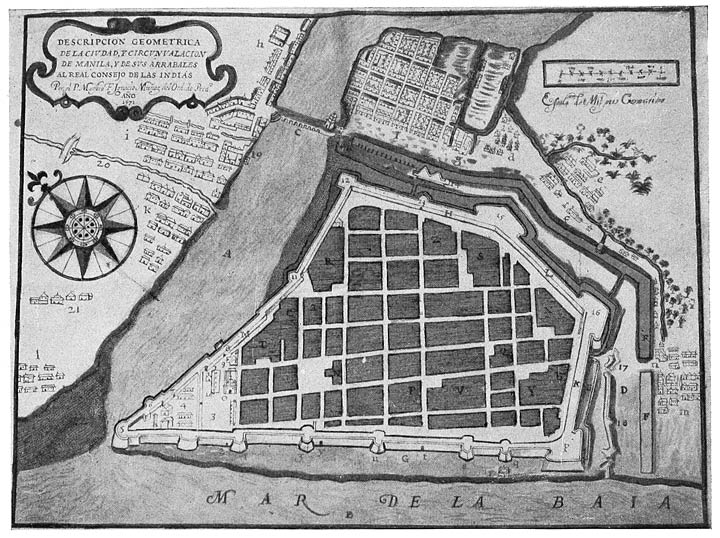
Map of Manila and its suburbs
[From MS. (dated 1671) in Archivo general de Indias, Sevilla]
7. All of us in this country see another very peculiar thing—namely, that although the city is small, and the Spaniards few in number, yet thousands of Chinese, mestizos, and natives are maintained for their service, so that there are about two hundred Chinese carpenters in the Parián, beside those of the other trades, and all of them are always employed in Manila by the Spaniards. There are about two hundred Chinese and mestizo barbers, all of whom live on the Spaniards; and others in the same proportion. Outside the walls there is a famous hospital for the natives, which is well taken care of by the Franciscan fathers who have charge of it. Opposite the fortress of San Gabriel lies our charge, namely, the care of the Chinese. There one finds a Chinese physician, Chinese medicines, a religious who understands the Chinese language, a nurse, and servants who have charge of everything. Rarely does one die without baptism, and many of them show abundant signs of salvation. All the neighborhood of Manila, except the part that borders on the sea, is filled with villages and churches—that of the Parián being ours, where there is always a religious who knows the Chinese language. Dilao is a village of Japanese, and has a Franciscan religious. The parish church of Santiago is for Spaniards who live outside the walls; also that of Nuestra Señora de Guia, which has a very miraculous image. Our image of the Rosary is most miraculous, and it is the consolation of all the city and of the islands. It is said that they have made imperial crowns for the Son and the Mother, even more precious than those which I said were possessed by our Lady of the Rosary and her Blessed Son in Mexico. The Recollect fathers of our father St. Augustine have [an image], an Ecce Homo, which excites devotion most powerfully, and has been taken to the hearts of all people. It was placed in position amid great rejoicing and imposing ceremonies, shortly after the arrival of Don Sabiniano Manrique de Lara—who took part therein very fervently, and who went to hear mass in that sanctuary every Friday throughout the year.