Volume 34 — PRIMO VIAGGIO INTORNO AL MONDO (continued 2)
Reading edition
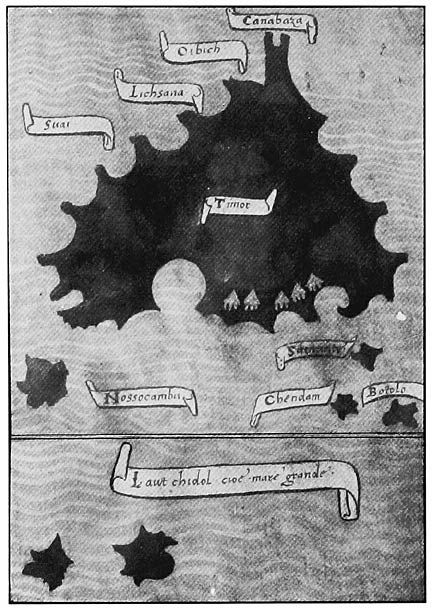
Longi vna giornata de qui tra iL ponente et iL maeſtrale ne fu deto trouarſe vna Jſola in laqalle naſcie assai cannella et se chiama Ende eL ſuo populo he gentille et nõ hanno re et como ſonno a la medeſma [Jſo: crossed out in original MS.] via molte yſolle vna dietro a lalta in fina a Jaua magiore et aL capo de malaca li nomi de leqalle ſonno queſti ende tana butun creuo chile bimacore aranaran Mani Zumbaua lomboch chorum et Jaua ma giore Queſti populi nõ la chiamano Jaua ma Jaoa le magiorj ville ſono in Jaua Sonno queſte Magepaher iL ſuo re Quando viueua era magiore de tutte queſte yſolle et chiamauaſſe Raia patiunus Sunda in queſta naſce molto peueri da ha dama gaghi amada Minutarãghan Cipara Sidaiu tuban creſſi Cirubaia et balli et como Jaua minore eſſere la yſola de Madura et ſtare apreſſo Jaua magiore meza legha Ancho ne diſſero Quando vno homo de li principali de Jaua magiore more Se bruſa Lo ſuo corpo La ſua moglie piu principalle adornaſſi cõ girlande de fiori et faſſi portare de tre ho catro hominj ſoura vno ſcanno ꝓ tuta qella vila et ridendo et confortando li ſui parenti que piangeno dice nõ piangere ꝓ cio me vado queſta cera a Cennare coL mio caro marito et dormire ſecho in queſta nocte poy et portata aL foco doue ſe bruſa Lo ſuo marito et ley voltandoſi contra li ſui parẽti et confortando li vnalta fiata Segetta neL fuocho oue ſe bruſa lo ſuo marito et ſe queſto nõ faceſſe nõ ſaria tenuta donna da benne ne vera moglie deL marito morto et Como li Joueni de Jaua Quando ſono Jnamo rati in qalque gentiL donna ſe ligano certi ſonagli cõ fillo tra iL membro et la peleſſina et vanno ſoto le feneſtre de le ſue Jnamorate et facendo moſtra de horinare et Squaſando Lo membro ſonano cõ qelli ſonagli et fin tanto le ſue Jnamorate hodeno lo ſono ſubito qelle veneno Ju et fanno ſuo volere Sempre cõ qelli ſonagliti ꝓ che loro donne ſe piglianno grã ſpaſſa aſen tirſi Sonare de dentro Queſti ſonagli ſonno tucti Coperti et piu ſe copreno piu ſonano JL nr̃o piloto piu vechio ne diſſe Como in vna yſola deta acoloro ſoto de Jaua magiore in Quella trouarſi ſinon femine et quelle Jnpregniarſi de vento et poi Quando parturiſcono ſiL parto et maſchio Lamazano ſe he femina lo aleuano et ſe hominj vanno aqella ſua yſola loro amazarli purche poſſianno. A day’s journey thence toward the west northwest, we were told that we would find an island where quantities of cinnamon grow, by name Ende.584 Its inhabitants are heathens, and have no king. [We were told] also that there are many islands in the same [isl: crossed out in original MS.] course, one following the other, as far as Java Major, and the cape of Malaca. The names of those islands are as follows: Ende, Tanabutun, Creuo, Chile, Bimacore, Aranaran, Mani, Zumbaua, Lomboch, Chorum,585 and Java Major.586 Those inhabitants do not call it Java but Jaoa. The largest cities are located in Java, and are as follows: Magepaher (when its king was alive, he was the most powerful in all those islands, and his name was Raia Patiunus); Sunda, where considerable, pepper grows; Daha; Dama; Gagiamada; Minutaranghan; Cipara; Sidaiu; Tuban; Cressi; Cirubaia;587 and Balli.588 [We were told] also that Java Minor is the island of Madura, and is located near to Java Major, [being only] one-half legua away.589 We were told also that when one of the chief men of Java Major dies, his body is burned. His principal wife adorns herself with garlands of flowers and has herself carried on a chair through the entire village by three or four men. Smiling and consoling her relatives who are weeping, she says: “Do not weep, for I am going to sup with my dear husband this evening,590 and to sleep with him this night.” Then she is carried to the fire, where her husband is being burned. Turning toward her relatives, and again consoling them, she throws herself into the fire, where her husband is being burned. Did she not do that, she would not be considered an honorable woman or a true wife to her dead husband.591 When the young men of Java are in love with any gentlewoman, they fasten certain little bells between their penis and the foreskin. They take a position under their sweetheart’s window, and making a pretense of urinating, and shaking their penis, they make the little bells ring, and continue to ring them until their sweetheart hears the sound. The sweetheart descends immediately, and they take their pleasure; always with those little bells, for their women take great pleasure in hearing those bells ring from the inside.592 Those bells are all covered, and the more they are covered the louder593 they sound. Our oldest pilot told us that in an island called Acoloro,594 which lies below Java Major, there are found no persons but women, and that they become pregnant from the wind. When they bring forth, if the offspring is a male, they kill it, but if it is a female they rear it. If men go to that island of theirs, they kill them if they are able to do so.
Ancho ne diſcero de ſoto de Jaua magiore ꝟſo la tramõtana neL golfo de la chijna Laqalle li anticqui chiamano ſigno magno trouarſi vno arbore grandisso neLqalle habitano vcceli deti garuda tanto grandi q̃ portano vn bufalo et vno elefante aL luoco doue he labore re chiamato puza thaer et Lo arbore cam panganghi aL ſuo fructo bua panganghi eLqalle he magiore q̃ vna anguria li mori de burne haueuamo ne li naui ne diſcero loro hauerne veduto ꝓ che lo ſuo re haueua dui mandatigli daL regnio de ſiam niun Jonco ne altra barcha da tre ho catro legue ſe po aꝓximare aL luoco de larbore ꝓ li grandi reuolutiõe de hacqua que ſonno circa queſto La pima fiata que ſi ſepe de queſto arbure fu vn Jonco ſpinto da ly vẽti ne la riuo lutiõe iLqalle tuto ſe diſfece tutti li homini ſe anegorono ecceto vn puto picolo ilqalle eſſendo atacato ſoura vna tauola ꝓ miraculo fo ſpinto apreſſo queſto arbore et mõtato ſoura lo arbore nõ acorgendoſi ſe miſſe ſoto lala a vno de qelli vcceli lo giorno ſeguento Lo vccelo andando in tera et hauendo pigliato vn bufalo iL puto venne de ſoto a la hala aL meglio puoto ꝓ cuſtui ſe ſepe Queſto et alhora Cogniobero qeli populi vicini li fructi trouauano ꝓ iL mare eſſere de queſto arbore. They also told us that a very huge tree is found below Java Major toward the north, in the gulf of Chiina (which the ancients call Signo Magno), in which live birds called garuda. Those birds are so large that they carry a buffalo or an elephant to the place (called Puzathaer), of that tree, which is called cam panganghi, and its fruit bua panganghi.595 The latter is larger than a cucumber. The Moros of Burne whom we had in our ship told us that they had seen them, for their king had had two of them sent to him from the kingdom of Siam. No junk or other boat can approach to within three or four leguas of the place of the tree, because of the great whirlpools in the water round about it. The first time that anything was learned of that tree was [from] a junk which was driven by the winds into the whirlpool. The junk having been beaten to pieces, all the crew were drowned except a little boy, who, having been tied to a plank, was miraculously driven near that tree. He climbed up into the tree without being discovered, where he hid under the wing of one of those birds. Next day the bird having gone ashore and having seized a buffalo, the boy came out from under the wing as best he could. The story was learned from him, and then the people nearby knew that the fruit which they found in the sea came from that tree.
JL capo de malacha ſta in vn grado et mezo aL antarticho a loriente de queſto capo a longo la coſta ſe trouão molte ville et cita de li nomi de algune ſono aq̃ſti Cinghapola q̃ ſta neL capo pahan Calantan patani bradlun benan lagon Che regigharan tumbõ prhan Cui brabri bangha Jndia Queſta e la cita doue habita iL re de siam eLqalle chiamaſſe Siri Zacabedera Jandibum Lanu et Langhon pifa Queſte citade ſonno edificade como le nr̃e et ſubgecte aL re de ſiam Jnqueſto regnio de ſiam ne le riue de li fiumi Si como ne fu deto habitanno vcceli grandi liqalli no mangerianno de alguno animale morto ſia portato iui ſe pima nõ vienne vno alto vccelo amangiarli iL core et poi Loro Lo mangiano dopo ſiam ſe troua Camogia iL ſuo re e deto Saret zacabedera chiempa eL ſuo re raia brahaun maitri inqueſto locho naſce lo reubarbaro et ſe troua in queſto modo ſe acaodunano vinti o vinti cinque hominj inſieme et vanno dentro ne li boſchi Quando he venuta la nocte montano ſoura li arbori ſi ꝓ ſentire Lodore deL reobarbaro como ancho ꝓ paura de leonnj elefanti et altre fere et daqella parte doue he lo reubarbaro iL vento li porta lodore poi venuto lo giorno vanno in qella parte doue li he venuto iL vento et lo cercanno fin tanto lo trouano Lo reubarbaro he vno arbure groſſo putrefato et ſenon foſſe cuſſi putrefacto non darebe lo hodore iL megliare de queſto arbore he la radice niente dimeno iL legnio he reobarbaro iLqaL chiamano Calama poi ſe truoua Cochi eL ſuo re e detto raia Seribumni pala dopo Queſto ſe troua la grã chijna iL ſuo re he magiore de tuto eL mõdo et chiamaſſe Santhoa raia iLqalle tenne ſetanta re de coro na ſoto de ſe alguni de liqalli anno dieci et quindice re de ſoto ſe eL ſuo porto he deto guantan fra le altre aſayssime citade ne ha due principalle dette namchin et Comlaha neliqalli ſta queſto re tienne catro ſui principali a preſſo Lo ſuo palatio vno verſo iL ponente lalto aL leuante lalto amezo de et lalto ala tramõtana ogni vno de queſti danno audientia Se nõ aqelli che veneno de ſua parte tucti li re et ſignori de la Jndia magiore et ſuperiore hobediſcono aqueſto re et ꝓ ſegnialle q̃ ſianno ſui veri vaſali ciaſcuna ha in mezo de la ſua piaza vno animale ſcolpito in marmore piu galiardo que iL leonne et chiamaſſe chinga Queſto chinga e lo ſigilo deL dito re de chijna et tucti qelli q̃ vanno ala chijna Conuieneno hauere Queſto animale ſcolpito in cera in vn dente de elephante ꝓ che altramente nõ potrianno intrare neL ſuo porto Quando alguno Signiore he in hobediente a queſto re lo fanno ſcorticare et ſecanno la pelle aL ſolle con ſale et poy la empi enno de paglia ho de alto et lo fanno ſtare cõ lo capo baſſo et cõ le many Jonte ſoura lo capo in vno luocho eminente ne la piaza acio Alhora ſi veda Cului far zonghu cioe riuerentia Queſto re nõ ſi laſcia vedere de algũo et Quando lui vole vedere li ſui Caualcha ꝓ iL palatio vno pauone facto maeſtralmente coſa richiſſima acompagniato de ſey donne de le ſue piu principalle veſtite Como lui fin che entra in vn ſerpente deto nagha rico Quanto altra coſa ſi poſſa vedere ilqalle e ſopa la corte magiore deL palatio iL re et le donne entranno dento açio lui nõ ſia cognioſſuto fra le donne vede li ſui ꝓ vno vedro grando q̃ e neL pecto deL ſerpente lui et le donne ſe ponno vedere ma nonſi puo diſcernere qaL he lore. Cuſtui ſe marita ne le ſue ſorelle acio lo ſangue realle nõ ſia miſſidiato cõ alti Circha lo ſuo pa latio ſonno ſette cerche de muri et fra ogni vna de queſte cerche ſtano diece millia homini q̃ fanno la gardia aL palatio fin q̃ ſona vna Cam pana poi vieneno diece millia alti homini ꝓ ogni cercha et cuſi ſe mudanno ogni giorno et ogni nocte ogni cercha de muro a vna porta ne la pima li ſta vno homo cõ vno granfionne in mano deto ſatu horã con ſatu bagan nella ſecondo vn canne detto ſatu hain nella terza vn homo cõ vna maza ferata deto Satu horan cũ pocum becin nela carta vno homo cõ vno archo in mano deto Satu horan con anat panan nella Quinta vn homo con vna lancia deto Satu horan con tumach ne la ſexta vno leonne deto Satu horiman nella ſeptima duy elefantj bianchi detti duo gagia pute in Queſto palatio li ſonno ſetanta noue ſalle doue ſtanno ſe non donne q̃ ſerueno aL re et li ſonno ſempre torcie acceſe Se tarda vno Jorno aſercare queſto palatio Jn cima de queſto li ſonno catro ſalle doue vanno alguna volta li principali a parlare aL re vna he hornata de metalo coſi de ſoto como de ſuura vna tuta de argento vna tuta de noro et Lalta de perle et petre precioſe Quando li ſui vaſſali li portanno horo ho altre coſe p̃ci oſe ꝓ tributo le butano ꝓ Queſte ſalle dicendo Queſto ſia a honnore et gloria deL nr̃o Sant hoa raia tute queſte coſe et molte altre de queſto re ne diſſe vno moro et lui hauerle vedute la gente de la chijna e biancha e veſtita et mangiano ſoura taule como nuy et anno croce ma non ſi ſa ꝓ che tengonno Jn Queſta chijna naſce Lo muſchio iL ſuo animale e vno gato Como qello deL gibeto et non mangia alto ſenon vn legnio dolce Sotile como li diti chiamato chamaru Quando voleno far lo muſchio atacano vno ſanſuga aL gato et li la laſcianno atacata infin ſia ben pienna de ſangue poi La ſtrucano in vno piato et meteno iL ſangue aL ſolle per cato ho cinque giornj poy lo bagniano cõ orina et il metenno altre tante fiate aL ſolle et cuſſi diuenta muſchio ꝓfeto ogniuno que tienne de queſti animali Conuien pagare vno tanto aL re Quelli pezeti que parenno ſian grani de muſchio ſonno de carne de capreto peſtatagli dento iL vero muſchio et ſe non iL ſangue et ſe ben diuenta in pezetti Se diſfa aL muſchio et al gato chiamano caſtori et ala ſanſuga lintha Seguendo poy la coſta de qʒſta chijna ſe trouano molti populi q̃ ſonno queſti li chienchij et ſtano in Jſole ne leqalli naſconno perle et cannela Li Lechij en tera ferma ſopa lo porto de Queſti trauerſa vna montagnia ꝓ laqaL ſe Conuien deſarburare tucti ly Jonqui et naui voleno Jntrare neL porto Jl re Mom in terra firma Queſto re ha vinti re ſoto diſe et e hobediente aL re de la chijna la ſua cita he deta bara naci Quiui e iL grã catayo orientalle Han yſola alta et frigida doue ſe truoua metalo argento perle et Seta iL ſuo re chiamaſſe raia Zotru Mli Janla eL ſuo re e detto raia chetisqnuga gnio lo ſuo re raia ſudacali tucti Queſti tre luogui Sonno frigidi et in terra ferma Triaganba Trianga due yſolle nelle Qualle vieneno perle metalo argento et ſeta il ſuo re raia Rrom Baſſi baſſa terra ferma et poi Sumbdit pradit due yſole richiſime de oro lihomini deleqalle portanno vna grã ſchiona de oro ne la gamba Soura iL piede Apreſſo Quiui ne la tera ferma in certi montagnie ſtano popoli che amazano li ſui padri et madre Quando ſonno vechi acio nõ ſe afati cano piu tucti li populi de Queſti luogui ſonno gentilli The cape of Malacha596 lies in one and one-half degrees toward the Antarctic Pole. Along the coast east of that cape are many villages and cities. The names of some of them are as follows: Cinghapola, which is located on the cape; Pahan; Calantan; Patani; Bradlun; Benan; Lagon; Cheregigharan; Tumbon; Phran; Cui; Brabri; Bangha; India, which is the city where the king of Siam, by name Siri Zacabedera, lives; Jandibum; Lanu; and Longhonpifa.597 Those cities are built like ours, and are subject to the king of Siam. On the shores of the rivers of that kingdom of Siam, live, as we are told, large birds which will not eat of any dead animal that may have been carried there, unless another bird comes first to eat its heart, after which they eat it.598 Next to Siam is found Camogia,599 whose king is called Saret Zacabedera; then Chiempa, whose king is Raia Brahaun Maitri.600 Rhubarb which is found in the following manner grows there. Twenty or twenty-five men assemble and go together into the jungles. Upon the approach of night, they climb trees, both to see whether they can catch the scent of the rhubarb, and also for fear of the lions, elephants, and other wild beasts. The wind bears to them the odor of the rhubarb from the direction in which it is to be found. When morning dawns they go in that direction whence the wind has come, and seek the rhubarb until they find it. The rhubarb is a large rotten tree; and unless it has become rotten, it gives off no odor. The best part of that tree is the root, although the wood is also rhubarb which is called calama.601 Next is found Cochi,602 whose king is called Raia Seribumni Pala. After that country is found Great Chiina, whose king is the greatest in all the world, and is called Santhoa Raia.603 He has seventy crowned kings subject to himself, and some of the latter have ten or fifteen kings subject to them. His port is called Guantan [i.e., Canton]. Among the multitude of other cities, there are two principal ones called Nanchin [i.e., Nanking] and Comlaha604 where the above king lives. He keeps his four principal men near his palace—one toward the west, one toward the east, one toward the south, and one toward the north. Each one of those four men gives audience only to those who come from his own quarter. All the kings and seigniors of greater and upper605 India obey that king; and in token that they are his true vassals, each one has an animal which is stronger than the lion, and called chinga,606 carved in marble in the middle of his square. That chinga is the seal of the said king of Chiina, and all those who go to Chiina must have that animal carved in wax [or] on an elephant’s tooth, for otherwise they would not be allowed to enter his harbor. When any seignior is disobedient to that king, he is ordered to be flayed, and his skin dried in the sun and salted. Then the skin is stuffed with straw or other substance, and placed head downward in a prominent place in the square, with the hands clasped above the head,607 so that he may be seen then to be performing zonghu, that is, obeisance. That king never allows himself to be seen by anyone. When he wishes to see his people, he rides about the palace on a skilfully made peacock, a most elegant contrivance, accompanied by six of his most principal women clad like himself; after which he enters a serpent called nagha,608 which is as rich a thing as can be seen, and which is kept in the greatest court of the palace. The king and the women enter it so that he may not be recognized among his women. He looks at his people through a large glass which is in the breast of the serpent. He and the women can be seen, but one cannot tell which is the king. The latter is married to his sisters, so that the blood royal may not be mixed with others. Near his palace are seven encircling walls, and in each of those circular places are stationed ten thousand men for the guard of the palace [who remain there] until a bell rings, when ten thousand other men come for each circular space. They are changed in this manner each day and each night. Each circle of the wall has a gate. At the first stands a man with a large hook in his hand, called satu horan with satu bagan; in the second, a dog, called satu hain; in the third, a man with an iron mace, called satu horan with pocum becin; in the fourth, a man with a bow in his hand called satu horan with anat panan; in the fifth, a man with a spear, called satu horan with tumach; in the sixth, a lion, called satu horiman; in the seventh, two white elephants, called two gagia pute.609 That palace has seventy-nine halls which contain only women who serve the king. Torches are always kept lighted in the palace,610 and it takes a day to go through it. In the upper part of it are four halls, where the principal men go sometimes to speak to the king. One is ornamented with copper [metalo], both below and above; one all with silver; one all with gold; and the fourth with pearls and precious gems. When the king’s vassals take him gold or any other precious things as tribute, they are placed in those halls, and they say: “Let this be for the honor and glory of our Santhoa Raia.611 All the above and many other things were told us by a Moro who had seen them. The inhabitants of Chiina are light complexioned and wear clothes. They eat at tables as we do, and have the cross, but it is not known for what purpose.612 Musk is produced in that country of Chiina. Its animal is a cat613 like the civet cat. It eats nothing except a sweet wood as thick as the finger, called chamaru.614 When the Chinese wish to make the musk, they attach a leech to the cat, which they leave fastened there, until it is well distended with blood. Then they squeeze the leech out into a dish and put the blood in the sun for four or five days. After that they sprinkle it with urine,615 and as often as they do that they place it in the sun. Thus it becomes perfect musk. Whoever owns one of those animals has to pay a certain sum to the king. Those grains which seem to be grains of musk are of kid’s flesh crushed in the real musk and not the blood.616 Although the blood can be made into grains, it evaporates. The musk and the cat are called castor and the leech lintha.617 Many peoples are to be found as one follows the coast of that country of Chiina, who are as follows. The Chienchii618 inhabit islands where pearls and cinnamon grow. The Lechii live on the mainland; above their port stretches a mountain, so that all the junks and ships which desire to enter that port must unstep their masts. The king on the mainland [is called] Mom.619 He has twenty kings under him and is subordinate to the king of Chiina. His city is called Baranaci. The great Oriental catayo620 is located there. Han621 [is] a cold, lofty island where copper [metalo], silver, pearls, and silk are produced, whose king is called Raia Zotru; Mli Ianla, whose king is called Raia Chetisqnuga;622 Gnio, and its king, Raia Sudacali. All three of the above places are cold and are located on the mainland. Triaganba623 and Trianga [are] two islands where pearls, copper [metalo], silver, and silk are produced, and whose king is Raia Rrom. Bassi Bassa [is] on the mainland; and then [follow] two islands, Sumbdit and Pradit,624 which are exceedingly rich in gold, whose inhabitants wear a large gold ring around the legs at the ankle. On the mainland near that point live a race in some mountains who kill their fathers and mothers as age comes on, so that they may have no further trouble. All the peoples of those districts are heathens.
Marti de nocte venendo aL mercore a vndici de febraro 1522 partendone de La yſola de timor ſe in golfaſſemo neL mare grande nominato Laut chidoL et pigliando lo nr̃o Camino tra ponente et garbin laſciaſemo a La mano drieta a La tramõtana ꝓ pagura deL re de portoghala la Jſola Zamatra antichamẽte chiamata Traprobana pegu bengala Vriza che lui nelaqalle ſtanno li malabari Soto iL re de narſingha Calicut ſoto Lo medeſimo re Canbaia nelaqalle ſonno li guzerati Cananor ghoa Armus et tutta laltra coſta de la india magiore in queſta india magiore li ſonno ſey ſorte de homini Nairi panichali yranai pangelini Macuai et poleai Nairj ſonno li principali panichali ſonno li Citadini Queſte due ſorte de hoj̃ Conuerſano inſieme Jranai Colgeno lo vino de la palma et fighi pagelinj Sonno li marinarj Macuai ſonno li peſcatorj poleai ſeminano et colgeno lo rizo Queſti habitanno ſempre neli campi mai intrano in cita alguna et quando ſe li da alguna coſa la ſe ponne in tera poy loro la piglianno coſtoro Quando vanno ꝓ le ſtrade cridano po po po çioe gar date damj, acadete ſi como ne fu referito vno nair eſſere tocho per diſgratia da vn polea ꝓ iLque iL nair ſubito ſe fece amazare açio non rimaneſſe cõ qeL deſhonnore Et ꝓ Caualcare lo capo de bonna ſperãza andaſſemo fin a Quaranta dui gradi aL polo antarticho ſteſſemo ſoura queſto Cauo noue ſetimane cõ le velle amaynate ꝓ lo vento accidentale et maiſtralle ꝓ proa et cõ fortuna grandiſsima iLqaL capo ſta de latitudine in trenquato gradi et mezo et mille et ſey cento legue longi daL capo de malaca et e lo magiore et piu pericoloſo capo ſia neL mondo aL guni de li noſti a malati et ſani voleuão andare a vno luoco de portu gheſi deto Mozanbich ꝓ la naue q̃ faceua molta hacqua ꝓ lo fredo grande et molto piu ꝓ nõ hauere alto da mangiare Se non rizo et hacqua ꝓ cio la carne haueuamo hauuta ꝓ non hauere ſale ne era pu trefata Ma alguni de li alti piu deſideroſi deL ſuo honnore q̃ de la ꝓpria vita deliberorono viui o morti volere andare in ſpagnia finalmente cõ lo ajuto de dio a ſey de magio paſaſſemo Queſto capo apreſſo lui cinque legue ſe non la ꝓximauamo tanto may Lo poteuão paſſare poi nauigaſſemo aL mayſtrale dui meſi continui ſenza pigliare refrigerio alcuno in queſto pocho tempo ne morſeno vinti vno homo Quando li butauamo neL mare li xp̃iani andauão al fondo con lo volto in ſuſo et li Jndij ſempre cõ lo volto in giu et ſe dio non ne conduceua bon tempo tucti moriuão de fame alfine conſtrecti de la grande neceſitade andaſſemo a le yſole de capo verde Mercore a noue de Julio agiungeſſemo a vna de queſte deta sto. Jacobo et ſubito madaſſemo lo batelo in tera ꝓ victuuaglia con queſta Jnuẽtiõe de dire ali portugheſi como ne era rocto lo trinqueto Soto la lignea equino tialle ben che foſſe ſoura lo capo bonna ſperanza et Quando lo conciauão Lo nr̃e capo generalle cõ le altre due naui eſerſi andata in ſpagnia con queſte bonne parolle et cõ le nr̃e mercadantie haueſſemo dui batelli pi ennj de rizo Cometeſſemo a li nr̃j deL batelo Quando andarono in tera domandaſſero que giorno era ne diſcero como era a li portugheſi Joue Se marauigliaſſemo molto ꝓ che era mercore anuy et nõ ſapeuamo Como haueſſemo herato ꝓ ogni Jorno yo ꝓ eſſere ſtato ſempre ſanno haueua ſcripto ſenza niſſuna Jntermiſſione ma como da poy ne fu deto non era erore ma iL viagio facto ſempre ꝓ occidente et ritornato a lo iſteſſo luocho Como fa iL ſolle haueua portato qeL vantagio de hore vinti catro como chiaro ſi vede eſſendo andato lo batello vnalta volta in tera ꝓ rizo furonnore tenuti tredici homini cõ lo batello ꝓ che vno de qelli como da poy ſapeſemo in ſpagnia dice ali portugheſi Como lo nr̃o capo era morto et alti et que noi nõ andare in ſpagnia dubitandone de eſſere ancho nuy preſi ꝓ certe carauelle ſubito ſe partiſſemo. Sabato a ſey de ſeptembre 1522 Jntraſſemo nella baia de S. lucar ſe nõ diſdoto homini et la mogior parte Jnfermy iL reſto de ſexanta q̃ partiſſemo da malucho qi morſe de fame chi fugite nela yſola de timor et qi furenno amazati ꝓ ſui delicti daL tempo q̃ ſe partiſſemo de queſta baya fin aL giorno pñte haueuão facto catordicy mille et quatro cento et ſaxanta leghe et piu Compiuto lo circulo deL mõdo deL leuante aL ponente. Luni a octo de ſeptembre butaſſemo lanchora ap̃ſo Lo molo de ſeuiglia et deſcaricaſſemo tuta lartigliaria Marti nuj tucti in Camiſa et diſcalci andaſſemo cõ vna torcia ꝓ vno in mano auiſitare iL luoco de sa. maria de la victoria et qella de sta. maria de lantiqua. On Tuesday night as it drew near Wednesday, February eleven, 1522, we left the island of Timor and took to the great open sea called Laut Chidol.625 Laying our course toward the west southwest, we left the island of Zamatra, formerly called Traprobana,626 to the north on our right hand, for fear of the king of Portoghala;627 [as well as] Pegu, Bengala, Uriza, Chelin where the Malabars live, who are subject to the king of Narsingha, Calicut, subject to the same king, Cambaia, where the Guzerati live, Cananor, Ghoa, Armus, and all the rest of the coast of India Major.628 Six different classes of people inhabit India Major: Nairi, Panichali, Yranai, Pangelini, Macuai, and Poleai.629 The Nairi are the chiefs; and the Panichali are the townspeople: those two classes of men have converse together. The Iranai gather the palm wine and figs. The Pangelini are the sailors. The Macuai are the fishermen. The Poleai are the farmers and harvest the rice. These last always live in the country, although they enter the city at times.630 When anything is given them it is laid on the ground, and then they take it. When they go through the streets they call out Po! po! po! that is “Beware of me!”631 It happened, as we were told, that a Nair once had the misfortune to be touched by a Polea, for which the Nair immediately had the latter killed so that he might erase that disgrace. In order that we might double the cape of Bonna Speranza [i.e., “Good Hope”], we descended to forty-two degrees on the side of the Antarctic Pole. We were nine weeks632 near that cape with our sails hauled down because we had the west and northwest winds on our bow quarter and because of a most furious storm.633 That cape lies in a latitude of thirty-four and one-half degrees, and is one thousand six hundred leguas634 from the cape of Malaca. It is the largest and most dangerous cape in the world. Some of our men, both sick and well, wished to go to a Portuguese settlement called Mozanbich,635 because the ship was leaking badly, because of the severe cold, and especially because we had no other food than rice and water; for as we had no salt, our provisions of meat had putrefied.636 Some of the others however, more desirous of their honor than of their own life, determined to go to Spagnia living or dead. Finally by God’s help, we doubled that cape on May six at a distance of five leguas. Had we not approached so closely, we could never have doubled it.637 Then we sailed northwest for two months continually without taking on any fresh food or water [refrigerio]. Twenty-one men died during that short time. When we cast them into the sea, the Christians went to the bottom face upward, while the Indians always went down face downward.638 Had not God given us good weather we would all have perished of hunger. Finally, constrained by our great extremity, we went to the islands of Capo Verde. Wednesday, July nine, we reached one of those islands called Sancto Jacobo,639 and immediately sent the boat ashore for food, with the story for the Portuguese that we had lost our foremast under the equinoctial line (although we had lost it upon the cape of Bonna Speranza), and when we were restepping it,640 our captain-general had gone to Spagnia with the other two ships. With those good words641 and with our merchandise, we got two boatloads of rice. We charged our men when they went ashore in the boat to ask what day it was, and they told us that it was Thursday with the Portuguese. We were greatly surprised for it was Wednesday with us, and we could not see how we had made a mistake; for as I had always kept well, I had set down every day without any interruption. However, as was told us later, it was no error, but as the voyage had been made continually toward the west and we had returned to the same place as does the sun, we had made that gain of twenty-four hours, as is clearly seen. The boat having returned to the shore again for rice, thirteen men and the boat were detained, because one of them, as we learned afterward in Spagnia, told the Portuguese that our captain was dead, as well as others, and that we were not going to Spagnia.642 Fearing lest we also be taken prisoners by certain caravels, we hastily departed.643 On Saturday, September six,644 1522, we entered the bay of San Lucar with only eighteen men and the majority of them sick, all that were left of the sixty men who left Malucho. Some died of hunger; some deserted at the island of Timor; and some were put to death for crimes.645 From the time we left that bay [of San Lucar] until the present day [of our return], we had sailed fourteen thousand four hundred and sixty leguas, and furthermore had completed the circumnavigation of the world from east to west.646 On Monday, September eight, we cast anchor near the quay of Seviglia, and discharged all our artillery. Tuesday, we all went in shirts and barefoot, each holding a candle, to visit the shrine of Santa Maria de la Victoria [i.e., “St. Mary of Victory”], and that of Santa Maria de l’Antiqua [i.e., “St. Mary of Antiquity”].647
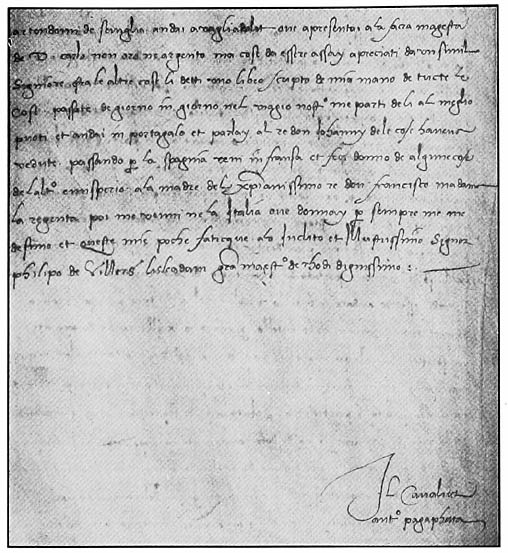
Partendomi de ſeuiglia andai a vagliadolit oue apreſentai a la ſacra mageſta de D. carlo non oro ne argento ma coſe da eſſere aſſay apreciati da vn ſimiL Signiore fra le altre coſe li detti vno libro ſcripto de mia mano de tucte le coſe paſſate de giorno in giorno neL viagio noſto me parti de li aL meglio puoti et andai in portagalo et parlay aL re don Johanny de le coſe haueua vedute paſſando ꝓ la ſpagnia veni in franſa et feci donno de algune coſe de lalto emiſperio a la madre deL xp̃ianiſſimo re don franciſco madama la regenta poi me venni ne la Jtalia oue donnay ꝓ ſempre me medeſimo et Queſte mie poche faticque a lo Jnclito et Illuſtriſſimo Signor philipo de Villers lisleadam grã maeſto de rhodi digniſſimo. Leaving Seviglia, I went to Vagliadolit [i.e., Valladolid], where I presented to his sacred Majesty, Don Carlo, neither gold nor silver, but things very highly esteemed by such a sovereign. Among other things I gave him a book, written by my hand, concerning all the matters that had occurred from day to day during our voyage.648 I left there as best I could and went to Portagalo where I spoke with King Johanni of what I had seen. Passing through Spagnia, I went to Fransa where I made a gift of certain things from the other hemisphere to the mother of the most Christian king, Don Francisco, Madame the regent.649 Then I came to Italia, where I established my permanent abode, and devoted my poor labors to the famous and most illustrious lord, Philipo de Villers Lisleadam, the most worthy grand master of Rhodi.
JL Caualier The Cavalier
anto pagaphetta Photographic facsimile of last page of Pigafetta’s relation showing signature [From the Pigafetta MS. in the Biblioteca Ambrosiana, Milan, Italy] Antonio Pagaphetta650
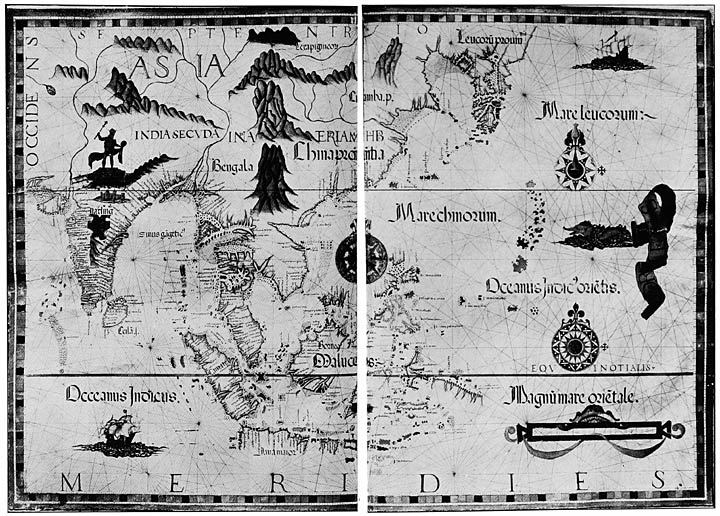
Map of eastern Asia and the eastern archipelago, showing the Moluccas; drawn by Diego Homem, ca. 1558 (on vellum)
[Photographic facsimile of original manuscript map in the British Museum]