← Table of contents
The Philippine Islands, 1493-1898—Volume 34 of 55, 1519-1522; 1280-1605

Volume 34 — RELATION OF THE PHILIPINAS ISLANDS

Reading edition

The people of this island are very skilful in their handling of gold. They weigh it with the greatest skill and delicacy that has ever been seen. The first thing that they teach their children is the knowledge of gold and the weights with which they weigh it, for there is no other money among them. This province, as well as all the others, has the greatest abundance of cocoa palms. This is one of the most fruitful and profitable trees that has ever been found hitherto for [the sustenance of] human life. The things that are obtained from this tree seem incredible to one who has not seen it. For, first, the wood is used in the construction of houses, and the leaves are used for tiles. The fruit is the cocoanut which is good to eat. They have a liquor inside, from which is made milk for cooking rice and other things. Oil is obtained from it which is medicinal like the oil of aparicio. Drinking vessels are made from the shells and a considerable number of them are taken to España. Wine is also made from it (and it is so good that that of España is no better), as well as brandy, vinegar, honey, preserves, and other things that I do not remember. Consequently from the palm the people get whatever they wish. This province contains a very great abundance of game such as buffaloes (which the other islands do not have), many deer, wild boars, a great abundance of goats, and many waterfowl. Many swine and fowl are raised in the houses, eight of the latter being sold for four reals. A very great abundance of fish including sardines are caught in all the settlements of this island, and those people relish it more than meat.

Province of Ylocos

Province of Cagayan
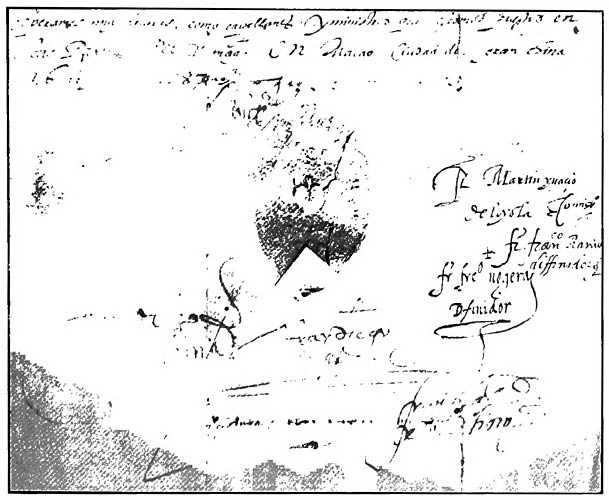
Signature of Martin Ignacio de Loyola (author of the Itinerario in Mendoza’s Historia de ... China—see VOL. VI, pp. 134–153, this series); et al.

Signature of Martin Ignacio de Loyola (author of the Itinerario in Mendoza’s Historia de ... China—see VOL. VI, pp. 134–153, this series); et al.

[Photographic facsimile of original MS. in Archivo general de Indias, Sevilla]

Province of Camarines

Notes in this chapter

Note 1 · See the excellent “History of the population” of the Philippine Islands, by Dr. David P. Barrows, in Census of Philippine Islands, pp. 411–4Note 2 · Possibly the state of Achen in Sumatra is meant. ↑Note 3 · Cf. Loarca’s account of the beliefs of the Visayas Islands, VOL. V, pp. 121–141, 163, 165, of the Tagálogs, pp. 171–175; Plasencia’s accountNote 4 · That is Franciscans, who first went to the islands in 1577. Salazar in his relation (VOL. VII, p. 39), says also that there were twelve reliNote 5 · Loarca (VOL. V, pp. 87, 88) mentions the names of the ten encomiendas about the lake of Bay. Salazar (ut supra) allows but eight encomenderoNote 6 · The production of cotton in the Philippines has been almost entirely confined to the island of Luzón, and was formerly much more important tNote 7 · Cf. Loarca’s account of the province of Ilocos, VOL. V, p. 103, and Salazar’s, VOL. VII, p. 37. ↑Note 8 · The cotton area of Cagayan did not reach 100 hectares in 1902, and the rice crop for that year was only 89,285 hectoliters. In 1902 Cagayan Note 9 · Montero y Vidal (Hist. de Filipinas, i, p. 84) says of this incident: “A Japanese pirate, called Tayfusa or Taizufa, having made himself masNote 10 · Francisco Cabral was born at Covilham Portugal, in 1528, and entered his novitiate in the Society of Jesus at Goa in 1554. He professed philNote 11 · The author probably includes in the term Camarines the modern provinces of Ambos Camarines, Albay, and Sorsogón, and possibly Tayabas. In 19Note 12 · This is the Bucaygan of Loarca (see VOL. V, p. 99), and must be the point on the southeastern extremity of Sorsogón. ↑Note 13 · See Pigafetta’s description of the city of Brunei, ante, VOL. XXXIII, p. 221; see also VOL. IV, p. 160 ff. ↑Note 14 · Literally: “Notwithstanding that our men were four cats.” ↑Note 15 · The second part of the island of Luzon is the province of Ylocos, which is located more northerly than Manila. That province contains a SpanNote 16 · About thirty leguas farther on from that Villa Fernandina and past the cape called Boxeador and in a latitude of nineteen degrees lies the pNote 17 · The other cape of this island of Luzon lying to the southeast is called Buza y Gan.11 It lies in a latitude of thirteen and one-third degreeNote 18 · That province is called Camarines and is very large and densely populated. It contains many small provinces in its confines. The people are
Explore with AITake your curiosity a little further.

Reading settings