Volume 34 — CHAPTER XL
Reading edition
Ma-yi
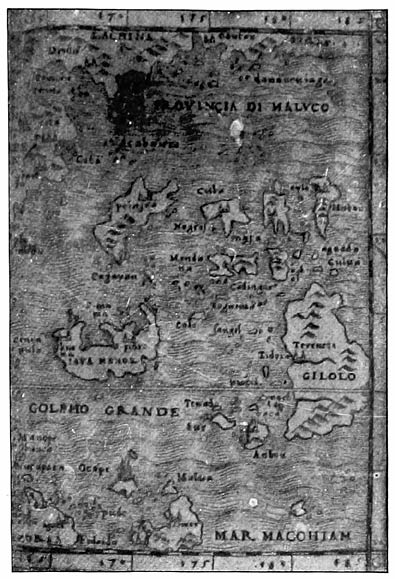
“India tercera nova tabula”—map of the Eastern archipelago; from Mattiolo’s edition of Ptolemy’s Geographia (Venetia, M. D. LXVIII)
[From a copy of this work in possession of Frank A. Hutchins, Madison, Wisconsin]
Notes in this chapter
Note 1 · There is no direct reference as to the time in which Chao Ju-kua lived, but his name is mentioned in the Imperial Catalogue, whence it appeaNote 2 · “Ma-yi,” the ancient name for Luzón, is derived from “Bahi” or “Bahy,” former names of the lake of Bay. In other Chinese dialects, the name Note 3 · Ancient Chinese name for the island of Borneo.—B. ↑Note 4 · Probably the river is the Pasig, and the settlement, Manila.—B. ↑Note 5 · Sarong is the Malay word for skirt.—B. ↑Note 6 · This confirms the statement that the Philippine Islands were once under the influence of Buddhism, from India.—B. It is far more likely thatNote 7 · The Chinese call all foreigners savages except the Japanese, Koreans, and people of Anam.—B. ↑Note 8 · San-hsii signifies the “Three Islands” and is attributed to the Visayan Islands. Pai-pu-yen is perhaps the Babuyanes. Pu-li-lu may be MindanNote 9 · Stangl believes that the yellow wax is an aromatic resin resembling wax, and somewhat like but not exactly the same as white pitch, and todaNote 10 · i.e., Tortoise-shell.—B. ↑Note 11 · Yu-ta seems to be the abacá.—B. Stangl prints “yii-ta.” ↑Note 12 · Coins of Siam and Java? For it appears that such coins circulated in the country.—B. Stangl reads the second half of this note “But how did Note 13 · Stangl inserts here “iron fixtures” [enseres de hierro]. ↑Note 14 · The following paragraph begins chapter xli in Stangl. ↑Note 15 · Ka-may-en is Mait or the modern Mindoro; and Pa-lao-yu, Paragua. “Pa-chi-neng” may also be read “Pa-kat-lung” and “Ba-ki-lung.” It seems to Note 16 · I believe that the word “tribe” means here village or settlement; for I think that the author meant to say that the villages usually had oneNote 17 · This phrase needs explanation. The Indians were accustomed to stain the teeth black, a custom quite general among many Malay nations. The NeNote 18 · These “Hay-tan” are the Aetas, Itas, or Negritos of modern authors. The antiquity of this ethnographical name surprises us. The description Note 19 · This refers to the Indians and not the Negritos.—B. ↑Note 20 · Of the mouth of the rivers?—B. ↑Note 21 · By cotton, the author evidently means cotton textiles.—B. This is not necessarily so. Stangl remarks that the author’s meaning must be the tNote 22 · Foreign cloth: sinamay [a light fabric made from abacá] and other textiles of the country?—B. ↑Note 23 · Camotes?—B. ↑Note 24 · The author accentuates the fact that the Visayan villages had no common jurisdiction. This appears to imply that several villages in Luzón wNote 25 · The island of Mindanao was also more populous during the period of the Spanish conquest than now. The islands of Sarangani which have now 1,Note 26 · According to the letters from the Jesuit fathers of Filipinas, there are yet similar coasts near Zamboanga, and such as are described by theNote 27 · This reminds us of the dangerous and arduous navigation about the eastern and southern coasts of Mindanao, especially near Cape San Agustin.Note 28 · The country Ma-yi2 is located north of Poni.3 About one thousand families inhabit the shores of a river which has many windings.4 The nativeNote 29 · In order to trade, the savage traders are assembled,7 and have the goods carried in baskets, and although the bearers are often unknown, nonNote 30 · The most noteworthy places of this country are: San-hsii; Pai-pu-yen; Pu-li-lu, which is located near San-hsii; Li-yin-tung; Lin-hsin; and LNote 31 · San-hsii, or the “Three Islands,” belong to Ma-yi. Their names are Ka-may-en, Pa-lao-yu, and Pa-chi-neng.15 Each of these islands is inhabitNote 32 · When foreign traders come to one of their villages,19 they must not touch the ground, but must remain aboard their vessel, which is anchored