INDEX. (continued 8)
Reading edition
Only the ancient profane, never seemed sure any more than the modern whether an apparition was the eidolon of a relative or the genius of the locality. Enneus while celebrating the anniversary of the name of his father Anchises, seeing a serpent crawling on his tomb knew not whether that was the genius of his father or the genius of the place (Virgil). “The manes143 were numbered and divided between good and bad; those that were sinister, and that Virgil calls numina larva, were appeased by sacrifices that they should commit no mischief, such as sending bad dreams to those who despised them, etc:”
Tibullus shows by his line:—
Ne tibi neglecti mittant insomnia manes. (Eleg., 1. II.)
“Pagans thought that the lower Souls were transformed after death into diabolical aerial spirits.” (Leloyer p. 22.)
The term Eteroprosopos when divided into its several compound words will yield a whole sentence, “an other than I under the features of my person.”
It is to this terrestrial principle, the eidolon, the larva, the bhoot—call it by whatever name—that reincarnation was refused in Isis.144
The doctrines of Theosophy are simply the faithful echoes of Antiquity. Man is a Unity only at his origin and at his end. All the Spirits, all the Souls, gods and demons emanate from and have for their root-principle the SOUL OF THE UNIVERSE—says Porphyry (De Sacrifice). Not a philosopher of any notoriety who did not believe (1) in reincarnation (metempsychosis), (2) in the plurality of principles in man, or that man had two Souls of separate and quite different natures; one perishable, the Astral Soul, the other incorruptible and immortal; and (3) that the former was not the man whom it represented—“neither his spirit nor his body, but his reflection, at best.” This was taught by Brahmins, Buddhists, Hebrews, Greeks, Egyptians, and Chaldeans; by the post-diluvian heirs of the prediluvian Wisdom, by Pythagoras and Socrates, Clemens Alexandrinus, Synesius, and Origen. the oldest Greek poets as much as the Gnostics, whom Gibbon shows as the most refined, learned and enlightened men of all ages (“See Decline and Fall,” etc.). But the rabble was the same in every age: superstitious, self-opinionated, materializing every most spiritual and noble idealistic conception and dragging it down to its own low level, and—ever adverse to philosophy.
But all this does not interfere with that fact, that our “fifth Race” man, analyzed esoterically as a septenary creature, was ever exoterically recognized as mundane, sub-mundane, terrestrial and supra mundane, Ovid graphically describing him as—
“Bis duo sunt hominis; manes, caro, spiritus, umbra Quatuor ista loca bis duo suscipiunt. Terra tegit carnem, tumulum circumvolat umbra, Orcus habet manes, spiritus astra petit.”
Ostende, Oct., 1886.
Poetical Occultism.
SOME ROUGH STUDIES OF THE OCCULT LEANINGS OF THE POETS.
II.
Perhaps no passage in Light on the Path is more forcible than that which warns the disciple against allowing the idea of separateness from any evil thing or person to grow up within him. He is bidden to, “be wary, lest too soon you fancy yourself a thing apart from the mass.” The Bagavad-Gita utters the same truth in other words by picturing man as led astray by the pride of self-sufficiency and the great danger underlying the desires and passions of the individual soul. Throughout life the student of occultism daily renews the struggle of soul against flesh, of faith against desire. This combat is finely pictured in Tennyson’s Palace of Art. It is truly an occult palace. Four courts are made, east, west, south and north, with a squared lawn in each, and four great fountains “stream in misty folds.” Here we are reminded of the Garden of Eden with its four rivers, of which Eliphas Levi says: “this description of the terrestrial paradise is resumed in the figure of a perfect pentacle. It is circular or square, since it is equally watered by four rivers disposed in a cross.” The square, answering to the number four was indeed the great kabbalistic figure, representing the Trinity in Unity. Nor is the mystic circle wanting in our occult palace, for there are “cool rows of circling cloisters” about the squares, and a gilded gallery that “lent broad verge to distant lands,” and “incense streaming from a golden cup,” another mystic symbol, representing the passive or negative side of nature. Full of sumptuousness was this palace, built for the soul that she might dwell in sensuous luxury, remote from the struggling world. Then the poet shows us further into the recesses of his sweet thought, and we see in the pictures with which the palace was hung, a portrayal of the various life experiences of the soul as it passes from phase to phase, from room to room of this great palace which is human life.
“Full of great rooms and small the palace stood, All various, each a perfect whole From living nature, fit for every mood And change of my still soul.”
From high estate to low the soul thus passes, from a “glimmering land” to “iron coast and angry wave;” from uplands of toil and harvest, to the “high bleak crags of sorrow,” from Greece and Sicily to India or the North, until “every landscape, as fit for every mood was there, not less than truth designed,” a rich panorama of reincarnations. Amongst all these the soul moves joyful and feasting, “Lord of the senses five,” communing with herself that all these are her own in the “God-like isolation which is hers.”
“Then of the moral instinct would she prate, And of the rising from the dead, As hers by right of full-accomplished Fate, And at the last she said: I take possession of man’s mind and deed. I care not what the sects may brawl. I sit as God, holding no form of creed But contemplating all.”
So three years she throve and prospered, but in the fourth year, (mark again the occult number of perfection,) a great dread came upon her, she was plagued in “the abyssmal deeps of personality” with a sore despair. The moment of choice, the turning point had come, that period of which Esoteric Buddhism speaks as occurring for the race in the fifth round but to which some exceptional personalities have forced themselves in this our fourth round. Many occultists will see their own experience mirrored in that of this tormented and lonely soul, contemplating her “palace of strength whereof the foundation stones were laid since her first memory,” only to see in its dark corners, “uncertain shapes, horrible nightmares, white-eyed phantasms and hollow shades enclosing hearts of flame.” Do we not seem to see all the elemental world, led on by the dread Dweller of the Threshold here confronting us? The struggle is even more powerfully depicted but the lesson is learned; the soul may retrieve herself by a lowly life; she throws aside her royal robes, and recognizing the need of mixing with her kind, begs for a “cottage in the vale.”
The poet reserves for his last verse the final lesson that only when we lead others to the heights and share these with our kind, can we ourselves stand steadfast there:
“Yet pull not down my palace towers, that are So lightly, beautifully built; Perchance I may return with others there When I have purged my guilt.”
A footnote in the September Path states:—“After all, the whole process of development is the process of getting back the memory of the past. And that too is the teaching found in pure Buddhism, etc.” Sometimes we are conscious of vague callings to do a certain thing, and critically regarding ourselves, we cannot see in this life any cause. It seems the bugle note of a past life blown almost in our face: it startles us; sometimes we are overthrown. These memories affect us like the shadows of passing clouds across our path, now tangible; then fading, only a cloud. Now they start before us like phantoms, or like a person behind you as you look at a mirror, it looks over the shoulder. If they are indeed reminiscences of other lives, although dead and past, they yet have a power. Hear what Lowell whispers in “The Twilight” of these mysterious moments:
“Sometimes a breath floats by me, An odor from Dreamland sent, Which makes the ghost seem nigh me Of a something that came and went, Of a life lived somewhere, I know not In what diviner sphere: Of mem’ries that come not and go not; Like music once heard by an ear That cannot forget or reclaim it; A something so shy, it would shame it To make it a show. A something too vague, could I name it, For others to know: As though I had lived it and dreamed it, As though I had acted and schemed it Long ago. And yet, could I live it over, This Life which stirs in my brain; Could I be both maiden and lover, Moon and tide, bee and clover, As I seem to have been, once again. Could I but speak and show it. This pleasure more sharp than pain. Which baffles and lures me so! The world would not lack a poet, Such as it had In the ages glad, Long Ago.”
Emerson, who saw further into the world of nature than any poet of our race, gives us this:
“And as through dreams in watches of the night, So through all creatures in their form and ways, Some mystic hint accosts the vigilant, Not clearly voiced, but waking a new sense, Inviting to new knowledge, one with old.”
The hermetic maxim, “As above so below,” sends us indeed to nature for initiation, and the Gita follows up this nail with a hammer by saying: “The man, O Arjoona, who, from what passeth in his own breast, whether it be pain or pleasure, beholdeth the same in others, is esteemed a supreme Yogi.” Analogy, Harmony, Unity, these are the words traced over and over for us, the shining rays of the one Law. These are the thoughts in which the poets delight. Emerson speaks again with still clearer voice:
“Brother, sweeter is the Law Than all the grace Love ever saw, If the Law should thee forget. More enamored serve it yet. * * I found this; That of goods I could not miss If I fell within the line; Once a member, all was mine: Houses, banquets, gardens, fountains, Fortune’s delectable mountains. But if I would walk alone Was neither cloak nor crumb my own.”
The Biblical verse:—“It is more blessed to give than to receive,” is a great occult teaching. As we strengthen the muscles by exercise, so we enlarge the intelligence and the heart by constantly dispensing our means, whether these be golden thoughts, or time, or affections, all along the line of Brotherhood. Not because of a sentiment, but because Life is made up of vibrations which our scientists, cautious as they are, admit may affect the farthest stars.
“Like warp and woof, all destinies Are woven fast, Linked in sympathy, like the keys Of an organ vast. Pluck but one thread, and the web ye mar; Break but one of a thousand keys, and the paining jar Through all will run.”
This from Whittier reminds us of the lines on Karma in Light on the Path. “Remember that the threads are living,—are like electric wires, more, are like quivering nerves. How far, then, must the stain, the drag awry, be communicated.” Yes, the communion of saints is a living fact. We all commune, not alone with one another; with those above us and with those below, but essentially with our time. Not one of us can escape its influence: we oppose its conclusions, deny its powers, and meanwhile it speaks through us, without our knowledge, the passwords we do not yet understand. This “dark age” is still the birth-place of spiritual development, of an awakening belief in the supernatural, or that which overshadows nature. We have had no more safe, practical sober poet than Whittier, who sweetly sings the life of every day, when he is not stirred by the fret of the times, to Freedoms larger issues. Yet hear him describing the power of a “wizard:”
“All the subtle spirits hiding Under earth or wave; abiding In the caverned rock, or riding Misty clouds, or morning breeze. Every dark intelligence, Secret soul, and influence Of all things, which outward sense Feels, or hears, or sees,— These the wizard’s skill confessed.—”
Is not here an “outward sense” of Professor Denton’s discoveries of the “soul of things?” But hear further the poet’s confession of faith in the occult power of will:
“Not untrue that tale of old! Now as then, the wise and bold All the powers of nature hold, Subject to their kingly will. Still to such, life’s elements, With their sterner laws dispense, And the chain of consequence Broken in their pathway lies. To his aid the strong reverses, Hidden powers and giant forces, And the high stars in their courses, Mingle in his strife.”
The italicized lines are almost an echo of the words of an Adept when speaking of the possibility for the disciple, of an ultimate escape from the laws of Karma, which give him the right to demand the secrets of nature. “He obtains this right by having escaped from the limits of nature, and by having freed himself from the rules which govern human life.” So does Whittier’s initiate. For every one of us there looms a danger in our being prone to mistake desire for will. The paradox of Levi is sound and true: “The will obtains all that it does not desire.” Meditation in this direction will reveal some deep and useful truths to the practical occultist.
But to return to our poets. There are many butterfly hints to be found fluttering through their lines. Time has spared us this one from Marvel:
“At some fruit-tree’s mossy root, Casting the body’s vest aside My soul into the bows does glide; There, like a bird, it sits and sings.”
And Matthew Arnold, turned dreamer for the nonce, has netted us one, more meaty than diaphanous, in which we find hints of periodic Devachanic sleep, between every period of earth struggle, of man’s threefold nature which serves to hide the memory of his other lives, and a touch of Karma as well:
“The Guide of our dark steps a triple veil Betwixt our senses and our sorrow keeps; Hath sown with cloudless passages the tale Of grief, and eased us with a thousand sleeps.”
It would sometimes seem, as in the above quotation, that the poet himself was scarcely conscious of the full bearing of what he wrote, as if that dim something from another life of which Lowell spoke, had brushed him with its wing unawares. Often the higher Self speaks out from a man’s work, to other men whose consciousness has a higher development than his own, while it has not as yet revealed itself to him. How many men tremble thus on the borders of the unseen. Let us beware whom we set down as remote from our communion, “for in an instant a veil may fall down from his spirit, and he will be far ahead of us all.” There is an occult verse from Goethe which has been quoted by Tyndall in one of those sad and baffled paragraphs which darkle through the works of our scientists, shadowy witnesses that these distinguished materialists and physicists are often nearer our path than they or we suspect. Through such they seem to call for deliverance. We give the verse in its setting, leaving Tyndall’s prose to point its poetic meaning.
“As regards knowledge, physical science is polar. In one sense it knows, or is destined to know everything. In another sense it knows nothing. Science understands much of this intermediate phase of things that we call nature, of which it is the product; but science knows nothing of the origin or destiny of nature. Who or what made the sun, and gave his rays their alleged power? Who or what made and bestowed upon the ultimate particles of matter their wondrous power of varied interaction? Science does not know: the mystery, though pushed back, remains unaltered. To many of us who feel that there are more things in heaven and earth than are dreamt of in the present philosophy of science, but who have been also taught by baffled efforts, how vain is the attempt to grapple with the Inscrutable, the ultimate frame of mind is that of Goethe:”
“Who dares to name His name, Or belief in him proclaim, Veiled in mystery as He is, the All-enfolder? Gleams across the mind His light, Feels the lifted soul His might; Dare it then deny His reign, the All-upholder?”
Julius.
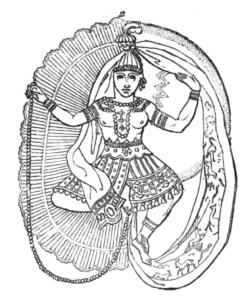
Hindu Symbolism.
II.
This figure represents Brahma-Maya or Mahat-Maya, Brahma Viraj, or the great Illusion.
The androgene or male-female, the Great Appearance, the first revelation of the Being or Brahman (neuter), under the form of the double-sexed first emanation. The neuter, became male and female, by separation into the male, positive, forming the spiritual—the entities or the noumena, and his sakti or female, the negative, or plastic, matter, the illusionary or phenomenal existence. The sakti, is his developing energy, force or potentiality. This symbol, the divine type of the first male and female, which can be compared with the terrestrial Adam before the final separation of Eve, is really in consonance with this Adam’s perfect ideal, the Adam Kadmon or Heavenly Adam of the Kabbalah. The Brahma-half is on the right side, the good side, man’s, the Maya-half is on the left, the evil side, the woman’s. So according to the Hebrew sacred writings, through Eve the woman, evil was brought into the world. Compare with this the Greek myth of Pandora. Issuing from the linga-yoni is the pearl chain, or connected circle of the existences, looked upon as united atoms, and the symbol of all the existing. It is held up by the hand on the male side.
Brahman (neuter), appears here as manifested in the male in union with the female sakti, of the preformatory imagination, as the ante creative monarch and Pearl King, richly decorated with the circles of the soul-monads and atoms. On his head is the world egg cap. The veil of the existences, upon which are woven the ideas or models of the to-be-emanated existences, flows from the linga-yoni to the highest part of the head and thence down the right side. He as the male, has a tendency to twist himself upon himself and his face bears the stamp of deep meditation. The aureole of fire is on the male side and from it scintillate sparks upon the veil of Maya. On the Maya side, the attitude is that of joy or dancing; the hand raised as if in play, holds up the veil, bells are hanging on her robe and singularly the Egyptian hieroglyphic for the water of life is shown; while the bust is developed. Portrayed upon the veil are the prototypes of the creatures. Compare the symbolism of the girdle of Aphrodite and that of Venus.
As the double spouse of Brahman (neuter) considered apart and in opposition to It. The Brahma-Maya is the life in nature, of which, Brahman (neuter) is the soul. The Brahma-Maya is that blind energy and force, potential and powerful, and eternally fecund, which is incessantly producing under forms which are without cessation renewed; and which is adored in India to-day, as the Great Mother, the Universal Mother, in other words all nature deified. Maya is the mother of Love or Desire, the first principle or affinity of all affection, creation, matter. She is even matter itself, but the primitive subtile matter co-existing with God (Brahman, neuter) from all eternity, contained in It, and symbolized by the three colors, red, white, black; the three qualities or powers of creation, preservation and destruction, consequently the Trimurti, and also the three gunas (qualities), Truth, Action, and Indifference, of the Bhagavadgitâ.145 It is Maya, who through the attraction of her beauty, causes the Most High, from the bosom of Its ineffable profoundity, forgetting Itself, to unite Itself, in the intoxication of desire with that divine enchantress.
The mysterious veil, which she had woven with her hands, received entirely from both, and the thought of the Eternal Almighty became fecundated, and fell into Time. The innumerable forms of the creatures, represent the perfect ideals woven upon the magic tissue, the woven warp and woof of all existence, with which veil Maya146 envelops her spouse and causes the recurrence of the gift of life.
Isaac Myer.
Teachings of the Master.
RECORDED BY ONE OF THE AUTHORS OF “MAN: FRAGMENTS OF FORGOTTEN HISTORY.” (Copyrighted.)
THE JOURNEY.
The Master stood on a great ledge of rock extending far out over a precipice that seemed miles below. With his face lighted by the first rays of the coming day that shot across the peaks above him and with his hands clasped behind him he waited in silence for the coming of the pupil to whom he had signalled. A Brother lying on the grass not far removed from the natural platform upon which he stood, questioned kindly the possibility of so long a journey by so feeble a student—but the Master waited looking piercingly across the distance. His eyes gazed intently before him turning neither to the right nor to the left, and when in the far azure of the clouds he saw approaching the soul that had projected itself at his bidding, he impelled his thought to his Brother who instantly recognized the approaching visitant. The Soul gaining in velocity every moment was in the presence of the Master before the twinkling of an eye could be noted—and prostrate before him could only articulate: “Master! Master!”
A touch of the purified hand pacified the terrible emotions of the new comer, who in suppliant attitude awaited the command of the Beloved Guru. “Rise my child,” came from the lips of the Teacher; who, when he was obeyed continued:
“Your progress is clogged by your indifference to duty. There can be no relations between us unless you disembody your desires and spiritualize every thought. Imprison the latter when they wander, and live to teach the lessons so often inculcated in your higher mind. Help your fellow-beings to better comprehend the capabilities of the inner, living Self.
“By the known laws of attraction and repulsion illustrate to them the impossibility of a higher life on earth for any but clean souls. There can be no mutuality of thought between clean and unclean natures—and the only hope of advancement is by casting off the latter and enveloping the real self in the shelter of noble thoughts. Teach that it is matter that is illusionary—life that is a transitory vision—earthly vanities that blind the eyes of the world.
“Try to speak of these secret things to the lowly and the burdened who are often endowed with a wisdom not to be found among the other and opposite classes. Tell them that the Spirit does have a real existence here in matter—does exercise absolute philanthropy, divine goodness—supreme self sacrifice; does know the power it possesses. Return to your duty refreshed. Let the sunlight now breaking over the hills and the mountains of Himavat radiate through your transparent spirit. Drink of the dew of the morning and feed upon the honey of wisdom that flows in upon your hungry Soul. Thus will you be strengthened to meet the conflict in the plain of action wherein you are constrained by your weakness to work. Thus will you escape from it and find in the mountain the repose and intuition for which you are yearning.”
The Brother whose form had lain in repose on the grass now approached and looking intently at the disciple entranced with delight and gratitude—said in stronger tones than the Beloved Master:
“In the land where your body lies secure from an intrusion that would result in your absolute separation from it—the great conflict is about to be fought. All the preliminary preparations have been made. A people freed from many chains—fast sinking into a materialism only recognized absolutely when some momentary impulse to generosity moves them—is to rise or fall with this closing cycle. To such a Babe as you is revealed a fact not perceived by the best minds among them. Go back there to work! Obey the impulse to throw aside every barrier—to do away with subterfuges deemed best for the personality, and go the rugged way lone and alone. In the time of greatest need we will comfort you and send the comforter to those whose Karma leads them to do battle in the same field. To you the sustaining force of our Fraternity will be contributed so long as the battle is waged for the race: the conquered rescued from their low estate and the Light of the Logos offered to every one who walks in the night of earth-life without guide and compass.”—Then there was silence.
The Beloved Master touching the speaker’s uplifted head said in softest accents: “Go now. If ye love me keep these commands.”
THE LESSONS.
The path of Wisdom is the path of duty. They are not separate roads as many erroneously conclude. Men fail to associate wisdom with duty—they consider them as apart. The disciple performs the action (duty), and in so doing finds wisdom.
There is, in each incarnation, but one birth, one life, one death. It is folly to duplicate these by persistent regrets for the past—by present cowardice or fear of the future. There is no time—it is eternity’s Now that man mistakes for past, present and future.
The forging of earthly chains is the occupation of the indifferent, the awful duty of unloosing them through the sorrows of the heart is also their occupation. Both are foolish sacrifices.
As mortal conscience is within, so also is the evidence of the spirit’s omnipotence. The soul of man is a tangible proof to his bodily senses that he is immortal. The existence of soul is not susceptible of proof on any but its own plane.
Compromise in the service of the weak. The starving must have food suited to the limitations of the irritated system—but be thou firm in thine own place of duty.
Liberate thyself from evil actions by good actions. The man accustomed to actions cannot at once become a Muni; he must work out his action-impelling qualities, and thus he transforms them into higher energies.
Meditation is but a name to the bewildered; the word is not understood until it is translated by the hungry spirit.
Fight the unknown force within you—it is evil. The good that is in you is written without, and is apparent.
Inquire of the stranger the earthly road you seek, but ask your higher self for the torch that will light you on your way. In the silence of one’s own being, is lighted the candle of will and aspiration. No wind can put it out, no heat can melt it. The flame is of the spirit’s quality—pure and of even temperature.
There is no vacillation in the mind of the initiated. Half-knowledge is the pitfall of the student.
Do not run aimlessly about saying lo, here is the light—lo, there is the truth. The light that illuminates the Atma is kindled in the mountain heights. It is the symbol of divine truth.
Wait in the morning for inspiration, at noon for guidance, and in the evening for a full understanding of the road thou hast travelled.
Man’s higher nature is invisible or rather the Divine Principle is. The individual human soul is universal: a right comprehension of where there is difference and where identity between the 6th and 7th Principles in man will free the subject of much confusion and misapprehension.
There is real affiliation as well as an occult connection existing between the seven principles in man and the seven classes of minerals under the earth. There are truths connected with the properties of the latter which man may find out by learning the constitution of his own sevenfold nature.
The law of embodied principles is to follow magnets. Is this not also true of the higher nature? We draw to us the attention of the Mahatma by a purified heart and a right development of will. From his heights he sees the valleys below and reaches out to give to him who is straining every faculty to receive.
Agitation that comes from mortal qualities affects the physical body alone: this deep unrest is not felt by the Atma, for the Atma is Spirit or pure bliss. But the ocean of matter, which includes the Soul, feels these waves of trouble and thus is the soul bewildered, ignorantly imagining that the spirit is affected. Learn to know the distinction and to realize that the spirit is eternally unaffected.
Life is a compromise—hasten to acquit yourself of the debt contracted in a former life, and remove its oppressing influence in this sphere.
When you re-enter the world of mortals again, let it be without the three disqualifications for enlightenment, fear, passion and selfishness: the sea of rebirths is half crossed already by the man who has overcome these three drawbacks.
Meat for the thoughtless, wine for the weak, but devotion for him who has overcome the appetites.
To be lord of self is to be selfless, a condition of perfect tranquility.
Forget not this lesson—that every one is so placed in this world as to exhibit his worst qualities. The purpose of this life is to strengthen the weak places of the spiritual man. His external life is for this only, therefore, all are seen at a disadvantage.
A lesson in meekness may be learned of the little child. It has come so recently from its previous field of life that it walks with the air of a stranger in a strange country and as one who must be led.
The divine quality is charity. Whenever it has been attained, the remainder of the spirit’s work with the lower nature, is to acquire a contrite heart.
(To be continued.)
“Alas we reap what seed we sow; the hands that smite us are our own.”
OM
No. 9.
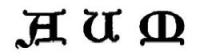
When there was neither day nor night, neither earth or sky, neither light nor darkness: when there was nothing that could be seen or felt by the physical senses or the faculties of the mind, there existed the One Great Being—God.—Vishnu Purana.
Resignation: the action of rendering good for evil; temperance; probity; purity; repression of the senses; knowledge of holy books, and of the Supreme Soul; truthfulness, and abstaining from anger: such are the ten virtues in which consists duty. * * Those who study these ten precepts of duty, and after having studied them conform their lives thereto, will reach to the Supreme Condition.—Manu, Book vi, sloka 92.
THE PATH.
Vol. I. DECEMBER, 1886. No. 9.
The Theosophical Society, as such, is not responsible for any opinion or declaration in this magazine, by whomsoever expressed, unless contained in an official document.
Where any article, or statement, has the author’s name attached, he alone is responsible, and for those which are unsigned, the Editor will be accountable.
“The Theosophical Mahatmas.”
It is with sincere and profound regret—though with no surprise, prepared as I am for years for such declarations—that I have read in the Rochester Occult Word, edited by Mrs. J. Cables, the devoted president of the T. S. of that place, her joint editorial with Mr. W. T. Brown. This sudden revulsion of feeling is perhaps quite natural in the lady, for she has never had the opportunities given her as Mr. Brown has; and her feeling when she writes that after “a great desire * * to be put into communication with the Theosophical Mahatmas we (they) have come to the conclusion that it is useless to strain the psychical eyes toward the Himalayas * *” is undeniably shared by many theosophists. Whether the complaints are justified, and also whether it is the “Mahatmas” or theosophists themselves who are to blame for it is a question that remains to be settled. It has been a pending case for several years and will have to be now decided, as the two complainants declare over their signatures that “we (they) need not run after Oriental Mystics, who deny their ability to help us.” The last sentence, in italics, has to be seriously examined. I ask the privilege to make a few remarks thereon.
To begin with, the tone of the whole article is that of a true manifesto. Condensed and weeded of its exuberance of Biblical expressions it comes to this paraphrastical declaration: “We have knocked at their door, and they have not answered us; we have prayed for bread, they have denied us even a stone.” The charge is quite serious; nevertheless, that it is neither just nor fair—is what I propose to show.
As I was the first in the United States to bring the existence of our Masters into publicity; and, having exposed the holy names of two members of a Brotherhood hitherto unknown to Europe and America, (save to a few mystics and Initiates of every age) yet sacred and revered throughout the East, and especially India, causing vulgar speculation and curiosity to grow around those blessed names, and finally leading to a public rebuke, I believe it my duty to contradict the fitness of the latter by explaining the whole situation, as I feel myself the chief culprit. It may do good to some, perchance, and will interest some others.
Let no one think withal, that I come out as a champion or a defender of those who most assuredly need no defense. What I intend, is to present simple facts, and let after this the situation be judged on its own merits. To the plain statement of our brothers and sisters that they have been “living on husks,” “hunting after strange gods” without receiving admittance, I would ask in my turn, as plainly: “Are you sure of having knocked at the right door? Do you feel certain that you have not lost your way by stopping so often on your journey at strange doors, behind which lie in wait the fiercest enemies of those you were searching for?” Our Masters are not “a jealous god;” they are simply holy mortals, nevertheless, however, higher than any in this world, morally, intellectually and spiritually. However holy and advanced in the science of the Mysteries—they are still men, members of a Brotherhood, who are the first in it to show themselves subservient to its time-honored laws and rules. And one of the first rules in it demands that those who start on their journey Eastward, as candidates to the notice and favors of those who are the custodians of those Mysteries, should proceed by the straight road, without stopping on every sideway and path, seeking to join other “Masters” and professors often of the Left-Hand Science, that they should have confidence and show trust and patience, besides several other conditions to fulfill. Failing in all of this from first to last, what right has any man or woman to complain of the liability of the Masters to help them?
Truly “‘The Dwellers of the threshold’ are within!”
Once that a theosophist would become a candidate for either chelaship or favours, he must be aware of the mutual pledge, tacitly, if not formally offered and accepted between the two parties, and, that such a pledge is sacred. It is a bond of seven years of probation. If during that time, notwithstanding the many human shortcomings and mistakes of the candidate (save two which it is needless to specify in print) he remains throughout every temptation true to the chosen Master, or Masters, (in the case of lay candidates), and as faithful to the Society founded at their wish and under their orders, then the theosophist will be initiated into—— thenceforward allowed to communicate with his guru unreservedly, all his failings, save this one, as specified, may be overlooked: they belong to his future Karma, but are left for the present, to the discretion and judgment of the Master. He alone has the power of judging whether even during those long seven years the chela will be favoured regardless of his mistakes and sins, with occasional communications with, and from the guru. The latter thoroughly posted as to the causes and motives that led the candidate into sins of omission and commission is the only one to judge of the advisability or inadvisability of bestowing encouragement; as he alone is entitled to it, seeing that he is himself under the inexorable law of Karma, which no one from the Zulu savage up to the highest archangel can avoid—and that he has to assume the great responsibility of the causes created by himself.
Thus, the chief and the only indispensable condition required in the candidate or chela on probation, is simply unswerving fidelity to the chosen Master and his purposes. This is a condition sine qua non; not as I have said, on account of any jealous feeling, but simply because the magnetic rapport between the two once broken, it becomes at each time doubly difficult to re-establish it again; and that it is neither just nor fair, that the Masters should strain their powers for those whose future course and final desertion they very often can plainly foresee. Yet, how many of those, who, expecting as I would call it “favours by anticipation,” and being disappointed, instead of humbly repeating mea culpa, tax the Masters with selfishness and injustice. They will deliberately break the thread of connection ten times in one year, and yet expect each time to be taken back on the old lines! I know of one theosophist—let him be nameless though it is hoped he will recognize himself—a quiet, intelligent young gentleman, a mystic by nature, who, in his ill advised enthusiasm and impatience, changed Masters and his ideas about half a dozen times in less than three years. First he offered himself, was accepted on probation and took the vow of chelaship; about a year later, he suddenly got the idea of getting married, though he had several proofs of the corporeal presence of his Master, and had several favours bestowed upon him. Projects of marriage failing, he sought “Masters” under other climes, and became an enthusiastic Rosicrucian; then he returned to theosophy as a Christian mystic; then again sought to enliven his austerities with a wife; then gave up the idea and turned a spiritualist. And now having applied once more “to be taken back as a chela” (I have his letter) and his Master remaining silent—he renounced him altogether, to seek in the words of the above manifesto—his old “Essenian Master and to test the spirits in his name.”
The able and respected editor of the “Occult Word” and her Secretary are right, and have chosen the only true path in which with a very small dose of blind faith, they are sure to encounter no deceptions or disappointments. “It is pleasant for some of us,” they say, “to obey the call of the ‘Man of Sorrows’ who will not turn any away, because they are unworthy or have not scored up a certain percentage of personal merit.” How do they know? unless they accept the cynically awful and pernicious dogma of the Protestant Church, that teaches the forgiveness of the blackest crime, provided the murderer believes sincerely that the blood of his “Redeemer” has saved him at the last hour—what is it but blind unphilosophical faith? Emotionalism is not philosophy; and Buddha devoted his long self sacrificing life to tear people away precisely from that evil breeding superstition. Why speak of Buddha then, in the same breath? The doctrine of salvation by personal merit, and self forgetfulness is the corner-stone of the teaching of the Lord Buddha. Both the writers may have and very likely they did—“hunt after strange gods;” but these were not our Masters. They have “denied Him thrice” and now propose “with bleeding feet and prostrate spirit” to “pray that He (Jesus) may take us (them) once more under his wing,” etc. The “Nazarene Master” is sure to oblige them so far. Still they will be “living on husks” plus “blind faith.” But in this they are the best judges, and no one has a right to meddle with their private beliefs in our Society; and heaven grant that they should not in their fresh disappointment turn our bitterest enemies one day.
Yet, to those Theosophists, who are displeased with the Society in general, no one has ever made to you any rash promises; least of all, has either the Society or its founders ever offered their “Masters” as a chromopremium to the best behaved. For years every new member has been told that he was promised nothing, but had everything to expect only from his own personal merit. The theosophist is left free and untrammeled in his actions. Whenever displeased—alia tentanda via est—no harm in trying elsewhere; unless, indeed one has offered himself and is decided to win the Masters’ favors. To such especially, I now address myself and ask: Have you fulfilled your obligations and pledges? Have you, who would fain lay all the blame on the Society and the Masters—the latter the embodiment of charity, tolerance, justice and universal love—have you led the life requisite, and the conditions required from one who becomes a candidate? Let him who feels in his heart and conscience that he has,—that he has never once failed seriously, never doubted his Master’s wisdom, never sought other Master or Masters in his impatience to become an Occultist with powers; and that he has never betrayed his theosophical duty in thought or deed,—let him, I say, rise and protest. He can do so fearlessly; there is no penalty attached to it, and he will not even receive a reproach, let alone be excluded from the Society—the broadest and most liberal in its views, the most Catholic of all the Societies known or unknown. I am afraid my invitation will remain unanswered. During the eleven years of the existence of the Theosiphical Society I have known, out of the seventy-two regularly accepted chelas on probation and the hundreds of lay candidates—only three who have not hitherto failed, and one only who had a full success. No one forces anyone into chelaship; no promises are uttered, none except the mutual pledge between Master and the would-be-chela. Verily, Verily, many are the called but few are chosen—or rather few who have the patience of going to the bitter end, if bitter we can call simple perseverance and singleness of purpose. And what about the Society, in general, outside of India. Who among the many thousands of members does lead the life? shall any one say because he is a strict vegetarian—elephants and cows are that—or happens to lead a celibate life, after a stormy youth in the opposite direction; or because he studies the Bhagavat-Gita or the “Yoga philosophy” upside down, that he is a theosophist according to the Master’s hearts? As it is not the cowl that makes the monk, so, no long hair with a poetical vacancy on the brow are sufficient to make of one a faithful follower of divine Wisdom. Look around you, and behold our Universal Brotherhood so called! The Society founded to remedy the glaring evils of christianity, to shun bigotry and intolerance, cant and superstition and to cultivate real universal love extending even to the dumb brute, what has it become in Europe and America in these eleven years of trial? In one thing only we have succeeded to be considered higher than our Christian Brothers, who, according to Lawrence Oliphant’s graphic expression “Kill one another for Brotherhood’s sake and fight as devils for the love of God”—and this is that we have made away with every dogma and are now justly and wisely trying to make away with the last vestige of even nominal authority. But in every other respect we are as bad as they are: backbiting, slander, uncharitableness, criticism, incessant war-cry and ding of mutual rebukes that Christian Hell itself might be proud of! And all this, I suppose is the Masters’ fault: They will not help those who help others on the way of salvation and liberation from selfishness—with kicks and scandals? Truly we are an example to the world, and fit companions for the holy ascetics of the snowy Range!
And now a few words more before I close. I will be asked: “And who are you to find fault with us? Are you, who claim nevertheless, communion with the Masters and receive daily favors from Them; Are you so holy, faultless, and so worthy?” To this I answer: I am not. Imperfect and faulty is my nature; many and glaring are my shortcomings—and for this my Karma is heavier than that of any other Theosophist. It is—and must be so—since for so many years I stand set in the pillory, a target for my enemies and some friends also. Yet I accept the trial cheerfully. Why? Because I know that I have, all my faults nothwithstanding, Master’s protection extended over me. And if I have it, the reason for it is simply this: for thirty-five years and more, ever since 1851 that I saw any Master bodily and personally for the first time, I have never once denied or even doubted Him, not even in thought. Never a reproach or a murmur against Him has escaped my lips, or entered even my brain for one instant under the heaviest trials. From the first I knew what I had to expect, for I was told that, which I have never ceased repeating to others: as soon as one steps on the Path leading to the Ashrum of the blessed Masters—the last and only custodians of primitive Wisdom and Truth—his Karma, instead of having to be distributed throughout his long life, falls upon him in a block and crushes him with its whole weight. He who believes in what he professes and in his Master, will stand it and come out of the trial victorious; he who doubts, the coward who fears to receive his just dues and tries to avoid justice being done—FAILS. He will not escape Karma just the same, but he will only lose that for which he has risked its untimely visits. This is why having been so constantly, so mercilessly slashed by my Karma using my enemies as unconscious weapons, that I have stood it all. I felt sure that Master would not permit that I should perish; that he would always appear at the eleventh hour—and so he did. Three times I was saved from death by Him, the last time almost against my will; when I went again into the cold, wicked world out of love for Him, who has taught me what I know and made me what I am. Therefore, I do His work and bidding, and this is what has given me the lion’s strength to support shocks—physical and mental, one of which would have killed any theosophist who would go on doubting of the mighty protection. Unswerving devotion to Him who embodies the duty traced for me, and belief in the Wisdom—collectively, of that grand, mysterious, yet actual Brotherhood of holy men—is my only merit, and the cause of my success in Occult philosophy. And now repeating after the Paraguru—my Master’s Master—the words He had sent as a message to those who wanted to make of the Society a “miracle club” instead of a Brotherhood of Peace, Love and mutual assistance—“Perish rather, the Theosophical Society and its hapless Founders,” I say perish their twelve years’ labour and their very lives rather than that I should see what I do to-day: theosophists, outvying political “rings” in their search for personal power and authority; theosophists slandering and criticizing each other as two rival Christian sects might do; finally theosophists refusing to lead the life and then criticizing and throwing slurs on the grandest and noblest of men, because tied by their wise laws—hoary with age and based on an experience of human nature milleniums old—those Masters refuse to interfere with Karma and to play second fiddle to every theosophist who calls upon Them and whether he deserves it or not.
Unless radical reforms in our American and European Societies are speedily resorted to—I fear that before long there will remain but one centre of Theosophical Societies and Theosophy in the whole world—namely, in India; on that country I call all the blessings of my heart. All my love and aspirations belong to my beloved brothers, the Sons of old Aryavarta—the Motherland of my Master.
H. P. Blavatsky.
Lines from Lower Levels.
Many will turn from this heading. Whether they really live upon the upper levels or only imagine such to be their dwellings, these words are probably mute to them. A laggard in the great race, one who has only just rounded the starting buoy in stress of weather, here signals to his unseen companions amid heavy seas. If a score of blind men, turned loose to beat the city’s by-ways, should meet and compare mischances, some light would presently dawn among them. We are not isolated in spiritual experience. Though Falsehood wears myriad masks, when Truth looks in, she turns the same face on all.
It is of the beginning of the Way that I speak. Confusions and perplexities beset us. Most of these are of our own conjuring. The insidious canker of Doubt is first, is worst of all. Better stop right where you are for a lifetime than advance with this moral leprosy unexterminated. It will spread through future existences until it has eaten the heart to the core. Now it is in our power. Wrestle boldly with every doubt until you have converted it to a certainty; thus you force it to bless you in departing, as Jacob did the Angel. Why should we doubt? The day on which I first heard of the Wisdom-Religion is for me set apart like a potent jewel in the crest of Time. My thought salutes its messengers with the grand old words,—“How beautiful upon the mountains are the feet of him that bringeth good tidings, that publisheth Peace.” The Peace of this religion is the proof absolute of its Wisdom. Our vitality is exhausted with the life struggle; it seems a dead pull against the current. Reason tells us we ought to be able to move with the stream. Man has a false idea of his own requirements; this is why possession satiates all. We are ignorant that the desire for Unity lies hidden in the deeps of every human heart. This is the Truth at the bottom of the well; it is the basic need of all mankind. Recognise it, and you may sweep unwearied along the resistless current of evolutionary progress. We begin to realize the inability of existing creeds to sound and explain our Being. Every one of us craves a belief which shall not be a formula, but Life itself, which shall develop and complete the constituency of lives.
Our religions violate the golden rule of Architecture,—“Ornament construction; do not construct ornamentation.” Their slight framework is florid with theological detail, garlanded with the varying ideals of centuries. Not so does the Master Builder plan. Yet the keystone of each arch is the Truth manifest in the Past, that Truth which still bears witness to Divinity to the new Age.
When men meet their belief in every department of life, when it assists them on every plane, so that they eat better, sleep better, love better, create better and die better by it, then will it be a vital law to them, not a garment to be laid aside on work days. Theosophy does all this. It informs every deed, makes of each fact a new revelation, and testifies to more religion in one chapter of Natural Philosophy, than in all the sermons of next Sunday. Study these grand similitudes and we find how single is Truth, so that the three great laws of Motion are also those of Emotion, and Newton spoke for my heart, as well as for the universe. All life is thus related; if you doubt the validity of theory or action, test them by this law of correspondence.
Do I revolt from the rule of gentle procedure in the teeth of wrath or abuse. I recall the axiom of mechanics,—“Motion seeks the line of least resistance,”—and my moral force proves itself perpetual motion by its avoidances of friction. Truth is the same in every part. You shall pass every beam of thought through this prism; if it is a pure ray each component will have its distinct value on its own plane, and all will blend again to Light.
Sometimes we are chilled as by a sense of isolation from the main body of our kind. This is imaginary; you shall not think we are few, or stand alone. Even now the thoughtful listener hears the soughing of the rising flood of Public Opinion. This was the mainstay of Science in her late tilt with the Church. The People, weary of barren Theology demanded in facts, in laws, the manifestation of the Divine. Now it begins to call Science to account for her limitations. Do we doubt the bubbling interest in Psychology? We should scan our newspapers, novels, magazines, boudoir gossip even, to feel the pulse of the general tide. Science yields so far to the pressure as to explain why she cannot or does not make thorough and sustained psychical investigations, and with a blunt,— “so much the worse for you,” the public turns expectantly to the broader or younger men who better gauge the tendency of our time.
This tendency is to coöperation, to unification. Science and Religion are one, are Truth, and blindness is the portion of those who dismember her kingdom. A pertinent case is that of a physician well known to New York clinics who used his mesmeric power in putting patients to sleep in the presence of his students and maintaining their complete unconsciousness during painful operations, thus carried to successful conclusions without the dangerous drawback of anesthetics. Less gifted confreres frowned down the “irregularity.” This is a thinking Age, and men are losing confidence in the judgment of scientists whose biased attitude would bar them from jury service in the pettiest court of the land.
Again there are those who are tried by the mistakes, the treachery, or the public misunderstanding of other adherents of Theosophy. What does it matter? The world swung on while Galileo recanted, and though a disciple betrayed his Master, the Christian world still kneels. Our noblest opponents are often unconscious Theosophists, judging them by their fervid search for Truth. When their hour strikes, they will find her; meanwhile Wisdom needs no converts. Man passes; Truth is, and needs no concern of ours. Do nut think either that the Wisdom-Religion is only for the strong or the intellectual; it is for all. Food is meant to sustain life, and Love to develop it, but excess in either may kill. So those whose nature is morbid, exaggerate the aspect of Truth and go mad of their own phantasms. Every Science, every Art, every Religion has its list of these moral suicides and those who confront you with it are like the old nurses who scare children from the jam closet with “bogies.”
I said that we breed our own perplexities. Take the first day of the new life, when with fledgling resolves aflutter we come glowing and resolute down the stairs. We had ordered a spartan meal which Love has spared us. Frowning, we order the dainties away and sit reflecting on the encumbrances of earthly affection; wounded, it leaves our side. Our plain food comes; it is ill cooked and the retarded servant has a scowl which we resent: the household jangles and jars. The meal has not refreshed us, and the lack of the soothing but condemned cigar brings our irritability to a head. We hasten to lock ourselves into the study for meditation; but a bird sings in at the window, and Love’s voice pleads at the door. We shut out the song and chide the syren. Why is our heart so heavy now when bent on eternal things? Knocking! We open with a martyr face. A friend is there, a dogged churchman; his salvation is in our hands! He chats of the weather, our club, state politics. We broach a higher theme, we denounce, cut and thrust, argue. Surprised he listens in courteous silence, and as he leaves us we remember too late that he too cherishes his religion, we curse the follies of the wretched day and call Theosophy for the nonce “impracticable.” Brothers! the man of creeds who can hear our dogmatism with self control is perhaps nearer the Essential than we are. He who plunges into restraints which unhinge and irritate him is no better than the man who loses his reason through drink. Both lack moderation, the result is the same, and we have only to do with results. Devote your thoughts to ascetic meals, and no Lucullus of the town is more prostrate before his viands than yourself. Moderation declares the sage. Accept all that comes with equal content, the thought held high above all. When the daily functions are fulfilled I have done nothing; the soul is no participant in these. Advance towards the Eternal and the Transient will imperceptibly drop away from you. No shirking of the duties of our position avails. Comrades! The battle field is there where the long roll finds you standing. Your past acts enlisted you under just that flag; fight it out there! The universal charge is carried through the vigor of individuals, each acting from his own headcentre and not from that of another. “The duties of a man’s own particular calling, although not free from faults, is far preferable to the duty of another, let it be ever so well pursued.”147 On this plane we are a body militant; on the next plane we shall transform this activity, but as long as individuality exists, it would seem that each must move in an orbit of his own. There is as much egotism in snatching at the burden not meant for us, as in refusing that which is. Do all necessary acts promptly and with your best ability, abandoning at once all care for the result. Do you say this is not Theosophy? You mistake. True Theosophy is everything that elevates or aids mankind, were it but the singing of a ballad to lighten another’s toil. “It is not that you must rush madly or boldly out to do, to do. Do what you find to do. Desire ardently to do it, and even when you shall not have succeeded in carrying out anything but some small duties, some words of warning, your strong desire will strike like Vulcan upon other hearts in the world, and suddenly you will find that done which you had longed to be the doer of. Then rejoice, that another had been so fortunate as to make such a meritorious Karma. Thus like the rivers running into the unswelling passive ocean, will your desires enter into your heart.” Drop this concern for ephemera and forms; heed essentials only. Get to the centre of every vital fact and live there as at the heart of an opal, darting forth prismatic rays of Love and Faith upon all created things.
If we set out upon a journey to lands unknown, we should observe the inhabitants, gathering the spirit of their laws from their manners, ourselves courteous yet cautious with all. So in this passage to the unseen, that which is essential is the spirit of things. What affair is it of mine if this man glows with gratified desire, or that woman shines in undue laces and coquetries? Do I know the principles of their constitution? Can I vouch that these errors are not the mere husk of habit, which dropping off may reveal a larger kernel of Virtue than I possess? Nor will I hastily become the spiritual bondsman of him who stands above me. He has not exhausted the sum of Truth; to-morrow I shall find a fraction of my own. All these finical distinctions are not of the Eternal. The substratum of all things is Wisdom. The twist of Failure has its strands of silver. The pratings of the fool dissuade men from folly. I have never done anything of myself: a clarion impulse commands my best deeds; high thoughts radiate to me from I know not what sphere. Ask yourself before friend or foe,—“How does the spirit manifest in him?” For above and below it manifests equally. The undeviating brute, true to its every principle, has a volume of teaching for us. We cannot read until we know the alphabet and Nature holds our primer daily before us. Do not hawk Truth about to the careless crowd. Not because you belittle it, (that is impossible,) nor yet yourself, (that is immaterial,) but because you must hold fast in silence to all that you possess to support you in the tests of the future. Nor is Truth a nostrum to be forced down the unready throat. Thereby you disgust a man with Truth; who covets that responsibility? Ah, gentle hearts and virile minds! Are you wounded by the wantonness of those you long to save? These errors are perhaps their appointed teachers in your stead. Error is not exempt from the law! Can Love check a cyclone in mid career, or does Reason outrun the whirlwind? Desire has a lustier voice than yours. Let these errant ones wisely alone. Presently when success is at an ebb, or the complacent Ego is stung by pride or pain, they will hear the low plaint of the soul. Then, their state related to yours, they will turn to you as the heliotrope to the sun. Trust to the law of spiritual affinity. He for whom you have a thought will be attracted to you for it; he will in some way ask it of you. Distrust the intellect in these replies. Only the dwellers of the upper levels draw their thought crystal pure from the Fountain-head of Mind. Below, sympathy is the universal solvent; its ardent fusion welds mankind. Speak to me in our common language; it is that of the heart. You cannot so much as tie up a straying rosetree without sympathy. Try it, and the tender shoots are nipped as by a frost. Do you say that it is hard that you should not help others? Perhaps you only want to help them in your own way. The difference between loving a man for himself, and loving him for myself, is the difference between “heaven” and “hell.” There is no hell but that which we create in our hearts, and selfishness is its yawning portal. Effort for Wisdom is help for all; he who thinks wisely does a deed of beneficence. Beneath generous yearnings lurks sometimes the wish that this “I,” shall become influential or admired, have clients and suitors in the anteroom. Lest I deceive myself I will mutely speed my good wishes to all. Only when we have learned how to preserve a wise silence, will the first stammerings of speech come to us. Speak then from your own knowledge, simply, without trying to adorn Truth. Many of our most valued writers are at times too transcendent, too erudite for us of the lower level. As the great orator or actor sees one face grow towards his from out the vast field of faces, and concentrating his burning purpose into that focus, sees streaming thence the homogeneous force which electrifies the throng,—so I would have each writer among you address his thought to some especial comrade within his mind, that you may drop this mantle of remoteness, and let us feel you tense and vibrant with helpfulness, pressing close to our side. The West needs a more ringing note than the mystic Orient mind. Let the spirit of your nation speak through your work and to your fellows every word will be an occult charm.
Why are we so impatient that we do not receive the accolade of accepted duty from those Royal Souls who procede us on the Way? “They also serve who only stand and wait.”148 He who cannot wait contentedly may be sure he cannot serve. We must master the diurnal before we can overcome the spiritual. Some say that a heroic deed is easier than submission to pinpricks. We may survive Niagara when a drop of water per second on the brain is madness. Friends; the struggle for the Eternal is not one daring deed nor yet hundreds of them. It is a calm unbroken forgetfulness of the lower self for all time. Begin it on your present plane. You have within you the same guide that the Masters possess. By obeying It, they have become what they are. Hark! A voice resounds within. “Know thy true Self; it is thy guide.” If the voice seems silent, it is perhaps because you ask with the mind only, which is a higher kind of curiosity. When a spiritual need cries out within you, the answer will come with a flash to the reverent listener. But in all the three worlds there is no power to save you but your own. When we have exhausted the possibilities of growth on our present plane, we rise naturally to a higher level. If here we find a Master, it is because we have come into the region where he dwells. Better than desiring to deserve is deserving to desire. Of this be sure. All that is rightfully yours will come to you. So reads the Law.
As a mountain climber leans forward, treads zig-zag, counteracting gravity and the air’s resistance, so shall you walk with care. We do not know what moral resistance we arouse, what unseen evil lurks near, what stone our passage may loosen to fall on those below. We do not know the delicate adjustment of this aerial world. Keep eyes and mind fixed on the heights above, lest the yawning abyss from which you rose, attract you. Distrust your emotions, your thoughts above all. An insidious thought, like a traitor in the fortress, tends outward to the legions of evil and would deliver you up to them. Who knows where the ripples of a hasty thought may end? We are pledged by our theosophic vow to do naught that can dishonor our Society. What more dishonoring than unjust, angered or vagrant fancies which corrupt the atmosphere of others and may breed a moral pestilence. “He that hateth his brother is a murderer.”149 Perhaps there are times when this is literally true. “If he does not love his brother whom he hath seen, how can he love God, Whom he hath not seen?” Pass this word along the line;—“Eternal vigilance is the price of safety.”
You who are inclined to dispute these thoughts, do better; ignore them. They are a life experience, not meant for you who have it not, nor are you once named herein. They are true from one standpoint and for those upon the same plane. Hereafter all must alchemize virtues and vices alike. Be not discouraged at these necessary transitions; they do not convict you of radical error. Give me an unknown seed; its potentiality is a secret from me, but in faith I plant and tend it. As it waxes to the budding glories of branch and flower, and thrills with the fecund boon of fruitage, I am no whit the loser, and hidden at the root of this larger heritage, the same seed remains life bestowing and true. Thus Knowledge is not final; it must expand and germinate or it is but a dead thing. “Veil upon veil shall lift, but there shall be veil upon veil behind.”150
Does he who writes thus always follow his own teachings? No! A hundred, a thousand times, no! Deluded, he climbs by devious paths and from the very brink of attainment, falls!
“Jove strikes the Titans down. Not when they set about their mountain piling, but when one stone more would complete the work.”151
Then with toil and pain he rises and cons the chart once more. Beloved Brothers!—and there is nowhere one so lost, so estranged, so low or so great whom this name does not call—he will have received these blows to a benign purpose, if their teachings shall roll away a single stone from your upward path.
J——.
Poetical Occultism.
SOME ROUGH STUDIES OF THE OCCULT LEANINGS OF THE POETS.
III.
Many will find in Whitman, the fullest measure of mystic truths, plainly and significantly stated, to be met with in any modern poet. For instance, a recognition of the reality of Reincarnation, and of its necessity, constantly recurs in his poems. Passages like these attest it: “Believing I shall come again upon the earth after five thousand years.” Births have brought us richness and variety, and other births have brought us richness and variety. “And as to you Life, I reckon you are the leavings of many deaths, (no doubt I have died myself ten thousand times before.)” In contemplating an idiot he muses:
“And I knew for my consolation what they knew not, I knew of the agents that emptied and broke my brother, The same wait to clear the rubbish from the fallen tenement, And I shall look again in a score or two of ages, And I shall meet the real landlord, perfect and unharmed, every inch as good as myself.”
Are not the “agents,” mentioned above, the operations of Karmic law? Among the last lines of the closing poem of his volume are the following:
“I receive now again of my many translations, from my avatars ascending, while others doubtless await me, An unknown sphere more real than I dream’d, more direct, darts awakening rays about me, So long! Remember my words, I may again return.”
Neither rhyme nor verse are essential to true poetry. Even words are but its vehicle, and not the poetry itself. Poetry is that manifestation of the mind which excites the imagination and arouses in responsive minds a sense of beauty. All that which does this is poetic in quality: that which does not, which awakens no response, leaving one cold and unimpressed, is prosaic. Poetry, therefore, possesses the rythmic quality, for beauty appeals to no sense, except through its power of producing rythmic action upon the brain through the nerves of sight, hearing, etc. Rythm is a product of harmonious vibration and produces the sensation of beauty by its play upon the nerves in a succession of reiterated, regular groups of impressions. All sensations of ugliness, etc., which are the causes of pain and disease, are due to the discordant impressions made by irregularity in the series of vibrations. Thus does strict mathematical law underlie all effects of beauty. All poetry is in some way rythmic, and arouses rythmic action.
The highest poetry is truth made manifest in the guise of beauty. Poets have often expressed in verse their feeling of the total inadequacy of words to present to others the sublimity and beauty of the thoughts which at moments occur to them. The poetic temperament is one which enables an approach to that state which some exalted men attain in perfection, and which is the ultimate destiny of the entire human race. The poet perceives fragments of the Divine thought as embodied in natural materials; he reads pages of the great book of Creation and interprets more or less clearly the significance of the symbols that exist on every hand in growing things, in things inanimate, in the waters and the heavens, and in the thoughts, sentiments, passions and emotions of men. In assuming the mental state which may be called the poetic attitude, he throws himself into rapport with his Higher self, his atma, and thus obtains a glimpse of the eternal truth, so much of which his memory retains as accords with his personality and with the nature of his mood; of this he incorporates in poetic form that which his power of expression enables him to give. Walt Whitman characterizes this state in his lines:
“I lie abstracted and hear beautiful tales of things and the reasons of things, They are so beautiful I nudge myself to listen, I cannot say to any person what I hear—I cannot say it to myself—it is very wonderful!”
The more unconscious one becomes of physical surroundings the more clearly does his mind act; its operations are attended with less friction. By withdrawing his attention from bodily environment he enters upon the plane of the higher consciousness. This accounts for the greater ease with which mental work proceeds after one has been engaged in it for some little time; it absorbs his attention so that the surrounding objects and circumstances no longer distract it. In other words, the mental machinery settles down to smooth running, after overcoming the various hitches and obstructions attending the starting of the train of thought. Everyone knows how earnest devotion to any object makes him oblivious to all else. Under such conditions one, in reality, loses consciousness and is merged in the object. Self, the illusory Self, simply consists in a sense of the existence of the body and the relations borne to it by surrounding objects.
Therefore, in concentration of the mind upon the object lies the true secret of power, and the man who best knows how to do this is the most powerful among his fellows. The best work is that done when one is least conscious of material environment. This accounts for remarkable examples of work done in a somnambulistic state when all consciousness of physical surroundings is lost, and the Self becomes so absorbed in the object that on returning to ordinary consciousness it cannot remember the process of its most perfect activity of thought. And yet people refuse to accept the truth of Reincarnation because they cannot remember, in this gross physical state, their former existences through the intervening Devachanic periods when their consciousness was lifted to a plane above the thralldom of matter!
Whoever knows anything of ceremonial magic, whether practically or theoretically, recognizes the necessity of rythmic action, or the institutions of a regularly recurring set of vibrations. Many will testify to the marvels wrought by the earnest repetitions of a rythmic formula. It seems likely that the transfer of consciousness and the performance of phenomenal feats by Adepts are wrought by their command of some formula or method which enables them instantly and perfectly to achieve the harmonious condition of mental vibration crudely acquired by novices only by elaborate processes. The logical inference may be drawn that the purpose of the rythmic form of poetry is not only to arouse harmonious thoughts in the minds of hearers or readers, but is due to the fact that the poet, by subjecting his mind to a rythmic flow of thought, opens it to the reception of impressions from the highest source of thought. In the words “I nudge myself to listen” the poet strikingly and graphically depicts the effort to maintain his concentration of mind as he lies abstracted when he feels his attention slipping away from the sublime mysteries which, in the greatness of their wonder, are beyond his power to realize in any thoughts he may frame. Poets are often unconscious of the full greatness of the truths they reveal after the moment of their receptive state has passed, but they, perhaps, awake to a sense of the true significance of their words years after.
This concentration of mind is insisted on in the Hindu systems in many different ways. It is called by them Ekkragrata or one-pointedness. In the dialogues the expression is constantly used, and Krishna is said to say to Arjuna (in Bagavad-Gita). “Has thou listened to me with thy mind fixed on one point?” It is to bring about such a condition that practitioners of Hatha Yoga—which in English simply means any practice tending to develop psychical powers, such as mediumship and the like—prescribe that the Yogee shall sit with his sight concentrated upon the tip of his nose. And this practice, although scarcely commendable, has a scientific basis which shows that the much belittled Aryans had a wonderful fund of knowledge. The fixing of the eyes upon the tip of the nose puts the focus about three inches from the eyeball, and that produces first, concentration, because of the effort to remain fixed, and secondly, a hypnotic state in which trance results with psychic vision and the like. They prescribed it for another reason not likely to be admitted by our science; three inches from the eyes was said by them to be the clairvoyant point.
Our poet Whitman, whether he was aware of it or not, constantly enunciated the doctrine of Karma. In “Assurances,” to be found in Leaves of Grass, he says:
I need no assurances. I am a man who is pre-occupied of his own soul; I do not doubt that from under the feet and beside the hands and face I am cognizant of, are now looking faces I am not cognizant of, calm and actual faces. I do not doubt but the majesty and beauty of the world are latent in any iota of the world. I do not doubt I am limitless, and that the universes are limitless; in vain I try to think how limitless. I do not doubt that the orbs and the systems of orbs play their swift sports through the air on purpose, and that I shall one day be eligible to do as much as they, and more than they. I do not doubt that temporary affairs keep on and on millions of years. I do not doubt interiors have their interiors, and exteriors have their exteriors, and that the eyesight has another eyesight, and the hearing another hearing, and the voice another voice. I do not doubt that the passionately-wept deaths of young men are provided for, and that the deaths of young women and the deaths of little children are provided for. (Did you think life was so well provided for, and Death, the purport of all life, not well provided for?) I do not doubt that wrecks at sea, no matter what the horror of them, no matter whose wife, child, husband, father, lover, has gone down, are provided for to the minutest points. I do not doubt that whatever can possibly happen anywhere at any time, is provided for in the inherences of things. I do not think Life provides for all and for Time and Space, but I believe Heavenly Death provides for all.
Here he dwells upon the belief that all things are provided for. It would be error to say that he was a fatalist, just as it is a mistake to hold that the Mohammedan doctrine of “Kismet” is pure fatalism. Edwin Arnold in “Pearls of the Faith,” enlarges on that pearl called Al-Kadar, in these words:
“When ye say Kismet, say it wittingly, O, true believers! under Allah’s throne place is not left for those accursed three, ‘Destiny,’ ‘Fortune,‘ ‘Chance.’ Allah alone ruleth his children: Kismet ye shall deem each man’s alloted portion * * *”
And Whitman plainly states that the provision which is made for all the happenings is a provision existing “in the inherences of things,” and not a fatalistic decree by an irresponsible Almighty.
He also says that he is limitless. This is the doctrine of the Upanishads. Everyone is limitless, for Ishwara, the Lord, dwells in the heart of every mortal being. Jesus also, said; “the kingdom of heaven is within you.” Now the kingdom of heaven cannot be apart from God, so that the Nazarene herein says the same thing as the Upanishads.
Again, in the lines, “I do not doubt that interiors have their interiors, and exteriors have their exteriors, and that the eyesight has another eyesight, and the hearing another hearing, and the voice another voice,” Whitman might be said to be taking the words from the mouths of those sages who in ancient India penned the Upanishads. In those it is incessantly insisted that these interiors really are the Universal Self which is “the eye of the eye and the hearing of the ear.” And a knowledge of that is the key to unlock the doors of glory and praise. As it is beautifully said in Brihadaranyaka-Upanishad:152
“This Self is the footstep of everything, for through it one knows everything. And as one can find again by footsteps what was lost, thus he who knows this finds glory and praise.”
And further, “Therefore, now, also, he who thus knows that he is Brahman (the Self) becomes all this, and even the Devas cannot prevent it, for he himself is their Self.”
S. B. J.
Apollonius and the Mahatmas.
[READ BEFORE THE MALDEN BRANCH, T. S.] (Concluded.)
When Apollonius asked about the wise men whom Alexander the Great was said to have conquered and then held converse with, Phraotes said that they were the Oxydraks, a warlike people who claimed Wisdom though they knew nothing of consequence; the truly wise men dwelt between the Hyphasis and Ganges. Had Alexander gone thither he could not have conquered them, even with ten thousand Achilles and thirty thousand Ajaxes. “For they fight not in battle against advancing enemies, but being holy men, beloved by God, they repulse them through aerial apparitions and lightning flashes.”
When Apollonius took his departure Phraotes gave him the following significant letter to the Brahmins:
“The King Phraotes greets his teacher Iarchas and the Wise men with him. Apollonius, the wisest of men, regards you as wiser than himself, and comes to learn from you. Let him not depart without knowledge of all which you yourselves know. For thus nothing of your wisdom will be lost; since no one speaks better than he, or has a truer memory. Let him also behold the throne whereon I sat when thou, Father Iarchas, gavest me my kingdom. His attendants also deserve praise for their attachment to such a man. Be thou happy. Be happy all of you.”
When they came near the hill where the wise men dwelt their guide was filled with fear, for the Indians stood more in awe of these men than of their own King, and the King who ruled the land where they lived was accustomed to consult them about everything he said or did.
When near a village not a stadium from the hill, a youth approached them, blacker than any Indian, with a gleaming, moon-shaped mark between his eyebrows. He bore a golden anchor, which in India took the place of the Herald’s staff. He addressed Apollonius in Greek, which did not astonish him, since all the dwellers in the village [a lamasary?] spoke that tongue, but it did astonish the others to hear their master called by name; Apollonius, however, it filled with confidence as he remembered the purpose of his journey. “We have come to men truly wise,” he said to Damis, “for they have a fore-knowledge of things.” Asking the youth what was to be done, he was told: “Those with you remain here; thou, however, shalt come just as thou art, for so They command.” In this They Apollonius recognized Pythagorean language and he followed with joy.
In one of his conversations with the Egyptian Gymnosophists, years afterwards, Apollonius thus characterized the wise men of India: “I saw the Indian Brahmins who dwell upon the earth and not upon the earth; in a strong fortress though unfortified; and, without possessions, possessing everything.” The deep, interior significance of this is evident to a Theosophist. Damis, in the matter-of-fact way often customary with him, also gives these words a literal interpretation, saying that they had their bed upon the earth and strewed the ground with herbs selected by themselves; he himself had seen them floating in the air two ells above the earth; not for hocus pocus—for they despised vain striving—but in order, by thus floating with the sun, to be near and pleasing unto the god. This was what was meant by “upon the earth and not upon the earth.” The strong fortress, unfortified, meant the air in which they dwelt, for although they appeared to live under the open heaven, they spread a shadow over themselves, were not wet by the rain, and were in the sunshine whenever they wished. And since they obtained everything the moment they wished it, Apollonius rightly said that they possessed what they did not possess. “They wear their hair long, they bind a white mitra around their heads, their feet are bare. The form of their clothing resembles that of a sleeveless under-garment; the material is a wool produced by the earth of itself, white like the Pamphylian, but softer, and so fat that oil flows from it. Of this they make their sacred garments, and when another than these men seeks to gather this wool the earth will not release it. By the power of the ring and the staff which they bear every thing can be done, but both are kept as a secret.” This personal description by Damis corresponds in certain particulars with what we are told of the Masters to-day. The account of the wool leads some commentators to believe that asbestos is meant.
Iarchas welcomed Apollonius in Greek and asked him for the letter from Phraotes; when Apollonius wondered at his gift of prescience he remarked that a delta was lacking in the letter, left out by mistake, and so it proved. After reading the letter Iarchas asked: “What dost thou think of us?”
And Apollonius replied: “As no other person in the land whence I came, as my journey hither shows.”
“What makest thou think that we know more than thou dost?”
“I believe,” answered Apollonius, “that your knowledge is deeper and much more divine.”
Iarchas hereupon said: “Others are accustomed to ask the new comer whence he comes and for what purpose; the first sign of our wisdom shall be this: that the stranger is not unknown to us. So then, test this:”
Hereupon he told Apollonius his history from father and mother down, what he had done in Aegæ, how Damis had come to him, what things of importance had happened on the way, etc. As Apollonius asked in surprise whence came that knowledge, Iarchas answered: “Thou also camest gifted with this wisdom, but not yet with all of it.”
“And wilt thou teach me all thy wisdom?” asked Apollonius.
“By all means, and in ungrudging abundance, for this is wiser than miserly to conceal that which is worthy of knowing. Besides, Apollonius, I see thou hast been richly gifted by Mnemosyne, and she is the one among the gods whom we most love.”
“Dost thou also behold,” asked Apollonius, “of what manner my nature is?”
“We see all peculiarities of the soul, for we know them by thousandfold indications,” replied Iarchas.
When mid-day came they rose in the air and did homage to the sun. The youth who bore the anchor was then told to go and provide for the companions of Apollonius. Swifter than the swiftest of birds he went and returned, saying: “I have provided for them.” He was then commanded to bring the throne of Phraotes, and when Apollonius had seated himself thereon they continued their conversation. Iarchas told him to ask what he wished, for he had come to men who knew all things. Apollonius asked if they knew themselves, for he believed that they, like the Greeks, held knowledge of self to be difficult. But Iarchus answered with an unexpected turning: “We know all things, because first of all we know ourselves; for no one of us can approach this wisdom without first attaining knowledge of self.”
Apollonius asked further, what they held themselves to be?
“Gods,” answered Iarchas.
“And wherefore?”
“Because we are good men.”
Apollonius found so much wisdom in this saying that he made use of it in his speech of defence before the Emperor Domitian.
They talked about the soul and reincarnation, and Iarchas told him that the truth was “as Pythagoras taught you, and as we taught the Egyptians.” They spoke about the previous incarnation of Apollonius as steersman of an Egyptian ship, in which capacity he had refrained from following the inducements held out by pirates to let his vessel come into their hands.
Concerning this Iarchas said that refraining from unrighteousness did not constitute righteousness.
The King came to visit the Brahmins and a wonderful feast was prepared for him; everything came of itself: Pythian tripods, and automatic attendants of black bronze, the earth spread out herbs softer than beds to recline on, delicate viands appeared in orderly succession, etc. The accounts of these phenomena occasioned great remark during the subsequent career of Apollonius, and people would persist in mixing them up with the teachings of the master just as to-day they inextricably confound Madame Blavatsky’s famous cup and saucer with Theosophy. But we are told that Apollonius did not concern himself with phenomena; when he saw these wonderful things he did not ask how they were done, nor to be taught to do them, but he contented himself with admiring them. And we are also told that the marvelous things he did were not accomplished through ceremonial magic, but through the perfection of his wisdom.
Damis was subsequently allowed to come to the Brahmins and when he asked about the composition of the world and the four elements they replied that there were five—the fifth being ether, which was to be regarded as the primal source of the gods.
“For everything that breathes the air is mortal; that which drinks the ether is immortal and divine,” said Iarchas. He also said that the world was to be regarded as a living being of both sexes, having a more ardent love for itself than that of one person to another, being united and bound to itself. Damis learnt much from his intercourse with the Brahmins, but he wrote that at the secret discourses Apollonius was alone with Iarchas, and from there originated the four books written by the former. Iarchas, said Damis, gave Apollonius seven rings bearing the names of the seven planets, and Apollonius wore them one after the other according to the name of the day of the week.
The foregoing is an incomplete account of the remarkable journey and experience of Apollonius, as is necessitated by the limits of a brief article. Many passages of deep wisdom have had to be passed over, and many remarkable things are told, hard to understand, but which, there is reason to believe, have an occult significance.
S. B.
Teachings of the Master.
RECORDED BY ONE OF THE AUTHORS OF “MAN: FRAGMENTS OF FORGOTTEN HISTORY.” (Copyrighted.)
The master walked beside the river at evening-time. In the instant that his signal was recognized he walked no longer alone. By his side appeared one—as a little child clinging close to his garments. The master said—“When you have obtained mastery over the senses then you will no longer totter in your step or falter in your flight. Realize the divine atma within you. Realize it!” he repeated, and then raising his hand slowly upward the stature of the child lengthened until a man’s proportions were outlined. Only this form could hold the expanded soul. Disenthralled the soul perceived a world with every pulsation and in every faculty there was absolute harmony. This was divine. This is man’s rightful condition into which only the Mahatmas have fully come; but to which every one is heir. The Mahatma teaches with the thought unexpressed, but formulated in his own mind and sent with sudden power, into yours. It strikes with resounding force against the spirit’s prison house. In great agony the pupil cried out: “Master! Master! redeem me from this state with your great power.” The Master answering said: “Burst by concentration of spiritual energy the bonds that bind you.” No pen can describe the force of the Master’s thought. For the instant it seemed possible; a moment’s hesitation to make the effort through mortal fear, and the supreme moment was passed. The Master looked sadly upon his suffering disciple and then was alone again.
The latter had gone back to try again through duty—if need be through death.
THE LESSON.
The pupil goes to the Master without conditions. He goes, but not to return. The illusions of matter are dispelled for him and thenceforth he is a stranger in the world of actions, even though he should be in it again.
Fiery is the furnace of probation, and great is the danger when the neophyte has reached the “states of exaltation.” About each advance step wait the enemies of the spirit—to overthrow its sovereignty and hurl it back to the plane of matter. These enemies live in matter and are persuaded that their existence is confined to it—hence their determination to keep matter from a knowledge of spirit. In darkness and sin is their safety, for they are children of these conditions and will cease to exist when the lamp that is lighted from within is turned upon the world.
Temptations are in the way of those who would demand much without deserving even a little. So soon as the student comes in contact with the occult he encounters on the threshold the demons who loiter by—the demons of worldliness, inconstancy, suspicion and faint-heartedness.
The student should find in his own intuitions all the proof needed of the existence on this earth of the Wisdom teachers. Behind the screen of the senses reposes the soul of man—an unfathomable factor in the Universe—as unknown to its possessor as to its observers. Intuition is its only avenue of communication, and the language it speaks is known only to him who understands arcane knowledge or occultism.
When the Master has initiated his pupil he puts the seal of the mysteries upon his lips and locks them even against the chance of weakness or indiscretion.
It is the sense of personal isolation that brings on death; genuine philanthropy puts the individual en rapport with the Divine Spirit and thus gives him the eternal life. The Divine Spirit being all-pervading, those who put themselves en rapport with it, necessarily put themselves en rapport with all other entities in the same rapport. Hence, the Mahatmas are necessarily in constant magnetic relation with those who succeed in extricating themselves from the lower animal nature. It is by this means that the Mahatmas must first be known.
Until the Master chooses you to come to Him be with humanity, and unselfishly work for its progress and advancement. This alone can bring true satisfaction.
What is a Mahatma? Is it His physical body? No; for that must perish sooner or later—though it can be preserved through what is to us an endless age. A Mahatma is one who lives in His higher individuality, and to know Him truly, He must be known through the individuality in which He is centered.