INDEX. (continued 10)
Reading edition
Education is slow and Evolution is tardy, and the whole circle of wisdom is slow to trace; but the march of Nature has been as it was bound to be—for the best—and the line of Pope
“One truth is clear, whatever is is right.”
seems more and more to be borne in upon the mind as an Eternal verity.
Destiny has guided us till now, and has made us what we are, but we who now realize the omnipotence of the divinely guided Will, have become potentially the makers—let us take it in our hands and shape our own career, for the sooner we rise to the heights of our Being, the sooner shall we be able to stretch down helping hands to the suffering Humanity of To-day.
Pilgrim.
Tea Table Talk.
THE TENDENCY OF THE PRESENT CIVILIZATION.—An Ancient Hindu Story.
Pretty much every subject comes up for discussion at our afternoon tea-table. Hence I was not surprised lately, walking in upon our five-o’clock callers, to find an argument on crime going the rounds with the bread and butter.
“What is the worst thing you have seen in the papers lately?” This question imparted the flavor of caviare to the mild refreshment of the ladies. The Club Bachelor held a certain divorce case to be——; the mother drowned the rest in the peremptory rattle of her tea-cups and instanced cruelty to the child slave of an Italian padrone. Sue let off a pyrotechnic series of wrath-compelling wrongs to animals, whom she considers “miles above horrid humans.” The widow pilloried that brutal subject of recent press dispatches “who murdered his fifth wife at her tea-table. Fancy! What an invasion of the Sanctuary.” Pretty Polly was also heard battling vi et armis with the Medical Student over a breach of promise case, and all were moderately heated over these comparative claims to condemnation when the professor entered. Tumultuously appealed to, he replied in his serious way that if he must discriminate between evils, he should give precedence to the matter of the Chicago Anarchists. First, because of the blood-shed and riot; second, because of recent manifestations of incipient public sympathy with the criminals. “For,” said he, “considering the infectious nature of the evil, a crime which strikes at principles as well as at humanity is a thousandfold crime.”
A murmur of approbation showed that as usual, he had conveyed the ultimate sense of the tea-table,—minus a paltry minority. For the widow fixing her eyes on me where I had edged between Polly and the Student, remarked that Mr. Julius looked “as if he sympathised with incitors of riots rather than with their victims.”
The prompt horror visible on Polly’s face nettled me into this reply. “Madam, your discrimination merits my homage, I am not totally devoid of all sympathy with the incitors of riots,” (gutturals of dismay from every throat,) “for those incitors,” here I bowed in a semi circle, “are yourselves.”
The silent indignation of my peers was brought presently home to my recreant soul by the mother’s gentle—“Really, Mr. Julius, you will excuse me if I regret what you have just said.”
“Excuse me, you who are Charity itself, and read my clumsy speech in the light of a declaration made by a Hindu theosophist—Mr. Mohini: “Whence springs the great diversity of conditions, the contemplation of which breeds Socialism? Is it not the direct outgrowth of the passion of acquisitiveness? The more a Western man gets, the more he wants, and while your world holds to this principle you can never be free from the danger and fear of socialism. The Brotherhood of Man which Jesus Christ believed in has become unthinkable to you, with your millionaires at one end of the scale and your tramps at the other.”163
“Do I understand you to conclude that Society, being responsible for crime, should permit criminals to go unpunished?”
“By no means, Professor, but if you will excuse another quotation,—‘Give moral restraint to moral maladies, and not impious chastisements. Do not travel in a bloody circle in punishing murder by murder, for so you sanction assassination in one sense and you perpetuate a war of cannibals.’ * * Remember the condemned man who said: ‘In assassinating I risked my head. You gain; I pay; we are quits.’ And in his heart he added: ‘we are equals.’”
“Who said that?” queried the widow.
“Eliphas Levi, at your service.”
“Thanks. I’ve no use for French morals!” Under cover of this dart she retired. What I love most in woman is her way of retreating from the field of defeat with all the honors of war!
“Seems to me,” said Sue, emerging from a monopoly of tea bun, “that things are just perfectly awful anyhow.”
“My Dear! What can you know about it?” remonstrated the mother. Sue silently pointed a sticky and accusing finger towards those philanthropic journals which cheerfully fulfil their mission of household enlightenment] ad nauseam.
“Things are as they always were,” said the Professor smoothing his philosophic beard.
The old Lady ruffled up in her shady corner. “By no means. When I was young—”
The mother looked deprecatingly at me. “Mr. Julius, have you never wondered why Life should be so dark? And yet there was once a Golden Age!”
“The occultists say that every age has its own characteristics. This is Kali Yuga, the dark age. In the Satwa Yuga, cycle of causes or truth, the highest of the three conditions or states, known as Satwa Guna, prevailed.164 Consequently in that age, men lived longer, happier and more spiritual lives. In Treta, the second age, prevailed Raja Guna the second condition, and the life period and happiness of men decreased. In the Dwarapa, (third age) there was less of Raja Guna. In the present Kali Yuga, there is more of Tamo Guna, and this is the worst of the cycles.
“The characteristics of these grand cycles and the different minor cycles are elaborately described in the sacred literature of the Hindus. If it would not weary you I could tell a story which gives some idea of the nature of cyclic influence and how coming events cast their shadows before.”
Popular opinion, led by Sue, clamored for the story.
“This story is taken from a secret sanscrit book, called the Diary of the Pandavas. It gives a diurnal account of the 18 years forest life of five exiled princely brothers immediately previous to our dark age. This book contains 18 x 360 stories describing the cumulative tendency of sin, and it is said was used in the last yugas as the first book of morals for boys;165 every story has its moral; the series reveals the genealogy of evil, or of the descent of spirit into matter.
“The volume is secretly preserved for the training of occultists, and the entire order in which the stories are arranged is only revealed during initiations. An initiate who has passed three initiations and is preparing for the fourth, is only shown that series treating of such especial elements of his evil nature as he is then preparing to convert into higher energies. In this story, the five brothers are ideal kings. The eldest is regarded as an embodiment of Dharma, (the Law itself,) an incarnation of the God of Justice, yet so strong was the influence of the coming dark cycle, that one Adharma, (transgression of law, injustice) occurred daily within the palace. Late one evening the Maharaja, (elder brother) had retired and was chatting with his wife. The four younger brothers were as usual respectively guarding the four palace gates. Bhima, (the terrible) wisest of the younger brothers was invariably at the chief gate during the first three hours. To him comes a poor injured Brahmin who asks to see the Maharaja immediately and knocks the “Bell of Complaint.” The Maharaja sends a servant to say that he is in bed and will hear the complaint next morning. The Brahmin saw that the shadow of Kali Yuga had come and smiling, turned away.166 But Bhima would not let him go without knowing whether justice had been done him. The Brahmin refused to reply; he would not sit in judgment nor reveal the king’s faults. Bhima knew from the petitioner’s silence that no attention had been paid to his case, and ordered that a trumpet be sounded and a proclamation be thus issued: “Strange that our just brother the Monarch has relied upon to-morrow and sacrificed duty to pleasure.” The king heard the cry of the trumpeter and coming hastily on foot, he overtook the Brahmin, fell at his feet, heard and redressed his complaint, then walked sullenly back. Kali’s influence was thus doubly seen. First in the Monarch’s conduct and secondly, in that the younger brother should presume to judge and to teach the elder. If even in the palace of the five most law abiding persons, Kali played so powerful a part, we may imagine her influence in other circles of life, amongst the ignorant, or amongst us later mortals now when her momentum has full swing.”
There was a brief silence. Then a shooting fire ray revealed a divine gem in the Mother’s eye and her soft voice said lowly; “After all, it seems that we are our brother’s keeper.” And no one gainsayed her.
Julius.
Note.—Any one desirous of having queries answered, or of relating authentic dreams, experiences, etc., is invited to communicate with “Julius, Care The Path, P. O. Box 2659.” No attention will be paid to anonymous letters.
Theosophical Work in America.
Boston.—The Boston T. S. meets every Friday evening. Mr. Mohini M. Chatterji is stopping quietly with friends in Boston. He is not here on a public mission, feeling that a different instrument is needed for arousing general interest in Theosophy. He is always glad to see Theosophists, however, and has set apart Monday, Wednesday and Friday afternoons to receive them and other earnest inquirers. He has a small class in the Bhagavat-Gita Tuesdays and Thursdays. Interest in occult subjects is largely increasing this winter. Some experiments by Mr. W. I. Bishop in “Thought Transference” have done their share in directing public interest that way. It is amusing to observe the crude theories to account for the phenomenon put forward by some of the members of the American Society for Psychical Research, which seems to have been organized for the special purpose of not finding out anything. One of the members, Rev. Minot J. Savage, however, comes out with the declaration that three things are proven beyond doubt; Thought Transference, Hypnotism, and Clairvoyance. There are rumors of a notable book by a strictly anonymous author, and of special interest to Theosophists, soon to be issued by a Boston publisher.
On Tuesday evening, December 21, by invitation of a well known theosophist, the Boston and Malden Societies held a largely attended joint meeting, to listen to Mr. Mohini Chatterji, who spoke on various phases of Theosophy, and with his spiritual insight, eloquence and learning, afforded questioners much light in the course of the discussion that followed.
In the field of psychical research much interest has been aroused by an able article by Mr. Charles Howard Montague, city editor of The Globe, describing the results and nature of experiments by which, after a few days’ trial, he was enabled to accomplish all that was done by Mr. W. I. Bishop, in his so-called feats of mind-reading. Mr. Montague says that it is not “muscle-reading,” but “impulse reading,” or close attention to unconscious impulses given by the subject. As it is absurd to seek a psychical explanation for what proves to be physical phenomena, it is well for the public to know the truth and not be deluded by the claims of Mr. Bishop and other public performers. Mr. Montague does not pretend to account, by his solutions, for the well-known cases of genuine thought transference.
Malden.—A largely attended open meeting of the Malden Branch, T. S., held Monday evening, December 6, was addressed by Mohini M. Chatterji on the Theosophical Aspects of the Christian Religion, based on a study of the New Testament. The broad and tolerant attitude of the speaker made a deep impression. At one of the recent previous meetings a record of some religious conversations held by the three Zuñi Indians who have been spending the summer on the neighboring coast with Mr. Frank Hamilton Cushing, the Ethnologist, was read and discussed, with one of their beautiful folktales, both showing deep veins of pure Theosophy.
New York.—The Aryan Theosophical Society continues to hold bi-monthly meetings, which have been well attended. In November, Brother Mohini M. Chatterji and Col. Aymé addressed meetings. Col. Aymé gave an address on Theosophy and Mathematics, with illustrations on the blackboard. On the first meeting in December, Bro. C. H. A. Bjerregaard read a paper upon the Elementals, which was of great value and interest; the first part of it is printed in this number and will be finished in February.
California.—The work here is being carried on by the Branches in Los Angeles and Oakland, and some new members are reported.
The American Theosophical Council.—In October, a Convention was held at Cincinnati, O., at which all the active Branches were represented. The American section of the General Theosophical Council was then formed, to take the place of the Board of Control, which went out of existence. Dr. Buck acted as Chairman, and a General Secretary who is to act as the means of communication between Branches and Headquarters was elected. The choice fell upon Mr. William Q. Judge, of New York, to whom hereafter all application and official communications should be sent. Since this convention, new applications have been coming in and the work shows no signs of abatement.
It is expected that another meeting of the Council will be held very soon for the purpose of carrying out some proposals for slight changes in the management of formal matters. The Council assumes no control of Branches who are left perfectly free so long as they act within the general rules of the Society.
Chicago.—At the annual election of this Branch, held December 4th, 1886, the following officers were elected: President, Stanley B. Sexton; Vice-President, Annie G. Ordway; Recording Secretary, Ursula N. Gestefeld; Corresponding Secretary, M. L. Brainard; Treasurer and Librarian, Mrs. A. V. Wakeman. Address all official correspondence to the Corresponding Secretary, 376 W. Adams St.
Reviews and Notes.
The Theosophist.—The leading article in The Theosophist for November is again by Madame Blavatsky—a notable contribution on animated images, in the course of which it is shown that some of the circumstances in that amusing travesty of Occultism, Anstey’s “Fallen Idol,” are based on true occult principles. By the way, every Theosophist should read Mr. Sinnett’s “Incidents in the Life of Madame Blavatsky,” for thereby a clearer conception of the character of that illustrious and heroic woman will be gained, with a better understanding of her nature and mission. Col. Olcott’s second and concluding article on “The Seeress of Prevorst,” is a careful and scholarly piece of work, throwing some light from Eastern sources on that remarkable case of occult development in an obscure German village. Dr. Hartman has a paper on “Occultism in Germany,” in which he gives an important hint concerning one of the methods of practically developing one’s higher nature. Srinivas Rao’s new story opens interestingly. The Eliphas Levy series continue, and a second article on Hypnotic Experiments is given. Several other interesting contributions must remain unnoticed. It is a valuable number. The Theosophist deserves to increase its circulation with the increasing interest in Theosophy.
Notes and Queries.—Brother Gould continues this useful and interesting publication. We are indebted to him for November and December numbers. Many of the replies are by our old friend, Prof. Alex. Wilder, who is learned in all that is curious in history, archæology and philology. The December number has 40 pages of extremely valuable matter. Address S. C. & L. M. Gould, Manchester, N. H.; price $1 a year.
Psychometry and Thought Transference, by N. C. F. T. S., with an introduction by H. S. Olcott, is one of the Adyar series. It has been compiled with a view of putting in a small compass the main facts available relating to these two subjects, with an outline of the occult explanation of the same.
Esoteric Buddhism.—A new American edition of this book has been brought out by Houghton, Mifflin & Co., containing all the new matter and notes of the latest English edition, besides a special introduction; it is sold at a less price. Inquirers can order through The Path.
The Platonist is to be revived, and will shortly appear in a new shape—octavo, 56 pp.; $3 per year. Thos. M. Johnson, Osceola, St. Clair Co., Mo.
Correspondence.
AN IMPORTANT CORRECTION. To all the Readers of The Path.
In the November number of Path in my article “Theories about Reincarnation and Spirits,” the entire batch of elaborate arguments is upset and made to fall flat owing to the mistake of either copyist or printer. On page 235, the last paragraph is made to begin with these words: “Therefore the reincarnating principles are left behind in Kama-loka, etc.,” whereas it ought to read “Therefore the NON-reincarnating principles (the false personality) are left behind in Kama-loka, etc.,” a statement fully corroborated by what follows, since it is stated that those principles fade out and disappear.
There seems to be some fatality attending this question. The spiritualists will not fail to see in it the guiding hand of their dear departed ones from “Summerland;” and I am inclined to share that belief with them in so far that there must be some mischievous spook between me and the printing of my articles. Unless immediately corrected and attention drawn to it, this error is one which is sure to be quoted some day against me and called a contradiction.
Yours truly,
H. P. Blavatsky.
November 20th, 1886.
Note.—The MS. for the article referred to was written out by some one for Mme. Blavatsky and forwarded to us as it was printed, and it is quite evident that the error was the copyist’s, and not ours nor Madame’s; besides that, the remainder of the paragraph clearly shows a mistake. We did not feel justified in making such an important change on our own responsibility, but are now glad to have the author do it herself. Other minor errors probably also can be found in consequence of the peculiar writing of the amanuensis, but they are very trivial in their nature.—[Ed.]
For thoughts alone cause the round of rebirths in this world; let a man strive to purify his thoughts. What a man thinks, that he is: this is the old secret.—Maitrayana Brahmana Upanishad, vi Prap., 34.
OM
No. 11.
There is not anything amongst the hosts of heaven which is free from the influence of the three qualities which arise from the first principles of nature.—Bagavad-Gita, ch. xviii.
Know that there is no enlightenment from without; the secret of things is revealed from within. From without cometh no Divine Revelation, but the spirit heareth within. Do not think I tell you that which you know not; for except you know it, it cannot be given you. To him that hath it is given, and he bath the more abundantly.—Hermetic Philosophy.
THE PATH.
Vol. I. FEBRUARY, 1887. No. 11.
The Theosophical Society, as such, is not responsible for any opinion or declaration in this magazine, by whomsoever expressed, unless contained in an official document.
Where any article, or statement, has the author’s name attached, he alone is responsible, and for those which are unsigned, the Editor will be accountable.
The Elementals, the Elementary Spirits,
And the Relationship between them and Human Beings. A paper read before the Aryan Theosophical Society of New York, December 14th, 1886. BY C. H. A. BJERREGAARD. (Continued.)
There are several designations for “angels” in the Bible, which clearly show that beings like the elementals of the Kabbala and the monads of Leibnitz, must be understood by that term rather than that which is commonly understood. They are called “morning stars,” (Job 38, 7); “flaming fires,” (Ps. 104, 4.); “the mighty ones,” (Ps. 103, 20) and St. Paul sees them in his cosmogonic vision (1 Col. 1, 16) as “principalities and powers.” Such names as these preclude the idea of personality, and we find ourselves compelled to think of them as impersonal existences, in the same way as we conceive the angel that troubled the waters of the pool of Bethesda, as an influence, a spiritual substance or conscious force.
I stated above that the Kabbala taught that all events in Nature and History were under the immediate superintendence of spirits, elementals and elementary. It was in harmony with such teachings, that the translators of the Septuagint translated Deuteronomy 32, 8-9, thus: “When the Most High divided to the nations their inheritance, he set the bounds of the Heathen according to the number of the spirits, but He Himself took His abode in Israel.”
According to this translation, which differs radically167 from the orthodox, spirits i.e. Elementals and Elementary Spirits, are the rulers, the principalities and powers, among the heathen, i. e. all people outside of Israel. Whatever we may think of the exclusiveness of this passage, and the work given the “chosen people” to perform, we can verify this passage historically.
All people of the earth—so far as we know their religious and philosophical ideas—have drawn their spiritual life from sources very different from those whence the leaders of Israel derived their inspiration. I say the leaders of Israel, for the Israelites as a people, never comprehended the mission imposed upon them, they constantly fell back into what has been called the “idolatry” of the nations around. The people, as a people, were true to their natural instincts, which led them to follow the guiding influence of natural ideas, (i. e. Elementals and Elementary Spirits).
I need not tell you that the Ideas now spoken of are not merely Conceptions, such as we, according to common usage, are wont to believe. Ideas to the antique world, were exactly the same thing as Leibnitz called monads, and the Kabbala Elements and Elementary Spirits. Plato, for instance, attributes to ideas an independent, singular existence and hypostative power. He calls them Gods (in the Timœus), and asserts that movement, life, animation, and reason belong to them, (in the Sophistes).
The nations of the earth, all those not belonging to the chosen few, have indeed been—for good and for evil—guided by the Spirits, now called Elementals, now Ideas and now Gods. Therefore, if any one will study the history of mankind, he must begin with a knowledge of these occult powers. If any one will guide mankind’s history, he must follow the laws of these occult forces.
If we recognize the translation of the Septuagint as given above, and find ourselves outside the pale of the chosen people, whose work is in “the plan of salvation,” we know where to look for the intermediate powers between ourselves and the Deity, we know that they are the Elementals, the powers of Nature, the silent, but invincible giants of the Elements.
The importance to Theosophists of the modern school of clear conceptions on these points are evident. I need not point out to you why and wherefore.
In the Zohar it is stated that, “when spirits come down, they clothe themselves with air or wrap themselves in Elements.” It is also stated that, “some spirits have a natural affinity for the air-(elements), others for fire-(elements), and when they come down to the earth, they envelop themselves either in air-(elements) or fire-(elements), according to their nature.”
These statements, which can easily be supplemented with many more like them, are of the greatest importance, when the question is of spirit manifestations, for it becomes a matter of grave consequence by what kind of monads we are surrounded.
But, before speaking of the atmosphere of monads that surround us, I must define the auras or emanations that proceed from all objects in nature.
As an aromatic scent emanates from a flower, so all other bodies emit either colors or rays of “imponderable” matter. Copper and Arsenic send out auras of red matter; Lead and Sulphur emit a blue colored substance; Gold, Silver Antimony green, etc. In short, Science teaches that all matter is luminous, i. e. shines by its own light.
Human beings, be they spiritual-minded or not, are also surrounded by their spheres. We all know this. We have all felt these sphere influences, and some of you have perhaps seen them. It it said that persons of a high and spiritual character have beautiful auras of white and blue, gold and green, in various tints; while low natures emit principally dark red emanations, which in brutal and vulgar persons darken almost to black.
The impulse or motive power, the cause, if you choose, of these emanations is the soul of man, of course. According to the condition of the soul, these emanations are more or less powerful, more or less extensive, more or less clear. The stuff they are made of, what is it? It is of course physical, though they may not be measured and weighed by any scientific instrument known at this day.
These emanations are soul-rays and they become reflected upon those small MONADIC bodies already described. I can not prove this to you experimentally, but I can see these reflections as clearly as a physical experiment can demonstrate to you the light-reflection of the sun’s rays upon a raindrop.
Swedenborg claimed to have smelled the inner nature of certain spirits he met with in the spiritual world, and to have determined their moral value by these rays. In his work “Heaven and Hell,” he has recorded several such experiences.
It is an innate power of the soul, that enables it to throw off these rays and it does it by necessity, for without going beyond itself, to express itself, the soul would never realize itself.
The soul can, however, also be trained to emit these rays or auras, consciously.
If we will believe the famous Norse traveller and explorer of Spiritland, already referred to, Em. Swedenborg, we may learn from his Arcana Celestia, that “the particular quality of a spirit is perceived immediately on his entrance into the other life, from his sphere,” that “the sphere is the image of the spirit extended beyond him;” “indeed, it is the image of all that is in him.” The cause of the spheres around spirits, the same author states to be from “the activity of things in the interior memory,” from “the ruling love.”
Swedenborg further states, that “by the sphere which exhales from the spirit of man, even while he lives in the body, every deed, however secret, becomes manifest in clear light,” and that good or evil spirits recognize him by his sphere; and that good spirits can not be present with those who are in worldly and corporeal loves, however pious exteriorly, because they instantly perceive their sphere of evil as something filthy; and, on the other hand, that good spirits readily associate with those surrounded by pure and heavenly spheres. But it is not necessary to have recourse to the seers and those spiritually illuminated, most of us have some knowledge of these facts from daily life. Who has not perceived the low and filthy sphere that surrounds the sensual, or the intolerable atmosphere of a proud and haughty spirit, or been depressed in the surroundings of a melancholy and passionate man or woman? Indeed, we all have perceptions as to these things; some stronger, some less developed.
It is, as I said, the very life of the soul to diffuse itself through all its surroundings. Without such an activity it would not be soul. An inactive, an inert soul has no existence.
Next, the soul, while thus actualizing itself, takes its material from the monads, just described, and moulds them into such shapes and forms as are requisite for its own life and the influence it endeavors to exert. The Soul has the power to mould and shape them into any possible condition. (More about this later on.) This faculty is its image-making power or the form-making power of the soul.
In order to understand this image-making power, let it first be remembered, that it is an axiom in all mystical and spiritual philosophy, that the spiritual degree in man (Atman) contains in its unity with the Universal soul, the patterns of all things and that these are reflected through the soul (Buddhi and Manas).
This being so, the soul (Buddhi and Manas) to understand the principle of creation has only to descend to its own deep, the spirit (Atman), there to find it reflected. Having found and realized the idea of creation, the soul may take material from the ethereal world, called by the Orientals Akasa, and out of it build any form—image, I call it—it likes.
Unless the soul gives such form and shape to the ideas and life, that dwells in its own inner deep, these will remain uncreated and the soul uneducated by not approving of its opportunities.
This is what I call the image-making power of the soul. Upon it depends all Kardialogy or the science of the heart, and all Rationality. Upon it depends our attainment of psychic powers.
It is not only an innate and natural tendency of the soul (Manas) to go beyond its body to find material with which to clothe the life that it wants to give expression to. The soul (Manas) can and must be trained to do this CONSCIOUSLY.
You can easily see that this power possessed consciously will give its possessor the power to work magic.
And this leads me directly to the subject of the use of aromas, odors, etc., wherewith to create a suitable atmosphere around us; an atmosphere congenial to the nature of spirits.
You all remember the splendid scene in Bulwer’s Zanoni where Glyndon meets the Dweller of the Threshold. In that scene is described all the mystery of aromatic vapors, their effect upon the human mind, and the assistance they offer to spirit manifestations.
In short, it is of the greatest importance that we produce the right environment by the right kind of emanations or auras, and atmospheres: “As we give, so we shall receive!”
It would require a volume to relate the religious, political, economic, and gallant history of odors and perfumes. I shall mention a few instances only.
From the highest antiquity we find that priests have employed odoriferous substances. The worshippers of light, the Zoroastrians, laid perfumes five times a day upon the sacred flame, that symbolized light and life. The Greeks were very profuse in the use of ambrosia, and believed that the gods always appeared in fragrant clouds. You all know the importance of smoke and perfumes in the rituals used at the Mysteries and around the sacred tripod on which rested the prophetesses at Delphi. The Romans almost carried the use of incense and odoriferous substances too far. From the classic people the custom was borrowed by the Christian Church. There was even a time, when the Romish Church owned large estates in the East, devoted exclusively to the cultivation of balms and essences to be used in the rites of worship.
But it was not only in religious practices that these delicate media were used to facilitate the descent of spiritual beings. All through the Orient, even to this day, they are employed in the private life for the same purpose; not for mere luxury, as some people will have us believe. It was very appropriate indeed, that the Greeks should burn aromatic substances during their banquets, and who can estimate the soothing influence upon the wild and warlike Romans of their beautiful custom of perfuming their baths, their sleeping rooms and beds, and their drinks. It is not at all likely that the Romans should have been ignorant of the high spiritual significance of these practices. Why should they before battle anoint the Roman eagles with the richest perfumes, if they did not think it pleasing to the god of war and his followers, if they did not thereby expect to prepare a suitable atmosphere for their descent.
I pass by the modern use of these things. Among the many abuses with which we are familiar, the strong human instinct asserts itself everywhere. We expect, for instance, that Youth and Beauty shall be surrounded by a sphere, sweet-smelling and elevating; and our instincts are true in this, for there is a close parallel between purity and aromatic odors.
It is a truth well understood that Spirit does not act immediately upon Matter. There always is a medium between them. It seems rational that it should be so. Spirit and Matter being the two poles of one and the same substance need the intermediate middle as a point of conjunction and exchange of energy.
Applying this general law to the particulars before us, it seems most natural to conclude that the Elementals are the media by means of which all our spiritual efforts are exerted upon Nature, and that nothing can be done without their intervention.
But the question also arises: how do we make the Elementals perform this work for us? By what means do we influence them?
Occult Science teaches that “the pure of heart,” those that, having travelled over “the Path,” have come to “freedom,” can, by a mere mental effort or by stretching out the hand, “do these things.”
In view of this teaching, I shall state a few facts relative to the power of the Mind and the Hand.
(1) The Word spoken consists of the thought or idea we want to convey to the person spoken to, and (2) this thought clothed in a form, a kind of vessel, by means of which we send the thought flying through space. These two elements are the main factors of the Word.
Let us now look a little closer upon each of these two factors.
When an animal in distress calls for another, we, human beings, understand that it throws its desire or animal life into the sounds which proceed from that throat, and the other animal answers instinctively, we say quite correctly, for we do not think that the animals reason about their doings.
This kind of “language,” if it can be so called, is not much different from the language of mankind at large. All language as used in ordinary daily life is but slightly higher in character, but not different in degree.
Language—the Word—is spoken when an Idea or Spiritual Life is communicated. In the true sense, we only speak or pronounce the Word when the Highest finds a channel into the actual world by means of our vocal organs.
That is the Word! Now, about its Form. Whence comes its material? For form is something substantial. It is not enough that an architect has a design to a building in his mind, he needs actual material with which to erect the house if it is to be realized on the actual side of existence. As surely as he procures stones and wood, etc., so do we also need material substances with which to construct our mental edifices. From what world do we draw these substances? From the astral or ethereal molecules! From the Monads!
By a pre-established harmony, the suitable monads glomerate around the heavenly idea that proceeds to reveal itself upon our tongue when we speak the Word. Thus the thought gets its Form.
Thus far I have spoken of the thought or idea descending to utter itself upon our tongue, we being the mere tools of the idea. And such is almost always the case. We neither originate thought nor its form. Thought or Spirit speaks through us as the passive agents. Yet we all know how we boast of our oracles, of our prophets and our seers, even because they act as passive agents.
But there is a language still higher. It is possible for man to originate thought and to control the form to such thought. The adepts know this secret and they have arrived at that power by getting beyond the “ordinary” laws of life. They are not mere channels for the flux and reflux of thought; they originate and control thought.
Heaven’s first law is order. As we know some of the laws according to which we formulate speech in a logical way, so that other sphere outside (or inside, if you like), which is full of the germs of life, has its laws. Hence the adepts, too, follow certain rules or laws, when they want to originate or control thought and its form. Vulgarly, the laws or methods are called spells or incantations.
Before we consciously can work spells or control spirits and their energies, we must arrive at the state of the adept, where he is beyond the laws that govern, so to say, the surface of things. But we cannot come there on any highroads nor by any short cuts. We must travel the road of self-denial and that of illusion.
As it is possible to enter into the sanctuary of a temple by sheer brutal force, so it is possible to get into possession of formulas and spells which work wonders, though we be neither pure of mind nor strong of heart.
Would formulas and spells under such conditions be useful to us? They may! They may not! They may also work our destruction. We have been taught that they are more dangerous to us than a naked sword in the hands of a child. The child may accidentally do some useful work with its sharp instrument, but it may also destroy itself.
From this we should learn that the true course to pursue in regard to the performing of wonders by means of Elementals or Elementary Spirits is to first to attain to the state of an adept: to learn to control life and thought.
If we should happen to come in possession of spells or incantations without knowing the proper use of them—better not use them!
But how do we attain to that state just described?
I can not define the way nor teach anybody how to do so, but I think that the way must be very much like that travelled by the Lord Buddha and now followed by “the Adepts.”
But, as it is not our immediate duty to prepare for the performance of miracles, we have been warned to abstain from such vain pursuits.
Far better is it for us to follow the directions given for moral life:
“Try to get as near to wisdom and goodness as you can in this life. Trouble not yourself about the gods. Disturb yourself not by curiosities or desires about any future existence. Seek only after the fruit of the noble path of self-culture and of self-control.” These are words from Buddhist Scriptures.
It is not only by mind that we may control the Elementals and the Elementary spirits. The hand forms a most important element among the tools used in occult science.
I shall not define the science of chiromancy, but describe the magnetic points of the fingers.
Have you given any thought and attention to the hand? Generally we consider the head of a man and put our estimate upon him according to the size of his brain. But we neglect the hand. And yet the hand is as important a factor in the execution of spiritual acts as is the brain.
The hand is the executive organ of the dynamico-mysterious actions of the Spirit of man. Through the hand its psychico-somatic operations take place, through it its whole spiritual-psychical energy flows out, when laid upon the sick, for instance.
It may be readily enough understood that the spiritual activity of the spirit of man ultimates itself in acts, and that almost all of these are executed by the hand, but it is probably but little known that in healing, for instance, there is a peculiar physical basis in the hand, upon which the healing power is dependent, the Pacinian corpuscles, namely.
It is now many years ago (it was in 1830 and 1840) that Pacini, a physician of Pistola, made his discovery; but with the exception of the literature to which it gave rise, and which is known only to a few learned men and a few librarians of larger libraries, little or nothing is known of his discovery.
Pacini found in all the sensible nerves of the fingers many small elliptical, whitish corpuscles. He compared them to the electrical organs of the torpedo and described them as animal magneto-motors, as organs of animal magnetism. And so did Henle and Kólliker, two German anatomists, who have studied and described these corpuscles very minutely.
In the human body they are found in great numbers in connection with the nerves of the hand, also in those of the foot. Why should they not be in the feet? Let us remember the rythmical structure of the human body, particularly the feet, and it becomes clear why they are there; the ecstatic dances of the enthusiasts and the not-sinking of somnambulists in water or their ability to use the soles of their feet as organs of perception and the ancient art of healing by the soles of the feet—all these facts explain the mystery.
They are found sparingly on the spinal nerves, and on the plexuses of the sympathetic, but never on the nerves of motion.
They are most numerous on the small twigs of nerves and generally placed parallel to them, though often at an acute angle. They are more or less oval, sometimes elongated and bent. They are nearly transparent, with a whitish line traversing their axis. The corpuscles of the human subject are from one-twentieth to one-tenth of an inch in length.
They consist of a series of membranous capsules, from thirty to sixty or more in number, enclosed one within the other. Inside of these capsules there is a single nervous fibre of a tubular kind enclosed in the stalk, and advancing to the central capsule, which it traverses from end to end. Sometimes the capsules are connected by transverse bands.
Anatomists are interested in these Pacinian corpuscles because of the novel aspect in which they present the constituent parts of the nerve-tube, placed in the heart of a system of concentric membranous capsules with intervening fluid, and divested of that layer which they (the anatomists) regard as an isolator and protector of the more potential central axis within.
This apparatus—almost formed like a voltaic pile, is the instrument for that peculiar vital energy, known more or less to all students as Animal Magnetism.
Since the cat is somewhat famous in all witchcraft, let me state, that in the mesentary of the cat, they can be seen in large numbers with the naked eye, as small oval shaped grains a little smaller than hempseeds. A few have been found in the ox (the symbol of the priestly office); but they are wanting in all birds, amphibia and fishes.
Though his discovery was disputed it has since been verified and the theory strongly supported. These organs are the beneficent media through which the Spirit operates.
From time immemorial the human hand has been regarded as the life-point of a mysterious magical power, but not until Pacini’s discovery do we know its seat. These corpuscles are its seat. Are they perhaps agglomerations of such monads as I have described and thus the media by means of which the highest spiritual powers perform their work?
We find the Elementals under all forms of existence, as mere natural forces, totally, to our perceptions, destitute of any self-conscious life; we find them also attaining a form very near the human. There is no valid reason against supposing them to be the stuff out of which we form thoughts, much less against considering them to be the life-giving elements in the Pacinian corpuscles.
Let us maintain the theory that there is no such thing as a dead or inanimate force in the universe. Every atom, itself a form of power, is alive with force. Every atom in space reflects the Universal Self, who is:
The Soul of Things.
I shall now come to the end of my paper by a few words which contain the practical purpose of my lecture.
(1) The monads, just described, whether they reflect the auras, that surround us consciously or unconsciously, whether they are used as mind-stuff or be located in the Pacinian corpuscles of the hand, are physical media of intercourse between the Elementaries and the adepts.
Why not! If Eastern adepts and Western mediums are in possession of power to atomize “the body,” to make it become the smallest of the smallest, to enter into a diamond, for instance, if they have power to magnify “the body” to any dimensions; to change the polarity of the body, to make it become the lightest of the lightest as in the well known phenomena of levitation, why should the Elementaries, existing, as they do, under much more favorable circumstances, not be able to enter into matter, to enter into atoms which “contain a Sun” and there, for the time being direct its vital principle and its universal orbs, to such purposes as they choose, to make it serve the adept’s or magician’s will, who seeks aid or enlightenment?
(2) I contend that they do! And I argue for the necessity of producing such surroundings of auras of monads as will facilitate and raise the standard of what is commonly called “Mediumship.”
(3) I argue for a cultivation of the image-making power of the soul, that we may be able to direct and utilize consciously the intercourse with the Elementaries.
(4) I wish to have a knowledge spread abroad about the Pacinian corpuscles, that we may lay our hands upon mankind and cure its ills.
I feel personally convinced that there is both “Light and Life” to be found upon these lines of study and conduct.
Poetical Occultism.
SOME ROUGH STUDIES OF THE OCCULT LEANINGS OF THE POETS.
IV.
Whitman, in his short and remarkable poem, “To him that was Crucified,” perceives very clearly the verity of Mahatmahood; the existence of men who live upon a higher plane than that of ordinary mortals, and who are united in an order of spiritual brotherhood. The poem runs:168
My spirit to yours, dear brother, Do not mind because many sounding your name do not understand you, I do not sound your name, but I understand you, I specify you with joy, O my comrade, to salute you, and to salute those who are with you, before and since, and those to come also, That we all labor together transmitting the same charge and succession, We few equals indifferent of lands, indifferent of times, We, enclosers of all continents, all castes, allowers of all theologies, Compassionaters, perceivers, rapport of men, We walk silent among disputes and assertions, but reject not the disputers nor anything that is asserted, We hear the bawling and din, we are reached at by divisions, jealousies, recriminations on every side, They close peremptorily upon us to surround us, my comrade, Yet we walk unheld, free, the whole earth over, journeying up and down till we make our ineffaceable mark upon time and the diverse eras, Till we saturate time and eras, that the men and woman of races, ages to come, may prove brethren and lovers as we are.
These lines, sublime as they are, will probably be regarded as little short of blasphemous by many of our good friends who, sounding his name, do not understand him; who, worshipping him as the only Man-God, have lost sight of the God in man, the Christ, the potential development of which in all men was the great lesson which the Nazarene sought to convey. They little think that he whose name they sound may perhaps be walking the earth to-day, striving to bring men to the light, but despised and rejected by themselves because in an unrecognized and strange guise, while the same old truths are again trampled upon, since they lack the endorsement of established authority.
The poet, however, shows that he, too broad to be limited by one name, truly understands the mission of Jesus; he, with his own grand teachings of universal brotherhood despised and misunderstood because of their unfamiliar form, is elevated by the sublimity of the truths that inspire himself to the level which gives him the right to address the founder of Christianity as a comrade. He sees, too, with a directness that probably has come to no other modern poet, that there is a band of “Equals” working for the same end, “transmitting the same charge and succession,” through all races, through all ages, and giving vitality to all religions. The free, uninfluenced attitude which he who would grow towards the light must maintain is expressed here with most effective simplicity, as is the end for which THEY are striving—so to saturate the world and all eras with their precepts as finally to lift all mankind into the unity of perfect Brotherhood.
The true mental abnegation is here referred to, just as Krishna in the Bagavad-Gita tries to teach Arjuna. In speaking of the necessity for retiring to the forest so as to attain perfection untroubled by man, he says to Arjuna that the true philosopher will look with equal mind upon all classes of men, upon all systems of thought and all objects of sense, esteeming all alike, inasmuch as they are all one in the Supreme Spirit, and that spirit found in each, so that to retire to the forest is not a necessity. Thus Whitman says that he and all others of the same mind, are indifferent of lands, times, disputes or disputers, allowers of all theologies, because they well know—as occultism teaches—that each theology and each assertion is one facet of the great Truth.
The result of this state of mind is beautifully set forth in the lines which say that amid the bawling and din, reached at by divisions and jealousies on every side that close peremptorily upon us to surround and fetter us, we walk free, unheld by all, because we are fixed upon the immutable rock of the True. This is the imperturbability sought by the ancient Chinese philosophers, who, themselves students of occultism, esteemed that equanimity above all else.
There are various passages throughout Whitman’s poems that intimate a perception, perhaps intuitive, of the existences of the Masters. For instance, he says, “I see the serene company of philosophers,” and in “A Song of the Rolling Earth” are the lines:
“The workmanship of souls is by those inaudible words of the earth, The masters know the earth’s words and use them more than audible words.”
And again, towards the end of the same poem:
“When the materials are all prepared and ready, the architects shall appear.”
The thought here is identical with that in “Light on the Path” (note to Rule 21, First Section):
“Therefore in the Hall of Learning, when he is capable of entering there, the disciple will always find his master.”
And in the following note:
“When the disciple is ready to learn, then he is accepted, acknowledged, recognized. It must be so; for he has lit his lamp, and it cannot be hidden.”
The poem in question concludes with the following exalted lines which contain a significant statement of one of the great truths of Occultism:
“I swear to you the architects shall appear without fail, I swear to you they will understand you and justify you, The greatest among them shall be he who best knows you, and encloses all and is faithful to all. He and the rest shall not forget you, they shall perceive that you are not an iota less than they, You shall be fully glorified in them.”
It is hardly possible to say whether or not the poet means that these architects are in one sense the various, changeful mortal costumes the human monad had here and there, in many races and places, assumed while passing through the wheel of rebirths. When he says that the architects “will understand you and justify you,” we may easily picture the time when the regenerated man, now able to see all his illusionary entrances upon the stage of life under the costume of varied personalities, can understand that all these different incarnations were fully justified by the need for the particular experience found in each new life, and thus he himself is glorified and justified by these architects, who were really himself.
Complete proof of Whitman’s belief in reincarnation is to be found in the following lines from “Facing West from California’s Shores:”
Facing west from California’s shores, Inquiring, tireless, seeking what is yet unfound, I a child, very old, over waves, towards the house of maternity, the land of migrations, look afar, Look off the shores of my Western sea, the circle almost circled; For starting westward from Hindustan, from the vales of Kashmere, From Asia, from the north, from the God, the sage, and the hero, From the south, from the flowery peninsulas and the spice islands, Long having wander’d since, round the earth having wander’d. Now I face home again, very pleas’d and joyous. (But where is what I started for so long ago? And why is it yet unfound?)
This last query is answered in Light on the Path (rule 12, § I.): “You will enter the light, but you will never touch the flame.” The Self is what we seek. It resides in the heart of every mortal creature “smaller than a grain of mustard seed;” the heart is in the Sun—and now we speak of the real heart and the real spiritual sun which is “now hidden by a vase of golden light”—(as the Upanishads say)—the Sun in the mouth of Brahman and Brahman is the All.
S. B. J.
Hindu Symbolism.
III.
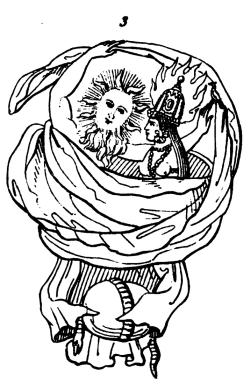
This figure represents the Mystic Brahma espousals with Parasakti. The latter is the divine principle of intellectual emanative potentiality or energy, and the ideal of archi-typal womanhood. The Sakti is conceived of as the female part of the energy of Brahma’s intellectual, creative power and creative wisdom. Brahma is here the true Para-Brahma, and Para-Sakti a true Para-sarasvadi. The sexless in Brahman (neuter) is here transmuted into the male or energizing power, as the principal symbolic type of the divine emanative, yet immanent, creative power, as the masculine principle of the ideal or Great Androgynic Man or the Makrokosm; and the flaming Sun is here depicted as the flaming sun-face, representative of the male-active deity, also called Purusha. The Sakti or Para-Sakti, the fructifying energy and potentiality of Brahman’s wisdom, wears upon her head a bright fire-flaming crown or nimbus.
The veil surrounding them, is the mystic veil produced by the ideation of the eternal thought of the eternal Mind. In the left hand of the sun-figure on the first finger, is carried a bird or perhaps a dove, which is intended to symbolize the flight of the ideal creation from the eternal Mind before the appearance of that which appears to us to be the real world. In the right hand he holds the end of the mystic veil. On the head of Maya—the woman—is the world-egg cap. Below, in the shadow of the spherical cloak of the God-dawn, is seen the world-egg surrounded by the spiritualizing Ananda the snake of eternity, which as if asleep and inactive, is suspended around the egg.
In India the principal general symbols are fire and water, sun and moon, man and woman, bull and cow, the linga and yoni, the lotus and the sacred fig (ficus indica). The lotus is formed of red, white and blue colors; blue is considered the same as black.
Isaac Myer.
“Light on the Path.”
“The Soul of man is immortal and its future is the future of a thing whose growth and splendour has no limit.”
It is with extreme diffidence that I venture to undertake a short commentary or analysis of the book whose title heads this article; not only because of the nature of the work itself, but also because it has already been twice commented upon, once by the author, and once by a very learned student of Eastern Literature. The author’s notes, however, were rather an extension of the original text than a commentary in the strict sense of the word; while the object of the second annotator was more an attempt to show the identity of the doctrines contained in Light on the Path with those of ancient Brahamanical Philosophy, than to give the nature of those doctrines in themselves.
The object of this paper on the contrary, is to attempt to analyze the scheme of Philosophy in accordance with which this little book has been written; in other words, to attempt to set forth the intellectual counterpart of the spiritual doctrines of Light on the Path. It is inevitable that, in thus changing the doctrine from the Spiritual to the intellectual plane, so to speak, the intellectual counterpart should be inferior to the Spiritual original. To counterbalance this loss, however, it is true on the other hand that the intellectual counterpart may render the spiritual original accessible to some, the conformation of whose minds renders them unable to appreciate it directly. It is in the hope that this may be so that the present paper has been attempted.
To begin with, then, the work we are considering indicates a possible enlightenment of the Soul, and development of the higher part of our nature; and further states that these results cannot take place before a certain battle has been fought and won: we have, therefore, to discover what the soul is; what is the nature of the battle; what are the opposing forces; and what are the results of the struggle.
The combatants are the higher nature, or Soul on the one side; and the lower nature or egotism on the other. The higher nature includes the intellectual, Spiritual, and æsthetical powers: that is to say, the powers which deal with the perception of truth, goodness, and beauty.
The sense of truth is characteristically manifested in the conquest of some intricate mathematical problem, or in following successfully some difficult chain of reasoning.
The sense of beauty is manifested in the joy with which we behold the splendor of a glorious sunset.
The sense of goodness is manifested in the voice of an approving conscience, or in the reverence and admiration we feel for some godlike and noble character.
It is undeniable that the intellect can discriminate between what is, and what is not, true, within its own domain, the æsthetical faculty also can pronounce with certainty as to the presence or absence of that quality which we call beauty.
So can the moral nature decide without hesitation as to what is or what is not in accordance with Righteousness. These three powers of the higher nature are subject to development, that is to say, at different periods they will perceive the qualities of beauty, truth, and goodness in different objects, and in different degrees; but as to the reality of the three qualities their voice is ever the same.
The three powers perceive three harmonies, each in its own domain; when the three are harmoniously developed the three harmonies are perceived to be one, and to this one great harmony are given the names of the Eternal and the Law of God. The seer of old feeling the sense of Rightousness’ within him exclaimed: “I will rejoice in the Eternal, and in him will I put my trust.” When the powers of the higher nature are developed, under all temporary disharmony and chaotic disturbance, are perceived a deeper order and more enduring harmony ever at work. Marcus Aurelius had perception of a deep Spiritual truth, when he wrote the concluding sentences of the following utterance.
“Figs, when they are quite ripe, gape open: and in the ripe olives, the very circumstance of their being near to rottenness, adds a peculiar beauty to the fruit, and ears of corn bending down, and foam which flows from the mouth of wild boars, and many other things,—though they are far from being beautiful, in a certain sense,—still, because they come in the course of nature, have a beauty in them, and they please the mind; so that if a man should have a feeling and a deeper insight with respect to the things which are produced in the universe, there is hardly anything which comes in the course of nature, which will not seem to him to be, in a manner, disposed so as to give pleasure.” That is,—in all things, could we but perceive it, is the harmony of the Eternal.
The first harmony, the harmony of truth, is perceived by the scientific materialist; that is to say, he is capable of perceiving the reign of Law in the physical universe.
The artistic nature can perceive the harmony of beauty in nature and art.
By the spiritually-minded is perceived the moral harmony.
It is the distinctive mark of modern Civilization that the harmonies of truth and beauty, of Science and Art are perceived and openly recognized by all, while the harmony of Holiness is passed over, in silence and oblivion. It is the object of Theosophy, rightly understood, to arouse the world to a renewed sense of the harmony of Righteousness.
So much for the higher nature. Confronting it stands the Egotism. For where the moral sense dictates peace and goodwill to all men, the Egotism raises a selfish claim for a monopoly of all good things, all pleasures, all enjoyments. The first enjoyment the Egotism demands is to surpass and dominate all other Egotisms which it seems to see pursuing the same pleasures as itself. Hence the command: “Kill out ambition.” Having once gained this domination the self cries out for enjoyments both sensual and sensuous, for all the pleasures of life. Hence the need for the command “Kill out the desire of life;” the self is also deterred by indolence from carrying out any good inspirations that may descend through the thick mist which surrounds it, from the higher nature: against indolence it is written “Kill out the desire of comfort.”
But the moral sense condemns the existence of this self, this centre of force, which is not in accordance with its perception of Harmony. When once the moral nature comes to perceive the evil of egotism, the question inevitably arises for solution, “Shall this cause of disharmony cease or continue?” If the decision is for its continuance one of two things will happen. Either, before the moral nature has been completely paralysed and atrophied by neglect,—before the seared conscience is completely silenced,—the fact will be recognised, in the midst of pain and sorrow unspeakable, that “to work for self is to work for disappointment;” and in that case the moral nature may at last meet with its development and all may be well; “the weak must wait for its growth, its fruition, its death, and it is a plant that lives and increases through the ages.” It has been said also “the forging of earthly chains is the occupation of the indifferent, the awful duty of unloosing them through the sorrows of the heart is also their occupation” and truly “both are foolish sacrifices.” Either this takes place, or,—the moral nature at last becomes completely deadened, all the force and vital power which has been drawn away from it goes to strengthen the Egotism which becomes from henceforth a centre of evil, of destruction; an enemy of the eternal.
It seems that individual existence means a certain amount of force, which may vitalise either the powers of the higher nature or those of the egotism; or those of both, in part. It seems also that the egotism is a group of centres, so to speak, from some or all of which the energic force of the individual may work; so that, for example, when this force works from one centre in the egotism sensuality arises; when from another centre, hate; from another, evil ambition, and so on. When the energic force is raised to the higher nature it may act from various centres; from one, as charity; from another, as holiness, and so on. Hence, “any good quality may become any other good quality”—if the conditions are favorable. It seems also that the Will can degrade the energic force from the soul to the egotism; or, conversely, can raise it from the egotism to the soul; so that, by the alchemical power of the will, so to speak, the baser metal becomes converted and, rising to the top of the still, becomes pure gold. Besides the higher and lower natures we have been considering there resides also, in the complete being, consciousness or sense of existence and will. When all the portions of energic force,—or the Satwaic sparks, as they are elsewhere called,—rise to the higher nature, the individual becomes one with the Eternal, and a part of the United Spirit of Life, and individual existence ceases, in a sense. When the question is asked “Shall the self cease or continue?” the moral nature answers decisively “It ought to cease.” If the truth of this mandate is recognised, at once a terrible struggle arises; self opposed rises with tenfold force and violence; again and again it craftily casts doubt on the truth of the moral nature; raises obstacles, temptations and hindrances; all the pleasures it has enjoyed are to be swept away forever; all the momentum and power that the egotism has gained, through long continued indulgence and unhindered growth, are brought to bear at once on the struggle; the whole nature is torn by the conflict, the will is tried to the uttermost; but under all this turmoil and strife lies the assured consciousness of final victory; it is felt that sooner or later the self must be destroyed, that it is built for time and not for eternity, that its days are numbered.
During the struggle intervals of peace occur, and grow greater and longer as the end approaches; till at last, when the final victory is won this peace becomes habitual.
But as the conflict goes on, the will at last gains strength to say, once for all “Henceforth, forever, will I serve self no more.” And immediately the first struggle is ended. The dominance of self is forever destroyed. In reply to the command “Seek in the heart the source of evil, and expunge it” the soul can say “this also have I done,” then comes “peace to the troubled spirit” peace deep and pure. The soul recognises that the self has been the cause of individual existence; when the self is removed the soul tends to harmonise itself with the great harmony, to become one with the eternal; but all the evil tendencies to selfishness and sin, must be gradually overcome, for though their cause and source has been destroyed, yet they still maintain a certain momentum. Not yet can it be said that the soul is perfectly at one with the United Spirit of Life. Much remains to be done, yet much has been done already, for during the struggle the energic force has become loosened from the centres of self, and has ascended to strengthen and vivify the soul, which becomes strong, fully awakened, and in harmony with the eternal; the flower of the soul is opening, the first step on the Path is taken. In the Idyll of the White Lotus the same author has given the same history in another form. The New-Testament story is the same, and so is the scheme of Christian Theology for those who have eyes to see it; for that story is “the tragedy of the soul, it has been told in all ages and among every people.”
“Enter the Path! there spring the healing streams Quenching all thirst! there bloom the immortal flowers Carpeting all the way with joy! there throng Swiftest and sweetest hours.”
Charles Johnston.
Dublin, Ireland.
Musings On the True Theosophist’s Path.
If you desire to labor for the good of the world, it will be unwise for you to strive to include it all at once in your efforts. If you can help elevate or teach but one soul—that is a good beginning, and more than is given to many.
Fear nothing that is in Nature and visible. Dread no influence exerted by sect, faith, or society. Each and every one of them originated upon the same basis—Truth, or a portion of it at least. You may not assume that you have a greater share than they, it being needful only, that you find all the truth each one possesses. You are at war with none. It is peace you are seeking, therefore it is best that the good in everything is found. For this brings peace.
It has been written that he who lives the Life shall know the doctrine. Few there be who realize the significance of The Life.
It is not by intellectually philosophizing upon it, until reason ceases to solve the problem, nor by listening in ecstatic delight to the ravings of an Elemental clothed—whose hallucinations are but the offspring of the Astral—that the life is realized. Nor will it be realized by the accounts of the experiences of other students. For there be some who will not realize Divine Truth itself, when written, unless it be properly punctuated or expressed in flowery flowing words.
Remember this: that as you live your life each day with an uplifted purpose and unselfish desire, each and every event will bear for you a deep significance—an occult meaning—and as you learn their import, so do you fit yourself for higher work.
There are no rose-gardens upon the way in which to loiter about, nor fawning slaves to fan one with golden rods of Ostrich plumes. The Ineffable Light will not stream out upon you every time you may think you have turned up the wick, nor will you find yourself sailing about in an astral body, to the delight of yourself and the astonishment of the rest of the world, simply because you are making the effort to find wisdom.
He who is bound in any way—he who is narrow in his thoughts—finds it doubly difficult to pass onward. You may equally as well gain wisdom and light in a church as by sitting upon a post while your nails grow through your hands. It is not by going to extremes or growing fanatical in any direction that the life will be realized.
Be temperate in all things, most of all in the condemnation of other men. It is unwise to be intemperate or drunken with wine. It is equally unwise to be drunken with temperance. Men would gain the powers; or the way of working wonders. Do you know, O man, what the powers of the Mystic are? Do you know that for each gift of this kind he gives a part of himself? That it is only with mental anguish, earthly sorrow, and almost his heart’s blood, these gifts are gained? Is it true, think you, my brother, that he who truly possesses them desires to sell them at a dollar a peep, or any other price? He who would trade upon these things finds himself farther from his goal than when he was born.
There are gifts and powers. Not just such as you have created in your imagination, perhaps. Harken to one of these powers: He who has passed onward to a certain point, finds that the hearts of men lie spread before him as an open book, and from there onward the motives of men are clear. In other words he can read the hearts of men. But not selfishly; should he but once use this knowledge selfishly, the book is closed—and he reads no more. Think you, my brothers, he would permit himself to sell a page out of this book?
Time—that which does not exist outside the inner circle of this little world—seems of vast importance to the physical man. There comes to him at times, the thought that he is not making any progress, and that he is receiving nothing from some Mystic source. From the fact that he has the thought that no progress is being made the evidence is gained that he is working onward. Only the dead in living bodies need fear. That which men would receive from Mystic sources is frequently often repeated, and in such a quiet, unobtrusive voice, that he who is waiting to hear it shouted in his ear, is apt to pass on unheeding.
Urge no man to see as yourself, as it is quite possible you may see differently when you awake in the morning. It is wiser to let the matter rest without argument. No man is absolutely convinced by that. It is but blowing your breath against the whirlwind.
It was at one time written over the door: “Abandon Hope, all ye who enter here.” It has taken hundreds of years for a few to come to the realization that the wise men had not the slightest desire for the company of a lot of hopeless incurables in the mysteries. There is to be abandoned hope for the gratification of our passions, our curiosities, our ambition or desire for gain. There is also another Hope—the true; and he is a wise man who comes to the knowledge of it. Sister to Patience, they together are the Godmothers of Right Living, and two of the Ten who assist the Teacher.
American Mystic.
Thought Effects.
Some thirty years ago, I began a five years’ residence in a foreign land. Whilst there, I was conscious of a stern conflict going on within me to keep myself from falling into some of the ways and beliefs of the people of that land. So strong was the assault in one direction upon the Idol of Right which had been set up within me by a New England training, that for fear it should topple and fall, I was constrained to withdraw myself little by little from social relations, until finally I came to be pretty much alone, living on the pampas with flocks, herds, nature generally, and a few books for company. Even after this change the fight went on, though in a less active form and on a more desultory scale.
After I went from there, reflection upon the subject brought me to this conclusion among others, viz.: that one of the most powerful forces emanating from distinct societies of mankind works by mental action upon man from the unseen atmosphere surrounding him.
It is said advisingly, “When in Rome do as the Romans do.” It may be said, warningly: “When one enters upon living in Rome, he can scarce help but do as the Romans do.”
In these later days, investigation of Theosophy has shown me of what nature was the obstacle against which I had been contending so stoutly.
It was of the Karma of that nation. It has shown me also the method of that unseen, unheard influence which “is in the air,” ever about us, ever ready to move us, to govern us. And this method of influence, unseen and unheard, is the action upon us of forces existing on the Astral Plane. Among these forces are the thoughts of men living upon the objective plane of Earth.
After so much of preface, I come to a more particular consideration of some of the effects of those thoughts of man, which are unexpressed by speech or action, upon others and upon himself:
1st. How may we effectually resist the force of bad influence of locality operating on us from the Astral Plane?
2nd. How may we do something, otherwise than by precept and example, towards overcoming the evil Karma of Locality which may be affecting others?
3rd. How may we in individual cases help some unfortunates with whose needs we are acquainted?
An answer is—by Thoughts.
In man’s advancement from darkness into light, in the “Human Soul’s” departure from lower materiality to entrance into right Spiritual living, among other means to be used to attain that end are right thought, right action, right speech and right meditation. Of these, right thought, is of primary importance, for it is the foundation from which only the others can spring into life. Actions in objectivity are illusions; they are shadows of our personality created by thoughts. Thoughts are nearer, more akin to our personality than actions are, for they are primary expressions from personality, always preceding conscious speech and action. Of all the indices to our personality of which we have knowledge thoughts are the clearest; we are as our thoughts are. In compliance with that grand mandate, “Know Thyself,” why scan life’s page of speech and actions—shadows—when a vast volume of thoughts—realities—expressions of our personality, lies open to us for finding knowledge of self?
Though independent of speech and action, thoughts are realities. They are real, living, active forces, until their force is expended,—but the effects of right thoughts last forever. Space does not necessarily limit their reach. They are in the air, so to speak, everywhere, and can move with a rapidity that is instantaneous. They may not only be sent, but are received. It takes but the veriest morsel of time to send a thought to the Sun; at the Sun it takes as little time to receive a thought from the Earth.
To the first question—“how may we effectually resist the force of bad influence of Locality operating on us from the Astral Plane?”—one way is to search for Spiritual Truth. That truth is “in the air.” It is conveyed to us by Thoughts. But a thought “from the air” is as a seed. A mustard seed planted in ice will not fructify; a spiritual thought-seed falling upon a “Human Soul” which is bound and tied to Earth by its “Animal Soul” will not fructify. The mustard seed must fall into ground properly prepared for its reception, ere by culture it can sprout, grow, and bear fruit. And so, too, must the soil of the “Human Soul,” be made ready in order that it shall afford an appropriate bed upon which the ever-present Spiritual thought-seed shall alight. On such a prepared soil it will surely fall; as surely as the magnetic needle points to its pole, and once there, by our own culture it may grow into “an everlasting tree of Holiness.”
How is that bed prepared? How is it that we become ready to receive Spiritual Truth? By right thought, right action, right speech and right meditation. It lies within our inner selves whether we shall advance in Spiritual knowledge and life, and nowhere else; it must be our purpose, our business. No dictum of the Schools can bring it about. No printed book on esoteric wisdom or on ethics, or on the multitudinous religions of man can give it to us;—belonging to the Theosophical Society does not necessarily lead us into Spiritual life. These, to the hungry “Human Soul,” may be of immense importance, but if the “Human Soul”—principle 5, be not first prepared, if we do not look upward and build upward, all these means,—Spiritual thoughts that are “in the air,” wise books, this society of yours—they are all to such a spiritually-desert soul, but as of old—“pearls before swine”—hidden light—a force shut out by ourselves from acting within us.
When we are engaged in right searching for Spiritual Truth, bad forces from the Astral Plane are inoperative upon us: Thus may we effectually resist the force of bad influence of Locality operating on ourselves from the Astral Plane.
The second question we are considering is, “How may we do something, otherwise than by precept and example, towards overcoming the evil Karma which may be affecting others?”
Surely, again, it is by right thought, and right action, speech and meditation. For, not only do they prepare the way for the reception of Spiritual Truths, but the ego, so thinking, acting, speaking and meditating, is, while so employed, disseminating Spiritual light on all sides through the Astral Plane. He is throwing out Spiritual truth-seed which is reaching far and near. Wherever a “Human Soul” is in need of it, and hungering for it, it will surely fall; for there the soil is ready for its reception. These right thoughts have gone into “the air,” and are certain to strike in somewhere for good.
Thus by right thought we may do something otherwise than by precept and example, towards obliterating the evil Karma of locality which is affecting others.
Regarding the third question; it seems to me that we all know some particular individuals to whose high needs we can minister by direct intention through the power of thought.
Who, that observes and reflects, cannot gather from his own experience the fact that thought can fly to a person at a distance? How common to say “I was thinking of one and he appeared.” It is not an uncommon experience for one to unexpectedly entertain serious, at any rate marked thoughts about another, and subsequently to find that the other was similarly occupied in mind with him at the same time. It is odd if there be not some among you who know that thought messages have been sent, received and acted on by the object-person when the receiver was in an abnormal condition to the sender. By these and other illustrations which doubtless will occur to you, we know that it is within the province of cause and effect that thought has power to operate on others at a distance by direct intention of the sender, by mental action alone.
Believing in the reality of thought—knowing the reality of thought—in its power to shield us from evil; in its power to affect others unknown to us; in our power to project it to special individuals, what opportunities it affords us for conferring high good.
But in order to do positive good to another by this direct thought unexpressed by speech or action, some certain conditions are necessary, which we may consider as milestones that shall indicate the progress of our own ascending path from materiality to spirituality. To be a power by thought influence,—(I do not refer now to thought sent by will power to a particular “sensitive” who is in subjective state to the sender—which condition is on a lower plane than that which we are now considering,) presupposes intensity of love born of and nurtured by Spirituality for those whose high good we thus seek to establish. There must first be born in us an enthusiasm for giving high and positive good to another unconciously enthusiasm, as is our enthusiasm, shall be the energy of our missive-thought; and according to the energy of that thought will be its effect upon the object to which it is sent,—the more powerfully intense the thought the deeper it will penetrate;—the longer its effects will endure.
Right meditation will be required of us to determine what we really desired to effect. If we arrive at the position within ourselves necessary for obtaining power for affecting another for good by thought message, there will be engendered within us a portion of that grand principle on which this Society is founded, viz: Universal Brotherhood—unselfish love for others.
In making thought message to others, on the basis of lifting them to a higher plane of action, a part of our daily life, by its reaction upon ourselves we shall surely be “laying up treasures in Heaven”—and full will be our material for Devachanic life.
As in Devachan one shall live in the good he has done while in objective earth life—shall live in the true beauty he has learned to perceive—shall live in the effects of his good-life, his thoughts while here on earth can be made for the Devachanic period of his existence a vast storehouse of “good-life” of purest water. But it must be of thoughts untinged by selfish considerations. It must be of thoughts evolved through love of others for their good.
Right thought being the grand power it is:
1st. To resist within ourselves the bad Karma of Locality.
2nd. By which to weaken and destroy the bad Karma of Locality, which is disastrously affecting others.
3rd. By which from a basis of spiritual love we may send light to a groping soul,—what heavy responsibility is ever over us that it shall be our purpose, our study to “think aright.”—To live much in thus right thinking—we shall ever be lifting some of the heavy Karma from off the world. It is thus, that we can “live in the Eternal, for right thought is of the Universal Mind, and Universal Mind is of the Eternal.”
Reflect that persistent right thinking affects humanity constantly in the right direction, ever from the gross and material to the refined and Spiritual. It will ever be a constant force so long as evil exists. Let this idea sink into our consciousness. Let right thought be to us as the strong arm with which to do good to others. One need not long for wealth, for position or power that he may do good to others; the poorest in material wealth, the humblest in station, the most insignificant among men has within himself this ever open storehouse of power for conferring good on which he can draw without limit; a wealth he can scatter broadcast, or can give by direct selection of object with the surety that he is bestowing benefits broadly,—knowing that he is successfully contending against Spiritual poverty—which is the sum of evil.
He who uses this wealth, can do so—must do so only by sacrifice of thought of self. He must be interested only in combating evil by helping humanity at large; of offering special help to those whom he knows are desirous of help. As his life-love for the objects in view is the only foundation upon which he can do these works,—love of self can not be a power within him.
To put it the other way. Begin the work of thought for the good of others by first forgetting self; as fast as possible get away from the dominion of materiality. Live in the love of doing enduring good to others—these conditions are the true and upward advancement of ourselves. The doing of these things is the reward;—it is the advancing into God-life. It is part of our real Eternal selves. It is living in the Eternal—the everlasting good; for the God-life—the good-life is the only eternally active one. By living thus, the gross and material now enchaining our entities will be broken down and will die and leave us—and die they must sooner or later or the “I am I” shall perish.
H. N. H., F.T.S.
Brooklyn, Oct 15, 1886.
Environment.
To the Western mind the doctrines of Karma and Reincarnation contain difficulties which while they seem imaginary to the Eastern student, are nevertheless for the Western man as real as any of the other numerous obstructions in the path of salvation. All difficulties are more or less imaginary, for the whole world and all its entanglements are said to be an illusion resulting from the notion of a separate I. But while we exist here in matter, and so long as there is a manifested universe, these illusions are real to that man who has not risen above them to the knowledge that they are but the masks behind which the reality is hidden.
For nearly twenty centuries the Western nations have been building up the notion of a separate I—of meum and tuum—and it is hard for them to accept any system which goes against those notions.
As they progress in what is called material civilization with all its dazzling allurements and aids to luxury, their delusion is further increased because they appraise the value of their doctrine by the results which seem to flow from it, until at last they push so far what they call the reign of law, that it becomes a reign of terror. All duty to their fellows is excluded from it in practice, although the beautiful doctrines of Jesus are preached to the people daily by preachers who are paid to preach but not to enforce, and who cannot insist upon the practice which should logically follow the theory because the consequences would be a loss of position and livelihood.
So when out of such a nation rises a mind that asks for help to find again the path that was lost, he is unconsciously much affected by the education not only of himself but also of his nation through all these centuries. He has inherited tendencies that are hard to be overcome. He battles with phantasms, real for him but mere dreams for the student who has been brought up under other influences.
When, therefore, he is told to rise above the body, to conquer it, to subdue his passions, his vanity, anger and ambition, he asks, “what if borne down by this environment, which I was involuntarily born into, I shall fail.” Then when told that he must fight or die in the struggle, he may reply that the doctrine of Karma is cold and cruel because it holds him responsible for the consequences which appear to be the result of that unsought environment. It then becomes with him a question whether to fight and die, or to swim on with the current careless as to its conclusion but happy if perhaps it shall carry him into smooth water whose shores are elysian.
Or perhaps he is a student of occultism whose ambition has been fired by the prospect of adeptship, of attaining powers over nature, or what not.
Beginning the struggle he presently finds himself beset with difficulties which, not long after, he is convinced are solely the result of his environment. In his heart he says that Karma has unkindly put him where he must constantly work for a living for himself and a family: or he has a life long partner whose attitude is such that he is sure were he away from her he could progress: until at last he calls upon heaven to interpose and change the surroundings so opposed to his perfecting himself.
This man has indeed erred worse than the first. He has wrongly supposed that his environment was a thing to be hated and spurned away. Without distinctly so saying to himself, he has nursed within the recesses of his being the idea that he like Buddha could in this one life triumph over all the implacable forces and powers that bar the way to Nirvana. We should remember that the Buddha does not come every day but is the efflorescence of ages, who when the time is ripe surely appears in one place and in one body, not to work for his own advancement but for the salvation of the world.
What then of environment and what of its power over us?
Is environment Karma or is it Reincarnation? The Law is Karma, reincarnation is only an incident. It is one of the means which The Law uses to bring us at last to the true light. The wheel of rebirths is turned over and over again by us in obedience to this law, so that we may at last come to place our entire reliance upon Karma. Nor is our environment Karma itself, for Karma is the subtle power which works in that environment.
There is nothing but the Self—using the word as Max Müller does to designate the Supreme Soul—and its environment. The Aryans for the latter use the word Kosams or sheaths. So that there is only this Self and the various sheaths by which it is clothed, beginning with the most intangible and coming down to the body, while outside of that and common to all is what is commonly known as environment, whereas the word should be held to include all that is not The Self.
How unphilosophical therefore it is to quarrel with our surroundings, and to desire to escape them? We only escape one kind to immediately fall into another. And even did we come into the society of the wisest devotees we would still carry the environment of the Self in our own bodies, which will always be our enemy so long as we do not know what it is in all its smallest details. Coming down then to the particular person, it is plain that that part of the environment which consists in the circumstances of life and personal surroundings is only an incident, and that the real environment to be understood and cared about is that in which Karma itself inheres in us.
Thus we see that it is a mistake to say—as we often hear it said—“If he only had a fair chance; if his surroundings were more favorable he would do better,” since he really could not be in any other circumstances at that time, for if he were it would not be he but some one else. It must be necessary for him to pass through those identical trials and disadvantages to perfect the Self; and it is only because we see but an infinitesimal part of the long series that any apparent confusion or difficulty arises. So our strife will be, not to escape from anything, but to realize that these Kosams, or sheaths, are an integral portion of ourselves, which we must fully understand before we can change the abhorred surroundings. This is done by acknowledging the unity of spirit, by knowing that everything, good and bad alike, is the Supreme. We then come into harmony with the Supreme Soul, with the whole universe, and no environment is detrimental.
The very first step is to rise from considering the mere outside delusive environment, knowing it to be the result of past lives, the fruition of Karma done, and say with Uddalaka in speaking to his son:
“All this Universe has the Deity for its life. That Deity is the Truth. He is the Universal soul. He Thou art, O Svetaketu!”169
Hadjii Erinn.
Tea Table Talk.
Recently the tea-table was chatting about the Widow’s escape from the Romish fold. She was nearly converted by the urbane Monsignor Capel, but escaped at the critical moment, she said, “by reason of a sudden preoccupation.” This turned out to be the death of her worthy husband. The Widow is a pretty and amiable creature, approved even by the ladies who say “she is a good little soul and mourns most expensively.” Hence she never appears at the tea-table without an escort, and the most frequent of these is one Didymus, lawyer by profession, good humored, sceptic by nature, whose careless, semi-flippant manner makes it difficult to know him, though he and I frequent the same clubs and make our bows in the same drawing rooms. On the day in question the lady said that she brought him often because she “wanted him converted to Theosophy.”
“But, my dear Madam,” said I, “you know we don’t believe in converts. Theosophy is simply an extension of previous beliefs and like Victor Hugo it says, ‘in the name of Religion, I protest against religions.’ People have to grow into it. When they are ready for it a crisis of some kind, now moral, now physical, seems to occur just before they accept the Light from the East as a man receives back something he has lost. It seems as if those elemental creatures, who attend man, foresaw his determination and strove to frighten him away from the initial moment of choice. Great momentum, even of misapplied energies, often indicates the nearness of radical change.”