INDEX. (continued 7)
Reading edition
“I obeyed strictly the directions of my Master, and, day by day, the spiritual world became more and more unveiled before me. The next day I saw the figures of the Prophet and his chief Companions, and legions of Saints and Angels passed before my inner vision. Three months passed in this manner, after which the sphere where all color is effaced opened before me, and then all the figures disappeared. During all this time the Master ceased not to explain to me the doctrine of the union with God and of mystical intuition. But, nevertheless, the Absolute Reality would not show itself to me. It was not until after a year that the knowledge of the Absolute Reality, in its relation with the conception of my own existence came to me. The following verses revealed themselves at that moment to my heart, whence they passed unbidden to my lips:—
‘That this corruptible frame was other than water and dust I knew not: the powers of the heart and the soul and the body I knew not, Woe is me! that so much of my life without Thee has for ever fled from me. Thou wert I; but dark was my heart: I knew not the secret transcendent.’
“I submitted to Mollâ Shâh this poetical inspiration, and he rejoiced that the idea of the union with God was at last manifested to my heart; and addressing his disciples, he said: ‘Tèwekkul Bêg has heard from my mouth the words of the doctrine of the union with God, and he will never betray the mystery. His inner eye is opened; the sphere of color and images is shown to him, and at last the sphere where all color is effaced has been revealed to him. Whoever after having passed through these phases of the union with God, has obtained the Absolute Reality, shall no more be led astray, whether by his own doubts or by those which sceptics may suggest to him.”
(To be continued.)
Musings on the True Theosophist’s Path.
II.
“Work as those work who are ambitious.—Respect life as those do who desire it.—Be happy as those are who live for happiness.”—Light on the Path.
We are tried in wondrous ways, and in the seemingly unimportant affairs of life, there often lie the most dangerous of the temptations.
Labor, at best, is frequently disagreeable owing either to mental or physical repugnance. When he who seeks the upward path, begins to find it, labor grows more burdensome, while at the time, he is, owing to his physical condition, not so well fitted to struggle with it. This is all true, but there must be no giving in to it. It must be forgotten. He must work, and if he cannot have the sort he desires or deems best suited to him, then must he take and perform that which presents itself. It is that which he most needs. It is not intended either, that he do it to have it done. It is intended that he work as if it was the object of his life, as if his whole heart was in it. Perhaps he may be wise enough to know that there is something else, or that the future holds better gifts for him, still this also must to all intents be forgotten, while he takes up his labor, as if there were no to-morrow.
Remember that life is the outcome of the Ever-Living. If you have come to comprehend a little of the mystery of life, and can value its attractions according to their worth; these are no reasons why you should walk forth with solemn countenance to blight the enjoyments of other men. Life to them is as real, as the mystery is to you. Their time will come as yours has, so hasten it for them, if you can, by making life brighter, more joyous, better.
If it be your time to fast, put on the best raiment you have, and go forth, not as one who fasts, but as one who lives for life.
Do your sighing and crying within you. If you can not receive the small events of life and their meanings without crying them out to all the world, think you that you are fitted to be trusted with the mysteries?
The doing away with one or certain articles of diet, in itself, will not open the sealed portals. If this contained the key, what wise beings must the beasts of the field be, and what a profound Mystic must Nebuchadnezar have been, after he was “turned out to grass!”
There are some adherents of a faith, which has arisen in the land, who deem it wise to cast away all things that are distasteful to them; to cut asunder the ties of marriage because they deem it will interfere with their spiritual development, or because the other pilgrim is not progressed enough. Brothers, there lives not the man who is wise enough to sit as a judge upon the spiritual development of any living being. He is not only unwise but blasphemous who says to another: “Depart! you impede my exalted spiritual development.”
The greatest of all truths lies frequently in plain sight, or veiled in contraries. The impression has gone abroad that the Adept or the Mystic of high degree, has only attained his station by forsaking the association of his fellow creatures or refusing the marriage tie. It is the belief of very wise Teachers that all men who had risen to the highest degrees of Initiation, have at some time passed through the married state. Many men, failing in the trials, have ascribed their failure to being wedded, precisely as that other coward, Adam, after being the first transgressor cried out “It was Eve.”
One of the most exalted of the Divine Mysteries lies hidden here—therefore, Oh Man, it is wise to cherish that which holds so much of God and seek to know its meaning; not by dissolution and cutting asunder, but by binding and strengthening the ties. Our most Ancient Masters knew of this and Paul also speaks of it. (Ephesians v. 32.)
Be patient, kindly and wise, for perhaps in the next moment of life, the light will shine out upon thy companion, and you discover that you are but a blind man, claiming to see. Remember this, that you own not one thing in this world. Your wife is but a gift, your children are but loaned to you. All else you possess is given to you only while you use it wisely. Your body is not yours, for Nature claims it as her property. Do you not think, Oh Man, that it is the height of arrogance for you to sit in judgment upon any other created thing, while you, a beggar, are going about in a borrowed robe?
If misery, want and sorrow are thy portion for a time, be happy that it is not death. If it is death be happy there is no more of life.
You would have wealth, and tell of the good you would do with it. Truly will you lose your way under these conditions. It is quite probable, that you are as rich as you ever will be, therefore, desire to do good with what you have—and do it. If you have nothing, know that it is best and wisest for you. Just so surely as you murmur and complain just so surely will you find that “from him that hath not, shall be taken even that which he hath.” This sounds contradictory, but in reality is in most harmonious agreement. Work in life and the Occult are similar; all is the result of your own effort and will. You are not rash enough to believe that you will be lifted up into Heaven like the Prophet of old—but you really hope some one will come along and give you a good shove toward it.
Know then, Disciples, that you only can lift yourselves by your own efforts. When this is done, you may have the knowledge that you will find many to accompany you on your heretofore lonely journey; but neither they or your Teacher will be permitted to push or pull you one step onward.
This is all a very essential part of your preparation and trial for Initiation.
You look and wait for some great and astounding occurrence, to show you that you are going to be permitted to enter behind the veil; that you are to be Initiated. It will never come. He only who studies all things and learns from them, as he finds them, will be permitted to enter, and for him there are no flashing lightnings or rolling thunder. He who enters the door, does so as gently and imperceptibly, as the tide rises in the night-time.
Live well your life. Seek to realize the meaning of every event. Strive to find the Ever Living and wait for more light. The True Initiate does not fully realize what he is passing through, until his degree is received. If you are striving for light and Initiation, remember this, that your cares will increase, your trials thicken, your family make new demands upon you. He who can understand and pass through these patiently, wisely, placidly—may hope.
American Mystic.
Poetical Occultism.
SOME ROUGH STUDIES OF THE OCCULT LEANINGS OF THE POETS.
I.
In the Bagavad-Gita and the Upanishads it is held that:
Ishwara, the Lord of all things, dwells in the heart of every mortal being, and from that place causes the illusions of the world to appear to man as reality.
Light on the Path dwells upon the necessity of understanding your own heart: It tells us to seek for the source of evil there, where it lives, as fruitfully in the heart of the devoted disciple as in that of the man of desire, and that your heart is the profoundest mystery of all the great obscurities.
Longfellow felt this when, in The Beleaguered City, he sang:—
I have read, in the marvelous heart of man, That strange and mystic scroll, That an army of phantoms vast and wan Beleaguer the human soul.
This verse occurs to him in connection with the old story that the City of Prague was once beleaguered by a vast phantom army, which camped down on the opposite bank of the river, and he likens the human heart to Prague. Here, in the city dwells Ishwara, who, while thus imprisoned, is beleaguered by the vast army—the phantoms of all the acts and thoughts of the person in this and other lives. Occultism declares with the poet, that the heart is a mystic scroll; it is a veritable field also, in which are sown many seeds that may lie unnoticed, not only during one life, but often for many many incarnations, but sure to blossom forth one day under favoring circumstances. And as they begin to grow, they evoke the phantoms of the deeds that sowed them, and those ghostly hosts sweep round the soul in its prison house.
In Resignation, Longfellow wrote: “There is no death! What seems so is transition.”
This is one of the propositions of Occultism. The poet was writing upon the death of the physical body of a girl much beloved, and was considering the change which in common life is known as “death.” But the followers of the Wisdom Religion know that this terrible change is not really death, is not in any sense the moment of decease of even the physical man. The visible being is a congeries of energies or elements which are by no means all dead when the person breathes his last, nor when the body is consigned to the grave. It is only the transition, as Longfellow says, of the informing spirit, to another sphere of action.
The same view is taken in the Atharva Veda, where it says, “Everything is transformed. Life and death are only modes of transformation, which rule the vital molecule from plant up to Brahma himself.”
The occult philosophy considers as death, only that process, and period, of separation between all the various elements of one’s lower human and animal nature; so that, in the case of suicides and other sudden and premature deaths, what occultists know as “death,” extends over a long period of time. The moment called death by the world, is only the time of separation between the body and the life principle, which the Hindus call jiva; this is the moment when the transition begins.
Goethe was a profound student of occultism. Its influence is to be traced throughout his works, and a leading motive in many of his dramas is the dominance over the lives of men of that power which we call Karma. His masterpiece, Faust, upon which a library of commentaries has been written, can only be truly read in the light of Occultism. Faust comes to an end with the following “Mystic Chorus” sung by the assembled Hosts of Heaven:
All that’s impermanent Is but a likeness. The Unattainable Here findeth witness; The Indescribable, Here is it done; The Ever-womanly Leadeth us on.
A wealth of occult meaning is packed into these eight closing lines of the grand drama, which is designed to depict the course of the soul from Heaven, through earth, back to Heaven. All that is impermanent, or of the earth, belonging to the realm of matter, is but a likeness, or symbol, designed for the instruction of man, who must learn to read the lesson if he is to progress. The Unattainable in the desires of those on and of the earth finds witness, or comes to pass, in the realization of all aspirations in the life beyond. The indescribable is done there, because man in the flesh has no senses adequate to comprehend those things pertaining to a higher plane of existence. The Ever-womanly is that which makes progress of the soul possible—the feminine principle which attracts the masculine, or pure spirit, to its opposite pole and thereby causes it to manifest itself. It is by these successive manifestations that the individual is carried forward, enriched by the experience which only thus, through the attraction of the Ever-womanly, or eternal feminine principle, is attained. So the Ever-womanly, or that whereby God the spirit is made manifest in matter, is the means to lead the soul of man on its course through the grandest possibilities of the Universe to the most exalted heights of the Indescribable.
Wordsworth, in his Ode on Immortality, says:
Our birth is but a sleep and a forgetting; The soul that rises with us, our life’s star, Had had elsewhere its setting, And cometh from afar. Not in entire forgetfulness, And not in utter nakedness, But trailing clouds of glory, do we come From God, who is our home. Heaven lies about us in our infancy! Shades of the prison-house begin to close Upon the growing boy; But he beholds the light, and whence it flows— He sees it in his joy. The youth, who daily farther from the east Must travel, still is nature’s priest. And by the vision splendid Is on his way attended; At length the man perceives it die away, And fade into the light of common day.
It is very clear here that Wordsworth is setting down the theory of “Reincarnation.” For he says the soul had elsewhere its setting; in order to set elsewhere, it must have had elsewhere an existence. He also refers, quite as curiously as do Whitman and Whittier, to a coming from the east, as if he had memories of a previous life in some oriental land where such ideas prevailed.
Shelley in Prometheus Unbound, sings:
Man, O not men! a chain of linked thought, Of love and might to be divided not, Compelling the elements with adamantine stress; As the sun rules, even with a tyrant’s gaze, The unquiet republic of the maze Of Planets, struggling fierce towards heaven’s free wilderness. Man, one harmonious soul of many a soul, Whose nature is its own divine control, Where all things flow to all, as rivers to the sea; Familiar acts are beautiful through love; Labor and pain and grief, in life’s green grove, Sport like tame beasts,—none knew how gentle they could be!
In the foregoing verses, the doctrine of Brotherhood is enunciated. Shelly refers to humanity as one, composed of its many units,—the one-life running through all; and also, in the first two lines, to the fact admitted by occultism, but sneered at by science, and dogmatic theology, that this “chain of linked thought,” compels the elements, and actually affects the course and destiny of the world. That is, that the Karma of the physical world, indissolubly bound up in that of the individuals upon it, is moulded and concentrated by the force of men’s thoughts and lives. To carry this out in one direction, we say that esoteric theosophy teaches that the inclination of the earth’s axis is made greater or less by the influence of the wickedness or goodness of the people upon the earth, thus bringing down what the people call evils, such as glacial disturbances, cyclones, earthquakes and other vicissitudes of earthly life. However fanciful this theory may appear, it remains for us quite true; and as the scientific world has no reason to give for the inclination of the axis, or for the precession of the equinoxes, we are entitled to hold an opinion where they have none. For the devout Christian this theory ought to have merits, if he chooses to remember that Sodom and Gomorrah were destroyed for their wickedness. They grew so horribly bad that fire was brought upon them either from heaven or beneath. If it ever happened, it must have been a cyclic disturbance. Science pooh-poohs it. Did it take place, then it was the culminating point for the dynamic power of the evil deeds and thoughts of the inhabitants.
In many places in the Christian bible, reference is made to the crying out to the Lord of the blood of the slain. Now as blood has no power to cry out, we must try in some way to make sense of these expressions, and the only way is by giving to the thoughts which produce deeds of violence, a dynamic power. It would then be easy to attribute to the blood the ability to cry out for justice, instead of saying that the deeds of blood require compensation.
But when blood is shed, elemental spirits pour in to the spot, drawn there by the emanations arising from it, and they become important factors in this supposed “calling out of the blood from the ground.” Being strengthened by the human exhalations, they are a new force composed not only of the thoughts of the murdered, but also of the despair, hate and revenge of the slain. Science of course of this knows nothing, and cares less. She cannot tell how long this new force, thus compounded of elementals, blood, and the thought of slayer and his victim, will last. But the God of the Christians knew all about this. In Genesis, Ch. iv, Verse 10, He says to Cain:
“What hast thou done? the voice of thy brother’s blood crieth unto me from the ground. And now art thou cursed from the earth, which hath opened her mouth to receive thy brother’s blood from thy hand.”
The blood furnishes the occasion, the thoughts of each give it force, and the elementals give it a voice to call on God.
S. B. J.
The Corner Stone.
Tradition relates that in the building of King Solomon’s temple there was a stone of such peculiar shape that the workmen could find no place for it, though it was regularly cut and with great care, and contained the sign of the Master. When the temple was near completion a place was found for the stone which the builders had through ignorance rejected. It was the Keystone of the Royal Arch.
Those who have opened the halls of learning to this generation have given a foundation stone, and repeatedly declared that no other foundation can endure, that the floods of time and the storms of passion will surely sweep with the besom of destruction every superstructure not founded on this rock. And yet there are those who wear the garb of fellow-crafts, and claim the wages of workmen, who not only reject this stone but ridicule it, and laugh it to scorn. The result is manifest in the confusion of the workmen, and it will presently become manifest that those who thus reject the corner-stone of Theosophy are brothers of the shadow literally, rather than Sons of Light; they will find no designs on the tracing-board, and they will be accused of murdering the “widow’s son.”
The time for wages will surely come, and even they who have come in at the ninth hour and labored faithfully in the vineyard will receive due wages.
The corner stone of Theosophy is distinctly stated to be Universal Brotherhood. A firm belief in this principle is required of every candidate for membership in the Theosophical Society. This is the sole requirement for affiliation, it is made plain, and no one can plead ignorance of this one requirement. To claim fellowship in the society, and ignore or repudiate its cardinal doctrine is not only the most pronounced hypocrisy, but works in every way to the injury of the individual and the society. Those therefore who are not ashamed to repudiate this cardinal principle ought in all fairness to retire from the society, and direct their energies into more congenial channels.
But aside from explicit repudiation of this principle of Brotherhood there is too often a tacit disregard of its requirements. It has been charged against the Society, that in the enunciation of this simple doctrine, they have announced nothing new, and it may at once be answered that it is not claimed as a novelty, but an actuality. And yet it is too often the case, that the application of this principle of universal brotherhood reaches no further than to the admission to membership in the T. S. of persons of either sex, and of every creed, color, and nationality, while in the relations of members and the necessary work of the society, the principle of brotherhood is too often practically ignored. It may therefore be profitable to inquire into the reasons assigned by the Masters for giving out to the world at this time their priceless treasures, and the purpose for which the Theosophical Society was instituted, though these purposes have been time and again stated, in plain English, and are printed in the rules and by-laws of the society, as well as in every application for membership. The misinterpretation of these plain declarations leads to constant disappointment, and hinders the legitimate work of the Society.
We have been repeatedly told that the Masters are no respecters of persons. They have on every occasion persistently and consistently refused to teach occultism to individuals. They have stated over and over again the terms on which anyone can gain their notice, or hope to advance in spiritual knowledge or power, viz: by working unselfishly and unceasingly for the advancement of the Brotherhood of man. This is the plan on which the masters work. Whatsoever they have given out has been designed for the elevation and well-being of the whole human race.
They have chosen such agents or assistants as were available for the promulgation of their doctrines, and they have distinctly stated, that not for this generation alone, but more especially for the coming Yuga, do they labor, like wise husbandmen, sowing now the seed for future harvests.
The meaning of Universal Brotherhood, and the mission of the Theosophical Society become thus perfectly plain, and we can misinterpret only at our peril. The masters have said, work with us, and become a part of us, and share with us.
Creeds and sects are innately selfish, dividing mankind into selfish circles of conceited and selfish men. Creeds are crumbling; replace them with universal benevolence, toleration, charity, justice—in one word, Brotherhood. He, therefore, who repudiates brotherhood, denies all. He who forgets charity, kindness, forbearance, forgiveness, has no right to call himself a Theosophist. We should have charity for everything but for uncharitableness. Let those who will in the face of all this, strive for occult power. Let them in spite of constant warning force, if they can, themselves into the astral plane, to be driven back in ever lasting terror by the “Demon of the Threshold,” or end their days in an Asylum for the Insane, but let them look for no assistance or protection from the Masters.
Pure and undefiled Theosophy leads man only to higher planes of thought and life. It puts him in possession of the true philosopher’s stone, by enabling him to convert the energies of life, into higher uses, for the welfare and elevation of his race. It teaches him neglect of no common duty or obligation, and it nowhere holds out the inducement that a Mahatma can be evolved by some secret hocus-pocus out of a mountebank. The mountebanks will presently denounce Mahatmas and repudiate theosophy, but they will prove as powerless to stay the tide of truth as to achieve mahatmahood. They may deceive the foolish and unwary, and console themselves with the company of Coloumb, Hodgson & Co., but those who have accepted in deed and in truth the simple doctrine of universal brotherhood with all that it implies, will possess their souls in patience and perfect trust, for they have heard the music of Bath Col.
J. D. Buck.
The Society of the Rosicrucians.
A ROUGH SKETCH OF THEIR FUNDAMENTAL DOCTRINES. (Communicated.)
The following are in outline the fundamental doctrines of the Brothers of the Rosy Cross. He who fulfills the required conditions, may find all necessary information in the “Book of Initiation,” and they say that when he is ready he finds with ease, a guide who, through his higher self instructs and directs him infallibly.
It is understood that the Society desires to be truly spiritual and asks no fees, but it seeks as members only those who are practical workers in the cause of humanity. But it is a secret body, not from fear of enemies, but in order to spread the truth, unimpeded by the war of opinions. The truth being eternal, is not subject to opinion, but to those who are able to see, it stands revealed in its own light.
1. The Universe as a whole is a Unity, having only one, eternal, universal and fundamental cause for its existence. All the multifarious forms, essences, powers or principles, are not originally self-existent, but are merely various manifestations of that one and universal cause. They are various modes of one original activity, and their shapes or organisms are the products of that activity, working upon different planes of existence and in various stages of evolution.
2. This cause, being eternal, unlimited and infinite, is beyond the power of the intellectual comprehension of any mortal and limited being. Its presence may be perceived everywhere, but in its highest aspect it can fully be known only to itself. Beings lower than itself, may intuitively feel its presence, but cannot intellectually know it, until they have risen up to its own level on the plane of existence. To avoid circumlocution, we call that eternal (spiritual) principle in its highest aspect “God” or “Brahm”; both words signifying originally “Good.”123
3. In this eternal and universal cause, the centre or fountain of All, is contained potentially everything existing in the Universe. It is itself, germinally or in a more or less developed state contained in everything that exists. It forms the (spiritual) centre of every living organism, and life itself is only a mode of manifestation of its own power. It is the cause and the architect of every form; it builds the form which it inhabits, from that centre, by the power of its own (consciously or unconsciously active) will and thought, and by the means offered by eternal nature, the latter being itself a product of previous states of its own existence and eternal action.
4. The highest form of activity of this principle requires for its perfect expression, perfect means. The perfect cannot manifest its perfection in an imperfect organism. The place which a being occupies on the ladder of evolution, depends on the progress which that divine principle, acting in the centre of each being, has made in evolving an organism, adapted to its manifestation.
5. The most perfect organism for the manifestation of the divine and universal principle in its highest aspect, of which we know, is the (spiritual) organism of Man. In this organism, this divine principle, after having attained sensation and consciousness in the lower forms of nature, may acquire (spiritual) self-consciousness and self-knowledge, evolving what is called the individual mind, with all its powers and faculties, for (spiritual) perception and real knowledge or wisdom.
6. The (ordinarily) visible so called physical-body of man is not the real Man, but merely a more or less imperfect representation of the real, or “inner man,” whose sphere of activity may extend as far as the sphere of his mind; in other words—as far as the power of his (spiritual) perception. The “inner man” is a reality, which after having attained—by the power of self differentiation—an individual existence, will retain its individuality, after the physical forms, which it has occupied for the purposes of evolution during its life upon a planet, have been disintegrated and changed into other forms.
7. Every being continues to exist in its essence after the (physical) form which expressed its essential character, has dissolved and disappeared; but as long as it has not acquired (spiritual) self-consciousness and self-knowledge, it is forced, after a time of rest, to reappear in a new form (mask or personality), to resume the process of its further development.124 After the divine principle in man has attained individual (spiritual) self-consciousness and self-knowledge, it requires no more embodiments in (physical) forms, and may, harmoniously united with the All, continue to exist as a self-conscious intelligence.
8. The attainment of spiritual self-consciousness and self-knowledge and the necessarily resulting perfection, therefore involves the attainment of immortality, and the latter can only be acquired by acquiring the former. Only that which is perfect remains; the imperfect is continually subject to change.
9. Although the individual human monad, without (spiritual) self-consciousness and knowledge, may arrive at that state of perfection in the slow course of its evolution, extending perhaps over many millions of years, nevertheless there is no necessity to wait until nature may, perhaps slowly and unaided, accomplish her object, but she may be assisted by the individual will and effort of those who know how to proceed.
10. The first necessary requirement for all who desire perfection, is therefore to know the laws that rule in the visible and invisible universe, and the attainment of the knowledge involves a study of the constitution of the Universe and of the constitution of (the soul of) Man.
11. From knowledge springs power, but those who possess knowledge, will be in the possession of something that will not benefit them, unless they desire to put it to some practical use. The second requirement is therefore to will, and as an individual will, deviating from the direction of the will of universal good, or acting in opposition to the latter, is evil, and can only bring final destruction upon him that exercises it, consequently the will of the individual must act in accordance with the universal will of God.
12. To act evil is for the majority of men far easier than to do good. Good will and desires to become useful must be made to accomplish some work. To overcome the resistance of evil and to put good into practice requires energy, courage and effort, and the third necessary requirement is therefore to dare to practice the good which we know and desire.
13. But as a power, after it has once been obtained, may be employed for good or for evil purposes, and as it is not desirable that persons with evil inclinations and tendencies, should be taught the way to prolong their personal existence after the dissolution of their physical form, because their existence would cause the infliction of injury upon others, and expose themselves to a long, slow and painful final disintegration; therefore, the deepest secrets of the Rosicrucians, and the way to the practical application of the secret knowledge, should be taught only to those who are good and pure to a degree sufficient to warrant that the mysteries communicated and revealed to them, may not be misapplied. The fourth necessary requirement for the Rosicrucian is, therefore, to be silent, in regard to that which it is not expedient to speak.
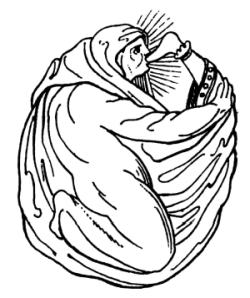
Hindu Symbolism.
I.
The student of Hindu metaphysical religious philosophy, will find most of its important formulations, veiled under a mystical symbolism; to understand which, is a key to the hints in the Upanishads and other esoteric writings.
We propose to give those interested, a series of illustrations from Hindu drawings with descriptions; in the latter, our study of the Kabbalah has been of great assistance.
The figure is a symbolical representation of Brahman (neuter) intwined in Itself.125 It is the highest deity of the Hindus, the principle of the universe; the representation is, of It, at the immediate instant of Its revealing Itself in the emanation of the universe, and before Its entrance into any kind of matter and before Its self renunciation. It symbolises the God-dawn between the pauses of emanative creation, its preservation, and the dissolution of created forms. Wrapped in Its cloak-sphere, Brahman conducts Its toe into Its mouth, perhaps to make, an eternal circle of Itself, perhaps to signify the union of the linga and yoni, perhaps to indicate the retrogression of Itself into Itself, or may be the eternity and unfathomableness of Its nature, plunged in the contemplation of Its own essence. Compare with this the great figure of Néith or Typhé, the Heaven goddess of the Egyptian Zodiac of Dendera. Brahman (neuter) or Para-brahma, i. e., the Great Brahma, as an unrevealed deity, has neither temple or image in India. It is in effect considered in Itself without form or figure, but exteriorly It manifests Itself in many figures and symbols. It is the unit and the multiplied in all, at the same instant, smaller than an atom, it is greater than the whole universe, which cannot contain It, and is ineffable and inexpressible in Its essence. The ancient Hindus say of it in the Vedas:—“Brahman is eternal, the being above all others, revealing Itself in felicity and joy. The universe is Its name, Its image, but that first existence, which contains all in Itself, is the soul really existing. All the phenomena have their cause in Brahman, It is not limited by time or space, is imperishable, is the soul of the world and of each particular existence.” * * * “That universe is Brahman, it comes from Brahman, exists in Brahman, and it will return to Brahman.”
“Brahman, the Being existing in Itself, is the form of all wisdom and of all the worlds without end. All the worlds are made only one with It, because they are through Its Will. That eternal Will is innate in all things. It reveals Itself in the emanation (or creation), in the preservation, and in the destruction (which is also a re-creation), and in the movements and forms, of Time and Space.” The Atharva-Veda says:—“All the gods are in (Brahman) as cows in a cow-house. In the beginning Brahman was this (universe). It created gods. Having created gods, It placed them in these worlds, viz: Agni in this world, Vāyu in the atmosphere, and Surya in the sky.126 And in the worlds which are yet higher, It placed the gods which are still higher. Then Brahman proceeded to the higher sphere.” This is explained by a commentator to be Satyaloka,127 the most excellent limit of all the worlds. In the “Taitteriya Brāhmana” it is; “Brahman generated the gods, Brahman (generated or emanated) this entire world. Within It are all these worlds. Within It is the entire universe. It is Brahman who is the greatest of beings. Who can vie with It.” Brahman (neuter) is the only real eternal true essence; when It passes in to actual manifested existence It is called Brahma; when It develops Itself in the universe It is called Vishnu, and when It again dissolves Itself into simple being, It is called Siva; all the other deities are only symbols or manifestations of the eternal neuter Brahman.128
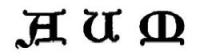
The Vishnu Purana says: “Glory to Brahman, who is addressed by that mystic word AUM,129 who is associated eternally with the triple universe (heaven, sky, earth), and who is one with the four Vedas. Glory to Brahman, who both in the destruction and renovation of the universe is called the great and mysterious cause of the intellectual principle, who is without limit in time or space, and exempt from diminution and decay, etc. To that supreme Brahman be for ever adoration.”
In its highest development, the doctrine of the Vedas is a rational and philosophical pantheism, combined with the most ideal, pure, and absolute monotheism, that the mind can conceive. The doctrines as to Brahman (neuter) in their higher conceptions, are similar in many respects to the exalted ideas as to the Ain Soph or Non Ego, of the Kabbalah.
Brahman, the Eternal, in Itself, Being, goes out of Its profundity in Its eternity, to emanate the universe of all the things, and undeniably establishes that great law of production, through the opposition and yet a harmonious blending, as to which, all nature offers everywhere a similitude, evidence, and image. Its first emanation is the creating energy, force or potentiality, which manifests Itself in Time, the mother and the matrix of the existences, that is the Sakti, Para Sakti or Maya, the first virgin and first female or plasticity, containing all in germ, symbolized by the Yoni. Its spouse, the spiritualizing, the man-type, is symbolized by the Lingam.
Isaac Meyer.
Literary Notes.
Betty’s Visions.—By Rhoda Broughton. (Geo. Routledge & Sons, London.) The prominence which occultism is acquiring, despite the attacks of so called scientific bodies and the constant sneers of savants and their parrot-like followers, is shown in the fact that such a book as this is published by a firm like Routledge and written by Rhoda Broughton. It is one of the one and sixpenny English books, in cloth. The visions are five—through a long life—each preceding a death in the family.
Esoteric Christianity, or Mental Therapeutics.—By Dr. W. F. Evans. (Carter & Karrick, Boston.) Extra cloth, $1.00. This is designed to complete a series of books on the subject of the Mind Cure, commenced some fifteen years ago. It contains twelve lectures intended to instruct in the philosophy of the subject. “To aid the student of Christian Theosophy to explore the inner realm of truth into which his spirit opens is the object of this volume,” and he believes that the principles are “identical with the philosophy of the New Testament and with primitive Christianity.” The book is well written, and is full of excellent arguments, but it covers so much ground that it would be impossible to properly review it in the limits allowable here.
We must disagree with him, however, in his statement: “That this system must ever be kept within the domain of a genuine Christianity,” to be successful. It is well known that hundreds of persons are practising mind cure, are helping many people, and none of these either believe in or talk of Christianity, genuine or otherwise. If mind cure have a real basis, no monopoly of it can be had by either Christian or dissenter.
Buddhist Diet Book.—A New York publishing house announces this book, prepared by Laura C. Holloway. It is a compilation of dishes used by Buddhists in Europe and the East, interspersed with explanations of the religious convictions of this great Sect regarding foods. The work will be of value to vegetarians—of whom there are many in this country. Mrs. Holloway writes with authority on this subject, having enjoyed in Europe and Prussia the advantages of an unmixed vegetarian diet in the homes of those who eat no meat. The book is a quaint brown-and-white conceit in parchment covers. Price 50 cents. Theosophists who desire to have this vegetarian cook book, can order it through The Path.
Can Matter Think.—This number of Prof. Coues’ Biogen Series was noticed in the July Path, and through a mistaken assumption of the proof reader it was stated that it was a reprint of an article which previously appeared in The Theosophist. Prof. Coues assures us that “Can Matter Think,” is a thoroughly original composition and has never been within 10,000 miles of India. The proof reader was thinking of the reprint of an English book under the title “Kuthumi,” in the same series, and also of the fact that the same subject was treated of in The Theosophist some years ago. We hasten, therefore, to correct the statement made in July.
Theosophical Activities.
Joshee.—Bro. Gopal Vinayak Joshee and his wife Anandabai, who graduated in Medicine at Philadelphia, return to India in October.
Ramabai.—Pandita Ramabai, who has been some time in America, accompanies Bro. Joshee and his wife to India.
Philadelphia.—The charter for a new Branch here has been received and probably soon the organization will be complete.
Secrecy in the Theosophical Society.—The question is frequently asked: “Is the Society a secret body; and how can a person enter it?” The reply can be found in the proceedings of the general Council last year, when it was resolved, that from thenceforth any person of good moral character, upon being recommended by two active members, and paying the usual fee, could become a member upon signing the application in which the declaration is made that the signer is in sympathy with the objects of the Society.
The old obligation is retained merely for those Branches desiring to use it in giving the signs and passwords of the Society, which are the only points about which the new member is pledged to secrecy, it being left to his own discretion and sense of propriety, not to make public matters which do not concern the public. For that matter, however, there is nothing in the teachings or practices of the lower section of the Society requiring secrecy.
New York.—The New York Branch has issued its third number of the Abridgements of Discussions on Theosophical subjects. The object of these leaflets is to increase interest among all Theosophists, and to strengthen the feeling of union. Col. H. S. Olcott, the President in India, has written to say, that he thinks the idea of the Abridgements is excellent. All Branches ought to co-operate in this movement, either by contributing questions and answers to New York, or by starting leaflets of their own and exchanging and distributing them.
Cincinnati.—The Branch here has held its first fall meeting, and has arranged for a series of essays of an interesting character, and also for meetings, to which strangers are to be invited by members.
Olcott.—It may be interesting to Theosophists to know that a statue was offered to Col. Olcott in Ceylon some months ago, but was refused by him on the ground that his work was not yet done, and no one could say whether he would deserve a statue until his death.
There is a limit beyond which the sun, moon and the planets cannot rise, and when they reach their point of climax, they come down again. But the souls that have attained to perfection never come down again.—Jain Precept.
OM!
No. 8.
Sri Krishna is the Lord of Lords, the King of Kings; his unthinkable glory irradiates all that is manifest and all that is unmanifest. This infinite universe, its life and its beauty, and its joy, rest but on his foot, from which flows the sacred stream of the Ganges, whose mortal aspect alone is known on this earth. Krishna reveals his infinity of attributes to his beloved worshipper, and yet he is devoid of attributes.
It is the crown of devotion to have these mysteries revealed to the inner gaze. May all his lovers reach that goal.—Vaishnara Scriptures.
Inquire about him by prostration, by question, and by service, and the wise men who know the truth, will give you the knowledge.—Bagavad-Gita.
THE PATH.
Vol. I. NOVEMBER, 1886. No. 8.
The Theosophical Society, as such, is not responsible for any opinion or declaration in this magazine, by whomsoever expressed, unless contained in an official document.
Where any article, or statement, has the author’s name attached, he alone is responsible, and for those which are unsigned, the Editor will be accountable.
The Common Sense of Theosophy.
[Reprinted from the Dublin University Review, May, 1886, by Permission of the Author.]
It is difficult to break down the Chinese wall of misconceptions with which all new movements of thought become more or less completely surrounded. The assimilation by the public mind of ideas which lie outside its mechanically-regulated every-day life is a slow process, which the vigour of the constitution does not justify. For all movements, which possess any vitality at all, always provoke to an unusual degree of activity the imaginative faculties of their opponents. More or less fantastic caricatures of the aims and methods of a struggling movement are generated by an unconscious process of invention, fathered upon the movement, and then knocked down with solemn pomposity. At the end of the achievement, when the invader of orthodox indolence and respectable indifference is found to gain ground in the midst of the dust-storm of misrepresentations, a wondering sneer is directed against personalities who have not had the decency and good sense to die at the command of their antagonists. The Theosophical movement has proved no exception to this general rule. Oppositions against it are generally but attempts to remove this disturber of established ease by finding some excuse for ignoring its existence. False issues are raised in every direction, and a candid examination of the truths that Theosophy embodies is evaded in the confusion. It is a profitless task to hunt the brood of Error which, like the giants of Norse folk-lore, sally forth at night to slay and devour, but melt into thin air when surprised by a ray of sunlight. Kicking at nothing is an exhausting process. Unmindful of this, many, in the words of the author of Religio Medici, have “rashly charged the troops of Error, and remained as trophies unto the enemies.” It is therefore proposed to set forth a “plain, unvarnished” statement of what Theosophy really is, and of the work in which the Theosophical Society is engaged, and leave the decision to the common sense of the reader. The transcendental metaphysics of Theosophy will be but slightly touched upon here. For fuller information the inquirer is referred to sources indicated by the publications of the Theosophical Society and the writings of the Theosophists of the day.
What, then, is Theosophy? Numberless are the misconceptions to which the word has given rise. Etymology does not throw any great light on it. The interpretation of “God-wisdom” can be spread over a very large area. Without following the history of the word, it may be stated that the chief exponents of the present revival of Theosophy take it to mean Wisdom-religion. Their interpretation, while open to no great philological objection, is sufficiently precise for all literary purposes. Theosophy from this standpoint is synonymous with Truth—the Truth that has been clothed in various garbs of religion; it also implies that this Truth is attainable by a natural development of wisdom, without the intervention of supernatural means. Thus it will be seen that Theosophy does not attach infallibility to any particular system of revelation, but maintains that under suitable conditions Truth reveals itself to every individual. The sun shines equally on all; the crystal reflects it; the clod of earth does not. Yet Theosophy sets great value on all systems of revelation, looking upon them as finger-posts which indicate the direction in which Truth is to be sought, although it declines to accept them as invitations to surrender personal inquiry. This tenet of Theosophy is founded upon the consideration that Truth is the result of real experience, and does not consist in the transfer of intellectual symbols from one person to another. To speak about Truth is one thing, and to perceive it is quite another. It is a fact of common experience that the most accurate and elaborate description of, say, a flower is by no means an efficient substitute for a visual contact with it, although the description has an abundant value of its own. Hence individual consciousness is consistently upheld as the only criterion of Truth, but this consciousness derives material help in its development and expansion by the study of the experiences of others. Thus Theosophy teaches that personal exertion is the only means by which progress can be achieved. But in the effort for growth the ultimate unity of consciousness must not be ignored. Individuals are not distinct crystals, placed side by side, but the varied manifestations of one unchanging universal consciousness. As light from one single source produces the appearance of different lights by reflection from a number of surfaces, so this universal consciousness, remaining itself unchanged, produces endless individualities, which in the course of their evolution reach perfection by recognising this essential unity. According to Theosophical thinkers this doctrine forms the fundamental truth upon which all religions are based; it is the final consummation of all philosophical thought and the crowning experience of all practical mysticism.
The search for this truth, and the practical realization of it are not considered as mere gratification of intellectual curiosity, but as the very summum bonum of evolutionary progress. It is the Nirvâna of the Buddhists, the Moksha of the Brahmins, and not very different from the Beatific Vision of the Christians. When this condition, or rather want of condition, is realized in consciousness, pain is for ever extinguished. Nirvâna is by no means the annihilation of consciousness, but its rest in the infinite plenitude of being. Needless to discuss the Nihilist view of Buddhism which some scholars of ability have brought forward; suffice it to say, that the Theosophists on this point share the responsibility of their opinion with many names of great eminence. Nirvâna is the extinction of all pain because, being the ultimate unity of all being, it cannot be the playground of those contending forces which alone produce pain.
Proceeding upon this basis, the essential features of Theosophy can be thrown into relief by determining its relations to Religion and Science. As the Science of Religion, it looks upon the different systems of faith as so many languages seeking to express the truth about man, his origin, nature, and destiny, as well as his relations to the surrounding world of objects. But, as a word or phrase is nothing but a sound in the absence of experience of the object connoted, so the proper comprehension of religious symbology can be acquired only by realizing the truths that underlie it. From the Theosophic standpoint the different systems of religion appear as the various forms evolved by the peculiarities of time, place, and other special causes, to embody the bodiless truth.
It is necessary to guard against a misconception which may arise here. Theosophy is not eclecticism, which is a mosaic, while Wisdom-Religion is an organic whole. Theosophy is like an abstract mathematical formula of which each religion is a particular application. It does not select bits from all religions and piece them together according to some fanciful standard of symmetry. But being the inner truth itself, Theosophy regards religions as various descriptions of that truth. It will no more recognise antagonism between religions than the linguist will condemn the description of the same thing in different languages because of peculiarities of idiom and grammar. Theosophy is not hostile to any religion, but is bound, in the interest of truth, to oppose the tyranny of ecclesiastical forms on individuals. Humanity, in the course of its evolution, produces individuals who outstrip the generality in the realization of truth, and are thus enabled to perceive the capabilities of the truth to be manifested within a certain period of time. To help the masses struggling blindly for the light of truth, these teachers of mankind construct a symbology of words and emblems to represent the truth. But, as acquisition of wisdom is a change in the quality of the consciousness of the acquirer, and not merely a surface expansion of it, the symbology, though eminently useful, is not in itself spiritual knowledge, and can never be converted into it except when “inwardly digested.” The physical process of digestion supplies a striking analogy in this matter. Food, assimilated by different organisms, follows their original differences. Spiritual food, on assimilation, partakes of the peculiarities of the individual, and two individuals cannot be exactly identical, whether physically or otherwise. A contrary supposition would violate the lex parsimoniæ in nature. Consequently, Theosophy is the uncompromising supporter of the freedom of individual conscience. On the other hand, it condemns a selfish desire for self-development as wrong, on account of its violation of the essential unity of being. One of the greatest Theosophists of the world, Gautama Buddha, declared, “Let the sins of the Kali Yuga130 fall upon me, and let the world be redeemed.” This noble saying found an echo in the Christian Apostle, who would be anathema from Christ if he could save the world thereby.
Nor has Theosophy any antagonism to the scientific spirit. Claiming to be the religion of Truth, it must show itself to be the most exact of all exact sciences. According to it truth cannot be dissociated from real experience; the mere intellectual form of it can never be the truth any more than the word man can be the human being. It opposes the dogmatisms of science which deny independent reality to facts of mental experience because of their eminently unscientific character. If there be no operation of thought matter itself will disappear. The contrary of this—existence of matter without relation to a conscious knower—has never been experienced. Therefore matter and consciousness are both eternal or neither. Further, it rejects the mechanical theory of the universe on account of its unreasonableness. If consciousness is derivable from unconsciousness, a fundamental law of reason becomes stultified. Unconsciousness is the negation of consciousness, and therefore an affirmation of the absence of all relations to consciousness is its essential property. How, then, can it be related to consciousness so as to produce it? If the atoms themselves are considered conscious the difficulty is not removed. For consciousness must be associated with the notion of I, and if this egoism is to be postulated for each atom it is inexplicable how a man, composed of myriads of atoms, possesses yet a single indivisible notion of I. It is clear therefore that there is in nature a principle of consciousness whose units are not atoms but individualities, and as the principle is eternal its units must also be so. For the ocean cannot be salt unless the quality of saltness inhered in every one of its drops. Theosophy for these, among other reasons, holds against materialism that the individuality in man is immortal. In this, however, it does not maintain that the present body, emotion or thought of a man will as such abide for ever, but that the unit of consciousness which is now manifested as the man, will never undergo any change in essence. For change, independent of consciousness, is unthinkable. It is in fact the unchangeableness of consciousness that by comparison renders the conception of change a reality. In ordinary language no doubt such phrases as the “growth and development of consciousness” are in use, but strictly speaking it is the basis in which the consciousness inheres that changes, the phrases in question being of the same character as those which ascribe motion to the sun in relation to the earth. Moreover, if one unit of consciousness were to change in essence, that is, become annihilated, the same liability must attach to all other units, and we shall be driven to hold that the principle of consciousness in nature is destructible, while matter which cannot exist in its absence is indestructible. From the indestructibility of individual consciousness, and its relations to matter, two important deductions follow. First, that this relation, which is perpetually changing, changes according to a definite law. The products of the change are bound each to each in a definite way. What is now is not wholly unrelated to what was before. This is a matter of experience, and in fact experience is based upon it. Without the law of causation experience would be impossible, on whatever plane we take experience—mental or physical. Thus by the application of the law of causation to our being, it follows that the experience of pleasure and pain in the present must be the necessary consequence of causes generated in the past. A contention may here be raised that it is a fact of experience that many sufferings and enjoyments come to us of which we are not conscious of having generated the causes. But it is without any real force. What connection is there between our consciousness of a cause and its power to produce effect? If we receive in the system malarious germs, the disease is not prevented because we were unconscious of the reception. Whatever you sow the same you reap, whether you are conscious of the sowing or not. The law of causation, thus applied to personal experience of suffering and enjoyment, is called by the Brahmins and Buddhists the Law of Karma.
The second deduction hinges on to the first and forms with it a harmonious whole. If the individual consciousness is immortal, and its experiences are governed by the Law of Karma, then it follows that so long as all causes, capable of producing effects on the present plane of life, are not exhausted, and the generation of similar causes is not stopped, the individual consciousness will remain connected with the experience of earthly existence. Thus the ego successively incarnates itself on this earth until it has collected all experiences that life on this planet can offer. The doctrine of reincarnation is taught by all religions of the world, Christianity not excepted. In the Gospel of St Matthew it is declared in no uncertain tone that John the Baptist was the incarnation of Elias (chap. xvii. 12, 13). It is not intended fully to discuss the scientific and metaphysical bases of the doctrine of reincarnation, as the subject has been adequately dealt with in a recent Theosophical publication.131 But it will not be out of place to consider the ethical objection which is so frequently brought forward against the doctrine. Is it just that a person should experience pleasure or pain for acts done in a previous life of which no recollection is preserved? The argument thus implied is based upon the confusion of the two different meanings of the word justice as applied to the regulation of human affairs, and to the operation of natural laws. Human beings are admittedly imperfect in knowledge, and it is required for the well-being of society that all its members should feel confident that they are not liable to arbitrary punishment. For this reason it is necessary that before inflicting punishment the grounds for it should be disclosed. But justice, as affecting the operation of natural laws, is a totally different thing. The workings of nature being invariably governed by the law of Causation are not amenable to conditions which depend upon admitted inability to apply that law without failure. The moral amelioration, which it is fancied that a knowledge of the precise cause of our sufferings would produce, is more than compensated for by the numberless incentives to good, which gratitude and other similar motives supply.
The teachings of Theosophy from the standpoint of common sense can be briefly summed up thus:—
1. That there is a principle of consciousness in man which is immortal.
2. That this principle is manifested in successive incarnations on earth.
3. That the experiences of the different incarnations are strictly governed by the law of causation.
4. That as each individual man is the result of a distinct causal necessity in nature, it is not wise for one man to dominate the life and action of another, no matter what their relative development may be. On the other hand it is of paramount importance that each individual should ceaselessly work for the attainment of the highest ideal that he is capable of conceiving. Otherwise, pain will arise from the opposition of the real and the ideal. Be as perfect as your Father in heaven is perfect.
5. That for the above reasons it is wise and just to practise the most ungrudging toleration towards all our fellow-creatures.
6. That as absolute unity of all nature subsists for ever, all self-centred actions are bound to end in pain to the actor on account of their opposition to this fact. The foundation of morals must therefore lie in the feeling of Universal Brotherhood of Man.
7. That the harmony of the unit with the whole is the only condition which can remove all pain, and as each individual represents a distinct causal operation of nature, this harmony is attainable only through the individual’s own exertions.
The Theosophical Society is an organization having for its object the study of truth upon the most unsectarian basis, and as a result of such study it believes that the truths enumerated above are, if generally accepted, calculated greatly to benefit the age. It is necessary, however, to add that there are many members in the Society, earnest in the pursuit of truth, who are not prepared to subscribe to all these doctrines without further thought and study; but all are agreed as to the ethical principles involved therein. The chief aim of the Theosophical Society is “to form the nucleus of a universal Brotherhood of mankind without distinction of race, color or creed.” The basis of brotherhood, which the Theosophical Society considers scientific has already been adverted to. The Theosophic brotherhood does not limit the freedom of individual development. It requires nothing from its members but a desire to recognise the unity of the human family as a natural fact which cannot be ignored with impunity, and a living conscious feeling of which is sure to lead to the highest development of the individual.
The Theosophical Society is convinced that the most efficacious means for the study of truth is furnished by the ancient religious and philosophical systems of the world, as they are free from the disturbing influences by which contemporary forms are surrounded. The Society therefore earnestly labours to promote an appreciative study of Eastern philosophy, built up by generations of Theosophists, as affording easy access to the Wisdom-Religion of the world.
Further, the Society seeks to combat materialism by the investigation of abnormal phenomena which afford a practical demonstration of the existence of a Psyche in man and to lead to a proper comprehension of the laws which underlie those phenomena. Theosophists do not believe in supernaturalism, and discard the notion of miracles as involving an unreasonable limitation of the possibilities of nature. The views of the leading Theosophists with regard to this subject are to be found very ably expounded in Madame Blavatsky’s Isis Unveiled, and Mr. Sinnett’s Esoteric Buddhism. All Theosophists, whether in perfect agreement with these views or not, look upon them as opening immense vistas of thought on subjects which are as important as they are neglected.
In conclusion, it is to be clearly stated that the Theosophical Society is composed of a body of earnest students and inquirers, and not of dogmatic teachers. But naturally a large number of members hold convictions in common on many points. Yet in each case the final authority comes from no external source but from within.
“There is no religion higher than Truth,” is the motto of the Society.
Mohini M. Chatterji.
Theories: About Reincarnation and Spirits.
By H. P. BLAVATSKY.
Over and over again the abstruse and mooted question of Rebirth or Reincarnation has crept out during the first ten years of the Theosophical Society’s existence. It has been alleged on prima facie evidence, that a notable discrepancy was found between statements made in “Isis Unveiled” Vol. I, 351-2, and later teachings from the same pen and under the inspiration of the same master.132
In Isis, it was held,—reincarnation is denied. An occasional return, only of “depraved spirits” is allowed. “Exclusive of that rare and doubtful possibility, ‘Isis’ allows only three cases—abortion, very early death, and idiocy—in which reincarnation on this earth occurs.” (“C. C. M.” in Light, 1882.)
The charge was answered then and there as every one who will turn to the Theosophist of August, 1882, can see for himself. Nevertheless, the answer either failed to satisfy some readers or passed unnoticed. Leaving aside the strangeness of the assertion that reincarnation—i. e., the serial and periodical rebirth of every individual monad from pralaya to pralaya133 is denied in the face of the fact that the doctrine is part and parcel and one of the fundamental features of Hinduism and Buddhism, the charge amounted virtually to this: the writer of the present, a professed admirer and student of Hindu philosophy, and as professed a follower of Buddhism years before Isis was written, by rejecting reincarnation must necessarily reject Karma likewise! For the latter is the very corner-stone of Esoteric philosophy and Eastern religions; it is the grand and one pillar on which hangs the whole philosophy of rebirths, and once the latter is denied, the whole doctrine of Karma falls into meaningless verbiage.
Nevertheless, the opponents without stopping to think of the evident “discrepancy” between charge and fact, accused a Buddhist by profession of faith of denying reincarnation hence also by implication—Karma. Adverse to wrangling with one who was a friend and undesirous at the time, to enter upon a defence of details and internal evidence—a loss of time indeed,—the writer answered merely with a few sentences. But it now becomes necessary to well define the doctrine. Other critics have taken the same line, and by misunderstanding the passages to that effect in Isis they have reached the same rather extraordinary conclusions.
To put an end to such useless controversies, it is proposed to explain the doctrine more clearly.
Although, in view of the later more minute renderings of the esoteric doctrines, it is quite immaterial what may have been written in “Isis”—an encyclopedia of occult subjects in which each of these is hardly sketched—let it be known at once, that the writer maintains the correctness of every word given out upon the subject in my earlier volumes. What was said in the Theosophist of August, 1882, may now be repeated here. The passage quoted from it may be, and is, most likely “incomplete, chaotic, vague, perhaps clumsy, as are many more passages in that work the first literary production of a foreigner who even now can hardly boast of her knowledge of the English language.” Nevertheless it is quite correct so far as that collateral feature of reincarnation is therein concerned.
I will now give extracts from Isis and proceed to explain every passage criticised, wherein it was said that “a few fragments of this mysterious doctrine of reincarnation as distinct from metempsychosis”—would be then presented. Sentences now explained are in italics.
“Reincarnation i. e. the appearance of the same individual, or rather of his astral monad, twice on the same planet is not a rule in nature, it is an exception, like the teratological phenomenon of a two-headed infant. It is preceded by a violation of the laws of harmony of nature, and happens only when the latter seeking to restore its disturbed equilibrium, violently throws back into earth-life the astral monad which had been tossed out of the circle of necessity by crime or accident. Thus in cases of abortion, of infants dying before a certain age, and of congenital and incurable idiocy, nature’s original design to produce a perfect human being, has been interrupted. Therefore, while the gross matter of each of these several entities is suffered to disperse itself at death, through the vast realm of being, the immortal spirit and astral monad of the individual—the latter having been set apart to animate a frame and the former to shed its divine light on the corporeal organization—must try a second time to carry out the purpose of the creative intelligence.” (Vol. 1. p. 351.)
Here the “astral monad” or body of the deceased personality—say of John or Thomas—is meant. It is that which, in the teachings of the Esoteric philosophy of Hinduism, is known under its name of bhoot; in the Greek philosophy is called the simulacrum or umbra, and in all other philosophies worthy of the name is said, as taught in the former, to disappear after a certain period more or less prolonged in Kama-loka—the Limbus of the Roman Catholics, or Hades of the the Greeks.134 It is “a violation of the laws of harmony of nature,” though it be so decreed by those of Karma—every time that the astral monad, or the simulacrum of the personality—of John or Thomas—instead of running down to the end of its natural period of time in a body—finds itself (a) violently thrown out of it by whether early death or accident; or (b) is compelled in consequence of its unfinished task to reappear, (i. e. the same astral body wedded to the same immortal monad) on earth again, in order to complete the unfinished task. Thus “it must try a second time to carry out the purpose of creative intelligence” or law.
If reason has been so far developed as to become active and discriminative there is no135 (immediate) reincarnation on this earth, for the three parts of the triune man have been united together, and he is capable of running the race. But when the new being has not passed beyond the condition of Monad, or when, as in the idiot, the trinity has not been completed on earth and therefore cannot be so after death, the immortal spark which illuminates it, has to re-enter on the earthly plane as it was frustrated in its first attempt. Otherwise, the mortal or astral, and the immortal or divine souls, could not progress in unison and pass onward to the sphere above136 (Devachan). Spirit follows a line parallel with that of matter; and the spiritual evolution goes hand in hand with the physical.
The Occult Doctrine teaches that:—
(1) There is no immediate reincarnation on Earth for the Monad, as falsely taught by the Reincarnationists Spiritists; nor is there any second incarnation at all for the “personal” or false Ego—the perisprit—save the exceptional cases mentioned. But that (a) there are rebirths, or periodical reincarnations for the immortal Ego—(“Ego” during the cycle of rebirths, and non-Ego, in Nirvana or Moksha when it becomes impersonal and absolute); for that Ego is the root of every new incarnation, the string on which are threaded, one after the other, the false personalities or illusive bodies called men, in which the Monad-Ego incarnates itself during the cycle of births; and (b) that such reincarnations take place not before 1,500, 2,000, and even 3,000 years of Devachanic life.
(2) That Manas—the seat of Jiv, that spark which runs the round of the cycle of birth and rebirths with the Monad, from the beginning to the end of a Manvantara,—is the real Ego. That (a) the Jiv follows the divine monad that gives it spiritual life and immortality into Devachan,—that therefore, it can neither be reborn before its appointed period, nor reappear on Earth visibly or invisibly in the interim; and (b) that, unless the fruition, the spiritual aroma of the Manas—or all these highest aspirations and spiritual qualities and attributes that constitute the higher Self of man become united to its monad, the latter becomes as Non existent; since it is in esse “impersonal” and per se Ego-less, so to say, and gets its spiritual colouring or flavour of Egotism only from each Manas during incarnation and after it is disembodied, and separated from all its lower principles.
(3) That the remaining four principles, or rather the—2-1/2—as they are composed of the terrestrial portion of Manas of its Vehicle Kama~Rupa and Lingha Sarira,—the body dissolving immediately, and prana or the life principle along with it,—that these principles having belonged to the false personality are unfit for Devachan. The latter is the state of Bliss, the reward for all the undeserved miseries of life,137 and that which prompted man to sin, namely his terrestrial passionate nature can have no room in it.
Therefore the reincarnating principles are left behind in Kama-loka, firstly as a material residue, then later on as a reflection on the mirror of Astral light. Endowed with illusive action, to the day when having gradually faded out they disappear, what is it but the Greek Eidolon and the simulacrum of the Greek and Latin poets and classics?
“What reward or punishment can there be in that sphere of disembodied human entities for a fœtus or a human embryo which had not even time to breathe on this earth, still less an opportunity to exercise the divine faculties of its spirit? Or, for an irresponsible infant, whose senseless monad remaining dormant within the astral and physical casket, could as little prevent him from burning himself as any other person to death? Or again for one idiotic from birth, the number of whose cerebral circumvolutions is only from twenty to thirty per cent. of those of sane persons, and who therefore is irresponsible for either his disposition, acts, or for the imperfections of his vagrant, half-developed intellect.” (Isis, vol. 1, p. 352.)
These are then, the “exceptions” spoken of in Isis, and the doctrine is maintained now as it was then. Moreover, there is no “discrepancy” but only incompleteness—hence, misconceptions arising from later teachings. Then again, there are several important mistakes in Isis which, as the plates of the work had been stereotyped were not corrected in subsequent editions.
One of such is on page 346, and another in connection with it and as a sequence on page 347.
The discrepancy between the first portion of the statement and the last, ought to have suggested the idea of an evident mistake. It is addressed to the spiritists, reincarnationists who take the more than ambiguous words of Apuleius as a passage that corroborates their claims for their “spirits” and reincarnation. Let the reader judge138 whether Apuleius does not justify rather our assertions. We are charged with denying reincarnation and this is what we said there and then in Isis!
“The philosophy teaches that nature never leaves her work unfinished; if baffled at the first attempt, she tries again. When she evolves a human embryo, the intention is that a man shall be perfected—physically, intellectually, and spiritually. His body is to grow, mature, wear out, and die; his mind unfold, ripen, and be harmoniously balanced; his divine spirit illuminate and blend easily with the inner man. No human being completes its grand cycle, or the “circle of necessity,” until all these are accomplished. As the laggards in a race struggle and plod in their first quarter while the victor darts past the goal, so, in the race of immortality, some souls outspeed all the rest and reach the end, while their myriad competitors are toiling under the load of matter, close to the starting point. Some unfortunates fall out entirely and lose all chance of the prize; some retrace their steps and begin again.“
Clear enough this, one should say. Nature baffled tries again. No one can pass out of this world, (our earth) without becoming perfected ”physically, morally and spiritually.” How can this be done, unless there is a series of rebirths required for the necessary perfection in each department—to evolute in the “circle of necessity,” can surely never be found in one human life? and yet this sentence is followed without any break by the following parenthetical statement: “This is what the Hindu dreads above all things—transmigration and reincarnation; only on other and inferior planets, never on this one!!!”
The last “sentence” is a fatal mistake and one to which the writer pleads “not guilty.” It is evidently the blunder of some “reader” who had no idea of Hindu philosophy and who was led into a subsequent mistake on the next page, wherein the unfortunate word “planet” is put for cycle. “Isis” was hardly, if ever, looked into after its publication by its writer, who had other work to do; otherwise there would have been an apology and a page pointing to the errata and the sentence made to run: “The Hindu dreads transmigration in other inferior forms, on this planet.”
This would have dove-tailed with the preceding sentence, and would show a fact, as the Hindu exoteric views allow him to believe and fear the possibility of reincarnation—human and animal in turn by jumps, from man to beast and even a plant—and vice versa; whereas esoteric philosophy teaches that nature never proceeding backward in her evolutionary progress, once that man has evoluted from every kind of lower forms—the mineral, vegetable, and animal kingdoms—into the human form, he can never become an animal except morally, hence—metaphorically. Human incarnation is a cyclic necessity, and law; and no Hindu dreads it—however much he may deplore the necessity. And this law and the periodical recurrence of man’s rebirth is shown on the same page (346) and in the same unbroken paragraph, where it is closed by saying that:
“But there is a way to avoid it. Buddha taught it in his doctrine of poverty, restriction of the senses, perfect indifference to the objects of this earthly vale of tears, freedom from passion, and frequent intercommunication with the Atma—soul-contemplation. The cause of reincarnation is ignorance139 of our senses, and the idea that there is any reality in the world, anything except abstract existence. From the organs of sense comes the “hallucination” we call contact; “from contact, desire; from desire, sensation (which also is a deception of our body,) from sensation, the cleaving to existing bodies; from this cleaving, reproduction; and from reproduction, disease, decay, and death.”
This ought to settle the question and show there must have been some carelessly unnoticed mistake and if this is not sufficient, there is something else to demonstrate it, for it is further on:
“Thus, like the revolutions of a wheel, there is a regular succession of death and birth, the moral cause of which is the cleaving to existing objects, while the instrumental cause is Karma (the power which controls the universe, prompting it to activity,) merit and demerit. It is therefore, the great desire of all beings who would be released from the sorrows of successive birth, to seek the destruction of the moral cause the cleaving to existing objects, or evil desire.”
“They in whom evil desire is entirely destroyed are called Arhats. Freedom from evil desire insures the possession of a miraculous power. At his death, the Arhat is never reincarnated; he invariably attains nirvana—a word, by the by, falsely interpreted by the Christian scholar and skeptical commentators. Nirvana is the world of cause, in which all deceptive effects or delusions of our senses disappear. Nirvana is the highest attainable sphere. The pitris (the pre-Adamic spirits) are considered as reincarnated by the Buddhistic philosopher, though in a degree far superior to that of the man of earth. Do they not die in their turn? Do not their astral bodies suffer and rejoice, and feel the same curse of illusionary feelings as when embodied?”
And just after this we are again made to say of Buddha and his Doctrine of “Merit and Demerit,” or Karma:
“But this former life believed in by the Buddhists, is not a life on this planet for, more than any other people, the Buddhistical philosopher appreciated the great doctrine of cycles.”
Correct “life on this planet” by “life in the same cycle,” and you will have the correct reading: for what would have appreciation of “the great doctrine of cycles” to do with Buddha’s philosophy, had the great sage believed but in one short life on this Earth and in the same cycle. But to return to the real theory of reincarnation as in the esoteric teaching and its unlucky rendering in Isis.
Thus, what was really meant therein, was that, the principle which does not reincarnate—save the exceptions pointed out—is the false personality, the illusive human Entity defined and individualized during this short life of ours, under some specific form and name; but that which does and has to reincarnate nolens volens under the unflinching, stern rule of Karmic law—is the real EGO. This confusing of the real immortal Ego in man, with the false and ephemeral personalities it inhabits during its Manvantaric progress, lies at the root of every such misunderstanding. Now what is the one, and what is the other? The first group is—
1. The immortal Spirit—sexless, formless (arupa) an emanation from the One universal Breath.
2. Its Vehicle—the divine Soul—called the “Immortal Ego,” the “Divine monad,” etc. etc., which by accretions from Manas in which burns the ever existing Jiv—the undying spark—adds to itself at the close of each incarnation the essence of that individuality that was, the aroma of the culled flower that is no more.
What is the false personality? It is that bundle of desires, aspirations, affection and hatred, in short of action, manifested by a human being on this earth during one incarnation and under the form of one personality.140 Certainly it is not all this, which as a fact for us, the deluded, material, and and materially thinking lot—is Mr. So and So, or Mrs. somebody else—that remains immortal, or is ever reborn.
All that bundle of Egotism that apparent and evanescent “I” disappears after death, as the costume of the part he played disappears from the actor’s body, after he leaves the theatre and goes to bed. That actor re-becomes at once the same “John Smith” or Gray, he was from his birth and is no longer the Othello or Hamlet that he had represented for a few hours. Nothing remains now of that “bundle” to go to the next incarnation, except the seed for future Karma that Manas may have united to its immortal group, to form with it—the disembodied Higher Self in “Devachan.” As to the four lower principles, that which becomes of them is found in most classics, from which we mean to quote at length for our defence. The doctrine of the perisprit the “false personality,” or the remains of the deceased under their astral form—fading out to disappear in time, is terribly distasteful to the spiritualists, who insist upon confusing the temporary with the immortal Ego.
Unfortunately for them and happily for us, it is not the modern Occultists who have invented the doctrine. They are on their defense. And they prove what they say, i.e., that no “personality” has ever yet been “reincarnated” “on the same planet” (our earth, this once there is no mistake) save in the three exceptional cases above cited. Adding to these a fourth case, which is the deliberate, conscious act of adeptship; and that such an astral body belongs neither to the body nor the soul still less to the immortal spirit of man, the following is brought forward and proofs cited.
Before one brings out on the strength of undeniable manifestations, theories as to what produces them and claims at once on prima facie evidence that it is the spirits of the departed mortals that re-visit us, it behooves one to first study what antiquity has declared upon the subject. Ghosts and apparitions, materialized and semi-material “SPIRITS” have not originated with Allan Kardec, nor at Rochester. If those beings whose invariable habit it is to give themselves out for souls and the phantoms of the dead, choose to do so and succeed, it is only because the cautious philosophy of old is now replaced by an a priori conceit, and unproven assumptions. The first question is to be settled—“Have spirits any kind of substance to cloth themselves with?” Answer: That which is now called perisprit in France, and a “materialized Form” in England and America, was called in days of old peri-psyche, and peri-nous, hence was well known to the old Greeks. Have they a body whether gaseous, fluidic, etherial, material or semi-material? No; we say this on the authority of the occult teachings the world over. For with the Hindus atma or spirit is Arupa (bodiless,) and with the Greeks also. Even in the Roman Catholic Church the angels of Light as those of Darkness are absolutely incorporeal: “meri spiritus, omnes corporis expertes,” and in the words of the “Secret Doctrine,” primordial. Emanations of the undifferentiated Principle, the Dhyan Chohans of the ONE (First) category or pure Spiritual Essence, are formed of the Spirit of the one Element; the second category of the second Emanation of the Soul of the Elements; the third have a “mind body” to which they are not subject, but that they can assume and govern as a body, subject to them, pliant to their will in form and substance. Parting from this (third) category, they (the spirits, angels, Devas or Dhyan Chohans) have BODIES the first rupa group of which is composed of one element Ether; the second, of two—ether and fire; the third, of three—Ether, fire and water; the fourth of four—Ether, air, fire and water. Then comes man, who, besides the four elements, has the fifth that predominates in him—Earth: therefore he suffers. Of the Angels, as said by St. Augustine and Peter Lombard, their bodies are made to act not to suffer. It is earth and water, humor et humus, that gives an aptitude for suffering and passivity, ad patientiam, and Ether and Fire for action. The spirits or human monads, belonging to the first, or indifferentiated essence are thus incorporeal; but their third principle (or the human Fifth—Manas) can in conjunction with its vehicle become Kama rupa and Mayavi rupa—body of desire or “illusion body.” After death, the best, noblest, purest qualities of Manas or the human soul ascending along with the divine Monad into Devachan whence no one emerges from or returns, except at the time of reincarnation—what is that then which appears under the double mask of the spiritual Ego or soul of the departed individual? The Kama rupa element with the help of elementals. For we are taught that those spiritual beings that can assume a form at will and appear, i.e., make themselves objective and even tangible—are the angels alone (the Dhyan Chohans) and the nirmanakaya141 of the adepts, whose spirits are clothed in sublime matter. The astral bodies—the remnants and dregs of a mortal being which has been disembodied, when they do appear, are not the individuals they claim to be, but only their simulachres. And such was the belief of the whole of antiquity, from Homer to Swedenborg; from the third race down to our own day.
More than one devoted spiritualist has hitherto quoted Paul as corroborating his claim that spirits do and can appear. “There is a natural and there is a spiritual body,” etc., etc., (1 Cor. xv, 44); but one has only to study closer the verses preceding and following the one quoted, to perceive that what St. Paul meant was quite different from the sense claimed for it. Surely there is a spiritual body, but it is not identical with the astral form contained in the “natural” man. The “spiritual” is formed only by our individuality unclothed and transformed after death; for the apostle takes care to explain in Verses 51 and 52, “Immut abimur sed non omnes.” Behold, I tell you a mystery: we shall not all sleep but we shall all be changed. This corruptible must put on incorruption and this mortal must put on immortality.
But this is no proof except for the Christians. Let us see what the old Egyptians and the Neo-Platonists—both “theurgists” par excellence, thought on the subject: They divided man into three principal groups subdivided into principles as we do: pure immortal spirit; the “Spectral Soul” (a luminous phantom) and the gross material body. Apart from the latter which was considered as the terrestrial shell, these groups were divided into six principles; (1) Kha “vital body”; (2) Khaba “astral form,” or shadow, (3) Khou “animal soul” (4) Akh “terrestrial intelligence;” (5) Sa “the divine soul” (or Buddhi;) and (6) Sah or mummy, the functions of which began after death. Osiris was the highest uncreated spirit, for it was, in one sense a generic name, every man becoming after his translation Osirified, i. e., absorbed into Osiris—Sun or into the glorious divine state. It was Khou, with the lower portions of Akh or Kama rupa with the addition of the dregs of Manas remaining all behind in the astral light of our atmosphere—that formed the counterparts of the terrible and so much dreaded bhoots of the Hindus (our “elementaries.”) This is seen in the rendering made of the so-called “Harris. Papyrus on magic.” (papyrus magique, translated by Chabas) who calls them Kouey or Khou, and explains that according to the hieroglyphics they were called Khou or the “revivified dead,” the “resurrected shadows.”
When it was said of a person that he “had a Khou” it meant that he was possessed by a “Spirit.” There were two kinds of Khous—the justified ones,—who after living for a short time a second life (nam onh) faded out, disappeared; and those Khous who were condemned to wandering without rest in darkness after dying for a second time—mut, em, nam—and who were called the H’ou-mêtr (“second time dead”) which did not prevent them from clinging to a vicarious life after the manner of Vampires. How dreaded they were is explained in our Appendices on Egyptian Magic and “Chinese Spirits” (Secret Doctrine.) They were exorcised by Egyptian priests as the evil spirit is exorcised by the Roman Catholic curé; or again the Chinese houen, identical with the Khou and the “Elementary,” as also with the lares or larvæ—a word derived from the former by Festus, the grammarian; who explains that they were “the shadows of the dead who gave no rest in the house they were in either to the Masters or the servants.” These creatures when evoked during theurgic, and especially necromantic rites, were regarded, and are so regarded still, in China—as neither the Spirit, Soul nor any thing belonging to the deceased personality they represented, but simply, as his reflection—simmulacrum.
“The human soul,” says Apuleius, “is an immortal God” (Buddhi) which nevertheless has his beginning. When death rids it (the Soul), from its earthly corporeal organism, it is called lemure. There are among the latter not a few which are beneficent, and which become the gods or demons of the family, i. e., its domestic gods: in which case they are called lares. But they are vilified and spoken of as larvae when sentenced by fate to wander about, they spread around them evil and plagues. (Inane terriculamentum, celerum noxium malis;) or if their real nature is doubtful they are referred to as simply manes (Apuleius. see—Du Dieu de Socrate, pp. 143-145. Edit. Niz.) Listen to Yamblichus, Proclus, Porphyry, Psellus and to dozens of other writers on these mystic subjects.
The Magi of Chaldea believed and taught that the celestial or divine soul would participate in the bliss of eternal light, while the animal or sensuous soul would, if good, rapidly dissolve, and if wicked, go on wandering about in the Earth’s sphere. In this case, “it (the soul) assumes at times the forms of various human phantoms and even those of animals.” The same was said of the Eidôlon of the Greeks, and of their Nephesh by the Rabbins: (See Sciences Occultes, Count de Resie. V. II) All the Illuminati of the middle ages tell us of our astral Soul, the reflection of the dead or his spectre. At Natal death (birth) the pure spirit remains attached to the intermediate and luminous body but as soon as its lower form (the physical body) is dead, the former ascends heavenward, and the latter descends into the nether worlds, or the Kama loka.
Homer shows us the body of Patroclus—the true image of the terrestrial body lying killed by Hector—rising in its spiritual form, and Lucretius shows old Ennius representing Homer himself, shedding bitter tears, amidst the shadows and the human simulachres on the shores of Acherusia “where live neither our bodies nor our souls, but only our images.”
“* * * Esse Acherusia templa, * * * Quo neque permanent animæ, neque corpora nostra, Sed quædam simulacra * *”
Virgil called it imago “image” and in the Odyssey (I. XI) the author refers to it as the type, the model, and at the same time the copy of the body; since Telemachus will not recognize Ulyssus and seeks to drive him off by saying—“No thou are not my father; thou art a demon,—— trying to seduce me!” (Odys. I. XVI. v. 194.) “Latins do not lack significant proper names to designate the varieties of their demons; and thus they called them in turn, lares, lemures, geni and manes.” Cicero, in translating Plato’s Timaeus translates the word daimones by lares; and Festus the grammarian, explains that the inferior or lower gods were the souls of men, making a difference between the two as Homer did, and between anima bruta and anima divina (animal and divine souls). Plutarch (in proble. Rom.) makes the lares preside and inhabit the (haunted) houses, and calls them, cruel, exacting, inquisitive, etc., etc. Festus thinks that there are good and bad ones among the lares. For he calls them at one time præstites as they gave occasionally and watched over things carefully (direct apports,) and at another—hostileos.142 “However it may be” says in his queer old French, Leloyer, “they are no better than our devils, who, if they do appear helping sometimes men, and presenting them with property, it is only to hurt them the better and the more later on. Lemures are also devils and larvæ for they appear at night in various human and animal forms, but still more frequently with features that THEY borrow from dead men.” (Livre des Spectres. V. IV p. 15 and 16).
After this little honour rendered to his Christian preconceptions, that see Satan everywhere, Leloyer speaks like an Occultist, and a very erudite one too.
“It is quite certain that the genii and none other had mission to watch over every newly born man, and that they were called genii, as says Censorius, because they had in their charge our race, and not only they presided over every mortal being but over whole generations and tribes, being the genii of the people.”
The idea of guardian angels of men, races, localities, cities, and nations, was taken by the Roman Catholics from the prechristian occultists and pagans. Symmachus (Epistol, I. X) writes: “As souls are given to those who are born, so genii are distributed to the nations. Every city had its protecting genius, to whom the people sacrificed.” There is more than one inscription found that reads: Genio civitates—“to the genius of the city.”