INDEX. (continued 11)
Reading edition
“Yes,” broke in Didymus quietly, “I believe that of the Elemental and the astral world. I’ve been there myself, don’t you know!”
Imagine the feelings of Balaam upon a noted occasion! Unlike the excellent but misunderstood animal of scripture, Didymus was urged to continue.
“No,” said he, “I can’t profess to explain my experiences, but I’ll tell them by way of illustrating Mr. Julius’ remark, as I find most people do go through a climax of some kind before they round the turning point of the Age.” The tea-table settled itself comfortably and Didymus proceeded.
“I was in a good deal of trouble last winter, trouble of various kinds, and needless to specify, and I had foolishly taken to a pretty lively life. I don’t mind saying that one of the chief causes of my trouble was the fact that I couldn’t believe in anything that made life worth living; all my ideals were pretty well played out. One Sunday I awoke with an overwhelming sense of terrible calamity, I recalled the events of the previous day, but all was in due order from the matutinal cocktail to the vesper toddy, so I finally concluded that my depression was a hint that I had been living too hard and I resolved to stop it. This resolve, by the way, I carried out from that hour, nor have I ever touched liquor since. I passed the day otherwise as usual with various friends and dined out with a glorious appetite. Returning to my hotel, I was engaged in making notes of one of Herbert Spencer’s works, when my attention was attracted by voices in the adjoining room, and I was astounded to find that they were detailing with startling accuracy, certain of my affairs which I not unnaturally supposed were hidden from the world at large. Conquering my blank amazement I sprang into the corridor, when the voices as suddenly ceased and I found my neighbor’s door ajar and the room entirely empty. This rather took me down, and I concluded to turn in, and was just falling asleep, when I seemed to see two fellows in evening dress whom I somehow knew to be jugglers. They advanced, bowed, and thereupon began a series of the most fascinating and laughable tricks I ever saw. I looked on with interest for what appeared to me a long time but at last the rapidity and variety of the illusions produced a feeling of intense weariness, and I said, ‘Gentlemen, thanks for your interesting performance, but you will pardon my remarking that it is late, and I am very tired.’ They bowed, said nothing, and continued their performance which became even more ludicrous. I repeated my request; again the bows and tricks of increasing absurdity. Worn out I exclaimed angrily, ‘I consider this a beastly imposition, you know, and if you persist I shall be obliged—’ but I never finished the sentence, for the two distorted their faces into masks of indescribable comicality and were off while I laughed—and awoke. As I did so, I was amazed to see a broad patch of vivid scarlet light slide down the wall from ceiling to floor and before I could give a second thought to this phenomenon, a big white cat sprang from the foot of my bed and vanished in the darkness.
“This aroused me thoroughly, for though I had never experienced the like before, I said to myself ‘Old Boy, you must have a touch of D. T. though why the devil you should have with your seasoned head, I can’t say.’ I got up and lit my gas; it was after midnight but I concluded to go out and get some medicine. The halls were quite dark save for a light in the front vestibule and I felt my way down by the balustrade. Turning the corner of the staircase I became aware of a shape—I cannot call it a form—which was distinguishable from the surrounding darkness only by being more intensely black. It seemed about seven feet high, the body was indistinct but in the sharply defined head two fiery eyes glowed with a malice and menace that were truly appalling. The shape stood directly before me and barred my way. I felt an icy chill down my back, and I’d wager that my hair stood up, but summoning all my courage I said,—‘Well; what do you want?’ The silent shape bowed mockingly and the eyes became more malignant and threatening. My temper, which is really hasty,” (cries of “Oh! no!” from the ladies,) “got the better of my fears, and advancing in furious anger I cried; ‘Stand aside and let me pass.’ The shape vanished and I reached the front door without further incident.
“The cold night somewhat calmed me, but as I crossed Madison Square I imagined that some one was following me. I turned sharply about; the square was deserted. I resumed my walk; again the swift footsteps ever coming closer: again I turned; nothing! By this time I began to be alarmed. For visible foes a man cares little, but those ghastly footsteps,—they curdled my very blood, by Jove! I walked on and reaching Broadway, I was struck with the tumult of voices that filled the air though there were but few people about. The street cars seemed crowded with noisy men, laughing, swearing, telling more or less questionable stories, and from every cab and wagon came similar sounds: it was like the rumpus on the Stock Exchange on a field day. The invisible footsteps, at first drowned in the noise recommenced, and constantly turning, I found myself ever duped. By this time I began to think the whole thing an illusion, but presently I saw a man just ahead of me look out from a doorway. As I approached, he apparently drew back, but getting opposite the door I found it closed by barred iron shutters: this occurred over and over. Then as I would approach anyone, pedestrian or driver, he would shout at me, mockingly, jovially, profanely or inconsequently, yet I could see that his lips were closed and that he was only mechanically aware of my presence.
“I now began to feel that there were two of me, so to speak. One recognized that this was all a delusion; the other self was alarmed and unstrung. I walked quietly but rapidly, attracting no attention. Looking at myself in a chance mirror I saw that in outward appearance I was the same as ever. Reaching the drug store by the Herald Office, I sat down completely unstrung, but my voice was steady as I asked for some Bromide of Potash, and the attendant gave me a dose in a glass of soda water at my request without remark. Having no excuse for remaining I reluctantly turned homeward, hoping that fatigue and the drug would dissipate my delusions. In vain! I no longer heard the dogging steps or saw the peeping men, but the voices were louder and more confusing in a perfect chorus of commonplace talk, intensified in volume. Arrived home, I took another dose of Bromide and threw myself on the bed. Instantly it seemed to sink under me and then rose violently. I rose, lit the gas and my cigar, but the voices began again in the next room. Though tired out, I sought the street again. By this time the sense of being ‘double’ was intensified, and I recognized with anger that my higher self was under the control of a lower portion which it ridiculed and reprobated. I walked up Broadway this time, and as I passed the hotels from doors and windows came invitations to drink, to dine, to play billiards and less innocent suggestions. A man and woman came towards me, and I was amazed at the breadth, or depth of their conversation, ranging over topics not whispered in general, much less proclaimed on the highway, yet as I met them I saw that their lips moved not; with heads bent slightly against the keen air of the winter morning they sped silently on their way. Jeers and mockeries saluted me from the cab stands, yet the cabbies dozed on their boxes. Hour after hour I walked thus, ready to drop with hunger and fatigue but unable to stop. At last in the cold grey of the morning I returned home, took a tub and a meal, and went to my Doctor, having heard the irrational tumult of voices all the while. The Doctor was vastly amused at some points of my narration; he thought my cat might be D. T. but could make nothing out of all the rest except a threatening of insanity, and giving me some beastly powders, advised me to live quietly, and keep out of doors as much as possible. I attended to my routine business, all the time hearing the voices, except when someone addressed me. Getting restless as the day wore on I walked down along the East River piers, went on board vessels, into holds and engine rooms, climbed over cargo and chatted with stevedores. No one saw anything unusual about me; friends asked me to wine and dine, yet still the hateful voices mingled with the real ones till I hardly knew them apart and feared I should commit some noticeable indiscretion. The day passed in misery; as I got to my bed at last, a red setter appeared by my side. An inmate owned a dog of this species, and at first I thought this was he, but my door was locked and as I turned to him he vanished, which upset my nerves again. Again I sought my Doctor’s aid, and taking a second worse prescription, passed another hideous night in desperate wandering, ever with the voices at my ear. It was useless to try to sleep or even to lie down; my bed heaved like a ship in a tempest. The next day I passed at my office again or with any acquaintances I could muster, talking as much as possible in the hope of a brief respite from the maddening sounds. At last the medicines did their work; the next day found me clear headed, the sights and sounds of the astral plane had vanished; I don’t want to experience them again, but I believe in them, you bet! Later I found out what they really were when my life had wholly changed, and I had joined the Theosophical Society.”
The ladies turned on him with one voice. “You! A Theosophist! and you never told us!”
“Well,” said he humbly, “I tried hard, but—you never gave me a chance.”
Pretty Polly says that under cover of the laughter the Widow whispered to Didymus that she had thought he was trying to tell her something else. But I don’t believe it, for Didymus is still a bachelor; some say he is a chela.
In answer to queries, I would say that all occurrences related in this department are strictly true, as is the above experience of an F. T. S. communicated since the published invitation to correspondents in our last number. All such will be hospitably received by the Tea-Table. I may add further that “Julius” is now the name of a department merely; though it has at times sheltered groups of personalities of both sexes, there has always been one fixed quantity directing these, and that’s he who now signs
Julius.
“These sons belong to me; this wealth belongs to me:” with such thoughts is a fool tormented. He himself does not belong to himself, much less sons and wealth.—Buddhaghosha Parables.
OM
No. 12.
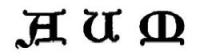
Let us adore the supremacy of that divine Sun, the Godhead who illuminates who recreates all, from whom all proceed, to whom all must return, whom we invoke: may he direct our understanding aright in our progress toward his holy seat.—The Gayatri.
The spiritual mind which by study hath forsaken the fruit of works, and which by wisdom hath cut asunder the bond of doubt, cannot be brought back to mortal birth by reason of any human action.—Bagavad-Gita, ch. iv.
THE PATH.
Vol. I. MARCH, 1887. No. 12.
The Theosophical Society, as such, is not responsible for any opinion or declaration in this magazine, by whomsoever expressed, unless contained in an official document.
Where any article, or statement, has the author’s name attached, he alone is responsible, and for those which are unsigned, the Editor will be accountable.
A Year on The Path.
The present issue of this Magazine closes the first year of its publication. It was not started because its projectors thought that they alone knew the true Path, but solely out of an intense longing to direct inquiring minds towards a way which had seemed to many persons who had tried it, to hold out the possibility of finding an answer to the burning questions that vex the human heart.
The question is always naturally asked “What is the Path?” or “What is the Philosophy?” which is the same thing, for of course the following of any path whatever will depend upon the particular philosophy or doctrines believed in. The path we had in view is held by us to be the same one which in all ages has been sought by Heathen, Jew and Christian alike. By some called the path to Heaven, by others the path to Jesus, the path to Nirvana, and by the Theosophists the path to Truth. Jesus has defined it as a narrow, difficult and straight path. By the ancient Brahmins it has been called, “the small old path leading far away on which those sages walk who reach salvation;” and Buddha thought it was a noble fourfold path by which alone the miseries of existence can be truly surmounted.
But of course mental diversities inevitably cause diversity in the understanding of any proposition. Thus it happens that Theosophists have many different views of how the path should be followed, but none of them disagree with the statement that there must be one Truth, and that no religion can be called higher than Truth. We therefore have pursued, as far as possible, a course which is the result of the belief that the prevalence of similar doctrines in the writings and traditions of all peoples points to the fact that the true religion is that one which will find the basic ideas common to all philosophies and religions.
We turned most readily and frequently to the simple declarations found in the ancient books of India, esteeming most highly that wonderful epic poem—the Bagavad-Gita. And in that is found a verse that seems to truly express in powerful words what philosophers have been blindly grasping after in many directions.
“It is even a portion of myself (the Supreme) that in this material world is the universal spirit of all things. It draweth together the five organs and the mind, which is the sixth, in order that it may obtain a body, and that it may leave it again; and that portion of myself (Ishwar) having taken them under his charge, accompanieth them from his own abode as the breeze the fragrance from the flower.”170
To catch the light which gleams through this verse, is not for mortal minds an easy task, and thus it becomes necessary to present as many views from all minds as can be obtained. But it seems plain that in every religion is found the belief that that part of man which is immortal must be a part of the Supreme Being, for there cannot be two immortalities at once, since that would give to each a beginning, and therefore the immortal portion of man must be derived from the true and only immortality.
This immortal spark has manifested itself in many different classes of men, giving rise to all the varied religions, many of which have forever disappeared from view. Not any one of them could have been the whole Truth, but each must have presented one of the facettes of the great gem, and thus through the whole surely run ideas shared by all. These common ideas point to truth. They grow out of man’s inner nature and are not the result of revealed books. But some one people or another must have paid more attention to the deep things of life than another. The “Christian” nations have dazzled themselves with the baneful glitter of material progress. They are not the peoples who will furnish the clearest clues to the Path. A few short years and they will have abandoned the systems now held so dear, because their mad rush to the perfection of their civilization will give them control over now undreamed of forces. Then will come the moment when they must choose which of two kind of fruit they will take. In the meantime it is well to try and show a relation between their present system and the old, or at least to pick out what grains of truth are in the mass.
In the year just passing we have been cheered by much encouragement from without and within. Theosophy has grown not only in ten years, but during the year past. A new age is not far away. The huge, unwieldy flower of the 19th century civilization, has almost fully bloomed, and preparation must be made for the wonderful new flower which is to rise from the old. We have not pinned our faith on Vedas nor Christian scriptures, nor desired any others to do so. All our devotion to Aryan literature and philosophy arises from a belief that the millions of minds who have trodden weary steps before ours, left a path which might be followed with profit, yet with discrimination. For we implicitly believe that in this curve of the cycle, the final authority is the man himself. In former times the disclosed Vedas, and later, the teachings of the great Buddha, were the right authority, in whose authoritative teachings and enjoined practices were found the necessary steps to raise Man to an upright position. But the grand clock of the Universe points to another hour, and now Man must seize the key in his hands and himself—as a whole—open the gate. Hitherto he has depended upon the great souls whose hands have stayed impending doom. Let us then together enter upon another year, fearing nothing, assured of strength in the Union of Brotherhood. For how can we fear death, or life, or any horror or evil, at any place or time, when we well know that even death itself is a part of the dream which we are weaving before our eyes.
Our belief may be summed up in the motto of the Theosophical Society “There is no religion higher than Truth,” and our practice consists in a disregard of any authority in matters of religion and philosophy except such propositions as from their innate quality we feel to be true.
What is True “Christianity”?
“Christianity” is a religion; but the word “religion” has evidently three distinct meanings:
1. In the first place it signifies the practice of a certain kind of spiritual training, by which the higher principles in the constitution of man are developed and reunited (bound back) to the divine source to which they belong. In this sense it is the same as yogism (from yog, to bind).
2. In the second aspect it implies the knowledge of the true relation existing between microcosmic man as a part of the All and the macrocosm of the spiritual and material universe. In this sense it is a science.
3. In the third and common acceptation of the term, “religion” means a certain system of forms, ceremonies and usages, by which some supposed eternal deity is worshipped or propitiated and his favor obtained, so that the sinner may escape the deserved punishment and evade the law. In this sense it is a superstition.
To become a “Christian” of the third order, it is merely necessary to submit to a certain ceremony called baptism, whose mode of administration varies in the different sects; but it seems that to become a real Christian some other baptism is necessary, namely, the baptism of the water of Truth, the baptism of Blood, and the baptism of the living Fire of the Spirit.
The first baptism, with the water of Truth, means the attainment of spiritual knowledge, and corresponds to the first of the four noble truths taught by Buddha: “right doctrine.”
The second, or the baptism of Blood, is commonly supposed to mean a shedding of blood by martyrdom, in the defense of a belief in a historical Christ. But such a process would be a loss of blood and not a reception of it, and could not properly be called a “baptism.” The best way to obtain information in regard to this “baptism of blood,” will be to ask those who have received it or who are receiving it at present.
There is a certain class of “practical occultists,” whose inner senses are opened to a great extent, and who have been taught by no one but the spirit within themselves and their own experience. They say that the “baptism of blood” means a penetration of the growing spiritual germ in man, through the flesh and blood and bones of the physical body, by which even the gross elements of the physical form are attenuated and purified,171 and that this process produces pains and sufferings, typically represented by the suffering, crucifixion and death of the man Jesus of Nazareth. They say that no one can be a true follower of Christ, or a “real Christian,” who has not undergone this baptism of blood, and experienced the pains of crucifixion,172 but that man having passed through that occult process becomes an Adept, when only the highest baptism (or the last initiation)—the baptism of Fire—will be necessary to enter the highest attainable state (Spiritual Power), and to become a Son of Light.
But, it is asked, what has Jesus of Nazareth to do with that process? How does the latter come to be typified by his suffering, and what is the rationale of it?
It is claimed that at the beginning of certain historical periods, when old religious truths are about to be forgotten, and the idolatry of form assumes the place of true religion, some great spirit (planetary) appears upon the Earth, incarnated into a human form, and by his word and example impresses the old truths forcibly upon a number of receptive minds, to communicate them to others, and thus lay the foundation of a new religious system, embodying old truths in a new form.
It is believed that the man Jesus of Nazareth was the mortal form in which such a Spirit was embodied; the latter being no less than what I believe every planetary spirit to be—an emanation of the Universal Logos or the Word.173
But what is the Logos? or, to express it better, how can we form a conception of it? We can conceive of no other God (or Supreme Good) but the one which lives within ourselves, and which is said to be the image of the Universal God reflected in the purified human soul, where it (He) may attain self-consciousness and the knowledge of self. The Universal God may be described as the incomprehensible centre from which proceed the elements of Love, Life and Light in the various modes of manifestation on the different planes. The whole of Nature is a product of the Spirit of God, being poured out throughout the All by the power of The Word, which is the Life—or thought rendered active by will.
The same process which took place in the eternal Macrocosm of the Universe, takes place in the inner world belonging to the microcosm of man. “No one can come to the Father, but through the Son;” that is to say: No God will take his seat in the interior temple of Man, except through the power of the Word—in other words; by the concentration of thought and good will upon the divine germ which rests in the innermost centre of every human being. If we concentrate our Love upon that centre of Good, the divine germ will begin its active Life, and the interior world will gradually become illuminated by the Light of the spirit. As this principle grows, it will penetrate the soul and through the soul all the lower principles, even the physical body, throwing off the impurities of soul and body, and the more such impurities are present, the greater will be the suffering, typically represented by Jesus, until finally the baptism of blood is completed, the soul purified, the animal ego dead and the man has become a “Christ” or an Adept,—that is to say one in whom the (6th) Christ principle has taken form.
It will readily be seen that this process is much more difficult to accomplish, than merely to go to church, pay the dues to the priests, attend to prayer-meetings and perform the prescribed ceremonies. To accomplish this process requires a constant meditation of the highest kind, and a continual employment of will power to keep away the disturbing elements of evil, which in a person who strives for light are still more boisterous than in one who is indifferent, for as soon as the spiritual light kindled in the centre begins to radiate its life-giving rays throughout our interior world, the “dwellers of the threshold”—the evil egos, created by evil thoughts and selfish desires, floating at the periphery of the soul-sphere like clouds sailing through the atmosphere of our earth, begin to feel the destroying influence of the central sun and battle for their existence. Still this atmosphere of evil must be penetrated before we can reach the luminous centre and the tranquil heaven within, and this is done by clinging to the principle of Good and virtue whose rays radiate from the centre. This principle will at first only be felt intuitionally but as we feed it with good thoughts, it grows and the interior spiritual senses become opened, so that we may see and hear its voice distinctly and without any fear of misunderstanding its meaning.
The “below” is always in exact correspondence to and related with the “above.” We are immersed in an all surrounding but invisible ocean of life, whose waves pervade our psychic organization, in the same sense as volumes of air enter our lungs, and as the latter stimulates the life of the body, likewise the former stimulates the growth of the elements of the spirit; which draw their substance from the lower-animal-principles. In the same way the caloric rays of the sun enter the bodies of plants and stimulate the assimilation of the elements which are drawn from earth, water and air.
Those who have gone through that occult process, will require no proof of the truth of these assertions: because they know it to be true by experience; but the “exoteric Christian” and sceptic, having no such experience to assist his faith, may arrive at a certain degree of conviction by using his reasoning powers and logic in conjunction with the teachings of the Bible. Christ is reported in the New Testament to have said: “Except Ye eat the flesh of the Son of Man and drink his blood, ye have no life in You” (John vi, 53); and again: “I am the living bread, which came down from heaven; if any man eat of this bread, he shall live forever” (John vi, 51.) Now this seems plain enough to every student of occultism, and if translated into the scientific language of modern occultists, it would mean: “Unless you absorb and assimilate within your psychic organization the sixth principle (The Christ), which is the only permanent and immortal principle in the constitution of Man, you will have no sixth principle developed within you, and consequently possess no immortal life—at least as far as Your personality is concerned (for the divine and now unconscious germ within you cannot die, but will reincarnate again). But if you absorb the principle or spiritual life and develop the spirit within you, so that it grows through your flesh and blood, then will you have drunk from the Elixir of Life and received the Baptism of Blood and become a Christian, an Adept; for ‘Christ’ will have taken form in your body, and being himself immortal you will be immortal through him.”
These views are corroborated by the great Christian mystic Jacob Boehme, by Jane Leade, Paracelsus, the Rosicrucians, and I can find nothing in them which would in any way conflict with the Esoteric Doctrine, as taught by the Eastern Adepts. If any difference in opinion could arise, it could be only, in regard to the person of Jesus of Nazareth or Jehoshua, and whether he lived exactly at the time claimed by modern Christians. This question I must leave to some one wiser than myself to settle; but it seems of no great importance to me; for the existence of the Christ-principle is disputed by none, and the man, Jesus—having died—can only be a Savior to us at present, if we study his character and imitate his example.
F. Hartmann, M. D.
Papyrus—The Gem.
The roads were thronged with the people moving toward the great square, for it was a feast of the Goddess. The temples were crowded, while long lines of men and maidens in the robes of “The Sacred” wound in and out toward the river.
Music and song rose and fell upon the evening breeze, like the pulse of a throbbing heart. Here and there could be seen the Scribes, and seated in an open space, the Tale-tellers. One of these, as I rested near him, told the tale of
ONE WHO FOUND THE GEM.
“In the land of the Wise-men, there dwelt a young man. Many years had he labored in a strange mine; the ‘Mine of the Priceless Gems;’—hopefully, bravely, but fruitlessly. He had long known that he who should find the Master Stone, would be free, be full of peace and dig no more, for nothing better could be found. He also knew that he who found the stone should seek to share it with all men.
“Many small stones had he found, but they were laid aside to be used when the great stone was reached.
“Silently and steadily he worked on, until one gloomy day when he had grown so weak that he could make but one more effort, that effort was rewarded, and before him lay the great gem. Weary, weak, but joyful, he gathered it into his bosom, and went forth to share it with others; for he who told not of his gem, or shared it not with all men, must lose the stone.
“Far he wandered, telling his wonderful story, the finding of the Priceless Stone—the stone that made men greater, wiser, more loving than all things living; the stone that no man could keep unless he gave it away.
“Far he wandered in his own country, seeking to tell his story and give of the Stone to each one he met. Silently they listened—gravely they meditated and gently they said to him: ‘This is Kali-yuga, the dark age. Come to us a hundred thousand years from now. Until then—the stone is not for us. It is Karma.’
“Far into another land he wandered, ever trying for the same end. Gravely they listened, quietly they spoke: ‘Peace be with you. When the Lotus ceases to bloom and our Sacred River runs dry, come to us. Until then we need not the stone.’
“Over the seas unto another land he went, for fully he believed that there they would hear and share with him. The many days of wandering and the long journey across the sea had made him thin and ragged. He had not thought of this, but as he told his story he was reminded of it and many other things, for here the people answered in many ways, and not always gently.
“Some listened, for his story was new to them, but the gem was uncut, and they wished it polished.
“Others paused and desired him to tell his story in their tents, for that would make them exalted and famous, but they wanted not the gem. As he did not belong to their tribe, it would bring discredit upon them to receive anything from him.
“One paused to listen and desired some of the stone, but he desired to use it to elevate his own position and assist him in overreaching his fellows in bartering and bargaining. The Wanderer was unable to give any of the stone to such as this one.
“Another listened, but inasmuch as the Wanderer refused to make the gem float in the air, he would none if it.
“Another heard, but he already knew of a better stone, and was sure he would find it, because he ate nothing but star-light and moonbeams.
“Another could not receive any of the stone or listen to the story, for the Wanderer was poor and ragged. Unless he was dressed in purple and fine linen and told his story in words of oil and honey, he could not be the possessor of the gem.
“Still another heard, but he knew it was not the gem. As the Wanderer had been unsuccessful before, surely he could not have found the stone. Even had he found it, he could not have the proper judgment to divide it. So he wanted none of the stone.
“Near and far went the Wanderer. Still ever the same. Some wanted it, but the stone was too hard, or not bright enough. He was not of their people, or was ignorant. He was too ragged and worn to suit their ideas, so they wanted none of the stone.
“Saddened, aged and heart-sore, he wandered back to the land of the Wise men. To one of these he went, telling of his journeyings and that no man would share with him the magnificent stone, and also of his sorrow that he too must lose it.
“‘Be not troubled, my son,’ said the Wise One, ‘the stone is for you, nor can you lose it. He who makes the effort to help his fellow man is the rightful owner and still possesses the entire stone, although he has shared it with all the world. To each and every one to whom you have spoken, although they knew it not, you have given one of the smaller stones which you first found. It is enough. When the Master Stone is cut and polished, then is the labor of the fortunate possessor ended. The long journeying and weary wandering, the sorrow-laden heart and tear-dimmed eyes, have cut and polished your gem. Behold, it is a white and a fair stone!’
“Drawing it from his bosom, the Wanderer gazed into the wonderful light of the stone while an expression of great peace stole over his face. Folding the gem close to his bosom his eyelids closed, and he fell asleep, a wanderer no more.”
Rameses.
Heralds from the Unseen.
“Behold, I show you a mystery. We shall not all sleep, but we shall all be changed.”—I Cor. xv, 51. “I have found the small old path leading far away.”—Upanishad.
To him who without murmuring, confident in the perfect justice of the law, waits and watches, there comes a herald from heights unseen. The just man follows him and attains; the unwise may surprise him and follow also. But when the fool has rushed unbidden in where angels fear to tread, he meets a mailed Truth with a drawn sword, on whose point he dies. Now there are two deaths. From the one he may rise, “in a moment, in the twinkling of an eye, * * * for the dead shall be raised,”174 and this by the vivifying power of truth, if so be he have one identical incorruptible atom in his spiritual make up, or else that rash being is dead forever, and the spirit monad creates another in the dream of three thousand years.
The indivisible Truth in its entirety is incommunicable in the words of our plane. A clue may indeed be given; it is the herald to those who await him. It is useless to turn the page to see who this is that offers the clue. Of myself I know nothing, yet through me may much be made known. I am the trumpet; through it the herald may proclaim a mystery.
It was in a night of silence that a Power bade me waken, and drew me to a dark cave wherein It passed. Not so I, for the entrance was narrow and I had encumbrances about me. Only many nights later, when I had parted with effort, hope and fear, did I stand within. All of me that was essential had entered; this was enough. Then a musical chord breathed low, the darkness dispersed, and I saw the Unknown Land.
It was a circling land of streams, Light everywhere, flowing, flowing, flowing. The flow was cadenced and welled from a mysterious Centre of blackness at the edges of which spouted cataracts of flame. My thought shrank with awe of the Darkness, but an unknown grasp of Might expanded within me and drew me to that flaming verge. On the knees of the soul I fall and am not. I become one with the All, and consciously resting in Omniscience I know the whole. Yet what forever dwells, wakeful and brooding with that dark pavillion, nor man nor angel may discover. Profounder than all Being, It is, girt about by unfathomed fires. “Ye shall enter the light, but ye shall never touch the flame.”175
A stir was over that central Dark, a titanic breath, like the sighing of myriad seas, measured, omnipotent. Where its harmonious friction fretted the verges of space, the flames burst forth, and with fecund pulsations gave birth to heat, light, motion and sound. The Centre felt a boundless attraction for the circumference, pouring toward it with inexhaustible energy, for “the heart of it is Love.” This was the force centrifugal, which in a dazzle of starry scintillations thrusts the universal glooms apart with a song. Were this all, Discord and Division were the end. But the circumference trembled also with a vast yearning toward the Centre, so that it ever tended to return there, as the prodigal, enriched in experience, returns to the mystic house of the Father. This was the centripetal force, and these two caused the double vibration of the Astral Light, and they are all you shall know though you blend with the infinite forever. “Whatever there is, the whole world when gone forth trembles in His breath: that Brahman is a great terror, like a drawn sword. They who know it become immortal.”176
Then a voice said—“The Absolute evolves thought from Himself, and the vibration of this thought in the passive wells of space generates Light and its correlated forces. The Thought is,—‘Creation!’ The singing breath is the Word; the Light is the Absolute made manifest, and the Universe begins.” At once I saw divergent lances of light pour their serried splendors into the void, and the point of each spear displaced the mist which curling backward from the centre of energy thus formed, communicated the movement to sister vapors in turn. Activities shoot, play back and forth, elongate, crystalize, and so great planets spring into the arena, feel the first instinct of separate Being, struggle to depart,—an estranged Self—in meteoric desolation, when the magnetic impulse of the Centre streams along the creative ray, meets the responsive principle, and lo! each chafing Orb, held in leash by Love, wheels into the circle of attraction and obeys the Law. The astral world has begun!
Thence presently the Light spreads afresh, reflected and repeated from every facet of every star, till arrowy glories, vibrant with each vibration sped forth by the primary pencils of light, in turn create dull planetary masses in the luminous abyss; then ever renewed coruscations quicken their dust with whose initial tremor shining crystals sparkle out and glide together about a glistering ring whose centre is ever a darkness ruffled by the outreaching current from that first tinted Gloom. So new spheres form, these, repeating the parent movement, with wide spreading auras touch and arouse their neighbors, and interpenetrating, revolving, throwing off, taking on, converging, diverging, modifying and modified, a world of forms is evolved whose final expression of Being is Man. Thus further departing, the infinite variations end in individuality and the greater the individuality, the more it leans to the centrifugal force, and the lack of equilibrium in the forces draws man further from the Eternal and he forgets the Law. His aura, his rays are nerve currents centred in the personality, but linked by star-beam and moon-ray to the quivering Source of all light, so that each man vibrating, imparts to the Akasa about him his own specific rate of vibration, and all men, all things, suspended as it were in this fine ether which fills the universe, act and react each on each, every one striving to modify the others to his own vibratory ratio, while the Light in the same way attacks all, and the battle of the giants is here. So the final expression of “evil” is inertia, and the highest attribute of Spirit is the Thought which is Life.
Once again the Voice spoke then saying: “What gives Life?” Someone answered: “Vibration.” And when It said, “Look back to the earth world,” I obeyed. I saw the modern sage reducing all the great forces, all the intoxicating play of colors and the bewildering tangle of harmonies to this one source,—Vibration. I saw wondering students bending over sensitive flames that danced or died at the mandate of sound. I saw a child playing with iron filings on glass, and as he drew a bow athwart the pane they marshalled into tiny mimicries of the primitive crystalline creation. I saw the Frost spirit, tracing his white wonders of tropical forests on vibrant surfaces, blazoning symbols of summer on the grim escutcheon of the snow. I saw Sound disintegrating granite and iron, taming wild beasts with a lure, transforming brothers into demons at the sibilant hiss of a scathing word.177 I saw Light fecundating the soil, and the teeming battalions of the underworld issuing from the palpitating spark in their germs; the selective art of the flower, choosing the kindred color of her tribe from all the flashing scale, gave up to me its secret of the synchronous vibration of that hue with the astral soul within her fragrant form. Passion I saw also, flaming in two breasts that for one tumultuous moment became one, and knew it for an instant of similar vibration. Aye, and saw that Love was a steadfast quality of motion between loyal hearts, saw too that Anger and Hatred had their rise in the same source, and mounting upward I saw that Faith was a similitude of vibration with Truth itself. Again the Voice spoke; “Dost thou see aught but Vibration anywhere?” I answered: “Such all life is, and from such all proceeds. He who cons its secret laws and can institute its musical numbers at will, is a God! He can create and destroy.” “Go then, and by analogy learn what thou art,” said the Voice, and like the rebel fraction of a star I fell from Glory, and found myself alone in the Maya world again, with these words thrilling my brain. “But He, that Highest Person, who wakes in us while we sleep, shaping one lovely sight after another, He indeed is called the Light, He is called Brahman, He alone is called The Immortal. All worlds are founded on It and no one goes beyond. This is that.”178
It is rarely that a man gets the whole of his thought; often others supply it. Analogy is the power of following a thought into all its correlations, and I shall ask you to do this in a measure with mine. These puny pages cannot contain the theme of cycles, and falling short, it scarce matters by how many pen strokes I fail. Consider this first; what are we? Look abroad over our Society, largely; we see each member working on his own particular line. So it must be with man for ages. When you shall have exhausted your special hobby, when through astral perception, or mesmeric control or mental acumen, you shall have attained high powers, the hour of your limitation will strike, as its awful knell can strike, even from the towers of Futurity, and you will know that you have not found that corner-stone on which alone the Eternal rests,—your indivisible Self. “Great ones fall back, even from the threshold, unable to sustain the weight of responsibility; unable to pass on.”179 Follow from the start that solitary beacon which informs the ultimate goal: Unity. Make it your touchstone and your guide; other stars are reflected lights only. The doctrine of unselfishness is no sentiment, but of logical, practical utility. The individual way lies from limited Being, through Becoming, to unlimited Being, precisely as the universal way lies from sterile Unity, through Division to fecund Unity, or from the one Life through Death to the Life of the All. He who in final choice elects the path of Division, chooses Death eternal. You may indeed wend homeward through the devious tangle of reflected rays, but how long, how hard are such paths! I would see your souls with eagle swoop make straight for the Central Sun. Look then within you. Man! Woman! Are you what you seem? Till this thought daily; it will bear the harvest of Life.
With analogy for our guide we observe that the first forms of life are crystalline and have two poles. You man, are also a magnetic sphere with physical and spiritual poles. On the physical side of the subject we find modern scientists telling us that man is matter in a state of low vibration, and thought, matter in a state of high vibration.180 In this ascertained view, Spirit is a higher state of vibration than we at present cognize. “Does the fact look crass and material, threatening to degrade thy theory of Spirit? Resist it not; it goes to refine and raise thy theory of matter just as much.”181 Nor do I say this is all. Trust your highest ideal to the unconditioned causation lying back of that primal vibration—Absolute Thought.
The vibrant tension of fixed thought must in time heighten the vibratory ratio of the man, for tension excites increased pulsation. This rarefies the density of all bodies, and the friction of intensified chemical action establishes light, heat and odic force. The increased porosity of the physical body tends to disengage the atoms of the astral body, and the generation of a strong odic current forces it out to the astral world, (always attracting it) all the sooner because the intensified pulsation of thought-tension sends the auric emanations further into space, thus draughting a larger portion of the world-soul to the entity. All vibration being attended with sound (which may or may not escape the ear) we proceed to examine tones and find them varying from the lowest of eight vibrations per second, to the highest known to western science of 24,000 per second. Remember that the tones of anger, hatred, scorn are all deep notes, those of cheerfulness, love, hope are treble. Here we discover the apparently inexplicable effect of spoken words which raise or depress our vibrations to their own by means of the etheric medium. To resist the wildfire spread of passion or anger we have but to check the vibration by holding steadily to our own; this maintained, may raise that of others, precisely as the high musical note constantly sounded, raises all lower ones at all related, to its own pitch. Tyndall says: “Scientific education ought to teach us to see the invisible as well as the visible in nature; to picture with the vision of the mind those operations which entirely elude bodily vision; to look at the very atoms of matter in motion and at rest, and to follow them forth without once losing sight of them * * to see them integrating themselves in natural phenomena.” So I shall ask you to imagine a tone at a high rate of vibration, to see it striking the hearer’s brain at a certain focus, creating there a centre of energy, which tending to crystallization, fixes the thought in the mind. And the more permanent duration of pleasant (which are high) thoughts and tones is evident if we glance back over a long period of time and note how the joys stand out and the griefs disappear; so we always forget physical suffering. Moreover we may see this tone raising his vibratory ratio and glancing off at an angle of reflection equal to that of incidence, reacting upon the surrounding ether and upon all hearers. The magical success of eastern mantras depends upon the exact intonation, which governs the vibratory result, and the proper intonation of the sacred books, learned from the priests, doubtless increased their effect. Turning to colors, we find them varying in vibration from violet 1/60000 inch to red 1/38000 inch, and the violet has greater actinism; so it would seem to follow that the more extended the undulation the greater the chemical action and resultant odic force. Hence the tone of animals or man is not such a poor test of their nature as we might suppose, and a certain clue to character is given in a preferred color. The higher sounds thus create greater akasic disturbance through increased undulation. Deleuze in his work on magnetism says: “The word which indicates our will can often exert an action. * * The very tones of the magnetizer, being produced by the vital energy, act upon the organs of the patients.” Reichenbach proved that all chemical action is a source of odic force, and the transmertion of air being nothing less, additional witness is born to the occult power of a word. All mesmerizers are now agreed that motions and words are unnecessary; the will suffices; what is this but the tension of fixed thought. Everything in Nature has its own specific rate of vibration; if we know and can reproduce and heighten it we can call the thing into existence or pass ourselves within its consciousness. Hence the old saying that numbers are the names of things. The “lost word” itself is, doubt it not, a sound of the highest possible vibration, represented by the Aum, or sound of the eternal outpour of Light, the Logos of the Christians. The ordinary ear may not grasp this sound, but Tyndall tells us such are not dead because they have passed from our ken.182 When we remember that this astral vibration can in time elevate that of all matter, we glimpse alike the great factor of Evolution and of the use of Aum. The thought being spiritually fixed, an unbroken vital current sets in between the man and the “One eternal Thinker, thinking non-eternal thoughts. He though one, fulfils the desire of many. The wise, who perceive Him within their Self, to them belong eternal joy, eternal peace!”183 Here we perceive the force of the repeated injunction to be calm; how else can the harmonious medium act upon us? “The man who is not calm and subdued, or whose mind is not at rest, he can never obtain the Self, even by knowledge.”184
Follow me now to the plane of soul. As all things from planet to molecule have their mystic centre, that of man is found in the heart, whose systole and diastole are regulated by the double movement of the Astral Light. There, hemmed about by the light of the semi-material soul, is the dusky centre, where the spirit may awaken and breathe. “The self is smaller than small, greater than great, hidden in the heart of the creature.” Air is breathed by the lungs; the soul breathes the astral light. As that spiritual monad who is your own Augoides, breathed first upon the plastic Akasa and drew together the principles of a man, so It must again breathe upon this silent centre to create the spiritual man. It does not inhabit him, It overshadows him. It is his “Father in Heaven” to whom Jesus bade him pray; his Creator. In each heart stands this shrouded altar to an unknown God. “Whom ye therefore ignorantly worship, Him declare I unto you.” He has created the physical man hundreds of times, for His mission is unfulfilled until through Evolution, He shall have made “one higher than the angels.” In that illimitable future which evades the mind, my soul sees ultimate beings in their glory, raise the swelling tide of Being higher still. So Divinity raises Itself by Itself and man expands God. Here is the adhesion of Jesus to the destiny latent in Humanity. “Be ye perfect as your Father in Heaven is also perfect.”
Jasper Niemand, F. T. S.
(Concluded in April.)
Thoughts in Solitude.
II.
The votaries of Religions that preach salvation only through the acceptance of their dogmas must inevitably be more or less animated by the proselytising spirit, and the more pretentious the claims of power to save by the inculcation of orthodox opinion, the more urgent must appear the necessity to spread those opinions as widely as possible. Indeed it seems imperative on one who holds such a faith in his heart of hearts, that he should spend his life in trying to spread it.
But when the true philosophic thought is attained and the law of Karma with its infinite ramifications realized as the all pervading power, how vain will seem all attempts to control or even deeply affect the destiny of others. Truly Occultism teaches the widest tolerance, and though its student will doubtless as formerly try to influence all who are brought into contact with him in his journey through life, and if possible instil into them the thoughts that actuate him and give his life a definite purpose, yet will he realize that over his own life alone has he paramount power. He may exercise his worldly wisdom as the sower of seed, may avoid what is most patently the rocky or the thorny ground, but he will gradually learn to cease to look for results from even the most promising, and will rise more and more on the wings of devotion to the true giver of the increase.
While therefore it is a subject for satisfaction if the Theosophical Society should indeed prove to be the dawn of that better hope for mankind the nucleus of that Universal Brotherhood which shall overspread all lands, and which shall plant in the hearts of men the Science-Religion along whose lines will move the spiritual progress of all future Humanity, yet as a Society it can scarcely be expected to be free from the imperfections inherent in all organization, which being of the earth is necessarily earthly—and after all it is a matter of very small moment in what form truth is given to the world. This only is certain that truth must advance that no man can stay the wheel of evolution—that the Divine Wisdom which we believe animates us will one day be recognized by all mankind as the only solution of the problem of the Universe, and as the guide to Life Eternal.
And Destiny will not be hurried—spite of our impatience—any more than she can be retarded. The evil Karma of the World must work itself out. The unclean man let him be unclean still, let him measure every depth of vice and taste of every spring of passion till the hour strikes for him also and his painful upward progress has to begin. So have the Rishis done who went before us, so have we done in past existences, indeed we may have but extricated ourselves from the slough, and the mire may still be clinging to our feet. For no man can transcend experience, and all earthly places, foul and clean alike, must be trodden by him. Nor when the words or acts of others come into direct antagonism with our own personality, any more than when the cruelty and injustice in the world at large are brought painfully before us, shall we continue to blame the actors, or allow the old prejudices “with their lurid colourings of passion” to dominate us any longer, for the true philosophic thought will have taught us to recognize that all acts are but the result of the “Three Qualities” blended in infinite combination—the great Karma of the World working itself out.
The deeper one looks into this Western Civilization of ours, and the more one realizes in what degrading depths its masses are sunk, in what heartless frivolity so many of the more opulent spend their lives, and in what superstitious intolerance its so-called Religious World moves, it seems indeed a forlorn hope to attempt to carry conviction of the Occult Truth or expect a widespread acceptance of it. But though this age of Darkness may exhibit an appalling depth of materiality, yet in all ages of the world, the blind multitude are many and the lovers of Wisdom few. And indeed this love of Wisdom is no light attainment, but one for which the soul has been educated through life times of experience and paroxysms of pain, for while the gratification of any of the senses still continues to give supreme satisfaction, there is no room in the soul for Theosophic thought. Not until by the slow education of repeated experience it is realized that the senses can no longer satisfy, that even the higher joys of communion with ones kind—though culminating in the ideal union of two souls—are but steps in the ladder to the Supreme Thought, can any true idea of the Divine Wisdom have been formed. Indeed a time will come for the student when the gratification of the senses will actually cause pain. It may be ushered in for one through the sense of sight, when the most beautiful scenery of earth, and the most perfect combinations of mountain wood and water only accentuate by their faint reflex the passionate desire for that land which no eye hath seen, that land which no eye can see. Or the symphonies of earthly music which once enthralled the soul may raise the longing for the song of the celestial choir to that ecstatic point where it becomes unrecognisable from pain. And so the student is driven inward to find at last his refuge in pure Thought, and he begins to perceive that the Eternal World of ideas is the only real World, the only one in which pure Being is to be found, and that this phenomenal existence is indeed but the circling of the nets of delusion, the restless tossing of the false salt waves of sense which reward “with droughts that double thirst” the deluded souls that float on them.
The more the student lives in this ideal world, the more will he find that the association with those whose interests are exclusively centred on earthly things becomes repugnant to him, and that even the calls of duty to descend from the tranquil heights of Thought, to the jarring discord of action in the world, are responded to with increasing pain, though duty in such cases is likely to be in process of changing her sphere of action. When the inner struggles of one still bound by ties of earth suggest such thoughts as these, surely the isolation from contact with the rude world of the most spiritual men, those who have achieved the sublime heights of Mahatmaship, is no longer a thing to wonder at, but becomes apparent as an absolute necessity.
The desires above referred to of seeing the invisible, and realizing the divine, will probably if practised continuously enough, and with sufficient intensity, be the prelude to some partial lifting of the veil, when the ecstatic may reap in a moment of beatific vision more than he ever dreamed of, and receive accretion of strength for the coming years, though this is more likely to be the immediate reward of some supreme self-devotion whether in act or thought, and when the words of Krishna, “near to renunciation—very near—dwelleth eternal peace” will flash upon the soul as truth that requires no word of mortal man to give it authority.
But woe to the man who unduly cultivates his spiritual faculties without being a complete master of his lower nature—the beast below will turn and rend him some day—the little bit of lust unconquered may be the means of his complete undoing. For as his astral consciousness develops his whole being intensifies, including the small unconquered part of his physical nature, which he will then have to fight upon the Astral plane, in far more terrible struggle than had he conquered on the physical. It becomes in fact what is symbolically known as the “Dweller on the threshold” that has to be fought and conquered before the neophyte can aspire to gain the first glimmering of vision on the true spiritual plane. For it must always be remembered that our nature is threefold, “body, soul and spirit” as the initiate St. Paul expressed it, and until the personality has transferred all its forces unto the soul plane, it cannot expect to attain to that of spirit. From this it will be evident how necessary it is to live more and more continuously in the Eternal Thought until all fleshly appetites and desires of sense die off by sheer inanition.
The vague dreams with which life began, and which the child with memories fresh from “that imperial palace whence he came” pictured in a material way of a golden city with walls of jasper and with gates of pearl, and into which no unclean thing was permitted to enter, are lost for a while in the frenzied rush of youth and early manhood, but maturer years bring them back with an added pathos and a more spiritualized meaning. It is indeed the Golden city we all seek for—“the city that hath foundations whose builder and whose maker is God.”
Pilgrim.
Hindu Symbolism.
IV.
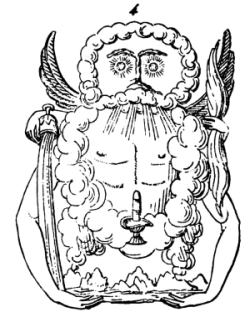
AUM symbolized as in unison with the attributes of the Trimurti, as the symbolic foundation of the elementary universe. This has a certain connection with figures Nos. 1 and 2 and 3.
The idea is to represent the mystic body of Brahman (neuter) and the ideal type of the Trimurti. The representation is of a four-handed cloud picture. A wreath of clouds forms the outline of the head which is without any tiara. Two suns indicate the eyes without lids, always open. This symbolism is also found in the Hebrew books, e. g. the Zohar. The nose and eyebrows are formed by a palm tree divided on the top, in the centre. This tree was considered as androgynous. The mouth is merely an opening in the clouds; from it emanate, four principal rays, the four-worlds of the Kabbalah. AUM is winged, Brahman (neuter) is not, for the latter is also AUM—Prana, the breath of the highest life and mystic carrier of the Will of Brahman (neuter). AUM is the bird of the Brahman Desire or Wish.
The four hands of AUM are holding the architypes of the four elements, fire, water, air, earth, in their height and depth. The lower are supporting the Himalayah Mountains, the mountains of the gods. From which comes the German Himmel i. e. Heaven. The linga yoni is shown as the symbol of all the creative and emanative powers which lie in the mystic cloud garment of AUM. In this figure are nearly all the principal symbols of the Brahmanical religious metaphysics.
The bond which unites Prakriti to Brahman (neuter) is Prana, the subtile body of Brahman, the form of the Being, the divine breath, the principle of the organism, the respiration so to say, of the Deity; in Sanscrit it also means “breath of man,” more correctly it is AUM, the first form of the creator, the Sun engendered before Time, the first Word (the Logos) which went from Its mouth, the ‘Hokhmah or Wisdom of the Kabbalah, when It prepared Its work, the creative Word. Prana and AUM are confounded in Maya, and as it, they have formed the Cow. AUM is the son of Maya as he is the son of Brahman (neuter), because Maya is Brahman. AUM is the first born Word or Logos of the Deity, the Memrah of the Jews, the Honover of the Persians, the origin of the Vedas. It has revealed and manifested all the emanated things, the so-called creation. It appeared before all things, and contains all qualities, all the elements, and is the name and body of Brahman (neuter), and consequently as infinite as It. The Will, Desire, Word is the master architect and creator of all the things. Brahma meditating upon the divine Word, therein found the primitive water, the common bond of all the creatures, the primitive fire, and the Trimurti of the Vedas, also the worlds and universal harmony of all the things. The image of AUM is the Cow, which is also a symbol of the universe. The universe was concealed and at first was hidden under the waters, and the waters were in Atma. These waters are those without any shores, all that which exists is water, and the water and AUM make but one; these primitive waters are the sea of Maya, the celestial ocean of all existence.
There are to be found further in this symbolical picture many other suggestions flowing from the Ancient Aryan or Hindu system. That system is believed to contain in germ all the others which have since arisen, as: the Hermetic, the Jewish, the Christian and others. Space, however, forbids a more extended explanation at present, and the student is recommended to study the four which have appeared in this magazine.
Isaac Myer.
Through the Gates of Gold.
The most notable book for guidance in Mysticism which has appeared since Light on the Path was written has just been published under the significant title of “Through the Gates of Gold.”185 Though the author’s name is withheld, the occult student will quickly discern that it must proceed from a very high source. In certain respects the book may be regarded as a commentary on Light on the Path. The reader would do well to bear this in mind. Many things in that book will be made clear by the reading of this one, and one will be constantly reminded of that work, which has already become a classic in our literature. Through the Gates of Gold is a work to be kept constantly at hand for reference and study. It will surely take rank as one of the standard books of Theosophy.
The “Gates of Gold” represent the entrance to that realm of the soul unknowable through the physical perceptions, and the purpose of this work is to indicate some of the steps necessary to reach their threshold. Through its extraordinary beauty of style and the clearness of its statement it will appeal to a wider portion of the public than most works of a Theosophical character. It speaks to the Western World in its own language, and in this fact lies much of its value.
Those of us who have been longing for some thing “practical” will find it here, while it will probably come into the hands of thousands who know little or nothing of Theosophy, and thus meet wants deeply felt though unexpressed. There are also doubtless many, we fancy, who will be carried far along in its pages by its resistless logic until they encounter something which will give a rude shock to some of their old conceptions, which they have imagined as firmly based as upon a rock—a shock which may cause them to draw back in alarm, but from which they will not find it so easy to recover, and which will be likely to set them thinking seriously.
The titles of the five chapters of the book are, respectively, “The Search for Pleasure,” “The Mystery of Threshold,” “The Initial Effort,” “The Meaning of Pain,” and “The Secret of Strength.” Instead of speculating upon mysteries that lie at the very end of man’s destiny, and which cannot be approached by any manner of conjecture, the work very sensibly takes up that which lies next at hand, that which constitutes the first step to be taken if we are ever to take a second one, and teaches us its significance. At the outset we must cope with sensation and learn its nature and meaning. An important teaching of Light on the Path has been misread by many. We are not enjoined to kill out sensation, but to “kill out desire for sensation,” which is something quite different “Sensation, as we obtain it through the physical body, affords us all that induces us to live in that shape,” says this work. The problem is, to extract the meaning which it holds for us. That is what existence is for. “If men will but pause and consider what lessons they have learned from pleasure and pain, much might be guessed of that strange thing which causes these effects.”
“The question concerning results seemingly unknowable, that concerning the life beyond the Gates,” is presented as one that has been asked throughout the ages, coming at the hour “when the flower of civilization had blown to its full, and when its petals are but slackly held together,” the period when man reaches the greatest physical development of his cycle. It is then that in the distance a great glittering is seen, before which many drop their eyes bewildered and dazzled, though now and then one is found brave enough to gaze fixedly on this glittering, and to decipher something of the shape within it. “Poets and philosophers, thinkers and teachers, all those who are the ‘elder brothers of the race’—have beheld this sight from time to time, and some among them have recognized in the bewildering glitter the outlines of the Gates of Gold.”
Those Gates admit us to the sanctuary of man’s own nature, to the place whence his life-power comes, and where he is priest of the shrine of life. It needs but a strong hand to push them open, we are told. “The courage to enter them is the courage to search the recesses of one’s own nature without fear and without shame. In the fine part, the essence, the flavor of the man, is found the key which unlocks those great Gates.”
The necessity of killing out the sense of separateness is profoundly emphasized as one of the most important factors in this process. We must divest ourselves of the illusions of the material life. “When we desire to speak with those who have tried the Golden Gates and pushed them open, then it is very necessary—in fact it is essential—to discriminate, and not bring into our life the confusions of our sleep. If we do, we are reckoned as madmen, and fall back into the darkness where there is no friend but chaos. This chaos has followed every effort of man that is written in history; after civilization has flowered, the flower falls and dies, and winter and darkness destroy it.” In this last sentence is indicated the purpose of civilization. It is the blossoming of a race, with the purpose of producing a certain spiritual fruit; this fruit having ripened, then the degeneration of the great residuum begins, to be worked over and over again in the grand fermenting processes of reincarnation. Our great civilization is now flowering and in this fact we may read the reason for the extraordinary efforts to sow the seed of the Mystic Teachings wherever the mind of man may be ready to receive it.
In the “Mystery of Threshold,” we are told that “only a man who has the potentialities in him both of the voluptuary and the stoic has any chance of entering the Golden Gates. He must be capable of testing and valuing to its most delicate fraction every joy existence has to give; and he must be capable of denying himself all pleasure, and that without suffering from the denial.”
The fact that the way is different for each individual is finely set forth in “The Initial Effort,” in the words that man “may burst the shell that holds him in darkness, tear the veil that hides him from the eternal, at any moment where it is easiest for him to do so; and most often this point will be where he least expects to find it.” By this we may see the uselessness of laying down arbitrary laws in the matter.
The meaning of those important words, “All steps are necessary to make up the ladder,” finds a wealth of illustration here. These sentences are particularly pregnant: “Spirit is not a gas created by matter, and we cannot create our future by forcibly using one material agent and leaving out the rest. Spirit is the great life on which matter rests, as does the rocky world on the free and fluid ether; whenever we can break our limitations we find ourselves on that marvellous shore where Wordsworth once saw the gleam of the gold.” Virtue, being of the material life, man has not the power to carry it with him, “yet the aroma of his good deeds is a far sweeter sacrifice than the odor of crime and cruelty.”
“To the one who has lifted the golden latch the spring of sweet waters, the fountain itself whence all softness arises, is opened and becomes part of his heritage. But before this can be reached a heavy weight has to be lifted from the heart, an iron bar which holds it down and prevents it from arising in its strength.”
The author here wishes to show that there is sweetness and light in occultism, and not merely a wide dry level of dreadful Karma, such as some Theosophists are prone to dwell on. And this sweetness and light may be reached when we discover the iron bar and raising it shall permit the heart to be free. This iron bar is what the Hindus call “the knot of the heart!” In their scriptures they talk of unloosing this knot, and say that when that is accomplished freedom is near. But what is the iron bar and the knot? is the question we must answer. It is the astringent power of self—of egotism—of the idea of separateness. This idea has many strongholds. It hold its most secret court and deepest counsels near the far removed depths and centre of the heart. But it manifests itself first, in that place which is nearest to our ignorant preceptions, where we see it first after beginning the search. When we assault and conquer it there it disappears. It has only retreated to the next row of outworks where for a time it appears not to our sight, and we imagine it killed, while it is laughing at our imaginary conquests and security. Soon again we find it and conquer again, only to have it again retreat. So we must follow it up if we wish to grasp it at last in its final stand just near the “kernel of the heart”. There it has become an “iron bar that holds down the heart”, and there only can the fight be really won. That disciple is fortunate who is able to sink past all the pretended outer citadels and seize at once this personal devil who holds the bar of iron, and there wage the battle. If won there, it is easy to return to the outermost places and take them by capitulation. This is very difficult, for many reasons. It is not a mere juggle of words to speak of this trial. It is a living tangible thing that can be met by any real student. The great difficulty of rushing at once to the centre lies in the unimaginable terrors which assault the soul on its short journey there. This being so it is better to begin the battle on the outside in just the way pointed out in this book and Light on the Path, by testing experience and learning from it.
In the lines quoted the author attempts to direct the eyes of a very materialistic age to the fact which is an accepted one by all true students of occultism, that the true heart of a man-which is visibly represented by the muscular heart—is the focus point for spirit, for knowledge, for power; and that from that point the converged rays begin to spread out fan-like, until they embrace the Universe. So it is the Gate. And it is just at that neutral spot of concentration that the pillars and the doors are fixed. It is beyond it that the glorious golden light burns, and throws up a “burnished glow.” We find in this the same teachings as in the Upanishads. The latter speaks of “the ether which is within the heart,” and also says that we must pass across that ether.
“The Meaning of Pain” is considered in a way which throws a great light on the existence of that which for ages has puzzled many learned men. “Pain arouses, softens, breaks, and destroys. Regarded from a sufficiently removed standpoint, it appears as a medicine, as a knife, as a weapon, as a poison, in turn. It is an implement, a thing which is used, evidently. What we desire to discover is, who is the user; what part of ourselves is it that demands the presence of this thing so hateful to the rest?”
The task is, to rise above both pain and pleasure and unite them to our service. “Pain and pleasure stand apart and separate, as do the two sexes; and it is in the merging, the making the two into one, that joy and deep sensation and profound peace are obtained. Where there is neither male nor female, neither pain nor pleasure, there is the god in man dominant; and then is life real.”
The following passage can hardly fail to startle many good people: “Destiny, the inevitable, does indeed exist for the race and for the individual; but who can ordain this save the man himself? There is no clew in heaven or earth to the existence of any ordainer other than the man who suffers or enjoys that which is ordained.” But can any earnest student of Theosophy deny, or object to this? Is it not a pure statement of the law of Karma? Does it not agree perfectly with the teaching of the Bhagavat-Gita? There is surely no power which sits apart like a judge in court, and fines us or rewards us for this misstep or that merit; it is we who shape, or ordain, our own future.
God is not denied. The seeming paradox that a God exists within each man is made clear when we perceive that our separate existence is an illusion; the physical, which makes us separate individuals, must eventually fall away, leaving each man one with all men, and with God, who is the Infinite.
And the passage which will surely be widely misunderstood is that in “The secret of strength.” “Religion holds a man back from the path, prevents his stepping forward, for various very plain reasons. First, it makes the vital mistake of distinguishing between good and evil. Nature knows no such distinctions.” Religion is always man-made. It cannot therefore be the whole truth. It is a good thing for the ordinary and outside man, but surely it will never bring him to the Gates of Gold. If religion be of God how is it that we find that same God in his own works and acts violating the precepts of religion? He kills each man once in life; every day the fierce elements and strange circumstances which he is said to be the author of, bring on famine, cold and innumerable untimely deaths; where then, in The True, can there be any room for such distinctions as right and wrong? The disciple, must as he walks on the path, abide by law and order, but if he pins his faith on any religion whatever he will stop at once, and it makes no matter whether he sets up Mahatmas, Gods, Krishna, Vedas or mysterious acts of grace, each of these will stop him and throw him into a rut from which even heavenly death will not release him. Religion can only teach morals and ethics. It cannot answer the question “what am I?” The Buddhist ascetic holds a fan before his eyes to keep away the sight of objects condemned by his religion. But he thereby gains no knowledge, for that part of him which is affected by the improper sights has to be known by the man himself, and it is by experience alone that the knowledge can be possessed and assimilated.
The book closes gloriously, with some hints that have been much needed. Too many, even of the sincerest students of occultism, have sought to ignore that one-half of their nature, which is here taught to be necessary. Instead of crushing out the animal nature, we have here the high and wise teaching that we must learn to fully understand the animal and subordinate it to the spiritual. “The god in man, degraded, is a thing unspeakable in its infamous power of production. The animal in man, elevated, is a thing unimaginable in its great powers of service and of strength,” and we are told that our animal self is a great force, the secret of the old-world magicians, and of the coming race which Lord Lytton foreshadowed. “But this power can only be attained by giving the god the sovereignty. Make your animal ruler over your self, and he will never rule others.”
This teaching will be seen to be identical with that of the closing words of “The Idyll of the White Lotus”: “He will learn how to expound spiritual truths, and to enter into the life of his highest self, and he can learn also to hold within him the glory of that higher self, and yet to retain life upon this planet so long as it shall last, if need be; to retain life in the vigor of manhood, till his entire work is completed, and he has taught the three truths to all who look for light.”
There are three sentences in the book which ought to be imprinted in the reader’s mind, and we present them inversely:
“Secreted and hidden in the heart of the world and the heart of man is the light which can illumine all life, the future and the past.”
“On the mental steps of a million men Buddha passed through the Gates of Gold; and because a great crowd pressed about the threshold he was able to leave behind him words which prove that those gates will open.”
“This is one of the most important factors in the development of man, the recognition—profound and complete recognition—of the law of universal unity and coherence.”
Considerations on Magic.
We hear a good deal nowadays and are likely to hear still more of occult science. In this regard we may as well accept the inevitable. All things have their day, and all things revolve in cycles; they come and go, and come again, though never twice the same. Even our very thoughts conform to this universal law. The life, the teachings, and the fate of Pythagoras are involved in mystery, but the fate of the schools which he established and of the followers who succeeded him are matters of history. The slaughter of the Magi stands over against the abuses and abominations which were perpetrated in their name, and doubtless by many styling themselves Magicians.
It is not the object of this brief paper to attempt to define magic, or elucidate occult Science as such, but rather to suggest a few considerations which are of vital import at the present time, equally important to those who utterly deny to magic any more than an imaginative basis, as to those who convinced of its existence as a science, are, or are to become investigators. In both the publications and conversations of the day, frequently occur the expressions “black magic,” and “white magic” and those who follow these studies are designated as followers of the “left hand path,” or the “right hand path“. It ought to be understood that up to a certain point all students of magic, or occultism, journey together. By and by is reached a place where two roads meet, or where the common path divides, and the awful voice from the silence, heard only in the recesses of the individual soul utters the stern command: ”Choose ye this day whom ye will serve.” Instead of black and white magic, read, black and white motive.
The student of occultism is rushing on his destiny, but up to a certain point that destiny is in his own hands, though he is constantly shaping his course, freeing his soul from the trammels of sense and self, or becoming entangled in the web, which, with warp and woof will presently clothe him as with a garment without a seam.
If early in the race he finds it difficult to shake off his chains, let him remember that at every step they grow more and more tyrannical, and often before the goal is reached where the ways divide, the battle is lost or won, and the decision there is only a matter of form. That decision once made is irrevocable, or so nearly so that no exception need be made. Man lives at once in two worlds: the natural and the spiritual, and as in the natural plane he influences his associates, and is in turn influenced by them, so let him not imagine that in the spiritual plane he is alone. This will be a fatal mistake for the dabbler in magic, or the student in occultism. Throughout this vast universe, the good will seek the good, and the evil the evil, each will be unconsciously drawn to its own kind.
But when man faces his destiny in full consciousness of the issues involved, as he must before the final decision is reached, he will be no longer unconscious of these influences, but will recognize his companions: companions, alas! no longer, Masters now, inhuman, pitiless; and the same law of attraction which has led him along the tortuous path, unveils its face, and by affinity of evil, the slave stands in the presence of his master, and the fiends that have all along incited him to laugh at the miseries of his fellow men, and trample under his feet every kindly impulse, every tender sympathy, now make the measureless hells within his own soul resound with their laughter at him, the poor deluded fool whose selfish pride and ambition have stifled and at last obliterated his humanity.
Blind indeed is he who cannot see why those who are in possession of arcane wisdom, hesitate in giving it out to the world, and when in the cycles of time its day has come, they put forth the only doctrine which has power to save and bless, Universal Brotherhood, with all that the term implies.
There may be those who have already in this new era, entered the left-hand road. But now as of old, “by their works ye shall know them”. To labor with them is in vain. Selfishness, pride and lust for power are the signs by which we may know them. They may not at once cast off disguise, and they will never deceive the true Theosophist. They can nevertheless deceive to their ruin the ignorant, the curious, the unwary, and it is for such as these that these lines are penned, and the worst of it is, that these poor deluded souls, are led to believe that no such danger exists, and this belief is fortified by the so-called scientists, who are quoted as authority, and who ridicule everything but rank materialism. Yet notwithstanding all this, these simple souls flutter like moths around the flame till they are drawn within the vortex. It is better a million times, that the proud, the selfish and time-serving should eat, drink and be merry, and let occultism alone, for these propensities unless speedily eradicated, will bear fruit and ripen into quick harvests, and the wages thereof is death, literally the “second death”.
The purpose of Theosophy is to eradicate these evil tendencies of man, so that whether on the ordinary planes of daily life, or in the higher occult realms, the Christ shall be lifted up, and draw all men unto him.
“Man’s inhumanity to man Makes countless thousands mourn.”
The Christs of all the ages have preached this one doctrine: Charity and Brotherhood of Man. To deny the law of charity is to deny the Christ. The Theosophical Society is not responsible for unveiling to the present generation the occult nature of man. Modern Spiritualism had already done this; nor is the responsibility to be charged to the Spiritualists, for these unseen forces had revealed themselves in the fullness of time, and many millions had become convinced, many against their wills, of the reality of the unseen universe. These things are here, and neither crimination, or recrimination is of any use. The responsibility therefore, rests entirely with the individual, as to what use he makes of his opportunities, as to his purposes and aims, and as he advances in his course, involved in the circle of necessity, he influences whether he will or no, those whose spheres of life touch at any point his own. As ye sow, so shall ye also reap. By and by the cycle will close and both the evil and the good will return like bread cast upon the waters. This is a law of all life.
Imagine not that they are weak and vacillating souls who enter the left-hand road: Lucifer was once a prince of light, admitted to the councils of the Most High. He fell through pride, and dragged downward in his fall all who worshiped the demon pride. This is no foolish fable, but a terrible tragedy, enacted at the gates of paradise, in the face of the assembled universe, and reënacted in the heart of man, the epitome of all. Only Infinite pity can measure the downfall of such an one, only Infinite love disarm by annihilation, and so put an end to unendurable woe, and that only when the cycle is complete, the measure of iniquity balanced by its measure of pain. Occultism and magic are not child’s-play, as many may learn to their sorrow, as many visitants of dark circles have already and long ago discovered. Better give dynamite to our children as a plaything, than Magic to the unprincipled, the thoughtless, the selfish and ignorant. Let all who have joined the Theosophical Society remember this, and search their hearts before taking the first step in any magical formulary. The motive determines all. Occult power brings with it unknown and unmeasured responsibility.
If in the secret councils of the soul, where no eye can see, and no thought deceive that divine spark conscience, we are ready to forget self, to forego pride, and labor for the well-being of man, then may the upright man face his destiny, follow this guide and fear no evil. Otherwise it were far better that a millstone were hung about his neck, and he were cast into the depths of the sea.
Pythagoras.
Tea Table Talk.
The Tea Table has had a sensation!
Do you remember the case of “Chalanka”? He was the “Fallen Idol,” in Anstey’s book of that name, and played the very deuce with people and bric-a-brac alike. There’s a deal of truth in that clever little satire, and the author shows up the elementals quite correctly without in the least suspecting it.
The Chalanka of the Tea Table arrived very demurely one winter afternoon, per Adams Express, in a promising box which bore the mark of a great china firm and contained as well, securely moored in its harbor of cotton wool, a tea-pot which the Tea Table pronounced “Adorable” were it not smashed. Nothing else was near this brittle loveliness save and except Chalanka. To all appearances he was a pencil sketch of the head of a young Brahmin of high caste, folded in the typical turban. The drawing is powerful and the subtle sidelong glance of the eyes to the extreme left has one peculiarity, viz: if you come round from behind the picture on the extreme right, the eyes meet you equally, and so from any position. I cannot escape that dark and searching gaze. Still, one would say there was nothing dynamic about a sketch, and yet the tea-pot arrived literally crushed to pieces within its perfect casing, and the indignant ladies, with the acumen of their sex, soon spotted Chalanka and held him responsible. Presently I noticed that everyone had a more or less sidelong glance in return for his, towards where he glowered from an étagère on which we had put him, and in the course of the social hour I collected these remarks upon him.
The Professor, sauntering up.—“H-m. Who have we here? The fellow has a beautiful face and—the devil’s in it!”
Sue. “Goodness! who’s that? Makes me feel like when I step down in the dark.”
The Mother. “That man’s face is not human.”
The Widow. “I have it! I wondered what Chalanka made me think of. Don’t you know that thing in the Bible about ‘the serpent that listeneth not to the voice of the charmer, charm he never so wisely?’” (The Widow was wiser than she knew.)
The Student. “You ladies always go in for poetry. Now he looks to me as if he said,—‘Get me if you can, my boy; if you don’t, I’ll get you!’” Great sensation and nervous shivers from the ladies, followed by instant demands for the lamp. The maid who brings it being observed to fix a fascinated gaze on Chalanka, is asked what she thinks of him. After a little urgency she replies. “That gentlemaen’s so sad, ain’t he? I do’n’ know, he’s unnatr’al like. Seems like there’s somethin’ he can’t get over.” Flings her apron over her head suddenly, and breaks from the room. Apologizes later and says “nerves is in her family” but always thereafter calls Chalanka “that gentleman,” as for instance; “I couldn’t bring meself to dust that gentleman.” Or, “I knocked that gentleman down but he ain’t hurt.”
Now the curious fact about the above remarks is this: A fellow F. T. S. felt impelled to draw one night. As he did so, a mist gathered near him, and gradually this Brahmin stood plainly before him, just as the sketch shows him, with his magnetic gaze which affects everyone who sees him. Many callers come into the room where the 5 by 8 drawing stands inconspicuously, surrounded by all the Heaven-only-knows-what, of modern decoration, but the Tea Table has yet to see the person who does not comment upon Chalanka with a baffled sense of mystery. The artist, a student well up in such matters and a man of unimpeachable veracity, knew his strange visitor for an elemental who assumed that shape to attract attention, the artist knowing many Hindus and thinking often of them.