INDEX. (continued 2)
Reading edition
Here at once should be noted, that although in Hindu theology we find Brahma, Vishnu and Siva, as the creator, preserver and destroyer, forming the Trinity, the Upanishad now before us—for cutting away error—has not such a division. It says Brahma is first, also the maker and the preserver. Even knowledge that is true for certain stages of development becomes error when we rise up into the higher planes and desire to know the true. Similarly we find Buddha in his congregation teaching his disciples by means of the “three vehicles,” but when he had raised them to the higher plane, he informed them that these vehicles might be discarded and sat or truth be approached through one vehicle.
The knowledge here spoken of is Brahman knowledge which is the supreme vehicle.
“2. Whatever Brahma told Atharvan that knowledge Atharvan told to Angir, he told it to Satyavaha Bharadvaga, and he in succession told it to Angiras.
“3. Saunaka, the great householder, approached Angiras respectfully and asked ‘Sir, what is that through which if it is known, everything else becomes known?’
“4. He said to him: ‘Two kinds of knowledge must be known, this is what all who know Brahman tell us, the higher and the lower knowledge.
“5. ‘The lower knowledge is the Rig-Veda, Yajur-Veda, Sama-Veda, Atharva-Veda Phonetics, Ceremonial, Grammar, Etymology, Metre and Astronomy; but the higher knowledge is that by which the Indestructible (Brahma) is apprehended.
“6. ‘That which cannot be seen nor seized, which has no origin and is without qualities, no eyes nor ears, no hands nor feet, the eternal, the all pervading, infinitesimal, that which is imperishable, that is what is regarded by the wise as the source of all beings.
“7. ‘As the spider sends forth and draws in its thread, as plants grow on the earth, as from every man hairs spring forth on the head and the body, thus does everything arise here from the Indestructible.
“8. ‘The Brahman swells by means of meditation; hence is produced matter; from matter mind, breath and intellect, the seven worlds, and from the works performed by men in the worlds, the eternal effects, rewards and punishment of works.
“9. ‘From Him who perceives all and who knows all, whose meditation consists of knowledge, from that highest Brahman is born that other Hiranyagarbha—name, form, and matter.’”
This Khanda unfolds broadly the whole philosophy. The following ones go into particulars. It is very easy here to see that the imperishable doctrine could not be communicated directly by the Great Brahma to man, but it has to be filtered down through various channels. The communicator of it to mortals, however, would be regarded by his finite auditors as a god. The same method is observable in the Bagavad-Gita (ch. IV) where Krishna says to Arjuna that “this never failing doctrine I formerly taught unto Vivaswat and he to Manu, who told it to Ikswaku, succeeding whom came the Rajarshis who studied it.” Manu is regarded as of a wholly Divine nature although not the Great Brahm.
Now, when Angiras, as detailed in the Upanishad, had received this higher knowledge, he was approached by a great householder, by name Saunaka. This has reference to an ancient mode of life in India when Saunaka would be called a grihastha, or one who was performing all his duties to his family, his tribe, and his nation while still in the world. All the while, however, he studied the knowledge of Brahman, so that when the proper time came for him to give up those duties of life, he could either die or retire to solitude. It was not considered then to be a virtue for one to violently sever all ties and assume the garb and life of a mendicant devoted to religious contemplation, but the better way was thought to be that one which resulted in our, so to speak, consuming all the Karma of our family in ourselves. Otherwise it would inevitably result that if he retired with many duties unfulfilled, they waited, figuratively speaking, for him, sure to attach to him in a succeeding incarnation and to work him either injury or obstruction. So it was thought better to work out all such results in the present life as far as possible.
We find here also a foreshadowing of some ideas held by the Greek philosophers. In the third verse, the question is asked: “What is that through which when it is known, the knower thereof knows everything else.” Some of the Greeks said that we must first ascend to the general, from which descent to the particular is easy. Such, however, is directly opposite to the modern method, which delights in going from particulars to generals, from effects to causes. The true knowledge proceeds as shown in the Upanishad. By endeavoring to attain to the Universal Soul of all, the knowledge of the particular parts may be gained. This is not easy, but it is easy to try. At the same time do not forsake modern methods altogether, which correspond to the lower knowledge spoken of in Verse 5. Therefore Angiras says: Two kinds of knowledge, the lower and the higher, must be known.
Here and there are persons who seem not to need the lower knowledge, who pay no attention to it, and who apprehend the higher flights impossible for others. This is what is known as the result of past births. In previous incarnations these persons studied upon all the lower planes so that their spiritual perceptions do not now need that help and training which the lower knowledge gives to others. They are approaching that state which is beautifully described by Longfellow in his “Rain in Summer,” in these words:—
“Thus the seer, With vision clear, Sees forms appear and disappear, In the perpetual round of strange, Mysterious change From birth to death, from death to birth; From earth to heaven, from heaven to earth; ’Till glimpses more sublime, Of things unseen before, Unto his wondering eyes reveal The Universe, as an immeasurable wheel Turning forevermore In the rapid and rushing river of Time.”
(To be continued.)
The Mystery of Numbers.
In a previous article on the Kabbalah, we spoke of it as being a tradition embodying a noble philosophy, which is but slightly understood, owing to its symbolical representations.
There were three forms of symbols introduced by the Ancient Theosophists to express their thoughts and convey their ideas from one to another. The object of the symbolic language was for the purpose of preventing their esoteric knowledge from becoming public property and to obviate persecution from those who were in authority and held different views. These three forms were: hieroglyphics, numbers and allegories.
It is the Kabbalistic science of numbers of which we purpose to speak. Deity in constructing the universe, employed but few means to accomplish a great purpose. They consisted of energy and law. The former is under control of the latter. The first act was the positing of energy, which formed substance. In this manner He converted chaos, which was a motionless, dark abyss, into activity and light. Light is not energy, but primarily resulted from the activity of atomic substance.
God creates all things by number, weight and measure, and with an arithmetical and geometrical precision. The universal continuity observed in nature is owing to the law that controls energy. Any interference with this law throws energy out of harmony, producing discord, and consequently a varying of continuity.
Every seed has within it an individual life energy which gives to it when developed into a plant or tree its type and form. Any external interference induces a struggle for life in the forces in maintaining their ancestral types and forms. Heredity may produce the same by interfering with the law controlling development.
The Kabbalists never intended to convey the idea that numbers possessed special virtues. They merely represent them; for example 3 represents a life entity; without this ternary combination it would be impossible for life to exist. The self-existing Deity is a Triune Entity; so is every individual life form. Whether it be a Monera, the lowest structureless life organism, or Man, the highest in the scale of living beings. Number three is therefore called the generating number.
Again, 7 is the harmonic numeral, there being seven primary grades of harmony, and in order to extend it, the scale of seven must be repeated, and every repetition lessens the harmony and tends to discord.
The Sepher Jetzirah, which is recognized by the Kabbalist as the key of the Sohar, is a wonderful and obscure work. Its wisdom is represented in ten numbers and twenty-two letters. From the numbers “are drawn or cut” the twenty-two letters which are divided into three mothers, seven double and twelve single letters. According to the Sepher there were three acts of creation; 1st, Conception or Idea; 2nd, The Word; 3rd, The Writings. For example, first, God conceived in His own mind, the archetype of the universe which constituted the design; second, the Word represents the law and the energy it controls and directs in carrying out the design; third, the product arising from the second constitute the writings.
The Sepher Jetzirah teaches that the hidden ways of wisdom are in the ten sephiroth, which are usually termed spheres. The Hebrews use the word “ways,” which with us mean degrees, forms or species. These hidden ways are the workings of the forces producing differentiation of forms, which represents the twenty-two letters, which are expressed as one in three, and three in seven, and seven in twelve, making twenty-two.
The ten sephiroth interest us the most for they represent the unity and synthesis of numbers and the manifestations of Deity in nature. The first sefir is called the Crown on account of its being the abode of the En Soph40 the unmanifested infinite Being; but the first form by which he became known was the Memra or “word,” which is represented by the first three sephiroth, namely, Kether, “the Crown,” Chochma, “wisdom,” Binah, “understanding.”41 To express it more clearly, the first three sephiroth comprise a Triune Entity, the verbalized spirit of God consisting of self-consciousness, wisdom and love which embodied the Word, “the heavenly man,” “the man on high,” (Ezekiel I, 26), the Adam Kadmon of the Kabbalist, the Paradisical Adam of Genesis, the Christ of the Christians and the Buddha of the Buddhists.
In order to be understood, we will state that the Triune spirit of the world contains the word, and is therefore the source of energy and life in both the subjective and objective worlds, and in fact is the source of all that exists outside of spirit. It is under the direction of spirit in developing forms and giving them activity and life. We thus perceive how a knowledge of the word gives us an insight into the work of God in creation.
Jacob Behmen was a mystic, and acquainted with the meaning of the word which he obtained through illumination or the unfolding of inner consciousness. What he called the Signatura Rerum—the signature of all things—is the word. He describes it as coming from a triune entity, which he locates in the super-celestial world. It is first manifested in the subjective or esoteric world, and afterwards in the objective. He also alludes to the septenary which he applies to the external world; he could not have understood the laws of harmony or he would not have made this application, for it applies to both the subjective and objective worlds.
We will now explain the Tetractys of Pythagoras; before doing so, however, we have a few remarks to make regarding his Kabbalistic knowledge. He is said to have been initiated into the secrets of nature by Daniel and Ezekiel, and subsequently admitted into the Egyptian Sanctuaries upon a personal recommendation by King Amosis. His tetractys proves that he was thoroughly familiar with theosophical science, which enabled him to study nature and arrive at correct conclusions. It is a noted fact that he was familiar with the movements of the heavenly bodies; which science did not reveal until centuries after his death. If he mistook some of its details, his substantial correctness was none the less wonderful. He was the founder of the renowned school of Crotona, about five hundred years before Christ. He maintained that the Sun is the centre of a system around which all the planets revolve, and that the fixed stars were each the centre of a system. He also believed that the planets were inhabited and that they and our earth are ever revolving in harmonious order—“keeping up a grand celestial concert, inaudible to man, but as a music of the spheres audible to God.” He was not permitted to declare publicly all that he knew, but taught it privately to a few chosen friends. He was also familiar with the laws of attraction and repulsion, which constituted one of the most important duties of the sanctuaries. Newton was led to the discovery of these forces through the study of the Kabbalah.
Speaking of Pythagoras calls to mind the Kabbalistic enigma written by Plato and sent to Dionysius: “all things surround our King, (God) He is the cause of all things: seconds for seconds and thirds for thirds.” This expresses the division of the Sephiroth. Plato was an earnest and most intelligent Kabbalist.
We will now explain for the first time the Tetractys of Pythagoras, which reveals the numerical meaning of the word. We remark, however, before doing so, that there is a greater enigma attached to it than is expressed by the numbers, which we cannot give for several reasons. One is, the name has never been imparted; when obtained, it was through self illumination; another is, it would open the doors of masonry, and reveal the secrets of the order. It is the key to mysticism—to religion and universal science.
In the Tetractys the four letters composing the name, are arranged in a triangular form, enclosed with a double circle.42 The numerical division he has made applies to the super-celestial, celestial and material worlds:
The Tetractys of Pythagoras.
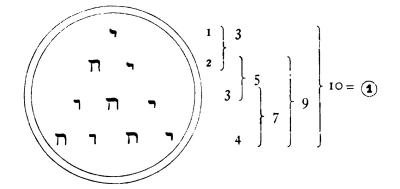
Super Celestial.—The first series of numbers 1, 2, 3, 4 of the tetractys refers to the super-celestial world.
1 is the unity of God represented thus: ① God in nothing.
2 is the duality of God.
3 is the spirit of a triune entity.
4 is Divine volition, capable of determining choice and forming a purpose, and manifesting activity.
Celestial.—The above numerals are combined in the following order:—1+2=3—the manifestation of the word, in the celestial world.
2+3=5—substance or quintescent matter, produced by the activity of the word.
3+4=7—the law of harmony—the providence of God in Nature. The celestial world is called by the Kabbalist the world of harmony, which none can occupy save the pure in spirit. Harmony is the only passport to Heaven.
Material.—The numeral 1, which represents the unity of God, is not represented in this world—we only have the following numerals:
2+3+4=9—humanity with the word unmanifested in the spirit. Yet it exists and can be made manifest through harmony of the spirit. It not being manifested debars humanity from the pleasure of enjoying the light of the celestial world. It is for this reason the Kabbalist called it the world of darkness or Hades. It is also called the world of discord. There are as many grades of discord here as there are harmonies in the world above. When man throws off the material covering of his soul, his consciousness reveals to him his moral standard and he gravitates to the sphere with which he is in accord. If harmonious he ascends, if discordant he descends.
10 is the synthesis of numbers. In the beginning before Deity manifested himself, it stood thus ①; in the consummation of creation it became reversed, thus 10.
Seth Pancoast.
Sufism,
Or Theosophy From the Standpoint of Mohammedanism.
A Chapter from a MS. work designed as a text book for Students in Mysticism. BY C. H. A. BJERREGAARD, Stud. Theos.
In Two Parts:—Part I, Texts; Part II, Symbols.
The spirit of Sufism is best expressed in the couplet of Katebi:
“Last night a nightingale sung his song, perched on a high cypress, when the rose, on hearing his plaintive warbling, shed tears in the garden, soft as the dews of heaven.”
INTRODUCTION.
Sufism has not yet received fair treatment in any publication that has appeared in Western literature.
The reason is that no Western writer upon the subject has endeavored to understand it, either because of an intellectual bias or from willful perversion. Most treatises are written under strong dogmatic prejudices, or by persons intellectually and morally incapable of rising to the A B C of a spiritual philosophy.
The present attempt to represent the doctrines and practices of Sufism has been made in the hope of overcoming the effect of these evils. We have studied patiently Sufism from Sufi works and claim to be in full sympathy with our subject.
That which we here present to the judgment of the candid reader is a part of a larger work we have been engaged on for many years; a work designed as a text book for students in Mysticism. This fact, the intention of making a text book for reference on all mystic questions, will account for the unusual method adopted in this series of articles.
In the first part we shall give a resumé of Sufi doctrine with copious quotations from Sufi works. In the second we shall give a full exposition of Sufi practices and symbols.
The following is a partial list of works consulted and quoted without further reference:
Tholuck, Sufismus, sive theosophia persarum—Tholuck, Blüthensammlung der morgenl. Mystik—Malcolm, Hist. of Persia—Trans. of the lit. soc. of Bombay, vol. I, art. by Capt. Graham—J. von Hammer, Geschichte der Schönen Redekünste Persiens, mit einer Blüthenlese—Garcin de Tassy, la poesie phil. et rel. chez les Persans, in Rev. cont. 1856—Fleischer, uber die farbigen Lichterscheinungen der Sufis, in Zeitsh. f. morgl. Geselsch. vol. 16—G. P. Brown, The Dervishes, or Oriental Spiritualism—Journal of Am. Orient. Soc., vol. 8—The Dabistan, or school of sects—E. H. Palmer, Oriental Mysticism—Persian Poetry by S. Robinson—Th. P. Hughes, Dict. of Islam—Ousely, Biographical notices of Persian poets—Omar Khayyam, see ed. illust. by Vedder—Al Gazzali, la perle precieuse, par L. Gautier—Allegories recits poetiques traduit de l’arabe, du persan &c., par Garcin de Tassy—Al Gazzali, Alchemy of Happiness tr. by H. A. Homes—Hammer-Purgstall, Literatur-Geschichte der Araber—The works of Nizami, Saadi, Attar, Jellalladin Rumi, Hafiz, Jami, Hatifi, &c., in English, French, German and Latin translations—Lane’s transl. of the Quran—&c., &c.
PART I.—TEXTS.
Origin of Sufism.
It is generally conceded among the Sufis that one of the great founders of their system, as found in Islam, was the adopted son and son-in-law of the Prophet, Ali-ibn-Abi-Talib. But it is also admitted that their religious system has always existed in the world, prior to Mohammed. It is known that a tribe, Sufah, from whom possibly the name is derived, in “the time of ignorance” separated themselves from the world and devoted themselves to spiritual exercises like those of the present Sufis.
Sufism in its best known forms must thus be considered to be the philosophy of Mohammedanism and to represent the protest of the human soul against the formalism and barrenness of the letter of the Quran. Still there is much in favor of Schmölder’s assertion (Essai sur les ecoles philos. chez les Arabes) that Sufism is neither a philosophical system nor the creed of a religious sect, but simply a way of living.
Perhaps the simplest statement is this: Sufism is theosophy from the standpoint of Mohammedanism.
Said-Abul-Chair (about A. D. 820) is often called the author of Sufism. Abu Hashem (A. D. 767) has been called the first Sufi.
The Dabistan maintains the identity of the pure Sufis and that of Platonism and it has popularly been supposed that Sufism has borrowed very much from the Vedanta and from Plato and Aristotle; it has even been confidently asserted that the similarity is so striking to the student, that it is a most easy matter to find identical statements in either of them. We must confess that our study does not prove the assertion. The similarity is to be accounted for by the universality of truth.
ETYMOLOGY.
The root of the word implies wisdom, the Greek Sophia, purity, spirituality, etc. Some have connected it with sûf, wool, on account of the woolen garment worn by the devotees.
Graham43 maintains that “any person or a person of any religion or sect, may be a Sûfi. The mystery lies in this: a total disengagement of the mind from all temporal concerns and worldly pursuits; an entire throwing off not only of every superstition, doubt, or the like, but of the practical mode of worship, ceremonies, etc., laid down in every religion, which the Mohammedans term Sheriat, being the law, or canonical law; and entertaining solely mental abstraction, and contemplation of the soul and Deity, their affinity, etc.” In short, Sufism may be termed the religion of the heart, as opposed to formalism and ritualism.
“Traces of the Sufi doctrine exist in some shape or other in every region of the world. It is to be found in the most splendid theogonies of the ancient school of Greece and of the modern philosophers of Europe. It is the dream of the most ignorant and the most learned, and is seen at one time indulging in the shade of ease, at another traversing the pathless desert.” (Malcolm Hist. of Persia.)
Abu-Said-Abul-Chair, the accredited founder of Sufism, when asked what Sufism was, answered: “What you have in the head, give it up; what you have in the hand, throw it away; whatever may meet you, depart not from it.”
Dschuneid, a Sufi Shaikh, thus defined Sufism: “To liberate the mind from the violence of the passions, to put off nature’s claims, to extirpate human nature, to repress the sensual instinct, to acquire spiritual qualities, to be elevated through an understanding of wisdom, and to practice that which is good—that is the aim of Sufism.”
Abul Hussein Nuri thus expressed himself: “Sufism is neither precept nor doctrine, but something inborn. If it were a precept, it could be followed; if it were a doctrine, it could be learned; it is rather something inborn—and as the Quran says: ‘Ye are created in the image of God.’ Evidently no one can, either by application or by teaching, possess himself of the likeness of God.”
Sufi Doctrines.
DEITY.
The Deity alone IS and permeates all things. All visible and invisible things are an emanation from Deity, and are not absolutely distinct from it.
One sect “the Unionists,” believe that God is as one with every enlightened being. They compare the Almighty to a flame, and their souls to charcoal; and say, that in the same manner that charcoal when it meets flame, becomes flame, the immortal part, from its union with God becomes God.
According to the Dabistan, the presence of the universal Deity is fivefold. The first is the presence of “the absolute mystery.” The absolute mystery is one with “the invariable prototypes” (or realities of things). The second is the presence of “the relative mystery,” and this belongs to pure intellects and spirits. The third is the presence of “the mysterious relation,” which is nearest to the absolute evidence; this is the world of similitude or dream. The fourth is the presence of the “absolute evidence” which reaches from the centre of the earth to the middle of the ninth empyrean heaven. The fifth is “the presence of the rest,” and this is the universe in an extensive, and mankind in a restricted acceptation.
Silvestre de Sacy gives the following explanation to the above from Jorjani. The five divine presences are (1) the presence of the absolute absence (or mystery); its world is the world of the fixed substances in the scientific presence. To the presence of the absolute mystery is opposed: (2) the presence of the absolute assistance; it is the world of the throne or seat of God, of the four elemental natures. (3) The presence of the relative absence; this is divided into two parts: The one nearer the presence of the absolute mystery; the world of which is that of spirits, which belong to what is called intelligences and bare souls; the other: (4) Nearer the presence of the absolute assistance; the world of which is that of models (images). (5) The presence which comprises the four preceding ones, and its world is the world of mankind, a world which reunites all the worlds, and all they contain.
GOOD AND EVIL: ETHICS.
There is no absolute difference between Good and Evil; all that exists, exists in unity and God is the real author of all the acts of mankind.
The Sufi says that evil only came into the world through ignorance, and that ignorance is the cause of error and disunion among men. The following tale answers to the point: “Four travelers—a Turk, an Arab, a Persian, and a Greek, having met together, decided to take their meal in common, and as each one had but ten paras, they consulted together as to what should be purchased with the money. The first said Uzum, the second Ineb, the third decided in favor of Inghur, and the fourth insisted upon Stafilion. On this a dispute arose between them and they were about to come to blows, when a peasant passing by happened to know all four of their tongues, and brought them a basket of grapes. They now found out, greatly to their astonishment, that each one had what he desired.”
They believe the emanating principle, proceeding from God, can do nothing without His will and can refrain from nothing that He wills. Some of them deny the existence of evil on the ground that nothing but good can come from God.
The Dabistan: One sect, “the Eternals,” conceive that man is taught his duty by a mysterious order of priesthood,44 whose number and ranks are fixed, and who rise in gradation from the lowest paths to the sublimest height of divine knowledge.
Another sect, “the Enlightened,” teach that men’s actions should neither proceed from fear of punishment nor the hope of reward, but from innate love of virtue, and detestation of vice.
THE SOUL, ITS LIFE AND CONDITIONS.
The soul existed before the body and is confined in it like in a cage. To the Sufi, death is liberation and return to the Deity.
The soul is confined in a body (metempsychosis) to be purified, to fulfill its destination, the union with Deity.
Without the grace of God (Fazlu allah) no soul can attain this union, but God’s grace can be obtained by fervently asking for it.
The soul of man is of God, not from God, an exile from Him; it lives in the body as in a prison and banishment from God. Before its exile the soul saw Truth, but here it only has glimpses “to awaken the slumbering memory of the past.” The object of all Sufi teaching is to lead the soul onward by degrees to reach that stage again.
“You say ‘the sea and the waves,’ but in that remark you do not believe that you signify distinct objects, for the sea when it heaves produces waves, and the waves when they settle down again become sea; in the same manner men are the waves of God, and after death return to His bosom. Or, you trace with ink upon paper the letters of the alphabet, a, b, c; but these letters are not distinct from the ink which enabled you to write them; in the same manner the creation is the alphabet of God, and is lost in Him.”
RELIGIONS
are matters of indifference; still they serve as stepping-stones to realities. Some are more useful than others, among which is al-Islam, of which Sufism is the true philosophy.
THE WORLD, &c.
The world is life and intellect, as far as the mineral kingdom; but the manifestation of intellect in everybody is determined by the temperature of the human constitution. Sometimes beauty attains an excellence which is uttered with ecstacy, and becomes a modulation more powerful than that which strikes the ear; and this is the work of the prophet.
THE TARIGAH OR “JOURNEY OF LIFE” AND ITS STATES.
The main duty of this life is Meditation on the Unity of Deity (wahdaniyah), the Remembrance of God’s Name (Zikr), and Progression in the Tarigah (the Path, the Journey of Life).
Human life is a journey (safar) and the seekers after God are travellers (salik). Perfect knowledge (marifah) of Deity as diffused throughout creation is the purpose of the journey. Sufism is the guide, and the end of the journey, is Union with God.
The natural state of every human being is nasut. In this state the disciple can not yet observe the Law (shariat). This is the lowest form of spiritual existence.
The states in the Tarigah are the following:
The first state is called Shariat—the state of law or method. The student’s passions are in this degree checked by a rigid observance of ritual, &c., whereby he learns human nature and to respect order and finds out for himself the rudiments of a knowledge of God.
The second state is Tureequt or the way, or road. This state implies mental or spiritual worship, abstracted totally from the above. The student learns to see the propædeutic nature of ceremonies and devotes himself to realities. At this stage the ascetic exercises begin and he holds communion with Melkut or the angelic world.
The third state, Huqeequt, or the state of truth is the state of inspiration or greater natural knowledge. The Sufi now lives no more in faith but in subjective truth and spiritual power; he has seen the similarity of God’s nature and his own; all antinomies are destroyed, even sin disappears from his reflections.
The fourth and last state is Marifut or union of spirit and soul with God. “Union (with God) is reality, or the state, truth and perception of things, when there is neither lord nor servant.” Still “the man of God is not God; but he is not separate from God.” At this stage man’s “corporeal veil will be removed, and his emancipated soul will mix again with the glorious essence, from which it had been separated, though not divided.”45
Aziz ibn Muhammad Nafasi in a book called al-Maqsadu ‘l-Aqsa or the “Remotest Aim,” (trans. in E. H. Palmer’s Oriental Mysticism) marks out the journey a little differently from that already described.
When a man possessing the necessary requirements of fully developed reasoning powers turns to them for a resolution of his doubts and uncertainties concerning the real nature of the Godhead, he is called a talib “a searcher after God.”
If he has further desire for progress he is called a “murid” or “one who inclines,” and he places himself under the instruction and guidance of a teacher and becomes a “traveller.”
The first stage of his journey is called “ubudiyah” or “service” and is as described above.
The second stage is ishq or “love.” He loves God. The divine love filling his heart, it expels all other loves and brings him to the third stage, Zuhd or “seclusion.” He occupies himself exclusively with contemplation of God and his attributes, and comes to the fourth state, Marifah or “knowledge.”
When settled he is come to the fifth stage, wajd or “ecstasy.” He now receives revelations and soon reaches the sixth stage, that of hagigah or “truth,” and proceeds to the final state, that of “wasl,” or “union with God.”
He has now finished the journey and remains in the state he has come to, still going on, however, progressing in depth of understanding. Finally he comes to “the total absorption into Deity.”
The Zikr, or ecstatic exercises belonging to the training on this journey, will be explained in our second part: Symbols.
THE SEVEN WAY-STATIONS OF PILGRIMAGE are these:46
The first degree consists of penitence, obedience, and meditation, and in this degree the light is, as it were, green.
The second degree is the purity of the Spirit from satanic qualities, violence, and brutality, because as long as the spirit is the slave of satanic qualities, it is subject to concupiscence, and this is the quality of fire. In this state Iblis evinces his strength, and when the spirit is liberated from this, it is distressed with the quality of fierceness, which may be said to be flashing and this is conformable to the property of wind. Then it becomes insatiable (lit. eager after anything to excess), and this is similar to water. After this it obtains quietness, and this quality resembles earth (i. e. apathy or cessation from all action). In the degree of repose, the light is as it were, blue, and the utmost reach of one’s progress is the earthly dominion.
The third degree is the manifestation of the heart, by laudable qualities, which is similar to red light, and the utmost reach of its progress is the middle of the upper dominion; and in this station the heart praises God, and sees the light of worship and spiritual qualities.
The fourth degree is the applying of the constitution to nothing else but to God, and this is similar to yellow light, and the utmost reach of its progress is the midst of the heavenly Malkat “dominion.”
The fifth degree of the soul is that which resembles white light, and the utmost aim of its progress is the extreme heavenly dominion.
The sixth degree is the hidden, which is like a black light, and the utmost reach of its progress is “the world of power.”
The seventh degree is “the evanescence of evanescence,” which is “annihilation” and “eternal life,” and is colorless. It is absorption in God, non-existence and effacement of the imaginary in the true being, like the loss of a drop of water in the ocean. It is eternal life as the union of the drop with the sea. “Annihilation” is not to be taken in the common acceptation, but in a higher sense, “annihilation in God.”
SUFI SYMBOLICAL LANGUAGE.
The Sufis inculcate the doctrine, “Adore the Deity in his creatures.” It is said in a verse of the Quran—“It is not given to man that the Deity should speak to him: if it does so it is by inspirations, or through a veil.” Thus all the efforts of man should tend to raise the veil of divine love and to the annihilation of the individuality which separates him from the Divine essence; and this expression “raise up the veil,” has remained in the language of the East as expressive of great intimacy.
One of the most violent and able of the enemies of the Sufis, says that they deem everything in the world a type of the beauty and power of the Deity and adds that it appears from both their actions and writings, that it is in the red cheeks of beautiful damsels that they contemplate its beauty; and in the “impious” daring of Nimrod and of Pharaoh, that they see and admire the omnipotence of its power.47
The Persian commentator Suruni says in regard to sexual love: “the beauty of the wife is a ray from God and not from the beloved herself. The Mystic recognizes the fact of the divine beauty everywhere in creation, and loves because he in beauty sees a revelation of the blessings of the divine name. It is therefore the prophet says he prefers these three things to all others: women, incense, and enjoyments.”
Jellaladdin Rumi said: “They (the Sufis) profess eager desire, but with no carnal affection, and circulate the cup, but no material goblet; since all things are spiritual, all is mystery within mystery.”
Jami exclaims, addressing the Deity:
Sometimes the wine, sometimes the cup we call Thee! Sometimes the lure, sometimes the net we call Thee! Except Thy name, there is not a letter on the tablet of the universe: Say, by what name shall we call Thee?
Nizami explains himself:
Think not that when I praise wine I mean the juice of the grape; I mean that wine which raiseth me above self. “My cup-bearer” is to perform my vow to God; “My morning draught from the tavern” is the wine of self oblivion. By heaven so long as I have enjoyed existence, Never hath the tip of my lip been stained with wine!
In regard to Hafis it is maintained that by wine he invariably means devotion; and his admirers have gone so far as to compose a dictionary of words of the language, as they call it, of the Sufis. In that vocabulary sleep is explained by meditation on the divine perfections, and perfume by hope of divine favor; gales (i. e. Zephyrs) are illapses of grace; kisses and embraces, the raptures of piety; idolators, infidels, and libertines are men of the purest religion, and their idol is the creator himself; the tavern is the cell where the searcher after truth becomes intoxicated with the wine of divine love. Read with this key to the esoteric meaning, Mr. Clouston says, the gazelles of Hafis are no longer anacreontic and bacchanalian effusions, but ecstatic lucubrations on the love of man to his creator. The keeper, or wine seller, the spiritual instructor; beauty denotes the perfection of the supreme being; tresses and curls are the expansion and infiniteness of his glory; lips, the hidden and inscrutable mysteries of his essence; down on the cheek, the world of spirits, who encircle the creator’s throne; and a black mole is the point of indivisible unity; lastly, wantonness, mirth and ebriety, mean religious ardor, ecstasy and abstraction from all terrestrial thoughts and contempt for all worldly things.
Mohemmed Missiree: On the Tesavuf, or spiritual life of the Sufis. Translated from the Turkish by John P. Brown, Esq., of the American embassy at Constantinople. (In Journ. of Am. Orient. Soc. vol. viii.):
What is the beginning of at-Tesavuf? Faith, which has six pillars, namely: (1) Belief in God, (2) in His Angels, (3) in His Books, (4) in His Prophets, (5) and in the Last Day, and (6) in His decree of Good and Evil. What is the result of the Tesavuf? It is not only the reciting with the tongue of these pillars of faith but also establishing them in the heart. What is the distinction between a Sufi and an ordinary person? The knowledge of an ordinary person is a “counterfeit faith” whereas that of the Sufi is “true faith.” What do you mean by “counterfeit faith?” It is that which an ordinary person has derived from his forefathers, or from the teachers and preachers of his own day, without knowing why it is essential that a man should believe in these six articles for his soul’s salvation. What is the proof of faith? The proof of faith consists in a search being made for the true origin of each of these six pillars of faith, until the enquirer arrives at “the Truth.” The Sufis regard certain things as lawful which are forbidden. For instance, they enjoin the use of wine, wine-shops, the wine-cup, sweethearts; they speak of the curls of their mistresses, and the moles on their faces, cheeks, &c., and compare the furrows on their brows to verses of the Quran. What does this mean? The Sufis often exchange the external features of all things for the internal, the corporeal for the spiritual, and thus give an imaginary signification to outward forms. They behold objects of a precious nature in their natural character and for this reason the greater part of their words have a spiritual and figurative meaning. For instance, when, like Hafis, they mention wine, they mean a knowledge of God, which, figuratively considered, is the love of God. Wine, viewed figuratively, is also love; love and affection are here the same thing. The wine-shop, with them, means “spiritual director,” for his heart is said to be the depository of the love of God. The sweetheart means the excellent preceptor, because, when anyone sees his beloved, he admires her perfect proportions, with a heart full of love. As the lover delights in the presence of his sweetheart, so the Salik rejoices in the company of his beloved preceptor. The sweetheart is the object of a worldly affection, but the preceptor of a spiritual attachment. The curls or ringlets of the beloved are the grateful praises of the preceptor, tending to bind the affections of the disciple; the moles on her face signify that when the pupil, at times, beholds the total absence of all worldly wants on the part of the preceptor, he also abandons all the desires of both worlds—he perhaps even goes so far as to desire nothing else in life than his preceptor; the furrows on the brow of the beloved one, which they compare to verses of the Quran, mean the light of the heart of the preceptor; they are compared to verses of the Quran, because the attributes of God, in accordance with the injunction of the Prophet, “Be ye endued with divine qualities,” are possessed by the preceptor.
(To be continued.)
Theosophical Symbolism.
The number 7 has, ever since the Theosophical Society was founded November 17th, 1875, played a prominent part in all its affairs, and, as usual, the symbols which particularly relate or pertain to the Society are in number, seven. They are: first the seal of the Society; second, the serpent biting his tail; third, the gnostic cross near the serpent’s head; fourth, the interlaced triangles; fifth, the cruxansata in the centre; sixth, the pin of the Society, composed of a cruxansata entwined by a serpent, forming together T. S.; and seventh, OM the sacred Vedic word.
The seal of the Society contains all of the symbols enumerated, excepting aum, and is the synthesis of them. It, in fact, expresses what the Society is itself, and contains, or ought to, in symbolic form, the doctrines which many of its members adhere to.
A symbol to be properly so called, must be contained in the idea or ideas which it is intended to represent. As a symbol of a house could never be the prow of a boat, or the wing of a bird, but must be contained somewhere in the form of the house itself; that is, it must be an actual part chosen to represent or stand for the whole. It need not be the whole, but may be a lower form or species used as the representative of a higher of the same kind. The word is derived from the Greek words meaning to throw with, that is to throw together. To be a just and correct symbol, it should be such as that the moment it is seen by one versed in symbolism, its meaning and application become easily apparent. The Egyptians adopted to represent the soul passing back to its source, after the trial in the Hall of Two Truths, a winged globe, for a globe is a symbol of either the Supreme Soul or a portion of it, and the wings were added to represent its life and flight to the upper spheres. In another branch of their symbology they represented justice by a scale which gives a just balance; while even there in the Hall of Two Truths, they reverted again to the other mode and symbolized the man being weighed by justice, in the form of his heart over against the feather of truth in the opposite pan of the scales.
There is one very curious hieroglyph of the Egyptians which deserves some study by those of curious mind. Here we will merely point it out, remarking that there is a mine of great value in the Egyptian method of picturing their ideas of the macrocosm. In one of the numerous papyri now in the British Museum, there is a picture of a globe being held up by a beetle by means of his head and two fore legs, while he is standing upon a sort of pedestal which has certain divisions, looking on the whole, like a section of an hour glass crossed by horizontal lines that project from each side. This pedestal represents stability; but what does the whole mean or shadow forth? Those who can follow up suggestions should direct their thoughts to the relation which the Sun bears to the earth in its orbital revolution.
To proceed with our analysis: The second symbol is the serpent biting his tail. This is wisdom, and eternity. It is eternity, because that has neither beginning nor end and therefore the ring is formed by serpent swallowing his tail. There is an old hermetic symbol similar to this, in which the circle is formed by two serpents interlaced and each swallowing the tail of the other one. No doubt the symbolism in that is, in respect to the duality of the manifested All, and hence, two serpents inextricably entwined.
Furthermore, the scales of the reptiles form the figures of facettes or diamonds, which shadow forth the illimitable diversity of the aspects of wisdom or truth. This is not due to any want of coherence or congruity in truth itself, but solely to the diverse views which each individual takes of the one Truth. These reflecting facettes are the beings composing the macrocosm: each one has developed himself only to a certain degree, and therefore can only appreciate and reflect that amount of wisdom which has fallen to his lot. As he passes again and again through the form of man, he slowly develops other various powers of appreciating more truth, and so at the last may become one with the whole—the perfect man, able to know and to feel completely his union with all. This is when he has acquired the highest Yoga. So in our experience and in history and ethnology we find individuals, nations and races, whose want of responsiveness to certain ideas, and others whose power to grasp them, can only be explained by the doctrines of Reincarnation and Karma. If those doctrines are not accepted, there is no escape from a blank negation.
It is not necessary to express the duality of the Supreme Soul by two serpents, because in the third component part of the Seal, elsewhere, that is symbolized by the interlaced triangles. One of these is white, that one with the point uppermost, and the other is black with its apex directed downward. They are intertwined because the dual nature of the Supreme, while in manifestation, is not separate in its parts. Each atom of matter, so called, has also its atom of spirit This is what the Bagavad-Gita48 denominates Purusha and Prakriti, and Krishna there says that he is at once Purusha and Prakriti, he is alike the very best and the very worst of men. These triangles also mean, “the manifested universe.” It is one of the oldest and most beautiful of symbols, and can be discovered among all nations, not only those now inhabiting the earth, but also in the monuments, carvings and other remains of the great races who have left us the gigantic structures now silent as far as the voice of man is concerned, but resounding with speech for those who care to listen. They seem to be full of ideas turned into stone.
The triangles thus combined form in the interior space, a six sided plane figure. This is the manifested world. Six is the number of the world, and 666 is the great mystery which is related to the symbol. St. John talks of this number. Around the six sided centre are the six triangles projecting into the spiritual world, and touching the enclosed serpent of wisdom. In an old book, this is made by the great head of the Lord rising above the horizon of the ocean of matter, with the arms just raised so that they make the upper half of the triangle. This is the “long face,” or macrocoscopos, as it is called. As it rises slowly and majestically, the placid water below reflects it in reverse, and thus makes the whole double triangle. The lower one is dark and forbidding in its aspect, but at the same time the upper part of the darker one is itself light, for it is formed by the majestic head of this Adam Kadmon. Thus they shade into one another. And this is a perfect symbolism, for it clearly figures the way in which day shades into night, and evil into good. In ourselves we find both, or as the Christian St. Paul says, the natural and spiritual man are always together warring against each other, so that what we would do we cannot, and what we desire not to be guilty of, the darker half of man compels us to do. But ink and paper fails us in the task of trying to elucidate this great symbol. Go to Hermes, to St. John, the Caballah, the Hindu books, wherever you please, and there will you find the seven times seven meanings of the interlaced triangles.
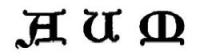
OM is the Sacred Vedic syllable: let us repeat it with a thought directed to its true meaning.49
Within the small circle, placed upon the serpent, is a cross with its ends turned back. This is called the Gnostic Cross. It signifies evolution, among other ideas, for the turning back of its ends is caused by the revolving of the two diameters of the circle. The vertical diameter is the spirit moving down and bisecting the horizontal. This completed, the revolution round the great circle commences, and that motion is represented in the symbol by the ends turned back. In Chapter III. of Bagavad-Gita, Krishna says: “He who in this life does not cause this cycle, thus already revolved, to continue revolving lives to no purpose, a life of sin, indulging his senses.” That is, we must assist the great wheel of evolution and not oppose it; we must try to help in the great work of returning to the source from whence we came, and constantly endeavor to convert lower nature into higher, not only that of ourselves, but also of our fellow men and of the whole animated world.
This cross is also the symbol of the Hindu Chakkra, or discus, of Vishnu. In the Mahabharata is described the conflict between the Asuras and Devas, for the possession of the vase of Amreeta which had been churned with infinite trouble, from the ocean, and which the Asuras desired to take for themselves. The conflict began when Rahu, an Asura, assuming the form of a Deva, began drinking the ambrosia. In this case the Amreeta was spiritual wisdom, material existence, immortality, and also magic power. The deceit of Rahu was discovered before he had swallowed, and then the battle began.
“In the midst of this dreadful hurry and confusion of the fight, Nar and Narayan entered the field together. Narayan beholding a celestial bow in the hands of Nar, it reminded him of his Chakkra, the destroyer of the Asuras. The faithful weapon, ready at the mind’s call, flew down from heaven with direct and refulgent speed, beautiful, yet terrible to behold. And being arrived, glowing like the sacrificial flame, and spreading terror around, Narayan with his right arm formed like the elephantine trunk, hurled forth the ponderous orb, the speedy messenger, and glorious ruin of hostile towns, who raging like the final all destroying fire, shot bounding with desolating force, killing thousands of the Asuras in his rapid flight, burning and involving, like the lambent flame, and cutting down all that would oppose him. Anon he climbeth the heavens from whence he came.” (Mahabharata, Book I, Chap 15.)
Ezekiel, of the Jews, saw this wheel, when he was among the captives by the river Chebar in Chaldea. In a vision he saw the four beasts and the man of the Apocalypse, and with them “for each of the four faces,” was a wheel, of the colour of a beryl; it was “as a wheel within a wheel,” and they went wherever the living creatures went, “for the spirit of the living creatures was in the wheels.” All of this appeared terrible to him, for he says: “And when they went I heard a noise like the noise of great waters, like the voice of the Almighty, a noise of tumult like the noise of a host.”
There are many other meanings concealed in this symbol, as in all the others.
In the center of the interlaced triangles is placed the Cruxansata. This is also extremely ancient. In the old Egyptian papyri it is frequently found. It signifies life. As Isis stands before the candidate, or the soul, upon his entry, she holds in one hand this cross, while he holds up his hand that he may not look upon her face. In another there is a winged figure, whose wings are attached to the arms, and in each hand is held the same cross. Among other things we find here the horizontal and vertical diameters once more, but conjoined with the circle placed on top. This is the same as the old astrological sign for Venus. But in the seal, its chief and most important meaning is the regenerated man. Here in the centre, after passing the different degrees and cycles, both spirit and matter are united in the intelligent regenerated man, who stands in the middle knowing all things in the manifested universe. He has triumphed over death and holds the cross of life.
The last theosophical symbol is, the pin of the Society, adopted early in its history but not used much. It is the cross we have just been considering, entwined in such a way by a serpent, that the combination makes T S as a monogram.
The foregoing is not exhaustive. Every symbol should have seven meanings of principal value, and out of every one of those we have been considering can be drawn that number of significations. Intelligent study of them will be beneficial, for when a consistent symbol, embodying many ideas is found and meditated upon, the thought or view of the symbol brings up each idea at once before the mind.
Nilakant.
Reviews.
The Secret Doctrine of the Ancient Mysteries.—An essay by J. D. Buck, (Robert Clarke & Co., Cincinnati, O.). This little pamphlet of 32 pages, is an essay read by Dr. Buck before the Liberal Club of Cincinnati. The author tries to show that one truth has run all through the Ancient Mysteries, and later, is even to be found in the Christian Church. His hint on p. 22, that “the Apostolic Catholic Church possessed the Secret Doctrine, that some of its clergy apprehended the great truths, but that there was wisdom for the priests and command for the people,” is full of truth. At the present day the great Jesuit College possesses much knowledge of the theurgy which is a part of the practice of the Secret Doctrine, and if all the magical practices of the disciples of Loyola were known, the Christian world would be startled. They know enough of forecasting the future to fear all such movements as the Theosophical Society, and have tried, as they still try, to undermine it within its own borders.
Anyone who reads Dr. Buck’s essay with a candid spirit, will agree with him that one core of truth underlies all religions, and will feel the refreshing influence of the author’s clear mind and solid sense.
Inworld.
[A poem taken from the January number of “The Dial,” 1842, the organ of the Transcendentalists, edited by Ralph Waldo Emerson.]
Amid the watches of the windy night A poet sat, and listened to the flow Of his own changeful thoughts, until there passed A vision by him, murmuring as it moved, A wild and mystic lay—to which his thoughts And pen kept time—and thus the measure ran: All is but as it seems, The round, green earth, With river and glen; The din and the mirth Of the busy, busy men; The world’s great fever Throbbing forever; The creed of the sage, The hope of the age, All things we cherish, All that live and all that perish, These are but inner dreams. The great world goeth on To thy dreaming; To thee alone Hearts are making their moan, Eyes are streaming. Thine is the white moon turning night to day, Thine is the dark wood sleeping in her ray. Thee the winter chills, Thee the spring time thrills; All things nod to thee— All things come to see If thou art dreaming on. If thy dream should break, And thou should’st awake, All things would be gone. Nothing is, if thou art not, From thee as from a root The blossoming stars upshoot, The flower cups drink the rain. Joy and grief and weary pain Spring aloft from thee, And toss their branches free. Thou are under, over all; Thou dost hold and cover all; Thou art Atlas—thou art Jove:— The mightiest truth Hath all its youth From thy enveloping thought. Thy thought itself lay in thy earliest love. Nature keeps time to thee With voice unbroken: Still doth she rhyme to thee When thou hast spoken. When the sun shines to thee, ’Tis thy own joy, Opening mines to thee Nought can destroy. When the blast moans to thee Still doth the wind Echo the tones to thee Of thy own mind. Laughter but saddens thee When thou art sad, Life is not life to thee, But as thou livest, Labor is strife to thee When thou least strivest:— More did the spirit sing, and made the night, Most musical with inward melodies, But vanished soon, and left the listening bard Wrapt in unearthly silence—till the morn Reared up the screen that shuts the spirit world From loftiest poet and from wisest sage.
Outworld.
The sun was shining on the busy earth. All men and things were moving on their way— The old, old way which we call life. The soul Shrank from the giant grasp of Space and Time, Yet, for it was, her dreamy hour half yielded To the omnipotent delusion—and looked out On the broad glare of things, and felt itself Dwindling before the universe: Then came unto the bard Another spirit with another voice, And sang:— Said he, that all but seems? Said he, the world is void and lonely, A strange vast crowd of dreams Coming to thee only? And that thy feeble soul Hath such a strong control O’er sovereign Space and sovereign Time And all their train sublime? Said he, thou art the eye Reflecting all that is— The ear that hears, while it creates All sounds and harmonies— The central sense that bides amid All shows and tunes and realities? Listen mortal while the sound Of this life intense is flowing! Dost thou find all things around Go as thou art going? Dost thou dream that thou art free, Making, destroying all that thou dost see In the unfettered might of thy soul’s liberty? Lo, an atom troubles thee. One bodily fibre crushes thee, One nerve tortures and maddens thee, One drop of blood is death to thee. Art thou but a withering leaf, For a summer season brief Clinging to the tree, ’Till the winds of circumstance, Whirling in their hourly dance, Prove too much for thee? Art thou but a speck, a mote In the system universal? Art thou but a passing note Woven in the great rehearsal? Canst thou roll back the tide of Thought And unmake the creed of the age, And unteach the wisdom taught By the prophet and the sage? Art thou but a shadow Chasing o’er a meadow? The great world goes on Spite of thy dreaming; Not to be alone Hearts are making their moan And tear-drops streaming, And the mighty voice of Nature Is thy parent, not thy creature, Is no pupil but thy teacher: And the world would still move on Were thy soul forever flown. For while thou dreamest on enfolded In nature’s wide embrace, All thy life is daily moulded By her informing grace. And Time and Space must reign And rule o’er thee forever, And the Outworld lifts its chain From off thy spirit never; But in the dream of thy half-waking fever Thou shalt be mocked with gleam and show Of truths thou pinest for, and yet canst never know. And then the Spirit fled and left the bard Still wondering—for he felt that voices twain Had come from different spheres with different truths That seemed at war and yet agreed in one.
C.
Another Theosophical Prophecy.
In the first number of The Path was inserted a prophecy made from certain books in India called Nadigrandhams, respecting the Society.
This called forth from the N. Y. Sun, that model of journalism, a long tirade about the superficial knowledge which it claims pervades the Society on the subject of oriental philosophy. Unfortunately for the learned editorial writer in that paper, he never before heard of Nadigrandhams, which are almost as common in India as the Sun is here, nor does he appear to know what a Nadi may be, nor a Grandham, either.
But without trying to drag the daily press of this country into the path of oriental knowledge, we will proceed to record another prophecy or two.
The first will seem rather bold, but is placed far enough in the future to give it some value as a test. It is this:—The Sanscrit language will one day be again the language used by man upon this earth, first in science and in metaphysics, and later on in common life. Even in the lifetime of the Sun’s witty writer, he will see the terms now preserved in that noblest of languages creeping into the literature and the press of the day, cropping up in reviews, appearing in various books and treatises, until even such men as he will begin perhaps to feel that they all along had been ignorantly talking of “thought” when they meant “cerebration,” and of “philosophy” when they meant “philology,” and that they had been airing a superficial knowledge gained from cyclopœdias of the mere lower powers of intellect, when in fact they were totally ignorant of what is really elementary knowledge. So this new language cannot be English, not even the English acquired by the reporter of daily papers who ascends fortuitously to the editorial rooms—but will be one which is scientific in all that makes a language, and has been enriched by ages of study of metaphysics and the true science.
The second prophecy is nearer our day, and may be interesting.—It is based upon cyclic changes. This is a period of such a change, and we refer to the columns of the N. Y. Sun of the time when the famous brilliant sunsets were chronicled and discussed not long ago for the same prognostication. No matter about dates; they are not to be given; but facts may be. This glorious country, free as it is, will not long be calm: Unrest is the word for this cycle. The people will rise. For what, who can tell? The statesman who can see for what the uprising will be might take measures to counteract. But all your measures can not turn back the iron will of fate. And even the City of New York will not be able to point its finger at Cincinnati and St. Louis. Let those whose ears can hear the whispers, and the noise of the gathering clouds, of the future, take notice; let them read, if they know how, the physiognomy of the United States, whereon the mighty hand of nature has traced the furrows to indicate the character of the moral storms that will pursue their course no matter what the legislation may be. But enough. Theosophists can go on unmoved, for they know that as Krishna said to Arjuna, these bodies are not the real man, and that “no one has ever been non-existent nor shall any of us ever cease to exist.”
Correspondence.
THEOSOPHY.
[A LETTER FROM A FRIEND.]
Dear Brother:
“It rejoices us all here more than I can tell you, to know that you have made such a start in America with Theosophy. We have had so many things to pull us back, that it has been quite as much as we could manage to keep our heads above water, and this not so much from the action of our enemies as from the apathy of our friends. It is strange to me to see how little faith there is in the power of truth, even among those who ought to realize this most strongly. Why should we fear and fold our hands when men speak evil of us or of the cause, why should we imagine that any attack on individual members can effect the position we take as a group or that theosophy can be endangered thereby? How few understand what theosophy is; they look upon it as solely an intellectual movement that can be damned by the folly of its adherents; they little dream of the strength that underlies the apparently inconsistent workings of this manifestation of truth which we call the Theosophical Society. And there is one thing which I believe establishes more than any other, the fact that the Society as a whole has true vitality within it, and that is the visible action of Karma in its developments.
“See how the mistaken value given to phenomena in the early history of the Society, brought immediately its Karmic development in the troubles then, and whenever any undue importance has been given either to individualities or any particular line of practice, it is always on that particular point that the next attack comes. So that while fully realizing that as an organization, the T. S. is defective in some things, I yet believe that there is a power within it that will purge it from its defects and carry it on in spite of the attacks of its enemies and what is worse still, the follies of its friends. What I do feel more and more is the necessity that we should remember and constantly keep before us what it is we are working for and not think we accomplish our end when we number our converts in the world of fashion, and gather around us men and women who vainly hope for psychic powers and the arts of fortune telling and reading the future. I do not fear black magic in our midst, but I do feel very strongly that there are many who will sink to the level of mere wonder-seekers and that they will become the prey of elemental influences.
“What can be done to make men realize, as you say, a sense of universal brotherhood and the true meaning of Theosophy. Well, let us join you in America and the few here who do realize that psychism is not spirituality, and let us try to stir the hearts of men with the living truths of Theosophy.
“I am most anxious, and have been for a long time, that we should address ourselves to another stratum of society than that (the intellectual and the fashionable) which we have sought. It is not that I would depreciate intellect; if I err in that matter it is in putting too much stress on intellectual development. But I am beginning to realize that the lower intellect can only deal with physical facts and that it can never develop ideas; these can only be apprehended by the higher intellectual faculties, and the ethical and emotional nature of man has also its higher and lower aspects.
“I wish very much that we had a literature calculated to appeal to the general masses, and I think that we should resolutely turn our attention to this object. I think the little book that Dr. Buck has just published very useful and I should be glad to see many more such little works treating of the various points of doctrine such as Reincarnation, Karma, &c. It is also encouraging to see such efforts as that contained in the small book lately out—What is Theosophy? Doubtless, in connection with that, for it seems to have been written for the author’s children, you will call to mind what was written by one of the adepts, not so long ago: ‘there is a great likelihood that the sons of theosophists will become theosophists,’ and will quite agree with me in the idea that we need a literature, not solely for highly intellectual persons, but of a more simple character, which attempts to appeal to ordinary common sense minds, who are really fainting for such mental and moral assistance, which is not reached by the more pretentious works. Indeed, we all need this. It is fortunate that we have been able to live through the tide of mere psychism and bare intellectuality which threatened nearly to swamp us. And you know to whom we owe our escape, and now, that there are ten or twelve members left who are prepared to work on independently of perturbation, I think it a clear gain. What does it matter to us whether H. P. Blavatsky has or has not fulfilled all of her duties, or whether investigation has cast doubt into the minds of some. In so far as she has done her duty, her work will remain, and if perchance she has come to the end of her capabilities—which I do not admit—it is for us to carry on what she has thus far done.
“In America I hope you will not fall into running after wonders and psychic gifts to the detriment of true philosophical and moral progress.
“Believe me to be, fraternally yours, A.”
Note.—The whole of this letter should be carefully studied, and in particular the point that Karma brings its attacks just on the point or persons where or by whom stress has been laid on phenomena. It may be accepted as almost axiomatic by our members, that if any group or single person has paid too undue attention to phenomena, to astralism, psychism, or whatever it is called, there will develop the next trouble or attack upon the Society. It has been authoritatively stated by one of the great Beings who are behind this movement, that it must prosper by moral worth and philosophy, and not by phenomena. Let us well beware then. Phenomena, powers—or siddhis as the Hindu say—are only incidental. Our real object is to spread Universal Brotherhood, in which task we necessarily explain phenomena, but the Society is not a Hall for Occultism, and that has also been asserted by an adept in India in reply to letters written him by certain well-known Englishmen who desired to establish a Branch then which should control all literature and phenomena. There are no secrets to be given out to any select persons, for no one receives a secret inaccessible to the rest, until he has acquired the right to it, and the proper sense to know when and to whom it is to be given out.—[Ed.]
WHAT IS THE UDGITHA?
Jamestown, April 16th, 1886.
Dear Brother:—Will you kindly explain, through The Path, what is to be understood by the Udgitha, or hymn of praise to Brahm? With best wishes for the success of your enterprise, I remain,
Fraternally yours, L. J.
This is a vital question. It may have arisen from the peculiarity of the word inquired about, or it may be that our brother really knows the importance of the point. We refer him to the article upon OM in the April number. Om is the Udgitha, and OM has been explained in that article. Read between the lines; and read also the “Upanishad Notes” in this month’s Path.
In the Maitrayana-Brahmana-Upanishad, (Pr. VI), it is said: “The Udgitha, called Pranava, the leader, the bright, the sleepless, free from old age and death, three footed, (waking, dream, and deep sleep), consisting of three letters and likewise to be known as fivefold, is placed in the cave of the heart.”
This is the Self. Not the mere body or the faculties of the brain, but the Highest Self. And that must be meditated on, or worshipped, with a constant meditation. Hymn of praise, then, means that we accept the existence of that Self and aspire to or adore Him. Therefore, it is said again, in the same Upanishad:
“In the beginning Brahman was all this. He was one, and infinite. * * * The Highest Self is not to be fixed, he is unlimited, unborn, not to be reasoned about, not to be conceived. He is, like the ether, everywhere, and at the destruction of the Universe, he alone is awake. Thus from that ether he wakes all this world, which consists of (his) thought only, and by him alone is all this meditated on, and in him it is dissolved. His is that luminous form which shines in the sun, and the manifold light in the smokeless fire. He who is in the fire, and he who is in the heart, and he who is in the sun, they are one and the same. He who knows this becomes one with the One.”
Now “to know” this, does not mean to merely apprehend the statement, but actually become personally acquainted with it by interior experience. And this is difficult. But it is to be sought after. And the first step to it is the attempt to realize universal brotherhood, for when one becomes identified with the One, who is all, he “participates in the souls of all creatures;” surely then the first step in the path is universal brotherhood.
The hymn of praise to Brahm (which is Brahman) is the real object of this magazine, and of our existence. The hymn is used, in the sacrifice, when verbally expressed, and we can offer it in our daily existence, in each act, whether eating, sleeping, waking, or in any state. A man can hardly incorporate this idea in his being and not be spiritually and morally benefited.
But we cannot fully explain here, as it is to be constantly referred to in this magazine.—[Ed.]
Theosophical Activities.
Aryan Theosophical Society of New York.—This branch has established the nucleus of a library to consist of Theosophical, Metaphysical, Occult, Aryan, and other literature. It already numbers about fifty volumes, some of which are loaned pending further accumulations and the acquirement of a proper place to keep them. It is hoped that this will grow to be of great value. A fund for the purpose has also been started. During April the contributions have been: A Friend, $5; Mr. B. X., $3: C., nine books: Hist. of Witchcraft in Salem; Zend Avesta; What is Theosophy?; Mother Clothed with the Sun; Footfalls on the Boundaries of Another World, &c.; from Dr. Seth Pancoast, Red and Blue Light.
The books will be loaned to resident members upon giving receipt for a definite period. Donations of books or money towards the fund, can be sent to The Path, or the Pres’t of the A. T. S., box 2659, New York City.
Several other books are promised and will be in hand before next month.
The Branch is actively engaged in spreading Theosophical literature, and now has requests for books from all parts of the U. S. It has reprinted Mrs. Sinnett’s “Purpose of Theosophy” very cheap in form, but well done, and has other reprints in mind. Since last month, permanent quarters have been obtained, where the library will be established. Private meetings are also held from time to time among the members, for study and discussion.
Mr. C. H. A. Bjerregaard finished his course of lectures on “Historic and Individual Cycles.”
All inquiries should be addressed to the Secretary, Box 2659, New York City.
Cincinnati.—Since our April issue the members here have been steadily at work, and among other things accomplished, is the printing of Dr. Buck’s essay upon the “Secret Doctrine of the Ancient Mysteries.”
Boston.—Interest in Boston continues unabated. A member of the Aryan Branch of New York has been spending a month in Boston, discussing the philosophy and ethics to be found in theosophical literature, and it is to be hoped that the work done will be permanent, founded as it is in ethics and not upon phenomena.
Bullel.—Brother Krishnarao B. Bullel, a Bombay member, who has been studying medicine in New York, and who constantly attended the meetings of the Aryan Branch, graduated from the Homœopathic Medical College, of New York, with honors. He sailed for home on April 14th, on the steamer America, intending to stop in London. He carries back with him the best wishes of his American brothers, and a good report of the progress of the Cause here.
Olcott.—Col. H. S. Olcott has lately been in Ceylon looking after the work there. Rev. Mr. Leadbeater was with him, and will remain on the Island, where Theosophy is very strong, to work for the Society. A theosophical paper, in Singhalese, was started there some years ago, and still flourishes. The Colonel has just recovered from a slight attack of fever contracted in his journeys, but his vigor remains unabated.
Exposures.—In reply to several inquiries made here, and also sent to London from the U. S., we beg to say that it is true that the Society for Psychical Research sent a prejudiced expert to India, who exposed nothing except his own bias. Among other things, he thought he had proved that the writing of alleged adepts was only Mme. Blavatsky’s disguised hand. But since then, a well-known German member has submitted specimens of adept writing, together with Mme. Blavatsky’s, to one of the best calligraphic experts in Germany, who certifies that the messages which have been impugned were not written by her.
Mme. Blavatsky is now in Europe, for her health, but she may be expected to return very soon to India, spy-theory and missionaries, to the contrary notwithstanding.
The American Board of Control.—The general and routine work of the Society in America, is under the jurisdiction of the Board of Control, of which the Secretary is Elliott B. Page, 301 South Main Street, St. Louis, Mo.
A resolution has been passed by this Board, which is binding on all members, that no publication shall be issued as a Theosophical one, without previous consent obtained from the officers of the Board. This is wise, as it will tend to prevent unauthorized declarations of so-called Theosophical doctrine from being laid at the door of the Society. All members, therefore, intending to make publication, should address the Secretary of the Board.
Yoga Vidya or the Knowledge of Yoga, is the name by which in India psychic practices, or astralism, or seeking after astral-body formation, or inducing clairvoyance and the like, is most commonly known. At the same time, True Yoga, called Raja Yoga, is a different thing. In the March Theosophist a member writes giving the name of one who will instruct in these practices, and the Editor replied:
“We cannot endorse the writer’s opinion as to the benefits of Yoga Vidya. For one or two who succeed in it, hundreds fail and wreck both body and mind, through its dangerous practices, and even if physical results are obtained they are not invariably followed by spiritual illumination.”
It certainly thus appears that our Society is not in favor of such practices, no matter if some of its members indulge in them.
Admission to the Society is open to any person of full age, who is in sympathy with its objects, willing to abide by its rules; and is obtained by signing an application which sets forth the above in a form which is provided. This must be countersigned by any two active members in good standing. The entrance fee is $5 and one belonging to a Branch should also pay the annual dues thereof. Applications can be made to Presidents of Branches or other officers. Persons may become members of Branches or unattached members of the General Society.
All that we are is the result of what we have thought; it is founded on our thoughts; it is made up of our thoughts. If a man speaks or acts with an evil thought pain follows him as the wheel follows the foot of him who draws the carriage.
All that we are is the result of what we have thought; it is founded on our thoughts; it is made up of our thoughts. If a man speaks or acts with a pure thought, happiness follows him like a shadow that never leaves him.—Dhammapada.
Receive this law, young men; keep, read, fathom, teach, promulgate and preach it to all beings. I am not avaricious nor narrow minded; I am confident and willing to impart Buddha knowledge, or knowledge of the self-born. I am a bountiful giver, young men, and ye should follow my example; imitate me in liberality, showing this knowledge, and preaching this code of laws and conduct to those who shall successively gather round you, and rouse unbelieving persons to accept this law. By so doing ye will acquit your debt to the Tathagatas.—Saddharma Pundarika.
OM
No. 3.
The great All, which is constantly in motion, and is constantly undergoing change in the visible and invisible universe, is like the tree which perpetuates itself by the seed and is incessantly creating the same identical types.—Book of Pitris.
Nothing is commenced or ended. Everything is transformed. Life and death are only modes of transformation which rule the vital molecule from plant up to Brahma himself.-Atharva Veda.
THE PATH.
Vol. I. JUNE, 1886. No. 3.
The Theosophical Society, as such, is not responsible for any opinion or declaration in this magazine, by whomsoever expressed, unless contained in an official document.
Where any article, or statement, has the authors name attached, he alone is responsible, and for those which are unsigned, the Editor will be accountable.
A Hindu Chela’s Diary.50
In the month of December he arrived at Benares, on what he hoped would be his last pilgrimage. As much as I am able to decipher of this curious manuscript, written in a mixture of Tamil—the South Indian language—with Mahratta, which, as you know, is entirely dissimilar, shows that he had made many pilgrimages to India’s sacred places, whether by mere impulse or upon actual direction, I know not. If he had been only any ordinary religiously disposed Hindu we might be able to come to some judgment hereupon, for the pilgrimages might have been made in order to gain merit, but as he must long ago have risen above the flowery chains of even the Vedas, we cannot really tell for what reason these journeys were made. Although, as you know, I have long had possession of these papers, the time had not until now seemed ripe to give them out. He had, when I received them, already long passed away from these busy scenes to those far busier, and now I give you liberty to print the fragmentary tale without description of his person. These people are, you know, not disposed to have accurate descriptions of themselves floating about. They being real disciples, never like to say that they are, a manner quite contrary to that of those famed professors of occult science who opportunely or inopportunely declare their supposed chelaship from the house top.
* * * “Twice before have I seen these silent temples standing by the rolling flood of sacred Ganges. They have not changed, but in me what changes have occurred! And yet that cannot be, for the I changeth not, but only the veil wrapped about, is either torn away or more closely and thickly folded round to the disguising of the reality. * * * It is now seven months since I began to use the privilege of listening to Kunâla. Each time before, that I came to see him, implacable fate drove me back. It was Karma, the just law, which compels when we would not, that prevented me. Had I faltered then and returned to the life then even so far in the past, my fate in this incarnation would have been sealed—and he would have said nothing. Why? Happy was I that I knew the silence would have not indicated in him any loss of interest in my welfare, but only that the same Karma prevented interference. Very soon after first seeing him I felt that he was not what he appeared exteriorly to be. Then the feeling grew into a belief within a short time so strong that four or five times I thought of throwing myself at his feet and begging him to reveal himself to me. But I thought that was useless, as I knew that I was quite impure and could not be trusted with that secret. If I remained silent I thought that he would confide to me whenever he found me worthy of it. I thought he must be some great Hindu Adept who had assumed that illusionary form. But there this difficulty arose, for I knew that he received letters from various relatives in different parts, and this would compel him to practice the illusion all over the globe, for some of those relatives were in other countries, where he had been too. Various explanations suggested themselves to me. * * * I was right in my original conception of Kunâla that he is some great Indian Adept. Of this subject I constantly talked with him since—— although I fear I am not, and perhaps shall not be in this life worthy of their company. My inclination has always been in this direction. I always thought of retiring from this world and giving myself up to devotion. To Kunâla I often expressed this intention, so that I might study this philosophy, which alone can make man happy in this world. But then he usually asked me what I would do there alone? He said that instead of gaining my object I might perhaps become insane by being left alone in the jungles with no one to guide me; that I was foolish enough to think that by going into the jungles I could fall in with an adept; and that if I really wanted to gain my object I should have to work in the reform in and through which I had met so many good men and himself also, and when the Higher Ones, whom I dare not mention by any other names, were satisfied with me they themselves would call me away from the busy world and teach me in private. And when I foolishly asked him many times to give me the names and addresses of some of those Higher Ones he said once to me: ‘One of our Brothers has told me that as you are so much after me I had better tell you once for all that I have no right to give you any information about them, but if you go on asking Hindus you meet what they know about the matter you might hear of them, and one of those Higher Ones may perhaps throw himself in your way without your knowing him, and will tell you what you should do.’ These were orders, and I knew I must wait, and still I knew that through Kunâla only would I have my object fulfilled. * * *
“I then asked one or two of my own countrymen, and one of them said he had seen two or three such men, but that they were not quite what he thought to be ‘Raj Yogs’ He also said he had heard of a man who had appeared several times in Benares, but that nobody knew where he lived. My disappointment grew more bitter, but I never lost the firm confidence that Adepts do live in India and can still be found among us. No doubt too there are a few in other countries, else why had Kunâla been to them. * * * In consequence of a letter from Vishnurama, who said that a certain X51 lived in Benares, and that Swamiji K knew him. However, for certain reasons I could not address Swamiji K directly, and when I asked him if he knew X he replied: “If there be such a man here at all he is not known.” Thus evasively on many occasions he answered me, and I saw that all my expectations in going to Benares were only airy castles. I thought I had gained only the consolation that I was doing a part of my duty. So I wrote again to Nilakant: “As directed by you I have neither let him know what I know of him nor what my own intentions are. He seems to think that in this I am working to make money, and as yet I have kept him in the dark as regards myself, and am myself groping in the dark. Expecting enlightenment from you, etc.” * * * The other day Nilakant came suddenly here and I met Sw. K. and him together, when to my surprise K at once mentioned X, saying he knew him well and that he often came to see him, and then he offered to take us there. But just as we were going, arrived at the place an English officer who had done Kunâla a service in some past time. He had in some way heard of X and was permitted to come. Such are the complications of Karma. It was absolutely necessary that he should go too, although no doubt his European education would never permit him to more than half accept the doctrine of Karma, so interwoven backward and forwards in our lives, both those now, that past and that to come. At the interview with X, I could gain nothing, and so we came away. The next day came X to see us. He never speaks of himself, but as ‘this body.’ He told me that he had first been in the body of a Fakir, who, upon having his hand disabled by a shot he received while he passed the fortress of Bhurtpore, had to change his body and choose another, the one he was now in. A child of about seven years of age was dying at that time, and so, before the complete physical death, this Fakir had entered the body and afterwards used it as his own. He is, therefore, doubly not what he seems to be. As a Fakir he had studied Yoga science for 65 years, but that study having been arrested at the time he was disabled, leaving him unequal to the task he had to perform, he had to choose this other one. In his present body he is 53 years, and consequently the inner X is 118 years old. * * * In the night I heard him talking with Kunâla, and found that each had the same Guru, who himself is a very great Adept, whose age is 300 years, although in appearance he seems to be only 4052. He will in a few centuries enter the body of a Kshatriya53, and do some great deeds for India, but the time had not yet come.”
[To be continued.]
Sufism,
Or Theosophy From the Standpoint of Mohammedanism.
A Chapter from a MS. work designed as a text book for Students in Mysticism. BY C. H. A. BJERREGAARD, Stud. Theos.
In Two Parts:—Part I, Texts; Part II, Symbols.
The spirit of Sufism is best expressed in the couplet of Katobi:
“Last night a nightingale sung his song, perched on a high cypress, when the rose, on hearing his plaintive warbling, shed tears in the garden, soft as the dews of heaven.”
(Continued.)
SUFI ECSTASY.
Motto: “Highest nature wills the capture; “Light to light!” the instinct cries; And in agonizing rapture falls the moth, and bravely dies. Think not what thou art, Believer; think but what thou mayest become For the World is thy deceiver, and the Light thy only home.” (Palm Leaves.)
ABULFAZL (A.D. 1595):
O Lord, whose secrets are for ever veiled, And whose perfection knows not a beginning! End and beginning both are lost in thee; No trace of them is found in thy eternal realm. My words are lame; my tongue, a stony tract; Slow wings my foot, and wide is the expanse. Confused are my thoughts; but this is thy best praise— In ecstacy alone I see thee face to face!
SHEMS TEBREEZ:
What advice, O Musselmans? I don’t know myself; I54 am neither Christian nor Jew, nor am I a fire-worshipper nor Musselman. I am not from the East or West, nor am I of land or fire. I am not from the country of Iran, nor am I from the land of Khoorassan. I am neither of water nor air, nor am I of fire or earth. I am not of Adam or Eve, nor am I of the inhabitants of paradise. My place is no place, my sign is without sign: I have neither body nor soul,—what is there then? I am the soul of my Beloved.55 When I took out my heart, the two worlds I saw as one. He is the first, He is the last, He is the manifest. He is the secret. Except Him, and that I am Him, I do not know anything else. O thou, Shems Tebreez, why this rapture in this world? Except with rapture and enthusiastic ardour, this work cannot be effected.
ECSTASY: THE HEART AS MEDIUM.
All the earth I’d wandered over, seeking still the beacon light, Never tarried in the day time, never sought repose at night; Till I heard a reverend preacher all the mystery declare, Then I looked within my bosom, and ‘twas shining brightly there.
(E. H. Palmer, Orient. Myst.)
Who so knoweth himself, knoweth the Godhead.—Thy soul is the sufficient proof of the existence of the Godhead: When by reflection thou hast penetrated to that deep within, thou shalt discover there the Universal Worker of his work.
(D’Herbelot—Persian Paraphrases.)
Wouldst know where I found the Supreme? One step beyond self.—Behind the veil of self shines unseen the beauty of the Beloved.—(Aphorisms.)
Soul of the soul! Neither thought nor reason comprehend thy essence, and no one knows thy attributes. Souls have no idea of thy being. The prophets themselves sink into the dust before thee. Although intellect exists by thee, has it ever found the path of thy existence? Thou art the interior and the exterior of the soul.—(Attar.)
They who see God are ever rapt in ecstacy. * * * (The Mesnevi.)
ECSTASY: NATURE AS MEDIUM.
The varied pictures I have drawn on space, Behold what fair and goodly sights they seem; One glimpse I gave them of my glorious face, And lo! ‘tis now the universal theme.
(E. H. Palmer, Orient. Myst.).
Recognise the mark of Deity in every place, and never place the foot without its own limit. The world is the image of the Godhead.—(Buslami.)
RABIA LEGENDS.
—The widow Rabia56 is reported having said “an interior wound consumes my heart; it can only be cured by communion with a friend.57 I shall remain sick till the day of judgment when I shall reach my end.”—
—It is told of Rabia, that once when requested to marry, she answered: My being has for a long time been in marital communion; hence I say that my ego is long ago lost in itself and arisen again in Him (in God); since then I am entirely in His power, yea, I am He. He, who would ask me for a bride, would ask me, not from myself, but from Him (God). Hassan Basri (a famous Mohamedan Theologian) asked her how she had reached this state. She answered: In this way, everything which I had found I lost again in Him (God). When questioned as to by which mode she knew Him, she made answer: O, Hassan, you know Him by certain methods and means, I know Him without modes and means.—