Part III.—Nature Lore.
Reading edition
THE STORY OF THE ROCKS.
“Sermons in Stones.”
A stone quarry is a common enough object in Orkney—so common, indeed, that we may never have taken any interest in it. Yet this common quarry is a place where we may learn some strange facts about the making of our islands, if we visit it in the spirit of one who
“Finds tongues in trees, books in the running brooks, Sermons in stones, and good in everything.”
The quarrymen begin their work by clearing away the “redd” from the rock beneath. First they remove the soil. This is dark in colour, not very rich or deep, perhaps, and not so black as the more fertile soils of other lands. Yet it contains the plant-food which nourishes our crops, and thus nourishes ourselves. The particles are fine and loose, and the soil is traversed everywhere by the small rootlets of plants. The dark colour is due to the decayed substance of past crops of plants, which largely consists of carbon. We must try to find out how this soil, which is so precious to the farmer, has been formed.
Every one knows the difference between the appearance of a new house and that of an old one: in the former the stones of the walls are clean and sharp, in the latter they have a weathered, time-worn look. In graveyards the headstones recently put up have their inscriptions sharp and clear; the older stones have their surfaces pitted, and the letters carved on them are indistinct. Compare the old carvings and tracery on the outer walls of our cathedral, made hundreds of years ago, with the clean-cut masonry of new buildings which stand near it, and you will see that stones decay with time and moulder away; they crumble into dust under the winter’s frost and rains and the heat of the summer sun.
So it is with all the rocks of which the surface of our islands is made up. Year by year they moulder away. The dust or earth into which they break down forms a soil in which plants take root and grow. The plants push their root fibres downwards, helping to open up the cracks in the rock; and when these roots die and decay their substance mingles with the soil, giving it that black colour which marks old fertile soils that have long been cultivated.
Under the soil lies the subsoil—that is, rock which is half decayed and partly broken up. In course of time it will become as fine as the soil itself; for the subsoil gradually changes into soil. In wet weather the rain, and in dry weather the wind, carry away the fine particles of earth from the surface of the fields, and would sooner or later take away all the fertile soil; but the continual action of the weather on the subsoil supplies fresh material. Hence, while the old soil is constantly being removed, new soil is forming to take its place.
As we see in the quarry, under the soil and the subsoil there is rock. This is true of all parts of our country; there is a rocky skeleton beneath the thin layer of fertile soil which supports the plants and animals. In the rocky skerries which are common along the shores we see the nature of the rock-built framework of the islands. If the soil and subsoil were swept away, as the waves have swept it from the skerries, it would be plainly seen that the islands are built up of rocks.
All the rocks of our islands, almost without exception, were laid down under water. They consist of three different substances. One is sand, in small rounded white or yellow grains. Another is clay, dark gray in colour, very close grained and soft. The third is lime.
A rock which consists mostly of sand is called sandstone. The Eday freestone, which is much used for putting round the doors and windows of shops and large buildings, is a sandstone. The common blue flagstone contains clay mixed with more or less sand. The sandy beds are coarse, gritty, and hard; the fine-grained flags contain more clay, and are darker in colour, softer, and smoother on the surface. Nearly all the fine flags contain lime; often it is seen in white shining crystals on the joint-faces of the stones used in building. The presence of lime in a soil improves it considerably.
In different parts of Orkney the rocks differ much in appearance. In one place we find yellow and red sandstone, in another blue and gray flags, in another pudding-stone and granite. What is the meaning of this? It shows that while the whole area of our islands was covered with water, gravel was being laid down at one place, sand or muddy silt at another, and so on. We can even make out the order in which the different layers or strata were laid down.
It is done in this way:—Usually the beds of rock are not now flat but tilted, and show their edges turned up in a more or less sharp slope. If we walk along any bare rocky shore we shall find that bed succeeds bed, each resting on the top of all those which underlie it. No place could be found to show this better than the shore of Hoy Sound from Stromness to Breckness. We go on and on, crossing over bed after bed of rock, till we have passed over the edges of a pile of flagstone which must be several thousand feet thick. The same thing can be seen to the east of Kirkwall, or, in fact, almost anywhere in the islands.
Sometimes the beds dip or slant in different directions at different parts of the shore. Then again they may be broken by cracks or faults which bring different kinds of rock up against one another. If one could visit the whole of Orkney and examine all the rocks, making out in what order they follow one another, how often they are interrupted or repeated by faults, and what is their inclination or dip, one could tell exactly the order in which the rocks of each district were laid down on the bottom of the old lake where they were formed. This is one of the tasks which the geologist undertakes; and though it looks very difficult, yet in Orkney it is quite possible to do so with pretty fair accuracy.
What is the result? At the bottom of the whole we place the granite of Stromness and Graemsay. This represents part of the floor of the old lake on which the gravel and sand and mud were laid down—a part which stood up above the water as an island. Next to this we find a thin layer of pudding-stone. This is formed of the old gravel which gathered on the beaches and shores around the granite island as it was slowly covered over. Above that were laid down the flagstones of the West Mainland; then those of Kirkwall, the East Mainland, and the North Isles; then the yellow and red sandstones of Eday, Shapinsay, the Head of Holland, Deerness, and South Ronaldsay.
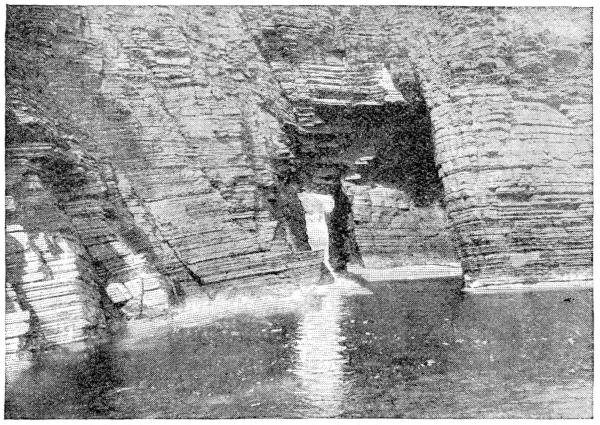
Cliff showing horizontal strata.
The whole series of these rocks must be thousands of feet thick, and how long they took to form we cannot conceive.
Then there is a gap in the series. This means that for a time the lake was dry land and instead of mud and sand being laid down, the rocks which had been formed were partly washed away by rain and streams. After a long time had passed, another lake was formed, and in it were laid down the yellow sandstones of Hoy, which are quite different from the other yellow sandstones of Orkney.
When you think that each thin flagstone or layer of sandstone in our quarry was once a sheet of mud and sand, and that it took months, no doubt, or even years, to gather on the lake bottom, you can understand how vast a space of time is represented by the old red sandstone of Orkney.
“Books in the Running Brooks.”
Let us now take a stroll along one of the little burns which flow between their green or heathery banks in any of the valleys of our native islands. These little burns are very small in comparison with the mighty rivers of the world, yet they are quietly performing a great task, and in the long past ages the amount of work which they have done is far greater than you have ever imagined.
It is summer, and the burn runs shallow and slow; the pebbles and sand show clearly in the pools. The burn enters a little bay, and as it flows across the shore it breaks up into several streamlets, each working its way through the gravel. Brackish water plants grow here; the shore is muddy, and the seaweed is often soiled with fine sediment. The burn has brought this down, and has dropped it where it enters the sea.
We follow the channel upwards, through flat, rich meadows, which may be tilled, and covered with corn and other crops. In the meadow the burn winds to and fro, and in each loop the outer side is steep, often overhanging: under the grassy bank the trout lie hid. The inner side of the bend is shallow, slopes gradually down to the water, and is covered with small broken stones and gravelly pebbles. We can see that the current is eating away the steep outer bank by undermining it, while on the inner side the small stones are gathering.
The meadow through which we are passing is flat, and covered with wiry grasses which love wet situations. The stuff of which it is made can be seen on the banks of the burn. It is a soft, dark-brown earth, almost without stones, or with here and there a layer of pebbles. How has this meadow been formed? The stream has done it.
To find out how the stream made the meadow we must visit it in winter after several days of heavy rain. Then a sheet of water covers the meadow, making it a shallow lake. The water is very still except near the channel of the burn; it is brown and full of mud. For some days the lake remains, then the water begins to fall. The stream is clearer now, though still dark with mud; good water this for the trout-fisher. A few days more and the lake has vanished; the stream keeps within its banks, though it is still full.
Now look at the meadow. It is covered with a very thin film of grayish-brown mud. In spring the grasses will grow quickly, and will be greener than ever. The meadow is a little—ever so little—higher for the new sheet of mud it has acquired. Winter after winter this goes on. The brown earth which forms the meadow is flood mud. Its flat configuration is due to its being laid down in a little temporary lake.
Let us follow the stream still farther, and leave the meadow behind. The channel gets steeper, and the water flows along quite merrily, faster than in the level meadow below. The bends in the burn disappear. It is in a hurry here and flows straight; in the flat meadow below it loiters and swings lazily to and fro. The channel is shallow, and there are few pools. The banks are often bare rock, or the stony clay which is produced by the weathering of rock. The stream is washing away the clay; it even attacks the hard rocks.
To see how this is done you must come when the burn is swollen with heavy rains. Then you will hear it rolling the stones along. They grind on one another, and thus they get their rounded shape, or are broken up into small fragments. As they are rolled along they wear away the rocks and deepen the bed of the stream. Loose pieces are swept away, soft layers are planed down. Many of the cracks and joints are opened and loosened, ready for fresh attacks during the floods of next winter.
This is where the gravel comes from. In the lower part of its course the stream cannot move large stones, but in floodtime the smaller pebbles are carried downwards. The big stones lie in the upper stream; they must be broken smaller before they can be carried away. After rainy weather you will often find that a rapid branch stream has shot a big heap of pebbles into the main stream. When the floods rise above the surface of the meadow they may strew sheets of little stones here and there over the grass.
After a big flood, if you know the stream well, you will find many changes. Here a bank of gravel has been carried away; there a new one has gathered. At every bend the bank shows undermining, and pieces have been swept away. The fine stuff makes mud: part of this is laid down on the meadow, but much of it is carried right out to sea.
That running water will wash away sand, gravel, and mud is not new to you. You have often seen it on the roads and in the roadside ditches, in the little runnels around the farmhouses, or in the ploughed fields. The burn is always doing the same thing, according to its powers. In dry weather it does little, for its current is weak; in floods it works rapidly. For perhaps two dozen days in a year every burn is in great strength, and is a powerful agent in changing the form of the land. This leads you to grasp the fact that the stream has dug out its own channel, and that it carries rock material to lower levels, and at last to the sea. If you know some of our burns well, and study and watch them closely, you will find a world of interest in them. Every feature of their channels is due to the work the flowing water is doing, and shows the manner in which it is done.
But what of the wide valley in which the burn flows? Other agencies have been at work here besides the water: ice has left its mark on every part of our valleys. But the burn has done most. On either side it is joined by branches. Each of these is cutting its own channel, and thus gradually deepening the valley. Each branch has its lesser branches; together they cover the whole valley with an intricate system of water channels.
Between these channels, heather and grass are growing in the stony soil. The soil, as you have learned already, is due to the decay of the rocks. Frost and rain begin the work, and the growth of plants hastens and helps it. Over the whole of the sloping valley sides the rocks are being broken up into finer and finer particles. When heavy rain comes it washes away the smaller particles, and little runnels appear which carry away the surface water.
Every year a portion of the soil is swept away to the meadows, or to the mud sheets which floor the shallow sea below. None of this ever comes back; it is sheer loss—a little at a time, but if the time be long enough it amounts to a very great quantity. Every day since that burn began to flow it has carried downwards a greater or smaller burden of soil.
It took a long time for people to grasp the fact that running water is a great earth-shaping agent. Every valley you have ever seen was made in this way. Other things helped, but the stream was the main cause. A valley is only a great groove eaten out of the rock. It is not due to any earthquake or rending apart of the rocks; it is not an original feature of the country. There was a time when there was no valley there; but from the day the stream first began to trickle over the rocks it has gone on deepening its channel and excavating the valley, and it is still doing so.
The stream not only made the valley; it shaped the hills also. We sometimes speak of “the everlasting hills.” No doubt the hills are very old, and will last a long time. Yet the little stream is older and mightier than they. It shaped them and brought them into being; in time it will remove them and level them with the plain.
Let us climb the side of a hill, and see what we can learn about it by patient observation and inference. Any one of our flat-topped, round-shouldered Orkney hills will do. They were all formed in the same way, and teach the same lessons.
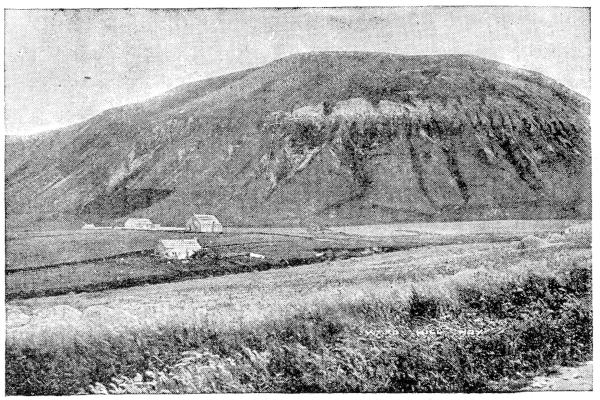
The Ward Hill, Hoy.
The ascent is gentle at first as we leave the plain or the bottom of the valley. Then it gets steeper and steeper. Often it is like a series of great steps—a sharp rise for a little, then a flat ledge; another sharp rise, followed by a gentle slope, and so on. These terraces are formed of beds of hard stone, which weather down very slowly. The softer rocks crumble fast, and form the steep slope. All our flagstone hills show these steps or terraces. They prove that the slope of the hillside is determined largely by the rate at which the different rock beds wear away.
After our stiff climb we get near the top. Many of our hills are broad-backed. When we get above the steep part we find a flat top, and it is often difficult to say where the actual summit is. In many places there are great groups of hills, all of about the same height, but separated by valleys. The Orphir, Firth, and Harray hills, the Rousay, Evie, and Birsay hills, and the hills of Walls are all of this kind. Even the Hoy hills show the same feature, though less clearly. In all these cases the hilltops look like the remains of one continuous stretch of high ground, which has been cut up into pieces by the digging out of the valleys. The hills are the remnants of a plateau.
This is not a mere supposition, but can be proved quite clearly. In many Orkney hills there are beds of rock which can be identified by the geologist by certain marks. They may contain peculiar fossils, or they may be of a special colour or structure. In Firth and Orphir, for example, there is a band of flagstone which yields roofing slabs. You can follow this band from hill to hill for several miles, often by the quarries in which it was extensively worked in former years. It occurs at much the same level in all the different hills, though sinking somewhat to the north according to the dip or slope of the rock bed. It is found on both sides of the valleys, as, for example, at Finstown, at much the same height.
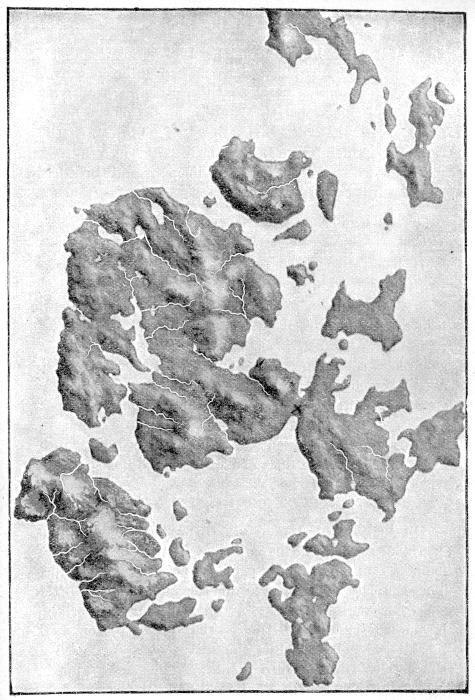
The Hills of Orkney. Photographed from a Relief Model based on the Ordnance Survey.
The Orkney hills, then, consist of a great pile of beds of flagstone which once spread unbroken over the whole country. Out of this great mass of flagstones and sandstones the running water of the burns has carved the valley systems. The hills are the remnants which the streams have not yet removed. As time goes on the valleys deepen and broaden, and the hills get less and less.
“The hills are shadows, and they flow From form to form, and nothing stands.”
It has taken vast ages to do this work, and the work is still going on. It is very slow. The oldest man hardly notices any visible change in the configuration of the country. But wind, rain, frost, and running water are ever at work. Every day sees some loss, some material swept away never to return. What becomes of it? It reaches the sea, and there forms mud and sand. Time will change these into solid rock again, and may ultimately use them in building new continents. The hills crumble into dust, but it is “the dust of continents to be.”
Cliffs and Beaches.
On looking at a map of Orkney or Shetland we are struck with the irregularity in the shape of the islands and the winding nature of the coast line. There must be some reason for this, and a little reflection will bring it to light. If you look at the larger valleys you will notice that most of them end in salt-water bays, while the hills or ridges between the valleys run out into points or “nesses.” This is especially the case in Shetland; but in Orkney, too, there are many instances of it. The shape of the land extends beneath the water—the deep bay continues the land valley, the point and the skerry mark the position of the watersheds.
We have seen that the valleys were eaten out by running streams. At one time the land stood higher, and the burns flowed where now the salt water covers the bottom of the bay. Thus the land was shaped. Then the ground sank a little, and the sea flooded the lower grounds. The hilltops remained above water as islands; the valleys and flat grounds were changed into bays and sounds and firths. Think what would happen if the land sank another hundred feet. Many of the present islands would become shoals, and new islands would be made where the sea flowed round the higher ground, winding out and in among them in narrow sounds and straits, just as it does among the islands of the present day.
Long ago Orkney and Shetland were much larger than they are at present. Most of the North Sea was dry land, covered with trees. In several parts of Orkney we can see trunks and roots of trees uncovered after heavy storms have shifted the sand on the beach. These trees did not grow beneath the sea, of course; but the land sank, and the salt water covered the site of the old forest.
Our wild animals, such as hares and rabbits, mice, voles, and shrews, were not imported in boats. They were here probably before man arrived, and they walked in on their own feet when the sea bottom was still part of the dry land of Europe. Those who have studied this question think the land is still sinking, or at any rate has not yet begun to rise. If it were rising, we should find gravels and shells and sea-beaches above the level of the present shores. Such raised beaches are found in many parts of Scotland, but not in Orkney or Shetland.
The shores are always changing, and every part of them bears evidence of constant alterations. Where there are high banks or cliffs, you will often find that pieces have fallen down; this is especially the case where the bank consists of clay. Our Orkney rocks are very hard and our cliffs very lasting, but in some parts of England there are villages and churches now standing on the very edge of the cliffs which a few centuries ago were at a considerable distance from the sea.
It is the sea that wears away the cliffs by hammering at the rocks; during storms the big stones on exposed beaches are rounded and worn by the billows tossing them about and driving them against the rocks. On the west coasts of our islands the great winter waves have enormous power; no breakwater could resist them, and a ship which is driven ashore soon goes to pieces. The cliffs are undermined at their base by the formation of caves; the soft parts are eaten out into geos. Frost and rain open the seams of the rocks and great masses tumble down; these are then tossed to and fro until they are converted into heaps of boulders. The boulders get less and less, and become pebbles; last of all they are ground down to fine shingle and sand.
Every kind of rock has its own characteristic type of cliff scenery. When pieces are detached they separate along natural cracks which are called “joints,” and these joints have a different arrangement in sandstone, in granite, in serpentine, and in schist. Weathering then acts on the exposed surface, and, if the rock is bedded, some beds are eaten away more rapidly than others. There is much to interest us in our cliffs; there is not a detail in their form which has not a meaning.
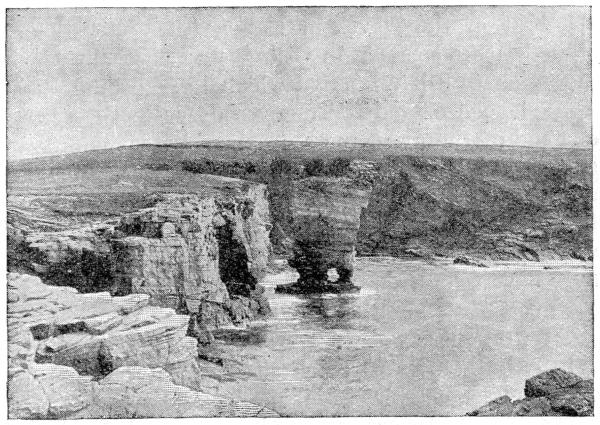
A sandstone cliff.
On wild shores where storm-waves are high we find large boulders; the smaller ones are washed away and swept out to sea. Sometimes there is no beach, but the cliff plunges down into deep water, for there the waves are so powerful that they clear away all the broken rock. On sheltered beaches we find small rounded pebbles. If we look at the stones on the shore of a small fresh-water loch we find them scarcely rounded at all, for the little waves cannot toss them about and rub them against one another.
The tear and wear of pebbles produces sand, and the sand is driven to and fro by currents and by storms. It rests for a time in some of the bays, but is not a fixture. A high wind drives some of it ashore to cover the grass of the sandy links. A heavy storm may drag a great deal of it out to sea. Unless it is held fast by bent or other plants, sand is always moving.
Even the stones travel along the shore, driven by the beat of the waves in bad weather. There are stone beaches common in Orkney and Shetland which are often called ayres, and which have behind them a salt lagoon or oyce. The oyce opens to the sea at one end of the ayre, and a strong tidal current flows out and in through the opening. An ayre is really an army of stones on the march, constantly moving forward. In every bay there is one direction from which the biggest waves come, and the stones of the ayre have come from that direction. The opening of the oyce is at the other end of the ayre.
At first there was a bay with a shallow inner end. When the big waves reach shallow water they turn over and have their speed checked. Stones carried along the shore are dropped at the edge of the shallow water, forming a bar. The bar goes on stretching across the bay as the storms fetch more stones, and in time the oyce is nearly walled in. But as the opening gets narrower and narrower the tidal flow gets stronger and stronger There is a combat between the tidal currents and the storm currents, and in time things are adjusted so that the speed of the outflow is just enough to keep the opening from being closed up.
The Age of Ice.
Along the burns and the seashores, and in stone quarries, we often see banks of clay. Usually this clay is full of stones. In some places the clay is merely the softened, crumbling top of the rock, and the stones in it are of the same kind as the solid rock below. In other places the clay contains stones which are quite unlike any rocks in the neighbourhood. Sometimes these stones are very large, and they must have been carried from some distant place, for they are of a kind of rock which is not found in the islands. What is the history of this clay with travelled stones, or “boulder clay,” as it is called?
Boulder clay may be recognized by several marks. It is tough and sticky; it shows no bedding or layers; and it may be only a few inches thick, or it may form cliffs thirty or forty feet high. Pick a few stones out of it: you will notice that they are not all of the same kind. Wash them carefully in the sea or the burn. Their ends are blunt and worn, but they are not rounded like sea-pebbles. Their surfaces are smooth, and are covered with fine scratches, as if some one had drawn a needle or the point of a knife along them. Nowhere except in this clay will you see stones with these curious scratches.
If you find the place where the bottom of the clay rests on the hard rock, you should carefully remove a little of the clay and lay bare the rock surface beneath. Wash it with a little water, and you will see that it is covered with fine scratches exactly like those on the stones. Now this smoothing and scratching of the stones and of the rock might be explained by imagining that the clay at one time was in motion, pushed forward by some immense force, and that the stones rubbing on one another and on the rocky floor produced these scratches.
Among the Alps, in Norway, in Greenland, and in other places where there are high snow-clad mountains or a very cold climate, the snow gathers in the valleys till it forms thick masses, and is compressed by its own weight into ice: these masses are known as glaciers. Glaciers are really slow-moving rivers of ice; they slip very slowly down the valley slopes, travelling usually only a few inches in a day. When they reach the warmer region at the base of the mountains, they melt away, leaving behind them heaps of clay which they have swept down from the hills. The stones in this clay are worn and smoothed and scratched exactly like those in the boulder clays of Orkney and Shetland, and the rocks over which the glaciers have moved are smoothed and scratched likewise.
The boulder clay, then, is clearly a glacial deposit, formed at a time when our islands were covered with moving sheets of ice. These ice sheets were travelling from the North Sea towards the Atlantic, in a west or north-west direction, for the scratches on the rock surface always have that trend. We can often prove also that the boulders found in the clay have travelled from the south-east. Thus at the Mont, near Kirkwall, the boulder clay is full of red sandstone from the Head of Holland and Inganess Bay. In Shetland stones have been carried from the east side of the mainland right over the hills to the west shores.
When we piece together all the evidence about this Ice Age or Glacial Period, not only in Orkney and Shetland but in all the north-west of Europe, we learn that it lasted a very long time, and that the North Sea was filled with a great sheet of ice which must have been several thousand feet thick. This ice was pushed out of the basin of the North Sea westwards into the Atlantic by the pressure of the deep snow-cap which covered the mountains of central Europe, and on its way it passed over Orkney and Shetland. The broken stones and rubbish which gathered below it formed the boulder clay. This may seem a very strange tale, but every kind of evidence that is needed to prove its truth has been found by those who have studied the boulder clay and the scratched rocks beneath it.
After the great ice sheet melted, the climate was still cold, and there were times when snow and ice gathered on our hilltops and little glaciers flowed down the valleys. These also have left traces behind by which you can know where they were. In every one of the higher glens in the Orkney hills you will find mounds of clay and stones, often forming a crescent or bow running from side to side of the valley. They are very well seen in Harray, Birsay, Orphir, and Hoy; but even in the East Mainland the hills, though low, gave rise to little glaciers. In Shetland they are almost as common as in Orkney. In many parishes there are clusters of large and small mounds, some of them grassy and others covered with heather, lying near the mouths of the main valleys. When these mounds have been cut into by streams or by roads, we see that they are not rocky hillocks but consist only of clay and stones, and that the stones are often scratched like those in the stiff boulder clay. These mounds are the “dumps” or moraines where the glaciers which filled the valleys melted and dropped their rubbish. At that time our islands must have resembled Spitzbergen, where to-day most of the hills have an ice-cap and nearly all the valleys are filled with glaciers, some of which reach the sea and give birth to icebergs, while others melt away and deposit lumpy moraines over the valley bottoms.
Orkney Fossils.
You cannot examine many of our Orkney flagstones carefully without finding fossils. The most common are scales and bones of fishes. In the rock these often appear as coal-black specks. When a fossil has weathered for a long time, as in a stone dyke or on the seashore, it often becomes bright blue, like a splash of blue paint. Sometimes whole fishes are found in the gray flagstones, with every fin and every scale perfect. Of course you will not find these every day or every year, but there are many quarries in Orkney where you may get them occasionally. When the quarryman uncovers a bed of rock, he often finds it sprinkled over with great numbers of fossil fishes.
We can picture to ourselves that, at some time long gone by, when these flagstones were being laid down in the old Orcadian lake as sheets of sandy and muddy silt, the fishes were suddenly killed by a volcanic eruption, or by a period of drought, and their dead bodies covered the muddy bottom for miles. Fresh mud then came down and buried them, and preserved their remains. In process of time their bones and scales were changed into the pitch-black substance which we now find in the rocks. But we can still see that these specks and scales are really parts of fishes. If we examine them under the microscope, we find that they have all the marks of structure that the same parts of certain fishes have at the present day.
In almost every parish in Orkney there is at least one quarry which contains good fossils, and there must be many others which we do not yet know of. But no person who knows what a bit of fossil fish is like need search very long among the flagstones of the shore without finding a scale, a jaw bone, a tooth, or other relic of the fishes which lived in Orkney at the time the flagstone muds were gathering. A heap of stones thrown down by the roadside, for building a dyke or for mending the roads, often contains fragments of dozens of fishes.
It is not difficult for us to picture what these fishes were like when alive. Some of them were about the size of sillocks or herrings, others were as large as a big cod. They had scales all over their bodies, and fins, supported by bony rays, just like living fishes. But though many of them were of the same shape and general outline as a trout or a herring, they differed from these in many ways.
Their scales were often hard and bony, with a smooth, shining outer layer of enamel like that which covers a tooth. Those fishes are called ganoids. On their heads they had bony plates with the same hard covering, often showing ridges and furrows, knobs, and other markings. You may see these beautifully preserved in many of the fossil bones which occur in the gray and blue flagstones. Those fishes belong to species which are no longer living on the earth’s surface, but closely allied kinds of fish are still found in a few rivers in Africa, America, and Europe. The royal sturgeon is one of these.
None of the fishes which are common in our seas at the present day are ever found as fossils in rocks as old as the Orcadian flagstones. The water of the Orcadian lake was fresh water. We know this because we find no marine shells, and no crabs or cuttle-fishes in the flagstones, though these kinds of animals peopled the sea at that time, and would have been preserved as fossils if they had inhabited the lake.
Some of the fishes in the lake were very grotesque and oddly-shaped creatures. One of them had two curious bony arms or wings which stuck out from its sides. It is not very common in Orkney, but is sometimes found in quarries near Stromness, and a smaller fish of much the same shape may be got in Deerness occasionally. They are called “winged fishes,” and are quite unlike any fishes now living. So strange is this fossil that when first found it was thought to be a curious beetle.
Another strange fish was of great size; its head bones are a foot or more in length. Pieces of the head of this fish may be seen in many parts of Orkney, but the bones of the body were soft and rotted away after the fish died. The back of its head was somewhat like a shovel in shape, and the bones are often half an inch in thickness. There were two great holes for the eyes near the corners of this shield. The back of the neck was protected by another large plate. A specimen of this fossil can be seen in the Stromness museum; it was called by Hugh Miller the Asterolepis, or “star-scale fish,” of Stromness.
Besides the fishes, other fossils occur in the flagstones, but not of many kinds. At Pickaquoy, near Kirkwall, and in several other places, very small shells, like tiny mussel shells, often cover the surface of the beds of rock. Pieces of wood may also be seen in the flagstones; they are flattened out and form black strips of a coaly substance, but as they must have drifted a long distance from land, and sunk to the bottom only when they became water-logged, they do not tell us much about the nature of the plants which clothed the islands and the shores of the lake. Yet we know that there were no flowers then, no grasses, or sedges, or trees like those that now live, but only great reeds and tree-like plants belonging to the same groups as the horse-tail that grows in watery places and along roadsides, and the little green scaly club moss that creeps through the heather, sending up its fruit-bearing spikes. There were also many kinds of ferns. In the forests and swamps there were land-snails and insects, but no frogs or lizards, still less any birds or other warm-blooded creatures. The fishes are the highest types that then existed; they were the “lords of creation” in that day.
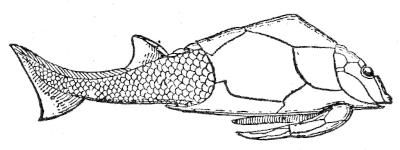
“Winged fish” (Pterichthys).
A PEAT-MOSS.
Earl Einar it was, as the story goes, who first taught the Orkneyman to make the turf into peats—Torf Einar, as he was called in memory of this fact. If the story is true, he did a great work for the islands,—not quite treeless in his day, perhaps, but yet in a bad way for fuel in the long winter evenings,—and he deserves a monument almost as splendid as that of Earl Magnus.
The wood fires went out long ago, and the peat fires will, no doubt, follow in due time. True, the peat-mosses are not yet exhausted, but year by year they recede, and the road to “the hill” grows longer. There is less time to spare now for peat-cutting than there used to be, for our modern methods of farming require more constant labour. But through our trade with other lands money is circulating more freely, and coal can be bought to take the place of peat. The change means more money and less time, and that is just the great difference between this century and those which have gone by.
But the peat-moss is not yet deserted, and in the early summer it is still a busy scene in many places. Harvest has ever been a time of joy, and peat-cutting is the harvest of the moss. The flaying-spade and the tuskar are not mere toys, nor is “taking out” the newly-cut peats a holiday task; but there are few scenes where more cheerfulness and wholesome mirth can be seen than at many an Orkney peat-cutting.
Let us approach one of these familiar “peat-banks,” not necessarily to share in the fun, and certainly not to take part in the labour, but to find out what we can about the substance which we call peat. Here is a bank where the moss is deep enough to give three lengths of peat, one above the other, besides the surface layer, which is cut off and thrown down on the old peat ground.
This top layer, we see, is, like ordinary turf, full of the roots of growing plants—heather, rushes, sedges, and grasses of various kinds. Filling up the spaces between them is a tangled mass of spongy mosses. These mosses are the most important plants of all in the formation of peat.
The most common of the bog-mosses is the Sphagnum, a small branching plant with thin, scaly leaves. Where there is plenty of light it is of a vivid green, and the tops of the sprays look like tiny emerald stars. Lower, where less light comes, the plant looks yellow and sickly, while still lower it is black and decaying. The black substance which we call peat is really a mass of decayed sphagnum moss.
The upper part of our peat-bank, just below the turf which has been cut away, is more loose and fibrous than the under part. The roots of the larger plants may still be seen in it. The second and especially the third peat are much closer in texture and of a deeper black colour. The vegetable matter is more completely decayed, and if we were to compress it sufficiently it would look very like coal.
At one part of the face of the bank we notice a layer of a different kind. We find the roots and parts of the stems and branches of small trees embedded in the moss. There has been a wood here at one time—how long ago, we cannot tell. That layer of moss which now lies above the remains of the trees may have taken centuries to form.
In many places we find more than one such layer of wood, separated as well as covered by thick layers of moss. Some of the trees have been of considerable size, too; the trunk of one found in the parish of Stenness measured about five feet in circumference, while the moss near it was thickly studded with the nuts which had fallen from it year after year.
The trees whose remains have been found in our mosses include the poplar, pine, mountain ash, birch, hazel, alder, and willow. One very interesting fact is that the silver fir is also found, a tree which does not now grow in Scotland, and is not found in Scottish peat-mosses, but which is common in Norway.
What curious tales those peat-mosses tell of the changes of climate which have passed over our islands! At the present day it is only in our deepest glens, as in Hoy, that we can find even small trees and bushes growing wild. Yet at one time our islands must have been well wooded, though it is only in the mosses that the remains have been preserved for us to see.
The sphagnum, again, has another story to tell. It requires abundant moisture for its growth, and at present it can find this only in flat and boggy ground. It is therefore only in such places that peat is now being formed. Yet we find peat on most of our hillsides and even hilltops. This tells of a time when our climate was much wetter than it now is, and when sphagnum flourished everywhere.
One more story of a different kind can be read from the peat-moss. Here and there, as at Deersound and Widewall Bay, when the tide is out, we may find peat-moss, and the remains of large trees among it, far down on the beach, many feet below the level of high water, and most of it covered to a considerable depth with the sand and gravel which form the upper beach and the land near it. This tells clearly of a gradual sinking of the land in the neighbourhood. When that moss was being formed, and when those trees were growing, the shallow bay must have been dry land.
The plants and flowers which grow on our mosses are worth more than a passing glance. Let us look at some of them. The sphagnum we have already mentioned; it belongs to the class of flowerless plants. The others we shall mention are flowering plants.
Best known of all, perhaps, is what we call heather. This name is used for at least four different plants in Orkney. Two of these bear that common but beautiful flower the heather-bell. One bears bells of a pale, rose-coloured, waxy appearance; the other, which is more common, has bells of a darker and often purplish red. The former is the cross-leaved heath, with its little green leaves arranged in whorls of four; the latter has its leaves in whorls of three, and is known as the fine-leaved heath.
The most common kind of heather is the ling, which flowers somewhat later than the heaths. It is this plant whose spikes of tiny rose-coloured flowers make our hillsides a purple glory in the early autumn, and whose leaves and stems give them their familiar brown tint during the rest of the year. A white variety is also found, the “white heather” which is supposed to bring good luck to the finder.
Another kind of heather is that which bears the small black berries so well known to every young Orcadian. This plant is not a heath at all; it is really the black crowberry. The berry is preceded by a tiny purplish flower, which probably few of the berry-gatherers have ever seen.
The “rashes” or rushes are a common feature of our moors. Two kinds may be noticed, one with its flower-tuft more closely packed together than the other. These rushes were of some use in former days. The white pith was extracted and dried for winter use as wicks in the old oil-burning “crusies,” before the introduction of paraffin.
There are many smaller plants of a similar type, one of which, the bog asphodel, ought to be well known; its pretty, yellow, star-like flowers, grouped on a stalk some eight inches high, often make patches of our moorlands glow with the shimmer of gold.
The cotton-grass is probably more familiar. There are two kinds found in Orkney, one bearing a single tuft of white down on each stem when seeding, the other a group or cluster of tufts. This plant is not a grass, and has no connection with the cotton plant; but the name is a good one for all that, and no one can mistake the plant to which it applies.
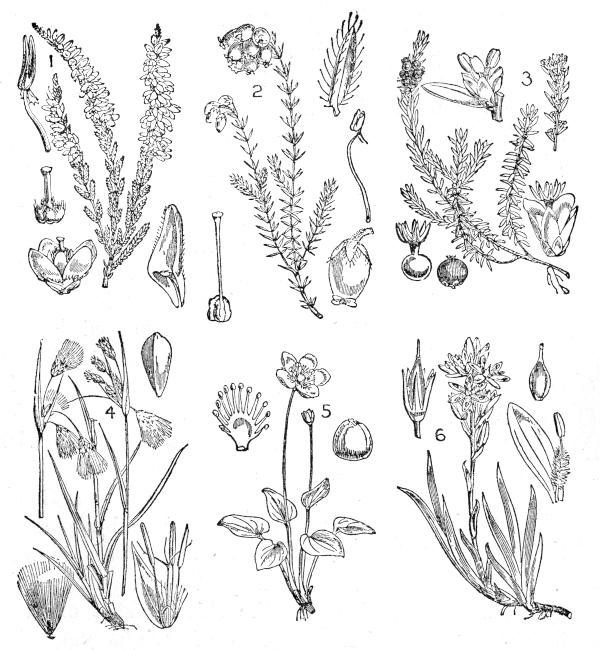
Plants of the peat-moss.
1. Common ling (Calluna vulgaris). 2. Cross-leaved heath (Erica tetralix). 3. Black crowberry (Empetrum nigrum). 4. Cotton grass (Eriophorum polystachion). 5. Grass of Parnassus (Parnassia palustris). 6. Bog asphodel (Narthecium ossifragum).
One of our most beautiful moorland plants is that which bears the attractive name, “grass of Parnassus.” This also is not a grass, and does not in the least resemble one. It is well worth looking for and looking at when found. From a group of dark-green, glossy, heart-shaped leaves rises a slender stem four or five inches high, with one leaf growing on it midway up its height. This stem bears a single cup-shaped flower as large as a common buttercup, with five white petals marked with darker veins. The central parts of the flower are yellowish-green. Round the stigma stand the five stamens, and between these and opposite the petals are five curiously shaped nectaries or honey vessels. They are fringed with a row of white hairs, each ending in a yellow knob, and look like a tiny golden crown placed in the centre of the flower-cup. The name of the flower is said to be taken from Mount Parnassus in Greece, the home of the Muses. Certainly the flower itself is dainty enough to be a favourite with the poets.
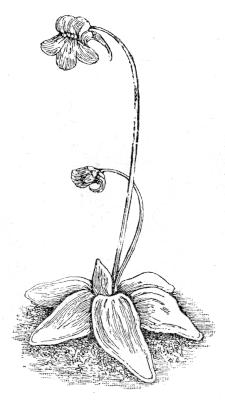
Butterwort.
Some plants have developed the curious habit of eating, or, at any rate, digesting and absorbing the juices of insects. Two of those insectivorous plants may be found in our peat-moss. In certain places we may notice that the thick carpet of moss is dotted with little rosettes of bright yellowish green, which look like vegetable star-fishes scattered over a beach of moss. That is one of our “plants of prey.” It is called the butterwort.
From the centre of the rosette rises a slender stalk of two or three inches, bearing a small dusky purple flower somewhat like a dog-violet. The green leaves which form the rosette are stiff, and lie close to the ground, as if to keep a clear space among the other plants. They curl up at the edges, and look as if they did not want to mingle with their kindred round about; and indeed they do not, for they have other game in view.
Attracted by this bright green star, a small insect comes in search, perhaps, of honey. He finds the leaf covered with a sticky fluid, and his touch causes more of the fluid to come out of little pores in the leaf. The insect is held fast, and the gum clogs up the pores of his body so that he cannot breathe. He soon dies. Then the plant pours out an acid liquid, which dissolves all the soft parts of the captured insect, and leaves only the skeleton. At the same time this dissolved or digested food is sucked in by the pores of the leaf.
The acid juice of the butterwort is so like the juice of the animal stomach, that in Lapland the people used to pour warm milk over butterwort leaves, and thus changed it into a curd, just as we do by adding to the milk some rennet, made from the stomach of a calf.
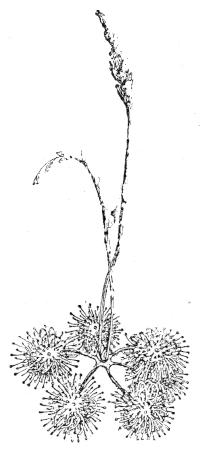
Sundew.
On this same patch of moor we may find another flesh-eating plant. This is smaller than the last, and less easily found. It has a slender flower-stalk with a spike of small whitish flowers rising from the centre of a curious group of leaves. The leaves lie flat on the ground; they are small and round, no larger than split peas, and covered with bright red hairs that look like tiny red pins stuck in a tiny green pin cushion.
Each of these hairs carries at its tip a bead of clear fluid, which glitters in the sun; hence the plant is called the sundew. Let any thirsty insect come to drink this dew, and a strange thing happens. He finds his feet held fast by the sticky dewdrops, and the more he struggles the more of these does he rub against. He is held fast until he is suffocated, and then he is digested and absorbed by the leaf.
When the fly alights on the plant, the hairs begin to bend in towards the centre of the leaf. Even those hairs which have not been touched bend over until all of them are helping to hold fast the prey and dissolve it with their liquid. If the insect alights near the edge of the leaf, he is thus carried towards the centre and held fast, while the leaf itself bends so as to form a cup for the acid that pours from the hairs. If two insects alight on the same leaf, the hairs form into two groups, those near each animal curving towards him, so that the leaf acts as if it had two hands. In this way all the insects that come are attended to.
There are many other curious plants to be found in the peat-moss, but those we have mentioned will suffice to show how much of interest there is in our bleak mosses and moors.
SOME COMMON WEEDS.
What is a weed? We may best describe it, perhaps, as a plant growing in the wrong place. A weed is not necessarily ugly, or harmful, or even useless. Many common weeds are very beautiful, and some of them are very useful; but if they are growing where we wish something else to grow, we call them “weeds,” and root them out, or try to do so. Grass in our hayfields and meadows is a valuable plant; grass in our flower-borders or turnip-fields is a weed. So when we speak of weeds, we do not mean any special class of plants, but only those which force themselves upon our notice by springing up where we wish something else to grow.
Many of our common weeds are very interesting plants to the botanist. They have to fight for their lives; and the way in which they scatter their seeds, and the power of those seeds to lie dormant for years waiting a chance to grow, are well worth study. It is a war between the farmer and wild nature, and when we look over our fields and pastures in spring and summer we see clearly enough that the farmer is not always the victor. In many a cornfield the oat crop seems to be merely incidental, while the hardier children of nature flourish in spite of its intrusion.
This is not as it ought to be. Even if they are otherwise harmless, the weeds use up a large part of the plant food in the soil, and they rob the young oats of the necessary light and air. In this way weeds prove an expensive crop to the farmer. It pays him to study their life-history so as to learn how they may be eradicated, and to spend some labour in the task of doing so.
A common pest in the Orkney cornfields is the “runcho” or “runchic,” known elsewhere by the name of charlock or wild mustard. Its pale-yellow flowers overtop the growing oats, and their unwelcome gleam makes some fields conspicuous for miles around. The form of the flower shows that the charlock belongs to the same family as the turnip and the cabbage and the fragrant wallflower of our gardens. The flower has four petals, and the cross-like arrangement of its six stamens, four long and two short, has given them their name of Cruciferæ, or cross-bearers. The seed-vessels, like those of the turnip, are in the form of a long, narrow pod with a partition running down the middle. The seeds are small and hard, and they grow only in a freshly-stirred soil with plenty of light and air. When a field is laid down in grass they make no sign of life, but when it is ploughed for the next crop of oats they spring up once more, and make it as gay as a flower-bed. Two kinds of this plant are found—the one, charlock, of a light yellow colour, common in peaty and clayey ground; and the other, wild mustard, of a deeper yellow, found in sandy soil.
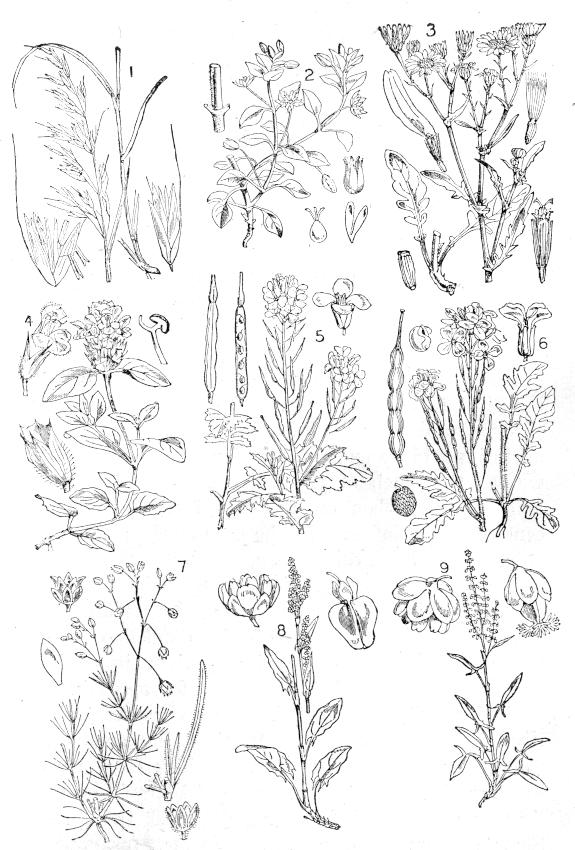
Some common weeds.
1. False oat grass. 2. Chickweed. 3. Ragwort. 4. Prunella. 5. Wild mustard (Brassica Sinapis). 6. Charlock (Raphanus Raphanistrum). 7. Corn spurrey. 8. Sheep’s sorrel. 9. Common sorrel.
Another showy weed is the yellow corn-marigold. This handsome flower seems more dainty in its choice of soil, and in some districts it is not common. A glance at the open flower shows its kinship to the “wee, modest, crimson-tipped” daisy. The so-called flower is not one, but a host of tiny flowers or florets growing upon a broad green disc called the receptacle. This compound or composite type of flower is found in a large number of common plants, named on this account Compositæ. Many of them are found in Orkney, and they are a very interesting as well as a numerous family.
One of the best known is the dandelion, a more beautiful flower than many which we grow in our gardens, and only its abundance prevents our admiring it. If we examine the florets of the dandelion, we see that each of them has a corolla forming a long yellow ribbon on the side farthest from the centre of the flower. In the corn-marigold only the outer florets have this ribbon, which forms a halo of rays round the central portion. In the daisy these rays are white, with the tips pink, especially underneath.
A well-known feature of the dandelion is the white down which it produces when in seed—a wonderfully beautiful arrangement for spreading its seeds far and wide to find room to grow. This is a common method of broadcast sowing among the Compositæ family. The thistles, which form a well-known section of that family, depend largely on their floating seeds in their struggle against the farmer. Some farmers seem to forget this fact, for, crowded in some corner of an old pasture, or in serried ranks by roadside and ditchside, we may see those armed foes allowed to blossom and send forth thousands of winged seeds to overrun the neighbouring fields, and even the neighbouring farms. A few hours’ work with a scythe would prevent the mischief. There might well be laws to prevent the careless spreading of weeds as there are to prevent the spreading of infectious disease among animals.
One of the Compositæ family is a common weed in Orkney pasture fields—the “tirsac” or ragwort. This is a coarse, vigorous plant, with a tough stalk about two feet in height, crowned with a spreading tuft of yellow daisy-shaped flowers. In fields where this weed is allowed to grow and multiply, it soon comes to occupy a large proportion of the whole area, and this means a considerable loss in the grazing value of the pasture.
The large family of the grasses includes some of the plants most useful to the farmer. All the grain crops, such as wheat, barley, and oats, are cultivated grasses, as are also the plants which are used for pasture and for hay. There are some wild grasses, however, which are very persistent and troublesome weeds. Some of these, like couch grass, spread more by creeping underground stems than by seeds. A common grass in Orkney is that known as “swine-beads,” from the knotted form of its underground stems. Its common name is false oat grass. It resembles small black oats, but is much taller. Cartloads of its beaded stems may be gathered from some fields when being prepared for turnips, and by so doing much trouble may be saved.
When a field is laid down in turnips or potatoes, the weeds have a hard struggle for life. Those of slow growth are checked by the ploughing and grubbing and harrowing, and later by the hoe and the scuffler. Yet there are a few which in a moist season spring up quickly and soon cover the drills. The common spurrey, with its narrow, sticky leaves growing in whorls, and its tiny white flowers which open only in the sun, is perhaps the best known. The chickweed is another common weed in such fields. These, however, if kept down at first by the hoe, are of too feeble growth to injure the crop among which they strive to find a living.
Sheep’s sorrel and common sorrel, both commonly known as “sooricks,” were more harmful half a century ago than they are at present. Cultivation and the rotation of crops have reduced their quantity, but their enormous power of spreading can be witnessed in a poor, thin, or peaty soil, where the crops, especially grass, are meagre. There they spread, and sometimes with such vigour that they push every other plant aside. Both kinds of sorrel are common. The one with arrow-shaped leaves is called common sorrel; that with spear-shaped leaves, sheep’s sorrel. Their leaves, which have a very acid taste, often turn reddish.
Another common and pretty little flower is prunella or self-heal. Whorls of green bracts and violet flowers form a dense, short spike. It grows from four to six inches high, and is to be met with on dry soils, and although fairly common in oats, flourishes best in second year’s grass. It is one of the large order of Labiates, a group which includes the dead-nettle and the hemp-nettle, and when abundant it is a clear indication of the exhaustion of some ingredients of the soil—often lime. When fields are brought to a high state of cultivation, or are near enough the seashore to get an abundant supply of sand, it almost disappears; but when they are impoverished, it soon returns.
These are only a few of the weeds which every farmer knows well. They are worth study, for it is only when we know how they grow and spread that we are able to prevent their increase. The cultivation and manuring of the soil and the sowing of seeds are only one side of the farmer’s work; he has to remove the wild growth as well as to promote the growth of what he sows. Otherwise his fields will bear two crops at a time, one of nature’s sowing and one of his own, and of these two the natural crop is likely to be the more flourishing.
HOME LIFE ON THE ROCKS.
Guillemots.

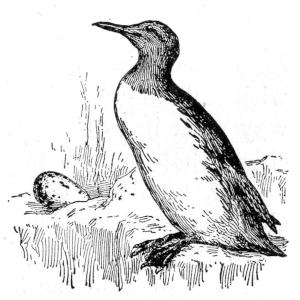
Nothing is more interesting than to look down from the summit of some precipice on to a ledge at no great distance below, which is quite crowded with guillemots. Roughly speaking, the birds form two long rows, but these rows are very irregular in depth and formation, and swell here and there into little knots and clusters, besides often merging into or becoming mixed with each other, so that the idea of symmetry conveyed is of a very modified kind, and may be sometimes broken down altogether. In the first row a certain number of the birds sit close against and directly fronting the wall of the precipice, into the angle of which with the ledge they often squeeze themselves. Several will be closely pressed together, so that the head of one is often resting against the neck or shoulder of another, which other will also be making a pillow of a third, and so on. Others stand here and there behind the seated ones, each being, as a rule, close to his or her partner. There is another irregular row about the centre of the ledge, and equally here it is to be remarked that the sitting birds have their beaks pointed towards the cliff, whilst the standing ones are turned indifferently. There are generally several birds on the edge of the parapet, and at intervals one will come pressing to it through the crowd in order to fly down to the sea, whilst from time to time others also fly up and alight on it, often with sand-eels in their beaks. On a ledge of perhaps a dozen paces in length there may be from sixty to eighty guillemots, and as often as they are counted the number will be found to be approximately the same.
Guillemot.
Most of the sitting birds are either incubating or have young ones under them, which, as long as they are little, they seem to treat very much as though they were eggs. Much affection is shown between the paired birds. One that is sitting either on her egg or her young one—for no difference in the attitude can be observed—will often be very much cosseted by the partner who stands close behind or beside her. With the tip of his long, pointed beak he, as it were, nibbles the feathers (or, perhaps, scratches and tickles the skin between them) of her head, neck, and throat; whilst she, with her eyes half closed, and an expression as of submitting to an enjoyment—a “Well, I suppose I must” look—bends her head backwards, or screws it round sideways towards him, occasionally nibbling with her bill also amidst the feathers of his throat, or the thick white plumage of his breast. Presently she stands up, revealing the small, hairy-looking chick, whose head has from time to time been visible just peeping out from under its mother’s wing. Upon this the other bird bends its head down and cossets in the same way—but very gently, and with the extreme tip of the bill—the little tender young one. The mother does so too, and then both birds, standing side by side over the chick, pay it divided attentions, seeming as though they could not make enough either of their child or of each other. It is a pretty picture, and here is another one.
A bird—we will think her the female, as she performs the most mother-like part—has just flown in with a fish—a sand-eel—in her bill. She makes her way with it to the partner, who rises and shifts the chick that he has been brooding over from himself to her. This is done quite invisibly, as far as the chick is concerned, but you can see that it is being done.
The bird with the fish, to whom the chick has been shifted, now takes it in hand. Stooping forward her body, and drooping down her wings, so as to make a kind of little tent or awning of them, she sinks her bill with the fish in it towards the rock and then raises it again, and does this several times before either letting the fish drop or placing it in the chick’s bill—for which it is I cannot quite see. It is only now that the chick becomes visible, its back turned to the bird standing over it, and its bill and throat moving as though swallowing something down. Then the bird that has fed it shifts it again to the other, who receives it with equal care, and bending down over it, appears—for it is now invisible—to help or assist it in some way. It would be no wonder if the chick had wanted assistance, for the fish was a very big one for so small a thing, and it would seem as if he swallowed it bodily. After this the chick is again treated as an egg by the bird that has before had charge of him—that is to say, he is sat upon, apparently, just as though he were to be incubated.
On account of the closeness with which the chick is guarded by the parent birds, and the way in which they both stand over it, it is difficult to make out exactly how it is fed; but I think the fish is either dropped at once on the rock, or dangled a little for it to seize hold of. It is in the bringing up and looking after of the chick that one begins to see the meaning of the sitting guillemots being always turned towards the cliff, for from the moment that the egg is hatched one or other of the parent birds interposes between the chick and the edge of the parapet. Of course I cannot say that the rule is universal, but I never saw a guillemot incubating with its face turned towards the sea, nor did I ever see a chick on the seaward side of the parent bird who was with it.
I observed that the chick—even when, as I judged by its tininess, it had only been quite recently hatched—was as alert and as well able to move about as a young chicken or partridge; but whilst possessing all the power, it appeared to have little will to do so. Its lethargy—as shown by the way in which, even when a good deal older, it would sit for hours without moving from under the mother—struck me as excessive; and it would certainly seem that on a bare, narrow ledge, to fall from which would be certain death, chicks of a lethargic disposition would have an advantage over others who were fonder of running about.
The young guillemot is fed with fish which are brought from the sea in the parent’s bill, and not—as in the case of gulls—disgorged for them after having been first swallowed. It is, however, a curious fact that the fish when thus brought in are, sometimes at any rate, headless. The reason of this I do not know, but with the aid of glasses I have made quite certain of it, and each time it appeared as though the head had been cleanly cut off. Moreover, on alighting on the ledge the bird always has the fish (a sand-eel, whenever I saw it) held lengthways in the beak, with the tail drooping out to one side of it, and the head part more or less within the throat—a position which seems to suggest that it may have been swallowed or partially swallowed—whereas puffins and razor-bills carry the fish they catch crosswise, with head and tail depending on either side.
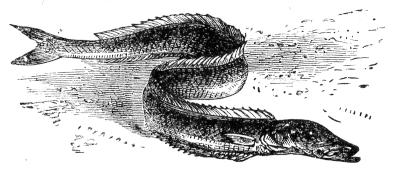
I have once or twice thought that I saw a bird which just before had no fish in its bill all at once carrying one. But I may well have been mistaken; and it does not seem at all likely that the birds should usually carry their fish, and thus subject themselves to persecution, if they could disgorge it without inconvenience. With regard to the occasional absence of the head, perhaps this is sometimes cut off in catching the fish.
Seals.
Quite near to where I watch the guillemots there is a little iron-bound creek or cove, walled by precipice, guarded by mighty “stacks,” and divided for some way into two by a long rocky peninsula running out from the shore. On the rocks in one of these alcoves were lying eight seals, which were afterwards joined by another, making nine, whilst in the adjoining one were four—also, as it happened, joined by another, as I watched—making fourteen in all: such a sight as I had never seen before.
Common seal.
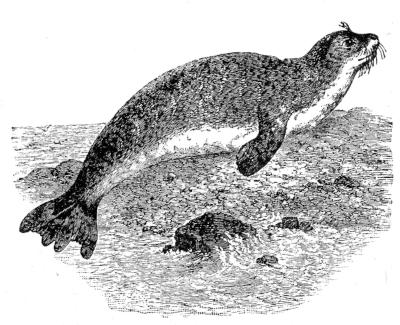
I watched these seals of mine on this, my first meeting with them, for a considerable time from the top of the cliffs—the glasses giving me a splendid view—and soon knew more about them than I had done before, and got rid of some popular errors. For instance, I had always imagined that seals had one set attitude for lying on the rocks—namely, flat on their bellies—a delusion which every picture of them in this connection had helped to foster. Imagine my surprise and delight when it burst upon me that only some three or four were in this attitude, and that even these did not retain it for long. No; instead of being in this state of uninteresting orthodoxy, they lay in the most delightful free-thinking poses, on their sides, showing their fine, portly, columnar bellies in varying degrees and proportions; whilst one utter infidel was right and full upon his broad back, yet looked like the carved image of some old Crusader on the lid of his stone sarcophagus. Every now and then they would give themselves a hitch, and bring their heads up, showing their fine round foreheads and large mild eyes; a very human—mildly human—and extremely intelligent appearance they had, looking down upon them from above. Again, they had the oddest or oddest-appearing actions, especially that of pressing their two hind feet or flippers together, with all their five-webbed toes spread out in a fan, with an energy and in a manner which suggested the fervent clasping of hands. Then they would scratch themselves with their fore feet lazily and sedately, raising their heads the while, looking extremely happy, having sometimes even a beatific expression. And then again they would curl themselves a little and roll more over, seeming to expatiate and almost lose themselves in large, luxurious ease—more variety and expression about them lying thus dozing than one will see in many animals awake and active.
Even in this little time I learnt that they were animals of a finely touched spirit, extremely playful, with a grand sense of humour, and filled “from the crown to the toe, top-full” of happiness. Thus one that came swimming up the little quiet bay, in quest of a rock to lie upon, seemed to delight in pretending to find first one and then another too steep and difficult to get up on (for obviously they were not), and would fling himself from off them in a sort of little sham disappointment, gambolling and rolling about, twisting himself up with seaweed, and generally having a most lively, solitary romp. A piece of bleached spar, some four or five feet long, happened—and I am glad that it happened—to be floating in the water at quite the other side of the creek and, espying it, this delightful animal swam over to it, and began to play with it as a kitten might with a reel of cotton or a ball of worsted. More frolicsome, kitten-hearted, and withal intelligent play I never saw. He passed just underneath it, and, coming up on the opposite side, rolled over upon it, cuffed it with one fore foot, again with the other, flipped it then with his footy tail as he dived away, and returning, in a fresh burst of rompiness, waltzed round and round with it, embracing it, one might almost say. At last, going off, he swam to a much steeper rock than any he had made-believe to find so difficult, and, scrambling up it with uncouth ease, went quietly to sleep in the best possible humour.
What intelligence all this shows! Much more, I think, than the sporting of two animals together. This seal was alone, saw the floating spar at a distance, and swam to it with the evident intention of amusing himself in this manner. Later, another seal played with this same spar in much the same way; yet both of them seemed to be quite full-grown animals.
Then I saw something which looked like a spirit of real humour, as well as fun. Three seals were lying on a slab of rock together, and one of them, raising himself half up, began to scratch the one next him with his fore foot. The scratched seal—a lady, I believe—took it in the most funny manner, a sort of serio-comic remonstrance, shown in action and expression: “Now do leave off, really. Come now, do leave me alone”—and when this had reached a climax the funny fellow left off and lay still again; but as soon as all was quiet, he heaved up and began to scratch her again. This he did—and she did the other—three times, at the least, and if not to have a little fun with her I can hardly see why.
Shags.
Now I have found a nest with the bird on it, to see and watch. It was on a ledge, and just within the mouth of one of those long, narrowing, throat-like caverns into and out of which the sea, with all sorts of strange, sullen noises, licks like a tongue. The bird, who had seen me, continued for a long time afterwards to crane about its long neck from side to side or up and down over the nest, in doing which it had a very demoniac appearance, suggesting some evil being in its dark abode.
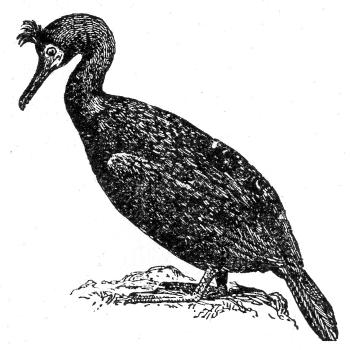
Shag.
As it was impossible for me to watch it without my head being visible over the edge of the rock I was on, I collected a number of loose flat stones that lay on the turf above, and, at the cost of a good deal of time and labour, made a kind of wall or sconce with loopholes in it, through which I could look and yet be invisible. Presently the bird’s mate came flying into the cavern, and wheeling up as it entered, alighted on a sloping slab of the rock just opposite to the nest. For a little both birds uttered low, deep, croaking notes in weird unison with the surroundings and the sad sea-dirges, after which they were silent for a considerable time, the one standing and the other sitting on the nest vis-à-vis to each other. At length the former, which I have no doubt was the male, hopped across the slight space dividing them on to the nest, which was a huge mass of seaweed. There were now some more deep sounds, and then, bending over the female bird, the male caressed her by passing the hooked tip of his bill through the feathers of her head and neck, which she held low down the better to permit of this. The whole scene was a striking picture of affection between those dark, wild birds in their lonely wave-made home.
The male bird now flies out to sea again, and after a time returns carrying a long piece of brown seaweed in his bill. This he delivers to the female, who takes it from him and deposits it on the heap, as she sits. Meanwhile the male flies off again, and again returns with more seaweed, which he delivers as before; and this he does eight times in the space of one hour and forty minutes, diving each time for the seaweed with the true cormorant leap. Sometimes the sitting bird, when she takes the seaweed from her mate, merely lets it drop on the heap, but at others she places and manipulates it with some care. All takes place in silence for the most part, but on some of the visits the heads are thrown up, and there are sounds—hoarse and deeply guttural—as of gratulation between the two.
The nest of the shag is continually added to by the male, not only while the eggs are in process of incubation, but after they are hatched, and when the young are being brought up. In a sense, therefore, it may be said to be never finished, though for all practical purposes it is so before the female bird begins to sit. That up to this period the female as well as the male bird takes part in the building of the nest I cannot but think, but from the time of my arrival on the island I never saw the two either diving for or carrying seaweed together. Once I saw a pair of birds together high up on the cliffs, where some tufts of grass grew in the niches. One of these birds only pulled out some of the grass, and flew away with it, accompanied by the other.
It is not only seaweed that is used by these birds in the construction of the nest. In many that I saw grass alone was visible, though I have no doubt seaweed was underneath it; and one in particular had quite an ornamental appearance, from being covered all over with some land plant having a number of small blue flowers; and this I have observed in other nests, though not to the same extent. I think it was on this same nest that I noticed the picked and partially bleached skeleton—with the head and wings still feathered—of a puffin. It had, to be sure, a sorry appearance to the human—at least to the civilized human—eye, but if it had not been brought there for the sake of ornament, I can think of no other reason; and brought there or at least placed upon the nest by the bird it must almost certainly have been. The brilliant beak and saliently-marked head of the puffin must be here remembered. Again, fair-sized pieces of wood or spar, cast up by the sea and whitened by it, are often to be seen stuck amongst the seaweed, and on one occasion I saw a bird fly with one of these to its nest and place it upon it. In all this, as it seems to me, the beginnings of a tendency to ornament the nest are clearly exhibited.
Both the sexes share in the duty and pleasure of incubation, and (as in some other species) to see them relieve each other on the nest is to see one of the prettiest things in bird life. The bird that you have been watching has sat patiently the whole morning, and once or twice, as it rose in the nest and shifted itself round into another position on the eggs, you have seen the gleam of them as they lay there “as white as ocean foam in the moon.” At last, when it is well on in the afternoon, the partner bird flies up and stands for some minutes preening itself; while the one on the nest, who is turned away, throws back the head towards it, and opens and shuts the bill somewhat widely, as in greeting, several times. The new-comer then jumps and waddles to the farther side of the nest, so as to front the sitting bird, and sinking down against it with a manner and action full both of affection and a sense of duty, this one is half pushed, half persuaded to leave, finally doing so with the accustomed grotesque hop. It has all been done nearly in silence, only a few low, guttural notes having passed between the birds whilst they were close together. Just in the same way the birds relieve each other after the eggs have been hatched, and when the young are being fed and attended to.
A shag is sitting on her nest with the young ones, whilst the male stands on a higher ledge of the rock a yard or so away. He now jumps down and stands for a moment with head somewhat erected and beak slightly open. Then he makes the great pompous hop which I have described before, coming down right in front of the female, who raises her head towards him, and opens and closes the mandibles several times in the approved manner. The two birds then nibble, as it were, the feathers of each other’s necks with the ends of their bills, and the male takes up a little of the grass of the nest, seeming to toy with it. He then very softly and persuadingly pushes himself against the sitting bird, seeming to say, “It’s my turn now,” and thus gets her to rise, when both stand together on the nest over the little ones. The male then again takes up a little of the grass of the nest, which he passes towards the female, who also takes it, and they toy with it a little together before allowing it to drop. The insinuating process now continues, the male in the softest and gentlest manner pushing the female away, and then sinking down into her place, where he now sits, whilst she stands beside him on the ledge. As soon as the relieving bird has settled itself amidst the young, and whilst the other one is still there—not yet having flown off to sea—it begins to feed them. Their heads—very small, and with beaks not seeming to be much longer in proportion to their size than those of young ducks—are seen moving feebly about, pointing upwards, but with very little precision. Very gently, and seeming to seize the right opportunity, the parent bird takes first one head and then another in the basal part, or gape, of his mandibles, turning his own head on one side in order to do so, so that the rest of the long bill projects sideways beyond the chick’s head without touching it. In this connection, and while the chick’s head is quite visible, little, if any, more than the beak being within the gape of the parent bird, the latter bends the head down and makes that particular action as of straining so as to bring something up which one is familiar with in pigeons. This process is gone through several times before the bird standing on the ledge flies away, to return again in a quarter of an hour with a piece of seaweed, which is laid on the nest.
As the chicks become older they thrust the head and bill farther and farther down the throat of the parent bird, and at last to an astonishing extent. Always, however, it appeared to me that the parent bird brought up the food into the chicks’ bills in some state of preparation, and was not a mere passive bag from which the latter pulled fish in a whole state. There were several nests all in unobstructed view, and so excellent were my glasses that, practically, I saw the whole process as though it had been taking place on a table in front of me. The chicks, on withdrawing their heads from the parental throat, would often slightly open and close the mandibles as though still tasting something, in a manner which one may describe as smacking the bill; but on no occasion did I observe anything projecting from the bill when this was withdrawn, as one would expect sometimes to be the case if unmodified fish were pulled up. Always, too, the actions of the parent bird suggested that particular process which is known as regurgitation, and which may be observed with pigeons, and also with the night-jar.
Young shags are at first naked and black, also blind, as I was able to detect through the glasses. Afterwards the body becomes covered with a dusky gray down, and then every day they struggle more and more into the likeness of their parents. They soon begin to imitate the grown-up postures, and it is a pretty thing to see mother and young one sitting together with their heads held stately upright, or the little woolly chick standing up in the nest and hanging out its thin little featherless wings, just as mother is doing, or just as it has seen her do. At other times the chicks lie sprawling together either flat or on their sides. They are good tempered and playful, seize hold playfully of each other’s bills, and will often bite or play with the feathers of their parent’s tail. In fact, they are a good deal like puppies, and the heart goes out both to them and to their loving, careful, assiduous mother and father.
When both birds are at home, the one that stands on the rock, by or near the nest, is ready to guard it from all intrusion. Should another bird fly on to the rock and alight, in his opinion, too near it, he immediately advances towards him, shaking his wings, and uttering a low grunting note which is full of intention. Finding itself in a false position, the intruding bird flies off; but it sometimes happens that when two nests are not far apart, the sentinels belonging to each are in too close a proximity and begin to cast jealous glances upon one another. In such a case neither bird can retreat without some loss of dignity, and, as a result, there is a fight.
I have witnessed a drama of this nature. The two locked their beaks together, and the one which seemed to be the stronger endeavoured with all his might to pull the other towards him, which the weaker bird, on his part, resisted as desperately, using his wings both as opposing props and to push back with. This lasted for some while, but the pulling bird was unable to drag the other up the steeply-sloping rock, and finally lost his hold. Instead of trying to regain it, he turned and shuffled excitedly to the nest; and when he reached it, the bird sitting there stretched out her neck towards him, and opened and shut her beak several times in quick succession. It was as if he had said to her, “I hope you observed my prowess. Was it well done?” and she had replied, “I should think I did observe it. It was indeed well done.” On the worsted bird’s ascending the rock to get to his nest, the victorious one ran, or rather waddled, at him, putting him to a short flight up it. This bird was also cordially received by his own partner, who threw up her head and opened her bill at him in the same way, as though sympathizing, and saying, “Don’t mind him; he’s rude.” In such affairs, either bird is safe as soon as he gets within close distance of his own nest; for it would be against all precedent, and something monstrous, that he should be followed beyond a charmed line drawn around it.
Edmund Selous. (From “Bird Watching” and “The Bird-Watcher in the Shetlands.” J. M. Dent and Co. By permission.)
THE BIRDS OF SULE SKERRY.
Sule Skerry is a tiny, barren, surf-bleached islet, lying far out in the open ocean, thirty-two miles west from Hoy Head, about the same distance from Cape Wrath, and thirty miles from the nearest land, Farrid Head, in Sutherlandshire. The Skerry, roughly rhomboidal in outline, is about half a mile in length and a quarter of a mile in its greatest width, and attains a height of only forty-five feet in its central part. All round the shore is a belt of bare, jagged rock, where the wash of the great Atlantic waves prevents any vegetation from finding a foothold, and of the thirty-five acres or so which form the entire area of the island only some twelve are covered with a mossy, vegetable soil.
Lying, as it does, right in the track of trading vessels, this low islet, together with the Stack, which rises to a height of more than a hundred feet some four and a half miles to the south-westward, formed a death-trap to many a ship, which was, no doubt, afterwards merely reported as “missing,” and its shores when visited were rarely found without some stranded wreckage to tell of the unrecorded tragedies of the winter seas. It was not till the year 1892 that steps were taken to mark this dangerous rock, but three years later saw the completion of Sule Skerry Lighthouse, a massive tower of a hundred feet in height, with a powerful light visible for a distance of eighteen miles.
Sule Skerry is no longer either a dangerous or a lonely islet when compared with its former state. The three lightkeepers who are always on duty, together with their goats, poultry, and rabbits, give quite an inhabited air to the place—probably too much so for the comfort of the original occupants, the flocks of birds which find on it either a permanent home or a temporary dwelling-place. Sule Skerry is an ideal place for observation of the birds which frequent our islands, both from the immense numbers of them which nest there, and from the absence of high cliffs or inaccessible rocks. Luckily for us, one of the lightkeepers formerly on this station, Mr. Tomison, a native of Orkney, was a man unusually well qualified for such observation, and he has recorded much that is of interest regarding the bird life of the Skerry. From one of his papers on this subject we quote the following interesting pages.
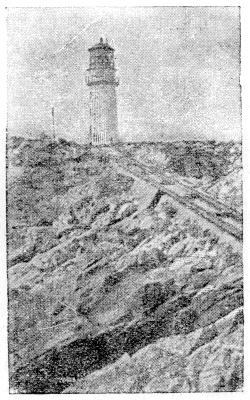
Sule Skerry Lighthouse.
The Residenters.
The birds of Sule Skerry may be divided into three classes—the residenters, the regular visitors, and the occasional visitors. The class of residenters is represented by the great black-backed gull, the herring gull, the shag or green cormorant, and the meadow pipit.
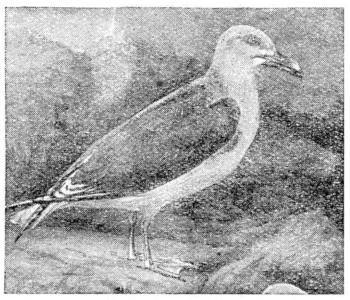
Great black-backed gull.
The great black-backed gull is one of the handsomest birds of the gull family, but owing to its destructive propensities amongst small birds, rabbits, and occasionally young lambs, a continual warfare has been waged against it for years by farmers and gamekeepers, until now it is almost entirely banished to the outlying parts of the country. Before the lighthouse was erected on Sule Skerry, large numbers of this species frequented the island; but the lightkeepers found them such arrant thieves that they reduced their numbers considerably. There are still about twenty pairs resident on the island all the year round, and they seem to find plenty of food either on land or at sea. Their breeding-time is in May, and sometimes as late as June. When the young are hatched the parents are continually on the lookout for food, and I have often seen them swoop down and seize young rabbits. Frequently they make desperate efforts to capture the old rabbits, but never successfully. They lay three eggs in a nest composed of withered grass, and the process of incubation lasts about four weeks.
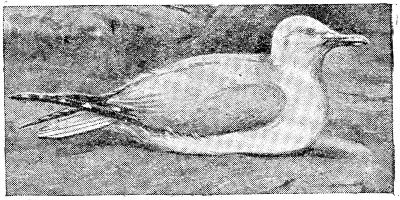
Herring gull.
A small colony of herring gulls stays on the island all the year round, but in summer vast flocks of them are in evidence when the herrings are on the coast. Only the residents remain to breed, and about a dozen pairs annually rear their young and spend their whole time in the vicinity. Some of the young must emigrate to a more genial climate, for although rarely disturbed their numbers are not increasing. They lay three eggs early in May, and sit about four weeks. When hatched, the young immediately leave the nest, and are so like the surrounding rocks in colour that when they lie close it is almost impossible to discover them. When hunting for food for their offspring, these gulls are almost as great a pest as their cousins, the great black-backed, and are more audacious thieves.
The most numerous of the residenters are the scarfs. In summer and winter they are always on the island, and apparently there is an abundant supply of suitable food in the vicinity, for they never go far away. During winter they congregate on the rocks in large flocks or colonies, and they have become so accustomed to man’s presence that they fly only when one approaches within a few yards of them. In very stormy weather they seek refuge in some sheltered spot, far enough away from the coast-line to be safe from the encroaching waves, and only when frightened by any one approaching too near do they choose what is, in their opinion, the lesser of two evils, and seek safety in flight. With the advent of spring they, like all other birds, turn their thoughts to love. Their comparatively homely winter dress gradually changes to one more appropriate to this sentiment and more in harmony with the imposing surroundings. Early in the year their plumage assumes a greener tint, and the graceful tuft or crest on the top of the head becomes more and more prominent. This crest practically disappears about the end of June, and seems to be a decoration in both sexes only during the nuptial season. Usually they manage to get through with their love-making and selecting of partners by the middle of March, after which the operations of nest-building are undertaken.
In Orkney we associate a scarf’s nest with some almost inaccessible cliff, but such is not the case on Sule Skerry, for the simple reason that there are no cliffs. The nests are built all over the island, but principally near the coast-line; and the sociableness of the bird’s disposition shows itself in this fact, that they tend to crowd their nests together in certain selected spots, to which they return year after year. One place in particular, a patch of rough, rocky ground from forty to fifty yards square, I have named the scarf colony on account of its numerous population during the breeding season. Here in 1898 I counted fifty-six nests.