Part III.—Nature Lore. (continued 2)
Reading edition
As to the materials used for nest-building, these are principally seaweed and grass, but the scarf is not very particular as to details, and uses anything that will suit the purpose. I have found pieces of ordinary rope, even wire rope, and small pieces of wood used, and a very common foundation is the skeleton of a rabbit which has died during the winter. During building operations I have observed that one bird builds and the other brings the materials. After all has been completed, three, four, and sometimes five eggs are laid. Three is the most common number; five is rare. During incubation the one bird relieves the other periodically. It is a common sight to see one come in from the sea, sit down at the edge of the nest, and hold a long palaver with its mate. The sitting bird then gets up and flies out to sea, the other taking its place.
When the young come out of the egg they are entirely naked, of a dark sooty colour, and particularly ugly. Towards the end of the first week of their existence a coating of down begins to grow, followed by feathers in about three weeks. As near as I can judge from observation, the bird is fully fledged in five weeks from the time of hatching.
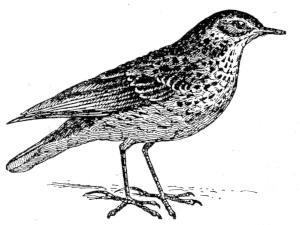
Meadow-pipit.
The only other residenter is the meadow-pipit, tit-lark, or moss-cheeper. It is the only small bird that remains on the island all the year round. It nests generally in May, and lays five or six eggs. It is said that two broods are raised in the season, but I have never noticed that here. Towards the end of summer they are to be seen in considerable numbers, but in September and October the island is visited by kestrels, who soon thin them down.
The Regular Visitors.
The regular visitors are puffin, razor-bill, common guillemot, black guillemot, oyster-catcher, tern, eider duck, kittiwake, stormy petrel, curlew, snipe, turnstone, and sandpiper. In this list I have advisedly placed first the puffin, or tammynorie, or bottlenose, or coulterneb, or pope, or sea-parrot, for it is a well-known and well-named bird. In point of interest it undoubtedly takes the first place among all our feathered friends. Its remarkable appearance, its activity, its assertive disposition, and the regularity of its habits, compel the attention of the most careless observer.
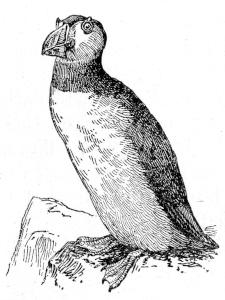
Puffin.
At one time puffins were much in demand for food. An old history of the Scilly Islands tells us that in 1345 the rent of these islands was three hundred puffins. In 1848, on account of the bird having got scarcer, and consequently more valuable, the rent was fifty puffins. We are also led to understand that the young birds, being plump and tender, were more highly esteemed than their more elderly and tougher relatives.
The most remarkable feature of this curious bird is its beak, the peculiarities of which are its enormous size compared with the size of the body, and its brilliant colours—blue, yellow, and red. For a long time it was a puzzle that occasional dead specimens found washed ashore in winter had a beak very much smaller and destitute of bright colours. It has now been ascertained that the outer sheath is moulted annually, being shed on the approach of winter and replaced at the return of the breeding season.
To give any idea of their numbers on Sule Skerry is an almost impossible task, for when they are on the island they are hardly ever at rest. The air is black with them, the ground is covered with them, every hole is tenanted by them, the sea is covered with them. They are here, there, and everywhere.
They first make their appearance early in April, and spend from eight to twelve days at sea before landing, coming close in round the island in the forenoon and disappearing at night. Before landing they fly in clouds round the place, and after having made a survey to see that all is right, they begin to drop in hundreds, till in half an hour every stone and rock is covered. They do not waste time, but start at once to clear out old holes and make new ones, and for burrowing they can easily put a rabbit in the shade. Those who are not engaged in digging improve the shining hour by fighting, and for pluck and determination they are hard to beat. They are so intent on their work that I have often seized the combatants, and even then they were unwilling to let go their hold of each other; but when they do, it is advisable for the person interfering to let go also, if he would avoid a rather unpleasant handshake.
After spending a few hours on the island they all disappear, and do not usually land again for two days; but when they do come back the second time there is no ceremony about their landing. They come in straggling flocks from all points of the compass, and resume their digging and fighting. They continue in this manner, never remaining ashore all night till the first week of May. They spend very little time on the construction of their nests, which consist merely of a few straws. The greater number burrow in the dry, peaty soil, and their holes will average at least three feet underground; but there are also an immense number that lay amongst loose rocks and stones on the north side of the island. The eggs laid there are always clean and white until the young bird is hatched; but those laid underground in a day or two become as brown as the soil, and seem more like a lump of peat than an egg. During the time of incubation, which lasts a month, those not engaged in hatching spend their time in fishing and resting on the rocks, and as a pastime indulge in friendly sparring matches.
One easily knows when the young are hatched by seeing the old birds coming in from sea with herring fry or small sand-eels, which are carried transversely in their bills, from six to ten at a time. The sole work of the parent birds for the next three or four weeks is fishing and carrying home their takes to the young. Very little time is given to nursing. They remain in the hole just long enough to get rid of their burden, and then go to sea again. As the young ones grow, the size of the fish brought home increases. At first it is small sand-eels from one and a half to two inches long, but at the end of a fortnight small herrings and moderate-sized sand-eels are the usual feeding. I noticed an old bird fly into a hole one day with a bigger fish than usual, and, to see what it was, I put in my hand and pulled out both birds. The tail of the fish was just disappearing down the young one’s throat, but I made him disgorge his prey, and found it to be a sand-eel eight inches long. How that small bird could find room for such a dinner was really wonderful.
At first the young are covered with a thick coating of down, and probably their appearance at this stage has given rise to the name “puffin,” meaning a “little puff.” In a fortnight the white feathers on the breast begin to show, and the birds are fully fledged in four weeks, when they at once take to the water. As soon as they go afloat, young and old leave the place, and about the middle of July one can easily see that their numbers are decreasing, the end of August usually seeing the last of them.
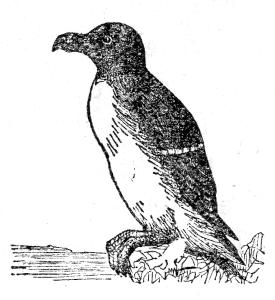
Razor-bill.
There is a considerable colony of razor-bills on the island. Their time of arrival is about the same as that of the puffin, but they make no commotion when they come. They seem to slip ashore, and always keep near the coast-line, ready to fly to sea when any one approaches. They begin laying towards the end of May, and lay one egg on the bare rock, usually under a stone, but in some cases on an exposed ledge. During incubation one bird relieves the other, for if the egg were left exposed and unprotected the black-backed gull would very soon appropriate it. Some authorities say that the male bird brings food to its mate; but I have never observed this, though I have watched carefully to see if such were the case The young remain in the nest, or, to speak more correctly, on the rock, for about two weeks if not disturbed, and I have seen a young one remain ashore until covered with feathers, which would mean about four weeks from the time of hatching. They all, young and old, leave early in August. I am sorry to say they are becoming scarcer every year, chiefly on account of their shyness and fear of man.
The common guillemots are scarce. Their great haunt in this vicinity is the Stack. There they are to be seen in myriads on the perpendicular side of the rock facing the west. Only two or three pairs take up their abode on the island; in fact their numbers scarcely entitle them to be called Sule Skerry birds. The few young ones I have seen are carried to the water as soon as they are hatched—at least they disappear the same day.
Black guillemots or tysties are plentiful. Their time of arrival is about the middle of March, but they are rarely seen ashore before the end of April. Their nests are to be found in out-of-the-way crevices or under stones, and are not easily discovered on account of the extraordinary watchfulness of the birds and their care not to be caught on or near their nests. They lay two eggs, and the young are fully feathered before going afloat. They remain about the island till the end of September.
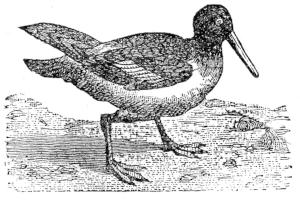
Oyster-catcher.
The first of all the visitors to arrive are the oyster-catchers. They first put in an appearance about the end of February, when their well-known cry denotes that the long, dreary winter is over. They spend their time till the end of March chiefly feeding along the coast-line; but after that time they pair, and are seen all over the island. About the end of May they lay three eggs in a nest composed of a few small stones; and when the young are hatched the noise of the old birds is perfectly deafening on the approach of an intruder, and even when no one is annoying them the clamour they make almost amounts to a nuisance. On calm, quiet nights it is hardly possible to sleep for them, and one feels inclined to get out of bed and shoot them down wholesale. The young leave the nest as soon as hatched, and are rarely seen, for on hearing the warning cry of the parent bird they at once hide among the long grass or under stones, and on one occasion I found a pair some distance underground in a rabbit’s hole. They all leave the island during the first half of September.
Next to the puffins in numbers are the terns—the Arctic terns. They are also like the puffins in the regularity of their arrival at the island. When first seen they are flying high up, and they continue doing so for a day or two, only resting at night. There are several varieties of terns scattered all over the British Isles, but in the north the most numerous are the Arctic and the common tern. The latter rarely visits the island.
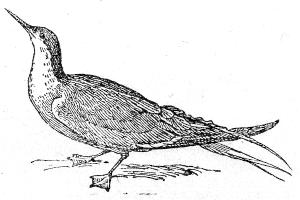
Arctic tern.
There are certain localities where the terns take up their abode, and they stick closely to the same ground year after year, never by any chance making a nest twenty yards outside their usual breeding ground. They begin to lay in the first week of June, but I have found eggs on the last day of May. They lay two eggs, and sometimes three. When the young are hatched the parents are kept busy supplying them with food, which consists chiefly of sand-eels and herring fry. Their method of fishing is to hover over the water, not unlike the way a hawk hovers when watching its prey, and when they see a fish to make a dart on it, rarely if ever failing to make a haul. They also prey on worms when it is too stormy for fishing at sea. On a wet evening, when the worms are having an outing, the terns are to be seen in hundreds all over the island, hovering about six feet above the ground, every now and again making a dart down, and, when successful, flying home with their catch to the young. No time is lost, for the old bird seldom alights when handing over the worm. It swoops down to where the young ones are standing with outstretched necks and bills gaping, screaming out to let their whereabouts be known, and then flies off again for more. When the young are able to fly they accompany their parents over the island, and occasionally do a little hunting on their own account.
About the first of August the young are fully fledged. Young and old then assemble from all parts of the island to a piece of bare rocky ground on the north-east corner, which they make their headquarters for about ten days, flying out to sea for food, but always returning at night. About the fifteenth of August they all disappear, and are seen no more till the following May.
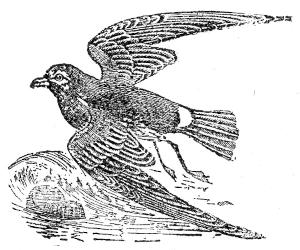
Stormy petrel.
The island is the headquarters of a large colony of stormy petrels. It is not an easy matter to fix the exact date of their arrival, for they are never seen during the day, and only come out of their holes at night. They are first seen in the latter end of June, when on a fine clear night one can see them flitting about close to the ground, very like swallows in their movements. They begin to lay in July, and their nests are to be found under stones and in rabbits’ holes. Almost the only way to find them is to listen for their peculiar cry, which they keep up at intervals the whole night through. If captured during the day, they seem quite dazed when released, and at once fly into some dark place. The date of their departure, like that of their arrival, is not easily fixed, but I think it is during September. Young birds have been got on the lantern at night as late as the end of September, but never in October.
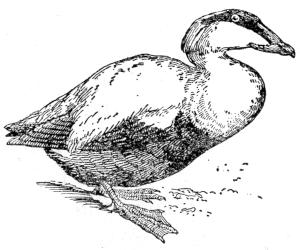
Eider duck (male).
The eider duck is a regular visitor, and a considerable flock make Sule Skerry their headquarters for about eight months in the year. They are first seen in March fishing off the island, but they very rarely land before the end of April. In May they may be seen ashore every day, but always near the water, ready to pop in if alarmed. They are very shy and difficult to approach. In June the duck and the drake both come ashore and select a place for their nest, and that is the only occasion on which the drake takes a part in the hatching process. So far as my observation goes, I have never seen him approach his mate during the month of incubation.
The nest is built sometimes on a bare rock, but more commonly among grass, and consists of coarse grass for a foundation, the famous down being added only as the eggs are laid. Five or six is the common number found in one nest. From the time it begins to sit until incubation is completed, the duck never leaves the nest unless disturbed, and will only fly to sea if driven off. If approached quietly, it will allow one to stroke it, and does not seem afraid. There are always one or two nests close to the house, and though I have watched them closely at all hours, night and day, I have never seen the birds go away for food, nor have I seen their undutiful spouses bring any to them. I will not venture to say that the duck lives a month without sustenance, but I am strongly inclined to that belief. When frightened away, it goes only a short distance, and returns immediately as soon as the cause of its fright has been removed.
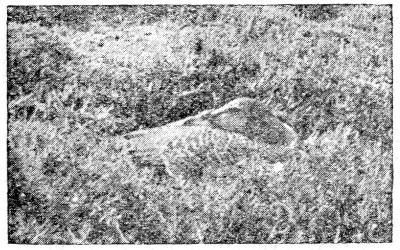
Eider duck on nest.
The whole inside of the nest is lined with down, which seems to be intended only for the purpose of keeping the eggs warm. It is certainly not intended to form a cosy nursery for the young, as they leave for the sea a few hours after birth and do not return. Unless the down is removed before the young are hatched it is useless, for it gets mixed up with the egg-shells, which are always broken into very small pieces. After leaving the nest the young birds rarely come ashore again, but remain afloat, feeding along the edge of the rocks on mussels and crustaceans. The old birds disappear in October, but some young ones remain till the end of November.
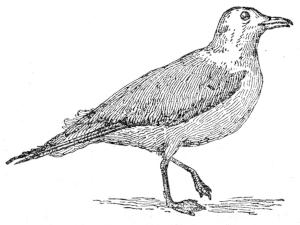
Kittiwake.
Few kittiwake gulls visit the island, but these come regularly, and take up their abode on the same ground year after year. They arrive in April, and about the first of May begin nest-building, a work which keeps them employed for about three weeks. They begin laying about the end of May, and lay three eggs. The young are fully grown before leaving the nest, and are fed by both the parent birds. They all leave the island about the end of August, and not even a straggler is seen till the following spring.
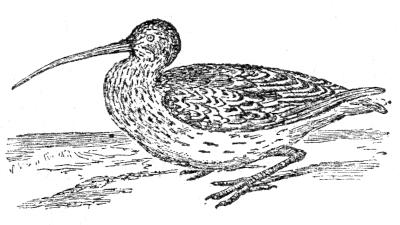
Curlew or whaup.
I have now gone over all the birds that breed on Sule Skerry, and come next to the regular winter visitors, consisting of the curlew, the snipe, the turnstone, and the common sandpiper.
About a dozen curlews or whaups make the island their home for about nine months of the year. They leave about the end of May and return in August, remaining on the island all winter. Their number always keeps about the same—twelve or fifteen. They have the same characteristics as those found elsewhere—their extraordinary alertness and their peculiar cry—but they are distinctly less shy than is usually the case in other parts of the country. They are never disturbed in any way, and the result is that, if any one wished, it would be an easy matter to get within gunshot of them. Their chief food is worms and insects, of which there is a plentiful supply on the island.
When the curlews leave the island, a few whimbrels take their place, and remain about six weeks. They breed in Orkney and Shetland, but though they remain on the island most of the breeding season I have never yet found a nest. I have spent many an hour watching them from the light-room with the glass to see if they were sitting, and have gone over the ground where they are most frequently seen, but could never find an egg or any attempt at nest building. They are very much like the curlew in general appearance, only much smaller.
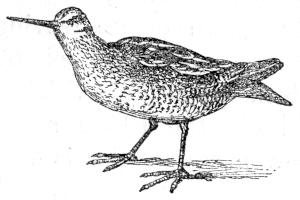
Snipe.
The snipe leaves the island in May, and is absent about four months, usually returning in October. None, so far, have ever nested on Sule Skerry, and they all go elsewhere for that purpose. There is a considerable number of them resident during the winter, larger in some years than in others. They sometimes get killed by dashing against the lantern at night, but it is not often they fly so high.
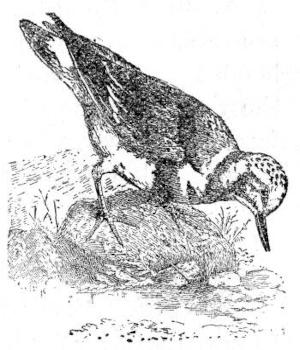
Turnstone.
The turnstone always spends the winter on the island, arriving about the end of August or the first of September, and from then on till April it spends its time feeding on insects. On Sule Skerry it is in no way afraid of man, but rather the opposite, for it depends a good deal on the lightkeepers for its livelihood in stormy weather. Whenever the lightkeepers go to feed their hens, the turnstones gather from all parts of the island and sit round at a respectful distance—about a dozen yards—waiting for their share, which they receive regularly every day, and they seem to enjoy it very much. The lightkeepers often turn over big stones to enable the hens to feed on the insects which are there in immense quantities. The turnstones have learned the meaning of this operation, and whether the hens are present or not, they soon gather round for a feast when one retires a short distance. A few specimens of the common sandpiper always accompany them, but they feed more amongst the seaweed along the coast-line, and are more afraid of the approach of man.
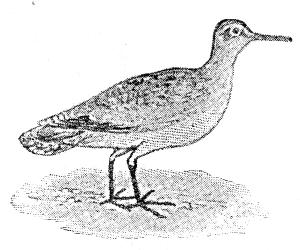
Sandpiper.
Occasional Visitors.
We now come to the third class, the occasional visitors. These are the wild goose, the mallard or stock duck, the teal, the widgeon, the Iceland gull, the Sclavonian grebe, the heron, the kestrel, the hooded crow, the rook, the lapwing, the golden plover, the redshank, the corncrake, the water rail, the fieldfare, the redwing, the snow-bunting, the starling, the song thrush or mavis, the blackbird, the water-wagtail, the stonechat, the woodcock, the skylark, the twite or mountain linnet, the robin, the swallow, the black-headed gull, and the little auk.
Wild geese pass the island on their way south in October, but very rarely rest. Occasionally a flock will hover round for some time, but the sight of a human habitation scares them away, and they continue on their way in the direction of Cape Wrath. Last October half a dozen were seen resting on the island one morning about eight o’clock. They seemed to be feeding in one of the fresh-water pools, but all they would find there would not fatten them. Sule Skerry is a very likely place for them to call at, as it is right in their track when on the way to and from Iceland and Faroe, but perhaps the island being inhabited causes them to give it a wide berth. At any rate very few of them ever honour it with a visit.
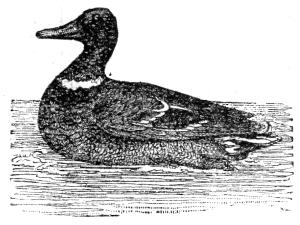
Mallard.
The mallard pays the island frequent visits during the winter, two and three at a time. They never stay long, for there is very little feeding for them. They are particularly shy, resting only on the most outlying parts, and seeming continually on the watch. Teal and widgeon are not common. Of the former one sees a specimen or two every winter, while of the latter only two have visited the island, and that was in March 1897, when they stayed a few days.
In November 1895 an Iceland gull arrived on the island, and remained to the end of February following. It became fairly tame, sitting the greater part of the day near the house on the watch for any scraps of meat that were thrown out. Hopes were entertained that it intended remaining permanently on the island, but on the approach of the breeding season it departed. In 1898 one stayed for a week in November; in the following year another was seen on the 23rd of November. This one was fishing in company with some common gulls, and occasionally flew over the island quite close to the tower; but I did not see it alight, nor was it seen again on any of the following days.
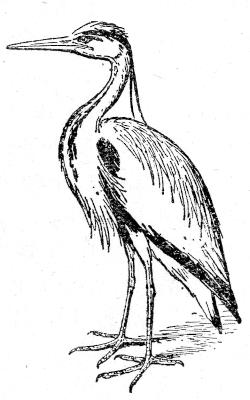
Heron.
The common heron every year spends a day or two on the island, generally in October or November, but it never seems at home. They wander about in search of food, but apparently do not find very much. When leaving the island they always, without exception, fly in the direction of Cape Wrath, but where they come from I cannot say, never having noticed them arriving.
The hooded crow is an annual visitor, generally in November, and it sometimes comes for a short visit in April. Two or three is the common number at one time. There is, however, not much food for them, and on that account their visit is soon over. A few rooks call about the same time.
Every year in April the lapwings make the island a resting-place, staying from a week to a fortnight. The place does not seem to suit them for nesting purposes, for I have never seen them make any attempt at nest-building. After resting and renewing their strength, they seek out some more hospitable part of the country. Small flocks of the golden plover also rest on the island on their passage north in March and April, and again on their way south in October and November, staying from eight to twelve days. There are also a few straggling visitors during the winter.
The common redshank is a frequent visitor, staying perhaps a week at a time, but it never nests on the island. In 1896 a corncrake’s well-known song was heard during the greater part of June. It was heard again the following season, but never since. The bird, however, is occasionally seen in summer. The only way I can account for its silence is that the goats and rabbits never allow the grass to grow to any length, and thus there is no cover for it. I think most ornithologists are now satisfied that this bird migrates to a warmer climate every year on the approach of winter. Whether such is the case or not I do not feel prepared to say, but from my experience of Sule Skerry I am quite satisfied it is only a summer visitor there, and does not remain on the island all winter. The water-rail pays the island a visit every winter, but I do not think there is any danger of its being mistaken for the corncrake. They are a little like one another in shape, but they are two distinct species, and easily recognized.
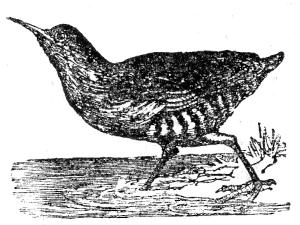
Water-rail.
In October and November the island is visited annually by considerable numbers of fieldfares, redwings, blackbirds, rock-thrushes, starlings, and woodcocks. They generally stay from a week to a fortnight, and are more numerous some years than others. Water-wagtails are rare visitors, seen at various times of the year. Stonechats are also rare visitors, only staying a few days in May. The skylark, so common everywhere else, is a very rare visitor, and is only seen or heard once or twice during the summer months. Robin redbreast is always seen in the autumn, and generally stays a few weeks if the weather is moderate. The twite or mountain linnet pays an occasional visit in summer, and stays for some time; but I have never yet found a nest, and cannot say if it breeds on the island. In June every year a few sparrows spend a fortnight on Sule Skerry. Snow-buntings almost deserve the name of regular winter visitors, for from October to March they are seldom long absent.
Last September I got a bird which I knew to belong to the grebe family, but I could not be sure of its proper name, and I sent it to Mr. Harvie Brown for identification. He informed me it was a Sclavonian grebe, a bird not very common in this part of the country. In November 1897 I found a dead specimen of the little auk.
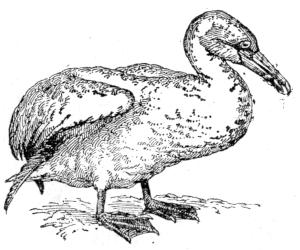
Solan goose.
Though not a Sule Skerry bird, the solan goose deserves notice in this paper. The Stack, distant four and a half miles, has been their chief breeding place in Orkney for ages, and every year it is tenanted by immense numbers. The rock is 140 feet high, rising perpendicularly on the west, but sloping gradually from the water to the summit on the east side. It is on this slope that the solans congregate, and no other bird is allowed to trespass on their preserves. In May, June, July, and August their numbers are so vast that any one seeing the rock at a distance would imagine it was painted white or composed of chalk. Sule Skerry, however, is too far distant to allow of one forming any idea of their numbers, but looking at them with the glass one sees the rock simply covered, and apparently as many flying about as resting. Lewis men visit the place annually in August, and carry away a boatload of young birds. Last year they came up to the rock, but there was too much surf for a landing, and as the weather was threatening they headed for the Sutherlandshire coast. That night the wind blew half a gale, and fears were entertained that it would prove too much for them, for their boat was small and hardly powerful enough to be so far from home; but a few days later they again approached the rock. They again failed to negotiate it, and after waiting for about an hour they made sail for home, and did not return. The weather certainly favoured the solans on these occasions.
I have never seen a solan resting on Sule Skerry; they even carefully avoid flying across the island, though they fish in immense numbers all round, and sometimes within forty or fifty yards of the shore. They usually begin to arrive in the vicinity about the end of January, and their numbers continue to increase until the end of April, when they take possession of the rock, and from then until the end of August their name is legion. When the young are fledged, they gradually disappear, and from the first of December till the last days of January they are not to be seen.
Thus they go on year after year, a fraction of that great feathered multitude which has come and gone since the earliest ages, and will probably continue to come and go as long as the world lasts, some arriving and departing in silence, others heralding their coming and going with the wildest clamour. On this subject, and speaking of the northern isles, Thomson the poet says:—
“Where the Northern Ocean, in vast whirls, Boils round the naked melancholy isles Of farthest Thule, and the Atlantic’s surge Pours in amongst the stormy Hebrides; Who can recount what transmigrations there Are annual made? what nations come and go? And how the living clouds on clouds arise, Infinite wings! till all the plume-dark air And rude resounding shore are one wild cry?”
J. Tomison (“Orcadian Papers.”)
COMMON SEAWEEDS.
A severe storm has been raging for several days on our shores, and no ship has dared to cross the Pentland. To-day a great calm has fallen upon the face of the waters, and the sun shines clear in the sky. A walk by the seashore on such a morning will afford an excellent opportunity for collecting specimens of our seaweeds, and for studying their life-history.
Here they lie in all their varied colours, strewn on the beach like autumn leaves in a forest. Now is our chance to secure some of those rare and beautiful weeds that grow in the deeper water, and have been torn off and driven ashore by the waves. If pressed and dried with care, they will remain things of beauty for long. For this purpose we use squares of stiff paper or card, on which we spread them out carefully under water. When pressed, they will adhere to the paper by means of the mucilage which they contain.
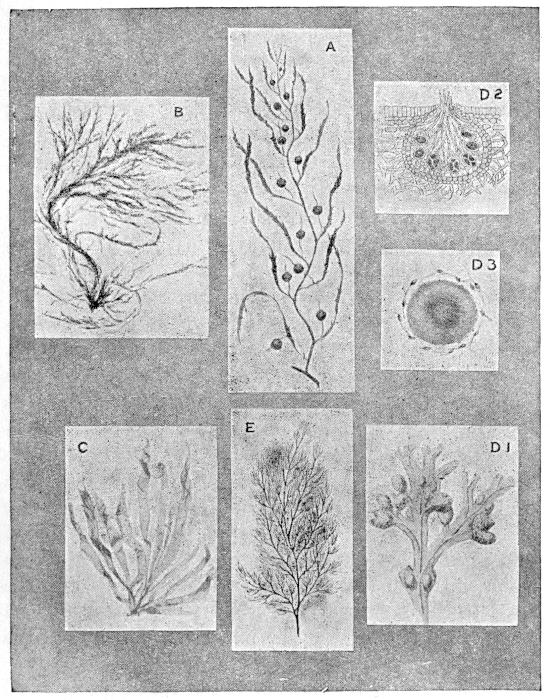
Common seaweeds.—I.
A, Sargassum (Gulf-weed), B, Cladophora. C, Enteromorpha. D 1, Fucus vesiculosus. D 2, Receptacle of same, with eggs and sperms. D 3, Egg, with sperms. E, Polysiphonia.
The delicate fern-like or feathery fronds of those red seaweeds will compare in beauty with the best of our flowering plants. This is all the more wonderful when we consider their lowly origin. For the family of the Algæ, to which the seaweeds belong, is the oldest and most primitive of all the families of plants. To the Algæ most likely belonged the first forms of life which appeared on the earth.
If we are fortunate to-day we may find a specimen of the famous Gulf-weed (Sargassum), which gives its name to the Sargasso Sea, and which is said to have cheered Columbus on his celebrated voyage of discovery. In the tropical Atlantic it covers immense areas of the ocean, and it is occasionally cast ashore on the Orkney coasts, drifted hither by the Gulf Stream and the westerly winds. It is easily recognized by its numerous little round air-bladders, each on a separate branch.
Now let us turn our attention to the seaweeds which we find growing on the beach around us. In many a rock pool in the “ebb” we may see a miniature forest of tiny weeds of beautiful colours and forms, a veritable ocean garden. Near high-water mark we find here and there in the pools pretty green algæ, some with broad, flat fronds, such as the sea-lettuce (Ulva), and others with slender branching feathery filaments (Cladophora). Many of the green algæ, however, prefer to live in fresh water. If you make an aquarium, you will find the sea-lettuce and the sea-grass (Enteromorpha) of great value in keeping the water pure, owing to the amount of oxygen which they give out.
Farther down on the beach the rocks are covered thickly with algæ of an olive-brown colour. The rocks, indeed, would fare much worse in a storm if the seaweeds were not there to protect them, as the grass protects the soil of the fields.
Look more closely at those big brown sea-wracks and you will notice that the most common kind (Fucus vesiculosus) has little globular air-bladders arranged in pairs along its flat, smooth-edged fronds. Each blade has a distinct midrib, and where it divides, like all the Fucus group, it splits into two equal branches. On some of the little end branches you may see a yellowish swelling dotted over with minute knobs and pores. These swellings are receptacles for holding the eggs and sperms, which are contained in tiny cavities under each projecting knob. Many seaweeds produce their fruit in winter, when the land plants are sleeping and the fields are bare.
The microscopic sperms correspond to the pollen and the eggs to the ovules of the flowering plants. But there is one wonderful difference. The sperms of the Fucus can move about freely by means of two little projecting threads or cilia. When the tide is out, both eggs and sperms come to the door of their little houses by the help of the mucilage in which they float; and when the sea comes back swarms of these sperms swim away and wriggle about, till one of them comes in contact with an egg. It adheres to and fuses with the egg, which thus becomes fertilized, and is then able to give rise to a young plant. A similar process goes on in all the plants of the Fucus group.
Here is one with notched or serrated edges (Fucus serratus), and without air-bladders; there another well known to every schoolboy as the “bell tang” (Fucus nodosus), with large air-bladders in the centre line of the frond, and yellow fruit-bodies each on a branch of its own, without any trace of midrib.
The air-bladders of the seaweeds are natural buoys, by means of which the plants are kept erect in the water. The mucilage which makes them so slippery to walk over is of the utmost importance, as it protects them from drought when they are left uncovered by the tide. Seaweeds are very simple in their structure, and have no true roots, stems, or leaves. They do not need such organs, for every part of their body is in contact with the water which contains their food-supply.
What are those tufts of reddish-brown threads growing all over the fronds of this Fucus? That is a red seaweed (Polysiphonia), which often makes its home under the shelter of a more hardy plant. In the red algæ the sperms have no cilia, and cannot move about of themselves, but the eggs have each a long thread, corresponding to the stigma of the higher plants, and against this thread the sperms are driven by currents of water.
The little Fucus known as “teeting tang” (Fucus canaliculatus) ought not to be passed unheeded. It is often much relished by sheep and cattle. You may know it by its greenish-brown colour and by the distinct groove on one side all along its length. It is found only in the upper part of the “ebb”. Another interesting plant of this group may be found on the large rocks nearer low-water mark. It is called the “sea-thong” (Himanthalia lorea), because its fructification grows out from a button-shaped base into long, forked, thong-like branches.
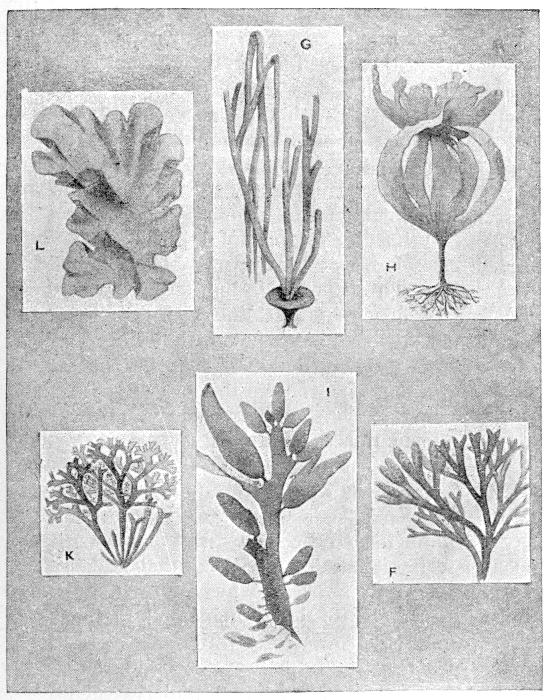
Common seaweeds.—II.
F, Fucus canaliculatus. G, Himanthalia lorea. H, Laminaria digitata. I, Rhodymenia. K, Chondrus crispus. L, Porphyra.
If the tide is far out, we shall be able to see the tops of the “red-ware” standing out of the water, and some of the tangles will be quite dry. These tangles belong to the Laminaria group, the giants among the seaweeds. They contain a large amount of iodine in their composition, and that is why they are used for the manufacture of kelp. Notice how firmly they cling to the sea-bottom by their strong holdfasts, which have weathered many a storm.
An interesting feature in this group is their manner of growth. The growing region lies at the junction of the stalk with the blade. You will often find a specimen in which the old blade is being pushed away on the end of the young one, ready to be broken off and cast adrift by the waves. The stalk itself is perennial, but in some kinds of Laminaria (Laminaria digitata, for example) the blade is usually torn into shreds before it is thrown off.
A well-known ally of the tangles is the “merkal,” also called “honey-ware.” You can tell it by the prominent midrib and the broad, thin wing on each side, running all its length. This is one of the edible seaweeds. Do you see this bright red palmate plant growing under the shelter of the tangles? It is the common dulse (Rhodymenia palmata), which may often be seen for sale on the streets of our cities. Examine it well and taste it, and you will be able to recognize it in future, however much it may vary in form or colour. But do not eat too much of it, for it is said to be somewhat indigestible.
Another edible seaweed which has been widely used as an invalid food may be found in the lower part of the “ebb,” often under the shelter of larger plants. This is the Irish moss or carrageen (Chondrus crispus). It is fleshy and pink in colour. A jelly is made from it which is considered a great delicacy.
The purple laver (Porphyra) is perhaps the most valuable of the seaweeds as a food, and is said to sell at a high price in Yokohama. In form it resembles the sea-lettuce. Many other marine algæ have been used as food, and none of them are poisonous. In North Ronaldsay the sheep seem to esteem them highly as food.
The most important use of seaweed is to serve as food for various kinds of molluscs, crustaceans, and fishes. The “plankton” of the sea-surface—minute one-celled algæ—are very important in this way. What grass is to the land animals, the marine algæ are to the living creatures of the sea. When driven ashore by the waves, or when cut down by the once familiar “hook,” the larger seaweeds are much used as manure for field crops. They thus repay the debt they owe for any portion of their food that may have come originally from the dry land.
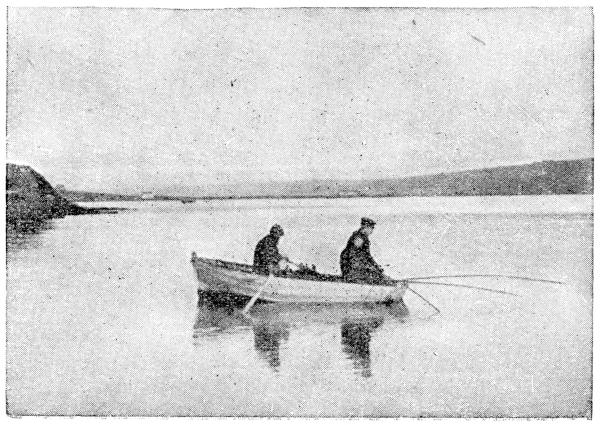
Before returning from our walk let us haul down this small boat from its “noust” and take a bird’s-eye view of the seaweeds in their natural habitat. Through the clear water beneath us we can see the strange shapes of the submerged vegetation, dense and tangled, with here and there a lazy sea-urchin on the broad red-ware, and the sillocks actively swimming around. But our oars are entangled in the “drew” (Chorda filum), so full of annoyance and even of danger to the swimmer. Look at one of those long threads. It is covered with hairs; it tapers towards both ends, and its fructification extends along its whole surface. In structure it is a hollow tube divided into many chambers.
What a variety of colours and shades we see as we look down on this wonderful submarine scenery! We notice that near high-water mark green is the predominant colour, and that the lower belt is mostly brown, while here at low-water mark and beyond it, as well as under the shelter of the sea-wracks and tangles, shades of red prevail. Beyond the depth of thirty or forty fathoms seaweeds are extremely rare, owing to the want of light at the sea-bottom: seaweeds, like other plants, cannot take in their food in darkness.
Notwithstanding their varied tints, the fundamental colour of all seaweeds is green, as you can prove for yourselves by boiling a few brown specimens, or soaking them for some time in fresh water. You will find that the other colouring matters are dissolved out, and only the green is left. The red or brown pigments are probably of use in aiding or in protecting the green colouring matter, chlorophyll, in its important work of assimilating the food material.
CRABS.
When I was a boy at school we frequently amused ourselves by catching crabs. The scene of our operations was the Peerie Sea, where a wall had been built along the shore. Here we used to gather, armed with a piece of string and bait of some kind, and we often spent a whole long evening perched on the wall, fishing for crabs. The Peerie Sea was a receptacle for all kinds of refuse, and formed a happy hunting-ground for swarms of crabs.
When one thinks of catching crabs, one may naturally imagine an excursion to the shore during ebb-tide, and much turning over of stones and seaweed. Our method was quite different. We made the crabs come to us. Our bait was a piece of fish or anything of an animal nature, provided it was fairly tough. No hook was necessary; we simply tied the end of the string round the bait.
The baited line was let down into the water, preferably in the vicinity of a crab, and drawn slowly along the bottom. If the animal was timid, and not very hungry, he often scuttled off in a fright. Usually, however, he was both hungry and fearless, and seized the bait at once, trying to drag it in among seaweed or into a hole. Now came the exciting part of the business. Our object was to haul him up before he quitted his hold. The wall was high, and he required careful management. Sometimes when he was drawn up out of the water he would let go, and fall back with a flop into the sea again; sometimes he would hold on till he was drawn up over the wall, and then we shook him off on the pavement behind.
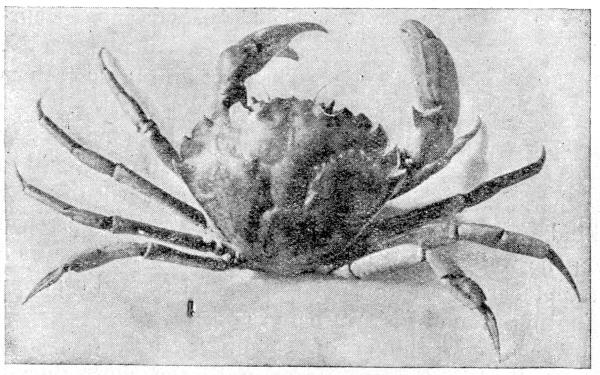
Common shore crab.
Occasionally when we had no bait we would manage to land a crab with a small stone or a cinder. So long as the stone lies motionless on the bottom he pays no attention to it. As soon as it begins to move, drawn along by the string, the crab rushes at it and seizes it with his claws, and it is some time before he finds out his mistake. Not infrequently he will allow himself to be drawn quite out of the water, clinging to his find. It is very amusing to see the crab worrying a hard stone, then dropping it when he has discovered it is not eatable, and then seizing it again as it begins to move away from him, just like a kitten with a ball of wool. Apparently he cannot resist the idea that movement means life.
The commonest kind of crab in Orkney is the green shore-crab. He is on the whole a bold animal, but when frightened he runs away with great speed. He moves sideways, and thus meets with less resistance from the water than if he were to move directly forward. Usually, however, he does not walk fast, but creeps over the bottom in a leisurely fashion. When seizing his food he comes up to it “head on,” his nipping claws held wide apart; when he is near enough, he suddenly brings them together, and begins to tear up the food in little bits and pack it into his mouth.
His eyes are placed on the tip of movable projections, so that they command a wide view. He cannot see behind him, however, or under his body, and he usually keeps his eyes fixed in the direction in which he is going. When he is resting, his eyes are ever on the watch. Every little movement on the beach near him he notices at once.
The crab has a peculiar method of feeding. His mouth is just under his head, and the opening is guarded by two flat jointed plates, one on each side of his mouth. If you pull these two plates apart—after having arranged with a friend to hold his pincers—you can see where his mouth is, and you may notice two strong things which look like teeth. These are really his jaws; they move from side to side, and not up and down like our jaws. To see how he feeds, you must put him into a glass jar, and look up from below while he is eating a bit of fish. He tears it up with his pincers, and puts little bits into his mouth, the parts of which move from side to side as he eats.
He is not very particular as to what he eats. He is, indeed, a cannibal, and will eat the crushed leg of another crab as readily as anything else. He is one of the most useful animals on the beach, however, and has been called the scavenger of the shore. In fact, if one wishes to get the flesh cleaned off the skeleton of any large animal, there is no easier method than to lay it on the beach, well below high-water mark, and build stones around it, leaving spaces between them to admit crabs.
As we have already said, the crab is bold and fearless. He is safe in his coat of armour, and his pincers are powerful weapons of offence and defence. When fighting he rears himself up and throws his nipping legs far apart with the pincers wide open. He then looks a formidable animal; and he really is formidable, for with these legs he can protect almost any part of his body, and the strength of his grip is considerable.
Take up a dead crab and examine his biting leg. The different parts are joined by hinges. Each hinge allows of motion only in one plane, but the various planes are so adjusted that the limb can be moved in almost any direction. Only one part of his body cannot be touched by his pincers, and that is his back. If you wish to grasp a live crab with impunity, seize him across the back just where his walking legs join the body. He may struggle as he pleases, but he cannot nip you.
It is quite a common thing to find a shore crab with one or more legs wanting, or with one large pincer and one small one. What is the reason of this? It means that at one time or other the crab has had a limb torn off in a fight, for the males are continually fighting with one another. When a limb is lost it is not a very serious matter, for a new limb soon begins to grow on again, and after a time becomes as large as the lost one.
There are times, however, when the crab is by no means pugnacious. One sometimes finds under a stone a crab which has hardly enough spirit to lift his pincers in self-defence. On touching him one finds that he is quite soft. What has happened to him? He has recently been casting his coat; for, as the animal goes on growing within his shell, he becomes too big for it, and the only thing he can do is to burst the shell and come out of it, and then wait for a bigger one to grow. When he is thus moulting, he is glad to crawl away and hide till he is able to face the world again. Many of the empty crab shells that one picks up on the beach are the old cast-off clothes of crabs still alive and vigorous. By examining one of these we can see how thorough the process of moulting is; not only are the shells of his back and his legs thrown off, but the covering of his eyes, his feelers, his mouth parts, and even the inside lining of his stomach,—for, strange to say, the wall of his stomach is lined with the same kind of shell as the outside of his body.
The crab is formed for living in water, but he can stand long exposure to the air. If you cover him with damp garden soil or peat mould he will survive for days. The reason is that so long as his gills are kept damp he can breathe and live quite well. The lobster breathes in exactly the same way, and when lobsters are being shipped for the southern markets they are put in boxes with layers of wet seaweed to keep them alive.
Have you ever seen the beautiful set of gills which the crab has? If you find a dead crab that has been lying on the beach for some little time, you can easily remove the upper shell, leaving the soft parts of the body with the legs attached. Just above the attachment of the legs there is a series of brown feathery-looking things which seem to cover the whole side of the body. These are the gills. They lie in a special chamber, occupying about half of the whole space inside the shell. While the crab is alive, the gills are continually bathed in a current of water, which is pumped in through a small hole at the side of his mouth and drawn out at another hole near it. If the gills become dry the animal soon dies.
There is a curious pointed flap folded tightly across the crab’s body underneath, which is commonly called its “purse.” It used to be a schoolboy belief that the crab carries its money here. The fact simply is that the purse is kept closed for the sake of protection, as the skin underneath it is soft and might easily be injured in a fight.
You have all seen the long tail of the lobster, with its broad flaps at the end. By suddenly bending its tail underneath its body the lobster is able to propel itself backwards through the water at a great rate. The crab and the lobster are, as you may know, closely related, and the purse of the former corresponds to the tail of the latter. The purse or tail of the crab, however, is always tucked up under the body, and is never used for swimming.
Both animals carry their eggs on this part of their body, and you may occasionally find a crab with its purse so full of eggs that it cannot be closed. These eggs have a curious history. When they are hatched, it is not a small crab that comes out, but a funny little creature not in the least like its parent. It has a rounded body and a long thin tail, and swims actively about. At this stage it is called a zœa.
By-and-by the creature settles down to the sea-bottom and casts its shell. Its back is now broader and its tail shorter, and it is provided with claws; but it is still quite unlike a crab, and swims freely about. It is now known as a megalopa. Swarms of these may be found clustered round seaweed and other floating substances, both near the shore and in deep water. As it grows it again casts its shell, but it now tucks in its tail and settles down in life as a real crab, though of course a very small one as yet: you may find scores of them on the beach not much bigger than a split pea.
Besides the green crab there are others which are common on the sea-beach. One of these is the edible crab or “partan.” This crab lives in somewhat deeper water than the other, and is of a dark reddish or purplish hue on the back, while its under parts are white. It is not nearly so quick and active in its movements as the green crab, but when it does get hold of anything it has a stronger bite. In deep water it grows to a giant size, and it is regularly caught in creels and sold for food, as its flesh is firm and good to eat. The flesh of the green crab, on the other hand, is much softer and less abundant, and it is not used for eating. Strangely enough, all crabs turn red when boiled, whatever their colour when alive.
Another curious crab is sometimes found in weedy pools on the beach. This animal is of a spidery form, and is much more difficult to see than an ordinary crab, for he is elaborately disguised. His back and legs are grown over with hairy brown seaweed, and as he always lies among a mass of similar weed it is impossible to detect him so long as he remains at rest. When he does move, his movements are extremely slow. If you take him out of the water, he looks a most uncouth creature as he feebly sprawls about. Place him back in the bunch of seaweed from which he was taken, and he immediately adjusts himself so as to become invisible. This is his mode of escaping observation, for he is too slow and weak to be able to defend himself.
Still another odd-looking crab may be found in deep water. This animal has rather thin legs, while its back is somewhat pear-shaped, the pointed end being directed forwards. It is, however, a much more active animal than the last mentioned, and we may often see it from a boat as it climbs about on the broad blades of the tangles. It is rarely found on the beach, but the cast-off shell of the animal may be found on almost any part of our shores.
One of the most interesting of our crabs is known as the hermit-crab. He belongs to the family of soft-tailed crabs, and in shape is more like the lobster than the other crabs we have mentioned. The hinder part of his body being without armour, he is forced to seek an artificial defence, and this he finds in the empty shell of a whelk or “buckie,” into the spiral coils of which he inserts his unprotected tail. These creatures are generally called hermit-crabs, because each lives in his own separate habitation, like a hermit in his cell or like Diogenes in his tub; but unlike these in their habits, they are so pugnacious that they are also known as soldier-crabs.
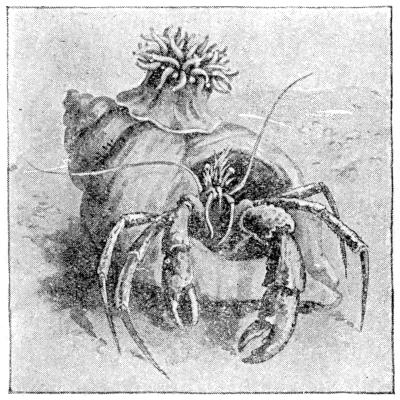
Hermit-crab (with anemone on shell).
Hermit-crabs may be found plentifully on the shores, of various sizes, and inhabiting any kind of shell that they find to suit their size. If we look into a shallow sand-bottomed rock-pool, we may see some of these shells moving about at a rate to which they were quite unaccustomed during the life of their builder and original occupier: we know at once that each of these shells has now as a tenant one of those interesting crabs.
By means of an apparatus at the extremity of his tail the hermit holds firmly to his temporary abode, and he flattens himself closely against the shell, leaving exposed only the one large pincer which is specially fitted to bar the door against intruders. It is difficult to seize the creature at all; and even when a grasp of any portion can be secured, the hold of the tail is so firm that the animal runs some risk of being torn apart rather than leave his shell.
A well-known writer on Natural History, the Rev. J. G. Wood, has given an interesting account of the hermit-crab, from which we quote the following paragraphs:—
“The combative propensities of these creatures are wonderful. If two hermits of fairly equal size are placed in an aquarium, they are not content with appropriating different portions of the vessel to themselves, but must needs travel over it and fight whenever they meet. This struggle is constantly renewed, until one of them discovers his inferiority and makes way whenever the victor comes near. When they fight they do so in earnest, tumbling over each other, and flinging about their legs and claws with great energy. They are not at all particular about diet so long as it is of an animal substance, and will eat molluscs, raw meat, or even their own species. More than once when a hermit has died I have dropped the body into the water so as to bring it within view of another hermit. The little cannibal caught the descending body in one of his claws very dexterously, and holding it firmly with one claw he picked it to pieces with the other, and put each morsel into his mouth in a rapid and systematic manner that was highly amusing.”
“When a hermit desires to change his habitation, he goes through a curious series of performances. A shell lies on the ground, and the hermit seizes it with his claws and his feet and twists it about with wonderful dexterity, as if testing its weight; and after having examined every portion of its exterior, he proceeds to satisfy himself about its interior. For this purpose he pushes his fore legs as far into the shell as they will reach, and probes every spot that can be touched. If this examination satisfies him, he whisks himself into the new shell with such rapidity that he seems to have been acted upon by a spring. Such a scene as this will not be witnessed in the sea unless the hermit is forcibly deprived of his shell, but when hermits are placed in a tank or vase they seem to be rather fond of ‘flitting.’”
HOPPERS AND SHOLTIES.
Of the great multitude of different animals which live on the seashore possibly the most numerous are the little creatures known as “sholties” or “Shetland sholties.” They are to be found on almost every beach. Their peculiar shape, flattened on the sides, their habit of hiding in crowds under stones or seaweed, their intense alarm when they are suddenly exposed, and their vigour in escaping into a new hiding-place, are known to every schoolboy. They look very different from their pugnacious relatives, the crabs; they are feeble creatures, more ready to escape from danger than to offer fight. Yet they are most interesting little animals, and the more one watches their ways the more one comes to understand their wonderful adaptation to their surroundings.
Though their general appearance is quite familiar, it is not so commonly known that there are many different varieties of these creatures. As a matter of fact, there are scores of different kinds, some living on the beach, some just below extreme low-water mark, and others in the deep sea. We shall concern ourselves here only with those that live on the beach.
There are three common kinds which every one ought to know. Two of these, curiously enough, though beach animals are not really sea animals. They are hardly ever in the water; they live on the fringe of beach which lies just above high-water mark. The sea reaches them but rarely, and they never voluntarily seek the water. These two kinds are known as the shore-hopper (Orchestia) and the sand-hopper (Talitrus), the latter being found mostly on sandy beaches, where they make little burrows in which to hide, and the former living under stones or among the decaying seaweed on stony beaches. They both get their name of “hopper” from their habit of leaping or springing into the air, by means of which they often avoid capture by enemies. French people call them “sea-fleas.”
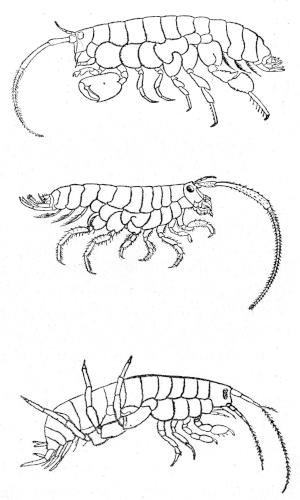
Shore-hopper (Orchestia). Sand-hopper (Talitrus). Sholtie (Gammarus).
(All magnified about three times.)
The third variety, which is probably best known of all, and to which the name of “sholtie” is here more especially applied, is that which occurs farther down on the beach in places which are constantly wet with sea-water. This animal (Gammarus) is much narrower in the body than the other two, and some of its legs are bent backwards along its side, so that by means of them it can run or crawl on its side. Indeed, when out of the water this creature in quite unable to walk back uppermost; whenever by any chance it does succeed in raising itself into what is for most animals the normal attitude, it immediately topples over on its side again. It can be readily distinguished from the other two forms by having two pairs of long, delicate feelers or antennæ in front of its head; the hoppers have only one long pair of antennæ and one short pair.
All these animals, in spite of their small size, are near allies of the crabs and lobsters. A naturalist would tell you that they belong to the group of the Crustacea, this name being applied to all animals of the crab tribe on account of the firm, crackly skin or shell which surrounds them. The Crustacea are marked by other features in addition to the possession of this hard exterior. They are all jointed animals, their body being built up of a series of segments, each of which carries a pair of legs or appendages of some kind, these appendages also being jointed. In the crab and the lobster a number of segments have become fused or welded together to form the front part or body of the animal. In the group of animals to which the sholties belong the segments are all distinct.
To understand something of the structure and the general habits of the sholtie, all that we require to do is to collect a few specimens from the beach and put them in a saucer with a little sea-water. They will swim about in a very active fashion, the swimming being performed by means of little fan-like appendages attached to the under part of the animal just where the swimmerets are in the lobster. By the vigorous strokes of these appendages the animal forces its way through the water.
These appendages are, however, of use in another way; the gills of the animal are attached to them. Even when it is lying almost dry, or in water too shallow for swimming, these appendages can be seen to work regularly and rhythmically with a gentle flapping movement. Sometimes they stop working for a little and then begin again, but they are never long at rest. In this way currents of water are made to bathe the gills continually, and the flapping of the appendages is really a breathing movement.
The walking legs are attached to the fore part of the body. Some of them point backwards, as has already been mentioned, and the animal prefers to crawl or run on its side. As a rule, too, it propels itself over the ground by jerking movements of its body, its tail being alternately curled up and then suddenly straightened out again. It is in this way that it wriggles over the stones and escapes into a place of safety when exposed.
One of the most characteristic points about the sholtie is its habit of clinging to objects, especially if they afford a cover from the light. Drop a bit of seaweed into the dish where they are swimming, and in two or three minutes the sholties will all be found clinging to the under surface of the weed. We might indeed imagine that they had escaped from the saucer. They cluster like swarming bees round the smallest blade of seaweed, and it is only by turning over the weed that we can make sure that they are there. When exposed to full daylight they seem uncomfortable, and keep swimming about trying to find a hiding-place. It is only when they find something to cling to and to hide under that they really rest and feel at ease.
But we have not yet examined the hoppers. Though externally so like the sholties, they are very different in constitution and habits. To understand the difference between the two classes of animals, the best plan is to put either a shore-hopper or a sand-hopper into some water along with a sholtie. The latter is an active little animal in the water, capable of moving about like a fish. The hopper, on the other hand, is obviously out of his element; he sinks to the bottom of the dish and there works his way along in lumbering fashion. His breathing organs can be seen waving backwards and forwards in rhythmical fashion, but they are too feeble to be used for swimming. The shore-hopper can breathe quite well in water, and may live in it for days. It is said that sand-hoppers do not stand long-continued immersion, and die of drowning.
On land, however, the hopper is at home, provided he gets just sufficient moisture to keep his gills damp. Not only can he crawl about back uppermost—a feat which the Gammarus would attempt in vain—but as he crawls he keeps his tail curled up under his body, and by suddenly straightening this out he can throw himself into the air with considerable vigour. In this way he often not merely escapes from an enemy, but even drives terror into the heart of the pursuer. It takes some little time to realize that hoppers can be handled with impunity, and are harmless for all their sudden jerky movements.
Why do these animals live on the upper fringe of beach, and what do they find there to eat? The answer is simple. They live on the cast up refuse of the sea; they are the scavengers of the jetsam. Naturalists who are collecting the skeletons of small animals often put the carcases which they wish to have cleaned under some decaying weed on the beach. After a week or a fortnight the bones are found to be picked absolutely clean.
In order to tell the sand-hopper from the shore-hopper we have only to look at his front feet. If they are all thin and slender, the animal is a sand-hopper; if one pair of the front feet are clubbed at the end and armed with a claw, we know that he is a shore-hopper.
SEA-ANEMONES.
When the tide ebbs and leaves the rocks exposed we may find here and there a few soft, rounded objects attached to the bare rock, often bright red in colour, and looking like strawberries or ripe cherries. They are found especially on the sheltered sides of high rocks and in the angles formed by slight ridges and clefts. We do not seem to have any local name for these objects, although they are so common and conspicuous; one wonders why our name-inventing forefathers did not bestow on them some descriptive title. Their English name is “sea-anemone,” a term derived from their resemblance to the anemone flower.
It is only when they are covered by the water, however, that they deserve the name of anemone, for then they open out like a bud and spread out circles of leaf-like projections, much as an opening daisy or dandelion does. They usually remain open during the whole time that the tide is up; when the water goes back again these leaves all curl in towards the middle of the anemone and are folded up inside, leaving only a little dimple on the top to indicate where they have disappeared.
Sea-anemones, however, are by no means flowers. Their jelly-like consistency and their habits would lead us to classify them as animals, and this they undoubtedly are. Though they seem to be rooted to one spot, and to open and close like a plant, their real habits are those of an animal. As a matter of fact, they are carnivorous animals; they first kill their victims by poisoning them, and afterwards devour them. If they had the power of moving rapidly in pursuit of prey, they would be as deadly to the general population of the beach as are the most venomous snakes to the creatures on land. As it is, they account for a very considerable number of the beach inhabitants by simply lying in wait and grasping the little animals that happen to stray within their reach.
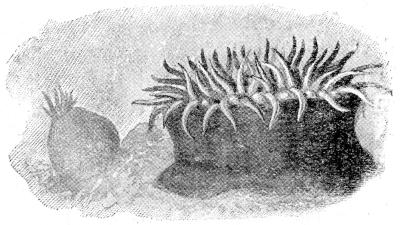
Sea-anemones.
The beautiful circles of leaflets which we see so regularly arranged are really active grasping tentacles, armed with whole batteries of little poisonous stings. With these tentacles they seize hold of any little creature, such as a “sholtie” or a young crab, that happens to move over them. The poor animal is held fast in spite of all its struggles, tentacle after tentacle is brought up by the anemone to grasp it, while hundreds of fine stinging darts discharge into it their poison, and the victim, its struggles gradually becoming more and more feeble, is ultimately drawn into the centre of the animal, where lie its mouth and its stomach. Then the tentacles are all closed in over the prey, and remain thus closed for a time—a day or several days, according to the size of the animal caught. During this time the process of digestion is going on, and when it is completed the skeleton and useless parts of the animal are discharged by the same opening as that by which it was taken in, and the anemone once more spreads its tentacles to wait for its next victim.
It is not only living animals that the anemone will devour. Anything of animal nature, dead or alive, is grist to its mill; and though it has no eyes, it can quite well distinguish what is good for food. A waving branch of seaweed borne towards it by currents in the water is quite ignored, while a bit of flesh is never allowed to come in contact with the tentacles without an effort being made to secure it. By some natural power, whether by the sense of smell or of taste or by some other sense unknown to us, the creature distinguishes unfailingly what it needs. It is great fun to feed it with small portions of limpet or of whelk, and by doing so one can see exactly how the process of feeding is carried on.
One might imagine that the anemone would easily fall a prey to larger and stronger animals. It has no hard skin or shell to protect it, and its beautiful jelly-like appearance would suggest to any hungry fish or crab that it is not only easy to demolish but would form a juicy morsel. Yet it does not seem to be in any danger from such enemies. I was once amusing myself by throwing little pieces of bait into the sea among a crowd of sillocks. Along with the bait, which consisted of limpet and fish, I threw in a morsel of one of these red anemones. A bold young sillock immediately snapped it up. Then something seemed to go wrong, for the poor young fish suddenly shot the anemone out of its mouth and swam off without so much as looking at the other bait which I threw all round about it. The piece of anemone was less palatable than it looked.
Strangely enough an anemone is not much inconvenienced by being cut into bits. The individual pieces if put into the sea again close up and grow into new animals. No doubt the piece which the sillock swallowed was fully alive, and stung the mouth and throat of its captor so severely that the fish was only too glad to be rid of it.
All anemones are not red in colour like those of which we have been speaking. There is a great number of different kinds of these creatures round our shores, but most of them are only to be found by careful searching. Some are found in rock-pools; these are generally coloured more or less like the seaweeds in the pools. Others are found only in dark places; under large stones or boulders near low-water mark they grow in all attitudes—upright, sideways, and upside down—attached by their base to the surface of the stone. The greatest variety of them I ever saw was found among the stones of a little jetty or pier, which was being taken down to make room for a larger pier. The under surface and the sides of the stones on this pier were simply covered with anemones of all sizes, shapes, and colours.
The various kinds of anemone differ not only in colour but also in size and shape. Some are minute things, with a thin body or stalk crowned at the top with long, fine tentacles, which they wave about actively through the water in search for small prey. Others again are large, and one kind, known as the dahlia, which is common in Orkney, attains to gigantic proportions; when its tentacles are expanded it is as wide across the top as the mouth of a large breakfast cup. The dahlia is variously coloured, sometimes dark crimson, the tentacles being marked with broad rings of crimson and white, sometimes green with red markings. The outside of its body is usually covered with bits of gravel and broken shells, so that when the animal closes up there is nothing to be seen but a rounded heap of gravel. When open it is a magnificent creature, and its broad, tapering tentacles shine with an iridescent light.
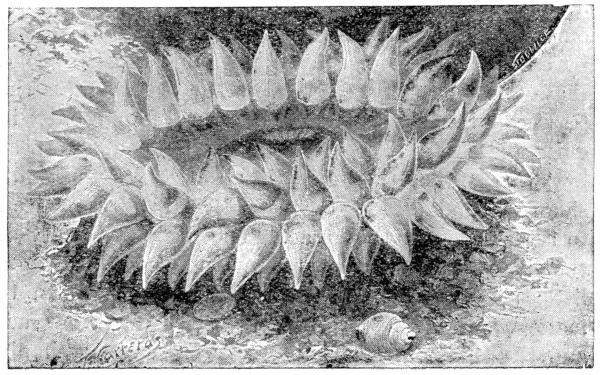
Dahlia anemone.