Part I.—The Story of the Past. (continued 2)
Reading edition
When the work was so far advanced that part of the cathedral could be roofed in, the remains of St. Magnus, which had already been removed from Christ Church in Birsay, were laid to rest in the new minster. Many great men have been laid in the same place since then. Earl Rognvald himself was buried there, and there too the remains of King Hakon rested for a time before their removal to Bergen.
While on a visit to Norway, Earl Rognvald made the acquaintance of a Crusader who had returned from the Holy Land, and he determined that he also would become a “Jorsalafarer,” or pilgrim to Jerusalem. The story of this strange voyage, in company with the Bishop of Orkney and many of his countrymen—half Vikings, half Crusaders—is well told in the “Saga of Earl Rognvald,” and in our next chapter we give part of the narrative.
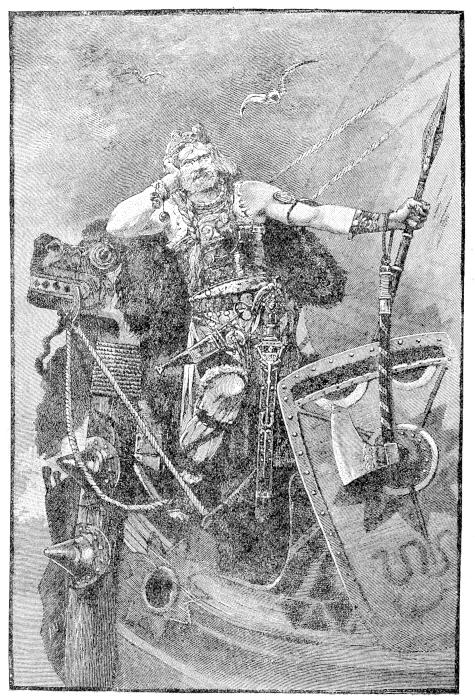
On the “Viking Path.”
THE JORSALAFARERS.
“Earl Rongvald busked him that summer to leave the Orkneys, and he was rather late boun; for they had a long while to wait for Eindrid, as his ship did not come from Norway which he had let be made there the winter before. But when they were boun, they held on their course away from the Orkneys in fifteen big ships.
“They sailed away from the Orkneys and south to Scotland, and so on to England, and as they sailed by Northumberland, off Humbermouth, Armod sang a song,—
‘The sea was high off Humbermouth When our ships were beating out, Bends the mast and sinks the land ’Neath our lee off Vesla-sand; Wave with veil of foam that rises Drives not in the eyes of him Who now sits at home; the stripling From the meeting rideth dry.’
“They sailed thence south round England and to France. Nothing is said of their voyage before that they came to that seaburg which is named Nerbon There these tidings had happened, that the earl who before had ruled the town was dead. His name was Germanus; he left behind him a daughter young and fair, whose name was Ermingerd. She kept watch and ward over her father’s inheritance, with the counsel of the most noble men of her kinsfolk. They gave that counsel to the queen that she should bid the earl to a worthy feast, and said that by that she would be famous if she welcomed heartily such men of rank who had come so far to see her, and who would bear her fame still further. The queen bade them see to that. And when this counsel had been agreed on by them, men were sent to the earl, and he was told that the queen bade him to a feast with as many of his men as he chose to bring with him. The earl took this bidding with thanks; he chose out all his best men for this journey with him. And when they came to the feast, there was the best cheer, and nothing was spared which could do the earl more honour than he had ever met before.
“One day it happened as the earl sat at the feast that the queen came into the hall and many women with her; she held a beaker of gold in her hand. She was dressed in the best clothes, had her hair loose as maidens wont to have, and had put a golden band round her brow. She poured the wine into the earl’s cup, but her maidens danced before them. The earl took her hand and the beaker too and set her on his knee, and they talked much that day.
“The earl stayed there very long in the best of cheer. The townsmen pressed the earl to settle down there, and spoke out loudly about how they would give him the lady to wife. The earl said he would fare on that voyage which he had purposed, but said that he would come thither as he fared back, and then they could carry out their plan or not as they pleased. After that the earl busked him away thence with his fellow voyagers. And as they sailed west of Thrasness they had a good wind; then they sat and drank and were very merry.
“They fared till they came to Galicialand in the winter before Yule, and meant to sit there Yule over. They dealt with the landsmen, and begged them to set them a market to buy food; for the land was barren and bad for food, and the landsmen thought it hard to feed that host of men. Now these tidings had happened there, that in that land sat a chief who was a stranger, in a castle, and he had laid on the landsmen very heavy burdens. He harried them on the spot if they did not agree at once to all that he asked, and he offered them the greatest tyranny and oppression. And when the earl spoke to the landsmen about bringing him food to buy, they made him that offer, that they would set them up a market thenceforth on till Lent, but they must rid them in some way or other of the men in the castle; but Earl Rognvald was to bear the brunt in return for the right of having all the goods that were gotten from them.
“The earl laid this bare before his men, and sought counsel from them as to which choice he should take; but most of them were eager to fall on the castlemen, and thought it bid fair for spoil. And so Earl Rognvald and his host went into that agreement with the landsmen. But when it drew near to Yule, Earl Rognvald called his men to a talk, and said,—
“‘Now have we sat here awhile, and yet we have had nothing to do with the castlemen, but the landsmen are getting rather slack in their dealings with us. Methinks they think that what we promised them will have no fulfilment; but still that is not manly not to turn our hands to what we have promised. Now, kinsman Erling, will I take counsel from you in what way we shall win the castle, for I know that ye are here some of you the greatest men for good counsel; but still I will beg all those men who are here that each will throw in what he thinks is likeliest to be worth trying.’
“Erling answered the earl’s speech: ‘I will not be silent at your bidding. But I am not a man for counsel, and it would be better rather to call on those men for that who have seen more, and are more wont to such exploits, as is Eindrid the Young. But here it will be as the saying goes, “You must shoot at a bird before you get him.” And so we will try to give some counsel, whatever comes of it. We shall to-day, if it seems to you not bad counsel or to the other shipmasters, go all of us to the wood, and bear each of us three shoulder-bundles of fagots on our backs under the castle; for it seems to me as though the lime will not be trusty if a great fire is brought to it. We shall let this go on for the three next days and see what turn things take.’
“They did as Erling bade; and when that toil was over, it was come right on to Yule. The bishop would not let them make their onslaught while the Yule high feast stood over them.
“That chief’s name was Godfrey who dwelt in the castle; he was a wise man, and somewhat stricken in years. He was a good clerk, and had fared far and wide, and knew many tongues. He was a grasping man and a very unfair man. He called together his men when he saw Rognvald’s undertakings, and said to them,—
“‘This scheme seems to me clever and harmful to us which the Northmen have taken in hand. It will befall us thus if fire is borne against us, that the stone wall round the castle will be untrustworthy. But the Northmen are strong and brave; we shall have to look for a sharp fight from them if they get a chance. I will now take counsel with you what shall be done in this strait which has befallen us.’ But his men all bade him see to that for them. Then he began to speak, and said, ‘My first counsel is that ye shall bind a cord round me and let me slide down from the castle wall to-night. I shall have on bad clothes, and fare into the camp of the Northmen, and know what I can find out.’
“This counsel was taken as he had laid it down. And when Godfrey came to Earl Rognvald he said he was an old beggar carle, and spoke in Spanish; they understood that tongue best. He fared about among all the booths and begged for food. He found out that there was great envy and splitting into parties amongst the Northmen. Eindrid was the head of one side, but the earl of the other. Godfrey came to Eindrid and got to talk with him, and brought that before him that the chief who held the castle had sent him thither. ‘He will have fellowship with thee, and he hopes that thou wilt give him peace if the castle be won. He would rather that thou shouldst have his treasures, if thou wilt do so much in return for them, than those who would rather see him a dead man.’ Of such things they talked and much besides. But the earl was kept in the dark; all this went on by stealth at first. And when Godfrey had stayed a while with the earl’s men, then he turned back to his men. But this was why they did not flit what they owned out of the castle, because they did not know whether the storm would take place at all; besides they could not trust the landfolk.
“It was the tenth day of Yule that Earl Rognvald rose up. The weather was good. Then he bade his men put on their arms, and let the host be called up to the castle with the trumpet. Then they drew the wood towards it, and piled a bale round about the wall. The earl drew up his men for the onslaught where each of them should go. The earl goes against it from the south with the Orkneyingers, Erling and Aslag from the west, John and Gudorm from the east, Eindrid the Young from the north with his followers. And when they were boun for the storm they cast fire into the bale.
“Now they began to press on fast both with fire and weapons. Then they shot hard into the work for they could not reach them by any other attack. The castlemen stood loosely here and there on the wall, for they had to guard themselves against the shots. They poured out too burning pitch and brimstone, and the earl’s men took little harm by that. Now it turned out as Erling had guessed, that the castle wall crumbled before the fire when the lime would not stand it, and there were great breaches in it.
“Sigmund Angle was the name of a man in the earl’s bodyguard; he was Sweyn Asliefson’s step-son. He pressed on faster than any man to the castle, and ever went on before the earl; he was then scarcely grown up. And when the storm had lasted awhile, then all men fled from the castle wall. The wind was on from the south, and the reek of the smoke lay towards Eindrid and his men. And when the fire began to spread very fast, then the earl made them bring water and cool the rubble that was burned. And then there was a lull in the assault.
“After that the earl made ready to storm, and Sigmund Angle with him. There was then but a little struggle, and they got into the castle. There many men were slain, but those who would take life gave themselves up to the earl’s power. There they took much goods, but they did not find the chief, and scarcely any precious things. Then there was forthwith much talk how Godfrey could have got away; and then at once they had the greatest doubt of Eindrid the Young, that he must have passed him away somehow, and that he (Godfrey) must have gone away under the smoke to the wood.
“After that Earl Rognvald and his host stayed there a short time in Galicialand, and held on west off Spain. They harried wide in that part of Spain which belonged to the heathen, and got there much goods. After that they sailed west off Spain, and got there a great storm, and lay three days at anchor, so that they shipped very much water, and it lay near that they had lost their ships. After that they hoisted their sails and beat out to Njorfa Sound [the Strait of Gibraltar] with a very cross wind. They sailed through Njorfa Sound, and then the weather began to get better. And then, as they bore out of the sound, Eindrid the Young parted company from the earl with six ships. He sailed over the sea to Marseilles, but Rognvald and his ships lay behind at the sound; and men talked much about it, how Eindrid had now himself given proof whether or not he had helped Godfrey away.
“Nothing is told of the voyage of the earl and his men before they came south off Sarkland, and lay in the neighbourhood of Sardinia, and knew not what land they were near. The weather had turned out in this wise, that a great calm set in and mists and smooth seas—though the nights were light—and they saw scarcely at all from their ships, and so they made little way. One morning it happened that the mist lifted. Men stood up and looked about them. Then the earl asked if men saw anything new. They said they saw nought but two islets, little and steep, and when they looked for the islets the second time, then one of the islets was gone. They told this to the earl. He began to say, ‘That can have been no islets. That must be ships which men have out here in this part of the world, which they call dromonds; those are ships big as holms to look on. But there, where the other dromond lay, a breeze must have come down on the sea, and they must have sailed away; but these must be wayfaring men, either chapmen or faring in some other way on their business.’
“After that the earl lets them call to him the bishop and all the shipmasters; then he began to say: ‘I call you together for this, lord bishop and Erling, my kinsman: see ye any scheme or chance of ours that we may win victory in some way over those who are on the dromond.’ The bishop answers: ‘Hard, I guess, will it be for you to run your long-ships under the dromond, for ye will have no better way of boarding than by grappling the bulwarks with a broad-axe; but they will have brimstone and boiling pitch to throw under your feet and over your heads. Ye may see, earl, so wise as you are, that it is the greatest rashness to lay one’s self and one’s men in such risk.’
“Then Erling began to speak: ‘Lord bishop,’ he says, ‘likely it is that ye are best able to see this, that there will be little hope of victory in rowing against them. But somehow it seems to me that though we try to run under the dromond, so methinks it will be that the greatest weight of weapons will fall beyond our ships, if we hug her close, broadside to broadside. But if it be not so, then we can put off from them quickly, for they will not chase us in the dromond.’
“The earl began to say: ‘That is spoken like a man and quite to my mind. I will now make that clear to the shipmasters and all the crews, that each man shall busk him in his room, and arm himself as he best can. After that we will row up to them. But if they are Christian chapmen, then it will be in our power to make peace with them; but if they are heathen, as I feel sure they are, then Almighty God will yield us that mercy that we shall win the victory over them. But of the war spoil which we get there, we shall give the fiftieth penny to poor men.’ After that, men got out their arms and heightened the bulwarks of their ships, and made themselves ready according to the means which they had at hand. The earl settles where each of his ships should run in. Then they made an onslaught on her by rowing, and pulled up to her as briskly as they could.
“But when those who were aboard the dromond saw that ships were rowing up to them, they took silken stuffs and costly goods and hung them out on the bulwarks, and then made great shoutings and hailings; and it seemed to the earl’s men as though they dared the Northmen to come on against them. Earl Rognvald laid his ship aft alongside the dromond on the starboard, but Erling, too, aft on the larboard. John and Aslak, they laid their ships forward each on his own board, but the others amidships on both boards; and all the ships hugged her close, broadside to broadside. And when they came under the dromond, her sides were so high out of the water that they could not reach up with their weapons. But the foe poured down blazing brimstone and flaming pitch over them. And it was as Erling guessed it would be, that the greatest weight of weapons fell out beyond the ships, and they had no need to shield themselves on that side which was next to the dromond, but those who were on the other side held their shields over their heads and sheltered themselves in that way.
“And when they made no way with their onslaught, the bishop shoved his ship off and two others, and they picked out and sent thither their bowmen, and they lay within shot, and shot thence at the dromond, and then that onslaught was the hardest that was made. Then those on board the dromond got under cover, but thought little about what those were doing who had laid their ships under the dromond. Earl Rognvald called out then to his men, that they should take their axes and hew asunder the broadside of the dromond in the parts where she was least iron-bound. But when the men in the other ships saw what the earl’s men were about, they also took the like counsel.
“Now, where Erling and his men had laid their ship a great anchor hung on the dromond, and the fluke was hung by the crook over the bulwark, but the stock pointed down to Erling’s ship. Audun the Red was the name of Erling’s bowman; he was lifted up on the anchor-stock. But after that he hauled up to him more men, so that they stood as thick as ever they could on the stock, and thence hewed at the sides as they best could, and that hewing was by far the highest up. And when they had hewn such large doors that they could go into the dromond, they made ready to board, and the earl and his men got into the lower hold, but Erling and his men into the upper. And when both their bands had come up on the ship there was a fight both great and hard. On board the dromond were Saracens, what we call Mahomet’s unbelievers. There were many blackamoors, and they made the hardest struggle. Erling got there a great wound on his neck near his shoulders as he sprang up into the dromond. That healed so ill that he bore his head on one side ever after. That was why he was called Wryneck.
“And when they met Earl Rognvald and Erling, the Saracens gave way before them to the fore-part of the ship, but the earl’s men then boarded her one after another. Then they were more numerous, and they pressed the enemy hard. They saw that on board the dromond was one man who was both taller and fairer than the others; the Northmen held it to be the truth that that man must be their chief. Earl Rognvald said that they should not turn their weapons against him, if they could take him in any other way. Then they hemmed him in and bore him down with their shields, and so he was taken and afterwards carried to the bishop’s ship, and few men with him. They slew there much folk, and got much goods and many costly things. When they had ended the greatest part of their toil, they sat down and rested themselves.
“Men spoke of these tidings which had happened there. Then each spoke of what he thought he had seen; and men talked about who had been the first to board the dromond, and could not agree about it. Then some said that it was foolish that they should not all have one story about these great things; and the end of it was that they agreed that Earl Rognvald should settle the dispute, and afterwards they should all back what he said.
“When they had stripped the dromond they put fire into her and burnt her. And when that tall man whom they had made captive saw that, he was much stirred, and changed colour, and could not hold himself still. But though they tried to make him speak, he never said a word and made no manner of sign, nor did he pay any heed to them whether they promised him good or ill. But when the dromond began to blaze, they saw as though blazing molten ore ran down into the sea. That moved the captive man much. They were quite sure then that they had looked for goods carelessly, and now the metal had melted in the heat of the fire, whether it had been gold or silver.
“Earl Rognvald and his men sailed thence south under Sarkland, and lay under a seaburg, and made a seven nights’ truce with the townsmen, and had dealings with them, and sold them the men whom they had taken. No man would buy the tall man. And after that the earl gave him leave to go away and four men with him. He came down the next morning with a train of men and told them that he was a prince of Sarkland, and had sailed thence with the dromond and all the goods that were aboard her. He said, too, he thought that worst of all that they burnt the dromond, and made such waste of that great wealth that it was of no use to any one. ‘But now I have great power over your affairs. Now you shall have the greatest good from me for having spared my life and treated me with such honour as ye could; but I would be very willing that we saw each other never again. And so now live safe and sound and well.’ After that he rode up the country, but Earl Rognvald sailed thence south to Crete, and they lay there in very foul weather.
“The earl and his men lay under Crete till they got a fair wind for Jewry-land, and came to Acreburg early on a Friday morning, and landed then with such great pomp and state as was seldom seen there. The earl and his men stayed in Acreburg a while. There sickness came into their ranks, and many famous men breathed their last. There Thorbjorn the Swarthy, a liegeman, breathed his last.
“Earl Rognvald and his men then fared from Acreburg, and sought all the holiest places in the land of Jewry. They all fared to Jordan and bathed there. Earl Rognvald and Sigmund Angle swam across the river and went up on the bank there, and thither where was a thicket of brushwood, and there they twisted great knots. After that they fared back to Jerusalem.
“Earl Rognvald and his men fared that summer from the land of Jewry, and meant to go north to Micklegarth [Constantinople], and came about autumn to that town which is called Imbolar. They stayed there a very long time in the town. They had that watchword in the town, if men met one another walking where it was throng and narrow, and the one thought it needful that the other who met him should yield him the path, then he says thus, ‘Out of the way; out of the way.’ One evening as the earl and his men were coming out of the town, and Erling Wryneck went out along the wharf to his ship, some of the townsmen met him and called out, ‘Out of the way; out of the way.’ Erling was very drunk, and made as though he heard them not, and when they ran against one another, Erling fell off the wharf and down into the mud which was below; and his men ran down to pick him up, and had to strip off every stitch of his clothes and wash him. Next morning when he and the earl met, and he was told what had happened, he smiled at it.
“After that they fared away thence. And nothing is told of their voyage before they come north to Engilsness [Cape St. Angelo]. There they lay some nights and waited for a wind which would seem fair to them to sail north along the sea to Micklegarth. They took great pains then with their sailing, and so sailed with great pomp, just as they had heard that Sigurd Jewry-farer had done.
“When Earl Rognvald and his men came to Micklegarth they had a hearty welcome from the emperor and the Varangians. Menelaus was then emperor over Micklegarth, whom we call Manuel. He gave the earl much goods, and offered them bounty-money if they would stay there. They stayed there awhile that winter in very good cheer. There was Eindrid the Young, and he had very great honour from the emperor. He had little to do with Earl Rognvald and his men, and rather tried to set other men against them.
“Earl Rognvald set out on his voyage home that winter from Micklegarth, and fared first west to Bulgarialand, to Dyrrachburg. Thence he sailed west across the sea to Poule. There Earl Rognvald and Bishop William and Erling, and all the nobler men of their band, landed from their ships, and got them horses and rode thence first to Rome, and so homewards on the way from Rome until they come to Denmark, and thence they fared north to Norway. There men were glad to see them, and this voyage was most famous, and they who had gone on it were thought to be men of much more worth after than before.”
From the “Orkneyinga Saga,” translated by Sir G. W. Dasent, D.C.L. (By permission of the Controller of H.M. Stationery Office.)
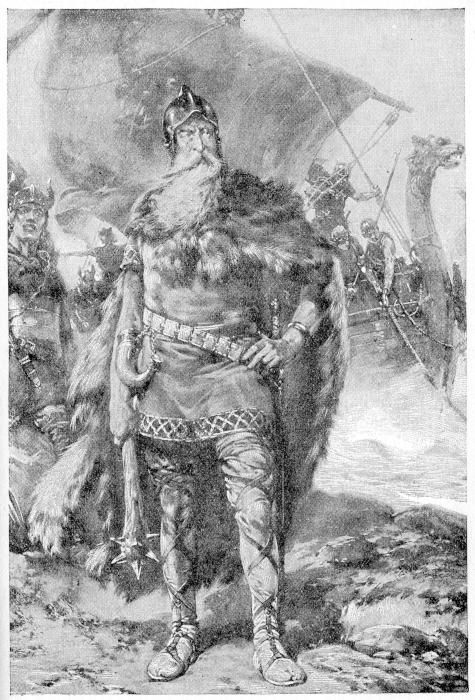
A Great Viking.
(From the picture by H. W. Koekkoek.)
SWEYN ASLEIFSON, THE LAST OF THE VIKINGS.
The sudden disappearance of Earl Paul, by which Earl Rognvald had been left in sole possession of the Orkneys, was, as we have said, due to a certain Viking, Sweyn Asleifson of Gairsay. This Sweyn is one of the most remarkable men in all Orcadian history. Among the Vikings of old he was the greatest, and he was the last. Of him the Saga says: “He was the greatest man in the western lands, either in old time or at the present day.”
For the slaying of one of Earl Paul’s men Sweyn had had to escape out of the isles. He abode for a time in the Hebrides, and afterwards sought refuge in the dales of Scotland, where Margaret, the daughter of Earl Hakon, was married to Maddad, Earl of Athole. He had promised to help Harald, their son, to become Earl of the Orkneys, and it was with a view to this that he kidnapped Earl Paul.
On that morning Earl Paul had gone out early from Westness to hunt the otter near Scabro Head. Sweyn had sailed over from Thurso, keeping to the west of Hoy and the Mainland, and was now rowing into Evie Sound, for he had heard that Earl Paul was staying with Sigurd of Westness. As they rowed near the land, Sweyn ordered all his men to lie hid except those at the oars, that the ship might look like a peaceful merchant-vessel.
When the earl saw the ship rowing near the rocks, he called out to the men that they should go on to Westness with their wares for Earl Paul. Then Sweyn, who was lying hid, bade his men ask where the earl was.
“The earl is here on the rocks,” was the reply.
“Row quickly to land at a place where they will not see us,” said Sweyn to his men; “and let us arm ourselves, for we have work to do.”
The ship was rowed to the shore, as he had said, and Sweyn and his men armed themselves and fell upon Earl Paul and his company. These, being unarmed, were soon disposed of. The earl was seized and taken aboard the ship, and Sweyn immediately set sail for Scotland by the way he had come.
Sigurd marvelled when the earl did not return from his hunting, and men were sent out to look for him. They came upon the bodies of the slain—nineteen of the earl’s men and six strangers—but the earl himself had disappeared. It was at first thought that Earl Rognvald had had something to do with his disappearance, and it was many days before men knew what had become of the vanished earl.
In the meantime Sweyn had carried Paul to Athole, and placed him in the keeping of Maddad and Margaret. His after fate is unknown. The story which Sweyn afterwards told is that Paul did not wish to return to Orkney, so shameful had been the manner of his leaving it; and that he wished it to be reported that he had been blinded or maimed, in order that men should not seek to bring him back. Sweyn himself came back to Orkney with this story; and he acknowledged Earl Rognvald, and became very friendly with him.
As the great Earl of Warwick has been called “the king-maker” in England, so Sweyn may be called the “earl-maker” in Orkney. He it was who caused Harald, the son of Maddad, to be made earl, and he also supported Earl Erlend in his claims while Earl Rognvald was in the Holy Land. He gained the friendship of David, King of Scots, Viking though he was, and the terror of the Scottish and Irish seas. Many of Sweyn’s Viking raids are told in the Orkney Saga, one of the most famous being that known as Sweyn’s “Broadcloth Cruise.” The following account is given of this cruise, and of the death of Sweyn:—
“These tidings happened once on a time, that Sweyn Asleifson fared away on his spring-cruise, and Hakon, Earl Harald’s son, fared with him; and they had five ships with oars, and all of them large. They harried about among the Southern Isles. Then the folk were so scared at him in the Southern Isles that men hid all their goods and chattels in the earth or in piles of rocks. Sweyn sailed as far south as Man, and got ill off for spoil. Thence they sailed out under Ireland and harried there. But when they came about south under Dublin, then two keels sailed there from off the main, which had come from England, and meant to steer for Dublin; they were laden with English cloths, and great store of goods was aboard them.
“Sweyn and his men pulled up to the keels and offered them battle. Little came of the defence of the Englishmen before Sweyn gave the word to board. Then the Englishmen were made prisoners. And there they robbed them of every penny which was aboard the keels, save that the Englishmen kept the clothes they stood in and some food, and went on their way afterwards with the keels; but Sweyn and his men fared to the Southern Isles and shared their war-spoil.
“They sailed from the west with great pomp. They did this as a glory for themselves when they lay in harbours, that they threw awnings of English cloth over their ships. But when they sailed into the Orkneys, they sewed the cloth on the fore-part of the sails, so that it looked in that wise as though the sails were made altogether of broadcloth. This they called the Broadcloth Cruise.
“Sweyn fared home to his house in Gairsay. He had taken from the keels much wine and English mead. Now when Sweyn had been at home a short while, he bade to him Earl Harald, and made a worthy feast against his coming. When Earl Harald was at the feast, there was much talk amongst them of Sweyn’s good cheer. The earl spoke and said: ‘This I would now, Sweyn, that thou wouldst lay aside thy sea-rovings; ’tis good now to drive home with a whole wain. But thou knowest this, that thou hast long maintained thyself and thy men by sea-roving; but so it fares with most men who live by unfair means, that they lose their lives in strife, if they do not break themselves from it.’
“Then Sweyn answered, and looked to the earl, and spoke with a smile, and said thus: ‘Well spoken is this, lord, and friendly spoken, and it will be good to take a bit of good counsel from you; but some men lay that to your door, that ye too are men of little fairness.’ The earl answered: ‘I shall have to answer for my share, but a gossiping tongue drives me to say what I do.’
“Sweyn said: ‘Good, no doubt, drives you to it, lord. And so it shall be, that I will leave off sea-roving, for I find that I am growing old, and strength lessens much in hardships and warfare. Now I will go out on my autumn-cruise, and I would that it might be with no less glory than the spring-cruise was; but after that my wayfaring shall be over.’ The earl answers: ‘’Tis hard to see, messmate, whether death or lasting luck will come first.’ After that they dropped talking about it. Earl Harald fared away from the feast, and was led out with fitting gifts. So he and Sweyn parted with great love-tokens.
“A little while after, Sweyn busks him for his roving cruise; he had seven long-ships, and all great. Hakon, Earl Harald’s son, went along with Sweyn on his voyage. They held on their course first to the Southern Isles, and got there little war-spoil; thence they fared out under Ireland, and harried there far and wide. They fared so far south as Dublin, and came upon them there very suddenly, so that the townsmen were not ware of them before they had got into the town. They took there much goods. They made prisoners there those men who were rulers there in the town. The upshot of their business was that they gave the town up into Sweyn’s power, and agreed to pay as great a ransom as he chose to lay upon them. Sweyn was also to hold the town with his men and to have rule over it. The Dublin men sware an oath to do this. Next morning Sweyn was to come into the town and take the ransom.
“Now it must be told of what happened in the town during the night. The men of good counsel who were in the town held a meeting among themselves, and talked over the straits which had befallen them; it seemed to them hard to let their town come into the power of the Orkneyingers, and worst of all of that man whom they knew to be the most unjust man in the western lands. So they agreed amongst themselves that they would cheat Sweyn if they might. They took that counsel, that they dug great trenches before the burg-gate on the inside, and in many other places between the houses where it was meant that Sweyn and his men should pass; but men lay in wait there in the houses hard by with weapons. They laid planks over the trenches, so that they should fall down as soon as ever a man’s weight comes on them. After that they strewed straw on the planks so that the trenches might not be seen, and so bided the morrow.
“On the morning after, Sweyn and his men arose and put on their arms; after that they went to the town. And when they came inside beyond the burg-gate, the Dublin men made a lane from the burg-gate right to the trenches. Sweyn and his men saw not what they were doing, and ran into the trenches. The townsmen then ran straightway to hold the burg-gate, but some to the trenches, and brought their arms to bear on Sweyn and his men. It was unhandy for them to make any defence, and Sweyn lost his life there in the trenches, and all those who had gone into the town. So it was said that Sweyn was the last to die of all his messmates, and spoke these words ere he died: ‘Know this, all men, whether I lose my life to-day or not, that I am one of the Saint Earl Rognvald’s bodyguard, and I now mean to put my trust in being there where he is with God.’ Sweyn’s men fared at once to their ships and pulled away, and nothing is told about their voyage before they come into the Orkneys.”
From the “Orkneyinga Saga,” translated by Sir G. W. Dasent, D.C.I. (By permission of the Controller of H.M. Stationery Office.)
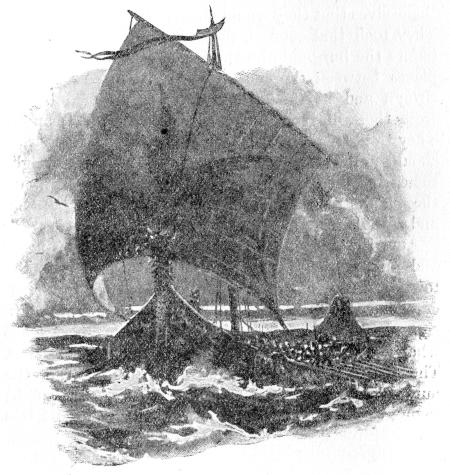
THE DECAY OF THE EARLDOM AND THE END OF THE WESTERN KINGDOM.
After the death of Earl Rognvald, the islands were ruled for almost fifty years by Harald Maddadson. Harald’s later days were full of troubles. With the decay of his powers the glory of the earldom also faded away. In 1194, when Sverrir was King of Norway, a rebellion took place, with the object of placing Sigurd Erlingson on the throne. Sigurd’s party, known as the “Eyjarskeggjar” or “Island-beardies,” had their headquarters in the Orkneys. There they collected their forces, and there the rebellion was organized. The rebels were completely overthrown in a great battle fought near Bergen. Sverrir summoned Earl Harald before him in 1196 to answer for his share in the matter. As a punishment for permitting plots against him to be hatched in Orkney—plots which the gray-haired old earl had been powerless to prevent—the king compelled him to surrender the government of Shetland. For nearly two centuries thereafter Orkney and Shetland were separate, the former ruled by the earl, the latter by a governor appointed by the Norwegian crown.
The result of this was twofold. In the first place it weakened the power of the Orkney earldom; in the second place it caused the earldom to draw nearer to Scotland, and to come more and more under Scottish influence. But the aged earl’s cup of sorrow was not yet full. He quarrelled also with the Scottish king. As a consequence of this quarrel he was stripped of his Scottish possessions, and his son Thorfinn perished miserably, a prisoner in Roxburgh Castle. When Earl Harald died in 1206, full of years and of sorrows, the earldom was but the shadow of its former self.
After Harald’s death, his two sons, John and David, succeeded to the earldom. David did not live long, and John was then left sole earl. This earl, the last of the old Norse jarls, was Earl of Orkney excluding Shetland, holding that earldom from the Norwegian king, and Earl of Caithness, including Sutherland, holding that from the King of Scotland. Matters continued in this state generally till the pledging of the islands in 1468, the only change being that Shetland was again added to the Orkney earldom in 1379, when Henry, the first of the St. Clairs, became earl.
The days of Earl John, like those of his father, were stormy, and disaster after disaster fell upon the isles. The burning of Bishop Adam at Halkirk in Caithness brought down on the earl the vengeance of King Alexander the Second of Scotland. The earl had no hand in the murder, but he was near by, and, in the opinion of King Alexander, might have prevented the tragedy. Then a feud arose between the earl and some of the leaders of a Norse expedition to the Western Isles. The earl was attacked suddenly in Thurso, and there murdered. This took place in the year 1231. The murderers took refuge in the Castle of Weir, where they were besieged by the earl’s friends and adherents. Ultimately both parties agreed that the case should be submitted to the Norwegian king.
The chief men of the islands embarked for Norway to be present at the trial of the murderers, which ended in their conviction and punishment. But a terrible disaster for the Orkney earldom followed. All the leading men of the islands left Norway in one ship, and set sail for Orkney late in autumn. Stormy weather set in shortly after their departure. Fears which were entertained for the safety of the ship proved to be only too well founded: the ship was never heard of again. With her went down nearly all the nobility of the earldom. This disaster, which happened in 1232, was irremediable. Well does the Saga of Hakon Hakonson say, “Many men have had to suffer for this later.” The earldom never recovered from the loss of its best blood, and but for this loss the after course of events might have been very different. Henceforth the Orkney earldom plays but a subordinate part in the history of the North.
In 1232 King Alexander of Scotland granted the Earldom of Caithness to Magnus, son of Gilbride, Earl of Angus. Magnus was at the same time confirmed in the Earldom of Orkney by the King of Norway. But King Alexander made Sutherland a separate earldom, William Friskyn being created first earl. Thus within a period of forty years the earldom, which had at one time rivalled the power of Scotland itself, and had been at once the centre and the defence of the Norse Empire in the west, was stripped of more than half its territories.
The Scottish king had a deep purpose to serve in thus weakening the northern earldom. He was already casting covetous eyes on the Hebrides, and every blow struck at the power of the Orkney earl was a step towards the conquest of the Western Isles. In the heyday of Norse ascendency there was danger of the western Norse colonies swallowing up Scotland rather than of Scotland swallowing up these colonies. But Hakon of Norway was now too busy at home repressing internal disorders to give much thought to the ambitions of the Scottish king, and the Orkney earl was too weak to form a serious obstacle, besides which he was more than half Scottish himself.
For many years the chiefs of the Hebrides and the Western Isles had been wavering in their allegiance to the Norwegian crown. King Alexander was also doing his utmost to undermine Norse influence in the west. While he was carrying on intrigues with the western chiefs, he at the same time kept sending embassies to Norway to treat with Hakon for the purchase of these islands. Hakon’s answer was brief and decided: He was not yet so much in want of money that he needed to sell his lands for it.
The next King of Scotland, Alexander the Third, had the same ambitions as his father, and as resolutely pursued his schemes for the subjugation of the Hebrides. He was, moreover, a young, energetic, and warlike king. He found the island chiefs very troublesome neighbours. His father’s policy of intrigue was too slow for him, and he determined to take by force what he could not obtain by treaty.
In 1262 the Scots invaded the Norse dominions in the west. Hakon, who had now pacified his own kingdom, was at last roused to make a serious effort to preserve his over-sea dominions. In the summer of 1263 he “let letters of summons be sent round all Norway, and called out the levies both of men and stores as he thought the land could bear it. He summoned all the host to meet him early in the summer at Bergen.”
A mighty fleet assembled in obedience to the king’s command, and, under the leadership of Hakon himself, set sail from Norway in the end of July 1263. After delaying through the summer in Shetland and Orkney, this ill-fated expedition reached the Firth of Clyde in late autumn. Alexander the Third, knowing well that he could not hope to meet the Norsemen at sea, prepared to give them as warm a reception as possible wherever they might land. In the meantime he pretended to be anxious for peace. Negotiations were opened between the two kings. Alexander temporized: winter was approaching.
Hakon’s patience at last gave way, and breaking off negotiations, the Norsemen began to harry the country, receiving willing aid from the various half-Celtic chieftains, who enjoyed nothing so much as an opportunity of ravaging the fertile Lowlands. But that ally whose coming Alexander had been awaiting came at length; on the first of October a great storm from the south-west arose suddenly during the night. Hakon’s ships began to drag their anchors. They fouled each other in the darkness, and several were driven ashore on the Ayrshire coast. When morning dawned, Hakon found his own ship within bowshot of the shore, while the Scots were already plundering one which had stranded near by.
During a lull in the storm Hakon managed to land a detachment of his men to protect the stranded galley. But the storm increased in fury once more. The Norsemen on shore were outnumbered probably by ten to one, and no help could be sent from the ships. The Vikings threw themselves into a circle bristling with spear-points. Onset after onset of the Scots forced the ring of spears slowly back towards the shore, but they could not break it. All day long the battle raged—the Norsemen with the angry sea behind them, and no hope of succour from their fleet; the Scots determined to drive the invaders into the sea, or slay them where they stood.
As evening began to fall the storm moderated, and Hakon was able to send reinforcements on shore. The Scots were borne backwards by the onset of the fresh warriors. But night was falling, and the Norsemen were anxious to get back to their ships, for the storm was not yet over. They accordingly hastened to take advantage of the breathing-space which they had won, and retired to their ships.
Such was the famous battle of Largs, which both Scots and Norsemen claim as a victory. In itself it was little more than a skirmish; but the events of that night and day, the storm and the battle together, gave the death-blow to Norse dominion in the west. The heart of King Hakon failed him. His men also were discouraged. The shattered remains of the once splendid fleet set sail for Orkney, and the great invasion of Scotland was over.
Broken in spirit and shattered in health, Hakon reached Orkney only to die. Part of his fleet was ordered to proceed to Norway, and part was laid up for the winter in Scapa Bay and Houton Cove. Scarcely had these matters been attended to when his fatal sickness seized the king. In the Bishop’s Palace in Kirkwall he spent his last hours. Here at midnight, on Saturday, December 15, 1263, in the sixtieth year of his eventful life, died Hakon Hakonson, the last of the great sea-kings of Norway.
The remains of the king were carried to the cathedral, where they lay in state, and were afterwards temporarily interred in the choir near the shrine of St. Magnus. When spring came, Hakon’s body was exhumed and taken to Bergen in Norway, where it was finally laid to rest in the choir of Christ Church.
After the death of Hakon, his son Magnus, now King of Norway, sent ambassadors to the Scottish king to treat for peace, and a treaty was signed at Perth in 1266. By this treaty Norway resigned her rights in the Hebrides, in consideration of Scotland’s paying down four thousand marks, besides a tribute of one hundred marks to be paid annually in St. Magnus Cathedral, Kirkwall. This tribute, called the Annual of Norway, was the direct cause of the troubles which preceded the marriage of James the Third of Scotland and Princess Margaret of Denmark.
A large proportion of King Hakon’s forces had to be maintained in Orkney during the winter succeeding Largs. To provide for this, the lands of the earldom were divided into sections, and charged with the maintenance of the soldiers in proportion to the amount of “skatt” each section owed the king. The Skatt Book of the earldom was prepared—a list of the lands therein, and the amount of skatt which they paid. It was the Domesday Book of the Orkneys. On this Skatt Book were based the Scottish Rentals, which came into such prominence in the history of the Scottish oppressions during the sixteenth century.
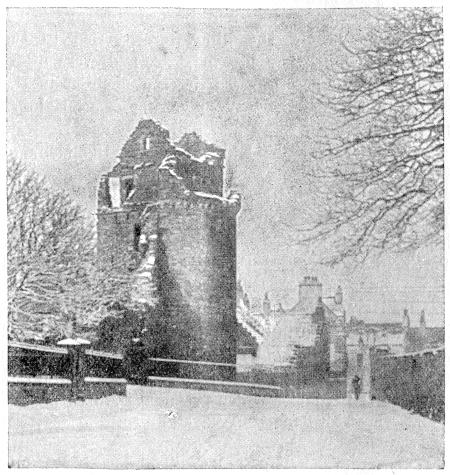
Ruins of the Bishop’s Palace, Kirkwall.
THE ANNEXATION TO SCOTLAND.
The history of Orkney during the two centuries which intervened between the battle of Largs and the annexation to Scotland contains little of interest. The earldom was held by Scottish families, first the Strathernes, and then the St. Clairs. The sympathies of the earls were with the Scots, the people were mainly Norse, and as a natural consequence quarrels frequently arose between the earls and their subjects. Another source of trouble was the fact that the earls generally held possessions in Scotland, and were thus subjects of Scotland as well as of Norway. The islands were neglected by both countries, being of little importance to Norway as governed by foreigners, and of little interest to Scotland as owned by a foreign country.
Several of the earls took a prominent part in the affairs of Scotland, and were men of mark and highly esteemed by the Scottish sovereigns. Thus Magnus, the last of the Angus line, was one of the eight Scottish noblemen who, in 1320, subscribed the famous letter to the Pope asserting the independence of Scotland; and Henry, the second of the St. Clairs, was entrusted by King Robert the Third with the task of conveying the young Prince James to a safe asylum in France, when that prince was made prisoner by the English.
In the history of Orkney itself the only man of note among the Scottish earls was Henry, the first of the St. Clairs, the builder of Kirkwall Castle. Henry became earl in 1379. Under his rule Orkney and Shetland were once more united. He is the only one of the Scottish earls who can be at all compared with the old Norse jarls of Orkney. In everything except name he was king of his island dominions, ruling them as he pleased without much thought of either Norway or Scotland.
It was in the time of William, the third of the St. Clair earls, that the transference of Orkney and Shetland to Scotland took place. The circumstances which led to this important event must now be related.
After the battle of Largs a treaty of peace between Norway and Scotland had been signed at Perth in 1266, Norway resigning the Hebrides in return for an immediate payment by Scotland of four thousand marks, and in addition a tribute of one hundred marks to be paid annually in St. Magnus Cathedral, Kirkwall. For every failure to pay this tribute—known in history as the Annual of Norway—Scotland was liable to a penalty of ten thousand marks. This treaty was afterwards confirmed by Hakon the Fifth and Robert the Bruce at Inverness in 1312.
In 1397 Norway, Sweden, and Denmark were united under one sovereign. When, in 1448, Christian the First became king of the united realms, payment by Scotland of the Annual of Norway had been neglected for some forty years. According to the Treaty of Perth, Scotland was therefore liable to a penalty of over four hundred thousand marks. Christian’s exchequer was empty; here was an opportunity of replenishing it. About 1460 Christian made a threatening demand for payment of the whole sum due.
The sum demanded was so large that it would have been no easy matter for Scotland to pay it, however willing she might be. Christian had concluded an alliance with France, and France had always been the firm friend of Scotland. When a rupture between Denmark and Scotland seemed inevitable, the French king employed all his influence to secure a compromise. He suggested that a marriage should be arranged between Prince James of Scotland, afterwards James the Third, and Margaret, Christian’s daughter, trusting that the negotiations in connection with the marriage would lead to the friendly settlement of the matters in dispute.
Prolonged negotiations took place between the two countries. Scotland at first demanded the remission of the Annual of Norway with arrears, the cession of Orkney and Shetland, and a dowry of a hundred thousand crowns. To these terms Christian refused to listen. The death of James the Second at the siege of Roxburgh Castle suspended negotiations for a time. Some years after the accession of James the Third they were resumed. The final result was the Marriage Treaty of 1468, which brought about the transference of Orkney and Shetland to Scotland.
The main provisions of the Marriage Treaty were these:—(1.) That the Princess Margaret’s dowry should amount to fifty thousand florins; ten thousand to be paid within the year, and the islands of Orkney to be pledged for the remaining forty thousand.—Only two thousand florins were paid, Shetland being pledged in the following year for the remaining eight thousand. (2.) That the rights of Christian as King of Norway should be exercised in the islands by the Scottish king until the forty thousand florins were paid. (3.) That the islanders should enjoy their own customs and laws while under Scottish rule.
Christian would not consent to the permanent cession of the islands to Scotland under any conditions. In fact nothing but the direst financial straits can account for his even pledging them. But he had just finished a costly war in Sweden, his exchequer was empty, and the Scottish marriage seemed to him very desirable.
On this Marriage Treaty of 1468, and on the agreement afterwards made with Earl William, Scotland bases her claim to the islands of Orkney and Shetland. It is certain that Christian intended to redeem the islands, and even as late as 1668 the plenipotentiaries of Europe assembled at Breda declared that Denmark—it ought to be Norway—still retained the right to redeem them.
Scottish influence in Orkney had been increasing for many years previous to the annexation. The needy dependants of the various Scottish noblemen who held the earldom found the islands a happy hunting-ground for their avarice or for their need. There was thus a strong party in Orkney in favour of the annexation to Scotland. But the large majority of the inhabitants could not but regard the change of masters with dismay. Scotland was an alien power, and had usually been a hostile one. Her laws and institutions had little in common with those of the northern earldom. Besides this, her tenure being only temporary, she had no inducement to promote the welfare of the islands, but on the contrary her obvious interest was to make as much profit as possible from her opportunity.
From 1468 onwards, till long after the termination of Scottish and the beginning of British rule, the lot of the islanders was far from enviable. The transformation of the leading Norse earldom into a minor Scottish county was the work of those years. The process by which this was accomplished was a long-continued series of injuries and oppressions, the story of which forms too long a tale to be fully told here.
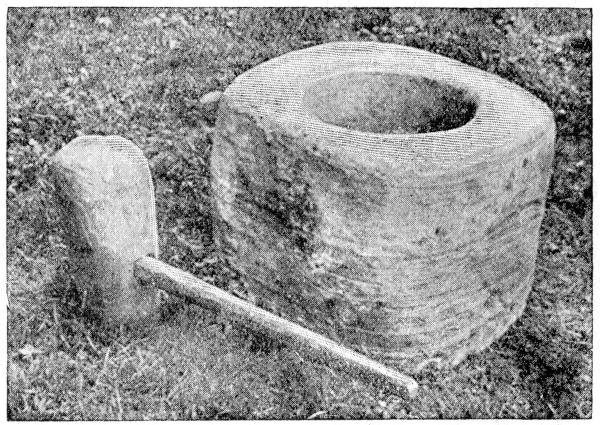
Knocking Stone and Mell.
UDAL AND FEUDAL.
Orkney and Shetland were handed over to Scotland, but care was taken to secure the rights of the inhabitants of the islands by the provision in the treaty of 1468 that they should be governed according to their own laws and usages. These were different from those of Scotland in several important particulars. Unfortunately, the new Scottish rulers did not know the laws of the earldom, and did not care to learn them.
With regard to the holding of land, the laws of Scotland were entirely different from those of Orkney. In Scotland land was held according to the feudal system, in Orkney according to the udal system. Under the feudal system the king was nominally the owner of all the lands in the kingdom. The various landlords held their lands from him as their superior, in exchange for certain services to be rendered or payments to be made, and by a written title, without which they had no legal claim to the land.
The udal system has been described as “the direct negation of every feudal principle.” The udaller held his land without any written title, subject to no service or payment to a superior, and with full possession and every conceivable right of ownership. The udaller was a peasant noble; he was the king’s equal and not his vassal. He owed king or jarl no services, duties, or payment for his udal lands, which he held as an absolute possession, inalienable from him and his race.
It must not be supposed that all the land in Orkney was held udally, or that all the inhabitants were udallers. There were some udallers who held part of their land as tenants, and many of the islanders held no udal land at all. All landholders, whether udallers or tenants, had to pay a tax, called “skatt.” This was a tax levied to meet the expenses of government and defence. Skatt was paid sometimes to the King of Norway, sometimes to the Earl of Orkney, but it was legally the property of the crown. Hakon, when he lay dying in Kirkwall, levied skatt on the landholders of Orkney for the support of his troops during the winter. In this he was only exercising the undoubted right of the crown of Norway. But the skatt was never a rent, and never carried with it the acknowledgment of king or jarl as the real landowner.
When Orkney came under Scottish rule, the King of Scotland became entitled to the skatt. Some Scottish nobleman or churchman was usually appointed to collect the revenues of the crown in the earldom. This nobleman or churchman was paid a commission on what he collected, together with any trifles he might extort “in ony manner of way.” Sometimes the revenues of the earldom were farmed out to the collector, an annual sum being paid by him into the royal treasury as rent. This arrangement afforded much room for extortion, and all the more so because the crown collector was ignorant, or could pretend to be ignorant, of Orkney law and of the udal system.
In 1471 the Scottish crown purchased from Earl William all the lands and revenues which he held as Earl of Orkney. In 1472 Bishop William Tulloch was appointed to collect the revenues of the crown in Orkney. The period of Scottish oppression at once began. The bishop was deeply imbued with feudal prejudices. He had a rental drawn up, in which he registered the lands of udaller and tenant indiscriminately, with a studied confusion of their different rights. Both udal and feudal payments were exacted as rents from all holders of land.
The udaller had no one to whom he could appeal to right his wrongs and protect him against oppression. He had no written titles. The bishop ruled the bishopric as bishop, and he ruled the earldom as representative of the crown. The churches were filled with Scottish priests subservient to his will. The struggle was hopeless from the beginning, but it took a century to reduce the peasant nobles of Orkney to the position and rank of tenant farmers, and in the meantime the various rulers of the islands reaped a rich harvest.
Bishop Tulloch’s rule lasted for seven years, and was followed by six years under Bishop Andrew. Then in 1485 Henry St. Clair was appointed representative of the crown in Orkney. The St. Clairs had always been popular in the islands, and the islanders rejoiced at the appointment of Lord Henry. He redressed a number of grievances, but the fundamental change of udal into feudal which had begun went on unchecked. It was too profitable a confusion to be put right.
After the death of Lord Henry St. Clair at Flodden, turmoil and confusion reigned in the earldom. His widow, Lady Margaret Hepburn, held the crown lands in Orkney for nearly thirty years, but she was quite unable to rule the islands. A report got abroad that the king intended to give Orkney a feudal lord. In 1529 the trouble came to a head. James St. Clair, the most popular of that popular family, was made Governor of Kirkwall Castle, and put himself at the head of the discontented faction. Open rebellion followed. Lord William St. Clair, son of Lady Margaret remained loyal, and had to escape to Caithness.
Allied with the Earl of Caithness, Lord William invaded the islands with a considerable force. The invaders were met at Summerdale in Stenness by the rebels under James St. Clair, and were defeated with great slaughter. Many old stories about this battle still exist. The Caithness force landed in Orphir, and on their march they are said to have encountered a witch, whom they consulted as to the omens of success. She walked before them, unwinding together two balls of thread, one blue and the other red. She asked them to choose one of the balls as the symbol of their fortune, and they chose the red. The red thread was the first to come to an end.
Unwilling to accept this omen, they demanded that the witch should give them yet another sign. She thereupon informed the Earl of Caithness that whichever side lost the first man in the fight would lose the day. Soon afterwards a boy was met herding cattle, and by order of the earl he was slain. Only after the deed was done did they discover that the boy was not an Orcadian but a native of Caithness.
Already prepared for defeat by these bad omens, the invaders came upon the Orcadian force at Summerdale. The Orcadians assailed them with showers of stones, and the Caithness force was quickly destroyed. Only one Orcadian is said to have fallen. He, having dressed himself in the clothes of one of the fallen enemy, was slain in the dusk of the evening as he returned home. His mother mistook him for one of the invading force, and felled him by a blow with a stone in the foot of a stocking.
Such are some of the tales tradition has woven round this fight. It was the last stand of the udallers, and the last pitched battle fought on Orcadian soil, if we except the siege of Kirkwall Castle during the rebellion of the Stewarts.
After the battle of Summerdale the islands still remained in a very unsettled condition, until in 1540 James the Fifth thought his presence necessary to restore tranquillity. The king stayed with the bishop in Kirkwall, though not in the ancient Bishop’s Palace, which had witnessed the death of King Hakon. The visit of the king led to the removal of many abuses. But his death in 1542, and the long minority of his daughter, Mary Queen of Scots, brought back the former evils in an aggravated form. For twenty years the records of the islands are records of murder, violence, and oppression. The udallers were now a comparatively feeble folk, but their worst period of oppression was still to come.
THE STEWART EARLS.
In 1565 began the most cruel oppression which the islands suffered under Scottish rule. Lord Robert Stewart, a son of James the Fifth and half-brother of the Earl of Moray, obtained a feu charter of Orkney and Shetland. This grant was illegal in every way. It was not sanctioned by Parliament, and it disposed not only of the actual property which the crown of Scotland had acquired in the islands, but of the lands and services of the udallers or free landowners, which had never belonged to Norway or Denmark, and could not therefore have been acquired by Scotland. In exchange for the revenues of the Abbey of Holyrood, the new earl also obtained possession of the lands and revenues of the Bishopric of Orkney.
To oppress the udallers so as to compel them to accept feus from him was the unvarying object of Earl Robert’s policy. He aggravated the burdens of the islanders by making them use weights and measures of his own devising, and increased their liabilities to him by a coinage of his own valuation. He raised the rents of the tenants to the limits of endurance, made every occasional or special payment an annual burden, imposed parish taxes as household taxes, and by pretended decrees of the Thing, or council, evicted many udallers without a show of justice. Heavy tolls and duties were laid on all fishermen and traders who came to the islands, and secret encouragement was given to pirates, whose booty was shared by the earl.
The more bitter the complaints of the islanders, the more grievous became their oppression. To prevent these complaints reaching the ears of the authorities in Edinburgh, the earl forbade any one to cross the firths or ferries without his permission. It began also to be whispered that Earl Robert was plotting to sever once more the connection between Orkney and the Scottish crown. He had made additions to the old palace at Birsay, and on a stone over the principal gate he had caused to be inscribed: DOMINUS ROBERTUS STEWARTUS FILIUS JACOBI QUINTI REX SCOTORUM HOC OPUS INSTRUXIT—that is, “Earl Robert Stewart, son of James the Fifth, King of the Scots, erected this building.” Those who know a little Latin will observe that by his using the nominative case rex, it is Earl Robert himself and not James the Fifth whom he describes as “King of the Scots.” This was probably a mere mistake in the earl’s Latin, but a much graver meaning was attached to it by the Scottish King and Parliament when the whisper of treason somehow reached their ears.
The complaints of the udallers might be unheeded, but the accusation of treason was a much more serious matter. The earl was summoned to Edinburgh to answer the charges against him. He was kept for some time a prisoner in Linlithgow Castle, but the storm quickly blew over. No trial ever took place. That ordeal Earl Robert escaped by the help of his powerful friends and relatives; and not only so, but in 1581 he was once more granted the Earldom of Orkney and Shetland, with extended powers.
When Robert Stewart died, the islands were granted to his son, Patrick Stewart, the most cruel oppressor of all. Skilful in tyranny and extortion as Earl Robert had been, his son showed still more ability and ingenuity in his evil courses. The multiplication of enactments and penalties for the most trivial offences, confiscation, torture, and judicial murder—these were the additions Earl Patrick made to the machinery of oppression used by his father. He had palaces built for him at Scalloway and at Kirkwall by the same forced labour that had already reared Earl Robert’s palace in Birsay. But Earl Patrick’s career is best described in the words of Mackenzie:—
“Earl Patrick—still remembered in Orkney tradition as ‘Black Pate’—was a man of kingly ideas, and had his lot been cast in Egypt instead of in Orkney, would have done very well as one of the Pharaohs. ‘Heaven is high and the Czar is far away,’ says a Russian proverb. Orkney is far from Holyrood and farther from London, and the earl did his own pleasure in his domain, without having the fear of the distant king before his eyes.
“Most astounding and extraordinary was the system of tyranny and extortion which he carried on. He accused one and another of the gentry of the islands of high treason, and tried them in his own court. But it was not his object to punish these gentlemen as traitors against the king. In that case their forfeited estates would go to the king, which would be no profit to the earl. The earl was not so simple. The frightened udallers were glad enough to compound with the formidable earl by making over to him a portion of their lands to save the remainder and their own necks.
“The Orkney potentate dealt in exactions of every description. He extorted taxes and duties. He created ferries and levied exorbitant tolls on them. He compelled the people to work for him all manner of work. He forced them to row his boats and man his ships, to toil in his quarries, to convey stones and lime for the building of his palace and park walls, and to perform whatever other kinds of slave-labour he chose to demand, ‘without either meat or drink or hire.’
“The Czar though far away sometimes hears at last. The doings of this tyrant of the isles attracted the attention of the law. He was seized and put in ward in Dumbarton Castle. What schemes were in his proud, fierce head it is difficult to guess. This is known, that, under his instructions, his son Robert occupied the castle of Kirkwall with armed men, fortified the cathedral, and stood ready to hold his own.
“As soon as it became known in Edinburgh that Orkney was in rebellion, the king’s Secret Council dispatched the Earl of Caithness to bring it under. Two great cannons were wheeled down from Edinburgh Castle and shipped at Leith along with a strong military force. The expedition landed safely within a mile and a half of Kirkwall. The great cannons were pointed against the castle. They shot and got their answer in shot. The siege continued about a month, when the rebels gave in. Caithness returned to Edinburgh with Robert Stewart and other prisoners, and the two great cannons passed up the High Street in triumph, to the sound of drum and trumpet, with the keys of Kirkwall Castle hanging at their muzzles.
“Robert Stewart was condemned to death and hanged at the Market Cross along with five of his accomplices. The people pitied him greatly, for it was his father’s scheming that had led him to destruction. His father’s execution soon followed. The ministers who tried to prepare him for death, finding him so ignorant that he could not say the Lord’s Prayer, asked the Council to delay his execution for a few days, till he could be better informed. The request was granted, and then he went his way into the great darkness.”
The rebellion of Earl Patrick led to the abolition of the Thing and the ancient laws of Orkney and Shetland, but there was little change for the better in the government of the islands. They were assigned to one nobleman after another, no one having any interest in their improvement. It was, indeed, not till the eighteenth century that any very great effort was made to give them the benefits of good government and a chance to regain somewhat of their ancient prosperity.
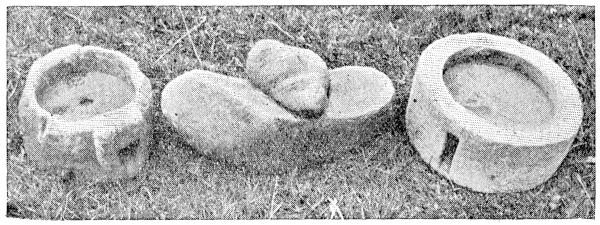
Pot Querns and Saddle Quern.
THE EIGHTEENTH AND NINETEENTH CENTURIES.
During the long period of oppression by the Scottish earls, the state of our islands had been indeed deplorable, and recovery was slow. The spirit was crushed out of the people. Industry was vain when plunder was sure to follow. Agriculture could not advance when the alien landlord claimed all the profit. An Orkney writer of the eighteenth century gives a sad picture of the condition of the country in his day:—
“The inhabitants, in general, are very polite, hospitable, and kind to strangers; but I am sorry to say that so little is industry encouraged in our country that no means can be assigned by which the lower class of people can get their bread. By reason of having no employment they must live very wretchedly; they become indolent and lazy to the last degree, insomuch that rather than raise cabbage for their own use they will steal from others; and instead of being at pains to prepare the turf, which they have for the mere trouble of cutting up and drying, yet, rather than do so, they will steal it from those who are richer or more industrious than themselves.... Every Saturday, which day they are privileged to beg, a troop of miserable, ragged creatures are seen going from door to door, almost numerous enough to plunder the whole town were they to exert themselves against it in an hostile manner—at least, if their valour was in proportion to their distress.”
The dawn of a brighter day came slowly, and it is difficult now to trace the steps by which the prosperity of the islands was restored. Agriculture remained in a very primitive state till the nineteenth century had well begun. An Orkney “township” had a very different appearance in those days from what we now see. The farms were not divided from one another; each patch of cultivated ground belonged to all the farmers in the township, who shared it on the “run-rig” system, each “rig” being worked by a different owner.
The only pasture was the natural grass of meadow and hill, and this also was common property. A “hill-dyke,” usually of turf, surrounded the corn-land, and formed a somewhat indifferent protection against the flocks of sheep, cattle, horses, and pigs which found their summer food on the “hill.” The names “Slap” and “Grind,” borne by farmhouses in many districts, remind us of the gateways in these old hill dykes.
With the corn-land subdivided in this way, and the pasture-land undivided, there was no inducement for any farmer to improve his methods of agriculture. Farm implements were of the rudest kind. The soil was scratched rather than tilled by means of wooden ploughs with only one stilt or handle, a model of which may be seen in the museum in Stromness. There were no carts; loads were carried pannier-fashion on the backs of horses, along the rough tracks or bridle-paths which served for roads.
Of the old style of farmhouse scarcely a relic now remains. One entrance usually served the farmer and his cattle, who lived under the same roof, though in separate apartments. In the kitchen, or “but-end,” the fireplace was simply a raised hearth in the centre of the room, with a low wall or “back” against which the peat-fire was built. There was no chimney, but a large opening in the roof allowed the smoke to escape in a leisurely fashion. Behind the “back” there was often accommodation for poultry, calves, and other domestic animals. The better class of houses had beyond the kitchen a parlour, or “ben-end,” which was used only on great occasions.
Rough and primitive as was their manner of life, yet at the beginning of last century the Orcadians had already made a very considerable advance in prosperity. A writer of the time tells us that the small farmers had more money among them than could be found among people of similar station in any other part of the British Isles.
It was not till the second quarter of the century that the land was divided up into separate farms, and modern methods of agriculture began to be employed, with rotation of crops and improved implements. A little later the beginning was made of the system of roads which now spreads in a network over the islands.
While agriculture was yet in its infancy, the islands were much benefited by various forms of industry and occupation which have now mostly fallen into disuse, as the need for their help has passed away. One of these industries, introduced towards the end of the eighteenth century, was the spinning of flax and the weaving of linen. Flax was largely grown in the islands at one time, and the dressing, spinning, and weaving of it was a common occupation.
About the beginning of the nineteenth century the manufacture of straw-plait was introduced, and soon took the place of the linen industry. It is said that over six thousand women and girls were at one time employed in straw-plaiting. Though the workers were paid but little, and that usually not in money but in goods, the straw-plaiting increased considerably the wealth and the trade of the county.
The manufacture of kelp was introduced early in the eighteenth century, and gave occupation to many of the inhabitants. Large profits were made in this business, not so much, of course, by the actual workers as by the landlords and other agents who exported the kelp. At one time, indeed, it seemed as if the attention given to this industry was to prove a hindrance to the advance of agriculture, which is the only foundation of true prosperity in these islands; and when other substances began to take the place of kelp, the decline of this trade was really a benefit to the islands.
Fishing has always been an important industry in Orkney, but it was not till near the middle of the nineteenth century that the improvements in boats and in gear made the fisheries a really valuable asset to the islanders. Fishing, however, cannot be called one of those temporary industries which we mentioned. The herring fishery and the white fishing, as well as other branches of this industry, have continued to increase, and next to agriculture, fishing is the great natural source of wealth for the people.
During the centuries now under our notice, Orkney had a closer connection with the seafaring life than it has to-day. When all trade was carried on by sailing ships, and when westerly winds were quite as common as they now are, vessels passing through the Pentland Firth for America or elsewhere found Stromness a convenient port of call, and its harbour was often crowded with shipping. This was especially the case during the French wars of the eighteenth century, when the English Channel was avoided by shipping as being too near the enemy’s shores. Fleets of trading ships used to gather at Stromness while waiting a convoy of men-of-war to accompany them across the Atlantic.
An interesting relic of those busy times in Stromness is the old Warehouse and Warehouse Pier at the north end of that town. This store was built about the middle of the eighteenth century for the convenience of the rice ships from America, as being the safest place for them to discharge their cargoes. Before the end of the century, however, the Stromness Warehouse was deserted in favour of Cowes in the Isle of Wight. A writer of the time makes out a strong case in favour of Stromness and against the English Channel, but the fact that Cowes is nearer to London seems to have settled the matter in favour of that port.
During these prolonged naval wars, it is said that as many as twelve thousand Orkneymen served in the navy. Many of them went as volunteers, but probably most of them served against their will, as the pressgang was very active among the islands. Many a young sailor who began his voyage on a peaceful trader was soon transferred to one of His Majesty’s ships. Traditions of those troublous times are still preserved among many families in the islands. Hundreds of these men were never heard of again, for those were not the days of telegraphs and war correspondents. The years passed, and the son or the brother did not return, but when or how he fell his friends never knew. It was a heavy war-tax the islands paid; the full extent of it has never been disclosed.
About 1740 the ships of the Hudson’s Bay Company began to visit the islands, not only to wait for a wind to start them on their annual voyage, but to engage labourers and tradesmen to carry on the fur trade among the Indians of the west and north of Canada. The connection thus begun is not yet quite extinct, but in the earlier part of the nineteenth century there was a constant stream of young men flowing to the Far West. At one time from fifty to a hundred men left Stromness for Hudson Bay every summer. Some remained as pioneers and colonists; some returned after a sojourn of five years or more, with a tidy sum of money to start them as farmers or tradesmen at home. Many of them who settled in the Great Lone Land rose to high positions in the Company’s service. The most famous of this band of empire-builders was Dr. John Rae, the discoverer of the fate of the ill-starred Franklin Expedition, and a noted Arctic explorer, whose monument may be seen in the nave of St. Magnus Cathedral.
The Company then ruled over the greater portion of what is now the Dominion of Canada. The names of Fort York, Moose Factory, and Red River were as familiar to the Orkney boys of those days as Edinburgh, Glasgow, and Aberdeen are to us to-day. But Canada changed even more than Orkney during the latter part of the nineteenth century, and the great Hudson’s Bay Company have now handed over their vast territories to the rule of the Dominion. The fur trade still exists in the North-West, and there are Orkneymen still in the employment of the Company; but the days have gone by when this was one of the chief industries of the wander-loving sons of our islands.
After the “Nor’-Wast,” as the Hudson Bay service was called, the “Straits” had the next claim on our youth. The Davis Strait whale-fishing fleet made an annual visit to our islands to complete their crews. This was in the spring or “vore,” when the crops were in the ground, and many men, both young and middle-aged, looked to the annual whaling trip to the north as a means of gain, just as their Norse ancestors did to the annual “vore-viking” raid on the richer shores of the South. This also has passed away; the harpoon and whale-lance are rarely seen in the islands; whales and whaling fleet alike have almost become extinct. But while agriculture was still in its infancy in Orkney, the “Straits” gave much-needed employment and modest gains to many of our hardy forefathers.
The general tendency of life in Orkney has been away from dependence upon the sea for a living, and towards agriculture and the trade and commerce which it brings with it. In its methods of farming and in its general prosperity the county now compares well with any other part of the kingdom. But most of this progress has been made during the last half century or so.
It was in 1833 that the Aberdeen, Leith, and Clyde Shipping Company, now the North of Scotland and Orkney and Shetland Navigation Company, first decided to send one of their steamers—the Velocity—to call at Kirkwall. The call was made once a fortnight, and only during the months of June, July, and August. The mails were then carried across the Pentland Firth in a small boat. The growth in traffic since that time is indicated by the fact that the trade and commerce of the islands now requires the weekly call of two steamers at Kirkwall and three at Stromness, with a daily mail steamer to both towns, in addition to numerous occasional trips of other steamers and sailing vessels, especially during the fishing season, while four smaller steamers maintain communication between the various islands.
The Orkney farmer still has a somewhat niggardly soil and a stormy climate to contend with. His acres are few, and his boys will often turn to richer lands to seek their fortune. But life in these islands to-day is easy and comfortable compared with what it was during any of the ten centuries whose history we have passed in brief review.
The boys and girls who aim at seeking wealth and fame in other lands, though by other means than those of their Viking ancestors, may now set forth on their voyage as well equipped by education and otherwise as the youth of any country in the world. Those who remain at home will still find a worthy task in carrying on the improvement of the homeland, as their fathers have done; for whatever stage of progress we may attain, it is never merely an end but also a beginning.
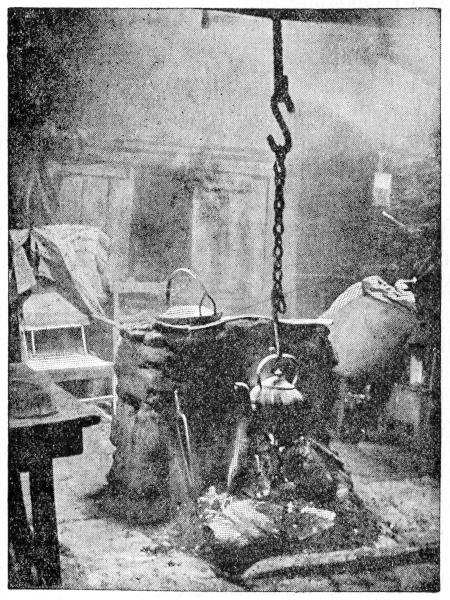
Old-fashioned Fireplace