Part I.—The Story of the Past.
Reading edition
PREHISTORIC ORKNEY.
At what period of the world’s history were our islands first inhabited, and who were their first inhabitants? These are questions which we cannot now answer. History is always made before it is written, and long ages must have passed in the history of these islands before any written records began to be kept.
Yet there are some records of that dim, forgotten past, which patient research has gathered together, and which can be made to tell us a few fragments of our Island story. If we look into one of the museums where relics of the past are preserved, we may find such things as flint arrow-heads and knives, stone axes and hammers, bronze spear-heads, and other tools and weapons of the early inhabitants of our islands. These silent witnesses tell us a little about what manner of men they were, and how they lived their long-forgotten lives.
The use of stone implements marks a very primitive stage of life, yet one which may not be entirely savage. There are tribes now living which are still in their Stone Age. A recent traveller tells of having seen an inhabitant of the South American Andes skin a hare very neatly with a small flint knife. This knife is now in Kirkwall, and is precisely similar to many which have been dug up in Orkney.
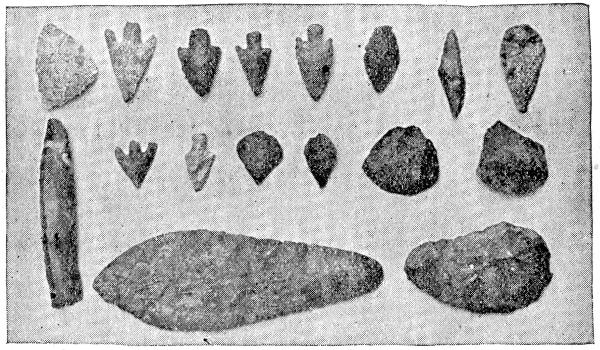
Flint Arrow-heads and Knives.
Flint is not a common stone in the Orkney Islands. It is found in occasional lumps and pebbles among the clay which has been carried from other places by the glaciers and icebergs of the Ice Age. Flint is common in the southern parts of Great Britain, however, and the arrows and knives found in our islands may have been brought from the south, or the art of making them may have been learned from tribes among whom flint was a more common material. This kind of stone, the fine steel of the Stone Age, was used for small implements over a wide area of the world.
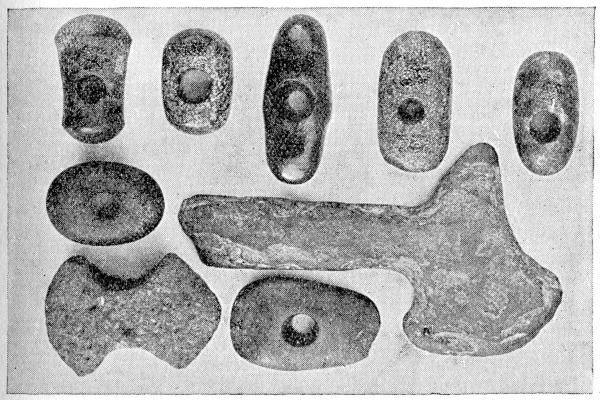
Stone Hammers and Axes.
Orkney must have had a large population in those early days. The number of ancient graves which have been found seems to indicate this, especially if we suppose that most of those graves with their heaped-up mounds are the resting-places of chiefs and great men rather than of the common people. The graves which remain are of varied types, from the simple cist of upright stones roofed with horizontal slabs and covered with earth, to the large mound with its carefully built chambers.
The variety of the objects found in those graves, from the rudest flint and bone implements to those which are carefully finished, and finally to objects made of metal, shows that the burials belong to different periods. They tell us of long ages of increasing though now forgotten civilization. Some of the mounds, indeed, show by their contents that they cover the remains, not of the original and unknown inhabitants, but of the Norse conquerors, and thus really belong to the period whose history has come down to us in writing. But in the very mound where the Norse warrior was laid to rest, there are sometimes also found the relics of burials of a much ruder age. Such mingling of the materials of our unwritten history makes the story which they tell a very difficult one to read.
There are few remains in our islands more striking than the chambered mounds, or Picts’ houses, as they are called. The most complete and probably the most recent of them is that known as Maeshowe. They consist of a mound of earth heaped over a rude building, sometimes of one apartment, but frequently of several, the entrance being a long, low, narrow passage, through which it is necessary to stoop or crawl in order to gain an entrance.
Possibly those Picts’ houses were built at first as houses to dwell in, though later used as tombs. It is not uncommon to-day to find buildings used for burial which were designed for other purposes. If ever our race and all its records were to vanish as completely as the primitive inhabitants of the Orkney Islands have done, we can imagine some future explorer of the ruins of St. Magnus Cathedral writing a learned treatise to prove that the largest building in our islands was erected as a burial-place for our dead.
Those mound dwellings, or Picts’ houses, may seem to us a very strange form of house to live in. Where can we find to-day houses of such a type, and with so very inconvenient a form of entrance? The Eskimos, as travellers tell us, are in the habit of building just such houses with blocks of snow, and they find this the best type in the extreme cold of their Arctic climate. Possibly the Picts’ house type of dwelling was used in Orkney and in other places for similar reasons.
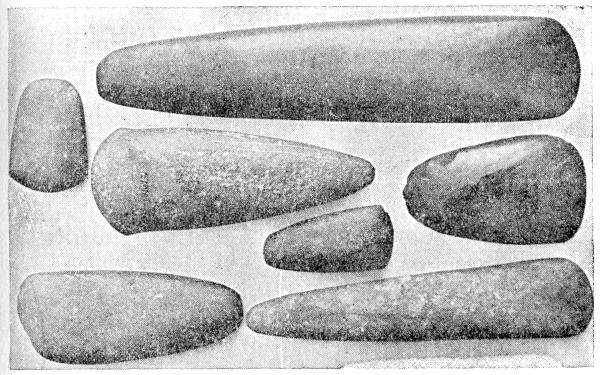
Polished Stone Celts.
The brochs, or Pictish towers, as they are also called, are buildings of a different kind, which are also fairly common in Orkney. They are probably of later date than the Picts’ houses. Considerable skill, as well as co-operation in labour, must have been required for their erection.
The most complete broch in existence is that of Mousa in Shetland. Of those which are found in Orkney, only the lower portions now remain. Over seventy such ruins have been examined, the best specimens being in Evie (Burgar), Birsay (Oxtro), Harray, Firth (Ingashowe and Stirlinghowe), St. Ola (Birstane and Lingro), St. Andrews (Dingishowe and Langskaill), Burray (East and West Brough), South Ronaldsay (Hoxa), Shapinsay (Borrowston), and Stronsay (Lamb Head).
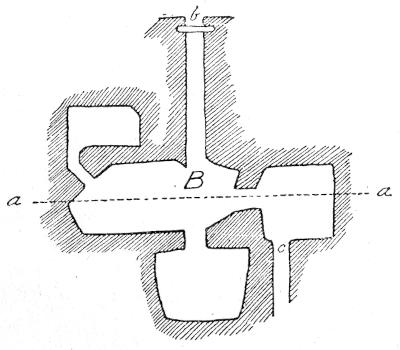
Plan of Chambered Mound, Wideford Hill.
b, Entrance. c, Blind Passage.
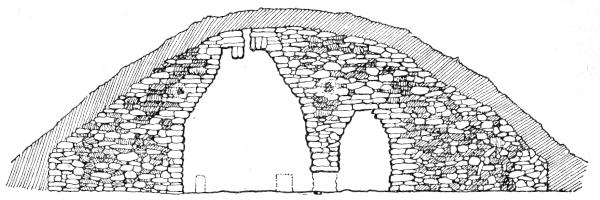
Chambered Mound, Wideford Hill.
Section on line a, a of plan.
The typical broch is a large round tower, fifty or sixty feet in diameter, and probably as much in height. The wall is about fifteen feet thick, and solid at the base, except for some vaulted chambers which are made in it. Higher, the wall is hollow, or rather consists of an outer and an inner wall, with a space of four or five feet between them. This space is divided into a number of stories or galleries by horizontal courses of long slabs of stone, which form the roof of one story and the floor of that above it, and at the same time bind the two walls firmly together. A stairway gives access to the various stories, and light is admitted by small windows opening into the interior space of the tower, no windows being made in the outer wall. A single door in the lower wall forms the only entrance to the inner court of the broch.
These towers were probably constructed for the purpose of defence, and against a primitive enemy they would serve as well as did the castles of a later age before the invention of gunpowder. Indeed, we read of the broch of Mousa being actually used as a fort in the time of the Norsemen.
Who the builders of these towers were we cannot discover. They are undoubtedly very ancient; yet their builders and occupiers were by no means savages. From the remains which have been found in them we learn that they were used by a people who kept domestic animals, who cultivated the ground, and who could spin and weave the wool of their flocks into cloth. No weapons of the Stone Age are found in the brochs.
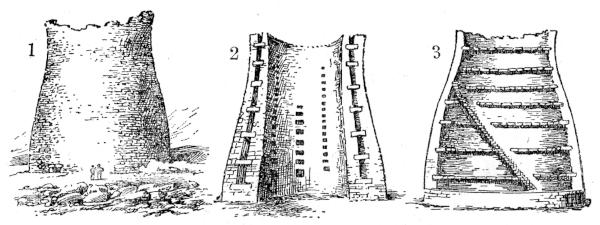
Broch of Mousa, Shetland.
1. Exterior. 2. Section. 3. Section with inner wall removed.
It is certain that they were built, and that most of them may have fallen into ruins, long before the Norsemen came. Many of the places where they stand were named by those settlers from the broch which was found standing there. The words borg, as in Burgar, and howe (haug), as in Hoxa (Haug’s aith, or isthmus), are found in many place-names. It is certain, too, that the brochs were not then occupied, or we should have found some account of their siege and capture in the Sagas which tell of Norse prowess by land and sea.
Another type of ancient remains which is common in our islands is the standing stones. These are found in many places, either singly or in groups or circles. Regarding these relics of a distant past much has been written, but little is known.
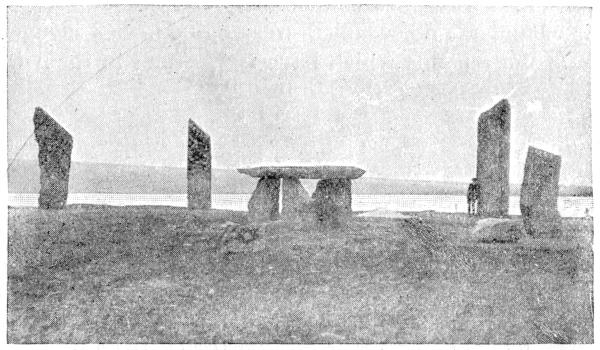
The Stone Circle of Stenness as now Restored.
An upright stone is the simplest and most effective form of monument, and is that which we most commonly use to this day to mark the resting-places of our dead. To the ancient Orcadian it was a matter of more difficulty to quarry and to transport and erect such monuments, and doubtless they would be set up only in memory of some great event, such as a notable victory, or the fall of a great chieftain.
The great stone circles, such as those of Stenness and of Brogar, are supposed to have served a different purpose. They are believed by many to have been the temples of some primitive people, who met there to worship their gods. It has also been supposed that the people who erected those circles were sun-worshippers, as the situation of certain prominent stones seems to have been determined by the position of the rising sun at midsummer.
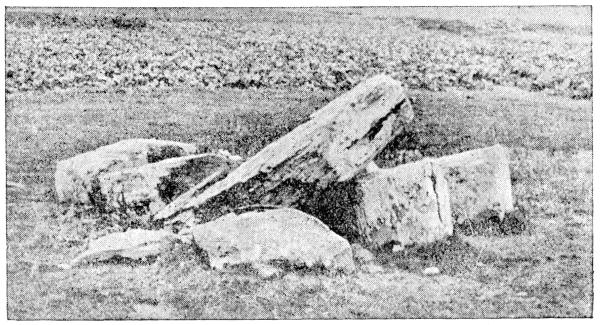
Fallen Cromlech or Table Stone, Sandwick.
But in these matters we cannot be certain of our conclusions. Most of our great churches and cathedrals are placed east and west, with the high altar towards the east, and even the graves in our churchyards are usually similarly oriented; but this does not prove that we are sun-worshippers, whatever our forefathers may have been before they accepted Christianity. We may indulge in much speculation about them, and form our own opinions as to what they originally meant, but those hoary monoliths remain a mystery, and the purpose of their erection we can only guess.
THE BEGINNINGS OF OUR HISTORY.
In the history of the ancient world some vague and fragmentary references are made to our islands, but from these little real knowledge of them can be gathered. As early as the time of Alexander the Great we come upon some notices of certain northern islands, which must be either Orkney, or the Hebrides, or Shetland, or the Faroes, but we cannot determine which. The Phœnicians, who were the great sea-traders and explorers of the early world, seem to have had a little knowledge of these northern archipelagoes.
In the time of the Roman occupation of Britain we have definite mention of the Orcades, but nothing which shows any real knowledge of them. They were visited by the fleet of Agricola after his invasion of Scotland, as recorded by Tacitus. About three centuries later, the poet Claudian sings of a victory by the Emperor Theodosius, who, we are told, sprinkled Orcadian soil with Saxon blood. We are not told, however, who the people called Saxons really were, or whether they were the inhabitants of the islands or not. They may have been early Viking raiders who had fled hither and been brought to bay among the group.
Early Church history has also some references to Orkney. After St. Columba had left the shores of Ireland to carry the message of Christianity to the Picts and Scots in Scotland, another Irish missionary, Cormac, went on a similar voyage among the Orkney Isles. Him, therefore, we may regard as the apostle to the northern heathen. St. Adamnan, the biographer of St. Columba, tells the story, and the name of Adamnan himself is still commemorated in the name of the Isle of Damsay.
After the visit of Cormac, the Culdee missionaries established themselves in various parts of Orkney, as the place-names given by the Norsemen show. In several of these names we find the word pápa, a form of pope, which was the name applied to the monks or clergy of the Culdee Church. Like Columba himself, who made the little island of Iona his headquarters, his followers seem to have preferred the seclusion of the smaller islands. To this habit are due such names as Papa Westray and Papa Stronsay. Other Church settlements have left their traces in names such as Paplay and Papdale.
Another place-name which records an old-world mission station is that of Deerness. At first sight this name seems rather to indicate that abundance of deer were found there; and some writers tell us, by way of proving this, that deer’s horns have been found in that parish. But as deer’s horns have also been found in many other places in the county, the proof is not convincing. We must remember that the Norse invaders were likely to name the place on account of its appearance from the sea. They may, of course, have noticed a chance herd of deer near the cliffs; but one thing is certain to have caught their eye—the unusual sight of a building of stone on the Brough of Deerness. Some remains of this building, and of a later one on the same site, still exist; and it was long regarded as in some way a sacred place, to which pilgrimages were made. This building was in fact one of those outposts of early Christianity—a Culdee monastery. When the Norse invaders came, they doubtless found it occupied by some of the Culdee clergy—diar, as they would be called by the strangers—and so the headland was named the Priests’ Cape, or Deerness.
It is quite possible that deer existed in Orkney down to the Norse period, but they were much more likely to be found in the hilly regions of the west Mainland, which was the earls’ hunting-ground. We read of an Earl of Orkney going over to Caithness for the chase of the deer, which seems to suggest that they were then scarce, if not extinct, in Orkney.
Among the remains of the Culdee settlements which are still found are monumental stones with Christian emblems inscribed on them, or with Irish Ogham writing, and ancient bells, probably used in the churches. The curious round tower which forms part of the old church of St. Magnus in Egilsay is of a type common only in Ireland. The name of that island is probably derived from an earlier church which the Norsemen found there, and heard called by its Celtic name, ecclais. It has been supposed by some that the name Egilsay means Egil’s Island, so called after some man named Egil; but the probability is that it meant the Church Island.
All that we can learn, then, from the ancient relics of its first inhabitants, and from the brief references to the islands by old historians, amounts to very little. We know that Orkney was thickly inhabited by some ancient people, living at first the primitive life which is indicated by the use of stone implements. We may suppose that they had at one time a religion in some way connected with sun-worship. We know that they built earth-houses somewhat like the snow-houses of the Eskimos, many of which still remain, and that, in some cases at least, these have been used as places of burial by later inhabitants. We know that at one period strong circular towers were built, probably as fortresses, by a people of some degree of civilization. We know that in the time of St. Columba Christian missionaries or monks visited the islands, whose inhabitants were then probably of the race known as Picts, and whose chiefs are said to have been subject to the Pictish king of Northern Scotland. Some at least of those Culdees we may suppose to have been hermits rather than missionaries, although they may have combined the two characters. How many centuries of time are covered by these facts and suppositions we do not know, but they sum up all that can be said with certainty regarding Orkney before the coming of the Norsemen.
There is one very curious fact about the beginnings of the Norse records: they make no mention whatever of any inhabitants being found in the islands. The place-names afford evidence, as we have seen, of the presence of Culdee monks, but of other population there is no trace. The new-comers seem to have settled as in an uninhabited land, each Viking selecting and occupying his land without let or hindrance.
If there had been a native population, and if these had been either expelled or exterminated by the invaders, we should surely have been told of it by the Saga writers, who would have delighted in telling such a tale. It has accordingly been supposed that at the time of the Norse settlement the islands were uninhabited save by the hermits of the Culdee Church. When or how the former Pictish inhabitants disappeared it is impossible to say. Possibly some early Viking raids, of which no history remains, had resulted in the slaughter of many and the flight of the rest to the less exposed lands south of the Pictland or Pentland Firth. Whatever the reason may be, the chapter of our Island history which opens with the Norse settlement is in no way a continuation of anything which goes before, but begins a new story.
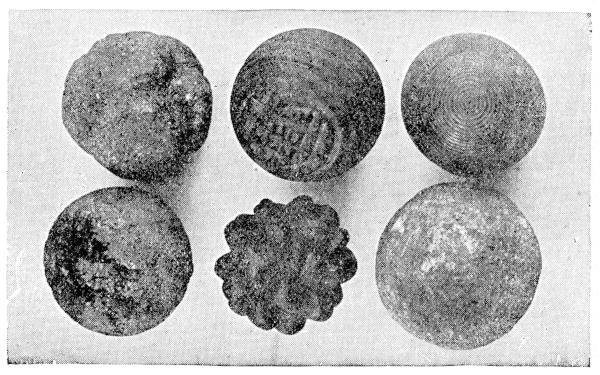
Carved Stone Balls.
THE NORSEMEN AND THEIR SAGAS.
It is late in the eighth century before the Northman or Norseman appears on the stage of history. From the day when Cæsar’s victorious legions brought the Gauls, the Germans, and the Britons under the sway of the imperial city, these nations of Western Europe are never again entirely lost to history. But Scandinavia and the countries round the Baltic remained unknown to Rome and to the world for long centuries afterwards. “There nature ends,” one of the Roman writers has said, when speaking of these northern lands. This brief yet expressive sentence well indicates how completely outside the Roman world lay the countries which were the cradle of our race.
There is another side to all this, which we find it difficult to picture clearly in our minds. To the inhabitants of Scandinavia and the lands round the Baltic, the southern parts of Europe were equally unknown. We find in a Scandinavian writer of the ninth century a description of an expedition which was made by one of the Viking chiefs to this unknown world. In the course of his travels he came upon a city which to the Norseman seemed mysterious and dread—a city of Niflheim, the under-world. This city, as we learn from contemporary Western writers, must have been Paris. Paris, now the gay capital of Europe, and even then a city of importance and of fame, was so unknown to the Norsemen of the early ninth century that it was deemed a part of Niflheim, the under-world!
During the period when the northern nations were hidden from the eye of history, many changes must have been going on among them. The building and management of ships could not have been learned in a day, and even when we first catch sight of the Norsemen they were the finest and most daring seamen in the world, and their ships probably the most perfect hitherto seen. Many voyages among their own islands and in the Baltic must have preceded the longer voyages to Britain, to Iceland, to Greenland, and to America. Numerous wars there must have been, quite unknown to history, before the northern warrior became the terrible fighter of the Viking Age.
We can imagine the delighted wonder with which the northern warriors first gazed upon the rich and fertile shores of South-Western Europe. We can imagine how they contrasted the fair fields and great cities of the south with the bleak and sterile shores of the north from which they came. What motives first led to their leaving their native shores it is difficult to say. Thirst for adventure, the pinch of poverty at home, the desire of possessing gold and treasure, all conspired to make them seek their fortunes in the wide and unknown lands which lay beyond the sea. When the first adventurers brought home accounts of the lands which they had seen—the fruitful fields, the great cities, the rich merchandise, and the yellow gold—great numbers of their fellow-countrymen would be seized with a longing to visit those wonderful shores where wealth was to be had for the taking. The roving spirit once roused spread rapidly over the northern lands. The storm of Viking fury burst on the lands of Western Europe almost without warning.
In the Anglo-Saxon Chronicle, under the date A.D. 787, we read: “In this year King Beorhtric took Eadburh, King Offa’s daughter, to wife. And in his days first came three ships of Northmen from Haerethaland, and the reeve rode down to them and would drive them to the king’s vill, for he knew not what men they were, and they there slew him. These were the first ships of Danish men that sought the land of the English.” Thus we read of the first mutterings of the storm which was so soon to burst on the coasts of Western Europe. During the succeeding two centuries and a half the English learned to know well what men these were who came out of the wild north-east. The monks’ litany, “From the fury of the Northmen deliver us, O Lord!” tells us what they thought of them.
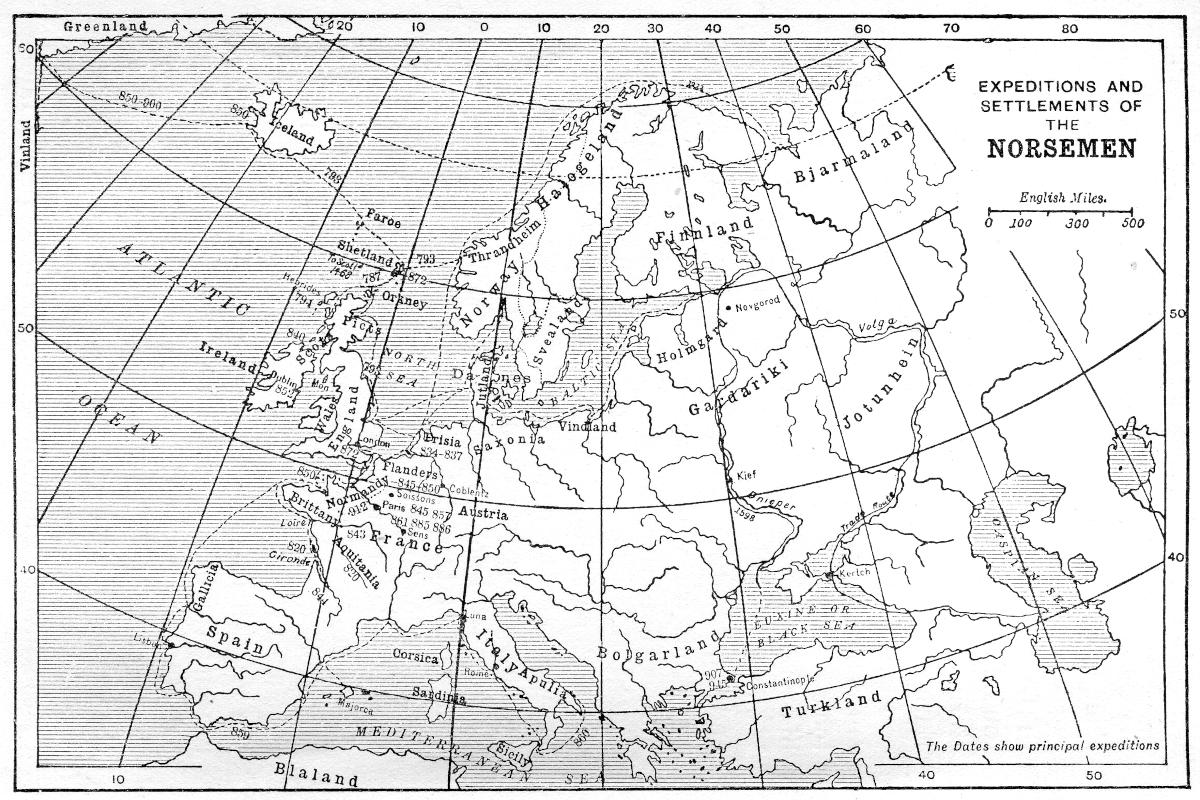
EXPEDITIONS AND SETTLEMENTS OF THE NORSEMEN
We can trace two distinct roads which the Viking raids followed. One, traversed chiefly by the Danes, led along the shores of Northern Europe to England, the English Channel, France, Spain, and the Mediterranean; the other, traversed chiefly by the Norsemen, led straight across the North Sea to the Orkneys, thence along the west coast of Scotland, to Ireland and the west of England. The islands lying off the coasts of Scotland, England, Ireland, and France were seized by the invaders, and from these as bases their raids extended far and wide. Monasteries felt the utmost fury of their attacks, for there they knew they would find abundance of spoil. At first the invaders confined themselves to plundering expeditions. The Norsemen early turned their attention to settlement and commerce; the Danes, on the other hand, remained for a longer period intent on plunder alone.
Civil wars in Western Europe had rendered the nations there incapable of effective resistance to the ruthless invaders. The Vikings descended now at one point, now at another. When they met with a more stubborn resistance than usual, they merely retired to their ships with whatever plunder they had seized, and sailed away to make an attack somewhere else. They wintered on the islands which they had seized, and as soon as spring was come they descended once more on the devoted lands. Ireland suffered severely at their hands. The Orkneys and the Hebrides became nests of Vikings; in fact, colonies of them must have been established there at a very early date. In these islands they were safe from all interference—a law to themselves; for as yet there was no arm in Europe long enough and strong enough to reach them. Nowhere could a more convenient base have been found for Viking raids on the British and Irish shores.
The first half-century of the Viking Age saw the Danes settled merely in outlying parts of the east coast of England. The Norsemen, on the other hand, had already seized on Orkney, Shetland, the Hebrides, and large tracts of Eastern Ireland. The first fifty years of the Viking Age may be called the first period of Norse colonization in the west.
It would be a great mistake, however, to suppose that the Norsemen were merely turbulent sea-robbers, or that the only result of their migrations was to hinder the progress of civilization in Western Europe. As settlers in other countries, they brought new strength and vitality to the land of their adoption; but instead of remaining separate colonies, they were soon absorbed into the native population, and had no further history of their own.
Yet there were two great settlements abroad which left a deep mark on European history. The one was the colonization of the north of France, afterwards called Normandy. There the Norsemen soon adopted the language and the religion of the country, but retained so much of their native characteristics that the subsequent Norman Conquest of England may be regarded as really a Norse inroad of a specially successful type. The other settlement was that in the south of Italy and Sicily, later known as the kingdom of the Two Sicilies, which occupied an important place in history during the Middle Ages.
Even the British settlements for the most part had only a brief period of separate history, and soon became merged into the general stream of national life. In Orkney and Shetland, however, where there was probably no native population at the time of the Norse invasion, the colony developed along its own special lines, and has left behind it a history which for centuries remained distinct from that of the rest of Great Britain.
The history of the Orkney Islands during the period of the Norse occupation is preserved for us in the Icelandic Sagas. Iceland was one of the earliest and most important Norse colonies, and there the old Northern language was preserved better than anywhere else. The Sagas are stories which, in the times of long ago, were told around the fires in Iceland and other Norse colonies to while away the long winter evenings. At festivals and merry-makings, during long voyages, or by the winter fireside, the Norseman listened eagerly to the recital of deeds done by his kinsmen in other times and in other lands. Storytelling was a popular pastime, and the man who knew many Sagas was ever a welcome guest.
Many of the Sagas have now been translated into English, and all of these are well worth reading. The greatest of all the Sagas is generally thought to be the Saga of Burnt Njal. It is one of the noblest stories to be found in any language, and it is besides nobly told. In this Saga we find the best account of the great battle of Clontarf. Among the other great Sagas are the Saga of the Settlers on the Ayre, the Saga of Laxdale, the Saga of Egil the son of Skallagrim, the Saga of Grettir the Strong, and the Saga of the Volsungs. The two last are mythical Sagas; they do not tell of real historical personages, but are paraphrases of old songs and legends which have come down from a more distant past. The Anglo-Saxon Saga of Beowulf tells some of the same stories, and is not a real Saga in the sense of a true story told by the fireside.
The stories of the earls and chiefs of Orkney form part of the great store of Saga literature, and these have come down to us in the form of the “Orkneyinga Saga.” It must be remembered, however, that this is merely the summary of a great number of stories which had been told long before by men who had no doubt taken part in the events related. It was a Saga-man’s pride to tell the truth—at least as it was told to him—and so we may in the main rely on the Orkney Saga as a true account of events which happened, although sometimes it may be exceedingly difficult to assign the correct dates. The Orkney Saga is not usually reckoned among the great Sagas. It partakes more of the nature of a general history than of a single and complete story. This Saga is the chief source of our knowledge of the history of our islands during Norse times.
The Orkney Saga consists of several parts, each of which might be called a separate Saga—the Earls’ Saga, Magnus’s Saga, and Rognvald’s Saga. The first relates the history of Orkney from its conquest by King Harald Fairhair of Norway down to the death of Earl Thorfinn, about the time of the Norman Conquest of England. The second relates the lives of Thorfinn’s sons, Paul and Erlend, but more especially of the holy Earl Magnus, of his murder, and of the wonderful things that happened afterwards through his holiness. The third part tells of the earls after St. Magnus, chiefly Earl Rognvald the Second, and the great Viking, Sweyn Asleifson of Gairsay, generally known as “the last of the Vikings.” The whole history given in the Orkney Saga includes the events of the three centuries from 900 to 1200.
In addition to what we learn from the Orkney Saga, we glean a few facts about the history of our islands from other Sagas, such as the Sagas of the Kings of Norway, usually called the “Heimskringla.” There are also many Norse poems which scholars say must have been written in Orkney, or in some other of the western Norse colonies, and from these we can learn much about the life of the people, their thoughts, and their beliefs, though very little about the actual history of the islands. We do not know who were the authors of these poems, but some of them were really great poets, greater, perhaps, than any then living in any other part of Europe.
Finally, there are occasional glimpses of our Norse ancestors to be caught in the pages of the chronicles and histories of the nations. Unfortunately, these references are so often distorted by fear or hatred, or so confused through scanty and imperfect knowledge, that they add very little to what we already know from Norse records. One good purpose, indeed, they serve: they show that the Saga-men were in the main truth-tellers, so that we can place reliance on their stories, even where these are not found in the records of other nations. The Saga-men also fill up many gaps in the history of those countries which the Norsemen visited, and thus they render our knowledge of the Viking Age more complete, more detailed, and more accurate, even as regards countries which were to them foreign lands.
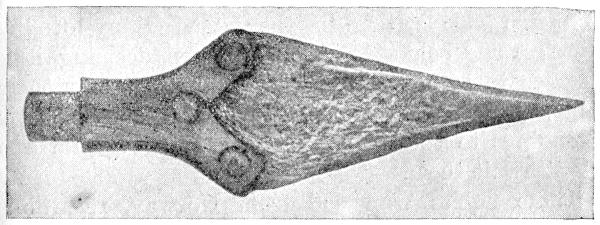
Ancient Bronze Spear-head; Horn Mounting still preserved.
THE BEGINNING OF THE EARLDOM.
Before our story begins, Norway was divided into a number of small kingdoms. About the year 890 A.D. a king called Harald, who ruled over one of these small kingdoms, resolved to make himself master of all Norway. He made a vow that he would not cut his hair until he was acknowledged king throughout the whole country. This ambitious aim took some time to accomplish, and as the years passed his thick locks grew long and shaggy. Thus he got the name of Harald Shockhead.
One after another, however, he subdued the smaller kingdoms, compelling the earls and chiefs to acknowledge him as their king, or to leave the country. Then began what may be called the second period of Norse colonization in the west. Many of the proudest and boldest of the Norsemen, deeming it a disgrace to serve a king who was at best only their equal, preferred to trust themselves and all their belongings to the ocean, and take whatever fortune might await them.
Those nobles who fled from Norway, regarding Harald as their enemy, soon began to spread terror along the shores of Norway itself, returning to plunder, and slay, and burn, as their fellow-countrymen had so often done in the west. Their chief haunts were among the Orkneys and the Hebrides. Thither they betook themselves with their booty when winter came on. There they lived and feasted all through the winter, and when spring came they descended once more on the coasts of Norway. Ireland and the west coast of England also suffered from these raiders, and in France a determined effort to conquer the country was at this time made by the Norsemen. Hrolf or Rollo, the Norseman, became master of the north of France, and gave to it a new name—Normandy, the land of the Normans or Norsemen.
The last great effort made by these Norse nobles to break the power of King Harald was foiled by their defeat at Hafursfrith. A great league had been formed against Harald. Vikings from over the sea crowded back to Norway to avenge their own injuries and to help their kinsmen. The two fleets met at Hafursfrith in the south of Norway, and a long and stubborn battle ended in victory for Harald. This battle had far-reaching results. It was the end of the struggle for independence in Norway. Harald was then left free to turn his attention to the chastisement of the Vikings in the west. The result was the foundation of the Norse Empire in the west, and the colonization of Iceland and Greenland by those Norsemen who still scorned to own the sway of the Norwegian king.
With a large and splendidly equipped fleet, Harald swooped down on the Vikings in Orkney and the Hebrides. Their resistance was feeble enough. Some yielded themselves to the king; others fled before him. Nowhere was there anything like a pitched battle. As far south as the Isle of Man, Harald pursued his career of conquest. Turning north once more, he established Norse jarldoms or earldoms in Orkney and the Hebrides, to be subject henceforth to the Norwegian crown. Then, considering that his vow was fulfilled, Harald at last had his long hair cut, and was afterwards known as Harald Fairhair.
One of Harald’s chief friends and supporters was Rognvald, Earl of Moeri and Romsdal, who was called by the men of his time, “The mighty and wise in council.” This Rognvald was the father of Rollo of Normandy. He had other sons named Ivar, Thorir, Rollaug, Hallad, and Einar, and he had a brother called Sigurd. The family makes a very large figure in the history of those times. In one of Harald’s battles in the west fell Ivar, Rognvald’s son. Harald assigned to Rognvald the newly created Jarldom of Orkney in order to compensate him in some measure for the loss of his son. But Rognvald had already large estates in Norway. He thought that these were quite enough for one man to govern. Accordingly he handed over the Orkneys to his brother Sigurd, who thus became the first Jarl or Earl.
Sigurd, the first Earl of Orkney, sometimes called Sigurd the Mighty, was a strong and energetic ruler. When King Harald departed for Norway, the earl at once began to strengthen himself in his new dominions. He first allied himself with Thorstein the Red, son of the Norse king of Dublin, and with the Norsemen in the Hebrides, and then invaded Scotland in an attempt to add to his earldom Caithness and Sutherland. The Scots naturally offered a determined resistance. Their leader was Maelbride or Melbrigda—called Melbrigda Tusk because he had a large projecting tooth—Earl or Maormor of Ross.
After the war had lasted for some time, the two earls agreed to meet and settle their quarrel, each taking forty men with him. On the day fixed for the meeting, Sigurd, suspecting, as he said, the good faith of the Scots, mounted two men on each of his forty horses, and came thus to the place appointed. As soon as the Norsemen appeared in sight, Melbrigda saw that he had been trapped, and turning to his men, said, “We have been betrayed by Sigurd, for I see two feet on each horse’s side. The men must therefore be twice as numerous as the horses that bear them. Nevertheless let us harden our hearts and sell our lives as dearly as we can.”
Seeing the Scots prepared to die hard in the place where they were, Sigurd divided his force and attacked them at once in front and in flank. The battle was fierce and bloody, but it ended in the total extermination of the small band of Scots. Sigurd, exulting over his fallen foe, cut off Melbrigda’s head and fixed it to his saddle. On his way home, in spurring his horse his leg struck against the great projecting tooth which had given Melbrigda his nickname, and the tooth pierced his leg. Blood-poisoning followed, and a few days later Earl Sigurd died in great pain on the banks of the Dornoch Firth. He was buried at a place now called Cyder Hall (Sigurd’s Howe), near Skibo Castle.
Sigurd was succeeded in the earldom by his son Guttorm. Guttorm ruled the islands for one short and uneventful winter, and then died childless. For some time the earldom was without a ruler. Vikings once more began to make the Orkneys their headquarters, and to harass the more peaceful inhabitants of the islands. When King Harald heard that the Orkneys were without a ruler, he asked Earl Rognvald to make haste to send them another earl. Rognvald then had the title of Earl of Orkney conferred on his son Hallad, who sailed for the west as the third earl. But Hallad was weak and indolent. The western earldom was too turbulent and difficult to govern. He soon wearied of his dignity, and at last, deserting his earldom, went back to Norway. After his ignominious withdrawal from the earldom, the islands came under the rule of two Danish Vikings.
Although Hallad preferred a simple farmer’s life to an earl’s dignity, there were others of Rognvald’s sons who were more ambitious. Einar especially was eager to redeem the family honour by the expulsion of the Vikings from the islands. Accordingly Einar was chosen as Earl of Orkney, and after King Harald had conferred on him the title, he set out for his earldom. The old Earl of Moeri had never regarded his youngest son with much favour, and, to tell the truth, neither desired to see the other’s face again.
Einar was the best and greatest of the early Norse earls. In appearance he was tall and manly; his face was somewhat disfigured by the loss of an eye, but in spite of this he was reputed to be very sharp-sighted. His father had prophesied that Einar would never become a great chief; yet he became the most famous of all Earl Rognvald’s sons, with the exception of Rollo of Normandy.
The earldom was in a state of great disorder when Einar arrived. The Vikings had to be expelled, the government had to be settled and established, and the people had to learn to trust and obey their new earl. All these things were accomplished in a marvellously short space of time. The new earl also taught his people many useful arts. Wood was scarce: Einar knew that the people of Scotland used peat for fuel, and he taught the Norsemen in the islands to do the same. From this he got the name of Torf-Einar.
Soon a serious trouble arose. King Harald’s sons had now grown up to be very turbulent and overbearing men. They quarrelled with their father’s chiefs and earls. Two of them, Halfdan Highleg and Gudrod Bright, attacked and slew Rognvald, Earl of Moeri. Harald was enraged that his sons should thus murder his best and most faithful counsellor and friend. He marched against them with an army, and ordered them to be seized and brought before him. Gudrod gave himself up to his father, but Halfdan seized a ship and sailed west to the Orkneys.
Halfdan’s sudden arrival in the earldom caused panic for a time. Einar was quite unprepared for an invasion. He accordingly thought it wiser to escape to Caithness until he had time to collect his forces. In the meantime Halfdan seized the government of the isles, taking the title of King of Orkney and Shetland. The same summer saw Einar back in the Orkneys with a fleet and an army to regain his earldom. The two fleets met somewhere off the island of Sanday. A fierce battle took place, and Halfdan’s force was practically annihilated. In the dusk of the evening he himself leaped overboard and escaped.
Next morning the shores were searched for fugitives. All who were found were slain, but Halfdan himself had disappeared. While the search was still proceeding, Einar was observed to stop suddenly and gaze across the sea towards the island of North Ronaldsay, or Rinansey, as it was then called.
“What see’st thou, jarl?” asked one of his companions. “I know not what it is,” was the reply. “Sometimes it appears to rise up, and sometimes to lie down. It is either a bird in the air or a man on the rocks, and I will find out.”
This object which the earl saw was Halfdan, who had probably just dragged his weary limbs from the water, and was now struggling up over the rocks to the land. The earl’s men pursued and captured him. He was at once brought before the earl, who ordered him to be slain, to avenge his father’s murder, and as a sacrifice to Odin for the victory.
Angry as King Harald had been because of the murder of Earl Rognvald, the death of his son at the hands of Rognvald’s son was not likely to be very agreeable to him. Harald therefore determined to make a second expedition to the west.
When Einar heard of Harald’s intended visit to the Orkneys, he thought that he would be safer out of the king’s way, and accordingly he crossed the Pentland Firth. Messengers went backwards and forwards between the king and the earl for a while, arranging terms of settlement. At length the king demanded that the earldom should pay a fine of sixty marks. To that Einar agreed, and King Harald Fairhair bade farewell to his western dominions for ever.
It was no easy matter for the Orkneymen to raise the sixty marks, and the earl called a Thing or council to discuss the matter. At length the earl offered to pay the whole fine himself, on condition that all the freehold or udal lands of the Orkneymen were handed over to him in pledge for the amount that each had to pay, and to this the islanders agreed.
In this way the earl came into possession of all the udal lands in the Orkneys; and it was not till the time of Earl Sigurd the Stout, a century later, that the udal rights were restored to the Orkneymen. Earl Einar spent the rest of his days in peace. The earldom was well ruled. Vikings were afraid to plunder the dominions of so powerful a chief; and after a long and honourable reign the good earl died on a sickbed—what the Vikings called a “straw death”—about the year 933.
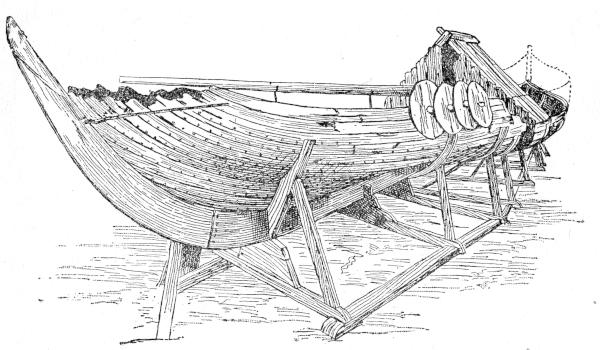
Remains of a Viking Ship found in Sweden.
THE DARK CENTURY.
The tenth century may fittingly be called the dark century of Orcadian history. We know very little of it except occasional glimpses afforded by obscure references in the Sagas; and the little that we do know tells of treachery and bloodshed and murder to an extent unusual even in the troubled annals of Orkney.
After the death of Torf-Einar the earldom came into the hands of his three sons, Thorfinn—usually called Thorfinn Skull-splitter—Arnkell, and Erlend. The disturbed state of Norway, consequent on the death of Harald Fairhair about the year 945, caused turmoil and confusion throughout all those lands which had been conquered and settled by the Norsemen. Harald left behind him a brood of wild, reckless sons, each of whom thought he had a right to a share of his father’s dominions. They filled the whole land with turbulence and bloodshed.
Eric Bloody-axe had been Harald’s favourite son, and he at first took over the chief rule in Norway. He was a brave and skilful warrior, but passionate, avaricious, and treacherous in his disposition. The same qualities were possessed in an even greater degree by his queen, Gunnhilda. Their deeds of violence soon estranged the hearts of their subjects.
Hakon, Harald’s youngest son, who had been brought up in England under the care of King Athelstan, came to Norway to claim his share of his father’s dominions. Hakon was at this time only in his fifteenth year, but he was daring and ambitious, and was the darling of the Norsemen both at home and abroad. Eric Bloody-axe and Gunnhilda were, on the other hand, regarded everywhere with hatred and detestation. When, therefore, Hakon invaded Norway and attempted to wrest the sovereignty from the hands of his elder brother, the latter was deserted by his people and was forced to flee from the country.
Eric crossed first to Orkney, where he gathered a band of followers as reckless as himself, and then held on to England and began to ravage the land in the usual Viking fashion. Close friendship had long existed between Athelstan and Harald Fairhair. Athelstan professed similar friendship for Harald’s sons, and now offered Eric the lordship of Northumbria. Eric was not so foolish as to reject this offer. Gunnhilda and he with their family abode in peace in Northumbria for about a year.
With the death of Athelstan fortune began once more to frown upon the exiled king. King Edmund thought it by no means desirable that the Norsemen should hold so large a portion of his kingdom. Knowing the insecurity of his tenure, Eric’s reckless spirit flashed at once into open rebellion. He left Northumbria, sailed to Orkney, seized the Earls Arnkell and Erlend, forced many other Orcadian chiefs to join him, and made a Viking raid on the west coast of England. The raiders met with resistance and a battle was fought; in this battle fell Eric himself, both the Orkney earls, and most of the other leaders.
When news of this disastrous expedition reached Gunnhilda, who had remained with her family in Northumbria, she in turn embarked for Orkney. She and her sons claimed the earldom, seized the taxes, and spread wrong and oppression over all the western colonies. For a short time the islands suffered the same misgovernment as Norway had already suffered at her hands. But war now broke out between Norway and Denmark. This seemed to afford her a chance of regaining the Norwegian crown, and Gunnhilda and her family sailed eastwards once more. Ragnhilda, her daughter, was left behind in Orkney to continue for a time her mother’s acts of treachery and bloodshed.
There are few worse characters in history than Ragnhilda as depicted by the Saga. She seemed to have a mania for plots and murders. Married first to Arnfinn, one of the sons of Earl Thorfinn, she caused him to be murdered at Murkle in Caithness, for no reason that we can find out, and then married his brother Havard. On the death of his father Thorfinn, shortly afterwards, Havard became earl. He is known in history as Havard the Harvest-happy, because during his time the islands were blessed with good harvests. Havard also met his death at the instigation of his wife. Ragnhilda persuaded Einar Oily-tongue, his nephew, to murder the earl, promising to marry him and secure for him the earldom when the deed was done. Einar set on Havard in Stenness, and slew him after a hard struggle. But it was apparently no part of Ragnhilda’s plan to marry Einar Oily-tongue. She now professed the greatest indignation and grief at the murder of Earl Havard, and called for vengeance on his murderer. Einar Oily-tongue had a cousin, also called Einar. He in turn fell a victim to the wiles of Ragnhilda. By promising or at least hinting that she would marry the man who avenged the murder of Earl Havard, she succeeded in getting the second Einar to murder the first, and ended by marrying Ljot, the third son of Earl Thorfinn, who was the real heir to the earldom.
This was by no means the end of Ragnhilda’s wickedness. Ljot had a brother, Skuli, who was not at all satisfied that the former should have the whole earldom. It was an easy matter to make trouble between the two brothers. In the end Skuli left the islands for Scotland, and became Earl of Caithness and a vassal of the Scottish king. Bad feeling continued between the brothers, and was carefully fostered by Ragnhilda. Ultimately they met in arms in Caithness, Skuli with a Scottish army, and Ljot with the forces of the earldom. The Scots were defeated and Skuli slain.
Ljot now added Caithness to his earldom, but the Scots again and again strove to reconquer it. Finally a great battle was fought at Skidmire in Caithness. The Norsemen gained the day, but the earl was fatally wounded. There remained one son of Thorfinn Skull-splitter, named Hlodver, who now became earl over an earldom exhausted and impoverished by twenty years of misgovernment and bloodshed, and embroiled in an arduous struggle with Scotland for the possession of Caithness.
The Orkney earldom, however, was now on the eve of a great expansion. Under the son and grandson of Hlodver, Sigurd the Stout and Thorfinn the Mighty, the Norse dominion in the west attained its widest bounds, and the earldom of Orkney its greatest importance. For more than half a century, with little or no interference from Norway, the Orkney earls helped to mould the history of Ireland and of Scotland; and until the union of England and Denmark took place under Canute, the Norse Earls of Orkney were probably the most powerful chieftains in the British Isles.
It was in the time of Earl Sigurd that Christianity was first introduced among the Norse inhabitants of Orkney. Olaf, Tryggvi’s son, King of Norway, had embraced the new faith, and his methods of promoting the religion which he professed were characteristic of his time and race. The story of the conversion of Earl Sigurd and his followers is thus given in the Saga:—
“Olaf, Tryggvi’s son, sailed from the west to the Orkneys; but because the Pentland Firth was not passable, he laid his ship up under the lee in Osmund’s Voe, off Rognvald’s Isle. But there in the voe lay already Earl Sigurd, Hlodver’s son, with three ships, and then meant to go a-roving. But as soon as King Olaf knew that the earl was there, he made them call him to come and speak with him. But when the earl came on board the king’s ship, King Olaf began his speech.” (We pass over his long historical review of the establishment of the Orkney earldom and its dependence upon the kings of Norway, and give only his closing sentences.)
“‘Now, as so it is, Earl Sigurd, that thou hast come into my power, now thou hast two choices before thee, very uneven. One is that thou shalt take the right faith and become my man, and allow thyself to be baptized and all thy undermen; then shalt thou have a sure hope of honour from me, and to have and to hold as my underman this realm, with earl’s title and full freedom as thou hast erewhile had it; and this over and above, which is much more worth, to rule in everlasting bliss with all-ruling God—that is sure to thee if thou keepest all His commandments. This is the other choice, which is very doleful and unlike the first—that now on the spot thou shalt die, and after thy death I shall let fire and sword ruthlessly rage over all the Orkneys, burn and brand homesteads and men, unless this folk will have salvation and believe on the true God....’
“But when Earl Sigurd had heard so long and clever a speech of King Olaf, he hardened his heart against him, and spoke thus: ‘It must be told thee, King Olaf, that I have firmly made up my mind that I will not and may not and shall not forego that faith which my kinsmen and forefathers had before me: for I know no better counsel than they, and I know not that that faith is better which thou preachest than this which we have now had and held all our lives.’
“And with that the king saw the earl so stiffnecked in his error, he seized his young son, whom the earl had with him, and who had grown up there in the isles. This son of the earl the king bore forward on the prow and drew his sword, and made ready to cut off the lad’s head, with these words, ‘Now mayst thou see, Earl Sigurd, that I will spare no man who will not serve Almighty God, or listen to my exhortations and hearken to this blessed message; and for that I will now on this very spot slay this thy son before thine eyes, with this same sword which I grasp, unless thou and thy men serve my God; for hence out of the isles will I not go before I have forwarded and fulfilled this His glorious errand, and thou and thy son, whom I now hold, have taken on you baptism.’
“And in the strait to which the earl was now come, he chose the choice which the king would have, and which was better for him, to take the right faith. Then the earl was baptized, and all the folk in the Orkneys. After that Earl Sigurd was made after this world’s honour King Olaf’s earl, and held under him lands and fiefs, and gave him for an hostage that same son of his of whom it was spoken before; he was called Whelp or Hound. Olaf made them christen the lad by the name of Hlodver, and carried him away with him to Norway. Earl Sigurd bound with oaths all their agreement, and next after that Olaf sailed away from the Orkneys, but set up there behind him priests to mend the folk’s ways and teach them holy wisdom; so they, King Olaf and Sigurd, parted with friendship. Hlodver lived but a scanty time; but after that he was dead Earl Sigurd showed King Olaf no service. He took to wife then the daughter of Malcolm the Scot King, and Thorfinn was their son.”
So does the Saga tell this dramatic tale; and we may notice that the earl’s allegiance to the new faith was as fickle as his fidelity to the king, for a few years later we find him fighting in the ranks of the heathen against the Christian king, Brian of Ireland, under the shadow of his raven banner, a flag endowed by his mother’s spells with the twofold magical power of ensuring victory to those who followed it, but death to him who bore it.
The story of “King Brian’s battle,” or the battle of Clontarf, is one of the most stirring in the old records, and we give it here as told by the Saga-man:—
“Then King Sigtrygg [of Ireland] stirred in his business with Earl Sigurd, and egged him on to go to the war with King Brian. The earl was long steadfast, but the end of it was that he said it might come about. He said he must have his mother’s hand for his help, and be king in Ireland if they slew Brian. But all his men besought Earl Sigurd not to go into the war, but it was all no good. So they parted on the understanding that Earl Sigurd gave his word to go; but King Sigtrygg promised him his mother and the kingdom. It was so settled that Earl Sigurd was to come with all his host to Dublin by Palm Sunday.
“Then King Sigtrygg fared south to Ireland, and told his mother, Kormlada, that the earl had undertaken to come, and also what he had pledged himself to grant him. She showed herself well pleased at that, but said they must gather greater force still. Sigtrygg asked whence this was to be looked for. She said that there were two Vikings lying off the west of Man; and they had thirty ships, and ‘they are men of such hardihood that nothing can withstand them. The one’s name is Ospak, and the other’s Brodir. Thou shalt fare to find them, and spare nothing to get them into thy quarrel, whatever price they ask.’
“Now King Sigtrygg fares and seeks the Vikings, and found them lying outside off Man. King Sigtrygg brings forward his errand at once; but Brodir shrank from helping him until he, King Sigtrygg, promised him the kingdom and his mother, and they were to keep this such a secret that Earl Sigurd should know nothing about it. Brodir, too, was to come to Dublin on Palm Sunday. King Sigtrygg fared home to his mother and told her how things stood. After that those brothers, Ospak and Brodir, talked together; and then Brodir told Ospak all that he and Sigtrygg had spoken of, and bade him fare to battle with him against King Brian, and said he set much store on his going. Ospak said he would not fight against so good a king. Then they were both wrath, and sundered their band at once. Ospak had ten ships and Brodir twenty. Ospak was a heathen, and the wisest of all men. He laid his ships inside in a sound, but Brodir lay outside him. Brodir had been a Christian man and a mass-deacon by consecration; but he had thrown off his faith and become God’s dastard, and now worshipped heathen fiends, and he was of all men most skilled in sorcery. He had that coat of mail on which no steel would bite. He was both tall and strong, and had such long locks that he tucked them under his belt. His hair was black.
“It so happened one night that a great din passed over Brodir and his men, so that they all woke, and sprang up and put on their clothes. Along with that came a shower of boiling blood. Then they covered themselves with their shields, but for all that many were scalded. This wonder lasted all till day, and a man had died on board every ship. Then they slept during the day. The second night there was again a din, and again they all sprang up. Then swords leapt out of their sheaths, and axes and spears flew about in the air and fought. The weapons pressed them so hard that they had to shield themselves; but still many were wounded, and again a man died out of every ship. This wonder lasted all till day. Then they slept again the day after. The third night there was a din of the same kind. Then ravens flew at them, and it seemed to them as though their beaks and claws were of iron. The ravens pressed them so hard that they had to keep them off with their swords, and covered themselves with their shields. This went on again till day, and then another man had died in every ship.
“Then they went to sleep first of all; but when Brodir woke up, he drew his breath painfully, and bade them put off the boat, ‘For,’ said he, ‘I will go to see Ospak.’ Then he got into the boat and some men with him. But when he found Ospak he told him of the wonders which had befallen them, and bade him say what he thought they boded. Ospak would not tell him before he pledged him peace, and Brodir promised him peace; but Ospak still shrank from telling him till night fell, for Brodir never slew a man by night.
“Then Ospak spoke, and said, ‘When blood rained on you, therefore shall ye shed many men’s blood, both of your own and others. But when ye heard a great din, then ye must have been shown the crack of doom, and ye shall all die speedily. But when weapons fought against you, that must forebode a battle. But when ravens pressed you, that marks the devils which ye put faith in, and who will drag you all down to the pains of hell.’
“Then Brodir was so wrath that he could answer never a word. But he went at once to his men, and made them lay his ships in a line across the sound, and moor them by bearing cables on shore, and meant to slay them all next morning. Ospak saw all their plan. Then he vowed to take the true faith, and to go to King Brian and follow him till his death-day. Then he took that counsel to lay his ships in a line, and punt them along the shore with poles, and cut the cables of Brodir’s ships. Then the ships of Brodir’s men began to fall aboard of one another. But they were all fast asleep; and then Ospak and his men got out of the firth, and so west to Ireland, and came to Kincora. Then Ospak told King Brian all that he had learnt, and took baptism, and gave himself over into the king’s hand. After that King Brian made them gather force over all his realm, and the whole host was to come to Dublin in the week before Palm Sunday.
“Earl Sigurd, Hlodver’s son, busked him from the Orkneys, and Flosi offered to go with him. The earl would not have that, since he had his pilgrimage to fulfil. Flosi offered fifteen men of his band to go on the voyage, and the earl accepted them; but Flosi fared with Earl Gilli to the Southern Isles. Thorstein, the son of Hall of the Side, went along with Earl Sigurd, and Hrafn the Red, and Erling of Straumey. He would not that Hareck should go, but said he would be sure to tell him first the tidings of his voyage. The earl came with all his host on Palm Sunday to Dublin, and there, too, was come Brodir with all his host. Brodir tried by sorcery how the fight would go. But the answer ran thus, that if the fight were on Good Friday, King Brian would fall but win the day; but if they fought before, they would all fall who were against him. Then Brodir said that they must not fight before the Friday....
“King Brian came with all his host to the burg; and on the Friday the host fared out of the burg, and both armies were drawn up in array. Brodir was on one wing of the battle, but King Sigtrygg on the other. Earl Sigurd was in the mid-battle. Now, it must be told of King Brian that he would not fight on the fast-day, and so a shieldburg was thrown round him, and his host was drawn up in array in front of it. Wolf the Quarrelsome was on that wing of the battle against which Brodir stood. But on the other wing, where Sigtrygg stood against them, were Ospak and his sons. But in mid-battle was Kerthialfad, and before him the banners were borne. Now the wings fall on one another, and there was a very hard fight. Brodir went through the host of the foe, and felled all the foremost that stood there, but no steel would bite on him. Wolf the Quarrelsome turned then to meet him, and thrust at him twice so hard that Brodir fell before him at each thrust, and was well-nigh not getting on his feet again. But as soon as ever he found his feet, he fled away into the wood at once.
“Earl Sigurd had a hard battle against Kerthialfad, and Kerthialfad came on so fast that he laid low all who were in the front rank, and he broke the array of Earl Sigurd right up to his banner, and slew the banner-bearer. Then he got another man to bear the banner, and there was again a hard fight. Kerthialfad smote this man too his death-blow at once, and so on one after the other all who stood near him. Then Earl Sigurd called on Thorstein, the son of Hall of the Side, to bear the banner, and Thorstein was just about to lift the banner. But then Amundi the White said, ‘Don’t bear the banner! for all they who bear it get their death.’ ‘Hrafn the Red!’ called out Earl Sigurd, ‘bear thou the banner.’ ‘Bear thine own devil thyself,’ answered Hrafn. Then the earl said, ‘’Tis fittest that the beggar should bear the bag;’ and with that he took the banner from the staff and put it under his cloak. A little after, Amundi the White was slain, and then the earl was pierced through with a spear. Ospak had gone through all the battle on his wing. He had been sore wounded, and lost both his sons ere King Sigtrygg fled before him. Then flight broke out throughout all the host. Thorstein, Hall of the Side’s son, stood still while all the others fled, and tied his shoestring. Then Kerthialfad asked why he ran not as the others. ‘Because,’ said Thorstein, ‘I can’t get home to-night, since I am at home out in Iceland.’ Kerthialfad gave him peace....
“Now Brodir saw that King Brian’s men were chasing the fleers, and that there were few men by the shieldburg. Then he rushed out of the wood, and broke through the shieldburg, and hewed at the king. The lad Takt threw his arm in the way, and the stroke took it off and the king’s head too; but the king’s blood came on the lad’s stump, and the stump was healed by it on the spot. Then Brodir called out with a loud voice, ‘Now man can tell that Brodir felled Brian.’ Then men ran after those who were chasing the fleers, and they were told that King Brian had fallen; and then they turned back straightway, both Wolf the Quarrelsome and Kerthialfad. Then they threw a ring round Brodir and his men, and threw branches of trees upon them, and so Brodir was taken alive.... After that they took King Brian’s body and laid it out. The king’s head had grown to the trunk....
“This event happened in the Orkneys, that Hareck thought he saw Earl Sigurd, and some men with him. Then Hareck took his horse and rode to meet the earl. Men say that they met and rode under a brae; but they were never seen again, and not a scrap was ever found of Hareck.”
From the “Njala Saga,” translated by Sir G. W. Dasent, D.C.L. (By permission of the Controller of H.M. Stationery Office.)
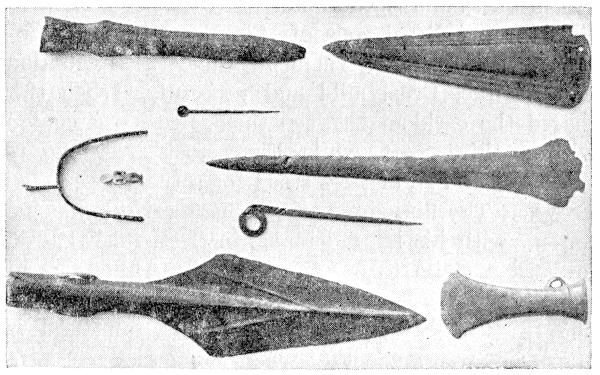
Ancient Bronze Weapons and Ornaments.
EARL THORFINN AND EARL ROGNVALD.
Earl Sigurd, as has been mentioned, took as his second wife the daughter of Malcolm the Second, King of Scots. They had but one son, Thorfinn, called the Mighty, the greatest of his race, who became the most powerful of all the Orkney earls. When he was but five winters old Thorfinn was sent to his grandfather Malcolm to be brought up at the Scottish Court, and on his father’s death he was made Earl of Caithness and Sutherland.
Einar and Brusi, sons of Sigurd by his first wife, then ruled over the islands. Einar was ambitious and warlike, Brusi mild and peaceful. When they shared the earldom between them, Brusi was content with a third part, while Einar took over the remainder; and so matters stood for a time.
When Thorfinn grew up to manhood, he was not content with his large domains in Scotland. He put forward a claim to one-third of the Orkneys as his rightful share. Einar would have disputed the claim; but Brusi resigned his share to Thorfinn, and an agreement was made that when Einar died his share should be handed over to Brusi. So peace was kept for the time. But when Einar died, Thorfinn seized half of the whole earldom.
Brusi was unable to resist the great power of Thorfinn, so he resolved to go east to Norway, and ask Olaf the king to do justice between him and his brother. Thorfinn also went to Norway to plead his own cause. King Olaf, unwilling to increase the power of a subject already too powerful, decided in favour of Brusi. But when the two earls returned to the islands, Brusi found the task of ruling his dominions and defending them against the Vikings too heavy for him, and Thorfinn no doubt took care that there should always be plenty of trouble for him to face.
At last Brusi was glad to hand over two-thirds of the earldom to Thorfinn, on condition of his undertaking to defend the islands; and this arrangement lasted till Brusi’s death.
In the meantime, Rognvald, Brusi’s son, had been growing up at the Court of Olaf, King of Norway, and he was a close friend of Magnus, Olaf’s son, who afterwards became king. When Rognvald heard that Brusi, his father, was dead, and that Earl Thorfinn had seized the whole earldom, he prepared to fare westward and claim his share of the land. Thorfinn was now the most powerful ruler in all the western lands. He had defeated the Scots in a great sea-fight off Deerness; he had subdued the Western Isles; he had conquered great realms in Scotland; and he had made himself master of the half of Ireland.
At the time when Rognvald came to the Orkneys, however, Thorfinn had wars on his hands in the Western Isles and in Ireland, and he was glad to offer Rognvald two-thirds of the islands in return for his friendship and his help. So for a time the two earls lived in friendship with each other.
Then evil men made mischief between them, and Thorfinn demanded back the third of the land which had belonged to Earl Einar. Rognvald refused, and sailed away to Norway to ask help from King Magnus. With a fleet of Norwegian ships he came back to Orkney, and was met in the Pentland Firth by the ships of Earl Thorfinn. Earl Rognvald’s ships were fewer in number, but their larger size at first gave him the advantage. Earl Thorfinn was hard pressed; but at last he persuaded his brother-in-law, Kalf Arnesson, whose ships were lying by watching the fight, to come to his aid and row against Rognvald. Then the tide of battle turned against Earl Rognvald, and only by the darkness of the night was he enabled to escape, and once more to find his way to Norway.
Again King Magnus came to his help; but this time Earl Rognvald tried to take Thorfinn by surprise, so he sailed away to Orkney in the dead of winter with only one ship. Before there was any news of his coming, he surrounded the house where Earl Thorfinn was feasting, and set it on fire. Only the women and children were allowed to go free; but while the warriors were in confusion, seeking some way of escape, the great earl broke a hole through the side of the house where the smoke was thickest, and, carrying his wife, Ingibiorg, in his arms, he escaped in the darkness to the seashore, took a boat, and rowed across to Caithness.
Now it seemed that Rognvald’s success was complete, for he thought that Earl Thorfinn was surely dead. When Christmas-time was at hand, he prepared to hold a great feast at Kirkwall, and with some of his men he took a ship to Papa Stronsay to bring over a cargo of malt for the brewing. They stayed there for the night, and sat long over the fire telling of all their adventures. Meanwhile, however, Earl Thorfinn had come back from Caithness to seek revenge. In the darkness he and his men surrounded the house where Earl Rognvald sat, and set it on fire. All except the earl’s men were allowed to come out, being drawn over the pile of wood which Thorfinn’s men had placed before the door.
While this was being done, a man suddenly leaped over the pile, and over the armed men beside it, and disappeared in the darkness.
“That must be Earl Rognvald,” cried Thorfinn, “for no one else could do such a feat.” Then they all ran to search for Earl Rognvald in the darkness. The barking of his dog betrayed the earl’s hiding-place to his enemies, and soon he was found and slain among the rocks upon the shore.
Next morning Thorfinn and his men took Earl Rognvald’s ship and sailed to Kirkwall. And when Rognvald’s men who were in the town came, unarmed, expecting to meet the earl, they were set upon by Earl Thorfinn’s men, and thirty of them were slain. These men were of the bodyguard of King Magnus, and only one of them was allowed to go back to Norway to tell the tidings to the king.
Then for eighteen years Thorfinn ruled the earldom, till the day of his death. He was by far the greatest of the Orkney earls. He built Christ’s Kirk in Birsay, and in his time the Bishopric of Orkney was founded. During his later years the islands enjoyed peace, and many wise laws were made; and when the great earl died there was much sorrow in the Orkneys. So the poet sings in his honour:—
“Swarthy shall become the bright sun, In the dark sea shall the earth sink, Finished shall be Austri’s labour, And the wild sea hide the mountains, Ere there be in these fair islands Born a chief to rule the people— May our God both keep and help them— Greater than the lost Earl Thorfinn.”
Paul and Erlend, the two sons of Thorfinn, succeeded to the earldom, and for some time they ruled in harmony together. They fought for King Harald Hardradi against Harold, Godwin’s son, at the battle of Stamford Bridge in Yorkshire in 1066, but were allowed to return in peace to their earldom. Trouble arose between the brothers when their sons grew to manhood, and Magnus Barefoot, King of Norway, made a descent upon the islands. He carried the two brothers into exile, appointing his own son Sigurd as “King” of Orkney, which post he held until his father’s death made him King of Norway. Hakon, Paul’s son, and Magnus, Erlend’s son, afterwards called St. Magnus, then became joint earls.
Their joint rule had the usual result, quarrels and misunderstandings, and was brought to an end by the murder of Earl Magnus in Egilsay in 1115. The story is told in the Saga of Earl Magnus, from which the next chapter is taken.
THE SLAYING OF EARL MAGNUS.
“St. Magnus, the isle earl, was the most peerless of men, tall of growth, manly, and lively of look, virtuous in his ways, fortunate in fight, a sage in wit, ready-tongued and lordly-minded, lavish of money and high-spirited, quick of counsel, and more beloved of his friends than any man. Blithe and of kind speech to wise and good men, but hard and unsparing against robbers and sea-rovers, he let many men be slain who harried the freemen and landfolk. He made murderers and thieves be taken, and visited as well on the powerful as on the weak robberies and thieveries and all ill deeds. He was no favourer of his friends in his judgments, for he valued more godly justice than the distinctions of rank. He was open-handed to chiefs and powerful men, but still he ever showed most care for poor men....
“Those kinsmen, Magnus and Hakon, held the wardship of the land for some while, so that they were well agreed.... But when those kinsmen had ruled the land some time, then again happened, what often and always can happen, that many ill-willing men set about spoiling their kinship. Then unlucky men gathered more about Hakon, for that he was very envious of the friendships and lordliness of his kinsman Magnus.
“Two men are they who are named, who were with Earl Hakon, and who were the worst of all the tale-bearers between those kinsmen, Sigurd and Sighvat Sock. This slander came so far with the gossip of wicked men, that those kinsmen again gathered forces together, and each earl faced against the other with a great company. Then both of them held on to Hrossey [the Mainland], where the place of meeting of those Orkneyingers was. But when they came there, then each drew up his men in array, and they made them ready to battle. There were then the earls and all the great men, and there, too, were many friends of both who did all they could to set them at one again. Many then came between them with manliness and good-will. This meeting was in Lent, a little before Palm Sunday. But because many men of their well-wishers took a share in clearing up these difficulties between them, but would stand by neither to do harm to the other, then they bound their agreement with oaths and handsels. And when some time had gone by after that, then Earl Hakon, with falsehood and fair words, settled with the blessed Earl Magnus to meet him on a certain day, so that their kinship and steadfast new-made peace should not be turned aside or set at naught. This meeting for a steadfast peace and a thorough atonement between them was to be in Easter week that spring on Egil’s Isle [Egilsay]. This pleased Earl Magnus well, being, as he was, a thoroughly whole-hearted man, far from all doubt, guile, or greed; and each of them was to have two ships, and each just as many men: this both swore, to hold and keep those terms of peace which the wisest men made up their minds to declare between them.
“But when Eastertide was gone by, each made him ready for this meeting. Earl Magnus summoned to him all those men whom he knew to be kindest-hearted and likeliest to do a good turn to both those kinsmen. He had two long-ships and just as many men as was said. And when he was ready he held on his course to Egil’s Isle. And as they were rowing in calm over the smooth sea, there rose a billow against the ship which the earl steered, and fell on the ship just where the earl sat. The earl’s men wondered much at this token, that the billow fell on them in a calm where no man had ever known it to fall before, and where the water under was deep. Then the earl said, ‘It is not strange that ye wonder at this; but my thought is, that this is a foreboding of my life’s end, may be that may happen which was before spoken about Earl Hakon. We should so make up our minds about our undertaking, that I guess my kinsman Hakon must not mean to deal fairly by us at this meeting.’ The earl’s men were afraid at these words, when he said he had so short hope as to his life’s end, and bade him take heed for his life, and not fare further trusting in Earl Hakon. Earl Magnus answers, ‘We shall fare on still, and may all God’s will be done as to our voyage.’
“Now it must be told about Earl Hakon, that he summoned to him a great company, and had many war-ships, and all manned and trimmed as though they were to run out to battle. And when the force came together, the earl makes it clear to the men that he meant at that meeting so to settle matters between himself and Earl Magnus that they should not both of them be over the Orkneys. Many of his men showed themselves well pleased at this purpose, and added many fearful words; and they, Sigurd and Sighvat Sock, were among the worst in their utterance. Then men began to row hard, and they fared furiously. Havard, Gunni’s son, was on board the earl’s ship, a friend and counsellor of the earl’s, and a fast friend to both alike. Hakon had hidden from him this bad counsel, which Havard would surely not join in. And when he knew the earl was so steadfast in this bad counsel, then he jumped from the earl’s ship and took to swimming, and swam to an isle where no man dwelt.
“Earl Magnus came first to Egil’s Isle with his company, and when they saw Hakon coming they saw that he had eight war-ships; he thought he knew then that treachery must be meant. Earl Magnus then betook himself up on the isle with his men, and went to the church to pray, and was there that night; but his men offered to defend him. The earl answers, ‘I will not lay your life in risk for me, and if peace is not to be made between us two kinsmen, then be it as God wills.’ Then his men thought that what he had said when the billow fell on them was coming true. Now for that he felt sure as to the hours of his life beforehand, whether it was rather from his shrewdness or of godly foreshowing, then he would not fly nor fare far from the meeting of his foes. He prayed earnestly, and let a mass be sung to him.
“Hakon and his men jumped up in the morning, and ran first to the church and ransacked it, and did not find the earl. He had gone another way on the isle with two men into a certain hiding-place. And when the saint Earl Magnus saw that they sought for him, then he calls out to them and says where he was; he bade them look nowhere else for him. And when Hakon saw him, they ran thither with shouts and crash of arms. Earl Magnus was then at his prayers when they came to him, and when he had ended his prayers then he signed himself [with the cross], and said to Earl Hakon, with steadfast heart, ‘Thou didst not well, kinsman, when thou wentest back on thy oaths, and it is much to be hoped that thou doest this more from others’ badness than thine own. Now will I offer thee three choices, that thou do one of these rather than break thine oaths and let me be slain guiltless.’
“Hakon’s men asked what offer he made. ‘That is the first, that I will go south to Rome, or out as far as Jerusalem, and visit holy places, and have two ships with me out of the land with what we need to have, and so make atonement for both of our souls. This I will swear, never to come back to the Orkneys.’ To this they said ‘Nay’ at once. Then Earl Magnus spoke: ‘Now seeing that my life is in your power, and that I have in many things made myself an outlaw before Almighty God, then send thou me up into Scotland to some of both our friends, and let me be there kept in ward, and two men with me as a pastime. Take thou care then that I may never be able to get out of that wardship.’ To this they said ‘Nay’ at once. Magnus spoke: ‘One choice is still behind which I will offer thee, and God knows that I look more to your soul than to my life; but still it better beseems thee than to take my life away. Let me be maimed in my limbs as thou pleasest, or pluck out my eyes, and set me in a dark dungeon.’ Then Earl Hakon spoke: ‘This settlement I am ready to take, nor do I ask anything further.’ Then the chiefs sprang up and said to Earl Hakon, ‘We will slay now either of you twain, and ye two shall not both from this day forth rule the lands.’ Then answers Earl Hakon: ‘Slay ye him rather, for I will rather rule the realm and lands than die so suddenly.’ So says Holdbodi, a truthful freeman from the Southern Isles, of the parley they had. He was then with Magnus, and another man with him, when they took him captive.
“So glad was the worthy Earl Magnus as though he were bidden to a feast; he neither spoke with hate nor words of wrath. And after this talk he fell to prayer, and hid his face in the palms of his hands, and shed out many tears before God’s eyesight. When Earl Magnus, the saint, was done to death, Hakon bade Ofeig his banner-bearer to slay the earl, but he said ‘Nay’ with the greatest wrath. Then he forced Lifolf his cook to kill Earl Magnus, but he began to weep aloud. ‘Thou shalt not weep for this,’ said the earl, ‘for that there is fame in doing such deeds. Be steadfast in thine heart, for thou shalt have my clothes, as is the wont and law of men of old, and thou shalt not be afraid, for thou doest this against thy will, and he who forces thee misdoes more than thou.’ But when the earl had said this he threw off his kirtle and gave it to Lifolf. After that he begged leave to say his prayers, and that was granted him.
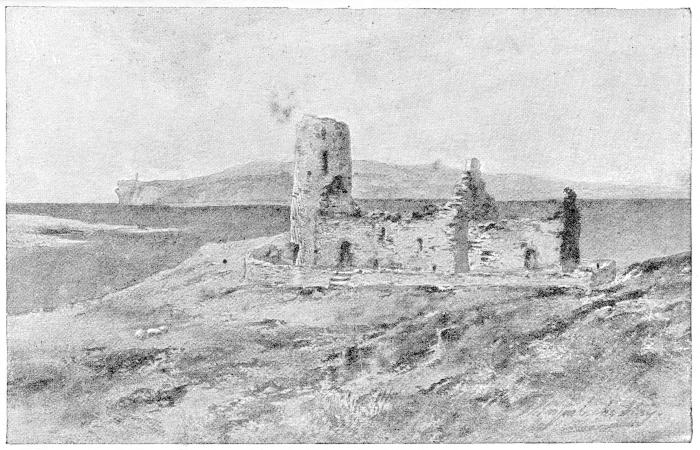
Church of St. Magnus, Egilsay.
(From a painting by T. Marjoribanks Hay, R.S.W.)
“He fell to earth, and gave himself over to God, and brought himself as an offering to Him. He not only prayed for himself or his friends, but rather there and then for his foes and banemen, and forgave them with all his heart what they had misdone towards him, and confessed his own misdeeds to God, and prayed that they might be washed off him by the outshedding of his blood, and commended his soul into God’s hand, and prayed that God’s angels would come to meet his soul and bear it into the rest of Paradise. When the friend of God was led out to slaughter he spoke to Lifolf: ‘Stand thou before me, and hew me on my head a great wound, for it beseems not to chop off chiefs’ heads like thieves’. Strengthen thyself, wretched man, for I have prayed to God that he may have mercy upon thee.’ After that he signed himself [with the cross], and bowed himself to the stroke. And his spirit passed to heaven.
“That spot was before mossy and stony. But a little after, the worthiness of Earl Magnus before God was so bright that there sprung up a green sward where he was slain, and God showed that, that he was slain for righteousness’ sake, and inherited the fairness and greenness of Paradise, which is called the earth of living men.... There had then passed since the birth of Christ one thousand and ninety and one winters.”
From the “Orkneyinga Saga,” translated by Sir G. W. Dasent, D.C.L. (By permission of the Controller of H.M. Stationery Office.)
THE FOUNDING OF ST. MAGNUS CATHEDRAL.
After the death of Hakon, the slayer of Earl Magnus, the earldom was divided between his two sons, Harald the Smooth-talker, and Paul the Speechless. There were many bitter quarrels between the brothers, until the death of the former left Paul as sole ruler. That happened in this wise.
When they had been reconciled after one of their quarrels, Harald invited Paul to a feast in his house at Orphir. On the morning before the feast, Earl Harald found his mother and his aunt working at a very beautiful shirt, which, they said, was a present for his brother Paul.
“Why should such a splendid garment be given to Paul and not to me?” asked the earl, taking it up in his hand to look at it. Then before the women could prevent him, he threw off the light cloak he was wearing and put on the gorgeous shirt. No sooner had it touched his skin than he was seized with violent pains, and with a sickness of which he died a few days later. The shirt had been poisoned in order to cause Earl Paul’s death, but it was Earl Harald who fell a victim to his mother’s cunning and treacherous design.
Earl Paul did not long reign in peace. A new claimant soon appeared for part of the lands. This was Kali, the son of Kol and of Gunhild, the sister of the murdered St. Magnus, who had been brought up at the court of King Harald of Norway. He was a man of noble appearance, bold and skilful in war, and a born leader of men. He was in addition a noted skald or poet, and many of the songs which he made have come down to us in the Sagas.
He now changed his name to Rognvald, which had been a popular name in the isles since the days of Rognvald, Brusi’s son, and he is known in history as Rognvald Kali, or Rognvald the Second.
Having the promise of help from Harald, the Norwegian king, Rognvald sent a message to Earl Paul, demanding that share of the islands which Earl Magnus had held. Earl Paul, who was a good ruler, and had many friends among the Orkneymen, replied that he would guard his inheritance while God gave him life. Rognvald then gathered ships and set sail for Shetland, but his fleet was destroyed in Yell Sound by the ships of Earl Paul, and he had to escape to Norway in a merchant vessel.
Earl Paul thereupon placed beacons on some of the highest hills in the islands, in order that he might have warning of any attempt by Rognvald to make a descent by way of Shetland, and the most important of these beacons was on the Fair Isle.
When Rognvald, angry and disappointed, arrived in Norway, he took counsel with his father Kol and with an old man named Uni, who was reckoned a very wise man; and as he had many friends among the men of Shetland, it was decided to make a new attempt in the spring. By the aid of King Harald and of his friends a new fleet was then got ready.
When the ships were assembled, Rognvald stood up on the deck of his war-dragon to address his men. “Earl Paul and the Orkneyingers,” he said, “have taken my inheritance, and refuse to give it up. My grandfather, the holy Earl Magnus, was treacherously slain by Paul’s father Hakon, and instead of giving compensation for the wicked deed, Earl Paul would wrong me still more in the matter of my inheritance. However, if it be the will of God, I intend to fare to the Orkneys, and there win what is mine by right, or die with honour.”
All the men cheered this speech, and when they were silent Kol rose to speak. He advised his son not to trust in his own strength for success. “I advise thee, Rognvald,” he said, “to make a vow that if St. Magnus secures to thee thine inheritance, thou wilt build and dedicate to him in Kirkwall a minster of such size and splendour that it shall be the wonder and the glory of all the North.”
Rognvald thought this the best of advice. Rising once more, he vowed to build in Kirkwall a splendid cathedral in honour of St. Magnus, and to remove thither with all reverence the remains of the sainted earl. No sooner had this solemn vow been taken than the wind became fair for sailing. The fleet at once put to sea, and reached Shetland in a few days.
Now Rognvald’s real difficulties began. How could he take Earl Paul by surprise, as he wished to do, with the beacon on the Fair Isle ready to give the alarm as soon as his ships came in sight? The wisdom of Kol and of Uni came to his aid. The former had a plan to cause the beacon to be lit on a false alarm, and the latter to prevent its being lit when it was needed.
Kol set sail from Shetland towards evening with a fleet of small boats. When they came in sight of the Fair Isle, they hoisted their sails half way up the masts, and with the oars the men kept back the boats so as to make them sail very slowly. At the same time they gradually hoisted their sails higher and higher, so that to those in charge of the beacon it might seem that a fleet was rapidly approaching When it was dark the boats returned to the land.
The trick was successful. The Fair Isle beacon flared up to the sky, those on North Ronaldsay and on Westray followed, and soon every hilltop in the islands showed its warning light. The Orkneymen took their weapons and hurried to Kirkwall, where Earl Paul had appointed them to gather in such a case, and all was ready to meet the enemy; but no enemy appeared. Those who had charge of the beacons came with the news of a fleet approaching; and after long waiting other men were sent to look for its coming, but they looked in vain. Quarrels soon began to arise as to who was to blame for the false alarm, for the men were angry at having been taken from their farm work to no purpose; so the earl had to make peace among them, and set other men to build up the beacons again and to watch them.
Now came Uni’s turn. He sailed to the Fair Isle with three companions, and pretended to be an enemy of Rognvald, saying many hard things against him and his men. His three companions went out every day to fish, but Uni himself stayed on shore. He gradually made friends with the people of the isle, and especially with those who had charge of the beacon. At last he offered to watch it for them, saying that he had nothing else to do, and his offer was accepted. Uni then poured water on the beacon, and kept it in such a state of dampness that it should be impossible to light it when it was needed.
Thus by the time that Rognvald was to set out from Shetland, Uni had everything prepared. As soon as his ships were seen from the Fair Isle, the men who had charge of the beacon tried to light it, but in vain. There was no time to warn Earl Paul, and Rognvald landed in Westray without any alarm being given. The bishop now interfered between the rivals, and a truce was agreed to in order that terms of peace might be arranged.
And now things took a strange and unexpected turn, so that Rognvald won the islands without any fighting. While Earl Paul was on a visit to his friend Sigurd of Westness, in Rousay, he went out before breakfast one morning and mysteriously disappeared. Sigurd sought him everywhere in vain. At last they discovered that he had been seized and carried off to Scotland by Sweyn Asleifson, and he never returned. Earl Paul’s men gradually came over to Earl Rognvald, and he became ruler over the whole earldom.
Earl Rognvald now set about fulfilling his vow and raising a great cathedral in Kirkwall in honour of St. Magnus. In 1137 the work was begun under the superintendence of Kol, but many a long year was to pass ere it should be finished. As the work went on it soon became very costly to the earl. In his difficulty he once more went to his father Kol for advice. Kol said that Rognvald should declare himself the heir of all landholders who died, and that their sons should have to redeem their lands from him. A Thing was called, and this law was passed; but the freemen also had the choice given them of buying their lands outright, so that the earl might not inherit them in the future. Most of the landholders took that plan, and now there was once more plenty of money for the cathedral.