Volume 4 — VOLUME IV (continued 6)
Reading edition
Silvester's method: Stand or kneel behind the person's head, grasp each arm at the elbow, draw both arms simultaneously upwards till they are extended in line with the body, as a man places them when he stretches himself. Let this movement occupy about two seconds. This enlarges the chest and causes the entrance of air to the lungs. Without a pause carry the arms down to the sides, making them overlap the chest a little, and firmly press them on the chest. This movement should occupy other two seconds. It expels air from the lungs. Repeat the movements, and maintain them steadily and patiently at the rate of fifteen times a minute, until breathing has been fully restored, or until medical aid arrives, or until death is certain. An hour is not too long a time to persist, and so long as there seems the least effort to breathe the movements must be persevered in.
Howard's Method for restoring the apparently Drowned
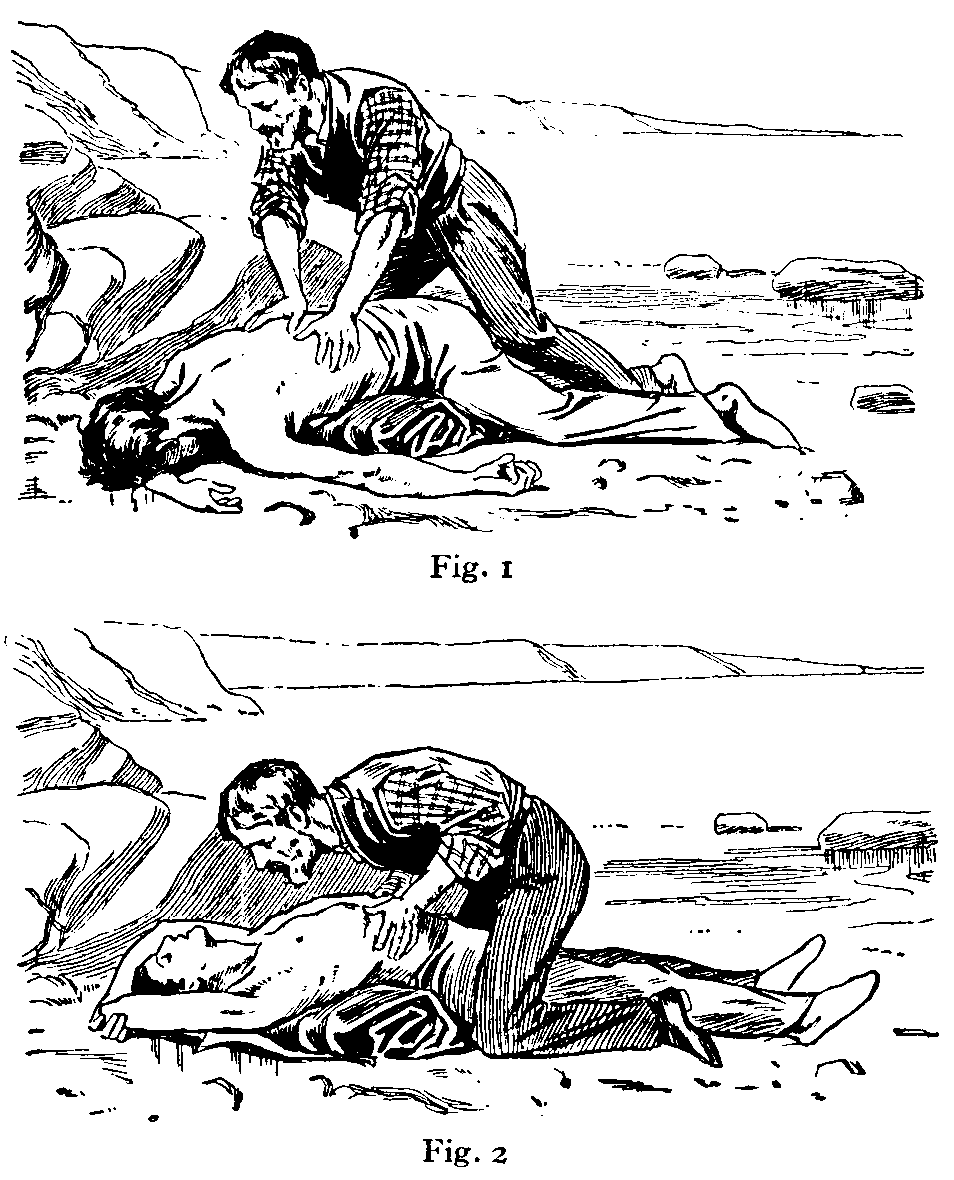
Howard's method: Place the body on its face, with the roll of clothing under the stomach; the head being supported on the hand as shown in fig. 1. Pull the body over the roll of clothing to expel water from the chest. Then turn the body on the back, the shoulders being supported as shown in fig. 2. Kneel over the body. Place both hands on the lower part of the chest, so that the thumbs hook in under the lowest ribs and the fingers are spread out on the chest. Steadily press forwards, raising the ribs, your own body being thus thrown leaning forward. This enlarges the cavity of the chest and causes air to enter. When the ribs have been raised to the utmost extent, with a slight effort push yourself back to the more erect position, allowing the ribs to recoil to their former position. This expels the air. Repeat the process fifteen times a minute. One person will find it more easy to maintain this method for a prolonged period than Silvester's, especially if the patient be big and heavy.
Meanwhile, if other persons are present they should be occupied rubbing the body and limbs (always upwards) with hands or warm flannel, applying hot flannels, bottles, &c., to the limbs, feet, arm-pits, &c. As soon as the person is sufficiently restored to be able to swallow, give small quantities of hot brandy and water, hot wine and water, hot coffee, &c., and use every effort to restore and maintain warmth.
Drowning was formerly a mode of capital punishment in Europe. The last person executed by drowning in Scotland suffered death in 1685. It survived in Switzerland until 1652, and in Austria until 1776. In Russia the punishment was abolished early in the eighteenth century.
Droylsden, a town of England, Lancashire, 3½ miles E. of Manchester, of which it is practically a suburb. Pop. 13,259.
Droz (drō), François Xavier Joseph, French moralist and historian, born at Besançon 1773, died 1850. In 1806 he published an Essai sur l'Art d'être Heureux, which was very popular; and in 1823 De la Philosophie Morale, ou des Différents Systèmes sur la Science de la Vie, which procured his admission into the Academy. His reputation is, however, founded chiefly on his Histoire du Règne de Louis XVI.
Drugget, a coarse kind of woollen felt or cloth, formerly used by the lower classes for purposes of clothing, but now chiefly used as a covering for carpets.
Druids, the priests of the Celts of Gaul and Britain. According to Julius Cæsar they possessed the greatest authority among the Celtic nations. They had some knowledge of geometry, natural philosophy, &c., superintended the affairs of religion and morality, and performed the office of judges. They were also well versed in the knowledge of the mysterious powers of plants and animals, and were adepts in the magic arts. They venerated the mistletoe when growing on the oak, a tree which they likewise esteemed sacred. They had a common superior, who was elected by a majority of votes from their own number, and who was appointed for life. They took unusual care to fence themselves round with mysteries, and it is probable that they cherished doctrines unknown to the common people; but that they had a great secret philosophy which was handed down by oral tradition is very unlikely. Of their religious doctrines little is known.—Bibliography: J. Rhys, Lectures on the Origin and Growth of Religion as Illustrated by Celtic Heathenism; D'Arbois de Jubainville, Les Druides et les dieux celtiques à forme d'animaux.
Druids, Order of, a secret organization, founded in London in 1781, for the purpose of mutual aid and protection. Their rites somewhat resemble those of freemasons; their lodges are known as 'groves'.
Drum, a musical instrument of percussion, of Eastern origin, either cylindrical or hemispherical in shape, with the end or ends covered with tightened parchment, which is stretched or slackened at pleasure by means of cords with sliding knots or screws. Drums are of three kinds: (1) the long or bass drum played with stuffed-nob drumsticks, and used only in large orchestras or military bands; (2) the side-drum, having two heads, the upper one only being played upon by two sticks of wood; (3) the kettle-drum, a hemisphere of brass or copper, the end of which is covered with parchment, always used in pairs, one drum being tuned to the key-note, and the other to the fifth of the key, the compass of the two together being an octave. The use of drums was introduced into Europe either by the Moors or the Crusaders.
Drumclog´, a moorland tract in Lanarkshire, Scotland, 6 miles S.W. of Strathaven, the scene of a skirmish between Claverhouse and the Covenanters, in which the former was defeated (1679). A graphic description of the battle is given by Scott in his Old Mortality.
Drum-fish, or Drum, Pogonias chromis, and other species of the same genus, fishes found on the Atlantic coast of N. America, and so named from the deep drumming sound they make, by means of the swim-bladder and its muscles, during the spawning season in April. It is the most powerful sound-producing apparatus known among fishes. They often weigh about 20 lb.
Drum-major, in the British army, a warrant or non-commissioned officer whose duty it is to teach and direct the drummers. He marches at the head of the band carrying the regimental baton.
Drum´mond, Professor Henry, was born at Stirling in 1851, died in 1897. Educated at the Universities of Edinburgh and Tübingen, he entered the ministry of the Free Church, and having devoted much attention to science, in 1877 was appointed lecturer on natural science in the Free Church College (or divinity hall), Glasgow, becoming professor in 1884. He travelled much, and wrote a popular book on Tropical Africa (1888). His most remarkable work is Natural Law in the Spiritual World (1883), which has passed through many editions and been translated into various languages. He is author, also, of Travel Sketches in Our New Protectorate, The Greatest Thing in the World, and The Ascent of Man (1894).
Drummond, Rev. James, Unitarian theologian, was born at Dublin in 1835, died 13th June, 1918. After receiving his early education at a private school, he entered Trinity College, Dublin, where he graduated and obtained the first gold medal for classics in 1855. In 1859 he became colleague of the Rev. W. Gaskell in Cross Street Chapel, Manchester, and ten years later was appointed professor of theology at Manchester New College, London, of which institution (now known, since its removal to Oxford in 1889, simply as Manchester College) he was principal from 1885 to 1906, when he retired from his post. His works include: Spiritual Religion: Sermons on Christian Faith and Life (1870); The Jewish Messiah: a Critical History of the Messianic Idea among the Jews (1877); Introduction to the Study of Theology (1884); Philo-Judæus (2 vols., 1888); Via, Veritas, Vita (the Hibbert lectures for 1894); The Pauline Benediction (1897); The Epistles to the Thessalonians, &c. (International Handbooks, 1899); Some Thoughts on Christology (1902); The Character and Authorship of the Fourth Gospel (1904); Johannine Thoughts (1909); Paul: his Life and Teaching (1911).
Drummond, William, of Hawthornden, a Scottish poet distinguished for the elegance and tenderness of his verses, was born at Hawthornden House, 7 miles from Edinburgh, 1585, died 1649. He was educated at the University of Edinburgh; after which he spent four years in foreign travels, residing for a part of the time at Bourges, to study the civil law. On his return to Scotland he retired to Hawthornden and gave himself up to the cultivation of poetry and polite literature, and here he spent the most of his life. He entertained Ben Jonson on the occasion of a visit which the English dramatist made to Scotland in the winter of 1618-9, and took notes of Jonson's conversation, first published in entirety in 1842 (Notes of Ben Jonson's Conversations with William Drummond). He was the first Scottish writer to abandon the native dialect for the language raised to supremacy by the Elizabethan writers. His chief productions are: The Cypress Grove, in prose, containing reflections upon death; Flowers of Zion, or Spiritual Poems; Tears on the Death of Mœliades (that is, Prince Henry); Poems, Amorous, Funeral, Divine, Pastoral, in Sonnets, Songs, Sextains, Madrigals; The River Forth Feasting (on King James's visit to Scotland in 1617); Polemo-Middinia, or the Battle of the Dunghill: a Macaronic Poem; and History of the Lives and Reigns of the Five Jameses, Kings of Scotland. As an historian he is chiefly remarkable for an ornate style, and a strong attachment to the High Church principles of the Jacobites.
Drumont, Édouard, French journalist and anti-Semitic agitator, born at Paris in 1844, died there in 1917. His work Mon vieux Paris (1879) was crowned by the Académie Française. In 1886 he published La France Juive devant l'opinion. He thus began a violent campaign against the Jews which he continued until his death, especially in his organ La Libre Parole, founded in 1892. In 1898 he was elected to the Chamber of Deputies, retaining his seat till 1902. His other works include: La fin d'un monde (1888), Testament d'un Anti-Sémite (1891), De l'or et de la boue du Sang (1896), and Les Juifs et l'affaire Dreyfus (1899).
Drunkards, Habitual. The Habitual Drunkards Act of 1879 provided for the licensing of retreats for receiving habitual drunkards, and for the regular inspection of such retreats. An habitual drunkard desiring admission to a retreat had to make a written application, accompanied by a declaration of two persons that the applicant was an habitual drunkard, and attested by two justices of the peace. No patient in a retreat was permitted to leave before the expiration of the term stated in the application, such term not to exceed one year. This Act was to expire in ten years; but another Act, passed in 1888, made it permanent, with some modifications. The Inebriates Act of 1898 introduced several important changes. It transferred the licensing power in counties from justices of the peace to County Councils and their committees, and in boroughs from magistrates to town councillors or police commissioners. The maximum period of detention was extended to two years, and the attestation of one justice was made sufficient for a valid application. It also gave power to the Secretary of State to establish State inebriate reformatories, or to grant certificates to reformatories suitable for such a purpose. If an habitual drunkard, when drunk, commit an offence punishable by imprisonment or penal servitude, the court may, in addition to, or in substitution for, the ordinary sentence, order him to be detained three years in a State or certified inebriate reformatory. The proof that the accused is an habitual drunkard may consist either in his own admission or in the jury's verdict after inquiry. The Inebriates' Act of 1899 was very short, and made no important change in the law. In Scotland habitual drunkenness is now a ground justifying judicial separation of spouses, while under the Matrimonial Causes Bill, 1920, it is proposed that in England, where one spouse has been granted a temporary separation order on the ground of the incurable habitual drunkenness of the other, and such order has been in force for at least three years, a divorce should be granted.
Drunkenness, the state of being drunk or overpowered by alcoholic liquor, or the habit of indulging in intoxication. A similar condition may be produced by numerous agents, but the term is always applied to the act or habit of drinking alcoholics to excess. By the law of Britain drunkenness is an offence against the public economy, and those found drunk are liable to fine or imprisonment. Drunkenness is no excuse for any crime, but it renders a contract invalid if either of the parties was in a state of complete drunkenness when the contract was signed.
Drunken Parliament, in Scottish history, a name given to the Privy Council who, under their powers as representing the estates between sessions, met at Glasgow and passed an Act (1st Oct., 1662) to remove the recusant ministers from their parishes within a month. All the members were said to have been drunk except Lockhart of Lee, who opposed the measure.
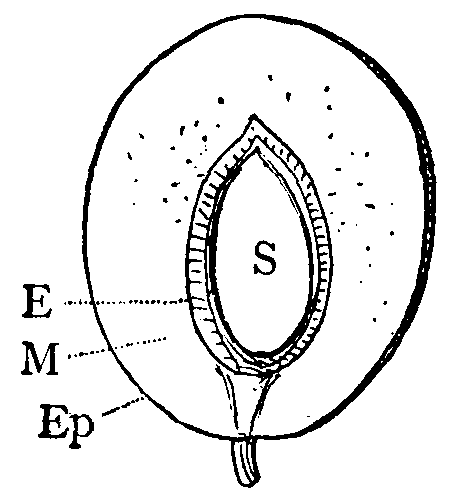
Longitudinal Section of Plum
S, Seed. E, Endocarp, or shell. M, Mesocarp, or intermediate layer. Ep, Epicarp, or skin.
Drupe, in botany, a stone fruit; a fruit in which the outer part of the pericarp becomes fleshy or softens like a berry while the inner hardens like a nut, forming a stone with a kernel, as the plum, cherry, apricot, and peach. The stone enclosing the kernel is called the endocarp, while the pulpy or succulent part is called the mesocarp. In some fruits, as those of the almond, the horse-chestnut, and coco-nut, the mesocarp is not succulent, yet, from their possessing the other qualities of the drupe, they receive the name. See Berry.
Drury Lane Theatre, one of the principal theatres in London, was established by Thomas Killigrew in the reign of James I. In 1671 it was burned down, and was rebuilt by Sir Christopher Wren between 1672 and 1674, but again destroyed by fire in 1809. On this occasion it was rebuilt by B. Wyatt, and was reopened on 10th Oct., 1812, with an address composed by Lord Byron. It was in connection with this opening that James and Horace Smith wrote the Rejected Addresses. Nearly all the great English actors from Betterton and Garrick have been more or less connected with Drury Lane.—Cf. J. Doran, In and About Drury Lane.
Druses, a curious people of mixed Syrian and Arabian origin, inhabiting the mountains of Lebanon and Anti-Lebanon, and also the Hauran (south-west of Damascus). In their faith are combined certain Jewish, Christian, and Mohammedan doctrines. They describe themselves as followers of Khalif Hakim Biamr-Allah, whom they regard as an incarnation of deity, the last prophet, and the founder of the true religion. They are nearly all taught to read and write. They maintain a semi-independence, and between 1840 and 1860 they engaged in bloody conflicts with their neighbours the Maronites. Their total number is estimated at 100,000. They are very friendly to the English, and some of them have been converted to Christianity. Cf. E. Sell, The Druses.
Drusus, the name of several distinguished Romans, among whom were: Marcus Livius, orator and politician; became tribune of the people in 122 B.C. He opposed the policy of Gaius Gracchus, and became popular by planting colonies.—Marcus Livius, son of the above, was early a strong champion of the senate or aristocratic party, but showed great skill in manipulating the mob. He rose to be tribune of the people, and was assassinated 91 B.C.—Nero Claudius, brother of the Emperor Tiberius, born 38 B.C. By a series of brilliant campaigns he extended the Roman Empire to the German Ocean and the River Elbe, and was hence called Germanicus. By his wife Antonia, daughter of Mark Antony, he had a daughter, Livia, and two sons, Germanicus and Claudius, the latter of whom afterwards became emperor. He died in 9 B.C.
Dry´ads, wood nymphs, in the Greek mythology; supposed to be the tutelar deities of trees. Each particular tree or wood was the habitation of its own special dryad.
Dryas. See Mountain Avens.
Dry´burgh Abbey, a monastic ruin in Scotland, consisting of the nave's western gable, the gable of the south transept, and a fragment of choir and north transept of an abbey founded in 1150 on the banks of the Tweed, about 5 miles E.S.E. of Melrose. It is celebrated as the burial-place of Sir Walter Scott and his family.
Dry Cell, originally a cell of the Leclanché type, in which the solution of sal-ammoniac was replaced by a paste containing this substance. The formulæ or recipes from which dry cells are now made up are numerous, although the electrodes, as a rule, remain the same as in the Leclanché cell. The E.M.F. of the cell is about 1.5 volts, and three dry cells are used to light up a small 'flash' lamp. A battery of dry cells forms a convenient and portable means of supplying a small current at voltages up to 100.
Dry´den, John, English poet, was descended from an ancient family, his grandfather being Sir Erasmus Dryden of Canons Ashby, Northamptonshire. Born near Aldwinkle, Northamptonshire, in 1631, he was admitted a King's scholar at Westminster under the celebrated Dr. Busby, whence he went to Trinity College, Cambridge, being elected to a scholarship there. After leaving the university, he went to London, where he acted as secretary to his cousin Sir Gilbert Pickering, a favourite of Cromwell; and on the death of the Protector he wrote his Heroic Stanzas on that event. At the Restoration, however, he hailed the return of Charles II in Astræa Redux, and from that time his devotion to the Stuarts knew no decay. In 1661 he produced his first play, The Duke of Guise; but the first that was performed was The Wild Gallant, which appeared in 1663 and was not a success. This was followed by The Rival Ladies, and The Indian Queen, a tragedy on Montezuma in heroic verse, written in collaboration with Sir Robert Howard, whose sister, Lady Elizabeth Howard, Dryden married in 1663. He followed up The Indian Queen with The Indian Emperor, which at once raised Dryden to the highest pitch of public estimation, an elevation which he retained till his death. The great fire of London put a stop for some time to theatrical exhibitions. In the interval Dryden published the Annus Mirabilis, an historical account of the events of the year 1666, one of the most elaborate of his productions. In 1668 he also published his celebrated Essay on Dramatic Poesy—the first attempt to regulate dramatic writing. In 1668 The Maiden Queen, a tragi-comedy, was represented. This was followed in 1670 by The Tempest, an alteration from Shakespeare, in which he was assisted by Sir William Davenant. It was received with general applause, notwithstanding the very questionable taste and propriety of the added characters. Dryden was shortly afterwards appointed to the offices of Historiographer Royal and Poet Laureate, with a salary of £200 a year. He now became professionally a writer for the stage, and produced many pieces, some of which have been strongly censured for their licentiousness and want of good taste. The first of his political and poetical satires, Absalom and Achitophel (Monmouth and Shaftesbury), was produced in 1681, and was followed by The Medal, a satire against sedition; and Mac Flecknoe, a satire on the poet Shadwell. In 1682 he published a poem called Religio Laici, wherein he maintained the doctrines of the Church of England. On the accession of James in 1685 Dryden became a Roman Catholic, a conversion the sincerity of which has been not unreasonably regarded with suspicion, considering the time at which it occurred. At court the new convert was received with open arms, a considerable addition was made to his pension, and he defended his new religion at the expense of the old one in a poem, The Hind and the Panther. Among his other services to the new king were a savage reply to an attack by Stillingfleet, and panegyrics on Charles and James under the title of Britannia Rediviva. At the Revolution Dryden was deprived of the offices of Poet Laureate and Historiographer, and of the certain income which these offices secured him. During the remaining ten years of his life he produced some of his best work, including his admirable translations from the classics. He published, in conjunction with Congreve, Creech, and others, a translation of Juvenal, and one of Persius entirely by himself. About a third part of Juvenal was translated by Dryden, who wrote an essay on satire which was prefixed to the whole. His poetic translation of Virgil appeared in 1697, and, soon after, the well-known lyric Alexander's Feast, and his Fables. He died 1st May, 1700, in the sixty-ninth year of his age, and was buried in Westminster Abbey. Dryden is unequalled as a satirist among English poets, and the best of his tragedies are unsurpassed by any since written. His poetry as a whole is more remarkable for vigour and energy than beauty, but he did much to improve English verse. He was also an admirable prose writer. Personally he was modest and kindly. The whole of his works, edited by Sir W. Scott, were published in 1818 (18 vols. 8vo); they were republished with additional notes, &c., by Professor Saintsbury (1882-93).—Bibliography: R. Garnett, Age of Dryden; Sir A. W. Ward, History of English Dramatic Literature; Cambridge History of English Literature (vol. viii).
Drying-machine, a machine consisting of any number of steam-heated cylinders up to thirty or even more, each about 22 inches in diameter, and used in bleachworks, dye-houses, and in cloth-finishing departments; used as a separate machine to dry fabrics which contain a certain amount of moisture left in at some previous operation, but often used in conjunction with a starching-mangle or similar apparatus. All the cylinders are in a horizontal plane, and usually in two rows, but such rows may be disposed either in horizontal or vertical frames. Floor-space is economized in the latter arrangement, and two or more groups of two rows per group may be provided for. Each cylinder is provided with some type of safety air-valve, which yields to allow air to enter in proportion as the steam is condensed in the cylinder, and so prevents the latter from collapsing. The condensed steam is withdrawn either by means of siphons or revolving scoops, so that the interior may be as dry as possible. The long length of cloth, either from the squeezing-rollers of the starch-mangle or from a loose or rolled state of cloth from some other machine, is conducted over guide-rollers, then under and over the two rows of steam-heated cylinders, and finally led from the last cylinder to the roller of a plaiting-down apparatus, or otherwise delivered. Both sides of the cloth thus come into direct contact with half the number of cylinders as it is drawn through the machine, and the dried cloth is ultimately delivered by the plaiting-down apparatus in folds ready for the subsequent operations.
Drying-oils, linseed and other oils, which are the bases of many paints and varnishes. When exposed to the air, they absorb oxygen, and are converted into a transparent, tough, dry mass or varnish.
Dry-point, a method of engraving generally regarded as part of etching, but more closely allied to line engraving. Instead of the copper being covered with etching ground and the lines bitten with acid, a pointed instrument is drawn across it, which incises a fine line with a more distinct burr on each side than that raised by a graver. This burr helps to give a characteristic quality to the line, but is rapidly worn away by printings. Dry-point may be used by itself, but is frequently combined with etching proper.
Dry-rot Fungus (Merulius lacrymans)
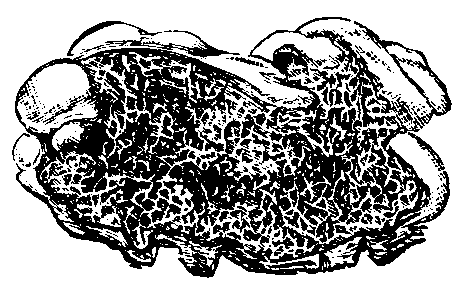
Dry-rot, a well-known disease affecting timber, occasioned by various species of Fungi, the mycelium of which penetrates the timber, destroying it. Merulius lacrymans, which is found chiefly in fir-wood, is the most common and most formidable dry-rot fungus in Britain; while Polypŏrus destructor is equally destructive in Germany. P. vaporarius may also cause dry-rot. Damp, unventilated situations are most favourable to the development of dry-rot Fungi. Various methods have been proposed for the prevention of dry-rot; that most in favour is thoroughly saturating the wood with creosote, which makes the wood unfit for vegetation, but proper ventilation is the surest safeguard.
Dual, in grammar, that number which is used, in some languages, to designate two things, whilst another number (the plural) exists to express many. The Greek, Sanskrit, and Gothic among ancient languages, and the Lithuanian and Arabic among modern, possess forms of the verb and noun in which two persons or things are denoted, called the dual numbers.
Du´alism, the philosophical exposition of the nature of things by the hypothesis of two dissimilar primitive principles not derived from each other. Dualism in religion is chiefly confined to the adoption of a belief in two fundamental beings, a good and an evil one, as is done in some Oriental religions, especially that of Zoroaster. In metaphysics, dualism is the doctrine of those who maintain the existence of matter and form, or mind and matter, as distinct substances, in opposition to idealism, which maintains that we have no knowledge or assurance of the existence of anything but our own ideas or sensations. Dualism may correspond with realism in maintaining that our ideas of things are true transcripts of the originals, or rather of the qualities inherent in them, the spirit acting as a mirror and reflecting their true images; or it may hold that, although produced by outward objects, we have no assurance that in reality these at all correspond to our ideas of them, or even that they produce the same idea in two different minds. Among modern philosophers Professor W. M‘Dougall and Bergson have defended the doctrine of dualism. See Monism.—Bibliography: J. Ward, The Realm of Ends; W. James, Essays in Radical Empiricism; H. Bergson, Matter and Memory.
Dubail, Augustin Edmond, French general, born at Belfort 15th April, 1851. He served in the Franco-Prussian War, and was for many years colonel of a Zouave regiment in Algeria. Chief of the Staff of the French army in 1914, he commanded the First Army operating in Alsace-Lorraine, and successfully defended Nancy. Appointed Military Governor of Paris in 1915, he held this post until June, 1918.
Du Barry, Marie Jeanne Bécu, Comtesse, mistress of Louis XV, was born at Vaucouleurs in 1743. She came young to Paris, and was presented to the king in 1769, who had her married for form's sake to the Comte du Barry. She exercised a powerful influence at court, and with some of her confidants completely ruled the king. Important offices and privileges were in her gift, and the courtiers abased themselves before her. After the death of Louis she was dismissed from court and sent to live in a convent near Meaux. She received a pension from Louis XVI. During the reign of terror she was arrested as a Royalist and executed, Nov., 1793.—Cf. N. Williams, Madame du Barry.
Dubit´za, a fortified town of Bosnia, in Yugo-Slavia, on the right bank of the Unna, about 10 miles from its confluence with the Save. In the sixteenth and seventeenth centuries it was a frequent point of contention between Austria and Turkey. In 1878, with the rest of Bosnia, it passed under Austrian administration. Pop. 3260.—Dubitza, in Croatia, on the opposite bank of the Unna, has 6660 inhabitants.
Dub´lin, the metropolis of Ireland, is situated in County Dublin, on the east coast of the island, at the mouth of the Liffey, the banks of which for more than 2 miles from the sea are lined with quays. The river, which divides the city into two unequal parts, is crossed by numerous bridges. In the old part of the city the streets are irregular, narrow, and filthy; in the more modern and aristocratic quarters there are fine streets, squares, and terraces, but with little pretension to architectural merit. The public buildings, however, are especially numerous and handsome. The main thoroughfare, east to west, is by the magnificent quays along the Liffey. The principal street at right angles to the river is Sackville Street, a splendid street 650 yards long and 40 yards wide, forming a thoroughfare which is continued across the river by O'Connell Bridge, a magnificent structure the same width as Sackville Street. The principal public secular buildings are the castle, the official residence of the viceroy; the Bank of Ireland, formerly the Irish Parliament House; Trinity College; the custom-house, destroyed in 1921; the King's Inns; the post office; rotunda; corn exchange; commercial buildings; the mansion house; and the city hall or corporation buildings. The most important literary and scientific institutions are Trinity College (Dublin University); the National University of Ireland; the Royal College of Science; the Catholic University; the College of Surgeons; the Royal Dublin Society; the Royal Hibernian Academy of Painting, Sculpture, and Architecture; the Royal Irish Academy for Promoting the Study of Science, Literature, and Antiquities; the Archæological Society; and the Royal Zoological Society. Dublin contains two Protestant Episcopal cathedrals—St. Patrick's Cathedral, erected in 1190, and thoroughly restored between 1860 and 1865, through the munificence of Sir Benjamin Lee Guinness; and Christ's Church, built in 1038 and restored between 1870 and 1877, the restoration being carried out at the expense of Henry Roe. The Roman Catholic Cathedral is a very large edifice. The charitable institutions are numerous, and some of them possess splendid buildings. There are several extensive military and constabulary barracks in the city and vicinity. A little north-west of the city, up the Liffey, is the Phœnix Park, with an area of 1759 acres. In it are the Viceregal Lodge, the usual residence of the King's representative; the Chief Secretary's and Under-Secretary's official residences; the Royal Hibernian Military School; and the depot of the Royal Irish Constabulary; as also the gardens of the Royal Zoological Society. The manufactures carried on are of little note: poplins, for which Dublin has been long celebrated, are still in some request, and brewing and distilling are largely carried on. Since 1918 Dublin returns seven members to the House of Commons. The Sinn Fein members, however, elected in 1918, never attended the Imperial Parliament. Serious risings occurred in Dublin at Easter 1916, in 1919, and 1920, and there were also disorders in May 1921. Dublin is an ancient town, but its early history is obscure. It was held by the Danes for more than three centuries from 836. Pop. 399,000 (1919). The county, which is in the province of Leinster, on the east coast of the island, has an area of 218,873 acres, about a third of it under crops of various kinds, chiefly grass and clover. The surface on the whole is flat, but the ground rises at its southern boundary into a range of hills, the highest of which—Kippure—is 2473 feet above the sea. There is about 70 miles of sea-coast, the chief indentation being Dublin Bay. The principal stream is the Liffey, which intersects the county west to east. Important water communications are the Royal and the Grand Canals, both centering in Dublin, and uniting the Liffey with the Shannon. The manufactures are unimportant, but the fisheries are extensive. Since 1918 the county returns four members to the House of Commons. Pop. 172,394; Dublin (county borough), 304,802.—Cf. D. A. Chart, The Story of Dublin.
Dublin, University of, an institution founded in 1591, when a charter, or letters-patent, was granted by Queen Elizabeth for the incorporation of the "College of the Holy and Undivided Trinity", the University and Trinity College being practically the same. The corporation now consists of a provost, seven senior fellows, twenty-six junior fellows, and seventy foundation scholars. The Senate of the university consists of "the chancellor of the university, or in his absence, of the vice-chancellor, and such doctors or masters of the university as shall have and keep their names on the books of Trinity College". The Senate possesses the right of electing the chancellor of the university; it is also the body which grants degrees. The fellows are appointed for life, after an examination. The scholars are chosen from among the undergraduates, after an examination in mathematics and logic, or in Greek, Latin, and logic. The scholarships are tenable for five years, or till the degree of M.A. is attained. The course of general instruction extends over four years. The academical year is divided into three terms—Michaelmas, Hilary, and Trinity—and every student must keep at least two terms in each year in order to obtain a degree. The system of instruction is superintended by the fellows, both junior and senior, together with a large staff of professors in the various departments of science and literature. Eighteen of the junior fellows act as tutors, and every student must place himself under one of these on entering the college. The B.A. degree is given after examination in the usual subjects, and may be a pass or honours degree; the M.A., as at Oxford and Cambridge, is gained by the payment of a fee after a certain time has elapsed. There are also a law school, a medical school, and a school of engineering, and degrees are granted in these subjects, as well as in arts and divinity. The college possesses a library of about 285,000 printed volumes and 1700 manuscripts. It has also a botanic garden and museum. In 1613 James I granted to the university the right of returning two members to Parliament. One was taken away at the Union, but was restored by the Reform Bill of 1832. The number of students in 1920 was 1350.—Cf. Dublin University Calendar.
Dubno, a town of the Ukraine, government of Volhynia. It was a place of some importance before the annexation of Western Poland by Russia. During the European War it was recaptured in the Russian advance in June, 1916. Pop. 14,000.
Dubois (du˙-bwä), Guillaume, a French cardinal, was the son of an apothecary, born in 1656, died 1723. He became tutor to the Duke of Chartres, afterwards Duke of Orleans and Regent, and maintained his influence by pandering to the vices of his pupil. He became Privy Councillor and overseer of the duke's household, and Minister for Foreign Affairs under the regency. The archbishopric of Cambrai having become vacant, Dubois ventured to request it of the regent, although he was not even a priest. The regent was astonished at his boldness; but he obtained the post, having in one morning received all the clerical orders, and, a few days after, the archbishopric. By his consummate address he obtained a cardinal's hat, and in 1721 was appointed Prime Minister. Dubois was an avaricious, lying, licentious creature, yet clever and industrious, and able to make himself very agreeable where it suited his interest.
Dubois (du˙-bwä), Paul, French sculptor, born 1829, died in 1905. He first studied law, but from 1856 to 1858 gave himself up to sculpture under Toussaint at Paris, and then went to Italy, where the sculptors of the early Renaissance, Donatello and Luca Della Robbia, had a decided influence upon him. Among his works are a St. John, a Narcissus, a Madonna and Child, Eve Awakening to Life, a figure of Song for the opera-house at Paris, and numerous busts; but his greatest work is the monument of General Lamoricière in the Cathedral of Nantes, with figures of Military Courage, Charity, Faith, and Meditation, which rank among the best products of French plastic art. He is also distinguished as a painter of portraits. He was director of the École des Beaux Arts from 1878 until his death, and received the grand cross of the Legion of Honour.
Du Bois-Reymond (du˙ bwä-rā-mōn˙), Emil, German physiologist, and an especial authority on animal electricity, born at Berlin 1818, died in 1896. He studied theology, geology, and afterwards anatomy and physiology, and became professor of physiology in the University of Berlin in 1858. His principal publication is Researches in Animal Electricity.
Dubov´ka, a town of South Russia, government of Saratov, on the Volga; it has an extensive river trade in wool, iron, oil, and grain. Pop. 16,530.
Dubuque (du-būk´), a city of Iowa, United States, on the right bank of the Mississippi. It occupies an important commercial position as a railway centre and entrepôt for the agricultural and mineral products of the northern half of Iowa, and the timber of Wisconsin, and also from the valuable lead-mines in its vicinity. Pop. 39,428.
Ducange (du˙-känzh), Charles Dufresne, Sieur, a French historian and linguist, was born in 1610 near Amiens, died at Paris 1688. He studied in the Jesuits' College at Amiens, afterwards at Orleans and Paris. At this last place he became Parliamentary Advocate in 1631, and in 1645 Royal Treasurer at Amiens, from which place he was driven by a pestilence, in 1668, to Paris. Here he devoted himself entirely to literature, and published his great works, viz. his Glossaries of the Greek and Latin peculiar to the Middle Ages and the Moderns, his Historia Byzantina, the Annals of Zonaras, the Numismatics of the Middle Ages, and other important works.
Ducas, Michael, Byzantine historian, flourished in the fifteenth century. His Historia Byzantina, which contains a reliable account of the siege and sack of Constantinople, was largely used by Gibbon.
Duc´at (Lat. ducātus, a duchy), a coin formerly common in several European states. They were either of silver or gold: value of the former, 3s. to 4s., of the latter about 9s. 4d. They were named from being first coined in one of the Italian duchies.
Ducatoon´, formerly a Dutch silver coin worth 3 gulden 3 stivers, or 5s. 3d. sterling. There were coins of the same name in Italy. In Tuscany its value was about 5s. 5d., in Savoy slightly more, and in Venice about 4s. 9d.
Du Chaillu (du˙-shā-yü), Paul Belloni, traveller, born in Paris 1835, died 1903. He spent his youth in the French settlement at the Gaboon, on the west coast of Africa, where his father was a merchant. In 1852 he went to the United States, of which he afterwards became a naturalized citizen. In 1855 he began his first journey through Western Africa, and stayed till 1859 alone among the different tribes, travelling on foot upwards of 8000 miles. He collected several gorillas, never before hunted, and rarely, if ever, before seen by any European. An account of this journey, Explorations and Adventures in Equatorial Africa, was published in 1861. A second expedition was made in 1863, an account of which, under the title A Journey to Ashango Land, appeared in 1867. The Land of the Midnight Sun, an account of a tour in Northern Europe (1881), had a considerable success. He published a number of books intended for boys, and based on his travels. One of his works is The Viking Age (1889), on the ancestors of the English-speaking peoples.
Duchesne, or Du Chesne (du˙-shān), André, French historian, born in 1584, died in 1640. His most important works are his collection of French historians—Historiæ Francorum Scriptores; Historiæ Normanorum Scriptores 838-1220; Histoire d'Angleterre, d'Écosse, et d'Irlande; Histoire des Papes.
Ducis (dü-sēs), Jean François, French dramatic writer, born at Versailles 1733, died 1816. Of his original works, the tragedy Abufar was much admired; but he is now best known for his adaptations of Shakespeare to the Parisian stage.
Mallard or Wild-duck
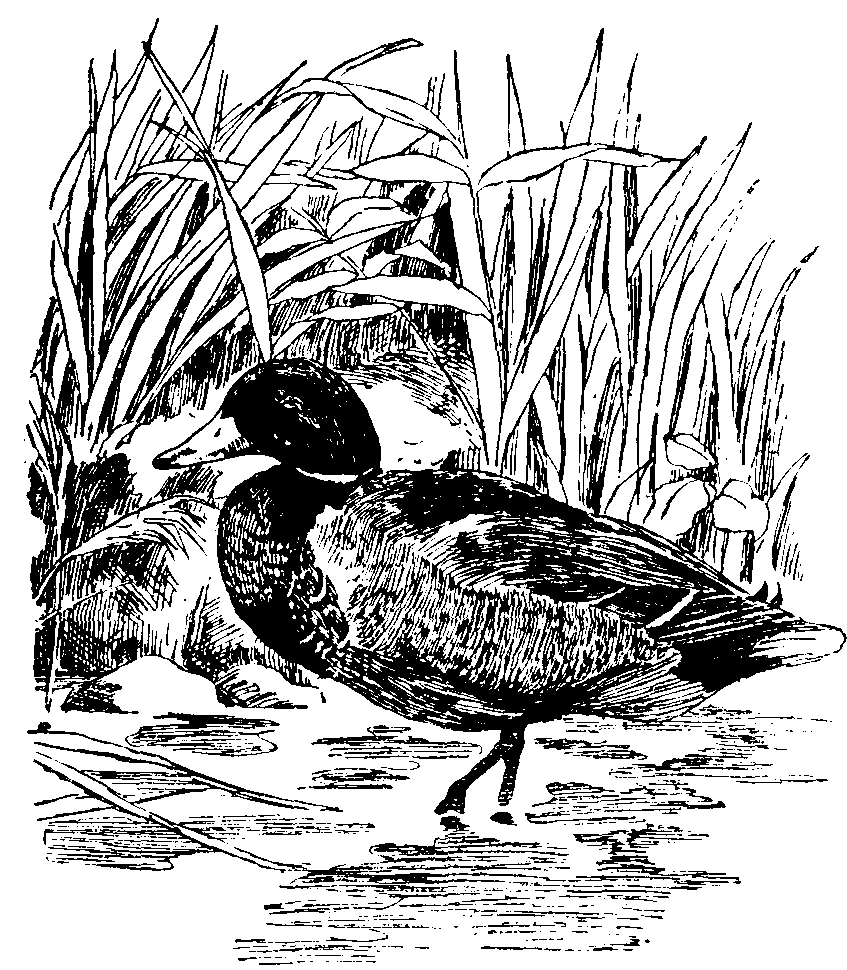
Duck, the name given to web-footed birds constituting the sub-family Anatinæ of the family Anatidæ, which also includes swans and geese. The ducks are very numerous as species, and are met with all over the world. They are often migratory, going northward in summer to their breeding-places. Their food is partly vegetable, partly animal. The common mallard or wild-duck (Anas boschas) is the original of the domestic duck. In its wild state the male is characterized by the deep green of the plumage of the head and neck, by a white collar separating the green from the dark chestnut of the lower part of the neck, and by having the four middle feathers of the tail recurved. The wild-duck is taken in large quantities by decoys and other means. Some tame ducks have nearly the same plumage as the wild ones; others vary greatly, being generally duller or pure white, but all the males have the four recurved tail-feathers. There are several favourite varieties of the domestic duck, those of Normandy and Picardy in France, and the Aylesbury ducks in England, being remarkable for their great size and delicacy of flesh. Other species of the sub-family are: shoveller (Spatula clypeata), garganey (Querquedula circia), pintail or sea-pheasant (Dafila acuta), teal (Nettion crecca), widgeon (Mareca penelope), gadwall (Chaulelasmus streperus), sheldrake (Tadorna cornuta), tree-ducks (species of Dendrocygna). In a wider sense the name 'duck' is applied to species of other sub-families of the Anatidæ as follows: Merganettinæ: blue duck (Hymenolæmus malacorhynchus) of New Zealand. Erismaturinæ: musk duck (Biziura lobata) of Tasmania and Australia. Lake ducks (species of Erismatura). Fuligulinæ: eider duck (Somateria mollissima), q.v.; scoter or black duck (Œdemia nigra); harlequin duck (Cosmonetta histrionica); logger-head or steamer duck (Tachyeres cinereus) of South America: scaup (Fuligula marila); canvas back (F. vallisneria), q.v.; pochard (Nyroca ferina). Plectopterinæ: summer duck (Aix sponsa) of N. America and Cuba; mandarin duck (A. galericulata) of E. Asia; Muscovy or musk duck (Cairina moschata), ranging from Mexico to the Argentine.—Bibliography: Nourse, Turkeys, Ducks, and Geese; Rankin, Natural and Artificial Duck Culture; J. G. Millais, British Diving Ducks.
Ducking-stool, a stool or chair in which common scolds were formerly tied and plunged into water. They were of different forms, but that most commonly in use consisted of an upright post and a transverse movable beam on which the seat was fitted or from which it was suspended by a chain. The ducking-stool is mentioned in Domesday Book (Chester): it was extensively in use throughout the country from the fifteenth till the beginning of the eighteenth century, and in one case—at Leominster—was used as late as 1809.
Duckweed, the popular name of several species of Lemna, nat. ord. Lemnaceæ, plants growing in ditches and shallow water, floating on the surface, and serving as food for ducks and geese. Five species are known in Britain, and others are common in America. They consist of small fronds bearing naked unisexual flowers.
Duckworth, Sir John Thomas, a British admiral, born in 1748, died 1817. He joined the navy when eleven years of age; and was post-captain in 1780. In 1793, on the breaking out of the French war, he was appointed to the command of the Orion, 74, forming part of the Channel fleet under Lord Howe, and distinguished himself in 1794 in the great naval victory on 1st June. In 1798 he aided in the capture of Minorca. From 1800 to 1806 he rendered important services on the West India station, in particular gaining a complete victory over a French squadron, for which he received a pension of £1000 a year and the thanks of both Houses of Parliament. In 1807, having been ordered to Constantinople, he forced the passage of the Dardanelles, but suffered severely from the Turkish batteries in returning. From 1810 to 1814 he commanded the Newfoundland fleet, and in 1817 he was appointed to the chief command at Plymouth. In 1813 he was created a baronet.
Duclos (du˙-klō), Charles Pinot, a French novelist, writer of memoirs, and grammarian, born in 1704 at Dinant, died at Paris 1772. He became secretary of the French Academy, and on the resignation of Voltaire he was appointed to the office of historiographer of France. His writings are lively and satirical. Among the best are: Confessions du Comte de * * * (1741), Considérations sur les Mœurs de ce Siècle, Mémoires secrets sur les Règnes de Louis XIV et XV, and Remarques sur la Grammaire générale de Port-Royal.
Ductil´ity, the property of solid bodies, particularly metals, which renders them capable of being extended by drawing, while their thickness or diameter is diminished, without any actual fracture or separation of their parts. The following is nearly the order of ductility of the metals which possess the property in the highest degree, that of the first mentioned being the greatest: gold, silver, platinum, iron, copper, nickel, palladium, cadmium, zinc, tin, lead. Dr. Wollaston succeeded in obtaining a wire of platinum only 1/30000th of an inch in diameter. The ductility of glass at high temperatures seems to be unlimited, while its flexibility increases in proportion to the fineness to which its threads are drawn.
Duddon, an English river which flows 20 miles along the boundaries of Cumberland and Lancashire to the Irish Sea, and is the subject of a series of sonnets by Wordsworth, written in 1820.
Du Deffand, Madame. See Deffand.
Duderstadt (dö´dėr-sta˙t), an old German town, province of Hanover, 10 miles east of Göttingen, formerly a member of the Hanseatic League and a place of some importance. Pop. 5380.
Dudevant, Madame. See Sand, George.
Dud´ley, Sir Edmund, born 1462, executed 1510, noted in English history as an instrument of Henry VII in the arbitrary acts of extortion by the revival of obsolete statutes and other unjust measures practised during the latter years of his reign. On the accession of Henry VIII he was arrested for high treason, and perished on the scaffold with his associate Sir Richard Empson.
Dudley, Lord Guildford, son of John, Duke of Northumberland, was married in 1553 to Lady Jane Grey, whose claim to the throne the duke intended to assert on the death of Edward VI. On the failure of the plot Lord Guildford was condemned to death, but the sentence was not carried into effect till the insurrection of Wyatt induced Mary to order his immediate execution (1554).
Dudley, John, Duke of Northumberland, son of Sir Edmund Dudley, minister of Henry VII, was born in 1502, beheaded 1553. He was left by Henry VIII one of the executors named in his will, as a kind of joint-regent during the minority of Edward VI. Under that prince he manifested the most insatiable ambition, and obtained vast accessions of honours, power, and emoluments. The illness of the king, over whom he had gained complete ascendency, aroused his fears, and he endeavoured to strengthen his interest by marrying his son Lord Guildford Dudley to Lady Jane Grey, descended from the younger sister of Henry VIII, and persuaded Edward to settle the crown on his kinswoman by will, to the exclusion of his two sisters, the Princesses Mary and Elizabeth. The attempt to place Lady Jane Grey on the throne failed, and many of the conspirators were executed.
Dudley, Robert, Earl of Leicester. See Leicester.
Dudley, a town and parliamentary borough of England, in an isolated part of Worcestershire enclosed by Staffordshire, 8 miles west by north of Birmingham. It is situated in the midst of the 'black country', and has extensive coal-mines, iron-mines, ironworks, and limestone quarries. It produces nails, chain-cables, anchors, vices, boilers, fire-irons, and has also glassworks, brickworks, and brass-foundries. There are the remains of a castle, said to have been founded in the eighth century by a Saxon prince called Dud, who has given the town its name. Dudley returns one member to Parliament. Pop. of municipal borough, 51,079.
Dudley Limestone, a highly fossiliferous limestone belonging to the Silurian system, occurring near Dudley, and equivalent to the Wenlock limestone. It abounds in beautiful masses of coral, shells, and trilobites.
Duel (Lat. duellum, from duo, two), a premeditated and prearranged combat between two persons with deadly weapons, for the purpose of deciding some private difference or quarrel. The combat generally takes place in the presence of witnesses called seconds, who make arrangements as to the mode of fighting, place the weapons in the hands of the combatants, and see that the laws they have laid down are carried out. The origin of the practice of duelling is referred to the trial by 'wager of battle' which obtained in early ages. This form of duel arose among the Germanic peoples, and a judicial combat of the kind was authorized by Gundebald, King of the Burgundians, as early as A.D. 501. When the judicial combat declined, the modern duel arose, being probably to some extent an independent outcome of the spirit and institutions of chivalry. France was the country in which it arose, the sixteenth century being the time at which it first became common, especially after the challenge of Francis I to Charles V in 1528. Upon every insult or injury which seemed to touch his honour, a gentleman thought himself entitled to draw his sword, and to call on his adversary to give him satisfaction, and it is calculated that 6000 persons fell in duels during ten years of the reign of Henri IV. His minister, Sully, remonstrated against the practice; but the king connived at it, supposing that it tended to maintain a military spirit among his people. In 1602, however, he issued a decree against it, and declared it to be punishable with death. Many subsequent prohibitions were issued, but they were all powerless to stop the practice. During the minority of Louis XIV, more than 4000 nobles are said to have lost their lives in duels. The practice of duelling was introduced into England from France in the reign of James I; but it was never so common as in the latter country. Cromwell was an enemy of the duel, and during the Protectorate there was a cessation of the practice. It came again into vogue, however, after the Restoration, thanks chiefly to the French ideas that then inundated the court. As society became more polished duels became more frequent, and they were never more numerous than in the reign of George III. Among the principals in the chief duels of this period were Charles James Fox, Sheridan, Pitt, Canning, Castlereagh, the Duke of York, the Duke of Richmond, and Lord Camelford. The last mentioned was the most notorious duellist of his time, and was himself killed in a duel in 1804. A duel was fought between the Duke of Wellington and Lord Winchelsea in 1829, but the practice was dying out. It lasted longest in the army. By English law fatal duelling is considered murder, no matter how fair the combat may have been, and the seconds are liable to the same penalty as the principals. In 1813 the principal and seconds in a fatal duel were sentenced to death, though afterwards pardoned. An officer in the army having anything to do with a duel renders himself liable to be cashiered. In France duelling still prevails to a certain extent; but the combats are usually very bloodless and ridiculous affairs. In the German army until 1918 it was common, and was recognized by law. The duels of German students, so often spoken of, seldom cause serious bloodshed.—Bibliography: Millingen, History of Duelling; Steinmetz, Romance of Duelling; G. Letainturier-Fradin, Le duel à travers les âges; C. A. Thimm, Bibliography of Fencing and Duelling; A. Hutton, The Sword and the Centuries.
Duen´na, the chief lady-in-waiting on the Queen of Spain. In a more general sense, an elderly woman holding a middle station between a governess and companion, appointed to take charge of the young daughters of Spanish and Portuguese families.
Dufaure (du˙-fōr), Jules Armand Stanislas, French orator and statesman, born 1798, died 1881. He practised law at Bordeaux; entered the Chamber of Deputies in 1834, and became an influential leader of the Liberal party. Under the Republic he was Minister of the Interior, but was driven from the public service by the coup d'état of 1851, and for the next twenty years devoted himself closely to his Bar practice and pamphlet writing. Under the Government of Thiers he acted as Minister of Justice; and in 1876, and again from 1877 to 1879, he was head of the Cabinet.
Duff, Alexander, Scottish missionary, born 1806, died 1878. Educated at St. Andrews University, in 1829 he set out for India as the first Church of Scotland missionary to that country, and reached Calcutta after being twice shipwrecked. He opened a school in which he taught successfully the doctrines of Christianity, as well as general knowledge, but on his secession (along with the other missionaries of the Church) from the Church of Scotland in 1843, he had to give up the school and begin again. In 1849 he visited Scotland, where he remained until 1856. He assisted in founding the University of Calcutta, and, having been obliged to return home for reasons of health, he raised £10,000 to endow a missionary chair in the New College, Edinburgh, becoming himself its first occupant. His chief writings are: The Church of Scotland's India Mission (1835); Vindication of the Church of Scotland's India Mission (1837); India and India Missions (1840); The Jesuits (1845); and The Indian Mutiny: its Causes and Results (a series of letters published in 1858).
Duff, Sir Mountstuart Elphinstone Grant, writer on political and other subjects, born in Aberdeenshire in 1829, died in 1906. He was educated at Edinburgh Academy, The Grange, Bishop Wearmouth, and Balliol College, Oxford, was called to the Bar at the Inner Temple in 1854, and in 1857 entered the House of Commons as Liberal member for the Elgin Burghs, which constituency he continued to represent until 1881. He was Under-Secretary for India in W. E. Gladstone's ministry from 1868 to 1874, and Under-Secretary for the Colonies from 1880 to 1881, in which latter year he was appointed Governor of Madras. His Indian administration was most successful, and on his retirement in 1886 he was made a G.C.S.I. He was president of the Royal Geographical Society from 1889 to 1893, and of the Royal Historical Society from 1892 to 1899, and was also a trustee of the British Museum. His published works include: Studies in European Politics (1866); A Political Survey (1868); Elgin Speeches (1871); Notes of an Indian Journey (1876); Miscellanies, Political and Literary (1879); Memoir of Sir H. S. Maine (1892); Ernest Renan (1893); and Notes from a Diary (7 vols., 1897-1905).
Duff´erin and Ava, Frederick Temple Hamilton-Blackwood, Marquess of, British statesman and author, son of the fourth Baron Dufferin and a granddaughter of R. B. Sheridan, born at Florence 1826, died in 1902. He began his public services in 1855, when he was attached to Earl Russell's mission to Vienna. Subsequently he was sent as Commissioner to Syria in connection with the massacre of the Christians (1860); was Under-Secretary of State for India (1864-6); Under-Secretary for War (1866); Chancellor of the Duchy of Lancaster (1868-72); Governor-General of Canada (1872-78); Ambassador at St. Petersburg (1879-81); at Constantinople (1882); sent to Cairo to settle the affairs of the country after Arabi Pasha's rebellion (1882-3); Viceroy of India (1884-8); Ambassador to Italy (1889-91); to France (1891-96). He was elected president of the Royal Geographical Society in 1878, and Lord Rector of Glasgow University in 1891. Besides being a noted diplomatist, he was also a popular author. In 1847 he published Narrative of a Journey from Oxford to Skibbereen during the year of the Irish Famine; in 1860, Letters from High Latitudes; also various pamphlets on Irish questions. In 1888 he was made Marquess of Dufferin and Ava.—Cf. Sir A. Lyall, Life of the Marquess of Dufferin and Ava.
Dufrénoy (du˙-frė-nwä) Pierre Armand, French geologist and mineralogist, born in 1792, died in 1857. He became director of the school of mines, and published a great variety of papers on geology and mineralogy. In 1841 he published, in collaboration with Élie de Beaumont, a great geological map of France with three volumes of text, and this was followed by his Traité de Minéralogie. He introduced a new classification of minerals, based on crystallography.
Dufresny (du˙-frā-nē), Charles Rivière, a French comic poet, born in 1648, died in 1724. He was clever and versatile, and had great skill as a landscape-gardener and an architectural designer. Among his dramatic pieces may be mentioned L'Esprit de Contradiction, Le Mariage Fait et Rompu, and Le Double Veuvage. He also wrote Amusements sérieux et comiques d'un Siamois, which suggested to Montesquieu his Lettres Persanes.
Dug´dale, Sir William, an English antiquary, born in 1605 of a good family in Warwickshire, died 1686. He was made Chester herald in 1644; accompanied Charles I through the civil war; and after the Restoration received knighthood, and was appointed garter king-at-arms. In concert with Roger Dodsworth he produced an important work on English monasteries entitled Monasticon Anglicanum. Among his other works are: Antiquities of Warwickshire; The Baronage or Peerage of England; Origines Judiciales, or Historical Memoirs of the English Law, Courts of Justice, &c.; a History of St. Paul's Cathedral; and various minor writings. He also completed and published the second volume of Spelman's Concilia.
Dugong (Halicŏrē dugong)
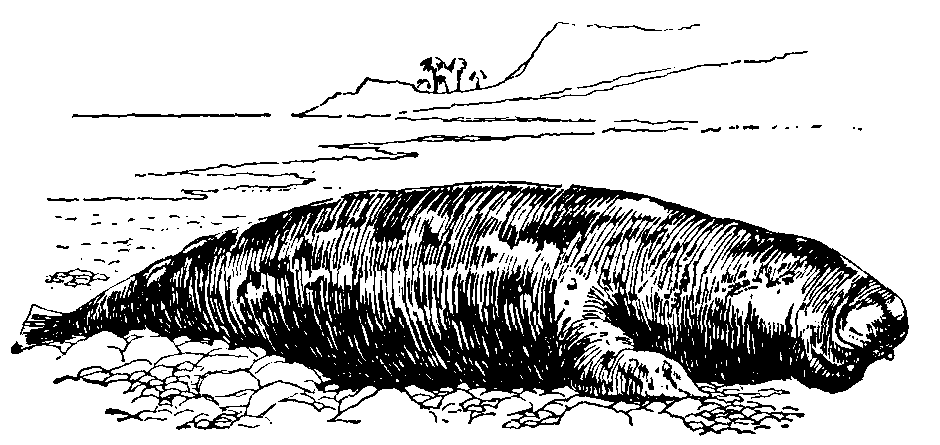
Du´gong, a herbivorous mammal, the Halicŏrē dugong, belonging to the ord. Sirenia, which also includes the manatees. It is a native of the Indian and Australian seas; possesses a tapering body ending in a crescent-shaped fin, and is said sometimes to attain a length of 20 feet, though generally it is about 7 or 8 feet in length. The fore-limbs are in the form of flippers; hind-limbs are absent. The skin is thick and smooth, with a few scattered bristles; the colour bluish above and white beneath. Its food consists of marine plants; it yields little or no oil, but is hunted by the Malays for its flesh, which resembles veal, and is tender and palatable. It has been suggested that the appearance of this animal has given rise to the legends of mermaids and mermen.
Duguay-Trouin (dü-gā-trö-an), René, a distinguished French seaman, born at St. Malo in 1673, died at Paris 1736. As commander of a privateer he took many prizes from the British between 1690 and 1697. He then entered the royal marine as a captain, and signalized himself so much in the Spanish War that the king granted him letters of nobility, in which it was stated that he had captured more than 300 merchant ships and twenty ships of war. By the capture of Rio de Janeiro (1711) he brought the Crown more than 25,000,000 francs. Under Louis XV he rendered important services in the Levant and the Mediterranean.
Du Guesclin (dü-gā-klan), Bertrand, Constable of France, born about 1314, died 1380. Mainly to him must be attributed the expulsion of the English from Normandy, Guienne, and Poitou. He was captured by Chandos at the battle of Auray in 1364, and ransomed for 100,000 francs. While serving in Spain against Peter the Cruel, he was made prisoner by the English Black Prince, but was soon liberated. For his services in Spain he was made Constable of Castile, Count of Trastamare, and Duke of Molinas; and in 1370 he was made Constable of France.
Duikerbok, species of Cephalophus, small South African antelopes with short horns (none in the female), and a tuft of stiff hairs between them.
Duisburg (dö´is-bu¨rh), a flourishing town in Rhenish Prussia, 13 miles north of Düsseldorf. It is an ancient place, believed to be of Roman origin. It early rose to be a free town, and became a member of the Hanseatic League. It possesses a beautiful church of the fifteenth century, and has iron manufactories, engineering works, chemical works, and cotton and woollen mills; and a large trade greatly facilitated by a canal communicating with the Rhine, which is about 2 miles distant. Pop. 229,483.
Dujardin (du˙-zha˙r-dan˙), Karel, a Dutch artist, who excelled in painting landscapes, animals, and scenes in low life, born in 1640 at Amsterdam, died at Venice 1678. His paintings are rare, and command high prices. His masterpiece, The Charlatans (1657), is in the Louvre.
Duke (Fr. duc, Sp. duque, It. duca, all from Lat. dux, leader, commander), a title belonging originally to a military leader. In Britain it is the highest rank in the peerage. Royal dukes have a special status and precedence. The first hereditary duke in England was the Black Prince, created by his father, Edward III, in 1336. The duchy of Cornwall was bestowed upon him, and was thenceforward attached to the eldest son of the king, who is considered a duke by birth. The duchy of Lancaster was soon after conferred on Edward's third son, John of Gaunt, and hence arose the special privileges which these two duchies still in part retain. A duke in the British peerage, not of royal rank, is styled 'your grace', or 'my Lord Duke'; his wife is a duchess. (See Address, Forms of.) The coronet consists of a richly-chased gold circle, having on its upper edge eight golden leaves of a conventional type called strawberry leaves; the cap of crimson velvet is closed at the top with a gold tassel, lined with sarsenet, and turned up with ermine. (See Coronet.) At various periods and in different continental countries the title duke (Herzog in Germany) was given to the actual sovereigns of small states. The titles 'grand-duke' and 'grand-duchess', 'archduke' and 'archduchess', were in use also on the European continent, especially in Russia and Austria until 1918. In the Bible the word dukes is used (Gen. xxxvi) for the duces of the Vulgate.
Dukhoborzi (du¨h-o-bor´tsē), a Russian sect of religious mystics which arose in the eighteenth century. The name means 'spirit-fighters', as the sect was accused by the orthodox priests of fighting against the spirit of God. They reject the doctrine of the Trinity, of the deity of Christ, hold property in common, and refuse oaths and military service, thus resembling Quakers. In 1899 a body of several thousands emigrated to Canada, where they received territory in Assiniboia and Saskatchewan.
Dukinfield, or Duckinfield, a municipal borough, England, county Cheshire, separated by the Tame from Ashton-under-Lyne, and mostly within Stalybridge parliamentary borough. Collieries, cotton-factories, brickworks, and tileworks give employment to the population. Pop. (municipal borough), 19,426.
Dulce (du¨l´sā), a lake of Guatemala, on the east coast, communicating with the Gulf of Honduras by the lakelet el Golfete. It is about 30 miles long by 12 broad, and affords profitable turtle hunting.
Dulcigno (du¨l-chēn´yō), a small seaport town, formerly in Albania, now in Montenegro, on the Adriatic, the seat of a Roman Catholic Bishop. It was captured by the Austrians in 1916, and retaken by Italian troops in 1918. Pop. 5000.
Italian Dulcimer
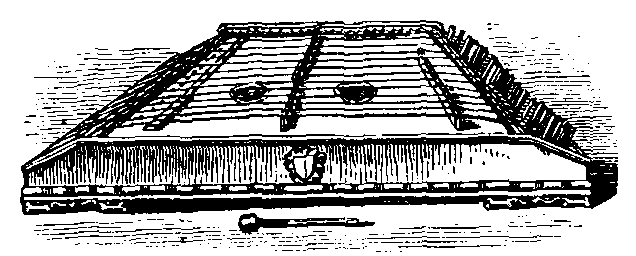
Dul´cimer, one of the most ancient musical instruments, used in almost all parts of the world. The modern instrument consists of a shallow trapezium-shaped box without a top, across which runs a series of wires, tuned by pegs at the sides, and played on by being struck by two cork-headed hammers. It is in much less common use in Europe now than it was a century or two ago, and is interesting chiefly as being the prototype of the piano. It is still, however, occasionally to be met with on the Continent at fairs in the country, and in England in the hands of street musicians. It was known in Persia and Arabia under the name of santir, and was introduced into Europe by the Crusaders. The Hebrew psaltery is supposed to have been a variety of the dulcimer.
Dul´cinists, followers of Dulcinus, a layman of Lombardy, in the fourteenth century, who preached the reign of the Holy Ghost, affirming that the Father had reigned till Christ's incarnation, and that the Son's reign terminated in 1300. He was followed by a great many people to the Alps, where he and his wife were taken and burned by order of Clement IV.
Dulcitol, or Dulcite, is an alcohol closely allied to the sugars. It is found in Madagascar manna, from which it is extracted by boiling water.
Duli´a (Gr. douleia, service, from doulos, a slave), an inferior kind of worship or adoration, as that paid to saints and angels in the Roman Catholic Church. The Catholics recognize different degrees of worship. The lowest degree is the dulia, which is given to saints and angels. Hyperdulia is reserved for the Virgin alone; and latria is given to God and to each person of the Trinity.
Dulse, a red sea-weed, the Rhodymenia palmāta, used in some parts of Scotland as an edible. It has a reddish-brown, or purple, leathery, veinless frond, several inches long, and is found at low water adhering to the rocks. It is an important plant to the Icelanders, and is stored by them in casks to be eaten with fish. In Kamchatka a fermented liquor is made from it. In the south of England the name is given to the Iridæa edūlis, also an edible red sea-weed.
Duluth (du-luth´), a town of the United States, capital of St. Louis county, Minnesota, at the south-west extremity of Lake Superior. The Northern Pacific and Lake Superior and Mississippi railways terminate here; and extensive docks and other works have been constructed, affording a convenient outlet for the surrounding wheat region. Pop. 97,077.
Dulwich (dul´ich), a suburb of London, in County Surrey, about 5 miles south of London Bridge, giving name to a parliamentary division of the borough of Camberwell; noticeable on account of its school, Dulwich College, called the 'College of God's Gift,' founded as a charitable institution in 1619 by the actor Edward Allen or Alleyn. Four parishes were benefited by the charity: St. Luke's, Middlesex; St. Botolph's, Bishopsgate; St. Saviour's, Southwark; and St. Giles', Camberwell. Having outlived its usefulness, in 1857 an Act was passed by which the college was reconstituted. It now consists of two branches, the educational and the eleemosynary, between which the surplus revenue is divided in the proportion of three-fourths to the former and one-fourth to the latter. The educational branch comprises two schools, the upper and the lower; the former giving boys a high-class education (lower fees for those of the privileged parishes), and having a number of scholarships and exhibitions. The eleemosynary branch maintains a certain number of resident and non-resident poor people. The original revenues were only £800, but now amount to £20,000. Dulwich College is celebrated for its pictures, many of which were bequeathed by the founder; but the greater and more valuable portion of them was the bequest of Sir Francis Bourgeois, a landscape-painter, who died in 1810. The collection includes many fine pictures of the Dutch school.
Duma, or Douma, the Lower House of the former Russian Parliament, the Upper House being the Council of the Empire. In 1905 Tsar Nicholas II granted his country a Constitution, promising that responsible Government would be established, and that no law would be made effective without the consent of the Duma. The first Duma accordingly met in 1906, and was to have had the power of a Parliament in Constitutional countries. The Legislative Assembly could make new laws, modify existing ones, issue the national Budget, &c., but had no right to alter the fundamental laws of the empire. In spite of the promises, however, given by the Tsar, the Imperial Government paid no attention to the demands of the Assembly, and when the criticisms of the Deputies became too loud, the first Duma was dissolved. A second Duma assembled the next year, but its members, in consequence of governmental restrictions on elections, were mostly Conservatives. In the opinion of the Government, however, even the second Duma was too Liberal in its tendencies, and it was promptly dissolved. The third Duma, which met in 1907, and whose members were mostly landed proprietors, retired officers, and priests, was absolutely subservient to the autocratic Government, and, from that date to the outbreak of the Russian Revolution in 1917, the power and influence of the Russian Duma were almost nil. The Duma ceased to exist on 7th Nov., 1917, when the Bolsheviks came into power, and the Government of Commissaries of the People was set up.
Dumas (du˙-mä), Alexandre (called Dumas Père), French novelist and dramatist, born at Villers-Cotterets 1803, died at Puys, near Dieppe, 1870. He was the son of a republican general, and grandson of the Marquis de la Pailleterie and a negress, Tiennette Dumas. In 1823 he went to Paris, and obtained an assistant-secretaryship from the Duke of Orleans, afterwards Louis Philippe. He soon began to write for the stage, and in 1829 scored his first success with his drama Henri III et sa cour. It was produced when the battle between the Romanticists and the Classicists was at its height, and hailed as a triumph by the former school. The same year appeared his Christine, and in quick succession Antony, Richard d'Arlington, Térésa, La Tour de Nesle, Catharine Howard, and Mlle de Belle-Isle. Dumas had now become a noted Parisian character. The critics fought over the merits of his pieces, and the scandal-mongers over his prodigality and galanteries. Turning his attention to romance, he produced a series of historical romances, among which may be mentioned: Le bâtard de Mauléon; Isabelle de Bavière; Les Deux Dianes; La Reine Margot; Les Trois Mousquetaires, with its continuations Vingt Ans Après and the later Vicomte de Bragelonne. His Monte-Cristo and several others are also well known to English readers through translations. Several historical works were also written by him: Louis XIV et son Siècle, Le Regent et Louis XV, Le Drame de '93, Florence et les Médicis, &c. The works which bear his name amount to some 1200 volumes, including about 60 dramas; but the only claim he could lay to a great number of the productions issued under his name was that he either sketched the plot or revised them before going to press. He earned vast sums of money, but his recklessness and extravagance eventually reduced him to the adoption of a shifty, scheming mode of living. His Mémoires, begun in 1852, present interesting sketches of literary life during the Restoration, but display intense egotism. In 1860 he accompanied Garibaldi in the expedition which freed Naples from the Bourbons. He died at the residence of his son, and was buried in Villers-Cotterets in 1872. Dumas was remarkable for his creative rather than for his artistic genius, and although he frequently squandered his gifts, he was admired even by the highly cultured, such as Thackeray and others.—Bibliography: H. Blaze de Bury, Alexandre Dumas: sa vie, son temps, son œuvre; A. B. Davidson, Alexandre Dumas père: his Life and Works.
Dumas, Alexandre, son of the above, born 1824, died in 1895, novelist and dramatist. His works treat mostly of the relations between vice and morals. His first novels, La Dame aux Camélias and Diane de Lys, were very successful, as were also the plays which were founded on them. His dramas, which are much superior to his novels, deal satirically with the characters, follies, and manners of French society. He was thus a pioneer in the 'comedy of manners'. His plays, besides his dramatized novel La Dame aux Camélias, which marked a date in the history of the French stage, and which supplied Verdi with the plot for La Traviata, are: Le demi-monde, Le fils naturel, L'Ami des femmes, La princesse Georges, and L'Étrangère.
Dumas, Matthieu, French soldier and military writer, born in 1753, died in Paris 1837. He early entered the French cavalry, took part in the War of American Independence, and was employed in the Levant and in Holland. At the commencement of the Revolution he assisted Lafayette in organizing the National Guard. On the triumph of the extreme party in 1797 Dumas was proscribed, but made his escape to Holstein, where he wrote the first part of his Précis des Événements Militaires, a valuable source for the history of the period of which it treats (1798-1807). He was recalled from exile by Napoleon, who had become First Consul. His first employment was to organize the reserve for the army of Italy. In 1802 he was appointed State Councillor; in 1805 he became general of division, and was shortly afterwards Neapolitan minister in the service of Joseph Bonaparte. In 1808 he was actively employed in the arrangements for the war against Austria, fought in the battles of Essling and Wagram, and arranged the terms of the armistice of Znaim. He held the office of General Intendant of the army in the campaign of 1812. After the Restoration Louis XVIII appointed him Councillor of State, and gave him several important appointments connected with the army. In 1830 he aided in bringing on the revolution of July, and after the fall of Charles X he obtained the chief command of all the national guards of France, together with a peerage. He published a translation of Napier's History of the Peninsular War.
Du Maurier (du˙-mō´ri-ā), George Louis Palmella Busson, artist and writer, was born in Paris 1834, died in 1896. He was the son of an English mother and a Frenchman who had been naturalized as a British subject. At the age of seventeen he took up the study of chemistry in London, but soon adopted art as a profession. After studying in Belgium and France, he returned to London, and soon began to contribute drawings to Punch, Once a Week, Cornhill Magazine, &c. He succeeded Leech on Punch, and became famous chiefly through his drawings for that publication. He also illustrated various books, and wrote three novels, Trilby, Peter Ibbetson, and The Martian. His elder son, Guy Du Maurier, born in 1865, killed in France in 1915, was the author of An Englishman's Home (1909).
Dumba, Konstantin Theodor, Austro-Hungarian diplomatist, who became conspicuous as an agent of German propaganda in the United States during the European War. He went as Ambassador to the United States in 1913, and at the outbreak of the war endeavoured to organize a vast conspiracy there, with a view to hampering the productions of munitions for the Allies. Abusing his position of Ambassador, he planned explosions and strikes in American factories. On 1st Sept., 1915, J. F. J. Archibald, an American newspaper correspondent, was arrested at Falmouth, and among the papers found upon him was a letter from Dr. Dumba to Baron Burian, Austrian Minister for Foreign Affairs, wherein the former suggested a plan of crippling the munition factories in America by creating strikes. President Wilson then demanded his recall, and he left the United States in Oct., 1915, Great Britain granting him a safe conduct.
Dumbar´ton, a royal and parliamentary burgh and seaport, Scotland, chief town of Dumbarton county, stands on the Leven near its junction with the Clyde, 16 miles W.N.W. of Glasgow. Shipbuilding is carried on to a great extent, and there are foundries and engine-works. Dumbarton unites with Port-Glasgow, Renfrew, Rutherglen, and Kilmarnock in sending a member to Parliament. Originally it was called Alcluyd, and it was the chief town of Cumbria or Strathclyde. Pop. 21,989. A little to the south is the famous rock and castle of Dumbarton, rising above the Clyde. The rock, which is of basalt, is 240 feet in height, and about 1 mile in circumference at the base. It is one of the fortresses stipulated to be kept in repair by the Act of Union, and the barracks contain accommodation for 150 men. There has been a stronghold here from the earliest times, and the fortress of Dumbarton occupied an important place in Scottish history.—Dumbartonshire, the county of Dumbarton, is partly maritime, partly inland, consisting of two detached portions, the larger and most westerly lying between the Clyde, Loch Long, and Loch Lomond, and the far smaller portion being about 4 miles east of the former, and comprising only two parishes. More than half the area of the county is occupied by mountains, some of them attaining a height of upwards of 3000 feet. The lower lands are fertile, and in general well cultivated. More than one-half of Loch Lomond and fully two-thirds of the islands in it belong to Dumbartonshire. The Gareloch, an arm of the Firth of Clyde, forms a part of the county into a peninsula. The principal rivers are the Leven, from Loch Lomond, and the Kelvin, both belonging to the Clyde system. The chief minerals are coal, limestone, ironstone, and slate, all of which are wrought more or less. On the banks of the Leven and elsewhere are extensive cotton printing and bleaching establishments; and there are extensive shipbuilding yards along the Clyde. Besides Dumbarton, the chief town, the county contains the towns of Helensburgh and Kirkintilloch, and the manufacturing villages of Alexandria, Renton, and Bonhill. Vestiges of the Roman wall of Antoninus still exist. The county returns one member to the House of Commons. Pop. 139,831.
Dumb-cane, a plant of the ord. Araceæ, the Dieffenbachia seguina, of the West Indies, so called from its acridity causing swelling of the tongue when chewed, and destroying the power of speech.
Dumdum, a military village and extensive cantonment, Hindustan, province of Bengal, 4½ miles E.N.E. of Calcutta. The village is famous as being the scene of the first open manifestation of the sepoys against the greased cartridges, which led to the mutiny of 1857. Pop. 12,000.
Dumdum Bullet (so called from the arsenal at Dumdum, a small village 4½ miles from Calcutta), a hollow-nosed bullet which expands on impact, and so causes an ugly wound. It was used in Indian frontier fighting to stop the rushes of fanatical tribesmen. While the term 'Dumdum' bullet should strictly only be applied to hollow-nosed bullets, it is popularly applied to any kind of expanding bullet. Ordinary bullets can be converted into expanding ones by means of filing the cupro-nickel envelope until the lead core is exposed, by means of slitting the envelope at the shoulders, or simply by reversing the bullet in its socket. Expanding bullets are considered legitimate in big-game shooting, but in the Declaration signed at the Hague, 29th July, 1899, Germany expressly promised not to use such bullets in warfare. In spite of this the Germans freely used bullets of this kind in the European War.
Dumfries (dum-frēs´), a river port, railway centre, and until 1918 a parliamentary burgh, Scotland, capital of the county of same name, and the chief place in the south of Scotland; situated on the left bank of the Nith, about 6 miles from its junction with the Solway Firth. It is connected with the suburb Maxwelltown (in Kirkcudbright) by three bridges, one dating from the thirteenth century. It is a pleasing, well-built town, with various handsome public edifices. There are iron-foundries, hosiery and tweed factories, tanneries, and coach-building works. The River Nith is navigable to the town for vessels of under 60 tons, but the port has decreased in importance since the development of the railway system. Dumfries is a place of great antiquity. The church of the Minorites which once stood here was the scene of the murder of the Red Comyn by Bruce in 1306. Burns spent his closing years here, and the street in which he lived now bears his name. His remains rest under a handsome mausoleum, and a statue of him was erected in 1882. Dumfries was the head-quarters of the Young Pretender in 1745. Until 1918 Dumfries united with Annan, Sanquhar, Lochmaben, and Kirkcudbright (the Dumfries burghs) in sending a member to Parliament. Pop. 19,076.—Dumfriesshire, the county of Dumfries, abuts on the Solway Firth, having on its borders the counties of Lanark, Peebles, Selkirk, Roxburgh, Ayr, and Kirkcudbright; area about 1100 sq. miles or 702,946 acres, of which about a third is under cultivation. The surface is irregular, but for the most part mountainous, especially in the north and north-west districts, where the hills attain a considerable elevation, some of them exceeding 2000 feet. The dales of the Nith, Annan, and Esk, the chief rivers of the county, contain fine pasture holms and good arable land. Oats, potatoes, and turnips are the most common products. Good cattle are reared, and are much in request for the English market. The sheep on the hill pastures are mostly Cheviots; on the lower and arable lands the Leicester breed prevails. The minerals most abundant are coal, lead, iron, antimony, and gypsum. Coal and lead are worked to a small extent. Limestone and freestone abound in various parts. There are no manufactures worth mentioning. The county returns one member to the House of Commons. Its principal towns are Dumfries, Annan, Sanquhar, Lockerbie, Moffat, Langholm, and Lochmaben. Pop. 72,825.
Dumont (du˙-mōn), Pierre Étienne Louis, the friend and literary assistant of Mirabeau and Jeremy Bentham, was born at Geneva in 1759, died at Milan 1829. Ordained a minister of the Protestant Church in 1781, he attached himself to the democratic party in Geneva, and when the opposite party gained the ascendency he went to St. Petersburg, in 1782, where he was appointed pastor of the French Reformed Church. Soon after he accepted an offer to act as tutor to the sons of Lord Shelburne, afterwards Marquess of Lansdowne, which brought him to London, where he became intimate with Jeremy Bentham and Sir Samuel Romilly. Visiting Paris during the first years of the Revolution, he gained the friendship of Mirabeau, whom he assisted in the composition of speeches and reports, and of whom he wrote some interesting Recollections. On his return to London he formed that connection with Bentham which fixed his career as a writer; recasting, popularizing, and editing Bentham's works in a form suitable for the reading public. He returned to Geneva in 1814 and became a Senator.
Dumont d'Urville (du˙-mōn du˙r-vēl), Jules Sebastien César, French navigator, was born in 1790, killed in a railway accident between Paris and Versailles 1842. After completing his studies at Caen, he entered the French navy, in which he ultimately rose to be rear-admiral. From 1826 to 1829 he commanded the corvette Astrolabe, which was sent to obtain tidings of La Pérouse, and to make hydrographic observations. He made surveys of the coasts of Australia and New Zealand, and found remains of the shipwreck of La Pérouse on one of the Pacific islands. The result of this voyage was the publication of Voyage de Découverte autour du Monde. In 1837 he sailed with the Astrolabe and Zélée on a voyage of Antarctic discovery, and after many dangers, and having visited many parts of Oceania, he returned in 1840. On his return he began the publication of Voyage au Pôle sud et dans l'Océanie, which was finished by one of his companions.
Dumouriez (du˙-mö-ri-ā), Charles François Duperrier, a French general of great military talent, was born at Cambrai in 1739 of a noble family of Provence, died near Henley-on-Thames 1823. He served as an officer in the Seven Years' War. In 1768 he went to Corsica as quartermaster-general of the small army which was sent for the conquest of that island, and was afterwards made colonel. In 1778 he was appointed Governor of Cherbourg. At the Revolution he joined the Jacobins, and subsequently the Girondists, and in 1792 he was Minister of Foreign Affairs. War breaking out between France and Austria, he resigned in order to take command of the army; invaded Flanders, and defeated the Austrians at Jemappes and conquered Belgium. Instead of prosecuting the war vigorously, he now entered upon measures for the overthrow of the Revolutionary Government, issued a proclamation, in which he promised the restoration of the constitutional monarchy in the person of the heir to the crown, but was attacked by the Versailles volunteers, and compelled to flee (4th April, 1793). The Convention set a price of 300,000 livres upon his head. At first he retired to Brussels, and after various wanderings found a final refuge in England. His Memoirs, written by himself, appeared in 1794; an enlarged edition in 1822. He was also the author of a large number of political pamphlets.—Bibliography: J. Holland Rose and A. M. Broadley, Dumouriez and the Defence of England against Napoleon; H. Welschinger, Le Roman de Dumouriez.
Düna (dü'na˙), or Western Dvina, a river of Russia, which rises in the government of Tver, about 15 miles W. of the source of the Volga, falls into the Gulf of Riga, has a course of about 650 miles, and waters the seven governments of Tver, Pskov, Vitebsk, Mogilev, &c., draining an area of about 65,000 sq. miles. It is navigable for a considerable distance, but is frozen for about four months each year.
Dünaburg (dü´na-bu¨rg), Dvinaburg, or Dvinsk, a fortified town in Latvia, formerly belonging to Russia, in the government of Vitebsk on the right bank of the Düna, or Dvina, 112 miles south-east of Riga. It carries on various industries, a considerable trade, and has three yearly fairs. The official name is Dvinsk, or Daugavpils. It was captured by the Germans in Feb., 1918. Pop. 110,912.
Dünamünde (dü´na-mu˙n-de; 'Dünamouth'), a fortress and port on the Gulf of Riga, at the mouth of the Düna, having a large winter harbour for the shipping of Riga. Pop. 2500.
Dunbar´, William, the most eminent of all the old Scottish poets, was born, probably in East Lothian, about 1460-5. In 1475 he went to St. Andrews, where, in 1477, he took the degree of B.A., and two years later that of M.A. After this he seems to have become a begging friar of the Franciscan order, and made journeys in England and France, but he returned to Scotland about 1490, and attached himself to the court of James IV, from whom he received a pension of £10. On the marriage of James IV to Margaret of England Dunbar celebrated the event in a poem of great beauty, entitled The Thrissil and the Rois. His pension was ultimately raised to £80 a year, and he was the recipient of various additional gratuities, though he appears frequently to have addressed both the king and the queen for a benefice, but always without success. After the defeat at Flodden his name disappears from the royal accounts, and he probably died about 1520. His works, which consist of elaborate allegories, satirical and grimly humorous pieces, and poems full of brilliant description and luxuriant imagination, first collected by David Laing (Edinburgh, 1834), were edited by John Small and Æ. J. G. Mackay, for the Scottish Text Society, between 1884 and 1893.—Cf. The Cambridge History of English Literature (vol. ii).
Dunbar´ (Gael., Castle Point), a town of Scotland; a royal and municipal (formerly parliamentary) burgh and seaport in Haddingtonshire, at the mouth of the Firth of Forth. It is a place of great antiquity, having originated in a castle, once of great strength and importance, which underwent several memorable sieges, on one occasion being successfully defended (in 1338) against the English for nineteen weeks by Black Agnes of Dunbar, Countess of March. In 1650, at the 'Race of Dunbar', Cromwell totally defeated the Scottish army under David Leslie near the town. The harbour is not very commodious, but the town is an important fishing-station. Pop. 4830.
Dunblane´, an old episcopal city, Scotland, in Perthshire, 6 miles north-east of Stirling, on the Allan. The ancient cathedral, partly in ruins, dates from the twelfth century. The nave is 130 feet by 58 feet, and the choir, now the parish church, is 80 feet by 30 feet. The building was restored in 1893. Bishop Leighton held the see from 1662 to 1670. About two miles from the town the indecisive battle of Sheriffmuir was fought in 1715, between the Royal forces under the Duke of Argyle, and the Jacobites under the Earl of Mar. Pop. 4600.
Dun´can, Adam, Viscount, a British naval officer, was born in Dundee in 1731, died 1804. He went to sea when young, and was a post-captain in 1761. In the following year he served at the taking of Havana; and in 1779 he shared in the victory of Admiral Rodney over the Spaniards. In 1789 he became rear-admiral of the blue, and in 1794 vice-admiral of the white squadron. The following year he was appointed commander of the North Sea fleet, and in Oct., 1797, won a brilliant victory over the Dutch fleet off Camperdown, for which he was rewarded with the title of Viscount Duncan of Camperdown and a pension of £2000 a year.
Duncan, Thomas, an eminent Scottish painter, was born in 1807, died at Edinburgh 1845. He studied under Sir W. Allan, and was elected an associate of the Royal Academy in 1843. His principal works were illustrative of Scottish history and character. Among the best known of them are: The Abdication of Mary Queen of Scots, Anne Page and Slender, Prince Charles Edward and the Highlanders entering Edinburgh after Prestonpans, Charles Edward asleep in a Cave after Culloden, and The Martyrdom of John Brown of Priesthill.
Dun´cansby Head, a promontory in Caithness-shire, Scotland, forming the N.E. extremity of the Scottish mainland, 1¾ miles E. of John o' Groat's House, and 18½ miles N. by E. of Wick. Close by the promontory are two rocks, of fantastic form and great height, called the Stacks of Duncansby, which in spring and summer are covered with sea-fowl.
Dundalk (dun-da¨k´), a seaport and former parliamentary borough, Ireland, capital of the county of Louth, on Castletown River, about 2 miles above its mouth in Dundalk Bay. It has railway workshops, tanyards, and a spinning-mill; the trade, chiefly in cattle and agricultural produce, is extensive. It was the seat of the court of Edward Bruce from 1315 to 1318. In 1649 it was captured by Cromwell. Pop. 13,128.
Dundas´ of Arniston, the name of a family several members of which held a conspicuous place in the legal and political history of Scotland.—Sir James Dundas, the first of Arniston, knighted by James VI, was the third son of George Dundas of Dundas, a descendant of the Dunbars, Earls of March.—His eldest son, Sir James, was member of Parliament for Mid-Lothian, and was appointed one of the judges of the Court of Session (1662).—His eldest son Robert was also raised to the bench of the Court of Session, and filled that station for thirty-seven years. He died in 1727.—His eldest son Robert (1685-1753) was successively Solicitor-General for Scotland, Lord-Advocate, member of Parliament for the county of Edinburgh, and Dean of the Faculty of Advocates. In 1737 he was raised to the bench, and on the death of Lord-President Forbes of Culloden, in 1748, he was appointed his successor.—His eldest son Robert (1713-87) also attained to the position of Lord-Advocate, and Lord-President of the Court of Session.—His brother Henry Dundas, Viscount Melville, distinguished statesman, was born in 1741 and died 1811. He obtained the post of Solicitor-General in 1773, that of Lord-Advocate in 1775, and was made joint keeper of the signet for Scotland in 1777. In 1782 he was appointed Treasurer of the Navy and member of the Privy Council; and from that time took a leading part in all the Pitt measures, and had supreme influence in Scotland. Among other offices he held that of First Lord of the Admiralty; and in 1805 he was impeached before the House of Lords of high crimes and misdemeanours in his former office of Treasurer of the Navy, but was finally acquitted. He was created Viscount Melville in 1801, a title still borne by his direct descendant.
Dundee´, John Graham of Claverhouse, Viscount. See Graham.
Dundee (Gael. Dun Taw, fort on the Tay), a city, royal and parliamentary burgh, and seaport, Scotland, in the county of Forfar, on the north shore of the Firth of Tay, about 8 miles from the open sea, 37 miles N.N.E. of Edinburgh; in population the third town in Scotland. It stretches along the Tay, or east to west, and of late years has been greatly extended in both directions. The more recently made streets are spacious and handsome, but most of those of more ancient date are narrow, and irregularly built. The most conspicuous building is St. Mary's Tower, or the Old Steeple as it is popularly called, 156 feet high, erected in the middle of the fourteenth century. Three modern parochial churches have been built on to it in form of a cathedral, the nave, choir, and transept respectively forming a separate church. Among public buildings are: the town hall, several public halls, the high school, exchange, infirmary, lunatic asylum, Albert Institute and free library. University College, for men and women, was opened in 1883, and affiliated to the University of St. Andrews in 1897. It was founded by private munificence, receiving an endowment of £140,000, and has ten professorships. Dundee has several public parks and recreation grounds and a good supply of water. The town has long been celebrated for its textile manufactures, particularly those of the coarser descriptions of linen, and it is now the chief seat of the linen trade in Scotland and of the jute trade in Great Britain, there being a great number of mills and factories engaged in the spinning and weaving of flax, jute, and hemp. Shipbuilding is extensively carried on, and there are large engineering establishments. Another branch of business is the northern seal and whale fishery. Dundee is also famous for its marmalade and other preserves and confectionery. The shipping accommodation includes five large wet-docks, with a connected tidal harbour and graving-docks. The chief foreign trade is with the Baltic and Archangel in the importation of flax and hemp, with Norway, Sweden, and Canada in timber, and with Calcutta in jute. The railway facilities of Dundee were greatly increased in 1878 by the opening of a bridge across the Tay; but on the 28th of Dec., 1879, the bridge was destroyed by a violent storm, when about 100 people in a train in the act of crossing lost their lives. A new bridge, to replace the one destroyed, was opened for traffic in June, 1887; it is a very substantial structure about 2 miles in length. Dundee was made a royal burgh by William the Lion about 1200, was twice in the possession of the English under Edward I, and was as often retaken by Wallace and Bruce. In 1645 it was besieged, taken, and sacked by the Duke of Montrose; and six years afterwards it was stormed by Monk, when a great number of its inhabitants were put to death. Since 1868 the town has returned two members to Parliament. In 1888 it was raised by royal grant to the rank of a city. In 1914 the burgh of Broughty Ferry was annexed to Dundee, increasing its area to 5964 acres. Pop. 176,062; population in 1921, 168,217.
Dundon´ald, Thomas Cochrane, tenth Earl of, British admiral, was born in Lanarkshire 1775, died 1860. At the age of eighteen he embarked with his uncle, then Captain, and afterwards Sir Alexander Cochrane, in the Hind, of twenty-eight guns, and soon distinguished himself by his daring and gallantry. In 1800 he was appointed to the Speedy sloop-of-war of fourteen guns, and in the course of thirteen months captured over fifty vessels, but was at last captured himself. In 1805, while in command of the Pallas frigate, he took some rich prizes, and for the next four years in the Impérieuse performed remarkable exploits in cutting out vessels, storming batteries, and destroying signals. On his return to England he entered Parliament, and by his attacks on the abuses of the naval administration made himself obnoxious to the authorities. He gave further offence by charging Lord Gambier, his superior officer, with neglect of duty (which was true); by denouncing the abuses of the prize-court, and the treatment of the prisoners of war. His enemies succeeded in 1814 in convicting him on a charge—since proved to be false—of originating a rumour, for speculative purposes, that Napoleon had abdicated. He was expelled from Parliament, ignominiously ejected from the Order of the Bath, imprisoned for a year, and fined £1000. The electors of Westminster immediately paid his fine and re-elected him, but he had to remain in prison till the expiration of his sentence. In 1818 he took service in the Chilian navy, his exploits greatly aiding the national independence of that country, as well as soon after of Brazil. In 1832 he was restored to his rank in the British navy. In 1831, by the death of his father, he had succeeded to the title of Earl of Dundonald; in 1841 he became vice-admiral of the blue; in 1848 he was appointed commander-in-chief on the North America and West India station; and in 1851 and 1854 respectively he became vice-admiral of the white, and rear-admiral of the United Kingdom. He was reinstated in the Order of the Bath (G.C.B.) on 25th May, 1847. He did much to promote the adoption of steam and the screw propeller in war-ships. He wrote an autobiography, which, though left incomplete, is a most interesting work.—Cf. J. B. Atlay, The Trial of Lord Cochrane before Lord Ellenborough.