Volume 4 — VOLUME IV (continued 4)
Reading edition
Doctors' Commons was a college founded in 1567 for the Doctors of the Civil Law in London, and was at one time the seat of the Court of Arches, the Archdeacon's Court, and the Court of Admiralty. The practitioners in these courts were called advocates and proctors. In 1857 an Act was passed empowering the college to sell its property and dissolve, and making the privileges of the proctors common to all solicitors.
Doctors of the Church, a name given to four of the Greek Fathers (Athanasius, Basil, Gregory Nazianzen, and Chrysostom) and five of the Latin Fathers (Hilary, Ambrose, Jerome, Augustine, and Gregory the Great). The Roman Catholic Church, however, recognizes eighteen 'Doctors of the Church', including, besides those already mentioned, Chrysologus, Leo, Isidore, Peter Damian, Anselm, Bernard of Clairvaux, Thomas Aquinas, Bonaventura, and Alphonsus of Liguori. The title is conferred only after death.
Doctrinaires, a section of French politicians, represented by the Duc de Broglie, Royer-Collard, Guizot, and others, who became prominent after the Restoration in 1815. They favoured a constitutional monarchy similar to that which then existed in Britain. In the Chambers they thus occupied a place between Radicals and ultra-Royalists. They received the name of doctrinaires because they were looked upon more as theoretical constitution-makers than practical politicians, and the term is now used with a wider application to political theorists generally.
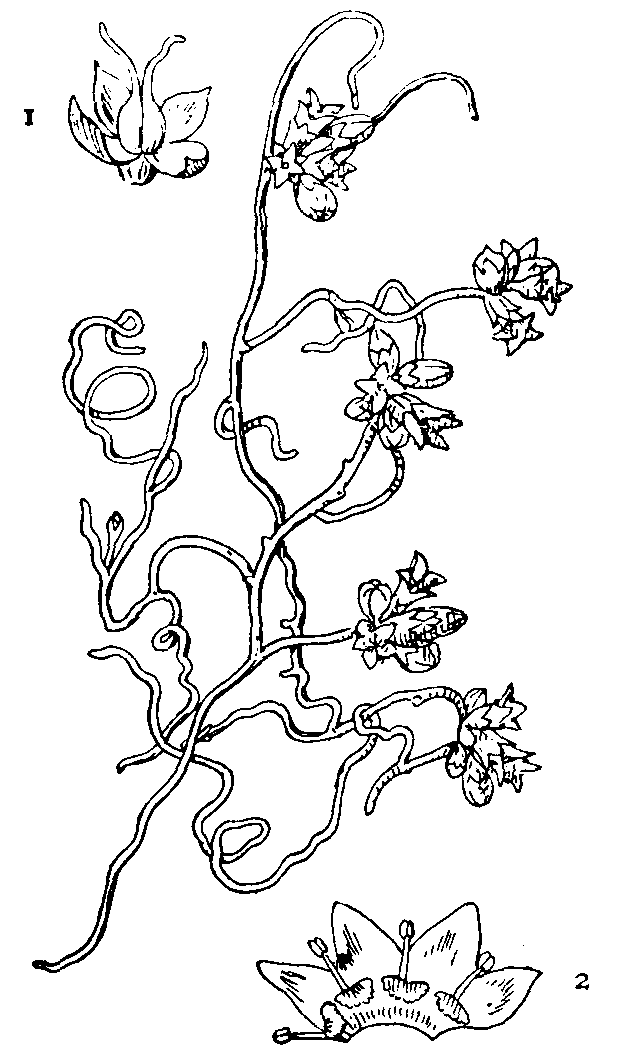
Dodder
1, Pistil. 2, Corolla.
Dodder, the common name of the plants of the genus Cuscŭta, a group of slender, branched, twining, leafless pink or white annual parasites, nat. ord. Convolvulaceæ. The seeds germinate on the ground, but the young plant speedily attaches itself to some other plant, from which it derives all its nourishment. Four species are common in England—C. europæa, found on nettles and vetches; C. Epithymum, on furze, thyme, and heather (these two being natives); C. trifolii, on clover; C. Epilīnum, on cultivated flax (both introduced from abroad).
Doddridge, Philip, D.D., an English Dissenting divine, born in London in 1702, died in 1751. He was an earnest pastor, and the author of many hymns and devotional treatises. The Rise and Progress of Religion in the Soul and The Family Expositor are amongst his best known works. Many of his hymns are still sung, such as O God of Bethel, by whose hand; and O happy day that fixed my choice.
Dodecanese (Gr., twelve islands), a name applied since the Turko-Italian War of 1912-3 to a group of islands lying off the south-west coast of Asia Minor, the base of the Italian troops. The group, consisting of the Southern Sporades, includes the Islands of Patmos, Cos, Lipsos, and others near Rhodes. Italy agreed to restore the islands to Turkey, but was prevented from carrying out the agreement by the breaking out of the Balkan War. The Treaty of Peace with Turkey (11th May, 1920) allotted these islands to Italy, who ceded them again to Greece (with the exception of Rhodes).
Dodgson, Charles Lutwidge. See Carroll, Lewis.
Dodo, from painting in the Belvedere, Vienna
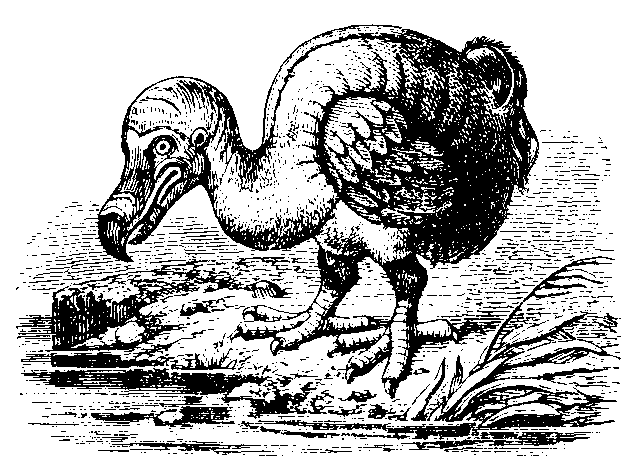
Dodo (Didus ineptus), an extinct genus of birds once abundant on the Island of Mauritius, and assigned by naturalists to the ord. Columbæ or pigeons, though an extreme modification of the type. It was a massive clumsy bird, larger than a swan, covered with down instead of feathers, with short ill-shaped legs, a strong bulky hooked beak, and wings and tail so short as to be useless for flight. Its extinction was due to its organization not being adapted to the new conditions which colonization and cultivation introduced. It probably became extinct soon after 1681.
Dodo´na, a celebrated locality of ancient Greece, in Epirus, where was one of the most ancient Greek oracles. It was a seat of Zeus (surnamed the Pelasgian), whose communications were announced to the priestesses in the rustling of the leaves on its oak tree, and the murmuring of water which gushed forth from the earth.
Dods, Marcus, theologian, born at Belford, Northumberland, in 1834, his father being minister of the Scottish Church there, died in 1909. He was educated in Edinburgh, where he took his M.A. degree at the age of twenty. In 1858 he was licensed as a minister of the Free Church of Scotland, and eight years afterwards was ordained to Renfield Free Church, Glasgow, where he remained until his appointment in 1889 to the chair of New Testament Exegesis in New College, Edinburgh. Of his works some of the most important are: The Prayer that Teaches to Pray (1863, 6th edition, 1889); Epistles to the Seven Churches (1865); Israel's Iron Age (1874); Mohammed, Buddha, and Christ (1877); The Book of Genesis (1882); Parables of Our Lord (1883 and 1885); How to become like Christ (1897); Forerunners of Dante (1903); The Bible: its Origin and Nature (1905); and articles in the Encyclopædia Britannica.
Dodsley, Robert, English poet, dramatist, and publisher, born in 1703, died in 1764. His first volume of verses, The Muse in Livery, appeared in 1732. The Toy Shop was performed at Covent Garden in 1735. In 1737 his King and the Miller of Mansfield was performed at Drury Lane, and met with an enthusiastic reception. He also wrote a tragedy, entitled Cleone, which had an extraordinary success on the stage. A selection of Fables in Prose, with an Essay on Fables prefixed, was one of his latest productions. He planned the Annual Register (commenced in 1758); the Collection of Old Plays (12 vols. 12mo), which now chiefly sustains his name as a publisher; and the Collection of Poems by Different Hands (6 vols. 12mo).
Doe, John, and Richard Roe, two fictitious personages of the English law who formerly appeared in a suit of ejectment. This fictitious form of procedure was abolished in 1852.
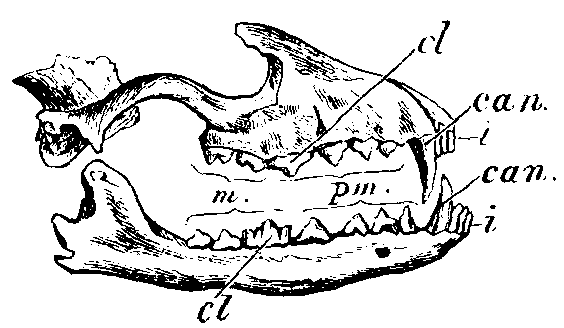
Jaws of Dog
m, Molars. pm, Premolars. cl, Carnassial. can, Canines. i, Incisors.
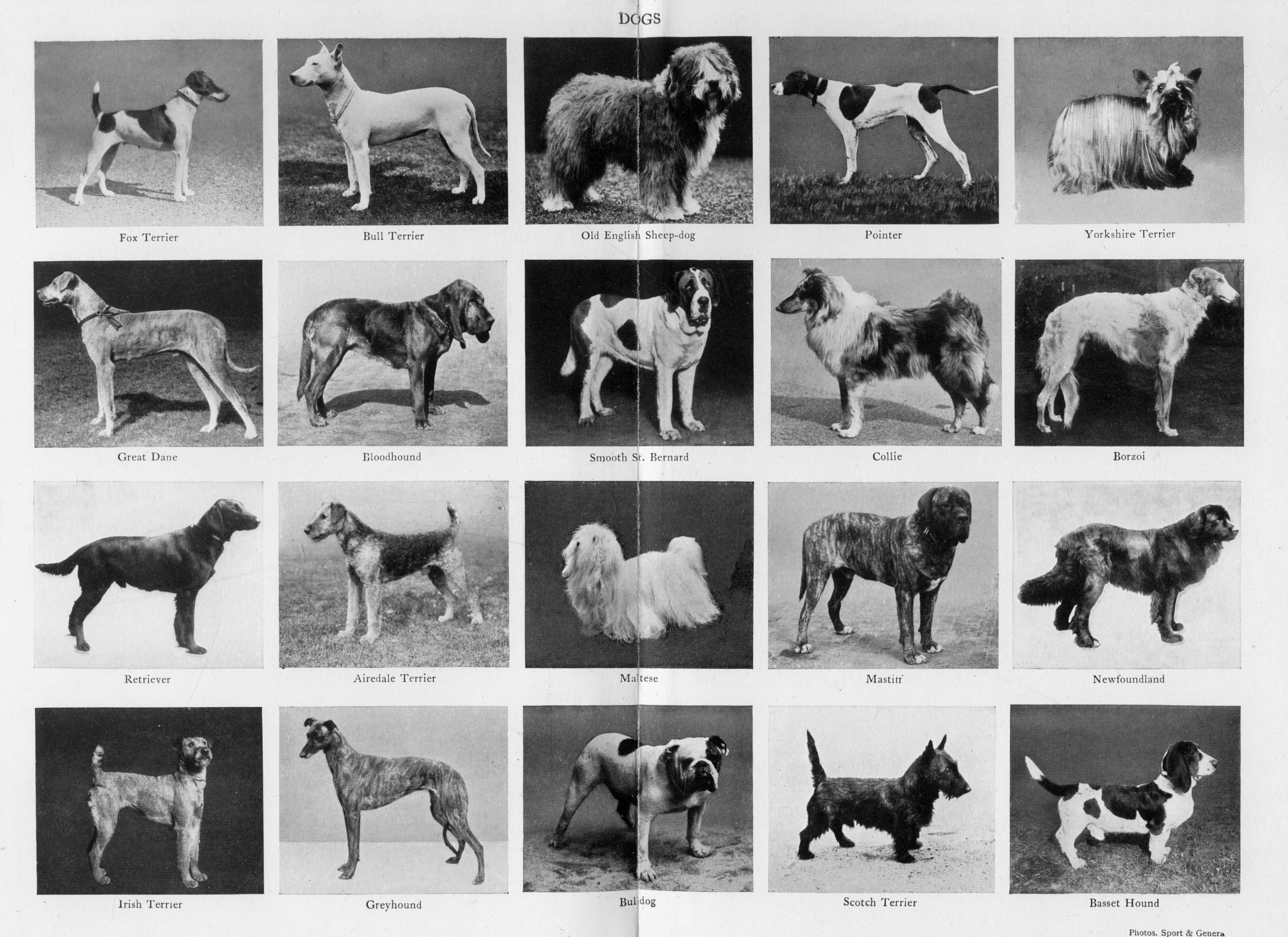
Dog (Canis familiaris), a digitigrade, carnivorous animal, forming the type of the genus Canis, which includes also the wolf, the jackal, and the fox. The origin of the dog is a much-debated question. The original stock is unknown, but various species of wolf and jackal have been suggested as ancestors. Probably a number of wild types were domesticated by prehistoric man, and there has been a good deal of crossing between these different stocks. It is generally agreed that no trace of the dog is to be found in a primitive state, the dhole of India and dingo of Australia being believed to be wild descendants from domesticated ancestors. Several attempts to make a systematic classification of the varieties of dogs have been made, but without much success, it being difficult in many cases to determine what are to be regarded as types, and what as merely mongrels and cross-breeds. Colonel Hamilton Smith divides dogs into six groups as follows: (1) Wolf-dogs, including the Newfoundland, Esquimaux, St. Bernard, shepherd's dog, &c.; (2) Watch-dogs and Cattle-dogs, including the German boar-hound, the Danish dog, the matin dog, &c.; (3) Greyhounds, the lurcher, Irish hound, &c.; (4) Hounds, the bloodhound, staghound, foxhound, setter, pointer, spaniel, cocker, poodle, &c.; (5) Terriers and their allies; (6) Mastiffs, including the different kinds of mastiffs, bull-dog, pug-dog, &c. (See the different articles.) On each side of the upper jaw are three incisors, one canine, four premolars, and three or two molars: on each side of the lower jaw the same number, except that the molars are four or three. The fore-feet have five toes, the hind-feet four or five; the claws are strong, blunt, and formed for digging, and are not retractile. The tail is generally long, and is curled upwards. The female has six to ten mammæ; she goes with young nine weeks as a rule. The young are born blind, their eyes opening in ten to twelve days; their growth ceases at two years of age. The dog commonly lives about ten or twelve years, at the most twenty. By English law it is prohibited to use dogs for purposes of draught.—Bibliography: W. Youatt, Training and Management of the Dog; R. B. Lee, A History and Description of Modern Dogs; F. T. Barton, Our Dogs and All about Them; J. S. Turner and V. Nicolas, The Kennel Encyclopædia.
Dog-days, the name applied by the ancients to a period of about forty days, the hottest season of the year, at the time of the heliacal rising of Sirius, the dog-star. The time of the rising is now, owing to the precession of the equinoxes, different from what it was to the ancients (1st July); and the dog-days are now counted from 3rd July to 11th Aug., that is, twenty days before and twenty days after the heliacal rising.
Doge (dōj: from Lat. dux, a leader, later a duke), formerly the title of the first magistrates in the Italian Republics of Venice and Genoa. The first doge of Venice elected for life was Paolo Anafesto, in 697; and in Genoa, Simone Boccanera, in 1339. In 1437 the Doge of Venice obtained from the emperor a diploma creating him 'Duke of Treviso, Feltre, Belluno, Padua, Brescia, Bergamo, &c.'. In Venice the dignity was always held for life; in Genoa, in later times, only for two years. In both cities the office was abolished by the French in 1797. The title was re-established in 1802 for the Ligurian Republic, but was abolished in 1805.
Egg Capsule of Lesser Spotted Dog-fish
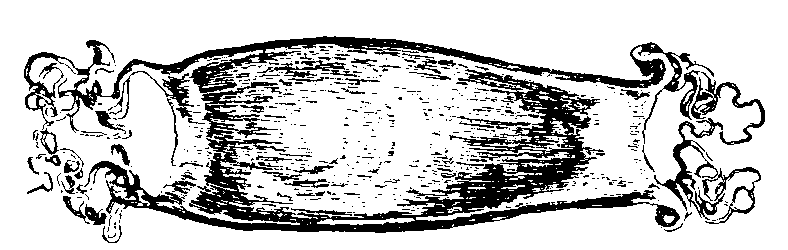
Dog-fish, a name given to several species of small shark, common around the British Isles. The rough skin of one of the species (Scyllium canicŭla), the lesser spotted dog-fish, is used by joiners and other artificers in polishing various substances, particularly wood. This species is rarely 3 feet long, S. catŭlus, the greater spotted dog-fish, is in length from 3 to 5 feet. It is blackish-brown in colour, marked with numerous small dark spots. Both species are very voracious and destructive. Their flesh is hard, dry, and unpalatable. The common or picked dog-fish (Acanthias vulgāris) is common in British and N. American seas, and is sometimes used as food. It is fierce and voracious. S. profundorum has been brought up from 816 fathoms in the North Atlantic. The tiger or zebra-shark (Stegostoma tigrinum) is a handsome dog-fish native to the Indian Ocean. It is marked with dark stripes on a yellow ground, and may attain the length of 15 feet.
Dogger, a Dutch vessel equipped with two masts and somewhat resembling a ketch. It is used particularly in the North Sea for the cod and herring fisheries.
Dogger Bank, an extensive sand-bank, near the middle of the North Sea, between Denmark on the east and England on the west, celebrated for its cod-fishery. It commences about 36 miles east of Flamborough Head and extends E.N.E. to within 60 miles of Jutland, in some places attaining a breadth of about 60 miles, though it terminates merely in a point. Where shallowest the water over it is 9 fathoms. In Oct., 1904, the Russian Baltic Squadron fired upon a British fishing-fleet on the Dogger, killing two men. The incident was settled by arbitration. During the European War a naval battle was fought off the Dogger Bank on 24th Jan., 1915, in which three powerful German cruisers were seriously injured by a British fleet under Admiral Beatty, but made their escape to Heligoland.
Doggett's Coat and Badge, the prize for a rowing-match which is held annually on the 1st Aug., the course being on the Thames from London Bridge to Chelsea. The match is open to six young watermen whose apprenticeship ends the same year, and the prize is a waterman's red coat bearing a badge which represents the white horse of Hanover. It was instituted—in celebration of the accession of George I—by the actor Thomas Doggett, born in Dublin; but though first rowed in 1716, its winners have only been recorded since 1791. The match, like other events of the same kind, suspended during the War, was held again on 3rd and 4th Aug., 1920, for the years 1915 to 1920.
Dog-gods. The dog was the first domesticated animal, and at an early period was deified. In ancient Egypt the god Anubis, who guided souls to the Otherworld, was dog-headed, as Herodotus says, or jackal-headed. Yama, the Indian god of death, has a dog form, and in the Mahábhárata, as Dhárma, god of justice (one of his forms), leads the Pandava brothers to Paradise as a dog. Indra had a dog form, and the custom still prevails among Northern Indian hill tribes of pouring hot oil in a dog's ear to bring rain; The Big Dog (Indra) is supposed to hear the howl of the tortured dog. The dog of Hades figures in Greek, Scandinavian, Celtic, and other mythologies. Cuchullin slew the dog of Hades, and was called 'Hound (cu) of Culann'. The widespread belief that dogs howl when a sudden death is about to take place has a long history. Dog ancestors figure in American, Javan, and other myths. In Japanese temples are images of 'Ama-Inu' (Heavenly Dog). Red Indian myths refer to a Dog Creator and to the eclipse-causing dog. Eskimos thrash dogs during an eclipse.
Dogma (Gr. dogma, from dokein, to seem), an article of religious belief, one of the doctrines of the Christian faith. The history of dogmas, as a branch of theology, exhibits in a historical way the origin and the changes of the various Christian systems of belief, showing what opinions were received by the various sects in different ages of Christianity, the sources of the different creeds, by what arguments they were attacked and supported, what degrees of importance were attached to them in different ages, the circumstances by which they were affected, and the mode in which the dogmas were combined into systems. Lectures on this subject are common in the German universities. In English dogma and dogmatism have come to be frequently used for assertion without proof.
Dogmat´ics, a systematic arrangement of the articles of Christian faith (dogmas), or the branch of theology that deals with them. The first attempt to furnish a complete and coherent system of Christian dogmas was made by Origen in the third century.
Dōgra. The Dōgras are a race of Indian hillmen, descended from Rajputs, who in almost prehistoric times overran the country to the east of Jammu, in Southern Kashmir, and founded principalities. They are now found in and recruited from the country comprised within a rough triangle having Jammu, Simla, and Chamba at its angles; or more generally still, between the upper waters of the Rivers Chenab and Sutlej, two of the five rivers from which the Punjab takes its name. By religion the Dōgras are, as becomes their descent, strict Hindus; indeed, their religion may be considered Hinduism in its purer and more original form, uncontaminated by outside influences. As is the case with other high-caste Hindus, the Dōgra's life is largely governed by ceremonial observances, those relating to birth, initiation, marriage, and death being the more important. He is, however, rather less fastidious about ceremonial cooking than either the sacerdotal Brahman or his distant Rajput cousin of the plains.
The Dōgra is not a big man, his average height being barely 5 feet 5 inches, but he is sturdy, and develops well with training, and, being fond of sport and games, makes an excellent soldier, especially in his native hills. Being Rajputs by descent, they are essentially a race of soldiers, and, enlisted in the Indian army, give excellent service as such, being law-abiding, hardy and enduring, and quietly courageous. It has already been said that Dōgras are not so ceremonious in their cooking arrangements as either Brahmans or down-country Rajputs, who require separate cooking-places for each man; the Dōgra, on the other hand, though remaining very particular about his drinking-water utensils, will yet agree to have his food prepared for him in messes of five to ten men; this trait makes his value on service and under service conditions considerably greater than that of either of the two above-mentioned classes. In the Indian army there are three first-line battalions of Dōgras: the 37th, 38th, and 41st. These are what are known as class regiments; that is, they consist entirely of the one class. In addition to the three regiments, Dōgras also enlist in the cavalry and in class-company regiments, i.e. regiments enlisting a variety of classes while keeping them separate inside the regiment.
Dog-rose, the Rosa canīna, or wild brier, nat. ord. Rosaceæ. It is a common British plant, growing in thickets and hedges. The fruit is known as the hip.
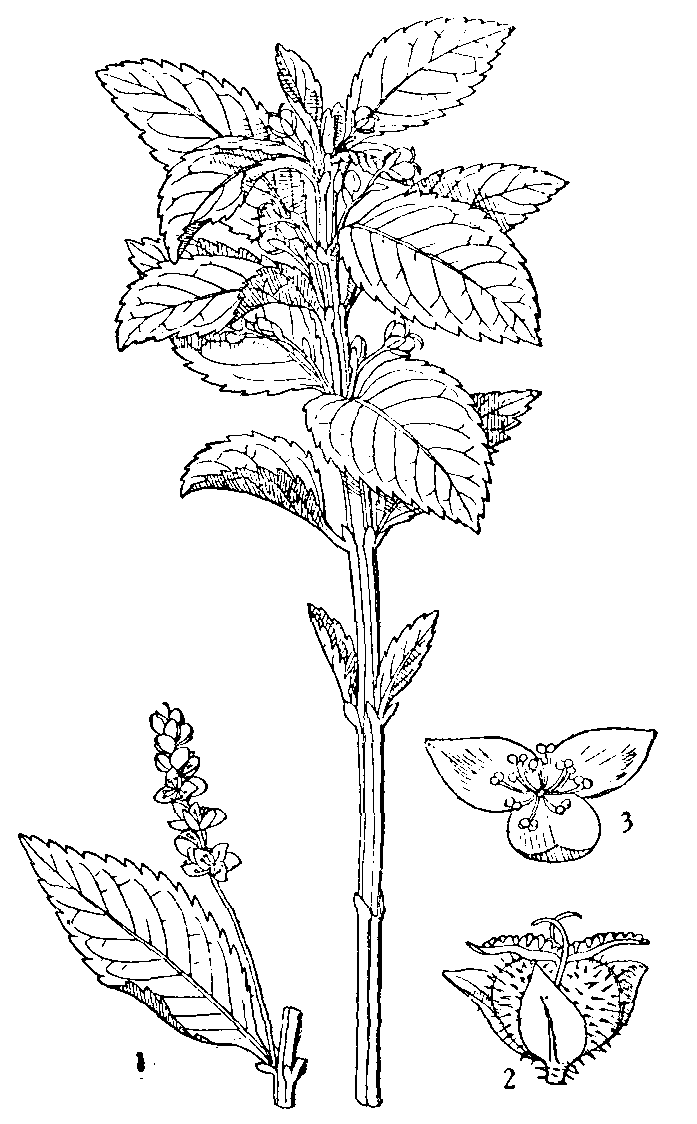
Dog's Mercury (
Mercuriālis perennis
)
1, Male flower. 3, Same, enlarged. 2, Female flower.
Dog's-mercury, Mercuriālis perennis, nat. ord. Euphorbiaceæ, a woodland herb common in Britain. It has poisonous properties, and may be made to yield a fugitive blue dye.
Dog's-tail Grass (Cynosūrus), a genus of grasses. Cynosūrus cristātus is a perennial found wild all over Great Britain in pastures, lawns, and parks. Its roots are long and wiry, and, descending deep into the ground, ensure the herbage against suffering from drought. Its stem is from 1 to 2 feet high, and its leaves are slightly hairy.
Dog's-tooth Ornaments. Early English Style
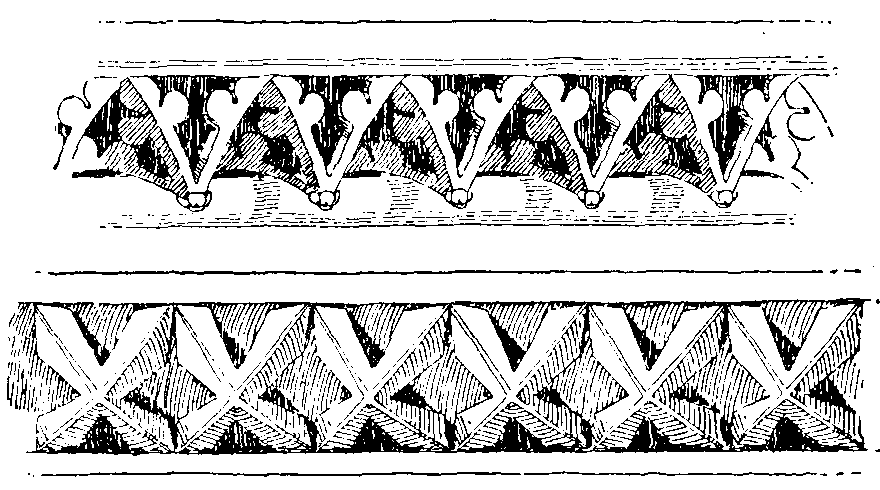
Dog's-tooth Ornament, an architectural ornament or moulding consisting usually of four leaves radiating from a raised point at the centre. It is the characteristic decorated moulding of Early English architecture, as the zigzag is of the Norman.
Dog-tooth Spar, a form of mineral calcium carbonate or calc-spar found in Derbyshire and other parts of England, and named from a supposed resemblance of its pointed crystals to a dog's tooth.
Dog-watch, a nautical term distinguishing two watches of two hours each (4 to 6 p.m. and 6 to 8 p.m.). All the other watches count four hours each, and without the introduction of the dog-watches the same hours would always fall to be kept as watch by the same portion of the crew.
Dogwood, a common name of trees of the genus Cornus, but specifically applied in Britain to C. sanguinea. It is a common shrub in copses and hedges in England; the small cream-white flowers are borne in dense roundish clusters. The branchlets and leaves become red in autumn. The wood is used for skewers and for charcoal for gunpowder.
Doit, an ancient Scottish coin, of which eight or twelve were equal to a penny sterling. In the Netherlands and Lower Germany there was a coin of similar name and value.
Dol, a town of France, department of Ille-et-Vilaine, 14 miles south-east by east of St. Malo. The old cathedral of St. Samson mostly dates back to the thirteenth century. To the north of the town stretches a salt-marsh, protected from inroads of the sea by a twelfth-century dyke, and in the centre of the marsh Mont-Dol rises to a height of 213 feet. Pop. 3540.
Dolci (dol´chē), Carlo, celebrated painter of the Florentine school, was born at Florence in 1616, and died there in 1686. His works, principally heads of madonnas and saints, have a character of sweetness and melancholy. Among his chief productions are: Archduchess Claudia, in the Uffizi (Florence); St. Cecilia at the Organ and Herodias with the Head of John the Baptist, both in the Dresden Gallery; Ecce Homo and St. Andrew in Prayer, at the Pitti Gallery; and Magdalene, at Munich.
Dolcinites, a Christian sect of Piedmont, so named from their leader Dolcino. They arose in 1304 as a protest against Papacy, but were suppressed by the troops of the Inquisition in 1307.
Dol´drums, among seamen, the parts of the ocean near the equator that abound in calms, squalls, and light baffling winds; otherwise known as the horse-latitudes.
Dôle, a town in France, Jura, 26 miles southeast of Dijon. It is of Roman origin, was long the capital of Franche Comté, and has some interesting antiquities. The manufactures are Prussian blue, hosiery, ironware, and leather. Pop. 16,294.
Dol´erite, compact rock of the Basaltic series, but crystalline throughout, composed of augite and labradorite with some titaniferous iron ore and often olivine. It makes, when unaltered, an excellent road-metal.
Dolgel´ly, a town of Wales, capital of Merionethshire, near the foot of Cader Idris. It was there that Owen Glendower held his Parliament in 1404 and signed his treaty with Charles VI of France. It has manufactories of woollens, flannels, and cloths. Pop. 2160.
Dolichocephalic (dol-i-ko-se-fal´ik), long-headed: a term used in anthropology to denote those skulls in which the diameter from side to side is less in proportion to the longitudinal diameter (i.e. from front to back) than 8 to 10.
Dol´ichos (-kos), a genus of leguminous plants, sub-ord. Papilionaceæ. They are found in the tropical and temperate regions of Asia, Africa, and America, and all produce edible legumes. D. Lablab is one of the most common kidney beans in India, and D. biflorus (horse-gram) is used as cattle-food in the same country. D. Pachyrrhizus tuberōsus of Martinique has a fleshy tuberous root which is an article of food.
Dol´ichosaurus ('long lizard'), an extinct snake-like reptile found in the English chalk, whose remains indicate a creature of aquatic habits from 2 to 3 feet in length.
Dollar, a silver or gold coin of the United States, of the value of 100 cents, or rather above 4s. sterling. The same name is also given to coins of the same general weight and value, though differing somewhat in different countries, current in Mexico, a great part of South America, Singapore, and the Philippine Islands. The name is from the Dutch (also Danish and Swedish) daler, from Ger. thaler, so named from Ger. thal, a dale, because first coined in Joachimsthal, in Bohemia, in 1518. By the Act of 14th March, 1900, the gold dollar was declared to be the standard of value in the United States, but no provision was made for the issue of a coin corresponding to the unit.
Dollar, a town and police burgh, Scotland, Clackmannanshire, 10 miles E. by N. of Stirling, noted for its academy, founded by John Macnab, who left £90,000 for this purpose. The building, a handsome structure in the Grecian style, was erected in 1819. The population of the village is 1497.
Dollart, The, a gulf of the North Sea, at the mouth of the Ems, between the Dutch province of Groningen and Hanover. It was originally dry land, and was formed by irruptions of the sea which took place in 1277 and 1530, overwhelming thirty-four large villages and numerous hamlets.
Döllinger (deul´ing-ėr), Johann Joseph Ignaz, a celebrated German theologian and leader of the Old Catholic party, was born at Bamberg, in Bavaria, in 1799, died in 1890. In 1822 he entered the Church, and soon after published The Doctrine of the Eucharist during the First Three Centuries, a work which won him the position of lecturer on Church history at the University of Munich. In later years he took an active part in the political struggles of the time as representative of the university in the Bavarian Parliament, and as delegate at the Diet of Frankfurt voted for the total separation of Church and State. In 1861 he delivered a course of lectures, in which he attacked the temporal power of the Papacy. But it was first at the Œcumenical Council of 1869-70 that Dr. Döllinger became famous over Europe by his opposition to the doctrine of Papal infallibility. In consequence of his opposition to the Vatican decrees, he was excommunicated in 1871 by the Archbishop of Munich. A few months later he was elected rector of the University of Munich, where he remained until his death. When the sentence of his excommunication was pronounced, he received honorary degrees from the Universities of Oxford and Edinburgh. Among his numerous works are: Origins of Christianity, A Sketch of Luther, The Papacy, Lectures on the Reunion of the Churches, and Papal Legends of the Middle Ages.
Dol´lond, John, an English optician of French descent, born in 1706, died in 1761. He devoted his attention to the improvement of refracting telescopes, and succeeded in constructing object-glasses in which the refrangibility of the rays of light was corrected.
Dolls, representing more or less realistically the human form, have, for more than fifty centuries, been the common playthings of children, more especially of girls, whose maternal instinct impels them to lavish upon these often crude surrogates all the affection and devotion which their elders display towards real babies. But in ancient times, and even in the ritual of many modern religions, worship is not infrequently paid to human images, which in ancient times, and among the less cultured modern peoples, are hardly distinguishable from dolls, such as children regard as playthings and their fancy endows with a crude animism. In the earliest times in which members of our own species, Homo sapiens, are known to have lived in Europe, i.e. at the latter part of the so-called Old Stone (palæolithic) Age, it was the custom to make grotesque representations of the female form as small figurines of clay or stone, which were regarded as amulets identified with the Great Mother, the giver of birth or life to mankind. As 'givers of life' such amulets were believed to be able to protect their possessors against the risk of death, because they were regarded in the most literal sense of the term as life-giving. But it was not merely against the risk of death that such amulets were believed to be potent: they could add 'vital substance' to the living and the dead, rejuvenating and reinvigorating the former, and enhancing the chances of continued existence and survival to the latter. Enormous respect was naturally paid to figurines supposed to possess such far-reaching powers; and when the Great Mother came to be identified with various animals, such as the cow, pig, &c., the amulet was identified with these 'givers of life' and sometimes represented in their shape. This is intimately associated with the origin of totemism (q.v.). It is probable that the modern doll is in part at least the survivor of these primitive images of the deities of early peoples. The fact that modern dolls are usually of the female sex may also be due to the fact of the earliest prototype of the doll being an amulet representing the Great Mother.
Dol´man, a long robe worn by the Turks as an upper garment. It is open in front, and has narrow sleeves. It has given its name to a kind of loose jacket worn by ladies, and to the jacket worn by hussars.
Dol´men, a Celtic name meaning 'table-stone'. Although some apply the name to prehistoric stone chambers covered with more than one slab (really 'corridor tombs'), the Dolmen proper, whether round or square, has a single cover-slab, and three, four, or even more stones supporting it. Some authorities consider the name dolmen as simply a French equivalent for cromlech (q.v.).
Dolomieu (dol-o-myeu), Déodat Guy Silvain Tancrède Gratet de, a French geologist and mineralogist, born in 1750 at Dolomieu (Isère), died in 1801. After some years of military service, he devoted himself to geological researches. He accompanied the French expedition to Egypt, but was shipwrecked on his return off the coast of Taranto, and imprisoned and harshly treated by the Neapolitan Government. Among his works are: Voyages aux Îles de Lipari (1783), Sur le Tremblement de Terre de la Calabre (1784), Philosophie minéralogique (1802).
Dol´omite, a mineral, the main constituent of magnesian limestone. It is composed of carbonate of calcium and carbonate of magnesium in equal molecular quantities, and varies from grey or yellowish-white to yellowish-brown. Dolomite is easily scratched with the knife, and is semi-transparent. It effervesces only slightly in cold hydrochloric acid. Its rhombohedral crystals are sometimes called bitter-spar. A variety is pearl spar, which has crystals with curvilinear faces and a pearly lustre.
Dolomites, a group of European mountains, a division of the Alps, in the Trentino, North Italy, and having the Piave and Rienz on the east, the Adige and Eisack on the west. They are named from the prevalence of the mineral dolomite, and present most interesting and picturesque scenery, the peaks being endlessly varied in form. The highest summits are Palle di San Martino (10,968 feet); Sorapiss (10,798 feet), and Monte Tofana (10,715 feet).
Common Dolphin (Delphīnus delphis)
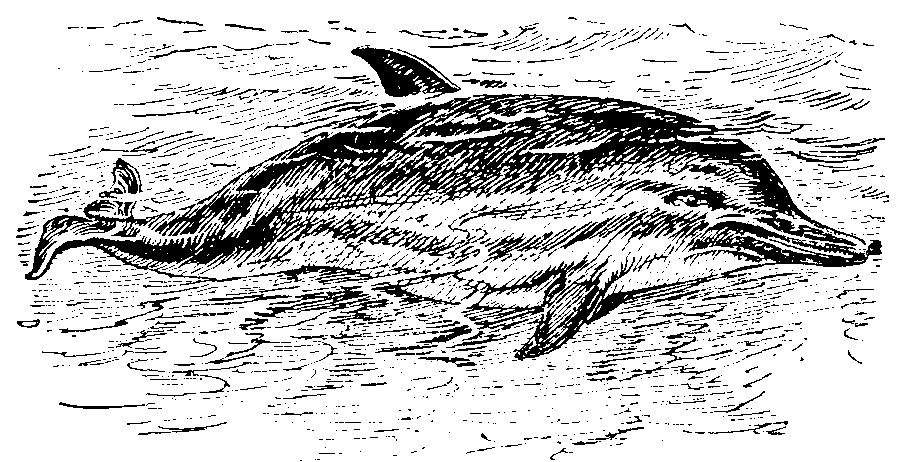
Dolphin (Delphīnus), a cetaceous animal, forming the type of a family (Delphinidæ) which includes also the beluga or white whale (Delphinapterus leucas), the narwhal (Monodon), porpoises (Phocæna), the ca'ing whale (Globicephalus melas), and the killer whale or grampus (Orca gladiator). Dolphins inhabit every sea from the equator to the poles; they are gregarious, and swim with extraordinary velocity. The common dolphin (D. delphis) measures from 6 to 10 feet in length, has a long, sharp snout with numerous nearly conical teeth in both jaws; its flesh is coarse, rank, and disagreeable, but is used by the Laplanders as food. It lives on fish, molluscs, &c., and often may be seen in numbers round shoals of herring. The animal has to come to the surface at short intervals to breathe. The blow-hole is of a semilunar form, with a kind of valvular apparatus, and opens on the vertex, nearly over the eyes. The structure of the ear renders the sense of hearing very acute, and the animal is observed to be attracted by regular or harmonious sounds. A single young one is produced by the female, who suckles and watches it with great care and anxiety, long after it has acquired considerable size. Dolphins are associated with many legends, and they figure in armorial bearings.—The name is also commonly but improperly given to fishes (species of Coryphæna) belonging to the mackerel family. They abound within the tropics, are about 4 or 5 feet long, very swift in swimming, and are used as food, though said sometimes to be poisonous. The corn aphis (Siphonophora granaria) is locally known as the dolphin.
Domain´, same as Demesne; also applied especially to Crown lands or Government lands.—Right of eminent domain, the dominion of the sovereign power over all the property within the State, by which it is entitled to appropriate any part necessary to the public good, compensation being given.
Dombrowski (-brov´skē), Jan Henryk, a Polish general, distinguished in the wars of Napoleon, born in 1755, died in 1818. He supported the rising of the Poles under Kosciusko in 1794. In 1796 he entered the service of France, and at the head of a Polish legion rendered signal services in Italy from 1796 to 1801. He took a distinguished part in the invasion of Russia in 1812, and also in the campaign of 1813. After Napoleon's abdication he returned to Poland, and the year following was made a Polish Senator by Alexander I.
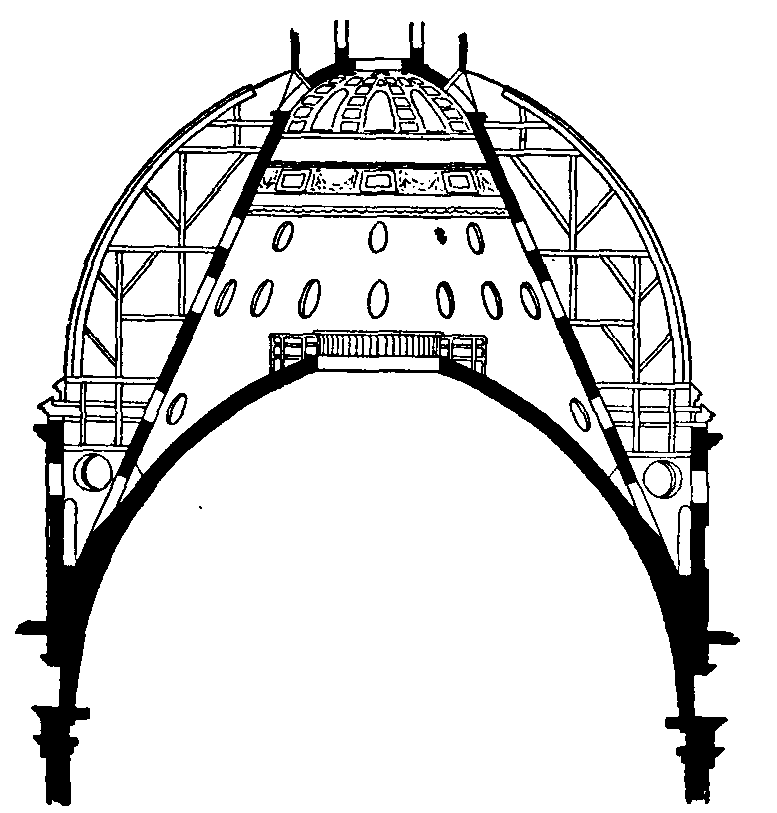
Dome of St. Paul's
Section showing the inner and outer domes with the conical wall. Diameter inside dome at base 102 feet.
The Pantheon, Rome
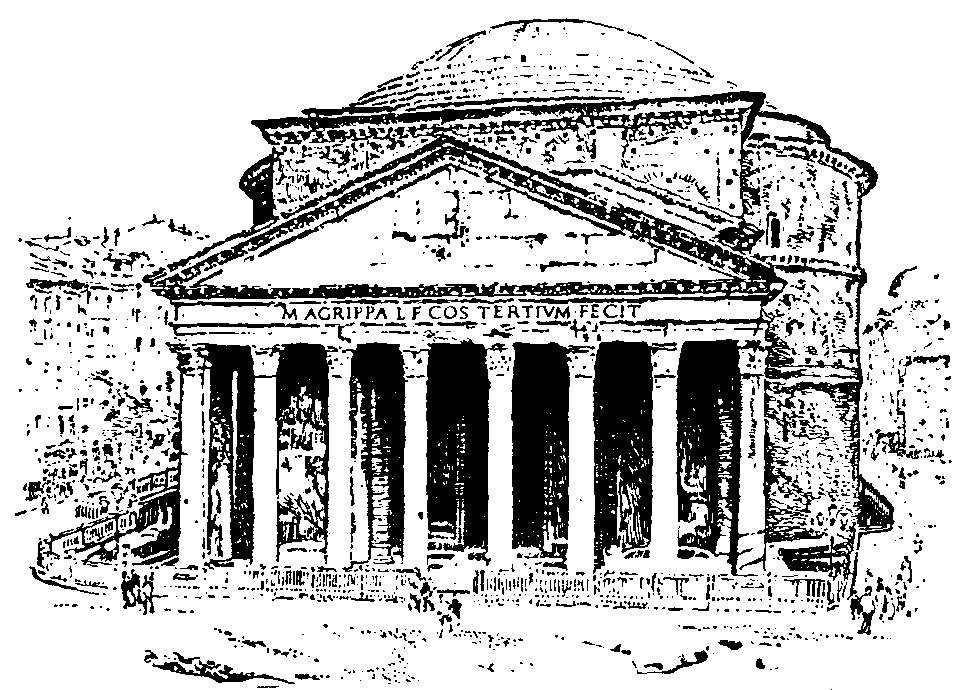
Dome, a vaulted roof of spherical or other curvature, covering a building or part of it, and forming a common feature in Byzantine and also in Renaissance architecture. Cupola is also used as a synonym, or is applied to the interior, dome being applied to the exterior. (See Cupola.) Most modern domes are semi-elliptical in vertical section, and are constructed of timber; but the ancient domes were nearly hemispherical and constructed of stone. Of domes the finest, without any comparison, ancient or modern, is that of the Rotunda or Pantheon at Rome (142½ feet internal diameter and 143 feet internal height), erected in the reign of Augustus, and still perfect. Among others the most noteworthy are St. Sophia at Constantinople (104 × 201 feet), the cathedral of Santa Maria del Fiore at Florence (139 × 310 feet), St. Peter's at Rome (139 × 330 feet), St. Paul's, London (112 × 215 feet), the Hôtel des Invalides (80 × 173 feet) and the Panthéon (formerly the church of St. Geneviève) at Paris (67 × 190 feet). The figures represent the internal diameter and height in English feet. The finest dome in America is that of the Capitol at Washington, built of cast iron.
Domenichino (dō-men-i-kē´nō) (or Domenico) Zampieri, a distinguished Italian painter, of the Lombard school, born at Bologna on 21st Oct., 1581. He studied under Annibal Carracci, and afterwards went to Rome, where he became painter to Pope Gregory XV. Among his best works are the Communion of St. Jerome in the Vatican Museum, the History of Apollo, the Martyrdom of St. Agnes, and the Triumph of David. He died at Naples, 15th April, 1641.
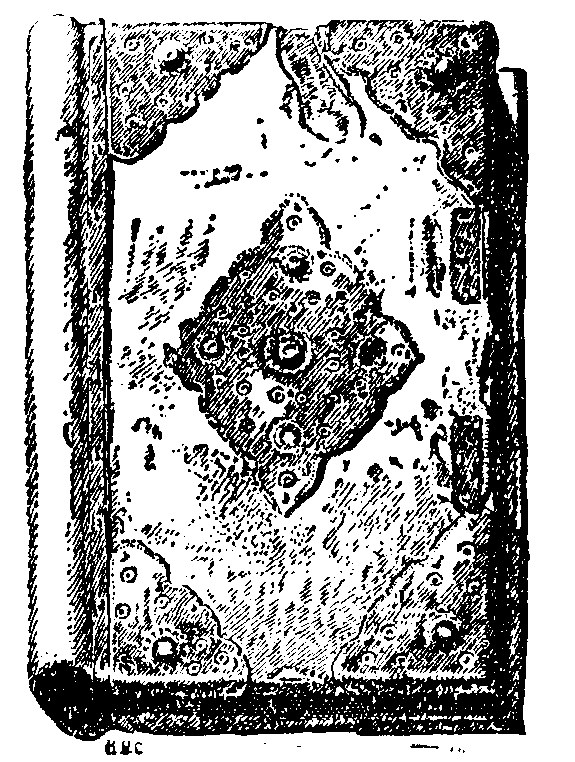
Domesday Book
From the original in the Public Record Office, London.
Domesday (or Doomsday) Book, a book containing a survey of all the lands in England, compiled in the reign and by the order of William the Conqueror. The survey was made by commissioners, who collected the information in each district from a sworn jury consisting of sheriffs, lords of manors, presbyters, bailiffs, villeins—all the classes, in short, interested in the matter. The extent, tenure, value, and proprietorship of the land in each district, the state of culture, and in some cases the number of tenants, villeins, serfs, &c., were the matters chiefly recorded. The survey was completed within a year. Northumberland, Durham, Cumberland, and Westmoreland were not included in the survey, probably for the reason that William's authority was not then (1086) settled in those parts. The Domesday Book first appeared in print in 1783 in two folios. In 1816 two supplementary volumes were published. These contained four other records of the same nature. It has been twice republished, the last time (1861-5) in perfect facsimiles of the original.—Bibliography: The Victoria County History; F. W. Maitland, Domesday Book and Beyond; H. Ellis, General Introduction to Domesday Book; Birch, Domesday: a Popular Account.
Dom´icile, in law, the place where a person has a home or established residence. Domicile is often an important question in determining the efficacy of legal citations, the validity of marriage, the right of succession to property, &c. For some purposes what is called a temporary domicile is sufficient, but in questions of marriage and succession it is the permanent domicile that determines the decision. A permanent domicile may be constituted by birth, by choice, or by operation of the law. To constitute a domicile by choice both actual residence and the intention to make it the permanent home are required. It is a legal principle that the wife takes the domicile of her husband. As a general rule the old domicile, and especially the domicile of origin, continues till a new one has been acquired.
Dom´inant, in music, the fifth tone of the diatonic scale. This tone assumes the character of a key-note itself when there is a modulation into the first sharp remove. Thus G is the dominant of the scale of C, and D the dominant of the scale of G.—Dominant chord, in music, that which is formed by grouping three tones, rising gradually by intervals of a third from the dominant or fifth tone of the scale. It occurs almost invariably immediately before the tonic chord which closes the perfect cadence.
Dom´inic, Saint, the founder of the order of the Dominicans, was born in 1170 at Calahorra, in Old Castile. He early distinguished himself by his zeal for the reform of canonical life and by his success as a missionary amongst the Mohammedans. His attention having been directed to the Albigenses in the south of France, he organized a mission of preachers against heresy in Languedoc. In 1215 he went to Rome to obtain the sanction of Pope Innocent III to erect the mission into a new order of preaching friars. His request was only partially granted, and it was the succeeding Pope, Honorius III, who first recognized the importance of a preaching order, and conferred full privileges on the Dominicans. He also appointed Dominic Master of the Sacred Palace or court preacher to the Vatican, an office which is still held by one of the order. Dominic died at Bologna in 1221, and was canonized in 1234 by Pope Gregory IX. St. Dominic is usually considered the founder of the Inquisition, which is supposed to have originated with his mission to the Albigenses; but his claim is denied, on the ground that two Cistercian monks were appointed inquisitors in 1198.—Cf. A. T. Drane, The Life of St. Dominic.
Dominica (dom-i-nē´ka˙), a British West India island, so named because discovered by Columbus on a Sunday (Sp. dominica), constituting a presidency of the united colony of the Leeward Islands between Martinique on the south, and Guadeloupe on the north. It is about 29 miles in length, north to south, and 12 miles in breadth, east to west; area, 186,436 acres, about 65,000 being under cultivation. It is rugged and mountainous, but it contains many fertile valleys and is well watered. The shores are but little indented, and are entirely without harbours; but on the west side there are several good anchorages and bays. The principal exports consist of sugar, molasses, cocoa, and lime-juice. The imports and exports amount to about £160,000 and £120,000 annually. Dominica was ceded by France to Great Britain in 1763. Roseau is the capital. Pop. 33,863 (including about 420 aboriginal Caribs).
Domin´ical Letter, in chronology, properly called Sunday letter, one of the seven letters of the alphabet, A B C D E F G, used in almanacs, ephemerides, &c., to mark the first seven days of the year and all consecutive sets of seven days to the end of the year, so that the letter for Sunday will always be the same. If the number of days in the year were divisible by seven without remainder, then the year would constantly begin with the same day of the week; but as it is the year begins and ends on the same day, and therefore the next year will begin on the day following, and on leap years two days following, so that the same series is not repeated till after four times seven or twenty-eight years.
Dominican Republic, or San Domingo. See Santo Domingo.
Dominican
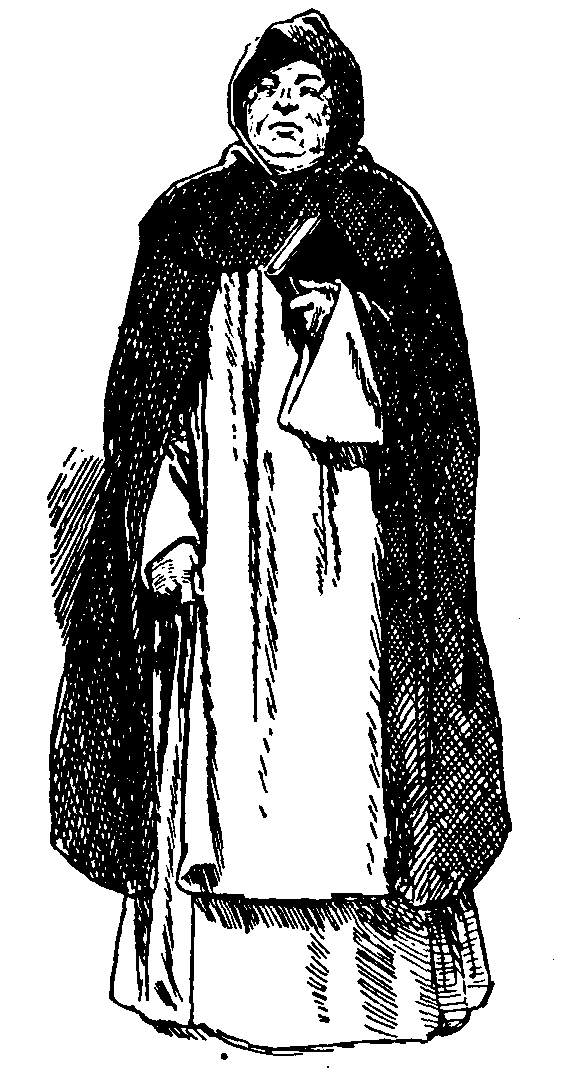
Domin´icans, called also predicants, or preaching friars (prædicatores), derived their name from their founder, St. Dominic. At their origin (1215, at Toulouse) they were governed by the rule of St. Augustine, perpetual silence, poverty, and fasting being enjoined upon them; and the principal object of their institution was to preach against heretics. Their distinctive dress consists of a white habit and scapular with a large black mantle, and hence they have been commonly known as Black Friars. They were almost from the first a mendicant order. They spread rapidly not only in Europe, but in Asia, Africa, and America. In England, where they founded their first house at Oxford, there were fifty-eight Dominican houses at the dissolution of the monasteries, and the Blackfriars locality in London took its name from one of their establishments. Four Popes, Innocent V, Benedict XI, Pius V, and Benedict XIII, were Dominicans, and the order produced some famous scholars, such as Albertus Magnus and Thomas Aquinas. As fierce opponents and strenuous combatants against any departure from the teaching of the Catholic Church, the Dominicans were entrusted with the conduct of the Inquisition, and became formidable as managers of this ecclesiastical institution, which was committed exclusively to them in Spain, Portugal, and Italy. In 1425 they obtained permission to receive donations, and ceased to belong to the mendicant orders, paying more attention to politics and theological science. With the Franciscans, their great rivals, they divided the honour of ruling in Church and State till the sixteenth century, when the Jesuits gradually superseded them in the schools and courts. They obtained new importance in 1620 by being appointed to the censorship of books for the Church. Amongst notable Dominicans we may mention Savonarola, Las Casas, and Lacordaire, through whose efforts the order was revived in France in the nineteenth century. There are still establishments of the Dominicans both in England and Ireland, twenty-one houses for men and thirteen for women.—Bibliography: Caro, Saint Dominique et les Dominicains; A. T. Drane, The Life of St. Dominic, with a Sketch of the Dominican Order.
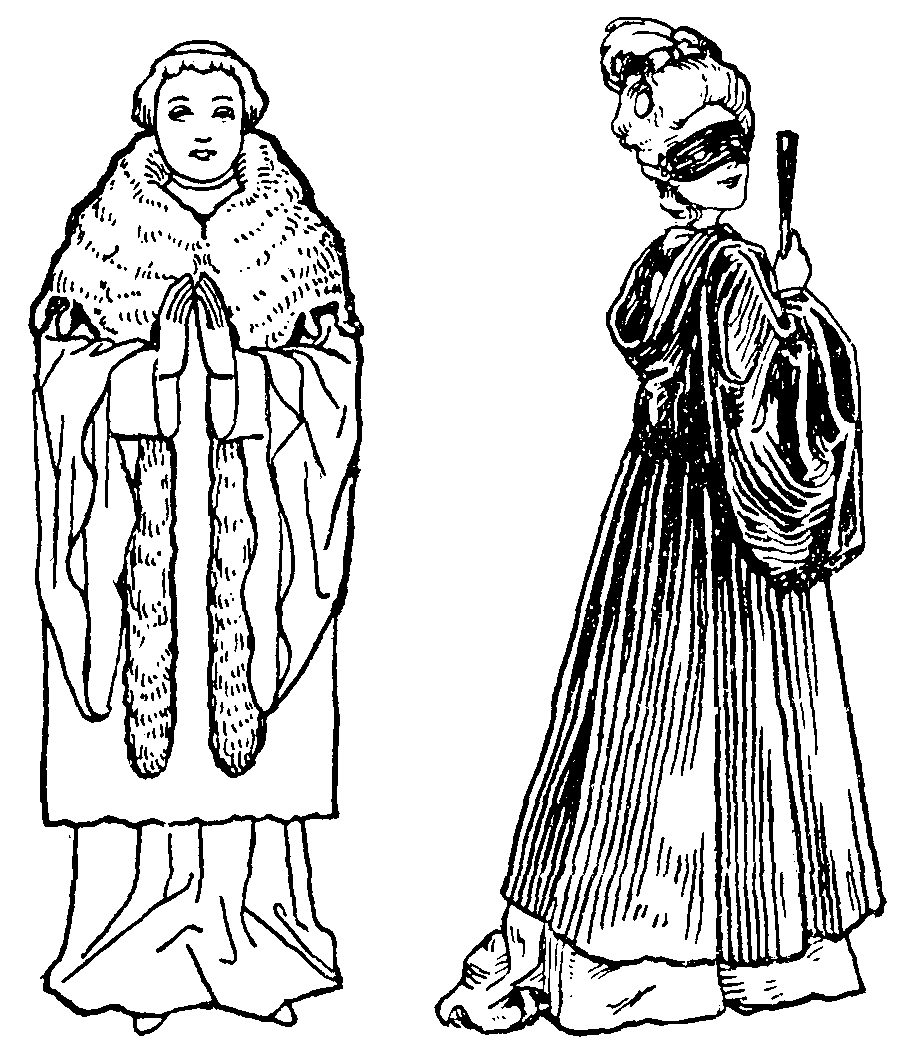
Dominoes.
Left, Priest wearing domino over surplice, from brass plate at Bury St. Edmunds, 1514. Right, Lady wearing domino.
Dom´ino, formerly a dress worn by priests in the winter, which, reaching no lower than the shoulders, served to protect the face and head from the weather. At present it is a masquerade dress worn by gentlemen and ladies, consisting of a long silk mantle with wide sleeves and a masquing hood. The name is also given to a half-mask formerly worn on the face by ladies when travelling or at masquerades.
Dom´inoes, a game played with small flat rectangular pieces of ivory, about twice as long as they are broad. They are marked with spots varying in number. When one player leads by laying down a domino, the next must follow by placing alongside of it another which has the same number of spots on one of its sides. Thus if the first player lays down 6-4, the second may reply with 4-8, or 6-7, &c.; in the former case he must turn in the 4, placing it beside the 4 of the first domino, so that the numbers remaining out will be 6-8; in the latter case he must turn in the 6 to the 6 in like manner, leaving 4-7, to which his opponent must now respond. The player who cannot follow suit loses his turn, and the object of the game is to get rid of all the dominoes in hand, or to hold fewer spots than your opponent when the game is exhausted by neither being able to play. The game was introduced into Europe about the middle of the eighteenth century.
Domitian
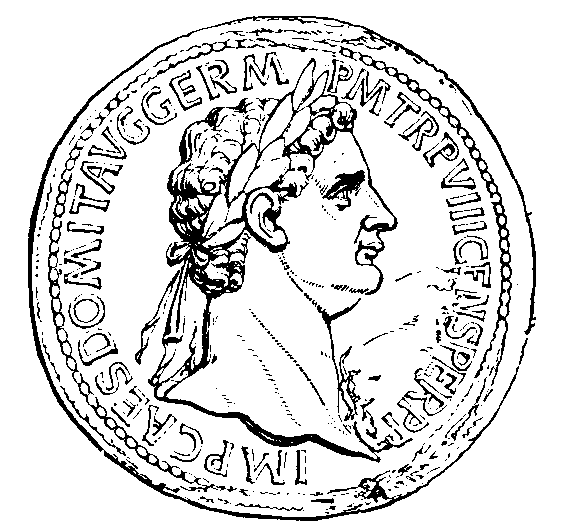
Domitian, or in full Titus Flavius Domitianus Augustus, Roman emperor, son of Vespasian, and younger brother of Titus, was born A.D. 51, and in 81 succeeded to the throne. At first he ruled with a show of moderation and justice, but soon returned to the cruelty and excesses for which his youth had been notorious. He was as vain as he was cruel, and after an ineffective expedition against the Catti, carried a multitude of his slaves, dressed like Germans, in triumph to the city. He executed great numbers of the chief citizens, and assumed the titles of Lord and God. He established the most stringent laws against high treason, which enabled almost anything to be construed into this crime. At length a conspiracy, in which his wife Domitia took part, was formed against him, and he was assassinated in his bedroom A.D. 96.
Domrémy la Pucelle (don˙-rė-mi la˙ pu˙-sāl), the birth-place of Joan of Arc, a small French village, department of the Vosges, 7 miles N. of Neufchâteau. The house is still shown here in which the heroine was born, and in the neighbourhood is the monument erected to her memory.
Don (ancient Tanaïs), a river of Russia, which issues from Lake Ivan-Ozero, in the government of Tula; and flows S.E. through the governments of Riazan, Tambov, Voronej, and the Don Republic, to within 37 miles of the Volga, where a railway connects the rivers. It now turns abruptly S.W. for 236 miles, and falls into the Sea of Azov; whole course nearly 900 miles. The chief tributaries are: right bank, the Donetz and Voronej; left, the Khoper and Manych. Although not admitting vessels of much draught, the Don carries a large traffic, especially during the spring-floods, and a canal connects it with the Volga system of navigation. It has productive fisheries. The principal port is Rostov.
Don, a river, Scotland, Aberdeenshire, rising near the Banffshire border. It flows tortuously east through the whole breadth of Aberdeenshire, and falls into the North Sea a little to the north of Aberdeen, after a total course of 82 miles. Its salmon fisheries are of considerable value.—Also, a river of Yorkshire, England, which rises near Cheshire, and joins the Ouse after a course of about 70 miles. It is navigable for small craft as far as Sheffield.
Don (Lat. dominus, a lord or master), a Spanish title of honour, originally given only to the highest nobility, afterwards to all the nobles, and finally used indiscriminately as a title of courtesy. It corresponds with the Portuguese Dom. During the Spanish occupation it was introduced and became naturalized in some parts of Italy, and was particularly applied to the priests.
Donaghadee (don-ah-a-dē´), a seaport and market town, Ireland, County Down, on the Irish Channel, 16 miles east by north of Belfast. Pop. 4878.
Don´aldson, Sir James, Scottish scholar, born in 1831 at Aberdeen, died in 1915. He was educated at Aberdeen University, and also at Manchester New College, London, and Berlin University. After being rector of Stirling High School, a classical master and rector of Edinburgh High School, he was appointed in 1881 to the Chair of Humanity (Latin) in Aberdeen University. In 1886 he became principal of the United College of St. Salvator and St. Leonard in St. Andrews University, and in 1890 principal of the university. He published a Modern Greek Grammar for the use of Classical Students (1853); Lyra Græca: Specimens of Greek Lyric Poets, with Introduction and Notes (1854); History of Christian Literature and Doctrine from the Death of the Apostles to the Nicene Council (1864-6); The Ante-Nicene Christian Library (24 vols., 1867-72, edited jointly with Professor A. Roberts); The Apostolical Fathers (1874); Lectures on the History of Education in Prussia and England (1874); The Westminster Confession of Faith (1905); Woman: her Position and Influence in Ancient Greece and Rome, and among the Early Christians (1907); Addresses Delivered in the University of St. Andrews from 1886 to 1910 (1911). He was knighted in 1907.
Donaldson, John William, a distinguished English philologist, was born in London in 1811, died in 1861. He studied at London University, and at Trinity College, Cambridge, where he was elected a fellow in 1835. His first work was The Theatre of the Greeks, a work showing much erudition. In 1839 he published The New Cratylus, which was amongst the earliest attempts to bring the philological literature of the Continent within the reach of the English student. In 1844 appeared the first edition of Varronianus, a work on Latin similar in scope to the Cratylus. Amongst his other writings are: Christian Orthodoxy (1855), History of the Literature of Ancient Greece, and grammars of the Hebrew, Greek, and Latin languages.
Donatello (properly, Donato di Betto Bardi), one of the revivers of the art of sculpture in Italy, was born at Florence between 1382 and 1387, died at Florence in 1466. His first great works in marble were statues of St. Peter and St. Mark, in the church of St. Michael in his native town, in an outside niche of which is also his famous statue of St. George. Along with his friend Brunelleschi he made a journey to Rome to study its art treasures. On his return he executed for his patrons, Cosmo and Lorenzo de' Medici, a marble monument to their father and mother, which is of high merit. Statues of St. John, St. George, Judith, David, John the Evangelist, and St. Cecilia are amongst his leading works.
Dona´ti's Comet, so called from the Italian astronomer Donati, who first observed it on 2nd June, 1858. Next to the comet of 1811 it was the most brilliant that appeared last century. It was nearest the earth on the 10th Oct., 1858, and was seen until March, 1859. See Comets.
Don´atists, one of a body of African schismatics of the fourth century, so named from their founder Donatus, Bishop of Casæ Nigræ, in Numidia, who taught that though Christ was of the same substance with the Father yet that he was less than the Father, that the Catholic Church was not infallible, but had erred in his time and become practically extinct, and that he was to be the restorer of it. All joining the sect required to be rebaptized, baptism by the impure Church being invalid.
Dona´tus, Ælius, a Roman grammarian and commentator, born A.D. 333. He was the preceptor of St. Jerome, wrote notes on Virgil and Terence, and a grammar of the Latin language so universally used in the Middle Ages that 'Donat' became a common term for grammar or primer of instruction.
Donauwörth (don´ou-veurt), a town, Bavaria, at the confluence of the Wörnitz and Danube. It was formerly a free Imperial town, and was stormed by the Swedes under Gustavus Adolphus in the Thirty Years' War, 1632. Pop. 5500.
Don Beni´to, a town, Spain, province of Badajoz. It has manufactures of woollens, and a trade in cattle, grain, and melons. Pop. 19,212.
Don´caster (Danum of the Romans, and Dona Ceaster of the Saxons), a municipal borough and market town, England, West Riding of Yorkshire, on the River Don, well built, with straight, broad streets. The parish church with its tower 170 feet high, Christ Church, the town hall, the theatre, are amongst the chief public buildings. It has railway workshops, manufactures of ropes, canvas, and machinery. It has been long celebrated for its annual races, begun in 1615, and held in September. Doncaster was originally a Roman station on the line of Watling Street. Pop. 30,520. It gives its name to a parliamentary division.
Dondrah Head, the southern extremity of the Island of Ceylon. It was the site of the Singhalese capital during part of the seventh century, numerous remains of which are still to be found.
Don´egal (Dun-na-n Gal, Fort of the Stranger), a maritime county, Ireland, province of Ulster, bounded north and west by the Atlantic Ocean; area, 1,197,154 acres, of which about a fifth is under crops. The coast is indented with numerous bays; the most remarkable being Lough Swilly. It is the most mountainous county in Ireland, but has some fine fertile valleys. Mount Errigal, the loftiest summit, is about 2460 feet high. The streams and lakes are small, but numerous and abounding in fish. The climate is moist, the subsoil chiefly granite, mica-slate, and limestone, and the principal crops oats, potatoes, and flax. Agriculture generally is in a very backward state. The manufactures are limited, and consist chiefly of linen cloth, woollen stockings, and worked muslin. The fisheries are extensive and valuable, and form the chief employment of the inhabitants of the coast and islands. Grain, butter, and eggs are exported. The minerals include marble, lead, and copper, but are not wrought to advantage. Donegal returns four members to Parliament. Pop. 168,530.
Donetz´, a Russian river which rises in the government of Kursk, flows south and east, forming the boundary of several governments, and joins the Don; length, 400 miles. Its basin is rich in coal.
Don´gola, a province of the Anglo-Egyptian Sudan extending on both sides of the Nile from about lat. 18° to lat. 20° N. After having belonged to Egypt, the rebellion under the Mahdi caused its evacuation by the Egyptian Government, leaving it in the hands of the dervishes, but the Anglo-Egyptian forces under Lord Kitchener again occupied it in 1896. Its chief products are dates, cotton, indigo, and maize. The population is a mixture of Arabs and indigenous Nubians. Its chief town is New Dongola, or El-Ordi, on the Nile. Pop. 20,000.
Doni, a clumsy kind of boat used on the coast of Coromandel and Ceylon; sometimes decked, and occasionally furnished with an outrigger. The donis are about 70 feet long, 20 feet broad, and 12 feet deep, have one mast and a lug-sail, and are navigated in fine weather only.
Donizet´ti, Gaetano, Italian composer, born in 1797 at Bergamo, died 8th April, 1848. He studied music at Bologna under the distinguished Abbé Mattei. His first opera, Enrico di Borgogna, was represented at Venice in 1818. In 1822 his Zoraïde di Granata gained him the honour of being crowned on the Capitol. In 1830 appeared his Anna Bolena, which first, along with Lucrezia Borgia and Lucia di Lammermoor—the latter his masterpiece—acquired for him a European fame. In 1835 Donizetti was appointed professor of counterpoint at the Royal College of Naples, but removed in 1840 to Paris, bringing with him three new operas, Les Martyrs, La Favorita, and La Fille du Régiment, of which the last two are amongst his most popular productions. Of his other operas none except Linda di Chamounix (1842) and Don Pasquale (1843) achieved any special triumph. He wrote in all as many as seventy operas.
Donjon, the principal tower of a castle, situated in the innermost court or bailey, which the garrison could make the last line of defence. Its lower part was commonly used as a prison.
Don Juan (Sp. pron. hu¨-a˙n´), the hero of a Spanish legend which seems to have had some historical basis in the history of a member of the noble family of Tenorio at Seville. According to the legend, Don Juan was a libertine of the most reckless character. An attempt to seduce the daughter of the Governor of Seville brought the indignant father and the profligate don into deadly conflict, in which the former was slain. Don Juan afterwards, in a spirit of wild mockery, goes to the grave of the murdered man and invites the statue of him erected there to a revel. To the terror of Don Juan the 'stony guest' actually appears at the table to bear him away to the infernal world. The legend has furnished the subject for many dramas and operas. The most famous of the latter is Mozart's Don Giovanni, which has made the story familiar to everybody. Amongst the former are Burlador de Sevilla by Tellez, Don Juan, ou Le Festin de Pierre by Molière (1665), and The Libertine by Shadwell. The Don Juan of Byron bears no relation to the old story but in name and in the libertine character of the hero. Among the modern authors who have made use of the theme are: Prosper Mérimée, in Les âmes du purgatoire; A. Dumas, in Don Juan de Marana; Bernard Shaw, in Man and Superman; and José Zorilla, in Don Juan Tenorio.—Cf. Gendarme de Bévotte, La Légende de Don Juan.
Donkey-engine, a small engine used in various operations where no great power is required. Thus a donkey-engine is often stationed on the deck of a ship to work a crane for loading and unloading.
Donnay, Maurice Charles, French dramatist, born in Paris in 1859. His first work, Phryné, was produced in 1891, and was followed by an adaptation of Aristophanes' Lysistrata. His later works include: Douloureuse (1897), Le Torrent (1898), L'Affranchie (1898), L'Autre Danger (1901), Le Retour de Jérusalem (1903), Le Ménage de Molière (1912). He was elected to the Académie Française in 1907.
Donne, John, a celebrated poet and dean of St. Paul's, was the son of a merchant of London, in which city he was born in 1573. He studied both at Oxford and Cambridge. In his nineteenth year he abjured the Catholic religion, and became secretary to the Lord Chancellor Ellesmere, but finally lost his office by a clandestine marriage with his patron's niece, a daughter of Sir George More. The young couple were in consequence reduced to great distress, till his father-in-law relented so far as to give his daughter a moderate portion. In 1610 he wrote for the king the Pseudo-Martyr, and in 1612 he published a philosophical poem, The Progress of the Soul. By the desire of King James, Donne took orders, and, settling in London, was made preacher of Lincoln's Inn. In 1621 he was appointed Dean of St. Paul's. He was chosen prolocutor to the Convocation from 1623-4. He died in March, 1631, and was interred in St. Paul's. As a poet, Donne stands extremely high, and may be deemed the founder of what Dr. Johnson calls the metaphysical class of poets. Abounding in thought, this school generally neglected versification, and that of Dr. Donne was peculiarly harsh and unmusical. His style is quaint and pedantic; but he displays sound learning, deep thinking, and originality of manner. A collection of his poems appeared in 1633, and they include: The Storm, The Calm, The Blossom, and Upon Parting with his Mistress. He also wrote Letters, Sermons, Essays on Divinity, and other pieces.—Cf. E. Gosse, Life and Letters of John Donne.
Donnybrook, formerly a village, Ireland, now a suburb of Dublin. Its famous fair, instituted under King John in 1204, and which seldom passed off without riot and bloodshed, was abolished in 1855.
Don Republic, a republic in south-eastern Russia, formerly a government of imperial Russia, and known as the Don Cossacks' Territory. The republic was proclaimed in Jan., 1918; its capital is Novo-Tscherkask.
Doombook, a code of laws compiled by King Alfred from the West-Saxon collection of his ancestor Ina, and comprising small portions of the Mercian laws of Offa, and of the Kentish collection of Ethelbert. The code begins with the words: "The Lord spake these words to Moses, and thus said: I am the Lord thy God".—Cf. B. Thorpe, Ancient Laws and Institutes of England.
Doon, a river in Ayrshire, Scotland, which issues from the long, narrow Loch Doon, and falls into the Firth of Clyde; length, 27 miles.
Doppler's Principle, the principle by which the motions of heavenly bodies in the line of sight can be determined spectroscopically. When the distance between a body and the observer is being diminished, the number of waves of light of any definite colour received from it per second is increased, just as a swimmer meets more waves in the same time if he swims to meet them. Each colour of light is, therefore, slightly shifted towards the violet end of the spectrum. Thus any radiation or absorption lines seen are shifted towards the violet. If the body's distance is increasing, they are shifted towards the red. By investigation of such displacements, the motions of stars, nebulæ, &c., in the line of sight can be measured, the dimensions of the orbits of double-stars gauged, the motions of gases in the solar atmosphere determined, and the rotational velocity of the sun's surface found for latitudes where sun-spots are rarely or never visible. The speed and direction of the sun's motion through space, viz. 12 miles per second towards a point in the constellation Hercules, has also been determined by this means.
Dor, or Dorr, the black-beetle, Geotrūpes stercorarius, one of the most common British beetles, of a stout form, less than 1 inch long, black with metallic reflections, not to be confounded with the cockroach, commonly but erroneously called black-beetle. It may often be heard droning through the air towards the close of the summer twilight.
Dora, the name of two rivers in Northern Italy, both tributaries of the Po. The Dora Baltea rises on the southern slopes of the Mont Blanc group, and falls, after a course of about 100 miles, into the Po below Chivasso; the Dora Riparia, about 75 miles long, rises in the Cottian Alps, and joins the Po below Turin.
Do´ran, John, English writer, born 1807, died 1878. He began writing when a mere youth, and produced a great number of books, among them being Lives of the Queens of England of the House of Hanover, Monarchs retired from Business, History of Court Fools, The Book of the Princes of Wales, Their Majesties' Servants (a history of the English stage from Betterton to Kean), Saints and Sinners, A Lady of the Last Century (Mrs. Montague), London in Jacobite Times, and Memories of Our Great Towns. In and about Drury Lane was published after his death. He was editor of Notes and Queries at the time of his death.
Dorcas Society (from Dorcas mentioned in Acts, ix, 36-42), an association generally composed of ladies for supplying clothes to the poor. Frequently the members of the society meet at stated times and work in common. Partial payment is generally required from all recipients except the very poor. Most of these societies are connected with churches of one denomination or another.
Dor´chester, a municipal borough of England, chief town of Dorsetshire, 118 miles S.W. of London. There are large cavalry and infantry barracks a little to the west of the town. The trade consists chiefly in agricultural produce. Dorchester was an important Roman station (Durnovaria), and many interesting Roman remains, such as the 'Maumbury Rings' (a Roman amphitheatre), are still to be found in the vicinity. It was a parliamentary borough till 1885, when it was merged in the county. Pop. 9842.
Dordogne (dor-dony), a department of France, which includes the greater part of the ancient province of Périgord, and small portions of Limousin, Angoumois, and Saintonge. Area, 3544 sq. miles, of which about a third is fit for the plough. The chief minerals are iron, which is abundant, slate, limestone, marble, and other stone. Mining, iron manufacture, &c., are carried on to a considerable extent, and there are a number of vineyards. The climate is mild but somewhat changeable. Pop. 396,702.—The river Dordogne, principal river of the department, rises on the flanks of the Puy-de-Sancy, flows W.S.W., and, after a course of 290 miles, unites with the Garonne in forming the Gironde.
Dordrecht. See Dort.
Doré (dō-rā), Gustave Paul, a prolific French draughtsman and painter, born at Strasbourg, 6th Jan., 1833, died 23rd June, 1883. He studied at Paris, contributing, when only sixteen years of age, comic sketches to the Journal pour Rire. He distinguished himself greatly as an illustrator of books. His illustrations of Rabelais (Rabelais Illustré), of Perrault's Tales, Sue's Wandering Jew, Dante's Divina Commedia, and Cervantes' Don Quixote displayed great fertility of invention, and the fine fantasy of his landscapes and the dramatic effectiveness of his groups acquired for him a European reputation. His illustrations of the Bible, of Ariosto's Orlando Furioso, and Milton's Paradise Lost are also of high excellence. As a painter he has grandeur of conception and a bold expressive style. Amongst his chief works are: Christ leaving the Prætorium, Paolo and Francesca di Rimini, The Flight into Egypt, and Mont Blanc. In later years Doré also won fame as a sculptor.
Dore´ma, a genus of plants, nat. ord. Umbelliferæ. D. ammoniăcum, a Persian species, yields the ammoniacum of commerce, a milky juice that exudes from punctures on the stem and dries in little 'tears'.
Doria, one of the most powerful families of Genoa, became distinguished about the beginning of the twelfth century, and shared with three other leading families, the Fieschi, Grimaldi, and Spinola, the early government of the Republic. Amongst the older heroes of this family are Oberto Doria, who in 1284 commanded the Genoese fleet which at Meloria annihilated the power of Pisa; Lamba Doria, who in 1298 defeated the Venetian Dandolo at the naval battle of Curzola; Paganino Doria, who in the middle of the fourteenth century distinguished himself by great victories over the Venetians. But the greatest name of the Dorias is that of Andrea, born at Oneglia in 1466, of a younger branch of the family. After serving some time as a condottiere with the princes of Southern Italy, he was entrusted by the Genoese with the reconstruction of their fleet. Disagreement with the Genoese factions drove him to take service with Francis I of France, in which he highly distinguished himself, and in 1527 he took Genoa in the name of the French king. But being displeased with the projects of Francis for reducing Genoa to a place of secondary importance, he went over to the service of Charles V, carrying with him the whole influence and resources of Genoa, and hastened the deliverance of Italy from French domination. He entered Genoa in 1528, re-established order, reorganized the Government, and, although refusing the title of doge, practically controlled its affairs to the end of his life. The country bestowed on him the title of Father of Peace. As Imperial Admiral he performed many services for Charles, clearing the seas of Moorish pirates and assisting the emperor in his expeditions to Tunis and Algiers. In 1547 his authority was threatened by the conspiracy of Fieschi, and he narrowly escaped assassination in the tumult. He died in 1560.
Dorians, one of the three great branches of the Greek nation who migrated from Thessaly southwards, settling for a time in the mountainous district of Doris in Northern Greece and finally in Peloponnesus. Their migration to the latter was said to have taken place in 1104 B.C.; and as among their leaders were certain men reputed to be descendants of Hercules (or Herakles), it was known as the return of the Heraclidæ. The Dorians ruled in Sparta with great renown as a strong and warlike people, though less cultivated than the other Greeks in arts and letters. Their laws were severe and rigid, as typified in the codes of the great Doric legislators Minos and Lycurgus.—The Doric dialect was characterized by its broadness and hardness, yet on account of its venerable and antique style was often used in solemn odes and choruses.
Grecian Doric Order
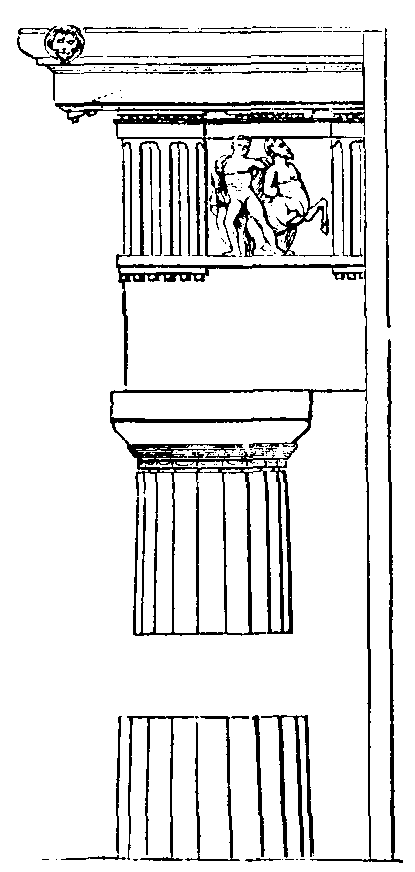
Doric Order, in architecture, is the oldest, strongest, and simplest of the three Grecian orders, and the one that is best represented among the remains of ancient Greek architecture. The Doric column is distinguished by its want of a base (in the more ancient examples, at least), by the small number of its flutings, and by its massive proportions, the true Grecian Doric having the height of its pillars six times that of the diameter. The capital was small and simple, and the architrave, frieze, and cornice were rather plain and massive.
Dorigny (do-rē-nyē), the name of several French painters and engravers. Michael, born in 1617, became professor in the Academy at Paris, and died in 1665. Louis, son of the preceding, was born in 1654, settled in Italy, and died in 1742. Sir Nicholas, brother of Louis, born in 1658 at Paris, was the most celebrated of the three. He spent eight years in engraving the famous cartoons of Raphael at Hampton Court, and was knighted by George I. He died in 1746.
Doris, anciently a small and mountainous region of Northern Greece, at one time the abode of the Dorians. It now forms an eparchy in the nomarchy of Phocis.
Dorking, a town of England, county of Surrey, 22 miles S.S.W. of London, largely consisting of villa residences. Large numbers of fowls, known as Dorkings, of an excellent breed, having five claws on the foot, are reared here, and sent to the London markets. The breed was introduced both into Gaul and Britain when those countries were subject to the Roman power. Pop. (urban district), 7850.
Dormant State, a state of torpidity in which certain animals pass a portion of the year. In cold and temperate climates this period of long sleep takes place during the winter months, and is properly called hibernation. It commences when the food of the animal begins to get scarce, continues for a longer or shorter period, and is deeper or lighter according to the habits and constitution of the animal. Bats, bears, some animals of the rodent order, such as the porcupine, the dormouse, and the squirrel, all the animals belonging to the classes of Amphibia and Reptilia, such as tortoises, lizards, and snakes (frogs, &c.), also many species of molluscs and insects, hibernate more or less completely, retiring to suitable places of concealment—the bat to dark caves, the hedgehog to fern-brakes, and snakes to holes in trees. During hibernation there is a great decrease of heat in the bodies of the animals, the temperature sometimes sinking to 40° or even 20°F., or in general to a point a little above that of the surrounding atmosphere. The respiration as well as the pulsation of the heart is exceedingly slow, and the irritability of the animal often so low that in some cases it can be awakened only by strong electric shocks. With frogs and other amphibia the dormant state is very common, and if the temperature is kept low by artificial means, they may remain dormant for years. The term æstivation has been used to describe a similar condition into which certain animals, such as serpents and crocodiles, in tropical countries pass during the hottest months of the year. Plants also present many interesting examples of the dormant state, by which unfavourable periods or conditions are tided over. A seed, for instance, contains a dormant embryo or plantlet, which resumes growth (i.e. germinates) when the temperature rises above a certain level, provided sufficient moisture and air are present. Many lower forms, notably bacteria, are able to form thick-walled cells (spores) that can retain their vitality for a considerable time.
Dormer Window. Abbeville, Fifteenth Century
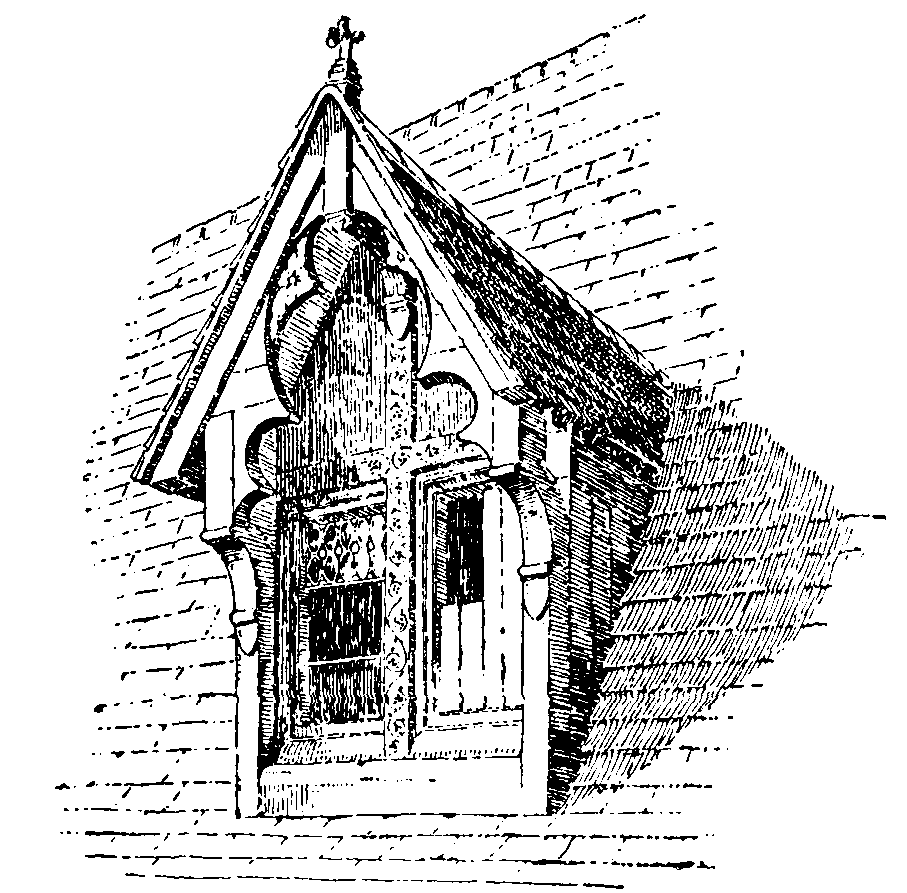
Dormer Windows (Fr. dormir, to sleep), are windows inserted in the inclined plane of a sloping roof, on a frame rising vertically above the rafters. They are named dormer windows because they are found chiefly in attic bedrooms.
Dormouse (Muscardinus avellanarius)
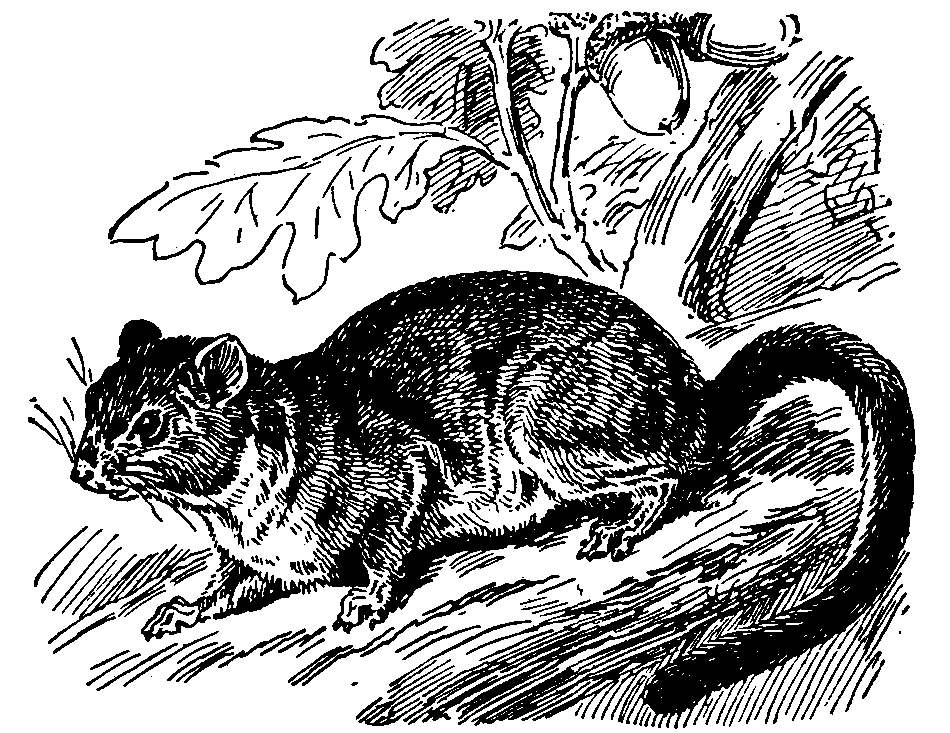
Dormouse, the popular name of small rodent mammals constituting a special family (Gliridæ or Myoxidæ) allied to rats and mice. They inhabit temperate and warm countries, and subsist entirely on vegetable food. Their pace is a kind of leap, but they have not the activity of squirrels. Whilst feeding they sit upright and carry the food to their mouths with their paws. Dormice pass the winter in a lethargic or torpid state, reviving only for a short time on a warm sunny day, when they take a little of their hoarded stores and then relapse into the dormant state. The squirrel-tailed or 'fat' dormouse (Myoxus glis) of the continent was esteemed as an article of diet by the ancient Romans. The common British dormouse (Muscardinus avellanarius) is a graceful little creature about 3 inches in length, with a tail 2½ inches long. It feeds on hazel-nuts, eggs, and insects, and constructs a spherical nest. It is not known to occur in Scotland or Ireland.
Dorn´birn, a manufacturing town in Tyrol, about 6 miles from the Lake of Constance. Pop. 28,550.
Dornick, a kind of stout figured linen fabric used for table-cloths, and generally chequered. It derives its name from Doornik, or Tournai, in the Netherlands. The manufacture was brought into Norfolk by the Dutch.
Dornoch (-noh), a seaport and royal burgh of Scotland, county of Sutherland, at the entrance of the Dornoch Firth, the seat of the extinct bishopric of Caithness. It is one of the Wick district of parliamentary burghs. Pop. 740.—The Firth runs inland for about 16 miles between Ross-shire and Sutherlandshire.
Dor´ohoi, a town of Roumania in N.W. Moldavia, near the Austrian frontier. Pop. 11,140.—The department of Dorohoi has an area of 1090 sq. miles, and a pop. of 189,789.
Dor´pat (Tartu), a town, formerly in the Russian province of Livonia, now belonging to the Republic of Esthonia. It is situated on the Embach, about 135 miles N.E. of Riga. Dorpat is chiefly remarkable for its university and other educational establishments. It is an ancient town, and was once a member of the Hanseatic Union. Captured by the Russians in 1559, it was ceded to Poland in 1582, was subsequently taken by the Swedes, and in 1704 passed to the Russians, who called it Yuryev. The town was occupied by the Germans on 18th Feb., 1918. The vernacular language is Esthonian, but the upper classes speak German. Pop. 44,140.
D'Orsay, Alfred, Count, a dilettante artist and man of fashion, born at Paris 1801, died 1852. When a young man he visited England, and became acquainted with Byron and other literary and fashionable celebrities. He married a daughter of the Earl of Blessington, but after the earl's death a separation took place, and D'Orsay became an inmate of Gore House, which the Countess of Blessington had made the centre of a famous literary coterie. A zealous Bonapartist, he followed Prince Louis Napoleon to Paris in 1849, and enjoyed his favour till his death. Disraeli has described him in his novel Henrietta Temple, under the name of 'Count Mirabel'.—Cf. Richard Madden, Life of Lady Blessington.
Dorset, Earls of. See Sackville.
Dorset, or Dorsetshire, a maritime county in the south of England, having on the south the English Channel; area, 627,265 acres, over 490,000 being under crop. The general surface of the county is undulating; its principal elevations being chalk hills known as the North and South Downs, upon which immense flocks of sheep are pastured. On the south, on the borders of Hampshire and along part of the sea-coast, is a heathy common. A great part of the county is in grass, and dairy husbandry is extensively carried on. Neither coal nor ores of any kind are found, but the quarries yield the well-known Portland stone. Pipe-clay, plastic clay, and potter's clay also abound. The principal manufactures are those of flax, canvas, duck, &c., also silk and woollens. The fish frequenting the coast are of various kinds, but mackerel is the most abundant. Near the mouth of Poole harbour is a prolific oyster bank. The principal rivers are the Stour, the Frome, and the Piddle. The county has four parliamentary divisions, with a member for each. Dorchester is the county town. Other towns are Bridport, Poole, and Weymouth. Pop. 223,274.
Dorsetshire Regiment, The, once known as the East Middlesex, dates from 1702, and is intimately associated with Gibraltar, which it twice defended during siege (1727 and 1779-82). For its services in India under Clive it bears the motto Primus in Indis. It later took part in the relief of Ladysmith, and during the European War suffered heavily on the Western front, being also represented at Kut and Ramadie.
Dorste´nia, a genus of plants, nat. ord. Moraceæ, found in tropical America. They have their naked flowers buried in a flat, fleshy, somewhat concave receptacle. D. Contrayerva and other species have a stimulant and tonic rhizome, which is used medicinally under the name of contrayerva.
Dort, or Dordrecht, a town, Holland, province of South Holland, 14 miles S.E. of Rotterdam, on the Merwede, an arm or part of the Maas, and on an island separated from the mainland by an inundation in 1421. It is an old town, founded in 1018 by Count Dietrich III of Holland, with a fine Gothic Church (Groote Kerk, 'Great Church'), a good town-house and museum. It was formerly of more importance than now, but it still carries on an extensive trade, being not only near the sea, but by the Rhine, the Maas, and other water communications, connected with an immense extent of inland territory. Pop. 47,300.
Dort, Synod of, an assembly of Protestant divines convoked at Dort on 13th Nov., 1618, dissolved on 9th May, 1619. Besides the Dutch and Walloon divines, it included representatives from England, Scotland, Switzerland, and part of Germany, in all about sixty-two native and twenty-four foreign deputies. The Synod was convoked principally for the sake of crushing the Arminian party, and extreme measures were taken to prevent that party being represented in the assembly or having a free voice there. The result was the condemnation of the Arminians and the dogmatic establishment of Calvinism in the Reformed Church. The Synod also set on foot the Dutch translation of the Bible known as the Dort Bible.
Dort´mund, a city of Prussia, province of Westphalia, on the Emscher, 47 miles N.N.E. of Cologne, starting-point of an important canal to the lower Ems. It has rapidly increased in recent years, being the centre of important railway systems, having extensive coal-mines in the vicinity, and active manufactures of iron, steel, machinery, and railway plant. There are also a number of breweries, potteries, tobacco factories, and chemical works. It was once a free Imperial Hanseatic town, and the seat of the chief tribunal of the Vehme. Pop. 214,226.
Dory (Zeus faber)
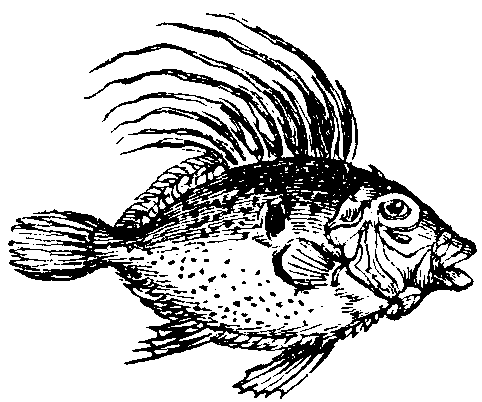
Dory, or John Dory (Zeus faber), a bony fish which is the type of a special family (Zeidæ), and is celebrated for the delicacy of its flesh. It seldom exceeds 18 inches in length, and is yellowish-green in colour with a blackish spot on each side, which, according to an old superstition, is the mark of St. Peter's forefinger and thumb; another claimant for this honour is the haddock. The dory is found on the Atlantic shores of Europe and in the Mediterranean. The name John Dory is supposed to be derived from the Fr. jaune dorée, golden yellow.
Dosith´eans, an ancient sect among the Samaritans, so called from their founder Dositheus, who was a contemporary and associate of Simon Magus, and lived in the first century of the Christian era. They rejected the authority of the prophets, believed in the divine inspiration of their founder, and had many superstitious practices.
Dosso Dossi, Giovanni di Lutero, Italian painter of the Ferrara school; born 1479, died 1542. He was much honoured by Duke Alfonso of Ferrara, and immortalized by Ariosto (whose portrait he executed in a masterly manner) in his Orlando. Modena, Ferrara, and Dresden possess most of his works. Circe in the Woods is in the Borghese Gallery, and St. Sebastian in the Brera at Milan.
Dost Mohammed Khan, born about 1790, a successful usurper who obtained possession of the throne of Afghanistan after the flight of Mahmud Shah in 1818. He ruled with very great ability, and although driven from his throne by a British army, was ultimately restored and became a steady supporter of British power in the East. He died in 1863.
Dostoiev´sky, Feodor Mikhailovitsh, a famous Russian novelist, born 1821, died 1881. After serving as an officer of engineers he devoted himself to literature, but becoming connected with the communistic schemes of Petrashevsky, he was condemned to death. At the last moment, when Dostoievsky was already on the scaffold, the sentence was commuted, and he was banished to the mines of Siberia. Pardoned by Alexander II, he returned in 1856 to resume his literary activity. His first novel, Poor People, came out in 1846. Among his works that have appeared in English are: Crime and Punishment; Injury and Insult; The Friend of the Family; The Gambler; The Idiot; Prison Life in Siberia; Uncle's Dream; The Permanent Husband; The Brothers Karamzov; Letters from the Underworld and Other Tales. There is a complete edition of his novels by C. Garnett, 1912.—Bibliography: J. A. T. Lloyd, A Great Russian Realist; J. M. Murray, F. Dostoievsky: a Critical Study.
Dot´terel (Eudromias morinellus), a species of plover which breeds in the north of Europe, and returns to the south for the winter. In Scotland it appears in April and leaves in August, the young being hatched in July, but comparatively few breed in the British Islands. It is found all over Europe and Northern Asia. The dotterel is about 8 inches long. Contrary to the general rule the hen is larger and more brightly coloured than the cock, and the latter performs most of the duties of incubation.
Douai (dö-ā), town, France, department of Nord, on the Scarpe, 18 miles south of Lille. It is one of the oldest towns in France, of which it became part by the Treaty of Utrecht. It is strongly fortified, has a fine town-house, several handsome churches, an academy of arts and law, a lyceum, museum and public library, Benedictine college, and hospital; a cannon foundry, linen manufactories, machine-works, and tanneries. There was long here a college for British Roman Catholic priests, the most celebrated of its kind, founded by Cardinal Allen in 1568. Douai was captured by the Germans during the European War, and retaken by the Allies in Oct., 1918. It received the Cross of the Legion of Honour in Sept., 1919. Pop. 36,314.
Douai Bible, the English translation of the Bible used among English-speaking Roman Catholics, and executed by divines connected with the English College at Douai. The New Testament was published in 1582 at Rheims, the Old during 1609-10 at Douai, the translation being based on the Vulgate. Various revisions have since materially altered it.
Douarnenez (du¨-a˙r-nė-nā), a seaport, France, Finistère, on a beautiful bay of the same name, 13 miles north-west of Quimper. It depends chiefly on the sardine fishery. Pop. 13,753.
Double Fertilization. See Embryo-sac.
Double-flowering, the development, often by cultivation, of the stamens and pistils of flowers into petals, by which the beauty of the flower is enhanced and its reproductive powers sacrificed.
Double-insurance, the effecting of two insurances upon the same goods. In marine insurance it is lawful for a shipper to insure his goods twice, but only to give an additional security in the event of the failure of the first underwriters. In the event of a loss it is ultimately divided among the underwriters in the ratio of the risks they have taken.
Double-stars, or Binary Stars, stars which are so close together that they appear as one to the naked eye, but are seen to be double when viewed through a telescope. One of these stars may revolve about the other, or, more accurately speaking, both revolve round the common centre of gravity.
1, Doublet, time of Edward IV. 2,3, Doublets, time of Elizabeth. 4, Doublet, time of Charles I.
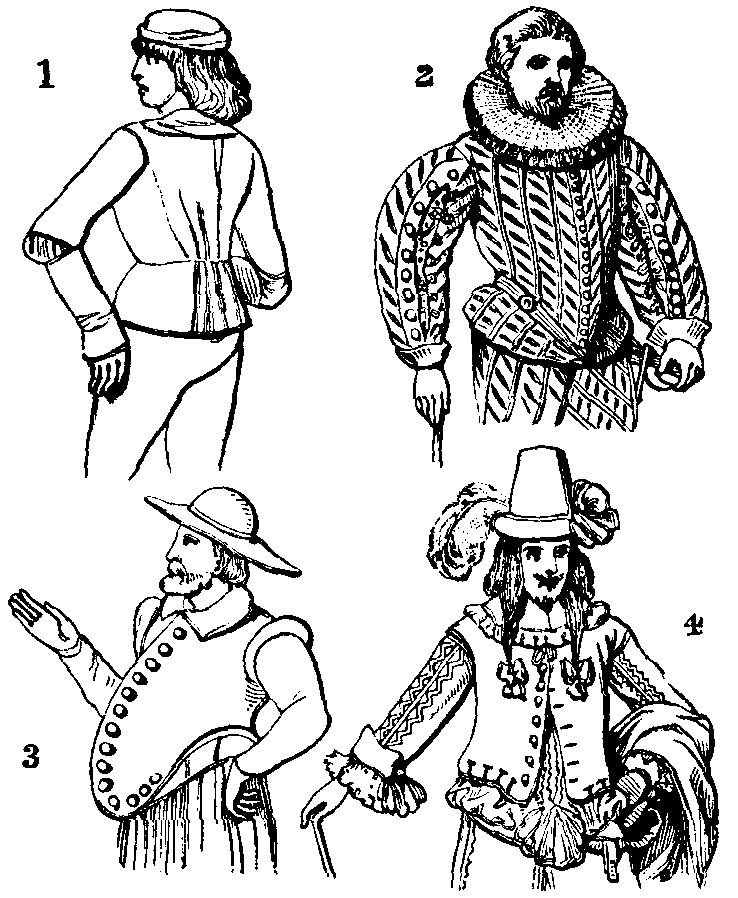
Doublet, a close-fitting garment, covering the body from the neck to a little below the waist. It was introduced from France into England in the fourteenth century, and was worn by both sexes and all ranks until the time of Charles II, when it was superseded, as far as men were concerned, by the coat and waistcoat. The garment got its name from being originally lined or wadded for defence.
Doublet, in lapidary work, a counterfeit stone composed of two pieces of crystal, with a colour between them, so that they have the same appearance as if the whole substance of the crystal were coloured.
Double-vault, in architecture, one vault built over another so that a space is left between the two. It is used in domes or vaulted roofs when the external and internal arrangements require vaults differing in size or shape, the outer and upper vault being made to harmonize with the exterior of the building, the inner or lower with the interior.
Doubloon´, a gold coin of Spain and of the Spanish American States, originally double the value of the pistole. The doubloon of Spain was subsequently equivalent to about a guinea sterling. The doubloon of Chile was worth about 18s. 9d. sterling; that of Mexico, £3, 4s. 8d.
Doubs (dö), a department of France, having Switzerland on its eastern frontier. Its surface is traversed by four chains of the Jura. The temperature is variable, and the climate somewhat rigorous. About a third of the land is arable, but much the greater part is covered with forests. Maize, potatoes, hemp, flax are the principal crops. Much dairy produce is made into Gruyère cheese. The minerals include iron, lead, and marble. Pop. 284,975.—The River Doubs rises in the department to which it gives its name, flows first north-east, then north-west till it joins the Saône at Verdun-sur-Saône; length, 250 miles.
Douche (dösh), a jet or current of water or vapour directed upon some part of the body; employed in bathing establishments. When water is applied, it is called the liquid douche, and when a current of vapour, the vapour douche.
Douglas (dug´las), a family distinguished in the annals of Scotland. Their origin is unknown. They were already territorial magnates at the time when Bruce and Baliol were competitors for the crown. As their estates lay on the borders they early became guardians of the kingdom against the encroachments of the English, and acquired in this way power, habits, and experience which frequently made them formidable to the Crown. We notice in chronological succession the most distinguished members of the family. James, son of the William Douglas who had been a companion of Wallace, and is commonly known as the Good Sir James, early joined Bruce, and was one of his chief supporters throughout his career, and one of the most distinguished leaders at the battle of Bannockburn. He was called 'Black Douglas' from his swarthy complexion. He fell in battle with the Moors while on his way to the Holy Land with the heart of his master, in 1331.—Archibald, youngest brother of Sir James, succeeded to the regency of Scotland in the infancy of David. He was defeated and killed at Halidon Hill by Edward III in 1333.—William, son of the preceding, was created first earl in 1357. He recovered Douglasdale from the English, and was frequently engaged in wars with them. He fought at the battle of Poitiers and died in 1384.—James, the second earl, who, like his ancestors, was constantly engaged in border warfare, was killed at the battle of Otterburn in 1388. After his death the earldom passed to an illegitimate son of the Good Sir James, Archibald the Grim, Lord of Galloway.—Archibald, son of Archibald the Grim and fourth earl, was the Douglas who was defeated and taken prisoner by Percy (Hotspur) at Homildon 14th Sept., 1402. He was also taken prisoner at Shrewsbury 23rd July, 1403, and did not recover his liberty till 1407. He was killed at the battle of Verneuil, in Normandy, in 1427. Charles VII created him Duke of Touraine, which title descended to his successors. He was surnamed 'The Tyneman', or loser, on account of his many misfortunes in battle.—William, sixth earl, born 1422, together with his only brother David was assassinated by Crichton and Livingstone at a banquet to which he had been invited in the name of the king, in Edinburgh Castle, on 24th Nov., 1440. Jealousy of the great power which the Douglases had acquired from their possessions in Scotland and France was the cause of this deed.—William, the eighth earl, a descendant of the third earl, restored the power of the Douglases by a marriage with his cousin, heiress of another branch of the family; was appointed Lord-Lieutenant of the kingdom, and defeated the English at Sark. Having entered into treasonous league, he was invited by James II to Stirling and there murdered by the king's own hand, 22nd Feb., 1452.—James, the ninth and last earl, brother of the preceding, took up arms with his allies to avenge his death, but was finally driven to England, where he continued an exile for nearly thirty years. He entered Scotland on a raid in 1484, but was taken prisoner and confined in the abbey of Lindores, where he died in 1488. His estates, which had been forfeited in 1455, were bestowed on the fourth Earl of Angus, the 'Red Douglas', the representative of a younger branch of the Douglas family, which continued long after to flourish. The fifth Earl of Angus, Archibald Douglas, was the celebrated 'Bell-the-Cat', one of whose sons was Gawin Douglas the poet. He died in a monastery in 1514. Archibald, the sixth earl, married Queen Margaret, widow of James IV, attained the dignity of regent of the kingdom, and after various vicissitudes of fortune, having at one time been attainted and forced to flee from the kingdom, died about 1560. He left no son, and the title of Earl of Angus passed to his nephew David. James Douglas, brother of David, married the heiress of the Earl of Morton, which title he received on the death of his father-in-law. His nephew, Archibald, eighth Earl of Angus and Earl of Morton, died childless, and the earldom of Angus then passed to Sir William Douglas of Glenbervie, his cousin, whose son William was raised to the rank of Marquess of Douglas. Archibald, the great-grandson of William, was raised in 1703 to the dignity of Duke of Douglas, but died unmarried in 1761, when the ducal title became extinct, and the marquessate passed to the Duke of Hamilton, the descendant of a younger son of the first marquess. The line of Angus or the Red Douglas is now represented by the Houses of Hamilton and Home, who both claim the title of Earl of Angus.—Bibliography: David Hume of Godscroft, A History of the House of Douglas and Angus; Sir H. Maxwell, A History of the House of Douglas.
Douglas, Gawin, an early Scottish poet of eminence. He was the son of Archibald, fifth Earl of Angus, and was born at Brechin about 1474. He received a liberal education, commenced at home and completed at the University of Paris. On returning to Scotland he took orders in the Church, and ultimately became Bishop of Dunkeld, through the influence of his nephew, the sixth Earl of Angus, who married Queen Margaret, widow of James IV. He died of the plague in 1522 in London, where he had been obliged to take refuge on account of political commotions. He translated Virgil's Æneid into verse with much spirit and elegance, prefixing original prologues to the different books of the original. This was the first poetical translation into English of any classical author. It was written about 1512, and first published in 1553. He also wrote The Palace of Honour and King Hart, both allegorical poems.—Cf. J. H. Millar, Literary History of Scotland.
Douglas, Sir Howard, Baronet, G.C.B., a British general, born in 1776, the son of Admiral Sir Charles Douglas. He served in Spain in the Peninsular War, and acquired much reputation by his writings on military subjects, especially by his Military Bridges and the Passage of Rivers (1816), and Treatise on Naval Gunnery (1819). From 1823 to 1829 he was Governor of New Brunswick, and from 1835 to 1840 Lord High Commissioner of the Ionian Islands. He attained the rank of general in 1851, and died in Nov., 1861.
Douglas, Stephen Arnold, American politician, born in Vermont, 1813, died 1861. Having gone to Jacksonville, Illinois, he became an attorney, was appointed Attorney-General for the State, and in 1843 was elected a member of the United States House of Representatives. In 1847 he was elected to the Senate, and by re-election was a member of this body till his death. He was especially prominent in connection with the question as to the extension of slavery into new states and territories, which he maintained was a matter to be settled by the people of the respective states or territories, and not by Congress. He was a presidential candidate in 1860, when Lincoln was elected.
Douglas, Sir William Fettes, painter, born in Edinburgh 1822, died in 1891. He was educated at the High School in that city, spent ten years in a bank before finally deciding (in 1847) upon the artist's profession. In 1851 he was elected an Associate of the Royal Scottish Academy, and three years later a full member. In 1877 he became Curator of the National Gallery of Scotland, resigning the post in 1882 on his election as president of the Royal Scottish Academy. Among the finest of his early pictures are: Bibliomania (1852, in the National Gallery), The Ruby Ring (1853), The Alchemist (1855), Hudibras and Ralph visiting the Astrologer (1856), and The Rosicrucian (1856), many of these showing much of the Pre-Raphaelite spirit, with abundance of detail. After 1870 he devoted himself rather to landscape, and his Stonehaven Harbour and A Fishing Village (1874-5) are perhaps his masterpieces. He was knighted in 1882.
Douglas (dug´las), capital of the Isle of Man, is situated on the south-east coast, on a beautiful semicircular bay. It is frequented by immense numbers of visitors during the summer. Among the objects of interest are the House of Keys, the custom-house, the extensive breakwater, and the promenade. Pop. 21,192.
Douglass, Frederick, American lecturer and journalist, was born at Tuckahoe, in Maryland, about 1817. His father was a white man, but his mother being a negro slave, he was, according to the law, reared as a slave. In 1832 he was purchased by a Baltimore shipbuilder, but made his escape in 1838. As he had taught himself to read and write, and showed talent as an orator, he was employed by the Anti-slavery Society as one of their lecturers. In 1845 he published his autobiography, and afterwards made a successful lecturing tour in England. In 1870 he started a journal entitled The New National Era; in 1871 he was appointed secretary of the Commission to Santo Domingo; in 1877 Marshal for the district of Columbia, then Commissioner of Deeds, and eventually Minister to Hayti. He died in 1895.
Doulton (dōl´tun), Sir Henry, 'the greatest potter of the nineteenth century', born in Lambeth in 1820, died in 1897. On leaving University College School, in 1835, he joined his father, who had carried on a small pottery since 1815, and began by perfecting himself in all the mechanical processes then used by potters. He scored his first distinct success in 1846 with glazed drain-pipes, and in 1851 and 1862 the firm obtained medals for stoneware vessels and chemical apparatus. At the South Kensington Exhibition in 1871 a striking display was made of the new Doulton artistic ware. Doulton exhibited at Vienna in 1873, and at Paris five years later, when he was made a chevalier of the Legion of Honour. He then established a school of artists in connection with his manufactory, with the object of promoting originality in design. He received the Albert gold medal of the Society of Arts in 1885, and was knighted at the Jubilee two years later.
Doum Palm (Hyphæne thebaica)
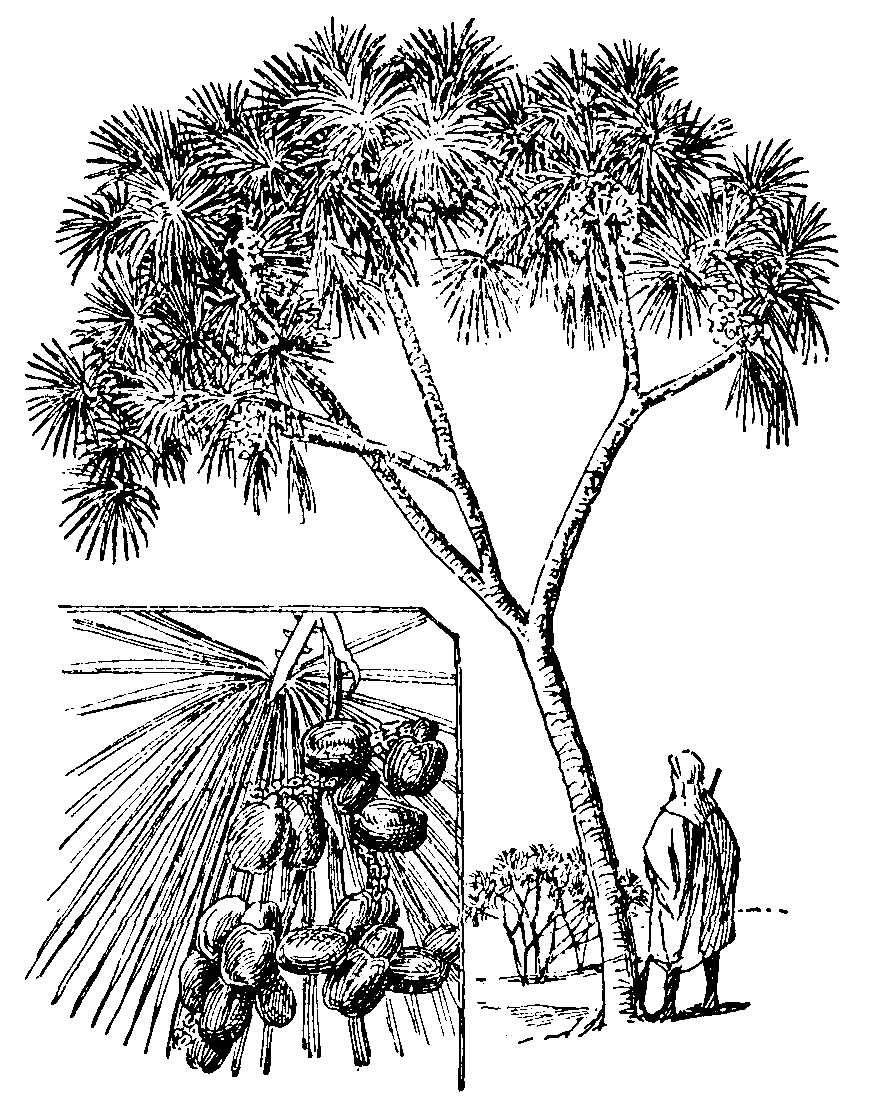
Doum Palm (dōm), a palm tree, Hyphæne thebaica. It is remarkable, like the other species of the genus, for having a repeatedly branched stem. Each branch terminates in a tuft of large fan-shaped leaves. The fruit is about the size of an apple; it has a fibrous mealy rind, which tastes like gingerbread (whence the name gingerbread tree sometimes applied to this palm), and is eaten by the poorer inhabitants of Upper Egypt, where it grows. An infusion of the rind is also used as a cooling beverage in fevers. The seed is horny, and is made into small ornaments. Ropes are made of the fibres of the leaf-stalks.
Doune (dön), a police borough in W. Perthshire, Scotland, on the River Teith, 9 miles north-west of Stirling, once famous for its manufacture of Highland pistols and sporrans. The old ruined castle—an imposing structure now partially repaired—is described in Scott's Waverley. Pop. 890.
Douro (dö´rō), one of the largest rivers of the Spanish Peninsula, which, flowing west, traverses about one-half of Spain and the whole of Portugal, and, after a course of 500 miles, falls into the Atlantic 3 miles below Oporto. It is navigable for small vessels for about 70 miles.
Dove. See Turtle-dove and Pigeon.
Dove (dōv), a river, England, Derbyshire, which, after a course of 39 miles through highly picturesque scenery, falls into the Trent.
Dove-cotes. Pigeon-keeping to provide a food-supply is a practice of considerable antiquity, and dove-cotes are found in many quarters of the world. Those introduced into Britain by the Normans were modelled on the Roman columbarium, a massive circular structure, lined with nest-holes, and having a domed roof. A fine example of this type, built 1326, survives at Garway, Herefordshire. Till towards the end of the sixteenth century, these buildings, numbering some 26,000, formed items of manorial privilege in England, and were long confined to Scottish baronies. About this period square and octagonal forms became common, a fine brick specimen of the latter style remaining at Whitehall, Shrewsbury. In Scotland typical 'doo'-cots' exist in the Edinburgh suburbs of Liberton and Corstorphine. That at Liberton, a type common in Scotland but rare in England, is oblong, with lean-to roof and two compartments—probably to avoid disturbing the whole flock when 'squabs' were taken from the nests. Dove-cotes fell generally into disuse when the introduction of 'roots' insured the winter feeding of farm-stock and a consequent steady supply of fresh meat; but their antiquarian interest and frequent beauty call for the careful preservation of existing specimens.
Dove Deities. The cult of the dove is of great antiquity. In Crete and at Mycenæ, and in the area of Hittite control in Asia Minor, it was connected with the Mother-goddess. The bird appears in archaic clay figurines from Phœnicia, Rhodes, Delos, Athens, and Etruria. Whether or not the dove cult originated in Crete or Asia Minor is uncertain. Some think it is of Egyptian origin, but there is no trace of a dove goddess in Nilotic art. In the love poems found in Egyptian tombs, however, the dove is referred to, being in one case addressed by a lover, who asks it if love is to be denied to her; she then tells the dove that she has found her chosen one and is happy by his side. The pigeon was protected in Egypt, and is still regarded as a 'luck bird', and it may have been connected with ancient folk religion. In Babylonia and Assyria the dove was associated with the goddess Ishtar, but not specially during the earlier periods. The Allatu bird is, however, referred to in the Gilgamesh epic, and Pinches has translated the suggestive reference in an Ishtar hymn, Like a lonely dove I rest. In another hymn the worshipper moans like a dove. According to Diodorus, the famous Assyrian Queen Semiramis, who was abandoned after birth, was protected and fed by doves. In Crete two forms of the Great Mother-goddess, who was an Aphrodite in one of her phases, were the snake goddess and the dove goddess. Two doves appear on a model of a Mycenæan shrine. The dove is associated with the Hittite goddess at Marash, Yarre, and Fraktin. It is sometimes found with the nude Syrian goddess. Lucian states, in reference to a Syrian cult, that the dove is the holiest bird (De Dea Syria, chapter liv), and that there was a golden dove in the temple, but nothing was known regarding its origin, some referring it to Dionysus, some to Deukalion, and some to Semiramis (a name said to mean mountain dove) (chapter xxxiii). Ælian tells that the dove was the sacred companion of Astarte (Hist. Nat., iv, 2). Like the Egyptians, the Semites regarded the pigeon with veneration. The Hebrews sacrificed it on special occasions (Num. vi, 10; Lev. xiv, 4, 49). Noah sent out a dove from the ark (Gen. viii, 8). A prophet mourns as a dove (Is. xxxviii, 14). The dove is 'silly' (Hos. vii, 11). Doves were sold in the temple (Mark, xi, 15). The Spirit of God appears as a dove (Matt. iii, 16). According to Herodotus, the Persians drove away white pigeons, connecting them with leprosy (Book I, 139). At Dodona, the famous sanctuary in Epirus, auguries were taken from the moaning of doves in the tree-tops, and the priestesses of Zeus were called doves (Peleiai). Doves and pigeons were mystical birds in the British Isles. In England it was believed that one could not die on a bed of pigeon feathers, and the dying person had, therefore, to be removed from one so that the suffering might not be prolonged. The early Christian saints reverenced the dove. St. Gregory the Great is shown with a dove on his shoulder, and the emblem of St. Remigius is a dove with an oil-cruse in its beak. A snow-white dove with golden bill was wont to sit on the head of St. Mungo, the patron saint of Glasgow. Stories used to be told of sick persons recovering on seeing a white dove on an altar. In the folk lore attached to the memory of Michael Scott, the dove is connected with heaven, and the raven with hell. St. Columba's name signifies 'Dove'. Dove-cotes were connected with old churches, especially in England.