Volume 4 — VOLUME IV (continued 5)
Reading edition
Do´ver, a municipal borough of England, county of Kent, 67 miles south-east of London. It lies on the coast of the Straits of Dover, and is 21 miles distant from Calais on the French coast. It is an important railway terminus, and as a port for mail and packet service with the Continent has a large passenger traffic. Ship-building, sail-making, and fisheries are carried on. There are two docks and a tidal harbour; an outer harbour of 70 acres, enclosed by a new pier and the extended Admiralty Pier, completed in 1871. Very extensive harbour improvements, begun in 1893, were carried out in subsequent years. The celebrated castle stands on a high chalk cliff. Dover is the chief of the Cinque Ports, and has extensive barracks. A parliamentary borough till 1918, Dover now gives its name to a parliamentary division of Kent. Dover was frequently raided by German aviators during the European War. Pop. 43,645.
Dover, a city of the United States, in New Hampshire. It is situated on both sides of the Cochecho, which has here a fall of over 30 feet, affording abundant water-power for the large iron and cotton manufactories. Pop. 13,247.
Dover, Straits of, the narrow channel between Dover and Calais which separates Great Britain from the French coast. At the narrowest part it is only 21 miles wide. The depth of the channel at a medium in the highest spring-tides is about 25 fathoms. On both the French and English sides the chalky cliffs show a correspondency of strata which leaves no room for doubt that they were once united, a fact which is clearly shown by many other proofs.
Dover's Powder, a preparation frequently used in medical practice to produce perspiration. It consists of 1 grain of opium, 1 of ipecacuanha, and 8 of sulphate of potash in every 10 grains, which constitute a full dose. It is named after Thomas Dover, an English physician of the eighteenth century.
Dovre-Fjeld (dō-vre-fyel), an assemblage of mountain masses in Norway, forming the central part of the Scandinavian system, and extending as a plateau 2000 feet high E.N.E. from lat. 62° N. to lat. 63°. It is generally composed of gneiss and mica schist. One of the mountains belonging to it is Snehaetta, 7620 feet.
Dow, Gerard, an eminent painter of the Dutch school, was the son of a glazier, and born at Leyden in 1613. He studied under Rembrandt, and united his master's manner in chiaroscuro with the most minute finish and delicacy. Among his pictures, generally of small size and mostly scenes of family life, are: The Evening School, Young Mother, Woman Sick with Dropsy, and The Bible Reader. Dow died in 1675.
Dowden, Edward, English critic, historian, and educator, was born at Cork in 1843, died in 1913. He studied at Queen's College, Cork, and Trinity College, Dublin, where he gained great distinction, especially in English and Philosophy; and in 1867 he was elected to the professorship of English literature in the university. He was the first Taylorian lecturer at Oxford University in 1889, and held the Clark lecturership in English literature at Trinity College, Cambridge, from 1893 to 1896. Besides contributing to periodicals, Professor Dowden published various works on literary subjects, in particular: Shakspere: his Mind and Art (1875); Shakspere Primer; Studies in Literature; Southey; Southey's Correspondence with Caroline Bowles; Life of Shelley (2 vols., 1886), the chief authority on the poet's life, being founded on papers in the possession of the Shelley family; Wordsworth's Poetical Works (1892-3); Introduction to Shakspere (1893); New Studies in Literature (1895); The French Revolution and English Literature (lectures delivered at Princeton College, New Jersey, in 1896); History of French Literature (1897); Robert Browning (1904); Michel de Montaigne (1905); Essays, Modern and Elizabethan (1910). A volume of poems by him appeared in 1876, and his collected Poetical Works and Letters appeared in 1914.
Dower (Fr. douaire, Lat. dos, dower), in English law, is the right which a wife (not being an alien) has in the freehold lands and tenements of which her husband dies possessed and undisposed of by will. By common law this right amounts to one-third of his estate during her life; by local custom it is frequently greater. Where the custom of gavelkind prevails, the widow's share is a half, and that of free-bench gives her the whole or a portion of a copyhold, according to the custom of the manor. The term is also applied to the property which a woman brings to her husband in marriage, but this is more correctly dowry.
Dowie, John Alexander, religious impostor, born at Edinburgh in 1847, died in 1907. Educated at the university of his native town, he joined his family in Sydney, Australia, and entered the ministry as clergyman of the Congregational denomination. In 1878 he started evangelistic work, maintaining that it was wrong to take a minister's salary. In 1882 he established a tabernacle at Melbourne, and began to practise faith-healing. He then came to the United States, where he organized his own Church, establishing it in 1901 at Zion City, 42 miles from Chicago, on the shore of Lake Michigan. He styled himself 'Elijah II', and 'the First Apostle of the Lord Jesus Christ, and General Overseer of the Catholic Apostolic Church'. Suspended in 1906 by his congregation of Zion City, who accused him of tyranny, polygamy, and misuse of funds, he died shortly afterwards.
Dowlais, a town of South Wales, Glamorganshire, included in the parliamentary borough of Merthyr Tydfil, from which it is distant 1½ miles north-east, with important iron- and steelworks. Pop. 18,112.
Dowlas, a kind of coarse linen formerly much used by working people for shirts; this use of it is now generally superseded by calico.—Cf. Shakespeare, 1st Henry IV, iii, 3.
Dowletabad. See Daulatabad.
Down, a county of Ireland, in Ulster, bounded on the north by Belfast Lough and on the east by the Irish Sea; area, 610,730 acres, of which over five-sixths are productive. Down is copiously watered by the Rivers Bann, Lagan, and Newry, and has numerous small lakes. The surface is very irregular, and in parts mountainous, Slieve Donard, in the Mourne Mountains, being 2796 feet high. Agriculture is in a flourishing condition, oats, wheat, flax, turnips, and potatoes being the principal crops. The native breed of sheep is small, but valued for the delicacy of its mutton and the fine texture of its wool. The principal manufactures are linen and muslin. The fisheries on the coast, principally cod, haddock, and herring, are considerable. The county has five parliamentary divisions, each returning a member. The county town is Downpatrick; others are Newry, Newtownards, Bangor, and Banbridge. Pop. 204,303.
Downing College, one of the colleges of the University of Cambridge, chartered in 1800 and opened in 1821. Its founder was Sir George Downing, a Cambridgeshire gentleman.
Downing Street, a street in London, leading from Whitehall. The name is used as a synonym for the British Government, the Foreign Office and Colonial Office being located in it. No. 10 is the official residence of the Prime Minister, and No. 11 that of the Chancellor of the Exchequer.
Downpat´rick, a market town of Ireland, county town of Down, 21 miles S.E. of Belfast. It is the seat of the diocese of Down, Connor, and Dromore, has a cathedral, and is celebrated as the supposed burial-place of St. Patrick. Pop. 3200.
Downs, a term given to undulating grassy hills or uplands, specially applied to two ranges of undulating chalk hills in England, extending through Surrey, Kent, and Hampshire, known as the North and South Downs. The word is sometimes used as equivalent to dunes or sand-hills.
Downs, The, a celebrated roadstead for ships, extending 6 miles along the east coast of Kent in England, protected on the seaward side by the Goodwin Sands.
Downton, a town of England, in Wilts., on the Avon, 6½ miles S.S.E. of Salisbury; an ancient place, with a large cruciform church in the Norman and later styles, an old earthwork mound called 'the Moat', and an agricultural college. Pop. 1933.
Doxol´ogy (from Gr. doxa, praise, glory, and logos), a set form of words giving glory to God, and especially a name given to two short hymns distinguished by the title of greater (Glory be to God on high, &c.) and lesser (Glory be to the Father, &c.). Both the doxologies have a place in the Church of England liturgy, the latter being repeated after every psalm, and the former used in the communion service.
Doyen, Eugène Louis, famous French surgeon, born at Rheims in 1859, died at Paris in 1916. He made numerous discoveries in gynæcological surgery, and in 1895 established a private clinic, where many French and foreign surgeons came to study under him. His surgical methods were adopted, although his claim to have discovered the germ of cancer has been disputed. In 1898 he received the degree of LL.D. from the University of Edinburgh, where he introduced the method of teaching surgery by means of the cinematograph. His works include: La maladie et le médecin and Le Cancer.
Doyle, Sir Arthur Conan, English novelist, a nephew of Richard Doyle, born at Edinburgh, 1859, studied medicine, and for some years practised, but gave up the profession for that of literature. In 1887 he produced A Study in Scarlet, in which he created the detective Sherlock Holmes. Among his other books are: Micah Clarke, The Sign of Four, The White Company, The Adventures of Sherlock Holmes, Brigadier Gerard, The Great Boer War, The Crime of the Congo, The Lost World, The Poison Belt, The British Campaign in France and Flanders, The New Revelation, and The Vital Message.
Doyle, Sir Francis Hastings Charles, English poet, born 21st Aug., 1810, died 8th June, 1888, was the son of Major-General Sir Francis Hastings Doyle, first baronet, succeeding his father in the title in 1839. Educated at Eton and Oxford, he graduated with first-class honours in classics in 1832, and held a fellowship at All Souls' from 1835 to 1844. After some years' work as a barrister, he became Receiver-General, and in 1869 Commissioner of Customs, having two years previously been elected professor of poetry at Oxford in succession to Matthew Arnold, a position to which he was re-elected for a second term five years later. He had already published Miscellaneous Verses (1840); The Two Destinies (1844); The Return of the Guards and other Poems (1866); and subsequently printed his Oxford Lectures (1869 and 1877) and Reminiscences and Opinions, 1813-85 (1886).
Doyle, Richard, an artist, born in London in 1824, died in 1883. He was long well known as a constant contributor of satirical designs to Punch, and also showed much talent in illustrations to Leigh Hunt's Jar of Honey, Thackeray's Newcomes and his Rebecca and Rowena, and Ruskin's King of the Golden River. Afterwards he devoted himself to water-colour painting.
Dozy (dō´zi), Reinhart, Dutch Orientalist and historian, born 1820, died 1883. He was thoroughly versed in most of the Semitic tongues, and spoke and wrote almost all the European languages with facility. Among his works (sometimes in Dutch, sometimes in French) are: Histoire des Musulmans d'Espagne de 711-1110, Géographie d'Edrisi, De Israelieten te Mekka, Het Islamisme], Supplements aux Dictionnaires Arabes.
Draa, or Wady Draa, a river, or rather water-course, of Morocco, rising in the Atlas Mountains and flowing generally south-east, until, after penetrating the Anti-Atlas range and passing several oases, it suddenly turns westwards, and forms the shallow lagoon El Debaia. From this point until it enters the ocean it is a wady, and forms the southern boundary of Morocco.
Dracæ´na, a genus of endogenous evergreen plants, nat. ord. Liliaceæ. It includes the dragon tree of Teneriffe (D. Draco), celebrated for producing the resin called dragon's blood. Several species of Dracæna are cultivated in greenhouses for the beauty of their foliage, but many of the fine plants known by this name belong strictly to other genera.
Drachenfels (drä´hen-fels; 'dragon rock'), "the castled crag of Drachenfels", as Byron calls it, a hill in Rhenish Prussia, about 8 miles south-east of Bonn, rising 900 feet above the Rhine, and crowned by the old castle of Drachenfels.
Drachma (drak´ma), the unit of weight and of money among the ancient Greeks. It was the principal Greek coin, was made of silver, and was worth (the Attic drachma) about 9¾d. As a weight amongst the Greeks it was about 2 dwt. 7 grains troy. The monetary unit of modern Greece is also called a drachma. Since 1867 its value has been equivalent to that of the franc of the Latin Monetary Union. It is divided into 100 lepta.
Draco, a legislator of Athens, about 620 B.C., whose name has become proverbial as an inexorable and bloodthirsty lawgiver, and whose laws were said to have been written in blood, not ink. Suidas says that he met his death at Ægina, being unintentionally suffocated by the caps and cloaks thrown at him by some of his enthusiastic supporters.
Draco, the Dragon, a constellation of the northern hemisphere, consisting of a long and straggling line of stars, coiled about Ursa Minor, the Lesser Bear. The Pole of the Ecliptic, or earth's orbital plane, is in this constellation, and round that point the Pole of the Equator, at present close to α Ursæ Minoris (the 'Pole Star'), travels in a circle in about 26,000 years. Some 4000 years ago α Draconis was pole-star.
Drag, (1) a long coach or carriage, generally uncovered and seated round the sides; (2) an apparatus for retarding or stopping the rotation of one wheel or of several wheels, in carriages especially; (3) an apparatus, consisting of a frame of iron with a bag-net attached, used to recover articles lost in the water.
Drag-net, a net drawn along the bottom of a river or pond to catch fish. The use of drag-nets is usually prohibited in rivers where fish breed, as it takes all indiscriminately.
Drago Doctrine, a doctrine formulated by L. M. Drago, an Argentinian jurist and Minister for Foreign Affairs, and asserting the principle that no power had a right to impose itself by force of arms upon any of the Spanish American nationalities. Drago first advanced his doctrine in 1902, when the British, German, and Italian fleets were blockading the Venezuelan coast to compel President Castro to pay certain claims made upon his government.
Dragomirov, Mikhail Ivanovitch, Russian general, born in 1830, died in 1905. He became known as lecturer on military tactics, and was appointed chief of the Russian general staff at Kiev. During the Russo-Turkish War he distinguished himself at the crossing of the Danube at Sistova, and was wounded at the Shipka Pass. Retired from active service, he was director of the War Academy at St. Petersburg, Governor-General of Kiev from 1898 to 1902, and member of the Council of the Empire. His works include: The Austro-Prussian War, A Study on the Novel 'War and Peace', The French Soldier, War is an Inevitable Evil, and Duels.
Dragomirov, Vladimir, son of the former, was prominent as a commander during the European War, and took part in the offensive in Galicia in 1916. In 1919 he was president of General Denikin's Political Council, and Governor of Kiev.
Dragon (Gr. drakon, 'the seeing one', a serpent). This 'composite wonder beast' is prominent not only in fairy lore and mediæval romances, but in ancient religious systems. In the mythical history of the East the dragon is the symbol of anarchy and destruction, and the idea was taken over by Christianity, which looked upon the dragon as an emblem of the devil. In Ancient Egypt certain of the deities had serpentine forms, as have still some of the dragons of India, China, and Japan. The Egyptian 'fiery flying serpent' is a dragon, as is also the Apep serpent of night and death, through which the sun-barque of Ra was supposed to pass each night. Biblical references to it as the 'worm' include: "Their worm shall not die" (Is. lxvi, 24); "The worm shall eat them like wool" (Is. li, 8); "In that day the Lord, with his sore, and great, and strong sword, shall punish leviathan the piercing serpent," &c. (Is. xxvii, 1); "The great dragon was cast out, that old serpent, he that is called the Devil and Satan" (Rev. xii, 9). See also Ps. lxxxvii, 4, and lxxxix, 10; Amos, ix, 3; and Is. li, 9. Osiris, as the Nile, was a dragon on which were human heads. In the Pyramid Texts he is addressed as "the Great Green" (the Mediterranean Sea), and the one who is "round as the Great Circle (Okeanos)." On the sarcophagus of Seti I he is "Osiris encircling the Nether World." Set, who slew him, had a 'roaring serpent' form and hid in a hole; he resembled Typhon. The Babylonian dragon Tiamat was the Great Mother of all the deities, and was slain by her descendant Marduk (Merodach), who formed the earth and sky from her body; her blood ran as the flooded rivers to the sea. In India the drought-demon is a water confiner. When slain by Indra with the thunderbolt, the rainy season ensues. The Naga serpent-gods are dragons who may assume human or half-human, half-reptile forms. They guard treasure and chiefly pearls. Early pearl-fishers believed that the shark was the owner and guardian of pearls. Among the Chinese dragons is the lion-headed shark. All the Chinese dragons have pearls in their mouths, and are supposed to spit out pearls. Dragon deities are connected with the moon, which is 'the night-shining pearl,' and in Mexico 'the pearl of heaven'. The Mexican dragon resembles the Chinese, Indian, and Babylonian dragons. The Indian wonder-beast, the Makara, the vehicle of the sea-god Varuna, is similar to the dragon of the Babylonian mother-goddess Ishtar seen on the famous Ishtar gate of Babylon. Makara forms include the lion-headed dolphin, the crocodile-headed fish, and the ram-headed fish so like the 'goat fish' or 'antelope fish' of the Babylonian sea-god Ea, and resembling the Greek horse-headed, dog-headed, and man-headed fish (Tritons). Japanese dragons are serpentine 'water fathers', which are prayed to in time of drought. The Chinese dragons are rain-bringers which sleep during the winter (the season of drought) in pools and rise to fight and thunder in spring. They are hatched from stones as snakes, or from sea-plants, or are transformed fish, or are born from aged pine trees. They are coloured according to their attributes, and may assume human forms or be horse-headed with a snake's tail. That the composite dragon-god is a mixture of several ancient animal-gods is evident by the following description of one class of dragon by a Chinese writer: "His horns resemble those of a stag, his head that of a camel, his eyes those of a demon, his neck that of a snake, his belly that of a clam, his scales those of a carp, his claws those of an eagle, his soles those of a tiger, his ears those of a cow." Dragons may transform themselves into fishes, snakes, crows, dogs, rats, cows, sharks, whales, crocodiles, &c., as well as human beings. The 'will o' wisp' is the 'dragon lantern', and the dragon pearl is the 'jewel that grants all desires' in India, China, and Japan. Dragon herbs cure diseases and prolong life. Dragons carry souls to the Celestial regions, or draw vehicles in which souls stand. This Far Eastern belief existed in Ancient Crete too. On a Cretan sarcophagus is a chariot drawn by two griffins (forms of the dragon) in which stands a woman, probably a goddess, and a swathed pale figure, the deceased. Shakespeare has interesting dragon references, including:
The dragon wing of night o'erspreads the earth,... (Troilus and Cressida, V, 8, 17.)
Swift, swift, you dragons of the night, that dawning May bare the raven's eye. (Cymbeline, ii, 2, 49.)
It is believed that the treasure-guarding dragon of the romances had origin in mixed memories regarding the pearl-guarding shark, the fiery flying serpent, and the ancient serpent and crocodile demons of destruction, flood, darkness, and death. The whole idea of dragons may have originated from traditions about the pterodactyls which lived in the Mesozoic period.
The dragon being a symbol of destruction and a power of evil, the slaying of a dragon was considered a great achievement of mediæval heroes, such as King Arthur, Beowulf, Siegmund, and Tristram.—Cf. G. Elliot Smith, The Evolution of the Dragon; M. W. de Visser, The Dragon in China and Japan.
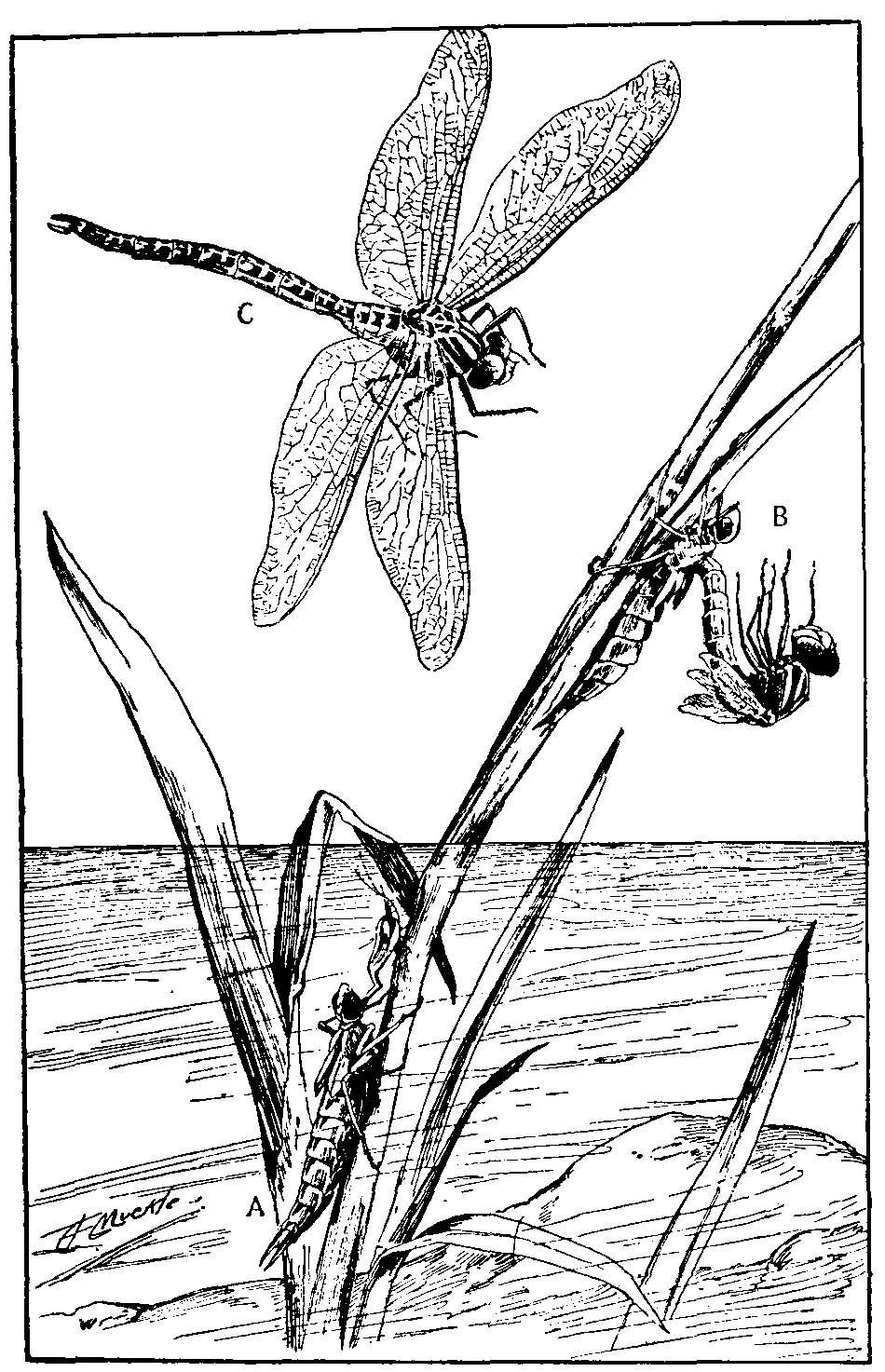
Dragon-fly
A, Larva of dragon-fly. B, Dragon-fly escaping from chrysalis. C, The perfect insect.
Dragon, or Dragon-lizard, a name for several species of lizards inhabiting South-East Asia. The common flying lizard (Draco volans), the best type of the genus, is about 10 or 12 inches in length, the tail being extremely long in proportion to the body. The sides are furnished with peculiar extensions of the skin, resembling wings, which help to support it in the air as it springs from branch to branch. These wing-like processes are borne by prolongations of five or six of the hindermost ribs, and can be folded up. Its food consists almost exclusively of insects.
Drag´onet, the common name of small marine fishes constituting a special family (Callionymidæ). The gemmeous dragonet (Callionymus lyra) is found in the British seas. The female is dull brown and much smaller than the male, which is brilliantly coloured with spots and bars of blue on a yellow ground. His first dorsal fin is large and drawn out into a long filament.
Dragon-fly, the common name of members of a family (Odonata or Libellulidæ) of neuropterous insects. They have a large head, large eyes, and strong horny mandibles. They are beautiful in form and colour, and are of very powerful flight. The great dragon-fly (Æschna grandis) is about 4 inches long, and the largest of the British species. They live on insects, and are remarkable for their voracity. The dragon-fly deposits its eggs in the water, where the wingless nymphs live on aquatic insects. The nymph stage lasts for a year. The family is of very wide distribution. The small blue Agrion is a common European form, but the familiar Libellula is the most extensively distributed. See Demoiselle.
Dragonnades, or Dragonades, the name given to the persecutions directed against the Protestants, chiefly in the south of France, during the reign of Louis XIV, shortly before the revocation of the Edict of Nantes in 1685. Bands of soldiers, headed by priests, marched through the villages, giving the Protestant inhabitants the alternative of renouncing their faith or being given over to the extortions and violence of the soldiery. The dragoons were conspicuous in these expeditions, to which they gave their name. The Dragonnades drove thousands of French Protestants out of France.—Cf. Tylor, The Huguenots in the Seventeenth Century.
Dragon's Blood, or Gum Dragon, a resinous juice, usually obtained by incision from various tropical plants, as Calămus Draco, Dracæna Draco, Pterocarpus Draco, &c. It varies in composition, and is often much adulterated. It is opaque, of a reddish-brown colour, brittle, and has a smooth shining conchoidal fracture. It is soluble in alcohol and oil, but scarcely so in water. It is used for colouring varnishes, for staining marble, leather, and wood, and for tooth tinctures.
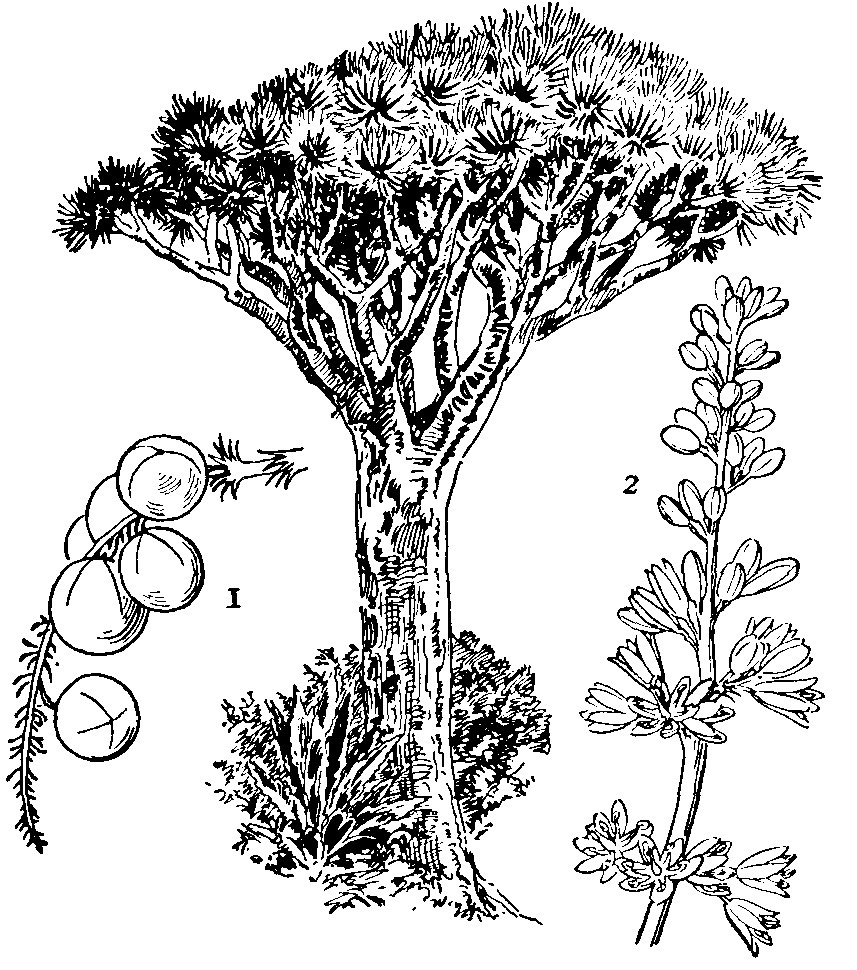
Dragon Tree (
Dracæna Draco
)
1, Fruiting branchlet. 2, Flowers.
Dragon Tree (Dracæna Draco), a tree-like liliaceous plant, with a stem simple or divided at top, and in old age often much branched. It is a native of the Canaries, and yields the resin known as dragon's blood. It is often grown in greenhouses.
Dragoon´, a kind of mounted soldier, so called originally from his musket (dragon) having on the muzzle of it the head of a dragon. At one time dragoons served both as mounted and foot soldiers, but now only as the former. In the British army there are heavy and light dragoons. The first dragoon regiment, the Scots Greys, was formed in 1681.
Draguignan (dra˙-gē-nyän),a town of Southern France since 1793, capital of the department of Var, in a beautiful valley, 41 miles north-east of Toulon. It has some interesting buildings, and manufactures of silk, soap, and leather. Pop. 9974.
Drainage. The term comprises the drainage of areas of country by rivers and streams, the reclamation of areas from the sea, and country formerly marshy, and the provision of culverts and pipe-drains to buildings and towns.
The Fens in Lincolnshire are a notable example of a comprehensive system of drainage by means of open ditches (locally called 'drains'), into which the surplus water is lifted by means of wind- and steam-pumps.
Low-lying or flat country often requires a considerable amount of drainage, which is carried out by means of a regular system of earthenware pipes, laid 2 to 3 feet deep, and from 15 to 35 feet apart. These pipes are porous, from 2 to 3 inches in diameter, laid with butt joints, and lead into larger mains, and thence by open ditches to streams.
A method recently introduced consists in drawing a pointed cylindrical tool, 2 inches in diameter, through the ground at the required depth. This tool is dependent from a thin steel plate, which connects it with the carriage above, so that it can be drawn underground in any desired direction. This system is economical in first cost, but its useful life is considerably less than that of a piped drain, and its use is obviously confined to soils of the heavier variety.
In considering the provision of drainage to water-logged or low-lying land, every care should first be taken to improve the existing natural means of drainage, such as deepening and cleaning out streams and ditches, and removing obstructions.
It should be borne in mind that the object of land drainage is not only to remove the surplus water, but to promote a free and natural circulation of water in the soil, and to allow the mineral constituents of the water to reach the plant roots.
In the drainage of buildings, glazed socketed stoneware pipes are used, varying in diameter from 3 to 9 inches, laid straight in plan and in longitudinal section, and laid to falls, calculated to give a minimum velocity of 3 feet per second when flowing half full. These are laid in trenches, with inspection chambers at all changes in direction, and should be laid on and surrounded with concrete. In bad ground, or under dwelling houses, cast-iron pipes are employed, with special turned and bored joints. In towns these drains lead into the public sewers, which are similar stoneware pipes from 6 to 18 inches in diameter, larger sizes being constructed in brickwork or concrete, and either circular or egg-shaped form. In populous areas these sewers attain very large dimensions, the northern outfall sewers of London consisting of five parallel sewers, each 9 feet in diameter. See Draining.—Bibliography: G. S. Mitchell, Handbook of Land Drainage; Moore and Silcock, Sanitary Engineering; Gilbert Thomson, Modern Sanitary Engineering.
Drainage Tubes are fenestrated india-rubber tubes used in surgery to effect the gradual removal of the contents of a suppurating cavity. The inner end of the tube is in the cavity, and the outer end projects above the skin surface, and is usually fixed by a stitch or safety-pin, and covered with suitable dressings.
Covered Drain without Pipes
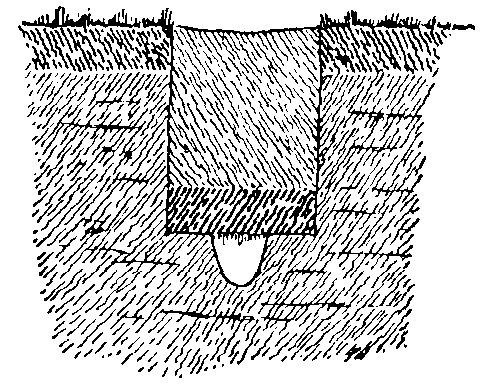
Open Drain
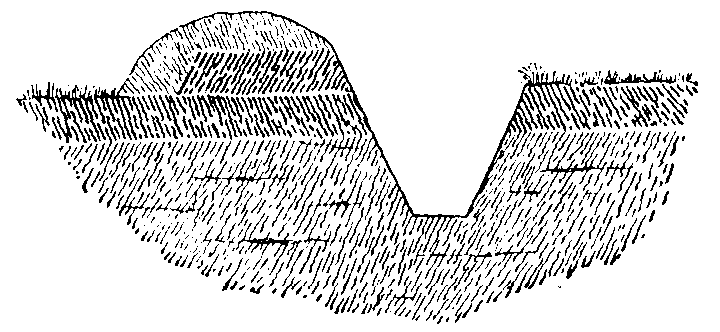
Stone-laid Drains
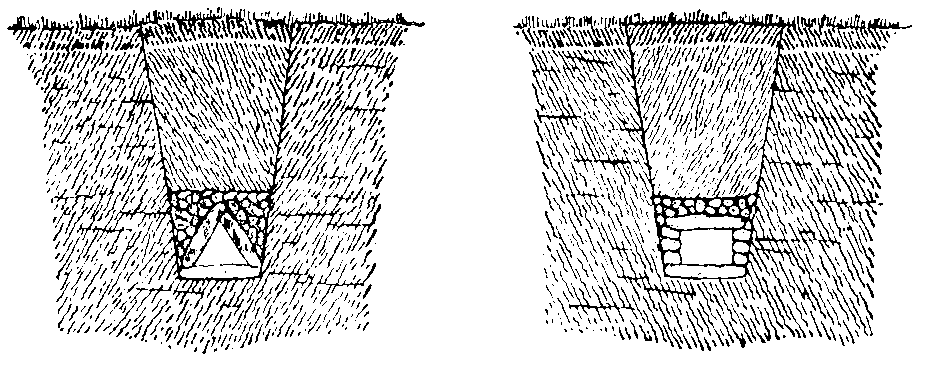
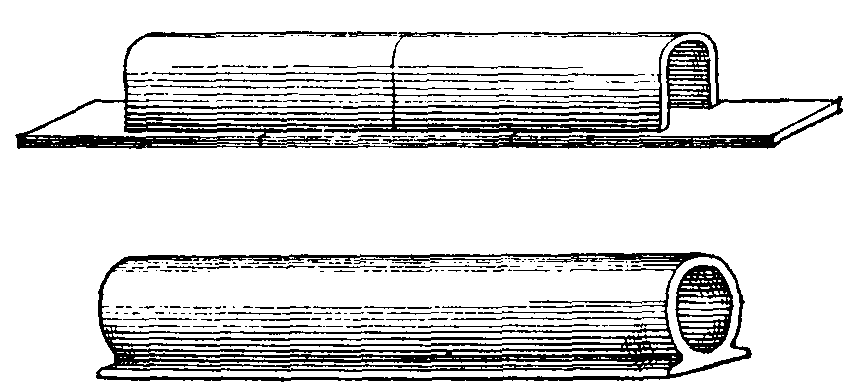
Draining, in agriculture, a method of improving the soil by withdrawing the superfluous water from it by means of channels that are generally covered over. Plants cannot thrive unless there is free circulation of air and water round their roots. The successful practice of draining in a great measure depends on a proper knowledge of the superficial strata, of their situation, relative degrees of porosity, &c. Some strata allow water to pass through them, while others more impervious force it to run or filtrate along their surfaces till it reaches more level ground below. In general, where the grounds are in a great measure flat and the soils of materials which retain the excess of moisture, they require artificial means of drainage to render them capable of yielding good crops whether of grain or grass. The wetness of land, which makes it inferior for agricultural purposes, may appear not only as surface-water but as water which flows through the lower strata, and to draw off these there are the two distinct operations of surface-draining and under-draining. The rudest form of open drains are the deep furrows lying between high-backed ridges, and meant to carry off the surplus water after the soil is completely saturated, but in doing so they generally carry off also much of the best of the soil and of the manure which has been spread upon it. The ordinary ditch is a common form of water-course useful in certain cases, as in hill pastures. But covered drains at a depth of 4 feet or so are the common forms in draining agricultural lands. They are generally either stone-drains or tile-drains. Stone-drains are either formed on the plan of open culverts of various forms, or of small stones in sufficient quantity to permit a free and speedy filtration of the water through them. The box-drain, for instance, is formed of flat stones neatly arranged in the bottom of the trench, the whole forming an open tube. In tile-drains, tiles or pipes of burnt clay are used for forming the conduits. They possess all the qualities which are required in the formation of drains, affording a free ingress to water, while they effectually exclude earth, as well as other injurious substances, and vermin. Drainage tiles and pipes have been made in a great variety of forms, the earliest of which, since the introduction of thorough draining, was the horse-shoe tile, so called from its shape. These should always rest on soles, or flats of burned clay. Pipe tiles, which combine the sole and cover in one piece, have been made of various shapes, but the best form appears to be the cylinder. An important department of draining is the draining off of the waters which are the sources of springs. The judicious application of a few simple drains, made to communicate with the watery layers, will often dry swamps of great extent, where large sums of money, expended in forming open drains in the swamp itself, would leave it but little improved. In the laying out of drains the first point to be determined is the place of outfall, which should always afford a free and clear outlet to the drains, and must necessarily be at the lowest point of the land to be drained. The next point to be determined is the position of the minor drains. In the laying out of these the surface of each field must be regarded as being made up of one or more planes, as the case may be, for each of which the drains should be laid out separately. Level lines are to be set out a little below the upper edge of each of these planes, and the drains must then be made to cross these lines at right angles. By this means the drains will run in the line of the greatest slope, no matter how distorted the surface of the field may be. All the minor drains should be made to discharge obliquely into mains or submains, and not directly into an open ditch or water-course. As a general rule, there should be a main to receive the waters of the minor drains from every 5 acres. The advantages of drainage are obvious. In the first place it brings the soil into a more suitable condition for the growth of plants, aiding in producing the finely divided and porous state which allows the roots and rootlets to spread themselves at will in order to obtain the needed supplies of food, air, and moisture. It also allows the sun's rays to produce their full effect on the soil and plants. In the presence of stagnant water a great part of this effect would be lost. See Drainage.
Horse-shoe and Cylindrical Drain Tiles
Drain-traps
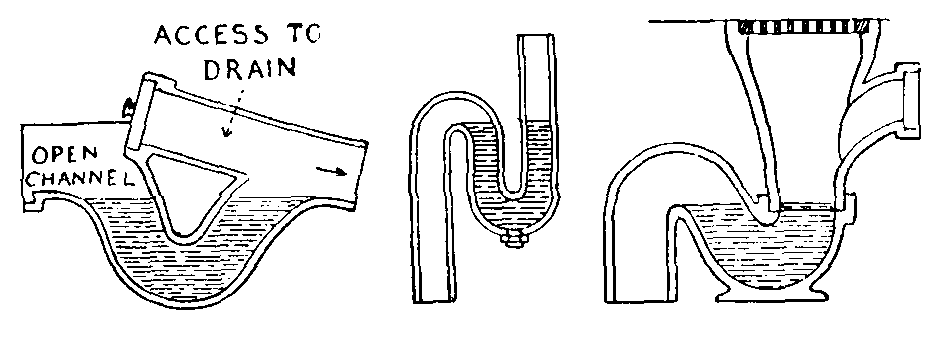
Drain-trap, a contrivance to prevent the escape of foul air from drains, while allowing the passage of water into them. They are of various forms. In the traps represented below it will be seen that there must always be a certain quantity of water maintained to bar the way against the escape of the gas from the drain or sewer. When additional liquid is conveyed to the trap, there is, of course, an overflow into the drain. In older types of drains the gas was prevented from escaping by a metal plate thrown obliquely over the drain mouth and dipping into the water in the vessel beyond it.
Drake, Sir Francis, an English navigator, born at Tavistock, in Devonshire, in 1539, or according to some authorities in 1545. He served as a sailor in a coasting vessel, and afterwards joined Sir John Hawkins in his last expedition against the Spaniards (1567), losing nearly all he possessed in that unfortunate enterprise. Having gathered a number of adventurers round him, he contrived to fit out a vessel in which he made two successful cruises to the West Indies in 1570 and 1571. Next year, with two small ships, he again sailed for the Spanish Main, captured the cities of Nombre de Dios and Vera Cruz, and took a rich booty which he brought safely home. In 1577 Drake made another expedition to the Spanish Main, having this time command of five ships. On this the most famous of his voyages Drake passed the Straits of Magellan, plundered all along the coasts of Chile and Peru, sacked several ports, and captured a galleon laden with silver, gold, and jewels, to the value of perhaps £200,000. He then ran north as far as 48° N. lat., seeking a passage to the Atlantic, but was compelled to return to Port San Francisco on account of the cold. He then steered for the Moluccas, and holding straight across the Indian Ocean doubled the Cape of Good Hope, and arrived at Plymouth 3rd Nov., 1580, being thus the first of the English circumnavigators. As there was no war between England and Spain, the proceedings of Drake had a somewhat dubious character, but the queen maintained that they were lawful reprisals for the action of the Spaniards, and showed her favour to Drake by knighting him on board his own ship. Five years afterwards Drake was again attacking the Spaniards in the Cape Verde Islands and in the West Indies, and in 1588 particularly distinguished himself as vice-admiral in the conflict with the Spanish Armada. In 1593 he represented Plymouth in Parliament. His later expeditions, that in 1595 against the Spanish West Indies and that to Panama, were not so successful, and his death, which took place on 28th Jan., 1596, at sea off Porto Bello, was hastened by disappointment.—Bibliography: Sir J. S. Corbett, Sir Francis Drake (English Men of Action Series), and Drake and the Tudor Navy.
Drakenberg Mountains, a range of South Africa forming the western frontier of Natal, and rising to the height of 11,000 feet, a continuation of the Quathlamba range.
Drama (Gr. drama, action, from drān, to act or do), a form of art which imitates action by introducing real persons to represent the fictitious characters, and to carry on the story by means of action and dialogue.
Man is naturally an imitative animal, and some crude form of drama must have been in existence in very early times. We can see the origins of drama in many of the games played by children, where important events such as war, marriage, and sacrifice are represented in song and dance. In Greece, the cradle of drama as of everything that is good, there must have been in prehistoric times war-dances which formed the basis of tragedy, and rough vintage revel dances which formed the basis of comedy.
Greek Drama.—The Greek drama was religious in its origin. It arose from the dithyrambs or songs composed in honour of Dionysus, the god of all vegetation, though identified most closely with the vine. When vegetation died in winter, this was considered to be the death of Dionysus; when it bloomed anew in the spring, this was thought to be the god's resurrection. The one event was celebrated with gloomy song and dance, and the other with merry revels and crude indecency. The history of Greek drama is the history of the decline and fall of the chorus. At first the chorus was the whole play, and in the Supplices of Æschylus, the earliest extant tragedy, the chorus played a predominating part. According to tradition, Thespis (about 535 B.C.) introduced for the first time a masked actor, who carried on a dialogue with the leader of the chorus. Æschylus introduced a second actor, and Sophocles a third. It is thought that there never were more than three actors, but, of course, duplication of parts was permitted. There were also frequently mute characters (kōpha prosōpa) on the stage. Dialogue became more important in the later plays of Æschylus, and chorus became less important; Sophocles developed his dialogue in masterly style, though his choruses are among the most beautiful things in all Greek poetry; in Euripides the choruses, however lovely in themselves, are less an integral part of the drama than they were in the plays of his predecessors. In fact the chorus acted as a clog on the freedom of the dramatist, who wished to develop exciting situations and depict realistic characters. In comedy the same decline of the chorus is to be found; in the Acharnians, the earliest comedy, the chorus is very prominent; in the Plutus, the last comedy extant, it is comparatively unimportant. Sumptuary laws had something to do with this, and there is a vast difference between the magnificently apparelled chorus in the Birds, and the chorus in the Lysistrata, which represented elderly Athenian men and women in their everyday costume.
Greek tragedies were usually presented in the form of trilogies, that is, in sets of three plays all dealing with the same subject. To these was added, as a rule, a fourth play, known as a satyr-play. The Cyclops of Euripides is the only example extant of this kind of play. It is not very amusing, though it contains a certain amount of horse-play and high spirits. The satyr-play was intended to lighten the gloom of the three preceding tragedies. We have one complete trilogy preserved—the magnificent Oresteia of Æschylus, consisting of the Agamemnon, Choephorœ, and Eumenides—plays which are bracketed with Lear and Othello as the highest and most majestic of all tragedies. In later times the three plays of the trilogy dealt with different subjects. The tragedies to be performed were carefully selected by some of the Athenian magistrates, and at the festival prizes were given for the best tragedy, on the recommendation of a carefully chosen jury. Comedies were presented one at a time; prizes were offered for the best of them also. Greek tragic actors wore long flowing robes, and added to their height by means of the cothurnus or thick-soled boot; it is believed that they wore masks with some sort of speaking-trumpet in the mouth, so that their words would be audible to the vast audience which assembled in the theatre, a huge circular open-air amphitheatre.
Each of the three Greek tragic writers whose work has been preserved is supreme in his own way. Æschylus's lyric dramas are among the greatest writings of all time; the plays of Sophocles are masterpieces of deft construction, of well-woven plot, and ironic dialogue; and his choruses are lyrics of the greatest beauty. Æschylus is more titanic; Sophocles is more humane. Euripides, the latest of the three, is a great poet and a champion of the weak, such as women and slaves; moreover, he sees deeply into men's hearts. He is really the founder of romantic drama, through the Roman Seneca, who imitated him. Of Greek comic poets we only possess one, but he is a host in himself. Aristophanes is a Gargantuan mirth-maker; he bestrides the narrow world like a Colossus. He plays with a master's hand upon every note in the whole comic gamut. His works, owing to the conditions of the old comedy, were very frequently political and highly personal in their tone. The later plays are less so. The Birds, Clouds, and Frogs are among the very greatest comic creations; only a little less great is the Lysistrata, where a serious purpose is veiled by intense indecency. The old comedy, however, was essentially the product of its own age; it did not invite, or even permit, imitation. The new comedy, of which Philemon, Menander, and Diphilus were the principal writers, gradually supplanted it. Their plays were more or less romantic comedies with carefully constructed plots. They are all lost, but we may gain some idea of them from Plautus and Terence, and from the fragments which have been found, some of them fairly recently.
A type of mask worn by the characters in a Roman play after Terence's time. The audience knew from the mask the particular character the actor represented.
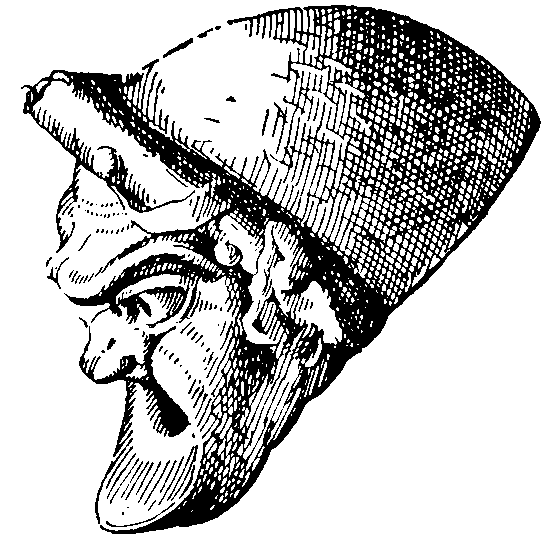
Roman Drama.—Roman drama is not intrinsically good; it is in many respects a weak imitation of Greek drama, but it has been very much more important in its influence. Early English, French, and Italian dramatists all turned to Seneca as a model for tragedy, and to Plautus and Terence as models for comedy. This was partly due to the fact that though most of them had small Latin, they had less Greek; but it was partly because the Latin writers were easier to imitate. Italy had native farces, known as Atellan Fables, which were not without their influence on the development of comedy. These plays were broadly farcical, and dealt almost entirely with country life. The two great Roman comedy writers, Plautus and Terence, based their work, however, upon the new comedy of Greece, especially upon the plays of Menander and Diphilus. Plautus is decidedly coarse at times, and sometimes his fun is too much like that of a fourth-form boy at a public school, but his work is wholesome and vigorous, and he is a more creative and virile writer than Terence. Terence's plays are somewhat weak dramatically, but are written in a style of great beauty. He was a careful literary craftsman. Seneca, the only Roman tragic writer, had an immense influence on later dramatists. It is hard to account for this. He based his work upon Euripides, but he suppressed everything that makes Euripides tender and human. Senecan tragedy abounded in bloodshed and horrors; the speeches are full of pompous rant, and their metre is most monotonous. Some of the choruses are good rhetorical writing, though scarcely great poetry. Seneca's influence pervades all our early tragedy; it is clearly seen in Gorboduc and in Jonson's Sejanus and Catiline; even Shakespeare is not without traces of it. As the Roman Empire declined so did the Roman stage; finally nothing was performed save pantomime, in the proper sense of the word, where everything was done in dumb-show. This appeared to content the populace of the Roman Empire, even as the cinema seems to satisfy the citizens of a later and perhaps greater empire.
Mediæval Drama.—There is no drama between the death of Seneca and the Renaissance, unless we except the six curious 'comedies' of the nun Hrosvitha of Gandersheim (born about A.D. 935). These plays are based upon Terence, though they do not follow their model closely. They are, of course, written in Latin. They have some vivid dramatic touches, and frequent felicities of expression. They were probably intended for recitation, not for representation on the stage. They must be regarded as an isolated phenomenon. The Church for long discouraged drama, but ended by adapting it to its own purposes. As in Greece, therefore, drama originated in England from religion. The priests impressed certain events in sacred history upon the minds of their congregation by means of dramatic performances which at first took place actually in the church. Thus the removal of the stone from the mouth of the sepulchre and the discovery of the empty tomb was performed at Easter, and the finding of the Babe in the manger by the three Magi was represented at Epiphany. It is easy to understand how performances of this sort arose from the singing of suitable anthems on festival days. The Oberammergau passion-play is a somewhat sophisticated representative of these liturgical plays; it cannot be called a survival, as it only dates back to 1633. These mystery-plays, so called because they were produced by the trade-guilds (Lat. ministerium, a trade), were eventually brought out into the market-place on wagons, and were moved round to various 'stations' in the town, different plays being performed at each station. A distinction is sometimes made between mystery- and miracle-plays, the former being defined as dealing with gospel events only, while the latter deal with incidents derived from the legends of the saints. Several collections of these plays survive—the Wakefield, Chester, and Coventry plays. They are written in a lively fashion, and are often naively humorous, the most sacred Bible characters being introduced along with English yokels and crudely comic persons. The next development of the drama was the morality play or allegory; the well-known Everyman is the most finished specimen of this kind of play which we possess. Here personifications of Virtues and Vices formed the dramatis personæ; the Devil was usually included in the cast. Moralities were in ways less crude than mysteries, as they consisted of an allegory worked out by means of a more or less continuous plot, while mysteries consisted merely of a series of isolated scenes. The interlude is another early species of drama; it marks a still further advance. Interludes were both farcical and theological in their subjects, and played an important part in the controversies at the time of the Reformation. John Heywood (1497-1580) is the most important writer of interludes, the controversial plays of John Bale (1495-1563) serving to link the interlude to the regular drama, which began gradually to spring up.
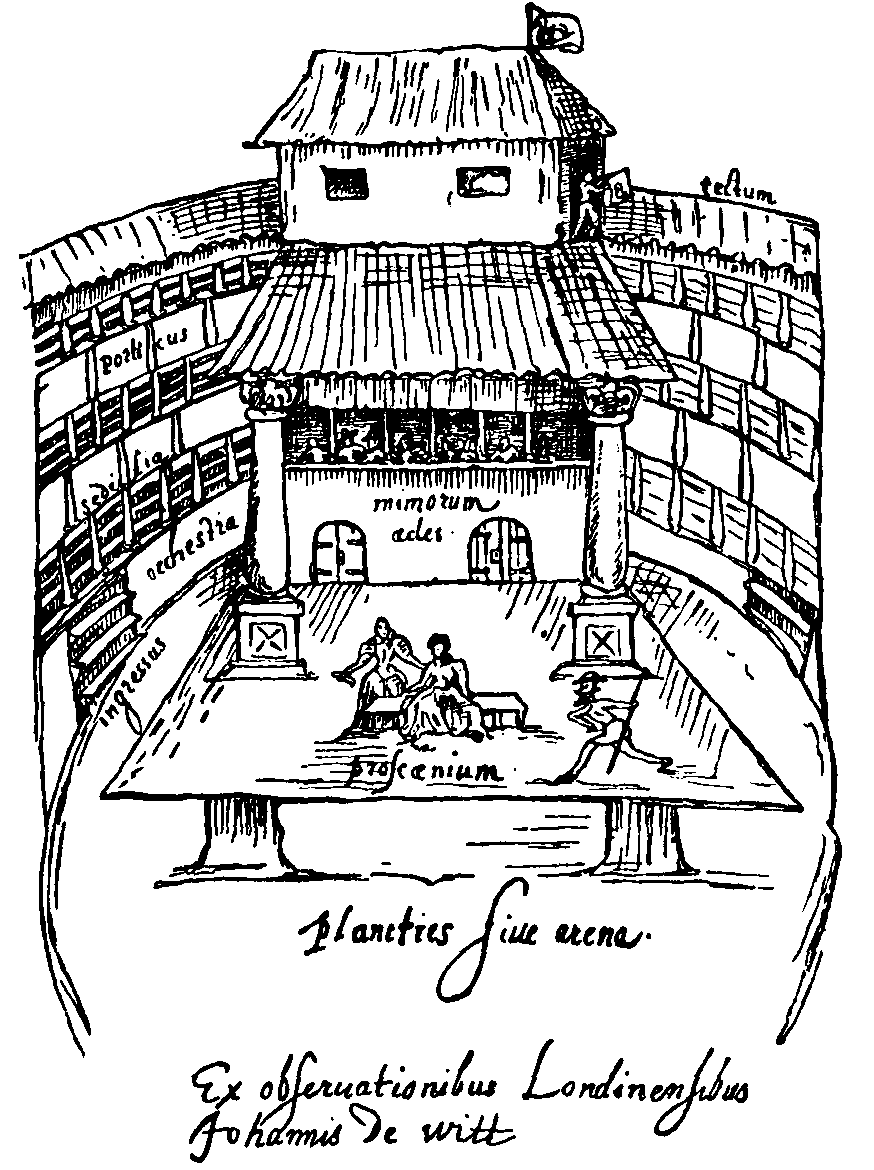
Elizabethan Drama
Interior of the Swan Theatre in 1596. From a sketch made by a Dutchman who visited England at the time.
Elizabethan Drama.—The first English comedy, Ralph Roister Doister, appeared in 1551. It is by Nicolas Udall, and is based upon the Miles Gloriosus of Plautus. Gammer Gurton's Needle, a more native production, thought to have been by John Still, who was master of St. John's College, Cambridge, and Bishop of Bath and Wells, appeared about 1566. Drama now improved rapidly, and was soon to attain perfection in Shakespeare. Marlowe, Kyd, Greene, Lyly, Nash, Lodge, and Peele all helped to prepare the way. The greatest of these is Marlowe, who died at the age of twenty-nine, leaving behind him the great plays Tamburlaine (1588), Faustus, and Edward II. In his development of blank verse he contributed greatly to the success of the drama. The earliest tragedy, Gorboduc (1562), is incredibly stiff and wooden in its versification. Marlowe made of blank verse an instrument that would sound any note of pathos or sublimity. In the plays of Shakespeare (1564-1616) drama reached its greatest height. In comedy, tragedy, history, in handling dramatic situations, and in liquid perfection of verse, he is supreme. Like the very greatest masters, he founded no school, and his contemporaries owe little to him. While they are all put in the shade by his myriad-minded genius, they are all partakers with him in the glory of their age, and are all great in themselves. Jonson (1573-1637) is one of the most important, as he to some extent founded a school and exercised considerable influence over later writers. He was a scholarly and laborious playwright, who over-elaborated some of his work, but who was a masterly adept at constructing a play, and a vigorous realist. Chapman (1559-1634), Dekker (1570-1641), and Marston (1575-1634) were all good workmanlike dramatists. Beaumont and Fletcher produced between them a great body of work, some of inferior quality, but all of great power. In some respects their work is less unlike that of Shakespeare than the work of other Elizabethans. Middleton, Webster, Tourneur, Thomas Heywood, and Massinger are all excellent in their way, Massinger in particular being a master of stage-craft. Shirley and Ford conclude the list of the great Jacobean dramatists. The Puritans caused the theatres to be closed in 1642.
Spanish and French Drama.—Meanwhile a similar outburst of dramatic activity was taking place on the Continent. In Spain, Lope de Vega (1562-1634) wrote a prodigious quantity of plays, and wrote them with much brilliance. Calderon wrote some beautiful plays, several of which have been translated by Edward Fitzgerald. Cervantes, though much better known as a novelist, wrote many good plays. The Spanish school directly inspired Corneille (1606-1684) to write his play Le Cid, and so begin the great age of classical French tragedy. Racine (1639-1700) is the other great name. French classical drama, though somewhat fettered by its observance of laws that were wrongly considered essential, is extremely dignified and beautiful. In Molière (1622-73) France possesses the greatest of all writers of society comedies. He is as supreme in his kingdom as Shakespeare is in his empire. He borrowed from his predecessors with all the licence of genius, but he payed usurious interest on his borrowings.
Restoration Drama.—When the theatres were reopened after the Restoration, many dramatists began to write. Restoration comedy was largely based on Molière, who was brutalized by Wycherley, and adapted but not improved by Congreve. Congreve was, however, a master of sparkling dialogue, and in one play, The Way of the World, he has shown himself not unworthy of comparison with his master. Vanbrugh and Farquhar are the other two important writers of comedies; all their comedies are more or less disfigured by cynicism and immorality, the reaction after the Puritan restraint. Restoration tragedy is much less important than Restoration comedy. Otway, Lee, and Southerne are its chief exponents.
Eighteenth Century Drama.—Some of these dramatists bring us into the eighteenth century, which was not on the whole prolific in good plays. Fielding wrote many amusing farces, but all were more or less hack-work. At a later period Foote, Cumberland, and the two Colmans wrote good acting plays, which have not lived. The two plays of Goldsmith and several of the plays of Sheridan still hold the stage. Sheridan owed much to the Restoration dramatists, especially Vanbrugh, but as he improved his originals in many respects, and made them much more presentable in decent society, he is entitled to most of the reputation he long enjoyed.
In France, Marivaux (1678-1763) wrote sentimental comedies, while Beaumarchais, whose own life was more exciting and varied than most plays, wrote comedies with brilliant plots. In Italy, Maffei, Goldoni, and Alfieri are notable dramatists; the last named wrote propaganda in the disguise of tragedy. In Germany, Lessing by precept and example inaugurated the 'romantic movement'; Schiller and Goethe are the two greatest names associated with the stage. Wallenstein in particular is a good chronicle-play, while Faust is considered one of the greatest of all German plays.
Nineteenth and Twentieth Century Drama.—Victor Hugo led the Romantic movement in France, and wrote many great plays, such as Hernani and Ruy Blas. De Musset wrote his plays, which he called proverbes, under the same influence, and later followers of this school are Rostand and the Belgian M. Maurice Maeterlinck. The French dramatists Augier, Scribe, and Sardou had an overwhelming influence on the English stage, not altogether for its good. English drama was at a low ebb in the middle of the nineteenth century. Lytton's plays, though sometimes performed still, are extremely theatrical. Boucicault, who made a great success by dramatizing 'the pathos of Paddy', is not a great writer. H. J. Byron was an inveterate punster and writer of burlesques of no value. One of his plays, Our Boys, was acted for many years. Robertson is the most outstanding author of what is known as 'the cup and saucer' school of comedy. His plays are very much acting plays; they are not literature, and are quite removed from real life. Gilbert was a man of great gifts, but though some of his farces and comedies are good, he was not a master of drama as he was of libretti writing. He did little to improve the drama of his day. Sir A. W. Pinero began his career as a dramatist under the ægis of Robertson, but continued it under that of Ibsen. Ibsen (1828-1906) exercised a not altogether wholesome influence upon English drama for a considerable time. His plays are extremely well-constructed, and he refused to tolerate many conventions, such as asides and soliloquies. In many of his plays he adopted the retrospective method, where the plot consists not so much in anything being done as in the gradual discovery of what has been done long before the rise of the curtain. Sophocles had done this most skilfully in Œdipus Tyrannus, but Ibsen carried the method to perfection in The Wild Duck and Rosmersholm. All Ibsen's plays are more or less unpleasant, and he did not make many of his characters sympathetic. Pinero, after writing several farces, wrote The Second Mrs. Tanqueray (1893), a masterpiece after the style of Ibsen. His House in Order is a cleverly constructed example of the retrospective method. H. A. Jones (born 1851) has written many excellent and extremely powerful plays, of which the best known are The Liars and The Case of Rebellious Susan. G. Bernard Shaw (born 1856), who combines some of the qualities of a Greek sophist with some of the foibles of a modern Irishman, has written some amusing plays, though others have been spoilt by his tendency to turn them into propaganda. Galsworthy has written plays of great earnestness; in some he has neglected the Aristotelian maxim that every play must have a beginning, a middle, and an end. Sir James Barrie has accumulated a large fortune by means of his plays, and in one at least, Peter Pan, he has made a bid for immortality.
Bibliography.—S. H. Butcher, Aristotle's Theory of Poetry and Fine Art; A. E. Haigh, The Attic Theatre; E. K. Chambers, The Mediæval Stage; A. W. Pollard, English Miracle Plays; F. S. Boas, Shakespeare and his Predecessors; A. C. Bradley, Shakespearean Tragedy; Sir W. Raleigh, Shakespeare (English Men of Letters Series); Sir A. W. Ward, History of English Dramatic Literature; K. Mantzius, History of Theatrical Art; A. S. Rappoport, The English Drama (Temple Primers); T. H. Dickinson, The Contemporary Drama of England; F. Brunetière, Les Époques du théâtre français 1636-1850; A. Filon, The Modern French Drama; A. d'Ancona, Origini del teatro italiano; G. H. Lewes, The Spanish Drama.
Drammen, or Dram, a seaport of Norway, in a valley on both sides of the Drammen, at its mouth in the Drammenfiord, 25 miles S.S.W. of Christiania. It has manufactures of leather, soap, ropes, sail-cloth, earthenware, and tobacco; and is the second port in the kingdom for the export of timber.
Draper, John William, American chemist and physiologist, born at Liverpool 1811, died 1882. He went to America in 1833, and was successively professor of physical science in Hampden-Sidney College, Virginia, and of natural history, chemistry, and physiology in the University of New York. He made many contributions to scientific literature, and devoted much attention to the chemical action of light, in connection with which he effected some discoveries. Among his chief works is his History of the Intellectual Development of Europe (2 vols., 1863). His son, Henry Draper (born 1837, died 1882), chemist and astronomer, made some valuable researches on the spectra of the heavenly bodies.
Draughts, a game resembling chess played on a board divided into sixty-four checkered squares. Each of the two players is provided with twelve pieces or 'men' placed on every alternate square at each end of the board. The men are moved forward diagonally to the right or left one square at a time, the object of each player being to capture all his opponent's men, or to hem them in so that they cannot move. A piece can be captured only when the square on the diagonal line behind it is unoccupied. When a player succeeds in moving a piece to the farther end of the board (the crown-head), that piece becomes a king, and has the power of moving or capturing diagonally backwards or forwards. When it so happens that neither of the players has sufficient advantage in force or position to enable him to win, the game is drawn. Checkers is the common American name of the game.
The game does not offer the same scope for brilliance and originality as the sister game of chess, but still is much more profound than is generally supposed. It has been cultivated in Britain, and especially in Scotland, certainly for over two hundred years, and has served as a field of exercise for some extremely able intellects, which but for it might hardly have been exercised at all. Among famous players are: Andrew Anderson, of Carluke, who published a celebrated work on the game in 1852; James Wyllie, the 'Herd Laddie', who travelled over the world playing exhibition matches, and was for many years world's champion; Robert Martins, English champion about 1870, who played several matches with Wyllie; R. D. Yates, a young American player, who defeated Wyllie for the championship, but shortly afterwards gave up the game; James Ferrie, of Coatbridge, who in 1894 defeated Wyllie and became champion, to be defeated in turn by Richard Jordan of Edinburgh in 1896; Robert Stewart, of Fifeshire, many times Scottish champion, and probably the strongest player now living.
The Scottish tourney, held annually in Glasgow since 1893, except for a few years on account of the War, has done much to stimulate interest in the game. The English Draughts Association also holds a biennial tourney. Several international matches have taken place between Scotland and England, the first in 1884. This, like nearly all the other matches, was won by Scotland. In 1905 a very strong British team visited America and decisively defeated a side representing the United States.—Bibliography: James Lees, A Guide to the Game of Draughts. Early works by Payne, Sturges, Drummond, Hay, Anderson, and Bowen are now very scarce. There are several periodicals devoted to the game; and some newspapers, notably The Glasgow Weekly Herald, give it a column weekly.
Drave, or Drau (drä´ve, drou), a European river which rises in Tyrol, flows E.S.E. across the north of Illyria and the south of Styria, and between Hungary on the left and Croatia and Slavonia on the right, and, after a course of nearly 400 miles, joins the Danube 14 miles east of Essek. It is navigable for about 200 miles.
Dravid´ian, a term applied to the vernacular tongues of the great majority of the inhabitants of Southern India, and to the people themselves who inhabited India previous to the advent of the Aryans. The affinities of the Dravidian languages are uncertain. The family consists of the Tamil, Telugu, Canarese, Malayâlam, Tulu, Tuda, Gond, Rajmahal, Oraon, &c. Only the first four mentioned have a literature, that of the Tamil being the oldest and the most important. Originally the word Dravidian was a purely philological term, but it is now used in an ethnological sense as well.—Cf. R. Caldwell, Comparative Grammar of the Dravidian or South Indian Family of Languages.
Drawback, usually a certain amount of duties or customs dues paid back or remitted to an importer when he exports goods that he has previously imported and paid duty on, as, for instance, tobacco, &c.; or a certain amount of excise paid back or allowed on the exportation of home manufactures.
Drawbridge, a bridge with a lifting floor, such as was formerly used for crossing the ditches of fortresses, or any movable bridge over a navigable channel where the height of the roadway is insufficient to allow vessels to pass underneath. Modern drawbridges across rivers, canals, the entrances of docks, &c., are generally made to open horizontally, and the movable portion is called a bascule, balance, or lifting bridge, a turning, swivel, or swing bridge, or a rolling bridge, in accordance with the mode in which it is made to open. Swing-bridges are usually divided into two parts meeting in the middle, and each moved on pivots on the opposite sides of the channel, or they may move as a whole on a pivot in the middle of the channel. Rolling bridges are suspended from a structure high above the water, and are propelled backwards and forwards by means of rollers.
Drawing is the art of representing upon a flat surface the forms of objects, and their positions in relation to each other. The idea of nearness or distance is given by the aid of perspective, foreshortening, and gradation, and in the same way the three-dimensional quality of objects is expressed. The term drawing is sometimes limited to the representing of the forms of objects in outline, with or without the shading necessary to develop roundness or modelling. But the term has a wider significance. Any arrangement of colours or tones which serve to express form, and the relation of one form to another, is really drawing; and thus a painting may show fine draughtsmanship without line being used at all. Drawing is not a matter of the medium employed, but of the manner in which it is used. It is, however, convenient to classify drawings according to mediums, each of which produces its effect in a different way. Thus drawing may be divided into (1) pen drawing; (2) chalk, pencil, or charcoal drawing; (3) crayon and pastel drawing; (4) drawing shaded with the brush; (5) architectural or mechanical drawing. Pen drawings are often confined to pure outlines; an appearance of relief or projection being given by thickening or doubling the lines on the shadow side, or they may be shaded by combination of lines. Chalk, pencil, and charcoal drawings may be in line or tone. When the chalk is powdered and rubbed in with a stump, large masses and broad effects can be produced with much rapidity. The best draughtsmen, however, rarely use a stump. In crayon and pastel drawings the colours of the objects represented are more or less completely represented in the medium. Drawings shaded with the brush are outlined with the pencil or pen, the shading being laid on or washed in with the brush in tints of Indian ink, sepia, or colour. This was the method of the early water-colour painters in England. Architectural and mechanical drawings are those in which the proportions of a building, machine, &c., are accurately set out for the guidance of the constructor; objects are, in general, delineated by geometric or orthographic projection.
The great schools of painting all show excellent drawing, though differing in character. In Italy the Florentine school combined study of the antique with anatomical research, and produced many vigorous and expressive draughtsmen, notably Michael Angelo and Leonardo da Vinci. The Roman school, under the influence of Raphael, sacrificed vigour and expressiveness to elegance and the representation of ideal form. In the Lombard school a severe style of drawing is seen through harmonious colouring, and in the Venetian school the drawing is often veiled in the richness of the colour. The German and Dutch schools excel in a careful and minute style of naturalistic drawing, combined with good colour. The French school in the time of Poussin was very accurate in its drawing; at a later period its style betrayed a tendency to mannerism. David introduced, again, a purer taste in drawing and a close study of the antique, and these are qualities which distinguish his school (the so-called Classical school), of which Ingres is the leading representative, from the Romantic and Eclectic schools of a later period. The drawing of the British school is naturalistic rather than academic, but the work of Gainsborough and Alfred Stevens is comparable with that of earlier masters.—Bibliography: Ruskin, Elements of Drawing; Spiers, Architectural Drawing; R. S. Bowers, Drawing and Design for Craftsmen; J. H. Brown, Sketching without a Master; Harold Speed, Drawing.
Drawing-room, a room appropriated for the reception of company; a room in which distinguished personages hold levees, or private persons receive parties. Court drawing-rooms are those assemblies held from time to time for the reception or presentation to the sovereign of such ladies as by custom, right, or courtesy are admissible. Receptions at which men are presented are known as levees. The sovereign sometimes deputes a member of the royal family to receive, in which case presentations are equivalent to those made to the sovereign in person.
Drawings. The term 'drawings' is usually taken to mean drawings of an architectural or engineering nature, such as the plans of a new building prepared by an architect, or the designs for engineering works, or for machinery produced by an engineer.
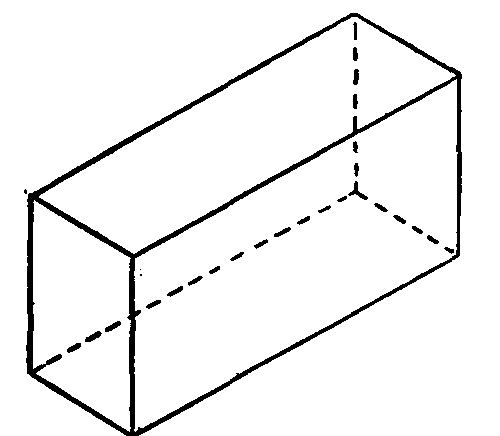
Isometric projection of a Brick 8¾ × 4¼ × 2¾
Plan and Elevation of a Square Slab pierced by a square hole obtained by orthographic projection
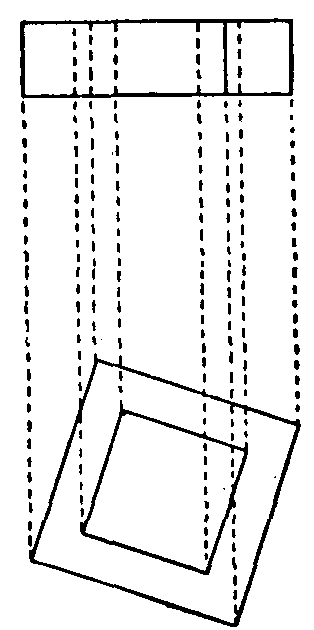
Three methods are commonly made use of in preparing drawings. (1) Orthographic, which represents the subject under consideration in one plane only, and from which dimensions may be scaled off, and which is the normal method of preparing an engineering drawing. (2) Perspective or radial projection is made use of by an architect for displaying the elevations of a building, and gives a truer appreciation of the actual appearance of the building than can be obtained by orthographic projection. (3) Isometric projection enables one to show the length, breadth, and thickness of an object drawn to scale on the one drawing. Such a drawing is really composed of three sets of parallel straight lines, and is not strictly a true representation of the object as it would appear to the eye. It has the great advantage, however, that measurements may be directly scaled from it, and lines which are parallel in the object are also parallel in the drawing.
Drayton, Michael, an English poet, born in 1563, is said to have studied at Oxford, and afterwards held a commission in the army. The poem by which his name is chiefly remembered is his Polyolbion (1622, reprinted in 1890), a sort of topographical description of England. It is generally extremely accurate in its details, with, at the same time, many passages of true poetic fire and beauty. Other works are his Nymphidia, the Court of Fairy; The Barons' Wars; The Legend of Great Cromwell; The Battle of Agincourt; besides numerous legends, sonnets, and other pieces. He died in 1631, and was buried in Westminster Abbey.—Cf. O. Elton, Michael Drayton: a Critical Study.
Drayton, Market, or Drayton-in-Hales, a town, England, county Salop, 18 miles northeast of Shrewsbury. It has a church, supposed to have been erected, with exception of the steeple, in the reign of William I. There are paper and hair-cloth manufactories. Pop. 5167.
Dreams, trains of ideas which present themselves to the mind during sleep. The principal feature of the state of dreaming is the absence of conscious control over the current of thought, so that all kinds of fantastic notions, which in the waking state would at once be put aside, are woven into the texture of the dream. The usual content of dreams consists of aspirations or dreads, which the dreamer had recently entertained or experienced, mixed up with incidents which excited intense emotion at some earlier period of the individual's history, and especially in early childhood. The memory of unpleasant experiences, such, for example, as the horrors of trench warfare, which is repressed in the waking state, tends to force itself on the individual's attention when the conscious control is relaxed in sleep, and to give rise to disturbing dreams which may become so intense as to interfere with sleep and cause insomnia. The only rational remedy for this distressing trouble is to discover the painful incident and persuade the patient frankly to face it and not 'try to forget'. In recent years S. Freud has placed the study of dreams upon a scientific basis. He maintains that dreams represent the fulfilment of wishes. There is usually an utter want of coherency in the images that appear before the mental eye, but this excites no surprise in the dreamer. Occasionally, however, intellectual efforts are made during sleep which would be difficult to surpass in the waking state. It is said that Condillac often brought to a conclusion in his dreams reasonings on which he had been employed during the day; and that Franklin believed that he had been often instructed in his dreams concerning the issue of events which at that time occupied his mind. Coleridge composed from 200 to 300 lines during a dream: the beautiful fragment of Kubla Khan, which was all he was able to commit to paper when he awoke, remains a specimen of that dream-poem. Dreams are subjective phenomena dependent on natural causes. They are retrospective and resultant instead of being prospective or prophetic. The latter opinion has, however, prevailed in all ages and among all nations; and hence the common practice of divination or prophesying by dreams, that is, interpreting them as presages of coming events. Some authorities declare that all our dreams take place when we are in process of going to sleep or becoming awake, and that during deep sleep the mind is totally inactive. This is denied by the majority of philosophers, and with apparent reason.—Bibliography: Havelock Ellis, The World of Dreams; S. Freud, The Interpretation of Dreams; W. H. R. Rivers, Instinct and the Unconscious.
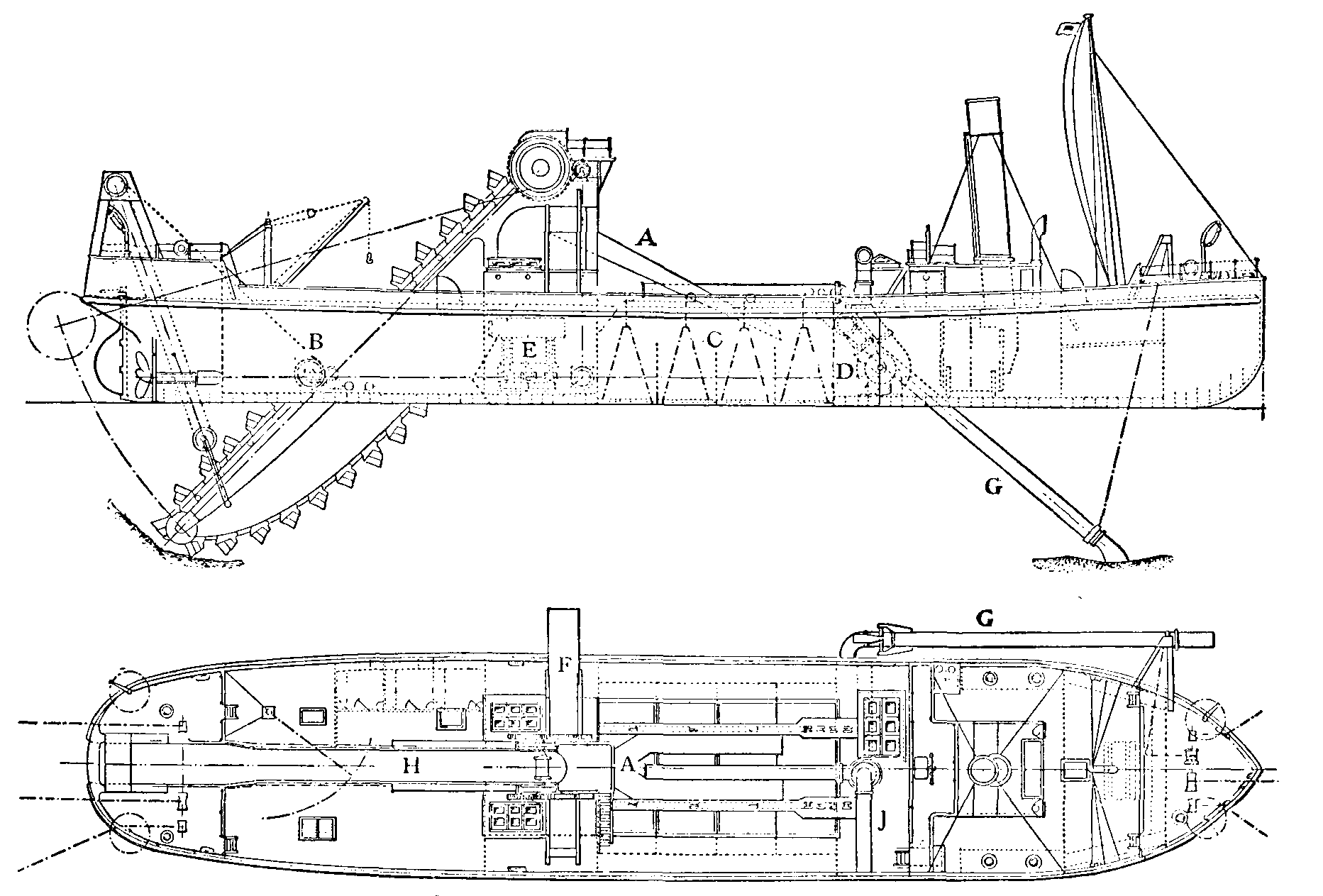
Plan and Elevation of an 800-ton Dredger
A, Shoot. B, Hoist-gear. C, Hopper. D, Sand-pump and its engines. E, Engines. F, Overboard shoot. G, Suction-pipe. H, Bucket-well. J, Overboard discharge.
Dredging, a term applied to the operation of removing mud, silt, and other deposits from the bottom of harbours, canals, rivers, docks, &c. The most simple dredging apparatus is the spoon apparatus, which consists of a strong iron ring or hoop, properly formed for making an impression upon the soft matter at the bottom, so as to scoop it into a large leather bag attached to the ring and perforated with a number of small holes. The means for working it is a long handle, a suspending rope, and a crane or sweep-pole planted in a boat. Much more effective is the steam dredging-machine now in common use. It has a succession of strong iron buckets on an endless chain, which travels on a frame whose lower end is vertically adjustable so as to regulate the depth at which it works. It is worked by steam, and the buckets tear up the matter at the bottom, raise it, and discharge it into punts or hoppers close to the dredging vessel. Various forms of steam-pump dredgers, in which suction-pipes are the chief features, are also used. The River Clyde, from being a shallow stream, has been converted, mainly by dredging, into a waterway carrying large vessels up to Glasgow. Dredging rivers for gold is now largely carried on; and the gold-dredge may even be floated in water artificially supplied. The operation of dragging the bottom of the sea for molluscs, plants, and other objects, usually for scientific observation, is also called dredging. The oyster-dredge is a light iron frame with a scraper like a narrow hoe on one side, and a bag attached to receive the oysters. The dredges used by naturalists are mostly modifications of or somewhat similar to the oyster-dredge. Scientific dredging has of late assumed great importance as making us acquainted with the life of deep-sea areas.
Dreisenssia, a genus of bivalve mollusc allied to the mussels. One species (D. polymorpha) is a native of the streams which flow into the Caspian, but has been accidentally introduced into most rivers and estuaries of Europe, including those of Britain, where it is now abundant.
Drelincourt (drė-lan˙-kör), Charles, a French Calvinistic minister, born at Sedan 1595, died at Paris 1669. He was the author of many controversial works, and of Consolations against the fear of Death. To promote the sale of the English translation of this work, De Foe wrote his Apparition of Mrs. Veal.
Drenthe (dren´te), a province of Holland, bounded by Hanover, Overijssel, Friesland, and Groningen; area, 948 sq. miles. It is in general more elevated than the surrounding provinces, especially in the centre. The soil is generally poor, and the surface largely consists of heath and morass, but the province is famed for its horses and cattle. Drenthe is remarkable for the great number of so-called 'giants' graves' or barrows scattered over the country. Its capital is Assen. Pop. 200,951.
Dres´den, the capital of the Republic (former kingdom) of Saxony, is situated in a beautiful valley on both sides of the River Elbe, which is here spanned by four stone bridges and an iron railway bridge. It is first mentioned in history in 1206, and has been the residence of the sovereigns since 1485; was greatly extended and embellished by Augustus the Strong (1694-1736), and rapidly increased during the nineteenth century. Among the chief sights are the museum (joined on to an older range of buildings called the Zwinger), a beautiful building containing a famous picture-gallery and other treasures; the Japanese palace (Augusteum), containing the royal library (founded by the Elector Augustus in the sixteenth century) of 570,000 volumes, besides a rich collection of manuscripts; the Johanneum, containing the collection of porcelain and the historical museum, a valuable collection of arms, armour, and domestic utensils, belonging to the Middle Ages. The palace, built about 1530, restored and remodelled externally between 1890 and 1902, and until 1918 the residence of the kings of Saxony, has also a fine interior, and contains (in what is called the Green Vault) a valuable collection of curiosities, jewels, trinkets, and works of art. The theatre is one of the finest structures of the kind in the world. The city is distinguished for its excellent educational, literary, and artistic institutions, among which are the Technical High School, much on the plan and scale of a university; the Conservatory and School of Music; and the Academy of Fine Arts. The manufactures are not unimportant, and are various in character; the china, however, for which the city is famed, is made chiefly at Meissen, 14 miles distant. The commerce is considerable, and has greatly increased since the development of the railway system. The chief glory of Dresden is the gallery of pictures, one of the finest in the world, which first became of importance under Augustus II, King of Poland and Elector of Saxony, but owes its most valuable treasures to Augustus III, who purchased the greater portion of the gallery of the Duke of Modena for £180,000. The pictures number about 3000, and in particular comprise many fine specimens of the Italian, Dutch, and Flemish schools. Besides this fine collection the museum contains also engravings and drawings amounting to upwards of 350,000. There is also a sculpture-gallery, the Albertinum, where by casts and otherwise the progress of sculpture is exemplified from the earliest times, all the most important antiques being shown. Dresden, being thus rich in treasures of art and favoured by a beautiful natural situation, is the summer resort of many foreigners. It suffered severely in the Thirty Years' War, and also in 1813, when it was the head-quarters of Napoleon's army. It was occupied by the Prussians in 1866, but was evacuated in the following spring. Pop. 548,308.
Dresden, Battle of, a battle fought in 1813 (26-27th Aug.), between the French under Napoleon and the Allies under Schwarzenberg. Napoleon had come to the relief of the city, which was occupied by the French. The Allies assaulted and bombarded the city, and soon after a great pitched battle was fought (27th Aug.), the Allies being defeated.
Dresden China. Candelabrum
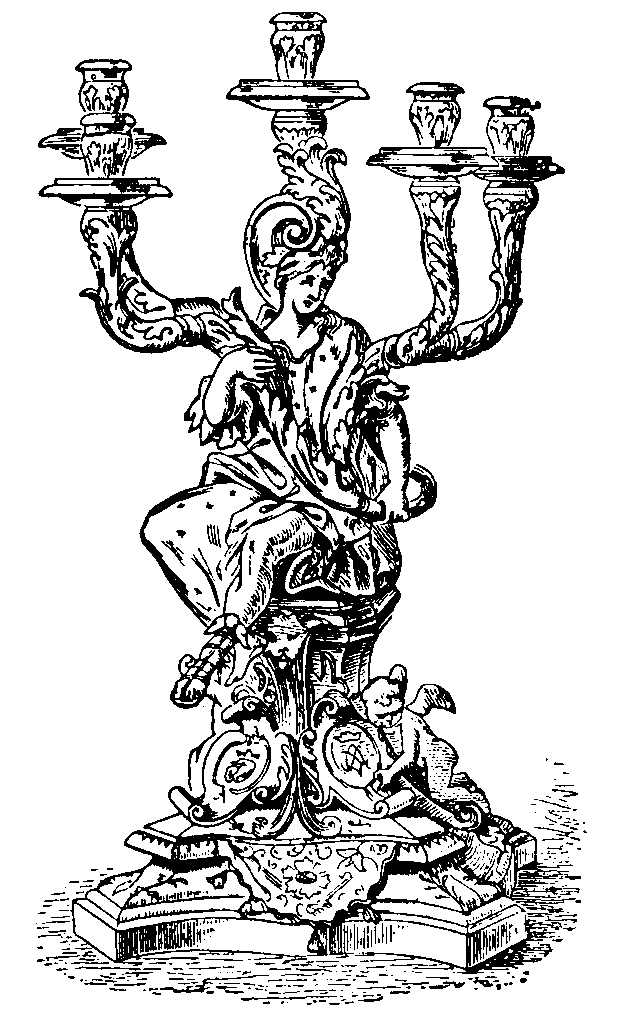
Dresden China, a delicate, semi-transparent, highly finished china made at Meissen, 14 miles from Dresden. The manufacture resulted from an accidental discovery made by Böttger, a young chemist, in 1710, and the vases, statuettes, groups of figures, candelabra, and clocks, manufactured during the eighteenth century are highly prized.
Dreux (dreu; Durocassis or Drocæ of the Romans), a French town, department of Eure-et-Loir, on the Blaise, near to where it joins the Eure, 20 miles N.N.W. of Chartres. It is built at the foot of a hill crowned by a dilapidated castle, which contains a chapel, founded in 1142; to which has been added the costly mausoleum of the Orleans family. A battle took place near the town in 1562 between the Royalists under Montmorency and the Huguenots under Condé, in which the latter were defeated. Pop. 10,692.
Dreyfus, Alfred, captain of artillery and general staff-officer in the French army, was born of a Jewish family in Mulhouse, Alsace, in 1859. In Oct., 1894, he was arrested on a charge of communicating military documents to a foreign Government, supposed to be Germany; and at a secret court-martial, which sat in December, he was condemned to public degradation and lifelong imprisonment. Early in 1895 he was sent to the Île du Diable (Devil's Island), near Cayenne, to undergo his sentence. About the middle of the same year Colonel Picquart became head of the Intelligence Department, and in the course of his official duties discovered various circumstances tending to throw doubt on the correctness of the court-martial's decision, and pointing to another officer, of the name of Esterhazy, as the real traitor. Picquart was superseded by a Colonel Henry in Nov., 1897, and in the following January Esterhazy, charged by a brother of the condemned man with having written the bordereau, or memorandum, which was the chief document relied on by the prosecutors of Dreyfus, was acquitted by a court-martial. Two days later M. Zola, the eminent novelist, in a letter headed J'accuse published in the Aurore, made serious charges against the general staff and the Government in connection with the Esterhazy court-martial. He was prosecuted, and condemned to pay a heavy fine and undergo a term of imprisonment. In June, 1898, M. Brisson succeeded M. Méline as Prime Minister, and next month M. Cavaignac, his War Minister, read to the Chamber several documents which he regarded as conclusive proof of the guilt of Dreyfus. The chief of these was soon admitted by Colonel Henry to have been forged by him, and M. Cavaignac at once resigned. In June, 1899, the Cour de Cassation ordered a fresh court-martial. The court-martial, which sat at Rennes, found Dreyfus guilty with extenuating circumstances. He was sentenced to ten years' imprisonment, but was pardoned by President Loubet almost immediately. In 1906, when Clemenceau was Prime Minister, the sentence was annulled, and Dreyfus was reinstated in the army (as major). He was shot at by a reactionary journalist in 1908, but escaped without serious injury. In Sept., 1919, Lieutenant-Colonel Dreyfus was publicly presented with the insignia of an officer of the Legion of Honour. Several times during the progress of the case France seemed on the verge of revolution.—Cf. J. Reinach, Histoire de l'affaire Dreyfus.
Driffield, Great, a town, England, Yorkshire, at the head of a navigable canal communicating with the Humber at Hull. It lies in a fertile district, has an ancient parish church, and manufactures linseed-cake and manures. Pop. 5676.
Drift, in geology, a term applied to earth and rocks which have been conveyed by flood-action, glaciers, or floating ice and deposited over the surface of a country. It is sometimes used in a wider sense to denote all post-Pliocene sands, gravels, and clays, such as the superficial deposits shown on the 'drift' maps of the Geological Survey.
Drift, in mining, a horizontal tunnel or passage excavated underground that follows the course of a vein or stratum. Drift, in musketry, is the lateral deviation of the bullet after it has left the barrel of the rifle; it is due to the spin of the bullet and the resistance of the air.
Drift Sand, sand thrown up by the waves of the sea, and blown when dry some distance inland until arrested by obstacles, round which it gradually accumulates until the heaps attain considerable dimensions, often forming dunes or sand-hills. Coast-land sometimes requires artificial protection from encroachment by drift-sand.
Drill, a tool used for boring holes in wood, metal, stone, ivory, &c. It consists of a sharp spindle to which a circular motion is communicated by various contrivances. Drills are of various designs. For rock-boring the diamond rock-drill, an instrument with cutting edges made of bort or black diamond, is now generally adopted. See Boring.—Cf. Dana and Saunders, Rock Drilling.
Drill is the A B C of all military movements. In the Training Manuals of the British army the word is defined as "the training of the soldier to perform certain movements as a second nature". It follows, therefore, that drill is an essential part of the training of every soldier, more especially in the early days of his training, in that without it, and without the power of movement in obedience to the expressed will of a superior given by it, a body of soldiers would be merely a collection of armed men who, however willing individually, would be incapable of carrying out collectively an order given for the general good. In the early days of our history, when fighting was largely individual, and the whole duty of a soldier was 'to do unto the other fellow as he would do unto you—and do it first' (with a club), drill, as we know it, was unknown; each man armed himself as he thought fit, and, beyond getting into some formation for the actual purpose of the assault, a battle was largely a go-as-you-please affair. In Saxon days the normal formation for the battle was the wedge; that is two men at the point followed by three, and so on till the available number was used up. This, of course, formed a solid pointed mass with considerable weight, and was used both for attack and defence. But once this formation was broken it was next to impossible to reform it. An instance of this weakness occurred at the battle of Hastings. The English were in this one and only wedge formation, officers and the better armed men at the point, and the less skilful and more indifferently armed at the base. Doubtless the troops had been got into this formation after much exertion in the way of pushing and vituperation, and, once in it, had been told on no account to break it. At a certain stage in the battle the heavily armoured Normans pretended flight; this was too much for the English, who broke their ranks and gave chase, each after his own particular source of ransom. This ended the battle; the Normans turned, and, owing to the entire inability of the English to re-form their ranks, the wedge, and with it the English army, ceased to exist: the result of want of discipline and absence of drill.
Drill and discipline are complementary to each other. In one of the battles of the Peninsular War, the 28th (now the Gloucestershire Regiment) were being hotly attacked in front by a French column. The regiment was firing in two ranks—the front rank kneeling and the rear rank standing—when suddenly a fresh attack developed from the rear. It was a matter of seconds for the commanding officer of the 28th to order the rear rank to turn about; drill and discipline did the rest, and the rear rank turned round, knelt down, and beat off the new attack. Since then the 28th has worn its badges both front and rear of its head-dresses.
Drill is an aid to discipline in that it teaches men that there is a right and a wrong way of doing a thing. Drill and the spirit arising from it has a great steadying effect on the nerves, as when in the European War the Guards Division, after being almost decimated during a German 'push', was brought out of the line and kept to steady drill for a week. To those who did not understand this appeared harsh and futile; to those who did it appeared, as it was, the best means of steadying men tried beyond endurance, and of preparing them for further efforts. Our English drill has passed through many phases in its time; but from the days when large bodies of men performed complicated manœuvres at the executive command of one man, through the times when drill, perhaps, was considered to be the be-all and end-all of the soldier, to modern days when it is recognized as a means to an end, the guiding principle remains the same, viz. that one of the first essentials for a soldier is that he shall be so trained by drill that he shall know instinctively how to do the right thing at the right time and in the right way. Even now, when drill movements are no longer performed in face of an enemy, accuracy and attention to detail are insisted on in all parade-ground movements as part of the education of the soldier and as an aid to discipline. Drill for the soldier takes the place of the five-finger exercises for the musician. Neither of them, in itself, is of any particular value, but each adds to the efficiency of those who practise it.
Drill (Papio leucophæus), a large variety of baboon, smaller and less fierce than the mandrill, and like it a native of the coast of Guinea. The face and ears are bare and of a glossy black colour, the palms of the hands and soles of the feet are also naked and of a deep copper colour.
Drilling, the plan of sowing in parallel rows as distinguished from sowing broadcast. It was introduced into England by Jethro Tull, who invented the first implement for drilling, and published a work on the subject in 1731. The crops which are now generally drilled are turnips and flax. The first form of drill was of very simple construction, and was only adapted for potatoes, beans, peas, carrots, clover, cereals, sowing one row at a time, but now a great variety of improved implements is in use, some of which distribute artificial manure with the seed. Among the principal advantages of drilling over broadcast sowing we may mention that a considerable saving of seed is effected in the sowing of grain crops, but the great advantage is that in the case of green crops it enables the farmer more readily to clean the land both by the hand- and by the horse-hoe. To keep the soil stirred and pulverized, which can only be properly done when the crops have been drilled, favours the retention and absorption of the moisture.
Dripstone over window, decorated Gothic, mixed tracery. Two different forms of termination.
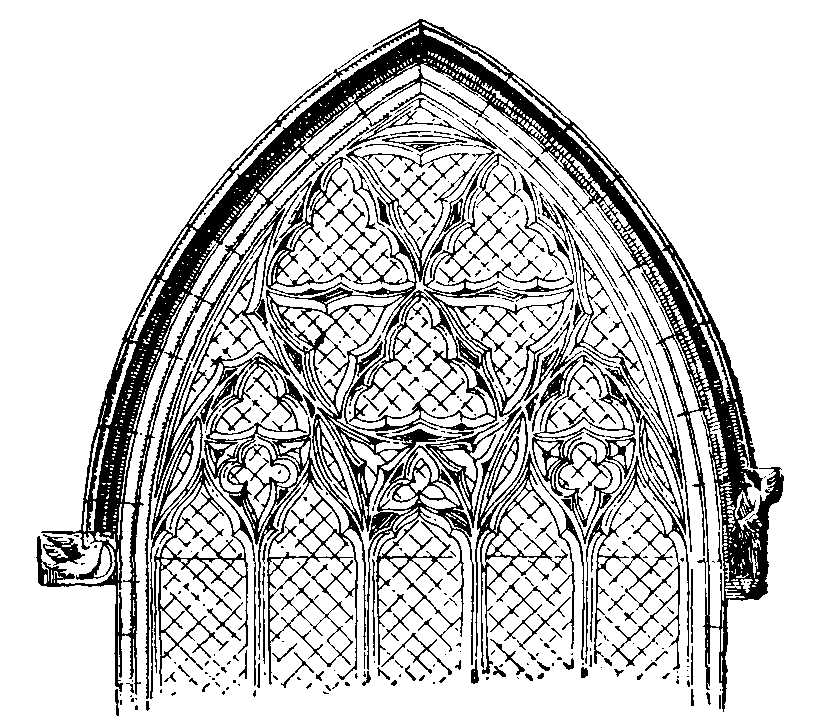
Dripstone, a projecting tablet or moulding over the head of a Gothic doorway, window, archway, or niche to throw off the rain. It is also called a weather moulding, and label when it is turned square. It is of various forms; sometimes a head is used as a termination or support, in others an ornament or simple moulding is adopted.
Driver, Rev. Samuel Rolles, D.D., professor of Hebrew and Biblical critic, born at Southampton 2nd Oct., 1846, died in 1914. He was educated at Winchester and at New College, Oxford, where he graduated with first-class honours in classics in 1869. In 1866 he gained the Pusey and Ellerton Hebrew Scholarship, and the Kennicott Scholarship (also for Hebrew) four years later, besides prizes for Septuagint Greek and Syriac. He was for some years a fellow and tutor of his college, and from 1876 to 1884 a member of the Old Testament Revision Committee. In 1883, on the death of Dr. Pusey, he became Regius professor of Hebrew at Oxford and (ipso facto) a Canon of Christ Church. Of his numerous works we may mention: A Treatise on the Use of the Tenses in Hebrew (1874); Isaiah: his Life and Times (1888); Introduction to the Literature of the Old Testament (1891), a work suited for popular reading, which has passed through many editions; Sermons on Subjects connected with the Old Testament (1892); The Parallel Psalter (1904); Commentaries on various books of the Bible; and articles in Bible Dictionaries and in periodicals. He was a joint editor of the new Hebrew-English Lexicon of the Old Testament published by the Clarendon Press.
Drogheda (droh´e-da), an ancient town and seaport, formerly a parliamentary borough, Ireland, in the county of Louth, on both sides of the Boyne, about 4 miles from the sea, 26 miles north of Dublin. The Boyne is here crossed by a railway viaduct of 18 arches and 95 feet high. Flax- and cotton-spinning are carried on; there are also salt-works, breweries, and tanneries; and the fisheries are increasing. There is a good export trade in cattle, sheep, grain, butter, and eggs. In 1412 a Parliament assembled here which enacted Poynings' Law. The town was for a long time strongly fortified, and was taken by Cromwell with great slaughter in 1649; it surrendered to William III immediately after the battle of the Boyne. Pop. 12,500.
Drohobycz (dro´ho-bich), a Polish town in Galicia, formerly belonging to Austria, 41 miles S.S.W. of Lemberg. Its Catholic church is one of the handsomest in the country. It has an important trade, particularly in salt, obtained from springs in the vicinity. Pop. 40,000.
Droit d'Aubaine (drwä-dō-bān), an old rule in some European countries, by which the property of a foreigner who died was claimed by the State, unless the person had a special exemption. In France, where it was not abolished till 1819, the Scots, Savoyards, Swiss, and Portuguese were exempted.
Droitwich (droit´ich), a town of England, in the county and 6 miles N.N.E. of Worcester, on the Salwarp. It is famous for its brine springs, from which salt has been manufactured for more than 1000 years. Pop. 4146.
Drôme, a south-east department of France, covered almost throughout by ramifications of the Alps, the average height of which, however, does not exceed 4000 feet; area, 2508 sq. miles, of which about one-fourth is waste, one-third under wood, and a great part of the remainder under tillage and pasture. A considerable extent of the area is occupied by vineyards, and several of the wines produced have a high reputation, especially Hermitage. Olives, chestnuts, and silks are staple productions. Valence is the capital. Pop. 263,509.
Dromedary. See Camel.
Dromore´, an episcopal city, Ireland, County Down, on the Lagan, here crossed by two bridges, 16 miles south-west of Belfast. Its cathedral contains the tomb of Jeremy Taylor. Pop. 2307.
Dropsy (Œdema) is a condition usually marked by enlargement and swelling of the affected parts, and due to an accumulation of serous fluid in the tissue spaces and cavities of the body. Different names are given to such accumulations in particular areas, thus anasarca refers to accumulations in the limbs and body generally; ascites to an accumulation of fluid in the peritoneal cavity (abdomen); hydrothorax to an accumulation in the pleural cavity (lungs); hydrocephalus to an accumulation in the brain. The commonest cause of dropsy is heart disease, where first the lower limbs, and then the trunk, are affected. It also appears in diseases of the kidneys and liver, and it may be produced in a limb by any obstruction of the veins of the part.
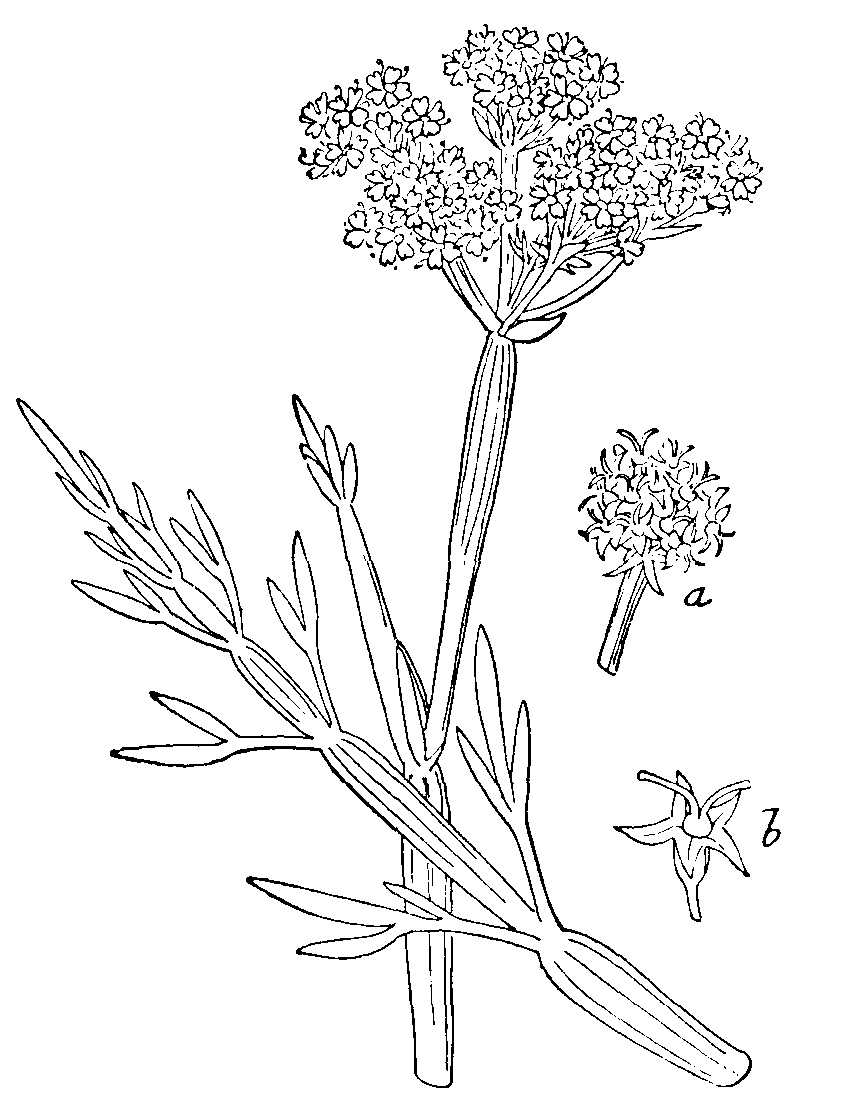
Common Water Drop-wort (
Œnanthe fistulōsa
)
a, Cluster of florets. b, Single floret.
Drop-wort (from the small tubers on the fibrous roots), Spiræa filipendŭla, nat. ord. Rosaceæ, a British plant of the same genus as queen-of-the-meadow, found in dry pastures. The hemlock drop-wort, or water drop-wort, is Œnanthe fistulōsa.
Drosera´ceæ, a nat. ord. of polypetalous Dicotyledons, consisting of insectivorous marsh herbs, whose leaves are usually covered with glands or glandular hairs. It contains six genera, including the sundew (Drosĕra), and Venus's fly-trap (Dionæa). (See Sundew and Dionæa.) They have no known qualities except that they are slightly bitter. The leaves are generally circinate in the bud, as in ferns.
Russian Droshky
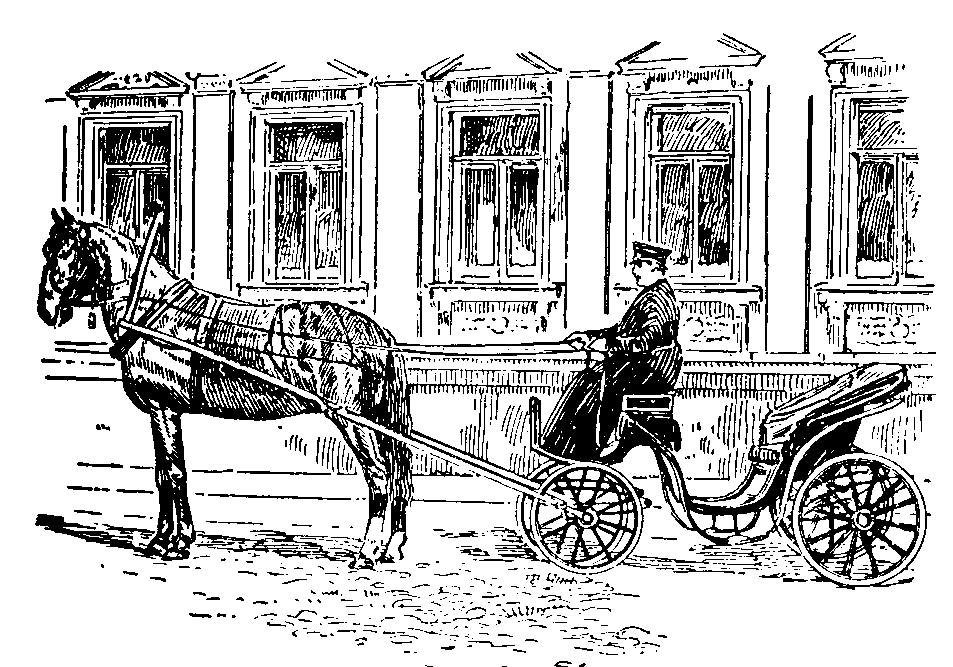
Droshky, a kind of light, four-wheeled carriage used by the Russians. It is not covered, and in some types there is in the middle a sort of bench placed lengthways on which the passengers ride as on a saddle; but the name is now applied to various kinds of vehicles, as to the common cabs plying in the streets of German cities.
Drouais (drö-ā), Jean Germain, French historical painter of considerable repute, born at Paris in 1763, died at Rome 1788. His chief pictures are: The Canaanitish Woman at the Feet of Jesus, Dying Gladiator, and Marius at Minturno.
Drouet (drö-ā), Jean Baptiste, Comte d'Erlon, French general, born 1765, died 1844. He served in the campaigns of the Moselle, Meuse, and Sambre (1793-6), in the Peninsula, and at Waterloo, where he commanded the first corps d'armée. In 1834-5 he was Governor-General of Algeria, and in 1843 was made a marshal.
Drouyn de Lhuys (drö-an˙ dė lwēs), Édouard, French statesman and diplomatist, born 1805, died 1881. He entered the diplomatic service in 1831, and was chargé d'affaires at the Hague during the events which led to the separation of Belgium from Holland. In 1840 he was head of the commercial department under the Minister of Foreign Affairs. Opposition to Guizot caused his dismissal in 1845. He became Minister for Foreign Affairs in 1848, Ambassador to London in 1849; and again Foreign Minister in 1851, and in 1863. On the fall of the empire he fled to Jersey, but subsequently returned to France.
Drowning means death by the air being prevented from entering the lungs owing to the mouth and nostrils being immersed in a liquid, the liquid being commonly water. Death may, therefore, occur by drowning in a small quantity of water. Thus a child may fall head downwards into a tub and be drowned, though the tub is not half full of water, sufficient to cover the mouth and nostrils being all that is necessary, and a man overcome by a fit or by drunkenness may fall on a road with his head in a ditch or pool of water, and thus meet death. Death is thus due to suffocation, to the stoppage of breathing, and to the entrance of water into the lungs. When death has been caused by drowning, the skin presents the appearance called goose-skin (cutis anserīna), the face and surface of the body generally are usually pale, a frothy liquid is found in the lungs and air-passages, and about the lips and nostrils; water may be found in the stomach, and clenched fingers, holding substances grasped at, may serve to show that a struggle has taken place in the water, and that the body was alive at the time of immersion. Complete insensibility arises, it is probable, in from one or two minutes after submersion, recovery, however, being still possible, and death occurs in from two to five minutes. So long as the heart continues to beat, recovery is possible; after it has ceased it is impossible. Newly-born children and young puppies stand submersion longer than the more fully grown.
For the restoration of the apparently drowned several methods are suggested. Those of Dr. Silvester, recommended by the English Humane Society, and Dr. Benjamin Howard, of New York, will be described.
Whichever method is adopted, the following steps must first and immediately be taken: Pull the body up on to dry ground. Send immediately for medical assistance, warm blankets, dry clothing, brandy and hot water, if any one is at hand to send. No delay must be permitted, however, in treating the drowned, so that if only one person is on the spot he must begin to treat the victim instantly, without seeking assistance. Remove all clothing from the neck and chest. Fold the articles of dress removed so as to make a firm pillow, which is to be placed under the shoulders, so that the upper part of the body is slightly raised and the head slightly thrown back. Cleanse the mouth and nostrils, open the mouth and pull forward the tongue. If natural efforts to breathe are made, try to stimulate them by brisk rubbing of the sides of the chest and of the face. If no effort to breathe is made, proceed to produce the entrance and outflow of air from the lungs by Silvester's or Howard's method.