Volume 4 — VOLUME IV (continued 3)
Reading edition
Diphthong (Gr. di-, double, and phthongos, sound), a coalition or union of two vowels pronounced in one syllable. In uttering a proper diphthong both vowels are pronounced; the sound is not simple, but the two sounds are so blended as to be considered as forming one syllable, as in void, bough. The term improper diphthong is applied to the union in one syllable of two or more vowels of which only one is sounded, as in bean.
Di´phyodont, a term applied to those animals which develop two sets of teeth, a deciduous or milk set, and a permanent set—as distinct from the monophyodonts, which develop only one set. The majority of mammals are diphyodont, though the number of teeth replaced may vary: thus in man twenty teeth of the adult are preceded by a milk set.
Diplacan´thus, a genus of ganoid fishes, found only in the Old Red Sandstone. They have small scales, a heterocercal tail, and two dorsal fins with a strong spine in front.
Diplei´doscope, an instrument for indicating the passage of the sun or a star over the meridian, by the coincidence of two images of the object, the one formed by single and the other by double reflection. It consists of an equilateral hollow prism, two of whose sides are silvered on the inside so as to be mirrors, while the third is formed of glass. The prism is adjusted so that one of the silvered sides shall be exactly in the plane of the meridian, and the transparent side towards the object.
Diploid Phase, in botany. See Generations, Alternation of.
Diplo´ma (Gr. diplōma, from diploō, to double or fold), literally a document folded but once, and therefore divided into two parts. It is used to signify a document signed and sealed, in which certain rights, privileges, or dignities are conferred, especially a university degree.
Diplo´macy, the science or art of foreign politics. In a more restricted sense the term denotes the science or art of conducting negotiations and arranging treaties between states and nations; the branch of knowledge which deals with the relations of independent states to one another; the agency or management of envoys accredited to a foreign court; the forms of international negotiations. The word, borrowed from the French, was first used in England in 1796 by Burke. The Cardinal de Richelieu is generally considered as the founder of that regular and uninterrupted intercourse between Governments which exists at present between almost all the Christian powers; though the instructions given by Machiavelli to one of his friends, who was sent by the Florentine Republic to Charles V (Charles I of Spain) show that Richelieu was not the first to conceive the advantages that might be derived from the correspondence of an intelligent agent accredited at the seat of a foreign Government. As a uniform system, however, with a fixed international status, diplomacy was only established in the nineteenth century at the Congresses of Vienna (1815) and Aix-la-Chapelle (1818). Amongst the European powers it is agreed that of ministers of the same rank he who arrives first shall have the precedence over his colleagues.—Bibliography: D. J. Hill, History of Diplomacy in the International Development of Europe; E. C. Grenville-Murray, Embassies and Foreign Courts: a History of Diplomacy; P. Pradier-Fodéré, Cours de droit diplomatique; L. Oppenheim, International Law; D. P. Heatley, Diplomacy and the Study of International Relations.
Diplomat´ics, originally the science of deciphering ancient MSS. It laid down certain principles for the systematic examination of public documents, and taught the forms and styles adopted in them, and the titles and rank of public officers subscribing them. Among the earliest exponents of diplomatics were Daniel van Papenbroeck, an Antwerp Jesuit (1675), and Mabillon (De Re Diplomatica, 1681).
Diplomatic Service, The, as now existing, may be said to have originated in the Venetian Republic, which employed ambassadors as early as the thirteenth century. At first these officials had a very brief term of office, rarely remaining at their post in a foreign country for more than two or three months. By the middle of the fifteenth century, however, a permanent Milanese embassy had been established at Genoa, followed by one at Paris in 1494; while two years later Venice was officially represented at London. The clergy, who for the most part alone possessed the requisite accomplishments for such work, were the usual ambassadors of the Middle Ages; but by the sixteenth century lawyers, or not seldom merchants, were employed. It was not till two hundred years later that the modern attachés, junior officials of an embassy, came into being. The diplomatic service of Great Britain, controlled by the Foreign Office, includes (1) ambassadors, and (2) envoys and ministers plenipotentiary, both of which ranks represent the person of their sovereign and enjoy numerous special privileges in the country to which they are sent. Of lower standing are (3) ministers resident and (4) chargés d'affaires; the last-named are accredited, not to a sovereign, but to his foreign minister, and frequently act merely as temporary substitutes for an ambassador. Secretaries of more than one grade, with naval, military, and, of late years, commercial attachés, also form members of an embassy. Candidates for the British diplomatic service require a nomination from the Foreign Secretary, must be between the ages of nineteen and twenty-five, are subjected to an examination, and are almost invariably young men of good birth and position. The service is distinguished and affords a pleasant, if to some extent an idle life; but it does not offer any prospect of financial fortune. Lord Stratford de Redcliffe (the 'Great Elchi') and Lord Lyons rank high among distinguished British ambassadors. See Civil Service.
Diplozo´on, a parasitic trematode worm which infests the gills of the bream, and which appears to be formed of two distinct bodies united in the middle, and resembling an or St. Andrew's cross, two sexually mature individuals being thus united.

Dip´noi, mud-fishes or lung-fishes, an ancient order now represented by three genera—Neoceratodus, Protopterus, and Lepidosiren. Like some adult Amphibia they possess both gills and lungs, the latter corresponding to a specialized swim-bladder. The heart has two auricles instead of one only, as in all other fishes. The single species of Neoceratodus (N. forsteri) is a large form with paddle-like fins and large overlapping cycloid scales. It is native to the Burnett and Mary Rivers of Queensland. Protopterus is represented by three African species, which inhabit rivers and swamps from the Senegal to the Zambezi. It is smaller than Neoceratodus, somewhat eel-shaped, with very narrow fins, and small cycloid scales embedded in the skin. It spends the summer in a torpid condition, buried in the mud, and is dug up by the natives as an article of food. Lepidosiren includes a single South American species (L. paradoxa) ranging from the Amazon to Paraguay. It is closely related to Protopterus, which it resembles in shape and the character of the fins.
Dippel, Johann Conrad, German theologian and alchemist, born 1672, died 1734. He studied theology, defended the orthodox party against the Pietists, led a turbulent life at Strasbourg, and then joined the Pietists until an unfortunate tractate placed him in disfavour with both parties. He then turned his attention to alchemy, and during a residence at Berlin produced the oil called after him, from which indirectly followed the discovery of Prussian or Berlin blue. After various adventures and wanderings in Sweden, Denmark, and Germany, he died at Berleburg.
Dippel's Oil, a pharmaceutical preparation obtained by the destructive distillation of animal matter, such as horn, ivory, blood. The crude form was refined by Dippel, and at one time was a good deal used in medicine as a diaphoretic and hypnotic. It is a form of bone oil, a product obtained in the manufacture of bone-black, or animal charcoal, by the distillation of bones. Crude bone oil has a most offensive smell. It contains the carbonate and other salts of ammonium, and a large variety of organic substances.
Dipper (Cinclus aquaticus)
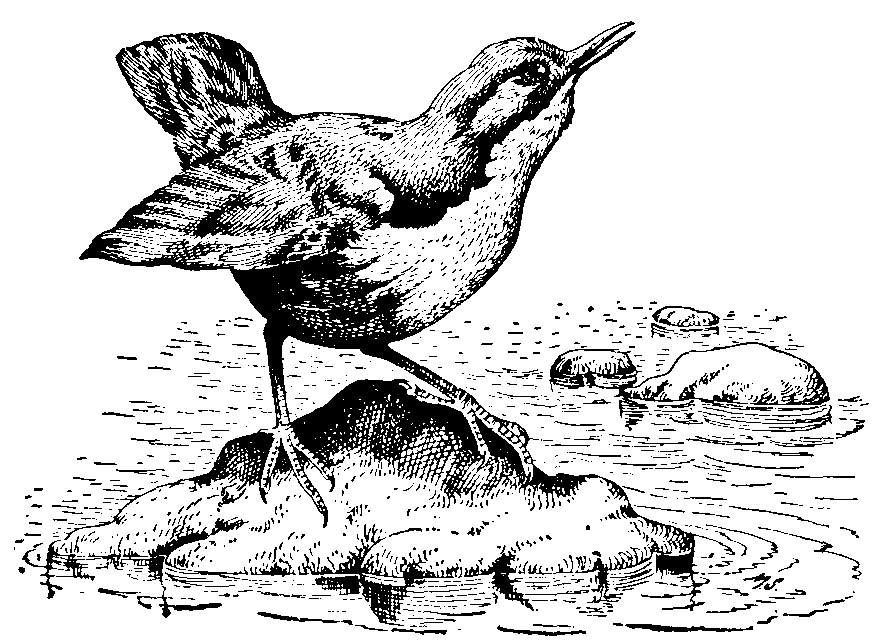
Dipper, a bird of the genus Cinclus, allied to the wrens. The common dipper, water-ouzel, or water-crow (Cinclus aquaticus), is a familiar European bird; it is about 7 inches in length, with a very short tail, small rounded wings, and large powerful feet; the bill is of moderate length, straight, and slender. The male has the upper part of the body dark brown, the throat and breast white, belly rusty. The dipper frequents streams, and feeds largely on water-insects and larvæ. It can dive and walk under water, effecting its progress by grasping the stones with its feet. The song is sweet and lively. Other species are found in North Asia, America, and North Africa.
Dipping-needle, or Inclination Compass, an instrument for showing the direction of the earth's magnetic force. In essentials the instrument consists of a light magnetized steel bar supported on a horizontal axis which passes, as nearly as possible, through the centre of inertia of the bar. When a needle thus mounted is placed anywhere not in the magnetic equator, it dips or points downward; and if the vertical plane, in which it moves, coincides with the magnetic meridian the position of the needle shows at once the direction of the magnetic force. The angle between the magnetic axis of the dipping-needle and the horizontal is called the dip or inclination. This varies from 90° at the magnetic poles to 0° at the magnetic equator. The dip is 70° at Glasgow, and varies slowly with the passage of time. In the northern hemisphere, the north-seeking pole of the dipping-needle dips downwards, the reverse being the case south of the magnetic equator.
Dipro´todon, a gigantic fossil marsupial from Pleistocene beds in Australia, allied to the kangaroos. The skull is 3 feet long.
Dipsas, a genus of tree-snakes of which the species are native to tropical South America. Some of the hinder teeth in the upper jaw are grooved for the conduction of poison, but this is not sufficiently deadly to be dangerous to human beings. The related genus Dipsadomorphus includes a number of Indian species.
Dipsoma´nia (Gr. dipsa, thirst, and mania, madness), a term used to denote an insane craving for intoxicating liquors, when occurring in a confirmed or habitual form. It is a form of acute alcoholism seen in persons with a strong hereditary tendency to drink. The only remedy appears to be seclusion, with enforced abstinence and healthy occupation. Homes for this purpose have been established in Britain under the Habitual Drunkards Act of 1879 and Inebriates Act of 1888. There are corresponding institutions in the United States.
Diptera—Diagram of a two-winged insect—a Daddy-long-legs. Appendages of left side omitted
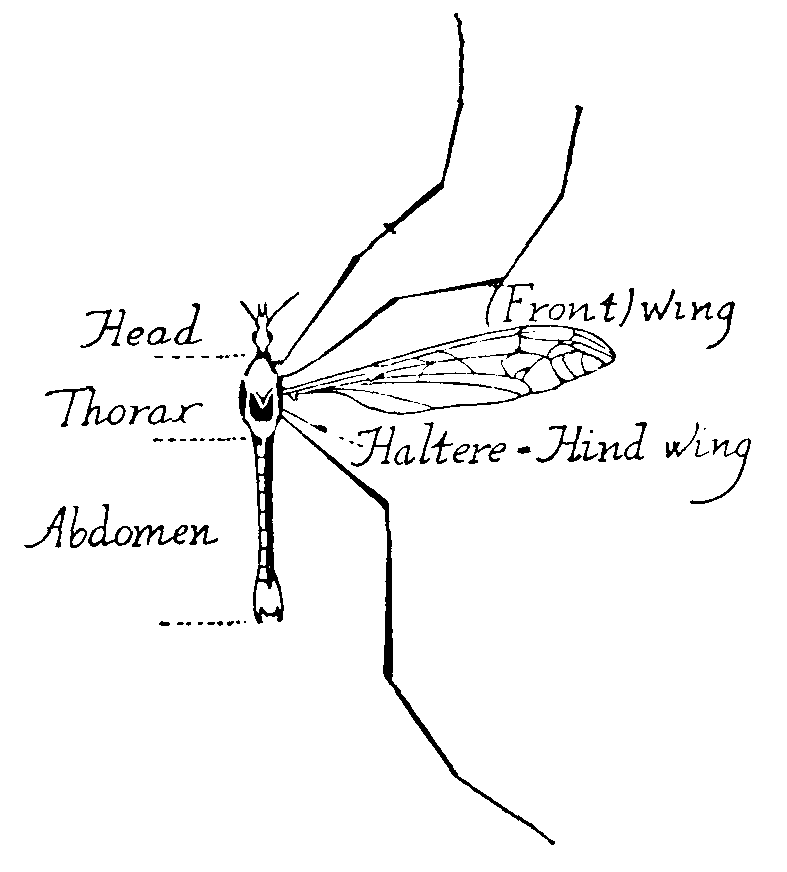
Dip´tera, two-winged flies, an order of insects embracing a vast number of species, of which about 40,000 have been named. The two transparent wings correspond to the fore-wings of other insects, the hind-wings being often represented by small club-shaped structures (halteres or balancers). See diagram, p. 42. There are two large compound eyes, and the mouth-parts are often modified for piercing and sucking. There is a well-marked metamorphosis, the larvæ being usually limbless maggots. The Diptera include many agricultural and horticultural pests, and a number are notorious as disease carriers. See Blow-fly; Bot-fly; Crane-fly; Gnat; House-fly; Hover-fly; Midge; Mosquito; Tsetse-fly.
Dipteris, a genus of Leptosporangiate ferns, section Mixtæ, formerly included in Polypodium, but now recognized as the sole living genus of the Dipteridineæ, a family which was largely developed in Mesozoic times. They are Indo-Malayan ferns with creeping rhizomes and long-stalked, fan-shaped, forked, leathery fronds.
Dipterocarpaceæ, an important order of Asiatic dicotyledonous trees, allied to the mallows (Malvaceæ). The different species produce a number of resinous, oily, and other substances; one, a sort of camphor; another, a fragrant resin used in temples; and others, varnishes; while some of the commonest produce pitches, and sal (Shorea robusta) yields valuable timber.
Diptych (dip´tik), in Greek originally signified the same as diploma, something folded; the double tablets of metal, ivory, &c., used by the Greeks and Romans. Diptychs became important in the Christian Church, in them being written the names of Popes, and other distinguished persons, who had deserved well of the Church, to be mentioned in the church prayers. Diptychs also often contained pictures of biblical scenes.—Cf. Sir W. Smith, A Dictionary of Greek and Roman Antiquities.
Dipyre (dī´pīr), or Mizzonite, a mineral—aluminium calcium sodium silicate—of the scapolite series. Its name indicates the double effect of fire upon it (Gr. di, double, pyr, fire) in producing first phosphorescence, and then fusion.
Diræ, one of the names under which the Eumenides were known to the Romans. See Furies.
Directors, persons elected to meet together at short fixed intervals and consult about the affairs of corporations or joint-stock companies, and to advise and assist the manager. These are termed Ordinary Directors, as in many companies there is a body called Extraordinary Directors, who have little or no business functions, and are chosen as a rule on account of their social position imparting a degree of distinction to the concern. Directors are appointed by a general meeting of the shareholders in the undertaking, and a certain number of them, usually a third, retire every year. Ordinary directors are granted a certain remuneration for their services. The duties and responsibilities of directors are defined by the constitution of the company, or by the various Acts of Parliament affecting joint-stock and other companies.
Direc´tory, the name given to a body of five officers to whom the executive authority in France was committed by the Constitution of the year III (1795). The two legislative bodies, called the councils, elected the members of the Directory: one member was obliged to retire yearly, and his place was supplied by election. This body was invested with the authority which, by the Constitution of 1791, had been granted to the king. By the Revolution of the 18th Brumaire the Directory and the Constitution of the year III were abolished. It was succeeded by the Consulate, with Napoleon as First Consul.
Directrix of a Parabola
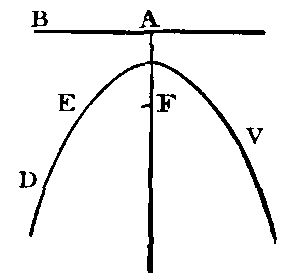
Direc´trix, a fixed line that is required for the description of a curve. The term is chiefly used in connection with the parabola, ellipse, and hyperbola, which are the loci of points that move so that their distances from a fixed point (the focus) are in a constant ratio to their distances from the directrix. The directrix of a parabola is a line perpendicular to the axis produced, and at a distance from the vertex equal to the distance of the vertex from the focus. Thus AB is the directrix of the parabola VED, of which F is the focus.
Dirk, a kind of dagger formerly used as a weapon of offence by the Highlanders of Scotland. Dirks are worn by midshipmen and cadets of the Royal Navy, and still form part of the full Highland costume.
Dirk-Hartog Island, on the west coast of Australia, 45 miles long, north to south, and 10 miles broad.
Dirt-beds, in geology, layers of ancient soil, such as those in the Oolitic strata of the Isle of Purbeck (Dorset), which contain the stumps of trees that once grew in them.
Disability, in law, incapacity to do any legal act. It is either absolute, which wholly disables the person, such as outlawry or excommunication—or partial, such as infancy, coverture, insanity, or drunkenness.
Disbarring, or Disbarments, expelling a barrister from the Bar, a prerogative which, in England, is possessed by the benchers of each of the four Inns of Court. The party disbarred may lodge an appeal with the judges in their capacity of visitors.
Disc, or Disk, the central part of the capitulum of compositæ, surrounded by the ray. Also a part of a flower, sometimes cup-shaped, at the base of the stamens, consisting in some cases of rudimentary stamens, in others of the modified receptacle.—In astronomy the term is applied to the visible face or figure exhibited by the sun, moon, or a planet. In the case of the moon and certain planets it may be of gibbous, semicircular, or crescent form.
Discharging Arch
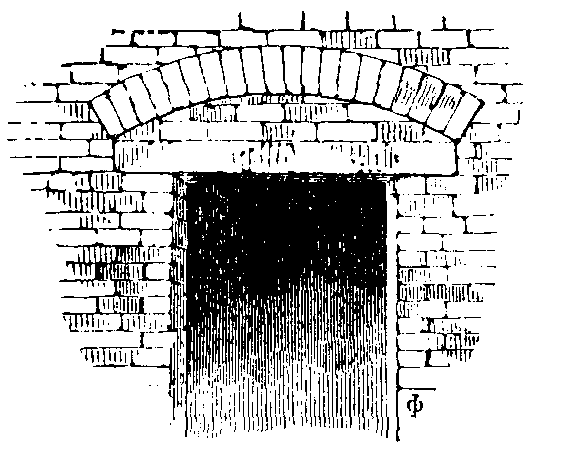
Discharging Arch, an arch formed in the substance of a wall to relieve the part which is below it from the superincumbent weight. Such arches are commonly used over lintels and flat-headed openings.
Discipline, Books of, two books connected with the Church of Scotland. The First Book of Discipline was drawn up by John Knox and four other ministers, and laid before the General Assembly in 1560. Though not formally ratified by the Privy Council, it was secretly subscribed by the greater part of the nobility and barons who were members of the Council. Another similar document, the Second Book of Discipline, was prepared and sanctioned by the General Assembly of 1578, and has from that time been recognized as the authorized standard of the Church of Scotland in respect of government and discipline.
Disclaim´er, in its stricter legal sense, a plea containing renunciation or a denial of some claim alleged to have been made by the party pleading.
Discomycetes, a large section of the ascomycetous Fungi, distinguished by the fact that the hymenium covers the surface of an open, disc-like or cup-shaped fruit-body called an apothecium. It includes many important genera, such as Dasyscypha, Peziza, and Sclerotinia.
Discopho´ra, (1) a sub-class of the Hydrozoa, comprising most of the organisms known as sea-jellies, jelly-fishes, and sea-nettles; (2) leeches (q.v.).
Dis´count, the charge made by a banker for interest of money advanced by him on a bill or other document not presently due. In advancing money on such a security the banker deducts the charge for interest on his advance from the total amount represented on the security, pays the difference, which is called the proceeds of the bill, to the person parting with it, and collects the full amount to reimburse himself for outlay and interest at maturity. Popularly the term discount is applied to any deduction from the full amount of an account made by the party to whom it is paid, especially on prompt or early payment. When a bill which has been discounted is paid by the acceptor before it is due, the discount allowed for prepayment is called rebate.
Discov´ery, in law, the act of revealing or making known any matter by a defendant in his answer to a bill in chancery. The word is also used in reference to the disclosure by a bankrupt of his property for the benefit of his creditors, and to the right of a party to a lawsuit to obtain from his adversary, on oath, full disclosure of the facts within his knowledge, and production of the documents in his possession, pertinent to the action.
Discus, Disc, or Disk, among the Greeks and Romans a quoit of stone or metal, convex on both its sides, sometimes perforated in the middle. The players aimed at no mark, but simply tried to throw the quoit to the greatest possible distance. It was sometimes furnished with a thong of leather to assist in the throwing. The thrower of the discus was called discobolus.
Disease, any morbid state of the body, or of any organ or part of the body. Diseases are described as local or constitutional, epidemic, endemic, contagious, acute, and chronic. As to their classification, see Nosology. The influence of the parents on the organization of the child is so great that not only peculiarities of external form, but the peculiar constitution, the greater or less activity and development of the organs, are found to pass from parent to child. As it is in the particular state of the several tissues and functions that certain diseases have their foundation, the liability to such affections is inherited with the organic structure, and children are not infrequently attacked by ailments from which one of their parents or grand-parents had previously suffered. In spite of the emphasis that has recently been put on the facts of heredity, the present tendency of preventive medicine holds out a larger hope by impressing upon us the fact that in such affections, for example, as tuberculosis and insanity, the individual's environment and personal history are perhaps more potent than hereditary influence in the causation or the prevention of disease.
Diseases of Plants. See Plant Pathology.
Disestablishment, the severance of connection between Church and State, with the resultant emancipation of the Church from civil control, is a movement in which there has been considerable growth during the last half-century. The Church of the West Indies was disestablished in 1868, and all Colonial Churches, with the exception of the Church in India, are now free from State authority. In 1869 an Act, taking effect two years later, was passed for the disestablishment of the Church of Ireland, in which country the mass of the inhabitants are Roman Catholics. In France all recognition of Roman Catholicism as the State religion ceased in 1905, the French Government now tolerating all religions. In 1914 was passed a Bill for disestablishing the Church in Wales, though its effect was, owing to the war, deferred till 1920 by the Suspensory Bill. The Church of Scotland has been practically free from State control since 1874, in which year patronage was abolished; and the presence of the Lord High Commissioner, who represents the sovereign at the opening of the General Assembly, and the precedence enjoyed by the Moderator during his term of office, are little more than decorative courtesies. Among a section of the English public there has been from time to time an agitation for the disestablishment of the Church of England; and the movement is even said to be viewed with favour by some advanced High Churchmen, who believe that it would result in increased freedom for the adoption of their special views; but, though a Disestablishment Society exists, there seems no immediate prospect of a decisive step in this direction.
Dishonour of a Bill, the refusal or neglect to accept or pay when due a bill of exchange, or promissory note, or draft on a banker. It is absolutely necessary that the holder of a dishonoured bill should give immediate notice of the non-payment to the drawer or endorsers.
Disinfection, the means employed for killing the germs of infectious or contagious disease by physical or chemical agencies. The former are the more important, and consist in applying water or steam at the boiling-point, or hot air at 160°C. Ten minutes' boiling, or half an hour in hot air, kills all ordinary disease germs, but a longer exposure is necessary to kill germs (especially those of putrefaction), which form spores (see Bacteria). The most important chemical agents are chlorine, iodine, carbolic acid, bleaching powder, Condy's red fluid (containing permanganate of potash), perchloride of mercury, formalin, and flavine. Carbolic acid is one of the most effective, needing, however, care in the handling, as it is very poisonous and in strong solution causes severe burns. It does not in its common form mix with water, but solutions can be made by using hot water. A greater dilution than 1 part in 40 of water is useless as a disinfectant. For application to the skin, tincture of iodine is one of the readiest preparations. In cases of infectious disease the most important points are the immediate disinfection of all the excretions of the patient. Expectoration should be received into a sputum-cup containing 1-20 carbolic acid, and all handkerchiefs when soiled should be similarly treated. The personal linen and sheets of the patient should be placed in carbolic acid (1-40) in a slop-pail, and should be boiled before being sent to the laundry. All plates, spoons, &c., used for the patient's food, should be boiled or scalded immediately after use. The excretions of the bowels or kidneys should be treated with bleaching powder. Those in attendance should wear an overall when in the sickroom, and should wash the hands and face before coming into contact with anyone outside. They should wash out the mouth frequently with Condy as strong as can be tolerated. Their linen should be treated in the same way as that of the patient. At the close of the illness all bedding should be baked in the hot-air oven which most local authorities now provide for the purpose. Everything washable in the sickroom should be washed with soft soap, and it is better that the room should be repapered.
Disin´tegrator, a machine for pulverizing and sometimes for mixing various materials, such as rock, asphalt, ore, artificial manures, sugars, corn, and the ingredients of mortar.
Disloca´tion, a surgical term applied to cases in which the articulating surfaces of the bones have been forced out of their proper places. The particular dislocation takes its name either from the joint itself or its farthest bone, and is called compound when accompanied by an external wound. The most common dislocations are those of the hip, shoulder, elbow, knee, and ankle, and the chief obstacle to their reduction is the spasmodic and violent contraction of the muscles consequent upon them, the application of considerable force being often necessary to set the joint. Chloroform is of great use, not only in preventing pain but in relaxing the muscles. The most dangerous dislocations are those of the bones of the spine.—In geology it signifies the displacement of parts of rocks or portions of strata from the situations they originally occupied.
Dismal Swamp, a large tract of marshy land in America, beginning a little south of Norfolk, in Virginia, and extending into North Carolina, containing 150,000 acres; 30 miles long, from north to south, and 10 miles broad. This tract was entirely covered with trees, with almost impervious brushwood between them, but it has now in part been cleared and drained. In the midst of the swamp is a lake, called Drummond's Pond, 7 miles in length. A navigable canal through the swamp connects Chesapeake Bay and Albemarle Sound.
Dispensa´tion is the act by which an exception is made to the rigour of the law in favour of some person. The Pope may release from all oaths or vows, and may sanction a marriage within the prohibited degrees of the Mosaic law, or exempt from obedience to the disciplinary enactments of the canon law. In England the monarch claimed, in former times, a similar dispensing power in civil law, but the prerogative was so much abused by James II that it was abolished by the Bill of Rights. The power of commuting sentences in capital cases is the only form in which the dispensing power of the Crown still exists. In ecclesiastical matters a bishop may grant a dispensation allowing a clergyman to hold more than one benefice, or to absent himself from his parish.—Cf. F. W. Maitland, Constitutional History of England.
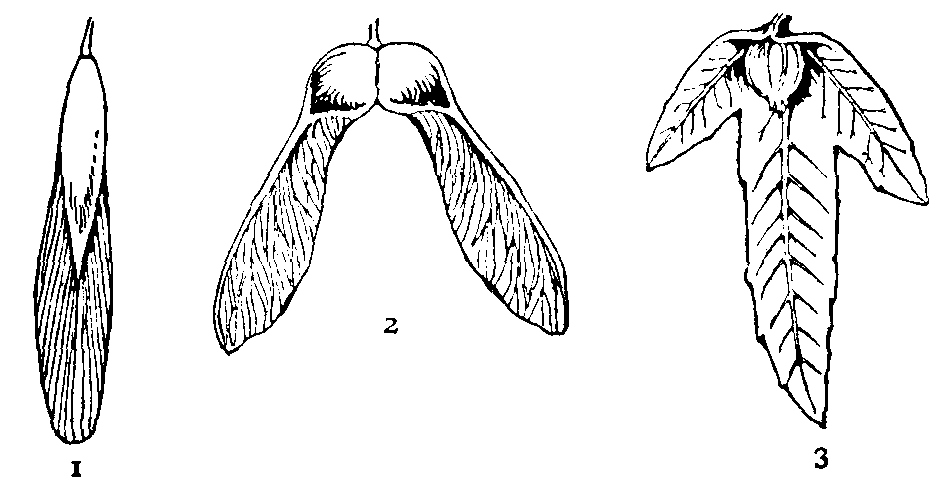
Winged Fruit
1, Ash. 2, Sycamore. 3, Hornbeam.
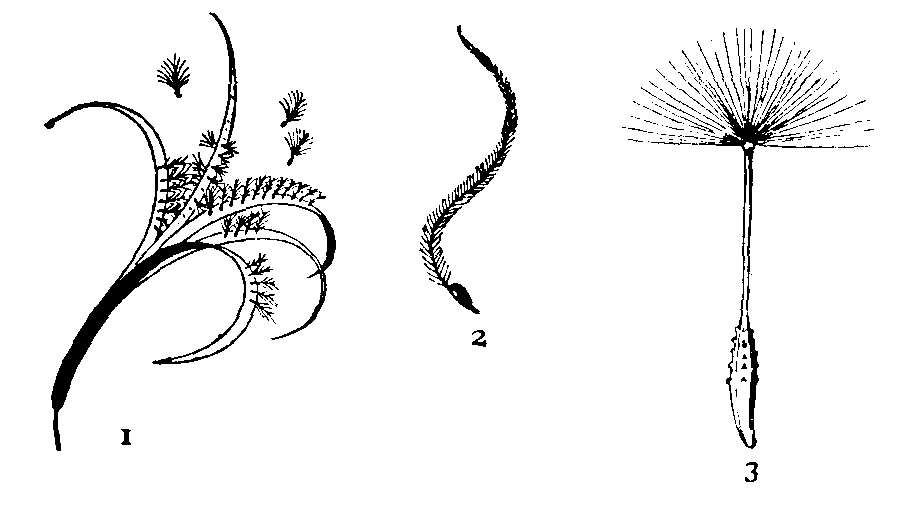
Parachute Fruits
1, Ripe fruit of willow-herb, dehiscing. 2, Single fruit of clematis. 3, Single fruit of dandelion.
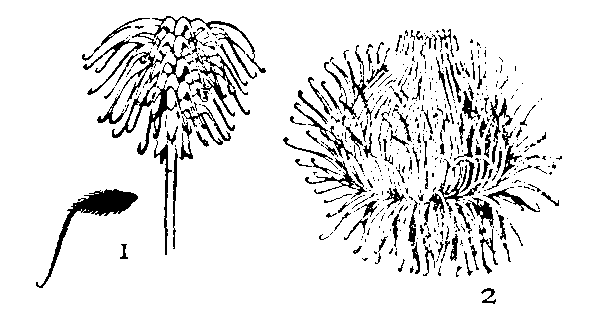
Hooked Seeds
1, Geum and single fruit. 2, Burdock.
Dispersal of Seeds and Fruits serves (a) to scatter these reproductive structures and so reduce internecine competition; (b) to bring the seeds into new surroundings, which may be more favourable than those of the parent plant. The chief agents of dispersal are wind and animals. Very minute seeds, like those of orchids, are carried away by the gentlest air-currents. Larger wind-borne seeds are winged, as in the pine, most Bignoniaceæ, &c.; or provided with a tuft of hairs acting as a parachute, as in willow, willow-herb, cotton, &c. Winged fruits are exemplified by ash, elm, sycamore, many docks, &c.; parachute fruits by Compositæ, Clematis, cotton-grass, &c. In the case of animal dispersal, the whole fruit is usually involved, being either edible, with hard indigestible seeds which are cast up or voided with excreta (fleshy fruits), or hooked so as to adhere to fur or wool, as in bidens, cleavers, enchanters' nightshade, and other 'burs'. A small number of fruits and seeds, such as the coco-nut and the seeds of water-lilies, are adapted for water transport. In certain cases seeds are scattered for short distances by an 'explosive' mechanism, as in wood-sorrel, impatiens, sand-box tree, squirting cucumber, and other 'sling' fruits.
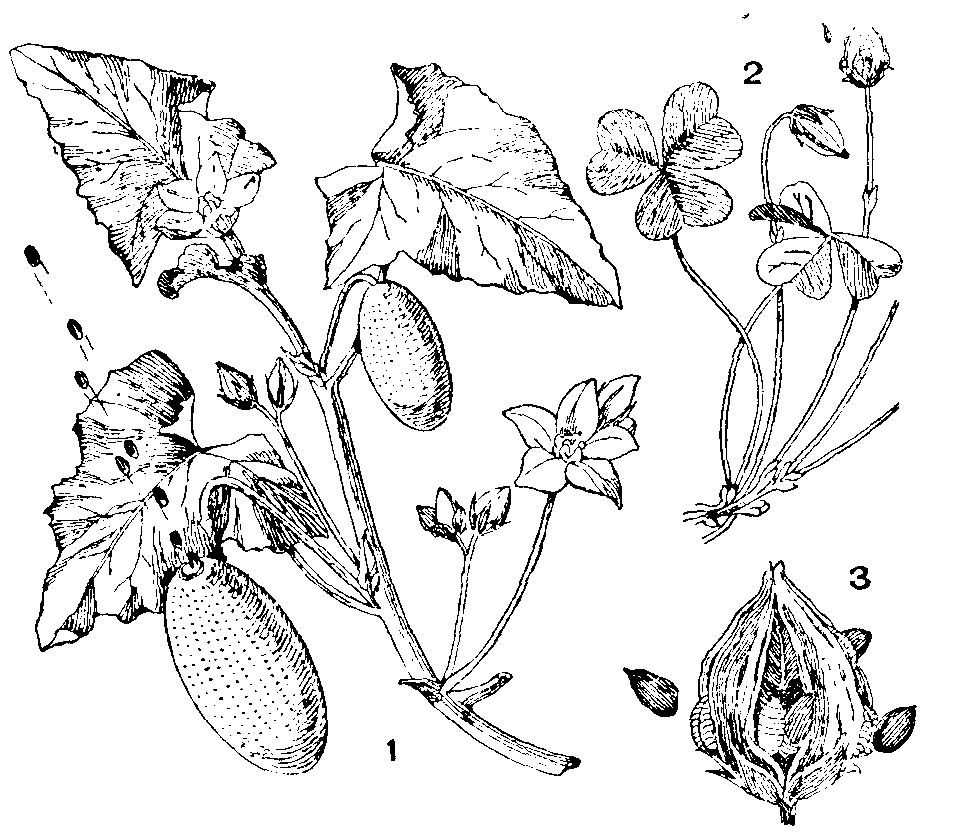
Explosive or Sling Fruits
1, Ecbalium Elaterium, flowers and fruit, one fruit detached from its stalk and with its seeds squirting out. 2, Oxalis Acetosella, entire plant, with one unripe fruit on a hooked stalk, and one ripe fruit on an erect stalk ejecting its seeds. 3, Ripe fruit of Oxalis Acetosella ejecting the seeds (enlarged).
Dispersion, in optics, the angular separation of light rays of different colour, that is, of different wave-length. Dispersion may be caused either by refraction or by diffraction. When a beam of composite light passes obliquely from air into a second transparent medium, each constituent of the light is bent or refracted through a different angle from the original direction of the beam, with the result that the different colours are separated fanwise, or dispersed at the surface of the second medium. In the refraction spectrum of white light, when caused by passage through a glass prism, the red rays are least deviated and the violet rays most deviated, if we consider only the visible spectrum. The difference of the angles of deviation for two selected rays measures their dispersion, and if this angle is divided by the deviation of the mean ray, we obtain the dispersive power of the prism. Transparent media vary in their dispersive powers; for example, carbon disulphide has more than three times the dispersive power of crown glass. The true nature of dispersion was first demonstrated by Newton, who concluded that the colours of the spectrum were homogeneous and caused by simple vibrations of definite wave-length, the different colours being unequally refrangible. Newton was, however, led to the erroneous view that the dispersion was proportional to the refraction. This was later disproved by the construction of achromatic lenses, or lenses which caused deviation without dispersion, and of direct-vision spectroscopes, or instruments which caused dispersion with no deviation of the central part of the spectrum. The dispersive power is not the same for all parts of a refraction spectrum; besides, the same colours do not occupy the same positions in spectra formed by prisms of different material. This arises from the fact that there is no simple relation between the deviation of a ray and its wave-length; consequently, such spectra are called irrational, and the property is known as the irrationality of dispersion. In the diffraction spectrum, the order of the colours is reversed, red undergoing the greatest deviation; also, the deviation for a given colour is nearly proportional to the wave-length. The diffraction spectrum is therefore termed a normal spectrum.
All substances do not give the same order of colours in their spectra; certain exceptions are known in which the usual order of the colours is changed. Christiansen showed that an alcoholic solution of fuchsine gave a spectrum containing only violet, red, and yellow; the violet is least refracted, and the yellow most, and a dark band lies between the violet and the red. This has been called anomalous dispersion, and similar effects have been observed in iodine and sodium vapours, and in solutions of colours derived from aniline which exhibit surface colour.
The theory of dispersion now generally accepted is that of Sellmeier, which was published in 1871. Sellmeier assumed that when light waves pass through a material substance, they set the particles of the substance in vibration, and these resonant vibrations react in such a way as to modify the velocity with which the waves are transmitted. Applying the dynamical principles of wave motion to the case of an elastic solid in which heavy particles are embedded, Sellmeier obtained an equation which connected the refractive index of the substance with the wave-length of the incident light. Equations of similar form were subsequently derived by Ketteler and Helmholtz. The consideration of Sellmeier's equation leads to important conclusions. If the period of vibration of the incident waves is very short, as compared with those of the particles forming the solid, no refraction will take place, and the rays will travel through the solid without deviation and without change of velocity. This is verified in the case of X-rays, which consist of extremely short waves and which are not deviated on passing through light-opaque solids. Sellmeier's equation may also be modified to apply to the case of anomalous dispersion. The phenomenon is always associated with absorption of light of a particular wave-length or range of wave-lengths, and the conclusion is drawn that the medium will possess an abnormally high refractive index for waves slightly longer than those which it absorbs, and an abnormally low index for waves slightly shorter than those which it absorbs. This result has been verified by various investigators. Rubens has determined the values of the constants in Sellmeier's equation for rock-salt, sylvine, fluorspar, and quartz, and has shown that the equation gives correct values for the refractive indices of these substances over the entire range of wave-lengths to which they are transparent.—Bibliography: T. Preston, Theory of Light; E. Edser, Light for Students; P. Drude, Theory of Optics.
Displacement. The position of a point in space is fixed by means of its distances x, y, z, from three mutually rectangular planes. If the point moves to another position, it is said to be displaced, and the rates of displacement parallel to these planes measure the velocities dx/dy, dy/dt, dz/dt parallel to these planes. If the acting forces be resolved in directions parallel to these planes, relations may be found between the forces, the accelerations parallel to the planes and the mass of the body. These relations are called the equations of motion. In hydrostatics a body immersed in a liquid displaces a certain volume of the liquid, and the upthrust of the liquid in the body is, by the principle of Archimedes, equal to the weight of liquid displaced. It follows that, in the case of a floating ship, the weight of the ship is equal to the weight of water displaced. This weight is called the displacement of the ship, and is measured in tons.
Disposition, in Scots law, is, in its general acceptation, a deed by which a person provides for the general disposal of his property heritable and movable, after his death, equivalent to a will or testament; also a conveyance of property.
Disraeli, Benjamin. See Beaconsfield.
D'Israeli (diz-rā´e-li), Isaac, man of letters, and father of the well-known statesman, was born at Enfield, Middlesex, in 1766, died in 1848. His father, Benjamin D'Israeli, a descendant of a family of Spanish Jews which had settled at Venice in the fifteenth century to escape the Inquisition, came over to England in 1748 and made a large fortune. Isaac D'Israeli, however, showed a strong repugnance to commerce, and was finally permitted to follow his literary bent. An anonymous reply to Peter Pindar, entitled On the Abuse of Satire, was followed during 1791 to 1793 by the appearance of his Curiosities of Literature, the success of which determined much of his afterwork. His Essay on the Literary Character was published in 1795, and some time afterwards a volume of romantic tales, The Loves of Mejnoun and Leila. Between 1812 and 1822 appeared his Calamities of Authors, Quarrels of Authors, and Inquiry into the Literary and Political Character of James I; the three being afterwards published collectively under the title of Miscellanies of Literature. In 1828 appeared the commencement of his Life and Reign of Charles I, a work completed in 1831. An affection of the eyes put an end to a projected Life of Pope and a History of English Freethinkers, but in 1841 he published a selection from his MSS. under the title of Amenities of Literature. The greater part of his life was passed in his library. For his son, see Beaconsfield.
Disrup´tion, the name commonly applied in Scotland to the act by which, in 1843, 474 ministers and professors of the Established Church gave up their livings to vindicate principles which they held to be essential to the purity of the Church, and in harmony with its earlier history. See Free Church.
Diss, a town, England, Norfolk, on the slope of a hill 18 miles south by west of Norwich. It was formerly noted for the manufacture of 'Suffolk hempen cloth', worsted yarn, and knit hosiery. Pop. 3763.
Dissection, a word, derived from Latin, that is etymologically equivalent to the word anatomy, derived from Greek. Its literal meaning is 'cutting up', and it is used to define the technical procedures for acquiring a practical knowledge of the anatomy or structure of the body. Dissection of the human body is an essential part of the education of a medical practitioner, for it is the only means whereby he can acquire a thorough and practical familiarity with the geography of the territories in which all his professional activities lie. Therefore the medical student is required thoroughly to explore every part of the human body, to examine all its constituent parts, to learn to recognize their properties, positions, and relationships, and to train his eyes and fingers to appreciate their distinctive qualities. This process of exploration usually occupies about eighteen months or more of the student's time; but it represents the foundation upon which all his professional knowledge and experience are built up. For this purpose it is of the utmost importance that he be provided with ample facilities for acquiring the training which is essential to the medical practitioner. But the supply of subjects for dissection is difficult to acquire. Until a century ago teachers in medical schools, being unable to get an adequate supply of bodies for dissection by legal means, were forced to deal with 'body snatchers' who plundered cemeteries. Eventually the terrible scandals associated with the names of Burke and Hare forced the Government to pass an Anatomy Act to make better provision for this necessary part of medical education. Within recent years the action of Boards of Guardians has so hampered the administration of the Act that teachers in medical schools are threatened with the same dilemma as their colleagues a century ago had to face. The Guardians of the Poor in some localities prefer to bury the unclaimed bodies of the dead at the ratepayers' expense rather than allow them to be used for the necessary instruction of surgeons and physicians. Offers are repeatedly made by men and women, often well-known and distinguished people like the late Miss Florence Nightingale, to place their bodies at the service of medical education; but in accordance with the law of the land such bequests are invalid, because once a person is dead the corpse is not his property but belongs to his relatives. Hence it is only the unclaimed bodies that are legally available for dissection.
Dissei´zin, or Disseisin, in law, is the dispossessing one of a freehold estate, or interrupting his seisin. Of freeholds only can a seizin be had, or a disseizin done. Whether an entry upon lands is or is not a disseizin, will depend partly upon the circumstances of the entry, and partly upon the intention of the party as made known by his words or acts.
Dissent´ers, the common name by which in Britain all Christian denominations, excepting those of the Established Churches, are usually designated, though in Acts of Parliament it generally includes only Protestant dissenters, Roman Catholics being referred to under their specific name. The most important bodies of English dissenters are the different bodies of Methodists, the Congregationalists, and the Baptists; and of Scottish dissenters, the United Free Church and the Free Church. The Nonconformists were dissenters from the English Church, and the name is sometimes used as meaning simply dissenters, though it has properly a wider meaning.
Dissentis´, a Swiss town, canton of Grisons, 3800 feet above the sea, at the junction of the Middle and Vorder Rhine, with a Benedictine abbey established so long ago as A.D. 614. Pop. 1420.
Dissociation. Certain substances tend to break down into simpler substances with change of temperature; thus ammonium chloride on heating gives a mixture of hydrochloric acid (HCl) and ammonia (NH3), and on cooling these substances recombine to give ammonium chloride (NH4Cl) again. Dissociation is therefore a particular case of decomposition, where the products of decomposition recombine on obtaining the original conditions.
Dis´sonance, in music, that effect which, results from the union of two sounds not in accord with each other. The ancients considered thirds and sixths as dissonances; and, in fact, every chord except the perfect concord is a dissonant chord. The old theories include an infinity of dissonances, but the present received system reduces them to a comparatively small number. The most common are those of the tonic against the second, the fifth against the sixth, or (the most frequent of all) the fourth against the fifth.
A, Distaff. It is shown held by the waist-belt of the spinner. The spindle is revolving and twisting the wool.
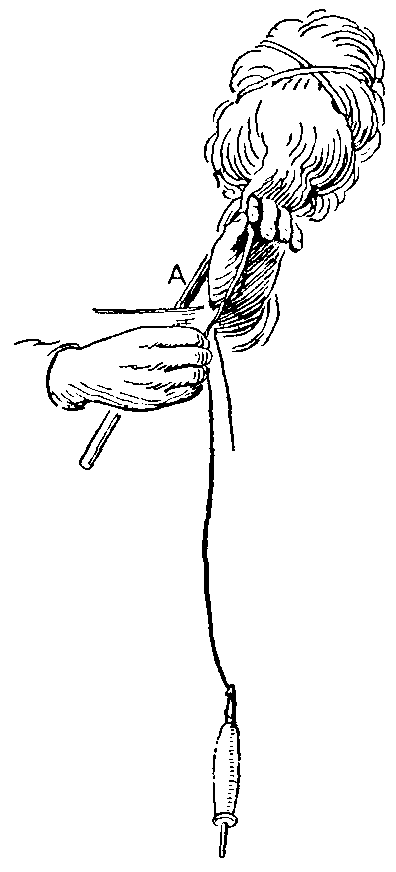
Dis´taff, the first instrument employed in spinning. It consisted of a staff, on one end of which the wool or flax was rolled. The spinner held it in the left hand, and drew out the fibres with the right, at the same time twisting them. A small piece of wood called a spindle was attached to the thread, the weight of which carried it down as it was formed. When the spindle reached the ground, the thread which had been spun was wound round it, and it was then again fastened near the beginning of the new thread. In ancient and modern art the Fates are usually represented with the distaff, engaged in spinning the thread of life.
Distemp´er, a disease of the dog commonly considered as of a catarrhal nature. In most cases a running from the nose and eyes is one of the first and chief symptoms, the defluxion becoming after some time mucous and purulent. The animal is subject to violent fits of coughing combined with vomiting, loses its appetite, its flesh begins to waste, and if the disease be virulent, symptoms of affection of the brain manifest themselves, accompanied by fits, paralysis, or convulsive twitchings. In the first stage of the disease laxatives, emetics, and occasional bleeding are the principal remedies; diarrhœa should be checked by astringents, and to reduce the violence of the fits warm bathing and antispasmodics should be resorted to. The distemper is generally contagious, and occurs but once in a lifetime.
Distemper (It. tempera), in painting, a preparation of colour mixed with size, yolk of egg or white of egg. Prepared with size, it is used chiefly in scene painting and household decorations, but in other forms it is much used for easel and mural paintings. Before the introduction of oil as a medium in the fifteenth century, fresco and distemper were the principal methods of painting. Distemper is usually but not necessarily applied to a dry ground, fresco always to a wet.
Distich (dis´tik), a couplet of verses, especially one consisting of a Latin or Greek hexameter and pentameter, making complete sense. Distichs have been frequently made use of by the modern German poets.
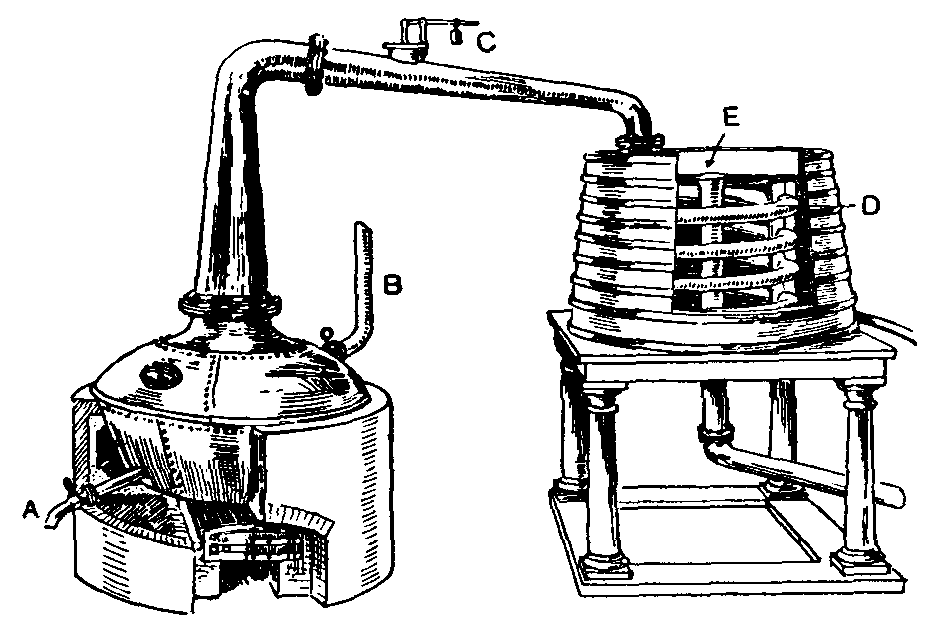
Distillation of Alcohol
A, Emptying pipe. B, Wash inlet. C, Vacuum safety valve. D, Worm. E, Cooling water inlet.
Distillation, the volatilization and subsequent condensation of a liquid in an apparatus known as a still and heated by a fire or flame. The operation is performed by heating the crude liquid or mixture in a retort or vessel known as the body of the still. This is made of various shapes and materials, and is closed, with the exception of a slender neck which opens into the condenser, a long tube through which the hot vapour from the still is passed. The tube is kept at a sufficiently low temperature to cause the vapour to condense, the common method of securing this being to surround the tube with a constantly renewed stream of cold water. In some cases ice or a freezing mixture may be required to effect condensation. In a large-scale apparatus the condensing tube is coiled round and round in a tub or box, and is known as a worm. From the end of it the vapour condensed into a liquid drops into a receiver. The simplest case of distillation is that of water containing solid matter in solution, the solid matter remaining behind in the still or retort while the water trickles pure into the receiver, through a worm made of block-tin, as most other metals are attacked by distilled water. When the mixture to be distilled consists of two or more liquids of different boiling-points, such as alcohol and water, the more volatile comes off first, accompanied by a certain proportion of the vapour of the other, so that it is hardly possible completely to separate bodies by one distillation. This is effected by repeated successive distillations of the liquid with or without the addition of substances to retain the impurities. When the production of one of the ingredients only is aimed at by this process, it is called rectification, but when it is desired to separate and collect all the liquids present, or to divide a mixture into portions which volatilize within certain ranges of temperature, the process is called fractional distillation. In the laboratory, distillation is employed for purifying water, for recovering alcohol and ether, and for the preparation, purification, and separation of a great number of bodies. Substances which decompose at their boiling-points can be distilled under reduced pressure. On the large scale distillation is employed in the preparation of potassium, sodium, zinc, mercury; of sulphuric acid, ether, chloroform, carbon bisulphide, essential oils and perfumes; in the purification of coal and wood tar, and the products obtained from them; and on an extensive scale in the manufacture of whisky, brandy, or other spirit. The distillation of whisky has long been familiar in Britain, especially in Scotland and Ireland, and, when performed by means of the old pot-still, is a simple operation indeed, and one that even yet is practised surreptitiously in out-of-the-way localities. On the large scale a more elaborate apparatus is employed, and for alcohol of a cheap class Coffey's or other patent still is much used. Copper is the metal that suits best as the material for the stills used in distilling whisky. Sea-water is distilled in many cases for drinking or cooking purposes. This water is, of course, very pure, but its taste is far from agreeable. Destructive distillation, or dry distillation, differs from the preceding in this respect, that the original substance is not merely broken up into bodies by the mixture of which it is formed, but is so treated that it is further decomposed, and products are obtained which were not present uncombined in the original material. (See Coal-tar.) The term is restricted to the action of heat upon complex organic substances out of contact with the air. The products of destructive distillation are numerous and varied. On the manufacturing scale the process is conducted sometimes for the sake of one part of the products, sometimes for the sake of another. Coal, for example, may be distilled not solely for the gas, but also for ammoniacal water, benzene, anthracene, as well as for the sake of the fixed carbon or coke, the volatile portions being too often neglected and practically wasted. But much more economical methods of making coke are now practised than formerly. Wood is distilled partly for the sake of the pyroligneous acid and the tar, partly for the charcoal. Bones are distilled for the sake of the charcoal, though the oil is also collected. Shale is distilled both for the oil and for the paraffin wax, ammonia, &c., obtained.
Distinguished Conduct Medal
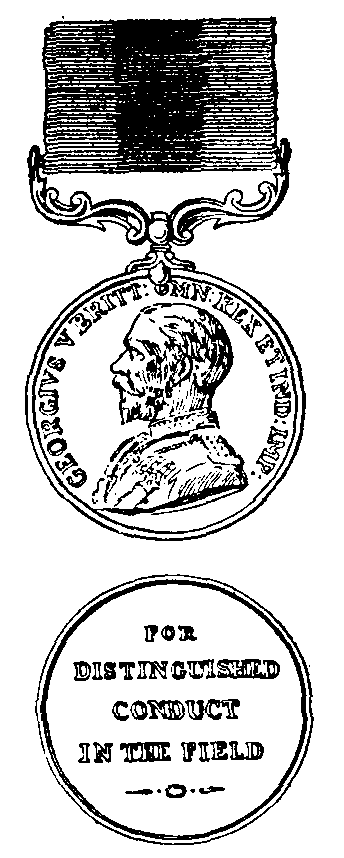
Distinguished Conduct Medal, a medal instituted in 1854 under the name of the Meritorious Service Medal as "a mark of the Sovereign's sense of the distinguished service and gallant conduct in the field of the army then serving in the Crimea". The regulations concerning this medal were revised in 1862, when it received its present name. It is given to warrant-officers, non-commissioned officers, and privates. As from the 1st Aug., 1918, the medal is awarded for services in action only. The medal is silver, 1.4 inches in diameter; on the obverse is the Sovereign's head, and on the reverse the inscription "For Distinguished Conduct in the Field". It is suspended from a ribbon 1¼ inches wide, crimson, blue, and crimson, the colours being of equal width. Bars may be awarded for additional deeds of gallantry; in service uniform the possession of a bar is indicated by a silver rosette worn on the ribbon. The letters D.C.M. are placed after the name of the recipient, who receives either a gratuity of £20 on discharge, or an increase in pay of 6d. a day.
On Left, Distinguished Flying Cross (obverse) On Right, Distinguished Flying Medal (obverse)
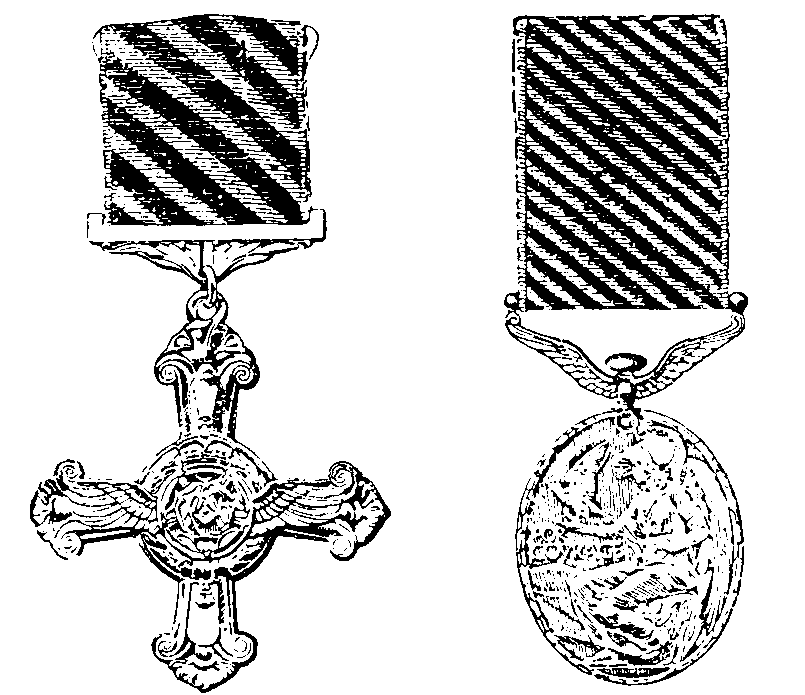
Distinguished Flying Cross, a decoration instituted during the European War, and awarded to officers and warrant-officers of the Air Force for acts of gallantry when flying in active operations against the enemy. The ribbon is 1¼ inches wide, and has narrow purple and white alternate diagonal stripes. The letters D.F.C. are placed after the name of the recipient. A corresponding medal, the Distinguished Flying Medal, is awarded to non-commissioned officers and men.
Distinguished Service Cross (obverse)
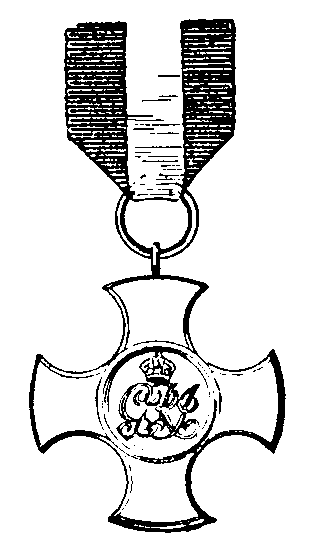
Distinguished Service Cross, a naval decoration formerly known as the Conspicuous Service Cross, and instituted in 1901. It is awarded to naval officers below the rank of lieutenant-commander, and to warrant-officers, for services before the enemy. The ribbon is dark-blue, white, and dark-blue, in stripes of equal width. The letters D.S.C. are placed after the name of the recipient.
Distinguished Service Order (obverse)

Distinguished Service Order, The, was instituted by Royal Warrant on 6th Sept., 1886. All commissioned officers of the Navy, Army, or Air Force are eligible to be appointed Companions of this Order. It is conferred upon officers who have been specially mentioned in dispatches for meritorious or distinguished services. Towards the end of the European War (1st Aug., 1918) it was decided that this decoration was only to be given for services in action, i.e. (1) for service under fire, or (2) distinguished individual service in connection with air-raids, bombardments, or other enemy action. Bars may be awarded for additional deeds of gallantry; in undress uniform the possession of a bar is indicated by a silver rosette worn on the ribbon. The ribbon is red, edged with blue, and is 1 inch wide. It is the same as the ribbon of the Waterloo and Peninsular medals, only narrower. The badge of the order is a gold cross patée enamelled white, edged gold, having on one side thereof, in the centre, within a wreath of laurels enamelled green, the Imperial Crown in gold, upon a red enamelled ground, and on the reverse, within a similar wreath and on a similar red ground, the Imperial and Royal cipher (G.R.I.) The letters D.S.O. are placed after the name of the recipient, who ranks between Commanders of the Order of the British Empire and Members of the Royal Victorian Order (4th class).
Dis´tomum, a genus of trematode or suctorial parasitic worms or flukes, infesting various parts in different animals. D. hepaticum, the common liver fluke, when adult inhabits the gall-bladder or ducts of the liver in sheep, and is the cause of the disease known as the rot. It may also occur in ox and man. In form it is ovate, flattened, and presents two suckers (whence the name), of which the anterior is perforated by the aperture of the mouth. The digestive tube divides into two branching halves, the excretory organs consist of delicate branching tubes, and there is a complex set of hermaphrodite reproductive organs. The minute larvæ live in a small water-snail (Limnæa truncatula), from which they ultimately escape to encyst on grass, &c., by which sheep may become infested. The adults of other species of Distomum live within the bodies of various fishes, amphibia, reptiles, birds, and mammals.
Distress´ (Lat. distringere, pull asunder), in law, is the taking of a personal chattel of a wrong-doer or a tenant, in order to obtain satisfaction for the wrong done, or for rent or service due. If the party whose goods are seized disputes the injury, service, duty, or rent, on account of which the distress is taken, he may replevy the things taken, giving bonds to return them or pay damage in case the party making the distress shows that the wrong has been done, or the service or rent is due. Wrongful distress is actionable. Another kind of distress is that of attachment, to compel a party to appear before a court when summoned. The distresses most frequently made are on account of rent and taxes and damage-feasance.—Cf. Blackstone, Commentaries on the Laws of England.
Distribution is that part of the subject-matter of economics which deals with the division, among the individuals composing a community, of the product of their labour and of land and capital at their command. It is the most contentious part of economics, as well as that which has most social interest and importance, for in it there is a sharper conflict than anywhere else between economic considerations and ideals of social justice, and the problem is to secure such a distribution as will satisfy social justice, without abandoning the incentive to effort provided by the possibility of a greater reward.
The present position is one of unresolved discord between the economic and the equalitarian schools. The economic analysis in based upon a division of the factors of production into three, viz. Labour, Capital, and Land. These are represented as competing among themselves for employment, which is given to each in accordance with the return which will be secured as a result of an addition to the amount already employed; the rewards of each fall roughly under the headings of Wages and Salaries, Interest and Rent, respectively. The demarcation cannot be exact, as much that in common life is regarded as interest on capital partakes really of the nature of wages, as being earnings of management or reward for risk-taking, while certain forms of capital, whose quantity is temporarily fixed, may receive a return which is more of the nature of rent.
The fundamental assumption of the economists is that competitive distribution is indispensable, both in order to secure a fruitful distribution of the resources and efforts of society between the three factors of production, and also owing to the need of an incentive to keep individuals working hard enough to ensure a supply of goods sufficient to maintain and improve the standard of life of the community. Economists do not assume that men would not work at all if they were guaranteed a living wage whether they did or not, but that men would not work enough, and would be guided in the direction of their efforts by personal idiosyncrasy rather than by the needs of the community. The only alternatives to a great falling off in national wealth are, in their view, either competitive distribution or enforcement of work by a rigid discipline, which would be as hard as the present system, while being less adaptable.
Against this analysis idealist thinkers rebel, on the ground that it fails to justify the great inequality in the distribution of wealth between different individuals and classes of society. Their protest dates from the harsh dogmatism of the economists who propounded the now discredited 'Iron Law of Wages' and 'Wages Fund Theory', which both consigned wage-earners to lives of unremitting toil for a reward inevitably limited to a very small amount. Against these views appeal is made to justice and equality, and the result is summed up in the phrase 'to each according to his needs, from each according to his ability', i.e. the community should be so organized that each member receives that which he needs, while giving in return work according to the best of his ability. An alternative and cruder theory is that which demands absolute equality in the distribution of wealth. The economic basis for these theories is the claim that all production is the result of labour, and that the workers are entitled to the 'whole produce of their labour', interest and rent being 'surpluses' appropriated by the capitalist owing to the exploited workers being kept at the level of subsistence. The economic statement of the case is generally associated with the name of Marx, who was, however, greatly influenced by English writers; but the driving force of the movement is moral and emotional.
District Courts, an important series of courts in the United States, each under a single judge, and having original jurisdiction in civil, criminal, and admiralty causes. Generally there is one for each state. By the Judiciary Code, enacted by Congress in 1911, the circuit courts, which had hitherto shared original jurisdiction with the district courts, became only appellate tribunals.
Distringas (Lat., that you distrain), a notice proceeding upon an affidavit filed in the High Court by a party not the registered holder of shares or stock but beneficially interested therein, and served upon the particular company or public body, whereby it is precluded from registering any transfer of the shares or stock or any mandate for payment of the dividends without previous intimation to such party. The latter has thus the opportunity, if desired, to apply for an interim injunction, and, should he not do so within eight days from the date upon which the transfer or mandate was lodged, the restraint flies off.
Dithyram´bus, or Dith´yramb, in Greek literature, a poem sung in honour of the god Bacchus or Dionysus, at his festivals. The choral portion of Greek tragedy arose out of the dithyramb. It was composed in a lofty and often inflated style: hence the term is applied to any poem of an impetuous and irregular character.
Ditmarshes (Ger. Dithmarschen), a district of Holstein, in Germany, consisting of a monotonous flat stretching along the North Sea, between the mouths of the Elbe and the Eider, and so little raised above the sea as to require the protection of strong embankments. Ditmarshes was incorporated in Prussia in 1866. The area is 500 sq. miles, and the total pop. 96,373.
Dit´tany, the popular name of the plants of the genus Dictamnus, an herb of the rue family (Rutaceæ), found in the Mediterranean region. The leaves are pinnate, the large white or rose-coloured flowers are in terminal racemes. The whole plant is covered with oily glands, and the secreted oil is so volatile that in hot weather the air round the plant becomes inflammable. D. Fraxinella and D. albus are found in gardens.
Dittay, in Scots law, a technical term signifying the matter of charge or ground of indictment against a person accused of a crime; also, the charge itself.
Diuret´ics are agents used to increase the flow of urine. Many drugs are used for this purpose: caffeine and theobromine, digitalis and squills, potassium salts, carbonates, calomel and blue pill.
Divan´, a Persian word having several significations. It is used in Turkey for the highest Council of State, the Turkish ministry; and for a large hall for the reception of visitors. Low couches, covered with rich carpets and cushions, are ranged along the walls of the room. Hence in Western Europe the term is applied to a café, and to a kind of cushioned seat. In India the term is applied to the Prime Minister of a native State. Among several Oriental nations this name is given to certain collections of lyric poems by one author. The divans of Hafiz and Saadi, the Persian poets, are among the most important.
Divergent, in algebra, opposed to convergent, a term applied to an infinite series which cannot be said to have a sum because there is no definite limit towards which the sum of its terms tends as the number of terms is increased indefinitely.
Red-throated Diver (Colymbus septentrionalis)
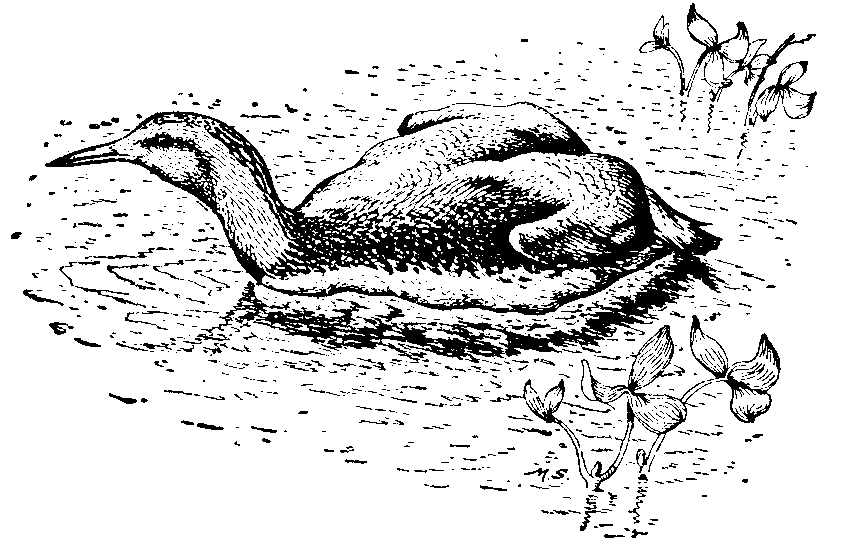
Divers, birds remarkable for the habit of diving. The divers (Colymbidæ) are a family of swimming birds, characterized by a strong, straight, rather compressed pointed bill about as long as the head; a short and rounded tail; short wings; thin, compressed legs, placed very far back, and the toes completely webbed. They prey upon fish, which they pursue under water, making use partly of their wings, but chiefly of their legs and webbed feet in their subaqueous progression. The leading species are the great northern diver (Colymbus glaciālis), the red-throated diver (C. septentrionālis), and the black-throated diver (C. arcticus). These birds inhabit the Arctic seas of the New and Old Worlds; they are abundant in the Hebrides, Norway, Sweden, and Russia. The great northern diver, loon, or ember goose is about 2¾ feet long, and is of handsome plumage.
Div´idend, literally what is to be divided, a term used in arithmetic and in reference to stocks. In the latter sense it is the interest or profit of stocks divided among, and paid to, the proprietors. No dividend must be paid except out of profit (Companies Act of 1862). The term also signifies the payment made to creditors out of the estate of a bankrupt.
Dividing Engine, a machine for marking the divisions on the scales of scientific, mathematical, or other instruments. Some of these perform work of extraordinary fineness and accuracy. It may also be employed to measure lengths accurately, or to divide a given length into any number of equal or unequal parts. See Graduation.—Cf. Stewart and Gee, Practical Physics (vol. i).
Dividing Range, Great, an Australian chain of mountains, forming the watershed between the rivers flowing into the Pacific and those running westward. It is situated at an average distance of 30 miles from the sea, though in some places it recedes as much as 60 miles, and stretches from Cape York on the north to Wilson's Promontory on the south. The culminating point is Mount Townshend (7353 feet).
Divi-divi, the pods of Cæsalpinia coriaria, a tree which grows in tropical America, and a member of the family which yields sapan, brazil, and other red woods. The pods are about 1 inch broad and 3 inches long, but are generally bent or curled up; are excessively astringent, containing a large proportion of tannic and gallic acid, for which reason they are used by tanners and dyers.
Divination, the act of divining; a foretelling future events, or discovering things secret or obscure, by the aid of superior beings, or by other than human means. Cicero divided it into two kinds, natural and artificial, or intuitive and inductive. Natural divination was supposed to be effected by a kind of inspiration or divine afflatus; this method of divination is familiar as represented by oracles; artificial divination was effected by certain rites, experiments, or observations, as by sacrifices, observation of entrails and flight of birds (ornithomancy), of the behaviour of fishes (ichthyomancy), lots, omens, and position of the stars. Among modes of divination were: axinomancy, by axes; belomancy, by arrows; bibliomancy, by the Bible; oneiromancy, by dreams; pyromancy, by fire; hydromancy, by water; coscinomancy, by observing the results of the turning of a sieve hung on a thread. Cf. Bouché-Leclercq, Histoire de la divination dans l'antiquité.
Divine Right, the claim set up by some sovereigns or their supporters to the absolute obedience of subjects as ruling by appointment of God, insomuch that, although they may themselves submit to restrictions on their authority, yet subjects endeavouring to enforce those restrictions by resistance to their sovereign's acts are considered guilty of a sin. This doctrine, which came into general use in the seventeenth century, and is so celebrated in English constitutional history, especially in the time of the Stuarts, may now be considered to be exploded. Hobbes was one of the chief supporters of the theory of Divine Right, whilst Milton was a strong opponent. Cf. J. N. Figgis, Theory of the Divine Right of Kings.
Divine Service, Tenure by, a species of tenure, now obsolete, by which the tenant held the land on condition of performing some divine service, such as saying so many masses or distributing a certain amount in alms.
Diving, the art or act of descending into the water to considerable depths, and remaining there for a time. The uses of diving are important, particularly in searching for pearls, corals, sponges, examining foundations of bridges, salvage of wrecked ships, recovering valuables, clearing propellers, valves, and cleaning bottoms of ships when no dry docks are available. Without the aid of artificial appliances a skilful diver may remain under water for two, or even three minutes; accounts of longer periods are doubtful or absurd. Various methods have been proposed, and engines contrived, to render diving more safe and easy. The great object in all these is to furnish the diver with fresh air, without which he must either make but a short stay under water or perish.
Diving-bell, a contrivance for the purpose of enabling persons to descend and to remain below the surface of water for a length of time, for various purposes, such as laying foundations of bridges, blasting rocks, and recovering treasure from sunken ships. Diving-bells have been made of various forms, more especially in that of a bell or hollow truncated cone, with the smaller end closed, and the larger one, which is placed lowermost, open. The air contained within these vessels prevents them from being filled with water on submersion, so that the diver may descend in them and breathe freely for a long time, provided he can be furnished with a new supply of fresh air when the contained air becomes vitiated by respiration. The diving-bell is usually made of cast iron, and weighted, and has several strong convex lenses set in the sides or roof, to admit light to the persons inside. It is suspended by chains from a barge or lighter, and can be raised or lowered at pleasure upon signals being given by the persons within, who are supplied with fresh air pumped into a flexible pipe by means of force-pumps carried in the lighter, while the heated air escapes by a cock in the upper part of the bell. Modern diving-bells are usually rectangular in shape, and have a trunk or tube on top reaching to the surface of the water, and fitted with an air-lock to enable men to go into or out of the bell without moving it from the bottom; they are fitted with telephones and electric lights. A constant flow of fresh air is kept up, and all excess of air escapes from the lower part of the bell, the pressure of the air being kept slightly above that of the water outside. The diving-bell has long been found highly useful for carrying on work under water, a steam-crane being usually employed for the movements required. A form, called the nautilus, has been invented which enables the occupants, and not the attendants above, to raise or lower the bell, move it about at pleasure, or raise great weights with it and deposit them in any desired spot.
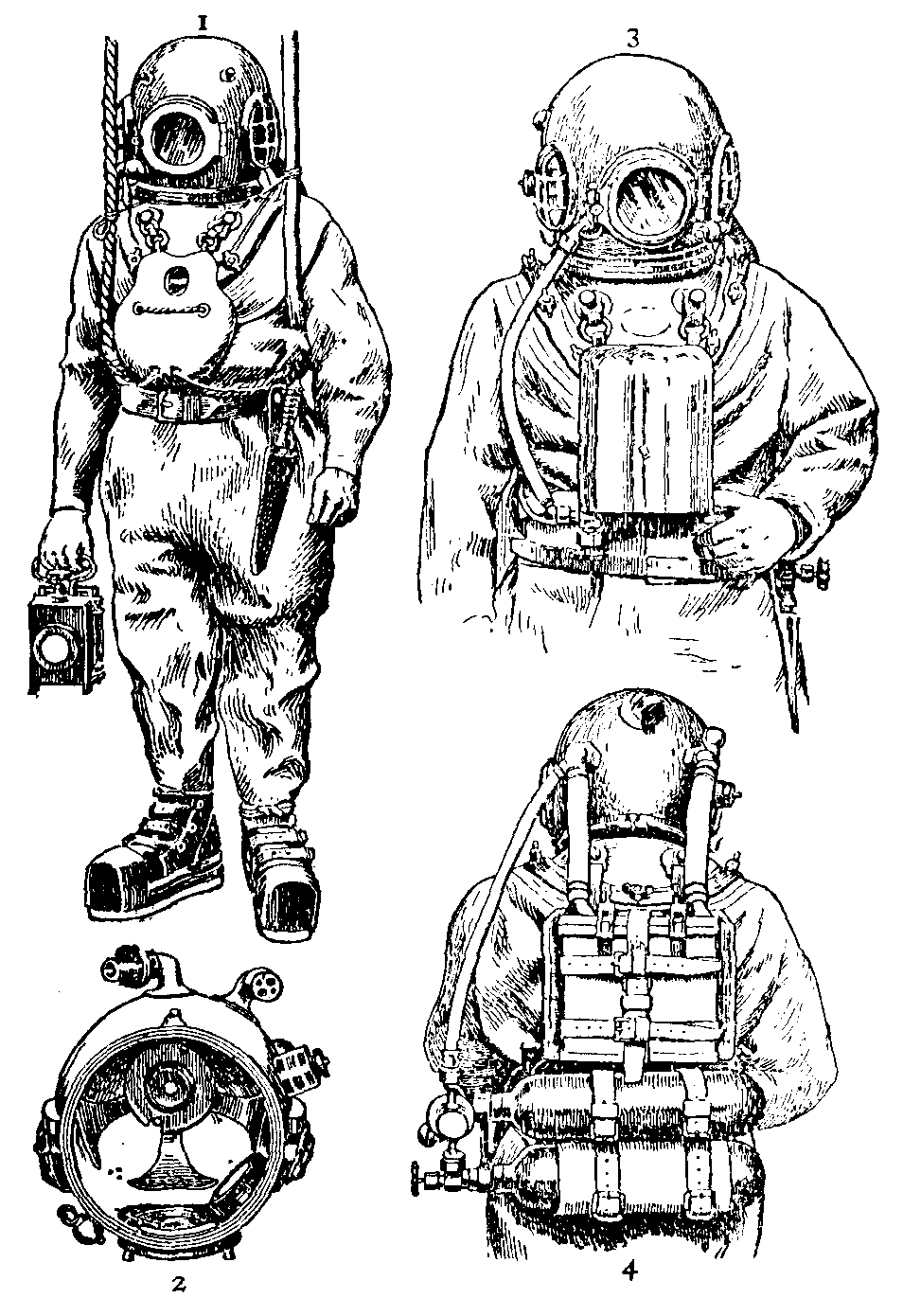
Diving Dress
1. Ordinary diving-dress with (2) helmet. 3. Front view and (4) back view of self-contained diving apparatus.
Reproduced by courtesy of Messrs. Siebe, Gorman, & Co
Diving-dress, a waterproof dress of india-rubber cloth used by professional divers, and covering the entire body except the head. The dress has a neck-piece or breastplate, fitted with a segmental screw bayonet joint, to which the head-piece or helmet, the neck of which has a corresponding screw, can be attached when wanted. The helmet has usually three eyeholes, covered with strong glass, and protected with guards. Air is supplied by means of a flexible air-pipe which screws on to a non-return valve on the helmet, and is connected with an air-pump on the surface. To allow of the escape of excess air a valve is fitted in the helmet, so constructed as to prevent water getting in, though it lets the air out. It can be adjusted by the diver to suit his convenience, no matter at what depth he may be. Leaden weights are attached to the diver, and his boots are weighted, so that he can descend a ladder and walk about on the bottom. Communication can be carried on with those above by signals on the breast-rope between the diver and his attendant, or he may converse with them through a speaking-tube or by telephone, which is usually fitted in the breast-rope. One form of diving-dress makes the diver independent of any connection with persons above water except by breast-rope. It is elastic and hermetically closed. A reservoir containing highly compressed air is fixed on the diver's back. This supplies him with air by a self-regulating apparatus at a pressure corresponding to his depth. When he wishes to ascend, he simply inflates his dress from the reservoir. Another form, known as the Fleuss dress, also makes the diver independent of exterior aid. The helmet contains a supply of compressed oxygen, and the exhaled breath is passed through a filter in the breast-piece which deprives it of its carbonic acid, while the nitrogen goes back into the helmet to be mixed with the oxygen, the supply of which is under the diver's own control, and to be breathed over again. A diver has remained for an hour and a half under 35 feet of water in this dress. The safe limit for diving is 200 to 300 feet, the deepest dive in this country being 210 feet; but great care must be exercised in bringing the diver to the surface. Diving for pearls, sponges, valuables, &c., is now to a great extent carried on by means of diving-dresses.—Bibliography: C. W. Domville-Fife, Submarine Engineering of To-day; G. W. M. Boycott, Compressed Air Work and Diving.
Divining Rod, a rod, usually of hazel, with two forked branches, used by persons who profess to discover minerals or water under ground. The rod, if carried slowly along by the forked ends, dips and points downwards, it is affirmed, when brought over the spot where the concealed mineral or water is to be found. Divination by means of rods is of great antiquity, and has been described by Cicero and Tacitus; their rods, however, were short bits of stick, and the forked hazel twig does not seem to have come into use before the early sixteenth century. Dr. H. Mayo gave a collection of discoveries made by it in his work On the Truth contained in Popular Superstitions (1847-51). The use of the divining rod is still common in many parts.—Cf. P. L. L. de Vallemont, La Physique Occulte: ou Traité de la baguette divinatoire.
Divisibil´ity, that general property of bodies by which their parts or component particles are capable of separation. The study of radioactivity has shown that larger atoms may be broken up into smaller ones, and the old conception of the atom as an absolutely indivisible unit is no longer entertained by physicists. (See Matter.) Numerous examples of the division of matter to a degree almost exceeding belief may be easily instanced. Thus glass test-plates for microscopes have been ruled so fine as to have 225,000 spaces to the inch. Cotton yarn has been spun so fine that one pound of it extended upwards of 1000 miles, and a Manchester spinner is said to have attained such a marvellous fineness that one pound would extend 4770 miles. One grain of gold has been beaten out to a surface of 52 sq. inches, and leaves have been made 367,500 of which would go to the inch of thickness. Iron has been reduced to wonderfully thin sheets. Fine tissue paper is about the 1200th part of an inch in thickness, but sheets of iron have been rolled much thinner than this, and as fine as the 4800th part of an inch in thickness. Wires of platinum have been drawn out so fine as to be only the 30,000th part of an inch in diameter. Human hair varies in thickness from the 250th to the 600th part of an inch. The fibre of the coarsest wool is about the 500th part of an inch in diameter, and that of the finest only the 1500th part. The silk line, as spun by the worm, is about the 5000th part of an inch thick; but a spider's line is only the 30,000th part of an inch in diameter; insomuch that a single pound of this attenuated substance might be sufficient to encompass our globe. The trituration and levigation of powders, and the perennial abrasion and waste of the surface of solid bodies, occasion a disintegration of particles almost exceeding the powers of computation. The solutions of certain saline bodies, and of other coloured substances, also exhibit a prodigious subdivision of matter. A single grain of sulphate of copper, or blue vitriol, will communicate a fine azure tint to five gallons of water. In this case the sulphate must be attenuated at least 10,000,000 times. Odours are capable of a much wider diffusion. A single grain of musk has been known to perfume a large room for the space of twenty years. At the lowest computation the musk had been subdivided into 320 quadrillions of particles, each of them capable of affecting the olfactory organs.
Division, in arithmetic, the dividing of a number or quantity into any parts assigned; one of the four fundamental rules, the object of which is to find how often one number is contained in another. The number to be divided is the dividend, the number which divides is the divisor, and the result of the division is the quotient. Division is the converse of multiplication.
Division, in the army, the smallest formation of troops which is a mixed force. A division, besides three brigades of infantry, includes artillery, engineers, and administrative troops. It is commanded by a major-general, and if at full strength consists of about 20,000 men.
Division, in Parliament, the mode of determining a question at the end of a debate. In the House of Commons the Speaker puts the question, and declares whether in his opinion the 'Ayes' or the 'Noes' have it. Should his opinion not be acquiesced in by the minority, the House is cleared, and the 'Ayes' directed to go into the right lobby and the 'Noes' into the left, where they are counted by two tellers appointed for each party. In the House of Lords the two sides in a division are called 'Contents' and 'Not-contents'.
Division of Labour, a method employed in productive undertakings for the simplifying of the work to be done by each of the workmen engaged therein. The separation of the process of production into a series of simple operations means that less ability on the part of the workman is required in order that he may acquire the necessary skill in performing any particular operation, and saves much time, partly because practice leads to each operation being more quickly performed, and partly by avoiding the waste which takes place in workmen moving from one operation to another. Owing to both of these causes, the cost of producing complicated articles may be immensely reduced. By standardizing operations division of labour tends to the invention of machinery; increases the skill and dexterity of the individual workman in the particular operation in which he is engaged; enables semi-skilled or unskilled labour to replace skilled; makes a more continuous and economical use of capital possible; and conduces to the more economical distribution of labour by classing work-people according to their capacity. It has, however, a deteriorating effect on the labourer's usefulness as an all-round workman, and is liable to kill his interest in his work, thereby reducing the incentive to industry. What is called division of labour in English economics has been sometimes termed co-operation by foreign economists.
Divorce (Lat. divortium, from divertere, to turn apart, separate), a separation, by law, of husband and wife, which is either a divorce a vinculo matrimonii, that is, a complete dissolution of the marriage bonds, or a divorce a mensâ et thoro (from bed and board), whereby the parties are legally separated, but not unmarried. The causes admitted by different codes of laws as grounds for the modification or entire dissolution of the marriage contract, as well as the description of tribunal which has jurisdiction of the proceedings, and the form of the proceedings, are various. Divorce was permitted by the law of Moses, but forbidden in the New Testament, except for adultery. The early laws of Rome permitted the husband to divorce his wife for adultery and many other alleged offences. The facility of divorce continued, without restriction, under the Roman emperors, but as the modern nations of Europe emerged from the ruins of the Roman Empire, they adopted the doctrine of the New Testament. Marriage, under the Roman Church, instead of a civil contract, came to be considered a sacrament of the Church, which it was unlawful to dissolve. The ecclesiastical courts could indeed annul a marriage, but only for a cause that existed at the time the marriage was contracted, such as prior contracts or impotency. For any cause arising after marriage they could only pronounce a divorce a mensâ et thoro, which did not leave either party free to marry again, except by Papal dispensation. A divorce a vinculo matrimonii, for any cause arising subsequent to marriage, could formerly be obtained in England only by an Act of Parliament, and the ecclesiastical courts must have previously pronounced a divorce a mensâ et thoro. The Act passed in 1857, however, established a new court for trying divorce causes, called the Court for Divorce and Matrimonial Causes, since absorbed into the Probate, Divorce, and Admiralty Division of the High Court of Justice. According to present practice the husband may obtain a divorce for simple adultery; but if the wife is the petitioner, she must show that her husband has been guilty of certain kinds of adultery, or of adultery coupled with desertion or gross cruelty. Either party may marry again after divorce. A divorce cannot be obtained if it appear that the petitioner has been guilty of the same offence, or has been accessory to or has connived at the offence, or if there has been collusion between the parties to obtain a divorce, or if they have condoned the offence by living together as man and wife after discovery. The husband may claim damages from the adulterer, and the court may also order the adulterer to pay the costs of the proceedings, in whole or in part. The Act also abolished divorces a mensâ et thoro, substituting, however, judicial separations. (See Judicial Separation.) A decree for a divorce is always in the first instance a decree nisi (q.v.). A Matrimonial Causes Bill, introduced in the House of Lords in 1920, proposes to abolish the legal disabilities of a wife in this matter, and to grant divorce to husband or wife on any of the following grounds: (a) adultery; (b) desertion for at least three years; (c) cruelty; (d) incurable insanity coupled with at least five years' confinement under the lunacy laws; (e) incurable habitual drunkenness coupled with three years' separation under a temporary separation order granted on the ground of habitual drunkenness; and (f) imprisonment under a commuted death sentence. In Scotland, from the time of the Reformation, divorce might be obtained by either party on the ground of adultery, marriage being held to be only a civil contract, and as such under the jurisdiction of the civil courts. Condonation, or connivance, or collusion is sufficient to prevent a divorce from being obtained on the ground of adultery, but not recrimination, that is, a counter charge of adultery. Wilful desertion for at least four years is also held a valid reason for divorce. The action is carried on before the Court of Session. In other countries, including British colonies, the law relating to divorce varies greatly. In the United States of America, marriage, though it may be celebrated before clergymen as well as civil magistrates, is considered to be a civil contract, and the laws as to divorce, and the facility or difficulty of obtaining it, differ greatly in the several states. In France divorce was legalized in 1884, with conditions, after having been prohibited for many years.—Bibliography: Lehr, Le mariage, le divorce et la séparation de corps dans les principaux peuples civilisés; Stephen, Commentaries on the Laws of England; Bryce, Marriage and Divorce.
Dixmude, a town of Belgium, in Flanders. It was the scene of severe fighting during the European War. Captured by the Germans, it was retaken by the Belgians on 29th Sept., 1918. Pop. 4040 (1911); 450 (1919).
Dixon, William Hepworth, miscellaneous writer, born at Manchester, 1821, died in London, 1879. In 1849 he published a memoir of Howard the philanthropist, which was followed by the Life of William Penn (1851), and by a work on Admiral Blake (1852). In 1853, after having been a contributor, he became chief editor of The Athenæum, a post which he retained till 1869. During this period he published several very popular works, including the Personal History of Lord Bacon, The Holy Land, and New America, the last being followed by Spiritual Wives. After his retirement from The Athenæum, and in the last ten years of his life, he gave to the world about twenty-five volumes of history, travel, and fiction, among others, Free Russia; Her Majesty's Tower; The Switzers; History of Two Queens, Catherine of Aragon and Anne Boleyn; Diana Lady Lyle, and Ruby Grey (both novels); and his last work, Royal Windsor.
Dizful, a town of Persia, near the western boundary, on the River Dizful; a place of great trade and manufactures. Pop. about 25,000.
Djavid Bey, Hussein, a Turkish Jew, one of the leaders of the Committee of Union and Progress, and Minister of Finance from 1914 to 1918. His advice that Turkey should adhere to strict neutrality during the European War was, unfortunately for his country, not followed by his colleagues, who decided to join Germany.
Djemal Pasha, Turkish soldier and politician, and one of the leaders of the Committee of Union and Progress. Minister of Marine in 1914, he commanded the Turkish forces in Palestine from 1915 to 1917, and became notorious on account of his oppression of and cruelties against the inhabitants of Syria and Palestine, and by his hatred of Zionism. Accused in 1918 of various crimes, such as misappropriation of funds, and compelled to flee from Constantinople, he was condemned to death in his absence in 1919. He was nevertheless one of the Turkish delegates who signed the Peace Treaty on 11th May, 1920.
Djokdjokarta, a Dutch residency in the Island of Java, on the south coast, with a capital of the same name. Its forests abound in teak. Its natural fertility is great, and rice, coffee, and tobacco are extensively cultivated. It is ruled by a sultan who is dependent on the Dutch. Pop. 441,800. The town is large and regular, and contains the sultan's water-palace, and the seat of the Dutch Resident, which is a fort commanding both the palace and the town. Pop. 97,058.
Dnieper (nē´pėr; Russ. Dnjepr, dnyepr; anciently Borysthĕnēs, or Danapris), a great river of Russia which rises in the government of Smolensk, flows first south-west, then south-east, and again south-west to the Black Sea. It begins to be navigable a little above Smolensk, and has a total length, including windings, of 1230 miles. Among its tributaries are the Beresina, the Pripet, the Desna, and the Psiol. In its lower course there are important fisheries. The region watered by the river in its lower course is famous for its great fertility, and is known as the black-soil. Between Kiev and Alexandrovsk it forms a series of cataracts. Since 1838 there have been steamboats on the river, and the trade carried by it is considerable. Through the Beresina Canal the Dnieper communicates with the Baltic Sea.
Dniester (nēs´tėr; Russ. Dnjestr; ancient Tyras), a large river of Europe (Poland, Roumania, and Ukraine), which has its source in the Carpathian Mountains, in Austrian Galicia, enters Russia at Chotin, and empties itself into the Black Sea, after a course of about 750 miles. Its navigation is difficult on account of frequent shallows and rapids.
Doab´ (that is, Two Waters), a name in Hindustan applied indiscriminately to any tract of country between two rivers, like the Greek Mesopotamia. The tract between the Ganges and the Jumna is usually called the Doab; other similar tracts have their distinctive names, the Punjab being divided into five districts of this kind.
Dobell´, Sydney, English poet and man of letters, born in 1824, died 22nd Aug., 1874. His first poem, The Roman, appeared in 1850, and was favourably received by the critics. Among his other works are: Balder, Sonnets on the War, and England in Time of War.
Döbeln (deu´beln), a town of Saxony, about 40 miles south-east of Leipzig, with a great trade in grain, and manufactures of cloth, yarn, leather, and lacquered wares. Pop. 17,920.
Döbereiner's Lamp, a contrivance for producing an instantaneous light, invented by Professor Döbereiner, of Jena, in 1824. The light is produced by throwing a jet of hydrogen or a mixture of oxygen and hydrogen gases upon recently prepared spongy platinum, when the metal instantly becomes red-hot, and then sets fire to the gas. The action depends upon the readiness with which spongy platinum absorbs both oxygen and hydrogen. The intimate contact of the two gases leads to chemical combination with evolution of heat. Coal-gas may be employed instead of hydrogen, and this has led to the application of the principle to self-lighting devices for igniting gas flames.
Dobritch, or Bazarjik, a town in Roumania, was, till the end of the second Balkan War, the chief town in Bulgarian Dobrudja. It is situated on a small tributary of the Danube, and is on the Cernavoda-Constanza railway. At one time it was famous for its panair or great annual fair, but it is now no longer an important centre. Pop. 10,000.
Dobrudja, or Dobrud´scha, The (anciently Scythia Minor), a territory forming part of the kingdom of Roumania, included between the Danube, which forms its boundary on the west and north, the Black Sea on the east, and Bulgaria (to which it belonged before 1878) on the south. Its area, formerly 6000 sq. miles, was increased by the Treaty of Bucharest of 10th Aug., 1913, and is now 8969 sq. miles. During the European War the Dobrudja was invaded in 1916 by an army of Germans, Bulgarians, and Turks, under General von Mackensen. In 1918 Roumania was compelled by the Treaty of Bucharest to cede the Dobrudja to Bulgaria, but it was restored to her in 1919. There are some fertile spots, but on the whole it is marshy and unhealthy. The population is of various nationalities, Roumanians, Bulgars, Greeks, Turks, and Jews. The inhabitants engage in tillage and stock-rearing. The principal towns are Kustendje and Tultcha. See Roumania. Pop. 381,306.
Curly or Yellow Dock (Rumex crispus)
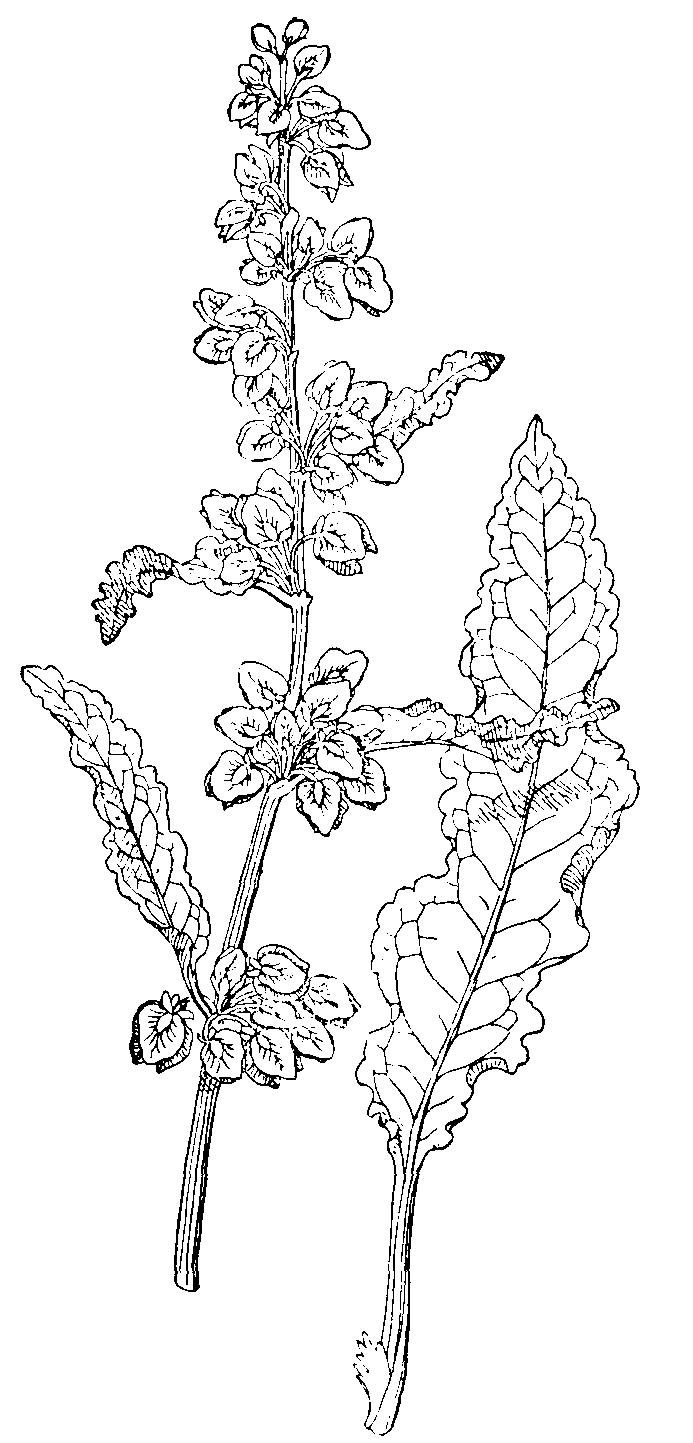
Dobson, Henry Austin, poet, born at Plymouth in 1840. He was educated at Beaumaris, Coventry, and Strasbourg; in 1856 obtained a clerkship under the Board of Trade, where he rose to be one of the officials known as principals. His earliest verses first appeared in book form under the title Vignettes in Rhyme and Vers de Société (1873). His other volumes of verse include: Proverbs in Porcelain (1877); Old World Idylls (1883); and At the Sign of the Lyre (1885), which The Athenæum pronounced to be "of its kind as nearly as possible perfect". Among his prose works may be mentioned his lives of Hogarth, Fielding, Steele, Goldsmith, Horace Walpole, Richardson, and Fanny Burney; Thomas Bewick and his Pupils; Four Frenchwomen, a study on Charlotte Corday, the Princesse de Lamballe, and Mesdames Roland and de Genlis; three series of Eighteenth Century Vignettes; A Paladin of Philanthropy; Sidewalk Studies; Old Kensington Palace; At Prior Park; A Bookman's Budget; and several editions of standard works. His collected poems were published in one volume in 1897. Many of Mr. Dobson's poems are written in various French forms, such as the rondeau and ballade, and all are marked by gracefulness and ease. He died in Sept., 1921.
Doce´tæ (from Gr. dokein, to seem or appear), the name given, in the earlier ages of the Church, to those who denied the reality of the human form of Christ, maintaining it to be merely a phantom or shadow. In the sense of regarding Christ's body as a heavenly and ethereal, instead of a human one, docetism had its partisans even among the orthodox.
Dock, a name applied to different plants of the genus Rumex, belonging to the rhubarb family (Polygonaceæ). These are large herbaceous plants, with stout roots, alternate and often entire leaves, and bearing panicles of small greenish flowers. They are very troublesome as weeds, but the roots of some of them are used medicinally as astringents.
Docket, or Docquet (dok´et; from dock, to shorten; Icel. dokr, stumpy tail), in law, a term variously used, as for a summary of a larger writing; a small piece of paper or parchment containing the heads of a writing; an alphabetical list of cases in a court, or a catalogue of the names of the parties who have suits depending in a court.
Docks, are artificial enclosures for the reception of shipping, for the purpose of loading, discharging, or repairs. They may be divided into four types, viz. tidal docks or basins, wet docks, dry or graving docks, and floating docks.
Tidal Docks or Basins are open permanently to the main channel or river, and the water-level therefore varies with the rise and fall of the tide. This variation of level is a serious hindrance in the work of loading or discharging cargo, unless the tidal range be small. It should be noted that this form is more properly termed a tidal basin.
Dry Dock, Tilbury, Essex
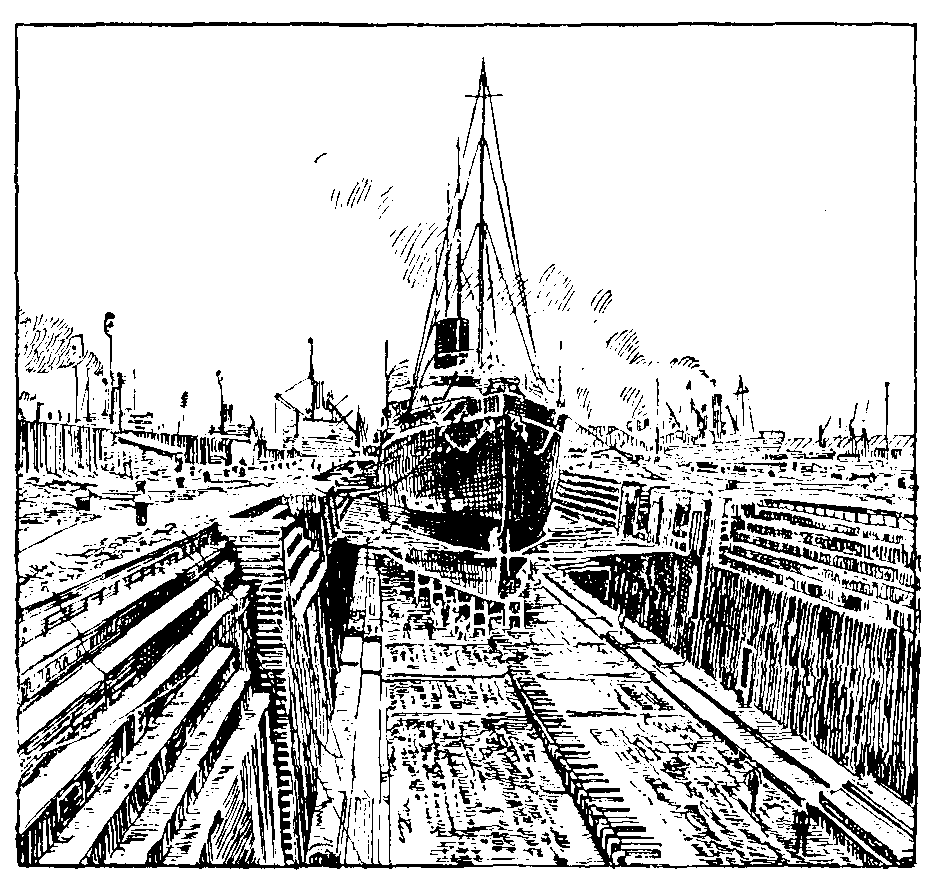
Wet Docks have a water entrance normally closed by gates or caissons, which permit the water-level of the enclosed area being maintained at high-water level. This uniformity of level is of great service in dealing with cargo, but this type has the disadvantage of only permitting traffic in and out of the dock at high water. This disadvantage may be modified by the provision of a lock at the dock entrance.
Dry or Graving Docks are used for the purpose of examining and repairing ships. The entrance is controlled by either gates or caissons. The ship having entered, the gates are closed, and the water pumped out, allowing the vessel to settle down gradually upon a row of keel blocks, running up the centre line of the dock. The sides of the docks are built in the form of large continuous steps or 'altars', which support the ends of the timber shores which serve to keep the ship in an upright position. The floor is graded to channels, leading to powerful pumps, usually of the centrifugal type, and capable of emptying a large dock in one hour.
Floating Docks fulfil the same functions as dry docks. In their modern form, they consist of a hollow steel box or pontoon, carrying hollow longitudinal walls at each side. These walls contain the pumps and controlling machinery, the pontoon portion being capable of being filled with or emptied of water, thus raising or sinking the dock. This lower portion is subdivided into a great number of compartments, all of which may be filled separately, so that errors of trim can be corrected. In making use of this type the dock is lowered by flooding the lower compartments. The ship is then floated into position and shored.
The Medway Floating Dock lifting H.M.S. Lion, 30,000 tons
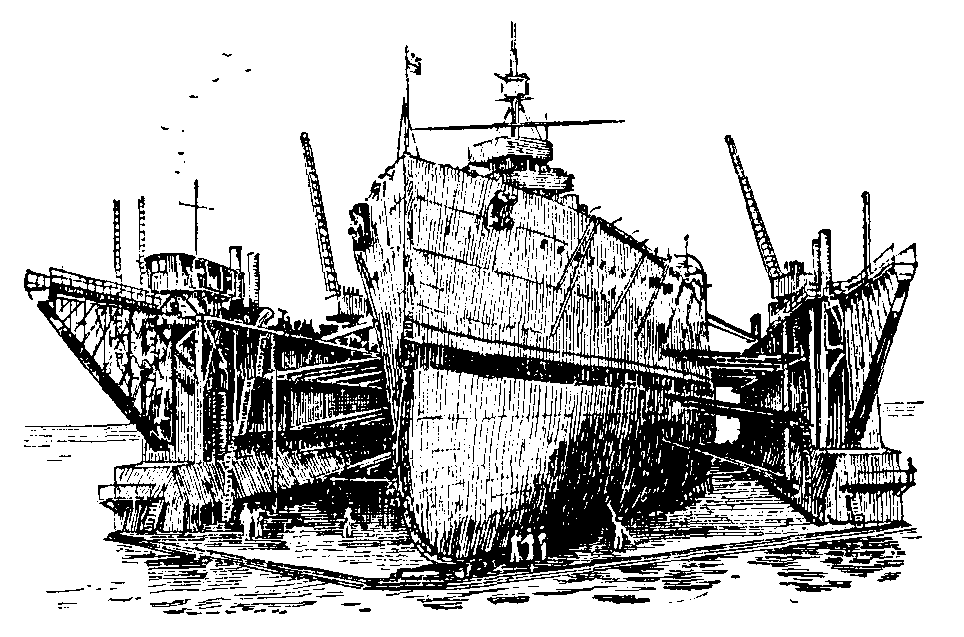
The initial cost of these two latter types is in favour of the floating dock, the annual maintenance charges of which, however, may be five to ten times those of an ordinary masonry dock. The mobility of a floating dock may be considered an advantage, allowing it to be easily removed to another locality to meet changing conditions, but this adaptability should not be overvalued.
The average life of a steel dock may be assumed to be 40 years, whereas a masonry dock may be said to last indefinitely, subject only to the fact that it may outlive its usefulness.
The first wet docks constructed in England were those now called the Commercial Docks, in London, which existed in a much less extensive form so early as 1660. In 1800 the West India Docks were constructed, and were followed by the East India Docks, Millwall Docks, London Docks, the St. Katharine Docks, and the Victoria Docks, affording, together with those at Tilbury, more than 600 acres of water accommodation, besides wharf and warehouse grounds, where all kinds of appliances and machinery for the speedy and convenient transfer of goods and cargoes are in use. Some of the warehouses are extremely capacious, the tobacco warehouse of the London Docks being itself nearly 5 acres in extent. Next after the London docks come those of Liverpool, which extend more than 6 miles along the north bank of the Mersey, and cover, together with the Birkenhead docks, nearly as large a total acreage as those of London. The other important British docks are those at Southampton, Bristol, Cardiff, Hull, Great Grimbsy, Newcastle, Shields, Barrow, Leith, Glasgow, Dundee, &c. A floating dock at Hamburg has a length of 728 feet, inside width of 123 feet, and a lifting capacity of 46,000 tons.—Bibliography: W. Shields, Principles and Practice of Harbour Construction; L. V. Harcourt, Harbours and Docks; Kempe, Engineer's Year Book.
Plan of PRINCE'S DOCK, GLASGOW.
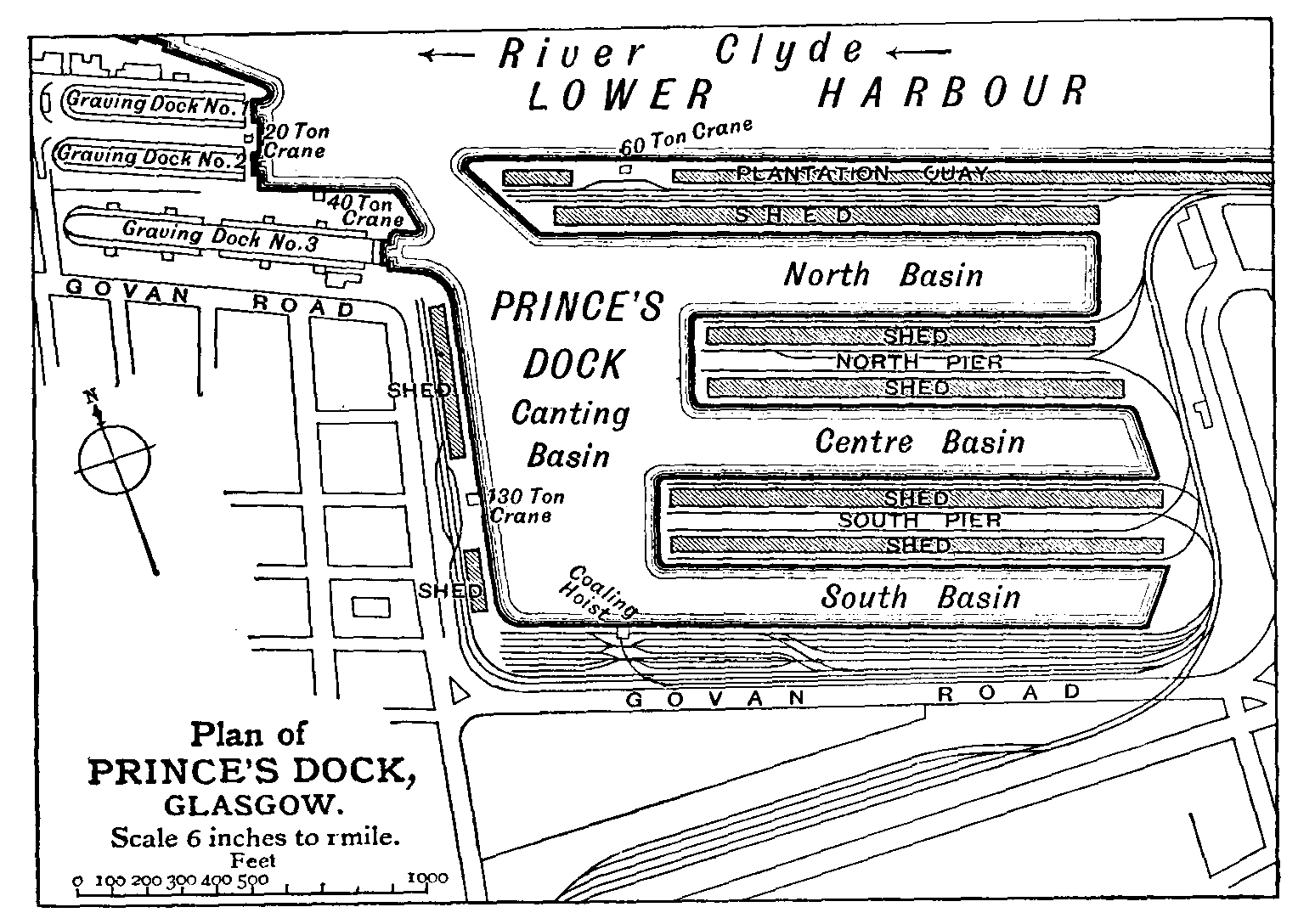
Dock-warrants, orders for goods kept in the warehouses connected with a dock. They are granted by the proper officer at the dock to the importer in favour of any one that he may name. These warrants are held to be negotiable, so that they may pass from one holder to another, the property of them being always vested in the holder.
Dock-yards, establishments supplied with all sorts of naval stores, materials and conveniences for the construction, repairs, and equipment of ships of war. In England the royal dock-yards are at Chatham, Sheerness, Portsmouth, Devonport, and Pembroke, besides the Deptford and Woolwich store-yards. There are also royal dock-yards or naval victualling yards at Haulbowline in Cork Harbour, Rosyth, Invergordon, at the Cape of Good Hope, Gibraltar, Malta, Bermuda, Bombay, Calcutta, Hong-Kong, Sydney, and Wei-hai-wei. Others in the colonies have been given up. The dock-yards are under the direct control of the Admiralty. The chief officer of the greater or home dock-yards is generally an admiral, with a considerable staff of officials under him, professional and other. Since the introduction of steam the engineering department has become an important one in such establishments.
Doctor, a term literally signifying teacher. In the Middle Ages, from the twelfth century, it came into use as a title of honour for men of great learning, such as Thomas Aquinas (Doctor Angelicus) and Duns Scotus (Doctor Subtilis). It was first made an academical title by the University of Bologna, and emperors and Popes soon afterwards assumed the right of granting universities the power of conferring the degree in law. The University of Paris followed in the footsteps of Bologna, and in 1145 the title was bestowed on Peter Lombard. The faculties of theology and medicine were soon included, but for a long time the faculty of arts retained the older title of Magister, till the German universities substituted that of Doctor. In England the Doctor's degree was introduced into the universities during the reign of John or Henry III. The title of Doctor is in some cases an honorary degree, and in other cases (as in medicine and science) conferred after examination. The title of D.C.L. (Doctor of Civil Law), for example, at the Universities of Oxford and Durham, is frequently an honorary degree, and so also are those of D.D. (Doctor of Divinity) and LL.D. (Doctor of Laws) at various universities. The Popes and the Archbishops of Canterbury exercise the right of conferring the degree of Doctor both in law and divinity. Oxford and Cambridge, and many other universities, create doctors of music (Mus.D.).