Volume 4 — VOLUME IV (continued 2)
Reading edition
Diather´mancy, the property that is possessed in various degrees by different substances, of transmitting radiant heat. Bodies that are equally transparent, that is, bodies which have equal power of transmitting rays of light, are very different in their power of transmitting heat-rays. Thus a thin plate of glass and a thin plate of rock-salt may be nearly equally transparent, but the plate of rock-salt has far superior power of transmitting rays of heat. The latter, it has been found, allows 92 per cent of the total heat from most sources to pass; glass and other substances transmit a much smaller proportion, and the amount varies with the source. Rock-salt is diathermanous to heat from nearly all sources. It has been shown that rock-salt is extremely opaque or athermanous to the radiations from a piece of heated rock-salt. The diathermancy of the plates in every case decreases very rapidly as their thickness is increased. See Radiation.
Diath´esis is the term given in medicine to a constitutional predisposition to a disease; thus uratic diathesis is a tendency to gout; aneurysmal diathesis is an inherent predisposition to aneurysms.
Diatoma´ceæ, a family of Algæ, consisting of microscopic unicellular plants with brown chromatophores found in fresh, brackish, and salt water, and on damp ground. The cell wall contains a very large quantity of silica, and is formed in each cell into three portions, viz. two generally symmetrical valves and a connecting hoop. The species consist of single free cells, or the cells remain connected so as to form usually linear colonies, sometimes enclosed in a transparent gelatinous sheath. The ordinary method of increase is by cell division. A sexual process resembling that of the conjugatæ also occurs. Diatoms constitute an important source of food for the lower marine animals, and thus indirectly for the food-fishes. Diatomaceæ are found fossil, forming considerable deposits of tertiary age, as at Bilin, Richmond in the United States, &c. Fossil polishing-powders, as tripoli and bergmehl, are composed of them; also kieselguhr, which, impregnated with nitroglycerine, forms dynamite. They are abundant in guano.
Diat´omite (Ger. kieselguhr), a diatomaceous earth (see Diatomaceæ) generally found underlying peat. In Skye, at Loch Quire, it is found about 18 inches below the surface, and extends downward for about 7 feet, and in some places to a much greater depth. Another important area is north of Toome Bridge in the county of Antrim. Diatomite is principally used for the manufacture of dynamite on account of its value as an absorbent. It is described also as extremely well adapted for the manufacture of silicate paints, siliceous glazings, porcelain, boiler-coatings, and for isolating felt and bricks for cold-storage buildings.
Diaton´ic, a term originally applied by the Greeks to one of their three genera of music. In modern music it is applied to the natural scale, and to the intervals, chords, melodies, or harmony characteristic of it. A diatonic chord is a chord having no note chromatically altered. A diatonic interval is an interval formed by two notes of the diatonic scale unaltered by accidentals. A diatonic melody is a melody composed of notes belonging to one scale only.
Diaz, Bartolommeo, a celebrated Portuguese navigator of the fifteenth century, named in 1486 commander of one of that long succession of exploratory expeditions which the Portuguese court had during this century become distinguished for promoting. The two vessels composing the expedition sailed along the African coast till they reached Cape Negro (lat. 15° 50' S.), where Diego Cam, a previous explorer, had stopped. At 29° S. they anchored at a point to which they gave the name of Angra das Voltas (Bay of Detours). In sailing south from this point they doubled the Cape of Good Hope without knowing it, and landed at a bay on the east coast. Diaz now wished to continue his voyage in order to discover the country of Prester John, but the sailors refused to accompany him. In again doubling the Cape he gave it the name of Cabo Tormentoso (Cape of Storms), which the king changed to its present designation. In 1500 Diaz had command of a vessel in the expedition of Cabral which discovered Brazil. In returning home the vessel which he commanded was lost, 29th May, 1500.
Diazo Compounds, or Diazonium Compounds, a name given to substances containing the chemical group - N:N -; thus diazo-benzene chloride, C6H5 - N:N·Cl, or diazo-toluene sulphate, C6H4(CH3) - N:NH·SO4, &c.
These substances are formed from the aromatic amines by treatment with nitrous acid at low temperatures. Primary amines all react with nitrous acid at moderate temperatures when the amino group (NH2) is replaced by a hydroxyl group (OH); thus ethylamine (C2H5NH2) reacts with nitrous acid (HNO2), yielding alcohol (C2H5OH), C2H5NH2 + HNO2 - C2H5OH + N2 + H2O. The aromatic amines, however, if treated below 0° C. with nitrous acid, yield diazo compounds, and not hydroxy compounds, e.g. aniline treated with nitrous acid in hydrochloric acid solution yields diazo-benzene chloride, C6H5NH2·HCl + HONO = C6H5 - N:N·Cl + 2(H2O). Diazo salts are crystalline compounds soluble in water, sparingly soluble in alcohol, and are unstable, decomposing explosively if struck or suddenly heated. In solution in water they decompose as the temperature rises, liberating nitrogen, and forming hydroxy compounds, C6H5N:NCl + H2O = C6H5OH + N2 + HCl. Diazo salts are valuable in the synthesis of different classes of compounds, as the - N:N - group reacts readily with other groups. For this purpose it is usually only necessary to prepare a solution containing the diazo compound. In the preparation of the azo dyes the starting-point is a primary amine; the amino group is 'diazotized', i.e. treated with a solution of sodium nitrite and dilute mineral acid at low temperature. A diazo salt is formed, and is then made to react in solution with a hydroxy compound or an amino compound, &c., with the formation of a highly coloured azo compound. The diazo compound is then said to be coupled. Diazo compounds are therefore important intermediate substances in the manufacture of azo dyes.
The diazo group may also be exchanged for the hydroxyl group by warming the solution with water, or for the cyanogen group by warming with a solution of potassium cyanide, e.g. diazo-benzene chloride warmed with potassium cyanide solution is converted into the nitrile of benzoic acid, C6H5 - N:NCl + KCN = C6H5CN + KCl + N2; or transformed into halogen derivatives of hydrocarbons by warming with cuprous chloride, e.g. diazo-benzene chloride is transformed into chlorobenzene, C6H5 - N:NCl + Cu2Cl2 = C6H5Cl + N2 + Cu2Cl2. These reactions, where nitrogen is eliminated from the compound, and a group or element replaces the two atoms of nitrogen, afford a means of synthesizing a variety of compounds.
Dib´din, Charles, an English dramatic manager and poet, composer and actor, born in 1745, died in 1814. At the age of fifteen he made his appearance on the stage, and was early distinguished as a composer. He invented a new kind of entertainment, consisting of music, songs, and public declamations, which he wrote, sang, composed, and performed himself, and by this means succeeded in amusing the public for twenty years. In 1769 he composed some of the music for the Shakespeare jubilee at Stratford-on-Avon. His patriotic songs were very popular, and his sea-songs, amongst which are Tom Bowling, Poor Jack, and The Trim-built Wherry, are still favourites in the British navy. He also wrote a History of the Stage, and the novels The Devil and Hannah Hewitt.—His son, Charles Dibdin, composed and wrote many small pieces and occasional songs.—Another son, Thomas, early displayed the same dramatic tastes as his father, was connected with various theatres, and wrote a great many songs and a number of dramas.
Dibdin, Thomas Frognall, an English bibliographer, born in 1776, died in 1847, was the son of the elder brother of Charles Dibdin the celebrated naval song-writer. After studying law and practising as a provincial counsel, he took orders and became a popular preacher in London. Here his bibliographical tastes developed themselves, and the Roxburghe Club being established in 1812, he became its first vice-president. Among his numerous writings may be noted: Bibliomania, Bibliographical Decameron, Typographical Antiquities of Great Britain, and The Library Companion.
Dibranchia´ta. See Cephalopoda.
Dice, cubical pieces of bone or ivory, marked with dots on each of their six faces, from one to six, according to the number of faces. They are shaken in a small box and then thrown on the table. Dice are often loaded or falsified in some way so as to make the high or the low sides turn down. The origin of dice is ascribed to Palamedes of Greece (1244 B.C.), although Herodotus attributes the invention of knuckle-bones and of dice to the Lydians. Dice were well known amongst the ancient Egyptians and Greeks, and are still very popular in Japan, China, India, and other Asiatic countries.
Dicen´tra. See Diëlytra.
Dichasium. See Cyme.
Dichlamydeous (dī-klam-id´i-us), in botany, said of plants that have both calyx and corolla.
Dichogamy, in flowers, the condition in which anthers and stigmas ripen at different times, whereby self-pollination is effectually prevented. If the anthers ripen first, as in borage, columbine, crocus, Caryophyllaceæ, Compositæ, Labiatæ, &c., the flower is said to be protandrous; protogynous flowers, with stigmas ripening and withering before the pollen is shed, occur, e.g. in Christmas rose, Colchicum, horse-chestnut, and in the majority of wind-pollinated plants.
Dichotomy (dī-kot´o-mi), a cutting in two; a division by pairs. Hence, in botany, a mode of branching by constant forking, each branch dividing into two others. See Branching.
Dichroic, or more generally Pleochroic, Crystals (dī-krō´ik), crystals that have the property of exhibiting different colours, according to the direction in which they are traversed by rays of light. When polarized light is passed through a transparent plate of a pleochroic mineral, the colour will vary with the direction in which the light-vibrations take place. Hence, face-pleochroism, the colour of the plate, may be distinguished from the colours given by axis-pleochroism, the colours given by light vibrating parallel with certain optical directions in the crystal.
Dichroite (dī´kro-īt), or Iolite, a mineral, a silicate of magnesium, iron, and aluminium, which readily undergoes modifications and passes into hydrous silicate. It exhibits marked pleochroism, whence the name.
Dick, Thomas, LL.D., a Scottish author of popular scientific works, born at Dundee in 1774, died 29th July, 1857. He was for many years a teacher at Perth, but subsequently resided at Broughty-Ferry, where he devoted himself to astronomical science, especially in its relations to religion. Some years before his death a small pension was granted to him by the Government. Amongst his works are: The Christian Philosopher (1823), The Philosophy of Religion (1825), The Philosophy of a Future State (1828), and Celestial Scenery (1838).
Dickens, Charles, one of the greatest English novelists, born 7th Feb., 1812, at Landport, Portsmouth, died 9th June, 1870. His father, John Dickens, was then in the employment of the Navy Pay Department, but subsequently became a newspaper reporter in London. Young Dickens received a somewhat scanty education, was for a time a mere drudge in a blacking warehouse, and subsequently a clerk in an attorney's office. Having perfected himself in shorthand, however, he became a newspaper critic and reporter, was engaged on The Mirror of Parliament, and The True Sun, and in 1835 on The Morning Chronicle. For some time previously he had been contributing humorous pieces to The Monthly Magazine; but at length, in 1835, appeared in The Morning Chronicle the first of that series of Sketches by Boz which brought Dickens into fame. It was followed in quick succession by a pamphlet entitled Sunday under Three Heads, by Timothy Spark (1836); The Tuggs at Ramsgate (1836); The Village Coquette, a comic opera (1836); and a farce called The Strange Gentleman (1836). In the same year Chapman & Hall engaged the new writer to prepare the letterpress for a series of comic sketches on sporting subjects by Seymour, an artist who had already achieved fame, and suggested as a subject the adventures of an eccentric club. Seymour committed suicide soon after, and H. K. Browne joined Dickens as illustrator, the result being the immortal Pickwick Papers. The great characteristics of Dickens's genius were now fully apparent, and his fame rose at once to the highest point it was possible for a writer of fiction to reach. A new class of characters, eccentric indeed, but vital representations of the humours and oddities of life, such as Mr. Pickwick, Sam Weller and his father, Mr. Winkle, and others, was made familiar to the public. Under the name of The Posthumous Papers of the Pickwick Club this work was published in 2 vols. 8vo, in 1837. In the same year Dickens was engaged as editor of Bentley's Magazine, to which he contributed Oliver Twist, a work which opened up that vein of philanthropic pathos and indignant satire upon institutions which became a distinguishing feature of his works. Before the completion of Oliver Twist, Nicholas Nickleby was begun, being issued complete in 1839. As the special object of Oliver Twist was to expose the conduct of workhouses, that of Nicholas Nickleby was to denounce the management of cheap boarding-schools. Master Humphrey's Clock, issued in weekly numbers, contained among other matter two other leading tales, The Old Curiosity Shop and Barnaby Rudge, the latter a historical tale, going back to the times of the Gordon riots. It was published complete between 1840 and 1841. In 1841 Dickens visited America, and on his return he wrote American Notes for General Circulation (1842). His next novel, Martin Chuzzlewit (1844), dwelt again on his American experiences. This work also added a number of typical figures—Mr. Pecksniff, Mark Tapley, Sarah Gamp, and others—to English literature. The series of Christmas Tales, in which a new element of his genius, the power of handling the weird machinery of ghostly legend in subordination to his own peculiar humour, excited a new sensation of wonder and delight. These, enumerated consecutively, were: A Christmas Carol (1843), The Chimes (1844), The Cricket on the Hearth (1845), The Battle of Life (1846), The Haunted Man and The Ghost's Bargain (1847). The extraordinary popularity of these tales created for a time a new department in literature, that of the sensational tale for the Christmas season. In 1845 Dickens went to Italy, and on his return The Daily News, started on 1st Jan., 1846, was entrusted to his editorial management; but, despite his early training, this was an occupation uncongenial to his mind, and in a few months the experiment was abandoned. His Pictures from Italy were published the same year. Next followed his novel of Dombey and Son (1848), and David Copperfield, a work which has a strong autobiographical element in it (1849-50). In 1850 Dickens became editor of the weekly serial Household Words, in which various original contributions from his own pen appeared. In 1853 his Bleak House came out. A Child's History of England, commenced in Household Words, was published between 1852 and 1854. Hard Times appeared in Household Words, and was published in 1854. Little Dorrit, commenced in 1856, dealt with imprisonment for debt, the contrasts of character developed by wealth and poverty, and executive imbecility, idealized in the Circumlocution Office. In 1859, in consequence of a disagreement with his publishers, All the Year Round superseded Household Words; and in the first number of this periodical, 28th May, was begun A Tale of Two Cities. Great Expectations followed in the same paper, on 1st Dec., 1860. In All the Year Round also appeared a series of disconnected sketches called The Uncommercial Traveller, published in 1868. Our Mutual Friend, completed in 1865, and published in the usual monthly numbers, with illustrations by Marcus Stone, was the last great serial work which Dickens lived to finish. It contained some studies of characters of a breadth and depth unusual with Dickens, and is distinguished among his works by its elaborate plot. The first number of his last work, The Mystery of Edwin Drood, was issued on 1st April, 1870, and only three numbers had appeared when he died somewhat suddenly, at his residence, Gad's Hill Place, near Rochester, on 9th June. He had considerably overtaxed his strength during his later years, more especially by his successive series of public readings from his own works, one series being delivered in America between 1867 and 1868. He was buried in Westminster Abbey. Dickens's work as a novelist is firmly based upon a wide and keen observation of men. The essence of his art was caricature, and for comic effect he, therefore, often exaggerated the abuses he attacked. His characters exhibit little more than one trait or quality, but the single trait or quality which they embody is truly conceived, and exhibited with great vitality and humour. His creative power was immense, and his great humour is admitted by all, even by those who consider his pathos as overdrawn. In spite, therefore, of all that is grotesque and overstrained in his work, he has been rightly placed amongst the great artists.—Bibliography: J. Forster, Life of Charles Dickens; George Gissing, Charles Dickens: a Critical Study; G. K. Chesterton, Charles Dickens; R. H. Shepherd, The Bibliography of Dickens; Sir F. T. Marzials, Life of Charles Dickens; E. Pugh, The Charles Dickens Originals; P. H. Fitzgerald, Memoirs of Charles Dickens.
Dicksonia, a genus of Leptosporangiate ferns, section Gradatæ, mostly large tree-ferns, such as D. antarctica, a native of Australia and New Zealand, often grown in greenhouses.
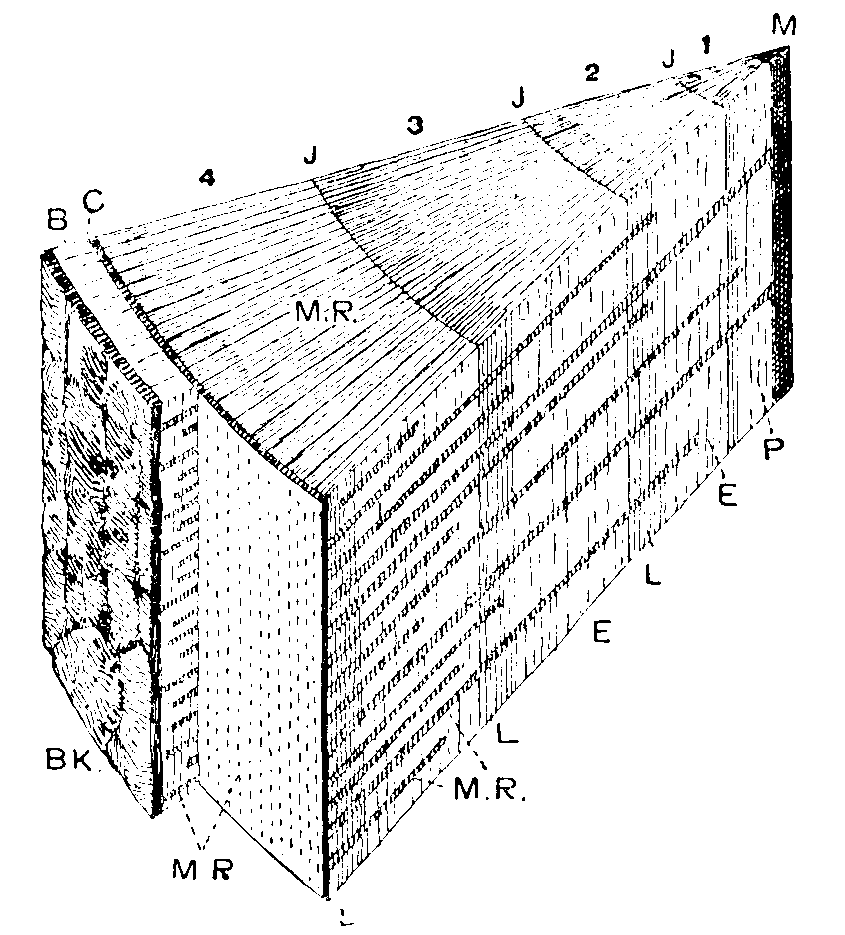
Portion of a Four-year-old Dicotyledonous Woody Stem cut in Winter
B, Bast. B.K., Bark external to the first periderm layer, corresponding to the primary cortex. C, Cambium ring. E, Early wood. J, J, J, Junction of the wood of successive years. L, Late wood. M, Medulla. M.R., Medullary rays, various views. P, Protoxylem. 1, 2, 3, 4, The four successive annual rings.
Dicotyledon (dī-kot-i-le´don), a plant whose seeds are readily recognized by the embryo containing a pair of cotyledons or seed-leaves, which are always opposite to each other. Dicotyledons are further characterized by their netted-veined leaves and their 'open' vascular bundles containing a cambium; the parts of the flower are commonly in fours or fives. In Bentham and Hooker's system the class is divided into four subclasses—Thalamifloræ, Calycifloræ, Corollifloræ, and Monochlamydeæ. Engler's system recognizes only two subclasses, viz. Archichlamydeæ and Sympetalæ.
Dictaphone, an adaptation of the gramophone, in which the principle of that invention is applied to the requirements of modern business. Letters or memoranda are spoken into the machine, which 'records' them on waxen cylinders. The machine is then passed on to a shorthand writer or typist (or the cylinder may be transferred to a duplicate machine), and the recorded matter is dictated. The motive power is electricity; the speed of dictation is capable of adjustment to that of the writer; and by means of an accessory machine the records can be scraped and re-used.
Dicta´tor, an extraordinary magistrate of the Roman Republic, first instituted B.C. 501. The power of naming a dictator, when an emergency arose requiring a concentration of the powers of the State in a single superior officer, was vested by a resolution of the Senate in one of the Consuls. The dictatorship was limited to six months, and the person who held it could not go out of Italy. This rule was laid aside during the first Punic War. The dictator was also forbidden to appear in Rome on horseback without the permission of the people, and he had no control over the public funds without the permission of the Senate. He had the power of life and death, and could punish without appeal to the Senate or people. All the other magistrates were under his orders. Originally the dictator was a patrician, but in 356 B.C. the plebeian Marcius Rutilus was called upon to fill the office of dictator. The term is now often applied to rulers enjoying or exercising extra-constitutional power.—Cf. A. H. J. Greenidge, Roman Public Life.
Dictionary (from the Lat., dictio, a saying, expression, word), a book containing the words, or subjects, which it treats, arranged in alphabetical order. It may be either a vocabulary, or collection of the words in a language, with their definitions; or a special work on one or more branches of science or art prepared on the principle of alphabetical arrangement, such as dictionaries of biography, law, music, medicine, history, or philosophy. Amongst dictionaries of the English language, the earliest seem to have been those of Bullokar (1616) and Cockeram (1623). That of Dr. Johnson, published in 1755, made an epoch in this department of literature. Previous to this the chief English dictionary was that of Bailey, a useful work in its way. An enlarged edition of Johnson's dictionary, by the Rev. H. J. Todd, appeared in 1818; and this, again enlarged and modified, was issued under the editorship of Dr. R. G. Latham (1864-72). The best-known American dictionary of the English language is that by Noah Webster, published in 1828, and since entirely recast. Richardson's dictionary, published during 1836 and 1837, was valuable chiefly for its quotations. Ogilvie's Imperial English Dictionary, based on Webster, and first published between 1847 and 1850, has been issued in a remodelled and greatly enlarged form (4 vols. 1881-2 and subsequently, Charles Annandale, LL.D., editor). It is one of the encyclopædic dictionaries. Cassell's Encyclopædic Dictionary is another extensive work (1879-88). The largest completed English dictionary is the Century Dictionary (New York, 1889-91, 6 vols. quarto). The Standard Dictionary is another American work. A new English dictionary 'on historical principles', first edited by Sir J. A. H. Murray, LL.D., with the assistance of many scholars, and now edited by Dr. Henry Bradley, is being published at the Clarendon Press since 1884. Among foreign dictionaries are the polyglot dictionary of Calepino (1502), the Latin and Greek Thesaurus of Robert and Henry Stephanus, the Italian Vocabulario della Crusca (1612), &c. The chief etymological dictionary of English words is that by Professor Skeat (1882). Among French dictionaries (for French people) the chief is that of Littré; among German, the dictionary begun by the brothers Grimm.
Dictyotaceæ, a family of Brown Algæ, section Cyclosporeæ. Dictyota dichotoma, with a delicate, flattened, repeatedly forked thallus, is not uncommon in sandy pools on our coasts. The plants are of three kinds, viz. ♂, bearing antheridia; ♀, bearing oogonia; and neuter, producing tetraspores. The oospores give rise to neuter plants, the tetraspores to ♂ or ♀ plants. This is one of the best instances of 'homologous' alternation of generations, i.e. that type in which the different generations are identical in form, differing only in their reproductive organs and in the number of chromosomes in their nuclei. Another genus is Padina.
Didactic Poetry, that kind of poetry which professes to give a kind of systematized instruction on a definite subject or range of subjects. Thus the Georgics of Virgil and the De Rerum Natura of Lucretius profess to give, the one a complete account of agriculture and kindred arts, the other a philosophical explanation of the world. Other examples of purely didactic poetry are Horace's Ars Poetica, and Pope's Essay on Criticism. In a larger sense of the word most great poems might be called didactic, since they contain a didactic element in the shape of history or moral teaching, Dante's Divina Commedia, Milton's Paradise Lost, or Goethe's Faust, for example. The difference may be said to be this, that in the one case the materials are limited and controlled by nothing but the creative fancy of the poet, while in the other they are much more determined by the actual nature of the subject treated of.
Didel´phia, one of the three subclasses of the Mammalia (the others being Monodelphia and Ornithodelphia), comprising only one order, that of Marsupials or pouched mammals.
Diderot (dēd-rō), Denis, a French writer and philosopher, born in 1713, at Langres, in Champagne, died in 1784. He was educated in the school of the Jesuits, and afterwards at Paris, at the College of Harcourt, but declined to study law, preferring to earn his living by teaching mathematics. His first works were the Essai sur le Mérite et la Vertu (1745); and the Pensées Philosophiques (1746), a pamphlet against the Christian religion. His Lettre sur les Aveugles à l'Usage de Ceux qui Voyent is in the same strain. These heterodox publications cost him an imprisonment for some time at Vincennes. Diderot now tried writing for the stage, but his pieces were failures. In 1749 he had begun, along with D'Alembert and some others, the Encyclopædia. At first it was intended to be mainly a translation of one already published in English by Chambers. Diderot and D'Alembert, however, enlarged upon this project, and made the new Encyclopædia a magnificently comprehensive and bold account of all the thought and science of the time. Diderot, besides revising the whole, undertook at first the mechanical arts, and subsequently made contributions in history, philosophy, and art criticism. But the profits of all his labour were small, and it was only the liberality of the Empress Catherine, who purchased his library for 50,000 livres and made him a yearly allowance of 1000 livres, that saved Diderot from indigence. In 1773 he visited St. Petersburg to thank his benefactress and was received with great honour. On his return to France he lived in retirement, passing the last ten years of his life in writing and conversations, wherein, as Marmontel said, he was at his best. Besides his articles in the Encyclopædia he wrote numerous works, some of which were published after his death. Among the best known are Le Neveu de Rameau, a kind of philosophical dialogue which Goethe thought worthy of translation; Essai sur la Peinture, and Paradoxe sur le Comédien, suggestive essays on the principles of painting and acting; two lively tales, La Religieuse and Jacques le Fataliste. On account of his great interest in almost every branch of human knowledge, Voltaire nicknamed him 'Pantophile Diderot'.—Bibliography: T. Carlyle, Essay on Diderot; F. Brunetière, Études Critiques; R. L. Cru, Diderot as a Disciple of English Thought.
Dido, or Elissa, the reputed founder of Carthage. She was the daughter of a king of Tyre, called by some Belus, by others Metten or Matgenus. After her father's death, her brother Pygmalion murdered her husband Sicharbas, or as Virgil calls him Sychæus, with the view of obtaining his wealth. But Dido, accompanied by many Tyrians of her party, fled with all the treasure over sea, and, landing on the coast of Africa, founded Carthage about 860 B.C. The story is told by Virgil, with many inventions of his own, in the Æneid (Books i and ii).
Didot (dē-dō), a famous house of printers, booksellers, and typefounders at Paris. The founder was François Didot, born in 1689, died 1757. Of his sons François-Ambroise (born 1720, died 1804) and Pierre-François (born 1732, died 1795) the first distinguished himself in the type-founding art as an inventor of new processes and machines, the second was equally eminent for his bibliographical knowledge, and contributed much also to the advancement of printing.—Pierre (born 1761, died 1853) succeeded his father François-Ambroise in the printing business. He made himself famous by his magnificent editions of classic authors in folio, amongst which his Virgil (1798) and his Racine (1801) may be particularly mentioned. He did much also for the improvement of types. He is known also as an author.—Firmin (born 1764, died 1836), the brother of Pierre, took charge of the type-founding, was the inventor of a new sort of script, and an improver of the stereotype process.—Ambroise-Firmin (born 1790, died 1876), and Hyacinthe-Firmin (born 1794, died 1880) occupied a distinguished position amongst the publishers of Paris. The former left a collection of MSS. which was worth, at the time of his death, about two million francs. The house has now extended its trade into everything connected with bookselling, paper-making, and bookbinding.
Didsbury, a district of Manchester, on the Midland Railway, 4 miles south by east of Manchester, a place of residence of many Manchester business men. There is an important Wesleyan Training College there. Pop. 9234.
Didunculus strigirostris
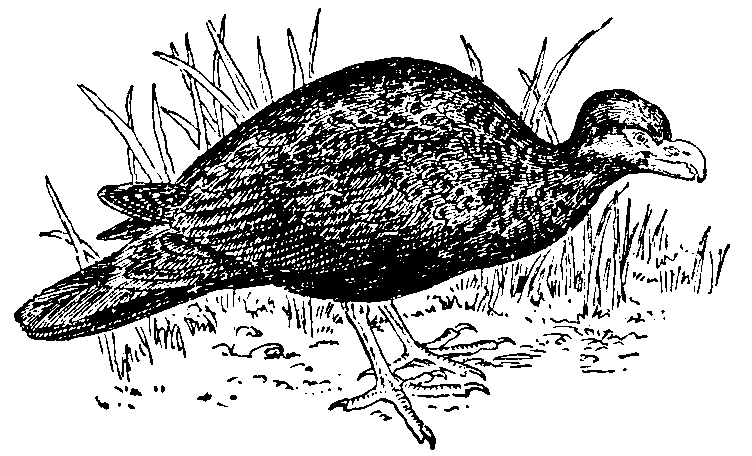
Didun´culus, a genus of birds allied to the pigeons, and comprising only the one species, D. strigirostris, native to some of the Samoan Islands. This bird is of special interest as being the nearest living ally of the extinct dodo. It has a length of about 14 inches, with a glossy plumage verging from a velvety black on the back to greenish black on the head, breast, and abdomen. The large beak, which is nearly as long as the head, is greatly arched on the upper half, while the lower is furnished with two or three tooth-like indentations.
Didym´ium, a rare metallic element, occurring along with lanthanum in the mineral cerite as discovered by Mosander in 1842. It has been resolved into two new elements: Praseodymium (Pr, 140.9) and Neodymium (Nd, 144.3).
Die, a metallic stamp for impressing a design or figure upon coins or other metallic objects. See Dies and Die-sinking.
Die (dē), an ancient town, France, department of Drôme, 26 miles south-east of Valence; with an ancient cathedral and Roman remains. Pop. 4000.
Dié (di-ā), St., a town, France, department of Vosges, on the Meurthe, 25 miles E.N.E. of Epinal. Both iron and copper are worked; there are marble quarries; and numerous manufactures are carried on. Pop. 19,029.
Diebitsch-Sabalkanski, Hans Karl, a Russian general, born at Grossleippe, in Silesia, in 1785, died 9th June, 1831. He was educated at the military school of Berlin, but in 1801 quitted the Prussian service for that of Russia. He was present at the battles of Austerlitz and Friedland, served with distinction in the campaign of 1812, took part in the battles of Dresden and Leipzig, and was made lieutenant-general at the age of twenty-eight. He had the chief command in the Turkish War of 1828-9, stormed Varna, and made the famous passage of the Balkans, for which the surname of Sabalkanski was conferred on him. In 1830 he commanded the army sent against the revolted Poles, but did not distinguish himself in this service.—Cf. Bantych-Kamenski, Biographies of Russian Field-marshals.
Dieffenbach (dē´fen-ba˙h), Johann Friedrich, German surgeon, born at Königsberg in 1792, died in 1847. After having studied at Bonn and Paris, he settled in Berlin, where his talent as an operator soon attracted notice. Surgery is particularly indebted to him for new methods of forming artificial noses, eyelids, and lips, and curing squinting and stammering.
Diego Garcia. See Chagos.
Di´electric, in electricity, a name applied by Faraday to any medium through or across which electrostatic induction can take place. See Electricity (Electrostatics). Faraday first showed that electrostatic induction was not action at a distance, but took place by means of the insulating medium separating the two conductors. The medium he named a dielectric, and measured its specific inductive capacity by taking that of common air as unity.
Diëly´tra, or Dicentra, a genus of plants, of the nat. ord. Fumariaceæ or Fumitories. The best known is D. spectabilis, a native of Northern China and Siberia, now common in European and other gardens. It blossoms in April and May, and its long drooping racemes of purplish-red blossoms present a very graceful appearance. It grows freely in the open air. It is sometimes called bleeding heart or virgin's heart from the shape of the blossoms.
Diemen (dē´men), Anton van, Dutch administrator, was born in 1593, died in 1645. Having gone to India, he speedily rose to the highest dignities, and was at length, in 1636, made Governor-General. He administered the government with much ability, and contributed much to the establishment of the Dutch commerce in India. Abel Tasman, whom he sent with a vessel to the South Seas in 1642, gave the name of Van Diemen's Land to the island now called Tasmania.
Dieppe (dē-ep´), a seaport town, France, department of Seine-Inférieure, on the English Channel, at the embouchure of the Arques, 93 miles N.N.W. of Paris. Almost the only public edifices worth special notice are the two Gothic churches, St. Jacques, begun in the thirteenth century, and St. Rémi, founded in 1522, and the old castle (1433), now a barracks. To the west of Dieppe proper is the suburb La Barre; and on the opposite side of the harbour Le Pollet, inhabited chiefly by sailors and fishermen. The old port is spacious, but a new channel with its own harbour system has been added, and vessels of 20-foot draft can now enter. Dieppe is one of the chief watering-places of France, and is much frequented by visitors in summer and autumn. The great bathing establishment forms a luxurious retreat for bathers and invalids, and includes a ballroom. The manufactures include works in ivory, horn, and bone, lace-making, sugar-refining, and shipbuilding. There is a busy fishery, and the foreign trade is still considerable. There is constant steam intercourse between this port and Newhaven. In early times Dieppe was the chief port of France, but its prosperity diminished after the revocation of the Edict of Nantes (1685). During the European War Dieppe was an important Allied base. Pop. 23,973.
Dierx, Léon, French poet, born in the Island of Réunion in 1838. Educated in Paris, he became one of the foremost of the Parnassians. His works include: Aspirations, Poèmes et Poésies, La rencontre, and Les Amants. His collected poems (1889-90) were crowned by the Académie. He died in Paris, 11th June, 1912.
Dies and Die-sinking. Die-sinking is the art of preparing dies, a die being a plate or block, usually of metal, so cut or shaped as to be capable, by means of stamping or pressure, of transferring a given design to some article which is to be manufactured in quantity. The pressure may be applied by any sort of power, from hand to hydraulic.
The steel for the manufacture of steel dies is carefully selected, forged at a high heat into the rough die, softened by careful annealing, and then handed over to the engraver. After the engraver has worked out the design in intaglio, the die is put through the operation of hardening, after which, being cleaned and polished, it is called a matrix. This is not, however, generally employed in multiplying impressions, but is used for making a punch or steel impression for relief. For this purpose another block of steel of the same quality is selected, and, being carefully annealed or softened, is compressed by proper machinery upon the matrix till it receives the impression. When this process is complete, the impression is retouched by the engraver, and hardened and collared like the matrix. Any number of dies may now be made from this punch by impressing upon it plugs of soft steel.
There is hardly any article which does not in the course of its manufacture require the use of a die of some kind. For all sorts of metal-work, seals, rings, silverware, moulds and shapes of sheet steel or tin, dies are employed. For this class of work they are usually of steel. For embossing articles of leather, wood, celluloid, rubber, cloth, or clay, dies of brass and phosphor-bronze are commonly used, these being easier media to work in and yet sufficiently strong. The dies for letter headings and company seals are cut, in reverse to the design required, in steel; those for sealing-wax seals in steel or brass; the lettering being usually punched in by hand by separate letter punches, which themselves have been cut in relief on steel. Designs which are unusually ornate may be engraved by hand. Dies for embossing designs on leather, catalogue covers, cardboard articles, cards, and soft materials are usually modelled in brass. The design in reverse is cut out to a depth corresponding to the relief wanted. These dies are usually worked up by hand by the engraver. Dies for the reproduction of rubber stamps for printing on clay are cut in phosphor-bronze or hard brass in relief and reverse, and with an extreme bevel. The dies or blocks are then struck deeply into lead, and melted rubber is poured into the moulds so formed. When set, the rubber is removed and mounted as a hand-stamp ready to impress the clay in ink. Dies for wallpapers are cut on rollers. Steel dies for flower-shapes have a cutting edge, so that they can stamp out and emboss in one action. Of late years machinery has come much into use for relieving the engraver of some of his labour, but the designs are generally kept secret. One machine, called the pantograph or engraving machine, reproduces engravings in all metals and many shapes from patterns. Many of the stamp-duty steel dies made and issued by the Royal Mint are reproduced from this machine in reductions from brass patterns.—Bibliography: Lucas, Dies and Die-making; J. V. Woodworth, Dies: their Construction and Use.
Diesel, Rudolph, German inventor, born in Paris in 1858, died in 1913. Educated in England and at Munich, he proposed in 1893 to utilize directly the energy created by the combustion of fuel, a proposal which led to his invention of the Diesel engine. (See Internal Combustion Engines.) In 1913 he was called to England to consult with the Admiralty on the application of his motor, but was drowned in crossing the Channel. In 1894 he published a monograph entitled Theory and Construction of a Rational Heat Motor.
Dies Fasti et Nefasti, a Roman division of days, with reference to judicial business, into working-days and holidays. A dies fastus was a day on which courts and assemblies could be held and judgments pronounced; a dies nefastus, a day on which courts could not be held nor judgments pronounced.
Dies Iræ (dī'es ī'rē), one of the great Latin hymns of the Mediæval Church, generally used as part of the requiem or mass for the souls of the dead. It describes, as its name ('the day of wrath') denotes, the Last Judgment of the world, and seems to have been suggested by the description in Zephaniah, i, 15 and 16. It is supposed to have been written by Thomas da Celano, a Franciscan friar of the thirteenth century. It was translated by Crashaw and Dryden in the seventeenth century, and by Macaulay and others in the nineteenth, but none of these translations conveys the solemn force of the original.
Diest (dēst), a town, Belgium, province of Brabant, 32 miles E.N.E. of Brussels. It has some manufactures, but the chief products of the place are beer and gin, the former being largely exported. The town was occupied by the Germans in 1914, and re-entered by the Belgians in 1918. Pop. 8800.
Diesterweg, Friedrich Adolf Wilhelm, German educator, born in 1790, died in 1866. In 1820 he became director of the new Teachers' Seminary at Mörs, and soon gained a reputation as teacher and educator. He was a follower of Pestalozzi, and aimed at making every subject of instruction a means of education. In 1827 he founded the Rheinische Blätter für Erziehung und Unterricht, wherein he advocated his pedagogical views.
Di'et, a meeting of some body of men held for deliberation or other purposes; a term especially applied to the legislative or administrative assemblies of Austria, Germany, and Poland.
Dietet'ics (Gr. diaita, daily regimen), that part of medicine which relates to the regulation of diet. The ideal diet is clearly that which, without burdening the viscera uselessly, furnishes all necessary nutritive elements, with due consideration for special physiological conditions in any given case. Under the head of Aliment the physiological properties of various foods have already been considered theoretically in respect of their capacity to supply physical waste in nitrogenous and non-nitrogenous matter. (See Aliment.) No single substance contains the elements needed to replace this waste in their requisite proportions, and a mixed diet is therefore necessary. For instance, to secure the required amount of carbon a man would need to eat about 4 lb. of lean beef, while 1 lb. would yield all the nitrogen required; thus, apart from the labour of digesting 4 lb. of beef, the body would be compelled to get rid of the excess of nitrogen. Bread, on the other hand, has carbon in abundance, but is deficient in nitrogen; so that by uniting 2 lb. of bread with ¾ lb. of lean meat, the due proportion of carbon and nitrogen is satisfactorily supplied. Milk and oatmeal taken together also contain nitrogenous and non-nitrogenous substances in nearly the required proportions. A certain proportion of saline matter is also necessary. The nature of the food most suitable for a healthy man is dependent in part upon general conditions, such as climate and season, and in part upon special conditions of individual habit. The inhabitants of the Arctic regions need large quantities of oleaginous food; those of the Tropics live chiefly on starchy products. With increased activity and exertion, as in training, an increase in the nitrogenous foods becomes necessary. In a state of health we need not draw hairbreadth distinctions as to the superior salubrity of the several sorts of diet, the quantity rather than the quality of food being the main consideration. Those persons who have been most remarkable for health and long life have generally been contented with two moderate meals a day, which are certainly quite sufficient during a state of health. In various countries the breakfast generally consists of tea, coffee, or cocoa, with a certain proportion of bread and butter; persons with delicate digestive powers, or who lead a sedentary life, cannot with safety or comfort eat animal food constantly to breakfast. At dinner all made-dishes highly spiced, such as curries, turtle-soup, &c., as provoking appetite, are hurtful; and the custom of late dining is not to be commended. Stewed and boiled meats are more difficult to digest than meat cooked by fire alone. The flesh of young animals seems to be more difficult of digestion than that of old; and the flesh of tame than that of wild animals. All sorts of fat meat must be taken in smaller quantities. Hence, also, ham, bacon, and salted meats cannot be eaten in such quantities as the tender flesh of poultry. Fish has the advantage of being easily soluble. All boiled vegetables are in general easy of digestion; raw vegetables and salads are rather more difficult. Fruit should be taken in the forenoon rather than after a hearty meal. The moderate use of fermented liquors is far from being invariably an evil, but the smaller the quantity habitually used the better in the majority of cases.
In all diseases attended with much fever or quickness of pulse the stomach loathes animal food, and there is generally a great increase of thirst, to quench which water, either quite cold, or iced, or tepid, or rendered acid, may be freely indulged. Infusions, too, of barley, sage, balm, &c., may be taken. In chronic diseases attended with hectic fever, milk is the most proper diet. The best food for infants is, of course, their mother's milk; but whenever they begin to cut teeth a little animal food, such as soft-boiled eggs, beef-tea, and even chicken minced very fine, may be given. Many infants suffer from having too much sugar given them in their food.—Bibliography: R. H. Chittenden, Physiological Economy in Nutrition, and Nutrition of Man; Hutchison, Food and Dietetics; Lusk, The Science of Nutrition.
Dietrich (dē´trih), Christian Wilhelm Ernst, a German painter and engraver, born in 1712, died in 1774. He studied under his father, and afterwards under Alexander Thiele at Dresden, where he became court-painter and professor in the academy. He adopted several different manners, successfully imitating Raphael and Mieris, Correggio, and Ostade.
Dietrich of Bern (dē´trih), the name under which Theodoric the Great, King of the Ostrogoths, appears in the old German legends. Bern stands for Verona, his capital.
Dieu, or D'Yeu (dyeu; ancient Insula Dei), an island off the west coast of France, department of Vendée. It is inaccessible on the west side, but on the east has a tolerable harbour defended by batteries. The chief industry is fishing. There are four lighthouses on the island. Pop. 3809.
Dieu et Mon Droit (dyeu e mon˙ drwä; 'God and my right'), the battle-cry of Richard I at the battle of Gisors (1198), signifying that he was not subject to France, but owed his power to God alone. The battle-cry was then adopted as the motto of the arms of England, and revived by Edward III in 1340, when he claimed the crown of France. Except during the reigns of Elizabeth and Anne, who used the motto Semper eadem, and of William III, who personally used Je maintiendray, it has ever since been the royal motto of England.
Diez (dēts), Friedrich Christian, German philologist of the Romance languages, born in 1794, died in 1876. Having qualified himself as a lecturer at Bonn, he was appointed professor of the Romance languages there in 1830. His work stands in much the same relation to the Romance dialects which the researches of Grimm occupy with respect to German dialects. In addition to various works on the poetry of the Troubadours, he published a very valuable Grammatik der Romanischen Sprachen (1836-42, translated into English by Cayley in 1863), and an Etymologisches Wörterbuch der Romanischen Sprachen (1853).
Difference, a stock-exchange term. When stock is bought or sold merely as a speculation for the rise or fall, with no intention of the buyer to 'take up' the stock, or of the seller to deliver it, the 'difference' is the movement in price which may take place between the date of the transaction and the following 'settling-day'. If the price falls, the buyer has to pay the difference upon 'carrying over' his purchase to the next account; if it rises, the seller is at the loss. Since the first weeks of the European War all stock-exchange transactions have been made, in theory at least, for cash, and speculative business of this nature has been consequently much reduced.
Differences, Finite, a calculus much used in actuarial work, which deals with a series of numbers by considering the differences of the successive terms.
If u1, u2, u3, ... are the terms of the series, then u2 - u1, u3 - u2, u4 - u3,... form another series called the series of first differences. The notation used is u2 - u1 = Δu1, u3 - u2 = Δu2,...
These first differences may themselves be differenced, giving the second differences Δu2 - Δu1, Δu3 - Δu2, ..., which are written Δ2u1, Δ2u2,...
Similarly, we form the third differences Δ3u1 = Δ2u2 - Δ2u1, and so on.
As an example, let the original series be the cubes of the natural numbers.
1 8 27 64 125 216 / 343 512
7 19 37 61 91 / 127 169
12 18 24 30 / 36 42
6 6 6 / 6 6
0 0 / 0 0
Here we begin by writing down the series of cubes as far, say, as 216; beneath these we write the first differences 8 - 1 = 7, 27 - 8 = 19, &c. We thus obtain the part of the table to the left of the diagonal line.
We observe that the third differences are constant, each being 6. (It is easy to prove generally that the nth differences of the series, 1n, 2n, 3n,..., are constant.) Knowing the third differences, we can now extend the table as far as we wish to the right of the diagonal line. We get first 6 + 30 = 36, 36 + 91 = 127, 127 + 216 = 343. We infer that 73 = 343.
Since u1 - u0 = Δu0, we have u1 = u0 + Δu0 = (1 + Δ)u0.
Similarly, u2 = (1 + Δ)u1 = (1 + Δ)2u0; and, generally,
ux = (1 + Δ)xu0
= { 1 + xΔ + x(x-1) Δ2 + ... } u0
1×2
= u0 + xΔu0 + x(x-1) Δ2u0 + ...
1×2
a formula much used by calculators, and known as Newton's interpolation formula.
The above symbolic method of proof only applies when x is a positive integer, but the result is used in practice even for fractional values of x, as in most cases the high differences become negligible.
If n is a positive integer, it is easy to prove that
Δnux = ux+n - nux+n-1 + n(n-1) ux+n-2 - ...
1×2
If the nth differences vanish, or are negligible, this gives
0 = ux+n - nux+n-1 + n(n-1) ux+n-2 - ... +(-1)nux,
1×2
another useful interpolation formula, by which we can calculate any missing term of a series.—Bibliography: G. Boole, Finite Differences; Textbook of the Institute of Actuaries.
Differential Equation, an algebraical relation involving derivatives or differentials. Examples:
d2z = g: ydx + xdy + zdz = 0.
dt2
An ordinary differential equation involves only one independent variable, a partial differential equation involves more than one. Examples of ordinary equations:
d2y + 1 dy + y = 0; d2x + a dy + px + qy = 0.
dx2 x dx dt2 dt
Examples of partial differential equations:
x dz + y dz = nz; d2u + d2u + d2u = 0.
dx dy dx2 dy2 dz2
Equations, whether ordinary or partial, can also be classified as linear or non-linear. A linear equation is a rational integral equation of the first degree in the dependent variable or variables and their derivatives. The equation
x2 d2y + x dy + (x4 + 1)y = 0
dx2 dx
is linear, but
( dy )2 = xy and y dy = x2
dx dx
are non-linear. The order of an equation is the order of the highest derivative or differential which it contains. Of the three equations last written, the first is linear of the second order, the other two are of the first order and second degree. To integrate a differential equation or system of equations is to find a relation or relations among the variables, equivalent to the given equation or equations. Thus the integral of
d2z = g is z = ½gt2 + At + B,
dt2
where A and B are arbitrary constants. An ordinary equation of the nth order with one dependent variable has exactly n arbitrary constants in its complete integral, or solution. In a practical problem the arbitrary constants are determined by the initial, or boundary, conditions. The solution of d2z/dt2 = g, e.g. is completely determinate if the values of z and dz/dt when t = 0 are given. The solution of partial equations may involve arbitrary functions, which become definite when proper initial or boundary conditions are assigned. Thus the equation du/dx = du/dt has for its complete solution u = φ(x + t), where φ may be a function of any form whatever; if now we are given that, when t = 0, u = a given function f(x), we obtain f(x) = φ(x), so that the solution required is u = f(x + t). Certain ordinary linear equations of the second order are specially important, both from the beauty of their theory and from their usefulness in Mathematical Physics. Some of these equations are: Bessel's equation, Legendre's equation, the hypergeometric equation, Mathieu's equation, Lamé's equation. Linear partial equations of the second order are fundamental in Physics. Such are: Laplace's equation,
d2V + d2V + d2V = 0;
dx2 dy2 dz2
the wave equation,
d2V = c2 ( d2V + d2V + d2V );
dt2 dx2 dy2 dz2
the equation of conduction of heat,
dV = k ( d2V + d2V + d2V ).
dt dx2 dy2 dz2
These involve one dependent variable only. Equations with several dependent variables occur in Elasticity, Electrodynamics, and Hydrodynamics. A notable feature of the hydrodynamical equations is that they are not linear.
No general rules exist enabling us to deal with a differential equation taken at random, and only a few types have been completely solved. Of soluble equations, the most important are those which are linear with constant coefficients.
Example 1. d2x/dt2 - 7dx/dt + 12 = 0. To solve this, try x = emt. We find emt(m2 - 7m + 12) = 0. Thus m = 3 or 4. It is now easy to show that x = Ae3t + Be4t is a solution, where A and B are arbitrary constants. This is the general solution. We can determine A and B if the values of x and dx/dt are given for a definite value of t, say t = 0.
Example 2. d2y/dt2 = c2 d2y/dx2. Try y = elx + mt. We find m2 = c2l2, or m = ±cl. Hence y = Ael(x + ct) + Bel(x - ct) is a solution for all values of A, B, l; so, also, is the sum of any number of terms of similar forms. We may infer that the general solution is
y = f(x + ct) + F(x - ct),
where f and F are arbitrary functions. It is only in exceptional cases that an equation can be solved, as in these two examples, by an analytical formula; indeed, differential equations are the most fertile source of new functions in analysis. But, as in the analogous cases of algebraic equations and definite integrals, it may be quite possible to find, by methods of approximation, an arithmetical solution which is sufficient for the purpose in hand.—Bibliography: H. T. H. Piaggio, Differential Equations; J. M. Page, Ordinary Differential Equations; A. R. Forsyth, A Treatise on Differential Equations; E. T. Whittaker and G. N. Watson, Modern Analysis.
Diffrac´tion, a term applied to the bending that rays of light undergo in passing close to the edge of an opaque body. Thus when a beam of direct sunlight is admitted into a dark room through a narrow slit, and falls upon a screen placed to receive it, there appears a line of white light bordered by coloured fringes; these fringes are produced by diffraction, and in the case given it may be seen that the red or long-wave rays are diffracted more than the blue rays. See Interference.
Diffu´sion, the gradual mixing of gases, liquids, or solids when brought into direct contact. When a block of lead is placed on a block of gold, with their smooth surfaces in close contact, it is found that, after several weeks, gold has diffused into the lead, and lead into the gold. In the case of gases, when a jar of oxygen and a jar of hydrogen are connected together by a tube or opening of any kind, they rapidly become mixed; and their mixture does not depend on gravity, but takes place in opposition to that force, as may be shown by placing the jar of hydrogen gas above the other. Oxygen is sixteen times heavier than hydrogen, bulk for bulk, but the heavier gas moves upwards and the lighter downwards, and the process of intermixture, or diffusion, goes on till the two gases are apparently equably distributed throughout the whole space. After that they have no tendency whatever to separate. Similarly, if two vessels, one containing oxygen and the other hydrogen, be connected by a tube which is stuffed with a plug of porous material, such as plaster of Paris, the gases gradually diffuse one into the other through the porous plug. The two gases, however, do not pass through the porous separator at equal rates, but in inverse proportion to the square roots of the densities of the gases. Thus in the case of two vessels, one containing hydrogen and the other oxygen, which is sixteen times as heavy as hydrogen, the hydrogen will pass towards the oxygen jar four times as quickly as the oxygen will pass towards the hydrogen jar. Kindred phenomena occur when two liquids that are capable of mixing, such as alcohol and water, are put in contact, the two gradually diffusing one into the other in spite of the action of gravity. In some cases, however, as where ether and water are employed, the diffusion is only partial, this result arising from the fact that these two liquids are not miscible in all proportions. When solutions of various solid bodies are placed in contact, interdiffusion also takes place. On the results of his examination of the phenomena of diffusion of liquids and salts across porous membranes or septa, Graham founded a method of separating colloid from crystalloid bodies, which he called dialysis.
Digam´ma, a letter which once belonged to the Greek alphabet, and which remained longest in use among the Æolians. It resembled our letter F, and hence was called digamma, that is, double Γ. It appears to have had the force of f or v. Its existence was first pointed out by Richard Bentley.
Digby, Sir Everard, an English gentleman, born of a Roman Catholic family in 1578. He enjoyed some consideration at the court of Elizabeth and James I, by whom he was knighted. Having contributed money to the Guy Fawkes conspiracy, he was tried and hanged in 1606.
Digby, Sir Kenelm, eldest son of the preceding, born in 1603, died in 1665. He studied at Oxford, was knighted in 1623, and on the accession of Charles I was created a gentleman of the bedchamber, a Commissioner of the Navy, and a governor of Trinity House. He soon after fitted out at his own expense a small but successful squadron against the French and Venetians. In 1636 he became a Roman Catholic, and was imprisoned as a Royalist during 1642-3, when he was allowed to retire to the Continent. At the Restoration he returned to England, became a member of the Royal Society, and was much visited by men of science. He wrote numerous works: a Treatise on the Nature of Bodies, a Treatise on the Nature and Operation of the Soul, and Of the Cure of Wounds by the Powder of Sympathy.
Di´gest, a name originally given to a collection or body of Roman laws, digested or arranged under proper titles by order of the Emperor Justinian. Hence applied to any somewhat similar collection.
Diges´ter, a strong vessel of copper or iron, on which is screwed an air-tight cover with a safety-valve, the object being to prevent loss of heat by evaporation, and to enable boiling to take place at a high pressure. Water may be thus heated to 400°F.; at which temperature its solvent power is so greatly increased that bones are converted into a jelly.
Diges´tion is that process in the animal body by which the aliments are so acted upon that the nutritive parts are prepared to enter the circulation, and separated from those which cannot afford nourishment to the body. The organs effecting this process are called the digestive organs, and consist of the stomach, the great and small intestines, &c. (see Intestine, Stomach), the liver, and pancreas. When the aliments, after being properly prepared and mixed with saliva by mastication, have reached the stomach, they are intimately united with a liquid substance called the gastric juice, by the motion of the stomach. By this motion the aliments are mechanically separated into their smallest parts, penetrated by the gastric juice, and transformed into a uniform pulpy or fluid mass. The gastric juice acts upon the albuminous parts of the food, converting them into peptones, which can pass through organic membranes and thus enter the blood. This action is aided by the warmth of the stomach. The pulpy mass, called chyme, proceeds from the stomach, through the pylorus, into that part of the intestinal canal called the small intestine, where it is mixed with the pancreatic juice, bile, and intestinal juice. The pancreatic juice converts starch into sugar, albumins into peptones, and emulsionizes fats, so that all these kinds of food are rendered capable of absorption. The process is aided by the intestinal juice. The bile also acts upon fats, and thus the food is formed into the chyle, which is absorbed into the system by the capillary vessels called lacteals (see Chyle; Chyme), while the non-nutritious matters pass down the intestinal canal and are carried off.—Bibliography: F. Hare, Food Factor in Disease; Taylor, Digestion and Metabolism.
Digit (dij´it; Lat. digitus, a finger), in arithmetic, any one of the ten numerals, 1, 2, 3, 4, 5, 6, 7, 8, 9, 0. Digit is also a measure of a finger's breadth, equal to ¾ inch.
Digit, in astronomy, is the measure by which we estimate the quantity of an eclipse. The diameter of the sun or moon's disk is conceived to be divided into twelve equal parts, called digits; and according to the number of those parts or digits which are obscured, so many digits are said to be eclipsed.
Digitalin (dij-i-tā´lin), a vegetable alkaloid, the active principle of the Digitālis purpurĕa or foxglove. It has a bitter taste, and is a strong poison, but is used medicinally, especially for the heart. See next article.
Digita´lis (dij-), a genus of plants, nat. ord. Scrophulariaceæ, containing about twenty species of tall herbs, natives of Europe and Western Asia. The purple foxglove (D. purpurĕa) is a common wild flower in Britain, and several species are grown in gardens. Various preparations from the foxglove receive this name, and are used in medicine, principally in cases of heart disease.
Digitigra´da (digitus, finger, toe, and gradi, to walk), a section of the Carnivora, so called from their walking on the ends of their toes; as the dog, cat, and their allies. See Plantigrade.
Digito´rium, a small portable dumb instrument having a short keyboard with five keys like those of a piano, used by piano-players for practice, to give strength and flexibility to the fingers.
Digne (dēny), a town, France, capital of the department of Basses-Alpes, picturesquely situated on a mountain slope, 60 miles north-east of Marseilles. In 1629 a plague reduced the population from 20,000 to 1500. Pop. 7317.
Dijon (dē-zhōn; Lat. Castrum Divonense), a town in Eastern France, capital of the department of Côte-d'Or, in a fertile plain, at the foot of a range of vine-clad slopes, formerly surrounded by ramparts, which now furnish beautiful promenades. At some distance it is surrounded by a series of forts. Some of the buildings belong to the period when Dijon was capital of the dukedom of Burgundy, the chief being the cathedral of St. Bénigne, a building of vast extent with a lofty wooden spire above 300 feet high; the churches of Nôtre Dame and St. Michael; the ancient palace of the Dukes of Burgundy, now used as the hôtel de ville and museum; and the palais de justice, formerly the Parliament House of Burgundy. Dijon is the birth-place of Bossuet. It has important educational institutions and a valuable library. Industries: woollens, hosiery, candles, mustard, vinegar, chemicals, paper-hangings, tanneries, foundries, machine factories, cotton- and oil-mills. The trade is considerable, particularly in the wines of Burgundy. Pop. 76,847.
Dike, or Dyke (connected with the Gr. teichos, wall), a word variously used in different localities to represent a ditch or trench, and also an embankment, rampart, or wall. It is specially applied to an embankment raised to oppose the incursions of the sea or of a river, the dikes of Holland being notable examples of work of this kind. These are often raised 40 feet above the high-water mark, and are wide enough at the top for a common roadway or canal, sometimes for both. The Helder Dike, one of the largest, is about 6 miles in length and costly in upkeep. See Embankment.
Dike, or Dyke, in geology, a term applied to intrusive igneous masses, such as basalt, which fill up veins and fissures in the other rocks, and sometimes project on the surface like walls through their superior resistance to weathering.
Dilapidation, in English ecclesiastical law, is where an incumbent of a church living suffers the parsonage-house or outhouses to fall down, or be in decay for want of necessary repairs; or it is the pulling down or destroying any of the houses or buildings belonging to a spiritual living, or destroying of the woods, trees, &c., appertaining to the same. An outgoing incumbent (or his heirs) is liable for dilapidation to his successor. In general, the term is applied to the act of allowing or causing any lands, houses, &c., to become waste or to decay.
Dilem´ma (from Gr. di-, double, and lēmma, proposition, assumption), in logic, a form of argument used to prove the falsehood or absurdity of some assertion, as in the following instance: If he did so he must be either foolish or wicked; but we know he is neither foolish nor wicked; therefore he cannot have done so. The two suppositions, which are equally untenable, are called the 'horns' of the dilemma.
Dilettante (di-let-ta˙n´tā), an Italian expression, signifying a lover of the arts and sciences, who devotes his leisure to them as a means of amusement and gratification, being thus nearly equivalent to amateur. It is also used in reference to the trifler and dabbler in art and science. In 1734 a number of gentlemen founded in London a Dilettanti Society, which published a splendid work on Ionian Antiquities, 1769, 1881 (4 vols.); Specimens of Ancient Sculpture, 1809, 1835.
Dilke, Sir Charles Wentworth, English writer and politician, son and grandson of men well known in their day, was born in 1843, died in 1911. He graduated at Cambridge, and was called to the Bar. His first work, Greater Britain, the result of a tour round the world from 1866 to 1867, became very popular. In 1868 he was elected member of Parliament for Chelsea, and he remained so up to 1885. After a few years' retirement (due to a divorce case) he became member of Parliament for Forest of Dean. He was Under-Secretary for Foreign Affairs, President of the Local Government Board, &c. He succeeded his father as owner of the Athenæum, and became the proprietor of Notes and Queries. The Present Position of European Politics, and Problems of Greater Britain, are among his works.
Dill, an umbelliferous plant, Anēthum graveŏlens, a native of the southern countries of Europe, the fruits, commonly but erroneously called seeds, of which are moderately warming, pungent, and aromatic, and are employed medicinally as a carminative.
Dillenia´ceæ, an order of plants, chiefly fine trees, inhabiting the East Indies, allied to Ranunculaceæ and Magnoliaceæ.
Dillingen (dil´ing-en), an old town, Bavaria, on the Danube, formerly the seat of a Jesuit university. Pop. 6291.
Dillon, John, Irish politician and agitator, born in Dublin in 1851, the son of John Blake Dillon (1816-66), a leader of the Young Ireland party. Educated at the Catholic University of Dublin and at the Royal College of Surgeons, he became a doctor of medicine. He identified himself with the Parnellite movement, and entered Parliament for Tipperary in 1880. An ardent Nationalist, not hesitating to incite his compatriots to lawlessness, he was sent to prison in 1888. Without a seat in Parliament from 1883 to 1885, he was returned in the latter year for East Mayo, which he represented thereafter. In 1918, after the death of John Redmond, he was elected chairman of the Irish Nationalist party, which, however, owing to the rise of the Sinn Fein party, was a nominal distinction only.
Dilman´, a town, Persia, province of Azerbijan, 75 miles west of Tabreez. Pop. estimated at 15,000.
Dilo´lo, a small lake in Angola, near the southern boundary of Belgian Congo, lat. 11° 22' S.; long. 22° 34' E.: regarded as the source of the Zambesi.
Dil´uents (Lat. diluere, to wash away), in medicine, are those substances which are taken to increase the proportion of fluid in the blood. They consist of water and watery liquors.
Dilu´vium, the name formerly given by geologists to certain gravels and comparatively recent deposits, which seemed to have been the result of a rush of water or deluge.
Dime (Fr. dîme, Lat. decimus, tenth), the term for the tenth part of a dollar or ten-cent piece in the United States of America, a silver coin whose English equivalent is about 5d. Hence the phrases dime novels, dime museums, &c.
Dimensions, Algebraical. There are three dimensions in space: length, breadth, and height or depth. An area is said to be of two dimensions because it has length and breadth only; a volume is of three dimensions. In algebra terms like x2, xy are said to be of two dimensions because there are two letters multiplied together, and their product would measure an area if each letter denoted a length. Similarly, x3, xyz are said to be of three dimensions, and the meaning is extended to cover the product of any number of letters. An expression of more than one term is said to be of the same degree as its term of highest dimensions. For example, 3x2y2z2 + 5xyz + 6x3 + 3x2y2 is said to be of the sixth degree because x2y2z2 = x × x × y × y × z × z is of six dimensions.
Dimensions, Physical. One of the aims of physical science is to express all its measurements in terms of the three fundamental units of length, mass, and time. A velocity, for example, is specified by the number of units of length traversed in the unit of time, so that we may write v = l ÷ t, or v = lt-1. On this account velocity is said to have the dimensions LT-1. Similarly, acceleration, being velocity added per unit time, has the dimensions of velocity ÷ time, or LT-2; and force, being proportional to mass and acceleration jointly, has the dimensions MLT-2.
When a physical law is expressed as an equation connecting the numbers of units of the quantities involved, every term in this equation must be of the same dimensions in any one of the fundamental units. This is the Principle of Dimensions, first stated by Joseph Fourier, founder of the theory of the conduction of heat. In order to see its truth, we have only to observe that an equation containing terms of different dimensions would give inconsistent results if the unit of length were varied. Suppose it to be suggested, for example, that the period of vibration t of a simple pendulum of length l is given by the formula t = 2πl/g, where g denotes the acceleration of a falling body. The dimensions of the expression on the right are L ÷ (LT-2), or T2, whereas the term t on the left has dimensions T1. Suppose the unit of length is the foot and the unit of time the second, so that g = 32, and let l = 3. We find in this case t = 6π/32, so that the period is 3π/16 seconds. But if we change the unit of time to one minute, g becomes 32 × 60 × 60, and the formula gives t = 6π/(32 × 60 × 60), so that the period is 3π/(16 × 60 × 60) minutes.
The two results are obviously inconsistent. If, however, we take the correct formula, namely t = 2π√(l/g), we find on trial that we obtain the same value for the period however we change the unit of time or the unit of length. Both sides are in this case of dimensions T1.
The principle of dimensions provides therefore a useful check on the accuracy of formulæ. But it does much more than this. It often gives very valuable information about the relations of physical phenomena in cases where these relations are far too complicated to be completely worked out by mathematical analysis. To mention but one example, it is by the use of this principle that modern naval architecture is able to predict the behaviour of ocean-going ships from experiments in ponds on small-scale models.
Dimin´utive, in grammar, a word having a special affix which conveys the idea of littleness, and all other ideas connected with this, as tenderness, affection, or contempt. The opposite of diminutive is augmentative. In Latin, diminutives almost always ended in -lus, -la, or -lum; as Tulliola, meum corculum, little Tullia my dear, or little heart; homunculus, a manikin. The Italian is particularly rich in diminutives and augmentatives, such compound diminutives as fratellinucciettinetto (a diminutive of frate, brother) being sometimes employed. Among English diminutive affixes are -kin, as in manikin, a little man; pipkin, a little pipe; -ling, as in gosling, a little goose; darling, that is, dearling, or little dear; and -et, as in pocket, from poke, a bag or pouch; tablet, a little table. Diminutives are not confined to nouns, and dandle, scribble, tipple, are examples of diminutive verbs, and greenish, whitish, are diminutives of adjectives. Diminutives are also formed, in colloquial and familiar language, by adding -y or -ie to the names, as Charley, Mousie, &c.
Dim´ity, a stout cotton fabric, ornamented in the loom either by raised stripes or fancy figures. It is usually employed white, as for bed and bedroom furniture.
Dimorph´ism, in crystallography, the crystallization of a body in forms belonging to two different systems, or in incompatible forms of the same system, a peculiarity exhibited by sulphur, carbon, &c.
Dimorphism, in botany. See Heterostyly.
Dinajpur´, a town, Hindustan, Bengal, capital of a district of same name, 205 miles north of Calcutta; pop. 12,500.—The district covers an area of about 4118 sq. miles; pop. 1,687,860.
Dinan (dē-nän), a town, France, department of Côtes-du-Nord (Brittany), on the Rance, 14 miles south of St. Malo. It was besieged and captured by the English under the Duke of Lancaster in 1359, but retaken by Du Guesclin. It stands on a steep hill nearly 200 feet above the river, is surrounded by high old walls pierced with four gates, and is a picturesque and interesting old place. In the cathedral of St. Sauveur the heart of Bertrand du Guesclin is buried. Pop. 11,410.
Dinant (dē-nän), a town, Belgium, in the province and 14 miles S. of Namur; picturesquely and strongly situated on the Meuse; a place of antique appearance. The town house was once the palace of the Princes of Liége. The town was destroyed by the Germans in 1914. It is one of the most popular Belgian summer resorts. Pop. 7690.
Dina´pur, a town, Hindustan, Patna district, Bengal, on the right bank of the Ganges, about 12 miles north-west of Patna, cantonment and military head-quarters of the district, with extensive barracks. The environs are studded with handsome bungalows. Pop. 31,025.
Dinar (Lat. denarius), formerly an Arab gold coin, also a Persian coin; at present the chief Serbian coin, value one franc.
Di´nas Bricks, an infusible kind of brick made of a peculiar rock, containing 98 per cent of silica, with a little alumina, which occurs at Dinas, in the Vale of Neath, in Glamorganshire, S. Wales. The rock is crushed, moistened with water, and moulded by a machine.
Dindigul, a town of India, Madura district, Madras, with a fort on a rocky height; manufactures cigars. Pop. 21,000.
Dindings, The, properly two small islands, also called Pangkor Islands, in the Straits of Malacca, belonging to the Straits Settlements, off the coast of Perak (British). The name now includes a strip of territory on the Malay Peninsula opposite; total area about 265 sq. miles, two-thirds of which is covered by dense forests. Coco-nuts, coffee, and pepper are grown with success. Lumut, on the mainland, has a fine natural harbour.
Din´dorf, Karl Wilhelm, German classical scholar, born 1802, lived most of his life at Leipzig, and died 1883. His chief publications were editions of the Greek dramatists (Poetæ Scenici Græci) and works elucidative of them and other Greek writers.
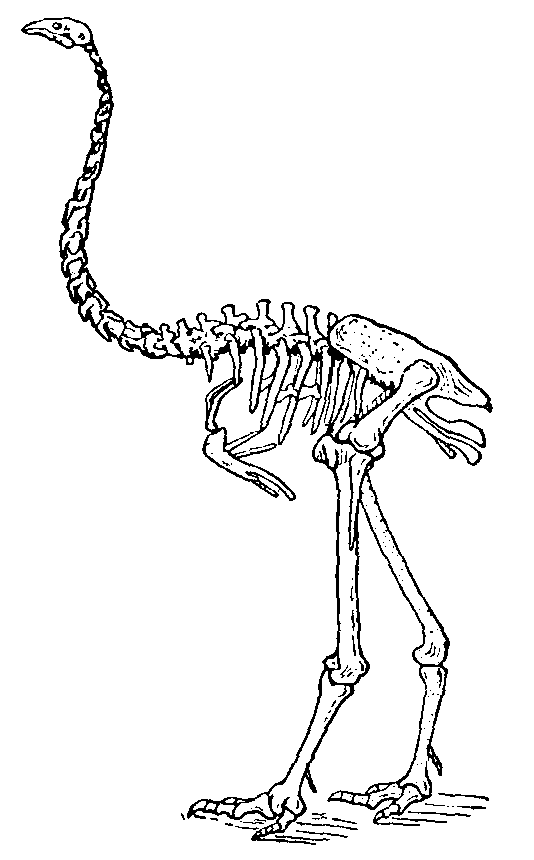
Dinornis maximus (the Moa)
Dingo, the native wild dog of Australia (Canis Dingo), of a wolf-like appearance and extremely fierce. The ears are short and erect, the head elongated, the tail rather bushy, and the hair of a reddish-dun colour. In habit the dingo is rather fox-like, usually lying concealed throughout the day and making predatory expeditions at night. It is very destructive to sheep, killing more than it eats. It was probably introduced by prehistoric man.
Ding´wall, a royal and parliamentary burgh and seaport of Scotland, county town of Ross and Cromarty, situated at the head of Cromarty Firth. This town, erected into a royal burgh in 1227, unites with Wick and other places in returning a member to Parliament. Pop. 2590.
Dino´ceras (Gr. deinos, terrible, keras, a horn), a fossil mammal found in the Eocene strata of North America, in some respects akin to the elephant and of equal size, but without a proboscis. Its bones were very massive; it had two vertical tusks in the upper jaw, three pairs of horns, and the smallest brain, proportionally, of any known mammal.
Dinor´nis (Gr. deinos, terrible, ornis, a bird), an extinct genus of large wingless birds—classed with the small existing Apteryx. The bones of several species have been found in New Zealand. The largest must have stood 12 feet in height, several of its bones being at least twice the size of those of the ostrich. The body seems to have been even more bulky in proportion, the tarsus being short and stout in order to sustain its weight. They do not appear to have become extinct until the seventeenth or eighteenth century, and are spoken of as moas by the natives, who buried the eggs (more than 1 foot long) with their dead as provision for their journey to the other world.
Diplodocus Carnegii, a gigantic Dinosaur. Length, 84 feet 9 inches; height at middle of back, 11 feet 5 inches
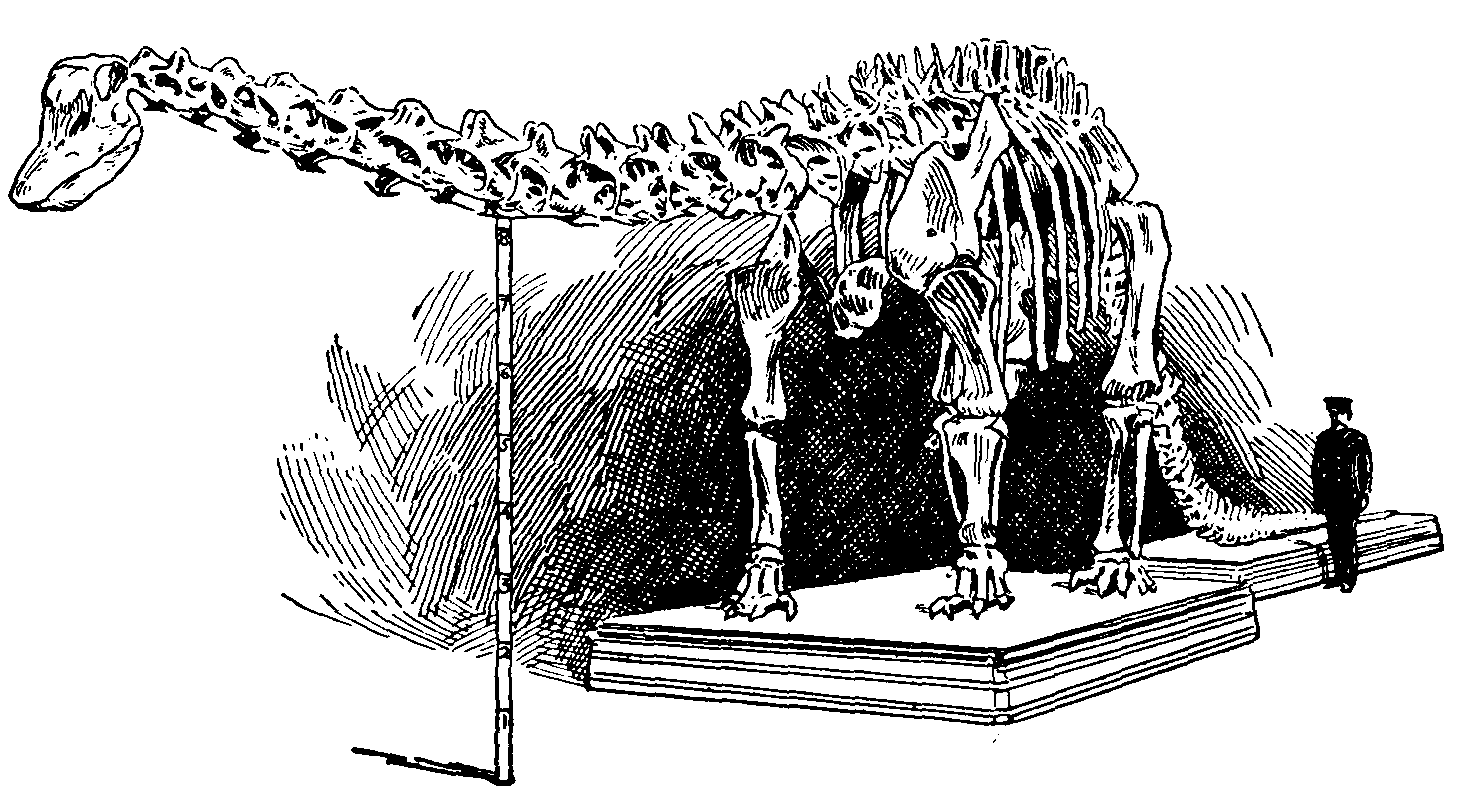
Dinosau´ria (Gr. deinos, terrible, and sauros, a lizard), a group of extinct reptiles, allied in skeletal structure both to the lizards and the birds. While some were only 3 feet long, a large number attained gigantic size. Atlantosaurus being 115 feet long. Many were carnivorous, but some of the large heavy forms were herbivorous, and protected by bony spines or plates. The Dinosaurs were the dominant land animals of the Jurassic and Cretaceous periods.
Skull of Dinotherium giganteum
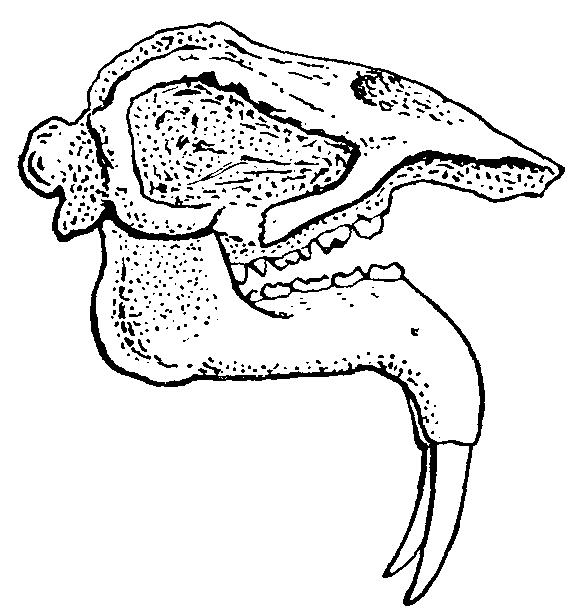
Dinothe´rium (Gr. deinos, terrible, thērion, beast), a genus of extinct gigantic proboscidean mammals, precursors of the elephants, the remains of which occur in Miocene formations in several parts of Europe. The type-species (D. giganteum) is calculated to have attained the length of 18 feet. It had a proboscis and also two tusks placed at the anterior extremity of the lower jaw, and curved downwards somewhat after the manner of those in the upper jaw of the walrus. The skull is best known from that found in 1835 at Eppelsheim; but the skeleton can now be pieced together from remains in various localities. The vertebræ resemble those of mastodon. Dinotherium may have inhabited rivers or estuaries.
Di´ocese (Gr. dioikēsis, administration), the circuit or extent of a bishop's jurisdiction. Each English diocese is divided into archdeaconries, each archdeaconry (nominally) into rural deaneries, and each deanery into parishes. In the Eastern Churches the term eparchy is used for diocese. See Bishop.
Diocle´tian (Gaius Valerius Diocletianus, surnamed Jovius), a man of mean birth, a native of Dalmatia, proclaimed Emperor of Rome by the army A.D. 284. He defeated Carinus in Mœsia (286), conquered the Allemanni, and was generally beloved for the goodness of his disposition, but was compelled by the dangers threatening Rome to share the government with M. Aurelius Valerius Maximian. In 292 Galerius and Constantius Chlorus were also raised to a share in the empire, which was thus divided into four parts, of which Diocletian administered Thrace, Egypt, Syria, and Asia. As the result of his reconstitution of the empire there followed a period of brilliant successes in which the barbarians were driven back from all the frontiers, and Roman power restored from Britain to Egypt. In 305, in conjunction with Maximian, he resigned the Imperial dignity at Nicomedia, and retired to Salona, in Dalmatia, where he cultivated his garden in tranquillity until his death in 313. In the latter part of his reign he was induced to sanction a persecution of the Christians.—Bibliography: Gibbon, Decline and Fall; P. Allard, La Persécution de Dioclétien; A. J. Mason, The Persecution of Diocletian.
Dioda´ti, Giovanni, Italian Protestant divine, born at Lucca, about 1576, of a noble Catholic family. He was for some time professor, first of Hebrew, then of theology, at Geneva, and in 1619 represented the Genevan clergy at the Synod of Dort, and aided in drawing up the Belgic confession of faith. He is most celebrated for a translation of the Bible into Italian (1607), which is superior to his translation of it into French. He died at Geneva in 1649.
Diodo´rus of Agyrium, in Sicily, and therefore called Siculus; a Greek historian in the time of Julius Cæsar and Augustus. His universal history, in the composition of which he travelled through a great part of Europe and Asia, occupied him thirty years, and consisted of 40 books, but only books 1-5 and 11-20, with certain fragments, are now extant.
Diœcious (Gr. di, double, oikos, a house), in botany, a term applied to plants which have flowers with stamens on one individual and those with pistils on another; as opposed to monœcious. The willow, the yew, the poplar, &c., are diœcious.
Diogenes Laërtius, author of a sort of history of philosophy in Greek, appears to have been born at Laerte, in Cilicia, and to have lived towards the close of the second century after Christ; but no certain information exists either as to his life, studies, or age. The work is divided into ten books, and bears in MSS. the title, On the Lives, Doctrines, and Apothegms of those who have distinguished themselves in Philosophy. It is full of absurd and improbable anecdotes, but contains valuable information regarding the private life of the Greeks, and many fragments of works now lost. It was the foundation of the earlier modern histories of philosophy. A translation of his work by C. D. Yonge was published in Bohn's Classical Library.
Diogenes (di-oj´ē-nēz) of Apollonia (Crete), known also as the Physicist, a Greek philosopher of the fifth century B.C., who belonged to the Ionian school, and considered air as the element of all things. He was a pupil of Anaximenes and a contemporary of Anaxagoras.
Diogenes of Sinopē (on the Black Sea), the most famous of the Cynic philosophers, born about 412 B.C., died about 323 B.C. Having been banished from his native place with his father, who had been accused of coining false money, he went to Athens, and thrust himself upon Antisthenes as a disciple. Like Antisthenes he despised all philosophical speculations, and opposed the corrupt morals of his time; but while the stern austerity of Antisthenes was repulsive, Diogenes exposed the follies of his contemporaries with wit and good humour. As an exemplar of Cynic virtue he satisfied his appetite with the coarsest food, practised the most rigid temperance, walked through the streets of Athens barefoot, without any coat, with a long beard, a stick in his hand, and a wallet on his shoulders, and by night, according to the popular story, slept in a tub (or large earthenware vessel). On a voyage to the Island of Ægina he fell into the hands of pirates, who sold him as a slave to the Corinthian Xeniades. The latter emancipated him, and entrusted him with the education of his children. He attended to the duties of his new employment with the greatest care, commonly living in summer at Corinth and in winter at Athens. It is at Corinth that he is said to have had his famous interview with Alexander the Great. The Macedonian conqueror was so struck with the philosopher's self-possession that he went away remarking: "If I were not Alexander, I should wish to be Diogenes". Of the many stories related of him the majority are probably fictions; many, indeed, are chronologically impossible. Concerned with practical wisdom, Diogenes established no system of philosophy. To gain virtue, he maintained, man must avoid physical pleasure, despise the conventions of society, and adopt a simple and natural life. His enemies accused him of various scandalous offences, but there is no ground for supposing him guilty of any worse fault than that of elevating impertinence to the rank of a fine art. See Cynics.
Diomedes (dī-o-mē´dēz), in Greek mythology, (1) the son of Mars and Cyrene, and King of the Bistŏnes in Thrace, who fed his horses on human flesh, and used to throw all strangers who entered his territories to those animals to be devoured. He was killed by Hercules, who carried off the horses. (2) One of the heroes at the siege of Troy, the son of Tydeus and Deïpyle, and King of Argos, one of the suitors of Helen. After she was carried off, Diomedes engaged in the expedition against Troy, in which his courage and the protection of Pallas rendered him one of the most distinguished heroes. He wounded Aphrodite and Ares, and thrice assailed Apollo; and by carrying off the horses of Rhœsus from the enemies' tents, and aiding Ulysses in the removal of Philoctetes from Lemnos, he fulfilled two of the conditions on which alone Troy could be conquered. Finally he was one of the heroes concealed in the wooden horse by which the capture of Troy was at length accomplished. Different accounts were given of his after-life. He is often called Diomede.
Dionæ´a, a genus of plants, nat. ord. Droseraceæ. Only one species is known, D. muscipŭla (Venus's fly-trap), a native of the sandy savannas of Carolina and Florida. It has a rosette of root-leaves, from which rises a naked scape bearing a corymb of largish white flowers. The leaves have a dilated petiole and a slightly stalked 2-lobed lamina, with three short stiff bristles on each lobe. The bristles are remarkably irritable, and when touched by a fly, or other insect, the lobes of the leaf suddenly close on and capture the insect. It dissolves the food thus captured by means of digestive fluid similar to ordinary gastric juice.
Dion Cassius, or Dio Cassius, a Greek historian, born about A.D. 155 at Nicæa, in Bithynia. After accompanying his father to Cilicia, of which he held the administration, he came to Rome about 180, and obtained the rank of a Roman Senator. On the accession of Pertinax Dion was appointed Prætor, and in the reign of Caracalla he was one of the Senators whom it had become customary to select to accompany the emperor in his expeditions, of which he complains bitterly. In 219 he was raised to the consulship, and about 224 became Proconsul of Africa. In 229 he was again appointed Consul; but feeling his life precarious under Alexander Severus, he obtained permission to retire to his native town of Nicæa. The period of his death is unknown. The most important of his writings, though only a small part is extant, is a History of Rome, written in Greek and divided into eighty books, from the arrival of Æneas in Italy and the foundation of Alba and Rome to A.D. 229.
Dion Chrysostom, a Greek sophist and rhetorician and a favourite of Trajan; born A.D. 50, died about A.D. 110. Eighty of his orations (in excellent Attic) have been preserved.
Dion of Syracuse, in Greek history, a connection by marriage of the elder and the younger Dionysius, tyrants of Syracuse, over whom he long exercised great influence. He attempted to reform the younger Dionysius, but his enemies succeeded in effecting his banishment. He afterwards returned and made himself ruler of the city, but became unpopular, and in 353 B.C. one of his followers, Callipus of Athens, caused him to be assassinated.
Dionys´ia. See Bacchanalia.
Dionys´ius, St., a disciple of Origen, and Patriarch of Alexandria in A.D. 248. He was driven from the city in 250, and in 257 was banished to Libya, but was restored in 260. He died in A.D. 265.
Dionysius of Halicarnassus, in Caria, a Greek critic and teacher of eloquence, born about 70 B.C. He went to Rome about 30 B.C., where he wrote his Roman Antiquities, in twenty books, in which he relates (in Greek) the early history of Rome and its government up to the times of the first Punic War. We have the first nine books of this work entire, the tenth and eleventh nearly so, and some fragments of the others. His rhetorical writings are of greater value, especially his essays on the Greek orators. He died about 6 B.C.—Cf. Sir J. E. Sandys, A History of Classical Scholarship.
Dionysius the Areopagite, that is, one of the judges of the Areopagus, at Athens, a convert to Christianity by the Apostle Paul about the middle of the first century, and the first Bishop of Athens, where he suffered martyrdom. Certain writings formerly ascribed to him consist of obscurely written treatises on mystical subjects. Scotus Erigena translated them into Latin. In France, where a certain Dionysius (see Denis, St.) established the first Christian community at Paris in the third century, they were readily received, this Dionysius being without further inquiry taken for the Areopagite, because the origin of the Gallican Church could thus be carried back to the first century; and France gained a patron who was a martyr and the immediate disciple of an apostle.—Cf. article in Smith's Dictionary of Christian Biography.
Dionysius the Elder, in Greek history, tyrant or absolute ruler of Syracuse, born about 430 B.C. of obscure parentage. He obtained the rank of general, and afterwards of commander-in-chief; and, gaining the support of the army, he seized the supreme power in Syracuse, though only twenty-five years of age. He extended his rule over other cities in Sicily; and after some successes and reverses in the struggle with the Carthaginians, he gained a complete victory over them under the walls of Syracuse. In his expeditions into Lower Italy he reduced the city of Rhegium by famine (387). After another short war with Carthage he lived some time in peace, occupied with writing poems and tragedies, with which he contended for the Olympian prize. In 368 he commenced a new war against the Carthaginians, but failed to drive them entirely out of Sicily. He is said to have died from a potion administered at the instigation of his son Dionysius the Younger (367 B.C.).
Dionysius the Little (so called on account of his short stature), a Scythian monk who was abbot of a monastery at Rome in the beginning of the sixth century, and died about the year A.D. 530, according to others about 545, celebrated as the first to introduce the computation of time from the Christian era. This mode of computation, however, was not publicly used until the eighth century.
Dionysius the Younger, a tyrant of Syracuse, who succeeded his father, Dionysius the Elder, in 367 B.C. For the purpose of recalling him from the excesses to which he was addicted, his kinsman Dion persuaded him to invite Plato to his court, but the influence of the philosopher effected no permanent change. Becoming suspicious of Dion, the tyrant banished him and confiscated his property, but in 357 B.C. Dion made himself master of Syracuse. Dionysius fled to Locri, but after the murder of Dion recovered his power in Syracuse. His misfortunes, however, had rendered him more cruel, and Timoleon, who came to Syracuse with aid from Corinth against the Carthaginians, deposed him in 344 B.C. He was carried to Corinth, where he is said to have gained a living by giving lessons in grammar, or as one of the attendants on the rites of Cybele.
Diony´sus, the original Greek name of the god of wine, the name Bacchus, by which he was also called both by the Greeks and the Romans, being at first a mere epithet or surname.—Cf. R. Brown, The Great Dionysiak Myth.
Dioon, a genus of Cycads, natives of Mexico, where meal is prepared from the starchy seeds.
Diophan´tus of Alexandria, the first Greek writer on algebra, flourished, according to some authorities, about the middle of the fourth century after Christ. He is called the Father of Algebra, and left behind him thirteen books of Arithmetical Questions, of which only six are extant; and a work on Polygonal Numbers.
Diop´side, a calcium magnesium silicate, of the pyroxene series, occurring in igneous rocks and altered limestones, with a vitreous lustre, and of a pale-green, or a greenish- or yellowish-white colour.
Diop´sis, a genus of two-winged flies of which the species are native to India and Africa. Each side of the head is drawn out into a long lateral horn, which bears the eye and antenna at its extremity.
Di´optase, emerald copper ore, hydrated silicate of copper, a translucent mineral, occurring crystallized in six-sided prisms. It occurs in Siberia, Hungary, and Chile. It has been used as a gem-stone, notably in Persia and Russia.
Diopter, the unit in terms of which the power of a lens or curved mirror can be expressed. It is obtained by taking the reciprocal of the focal length of the lens or mirror in metres. Thus, a lens with focal length 1 metre has a power of 1 diopter. If the focal length is 2 metres, the power is ½ diopter. The power may also be obtained by dividing 39.37 by the focal length in inches. The unit is employed in classifying spectacle lenses.
Di´orite, a coarsely crystalline igneous rock, sometimes of a whitish colour speckled with black or greenish-black, sometimes very dark in colour, consisting of hornblende and calcium sodium felspar. Dark mica sometimes takes the place of hornblende (mica-diorite). The 'greenstones' of older authors are mostly diorites.
Dioscoreaceæ, a nat. ord. of monocotyledons, with alternate reticulate-veined leaves, tuberous root-stocks, and twining stems. The flowers are small and unisexual. There are 6 genera, with about 100 species. The typical genus is Dioscorea, which includes the yam. Black bryony is the only British representative.
Dioscor´ides, Pedanius, a Greek physician, born in Cilicia in the first century of the Christian era. He was the author of a celebrated work on materia medica, in five books, particularly valuable in regard to botany.
Dioscu´ri. See Castor and Pollux.
Dios´pyros, a large genus of trees or shrubs, natives of the warmer regions of the world, nat. ord. Ebenaceæ. The trees of this genus supply ebony wood. That from Ceylon is the wood of D. Ebĕnum; from India, of D. melanoxylon and other species; and that from Mauritius, D. tesselaria. The Chinese date-plum (D. kaki) is an apple-like tree which produces large red fruits resembling tomatoes. In China and Japan this tree is as important as the apple is in Northern Europe.
Dip, of the horizon, the angle of depression of the visible horizon at sea below the true horizontal direction, due to the height of the eye above the level of the sea. The dip in minutes of arc is approximately equal to the square root of the height in feet.—Dip, magnetic, or Inclination, is the angle which a magnetic needle free to move in a vertical circle in the magnetic meridian makes with the horizon. See Dipping Needle.
Dip, in geology, the inclination or angle at which strata slope or dip downwards into the earth. The degree of inclination or amount of the dip, which is easily measured by a clinometer, is the steepest angle made with a horizontal plane by a line drawn in the surface of the stratum. The line of dip is hence perpendicular to the intersection of the stratum with the horizontal, which is called the strike.
Dip Circle. See Dipping Needle.
Diphthe´ria is an acute infectious disease characterized by the formation of membrane in the throat and air-passages, and associated with severe disturbances affecting especially the heart and nervous system. It is due to a bacillus described by Koch in 1883. It is essentially a disease of the early years of life, and the period between two and twelve years covers the vast majority of cases. The commonest modes of infection are direct and indirect contact, infected milk, and defective drains. Of late years, the domestic cat has been held to be a source of infection. The disease runs a rapid course, beginning with fever, headache, chilliness, lassitude, and occasionally vomiting, while usually there is early complaint of sore throat. The membrane, which appears on the side of the throat, is usually of a dirty yellowish-white colour. It may be limited to a small area, but usually, if untreated, it would spread extensively over the throat, involving the palate and uvula. Diphtheria beginning in the larynx (windpipe) is what is popularly called croup (q.v.). There is danger of death in severe cases during the first few days from early heart failure, and almost any time during convalescence late heart failure may occur. Late heart failure is one of the forms of post-diphtheritic paralysis which arise from disturbances of the nervous system. The other common varieties are paralysis of the palate, of the pharynx, of the eye muscles, and of the respiratory muscles. An effective treatment is found in diphtheric antitoxin, which should be administered as early as possible in the disease. It is given under the skin, and the dose is regulated by the severity of the attack.—Bibliography: W. F. Litchfield, Diphtheria in Practice; W. R. Smith, Harben Lectures.