Chapter VIII · THE NEGRO IN INDUSTRY
Reading edition
A. EMPLOYMENT OPPORTUNITIES AND CONDITIONS
I. INTRODUCTION
1. NEGRO WORKING POPULATION IN 1920
Between 1910 and 1920 the Negro population of Chicago increased from 44,103 to 109,594. Of this number it is estimated that about 70,000 were engaged in industries in 1920 as compared with about 27,000 in 1910.[49]
Questions which naturally suggest themselves for answer in connection with this great increase in the Negro working population in Chicago are: How did this large number of Negroes fit into the industrial life of the city? What were and are the opportunities open to them? Have they given satisfaction to employers? Are they discriminated against by employers or fellow-workers? Has racial friction developed because of competition between white and Negro workers? Were the riots of 1919 in any sense the result of labor troubles? What part have the Negroes taken in strikes? What is the relation of the Negro to organized labor? What is the outlook for the Negro in industry? These and other questions guided the inquiries and investigations of the Commission in the industrial field.
2. OPPORTUNITIES CREATED BY THE WAR
The Negro's position in the industrial life of Chicago is so intimately connected with the changes due to the war that a brief reference to certain facts of common knowledge in connection with the war will be helpful. With the beginning of the war in 1914 came an abnormally large demand by the belligerent countries for American munitions, food products, clothing, leather, iron and steel products, and other manufactured goods. Existing establishments were enlarged and new ones were erected in response to the demand for increased production. It was not uncommon for a plant to double or treble its labor force. A typical case was one of the large packing-plants in the Chicago "Yards" which increased its workers during the war from 8,000 to 17,000.
The war stimulated the demand for goods, and therefore for labor, and at the same time decreased the available labor supply. Immigration from the belligerent nations immediately ceased, and there was a marked decrease in immigration from other countries; aliens in large numbers departed to join the fighting forces of their native lands.
The labor shortage became acute soon after the United States entered the war in 1917, and enlistments withdrew hundreds of thousands of men from northern industries. An unprecedented demand for Negro workers was the result. The migration from the South was mainly a response to the call of larger opportunity and higher wages in the North.
3. INDUSTRIAL BACKGROUND OF NEGRO WORKERS
For the United States as a whole in 1910 the industrial condition of the gainfully occupied Negro population is shown in Table XVIII:
TABLE XVIII
Gainfully Occupied Negro Population Ten Years of Age and Over in the United States in 1910
Industry Both Sexes Percentage Male Female
Agriculture 2,893,674 55.7 1,842,537 1,051,137
Domestic and personal service 1,074,543 20.7 234,063 840,480
Manufacturing and hand trades 657,130 12.6 575,845 81,285
Transportation 276,648 5.3 274,565 2,083
Trade 132,019 2.5 123,635 8,384
Professional service 69,471 1.3 39,400 30,071
Public service 26,295 0.5 25,838 457
Others 62,755 1.4 62,671 84
Total United States[50] 5,192,535 100.0 3,178,554 2,013,981
In 1910, more than three-fourths of the gainfully occupied Negroes in the United States were engaged in two forms of industry—agriculture and domestic and personal service. In the South at that time 78.8 per cent of the Negro population lived in rural communities[51] and 62 per cent of those employed were engaged in agriculture.[52] It is evident, therefore, that the northward migration involved a sudden transition of the southern Negro from farms or small towns to the highly specialized industries of northern cities, with marked changes in modes of living.
On many southern plantations the Negroes were required to buy food and clothing on credit at such high prices that their shares of the return were usually spent before the crops were harvested.[53] This system encouraged careless spending and did nothing to induce habits of thrift. Even the hardest-working Negroes frequently found themselves in debt to their landlords at the end of the year.[54] Incentive to sustained effort and regular work was lacking in the hand-to-mouth existence under this prevailing system of share rent and credit. It naturally produced habits such as drawing against wages and working irregularly under the spur of temporary need. Men handicapped by such habits joined the migration in great numbers. Though ill-fitted for the keen competition, business-like precision, and six-day-week routine of northern industry, the southern Negro, in spite of these handicaps, has succeeded in Chicago.
II. THE NEGRO IN CHICAGO INDUSTRIES IN 1910 AND 1920
Of the Negro population of 44,103 in Chicago in 1910 the gainfully occupied numbered 27,317. The distribution of this number, according to industrial classification, is given in Table XIX, which shows that 60 per cent of all such Negroes were engaged in domestic and personal service, as compared with 15 per cent in manufacturing and 3 per cent in clerical occupations.
TABLE XIX
Negroes Gainfully Occupied in Chicago in 1910
Industries Both Sexes Percentage Male Female
Manufacturing and mechanical 4,071 15 3,073 998
Transportation 1,852 7 1,849 3
Trade 1,241 5 1,148 93
Public service 224} 4 {224 0
Professional 963} {640 323
Clerical occupations 934 3 771 163
Domestic and personal service 16,389 60 9,426 6,963
Agriculture, mining, and unclassified 1,643 6 1,306 337
Totals 27,317 100 18,437 8,880
1. METHOD AND SCOPE OF INVESTIGATION
To discover the industries in Chicago which were employing Negroes in appreciable numbers in 1920, preliminary questionnaires were sent to 850 employers compiled from lists furnished by: (1) the Chicago Association of Commerce (covering 591 establishments, with a total of 350,000 employees); (2) the Employment Department of the Chicago Urban League; (3) the Illinois Free Employment Bureau; (4) the Federal Employment Bureau; and (5) the classified telephone directory.
Questionnaires were returned by 460 establishments of 850 to which they were mailed. We are satisfied that the replies received cover the field of Negro labor, and that no establishments of importance in this field have been overlooked. Table XX shows the results:
TABLE XX
Negroes Employed Number of Establishments Total Negroes Employed
No Negroes 264 0
Less than five Negroes 59 111
Five Negroes or more (manufacturing) 69 12,854
Five Negroes or more (non-manufacturing) 68 9,483
Totals 460 22,448
Answers came from 156 manufacturing establishments employing fifty-one or more wage-earners. The representative character of this group is indicated by the fact that over three-fourths of the total wage-earners in Chicago engaged in manufacturing in 1914 were employed in factories of this class. The United States Census of Manufactures for 1914 reported the total number of wage-earners employed in manufacturing in Chicago in that year as 313,710; of this number, 244,827, or 78 per cent, were employed in 1,032 establishments employing fifty-one or more wage-earners. The 156 questionnaires therefore represented 15 per cent of the 1,032 establishments in this class (in 1914) and included 107,403 wage-earners, or almost 44 per cent of the total wage-earners in this class and 30 per cent of the total wage-earners engaged in manufacturing in 1914.
Questionnaires reporting Negro employees were returned by 104 manufacturing establishments of all classes. Of these, sixteen employed one to fifty wage-earners, representing a total of 435 wage-earners; and eighty-eight employed fifty-one or more wage-earners, representing a total of 78,919 wage-earners.
Since thirty-five of the manufacturing establishments reporting Negro labor (or 33 per cent of the 104 so reporting) employed less than five Negroes each, or a total of seventy Negroes in all, while sixty-nine employed 12,854 Negroes, or 99.4 per cent of the total Negroes reported by manufacturing establishments, it seemed advisable in this report to consider only those employing five Negroes or more, in order not to give undue weight to conditions where only a relatively few Negroes were concerned. A similar situation was disclosed by the returns furnished by non-manufacturing establishments, and the returns from twenty-four employing a total of forty-one Negroes have been disregarded in this report in order to give proper weight to conditions in the sixty-eight employing five or more Negroes which reported a total of 9,483 Negroes.[56] The combined number of establishments, both manufacturing (69) and non-manufacturing (68), employing five or more Negroes each was 137.
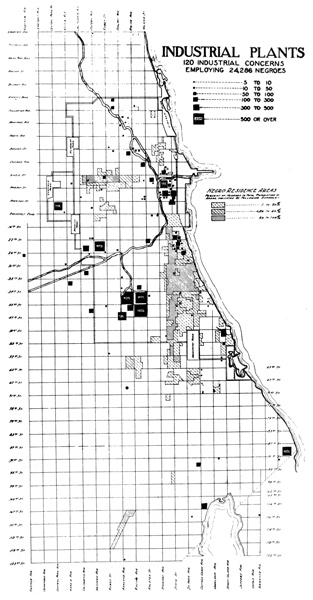
INDUSTRIAL PLANTS 120 INDUSTRIAL CONCERNS EMPLOYING 24,286 NEGROES
On the basis of the returns reported in the preliminary questionnaires certain establishments and industries were selected for more intensive study through personal interviews with employers, conferences participated in by employers and members of the Commission, and interviews with employees. The basis on which the selection was made was either the number of Negroes employed or the length of time during which Negroes had been employed, special attention being given to those industries and establishments which had employed Negro labor for the first time since the war. The industries employing large numbers of Negro workers which were selected for further study were: slaughtering, meat packing, and other food products; iron foundries and iron and steel products; laundries; needle trades; hotels; railroads; Pullman and dining-car services; tanneries; taxicab upkeep and repair; mail order.
An investigator for the Commission visited 101 establishments of the 137 reporting five or more Negro employees (ten establishments employing less than five Negroes each were also visited). Four industrial conferences or informal hearings were held by the Commission, large employers of Negro labor being invited to co-operate with the Commission by giving it the benefit of their experience with Negro labor. Among those who reported were general superintendents, assistant superintendents, employment managers, and other representatives of the large employers of Negro labor in Chicago as shown in Table XXI:
TABLE XXI
No. of Negroes Employed in 1920
Pullman Car Shops 450
Armour & Co., Stock Yards 2,084
Morris & Co., Stock Yards 1,400
Swift & Co., Stock Yards 2,278
Wilson & Co., Stock Yards 818
Corn Products Refining Co., food products 500
International Harvester Co., agricultural machinery 1,551
Yellow Cab Co., taxicab 250
American Car and Foundry Co.[57] 20
American Brake Shoe and Foundry Co. 265
Brady Foundry Co. 125
National Malleable Castings Co. 427
Western Foundry Co. 200
Sears, Roebuck & Co., mail order 1,423
Montgomery Ward & Co., mail order 350
Gage Bros. Wholesale Millinery 73
Spring-filled Products Co., automobile cushions 250
Total 12,464
2. NUMBER AND PERCENTAGE OF NEGRO EMPLOYEES
The number and percentage of Negro employees to the total employees in 136 establishments reporting five or more Negroes are shown in Table XXII.
TABLE XXII
Number and Percentage of Negro Employees in Establishments Reporting Five or More Negroes
Industry Number of Establishments Total Employees Negro Employees Negro Percentage of Total
Manufacturing:
Box manufacturing (paper) 3 995 143 14
Clothing 9 1,405 203 14
Cooperage 2 327 106 32
Food products 8 35,278 7,597 22
Iron and steel products (iron foundries) 27 37,773 3,879 10
Tanneries 7 2,230 462 21
Miscellaneous:
Lamp-shade manufacturing 1 275 75 27
Auto-cushion manufacturing 2 500 250 50
Other industries (manufacturing) 10 2,571 139 5
Totals 69 79,354 12,854 16
Non-manufacturing:
Hotels 9 1,714 923 53
Laundries 20 1,736 764 44
Mail order[58] 1 17,450 1,423 8
Railroads, dining- and Pullman-car service 16 7,816 5,408 68
Miscellaneous industries[59] 21 10,028 615 6
Totals 67 38,744 9,133 23
3. INCREASE IN NEGRO LABOR SINCE 1915
The data obtained from questionnaires, interviews, and conferences with employers disclosed the fact that there has been a remarkable increase since 1915 in the number of Negro workers employed in manufacturing, in clerical occupations, and in laundries. As was to be expected, the number of Negroes in personal service (hotels, dining-cars, and parlor-cars) also increased, but the increase was negligible in comparison with the gain in the other fields mentioned.
Inability to obtain competent white workers was the reason given in practically every instance for the large increase in the number of Negroes employed since 1914. All of the large employers of Negro labor attending the conferences assigned shortage of labor as the principal reason for the increased number of Negroes reported. A few establishments (not represented in the conferences) reported that Negroes had first been employed to take the place of strikers, and increasing numbers had been employed thereafter. The establishments so reporting were hotels, a small clothing factory, and a warehouse company. Because of the labor shortage in the North, large numbers of Negroes left the southern states.
TABLE XXIII
Negroes Employed from 1915 to 1920 in Sixty-two Manufacturing Establishments Classified According to Industries
Industries Number of Establishments 1915 1916 1917 1918 1919 1920
Box making 3 3 3 116 116 145 143
Clothing 9 75 110 140 108 161 203
Other needlework 3 0 0 0 25 325 325
Cooperage 2 29 34 95 110 15 106
Food products[61] 16 1,103 2,529 4,765 6,518 5,789 5,379
Iron and steel[62] 22 121 672 1,115 1,580 3,002 3,829
Tanneries 7 0 17 36 87 229 462
Miscellaneous manufacturing 10 15 15 24 48 75 140
Totals 62 1,346 3,380 6,291 8,592 9,881 10,587
TABLE XXIV
Negroes Employed from 1915 to 1920 in Forty-seven Establishments (Non-manufacturing) Classified According to Industries
Industries Number of Establishments 1915 1916 1917 1918 1919 1920
Hotels 9 544 559 615 684 693 956
Laundries 20 118 180 220 350 520 764
Mail order (clerical occupations) 2 0 0 0 664 1,650 1,400
Railroads (dining- and parlor-car service) 16 3,939 3,940 4,274 4,493 4,506 5,363
Totals 47 4,601 4,679 5,109 6,191 7,369 8,483
4. CHICAGO EMPLOYERS AND SOUTHERN NEGRO LABOR
During the course of its inquiry the statement was frequently made to members of the Commission or to its investigators that large employers of labor in Chicago, and particularly the packers, had imported many Negroes from the South. Although the Commission made a thorough investigation of such statements, no evidence of any value was discovered to support them.
The general superintendents of the Armour, Morris, Swift, and Wilson plants who attended conferences declared emphatically that their companies had not engaged in any encouragement of migration.
Mr. Samuel Gompers, president of the American Federation of Labor, being asked through correspondence from the Commission if he could furnish any evidence tending to prove the importation of Negroes into the Chicago district by employers, replied, "There is a plentitude of such evidence," but when Mr. Gompers was urged to cite the evidence, his reply was: "It cannot be unknown to you that some 30,000 Negroes were imported into the Chicago district during the steel strike. They did not go there of their own volition, but through inducements which were held out to them by the agents of employers who visited southern and western cities."
As, however, the Chicago race riot occurred a year prior to the steel strike, importation of Negroes at the latter time could not have affected the situation out of which the riot came. But the fact remains that labor leaders insist that employers in the Chicago district imported Negroes from the South, notwithstanding their inability to cite facts in support of this belief.
5. CLASSIFICATION OF NEGRO WORKERS
An accurate classification of Negro laborers into skilled, semi-skilled, and unskilled would help to an understanding of the position of the Negro in industry. In manufacturing, such a classification was attempted, but the results were unsatisfactory. These classes cannot be strictly defined, and different employers give them different meanings. In a number of important cases employers reported the total number of skilled and unskilled, and that figures for each class could not be compiled without great labor. In all such cases the total is listed as "unskilled." This class is thus unduly enlarged at the expense of the semi-skilled and the skilled. So the number of semi-skilled workers appears to be less than the skilled. These facts show that accuracy cannot be claimed for the classification in Table XXV.
TABLE XXV
Negro Employees in Sixty-six Manufacturing Establishments Classified As Skilled, Semi-skilled, and Unskilled
Industry Number of Establishments Total Negroes Skilled Semi-skilled Unskilled
Box manufacturing 3 143 ... ... 143
Clothing 9 203 57 29 117
Cooperage 2 106 8 45 53
Food products[64] 8 7,597 229 12 7,356
Iron and steel 27 3,879 434 180 3,265
Tanneries 7 462 175 ... 287
Miscellaneous 10 139 24 1 114
Total[65] 66 12,529 927 267 11,335
The attempt to classify Negro workers according to occupation failed because the necessary information was not obtainable, especially from large employers. Nevertheless the number of workers in certain occupations reported by a few establishments is suggestive of the fields recently opened to Negroes in Chicago. In 1910[66] there were only thirty-one Negro molders in Chicago, while in 1920 there were 304 reported by ten establishments. In 1910 there were but twenty-eight factory sewers or machine operators, while in 1920 there were 382 in twelve factories. In 1910 there were 934 Negroes employed in clerical occupations as compared with 1,400 in two concerns in 1920. In 1910 there were but 287 Negro laundry operatives in Chicago, while there were 764 reported by twenty laundries in 1920.
6. WAGES OF NEGRO WORKERS
The period of this industrial investigation—the spring and summer of 1920—was one of exceptional demand for labor and of high wages. Employers were glad to get workers of any sort at high pay.[67] In branches of employment where Negroes were permitted to work, their wages were generally the same as those of the white workers. In interviewing many Negro workers the Commission's investigators found practically no complaints of discrimination in wages on the same tasks. And the Chicago Urban League which, through its industrial department, places more Negroes in employment than any other agency in Chicago reported that it had very few complaints of such discrimination.
Some discrimination was practiced by foremen in placing or keeping Negroes at work on processes that yielded smaller returns than those to which white workers were assigned. In the field of common labor, where the largest number of Negroes are employed, some kinds of piecework yield greater returns than others. The tendency of foremen in some plants was to place Negroes on those processes yielding the smallest returns. The following are instances of such discrimination in favor of the white workers in the same plants.
In two large foundries white molders were given standard patterns, which remain the same throughout the year and permit the working up of speed; while patterns that were changed frequently, and made production slower were given to the Negroes. As speed determined the piecework earnings, the Negroes could not earn as much as the white molders in the same foundry.
In the several plants the white workers were favored in the distribution of overtime work; or Negroes were not permitted to work at all on overtime at "time and a half" rates or on Sundays at "double pay" as long as white workers were available.
While in the larger industries there was seldom any complaint about inequality in the basic rate of pay for common labor, restrictions upon the promotion and advancement of Negroes frequently prevented them from earning higher wages. In one department of a large food-products plant Negroes reached the maximum rate of 61 cents per hour after a few months' employment. No further advancement could be had because the superintendent was not willing to place Negro foremen over white workers. A Negro in the starch-mixing department held a skilled position as starch tester. It became apparent that in carrying out his duties many of the starch mixers would be subject to his immediate direction. The foreman apparently did not approve of this and ordered him to teach his duties to a Polish workman. The Negro declined to do this, and the matter was referred to the general superintendent. After an investigation it was decided to permit the Negro to retain his position as tester, but he was given no authority over the men.
In view of the fluctuations in wages, the impracticability of getting actual records of wages from all plants, and the discrepancies which in some instances did appear between reported and actual wages, it seemed desirable to supplement the information of the Commission's investigators. The records of the industrial department of the Chicago Urban League afforded the most complete data on wages received by Negroes that could be found in Chicago. During the year 1919 it placed more than 14,000 Negroes in plants in the Chicago District. In each case, when securing Negro employment, it kept a record of the wages actually offered and of conditions of work. If the Negro made complaint that the wage or work conditions did not prove to be as stated, it investigated the complaint.
Included in these records are the Pullman Company, Wilson & Company (packers), Armour & Company, Morris Company, Swift & Company, Illinois Malleable Iron Company, National Malleable and Castings Company, International Harvester Company, the General Can Company, the Republic Box Company, Chicago Fire Brick Company, Sears, Roebuck & Company, Superior Process Company, Consumers Coal Company, Corn Products Refining Company at Argo, United States Quartermasters' Department, Adams & Westlake Company, Griess Pfleger Tanning Company, and Inland Steel Company.
In the industries listed above, the minimum wage rate per hour is 42.5 cents, which is the minimum rate for the packing industries. The maximum rate is sixty-one cents per hour paid by the Corn Products Refining Company at Argo and the International Harvester Company. Neither of the latter, however, represents a basic wage. The average wage for the thirty-six companies is 48.7 cents. These wage rates cover the most arduous tasks found in the list of common labor. Three items for track laborers are included. Others include freight handlers, yardmen, truckers, sweepers, foundry laborers, etc. Six companies work ten hours per day, twelve companies nine hours, one company nine and one-half hours, seventeen companies eight hours. Four pay bonuses, not including packers, who also pay a bonus in compliance with the award of a judge acting as mediator between the packers and the union.
The building trades are not included, but of the three independent contractors listed the wage paid common laborers is 50 cents per hour, 60 cents per hour, and 70 cents per hour, respectively, for eight hours, while the union rate of pay for common labor is $1.00 per hour for eight hours, time and one-half for overtime, and double time for Sunday.
7. WOMEN EMPLOYEES IN INDUSTRIAL ESTABLISHMENTS
Negro women employed in thirty-one industrial establishments worked, in five of them forty-four hours a week, in fifteen of them forty-eight hours, in seven of them forty-nine hours, and in four of them fifty-one hours. The weekly pay ranged from $9.00 to $15.00 a week as clothing folders, to as high as $20.00 to $35.00 a week as clothing drapers or finishers. Map mounting paid $15.00 a week, book binding $15.00, paper-box making $13.00, tobacco stripping $16.40, core making (foundry work) $16.40, twine weaving $17.40, silk-shade making $10.00 to $18.00, food packing $12.00 to $15.00, mattress making $12.00 to $22.00, riveters (canvas) $15.00, paper sorters $12.00, steam laundry workers (unskilled) $13.00 to $16.00, steam laundry hand workers $18.00 to $29.00, power-machine operators on men's caps $15.00 to $18.00, on aprons $14.00 to $18.00, on dresses $15.00 to $18.00, on overalls (union shop) $18.00 to $25.00, and on overalls (non-union shop) $15.00 to $18.00.
Of fourteen companies employing colored girls as operators, five paid on a piecework basis only. Two paid from $12.00 to $18.00 per week, depending on the skill of the operator, two companies paid $14.00 per week to beginners, one paid $15.00 per week to beginners, three paid $12.00 per week to beginners, one paid $18.00 per week to beginners, the latter being a union shop.
Considerable unrest has been traceable to delay on the part of the managers in promoting beginners above the beginning wage. Girls have been retained at a beginning wage for an unreasonable time after acquiring satisfactory skill and production. This condition is known to the Women's Trade Union League, but no well-directed effort has ever been made to unionize colored workers in the garment trades, except when they have been called in as strike breakers to replace white workers. An instance of this was the strike at the C. B. Shane Company, manufacturers of raincoats, where colored girls were employed to replace striking white union workers. At that time very few colored girls were members of the local union. According to an official of the Women's Garment Workers' Union not more than 125 colored workers have become members.
8. HOTEL AND RESTAURANT EMPLOYEES
Men.—In about twenty-five hotels and restaurants in which colored men are employed, wages are as follows:
Chief cooks $25.00 to $50.00 per week
Waiters 25.00 to 40.00 per week
Bus boys 14.00 to 20.00 per week
Hotel porters 45.00 to 65.00 per month
Dishwashers 15.00 to 20.00 per week
Second cooks 20.00 to 35.00 per week
Bell-boys 40.00 to 45.00 per month
Shoe shiners and washroom porters 15.00 to 17.00 per week
In all of the above-listed occupations the wages are augmented by tips. It is difficult to form an accurate estimate of the amount earned in tips for the reason that it is conditioned upon the character of service rendered and the inclination of the person served to pay for personal service. It would be fair to estimate that in hotels and restaurants known to employees as "good houses" the tips range from $2.00 to $5.00 per day. In a colored restaurant in the neighborhood of Thirty-first and State streets a wage of $5.00 per week is paid to waitresses, while the tips have been known to total five times that amount.
Women.—The twenty-five hotels and restaurants concerning which the Chicago Urban League's Industrial Department has records, employ women in the occupations and at the wages listed as follows:
Waitresses $ 8.00 to $15.00 per week and tips (board)
Chambermaids 25.00 to 45.00 per month and tips (board)
Pantry girls 15.00 to 18.00 per week and board
Kitchen help 9.00 to 16.00 per week and board
Allowing an average of 35 cents per meal for three meals, $1.05 per day or $7.35 per week should be added where board is included. This would make the following schedule of wages:
Waitresses $15.35 to $22.35 per week
Chambermaids 54.40 to 74.40 per month
Pantry girls 22.35 to 25.35 per week
Kitchen help 16.35 to 23.35 per week
In clerical positions colored men have had very little opportunity, except in the post-office. There are exceptions, however, such as shipping clerks, storekeepers, and bookkeepers.
The girls employed as long-hand entry clerks, typists, checkers, routers, and Elliott-Fisher and adding-machine operators received during 1920 from $15.00 to $16.00 as a beginning wage. The chief supervisor (colored) in charge of 600 girls in one of the large mail-order houses received $23.00 per week, and the assistant superintendent, a white man, received $50.00 per week while studying the mail-order business under the chief supervisor. When the management's attention was called to the inequality, two additional supervisors were added and the work lessened without increase of pay.
Another firm employing several hundred colored girls paid a welfare worker $20.00 per week, while another with half that number of girls paid $25.00 per week.
There was a deep-seated suspicion existing among the clerical force of a firm employing a large number of colored girls that the white girls employed by the same company received a higher wage than that paid the colored girls. The suspicion grew out of the mistake of an employment manager in mistaking a colored girl for a white one.
9. RAILROAD WORKERS
Dining-car men.—According to the records of the Railway Men's International Industrial Benevolent Association, wages of dining-car waiters prior to 1916 were universally $25.00 per month, with the exception of the Santa Fe, which paid from $35.00 to $40.00 per month for "preferred" runs. The Chicago, Burlington & Quincy allowed an additional $3.00 to the $25.00 standard for men in service ten years or more.
In 1918, after the roads had been federalized, the minimum wage became $48.00 per month. In May, 1919, a further increase to $55.00 per month and overtime on a mileage basis was granted. This gave an average of $62.00 per month for so called "transcontinental" runs, that is, service between Chicago and the Pacific Coast.
Effective February 1, 1920, wages were adjusted to an hourly basis, which gave payment for overtime in excess of 240 hours per month. On July 20, 1920, most roads allowed a general increase to dining-car men which brought the average to $65.00 per month.
An official of the Railway Men's International Industrial Benevolent Association estimated that the tips and salary of the average waiter were $105.00 per month, including three meals valued at 35 cents per day. This estimate was accepted by the Federal Railway Labor Board. This low estimate is arrived at because it is generally the custom to feed waiters and kitchen crews on leftovers which would otherwise become waste.
Porters.—The wages of porters, including tips, is estimated at $105.00 per month. The present salary paid to porters is $65.00 per month. In May, 1919, the minimum basis was $60.00 per month on a mileage basis of $.0055 per mile in excess of 11,000 miles per month. In December of the same year a final adjustment of the wage scale was made in which length of service was taken as a basis. For three years or less the pay was $63.00 per month; for from three to ten years the pay was $66.00 per month; for ten years or more the pay was $69.00 per month. The Railway Men's International Industrial Benevolent Association furnished the above information.
According to the same authority, on January 1, 1921, most roads reduced the hourly overtime for waiters, cooks, and stewards and placed it on a straight time service, with pay ranging between $60.00 and $65.00 per month. A twenty-four-day month was also established. This was equal to a reduction of wages for the class of labor referred to.
In the case of thirty-one orders for porters in stores, restaurants, cafés, and drugstores, office buildings, etc., the wages ran from $12.00 per week to $25.00. Some difficulty was experienced in determining a minimum wage, for the reason that in many instances full time is not required, porters being allowed to do odd jobs on their own account. Of these thirty-one, three received $12 a week, one $13, four $15, two $16, one $17, four $18, two $19, six $20, three $21, one $21.25, one $22 and two $25.
Apartment-house janitors usually are affiliated with the labor unions. An instance of financial benefit is as follows: F——, who is engineer for an apartment in Evanston, before joining the union received $45.00 per month for his services, with quarters in a basement apartment. He now receives $125.00 per month with the same quarters.
Firemen with licenses were offered from $125.00 to $150.00 per month in ten different positions filled by the League.
10. DOMESTIC WORKERS
Eighty-one orders for maids for service in private families were listed with the following results: maximum, $18.00 per week with room and board; minimum, $6.00 per week with room and board; average, $12.84 per week with room and board. Of these, twenty-six were paid $15, eight $14, twelve $12, fifteen $10. Three received $18, and one $20.
Children's nurses.—Fifteen were listed, of whom five were paid $15.00 per week with room and board, six were paid $12.00, one was paid $7.00, two were paid $5.00, and one was paid $3.00.
Cooks.—Sixteen were listed as follows: one was paid $25.00 per week with room and board, four were paid $18.00, three were paid $16.00, six were paid $15.00, and two were paid $14.00.
The minimum wage for cooks indicated is $14.00 per week with room and board. The maximum wage is $25.00 per week with room and board, while in the case of children's nurses the maximum wage is $15.00 per week and the minimum $3.00 per week for part time.
Housemen.—Out of a list of twenty-five orders, a minimum of $40.00 per month with room and board, a maximum of $100.00 per month with room and board, and an average of $65.00 per month with room and board.
Chauffeurs.—Minimum of $100.00 per month with room and board and maximum of $150.00 per month with room and board. It is difficult to outline the duties of chauffeurs for the reason that they often perform the duties of butler, houseman, yardman, etc., in addition to that of chauffeur.
Couples.—(Man and wife.) Out of twenty-five orders listed, the following wages were offered: minimum of $85.00 per month with room and board. A maximum of $165.00 per month with room and board.
Laundresses.—Usually employed by the day. The prevailing rate per day over the past year was $4.00 and car fare, with one meal. This wage was asked by common understanding and without any visible form of organization. Since November 1, 1920, when the unemployment situation became manifest, $3.60 per day, car fare, and one meal has been accepted.
From 1918 to November 1, 1920, a serious shortage of domestic help was noted. Colored girls and women deserted this grade of work for the factories, where shorter hours and free Sundays were secured. The larger pay of domestic employment did not attract the average worker, for the reason that free evenings for recreation and amusement were apparently more desirable than the isolation and long hours of domestic service.
Recently housekeepers secured Negro girls from the southern states and imported Negro girls from the British West India Islands[68] in an attempted solution of the domestic-help problem. Transportation and clothes were furnished by employers and some sort of verbal agreement entered into by which the girls were expected to work out this indebtedness. Instances have come to the attention of the Chicago Urban League which seem to indicate that these agreements have not worked out satisfactorily. For example: One colored woman was brought from a small town in Florida to a Chicago suburb by a white family on such an agreement. After a few weeks' service the employer complained that the work performed by the woman as a general maid was unsatisfactory. Abuse followed. The woman sought to go to a Negro family under the pretence that she wished to return a pair of borrowed shoes. Her employer, fearing that she wished to escape, drove her to the home of the Negro family in his automobile. Once inside the home, she told a story of how her employer had kicked, beaten, and threatened her with a revolver if she attempted to leave. The Negro family gave asked-for shelter and informed the employer that she would not return. After threatening to take her away by force, the employer went away and the woman remained. A suit followed on a charge of assault and battery and the employer was discharged for lack of evidence.
A few weeks ago a white resident of another Chicago suburb applied to the juvenile court for the guardianship of a colored girl. The court, being unable to handle the case, requested the advice of the Chicago Urban League. The details of the case were substantially as follows:
A Roman Catholic organization in Jamaica, British West Indies, sent ten or twelve Jamaican girls to the United States, upon applications of housekeepers, to serve as domestics. Some verbal agreement had been entered into whereby the girls were to accept service as domestics and work out the cost of transportation and clothing at a stipulated rate per week. The arrangement seems to have progressed fairly until the girls became acquainted with other colored people residing in the neighborhood. It was then discovered that they were working at a wage considerably lower than the usual wage. The girl in question, who was a minor but seems to have misrepresented her age when applying for a passport, was receiving $6.00 per week, one dollar of which was paid in cash and the balance deducted to cover the expense of clothing and transportation. After becoming dissatisfied with these wages, the girl left the home of her white employer, who sought to be appointed her guardian so that he could restrain her. A guardian has not thus far been appointed, for the reason that the legal status of the girl and the legality of the contract entered into are doubtful.
III. EMPLOYERS' EXPERIENCE WITH NEGRO LABOR
The entrance of Negroes in large numbers into manufacturing industries and clerical occupations is one of the striking facts shown by this investigation. Shortage of labor due to war conditions created many openings for the Negro. Whether he will remain in these fields and become an increasingly important factor in them will depend in a large degree upon his efficiency and reliability, as well as upon absence of racial friction, satisfactory wages, etc. It was therefore deemed important to learn how the Negro improved his industrial opportunities.
The Commission made some investigation of this subject, seeking the opinion of as many employers as possible who had had experience with Negro workers. The inquiry covered two points: (1) a general question in the preliminary questionnaire, to learn whether Negro labor had proved satisfactory; and (2) a comparison of the Negro with the white worker in efficiency, reliability, regularity, and labor turnover. The facts under each head are considered separately below, following a brief consideration of the difference between the southern and northern Negro.
1. SOUTHERN AND NORTHERN NEGROES COMPARED
Many employers drew a distinction between the recent southern migrants and northern Negroes, and commented upon certain shortcomings of the former, although they expressed themselves as satisfied on the whole with Negro labor.
For instance, the representative of a foundry company with 200 Negroes out of a total of 950 employees said:
It appears to me that the men coming from the South get here and for a limited length of time seem to have a different view of things. They do things that probably the Chicago Negro wouldn't do. They don't seem to know exactly how to control themselves. They are unsettled and to a great degree unsteady. The northern-born Negro is more active. He is brighter in a way and a little more ambitious. The southern Negroes are inclined to work today, lay off tomorrow, and be back the next day on the job again.
A representative of a large machinery-manufacturing establishment employing 1,500 Negroes out of a total of 23,000 employees in Chicago expressed the same opinion in these words:
Our experience with Negroes has a tendency to show that these people do not realize that there is such a thing as steady work. They work for possibly a week or two, then say they are obliged to lay off for some imaginary cause and will probably return within a week or four weeks. We believe they are improving and will be better as time goes on and they become more used to the way work and business are done in the North.
The superintendent of a foundry which increased its Negro employees in five years from six to 125 out of a total of 466 employees was of the following opinion:
The Negro up here from the South never heard of working six days a week and being on time every morning and staying until the job was done. It is entirely foreign to his idea of things, but with a little persistent effort and showing him that it is necessary he soon learns the system the same as the others, and I do not believe he is any worse than the white man after he has been here a year or two.
The superintendent of a company employing more that 2,000 Negroes out of a total of 10,000 employees in Chicago declared:
The southern Negroes have not yet become thoroughly reconciled to working six days a week. Down South they are accustomed to taking off Saturdays, and they are quite frequently absent on Saturday. That is not true of the colored man who has been with us a long time. He is accustomed to the regularity of six days a week, but the men from the South have the weakness of being away on Saturdays.
In general it was the employers of large numbers of Negroes who differentiated between the southern and the northern Negro. Employers of Negroes in small numbers were more inclined to judge all Negroes by those recently arrived from the South.
2. NEGRO LABOR SATISFACTORY
One of the questions contained in the preliminary questionnaire was: "Has your Negro labor proved satisfactory?" Of 137 questionnaires returned by establishments employing five or more Negro workers, 118 reported that Negro labor had proved satisfactory and nineteen that it had not proved satisfactory.
The significance of these returns is disclosed by Table XXVI, in which the establishments are classified by industries, and the number of Negro employees in establishments reporting Negro labor satisfactory is shown to be 21,640 as contrasted with 697 Negro employees in the nineteen establishments reporting Negro labor unsatisfactory.
TABLE XXVI
Negro Labor Satisfactory or Unsatisfactory in Establishments Classified by Industries
Industry Total Number Establishments Total Negroes Employed Establishments Reporting Negro Labor Satisfactory Establishments Reporting Negro Labor Unsatisfactory
Number Number of Negroes Employed in These Establishments Number Number of Negroes Employed in These Establishments
Manufacturing:
Clothing 9 203 8 191 1 12
Food products 8 7,597 7 7,547 1 50
Iron and steel 27 3,879 22 3,750 5 129
Tanneries 7 462 6 421 1 41
Totals 69 12,854 56 12,373 13 481
Non-manufacturing:
Railroads 16 5,408 16 5,408
Hotels 9 923 8 911 1 12
Laundries 20 764 16 587 4 177
Mail order 2 1,773 2 1,773
Public service 4 42 4 42
Taxicab upkeep 1 250 1 250
Miscellaneous[70] 16 323 15 296 1 27
Totals 68 9,483 62 9,267 6 216
Totals, all industries 137 22,337 118 21,640 19 697
3. NEGRO AND WHITE LABOR COMPARED
At a conference at which Negro and white workers were under discussion a large foundry representative suggested that such a comparison was unfair to the Negro because he was still a newcomer in manufacturing industries and could not be expected to be as efficient, reliable, and regular as the white worker who had been thus engaged much longer. Other employers felt that this point should be borne in mind.
Efficiency.—Comparing the efficiency of the Negro worker and the white worker, seventy-one employers interviewed (thirty-four manufacturing and thirty-seven non-manufacturing establishments) considered the Negro equally efficient, and twenty-two employers (thirteen manufacturing and nine non-manufacturing) considered the Negro less efficient.[71]
The seventy-one establishments which reported Negro labor as equally efficient as white labor included all of the large employers of Negro labor, with very few exceptions. Ability shown by Negro workers in widely dissimilar occupations and industries was commented upon. The following instances are of interest:
Foundries: "Our star molder in the foundry is a Negro who has been with us twenty years. Our best truck driver is a Negro who has been with us about eighteen years." "About the best grinder we have in one department is a colored man." The superintendent of a large foundry employing 125 Negroes said:
I covered thirty foundries, members of the National Association when I was serving on a certain Committee, and I know that in their departments Negroes have made very good. Out of the thirty foundries, there are half or more which have colored men in now which did not have colored men two years ago. One of the instances, a little foundry I know of, had four men in the grinding department; one colored man and his partner wanted to take the job of running the grinding room. The partner wanted to do it all himself, and is now doing what four men were doing formerly.
That the Negro is apt in learning new work is illustrated by an instance cited by the same superintendent:
I know of a Pullman porter who has been with the Pullman Company twenty years who turned out to be as good a helper as we had in the foundry. Take a man who has made beds for twenty years, put him to carrying melted iron in a ladle, which is a real man's job, and make good at it, and I think he's going some! We had one man who did that and did it well. He was a helper that the different foremen tried to get hold of, wanted to have him with them.
Public service: The probation department of the juvenile court reported six Negro employees. "The colored employees are intelligent, efficient persons. With one exception they are probation officers. One employee is in charge of the probation clerk's office and not only works with white clerks but directs the work of nine white persons."
The office of the recorder of deeds reports seventeen Negro employees in the folio or record-writing department. "The employees are marked on their efficiency. Percentages of efficiency run from 94.5 to 98 per cent among the colored clerks, and several of them averaged 97.9 per cent and 98 per cent for the past three years."
Stock Yards: "Negroes make skilled workmen. They are among the best of what are known as 'knife-men' we have."
Whether Negro labor shows greater efficiency in a working unit composed entirely of colored workers or in a mixed unit of Negro and white workers is an unsettled question. Only a few employers expressed an opinion on this point (not affording a sufficient basis for generalization), but it is interesting to note that of four foundries, one favored the separate unit and three the mixed unit, while a large food-products company had found both satisfactory.
Several employers mentioned the fact that, because of his knowledge of English, the Negro is frequently more efficient than the foreign-speaking worker. One wool warehouse company, for example, reported that Poles were satisfactory under the old method of shipping wool in carloads from a single shipper, but the new system, with shipments of hundreds of sacks tagged with the names of as many shippers, required laborers unloading the cars to separate the shipments into sections. This the Poles were unable to do, while the Negroes did the work very efficiently.
Reliability.—Does the Negro require more supervision than the white worker in order to secure equally good results? An opinion was expressed on this point by ninety-two employers; sixty-three (thirty manufacturing and thirty-three non-manufacturing establishments) considered that the Negro did not require more supervision while twenty-eight (sixteen manufacturing and thirteen non-manufacturing establishments) considered that he did. The general superintendents of two of the large packing companies expressed contrary views on this point during one of the conferences. One said:
Negroes do not require as much supervision as some of those racial groups who do not understand the language. We can talk to a man and tell him what to do, where to go to do the work and how to do it, we can accomplish a whole lot more than if we had to send an individual with him constantly from place to place to show him how to do it. To that extent the Negro has the advantage over the man who cannot talk the English language.
The superintendent of the other company expressed the opinion that Negroes require more supervision than white workers:
For example, when they are working together in groups, especially after pay-day, they are inclined to wander into isolated spots and shoot craps. We've a good deal of trouble of that kind. They spend their money when they get it more recklessly than white people.
The representative of a food-products company with 500 Negro employees in the working force of 3,000 stated that the company had found no need of greater supervision of Negro workers than of white.
A representative of a taxicab company employing 250 colored workers stated:
We have some colored employees we trust absolutely and as far as any white employees. We have some colored men in the garage, and they take more supervision not because they are colored but because they lack education and are shiftless, but this you would find in the same grade of white workers.
A preliminary questionnaire returned by the president of a laundry company employing eighty-two Negroes out of a total of 110 employees reported:
We have a number of exceptionally good and reliable Negro employees. These men and women need very little supervision. We get some, who have never worked in industries, who require more supervision and are not very steady. On the whole we are pleased with our Negro employees.
Regularity.—Of the employers interviewed, fifty-seven (twenty-three manufacturing and thirty-four non-manufacturing establishments) expressed an opinion that "absenteeism" among colored workers was no greater than among white workers, while thirty-six employers (twenty-four manufacturing and twelve non-manufacturing establishments) reported that it was greater. In this connection the habits of the southern Negro, commented upon above, would naturally exercise great influence. The superintendent of one of the packing companies employing 2,084 Negroes reported:
Previous to the war and up to the war the Negro was the poorest in attendance in the plant. Since the war his attendance compares favorably with any other class of employees in the Yards. It is pretty hard to explain excepting this, as they lived here longer they acquired better habits, I mean more ambition, and ambition brought about the necessity for better methods of living, better clothing, and they required more money and I guess they found out in a short time that work brought its compensations.
The tendency to work and accumulate a little and then take a vacation is no more pronounced among the colored workers than among the white workers, according to the representative of a food-products company employing 500 Negroes out of a total of 3,000 employees.
Labor turnover and "hope on the job."—Of the fifty-two employers expressing an opinion on the comparative labor turnover of Negro and white workers twenty-four (eleven manufacturing and thirteen non-manufacturing establishments) considered the labor turnover about equal, and twenty-eight (eighteen manufacturing and ten non-manufacturing establishments) considered the turnover greater among the Negro workers.
Closely connected with the question of labor turnover among Negroes is the question of "hope on the job," as one alert Negro expressed it. The desire to secure improved conditions of work and higher wages is shared by all workers irrespective of race. If Negro workers are not allowed to advance to better positions in a given plant, or if they are discriminated against by having their efficiency underrated by foremen, the turnover of Negro labor will naturally be high. The attitude of foremen largely determines whether Negro workers will succeed or fail. Superintendents of large plants realizing this fact have taken special care to educate foremen in the treatment of Negro labor.
For example, the superintendent of a tannery with 175 Negroes out of a total of 600 employees notified his foremen that he intended to use Negro labor, and that any foreman who felt that he could not teach colored workers would have to yield his place to someone who could. Frequent lectures to foremen were necessary to make them realize that fairness to Negro labor meant tolerance of a beginner's awkwardness and shortcomings and refraining from the use of insulting terms such as "nigger," etc.
Another company reported that when it attempted to fill skilled positions with Negroes the foremen said they would never be able to teach them as long as they lived. "It couldn't be done." The foremen were told they had to do it, and they now agree that it can be done and are "quite won over to the point of employing Negroes." The experience of this plant led the superintendent to the conclusion that no particular race is especially fitted for any given kind of work.
The superintendent of a foundry employing 2,500 men, of whom 427 are Negroes, said:
The foremen told me one time that they never could get a colored man to grind because he was afraid of the wheel. I thought we'd better try out a few of them. We found that was not the fact at all. One of the best grinders we now have is a colored man.
In discussing the attitude of foremen toward colored labor, the superintendent of another large foundry made this significant statement:
I think 50 per cent of what trouble we who employ Negro labor have is due to inefficient foremen, and the failure is in the foreman directly over the man to understand the Negro. As I see it, the Negro must be handled differently from the Pole whom we have usually had in the common labor capacity. We cannot handle the Negro the same as we could the Pole. Our foremen have not been accustomed here in Chicago in our shops to handling Negroes, and at times I have a real fight to see a Negro get an absolutely square deal.
The industrial secretary of the Chicago Urban League, referring to a large firm engaged in the manufacture of machinery, remarked:
I find the attitude of the company liberal. Negroes are advanced to high-grade positions, although some foremen need education in order to have them take the proper attitude toward the employment of Negroes. One foreman set their efficiency down to 75 per cent; the matter was taken to the efficiency department and his statement was found to be untrue. This bears out the point that Negroes will not succeed where foremen do not intend them to succeed.
Despite occasional statements that the Negro is slow or shiftless, the volume of evidence before the Commission shows that Negroes are satisfactory employees and compare favorably with other racial groups.
4. NEGRO WOMEN IN INDUSTRY
Before the war created openings in industry for Negro women, they were even more definitely restricted in their choice of occupations than were Negro men. Restricted opportunity is evident from the fact that, in 1910, almost two-thirds of the gainfully occupied Negro women in Chicago were engaged in two occupational groups, "servants" and "laundresses not in laundries," these being included among those in domestic and personal service who numbered more than three-fourths. The enumeration of Negro women gainfully employed in Chicago in 1910 classified in the census according to industries is given in Table XXVII.
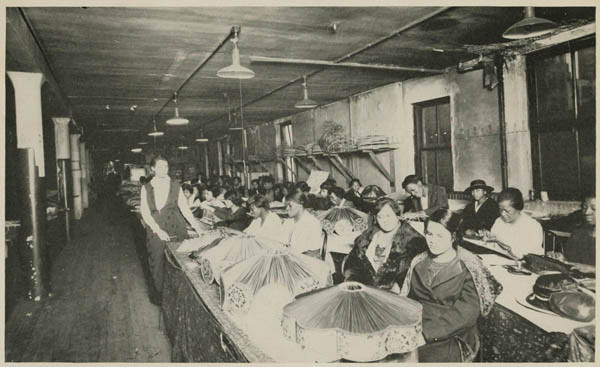
NEGRO WOMEN AND GIRLS EMPLOYED IN A LAMP-SHADE FACTORY Work room is poorly lighted and generally unattractive.
TABLE XXVII
Negro Women Gainfully Occupied in Chicago in 1910, Classified by Industries
Industry Number Percentage of Total
Manufacturing and mechanical industries 998 11
Trade and transportation 96 1
Professional service 323 4
Clerical occupations 163 2
Domestic and personal service:
Laundresses not in laundries 2,115}
Servants 3,512} 78
Other domestic and personal service 1,336}
General and unclassified occupations 337 4
Total gainfully occupied 8,880 100
TABLE XXVIII
Negro Women in Fifty Establishments Classified by Industries in 1920
Industry Number of Establishments Reporting Total Employees Total Negro Employees Total Negro Women Employees
Manufacturing:
Tanneries 1 600 175 50
Iron and steel 3 10,435 1,729 74
Slaughtering and packing 3 20,990 4,818 437
Cooperage 2 327 106 30
Clothing 9 1,405 203 202
Other needle trades 3 775 325 325
Box making (paper) 3 995 143 104
Miscellaneous 3 1,543 95 73
Totals 27 37,070 7,594 1,295
Non-manufacturing:[73]
Hotels 4 550 250 69
Taxicab upkeep 1 1,600 250 100
Laundries 16 1,511 664 543
Mail order (clerical occupations)[74] 2 ... 1,773 1,400
Totals 23 ... 2,937 2,112
To learn the special problems concerning Negro women in industry, one conference was devoted to the industries recently opened to them. Representatives of four establishments employing a total of 1,713 Negro women attended the conference. The investigation of the 101 establishments (employing five or more Negroes) disclosed the presence of women in a large majority of cases, but in a number of instances the management was unable to tell the sex of workers from the records kept and gave the investigator the total number of Negroes employed without classification by sex. Of the 137 establishments reporting, forty-two had no Negro women employees; forty-five kept no separate sex records; fifty reported separately the number of Negro women workers.
Comparing the industries in which Negro women were employed in 1910 with the figures quoted for 1920, a striking increase is seen in the total engaged in manufacturing, 998 being the total Negro women reported for all manufacturing establishments in Chicago in 1910, as compared with 1,295 Negro women reported by twenty-seven establishments in 1920.
Comparisons for special industries and occupations show the contrasts between 1910 and 1920 in Table XXIX.
TABLE XXIX
Industry 1910 1920 Number of Establishments
Sewers and sewing-machine operators in factories 25 527 12
Slaughtering and packing-house operatives 8 437 3
Box making (paper) 3 104 3
Tanneries 0 50 1
Clerical occupations 163 1,400 2
Laundry operatives 184 543 16
Taxicab cleaning 0 100 1
Labor shortage was given as the reason for employing Negro women and girls by all of the firms employing them in large numbers. The outlook for Negro women in industry when there is a labor surplus is uncertain. Employers employing 1,713 Negro women represented at a conference, May 18, 1920, agreed that there were no indications of a reduction of employment. This question is considered at length hereafter in "Future of the Negro in Chicago Industries."
EXPERIMENTS WITH NEGRO WOMEN WORKERS
Employers' opinions regarding the character of Negro labor without reference to sex were considered above. Particular comments concerning male workers were quoted there, comments upon women workers are now given. Four employers of Negro women in large numbers within the past two years gave the Commission the benefit of their experience. They were two mail-order concerns, a manufacturer of automobile spring cushions, and a wholesale millinery shop.
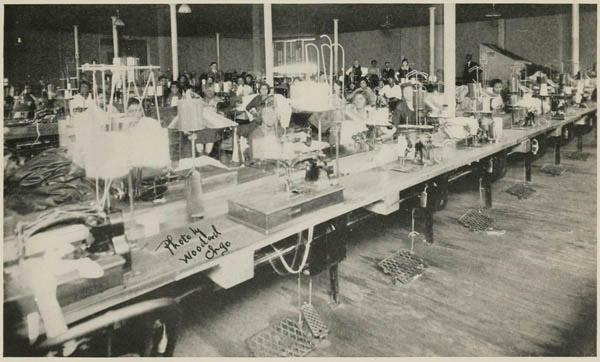
NEGRO WOMEN EMPLOYED ON POWER MACHINES IN A LARGE APRON FACTORY This concern when it increased its number of Negro women, combined its four shops and moved into this modern daylight factory building.
The mail-order house which established a large office for Negro entry clerks in September, 1918, was the first to try the experiment. It had no precedent to guide it and "did not know how the colored girl would act in business." The unit was opened with ninety girls, and increased in the fall of 1919 to 650 girls, who were given the promise of advancement and Negro supervision. In the early summer of 1920, when the investigator visited this office, there were 311 girls at work, as follows:
Operators on Elliott-Fisher machines 30
Mail-order workers 76
Instructing new girls 9
Checkers 138
Supervisors 5
Mail opening, sorting, etc. 27
Posting 26
They were above the average in education, 75 per cent being high-school graduates and 12 per cent having had two or more years in college.
The employment manager said that misunderstandings had arisen occasionally, due to the colored girl being oversensitive and suspicious. "The colored girl seems to suspect that her employer is going to put something over on her. She is suspicious of any whites that come in her vicinity and is ready to believe that any white person is prejudiced against her on account of race."
The Negro welfare worker for this unit suggested that what might seem supersensitiveness was often overzealousness on the part of girls who have not had experience enough to judge their limitations or qualifications. Being eager to succeed, they are very much disappointed when advancement does not reward their efforts: "I think the best type of colored girl we have in business is very ambitious. This is her first opportunity, and she feels that she is really a pioneer making history for her race. She is possibly a little overzealous, but can be made to get the right attitude and accept it all very gracefully."
Another characteristic of Negro girls, in the opinion of the employment manager, was an "excitable nature" which made it possible for a good leader to influence them readily:
They complain of a change of supervisors, for instance. You attempt to shift supervisors from one point of the office to another and you immediately receive a petition signed by all the girls, saying, "We love So-and-So, and please don't change her." This is not to be criticized too harshly, but it does represent something that does go on. It shows inexperience. The white girl would expect that those things would take place. The colored girl, not having been in the office very long, would feel that the fact that the supervisor was changed was something derogatory to the supervisor.
The whites didn't want to act as instructors, and the colored girls didn't want to receive instructions from the whites. By being very careful in the girls that were selected, and showing the white girls where they were wrong, and then attempting to show the colored people that these girls were not to exercise supervision, but were merely to be instructors, both sides came to an understanding on it, and we had pretty good results. The white girls that we had over there became very used to it and usually hated to leave, but we have always insisted that they leave as soon as the girls learned the work.
During the conference on Negro women in industry the representative of this mail-order establishment was asked why the Negro workers were put into a separate unit instead of being intermingled with white girls. He answered:
The first reason is that we haven't any room. The second is, I imagine, because the officials who started the office and who have carried it on since felt that it wouldn't be policy. We haven't discussed the question because we've never had occasion to consider such a move seriously. Our main office is not large enough to accommodate any more employees than we have white employees in the house. We keep that office constantly recruited up to its present strength, and there has never been any necessity or any reason to seriously consider bringing colored girls in with the white girls....
Another thing to consider there would be the type of girl that we employ. They are all young girls, mostly under twenty-five years, and they don't think for themselves; they are influenced very easily by what other girls say. You take one girl in an office of that size who was very anti-colored, and it wouldn't be very long until her sentiment would spread and pretty soon you'd have a strong sentiment against the colored girls.
If a colored girl should want to obtain employment in that part of our concern where we now employ all white girls, even if she were very competent she would undoubtedly have some trouble in securing employment in that department.
The result of the experiment with the colored unit, he said, was highly satisfactory: "We have been very favorably impressed.... The girls have made very rapid progress, in fact they surprised all of us. Their progress along lines of leadership, as supervisors, etc., has been remarkable."
About six weeks after this conference the colored unit was closed. The reasons given were lack of business, trouble with the lessor of the office, and failure to find another convenient location. A letter of recommendation was given to each employee showing that her service had been satisfactory, and a letter was also sent to the Urban League, through which the women had been employed, explaining why it had been necessary to close the office and emphasizing the fact that this action should not be considered in any sense a reflection upon the Negro workers employed.
The other mail-order house opened a unit for Negro women in the fall of 1918, with 650 women who worked until the end of the "fall rush" in January, 1919. In the following fall the unit was again opened, with 1,050 Negro women; and the office was still in operation in 1920. This office was just outside the "Loop" district. The sudden influx of Negro girls there caused complaints by the local restaurants, fearing the loss of old patrons in handling this new business. The company then installed an "at cost" cafeteria service. The work of these girls was clerical, billing, labeling, addressing, etc. Considering their inexperience, their service has been highly satisfactory. The employment manager said: "It's not a defect in their minds, it's a defect in the country. They haven't had the opportunity to gain the education and experience needed for responsibility; the Negro girl is equal to the Italian or Bohemian in working ability and superior for executive work, such as instructing or supervising." Among 143 girls interviewed in the entry offices of these two mail-order houses only three expressed dissatisfaction with the conditions of work. The girls seemed to take pride in the fact that they had succeeded in "making good" in a new and attractive field of work.
The experiment of the establishment manufacturing automobile spring cushions had a very modest beginning. A factory was rented in the Negro residential area on the South Side, and twenty machines were installed to test out Negro women as sewing-machine operators. Gradually the number increased to 120 in this plant, and a second plant was opened in the same vicinity with about the same number of operators. During the year 1919-20 there were 250 Negro women employed as machine operators in these two plants. The superintendent considered that they required less supervision than the white workers in the company's other shops and rated them equal to white workers in efficiency. "We could take our best white girl and our best colored girl, and they earn about the same amount of money on piecework rates, in the same number of hours."
The superintendent of the wholesale millinery establishment represented in conference considered that the employment of Negro women in that industry had outgrown the experimental stage. Although a long period of training is necessary in order to become a skilled milliner (four years for hand sewers, eight years for machine operators), Negro women were keen to learn the trade and willing to accept the low wages paid to beginners. Of the forty-seven Negro women employed on the day of the investigator's visit, thirty-three received less than $12.00 a week and forty-two received less than $15.00 a week. These women were all employed as hand sewers, and in the opinion of the superintendent they had done "just as well as the white. They learn as quickly and are as persevering, and in every respect equal to the whites as far as their work is concerned. We are absolutely satisfied with their work."
Other industries in which Negro women are engaged in considerable numbers include laundering, the manufacture of clothing, lamp shades, gas mantles, paper boxes, barrels, and cheese making. An investigator from the Commission visited establishments employing Negro women in each of these industries.
Laundry operatives.—The fact that 543 Negro women laundry operatives were reported by sixteen laundries, as contrasted with 184 in all Chicago laundries in 1910, gives evidence of an increase in the number of Negro women in this field proportionately much greater than the increase in Negro population in Chicago in the same decade. The opportunity to work in a laundry was practically denied to Negro women until labor shortage forced laundry owners to tap this reserve labor supply. Negro women were eager to desert work as domestic servants and "family washer-women," with the social stigma and restricted human contact involved, to enter laundries where more independence was possible, hours were better standardized, and association with fellow-workers enlivened the work day. The employment department of the Urban League experienced great difficulty in supplying the demand for domestic servants and laundresses in the home, but had no difficulty in filling openings in laundries.
The work of Negro women in this field has proved satisfactory except in a few establishments. Of the twenty laundries which reported Negro labor satisfactory or unsatisfactory (included in Table XXVI), four failed to report separate figures covering male and female employees. Of the remaining sixteen establishments, twelve, with a total of 409 Negro women, reported Negro labor satisfactory, and four with a total of 134 Negro women, reported Negro labor unsatisfactory. The complaint in two instances was unwillingness to work overtime and on Sundays. In both these instances the employees interviewed complained that hours were long (nine-hour day) and the treatment by the management harsh and inconsiderate.
Laundries which did not make a practice of requiring overtime and Sunday work found Negro women workers cheerful, loyal, and industrious. The employees interviewed in these establishments expressed satisfaction with working conditions and with hours.
One efficiently managed laundry, employing seventy-six Negro women and six Negro men, out of a total of 110 employees, reported: "We have a number of exceptionally good and loyal Negro employees. These men and women need very little supervision. We got some who have never worked in industries. They require more supervision and are not very steady. On the whole, we are well pleased with our Negro employees."
Sewing-machine operators and sewers.—Denial of opportunity to enter the sewing trades is evidenced by the small number of Negro women listed in the 1910 census as sewers and sewing-machine operators in factories, the number being twenty-five. That this exclusion was not because of any natural inaptitude for sewing is indicated by the fact that the 1910 census listed 867 Negro women as seamstresses not in factories. Negro women have entered millinery work and proved apt hand workers; they have also proved efficient sewing-machine operators in the manufacture of automobile cushions. The lampshade manufacturers employed Negro women as hand sewers and found them to be efficient workers. The clothing establishments which reported Negro women workers found them satisfactory machine and hand workers, with the exception of one apron factory which complained that they are shiftless, often unreasonable, and do not stick to the job. An investigation of this establishment by the Urban League disclosed the following facts: The shop was located in a shabby-looking, unclean store, inadequately heated by a coal stove. The work day was nine and one-half hours, and piece rates on several operations were so low that it was impossible to earn a decent wage. In this case the large labor turnover was evidently a healthy protest against poor working conditions.
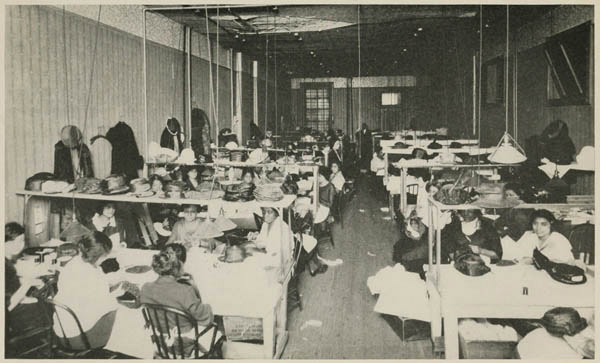
NEGRO WOMEN AND GIRLS IN A LARGE HAT-MAKING CONCERN This shop has been partitioned for the accommodation of Negro women workers. The workshop is unattractive and the lighting extremely poor for the character of work required.
Other industries.—Three paper-box-making plants employing Negro women were investigated. They reported that Negro women had proved unsatisfactory, either slow or lazy. The experience of a cheese factory is worth noting in this connection. Because Negro women appeared to be slow at their work it was decided to measure their tasks. It was then found that many were doing as well as and some better than the white girls in whose places they were working.
Whether such tests had ever been made in the box-making plants does not appear. The employees interviewed in one box factory complained of low wages and no chance for advancement. Negro women in this plant were averaging only $2.40 a day. A cooperage company reported fifteen women stave carriers and fifteen machine operators. Negro labor in this plant was reported satisfactory. Negro women in the garage of a taxicab company, cleaning automobiles, have shown themselves not afraid of hard work; 100 Negro women were reported working in this capacity. Negro women as Pullman-car cleaners have also proved satisfactory.
Before the war Negro women were popularly thought of as a class of servants unfitted by nature for work calling for higher qualifications. It is difficult to say how long this popular misconception might have survived had it not been for the labor shortage which forced employers to experiment with Negro women workers and to learn with surprise that they were as teachable as white women and became as efficient workers after receiving the necessary training.
IV. INDUSTRY AS THE NEGRO SEES IT
1. ATTITUDE TOWARD INDUSTRIAL OPPORTUNITIES
In order to learn the attitude of the Negro toward his work, and his special problems, including the treatment accorded him by foremen and by fellow-workers, 865 Negro employees were interviewed by a Negro investigator at their work or at home. Less than 1 per cent of those interviewed complained of disagreeable treatment by white workers. Approximately one-half had no complaints to make about conditions of work. On the contrary, they expressed themselves as being glad of the opportunity to work and earn good wages.
The attitude of a large number of the workers interviewed is illustrated by the following:
C—— W—— was referred to in one of the industrial conferences before the Commission. The superintendent of the foundry said he was the "star molder" in the plant. When interviewed C—— W—— said he had come to Chicago in 1910 from Kentucky because he was tired of being a flunkey. He had been in the high school for two years, but could only get work as janitor in a public building in his home town. After coming here he worked in a foundry as a molder's helper until he learned the trade. "I was getting 38 cents an hour then, but I got on piecework and my wages have steadily gone up. I'm an expert now and make as much as any man in the place. I can quit any time I want to, but the longer I work the more money it is for me, so I usually work eight or nine hours a day. I am planning to educate my girl with the best of them, buy a home before I'm too old, and make life comfortable for my family. There is more chance here to learn a trade than in the South. I live better, can save more, and I feel more like a man."
R—— N——, who is working as a helper in the same foundry, says he has just gone from one job to another. In the South he worked on a section gang on the railroad most of the time. "Didn't have to know much to get a job on the section gang—just able to lift." Friends here wrote him of the chances to make money, so he came because he was just drifting anyway. When he got here he thought Chicago was "full of life." Every night for a month he went to cabarets. He likes his work and his wages. "My wife can have her clothes fitted here; she can try on a hat and if she don't want it she don't have to buy it. I can go anywhere I please on the cars after I pay my fare, and I can do any sort of work I know how to do."
When M—— G—— came to Chicago in 1900 he thought it "the biggest place in the world and the world didn't reach much further. Life is easier here because you can make more money. Working conditions are better than in the South, but they could be better still." He worked as a butler in the South, but when he came to Chicago he got out of personal service and became a laborer in the Stock Yards. Later he went to Gary, Indiana, to the steel works, where he is earning about $40.00 a week. His wife is doing clerical work in a mail-order house and is going to night school three nights a week to learn typing.
H—— B—— with his family left Mississippi in 1916 and came to Chicago, where he found work as a coal heaver at $3.20 a day. His wife sorted paper in a junk house at $10.00 a week, and his daughter entered a canning department at the Stock Yards at $18.00 a week. When Mr. B—— was interviewed in June, 1920, he was working in the Stock Yards and earning $27.00 a week for an eight-hour day. He said he didn't have to work nearly as hard here as in the South and was earning enough money so his wife could stay at home. "In the South you had to work whether you wanted to or not unless you were very sick. White people did not work there as they do here. They made the Negro do the work. Men and women had to work in the fields. A woman was not permitted to remain at home if she felt like it. If she was found at home some of the white people would come to ask why she was not in the field and tell her she had better get to the field or else abide by the consequences. After the summer crops were all in, any of the white people could send for any Negro woman to come and do the family washing at 75 cents to $1.00 a day. If she sent word she could not come she had to send an excuse why she could not come. They were never allowed to stay at home as long as they were able to go. Had to take whatever they paid you for your work."
M—— H—— "likes the air of doing things here." He is able to earn enough to keep the family without having his wife go out to work. There are four "youngsters," the oldest being eight years old. Mr. H—— came to Chicago in 1918 from Tennessee. He complained that there was not much work for a man in his home town. He did whatever odd jobs turned up. People there were talking about the chances in Chicago, so he came here and went to work as a monument setter on the West Side. Later he found a better-paying job in a mattress factory and was able to send for his family. He is now working in a foundry and makes $35.00 a week but finds it hard to live on this. If he can go to night school he feels he will be able to earn more money.
Mrs. L—— works as an entry clerk in a mail-order house and likes everything connected with the place. She used to be a maid in a private family but says she wouldn't work in service again "for any money. I can save more when I'm in service, for of course you get room and board, but the other things you have to take—no place to entertain your friends but the kitchen, and going in and out the back doors. I hated all that. Then, no matter how early you got through work you could only go out one night a week—they almost make you a slave. You can do other work in Chicago and you don't have to work in such places."
Mrs. L—— had taught school in Atlanta, Georgia. After her husband died she had tried to get back in the school but could not. Friends here advised her to move to Chicago, so she sold her property in 1915 and came here. She got work in the Stock Yards but gave music lessons on the side to help keep up expenses. "I hated the surroundings at the Yards and the class of people who worked there, so when I had a chance to work in a mail-order house I changed. The first work here was filing. I learned it very quickly and tried so hard to make good that they made me a supervisor." She likes the freedom of the North and the opportunities to advance in work. Her ambition is to get into the public schools as a teacher.
Miss T—— S——, twenty-two years old, started to work when she was fourteen, helping her mother cook for a large family in Lexington, Georgia. Her mother died when she was about seventeen, and she continued to work in the same family about three years. Then some relatives persuaded her to come north with them in 1919. She worked as a waitress in Chicago until her cousin got her a job in a box factory. "I'll never work in nobody's kitchen but my own any more. No, indeed! That's the one thing that makes me stick to this job. You do have some time to call your own, but when you're working in anybody's kitchen, well, you're out of luck. You almost have to eat on the run; you never get any time off, and you have to work half the night, usually. I make more money here than I did down South, but I can't save anything out of it—there are so many places to go here, but down South you work, work, work, and you have to save your money because you haven't any place to spend it."
Many of those interviewed were grateful for the opportunity to work overtime at overtime rates. A number complained that they were able to spend but little time with their families, or in recreation, because they were compelled to live in districts far from the plants in which they worked, so that two, and often three, hours a day were wasted on the cars. The Negroes who had come to Chicago within the past two or three years as a rule were satisfied with conditions of work, including hours, wages, and treatment.
2. COMPLAINTS ABOUT CONDITIONS OF WORK
Among the Negroes who had lived in Chicago for a longer period the most insistent complaint was lack of opportunity for advancement or promotion. This was occasionally coupled with the complaint that foremen discriminated in favor of the white workers. In certain industries no complaint of treatment by foremen was made, while approximately 10 per cent of those interviewed in three industries (mentioned below) complained of discrimination in favor of white workers, in the distribution of work, in recognition of efficiency, or in permitting the earning of overtime rates. The industries registering the greatest percentage of complaints were: (1) foundry and iron and steel mills, (2) Stock Yards, and (3) railroad dining-car and Pullman service. The common complaints in each of these fields are considered briefly below.
Foundries and iron and steel manufacturing.—The ninety-three Negro employees interviewed in fourteen establishments in this field were of different grades of skill: fifty-nine unskilled, twelve semi-skilled, nineteen skilled, and three apprentices to skilled trades. The length of time in the plant varied from a week to twenty years (forty-one employees less than one year, and eighty less than five years). To the inquiry, "Is anything wrong with your conditions of work?" fifty answered, "No"; sixteen complained that hours were too long (in these cases the men were working a twelve-hour day and a seven-day week); ten complained of low wages; six that foremen or straw bosses were not fair in the distribution of work or of "heats"; four complained that straight-time pay only was allowed for overtime, three that working gangs were reduced without decreasing the work demanded or increasing the pay of the men who remained; one thought that Negroes were paid lower wages than white workers; one said the work in his plant was much dirtier than it need be; and two were dissatisfied because shower or locker accommodations were insufficient.
A foundry company employing twenty Negroes out of a total of eighty employees was one of the establishments reporting Negro labor unsatisfactory. Negroes interviewed there complained of harsh and unfair treatment by bosses and said that Negroes usually did not stay longer than thirty days. The employment manager of a large foundry employing 427 Negroes out of a total of 2,488 employees told the investigator that the foremen in the plant would refuse to use Negroes if white labor could be obtained, and if such a time should come the foremen would have their way, because it took years to make a foreman, but a laborer could be picked up any day. The investigator was not permitted to interview any of the employees at this plant, but he visited some of them at their homes. They complained of harsh treatment by foremen, reduction in piece rates without notice, and discrimination in favor of white workers. The labor turnover reported by this plant was 70 per cent for Negro as compared with 14 per cent for white workers. This contrast is readily accounted for when the attitude of foremen toward Negroes is known.
Negroes interviewed at one of the plants of another foundry company employing seventy-five Negroes out of a total of 300 employees complained that the foreman in one department established conditions discouraging to Negro workers. He had an even number of Negro and white workers employed as partners on a certain process of piecework rates, each doing one-half of a joint task. When a man was absent, partners would be shifted about so that a Negro worker would be left without a partner instead of a white man. This handicapped the single worker by slowing down the process so he could not earn a full day's pay. Complaint was also made that the same foreman allowed white workers to accumulate a supply of material for their work, although he ordered Negro workers to stop this practice, thus forcing them to lose time in making frequent trips for material.
In a large iron and steel plant a few of the workers interviewed complained of unfair and abusive treatment by foremen. Numerous complaints had likewise come to the attention of the industrial secretary of the Urban League, who took the matter up with the chief of the industrial-relations department of the company. An investigation was ordered, and it was found that a certain foreman had made a threat to drive all the "niggers" from the department. This foreman, who had been employed by the company for more than sixteen years, was discharged as a result of the investigation. The company states that considerable pressure has been brought to bear for the foreman's reinstatement, but that it will not reinstate him because it wants his case to be a warning to others in the plant who may be prejudiced against Negro workers. The discharged foreman has been told that he may seek employment with the company in some other capacity, with the loss of his seniority rights.
In contrast with conditions in the preceding cases, the investigator found no complaints of mistreatment by foremen or other causes for dissatisfaction among Negro workers at another foundry which employs 125 Negroes out of a total force of 466 employees. Negro labor in this foundry was reported "satisfactory" and as efficient as white labor. The attitude of foremen evidently contributed to the contentment and success of Negroes in this plant.
Stock Yards.—Interviews with seventy-four Negroes employed in the Stock Yards disclosed much dissatisfaction with treatment by foremen. Specific instances of discrimination were cited in great detail, leaving no doubt in the mind of the investigator that these workers felt that they did not have an equal chance with white workers in many departments in the Yards. Some of those interviewed were well pleased with the treatment of present foremen, but had worked in other departments in the same plants where they said foremen had been unfair and insulting to Negroes. The Negroes interviewed, with one exception, considered their treatment by white fellow-workers good or "O.K." The following are typical of the complaints made by the men interviewed in three of the large establishments in the Yards:
G—— R—— had worked in one plant in the Yards for four years. He said that he was not given a chance to make overtime, while Poles who had not been with the company as long as he had were given this privilege.
Another worker had been dismissed by a foreman when a white worker in the boiler room had shut off the supply of water for washing hogs. No blame was attached to the real offender, but the Negro worker was discharged. He wrote a letter to the general superintendent, who investigated and ordered his reinstatement. The foreman then tried to reinstate him as a new hand, which would deprive him of his seniority rights.
Another worker interviewed said that one assistant foreman had openly made the statement that he would not work with "niggers."
The foreman over pipe fitters was accused of placing new Negroes on the hardest work, with no one to give assistance. He permitted white men to work as helpers for two or three months, and then to quit for a month or two and return as pipe fitters, advancing them over Negroes who had more training for the work.
The foreman in the sheep-killing department of one of the plants was said by one worker to make advancement difficult, if not impossible, for Negroes. Another worker complained that this foreman had recently taken one man off the jaw-trimming machine but ran the chain just as fast, with the evident intention of overtaxing the remaining Negroes and reporting that they were not equal to the job.
The foreman in the hog-killing department was charged with showing preference to the Poles in shoulder sawing. If a Negro made complaint to the superintendent and was sent back with instructions to the foreman, the latter would try to "burn" the Negro out with work.
It would seem from the discussion of the representatives of the packing companies before the Commission that the Negro in reality has little opportunity for promotion in the Yards. There are no Negro foremen over mixed gangs. The highest position a Negro is able to reach is that of subforeman over a group of Negro workmen. The general superintendent of one of the packing companies admitted that he had never tried out a Negro as foreman over a mixed gang because he wouldn't want to work under a Negro himself. Such an attitude on the part of a general superintendent closes the door to experimentation and limits the opportunities of even the most capable Negroes. It was this same official who said, as previously noted, that Negro labor required more supervision than white labor, and that the turnover of Negro labor was greater. Lack of "hope on the job" would seem an adequate explanation of both conditions.
Railroad dining-car and Pullman service.—Negroes are used as dining-car waiters on all roads running out of Chicago which carry such accommodations. Certain of the roads also use Negro cooks and kitchen help. The dining-cars on all roads are in charge of white stewards. The source of greatest complaint among the 204 Negro waiters interviewed was the arbitrary use of authority by the stewards and the fact that color bars Negro waiters from becoming stewards. They say that when stewards are needed, intelligent and experienced Negroes are passed over and white men, often entirely ignorant of the work, are taught their duties by these Negroes and are then placed in authority over them. One road carrying seven dining-cars uses white stewards on two cars and the remaining five cars are in charge of Negroes called "waiters in charge." Negroes complained that these men get little more than the wages of a waiter, and in many cases do all that is required of steward and waiter.
The outstanding complaint concerned the drawing of the color line in promotion. In view of the fact that many college graduates are serving as waiters, it would seem absurd to say that Negro waiters are incapable of performing a steward's duties, which consist of receiving and checking supplies for the car, seating dining patrons and issuing checks to them, having general supervision of the other employees on the dining-car, and making daily reports to the car superintendent of business transacted. Race prejudice on the part of administrative officials of railroads seems to be the only explanation for barring Negroes from becoming stewards, in view of the fact that Negro waiters have been used in dining-cars for over forty years and have been accepted by the white traveling public as a matter of course, though some contend that some patrons who accept Negroes as waiters would object to seeing them in positions of stewards, particularly if that brought white employees under them.
Negroes are employed in large numbers in Pullman cars as porters, cleaners, cooks, and mechanics. The main complaint made by the sixty porters interviewed was poor wages and necessity of dependency on tips to make a decent living. The wages of porters, as stated by a representative of the Pullman Company before the Commission, are:
The minimum rate for a porter on a standard sleeping or parlor car is $60.00 per month; when running in charge of one car the rate is $70.00 per month; when running in charge of a private car the rate is $75.00 per month; but when operating in charge of two or more cars the rate is $155.00 per month.
In 1914 the minimum was either $27.50 or $30.00 per month. Asked whether the Government Railroad Administration had anything to do with the increase granted by the Pullman Company, he indicated that the Pullman Company was under the direction of the Railroad Administration.
Another complaint by Pullman porters was that no promotion was possible for them, since only white men are used as Pullman-car conductors. The explanation of the company, given by one of its representatives at a conference with the Commission, was: "It is merely carrying out an ancient and honorable custom—we started out with white conductors and colored porters and have always continued that way."
Interviews with Negro workers revealed individual differences in attitude and temperament, but the more ambitious and thoughtful Negroes expressed the conviction that they were barred by color from positions for which they were better qualified than the white men who held them. Their complaints were largely variations of the same theme—race discrimination.
V. INDUSTRIES EXCLUDING THE NEGRO
Several important industries in Chicago have not yet employed Negroes. The traction companies (both elevated and surface) do not employ them as conductors, motormen, guards, or ticket agents. The large State Street department stores have no Negro clerks, and taxicab companies do not employ colored drivers. In these industries, which depend directly upon the public for patronage, it is to be expected that the employing of Negro help will be determined by the employer's views of the wishes of his patrons. If there is any fear that they are unfavorable, any individual employer in a competitive industry will hesitate to try the experiment alone. The employment managers of five State Street department stores made the following statements:
1. Our customers would object to colored salespeople, I am sure.
2. We have never employed any Negroes in our Chicago establishments. I don't care to go into the matter. It will not do you any good and will not do us any good.
3. Customers and white employees would object if they were used as clerks.
4. No Negroes are ever employed because we have sufficient white applicants.
5. If we ever tried using Negroes as clerks the white workers would make trouble, I am sure of that. Our customers would object. A good many are from the South and would make trouble even if Chicago people did not.
One large taxicab company, employing 250 Negroes for repair work and upkeep of automobiles, does not employ Negroes as drivers. A representative of this company stated that the company had gone as far as many employers, and often farther, in the employment of Negro labor; that it had done this in a progressive way, one step after another, but had "not yet got as far as employing Negro chauffeurs," although this might come in time. When asked whether he thought such action would affect the company's business unfavorably he said, "I do not know. It is a matter that I have never thought about."
The Chicago Telephone Company does not employ Negro telephone operators. Its only Negro employees are porters, window washers, and maids. A representative stated that it has always had sufficient white applicants for positions as telephone operators and has not considered taking on Negro girls, although the suggestion has often been made that Negro operators be used at the Douglas Exchange (located in the Negro area of the South Side). This official thought there was very little possibility that they would employ Negro operators in the future. He feared objection from white employees.