Chapter VIII · THE NEGRO IN INDUSTRY (continued 2)
Reading edition
In connection with the foregoing it may be borne in mind that the company has answered complaints of poor telephone service within the past few years with the statement that it is difficult to secure capable girls, and that the Telephone Company is continually advertising for girls as operators.
Social waste involved.—The industrial secretary of the Urban League has called attention to the large number of educated Negro girls who are unable to secure industrial openings where education is required. It is impossible to estimate how great a social waste is involved in relegating trained and educated Negroes to inferior positions, and there is evidence that such waste is considerable. Negroes with college training are found working as waiters; young women college graduates are frequently forced to serve as ladies' maids, theater ushers, or in some other capacity where they are unable to use their educational training. The fact that it was not difficult to find over 1,500 Negro women of more than average education for clerical positions in two Chicago mail-order houses when the opportunity offered is some indication of the extent of the social waste when Negroes are not used in other positions which require training.
VI. RELATIONS OF WHITE AND COLORED WORKERS
The entrance of Negroes into new industries and occupations means that the workers already in these fields will meet increased competition. The self-interest of white workers in a given shop may therefore cause them to resent the presence of Negro workers. On the other hand, through contact and association with Negroes during working hours, white workers may come to look upon Negroes, not as members of a strange group with colored skin, but as individuals with the same feelings, hopes, and disappointments as other people. Whether the hostile attitude prompted by self-interest or the friendly attitude born of understanding, acquaintance, and daily association will prevail in any given shop depends on many factors, over some of which the workers involved have no control. Some of these are:
1. The attitude of the management when Negro labor is first introduced.
2. Circumstances under which Negroes are hired, whether because of recognized labor shortage, or as strike breakers, or to reduce labor costs.
3. The attitude and characteristics of the particular Negroes employed.
4. The attitude of the white workers toward Negroes as a result of previous contacts with Negroes.
The spirit displayed in the shop is likely to spread beyond it and affect relations between the races on the streets and in cars and other public places. It is therefore important to know what the relations between white and Negro workers are, both because of their importance to the Negro in industry and their bearing on the broader social aspect of race problems.
1. RACE FRICTION AMONG WORKERS
Information concerning race relations in industry was received from employers through questionnaires returned by 137 establishments employing a total of 22,337 Negroes, through interviews at places of business with representatives of 101 employers, through industrial conferences held by the Commission, and through interviews with 865 Negro workers. Since the best judges of the existence of race friction would be the Negro workers themselves, who would bear the brunt of any ill-treatment resulting from such friction, it was considered that any extended canvass of opinion among white workers beyond the inquiries made in connection with the trade-union investigation was unnecessary.
Race friction between white and Negro workers sufficient to interfere with output would militate against the use of Negro labor. The fact that Negro labor has proved satisfactory in the great majority of cases where it has been used is therefore indirect evidence that race friction is not pronounced in Chicago industries. Direct evidence from employers on this subject was also secured in answer to a specific question on the point. Out of 137 establishments employing Negroes, which returned questionnaires, only two reported that race friction was a disturbing factor in their plants. The facts in these two cases were as follows:
In a steel-manufacturing plant there was a total of 1,300 employees, of whom seventeen were Negroes, eleven men and six women. During the steel strike of 1919 Negroes were employed in this plant in large numbers. Feeling was antagonistic on the part of the whites, "particularly Austrians and Slavonians." The total number of Negroes employed during the strike and the turnover were reported as "an average force of 175."
Friction in the foregoing case was probably due to the heritage of bitterness over the use of Negroes as strike breakers and to irritation caused by the low grade of workers employed more than to difference in color. They were described by the manager as "irresponsible and shiftless."
In the other case fear of Negroes' competition rather than race prejudice was apparently the cause of friction. The manager of a wholesale millinery house employing forty-three girls in one department, out of a total of 700 employees, said:
We decided to take on colored help in June, 1919. Our white people resented very much the fact of employing colored people in our business, and I believe the blame, if there is any, lies as much with the whites as with the blacks in the difficulties we have had. I find a great resentment among all our white people. I couldn't overcome the prejudice enough to bring the people in the same building, and had to engage outside quarters for the blacks. We had a meeting of our colored operators after employing the hand workers. We thought it would be nice if we would start a school for machine operators. It was, of course, rumored that we were going to do this, and I received a delegation from our sewing hall who said they resented the idea. They wouldn't listen to it at all, and I had to abandon the project. Their argument was: "If you let them in it won't be long until we are out entirely." The attitude against the colored is only the same as it was against the Slavs or the foreign races when they first intruded in the field. There was no prejudice, particularly against the color. In millinery establishments in New York City colored girls and white girls work together and do not seem to have any trouble, but, we can't do it here.
The resentment felt by the white girls in this shop may be accounted for in part by a fact to which the manager apparently attached no importance. In speaking of the loyalty and good spirit of the Negro girls, he said casually:
In a few instances, where we have had difficulty in getting work done by the whites, we have been able to use the colored workroom as a level. We have sent it over to them and gotten it out. The white girls have refused either through stubbornness or some condition to get the work out.
Friction was also reported between women employees in a plant where relations between the men of both races were reported harmonious. This plant which manufactures machinery, has a total of 6,647 employees, including 1,225 Negro men and sixty Negro women. A representative of the company said:
Among the girls we had quite a lot of trouble in some departments against our hiring colored girls. To every colored girl employed we lost five white girls. There was friction in the washrooms due probably to race, though it may have been personal.
The report from a foundry employing 950 men, of whom 200 were colored, said:
As a rule if any objection is made to working together it comes from the white men (Polish) on the grounds that the colored man is being given the preference.
A laundry company employing ten Negroes out of a total of thirty-five employees, reported that when the first Negro girl was employed the white girls threatened to quit. The manager asked them to wait a week and, if they still objected, he would let her go. There was no further objection; they grew to like her.
The reports of employers regarding the absence of friction between white and Negro workers is borne out by the testimony of Negro workers themselves. Among 865 Negroes interviewed in all the industries covered, the number who complained of disagreeable treatment by white workers was practically negligible. It is possible that some Negro workers among those interviewed at their work places, sometimes with white fellow-workers and foreman near by, felt hesitancy in voicing such complaints. But the fact that the information was sought by an investigator of their own race, and confidentially for the Commission, may be considered as a factor likely to encourage the expression of any grievance, especially if felt at all deeply.
Conditions of work in large foundries would seem to offer plenty of opportunity for friction even where workers are all of the same race. This is particularly true of foundries where the piecework system prevails. The work is done in the confusion of smoke, heat, dust, and noise, with men shouting at each other, each striving to be first to receive this pouring of molten iron from the vats. Notwithstanding the fact that the work is carried on under great tension, the ninety-three Negroes interviewed in fourteen foundries, when asked how they got along with the white men with whom they worked, said: "Good," "Fine," or used other words to indicate friendly relations. Not a single complaint was made against treatment by white workers in any of the foundries or iron and steel establishments investigated.
One interesting instance of happy working relations in which several nationalities of whites were involved was found at Hull-House. A Negro has been in charge of the Coffee House there for six years. He had nine employees working under him: three Negro girls, one German boy, one Greek man, two Polish girls, and two Italian women. The Greek man and the two Polish girls were in the employ of the Coffee House when he took charge. The others have all been employed for a considerable period. In commenting upon the amicable relations of people representing so many different races and under a Negro manager, he said, "We are all working for a living, and there will be no discrimination. It is very simple. The thing to do is to get acquainted."
2. WORKERS REFLECT ATTITUDE OF MANAGEMENT
When the employment of Negroes is decided upon, there is an effort to make the change with as little disturbance as possible to white workers. Frequently the manager tries to imagine himself in the place of his white workers in order to discover what their reaction will be. In so doing, he considers, not what they will think or feel, but what a man with his own social background would feel in their position. The attitude of the management therefore determines whether Negro workers shall be segregated or treated like other workers in the plant without regard to color. Separation once decided upon and partitions erected, white workers may insist upon the distinction being maintained where they would not have raised the point in the first instance. Establishments following both courses gave the Commission the result of their experiences. Of 101 establishments employing five or more Negroes each, eighteen maintained separate lavatory and toilet accommodations for Negro workers. This condition was accepted without complaint in some establishments, while in others it was a source of dissatisfaction among the Negro workers, who resented this manifestation of "Jim Crowism" in the North. The fact is worthy of note that the eighteen establishments reporting separate accommodations or separate departments for colored workers employed but 2,623 Negroes out of a total of 22,337 covered by the investigation, or slightly more than 11 per cent. The remaining 89 per cent, or 19,714, were using all accommodations in common with white workers.
One large foundry company employing 427 Negroes out of a total of 2,488 employees tried a different method in each of its three plants. In one a partition in the locker and shower rooms was erected, to which the Negro workers objected. The general superintendent said he would not have consented to the erection of the partition in the first place, but he was afraid to take it down. In the second plant separate lavatory accommodations were provided in connection with separate departments for Negro and white workers on different floors, and there was no trouble. In the third plant, where no color distinctions were made, all workers using the same lavatory accommodations, the manager never heard of any complaint from white or Negro workers.
In another foundry employing 125 Negroes out of a total of 466 employees the representative said that the Polish workers had objected "that the colored people used the showers and basins all the time and they did not get a chance to. We checked up on this and limited some of our showers to colored only, and we only had two men use the white showers in something like two weeks, time, and in the colored there was something like 200 baths taken." The use of the same accommodations in this plant caused no further complaint after this incident. Another foundry reported that the white and Negro workmen ate lunch and smoked together. There were no separate accommodations and there was no ill-feeling whatever. Another firm employing 500 Negroes out of a total of 3,000 employees reported: "The relationship between our Negro and white employees is very friendly. During the past year we have not had a single encounter of any kind between the white and colored workers. They work together in most of our departments, use the same locker rooms and washrooms, and eat in the same restaurant in the plant." In one foundry the superintendent was nearly compelled to install separate accommodations because of stealing in the locker rooms. Suspicion was aroused against the Negro workers, and the white workers had a shop meeting to demand separate accommodations. The manager said: "The same day the janitor caught a red-headed Irish boy red-handed. We paraded him through the shop and made quite a grandstand operation out of it, and it ended my troubles from that time on, but if I hadn't caught him I might have had to maintain separate locker rooms."
There were only six establishments which maintained separate departments for Negro workers. In some cases segregation was effected by a partition; in others by maintaining a complete Negro unit in a different part of the city. The second plan has worked satisfactorily, but segregation by partition in the same plant is resented by Negro workers. Representatives of the largest employers of Negro labor expressed the opinion that erecting a partition, by drawing the "color line," causes friction which in all probability would not otherwise appear.
The industrial secretary of the Urban League, who has been actively interested in extending the range of opportunity for the Negro in industry, firmly believes that the attitude of the management on racial matters is reflected by the employees, that wherever an uncompromising stand is made for fair play for all employees, racial differences do not cause annoyance. He cites the following incident as one of several tending to support his view:
During the fall of 1919 the general manager of the S—— F—— P—— Company was approached on the subject of employing colored girls. To our surprise, it was discovered that colored girls were already employed by him in all branches of the industry, and mixed freely with white employees. There was no discrimination in the character or kind of work or the use of plant facilities. Mr. N—— explained that he had never thought of segregating white and colored workmen, and the wisdom of his plan had been proved by the experience of his father, who employs both white and colored girls, but keeps the groups separated by a partition. According to Mr. N—— the partition had been a source of trouble for the reason that the placing of the partition itself indicated that the company intended to make a difference between white and colored workers. This put each group in a frame of mind which caused them to resent the presence of any worker on the side of the partition on which she was not employed. The elder Mr. N—— realized his mistake but did not dare to take the partition down, fearing that by so doing he would precipitate further trouble which would result in the most desirable girls in each group quitting the plant.
Foremen, because they personify the management in the mind of the workmen, play a large part in shaping the attitude white workers adopt toward Negroes. If the foremen are antagonistic or insulting in their treatment of the Negro, white workers find favor with the foremen by adopting the same attitude. A construction company employing sixty Negroes reported:
There were always difficulties with this gang when the Italian foreman was here, as he constantly endeavored to place Italians at work displacing some very good Negro workers. When I was sent here I dug under the difficulties and found the Italians were very clannish and were using the foreman to carry out the plan of giving every Italian who came along a job, at the expense of some Negro's job. I am a French Canadian and have worked with colored men before. After failure in trying to get Italians to see how bad the old system was, I was forced to let all the Italians go. I have an excellent gang of Negroes now.
The representative of a large foundry said:
I believe I have a harder time to get the Polish foremen to handle Negro help than any other. Our foremen are accustomed to handling the Polish workers pretty rough. While employers don't want that, it goes on that way. A Pole is "cussed" around and does not care what he is called. It's all the same to him, but a colored man is a pretty thin-skinned individual. You call a colored man something, and he will grab his hat and is gone. He thinks that when the foreman uses those words he means it. He will not stand for the same kind of language that the Polak will.
3. USE OF NEGRO LABOR TO UNDERMINE WAGES
If Negroes are introduced into a plant during a strike and retained afterward, a period of strained relations between white and Negro workers is almost certain to ensue. They are given a similarly unfavorable start when they are introduced to reduce labor costs. In the smaller establishments, where wages and conditions of work were not well standardized, white workers were suspicious that Negroes were working for lower wages, and the Negroes suspected that they were being paid lower wages than white workers. It is obvious that where mutual distrust and suspicion are present, friction readily develops which may lead to serious social consequences.
To what extent Negroes are being paid lower wages than white workers it is impossible to say. In this connection the Chicago Urban League made the following statement:
The charge of inequality in the wages of white and colored workers is frequently made, but the League is not always permitted to inquire into wage scales, and therefore verification of some of these rumors has been impossible.
The League has taken up this matter with such companies as ——, ——, ——, and numerous others, with the result that in each instance the statement has been made that white and colored workers receive the same pay for the same work. There is a deep-seated suspicion, however, that this is not true. In some cases this suspicion seemed to be justified. Complaints have come to our attention where colored people have been mistaken for white in the offices of the —— Company and employed at a higher rate of pay than that given colored girls for similar work. This, however, has never been verified. Pay inequalities have been explained away by larger experience, seniority, superior production, etc., in favor of whites.
The employment manager of one company has told representatives of the Chicago Urban League that the colored girls employed in their South Side Branch Office started at a wage in excess of that given white girls for similar work in their main office.
The statement can be correctly made, however, that many employers of colored girls, particularly in the needle trades, have refused to pay colored workers a wage equal to that of white. There are well-known instances of sweatshop tactics used on colored girls because of their inexperience in industry and lack of organization.
An official of the Women's Garment Workers' Union reported that —— Company, upon finding that they had to pay the union scale of wages, requested the local to supply white girls instead of the colored girls who were already in his employ. The colored girls were employed to replace the striking whites.
No complaint has come to our attention of inequality of wages in union shops employing white and colored workers, or in any of the larger industries. Colored workers are usually exploited in the smaller shops. White workers have been known to refuse to work in shops paying white and colored workers the same wage.
All of the representatives of employers appearing in conferences and all but one of the representatives interviewed stated that Negro and white workers were being paid equal wages in their establishments. The exception was a wholesale hardware company where the employment manager admitted paying Negroes "a dollar or two less per week" because they could not be shifted from one department to another as readily as white workers on account of prejudice of workers or foremen in certain departments.
It was learned that employers occasionally refuse to hire Negro unionists when they learn they must pay them "white men's wages." Unionists allege that even Negro employers object to paying Negroes the same union scale as white workers. To the extent that Negro labor is being used to undermine wage standards, misunderstanding and race friction develop.
4. RELATIONS OF WHITE AND NEGRO WORKERS DURING THE RIOT
In contrast with the violence that characterized street encounters during the riots it is significant that no unfriendly demonstrations occurred between workers in any of the establishments covered by the investigation, according to statements made by representatives of employers. On the contrary, white workers are said by employers to have expressed sympathy in many ways with their Negro fellow-workers. The general superintendent of one of the largest packing companies in the "Yards" emphasized the good feeling that existed between the workers at this critical time:
I think this Commission ought to know that there wasn't a single case of violence in what we call Packingtown during the race riot, and the morning that the Negroes were brought back to work in this packing-house there was not a single argument—there wasn't a single indication in this plant of any racial feeling. In fact the two classes of common labor we have are the Slavs and the Negroes, and they met as old friends. In many instances they put their arms around one another's necks. In one particular instance a Negro and a Pole got on an elevated truck and rode all around this plant simply to signify to the rest of the workers that there was a good spirit existing between the two. There was nothing in the contact between the Negro and the Pole or the Slav that would indicate that there had ever been a race riot in Chicago, and there was nothing from the beginning of the race riot to the end that would indicate that there was any feeling started in the Stock Yards or in this industry that led up to the race riot.
That there was at least one case of mob violence is shown by the report of the coroner's jury which investigated the riots. William H. Dozier, a colored man, was killed in the Stock Yards, according to this report. The jury's finding in this case was:
We find that during the race riots at a point about Cook Street and Exchange Avenue in the Union Stock Yards, and at about 7:15 a.m., July 31, 1919, deceased, a colored man, was struck by a hammer held and wielded by one Joseph Carka, that the deceased ran east on Exchange Avenue toward the sheep pens at Morgan Street, that he was followed and chased by a mob of white men, and that while so running the deceased was struck by a street broom, held and wielded by one Joe Scovak, and that he was also struck by a shovel in the hands of an unknown white man, and by one or more stones or missiles thrown by one or more unknown white men; injuries sustained causing death.
This was the only serious case of violence in the Stock Yards discovered, although a number of rumors were investigated, which could not be substantiated by facts.
Because of the nature of the work in the "Yards" and the presence of knives and other dangerous implements which could be turned to ready use, it is significant that more rioting, with deaths and injuries resulting, did not take place. But it is also true that the riot, which started on Sunday afternoon, became so serious by Monday morning that few Negroes made an effort to reach their work at the Stock Yards.
VII. FUTURE OF THE NEGRO IN CHICAGO INDUSTRIES
The investigation of the Negro in industry points to the conclusion that Negro labor has made a satisfactory record, and that there is little race friction in evidence between white and Negro workers. What the future will hold for him depends upon many complicating factors, some of which are: renewal of immigration in large volume, depressed business conditions, attempted reductions in labor costs, increasing unemployment, falling wages, the announced determination of many employers' associations throughout the country to undermine the strength of unions by establishing the "open shop" which might involve the use of Negro labor, and the admitted prejudice of foremen against Negro labor in many plants. It was labor shortage which forced employers to experiment with Negro workers in new fields. Whether Negro employees will be retained when a surplus of white labor is available is an open question.
Employers' representatives, in April and May, 1920, stated (with one exception) that no reduction in labor force was contemplated; that when such reduction became necessary, efficiency and seniority rights would determine which workers would be retained; that the question of color would not enter into the decision in any way. The employment manager of a firm employing a very large number of Negroes expressed the general opinion of the employers' representatives when he said:
I feel that our house will continue to run a colored office as long as they can run it as efficiently and economically as they could a white office; while, on the other hand, if they could not run it as efficiently and economically of course they wouldn't run it, because it's just a matter of dollars and cents, and as far as charity and good will goes, all good business men have it, but they are not going to run their business according to that entirely.
On the other hand, the employment manager of an establishment which had experienced friction between white and Negro workers was of the opinion that white workers resented the intrusion of Negroes. He thought that this feeling would be a factor if a time came when there was an oversupply of labor; that Negroes would then have to give way because no employer would be strong enough to resist the resentment of white workers; and Negro workers would thus be thrown out of work and would be a standing menace to the community.
The investigations and inquiries of the Commission in industry took place almost entirely in the period from March to September, 1920, and the statistics concerning Negroes employed were gathered in the earlier part of this period. During these months the general industrial situation was such as to demand all the labor, both white and Negro, that could be secured. In the autumn of 1920, however, a period of decline began, with increasing unemployment. This affected both white and Negro workers. Its own investigational staff no longer available for additional service, the Commission sought information concerning these changed conditions, so far as they affected Negro workers, from the industrial secretary of the Chicago Urban League. Through its industrial department the League places more Negroes in employment than any other agency in Chicago. The industrial secretary made the following statement on November 20:
At the present time the unemployment among colored people has reached what seems serious proportions. While there is no indication that colored people are suffering more in this respect than any other group, the constantly swelling number is a cause for grave concern. For three weeks our employment office has been crowded with job seekers. At first it appeared that those who failed to take their work seriously suddenly found themselves unable to get employment, but now hundreds of men with good records have been forced out by temporary "shut downs" and reduced forces of various plants.
During the working days included between November 15 and 20, our attendance record is 1,073 job seekers with only 131 openings. One month ago the attendance figure was 571 persons for the equal period (259 men and 312 women).
Our labor reports for May, 1920, indicated an attendance of 941 males and 739 females; about 1,000 orders for male help and about 500 for female help; there were 722 placements for males and 371 for females. The total attendance was 1,680; orders, 1,500; placements, 1,093.
A casual survey including most of the leading industries ... shows a general decline and a letting off of workers. Some few report difficulty in keeping their present forces.
There have been some complaints of discrimination against colored workers, but few comparatively.... Most industries are keeping their proportionate share of Negroes. In some instances the proportion has been slightly increased....
During the week, workers have registered from cities in states from Mississippi to Michigan. Detroit predominates, where the automobile industries show a marked depression.
Women's work presents a very discouraging outlook. Hundreds of needle workers are out of employment by the closing of many of the smaller shops which employed colored girls. The Women's Trade Union League reports many workers unemployed, due to the slowness of the trade. Immigrant white girls are said to be consuming much of the work offered to domestics.... Colored women seem in most cases as reluctant as ever to accept domestic employment.
The present unemployment problem is probably as serious as any the League has known. What shall become of the army of jobless men is a problem serious and perplexing.
As a result of the necessity of reducing costs in response to depressed business conditions, managers of establishments employing both white and Negro workers may be tempted to pit Negro and white workers against each other, paying Negro labor less than white labor as a means of forcing down wages or undermining labor-union organizations. Such attempts would certainly be conducive to increased racial animosity. On the other hand, managers who are hostile to Negro labor may take advantage of the change in the labor situation by discharging Negroes indiscriminately, replacing them with white workers.
During the period of business depression which had already begun, both white and Negro workers seemed certain to lose some of the advantages which they had gained as a result of the labor shortage caused by the war. After the industrial depression has passed, discrimination against the Negro, to whatever extent it may exist, will make the recovery of lost ground more difficult for Negro workers than for white workers. In considering the question of race discrimination, it is evident that the Negro who has lived in the North for a number of years feels keenly the fact that color bars even the most capable members of his race from the hope of promotion to executive or administrative positions, while prejudice on the part of persons in authority prevents the rank and file of Negroes from developing the degree of efficiency which they could develop if they knew their efforts would be judged on merit alone. Where advancement is precluded by color, the incentive supplied by recognition of effort is lacking.
One door of escape from the discouraging prospects held out in industries managed by white men, where there is no chance for promotion to executive positions, is the opportunity for an increasing number of the more ambitious Negroes to enter business among members of their own race. According to Black's Blue Book (1919-20) there were over 1,200 Negro business houses and professional offices in Chicago in 1920. Among others, the list included five banks, forty dentists, fifteen druggists, twenty-four employment agencies, six hotels, three insurance offices, forty-eight real estate offices, eleven newspapers and magazines, 106 physicians, seventy lawyers, 161 barber shops and billiard rooms, and 120 hairdressing parlors. Although the list of Negro business men in Chicago is growing rapidly, it must necessarily remain but a small percentage of the total Negro population. The great majority of Negroes gainfully occupied will continue to be employees in industry. Therefore the fact that a large number of Negroes feel that discrimination is practiced and that, no matter what abilities they show, they can "go so far and no farther" in industries managed by white men is of great importance in any consideration of race problems. These men are the more thoughtful, aspiring members of their race, and their opinion accordingly carries more weight than the opinion of an equal number of care-free Negroes who may consider that the high wages of the present are an offset for all handicaps. Negroes who feel keenly the injustice of unequal opportunities are the ones to seek expression in Negro newspapers and magazines with the aim of arousing widespread resentment against race discrimination. Men who frequently would not resent discrimination directed against themselves are stirred to resentment by well-told recitals of injustice to others. Specific instances may seem to be of trifling importance, but in being retold they reach an ever-widening audience, which is constantly growing more race conscious.
B. ORGANIZED LABOR AND THE NEGRO WORKER
I. INTRODUCTION
Industry involves the continuous contact of more whites and Negroes than any other field. It therefore affords wide opportunity for the operation of racial misunderstanding and friction. It is also a field in which the lines of economic interest are so tightly drawn and so closely watched that any misunderstanding or friction is thereby greatly accentuated.
Irritation and clashes of interest have been conspicuous in the relations between labor unions and Negro workers. This friction has extended to the relations between whites and Negroes generally. The efforts of union labor to promote its cause and gain adherents have built up a body of sentiment that cannot easily be opposed by non-union workers. The strike breaker is intolerable to the union man. Circumstances have frequently made Negroes strike breakers, thus centering upon them as a racial group all the bitterness which the unionist feels toward strike breakers as a class. This tends to increase any existing racial antipathy or to serve as concrete justification for it.
On the other hand, Negroes have often expressed themselves as distrustful of the unions because prejudice in the unions has denied them equal benefits of membership. They often find that their first opportunity in a new industry comes through the eagerness of a strike-bound employer to utilize their labor at wages more than they have previously earned, even if less than the union scale. This often tends to make them feel that they have more to gain through affiliation with such employers than by taking chances on what the unions offer them.
There is a gradually increasing sympathetic understanding by unionists of the struggle of Negroes to overcome their handicaps, and an increasing realization of the importance to the unions of organizing them. Negroes are themselves showing more interest in efforts toward organizations, but there is still much mutual suspicion and resentment in their relations.
To understand these relations it is necessary to know (1) the policy and attitude of organized labor toward the Negro and how its expressed policy is carried out in practice; and (2) what the Negro believes the facts to be and what his attitude is toward organized labor. In its investigation the Commission used the following methods of inquiry: Questionnaires were sent to all labor organizations; interviews were held with union officials and members, both white and Negro, with officers and members of Negro "protest" unions, with non-union Negroes, and with persons who were not connected with unions but had certain special information. Ninety-one persons, of whom twenty-five were Negroes, were interviewed. Trade-union meetings were attended by the Commission's investigator. Union constitutions, magazines, convention reports, etc., were collected and studied. Conferences were held by the Commission at which the following labor leaders and organizers presented their information and views:
George W. Perkins, president of the International Cigarmakers' Union, and prominent in the affairs of the American Federation of Labor since its organization.
Victor Olander, secretary-treasurer, Illinois State Federation of Labor, and vice-president of International Seaman's Union.
John Fitzpatrick, president, Chicago Federation of Labor.
W. Z. Foster, organizer of the American Federation of Labor in the steel and packing industries.
A. K. Foote, Negro, vice-president of Stock Yards Labor Council and secretary-treasurer, Local 651, Amalgamated Meat Cutters and Butcher Workmen of America.
I. H. Bratton, Negro organizer for Amalgamated Meat Cutters and Butcher Workmen of America.
John Riley, Negro organizer for the American Federation of Labor in the Stock Yards district.
Max Brodsky, secretary-treasurer, Local 100, International Ladies' Garment Workers' Union.
Agnes Nestor, president, Women's Trade Union League.
Elizabeth Maloney, treasurer and organizer, Chicago Waitresses' Union.
Robert L. Mays, Negro, president of an independent Negro union, the Railway Men's International Benevolent and Industrial Association.
II. POLICY OF THE AMERICAN FEDERATION OF LABOR AND OTHER FEDERATIONS
From its beginning the American Federation of Labor has declared a uniform policy of no racial discrimination, although this policy has not been carried out in practice by all the constituent autonomous bodies. At its fortieth annual convention, held at Montreal, Canada, in June, 1920, a plan was presented to "use every means in its power to have the words 'only white' members stricken out of the constitution" of the Brotherhood of Railway Clerks, an organization which exercises jurisdiction over 100,000 colored employees, although barring them from membership, and "admit the colored workers to full membership in their Brotherhood or have them relinquish jurisdiction" over these Negro employees and allow them to establish a brotherhood of their own.
This failed to receive favorable action, but a resolution was passed reaffirming the position taken at the Atlantic City convention in 1919 that "where international unions refuse to admit colored workers to membership, the American Federation of Labor will be authorized to organize them under charters from the American Federation of Labor." This means that in such cases the American Federation of Labor itself becomes the national or international union of such locals. According to the information given to the Commission by George W. Perkins, "the American Federation of Labor has organized hundreds of local unions and thereby directly attached to the American Federation of Labor colored workers." President Gompers states: "Of the 900 unions affiliated directly with the American Federation of Labor there are 169 composed exclusively of Negroes."
A brief reference to the history of the national federations which preceded the American Federation of Labor shows that the foregoing policy has been followed since shortly after the Civil War.
The National Labor Union (1866-72), at its first convention in 1866, was the first national federation of labor unions to deal with the problem of meeting Negro competition after the Civil War. The formation of trades unions among colored people was favored. In 1869 Negro delegates were admitted to the annual convention. A separate national Negro Labor Union, formed in 1869, was short-lived. The unfriendly attitude of the unions toward the Negroes was the subject of bitter comment at the various sessions of the latter organization. The Knights of Labor, which rose to prominence after the decline of the National Labor Union, admitted all workers without regard to color. Many Negroes in the South joined the organization. When the leadership of organized labor shifted from the Knights of Labor to the American Federation of Labor in the late eighties, the Federation continued to express the policy of no racial discrimination and has stood for that policy to the present time.[75] At the convention of the American Federation of Labor in Atlantic City, 1919, there were present about fifty Negro delegates, men and women. A large number of Negro delegates also attended the last convention of the Federation at Montreal.
The policy of the Illinois State Federation of Labor was outlined to the Commission by Victor Olander, secretary-treasurer, as follows:
The State Federation of Labor is under the jurisdiction of the American Federation of Labor, and the laws governing the national would necessarily govern the state federation, so that in respect to law they are the same. I might add that they are carrying out the law in much the same manner with respect to the Negro. There hasn't been a convention of the Illinois State Federation of Labor held in many years that hasn't had in attendance Negro delegates. That is the usual thing at every convention. There is no discrimination.
The Chicago Federation of Labor is the city central body of the various local unions in Chicago which are connected with the American Federation of Labor. Each of these local unions elects delegates to represent it at the semi-monthly meetings of the Chicago Federation. Negro delegates take an active part in these meetings, and are cordially received. The Federation and its president have been very active in all efforts to organize Negroes, especially in the Stock Yards, the steel industry, and the culinary trades.
III. POLICY OF NATIONAL AND INTERNATIONAL UNIONS
In considering the policy of national and international unions, that of the unions affiliated with the American Federation of Labor will be discussed first, and following this the policy of six of the most important of the independent internationals.
1. UNIONS AFFILIATED WITH THE AMERICAN FEDERATION OF LABOR
The American Federation of Labor has consistently followed a policy of no racial discrimination. It has, however, no power to compel its constituent national and international unions to follow this policy. The question of race discrimination by an autonomous national or international union has been frequently the subject of spirited discussion at American Federation of Labor conventions, but the outcome has been merely a recommendation to the offending union that the discrimination be discontinued. Since strict autonomy of national and international unions is recognized in the constitution of the American Federation of Labor, no more effective action can be taken.
In order to learn the racial policy of the 110 nationals and internationals affiliated with the American Federation of Labor inquiries were sent to each, and direct responses were received from sixty-nine. The policy of twenty-five additional unions was learned through their district councils or locals in Chicago. Thus all but sixteen of the 110 national and international unions in the American Federation of Labor were covered. Of these, two were suspended from the American Federation of Labor in 1919-20. Only three have locals in Chicago, and all have little significance for Chicago. Information concerning the racial policy of the sixteen unions not heard from was supplied by labor leaders in touch with the whole union situation and able to speak with authority on this subject.
Of the 110 national and international unions affiliated with the American Federation of Labor, eight expressly bar the Negro by their constitutions or rituals. These unions are: Brotherhood of Railway Carmen of America, International Association of Machinists, American Association of Masters, Mates, and Pilots, Railway Mail Association, Order of Railroad Telegraphers, the Commercial Telegraphers' Union of America, American Wire Weavers' Protective Association, and Brotherhood of Railway Mail Clerks.
Thus 102 of the 110 national and international unions affiliated with the American Federation of Labor admit Negroes. Not all of these unions, however, have Negro members, notwithstanding the fact that Negroes are eligible to membership. In accounting for the absence of Negro members, twenty-eight national and international unions reported "no Negroes in the trade," or "no applications ever received." Certain of the 102 nationals and internationals reported a small Negro membership with the following explanations:
Eleven stated that employers discriminated against Negro members of the union—wanted white men if they had to pay the union scale of wages.
Seven internationals and five delegate bodies reported that special efforts were now being made to organize Negro workers.
Twelve internationals called attention to long periods of apprenticeship—four had a three-year period, six a four-year period, and two a five-year period—as a factor which accounted for the failure of Negroes to join.
In their comments, some of these union officials unconsciously express their prejudice, sometimes attributing traits to the Negro which they seem to take for granted as being characteristic. The following are some examples:
No Negroes have applied for membership in our union or did not have nerve enough as it requires lots of climbing.
We do not have any Negroes in our organization, but there is nothing in the constitution which prevents them from becoming members after they have learned the trade. No one has ever made application for a Negro. I judge this is because they have to blow in the same pipe [in glass blowing].
I find nothing in our laws which bars Negroes from becoming members of this union, but in my thirteen years in this office I have never known one to make application for membership. This may be due to the hazardous nature of our work.
Ours is usually very hard work. Negroes as a whole do not like hard work. They instead very often prefer employment where they can get along at their own gait or in their own way, especially working in gangs.
National and international unions which had Negro members in appreciable numbers reported the following facts:
Sixteen had Negro officers or organizers.
Twenty-three reported that relations between the races in the unions were undisturbed by race prejudice.
Thirty-three stated that Negroes had belonged to the union for the following periods:
Number of Unions
2 years or less 12
2 to 4 years 8
4 to 6 years 1
6 to 8 years 2
8 to 15 years 4
20 years 4
25 years 1
35 years 1
2. UNIONS NOT AFFILIATED WITH THE AMERICAN FEDERATION OF LABOR
There are a number of unions[76] not affiliated with the American Federation of Labor, of which the most important are: the four railway brotherhoods—Brotherhood of Railway Clerks, Brotherhood of Locomotive Firemen and Enginemen, Brotherhood of Railroad Trainmen, Order of Railway Conductors of America—Amalgamated Clothing Workers of America; Industrial Workers of the World (I.W.W.). The four railway brotherhoods exclude the Negro by constitutional provision. The Amalgamated Clothing Workers of America and the Industrial Workers of the World admit the Negro and make special efforts to organize Negro workers. The I.W.W. has its main foothold in the lumber, mine, and textile industries and does not have any strong unions in Chicago.
Disregarding the classification of nationals and internationals based upon affiliation with the American Federation of Labor, a review of the figures presented above shows that 104 national and international unions admit the Negro, and that twelve exclude the Negro by written provision.
The outstanding fact with reference to these twelve organizations is that, with the exception of the Wire Weavers, they are all connected with the transportation industry: seven are members of the American Federation of Labor Railway Department and the other four constitute the big "railway brotherhoods." The latter are sometimes referred to by members of the unions as the "aristocrats in the labor movement." All of these unions, except the Masters, Mates, and Pilots, have been organized more than twenty years. None of the unions formed within the last twenty years, except the Masters, Mates, and Pilots, excludes the Negro.
In these crafts, excepting such trades as carmen, machinists, clerks, and firemen, it may be that in general the Negro would not be much of a factor at present, because these trades demand an amount of education and skill not yet possessed by a large percentage of Negroes. But this by no means proves that the Negro would not acquire the necessary skill and education if opportunities in these trades were actually open to him.
The Railway Department of the American Federation of Labor is composed of fourteen craft unions, all but two of which exclude the Negro worker. The Stationary Firemen and Oil Men of the American Federation of Labor Railway Department are openly soliciting Negro members. The only other craft organization which admits Negroes is the Maintenance of Way Craft, which really means the common labor group. Negroes can get into this craft through an auxiliary charter to a Negro local. Regardless of how skilled or how intelligent the applicant may be, or how logically he falls into some other craft, he can only come in through one or the other of these two craft unions.
The attitude of the railway brotherhoods is typified in remarks made to an investigator for the Commission by a member of the Brotherhood of Railway Clerks who is now serving on an important public commission. He was emphatic in upholding the brotherhood's policy of excluding Negroes. "As long as the engineers have anything to say about it, they certainly will not get in." He said that the modern locomotive was a highly complicated and scientific mechanism, and that the Negroes "did not have brains enough to run one."
As showing the contrasting view of another trade-union man, an employee of the public commission mentioned said that he had been a member of the United Mine Workers since 1901, and in that organization no color line is drawn; that he had worked beside Negro miners and feels no prejudice. He pointed out that the national conventions of the miners always have a large representation of Negro delegates, and some of the ablest and best speakers come from the Negro race. He expressed the feeling that the policy of the railway brotherhoods is a mistake, and is a case of "swell-headedness."
The general exclusion policy of the railway brotherhoods and certain of the unions in the Railway Department of the American Federation of Labor has created a feeling of bitterness among Negroes which spreads beyond these crafts and is directed against unions in general, notwithstanding the constructive and progressive policy of the many unions which admit Negroes. In the transportation crafts it has led to the formation of a "protest" Negro railway union.
The Railway Men's International Benevolent Industrial Association.—This organization is a labor union open to Negro railway employees. It is a protest organization which has grown up because of the exclusion of Negroes by the railway brotherhoods and certain unions in the Railway Department of the American Federation of Labor.
The Association was organized May 12, 1915, and has seventeen locals in Chicago and a membership of about 1,200, all railway employees. The leaders of this group disclaimed any intention of building up "a rival American Federation of Labor among Negroes," but stated that, as far as they were personally concerned, they would be willing to affiliate with the American Federation of Labor in its proper department, providing all forms of discrimination in national and international unions, both in constitution and practice, were done away with, and the Negro worker was assured of equal treatment and opportunity with the white worker. They realize that the highest welfare of both groups depends upon co-operation. But, as to what the membership would want to do when that time comes, they of course do not know.
Mr. Mays, the president of the organization, was asked by the Commission's investigator what he would do in a situation where both Negroes and whites were organized separately, and the whites were going out on a strike and had requested the Negroes to come out also. He stated that several such local strike situations had arisen in the South, and that he had advised the Negro union in each of these cases to use its own judgment, but that if it decided to support the white unions, it should, before doing so, have a joint committee of both groups meet and make it understood absolutely that any agreement finally reached with the employers must include both groups on equal terms. In one case, after such an agreement had been reached and the men had gone back to work, the employer tried to keep out certain Negroes, but the white unionists insisted that the agreement must be lived up to.
The officials of this organization are exceptionally capable Negroes; its advisers are professional men, well educated and thoroughly familiar with the history and tactics of white labor unions.
A more definite statement of the purpose and policies of this protest organization was made before the Commission by R. L. Mays:
The Railway Men's International Benevolent Industrial Association really protests as an organization against unfair and bad working conditions of the employer and against unfair practices on the part of the American Federation of Labor and the railway brotherhoods.
This is the crux of the problem as we see it. We agree with the policies and principles of the American Federation of Labor so long as they are American and in the interests of the workmen, but if their practices are against Negroes, then we are against the American Federation of Labor unflinchingly.
Question: To what extent have you found their practices unfair to the colored people?
Mr. Mays: There are fourteen unions in railway employment in the American Federation of Labor. The United Brotherhood of Railway Employees has been accepting Negroes in full membership, but the other thirteen organizations do not accept Negroes in membership. As a matter of fact, they are secured on contract, which is the greatest holdback for the Negroes and breeds more distrust on the part of the Negro in these places, so far as the American Federation of Labor is concerned.
Before the roads were under government control certain discriminatory practices were found in the South, but now you will find colored men in certain skilled positions. In the Brotherhood of Carmen, if a colored man is not organized into the local union, he cannot advance automatically from repair to car building. He might be a member of one of these local unions chartered by and affiliated with the American Federation of Labor. But under contract they say their members must be white, and they use only white men. In the South our men have enjoyed these jobs; under war conditions they were brought here, but under this contract no Negro can be employed as a carman, although he has all the experience in the world. They refuse to take the colored man but take the white man. No colored boy can go in as an apprentice and work up to a skilled mechanic's position. Consequently they are reducing the Negro railway worker to a position of common laborer and automatically are keeping him down. If this is the condition in the railways in the North, I say it will prevail everywhere. I have said that it is a northern prejudice coming South.
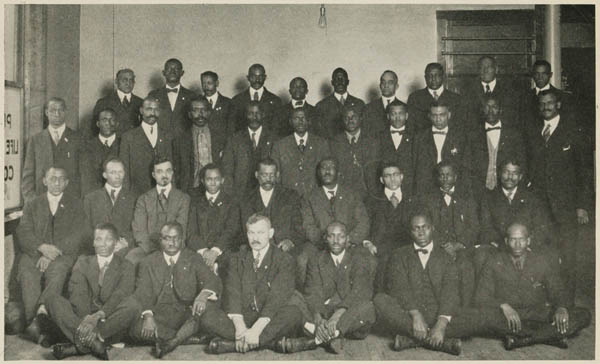
OFFICERS OF THE RAILWAY MEN'S INTERNATIONAL BENEVOLENT INDUSTRIAL ASSOCIATION
IV. ATTITUDE AND POLICY OF LOCAL UNIONS IN CHICAGO
1. WHITE AND NEGRO MEMBERSHIP IN CHICAGO LOCAL UNIONS
Much effort was made to obtain statistics of white and Negro membership in local trade unions in Chicago. Information was sought through requests addressed to the national headquarters of all national and international unions affiliated with the American Federation of Labor for data as to any local unions they might have in Chicago. Requests were also addressed directly to these local unions as listed in a directory published by the Chicago Trade Union Label League. Further requests were addressed to local unions in Chicago directly affiliated with the American Federation of Labor as listed in a directory of all such unions published by that organization.
It was difficult to ascertain the exact number of local unions in Chicago. Those covered embraced, however, as full a list as could be supplied by trade-union offices in Chicago. But the president of the Chicago Federation of Labor said that the number of local unions was changing so continually by reason of the organization of new ones and the consolidation of two or more into one, that no accurate list was available.
Data for the Amalgamated Clothing Workers of America and for the Railway Men's International Industrial Benevolent Association were obtained directly from those organizations.
Reports were received from the railway brotherhoods saying that they exclude Negroes, but giving no data as to the number of white members.
The information which was obtained may be summarized as follows:
Members
371 local unions affiliated with the American Federation of Labor, comprising locals of national and international unions so affiliated, and also federal and local unions directly affiliated with the American Federation of Labor 253,237
11 local unions of the Amalgamated Clothing Workers of America 40,000
17 local unions of the Railway Men's International Industrial Benevolent Association 1,200
294,437
The total Negro membership reported for Chicago by the foregoing organizations was 12,106. The number of locals through which this Negro membership was distributed cannot be stated with any approach to accuracy, due to the fact that in a number of cases the district council or the national body reported the membership for its Chicago locals jointly. In such cases it could not safely be assumed that each of the locals in question had Negro members. Disregarding all such cases, however, there still remains a total of at least eighty-five Chicago locals for which, individually, Negro members were reported.
It is interesting to note that, judging by the figures here shown as to white and Negro membership in local unions in Chicago, the proportion of Negro union members to the Negro population in Chicago is almost exactly the same as the proportion of white members to the white population in Chicago.
2. METHODS OF DEALING WITH NEGRO APPLICANTS
If the unions which bar the Negro are chosen as examples, organized labor might appear to be very unfair to Negro workers. On the other hand, if unions which admit them into the same locals and have Negro organizers and officers are chosen as examples, it might appear that there was no prejudice whatever against Negroes on the part of trade unions. Neither extreme would represent the facts. On the basis of policy toward the Negro, unions in Chicago may be divided into four classes or types. These classes are:
A. Unions admitting Negroes to white locals.
B. Unions admitting Negroes to separate co-ordinate locals.
C. Unions admitting Negroes to subordinate or auxiliary locals.
D. Unions excluding Negroes from membership.
The existence of these classes indicates the fact that the union attitude and policy toward the Negro cannot be summed up by any simple generalization. Each class or type has its own policy, and even within the class there are minor variations of attitude and policy.
A. UNIONS ADMITTING NEGROES TO WHITE LOCALS
Wherever and whenever Negroes are admitted on an equal basis and given a square deal, the feeling inside the union is nearly always harmonious. This is true in such unions as the Butcher Workmen's, Hodcarriers', Flat Janitors', and Ladies' Garment Workers', which include important fields of Negro labor in Chicago.
Stock Yards' unions.—The Stock Yards' strike of 1904 was broken by the use of Negroes. This was the opening wedge for the admittance to the union of the large number of Negroes which followed. No organization thereafter could hope to amount to anything in the Yards unless it took in Negroes. From 1917 until the riot of 1919 Negroes in large numbers were joining the Amalgamated Meat Cutters and Butcher Workmen's Union of North America. Forty locals were formed. The Negro was welcome to join any local he desired, whether it was predominantly Polish or Irish or Negro. However, the majority gravitated to Local 651, which was composed mainly of Negroes and had Negro officers and organizers and headquarters near the "Black Belt."
This was not unnatural, since the headquarters of the various local unions are distributed over the city with a view to their convenience for the members. Most of the Negro members live within the "Black Belt." The most active Negro organizer in the city is connected with this local. Negroes living outside this area belong to the locals nearest their homes.
Efforts to organize Negro workers in the Yards are commented upon in the Negro Year Book of 1918-19 in the following paragraph:
That the unions are doing much to organize Negro labor is indicated by the fact that of the more than ten thousand Negro workers in the Chicago packing houses, over 60 per cent are reported in the unions. The International Union of Butchers' Workmen, which has jurisdiction over 90 per cent of the employees in the packing houses of the country, has three paid Negro organizers. In other lines of work there is equal activity in organizing Negro labor.
The unions succeeded in securing an agreement under which Judge Samuel Alschuler was mutually accepted by the packing companies and the unions as an arbitrator on matters affecting working conditions in the Yards, especially hours and wages. This agreement applies to all who work in the Yards, whether in or out of the union, but, according to labor leaders, union action and union money "put it across." Consequently there was the feeling that all who benefited should join and help share in the expense, and a feeling of hostility toward such Negroes, and whites as well for that matter, who did not join because they found that they could get all the benefits of the arrangement without paying dues.
While the Commission's investigator was interviewing the officials of one of the unions of the packing industry at their headquarters, a number of the white members dropped in to pay their dues. In conversation they showed, quite unsolicited, that considerable feeling existed because the Negro workers were not coming into the union. They felt that the Negroes were receiving all the benefits secured for the workers by the unions without paying their proportion of the expense of the organization. In fact, several used rather strong terms with the words "fink" and "scabs."
The sentiment of the men present seemed to be that, while mistakes had been made on both sides in the 1904 strike and since, the antagonistic feeling had been pretty largely eliminated, as was shown by the large Negro membership prior to the riot, and they said that every effort was being made at that time and since to bring the Negro into the union. Conferences had been held with Negro ministers and other organizations explaining the position of the unions, literature had been distributed, and a great deal of money had been spent through Negro organizers, and yet the results were disappointingly small. These white union men contended that they were opposed by an effective combination of "packers'" influence hard to beat and intensively interested in keeping the races apart for its own purposes in opposing union organization.
The Hod Carriers have sixteen locals in Chicago with a large total membership. No racial record is kept, but Negroes are admitted without discrimination into all of the unions. A few years ago the Negro membership was between 1,200 and 1,400; at present with an increase of 300 to 500 from the South, the secretary of the executive council estimates the total Negro membership to be at least 1,700, most of whom have joined two locals. The president of the Evanston union and the vice-president of the Chicago Heights union are colored. No feeling of discrimination exists, all being treated alike as long as they pay their dues and live up to the rules. The Hod Carriers have joint arbitration agreements with the employing contractors' associations in this industry, and no strikes have been called since 1900.
The International Ladies' Garment Workers' Union is another illustration of a union which accords Negroes the same treatment as white members, and where the relationship is entirely harmonious. This union has never drawn the race, creed, or color line and is trying to leave out the word "white" and "colored" from its minutes and reports. The Negro girls came into this industry as strike breakers within the last three years.
The officials of this union, in interviews and in testimony before the Commission, claimed that whenever any friction did arise it was due to the fact that the employers in this industry discriminated against Negro girls and paid them less than white girls. The agreement between the ladies' garment manufacturers and the union provided a weekly wage of $37.40 for skirt and dress operators—85 cents per hour for a forty-four-hour week. Negro operators in non-union factories for the same work were being paid from $18.00 to $25.00 per week. Union skirt and dress finishers were being paid $26.40 per week—60 cents per hour for forty-four hours. Negro operators in non-union factories averaged $15.00 per week for the same work and frequently worked longer than forty-four hours.
The relations of whites and Negroes in the union were discussed before the Commission by Max Brodsky, a representative of the union, who said:
As a result of the 1917 strike we have now about 450 colored women workers in our industry. We lost the strike, and this is how the colored women got into our industry. Now the union knew the object of the colored women coming into our industry, and we decided to have them organized just like the white women and girls, so we established this particular union. They are at present conscientious union girls and women. It was the policy of the union not to discriminate against the colored women who broke the strike in 1917. This helped us.
At the same conference, Agnes Nestor, president of the Women's Trade Union League, testified as follows:
Miss Nestor: In the ladies' garments work, the unions have taken in colored girls on the same basis as the white girls. They made a colored girl a chairman of their shop meeting. There is no feeling there with them as far as I know.
Miss McDowell: Didn't they elect a colored girl as shop steward where they had both white and colored girls?
Miss Nestor: Yes.
As an illustration of employers' discrimination against Negro workers, and of the efforts of the union to protect Negroes when they become members of the union, the case of a manufacturer was cited whose shop had only Negro workers. Shortly after the union had organized them they were locked out. Later the employer was willing to settle "providing you sent us a set of white workers." The union refused to do this and called a strike.
The union claimed that in many recent cases where Negro girls were sent out on jobs the employers would refuse them when they found out that they had to pay them the same scale as white workers. During 1917-18, owing to the war, the manufacturers worked in harmony with the unions because they had to; since the war, and largely within the first few months of 1920, the manufacturers have opened many shops on the South Side employing only non-union colored girls. In the various strikes in which this union has been engaged for this same period, the strike breakers have been Negro girls secured for the employers through a Negro minister acting as a labor agent or solicitor.
The Flat Janitors' Union has a membership of approximately 5,000, of whom 1,000 are Negroes. It includes many nationalities with strong racial feelings, yet, as stated by Mr. Fitzpatrick, president of the Chicago Federation of Labor, rarely is any complaint made against this union by Negroes.
Interviews with the president and other officials, attendance at a session of the Executive Board, and attendance at a crowded meeting of the union, where transaction of general business, nomination of candidates for the coming election, and initiation of new members occurred, gave the Commission's investigator ample opportunity for observation of the attitude toward Negroes.
This union, organized in 1904, started out with a Negro as recording secretary and business agent. At the time of the interviews, the vice-president and three members of the Executive Board were Negroes. These had been elected for a three-year term. At the general meeting attended, the Negro officers were renominated unanimously to hold office for a period of five years. In addition, several more Negroes were nominated as stewards and as delegates to the Chicago Federation of Labor.
According to the members, discrimination in this craft is practiced by the flat and apartment owners. The experience of the union is that as soon as a Negro is taken into the union and demands the union scale the owner calls up the union and says, "If I have to pay these wages I'm going to get a good white man."
The position taken by the union is that if a Negro has had the job he must be allowed to stay there and get the scale, and the union will back him up in the fight for it. The threat of a strike against a building is usually effective.
Inquiry among Negro janitors in the residence districts brought up a case in which one Negro claimed that Negroes were forced into the union and then usually found themselves discriminated against by the white members, especially by Belgians, and soon or later, were squeezed out of the good jobs. However, this Negro admitted that he had not attended a union meeting since his initiation, except to stop in to pay his dues, and that he had never made a complaint to the Negro officer of the union. The officers of the union admitted that there was, in the many racial groups in this craft, strong racial feeling, especially among Austrians and Belgians, who seemed to feel that whenever a janitor died or left the job, or an assistant or helper was needed, such job should always be filled with members of their own nationality. However, the Negro officials claimed that with three Negroes on the Executive Board and a Negro vice-president, any complaint coming from a Negro would surely be fairly dealt with; but that unless their attention was called to unsatisfactory conditions the union could not be expected to know of them, and in such cases it was not the union that was to blame, but the member himself.
Frequently, in those unions in which the Negroes are not admitted into the same locals with the whites, the reasons given for putting them into separate locals or auxiliaries is that the white members object to the close physical contact or association in meetings, especially where there is some element of ritual in connection with the meetings. At the meeting of the Janitors' Union attended by the investigator, new pass words were given out, and all members, white and Negro, had to come before the Negro vice-president, who whispered the words to each and they in turn repeated them to him. Not the slightest hesitancy was noted on the part of the white members, but rather a hearty handshake or a slap on the back seemed to be the rule. Again, in taking in nineteen new members, four of whom were Negroes, the major part of the ceremony was performed by the Negro vice-president. At this meeting, packed to standing-room and attended by well over a thousand members, Negroes were a large percentage of those present. These were not confined to a group by themselves, but were scattered in all parts of the hall and seemed to be in cordial conversation with the white members.
A number of interesting comments by members and officers of unions admitting Negroes on equal terms with whites were volunteered, either in interviews or in correspondence. In one union of 700 highly skilled workers receiving $1.50 an hour, or $12.00 a day, no Negroes were found to be members, although they are not barred by the constitution. It was suggested that the five-year apprenticeship period discouraged Negroes. It was further noted that admittance was by a two-thirds vote, a provision which could easily result in the exclusion of any race which two-thirds of the members did not like. The investigator's report of his interview says:
The business representative of this union was strongly of the personal opinion that unions had made a mistake in ever admitting the Negro into any of the unions. He claimed that the employers' only interest in them was as a lever to keep wages down for the workers.
Two other members of the League took a contrary position and held that Negro labor was in the field, and that while the employer's interest in the Negro was simply to play one group against another to keep expense down as low as possible, it was really up to labor itself to solve the question and that the Negroes must be taken into unions. They admitted that undoubtedly prejudice existed, but that it was gradually being overcome.
Other comments are as follows:
From an officer of the Teamsters and Chauffeurs: "We have had one Negro holding office as trustee for several years. So feeling is brotherly."
From an officer of a specialized mechanics' union: "There has been no sign of race feeling or hatred since we have been organized. We have six officers (one colored). I myself, being colored, have no complaints whatever against my white brothers."
From a Negro officer of the Mattress Makers: "Discrimination and race prejudice does not exist in this union. We are one happy family. It seems impossible to organize the other Negro mattress makers. Would appreciate some assistance."
B. UNIONS ADMITTING NEGROES TO SEPARATE CO-ORDINATE LOCALS
Certain unions organize Negroes into separate locals which are in all respects co-ordinate with the white locals belonging to the same unions. The reason for maintaining separate Negro locals is either (1) preference of the Negro workers for locals of their own, or (2) unwillingness of white workers to admit Negroes to white locals. It often seemed that the second indicated the real situation, the first reason being given as an excuse for it.
The important factor is the reason for the existence of separate Negro locals rather than the fact of separation. This is illustrated by the experience of the Painters' and Musicians' unions on the one hand, and that of the Waiters' Union on the other.
During July, 1920, twenty Negro painters applied to the Painters' District Council for membership in the Painters' Union. They passed the required examination but, instead of being placed in the existing Painters' Union, were given temporary working permits which identified them as members of "South Side Colored Local." They immediately suspected that some effort was being made to place them in a separate Negro local in which they could not get the full benefits of union membership. They then went to discuss the matter with the editor of a Negro paper which had expressed the point of view of many Negroes concerning labor unions in its editorial columns. This editor told them his belief that the Painters' District Council was merely duplicating the practices of several other unions in the city, and was attempting to limit these men to a "Jim Crow" union. They returned to the president of the District Council, who explained that he had to keep track of all temporary permits issued, and inasmuch as the charter for their local was not yet issued he could not know the number until issued. He had to put the description on the cards to identify the men temporarily.
A charter for the local was given from national headquarters, and the new cards were issued, designating them simply as members of Local No. ——. The membership of this local, exclusively Negro, grew from twenty to seventy-five in two months. One of the Negro officials of the local stated that its members had been working in all parts of the Chicago District, including the North Side and Evanston, and that they had a representative on the District Council. The attitude of the white workers, he stated, was a little cool on the first day, but there is now no evidence of friction. He thought that the members of this local were well pleased and happy.
The Negro Musicians are organized into a strong separate local, chartered in 1902. It has a membership of approximately 325. It has held the Municipal Pier dance-hall contract for three years, and besides many other contracts in the city. It furnishes players for various occasions for a considerable territory outside of Chicago. This group much prefers its own union, but works jointly with the large white union, the Chicago Federation of Musicians, whenever matters come up affecting both organizations. Both unions have the same wage scale.
Where Negro workers are permitted to join white locals but prefer to have their own colored local there is no feeling that they are discriminated against, occasional joint meetings with white locals being characterized by friendly interest and good fellowship. Where, however, a union closes the door of its white locals to Negroes and organizes them into separate locals because the white members object to contact with Negroes, a very difficult situation exists. This condition is illustrated by the methods of the Waiters' Union in Chicago.
Negro waiters are not admitted into the white Waiters' Union, but are placed in the Pullman Porters and Dining-Car Waiters' Union, which is a local affiliated with the same international as the white Waiters' Union. The makeshift of putting Negro waiters, although employed in city hotels, restaurants, and cafés, into this local is pointed to by Negroes as unmistakable evidence of discrimination.
The culinary strike in Chicago, which started May 1, 1920, resulted in failure for the unions concerned largely because Negroes acted as strike breakers. This is easily accounted for by the fact that seventeen years ago Negro waiters lost their positions in many of the first-class hotels and restaurants in the business district through circumstances in which they felt that they had been "double-crossed" by the unions, of which they then were members.
The Negro strike breakers in 1920, however, found themselves again displaced, this time through the action of employers. A typical instance was found in the restaurant of a hotel patronized largely by people of German descent, the managers as well as many of the former waiters being of German extraction. These waiters, some of whom had been employed for many years in this restaurant, were members of the union and went out when the strike was called. The managers replaced them with Negroes. The latter filled the positions with apparent satisfaction for nearly a year, when suddenly they were all discharged and the old waiters taken back.
A regular patron of the restaurant, a man of German descent, expressed vigorous views upon the "injustice" with which the Negroes had been treated by the management, which should have appreciated their service through the period when the former waiters caused trouble. He said he had always found the Negroes efficient and willing, and many of them "very intelligent fellows." Although of the same nationality as the managers and the former waiters, many of whom he had known for years, he did not let this national feeling blind him to what he considered most unfair treatment of the Negroes. He said that he had discussed the matter with one of the managers and had been told that the reason why the Negroes had been discharged and the old waiters taken back was because of complaints against the Negroes by patrons of the restaurant. He added, "I think that's bunk."
A change in the officers of the Waiters' Union at the recent election has placed in power a group which recognizes that the entire policy of the culinary unions must be co-ordinated and proper provision made for the large Negro element in the field. If this is not done, it is felt that a rival Negro union may be organized, similar to that organized by the Negro railway workers. In fact, even now a beginning has been made toward such an organization by a few high-grade Negro waiters who have been in active charge of the waiters of several of the large hotel dining-rooms during the recent strike.
C. UNIONS ADMITTING NEGROES TO SUBORDINATE OR AUXILIARY LOCALS
The practice of admitting Negroes to subordinate locals appears to be very unusual in Chicago. The investigation disclosed only one instance where the policy of the union was to admit Negroes only to subordinate locals. The Commission is not at liberty to publish the name of this union, which makes the following provision for Negro locals in its constitution:
Where there are a sufficient number of colored helpers they may be organized as an auxiliary local and shall be under the jurisdiction of the white local union having jurisdiction over that locality; and minutes of said auxiliary local must be submitted to duly authorized officers of said white local for their approval.
In shops where there is a grievance committee of the white local, grievances of members of said auxiliary local will be handled by that committee.
Members of auxiliary locals composed of colored helpers shall not transfer except to another auxiliary local composed of colored members, and colored helpers will not be promoted to ... or helper apprentice; and will not be admitted to shops where white helpers are now employed.
Auxiliary locals will be represented in all conventions by the delegates elected from the white local in that locality.
The officials of this union stoutly maintain that the provisions above quoted are not discriminatory, and they are at a loss to explain why attempts to organize Negro workers in Chicago into auxiliary locals have not met with success.
D. UNIONS EXCLUDING NEGROES FROM MEMBERSHIP
Chicago locals which exclude the Negro do so either in conformity with the laws of their national unions or in the exercise of "local option." Locals belonging to the national and international unions which bar the Negro by written provision in their constitutions or rituals are obliged to follow the same racial policy as their parent bodies. This number includes the Chicago locals belonging to the eight American Federation of Labor national unions which exclude the Negro, and the locals of the four railway brotherhoods which likewise exclude the Negro by constitutional provision.
In addition to the locals which are bound to follow the policy of their nationals, there are certain other locals which are known to reject Negro applicants. By allowing their locals to practice "local option" or to require a majority or two-thirds vote for election to membership, the progressive policy of certain American Federation of Labor national and international unions which admit the Negro is nullified.
The Machinists' Union has frequently been referred to as a union which, although complying in its constitution with the American Federation of Labor policy of no racial discrimination, still effectually bars the Negro by a provision in its secret ritual. In effect, however, there is no real difference between such a policy on the part of the Machinists' Union and that of the unions which apparently practice exclusion as an unwritten law. With the Machinists' Union must then be grouped such unions as the Amalgamated Sheet Metal Workers' International Alliance, International Brotherhood of Electrical Workers of America, and United Association of Plumbers and Steam Fitters of United States and Canada. The Electricians' Union has only one Negro member out of a total membership of 11,000 in Chicago.
V. ATTITUDE OF NEGROES TOWARD UNION ORGANIZATION
From its attitude toward labor unions the Negro population of Chicago may be considered in four groups: (1) racial leaders outside the labor movement—ministers, editors, politicians, etc.; (2) Negroes with a special interest in opposing unions; (3) Negro workers outside of the unions; (4) Negro workers within the ranks of the unions.
1. RACIAL LEADERS OUTSIDE OF THE LABOR MOVEMENT
Within this group are found many sincere workers for the welfare of the race. Their attitude is determined by the apparent practicability of courses of action for Negroes in relation to the unions. These attitudes again depend upon their familiarity with the principles and purposes of unionism. They recognize that the entrance of large numbers of Negroes in industry has been recent. The belief is that the employers rather than the labor unions provided this first opportunity, and since, under most frequent circumstances, the holding of these positions has been due to the kindly attitude of employers, they felt that first loyalty was due to them.
They have also been affected by experiences with labor unions which in the past have not been disposed to accept Negroes freely into membership with them.
Although the interest of employers in securing Negroes has not always been merely the granting of an opportunity for work, where Negroes have entered as strike breakers they have usually remained. This recent entrance into industry has made them, for the first time, a considerable factor, and they feel that the unions, recognizing their importance to the accomplishment of union aims, are making appeals to them for membership, not out of a spirit of brotherhood, but merely to advance their purposes.
These considerations have largely determined the attitude of many Negro leaders, especially the ministers, some of whom have been requested by employers to recommend members of their congregations for jobs in various fields of industry. At a recent industrial convention of Negro organizations controlling the employment of thousands of Negro workers, it was decided that Negroes would not be sent as strike breakers to plants where the strikers' unions accepted Negroes, and that they would advise Negroes to join the unions wherever possible, but that where Negroes are offered positions by employers in trades where Negroes are excluded from the unions, they would not be advised to forego the opportunity.
An intelligent Negro woman, who has been active in trying to acquaint ministers with union aims and methods, commented upon the fact that until recently Negro ministers knew very little about unionism, except that employers were opposed to it. This was enough to influence many ministers to urge Negro workers to stay out of labor unions and thus demonstrate their loyalty to employers who had given them a chance in industry.
A prominent Negro leader, a member of the Illinois legislature, stated his position respecting unions, at one of the industrial conferences held by the Commission, as follows:
I want to confess that I have never felt that I could intelligently advise the colored people who ask me whether laboring people should join the unions. It has been the opinion of the leaders of our race for years that employers of labor felt more kindly toward colored labor and were less concerned about the color of the workmen—were only concerned about the character of the service. We felt as leaders of the race that the labor employer was given a square deal much more than the employee himself.... We had a strike here of waiters several years ago when the Kohlsaat lunchroom waiters were involved. I was the president of a men's Sunday club, and some labor agitators got the colored boys to join the white Waiters' Union, and I remember when the matter came before the club I told them, "They raised your wages to the white man's scale, and the white men are raising you out in the street," and that is what they did too.... I have been somewhat influenced by that experience.
2. NEGROES WITH A SPECIAL INTEREST IN OPPOSING UNIONS
The rift between employers and labor unions has provided a field of exploitation for certain less responsible Negroes. Their operations have occasioned bitter feeling between Negroes and labor unions and have accomplished little or nothing for the Negro workers. A Negro editor of a small and irresponsible paper advises Negro workers not to join the white man's union, but instead to join a union which he has formed and of which he is president. He is looked upon with suspicion by representative Negroes of Chicago, who believe that he is willing to sacrifice the best interests of the race to serve his own purposes. A well-informed Negro outlined the method employed by the editor in question to represent himself to employers of labor as one who controls large numbers of Negro laborers. In furtherance of this plan, which appears to have prospered, he organized a group which he called the "American Unity Labor Union." The appeal on the one hand to Negroes was that white unions would not admit them on an equal basis and that white employers preferred Negro non-unionists to white unionists and would pay them the same wages while according them better treatment. To white employers he represented the Negroes as being opposed to unions because they were white men's unions, and as such discriminated against Negroes, and that they belonged in large numbers to his organization, which was designed to improve the quality of Negro labor by increasing Negro pride in special and unmixed endeavors.
That certain employers did give money for this kind of service is apparent in several instances. A Negro ex-clergyman secured for a long period something like $2.00 per capita for every Negro supplied by him to any one of ten iron foundries in the Calumet district.
The following are typical of advertisements which appear regularly in the paper of the Negro editor referred to above:
Wanted
100 Building Laborers to work in the city of Chicago at Building Scale Wages. Union Job. If you are not a Union man you can get a permit to work as a Union Man at —— Indiana Avenue.
Do not pay $33.00 to join a white man's union, when you can join the black man's union for $5.00 and work on any building in Chicago.
Wage Earners Club
American Unity Labor Union was organized March 10th, 1917, Chicago, Illinois.
Get a Square Deal with Your Own Race
Time has come for Negroes to do now or never. Get together and stick together is the call of the Negro. Like all other races, make your own way; other races have made their unions for themselves. They are not going to give it to you just because you join his union. Make a union of your own race; union is strength. Join the American Unity Packers Union of the Stock Yards, this will give you a card to work at any trade or a common laborer, as a steam fitter, electrician, fireman, merchants, engineers, carpenters, butchers, helpers, and chauffeurs to drive trucks down town, delivering meat as white chauffeurs do for Armour's and Swift's, or other Packers. A card from this Union will let you work in Kansas City, Omaha and St. Louis, or any other city where the five Packers have packing houses.
This Union does not believe in strikes. We believe all differences between laborers and capitalists can be arbitrated. Strike is our last motive if any at all.
Get in line for a good job. You are next. Office, —— Indiana Ave.
The Working Men's Club
Join the American Unity Steel and Metal Union, a Union of your own race with officers of your own race with a President. A card from this Union will entitle you to work any place in the United States as a steel and iron worker, craneman, engineer, molders, rail straighteners, and any job that it takes brains and skill to do and common laborer. Join one big union and demand a square deal with your own strength. 8 hour day's work.
Get in line for a good job. You are next. Office, —— Indiana Ave.
All classes and kinds of work waiting for good people in our Association.
During the latter part of December, 1920, the editor in question visited the large daily newspapers in Chicago and presented an article which purported to tell of a large mass meeting of his union at which this group decided that they would work at the Stock Yards, steel mills, and all other plants in Chicago and the Calumet region and at all foundries and factories at a 15 per cent discount on wages previously paid for skilled labor, and 10 per cent on common-labor wages. Although only one paper gave any attention to this statement, the opinion of some of the more responsible Negroes was expressed in a Negro newspaper in Chicago, which characterized the man as "a public nuisance" and his story as "bunk."
3. NEGRO WORKERS OUTSIDE OF UNIONS
Negro workers outside of the union ranks often do not see any necessity for unionism or do not understand its aims and methods; many are frankly suspicious of the good intentions of white unionists toward Negroes; others condemn unions generally because of some bitter experience with a particular union, while still others are enthusiastic believers in unionism and expect to join a union at some time. Several shades of opinion are illustrated by the following quotations taken at random from interviews with a large number of Negro workers.
H—— G——, thirty-four years old, left a farm in Georgia to come to Chicago in October, 1919. Employed as a laborer in a paper-box manufacturing plant. He said he didn't know much about unions but couldn't see what good they were doing. They made prices go up, but wages didn't go up with prices. If unions did any good he would join, but he can't see that they do.
W—— W—— had spent nearly all of his life hauling logs to be made into ties for railroads. When he came here from the South he worked as a trucker in the Quartermaster's Department of the army until the department closed. After loafing half a month, he got his present job trucking at a box factory. Unions would be all right, in his opinion, if they let all of the men in who would do right, but when they don't, they do more harm than good. He used to belong to the Butchers' Union at the Stock Yards and "got along fine," but he quit butchering. He intends to get back in a union if possible. Strikes are too hard on the man that "ain't in the union; strike out here recently and now we can't make overtime and we hardly make enough in regular time to live on. Unions are secret—I can't remember all the bunk about them now, but you pay dues and go to meetings, something like a lodge I guess. If anything goes wrong on your job you tell it in meeting, and your branch of the union takes it up with the people. You don't have any of that worry on yourself. They are all right if you are on the inside, but mighty hard if you ain't."
J—— McN——, forty-two years old, had been a farmer in the South all of his life until he came to Chicago in January, 1920, and went to work in the Yards as a meat trimmer. He has been asked to join the unions but hasn't done it as yet—he isn't quite sure they mean a square deal by the colored man, although he can't see why they would ask him to join if they didn't. Don't know much about the "workings of 'em" but they pull together, sort of "lodge like." He thinks everybody who belongs is mighty "close mouthed" about what they do at the meetings. He knows that they pay dues and have assessments, that they look after sick members and have some sort of initiation.