Chapter VI · RACIAL CONTACTS
Reading edition
INTRODUCTION
Contacts of whites and Negroes in the North and South differ according to the institutions and traditions of the sections in which they have been reared. In the South relations are fixed and generally understood, although Negroes consider the institutions on which these relations are based oppressive and consistently oppose them. There the "color line" is drawn rigidly without reference to the desires or comfort of Negroes or the free expression of their citizenship privileges. Because it is nearer than the North to the institution of slavery, the South still maintains an almost patriarchal relationship with its Negro population. Small communities, the plantation system, and the great numbers of Negroes in domestic service hold the two races steadily in contacts so close that class as well as race lines are maintained with deliberateness and persistence. Even where there are no laws specifically regulating association of the races, the sentiment of the community is enforced, frequently in disregard of existing general laws. Thus Negroes may not eat in a restaurant with whites, sit in adjoining seats in a theater, live in the same neighborhoods, work together on the same jobs, or attend the same schools.
In northern communities the institutions are more liberal and with few exceptions there are no restrictive laws applying specifically to racial association. In fact, the trend of legislation and of court decisions is strongly toward adopting and enforcing general regulations without regard to race or color. Relations are less personal, contacts are wider and more frequent.
From a very simple organization of relations in the South, Negroes are transported to more complex relations based on more elaborate urban distribution of responsibilities. Thus it happens that whites and Negroes in Chicago may be found working together in industry, riding together on street cars, attending the same schools, sharing political activities, with an increasing number of Negroes holding public office, transacting business in banks, stores, and real estate, competing in athletics in public schools, colleges, and the Y.M.C.A., and conferring on social problems in civic and reform clubs.
The increasing number of these contacts cannot fail to influence the necessary adjustments. The general public seems to accept necessary contacts with a minimum of outward friction, as is shown by thousands of daily contacts. Each contact, however, where there is friction, is a focus of comment, antagonism, resentment, prejudice, or fear. But association in such places as hotels, restaurants, barber shops, dance halls, and theaters is often limited by tradition and custom in the North as strictly as by regulation in the South.
A. LEGAL STATUS OF NEGROES IN ILLINOIS
The legal status of Negroes in Illinois differs in no respect from that of white persons. The limitations which affect Negroes are established through rules imposed by persons who offer public services and accommodations. When these rules are unfair, evasive, or even illegal, they can be enforced only because of non-enforcement of existing laws. Federal and state courts are in accord in holding Negro men and women in Illinois to be citizens of the United States and of the commonwealth, protected by the laws against discrimination or oppression on account of their race or color.
There are two lines of decisions in Illinois relating to discriminations on account of color. One line of cases prohibits discrimination in certain public places and the other prohibits discrimination against school children. All but two of these cases were tried since the passage of the School Act and the Civil Rights Act, prohibiting such discrimination, enacted in 1874 and 1885, respectively. The civil-rights cases[28] are briefly reviewed below by a consideration of the school cases.
I. CIVIL RIGHTS IN PUBLIC PLACES
The Civil Rights Act, originally passed in 1885, was amended in 1903, and again in 1911. Section 1 of this act now provides:
That all persons within the jurisdiction of said State of Illinois shall be entitled to the full and equal enjoyment of the accommodation, advantages, facilities and privileges of inns, restaurants, eating houses, hotels, soda-fountains, saloons, barber shops, bathrooms, theaters, skating rinks, concerts, cafés, bicycle rinks, elevators, ice-cream parlors or rooms, railroads, omnibuses, stages, street cars, boats, funeral hearses, and public conveyances on land and water, and all other places of public accommodation and amusement, subject only to the conditions and limitations established by law and applicable alike to all citizens; nor shall there be any discrimination on account of race or color in the price to be charged and paid for lots or graves in any cemetery or place for burying the dead, but the price to be charged and paid for lots in any cemetery or place for burying the dead shall be applicable alike to all citizens of every race and color.
Section 2 provides:
That any person who shall violate any of the provisions of the foregoing section by denying to any citizen, except for reasons applicable alike to all citizens of every race and color and regardless of color or race, the full enjoyment of any accommodations, advantages, facilities or privileges in said section enumerated or by aiding or inciting such denial, shall for every such offense forfeit and pay a sum not less than $25 nor more than $500 to the person aggrieved thereby, to be recovered in any court of competent jurisdiction in the county where said offense was committed, and shall also for every such offense be deemed guilty of a misdemeanor, and upon conviction thereof, shall be fined not to exceed $500 or shall be imprisoned not more than one year or both; and provided further, that a judgment in favor of the party aggrieved, or punishment upon an indictment, shall be a bar to either prosecution respectively.
Anna William v. Chicago & Northwestern Railway Company (55 Ill. 185)—the first case of color discrimination which reached the supreme court of Illinois—was heard in 1870, before the passage of the Civil Rights Act. The court decided that a railroad company could not exclude a Negro woman on account of her color from a certain car reserved for the use of ladies. The evidence showed that the brakeman had refused to permit the Negro woman to enter the "ladies' car" and pushed her away. The jury awarded her $200 damages, which the court upheld as reasonable.
Before the Amendment of 1903, the Civil Rights Act of 1885 provided that all persons should be entitled
to the full and equal enjoyment of the accommodation, advantages, facilities and privileges of inns, restaurants, eating houses, barber shops, public conveyances on land or water, theaters, and all other places of public accommodation and amusement, subject only to the conditions and limitations established by law and applicable alike to all citizens.
In 1896, in Cecil v. Green (60 Ill. App., 61; affirmed, 161 Ill. 265), the court decided that the expression "all other places of public accommodation" embraced only places of the same general character as those enumerated, and therefore that soda fountains were not included within the general term.
The amendment of 1903 included soda fountains, saloons, bathrooms, skating rinks, concerts, bicycle rinks, elevators, and ice-cream parlors.
In Baylies v. Curry (30 Ill. App. 105; affirmed, 128 Ill. 36), decided in 1889, a Negro woman, after being refused tickets at the box-office of Curry's Theater, had a white woman purchase two tickets for her in the balcony. Upon attempting to use them, the Negro woman and her husband were referred back to the box-office and their money returned. The proprietor introduced evidence to show that his theater was in a bad neighborhood, and he had, therefore, adopted the rule of reserving certain rows for Negroes in each section of the house. The supreme court, in affirming judgment for $100 damages, said: "Beyond all question, the Civil Rights Act prohibits the denial of access to the theater and to the several circles or grades of seats therein, because of race or color."
In 1903, in Grace v. Moseley (112 Ill. App. 100), it was held that the statute imposes liability only where the defendant denies or incites a denial of service, not where he merely fails to provide service.
The amendment of 1911 provided that there should not be any discrimination on account of race or color in the price charged for lots or graves in any cemetery.
Relying upon this provision, Gaskill, a Negro, applied for a writ of mandamus to compel the Forest Home Cemetery Company to receive the body of his wife for burial (People ex rel. Gaskill v. Forest Home Cemetery Company, 258 Ill. 36, 1913). The cemetery company had passed a resolution in 1907 that thereafter the cemetery would be maintained for the burial of white persons only—except that colored persons owning lots in the cemetery, and their direct heirs, should be admitted for burial. Gaskill did not own a lot in the cemetery, but four of his children had been buried there fifteen to twenty years before in single graves separated from each other; and when he applied in 1912 for space for the burial of his wife, the company refused permission solely on account of her color.
The court held that the 1911 amendment did not prohibit a cemetery corporation, which did not have the power of eminent domain under its charter and which had no monopoly of the burial places in its vicinity, from making and enforcing a rule excluding colored persons from burial in its cemetery. The case was taken on writ of error to the Supreme Court of the United States (238 U.S. 606), but the writ was dismissed for want of jurisdiction without further comment.
In Dean v. Chicago & Northwestern Railway Company (183 Ill. App. 317; 1913), Dean, a Negro, recovered damages of $300 from the railway company for its refusal to allow him to ride in a station elevator because of his color.[29]
II. DISCRIMINATION IN PUBLIC SCHOOLS
The first school case was decided in 1874, before there was any statute forbidding discrimination against Negro children in the public schools.[30] In Chase v. Stephenson (71 Ill. 383; 1874) a taxpayer filed a bill to enjoin the directors of a school district from maintaining a separate school for Negro children; and the court held that the directors had no authority to discriminate on account of color, and the separate school was enjoined.
In March, 1874, "An Act to Protect Colored Children in Their Rights to Attend Public Schools" was passed which provided:
That all directors of schools, boards of education, or other school officers, whose duty it now is or may be hereafter to provide in their respective jurisdictions schools for the education of all children between the ages of six and twenty-one years, are prohibited from excluding directly or indirectly any such child from such school on account of the color of such child.
Two school cases have since arisen at Quincy, Illinois. The first, decided in 1882 (People ex rel. Longress v. Board of Education of Quincy, 101 Ill. 308), was a quo warranto proceeding, attacking a regulation of the school board, requiring all Negro children to attend one school, and excluding them from all others. The court held that the laws of Illinois prohibited such discrimination and the board was without authority to make the regulation.
In the second Quincy case, decided in 1888 (People v. McFall and Board of Education of Quincy 26 Ill. App. 319; affirmed, 124 Ill. 642), the petition for quo warranto charged that the Board of Education had continued the illegal discrimination against Negro children ever since the decision in the first case. The petition was supported by a number of affidavits of Negroes. After a full hearing on affidavits and counter-affidavits the trial court denied the petition. The appellate court affirmed the judgment, characterizing the affidavits in support of the petition as "vague and unsatisfactory"; and the supreme court affirmed the judgment.
Quincy has fourteen schools, and the School Board has divided the city into four school districts. The Lincoln School is exclusively a Negro school and is the only school in the district in which most of the Negroes live. All white children in that district are transferred to other schools, and the few Negro children outside the Lincoln district are urged to attend the Lincoln School. The Negro teachers and Negro principal of the Lincoln School are paid higher salaries than other teachers in Quincy, and are told that if they wish to maintain themselves in the Quincy schools, they must persuade Negro children in other districts to attend the Lincoln School. In this way the board has succeeded in confining Negro children with few exceptions to the Lincoln School. Yet some Negroes are attending five other schools, including the high school.
There have also been two school cases from Alton, Illinois. The first case was People v. Board of Education of Upper Alton (127 Ill. 613), decided in 1889. This was a proceeding by mandamus, begun in the supreme court by John Peair, to compel the Board of Education to admit his two children to the high school of Upper Alton. Certain issues of fact were certified to the circuit court for trial by jury. The jury returned a general verdict in favor of the Board of Education, notwithstanding the following special findings in answer to questions asked by the relator, John Peair:
Q.: When application was made ... to the principal in charge of the said building on behalf of relator's two children for permission to attend school in said building, was such permission refused by said principal because said children were colored?
A.: Yes.
Q.: Have not the children of relator, John Peair, been excluded from attending school in said high school building by the defendants on account of the color of said children?
A.: Yes.
The supreme court held that the general verdict in favor of the Board of Education was "so manifestly the result of misdirection by the court as to be entitled to no consideration," and a writ of mandamus was ordered.
The second school case from Alton, though begun in 1899, was not finally decided until 1908. This was a petition for mandamus filed in the supreme court by Scott Bibb to compel the mayor and city council of Alton to admit his children to the Washington School which they had been attending, and from which he alleged they were excluded on account of color and were transferred to a school attended only by Negro children. The supreme court certified the case to the circuit court of Madison County for the trial of certain issues of facts. Before the supreme court finally ordered the mandamus to issue in 1908 the case had been tried by a jury seven times, had been before the supreme court five times, and the Bibb children were grown up. It is interesting as a flagrant example of race prejudice in the trial judge and jury.
In this case (People ex rel. Scott Bibb v. Mayor and Common Council of Alton, 233 Ill. 542) the supreme court said:
The issues in this case have been tried seven times by juries in the circuit court, and in two of them the jury disagreed. Upon the first trial where there was a verdict it was in favor of the respondents, and it was certified to this court. That verdict was set aside for manifest error prejudicial to the relator in rulings of the court in the admission of evidence. (People ex rel. v. Mayor and Common Council of Alton, 179 Ill. 615.) There was another trial resulting in a verdict in favor of the respondents, which was set aside on account of a misdirection of the court in submitting to the jury a question of law. (People ex rel. v. Mayor and Common Council of Alton, 193 Ill. 309.) Upon another trial there was a third verdict in favor of the respondents, which this court set aside because clearly contrary to the facts proved and without any support in the evidence. It was proved at that trial, beyond dispute or controversy, that the respondents were guilty of the charge contained in the petition, and the evidence introduced by them had no tendency to prove that the intention clearly manifested by their acts did not exist. The verdict could only be accounted for as a product of passion, prejudice or hostility to the law. (People ex rel. v. Mayor and Common Council of Alton, 209 Ill. 461.) The attorney for relator then urged that a peremptory writ should be awarded on the ground that the evidence in the record clearly showed the relator to be entitled to it. The relator, however, had not requested the circuit court to direct a verdict in his favor, and it was said that if such a motion had been made the court would doubtless have granted it. The court said that the issues were sent to the circuit court for trial in conformity with the practice governing the trial of issues of fact in actions at law before a jury, and it was not deemed advisable, in the existing condition of the record, to set aside that order. The case was sent back for another trial, and upon the next trial the attorney for relator moved the court to direct a verdict in his favor, and this the court refused to do, assigning as a reason that this court had directed that the issues be submitted to another jury. The excuse was so shallow and baseless as to justify a conclusion that it was a mere pretext to evade a compliance with the law as declared by this court, and the verdict was set aside and the circuit court directed, in the trial of the questions of fact, to proceed in accordance with the opinion then filed and the earlier opinions in the case. (People ex rel. v. Mayor and Common Council of Alton, 221 Ill. 275.) The case has been again tried, and a verdict in favor of the respondents, unsupported by any evidence, has been returned to this court. The evidence was to all intents and purposes the same as upon the former trials, and demonstrated, beyond the possibility of a doubt, that the children of relator were excluded from the Washington School, which was the most convenient of the public schools of the city to which they had the right to be admitted, and that the exclusion was solely on account of their race and color, and for no other reason whatever. The evidence for the respondents that nothing was said about schools or colored children by the mayor and council in changing the ordinances for the purpose of excluding colored children from schools attended by white children; that the intention to exclude them was not declared, or that orders were never issued to the police, or that the mayor never intended the police force under his control to do what they did and what he knew they were doing, had no tendency whatever to prove that the children of the relator were not excluded by the respondents on account of their race or color. At the conclusion of the evidence the attorney for the relator moved the court to direct a verdict finding the issues in favor of the relator and presented to the court a written instruction for that purpose, but the court denied the motion and refused to give the instruction. In so doing the court erred, and the error was in a matter of law, and contrary to the law in this case as declared by this court in previous opinions filed in the case.
The attorney for respondents says that we ought to approve this verdict for the reason that the questions of fact have been tried seven times in the circuit court; that the juries have twice disagreed and five juries have decided in favor of the respondents, and all the trials have been presided over by learned judges. Great weight is justly given to the conclusion of a jury upon controverted questions of fact where the verdict appears to be the result of an honest exercise of judgment and the weighing, with fair deliberation, of the credibility of witnesses, but it is beyond dispute that this verdict, when viewed in the most favorable light for the respondents, does not represent any conclusion of the jury from the evidence, and that all of the verdicts represent nothing but a refusal by juries to enforce a law which they do not personally approve or which is distasteful to them. In the first opinion filed in this case it was said that it might be that the wisest of both races believe that the best interests of each would be promoted by voluntary separation in the public schools, but that it is no less the duty of courts to enforce the law as it stands, without respect to race or persons. We would be remiss in our duty to enforce the law and would forfeit the respect of all law-abiding citizens if we should approve this verdict for no other reason than because it is one of a series which represent, not the enforcement of law or the discharge of duty, but a deplorable disregard for the law and for the rights of citizens. The verdicts have all been more offensive and dangerous assaults upon the law, the government, and organized societies, than utterances of individuals or societies who are opposed to all law, and which are regarded only as the sentiments of the ignorant, depraved and vicious who are the enemies of a government of laws. These verdicts were pronounced, not by those who were avowed enemies of law and government, but by those who constituted a part of the governmental machinery for the enforcement of the law and who had been sworn to discharge their duty in that regard. Such verdicts not only denote opposition to the enforcement of the law, but they also jeopardize the highest interests of society and individuals. When the law, through the refusal of jurors to regard their oaths, becomes impotent to protect the rights of the humblest, the rights of no person are secure; and jurors may take heed that they obey and enforce the law, lest their refusal to enforce the law for the protection of others becomes effective to deprive them of their legal rights and substitute the beliefs of jurors and courts as to the wisdom of laws enacted for their protection. The error of the court in refusing to direct a verdict is not obviated by the fact that there have been so many verdicts contrary to the law and the evidence. The verdict must be set aside, and the next question is whether the issues shall be again sent to the circuit court for trial.
In this case the effort to obtain a fair trial of the issues of fact before a jury has proved utterly futile, and upon the trial now under review the court refused to direct a verdict in passing upon a question of law raised by the motion of the relator for such a direction. It is clear that after so many trials there can be no further evidence produced by either party but that all the evidence relating to the issues is before us. We are of the opinion that it would be a wrong to the relator to further delay him in establishing his rights and to compel him to add to the trouble and expense already incurred in an effort to compel obedience to the law. The verdict of the jury is set aside and the issues will not be again certified to the circuit court for trial but will now be finally disposed of. The averments of the petition have been fully proved upon repeated trials and the evidence is preserved in the record. The evidence produced by the respondents affords no support to their answer.
We therefore find that all the material facts alleged in the petition are true as therein stated and that the relator is entitled to a writ of mandamus as therein prayed, and it is therefore ordered that a peremptory writ of mandamus issue according to the prayer of the petition, that the respondents pay the costs, and that execution issue therefor.
B. CONTACTS IN CHICAGO PUBLIC SCHOOLS
The public schools furnish one of the most important points of contact between the white and Negro races, because of the actual number of contacts in the daily school life of thousands of Negro and white children, and also because the reactions of young children should indicate whether or not there is instinctive race prejudice.
The Chicago Board of Education makes no distinction between Negro and white children. There are no separate schools for Negroes. None of the records of any teacher or principal shows which children are Negroes and which white. The board does not know how many Negro children there are in any school or in the city at large, nor how many of the teachers are Negroes. It was impossible to obtain from the board, for example, a list of the schools having a large Negro enrolment with which to begin the investigation. An unfortunate but unavoidable incidental effect of the investigation was the focusing of attention of principals and teachers on the Negroes in their schools.
Frequently white teachers in charge of classes with Negro pupils are race conscious and accept the conduct of white children as normal and pay disproportionate attention to the conduct of Negro children as exceptional and distinctive. As a result of the focusing of attention on Negro children, the inquiry, which was intended to get balanced information, developed a disproportionate amount of information concerning their conduct as compared with that of whites. Teachers who considered both races were inclined to believe that Negro children as a group had no special weaknesses that white children as a group did not also exhibit; that some Negro children, like any other children, were good, some were bad, and some indifferent, and that no generalizations about the race could be made from the characteristics or attitude of a few.
It became evident as soon as the investigation started that it was necessary to distinguish between the northern and the southern Negro. The southern Negro is conspicuous the moment one enters the elementary schools. Over-age or retarded children are found in all the lower grades, special classes, and ungraded rooms, and are noticeable all the way to the eighth grade, where seventeen- and nineteen-year-old children are sometimes found. In some schools these children are found in the regular classes; in others there are special rooms for retarded children, and as these groups are often composed almost entirely of Negro children, there is an appearance of segregation which made necessary a study of these retarded children from the South.
The southern child is hampered first of all by lack of educational opportunity in the South. He is usually retarded by two or more years when he enters the northern school because he has never been able to attend school regularly, due to the short term in southern rural schools, distance from school, and inadequacy of teaching force and school equipment. According to a report by the United States Bureau of Education on Negro Education[31] 90 per cent of the Negro children between fifteen and twenty years of age attending school in the South are over-age. Says this report:
The inadequacy of the elementary school system for colored children is indicated both by the comparisons of public appropriations and by the fact that the attendance in both public and private schools is only 58.1 per cent of the children six to fourteen years of age. The average length of the public school term is less than five months in practically all of the states. Most of the school buildings, especially those in the rural districts, are in wretched condition. There is little supervision and little effort to improve the schools or adapt their efforts to the needs of the community. The reports of the state departments of Georgia and Alabama indicate that 70 per cent of the colored teachers have third grade or temporary certificates, representing a preparation less than that usually given in the first eight elementary grades. Investigations made by supervisors of colored schools in other states indicate that the percentage of poorly prepared colored teachers is almost as high in the other southern states.[32]
The inadequacy of Negro teachers' salaries is shown by the per capita expenditure in six southern states for each white and Negro child between six and fourteen years of age. The salary of the teacher, expressed in per capita for each child, ranges from $5.27 to $13.79 for white pupils and from $1.44 to $8.53 for Negro pupils. South Carolina pays its white teachers ten times as much as its Negro teachers. Alabama pays its white teachers about nine times as much. In Kentucky the per capita for white and colored is about the same.[33]
Distribution of school funds by counties indicated a decreasing per capita expenditure for the Negro as the proportion of Negroes in the county increased. A table from the Bulletin shows:[34]
County Groups, Percentage of Negroes in the Population White School Population Negro School Population Per Capita Expenditure, White Per Capita Expenditure, Negro
Counties under 10 per cent 974,289 45,039 $7.96 $7.23
Counties 10 to 25 per cent 1,008,372 215,774 9.55 5.55
Counties 25 to 50 per cent 1,132,999 709,259 11.11 3.19
Counties 50 to 75 per cent 364,990 661,329 12.53 1.77
Counties 75 to 100 per cent 40,003 207,900 22.22 1.78
A southern state superintendent of education is quoted in the report, as follows:
There has never been any serious attempt in this state to offer adequate educational facilities for the colored race. The average length of the term for the state is only four months; practically all of the schools are taught in dilapidated churches, which, of course, are not equipped with suitable desks, blackboards, and the other essentials of a school; practically all of the teachers are incompetent, possessing little or no education and having had no professional training whatever, except a few weeks obtained in the summer schools; the schools are generally overcrowded, some of them having as many as 100 students to the teacher; no attempt is made to do more than teach the children to read, write, and figure, and these subjects are learned very imperfectly.[35]
Another difficulty was suggested by the principal of a Chicago school (Webster) where 30 per cent of the children are Negroes, who said: "We base our educational ideas on certain backgrounds. The curriculum in Chicago was planned for children who come from families who are educated. It doesn't take children coming from uneducated families into consideration. That isn't fair either to the white or colored children."
The problem of readjustment to life in a northern city also affects the child's school life, and he is self-conscious and inclined to be either too timid or too self-assertive. A Negro teacher in speaking of the difficulties confronting the southern Negro, as well as the whole Negro group, said:
The southern Negro has pushed the Chicago Negro out of his home, and the Chicago Negro in seeking a new home is opposed by the whites. What is to happen? The whites are prejudiced against the whole Negro group. The Chicago Negro is prejudiced against the southern Negro. Surely it makes a difficult situation for the southern Negro. No wonder he meets a word with a blow. And all this comes into the school more or less.
Another Negro teacher thus analyzes further the adjustment problems which tend to make the Negro newly come from the South unpopular with the Chicago Negro, as well as with the whites:
These families from the South usually come from the country where there are no close neighbors.... Then the family is transplanted to Chicago to an apartment house, and even in with another family. The whole environment is changed and the trouble begins. No sense of property rights, no idea of how to use conveniences, no idea of how to live in the new home, to keep it up, to live with everybody else so near. On top of that, the father does not fit into his work, and therefore cannot support the family; the mother goes out to work, and what is the result? Poorly kept houses and poorly kept children.... A normal home shows itself in the school, and poor home conditions show up still more.
The Negro child born in the North is not found to an unusual extent among the retarded children. He has been able to enter school on time and to attend the full term of nine months; his teachers compare favorably with those in white American and foreign neighborhoods, and his parents as a rule have a better background. Many teachers say that the progress of northern-born Negroes compares very favorably with that of whites.
I. PHYSICAL EQUIPMENT OF SCHOOLS
Since the Board of Education keeps no record of Negro children as such, it could not furnish a list of the schools having a percentage of Negro children. Therefore a list was made up of all the schools in the Negro residential areas, the boundaries of these schools were obtained from the Board of Education, and the percentage of Negroes in each school district was worked out from the 1920 census figures. The schools listed in Table X were found to be situated in districts where the Negro population was 10 per cent or more. The figures at the right show the approximate percentage of Negro children in the school, as given by the principal of the school.
Fuller School is a branch of Felsenthal and has the same principal; it is in a neighborhood where the percentage of Negroes is practically the same as in the neighborhoods around Felsenthal, but there is a very great difference in the percentage of Negro children in the two schools, according to figures given by the principal. It appears from this that the principal, who is a believer in separate schools, places the large majority of the Negro children in Fuller School. Negroes in the vicinity say that Fuller School is run down and neglected, that the staff of teachers is below the average, that the school has no playground of its own but must use the one at Felsenthal, and that all the unmanageable children are sent there from Felsenthal. It is also believed by these Negroes that Fuller is used as a feeder for the other schools in the neighborhoods where there are fewer Negro children.
TABLE X
Schools in Districts Having an Average Negro Population of 10 Per Cent or More
School Percentage of Negroes in District Percentage of Negro Children in School
Colman 81 92
Copernicus 18 23
Doolittle 65 85
Douglas 72 93
Drake 28 24
Emerson (branch of Hayes) 70 75
Farren 69 92
Felsenthal 38 20
Forrestville 20 38
Fuller (branch of Felsenthal) 42 90
Haven 24 20
Hayes 70 80
Keith 89 90
McCosh 13 15
Mann (branch of Raymond) 39 25
Moseley 46 70
Oakland 17 26
Raymond 85 93
Sherwood 20 25
Tennyson 14 28
Webster 50 30
Willard 15 13
The points in regard to physical equipment stressed by a district superintendent in the area containing the largest number of schools attended mainly by Negroes were: date of erection, an assembly hall located on the main floor, gymnasium, and, in the congested districts, bathroom and lunchroom. Table XI shows such facts concerning these schools.
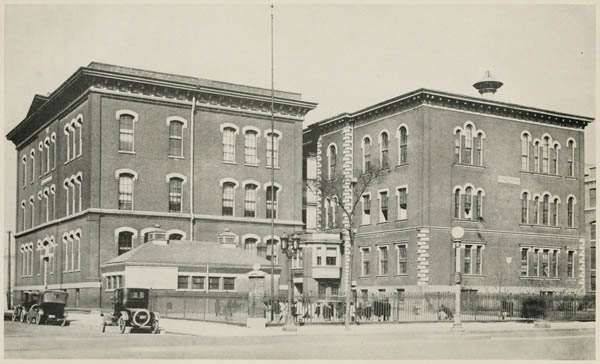
MOSELEY SCHOOL Located at Twenty-fourth Street and Wabash Avenue, 70 per cent Negro attendance.
It will be noted that only five of these schools, or 23 per cent, were built since 1900, and four of these five are in sections where the Negro population is less than 25 per cent. The ten schools serving the largest percentage of Negroes were built, one in 1856, one in 1867, seven between 1880 and 1889, and one between 1890 and 1899. Of the 235 white schools 133, or 56 per cent, were built after 1899.
TABLE XI
Physical Equipment of Twenty-two Schools Attended Largely by Negroes
School Date of Erection Location of Assembly Hall Separate Gymnasium Bathroom Lunchroom
Colman 1887 None None Yes Yes
Copernicus 1907 First floor Yes None None
Doolittle 1885 Third floor Combined None None
Douglas 1889 Third floor Combined None None
Drake 1900 None None None None
Emerson 1884 None None None None
Farren 1898 Third floor Combined Yes Yes
Felsenthal 1901 Third floor Combined None None
Forrestville 1896 First floor Yes None None
Fuller 1890 None None None None
Haven 1885 Fourth floor Combined Yes None
Hayes 1867 Fourth floor Combined Yes Yes
Keith 1883 None None Yes Yes
McCosh 1895 None None None None
Mann 1890 Third floor Combined None None
Moseley 1856 None None Yes None
Oakland 1903 First floor Combined None None
Raymond 1886 Third floor Combined Yes None
Sherwood 1892 Third floor Combined None None
Tennyson 1895 First floor Combined None None
Webster 1883 None None None None
Willard 1915 Basement Yes None None
Assembly halls and gymnasiums were totally lacking in seven of the twenty-two schools, and in the remaining fifteen the assembly hall was on the third or fourth floor, where, according to the district superintendent, it cannot have maximum use for community purposes. A really useful assembly hall, he stated, should be on the ground floor, opening directly on the school yard, and capable of being shut off entirely from the rest of the building so that it could be lighted and heated separately for evening gatherings. Only three of these fifteen schools had separate gymnasiums. In the others the gymnasium was combined with the assembly hall. There was little in the way of apparatus; what there was consisted mainly of hand apparatus, including clubs, dumbbells and basket-balls, that could be used in the assembly hall or the corridors. The district superintendent emphasized the need for gymnasiums in Negro residential areas because the children were weak physically and needed special exercises.
Playground space for schools attended largely by Negroes compares favorably with that for schools attended largely by whites, though Douglas School (92 per cent Negro), with 1,513 pupils, has only one playground 96×125 feet. Most schools have two playgrounds, one for boys and one for girls. The only other school having such limited play space as Douglas is a foreign school, Von Humboldt, where there are 2,500 pupils and the playground is 50×100 feet. Like Douglas, this is a double school with inadequate space for the children inside the school and outside. Sometimes there is a public playground near by which relieves the congestion on the school playground except in the case of Keith School (90 per cent Negro), the principal of which emphasized the need for a playground near her school.
In a group of twenty-four schools, six of which are attended mainly by Negroes, six mainly by white Americans, and twelve mainly by children of immigrants, it was found that there was no unusual crowding of classrooms in those attended mainly by Negroes except in the case of Douglas School. Conditions were practically the same in the three groups of schools.
Indications of overcrowding are the average number of seats in a classroom, the average number of pupils per teacher, and the double-school or shift system. There is little variation among the three groups of schools in the number of seats in the classroom and the number of pupils to each teacher, except that the school having the largest number of pupils to each teacher (57) is Colman, 92 per cent Negro. Although there are no double schools in the group attended mainly by white Americans, one of the six schools attended mainly by Negroes and five of the schools attended mainly by children of immigrants are double schools. Under this system, which is a makeshift in a neighborhood where another school is needed to take care of the children, the children go to school in two shifts, one shift an hour later than the other, and leave correspondingly later in the afternoon. Under this arrangement more children are at the school during the major part of the day than can be seated in the classroom and the full school curriculum can be carried on only under pressure, as one group of children must always be hurried on before the next group appears.
II. SCHOOL CONTACT PROBLEMS
Information as to problems of contact in the schools was gathered from conferences to which the principals of high and elementary schools were invited, and by personal visits to the schools. Thirteen elementary schools were visited, seven of which had an enrolment of less than 50 per cent Negro, and six of which had an enrolment of more than 50 per cent Negro. The schools with the smaller percentage were: Drake (30),[37] Felsenthal (20), Forrestville (38), Haven (20), Oakland (26), Webster (30), and Kenwood (a very small number of Negroes). The schools having a majority Negro were Colman (92), Doolittle (85), Douglas (93), Farren (92), Keith (90), and Moseley (70).
The high schools visited were Englewood, Hyde Park, and Wendell Phillips. In Englewood and Hyde Park the percentage of Negroes was very small, while in Wendell Phillips the Negro children were about 56 per cent of the enrolment.
The opinions of principals and teachers about Negro children are a cross-section of public opinion on the race question with all its contradictions and irritations. It must therefore be borne in mind in reading this section on school contacts that whether Negro children are reported good or bad, bright or dull, quarrelsome or amiable, whether antagonism and voluntary grouping or their lack are reported, there is an inevitable tendency for the teacher to see the facts in the light of any prejudice or general views she may have on race relations.
It was thought, for example, that for the purposes of this discussion the schools could be put in two general groups: those with less than 50 per cent Negroes and those with more than 50 per cent Negroes. But it was immediately apparent that no generalizations could be made on the basis of the percentage of Negro children in the schools, because sometimes two principals of schools having the same proportion of Negro pupils reported widely different experience with reference to friction; and in some cases principals of schools with a small percentage of Negroes reported friction, while other principals of schools with a larger percentage reported harmonious relations. The most important factor determining the attitude of the teachers in a school was invariably the attitude of the principal. Though there were many cases where individual teachers held views entirely different from those of the principal, yet the attitude of the principal was usually reflected in the expressed opinion of the teachers and in the atmosphere of the school.
But there is no explanation for total disagreement between two teachers in the same school as to whether or not there is race friction in the school except difference in points of view on the race problem. This factor is to be taken into consideration in weighing the testimony of teachers regarding school contacts of the races.
The attitude of some of the principals and teachers was revealed in their fear that their schools, with 20 per cent or 30 per cent Negro children, would be regarded as largely Negro schools. The principal of a school with 30 per cent Negro children considered it an insult to be asked to have his school take part in a song festival with schools largely attended by Negroes. A teacher in a school 26 per cent Negro was much incensed because the Board of Education had sent Negroes to the school to talk to the children on cleaning up the neighborhood. She said that the white children did not seem to mind and listened interestedly; it was the teachers who considered it an outrage that Negroes should come to "tell a community seven-eighths white to clean up."
Since the elementary schools and high schools present rather different problems, due to the greater number of social activities in the latter, it was decided to consider the two groups separately.
1. ELEMENTARY SCHOOLS
The contacts in the elementary schools fall naturally under three heads: classroom contacts, building and playground contacts, and social contacts.
Classroom contacts.—There was much less variety of opinion in regard to classroom contacts than the other two. Most teachers agreed that there was little friction so far as school work was concerned, even when it meant sitting next to one another or in the same seats. Most kindergarten teachers found the most natural relationship existing between the young Negro and white children. "Neither colored nor whites have any feeling in our kindergarten," said one principal in a school 30 per cent Negro (Webster); "they don't understand the difference between colored and white children." In visiting one school the investigator noticed that the white children who objected to holding hands with the Negro children in the kindergarten and first and second grades were the better-dressed children who undoubtedly reflected the economic class and race consciousness of their parents. The Armour Mission near the school had excluded Negroes from its kindergarten, thereby fostering this spirit among the whites. A teacher in Doolittle (85 per cent) told of a little white girl in another school who cried because she was afraid the color from the Negro children's hands would rub off on hers; in her present school she has known no such instances in the kindergarten. This conduct is paralleled in instances in which Negro children who have never had any contact with white children in the South are afraid of them when they first come North.
Most of the teachers in the higher grades reported that there were no signs of race prejudice in the room. A teacher at Oakland (26 per cent) said that white girls sometimes asked to be moved to another seat when near a very dirty Negro child, but that this often happened when the dirty child was white. This teacher said it was the white mothers from the South, not the children, who wanted their children to be kept away from the Negroes. "The white children don't seem to mind the colored," she said. "I have had three or four mothers come in and ask that their children be kept away from the colored, but they were women from the South and felt race prejudice strongly. But they are the only ones who have complained."
A teacher in a school 90 per cent Negro said that when doubling up in the seats was necessary whites and Negroes frequently chose each other. A teacher at Moseley (70 per cent), when the investigator was present, called upon a white girl to act as hostess to a Negro girl who had just come from the South, and the request was met with pride and pleasure by the white girl. On the same occasion a white boy was asked to help a Negro boy with his arithmetic, and the two doubled up and worked together quite naturally.
"Race makes no difference," declared the principal of a school 92 per cent Negro (Colman). "The other day I had them all digging in the garden, and when they were all ready to go in I kept out one colored boy to help me plant seeds. We could use another boy, so I told Henry to choose anyone out of two rooms and he returned with an Italian. The color makes no difference."
A few instances of jealousy are cited. In one of them resentment ran high because when a loving cup was presented in McKinley (70 per cent) for the best composition, it was awarded by a neutral outside jury to a white girl. The principal of this 70 per cent Negro school, in addition to finding the Negro children jealous, considered their parents insolent and resentful. On the investigator's first visit she said that military discipline was the only kind for children, and that absolute segregation was necessary. At the next interview she said she preferred her school to any other; that there was never any disciplinary difficulty, and that white children who had moved from the district were paying car fare to finish their course at her school.
Discipline.—There was considerable variety of opinion among the teachers as to whether Negro children presented any special problems of discipline. The principal of a school 20 per cent Negro (Felsenthal), for example, said that discipline was more difficult in this school than in the branch where 90 per cent were Negroes (Fuller). This principal is an advocate of separate schools. She was contradicted by a teacher in her school who said she had never used different discipline for the Negroes. In schools where the principals were sympathetic and the interracial spirit good the teachers reported that Negro children were much like other children and could be disciplined in the same way. One or two teachers reported that Negro children could not be scolded but must be "jollied along" and the work presented as play. This is interesting in view of the frequent complaint of the children from the South that the teachers in Chicago played with them all the time and did not teach them anything.
Attitude toward Negro teachers.—Few Negro teachers were found in the schools investigated.
At Doolittle (85 per cent) there were thirty-three teachers, of whom two were Negroes. There was also a Negro cadet. At Raymond (93 per cent) there were six Negro teachers and a Negro cadet in a staff of forty. At Keith (90 per cent) there were six Negro teachers in a staff of twelve. Two of these principals said that their Negro teachers compared favorably with their white teachers and that some of them were excellent. Asked whether there was much antagonism if a Negro teacher was assigned where all the children were white, the principal of a 93 per cent school (Raymond) said there had been one or two such cases. "They are most successful in the foreign districts on the West Side. The European people do not seem to resent the presence of a colored teacher."
Another principal said that this was especially true where the foreign element was Jewish. A Negro teacher in a West Side school, largely Italian, is considered one of the ablest teachers in the school and proved herself highly competent during the war, when she assisted with the work of the draft board in the district.
One or two principals said that they would not have Negro teachers in their schools because the white teachers "could not be intimate with colored teachers," or because Negro teachers were "cocky," or because "the Defender preaches propaganda for colored teachers to seek positions in white schools." Sometimes an effort was made to explain the principal's objection to Negro teachers by saying that Negro children had no respect for Negro teachers. One principal whose white teachers were rather below the accepted standard said that the one colored teacher who had been there was obliged to leave because of the children's protest against her. A Negro teacher in a 20 per cent school (Haven) was valued highly by the principal, who advised with her as to what measures could be taken to prevent the appearance of race feeling. This teacher formerly taught in a school where there were no Negro children and had experienced no difficulty in either type of school. "The children just seem to forget I am colored," she said.
In Farren School (92 per cent) a teacher of a special room for children recently arrived from the South expressed the belief that these children "have a distinct and decided fear of the white teacher and it's up to the teacher to change this fear into respect." They were very timid at first, she said, due to the new environment and the contact with so many more people, especially white. This timidity lasted for about a year and then these children became more like Chicago children.
Building and playground contacts.—At six out of the thirteen elementary schools some friction about the buildings and on the playgrounds was reported, and none at the other seven schools. On further analysis it appeared that the friction reported was general at only two of the six schools. At the other four the instances cited seemed either to involve a few troublesome individuals or to be quarrels among Negro children rather than between Negroes and whites. The two schools reporting general antagonism between Negro and white children had about 30 per cent Negro children. The principals of these schools said that the white children were dominated by the Negroes and did not dare stand up for their rights. The testimony of the principal of one of these schools showed a disposition to regard many acts as characteristically racial. For example, she needed no further evidence that a Negro boy had cut up a white boy's cap than the fact that it was cut with a safety-razor blade. Although both white and Negro boys commonly carry safety-razor blades to sharpen their pencils, she thought of razors only in connection with Negroes. She also believed that "Negro children of kindergarten age are unusually cruel," and that "Negroes need a curriculum especially adapted to their emotional natures." Again she said that a Negro boy who asked to be put back from the third to the first grade, because the third-grade work was too hard for him, was typical of Negro children, who "shut down on their intellectual processes when they are about twelve or fourteen years of age." In view of the numbers of Negro children in the higher grades who are advancing normally, this is obviously an unwarranted generalization.
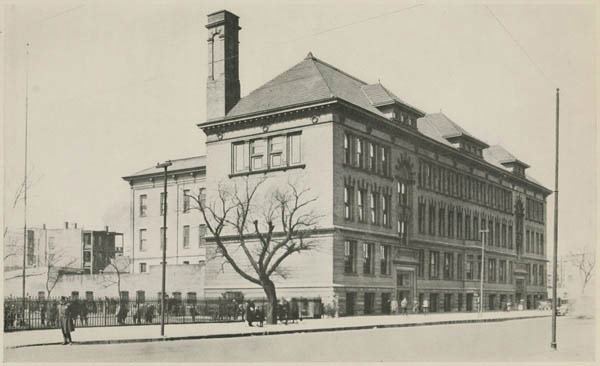
FARREN SCHOOL Located at Forty-eighth Street and Wabash Avenue, 92 per cent Negro attendance.
There were some signs of friction at a school 20 per cent Negro (Haven) when a school largely Italian was combined with it, but the situation was handled tactfully by the principal and there had been no trouble. At a school 85 per cent Negro (Doolittle), where the white element was Jewish, all the teachers reported that there was no antagonism between the races.
Voluntary grouping.—The only school where the investigator noticed Negro and white children playing in separate groups was Webster (30 per cent), whose principal reported antagonism between Negroes and whites. At the other schools natural mingling was reported by some teachers or observed by the investigator. At a school 26 per cent Negro (Oakland) three teachers said that Negro and white children did not mingle on the playgrounds, while another teacher said they all played together regardless of color. The principal and twelve teachers at a school 85 per cent Negro (Doolittle) agreed, with the exception of one teacher who was a southerner, that there was never anything but the most natural mingling in the classrooms, about the building and on the playground. At a school 30 per cent Negro (Drake), the principal of which stated that the relations between the races were not harmonious, the investigator observed a free and natural grouping of Negroes and whites of all ages on the playground. The principal explained that this was "a forced rather than a natural grouping because of lack of apparatus for all." The white children at a school 20 per cent Negro (Haven) were Italians, Jews, and Greeks, and all the races played so naturally together that passersby frequently stopped to watch them.
Social contacts.—There are few social organizations and gatherings in the elementary schools. The principal of a school 93 per cent Negro (Raymond) said that there were clubs through all the grammar grades and that the friendliness between the two races was marked, but added:
We have not more than fifty or sixty white children in this particular building. One white child was elected vice-president, the first white child elected in eight years. It shows the friendly relationship when a white child could be elected to office with a large preponderance of colored children. A Jewish boy was elected to a smaller office of clerk. The white children are not foreign. In their meetings the question of color never arises at all.
In a few instances principals had found that graduation presented some difficulties, as white mothers would appear at the school a few days before and request that their children do not march with Negro children. "About the only time I see a white mother is near graduation," said the principal of a school 38 per cent Negro (Forrestville). "They always say they wouldn't care for themselves, but a friend might see and they would feel ashamed." "White children prefer not to march with colored at graduation," said a teacher at Oakland School (26 per cent), "and mothers sometimes come to ask that it be so arranged that their girls can march with white girls. They usually say that for themselves they don't mind, but friends might see and wonder why that should be."
A number of the schools have orchestras or occasional musical programs. The investigator heard one orchestra of eleven pieces in Doolittle School (85 per cent), which played remarkably well. All but one of the children were Negroes. A teacher in Webster School (30 per cent), where there was reported to be constant friction between Negro and white children, gave an incident of a Negro boy in the school playing the violin with a white accompanist and being enthusiastically applauded by the children.
The principal of a 92 per cent Negro school (Colman) reported an unpleasant experience when pupils from her school were invited to take part in a musical program at a West Side Park.
A group of sixty went with two white teachers in charge. On the way over a group of foreign women called out insulting remarks to the teachers, but no one paid any attention. After the program the group started marching out of the park and were met at the gate with a shower of stones. The teacher told the children to run for their lives, and they all had to scatter and hide in the bushes in the park or run toward home if they could. A rough set of boys had got together and were waiting for those children, stones all ready to throw. Since that time we have never accepted an invitation to sing outside our own neighborhood. Invitations have come from time to time, but the children all come with excuses. All of them, children and parents throughout the neighborhood, are afraid but you can't get anyone to come out and say it.
Attitude of parents.—Principals and teachers were questioned about their relations with the parents of both Negro and white children—whether they received co-operation from the parents in matters of discipline; what was the attitude of the parents toward Negro teachers; and whether many requests were received from Negro or white parents for transfers to schools where there were fewer Negroes.
In general it may be said that the principals who found Negro parents unco-operative, unambitious, and antagonistic were those who believed in separate schools, found Negro children difficult to discipline, and would have no Negro teachers in their schools. Such principals declared that Negro parents were "10 to 1 in the complaints brought into the office,"[38] and that "they fuss over everything and tell their children not to take anything from a white child." They also cited cases of insolence and threats which appeared to be exceptional rather than typical.
Some teachers said the reason they did not receive any co-operation from Negro mothers was because a large proportion of them were working. Tardiness and absence were due mainly to this cause, according to one principal, though a teacher of a room for retarded children in another school said there was little tardiness and practically no absence in her group. This teacher expressed the conviction, as did many others, that Negro parents were appreciative of school advantages and eager to have their children learn. Principals who came in contact with both Negro and foreign parents found the Negro parents much more interested and ambitious than the foreigners. Even the principal of a school 30 per cent Negro (Webster), who was somewhat prejudiced in her attitude toward Negroes in the school, said she had more Negro than white boys able to go to work whose parents wished them to remain in school.
Negro teachers were apparently acceptable to Negro parents, only one of the principals or teachers interviewed reporting objections by Negro parents. One teacher in a school 30 per cent Negro (Webster) said that Negro parents had their children transferred there from schools with more Negroes, so that they would have white teachers. The district superintendent said he had had some difficulty in placing Negro teachers in Negro schools, which he attributed to the fact that Negro parents felt that Negro teachers had not had the same opportunity for thorough training as white teachers. Some Negro parents, however, had indicated that their attitude was not due to belief that Negro teachers were inadequately trained, but to fear that too general placing of Negro teachers over Negro pupils was a step toward segregation.
The principal of a school 90 per cent Negro (Keith) thought Negro mothers preferred Negro teachers because several had said to her that the "colored teachers understand our children better."
The district superintendent in the area including most of the schools largely attended by Negroes said that few requests for transfers were made during the year, but he believed more were made at the request of Negro than of white parents. A number of these Negro children transferred not to go to a school largely white but to a school 70 per cent Negro, because they said they were afraid to go to the school in their own district which was across Wentworth Avenue. The race feeling between certain groups in this district was very intense, according to the superintendent. It was especially violent between the Negro children and the Italians and between the Jews and the Bohemians. The principal of a school 93 per cent Negro (Raymond) also testified to the spirit of antagonism along Wentworth Avenue:
Wentworth Avenue is the gang line. They seem to feel that trespass on either side of that line is ground for trouble. While they will admit colored members to the school without any trouble for manual training, they have to be escorted over the line, because of trouble, not from members of the school, but groups of boys outside the school. To illustrate: We took a kindergarten group over to the park. One little six-year-old girl was struck in the face by a man. The condition is a tradition. There does not seem to be any malice in it. "He is from the east side," or "Hit him, he is from the West Side," are remarks frequently heard.
Transfers from schools with a predominant Negro membership were reported by one or two principals and teachers in schools with a Negro minority, who said that the Negro mothers objected to having their children in schools "where there are so many common niggers." One of the principals said she had many requests from Negro mothers for transfers from the branch of the school with 90 per cent Negroes to the main school with 20 per cent. The Commission did not find in its inquiry among Negro mothers that such an objection was prevalent, but that most of the transfers requested were due to the reputation of the school for being overcrowded, poorly taught, and generally run down.
2. HIGH SCHOOLS
Classroom and building contacts.—In the high schools the ordinary contacts in classes and about the building become subordinate to the more difficult problems created by the increased number of social activities—athletics, gymnasium exhibitions, clubs, and parties.
The dean of Englewood High School, which has only about 6 per cent Negro children, said that the white and Negro children mingled freely with no sign of trouble or prejudice but thought that if more Negro children came to the school the spirit would change. A teacher in this same school who had formerly been at Wendell Phillips, where the majority are Negro, said that a spirit of friendliness had grown up there between the two races, and race distinction had disappeared.
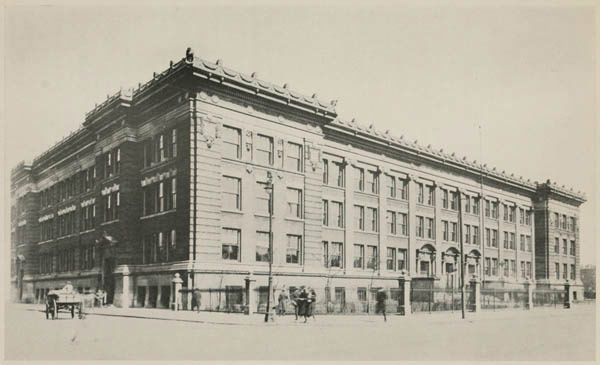
WENDELL PHILLIPS HIGH SCHOOL Located at Thirty-ninth Street and Prairie Avenue, 52 per cent Negro attendance.
There was only one Negro teacher in the high schools of Chicago at the time of this investigation, the teacher of manual training at Wendell Phillips. He is a graduate of the University of Illinois and had substituted around Chicago for several years. Although they spoke very highly of him, none of the principals of three high schools with small Negro percentages and in which there were vacancies could use him. The principal of Wendell Phillips, with a large proportion of Negroes, told, however, of a different experience when this teacher was at that school. "In answer to complaints by pupils I told them that this man was a graduate of the University of Illinois, a high-school graduate in the city, and a cultured man. 'Go in there and forget the color, and see if you can get the subject matter.' In the majority of cases it worked."
Racial friction about the buildings and grounds was not reported by any of the high-school principals. "I have not known of a fight between a colored and a white boy in fifteen years," said the principal of Hyde Park.
Two principals said that the Negro children voluntarily grouped themselves at noon, either eating at tables by themselves in the lunchroom or bringing their own lunches and eating in the back part of the assembly hall. The gymnasium instructor at Wendell Phillips said that she had no difficulty in her work if she let the children arrange themselves. The gymnasium instructor at a school with a small proportion of Negroes said that the white girls had objected to going into the swimming-pool with Negro girls, but that she had gone in with the Negro girls, which had helped to remove the prejudice.
Athletic teams.—In the field of athletics there seems to be no feeling between the white and Negro members of a school team, but the Negro members are sometimes roughly handled when the team plays other schools. "The basketball team is half and half," said the principal of Wendell Phillips. He reported some friction in previous years but said that "this year it is not shown at all." "They played a strenuous game with Englewood last week. A colored boy was roughly treated by the other team. Our white boys were ready to fight the whole Englewood team."
The principal of Hyde Park High School also said that there was no feeling in his school against Negro members of athletic teams, and that he did not know of a single instance in which a Negro boy was kept off an athletic team if he was the best for the place.
Two Seniors in a high school mainly white (Tilden) thus described the way they handled the Negro members of a visiting basket-ball team:
On the way over here fellows on the outside bawled them out, but our fellows sure got them on the way home. There were three black fellows on the team and those three got just about laid out. Our team wouldn't play them, so there was a great old row. Then, when they went home some of our boys were waiting for them to come out of the building to give them a chase. The coons were afraid to come out, so policemen had to be called to take them to the car line. The white fellows weren't hurt any, but the coons got some bricks.
Transfers between high schools.—Requests for transfers from Wendell Phillips to Englewood and Hyde Park schools had been made by both white and Negro children, according to the principals of the latter schools. The permits of the Negro children had frequently been revoked after they had been admitted to classes, and the children returned to Wendell Phillips. A teacher at Wendell Phillips pointed out the injustice of transferring a child in the middle of a term. After a child has been admitted to classes he should be permitted to remain through the semester, she believed, for otherwise a full term's work was lost because the courses in the schools were different. "All this transferring is nonsense, anyway," she said. "Children should be made to go to school in the district where they live and that would end the trouble."
This teacher told of an incident at Tilden School when a group of Negro boys registered for entrance:
About sixty colored boys entered Tilden High School either for the regular high-school course or prevocational work and were thrown out by the Tilden boys. They made it so hot for the colored boys that the sixty had to withdraw. Some came back here; others dropped out of school entirely. It's pretty bad when one set of boys can put out another set and nothing is done to punish one and call back the other group.
Two boys at Tilden who took part in this affair gave this version of the incident:
About thirty colored boys registered at Tilden last fall, but we cleaned up on them the first couple of days and they never showed up again. We didn't give them any peace in the locker room, basement, at noon hours, or between classes—told them to keep out of our way or we'd see they got out. The fellows who were in school before we didn't tackle—they know where they belong. There's one colored fellow in our class everybody likes. He's a smart nice fellow to talk to, and he doesn't stick around when you don't want him. He didn't say anything when we made the new coons step around, but I guess he didn't like it very well.
It was this same group of boys who objected to playing a visiting basketball team with three Negroes on it and "just about laid them out."
Social activities in high schools.—In high schools, with their older pupils, there is an increased race consciousness, and in the purely social activities such as clubs and dances, which are part of high-school life, there is none of the general mingling often found in semi-social activities such as singing and literary societies. Although Negro pupils do not share in the purely social activities, they do not organize such activities among themselves.
"The colored never come to social affairs," said the dean of one school. "They are so much in the minority here that they leave all organizations to the whites." The principal of this school told of having seen two colored girls at a class party who danced together for a while and left. "It is the only time I've seen the two races at the same social gathering."
The dean of Englewood said: "We have colored children in singing clubs, in the orchestra, in literary societies, in class organizations, and on athletic teams. Always when there is a class party there will be five or six colored children. They will always dance together, but they are present and welcomed by the white. Between dances it is not uncommon to see white and colored talking."
An incident showing lack of feeling against individuals of special achievement was given by the principal of this last school:
Several years ago we organized a voluntary orchestra which met after school. The director accepted all applications, among them a number of colored boys. The white boys balked; it should be white membership or they would leave. As it was near the end of the year the orchestra was dissolved. The next year I suggested to the teacher that he fill the orchestra places by a general tryout, so understood, but really with the policy of excluding the colored. This was done and a white orchestra organized. Shortly, the father of H. F., a colored boy who had been excluded, protested in my office, saying that his boy had been excluded because of race prejudice and that he was going to carry his protest to the Board of Education, for he knew his boy played better than any boy in school. I admitted that it was a choice in the school of white orchestra or no orchestra, but that if his boy was the fine musician he said he was I would gladly see what could be done. Soon after that H. appeared on a school program and played with remarkable skill and technique. He was applauded enthusiastically and recalled three times. Straightway the orchestra members asked him to play with them. He became unusually popular throughout the school. His standing was the highest and he was awarded a scholarship of $100 allowed by the Board of Education for the best student. He was also chosen to represent the school on the Northwestern University scholarship, and in his Freshman year he won another scholarship for the next year. The death of his parents made it necessary for him to leave college to support his brothers and sisters. At this time he was stricken with infantile paralysis. The interest on Liberty bonds taken out by the high school is paid in to H., and when the colored people gave a benefit for him the pupils sold 500 tickets. He is improving and teaching violin to thirty pupils at present. His sister is in the school now on a scholarship and is doing remarkably well also.
At Wendell Phillips the situation was quite different, for there were no school or class social affairs which were general. There were invitational affairs to which the Negroes were not invited. All the clubs in the school were white, Negroes being excluded. The principal said he would not insist on mixed clubs until he saw the parents of the children mixing socially. The glee club was an especially difficult problem because of its semi-public as well as social character. The Negro children maintained that a glee club composed entirely of whites was not representative of a school in which the majority were Negroes. The Negroes had not responded to the suggestion of the principal that they form a glee club of their own, and as the white children would not be in a glee club with Negro children, there was constant friction over this club.
Other principals expressed the conviction that the racial problem of school social affairs could not be solved until the prejudice and antagonism of adults had disappeared. One principal said he had had to call off an arrangement for a class affair because the hotel would not accommodate the Negroes. Another principal thought that the schools would not wait to follow the lead of the parents in forgetting the race prejudice but would themselves be the greatest factor in destroying it.
Relations with parents.—In most cases the high schools were receiving splendid support from Negro parents in matters of discipline. "I have never had a case where the parent did not back up the teacher in the treatment given to a colored child," said one principal, speaking of cases where children had got into difficulty when they complained that the teacher had "picked on them" because they were Negroes. The parents always made the child withdraw the statement and admit that the trouble was not due to color at all.
3. TECHNICAL HIGH SCHOOLS
Reports were received from three technical high schools, Lane, Tilden, and Lucy H. Flower. Lane and Tilden had few Negro students, while in Lucy H. Flower the Negroes were about 20 per cent. The principals of Lane and Tilden said they were not conscious of any racial difference in their pupils, that no special methods of instruction were necessary for the Negro children, that there were no quarrels with a racial background in the schools, and no voluntary or compulsory groupings of white and Negro. The principal of Lucy H. Flower found racial differences between the Negroes and whites which she believed created special problems of education and discipline. The children got along together very well in school, and whatever quarrels there were, the principal thought were due to personal dislikes rather than to race prejudice. The colored girls grouped themselves voluntarily at noon and at dismissal time, and the white girls did the same.
III. RETARDATION
1. RETARDATION IN ELEMENTARY SCHOOLS
With the assistance of the Board of Education a selection was made of three groups of schools to be studied for comparative retardation. The group comprised six schools having the largest percentage of Negro children, six attended mainly by whites in neighborhoods where the family income might be comparable, and twelve attended mainly by children of immigrants. Table XII gives the number and percentage of accelerated, normal, and retarded children for each school, for each group, and for the whole group of twenty-four schools.
This table shows the much greater amount of retardation among schools attended by Negroes than in schools attended by white Americans or by children of immigrants. The percentage for the group attended by Negroes is 74, while for the different schools in the group it varies from 67 to 81. For the two groups of schools attended by white Americans the percentage of retardation is the same, 49, though there is greater variation among these schools than among the schools attended by Negroes. In the group attended by children of immigrants, for instance, only 32 per cent are retarded in the Jungman (Bohemian) School, while 71 per cent are retarded in the Holden (Polish) School. A similar discrepancy appears in the group attended by white Americans, where the figure is 40 per cent for the Armstrong School and 62 per cent for the Byford School.
TABLE XII
Number and Percentage of Children in Accelerated, Normal, and Retarded Groups in Schools Attended Mainly by White Americans, by Negroes, and by Children of Immigrants
School Accel. Percentage Normal Percentage Retarded Retarded Ungrad.[39] Percentage Total
Attended mainly by white Americans:
Armstrong 202 21 365 39 355 19 40 941
Byford 118 9 361 29 783 — 62 1,262
Harper 291 17 609 35 829 — 48 1,729
Howe 220 17 421 35 577 — 48 1,218
Key 173 25 205 29 314 — 46 692
Morse 169 14 450 37 581 — 49 1,200
Total 1,173 17 2,411 34 3,439 19 49 7,042
Attended mainly by Negroes:
Coleman 54 8 124 17 561 2 75 743
Doolittle 267 16 261 16 1,099 24 68 1,651
Douglas 136 9.3 197 13.7 1,126 — 77 1,463
Keith 77 11 93 14 497 — 75 667
Moseley 62 7.5 95 11.5 551 122 81 830
Raymond 112 13 179 20 578 — 67 869
Total 708 11 949 15 4,412 148 74 6,217
Attended mainly by children of immigrants:
Bohemian
Bryant 385 21 735 37 809 15 42 1,944
Hammond 161 12 503 34 795 — 54 1,459
Jungman 375 35 350 33 357 — 32 1,082
Polish
Chopin 298 17 631 36 818 1 47 1,748
Hibbard 392 29 445 32 535 — 39 1,372
Holden 122 11 208 18 759 — 71 1,089
Italian
Goodrich 157 14 240 22 693 — 64 1,090
Jackson 360 15 731 32 1,174 — 53 2,265
Jenner 176 11 524 33 875 — 56 1,575
Jewish
Herzel 609 25 731 30 1,085 — 45 2,425
Lawson 466 16 944 32 1,407 20 52 2,837
Von Humboldt 528 22 848 34 1,072 — 44 2,448
Totals 4,029 19 6,890 32 10,379 36 49 21,334
Totals for three groups 5,910 17 10,250 30 18,230 203 53 34,593
The retardation figures for the group of twenty-four schools studied are close to those for the city at large, 53 per cent retarded in the special group and 51 per cent for the city at large. In the accelerated group the percentage of accelerated Negro children, 11, is smaller than the percentage of accelerated white children, 17, or the percentage of accelerated foreign children, 19. This variation is not so striking as that in the normal group where only 15 per cent of the Negro children appear to make normal progress as compared with 34 per cent of the white children and 32 per cent of the foreign children. From this it would appear that there are factors in the lives of many Negro children which prevent them from making normal progress.
The degree of retardation, as shown in Table XIII is again quite different for the white and Negro groups.
The largest single groups of backward white American and foreign children are retarded less than one year (42 per cent of the white American and 39 per cent of the foreign group), and the numbers decrease rapidly as the degree of retardation increases. In the case of the Negroes 19 per cent are retarded less than one year. The decrease as the degree of retardation increases is slower than in the white groups, and many more children are retarded two, three, four, five years and more. In the white American group only one child out of 3,439 retarded children is retarded five and one-half to six years, while there are forty-one in the corresponding Negro group out of a total of 4,412. One white child is retarded six and one-half to seven years, while seventeen Negro children are retarded this amount; twelve foreign children out of 10,379 retarded children are retarded six to ten years, and thirty-seven Negro children are found in these groups.
Though the main reasons for the high degree of retardation among Negro children are set forth in the next section under "Causes of Retardation," a partial explanation is to be found in the fact that Negro parents are frequently more interested in keeping their over-age children in school than white parents, especially foreign parents, whose anxiety to have their children leave school as soon as they are old enough to get work-permits is well known.
Causes of retardation.—It is generally understood of course that comparisons of Negro with white children are hardly fair, since Negro children have not had the same opportunities as whites to make normal progress.
A study was made of the reasons why children were retarded in the groups of schools attended mainly by Negroes, by white Americans, and by children of immigrants. Records were obtained at the schools for 1,469 Negro children and 1,560 white children who were listed according to the Board of Education's classification for retarded children.
Table XIV shows clearly that the predominating cause of retardation among Negroes is late entrance, which, according to the board's classification, means that they did not enter school until more than six years of age. This is generally explained by the fact that the family came from the South, where there was no school near enough for the child to attend, or the school was overcrowded, or the family was uneducated and indifferent. In some cases the parents have come North, leaving the child with grandparents who made no effort to see that it went to school.
TABLE XIII
Number of Children in Table XII Who Are Retarded One-half to One Year, One Year to One and One-half Years, etc.
YEARS
SCHOOL ½ to 1 1 to 1½ 1½ to 2 2 to 2½ 2½ to 3 3 to 3½ 3½ to 4
Attended mainly by white Americans:
Armstrong 143 84 62 31 15 13 3
Byford 317 175 105 64 54 20 11
Harper 364 234 106 67 28 12 6
Howe 275 128 93 57 9 9 2
Key 141 106 33 19 20 2 2
Morse 229 160 81 56 27 14 8
Total 1,470 887 480 294 143 70 32
Attended mainly by Negroes:
Colman 109 114 109 66 50 46 27
Doolittle 229 175 146 152 117 86 69
Douglas 190 198 191 142 126 83 71
Keith 94 66 71 78 54 34 30
Moseley 95 104 96 54 59 31 34
Raymond 135 115 111 69 50 39 27
Total 852 772 724 561 456 319 258
Attended mainly by children of immigrants:
Bohemian:
Bryant 369 224 107 51 36 15 3
Hammond 306 225 114 69 47 13 10
Jungman 173 87 49 27 12 6 2
Polish:
Chopin 323 216 125 57 43 23 16
Hibbard 252 158 68 28 18 5 4
Holden 216 190 112 91 60 36 18
Italian:
Goodrich 236 185 104 68 42 28 10
Jackson 369 284 202 141 84 53 16
Jenner 281 253 135 86 42 32 20
Jewish:
Herzel 521 294 124 71 38 19 9
Lawson 574 370 233 109 65 24 19
Von Humboldt 498 145 145 76 37 17 6
Totals 4,118 2,710 1,518 874 524 271 133
Totals for three groups 6,440 2,249 2,722 1,729 1,123 660 423
TABLE XIII (continued)
Number of Children in Table XII Who Are Retarded One-half to One Year, One Year to One and One-half Years, etc.
YEARS
SCHOOL 4 to 4½ 4½ to 5 5 to 5½ 5½ to 6 6 to 6½ 6½ to 7
Attended mainly by white Americans:
Armstrong ... 4 ... ... ... ...
Byford 32 2 2 ... ... 1
Harper 4 3 1 ... 1 ...
Howe ... 4 ... ... ... ...
Key 1 ... ... ... ... ...
Morse 3 1 1 1 ... ...
Total 40 14 4 1 1 1
Attended mainly by Negroes:
Colman 18 7 8 4 2 ...
Doolittle 44 37 16 8 4 4
Douglas 45 26 21 14 10 7
Keith 32 17 8 6 4 3
Moseley 26 20 15 7 4 2
Raymond 12 10 6 2 ... 1
Total 177 117 74 41 24 17
Attended mainly by children of immigrants:
Bohemian:
Bryant 1 2 1 ... ... ...
Hammond 8 2 1 ... ... ...
Jungman 1 ... ... ... ... ...
Polish:
Chopin 9 2 1 2 ... ...
Hibbard ... 2 ... ... ... ...
Holden 13 9 8 4 2 ...
Italian:
Goodrich 9 2 3 4 2 ...
Jackson 13 4 4 2 ... 1
Jenner 10 3 4 4 2 2
Jewish:
Herzel 4 4 ... 1 ... ...
Lawson 7 4 2 ... ... ...
Von Humboldt 6 2 1 ... ... ...
Totals 81 36 25 17 6 3
Totals for three groups 298 167 103 59 31 21
TABLE XIII (continued)
Number of Children in Table XII Who Are Retarded One-half to One Year, One Year to One and One-half Years, etc.
YEARS
SCHOOL 7 to 7½ 7½ to 8 8 to 8½ 8½ to 9 9 to 9½ 9½ to 10 10 to 10½
Attended mainly by white Americans:
Armstrong ... ... ... ... ... ... ...
Byford ... ... ... ... ... ... ...
Harper 1 ... ... 1 ... ... ...
Howe ... ... ... ... ... ... ...
Key ... ... ... ... ... ... ...
Morse ... ... ... ... ... ... ...
Total 1 ... ... 1 ... ... ...
Attended mainly by Negroes:
Colman ... 1 ... ... ... ... ...
Doolittle ... 4 4 1 1 2 ...
Douglas ... ... ... ... ... ... 2
Keith ... ... ... ... ... ... ...
Moseley 3 ... 1 ... ... ... ...
Raymond ... 1 ... ... ... ... ...
Total 3 6 5 1 1 2 2
Attended mainly by children of immigrants:
Bohemian:
Bryant ... ... ... ... ... ... ...
Hammond ... ... ... ... ... ... ...
Jungman ... ... ... ... ... ... ...
Polish:
Chopin ... ... ... ... ... ... ...
Hibbard ... ... ... ... ... ... ...
Holden ... ... ... ... ... ... 1
Italian:
Goodrich ... ... ... ... ... ... ...
Jackson 1 ... ... ... ... ... ...
Jenner ... ... ... 1 ... ... ...
Jewish:
Herzel ... ... ... ... ... ... ...
Lawson ... ... ... ... ... ... ...
Von Humboldt ... ... ... ... ... ... ...
Totals 1 ... ... 1 ... ... 1
Totals for three groups 5 6 5 3 1 2 3
TABLE XIV
REASONS WHY 1,469 NEGRO CHILDREN AND 1,560 WHITE CHILDREN WERE RETARDED IN GROUP OF TWENTY-FOUR SCHOOLS
SCHOOLS TOTAL LATE ENTERING FOREIGN PHYSICAL DEFECT ILL HEALTH
N. W. N. W. N. W. N. W. N. W.
Attended mainly by Negroes:
Colman, 92 per cent Negro attendance 29 1 20 ... ... ... ... ... 1 ...
Doolittle, 85 per cent 603 6 190 ... ... 6 3 ... 68 ...
Drake, 24 per cent 72 58 41 11 ... 3 ... ... 4 15
Farren, 92 per cent 171 7 49 ... ... ... 1 1 34 1
Felsenthal, 20 per cent 173 69 58 13 3 2 ... ... 6 12
Forrestville, 38 per cent 93 5 34 2 ... ... 2 ... 4 ...
Haven, 20 per cent 71 59 56 9 ... 6 ... ... 2 9
McCosh, 15 per cent 18 31 7 4 ... 2 ... 1 5 8
Oakland, 26 per cent 50 44 18 6 ... ... 1 ... 4 5
Raymond, 93 per cent 133 6 64 2 ... 2 1 ... 7 1
Webster, 30 per cent 52 31 27 7 ... 1 1 ... 5 9
Attended mainly by White Americans:
Fiske 2 88 ... 3 ... 16 ... 2 ... 1
Rowland ... 101 ... 13 ... 7 ... 2 ... 17
Kenwood ... 25 ... 1 ... 5 ... ... ... 4
Attended mainly by children of immigrants:
Farragut ... 107 ... 12 ... 10 ... 2 ... 11
Goodrich ... 92 ... ... ... 28 ... 3 ... 8
Jackson ... 255 ... 32 ... 48 ... 12 ... 38
Jungman ... 21 ... 11 ... 2 ... ... ... ...
Kosciuszke ... 144 ... 23 ... 17 ... 4 ... 9
Lawson 1 155 ... 7 ... 15 ... 1 ... 19
McCormick ... 21 ... ... ... 2 ... 1 ... 7
Seward ... 131 ... 19 ... 29 ... 2 ... 14
Smyth ... 57 ... 3 ... 14 ... 1 ... 9
Swing ... 46 ... 9 ... 2 ... 1 ... 7
Totals by races 1,469 1,560 564 187 3 217 9 33 140 204
Totals of both races 3,029 751 220 42 344
TABLE XIV (continued)
REASONS WHY 1,469 NEGRO CHILDREN AND 1,560 WHITE CHILDREN WERE RETARDED IN GROUP OF TWENTY-FOUR SCHOOLS
SCHOOLS FAMILY DIFFICULTIES DEFECTIVE VISION DEFECTIVE HEARING VARIANT MENTALITY BACKWARD
N. W. N. W. N. W. N. W. N. W.
Attended mainly by Negroes:
Colman, 92 per cent Negro attendance ... ... ... ... ... ... ... ... 4 ...
Doolittle, 85 per cent 141 ... 7 ... ... ... 35 ... 73 ...
Drake, 24 per cent ... 3 ... 2 ... ... ... 7 7 12
Farren, 92 per cent 21 ... 3 ... 1 ... 12 2 18 ...
Felsenthal, 20 per cent 56 15 ... 2 1 ... 7 1 33 10
Forrestville, 38 per cent 10 ... 1 ... ... ... 4 ... 30 ...
Haven, 20 per cent ... ... ... 4 ... ... ... 3 7 19
McCosh, 15 per cent ... ... ... 1 ... ... ... ... 1 1
Oakland, 26 per cent ... 6 1 2 ... 2 3 6 3 5
Raymond, 93 per cent 18 ... ... ... ... ... 1 ... 11 ...
Webster, 30 per cent 6 2 ... ... ... ... ... 1 4 2
Attended mainly by White Americans:
Fiske ... 34 ... 1 ... ... ... ... 1 21
Rowland ... 3 ... 4 ... ... ... 9 ... 28
Kenwood ... 4 ... ... ... ... ... 2 ... 5
Attended mainly by children of immigrants:
Farragut ... 6 ... 3 ... ... ... 5 ... 23
Goodrich ... 7 ... 3 ... ... ... 2 ... 23
Jackson ... 38 ... 8 ... 1 ... 3 ... 45
Jungman ... 1 ... ... ... ... ... ... ... ...
Kosciuszke ... 18 ... 2 ... ... ... 12 ... 4
Lawson 1 20 ... 2 ... 1 ... 25 ... 39
McCormick ... ... ... ... ... ... ... ... ... 1
Seward ... 10 ... ... ... 1 ... 2 ... 13
Smyth ... 4 ... 2 ... ... ... ... ... 14
Swing ... 4 ... 2 ... ... ... 1 ... 6
Totals by races 253 175 12 38 2 5 62 81 192 271
Totals of both races 428 50 7 143 463
TABLE XIV (continued)
REASONS WHY 1,469 NEGRO CHILDREN AND 1,560 WHITE CHILDREN WERE RETARDED IN GROUP OF TWENTY-FOUR SCHOOLS
SCHOOLS LOW MENTALITY FEEBLE-MINDED IRREGULAR ATTENDANCE TEMP. IN GRADE DEMOTED FOR CONDUCT
N. W. N. W. N. W. N. W. N. W.
Attended mainly by Negroes:
Colman, 92 per cent Negro attendance ... ... 1 ... 1 1 ... ... 2 ...
Doolittle, 85 per cent 10 ... ... ... 68 ... 8 ... ... ...
Drake, 24 per cent ... 1 ... ... 19 5 ... ... ... ...
Farren, 92 per cent 11 2 ... ... 21 1 ... ... ... ...
Felsenthal, 20 per cent 3 4 ... ... 13 2 ... 1 ... ...
Forrestville, 38 per cent 1 ... 1 ... 6 3 ... ... ... ...
Haven, 20 per cent 2 4 ... ... 4 5 ... ... ... ...
McCosh, 15 per cent 1 6 ... ... 3 9 ... ... ... ...
Oakland, 26 per cent 4 3 1 ... 12 9 1 2 ... ...
Raymond, 93 per cent 6 ... 6 ... 19 1 ... ... ... ...
Webster, 30 per cent 9 6 ... ... 1 2 ... ... ... ...
Attended mainly by White Americans:
Fiske 1 2 ... 1 ... 6 ... 1 ... ...
Rowland ... 10 ... 1 ... 7 ... ... ... ...
Kenwood ... 1 ... ... ... 3 ... ... ... ...
Attended mainly by children of immigrants:
Farragut ... 32 ... ... ... 3 ... ... ... ...
Goodrich ... 10 ... ... ... 8 ... ... ... ...
Jackson ... 8 ... ... ... 19 ... 2 ... ...
Jungman ... ... ... ... ... 7 ... ... ... ...
Kosciuszke ... 8 ... 1 ... 39 ... 9 ... ...
Lawson ... 19 ... 2 ... 5 ... ... ... ...
McCormick ... 8 ... ... ... 1 ... ... 1 ...
Seward ... 11 ... 5 ... 20 ... 5 ... ...
Smyth 1 5 ... ... ... 5 ... ... ... ...
Swing ... 6 ... 1 ... 2 ... 4 ... ...
Totals by races 49 146 9 12 167 161 9 24 3 ...
Totals of both races 195 21 328 33 3
The next most important cause of retardation among the Negroes is family difficulties. The fathers are often kept away from home weeks at a time by their work. A large number of the mothers are working, and the parents' lack of education is frequently the cause of a home life that is below standard, physically and morally.
Among the whites, late entrance, inability to speak the language, ill health, backwardness, and low mentality are the main causes of retardation. While it is often maintained that the Negro is the mental inferior of the white, these figures do not bear out that contention. Also the retardation figures do not show the home life of the Negroes to be productive of as much ill health as is the case with the whites.