Chapter VI · RACIAL CONTACTS (continued 3)
Reading edition
The director of Fuller Park believed that the groups of hoodlums mainly responsible for keeping Negroes out of the parks were the athletic clubs "composed usually of a bunch of young sports that are not athletes at all." "These clubs, which have only about one athlete on the roster," he said, "are so situated that the Negroes have to pass them going to and from the park. Those are the boys, numerous in every park neighborhood, who are keeping the colored people out of the parks."
The director of Ogden Park took the part of a Negro boy set upon by a white gang during the 1919 riot and rescued by the police, though they did not keep the mob from killing the Negro. He advocated the formation of "square-deal" clubs to defend innocent people from hoodlums. "Members would be bound to fight for the square deal—whites against white hoodlums and blacks against black hoodlums," he said. "Until both races will act, the lawless elements will continue to cause trouble."
It is possible in some cases, such as those in which the "athletic clubs" are involved, to find out the identity of boys who molest Negroes, but, according to the testimony of several park directors, it is absolutely impossible to control these boys because the courts will not convict them. The director of Armour Square stated:
I have had boys taken down to the courts time after time, and now my policeman refuses to take them down to the court any more, because he is reprimanded when he brings them in.... One of our attendants was shot through the lung and is now absolutely incapacitated for work, and the policeman was reprimanded because he had kept the boy in jail two nights. When it came to trial, they had already seen somebody and the policeman got the reprimand.
There was a general feeling among park representatives that the presence of a director with a proper attitude toward the problem was the greatest factor in bringing about amicable relations within the park, but there was considerable difference of opinion as to whether the park management could or should attempt to influence the surrounding neighborhood. The West Chicago Commission representative said that there was no instructor at Union Park the first year it was open, and that considerable segregation and undesirable conduct on the part of both whites and Negroes resulted. Since then, there had always been a director in charge, and a very harmonious mingling of the two races had been brought about on the playground. He believed that a similar relationship could be brought about within the recreation building by a director with the right personality, if adequate facilities were provided.
The Seward Park director did not consider it a proper function of a recreation center to try to direct the community life outside it.
The director of Armour Square felt that she could do nothing to promote Negro activities there. She did not approve of the suggestion of turning over Armour Square to the Negroes as the best way of solving the problem. She thought this would result in ill feeling and trouble, since there was a well-established tradition that the whites should use Armour Square to the fullest extent. But since the Negroes had no such recreation center as Armour Square available to them, she believed that a new center with full equipment should be started in a neighborhood part white and part Negro with the understanding that it should be a Negro recreation center where the whites were welcome if they wished to come. She thought that white people would patronize such a recreation center and, with careful leadership, would mingle with the Negroes on friendly and peaceable terms.
Two recreation-center directors favored entirely separate recreational facilities for Negroes with whites excluded. One of these was the director of Fuller Park, who told the Commission that he had made every effort to get Negroes to come to the park, and that he considered it part of his duty to go out into the neighborhood and try to get Negroes to use the park. "Separate parks and playgrounds for colored people are advisable," he said, "not because one group is any better than the other, but because they are different. Human nature will have to be remodeled before racial antipathy is overcome."
The director of Hardin Square, another recreation center little used by Negroes, though it is near the main Negro area, believed that separate facilities for each race would be the best solution of the problem. He did not encourage Negroes to come to Hardin Square. The policeman at the park also believed that "you can't make the two colors mix." This policeman said he knows a group of young men in the district, mostly ex-service men, who would "procure arms and fight shoulder to shoulder with me if a Negro should say one word back to me or should say a word to a white woman." He thought it would not take much to start another riot, and that the white people of the district would resolve to make a "complete clean-up this time." This policeman is the one whose failure to arrest a white man accused of stoning the Negro boy, Williams, at the Twenty-sixth Street Beach was an important factor in precipitating the riot in 1919.
The director of Moseley Playground, who was born and raised in that vicinity, said there had been antagonism between the two races in that neighborhood for thirty years. He believed that separate recreation facilities would be impracticable because the taxpayers could not be divided in such a way that they would not be paying for fields their children could not use.
The director of Seward Park thought that it might be arranged in the small parks to give special hours to Negro groups. This would meet what he believed to be the desire of the Negroes to be by themselves and also the objection of the white girls who had protested against having Negro girls in the same gymnasium classes with them.
V. TRAINING FOR RECREATION DIRECTORS
The importance of the personality of the park director in determining the conditions in the park, which was often emphasized, led to a consideration of the training for the work—whether training was required that would develop the understanding and vision necessary to handle the problems involved in racial contacts. The representative of the Municipal Bureau said that every effort had been made to get trained men, but that there was no school or curriculum of training that determined the efficiency of a person in charge. Some of his best directors had had no specific training, while some of the poorest came from the best recreational training schools.
Few Negro instructors were found at the places of recreation and these were employed by the Municipal Bureau. The representative of the West Side Commission said that he had been trying for a long time without success to get a Negro to take the civil-service examination for playground instructors, as he was anxious to get a Negro for Union Park. The representatives of the Lincoln and South Park commissions said that they used Negroes only as life guards, attendants, janitors, etc. The South Park Commission representative said the question of the desirability of having Negro instructors and play leaders had never come up, because no Negro had ever become a candidate for a position as a result of the competitive examinations.
Training opportunities for Negroes.—It was found that the Y.M.C.A. has a four-year recreational training-course in which no distinction is made between Negroes and whites. As the courses are not open to women, the Y.M.C.A. has no such race problem as arises in recreation courses where women are admitted. The president of the graduating class at the Y.M.C.A. College the year previous was a Negro, though the rest of the class was composed entirely of whites. The number of Negroes taking the Y.M.C.A. recreation course is relatively small, usually about two in a class of 150.
The American College of Physical Education and the Chicago Normal School of Physical Education reported that they did not admit Negroes to any courses, saying that their students would object to physical contact with Negroes.
The Recreation Training School of Chicago, successor to the Recreation Department of the Chicago School of Civics and Philanthropy, admits Negroes to the recreation course on the same terms as all other students and has trained several, both in the short courses and in the full year's course. This school admits both men and women.
VI. SUMMARY
Though the Negro areas are as well supplied with ordinary playgrounds as the rest of the city, they are noticeably lacking in more complete recreation centers with indoor facilities for the use of older children and adults. Several of these recreation centers, such as Hardin, Armour, and Fuller squares, Stanton and Ogden parks, border on Negro areas but are not used to any great extent by Negroes because the Negroes feel that the whites object to their presence. Though there are three publicly maintained beaches within the main Negro area the Negroes feel free to use only the Twenty-sixth Street Beach, though many of them live as far south as Sixty-sixth Street. Where Negroes do not use nearby facilities to any great extent they have usually either been given to understand, through unofficial discrimination, that they are not desired, or they have been terrorized by gangs of white boys. Few attempts to encourage Negro attendance have been made, and with the exception of Union Park these attempts have failed.
In the main there seem to be no difficulties arising from contacts between young white and Negro children at the playgrounds, no matter whether the playground is predominantly white or predominantly Negro, with the exception of one or two playgrounds, such as Sherwood and Moseley, which seem to share in traditional neighborhood antagonism between the two races. Voluntary racial grouping at the playground was found only in rare instances and usually involved the older rather than the younger children. The swimming-pools, for example, are patronized more by older children, and voluntary racial grouping at swimming-pools was reported in several instances. In the ordinary playground sports and athletic contests the two races mingle with the best of feeling.
Voluntary racial groupings and serious clashes are found mainly at the places of recreation patronized by older children and adults—the large parks, beaches, and recreation centers. Trouble is usually started by gangs of white boys, organized and unorganized. The members of so-called "athletic clubs," whose rooms usually border on the park, are the worst offenders in this respect. If they do not reflect the community feeling they are at least tolerated by it, as nothing is done to suppress them. Some park authorities that have made sincere efforts to have these hoodlums punished are discouraged because they get no co-operation from the courts, and the policeman who takes the boy to court gets a reprimand, while the boy is dismissed.
Another source of racial disorder is the lack of co-ordination between park and city police. The park police stop a fight between a white child and a Negro child and send them from the park. Outside the park gates the children start fighting again, and the park police have no power to interfere. The spectators may then get into the fight, dividing along racial lines, and before the city police can be summoned a race riot may be well under way. Either city police should be stationed directly outside every park, ready to co-operate with the park police, or else the jurisdiction of the park police should be extended to include the area immediately surrounding the park.
The most important remedies suggested to the Commission for the betterment of relations between Negroes and whites at the various places of recreation were: (1) additional facilities in Negro areas, particularly recreation centers which can be used by adults; (2) an awakened public opinion which will refuse longer to tolerate the hoodlum and will insist that the courts properly punish such offenders; (3) selection of directors for parks in neighborhoods where there is a critical situation who will have a sympathetic understanding of the problem and will not tolerate actions by park police officers and other subordinate officials tending to discourage Negro attendance; and (4) efforts by such directors to repress and remove any racial antagonism that may arise in the neighborhood about the park.
D. CONTACTS IN TRANSPORTATION
I. INTRODUCTION
Volume of traffic.—The number of passengers carried in 1916 in a twenty-four-hour day by the Chicago surface lines was 3,500,000 and by the elevated railway lines 560,000, according to a tabulation made by the Chicago Traction and Subway Commission in 1916. With the city's growth in population the traffic in 1920 doubtless showed an even larger volume. This traffic is distributed over approximately 1,050 miles of surface and 142 miles of elevated track. It is most congested in the "Loop" area of the downtown business section, which is a transfer center for the three sides of the city, North, South, and West; and of course it is heaviest at the hours when people go to and from work.
Concentration of Negro traffic.—Negroes constitute 4 per cent of the city's population, according to the federal census for 1920, and presumably about that percentage of the city's street-car traffic. The Negro traffic, however, instead of being scattered all over the city, is mainly concentrated upon twelve lines which traverse the Negro residence areas and connect them with the manufacturing districts where Negroes are largely employed. These twelve lines, which are shown on the two transportation diagrams facing page 300, cover 11 per cent of the total mileage of the surface and elevated lines. Because of this concentration, however, the proportion of Negroes to whites on these twelve lines is much higher than 4 per cent, and on such lines as that on State Street, which runs along the principal business street of the main South Side Negro residence area, it often happens that the majority of the passengers are Negroes. In addition to these twelve lines of heaviest Negro traffic, there are others traversing less densely populated parts of Negro residence areas. In varying degrees contacts of Negroes and whites may be found on other lines which serve the small proportion of the Negro population scattered throughout the city.
The main area of Negro residence, on the South Side, where about 90 per cent of the Negroes in Chicago live, is traversed by the State Street, Indiana Avenue, Cottage Grove Avenue, Stony Island Avenue, and the South Side elevated lines, running north and south, and by eleven cross-town lines, running east and west, beginning with the Twenty-second Street line at the north and ending with the Seventy-first Street line at the south. From six to nine o'clock in the morning, and from four to six o'clock in the afternoon, there is a heavy Negro traffic on the lines going north to the "Loop," on the Cottage Grove Avenue line going south to the South Chicago manufacturing district, and on the Thirty-fifth Street and Forty-seventh Street lines and the elevated branch line at Fortieth Street going west to the Stock Yards. To reach the Stock Yards, Negro laborers must ride through a territory between Wentworth Avenue and Halsted Street in which, as shown in the sections of the report dealing with housing and with racial clashes, hostility toward Negroes has often been displayed. This Negro traffic west of Wentworth Avenue is, therefore, chiefly confined to a few hours in the morning and the afternoon.
The West Side Negro residence area is connected with the "Loop" by the Madison Street and Lake Street surface lines, and the elevated line on Lake Street, and with the Stock Yards by the Halsted Street and Ashland Avenue lines.
The North Side Negro residence area is connected with the "Loop" by the lines on State and Clark streets and by the Northwestern elevated lines. Contacts on these lines, however, are not as important as on the lines serving the South and West Side areas, because the number of Negroes involved is only about 1,500, or less than 2 per cent of the Negro population.
Contacts and racial attitudes.—As in other northern cities, there is no "Jim Crow" separation of the races on street cars in Chicago. The contacts of Negroes and whites on the street cars never provoked any considerable discussion until the period of Negro migration from the South, when occasional stories of clashes began to be circulated, but only one such incident was reported in the newspapers. Even since the migration began there have been few complaints based upon racial friction in transportation contacts.
In response to inquiries, the South Side Elevated Company, which has the largest Negro traffic of any elevated line, replied that except during the riot in 1919, when a few cases of racial disorder were reported, there had been no complaints from motormen or trainmen since 1918, when a trainman was cut by a Negro but not seriously injured. No complaints from white passengers had been received since the spring of 1917, when white office workers objected to riding with Stock Yards laborers, mainly Negroes, on the Stock Yards spur of the elevated. White laborers in the Stock Yards mostly lived within walking distance of their work, but Negroes found it necessary to use car lines running east to the main Negro-residence area. The Chicago Surface Lines replied that complaints due to racial friction were negligible.
Information obtained by investigators for the Commission showed that the attitude of Negroes and whites toward each other was being affected by contacts on the cars. A white woman in the Hyde Park district, an officer of the Illinois Federation of Woman's Clubs, when interviewed upon race relations, made special reference to transportation contacts. She said:
While Negroes are coming into this neighborhood, especially on Lake Park, I see little of them, except on the street car. There I must say I have a decided opinion. Just last evening around five o'clock, I took a Lake Park car at Fortieth Street and Cottage Grove Avenue, and several colored men saw to it that they were first to board the car. I had to sit near the front and a great big Negro man sat next to me, smoking a cigar right in the car. I told my husband when I got home, I was for moving them all out of the city, and I never felt like that toward them until just of late. There's a feeling of resentment among us white people toward the colored people on the cars, and they feel that, and they feel the same resentment toward us. I think I see that very plainly. Last night, on this same car, a colored man was hanging over me, and I know he didn't want me there near him, any more than I wanted him.
As a factor in attitudes on race relations, transportation contacts, while impersonal and temporary, are significant for several reasons. In the first place, many whites have no contact with Negroes except on the cars, and their personal impressions of the entire Negro group may be determined by one or two observations of Negro passengers. Secondly, transportation contacts are not supervised, as are contacts in the school, the playground, and the workshop. If there is a dispute between passengers over a seat it usually rests with the passengers themselves to come to an understanding. Any feeling of suspicion or prejudice on either side because of the difference in race accentuates any such misunderstanding. In the third place, transportation contacts, at least on crowded cars, involve a degree of physical contact between Negroes and whites which rarely occurs under other circumstances, and which sometimes leads to a display of racial feeling.
Scope and method of investigation.—In obtaining information as to transportation contacts the Commission's investigators, both white and Negro, men and women, made many observation trips on the twelve lines carrying the heaviest volume of Negro traffic and therefore involving the greatest amount of contact. Counts of passengers, Negro and white, were made, behavior and habits were noted, passengers and car crews were questioned, and officials of the surface and elevated lines, starters, and station men were interviewed.
Superintendents of 123 industrial plants were interviewed to ascertain the numbers of whites and Negroes employed in offices and in plants, transportation lines used by workers, nature of work and its effect upon cleanliness of person and clothing, provision of baths, etc. A further source of information was a report made for the officers of the Central Manufacturing District, setting forth the transportation facilities for the 12,000 employees of the district and providing data drawn from questionnaires filled out by these employees. The district includes the area from Thirty-fifth to Forty-third streets and from Morgan to Robey streets.
II. DISTRIBUTION OF NEGRO TRAFFIC
Negro traffic is fairly continuous throughout the day in the Negro residence areas, and the proportion of Negroes and whites is about the same at different hours of the day. Except during the times of going to and from work the cars are not overcrowded, and the danger of friction is therefore small. On the routes connecting the Negro residence areas with the Stock Yards and with South Chicago, where many Negroes are employed in steel plants, the Negro traffic is confined to a few hours in the morning and late afternoon, but at these hours the cars are very crowded. There is much rushing to board cars and get seats, and white office workers and other non-laborers are thrown into contact with Negro laborers still in their working clothes. It is under such circumstances that irritation and actual clashes are most likely to arise. It should be noted that similar contacts with white laborers in their working clothes are disagreeable in the same ways, though in such cases the odors and grime are not associated with race and color.
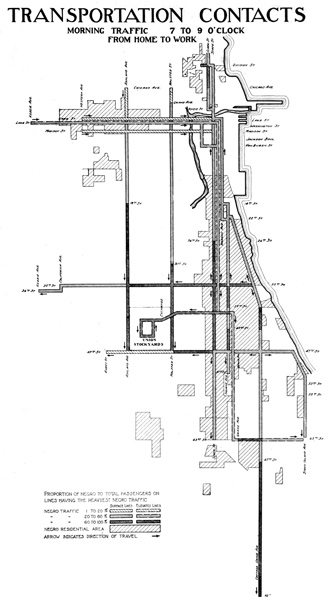
TRANSPORTATION CONTACTS MORNING TRAFFIC 7 TO 9 O'CLOCK FROM HOME TO WORK
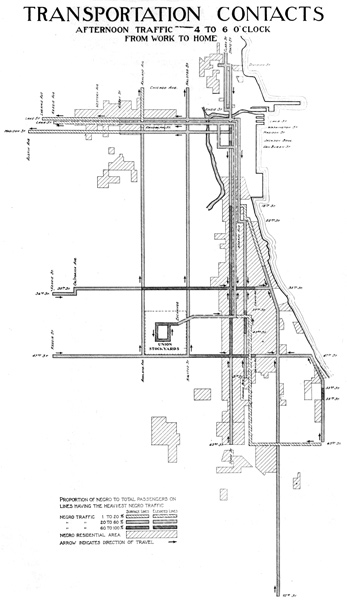
TRANSPORTATION CONTACTS AFTERNOON TRAFFIC—4 TO 6 O'CLOCK FROM WORK TO HOME
The hours of greatest general travel and car crowding were found to be from six to nine o'clock in the morning and from four to six o'clock in the afternoon.
The proportions of whites and Negroes on lines carrying the largest numbers of Negroes to and from work are shown in two diagrams. These are based on counts of white and Negro passengers, several trips being averaged to show typical car loads during the heavy travel of early morning and late afternoon. The first diagram shows the proportions in travel from the Negro residence areas of the South and West sides toward the Stock Yards, the other large industries employing Negroes, and the "Loop" district during the period from six to nine a.m. The second diagram shows the proportions in travel from the Stock Yards, the other industries, and the "Loop" toward the Negro residence areas of the South and West sides during the period from four to six p.m.
III. CONDUCT RESULTING FROM CONTACTS
As already noted, contacts of Negroes and whites on street cars provoked little discussion until the migration of Negroes from the South began to be felt. The great majority of the migrants are laborers. Many of them are ignorant and rough mannered, entirely unfamiliar with standards of conduct in northern cities. It is this type which is meant in references hereinafter to the "migration" or "southern" Negro.
Coming to a city like Chicago, with no "Jim Crow" racial segregation, was a new experience to many southern Negroes. They felt strange and uncertain as to how they should act. Many whites and Negroes long resident in Chicago have said that they could tell a migration Negro by his ill-at-ease manner and often by his clothes.
The conspicuous points in the behavior of the migration Negro before he became urbanized were his "loud laughing and talking," his "ill-smelling clothes," his "roughness," and his tendency to "sit all over the car." These are easier to understand when one considers the background of the southern Negro.
Few white people realized how uncertain the southern Negro felt about making use of his new privilege of sitting anywhere in the car, instead of being "Jim Crowed." One Negro woman who came to the city during the migration said, when she was asked about her first impression of Chicago: "When I got here and got on the street cars and saw colored people sitting by white people, I just held my breath, for I thought any minute they would start something. Then I saw nobody noticed it, and I just thought this is a real place for Negroes." There were exceptional cases in which southern Negroes walked miles, rather than take a car.
It may seem strange in view of such uncertainty of mind and timidity that the most noticeable point of behavior of the southern Negro was loud talking, joking, and laughter. The South Side Elevated Company, replying to the Commission's inquiries, said: "These colored people are of a happy-go-lucky type and are often noisy, especially when two or more acquaintances meet on the trains or station platforms or crossing from one side of the station to the other. They laugh and talk a good deal and seem to be happy and care-free."
Although some of this boisterousness was no doubt due to a care-free spirit and a broad good humor, some of it had quite a different source. Many a southern Negro thinks that the whites like him to be "typical," and that they will tolerate him as long as his dialect, his wit, and his manner are amusing enough. A Negro newspaper of Chicago took the southern Negroes to task for using this safety device in Chicago.
Many whites, clerical workers, shoppers, and others of a non-laboring type, have expressed objections to what they term a tendency of Negroes to "sit all over the cars," meaning to sit anywhere in the car. This was most conspicuous when whites had to ride in the morning on a car which had come from one of the Negro residence areas and was already filled with Negroes, or when Negroes and whites were boarding a comparatively empty car near one of the big industrial plants in the afternoon. The employment manager of the Corn Products Company plant at Argo reported a complaint about this tendency made to him by one of the girls in the office:
An office girl told me she had trouble getting a seat on the cars. She was not able to get a seat by herself and did not want to sit next to a Negro. She said that Negroes would rush in and get all the seats by the windows. She thought they did it more to tease the office help than anything else. This girl was undoubtedly prejudiced. That was one of her arguments to explain why she had difficulty in getting to work in the morning. She is a St. Louis girl of Flemish extraction.
Many of the southern Negroes were found to be very hesitant about taking seats next to whites. The southern tradition was so ingrained in them that they tried to be as inconspicuous as possible. On the other hand, some, with the sudden removal of the restraints of the South, used their new freedom without thought of the effect of their behavior on Chicago whites and Negroes.
The attitude of migration Negroes was sometimes expressed to the Commission's investigators. For example:
You can spend your money as you please, live better and get more enjoyment out of it—I mean go where you please, without being Jim-Crowed.
There's no lynching or Jim Crow. You can vote, you receive better treatment and more money for your work.
The freedom of speech and action. You can live without fear and there's no Jim Crow.
Some southern Negroes apparently came to Chicago with a real grudge against all whites and ready at slight provocation to display their resentment. The minister of one of the Negro churches in Chicago said:
After years of restriction and proscription to which they were subjected in the South, they suddenly find themselves freed in a large measure of these conditions. Their mind harks back to that which they endured at the hands of members of the Aryan race in the South, and they grow resentful, and in the midst of their new environment they vent their spleen. One has but to ride on any of the surface lines running into the section of Chicago largely occupied by my race group to be convinced of the facts mentioned above.
The southern Negro who got into trouble with whites by insisting on his right to a seat sometimes belonged to the class of suspicious and sensitive Negroes, and sometimes he was simply a "greenhorn." The following cases show how "green" the migration Negro could be, and how easy it was for him to make himself disliked and ridiculous. The first case was observed by a Negro man, the second by a Negro woman, both long resident in Chicago:
I boarded a crowded car in the "Loop" going south and was forced to stand near the rear door. There are two lengthwise seats at the rear of the car, one of which will hold three people and one of which will hold two. Two colored women, carelessly dressed and holding greasy paper bundles in their hands, got on the car at Twelfth Street and stood in the back of the car hanging on to straps. They rode this way until Eighteenth Street, when one of them, a large woman, noticing that there were three white people on one of the seats and only two on the other said to her companion, "If three folks can sit on that seat, I ain't going to stand over these white folks, who are just like they are down South, and don't want you to sit down. I'm going to sit down myself." She then inserted herself between the two white women, one of whom was pushed to the floor. The Negro woman was much embarrassed, but I don't think she has yet realized that the seats were of different lengths.
I was on a State Street car when two southern Negro women got on, talking loud, and throwing themselves around loose and careless like. I was sitting on one of the end seats, just big enough for three, and one of the women says to the other, "Here's a seat, here's a seat." "You move over," she said to me. There was fire in their eyes, and I don't like fighting, so I made up my mind that if they started anything I'd get up and give them my seat. Most people would have understood how you felt if you did that, but I am not sure they would have understood. I said to one of them, "There really isn't room on this seat." She gave me a shove, so I said, "But I'll get up and give you my seat." You wouldn't believe what happened then. The conductor came in and said, "You just keep your seat." And a white man, who was sitting in one of the cross-seats, turned around and said, "I'll see that she does."
Soiled and ill-smelling clothes were a large factor in making Negro workingmen objectionable to many whites even of the same working class.
At the time of the migration, in the fall of 1916 and the spring of 1917, the Stock Yards were taking on hundreds of Negro laborers to increase their war-time production, and these new hands, most of them migration Negroes, rode to and from work with white office workers. How the white office workers felt about it is shown by a statement of a white woman clerk in the Stock Yards:
Some of the Negroes on the Thirty-fifth Street car are very rough. Most of them work out at the Stock Yards and the smell of the Yards is very bad. They seem to try to clean up, but the smell is there, especially in cold weather when the cars are closed. I would suggest that they run special cars from the Stock Yards for those people, and that would leave enough cars for us and we wouldn't get the odor either.
This situation was somewhat remedied by the fact that most of the Negro laborers at least changed their clothes before going home, even if they could not entirely rid themselves of the Stock Yards odor; also the hours for Stock Yards employees were so arranged that the office workers came to work later and left later than the white and Negro laborers.
The Negro press of Chicago tried to make the migration Negro realize how the odor attaching to his clothes was affecting public opinion. The Chicago Searchlight of May 22, 1920, had this exhortation by the editor:
Did you ever get on the elevated train at Indiana Avenue about 5:30 o'clock in the afternoon, and meet the "gang" from the Stock Yards? It would make you ashamed to see men and women getting on the cars with greasy overalls on and dirty dresses in this enlightened age. There is really no excuse for such a condition to exist. There is plenty of soap and water in the Stock Yards and you have better clothes in your homes. Why not take a suit to the yards and wash up and change your clothing, before attempting to mingle with men and women, many of them being dressed for theaters and club parties, etc.? Don't you know that you are forcing on us here in Chicago a condition similar to the one down South?
In order to find out whether Negroes working in other plants than the Stock Yards do work which leaves the worker soiled and smelling, superintendents or foremen were questioned. It was learned that much other work done by Negro laborers leaves oil, grease, and acid stains, that many of the plants have no baths or adequate facilities for washing, and that sometimes where there are such facilities they are not kept in order. Three-fourths of the superintendents and foremen interviewed had the impression that Negroes were more careful about bathing and changing their clothes than whites. They said the difference was probably due either to the fact that the white laborer who was doing the same class of work as the Negro, was an immigrant, or to the fact that the white laborer often lived near the plant where he works, and preferred to wash up at home.
The Negro laborer meets little objection when he is riding with white laborers; it is when he comes in contact with whites of a non-laboring class that there is the most likelihood of trouble. Such whites often find white laborers quite as objectionable. A lawyer in Indiana Harbor who was questioned about the transportation contacts in the Calumet industrial district, said:
So far as transportation is concerned, little trouble need be expected. Most of the people here are working people, and they know what to expect when a dirty workman comes and sits down next to them. The fact of it is that if there is any complaint to be made, it would be against the foreigners. In the winter, when the doors are closed, the smell of garlic is almost unbearable.
Another complaint from whites is that Negroes on the street cars are "rough." It is significant, however, that all the incidents related to the Commission in regard to "roughness" occurred on crowded cars. The rush to get on a car before or after working hours is often heavy. The Commission's investigator, describing the loading of cars at an important transfer point near the Stock Yards at the evening rush hour, said:
I observed the loading and transfers at Ashland and Forty-seventh from three to four o'clock in the afternoon. With the possible exception of six to seven in the morning the traffic is heaviest at this time. The transfers from the Ashland to the Forty-seventh Street car are mostly Negroes from the government plants at Thirty-ninth and Robey. About 40 per cent of them are women. Cars going east on Forty-seventh Street leave every five minutes. There is a supervisor on this corner, whose duty it apparently is to supervise the arrival and departure of cars. He pays no attention, however, to the matter of loading. Usually the men meet the car in the middle of the block and climb on while it is moving. By the time the car reaches the corner the seats are all taken and the doorway is congested. The women, like the men, get on as they can. No deference is shown them. Most of those who get on this car are colored, and most of them, colored and white alike, are workmen.
Some friction between whites and Negroes has occurred during the boarding of cars. It may be caused by general racial attitude as well as by the circumstances of the particular case. The following cases were both related by white men, one an assistant superintendent in a foundry, and the other a barber:
One of our employees (Negro) in running to catch a car accidentally knocked over a white man. The white man became particularly abusive, and the crowd joined in with him. The crowd attempted to beat the Negro up, but he ran back to the plant here for protection and we quieted them down.
I remember one time about three years ago, I was coming home on the Forty-seventh Street car and two Negroes were standing on the back. It was pretty crowded. A man swung his wife on board, and two more white men jumped on too. He got her through into the car, and one of the Negroes said to her: "I'm going to get that husband of yours." I went up and stood in back of the white man and told him I'd stand by him, if anything happened. There were lots of whites on the car but about half Negroes, I guess. I think the Negroes have too much freedom. They don't know how to act. Some of those Negroes on the street car are real uncivilized.
The South Side Elevated Company, in answer to a questionnaire said: "It requires constant watching to prevent Negroes from entering and leaving cars through the windows." The following incident, reported by the Commission's investigator, who traveled over all the lines used by Negroes, shows that both whites and Negroes may climb through the windows under the same conditions of crowding:
I was transferring from the Argo car to the Sixty-third Street car with a number of white and Negro workmen from the Corn Products Refining Company. The crowd rushed for the door, and the doorway soon became congested. Two white men climbed in the car through the back window, followed immediately by a Negro. When the conductor came up, a white woman, who was standing next to me and had seen the whole performance, said to the conductor, indicating the Negro, who had climbed in through the window: "I wouldn't take his fare, if I were you. He came in through the window."
Selection of seats by white and Negro passengers often provides instances of conduct which is based on racial prejudices. These seem to be most frequent on lines with comparatively light travel by Negroes and where there is thus less opportunity for the races to become accustomed to contact. Sometimes whites show plainly their avoidance of Negroes.
Some Negroes have timidly offered their seats to women standing, and have been chagrined by the refusal of the white women to accept the courtesy. The superintendent of one of the plants where Negroes work made the following comment:
Negroes seemingly refrain from showing courtesy to white women, such as offering them their seats, because of two facts. Either the woman to whom the courtesy was extended, or outsiders, seem to the Negro to place a wrong construction upon his courtesy. They think him either fresh or servile, and in the majority of cases where a Negro would extend such courtesies, he refrains from doing so.
A few Negroes justified themselves by pointing out that white men did not give up their seats for Negro women, and so they did not intend to give up their seats for white women. The editor of a Negro newspaper took Negro men to task for their disregard of white women and also women of their own race, as follows:
Do you know that there is a growing tendency among the young men of our race to show disrespect for our womanhood? If you don't think so, just get on a street car or visit public amusement places, or even notice their actions as they walk along the street. It is nothing to see hundreds of big strong young men sitting on our cars, while women stand until they become almost exhausted, while those "fellows" sit and read their papers or gaze out of the car windows.
There is one trait, and I might say only one, that I take off my hat to the southern "Cracker" for, and that is his respect and high regard for women. While he hasn't any for the other fellow's [the Negro's] wives and daughters, yet he respects his own. We must set a good example for him and respect all women, regardless of race, color, or creed. Then you will win the admiration of all civilized people. Men who do not respect and honor their women are not worthy of citizenship. Do you get me, brother?
White men have become much incensed when they have given seats to white women, and Negro men, not realizing what had happened, took the seats. The timekeeper at a large industrial plant said:
I was on an East Chicago Whiting car. Six Negro workmen were standing. The car was full about one-third with Negroes. A man got up to let a white woman sit down. A Negro, seeing the seat vacated, sat down before the woman had a chance to get to it. The man who had proffered the seat became indignant, cursed the Negro, yanked him out of his seat, and proceeded to beat him up. The Negro drew out a knife. About this time, it became a general race clash. One of the Negro workmen had a gun: he pulled it out of his pocket and cleaned out the car.
The following incidents were reported by two white investigators:
I was on a Cottage Grove Avenue car at 5:30 p.m. The car was crowded, about one-third colored people. A young, well-dressed colored boy of about twenty was standing in the aisle beside a white man and a white woman. The seat directly in front of this colored boy was vacated, and the white man made a move to seize it, but the boy by holding his arm on the back of the seat barred the white man's way and stepped aside to allow the woman to sit down. The woman nodded her thanks to the boy, and the white man went on reading his paper.
I was on an eastbound Oak Park elevated train at about 10:30 a.m. Several Pullman porters got on at Campbell Avenue and had to stand, as did several white women and men. As the crowd began to thin out, I noticed that the white men were apt to drop into a vacant seat themselves, while the Negro porters were careful to wait until the women sat down before they took advantage of any vacant seats.
A white woman in the Hyde Park district said to one of the investigators:
On the street cars I would rather ride with Negro gentlemen than with many of our so-called white gentlemen. A Negro man who has the slightest training is courteous and genuinely so. My children use the street car every day to go to the Hyde Park High School, and it's not the Negro men on the street cars I hate to think of; it's the cheap white men. A very rough element of whites congregate every night on Lake Park near Fifty-first Street—hoodlums that the colored people living there must fear.
No case of attempted familiarity by a Negro man toward a white woman on the street cars was reported to the Commission. Cases were reported, however, of accidental contacts between Negro men and white women which might easily have been misunderstood, but which seemed to the investigator, a white woman, to be due to the clumsiness of southern rural Negroes in crowded cars. Two such cases follow:
I was on a Madison car going west. A number of Negroes got on at the Northwestern Station. The car was crowded, and I felt someone in the aisle leaning heavily against my shoulder. I was very much annoyed and glanced up. I saw that the man was a Negro about twenty years old. He was with a girl, obviously his sister, who was also standing in the aisle. They both had childlike faces, and I could see that he was quite unaware that he was leaning against me. I didn't say anything, as the car was really crowded.
I was in the aisle seat of an Illinois Central suburban car about 5:00 p.m., waiting for the train to start. A Negro man standing in the aisle next to me suddenly leaned against my shoulder so hard that it hurt. I looked up at him resentfully but he didn't notice me. He looked as though he had been picked up in a little western town and dumped down in a city for the first time. He had a wide western hat on, and his face was lean and weatherbeaten. I take it he was about fifty years old. He was in animated conversation with a woman in a seat behind me. This woman had many bundles. Apparently they wanted to find seats together. Soon another man joined them who had been scouting for seats in the car ahead, and they all set out together for another car. They were so concentrated on this problem of getting a seat that they didn't know there was anyone else in the car. They lunged down the aisle knocking against people as they went along, but no one paid any particular attention to them.
Another case of accidental contact, showing an attitude of suspicion on the part of a white woman, was reported by a Negro Y.M.C.A. secretary:
I was on a street car going west through the "Loop" on Madison Street. A colored man, apparently a workman, was sitting across the aisle from me, looking out of the window, with his left arm stretched along the back of the seat. A white woman came in, glanced at the vacant seat beside me, and sat down beside the colored man across the aisle. He looked around and saw the woman sitting in the seat, and apparently was confused. He attempted to remove his arm, and in doing so his arm brushed across the woman's shoulder. She got right up and exclaimed: "How dare you put your arm around me?" The man looked at her dumbly, his face the picture of excitement and wonder. I said to the lady, "I was watching this man and he was honestly trying to remove his arm from the back of the seat. I think he was more surprised to find you there than anything else, and the whole thing was sheer accident." She wanted to know what I had to do with it, and I simply said I wouldn't like to see a matter of that kind misunderstood. She resumed her seat beside the colored man and nothing further happened.
Many cases of improper advances by white men toward Negro women were reported to the Commission by Negro women, well known to the Commission, whose character is beyond question. The following are typical:
Going south on a State Street car to Fifty-third Street, I noticed a man in the aisle staring at me. He kept moving down nearer and nearer to my seat and sat down in front of me. He handed me a note written on a scrap of newspaper. I opened it because I was curious to know what his motive was. He was a young man, in his twenties, and well dressed. He had written down his name and telephone number and the words: "Call me for a date."
I remember one man especially, because I used to ride downtown on the same car he took every morning. The first time I ever saw him, he stared at me a great deal and when I got off the car, he got off too. As he got off he said to me, "Don't take that car, wait for the other one." I noticed then that he went over to the corner and took a car going in the opposite direction from mine. I saw him lots of times after that, and he always got just as close as he could and stared. I always arranged it so that he could not sit next to me.
I was on the elevated with a friend the other day. We were sitting on end seats. A man got up to give a white woman his seat and then came over and stood close to us. He stood with his legs against my friend's knees, until she jerked around and sat facing me. Then he tried standing close to me. He had me so hedged in I could hardly move, and I had to make a very abrupt movement to get away. He moved on after a while.
What may be done to prevent misunderstanding and check in its incipiency trouble which might easily and suddenly become serious, is illustrated in the action of a white woman, a resident of the Chicago Commons Social Settlement:
One evening, soon after the race riot in July, 1919, I was riding on a State Street car, going south from Grand Avenue. I had only ridden a block, when there was a general stir in the car, a young woman fainted, and I learned that the conductor had been struck and his cap knocked off. Word went around the car that a "nigger" did it. Ugly remarks were being made and I feared there would be trouble. I stepped to the back of the car and asked two colored women if they knew who struck the conductor. One said, "He looked like a colored man," the other said, "I don't know." Then I asked the conductor, in a voice loud enough so that the rest of the car could hear me, whether it was a white or a black man that struck him and why. He said: "It was a white man. I wouldn't let him bring his big drum on the platform, it was too crowded." Having learned this, I turned to two young couples who were still showing much feeling and said, "A white man struck the conductor." The whole car then quieted down, and there was no more feeling.
Most of the difficulties in transportation contacts reported and generally complained of seem to have centered around the first blundering efforts of migrants to adjust themselves to northern city life. The efforts of agencies interested in assisting this adjustment, together with the Negro press, and the intimate criticisms and suggestion for proper conduct of Chicago Negroes, have smoothed down many of the roughnesses of the migrants, and as a result friction from contact in transportation seems to have lessened materially.
E. CONTACTS IN OTHER RELATIONS
Here are included:
I. Contacts in public places, such as restaurants, department stores, theaters, and personal-service places.
II. "Black and tan" resorts, which present a much-criticized association because of the vicious elements of whites and Negroes in contact there.
III. Cultural contacts which indicate associations on a purely intellectual basis.
IV. Contacts in co-operative efforts for race betterment, which includes most of the social organizations working among Negroes.
I. CONTACTS IN PUBLIC PLACES
On the street, in public conveyances, stores, restaurants, and commercial places of amusement, contacts of races and nationalities are unavoidable and have not the supervision that is common in schools or even public amusement places.
Where large numbers of Negroes live there are theaters, restaurants, stores, barber shops, and personal-service places, which are used by Negroes in the proportion in which they predominate in the population of the area. In any or all of these places, however, white persons are served.
The business district along State Street between Twenty-sixth and Forty-seventh, and on the car-line cross-streets, is maintained partly by, and largely for, the Negro residents in the general neighborhood. Since, however, about 50 per cent of the population is white, there are personal-service places which are used almost exclusively by whites. Barber shops are wholly exclusive, and several restaurants attempt to make themselves so. For example:
At Thirty-first Street and Indiana Avenue, in the heart of the Negro residence area, a restaurant proprietor maintains an L-shaped establishment. Fronting on Thirty-first Street is a neatly arranged and well-kept dining-room, with tables for ladies, and a lunch counter with white waiters. Fronting on Indiana Avenue is a narrow, dark dining-room, with a counter served by colored waitresses. It is not kept neatly, and is not so well supplied. Both dining-rooms are served from the kitchen in the corner of the L, and patrons in either dining-room would never suspect that there were two dining-rooms with connection through this kitchen. At the time of the investigation, the dining-rooms had different names.
Negroes entering the Indiana Avenue dining-room are given prompt service. If they enter the Thirty-first Street room they are given indifferent service, are required to wait long and the service given them is reluctant and discourteous.
At another restaurant in the same neighborhood, similar means are used to discourage Negro patronage. Sometimes in addition to long waiting and discourtesy, food is spoiled. For example, egg shells are placed in egg orders, and salt is poured into the food.
In the districts where whites predominate, the measures taken to exclude Negroes are very definite. In a lunchroom near Forty-third Street and Vincennes Avenue, a well-educated, well-appearing young Negro had the following experience:
I went into the restaurant about two o'clock June 13, and sat about four seats from the front at a counter. After about ten minutes the waiter came and asked me to move to a seat at the rear of the counter. I asked him why and he told me he could not serve me where I was sitting. He said the management reserved the right to seat its guests, and pointed to a sign on the wall bearing that notice. I asked him if he could not serve me just as well where I was sitting as on the rear counter. He said maybe he could, but it was a rule of the house not to, and he would not. I left without being served.
Another Negro experience in a lunchroom on Forty-third Street near the Elevated is thus described: "Service given was very poor. When protest was made, the police were called and the young man was arrested for disorderly conduct. The case was dismissed."
Fifty-ninth and Halsted streets: "Service refused in a Swedish café. No witnesses."
Near Berwyn and Broadway (North Side): "Service refused, and investigator ordered out."
In the "Loop," experiences are widely varied. In all of the following cases, carefully selected investigators were sent and asked to report in detail what happened. It is possible to gather large numbers of personal experiences, from any group of Negroes, but as the facts cannot be verified they have not been used. These instances usually go unnoticed by all but the participants, except where the parties offended may secure witnesses among the guests present, which is difficult.
At a large, popular, general restaurant on Randolph Street, two women investigators had this typical experience showing how a manager can refuse service, and still attempt to keep within the law:
Entered about 7:30 p.m. The restaurant was well filled; I counted only six vacant tables. A woman head waitress took us through the main dining-room to the annex, where another head waitress preceded us down the length of the room to a corner table in the rear. There was a vacant table on either side of us. We waited almost a half hour, with no attention, until a couple was seated at the next table. When the waitress brought water to them she also brought water to us. She took the orders for both tables. Mrs. H—— ordered steak, salad and tea. I ordered chicken salad and tea. Steak and potatoes were served to the next table in about ten minutes. The waitress came to me and said the chef said he was out of chicken. I ordered steak. After another long period of waiting, she came back and said, "The chef says he is out of small steaks." I asked, "What have you?" She said she would go and see. She did not return, but after about fifteen minutes a man came to our table, put his hands on it, leaned down and said, "Do you want to see me?" Although I suspected he was the manager, he had not said so, and I replied, "Who are you? I don't know anything about you. No, we don't want to see you." He then said, "I am the manager. What do you want?" "I came to be served with dinner." He replied, "We have nothing to serve you." I asked, "Why, what is the reason?" He replied "There is no reason; we haven't anything to serve you." He was evidently cautious to keep within the letter of the law, but was determined that we should not be served. He would give no reason, simply repeating his former statement. We left without further discussion, and without being served.
Mrs. T—— says the waitress was courteous, and evidently regretful of the embarrassment of repeated refusal to serve. None of the patrons sitting near made any protest at their presence. It has been her experience that patrons, waitresses, ushers in theaters rarely show any hesitancy in accepting the presence of colored people who are orderly and self-respecting. Almost invariably the disagreeable incidents happen through the management, or through the carrying out of orders.
An interview with the manager of this restaurant was willingly given to a white investigator who later visited the place, and questions were answered freely and carefully. He said he had a number of Negro friends and appreciated the differences in them, as he did in whites. The main points in a long discussion of restaurant management in general, and the particular problem with reference to serving Negroes, he summed up as follows:
In the past five years, only one Negro has been served in this restaurant. She came in with a southern family as maid to a small child. The family was told that she could be served at a table with them, or in a side room, but could not be served at an adjoining table, even with the child. After some discussion, the maid ate at one end of a long table with the child, while the family sat at the other end.
At the time of the recent instance, when the two Negro women came in, the manager was not in the restaurant. From what he was told of the incident, he thinks he should have asked them to come to the office, and explained the situation to them. He had no doubt they would have understood, as he has always found intelligent Negroes readily responsive to the things which might be injurious to their relations with whites.
Before he was manager, a man brought in two Negroes, seemingly to get a basis for a suit and damages. The manager offered to serve them in a side room, but refused service in the main dining-room. They left without being served, and nothing further was heard from them.
In former years he had seen dishes broken in the presence of Negroes after being used in high-grade restaurants where their patronage was not wanted.
Barring Negroes was not personal, he said. A successful restaurant must watch closely the desires of its patrons, and not allow anything to interfere with smooth running. Complaints are made after each appearance of Negroes. He did not know what he would do if Negroes insisted on being served, but was firm that no Negro could be served in the main dining-rooms. He would vary procedure to suit the circumstances.
The following case, illustrative of the witnesses and testimony necessary to a court decision, was tried before Judge Adams, and damages of $100 with costs were awarded:
In August, 1920, Miss Lillian Beale, Negro secretary to Miss Amelia Sears, white, superintendent of the United Charities, went as the guest of her employer to a candy shop and lunch room on Michigan Avenue. They seated themselves and remained for two hours without service. During this time several friends of Miss Sears came in, were served and left, all of them commenting on the apparently deliberate oversight of the party. They remained for some time and left. Suit was brought against the company, supported by Miss Sears and her friends. At the first hearing it was stated that the waitress was ill at a hospital in Cincinnati. The judge, however, was insistent, and she was produced. When placed on the stand she admitted, contrary to the expectations of the management, that she had been ordered by the management not to serve any colored persons at any time. Miss Beale was awarded and collected damages of $100 and costs.
Eight months later, in July, 1921, a test was made of the same restaurant. Two Negro women went together to the restaurant, and a white woman observer went along to watch what might happen. Their reports agree and are as follows:
Time, one o'clock. Restaurant 50 per cent filled. Mrs. L—— and Mrs. S—— came in and seated themselves at a table for two near the center of the room. Waitress followed usual routine of bringing water, taking order, etc. Service of a table d'hôte luncheon was prompt and courteous. No inattention was observed, nor any disturbance on part of neighbors. Two white women came in and seated themselves at the next table, though there were several others vacant.
Two other Negro women and a white observer were sent to another restaurant operating under the same firm name. It was reported by the white observer as follows:
Restaurant two thirds filled—12 o'clock. Mostly women patrons, though a fair number of men alone, and of couples use this restaurant. Mrs. T—— and her friend came in through the long passage by the candy counter, and crossed to a table for two in the middle of the room. The manager, who is a young woman of considerable poise and ability, came at once and gave them water, took their order, and later served them. Two young white women at an adjoining table moved, but it may have been because they were sitting with strangers and preferred a table for two. After finishing my lunch, I joined Mrs. T—— and her friend, and the manager kept us under observation, but nothing was said.
In a subsequent interview with the manager at the general office of this chain of tea rooms cautiously worded replies were made to questions, with constant reiteration of the statement, "But you know we must serve them." In general it was said:
Negro patrons are infrequent, and there has been no noticeable increase. After many cases, complaint is made by white patrons, either in person or by letter, to the effect that if the tea room caters to Negroes, the white patrons will no longer use it. They had never known of a case of objectionable conduct but whites simply objected to their presence.
No instructions were given waitresses, but each case was handled by the head waitress as it occurred. Some girls made no objections to waiting on Negroes, and some refused to do it, but each attitude is individual, and not from instructions. No question that Negro patronage would hurt any high-grade place, as white patrons would be likely to leave. Rights did not enter into the problem—simply a matter of profitable business.
Interviews with managers of tea rooms in department stores brought out uniformity of attitude and of practice, as is shown in the following reports:
The manager of one tea room is a young woman of considerable experience. She was emphatic in saying that Negroes were not wanted, and that every effort would be made to discourage their coming. Considerable personal feeling was manifested in her statements.
Not enough Negroes can afford to pay the prices in high-grade restaurants to make them a real problem, and stray cases are handled as they appear. The effort was made to make them feel uncomfortable so they would not return. Slow service, indifferent attention were given, but there was no overcharging, and no spoiling of food.
Had never observed any objectionable conduct. Objections of white patrons was only reason. Especially difficult in summer, when many southern white people come to Chicago as a summer resort.
Waitresses are largely young married women with spare time. Manager finds them more unwilling than regular waitresses to give service to Negroes.
At another tea room practically the same statements were made, and the following instance was given: "Last winter a telephone reservation was made for a large luncheon party—about forty. When the group arrived, it was a club of colored women. Screens were placed around the tables, and luncheon served. A rule was then made and enforced that no telephone reservations would be made."
Following are reports from investigators seeking to learn at which restaurants, tea rooms, and lunch counters, service would be given to Negroes:
We had been shopping down town, and went into ——'s on State Street to get a light lunch. There were vacant tables and we sat down. No one came to wait on us. After waiting until several persons who had come in after us had been served, I went to one of the men who appeared to be the manager, and asked him why we were not served. He did not respond very cordially, but sent a girl. We ordered several dishes from the card, and were told that they were "just out." Although orders were being served, the girl stated that they were "just out" of everything we ordered. To cover our embarrassment, we practically begged her to serve us cups of chocolate. She gave us the chocolate and our check; we paid it and left.
Mrs. T—— and Mrs. — were served promptly and without incident in a well-known candy store in the shopping district on State Street. Mrs. T—— says that for many years this place has been known for its courtesy to colored people. Soon after it was opened, about World's Fair year, Mrs. ——, a Negro woman, was refused service by a waitress. She reported the fact to the owner, who investigated, and finding her statement correct, discharged the waitress. He made the rule that every patron was entitled to prompt, courteous service, and that discharge would follow any justified complaint. Although the store has been under other management for many years, later adding light luncheons to candy and soft drinks, the tradition has continued. Mrs. T—— says neither waitress nor patrons paid any attention to the serving of two colored women.
This case, involving three races, was reported from one of the Chinese restaurants on South Wabash Avenue:
About 7:00 p.m. we entered a Chinese restaurant. There were three or four white couples eating in the main dining-room, and two in booths. A Japanese waiter ushered us toward the furthest booth at the rear of the room. "I prefer sitting in the main dining-room," I said. He replied, "I can't serve you here." "Why?" "These seats are reserved. I will serve you in there [pointing to the booth] but not out here." We left.
One of the largest chains of cafeterias in Chicago is noted for the fairness of its treatment of Negroes, but even here there are exceptions. One of the Commission's staff observed two incidents within a short time in the same cafeteria of this system and reported them as follows:
Just in line before me was a small, quiet, well-dressed colored woman. She passed the checker, carried her tray to an unoccupied table, and then counted her check. She took her tray back to the checker, and made complaint of overcharge. The checker did not recount, or explain, simply saying, "That is our price." The woman went back to her table, ate, paid, and went out without further protest.
A few nights later, I noticed two young, well-mannered colored girls at a nearby table. As I went out I met the manager and said to him, "Do many Negroes come here to eat?" He said, "No, occasionally they come in, but they don't come back more than once, or at most twice." "How do you manage it?" "Well, under the law, we can't refuse to let them eat, but we can charge them any price we like. The first time we charge them enough to keep them from coming back. Then if they persist and come again, as soon as they go down the line, I see to it that something is put in their food which makes it taste bad—salt or Epsom salts. They never come back after that." After a pause he added, "You know we are within the law. We can't have them coming here—it would ruin our trade."
In the inexpensive restaurants on the edge of the "Loop," various practices are followed, as indicated by the following reports:
Miss B. S. met a friend and went into the —— Cafeteria on Lake Street, near State, upstairs. They were served, but the waiter put screens around their table while they were eating.
In May, 1921, I went to a lunchroom on Van Buren Street to get a lunch at noon. Six or seven men were at the counter, and were served as fast as they came in. Finally all seats were filled and three waiters were doing nothing, so I asked to be served. The waiter pretended not to hear me, then said roughly, "What do you want?" I said, "I do not know until I get a bill of fare." He pitched it at me and I asked for some baked beans. He stuck his head through the chef's window and gave my order. He brought me a plate on which were fourteen beans, and one small roll. I asked for a glass of water and he brought me a half-glass. I asked for butter (which had been served with two rolls to white patrons) and he said it would cost me a nickel. He said with emphasis, "It will cost you a nickel." I said, "You give me the butter, and then watch me and see if I pay for it." I asked for some pie and he gave me a piece about half the size he was serving the others. Then he said again, "Remember that butter will cost you a nickel extra." I said, "I won't pay it." He said, "You will pay for that dinner before you eat a bite of it." I said, "No chance, because I am not going to pay you at all, either before or after I eat. After I have finished I will pay the cashier at the desk." He looked at me hard and I kept on eating. Then he threw me down a check for 25 cents. I said, "Brother, you are wrong. My bill is only 20 cents. Your menu says beans are 15 cents and pie is 5 cents, and you gave me only one roll when to all of the others you served two." He said again, "I told you your butter would cost you a nickel." I said, "Now, you watch me right close when I go out and see if I pay for it." I told the cashier that my check called for 25 cents when it should be 20, "beans 15, pie 5, and if you can make 25 out of that all right." She said, "You know I have to collect what the check calls for, or else make good myself." I told her I appreciated her position but would not pay 25 cents for a 20-cent lunch. Then my waiter stepped up with an iron tap in his hand, and said, "I told you that butter would cost you a nickel, and now you pay it or else——." I said, I will "else," and laid down twenty cents and walked out. At the door he gave me a push but did not strike me.
The white proprietor of a drug-store in a residence neighborhood volunteered this story to a member of the Commission's staff:
Several years ago, there was a fine old colored man who used to come in frequently to buy drugs, supplies, etc. One day he came in with his wife, sat down at one of the little tables, and asked for soda water. My clerk refused to serve them, and the idea occurred to me that I would serve them myself in such a way that there would be no possibility that they would ever come back. I compounded a vile concoction and served it to them. They tasted it, paid for it, thanked me, and went out without making any complaint. I have never got over feeling mean about it. I not only humiliated them, and insulted them, but I cheated them out of their money.
An instance of unusual absence of friction in contacts under conditions which might be expected to produce it was given by a white woman who visited a restaurant patronized by many whites and Negroes:
In talking with Mr. O—— he asked me, "Would you consider it possible that you would voluntarily go into a restaurant and eat your lunch where you might have a Negro sitting on the next stool, or perhaps one on either side of you at a table?" I answered promptly, "No, I can't imagine it." He said, "A year ago I wouldn't have imagined such a thing possible myself, but now I do it quite frequently. There is a restaurant across the street from my office, right here in the heart of the Negro district, which a few years ago was a very good one, with regular table service, excellent food, and all the rest. Last year it was changed into a sort of a cafeteria, with a lunch counter down one side, and some tables. You get your knife and fork, go to the serving counter, and a man gives you on a plate whatever you order. The other day I found myself between two colored men, and took a good look at the restaurant. There is absolutely no disturbance, or even consciousness of any reason for disturbance."
Today I decided I would try it myself. The restaurant has no frills; it is simply an eating-place. I chose a corner seat at a table, because I could see all over the room. As I sat down, a courteous arm reached across the table to shove back the used dishes. I looked up to say "thank you," and found a good-looking young colored man opposite. No further attention was paid to me, nor was there any consciousness in his face, other than courtesy. In a few minutes, two young white truck drivers took the other places at my table. They were in working jeans, and except that the color was blue instead of khaki, looked just like the young soldiers in transport service who used to come into my canteen in France. At the next table was a quietly dressed young colored girl eating her lunch in a business-like way. A young white father brought in his little daughter. At the long lunch counter were neighborhood business men, white and colored, some professional men, each taking whatever stool happened to be vacant. Occasionally a truck driver or roughly dressed working man came in. Even the white dandy, immaculate in linen and with a cane hooked over his arm, took his cup of coffee to the counter and sat between a laborer and a business man.
In theaters, as in restaurants, there are petty evasions of the law, disagreeable encounters, and small but insistent snobberies. A colored investigator reported the result of a test of the purchase of tickets for a play which had had a long run, as follows:
On July 5 I went down to the —— theater and asked the ticket seller if I could get two seats for Thursday or Friday night between the third and ninth rows, center. She hunted out two seats in the ninth row for Thursday. I said, "If you have them I would prefer them for Friday." I asked the price, paid her, and she thanked me.
Friday, I went to the theater, and handed the doorman my tickets. He tore off the coupons, and directed me to the main-floor door. The lady usher seated us three rows from the back on the aisle. I counted and found that I was in the seventeenth row. I went to the usher and said, "I beg your pardon, but you seated me in the wrong place." She took the coupons, said, "Wait a second," and started out with them. I followed to see that she did not exchange my coupons. She went to the lobby and talked with the manager. He looked at me and said, "Well, seat them; there is nothing else to do now." She went back, gave my coupons to another usher, who asked her if I was to be seated in the seats the coupons called for. She answered, "I guess so." Then we were shown to the correct seats. There was no protest from those around us.
The manager of this theater was later interviewed. He had been in Chicago only a few months and was not at all interested in the general question of race relations, but was decided in his opinion that the attendance of Negroes in any high-class theater was not desirable. His views were about as follows:
Not many Negroes buy seats down stairs. Usually the ticket seller gives them tickets in the balcony or gallery and on the side aisles. Usually had complaints from white patrons if they found a Negro seated near them, especially if there were ladies in the party. It was not that the conduct of the Negroes was objectionable, but their mere presence was objectionable. If Negroes present tickets for the best main-floor seats, ushers try to put them in less conspicuous places. If they insist on taking their seats as shown on tickets, nothing can be done. If white patrons object, every effort is made to change their seats. Usual objection is offensive odor and proximity.
In making the study of theaters, certain tests were established. A Negro would ask at the box-office for seats on the main floor within certain rows and on the aisle. In the preceding report it will be noted that seats were sold readily, but some difficulty was found in using them. In the next report, conditions were reversed:
Mr. J——, Negro, asked for tickets, and was told that there was nothing on the main floor further in front than the twenty-third row. Miss H——, white, who was standing by him as he made the request, and heard the answer, moved up to the window and was immediately and without any remark, sold tickets in the seventeenth row on the aisle.
These tickets were presented by Mr. and Mrs. S——, Negroes. They report:
We arrived at 8:15, five minutes before the opening of the performance. The ticket taker tore off our stubs and returned them to us without any hesitancy. The ushers, who were women, glanced at the seat numbers and directed us to our seats, which were in a very conspicuous location on the first floor. They were in the seventeenth row, on the aisle. The people around us, even the ones immediately next to us, were not in the least concerned at our presence. The treatment accorded us in general could not have been surpassed.
A different report comes from another "Loop" theater, which has always been rather conservative in the standard of plays which it presents:
My husband and I wished to see a play at —— Theater, and bought seats several days in advance that we might have a choice. When we were shown to our seats, however, we were surprised to find that our tickets called for seats in the gallery, and in a corner which did not afford a view, and made them more than undesirable. We noticed that there were several vacant seats in the balcony, also on the first floor. My husband went to the box office and tried to exchange the seats. The ticket seller refused to make the exchange and also became insulting in his remarks to us. Afterwards we made the attempt to secure seats on the first floor of this same theater several days in advance of the performance which we wished to attend. We were told there were no seats on the first floor which we could get.
A contrasting experience follows:
On Tuesday I went to the —— Theater, and applied for two tickets on the main floor, center aisle, between the third and eleventh rows. The ticket seller stated politely that he had two tickets in the ninth row on the left. When we attended the performance, nothing unusual occurred. Other patrons made no comment, and in no way could we observe any objection made to our presence. There were no other Negroes at the performance.
Reports of investigators indicate that the managers of movies are convinced that their main floors, at least, should be guarded against Negroes. In most of the commercial amusement places, Negroes seldom have difficulty if they are willing to sit in the balcony, though attempts are frequently made to seat them on the aisles next to the walls, even when there are center seats empty. It is rare that any report is obtained of objections by white patrons to the actual presence of Negroes when they are well-mannered, well-dressed, and appreciative auditors.
As a rule movie theaters do not sell reserved seats, general admission entitling any patron to any seat in the house. But the following detailed report of the experience of two intelligent, well-dressed, quiet-mannered Negro women at a new movie theater on State Street is typical:
Purchased tickets, and entered the large lobby which extends across the front of the house. From this lobby there are closed doors at the entrance of several aisles, so that patrons are directed by ushers to different aisles, supposedly wherever there are vacant seats. We followed directions, and went to the extreme left of the lobby. We opened the door, and the usher in charge of this aisle started down toward the front to show us seats. We saw at once that the narrow section of seats next to the wall was empty except for one colored woman sitting about the middle of the section. Instead of following the usher down the aisle, and taking seats indicated to the right of this section, we turned through a row of empty seats on the left-hand section, and sat next to a woman in the aisle seat. This put us two rows from the rear in a side middle section, instead of in the section which seemed to be reserved for colored patrons, next to the wall. As the usher returned to his station he said, "We have some lovely seats in the balcony; wouldn't you prefer sitting there?" He was courteous, and I thanked him, telling him that we were quite satisfied with the seats we had taken.
Later, seeing two vacant seats further front in the center section which gave us a much better view we decided to take them and see what would happen. As we rose, the usher tried to block us by putting his hands on the back of the seat in front, and saying, "I am sorry that you can't take those seats." I brushed by him and took one of the seats. He tried the same thing with Mrs. H——, and she also brushed by and joined me. There were scattered vacant seats both in the section we left and the one to which we moved. We remained until the end of the show without embarrassment.
The manager of this theater has had many years of experience in Chicago, and was quite willing to discuss race contacts. Nothing in his words would indicate any strong prejudice against Negroes, even when expressing his conviction that they should keep to places intended especially for them. He said, in substance:
Not many Negroes buy tickets—perhaps ten or a dozen a day. An effort is made to seat them in one section of the house, preferably the balcony, to which they are directed by ushers. Reason is the complaint by white patrons who object to sitting next to them for an hour, or hour and a half. Offensive odor reason usually given. White patrons often complain to manager as they go out if Negro has been sitting near them.
Conduct of Negroes is not often objectionable—runs about the same as all patrons. Occasionally one tries to "start something." Recently two Negroes came to manager in crowded lobby after they had attended the show and objected to their seats on the balcony to which they had been sent by ushers, saying there were vacant seats on the main floor. Wanted to know why they were discriminated against. Manager did not want an argument in the presence of other patrons, and told them that as they had seen the show, heard the music, and shared everything with other patrons, he did not see they had any real cause for complaint. Called attention to the notice printed on almost every theater ticket in some form or other to the effect that the management reserves the right to revoke the license granted in the sale of the ticket, by refunding the money paid.
The same two women bought tickets the next day and attended a movie in an older and very popular "Loop" theater. They reported that they had no difficulty of any kind.
On a test made of a new and popular movie theater in an outlying section the investigator reported:
There were four of us in the party on June 5. We were told by the usher that there were no seats on the first floor, and that we would find seats in the first balcony. I think he was right, for there were white people also sent to the balcony. We were ushered in promptly, but another usher met us and said, "Right on up to the second balcony." We said we preferred seats in the first balcony, and walked by him. He went and got two more ushers and stood in front of us to prevent us from going into the first balcony, insisting that there were no seats there. One of the young ladies stepped around the usher, and saw three vacant seats. She called them to the attention of the usher, and he then said he meant there were no seats for four. Two of our party took those seats, and the other two waited about twenty minutes till they could get the seats they wanted. After getting into the first balcony, we saw vacant seats in at least four rows, two, three, and four seats together into which we might quietly have gone had the usher been courteous.
On June 18, 1920, a well-known Negro employed in the City Hall was denied admission to a movie theater at Halsted and Sixty-third streets. There is a small but long-established Negro colony about a mile west of this location.
In business places of various kinds, contacts are determined largely by the kind of service offered. Department-store managers questioned by investigators concerning their Negro patronage and the use of Negro girls as clerks, stated that the public had definite preferences, and probably would not willingly tolerate Negroes either as patrons or as clerks. In stores selling general merchandise, courteous treatment is, as a rule, accorded to Negro patrons, although there are occasional annoying incidents. The attitude then taken is determined by the standing and influence of the Negroes discriminated against. For instance:
At one of the largest department stores, two Negro women, both school teachers, were refused service in the basement shoe department. The clerks refused to fit shoes for them. A Negro alderman became interested in this case, and because of refusal of service, canceled his account.
The wife of a prominent Negro attorney went into a State Street candy store and was flatly refused service. Her husband brought suit and got damages.
Miss V—— was refused service at a large State Street department store by one of the clerks. The manager was interviewed and the clerk reprimanded and transferred. On the second visit, Miss V—— received attention.
In residence areas which are largely white, certain stores practice a peculiar subversion of the law in the effort to regulate contacts. A Negro resident of Woodlawn stated that his seven-year-old daughter had gone to the store to purchase goods for a costume to wear at a school entertainment. She was given material for which she had not asked, which she did not want, and for which she was overcharged. Frightened at the manners of the clerk, she took it. When it was returned, the clerk was extremely abusive, and told her that colored people were not wanted in the store. The little girl had, according to her parents, made a mistake in entering the store. Her parents were acquainted with the attitude of the management and avoided the place. In the following reports, there is evident the sense of injustice felt by both whites and Negroes concerned in the contacts:
Miss S. T—— wrote a prominent musical college and made arrangements for taking the summer normal-training courses. Her tuition fee was accepted, and the classes arranged. On her arrival, the manager received the balance of her money for the entire course, but told her the classes she wanted were full, and she would have to take private lessons with another teacher. The teacher of the desired classes told her the manager had not been frank, and that he feared the objection of southern white girls in the classes. Miss T—— made repeated attempts to get into the classes, but each time was told to apply again. This she did until it was too late to catch up with her back work. Other pupils were given prompt admission to the classes.
Two investigators were instructed to go to a public restroom in a large office building on State Street where there are many small shops selling women's wearing apparel. Their experience follows:
On July 6, at one p.m. with Mrs. H——, I visited the public restroom in the —— building. It is on the eleventh floor, on the main hall, and the door to the suite of rooms stood open. On one side of the entrance hall there is a small room used for a shoe-shining, with a Negro in attendance. Next on the same side is a large lavatory. Facing the outside door is the entrance to the restroom proper, which is large enough for ten or fifteen women, and is fitted up with wicker chairs, lounge, table, etc.
As we were about to enter the restroom, the woman in charge stood with her arm across the door, and said, "You are not to go in there; you may go into the lavatory." We asked why, and she said, "Those are the orders of the office." We went into the restroom, and she did not offer any opposition, but a little later came to us and said, "You are not allowed in here. You will have to see the manager."
I asked the attendant for the manager's name and room number, which she gave me. I related the incident to him. He told me that the attendant had informed me correctly, that the eleventh-floor restroom was reserved for "white folks" and that "colored folks" were not allowed to use it. They could use a restroom on the nineteenth floor set aside for colored employees of the building, and for any "colored folks" who might come into the building. He said it was one of the "iron-clad rules of the man who owned the building," and that "the attendant had it down in black and white."
Difficulties of this sort which confront Negroes and the efforts by Negroes to share equal treatment in public accommodations as well as the experiences met with when cases reach the courts were commented upon by Judge Cook, of the municipal court, in testimony before the Commission. He said:
During the earlier part of 1918 I sat in what was known as the criminal jury branch. That is the branch to which were assigned all criminal cases in the municipal court where the defendants demanded a trial by jury and were not tried at the police station. Among them were cases involving violations of what is known as the civil-rights law, where a colored man had a druggist or the proprietor of a moving picture or legitimate theater arrested for refusing to serve him soda water or refreshments at the drug store or to furnish him admission by ticket at a movie or legitimate theater, or if he did furnish him admission by selling him a ticket, limiting the ticket which he would sell to some undesirable portion of the house or to the gallery and not to the main floor, claiming that the theater was crowded downstairs and that there were no seats.
I suppose I tried during the early part of 1918 and the summer of 1919 probably a half-dozen of those civil-rights cases. In every one of them that I tried, there was virtually a clear case against the defendant. The jury in every instance was practically a white jury, or may have had one or two colored men. Notwithstanding that I gave very positive and clear instructions as to what the law was—to wit, that they were entitled to equal rights and privileges in public places and that if the jury believed from the evidence that the plaintiff was not accorded such right, there was a violation of the law and the defendant should be punished, and after elaborate argument by counsel for both the prosecution and the defendant (and by parenthesis I may say in all of these cases the state's attorney prosecuted vigorously), the jury, notwithstanding the plain evidence and the instructions of the court, went out and in about such time as it would take them to sign the verdict and return to court, would bring in a verdict of "Not Guilty."
Of course in the criminal court in a case of that kind, the jury is the judge of both the law and the fact. Therefore, I was not in a position to grant a new trial. The white jury simply say that law was not the law in Illinois or they would not convict under such circumstances, and having once acquitted the man the court and the state were without any remedy. Now I have always thought that was unjust.