Chapter IV · THE NEGRO POPULATION OF CHICAGO (continued 2)
Reading edition
The Commission's investigation being confined to the city of Chicago, the growing Negro colonies in such suburbs as Evanston and Glencoe were not studied, but attention was given to two southwestern outlying neighborhoods in the east part of Morgan Park, just inside the city limits, and the village of Robbins, wholly Negro, just outside.
1. MORGAN PARK
In 1910, 126 Negroes lived in Morgan Park, with a total population of 5,269. In 1920 the area had been incorporated in the city of Chicago, and there were 695 Negroes in a total population of 7,780 occupying approximately the same area.
In its early days Morgan Park was the site of a theological seminary, which in 1892 became part of the University of Chicago. The first Negroes there were servants, mostly from the South, working in the households of the professors. The colony remained, and its more recent increase was due in considerable measure to the influx of well-to-do Negroes from farther north in Chicago, many of whom bought houses. In some cases Negroes in congested Negro residential areas sold out to Negroes arriving in the migration and re-established themselves in much better dwellings and surroundings in Morgan Park.
Less prosperous Negroes also came, despite the feeling of some home owners that too great an influx of that type would injure property values and render the neighborhood less desirable. Many of these work in the South Chicago steel mills and the shops at Pullman. Some work in the Stock Yards.
A number of Negroes of Morgan Park are employed at the Chicago City Hall. Some are porters on Pullman cars. Only a small number are laborers. Many of the women sew or work as car cleaners and seem reluctant to do housework even at day wages.
Physically Morgan Park is attractive with comfortable homes and large grounds. Several churches, a number of schools, and an attractive park all add to the desirability of the place as a "home town." The lots are deep, affording plenty of space for gardens, and many vacant lots are cultivated. The opportunity for garden patches is an attraction for many Negroes. There are two Negro churches, Methodist and Baptist, and a Colored Men's Improvement Association which has provided a social hall for the Negro population.
School facilities are inadequate, and the buildings are old and overcrowded. Because of this congestion, it becomes necessary for children in the sixth and higher grades to go three miles to a school on Western Avenue. About twenty Negroes attend the high school. In the Esmond Street school approximately 25 per cent of the children are Negroes. The Negroes have repeatedly requested enlarged school facilities. They want a new building conveniently situated for their children.
The white people of Morgan Park are not unfriendly toward their Negro neighbors, though there seems to be a common understanding that Negroes must not live west of Vincennes Road, which bisects the town from northeast to southwest. A Negro once bought a house across the line but found he was so unwelcome that he promptly sold again. More recently the owner of a three-story brick flat building rented to Negroes the twenty flats above his stores. A protest was made by both white and Negro house owners, so that he was forced to eject the Negro tenants.
The demand for homes is shown in the numbers of Negroes who go to Morgan Park on Sundays by automobile, street car, and train. In the spring of 1920 a number of houses were being erected for Negro occupancy in what is known in Morgan Park as "No Man's Land," east of Vincennes Road from 109th to 112th streets. This swampy tract of land was being reclaimed. Streets had been surveyed and laid out, though with little paving. Water, light, and gas were available, and some efforts at drainage had been made, leaving some stagnant pools. Other plans involved the building of eighty five-room bungalows by a Chicago contractor. Six of these were under construction at the time of the investigator's visit, and five had been sold, corner-lot houses at $4,550, houses on inside lots at $4,330.
Morgan Park Negroes appear to be progressing financially. An officer of a local trust and savings bank said that they met their obligations promptly, only occasionally defaulting or suffering foreclosure and then only because of illness, death, or loss of employment. The same officer said savings accounts of Negroes were increasing in number, though small in amount.
Whites and Negroes maintain a friendly attitude. During the 1919 riots a number of conferences took place between Negroes and white people of Morgan Park. The Negroes kept rather close to their own neighborhood, and the only difficulty the police had was in controlling rowdy white boys.
Younger children of the two races play together in the school yards. A teacher in the Esmond Street school declared that no distinction was made between Negroes and whites in that school. It was noted, however, that when games were played, this teacher directed the little Negroes to take little Negro girls as partners. Some prejudice is discernible among whites in the community, but there is an evident desire to be fair and to give the Negroes every reasonable opportunity to exemplify good citizenship so long as they do not move from their own into the white neighborhoods.
Those familiar with the Morgan Park settlement believe that it offers unusual inducements as a home community for Negroes. The contractor who is already building for Negroes there has confidence in the venture. He has dealt before with Negroes and found them satisfactory clients.
2. ROBBINS
This village is the only exclusively Negro community near Chicago with Negroes in all village offices.
Robbins is not attractive physically. It is not on a car line and there is no pretense of paved streets, or even sidewalks. The houses are homemade, in most cases by labor mornings, nights, and holidays, after or before the day's wage-earning. Tar paper, roofing paper, homemade tiles, hardly seem sufficient to shut out the weather; older houses, complete with windows, doors, porches, fences, and gardens, indicate that some day these shelters will become real houses. In 1920 the village took out its incorporation papers, and while there are some who regret this independence and talk of asking Blue Island to annex it, in the main the citizens are proud of their village and certain of its future. There are 380 people all told, men, women, and children, living in something more than seventy houses. It is a long mile down the road to the street car, but daily men and women trudge away to their work, taking with them the feeling of home ownership, of a place for the children to play unmolested, of friends and neighbors.
These men and women find many kinds of work in the neighboring towns—at the mills, on the railroads, in the factories. Many of the women work in the factory of Libby, McNeil & Libby. Their wages go into payments for their homes. Men and women together are living as pioneer families lived—working and sacrificing to feel the independence of owning a bit of ground and their own house.
C. THE NEGRO COMMUNITY
I. THE BEGINNING OF THE NEGRO COMMUNITY
Negroes have been living in Chicago since it was founded. In fact, Jean Baptiste Point de Saible, a San Domingan Negro, was the first settler and in 1790 built the first house, a rude hut on the north bank of the Chicago River near what is now the Michigan Boulevard Bridge.
There are records of Negroes owning property in Chicago as early as 1837, the year of its incorporation as a city. In 1844 there were at least five Negro property owners and in 1847 at least ten. Their property was in the original first and second wards of the city, one on Lake Street, others on Madison, Clark, and Harrison, and Fifth Avenue. In 1848 the first Negro church property was purchased at the corner of Jackson and Buffalo streets, indicating the presence of the first colony of Negroes. In 1850 the passage of the Fugitive Slave Law caused many to flee for safety to Canada, many of the property owners disposing of their holdings at a great loss. In 1854 Negroes held two pieces of church property in the same general locality. Although the great majority lived on Clark and Dearborn streets north of Harrison Street, there was a tendency among the property-owning class to invest in outlying property. Some of them bought property as far south as what is now Thirty-third Street.
The year of the Great Fire, 1871, Negroes owned four pieces of church property. That fire stopped at Harrison Street and did not consume all of the Negro settlement. A second large fire in 1874 spread northeast and burned 812 buildings over an area of forty-seven acres. With the rebuilding of the city they were pushed southward to make room for the business district.
In 1900 the most congested area of Negro residence, called the "Black Belt," was a district thirty-one blocks long and four blocks wide, extending from Harrison Street on the north to Thirty-ninth Street on the south, between Wabash and Wentworth avenues. Although other colonies had been started in other parts of the city, notably the West Side, at least 50 per cent of the 1900 Negro population of 30,150 lived in this area. As this main area of Negro residence grew, the proportion of Negroes to the total Negro population living in it increased until in 1920 it contained 90 per cent of the Negroes of the city.
II. THE ORGANIZATION OF THE NEGRO COMMUNITY
In the discussion of race contacts attention is called to the peculiar conditions which compel Negroes of the city to develop many of their own institutions and agencies. Partly from necessity and partly from choice, they have established their own churches, business enterprises, amusement places, and newspapers. Living and associating for the most part together, meeting in the same centers for face-to-face relations, trusting to their own physicians, lawyers, and ministers, a compact community with its own fairly definite interests and sentiments has grown up.
The institutions within the Negro community that have been developed to aid it in maintaining itself and promoting its own welfare, are of four general types: (1) commercial and industrial enterprises; (2) organizations for social intercourse; (3) religious organizations; (4) agencies for civic and social betterment.
1. COMMERCIAL AND INDUSTRIAL ENTERPRISES
Commercial and industrial establishments conducted by Negroes are listed by Ford S. Black in his yearly Blue Book, which serves as a directory of Negro activities. They increased from 1,200 in 1919 to 1,500 in 1920. The compilation lists 651 on State Street, the main thoroughfare, 549 on principal cross streets, and more than 300 on other streets. The increase is strikingly shown in the following figures: In 1918 Negro business places on Thirty-first Street numbered nine and seventy-one in 1920; on Thirty-fifth Street there were forty-seven in 1918 and seventy-seven in 1920. On Cottage Grove Avenue, Negroes have only recently established themselves in large numbers, yet between Twenty-eighth and Forty-fifth streets there are fifty-seven Negro business places, including nine groceries, three drug-stores, and two undertaking establishments.
A partial list of business places as listed in Black's Blue Book is given:
Art stores 14
Automobile schools and repair shops 10
Bakeries, wholesale and retail 13
Banks 2
Barbershops 211
Baths 2
Blacksmith shops 6
Book and stationery stores 6
Chiropodist 29
Cleaning, dyeing, and repairing establishments 68
Clothing stores 8
Decorators 12
Dressmaking shops 32
Drug-stores 31
Electricians and locksmiths 9
Employment agencies 15
Express and storage offices 71
Fish markets 7
Florists 5
Furnace and stove repairing 6
Groceries and delicatessens 119
Hairdressing parlors 108
Hotels 11
Ice-cream and confectionery stores 7
Insurance companies 3
Jewelers 5
Laundries 2
Medicine specialists 9
Millinery shops 15
Music and musical instruments 16
Newspapers and magazines 13
Musicians and music teachers 66
Notions 25
Optometrists 4
Orchestras 1
Photographers 4
Plumbers 4
Printers 20
Public stenographers 6
Real estate offices 52
Restaurants 87
Schools 4
Shoemaking and repairing shops 33
Shoe-shining parlors 26
Sign painters 4
Soft-drink parlors 11
Tailors 62
Toilet articles 10
Undertaking establishments 21
Vending machines 2
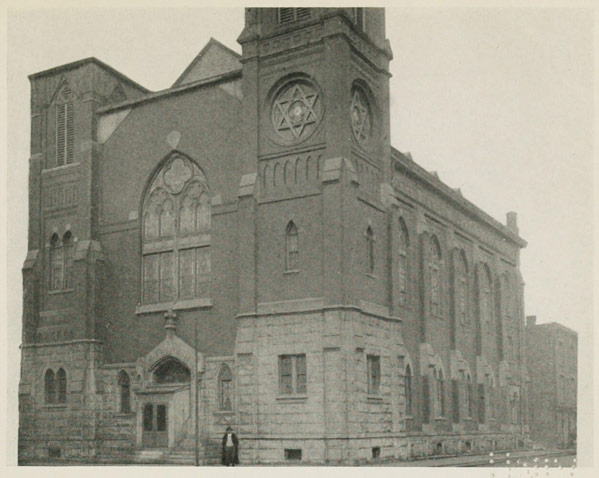
OLIVET BAPTIST CHURCH The largest Negro church in Chicago (old building), at Twenty-ninth and Dearborn streets.
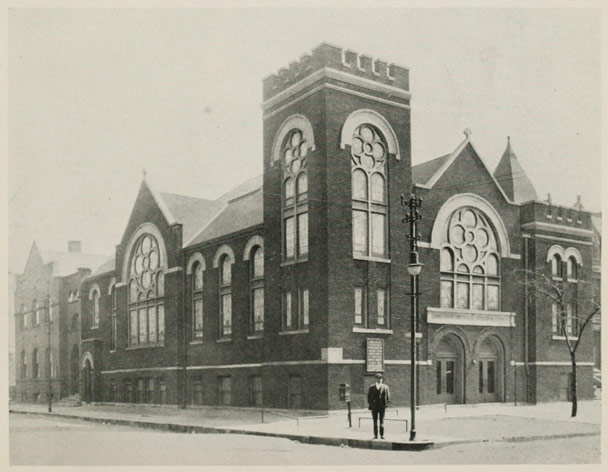
ST. MARK'S M.E. CHURCH Located at Fiftieth Street and Wabash Avenue, built by Negroes.
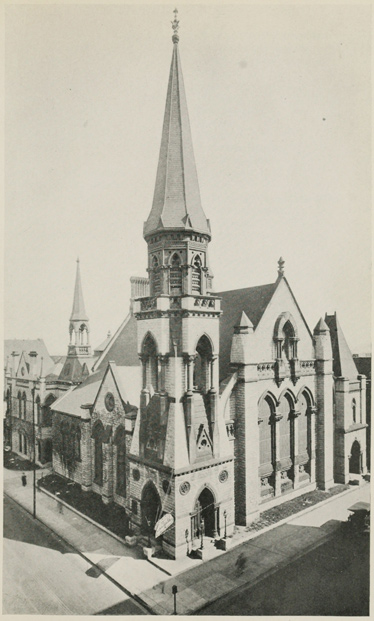
OLIVET BAPTIST CHURCH The largest Negro church in Chicago, larger and more modern building, Thirty-first Street and South Park Avenue, purchased recently by Negroes.
2. ORGANIZATIONS FOR SOCIAL INTERCOURSE
Various organizations for social intercourse and mutual helpfulness have developed in the Negro community. Some are local lodges or branches of national organizations, and others are purely local and independent. Some are simply for social intercourse, and others have in addition benefit features, professional interests, etc. Frequent reference is made in the family histories given in this report to these various organizations.
Fraternal organizations.—Fraternal organizations are an old institution among Negroes. In the South they rank next in importance to the church; in the North they have considerable prestige. Membership is large and interest is strong. Following is a list of the most active in Chicago:
Elks, Great Lakes Lodge No. 43, I.B.P.O. Elks of the World (an independent order of Elks)
Ancient Order of Foresters
Catholic Order of Foresters
American Woodmen
Builders of America
Knights of Pythias
Mosaic Templars of America
Masons
Grand Court Heroines of Jericho of Illinois
Eastern Star
The Golden Circle
Odd Fellows (G.U.O. of O.F.)
Royal Circle of Friends
United Brotherhood of Friendship
Sisters of the Mysterious Ten
All of these organizations, although having their own rituals, serve as a means of group control and of exchange of views and opinions. They are also a guaranty against absolute friendlessness, and that is perhaps one of the strongest motives for the establishment of the first organizations years ago. Much charitable and relief work is carried on by these fraternal bodies among their members.
Out of these associations have grown clubs with social activities among wider circles. There are, for example, the Easter Lily Club, the Mayflower Club, and the Masonic Progressive Club.
Social clubs.—Many of the clubs and societies with social, educational, or professional interests are modeled after those of the larger community. There are, for example, the Arts and Letters Society, the University Society, and Civic Study Club. There are also many smaller clubs organized for various purposes, but designed principally to serve the Negro community. There are more than seventy women's clubs, leagued in the Chicago Federation of Colored Women's Clubs. There are also the Art and Charity Club, Chicago Union Charity Club, Cornell Charity, Dearborn Centre, Diana Charity, East End 30th Ward, East Side Woman's Club, Eureka Fine Arts, Fideles Charity, Giles Charity, Hyacinth Charity, Ideal Embroidery Art, Ideal Woman's Club, Imperial Art, Kenwood Center, Mental Pearls, Mothers' Union, Necessity Club, New Method Industrial, North Shore, North Side Industrial, Motley Social Uplift, Phyllis Wheatley Club, Progressive Circle of Kings Daughters, 37th Ward Civic League, Volunteer Workers, West Side Woman's City Club, and the Woman's Civic League.
Among the exclusive social clubs, perhaps the most important is the Appomattox Club. Its membership includes the leading business and professional men, and it has a well-appointed club building. Its membership is limited and it carries civic and social prestige.
The Phalanx Club is an organization of government employees. Its membership is large, though limited by occupational restriction. Its interests are largely social. The Forty Club and Half Century Club are purely social and still more exclusive.
Negro professional societies, sometimes formed because of the objections of whites to the participation of Negroes in white societies of a similar nature, include the Lincoln Dental Association, Physicians, Dentists and Pharmacists' Association, a Bar Association, and a Medical Association.
3. RELIGIOUS ORGANIZATIONS
Negro churches.—The church is one of the first and probably one of the strongest institutions among Negroes. The importance of churches in the Negro community lies not only in their large membership and religious influence, but in their provision of a medium of social control for great numbers of Chicago Negroes, and in their great value in promoting the adjustment of newcomers.
In the South the churches are the principal centers for face-to-face relations. They serve as a medium for the exchange of ideas, making and maintaining friendships, community co-operation, collective striving, group competition, as well as for the dissemination of information, assistance and advice on practical problems, and the upholding of religious ideals. The pastors know the members personally, and the church exercises a definite control over individual behavior.
The church is often the only Negro social institution with an unhampered opportunity for development. In most southern cities, Negroes have no Y.M.C.A., public playground, welfare organizations, public library, gymnasium, orderly dance halls, public parks, or theaters. The church in a large degree takes the place of these and fills a vacancy created by the lack of the public facilities ordinarily found in white communities. In many instances it determines the social standing of the individual Negro. No one can escape the opprobrium attached to the term "sinner" if he is not a member of the church, however successful otherwise.
The minister is the recognized leader of the Negroes, and often their legal adviser and school teacher. He is responsible for the social good behavior of his people. No movement can get the support of the people unless it has his sanction.
In the North the function of both Negro church and pastor is different. Negroes can find other places than the church for their leisure time; numerous urban and civic organizations with trained workers look after their interests, probably better than the church. In the Y.M.C.A. they find religion related to the development of their bodies and minds. In northern cities enterprises and movements thrive without the good-will or sanction of the clergy, and even against their protest.
The field wholly occupied in the South by the church is shared in the North by the labor union, the social club, lectures, and political and other organizations. Some of the northern churches, realizing this, have established employment agencies and other activities of a more social nature in response to this new demand.
Social activities.—The churches in Chicago serve as social-contact centers, though not to the same extent as in the South. Frequently they arrange lectures, community programs, fêtes, and meetings. Many of them, seeking to influence the conduct of the group, have provided recreation and amusements for their members. Several churches have social-service departments, basket-ball teams, and literary societies. Olivet Baptist Church, with a membership of 9,069, maintains an employment department, rooming directory, kindergarten, and day nursery, and employs sixteen workers; in its social organization there are forty-two auxiliary departments. During the last five years it has raised $200,000, contributed $5,600 for charitable relief, and found jobs for 1,100 Negroes.
Unique among such developments is the People's Church and Metropolitan Community Center, organized by a group which withdrew from the Bethel African Methodist Episcopal Church in October, 1920. Relying solely upon its membership, it raised $22,000 during its first five months. Six persons are employed to carry on the work, one a social-service secretary. Land for a church building has been purchased, and plans have been made to buy a community-center building to accommodate several thousand people.
Relief work.—The records of the United Charities, which assumes the care of dependent children of the juvenile court, show a much smaller proportion of appeals for aid from Negroes than might be expected. This is partly explained by the work of the churches in relieving Negro families. A very high proportion of families below the line of comfortable subsistence belong to the churches, the small "store-front" churches. The number and variety of denominational divisions and sects increases competition for membership and sends pastors and members out into the community to gather in the people. Forty-one churches, many of them small, reported a total of $15,038 distributed during 1920 for the relief of the sick and distressed.
Following is a summary of information collected by the Commission concerning the churches in the Negro community:
Number of churches, regular and "store-front" 170
Number visited 146
Number of churches owning their property 49
Value of property owned $1,677,183.00
Indebtedness on church properties being bought $325,895.91
Amount collected in 146 churches during 1919 $400,000.00
Membership of 62 of the 146 churches 36,856
Number in Sunday school in 57 of 146 churches 16,847
Number of persons in attendance in 64 of 146 churches
Morning 20,379
Evening 13,806
In a very few cases, Negroes are found to be members of white churches, but the Negro churches have an entirely Negro membership with Negro pastors.
"Store-front" churches.—The "store-front" church membership is merely a small group which, for one reason or another, has sought to worship independently of any connection with the larger churches. The establishment of such a church may be the result of a withdrawal of part of the membership of a larger church. They secure a pastor or select a leader from their own number and continue their worship in a place where their notions are not in conflict with other influences. Most frequently a minister formerly in the South has come with or followed his migrant members and has re-established his church in Chicago. Or again a group with religious beliefs and ceremonies not in accord with those of established churches may establish a church of its own. The groups are usually so small and the members so poor as to make the purchase of a building impossible. The custom has been to engage a small store and put chairs in it. Hence the name "store-front" church.
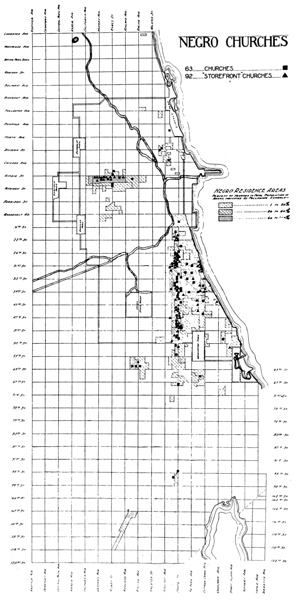
NEGRO CHURCHES
Denominations.—The varieties of denominational divisions are wide and interesting. A classification on the basis of information collected by the Commission is given in Table VII.
TABLE VII
Denomination Regular "Store-Front"
Baptist:
Missionary Baptist 19 61
Free Will Baptist 2
Primitive Baptist 4
Methodist:
Methodist Episcopal 6
African Methodist Episcopal 9 6
African Methodist Episcopal Zion 3 1
Colored Methodist Episcopal 3
Independent Methodist Episcopal 6
Presbyterian 2 2
Episcopal 1
Congregational 1
Disciples of Christ 1
Saints, Holiness, and Healing Churches 20
Total 45 102
The steady growth in the number of churches is shown in the dates of organization of sixty-five of them as given in Table VIII.
TABLE VIII
Year Number
1825-50 2
1850-80 2
1880-90 5
1890-1900 5
1900-1910 5
1910-15 12
1915-16 4
1917 3
1918 15
1919 6
1920 6
Total 65
Church property.—It was not easy to determine the amount of money raised and handled by the Negro churches for any specific period, because only the better-organized churches keep accurate accounts.
The total value of the property holdings of twenty-six of the larger and better-organized churches is $1,677,183.02, with a total indebtedness on nineteen of them of $318,595.91. In twenty of the twenty-six annual collections aggregate $226,216.25.
Out of 100 "store-front" churches visited only seven own or are buying the property they use. The total value of the property of these seven churches is $44,300. Four of the seven have an indebtedness of $7,300; and the four that kept records showed a total annual collection of $5,170.
The pastors.—A sharp division both as to education and experience is found between the pastors of the regular churches and those of the "store-front" churches. Generally the larger churches have the better-trained, more experienced, and more highly salaried ministers. Exceptions are found in the case of one or two "holiness" churches.
The ministers in these various churches represent a range of training from that of such seminaries as Newton Theological and institutions like Yale University, University of Chicago, and Northwestern University, down to that of the sixth grade in grammar school. Some have had no schooling at all. The number of specially trained ministers totals twenty-one. Six of these are graduates of recognized northern institutions, while fourteen are graduates of recognized Negro institutions such as Lincoln University, Howard University, Virginia Union University, and Livingston College. Four are graduates of standard high schools and four of other high schools below the standard rating. The remainder fall below the sixth grade. Among this last group it is not unusual to hear that "God prepares a man to preach; he does not have to go to school for that. All he must do is to open his mouth and God will fill it. The universities train men away from the Bible."
The range of active service in the ministry is from two months to forty-four years. Here again the larger established churches have the ministers of longer service. Typical examples are found in churches like Bethel African Methodist Episcopal Church, whose pastor has had forty-four years of service; Shiloh, thirty-seven years; Bethesda Baptist Church, thirty-seven years; Grace Presbyterian Church, thirty-two years (all at this one church); Original Providence, thirty-five years; Berean Baptist Church, thirty years.
4. SOCIAL AND CIVIC AGENCIES
Social agencies in the Negro communities are an expression of group effort to adjust itself to the larger community. Within the Negro community there are two types, those especially for Negroes and those which are branches of the agencies of the larger community but located conveniently for use by Negroes.
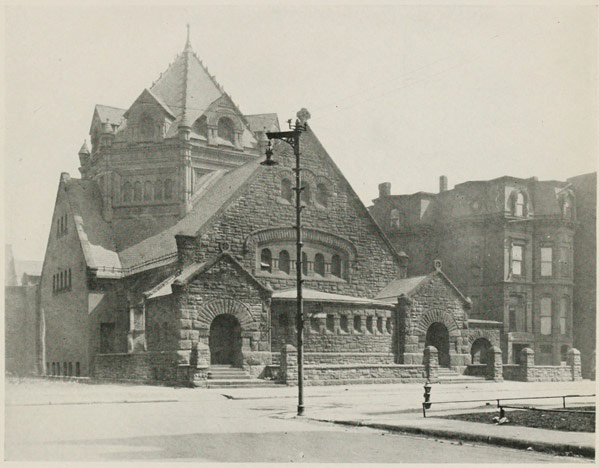
TRINITY M.E. CHURCH AND COMMUNITY HOUSE Located at Prairie Avenue near Thirty-first Street, purchased recently by Negroes.
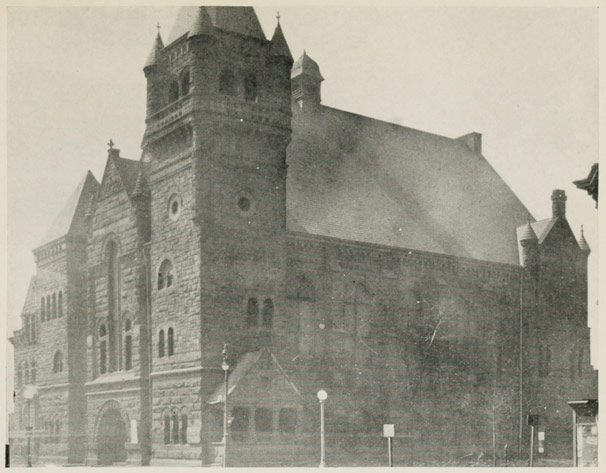
SOUTH PARK M.E. CHURCH The congregation moved from a store-front church to this edifice at Thirty-second Street and South Park Avenue in less than three years after the church was established.
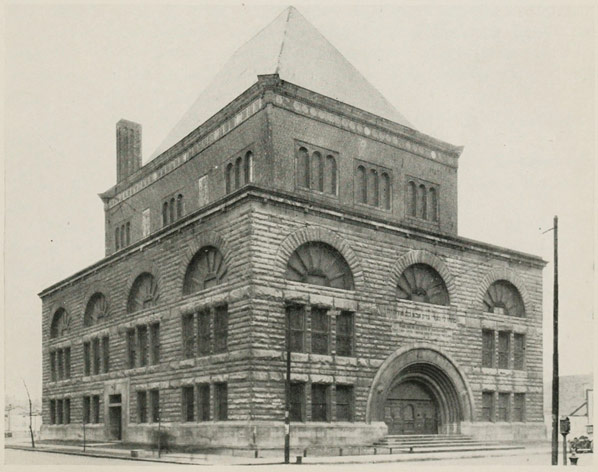
PILGRIM BAPTIST CHURCH Located at Thirty-third Street and Indiana Avenue. Formerly a Jewish synagogue, purchased recently by Negroes.
A. AGENCIES ESPECIALLY FOR NEGROES
Chicago Urban League.—This organization is one of the thirty-two branches of the National Urban League whose headquarters are in New York City. It was established in Chicago in 1917 during the period of heaviest migration of Negroes to the city. The numerous problems consequent upon this influx guided the development of the League's activities. Its executive board and officers are whites and Negroes of high standing and influence in both the white and Negro groups, and it is supported by voluntary subscriptions. Within four years this organization has taken the leading place among all the social agencies working especially among Negroes. It has a well-trained staff of twelve paid workers, and its work is carried out along the lines accepted in modern social work. The League has organized its activities as follows: Administration Department, Industrial Department, Research and Records Department, Children's Department, settlement work.
The work of the Administration Department involves, in addition to general management, co-operation with other agencies and co-ordination of their efforts for community improvement through interracial meetings, conferences, and joint undertakings.
The Industrial Department during 1920 placed more than 15,000 Negroes in positions, made industrial investigations in sixteen plants, provided lectures for workingmen in plants and for foremen over Negro workers. It also investigates complaints of workers, selects and fits men for positions, secures positions for Negroes where Negroes have never worked before, and assists in other ways the adjustment of Negroes in industry. More than 25,000 persons passed through the department during 1920.
The Department of Research and Records makes the investigations on the basis of which the programs of the League are carried out. Its information is a permanent and growing body of material useful to all agencies and persons interested in obtaining reliable information concerning Negroes in Chicago.
The Children's Department handles cases of boys and girls and co-operates with the schools, juvenile protective organizations, the juvenile court and probation department, and various other child-helping institutions. A total of 540 such cases were adjusted during 1920.
During 1919 a total of $28,659 was raised and used in the support of the Chicago Urban League.
The Wendell Phillips Settlement on the West Side is under the supervision of the League. The settlement has a day nursery and provides a center and leadership for twenty-five groups in the West Side community.
Wabash Avenue Y.M.C.A.—This organization is a branch of the local Young Men's Christian Association, but because of its location and the peculiar social problems of its membership and vicinity, it has become one of the strongest agencies of the community. Its work is among boys and young men, many of whom are industrial workers in various plants. Community work is vigorously promoted. In 1920 an enthusiastic group of 1,137 boys was enlisted in a neighborhood clean-up campaign, and 100 community gardens were put in operation. Moving pictures and community singing were provided during the summer months. The following list gives some statistics of activities for the first nine months of 1920.
SOCIAL ACTIVITIES
Attendance at building 140,740
Attendance at reading-room 19,402
Attendance at Bible classes 1,514
Attendance at industrial clubs 5,394
Attendance at entertainments 6,542
Meals served 100,610
Dormitory attendance 71,396
Persons directed to rooms 614
Persons assisted 1,526
Persons reached through community work 10,406
Personal religious interviews 396
Men referred to churches 196
PHYSICAL WORK
Men used swimming-pool 3,604
Boys used swimming-pool 14,096
Men and boys used shower baths 24,332
Participated in leagues and tournament 3,906
Spectators 44,742
Men attended gymnasium classes 5,622
Boys attended gymnasium classes 17,106
In addition to the foregoing work this institution has promoted efficiency and industrial clubs among Negro workers in industrial plants, three glee clubs, noonday recreational programs, and nine baseball teams.
During 1919 the total contributions for support were $15,353, of which $3,100 came from Negroes. The membership dues of the latter, however, totaled $16,000 and receipts from operation amounted to $143,747.
Chicago Branch of the National Association for the Advancement of Colored People.—This organization aims to carry out the general policies of the National Association as far as they apply to Chicago. The national purpose is to combat injustice against Negroes, stamp out race discriminations, prevent lynchings, burnings, and torturings of Negroes, and, when they do occur, to demand the prosecution of those responsible, to assure to every citizen of color the common rights of an American citizen, and secure for colored children equal opportunity in public-school education.
In Chicago, the principal efforts of this organization have been in the line of securing justice for Negroes in the courts and opposing race discriminations in public accommodations. Its most active period followed the riots of 1919. With a number of competent attorneys, white and Negro, it gave legal support to Negro riot victims and followed through the courts the cases of many Negroes accused of participation in rioting.
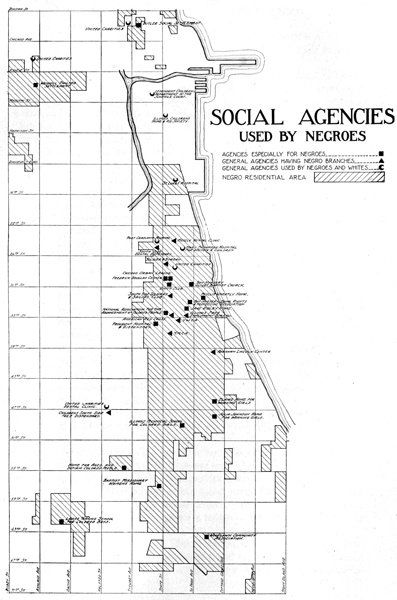
SOCIAL AGENCIES USED BY NEGROES
Community service.—The South Side Community Service is a re-established organization growing out of the Soldiers and Sailors' Club. It aims to provide wholesome recreation and leisure-time activities for its neighborhood. At Community House, 3201 South Wabash Avenue, it serves a number of organizations, arranges supervised dances, dramatics, programs, and other entertainment for the groups.
Wendell Phillips Settlement.—The Wendell Phillips Settlement is located on the West Side at 2009 Walnut Street and has been under the supervision of the Chicago Urban League since 1918. It has a day nursery, serves as a center for twenty-five different groups, and provides the only public meeting place for Negroes apart from the churches, on the West Side. There is a Boy Scout division and a division especially for women and girls.
Butler Community Center.—The Butler Community Center is located on the North Side in a neighborhood with about 2,000 Negroes. About 250 persons use the Center regularly. There are classes in citizenship, hygiene, Negro history, sewing, and china painting. There is an organization of Camp Fire Girls and a Boys' Group. Through courses of lectures instruction is given in hygiene, sanitation, and first aid.
Phyllis Wheatley Home.—The Phyllis Wheatley Home was established several years ago to provide wholesome home surroundings for colored girls and women who are strangers in the city and to house them until they find safe and comfortable quarters. The building at 3256 Rhodes Avenue, which has been purchased, accommodates about twenty girls.
Home for the Aged and Infirm.—The Home for Aged and Infirm Colored People on West Garfield Boulevard is supported almost entirely by contributions from Negroes.
Indiana Avenue Y.W.C.A.—The Indiana Avenue branch of the Y.W.C.A. on the South Side is under the general direction of the Central Y.W.C.A. of Chicago. Its directors are Negro women. Many girls are directed in their activities by volunteer group leaders from the community. The Industrial Department secures employment for Negro girls. A small number of girls live in the building at 3541 Indiana Avenue, and a room directory is maintained through which safe homes are secured for girls who are strangers in the city, or who have no family connections. Mrs. Martha G. McAdoo is the executive secretary.
Elaine Home Club and Johnson Home for Girls.—The Elaine Home Club and the Julia Johnson Home for Girls are small institutions which provide living accommodations under careful supervision for young working girls.
Hartzell Center.—Hartzell Center is a social institution under the direction of the South Park Methodist Episcopal Church. It has a commercial school, in which typewriting and stenography are taught, a cafeteria, and some social activities.
Illinois Technical School.—The Illinois Technical School for Colored Girls, a Catholic Institution, serves as a boarding and technical school for colored girls. It accommodates about 100 girls. Sister Augustina is the superintendent.
Woodlawn Community Association.—This is a neighborhood organization originally intended to interest the Negroes of the Woodlawn community in taking pride in their property and in making the neighborhood more desirable for residence purposes. It has extended its functions to include community activities and civic welfare program.
Louise Training School for Colored Boys.—This school is at Homewood, Illinois, about twenty-five miles from Chicago; until 1918 it was located at 6130 South Ada Street. It receives dependent boys between eight and fifteen years of age. Some of these boys are placed in the institution by the Cook County authorities. The institution can accommodate only a few. At present thirty-two boys are cared for in the dormitory. This is the only institution in the city for dependent colored boys.
B. AGENCIES CONVENIENT FOR NEGROES
American Red Cross.—The American Red Cross has a branch headquarters at 102 East Thirty-fifth Street. It gives emergency relief, general information and advice, and has been active in helping the families of Negro service men. During the riot of 1919 it provided food for thousands of Negroes who were cut off from work.
United Charities.—The United Charities, which provides relief and other help for needy families, has four branches convenient for use by Negroes: one at 2959 South Michigan Avenue, near the center of the main Negro residence area on the South Side; another at 1701 Grand Avenue, near the West Side Negro residence area; another at 102 East Oak Street, near the North Side area; and another at 6309 Yale Avenue, convenient for Negroes living in Woodlawn, in the vicinity of Ogden Park and in the southern part of the South Side residence area.
The Illinois Children's Home and Aid Society.—This society has two field representatives who find homes for dependent Negro children and supervise their placing. Since 1919 it has placed and supervised more than 168 Negro children.
Abraham Lincoln Center.—The Abraham Lincoln Center is at Langley Avenue and Oakwood Boulevard. Although originally not used by Negroes, the movement of the Negro population southward has added many of them to the group of people using its facilities. There is a boys' group, a branch library, and a neighborhood visitor. Negroes are welcomed in most of the activities of this center. Miss Susan Quackenbush is the resident.
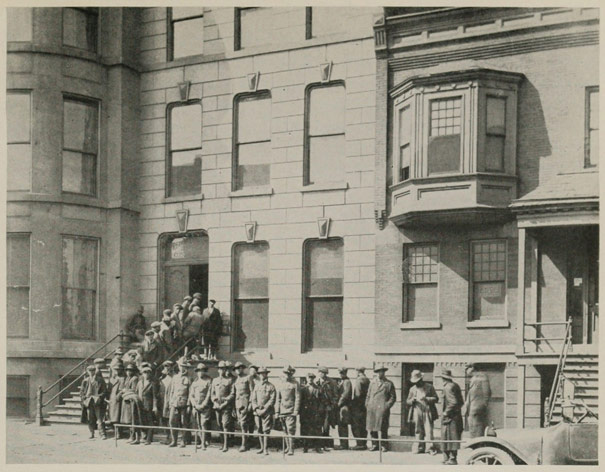
THE CHICAGO URBAN LEAGUE BUILDING Located at 3032 South Wabash Avenue.
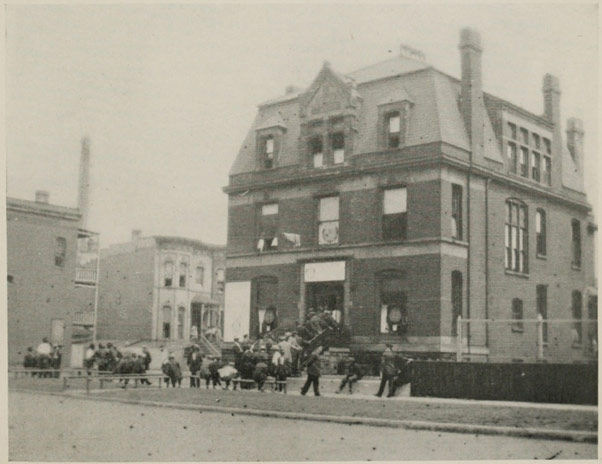
THE SOUTH SIDE COMMUNITY SERVICE BUILDING Located at 3201 South Wabash Avenue.
C. MEDICAL INSTITUTIONS
Provident Hospital and Training School.—Provident Hospital and Training School is supported and controlled by whites and Negroes. It has a mixed board of directors. Practically all its physicians and all its internes and nurses are Negroes. For the year ended June, 1919, the hospital handled 1,421 patients, served 682 persons through its dispensary, and gave free medical care to 143. Of the total number of patients in the hospital during 1919, 1,248 were Negroes, and 173 were white. Support of the institution comes from patients and donations. During 1919 the receipts from patients totaled $36,445.81; from donations $5,782.07. Donations in drugs totaled $1,505.95, and from the dispensary $112.05. The expenses for the year were $42,002.35. The hospital has an endowment fund of $47,350, invested in securities. It has a training school for Negro nurses whose faculty is made up of prominent white and Negro physicians and surgeons.
Municipal Tuberculosis Sanitarium.—The two branches of this institution which are in Negro neighborhoods, at 2950 Calumet Avenue and 4746 South Wabash Avenue, and the Children's South Side Dispensary, 705 West Forty-seventh Street, are municipal agencies so located that they are convenient for Negroes.
South Side Dispensary.—This is at 2531 South Dearborn Street and is supported by the Northwestern University Medical School. It gives free care to those unable to pay for medical services.
D. SUPPORT OF INSTITUTIONS BY NEGROES
Social agencies, although their work is limited as respects the Negro group, have for many years taken second place to the churches in self-support. This is accounted for largely by the fact that social work in general has been regarded as a philanthropic rather than a co-operative matter. With Negro social and philanthropic agencies, especially during the period of general unsettlement following the migration, the number of possible beneficiaries greatly increased, while the group of Negroes educated in giving to such agencies grew more slowly. Recently, however, support from Negroes for their own institutions has gradually been increasing. An example is found in the Urban League. In 1917 Negroes contributed $1,000 and in 1919 $3,000. During 1920 six social agencies and twenty-seven churches raised among Negroes approximately $445,000. Although Negroes contribute in some measure to agencies like the United Charities and American Red Cross, there is no means of knowing or accurately estimating the amount.