Volume 1 / Part 2 — PART II. BLUE JACKETS OF 1812
Reading edition
CHAPTER I.
THE GATHERING OF THE WAR-CLOUD. — THE REVOLUTION ENDED, BUT THE WAR FOR INDEPENDENCE YET UNFOUGHT. — OUTRAGES UPON AMERICAN SAILORS. — THE RIGHT OF SEARCH. — IMPRESSMENT. — BOYHOOD OF COMMODORE PORTER. — EARLY DAYS OF COMMODORES PERRY AND BARNEY. — BURNING A PRIVATEER. — THE EMBARGO. — WAR INEVITABLE.
n a bright November afternoon in the year 1783, the streets of New York City, bordering on the bay, were crowded with excited people, pushing and elbowing each other rudely, and all pressing down to the water-side, where was collected a huge crowd, looking anxiously across the broad waters of the noble bay, to a spot where lay anchored a large squadron of ships. The taut cordage, the trimly squared yards, and the rows of cannon protruding from the open ports made it evident to the veriest landsman that many of the ships were men-of-war; while the scarlet flags crossed by the emblem of St. George, flaunting from the peak of every vessel, declared the allegiance of the fleet to the monarch of Great Britain, against whose rule the hardy Colonists had been for years waging a warfare, now to end in victory. Between the ships and the landing-place of old Fort George, that then stood where now extends the green sward of the Battery park, a fleet of long-boats was actively plying; the long, swinging strokes of the blue-clad sailors stamping them as men-o'-war's men beyond doubt. The landing-place was thronged with troops, whose glistening muskets, scarlet coats, gold trimmings, and waving plumes contrasted beautifully with the bright blue jackets of the sailors, as file after file of the soldiers boarded the boats, and were rowed away to the waiting ships. The troops drawn up on the shore formed long lines of scarlet against the green background of the bastions of Fort George. The men standing at rest talked loudly to each other of the coming voyage, and now and again shouted fiercely at some soberly clad citizen who strolled too near the warlike ranks; for had not all the sturdy citizens of New York come down to see the hated British evacuate the city, forced out by the troops of Gen. Washington (plain Mr. Washington, the British liked to call him)? The ragged gamins scurried here and there, yelling ribald jests at the departing soldiers; and the scarlet-coated troopers had hard work keeping down their rising anger, as suggestive cries of "boiled lobsters" rose on every side. Even the staid citizens could hardly conceal their exultation, as they thought that with those soldiers departed forever the rule of Great Britain over the Colonies. It was a quaint-looking crowd that had gathered that day, at the end of the little town. The sturdy mechanics and laborers, who were most numerous, were dressed in tight leather or yellow buckskin breeches, checked shirts, and flaming red flannel jackets. Their heads were covered with rusty felt hats, cocked up at the sides into a triangular shape, and decorated with feathers or bright buckles. On their feet were heavy leathern shoes, fastened with huge brass buckles that covered the entire instep. Here and there in the crowd stood a prosperous merchant or man of fashion, whose garb, if less rough than that of his humbler fellow-citizen, was no less odd and picturesque. At first sight, an observer might think that all the men of New York were white-haired; but a closer examination would show that the natural color of the hair was hid by dense layers of white powder. The hair was done up in a short cue tied by black ribbons, and on top of all rested a three-cornered cocked hat, heavily laced with gold or silver braid. The coat was light-colored, with a profusion of silver buttons, stamped with the wearer's monogram, decorating the front. Over the shoulders hung a short cape. The knee-breeches, marvellously tight, ended at the tops of gaudy striped stockings, which in turn disappeared in the recesses of pointed shoes adorned with gleaming buckles. The broad cuffs of the coat-sleeves were heavily laden with lead, to keep them in proper position.

Derelict.
Such were the characteristics of the crowd that had assembled that day to witness the closing scene of British domination in America. Even as they stood there, they heard, faintly rising on the autumnal air, the sound of the fife and drum, as the American troops came marching down into the city, from their camp at the upper end of the island. And, as the last boat-load of grenadiers pushes off from the shore, the crowd, no longer restrained by the glittering bayonets, rushes down to the water's edge, and hurls taunts and gibes after the retreating boats, until the grizzled old soldiers curse the "Yankee rebels" fiercely, under their mustaches, and beg the officers to give them a volley.
Now the advance guard of the little American army, with fifes shrilling out the notes of "Yankee Doodle," comes marching down to the fort. No gay trappings, scarlet or gold lace about these soldiers, but ragged suits of homespun and homely flint-lock muskets, whose barrels are better burnished within than without. They march quickly to the water-front, and halt. The captain looks at the British squadron, now getting under way, and then, with true soldierly instinct, flashes a glance to the top of the flagstaff in the centre of the fort. His brow contracts, he stamps his foot, and the soldiers and citizens who have followed his glance break out into a cry of rage that rings far out over the placid waters of the bay, and makes the tough old British veterans chuckle grimly over the success of their little joke upon the Yankees; for there, high above the heads of the wrathful crowd, flaunting its scarlet folds over the roofs of the liberated city, floats proudly the British Flag.
"Tear it down!" The cry rises hoarsely from a thousand throats; and the Colonial officer springs with glittering sword to cut the halliards, but finds them cut away already, and the flag nailed to the mast. Then a trim sailor-boy works his way through the crowd, and, grasping the pole firmly, attempts to climb up, but soon slides down ingloriously over the greasy surface, freshly slushed by the British before their departure. The crowd yells in wrathful impotence; and a few hot-headed youths spring forward, axe in hand, to bring down pole and all to the earth. But the firm hand of the commanding officer restrains them. He whispers a few words into their ears; and they start briskly away, followed by a dozen or two of the steadily growing crowd.
"Gen. Washington will be here soon," says the captain; "we must get that rag down at once."
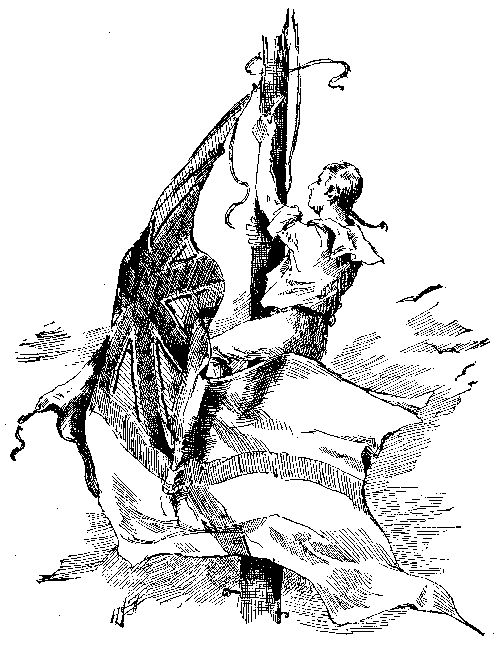
Cutting Away The Flag.
In a few minutes the messengers return. They have been to a neighboring hardware store, and startled the gray-haired old merchant so that he stared vaguely at them through his spectacles, as they fiercely demanded hammers, nails, and wooden cleats. Loaded with these, they dash back to the scene of action; and again the sailor-boy becomes the hero of the moment. With his pockets filled with cleats, and his mouth stuffed with nails, he begins again his ascent of the slippery staff. He nails cleat after cleat upon the pole, and step by step mounts toward the top. At last he reaches the flag; and, with a few quick jerks, it is torn from the pole, and thrown contemptuously out into the air, to float down upon the crowd, and be torn to pieces by curiosity seekers. Then the halliards are lowered, and soon the flag of the young and struggling nation floats in the cool breeze; while from the neighboring heights the cannon of the forts speak in deep-mouthed salvos of applause, that mingle with the rejoicings of the people, and do not cease until the ships of the enemy have passed through the Narrows, and are out of sight and hearing. The British had evacuated New York, and America had won her independence.
Not many years, however, had passed after this memorable event, when the citizens not only of New York, but the people of all the United States, began to find out that America had not won her true independence, but merely a slight relief from the oppressions of Great Britain. Already the nations of Europe were beginning to encroach upon the rights and liberties of the infant nation. For this the States were themselves greatly to blame. Nobly as they had fought in unison to throw off the yoke of Great Britain, they fell into strife among themselves as soon as the war was at an end, and by their quarrels and bickerings led all the European nations to believe that the contentious Colonies, like the Kilkenny cats, would end by destroying each other. Such a nation could command little respect, and the stronger powers were not slow to show their contempt for the United States. American vessels, coming back to port, would report that a British ship-of-war had halted them in mid-ocean, and seized American sailors as suspected British deserters. Other American ships, sailing full of hope from American ports, would never re-appear, and their fate would be a mystery, until, after many months, some sailor wandering home told of his ship's capture by a French privateer or Tripolitan war vessel. For years a debasing tribute was paid to the Bashaw of Tripoli, upon condition of his granting to American ships the privileges of the sea, that are the undoubted rights of every nation; yet even this compact was more often ignored than observed. Small wonder was it that the sage old statesman, Benjamin Franklin, on hearing a young man speak of the "glorious war for independence," responded gravely, "Say rather the war of the revolution: the war for independence is yet to be fought."
In the year 1789, the States, after much debate and bickering, finally ratified the document known as the Constitution of the United States. While the work of the American Revolution was thus being completed, and a new nation was being formed, events were transpiring on the other side of the Atlantic that were destined to affect gravely the growth of the new nation. The oppressed peasantry and laborers of France, smarting under the wrongs of centuries, rose in a mighty wave, and swept away the nobles, their masters. The royal head of King Louis fell a prey to the remorseless spirit of the guillotine, and the reign of terror in Paris began. Soon the roll of the drum was heard in every European city, and the armies of every nation were on the march for France. England was foremost in the fray; and the people of the United States, seeing their old enemy at war with the country of Lafayette, fired by generous enthusiasm, were ready to rush to the aid of their old ally. But the wise prudence of their rulers restrained them; and for the next twenty years the United States were neutrals, while all the nations of Europe were plunged in war.
The first effect of this condition of affairs was most beneficial. As neutrals, the ships of the United States could trade with all the battling peoples; while any vessel flying a European flag was sure to find an enemy somewhere on the broad seas, and suffer confiscation. While France was giving her farmers and mechanics to follow in the glorious footsteps of Napoleon, the industrious citizens of the United States were reaping a rich reward in trade with the warring nation. The farmers received the highest prices for their grain, the ingenious mechanics of New England reaped fortunes from the sale of their wares, and the shipyards were filled to their greatest capacity with the graceful frames of fast clipper vessels destined for the trade with Europe. In 1780 the shipping of the United States was confined to a few coasting-vessels, and the American flag was seldom seen beyond the Atlantic. Fifteen years later, the white sails of American ships dotted every sea, and but few European ports did not show some trim clipper floating in the harbor, bearing at her peak the stars and stripes.
From Maine to Georgia the people were building ships, and manning them. The vast forests resounded with the strokes of the woodman's axe, getting out the timber; and the seaport towns were given over to ship-wrights, who worked day and night at their craft. In New England there sprung up a race of hardy seamen. Boys of twelve or fourteen ran away to sea, made a coasting voyage or two, and, after a voyage to some European port, became captains of ocean-going ships,—often before they were twenty years of age. The people of the coastwise towns of New England can tell of hundreds of such cases. There was "Nat" Palmer of Stonington, who shipped when a boy of fourteen, and, after four years' coasting, was made second mate of the brig "Herselias," bound around Cape Horn, for seals. On his first voyage the young mate distinguished himself by discovering the South Shetland Islands, guided by the vague hints of a rival sealer, who knew of the islands, and wished them preserved for his own trade, as the seals swarm there by the hundred thousands. The discovery of these islands, and the cargo of ten thousand skins brought home by the "Herselias," made young Palmer famous; and, at the age of twenty, he was put in command of a sloop, and sent to the South Seas again. One day he found his passage in the desired direction blocked by two long islands, with a narrow opening between them. To go around the islands would have been a long voyage; and the young captain headed his craft for the opening, but soon found himself on the rocks. Luckily, the vessel backed off, and the crew set about repairing damages. While thus engaged, the great, blunt head of a whale was seen in the narrow channel; and, after blowing a column of water high in the air, the monster swam lazily through the strait. "If a whale can go through that channel, I can," quoth "Cap'n Nat." And he forthwith did so. Quick of observation, and prompt of action, the sailors of the United States became the foremost seamen of the world, and guided their little vessels over every known sea.
But the growing commerce of the United States was destined to meet a series of checks, that seemed for a time likely to destroy it forever. England, jealous of the encroachments of the Americans upon the broad seas of which she had long called herself the mistress, began a series of outrages upon American ships, and, not content with acting in open hostility, incited the piratical rulers of Tripoli and Algiers to make war upon American shipping. In this volume it is not my purpose to tell of the means adopted by England to let the swarming ships of the Barbary pirates out of the Mediterranean Sea, to prey upon the vessels of the United States; nor do I intend to tell how, after peaceful arguments had been exhausted, Decatur and Preble, with a fleet of American vessels and a handful of fighting jack-tars, crossed the ocean, and thrashed the pirates of the Mediterranean into subjection. That may well be left for future consideration, and this chapter devoted to a history of the acts of insolence and oppression on the part of England, that finally forced the United States to declare war against a power so vastly superior to them in wealth, population, and military and naval strength.
The first great and crying outrage, protested against by the statesmen, the newspapers, and the people of the United States, was the so-called right of search. By this was meant the right claimed by every British man-of-war to stop an American vessel on the high seas, muster her crew on the forecastle, and seize and carry away any sailor thought to be a native of Great Britain. This outrageous act was committed time and time again by the commanders of British frigates, who knew no easier way of filling up a short-handed crew than by stopping some passing vessel flying the stars and stripes, and taking from her the best-looking sailors of her crew. Hardly a week passed without the arrival of a ship at New York, New London, or any of the shipping towns of New England, bringing some such tale. The merchant-vessel, skimming lightly over the ocean, at peace with all the world, and with nothing to fear save the terrors of the storms, against which the sturdy mariners knew so well how to guard, would be suddenly halted by a shot from a frigate of a nation with whom the United States had no quarrel. A hail from the frigate told the American to come up into the wind, while a boat was sent aboard. Soon a long-boat filled with man-o'-war's men, and with a beardless young midshipman in the stern-sheets, came dancing over the water; and in a minute or two a lieutenant, the middy, and a few sailors clambered aboard the wondering merchantman. There was small ceremony about the proceedings then.
"Muster your men aft," quoth the middy peremptorily; "and you'd better be quick about it, too."
Perhaps the American captain protested,—they generally did,—and talked about the peace between the nations, and the protection of his flag; but his talk was usually of little avail.
"Get those man aft, and be quick about it," orders the British officer. "You've got deserters from his Majesty's service in your crew; and I'll have them. Do you want me to send the boat back for the marines?"
The American crew came aft unwillingly, grumbling, and cursing his Majesty's service under their breath, and formed a line before the boarding officer. That worthy whispered a minute or two with the boatswain and sailors who came aboard with him, and then, pointing out one man, boldly claimed him as a British subject. American captains declared that the man so chosen was generally the most ship-shape sailor aboard; and indeed it seemed but natural that the English, in filling out their crew, should choose the best. Sometimes the American captain went on board the British ship, to protest against so summary a draft upon his crew. In such a case he was usually received with courtesy by the commander, but never did he regain his kidnapped sailors. The commander trusted in every thing to his first lieutenant, who boarded the merchantman; and that officer was thus made, in the words of an English journalist, "at once accuser, witness, judge, and captor."
The men thus pressed were expected to serve with all the zeal and bravery of regularly enlisted sailors. The slightest sign of hesitation or unwillingness was met with blows. A pressed man who refused to serve was triced up, and lashed with the cat-o'-nine tails until his back was cut to ribbons, and the blood spurted at every blow. Few cared to endure such punishment twice. Yet the sailors taken from the American ships lost no opportunity for showing their desire to get out of the service into which they had been kidnapped. Desertions from ships lying near the coast were of weekly occurrence, although recaptured deserters were hanged summarily at the yard-arm. Sailors who found no chance to desert made piteous appeals to the American consuls in the ports at which they stopped, or wrote letters to their friends at home, begging that something should be done to release them from their enforced service. It was not the severity of man-o'-war discipline that so troubled the poor fellows; many of them were old man-o'-war's men, and all would have been glad of berths in the United States navy; but the sight of the red flag of Great Britain waving above their heads, and the thought that they were serving a nation with which their country had just fought a bloody war, were intolerable.
One "pressed man," on a British ship lying in the West Indies, managed to write the following letter to a newspaper editor in New York, and, after much planning, succeeded in mailing it.
Port Royal, Jamaica, June 30, 1811.
Mr. Snowden,—I hope you will be so good as to publish these few lines. I, Edwin Bouldin, was impressed out of the barque "Columbus" of Elizabeth City, and was carried on board his Britannic Majesty's brig "Rhodian," in Montego Bay, commanded by Capt. Mowbary. He told me my protection was of no consequence, and he would have me whether or not. I was born in Baltimore, and served my time with Messrs. Smith & Buchanan. I hope my friends will do something for me to get my clearance; for I do not like to serve any other country but my own, which I am willing to serve. I am now captain of the forecastle, and stationed captain of a gun in the waist. I am treated very ill, because I will not enter. They request of me to go on board my country's ships to list men, which I refused to do, and was threatened to be punished for it.
I remain a true citizen of the United States
EDWIN BOULDIN.
Pathetic letters such as this appear often in the columns of the newspapers published in the early part of this century; and are usually accompanied by petitions from the relatives and friends of the pressed man, begging that Congress take some action to secure American sailors from such outrages. But year after year the practice went on, and higher and higher grew the enmity between England and the United States. Among the sailors who suffered impressment at the hands of the British were many who afterward in the naval battles of the ensuing war won ample revenge from the nation that had so abused their liberties.
Most prominent of all these men was David Porter, who, from the humble station of a cabin boy on his father's ship in 1796, rose in twenty years to be commodore in the United States navy. The name of Porter is one famous in the naval annals of the United States; and probably there never existed a family in which the love for the life of a fighting jack-tar was so strong as among these representative American sailors. David Porter, sen., and Samuel Porter served the American Colonies dashingly upon the sea in the Revolution. Of David Porter, jun., we shall have much to say in this volume. Of his children the eldest, William D., rose to the post of commodore, United States navy, and died of wounds received in the civil war; Henry O. Porter was first lieutenant of the "Hatteras" when she sunk before the fire of the Confederate ship "Alabama;" Thomas Porter served in the Mexican navy; Hambleton Porter died of yellow-fever while a midshipman in the United States navy; Lieut. Theodoric Porter, U.S.A., was the first officer killed in the Mexican war; and Admiral David D. Porter, U.S.N., by virtue of his exploits on blue water and in the ditches and bayous back of Vicksburg during the civil war, now stands at the head of living naval officers.
But to return to David Porter. He was sixteen years old, when, in 1796, his father, having obtained command of a vessel in the West India trade, determined to take the lad to sea, that he might learn the profession of his ancestors. It was hardly a favorable time to inspire an independent boy with admiration for the life of an American merchant sailor. The United States had no navy to protect its merchant ships; and the British cruisers that scoured the ocean felt little hesitation about boarding the ships of the infant nation, and kidnapping such sailors as they might desire. Of this young Porter soon had evidence. While his ship, the "Eliza," was lying in the port of Jeremie in San Domingo, a British frigate came into the harbor, and dropped anchor near by. One morning the lookout on the "Eliza" saw a boat, manned by armed men, put off from the frigate, and steer for the American merchantman. The movement was quickly reported to Capt. Porter, who was too old a seaman not to know what it portended, and too plucky an American to submit willingly to any indignity. His preparations were quickly made; and by the time the frigate's boat came alongside, the crew of the "Eliza" were armed and ready to rush to the deck at the first alarm. Capt. Porter with his officers and son stood on the quarter-deck, and awaited with great dignity the arrival of the boat. Soon the British came alongside; and an officer in the stern-sheets announced that he was about to board the "Eliza," and demanded to search the vessels for deserters from the British service.
Capt. Porter replied that his was an American ship, and the British might board at their peril; for he was armed, and would resist the boarders to the last extremity. A great laugh went up from the boat alongside. A Yankee merchantman to resist British sailors, indeed! And the officer, without more ado, ordered his men to board. Hardly had the order passed his lips, than Porter's clear voice rang out, "Repel boarders!" and the crew of the "Eliza," armed with pikes and muskets, rushed upon their assailants, and drove them into the sea. Young Porter was not behindhand in the fight, but lent his boyish aid to the vindication of American sailors' rights. One man was shot down by his side; and Porter received his first baptism of blood in this encounter, which thus early rooted in his mind a detestation for the arrogance of the British, and a determination to devote his life to the cause of his seafaring countrymen.
On his second voyage, a year later, young Porter was destined to experience still further the hardships and ignominy which American sailors only too often encountered at the hands of the British. Once again the boy, now a first officer, was walking the deck of his vessel in a San Domingo port, when a boat's-crew from a British frigate came on board on the usual errand of impressment. This time the sturdy, independent spirit of the elder Porter was absent; and the captain of the American vessel basely permitted a portion of his crew, among whom was Porter, to be carried aboard the frigate, where they were to be kept until they agreed to enlist. Loaded with irons, they were thrust into "the brig," or guard-room of the frigate; but, though the case seemed hopeless, Porter gallantly refused to enter the king's service, and ceaselessly exhorted his comrades to stand firm against the commands of the British. Days passed, and still the frigate's crew was in no wise increased from among the obstinate Americans. The British captain lost patience, and commanded that all the prisoners be brought out on deck, triced up, and publicly flogged with the cat-of-nine tails, for "the bad example they set the crew of his Majesty's ship." The order was duly put into execution. The prisoners, still ironed, were brought up under a heavy guard, and taken to the gratings; but when young Porter reached the deck, and saw the ignominious punishment in store for him, he fought desperately with his guards, and, finally breaking away, ran below, and hid in some corner of the hold, from which the most careful search failed to dislodge him. The captain finally gave orders to leave him alone, saying, "He'll come out fast enough when he gets hungry." But the lad did not wait for hunger to drive him from his hiding-place. That very night he came from the hold, crawled stealthily across the deck, and dropped into the water, regardless of the sharks that abound in those tropic seas. A short swim took him to a Danish vessel, by which he was carried across the Atlantic. Only after many months of voyaging as a common sailor did the lad succeed in working his way back to his home.
Even this experience could not deter the young seaman from again seeking employment upon the billowy main, and for the third time he shipped upon an American merchantman. Again his course lay toward the West Indies, and again he was intercepted by the inevitable man-of-war. This time he was not so fortunate as to escape until after a month or more of captivity, during which time he was treated with the greatest cruelty on account of his persistent refusal to serve under any flag save that of his own country. At last he made his escape, and reached home. By this time he was naturally somewhat disgusted with the life of a sailor on an American merchant-vessel; and he cast about for an appointment to the navy, which he soon received. It is impossible to doubt that his three adventures with the British press-gang had much to do with the ardor and bravery with which in later days the young sailor, then elevated to the highest ranks, did battle with the enemies of his country. When, at the close of the War of 1812, the veteran naval officer looked back upon his record during that conflict, he could point to one captured British man-of-war and scores of captured British merchantmen as the measure of his retaliation for the wrongs done him as a defenceless American sailor-boy.
Oliver Hazard Perry, of whose famous victory over the British on Lake Erie we shall speak later, also was brought into conflict with the British in the days of the "right of search." His father, Christopher Raymond Perry, in command of the United States ship "Gen. Greene," was escorting an American brig freighted with a valuable cargo. Near Gibraltar they were sighted by a British man-of-war, which bore down quickly upon the two ships. Perry was an old and cautious naval officer; and, though peace reigned between his country and Great Britain, he no sooner saw an armed vessel approaching, than he put his vessel in trim for action, and sent the crew to the guns. Nearer and nearer came the great English man-o'-war; and, as she came within range, a puff of smoke burst from her bow-port, and a ball skipped along the water before Perry's unarmed convoy, conveying a forcible invitation to heave to. Perry at once made signal to his convoy to pay no regard to the Englishman; and, setting the American flag, the two ships continued on their way. But at this moment the breeze died away, and all three ships lay becalmed within easy range of each other. The British captain was not slow to take advantage of this; and a boat soon put off from his ship, and made for the American brig. This move Perry promptly checked by a shot from the "Gen. Greene," which so narrowly missed the boat that the crew thought it well to run alongside the American man-o'-war, and arrange the matter peaceably. As the boat came alongside the "Gen. Greene," the gangway was manned, and the British officer escorted with the greatest formality to Perry's presence.
He at once stated his purpose in attempting to board the merchantman; claiming that, by virtue of the right of search, he was entitled to visit the brig, and examine into the nationality of her crew.
"I deny the existence of any right, on the part of British vessels, to search any American vessel, except with the consent of the American commander," responded Perry; "and my shot was intended to warn you that you had received no such permission."
By this time the British vessel had come within hailing distance of the "Gen. Greene;" and the captain demanded why his boat had been fired upon, and was now detained. Perry responded in the same words with which he had answered the boarding-officer.
"It's a most surprising thing," shouted the Englishman, losing his temper, "if a British seventy-four-gun ship cannot search a pitiful little Yankee merchantman."
"By Heaven!" responded Perry. "If you were a ship of the first rate, you should not do it, to the dishonor of my flag." And in an instant the ports of the "Gen. Greene" were triced up, and the British captain saw that his adversary was prepared for battle. After a moment's thought, he abandoned all attempts at violence, and sent a courteous letter to Perry, begging leave to visit the brig in search of British deserters, which request Perry as courteously granted.
To this list of American seamen who suffered indignities at the hands of the British, and afterwards won reparation from their enemies in the War of 1812, may be added the name of Joshua Barney. Few Americans have given to their country a longer service or more efficient aid than he. In the little Colonial navy of the Revolution, he held high rank, and won the plaudits of older sailors. At the close of the Revolution, he served for a time in the merchant-marine; then entered the naval service of France, and, at the first news of war between England and America, returned to his country, to enlist under the stars and stripes. It was while he was in command of a merchantman that he was brought into collision with the British in a way that well might make the doughty old sea-dog doubt if the Revolutionary days, when he suffered in the noisome confines of Mill Prison, had not come again.
It was in the summer of 1793, that the good ship "Sampson," two days out from Cape François, West Indies, was slowly making her way northward, over the tropic seas, and under the glaring rays of the summer sun of the torrid zone. Capt. Barney and his crew were ever on the watch for danger; for, in addition to the hurricanes and typhoons common to the equatorial latitudes, much was to be feared from the lawless British privateers that then swarmed in the West Indies and Bermudas. That the "Sampson" was under the flag of a neutral power, was but little protection; for the commanders of the semi-piratical craft cared little for international law or for justice. War was raging between France and England; and a mere suspicion of traffic with French colonies was enough, in the eyes of these worthies, to condemn a vessel of any nationality.
Knowing his danger, Capt. Barney strove to avoid the localities frequented by the privateers, but to no avail. One bright morning, the lookout reported three sail in sight from the masthead, and in a few hours Barney found himself hemmed in by privateers. Three officers boarded him, and began a rigid examination of the cargo and papers. Two finally expressed themselves as satisfied of the neutral character of the vessel; but the third exclaimed that he had discovered in the cabin an iron chest, full of money, which surely proved that the "Sampson" had something to do with the French, for "no blasted Yankee ever had iron chests or dollars on board his vessel!" Such conclusive proof as this could not be overlooked by the sapient privateers; and, after a little consultation, they informed Capt. Barney that they would let the ship go, if the money were given to them. As it amounted to eighteen thousand dollars, Capt. Barney looked upon this demand as nothing short of robbery, and indignantly refused to consider it; whereupon his captors took from the "Sampson" all her crew except the carpenter, boatswain, and cook, sent a prize-crew aboard, and ordered that she be taken to New Providence, a British naval station. The privateers were soon hull down on the horizon; and Barney found himself a prisoner on his own ship, exposed to ceaseless insolence from the British prize-master.
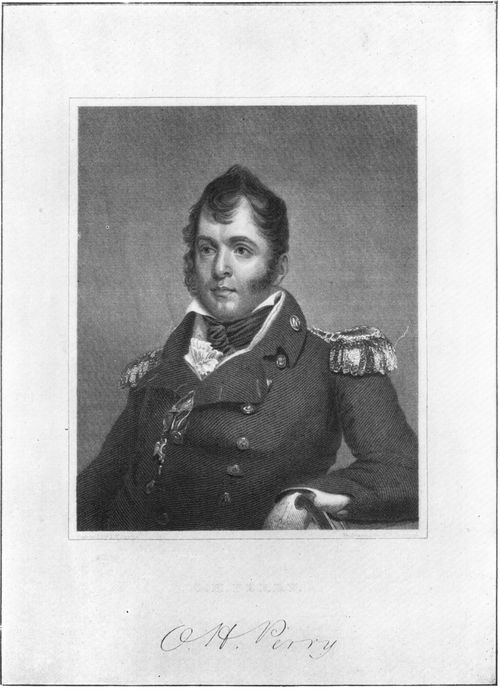
Commodore Perry.
Several days passed, as the "Sampson" lay becalmed in the tropics. Barney, though too old a sailor to be cast down by misfortune, nevertheless chafed under his situation. From prize-master and prize-crew he received nothing but scurrilous epithets; and the oft-repeated murmurs of "Rebel rascal!" "Yankee traitor!" "Blow out his brains!" and "Throw him overboard!" made it hard for him to believe the Revolution over, and the United States and England at peace. Even while they thus abused the captain, the rogues were feasting upon his provisions and drinking his wines; and only his firm refusal to give up his keys prevented their rifling his iron chest, and filling their pockets with his dollars. At last he began to feel that his life was no longer safe in the hands of his captors; and, though he had by him but three men of his original crew, he determined to attempt to recapture the ship.
One evening the captain managed to catch a few minutes' conversation with the carpenter and boatswain of his own crew, and broached to them the project for a recapture. No argument was needed to induce these bold men to embark in the perilous enterprise. Indeed, from the very moment of the capture, they must have cherished some such purpose; for each had hidden away in his bunk a gun and bayonet. Barney, on his part, had secreted a small brass blunderbuss and a broad-sword; and with this meagre armament the three determined to take the ship from its captors.
The success of the project then depended upon a favorable opportunity, and the three conspirators watched eagerly for the decisive moment to arrive. At last there came a day so squally that all the prize-crew were kept busy with the sails all the morning. Much exhausted, the sailors sat down to their dinner on the forecastle at noon, while the three British officers spread their mess amidships. Barney saw that the moment had arrived; and, giving the signal to his men, the plotters went below for their weapons. Barney was the first to re-appear,—the blunderbuss, loaded and cocked, in his hand, and the naked cutlass under his arm. Hardly had he stepped on deck when one of the officers saw him, and, throwing down dishes and dinner, sprang at the American and grappled with him. Barney struggled violently, and soon managing to get the blunderbuss against his enemy's shoulder, fired it, filling the wretch's arm and side with buckshot. Freed from his adversary, the gallant captain cut down with a blow of his cutlass the second prize officer, who was advancing upon him; and the third, seeing his two companions lying, drenched with blood, upon the deck, ran below. In the mean time the crew, startled from their dinner by the report of the blunderbuss, had rushed below for their weapons; but the last man had hardly dived down the hatchway when the wily carpenter and boatswain rushed forward, clapped on the hatches, and in a trice had the British sailors nicely cooped up in the forecastle. The two wounded officers were quickly cared for, and the unhurt fugitive secured; and Barney found himself again in control of the ship.
The victors then held a consultation as to their future action. They controlled the ship, it was true; but what were three men to do with a full-rigged ship on the stormy Atlantic? Clearly they must get aid from their captives, or all might go to the bottom together. Accordingly the three, with loaded weapons, went forward, and standing at the hatchway, proposed terms to the imprisoned sailors below. Capt. Barney acted as spokesman.
"You shall be released from confinement," cried he to the captives, "and may now come on deck one at a time, each one bringing his weapons with him."
The hatches were then thrown back, and the carpenter and boatswain stood with cutlasses and muskets ready to cut down the first who should make an offensive movement. The British saw the preparations for their reception, and came up one at a time as ordered. As each came up, his arms were seized and thrown overboard; and a gruff order given for him to go forward. Before long the crew, deprived of all means of resistance, were gathered on the forecastle. Barney then retired to the quarter-deck, and ordered that the crew be mustered before him.
"You are now my prisoners," said he; "and I have not only the power, but the right, to hang every man jack of you. You seized this vessel without any just cause, and simply because you were the stronger; and you have further used that strength to abuse and ill-treat me and waste my property. I do not propose to execute you, but will give you the choice of two alternatives. You may either stay with me and work this ship to Baltimore, there to be discharged with wages; or I will give you a small boat with provisions, and set you adrift to shift for yourselves. One condition I attach to the first alternative. If one of you is seen talking with his former officers, or if one man steps abaft the main-mast, he shall be instantly shot."
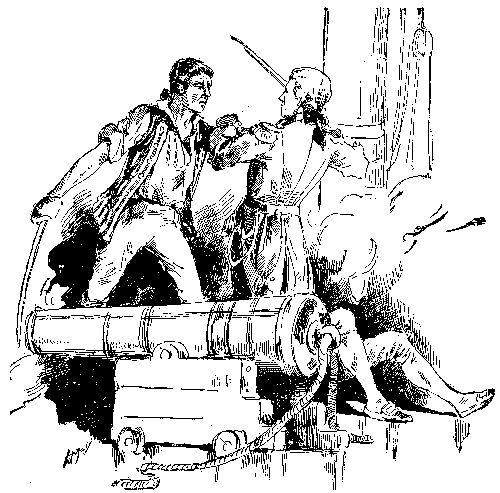
Barney Regains His Ship.
The crew wasted no time in deliberation, but decided to stay with the ship, and at once went forward on duty. Then began a fortnight of ceaseless watchfulness and grave anxiety for Capt. Barney. At night he never closed his eyes, but took his sleep by day in an armchair on deck, his blunderbuss and cutlass by his side, and a sentinel ready to awaken him at the slightest alarm. At last, however, he brought his ship safely to Baltimore, and discharged his crew. But the memory of that month of violence remained with him; and we shall hear of him again as a brave sailor in the service of the United States, and an uncompromising foe to England.
Among the most adventurous of American merchant seamen in the days following the Revolution was Capt. Thomas Macdonough. Like others of his class, his daring and ability as a navigator gained him a commission in the very small American navy of that time. On one occasion the United States ship "Siren," of which he was first lieutenant, was lying at anchor in the harbor of Gibraltar, surrounded by a number of merchantmen, from the peak of one of which floated the stars and stripes. While pacing the deck one bright afternoon, Macdonough observed a boat manned with armed men put off from a British man-of-war that rode at anchor a mile away. At once his suspicions were aroused, and with a strong glass he watched the movements of the British. As he had expected, the boat steered straight for the American merchantman; and through his glass Macdonough could see the boarders scramble over the bulwarks of the vessel, and soon thereafter return to their boat, taking with them a man dressed in the garb of a merchant seaman, and tightly bound.
The captain of the "Siren" was on shore; and Macdonough, as the officer in command, determined that so audacious an impressment should not succeed under the guns of an American war-vessel, small though she might be.
"Clear away the long-boat," he shouted; and the boat quickly was lowered to the water, and a dozen jackies grasped the oars. Macdonough sprung into the stern-sheets, and grasped the tiller.
"Let fall! Give way! Pull hard, men!" He gave the orders in quick succession, and laid his course straight for the British boat, which was soon overtaken. He laid his boat alongside the British cutter, and demanded that the captive be given up. The English officer began to protest, but Macdonough cut his protests short.
"You have no right to that man. He is an American sailor.—Tumble in here, my man."
The pressed man, delighted with the prospect of rescue, sprang into the American boat; and before the British officer had recovered from his amazement sufficiently to offer resistance, the blue-jackets were pulling away toward the "Siren," with the long, swinging, man-o'-war stroke. When he reached his vessel, Macdonough retired to his cabin to await further developments, which were not long in appearing.
"Boat from the British frigate heading for the ship, sir," reported the officer of the deck, in a few minutes.
"Very good, sir. Have the gangway manned," returned the lieutenant.
The boat was soon alongside; and the British captain, white with rage, leaped to the gangway, and was shown to Lieut. Macdonough's cabin.
"How dare you take a man from a boat of his Majesty's ship, sir?" was his salutation.
"'Dare' is not a word to be spoken to an officer of the United States navy," responded Macdonough. "As for the man, he is a citizen of the United States; and I propose to protect him, at all hazards."
"I'll bring my frigate alongside, and sink your beggarly little craft," shouted the visitor, with a volley of oaths.
"That you may do," responded the American; "but while she swims, the man you shall not have."
"You are a hair-brained young fellow, and will repent this rashness," cried the irate Briton. "Do you mean to say, that, if I had been in that boat, you would have dared to commit such an act?"
"I should have made the attempt, sir, at all hazards."
"What, sir!" shouted the captain, greatly enraged, "would you venture to interfere, if I should now impress men from that brig?"
"You have but to try it, sir," was the pithy response. And the British captain returned to his frigate, vowing all sorts of vengeance, but nevertheless did not again annoy the American ship.
While the popular clamor against the hateful right of search was still at its height in America, Great Britain unwisely added yet another outrage to the already long list of grievances complained of by the Americans. Notwithstanding the danger of Barbary pirates and British impressment, the merchants of the United States were carrying on a thriving trade with France. England, then at war with the great Napoleon, looked upon this commerce at first with disfavor, and finally with such intense hatred that she determined to put an end to it altogether. Accordingly, she issued the celebrated "Orders in Council," forbidding all traffic with French ports. For such action the imperious nation had no authority by any principle of international law. Her blockade of the French ports was very imperfect, and easily evaded. It is a perfectly well-established principle of the common law of nations that a blockade, to be legal, must be complete and effective; otherwise, it is known as a "paper blockade," and neutral vessels are justified in attempting to evade it. Instead of posting blockading vessels at the entrances of French ports, to warn off all vessels, Great Britain contented herself with licensing hordes of privateers, that roamed the seas and snapped up vessels with little regard to law or justice. Hundreds of American vessels were thus captured; for our trade with France and the French West Indian colonies at that time was of vast proportions. The ocean soon became so infested with privateers that every American merchantman carried cannon, and an array of small-arms that would have done credit to a sloop-of-war. The New England sailors became able naval fighters, as well as experienced seamen; for a man shipping for a voyage knew well that, in addition to battling with the angry elements, he might be required to sight truly the great "long Tom," or beat back piratical boarders at the muzzle of the muskets. But even these heroic remedies could not save many a good ship.
Occurrences such as these fanned into flaming fury the smouldering fires of the American hatred for Great Britain. The people saw their old oppressor and enemy engaged in war with their old ally France, and the popular cry went up for a union of France and the United States against England. Happily, the statesmen of the time—Washington, Hamilton, and Jay—were too firm of purpose, and too clear-sighted, to be led away by popular clamor; and they wisely kept the United States Government in a position of neutrality between the two nations. Deep and loud were the murmurs of the people at this action. Could true-hearted Americans desert their friends in such a manner? Never! And so, whatever might be the policy of the rulers, the many-headed people welcomed French ambassadors, fêted the officers of visiting men-of-war, and hung the tricolor and the stars and stripes side by side on all public holidays.
It was in 1795, while the popular affection for France was at its height, that a merchant-vessel flying the British flag sailed into Boston Harbor, and made fast to the Long Wharf. Under her stern appeared the legend, "The Betsy of St. Croix;" her decks were littered with poultry and domestic animals, her cordage flapped loosely in the breeze, and every thing about her bespoke the merchant-vessel. Her captain, being hailed by the dock-loafers, and made the victim of the proverbial Yankee inquisitiveness, stated that he had just come from the West Indies with a load of lignum-vitæ, pineapples, and hides, which he hoped to sell in Boston. The self-constituted investigating committee seemed satisfied, and the captain strolled on into the city.
But the French consul at Boston was far from satisfied, and he took care to let his suspicions become generally known. "That innocent-looking merchantman is a British privateer," quoth he; "and it's a shame to harbor her in the good port of Boston, amid French-loving people." The consul's words spread like wildfire; and his suspicions soon passed for facts, without any supporting proof. No one knows who was the writer, or who the printer; but in a few hours the people upon the streets had thrust into their hands the following handbill:—
THIS NIGHT
Will be performed at the steps bottom of Long Wharf
A COMEDY
of stripping the
BERMUDIAN PRIVATEER.
CITIZENS. Remember there have been near three hundred of our American vessels taken by these Bermudians, and have received the most barbarous treatment from those Damn'd PIRATES!!!
Now, Americans, if you feel the spirit of resentment or revenge kindling in your hearts, let us be united in the cause.
This was enough to rouse the turbulent people of Boston to action. They well remembered the winter's night, twenty-two years before, when their harbor was the scene of the first protest against the oppression of Great Britain. Then they threw overboard the tea, and spared the ships; this time ship and cargo alike should be destroyed. When night fell, small bodies of men could be seen marching down to the wharfs, through the narrow, crooked streets of the old town. Before eight o'clock Long Wharf was crowded with an angry mob. On the deck of the threatened vessel stood the captain, arguing and pleading with the crowd, and at times pointing to the scarlet flag above his head, and threatening his assailants with the wrath of mighty England. Argument, entreaty, and threats proved unavailing; and the crowd, gaining courage with numbers, rushed upon the vessel, and ordered captain and crew ashore. Leaving the scene, the captain rushed wildly into the city in search of the British consul; and, in his absence, the mob began to search his ship. An active and careful search soon brought to light in an out-of-the-way corner of the hold two swivel-guns, two three-pounders, forty charges of shot, fifteen pounds of powder, and eight muskets. All was piled upon the deck, and pointed out to the captain on his return, amid frantic yells from the enraged populace. He solemnly protested that the ordnance was only intended for purposes of defence against the pirates that infested the Bermudas. But the case was already judged. The people laughed at the captain's declarations; and in a few minutes the "Betsy," a mass of flame, was drifting across the harbor to the Charlestown beach. There she blazed away, while the crowd watched the bonfire from the dock, until the last timbers of the ship fell with a hiss into the black waters, and all was dark again.
Popular sympathy is at best but an unstable sentiment, and so it proved with this unreasoning affection of the American people for France. Firmly the American authorities held to their policy of neutrality, refusing to be influenced in the slightest degree by the popular clamor of the people for an alliance with France. Then the French sympathizers made their fatal error. In the presidential chair of the United States sat Washington, the hero of the Revolution. Rashly the French minister and his following began an onslaught upon this great and wise man, because of his firm determination to keep the United States neutral. They accused him of being an "aristocrat;" of wishing to found an hereditary monarchy, with himself at the head. No epithet was too vile for them to apply to him: "liar" and "traitor" were terms freely applied to him whom we regard as the veritable founder of our free Republic. Such intemperate and unreasoning malice as this had a very different effect from what was intended by the French sympathizers, or Republicans as the party was then termed. The party supporting the President gained strength and influence, even while the actions of Napoleon and the French Chamber of Deputies were giving American seamen the same grounds of complaint as those which Great Britain had so long forced upon them.
It was during the last year of the administration of Washington, that the French Directory issued secret orders to the commanders of all French men-of-war, directing them to treat neutral vessels in the same manner as they had suffered the English to treat them. The cunning intent of this order is apparent by its wording: "Treat American vessels as they suffer themselves to be treated by the British." What course does that leave open to the Americans, save to resist the British, thereby become involved in a war, and so aid France? But there was one other alternative; and, much to the surprise and chagrin of the French, the Americans adopted it. And the only effect of the diplomatic secret order was to embroil France in a naval war with the United States.
The condition of American commerce, after the promulgation of the French decree, became deplorable indeed. A merchant-vessel flying the American flag was never safe unless under the guns of an American war-vessel; and the reduction of the navy had made these few indeed. Should the brig "Nancy" or "Sarah Jane" put out from the little port of Salem or New London, she was certain to be overhauled by some British frigate, whose boarding officer would pick from the brig's crew a few able sailors, and leave her to make her way short-handed as best she might. Next would come along some French frigate or privateer,—some "Terreur," "Incroyable," or "Insurgente,"—whose astute officers would quickly notice the gaps in the American crew, and, finding out that the brig had been boarded by the English, would declare her a prize for having given aid to the enemies of la belle France. Should the little brig be so fortunate as to escape the civilized belligerents, there were still the pirates of Tripoli, the picaroons of the French West Indies, and the unauthorized and irresponsible pirates, who, with forged commissions and flying the Spanish or Portuguese colors, ravaged the seas in all directions. The career of an American merchantman at that time is admirably told by our great novelist Fenimore Cooper in his sea-tale of "Miles Wallingford." The fate of the good brig "Dawn" was the fate of too many an American vessel in those turbulent times; and the wondrous literary art with which the novelist has expanded the meagre records of the times into an historical novel of surpassing interest makes an acquaintance with the book essential to a proper knowledge of American naval history.
The first act of retaliation on the part of the United States was the embargo ordered by Congress, which prohibited any vessel from leaving American ports. This action had two effects. It quickly brought about great distress in European countries, which even then relied much on the United States for food. This was the chief object of the embargo. The second effect was inevitable. The sudden check upon all foreign commerce plunged business in all parts of the United States into stagnation. Sailors out of work thronged the streets of the seaport towns. Farmers trudged weary miles beside their ox-teams, only to find, when they had hauled their produce to town, that there was no market for it. Along the docks the ships lay idly tugging at their cables, or stranded on the flats as the tide went out. Merchants discharged their clerks, and great warehouses were locked up and deserted. For nearly a year the ports were closed, and commerce thus languished. Then Congress substituted for the embargo the Non-intercourse Act, which simply prohibited commerce with France and England; and again the American flag appeared upon the ocean. But the two warring nations had learned neither wisdom nor justice, and began again their depredations upon the unoffending Americans. Envoys were sent to France to protest against the outrageous action of that nation; but they were told that no audience could be granted them, unless they paid into the French treasury two hundred and forty thousand dollars. This last insult was too great. The envoys returned home, told of their treatment, and the war party in the United States rallied to the defence of their nation's honor, shouting Pinckney's noble sentiment, "Millions for defence, but not one cent for tribute."[Back to Content]
CHAPTER II.
WAR WITH FRANCE. — THE BUILDING OF A NAVY. — FIRST SUCCESS FOR THE AMERICANS. — CUTTING OUT THE "SANDWICH." — THE "CONSTELLATION" AND "L'INSURGENTE." — THE "CONSTELLATION" AND "LA VENGEANCE."
hile France and England were waging a desperate and bloody war, the United States was like a shuttlecock, being struck repeatedly by the diplomatic battledores of each nation. Between the British "Orders in Council" and the French "Milan Decree," American commerce was in a fair way of being obliterated. To declare war against both nations, would have been absurd in so young a people; and for months, and even years, the fierce contests of political parties in the United States made a declaration of war against either aggressor impracticable. Now the Franco-maniacs were in the ascendency, and the country rang with praises of France,—the nation which had cast off aristocrats, and, like America, was devoted to republican principles; the nation which had aided the Colonies in their war for freedom. What though a French privateer did occasionally seize an American ship? The Americans alone were to blame for that; for was not their attitude toward England, their natural foe, enough to inflame the French? And were not the British aggressions more oppressive than those of France? War there must be, but let it be declared against the hated British.

Such were the sentiments of the French sympathizers, or Democrats as they were then termed in political parlance. But the English sympathizers, or Federalists, held very different opinions. They made no attempt to excuse the offensive attitude assumed by England, but claimed that so soon as her war with France was over she would admit the injustice of her actions, and make due reparation for the injuries she had heaped upon American commerce. But they pointed out that for one vessel taken by England, ten were seized by French privateers, or piratical vessels of nondescript nationality, but bearing French papers. As for France loving republican principles, her republicanism was founded upon blood and the guillotine. She was no longer the nation that had aided the struggling Colonies. She was the nation that had foully murdered the kind king who had lent that aid two decades before. Besides these arguments, the Federalists did not scruple to hint, that, in a second war with England, the United States might lose the independence so recently won, while the navy of France was not so greatly to be dreaded.
Indeed, the American people of that day might well be excused for lethargy in resenting the insults of any first-class naval power. It is not too strong a statement, to say that at this time, when the need was greatest, the United States had no navy. At the close of the Revolution, the navy had been disbanded, the ships sold, and the officers dispersed among the vessels of the merchant marine. This fact alone is enough to account for the depredations of French, English, Portuguese, Tripolitans, and the hordes of pirates without a country. Is there no lesson in this? From this lesson of history cannot we deduce the rule that a nation with 6,000 miles of seacoast, a republic hated by all monarchies, must maintain its sea-power if it would maintain its honor? The naval regeneration begun in 1893 ought not to be checked until the United States ranks next to Great Britain as a naval power.
But the depredations of the enemies of American commerce at last reached such a point that Congress could no longer overlook the necessity for an American navy. In March, 1794, Congress, after listening to a message from the President detailing the depredations of the Algerines, passed an Act authorizing the construction or purchase of six frigates, or an equivalent naval force. This was the beginning of the present United States navy; for some of the frigates built under that law are still afloat, although no longer exposed to the rude shocks of battle or the still more violent onslaughts of the mighty ocean.
In accordance with the law, the frames of six frigates were quickly laid upon the stocks at six different shipyards; and even while the ribs were yet uncovered, commanders were selected for the unbuilt ships. The names of ships and officers alike are famous in American annals, and may well be mentioned here. The "Constitution," "President," "United States," "Chesapeake," "Constellation," and "Congress" were the vessels begun at this time; and the rolls of no navy of the world ever bore six more famous names. The captains chosen were John Barry, Samuel Nicholson, Silas Talbot, Joshua Barney, Richard Dale, and Thomas Truxton. Of these, all save Truxton had served the Colonies in the Revolution. Barney narrowly escaped being totally disowned by his country, because while holding a commission in the French navy he had once accidentally hoisted the American flag upside down. A cry went up from his enemies, that it was an intentional insult to the country; but his friends, with justice, pleaded that the flag had been wet, and a sailor, running it up to dry, had thus carelessly inverted it.
In the mean time the building of the ships went merrily on, until, when they were nearly finished, a disgraceful treaty was made with Algiers, and work on the new navy was neglected, and three of the unfinished ships sold. But in 1797 the French depredations became so unbearable that work was hastened; and cities and towns, not satisfied with the three frigates provided for, began collecting subscriptions for the purchase of ships, to be presented to the Government. The first of the frigates building by the Government to reach the water was the "United States." As the first vessel built by the United States under the Constitution, her launch was an event to be celebrated. At noon on the bright May afternoon chosen, the streets of Philadelphia leading to the ship-yard, where the hull of the great frigate lay upon the stocks, were thronged with holiday-making people. The sun had hardly risen, when anxious spectators began to seize upon the best points of observation about the ship-yard. The hour of the launch was set at one P.M.; and for hours before the crowd of watchers sung patriotic songs, cheered for Congress and the new navy, and anxiously debated the chances of a successful launch. The river was covered with pleasure-craft, decked with flags, and bright with the gay dresses of ladies. The great frigate, too, was a mass of bunting from stem to stern. At one precisely, the blows of many hammers were heard knocking out the blocks; and, after a moment's trembling pause, the first United States frigate glided swiftly into the water, and, after a graceful dip, rode buoyantly on the placid surface of the Delaware.
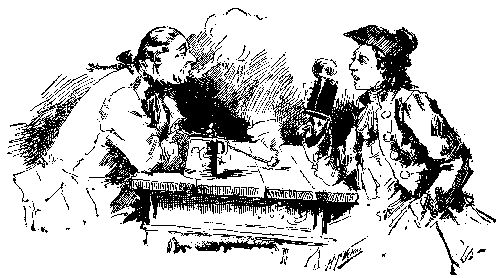
Toasting The Wooden Walls Of Columbia.
While the ships were building, the war-feeling against France was steadily growing, and the enthusiasm of the people over the infant navy knew no bounds. Toasts to the "wooden walls of Columbia," and the "rising navy of America," were drunk with cheers at stately public banquets, and by bands of jolly roisterers at tap-houses. The patriotic song writer invaded the columns of the newspapers; and, as these could not afford space for all the poetic effusions, they were printed on broadsides, and hawked about the streets. At Harvard College the students made the chapel walls ring with the ode written by Joseph Story:—
"Shall Gallia's clan our coast invade, With hellish outrage scourge the main, Insult our nation's neutral trade, And we not dare our rights maintain? Rise, united Harvard's band, Rise, the bulwark of our land."
Admirable as may be the patriotism of this ode, the poetry is not above criticism; but it is classic in comparison with many others. The following stanza and chorus will show the character of one of the most popular street-songs of the day:—
"Americans, then fly to arms, And learn the way to use 'em. If each man fights to 'fend his rights, The French can't long abuse 'em.
Yankee Doodle (mind the tune), Yankee Doodle Dandy; For the French there's trouble brewin': We'll spank 'em, hand and handy."
From Maine to Georgia the mania for writing such doggerel spread with a rapidity only equalled by the avidity with which the people seized upon the songs, and sung them. A complete collection of these remarkable efforts of poetic art would form an amusing volume, and from it alone a history of political movements in the United States might be written. That even such wretched doggerel had its effect upon popular sentiment, cannot be doubted; for has it not been said, "I care not who makes the laws of a nation, let me but write its songs"?
But the manifestation of the growing ill-feeling towards France was not confined to poor but harmless poetizing. The first open rupture took place at Savannah. In the port of that city were lying two long, rakish schooners flying the French tricolor. Their decks were crowded with men, whose rough actions and brutal countenances showed them to be no respecters of law or order. It did not need the rows of cannon protruding from the ports, nor the carefully covered "long Toms" amidships, to indicate to the good people of Savannah that their harbor sheltered two French privateers. Among the seafaring people of the city, the sight of these two vessels aroused the greatest anger. Were they not representatives of the nation whose ships were seizing and burning American vessels in the West Indies almost daily? Perhaps these very vessels were then fresh from an action with some American ship. Who could tell that the holds of the privateers did not at that very minute contain the best part of the cargo of some captured American vessel? Probably the last shot fired from that "long Tom" had crashed into the side of some little brig flying the stars and stripes, and perhaps ended the career of many an American sailor. From suspicions and conjectures, positive statements soon grew. It was whispered about that the two privateers had recently plundered and burned a Yankee ship returning from the West Indies with a goodly store of specie in exchange for her cargo. Those cut-throat-looking Frenchmen were even then stained with the blood of true Americans. The money they threw on the bars of water-side dram-shops, in exchange for the vile rum which was the worst enemy of too many a good jack-tar, was looked upon with suspicion. "What Yankee's pockets did Johnny Crapaud pick to get all that money?" growled the American sailors.
The Frenchmen were not slow in discovering the dislike manifested by the people of Savannah; and like true soldiers of fortune, as they were, they did nothing to make friends of their enemies. They came ashore in troops instead of singly. Cutlasses hung at their sides. Their tight leather belts held many a knife or clumsy pistol. Their walk on the street was a reckless swagger; and a listener who could understand French could catch in their loud conversation many a scornful sneer or braggart defiance of the Americans.
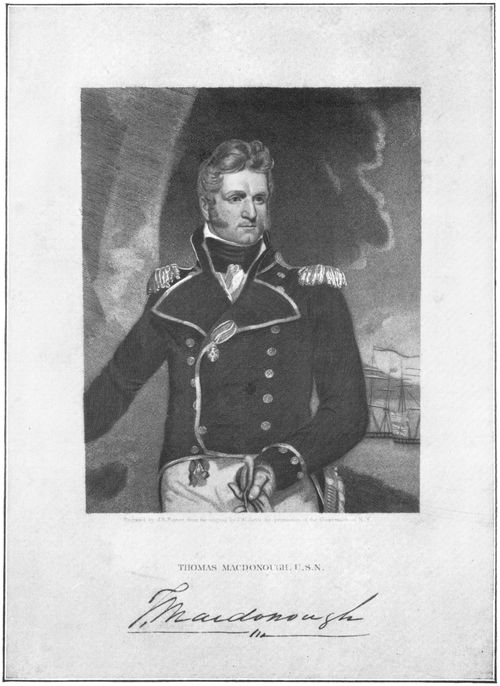
Commodore Macdonough.
Such a state of affairs could not long continue. Each party was ready and waiting to fight, and it was not hard to find an excuse. How the fighting began, no one ever knew; but one night the streets of the little city resounded with cries of rage and groans of agony. Soon crowds began to gather; and sailors rushed up and down the streets, crying that the French desperadoes had killed three Americans. The rage of the populace, and particularly of the seafaring community, had no bounds. "Arm! arm! and take bloody vengeance upon the murderers," was the cry in all quarters. The mob blocked all the roadways leading to the water-front. With cutlasses and guns they attacked the sailors on "L'Agile," which lay at a wharf, and drove them overboard. Once in possession of the ship, the enraged rioters vented their fury by cutting away the masts and rigging, tearing to pieces the woodwork of the cabin, and finally putting the torch to the battered bulk, and sending her drifting helplessly down the river. This summary vengeance did not satisfy their anger. They looked about them for the other vessel, "La Vengeance," and discovered that she had been towed away from the shore, and was being warped up stream to a place of safety. Boats were secured, and the irresistible mob set out in mad pursuit. A militia company, hastily sent to the scene of action by the authorities of the town, failed to check the riot; and, after a futile struggle on the part of her crew, "La Vengeance" shared the fate of her consort. Sympathy for France was well rooted out of Savannah then, and the cry of the city was for war.
Before the news of the uprising at Savannah was known in New England, the navy had struck the first blow against French oppression, and the victory had rested with the sailors of the United States. Congress had at last been aroused to a sense of the situation, and had issued orders to captains of American war-vessels, directing them to capture French cruisers wherever found. A number of large merchant-vessels and Indiamen had been armed hastily, and sent out; and at last the country had a navy on the seas. One of the first vessels to get away was the "Delaware," a twenty-gun ship, commanded by Stephen Decatur the elder. Decatur had been out but a few days when a merchantman, the "Alexander Hamilton," was sighted, from the halliards of which a flag of distress was flying. The "Delaware" ran toward the vessel, and sent a boat aboard, which returned, bringing the captain of the distressed craft. To Decatur the captain related the old story of French aggression, which had become so hateful. Only the day before, he said, his ship had been boarded by boats'-crews from a French privateer of twenty guns. The assailants, once on board, had eaten his provisions, and plundered his cargo without scruple. He gave careful directions as to the course of the privateer after leaving the "Alexander Hamilton," and returned to his ship happy in the thought, that, though he could not regain his plundered property, the thieves at least would be punished.
Decatur crowded on all sail, and set off in pursuit of the oppressor. Four hours later, the lookout forward reported four schooners in sight off the bow. For a moment the captain was puzzled, as he had no means of knowing which was the guilty privateer; but, after brief deliberation, he determined to adopt strategy. The rigging of his vessel was slackened, the yards slewed round, and every attempt made to transform the trim man-o'-war into a shiftless merchantman. Then the helmsman was instructed to carefully avoid running near the suspected schooners. The ruse succeeded admirably. The lookouts in the tops of the schooners reported an American merchantman in sight, but making attempts to escape. The cupidity of the Frenchmen was aroused. In the "Delaware" they saw only a defenceless ship, from which, by virtue of their strength, they could take whatever plunder they desired. From the decks of the "Delaware," the sailors could see the Frenchmen shaking out sail after sail; and soon one schooner, a perfect cloud of canvas, took the lead, and left her consorts far in the rear. It was the privateer they were after. The jackies of the "Delaware" clambered into the rigging, and set all sail, with the clumsiness of merchant-sailors; but, though the ship spread a large expanse of canvas, she was making but little progress, for two long cables dragged in the water astern, holding her back. The Frenchman came up gallantly, but suddenly discovered the ports along the side of the "Delaware," and concluded he had caught a Tartar. It was too late to escape then; for the "Delaware," coming about, had the schooner directly under her guns, and the Frenchman had no course left but to surrender. The privateer proved to be "Le Croyable," of fourteen guns and seventy men. Her captain was vastly astounded to hear that the United States had at last sent out cruisers against the French, who had come to look upon Americans as their legitimate prey. Keeping "Le Croyable" alongside, Decatur ran for Philadelphia, where he was received with unbounded enthusiasm. The captured ship was taken into the United States navy, under the name of the "Retaliation," and sent, under command of Lieut. Bainbridge, to cruise in search of other privateers.
But the career of the "Retaliation" under the American flag was neither long nor glorious. Ill luck seemed to attend the vessel in all her cruises, and Bainbridge wandered up and down the high seas without getting within range of a French cruiser or privateer. In November, 1798, the "Retaliation" was cruising, with two other men-of-war, in the West Indies, not far from Guadaloupe. One day three sails were made out to the eastward, and two more to the westward. Bainbridge thought that at last his opportunity had arrived; and the "Retaliation" set off to reconnoitre the strangers on the eastward, while the two other American ships made after the three sails in the opposite direction. As Bainbridge gained upon his chase, he concluded from their appearance that they were two English ships, and accordingly threw aside all caution, and sailed boldly alongside. Unluckily, they proved to be hostile French cruisers; and, when the discovery was made, the "Retaliation" was well within range. Every sail was set, and the ship put before the wind, to escape from the enemy, but too late. The leading ship of the enemy was a fine frigate; and she rushed through the water after the fugitive, like a dolphin after a flying-fish. Soon a heavy shot from one of the frigate's bow-chasers came whizzing by the "Retaliation," unpleasantly reminding the Americans that they were still within range, and their adversaries carried heavy metal. The second frigate soon opened fire, and the position of the "Retaliation" became hopeless. Her flag was unwillingly hauled down, and the vessel became again the property of its original owners. It is a strange coincidence, that this ship should have thus been the first prize of both Americans and French in the war.
The Frenchmen were not content with their success in capturing the "Retaliation:" so, while one frigate stopped to secure the prize, the other passed on in hot chase after "The Retaliation's" two former consorts, the "Montezuma" and "Norfolk." Bainbridge was taken aboard the French frigate "Volontaire," which then continued her course in the wake of her consort, the "Insurgente." For the captured American captain on the deck of the "Volontaire," the chase was one of great excitement. He well knew that the two stately French frigates were much more than a match for the flying Americans; and, should they overhaul the chase, the "Montezuma" and the "Norfolk" would join the "Retaliation" in French captivity. Racked with anxiety he paced the deck, trying in vain not to perceive that the pursuers were steadily gaining, and chafing under the position of helplessness in which he found himself. But an opportunity to help did unexpectedly present itself. The French captain, after a long look through his marine-glasses at the flying craft, turned to Bainbridge, and inquired,—
"What may be the force of your consorts, captain?"
Without a moment's hesitation, Bainbridge responded,—
"The ship carries twenty-eight twelve-pounders, and the brig twenty nines."
The Frenchman was astounded, as well he might be; for Bainbridge's answer was a most preposterous falsehood, nearly doubling the actual armament of the two vessels. An eager consultation was immediately held by the officers on the quarter-deck. Bainbridge looked on anxiously, and was delighted with the success of his ruse, when he heard orders for the hoisting of a signal which should call back the frigate leading in the chase. The signal was hoisted; and the "Insurgente," obeying, abandoned the chase, and returned. Her captain was indignant at his recall, and curious to know the cause of it. When told of Bainbridge's statement, he was furious; for his ship had been close enough to the chase to see that the Americans were small craft, utterly unable to cope with the two pursuing frigates. For his falsehood, Bainbridge was roundly abused, and many a French oath was hurled at his head. His action was indeed inexcusable by the rules of honor; and the utmost that can be said of it by the most patriotic American is, that by his falsehood he saved two good ships for the infant navy of the United States. From a military point of view, however, his conduct was commendable; and in recognition thereof, on his release from captivity, he was made commander of the "Norfolk," one of the vessels he had saved.
France and the United States were now actually at war, although no definite declaration of war had been made by either party. This fact made many French privateers assume an injured air, on being captured by United States ships, and complain that they had never heard of any declaration of war. With a Frenchman of this sort, Stephen Decatur the younger had an experience early in his naval career.
This occurred in February, 1799. The frigate "United States" was cruising near Martinique in that year, and to her young Decatur was attached as a sub-lieutenant. One morning a French privateer was sighted, and the frigate set out in hot pursuit. The privateer took the alarm quickly, and crowded on all sail, until her long, narrow hull slipped through the waves like a fish. The breeze was fresh, and the chase an exciting one; but gradually the immense spread of the frigate's canvas began to tell, and she rapidly overhauled the fugitive. The French captain was plucky, and even desperate, in his attempt to escape; for, seeing that he was about to be overhauled, he resorted to the expedient of a fox chased by hounds, and doubled, turning short to windward, and running right under the guns of the frigate. The move was a bold one, and might well have succeeded, had it not been for the good marksmanship of a gunner on the frigate, who promptly sent a twenty-four-pound shot (the only one fired in the affair) straight through the hull of the privateer, between wind and water. In an instant all was confusion on the French vessel. The water poured into her hold through the hole cut by the shot; and the hasty lowering of her sails, and the frantic howls for succor from the crew, told the people of the "United States" that their chase was at an end. The boats of the frigate were quickly lowered, and Decatur went in one as officer in command. When he reached the sinking ship, he found a scene too ludicrous to be pathetic. Along the rail of the vessel, from bow to stern, the Frenchmen were perched like birds. Many had stripped off all their clothes, in order to be prepared to swim; and from all arose a medley of plaintive cries for help, and curses on that unlucky shot. By skilful management of the boats, all were saved; and it happened that Decatur pulled into his own boat the captain of the sinking vessel.
Brushing the salt water out of his eyes, this worthy expressed great surprise that he had been fired upon by a vessel bearing the United States flag.
"Ees eet that that ees a sheep of les États-Unis?" he inquired, in the broken English that four years of cruising against Americans had enabled him to pick up.
"It is," responded Decatur.
"I am indeed sairprised. I had not thought that les États-Unis had the war with La République Française."
"No, sir," responded Decatur, thoroughly provoked; "but you knew that the French Republic was at war with the United States, that you were taking our merchant-vessels every day, and crowding our countrymen into prison at Basseterre to die like sheep."
This was more than the Frenchman could deny, and he was constrained to accept his capture with the best grace possible.
An audacious, but clearly illegal, exploit of the blue-jackets in this war, was the cutting out and capture of the French letter-of-marque vessel "Sandwich," as she lay in Port Platte, a small harbor on the Spanish side of St. Domingo. Commodore Talbot, who won a reputation for daring and recklessness in the Revolution, was cruising about on the San Domingo station, and had spent some weeks in monotonous voyaging, without an opportunity to capture a single prize. Word was brought to the squadron, that in the little harbor of Port Platte a vessel was taking in a cargo of coffee. From the description of the vessel, Commodore Talbot recognized her as a former British packet, the "Sandwich," now sailing under French letters of marque. Her known speed and seaworthy qualities made her too valuable a prize to be left in the hands of the enemy; and Talbot, without more ado, determined to capture her. The first difficulty that lay in the way was the fact that the vessel was under the protection of Spain, a neutral power. Talbot was no man to notice so purely formal an obstacle. He growled out a decided negative to all hints about respecting a neutral flag. Spain neutral, indeed! She might claim to be neutral, but her Picaroons were too often to be found among the French pirates to leave any respect for Spain's neutrality in the mind of a man of sense; and the "Sandwich" he was going to take, and on his own responsibility. This silenced all opposition.
Having arrived at the determination to take the "Sandwich," the next problem to be solved was, how shall she be taken? Obviously the first step was to make a careful reconnoissance of the ship and her defences. To Lieut. Hull of the "Constitution," this duty was assigned. One dark and stormy night Mr. Hull took one of the frigate's cutters, and, pulling into the harbor, carefully examined the situation. On his return, he reported that the "Sandwich" was stripped of her rigging, and lay directly under the guns of a small battery, built on shore for her protection. To sail in with the frigate, and capture the enemy by mere force of arms, would have been simple enough; but the object of the Americans was to take the ship without injuring her, in order that she might at once join the United States squadron. Strategy was therefore necessary.
It was accordingly determined to secure an American merchant-vessel, that could enter the port, and run alongside the "Sandwich," without arousing suspicion. Luckily at that very moment a craft turned up that filled the need precisely. This was the American sloop "Sally," a battered, weather-beaten little craft, that had for some time been trading in the West Indies, and by her very insignificance had escaped capture by the French. She had often entered and cleared from Port Platte, and therefore her appearance there would create no suspicion.
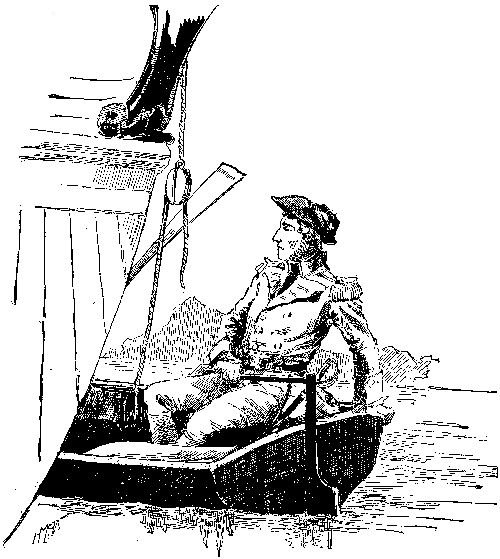
Hull Makes A Reconnoissance.
The "Sally" was accordingly chosen to bear the sailors on their audacious expedition. A rendezvous having been appointed, the sloop met the "Constitution" far out at sea; and a large body of blue-jackets and marines left the frigate, and took quarters on the clumsy little merchantman, which then laid her course for Port Platte. About midnight the lookouts on the "Sally" saw a vessel's lights near at hand; but, beyond reporting to the officer of the deck, they paid no heed to their neighbor. Suddenly, however, out of the darkness came a bright flash; and the hum of a heavy shot in the air above the "Sally" was followed by the dull report of a cannon. At the same time a blue light burned on the deck of the vessel from which the shot proceeded, showed her to be a powerful frigate. Then ensued a few moments of intense suspense for the little band on the "Sally." Should the stranger prove to be a French frigate, all was lost; but in that latitude English vessels were common, and possibly this might be one. Soon the regular thumping of oars in the tholepins, and the splashing of the waves against an approaching boat, could be heard; and in a few minutes a hail came from the black water alongside, and the dark figure of a man standing in the stern-sheets of a boat was seen. A rope was thrown him, by the aid of which he nimbly clambered aboard. An involuntary murmur of relief arose from the party on the "Sally," as by the dim light of the lanterns they saw that the officer wore a British uniform. The officer himself could not repress a start and exclamation of surprise as he saw a band of officers in naval uniform, and a large body of blue-jackets and marines, on the vessel which he expected to find manned by a half-dozen lanky Yankees, commanded by a down-east "skipper."
"Why, what ship's this?" he exclaimed in surprise, as he looked upon the armed men about him. Lieut. Hull, who was in command, explained to him the situation, and told him of the adventure that was being attempted. The officer seemed much disappointed, and told Mr. Hull that the British frigate was standing about outside the harbor, to capture the "Sandwich" as she came out; but the idea of so boldly setting at naught the principles of neutrality had not occurred to them. After a few minutes' conversation, the visitor returned to his ship, and the "Sally" proceeded on her errand. She reached the entrance to the harbor of Port Platte in the morning, and sailed boldly in. Most of the crew and the marines were hidden beneath the bulwarks, or sent below; so that the people on the "Sandwich" gave but a glance to the approaching vessel, until she ran so close to their vessel's bows that they feared an accident.
"Look out there, or you'll run foul of us!" shouted a mate from the deck of the "Sandwich"; and, as if his cry was a signal, the helm of the "Sally" was put down, the vessel ranged up alongside, and in an instant a torrent of armed men poured over the sides of the surprised Frenchman, and drove the crew below. There was no resistance. The ship was captured in five minutes. The marines of the expedition had been sent ashore to spike the guns of the battery, and their work was performed with equal promptitude. Then all hands set to work rigging the captured vessel, and getting her ready for sea. On the shore the people were in the greatest excitement, beating drums, parading the few militia, and threatening dire revenge in the name of outraged Spain. But the captors of the vessel paid but little attention to their enemies; and by sunset the "Sandwich," with all sails set, left the harbor, and joined the United States squadron.
The news of this achievement, lawless as it was, evoked great enthusiasm in the United States. A nation's conscience is elastic; and the people praised the heroes of the "Sandwich" episode, much as sixty-five years later they commended the commander of the "Wachuset" for running down and capturing the Confederate ship "Florida," which was relying upon the protection of a neutral port in Brazil. Yet in 1814, when two British frigates attacked and captured the "Essex" in the harbor of Rio Janeiro, the good people of the United States were loud in their denunciations of the treachery of a commander who would so abuse the protection of a neutral nation. Such inconsistencies are only too common in the history of nations. In the end, however, the affair of the "Sandwich" terminated disastrously for the bold adventurers; for the protests of Spain were too forcible to be disregarded, and the prize-money of all concerned in the exploit was confiscated to pay the damages awarded the injured party.
Not all the successes of the United States navy in the war with France were, like those we have related, dependent upon the speed rather than the fighting qualities of our ships. Not many months had passed, when two representative ships of the warring nations met, and tried conclusions at the mouths of their cannon. It was on the 9th of February that the "Constellation," one of the new American frigates, was cruising on her station in the West Indies, when her lookout reported a large ship some miles to leeward. The frigate at once ran down the stranger, which hoisted American colors. Among ships of the same navy it is customary to have private signals of recognition; and Commodore Truxton, who commanded the "Constellation," set his signal, and awaited the answer. But no answer came; and the stranger, evidently considering further disguise impossible, boldly set French colors, and fired a gun to windward by way of a challenge.
On the "Constellation" the challenge aroused universal enthusiasm. For the first time since the Revolution, the gallant defenders of the stars and stripes were to have an opportunity to try their strength with a hostile man-of-war. The enemy seemed no less ready for the conflict, and waited gallantly for the "Constellation" to come down to closer quarters. From both ships came the roll of the drums and the shrill pipings of the bo's'n's whistle, as the men were called to quarters. Then all became still, and the two frigates bore down upon each other. Neither antagonist was hasty about opening fire, and the report of the first gun came from the Yankee when she had come into point-blank range. Then began the thunderous broadsides, that soon enveloped the hulls of the two ships in dense gray smoke; so that, to an observer at a little distance, all that could be seen of the fight was the tapering masts and yard-arms, above the smoke, crowded with sailors repairing damages, and nimble young midshipmen shrilly ordering about the grizzled seamen, and now and again taking a crack at the enemy with pistol or musket, by way of recreation. In the foretop of the "Constellation" was stationed young David Porter, who in that trying moment showed the result of his hard schooling in the merchant-service, of which we have spoken. By the rapid fire of the enemy, the fore-topmast was badly cut, and there was great danger that it might go by the board. Porter hailed the deck several times for instructions, but, finding that his voice could not be heard above the roar of battle, determined to act upon his own responsibility, and accordingly cut away the sails, lowered the yards, and, by relieving the injured spar of all strain, prevented its falling. In the mean time the battle raged fiercely below. The American frigate was more powerful in her armament, and better handled, than the Frenchman. Her guns were handled with deliberation, and the aim of the gunners was sure and deadly; while the shot from the enemy went hurtling through the rigging of the "Constellation," doing but little damage. The decks of the Frenchman were covered with dead and wounded, and at last two raking broadsides from the American frigate ended the conflict. When the vanquished ship was boarded, she proved to be the "Insurgente," the same frigate that had captured the "Retaliation" some months before. Her loss in this engagement amounted to twenty-nine killed and forty-one wounded, while the cock-pit of the "Constellation" was tenanted by but three wounded men; and but one American had lost his life, he having been killed by an officer, for cowardice. Both ships were badly cut up in the engagement.
The news of this victory was received with great rejoicing in the United States, and was celebrated with cannon-firing and the ringing of bells. At Boston, the fourth Sunday in March was set for a day of general rejoicing; and on that day huge crowds gathered in State Street, and after salutes had been fired, and the city's bells pealed, the people, at a given signal, joined in three mighty cheers, that fairly shook the surrounding houses, for Truxton, the "Constellation," the blue-jackets, and the success of the wooden walls of America.
Even after the "Insurgente" had struck her flag, the tars of the "Constellation" found they had an elephant on their hands. The work of transferring the prisoners was begun, and actively prosecuted; but, when night fell, there were still nearly two hundred Frenchmen on the prize. The wind was rising fast, and the long rollers of the Atlantic were being lashed into foaming breakers by the rising gale. It was hazardous for the two vessels to continue near each other; and Lieutenant Rodgers, with Midshipman Porter and eleven men, was detailed to take charge of the prize, and bring her into port. When the officers boarded the prize, they found that they had indeed a desperate undertaking before them. It was difficult enough for thirteen men to handle the great ship, without having to keep in subjection one hundred and seventy-three captives. To add to the clanger, the gratings had been thrown overboard, and there was no way of confining the captives in the hold. A careful search for handcuffs resulted only in failure. But Rodgers was a man of decision, and Porter, though but a boy, was bold and determined; and between them they solved the problem. The prisoners were ordered below; and a sentinel was placed at each hatchway, with orders to shoot the first man who should attempt to come on deck. Howitzers loaded with grape were trained upon the hatchway, for use in case of an organized movement of the prisoners. For three days the officers sustained this fearful strain, without a moment's sleep; but their labors were finally crowned by successfully bringing the ship and prisoners into St. Kitts.
In the second pitched battle of the war, the "Constellation" was again the American combatant; but this time, though the fight was a glorious one, it did not terminate so fortunately for the American ship. It was on the 1st of February, 1800, that the gallant frigate, under the same commander, was cruising about her old hunting-grounds, near Guadaloupe. A sail was sighted, which, after a careful examination through his marine-glass, Commodore Truxton pronounced to be an English merchantman. As an invitation to the stranger to approach, English colors were hoisted on the "Constellation," but had only the effect of causing the stranger to sheer off; for she was, indeed, a French war-vessel. Perplexed by the actions of the mysterious ship, the "Constellation" gave chase, and soon came near enough to see that she had caught a Tartar; for the vessel was the French frigate "La Vengeance," mounting fifty-two guns. Although a more powerful vessel than the American, she continued her flight; while the gallant Truxton, caring nothing for the odds against him, kept on in hot pursuit. All the remainder of that day, and until noon of the next, the chase continued, with but little change in the position of the ships. "A stern chase is a long chase," thought the jackies on the "Constellation;" but they were not discouraged, and only crowded on the more sail. On the afternoon of the second day, the American began to gain rapidly; and by eight at night the two ships were within speaking distance of each other. Truxton mounted the rail, and shouted through a speaking-trumpet, "What ship is that?" The only answer was a shot from the stern-port of the Frenchman, and the fight was opened.