Volume 1 / Part 2 — PART II. BLUE JACKETS OF 1812 (continued 3)
Reading edition
"Well," said Hull at last, "you may just take good care of that ship of yours, if ever I catch her in the 'Constitution.'"
Capt. Dacres laughed good-humoredly, and offered to bet a sum of money, that in the event of a conflict his confident friend would find himself the loser.
"No," said Hull, "I'll bet no money on it; but I will stake you a hat, that the 'Constitution' comes out victorious."
"Done," responded Dacres; and the bet was made. War was soon declared; and, as it happened, the two friends were pitted against each other early in the hostilities.
It was not long after the American frigate parted from the privateer when the long-drawn hail of "Sail ho-o-o!" from the lookout aloft announced the discovery of another vessel. The course of the "Constitution" was at once shaped toward the stranger. In half an hour she was made out to be a frigate, and from her actions was evidently anxious to come alongside the American ship. As more than an hour must elapse before the ships could come together, Capt. Hull made his preparations for action with the greatest deliberation. The top-gallant sails were furled, and the lighter spars lowered to the deck. Through their glasses, the officers could see the enemy making similar preparations, and waiting deliberately for the "Constitution" to come down.
At five o'clock in the afternoon the two ships were rapidly nearing, and the drums on the American frigate beat to quarters. Then followed the rush of barefooted men along the deck, as they ran hastily, but in perfect order, to their stations. As the roll of the drums died away, the shrill voices of the boyish midshipmen arose, calling off the quarter-bills, and answered by the gruff responses of the men at their posts. Every man, from the cook to the captain, knew his place, and hurried to it. The surgeon, with his assistants, descended to the cock-pit. The carpenter and his mates made ready their felt-covered plugs, for stopping holes made by the enemy's shot. The topmen clambered to their posts in the rigging, led by the midshipmen who were to command them. The line of powder-passers was formed; and the powder-monkeys gave up skylarking, and began to look sober at the thought of the business in hand.
The "Guerriere" was not behindhand in her preparations for action. Capt. Dacres had suspected the character of the American vessel, from the first moment she had been sighted. On board the English frigate was Capt. William B. Orne, a Marblehead sailor who had been captured by the "Guerriere" some days before. "Capt. Dacres seemed anxious to ascertain her character," wrote Capt. Orne, shortly after the battle, "and after looking at her for that purpose, handed me his spy-glass, requesting me to give him my opinion of the stranger. I soon saw, from the peculiarity of her sails and her general appearance, that she was without doubt an American frigate, and communicated the same to Capt. Dacres. He immediately replied, that he thought she came down too boldly for an American; but soon after added, 'The better he behaves, the more credit we shall gain by taking him.'
"The two ships were rapidly approaching each other, when the 'Guerriere' backed her main topsail, and waited for her opponent to come down and commence the action. He then set an English flag at each masthead, beat to quarters, and made ready for the fight.
"When the strange frigate came down to within two or three miles distant, he hauled upon the wind, took in all his light sails, reefed his topsails, and deliberately prepared for action. It was now about five in the afternoon, when he filled away and ran down for the 'Guerriere.' At this moment Capt. Dacres said politely to me, 'Capt. Orne, as I suppose you do not wish to fight against your own countrymen, you are at liberty to retire below the water-line,' It was not long after this, before I retired from the quarter-deck to the cock-pit." It may be well here to supplement Capt. Orne's narrative by the statement that Capt. Dacres, with a chivalric sense of justice not common in the British navy of that day, allowed ten American sailors who had been impressed into his crew to leave their quarters and go below, that they might not fight against their country. Though an enemy, he was both gallant and generous.
The action was opened by the "Guerriere" with her weather broadside; the shot of which all falling short, she wore around, and let fly her port broadside, sending most of the shot through her enemy's rigging, though two took effect in the hull. In response to this, the "Constitution" yawed a little, and fired two or three of her bow-guns; after which the "Guerriere" again opened with broadsides. In this way the battle continued for about an hour; the American ship saving her fire, and responding to the heavy broadsides with an occasional shot.
During this ineffectual firing, the two ships were continually drawing nearer together, and the gunners on the "Constitution" were becoming more and more restive under their inaction. Capt. Hull was pacing the quarter-deck with short, quick steps, trying to look cool, but inwardly on fire with excitement. As the shot of the enemy began to take effect, and the impatience of the gunners grew more intense, Lieut. Morris, the second in command, asked leave to respond with a broadside.
"Not yet," responded Capt. Hull with cool decision. Some minutes later, the request was repeated, and met with the same response, while the captain never ceased his pacing of the deck. When within about half pistol-shot, another broadside came from the "Guerriere." Then the smothered excitement in Hull's breast broke out.
"Now, boys, pour it into them!" he shouted at the top of his lungs, gesticulating with such violence that the tight breeches of his naval uniform split clear down the side. Lieut. Morris seconded the captain in cheering on the crew.
"Hull her, boys! Hull her!" he shouted; and the crew, catching up the cry, made the decks ring with shouts of "Hull her!" as they rapidly loaded and let fly again.
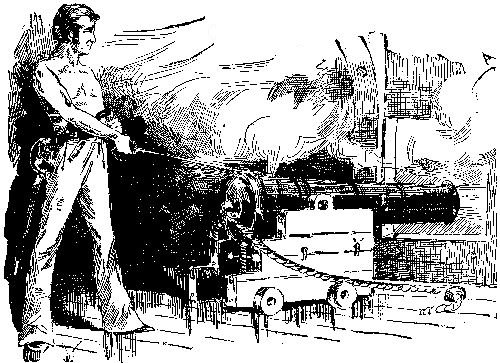
"Hull Her, Boys!"
The effect of their first broadside was terrific. Deep down in the cock-pit of the "Guerriere," Capt. Orne, who had been listening to the muffled thunder of the cannonade at long range, suddenly "heard a tremendous explosion from the opposing frigate. The effect of her shot seemed to make the 'Guerriere' reel and tremble, as though she had received the shock of an earthquake. Immediately after this, I heard a tremendous shock on deck, and was told that the mizzen-mast was shot away. In a few moments afterward, the cock-pit was filled with wounded men."
Though in his retreat in the cock-pit the captive American could hear the roar of the cannon, and see the ghastly effects of the flying missiles, he could form but a small idea of the fury of the conflict which was raging over his head. Stripped to the waist, and covered with the stains of powder and of blood, the gunners on the two ships pulled fiercely at the gun-tackle, and wielded the rammers with frantic energy; then let fly the death-dealing bolt into the hull of an enemy only a few yards distant. The ships were broadside to broadside, when the Englishman's mizzen-mast was shot away, and fell, throwing the topmen far out into the sea. The force of the great spar falling upon the deck made a great breach in the quarter of the ship; and, while the sailors were clearing away the wreck, the "Constitution" drew slowly ahead, pouring in several destructive broadsides, and then luffed slowly, until she lay right athwart the enemy's bow. While in this position, the long bowsprit of the "Guerriere" stretched far across the quarter-deck of the American ship, and was soon fouled in the mizzen-rigging of the latter vessel. Then the two ships swung helplessly around, so that the bow of the Englishman lay snugly against the port-quarter of the Yankee craft. Instantly, from the deck of each ship rang out the short, sharp blare of the bugle, calling away the boarders, who sprang from their guns, seized their heavy boarding caps and cutlasses, and rushed to the side. But a heavy sea was rolling and tossing the two frigates, so that boarding seemed impossible; and, as Dacres saw the crowd of men ready to receive his boarders, he called them back to the guns. Although each party stuck to its own ship, the fighting was almost hand to hand. Pistols were freely used; and from the tops rained down a ceaseless hail of leaden missiles, one of which wounded Capt. Dacres slightly. So near to each other were the combatants, that the commands and the cries of rage and pain could be heard above the deep-toned thunder of the great guns and the ceaseless rattle of the musketry. The protruding muzzles of the guns often touched the sides of the opposing ship; and when the cannon were drawn in for loading, the sailors on either side thrust muskets and pistols through the ports, and tried to pick off the enemy at his guns.
While the fight was thus raging, a cry of "Fire!" horrified every one on the "Constitution." Flames were seen coming from the windows of the cabin, which lay directly beneath the bow-guns of the "Guerriere." The fire had been set by the flash from the enemy's cannon, so close were the two ships together. By the strenuous exertions of the men on duty in the cabin, the flames were extinguished, and this, the greatest of all dangers, averted. Shortly after, the gun which had caused the trouble was disabled by a skilful shot from one of the Yankee's guns.
While the flames in the cabin were being extinguished, the Americans were making a valiant attempt to board and Lieut. Morris with his own hands was attempting to lash the two ships together. Abandoning this attempt, he leaped upon the taffrail, and called upon his men to follow him. Lieut. Bush of the marines, and Mr. Alwyn, were soon at the side of the intrepid officer, when, at a sudden volley of musketry from the British, all three fell back, poor Bush dead, and the two others badly wounded. The ships then drifted asunder; and the "Guerriere's" foremast was shot away, and dragged down the main-mast with it in its fall. The shattered ship now lay a shapeless hulk, tossing on the waves, but still keeping a British ensign defiantly flying from the stump of her fallen mizzen-mast.
The "Constitution" drew away, firing continually, and soon secured a raking position; seeing which, the British hauled down their colors. Lieut. Read was sent on board the prize, and, on the appearance of Capt. Dacres, said,—
"Capt. Hull presents his compliments, sir, and wishes to know if you have struck your flag."
Dacres looked significantly at the shattered masts of his ship, and responded dryly,—
"Well, I don't know. Our mizzen-mast is gone, our main-mast is gone; and I think, on the whole, you may say that we have struck our flag."
After looking about the ship, the boarding officer stepped to the side, to return to his own vessel. Before leaving, he said to Capt. Dacres,—
"Would you like the assistance of a surgeon, or surgeon's mate, in caring for your wounded?"
Dacres looked surprised, and responded,—
"Well, I should suppose you had on board your own ship business enough for all your medical officers."
"Oh, no!" answered Read. "We have only seven wounded, and they have been dressed long ago."
Dacres was astounded, as well he might be; for on the decks of his ship lay twenty-three dead or mortally wounded men, while the surgeons were doing their best to alleviate the sufferings of fifty-six wounded, among whom were several officers. Indeed, the ship looked like a charnel-house. When Capt. Orne, freed by the result of the battle, came on deck, he saw a sight that he thus describes: "At about half-past seven o'clock, I went on deck, and there beheld a scene which it would be difficult to describe. All the 'Guerriere's' masts were shot away; and, as she had no sails to steady her, she was rolling like a log in the trough of the sea. Many of the men were employed in throwing the dead overboard The decks were covered with blood, and had the appearance of a ship's slaughter-house. The gun-tackles were not made fast; and several of the guns got loose, and were surging from one side to the other. Some of the petty officers and seamen got liquor, and were intoxicated; and what with the groans of the wounded, the noise and confusion of the enraged survivors on board of the ill-fated ship, rendered the whole scene a perfect hell."
For some time after the "Guerriere" had been formally taken possession of, it seemed as though the "Constitution" would have to fight a second battle, to keep possession of her prize. A strange sail was seen upon the horizon, bearing down upon the "Constitution" in a way that seemed to threaten hostilities. Again the drums beat to quarters, and once again the tired crew went to their stations at the guns. But the strange ship sheered off, and the gallant crew were not forced to fight a second battle. All hands then set to work to remove the prisoners from the "Guerriere," which was evidently in a sinking condition.
In the first boat-load from the sinking ship came Capt. Dacres, who was politely shown into Capt. Hull's cabin. Unclasping his sword from its place at his hip, the conquered seaman handed it silently to Capt. Hull. The victor put it gently back, saying,—
"No, no, captain: I'll not take a sword from one who knows so well how to use it. But I will trouble you for that hat."
For a moment a shade of perplexity passed over the brow of the British captain; then he recollected the wager of a year or two before, and all was clear again. Unfortunately, the veracious chronicler who has handed this anecdote down to modern times has failed to state whether the debt was duly paid.
After some hours of hard work with the boats, the last of the prisoners, with their effects, were brought on board the "Constitution." Torches were then set to the abandoned frigate; and the sailors watched her blaze, until the fire reached her magazine, and she vanished in the midst of a tremendous explosion. Then, leaving behind her the floating mass of ruin, the "Constitution" headed for Boston, where she arrived after a few days of sailing.
Great was the excitement and exultation aroused among the people by the arrival of the noble ship with her prisoners. She had, indeed, come at a time when the public mind required cheering; for from the interior came the reports of British successes by land, along the Canadian frontier about Detroit, and for weeks the papers had been unable to record any success for the American arms. But the report of the engagement with the "Guerriere" changed wholly the tide of popular feeling. Boston—the city which at the declaration of war had hung its flags at half-mast, in token of mourning and humiliation—Boston welcomed the conquerors with an ovation like to a triumph in the days of imperial Rome.
When the ship came up the harbor, she was met and surrounded by a great flotilla of gayly decorated boats; while the flags on the surrounding vessels were dipped in salutation as the war-scarred veteran made her stately way to the wharf. Here a volunteer artillery company was assembled; and, as the ship came up, they fired a national salute, which was returned from the guns so lately employed in defending the national honor. Quarters had been prepared for Capt. Hull in the city; and, as he landed, he found the streets through which he must pass decked with bright bunting, and crowded with people. His progress was accompanied by a great wave of cheers; for, as the people saw him coming, they set up a shout, which was not ended until he had passed from sight. At night came a grand banquet to the officers of the ship, at which six hundred sat down to the feast. The freedom of the city was presented to the captain; and at a later date came the news of sword presentations from citizens of New York, plate from the people of Philadelphia, and gold medals from Congress. Amid all the exultation, the rash arrogance of the British writers was not forgotten; and many a bumper was emptied to the success of the frigate described by British journalists as "a bunch of pine boards under a bit of striped bunting."[Back to Content]
CHAPTER V.
AN INTERNATIONAL DEBATE. — THE "WASP" AND THE "FROLIC." — THE "UNITED STATES" AND THE "MACEDONIAN." — OVATIONS TO THE VICTORS.
he rejoicing over the success of the "Constitution" had not died away in the United States when the English newspapers began to appear with elaborate articles, showing just why the battle had terminated as it did. "The 'Constitution' is the crack frigate of the American navy," cried the apologists; but to this the Americans retorted by quoting the British description of the ship as "a bunch of pine boards." The "Guerriere" was an "old worn-out frigate," responded the English, returning to the charge. "She was on her way to Halifax to refit, when attacked." Again they were refuted by their own statements; for, but a month before, the "Guerriere" was said to be "able to drive the insolent striped bunting from the seas." Throughout the discussion, the shrewdness of the Americans enabled them to meet the arguments of the British at every point; but not until the charge was made, that the "Constitution" was chiefly manned by British sailors, did the people become thoroughly in earnest in the war of words.

Such a charge as this was adding insult to injury. Was not the British navy full of Americans who were forced against their will to serve against their own country, while the few Englishmen on the "Constitution" were enlisted with their own consent? For Capt. Dacres to say that his ship was weakened by allowing the ten Americans to go below, and then beaten by the efforts of the Englishmen on the "Constitution," was merely tantamount to saying that the victory hinged on the fact that Americans would not fight against their own country, while Englishmen did so willingly. But for Great Britain to exclaim against the American navy because it harbored a few Englishmen, was the rankest hypocrisy. So said the American journalists of the day; and, in support of their statement, they printed long letters from American seamen impressed into and held in the British naval service. One writes that he was impressed into his British Majesty's ship "Peacock," in 1810, and after serving two years he heard of the declaration of war. After a consultation with two fellow-seamen, both Americans, all decided to refuse to serve longer, claiming to be prisoners of war. But the captain under whom they were enrolled looked upon the matter in a different light. He heard their claim, pronounced it a bit of "confounded insolence," and straightway ordered that they be put in irons. After some hours for meditation in "the brig," the three sailors were taken to the gangway, stripped naked, and tied up, while a sturdy boatswain's mate laid on a dozen and a half blows of the cat. Later, when the ship went into action with a United States vessel, the three sailors asked to be sent below, that they might not fight against their own countrymen; but the captain's sole response was to call up a midshipman, and order him to do his duty. This duty proved to consist in standing over the three malcontents with a loaded pistol, threatening to blow out the brains of the first who should flinch from his work.
Three sailors were impressed after the war had begun. Learning that the ship on which they found themselves was to cruise upon the American station, they with one accord refused to serve. The response to this was "five dozen lashes well laid on." Being still mutinous, they received four dozen lashes two days later, and after the lapse of two more days were flogged with two dozen more. But all the beating to which they were subjected could not compel them to serve against their country; and they were accordingly ironed and thrown into "the brig," where they lay for three months. When released from "the brig," they found the ship at London. Here they heard of the glorious victory of the "Constitution," and determined to celebrate it. By ripping up their clothing into strips, and sewing the strips together, a rude American flag was made; and with the most astonishing audacity the three sailors hung this emblem over a gun, and gave three cheers for the stars and stripes. This naturally brought them another flogging.
Flogging, however, could not always be resorted to in order to bring American sailors into subjection. It is estimated, that, when war was declared, there were five times as many American seamen in the British navy as were in the whole navy of the United States. To attempt to keep this immense body of disaffected seamen in order by the lash, would have been impracticable; and soon the custom arose of sending the more refractory tars into confinement at some English prison. Dartmoor prison was for a time the principal place of detention for pressed men; but, as it soon became crowded, it was given over to prisoners of war, and the hapless seamen were sent to languish in dismantled ships, known as "hulks." These hulks were generally old naval vessels, dismasted and stripped of all their fittings. Anchored midstream in tidal rivers, the rotting hulks tugged at their rusty chains, as the tide rose and fell, groaning in their bondage, and seeming as much imprisoned as the wretched sailors by whom they were tenanted. The captives lived in misery and squalor. Crowded together in stifling quarters between decks, they were the prey of vermin of all kinds. Their miserable diet, and lack of proper exercise, caused the scurvy in its most repulsive forms to break out among them. The only breath of fresh air they could obtain was when, in gangs, they were allowed to go on deck, and pace up and down under the watchful eyes of soldiery; then back to the crowded quarters below, to swelter in summer or freeze in winter. Such was their punishment for the crime of being loyal to their country.
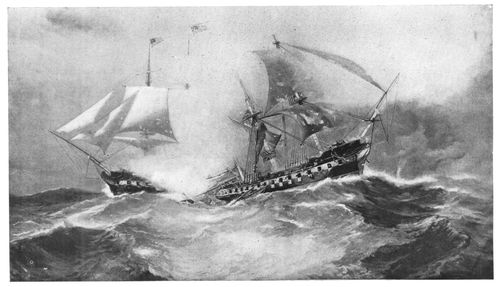
Engagement Of The Frigates "United States" And "Macedonian," Christmas Day, 1812. Copyright, 1892, by C. Klackner.
Careful estimates show that at this time there were at least twenty thousand American sailors in the British navy, each one of whom was liable at any moment to be ordered into this inhuman captivity. A British official document of 1812 reported that 2,548 American seamen had been imprisoned for refusing to serve against their country. Hundreds of these were sent to the living death in the hulks. Was it any wonder that, with such facts, before their eyes, Americans grew indignant at hearing that the victory of the "Constitution" had been won by the prowess of British seamen? But before many days had passed, a victory was recorded for the stars and stripes, which not even the acuteness of an English naval historian could ascribe to any cause other than the naval superiority of the victor.
This was the capture, by the United States sloop-of-war "Wasp," of the British sloop-of-war "Frolic," after a battle ever memorable for the extraordinary dash and bravery shown by each combatant. In size, the "Wasp" was one of the inferior vessels of the United States navy. In her architecture and appointments, however, she was the pride of the navy, and was often cited as a model ship of her class. Her armament consisted of sixteen thirty-two-pounder carronades, and two "long twelves."
When the war broke out, the "Wasp" had just left the coast of Europe, bearing despatches from the foreign diplomatic representatives of the United States to the Government. It was accordingly near the middle of October before the sloop had been refitted, and, with a crew of one hundred and thirty-five men, left the Delaware, on her first cruise against the English. Her commander was Capt. Jacob Jones, who had served in the war with Tripoli, and had himself been a captive among the barbarians of Northern Africa.
After a few days' cruising, with one or two unimportant captures, a bunch of sails was sighted at some distance. The most careful examination failed to reveal the character of the strangers, and Jones determined to run down cautiously toward the squadron, to reconnoitre. The wind was blowing fiercely at the time, and a heavy sea was running, from the effects of a gale of the day before, in which the "Wasp" lost her jib-boom, together with two sailors who were upon it. As the vessel bore down upon the strangers, Jones could see through his marine glasses that they were a convoy of merchantmen, under the protection of a British sloop-of-war. The merchantmen were evidently armed, and some seemed to carry as many as twelve guns. Deeming it unwise to attack at that moment, Capt. Jones kept on a course parallel with that of the enemy, during the remainder of that day and through the night. With the break of day, every officer of the "Wasp" was on deck, and all eyes were turned towards the quarter in which the Englishmen should be found. There, sure enough, they were. Six merchant ships and a bluff little brig, the port-holes in the sides of which showed her to be a war-vessel rating as a sloop. Signs of activity on board made it evident that the Englishmen had caught sight of the vessel which had been dogging them for the last day, and were making ready to give her battle. The British, too, had suffered in the gale, and the sailors could be seen shipping a new main-yard, and setting new topsails. On the "Wasp," the jackies were hard at work, getting in a spar to take the place of the jib-boom, which had been lost in the storm. Both ships were under short canvas, for the wind was still high. Instead of the English ensign, a Spanish flag fluttered from the halliards of the Englishman,—an unnecessary ruse to draw on an adversary already seeking a conflict.
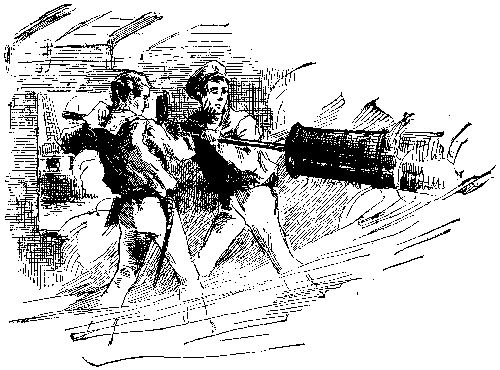
Loading.
It was half-past eleven in the morning when the action began. The day was an ideal October morning at sea,—cool, clear, and a breeze blowing fresh and constantly stiffening. The two vessels were running on the starboard tack, not sixty yards apart. As they ploughed through the waves, great clouds of spray dashed over the bows; and every now and then a wave would sweep over the forecastle, drenching the jackies as they stood at their quarters. As they sped along, the two ships exchanged broadsides, the "Frolic" firing three to the "Wasp's" two. After every broadside, the gunners cheered as they saw the damage done by their fire. When the state of the sea is considered, it seems marvellous that the broadsides should have done any execution whatever. The vessels were rolling terribly, now wallowing in the trough of the sea, and again tossed high on the crest of some enormous wave. At one instant the muzzles of the guns would be pointed toward the skies, then actually submerged under the waves, from which they rose dripping, to be loaded and fired before another dip should soak the charge. Yet, with all this rolling to spoil their aim, the gunners of both ships pointed their pieces with most destructive effect. Within five minutes from the time of opening fire, the main topmast of the "Wasp" was shot away, and hung tangled in the rigging, despite the active efforts of the topmen, headed by the nimble midshipmen, to clear away the wreck. This greatly hampered the movements of the American vessel; and when, a few minutes later, the gaff and the main top-gallant mast fell, the chances of the American ship seemed poor indeed. The effects of the "Wasp's" fire were chiefly to be seen in the hull of her antagonist; but the first twenty minutes of the fight seemed to give the Englishman every chance of victory, since his fire had so cut away the rigging of the "Wasp" that she became unmanageable. It is said that the difference between the execution done by the two batteries was due to the fact that the British fired as their ship was rising on the crest of the wave, while the Americans fired from the trough of the sea, sending their shot into the hull of the enemy.
While the fight was raging, the two ships were constantly drawing nearer together; and just as it seemed as though the destruction wrought in the "Wasp's" rigging would inevitably lead to her defeat, the two vessels fouled. For an instant they lay yard-arm to yard-arm, and at that very moment the American gunners poured in a terrific broadside. So close were the two vessels to each other, that, in loading, the rammers were shoved up against the sides of the "Frolic." Before the gunners of the "Frolic" could respond to this broadside, their ship swung round so that her bow lay against the "Wasp's" quarter; and her bowsprit passed over the heads of Capt. Jones and his officers as they stood on the quarter-deck. That was the moment for a raking volley; and with deadly aim the Americans poured it in, and the heavy iron bolts swept the decks of the "Frolic" from stem to stern.
This turn in the tide of battle fairly crazed with excitement the sailors of the "Wasp." With ringing cheers they applauded the success of the last volley, and, springing into the hammock-nettings, called loudly for their officers to lead them on board the English ship. From the quarter-deck, Capt. Jones, with shouts and gestures, strove to hold back the excited men until another broadside could be given the enemy. But the enthusiasm of the sailors was beyond all control. All at once, they saw a sailor from New Jersey, named Jack Lang, spring on a gun, cutlass in hand, ready to board. All were about to follow him, when Capt. Jones called him down. Only for a minute did Jack's sense of duty overcome his enthusiasm; and then, remembering that he had once been impressed on the "Frolic," his rage blazed up, and in an instant he was clambering over the nettings, calling for followers. Capt. Jones saw that the ardor of his crew was beyond his control, and ordered the bugler to call away the boarders. Headed by their officers, the bold tars swarmed over the nettings, and through the tangled rigging, to the deck of the enemy's ship. Each man clutched his cutlass viciously, for he felt that a desperate conflict was imminent. But when they dropped upon the deck of the "Frolic," a most unexpected spectacle met their eyes.
The broad deck stretched out before them, untenanted save by a few wounded officers near the stern, and a grim old British seaman at the wheel. Instead of the host of armed men with whom the boarders expected to dispute the possession of the ship, they saw before them only heaps of dead sailors lying about the guns which they had been serving. On the quarter-deck lay Capt. Whinyates and Lieut. Wintle, desperately wounded. All who were unhurt had fled below, to escape the pitiless fire of the American guns, and the unerring aim of the sailors stationed in the "Wasp's" tops. Only the old helmsman stood undaunted at his post, and held the ship on her course, even while the Americans were swarming over the nettings and clambering down the bowsprit. The colors were still flying above the ship; but there was no one left, either to defend them or to haul them down, and they were finally lowered by the hands of Lieut. Biddle, who led the boarding party.
No action of the war was so sanguinary as this short conflict between two sloops-of-war. The "Frolic" went into action with a crew of one hundred and ten men, fully officered. When the colors were hauled down, only twenty men were uninjured. Every officer was wounded, and of the crew thirty lost their lives. They had stood to their guns with the dogged courage of the English sailor at his best, and had been fairly mowed down by the destructive fire of the Americans. On the "Wasp," the loss of life was slight. The shot of the enemy took effect in the rigging chiefly. The three sailors who were killed were topmen at their posts, and the five wounded were almost all stationed in the rigging.
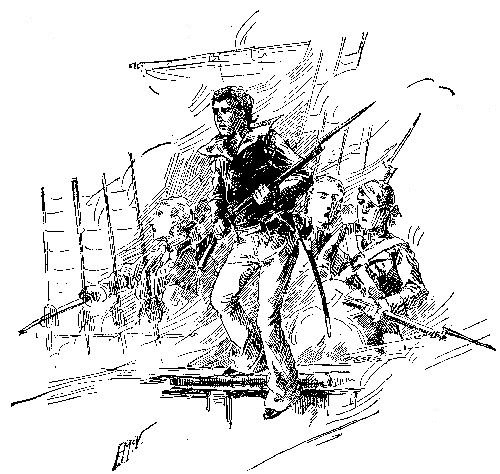
Ready To Board.
The Americans were not destined to enjoy their triumph long. Shattered though the "Frolic" was, Lieut. Biddle, with a prize-crew, took charge of her, and was in hopes of taking her safely to port; but his plan was rudely shattered by the appearance of an English frigate, only a few hours after the action ceased. For the "Frolic" to escape, was out of the question. Both her masts had gone by the board shortly after her flag was struck; and, when the new enemy hove in sight, the prize-crew was working hard to clear from her decks the tangled mass of rigging, wreckage, and dead bodies, that made the tasks of navigation impossible. The ship was rolling like a log, in the trough of the sea, and was an easy prize for an enemy of even less strength than the man-of-war which was then bearing down upon her.
The vessel which came rapidly down before the wind was the "Poictiers," a British seventy-four-gun ship, which would have been more than a match for the little "Wasp," even though the latter had been fresh and ready for battle, instead of shattered by desperate fight. Seeing no chance for a successful resistance, Capt. Jones determined upon flight, and ordered all hands aloft, to make sail. But the sails when shaken out were found to have been cut to pieces by the "Frolic's" shot; and the "Poictiers" soon came alongside, and changed the triumph of the Americans to defeat.
Though Capt. Jones and his gallant crew were thus deprived of their hard-won conquest, they received their full meed of praise from their countrymen. They were soon exchanged, voted twenty-five thousand dollars prize-money by Congress, and lauded by every newspaper and legislative orator in the country. The song-writers of the day undertook to celebrate in verse the famous victory, and produced dozens of songs, of which the following stanza may be taken for a fair sample:—
"Like the fierce bird of Jove the 'Wasp' darted forth, And he the tale told, with amazement and wonder. She hurled on the foe from her flame-spreading arms, The fire-brands of death and the red bolts of thunder. And, oh! it was glorious and strange to behold What torrents of fire from her red mouth she threw; And how from her broad wings and sulphurous sides, Hot showers of grape-shot and rifle-balls flew!"
Let us now turn to Commodore John Rodgers, whose unlucky cruise at the opening of the war we have already noted. Having refitted his squadron in the port of New York, he set sail on a second cruise, leaving behind him the "Hornet." Again he seemed to have fallen upon unprofitable times, for his ships beat up and down in the highway of commerce without sighting a single sail. After several days of inaction, it was determined to scatter the squadron; and to this end the frigate "United States," Commodore Decatur, and the sixteen-gun brig "Argus," Capt. Sinclair, left the main body of ships and started off on a cruise in company. After the two ships left the main body, Commodore Rodgers met with better success, capturing a Jamaica packet with two hundred thousand dollars in her hold, and chasing a British frigate for two hours, but without overhauling her.
In the mean time, the "Argus" had parted from her consort, and was cruising to the eastward on her own account, meeting with fair success. During her cruise she captured six merchantmen, and was herself chased by a British squadron. This chase was almost as memorable as that of the "Constitution;" for the little brig was hotly pursued for three days and nights, and, to escape her pursuers, was obliged to cut away her boats and anchors, and part with every thing movable save her guns. She escaped at last, however, and was for many months thereafter a source of continual annoyance to the commerce of the enemy.
After parting with the "Argus," the "United States" had made her course toward the south-east, in the hopes of intercepting some of the British West-Indiamen. But what the plucky sailors would consider better luck fell to the lot of the frigate.
At dawn on a bright Sunday morning, the lookout of the "United States" descried a sail about twelve miles away, on the weather-beam. Sail was crowded on the American frigate, and, urged along by a rattling breeze, she made towards the stranger. As the distance between the ships lessened, and the rigging of the stranger showed her to be a frigate, the enthusiasm among the gallant tars of the "United States" grew apace. Visions of battle, of glory, and, above all, of resultant prize-money, arose in their minds; and their shouts could be heard by the crew of the distant frigate before the two vessels came within range of each other.
The vessel toward which the "United States" was advancing was the "Macedonian," a British frigate rating thirty-eight guns, but said to have been carrying forty-nine at this time. She had for some time been reckoned a crack ship of her class in the British navy, and her crew was in admirable training. From her quarter-deck and forecastle groups of officers and seamen were watching the on-coming of the American frigate. One of the powder monkeys, named Samuel Leech, of the British ship, told graphically and simply the story of that day's doings on the "Macedonian."
"Sunday (Dec. 25, 1812) came, and it brought with it a stiff breeze," so runs the powder-monkey's tale. "We usually made a sort of holiday of this sacred day. After breakfast it was common to muster the entire crew on the spar-deck, dressed as the fancy of the captain might dictate,—sometimes in blue jackets and white trousers, or blue jackets and blue trousers; at other times in blue jackets, scarlet vests, and blue or white trousers; with our bright anchor-buttons glancing in the sun, and our black, glossy hats ornamented with black ribbons, and the name of our ship painted on them. After muster we frequently had church-service read by the captain; the rest of the day was devoted to idleness. But we were destined to spend the rest of the sabbath just introduced to the reader in a very different manner.
"We had scarcely finished breakfast before the man at the masthead shouted 'Sail, ho!'
"The captain rushed upon deck, exclaiming, 'Masthead, there!'
"'Sir?'
"'Where away is the sail?'
"The precise answer to this question I do not recollect; but the captain proceeded to ask, 'What does she look like?'
"'A square-rigged vessel, sir,' was the reply of the lookout.
"After a few minutes, the captain shouted again, 'Masthead, there!'
"'Sir?'
"'What does she look like?'
"'A large ship, sir, standing toward us.'
"By this time, most of the crew were on deck, eagerly straining their eyes to obtain a glimpse of the approaching ship, and murmuring their opinions to each other on her probable character.
"Then came the voice of the captain, shouting, 'Keep silence, fore and aft!'
"Silence being secured, he hailed the lookout, who to his question of 'What does she look like?' replied, "A large frigate bearing down upon us, sir.'
"A whisper ran along the crew, that the stranger ship was a Yankee frigate. The thought was confirmed by the command of 'All hands clear the ship for action, ahoy!' The drum and fife beat to quarters, bulkheads were knocked away, the guns were released from their confinement, the whole dread paraphernalia of battle was produced; and, after the lapse of a few minutes of hurry and confusion, every man and boy was at his post ready to do his best service for his country, except the band, who, claiming exemption from the affray, safely stowed themselves away in the cable tier. We had only one sick man on the list; and he, at the cry of battle, hurried from his cot, feeble as he was, to take his post of danger. A few of the junior midshipmen were stationed below on the berth-deck, with orders, given in our hearing, to shoot any man who attempted to move from his quarters.
"As the approaching ship showed American colors, all doubt of her character was at an end. 'We must fight her,' was the conviction of every breast. Every possible arrangement that could insure success was accordingly made. The guns were shotted, the matches lighted; for, although our guns were all furnished with first-class locks, they were also furnished with matches, attached by lanyards, in case the lock should miss fire. A lieutenant then passed through the ship, directing the marines and boarders—who were furnished with pikes, cutlasses, and pistols—how to proceed if it should be necessary to board the enemy. He was followed by the captain, who exhorted the men to fidelity and courage, urging upon their consideration the well-known motto of the brave Nelson, 'England expects every man to do his duty.' In addition to all these preparations on deck, some men were stationed in the tops with small-arms, whose duty it was to attend to trimming the sails, and to use their muskets, provided we came to close action. There were others, also, below, called sail-trimmers, to assist in working the ship, should it be necessary to shift her position during the battle."
Thus, with her men at their quarters, her guns primed, and matches lighted, the "Macedonian" bore down to open the action. On the "United States," very similar scenes were being enacted. In some respects, the American frigate was a more formidable ship than the adversary she was about to engage. Her battery consisted of fifty-four guns, and some were of heavier calibre than those of the "Macedonian." Her crew, too, was rather larger than that of her adversary. But, in most respects, the ships were well matched. Indeed, the commanders of the two ships had met before the opening of the war, and, in conversation, agreed that their vessels were well fitted to test the comparative valor of Yankee and English sailors. Capt. Carden of the "Macedonian" had asked Decatur what would be the probable result, if the two ships were to meet in battle.
"Why, sir," responded the American captain, "if we meet with forces that might be fairly called equal, the conflict would be severe; but the flag of my country on the ship I command shall never leave the staff on which it waves, as long as there is a hull to support it."
Such sentiments as this were ever in the heart of the gallant Decatur, whose service in the war of 1812 was but the continuation of his dashing career during the war with Tripoli. A captain of such ardent bravery could not fail to inspire his crew with the same enthusiasm and confidence.
In the crew of the "United States" were many young boys, of ages ranging from twelve to fourteen years. At that time many a lad received his warrant as midshipman while still in his tenth year; and youngsters who wished to join the navy as "ship's boys," were always received, although sometimes their extreme youth made it illegal for their names to be formally enrolled upon the roster of the crew. Such was the station of little Jack Creamer, a ten-year-old boy, who had been serving on the ship for some weeks, although under the age at which he could be legally enlisted. When Jack saw the English frigate looming up in the distance, a troubled look came over his face, and he seemed to be revolving some grave problem in his mind. His comrades noticed his look of care, and rallied him on what they supposed to be his fear of the coming conflict. Jack stoutly denied this charge, but said he was anxious to speak to the captain before going into action. An old quartermaster marched him up to the quarter-deck, and stood waiting for Capt. Decatur's attention. In a moment the captain noticed the two, and said cheerily,—
"Well, Jack, what's wanting now?"
Touching his hat, the lad replied, "Commodore, will you please to have my name put down on the muster-roll?"
"Why, what for, my lad?"
"So that I can draw my share of the prize-money, when we take that Britisher, sir."
Amused and pleased with the lad's confidence in the success of the "United States" in the coming battle, Decatur gave the necessary order; and Jack went back to his post with a prouder step, for he was now regularly enrolled.
The two ships were now coming within range of each other, and a slow, long-distance cannonade was begun, with but little effect; for a long ground-swell was on, and the ships were rolling in a manner fatal to the aim of the gunners. After half an hour of this playing at long bowls, the Englishman's mizzen topmast was shot away; and the cannon-balls from the "States" whizzed through the rigging, and splashed into the water about the "Macedonian," in a way that proved the American gunners had the range, and were utilizing it. Capt. Carden soon saw that at long range the American gunners were more than a match for his men, and he resolved to throw prudence to the winds; and, disdaining all manœuvring, bore straight down on the American ship that lay almost stationary on the water, pouring in rapid and well-aimed broadsides.
Though a gallant and dashing movement, this course led to the defeat of the English ship. The fire of the Americans was deadly in its aim, and marvellous in rapidity. So continuous was the flashing of the discharges from the broadside ports, that the sailors on the "Macedonian" thought their adversary was on fire, and cheered lustily. But the next instant their exultation was turned to sorrow; for a well-directed shot cut away the mizzen-mast, which fell alongside, suspended by the cordage.
"Huzza, Jack!" cried the captain of a gun on the "United States." "We've made a brig of her."
"Ay, ay, my lad," said Decatur, who stood near by; "now aim well at the main-mast, and she'll be a sloop soon."
A few minutes later, the captain shouted to the nearest gunner, "Aim at the yellow streak. Her spars and rigging are going fast enough. She must have a little more hulling."
This order was immediately passed along the gun-deck, until every gunner was striving his utmost to plant his shot in the hull of the enemy. The effect was terrible. The great missiles crashed through the wooden sides of the English frigate, and swept the decks clear of men. She was coming down on the American bravely, and with manifest intention of boarding; but so skilfully was the "United States" manœuvred, and so accurate and rapid was her fire, that the "Macedonian" was unable to close, and was fairly cut to pieces, while still more than a pistol-shot distant. The "United States," in the mean time, was almost unscathed. The aim of the English gunners was usually too high, and such shots as took effect were mainly in the rigging. After pounding away at the "Macedonian" until the chocks of the forecastle guns on that ship were cut away, her boats cut to pieces, and her hull shattered with more than one hundred shot-holes, the American ship drew away slightly. The British thought she was in retreat, and cheered lustily, but were soon undeceived; for, after a little manœuvring, the "United States" ranged up under her adversary's lee, securing a raking position. Before a broadside could be fired, the British hauled down their flag; and the action was ended, after just an hour and a half of fighting.
The slaughter on the British frigate had been appalling. From the official accounts, we glean the cold reports of the numbers of the killed and wounded; but for any picture of the scene on the decks of the defeated man-of-war, we must turn to such descriptions as have been left by eye-witnesses. Sailors are not much given to the habit of jotting down the descriptions of the many stirring scenes in which they play parts in their adventurous careers; and much that is romantic, much that is picturesque, and much that is of historic value, has thus been lost to history. But of the details of the action between the "Macedonian" and "United States," the sailor-lad already quoted has left an account, probably as trustworthy as should be expected of a witness in his situation. He was stationed at one of the guns on the main-deck; and it was his duty, as powder-boy, to run to the magazine for powder for his gun. Before the entrance to the magazine was a heavy wooden screen, pierced with a hole through which the cartridges were passed out to the fleet-footed powder-monkeys, as they rushed up for more powder. Each boy, on getting his cartridge, wrapped it in his jacket, that no stray spark might touch it, and dashed off at full speed for his gun, quickly returning for further supplies.
With the men all standing pale and silent at the guns, the "Macedonian" came on doggedly towards her foe. Three guns fired from the larboard side of the gun-deck opened the action; but the fire was quickly stopped by the gruff order from the quarter-deck, "Cease firing: you are throwing away your shot!" Then came the roar of the opening volley from the American frigate.
"A strange noise such as I had never heard before next arrested my attention," wrote the English sailor-lad. "It sounded like the tearing of sails just over our heads. This I soon ascertained to be the wind of the enemy's shot. The firing, after a few minutes' cessation, recommenced. The roaring of cannon could now be heard from all parts of our trembling ship; and, mingling as it did with that of our foes, it made a most hideous noise. By and by I heard the shot strike the sides of our ship. The whole scene grew indescribably confused and horrible. It was like some awfully tremendous thunderstorm, whose deafening roar is attended by incessant streaks of lightning, carrying death in every flash, and strewing the ground with the victims of its wrath; only in our case the scene was rendered more horrible than that by the presence of torrents of blood, which dyed our decks. Though the recital may be painful, yet, as it will reveal the horrors of war, and show at what a fearful price the victory is won or lost, I will present the reader with things as they met my eye during the progress of this dreadful fight. I was busily supplying my gun with powder, when I saw blood suddenly fly from the arm of a man stationed at our gun. I saw nothing strike him: the effect alone was visible; and in an instant the third lieutenant tied his handkerchief round the wounded arm, and sent the poor fellow below to the surgeon.
"The cries of the wounded now rang through all parts of the ship. These were carried to the cock-pit as fast as they fell, while those more fortunate men who were killed outright were immediately thrown overboard. As I was stationed but a short distance from the main hatchway, I could catch a glance at all who were carried below. A glance was all I could indulge in; for the boys belonging to the guns next to mine were wounded in the early part of the action, and I had to spring with all my might to keep three or four guns supplied with cartridges. I saw two of these lads fall nearly together. One of them was struck in the leg by a large shot; he had to suffer amputation above the wound. The other had a grape or canister sent through his ankle. A stout Yorkshire man lifted him in his arms, and hurried with him to the cock-pit. He had his foot cut off, and was thus made lame for life. Two of the boys stationed on the quarter-deck were killed. They were both Portuguese. A man who saw one killed afterwards told me that his powder caught fire, and burnt the flesh almost off his face. In this pitiable situation the agonized boy lifted up both hands, as if imploring relief, when a passing shot instantly cut him in two."
But the narrative of this young sailor, a boy in years, is almost too horrible for reproduction. He tells of men struck by three or four missiles at once, and hacked to pieces; of mangled sailors, mortally wounded, but still living, thrown overboard to end their sufferings; of the monotonous drip of the blood on the deck, as desperately wounded men were carried past. The brave seaman who left his bed of sickness for the post of duty had his head carried away by a cannon-ball. The schoolmaster who looked after the education of the midshipmen was killed. Even a poor goat, kept by the officers for her milk, was cut down by a cannon-ball, and, after hobbling piteously about the deck, was mercifully thrown overboard. And this was Sunday, Christmas Day!
The spot amidships where our sailor-lad was stationed must have been the hottest station in the whole ship. Many years later, as Herman Melville, the author of several exciting sea-tales, was walking the deck of a man-of-war with an old negro, "Tawney," who had served on the "Macedonian," the veteran stopped at a point abreast the main-mast. "This part of the ship," said he, "we called the slaughter-house, on board the 'Macedonian.' Here the men fell, five and six at a time. An enemy always directs its shot here, in order to hurl over the mast, if possible. The beams and carlines overhead in the 'Macedonian' slaughter-house were spattered with blood and brains. About the hatchways it looked like a butcher's stall. A shot entering at one of the port-holes dashed dead two-thirds of a gun's crew. The captain of the next gun, dropping his lock-string, which he had just pulled, turned over the heap of bodies, to see who they were; when, perceiving an old messmate who had sailed with him in many cruises, he burst into tears, and taking the corpse up in his arms, and going to the side with it, held it over the water a moment, and eying it, cried, 'O God! Tom'—'Hang your prayers over that thing! Overboard with it, and down to your gun!' The order was obeyed, and the heart-stricken sailor returned to his post."
Amid such scenes of terror, the British tars fought on doggedly, cheering loudly as they worked their guns, but not knowing why they cheered; for the officers, at least, could see how surely the battle was going against them. When the "United States" drew away to repair damages, the British officers held a consultation on the quarter-deck. They could not but see that their position was hopeless; and, knowing all further resistance to be folly, the flag was hauled down. To the pride of the officers, the surrender was doubtless a severe blow. But Sam Leech remarks pithily, that to him "it was a pleasing sight; for he had seen fighting enough for one Sabbath,—more, indeed, than he wished to see again on a week-day."
Decatur at once hailed, to learn the name of his prize, and then sent off a boat with Lieut. Allen to take possession. He found the decks of the ship in a fearful state. Many of the crew had found liquor, and were drinking heavily. Others were throwing the dead into the sea, carrying the wounded below, and sprinkling the deck with hot vinegar, to remove the stains and odor of blood. The dead numbered forty-three, and sixty-one were wounded. An eye-witness of the terrible spectacle writes of it: "Fragments of the dead were distributed in every direction, the decks covered with blood,—one continued, agonizing yell of the unhappy wounded. A scene so horrible of my fellow-creatures, I assure you, deprived me very much of the pleasure of victory." Yet, with all this terrific destruction and loss of life on the "Macedonian," the "United States" was but little injured; and her loss amounted to but seven killed, and five wounded. Indeed, so slight was the damage done to the American ship, that an hour's active work by her sailors put her in trim for a second battle.
While Lieut. Allen was examining the muster-rolls of the "Macedonian," a sailor pushed his way toward the quarter-deck, and cried out that he was an impressed American, and that he had seven mates aboard, all pressed into the British service. They had all been forced to serve against their country, and in the battle three had been killed. Just before the battle began, they had begged to be sent below, but were peremptorily ordered to stand by their guns, or expect to be treated as mutineers. Now that the battle was over, the five who were left alive begged to be taken into the crew of the "United States," which was accordingly done.
After the "Macedonian" had been formally taken possession of by Lieut. Allen, the British officers were removed to the American ship. Some of them were inclined to be very surly over their defeat, and by words and actions showed their contempt for the Americans, whose prisoners they were. In the first boat which went from the prize to the victor was the first lieutenant of the "Macedonian." As he clambered down the side of his vessel, he noticed that his baggage had not been put in the boat which was to bear him to the American frigate. Turning to Lieut. Allen, he said surlily,—
"You do not intend to send me away without my baggage?"
"I hope," responded Allen courteously, "that you do not take us for privateersmen."
"I am sure I don't know by whom I have been taken," was the rude reply, which so angered Allen that he peremptorily ordered the fellow to take his place in the boat, and be silent.
Whatever may have been the demeanor of the British captives, they met with nothing but the most considerate treatment from the American officers. Capt. Carden, on his arrival upon the deck of the victorious frigate, was received with the consideration due his rank and the brave defence of his vessel. He was conducted at once to Decatur's cabin, on entering which he took off his sword, and mutely held it out for Decatur's acceptance. Decatur courteously refused to accept it, saying, "Sir, I cannot take the sword of a man who has defended his ship so bravely; but I will take your hand." As long as Carden and his officers remained on the ship, they were treated with the greatest consideration, and were allowed to retain all their personal property. Every attempt was made to take away from them the bitter remembrance of their defeat. The innate nobility of Decatur's nature is well shown in a letter written to his wife a few days after the action. "One-half of the satisfaction," he says, "a-rising from this victory is destroyed in seeing the mortification of poor Carden, who deserved success as much as we did who had the good fortune to obtain it." When Carden left the ship, he thanked Decatur for his consideration, and expressed a desire to do likewise by the Americans, should he ever be able to turn the tables.
Amid the heat of battle and the excitement of success, Decatur did not forget little Jack Creamer, the lately enrolled ship's boy. Shortly after the close of the conflict, he sent for Jack to come to his cabin. Soon a much abashed small boy stood before the captain.
"Well, Jack," said the great man, "we did take her, after all."
"Yes, your Honor," responded Jack. "I knew we would, before we gave her the first broadside."
"And your share of the prize-money," continued Decatur, "may amount to two hundred dollars, if we get her safe into port. Now, what are you going to do with so much money?"
Jack's eyes had lighted up at the thought of such great wealth.
"Please, sir," he cried, "I'll send half of it to my mother; and the rest will get me a bit of schooling."
"Well said, Jack," said Decatur warmly; and the interview closed for the time. But the captain's interest in the boy was aroused, and for years he showed an almost fatherly regard for the lad. Jack had his "bit of schooling," then received a midshipman's warrant, and for years served with Decatur, giving promise of becoming an able officer. At last, however, his career was ended by the accidental upsetting of a boat when on a pleasure excursion in the Mediterranean.
After putting in for a short time at New London, the two ships, captor and captive, proceeded down the Sound to New York. Here they arrived on the 1st of January, 1813; and the news-writers of the day straightway hailed the "Macedonian" as "a New Year's gift, with the compliments of old Neptune." However, the news of the victory had spread throughout the land before the ships came up to New York; for Decatur had sent out a courier from New London to bear the tidings to Washington. A curious coincidence made the delivery of the despatch as impressive as a studied dramatic scene.
It so happened that the people of Washington had chosen the night of Dec. 28 for a grand ball, to be tendered to the officers of the navy, and particularly to Capt. Stewart of the "Constellation." A brilliant company was gathered, in honor of the occasion. The Secretary of the Navy, and other cabinet officers, lent their presence to the festivities. Capt. Hull of the victorious "Constitution" was present; and, to make the affair even more of a triumph, the captured colors of the "Alert" and the "Guerriere" were draped on the wall of the hall. Near midnight, the revelry was at its height. The brilliant toilets of the ladies; the men, gorgeous in the uniforms of the army, navy, or diplomatic corps; the light of a thousand wax-candles flashing from a myriad of sconces,—made the scene one of the utmost splendor. All at once, in the midst or the stately measures of the old-fashioned minuet, a murmur rose near the entrance to the hall, and spread until every one was whispering, that news had come of a great naval battle, a victory. Word was brought to the Secretary of the Navy. He directed that the bearer of the despatches should be at once admitted; and, amid cheers and clapping of hands, Lieut. Hamilton entered the hall, and delivered his despatches to his father, the Secretary of the Navy. The tenor of the despatch was soon known to all; and Lieut. Hamilton turned from the greetings of his mother and sisters, who were present, to receive the congratulations of his brother-officers. He had brought the colors of the captured ship with him to the city; and Capts. Stewart and Hull immediately went in search of them, and soon returned, bearing the flag between them. The two veteran sailors marched the length of the hall, amid the plaudits of the gay company, and laid the colors before Mrs. Madison,—the Dolly Madison who is still remembered as the most popular of the "ladies of the White House." Then the company proceeded to the banquet-hall, where, to the list of toasts already prepared, was added, "The health of Commodore Decatur and the officers and crew of the 'United States.'"
Two weeks later, Capt. Decatur and his officers and the crew of the "United States" were sumptuously entertained by the citizens of New York. The officers were tendered a banquet in the great assembly-room of the City Hotel, which was decked with laurel and ship's spars and sails. The chief table at the head of the room, at which sat Mayor De Witt Clinton and Capts. Hull and Decatur, was a marvel of decoration. Its centre was taken up by a sheet of water with grassy banks, bearing on its placid surface a miniature frigate floating at her moorings. Each of the smaller tables bore a small frigate on a pedestal in the centre of the board. On the wall at the end of the room hung a heavy sail, on which was printed the motto,—
"OUR CHILDREN ARE THE PROPERTY OF THEIR COUNTRY."
After the dinner was ended and the toasts were begun, the health of the navy was proposed. At the word, the great sail began to ascend, and, being drawn to the ceiling, disclosed an illuminated transparent painting, showing vividly the scenes of the three great actions won by the "Constitution," the "United States," and the "Wasp." The whole company rose and cheered, until the walls of the hall fairly rung.
Three days later, the jackies from the forecastle of the "United States" were entertained. They were landed at the Battery, and marched in procession to the hotel, headed by a brass band which had been captured with the "Macedonian." Four hundred of the fine fellows were in the line, clad in the dress uniform of the navy of that time. Glazed canvas hats with stiff rims, decked with streamers of ribbon; blue jackets buttoned loosely over red waistcoats; and blue trousers with bell-buttons,—made up the toggery of the tar of 1812. As they marched, two by two, through the narrow streets that led to the City Hotel, the populace assembled on the sidewalks and in the windows along the route, greeting the jackies with cheers. The rear was brought up by the usual band of street-urchins, each of whom that day was firm in his determination to be a sailor.
After the banquet at the hotel, the sailors were marched to the theatre, where the pit had been set aside for them. The orchestra opened with "Yankee Doodle;" but the first bar had hardly been played, when the cheers of the blue-jackets fairly drowned the music, and the musicians were fain to stop. The programme had been arranged with special regard to the seafaring audience. Little children bounded upon the stage, bearing huge letters in their hands, and, after lightly whirling through the mazes of the dance, grouped themselves so that the letters formed the words,—
HULL, JONES, DECATUR.
Then came more cheers from the pit; and more than one glazed hat soared over the heads of the audience, and fell on the stage,—a purely nautical substitute for a bouquet. Late at night, the sailors returned to their ship, elated with an ovation the like of which has never since been tendered to the humble heroes of the forecastle or the ranks.[Back to Content]
CHAPTER VI.
BAINBRIDGE TAKES COMMAND OF THE "CONSTITUTION." — THE DEFEAT OF THE "JAVA." — CLOSE OF THE YEAR'S HOSTILITIES ON THE OCEAN.
s Hull and Decatur sat in the gayly decorated banquet-hall at New York, and, amid the plaudits of the brilliant assembly, drank bumpers to the success of the navy, they little thought that thousands of miles away the guns of an American frigate were thundering, and the stout-hearted blue-jackets laying down their lives for the honor and glory of the United States. But so it was. The opening year of the war was not destined to close without yet a fourth naval victory for the Americans; and, at the very moment when they were so joyfully celebrating the glories already won, Capt. Bainbridge in the good ship "Constitution" was valiantly giving battle to a British frigate far south of the equator.

Before considering the details of this last action of the year 1812, let us recount briefly the movements of some American vessels in commission at this time. After sending the "Guerriere" to the bottom of the sea, and bringing her officers and crew in triumph into Boston, Capt. Hull had voluntarily relinquished the command of the "Constitution," in order that some other officer might win laurels with the noble frigate. In his place was appointed Capt. Bainbridge, who had served in the wars with France and Tripoli. After a short time spent in refitting, Bainbridge sailed from Boston, accompanied by the "Hornet," eighteen guns. The "Essex," thirty-two, Capt. Porter, was lying in the Delaware at the time Bainbridge left Boston, and her captain was ordered to cruise in the track of British West-Indiamen. After spending some time in this service, he was to turn southward and visit several South American ports, with a view to joining Bainbridge. Should he fail to find the "Constitution," he was free to act at his own discretion. This permission gave Porter an opportunity to make a cruise seldom equalled in naval annals, and which will form the subject of a subsequent chapter.
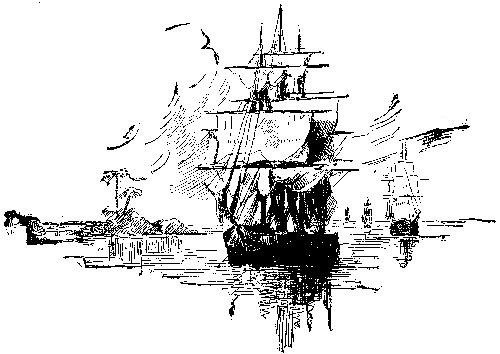
The "Constitution" and "Hornet" left Boston on the 26th of October, and shaped their course at once for the south. They put in at two or three ports which had been named to Capt. Porter as meeting-places, but, finding no trace of the "Essex," continued their cruise. At Port Praya in the island of St. Jago, and at Fernando Noronha, the two ships assumed the character of British men-of-war. Officers from whose uniform every trace of the American eagle had been carefully removed went ashore, and, after paying formal visits to the governors of the two islands, requested permission to leave letters for Sir James Yeo of His Majesty's service. Though directed to this prominent British naval officer, the letters were intended for Capt. Porter, and contained directions for his cruise, written in sympathetic ink. After the letters were deposited, the two vessels left; and we may be sure that the British colors came down from the masthead as soon as the ships were out of sight.
The next point at which the American ships stopped was San Salvador, on the coast of Brazil. Here Bainbridge lay-to outside the harbor, and sent in Capt. Lawrence with the "Hornet" to communicate with the American consul. Lawrence returned greatly excited. In the harbor he had found the British sloop-of-war "Bonne Citoyenne," of twenty guns, which was on the point of sailing for England. A more evenly matched adversary for the "Hornet" could not have been found, and the Yankee sailors longed for an engagement. A formal challenge was sent, through the American consul, to the captain of the British ship, requesting him to come out and try conclusions with the "Hornet." Every assurance was offered that the "Constitution" would remain in the offing, and take no part in the battle, which was to test the strength of the two equally matched ships only. Some days later, this challenge was reduced to writing, and sent to the English captain. But that officer declined the challenge, giving as his reason the fact that he had in his ship over half a million pounds in specie, which it was his duty to convey to England. For him to give battle to the "Hornet," would therefore be unwise, as he would put in jeopardy this money which it was his duty to guard. This response was conclusive, and the Englishman must be admitted to have acted wisely; but the knowledge of the valuable cargo of the "Bonne Citoyenne" only increased the desire of the Americans to capture her. The "Hornet" accordingly remained outside the harbor, as a blockader, while the "Constitution" continued her cruise alone.
Assuming To Be British Men-of-war.
She had not far to go in order to meet an enemy well worthy of her metal. Three days after parting with the "Hornet," two sail were made, well in shore. One of the vessels so sighted seemed to make for the land, as though anxious to avoid meeting the American ship; while the other came about, and made her course boldly toward the "Constitution."
It was about nine o'clock on a bright December morning that the "Constitution" encountered the strange vessel, which bore down upon her. A light breeze, of sufficient force to enable the vessels to manœuvre, was blowing; but the surface of the ocean was as placid as a lake in summer. The build of the stranger left no doubt of her warlike character, and the bold manner in which she sought a meeting with the American ship convinced Bainbridge that he had fallen in with an enemy. The "Constitution" did not for a time meet the enemy's advances in kind. Back of the advancing frigate could be seen the low, dark coast-line of Brazil, into whose neutral waters the Englishman could retreat, and thus gain protection, if the conflict seemed to go against him. Bainbridge determined that the coming battle should be fought beyond the possibility of escape for the vanquished, and therefore drew away gradually as the stranger came on. By noon the two ships were near enough together for flags to be visible, when Bainbridge set his colors, and displayed private signals. The enemy did the same; and, though his signals were unintelligible, the flag that fluttered at the masthead was clearly the flag of Great Britain. Bainbridge continued his retreat for an hour longer, then, being far enough from land, took in his main-sail and royals, and tacked toward the Englishman.
By this time the strange sail which had been sighted in company with the English ship had disappeared. The low-lying coast of Brazil had sunk below the horizon. From the deck of the "Constitution," nothing could be seen but the vast circle of placid ocean, and the English frigate about a mile to the windward, bearing down to open the fight. The drums beat, and the crew went quietly and in perfect order to their quarters. They were no longer the raw, untrained crew that had joined the ship some months before. They were veterans, with the glorious victory over the "Guerriere" fresh in their remembrance, and now animated with a desire to add to their trophies the strange vessel then in sight.
As the enemy, which proved to be the "Java," thirty-eight, Capt. Lambert, came nearer, she hauled down her colors, leaving only a jack flying. A jack is a small flag hoisted at the bowsprit cap. The Union jack of the United States navy is a blue flag dotted with stars, but without the stripes of the national flag; the jack of Great Britain has the scarlet cross of St. George on a blue field. The Englishman's action in hauling down his ensigns puzzled Bainbridge, who sent a shot as an order that they be raised again. The response to this reminder came in the form of a heavy broadside, and the action opened.
In the light wind that was blowing, the enemy proved the better sailer, and soon forged ahead. His object was to cross the bows of the American ship, and get in a raking broadside,—the end and aim of most of the naval manœuvring in those days of wooden ships and heavy batteries. By skilful seamanship, Bainbridge warded off the danger; and the fight continued broadside to broadside. The firing on both sides was rapid and well directed. After half an hour of fighting, the "Constitution" was seriously crippled by a round shot, which carried away her wheel, and wounded Bainbridge by driving a small copper bolt deep into his thigh. For a moment it seemed as though the American ship was lost. Having no control over the rudder, her head fell off, her sails flapped idly against the spars, and the enemy was fast coming into an advantageous position. But, though wounded, the indomitable Yankee captain was equal to the occasion. Tackle was rigged upon the rudder-post between decks, and a crew of jackies detailed to work the improvised helm. The helmsmen were far out of earshot of the quarter-deck: so a line of midshipmen was formed from the quarter-deck to the spot where the sailors tugged at the steering-lines.
"Hard-a-port!" Bainbridge would shout from his station on the quarter-deck.
Marines Picking Off The Enemy.
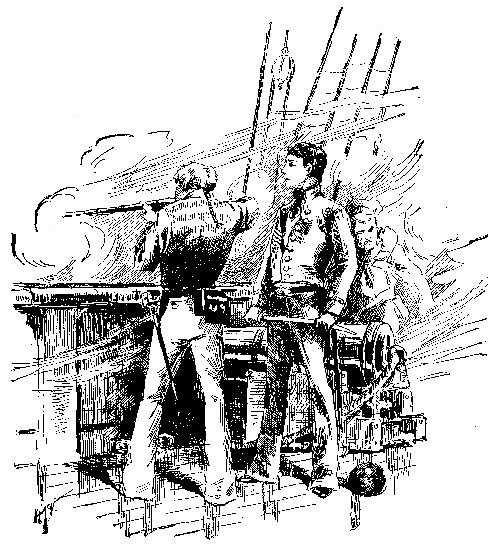
"Hard-a-port! Hard-a-port!" came the quick responses, as the midshipmen passed the word along. And so the ship was steered; and, notwithstanding the loss of her wheel, fairly out-manœuvred her antagonist. The first raking broadside was delivered by the "Constitution," and did terrible execution along the gun-deck of the English ship. The two ships then ran before the wind, exchanging broadsides at a distance of half pistol-shot. At this game the American was clearly winning: so the Englishman determined to close and board, in the dashing, fearless way that had made the tars of Great Britain the terror of all maritime peoples. The frigate bore down on the "Constitution," and struck her on the quarter; the long jib-boom tearing its way through the rigging of the American ship. But, while this movement was being executed, the American gunners had not been idle; and the results of their labors were very evident, in the rigging of the "Java." Her jib-boom and bowsprit were so shattered by shot, that they were on the point of giving way; and, as the ships met, the mizzen-mast fell, crashing through forecastle and main-deck, crushing officers and sailors beneath it in the fall, and hurling the topmen into the ocean to drown. The "Constitution" shot ahead, but soon wore and lay yard-arm to yard-arm with her foe. For some minutes the battle raged with desperation. A dense sulphurous smoke hung about the hulls of the two ships, making any extended vision impossible. Once in a while a fresher puff of wind, or a change in the position of the ships, would give the jackies a glimpse of their enemy, and show fierce faces glaring from the open ports, as the great guns were drawn in for loading. Then the gray pall of smoke fell, and nothing was to be seen but the carnage near at hand. The officers on the quarter-deck could better judge of the progress of the fray; and, the marines stationed there took advantage of every clear moment to pick off some enemy with a shot from one of their muskets. High up in the tops of the "Constitution" were two small howitzers, with which crews of topmen, under the command of midshipmen, made lively play with grape and canister upon the crowded decks of the enemy. From the cavernous submarine depths of the cock-pit and magazine, to the tops of each ship, not an idler was to be found. Chaplains, surgeons, clerks, cooks, and waiters—all were working or fighting for the honor of the flag under which they served.
Again the British determined to board; and the quick, sharp notes of the bugle calling up the boarders gave warning of their intentions. The men in the tops of the American frigate, looking down from their lofty station, could see the crowd of boarders and marines gathered on the forecastle and in the gang-ways, and could hear the shrill notes of the boatswain's whistle cheering them on. At that moment, however, the American fire raked the enemy with fearful effect, and the volleys of musketry from the marines and topmen made such havoc among the crowded boarders that the attempt was abandoned. The deadly fire of the Americans was not slackened. Capt. Lambert was struck down, mortally wounded; and the command fell upon Lieut. Chads, who, though himself badly wounded, continued the fight with true British courage. Over the side of the "Java" hung the wreck of her top-hamper, which every broadside set on fire. Yet the British tars fought on, cheering lustily, and not once thinking of surrender, though they saw their foremast gone, their mizzen-mast shivered, even the last flag shot away, and the last gun silenced.
When affairs had reached this stage, the "Constitution," seeing no flag flying on the enemy, hauled away, and set about repairing her own damages. While thus engaged, the main-mast of the "Java" was seen to go by the board, and the ship lay a hopeless wreck upon the water. After making some slight repairs, Bainbridge returned to take possession of his prize, but, to his surprise, found a jack still floating over the helpless hulk. It was merely a bit of bravado, however; for, as the "Constitution" ranged up alongside, the jack was hauled down.
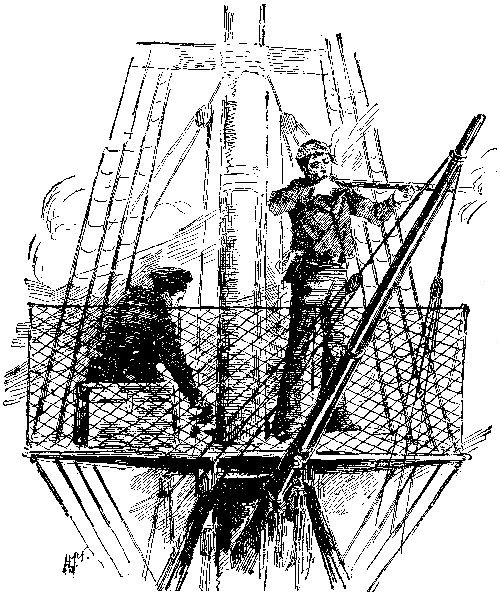
In The Cross-trees.
The "Java" proved to be a rich prize. She was one of the best of the English frigates, and had just been especially fitted up for the accommodation of the governor-general of Bombay and his staff, all of whom were then on board. This added to the regular number of officers and crew more than one hundred prisoners, mostly of high rank in British military and social circles.
The boarding officer found the ship so badly cut up that to save her was impossible. Her loss in men, including her captain Henry Lambert, and five midshipmen, was forty-eight, together with one hundred and five wounded, among whom were many officers. The "Constitution" had suffered much less severely, having but twelve killed and twenty wounded. The ship herself was but little damaged; her chief injury being the loss of her wheel, which was immediately replaced by that of the "Java."
Capt. Bainbridge now found himself a great distance from home, with a disabled ship filled with prisoners, many of whom were wounded. Even had the wreck of the "Java" been less complete, it would have been hazardous to attempt to take her back to the United States through the West India waters that swarmed with British vessels. No course was open save to take the prisoners aboard the "Constitution," and set the torch to the disabled hulk.
To do this was a work of no little difficulty. The storm of lead and iron that had swept across the decks of the British frigate had left intact not one of the boats that hung from the davits. The "Constitution" had fared better; but, even with her, the case was desperate, for the British cannonade had left her but two serviceable boats. To transfer from the sinking ship to the victorious frigate nearly five hundred men, over a hundred of whom were wounded, was a serious task when the means of transfer were thus limited.
Three days the "Constitution" lay by her defeated enemy, and hour after hour the boats plied between the two ships. The first to be moved were the wounded. Tackle was rigged over the side of the "Java;" and the mangled sufferers, securely lashed in their hammocks, were gently lowered into the waiting boat, and soon found themselves in the sick-bay of the American ship, where they received the gentlest treatment from those who a few hours before sought only to slay them. The transfer of the wounded once accomplished, the work proceeded with great rapidity: and in the afternoon of the third day the "Constitution" was filled with prisoners; and the "Java," a deserted, shattered hulk, was ready for the last scene in the drama of her career.
The last boat left the desolate wreck, and, reaching the "Constitution," was hauled up to the davits. The side of the American frigate next to the abandoned ship was crowded with men, who looked eagerly across the water. Through the open port-holes of the "Java," a flickering gleam could be seen, playing fitfully upon the decks and gun-carriages. The light grew brighter, and sharp-tongued flames licked the outside of the hull, and set the tangled cordage in a blaze. With this the whole ship seemed to burst into fire, and lay tossing, a huge ball of flame, on the rising sea. When the fire was raging most fiercely, there came a terrific explosion, and the great hull was lifted bodily from the water, falling back shattered into countless bits. Guns, anchors, and ironwork dragged the greater part of the wreckage to the bottom; and when the "Constitution," with all sail set, left the spot, the captive Englishmen, looking sadly back, could see only a patch of charred woodwork and cordage floating upon the ocean to mark the burial-place of the sturdy frigate "Java."
The "Constitution" made sail for San Salvador, where the prisoners were landed; first giving their paroles not to serve against the "United States" until regularly exchanged. Bainbridge then took his ship to Boston, where she arrived in February, 1813.
The substitution of the wheel of the "Java" for that of the "Constitution," shot away in battle, has been alluded to. In his biography of Capt. Bainbridge, Fenimore Cooper relates a story of interest regarding this trophy. It was a year or two after peace was made with England, in 1815, that a British naval officer visited the "Constitution," then lying at the Boston navy-yard. The frigate had been newly fitted out for a cruise to the Mediterranean; and an American officer, with some pride, showed the Englishman over the ship, which was then undoubtedly the finest of American naval vessels. After the tour of the ship had been made, the host said, as they stood chatting on the quarter-deck,—
"Well, what do you think of her?"
"She is one of the finest frigates, if not the very finest, I ever put my foot aboard of," responded the Englishman; "but, as I must find some fault, I'll just say that your wheel is one of the clumsiest things I ever saw, and is unworthy of the vessel."
The American officer laughed.
"Well, you see," said he, "when the 'Constitution' took the 'Java,' the former's wheel was shot out of her. The 'Java's' wheel was fitted on the victorious frigate, to steer by; and, although we think it as ugly as you do, we keep it as a trophy."
All criticisms on the wheel ended then and there.
The defeat of the "Java" closed the warfare on the ocean during 1812. The year ended with the honors largely in the possession of the United States navy. The British could boast of the capture of but two armed vessels,—the "Nautilus," whose capture by an overwhelming force we have already noted; and the little brig "Vixen," twelve guns, which Sir James Yeo, with the "Southampton," thirty-two, had overhauled and captured in the latter part of November. The capture of the "Wasp" by the "Poictiers," when the American sloop-of-war was cut up by her action with the "Frolic," was an occurrence, which, however unfortunate for the Americans, reflected no particular honor upon the British arms.
In opposition to this record, the Americans could boast of victory in four hard-fought battles. In no case had they won through any lack of valor on the part of their antagonists; for the Englishmen had not sought to avoid the battle, and had fought with the dogged valor characteristic of their nation. In one or two instances, it is true that the Americans were more powerful than the foe whom they engaged; but, in such cases, the injury inflicted was out of all proportion to the disparity in size of the combatants. The four great actions resulting in the defeat of the "Guerriere," the "Frolic," the "Macedonian," and the "Java," showed conclusively that the American blue-jackets were equal in courage to their British opponents, and far their superiors in coolness, skill, discipline, and self-reliance; and these qualities may be said to have won the laurels for the American navy that were conceded to it by all impartial observers.
Besides the victories over the four British ships enumerated, the Americans had captured the "Alert," and a British transport bearing a considerable detachment of troops. These achievements, as involving no bloodshed, may be set off against the captures of the "Nautilus" and "Vixen" by the British. Of the number of British merchant-vessels captured, the records are so incomplete that no accurate estimate can be made. To the naval vessels are accredited forty-six captures among the enemy's merchant-marine, and this estimate is probably very nearly accurate. But with the declaration of war, Portsmouth, Salem, New London, New York, Baltimore, and, indeed, every American seaport, fitted out fleet privateers to prey upon the enemy's commerce. The sails of this private armed navy fairly whitened the sea, and few nights were not illuminated by the flames of some burning prize. As their chief object was plunder, the aim of the privateers was to get their prize safely into port; but, when this was impossible, they were not slow in applying the torch to the captured vessel. The injury they inflicted upon the enemy was enormous, and the record of their exploits might well engage the industry of painstaking historians. As an adjunct to the regular navy, they were of great service in bringing the war to a happy conclusion.
It is not to be supposed that the British men-of-war and privateers were idle while the Americans were thus sweeping the seas. More than one American vessel set sail boldly from some little New England port, freighted with the ventures of all classes of tradesmen, only to be snapped up by a rapacious cruiser. But the mercantile marine of the United States was but small, and offered no such rewards to enterprising privateers as did the goodly fleets of West-Indiamen that bore the flag of Great Britain. And so, while the American privateers were thriving and reaping rich rewards of gold and glory, those of the British were gradually abandoning privateering in disgust. The American prize-lists grew so large, that the newspapers commenced the practice of publishing weekly a list of the enemy's ships taken during the week past. In Baltimore, Henry Niles, in his paper "The Weekly Register," robbed "The London Naval Chronicle" of its vainglorious motto,—
"The winds and seas are Britain's broad domain, And not a sail but by permission spreads."
This sentiment Niles printed at the head of his weekly list of British vessels captured by United States vessels,—a bit of satire not often equalled in the columns of newspapers of to-day.[Back to Content]
CHAPTER VII.
THE WAR ON THE LAKES. — THE ATTACK ON SACKETT'S HARBOR. — OLIVER HAZARD PERRY ORDERED TO LAKE ERIE. — THE BATTLE OF PUT-IN-BAY.
et us now abandon for a time our consideration of the progress of the great naval war on the ocean, and turn our attention to a humbler theatre, in which the drama of battle was proceeding with no less credit to the American participants, though with less grand and inspiring accessories. On the great fresh-water lakes which skirt the northern frontier of the United States, the two warring powers contended fiercely for the mastery. But there were no desperate duels between well-matched frigates; nor, indeed, did either the British or American squadron of the lake station boast a craft of sufficient armament to be termed a frigate, until the war was nearly at an end. Barges, gunboats, sloops, schooners, and brigs made up the squadrons that fought for the possession of the fresh-water seas; and few either of the jackies of the forecastle or the officers of the quarter-deck were bred to the regular service. With such forces it could only happen that the encounters of the foes should be little more than skirmishes, and that neither in immediate loss of life nor in direct results should these skirmishes be important. Such, in fact, was the general character of the hostilities on the lakes, with two noteworthy exceptions,—Perry's victory at Put-in-Bay, and McDonough's successful resistance of the British on Lake Champlain.

That the war should invade the usually peaceful waters of Ontario, Erie, and Champlain, was inevitable from the physical characteristics of the northern frontier of the United States. Great Britain held Canada; and an invasion of her enemy's territory from that province was a military measure, the advisability of which was evident to the most untaught soldier. No overland expedition could hope to make its way through the dense forests of Maine, New Hampshire, Vermont, or the Adirondack region of New York. But the lakes offered a tempting opening for invasion. Particularly did the placid, navigable waters of Lake Champlain, stretching, from the Canada line far into the heart of New York, invite the invader; while Lakes Erie and Ontario afforded an opportunity for attacking the Americans on what was then, practically, their western frontier.
The Americans were not slow in perceiving the dangers that threatened their north-western frontier, and began to prepare for its defence most energetically at the first declaration of war. It was a work that taxed to the utmost the resources of the young country. The shores of the lakes as far west as Detroit were open to the attacks of the enemy, and, although part of the territory of the United States, were really more accessible to the invaders than to the American defenders. The population was sparse, and the means of transportation very primitive. Before the days of railroads, canals, or even well-kept turnpikes, troops, seamen, ordnance, and all munitions of war could only be transported from the cities on the seacoast by the most laborious hauling over roads hardly worthy of the name. Nor was the transportation problem solved during the continuance of the war. When in May, 1814, the new United States frigate "Superior" lay at her dock at Sackett's Harbor, her ordnance, stores, and cordage had to be brought from Oswego Falls, some fifty miles away. A clear water-route by the Oswego River and the lake offered itself; but Sir James Yeo, with his squadron, was blockading the mouth of the harbor, and the chance for blockade-runners was small indeed. To carry the heavy ordnance and cables overland, was out of the question. The dilemma was most perplexing, but Yankee ingenuity finally enabled the "Superior" to get her outfit. The equipment was loaded upon a small fleet of barges and scows, which a veteran lake captain took to a point sixteen miles from the blockaded harbor. By sailing by night, and skulking up creeks and inland water-ways, the transports reached this point without attracting the attention of the blockading fleet. They had, however, hardly arrived when news of the enterprise came to the ears of the British, and an expedition was sent to intercept the Americans, which expedition the Yankees successfully resisted. The question then arose as to how the stores were to be taken across the sixteen miles of marsh and forest that lay between the boats and the navy-yard at Sackett's Harbor. The cannon and lighter stores were transported on heavy carts with great difficulty, but there still remained the great cable. How to move this was a serious question. No cart could bear its ponderous weight of ninety-six hundred pounds. Again Yankee ingenuity and pluck came to the rescue. Two hundred men volunteered to carry the great rope on their shoulders, and in this way it actually was transported. Along the shore of the little creek the great cable was stretched out with prodigious labor, and lay there looking like a gigantic serpent. The two hundred men ranged themselves along the line at regular intervals, and at a given signal hoisted the burden to their shoulders. At the word of command, all stepped off briskly together, and the long line wound along the narrow path through the forests. They started out cheerily enough, enlivening the work with songs and jests; but at the end of the first mile all were glad enough to throw down the load, and loiter a while by the roadside. A few minutes' rest, and up and on again. Now arms began to ache, and shoulders to chafe, under the unusual burden; but the march continued until noon of the next day, when the footsore and weary carriers marched proudly into Sackett's Harbor, to find sailors and soldiers assembled to greet them with bands and cannon-firing. In accordance with the custom of the time, these demonstrations of honor were supplemented by the opening of a barrel of whiskey, in honor of the arrival of the cable.