Volume 1 / Part 2 — PART II. BLUE JACKETS OF 1812 (continued 2)
Reading edition
It was then growing dark, though the faint glow of the long tropic twilight still lingered on the western horizon. Above the towering masts of the two great frigates, the stars gleamed with a brilliancy seldom seen in more northern latitudes. As the ships rushed through the water, the waves broke against the bows, and fell back in masses of phosphorescent light; while the wakes of the vessels could be traced far back into the darkness,—two parallel paths of light, that glowed and sparkled like the milky way that spanned the starry sky above.
Side by side the two frigates ploughed through the water. The creaking of their cordage, and the rushing of the wind through the rigging, mingled with the thunder of the cannonade, which, though slow, and made up of single reports, when the "Constellation" was confined to the use of her bow-chasers, soon rose to thunderous broadsides as the two ships came side to side. As the twilight died away, the two contestants were enveloped in almost total darkness, save for the fitful flashes of the cannon, and the red glare of the battle-lanterns that hung from the shrouds. The gunners had for a target nothing but a black, shapeless mass, that could be seen rushing through the waves some hundreds of yards away. But this did not prevent fearful execution being done on both sides. For five hours the two ships kept up the running fight. The ponderous eighteen and forty-two pound shot of the enemy crashed into the "Constellation," or swept her decks, doing dreadful damage. The deck was strewn with dead and dying men, and the surgeons down in the cock-pit soon had their tables full of moaning sufferers. No one could tell what might be the condition of "La Vengeance;" but her regular fire told that she was in no wise disabled. At one o'clock in the morning, the sound of her guns seemed to be more distant; and by the flash of the cannon it was seen that she was drawing out of the fight. The Americans cheered lustily, and Truxton ordered that his ship be braced up in chase.
But the fire of the enemy had been rapid and well directed; and now, at this critical moment, its results were to rob the "Constellation" of her victory. As the ships were brought about, to follow in the track of the flying "Vengeance," an officer came rushing to the quarter-deck, and reported that all the shrouds and braces of the foremast had been shot away, and the mast was in momentary danger of falling. The rigging had been so literally cut in pieces by the fire of the enemy, that splicing was out of the question; but Truxton, in the hope of saving his mast, called all hands from the guns, and the fire of the "Constellation" stopped.
Up in the foretop was stationed Midshipman Jarvis, with a dozen or more of jackies, whose duty it was to mend the cordage of the topmast, and to keep up a musketry fire upon the enemy. Long before the officer of the deck had reported the danger of the foremast, one of the topmen had told Jarvis, who was but a lad, that the mast was likely to fall.
"Ay, ay, my lad," responded the plucky young officer; "but our place is here, and we must go with it."
The sailors on the deck below worked manfully: but, notwithstanding all their efforts, the mast soon went by the board; and Jarvis and his brave comrades were thrown far out into the black water, never to be seen again.
The fall of the foremast ended the battle for the "Constellation." Helpless, and cumbered by the wreck, she tossed about on the water while her foe made good her escape. What might have been the outcome of the conflict, had it continued, it is impossible to tell. "La Vengeance" carried heavier metal and a larger crew than the American frigate; and Truxton, with all his dash, found no mean adversary in Capt. Pitot. Yet the condition of the French ship when she came into port at Curaçoa showed that the fire of the Yankee gunners had been rapid and accurate. Fifty of the enemy were killed, and one hundred and ten wounded; while, of the Americans, only thirty-nine appeared on the lists of killed and wounded. It was said at the time, that Capt. Pitot reported having struck his flag three times; hoisting it again, on finding that in the darkness the "Constellation" took no notice of the surrender. But this seems, on the face of it, improbable; and the action can hardly be awarded to either ship, although the gallantry shown on either side was enough to win a victory.
It may well be imagined that this brilliant action, together with the capture of "L'Insurgente," made the "Constellation" the most popular ship of the navy; a place which she held until the stirring events of the war with England pushed the "Constitution" so far to the front, that even now, when she lies dismantled and rotting at the Brooklyn navy-yard, Americans still think of "Old Ironsides" as the typical ship of our once glorious navy.
The actions between the "Constellation" and the "Vengeance" and "Insurgente" were the chief contests between regularly commissioned ships of the two nations in the war with France. But the West Indies were filled with privateers and semi-piratical craft, with which the navy waged a ceaseless warfare, which well prepared the blue-jackets for the graver struggle which was yet to come with Great Britain. The half-savage population of the French islands was a fruitful source of trouble to the American seaman. These gentry, known as Picaroons, seemed to have a natural inclination for piracy; and the unlucky merchant-captain who should come to anchor, or be becalmed, near one of the islands, was sure to see his vessel boarded, and his cargo plundered, by a lawless horde of Frenchmen and mulattoes, whose dialect was an unmusical combination of French and African tongues. The custom of the Picaroons was to do their cruising in huge barges propelled by sweeps. With these they would often cut out a merchant-vessel from beneath the guns of a protecting man-of-war, and tow her off to be plundered at leisure. Occasionally, however, their well-laid plans failed in the execution.
One of the most noted of these occasions was the repulse of ten Picaroon barges that attacked the United States topsail schooner "Experiment," and a fleet of merchantmen under her charge. The "Experiment," with her convoy, was lying becalmed in the Bight of Leogane, in the island of San Domingo. Not a breath of air was stirring; and the vessels, drifting about at the mercy of the currents, soon became widely separated, and were an easy prey for the hordes of Picaroons that swarmed in that region. In no way could the "Experiment" secure a position which would enable her to protect all the merchantmen. In this dilemma it was determined to disguise the war-vessel, in the hopes that the pirates, taking her for a merchantman, would attack her first. This was done; and, as luck would have it, the Picaroons fell into the trap.
Although not the captain of the ship, Lieut. David Porter was in command on this occasion; and, on hearing that ten Picaroon barges with swivels in the bows, and crews of forty men each, were approaching, he sent his crew to quarters, and prepared for a desperate resistance. Onward over the smooth waters came the huge barges, each with its twenty-six oars, looking like a mighty centipede. On the ship every thing was quiet, as the jackies stood to their guns, with the prospect of a deadly struggle before them. Should the barges get to close quarters, and surround the schooner, no earthly power could prevent their boarding, when their numbers would surely bring them success. But the painful pause before the battle was not long. Suddenly Porter, ever on the alert, cried out to fire. From every gun that could be brought to bear, a storm of grape and canister was rained upon the advancing boats; and the yells that went up from the astounded Picaroons told of the deadly work done in the crowded boats. For a moment, the fleet of barges fell into confusion; some retreating, some advancing, and others drifting about helpless. Although the murderous fire was kept up, the pirates formed again, and attempted to get alongside, but were repeatedly beaten back. With musketry and swivels they attempted to answer the fire of the Americans; but with little effect, for the crew of the "Experiment" kept close under the bulwarks. Men were precious then, and Porter would not let one expose himself unnecessarily; but he himself, from his prominent post of observation, was an easy mark, and a Picaroon's bullet soon lodged in his shoulder. Notwithstanding the painful wound he never left his post. The unexpected opposition only maddened the Picaroons, and they made desperate attempts to get alongside; but to no avail. Now the stern and now the bow of the "Experiment" was chosen as the point of attack; but still the rapid fire of the jackies beat the pirates back.
On the low-lying shores of the islands, some hundreds more of the Picaroons had gathered to watch the conflict; and, as the boats became short-handed from the carnage, they put back to the shore, and returned to the fight fully re-enforced. The bodies of the dead were thrown overboard without ceremony, and soon attracted great schools of the fierce sharks that abound in the waters of the tropics. Then a new horror was added to the scene. At a moment when the barges wavered and floated for a moment without motion, Porter ordered his gunners to load with solid shot. Two or three broadsides rang out; and, when the smoke cleared away, two barges were seen to be sinking. The affrighted crews bent to their oars, and strained every muscle to reach the shore; but, while yet in deep water, the barges sunk, and the Picaroons were left floundering in the sea. All struck out manfully for the shore; but suddenly one sprung half from the water, and with a horrid yell sunk from sight. One after another disappeared in the same way; for the sharks had tasted blood, and were not to be appeased. For seven hours the conflict raged fiercely; but at last the Picaroons confessed themselves beaten, and sullenly relinquished their attacks upon the "Experiment." But they were not to be wholly robbed of their plunder; and two merchant-vessels fell a prey to their piratical violence, before a breeze, springing up, enabled the squadron to escape.
Before the year was over, the Picaroons had another serious defeat to mourn over; and on this second occasion they were well punished for their many piracies. The "Boston," a twenty-eight-gun ship, was convoying a merchant-brig to Port au Prince, when the lookout discovered nine large barges skulking along the shore, ready to pounce upon the two vessels when a favorable moment should arrive. Porter was again in command. His tactics were at once determined upon; and the ports of the "Boston" were closed, and the ship thoroughly disguised. The Picaroons were deceived sufficiently to make a dash upon the two ships, and approach boldly within easy gunshot; then, discovering their mistake, they turned and fled in panic. This time no calm hampered the ship-of-war; and, making all sail, she dashed into their midst. For two hours she kept within easy range of the barges; and her gunners, working deliberately, did fearful execution in the ranks of the enemy, and sunk three barges before the wretched fugitives could reach the shore. After dealing out this summary justice, the "Boston" continued her voyage, and, after leaving her convoy in the port of her destination, began a cruise about the islands and the Spanish Main. In the course of this cruise she met the French corvette "Le Berceau," which struck after a plucky action of two hours. The Frenchman was badly cut up in hull and rigging, and shortly after the surrender her fore and main masts went by the board. The "Boston" was but little injured, and took her prize safely into port.
After this the fighting was chiefly confined to short, sharp affrays between the smaller United States ships and the French privateers, which were generally good sailers and well manned, although deficient in metal. The great frigates like the "Constellation" found no more adversaries worthy of their fighting qualities, and only the sloops and topsail-schooners gave their crews a chance to smell gunpowder. Some of these smaller actions, however, were sharp and gallant, although their details have not been preserved like those of the famous naval duels.
The "Experiment," after her adventure with the Picaroons, fought two gallant battles, and was successful in each, although the second for a time threatened to lead to international difficulties. While cruising on her station, the vessel made two sail, which, as they came nearer, proved to be a brig of eighteen guns and a three-masted schooner of twenty guns, both flying the French tricolor, and both intent on mischief. The American fled, but laid her course in such a way as to separate the two pursuers. When night had fallen, Lieut.-Commander Stewart, who commanded the "Experiment," saw that the enemy's forces were divided by about a league of green water, and at once determined to strike a blow. Doubling on his course, he ran his vessel alongside the schooner, and poured in two or three broadsides with such rapidity and haste that the Frenchman struck before his consort could come to his aid. Hastily throwing Lieut. Porter and a prize-crew aboard the prize, Stewart dashed off after the brig, which fled incontinently, and proved too good a sailer to be overtaken. Pure audacity had carried the day for the "Experiment," for the brig was powerful enough to have blown her pursuer to bits in a short engagement.
The second exploit of the "Experiment" was no less gallant than this, but in the end proved far less satisfactory. Late in a summer's afternoon a suspicious sail was made; and the chase, begun at once, had continued until nightfall. When darkness settled over the ocean, Stewart calculated the course laid by the stranger, and ordered his helmsman to keep the ship on that course until midnight, when, if the fugitive was not overhauled, the chase would be abandoned. Just before midnight a sail was seen near by and to windward. The men were sent to quarters; and with guns shotted, and battle-lanterns burning, the "Experiment" ran up under the stranger's lee, and hailed. No answer was returned. Perplexed and irritated, Stewart ordered a shot fired into the stranger, which was no sooner done than a broadside was returned, which made the schooner reel. Both vessels were then plunged into conflict, though neither knew the name or nationality of the opponent. For a time the "Experiment" was handicapped by the heavy wind, which laid her over so far that her guns were elevated skyward, and her shot whistled through the enemy's tops. To obviate this, planks were thrust under the breeches of the guns, until at last the proper range was secured, when an active cannonade soon forced the stranger to strike. Lieut. Porter was sent to take possession of the prize; but the report he brought back put all thought of prize-money out of the minds of the victors, for the stranger was a Bermudian privateer, flying the British flag, and under the protection of a nation with which the United States was at peace. The fault lay with the privateers for not responding to the hail, but the Americans did all in their power to repair the damage done. All the next day they lay by their vanquished adversary, and the sailors of two ships worked side by side in patching up the injuries done by the shot. By night the privateer was able to continue her cruise, resolving, doubtless, to avoid future conflicts with the ships of the American navy.
But to enter into the details of each of the naval duels of the French war of 1798, would require a volume devoted exclusively to its consideration. Although there was never a declaration of war between the two countries, yet the warfare on the ocean was earnest, and even desperate. Both nations went to work with a will, and the results were of incalculable benefit to the then pygmy navy of the United States. In their newspapers the Americans read with wonder and pride of the successes of their new vessels and young sailors, against the trained seamen and best frigates of France. When the war closed, the country rang with the praises of the blue-jackets. Indeed, a record of sixty-four French vessels captured, besides many American vessels which were recaptured from their captors, was enough to arouse feelings of pride throughout the nation; and the celerity with which France seized upon the proposal for peace showed well the reputation which our navy had gained beyond the ocean. For months after the peace was signed, the names of Bainbridge, Truxton, Stewart, and Talbot were household words throughout the nation; and the deeds of the gallant ships along the Spanish Main were the favorite stories of the boys of the land. Three of the oaken veterans, however, never came home; but against their names must be put the saddest of all naval records: foundered at sea. The captured "Insurgente," the "Saratoga," and the "Pickering" simply vanished from the ocean. Over fourscore years have passed; and of them, and the gallant lads that manned them, nothing has ever been known. Whether they perished by the fury of the tropical typhoon, whether a midnight collision sent them suddenly to the bottom, or whether the ships were destroyed and the crews murdered by the piratical desperadoes of the West Indies, can never be known. Somewhere on the coral-strewn bed of the blue seas of the tropics lie the mouldering hulks of those good ships, and the bones of their gallant crews. There will they lie, unknown and unsought, until earthly warfare is over for all men, and the sea gives up its dead.[Back to Content]
CHAPTER III.
PROPOSED REDUCTION OF THE NAVY. — RENEWAL OF BRITISH OUTRAGES. — THE AFFAIR OF THE "BALTIMORE." — ATTACK ON THE "LEANDER." — ENCOUNTER BETWEEN THE "CHESAPEAKE" AND "LEOPARD."
ot many months had elapsed after the close of the war between the United States and France, when the pride of the nation in the navy that had won such laurels in that conflict began to wane. In the place of poems and editorials singing the praises and pointing out the value of the navy, the newspapers began to be filled with demands for its reduction. It was an unwarrantable expense, exclaimed the critics of the press, for a nation so young, and so far from the warring peoples of Europe, to maintain a navy at all. A few gunboats to guard the coast would be enough. All the consequences of the reduction of the navy at the close of the Revolution were forgotten in an instant. A penny-wise and pound-foolish spirit came over all the political leaders; and the Democratic party, then newly come into power, determined to endear itself to the hearts of the people by cutting down the expenses of the Government, and to this end they attacked first the appropriations for the navy. A gallant fight was made against the total abolition of the navy; and finally it was decided to retain thirteen of the ships-of-war on the list, while the others should be sold. With these thirteen vessels, of which the most noted were the "Constitution," the "Constellation," and the "United States," the navy was placed upon a peace footing. Even this moderate squadron, however, brought out much opposition from economically minded statesmen; but the aggressions of the Barbary pirates, and the war with Tripoli which opened in 1801, gave the sailor lads active employment, and for the time the outcry of the economists against the navy ceased.

Of the various wars with Tripoli and the other states of Barbary, we have already given some account. The political bearing of the Tripolitan war upon the war which afterwards followed with Great Britain was slight; but, as discipline for the sterner reality of naval warfare with the nation long reputed to be "mistress of the seas," the experience of the Yankee tars with the turbaned infidels was invaluable.
Let us, then, return to the shameful recountal of the injuries committed by the British upon the American flag on the high seas. Even while the United States was at war with France, and thus aiding the British, the outrages never ceased. American sailors were still impressed. American vessels were boarded, and often seized, on the slightest pretexts. Even the ships of the Government were not exempt, for the British respected no right save that of greater power.
It was in November, 1798, that the United States sloop-of-war "Baltimore," of twenty guns, and under command of Capt. Phillips, was in charge of a convoy of merchantmen bound to Havana. On the morning of the 16th of that month, the sloop, with her convoy, were in sight of their destination, and could even see the solid, towering walls of the Moro, rising high above the low-lying shores about Havana. The breeze was fresh and fair; and all hands expected to cast anchor before night in the beautiful bay, oh the shores of which stands the chief city of the island of fruits and spices. On the "Baltimore" the jackies were busily at work holystoning the decks, until they glistened with the milky whiteness dear to the eye of the sailor of the days before the era of yellow pine or black, unsightly iron ships. The shrouds and standing rigging had been pulled taut with many a "Yo, heave ho!" until the wind hummed plaintively through the taut cordage, as through the resounding strings of an Æolian harp. The brasswork and polished breeches of the guns were polished by the vigorous rubbing by muscular sailors, until they shone again. All told of a coming season in a friendly port.
While the work of preparation for port was thus going busily on, the lookout hailed the deck, and reported a squadron in sight. A moment's glance convinced Capt. Phillips that the strangers were British war-vessels; and, as they were still accustomed to annoy American merchantmen, he hastily signalled his convoy to carry sail hard, and make port before the British came up, while the "Baltimore" bore up to speak to the British commodore.
Before the merchantmen could escape, however, the British cut off three of them, under some peculiar and mistaken ideas of the law of blockades. More than this, when Capt. Phillips paid his visit to the English commodore in the latter's cabin, he was calmly informed that it was intended to take from the "Baltimore" into the British service every sailor who had not a regular American protection; this under the new English doctrine, that every sailor was an Englishman unless proved to be otherwise. The avowal by the British captain of this intention filled Phillips with indignation, and he warmly protested against any such action.
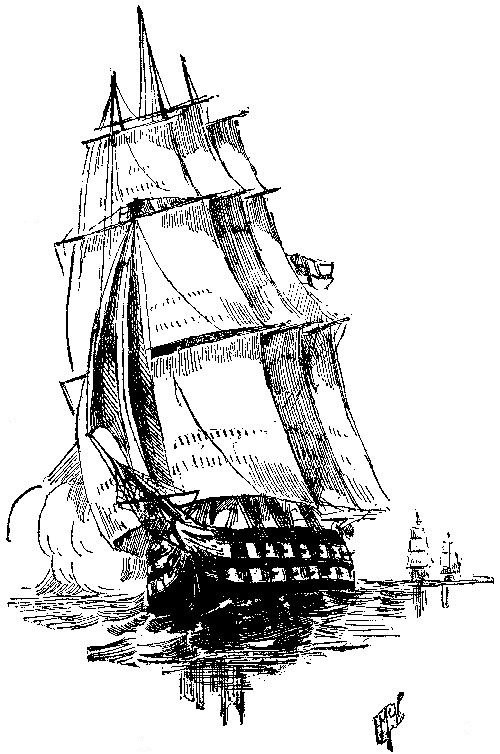
The British Squadron.
It would, he insisted, be an outrage on the dignity of the nation which he served; and, as the overpowering force of the British rendered resistance impossible, he should insist upon surrendering his ship should they persist in their undertaking, which was no more nor less than open warfare. With this he arose from his seat, and leaving the cabin, to which he had been invited as the guest of a friendly nation, returned to his own ship.
Here he found a state of affairs that still further added to his indignation. At the foot of the gangway of the "Baltimore" floated a boat from one of the British ships, and on the deck of the sloop was a lieutenant in British uniform in the act of mustering the American crew. Capt. Phillips at once seized the muster-roll, and ordered the officious Briton to walk to leeward, while the crew of the "Baltimore" were sent to their quarters.
But, having done this, he became doubtful as to the course for him to pursue. Successful resistance was out of the question; for he was surrounded by five British vessels, one of which carried ninety-eight guns, while the smallest mounted thirty-two, or twelve more than the "Baltimore." Even had the odds against him been less great, Capt. Phillips felt grave doubts as to his authority to resist any armed vessel. He had sailed under instructions that "the vessels of every other nation (France excepted) are on no account to be molested; and I wish particularly to impress upon your mind," wrote the Secretary of the Navy, "that should you ever see an American vessel captured by the armed ship of any nation at war, with whom we are at peace, you cannot lawfully interfere, for it is to be taken for granted that such nation will compensate for such capture, if it should prove to have been illegally made." After some deliberation over this clause in his instructions, Capt. Phillips concluded that for him to make even a formal resistance would be illegal; and accordingly the flag of the "Baltimore" was lowered, and the British were told that the ship was at their disposal. They immediately seized upon fifty-five men from the American crew, who were taken away to the British fleet. But in this wholesale impressment they did not persist. Fifty of the men were sent back; and the squadron set sail, carrying away the five pressed men, and leaving the men of the "Baltimore," from the captain down to the smallest cabin-boy, smarting under the sense of an indignity and insult offered to the flag under which they served.
Capt. Phillips hoisted his flag again, and continued his cruise. News travelled slowly in those days; and the tidings of this latest British insult did not reach the United States until the "Baltimore," returning home, brought it herself. Hardly had the ship reached port, when Capt. Phillips hastened to Philadelphia, then the national capital, and laid his report of the affair before the Government. In a week's time, without even the formality of a trial, he was dismissed from the navy.
After the lapse of more than eighty years it is impossible to look back upon this affair without indignation, mortification, and regret. That the naval officers of Great Britain should have been able, by the mere force of arms, to inflict so cruel an insult upon our flag, can but arouse indignation in the breast of every true American. And the humiliation was great enough, without having added to it the obviously hasty and unjust action of the authorities, in dismissing, without a trial, an officer who had faithfully served his country. It is indeed possible that Capt. Phillips erred gravely in his course; but justice alone demanded for him a fair trial, and the nature of his instructions certainly afforded him some justification for his action.
The years that opened the nineteenth century were full of events that exerted the greatest influence over the growth of the United States. The continuance of the Napoleonic wars in Europe, our own war with the Barbary powers, the acquisition of Louisiana,—all these had their effect on the growth of the young Republic of the West. But, at the same time, England was continuing her policy of oppression. Her cruisers and privateers swarmed upon the ocean; and impressment of seamen and seizure of vessels became so common, that in 1806 memorials and petitions from seamen and merchants of the seaport towns poured in upon Congress, begging that body to take some action to save American commerce from total destruction. Congress directed the American minister in London to protest; but to no avail. Even while the correspondence on the subject was being carried on, the British gave renewed evidence of their hostility to their former Colonies, and their scorn for the military or naval power of the United States. From the far-off shores of the Mediterranean came the news that boats from the fleet of the British Admiral Collingwood had boarded the United States gunboat No. 7, and taken from her three sailors, under the pretence that they were Englishmen. But an occurrence that shortly followed, nearer home, threw this affair into oblivion, and still further inflamed the national hatred of the English.
A small coasting sloop, one of hundreds that made voyages along the American coast from Portland to Savannah, was running past Sandy Hook into New York Bay, when she was hailed by the British ship "Leander," and ordered to heave to. The captain of the coaster paid no attention to the order, and continued on his way, until a shot from the cruiser crashed into the sloop, and took off the head of the captain, John Pearce of New York. This was murder, and the action of the British in firing upon the sloop was gross piracy. Such an outrage, occurring so near the chief city of the United States, aroused a storm of indignation. The merchants of New York held meetings at the old Tontine Coffee-House, and denounced not only the action of the British cruiser, but even impeached the Government of the United States; declaring that an administration which suffered foreign armed ships to "impress, wound, and murder citizens was not entitled to the confidence of a brave and free people." The fact that the captain of the offending cruiser, on being brought to trial in England, was honorably acquitted, did not tend to soothe the irritation of the Americans.
Occurrences such as this kept alive the American dislike for the English, and a year later an event happened which even the most ardent peace-lover could not but condemn and resent with spirit.
In 1807 the United States frigate "Chesapeake," then lying at the navy-yard at Washington, was put in commission, and ordered to the Mediterranean, to relieve the "Constitution." Nearly a month was consumed in making necessary repairs to hull and cordage, taking in stores, shipping a crew, and attending to the thousand and one details of preparation for sea that a long time out of commission makes necessary to a man-of-war. While the preparations for service were actively proceeding, the British minister informed the naval authorities that three deserters from His British Majesty's ship "Melampus" had joined the crew of the "Chesapeake;" and it was requested that they should be given up. The request was made with due courtesy; and, although there is no principle of international law which directs the surrender of deserters, yet the United States, as a friendly nation, was inclined to grant the request, and an inquiry was made into the case. The facts elicited put the surrender of the men out of the question; for though they frankly confessed to have deserted from the "Melampus," yet they claimed to have been impressed into the British service, and proved conclusively that they were free Americans. This was reported to the British minister; and, as he made no further protests, it was assumed that he was satisfied.
Some weeks later the vessel left the navy-yard, and dropped down the river to Hampton Roads. Even with the long period occupied in preparation for sea, the armament of the ship was far from being in order; a fact first discovered as she passed Mount Vernon, as she was unable to fire the salute with which at that time all passing war-vessels did honor to the tomb of Washington. After some days stay at Hampton Roads, during which time additional guns and stores were taken on, and the crew increased to three hundred and seventy-five men, the ship got under way, and started on her voyage.
It was on a breezy morning of June that the "Chesapeake" left the broad harbor of Hampton Roads, the scene of so many of our naval glories. From the masthead of the frigate floated the broad pennant of Commodore Barron, who went out in command of the ship. The decks were littered with ropes, lumber, and stores, which had arrived too late to be properly stowed away. Some confusion is but natural on a ship starting on a cruise which may continue for years, but the condition of the "Chesapeake" was beyond all excuse; a fact for which the fitting-out officers, not her commander, were responsible.
As the American ship passed out into the open ocean, there was a great stir on the decks of four English cruisers that lay quietly at anchor in Lynn Haven Bay; and almost immediately one of these vessels hoisted her anchor, set her sails, and started out in the track of the frigate. A stiff head-wind blowing, the American was forced to tack frequently, in order to get ahead; and her officers noticed that the British ship (the "Leopard," of fifty guns) tacked at the same time, and was evidently following doggedly in the wake of the "Chesapeake." No suspicion that the pursuer had other than peaceful motives in view entered the minds of the American officers; and the ship kept on her course, while the sailors set about putting the decks in order, and getting the vessel in trim for her long voyage. While all hands were thus busily engaged, the "Leopard" bore down rapidly, and soon hailed, saying that she had a despatch for Commodore Barron. The "Chesapeake" accordingly hove to, and waited for a boat to be sent aboard.
The two ships now lay broadside to broadside, and only about a half pistol-shot apart. No idea that the Englishman had any hostile designs seems to have occurred to Commodore Barren; but some of the younger officers noticed that the ports of the "Leopard" were triced up, and the tompions taken out of the muzzles of the cannon. The latter fact was of the gravest import, and should have been reported at once to the commander; but it appears that this was not done.
In a few moments a boat put off from the "Leopard," and pulled to the American ship, where an officer stood waiting at the gangway, and conducted the visitor to Barron's cabin. Here the English lieutenant produced an order, signed by the British Admiral Berkeley, commanding all British ships to watch for the "Chesapeake," and search her for deserters. Commodore Barron immediately responded, that the "Chesapeake" harbored no deserters, and he could not permit his crew to be mustered by the officer of any foreign power. Hardly had this response been made, when a signal from the "Leopard" recalled the boarding officer to his ship.
The officers of the "Chesapeake" were now fully aroused to the dangers of the situation, and began the attempt to get the ship in readiness for action. Commodore Barron, coming out of his cabin for the first time, was forcibly struck by the air of preparation for action presented by the "Leopard." Capt. Gordon, the second in command, was ordered to hasten the work on the gun-deck, and call the crew to quarters. The drummers began to beat the call to quarters, but hasty orders soon stopped them; and the men went to their places quietly, hoping that the threatening attitude of the "Leopard" was mere bravado.
The most painful suspense was felt by all on board the American ship. The attitude of the "Leopard" left little doubt of her hostile intentions, while a glance about the decks of the "Chesapeake" told how little fitted she was to enter into action. Her crew was a new one, never exercised at the guns, and had been mustered to quarters only three times. On the gun-deck lay great piles of cumbrous cables, from the coiling of which the men had been summoned by the call to quarters. On the after-deck were piles of furniture, trunks, and some temporary pantries. What little semblance of order there was, was due to the efforts of one of the lieutenants, who, suspecting trouble when the "Leopard" first came up, had made great exertions toward getting the ship clear. While the captain stood looking ruefully at the confusion, still more serious troubles were reported. The guns were loaded; but no rammers, powder-flasks, matches, wads, or gun-locks could be found. While search was being made for these necessary articles, a hail came from the "Leopard." Commodore Barron shouted back that he did not understand.
"Commodore Barron must be aware that the orders of the vice-admiral must be obeyed," came the hail again.
Barron again responded that he did not understand. After one or two repetitions, the British determined to waste no more time in talking; and a single shot fired from the bow of the "Leopard" was quickly followed by a full broadside. The heavy shot crashed into the sides of the "Chesapeake," wounding many of the men, and adding to the confusion on the gun-deck. No answer came from the American frigate; for, though the guns were loaded, there was no way of firing them. Matches, locks, or loggerheads were nowhere to be found. Mad with rage at the helpless condition in which they found themselves, the officers made every effort to fire at least one volley. Pokers were heated red-hot in the galley-fire, and carried hastily to the guns, but cooled too rapidly in the rush across the deck. In the mean time, the "Leopard," none too chivalric to take advantage of an unresisting foe, had chosen her position, and was pouring in a deliberate fire. For nearly eighteen minutes the fire was continued, when the flag of the "Chesapeake" was hauled down. Just as it came fluttering from the masthead, Lieut. Allen, crying, "I'll have one shot at those rascals, anyhow," ran to the galley, picked up a live coal in his fingers, and carried it, regardless of the pain, to the nearest gun, which was successfully discharged. This was the only shot that the "Chesapeake" fired during the affair,—battle it cannot be called.
A boat with two British lieutenants and several midshipmen on board speedily boarded the "Chesapeake," and the demand for the deserters was renewed. Four seamen were seized, and borne away in triumph; but the British commander refused to receive the ship as a prize, and even went so far as to express his regret at the loss of life, and proffer his aid in repairing the damages. Both sympathy and assistance were indignantly rejected; and the disgraced ship went sullenly back to Norfolk, bearing a sorely mortified body of officers and seamen. Of the four kidnapped sailors, it may be stated here, that one was hanged, and the other three forced to enter the British service, in which one died. His comrades, five years later, were restored to the deck of the ship from which they had been taken.
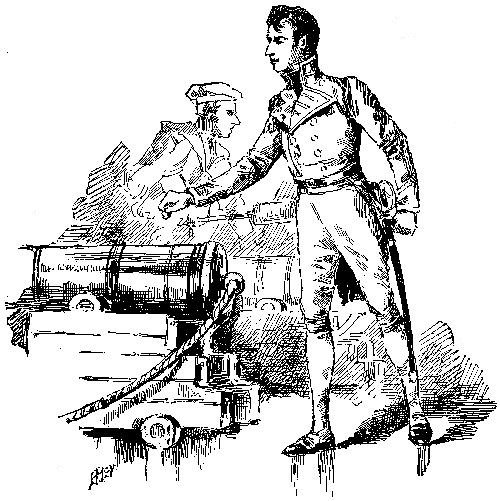
Lieut. Allen Fires A Shot.
The news of this event spread like wildfire over the country, and caused rage and resentment wherever it was known. Cities, towns, and villages called for revenge. The President issued a proclamation, complaining of the habitual insolence of British cruisers, and ordering all such vessels to leave American waters forthwith. As in the reduced state of the navy it was impossible to enforce this order, he forbade all citizens of the United States to give aid to, or have any intercourse with, any such vessels or their crews. War measures were taken both by the Federal and State Governments. As usual, the popular wrath was vented upon the least culpable of the people responsible for the condition of the "Chesapeake." Commodore Barren was tried by court-martial, and sentenced to five years' suspension from the service, without pay. The cool judgment of later years perceives the unjustness of this sentence, but its execution cast a deep shadow over the remainder of the unhappy officer's life.
For some years after this episode, little occurred to change the relations of the two nations. The war spirit grew slowly, and was kept alive by the occasional reports of impressments, or the seizure of American ships by British privateers. The navy held its place amid the national defences, although a plan devised by President Jefferson came near putting an end to the old organization. This plan provided for the construction of great numbers of small gunboats, which should be stationed along the coast, to be called out only in case of attack by an armed enemy. A contemporary writer, describing the beauties of this system, wrote, "Whenever danger shall menace any harbor, or any foreign ship shall insult us, somebody is to inform the governor, and the governor is to desire the marshal to call upon the captains of militia to call upon the drummers to beat to arms, and call the militia men together, from whom are to be drafted (not impressed) a sufficient number to go on board the gunboats, and drive the hostile stranger away, unless during this long ceremonial he should have taken himself off." Fortunately the gunboat system did not work the total extinction of the old navy.
In 1811 the British aggressions began again, and the situation became more and more warlike. So bold had the privateers become, that they captured a richly laden vessel within thirty miles of New York. Shortly after, the British frigate "Guerriere" stopped an American brig eighteen miles from New York, and took from her a young sailor. The sea was running very rough, and a stiff breeze blowing, when the "Spitfire" was halted by the frigate; but the American captain went with the captured lad to the war-vessel, and assured the commander that he had known the young man as a native of Maine from his boyhood. The reply was, "All that may be so; but he has no protection, and that is enough for me." With these memories fresh, it is not surprising that Americans rejoiced when the news of an encounter terminating in favor of the United States ship was received.
On May 7, 1811, the United States frigate "President" was lying quietly at anchor off Fort Severn, Annapolis. Every thing betokened a state of perfect peace. The muzzles of the great guns were stopped by tompions. The ports were down. In the rigging of the vessel hung garments drying in the sun. At the side floated half a dozen boats. Many of the crew were ashore on leave. The sailing-master was at Baltimore, and the chaplain and purser were at Washington. From the masthead floated the broad pennant of Commodore Rodgers, but he was with his family at Havre de Grace; and the executive officer, Capt. Ludlow, was dining on the sloop-of-war "Argus," lying near at hand. But the captain's dinner was destined to be interrupted that bright May afternoon; for in the midst of the repast a midshipman entered, and reported that the commodore's gig was coming up rapidly, with Rodgers himself on board. The dinner party was hastily broken up, and the captain returned to his ship to receive his superior officer. On his arrival, Commodore Rodgers said that he had received orders to chase the frigate that had impressed the sailor from the "Spitfire," and insist upon the man's being liberated, if he could prove his citizenship. This was good news for every man on the frigate. At last, then, the United States was going to protect its sailors.
Three days were spent in getting the crew together and preparing for sea; then the stately frigate, with all sails set and colors flying, weighed anchor, and stood down the Chesapeake with the intention of cruising near New York. She had been out on the open ocean only a day, when the lookout, from his perch in the cross-trees, reported a strange sail on the horizon. The two vessels approached each other rapidly; and, as the stranger drew near, Rodgers saw, by the squareness of her yards and the general trim, symmetrical cut of her sails, that she was a war-vessel. Perhaps she may be the offender, thought he, and watched eagerly her approach.
As the stranger came up, the "President" set her broad pennant and ensign; on seeing which the stranger hoisted several signal flags, the significance of which was not understood by the Americans. Finding her signals unanswered, the stranger wore ship, and bore away to the southward, hotly followed by the "President." During all these manœuvres, Rodgers's suspicion of the strange vessel had increased; and her apparent flight only convinced him the more of the hostile character of the stranger. It was a stern chase and a long one, for at the outset the stranger was hull down on the horizon. After an hour it became evident that the "President" was gaining, for the hull of the fugitive was plainly seen. The breeze then died away, so that night had fallen over the waters before the ships were within hailing distance.
A little after eight in the evening the "President" was within a hundred yards of the chase, which could be seen, a dark mass with bright lights shining through the rows of open ports, rushing through the water directly ahead. Rodgers sprang upon the taffrail, and putting a speaking-trumpet to his lips, shouted, "What ship is that?" A dead silence followed. Those on the "President" listened intently for the answer; but no sound was heard save the sigh of the wind through the cordage, the creaking of the spars, and the rush of the water alongside. Rodgers hailed again; and, before the sound of his words had died away, a quick flash of fire leaped from the stern-ports of the chase, and a shot whizzed through the rigging of the "President," doing some slight damage. Rodgers sprang to the deck to order a shot in return; but, before he could do so, a too eager gunner pulled the lanyard of his piece in the second division of the "President's" battery. The enemy promptly answered with three guns, and then let fly a whole broadside, with discharges of musketry from the deck and the tops. This exhausted Rodgers's patience. "Equally determined," said he afterwards, "not to be the aggressor, or to suffer the flag of my country to be insulted with impunity, I gave a general order to fire." This time there was no defect in the ordnance or the gunnery of the American ship. The thunderous broadsides rang out at regular intervals, and the aim of the gunners was deliberate and deadly. It was too dark to see what effect the fire was having on the enemy, but in five minutes her responses began to come slowly and feebly. Unwilling to continue his attack on a ship evidently much his inferior in size and armament, Rodgers ordered the gunners to cease firing; but this had hardly been done when the stranger opened again. A second time the guns of the "President" were run out, and again they began their cannonade. The stranger was soon silenced again; and Commodore Rodgers hailed, that he might learn the name of his adversary. In answer came a voice from the other vessel,—
"We are his Majesty's ship ——." A gust of wind carried away the name, and Rodgers was still in doubt as to whom he had been fighting. Hoisting a number of bright lights in her rigging, that the stranger might know her whereabouts, the "President" stood off and on during the night, ready to give aid to the disabled ship in case of need.
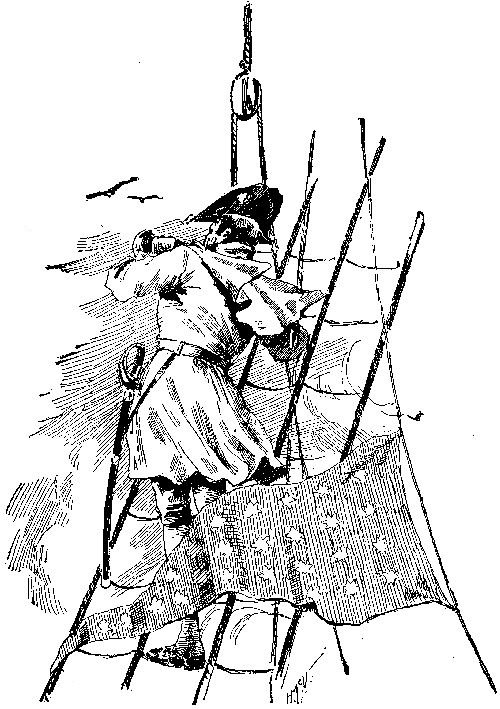
Commodore Rodgers Hails.
At early dawn every officer was on deck, anxious to learn the fate of their foe of the night before. Far in the distance they could see a ship, whose broken cordage and evident disorder showed her to have been the other party to the fight. A boat from the "President" visited the stranger, to learn her name and to proffer aid in repairing the damages received in the action. The ship proved to be the British sloop-of-war "Little Belt;" and her captain stated that she was much damaged in her masts, sails, rigging, and hull, and had been cut several times between wind and water. He declined the proffered aid, however, and sailed away to Halifax, the nearest British naval station. Commodore Rodgers took the "President" to the nearest American port.
When the "President" reached home, and the news of her exploit became known, the exultation of the people was great, and their commendations of Rodgers loud. "At last," they cried, "we have taught England a lesson. The insult to the 'Chesapeake' is now avenged." Rodgers protested that he had been forced unwillingly into the combat, but his admirers insisted that he had left port with the intention of humbling the pride of some British ship. Indeed, the letter of an officer on the "President," printed in "The New York Herald" at the time, rather supported this theory. "By the officers who came from Washington," wrote this gentleman, "we learn that we are sent in pursuit of a British frigate, who had impressed a passenger from a coaster. Yesterday, while beating down the bay, we spoke a brig coming up, who informed us that she saw the British frigate the day before off the very place where we now are; but she is not now in sight. We have made the most complete preparations for battle. Every one wishes it. She is exactly our force; but we have the "Argus" with us, which none of us are pleased with, as we wish a fair trial of courage and skill. Should we see her, I have not the least doubt of an engagement. The commodore will demand the person impressed; the demand will doubtless be refused, and the battle will instantly commence.... The commodore has called in the boatswain, gunner, and carpenter, informed them of all circumstances, and asked if they were ready for action. Ready, was the reply of each."
No consequences beyond an intensifying of the war spirit in America followed this rencounter. Before dismissing the subject, however, it is but fair to state that the account as given here is in substance Commodore Rodgers's version of the matter. The British captain's report was quite different. He insisted that the "President" fired the first shot, that the action continued nearly an hour, that it was his hail to which no attention was paid, and finally he intimated that the "President" had rather the worse of the encounter. The last statement is easily disproved, for the "President" was almost unscathed, and the only injury to her people was the slight wounding of a boy, in the hand. On the "Little Belt," thirty-one were killed or wounded. The other points led to a simple question of veracity between the two officers. Each government naturally accepted the report of its officer; and, so far as the governments were concerned, the matter soon passed into oblivion.
Not long after this episode, a somewhat similar occurrence took place, but was happily attended with no such serious consequences. The frigate "United States," cruising under the broad pennant of Commodore Decatur, fell in with two British ships near New York. While the commanders of the vessels were amicably hailing, a gun was suddenly fired from the battery of the "United States," owing to the carelessness of a gunner in handling the lanyard. It was a critical moment, for the British would have been justified in responding to the fire with broadsides. Happily, they were cool and discreet, and Decatur made such explanations as showed that no attack or insult was intended. This little incident is interesting, as showing the distrust of the British which led an American captain to keep his guns primed and cocked, while conversing with English men-of-war.
Another incident showed that the hatred of the British service that prevailed among seamen was a matter of deep-seated conviction. While the United States ship "Essex" was lying in an English port, it became known that one of her crew was a deserter from the British navy, and his surrender was immediately demanded. Although the man stoutly protested that he was an American, yet no proof could be shown; and, as the ship was in British waters, it was determined to surrender him. A British officer and squad of marines boarded the "Essex" and waited on the deck while the sailor went below to get his kit. Bitterly complaining of the hardness of his fate, the poor fellow went along the gun-decks until he passed the carpenter's bench. His eye fell upon an axe; and after a minute's hesitation he stepped to the bench, seized the axe in his right hand, and with one blow cut off the left. Carrying the severed member in his hand, he again sought the deck and presented himself, maimed, bleeding, and forever useless as a sailor, to the British officer. Astonished and horrified, that worthy left the ship, and the wounded man was sent to the sick-bay. The incident was a forcible commentary on the state of the British service at that time, and left a deep impression on the minds of all beholders.
In the next contest over deserters, however, the Americans rather secured the best of the argument. The "Constitution" was lying at anchor in Portsmouth roads, when one of the crew slily slipped overboard and swam down with the tide to the British ship "Madagascar" that lay at anchor near by. When he had reached the Englishman, he was too exhausted to speak; and the officers, supposing that he had fallen overboard accidentally, sent word to the "Constitution" that her man had been saved, and awaited the orders of his commander. The next morning a boat was sent down to the "Madagascar" to fetch the man back; but, to the astonishment of the visiting officer, he was told that the sailor claimed to be a British subject and wished to escape from the American service.
"Have you any evidence," asked the American officer of the British admiral, "beyond the man's own word, that he is an Englishman?"
"None whatever, sir," was the response, "but we are obliged to take his declaration to that effect."
The American officer returned to his ship, vowing vengeance on the harborers of the deserter. His opportunity came that very night.
In the dead watches of the night, when all was still on deck save the monotonous tramp of the sentries, there suddenly rang out on the still air the sharp crack of a musket. The officer of the deck rushed to see what was the matter, and was shown a dark object floating near the ship, at which a sentry had fired. A boat was lowered and soon came back, bringing in it a sailor who had deserted from the "Madagascar," and reached the "Constitution" by swimming. Capt. Hull asked the fellow his nationality.
"Sure, O'im a 'Merricun, your honor," he answered in a rich brogue that would have branded him as a Paddy in any part of the world. With a twinkle in his eye, Hull sent the Irishman below, and told the sailors to take good care of him.
Early in the morning, a boat came from the "Madagascar;" and a trim young lieutenant, clambering aboard the American frigate, politely requested that the deserter be given up. With great dignity, Capt. Hull responded that the man was a citizen of the United States, and should have protection. The visiting officer fairly gasped for breath. "An American!" he exclaimed. "Why, the man has never been out of Ireland except on a British man-of-war."
"Indeed!" responded Hull blandly. "But we have his statement that he is an American, and we are obliged to take his declaration to that effect." And the man was never given up.
During the day, two British frigates cast anchor so near the "Constitution" that Capt. Hull suspected them of hostile intentions, and moved his ship to a new anchorage. A frigate followed closely in her wake. At eight in the evening, Capt. Hull determined to meet the show of force with force. The drums beat, and the men were called to quarters. The battle-lanterns were lighted fore and aft. The tops were crowded with sailors, armed with short carbines, to pick off the men on the enemy's decks. Along the gun-deck stood the men at the guns; and an officer, describing the scene, says they took hold of the ropes as if they were about to jerk the guns through the ship's sides. All were enthusiastic over the prospect of the coming action.
"Now, then, my lads," said an officer to a group of sailors, "if a fight comes of this, it will be in the cause of you sailors; and I expect you to fight like men."
"Ay, ay, sir," was the response. "Let the quarter-deck look out for the colors, and we'll keep the guns going."
All the preparations for battle were made openly, and the attitude taken by the "Constitution" was an open challenge. No notice of it was taken by the British ship; and, after maintaining her hostile attitude for some time, the "Constitution" hoisted her anchor, and left the harbor.
The time of the formal declaration of war was now rapidly approaching. The long diplomatic correspondence between the two nations had failed to lead to any amicable solution of the difficulties that were fast urging them to war. Great Britain still adhered to her doctrine that a man once an Englishman was always an English subject. No action of his own could absolve him from allegiance to the flag under which he was born. Upon the trade of the United States with France, the English looked with much the sentiments with which, during our civil war, we regarded the thriving trade driven with the Confederacy by the British blockade-runners. Upon these two theories rested the hateful "right of search" and the custom of impressment.
It is needless to say that the views of the United States on these questions were exactly contrary to those of the English. Such vital differences could, then, only be settled by war; and war was accordingly declared in June, 1812. It was a bold step for the young nation, but there was enough of plausibility in the English claims to make it evident that they could never be set aside by diplomacy; and so, with hardly a thought of the odds against her, the United States dashed in to win justice at the muzzles of her cannon.
That the odds were tremendous, is not to be denied. Of the military strength of the two nations, it is not the purpose of this book to treat. Indeed, a recountal of the land battles of the war of 1812 would hardly be pleasant reading for Americans. It was on the sea that our laurels were chiefly won. Yet, at the time of the declaration of war, the navy of the United States consisted of twenty vessels, of which the largest carried forty-four guns, and the majority rated under thirty. For years this navy had been a butt of ridicule for all the European naval powers. The frigate "Constitution" was scornfully termed by an English newspaper "a bunch of pine boards sailing under a bit of striped bunting." Not long after the publication of this insolent jeer, the "Constitution" sailed into an American port with a captured British frigate in tow. Right merrily then did the Americans boast of their "bunch of pine boards."
This miniature navy of the United States was about to be pitted against the greatest naval power of the world. The rolls of the navy of Great Britain bore at this time the names of over one thousand ships. Of these, no less than two hundred and fifty-four were ships-of-the-line, mounting over seventy-four guns each. Behind this great navy were the memories of long years of conquests, of an almost undisputed supremacy upon the ocean. Small wonder was it, then, that the British laughed at the idea of the Americans giving battle to their hitherto unconquered ships.
What, then, was the secret of the success which, as we shall see, attended the American arms on the sea? The answer is, that men, not ships, carried the day. Yet Great Britain had the more sailors on her muster-rolls. True, but they were only too often unwilling slaves. Instead of enlisting, like free men, they were hunted down like brutes and forced to enter the service. No sailor was safe from the press-gang, and even sober citizens were often kidnapped to serve the 'King' on the ocean. From the ships of other nations, from their homes and from taverns, the unlucky sailors were dragged away. Even in the streets of populous cities, they were not safe; and it was no uncommon sight to see pitched battles being fought between the press-gangs and sailors whom they were trying to capture. Generally, the inhabitants and landsmen sided with the victims; and a sailor running through the streets of the town would be given every assistance by people, who filled with obstacles the path of his pursuers. Could he reach the water-side, the fugitive would find every boat at his service; while his pursuers, on coming up, found every water-man very busy and very gruff. But the wonder is, that, with this unjust and repulsive system of impressments, the British sailors were so loyal, and fought with the dogged courage that they invariably showed.
In the American navy, on the contrary, the enlistments were voluntary. The service was popular, and the seamen entered it without the feeling of outraged liberty inspired by the British system. Officers were readily obtained from the ranks of the adventurous American navigators. Officers and men alike often brought into the service personal memories of British oppression; and this, with their free and independent spirit, enabled them to wage an unequal war with glorious results for the supporters of the stars and stripes.[Back to Content]
CHAPTER IV.
THE WAR ON THE OCEAN. — COMMODORE RODGERS'S CRUISE. — THE LOSS OF THE "NAUTILUS." — FIRST SUCCESS FOR THE BRITISH. — THE ESCAPE OF THE "CONSTITUTION." — THE "ESSEX" TAKES THE "ALERT." — THE "CONSTITUTION AND THE "GUERRIERE."
t the time when the declaration of war was made public, a small squadron of United States vessels was lying in the port of New York, under the command of Commodore Rodgers. The warlike tendency of the popular mind had long been evident, and the captain of every war-vessel had been for some time making active preparations for service. Some apprehension was felt in naval circles, lest the small size of the navy should lead the authorities to lay up the vessels in port during the continuance of the war. This apprehension was well founded; for not only had such a course been debated in the cabinet, but orders had been prepared, directing Commodore Rodgers to hold his vessels in port. This decision was actively opposed by the officers of the navy, who felt that, though inconsiderable in numbers, the United States navy could make a brave fight for the honor of the nation; and with one accord all protested against the action contemplated. Two officers, Capt. Bainbridge and Capt. Stewart, went to Washington and sought an interview with the Secretary of the Navy, Paul Hamilton, who assured them that the plans of the Government were well matured and would not be changed. The United States could not afford, said the secretary, that its few frigates and men-of-war should be snapped up by the enormous fleets of the British, as would surely be the case, if they ventured upon the ocean. But it was not intended to materially reduce the lists of naval officers. The frigates, with all their loose spars and top-hamper taken down, were to be anchored at the entrances of the principal harbors of the country, and operated as stationary batteries.

This prospect was far from agreeable to the two officers. It was intolerable for them to imagine the graceful frigates, with towering masts and snowy canvas, reduced to mere shapeless hulks, and left to guard the entrance of a placid harbor. Finding the secretary inexorable, they went to the President and put the case before him. They assured him, that, small though the list of American ships was, it bore the names of vessels able to cope with any thing of their class in the British navy. Both officers and seamen were proud of the service, and burned to strike a blow for its honor. President Madison seemed much impressed by their representations, and agreed to take the matter into consideration; and, if it seemed wise, to change the plan. But, before any definite action was taken by him, war was declared.
Within an hour after he had received news of the declaration of war, Commodore Rodgers had his squadron under way, and dropped down New York Bay to the ocean. Under his command were the flag-ship "President" of forty-four guns, the "Essex" thirty-two, and the "Hornet" eighteen. In the lower bay these vessels were joined by the "United States" forty-four, the "Congress" thirty-eight, and the "Argus" sixteen. On June 21, 1812, three days after the declaration of war, the whole squadron passed Sandy Hook, and stood out into the ocean.
It is probable that the remarkable celerity of Commodore Rodgers's departure was due, in part, to the fear that the authorities would revive the obnoxious order laying up the ships in port. His chief object, however, was to overhaul a large fleet of British merchantmen that had recently left the West Indies, and, according to all calculations, should have been in the vicinity of New York at that time. All sail was accordingly crowded upon the ships, and the squadron set out in hot pursuit.
For two days the monotony of the horizon was broken by no sail; but on the third a ship was espied in the distance, which was made out to be an enemy's frigate, after which chase was made by the whole squadron. A fresh breeze was blowing, and both chase and pursuers were running free before the wind. As sail after sail was crowded upon the ships, the smaller vessels, with their lesser expanse of canvas, began to fall behind; and in a few hours the frigate "President" had gradually drawn away from the fleet, and was rapidly gaining on the enemy. The sail had been spied at six o'clock in the morning, and at four P.M. the flag-ship had come within gunshot of the chase. The wind then fell; and the chase, being long out of port and light, began to gain on her heavier adversary. Both vessels now began to prepare for a little gunnery. On the English vessel, which proved to be the "Belvidera," thirty-six, the sailors were busily engaged in shifting long eighteens and carronades to the stern, making a battery of stern-chasers mounting four guns.
The action was opened by a gun from the bow of the "President," sighted and fired by Commodore Rodgers himself; so that this officer may be said to have fired the first gun of the war. His shot was a good one, hulling the enemy. A second shot from one of the guns of the first division broke off the muzzle of one of the "Belvidera's" stern-chasers; and a third shot, fired by Commodore Rodgers, crashed into the stern of the chase, killing two men, and wounding several others. Certainly in their first action the Yankees showed no lack of skill in gunnery.
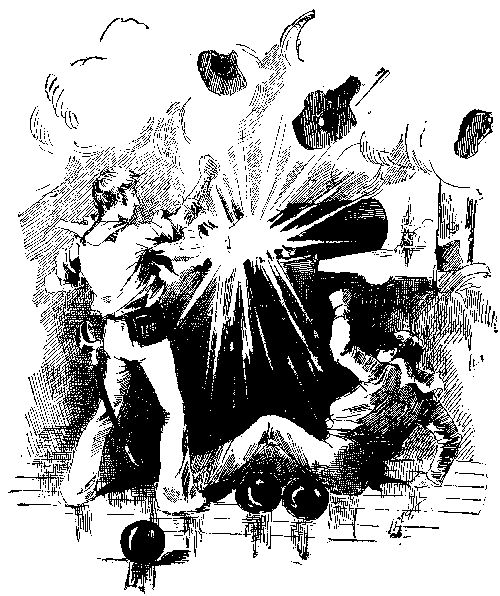
The chase was slow in responding to the fire; and although her commander, Capt. Byron, sighted the guns for the first few discharges himself, his aim was by no means so good as that of the Americans. The British showed great energy, however, in defending their ship. Not content with the stern guns already mounted, they shifted to the stern ports two long eighteen-pounders on the main deck, and two thirty-two-pound carronades on the quarter-deck. With these they kept up a brisk fire, which soon became effective, many shots cutting the rigging of the "President," while one plunged down upon the deck, killing a midshipman and two or three men. But the superiority of the American gunnery was beginning to tell, when, at a critical moment, a main-deck gun, on the "President," burst with a stunning report; and the flying fragments killed or wounded sixteen men. The force of the explosion shattered the forecastle deck. Commodore Rodgers was thrown high into the air, and, falling heavily on the deck, suffered a painful fracture of the leg. The crew was at once thrown into confusion and almost panic. Every gun was looked upon with suspicion. Encouraged by this confusion, the enemy worked his stern guns with renewed vigor, and at the same time lightened his ship by cutting away boats and anchors, and starting fourteen tons of water. Thus lightened, she began to draw away from the "President;" perceiving which, the latter ship yawed several times, and let fly full broadsides at the escaping chase. The shot rattled among the spars of the "Belvidera," but the nimble topmen quickly repaired all damages; and the British ship slowly but steadily forged ahead. Seeing no hope of overtaking her, Rodgers ordered the chase abandoned; and the American squadron again took up its search for the fleet of British merchantmen.
But this, the first cruise of the United States navy in the war was destined to be a disappointment to all concerned. The key-note set by the affair just related—in which the "President" lost twenty-two men, and permitted her adversary to escape—was continued throughout the voyage. Always finding traces of the enemy they were seeking, the Americans never succeeded in overhauling him. One day great quantities of orange-peel, cocoanut-shells, and similar fragments of tropical fruits gave the jackies assurance of the proximity of the long-sought enemy, and urged them on to renewed energy and watchfulness. Then the master of an English letter-of-marque, captured by the "Hornet," reported that the day before he had passed a fleet of eighty-five sail, of which four were men-of-war. That night there was no room in the minds of the sailors for any thoughts other than those of big prize-money. But their golden dreams were never to be fulfilled; for, although the chase was continued until within a day's run of the English Channel, no sight of the Jamaica fleet was ever gained. Abandoning this chase, the squadron returned to Boston by a Southern route; and, although constantly in the very highway of commerce, few sails were sighted. When port was reached, the results of a cruise that had occupied seventy days amounted only to the capture of one letter-of-marque, seven merchantmen, and the recapture of one American ship. But Rodgers heard, that, while he had been scouring the ocean with such meagre results, events of more importance had occurred nearer home.
Explosion On The "President."
The British ship "Belvidera," after her lucky escape from the "President," had made her way to Halifax, the chief naval station of Great Britain on the American coast. Her report was the first news of the declaration of war, for at that day news travelled slowly. Once alarmed, the British were prompt to act; and in a few days a squadron left Halifax in search of Commodore Rodgers. The force thus hurriedly gathered was quite formidable. The "Africa" of sixty-four guns, the "Shannon," thirty-eight, the "Guerriere," thirty-eight, the "Belvidera," thirty-six, and the "Æolus," thirty-two, made up the fleet despatched to chastise the headstrong Americans for their attempt to dispute with Great Britain the mastery of the ocean. Early in July, this force made its appearance off New York, and quickly made captures enough to convince the American merchantmen that a season in port was preferable to the dangers of the high seas in war-times. To this same fleet belongs the honor of the first capture of a war-vessel during the war; for the American brig "Nautilus," fourteen guns, was suddenly overhauled by the entire fleet, and captured after a plucky but unavailing attempt at flight.
Fourteen-gun brigs, however, were rather small game for a squadron like that of the British; and it is probable that His Britannic Majesty's officers were heartily glad, when, some days, later the United States frigate "Constitution" hove in sight, under circumstances which seemed certain to make her an easy prey to the five British ships.
It was on the 17th of July, 1812, that the "Constitution," after receiving a new crew at Annapolis, was standing northward under easy sail on her way to New York. About noon four sails were sighted on the horizon, and an hour later the appearance of a fifth sail was duly reported. A careful scrutiny of the strangers convinced Capt. Hull that they were men-of-war, although their nationality could not be determined. Night fell before the ships could come within hailing distance; and, though Hull set private signals, no answer was returned. When day broke, Hull found himself fairly surrounded by British frigates. In addition to the squadron which has been described as leaving Halifax, there was the captured "Nautilus" with her guns turned against her own nation, and a captured American schooner which had been likewise pressed into the service. Clearly the "Constitution" was outnumbered, and nothing was left for her but flight.
The events of that three days' chase are told with great minuteness in the log-book of the "Constitution" to which many of those on board have, in later publications, added more interesting personal reminiscences. When the rising mists showed how completely the American frigate was hemmed in, hardly a breath of air was stirring. Although every sail was set on the ship, yet she had not steerage way; and Hull ordered out the boats, to pull the ship's head around and tow her out of range of her enemies. At the same time, gangs of sailors with axes cut away the woodwork about the cabin windows, and mounted two stern guns in the cabin and one on the upper deck. The enemy, in the mean time, were keeping up a vigorous fire, but without effect. Their ships were rapidly gaining, as they were enabled to set the boats of the whole squadron to towing the two foremost vessels. Hull saw that some new means of getting ahead must be devised.
Soundings were taken, and the ship found to be in twenty-six fathoms of water. All the available rope in the ship was then bent on to a kedge and carried far ahead, when the kedge was lowered to the bottom. The sailors then shipped their capstan-bars, and tramped about the capstan, until the ship was dragged up to the kedge, which was then hoisted and again carried ahead and let fall. This manœuvre was repeated several times with marked success; for the "Constitution" was rapidly drawing away from her pursuers, who could not discover her means of propulsion. Out of sight of land as they were, the British did not for some time suspect the true cause of the sudden speed of the fugitive. When, after long scrutiny through their marine-glasses, they finally did discover the stratagem, the "Constitution" was far ahead; and though the pursuers adopted the same device, yet their awkwardness was so great, that even the superior force they were enabled to employ did not bring them up to their chase.
While the ships were thus being urged on by towing, kedging, and occasionally by sweeps, an intermittent fire was kept up by the British, and responded to by the "Constitution" from her stern ports. The guns which had been mounted by the Americans in the cabin, they were soon forced to abandon, as the explosions threatened to blow out the whole stern frame. With the stern-chasers on the gun-deck, however, a constant fire was maintained, in the hopes of crippling the enemy by a lucky shot.
For more than forty-eight hours the chase maintained this aspect of monotony. A dead calm prevailed the greater part of the time. Occasionally, light breezes filled the sails, and wafted the ships ahead for a few minutes; then, dying away, left the sea unruffled, and the sails flapping idly against the masts. British historians concur with those of our own country, in saying that the "Constitution," in seizing the advantages of the breeze, showed far better seamanship than did her enemies. While the British vessels lay to, to pick up their boats, the "Constitution" forged ahead, picking up her boats while under way. Later in the chase, the British totally abandoned their boats, and, when the American frigate had fairly escaped them, went about for some days picking up such boats as were found drifting on the broad ocean.
The morning of the second day of the chase dawned with a light breeze ruffling the water, and filling out the sails of the ships. Before the breeze died away, which it did in a few hours, the "Constitution" had gained on her pursuers so that she led them by more than four miles. Then the calm again held the ships quiet; and again the Americans saw their enemies closing in upon them by the aid of sweeps, and towing with their boats. There was little rest for the crew of the American frigate. On the gun-deck, about the carriages of the great cannon, lay such of the men as were not assigned to duty in the boats or at the capstan. Wearied with the constant strain, they fell asleep as soon as relieved from active duty; though they knew that from that sleep they might be awakened to plunge into the fierce excitement of desperate battle. Exhausted as the men were, their officers were forced to endure a still more fearful strain. No sleep came to the eyelids of Capt. Hull, throughout the chase. Now encouraging the men, now planning a new ruse to deceive the enemy, ever watchful of the pursuing ships, and ready to take advantage of the slightest breath of air, Capt. Hull and his able first lieutenant Morris showed such seamanship as extorted admiration even from the British, who were being baffled by their nautical skill.
By skilful manœuvring, the Americans managed to keep to the windward of their enemies throughout the chase; and to this fact the success of Capt. Hull's most astute stratagem was due. Ever alert for any sign of a coming breeze, he saw on the water far to windward that rippling appearance that betokens the coming of a puff. Hull determined to utilize it for himself, and, if possible, trick the British so that they would lose all benefit of the breeze. The clouds that were coming up to windward seemed to threaten a squall, and driving sheets of rain were rapidly advancing toward the ship. With great ostentation, the "Constitution" was made ready for a severe gale. The enemy could see the nimble sailors taking in sail, and furling all the lighter canvas. Then the driving rain swept over the ship, and she was shut out of sight. Immediately all was activity in the tops of the British frigates. Reefs were rapidly taken in the larger sails, while many were closely furled. All forsook their course, and steered in different directions in preparation for the coming squall, which, indeed, was far less violent than the action of the "Constitution" seemed to indicate. But the shrewd Yankees on that craft, protected from spying British eyes by the heavy rain, were now shaking out the reefs they had just set; and under full sail the ship was soon flying away towards home. After an hour of driving thunder-shower, the clouds passed by; and the wall-like edge of the shower could be seen moving rapidly away before the wind. The tars on the "Constitution" watched eagerly to see the British fleet appear. Farther and farther receded the gray curtain, and yet no ships could be seen. "Where are they?" was the thought of every eager watcher on the deck of the "Constitution." At last they appeared, so far in the distance as to be practically out of the chase. Two were even hull down; while one was barely visible, a mere speck on the horizon.
Though now hopelessly distanced, the British did not give up the pursuit, but held valiantly on after the American frigate. She had so long been within their very grasp that it was a bitter disappointment for them to be balked of their prey. But, as the wind now held, the American gained on them so rapidly that at last they unwillingly abandoned the chase; and, disbanding the fleet, each ship set off on an individual cruise, in the hopes that the enemy which had shown such ability in flight when overpowered would not deign to fly if encountered by a single hostile ship. This expectation was fully realized some weeks later, when the "Constitution" fell in with the British frigate "Guerriere."
Thus, after a chase of more than sixty-four hours, the "Constitution" evaded her pursuers, and made her way to Boston. Although they reaped no glory by their labors, the British did not come out of the chase altogether empty-handed. As the course of the vessels was along the New England coast, they were in the direct path of American commerce; and more than one wretched coaster fell into their clutches. At one time, a fine, full-rigged ship, flying the stars and stripes, came within sight; and the British, to lure her to her destruction, hoisted the American flag over all their vessels. But Hull was a match for them at strategy; and he promptly set the British colors at his masthead, and began so vigorous a cannonade that the stranger concluded that a merchantman had no business in that quarter, even though the Americans did appear to be rather in the majority.
By his able seamanship in this chase Capt. Hull gained for himself a national reputation. The newspapers of the day vied with each other in pointing out the manœuvres in which he had excelled his enemies,—how he had picked up his boats while under way, though the enemy were forced to cut theirs adrift; how he had come out of the chase without injury, and after parting with only a few gallons of water, though a less cool-headed commander would have thrown overboard guns, ammunition, and every thing movable, in the face of so great a danger. A modest sailor, as well as a skilful one, Capt. Hull showed himself to be; for, while the popular adulation was at its height, he inserted a card in the books of the Exchange Coffee-House at Boston, begging his friends to "make a transfer of a great part of their good wishes to Lieut. Morris and the other brave officers and crew under his command, for their very great exertions and prompt attention to orders while the enemy were in chase."
Leaving the "Constitution" thus snugly in port at Boston, we will turn aside to follow the fortunes of a ship, which, though belated in getting out to sea, yet won the honor of capturing the first British war-vessel taken during the war.
When Commodore Rodgers set sail from New York with his squadron, in the fruitless pursuit of the fleet of Jamaica men, he left in the harbor the small frigate "Essex," under the command of Capt. David Porter. The ship was thoroughly dismantled,—stripped of her rigging, her hold broken out, and provided neither with armament, ammunition, nor crew. Her captain, however, was a man of indomitable energy; and by dint of much hard work, and constant appeals to the authorities at Washington, he managed to get his ship in order, and leave the harbor within a fortnight after the departure of the squadron under Rodgers's command.
The "Essex" was a small frigate, lightly sparred, rating as a thirty-two-gun ship, but mounting twenty-six guns only, of which six were twelve-pounders, and the remainder carronades of thirty-two pounds. A carronade is a short cannon of large calibre, but of very short range. Capt. Porter protested vigorously against being furnished with a battery so useless except at close quarters: but his protests were unheeded; and the "Essex" put to sea, trusting to her ability to get alongside the enemy, where her carronades would be of some use.
Among the midshipmen who bunked, messed, and skylarked together in the steerage of the "Essex," was one lad whose name in later days was to be inscribed on the roll of the greatest naval heroes of history. David Glasgow Farragut was a child of seven years of age when he was adopted by Capt. Porter, and began his training for a naval career. In 1810 the boy secured his appointment of midshipman; and now, in 1812, we find him enrolled among the "young gentlemen" who followed the fortunes of the "Essex." In those days the midshipmen were often mere boys. Farragut himself was then but eleven years old. But, boys as they were, they ordered the hardy old tars about, and strutted the streets when on shore-leave with all the dignity of veterans.
That the discipline of the "Essex" was of the strictest, and that the efficiency of her crew was above criticism, we have the testimony of Farragut himself to prove. "Every day," he writes, "the crew were exercised at the great guns, small arms, and single stick; and I may here mention the fact, that I have never been on a ship where the crew of the old "Essex" was represented, but that I found them to be the best swordsmen on board. They had been so thoroughly trained as boarders, that every man was prepared for such an emergency, with his cutlass as sharp as a razor, a dirk made by the ship's armorer out of a file, and a pistol."
Hardly were the Highlands of Navesink lost to sight below the horizon, when Porter began to receive evidences that his cruise was to be a lucky one. Several brigs were captured, and sent into New York; but the tars of the "Essex" were beginning to grow weary of small game, and hoped, each time a sail was sighted, that it might be a British man-of-war. At last a small squadron hove into sight, the appearance of which seemed to indicate that the jackies might smell gunpowder to their hearts content before the next day.
It was late at night when the strange fleet was sighted; and the "Essex" was soon running down upon them, before a fresh breeze. Although the moon was out, its light was obscured by dense masses of cloud, that were driven rapidly across the sky; while over the water hung a light haze, that made difficult the discovery of objects at any distance. The "Essex" soon came near enough to the squadron to ascertain that it was a fleet of British merchantmen and transports convoyed by a frigate and bomb-vessel. The frigate was at the head of the line; and the "Essex," carefully concealing her hostile character, clapped on all sail and pressed forward, in the hopes of bringing on an action. After passing the hindermost transport, however, the American ship was hailed by a second transport, which soon suspected her hostile character and threatened to give the alarm. Instantly the ports of the "Essex" were knocked out, the guns trained on the enemy, and the transport was ordered to haul out of the line at once, and silently, under penalty of being fired into. The defenceless ship complied, and was at once taken possession of, and the soldiers on board were transferred to the "Essex." This operation took so much time, that, by the time it was concluded, day dawned over the ocean; and the attack upon the British frigate was abandoned.
Again the "Essex" continued her cruise in search of an enemy worthy of her metal. For two or three days she beat about the ocean in the usual track of ships, without sighting a single sail. The ship had been so disguised, that the keenest-eyed lookout would never have taken her for a ship-of-war. The top-gallant masts were housed, the ports of the gun-deck closed in, and her usually trim cordage and nicely squared yards were now set in a way that only the most shiftless of merchant skippers would tolerate. Not many days passed before the enemy fell into the trap thus set for him.
When on the 13th of August Capt. Porter learned that a sail to windward, apparently a British man-of-war, was bearing down upon the "Essex," he carried his little bit of acting still further. Instead of the great crowd of agile sailors that spring into the rigging of a man-of-war, at the order to make sail, only a handful, in obedience to Porter's orders, awkwardly set on the "Essex" all the sail she would carry. Two long, heavy cables dragging in the water astern so retarded the ship, that the stranger, coming down gallantly, thought he had fallen in with a lumbering old American merchantman, which was making frantic, but futile, efforts to escape.
Had the British captain been able to look behind the closed ports of the "Essex," he would have formed a very different idea of the character of his chase. He would have seen a roomy gun-deck, glistening with that whiteness seen only on the decks of well-kept men-of-war. Down either side of the deck stretched a row of heavy carronades, each with its crew of gunners grouped about the breech, and each shotted and primed ready for the opening volley. From the magazine amidships, to the gun-deck, reached a line of stewards, waiters, and cooks, ready to pass up cartridges; for on a man-of-war, in action, no one is an idler. Active boys were skurrying about the deck, barefooted, and stripped to the waist. These were the "powder monkeys," whose duty it would be, when the action opened, to take the cartridges from the line of powder-passers and carry it to the guns. On the spar-deck, only a few sailors and officers were visible to the enemy; but under the taffrail lay crouched scores of blue-uniformed jackies, with smooth-faced middies and veteran lieutenants, ready to spring into the rigging at the word of command, or to swarm over the side and board the enemy, should the gunwales of the vessels touch.
All this preparation, however, was unknown to the "Englishman," who came boldly on, doubting nothing that the "Essex" would that day be added to his list of prizes. As he drew nearer, the American sailors could see that their foe was much their inferior in size and armament; and the old tars who had seen service before growled out their dissatisfaction, that the action should be nothing but a scrimmage after all. In a few minutes, the bold Britons gave three ringing cheers, and let fly a broadside at the "Essex." In an instant the ports of the sham merchantman were knocked out; and, with a warlike thunder, the heavy carronades hurled their ponderous missiles against the side of the assailant. The astonished Englishmen replied feebly, but were quickly driven from their posts by the rapidity of the American fire; and, in eight minutes after the action was opened, the British hauled down their flag. The captured ship proved to be the sloop-of-war "Alert," mounting twenty eighteen-pounder carronades. The boarding officer found her badly cut up, and seven feet of water in the hold. The officers were transferred to the "Essex," and the "Alert" taken in tow. Circumstances, however, forced the Americans to part in a very few days.
The chief cause which led to the separation of the two vessels was an incipient mutiny, which was discovered by Midshipman Farragut, and was only averted by the perfect discipline of the American crew. An exercise to which the greatest attention was given was the "fire-drill." When the cry of fire was raised on the ship, every man seized his cutlass and blanket, and went to quarters as though the ship were about to go into action. Capt. Porter was accustomed, that his men might be well prepared for any emergency, to raise this cry of fire at all hours of the night; and often he caused a slight smoke to be created in the hold, further to try the nerves of his men. Shortly after the "Alert" was captured, and while the "Essex" was crowded with prisoners, some of the captives conspired to seize the ship, and carry her to England. One night, as Farragut was sleeping in his hammock, a strange feeling of fear came over him; and he opened his eyes to find the coxswain of the captain's gig of the "Alert" standing over him with a pistol in his hand. The boy knew him to be a prisoner, and, seeing him armed, was convinced that something was wrong. Expecting every moment to be killed, he lay still in his hammock, until the man turned on his heel and walked away. Then Farragut slipped out, and ran to the captain's cabin to report the incident. Porter rushed upon the berth-deck in an instant. "Fire! fire!" shouted he at the top of his voice; and in an instant the crew were at their quarters, in perfect order. The mutineers thought that a bad time for their project, and it was abandoned. The next day the prisoners were sent on board the "Alert," and that vessel sent into St. Johns as a cartel.
The capture of the "Alert" reflected no great glory upon the Americans, for the immense superiority of the "Essex" rendered her success certain. It is, however, of interest as being the first capture of a British war-vessel. The action made the honors easy between the two nations; for while the Americans had the "Alert," the British were captors of the brig "Nautilus." This equality was not of long duration, however; for an action soon followed which set all America wild with exultation.
After her escape from the British fleet, the "Constitution" remained at Boston only a few days, and then set out on a cruise to the eastward along the New England coast. Bad luck seemed to follow her, and she had reached a point off Cape Sable before she made a prize. Here two or three prizes of little value were taken; and an English sloop-of-war was forced to relinquish an American brig, which had been recently captured. Shortly afterwards, a Salem privateer was overhauled, the captain of which reported an English frigate cruising in the neighborhood; and Capt. Hull straightway set out to discover the enemy.
The frigate which had been sighted by the Salem privateer, and for which Hull was so eagerly seeking, was the "Guerriere," a thirty-eight-gun ship commanded by Capt. Dacres. With both ship and captain, Capt. Hull had previously had some little experience. The "Guerriere" was one of the ships in the squadron from which the "Constitution" had so narrowly escaped a few weeks before, while Capt. Dacres was an old acquaintance. A story current at the time relates, that, before the war, the "Guerriere" and the "Constitution" were lying in the Delaware; and the two captains, happening to meet at some entertainment on shore, fell into a discussion over the merits of their respective navies. Although even then the cloud of war was rising on the horizon, each was pleasant and good-natured; and the discussion assumed no more serious form than lively banter.