Volume 1 / Part 2 — PART II. BLUE JACKETS OF 1812 (continued 5)
Reading edition
In truth, however, the condition of this same crew was such that the captain would have been justified in refusing the challenge. An unusual number of foreign sailors were enrolled, among whom was a Portuguese, who, in the ensuing battle, did incalculable injury to the cause of the "Chesapeake." The crew had never drilled together; many of the sailors came on board only a few hours before the ship sailed out to battle. All the old sailors were sullen over the delay in the payment of the prize-money of their last cruise. Lawrence attempted to allay their discontent by giving them checks for the prize-money; but the sense of injury still lingered in the minds of the men, and they were ill-fitted to do battle for the honor of the flag. Added to this evil was the fact that the first and second lieutenants and two acting lieutenants were away on sick-leave, and the ship was thus left short of officers on the eve of battle.
Regardless of the disadvantages under which he labored, Lawrence weighed anchor on the 1st of June, and started down the harbor. As he approached the ocean, Lawrence mustered his crew aft, and eloquently urged them to fight bravely, and do their duty to the country, which had entered upon this war in defence of seamen and their rights. Three ensigns were run up; and at the fore was unfurled a broad white flag, bearing the motto, "Free Trade and Sailors' Rights." When Lawrence closed his speech, and pointed out the flag floating at the fore, the men cheered and went forward, leaving the captain convinced that he could depend upon their loyalty.
The morning was bright and cool, with a fresh breeze blowing, before which the "Chesapeake" rapidly bore down upon the foe that awaited her. Following cautiously in her track came a number of small craft,—pilot-boats, sloops, fishing-smacks, and pleasure-boats,—that had come down the bay to see the outcome of the battle. Hundreds of people of Boston rode along the coast, in hopes of gaining an outlook from which the progress of the fight might be viewed.
At noon the ship rounded Boston Light, and made out into the open sea. The "Shannon" went ahead, under easy sail, making up the coast toward Salem. Towards five o'clock the "Chesapeake" luffed up for a moment; while the pilot clambered down the side, and put off in a small boat. A gun was then fired, as a signal that the Americans were ready for action.
The "Shannon" evidently understood the purport of the signal; for she quickly hove to, and troops of agile jackies clambered up her rigging, and began to take in sail. The "Chesapeake" followed suit, and was soon under only topsails and jib. She then laid her course straight for the enemy.
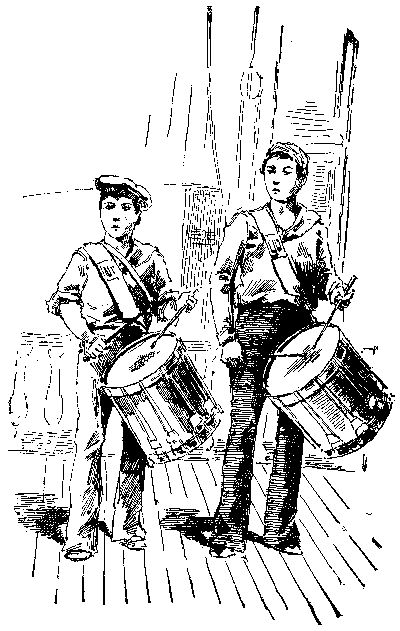
Beating To Quarters.
A ship preparing for action in that day was a scene of hurry and confusion that cannot be equalled in this era of machinery and few guns. At the short, broken, rolling beat of the drums, calling the men to quarters, the hurried rush of hundreds of feet began, as the men came pouring from all parts of the ship to their posts. Some clambered aloft to their stations in the tops; others invaded the sanctity of the quarter-deck and captain's cabin, where several guns are always mounted. But the most stirring scene is on the long gun-deck where the men gradually fall into their places at the two long rows of great guns that peer through the open ports on either side. All are stripped to the waist; and at many a gun the fair skin of the American sailor gleams white by the side of some swarthy Spaniard, or still darker negro.
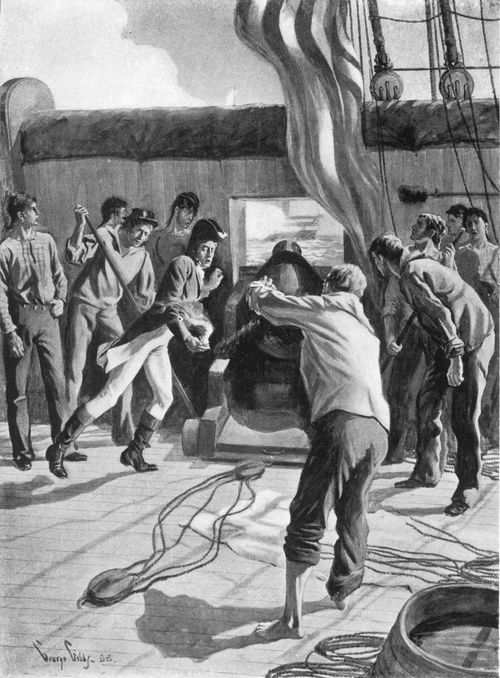
The Only Shot Of The "Chesapeake".
All quiet down on reaching their stations; and, five minutes after the drum-beats, no sound is heard, save perhaps the steps of the black boys, taking rations of grog around, that the men may "splice the main brace" before going into the fight.
Thus silently did the "Chesapeake" bear down upon her adversary. There was no long-range firing; for the two commanders were veterans, whose chief desire was to settle the dispute yard-arm to yard-arm. Gradually the American ship ranged alongside the "Shannon," at a distance of half pistol-shot; and, as her foremast came in a line with the "Shannon's" mizzen-mast, the latter opened fire with her cabin-guns. For a moment the "Chesapeake" was silent, waiting for her guns to bear; then, with sulphuric flashes and a thunderous roar, she let fly her whole broadside. Then followed a duel with great guns. The two ships, lying side by side, dealt and received staggering blows. The spectators in small boats, who kept a safe distance, and the crowds of eager watchers on the far-off heights of Salem, saw through their spy-glasses the flash of the first broadsides, and the flying splinters that followed the course of the deadly shot. Then a heavy cloud of yellow smoke settled over the warring leviathans, and all further incidents of the battle were shut out from view. Only the top-masts of the ships, with the half-furled sails and the opposing ensigns flying, could be seen above the smoke.
Under this vaporous pall, the fighting was sharp and desperate. The first broadside of the "Shannon" so swept the decks of the American frigate, that, of one hundred and fifty men quartered on the upper deck, not fifty were upon their legs when the terrible rush of the shot was over. The sailors in the tops of the British frigate, looking down upon the decks of their enemy, could see nothing but a cloud of hammocks, splinters, and wreckage of all kinds, driven fiercely across the deck. Both men at the wheel fell dead, but their places were soon filled; while fresh gunners rushed down to work the guns that had been silenced by the enemy's fearful broadside. In a moment the "Chesapeake" responded with spirit, and for some time broadsides were exchanged with inconceivable rapidity. The men encouraged each other with cheers and friendly cries. They had named the guns of the frigate, and with each telling shot they cheered the iron-throated monster which had hurled the bolt. "Wilful Murder," "Spitfire," "Revenge," "Bull Dog," "Mad Anthony," "Defiance," "Raging Eagle," and "Viper" were some of the titles born by the great guns; and well the weapons bore out the names thus bestowed upon them. The gunnery of the Americans was good, their shot doing much damage to the enemy's rigging. But the effect of the "Shannon's" broadsides was such that no men, however brave, could stand before them. They swept the decks, mowing down brave fellows by the score. Officers fell on every side. At a critical moment the two ships fouled, exposing the "Chesapeake" to a raking broadside, which beat in her stern-ports, and drove the gunners from the after-port. At this moment, Lawrence was wounded in the leg, but remained at his post and ordered that the boarders be called up. Unhappily a negro bugler had been detailed for the duty usually performed by drummers; and, at this important moment, he could not be found. Midshipmen and lieutenants ran about the ship, striving to call up the boarders by word of mouth. In the confusion, the bugler was found skulking under the stem of the launch, and so paralyzed by fear that he could only give a feeble blast upon his instrument. In the din and confusion of battle, the oral orders of the officers only perplexed the men; and the moment for boarding was lost. At that very moment, the turning-point of the conflict, Capt. Lawrence was struck by a musket-ball, and fell mortally wounded to the deck. His officers rushed to his side, and, raising him gently, were carrying him below, when in a firm voice he cried,—
"Tell the men to fire faster, and not give up the ship. Fight her till she sinks."
With these words on his lips, he was carried to the wardroom.
At this moment, the upper deck was left without an officer above the rank of midshipman. The men, seeing their captain carried below, fell into a panic, which was increased by the explosion of an arm-chest, into which a hand-grenade, hurled by a sailor lying out on the yard-arm of the "Shannon," had fallen. Seeing that the fire of the Americans had slackened, Capt. Broke left his quarter-deck, and, running hastily forward, gained a position on the bow of his ship from which he could look down upon the decks of the "Chesapeake." His practised eye quickly perceived the confusion on the deck of the American frigate; and he instantly ordered that the ships be lashed together, and the boarders called up. An old quartermaster, a veteran in the British navy, set about lashing the ships together, and accomplished his task, although his right arm was actually hacked off by the cutlass of an American sailor. The boarders were slow in coming up, and but twenty men followed Broke as he climbed to the deck of the "Chesapeake." Broke led his men straight for the quarter-deck of the frigate. The Americans offered but little resistance. Not an officer was in sight to guide the men, and the newly enlisted sailors and foreigners fled like sheep before the advance of the boarders.
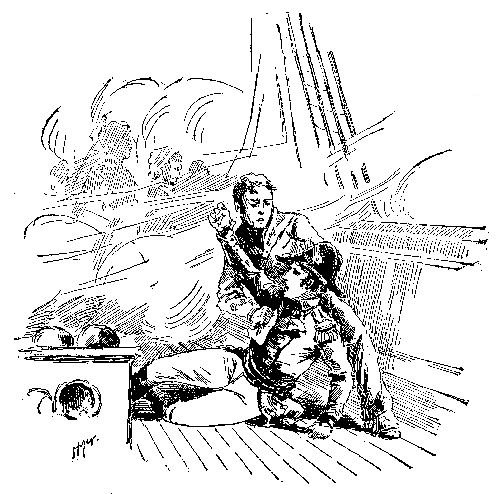
On Board The "Chesapeake."
The British reached the quarter-deck with hardly the loss of a man. Here stood Mr. Livermore, the chaplain of the "Chesapeake," who had cruised long with Lawrence, and bitterly mourned the captain's fate. Determined to avenge the fallen captain, he fired a pistol at Broke's head, but missed him. Broke sprang forward, and dealt a mighty stroke of his keen cutlass at the chaplain's head, who saved himself by taking the blow on his arm. While the boarders were thus traversing the upper deck, the sailors in the tops of the "Chesapeake" were keeping up a well-directed fire, before which many of the Englishmen fell. But this resistance was not of long duration; for one of the "Shannon's" long nines, loaded with grape, swept clean the "Chesapeake's" tops. With this, the British were in full control of the upper deck.
Up to this time, the Americans on the gun-deck had known nothing of the events occurring on the deck above them. When the news of the British assault spread, Lieut. Budd called upon the men to follow him, and drive the boarders back to their own ship. A number of the marines (who behaved splendidly throughout the fight) and some twenty veteran sailors were all that responded to the call. Broke had in the mean time summoned the marines of the "Shannon" to his aid; and the British, led by their dashing commander, were pouring in a dense column down the companion-ways to the gun-deck. Budd and his handful of followers attacked them fiercely; and, by the very desperation of the onset, the British were forced back a few paces. Broke threw himself upon the Americans. With his cutlass he cut down the first man who attacked him, and bore down upon the others, dealing deadly blows right and left. His followers came close behind him. The Americans fell on every side, and began to retreat before the overwhelming force of their foes. Up from the wardroom came Lieut. Ludlow, already suffering from two dangerous wounds. He placed himself beside the younger officer, and the two strove in every way to encourage their men. But Ludlow soon fell, with a gaping wound across his forehead. Budd was cut down, and fell through the hatchway to the deck beneath. The sailors, seeing both officers fall, gave way in confusion; and the ship was in the hands of the British. A few marines kept up a fire through the hatchway, but soon were silenced.
An English officer, Lieut. Watts, ran to the halliards to haul down the American flag. But it would seem that the good genius which had watched over that starry banner throughout the war was loath to see it disgraced; for the officer had hardly finished his work, when a grape-shot from his own ship struck him, and he fell dead.
The noise of the battle had by this time died away, and the fresh breezes soon carried off the smoke that enveloped the combatants. It was an awful scene thus exposed to view. On the "Chesapeake" were sixty-one killed, and eighty-five wounded men. On the "Shannon" were thirty-three dead, and fifty wounded. On a cot in the wardroom lay Capt. Lawrence, his mortal wound having mercifully rendered him unconscious, so that he knew nothing of the loss of his ship. Broke had been made delirious by the fevered throbbing of the wound he had so long neglected. Everywhere were evidences of carnage and desolation.
Little time was lost in getting the ships in order after the surrender. The noise of the hammer and saw was heard in every quarter. The wounded were taken to the sick-bay, and the bodies of the dead were committed to the ocean. Floods of water and the heavy holystones took from the decks the stains of blood. The galley cooks marched up and down the decks, sprinkling hot vinegar with a lavish hand. The British prize-crew took possession of the captured ship, and in a few hours the captor and captive were well on their way toward Halifax.
They reached port on the 7th of June; and the sight of the "Shannon," followed by the "Chesapeake" with the British ensign flying proudly over the stars and stripes, stirred the little city to the utmost enthusiasm. As the two ships pursued their stately course up the harbor, the British men-of-war on all sides manned their yards, and fired salutes in honor of the victory. The thunders of the cannon brought the town's-people to the water-side, and their cheers rang out lustily to welcome their conquering countrymen to port.
Capt. Lawrence had died the day before; and his body, wrapped in an American flag, lay on the quarter-deck of his frigate. Three days later, his body, with that of his gallant lieutenant Ludlow, was laid to rest with imposing naval honors, in the churchyard of Halifax. But his country, honoring him even in the day of his defeat, was not content that his body should lie in the soil of an enemy's country. Two months after the battle, an American vessel, the "Henry" of Salem, entered the harbor of Halifax, under cover of a flag of truce, and took on board the bodies of Lawrence and Ludlow. They were conveyed first to Salem and later to New York, where they now lie under a massive monument of sandstone, in a corner of Trinity churchyard. A few feet away, the ceaseless tide of human life rolls on its course up and down Broadway; few of the busy men and women pausing to remember that in the ancient churchyard lies the body of the man whose dying words, "Don't give up the ship," were for years the watchword and motto of the United States navy.[Back to Content]
CHAPTER X.
CRUISE OF THE "ESSEX." — A RICH PRIZE. — THE MYSTERIOUS LETTER. — CAPE HORN ROUNDED. — CAPTURE OF A PERUVIAN PRIVATEER. — AMONG THE BRITISH WHALERS. — PORTER IN COMMAND OF A SQUADRON. — A BOY COMMANDER. — THE SQUADRON LAYS UP AT NOOKAHEEVAH.
hile the events related in the two preceding chapters were occurring along the American coast, a few gallant vessels were upholding the honor of the stars and stripes in far distant lands. To cruise in waters frequented by an enemy's merchantmen, and capture, burn, sink, and destroy, is always a legitimate occupation for the navy of a belligerent nation. Yet the nation suffering at the hands of the cruisers invariably raises the cry of "wanton vandalism and cruelty," and brands the officers to whom falls so unpleasant a duty with the name of pirates. Such was the outcry raised against Paul Jones in the Revolutionary war; so it was the British described the brilliant service of the little brig "Argus" in 1813; and so the people of the North regarded the career of the "Alabama" and other Confederate cruisers in the great war for the Union. But perhaps no ship had ever a more adventurous career, or wrought more damage to the enemy's commerce, than the United States frigate "Essex," under the command of the able officer David Porter.

Of the circumstances which led to the famous cruise of the "Essex," some account has already been given. With a full crew, and stores enough to enable her to keep the sea for some months, the ship set sail from the Delaware in the autumn of 1812, and headed to the southward with the intention of joining the "Constitution" and "Hornet" at some point in the tropics. Her first point of call was at Porto Praya, a harbor in the Cape Verd Islands. To the captain's disappointment, he could learn nothing of Bainbridge at this place; and he soon departed, after scrupulously exchanging salutes with a rickety little fort, over which floated the flag of Portugal. Continuing her southward way, the "Essex" crossed the equator, on which occasion the jolly tars enjoyed the usual ceremonies attendant upon crossing the line. Father Neptune and his faithful spouse, with their attendant suite, came aboard and superintended the operation of shaving and dowsing the green hands, whose voyages had never called them before into the Southern seas. Capt. Porter looked upon the frolic indulgently. He was well known as a captain who never unnecessarily repressed the light-heartedness of his crew. Two hours daily were set aside during which the crew were free to amuse themselves in any reasonable way. At four o'clock every afternoon, the shrill piping of the boatswain's whistle rang through the ship, followed by the cry, "D'ye hear there, fore and aft? All hands skylark!" No order ever brought a quicker response, and in a minute the decks became a perfect pandemonium. The sailors rushed here and there, clad in all sorts of clothes; boxed, fenced, wrestled; ran short foot-races; played at leap-frog, and generally comported themselves like children at play. Fights were of common occurrence; and the two combatants soon became the centre of an interested ring of spectators, who cheered on their favorites with loud cries of "Go it, Bill. Now, Jack, lively with yer left." But a sailor has no better friend to-day than the man he fought yesterday; and the fights, like the play, only kept the crew in good spirits and contentment.
The day after crossing the equator, the "Essex" sighted a sail and gave chase. Towards evening the frigate had gained greatly upon the stranger, and Porter displayed all the British signals which he had in his possession. The chase made no response, but set a British ensign. By nine o'clock, the "Essex" was within musket-shot, and could easily have blown the fugitive out of water; but this Porter was loath to do, as he desired to take the brig without doing her any injury. However, as she showed no signs of surrendering, he ordered the marines to give her a volley of musketry. One man on the chase was killed, and a number wounded, upon which her flag was immediately hauled down. She proved to be the British packet "Nocton" of ten guns. In her hold was found fifty-five thousand dollars in specie, which was at once taken on board the "Essex;" and the "Nocton" was sent to the United States under the charge of a prize-crew. Before she could make a port, she fell in with a British man-of-war, and was captured after a few hours' chase.
Two days after parting with the "Nocton," the "Essex" hove in sight of the Island of Fernando Noronha, off the coast of Brazil. For a time the frigate abandoned her warlike character, battened down her ports, housed her guns, hid her large crew between decks, and sailed into the little harbor looking like a large but peaceable British merchantman. An officer clad in plain clothes went ashore, and, meeting the governor, stated that the ship was the "Fanny" of London, bound for Rio Janeiro. During the conversation, the governor remarked that His British Majesty's ships, the "Acosta" forty-four, and the "Morgiana" twenty, had but recently sailed from the port, and had left a letter for Sir James Yeo, requesting that it be forwarded to England as soon as possible. With this news, the lieutenant returned to the ship. On hearing his report, Porter at once surmised that the letter might have been left for him by Commodore Bainbridge; and he at once sent the officer back, bearing the message that the "Fanny" was soon going to London, and her captain would see the letter delivered to Sir James Yeo, in person. The unsuspecting governor accordingly delivered up the epistle, and it was soon in Porter's hands. The note read as follows:—
My Dear Mediterranean Friend,—Probably you may stop here. Don't attempt to water: it is attended with too many difficulties. I learned, before I left England, that you were bound to Brazil coast. If so, perhaps we may meet at St. Salvador or at Rio Janeiro. I should be happy to meet and converse on our old affairs of captivity. Recollect our secret in those times.
Your friend of His Majesty's ship "Acosta," KERR. Sir James Yeo of His British Majesty's ship "Southampton."
Porter read and pondered over this perplexing letter. He felt sure that the letter was from Bainbridge; and in the allusion to St. Salvador and Rio Janeiro, he perceived the commodore's wish for a rendezvous at one of those places. But what could be the secret of the times of captivity? Suddenly a thought struck him. Might there not be something written in sympathetic ink? Hurriedly calling for a candle, he held the letter above its flame, and saw, under the influence of the heat, words and sentences appearing where before all was blank paper.
"I am bound off St. Salvador," it read; "thence off Cape Frio, where I intend to cruise until the 1st of January. Go off Cape Frio to the northward of Rio, and keep a lookout for me."
That afternoon the governor of the island, looking out toward the harbor, was surprised to see the "Fanny" standing out under a full spread of canvas. Porter had gained all the information that he wished, and was off in search of his consorts. This search he continued until the 20th of January, cruising up and down off the Brazilian coast, and taking one or two small prizes. In this unprofitable service the ship's stores were being rapidly consumed. Among other things, the supply of rum began to run short; and in connection with this occurred a curious incident, that well illustrates the character of sailors. The daily rations of bread were reduced one-half, and the rations of salt meat one-third, without a word of remonstrance from the patient crew. Next the discovery was made that the rum was giving out, and a proportional reduction in the rations of grog was duly ordered. The jackies put in a vigorous and immediate protest. They were prepared, they said, to go without grog, should the supply of rum be unhappily exhausted; but so long as any of the precious fluid remained, their rations of grog should not be curtailed. But to this Porter would not accede, fearing that, should the men be altogether deprived of their grog, the health of the crew might suffer. Accordingly, when the crew were piped to "splice the main brace" the next day, they were told that half rations only would be issued; and, if the grog was not taken up in fifteen minutes, the tub would be overturned, and the rum spilled into the sea. So dire a threat was too much for the rebellious seamen: they sprang into line, with their tin cups, and drew their curtailed rations without more ado.
Some days after this occurrence, the "Essex" overhauled a Portuguese vessel, from the captain of which Porter learned that an American frigate had shortly before fought and sunk an English frigate off the coast of Brazil; also, that it was rumored that an American corvette of twenty-two guns had been brought into Rio, a prize to a British seventy-four. This intelligence placed Capt. Porter in some perplexity. He felt convinced that the successful American frigate was the "Constitution;" a conjecture in which he was correct, for the news referred to the celebrated action of that ship with the "Java." The captured American corvette, he concluded, must be the "Hornet;" but herein the captain was wrong, for the "Hornet" was at that moment blockading the "Bonne Citoyenne."
Porter now found it necessary to decide upon a course of action. The news which he had received made it appear most improbable that he would fall in with either of the United States vessels for which he was seeking. He was far from home, cruising in seas much frequented by British men-of-war. There were no naval stations or outposts belonging to the United States, into which he could put for protection or repairs; for then, as now, the nation ignored the necessity of such supply-stations. To return home was peculiarly distasteful to the captain, who had set sail with the intention of undertaking a long cruise. In this dilemma, he wasted but little time in thought. By rounding Cape Horn, he would carry the "Essex" into the Pacific Ocean, where British merchantmen abounded and men-of-war were few. It was an adventurous and a perilous expedition to undertake; but Porter, having decided upon it, wasted no time in getting under way. That very night he took his ship out of the snug harbor of St. Catherine's, and started upon his long voyage around the Horn.
A winter voyage around Cape Horn, even in the stoutest of ships, is an undertaking to be dreaded by the most courageous seamen. The "Essex" seemed to meet with more than her share of stormy weather. From the night when she set sail from St. Catherine's, until she dropped anchor in a harbor of the Island of Mocha, almost every day witnessed a struggle for supremacy between the raging ocean on the one side, and skilful seamanship and nautical science on the other. Capt. Porter, however, proved himself ready for every emergency. No peril of the deep was unforeseen, no ounce of prevention unprovided. The safety of his ship, and the health of his men, were ever in his thoughts; and accordingly, when the "Essex" rounded into the Pacific Ocean, both men and ship were in condition to give their best service to the enterprise in which they were embarked.
After rounding Cape Horn, the "Essex" made her way northward along the desolate coast of Chili, until she reached the Island of Mocha. Here she anchored for a day, giving the crew a much needed run on shore, which they enjoyed with all the zest of schoolboys out for a day's holiday. The island afforded little in the way of fresh stores; but some pigs and horses were shot, and devoured with gusto by men who for over two months had not tasted fresh meat. From this point the frigate made for Valparaiso, and, after reconnoitring the port, put in for water and stores. The officers were received with much hospitality by the townspeople, and, after a few days' stay, were tendered a complimentary ball,—an entertainment into which the young officers entered with great glee. But, unhappily for their evening's pleasure, the dancing had hardly begun, when a midshipman appeared at the door of the hall, and announced that a large frigate was standing into the harbor. Deserting their fair partners, the people of the "Essex" hastened to their ship, and were soon in readiness for the action; while the townspeople thronged the hills overlooking the sea, in the hopes of seeing a naval duel. But the frigate proved to be a Spaniard; and, of course, no action occurred.
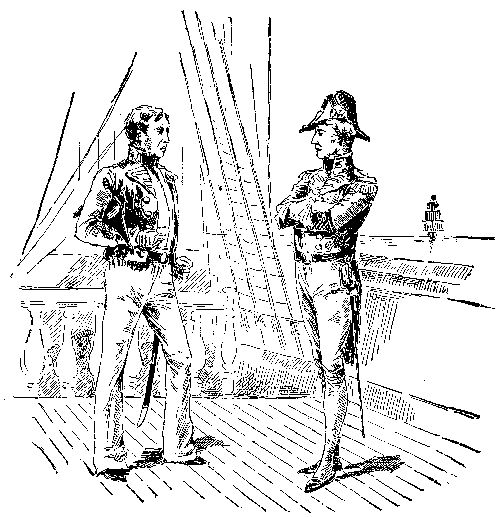
The Peruvian Privateer.
The "Essex" remained several days at Valparaiso, and during her stay two or three American whalers put into the harbor. From the captains of these craft, Porter learned that the Peruvians were sending out privateers to prey upon American commerce, and that much damage had already been done by these marauders, who were no more than pirates, since no war existed between Peru and the United States. Porter determined to put an immediate stop to the operations of the Peruvian cruisers, and had not long to wait for an opportunity. A day or two after leaving Valparaiso, a sail was sighted in the offing, which was soon near enough to be made out a vessel-of-war, disguised as a whaler. Porter hung out the English ensign, and caused an American whaler, with which he had that morning fallen in, to hoist a British flag over the stars and stripes. At this sight, the stranger hoisted the Spanish flag, and threw a shot across the bow of the "Essex." Porter responded by a few shot that whizzed through the rigging just above the Spaniard's deck. The latter thereupon sent a boat to the "Essex;" and the officer who came aboard, thinking that he was on a British man-of-war, boasted of his ship's exploits among the American whalers. His vessel was the Peruvian privateer "Nereyda" of fifteen guns, and she had captured two American whalers, whose crews were even then in the hold of the privateer. He admitted that Peru had no quarrel with the United States, and no reason for preying upon her commerce. The confession, so unsuspectingly made, gave Porter ample grounds for the capture of the offending vessel. Curtly informing his astounded visitor that he was on a United States man-of-war, Porter ordered the gunners to fire two shots close to the privateer. This was done, and the Peruvian quickly hauled down his colors. The American officers, on boarding the prize, found twenty-three American sailors, who had been robbed of all that they possessed, stripped of half their clothing, and thrown into the hold. These unfortunate men were released and sent to the "Essex;" after which all the guns and ammunition of the privateer were thrown overboard, and the vessel ordered to return to Callao.
After this act of summary justice, the "Essex" continued in her northward course. She touched at Callao; but, much to the disappointment of all on board, there were no British vessels among the shipping at that port. Nor could the lookouts, for some days, discern from the masthead any craft other than the double-hulled rafts of logs, called catamarans, in which the natives along the Peruvian coast make long voyages. Weary of such continued ill-luck, Porter determined to make for the Galapagos Islands, where it was the custom of the British whaling-ships to rendezvous. But it seemed that ill-fortune was following close upon the "Essex;" for she sailed the waters about the Galapagos, and sent out boats to search small bays and lagoons, without finding a sign of a ship. Two weeks passed in this unproductive occupation, and Porter had determined to abandon the islands, when he was roused from his berth on the morning of April 29, 1813, by the welcome cry of "Sail, ho!"
All hands were soon on deck, and saw a large ship in the offing. All sail was clapped on the frigate; and she set out in hot pursuit, flying the British ensign as a ruse to disarm suspicion. As the chase wore on, two more sail were sighted; and Porter knew that he had fallen in with the long-sought whalers. He had no doubt of his ability to capture all three; for in those southern seas a dead calm falls over the ocean every noon, and in a calm the boats of the "Essex" could easily take possession of the whalers. By eight o'clock in the morning, the vessel first sighted was overhauled, and hove to in obedience to a signal from the frigate. She proved to be the "Montezuma," Capt. Baxter, with a cargo of fourteen hundred barrels of sperm-oil. Baxter visited Capt. Porter in his cabin, and sat there unsuspectingly, giving the supposed British captain information for his aid in capturing American ships. The worthy whaler little knew, as he chatted away, that his crew was being transferred to the frigate, and a prize-crew sent to take charge of the "Montezuma."
By noon the expected calm fell over the water; and the boats were ordered away to take possession of the two whalers, that lay motionless some eight miles from the "Essex." The distance was soon passed, and the two ships were ordered to surrender, which they quickly did, much astonished to find a United States man-of-war in that region. A breeze shortly after springing up, all the prizes bore down upon the frigate; and the gallant lads of the "Essex" had the pleasure of seeing themselves surrounded with captured property to the value of nearly half a million dollars. One of the vessels, the "Georgiana," was a good sailer, strongly built, and well fitted for a cruiser. Accordingly she was armed with sixteen guns and a number of swivels, and placed under the command of Lieut. Downes. With this addition to his force, and with the other two prizes following in his wake, Porter returned to the Galapagos Islands. The first sight of the far-off peaks of the desert islands rising above the water was hailed with cheers by the sailors, who saw in the Galapagos not a group of desolate and rocky islands, but a place where turtle was plenty, and shore liberty almost unlimited. Porter remained some days at the islands, urging the crew of the "Essex," as well as the prisoners, to spend much time ashore. Signs of the scurvy were evident among the men, and the captain well knew that in no way could the dread disease be kept away better than by constant exercise on the sands of the seashore. The sailors entered heartily into their captain's plans, and spent hours racing on the beach, swimming in the surf, and wandering over the uninhabited islands.
After a few days of this sort of life, the squadron put to sea again. The "Georgianna" now separated from the fleet, and started on an independent cruise, with orders for a rendezvous at certain specific times. The "Essex" continued to hover about the Galapagos, in the hopes of getting a few more whalers. She had not long to wait; for the whale ship "Atlantic" soon fell in her way, and was promptly snapped up. The captain of this ship was a Nantucket man, who had deserted the flag of his country, to cruise under what he thought to be the more powerful flag of Great Britain. Great was his disgust to find that by his treachery he had lost all that he desired to protect. While in chase of the "Atlantic," a second sail had been sighted; and to this the "Essex" now gave chase. On being overhauled, the stranger at first made some show of fighting; but a shot or two from the guns of the frigate convinced him of the folly of this course, and he surrendered at discretion. The vessel proved to be the whale ship letter-of-marque "Greenwich;" a stout ship, of excellent sailing qualities. She carried ten guns, and was in every way a valuable prize.
Porter had now been in the Pacific Ocean about three months. On the 24th of February, the "Essex," solitary defender of the flag of the United States in the Pacific, had turned her prow northward from Cape Horn, and embarked on her adventurous career in the most mighty of oceans. Now in May, Porter, as he trod the deck of his good ship, found himself master of a goodly squadron instead of one stanch frigate. The "Essex," of course, led the list, followed by the "Georgianna," sixteen guns, forty-two men; "Atlantic," six guns, twelve men; "Greenwich," ten guns, fourteen men; "Montezuma," two guns, ten men; "Policy," ten men. Of these the "Georgianna" had already received her armament and authority as a war-vessel; and the "Atlantic" showed such seaworthy qualities that Porter determined to utilize her in the same way. Accordingly he set sail for Tumbez, where he hoped to get rid of some of his prisoners, perhaps sell one or two of his prizes, and make the necessary changes in the "Atlantic." While on the way to Tumbez, a Spanish brig was overhauled. Her captain vastly edified Capt. Porter by informing him that the "Nereyda," a Peruvian privateer, had recently attacked a huge American frigate, and inflicted great damage upon the Yankee. But the frigate proving too powerful, the privateer had been forced to fly, and hastened her flight by throwing overboard all her guns and ammunition.
On the 19th of June, the "Essex" with her satellites cast anchor in the harbor of Tumbez. The first view of the town satisfied Porter that his hopes of selling his prizes there were without avail. A more squalid, dilapidated little seaside village, it would be hard to find. Hardly had the ships cast anchor, when the governor came off in a boat to pay a formal visit. Though clothed in rags, he had all the dignity of a Spanish hidalgo, and strutted about the quarter-deck with most laughable self-importance. Notwithstanding his high official station, this worthy permitted himself to be propitiated with a present of one hundred dollars; and he left the ship, promising all sorts of aid to the Americans. Nothing came of it all, however; and Porter failed to dispose of any of his prizes. While the "Essex" with her train of captives lay in the harbor at Tumbez, the "Georgianna" came into port, and was greeted with three cheers by the men of the frigate. Lieut. Downes reported that he had captured three British ships, carrying in all twenty-seven guns and seventy-five men. One of the prizes had been released on parole, and the other two were then with the "Georgianna." This addition to the number of vessels in the train of the "Essex" was somewhat of an annoyance to Capt. Porter, who saw clearly that so great a number of prizes would seriously interfere with his future movements against the enemy. He accordingly remained at Tumbez only long enough to convert the "Atlantic" into an armed cruiser under the name of the "Essex Junior," and then set sail, in the hopes of finding some port wherein he could sell his embarrassing prizes. His prisoners, save about seventy-five who enrolled themselves under the American flag, were paroled, and left at Tumbez; and again the little squadron put to sea. The "Essex Junior" was ordered to take the "Hector," "Catherine," "Policy," and "Montezuma" to Valparaiso, and there dispose of them, after which she was to meet the "Essex" at the Marquesas Islands. On her way to the rendezvous, the "Essex" stopped again at the Galapagos Islands, where she was lucky enough to find the British whaler "Seringapatam," known as the finest ship of the British whaling fleet. By her capture, the American whalers were rid of a dangerous enemy; for, though totally without authority from the British Crown, the captain of the "Seringapatam" had been waging a predatory warfare against such luckless Americans as fell in his path. Porter now armed this new prize with twenty-two guns, and considered her a valuable addition to his offensive force. She took the place of the "Georgianna," which vessel Porter sent back to the United States loaded with oil.
Among the embarrassments which the care of so many prizes brought upon the leader of the expedition was the difficulty of finding commanding officers for all the vessels. This difficulty was enhanced while the flotilla lay off the Galapagos Islands; for two officers, falling into a dispute, settled their quarrel, after the manner of the day, by a duel. In the contest one, a lieutenant, aged only twenty-one years, was killed, and now lies buried in the sands of the desolate and lonely island. After this occurrence, the need for commanding officers became so imperative that even the purser and chaplain of the "Essex" were pressed into the service. Midshipmen twelve or fourteen years old found themselves in command of ships. David Farragut was one of the boys thus suddenly promoted, and in his journal has left a description of his experience as a boy commander.
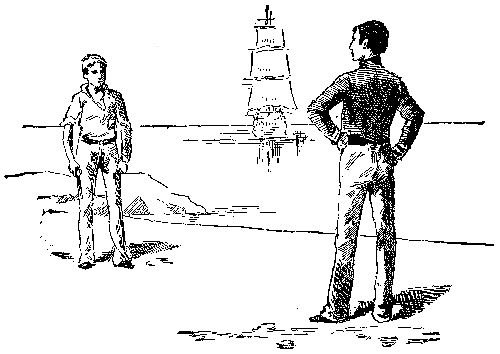
The Duel At The Galapagos Islands.
"I was sent as prize-master to the 'Barclay,'" he writes. "This was an important event in my life; and, when it was decided that I was to take the ship to Valparaiso, I felt no little pride at finding myself in command at twelve years of age. This vessel had been recaptured from a Spanish guarda costa. The captain and his mate were on board; and I was to control the men sent from our frigate, while the captain was to navigate the vessel. Capt. Porter, having failed to dispose of the prizes as it was understood he intended, gave orders for the 'Essex Junior' and all the prizes to start for Valparaiso. This arrangement caused great dissatisfaction on the part of the captain of the 'Barclay,' a violent-tempered old fellow; and, when the day arrived for our separation from the squadron, he was furious, and very plainly intimated to me that I would 'find myself off New Zealand in the morning,' to which I most decidedly demurred. We were lying still, while the other ships were fast disappearing from view; the 'Commodore' going north, and the 'Essex Junior' with her convoy steering to the south for Valparaiso.
"I considered that my day of trial had arrived (for I was a little afraid of the old fellow, as every one else was). But the time had come for me at least to play the man: so I mustered up courage, and informed the captain that I desired the topsail filled away. He replied that he would shoot any man who dared to touch a rope without his orders; he 'would go his own course, and had no idea of trusting himself with a d—d nutshell;' and then he went below for his pistols. I called my right-hand man of the crew, and told him my situation; I also informed him that I wanted the main topsail filled. He answered with a clear 'Ay, ay, sir!' in a manner which was not to be misunderstood, and my confidence was perfectly restored. From that moment I became master of the vessel, and immediately gave all necessary orders for making sail, notifying the captain not to come on deck with his pistols unless he wished to go overboard; for I would really have had very little trouble in having such an order obeyed."
On the 30th of September, the squadron fell in with the "Essex Junior," which had come from Valparaiso. Lieut. Downes reported that he had disposed of the prizes satisfactorily, and also brought news that the British frigate "Phœbe," and the sloops-of-war "Raccoon" and "Cherub," had been ordered to cruise the Pacific in search of the audacious "Essex." More than this, he secured statistics regarding the fleet of British whalers in the Pacific, that proved that Porter had completely destroyed the industry, having left but one whaler uncaptured. There was then no immediate work for Porter to do; and he determined to proceed with his squadron to the Marquesas Islands, and there lay up, to make needed repairs and alterations.
The Marquesas are a desolate group of rocky islands lying in the Pacific Ocean, on the western outskirts of Oceanica. In formation they are volcanic, and rise in rugged mountain-peaks from the bosom of the great ocean. Sea-fowl of all sorts abound; but none of the lower mammals are to be found on the island, save swine which were introduced by Europeans. The people at the time of Porter's visit were simple savages, who had seldom seen the face of a white man; for at that early day voyagers were few in the far-off Pacific.
The island first visited by the "Essex" was known to the natives as Rooahooga. Here the frigate stopped for a few hours. During her stay, the water alongside was fairly alive with canoes and swimming natives. They were not allowed to come on board, but were immensely pleased by some fish-hooks and bits of iron let down to them from the decks of the frigate. Not to be outdone in generosity, the islanders threw up to the sailors cocoanuts, fruits, and fish. A boat-crew of jackies that went ashore was surrounded by a smiling, chattering throng of men, women, and children, who cried out incessantly, "Taya, taya" (friend, friend), and strove to bargain with them for fruits. They were a handsome, intelligent-looking people; tall, slender, and well formed, with handsome faces, and complexion little darker than that of a brunette. The men carried white fans, and wore bracelets of human hair, with necklaces of whales' teeth and shells about their necks,—their sole articles of clothing. Both men and women were tattooed; though the women seemed to content themselves with bands about the neck and arms, while the men were elaborately decorated from head to foot. Though some carried clubs and lances, they showed no signs of hostility, but bore themselves with that simple air of hospitality and unconscious innocence common to all savage peoples of tropical regions, uncorrupted by association with civilized white men.
Porter remained but a short time at this island, as its shallow bays afforded no safe anchorage for the vessels. But, charmed as he was with the friendly simplicity of the natives, he determined to remain some time in the vicinity, provided safe anchorage could be found. This essential was soon discovered at Nookaheevah, where the ships cast anchor in a fine harbor, which Porter straightway dubbed Massachusetts Bay. Hardly had the ship anchored, when a canoe containing three white men came alongside, and was ordered away by the captain, who thought them deserters from some vessel. The canoe then returned to the shore, and the three whites were joined by a vast assemblage of armed natives. Porter now began to fear lest he had offended the natives, and proceeded at once to the beach, with four boats well armed and manned. But, by the time the boats' prows grated upon the white sand, every native had disappeared; and the sole figure visible was that of a young man, who advanced, and, giving a formal naval salute, announced himself as Midshipman John M. Maury, U.S.N. Porter was greatly surprised to find a midshipman in so strange a place; but the latter explained it by stating that he was on furlough, and had been left there by a merchant-vessel, which was to call for him. She had never returned, however, and he now hailed the "Essex" as an opportunity for escape. A second white man, who then put in an appearance, naked and tattooed like an Indian, proved to be an Englishman who had been on the island for years, and who, by his knowledge of the language and character of the natives, proved of great assistance to the Americans, during the long stay upon which Capt. Porter had determined.[Back to Content]
CHAPTER XI.
WAR WITH THE SAVAGES. — THE CAMPAIGN AGAINST THE TYPEES. — DEPARTURE FROM NOOKAHEEVAH. — THE "ESSEX" ANCHORS AT VALPARAISO — ARRIVAL OF THE "PHŒBE" AND "CHERUB." — THEY CAPTURE THE "ESSEX." — PORTER'S ENCOUNTER WITH THE "SATURN." — THE MUTINY AT NOOKAHEEVAH.
t was now the last of October, 1813. Capt. Porter saw that the work he desired done upon the ships under his charge would occupy about six weeks, and he at once set about forming such relations of peace and amity with the natives as should enable him to procure the necessary supplies and prosecute his work unmolested. Much to his dismay, he had hardly begun his diplomatic palaver with the chiefs, when he learned that to keep one tribe friendly he must fight its battles against all other tribes on the island. The natives of Nookaheevah were then divided into a large number of tribal organizations. With three of these the Americans were brought into contact,—the Happahs, the Taeehs, and the Typees. The Taeehs lived in the fertile valley about the bay in which the American squadron was anchored. With these people Porter treated first, and made his appearance in their village in great state, being accompanied by the band, the marines, and several boats' crews of jackies. He was hospitably received by the natives, who crowded about to listen to the band, and wonder at the military precision of the marines, whom they regarded as supernatural beings. Gattanewa, the chief, expressed his abounding love for the captain, and exchanged names with him, after the custom of the people; but ended by saying that the lawless Happahs were at war with the Taeehs, and the Americans, to gain the friendship of the latter tribe, must make common cause with them against their enemies. To this Porter demurred, but the wily chief thereupon brought forward a most conclusive argument. He said that the Happahs had cursed his mother's bones; and that, as he and Porter had exchanged names, that estimable woman was the captain's mother also, and the insult to her memory should be avenged. It is probable that even this argument might have proved unavailing, had not the Happahs the next night descended upon the valley, and, having burned two hundred bread-fruit trees, departed, leaving word that the Americans were cowards, and dared not follow them into their mountain fastnesses. Porter saw that his food supplies were in danger from these vandals, and his knowledge of savage character convinced him that he could have no peace with any of the natives until the insolence of this tribe was punished. Accordingly he notified the Taeehs, that, if they would carry a gun to the top of one of the mountain peaks, he would send a party against the Happahs. The Taeehs eagerly agreed; and, after seeing the gun fired once or twice (a sight that set them fondling and kissing it, to show their reverence for so powerful a weapon), they set off up the steep mountain sides, tugging the gun after them. Lieut. Downes led the American forces. They had hardly reached the mountain tops, when the fighting began. The Happahs were armed with spears, and with slings, from which they threw heavy stones with terrific velocity. They seemed to know no fear, and stood gallantly before the advancing Americans, fairly darkening the air with clouds of stones and spears. The Americans, though few in number,—forty, opposed to nearly four thousand savages,—pressed forward, suffering but little from the weapons of their foes. From the deck of his frigate in the bay, Porter could see the steady advances of his forces, as they drove the Happahs from peak to peak. Before the Americans a huge native strode along, waving wildly the American flag. The howitzer came in the rear, and was every now and then discharged, to drive the foe from some formidable stronghold. So ignorant of fire-arms were the enemy, that they had no idea of their power, often fighting until the muzzle of a musket was laid to their temples before the discharge. But before nightfall this warlike spirit was broken, and the victors returned to their ships, their native allies carrying five dead bodies slung on poles. Two only of the Americans were wounded. The next day Happah ambassadors came to sue for peace; and soon every tribe on the island joined the alliance, save the Typees, and a distant tribe that proudly bore the unpronounceable name of Hatecaaheottwohos. For two or three weeks peace reigned undisturbed. Work was pushed on the vessels. The rats with which the "Essex" was infested were smoked out, an operation that necessitated the division of the crew between the shore and the other vessels. Porter himself, with his officers, took up his quarters in a tent pitched on the shore. Under some circumstances, such a change would have been rather pleasant than otherwise; but the rainy season had now come on, and the tent was little protection against the storms. Noticing this, the natives volunteered to put up such buildings as the captain desired, and proceeded to do so in a most expeditious manner. At early dawn four thousand men set about the work, and by night had completed a walled village, containing a dwelling-house for the captain, another for his officers, a cooper's shop, hospital, bake-house, guard-house, and a shed for the sentinel to walk under. For their services the men received old nails, bits of iron hoop, and other metal scraps, with which they were highly delighted. The Americans were then living on the terms of the most perfect friendship with the natives. Many of the jackies had been taken into the families of the islanders, and all had formed most tender attachment for the beautiful island women; who, in their turn, were devoted to the "Malleekees," who were such mighty men of war, and brought them such pretty presents of beads and whales' teeth. The Americans entered into the celebrations and festivities of the islanders, watched their dances, joined their fishing expeditions, and soon were on the friendliest footing with their dusky hosts.

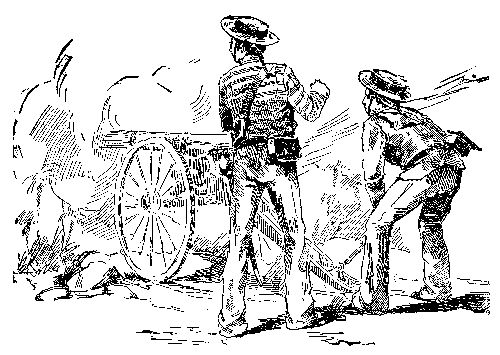
Firing The Howitzer.
But so pleasant and peaceful an existence was not destined to continue long. The Typees, who inhabited the interior of the island, were beginning to stir up strife against the Americans; and Porter saw that their insolence must be crushed, or the whole native population would unite in war against him. But to begin a war with the Typees was far from Porter's wish. The way to their country lay over rugged precipices and through almost impenetrable jungles. The light-footed natives could easily enough scale the peaks, or thread the forests; but to Porter's sailors it would be an exhausting undertaking. No artillery could be taken into the field, and the immense number of natives that might be arrayed against the sailors made the success of the expedition very uncertain. Porter, therefore, determined to try to adjust the difficulty amicably, and with this purpose sent an ambassador to the Typees, proposing a peaceful alliance. The reply of the natives is an amusing example of the ignorant vainglory of savage tribes, unacquainted with the power of civilized peoples. The Typees saw no reason to desire the friendship of the Americans. They had always got along very well without it. They had no intention of sending hogs or fruit to sell to the Americans. If the Americans wanted supplies, let them come and take them. The Americans were cowards, white lizards, and mere dirt. The sailors were weaklings, who could not climb the Nookaheevan hills without aid from the natives. This, and much more of the same sort, was the answer of the Typees to Porter's friendly overtures.
This left no course open to the Americans save to chastise the insolent barbarians. The departure of the expedition was, however, delayed until a fort could be built for the protection of the American village. This work, a sand-bag battery, calculated to mount sixteen guns, was completed on the 14th of November, and preparations for the expedition were then begun. And, indeed, it was time that the Americans showed that they were not to be insulted with impunity. Already the Taeehs and Happahs were beginning to wonder at the delay, and rumors spread about the village that the whites were really the cowards for which the Typees took them. One man, a chief among the Happahs, was rash enough to call Porter a coward to his face; whereat the choleric captain seized a gun, and, rushing for the offender, soon brought him to his knees, the muzzle of the weapon against his head, begging for mercy. That man was ever after Porter's most able ally among the natives.
The preparations for war with the Typees were completed, and the expedition was about to set out, when a new difficulty arose, this time among the white men. First, a plot was discovered among the British prisoners for the recapture of the "Essex Junior." Their plan was to get the crew drunk, by means of drugged rum, and then rise, seize the vessel, and make off while the American forces were absent on the Typee expedition. This plot, being discovered, was easily defeated; and the leaders were put in irons. Then Porter discovered that disaffection had spread among his crew, which, for a time, threatened serious consequences. But this danger was averted by the captain's manly actions and words, which brought the jackies to his side as one man.
On the 28th of November the long-deferred expedition against the Typees left the snug quarters on the shore of Massachusetts Bay. The expedition went by sea, skirting the shore of the island, until a suitable landing-place near the territory of the hostile tribe was reached. The "Essex Junior" led the way, followed by five boats full of men, and ten war-canoes filled with natives, who kept up an unearthly din with discordant conches. When the forces landed, the friendly natives were seen to number at least five thousand men; while of the Americans, thirty-five, under the command of Capt. Porter, were considered enough for the work in hand. From the time the fighting began, the friendly natives kept carefully in the rear, and seemed to be only waiting to aid the victors, whether they should be Americans or Typees.
Capt. Porter and his followers, upon landing, sat down upon the beach for breakfast; but their repast was rudely disturbed by a shower of stones from an ambuscade of Typees in the edge of the wood. Stopping but a moment to finish their food, the jackies picked up their cutlasses and muskets, and started for the enemy. They were soon in the shady recesses of the tropical forest, but not a Typee was to be seen. That the enemy was there, however, was amply attested by the hail of stones that fell among the invaders, and the snapping of slings that could be heard on all sides. This was a kind of fighting to which the sailors were not accustomed; and for a moment they wavered, but were cheered on by their brave leader, and, pushing through the woods, came to a clearing on the banks of a narrow river. But here a sad disaster befell them in the loss of Lieut. Downes, whose ankle was broken by a stone. He was sent back to the ship, with an escort of five men; and the party, thus reduced to twenty-nine, forded the river, and scaled its high bank, cheering lustily, under a heavy fire from the Typees, who made a dogged stand on the farther shore. By this time, the last of their savage allies had disappeared.
The advance of the Americans was now checked by a jungle of such rank underbrush that the cutlasses of the men made no impression upon it; and they were forced to crawl forward on their hands and knees, under a constant fire from the enemy. From this maze, they burst out upon a clearing, and, looking about them, saw no sign of their savage foes, who had suddenly vanished. The solution of this mystery was soon discovered. After marching a few rods totally unmolested, a sudden turn in the path brought the Americans in sight of a formidable stone fortress, perched on a hill commanding the road, and flanked on either side by dense jungles. The wall of the fortress was of stone, seven feet high; and from it, and from the thickets on either side, came such demoniac yells, and such showers of stones, as convinced the Americans that they were in front of the Typee stronghold. For a time the invaders seemed in danger of annihilation. They were totally unprotected, and flanked by concealed foes, whose missiles were plunging down upon them with deadly effect. Some few secured places behind trees, and began a musketry fire; but the alarming cry soon arose that the ammunition was exhausted. Five men were immediately despatched to the beach for more cartridges, while the few remaining determined to hold their position at any cost. But to this determination they were unable to adhere. Had the Typees charged, the whole American force would have been swept away like driftwood before a springtime flood. But the savages neglected their opportunity; and the Americans first gained the protection of the bushes, then fell back across the river, and so to the beach.
Here a council of war was held. They had been beaten back by savages; enormously outnumbered, to be sure, but still opposed by undisciplined warriors armed with rude weapons. The stain of that defeat must be washed out by a victory. Upon one point, all were agreed. The Happahs had played them false by leading them over the most dangerous roads, and into ambuscades of the enemy. To such treacherous guides, they would not again trust themselves. Before he again led his men to battle, Porter wished to try diplomacy. Although he knew that he had been beaten in the engagement, it would never do to confess defeat before so many savages (for the Taeehs and Happahs were now swarming about him, discussing the fight). Accordingly a messenger was sent to tell the Typees that a handful of white men had driven them into their fort, killing and wounding many. Now a large re-enforcement of white men was on the beach, ready to drive them from their valley, but that if they would sue for peace they might yet save their lives and their villages. At this the Typees laughed. "Tell Opotee," said they, "that we have plenty of men to spare; while his men are few. We have killed his chief warrior, and wounded many of his people. We are not afraid of his bouhies [muskets]: they often miss fire, and, when they wound, don't hurt much. If the Malleekees can drive us from our valley, why don't they come and do it?—not stay on the beach and talk."
When Porter received this letter, he knew that he must again take the field against the Typees, or his half-hearted allies would abandon him and join his foes, giving him endless trouble, and putting a stop to the refitting of the ships in Massachusetts Bay. He now understood the power of his foes, and accordingly chose two hundred men to go with him on the second expedition. He also determined to leave behind the friendly savages, whose friendship was a very doubtful quality. The forces left the beach that very night, and began their weary march up the mountain-side. It was bright moonlight; so that the narrow mountain paths, the fearful precipices, the tangled jungles, and the swamps and rivers were visible to the marching column. By midnight the Americans found themselves perched on the summit of a rocky peak overlooking the Typee valley, from which arose sounds of drum-beating, singing, and loud shouts of revelry. The guides who had led the American column said that the savages were rejoicing over their triumph, and were calling upon their gods to send rain and spoil the "Malleekees' bouhies." Porter knew the time was ripe for a surprise, and the men were eager to be led against the enemy; but the guides protested that no mortal men could descend the path leading to the Typee village, at night, so precipitous was the descent. The Americans were therefore forced to wait patiently until morning. Throwing themselves on the ground, the weary sailors were soon asleep, but were waked up in an hour by a heavy burst of rain. They saw the rain falling in sheets, and the sky banked with black clouds that gave little hope of a stoppage. From the valley below rose the triumphant yells of the Typees, who were convinced that their gods had sent the shower to spoil the white men's weapons. And, indeed, the floods poured down as though sent for that very service; so that at daybreak the Americans found that more than half their powder was spoiled. To make matters worse, the precipitous path leading down into the valley was so slippery that it would have been madness to attempt the descent. Accordingly Porter determined to retreat to the Happah village, and there wait for better weather. Before falling back, however, he ordered a volley fired, to show the savages that the fire-arms were not yet useless. The noise of the volley was the first intimation to the Typees that the Americans were so near them, and their village was at once thrown into the direst confusion. Cries of surprise mingled with the beating of drums, the blowing of horns, the shrieks of women and children, and the squealing of pigs being driven to places of safety. In the midst of the tumult the Americans retired to the Happah village, where they spent the remainder of that day and the following night.
The next morning dawned bright and cool after the rain; and the Americans sallied forth, determined to end this annoying affray in short order. They soon reached their former station on the cliffs, and, looking down upon the Typee territory, saw a beautiful valley, cut up by stone walls into highly cultivated farms, and dotted with picturesque villages. But though their hearts may have been softened by the sight of so lovely a spot, so soon to be laid desolate, they were soon nerved to their work by a party of Typees, who were posted on the farther bank of a river that skirted the base of the cliff, and were calling out to the Americans, calling them cowards, and daring them to come down and fight. Porter gave the command; and the jackies were soon clambering down the cliffs, in the face of a rapid fire from their enemies. The bank of the river once gained, the Americans halted to rest for a few minutes, and then, fording the stream, pushed forward straight for the nearest village. The Typees hung upon the flank of the advancing column; now and then making fierce charges but always beaten back with severe losses. The sailors suffered but little, and were soon in possession of the village, behind the walls of which the main body halted, while scouting parties were sent out to reconnoitre. After a short halt at this point, the invaders pushed forward to the next village, and so on up the valley, burning each village as soon as it was captured. Undismayed by their continued reverses, the Typees fought doggedly, scornfully refusing to listen to the peaceful overtures made by the American commander. After marching three or four miles, and fighting for every foot of the way, the Americans found themselves before an extensive village, which, from its size, and the strength of its fortifications, was evidently the Typee capital. Here the savages made a last determined stand, but to no avail. The Americans poured over the wall, and were soon in possession of the town. The beauty of the village, the regularity of its streets, and the air of comfort and civilization everywhere apparent, made it hard for Porter to give the fateful order that should commit all to the flames. But his duty was clear, and the order was given. Leaving the blazing capital behind them, the sailors retraced their steps to the ships, having completed the devastation of the valley that a day before was so peaceful, fertile, and lovely. The spirit of the Typees was thoroughly broken by this crushing blow; and for the next few days the ships were besieged by ambassadors from all the island tribes, begging for peace.
Feeling assured that he should have no further trouble with the natives, Porter now exerted all his energies to complete the repairs on the ships, that he might again take the sea. So rapidly did the work progress, that by the 9th of December the "Essex" and "Essex Junior" were refitted, and stocked with fresh provisions of hogs, cocoanuts, and bananas; the "New Zealander," loaded with oil from the other prizes, was ordered to proceed to New York; while the "Greenwich," "Seringapatam," and "Hammond" were to remain at the islands until the "Essex" should return for them. These arrangements being made, the war-ships made ready to depart.
But now arose a difficulty, ludicrous in its cause, but which threatened to be serious in its effects. The ships had been lying in harbor for about two months; and during that time the sailors, with unlimited shore liberty, had made such ties as bound them closely to the native people. The young girls of the islands, with their comely faces and fair complexions, had played sad havoc with the hearts of the gallant tars of the "Essex;" and deep was the grumbling among the sailors when they heard that the time had come for them to bid farewell to their sweethearts. No openly mutinous demonstration was made; but so old a commander could not overlook the fact that some disaffection existed among his crew, and a little investigation disclosed the trouble. There could be no half-way measures adopted in the case, and Porter at once gave orders that all further intercourse with the shore should cease. That very night three sailors slipped into the sea, and swam ashore to meet their sweethearts; but the wily captain had stationed a patrol upon the beach, and the three luckless Leanders were sent back to the ship in irons. All the next day the native girls lined the shore of the bay, and with pleading gestures besought the captain to let the sailors come ashore, but to no avail. Some fair maidens even swam off to the ship, but were gruffly ordered away by the officers. All this was very tantalizing to the men, who hung over the bulwarks, looking at the fair objects of their adoration. But one man only showed signs of rebellion against the captain's authority; and Porter, calling him out before the crew, rebuked him, and sent him ashore in a native canoe: while the rest of the jackies sprang into the rigging, set the canvas, and the ship soon left the island, with its sorrowing nymphs, far in her wake.
The two vessels turned their heads toward Valparaiso, and made the port after an uneventful voyage of fifty-six days. The frigate entered the harbor at once, and cast anchor; while the "Essex Junior" was ordered to cruise about outside, keeping a close watch for the enemy's ships. The friendship of the people of the town seemed as great as during the first visit of the frigate to the port; and a series of entertainments was begun, that culminated in a grand ball upon the "Essex" on the night of the 7th of February, 1814. For that one night the officers of the "Essex Junior" were absolved from their weary duty of patrolling the sea at the mouth of the harbor. The vessel was anchored at a point that commanded a view of the ocean; and her officers, arrayed in the splendor of full dress, betook themselves on board of the frigate. At midnight, after an evening of dancing and gayety, Lieut. Downes left the "Essex," and returned to his vessel, which immediately weighed anchor and put to sea. The festivities on the frigate continued a little time longer; and then, the last ladies having been handed down the gangway, and pulled ashore, the work of clearing away the decorations began. While the ship's decks were still strewn with flags and flowers, while the awnings still stretched from stem to stern, and the hundreds of gay lanterns still hung in the rigging, the "Essex Junior" was seen coming into the harbor with a signal flying. The signal quartermaster rushed for his book, and soon announced that the flags read, "Two enemy's ships in sight." At this moment more than half the crew of the "Essex" were on shore; but a signal set at the ship's side recalled the men, and in an hour and a half the ship was ready for action; while the "Essex Junior" cast anchor in a supporting position.
The two strange vessels were the "Cherub" and the "Phœbe," British men-of-war. They rounded into the harbor about eight A.M., and bore down towards the American ships. The "Phœbe," the larger of the two Englishmen, drew close to the "Essex;" and her commander, Capt. Hillyar, sprang upon the taffrail, and asked after Capt. Porter's health. Porter responded courteously; and, noticing that the "Phœbe" was coming closer than the customs of war-vessels in a neutral port permitted, warned the Englishman to keep his distance, or trouble would result. Hillyar protested that he meant no harm, but nevertheless continued his advance until the two ships were almost fouled. Porter called the boarders to the bow; and they crowded forward, armed to the teeth, and stripped for the fight. The "Phœbe" was in such a position that she lay entirely at the mercy of the "Essex," and could not bring a gun to bear in her own defence. Hillyar, from his position on the taffrail, could see the American boarders ready to spring at the word of command, and the muzzles of the cannon ready to blow the ship out of water. There is little doubt that he was astonished to find the "Essex" so well prepared for the fray, for he had been told that more than half her crew had gone ashore. Relying upon this information, he had probably planned to capture the "Essex" at her moorings, regardless of the neutrality of the port. But he had now brought himself into a dangerous position, and Porter would have been justified in opening fire at once. But the apologies and protestations of the British captain disarmed him, and he unwisely let the "Phœbe" proceed unmolested.
In his journal, Farragut thus describes this incident: "We were all at quarters, and cleared for action, waiting with breathless anxiety for the command from Capt. Porter to board, when the English captain appeared, standing on the after-gun, in a pea-jacket, and in plain hearing said,—
"'Capt. Hillyar's compliments to Capt. Porter, and hopes he is well.'
"Porter replied, 'Very well, I thank you. But I hope you will not come too near, for fear some accident might take place which would be disagreeable to you.' And, with a wave of his trumpet, the kedge-anchors went up to our yard-arms, ready to grapple the enemy.
"Capt. Hillyar braced back his yards, and remarked to Porter, that, if he did fall aboard him, he begged to assure the captain that it would be entirely accidental.
"'Well,' said Porter, 'you have no business where you are. If you touch a rope-yarn of this ship, I shall board instantly.'"
Notwithstanding Porter's forbearance, the incident came near leading to a battle, through the action of one of the crew, who had come off from shore with his brain rather hazy from heavy drinking. This man was standing by a gun, with a lighted brand in his hand, ready to fire the piece, when he thought he saw an Englishman grinning at him through one of the open ports of the "Phœbe." Highly enraged, he shouted out, "My fine fellow, I'll soon stop your making faces!" and reached out to fire the gun; when a heavy blow from an officer, who saw the action, stretched him on the deck. Had that gun been fired, nothing could have saved the "Phœbe."
The two hostile ships cast anchor within long gunshot of the Americans, and seemed prepared for a long season in port. For the next few weeks the British and American officers and seamen met frequently on shore; and a kind of friendship sprang up between them, although they were merely waiting for a favorable moment to begin a deadly strife. Some incidents, however, took place which rather disturbed the amicable relations of the two parties. At the masthead of the "Essex" floated a flag bearing the motto, "Free Trade and Sailors' Rights." This flag gave great offence to the British, who soon displayed a flag with the inscription, "God and Country, British Sailors' Best Rights. Traitors offend both." To this Americans responded with, "God, our Country and Liberty. Tyrants offend them." Here the debate closed, and seemed to arouse no unfriendly feeling; for Porter and Hillyar talked it over amicably on shore. In the course of this conversation, Porter challenged the "Phœbe" to meet the "Essex" alone; but Hillyar declined the proposition. Shortly after this, the crews of the hostile ships began the practice of singing songs at each other; the Americans beginning with "Yankee Doodle," while the British retorted with "God save the King." Then the poets of the forecastle set to work, and ground out verses that would prove particularly obnoxious to the enemy. One of the American songs recited at full length the capture of the "Guerriere." The character of the poetry may be judged by the first verse.
"Ye tars of our country, who seek on the main The cause for the wrongs your country sustain, Rejoice and be merry, for bragging John Bull Has got a sound drubbing from brave Capt. Hull."
The British responded with triumphant verses upon the capture of the "Chesapeake," news of which had just reached Valparaiso. Their poetry was quite as bad.
"Brave Broke he waved his sword, And he cried, 'Now, lads, aboard; And we'll stop their singing, Yankee Doodle Dandy, O!'"
Porter now wished to get rid of some of the prizes with which he was encumbered. He could not burn them in the harbor, and the British ships kept too close a watch upon him to permit his ships to leave the harbor for an hour: so he was forced to wait many days for an opportunity. On the 14th of February the opportunity came; and the "Hector" was towed out to sea, and set a-fire. Two weeks later, the "Phœbe" came alone to the mouth of the harbor, and, after showing her motto-flag, hove to, and fired a gun to windward. This Porter understood to be a challenge, and he at once put out in the "Essex." But the "Phœbe" had no intention of entering a fair and equal fight; for she quickly joined her consort, and the two then chased the "Essex" back to port. Much talk and a vast deal of correspondence grew out of this affair, which certainly did not redound to the credit of the British.
On the 28th of March the wind blew with such force that the larboard cable of the "Essex" parted; and the ship, drifting before the wind, dragged her starboard cable out to sea. Knowing that the British ships were in waiting outside, Porter lost no time in getting on sail and trying to beat back into the harbor. But, just as the ship was rounding the point, there came up a heavy squall, which carried away the main topmast, throwing several topmen into the sea. In her disabled state the frigate could not regain the harbor; but she ran into a little cove, and anchored within half pistol-shot of the shore. Here she was in neutral waters; and, had Capt. Hillyar been a man of his word, the "Essex" would have been safe: for that officer, on being asked by Porter whether he would respect the neutrality of the port, had replied with much feeling, "You have paid so much respect to the neutrality of the port, that I feel bound in honor to respect it." But he very quickly forgot this respect, when he saw his enemy lying crippled and in his power, although in neutral waters.
Hardly had the "Essex" cast anchor, when the two British ships drew near, their actions plainly showing that they intended to attack the crippled frigate. The "Essex" was prepared for action, the guns beat to quarters; and the men went to their places coolly and bravely, though each felt at his heart that he was going into a hopeless fight. The midshipmen had hardly finished calling over the quarter-lists, to see that every man was at his station, when the roar of the cannon from the British ships announced the opening of the action. The "Phœbe" had taken up a position under the stern of the American frigate, and pounded away with her long eighteens; while the "Essex" could hardly get a gun to bear in return. The "Cherub" tried her fortune on the bow, but was soon driven from that position, and joined her consort. The two kept up a destructive fire, until Porter got three long guns out of the cabin-windows, and drove the enemy away. After repairing damages, the British took up a position just out of range of the "Essex's" carronades, and began a rapid and effective fire from their long eighteens.
Such an action as this was very trying to the crew of the "Essex." The carronades against which Porter had protested when his ship was armed were utterly useless against an enemy who used such cautious tactics. On the deck of the frigate men were falling on every side. One shot entered a port, and killed four men who stood at a gun, taking off the heads of the last two. The crash and roar of the flying shots were incessant. As the guns became crippled for lack of men, the junior officers took a hand in all positions. Farragut writes, "I performed the duty of captain's aid, quarter-gunner, powder-boy, and, in fact, did every thing that was required of me.... When my services were not required for other purposes, I generally assisted in working a gun; would run and bring powder from the boys, and send them back for more, until the captain wanted me to carry a message; and this continued to occupy me during the action." Once during the action a midshipman came running up to Porter, and reported that a gunner had deserted his post. Porter's reply was to turn to Farragut (the lad was only twelve years old), and say, "Do your duty, sir." The boy seized a pistol, and ran away to find the coward, and shoot him in his tracks. But the gunner had slipped overboard, and made his way to the shore, and so escaped.
After the "Essex" had for some time suffered from the long-range fire of the enemy, Capt. Porter determined to make sail, and try to close with his foes. The rigging had been so badly shot away that the flying jib was the only sail that could be properly set. With this, and with the other sails hanging loose from the yards, the "Essex" ran down upon the British, and made such lively play with her carronades, that the "Cherub" was forced to haul off for repairs, and the tide of war seemed to be setting in favor of the Americans. But, though the gallant blue-jackets fought with desperation, their chances for success were small. The decks were strewn with dead, the cock-pit was full, and the enemy's shot were constantly adding to the number of dead and dying. Young Farragut, who had been sent below after some gun-primers, was coming up the ladder, when a man standing at the opening of the hatchway was struck full in the face by a cannon-ball, and fell back, carrying the lad with him. The mutilated body fell full upon the boy, who lay for a time unconscious; then, jumping to his feet, ran, covered with blood, to the quarter-deck. Capt. Porter saw him, and asked if he was wounded. "I believe not, sir," answered the midshipman. "Then," said the captain, "where are the primers?" Farragut remembered his errand, and dashed below to execute it. When he emerged the second time, he saw the captain (his adopted father) fall, and running up asked if he was wounded. "I believe not, my son," was the response; "but I felt a blow on the top of my head." He had probably been knocked down by the wind of a passing shot.
But the end of the action was now near. Dreadful havoc had been made in the ranks of both officers and men. The cock-pit would hold no more wounded; and the shots were beginning to penetrate its walls, killing the sufferers waiting for the surgeon's knife. Lieut. McKnight was the only commissioned officer on duty. The ship had been several times on fire, and the magazine was endangered. Finally, the carpenter reported that her bottom was so cut up that she could float but a little while longer. On learning this, Porter gave the order for the colors to be hauled down, which was done. The enemy, however, kept up their deadly fire for ten minutes after the "Essex" had struck.
David Farragut narrates some interesting incidents of the surrender. He was sent by the captain to find and destroy the signal book before the British should come aboard; and, this having been done, he went to the cock-pit to look after his friends. Here he found Lieut. Cornell terribly wounded. When Farragut spoke to him, he said, "O Davy, I fear it's all up with me!" and died soon after. The doctor said, that, had this officer been operated upon an hour before, his life might have been saved; but when the surgeons proposed to drop another man, and attend to him, he replied, "No, no, doctor, none of that. Fair play's a jewel. One man's life is as dear as another's; I would not cheat any poor fellow out of his turn." Surely history nowhere records more noble generosity. Soon after this, when Farragut was standing on the deck, a little negro boy came running up to inquire about his master, Lieut. Wilmer, who had been knocked over by a shot. On learning his master's fate, he leaped over the taffrail into the sea, and was drowned.
After the "Essex" had been formally surrendered, boats were sent to convey the prisoners to the British ships. In one of these Farragut was carried to the "Phœbe," and there fell into a second battle, in which the victory remained with him. "I was so mortified at our capture that I could not refrain from tears," he writes. "While in this uncomfortable state, I was aroused by hearing a young reefer call out,—
"'A prize! a prize! Ho, boys, a fine grunter, by Jove.'
"I saw at once that he had under his arm a pet pig belonging to our ship, called 'Murphy.' I claimed the animal as my own.
"'Ah,' said he, 'but you are a prisoner, and your pig also!'
"'We always respect private property,' I replied; and, as I had seized hold of 'Murphy,' I determined not to let go unless 'compelled by superior force.'
"This was fun for the oldsters, who immediately sung out,—
"'Go it, my little Yankee. If you can thrash Shorty, you can have your pig.'
"'Agreed,' cried I.
"A ring was formed in an open space, and at it we went. I soon found that my antagonist's pugilistic education did not come up to mine. In fact, he was no match for me, and was compelled to give up the pig. So I took Master Murphy under my arm, feeling that I had in some degree wiped out the disgrace of the defeat."
When the British ships with their prize returned to the quiet waters of the harbor, and began to take account of damages, it was found that the "Essex" had indeed fought a losing fight. On the "Phœbe," but four men were killed, and seven wounded; on the "Cherub," one killed and three wounded, made up the list of casualties. But on the "Essex" were fifty-eight killed, and sixty-six wounded; while an immense number of men were missing, who may have escaped to the shore or may have sunk beneath the waves. Certain it is some swimmers reached shore, though sorely wounded. One man had rushed on deck with his clothing all aflame, and swam ashore, though scarcely a square inch could be found on his body which was not burned. Another seaman had sixteen or eighteen scales of iron chipped from the muzzle of his gun driven into his legs, yet he reached the shore in safety.
After some delay, the "Essex Junior" was disarmed; and the prisoners, having given their paroles, were placed on board her, with a letter of safe-conduct from Capt. Hillyar to prevent their capture by any British man-of-war in whose path they might fall. But this letter availed them little; for, after an uneventful voyage to the northward, the "Essex Junior" found herself brought to by a shot from the British frigate "Saturn," off Sandy Hook. The boarding-officer took Capt. Hillyar's letter to the commander of the "Saturn," who remarked that Hillyar had no authority to make any such agreement, and ordered the "Essex Junior" to remain all night under the lee of the British ship. Capt. Porter was highly indignant, and handed his sword to the British officer, saying that he considered himself a prisoner. But the Englishman declined the sword, and was about to return to his ship, when Porter said, "Tell the captain that I am his prisoner, and do not consider myself any longer bound by my contract with Capt. Hillyar, which he has violated; and I shall act accordingly." By this Porter meant that he now considered himself absolved from his parole, and free to escape honorably if an opportunity should offer.
Accordingly at seven o'clock the following morning, a boat was stealthily lowered from the "Essex Junior;" and Porter, descending into it, started for the shore, leaving a message, that, since British officers showed so little regard for each other's honor, he had no desire to trust himself in their hands. The boat had gone some distance before she was sighted by the lookout on the "Saturn," for the hull of the "Essex Junior" hid her from sight. As soon as the flight was noticed, the frigate made sail in chase, and seemed likely to overhaul the audacious fugitives, when a thick fog set in, under cover of which Porter reached Babylon, L.I., nearly sixty miles distant. In the mean time, the "Essex Junior," finding herself hidden from the frigate by the fog-bank, set sail, and made for the mouth of the harbor. She was running some nine knots an hour when the fog showed signs of lifting; and she came up into the wind, that the suspicion of the British might not be aroused. As it happened, the "Saturn" was close alongside when the fog lifted, and her boat soon came to the American ship. An officer, evidently very irate, bounded upon the deck, and said brusquely,—
"You must have been drifting very fast. We have been making nine knots an hour, and yet here you are alongside."
"So it appears," responded the American lieutenant coolly.
"We saw a boat leave you, some time ago," continued the Englishman. "I suppose Capt. Porter went in it?"
"Yes. You are quite right."
"And probably more of you will run away, unless I cut away your boats from the davits."
"Perhaps that would be a good plan for you to adopt."
"And I would do it very quickly, if the question rested with me."
"You infernal puppy," shouted the American officer, now thoroughly aroused, "if you have any duty to do, do it; but, if you insult me further, I'll throw you overboard!"
With a few inarticulate sounds, the Englishman stepped into his boat, and was pulled back to the "Saturn," whence soon returned a second boat, bearing an apology for the boarding-officer's rudeness. The boarders then searched all parts of the ship, mustered her crew on the plea that it contained British deserters, and finally released her, after having inflicted every possible humiliation upon her officers. The "Essex Junior" then proceeded to New York, where she was soon joined by Capt. Porter. The whole country united in doing honor to the officers, overlooking the defeat which closed their cruise, and regarding only the persistent bravery with which they had upheld the cause of the United States in the far-off waters of the Pacific.
Before closing the account of Porter's famous cruise, the story of the ill-fortune which befell Lieut. Gamble should be related. This officer, it will be remembered, was left at Nookaheevah with the prizes "Greenwich," "Seringapatam," and "Hammond." Hardly had the frigate disappeared below the horizon, when the natives began to grow unruly; and Gamble was forced to lead several armed expeditions against them. Then the sailors under his charge began to show signs of mutiny. He found himself almost without means of enforcing his authority, and the disaffection spread daily. The natives, incited by the half-savage Englishman who had been found upon the island, began to make depredations upon the live-stock; while the women would swim out to the ships by night, and purloin bread, aided by their lovers among the crews. To the lieutenant's remonstrances, the natives replied that "Opotee" was not coming back, and they would do as they chose; while the sailors heard his orders with ill-concealed contempt, and made but a pretext of obeying them. In the middle of April three sailors stole a boat from the "Greenwich," and, stocking it well with ammunition and provisions, deserted, and were never again seen. One month later, mutiny broke out in its worst form. Lieut. Gamble and his two midshipmen, being upon the "Seringapatam," were knocked down by the sailors, gagged, bound, and thrust into the hold. The mutineers then went ashore, spiked the guns in the fort, and then, hoisting the British colors over the captured ship, set sail. Lieut. Gamble was badly wounded in the foot by a pistol-shot fired by one of his guards. Notwithstanding his wound, he, with the two lieutenants and two loyal seamen, was turned adrift in an open boat. After long and painful exertions, they reached the shore, and returned to the bay, where the "Greenwich" still lay at anchor. The mutineers, thirteen of whom were Englishmen who had enlisted in the American service, steered boldly out to sea, and were nevermore heard of. The half-savage Englishman, Wilson, was supposed to be at the bottom of this uprising, and some days later a boat's crew from the "Greenwich" went ashore to capture him. Soon after, Gamble, anxiously watching the shore, saw a struggle upon the beach, the natives rushing down on all sides, the boat overturned in the surf, and two white men swimming towards the ship, making signals of distress. Mr. Clapp, with two men, sprang into a boat, and put off to the aid of the swimmers, leaving Gamble alone on the ship. Two large canoes loaded with savages then left the beach, and swiftly bore down towards the "Essex;" but Gamble, lamed though he was, seized a lighted brand, and hobbled along the deck of the ship, firing her guns with such effect that the savages were driven back, the beach cleared, and Mr. Clapp enabled to save the two struggling men. When the boat returned to the ship, it was learned that Midshipman Feltus and five men had been basely murdered by the savages. There were now left but seven Americans; and of these but two were well, and fit for duty. Setting the "Greenwich" on fire, this little band boarded the "Hammond," and made their way to sea. But between the Sandwich Islands and Honolulu they fell in with the "Cherub," by whom they were captured, and kept prisoners for nine months, when, peace being declared, they were released.