Volume 1 / Part 2 — PART II. BLUE JACKETS OF 1812 (continued 4)
Reading edition
This incident, trivial in itself, is typical of that ingenuity and fertility of resource, which, more than any thing else, contributed to the success of the Americans, not only in the lake operations of the war of 1812, but in every war the nation has since undertaken. But the advantages gained by Yankee enterprise and ingenuity were, perhaps, more evident in the operations on Lake Ontario and Lake Erie than in the operations of the armies, or of the fleets upon the ocean. The great contest lay more in the rapid building of ships than in fighting them. At the outset the enemy were better equipped for the struggle than were the Americans. The Canadian frontier had been longer settled, and could lend more men to the needs of the nation. More than this, the route to the ocean by the St. Lawrence River made it really easier to transport naval stores from far-off Liverpool to the British naval station on the shores of Lake Ontario, than to carry like goods across the wooded hills of New York. Nor were the British altogether without naval resources upon the lakes at the hour when war was declared. On Lake Erie the English flag waved over the "Royal George," twenty-two; "Prince Regent," sixteen; "Earl of Moira," fourteen; "Gloucester," ten; "Seneca," eight; and "Simcoe," eight. Opposed to this squadron was but one United States vessel,—the "Oneida," a man-of-war brig carrying sixteen twenty-four-pound carronades. On Lake Erie the British had a squadron of six vessels, carrying in all forty-six guns.
Hostilities opened early on Lake Ontario. For some time before the formal declaration of war, a desultory warfare had been waged by the Americans and Canadians about Niagara. Canadian schooners had been seized on account of alleged violations of the revenue and embargo regulations of the United States. The resentment of the sufferers was aroused, and they only awaited a suitable opportunity to retaliate. The opportunity soon came, in the form of the declaration of war; and a body of Canadian volunteers attacked eight American schooners, near the Thousand Isles, and burned two of them.
With the opening of the war, the United States authorities had fixed upon Sackett's Harbor as the naval station for Lake Ontario. In the harbor, on the 19th of July, 1812, lay the "Oneida," which had lately come into port after a short cruise in search of British schooners. At early dawn of the day mentioned, the lookout reported five ships in the offing, and a few minutes later hailed the deck, to report them to be British ships-of-war. The alarm quickly spread over the little town. Puny though the British fleet would have appeared upon the ocean, it was of ample power to take the "Oneida" and destroy the village. Before the villagers fairly understood their peril, a small boat came scudding into the harbor before the wind. It bore a message from the British commander, demanding that the "Oneida" and the "Lord Nelson" (a captured Canadian vessel) be surrendered. Should the squadron be resisted, he warned the inhabitants that their town should be burned to the ground.
Commander Woolsey, who commanded the "Oneida," was a United States officer of the regular service, and a man of courage and fertility of resource. Unable to take his vessel out into the lake, he moored her at the entrance of the harbor in such a way that her broadside of nine guns might be brought to bear on the enemy. All hands then set to work getting the other broadside battery ashore; and, by the aid of the villagers, these guns were mounted on a hastily thrown up redoubt on the shore. At the foot of the main street of the village was planted a queerly assorted battery. The great gun, on which the hopes of the Americans centred, was an iron thirty-two-pounder, which had lain for years deeply embedded in the muddy ooze of the lake-shore, gaining thereby the derisive name of the "Old Sow." This redoubtable piece of ordnance was flanked on either side by a brass six-pounder; a pair of cannon that the Yankee sailors had, with infinite pains and indomitable perseverance, dredged up from the sunken hulk of a British war-vessel that had filled a watery grave some years. Two brass nine-pounders completed this novel armament.
It was about eight o'clock in the morning when the British vessels came up within range. Alarm guns had been firing from the shore all the morning; and by that time the village was filled with militiamen, who flocked to the scene of action. Woolsey, who had taken charge of the shore-batteries, ordered a shot from the thirty-two pounder. The "old sow" spoke out bravely, but the shot missing, only roused the enemy to laughter, which could be heard on shore. The British vessels then began a vigorous cannonade, keeping well out of range of the small guns on shore; although so weak were the American defences, that a vigorous onslaught by the enemy would have quickly reduced the town to submission. As it was, a harmless fire was kept up for about two hours. Not a shot took effect, and nothing save the noise and excitement of the cannonading need have deterred the good people of Sackett's Harbor from observing that Sunday morning in accordance with their usual sabbath customs. It was reserved for one shot to put an end to this strange engagement. Just as the artillerists who served the iron thirty-two pounder were loading the gun, a cannon-ball struck the ground near the battery. One of the Americans ran, and, picking up the spent ball, brought it into the battery, saying, "I've been playing ball with the redcoats, and have caught them out. Let's see now if they can catch back again." So saying, he rammed the missile down the muzzle of the long thirty-two, and sent it back with deadly aim. The captured ball crashed into the stern of the "Royal George," raked her from stem to stern, killing fourteen men, and wounding eighteen in its course. The marksman, watching the course of his shot, saw the splinters fly from the deck of the British ship; and the Americans cheered loudly for the "old sow" as the British squadron put about, and left the Sackett's Harbor people to celebrate their easily won victory.
Insignificant though this engagement was, it was the chief battle of the year on Lake Ontario. The Americans strained every nerve to put more armed vessels afloat, and, being left unmolested by the British, managed to have quite a flotilla in commission before winter set its icy seal upon the lake. In September, Capt. Isaac Chauncey was appointed commander-in-chief of the lake navy; and, on his arrival, he proved himself the very man for the place. He rushed ahead the building of new ships, arranged for the transportation of seamen from the seacoast to man the vessels on the lakes, and then, not content with attending only to the building of the ships, took command of the squadron in commission, and fairly swept the lake clear of the enemy's vessels. He met with little opposition as the British retired to their naval station at Kingston, remaining there until all further naval operations were checked by the ice.
Winter, which seriously impeded the work of the British by putting an end to navigation upon the St. Lawrence, did away with many of the difficulties of transportation which had so hampered the Americans. The roads to the seacoast grew hard, and were soon covered with snow, over which long teams of oxen plodded to and fro until the path was well broken. Then began the hauling of supplies from the seaboard. From his post at Sackett's Harbor, Chauncey sent out requisitions for ship-timber, cordage, ordnance, and ship-carpenters. Long trains of heavily laden wagons and sledges wound their way across the State from New York or Albany to the station at Sackett's Harbor. Agents were appointed in the seacoast towns to enlist seamen for service on the lakes,—a work that required no small powers of persuasion; for the true salt-water jack looks with great disfavor upon the "fish-ponds" of fresh water. But, by dint of munificent offers of bounties and prize-money, several hundred sailors were induced to leave their ships on the ocean, and take service in the infant navy of the lakes.
Most of the sailors were sent across the State in the dead of winter. The trip was made in huge sleds, drawn by several pairs of horses, and carrying a score or more men each. The jackies enlivened the journey with rollicking songs and stories as the sleds sped over the well-packed roads through the sparsely settled country. One of the largest parties was accompanied by a brass band, with the aid of which the sailors made their entrance to the villages along the road in truly royal style. The sleighs and horses were gayly decked with the national colors. The band led in the first sleigh, closely followed by three other sledges, filled with blue-coated men. Before the little tavern of the town the cortége usually came to a halt; and the tars, descending, followed up their regulation cheers with demands for grog and provender. After a halt of an hour or two, the party continued its way, followed by the admiration of every villager, and the envy of every boy large enough to have seafaring ambitions.
With all his energy and unswerving fidelity to the cause of his country, Chauncey probably did nothing of more direct benefit to the United States than writing a letter to a young naval officer, then stationed at Newport, asking him to come West and take charge of the naval operations on Lake Erie. The name of this young officer was Oliver Hazard Perry, and a year later no name in American history carried with it more fame.
Hostilities on Lake Erie had been unimportant up to the time that Chauncey sent for Perry. The Americans had no naval vessel to oppose to the fleet of Canadian craft that held the lake. One war-vessel only had shown the American flag on the lake; and she had been fitted out by the army, and had fallen into the hands of the enemy at the surrender of Detroit. But this prize was not destined to remain long in the hands of the Canadians. Early in the autumn of 1812, Chauncey had sent Lieut. Elliott to Lake Erie, with instructions to begin at once the creation of a fleet by building or purchasing vessels. Elliott chose as the site of his improvised navy-yard Black Rock, a point two miles below Buffalo; and there pushed ahead his work in a way that soon convinced the enemy, that, unless the young officer's energy received a check, British supremacy on Lake Erie would soon be at an end. Accordingly, two armed brigs, the "Caledonia" and the "Detroit," recently captured by the British, came down to put an end to the Yankee ship-building. Like most of the enemy's vessels on the lakes, these two brigs were manned by Canadians, and had not even the advantage of a regular naval commander.
On the morning of the 8th of October, the sentries on the river-side at Black Rock discovered the two British vessels lying at anchor under the guns of Fort Erie, a British work on the opposite side of the Niagara River, that there flows placidly along, a stream more than a mile wide. Zealous for distinction, and determined to checkmate the enemy in their design, Elliott resolved to undertake the task of cutting out the two vessels from beneath the guns of the British fort. Fortune favored his enterprise. It happened that on that very day a detachment of sailors from the ocean had arrived at Black Rock. Though wearied by their long overland journey, the jackies were ready for the adventure, but had no weapons. In this dilemma Elliott was forced to turn for aid to the military authorities, from whom he obtained pistols, swords, and sabres enough to fit out his sailors for the fray. With the arms came a number of soldiers and a small party of adventurous citizens, all of whom enlisted under the leadership of the adventurous Elliott. In planning the expedition, the great difficulty lay in getting rid of the too numerous volunteers.
By nightfall, the preparations for the expedition were completed. In the underbrush that hung over the banks of the river, two large boats were concealed, ready for the embarkation. At midnight fifty men, armed to the teeth, silently took their places in each of the great barges, and pushed out upon the black surface of the river. All along the bank were crowds of eager watchers, who discussed the chances of success with bated breath, lest the merest whisper should alarm the British sentries on the farther shore. With steady strokes of the muffled oars, the two boats made their way toward the two brigs that could just be seen outlined against the sky. Elliott, in the first boat, directed the movements of his men, and restrained the too enthusiastic. So stealthy was the approach, that the foremost boat was fairly alongside of the "Detroit" before the British took the alarm. Then the quick hail of the sentry brought an answering pistol-shot from Elliott; and, amid volleys of musketry, the assailants clambered up the sides of the brigs, and with pistol and cutlass drove the startled crew below. So complete was the surprise, that the British made but little resistance; and the cables of the brigs were cut, sails spread, and the vessels under way, before the thunder of a gun from Fort Erie told that the British on shore had taken the alarm.
At the report of the first shot fired, the dark line of the American shore suddenly blazed bright with huge beacon fires, while lanterns and torches were waved from commanding points to guide the adventurous sailors in their navigation of the captured brigs. But the victors were not to escape unscathed with their booty. The noise of the conflict, and the shouts of the Americans on the distant bank of the river, roused the British officers in the fort, and the guns were soon trained on the receding vessels. Some field-batteries galloped along the bank, and soon had their guns in a position whence they could pour a deadly fire upon the Americans. Nor did the spectators on the New York side of the river escape unharmed; for the first shot, fired by the field-battery missed the brigs, but crossed the river and struck down an American officer. Almost unmanageable in the swift current and light wind, the two brigs seemed for a time in danger of recapture. The "Caledonia" was run ashore under the guns of an American battery; but the "Detroit," after being relieved of the prisoners, and deserted by her captors, was beached at a point within range of the enemy's fire. The British made several determined attempts to recapture her, but were beaten off; and, after a day's fighting around the vessel, she was set on fire and burned to the water's edge. The "Caledonia," however, remained to the Americans, and some months later did good service against her former owners.
It was shortly after this occurrence that Lieut. Perry offered his services for the lakes; and four months later he received a letter from Chauncey, saying, "You are the very person that I want for a particular service, in which you may gain reputation for yourself, and honor for your country." This letter was quickly followed by orders from the Secretary of the Navy to report at once for duty to Chauncey at Sackett's Harbor. Perry was overjoyed. The dull monotony of his duties at Newport suited little his ardent nature. He longed for active service, and an opportunity to win distinction. His opportunity had at last come; and twenty hours after the receipt of his orders, he and his thirteen-year-old brother were seated in a sleigh and fairly started on the long drive across the country. Travelling was a serious matter in those days, and the journey from Newport to Sackett's Harbor required twelve days.
On his arrival, Perry found that the special service for which he was needed was the command of a naval force on Lake Erie. He stopped but a short time at Sackett's Harbor, and then pressed on to Erie, the base of the naval operations on the lake of the same name. It was late in March when Perry arrived; and the signs of spring already showed that soon the lake would be clear of ice, and the struggle for its control recommence. The young lieutenant was indefatigable in the labor of preparation. He urged on the building of vessels already begun. He arranged for the purchase of merchant schooners, and their conversion into gunboats. He went to Pittsburg for supplies, and made a flying trip to Buffalo to join Chauncey in an attack upon Fort George at the mouth of the Niagara River. All the time, he managed to keep up a constant fire of letters to the Secretary of the Navy and to Chauncey, begging for more sailors. By summertime, he had five vessels ready for service, but no men to man them. The enemy blockaded him, and he dared not accept the challenge. In July he wrote to Chauncey: "The enemy's fleet of six sail are now off the bar of this harbor. What a golden opportunity if we had men!... Give me men, sir, and I will acquire both for you and myself honor and glory on this lake, or perish in the attempt." Again he wrote: "For God's sake, and yours and mine, send me men and officers; and I will have them all [the British squadron] in a day or two." When the men finally did arrive, he was much disgusted with their appearance, pronouncing them to be "a motley set,—blacks, soldiers, and boys." Nevertheless, this same motley crew, headed by the critical young officer, won a victory that effectually crushed the pretensions of the enemy to the control of Lake Erie.
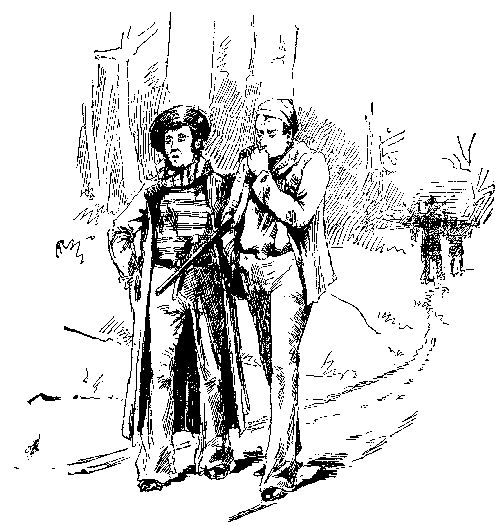
Perry's Recruits.
His crews having arrived, Perry was anxious to get out upon the lake, and engage the enemy at once. But this course of action was for a long time impossible. The flotilla lay snugly anchored within the harbor of Erie, the entrance to which was closed by a bar. To cross this bar, the ships would have been obliged to send all heavy ordnance ashore; and, as the enemy kept close watch outside the harbor, the American fleet was practically blockaded. For several weeks the Americans were thus kept prisoners, grumbling mightily at their enforced inaction, and longing for a chance to get at the enemy. One morning in August word was brought to Perry that the blockading fleet had disappeared. Instantly all was life and bustle in the harbor. The crews of all the vessels were ordered aboard; and the flotilla dropped down to the bar, intending to cross early in the morning. At dawn the movement was begun. The schooners and other small craft were easily taken outside; but, when it came to the turn of the two gun-brigs, "Lawrence" and "Niagara," it became evident that mechanical assistance was required. Accordingly, a powerful "camel" was hastily improvised, by the aid of which the two vessels were dragged across the bar. Hardly had the second brig made the passage in safety, when the British fleet appeared in the offing. Tradition says that the opportune absence of the enemy's fleet was caused by a public banquet to which the citizens of Port Dover had invited Commodore Barclay and his officers. While the dinner was going merrily on, the Americans were hard at work, escaping from the trap in which the British had left them. In responding to a toast at the banquet, Barclay said, "I expect to find the Yankee brigs hard and fast on the bar at Erie when I return, in which predicament it will be but a small job to destroy them." His anticipations were not realized; for, on his arrival, he found the entire squadron safely floating in the deep water outside the bar.
Had Barclay but known it, he would even then have found it "but a small job to destroy them;" for the two brigs, having been stripped of their ordnance, would have been easy prey for the British squadron. But Perry's bold action in sending forward two schooners to engage the enemy seemed to alarm the too prudent commodore; and the British bore away, and were soon out of sight.
By night Perry's flotilla was in readiness for cruising, and set out immediately in pursuit of the foe. Barclay seemed to avoid the conflict; and, after some weeks' cruising, the Americans cast anchor at Put-in-Bay, and awaited there the appearance of the enemy.
The little flotilla that lay anchored on the placid waters of the picturesque bay consisted of nine vessels, ranging in size from the "Trippe," a puny sloop carrying one gun, to the "Lawrence" and "Niagara," brigs carrying each two long twelves and eighteen short thirty-twos. No very formidable armada was that of a handful of pygmy vessels, commanded by a young officer who had never heard the thunderous cannonade of a naval battle, or seen the decks of his ships stained with the blood of friends and daily companions. Yet the work of the little squadron saved the United States from invasion, won for the young commander a never-dying fame, and clothed the vine-clad hills, the pebbly beaches, and the crystal waters of Put-in-Bay with a wealth of proud, historical associations.
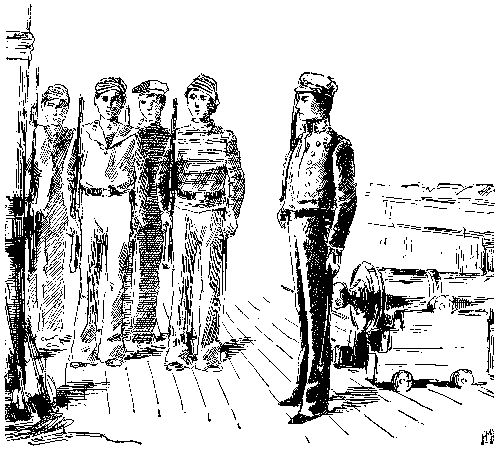
Drilling The Raw Recruits.
Day after day the vessels lay idly at their anchorage, and the sailors grew restless at the long inactivity. Perry alone was patient; for to him had come the knowledge that the hostile fleet was getting short of supplies, and would soon be starved out of its retreat at Malden. Knowing this, he spared no pains to get his men into training for the coming conflict. They were exercised daily at the great guns, and put through severe drills in the use of the cutlass, in boarding, and repelling boarders. By constant drill and severe discipline, Perry had made of the motley crew sent him a well-drilled body of seamen, every man of whom had become fired with the enthusiasm of his commander.
As the time passed, and the day of battle drew nearer, Perry's confidence in his men increased; and he looked upon the coming conflict as one certain to bring glory to his country. At early dawn the jackies on the ships could see the slender form of their commander perched upon the craggy heights of one of the islands, called to this day "Perry's Lookout," eagerly scanning the horizon in the direction of Malden. On the night of Sept. 9, 1813, the commodore felt convinced that on the next day the British would come out to battle. Accordingly, a conference of captains was called in the cabin of the flag-ship, and each received directions as to his course of action during the fight. They were urged to force the fighting to close quarters. Said Perry, "Nelson has expressed my idea in the words, 'If you lay your enemy alongside, you cannot be out of your place.'" As the officers were about to depart, Perry drew from a locker a large, square blue flag, on which appeared, in white letters, the dying words of the gallant Lawrence, "Don't give up the ship!" "This," said Perry, "shall be the signal for action; and when it appears at the masthead, remember your instructions." The conference then ended; and the captains returned to their ships across the bay, silvered by the light of the moon, to spend the greater part of the night in preparations for the great danger of the coming day.
Morning dawned bright and clear, with a light breeze blowing, that broke into ripples the surface of the land-locked bay. The rosy light of the rising sun was just reddening the eastern horizon, when, from the lookout in the foretop of the "Lawrence," came the long-drawn hail of "Sail, ho!" quickly repeated from the other vessels.
Perry was already on deck. "What does it look like?" he shouted to the lookout.
"A clump of square rigged, and fore and afters, sir," was the response.
In a few minutes the signals "Enemy in sight," and "Get under way," were flying from the masthead of the flag-ship; and the merry piping of the boatswains' whistles, and the measured tramp of the sailors around the capstans, told that signals were observed, and were being obeyed.
The fleet was soon threading its way through the narrow channels, filled with islands, at the entrance to the bay, and finally came into line on the open lake. Not a cloud was in the sky. The lake was calm, with enough wind blowing to admit of manœuvring, yet gentle enough to be of advantage to the schooners that made up the greater part of each fleet.
For some time the Americans held back, manœuvring to get the weather-gauge; but Perry's impatience for the fray got the better of his caution, and he determined to close at once. His first officer remonstrated, saying, "Then you'll have to engage the enemy to leeward."
"I don't care," responded the commodore. "Leeward or windward, they shall fight to-day." Then, turning to the quartermaster, he called for the battle-flag, which being brought, he mustered the crew aft, and addressed them briefly, telling them of the task before them, and urging them to fight bravely for the victory. "My brave lads," he concluded, "this flag bears the last words of Capt. Lawrence. Shall I hoist it?"
"Ay, ay, sir!" cried the jackies, in unison; and, as the flag was swiftly run to the masthead, the cheers of the sailors on the deck of the "Lawrence" were echoed from the neighboring vessels, as the white letters showed boldly against the blue flag, bearing to each commander the exhortation, "Don't give up the ship!"
The battle-signal being thus displayed, the vessels moved onward to the attack. As the crew of the "Lawrence" stood at their guns, the cooks passed along the decks, handing to each man a bit of food, that his strength might not leave him in the coming struggle. Then followed boys with boxes of sand, which they strewed upon the decks, to afford a firm foothold for the men at the guns. The hammocks were stowed along the nettings, to serve as some little protection against flying shot. The men stood silent and pale at their quarters, each occupied with his own grave thoughts, but all determined to fight like brave men and true for the honor of the flag. By Perry's side stood his brother, a boy thirteen years old, armed and ready to do his duty as well as the older men.
The British came on gallantly. Barclay had lost all his diffidence, and brought up his vessels like a veteran. His ships were kept close together; the ship "Detroit" under short sail, that the pygmy sloop "Little Belt" might not be left in the rear. The Americans came down in single file, headed by the schooner "Scorpion." Suddenly through the still air rang out the sharp notes of a bugle-call on the enemy's flag-ship. It was the signal for action; and, as the last notes died away, the bands struck up "Rule, Britannia." The Americans answered with cheers; and in the midst of the cheering, a jet of smoke and fire spurted from the side of the "Detroit," and a heavy shot splashed into the water near the "Lawrence," while a dull, heavy report came booming over the water.
The battle was opened, but five minutes elapsed before a second shot was fired. When it did come, it crashed through the bulwarks of the "Lawrence," and sped across her deck, doing no great damage. "Steady, lads, steady," cried Perry, from his post on the quarter-deck, as he saw an uneasy stir among his men, who longed to return the fire. The commodore was determined to fight at close quarters, and hung out signals for each ship to choose its antagonist, and fight the fight out for itself.
It was then high noon, and the battle soon became general. The little schooners "Scorpion" and "Ariel" pluckily kept their place in the van of the American line, but the fire of the enemy fell most fiercely upon the flag-ship "Lawrence." No less than four vessels at one time were grouped about the "Lawrence," pouring in a destructive fire, and bent upon destroying the flag-ship and her brave commander; then taking the smaller vessels in detail. The "Lawrence" fought bravely, but the odds were too great. The carronades with which she was armed were no match for the long guns of her adversaries. For two hours the unequal combat raged, and no American vessel came to the aid of the sorely smitten flag-ship. Amid the hail of cannon-balls and bullets, Perry seemed to bear a charmed life. He saw his officers and men falling all about him. John Brooks, the lieutenant of marines, fought by the commodore's side. While speaking cheerfully to the commodore, a cannon-ball struck the young lieutenant on the hip, dashing him across the deck against the bulwark, and mutilating him so, that he plead piteously with Perry, imploring that he might be put out of his misery with a pistol-shot. From this awful spectacle Perry turned to speak to the captain of a gun, when the conversation was abruptly cut short by a shot which killed the seaman instantly. Perry returned to the quarter-deck. The first lieutenant came rushing up, his face bloody, and his nose swelled to an enormous size from a splinter which had perforated it. "All the officers in my division are killed," he cried. "For God's sake, give me more!" Perry sent some men to his aid; but they soon fell, and the cry for more men arose again. One of the surgeons who served in the cock-pit on that dreadful day states, that, in the midst of the roar of battle, Perry's voice was heard calling down the hatchway, and asking any surgeon's mates who could be spared, to come on deck and help work the guns. Several went up; but the appeal was soon repeated, and more responded. When no more men could be obtained, the voice of the commodore took a pleading tone. "Can any of the wounded pull a rope?" said he; and such was his ascendency over the men, that several poor mangled fellows dragged themselves on deck, and lent their feeble strength to the working of the guns.
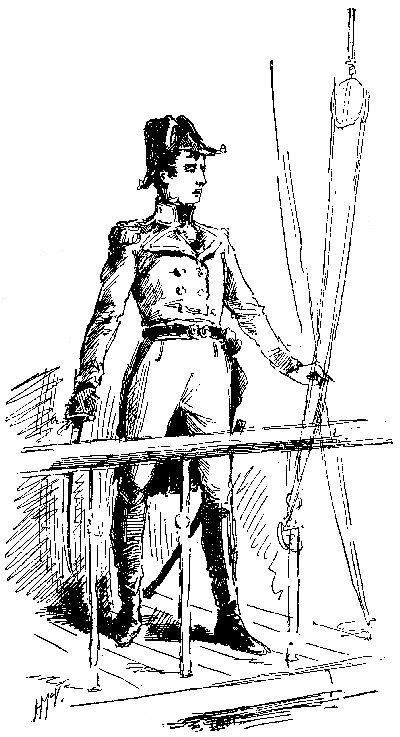
Commodore Perry At The Battle Of Lake Erie.
Amid all the carnage, the sailors were quick to notice the lighter incidents of the fray. Even the cock-pit, filled with the wounded, and reeking with blood that dripped through the cracks in the deck above, once resounded with laughter as hearty as ever greeted a middy's after-dinner joke in the steerage. Lieut. Yarnall received a bad scalp-wound, which fairly drenched his face with blood. As he groped his way towards the cock-pit he passed a lot of hammocks stuffed with "cat-tails" which had been stowed on the bulwarks. The feathery down of the "cat-tails" filled the air, and settled thick upon the head and face of the officer, robbing his countenance of all semblance to a human face. As he descended the ladder to the cock-pit, his owl-like air roused the wounded to great shouts of laughter. "The Devil has come among us," they cried.
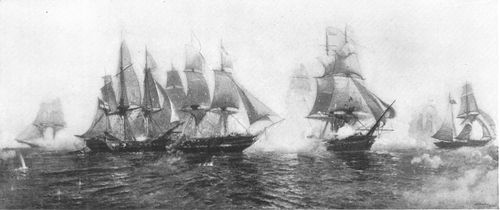
Perry's Victory—the Battle Of Lake Erie. September 10, 1813. Copyright, 1893, by C. Klackner.
While talking to his little brother, Perry to his horror saw the lad fall at his feet, dashed to the deck by an unseen missile. The commodore's agony may be imagined; but it was soon assuaged, for the boy was only stunned, and was soon fighting again at his post. The second lieutenant was struck by a spent grape-shot, and fell stunned upon the deck. He lay there for a time, unnoticed. Perry raised him up, telling him he was not hurt, as no blood could be seen. The lieutenant put his hand to his clothing, at the point where the blow had fallen, and discovered the shot lodged in his coat. Coolly putting it in his pocket, he remarked, "You are right: I am not hurt. But this is my shot," and forthwith returned to his duty.
It was a strange-looking body of men that fought at the guns of the "Lawrence." Lean, angular Yankee sailors from the seafaring communities of New England stood by the side of swarthy negroes, who, with their half-naked black bodies, in the dense powder-smoke, seemed like fiends in pandemonium. In the rigging were stationed a number of Kentucky riflemen, who had volunteered to serve during the battle. The buckskin shirts and leggings gave an air of incongruity to their presence on a man-of-war. Their unerring rifles, however, did brave service for the cause of the stars and stripes. At the opening of the action, two tall Indians, decked in all the savage finery of war-paint and feathers, strode the deck proudly. But water is not the Indian's element, and the battle had hardly begun when one fled below in terror; the other remained on deck, and was killed early in the action.
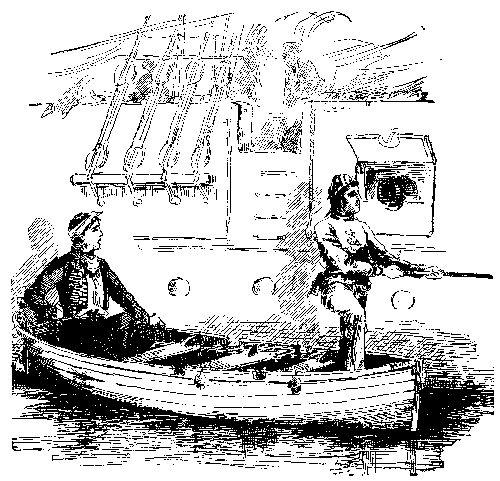
Making Ready To Leave The "Lawrence."
Courageous and self-confident though the American commander was, the moment came when he could no longer disguise the fact that his gallant flag-ship was doomed to destruction before the continuous and deadly fire of her adversaries. There was but one course of action open, and upon this he determined at once. He would transfer his flag to the "Niagara," and from the deck of that vessel direct the movements of his fleet. Accordingly, the only uninjured boat of the "Lawrence" was lowered; and Perry sprang into the stern, followed by his little brother. Before the boat pushed off, the battle-flag was thrown into her; and, wrapping it about him, Perry took a standing position in the stern, and ordered the oarsmen to give way. He steered straight for the "Niagara," through the very centre of the fight. The enemy quickly grasped the purpose of the movement, and great guns and muskets were trained on the little boat. Shot of all sizes splashed in the water about the boat, splintered the oars, and buried themselves in the gunwale. The crew begged their commander to sit down, and make himself a less conspicuous target for the fire of the enemy; but Perry paid but little attention to their entreaties. Suddenly the men rested on the oars, and the boat stopped. Angrily the commodore demanded the cause of the stoppage, and was told that the men refused to row unless he sat down. With a smile he yielded, and soon the boat was alongside the "Niagara." Perry sprang to the deck, followed by his boat's crew and a plucky sailor who had swum just behind the boat across the long stretch of water. Hardly a glance did the commodore cast at the ship which he had left, but bent all his faculties to taking the new flag-ship into the battle.
The "Niagara" was practically a fresh ship; for, up to this time, she had held strangely aloof from the battle. Now all was to be changed. The battle-flag went to her masthead; and she plunged into the thick of the fight, striking thunderous blows at every ship she encountered. As she passed the American lines, the sailors greeted with cheers their gallant commander. The crippled "Lawrence," an almost helpless hulk, left far behind, was forced to strike her flag; although her crew protested loudly, crying out, "Sink the ship, and let us go down with her." But the conquered vessel was not destined to fall into the hands of her enemies. Already the sight of their commodore on a fresh vessel stimulated the American tars; so that in half an hour the British line was broken, their ships cut to pieces, and the "Detroit," their flag-ship, a prize to the "Niagara." A white handkerchief was waved at the end of a pike by one of the crew of the "Princess Charlotte." The firing stopped, the flag was again run up to the masthead of the "Lawrence," while a few feeble cheers came faintly over the water from the remnant of her crew.
The dense clouds of smoke blowing away, Perry saw, by the disposition of his squadron, that the victory was secure. Hastily catching off his navy-cap, he laid upon it a sheet of paper torn from an old letter, and wrote to Gen. Harrison the famous despatch, "We have met the enemy, and they are ours,—two ships, two brigs, one schooner, and one sloop."
Then, with true chivalry, he determined that to his flag-ship "Lawrence," that had so stoutly borne the brunt of battle, should belong the honor of receiving the British captains, when they came to surrender their vessels. He returned to the "Lawrence;" but the scene there was such that even the excitement of victory could raise no feelings of exultation in his breast. He saw on every side the bodies of officers with whom, but the night before, he had dined in perfect health. The decks were red with blood, and from the cock-pit arose the groans of the wounded.
After the formal surrender, to make which the officers picked their way over the deck covered with slain to the quarter-deck, the work of burying the dead of both squadrons was begun. It was about sundown that the sad ceremonies were held; and, as the deep tones of the chaplains reading the burial service arose upon the evening air, the dull, mournful splashing of heavy bodies in the water told that the last scene in the great victory was drawing to an end.[Back to Content]
CHAPTER VIII.
ON THE OCEAN. — THE "HORNET" SINKS THE "PEACOCK." — THE BLOCKADE. — ADVENTURES OF THE "SALLY." — HOSTILITIES ON CHESAPEAKE BAY. — THE CRUISE OF THE "PRESIDENT."
he year 1813, that brought to American sailors upon the lakes such well-earned laurels, opened auspiciously for the stars and stripes upon the ocean. It will be remembered that the "Constitution," while on the cruise in the South Atlantic that ended with the destruction of the "Java," had left the "Hornet" off San Salvador, blockading the British ship "Bonne Citoyenne." For eighteen days the "Hornet" remained at her post. Her captain continually urged the enemy to come out and give him battle, but to no avail. The remembrance of his valuable cargo deterred the Englishman, and he remained snug in his harbor. Months after, when the occurrence became known in the United States, an unreasoning outcry was raised against the commander of the "Bonne Citoyenne" for thus avoiding the conflict; but naval men have always agreed that his action was wise and commendable.

After eighteen days' service on this blockade, the "Hornet" saw a British seventy-four bearing down upon her, bent upon releasing the treasure-ship. Against such odds it would have been folly to contend; and the Americans, taking advantage of a dark night, slipped away, and were soon beyond pursuit. The vessel continued her cruise in the waters south of the equator, meeting with good fortune, and taking many valuable prizes, from one of which twenty-three thousand dollars in specie were taken. But her cruise was not destined to proceed without serious opposition.
On the 24th of February, as the "Hornet" was giving close chase to a suspicious brig near the mouth of the Demarara River, a second stranger was sighted in the offing. Giving no heed to the newly sighted vessel, the "Hornet" continued her chase until the rapidly approaching vessel was clearly made out to be a brig, flying the British flag, and evidently a man-of-war. The "Hornet" was immediately cleared for action; and the two hostile vessels began manœuvring for the weather-gage, as two scientific pugilists spar cautiously for an opening. In this contest of seamanship, Capt. Lawrence of the "Hornet" proved the victor; and a little after five o'clock in the afternoon, the two enemies stood for each other upon the wind, the "Hornet" having the weather-gage. As they rapidly neared each other, no sound was heard save the creaking of the cordage, and the dashing of the waves against the vessels' hulls. Not a shot was fired until the enemies were dashing past each other, going in opposite directions. The first broadsides were exchanged at half pistol-shot, with very unequal effects. The shot of the "Hornet" penetrated the hull of her antagonist, doing terrible execution; while the broadside let fly by the "Peacock" whistled through the rigging of the American ship, cutting away the pennant, and killing a topman, who was struck by a round shot, and dashed from his station in the mizzen-top, to fall mangled and lifeless into the sea.
Hardly were the ships clear, when the British captain put his helm hard up,—a manœuvre executed with the intention of securing a raking position. But the plan was balked by the cool seamanship of Capt. Lawrence, who quickly followed up the British vessel, and, getting a position on his quarter, poured in so rapid and accurate a fire that the enemy was fain to haul down his colors and confess defeat. The British ensign had hardly touched the deck, when it was run up again, with the union down, as a token of distress. At this sight, the Yankee tars, who had been cheering lustily over their quickly won victory, stopped their rejoicings, and set about giving assistance to the injured Britons with as hearty good-will as they had lately shown in their vigorous cannonade.
With all possible despatch, a boat was lowered, and Lieut. Shubrick proceeded on board the prize. He found the "Peacock" a complete wreck. Shortly after the surrender her main-mast had gone by the board, and her hull was fairly honeycombed with shot-holes. Returning to his ship, Shubrick reported the condition of the prize. He was immediately ordered to return to the "Peacock," and make every effort to save her. Accompanied by three boats' crews of American sailors, he again boarded the sinking ship, and bent every energy to the attempt for her salvation. Bulwarks were cut away, and the heavy guns were rolled out of the gaps thus made, and cast into the sea. Deep down in the hold, and swinging like spiders over the sides of the vessels, sailors tried to stop up with felt-covered blocks of wood the great holes through which the water was pouring. All the time boats were plying between the sinking vessel and the "Hornet," transferring the wounded and the prisoners. Twilight fell before the work was ended, and it became evident to all that the "Peacock" must sink during the night. But the end came even quicker than had been expected. Some new rent must have opened in the brig's side; for, with a sudden lurch, she commenced to sink rapidly, bow foremost. Several of the English crew were below, searching for liquor; and, caught by the inpouring flood, they found a watery grave in the sinking hulk. Three Americans were also ingulfed; and five narrowly escaped death by climbing up the rigging to the foretop, which remained above water when the hull rested upon the bottom. In the midst of the excitement and confusion, four British seamen slyly clambered out of the cabin-windows, and, dropping into a boat that was made fast to the stern, made off in the darkness. The Americans, eagerly watching the sinking ship, did not detect the fugitives until the boat was far beyond the possibility of recapture.
The vessel so quickly destroyed by the "Hornet" was the British man-of-war brig "Peacock," mounting ten guns, and carrying a crew of two hundred and ten men. In one respect, she was a model ship. Among naval men, she had long been known as "the yacht," on account of the appearance of exquisite neatness she always presented. Her decks were as white as lime-juice and constant holystoning could keep them. The brasswork about the cabins and the breeches of the guns was dazzling in its brilliancy. White canvas lined the breechings of the carronades. Her decks everywhere showed signs of constant toil in the cause of cleanliness. The result of the battle, however, seemed to indicate that Capt. Peakes had erred, in that, while his ship was perfect, his men were bad marksmen, and poorly disciplined. While their shot were harmlessly passing through the rigging of the "Hornet," the Americans were pouring in well-directed broadsides, that killed and wounded thirty-eight men, and ended the action in fifteen minutes. The Americans lost but one man in the fight, though three more went down in the sinking prize.
Capt. Lawrence now found himself far from home, short of water, and crowded with prisoners. For a time, he feared that to these evils was to be added a second action, while his crew was still fatigued with the labors of the first. During the battle with the "Peacock," a second British man-of-war brig, the "Espiègle," lay quietly at anchor only four miles away. Why she had not joined in the strife, has never been explained. She was clearly visible from the tops of the "Hornet" throughout the action, and Lawrence expected every moment to see her bear down to the assistance of her consort. But she made no movement; and even after the fight ended, and the "Peacock" lay on the bottom of the ocean, the mysterious stranger awoke not from her lethargy. Not wishing to engage a second adversary while his ship was crowded with prisoners, Lawrence immediately left the scene of action, and laid his course for home. The homeward voyage was rapid and uneventful. No pains were spared to secure the comfort of the prisoners who crowded the ship. The British officers were treated with the greatest consideration; so that, as one said on quitting the ship, they "ceased to consider themselves as captives." The tars, who were consigned to the care of the blue-jackets in the forecastle, were met with less courtesy, but certainly with no less good feeling. They were not spared an occasional taunt or triumphant joke; but when it was learned that by the sinking of their ship the Britons had lost all their "toggery," the "Hornet's" lads turned to, and soon collected clothing enough to fit out each prisoner with a respectable kit.
It was the middle of March before the long, homeward voyage was ended, and the anchor was dropped in the snug harbor of Holmes's Hole in the island of Martha's Vineyard. The usual rejoicings followed the news of the victory. Lawrence was the hero of the hour; and songs innumerable appeared in the newspapers, extolling the courage and devotion of the brave lads of the "Hornet."
Indeed, the arrival of the "Hornet" with her glorious news came at an opportune moment, to cheer the spirits of the American people. The war had begun to assume a serious aspect. Continued reverses on the ocean had roused the British ministry to the fact that they were dealing with no contemptible enemy, and the word had gone forth that the Americans must be crushed into submission. Troops were hurriedly sent to Canada, and all the vessels that could be spared were ordered to the coast of the United States. The English had determined upon that most effective of all hostile measures,—a rigorous blockade of their enemy's coast. Up and down the coast from New Jersey to the Carolinas, British frigates and sloops kept up a constant patrol. Chesapeake Bay was their chief rendezvous; and the exploits of the blockading squadron stationed there, under Admiral Cockburn, led often to scenes more befitting savage warfare then the hostilities of two enlightened and civilized peoples. On the New England coast, the blockade was less severely enforced. The people of that section had been loud in their denunciations of the war; and the British hoped, by a display of moderation, to seduce the New Englanders from their allegiance to the United States,—a hope that failed utterly of fulfilment. Even had the British desired to enforce the blockade along the New England shore, the character of the coast, and the skill and shrewdness of the Yankee skippers, would have made the task of the blockaders a most difficult one.
The annals of the little seafaring-villages along the coast of Maine and Massachusetts abound in anecdotes of hardy skippers who outwitted the watchful British, and ran their little schooners or sloops into port under the very guns of a blockading man-of-war.
Among the blockade-runners of the New England coast, Capt. Dan Fernald of Portsmouth stood foremost. When a shipload of Maine timber was needed at the Portsmouth navy-yard, to be converted into a new man-of-war, to Capt. Fernald was assigned the task of bringing it down from Portland past the British frigates, that were ever on the watch for just such cargoes. When the preparations for the building of the seventy-four-gun ship "Washington" were making at the navy-yard, Capt. Fernald was sent to Portsmouth for a load of ship's-timber. His cargo was to consist of forty-eight "knees" and the breast-hook of the seventy-four. Loaded down with this burden, the schooner "Sally" left Portland, and headed for her destination. Caution led her captain to keep his craft close to the shore, and for a day or two she crept along the coast without being discovered. But head-winds and calms delayed the "Sally," and on her fourth day out she was sighted by the British frigate "Tenedos." The "Sally" was not an imposing craft, and under ordinary circumstances she might have been allowed to proceed unmolested; but on this occasion a number of the oaken knees for the new war-vessel were piled on the deck, and the British captain could clearly make out, through his glasses, that the "Sally" was laden with contraband of war. Accordingly, he set out in hot pursuit, in the full expectation of overhauling the audacious coaster. Capt. Fernald, however, had no idea of letting his schooner fall into the hands of the British. He was a wily old skipper, and knew every nook and corner of the Maine and New Hampshire coasts better than he knew the streets of his native village. Apparently unmoved by the pursuit of the man-of-war, he stood at the tiller, and, beyond ordering his crew to shake out the reefs in the sails, seemed to make no great attempt to elude the enemy. But soon the crew noticed that the skipper was taking his schooner rather dangerously close to the shore; and a cry came from a sailor on the bow, that the "Sally" was ploughing through the kelp, and would soon be on the rocks.
"No matter," sung out the captain; "just heave over a few of them knees, and I guess she'll float clear."
Overboard went a dozen heavy timbers, and the "Sally" sailed smoothly on over the rocks. Then the captain glanced back over his shoulder, and chuckled slyly as the majestic frigate, following closely in his track, brought up all of a sudden on the rocks, and was quickly left a fixture by the receding tide. The exasperated Englishman sent two eighteen-pound shot skipping over the water after the "Sally," but without effect. One shot buried itself in the sand of the beach; and Capt. Fernald, after picking up the knees that had been thrown overboard, coolly went ashore, dug up the ball, and carried it away as a trophy. He reached his moorings at the navy-yard safely, and was warmly greeted by Commodore Hull, who asked if the "Sally" had been fired upon; and, on being presented with the eighteen-pound shot for a token, exclaimed, "You are a good fellow, and stand fire well."
The "Tenedos" came not so luckily out of the adventure. By the time a flood tide lifted her clear of the reef, the jagged points of the rocks had pierced her hull, so that she leaked badly, and was forced to go to Halifax for repairs.
One more adventure in which the "Sally" and her wily captain figured is worth recounting. Again the dingy schooner was edging her way along the rugged shore, bound for the Portsmouth navy-yard. No vessel could have seemed more harmless. Her patched and dirty canvas was held in place by oft-spliced ropes and rigging none too taut. Her bluff bows butted away the waves in clouds of spray, that dashed over the decks, which seldom received other washing. Her cargo seemed to be cord-wood, neatly split, and piled high on deck. While off Casco, the wind dropped down, and the "Sally" was left floating idly upon the glassy ocean. Far in the distance lay an English man-o'-war, also becalmed; but from which a long-boat, stoutly manned, soon put out, and made for the becalmed schooner. The boat was soon within hail, and a trim young officer in the stern-sheets sung out,—
"What craft's that?"
"Schooner 'Sally' of Portsmouth," came the answer, in the drawling tones of a down-east skipper.
"Where from?"
"Portland."
"Where bound?"
"Portsmouth."
"What's your cargo."
"Firewood," responded Capt. Fernald with a carelessness he was far from feeling; for deep down in the hold, under the cord-wood, were two twenty-four-pounder cannon, thirteen thousand pounds of powder, and about one hundred boarding pikes and cutlasses.
The British officer hesitated a moment, as if the little coaster was of too little importance for further examination.
"Well, I think I'll come aboard," said he carelessly, and soon stood with three or four of his men on the deck of the "Sally."
After glancing contemptuously about the ill-kept decks, he turned to his men with the sharp order: "Clear away some of that wood from the hatchways, and see what's in the hold."
The men set to work, passing the cord-wood away from the hatch ways, and piling it upon the after-deck. Soon they had worked their way into the hold, and were going deeper and deeper down toward the munitions of war. Capt. Fernald's blood seemed to stop coursing in his veins. He knew that but one layer of cord-wood then lay above the cannon, and he expected every instant to see the black iron uncovered. But the British officer grew impatient.
"That's enough of that work," said he; "there's nothing but wood there. Captain, you can proceed on your course."
A momentary murmur arose from the English sailors. The "Sally" was theirs by right of capture, and they saw no reason for her liberation. "Why, lads," said the officer, "it would cost just as much to get this poor fellow's wood-schooner condemned as it would a large ship. As for the prize-money, it would not make a penny apiece." So, tumbling into their boat, the jackies pulled away; shouting to the captain of the "Sally" to stow his cargo again, or his old tub would capsize. Capt. Fernald took their jeers good-naturedly, for he was the victor in that encounter.
The occurrence had been observed from the shore; and, when the British sailors were seen swarming over the side of the "Sally," a horse-man set off for Portsmouth to notify Commodore Hull that the schooner was captured. It was a sore blow; for the guns and powder were thought to be lost, and munitions of war were hard to be had at that time. But Hull soon threw aside the disappointment, and was busily engaged with plans for the vessels then building, when a sentry came in, and reported the "Sally" in sight. Hull rushed to the water-side. Sure enough, there came the battered old schooner, butting her way through the waves of the channel; and, before long, the two cannon were safe in the storehouses, while Capt. Fernald found himself vested with a reputation for almost superhuman sagacity and luck.
Not all the encounters between the blockaders and the blockade-runners terminated so happily for the Americans. Many a coasting-vessel was sent to Halifax to swell the coffers of the British prize-courts, or, after being set on fire, was left to lie charred and ruined upon the rocky shore, as a warning to all who violated the blockade.
The capture of one United States war-vessel graced the English naval annals of January, 1813; for the little brig "Viper," carrying twelve guns, fell in the way of the British, thirty-two, "Narcissus," and straightway surrendered to the overwhelming force of her enemy.
Among the United States war-vessels caught and held in port by the blockade was the frigate "Constellation." She was at the opening of the war the favorite ship of the American navy; her exploits in the war with France having endeared her to the American people, and won for her among Frenchmen the name of "the Yankee race-horse." Notwithstanding her reputation for speed, she is said to have been very crank, and had an awkward way of getting on her beam-ends without much provocation. An almost incredible tale is told of her getting "knocked down" by a squall while chasing a French privateer, and, notwithstanding the delay, finally overhauling and capturing the chase.
When war was declared with England, the "Constellation" was so thoroughly dismantled, that some months were occupied in refitting before she was ready to put to sea. In January, 1813, she dropped anchor in Hampton Roads, expecting to set out on an extended cruise the next morning. Had she been a day earlier, her career in the War of 1812 might have added new lustre to her glorious record in the war with France; but the lack of that day condemned her to inglorious inactivity throughout the war: for on that very night a British squadron of line-of-battle ships and frigates dropped anchor a few miles down the bay, and the "Constellation" was fairly trapped.
When, by the gray light of early morning, the lookout on the "Constellation" saw the British fleet lying quietly at their anchorage down the bay, he reported to Capt. Stewart; and the latter saw that, for a time, he must be content to remain in port. Stewart's reputation for bravery and devotion to his country leaves no doubt that the prospect of prolonged idleness was most distasteful to him. But he had little time to mourn over his disappointment. The position of the frigate was one of great danger. At any moment she might be exposed to attack by the hostile fleet. Accordingly, she dropped down abreast of Craney Island, where she was secure from attack by the British vessels, but still open to the assaults of their boats.
To meet this danger, Capt. Stewart took the most elaborate precautions. His ship was anchored in the middle of the narrow channel; and on either side were anchored seven gunboats, officered and manned by the men of the frigate. Around the gunboats and frigate extended a vast circle of floating logs, linked together by heavy chains, that no boarders might come alongside the vessels. The great frigate towered high above the surrounding gunboats, her black sides unbroken by an open port; for the gun-deck ports were lashed down, and the guns housed. Not a rope's end was permitted to hang over the side; the stern ladders were removed, and the gangway cleats knocked off. An enemy might as well hope to scale the unbroken front of a massive wall of masonry, as that dark, forbidding hull. From the bulwarks rose on all sides, to the ends of the yards, a huge net made of ratlin stuff, boiled in pitch until it would turn the edge of a cutlass, and further strengthened by nail-rods and small chains. The upper part of the netting was weighted with kentledge, the pigs of iron used for ballast; so that, should the hardy assailants succeed in coming alongside and scaling the side, a few blows of an axe would let fall the heavily weighted nettings, sweeping the boarders into the sea, and covering boats and men with an impenetrable mesh, under which they would be at the mercy of the sailors on the frigate's decks. The carronades and howitzers were loaded with grape; and the officers and men felt that only bravery on their part was essential to the defeat of any force that Great Britain could send against the ship.
Heedless of these formidable preparations for their reception, the enemy set under way two expeditions for the capture of the "Constellation." In neither case did the antagonists actually come to blows, for the approach of the British was discovered before they came within pistol-shot; and, as their only chance lay in surprising the Americans, they retired without striking a blow. The coming of the first expedition was known upon the "Constellation" the day before it actually set out. A Portuguese merchantman, trying to beat out of the bay, had been stopped by the British, and anchored a few miles below the American frigate. A guard and lookout from the English fleet were stationed on the Portuguese to watch the "Constellation." In an unguarded moment, these men let fall a hint of the movement under way; and an American passenger on the Portuguese vessel quickly carried the news to Capt. Stewart, and volunteered to remain and aid in the defence. The next night was dark and drizzly; and the British, to the number of two thousand, set out in boats for the "Constellation." Hardly were they within gunshot, when two lanterns gleamed from the side of a watchful guard-boat; and the roll of drums and sound of hurrying feet aboard the frigate told that the alarm was given. The assailants thereupon abandoned the adventure, and returned to their ship. The next night they returned, but again retreated discomfited. Several nights later, a third expedition came up. This time the guard-boat was far down the bay; and, seeing the huge procession of boats, the Americans calmly edged in among them, and for some time rowed along, listening to the conversation of the British, who never dreamed that an enemy could be in their midst. Suddenly a sailor, more sharp-eyed than the rest, caught sight of the interlopers; and the cry was raised, "A stranger!" The Americans tugged at their oars, and were soon lost to sight; but, not being pursued, returned, and accompanied their foes up the bay, and even anchored with the flotilla at a point above the "Constellation." The enemy, finding the Americans constantly on the watch, abandoned their designs on the ship, and vowed that Capt. Stewart must be a Scotchman, as he could never be caught napping. Some days later, an officer, sent with a flag of truce to the British fleet, vastly chagrined the officers there by repeating their remarks overheard by the guard-boat officers who joined the British flotilla in the dark. These three escapes confirmed the reputation borne by the "Constellation," as a "lucky ship;" and although she remained pent up in port throughout the war, doing nothing for her country, her luck was unquestioned in the minds of the sailors. With her they classed the "Constitution" and "Enterprise," while the "Chesapeake" and "President" were branded as unlucky. Certainly the career of these ships in the War of 1812 went far to confirm the superstitious belief of the sailors.
In the course of the next two months, Chesapeake Bay was the scene of two gallant adventures, in which American privateersmen were opposed to the British sailors. On Feb. 8, the privateer schooner "Lottery" was standing down the bay under easy sail, out-bound on a voyage to Bombay. The schooner was one of the clipper-built craft, for which Baltimore ship-builders were famous the world over. Her battery consisted of six twelve-pounder carronades, and her crew numbered twenty-five men. Near the point at which the noble bay opens into the Atlantic ocean, a narrow sheet of water extends into the Virginia shore, winding in sinuous courses several miles inland. This is known as Lynnhaven Bay; and on its placid surface there lay, on the morning of the "Lottery's" appearance, four powerful frigates flying the British flag. From their tops the approaching schooner could be seen across the low-lying neck of land that separated the smaller bay from the main body of water. The cry of "Sail, ho!" roused the fleet to sudden activity; and an expedition of two hundred men was quickly organized to proceed against the privateer. Fortune seemed to favor the British; for hardly had the boats left the fleet, when the fresh breeze died away, and the schooner was left at the mercy of the boats, which, propelled by the long, swinging strokes of man-o'-war oarsmen, bore down rapidly upon her. Capt. Southcomb of the "Lottery" was an American sailor, who had smelt powder before; and he had no idea of yielding up his ship without a struggle. The formidable force sent against him merely moved him to more desperate resistance. When the boats came within range, the guns of the "Lottery" opened upon them with a hail of grape and round shot. Still the assailants pressed on, and soon came beneath the schooner's lee. Dropping their oars, the plucky British tars sprang into the chains, swarmed up the bobstay and over the bow, and used each other's backs as ladders to aid them to reach the schooner's deck. The little crew of privateersmen fought viciously, guarding the side with cutlasses and pistols, hurling the boarders back into the sea, or cutting them down as they reached the deck. Cold shot and kentledge were dashed upon the boats, in the hopes of sinking them; while the carronades poured a destructive fire upon such boats as could be reached by their shot. But the conflict was too unequal to last long. The English sailors swarmed over the gunwale on all sides, and, cheering lustily, drove the small remnant of defenders below. Capt. Southcomb was cut down, and lay mortally wounded upon the deck when the enemy took possession of the ship. When the victors came to look about the captured vessel, they found such proofs of a desperate resistance, that their admiration was open and pronounced. Five only of the schooner's crew were unhurt, while the British paid for their success with the loss of thirteen men. Capt. Southcomb, in a dying condition, was taken aboard the frigate "Belvidera," where he received the tenderest treatment, and was shown marked respect on account of his bravery.
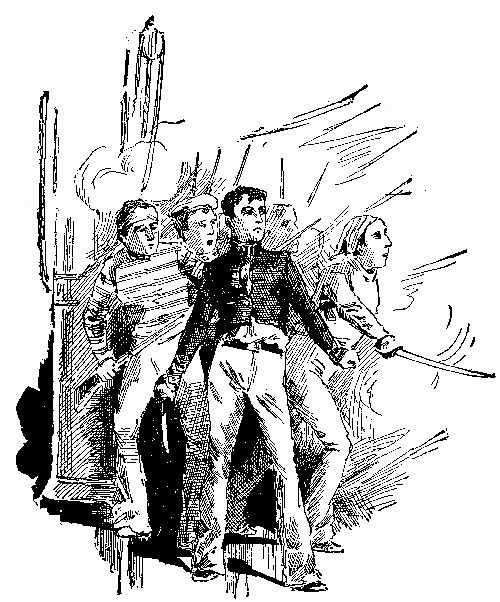
Awaiting The Boarders.
In the next encounter between the blockaders and a privateer, the British bore away the palm for gallantry. This time the privateersmen had every advantage, while the British carried the day by pure courage. The captured vessels were the privateer schooner "Dolphin," of twelve guns, and the letters-of-marque "Racer," "Arab," and "Lynx," of six guns each. The crews of the four vessels aggregated one hundred and sixty men. Against this force came five boats manned by one hundred and five British sailors, who pulled fifteen miles in order to attack their foes. Wearied though they were by the long pull, the sight of the privateers seemed to arouse new strength in the plucky tars; and, without a thought of the odds against them, they dashed forward, cheering, and calling upon the Americans to surrender. Had the four schooners been manned by such brave men as those who defended the "Lottery," the assailants might have been beaten off. As it was, two vessels surrendered without firing a shot. The crew of the "Racer" fought pluckily for a time, but were soon overpowered, and the vessel's guns turned upon the "Dolphin." When fire was opened upon this last vessel, her crew, affrighted, leaped overboard from every side; and the "Dolphin" was soon in the hands of her enemies, who had lost but thirteen men in the whole action.
Many a gallant adventure, such as this, is to be laid to the credit of the British tars on the American station during the continuance of the blockade. Right dashing fellows were they, at cutting out a coasting-schooner as she lay under the guns of some American earthworks. The lads that have won for England her supremacy upon the seas have never been behindhand at swarming up the sides of an enemy, leaping his taffrail, and meeting him on his own deck with the cold steel. And as the year rolled on, and the blockade along the American coast was made more strict, the meetings between the enemies became more frequent. From every seaport town, Yankee privateers were waiting to escape to sea; and they seldom won clear without a brush with the watchful enemy. The British, too, had begun to fit out privateers, though American commerce offered but little enticement for these mercenary gentry. Between the ships of the two private armed navies, encounters were common; and the battles were often fought with courage and seamanship worthy of the regular navy.
Little glory was won by the navy of the United States during the opening months of the year. Many ships were laid up in port; while some, like the "Constellation," were blockaded by the enemy. The "President" and the "Congress" managed to get to sea from Boston in April, and entered upon a protracted cruise, in which the bad luck of the former ship seemed to pursue her with malevolent persistence. The two ships parted after cruising in company for a month, and scoured the ocean until the following December, when they returned home, experiencing little but continual disappointments. The "Congress" could report only the capture of four British merchantmen, as the result of her eight months' cruise; while the long service had so seriously injured her hull, that she was condemned as unseaworthy, and ended her career, a dismantled hulk reduced to the ignoble service of store-ship at a navy-yard.
The "President" was little more fortunate in her search for prizes. After parting with her consort, she beat about in the vicinity of the Gulf Stream, in the hopes of getting a ship or two returning from the West Indies. But day after day passed, and no ship appeared. Changing his plan, Commodore Rodgers made for the North Sea, feeling sure that there he would find in plenty the marine game for which he was seeking. But, to his astonishment, not an English ship was to be found. It was then the middle of summer, and the frigate had been at sea for nearly three months. The jackies on the forecastle were weary of the long voyage, and fairly at the end of their occupations for "teasing time." The officers, well knowing the effect of long idleness upon the sailors, were tireless in devising means of employment. The rigging was set up weekly, so that the shrouds and stays were like lines drawn with a ruler. Enough rope-yarn was pulled, and spun-yarn spun, to supply a navy-yard for months. Laggards were set to scrubbing the rust off the chain cables, and sharpening with files the flukes of the anchors. When such work failed, the men were drilled in the use of cutlasses and single sticks; forming long lines down the gun-deck, and slashing away with right good will at the word of the instructor. But the monotony of a long cruise without a prize cannot long be beguiled by such makeshifts; and it was with the heartiest pleasure that the sailors heard that the commodore had determined to put into port for a time, and take on board stores.
It was North Bergen, Norway, that Rodgers chose for this purpose; and an unfortunate choice it proved to be, for a famine prevailed in the country, and only water could be obtained for the ship. Leaving the inhospitable port, the "President" was soon again upon the ocean. She quickly took two British merchantmen, from which she replenished her stores. Shortly after, two hostile frigates hove in sight, and the "President" fled for her life before them for more than eighty hours. At that season, in those high latitudes, no friendly darkness settled over the ocean to give the fugitive a chance to escape. Bright daylight persisted throughout the chase, and the sun never dipped below the horizon. Sheer good sailing saved the American frigate, and enabled her to leave her pursuers far in her wake.
For some days thereafter, better luck seemed to attend the frigate that so pluckily kept up her operations in seas thousands of miles from a friendly port. With true Yankee audacity, she extended her cruise even into the Irish Channel, and there preyed upon British commerce until the enemy was moved to send a squadron to rout out the audacious intruder. Then Rodgers set sail for home.
On the voyage to the United States, the "President" captured a British armed schooner by a stratagem which taught at least one British officer to respect "Yankee cuteness."
It was near the last of September that the frigate was flying along before a fresh breeze. Her yards were spread with a cloud of snowy canvas, and the wind sung through the straining cordage a melody sweet to the ears of the sailor homeward bound. Towards evening, a small sail was made out in the distance; and, as time wore on, it was seen that she was rapidly approaching the "President." Rodgers surmised that the stranger might be a British vessel, and determined to lure her within range by strategy. In some way he had obtained knowledge of some of the private signals of the British navy; and in a few minutes from the masthead of the American frigate, there fluttered a row of flags which announced her as the British frigate "Sea-Horse." The stranger promptly responded, and was made out to be the schooner "Highflyer," a little craft noted for her sailing qualities. Unsuspectingly the "Highflyer" came under the stern of the American frigate, and waited for a boat to be sent aboard. Soon the boat came; and one of Rodgers's lieutenants, clad in British uniform, clambered up the side, and was received with due honor. He was the bearer of a message from Commodore Rodgers, requesting that the signal-books of the "Highflyer" be sent on board the fictitious "Sea-Horse" for comparison and revision. This the British captain hastened to do, and soon followed his books to the deck of the frigate, where a lieutenant met him, clothed in full British uniform. A file of marines, dressed in the scarlet coats of the British service, stood on the deck; and the duped Englishman greatly admired the appearance of the frigate, remarking to the officer who escorted him to Rodgers's cabin, that so trim a craft could only be found in His Majesty's service.
On entering the cabin, the English officer greeted Commodore Rodgers with deference, and proceeded at once to tell of naval matters.
"I have here," said he, placing a bundle of papers in the commodore's hands, "a numbers of despatches for Admiral Warren, who is on this station. You may not know that one of the principal objects of our squadron cruising here is the capture of the Yankee frigate 'President,' which has been greatly annoying British commerce."
Rodgers was naturally much interested in this statement, and asked the visitor if he knew much about the commander of the "President."
"I hear he is an odd fish," was the response; "and certainly he is devilish hard to catch."
Rodgers started. He had hardly expected so frank an expression of opinion.
"Sir," said he emphatically, "do you know what vessel you are on board of?"
"Why, certainly,—on board of His Majesty's ship 'Sea-Horse.'"
"No, sir, you are mistaken," was the startling response. "You are on board of the United States frigate 'President,' and I am Commodore Rodgers."
The astounded Englishman sprang to his feet, and rushed to the deck. The sight he saw there was still more startling. The quarter-deck was crowded with officers in United States uniform. The scarlet coats of the marines had vanished, and were replaced by Yankee blue. Even as he looked, the British flag came fluttering down, the American ensign went up, and the band struck up "Yankee Doodle."
Nothing was left to the Englishman but to submit; and, with the best grace possible, he surrendered his vessel and himself to the "odd fish," who had so cleverly trapped him.
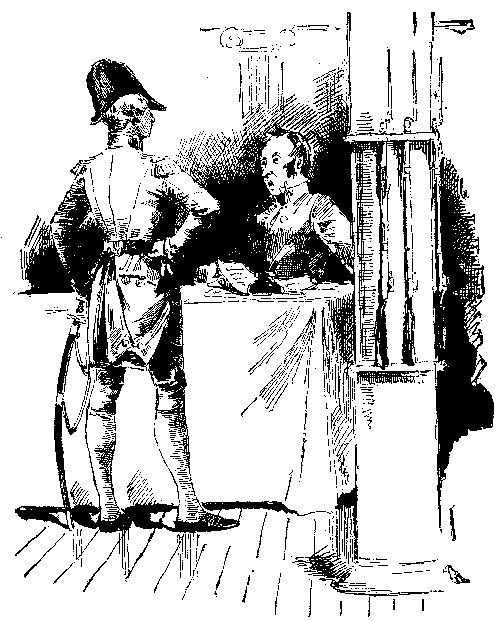
"I Am Commodore Rodgers."
Three days later, the "President," with her prize, and crowded with prisoners, dropped anchor in the harbor of Newport, after a cruise of one hundred and forty-eight days. In actual results, the cruise was far from satisfactory, for but eleven vessels had been taken. But the service rendered the country by annoying the enemy's merchantmen, and drawing the British war-vessels away in chase, was vast. At one time more than twenty British men-of-war were searching for the roving American frigate; and the seafaring people of the United States were thus greatly benefited by the "President's" prolonged cruise.[Back to Content]
CHAPTER IX.
DECATUR BLOCKADED AT NEW YORK. — ATTEMPTS TO ESCAPE THROUGH LONG ISLAND SOUND. — THE FLAG-SHIP STRUCK BY LIGHTNING. — TORPEDOES. — FULTON'S STEAM FRIGATE. — ACTION BETWEEN THE "CHESAPEAKE" AND "SHANNON."
hile the "President" was thus roaming the seas, almost within sight of the shores of the British Isles, events were occurring along the American coast which were little likely to raise the spirits of the people of the United States. From the "President," the "Congress," the "Essex," and the smaller vessels that were upholding the honor of the flag upon the ocean, they could hear nothing. But worse than this was it for the good people of New York or Boston to go down to the water-side and see stanch United States frigates kept in port by the overwhelming forces of the enemy, that lay watchfully outside the harbor's mouth.

For there was no doubt about it: the blockade was daily becoming closer; and in the months of April and May a ship would have found it a hard task to run out of New York Harbor without falling into the hands of the British fleet stationed there. But, at that very time, three stout men-of-war floated on the waves of that noble bay, under the command of an officer little used to staying quietly in port in time of war. The officer was Stephen Decatur: and the ships were the flag-ship "United States;" the captured "Macedonian," repaired, and flying the stars and stripes, under the command of the gallant Capt. Jacob Jones; and the sloop-of-war "Hornet," Capt. Biddle.
With this force under his command, Decatur burned with the desire to get to sea. The watchfulness of the British at the Narrows made it useless to think of escaping that way: therefore, he determined to pass up the sound, and reach the ocean by way of the opening between Montauk Point and Block Island. At the very outset of this voyage, however, was a serious obstacle. Through the narrow channel of the East River, between Ward's Island and the Long Island shore, the tides rushed with a mad speed and turbulence, that had won for the strait the significant name of Hell Gate. The United States Government had not then bent its energies to undermining and blowing into bits the jagged rocks that at low tide reared their crests above the swirling eddies. With its tides like mill races, and rocks hidden beneath the treacherous water, Hell Gate was a fearful place for any ship to make its way through with the uncertain aid of sails alone. Still greater were its dangers for the ponderous and deep-laden men-of-war, that required deep water and plenty of sea-room for their movements. Such considerations, however, had no weight with Decatur, who had seen his ships lying idly at their anchorage off Staten Island long enough. In the night of May 24, he accordingly got up anchors and started for the sound.
Hell Gate was passed safely, thanks to a skilful pilot, whom neither the darkness of the night, nor the perils of the narrow channel, could daunt. Once past this danger, the three vessels made their way up the sound, with the flag-ship leading. They had gone but a little way when black clouds to the westward told of a coming storm. The cloud-bank came rolling up rapidly; and soon, with a burst of rain, the three vessels were enveloped in the thunder-shower. The lightning flashed through the black clouds, the thunder crashed and roared, and the wind shrieked fiercely through the cordage. The "United States" held her place at the head of the squadron; while behind, at the distance of half a cable's-length, came the "Macedonian." Suddenly the men on the deck of the latter vessel were horrified to see a jagged flash of lightning cut its zigzag course through the clouds, then dart, straight as an arrow, at the main-mast of the "United States." Hoarse cries were heard from the deck of the stricken frigate; and the captain of the "Macedonian," fearing lest the "States" should blow up, threw all aback on his ship, to escape the explosion. But happily the thunderbolt had done little serious injury. In its course it had cut away the pendant; shot into the doctor's cabin, extinguishing that worthy's candle, to his vast astonishment; then, gliding away, broke through the ship's hull near the water-line, and plunged into the sea, after ripping off a few sheets of copper from the ship's bottom. No delay was caused by the accident; though the superstitious sailors pronounced it an evil omen, and dismally predicted all sorts of disasters.
On the 29th of May the squadron reached the strait through which Decatur hoped to gain the ocean; but, to the intense disappointment of all on board, a formidable British fleet barred all egress. Three days later the Americans made an attempt to slip out unseen; but, failing in this, they returned to New London harbor, where the two frigates were kept rotting in the mud until the war was ended. The "Hornet" luckily managed to run the blockade, and of her exploits we shall hear later.
Upon the arrival of the three American ships at New London, the enemy guarded the coast with renewed vigilance. The inhabitants made every attempt to drive away the blockaders; and in the course of this prolonged struggle there appeared, for almost the first time in the history of warfare, that most terrible of offensive weapons, the submarine torpedo.
During the Revolution, two attempts had been made to blow up British men-of-war by means of torpedoes, invented by a Saybrook mechanic named Bushnell. Though the attempts failed, yet the torpedoes demonstrated their tremendous power. Before the declaration of the second war with England, Robert Fulton, the inventor of the steamboat, had made many improvements upon Bushnell's designs, and had so thoroughly spread the knowledge of torpedo warfare that it suggested itself to many New Englanders as a means of driving the enemy from their coast.
The first attempt was well planned, but failed through an entirely accidental combination of circumstances. Certain private citizens (for in that day it was thought ignoble for a government to embark in torpedo warfare) fitted out in New York a schooner, the "Eagle," in the hold of which ten kegs of powder, together with sulphur and piles of heavy stones, were placed. In the head of one of the casks were two gun-locks, primed, and held in place by two barrels of flour. Should either of the barrels be moved, the lock would spring, and the terrible mine would explode with tremendous force. With this dreadful engine of destruction, carefully covered by a cargo of flour and naval stores, the "Eagle" left New York, and made her way up the bay, until, near New London, she was overhauled and captured by the British frigate "Ramillies." Boats were sent out by the English to take possession of the prize; but the crew of the "Eagle," seeing the enemy coming, took to their small boats, and succeeded in safely reaching the shore. The captors, on boarding the vessel, were vastly pleased to find that its cargo consisted largely of flour, of which the "Ramillies" stood in great need. They at once attempted to get the frigate alongside the prize, that the captured cargo might be readily transferred. But a calm had fallen, and two hours' constant work with sweeps and towing was unavailing. Accordingly, this plan of action was abandoned, and the boats were ordered to lighter the cargo from the "Eagle" to the frigate. Hardly had the first barrel been moved, when, with a roar, and rush of flame and smoke as from a volcano, the schooner blew up. Huge timbers, stones, and barrels were sent flying high into the air. The lieutenant and ten men from the frigate, who were on the "Eagle" at the time, were blown to atoms; and the timbers and missiles, falling on all sides, seriously injured many men in the boats near by. Had the frigate been alongside, where her commander had endeavored to place her, she would have gone to the bottom, with all her crew.
An attempt so nearly successful as this could not be long in leading others to make similar ventures. Sir Thomas Hardy, the commander of the "Ramillies," was kept in a constant fever of apprehension, lest some night his ship should be suddenly sent to the bottom by one of the insidious torpedoes. Several times the ship was attacked; and her escapes were so purely matters of accident, that she seemed almost to be under the protection of some sailors' deity. A Norwich mechanic, who had invented a submarine boat with a speed of three miles an hour, succeeded in getting under the bottom of the blockader three times, but was each time foiled in his attempt to attach a torpedo to the ship's hull. Another American, a fisherman, succeeded in getting alongside in a whale-boat, unobserved, but was driven away before he could get his torpedo in position. Such constant attacks so alarmed Hardy, that at last he gave up bringing his ship to anchor, keeping her continually under way, and, as a further precaution, causing her bottom to be swept every two hours throughout the day and night.
The use of torpedoes was not confined to the people of New England. New York Harbor was closed with a row of them. The British seventy-four "Plantagenet," lying off Cape Henry, Virginia, was nearly sunk by one in the charge of Mr. Mix, an American naval officer. The attack was made near ten o'clock, on an unusually dark night. Mix and his associates pulled in a heavy boat to a point near the bow of the menaced vessel. The torpedo was then slipped into the water, with the clockwork which was to discharge it set in motion. The rushing tide carried the destructive engine down toward the frigate; and the Americans pulled away into the darkness, to await the explosion. But the clockwork had been badly adjusted, and the torpedo exploded just before it reached the ship. A huge column of water, gleaming with a ghostly sulphurous light, was thrown high in the air, falling with terrific force on the deck of the frigate, which was almost capsized by the shock.
A veritable storm of abuse and condemnation followed the introduction of torpedo warfare. All countries and all peoples pronounced it treacherous and cowardly, and the English press was particularly loud in its denunciations. Yet the torpedo had won its place in the armaments of nations; and to-day we see all the nations of Europe vieing with each other in the invention and construction of powerful and accurate torpedoes and swift torpedo-boats.
The germ of another feature of modern naval organization is to be found in the annals of the War of 1812. The first war-vessel propelled by steam was launched by the Americans for service in this war. She was designed by Robert Fulton, and bore the name of "Fulton the First." In model she was a queer craft, with two hulls like a catamaran, with the single propelling-wheel mounted between them amidships. Her armament was to consist of thirty thirty-two-pounder guns, and two one-hundred-pounder columbiads. A secondary engine was designed to throw floods of water upon the decks and through the port-holes of an enemy. While the vessel was building, reports concerning her reached England; and soon the most ludicrously exaggerated accounts of her power were current in that country. "She mounts forty-four guns," said an English paper, "four of which are one-hundred-pounders, mounted in bomb proofs, and defended by thousands of boarding-pikes and cutlasses wielded by steam; while showers of boiling water are poured over those boarders who might escape death from the rapidly whirling steel." Unfortunately for the American cause, this much dreaded vessel did not get into the water in time to take any active part in the war.
In June, 1813, while the British blockaders in the Sound were exercising all their ingenuity to keep off the torpedoes, there was fought off the Massachusetts coast, near Boston, an engagement which must go down to history as one of the most brilliant naval duels of the age of sails. The United States frigate "Chesapeake" was refitting at Boston, after a cruise of four months, during which she had more than justified her reputation as an unlucky ship. Though she sailed the waters most frequented by British merchantmen, she returned to port having captured only four vessels. Three men-of-war were sighted, but could not be spoken. Strangely enough, the frigate sailed over the spot where lay the sunken "Peacock" the very day after the "Hornet" had fought her famous fight. Ill-luck pursued the hapless ship even to her home port; for, as she was entering the port of Boston, a sudden squall carried away the topmast, with several men who were aloft at the time.
When the "Hornet" reached port, after her victory over the "Peacock," her gallant captain, James Lawrence, was appointed to the command of the "Chesapeake." On reaching his ship, he found affairs in a desperate condition. The sailors who had sailed on the long and unproductive cruise were firmly convinced that the frigate's bad luck was beyond remedy. The term of enlistment of many had expired, and they were daily leaving the ship. Those who remained were sullen, and smarting under fancied ill-treatment in the matter of the prize-money. To get fresh seamen was no easy task. Great fleets of privateers were being fitted out; and sailors generally preferred to sail in these vessels, in which the discipline was light, and the gains usually great. Some sailors from the "Constitution" were induced to join the "Chesapeake;" and these, with the remnant of the frigate's old crew, formed the nucleus of a crew which was filled up with merchant-sailors and foreigners of all nations. Before the lists were fairly filled, the ship put to sea, to give battle to an adversary that proved to be her superior.
The events leading to the action were simple, and succeeded each other hurriedly. The port of Boston was blockaded by two British frigates, the "Tenedos" thirty-eight, and the "Shannon" thirty-eight. The latter vessel was under the command of Capt. Philip Bowes Vere Broke, a naval officer of courage, skill, and judgment. His crew was thoroughly disciplined, and his ship a model of efficiency. No officer in the service understood better than he the difference between the discipline of a martinet and the discipline of a prudent and sagacious commander. His ship might not, like the "Peacock," merit the title of "the yacht;" but for active service she was always prepared. James, an English naval historian, turns from his usual occupation of explaining the American naval victories by belittling the British ships, and enormously magnifying the power of the victors, to speak as follows of the "Shannon:"—
"From the day on which he [Capt. Broke] joined her, the 14th of September, 1806, the 'Shannon' began to feel the effect of her captain's proficiency as a gunner, and zeal for the service. The laying of the ship's ordnance so that it may be correctly fired in a horizontal direction is justly deemed a most important operation, as upon it depends, in a great measure, the true aim and destructive effect of the shot; this was attended to by Capt. Broke in person. By drafts from other ships, and the usual means to which a British man-of-war is obliged to resort, the 'Shannon' got together a crew; and in the course of a year or two, by the paternal care and excellent regulations of Capt. Broke, the ship's company became as pleasant to command as it was dangerous to meet." Moreover, the historian goes on to relate that the ship's guns were carefully sighted, and her ammunition frequently overhauled. Often a cask would be thrown overboard, and a gun's crew suddenly called to sink it as it bobbed about on the waves astern. Practice with the great guns was of daily occurrence. "Every day for about an hour and a half in the forenoon, when not prevented by chase or the state of the weather, the men were exercised at training the guns; and for the same time in the afternoon in the use of the broad-sword, musket, pike, etc. Twice a week the crew fired at targets, both with great guns and musketry; and Capt. Broke, as an additional stimulus beyond the emulation excited, gave a pound of tobacco to every man that put a shot through the bull's-eye."
Such was the vessel that in June appeared alone off the entrance to Boston Harbor, and by her actions seemed to challenge the "Chesapeake" to give her battle. Indeed, Broke's wish to test the strength of the two vessels was so great, that he sent in, by the hands of an American prisoner, a written challenge, the terms and spirit of which showed the writer to be a courageous and chivalric officer and gentleman. "As the 'Chesapeake' now appears ready for sea," he wrote, "I request you will do me the honor to meet the 'Shannon' with her, ship to ship, to try the fortunes of our respective flags. To an officer of your character, it requires some apology for proceeding to further particulars. Be assured, sir, it is not from any doubt I can entertain of your wishing to close with my proposal, but merely to provide an answer to any objection which might be made, and very reasonably, upon the chance of our receiving any unfair support." Capt. Broke then proceeds to assure Lawrence that the other British ships in the neighborhood would be sent away before the day of combat. To the challenge was appended a careful statement of the strength of the "Shannon," that Lawrence might understand that the ships were fairly matched.
But before this challenge reached Boston, Lawrence had set out to seek the enemy. He had seen the "Shannon" lying off the entrance to the port; and, finding out that she was alone, he knew that her presence was in itself a challenge that he could not honorably ignore. Nor did he desire to avoid the battle thus offered. He had confidence in his crew, his frigate, and himself, and looked for nothing but victory. To the Secretary of the Navy, he wrote, "An English frigate is now in sight from my deck. I have sent a pilot-boat out to reconnoitre; and, should she be alone, I am in hopes to give a good account of her before night. My crew appear to be in fine spirits, and I hope will do their duty."