Volume 5 — BOOK I[330]
Alexander Teixeira de Mattos translation
BOOK I[330]
Introduction—Trial of the ministers-Saint-Germain-l'Auxerrois—Pillage of the Archbishop's Palace—My pamphlet on the Restauration et la Monarchie élective—Études historiques—Letters to Madame Récamier—Geneva—Lord Byron—Ferney and Voltaire—Useless journey to Paris—M. Armand Carrel—M. de Béranger—The Baude and Briqueville proposition for the banishment of the Elder Branch of the Bourbons—Letter to the author of the Némésis—Conspiracy of the Rue des Prouvaires—Letter to Madame la Duchesse de Berry—Epidemics—The cholera—Madame La Duchesse de Berry's 12,000 francs—General Lamarque's funeral—Madame La Duchesse de Berry lands in Provence and arrives in the Vendée.
Infirmerie de Marie-Thérèse.
Paris, October 1830.
Out of the turmoil of the Three Days, I am quite surprised to find myself opening the fourth part of this work amid a profound calm; it seems to me that I have doubled the Cape of Storms and penetrated into a region of peace and silence. If I had died on the 7th of August of this year, the last words of my speech in the House of Peers would have been the last lines of my history; my catastrophe, being that of a past of twelve centuries, would have augmented my memory. My drama would have ended magnificently.
But I did not fall under the blow, I was not struck to the ground. Pierre de L'Estoile wrote this page of his Journal on the day following the assassination of Henry IV.:
"And here I end with the life of my King the second register of my melancholic pastimes and my vain and curious researches, both public and private, interrupted often since the past month by the watches of the sad and irksome nights which I have suffered, similarly this last, for the death of my King.
"I had proposed to close my ephemerides with this register; but so many new and curious occurrences have presented themselves through this signal mutation, that I pass to another which also will go before God pleases: and I doubt 'twill not be very long."
L'Estoile saw the death of the first Bourbon; I have just seen the fall of the last: ought I not to "close here the register of my melancholic pastimes and of my vain and curious researches?" Perhaps; "but so many new and curious researches have presented themselves through this signal mutation, that I pass to another register."
Like L'Estoile, I lament the adversities of the Dynasty of St. Louis; nevertheless, I am obliged to admit, there mingles with my sorrow a certain inward satisfaction: I reproach myself with it, but I cannot prevent it; this satisfaction is that of the slave delivered from his chains. When I abandoned the career of a soldier and a traveller, I felt a certain sadness; now I feel joy, freed convict that I am of the galleys of the world and the Court Faithful to my principles and my oaths, I have betrayed neither liberty nor the King, I carry away neither wealth nor honours; I go as poor as I came. Happy to end a career which was hateful to me, I lovingly return to repose.
Blessed be thou, O my native and dear independence, soul of my life! Come, bring me my Memoirs, that alter ego whose confidant, idol and muse you are. The hours of leisure are fit for story-telling: a shipwrecked mariner, I shall continue to relate my shipwreck to the fishermen on shore. Returning to my primitive instincts, I become a free man and a traveller once again; I end my course as I began it. The closing circle of my days brings me back to the starting-point. On the road which I once took as a careless conscript, I am going to travel as an experienced veteran, with my furlough in my shako, the stripes of time upon my arm, a knapsack full of years upon my back. Who knows? Perhaps I shall, stage by stage, recover the reveries of my youth. I shall call many dreams to my help, to defend me against that horde of truths which are begotten in old days even as dragons hide themselves in ruins. It will depend but on myself to knot together again the two ends of my existence, to blend far-distant periods, to mingle illusions of different ages, since the Prince whom I met in exile on leaving my paternal home I now meet in banishment on my way to my last abode.
*
I rapidly wrote the little introduction to this part of my Memoirs in the month of October of last year[331]; but I was unable to continue this labour, because I had another on my hands: this was the work[332] which concluded the edition of my Complete Works. From this work again I was diverted, first, by the trial of the ministers and, next, by the sack of Saint-Germain-l'Auxerrois.
Trial of the ministers.
The trial of the ministers[333] and the flurry in Paris made no great impression on me: after the trial of Louis XVI. and the revolutionary insurrections, all is small in the matter of trials and insurrections. The ministers, when coming from Vincennes to the Luxembourg and returning to Vincennes while sentence was being passed, went through the Rue d'Enfer: I could hear the wheels of their carriage from the back of my retreat. How many events have passed before my door!
The defenders of those men did not rise to the level of their task. None took a high enough view of the matter: the advocate predominated too greatly in the speeches. If my friend the Prince de Polignac had chosen me for his second, with what an eye should I have looked upon those perjurers setting themselves up for judges of a perjurer!
"What!" I should have said to them. "It is you who dare to be my client's judges; it is you who, all sullied with your oaths, dare to impute it as a crime to him that he ruined his master when he thought he was serving him: you, the instigators; you who urged him to issue the Ordinances! Change places with him whom you claim the right to judge: he who was accused becomes the accuser. If we have deserved to be struck, it is not by you; if we are guilty, it is not towards you, but towards the people: they are waiting for us in the yard of your palace, and we shall take our heads to them."
*
After the trial of the ministers, came the scandal of Saint-Germain-l'Auxerrois[334]. The Royalists, full of excellent qualities, but sometimes stupid and often aggravating, never calculating the range of their measures, always thinking that they would restore the Legitimacy by affecting a colour in their cravats or a flower in their button-holes, occasioned deplorable scenes. It was evident that the Revolutionary Party would profit by the service held in commemoration of the Duc de Berry to make a noise. Now, the Legitimists were not strong enough to oppose this, and the Government was not settled enough to maintain order; and so the church was pillaged. A Voltairean and progressive apothecary[335] triumphed fearlessly over a steeple of the year 1300 and a cross already overthrown by other Barbarians at the end of the ninth century.
Consequently upon the exploits of these enlightened pharmaceutics come the devastation of the Archbishop's Palace, the profanation of the sacred things, and the processions copied from those of Lyons. The executioner and the victims were lacking; but there were plenty of buffoons, masks and diverse carnival delights. The burlesque sacrilegious procession marched on one side of the Seine, while the National Guard, pretending to hasten in aid, defiled on the other. The river separated order and anarchy. It is stated that a man of talent was there as an onlooker and that he said, on seeing the chasubles and books floating on the Seine:
"What a pity they did not throw the Archbishop in!"
A profound utterance, for indeed a drowned archbishop must be a pleasant sight; that makes liberty and enlightenment take so great a step forward! We old witnesses of old deeds are obliged to tell you that you see here but pale and wretched copies. You still possess the revolutionary instinct, but you no longer have its energy; you can be criminal only in imagination; you would like to do evil, but your heart lacks courage and your arm strength; you would like to see fresh massacres, but you would no longer set to work to commit them. If you want the Revolution of July to be great and to remain great, do not let M. Cadet de Gassicourt be its real hero and "Mayeux" its ideal personage[336].
My new pamphlet.
Paris, end of March 1831.
I was out of my reckoning when, after the Days of July were over, I thought that I was entering a region of peace. The fall of the three Sovereigns had obliged me to explain myself in the House of Peers. The proscription of those Kings forbade me to remain dumb. On the other hand, Philip's newspapers were asking me why I refused to serve a revolution which consecrated the principles which I had defended and diffused. I had needs to speak on behalf of the general truths and to explain my personal conduct. An extract from a little pamphlet which will be forgotten, De la Restauration et de la Monarchie élective[337], will continue the thread of my narrative and that of the history of my times:
*
"Despoiled of the present, possessing but an uncertain future beyond the tomb, I feel a need that my memory should not be injured by my silence. I must not hold my peace touching a Restoration in which I have taken so much part, which is being daily outraged and which is at length being proscribed before my eyes.... In the middle-ages, at times of calamity, men used to take a religious and lock him in a tower, where he fasted on bread and water for the salvation of the world. I am not unlike this twelfth-century monk: through the dormer-window of my expiatory jail, I have preached my last sermon to the passers-by..."
Here is the epitome of that sermon:
"As I predicted in my last speech in the tribune of the Peers, the Monarchy of July is in an absolute condition of glory or of laws of exception; it lives by the press, and the press is killing it; devoid of glory, it will be devoured by liberty; if it attack that liberty, it will perish. It would be a fine thing if, after driving out three Kings with barricades, on behalf of the liberty of the press, we were to be seen erecting new barricades against that liberty! And yet, what is to be done? Will the redoubled action of the tribunals and the laws suffice to restrain the writers? A new government is a child that can walk only in leading-strings. Are we to put back the nation into swaddling-clothes? Will that terrible nursling, which has sucked blood in the arms of victory at so many bivouacs, not burst its bandages? There was but one old stock, deeply rooted in the past, which could have withstood with impunity the gales blowing from the liberty of the press. . . . . . . . . . . . . . . . .
"To listen to the declamations of the moment, it seems that the exiles of Edinburgh are the poorest fellows living and that they are nowhere missed. The present, to-day, lacks nothing but the past: a small thing! As though the centuries did not make use of each other as pedestals, and as though the last comer could support itself in mid-air!... It is useless for our vanity to take offense at memories, to erase the fleurs-de-lys, to proscribe names and persons: that family, the heir of a thousand years, has left an immense void by its withdrawal; one feels it everywhere. Those individuals, so paltry in our eyes, have shaken Europe in their fall. To however small a degree events produce their natural effects and bring about their rigorous consequences, Charles X., in abdicating, will have made all those Gothic kings, the grand vassals of the past under the suzerainty of the Capets, abdicate with him. . . . . . . . . . . . . . . . .
"We are marching towards a general revolution. If the transformation which is being effected follows its inclination and meets with no obstacles, if popular reason continues its progressive development, if the education of the middle classes suffers no interruption, the nations will become levelled in a uniform liberty; if that transformation is stayed, the nations will become levelled in a uniform despotism. This despotism will not last long, because of the advanced age of intelligence, but it will be harsh, and a long social dissolution will follow it. . . . . . . . . . . . . . . . .
Extracts from my pamphlet.
"Preoccupied as I am with these ideas, it is clear why I was; bound, as an individual, to remain true to what seemed to me; the best safeguard of the public liberties, the least perilous road by which to attain the complement of those liberties.
"It is not that I have the pretension to be a tearful preacher of sentimental politics, an eternal repeater of white plumes and commonplaces à la Henry IV. Casting my eyes over the space that separates the tower of the Temple from the palace in Edinburgh, I should doubtless find as many calamities heaped up as there are centuries accumulated on a noble race. A woman of sorrow, above all, has been loaded with the heaviest burden, as being the strongest; there is not a heart but breaks at the thought of her: her sufferings have risen so high that they have become one of the grandeurs of the Revolution. But, when all is said and done, no one is obliged to be king: Providence sends particular afflictions to whom it pleases, always brief ones, because life is short; and those afflictions are not counted in the general destinies of the peoples. . . . . . . . . . . . . . . . .
"Even if the proposition which for ever banishes the deposed Family from French territory be a corollary of the deposition of that Family, that corollary carries no conviction for me.... I should in vain seek my place in the several categories of persons who have become attached to the actual order of things. . . . . . . . . . . . . . . . .
"There are men who, after taking the oath to the Republic One and Indivisible, to the Directory of five persons, to the Consulate of three, to the Empire of one alone, to the First Restoration, to the Additional Act to the Constitutions of the Empire, to the Second Restoration, have something left to swear to Louis-Philippe: I am not so rich.
"There are men who flung their word on the Place de Grève, in July, like those Roman goat-herds who play at odd or even among ruins. Those men... treat as a fool and simpleton whosoever does not reduce politics to a question of private interests: I am a fool and a simpleton.
"There are timorous people who would have much preferred not to swear, but who saw themselves being butchered, together with their grand-parents, their grandchildren, and all the landlords, if they had not trembled out their oaths: this is a physical effect which I have not yet experienced; I shall wait for the infirmity and, if it comes to me, I shall consider.
"There! are great lords of the Empire linked to their pensions by sacred and indissoluble bonds, whatever be the hand they fall from: a pension is in their eyes a sacrament; it stamps a character, like orders or marriage; no pensioned head can ever cease to be so: pensions being charged to the Treasury, they remain charged to the same Treasury. As for me, I have the habit of divorce from Fortune: I am too old for her and abandon her, lest she should leave me.
"There are high barons of the Throne and the Altar who have not betrayed the Ordinances: no! But the insufficiency of the means employed to carry out the Ordinances has excited their spleen: indignant to find shortcomings in despotism, they have gone to seek another antechamber. It is impossible for me to share their indignation and their abode.
"There are men of conscience who are perjurers only to be perjurers; who, while yielding to force, are none the less for the right: they weep over that poor Charles X., whom they first dragged to his ruin by their advice and then put to death by their oaths; but, if ever he or his House revive, they will be very thunder-bolts of legitimacy. As for me, I have always been devoted to death, and I am the funeral procession of the Old Monarchy, like the poor man's dog.
"Lastly, there are trusty knights who have dispensations from honour and permits of disloyalty in their pocket: I have none.
"I was the man of the possible Restoration, of the Restoration accompanied by every kind of liberty. That Restoration took me for an enemy; it is ruined: I must undergo its fate. Shall I go to attach the few years that remain to me to a new fortune, like the hems of dresses which women drag from court to court for all the world to tread upon? At the head of the young generations, I should be suspect; following them, is not my place. I am fully aware that none of my faculties has aged; I understand my century better than ever; I penetrate more boldly into the future than anybody; but necessity has pronounced its decree; to end his life opportunely is a necessary condition for the public man."
Lastly, the Études historiques[338] have just appeared; I will quote the Introduction, which is a real page of my Memoirs, and contains my history at the very moment at which I am writing:
The Études historiques.
Introduction
"Remember, so as not to lose sight of the pace of the world, that at that time[339]... there were citizens engaged, like myself, in ransacking the archives of the past amid the ruins of the present, in writing the annals of the old revolutions to the uproar of the new revolutions; they and I taking as our table, in the crumbling edifice, the stone that had fallen at our feet, while awaiting that which was to crush our heads" (Études historiques).
"I would not, for the sake of the days that remain for me to live, begin again the eighteen months that have just elapsed. None will ever have an idea of the violence which I have done on myself; I have been forced to abstract my mind, for ten, twelve and fifteen hours a day, from what was passing around me, in order childishly to abandon myself to the composition of a work of which no one will read a line. Who would peruse four stout volumes, when it is already so difficult to read the feuilleton of a newspaper? I was writing ancient history, and modern history was knocking at my door; in vain I cried, 'Wait, I am coming to you:' it passed on, to the sound of the cannon, carrying with it three generations of kings.
"And how marvellously the times agree with the very nature of these Études! Men are overthrowing the Cross and persecuting the priests, and the Cross and the priests occur on every page of my narrative; they are banishing the Capets, and I am publishing a history in which the Capets occupy eight centuries. The longest and the last work of my life, that which has cost me most research, care and years, that in which I have perhaps stirred up most ideas and facts, appears at a time when it can find no readers; it is as though I flung it into a pit, where it will sink down under the mass of the rubbish that will follow it. When a society is being composed and decomposed, when the existence of each and all is at stake, when one is not sure of a future of an hour's duration, who cares what his neighbour does, says, or thinks? Men have something else to trouble their heads about than Nero, Constantine, Julian, the Apostles, the Martyrs, the Fathers of the Church, the Goths, the Huns, the Vandals, the Franks, Clovis, Charlemagne, Hugh Capet and Henry IV.; they have something else to think of than the shipwreck of the old world at a time when we are all involved in the shipwreck of the new world! Does it not argue a sort of dotage, a kind of feeble-mindedness, to busy one's self with literature at such a time? That is true; but this dotage has nothing to do with my brain, it comes from the antecedents of my spiteful fortune. If I had not made so many sacrifices to the liberties of my country, I should not have been obliged to contract engagements which are now being fulfilled under circumstances doubly deplorable to myself. No author has ever been put to such a proof; thank God, it is nearly at an end: I have nothing left to do but to sit on ruins and despise that life which I scorned in my youth.
"After these very natural complaints, which have involuntarily escaped me, one thought comes to console me: I began my literary career with a work in which I considered Christianity in its poetic and moral aspects; I end it with a work in which I regard the same religion in its philosophical and historical aspects: I began my political career under the Restoration, I end it with the Restoration. It is not without a secret satisfaction that I observe this consistency with myself."
Paris, May 1831.
I have not abandoned the resolution which I conceived at the moment of the catastrophe of July. I have been considering the ways and means of living abroad: difficult ways and means, because I have nothing; the purchaser of my works has all but made me a bankrupt, and my debts prevent me from finding anyone willing to lend me money.
I leave for Geneva.
Be this as it may, I shall go to Geneva[340] with the sum that has accrued to me from the sale of my last pamphlet[341]. I am leaving a procuration to sell the house in which I write this page for the sake of the order of dates. If I find a customer for my bed, I can find another bed outside France. In these uncertainties and movements, it will be impossible for me, until I am settled somewhere, to resume the sequence of my Memoirs at the place where I interrupted them[342]. I shall continue, therefore, to write down the things of the actual moment of my life; I shall communicate these things by means of the letters which I may happen to write on the road or during my different stoppages; I shall afterwards join the intermediary facts by a "journal" which will fill up the intervals between the dates of those letters.
I leave for Geneva.
To Madame Récamier[343]
"Lyons, Wednesday 18 May 1831.
"Here I am, too far away from you. I have never made so sad a journey: wonderful weather, nature all arrayed, the nightingale singing, a starry night; and all this for whom? I shall indeed have to return to where you are, unless you be willing to come to my aid[344]."
To Madame Récamier
"Lyons, Friday 20 May.
"I spent the day, yesterday, in wandering beside the Rhone; I contemplated the town where you were born, the hill upon which rose the convent where you were chosen as the fairest: an expectation which you did not disappoint; and you are not here, and years have elapsed, and you have since been exiled to your birth-place, and Madame de Staël is no more, and I am leaving France! One singular personage[345] belonging to those old days has appeared before me: I send you his note, because of its unexpectedness and its surprise. This personage, whom I had never seen, is planting pines in the mountains of Lyonnais. It is a long cry from there to the Rue Feydeau and the Maison à vendre: what different parts men play on earth!
"Hyacinthe has told me of the regrets and the newspaper articles: I am not worth all that You know that I sincerely think so for twenty-three hours out of the twenty-four; the twenty-fourth is dedicated to vanity, which, however, is of slight duration and soon passes. I wanted to see nobody here; M. Thiers, who was on his way to the South, forced my door."
Note enclosed in the above letter
"A neighbour, your fellow-countryman, who has no other claim upon you than a profound admiration for your glorious talent and your admirable character, would like to have the honour of seeing you and offering you the homage of his respect. This next-door neighbour at your hotel, this fellow-countryman is called
"Elleviou."
To Madame Récamier
"Lyons, Sunday 22 May.
"We leave to-morrow for Geneva, when I shall find more memories of you. Shall I ever see France again, after I have once crossed the frontier? Yes, if you will, that is to say, if you remain there. I do not wish for the events which might offer me another chance of returning; I shall never allow the misfortunes of my country to enter among the number of my hopes. I shall write to you on Tuesday, the 24th, from Geneva. When shall I again see your little hand-writing, the younger sister of mine[346]?"
Letters to Madame Récamier.
"Geneva, Tuesday 24 May.
"We arrived here yesterday and are looking at houses. We shall probably make shift with a little summer-house on the edge of the lake. I cannot tell you how sad I feel as I busy myself with these arrangements. Again another future! Again to begin anew a life which I thought I had ended! I mean to write you a long letter when I am a little at rest: I dread that rest, for then I shall be contemplating without distraction those dim years upon which I am entering with a heart so much oppressed."
9 June 1831.
"You know that a 'reformed' sect has been established in the midst of the Protestants. One of the new pastors of the new church has been to see me and has written me two letters worthy of the first Apostles. He wants to convert me to his faith, and I want to turn him into a 'Papist.' We argue as though living in Calvin's[347] day, but loving each other in Christian brotherhood and without burning one another. I do not despair of his salvation; he is quite shaken by my arguments in favour of the Popes. You cannot conceive the pitch of exaltation to which he has risen, and his candour is admirable. If you come to me, accompanied by my old friend Ballanche, we shall do wonders. In one of the Geneva newspapers, a Protestant controversial book is advertised, and the authors are urged to 'stand firm' because 'the author of the Génie du Christianisme is close at hand.'
"There is a certain consolation in finding a little free people, administered by the most distinguished men, among which religious ideas form the basis of liberty and the chief occupation of life.
"I lunched at M. de Constant's[348], beside Madame Necker[349], who is unfortunately deaf, but a woman of rare qualities and the greatest distinction: we spoke only of yourself. I had received your letter and I told M. de Sismondi the amiable things you had said for his benefit. You see I am taking your lessons.
"Lastly, here are some verses. You are my 'star' and I am waiting for you to go to that enchanted island.
"Delphine[350] married: O Muses! I have told you in my last letter why I could write neither on the peerage nor on the war: I should be attacking a contemptible body to which I have belonged and preaching honour to those who no longer possess it.
"It needs a sailor to read the verses and understand them. I put myself in M. Lenormant's hands. Your intelligence will suffice for the last three stanzas, and the key to the riddle is at the foot[351]."
"Geneva, 18 June 1831.
"You have received all my letters. I am constantly expecting a few words from you; I can see that there will be nothing for me, but still I am always surprised when the post brings me only newspapers. Not a soul writes to me, except yourself; not a soul remembers me, except yourself, and that is a great charm. I love your solitary letter, which does not arrive as it used to arrive in the days of my magnificence, in the midst of packets of dispatches and of all those letters of attachment, admiration and meanness which vanish with fortune. After your little letters, I shall see your fair self, if I do not go to join you. You shall be my testamentary executrix; you shall sell my poor retreat; the price will enable you to travel towards the sun. At this moment, the weather is admirable: as I write to you I can see Mont Blanc in its splendour; from the top of Mont Blanc one sees the Apennines: it seems to me as though I have but three steps to take to arrive in Rome, where we shall go, for all will get settled in France.
"Our glorious country lacked but one thing in order to have passed through every form of wretchedness: to have a government of cowards; she has it now, and her youth is about to be swallowed up in doctrine, literature and debauch, according to the particular character of the individual. The chapter of accidents remains; but, when a man drags along life's road, as I do, the most likely accident is the end of the journey.
"I do no work, I can do nothing more: I am bored; it is my nature, and I am like a fish in water: nevertheless, if the water were a little less deep, perhaps I should be better pleased in it"
Geneva.
Journal from the 12th of July to the 1st of September 1831
The Pâquis, near Geneva.
I am settled at the Pâquis[352] with Madame de Chateaubriand; I have made the acquaintance of M. Rigaud, Chief Syndic of Geneva: above his house, by the edge of the lake, going up the Lausanne Road, you find the villa of two clerks of M. de Lapanouze[353], who have spent 1,500,000 francs in building it and laying out their gardens. When I pass on foot before their dwelling-house, I wonder at Providence, which has placed witnesses of the Restoration at Geneva in them and in me. What a fool I am! What a fool! The Sieur de Lapanouze went through royalism and misery with me: see to what his clerks have risen for having favoured the Conversion of the Funds, which I had the simplicity to oppose and by virtue of which I was turned out Here are the gentlemen: they drive up in an elegant tilbury, hat on ear, and I am obliged to step into a ditch lest the wheel should carry off a skirt of my old frock-coat. And yet I have been a peer of France, a minister, an ambassador, and in a cardboard box I have all the principal Orders of Christendom, including the Holy Ghost and the Golden Fleece. If the clerks of the Sieur César de Lapanouze, now millionaires, cared to buy my box of ribbons for their wives, they would do me a lively pleasure.
Nevertheless all is not roses for the Messieurs B—-: they are not yet Genevese nobles, that is to say, they have not yet reached the second generation; their mother still lives in the lower part of the town and has not risen to the Saint-Pierre quarter, the Faubourg Saint-Germain of Geneva; but, with God's help, nobility will follow on money.
It was in 1805 that I saw Geneva for the first time. If two thousand years had elapsed between the dates of my two journeys, would they be further separated from each other than they are? Geneva belonged to France; Bonaparte was shining in all his glory, Madame de Staël in all hers; there was no more question of the Bourbons than if they had never existed. And Bonaparte, and Madame de Staël, and the Bourbons: what has become of them? And I, I am still there!
M. de Constant, a cousin of Benjamin Constant, and Mademoiselle de Constant, an old maid full of wit, virtue and talent, live in their cottage of "Souterre" on the bank of the Rhone; they are overlooked by another country-house, which was formerly M. de Constant's: he sold it to the Princesse Belgiojoso[354], a Milanese exile, whom I saw pass like a flower through the fête which I gave in Rome for the Grand-duchess Helen.
During my boating excursions, an old oarsman tells me of the deeds of Lord Byron, whose house we see standing on the Savoyard side of the lake. The noble peer would wait for a tempest to rise before setting sail; from the deck of his felucca, he leapt into the waves and swam in the midst of the gale to land at the feudal prisons of Bonivard: he was always the actor and the poet. I am not so eccentric: I also love the storms; but my loves with them are secret, and I do not confide them to the boatmen.
I have discovered, behind Ferney[355], a narrow valley, in which runs a tiny stream some seven or eight inches deep; this rivulet waters the roots of a few willows, hides itself here and there under patches of water-cress and shakes rushes on whose tips perch blue-winged dragon-flies. Did the man of trumpets ever see this refuge of silence right up against his resounding house? No, without a doubt: well, the water is there; it still flows; I do not know its name; perhaps it has none: Voltaire's days are spent; only his fame still makes a little noise in a little corner of our little world, even as that streamlet can be heard at a dozen paces from its banks.
Men differ from one another: I am charmed with this deserted water-furrow; within sight of the Alps, the palm-leaf of a fern which I gather delights me; the murmuring of a ripple over pebbles makes me quite happy; an imperceptible insect, seen only by myself, which plunges into the moss, as into a vast solitude, occupies my gaze and makes me dream. These are intimate trifles, unknown to the fine genius who, disguised as Orosmane[356], played his tragedies, wrote to the princes of the earth and forced Europe to come to admire him in the hamlet of Ferney. But were not those trifles too? The transitions of the world are not equal to the passing of those waters; and, as for kings, I prefer my ant.
Memoires of Voltaire.
One thing always astonishes me, when I think of Voltaire: although gifted with a superior, rational, enlightened mind, he remained completely foreign to Christianity; he never saw what every one sees: that the institution of the Gospel, to consider only the human aspect of it, is the greatest revolution that ever took place on earth. It is true to say that, in the age of Voltaire, this idea had come into the head of nobody. The theologians defended Christianity as an accomplished fact, as a verity based upon laws emanating from spiritual and temporal authority; the philosophers attacked it as an abuse springing from priests and kings: they went no further. I have no doubt that, if one could suddenly have presented the other side of the question to Voltaire, his quick and lucid intelligence would have been struck with it: one blushes to think of the mean and limited manner in which he treated a subject which embraces nothing less than the transformation of peoples, the introduction of morality, a new principle of society, another law of nations, another order of ideas, the total change of humanity. Unfortunately, the great writer who ruins himself in spreading baleful ideas drags many minds of lesser capacity with him in his fall: he is like those old Eastern despots on whose tombs men immolated slaves.
There, to Ferney, which no one visits now, to that Ferney around which I come to roam alone, how many celebrated personages at one time hastened! They sleep, gathered together for all time at the bottom of Voltaire's letters, their hypogæan Temple: the breath of one century grows weaker by degrees and dies away in the eternal silence, as one begins to hear the respiration of a new century.
The Pâquis, near Geneva, 15 September 1831.
O gold, which I have so long despised and which I cannot love whatever I may do, I am nevertheless forced to admit thy merit: the source of liberty, thou arrangest a thousand things in our existence, in which all is difficult without thee! Excepting glory, what is there that thou canst not procure? With thee, one is handsome, young, adored; one enjoys consideration, honours, qualities, virtues. You tell me that with gold one has but the appearance of all that: what matter, if I believe what is false to be true? Deceive me well, and I will release you from the rest: is life other than a lie? When one has no money, one is dependent upon everything and everybody. Two creatures who do not suit one another could go each his own way; well, for want of a few pistoles, they must remain face to face, sulking, fuming, souring, bored to extinction, devouring each other's souls and the whites of their eyes, furiously sacrificing to one another their tastes, their inclinations, their natural methods of life: poverty presses them close together, and, in those beggars' bonds, instead of embracing, they bite each other, but not in the way in which Flora bit Pompey. Without money, there is no means of escape; one cannot go in search of another sun, and, with a proud soul, one wears chains without ceasing. O happy Jews, dealers in crucifixes, who to-day govern Christendom, who decide peace or war, who eat pig after selling old hats, who are the favourites of kings and beauties, ugly and dirty though you be: ah, if you would but change skins with me! If I could at least creep into your iron chests, to rob you of that which you have stolen from young men under age, I should be the happiest man in the world!
True, I might have a means of existence: I could apply to the monarchs; as I have lost all for the sake of their crown, it would be only fair that they should feed me. But this idea, which ought to occur to them, does not; and to me it occurs still less. Rather than sit at the banquets of kings, I should even prefer once more to begin the regimen which I kept in the old days, in London, with my poor friend Hingant. However, the happy times of garrets are past: not that I was not most comfortable there, but I should be ill at ease, I should take up too much room with the flounces of my reputation; I should no longer be there with my one shirt and the slender figure of an unknown person who has not dined. My cousin de La Boüétardais is there no more to play the violin on my truckle-bed in his red robes as a counsellor to the Parliament of Brittany, and to keep himself warm at night, covered with a chair by way of counterpane; Peltier is there no more to give us dinner with King Christophe's money; and, above all, the witch is there no more, Youth, who, with a smile, changes penury into a treasure, who brings you her younger sister, Hope, for a mistress: the latter also as deceptive as her elder, though she still returns when the other has fled for ever.
I had forgotten the distress of my first emigration and imagined that it was enough to leave France in order peacefully to preserve one's honour in exile: the larks fall ready roasted into the mouths only of those who reap the harvest, not of those who have sown it If I alone were concerned, I should do marvellously well in an alms-house: but Madame de Chateaubriand? And so I have no sooner become settled than, as I cast my eyes upon the future, anxiety seizes hold of me.
The value of money.
They wrote to me from Paris that there was no means of selling my house in the Rue d'Enfer save at a price which was not sufficient to pay off the mortgages with which that hermitage is loaded; that something might nevertheless be arranged if I were there. Acting on this communication, I have taken a useless journey to Paris, for I found neither goodwill nor a purchaser; but I saw the Abbaye-aux-Bois again and a few of my new friends. On the eve of my return here, I dined at the Café de Paris with Messieurs Arago, Pouqueville[357], Carrel and Béranger, all more or less dissatisfied and deceived by "the best of republics."
The Pâquis, near Geneva, 26 September 1831.
My Études historiques brought me into relations with M. Carrel, even as they made me acquainted with Messieurs Thiers and Mignet. I had copied into the Preface of those Studies a fairly long passage from the Guerre de Catalogne[358], by M. Carrel, and especially the following:
"Things, in their continual and fatal transformations, do not always carry every intelligence with them; they do not master every character with equal facility; they do not take the same care of all interests: this is what we must understand and make some allowance for the protests raised on behalf of the past. When a particular period is finished, the mould is shattered, and it is enough for Providence that it can not be made over again; but of the fragments left upon the ground, there are occasionally some that are beautiful to look upon."
After these fine lines, I myself added this summary:
"The man who was able to write those words has reasons for sympathy with those who have faith in Providence, who respect the religion of the past and who also have their eyes fixed upon fragments."
M. Carrel came to thank me. He represented both the courage and the talent of the National, on which he worked with Messieurs Thiers and Mignet. M. Carrel belongs to a pious and royalist family of Rouen: the blind Legitimacy, which rarely distinguished merit, misjudged M. Carrel. Proud and alive to his worth, he had resort to dangerous opinions, in which one finds a compensation for the sacrifices one lays upon one's self: there happened to him what happens to all characters fit for great movements. When unforeseen circumstances oblige them to restrict themselves within a narrow circle, they consume their super-abundant faculties in efforts which go beyond the opinions and events of the day. Before revolutions, superior men die unknown: their public has not yet come; after revolutions, superior men die neglected: their public has disappeared.
M. Carrel is not happy: there is nothing more material than his ideas, nothing more romantic than his life. After being a republican volunteer in Spain, in 1823, being captured on the battle-field, condemned to death by the French authorities, and escaping a thousand dangers, he finds love mingled with the pleasures of his private existence. He has to protect a passion[359] which is the mainstay of his existence; and this large-hearted man, ever ready to face a sword's point by day-light, sets wicket-gates before him, and the shades of night: he walks in the silent fields with a beloved woman at that first dawn at which the reveille used to call him to the attack of the enemy's tents.
I leave M. Armand Carrel in order to write a few words on our famous song-writer. You will find my story too short, reader, but I have a claim on your indulgence: his name and his songs must be engraved on your memory.
*
M. de Béranger is not, like M. Carrel, obliged to conceal his love-affairs. After singing the praises of liberty and the popular virtues, while defying the gaols of the kings, he puts his amours into a couplet, and behold Lisette immortalized.
A flying visit to Paris.
Near the Barrière des Martyrs, below Montmartre, you see the Rue de la Tour-d'Auvergne. In this half-built, half-paved street, in a little house hiding behind a little garden and calculated upon the modesty of present-day fortunes, you will find the illustrious song-writer. A bald head, a somewhat rustic, but keen and voluptuous air announce the poet. I love to rest my eyes on that plebeian countenance, after looking at so many royal faces; I compare those so greatly different types: on the monarchical brows one sees something of an exalted nature, but blighted, impotent, effaced; on the democratic brows appears a common physical nature, but one recognises a lofty intellectual nature: the monarchical brow has lost a crown; the popular brow awaits one.
One day I asked Béranger (I beg him to forgive me for becoming as familiar as his fame), I asked him to show me some of his unknown works:
"Do you know," he said, "that I began by being your disciple? I was mad on the Génie du Christianisme, and I wrote Christian idylls: scenes in the life of a country priest, pictures of religious worship in the villages and in the midst of the harvest."
M. Augustin Thierry has told me that the Battle of the Franks in the Martyrs suggested to him a new manner of writing history: nothing has flattered me more than to find my memory occupying a place at the commencement of the talent of the historian Thierry and the poet Béranger.
Our song-writer has the several qualities upon which Voltaire insists for the ballad:
"To succeed well in these little works," says the author of so many graceful poems, "one needs refinement and sentiment of intellect, to have harmony in one's head, not to lower one's self over much, and to know how not to be too long."
Béranger has many muses, all of them charming; and, when those muses are women, he loves them all. When they betray him, he does not turn to elegiacs; and nevertheless there is a feeling of sadness at the bottom of his gaiety: his is a serious face that smiles; it is philosophy saying its prayers.
My friendship for Béranger earned me many expressions of astonishment on the part of what was called my party. An old knight of St. Louis, personally unknown to me, wrote to me from his distant turret:
"Rejoice, sir, at being praised by one who has slapped the face of your King and your God."
Well said, my gallant nobleman! You are a poet too.
Béranger.
At the end of a dinner at the Café de Paris which I gave to Messieurs de Béranger and Armand Carrel before my departure for Switzerland, M. Béranger sang us his admirable printed song:
Chateaubriand, pourquoi fuir ta patrie, Fuir son amour, notre encens et nos soins[360]?
In it occurred this stanza on the Bourbons:
Et tu voudras t'attacher à leur chute! Connais donc mieux leur folle vanité: Au rang des maux qu'au ciel même elle impute, Leur cœur ingrat met ta fidélité[361].
To this song, which belongs to the history of my time, I replied from Switzerland by a letter which is printed at the head of my pamphlet on the Briqueville[362] Motion. I said to M. de Béranger:
"From the place whence I wrote to you, monsieur, I can see the country-house where Lord Byron lived and the roofs of Madame de Staël's château. Where is the bard of Childe-Harold? Where is the author of Corinne? My too long life is like those Roman roads bordered with funeral monuments[363]."
I returned to Geneva; I next took Madame de Chateaubriand to Paris and brought back the manuscript directed against the Briqueville Motion for the banishment of the Bourbons, a motion which was taken into consideration in the sitting of the Deputies of the 17th of September of this year 1831: some attach their lives to success, others to misfortune.
Paris, Rue d'Enfer, end of November 1831.
Returning to Paris on the 11th of October, I published my pamphlet at the end of the same month; it is entitled, De la nouvelle proposition relative au banissement de Charles X. et de sa famille, ou suite de mon dernier écrit: De la Restauration et de la Monarchie élective.
When these posthumous Memoirs appear, will the daily polemics, the events of which men are enamoured at this present hour of my life, the adversaries against whom I am fighting, will even the act of banishment of Charles X. and his Family count for anything? There you have the drawback of all diaries: you find in them ardent discussions of subjects that have become indifferent; the reader sees pass, like shadows, a host of persons whose very names he does not remember: silent supernumeraries, who fill the back of the stage. Yet it is in these dryasdust portions of the chronicles that one gathers the observations and facts of the history of mankind and men.
I placed first at the commencement of the pamphlet the decree brought forward successively by Messieurs Baude and Briqueville. After examining the five courses that lay open after the Revolution of July, I said:
"The worst of the periods through which we have passed seems to be that in which we are, because anarchy reigns in men's reasons, morals and intellects. The existence of nations is longer than that of individuals: a paralytic man often remains stretched on his couch for many years before disappearing; an infirm nation lies long on its bed before expiring. What the new Royalty needed was buoyancy, youth, intrepidity, to turn its back upon the past, to march with France to meet the future.
"All this it neglects: it appeared before us reduced and debilitated by the doctors who were physicking it. It arrived piteous, empty-handed, having nothing to give, everything to receive, playing the poor thing, begging everybody's pardon, and yet snappish, declaiming against the Legitimacy and aping the Legitimacy, against republicanism and trembling before it. This abdominous 'system' beholds enemies only in two forms of opposition which it threatens. To support itself it has built itself a phalanx of re-enlisted veterans: if they bore as many stripes as they have taken oaths, their sleeves would be more motley than the livery of the Montmorencys.
"I doubt whether liberty will long be content with this stew-pot of a domestic monarchy. The Franks placed liberty in a camp; in their descendants it has retained the taste and love of its first cradle; like the old Royalty, it wants to be raised on the shield and its deputies are soldiers."
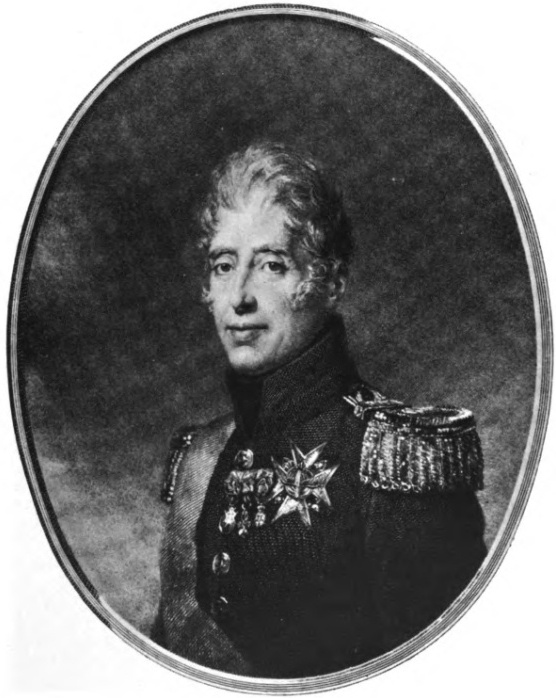
Charles X.
From this general argument I pass on to the details of the system followed in our foreign relations. The immense mistake of the Congress of Vienna is that it placed a military nation like France in a condition of forced hostility with the neighbouring peoples. I point to all that the foreigners have gained in territory and power, all that we could have taken back in July. A mighty lesson! A striking proof of the vanity of military glory and of the work of conquerors! If one were to draw up a list of the Princes who have increased the possessions of France, Bonaparte would not figure on it; but Charles X. would occupy a remarkable place!
Yet another pamphlet.
Passing from argument to argument, I come to Louis-Philippe:
"Louis-Philippe is King," I say; "he wields the sceptre of the child whose immediate heir he is, of the ward whom Charles X. placed in the hands of the Lieutenant-general of the Kingdom as into those of a tried guardian, a faithful trustee, a generous protector. In that Palace of the Tuileries, instead of an innocent couch, free from insomnia, free from remorse, free from ghosts, what has the Prince found? An empty throne presented to him by a headless spectre bearing, in its blood-stained hand, the head of another spectre....
"Must we, to finish the business, put a handle to Louvel's blade in the shape of a law, in order to strike a last blow at the proscribed Family? If it were driven to these shores by the tempest; if Henry, too young as yet, had not attained the years requisite for the scaffold, well then, do you, the masters, give him a dispensation of age to die!"
After speaking to the French Government, I turn to Holyrood and add:
"Dare I, in conclusion, take the respectful liberty of addressing a few words to the men of exile? They have returned to sorrow as into their mother's womb: misfortune, a seduction from which it is difficult for me to defend myself, seems to me to be always in the right; I fear to offend its sacred authority and the majesty which it adds to insulted grandeurs, which henceforth have none but me to flatter them. But I will overcome my weakness, I will strive to voice words which, in a day of ill-fortune, might give grounds for hope to my country.
"The education of a prince should be analogous to the form of government and the manners of his native land. Now, there are in France neither chivalry nor knights, neither soldiers of the Oriflamme nor nobles barbed in steel, ready to march behind the White Flag. There is a people which is no longer the people of other days, a people which, changed by the centuries, has lost the old habits and the ancient manners of our fathers. Whether we deplore the social transformations that have arisen or glorify them, we must take the nation as it is, facts as they are, enter into the spirit of our time, in order to exercise an action over that spirit.
"All is in God's hand, except the past, which, once fallen from that hand, does not return to it.
"The moment will doubtless arrive when the orphan will leave that palace of the Stuarts, the ill-omened refuge which seems to spread the shadow of its fatality over his youth: the last-born of the Bearnese must mix with children of his own age, attend the public schools, learn all that is known to-day. Let him become the most enlightened young man of his time; let him be acquainted with the knowledge of the period; let him add to the virtues of a Christian of the age of St. Louis the sagacity of a Christian of our age. Let travel be his instructor in manners and laws; let him cross the seas, compare institutions and governments, free peoples and enthralled peoples; let him, if he find the occasion while abroad, expose himself, as a simple soldier, to the dangers of war, for none is fit to reign over Frenchmen who has not heard the hiss of the cannon-ball. Then you will have done for him all that, humanly speaking, you can do. But, above all, beware of fostering him in ideas of invincible right: far from flattering him with the thought of reascending the throne of his fathers, prepare him never to reascend it; bring him up to be a man, not to be a king: those are his best chances.
"Enough: whatever God's counsel may provide, there will remain to the candidate of my fond and pious loyalty a majesty of the ages which men cannot take from him. A thousand years attached to his young head will always deck him with a pomp exceeding that of all monarchs. If, in a private condition, he bear bravely this diadem of days, of memory and of glory, if his hand raise without effort this sceptre of time which his ancestors have bequeathed to him, what empire will he be able to regret?"
The Comte de Briqueville.
M. le Comte de Briqueville, whose motion I thus contested, printed some reflections on my pamphlet; he sent them to me with the following note:
"Monsieur,
"I have yielded to the need, to the duty, to publish the reflections brought to my mind by your eloquent words on my motion. I obey a feeling no less sincere when I deplore that I should find myself in opposition to you, monsieur, who add to the power of genius so many claims to public consideration. The country is in danger, and from that moment I cease to believe in a serious dissension between us: this France of ours invites us to unite to save her; assist her with your genius; we shall work, we shall assist her with our strong arms. On that field, monsieur, is it not true that we shall not be long in coming to an understanding? You shall be the Tyrtæus[364] of a people of which we are the soldiers, and it will be with the greatest happiness that I shall then proclaim myself the most ardent of your political adherents, as I am already the sincerest of your admirers.
"Your most humble and obedient servant,
"The Comte Armand de Briqueville.
"Paris, 15 November 1831."
I was not slow in answering, and I broke a second still-born lance against the champion:
"Paris, 15 November 1831.
"Monsieur,
"Your letter is worthy of a gentleman: forgive me for using this old word, which becomes your name, your courage, your love of France. Like you, I detest the foreign yoke: if the question were that of defending my country, I should not ask to wear the lyre of the poet, but the sword of the veteran, in the ranks of your soldiers.
"I have not yet read your reflections, monsieur; but, if the state of politics led you to withdraw the motion which has so strangely saddened me, how happy I should be to find myself by your side, with no obstacle between us, on the field of liberty, of honour, of the glory of our country!
"I have the honour to be, monsieur, with the most distinguished regard,
"Your most humble and most obedient servant,
"Chateaubriand."
Paris, Infirmerie De Marie-Thérèse, Rue d'Enfer,
December 1831.
A poet[365], mingling the proscriptions of the Muses with those of the laws, attacked the widow and the orphan in a vigorous improvisation. As these verses were by a writer of talent, they acquired a sort of authority which forbade me to let them pass in silence; I faced about to meet another enemy[366].
The reader would not understand my reply if he did not read the poet's lampoon; I invite you, therefore to cast your eyes over those verses: they are very fine and are to be found everywhere. My reply has not been published: it appears for the first time in these Memoirs. Wretched contentions in which revolutions end! See to what a struggle we come, the feeble successors of those men who, arms in hand, treated great questions of glory and liberty by shaking the universe! Pygmies to-day utter their little cry among the tombs of the giants buried beneath the mountains which they have overturned upon themselves.
"Paris, Wednesday evening, 9 November 1831.
"Sir,
"I received this morning the last number of Némésis which you have done me the honour to send me. To protect myself against the seduction of those praises awarded with so much brilliancy, grace and charm, I need to recall the obstacles that exist between us. We live in two worlds apart; our hopes and fears are not the same; you burn what I adore, and I burn what you adore. You, sir, have grown up amid a crowd of abortions of July; but, even as all the influence which you attribute to my prose will not, according to you, raise up a fallen House, so, according to me, will all the might of your poetry fail to abase that noble House. Can it be that both you and I are thus placed in two impossible positions?
"You are young, sir, like the future which you dream of and which will trick you; I am old, like time, which I dream of and which escapes me. If you were to come to sit by my fireside, you obligingly say, you would reproduce my features with your graver: I should strive to make you a Christian and a Royalist. Since your lyre, at the first chord of its harmony, sang my Martyrs and my Pilgrimage, why should not you complete the course? Enter the holy place; time has stripped me only of my hair, as it strips a tree of its leaves in winter, but the sap remains in my heart: my hand is still firm enough to hold the torch which would guide your steps under the vaults of the sanctuary.
Letter to Barthélemy.
"You declare, sir, that it would need a people of poets to understand my contradictions of 'extinct kingdoms and young republics:' is it likely that you too have not celebrated liberty and yet found some magnificent words for the tyrants who oppressed it? You quote the Du Barrys, the Montespans, the Fontanges, the La Vallières: you recall royal weaknesses; but did those weaknesses cost France what the debauches of Danton and Camille Desmoulins cost her? The morals of those plebeian Catalines were reflected even in their speech: they borrowed their metaphors from the piggeries of infamous persons and prostitutes. Did the frailties of Louis XIV. and Louis XV. send the fathers and husbands to the gallows, after dishonouring the daughters and wives? Did his blood-baths do more to render chaste a revolutionary's lewdness than did her milk-baths to render virginal a Poppæa's pollution? If Robespierre's hucksters had retailed to the people of Paris the blood from Danton's bathing-tub, as Nero's slaves sold to the inhabitants of Rome the milk from his courtesan's thermæ, do you think that any virtue would have been found in the rinsings of the obscene headsmen of the Terror?
"The swiftness and the height of the flight of your muse have deceived you, sir: the sun, which laughs at all misery, must have struck the garments of a widow; they must have seemed 'gilded' to you: I have seen those garments, they were of mourning; they knew nothing of pleasure; the child, in the entrails which bore him, was rocked only to the sound of tears; if he had 'danced nine months in his mother's womb,' as you say, he would then have known joy only before being born, between conception and delivery, between the assassination and the proscription! 'The pallor of fearsome omen' which you remarked on Henry's face is the result of his father's blood-letting, and not of a ball of two hundred and seventy nights. The old curse was kept up for the daughter of Henry IV.: In dolore paries filios. I know none save the Goddess of Reason whose confinements, hastened by adultery, took place amid the dances of Death. From her public flanks fell unclean reptiles which, at that very instant, began to jig in the ring with the knitting-women around the scaffold, to the sound of the rise and fall of the knife, the refrain of that devils' dance.
"Ah sir, I entreat you, in the name of your rare talent, cease to reward crime and to punish misfortune by the sentences improvised by your muse; do not condemn the first to Heaven, the second to Hell. If, while remaining attached to the cause of liberty and enlightenment, you were to afford an asylum to religion, humanity, innocence, you would see another sort of Nemesis appear before you in your waking hours, one worthy of all the earth's homage. And, while waiting to pour over virtue, better than I know how, 'the whole ocean of your fresh ideas,' continue, in the spirit of vengeance which you have adopted, to drag our turpitude to the gemoniæ; overthrow the false monuments of a revolution which has not built the temple fit for its cult; turn up their ruins with the plough-share of your satire; sow salt in that field to make it barren, so that no new vileness can shoot there. I recommend above all, sir, to your attention, that Government which has fallen so low that it trembles before the pride of the obedience, the victory of the defeats, and the glory of the humiliations of the country.
"Chateaubriand."
Paris, Rue d'Enfer, end of March 1832.
Those travels and those contests came to an end for me in the year 1831; at the beginning of the year 1832, a new annoyance.
The Paris Revolution had left on the streets of Paris a host of Swiss, of Body-guards, of men of all conditions kept by the Court, who were now starving and whom certain monarchical dunderheads, young and foolish under their grey hairs, thought of enlisting for a surprise.
In this formidable plot there was no lack of serious, pale, lean, diaphanous, bent persons, with noble faces, eyes still bright, white heads; that past suggested honour resuscitated, coming to try, with its shadowy hands, to restore the Family which it had been unable to maintain with its living hands. Often men on crutches pretend to prop crumbling monarchies; but, at this period of society, the restoration of a mediæval monument has become impossible, because the genius which quickened that architecture is dead: what we take for Gothic is merely antiquated.
On the other hand, the heroes of July, whom the juste-milieu had swindled out of the Republic, desired nothing more than to come to an understanding with the Carlists to revenge themselves on a common enemy, remaining free to cut each other's throats after the victory. M. Thiers having extolled the system of 1793 as the work of liberty, victory and genius, young imaginations became kindled at the flame of a conflagration of which they saw only the distant reverberation; they have got no further than the poetry of the Terror: a mad and hideous parody which sets back the hour of liberty. This is to disregard at once time, history and humanity; it is to oblige the world to recoil under the whip of the convict-keeper in order to escape those fanatics of the scaffold.
Money was needed to feed all those malcontents, dismissed heroes of July, or servants out of place: people clubbed together. Carlist and republican cabals were held in every comer of Paris, and the police, informed of all that went on, sent its spies from club to garret to preach equality and liberty. I was told of these proceedings, which I opposed. The two parties wanted to declare me their leader at the assured moment of triumph: a Republican club asked me if I would accept the Presidency of the Republic; I answered:
"Yes, most certainly; but after M. de La Fayette."
The Marquis de La Fayette.
This was thought modest and proper. General La Fayette used sometimes to come to Madame Récamier's; I used to make fun of his "best of republics;" I asked him if he would not have done better to proclaim Henry V. and to be the real President of France during the minority of the royal infant. He agreed and took the jest in good part, for he was a well-bred man. Each time we met, he would say:
"Ah, you are going to pick your quarrel again!"
I used to make him admit that no one had been more caught than himself by his good friend Philip.
In the midst of this excitement and these extravagant plottings, arrived a man in disguise. He landed at my door with a tow wig on his pate and a pair of green spectacles on his nose, hiding his eyes, which could see quite well without spectacles. He had his pockets stuffed with bills of exchange, which he displayed; and, suddenly aware that I wanted to sell my house and settle my affairs, he offered me his services. I could not help laughing at this gentleman (a man, otherwise, of intelligence and resource) who thought himself obliged to buy me for the Legitimacy. When his offers became too pressing, he saw on my lips a certain scornfulness which obliged him to beat a retreat, and he wrote to my secretary this little note, which I have kept:
"Sir,
"Yesterday evening I had the honour to see M. le Vicomte de Chateaubriand, who received me with his customary kindness; nevertheless, I seem to have perceived that he no longer showed his usual geniality. Tell me, I beg of you, what can have caused me to lose his confidence, which I valued more highly than anything else. If he has been told 'stories' about me, I am not afraid to expose my conduct to the light of day, and I am prepared to reply to anything that he may have been told: he knows too well the spitefulness of intriguing people to condemn me unheard. There are timid persons too who make others so; but we must hope that the day will come when we shall see people who are really devoted. Well, he told me that it was of no use for me to meddle in his business; I am sorry for that, because I flatter myself that it would have been arranged according to his wishes. I have little doubt as to the person who has wrought this change in him; if I had been less discreet at the time, this person would not have been in a position to injure me with your excellent 'patron.' However, I am none the less devoted to him, as you may assure him once more with my respectful homage. I venture to hope that a day will come when he will be able to know me and to judge of me.
"Pray accept, sir, etc."
Hyacinthe answered this note with the following reply at my dictation:
"My patron has nothing whatever in particular against the person who has written to me; but he wishes to live outside everything, and does not wish to accept any service."
Shortly afterwards, the catastrophe came.
A Royalist conspiracy.
Do you know the Rue des Prouvaires[367], a narrow, dirty, populous street, near Saint-Eustache and the markets? It was there that the famous supper of the Third Restoration was held. The guests were armed with pistols, daggers and keys; after drinking, they were to make their way into the gallery of the Louvre and, passing at midnight through a double row of master-pieces, go to strike the usurping monster in the midst of a fête. The conception was a romantic one: the sixteenth century had returned; one might have believed one's self in the times of the Borgias, the Florentine Medicis and the Parisian Medicis: only the men were different.
On the 1st of February, at nine o'clock in the evening, I was going to bed, when a zealous man and the individual of the bills of exchange forced my door in the Rue d'Enfer to tell me that all was ready, that in two hours Louis-Philippe would have disappeared; they came to enquire if they might declare me the principal chief of the Provisional Government and if I would consent to take the reins of the Provisional Government, in the name of Henry V., with a council of Regency. They admitted that the thing was dangerous, but said that I should reap all the greater glory, and that, as I was acceptable to all parties, I was the only man in France in a position to play such a part.
This was pressing me very hard: two hours to decide upon my crown! Two hours in which to sharpen the big mameluke's sabre which I had bought in Cairo in 1806! However, I felt no embarrassment and I said to them:
"Gentlemen, you know that I have never approved of your enterprise, which seems to me a mad one. If I were disposed to meddle in it, I would have shared your dangers and would not have waited for your victory to accept the prize of your risks. You know that I have a serious love of liberty, and it is clear to me, to judge by the leaders of all this business, that they do not want liberty and that, if they remained masters of the field of battle, they would begin by establishing the reign of arbitrariness. They would have no one, they would have me least of all, to support them in these plans; their success would bring about complete anarchy, and other countries, profiting by our discords, would come to dismember France. I cannot therefore enter into all this. I admire your devotion, but mine is not of the same character. I am going to bed; I advise you to do the same; and I am very much afraid that I shall hear to-morrow morning of the misfortune of your friends."
The supper took place; the proprietor of the tavern, who had prepared it only with the authorization of the police, knew what he was about. The police-spies, at table, touched glasses to the health of Henry V. with the best of them; the officers arrived, seized the guests, and once more upset the cup of the Legitimate Royalty. The Renaud of the royalist adventurers was a cobbler in the Rue de Seine[368], a hero of July, who had fought valiantly during the Three Days and who seriously wounded one of Louis-Philippe's policemen, even as he had killed soldiers of the Guard to drive out Henry V. and the two old Kings.
During this business, I had received a note from Madame la Duchesse de Berry appointing me a "member of a secret government," which she was establishing in her quality as Regent of France. I took advantage of this occasion to write the following letter to the Princess[369]:
My letter.
"Madame,
"I have received with the deepest gratitude the mark of confidence and esteem with which you have consented to honour me; it lays upon my loyalty the duty of doubling my zeal, while not refraining from placing before the eyes of Your Royal Highness what appears to me to be the truth.
"I will speak first of the so-called conspiracies, the rumour of which will perhaps have reached Your Royal Highness. It is asserted that these have been concocted or provoked by the police. Leaving the fact on one side, and without insisting upon the intrinsically reprehensible nature of conspiracies, be they true or false, I will content myself with observing that our national character is at once too light and too frank to succeed in such tasks. And so, during the last forty years, this sort of guilty enterprise has invariably failed. Nothing is more common than to hear a Frenchman publicly boast of being in a plot: he tells the whole details of it, without forgetting the day, place and hour, to some spy whom he takes for a brother; he says aloud, or rather exclaims to the passers-by:
"'We have forty thousand men all told, we have sixty thousand cartridges, in such a street, number so-and-so, the corner-house.'
"And then our Cataline goes off to dance and laugh.
"Secret societies have a long range only because they proceed by revolutions and not by conspiracies; they aim at changing doctrines, ideas and manners, before changing men and things; their progress is slow, but their results certain. Publicity of thought will destroy the influence of secret societies; it is public opinion which will now effect in France that which occult congregations accomplish among unemancipated nations.
"The departments in the West and South, which they seem to wish to drive to extremities by means of arbitrary measures and violence, retain the spirit of loyalty for which our old manners were distinguished; but that half of France will never conspire, in the narrow sense of the word: it forms a sort of camp standing at ease under arms. Admirable as a reserve force of the Legitimacy, it would be insufficient as an advance-guard and would never assume the offensive successfully. Civilization has made too much progress to allow of the outburst of one of those intestine wars, leading to great results, which were the outlet and the scourge of centuries at once more Christian and less enlightened than our own.
"What exists in France is not a monarchy; it is a republic: one, truly, of the worst quality. This republic is plastroned with a royalty which receives the blows and prevents them from striking on the Government itself.
"Besides, if the Legitimacy is a considerable force, the right of election is also a preponderating power, even when it is only fictitious, especially in this country where men live only on vanity: the French passion for equality is flattered by the right of election.
"Louis-Philippe's Government abandons itself to a double excess of arbitrariness and obsequiousness which the Government of Charles X. had never dreamt of. This excess is endured; and why? Because the people more easily endure the tyranny of a government which they have created than the lawful strictness of the institutions which are not their work.
"Forty years of storms have shattered the strongest souls: apathy is great, egoism almost general; men shrivel up to escape danger, to keep what they possess, to make shift to live in peace. After a revolution, there remain also cankered men who communicate their contamination to everything even as, after a battle, there remain corpses which pollute the air. If, by a mere wish, Henry V. could be transported to the Tuileries without trouble, without a shock, without compromising the slightest interest, we should be very near a restoration; but, in order to effect it, if one had to spend as much as one sleepless night, the chances would decrease.
"The results of the Days of July have not turned to the profit of the people, nor to the honour of the army, nor to the advantage of literature, art, commerce or industry. The State has fallen a prey to the professional ministerialists and to the class which sees the country in its stew-pot, public affairs in its domestic economy. It is difficult, Madame, for you at your distance to know what is here called the juste-milieu: Your Royal Highness must imagine a complete absence of elevation of soul, of nobility of heart, of dignity of character; you must picture to yourself people swelled up with their importance, bewitched with their employs, doting on their money, determined to die for their pensions: nothing will part them from those; it is a question of life or death to them; they are wedded to them as were the Gauls to their swords, the knights to the Oriflamme, the Huguenots to the white plume of Henry IV., the soldiers of Napoleon to the tricolour; they will die only when they are exhausted of oaths to every form of government, after shedding the last drop of those oaths on their last place. These eunuchs of the sham Legitimacy dogmatize about independence while having the citizens bludgeoned in the streets and the writers crowded into prison; they strike up songs of triumph while evacuating Belgium at the bidding of an English minister and, soon after, Ancona by order of an Austrian corporal. Between the threshold of Sainte-Pélagie and the doors of the Cabinets of Europe, they strut all puffed out with liberty and soiled with glory.
To the Duchesse de Berry.
"What I have said concerning the temper of the French must not discourage Your Royal Highness; but I wish that the road that leads to the throne of Henry V. were better known.
"You know my way of thinking as regards the education of my young King: my opinions are expressed at the end of the pamphlet which I have laid at Your Royal Highness' feet; I could only repeat myself. Let Henry V. be brought up for his century, with and by the men of his century: my whole system is summed up in those two words. Let him, above all, be brought up not to be King. He may reign tomorrow, he may reign only in ten years, he may never reign: for, if the Legitimacy has the different chances of returning which I will presently set out, nevertheless the present edifice might crumble to pieces without the formers rising from its ruins. You have a firm enough soul, Madame, to be able, without allowing yourself to be cast down, to suppose a judgment of God which would thrust back your illustrious House into the popular sources, even as you have a large enough heart to cherish just hopes without allowing them to intoxicate you. I must now place this other side of the picture before you.
"Your Royal Highness can defy, can dare everything at your age; you have more years left to run than have elapsed since the commencement of the Revolution. Now, what have these latter years not seen? When the Republic, the Empire, the Legitimacy have passed, shall the amphibious thing known as the juste-milieu not pass? What! Was it to arrive at the wretchedness of the men and things of the present moment that we have gone through and expended so many crimes, so much misfortune, talent, liberty and glory? What! Europe overturned, thrones tumbling one over the other, generations hurled into the common ditch with the steel in their breasts, the world labouring for half a century, and all this to bring forth the sham Legitimacy? One could conceive a great republic emerging from this social cataclysm: it would at least be fitted to inherit the conquests of the Revolution, that is, political liberty, liberty and publicity of thought, the levelling of ranks, the admission to all offices, the equality of all before the law, popular election and sovereignty. But how can we suppose a troop of sordid mediocrities, saved from shipwreck, to be able to employ those principles? To what a proportion have they not already reduced them! They detest them, they hanker only after laws of exception; they would like to catch all those liberties in the crown which they have forged, as in a trap; after which they would fiddle-faddle sanctimoniously with canals, railways, a mish-mash of arts, literary arrangements: a world of machinery, loquacity and self-sufficiency denominated 'a model society.' Woe to any superiority, to any man of genius ambitious of preferment, of glory and pleasure, of sacrifice and renown, aspiring to the triumph of the tribune, the lyre or arms, who should rise up some day in that universe of boredom!
"There is but one chance, Madame, for the sham Legitimacy to continue to vegetate: that is, if the actual state of society were the natural state of that very society at the period in which we live. If the people, grown old, found itself in sympathy with its decrepit government; if there were a harmony of infirmity and weakness between the governors and the governed, then, Madame, all would be over for Your Royal Highness and for the rest of the French. But, if we have not come to the age of national dotage and if the immediate Republic be impossible, then the Legitimacy seems called to be born again. Live your youth, Madame, and you shall have the royal tatters of the poor thing known as the Monarchy of July. Say to your enemies what your ancestress, Queen Blanche[370], said to hers during the minority of St. Louis:
"'No matter; I can wait.'
"Life's beautiful hours have been given you in compensation for your sufferings, and the future will give you as many occasions of happiness as the present has robbed you of days.
"The first reason which militates in your favour, Madame, is the justice of your cause and the innocence of your son. All the eventualities are not against the good right."
On the prospects.
After setting forth in detail the reasons for hope which I hardly entertained, but which I endeavoured to amplify in order to console the Princess, I continued:
"There, Madame, you see the precarious state of the sham Legitimacy at home; abroad its position is no more assured. If Louis-Philippe's Government had felt that the Revolution of July cancelled the earlier transactions, that a new national constitution entailed a new political right and changed social interests; if it had shown judgment and courage at the outset of its career, it could, without firing a single cartridge, have endowed France with the frontier which has been taken from her, so keen was the assent of the peoples, so great the stupefaction of the kings. The sham Legitimacy would have paid ready money for its crown with an increase of territory and would have entrenched itself behind that bulwark. Instead of profiting by its republican element to go fast, it has been afraid of its own principles; it has dragged itself on its belly; it has abandoned the nations which have risen for it and through it; it has turned them from the clients that they were into adversaries; it has extinguished warlike enthusiasm; it has changed into a pusillanimous wish for peace an enlightened desire to restore the balance of power between ourselves and the neighbouring States, or at least to claim from those States, enlarged out of all proportion, the shreds tom from our old country. Thanks to his faint-heartedness and lack of genius, Louis-Philippe has recognised treaties which are not connatural with the Revolution, treaties with which it cannot live and which the foreigners themselves have violated.
"The juste-milieu has left the foreign Cabinets time to recover themselves and to form their armies. And, as the existence of a democratic monarchy is incompatible with the existence of the continental monarchies, a state of hostilities might issue from this incompatibility in spite of protocols, financial embarrassments, mutual fears, prolonged armistices, gracious dispatches and demonstrations of friendship. If our bourgeois Royalty has resigned itself to accept insult?, if men dream of peace, still the state of things may become such as to necessitate war.
"But whether war shatter the sham Legitimacy or not, I know, Madame, that you will never fix your hopes in the foreigner; you would rather that Henry V. should never reign than see him triumph under the patronage of an European coalition: you place your hopes in yourself and in your son. In whatever manner we might argue about the Ordinances, they could never affect Henry V.; innocent of all, he has the election of the ages and his native misfortunes in his favour. If unhappiness touches us in the solitude of a tomb, it moves us still more when it keeps watch beside a cradle: for then it is no longer the memory of a thing that is past, of a being who is miserable but who has ceased to suffer; it is a painful reality; it saddens an age which ought to know only joy; it threatens a whole life which has done nothing to deserve its rigours.
"For you, Madame, your adversities provide a powerful authority. Bathed in your husband's blood, you have carried in your womb the son whom politics named "the child of Europe" and religion "the child of miracle." What influence do you not exercise over public opinion when you are seen to be keeping unaided, for the exiled orphan, the heavy crown which Charles X. shook from his whitened head and from whose weight two other brows escaped, sufficiently laden with sorrow to permit them to reject this new burden! Your image presents itself to our memory with those feminine graces which seem to occupy their natural place, when seated on the throne. The people entertain no prejudice against you; they pity your sorrows, they admire your courage; they remember your days of mourning; they are grateful to you for mingling later in their pleasures, for sharing their tastes and their festivals; they find a charm in the vivacity of this foreign Frenchwoman, who has come from a land endeared to our glory by the days of Fornovo[371], of Marignano[372], of Areola[373] and of Marengo[374]. The Muses regret their protectress, born under that fair sky of Italy which inspired her with the love of the arts and which turned a daughter of Henry IV. into a daughter of Francis I.
"France, since the Revolution, has often changed leaders, and has not yet seen a woman at the helm of the State. God wills, perhaps, that the reins of this unmanageable people, which slipped from the devouring hands of the Convention, broke in the victorious hands of Bonaparte, and were taken up in vain by Louis XVIII. and Charles X., should be fastened again by a young Princess, who would know how to make them at once less fragile and less light."
On the legitimacy.
Lastly reminding Madame that she had been good enough to think of me as a member of the secret government, I concluded my letter as follows:
"In Lisbon there stands a magnificent monument on which one reads this epitaph:
Here lies Basco Fuguera against his will.
My mausoleum shall be a modest one, and I shall not rest there unwillingly.
"You know, Madame, the order of ideas in which I perceive the possibility of a restoration: the other combinations would be beyond the range of my mind; I should confess my insufficiency. It would be overtly, by proclaiming myself the man of your consent, of your confidence, that I should find some strength; but I should feel no aptitude to act as a nocturnal minister plenipotentiary, a chargé d'affaires to the darkness. If Your Royal Highness were patently to appoint me your ambassador to the people of 'New France' I should inscribe in large letters over my door:
Legation of Old France.
Things would happen as God pleased; but I would have nothing to do with secret devotions; I know how to be guilty of loyalty only in flagrante delicto.
"Madame, without refusing Your Royal Highness the services which you have the right to command of me, I entreat you to allow the plan which I have formed of ending my days in retirement. My ideas cannot be acceptable to the persons who enjoy the confidence of the noble exiles of Holyrood: once misfortune were past, the natural antipathy to my principles and person would revive with prosperity. I have beheld the rejection of the plans which I had put forward for the greatness of my country, to give France frontiers within which she could exist safe from invasion, to remove from her the disgrace of the Treaties of Vienna and Paris. I have heard myself treated as a renegade, when I was defending religion; as a revolutionary, when I was striving to establish the throne on the basis of the public liberties. I should find the same obstacles increased by the hatred which the faithful of the Court, the town and the country would have conceived from the lesson inflicted upon them by my conduct on the day of trial. I have too little ambition, too great a longing for repose to make my attachment a burden to the Crown and to thrust upon it my importunate presence. I have done my duty without thinking for a moment that it gave me a right to the favour of an august Family: happy in being permitted to embrace its adversity, I see nothing higher than that honour; it will find no more zealous servant than myself; but it will find those who are younger and abler. I do not believe myself a necessary man, and I think that there are no necessary men left at this day: useless henceforth, I am going to retire into solitude to busy myself with the past. I hope, Madame, still to live long enough to add to the history of the Restoration the glorious page which your future destinies promise to France.
"I am, Madame,
"with the most profound respect, "Your Royal Highness' most humble and most "obedient servant,
"Chateaubriand."
The letter was obliged to await a safe messenger; time went on, and I added the following postscript to my dispatch:
The cholera.
"Paris, 12 April, 1832.
"Madame,
"All things grow old early in France; each day opens out new chances for politics and commences a series of events. We now have M. Périer's illness[375] and the plague sent by God. I have sent to M. the Prefect of the Seine the sum of 12,000 francs which the outlawed daughter of St. Louis and Henry IV. has destined for the relief of the unfortunate: a worthy use of her noble indigence! I shall strive, Madame, to be the faithful interpreter of your sentiments. I have never in my life received a mission with which I felt myself more honoured.
"I am, with the most profound respect, etc."
Before speaking of the affair of the 12,000 francs for the cholera-stricken sufferers mentioned in the above postscript, I must speak of the cholera. I had not met with the plague during my journey in the East: it came to visit me at home; the fortune which I had run after awaited me seated at my door.
*
At the time of the plague of Athens, in the year 431 before our era, already twenty-two great plagues had ravaged the world. The Athenians imagined that their wells had been poisoned: a popular fancy renewed in all contagions. Thucydides has left us a description of the Attic scourge which has been copied, among the ancients, by Lucretius, Virgil, Ovid, Lucan[376]; among the moderns, by Boccaccio[377] and Manzoni. It is a remarkable thing that, when writing of the plague of Athens, Thucydides does not say a word of Hippocrates[378], in the same way as he does not name Socrates in connection with Alcibiades. This pestilence first attacked the head, descended to the stomach, thence to the bowels, lastly to the legs; if it went out by the feet, after passing through the whole body, like a long serpent, the patient recovered. Hippocrates called it the "divine evil" and Thucydides the "sacred fire:" they both regarded it as the fire of the heavenly wrath.
One of the most dreadful plagues was that of Constantinople, in the fifth century, under the reign of Justinian: Christianity had already modified the imagination of the peoples and given a new character to a calamity, even as it had changed poetry; the sick seemed to see ghosts hover around them and to hear threatening voices.
The black plague of the fourteenth century, known by the name of the Black Death, took rise in China: it was imagined that it moved rapidly in the shape of a fiery vapour, while spreading a noxious smell. It carried off four-fifths of the inhabitants of Europe.
In 1575, descended upon Milan the contagion which immortalized the charity of St Charles Borromeo. Fifty-four years later, in 1629, that unfortunate city was again exposed to the calamities of which Manzoni[379] has made a painting far superior to the celebrated picture by Boccaccio.