Volume 5 — BOOK XIII[1]
Alexander Teixeira de Mattos translation
BOOK XIII[1]
The Roman Embassy continued—Letter to Madame Récamier—Dispatch to M. le Comte Portalis—Conclaves—Dispatches to M. le Comte Portalis—Letters to Madame Récamier—Dispatch to M. le Comte Portalis—Letters to Madame Récamier—Dispatch to M. le Comte Portalis—Letter to Madame Récamier—Letter to the Marchese Capponi—Letters to Madame Récamier—Letter to M. le Duc de Blacas—Letters to Madame Récamier—Dispatch to M. le Comte Portalis—Letter to Monseigneur le Cardinal de Clermont-Tonnerre—Dispatch to M. le Comte Portalis—Letters to Madame Récamier—Dispatches to M. le Comte Portalis—Fête at the Villa Medici for the Grand-duchess Helen—My relations and correspondence with the Bonaparte Family—Dispatch to M. le Comte Portalis—Monte Cavallo—Dispatch to M. le Comte Portalis—Letter to Madame Récamier—Presumption—The French in Rome—Walks—My nephew Christian de Chateaubriand—Letter to Madame Récamier—I return to Paris—My plans—The King and his disposition—M. Portalis—M. de Martignac—I leave for Rome—The Pyrenees—Adventures—The Polignac Ministry—My consternation—I come back to Paris—Interview with M. de Polignac—I resign my Roman Embassy.
Rome, 17 February 1829.
Before passing to important matters, I will recall a few facts.
On the decease of the Sovereign Pontiff, the government of the Roman States falls into the hands of the three cardinals heads of the respective orders, deacon, priest and bishop, and of the Cardinal Camerlingo. The custom is for the ambassadors to go to compliment, in a speech, the Congregation of Cardinals who meet before the opening of the conclave at St. Peter's.
His Holiness' corpse, after first lying in state in the Sistine Chapel, was carried on Friday last, the 13th of February, to the Chapel of the Blessed Sacrament at St. Peter's; it remained there till Sunday the 15th. Then it was laid in the monument which contained the ashes of Pius VII., and the latter were lowered into the subterranean church.
To Madame Récamier
"Rome, 17 February 1829.
"I have seen Leo XII. lying in state, with his face uncovered, on a paltry state bed, amid the master-pieces of Michael Angelo; I have attended the first funeral ceremony in the Church of St. Peter. A few old cardinal commissaries, no longer able to see, assured themselves with their trembling fingers that the Pope's coffin was well nailed down. By the light of the candles, mingling with the moon-light, the coffin was at last raised by a pulley and hung up in the shadows to be laid in the sarcophagus of Pius VII.[2]
"They have just brought me the poor Pope's little cat; it is quite grey and very gentle, like its old master."
Dispatch to Portalis.
Dispatch to M. Le Comte Portalis
"Rome, 17 February 1829.
"Monsieur Le Comte,
"I had the honour to inform you in my first letter carried to Lyons with the telegraphic dispatch, and in my Dispatch No. 15, of the difficulties which I encountered in sending off my two couriers on the 10th of this month. These people have not got beyond the history of the Guelphs and Ghibellines, as though the fact of the death of a pope becoming known an hour sooner or an hour later could cause an imperial army to enter Italy.
"The obsequies of the Holy Father were concluded on Sunday the 22nd, and the Conclave will open on Monday evening the 23rd, after attending the Mass of the Holy Ghost in the morning; they are already furnishing the cells in the Quirinal Palace.
"I shall not speak to you, monsieur le comte, of the views of the Austrian Court or the wishes of the Cabinets of Naples, Madrid and Turin. M. le Duc le Laval, in his correspondence with me in 1823, has described the personal qualities of the cardinals, who are in part those of to-day. I refer you to No. 5 and its appendix, Nos. 34, 55, 70 and 82. There are also in the boxes at the office some notes from another source. These portraits, pretty, often fanciful, are capable of providing amusement, but prove nothing. Three things no longer make popes: the intrigues of women, the devices of the ambassadors, the power of the Courts. Neither do they issue from the general interest of society, but from the particular interest of individuals and families, who seek places and money in the election of the Head of the Church.
"There are immense things that could be effected nowadays by the Holy See: the union of the dissenting sects, the consolidation of European society, etc. A pope who would enter into the spirit of the age and place himself at the head of the enlightened generations might give fresh life to the Papacy; but these ideas are quite unable to make their way into the old heads of the Sacred College; the cardinals who have arrived at the end of life hand down to one another an elective royalty which soon dies with them: seated on the double ruins of Rome, the popes appear to be impressed only with the power of death.
"Those cardinals elected Cardinal Della Genga[3], after the exclusion of Cardinal Severoli, because they thought that he was going to die; Della Genga taking it into his head to live, they detested him cordially for that piece of deceit. Leo XII. chose capable administrators from the convents; another cause for murmuring for the cardinals. But, on the other hand, this deceased Pope, while advancing the monks, wanted to see regularity established in the monasteries, so that no one was grateful to him for the boon. The arrest of the vagrant hermits, the compelling of the people to drink standing in the street in order to prevent the stabbing in the taverns, unfortunate changes in the collection of the taxes, abuses committed by some of the Holy Father's familiars, even the death of the Pope, occurring at a time which makes the theatres and tradesmen of Rome lose the profit arising from the follies of the Carnival, have caused the memory to be anathematized of a Prince worthy of the liveliest regret; at Cività-Vecchia they wanted to burn down the house of two men who were thought to be honoured with his favour.
"Among many competitors, four are particularly designated: Cardinal Capellari[4], the head of the Propaganda, Cardinal Pacca[5], Cardinal Di Gregorio[6] and Cardinal Giustiniani[7].
"Cardinal Capellari is a learned and capable man. They say that he will be rejected by the cardinals as being too young a monk and unacquainted with worldly affairs. He is an Austrian and said to be obstinate and ardent in his religious opinions. Nevertheless, it was he who, when consulted by Leo XII., saw nothing in the Orders in Council to warrant the complaint of our bishops; it was he also who drew up the concordat between the Court of Rome and the Netherlands and who was of opinion that canonical institution should be granted to the bishops of the Spanish republics: all this points to a reasonable, conciliatory and moderate spirit. I have these details from Cardinal Bernetti, with whom, on Friday the 13th, I had one of the conversations which I announced to you in my Dispatch No. 15.
"It is important to the Diplomatic Body, and especially to the French Ambassador, that the Secretary of State in Rome should be a man of ready intercourse and accustomed to the affairs of Europe. Cardinal Bernetti is the minister who suits us best in every respect; he has committed himself on our behalf with the Zelanti and the members of the lay congregations; we are bound to wish that he should be re-employed by the next Pope. I asked him with which of the four cardinals he would have most chance of returning to power. He answered:
"'With Capellari.'
"Cardinals Pacca and Di Gregorio are faithfully depicted in the appendix to No. 5 of the correspondence already mentioned; but Cardinal Pacca is very much enfeebled by age, and his memory, like that of the Senior Cardinal, La Somaglia[8], is beginning to fail him entirely.
Candidates for the Papacy.
"Cardinal Di Gregorio would be a suitable Pope. Although he ranks among the Zelanti, he is not without moderation; he thrusts back the Jesuits, who have as many adversaries and enemies here as in France. Neapolitan subject though he be, Cardinal Di Gregorio is rejected by Naples, and still more by Cardinal Albani[9], the executor of the high decrees of Austria. The cardinal is Legate at Bologna, he is over eighty and he is ill; there is therefore some chance of his not coming to Rome.
"Lastly, Cardinal Giustiniani is the cardinal of the Roman nobility; Cardinal Odescalchi is his nephew, and he will probably receive a fairly good number of votes. But, on the other hand, he is poor and has poor relations; Rome would fear the demands of this indigence.
"You are aware, monsieur le comte, of all the harm that Giustiniani did as Nuncio in Spain, and I am more aware of it than anyone else through the troubles which he caused me after the delivery of King Ferdinand. In the Bishopric of Imola, which the cardinal governs at present, he has shown himself no more moderate; he has revived the laws of St. Louis against blasphemers; he is not the pope of our period. Apart from that, he is a man of some learning, a hebraist, a hellenist, a mathematician, but better suited for the work of the study than for public business. I do not believe that he is backed by Austria.
"After all, human foresight is often deceived; often a man changes on attaining power; the zelante Cardinal Della Genga became the moderate Pope Leo XII. Perhaps, amid the four competitors, a pope will spring up, of whom no one is thinking at this moment. Cardinal Castiglioni[10], Cardinal Benvenuti, Cardinal Galleffi[11], Cardinal Arezzo[12], Cardinal Gamberini, and even the old and venerable Dean of the Sacred College, La Somaglia, in spite of his semi-childishness, or rather because of it, are presenting themselves as candidates. The last has even some hope, because, as he is Bishop and Prince of Ostia, his exaltation would bring about alterations which would leave five great places free.
"It is expected that the Conclave will be either very long or very short: there will be no systematic contests as at the time of the decease of Pius VII.; the 'conclavists' and 'anti-conclavists' have totally disappeared, which will make the election easier. But, on the other hand, there will be personal struggles between the candidates who assemble a certain number of votes, and, as it requires only one more than a third of the votes of the Conclave to give the exclusive, which must not be confounded with the right of exclusion[13], the balloting among the candidates may be prolonged.
"Does France wish to exercise the right of exclusion which she shares with Austria and Spain? Austria exercised it in the preceding conclave against Severoli, through the intermediary of Cardinal Albani. Against whom would the Crown of France exercise that right? Would it be against Cardinal Fesch, if by chance he were thought of, or against Cardinal Giustiniani? Would the latter be worth the trouble of striking with this veto, always a little odious, inasmuch as it trammels independence of election?
"To which of the cardinals would His Majesty's Government wish to entrust the exercise of its right of exclusion? Does it wish the French Ambassador to appear armed with the secret of his Government, and as though ready to strike at the election of the Conclave, if it were displeasing to Charles X.? Lastly, has the Government a choice of predilection? Is there such or such a cardinal whom it wants to support? Certainly, if all the cardinals of family, that is to say the Spanish, Neapolitan and even Piedmontese cardinals, would add their votes to those of the French cardinals, if one could form a party of the crowns, we should gain the day at the Conclave; but those coalitions are chimerical, and we have foes rather than friends in the cardinals of the different Courts.
Reasons against interference.
"It is asserted that the Primate of Hungary and the Archbishop of Milan will come to the Conclave. The Austrian Ambassador in Rome, Count Lützow, talks very cleverly of the conciliatory character which the new Pope must have. Let us await the instructions of Vienna.
"Moreover, I am persuaded that all the ambassadors on earth can do nothing to-day to influence the election of the Sovereign Pontiff, and that we are all perfectly useless in Rome. For the rest, I can see no pressing interest in hastening or delaying (which, besides, is in nobody's power) the operations of the Conclave. Whether the non-Italian cardinals do or do not assist at this Conclave is of the very slightest interest to the result of the election. If one had millions to distribute, it might still be possible to make a pope: I see no other means, and that method is not in keeping with the customs of France.
"In my confidential instructions to M. le Duc de Laval, on the 13th of September 1823, I said to him:
"'We ask that a prelate should be placed on the Pontifical Throne who shall be distinguished for his piety and his virtues. We desire only that he should possess sufficient enlightenment and a sufficiently conciliatory spirit to enable him to judge the political position of governments and not to throw them, owing to useless exigencies, into inextricable difficulties as vexatious to the Church as to the Throne.... We want a moderate member of the Italian zelante party, capable of being accepted by all parties. All that we ask of them in our interest is not to seek to profit by the divisions which may arise among our clergy in order to disturb our ecclesiastical affairs.'
"In another confidential letter, written with reference to the illness of the new Pope Della Genga, on the 28th of January 1824, I again said to M. le Duc de Laval:
"'What we are concerned in obtaining (supposing there should be a new conclave) is that the Pope should, through his inclinations, be independent of the other Powers, that his principles should be wise and moderate, and that he should be a friend of France.'
"Am I, monsieur le comte, to-day, to follow as ambassador the spirit of those instructions which I gave as minister?
"This dispatch contains all. I shall only have to keep the King succinctly informed of the operations of the Conclave and of the incidents that may arise; the only questions will be the counting of the votes and the variations of the suffrages.
"The cardinals favourable to the Jesuits are Giustiniani, Odescalchi, Pedicini[14] and Bertalozzi[15].
"The cardinals opposed to the Jesuits, owing to different causes and different circumstances, are Zurla[16], Di Gregorio, Bernetti, Capellari and Micara[17].
"It is believed that, out of fifty-eight cardinals, only forty-eight or forty-nine will attend the Conclave. In that case thirty-three or thirty-four would effect the election.
"The Spanish Minister, M. de Labrador, a solitary and secluded man, whom I suspect of being frivolous under an appearance of gravity, is greatly embarrassed by the part he is called upon to play. The instructions of his Court have foreseen nothing; he is writing in that sense to His Catholic Majesty's chargé d'affaires at Lucca.
"I have the honour to be, etc.
"P.S.-They say that Cardinal Benvenuti has already twelve votes certain. If that choice succeeded, it would be a good one. Benvenuti knows Europe and has displayed capacity and moderation in different employments."
As the Conclave is about to open, I will rapidly trace the history of that great law of election, which already counts eighteen hundred years' duration. Where do the Popes come from? How have they been elected from century to century?
At the moment when liberty, equality and the Republic were completely expiring, about the time of Augustus, was born at Bethlehem the universal Tribune of the peoples, the great Representative on earth of equality, liberty and the Republic, Christ, who, after planting the Cross to serve as a boundary to two worlds, after allowing Himself to be nailed to that Cross, after dying on it, the Symbol, Victim and Redeemer of human sufferings, handed down His power to His Chief Apostle. From Adam to Jesus Christ, we have society with slaves, with inequality of men among themselves; from Jesus Christ to our time, we have society with equality of men among themselves, social equality of man and woman, we have society without slaves, or, at least, without the principle of slavery. The history of modern society commences at the foot and on this side of the Cross.
The early Popes.
Peter[18] Bishop of Rome inaugurated the Papacy: tribune-dictators successively elected by the people, and most part of the time chosen from among the humblest classes of the people, the Popes held their temporal power from the democratic order, from that new society of brothers which Jesus of Nazareth had come to found, Jesus, the workman, the maker of yokes and ploughs, born of a woman according to the flesh, and yet God and Son of God, as His works prove.
The Popes had the mission to avenge and maintain the rights of man; the heads of public opinion, all feeble though they were, they obtained the strength to dethrone kings with a word and an idea: for a soldier they had but a plebeian, his head protected by a cowl, his hand armed with a cross. The Papacy, marching at the head of civilization, progressed towards the goal of society. Christian men, in all regions of the globe, gave obedience to a priest whose name was hardly known to them, because that priest was the personification of a fundamental truth; he represented in Europe the political independence which was almost everywhere destroyed; in the Gothic world he was the defender of the popular liberties, as in the modern world he became the restorer of science, letters and the arts. The people enrolled itself among his troops in the habit of a mendicant friar.
The quarrel between the Empire and the priesthood is the struggle of the two social principles of the middle ages, power and liberty. The Popes, favouring the Guelphs, declared themselves for the governments of the peoples; the Emperors, adopting the Ghibellines, urged the government of the nobles: these were precisely the parts played by the Athenians and Spartans in Greece. Therefore, when the Popes took side with the kings, when they turned themselves into Ghibellines, they lost their power, because they were disengaging themselves from their natural principle, and, for an opposite and yet analogous reason, the monks have seen their authority decrease, when political liberty has returned directly to the peoples, because the peoples have no longer needed to be replaced by the monks, their representatives.
Those thrones declared vacant and delivered to the first occupant in the middle ages; those emperors who came on their knees to implore a pontiff's forgiveness; those kingdoms laid under an interdict; an entire nation deprived of worship by a magic word; those anathematized sovereigns, abandoned not only by their subjects, but also by their servants and kindred; those princes avoided like lepers, separated from the mortal race while waiting to be cut off from the eternal race; the food they had tasted, the objects they had touched passed through the flames as things sullied: all this was but the forceful effect of popular sovereignty delegated to and wielded by religion.
The oldest electoral law in the world is the law by virtue of which the pontifical power has been handed down from St. Peter to the priest who wears the tiara to-day: from that priest you go back from pope to pope till you come to saints who touch Christ; at the first link of the pontifical chain stands a God. The bishops were elected by the general assembly of the faithful; from the time of Tertullian[19], the Bishop of Rome was named the Bishop of Bishops. The clergy, forming part of the people, concurred in the election. As passions exist everywhere, as they debase the fairest institutions and the most virtuous characters, in the measure that the papal power increased, it attempted more, and human rivalries produced great disorders. In Pagan Rome, similar troubles had broken out on the occasion of the election of the Tribunes: of the two Gracchi, one[20] was flung into the Tiber, the other[21] stabbed by a slave in a wood consecrated to the Furies. The nomination of Pope Damasus[22], in 366, led to an affray attended by bloodshed: one hundred and thirty-seven people succumbed in the Sicinian Basilica, known to-day as Santa Maria Maggiore.
History of their election.
We find St. Gregory[23] elected Pope by the Clergy, the Senate and the People of Rome. Any Christian could rise to the tiara: Leo IV.[24] was promoted to the Sovereign Pontificate, on the 12th of April 847, to defend Rome against the Saracens, and his ordination deferred until he had given proofs of his courage. The same thing happened to the other bishops: Simplicius[25] ascended the See of Bourges, layman though he were. To this day (which is not generally known) the choice of the Conclave might fall on a layman, even if he were married: his wife would take the veil, and he would receive all the orders together with the papacy.
The Greek and Latin Emperors tried to suppress the liberty of the popular papal election; they sometimes usurped it, and often exacted that the election should at least be confirmed by them: a capitulary of Louis the Débonnaire[26] restores its primitive liberty to the election of the bishops, which was accomplished according to a treaty of the same time, by "the unanimous consent of the clergy and the people."
The dangers of an election proclaimed by the masses of the people or dictated by the emperors made necessary certain changes in the law. There existed, in Rome, priests and deacons known as "cardinals," whether because they served at the horns or corners of the altar, ad cornua altaris, or that the word cardinal is derived from the Latin word cardo, a hinge. Pope Nicholas II.[27], in a council held in Rome in 1059, carried a resolution that the cardinals alone should elect the popes and that the clergy and the people should ratify the election. One hundred and twenty years later, the Lateran Council[28] took away the ratification from the clergy and the people, and made the election valid by a majority of two-thirds of the votes in the assembly of cardinals.
But, as this canon of the Council fixed neither the duration nor the form of this electoral college, it came about that discord was produced among the electors, and there was no provision, in the new modification of the law, to put an end to that discord. In 1268, after the death of Clement IV.[29], the cardinals who had met at Viterbo were unable to come to an agreement, and the Holy See remained vacant for two years. The Podesta and the people were obliged to lock up the cardinals in their palace, and even, it is said, to unroof that palace in order to compel the electors to make a choice. At last Gregory X.[30] came out of the ballot, and thereupon, to remedy this abuse in future, established the Conclave, cum clave, with or under key; he regulated the internal dispositions of the Conclave in much the same manner as they exist to-day: separate cells, a common room for the balloting, walled-up outer windows, from one of which the election is proclaimed, by demolishing the plaster with which it is sealed, and so on. The Council held at Lyons in 1274 confirms and improves these arrangements. Nevertheless, one article of this rule has fallen into disuse: that in which it was laid down that, if the choice of a pope were not made in three days of confinement, during five days after those three days the cardinals should have only one dish at their meals, and that, after that, they should have only bread, wine and water until the Sovereign Pontiff was elected.
To-day the duration of a conclave is no longer limited, nor are the cardinals now punished in their diet, like naughty children. Their dinner, placed in baskets, carried on barrows, is brought to them from the outside, accompanied by lackeys in livery; a dapifer follows the convoy, sword at side, and drawn by caparisoned horses in the emblazoned coach of the cardinal recluse. On reaching the conclave tower, the chickens are drawn, the pies examined, the oranges cut into quarters, the corks of the bottles cut up, lest some paper should be concealed inside. These old customs, some childish, others ridiculous, have their drawbacks. If the dinner be sumptuous, the poor man starving of hunger who sees it go by makes his comparison and murmurs. If it be mean, by another infirmity of human nature, the pauper laughs at it and despises the Roman purple. It would be a good thing to abolish this usage, which is no longer in keeping with our present customs; Christianity has gone back to its source; it has returned to the time of the Lord's Supper and the love-feasts, and Christ alone should to-day preside over those banquets.
Intrigues of the Conclaves.
The intrigues of the conclaves are famous; some of them had baneful results. During the Western Schism, different popes and anti-popes were seen to curse and excommunicate one another from the top of the ruined walls of Rome. The schism seemed on the point of extinction, when Pedro de Luna[31] revived it, in 1394, through an intrigue of the conclave at Avignon. Alexander VI.[32], in 1492, bought the votes of twenty-two cardinals, who prostituted the tiara to him, leaving memories of Lucrezia[33] behind him. Sixtus V. had no intrigue in the conclave except with his crutches, and when he was Pope his genius no longer had need of those supports. I have seen in a Roman villa a portrait of Sixtus V.'s sister, a woman of the people, whom the terrible pontiff, in all his plebeian pride, pleased himself by having painted:
"The first arms of our house," he said to this sister, "are rags[34]."
That was still the time at which some sovereigns dictated orders to the Sacred College. Philip II. used to have notes passed into the conclave, saying:
"Su Magestad no quiere que N. sea Papa; quiere que N. to tenga."
From that period, the intrigues of the conclave are scarcely more than agitations without general results. Nevertheless, Du Perron[35] and d'Ossat obtained the reconciliation of Henry IV. with the Holy See, which was a great event. The Ambassades of Du Perron are greatly inferior to the Letters of d'Ossat. Before then, Du Bellay was at one time on the point of preventing the schism of Henry VIII.[36] Having obtained from that tyrant, before his separation from the Church, that he should submit to the judgment of the Holy See, he arrived in Rome at the moment when the condemnation of Henry VIII. was about to be pronounced. He obtained a delay to send a man of trust to England; the bad roads retarded the reply. The partisans of Charles V. caused the sentence to be pronounced, and the bearer of the powers of Henry VIII. arrived two days later. The delay of a message made England Protestant and changed the political face of Europe. The destinies of the world depend on no more potent causes: a too capacious goblet emptied at Babylon caused Alexander to disappear.
Next comes to Rome, in the time of Olimpia[37], the Cardinal de Retz, who, in the conclave held after the death of Innocent X.[38], enlisted in the "flying squadron," the name given to ten independent cardinals; they carried with them "Sacchetti," who was "only good to paint," in order to pass Alexander VII.[39], savio col silenzio, who, as Pope, showed himself to be nothing much.
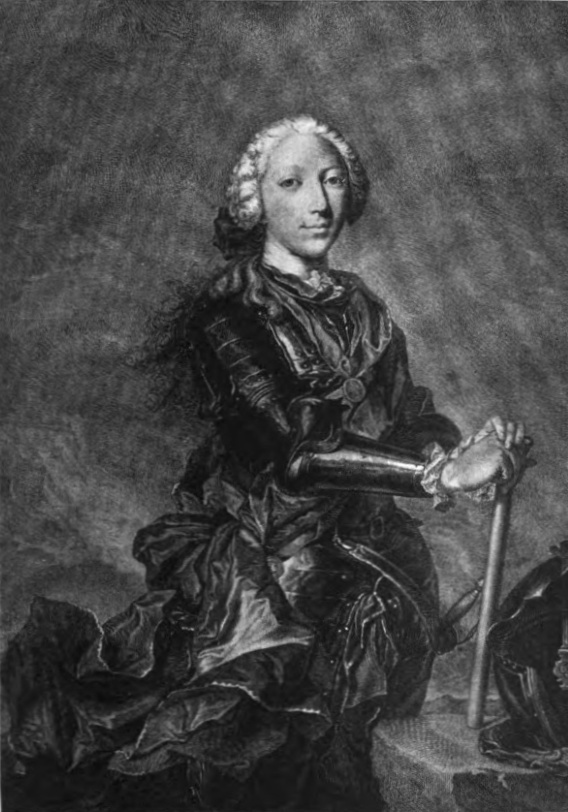
Henry IX. (Cardinal of York)
The Président de Brosses describes the death of Clement XII.[40], which he witnessed, and saw the election of Benedict XIV.[41]—as I saw Leo XII. the Pontiff lying dead on his abandoned bed: the Cardinal Camerlingo had struck Clement XII. twice or thrice on the forehead, according to the custom, with a little hammer, calling him by his name, Lorenzo Corsini.
"He made no reply," says de Brosses, and adds, "That is how your daughter comes to be dumb[42]."
And that is how at that time the most serious things were treated: a dead pope at whose head one knocks as it were at the gate of understanding, while calling on the deceased and voiceless man by his name, could, it seems to me, have inspired a witness with something else than raillery, even though it were borrowed from Molière. What would the frivolous Dijon magistrate have said had Clement XII. answered him from the depths of eternity:
"What do you want with me?"
Cynicism of de Brosses.
The Président de Brosses sends his friend the Abbé Courtois a list of the cardinals of the Conclave, with a word on each of them to his honour:
"Guadagni[43], a bigot, a hypocrite, witless, tasteless, a poor monk.
"Aquaviva of Aragon, a fine presence, although somewhat heavy in figure, as he is also in mind.
"Ottoboni[44], no morals, no credit, debauched, ruined, a lover of the arts.
"Alberoni[45], full of ardour, anxious, restless, despised, no morals, no decency, no consideration, no judgment: according to him, a cardinal is a ——- dressed in red."
The rest of the list is all of a piece; cynicism here takes the place of wit.
A singular piece of buffoonery took place: de Brosses went to dine with some Englishmen at the Porta San Pancrazio; they had a mock election of a pope: a certain Sir Ashwood took off his wig and represented the dean of the cardinals; they sang Oremus, and Cardinal Alberoni was elected by the ballot of that orgy. The Protestant soldiers in the Constable de Bourbon's army nominated Martin Luther pope in the Church of St. Peter. Nowadays the English, who are at once the plague and the providence of Rome, respect the Catholic Religion which has permitted them to build a church outside the Porta del Popolo. The government and manners of the day would no longer suffer such scandals.
So soon as a cardinal is imprisoned in the conclave, the first thing he does is, with the aid of his servants, in the dark, to scratch at the newly blocked-up walls until they have made a little hole. Through this, during the night, they pass strings by means of which news is sent and received between the inside and the outside. For the rest, the Cardinal de Retz, whose opinion is above suspicion, after speaking of the miseries of the conclave in which he took part, ends his story with these fine words:
"We lived there, always together, with the same mutual respect and the same civility that are observed in the closets of kings; with the same politeness that obtained at the Court of Henry III.; with the same familiarity that is seen in the colleges; with the same modesty that prevails in noviciates, and the same charity, at least in appearance, that might exist among brothers wholly united."
I am struck, in finishing this epitome of a vast history, by the serious manner in which it commences and the almost burlesque manner in which it ends: the greatness of the Son of God opens the scene which, shrinking in proportion as the Catholic Religion moves farther from its source, ends in the littleness of the son of Adam. We scarcely find again the primitive loftiness of the Cross until we come to the decease of the Sovereign Pontiff: that childless, friendless pope, whose corpse lies neglected on its couch, shows that the man was reckoned as naught in the head of the evangelical world. Honours are rendered to the Pope as a temporal prince; as a man, his abandoned corpse is flung down at the door of the church where of old the sinner did penance.
Dispatches to Portalis.
Dispatches to M. Le Comte Portalis
"Rome, 17 February 1829.
"Monsieur le comte,
"I do not know whether the King will be pleased to send an extraordinary ambassador to Rome, or whether it will suit him to accredit me to the Sacred College. In the latter case, I have the honour to observe to you that I allowed M. le Duc de Laval, for his expenses for extraordinary service in a similar circumstance, in 1823, a sum which amounted, as far as I can remember, to 40,000 or 50,000 francs. The Austrian Ambassador, M. le Comte d'Apponyi[46], at first received from his Court a sum of 36,000 francs for the first requirements, a supplementary allowance of 7,200 francs per month over and above his ordinary salary during the sitting of the Conclave, and 10,000 francs for presents, chancery expenses, etc. I do not, monsieur le comte, pretend to compete in magnificence with His Excellency the Austrian Ambassador, as M. le Duc de Laval did; I shall hire no horses, carriages, nor liveries to dazzle the Roman mob; the King of France is a great enough lord to pay for the pomp of his ambassadors, if he wishes it: borrowed magnificence is wretched. I shall therefore go modestly to the Conclave with my ordinary footmen and in my ordinary carriages. It only remains for me to know whether the King will not think that, as long as the Conclave lasts, I shall be bound to keep up a display for which my ordinary salary will not be sufficient I ask nothing, I merely submit the question to your judgment and to the royal decision.
"I have the honour to be, etc."
"Rome, 19 February 1829.
"Monsieur le comte,
"I had the honour yesterday to be presented to the Sacred College and to deliver the little speech of which I sent you a copy in advance in my Dispatch No. 17, which left on Tuesday the 17th inst. by a special courier. I was listened to with the most auspicious marks of satisfaction, and the Senior Cardinal, the venerable Della Somaglia, replied to me in terms most affectionate towards the King and France.
"Having informed you of everything in my last dispatch, I have absolutely nothing new to tell you to-day, unless it be that Cardinal Bussi[47] arrived yesterday from Benevento. Cardinals Albani, Macchi[48], and Oppizzoni are expected to-day.
"The members of the Sacred College will lock themselves up in the Quirinal Palace on Monday evening the 23rd of this month. Ten days will then elapse to await the arrival of the foreign cardinals, after which the serious operations of the Conclave will commence, and, if they were to come to an understanding at once, the pope could be elected in the first week of Lent.
"I am, monsieur le comte, awaiting the King's orders. I presume that you dispatched a courier to me after M. de Montebello's arrival in Paris. It is urgent that I should receive either the announcement of an extraordinary embassy, or my new credentials together with the instructions of the Government.
"Are my five French cardinals coming? Politically speaking, their presence here is very little necessary. I have written to Monseigneur le Cardinal de Latil[49] to offer him my services in case he should decide to come,
"I have the honour to be, etc.
"P.S. I enclose a copy of a letter which M. le Comte de Funchal has written to me. I have not replied to this ambassador in writing; I only went to talk to him."
To Madame Récamier
"Rome, Monday 23 February 1829.
"Yesterday the Pope's obsequies were finished. The pyramid of 'paper' and the four candelabra were fine enough, because they were of immense proportions and reached up to the cornice of the church. The last Dies iræ was admirable. It is composed by an unknown man, who belongs to the pope's chapel, and who seems to me to possess a very different sort of genius from Rossini's. To-day we pass from sorrow to joy; we sing the Veni Creator for the opening of the Conclave; then we shall go every evening to see if the ballot-papers are burnt, if the smoke issues from a certain chimney: on the day on which there is no smoke, the pope will have been appointed, and I shall go to see you again; that is the whole business as it affects me. The King of England's speech is very insolent to France! What a deplorable expedition that Morean Expedition is! Are they beginning to see it? General Guilleminot wrote me a letter on the subject which made me laugh; he can only have written as he did because he presumed me to be a minister."
Letters to Madame Récamier.
"25 February.
"Death is here; Torlonia went yesterday evening after two days' illness; I have seen him lying all painted on his death-bed, his sword at his side. He lent money on pledges, but on such pledges! On antiquities, on pictures huddled promiscuously in an old, dusty palace. That was different from the shop in which the Miser put away 'a Bologna lute, fitted with all its strings, or nearly... the skin of a lizard three feet long... and a four-foot bedstead with slips in Hungarian point[50].'
"One sees nothing but dead people carried dressed-up through the streets; one of them passes regularly under my windows when we sit down to dinner. For the rest, everything proclaims the spring parting; people are beginning to disperse; they are leaving for Naples; they will come back a moment for Holy Week, and then separate for good. Next year there will be different travellers, different faces, a different society. There is something melancholy in this journey over ruins: the Romans are like the remains of their city; the world passes at their feet. I picture those persons going back to their families in the various countries of Europe, the young 'Misses' returning to the midst of their fogs. If, by chance, thirty years hence, one of them is brought back to Italy, who will remember to have seen her in the palaces whose masters shall be no more. St. Peter's and the Coliseum: that is all that she herself would recognise."
Dispatch to M. le comte Portalis
"Rome, 3 March 1829.
"Monsieur le comte,
"My first courier having reached Lyons, on the 14th of last month, at nine o'clock in the evening, you must have learned the news of the Pope's death, by telegraph, on the morning of the 15th. It is to-day the 3rd of March, and I am still without instructions and without an official reply. The newspapers have announced the departure of two or three cardinals. I had written to Paris to Monseigneur le Cardinal de Latil to place the Embassy Palace at his disposal; I have just written to him again at different points on his road to renew my offers.
"I am sorry to be obliged to tell you, monsieur le comte, that I notice some little intrigues here to keep the cardinals away from the Embassy, to lodge them where they might be placed more within reach of the influences which it is hoped to exercise over them.
"As far as I am concerned, this is a matter of indifference to me. I shall show Their Eminences all the services which depend upon myself. If they question me touching things which it is well that they should know, I shall tell them what I can; if you transmit the King's orders for them to me, I will communicate these to them; but, if they were to arrive here in a spirit hostile to the views of His Majesty's Government, if it were perceived that they were not in agreement with the King's Ambassador, if they held a language contrary to mine, if they went so far as to give their votes in the Conclave to some exaggerated man, if even they were divided among themselves, nothing would be more fatal. It would be better for the King's service that I should instantly hand in my resignation rather than present this public spectacle of our discords. Austria and Spain have a line of conduct with reference to their clergy which leaves no opening for intrigue. No Austrian or Spanish priest, cardinal or bishop, can have any other agent or correspondent in Rome than the ambassador of his Court himself; the latter has the right to remove from Rome, at a moment's notice, any ecclesiastic of his nationality who may obstruct him.
"I hope, monsieur le comte, that no division will take place, that Their Eminences the cardinals will have formal orders to submit to the instructions which I shall before long receive from you, and that I shall know which of them will be charged with the exercise of the exclusion, in case of need, and which heads that exclusion is to strike.
"It is very necessary that we should be on our guard; the last ballots revealed the awakening of a party. This party, which gave twenty or twenty-one votes to Cardinals Della Marmora[51] and Pedicini, forms what is known here as the Sardinian faction. The other cardinals, alarmed, want all to give their suffrages to Oppizzoni, a man both firm and moderate. Although an Austrian, that is to say, a Milanese, he coped against Austria at Bologna. He would be an excellent choice. The votes of the French might, by settling on one candidate or another, decide the election. Rightly or wrongly, these cardinals are believed to be hostile to the present system of His Majesty's Government, and the Sardinian faction is reckoning on them.
"I have the honour to be, etc[52]."
To Portalis and Récamier.
To Madame Récamier
"Rome, 3 March 1829.
"I am quite surprised at your acquaintance with the story of my excavation; I did not remember having written you so well on that subject. I am, as you think, very busy: left without directions or instructions, I am obliged to take everything upon myself. I believe, however, that I can promise you a moderate and enlightened pope, if God only grant that he be made at the expiration of the interim of M. Portalis' ministry."
"4 March.
"Yesterday, Ash Wednesday, I was on my knees alone in the Church of Santa Croce, which rests against the walls of Rome, near the Porta di Napoli. I heard the monotonous and lugubrious chanting of the monks within that solitude: I should have liked myself to be in a frock, singing among those ruins. What a spot to appease ambition and to contemplate the vanities of earth! While I am suffering, I hear that M. de La Ferronnays is getting better; he rides on horseback, and his convalescence is looked upon in the country as miraculous: God grant that it be so, and that he may resume work at the end of the interim. What a number of questions that would solve for me!"
Dispatch to Portalis.
Dispatch to M. le comte Portalis
"Sunday[53] 15 March 1829.
"Monsieur le comte,
"I have had the honour to inform you of the successive arrivals of their Eminences the French cardinals. Three of them, Messieurs de Latil, de La Fare[54] and de Croy[55] have done me the honour to be my guests. The first entered the Conclave on Thursday evening the 12th, with M. le Cardinal Isoard[56]; the two others locked themselves in on Friday evening the 13th.
"I told them all I know; I gave them important notes on the minority and majority in the Conclave, and on the sentiments which animate the different parties. We agreed that they should support the candidates of whom I have already spoken to you, namely, Cardinals Capellari, Oppizzoni, Benvenuti, Zurla, Castiglioni and, lastly, Pacca and Di Gregorio; and that they should reject the cardinals of the Sardinian faction: Pedicini, Giustiniani, Galleffi, and Cristaldi[57].
"I hope that this good intelligence between the ambassadors and cardinals will have the best effect: at least I shall have nothing with which to reproach myself if passions or interests intervene to deceive my hopes.
"I have, monsieur le comte, discovered dangerous and contemptible intrigues carried on between Paris and Rome through the channel of Monsignor Lambruschini, the Nuncio[58]. It was no less a question than to cause to be read, in open conclave, a copy of some pretended secret instructions, divided into several clauses and given (so it was impudently asserted) to M. le Cardinal de Latil. The majority of the Conclave has pronounced strongly against these machinations; it wished the Nuncio to be instructed to break off all relations with those men of discord who, while troubling France, would end by making the Catholic Religion hateful to all. I am, monsieur le comte, making a collection of these authentic revelations, and I will send it to you after the election of the pope: that will be worth more than all the dispatches in the world. The King will learn to know who are his friends and who his enemies, and the Government will be able to rely on facts suited to guide its conduct
"Your Dispatch No. 14 informs me of the encroachments which His Holiness' Nuncio endeavoured to renew in France in connection with the death of Leo XII. The same thing had happened before, when I was Foreign Minister, at the time of the death of Pius VII.: fortunately, we always have means of defending ourselves against those public attacks; it is much more difficult to escape the plots laid in the dark.
"The conclavists who accompany our cardinals appeared to me to be reasonable men: the Abbé Coudrin[59] alone, whom you mentioned to me, is one of those cramped and narrow minds into which nothing can enter, one of those men who have mistaken their profession. As you are well aware, he is a monk, head of an order, and he even has bulls of institution: this is but little in agreement with our civil laws and our political institutions.
"It may happen that the pope will be elected at the end of this week. But, if the French cardinals fail to make their presence felt at once, it will become impossible to assign a limit to the duration of the Conclave. New combinations would perhaps bring about an unexpected nomination: to have done with it, they might agree on some insignificant cardinal, such as Dandini[60].
"In times gone by, monsieur le comte, I have found myself placed in difficult circumstances, whether as Ambassador to London, or as Minister during the Spanish War, or as a member of the House of Peers, or Leader of the Opposition; but nothing has given me so much anxiety and care as my present position in the midst of every kind of intrigue. I have to act upon an invisible body locked up in a prison, the approaches to which are strictly guarded. I have no money to give, no places to promise; the decaying passions of fifty old men give me no hold on them. I have to fight against stupidity in some, against ignorance of the times in others; fanaticism in these, craft and duplicity in those; in almost all, ambition, self-interest, political hatred: and I am separated by walls and mysteries from the assembly in which so many elements of division are fermenting. At each moment, the scene varies; every quarter of an hour, contradictory reports plunge me into fresh perplexities. I am not, monsieur le comte, telling you of these difficulties to show my importance, but rather to serve as my excuse in case the election should result in a pope contrary to what it seems to promise and to the nature of our wishes. At the time of the death of Pius VII., public opinion was not excited over religious questions: to-day, these questions have begun to play their part in politics, and never did the election of the Head of the Church fall at a less auspicious moment
"I have the honour to be, etc."
Letter to Madame Récamier.
To Madame Récamier
Rome, 17 March 1829.
"The King of Bavaria[61] has called in mufti to see me. We spoke of you. This 'Greek' sovereign, though he wears a crown, seems to know what he has on his head, and to understand that you cannot nail the present to the past. He is to dine with me on Thursday, and wants no one there.
"For the rest, behold us in the midst of great events: a pope to be made; what will he be like? Will Catholic Emancipation be passed? A new campaign in the East: on which side will victory be? Shall we profit by this position? Who will conduct our affairs? Is there a head capable of perceiving all that this contains for France and of profiting by it according to events? I am persuaded that they do not so much as think of it in Paris and that, what with the salons and the Chambers, pleasures and legislation, worldly joys and ministerial anxieties, they don't trouble about Europe or anything else. Only I myself, in my exile, have time to indulge in dreams and to look about me. Yesterday I went for a walk in a sort of gale on the old Tivoli Road. I came to the old Roman pavement, which is so well preserved that one would believe it had been newly laid. Yet Horace had trod the stones which I was treading: where is Horace?"
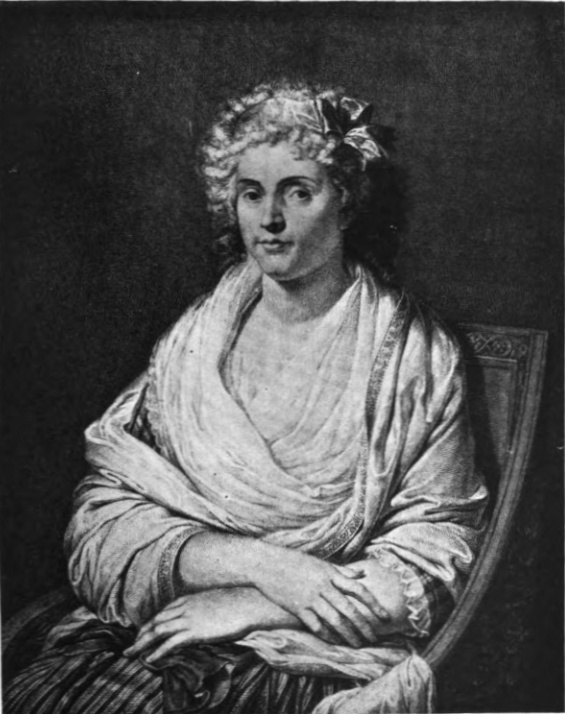
Louise of Stolberg (Countess of Albany)
The Marquis Capponi[62] arrived from Florence, bringing me letters of recommendation from ladies in Paris. I replied to one of these letters on the 21st of March 1829:
"I have received your letters: the services I am able to do are nothing, but I am entirely at your orders. I was already well acquainted with the Marquis Capponi's merits. I can tell you that he is still good-looking; he has weathered time. I did not answer your first letter, so full of enthusiasm for the sublime Mahmud and for 'disciplined' barbarism, for those slaves 'bastinadoed' into soldiers[63]. I can imagine that women are carried away with admiration for men who marry hundreds of them at a time, and that they take that for the progress of enlightenment and civilization; but, as for me, I cling to my poor Greeks; I desire their liberty as I do that of France. I also want frontiers which will cover Paris and ensure our independence; and it is not by means of the triple alliance of the pale of Constantinople, the schlag of Vienna and the fisticuffs of London that you will obtain the bank of the Rhine. Many thanks for the fur-coat of honour which our glory might obtain from the invincible Commander of the Faithful, who has not yet sallied from the outskirts of his seraglio; I prefer that glory naked; she is a woman and beautiful: Phidias would certainly never have robed her in a Turkish dressing-gown."
To Madame Récamier
Rome, 21 March 1829.
"Well, I am right and you are wrong! I went yesterday, between two ballots and while waiting for a pope, to Sant' Onofrio: and it is two orange-trees that grow in the cloister, and not an evergreen oak. I am quite proud of this fidelity of my memory. I ran, almost with my eyes shut, to the little stone that covers your friend; I prefer it to the great monument they are going to raise to him. What a charming solitude! What an admirable view! What happiness to lie there between the frescoes of Domenichino[64] and Leonardo da Vinci! I wish I were there, I never felt so tempted. Did they let you enter the interior of the convent? Did you see, in a long corridor, that delicious, though half-obliterated, head of a Madonna by Leonardo da Vinci? Did you see in the library Tasso's mask, his withered laurel-wreath, a mirror which he used, his ink-stand, his pen and the letter written by his hand, pasted to a board that hangs below his bust? In this letter, in a small, scratched-out, but easily legible hand, he speaks of 'friendship' and the 'wind of fortune;' the latter scarcely ever blew for him, and the former often failed him.
"No pope yet, we expect him hourly; but, if the choice has been delayed, if obstacles have arisen on every hand, it is not my fault: they ought to have listened to me a little more, and not acted in a sense exactly opposite to that which they seemed to decide upon. For the rest, it seems to me at present that every one wants to be at peace with me. The Cardinal de Clermont-Tonnerre himself has just written to tell me that he claims my former kindness for him; and after all that he comes to stay with me resolved to vote for the most moderate pope.
"You have read my second speech. Thank M. Kératry[65], who has spoken so obligingly of the first; I hope he will be still more pleased with the other. We shall both of us try to make liberty Christian, and we shall succeed. What do you say to the answer Cardinal Castiglioni made me? Have I been finely enough praised 'in open conclave'? You could not have done better in the days when you spoilt me."
Letters to Madame Récamier.
"24 March 1829.
"If I were to believe the rumours of Rome, we should have a pope to-morrow; but I am in a moment of discouragement, and I refuse to believe in such happiness. You can understand that that happiness is not political happiness, the joy of a triumph, but the happiness of being free and seeing you again. When I speak to you so much about the Conclave, I am like the people who have a fixed idea and who believe that the whole world is interested in that idea. And yet, in Paris, who thinks of the Conclave, who troubles about a pope or my tribulations? French light-heartedness, the interests of the moment, the discussions in the Chambers, excited ambitions have very different things to do. When the Duc de Laval used also to write to me of his cares about the Conclave, preoccupied with the Spanish War as I was, I used to say, when I received his dispatches, 'Oh, good Heavens, I have something else to think of!' and M. Portalis is applying the lex talionis to me to-day. Nevertheless, one may fairly say that things at that time were not what they are now: religious ideas were not mixed up with political ideas as they have since been throughout Europe; the quarrel did not lie there; the nomination could not, as it does now, disturb or pacify States.
"Since the letter which informed me that M. de La Ferronnays' leave had been extended and that he had left for Rome, I have heard nothing: still, I believe that news true.
"M. Thierry has written me a touching letter from Hyères; he tells me that he is dying, and still he wants a place in the Academy of Inscriptions and asks me to write for him. I am going to do so. My excavation continues to give me sarcophaguses; death can only yield what it possesses. The Poussin monument is getting on. It will be noble and large. You cannot imagine how the picture of the Arcadian Shepherds was made for a bas-relief, nor how well it suits sculpture."
"28 March.
"M. le Cardinal de Clermont-Tonnerre, who has been staying with me, enters the Conclave to-day; this is an age of marvels. I have with me the son of Marshal Lannes and the grandson of the Chancellor[66]; Messieurs du Constitutionnel dine at my table beside Messieurs de la Quotidienne. That is the advantage of being sincere; let every one think what he pleases, provided I am allowed the same liberty; I only endeavour that my opinion shall have the majority, because I think it, and rightly, better than the others. I attribute to this sincerity the tendency of the most diverging opinions to gather round me. I exercise the right of sanctuary towards them: they cannot be seized beneath my roof."
To M. le Duc de Blacas[67]
"Rome, 24 March 1829.
"I am sorry, monsieur le duc, that a phrase in my letter should have been able to cause you any anxiety. I have no reason whatever to complain of a man of sense and intelligence[68], who told me nothing save diplomatic commonplaces. Do we ambassadors ever talk anything else? As to the cardinal of whom you do me the honour to speak, the French Government has not designated any one in particular; it has left the matter entirely as I reported it. Seven or eight moderate and peaceful cardinals, who seem to attract the wishes of all the Courts alike, are the candidates among whom we wish to see the votes fall. But, if we lay no claim to impose a choice upon the majority of the Conclave, we do with all our might and by every means repel two or three fanatical, intriguing, or incapable cardinals, whom the minority are supporting.
"I have no other possible means of sending you this letter, monsieur le duc; I am therefore very simply posting it, because it contains nothing that you and I cannot confess aloud.
"I have the honour to be, etc."
To Blacas and Récamier.
To Madame Récamier
"Rome, 31 March 1829.
"M. de Montebello has arrived and has brought me your letter, with a letter from M. Bertin and from M. Villemain.
"My excavations are doing well: I find plenty of empty sarcophaguses; I shall be able to choose one for myself, without my ashes being obliged to turn out those of the old dead men whom the wind has carried away. Depopulated sepulchres afford the spectacle of a resurrection, and yet they await only a more profound death. It is not life but annihilation which has made those tombs deserted.
"To finish my little diary of the moment, I will tell you that the day before yesterday I climbed to the ball of St. Peter's during a storm. You cannot imagine the noise of the wind in mid-sky, around that cupola of Michael Angelo and above that temple of the Christians which crushes Ancient Rome."
"31 March, evening.
"Victory! I have one of the Popes whom I had placed on my list: it is Castiglioni, the very cardinal whom I was supporting for the Papacy in 1823, when I was Minister, he who lately replied to me in the Conclave with 'many praises.' Castiglioni is a moderate man and devoted to France; it is a complete triumph. The Conclave, before separating, gave orders to write to the Nuncio in Paris, to tell him to express to the King the satisfaction of the Sacred College with my conduct. I have already dispatched the news to Paris by the telegraph. The Prefect of the Rhone is the intermediary of this aerial correspondence, and this prefect is M. de Brosses, son of that Comte de Brosses, the frivolous traveller to Rome, whom I have often quoted in the notes which I collect while writing to you. The courier who carries this letter to you carries my dispatch to M. Portalis.
"I never have two consecutive days of good health now; this makes me furious, for I have no heart for anything in the midst of my sufferings. Still, I am awaiting with some impatience to hear the effect in Paris of the nomination of my Pope, what they will say, what they will do, what will become of me. The most certain thing is that my leave has been applied for. I have seen in the papers the great quarrel raised by the Constitutionnel about my speech; it accuses the Messager of not printing it, and we in Rome have Messagers of the 22nd of March (the quarrel belongs to the 24th or 25th) containing the speech. Isn't it singular? It seems clear that there are two editions, one for Rome and the other for Paris. Poor people! I am thinking of the mistake made by another paper; it assures its readers that the Conclave was very much dissatisfied with this speech: what can it have said when it read the praises given me by Cardinal Castiglioni, who has become Pope?
"When shall I have done talking to you of all these trifles? When shall I busy myself only with finishing the Memoirs of my Life and my life also, as the last page of those Memoirs? I have great need of it; I am very weary, the weight of my days increases and makes itself felt on my head; I amuse myself by calling it 'rheumatism' but it is the kind that one cannot cure. One word only sustains me, when I again say:
"'Soon.'"
"3 April.
"I forgot to tell you that, as Cardinal Fesch behaved very well in the Conclave and voted with our cardinals, I took a resolution and invited him to dinner. He refused in a very tactful note."
Dispatch to Portalis.
Dispatch to M. le comte Portalis
"Rome, 2 April 1829.
"Monsieur le comte,
"Cardinal Albani has been appointed Secretary of State, as I had the honour to inform you in my first letter carried to Lyons by the mounted messenger dispatched on the evening of the 31st of March. The new minister is not pleasing to the Sardinian faction, nor to the majority of the Sacred College, nor even to Austria, because he is violent, an Anti-Jesuit, rude in his manner, and an Italian above everything. Rich and excessively avaricious, Cardinal Albani is mixed up in all sorts of enterprises and speculations. I went yesterday to pay him my first visit; the moment he saw me, he exclaimed:
"'I am a pig!' He was, in fact, exceedingly dirty. 'You shall see that I am not an enemy.'
"I am giving you his own words, monsieur le comte. I replied that I was very far from regarding him as an enemy.
"'You people' he resumed, 'want water, not fire: don't I know your country? Haven't I lived in France?' He speaks French like a Frenchman. 'You will be satisfied, and your master too. How is the King? Good-morning. Let us go to St. Peter's!'
"It was eight o'clock in the morning; I had already seen His Holiness, and all Rome was hastening to the ceremony of the Adoration.
"Cardinal Albani is a man of intelligence, false by nature and frank by temperament; his violence foils his cunning; one can make use of him by flattering his pride and satisfying his avarice.
"Pius VIII. is very learned, especially in matters of theology; he speaks French, but with less facility and grace than Leo XII. He is attacked on the right side with partial paralysis, and is subject to convulsive movements: the supreme power will cure him. He is to be crowned on Sunday next, Passion Sunday, the 5th of April.
"Now, monsieur le comte, that the principal business which kept me in Rome is ended, I shall be infinitely obliged to you if you will obtain for me from His Majesty's kindness a leave of a few months. I shall not take it until after I have handed the Pope the letter in which the King will reply to that which Pius VIII. has written or is going to write to him to announce his elevation to the Chair of St Peter. Permit me to beg once more, on behalf of my two secretaries of Legation, M. Bellocq[69] and M. de Givré[70], the favours which I have asked of you for them.
"The intrigues of Cardinal Albani in the Conclave, the partisans whom he had won, even among the majority, had made me fear some unexpected stroke to carry him to the Sovereign Pontificate. It seemed to me impossible to allow ourselves to be thus surprised and to permit the Austrian chargé d'affaires to put on the tiara under the eyes of the French Ambassador. I therefore availed myself of the arrival of M. le Cardinal de Clermont-Tonnerre to charge him against all eventualities with the letter enclosed, the terms of which I framed on my own responsibility. Fortunately he was not called upon to make use of this letter; he handed it back to me, and I have the honour to send it to you.
"I have the honour to be, etc."
To His Eminence Monseigneur le Cardinal de Clermont-Tonnerre
"Rome, 28 March 1829.
"Monseigneur,
"Unable to communicate with your colleagues, Messieurs the French cardinals, confined in the Monte Cavallo Palace; obliged to provide for every thing to the advantage of His Majesty's service, and in the interests of our country; knowing how often unexpected nominations have been made in the conclaves, I find myself, to my regret, in the disagreeable necessity of confiding to Your Eminence a power of eventual exclusion.
"Although M. le Cardinal Albani appears to have no chance, he is none the less a man of capacity on whom, in case of a prolonged struggle, they might turn their eyes; but he is the cardinal charged at the Conclave with the instructions of Austria: M. le Comte de Lützow has already designated him in that quality in his speech. Now it is impossible to allow the elevation to the Sovereign Pontificate of a cardinal openly belonging to a crown, whether it be the Crown of France or any other.
"Consequently, monseigneur, I charge you, by virtue of my full powers as His Most Christian Majesty's Ambassador, and taking all the responsibility upon myself alone, to give the exclusion to M. le Cardinal Albani, if, on the one hand, by a fortuitous juncture, or, on the other, by a secret combination, he should come to obtain the majority of the suffrages.
"I am, etc., etc."
The letter of exclusion.
This letter of exclusion, entrusted to a cardinal by an ambassador who is not formally authorized to that effect, is a piece of diplomatic temerity: it is enough to send a shudder through all stay-at-home statesmen, all the heads of departments, all the chief clerks, all the copiers at the Foreign Office; but, as the Minister knew so little about his business as not even to think of an eventual case of exclusion, needs must that I should think of it for him. Suppose that Albani had been made Pope by accident: what would have become of me? I should have been ruined for ever as a politician.
I say this, not for myself, who care little for a politician's fame, but for the future generation of writers who would be browbeaten because of my accident and who would expiate my misfortune at the cost of their career, even as the whipping-boy is punished when M. le Dauphin commits a blunder. But neither should my daring foresight, in taking the letter of exclusion upon myself, be too much admired: that which appears enormous, when measured by the stunted scale of the old diplomatic ideas, is really nothing at all, in the actual order of society. I owed my audacity on the one hand to my insensibility to all disgrace, on the other to my knowledge of contemporary opinion: the world as it is to-day does not care two sous for the nomination of a pope, the rivalries of crowns, or the internal intrigues of a conclave.
Dispatch to M. le comte Portalis
Confidential.
"Rome, 2 April 1829.
"Monsieur le comte,
"I have the honour to-day to send you the important documents which I promised you. These are nothing less than the secret and official journal of the Conclave. It is translated, word for word, from the Italian original; I have only removed any part of it which might point too precisely to the sources whence I drew it. If the smallest atom of these perhaps unexampled revelations were to transpire, it would cost the fortune, the liberty and perhaps the lives of several persons. This would be the more deplorable inasmuch as we owe these revelations not to interest and corruption, but to confidence in French honour. This document, monsieur le comte, must therefore remain for ever secret after it has been read in the King's Council; for, in spite of the precautions which I have taken to keep names silent and to suppress direct references, it still says enough to compromise its authors. I have added a commentary, to facilitate its perusal. The Pontifical Government is in the habit of keeping a register on which its decisions, its acts and deeds are noted down day by day, and so to speak hour by hour: what an historical treasure, if one could delve into it, going back towards the earlier centuries of the Papacy! I have been given a momentary glimpse of it, for the present period. The King will see, through the documents which I am sending you, what has never been seen before, the inside of a Conclave; the most intimate sentiments of the Court of Rome will be known to him, and His Majesty's Ministers will not be walking in the dark.
"The commentary which I have made of the journal dispensing me from any other reflection, it but remains for me to offer you the renewed assurance of the high regard with which I have the honour to be, etc., etc."
The Italian original of the precious document announced in this confidential dispatch was burnt in Rome before my eyes; I have kept no copy of the translation of this document which I sent to the Foreign Office; I have only a copy of the "commentary" or "remarks" which I added to that translation. But the same discretion which made me charge the Minister to keep the document for ever secret obliges me here to suppress my own remarks; for, however great the obscurity in which those remarks are enveloped, in the absence of the document to which they refer, that obscurity would still be daylight in Rome. Now resentment is long in the Eternal City; it might happen that, fifty years hence, it should fall upon some grand-nephew of the authors of the mysterious confidence. I shall therefore content myself with giving a general epitome of the contents of the commentary, while laying stress on a few passages which bear a direct relation to the affairs of France.
We see, first, how greatly the Court of Naples was deceiving M. de Blacas, or else how much it was itself deceived; for, while it was causing me to be told that the Neapolitan cardinals would vote with us, they were joining the minority or the so-called Sardinian faction.
The minority of the cardinals imagined that the vote of the French cardinals would influence the form of our government. How so? Apparently by means of secret orders with which they were supposed to be charged and by their votes in favour of a hot-headed pope.
A secret document.
The Nuncio Lambruschini declared to the Conclave that the Cardinal de Latil had the King's secret; all the efforts of the faction tended to create the belief that Charles X. and his Government were not in agreement.
On the 13th of March, the Cardinal de Latil announced that he had a declaration purely of conscience to make to the Conclave; he was sent before four cardinal-bishops: the acts of that secret confession remained in the keeping of the Grand Penitentiary. The other French cardinals knew nothing of the subject-matter of this confession, and Cardinal Albani sought in vain to find out: the fact is important and curious.
The minority consisted of sixteen compact votes. The cardinals forming this minority called themselves the "Fathers of the Cross;" they placed a St. Andrew's cross on their doors as a sign that, having decided on their choice, they did not want to communicate with any one. The majority of the Conclave displayed reasonable sentiments and a firm resolution in no way to mix in foreign politics.
The minutes drawn up by the protonotary of the Conclave are worthy of remark. They conclude with these words:
"Pius VIII. determined to appoint Cardinal Albani Secretary of State, in order also to satisfy the Cabinet of Vienna."
The Sovereign Pontiff divides the lots between the two crowns: he declares himself the French Pope, and gives the secretaryship of State to Austria.
To Madame Récamier
"Rome, Wednesday 8 April 1829.
"This day I have had the whole Conclave to dinner. Tomorrow I receive the Grand-duchess Helen. On Easter Tuesday, I give a ball for the closing of the session; and then I shall prepare to come to see you. You can judge of my anxiety: at the moment of writing to you, I have no news yet of my mounted courier announcing the death of the Pope, and yet the Pope is already crowned; Leo XII. is forgotten; I have begun again to transact affairs with the new Secretary of State, Albani; everything is going on as though nothing had happened, and I do not even know whether you in Paris know that there is a new Pontiff! How beautiful that ceremony of the papal benediction is! The Sabine Range on the horizon, then the deserted Roman Campagna, then Rome itself, then the Piazza San Pietro and the whole people falling on its knees under an old man's hand: the Pope is the only prince who blesses his subjects.
"I had written so far when a courier arrived from Genoa bringing me a telegraphic dispatch from Paris to Toulon, which dispatch, replying to the one I had sent, informs me that, on the 4th of April, at eleven o'clock in the evening, they received in Paris my telegraphic dispatch from Rome to Toulon announcing the election of Cardinal Castiglioni, and that the King is greatly pleased.
"The rapidity of these communications is prodigious; my courier left at eight o'clock in the evening on the 31st of March, and at eight o'clock in the evening on the 8th of April I received a reply from Paris."
"11 April 1829.
"To-day is the 11th of April: in eight days we shall have Easter with us, in fifteen days my leave, and then to see you! Everything disappears before that hope; I am no more sad; I no longer think of ministers or politics. To-morrow we begin Holy Week. I shall think of all you have told me. Why are you not here to hear the beautiful songs of sorrow with me! We should go to walk in the deserts of the Roman Campagna, now covered with flowers and verdure. All the ruins seem to become young with the new year: I am of their number."
To Récamier and Portalis.
Wednesday in Holy Week, 15 April.
"I have just left the Sistine Chapel, where I attended Tenebræ and heard the Miserere sung. I remembered that you had talked to me of this ceremony, which touched me a hundred times as much because of that.
"The daylight was failing; the shadows crept slowly across the frescoes of the chapel, and one distinguished but a few bold strokes of Michael Angelo's brush. The candles, extinguished one by one in turns, sent forth from their stifled flames a slender white smoke, a very natural image of life, which Scripture compares to a little smoke[71]. The cardinals were kneeling, the Pope prostrate before the same altar where a few days before I had seen his predecessor; the admirable prayer of penance and mercy, which succeeded the Lamentations of the prophet, rose at intervals in the silence of the night. One felt overwhelmed by the great mystery of a God dying that the sins of mankind might be wiped out. The Catholic Heiress was there on her seven hills with all her memories; but, instead of the powerful pontiffs, those cardinals who contended for precedence with monarchs, a poor old paralyzed Pope, without family or support, Princes of the Church, without splendour, announced the end of a power which has civilized the modern world. The master-pieces of the arts were disappearing with it, were fading away on the walls and ceilings of the Vatican, that half-abandoned palace. Inquisitive strangers, separated from the unity of the Church, assisted at the ceremony on their way and took the place of the community of the Faithful. The heart was seized with a two-fold sadness. Christian Rome, while commemorating the Agony of Jesus Christ, seemed to be celebrating her own, to be repeating for the new Jerusalem the words which Jeremias addressed to the old."
To Récamier and Portalis.
Dispatch to M. le comte Portalis
"Rome, 16 April 1829.
"Monsieur le comte,
"Things are developing here as I had the honour to foreshadow to you; the words and actions of the new Pope are in complete agreement with the pacificatory system followed by Leo XII.: Pius VIII. goes even further than his predecessor; he expresses himself with greater frankness on the Charter, of which he is not afraid to pronounce the word nor to advise the French to follow the spirit. The Nuncio, having again written about our business, has received a dry intimation to mind his own. All is being concluded for the Concordat with the Netherlands, and M. le Comte de Celles will complete his mission next month.
"Cardinal Albani, finding himself in a difficult position, is obliged to pay for it: the protestations which he makes to me of his devotion to France annoy the Austrian Ambassador, who is unable to conceal his ill-humour. From the religious point of view we have nothing to fear from Cardinal Albani; himself troubled with very little religion, he will not feel the impulse to trouble us either with his own fanaticism or with the moderate opinions of his Sovereign.
"As for the political point of view, Italy is not at this day to be juggled away through police intrigues and a cypher correspondence; to allow the Legations to be occupied or to place an Austrian garrison at Ancona on some pretext or other would mean stirring up Europe and declaring war against France: now we are no longer in 1814, 1815, 1816 and 1817; a greedy and unjust ambition is not to be satisfied before our eyes with impunity. And so, that Cardinal Albani is in receipt of a pension from Prince Metternich; that he is a kinsman of the Duke of Modena[72], to whom he declares himself to be leaving his enormous fortune; that he is hatching a little plot with that Prince against the Heir to the Crown of Sardinia[73]: all that is true, all that would have been dangerous at the time when secret and absolute governments set soldiers dimly in movement behind the shelter of a dim dispatch; but, in these days, with public governments, with liberty of the press and of free speech, with the telegraph and general rapidity of communication, with knowledge of affairs spread through the several classes of society, we are protected against the conjuring tricks and artifices of the old diplomacy. At the same time it cannot be denied that there are drawbacks attached to an Austrian chargé d'affaires in the position of Secretary of State in Rome; there are even certain notes (those for instance relating to the imperial power in Italy) which it would not be possible to place in Cardinal Albani's hands.
"No one has yet been able to fathom the secret of an appointment which everybody dislikes, including even the Cabinet of Vienna. Has this to do with interests foreign to politics? They say that Cardinal Albani is at this moment offering to make the Holy Father an advance of 200,000 piastres of which the Roman Government stands in need; others pretend that this sum will be lent by an Austrian banker. Cardinal Macchi told me on Saturday last that His Holiness, not wishing to re-appoint Cardinal Bernetti and desirous, nevertheless, of giving him a big place, found no other means of arranging things than to make vacant the Bologna Legation. Wretched little difficulties often become the motives of the most important resolutions. If Cardinal Macchi's version is the true one, all that Pius VIII. is doing and saying for the satisfaction of the Crowns of France and Austria would be only an apparent reason, by the aid of which he would seek to mask his own weakness in his own eyes. For the rest, no one believes that Albania ministry will last. So soon as he begins to enter into relations with the ambassadors, difficulties will spring up on every hand.
The position of Italy.
"As to the position of Italy, monsieur le comte, you must read with caution what will be written to you from Rome or elsewhere. It is, unhappily, but too true that the Government of the Two Sicilies has fallen into the last stage of contempt. The manner in which the Court lives in the midst of its guards, for ever trembling, for ever pursued by the phantoms of fear, presenting the sole spectacle of ruinous hunting-parties and gibbets, contributes more and more to debase royalty in this country. Yet they take for conspiracies what is only the general uneasiness, the product of the century, the struggle of the old society with the new, the contest between the decrepitude of the old institutions and the energy of the young generations: in fine, the comparison which everybody makes of that which is with that which might be. Let us not blind our eyes to this fact: the great spectacle of a powerful, free and happy France, that great spectacle which strikes the eyes of the nations which have remained or relapsed under the yoke, excites regrets or feeds hopes. The medley of representative governments and absolute governments cannot long continue; one or the other must go under, and politics must return to an even level, as in the time of Gothic Europe. The custom-house on a frontier can henceforth not separate liberty from slavery; a man can no longer be hung on this side of a brook for principles reputed sacred on the other side of that brook. It is in this sense, monsieur le comte, and in this sense alone, that there is any conspiracy in Italy; it is in this sense too that Italy is French. On the day when she shall enter on the enjoyment of the rights which her intelligence perceives and which the progressive march of time is carrying to her, on that day she will be peaceful and purely Italian. It is not a few poor devils of Carbonari, stirred up by the manœuvres of the police and mercilessly hanged, that will rouse the country to revolt. Governments are given the falsest ideas of the true state of things; they are prevented from doing what they ought to do to ensure their safety by always having pointed out to them as the private conspiracies of a handful of Jacobins what is really the effect of a permanent and general cause.
"This, monsieur le comte, is the real position of Italy. Each of her States, in addition to the common working of men's minds, is tortured with some local malady: Piedmont is delivered to a fanatical faction; the Milanese is being devoured by the Austrians; the domains of the Holy Father are being ruined by bad financial administration; the taxes amount to nearly fifty millions and do not leave the landlord one per cent, of his income; the customs bring in hardly anything; smuggling is general; the Prince of Modena has established shops in his Duchy (a place of immunity for all ancient abuses) for the sale of prohibited merchandise, which he passes at night into the Bologna Legation[74].
"I have already, monsieur le comte, spoken to you of Naples, where the weakness of the government is saved only by the cowardice of the population.
"It is this absence of military valour that will prolong the death-agony of Italy. Bonaparte did not have time to revive that valour in the land of Marius and Cæsar. The habits of an idle life and the charm of the climate contribute still more to deprive the Southern Italians of the desire to agitate for an improved condition. Antipathies arising from the territorial divisions add to the difficulties of an inside movement; but, if some impulse came from without, if some prince beyond the Alps granted a charter to his subjects, a revolution would take place, because all is ripe for such a revolution. Happier than we and instructed by our experience, the people would be sparing in the crimes and miseries with which we were lavish.
"I have no doubt, monsieur le comte, that I shall soon receive the leave for which I asked you: I shall perhaps use it. At the moment, therefore, of leaving Italy, I have thought it my duty to place a few general hints before you, in order to fix the ideas of the King's Council and to warn it against reports inspired by narrow minds or blind passions.
"I have the honour to be, etc., etc."
Expensive visitors.
Dispatch to M. le comte Portalis
"Rome, 16 April 1829.
"Monsieur le comte,
"Messieurs the French cardinals are very eager to know what sum will be allowed them for their expenses and their stay in Rome: they have repeatedly asked me to write to you on the subject; I shall therefore be infinitely obliged to you if you will inform me as soon as possible of the King's decision.
"As regards myself, monsieur le comte, when you were good enough to allow me an additional sum of thirty thousand francs, you were under the impression that none of the cardinals would stay with me. Now M. de Clermont-Tonnerre put up here with his suite, consisting of two conclavists, an ecclesiastical secretary, a lay secretary, a valet, two men-servants and a French cook, besides a Roman groom of the chambers, a master of ceremonies, three footmen, a coachman and all the Italian establishment which a cardinal is obliged to keep up here. The Archbishop of Toulouse, who is not able to walk[75], does not dine at my table; he requires two or three courses at different hours, and horses and carriages for his guests and friends. My reverend visitor will certainly not pay his expenditure here; he will go, and leave the bills to me; I shall have to pay not only the cook, the laundress, the livery-stable keeper, etc., etc., but also the two surgeons who came to look at His Lordship's leg, the shoemaker who makes his white and purple slippers, and the tailor who has 'confectioned' the cloaks, cassocks, neck-bands, the whole outfit of the cardinal and his abbés.
"If to this, monsieur le comte, you add my extraordinary expenses for costs of representation, which expenses have been increased by the presence of the Grand-duchess Helen, Prince Paul of Wurtemberg[76] and the King of Bavaria, you will no doubt find that the thirty thousand francs which you allowed me will have been much exceeded. The first year of an ambassador's establishment is a ruinous one, the grants allowed for that establishment being far below its needs. It requires a residence of almost three years for a diplomatic agent to find means to pay off the debts which he has begun by making and to keep his expenses on a level with his receipts. I know all the penury of the budget of the Foreign Office; if I had any fortune of my own, I would not trouble you: nothing is more disagreeable to me, I assure you, than these details of money into which a rigorous necessity compels me to enter, much against my will.
"Accept, monsieur le comte, etc."
I had given balls and evening-parties in London and Paris, and, although a child of a different desert, I had not passed too badly through those new solitudes; but I had had no glimmer of the nature of the entertainments in Rome: they have something of ancient poetry, which places death by the side of pleasures. At the Villa Medicis, where I received the Grand-duchess Helen, the gardens themselves are an adornment, and the frame of the picture is magnificent: on one side, the Villa Borghese, with Raphael's house; on the other the Villa Monte-Maria, and the slopes edging the Tiber; below the spectator, the whole of Rome, like an old, abandoned eagle's nest. Amid the groves thronged, together with the descendants of the Paulas and Corinnas, beauties come from Naples, Florence and Milan: the Princess Helen seemed to be their queen. Boreas, suddenly descending from the mountain, tore the banqueting-tent and fled with shreds of canvas and garlands, as though to give us an image of all that time has swept away on this shore. The Embassy staff were in consternation; I felt an indescribable ironical gaiety at seeing a breath from heaven carry off my gold of a day and my joys of an hour. The mischief was promptly repaired. Instead of lunching on the terrace, we lunched in the graceful palace: the harmony of the horns and oboes, spread by the wind, had something of the murmur of my American forests. The groups disporting amid the squalls, the women whose tortured veils beat their hair and faces, the saltarello which continued during the storm, the improvisatrice declaiming to the clouds, the balloon escaping crooked-wise with the cypher of the Daughter of the North: all this gave a new character to those sports in which the customary tempests of my life seemed to take part.
What a fascination for any man who should not have counted his heap of years, and who should have asked illusions of the world and the storm! It is difficult indeed for me to remember my autumn when, at my receptions, I see pass before me those women of spring-time who penetrate among the flowers, the concerts and the lights of my successive galleries: as who should sway swans swimming towards radiant climes. To what désennui are they going? Some seek what they already love, others what they do not yet love. At the end of the road, they will fall into those sepulchres, always open here, into those ancient sarcophaguses which serve as basins to fountains hanging from porticoes; they will go to swell so many light and charming ashes. Those waves of beauties, diamonds, flowers and feathers roll to the sound of Rossini's music, which is re-echoed and grows feebler from orchestra to orchestra. Is that melody the sigh of the breeze to which I listened in the savannahs of the Floridas, the moan which I heard in the Temple of Erechtheus at Athens? Is it the distant wailing of the north winds, which rocked me on the ocean? Could my sylph be hidden beneath the form of some of these brilliant Italian women? No: my hamadryad has remained united to the willow of the meadows where I used to talk with her on the further side of the hedge at Combourg. I have little in common with these frolics of the society which has attached itself to my steps at the end of my race; and yet this fairy-scene contains a certain intoxication that flies to my head: I get rid of it only by going to cool my brow in the solitary square of St. Peter's or in the deserted Coliseum. Then the puny sights of the earth are lost, and I find nothing equal to the sudden change of scene but the old melancholy of my early days.
The exiled Bonapartes.
I will now set forth here my relations, as Ambassador, with the Bonaparte Family, in order to clear the Restoration of one of the calumnies that are incessantly being thrown at its head.
France did not act alone in banishing the members of the Imperial Family; she merely obeyed the hard necessity put upon her by the force of arms; it was the Allies who provoked that banishment: diplomatic conventions, formal treaties pronounce the exile of the Bonapartes, lay down the very places they are to live at, forbid a minister or ambassador to deliver a passport, by himself, to Napoleon's kinsmen; the visa of the four other ministers or ambassadors of the four other contracting Powers is exacted. To such a degree did the blood of Napoleon frighten the Allies, even when it did not flow in his own veins!
Thank God, I never submitted to those measures. In 1823, without consulting anybody, in spite of the treaties, and on my own responsibility as Minister of Foreign Affairs, I delivered a passport to Madame la Comtesse de Survilliers[77], then in Brussels, to enable her to come to Paris to nurse one of her kinsmen, who was ill. Twenty times over I called for the repeal of those laws of persecution; twenty times over I told Louis XVIII. that I should like to see the Duc de Reichstadt captain of his Guards, and the statue of Napoleon put back on the top of the column in the Place Vendôme. Both as minister and ambassador, I rendered all the services in my power to the Bonaparte Family. That was the broad view I took of the Legitimate Monarchy: liberty can look glory in the face. As Ambassador to Rome, I authorized my secretaries and attachés to appear in the palace of Madame la Duchesse de Saint-Leu; I threw down the barrier raised between Frenchmen who had all known adversity. I wrote to M. le Cardinal Fesch to invite him to join the cardinals who were to meet at my house; I expressed to him my sorrow at the political measures which it had been thought necessary to take; I reminded him of the time when I had formed part of his mission to the Holy See; and I begged my old ambassador to honour with his presence the banquet of his old secretary of embassy. I received the following reply, full of dignity, discretion and prudence:
Fesch, Jerome Bonaparte.
"Palazzo Falconieri, 4 April 1829.
"Cardinal Fesch greatly appreciates M. de Chateaubriand's obliging invitation, but his position on returning to Rome was such as to recommend him to forsake the world and lead a life quite apart from any society except that of his family. The circumstances that followed proved to him that this course was indispensable to his tranquillity; and, as the amenities of the moment are no safeguard against unpleasantness in the future, he is obliged not to change his mode of life. Cardinal Fesch begs M. de Chateaubriand to be convinced that nothing can equal his gratitude, and that it is with much regret that he will not wait upon His Excellency as frequently as he would have desired.
'His very humble, etc.,
"Cardinal Fesch."
The phrase, "the amenities of the moment are no safeguard against unpleasantness in the future," is an allusion to the threat uttered by M. de Blacas, who had given orders for M. le Cardinal Fesch to be flung down his stairs if he presented himself at the French Embassy: M. de Blacas was too much inclined to forget that he had not always been so great a lord. I who, in order to be what I have to be, in so far as I can, in the present, am constantly recalling my past, have acted differently with His Eminence the Archbishop of Lyons: the little misunderstandings that existed between him and me in Rome oblige me to adopt a tone of propriety the more respectful inasmuch as I, in my turn, belong to the triumphant and he to the beaten party.