Volume 5 — BOOK II[407] (continued 2)
Alexander Teixeira de Mattos translation
The mail-post brings me a very fine letter from M. de Béranger, in reply to that which I wrote to him on leaving Paris: this letter has already been printed as a note, with a letter from M. Carrel, in the Congrès de Vérone[457].
*
Constance.
Geneva, September 1832.
Going from Lucerne to Constance, one passes through Zurich and Winterthur. Nothing pleased me at Zurich, except the memory of Lavater[458] and Gessner[459], the trees of an esplanade overlooking the lakes, the course of the Limmat, an old crow and an old elm; I prefer this to all Zurich's historic past, with due deference even to the Battle of Zurich. Napoleon and his captains, passing from victory to victory, brought the Russians to Paris.
Winterthur is a new and industrial little market-town, or rather one long clean street. Constance has an air of belonging to nobody; it is open to all the world. I entered it, on the 27th of August, without seeing a custom-house officer or a soldier and without being asked for my passport.
Madame Récamier had arrived, three days earlier[460], to pay a visit to the Queen of Holland. I was waiting for Madame de Chateaubriand, who was coming to join me at Lucerne. I proposed to weigh whether it would not be preferable to settle first in Swabia, remaining free to go down into Italy later.
In the decayed town of Constance, the inn was very gay; they were making preparations for a wedding. The day after my arrival, Madame Récamier wanted to escape the rejoicings of our hosts: we took a boat on the lake and, crossing the sheet of water from which the Rhine flows to become a river, we reached the strand of a park. Setting foot on land, we passed through a hedge of willows, on the other side of which we found a sanded walk winding among thickets of shrubs, groups of trees and grassy lawns. A summer-house stood in the middle of the gardens and an elegant villa leant against a forest of old trees. I noticed on the grass some meadow-saffron, always melancholy for me because of the reminiscences of my various and numerous autumns. We strolled at random and then sat down on a bench at the edge of the water. From the summer-house in the grove rose harmonies of harp and horn which ceased when, charmed and surprised, we began to listen: it was a scene from a fairy-tale. The harmonies did not recommence and I read to Madame Récamier my description of the Saint-Gotthard; she asked me to write something on her tablets, already half-filled with details of the death of J. J. Rousseau. Below these last words of the author of the Héloïse: "Wife, open the window, that I may see the sun again," I wrote these words in pencil:
"What I wanted on the Lake of Lucerne, I have found on the Lake of Constance: the charm and intelligence of beauty. I do not want to die like Rousseau; I want to see the sun for long, if I am to end my life near you. Let my days expire at your feet, like those waves whose murmur you love.—28 August 1832."
The blue of the lake kept watch behind the foliage; on the southern horizon, gathered the summits of the Grisons Alps; a breeze passing to and fro across the willows harmonized with the rise and fall of the billows: we saw no one; we did not know where we were.
*
As we returned to Constance, we saw Madame la Duchesse de Saint-Leu and her son Louis Napoleon[461]: they came up to Madame Récamier. I had not known the Queen of Holland under the Empire; I knew that she had shown herself generous at the time of my resignation on the death of the Duc d'Enghien and when I tried to save my cousin Armand; under the Restoration, when Ambassador in Rome, I had had only relations of politeness with Madame la Duchesse de Saint-Leu; unable to go to her myself, I had left the secretaries and attachés free to pay their court to her, and I had invited Cardinal Fesch to a diplomatic dinner of cardinals. Since the last fall of the Restoration, chance had made me exchange a few letters with Queen Hortense and Prince Louis. These letters are a rather singular monument of faded grandeurs; here they are:
Letter from Queen Hortense.
Madame de Saint-Leu, after reading the last letter of M. de Chateaubriand
"Arenenberg, 15 October 1831.
"M. de Chateaubriand has too much genius not to have understood the whole extent of the Emperor Napoleons. But his so brilliant imagination required more than admiration: memories of youth, an illustrious fortune attracted his heart; he devoted his person and talent to them and, like the poet who lends to everything the sentiment which animates him, he clothed what he loved with the features which were to kindle his enthusiasm. Ingratitude did not discourage him, for misfortune was always there to draw it to him; nevertheless his wit, his reason, his truly French sentiments make him the antagonist of his party in spite of himself. He loves, of the olden times, only honour, which makes men faithful, and religion, which makes men good; the glory of his country, which makes its strength; liberty of conscience and opinion, which gives a noble impulse to the faculties of men; the aristocracy of merit, which opens up a career to every intelligence: these constitute his domain more than any others. He is therefore a Liberal, a Napoleonist and even a Republican rather than a Royalist And therefore new France, its new lights would know how to appreciate him, whereas he will never be understood by those whom he has set so near to the Divinity in his heart; and, if there be now naught left for him but to sing unhappiness, were it the most interesting, high misfortunes have become so common in this age of ours that his brilliant imagination, without any real object or motive, will die out for want of nutriment sufficiently lofty to inspire his fine talent.
"Hortense."
After reading a note signed, "Hortense"
"M. de Chateaubriand is exceedingly flattered and in the highest degree grateful for the sentiments of good-will so gracefully expressed in the first part of the note; in the second there lurks the seductiveness of a woman and a queen which might carry with it a self-love less sophisticated than M. de Chateaubriand's.
"There are certainly to-day plenty of occasions of infidelity among such high and numerous misfortunes; but, at the age to which M. de Chateaubriand has attained, reverses which reckon but few years would scorn his homage: needs therefore must he remain attached to his old unhappiness, however much he might be tempted by younger adversities.
"Chateaubriand.
Paris, 6 November 1831."
Prince Louis Napoleon to the Vicomte de Chateaubriand
"Arenenberg, 4 May 1832.
"Monsieur le vicomte,
"I have just read your last pamphlet. How happy the Bourbons are to be supported by a genius such as yours! You raise a cause with the same arms that have served to lay it low; you find words that send a thrill through every French heart. All that is national finds an echo in your soul; thus, when you speak of the great man who rendered France illustrious during twenty years, the loftiness of the subject inspires you, your genius embraces it entirely, and then your mind, naturally pouring itself out, surrounds the greatest glory with the greatest thoughts.
"I too, monsieur le vicomte, grow enthusiastic on behalf of all that contributes to the honour of my country; that is why, giving vent to my impulse, I venture to express to you the sympathy which I feel for one who displays so much patriotism and so much love of liberty. But, permit me to tell you, you are the only formidable defender of the Old Monarchy; you would make it national, if one could believe that it would think as you do; and so, to give it any worth, it is not enough to declare yourself on its side, but rather to prove that it is on yours.
"However, monsieur le vicomte, if we differ in opinions, at least we are agreed in the wishes which we form for France's happiness.
"Pray accept, etc., etc.
"Louis-Napoléon Bonaparte."
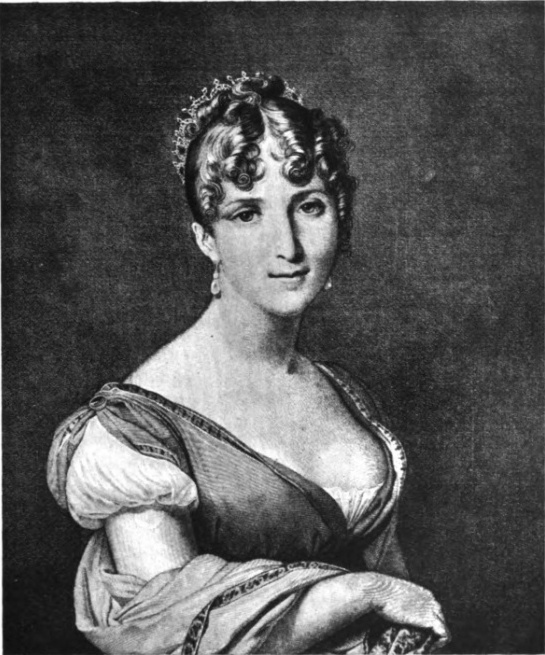
Queen Hortense.
And Louis Napoleon.
The Vicomte de Chateaubriand to the Comte de Saint-leu (Prince Louis Napoleon)
"Paris, 19 May 1832.
"Monsieur le comte,
"It is never easy to reply to praises; but, when he who awards them with as much wit as propriety is moreover in a social condition to which peerless memories are attached, then the difficulty is doubled. At least, Monsieur, we meet in a common sympathy; you with your youth, as I with my old days, desire the honour of France. It needed no more for either of us, to die of confusion or laughter, than to see the juste-milieu blockaded in Ancona[462] by the soldiers of the Pope. Ah, Monsieur, where is your uncle? To others than yourself I should say:
"'Where is the guardian of kings and the master of Europe?'
"In defending the cause of the Legitimacy, I entertain no illusions; but I think that every man who cares for public esteem must remain faithful to his oaths: Lord Falkland, a friend of liberty and an enemy of the Court, got himself killed at Newbury in the army of Charles I. You shall live, Monsieur le Comte, to see your country free and happy; you are passing through ruins among which I shall remain, because I myself form part of those ruins.
"I had for a moment entertained the flattering hope of laying the tribute of my respect, this summer, at the feet of Madame la Duchesse de Saint-Leu: fortune, accustomed to baffle my plans, has deceived me once again. I should have been happy to thank you by word of mouth for your obliging letter; we should have spoken of a great glory and of France's future, two things, Monsieur le Comte, which touch you nearly.
"Chateaubriand."
Have the Bourbons ever written letters to me similar to those which I have just produced? Did they ever entertain the idea that I rose above this versifier or that pamphleteering politician?
When, as a little boy, I used to wander, the companion of the herdsmen, over the heaths of Combourg, could I have believed that a time would come at which I should walk between the two highest powers on earth, powers now overthrown, giving my arm on one side to the family of St. Louis, on the other to that of Napoleon: hostile magnificences which alike lean, in the misfortune which brings them together, on the feeble and faithful man, the man scorned by the Legitimacy?
Madame Récamier went to fix herself at Wolfsberg, a country-house occupied by M. Parquin[463], near Arenenberg, where Madame la Duchesse de Saint-Leu was living; I stayed two days at Constance. I saw all that there was to see: the market containing the public granary christened the "Hall of the Council," the so-called statue of Huss[464], the square in which Jerome of Prague[465] and John Huss were, they say, burnt; in fine, all the ordinary abominations of history and society.
The Rhine, issuing from the lake, announces itself very much like a king: nevertheless it was not able to defend Constance, which was, if I am not mistaken, sacked by Attila[466], besieged by the Hungarians[467], the Swedes[468], and twice taken by the French[469].
Constance is the Saint-Germain of Germany: the old people of the old society have retired to it. When I knocked at a door to look for rooms for Madame de Chateaubriand, I came upon some canoness, a girl past her minority; some prince of an ancient house, an elector on half-pay: which went very well with the abandoned steeples and the deserted convents of the city. Condé's Army fought gloriously under the walls of Constance and seems to have left its ambulance there. I had the misfortune to meet a veteran Emigrant; he did me the honour to have known me in former times; he had more days than hairs; his words were endless; he was unable to contain himself and allowed his years to run.
*
Diner at Arenenberg.
On the 29th of August, I went to dine at Arenenberg.
Arenenberg stands on a sort of promontory in a chain of steep hills. The Queen of Holland, whom the sword had made and whom the sword had unmade, built the château, or, if you prefer, the summer-house of Arenenberg. From it, one enjoys an extensive, but melancholy view. This view commands the Lower Lake of Constance, which is only an expansion of the Rhine over swamped fields. On the other side of the lake, one sees gloomy woods, remains of the Black Forest, a few white birds fluttering under a grey sky and driven by an icy wind. There, after having sat on a throne, after being outrageously slandered, Queen Hortense came to perch upon a rock; below is the isle of the lake on which, they say, the tomb of Charles the Fat[470] was discovered and on which, at present, canaries are dying which ask in vain for the sun of their native islands. Madame la Duchesse de Saint-Leu was better off in Rome; nevertheless, she has not descended in proportion to her birth and her early life: on the contrary, she has risen; her abasement is only relative to an accident of her fortune; this is not one of those descents like that of Madame la Dauphine, who has fallen from all the height of the centuries.
The companions, male and female, of Madame la Duchesse de Saint-Leu were her son, Madame Salvage[471], Madame——-. By way of visitors, there were Madame Récamier, M. Vieillard[472] and myself. Madame la Duchesse de Saint-Leu acquitted herself very well in her difficult position as a queen and a Demoiselle de Beauharnais.
After dinner, Madame de Saint-Leu sat down to her piano with M. Cottreau[473], a tall young painter in mustachios, a straw hat, a blouse, a turned-down shirt-collar, an eccentric costume, who hunted, painted, sang, laughed, in a witty and noisy fashion.
Prince Louis occupies a summer-house standing apart, where I saw arms, topographical and strategical charts; industries which made one, as though by accident, think of the blood of the Conqueror without naming him: Prince Louis is a studious and well-informed young man, full of honour and naturally grave.
Madame la Duchesse de Saint-Leu read me a few fragments of her Memoirs: she showed me a cabinet filled with relics of Napoleon. I asked myself why this wardrobe left me cold; why that little hat, that sash, that uniform worn at such and such a battle found me so indifferent: I was much more perturbed when writing of the death of Napoleon at St. Helena. The reason of this is that Napoleon is our contemporary; we have all seen him and known him: he lives in our memory; but the hero is still too close to his glory. A thousand years hence, it will be a different thing: it is only the centuries that have lent a perfume to Alexander's sweat; let us wait: of a conqueror one should show only the sword.
I returned to Wolfsberg with Madame Récamier and set out at night: the weather was dark and rainy; the wind whistled through the trees and the wood-owl hooted: a real Germanian scene.
Madame de Chateaubriand soon arrived at Lucerne: the dampness of the town frightened her and, as Lugano was too dear, we decided to come to Geneva. We took our route over Sempach: the lake preserves the memory of a battle[474] which ensured the enfranchisement of the Swiss, at a time when the nations on this side of the Alps had lost their liberties. Beyond Sempach, we passed before the Abbey of St. Urban's, crumbling like all the monuments of Christianity. It stands in a melancholy spot, on the skirt of a heath which leads to a wood: if I had been free and alone, I would have asked the monks for a hole in their walls, there to finish my Memoirs beside an owl; then I should have gone to end my days in doing nothing under the beautiful do-nothing sun of Naples or Palermo: but beautiful countries and spring-time have become insults, disasters and regrets.
On reaching Berne, we were told that there was a great revolution in progress in the city; I looked in vain: the streets were deserted, silence reigned, the terrible revolution was realized without a word, to the peaceful smoke of a pipe in the corner of some coffee-house.
Madame Récamier was not long in joining us at Geneva.
A visit to Coppet.
*
Geneva, end of September 1832.
I have begun to take up my work again seriously: I write in the morning and walk in the evening. Yesterday, I went to pay a visit to Coppet. The house was shut up; they opened the doors for me; I wandered through the deserted rooms. The companion of my pilgrimage recognised all the places, where she still seemed to see her friend, seated at her piano, or coming in, or going out, or talking on the terrace alongside of the gallery; Madame Récamier has seen again the room which she used to occupy; days gone by have come up again before her; it was like a rehearsal of the scene which I described in René:
"I passed through the sonorous apartments where nothing was heard but the sound of my footsteps.... Everywhere the rooms were without hangings and the spider spun its web in the abandoned couches.... How sweet, but how rapid are the moments which brothers and sisters pass in their youthful years, gathered under the wing of their old parents! Man's family is but of a day; God's breath disperses it like a bubble. The son has scarce time to know the father, the father the son, the brother the sister, the sister the brother! The oak sees its acorns shoot up around itself: it is not thus with the children of men!"
I also remembered what I said, in these Memoirs, of my last visit to Combourg, before leaving for America. Two different worlds, but connected by a common sympathy, occupied Madame Récamier and myself. Alas, each of us carries within himself one of those isolated worlds; for where are the persons who have lived long enough together not to have separate memories?
From the château, we entered the park; the early autumn began to redden and to loosen a few leaves; the wind fell by degrees and let one hear a stream that turns a mill. After following the alleys along which she had been accustomed to walk with Madame de Staël, Madame Récamier wanted to greet her ashes. At some distance from the park stands a coppice mingled with taller trees and surrounded by a damp and dilapidated wall. This coppice resembles those clusters of trees in the midst of plains which sportsmen call "covers:" it is there that death has driven its prey and shut up its victims.
A burial-place had been built beforehand in that wood to receive M. Necker, Madame Necker and Madame de Staël: when the last of these arrived at the trysting-place, they walled-up the door of the crypt. The child of Auguste de Staël remained outside, and Auguste himself, who died before his child, was laid under a stone, at his relations' feet. On the stone are carved these words taken from Scripture:
Why seek you the living with the dead[475]?
I did not go into the wood; Madame Récamier alone obtained permission to enter it. Remaining seated on a bench before the surrounding wall, I turned my back on France, and fixed my eyes, now on the summit of Mont Blanc, now on the Lake of Geneva: the golden clouds covered the horizon behind the dark line of the Jura; it was as though a halo of glory were rising above a long coffin. On the other side of the lake, I saw Lord Byron's[476] house, the ridge of which was touched by a ray of the setting sun. Rousseau was no more there to admire that spectacle, and Voltaire, who had also disappeared, had never cared about it. It was at the foot of the tomb of Madame de Staël that so many illustrious absentees on the same shore presented themselves to my recollection: they seemed to come to seek the shade their equal to fly away into the sky with her and escort her during the night At that moment, Madame Récamier, pale and in tears, came out from the funeral grove herself like a shadow. If ever I have felt at one time the vanity and the verity of glory and life, it was at the entrance of that silent, dark, unknown wood, where she sleeps who had so much lustre and fame, and when seeing what it is to be truly loved.
With Madame Récamier.
That same evening, the day after my devotions to the dead of Coppet, tired of the edge of the lake, I went, still with Madame Récamier, in search of less frequented walks. We discovered, going down the Rhone, a narrow gorge through which the stream flows bubbling under several mills, between rocky cliffs intersected by meadows. One of these meadows stretches at the foot of a hill on which a house is planted amid a cluster of elms.
We several times climbed and descended, talking the while, this narrow strip of grass which separates the boisterous stream from the silent hillock: how many persons are there whom one can weary with what one has been and carry back with one on the track of one's days? We spoke of those days, always painful and always regretted, in which the passions form the happiness and the martyrdom of youth. Now I am writing this page at midnight, while all is at rest around me, and through my window I see a few stars glimmering over the Alps.
Madame Récamier is going to leave us: she will return in the spring, and I shall spend the winter in evoking my vanished hours, in summoning them one by one before the tribunal of my reason. I do not know if I shall be very impartial nor if the judge will not be too indulgent towards. the culprit I shall spend next summer in the land of Jean Jacques. God grant that I may not catch the dreamer's malady. And then, when autumn shall have returned, we shall go to Italy: "Italian!" that is my eternal refrain.
*
Geneva, October 1832.
Prince Louis Napoleon having given me his pamphlet entitled, Rêveries politiques, I wrote him this letter:
"Prince,
"I have read attentively the little pamphlet which you were so good as to entrust to me. I have jotted down, as you wished, a few reflections, springing naturally from yours, which I had already submitted to your judgment. You know, Prince, that my young King is in Scotland, that, so long as he lives, there can be no other King of France for me than he; but, if God, in his impenetrable counsels, had rejected the House of St. Louis, if the habits of our country did not render the republican state possible, there is no name which goes better with the glory of France than yours.
"I am, etc., etc.
"Chateaubriand."
*
Paris, Rue d'Enfer, January 1833.
I had dreamt much of that approaching future which I had made for myself and which I thought so near. At night-fall, I used to go wandering in the windings of the Arve, in the direction of Salève. One evening, I saw M. Berryer enter; he was returning from Lausanne and told me of the arrest of Madame la Duchesse de Berry[477]; he did not know any details. My plans for repose were once more upset. When the mother of Henry V. believed in her success, she discharged me; her misfortune destroyed her last note and recalled me to her defense. I started on the spot from Geneva, after writing to the ministers. On arriving in my Rue d'Enfer, I addressed the following circular letter to the editors of the newspapers:
"Sir,
"I arrived in Paris on the 17th of this month and wrote, on the 18th, to M. the Minister of Justice[478] to ask if the letter which I had had the honour to send him from Geneva, on the 12th, for Madame la Duchesse de Berry had reached him and if he had had the goodness to forward it to Madame.
"I begged M. the Keeper of the Seals at the same time to give me the necessary authorization to go to the Princess at Blaye.
"M. the Keeper of the Seals was so good as to reply, on the 19th, that he had handed my letters to the President of the Council[479] and that I must apply to the latter. I wrote, consequently, on the 20th, to M. the Minister for War. To-day, the 22nd, I receive his answer of the 21st: he 'regrets to be under the necessity of informing me that the Government does not consider it expedient to grant my request.' This decision has put an end to my applications to the authorities.
"I have never, sir, pretended to think myself capable of defending unaided the cause of misfortune and of France. My plan, if I had been permitted to reach the feet of the august prisoner, was to propose to her, in this emergency, the formation of a council of men more enlightened than myself. In addition to the honourable and distinguished persons that have already come forward, I would have taken the liberty to suggest to Madame's choice M. le Marquis de Pastoret[480], M. Lainé, M. de Villèle, etc., etc.
"Now, sir, that I am officially turned away, I return to my right as a private individual. My Mémoires sur la vie et la mort de M. le Duc de Berry, wrapped in the hair of the widow to-day a captive, lie near the heart which Louvel made to resemble even more that of Henry IV. I have not forgotten that signal honour, of which the present moment asks me for a reckoning and makes me feel all the responsibility.
"I am, sir, etc., etc.
"Chateaubriand."
My circular to the press.
While I was writing this circular letter to the newspapers, I found means to have the following note handed to Madame la Duchesse de Berry:
"Paris, 23 November 1832.
"Madame,
"I had the honour to address to you from Geneva an earlier letter dated the 12th of this month. This letter, in which I begged you to do me the honour to choose me as one of your defenders, has been printed in the newspapers[481].
"Your Royal Highness' cause may be taken up by all those who, without being authorized to do so, might have useful truths to make known; but, if Madame wishes that it be carried on in her own name, it is not one man, but a council of men, of politicians and lawyers, that must be charged with this high affair. In that case, I would ask that Madame would consent to assign to me as coadjutors (with the persons whom she would have already selected) M. le Comte de Pastoret, M. Hyde de Neuville, M. de Villèle, M. Lainé, M. Royer-Collard, M. Pardessus[482], M. Mandaroux-Vertamy[483], M. de Vaufreland.
"I had also thought, Madame, that one might summon to this council a few men of great talent and of an opinion contrary to ours; but perhaps it would be to place them in a false position, to oblige them to make a sacrifice of honour and principle to which lofty minds and upright consciences do not readily lend themselves.
"Chateaubriand."
An old disciplined soldier, I was therefore hastening up to take my place in the ranks and to march under my captains: reduced by the will of the authorities to a duel, I accepted it I had scarcely expected to come, from the tomb of the husband, to fight by the tomb of the widow.
Supposing that I were bound to remain alone, that I had misunderstood what suits France, I was none the less in the path of honour. Nor is it of little use for men that a man should immolate himself to his conscience; it is good that some one should consent to ruin himself to remain steadfast to principles of which he is convinced and which have to do with what is noble in our nature: those dupes are the necessary contestants of the brutal fact, the victims charged to utter the veto of the oppressed against the triumph of might. We praise the Poles: is their devotion other than a sacrifice? It has saved nothing; it could save nothing: even in the minds of my opponents, will that devotion be barren of results for the human race?
I prefer a family before my country, they say: no, I prefer fidelity to my oaths before perjury, the moral world before material society; that is all: in so far as the family is concerned, I devote myself to it because it was essentially beneficial to France; I confound its posterity with that of the country and, when I deplore the misfortunes of the one, I deplore the disasters of the other: beaten, I have prescribed duties to myself, even as the victors have laid interests upon themselves. I am trying to withdraw from the world with my self-respect; in solitude we have to be careful whom we choose for our companion.
*
On the arrest of Madame.
In France, the land of vanity, so soon as an occasion offers for making a fuss, a crowd of people seize it: some act from good-heartedness, others from their consciousness of their own merits. I therefore had many competitors; they begged, as I had done, of Madame la Duchesse de Berry, the honour to defend her. At least, my presumption in offering myself to the Princess as a champion was a little justified by former services; though I did not fling the sword of Brennus[484] into the scale, at least I put my name there: however unimportant that may be, it had already gained some victories for the Monarchy. I opened my Mémoire sur la captivité de Madame la duchesse de Berry[485] with a consideration by which I am forcibly struck; I have often reprinted it, and it is probable that I shall reprint it again:
"We never cease," I said, "to be astonished at events; ever we imagine that we have come to the last; ever the revolution recommences. Those who, since forty years, are marching to reach the goal, repine; they thought they were sitting for a few hours by the edge of their tomb: vain hope! Time strikes those travellers gasping for breath, and forces them to move onward. How many times, since they have been on the road, has the Old Monarchy fallen at their feet! Scarce escaped from those successive crumblings, they are obliged once more to pass over its rubbish and its dust. Which century will see the end of the movement?...
"Providence has willed that the transient generations destined for unremembered days should be small, in order that the damage might not be great. And so we see that everything proves abortive, that everything is inconsistent, that no one is like himself or embraces his whole destiny, that no event produces what it contained and what it ought to produce. The superior men of the age which is expiring are dying away; will they have successors? The ruins of Palmyra end in sands."
Passing from this general observation to particular facts, I show, in my reasoning, that they might deal with Madame la Duchesse de Berry by arbitrary measures, regarding her as a prisoner of police, of war, of State, or asking the Chambers to pass a bill of attainder; that they might bring her within the competence of the laws by applying to her the Briqueville Law of Exception or the common law of the Code; that they might regard her person as inviolable and sacred. The ministers maintained the first opinion, the men of July the second, the Royalists the third.
I go through the several suppositions: I prove that, if Madame la Duchesse de Berry made a descent upon France, she had been drawn thither only because she heard men's opinions asking for a different present, calling for a different future.
False to its popular extraction, the revolution proceeding from the Days of July repudiated glory and courted shame. Except in a few hearts worthy of giving it an asylum, liberty, become the object of the derision of those who made it their rallying-cry, that liberty which buffoons bandy about with kicks, that liberty strangled after dishonour by the tourniquet of the laws of exception will, through its destruction, transform the Revolution of 1830 into a cynical fraud.
Thereupon, and to deliver us all, Madame la Duchesse de Berry arrived. Fortune betrayed her; a Jew sold her; a minister bought her[486]. If they are not willing to proceed against her by police measures, the only alternative is to indict her at the assizes. I suppose this to have been done, and I bring on the stage the Princess's defending counsel; then, after making the defending counsel speak, I address the counsel for the prosecution:
My pamphlet.
"Advocate.... stand up....
"Establish learnedly that Caroline Ferdinande of Sicily, Widow de Berry, niece of the late Marie-Antoinette of Austria, Widow Capet, is guilty of opposition to a man, the reputed uncle and guardian of an orphan called Henry, which uncle and guardian is said, according to the calumnious allegation of the prisoner, unlawfully to detain the crown of a ward, which ward impudently pretends to have been King from the day of the abdication of the ex-King Charles X. and the ex-Dauphin till the day of the election of the King of the French....
"In support of your argument, let the judges first call up Louis-Philippe as evidence for or against the prisoner, unless he prefer to excuse himself as a kinsman. Next, let the judges confront the prisoner and the descendant of the Great Traitor; let the Iscariot into whom Satan had entered[487] say how many pieces of silver he received for the bargain.
... Then it will be proved, by those who have examined the spot, that the prisoner for six hours suffered the Gehenna of fire in a space too narrow for her, in which four people could hardly breathe, which caused the tortured person contumeliously to say that they 'were making war upon her as though she were a St. Laurence[488]. Now, Caroline Ferdinande being pressed by her accomplices against the red-hot slab, her clothes twice caught fire, and, at each blow of the gendarmes on the outside of the fiery furnace, the shock was communicated to the prisoner's heart, causing her to vomit blood.
"Next, in the presence of the image of Christ, they will lay on the desk, as a piece of direct evidence, the burnt garments: for there must always be lots cast upon garments in these Judas bargains."
*
Madame la Duchesse de Berry was set at liberty by an arbitrary act of the authorities, after they thought that they had dishonoured her. The picture which I drew of the proceedings made Philip see the invidiousness of a public trial and determined him to grant a pardon to which he believed that he had attached a punishment: the pagans, under Severus[489], used to throw to the lions a newly-delivered young Christian woman. My pamphlet, of which only some phrases survive, had its important historical result.
I am melted again, as I copy out the apostrophe which ends my work; it is, I admit, a foolish waste of tears:
"Illustrious captive of Blaye, Madame! May your heroic presence in a land which knows something of heroism lead France to repeat to you what my political independence has won for me the right to say:
"'Madame, your son is my King!'
"If Providence inflict yet a few hours upon me, shall I behold your triumphs, after having had the honour of embracing your adversities? Shall I receive that guerdon of my faith? At the moment when you return happy, I would joyfully go to end in retirement the days commenced in exile. Alas, I am disconsolate to be able to do nothing for your present destinies! My words die away in mere waste around the walls of your prison: the noise of the winds, of the waves and of men, at the foot of the lonely fortress, will not even allow the last accents of a faithful voice to ascend to where you are."
Paris, March 1833.
Some newspapers, having repeated the phrase, "Madame, your son is my King!" were indicted in the courts for a press offense; I found myself involved in the proceedings. This time, I could not take exception to the competency of the judges; I had to try to save by my presence the men attacked for my sake; my honour was at stake and I had to answer for my works.
Moreover, the day before my summons before the court, the Moniteur had given the declaration of Madame la Duchesse de Berry[490]; if I had stayed away, they would have thought that the Royalist Party was retreating, that it was abandoning misfortune and blushing for the Princess whose heroism it had celebrated.
There was no lack of timid counsellors who said to me:
"Do not put in an appearance; you will be too much embarrassed with your phrase, 'Madame, your son is my King!'"
"I shall shout it louder than ever," I replied.
I went to the very court where the revolutionary tribunal had formerly been installed, where Marie-Antoinette had appeared, where my brother had been condemned. The Revolution of July has ordered the removal of the crucifix whose presence, while consoling innocence, caused the judge to tremble.
My trial in Paris.
My appearance before the judges had a fortunate effect; it counterbalanced for a moment the effect of the declaration in the Moniteur and maintained the mother of Henry V. in the rank in which her courageous adventure had placed her: men hesitated, when they saw that the Royalist Party dared to face the event and did not consider itself beaten.
I did not want a counsel, but M. Ledru, who had attached himself to me at the time of my imprisonment, wished to speak: he grew disconcerted and gave me great uneasiness. M. Berryer, who represented the Quotidienne, indirectly took up my defense. At the end of the proceedings, I called the jury the "universal peerage," which contributed not a little towards the acquittal of all of us[491].
Nothing remarkable occurred to signalize this trial in the terrible chamber that had resounded with the voices of Fouquier-Tinville and Danton; there was nothing amusing in it, except the arguments of M. Persil[492]: wishing to prove my guilt, he quoted this phrase from my pamphlet, "It is difficult to crush what flattens itself underfoot," and, exclaiming, "Do you feel, gentlemen, all the scorn comprised in that paragraph, 'It is difficult to crush what flattens itself underfoot'?" he made the movement of a man who crushes something under his feet He resumed his speech triumphantly: the laughter of the audience was renewed. The worthy man perceived neither the delight of the audience at his unlucky phrase nor the perfectly absurd figure which he cut while stamping his feet, in his black robes, as though he were dancing, at the same time that his face was pale with inspiration and his eyes haggard with eloquence.
When the jury returned and pronounced their verdict of "not guilty," applause broke out and I was surrounded by young men who had put on barristers' robes to get in: M. Carrel was there.
The crowd increased as I went out; there was a scuffle in the court-yard of the palace between my escort and the police. At last, I succeeded, with great difficulty, in reaching home in the midst of the crowd which followed my cab shouting:
"Long live Chateaubriand[493]!"
I am acquitted.
At any other time, this acquittal would have been very significant; to declare that it was not guilty to say to the Duchesse de Berry, "Madame, your son is my King!" was to condemn the Revolution of July; but to-day this verdict means nothing, because there is no opinion nor duration in anything. In four and twenty hours, everything is changed: I should be condemned to-morrow for the fact on which I was acquitted to-day.
I have been to leave my card on the jurymen and notably on M. Chevet[494], one of the members of the "universal peerage." It was easier for that worthy citizen to find a conscientious verdict in my favour than it would have been for me to find in my pocket the money necessary to add to the happiness of my acquittal the pleasure of eating a good dinner at my judge's establishment: M. Chevet arbitrated with more equity on the Legitimacy, the Usurpation and the author of the Génie du Christianisme than many publicists and censors.
*
Paris, April 1833.
The Mémoire sur la captivité de madame la duchesse de Berry has obtained for me an immense popularity in the Royalist Party. Deputations and letters have reached me from every quarter. I have received from the North and South of France declarations of adhesion covered with many thousands of signatures. All of these, referring to my pamphlet, demand the liberation of Madame la Duchesse de Berry. Fifteen hundred young men of Paris have come to congratulate me, not without great excitement on the part of the police. I have received a cup in silver gilt, with this inscription:
To Chateaubriand from the loyal men of Villeneuve (Lot-et-Garonne)
A town in the South sent me some very good wine to fill this cup, but I do not drink. Lastly, Legitimist France has taken as its motto the words, "Madame, your son is my King!" and several newspapers have adopted them as an epigraph; they have been engraved on necklaces and rings. I am the first to have uttered, in the face of the Usurpation, a truth which no one dared to speak, and, strange to say, I believe less in the return of Henry V. than the most contemptible juste-milieu man or the most violent Republican.
For the rest, I do not understand the word usurpation in the narrow sense given to it by the Royalist Party; there would be many things to say about this word, as about that of legitimacy: but there really is usurpation, and usurpation of the worst kind, in the guardian who plunders his ward and proscribes the orphan. All those grand phrases, that "the country had to be saved," are so many pretexts furnished to ambition by an immoral policy. Truly, ought we not to regard the meanness of your usurpation as an effort of virtue on your part? Are you Brutus[495], by chance, sacrificing his sons to the greatness of Rome?
I have been able, in the course of my life, to compare literary renown and popularity. The former pleased me for a few hours, but that love of renown soon passed. As for popularity, it found me indifferent, because, in the Revolution, I have seen too much of men surrounded by those masses which, after raising them on the shield, flung them into the gutter. A democrat by nature, an aristocrat by habit, I would most gladly sacrifice my fortune and my life to the people, provided I need have little relation with the crowd. Anyhow, I was extremely sensible of the impulse of the young men of July who carried me in triumph to the Chamber of Peers, and this inasmuch as they did not carry me there to be their leader or because I thought as they did: they were only doing justice to an enemy; they recognised in me a man of honour and liberty: that generosity touched me. But this other popularity which I have lately acquired in my own party has caused me no emotion; there is an icy barrier between the Royalists and myself: we want the same King; with that exception, most of our wishes are opposed one to the other.