INTRODUCTION.
Reading edition
The Middle Ages are usually considered to have closed between 1490 and 1500, only one century previous to the birth of that Marquis of Worcester to whom posterity is indebted for his ever memorable publication, the “Century of Inventions,” of which a reprint is now before the reader. It records the earliest full, though brief, sketch of a practically working Steam-Engine; an invention which, whether in relation to the age in which it was produced, or the difficulties under which it was wrought out, cannot be considered otherwise than as a marvellous effort of ingenuity. The literature and science of that era, as compared with the progressive stages of improvement distinguishing the two succeeding centuries, were barren and meagre indeed. Hallam justly observes: “Learning, which is held pusillanimous by the soldier, unprofitable by the merchant, and pedantic by the courtier, stands in need of some countenance from the ruling powers before whom all three bow down.” But even at that early period Leonardo da Vinci, born 1452, had anticipated Lord Bacon in the universally accepted principle, that experiment and observation must ever be the only sure guides to the forming of just theories in the investigation of nature.
The “Century of Inventions” derives its name rather from the circumstance of the work containing one hundred articles, than the same number of inventions. Its noble author may have had in mind the Centuria di Secreti Politici, Cimichi, e Naturali, by Francesco Scarioni of Parma, duodecimo, printed at Venice in 1626, when he fixed on the quaint title of his own remarkable production.
Among the Harleian Manuscripts in the British Museum Library is a manuscript copy of the “Century,” the title of which omits the words “at the instance of a powerful friend,” also the motto, date, dedications, and author’s name. It also differs in other respects from the printed edition, by introducing “A stamping Engine” as the 88th article, in place of which its author has printed his account of “A Brazen Head;” the concluding article likewise varies, especially in closing with a short notice of “three sorts” of other inventions “set down in cypher,” but which do not appear. The top of the title page has written on it “From August ye 29th to Sept. ye 21st 1659,” probably by the copyist, to notify the time occupied in writing.
The first edition was printed in 1663, during the author’s lifetime, as he died in 1667; and the last edition, with notes by Mr. C. F. Partington, is dated 1825. This last edition professes on the title page to be “from the Original Manuscript”; and, at page 6, alludes to “a manuscript in the Marquis’s handwriting, having been preserved in the Harleian Collection, appended to an original copy of the Century of Inventions.” Now, as no other manuscript is known to exist, it is important to state distinctly that the Manuscript Century in question is neither original nor yet in the handwriting of the Marquis; it is evidently no more than one of those copies, which it was then a common practice to circulate; and the MS. bound up in the same volume with this interesting document, relating to a method of “Cypher writing,” is not in the Marquis’s handwriting.
So far, therefore, from “The Century of Inventions of the Marquis of Worcester, from the Original MS.” being what it thus distinctly professes, it is an amalgamation of the Harleian MS. copy, and the first printed edition. This obliges the introduction of two Nos. 88; but unfortunately there is neither mark, note, nor observation to guide or guard the reader even as to the editor’s numerous emendations; and the result has been such as to render this the most unreliable of all the reprints of the “Century,” which will appear more evident by the unauthorised readings, marked P, in the notes.
The “Century” remained in manuscript from 1655, the period of its author’s release from the Tower, until 1663, the date of the first printed edition; the title page of which repeats the date of its composition, adding, “my former notes being lost;” as he was, however, the inventor of many ciphers or kinds of short-hand, it is probable his lost notes would be written so as to be unreadable without the key. It was printed soon after the passing of the Act for his “Water-commanding Engine,” which is mentioned in the Dedication to the Houses of Parliament.
It has been frequently reprinted singly, as well as produced entire in larger works, of all which publications a list is hereunto annexed.
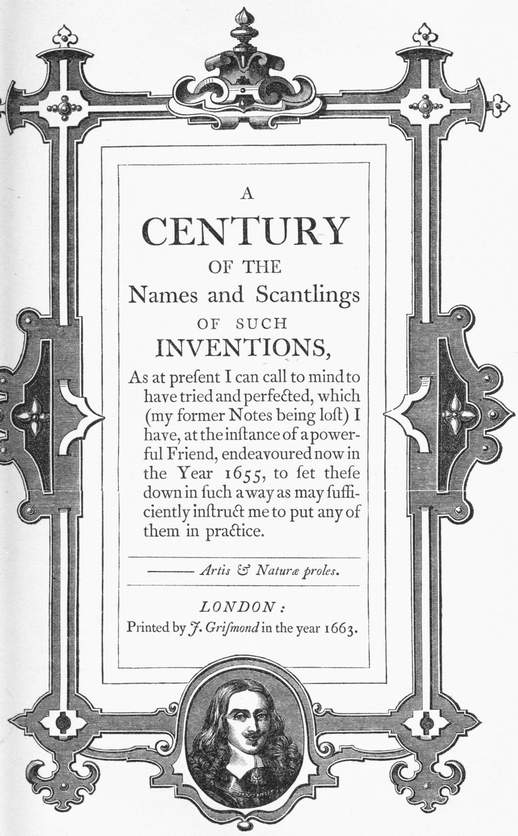
We subjoin the title pages of the “Century”:—
From the Harleian MS. in the British Museum.
“From August ye 29th to Sept. ye 21st, 1659.
From the printed edition of 1663.
“A Century of the names and scantlings of such Inventions as att present I can call to mynde to have tryed, and perfected; (my former notes being lost) I have endeavoured to sett these downe in such a way, as may sufficiently instruct me to putt any of them in practice havinge wherewith to doe it.”
“A Century of the Names and Scantlings of such Inventions, As at present I can call to mind to have tried and perfected, which (my former notes being lost) I have, at the instance of a powerful Friend, endeavoured now in the year 1655, to set them down in such a way as may sufficiently instruct me to put any of them in practice.”
“Artis et Naturæ prole.”
The peculiar term “Scantlings,” here employed, is no doubt derived from eschantillon, a pattern or quantity cut for a particular purpose, a certain small quantity serving as a sample of some similar larger piece of work; the “Century” being intended by its author as but the precursor of his proposed ample, finished, descriptive and illustrated production.
No one unacquainted with the state of scientific knowledge between 1601 and 1667, can justly estimate the character and value of the Marquis’s labours. Properly to understand him the reader must place himself as much as possible in his actual condition, peruse the books that he might have read, and consider the existing state of society and science. No commentator has yet done this, and consequently a serious difficulty has been thrown in the way of the purely classical scholar, who, though he might fairly estimate the Marquis’s character on points of history, learning, or theology, could in no way turn to account his one hundred extraordinary inventions. When Walpole composed his “Catalogue of Royal and Noble Authors,” the capricious cynic was sorely perplexed how to treat such a literary production as the “Century.” It has been said of the wit that he had so disparaged all things in his own eyes, that nothing appeared to him worthy of admiration, respect, or emulation; and it is no wonder, therefore, that he should cover his own ignorance on scientific matters by declaring the book he affected to criticise, “an amazing piece of folly;” closing his flippant strictures with the sapient remark, “But perhaps too much has been said on so fantastic a man; no wonder he believed transubstantiation, when he believed that himself could work impossibilities!”
David Hume was equally at fault in comprehending the mechanical skill of the Marquis of Worcester, for we find the eloquent historian, in his History of England, in perfect simplicity and ignorance, observing, “That the King judged aright of this nobleman’s character, appears from his Century of arts or scantling of inventions, which is a ridiculous compound of lies, chimeras and impossibilities, and shows what might be expected from such a man!” That the “Century” shows “what might be expected from such a man,” as its author, all must willingly admit; but that Hume’s pungent tirade presents any logical sequence, all must as strenuously deny. Never surely did two talented writers, in different departments of our literature, figure so unfortunately and contemptibly as Walpole and Hume in their unseemly efforts thus to misrepresent and malign their country’s noblest mechanical genius.
Verstegan, in his “Restitution of decayed Intelligence,” printed at Antwerp in 1605, treating in the second chapter of Germany as it was of old, exclaims: “And as touching the knowledge of the people, what learning or skill is there among men that they exceed not in.” And proceeds—“Sundry most rare inventions have had their original and birth among them. Whereof the noble art of printing, and the use of Artillery, are of most note.” He then goes on to enumerate “the heaven of silver,” a piece of exquisite workmanship which it took twelve men to carry; and the wonderful flying “eagle made of wood.”
We in the 19th century are ever liable to misunderstand the inventions of the 17th century. Either the inventions often appear puerile, or their authors seem perplexed on very small occasions of difficulty. Many have no doubt hastily formed opinions in regard to the automata and other curiosities of the “Century.” But such judgments can only emanate from persons not versed in our history and literature from Elizabeth to Charles the Second’s reign. A few brief illustrations may be advantageously offered here, to show that within a very short period after the death of the Marquis of Worcester, scientific men, in mechanical matters, not only seldom rose above very slight improvements, but were at the same time delighted with every species of amusing mechanical device.[A]
The late Marquis’s nephew, then Lord Herbert, being on the Continent, writes from Blois, 18th July, 1674:[B] —“We are again settled here for this summer. In our passage from Aix we saw at Lyons the most curious closets of Monsieur Cervier, which for mathematical Inventions and Machines (all his own handywork) are the most surprising and astonishing, I believe, in the world. His many pretended Perpetual Motions, Hydraulic Dials, various Clocks and Hour-glasses, his Engines of Sympathy and Antipathy; but above all his device to discover the most predominant quality in every spectator, are past my comprehension and conception. These, and a hundred other things there, might be well worthy a journey in this long vacation for one of your experimentators.”
In the 21st volume of the Royal Society’s Transactions, for 1685, Dr. Papin, describes the external appearance, and the performance, of a small hydro-pneumatic fountain, which is represented in an engraving, as being enclosed by a cylindrical glass, under a glass shade. The Doctor states that it might be seen at his house, in operation on his mantel-piece, where Dr. Hook had watched it for half an hour, and other visitors for four hours together. The secret had been communicated to Mr. Boyle, but, with a view to excite the speculations of the ingenious, was not made public; for it was the pleasure of the learned to puzzle each other with such paradoxes.
The Diaries of John Evelyn and of Samuel Pepys offer numerous instances of the possession of similar cabinets of mechanical curiosities.
In the Life of Baron Guilford,[C] we have a fuller notice of scientific society about the same period, of which the following extracts will suffice to give a clear idea. It is evident that, except as relates to the most ancient, approved appliances, then in common use in the mechanical arts, all mechanical improvement beyond these was in its non-age; so much indeed was this the case, that no invention was too simple, and scarcely any too outrageous or absurd, to be esteemed unworthy of being submitted to the attention of the learned.
“His Lordship was no concealed virtuoso; for his diffused acquaintance and manner of conversation, made him known and esteemed, as a professor of most polite arts, and given to scientific inquiries. This brought upon him an importunity to be admitted a member of the Royal Society. But his Lordship never countenanced the proposal; and at length, gave his positive denial. He esteemed it a species of vanity for one, as he was, of a grave profession, to list himself of a society which, at that time, was made very free with by the ridiculers of the town: and he could not discover what advantage of knowledge could come to him that way, which he could not arrive at otherwise.”
Among his acquaintance were “Sir John Werden—very far gone in the mystery of algebra and mathematics.—
“One Mr. Aubrey of Surrey, a professed virtuoso, and always replete with new discoveries.
“One Mr. Weld, a rich philosopher, lived in Bloomsbury. He was single, and his house a sort of knick-knack-atary. Most of the ingenious persons about town, sometimes visited him; and, among the rest, (his Lordship) did suit and service there.
“His Lordship was once invited to a philosophical meal, at the house of Mr. Evelyn at Deptford. The house was low, but elegantly set off with ornaments and quaint mottos at most turns; but, above all, his garden was exquisite, being all boscoresque.
“He had a great value for Sir Jonas Moor, a capital mathematician, knowing well his worth and honesty, ... (he) once invited his Lordship to dine with him in the Tower, and, after dinner, presented Mr. Flamstead ... the star-gazer (who was) invited to come and see him.”
He “had another virtuoso acquaintance in the Temple, one Mr. Ball ... one in the list of his Lordship’s ingenious acquaintance.”
“And once, upon an invitation, his Lordship dined with Sir Samuel (Morland) at his house; and though his entertainment was exquisite, the greatest pleasure was to observe his devices; for every thing showed art and mechanism, as—1. A fountain in the room.—2. A cistern in his garret—supplying all parts of the house.—3. His coach was most particular.—4. A portable engine, moved by watch-work—it had a fire-place and grate,—cost £30. He took it with him in his own coach, and, at inns, he was his own cook.”
These notices afford a glimpse of the early progress of mechanical science. To return to our remarks on the “Century;” two of the articles the Marquis borrowed, No. 21, “A Bucket fountain,” of which he obtained information at Rome; and No. 26, “A to and fro Lever,” which he saw at Venice. A great number refer to Cipher writing and means of holding secret correspondence, many of which contrivances depend on very slight modifications, so that, although only twenty-three are set down, he might very easily have enlarged this one subject tenfold, only to arrive at still more extended conclusions. His engine is noted under the articles Nos. 68, 98, and 100, as, a fire water-work; a semi-omnipotent engine; and a stupendous water-work. So that discarding 2, and reducing these three to one, will leave 96 inventions emanating from the Marquis. But a further reduction might be made, if we strike out the additions made to the list, thus: No. 9 is “a ship destroying engine,” but No. 10 is only the means whereby to fasten it; and No. 11, a mode of preventing the operation of the engine, in the hands of an enemy. Now in strictness the whole can only be considered as one invention. So likewise, in his improvements on Fire-arms; No. 61, is a way for Muskets, No. 62, for Harquebusses, and No. 63, for Sakers, &c. which again can but be taken as representing one invention variously applied. These examples would remove four other inventions from the list, thereby reducing the number of inventions, due to the Marquis of Worcester in the Century, to 92. But this rather explains the plan adopted in indicating the several inventions, and in no way detracts from the value of the work.
The Inventions may be thus classified:
3 refer to Seals and Watches. 2 . . . Games. 2 . . . Arithmetic and Perspective. 6 . . . Automata. 23 . . . Ciphers, Correspondence, and Signals. 10 . . . Domestic affairs. 9 . . . Mechanical appliances. 32 . . . Naval and Military affairs. 13 . . . Hydraulics and the Water Engine. —– 100
The very incongruous character of these matters is suggestive of their having occurred to the inventive mind of the Marquis at very different times, at remote intervals, and under varied circumstances; they might occasionally have resulted from his reading, his studies, or his experiments. He evidently availed himself of every suggestion that either reading, accident, experience, or travel threw in his way. His domestic life led to light, amusive, and mechanical exercises; while his military operations drew him to consider improvements in ordnance, fire-arms, and military and naval affairs generally.
All we know regarding the origin of the work itself is derived from the author’s title page, wherein he states that it was written in 1655, his “former notes” then “being lost.” He consequently sets down “at the instance of a powerful friend,” only those inventions he “can call to mind to have tried and perfected.” This explicit language admits of no doubtful construction, yet he has been maligned by the envious as recording dreams and fancies. The Century closes with the remarkable declaration of his “meaning to leave to posterity a book, wherein under each of these heads the means to put in execution and visible trial all and every of these inventions, with the shape and form of all things belonging to them, shall be printed by brass-plates.” An intention which his premature decease rendered unavailing, yet sarcastic writers have not been wanting to stigmatize the “Century” as though its author had offered it to public approbation as a complete work; making no allowance for the circumstances under which it was produced, as a mere syllabus of the intellectual treasures he possessed, or the sad occurrence to which alone the non-completion of his promised publication with engravings of his several designs can be attributed.
Some of his inventions he specially notices to signify their practical development. Thus No. 56, he performs at the Tower before Charles I, most of his Court, and the Lieutenant, Sir William Balfour.
No. 64, an improvement on fire-arms, was “tried and approved before the King (Charles I.), and an hundred Lords and Commons.”
Nos. 59 to 67, further improvements on fire-arms and cannon, occasion his particularly stating that:—“by several trials and much charge I have perfectly tried all these.”
No. 77, his scheme for flying, whatever it might have been, whether a balloon, wings, or a machine, yet even of this he says—“which I have tried with a little boy of ten years old.”
Lastly, No. 100, a water-work is spoken of as “by many years experience and labour, advantageously contrived.” And connected with this water-raising subject we may take No. 68, of which he says:—“I have seen the water run like a constant fountain-stream forty feet high.” This is not the language of a speculative theorist. It is experimental, practical, and demonstrative.
Considering the vast sums expended by the Marquis on his experimental and on his practical works, the immense variety of his inventions, and the extreme novelty and singularity of many, it is rather surprising that no account of any of them has come down to our time, through some of the many channels of information then open to receive any accounts of the marvellous. Our next surprise is that none of the many cabinets of the curious seem to have possessed any model or any curious work of his production; not even the indefatigable Tradescant, although his museum was at Lambeth, bought by Ashmole, and given by him to the Bodleian Museum at Oxford. The Marquis did, however, present a peculiarly constructed box to Charles the Second, and he offered an improvement on it to the Earl of Lotherdale,[D] remarking:—“I promise your Lordship a box, with such conveniences and rarities as that which you saw had,—though it were a presumption in me to say, I would give a subject a better qualified present than I gave my Sovereign.” The invention might refer to the Cabinet mentioned in article No. 79, of the Century, as well as include some of his ingenious escutcheons, keys, and locks.
We cannot but suppose that the Marquis was intimately acquainted with the published works of the renowned Roger Bacon, born in 1212, and who died at Oxford in 1292, celebrated for his proficiency in mathematics, mechanics, and chemistry. In his “Discovery of miracles of Art,” published 1659, there occurs the following passage:—“A man may easily make an instrument, whereby one man may, in despite of all opposition, draw a thousand men to himself, or any other thing, which is tractable.”
The Marquis has left in manuscript a list of nine inventions, due to the “Quint-essence of Motion,” by means of which, he says in the 8th section,—“I can stop any other man’s motion, and render it null, since from any point of the compass, I can forcibly and effectually cause a counter-buff, or absolute obstruction to such motion, which way I please; all ways being indifferent to me, to work a perfect resistance, and to countermine their intentions, or to force their motions a clear contrary way.”[E]
What may be the meaning of either statement it is difficult to imagine; or even to decide whether they be really allied to each other, for although in some respects alike, each is very enigmatical.
We have also given in the “Life,” at page 216, a copy of a MS. list of heads of some inventions, among which occurs:—“Intelligence at a distance communicative, and not limited to distance, nor by it the time prolonged.” The wording of which article as clearly as possible expresses what in modern times has actually been attained by the magnetic and the electric telegraph. The “not limited to distance,” and the “time not prolonged” appear conclusive. Wires, tubes, or other mechanical means of communication would necessarily be “limited to distance;” and that which alone we believe to be illimitable through, any human agency is electricity. Truly the Marquis of Worcester was a man of no ordinary stretch of mind.
The “Century” has but slender claims to our notice as a literary performance. Some persons have even imagined that it would have been fortunate for the character of its noble author had it never been written. This is a mistaken view of the subject. In the absence of his elaborated work, it is fortunate that this precious relic has come down unmutilated to our time. It is but as a sketch compared with the finished picture, but we realize the master-hand in the brief outline, and feel conscious of the intelligence and versatile genius of the mind that could conceive, work out, and minutely register the forming of alphabets, automata, ordnance, and finally “a semi-omnipotent engine.” His work has two dedications, one addressed to Charles the Second, the other to both Houses of Parliament, composed in a quaint but courtly style. He mingles classic lore with every-day proverbs. He re-entitles his book as a “summary collection,” and a “Century of summary heads of wonderful things,” as “experiments extant and comprised under these heads practicable with my directions,” and is convinced of “The treasures buried under these heads both for War, Peace and Pleasure being inexhaustible;” concluding that it is a “Century of Experiences perhaps dearly purchased” by him.
He also touches on his pecuniary position, offering, in case he is assisted with the patronage and support sought, “to outgo the £6 or £700,000 already sacrificed;” alludes to “the melancholy which hath lately seized” upon him; and to his work-place at “great expenses made fit for public service,” amounting to about £10,000, “yet lately like to be taken” from him.
He assures Parliament that his several inventions are “practicable with my directions, by the unparalleled workman both for trust and skill, Caspar Kaltoff’s hand, who hath been these five and thirty years as in a school under me employed.” So that, dating from 1663, when he made this statement, we are thus carried back to the year 1628, about the period of his first marriage, and the whole comprises a space of time from the 27th to the 62nd year of his age. How had he employed the peaceable portion of those 35 years? It seems to have been peculiar to the noble experimenter to keep his favourite workman fully employed in putting into practice whatever was known, and in that way establish his own improvements. We can find some analogous device in old scientific writings for the greater part of the subjects he investigated; and it is no disparagement of his ingenuity to say that his refinements may often be traced to the crude efforts made by others to attain similar results. Italy, Germany, Holland, and France abounded in authors whose works we may easily imagine formed a favourite portion of his library; Vitruvius, Vegetius, Hero, Ramelli, Branca, De Caus, Fludd, Besson, Van Etten, Schwenter, Porta, Lana, and other similar tomes replete with engraved brass, copper, and wood-engravings. But the English press likewise produced such works, as Bourne’s Inventions, 1578; Lucar’s Lucar-solace, 1590; Bate’s Mysteries of Art, 1634; Wilkins’ Mathematical Magick; Porta’s Natural Magick, 1658; De Caus’ New and Rare Inventions, 1659, &c. Of all these we are disposed to think that Bate’s Mysteries of Nature and Art was an early favourite; the second edition appeared in 1635, when the Marquis was 34 years of age. The first portion of the work on “Water-works” opens with the observation: “It hath beene an old saying amongst Philosophers, and experience doth prove it to bee true, Non datur vacuum, that is to say, Nature will not admit of any vacuity or emptinesse. For some or other of the Elements, but especially Ayre and Water, doe insert themselves into all manner of concavities, or hollownesses, in, or upon the earth, whether they are such as are formed either by Art or Nature.” Through 82 pages the same subject of Water-works is carefully examined, and at page 57, is a description with engravings of “the Watermill or Engine neare the North end of London Bridge.”
In the composition of the “Century,” we notice several peculiarities which may sometimes be accounted for by the writer having caught the style of certain English authors. In a letter dated 30th of August, 1646, he quotes the proverb, “a child burned dreads the fire,” and in the “Century” we find the word “child” occurring six times to indicate little power or strength being required. The word “conceited” is used three times in the sense of ingeniously contrived. All these modes of expression are also peculiar to Bate, Plat, and the translation of Van Etten. The “twinkling of an eye” is an expression used twice. The article No. 15, is “A boat driving against wind and tide;” in Humane Industry, 1661, appears—“a way to drive their ships without oar.” The term “admirable” is common to Bate and to the Marquis; and so is another, that of the word “force,” peculiarly used in article No. 68, when he speaks of the “vessels” being “strengthened by the force within them:” really meaning no more, as appears, than some kind of pump-force or plunger acting the part of a valve to diminish any superabundant steam pressure; and not, as is perplexingly supposed, that he had some contrivance for making the expansive force of the steam within the boiler act of itself to strengthen the vessel!
When we read in article No. 56, the expression, “A most incredible thing if not seen,” and find Dr. Dee, in his preface to Euclid, expressing himself on a kindred subject, that it is—“A thing almost incredible,” we cannot refuse to believe from internal evidence that the author was from natural inclination well acquainted with that early English translation. The range of such studies as he delighted in, taken from the reign of Elizabeth to the troubled times of Charles the First, or even later, was very restricted; therefore a course of scientific reading would soon be exhausted by an indefatigable inquirer, who would then probably settle down to being satisfied with a small but chosen collection of his favourite authors. It is not only in traits of language that we see a resemblance in such early authors, but equally do we find a certain agreement in their matter. John Bate, for example, mingles the great with the small, the serious with the ludicrous; he has philosophical experiments, a great water-work, amusive toys, pyrotechny, drawing, and medical recipes arranged in four books; and the several editions appear to have enjoyed an amount of popularity which has made any of them very scarce in a perfect form.
A careful perusal of the “Century” will satisfy the reader that its contents relate principally to the practical and useful, notwithstanding that some appear of doubtful value, and some even paradoxical. The variety of cannon and musquetry is singular, the improvements in ships and fortifications quite surprising, and in various mechanical appliances remarkably ingenious. But, after all, what was the special design of its author; what was he principally seeking to establish through this wide course of investigation? It is evident he sought some mechanical power to supersede ordinary wind, water, and animal power. He tried weights and springs, screws and levers, and finally he filled a piece of a cannon three-quarters full of water, which, after making a fire under it, “burst and made a great crack.” The aim and object of all his laborious experiments was now attained, and from the day when he thus burst the cannon, steam power was realized, its application pursued, various kinds of machines constructed, and the strangeness, novelty, and power of the new engine were such that he declared, as in an ecstacy of delight, “I call this A Semi-omnipotent Engine, and do intend that a model thereof be buried with me.” Nay, more, he bowed down in adoration before his Maker, rendering him most humble thanks for vouchsafing him “an insight in so great a secret of nature.”
It is worth remarking, that the very form of the “Century” was rather due to a custom among scientific inventors than to any whim on the part of its author. In the 13th century, Wilars de Honecort had given a statement of fourteen inventions. In like manner Leonardo da Vinci, of ten various schemes for bridges, ditches, fortifications, and others, military and naval. So again Ralph Rabbards in 1574, Edmund Jentill in 1594, and Henry Marshall in 1595, gave notices of their several discoveries in medical waters, fire-works, and mechanical devices. In 1583, appears a MS. note of twenty “sundry sorts of engynes.” In 1596, Lord Napier wrote concerning his four “secret inventions,” concluding:—“These inventions, besides devices of sailing under water, with divers other devices and stratagems for harming of the enemies, by the grace of God, and work of expert craftsmen, I hope to perform.” In James the First’s reign was published a tract entitled, “Cornu-Copia: a miscellaneum of lucriferous and most fructiferous experiments, observations, and discoveries, immethodically distributed; to be really demonstrated and communicated in all sincerity.” The suggestions, amounting to seventeen, are chemical, medicinal, agricultural, and mechanical. In 1632, Thomas Grent patented six inventions, not one of which is otherwise described than after this manner:—“First. An instrument very profitable when common windes doe fail, for a more speedy passage of calmed shipps, or other vessels upon the sea or great rivers, which may be called the wind’s mate.” In 1636, Sir John C. Van Berg patented eight inventions, specified after this manner:—(First) “Diverse mechanicke instruments and frames operating by waights, soe to bee fitted and ordered that the force and strength of them may bee augmented or diminished either in regard of the instruments themselves, or in respecte of the number of workmen to be employed aboute them accordinge as occasion or necessitie shall require; &c.” In 1646, Captain Bulmer gave Emanuel College, Cambridge, a certificate of four hydraulic and mechanical inventions. In 1659, an account of Roger Bacon’s “admirable artificial instruments” was published, relating to ships, chariots, flying, scaling ladders, diving bell, &c. So that there was no lack of precedents for the form adopted in treating the multifarious subjects recorded in the “Century.” But, indeed, had no other existed, he had a sufficient example in the vague patent specifications that his predecessors, and he himself (in 1661), lodged as sufficient and valid instruments to secure a right in the matters therein specified. And in confirmation of this we have only to place in juxta-position the fore-named patent of 1661, and the “Century,” to see at once the close resemblance between the two; thus No. 1, is the 78th article, No. 2, the 58th, No. 3, the 19th, and No. 4, the 15th article of the “Century,” copied almost verbatim.[F] We, therefore, find that the one hundred articles are as explicit as any of the patent specifications of, and prior to, the reign of Charles the Second. Yet men of unquestionable literary taste, but unacquainted with these simple facts, have charged the Marquis of Worcester with mystifying his statements, by writing too enigmatically, without considering his promise, had he lived, “to leave to posterity a book” containing “the means to put in execution all these inventions;” and without the indulgence of awarding him at least the merit of writing his very syllabus with all the amplification required by law for the enrolment of a Patent Specification.
While the Marquis was struggling to obtain royal and state patronage, he had a powerful rival in Sir Samuel Morland, a gentleman of the Privy Chamber and Master of Mechanics, to Charles the Second. It has never been noticed that, simultaneously with the Marquis, he was projecting plans of novel means for draining mines, and it is very improbable that, while so engaged, he could view disinterestedly the various efforts of the Marquis of Worcester. In the “Calendar of State Papers, Domestic Series for 1661–1662, edited by Mrs. M. A. E. Green,” octavo, 1861, we find the following particulars under the respective dates, viz:—
“Dec? 1661. No. 36. Petition of [Sir] Samuel Morland to the King, for a patent for the sole use of his invention of an Engine for raising water out of mines or pits, quicker and better than before practised.
“Dec. 11. Whitehall. Warrant for a grant to Sir Sam. Morland of the sole use for 14 years of his invention for raising water out of pits, &c. to a reasonable height, “by the force of powder and air conjointly.”
“Dec. Whitehall. Vol. 46. No. 49. Warrant for a grant to Sir Sam. Morland of the sole making of an Engine invented by him for raising water in mines or pits, draining marshes, or supplying buildings with water.”
The annexed reprinted title page is a facsimile for size and letter-press within the gothic frame, employed to enlarge it. The smallness of the work was by no means unusual, indeed the first edition, in the British Museum, is bound in a volume uniform with the discourses of Sir William Petty, and of Dr. Grew, before the Royal Society, in 1674, issued by its own printer. Although more than ten years later the quaint style reminds one of the Dedications to the “Century,” as when Sir William says he was commanded to print his discourse—“Because, as drapers cut patterns of their whole cloth out of an end, not because the end is better than the rest, but because it may be best spared; so (I suppose) the Society are content, that this exercise pass for a sample, pro tanto, of what they are doing.” And of his second part he observes that it is “To excite the world to the study of a little Mathematics, by showing the use of Duplicate Proportions in some of the most weighty of human affairs, which notion a child of 12 years[G] old may learn in an hour.” Lastly, the Epistle Dedicatory informs us that:—“Falsity, disproportion, and inconsistence cannot be rectified by any sermocinations, though made all of figurate and measured periods, pronounced in tune and cadence, through the most advantageous organs; much less by grandiosonous or euphonical nonsense farded with formality; no more than vicious wines can be remedied with brandy and honey, or ill cookery with enormous proportions of spice and sugar: Nam Res nolunt malè administrari.” One example from Dr. Grew’s epistle to his discourse will suffice, where he says:—“I know, my Lord, that there are some men, who have just so much understanding, as only to teach them how to be ambitious: the flattering of whom, is somewhat like the tickling of children, till they fall a dancing.”
The annexed Commentary has for its object to show the several sources from which it is not less probable than possible that the Marquis derived a certain amount of information for his guidance in endeavouring to advance and refine on the same by his own efforts at improvement. Many intelligent persons, particularly classical scholars, and men of purely literary tastes, whose reading has not embraced the study of the literature of science, have supposed that the whole or greater part of the Marquis of Worcester’s inventions emanated solely from his own unguided inventive skill; and not a few may have imagined it would be derogatory to the originality of an inventor to suppose him walking in the steps of others, however much he might outstrip their attainments in the same branch of inquiry. But all invention is progressive—first, laws of nature are discovered, then applications are invented, and last follow divisions and sub-divisions of endless great, small, and minute improvements. The Marquis originated many improvements, but assuredly only one pre-eminent invention, his great “fire water-work.” It would have been easy for us to make the commentary consist of essays on modern improvements, more or less traceable to the suggestive character of the “Century.” But we stop where the Marquis laid down his pen, preferring rather to show that materials existed from which he might derive the several classes of subjects therein noted, which many have so far doubted as to believe they originated wholly with himself; as by adopting the other course, we should only satisfy the public of the great use the “Century” has been to others, a matter which has never been doubted.
We thus see that the “Century” is but the epitome of a greater work, designed to have been published with suitable explanatory engravings, which the premature decease of the author alone frustrated. During two hundred years the subjects of the various inventions and improvements it calendars have been long superseded, so that there is not one, perhaps, that would in the least assist the modern engineer, however minutely it could be described. Yet the history of the Steam Engine, of Inventions, and of Inventors would be incomplete indeed without a Memoir of the Marquis of Worcester, and some account of his inimitable “Century of Inventions.”
Much might be written on the conflicting opinions expressed by historical, biographical, and scientific writers, regarding the intellectual capacity and ingenuity of the Marquis as well as of their adverse statements on various historical points. But instead of adopting such a thoroughly controversial strain, which after all would only lead to a very doubtful result, another and very different course has been adopted in the present work, by supplying facts in place of conjecture. The writer, who is strongly imbued with political, theological, or scientific views, cannot write otherwise than as directed by the natural effect of such influences. But as a rule the arena of scientific discussion is neutral ground; and the biographer and commentator, in the present instance, does not feel swayed by any party prejudice, and certainly not by any peculiar scientific views. It has been his wish to associate himself as much as possible with the Marquis and with his times, irrespective of modern taste, changed customs, and enlarged knowledge, as contrasted with a period about the middle of the seventeenth century. Here the critic rises in importance with the information he possesses of a bygone age. But it has been so uniformly the misfortune of the Marquis of Worcester to be examined solely through a modern medium, that it is almost surprising his antiquated costume, and style of writing, should have escaped the generally reckless course of censure bestowed on the precious relics that alone remain to attest his amazing genius.
Every work descriptive of the Steam-engine, gives some historical notice, awarding a certain amount of dubious merit to the Marquis of Worcester, among other early inventors, but it would be impossible to point to a single instance savouring of any national pride in the inquiry. It seems incredible, and might be believed to be so, had we not the fact before our eyes, that the true history of the origin of the Steam-engine is only now emerging into light in the form best calculated to place the fact beyond dispute.
Like all other great inventions, the improvements in the Steam-engine have been progressing from 1663 to the present day. Its history presents three eras:—1st, the period when the parent engine and its immediate successors were called “fire engines;”—2nd, from Newcomen’s time, when that stage of improvement was designated the “atmospheric-engine;” and, 3rdly, its last form, the true “steam-engine” of Watt. We cannot destroy one link in this mystic chain without serious hazard, without deranging the natural consanguinity of these children of the brain. But while we consider it unnecessary to deal singly with each work contributing an apocryphal history to the origin of the steam-engine, a solitary instance occurs, within the last five years, the publication of which demands special notice.
Nowhere should we less expect to find a want of sympathy with the amiable character and astonishing scientific abilities of the Marquis of Worcester than in the pages recording the life of James Watt; for there we might hope to be supplied, as from a fountain-head, with the pure stream of most authentic information; an elaborate, careful, and comprehensive digest of the best materials that learning and influence could accumulate; at once clearing up many doubts, and for ever dissipating the groundless surmises of a multitude of superficial writers. We should never expect a less careful procedure, or in its absence other than the most respectful allusion to the true inventor of the steam-engine—that engine from which Watt’s is lineally descended.
Had the Marquis of Worcester and his “Century,” together with his Engine, been unknown, and consequently also his untiring representation and advocacy of its wonderful properties, where would have been the justly-admired models of Savery, Newcomen, and Watt? The inveterate prejudice against the employment of any new engine with which the Marquis had to contend, was not wholly extinct even in the days of Watt’s early career; and it was the all-powerful influence of large capital alone that secured for him what Charles the Second blindly withheld from the great engineer’s noble predecessor.
We are far from advocating any undue devotion either to a theory or to a hero. But, certainly, if the rhetorical flourishes of M. Arago can justly be summoned to eulogize the hot-water fountain of De Caus, in preference to producing his own clear, simple description; then, assuredly, in common fairness Mr. Muirhead should have felt bound to a somewhat similar advocacy of the Marquis of Worcester’s invention. If M. Arago’s example is to be quoted, showing how much could be advanced in favour of De Caus’s little metal sphere, then surely Mr. Muirhead should have exerted himself to represent and distinguish the superior properties of the Marquis’s Water-commanding Engine, raising four vessels of water, forty feet high, through a tube a span wide.[H]
But Mr. Muirhead hazards no opinion decidedly favourable to either the Marquis or his inventions; while, on the contrary, his observations suggest unfounded difficulties, and raise unnecessary doubts, contributing to increase the existing confusion found in our current literature, in relation to the great inventor and his projects; an instance is even adduced of the pseudonymous writer, Robert Stuart, who, in his “Anecdotes,” and his “History,” flatly contradicts himself; and frequently what one compiler only conjectures, another takes up as a fact. But this vicious system of writing is not to be corrected by following in the same track and proposing new speculative views, offered too in a strain seriously derogating from the Marquis’s character for honour, integrity, consistency, and consummate ingenuity.
In quoting the “Century” Mr. Muirhead notices that it concludes with the promise of a more finished work, which only elicits the sinister remark: “that he either was unable, or never seriously intended to make such a further publication.” This is indeed unjust, and severe enough. And what he quotes from the “Century” about the Engine, is only to tell what “posterity supposes” about it; and to note that, in respect to it, “there has always prevailed a great diversity of opinion.” But here is no attempt made to trace and analyse that “diversity of opinion,” or to dissipate the cloud. The Marquis’s captivity in the Tower is mis-stated; and the luckless “pot-lid” story enlarged and improved upon, for it is concluded that hence—“so runs the story—arose the ‘Century of Inventions,’ with its steam-engine all ready—made and acting;—at least in the mind of its contriver!” This undignified view of the case of the imprisoned, ruined, neglected inventor of the steam-engine, never deserved to be enrolled in the volume devoted to the life of his glorious but remote successor.[I]
Although, however, we have been presented with a view of De Caus as elevated through the medium of Arago’s eloquent Eloge, when endeavouring with true national zeal to claim the honour of the invention of the steam-engine (even on this slender proof) for his own country; this position seems only to have been assigned to him in the present instance, to make his downfall the more signally complete; for Mr. Muirhead most dispassionately observes:—“Considering the uselessness of the contrivance of De Caus, and the doubtfulness existing as to that of the Marquis, it is, perhaps, rather surprising that ‘the invention of the steam-engine’ should have been attributed to either of them, with such great confidence as both English and French writers have alternately shown.” Unfortunately for this antithesis, the one invention is not “worthless,” and the other is not properly to be charged with “doubtfulness.” It may be justly said, in one sense, that all the engines preceding those made in Watt’s time are “worthless,”—but we have here a wide range. In 1615 De Caus’s invention was not “worthless,” although its worth was limited to its demonstrating one simple mode of applying an important elementary principle. And the vast amount of accumulated evidence relating to the Marquis of Worcester’s Engine indisputably removes all “doubtfulness” as to its actual accomplishment and general construction, so far as words, irrespective of absolute models and drawings, can supply information; and the absence of these latter accessories is traceable solely to the lapse of time, combined with the indifference of the public to designs that went beyond general information on such matters, as well as from their exceeding the common manufacturing skill, and not captivating the small commercial enterprize of that age.
We must estimate the Marquis of Worcester by his general character. His natural taste and domestic habits led him into mechanical studies, while his large fortune enabled him to retain a paid mechanic in his service for nearly forty years, expending many thousands of pounds in experimental and practical trials of engines, machines, automata, naval and military works, and great guns and fire-arms. In his private life he was strictly honourable, virtuous, consistent, and free from all narrow or bigoted views, either in politics or religion. So adverse, however, did the course of events prove to him, that his loyalty and his religion combined, can alone be named against him as his greatest misfortune. His “Century” has been preserved to these times, but all his other works which might have thrown a fuller light on his inventions have perished. Whether books and papers belonging to him were procured and burnt, according to the story relating to such an incident, is now past discovery; but it is abundantly evident that the great scarcity of information which exists, has led to the propagation of many unfounded statements, and given undue weight to others purely conjectural. That which cannot be established by producing positive evidence, is too often only complicated by hazarding opinions irrespective of reasonable evidence, or worse, in the face of reasonable grounds for contrary statements. The “Century” stands alone in the languages of the civilized world, the strange monument of a strong mind, seeking its full development in a prejudiced age, striking into new paths which society could not comprehend, and which it therefore would not patronise.
H. D.
Blackheath, Kent, November, 1864.
EDITIONS OF THE CENTURY.
1663. London: Printed by J. Grismond in the year 1663. small 12mo.
1746. London: Printed in the year 1663. Reprinted and sold by T. Payne, in Round-Court in the Strand, 1746.
1748. No particulars. A copy was sold, according to Lowndes’s Bib. Man. with MS. additions.
1763. No particulars. Query—1663.
1767. Glasgow: Printed by R. and A. Foulis, 1767.
1778. Dated “Kyo, near Lanchester [co. Durham], June 18, 1778,” with an “Appendix containing an Historical account of the Fire-Engine for raising water.”
1778. A reprint agreeing with above, except in having no name or date. It repeats the Title of the first edition, 1663, and at the end gives the foregoing “Appendix: containing an Historical Account of the Fire-Engine for raising water.” 8vo. In the latter, Dr. Desagulier’s Lectures, 1744, are quoted, so that this may possibly be an edition short only of a leaf, bearing the same place and date as the preceding.
1786. Glasgow, Printed. London: Reprinted by W. Bailey, Proprietor of the Speaking Figure, now shewing, by Permission of the Right Hon. the Lord Mayor, at No. 40, within Bishopgate, 1786. Sq. 16mo.
1813. Newcastle; Printed by S. Hodgson, Union Street, 1813. 8vo. pp. 53. Title page:—“The Marquis of Worcester’s Century of Inventions, to which is added, An Appendix containing an historical account of the Fire-Engine, for raising Water; which invention originated from the above work. By John Buddle.” [The Preface is dated “Kyo, near Lanchester, June 18, 1778,”—in the North West of Durham. See edition 1778. A copy of this reprint is in the Library of the Patent Office.]
1813. The Title page is a reprint of 1663, and on the back appears “Reprinted by J. Adlard, 27, Bartholomew Close, 1813.” [London.] Sq. 16mo. 1813. [It would appear from a MS. note by Mr. P. Bliss, in an interleaved edition of “Walpole’s Royal and Noble Authors,” Brit. Mus. that this year there was another edition of “The Century, &c.” viz.]—
London, sold by R. Triphook, 37, St. James’s Street; J. Major, West Smithfield; and R. Priestley, 143, High Holborn.
[12mo. price 4s. sewed; 100 copies printed, 1813.]
1825. The Century of Inventions of the Marquis of Worcester. From the Original MS. &c. By Charles F. Partington. London: John Murray, Albemarle Street, 1825. 12mo.
Reprinted in the following Works: viz.—
1789. The Gentleman’s Magazine, Vol. 18. 8vo.
1801. The Philosophical Magazine. By Alexander Tilloch. Vol. 12. 8vo. pp. 43 to 57.
1802. The Repertory of Arts, Manufactures, and Agriculture. Vol. 1. Second Series. 8vo.
1809. The Harleian Miscellany: a collection of scarce Pamphlets and Tracts, &c. By Oldys and Park. Vol. 4. 4to.
1815. A Treatise of Mechanics. By Olinthus Gregory, L.L.D. &c. 3rd edition. Vol. 2. 8vo.
1822. The Mechanic; or, compendium of Practical Inventions. By James Smith. 2 vols. 8vo. p. 403.
1824. The Kaleidoscope. Liverpool. Vol. 5. 4to. No. 212 to No. 219.
1825. The Mechanics’ Magazine [London.] Vol. 3. 8vo. p. 18.
1827. One thousand Notable Things. London, T. Tegg; and Glasgow, Griffin and Co. [Appended to this reprint of the original work, 12mo. by “Thomas Lupton,” B.L. 1586. 4to.]
1833. Mechanics’ Magazine. New York. Vol. 1. 8vo. pp. 82 to 92.
1856. Weale’s Quarterly Papers on Engineering. Vol. 5. 4to.
TO THE
KINGS
Most Excellent MAJESTY.
Sir,
Scire meum nihil est, nisi me scire hoc sciat alter, saith the Poet, and I most justly in order to Your Majesty, whose satisfaction is my happiness, and whom to serve is my onely aime, placing therein my Summum bonum in this world: Be therefore pleased to cast Your gracious Eye over this Summary Collection, and then to pick and choose. I confess, I made it but for the superficial satisfaction of a friends curiosity, according as it is set downe; and if it might now serve to give aime to Your Majesty how to make use of my poor Endeavours, it would crowne my thoughts, who am neither covetous nor ambitious, but of deserving Your Majesties favour upon my own cost and charges; yet, according to the old English Proverb, It is a poor Dog not worth whistleing after. Let but Your Majesty approve, and I will effectually perform to the height of my Undertaking: Vouchsafe but to command, and with my Life and Fortune I shall chearfully obey, and maugre envy, ignorance and malice, ever appear
Your Majesty’s
Passionately-devoted, or
otherwise dis-interested
Subject and Servant,
WORCESTER.
To the Right Honourable
The Lords Spiritual and Temporal;
And to the Knights, Citizens, and Burgesses of the Honourable House of Commons; now assembled in Parliament.
My Lords and Gentlemen, Be not startled if I address to all, and every of you, this Century of Summary Heads of wonderful things, even after the Dedication of them to His most Excellent Majesty, since it is with His most gracious and particular consent, as well as indeed no wayes derogating from my duty to His Sacred Self, but rather in further order unto it, since your Lordships, who are His great Council, and you Gentlemen His whole Kingdoms Representatives (most worthily welcome unto Him) may fitly receive into your wise and serious considerations what doth or may publickly concern both His Majesty and His tenderly-beloved People.
Pardon me if I say (my Lords and Gentlemen) that it is joyntly your parts to digest to His hand these ensuing particulars, fitting them to His palate, and ordering how to reduce them into practice in a way useful and beneficial both to His Majesty and His Kingdom.
Neither do I esteem it less proper for me to present them to you in order to His Majesty’s service, then it is to give into the hands of a faithful and provident Steward whatsoever dainties and provisions are intended for the Masters diet; the knowing and faithful Steward being best able to make use thereof to his Masters contentment and greatest profit, keeping for the morrow whatever should be overplus or needless for the present day, or at least to save something else in lieu thereof. In a word, (my Lords and Gentlemen) I humbly conceive this Simile not improper, since you are His Majesty’s provident Stewards, into whose hands I commit my self, with all properties fit to obey you; that is to say, with a heart harbouring no ambition, but an endless aim to serve my King and Countrey: And if my endeavours prove effectual, (as I am confident they will) His Majesty shall not onely become rich, but His People likewise, as Treasurers unto Him; and His Pierless Majesty, our King, shall become both belov’d at home, and fear’d abroad; deeming the riches of a King to consist in the plenty enjoyed by His People.
And the way to render him to be feared abroad, is to content his People at home, who then with heart and hand are ready to assist him; and whatsoever God blesseth me with to contribute towards the increase of His Revenues in any considerable way, I desire it may be imployed to the use of His People; that is, for the taking off such Taxes or Burthens from them as they chiefly groane under, and by a Temporary necessity onely imposed on them; which being thus supplied will certainly best content the King, and satisfie His People; which, I dare say, is the continual Tend of all your indefatigable pains, and the perfect demonstrations of your Zele to His Majesty, and an evidence that the Kingdoms Trust is justly and deservedly reposed in you. And if ever Parliament acquitted themselves thereof, it is this of yours, composed of most deserving and qualified Persons; qualified, I say, with your affection to your Prince, and with a tenderness to His People; with a bountiful heart towards Him, yet a frugality in their behalfs.
Go on therefore chearfully (my Lords and Gentlemen) and not onely our gracious King, but the King of Kings, will reward you, the Prayers of the People will attend you, and His Majesty will with thankful arms embrace you. And be pleased to make use of me and my endeavours to enrich them, not my self; such being my onely request unto you, spare me not in what your Wisdoms shall find me useful, who do esteem my self not onely by the Act of the Water-commanding Engine (which so chearfully you have past) sufficiently rewarded, but likewise with courage enabled to do ten times more for the future; and my Debts being paid, and a competency to live according to my Birth and Quality setled, the rest shall I dedicate to the service of our King and Countrey by your disposals: and esteem me not the more, or rather any more, by what is past, but what’s to come; professing really from my heart, that my Intentions are to out-go the six or seven hundred thousand pounds already sacrificed, if countenanced and encouraged by you, ingenuously confessing that the melancholy which hath lately seized upon me (the cause whereof none of you but may easily guess) hath, I dare say, retarded more advantages to the public service than modesty will permit me to utter: And now revived by your promising favours, I shall infallibly be enabled thereunto in the Experiments extant, and comprised under these heads practicable with my directions by the unparallel’d Workman both for trust and skill, Caspar Kaltoff’s hand, who hath been these five-and-thirty years as in a school under me imployed, and still at my disposal, in a place by my great expences made fit for publick service, yet lately like to be taken from me, and consequently from the service of King and Kingdom, without the least regard of above ten thousand pounds expended by me, and through my Zele to the Common good; my Zele, I say, a field large enough for you (my Lords and Gentlemen) to work upon.
The Treasures buried under these heads, both for War, Peace, and Pleasure, being inexhaustible; I beseech you pardon me if I say so; it seems a Vanity, but comprehends a Truth; since no good Spring but becomes the more plentiful by how much more it is drawn, and the Spinner to weave his web is never stinted but further inforc’d. The more then that you shall be pleased to make use of my Inventions, the more Inventive shall you ever find me, one Invention begetting still another, and more and more improving my ability to serve my King and you; and as to my heartiness therein there needs no addition, nor to my readiness a spur. And therefore (my Lords and Gentlemen) be pleased to begin, and desist not from commanding me till I flag in my obedience and endeavours to serve my King and Country.
For certainly you’l find me breathless first t’ expire, Before my hands grow weary, or my legs do tire.
Yet abstracting from any Interest of my own, but as a Fellow-Subject and Compatriot will I ever labour in the Vineyard, most heartily and readily obeying the least summons from you, by putting faithfully in execution, what your Judgments shall think fit to pitch upon amongst this Century of Experiences, perhaps dearly purchased by me, but now frankly and gratis offered to you. Since my heart (methinks) cannot be satisfied in serving my King and Country, if it should cost them any thing; As I confess when I had the honour to be neare so obliging a Master as His late Majesty of happy memory, who never refused me his Ear to any reasonable motion: And as for unreasonable ones, or such as were not fitting for him to grant, I would rather to have dyed a thousand deaths, then ever to have made any one unto him.
Yet whatever I was so happy as to obtain for any deserving Person, my Pains, Breath and Interest imployed therein satisfied me not, unless I likewise satisfied the Fees; but that was in my Golden Age.
And even now, though my ability and means are shortened, the world knows why my heart remains still the same; and be you pleased (my Lords and Gentlemen) to rest most assured, that the very complacency that I shall take in the executing your Commands shall be unto me a sufficient and an abundantly-satisfactory reward.
Vouchsafe therefore to dispose freely of me, and whatever lieth in my power to perform; first, in order to His Majesty’s service; secondly, for the good and advantage of the Kingdom; thirdly, to all your satisfactions, for particular profit and pleasure to your individual selves, professing that in all and each of the three respects I will ever demean my self as it best becomes,
My Lords and Gentlemen,
Your most passionately-bent Fellow-Subject in His Majesty’s service, Compatriot for the publick good and advantage, and a most humble Servant to all and every of you,
WORCESTER.
A CENTURY
OF THE
Names and Scantlings of
Inventions by me already
practised.
[*** The numerals refer to variations in the reading, afforded by the Harleian MS.; except when marked P, to distinguish the unauthorised and other alterations made by Mr. Partington, in his edition of 1825.]
I.
Several sorts of Seals, some shewing by scrues, others by gages, fastening or unfastening all the marks at once; others by additional points and imaginary places, proportionable to ordinary[1] Escocheons [2][3] and Seals at Arms, each way palpably and punctually setting down (yet private from all others, but the Owner, and by his assent) the day of the Moneth, the day of the Week, the Moneth of the Year, the Year of our Lord, the names of the Witnesses, and the individual place where anything was sealed, though in ten thousand several places, together with the very number of lines contained in a Contract, whereby falsification may be discovered, and manifestly proved, being upon good grounds suspected.
Upon any of these Seals a man may keep Accompts of Receipts and disbursments from one Farthing to an hundred millions, punctually shewing each pound, shilling, peny or farthing.
By these seals likewise any Letter, though written but in English, may be read and understood in eight several languages, and in English it self to clean contrary and different sense, unknown to any but the Correspondent, and not to be read or[4] understood by him neither, if opened before it arrive unto him; so that neither Threats, nor hopes of Reward, can make him reveal the secret, the Letter having been intercepted, and first opened by the Enemy.
Footnotes
[Seals abundantly-significant.] Under this title the present article is referred to in the “Index,” given by the Marquis, at the end of the first edition of his “Century,” while the articles themselves are only distinguished by consecutive numerals. Therefore, without deranging the original form of the “Century,” the designation of the several articles will appear throughout, as above, at the head of each comment.
The author, never having met with any attempt to elucidate the mechanical arrangement here suggested, communicated a plan that occurred to him in 1829, soon after reading the foregoing, which was as follows:—
A Cipher Seal. Amidst the variety of inventions for giving security to property, few improvements have been made in seals or signets. I shall proceed to describe a cipher seal, which, though not, perhaps, so “abundantly significant” as those described by the Marquis of Worcester, might, nevertheless, be applied to very important uses, inasmuch as the face of the seal may be varied at pleasure.
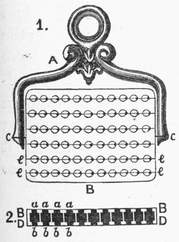
Fig. 1. A, the seal handle; B, the seal made moveable on the pivots at c c.
Fig. 2. Is a section of the seal. It consists of two metal plates, B B, and D D, having a number of corresponding holes drilled through them, as at a a a a, and b b b b, into which the ends of small rollers, a b, a b, are made to fit and turn exactly. When all the holes are supplied with rollers, the plates, B B, D D, are retained at a proper distance by a metal rim, soldered to the edges of the plates. The ends of the rollers being thus exposed, and ground level with the surface of each plate, are to have a groove cut in each, similar to a screw head; this is to be effected by cutting lines from end to end of the plate, as shown at e e, e e, Fig. 1. With a graver a small dot is next to be made, all to the right on one plate, and all to the left on the other; or, vice versa, of each line occupying the small circular end of each roller. It is now evident that, by using a small chisel-shaped steel instrument, or key, with which to turn the roller, the small dotted line on its end, may be so varied as to form any alphabetical arrangement.
The position of the dotted line admits of sufficient variety to take in 24 letters, distinct enough to the eye, without increasing the size of the seal. In this alphabet only three variations are supposed to be made from the horizontal and perpendicular, one very slight on either side, the other greater, and the third at an angle of 45°. It only requires a transposition of the letters to produce a correspondence which shall be private between two persons. The use of two faces to the seal is obvious, one serving to compose on, and the other, being a reverse, to make an impression on the wax. Were this not the case, a sentence would have to be written from right to left. Its use might be multiplied by making each cipher refer to an entire word or sentence; as, if a, stood for men; b, for horses; c, food; d, money; and so forth: a mode which it would be next to impossible for any third party to decipher.—See Mechanics’ Mag. vol. x.
2.
How ten thousand Persons may use these seals to all and every of the purposes aforesaid, and yet keep their secrets[5] from any but whom they please.
Footnote
[Seals private and particular to each owner.] The present is one of those articles of a nature already noticed in the introduction, which can scarcely be classed as an independent invention; it is in fact little, if any, more than some intricate application of the foregoing, a mere step beyond the more obvious employment of such seals. We may consider the first as the instrument, and No. 2 as an ingenious table, by the aid of which to construct alphabets, words, or sentences.
3.
A Cypher and Character so contrived, that one line, without returns and[6] circumflexes, stands for each and every of the 24. Letters; and as ready to be made for the one letter as the other.
Footnote
[An one-line Cypher.] A line to be continuous, and yet capable of signifying a series of letters, must be curved. A method of performing this occurred to the author some years ago, which affords a very simple key, being composed from the Circle and the Ellipsis, and can be, therefore, very readily kept in mind. The first affords only one figure, the second can be varied to one vertical and two inclined figures, and all can be again varied as to size, but for convenience only three gradations are recommended, as four or more would increase the difficulty of writing accurately. These varieties are shown in the annexed diagram—
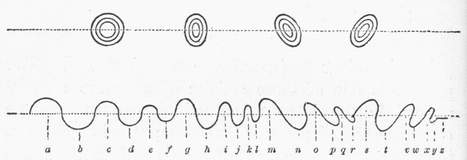
where each is described three-fold, with a horizontal line through the centre. Each figure thus affords three varieties of size above, and three below the line, making six figures each, or twenty-four in all, as curvilinear signs for letters. These taken in rotation, may be extended as above, or in any arbitrary order, and each employed, as in short-hand, to signify letters, syllables, or words. In practice it is only requisite to bear in mind the three gradations of size, so as never to mistake the middle semicircle for the outer ones. This is to be avoided by invariably making the small figure as small as possible, and the greater figure as large as space will permit.
4.
This invention refined, and so abreviated that a point onely sheweth distinctly and significantly any of the 24. letters; and these very points to be made with two pens, so that no time will be lost, but as one finger riseth the other may make the following letter, never clogging the memory with several figures for words, and combination[7] of letters; which with ease, and void of confusion, are thus speedily and punctually, letter for letter, set down by naked and not multiplied points. And nothing can be less then a point, the Mathematical definition of[8] being Cujus pars nulla. And of a motion[9] no swifter imaginable then[1] Semiquavers or Releshes, yet applicable to this manner of writing.
Footnotes
[Reduced to a Point.] A man of the Marquis of Worcester’s ingenious cast of mind could readily have made up the entire “Century” out of these systems of alphabets and secret writing. He may have been acquainted with “Traicté des Chiffres, ou Secretes Manieres d’escrire, par Blaise de Vigenere, Bourbonnois.” 4to. Paris, 1586—now very scarce; but indeed there were many learned works on the subject, among which Trithemius’s “Libri Polygraphia VI,” 1600, was conspicuous. The long disuse of such methods of secretly conveying information, has reduced the cleverest of these systems of Cryptographia in public estimation. But, at the same time, these inventions were quite consistent with the early times in which the Marquis flourished. We shall see, in the next article, what probably illustrates this proposed use of a mere point or dot.
5.
A way by a Circular motion, either along a Rule or Ring-wise, to vary any Alphabet, even this of Points, so that the self-same Point individually placed, without the least additional mark or variation of place, shall stand for all the 24. letters, and not for the same letter twice in ten sheets writing; yet as easily and certainly read and known, as if it stood but for one and the self-same letter constantly signified.
[Varied significantly to all the 24. letters.] This and the former article may certainly be taken in connection with each other; and the cipher engraved in No. 3, would seem to anticipate the present proposal of “a circular motion along a rule.” The “ring-wise” method may have been no more than a substitution for the octagon or any other figure. We fortunately find among the Harleian MSS. in the British Museum, No. 2428, a probable clue to this particular method of writing, which we shall give entire. It forms the first portion of the small oblong folio volume containing the Manuscript Century at the end, with many intervening blank pages between them. It is as follows:—
“An explanation of the most exact and most compendious way of short writing. And an example given by way of Questions, and Resolves upon each significant point, proving how, and why, it stands for such and such a letter, in order Alphabetically placed in every page.
“A. Q. How is a point made to signifie an A. Resol. By being placed between the constant center of the square and the right side thereof in a streight line not touching it. [See diagram at the end].
It is proved by drawing a line from the said center towards, and not to touch the right side line, and then you will finde the line placed under an A of the Alphabett in each page.
“B. Q. How is a point made to signifie a B. Res. By being placed between the center of the square, towards the right corner upper angle of the Octagon, or square devided in to eight Angles, not touching the line thereof.
It is proved by drawing an oblique line from the center, towards the right corner upper angle, yett not touching the line thereof, and then you will finde it to bee the line placed under a B, in the Alphabett of each page.
In like manner lett there be a Question, and a Proofe made of all the other Letters in order and you will finde—
“C. The C. to bee placed in a streight line from the center upwards, but not arriving to the upper side line of the square.
“D. The D. in an oblique line towards the left upper corner line but not touching it.
“E. The E. in a streight line between the center of the left side line, butt not touching it.
“F. The F. in an oblique line downwards, towards the left angle line, butt not touching it.
“G. The G. in a streight line downwards from the center, likewise towards the lower line of the square not touching it.
“H. The H. in an oblique line downwards towards the right angle line, butt not touching it.
“I. The I. in a streight line from the center to the midle of the right side line.
“K. The K. in an oblique line from the center to the right upper angle touching it.
“L. The L. in a streight line from the center upwards, and touching the upper line.
“M. The M. in an oblique line from the center towards the left upper corner line touching it.
“N. The N. in a streight line from the center to the midle of the left side line.
“O. The O. in an oblique line from the center downwards, towards the left corner touching the line thereof.
“P. The P. in a right line from the center downwards touching the lower side line.
“Q. The Q. in an oblique line downwards towards the right corner touching the line thereof.
“R. The R. in a streight line from the center to the outside, and furthest line of the right midle and opposite chequer touching it.
“S. The S. in an oblique line from the center, and passing the right upper corner line.
“T. The T. in a streight line from the center and passing the upper-side line of the square.
“V. The V. in an oblique line from the center upwards passing the left upper corner line.
“W. The W. in a streight line from the centre to the left outside and furthest line of the left midle and opposite chequer.
“X. The X. in an oblique line downwards passing the left lower corner line.
“Y. The Y. in a streight line downwards passing the lower side or bottome line.
“Z. The Z. in an oblique line downwards passing the right corner line of the square.
“The Chequers are five in number, which of either outside show the vowells, and each Chequer haveing two corners inwards of each side make tenn, those towards the preceding square may conteyne of the 24 letters, and the opposite corners as many Alphabetically, and the centers of the two upper Chequers square, and of the two lower shew the other 4 letters; The 20 in the Chequers are noted by a separation of a corner in the printed Alphabett, and the 4 by the midde points.
“It is for curiosity and secresy to bee deservedly observed that whether in squares or chequers single points only stand for letters, and they being varyed att pleasure, it is in any ones power to keepe his secrett from me or any other not made acquainted with the denominations by him given to the severall points, and accordingly by him marked in the 24 blank squares, and rowes of chequers placed under the Alphabett in his private explanation easily to be framed by him mutatis mutandis, only that is making the questions and resolves according to his points as they represent the letters to his owne fancy keept private from others without his consent.
“The points are to bee written, and reade as they precede, or as they are the one above the other, unlesse they have a sequell distinction made by takeing the penn of the paper thus ✓ without further losse of tyme, and such as are soe marked, must be written and read as the others they being soe made, but for husbanding of paper, the word being soe conteyned in lesse roome, the e at the end of most words prolonging butt the sillable, and all needlesse and unsounding letters are to bee omitted; I will not trouble you with more rules leaving the rest to practice.”
The preceding description is written on small oblong pages, which measure 11¼ by 7¼ inches, the whole surface of the unwritten portions being covered with an engraved pattern, of which Fig. 1 is but a portion of the top left-hand corner, and therefore proceeds no further than letter h, which ends the application of that particular figure.
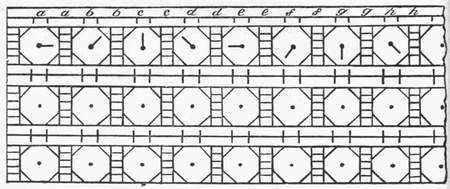
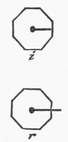
Fig. 2. Gives the next form for 8 other similar situations, commencing at i. And—
Fig. 3. Is again 8 more, commencing at r; making in all 24 characters or letters.
We thus see how, whether by a dot, or a short line of three gradations in length, an entire alphabet may be obtained.
On page 180 of “The Life of the Marquis of Worcester,” is the facsimile of a letter written by his Lordship about 1646–7, apparently adopting this very cipher. It occurs in a volume, entitled “Carte Papers, 1634–57. Ireland, No. 63,” in the Bodleian Library.
It is worth remarking here, that the foregoing description, with its accompanying brass-plate engravings, looks exceedingly like an instalment of his promise, conveyed to us in the concluding lines of the 100th Article.
6.
How at a Window, far as Eye can discover[2] black from white, a man may hold discourse with his Correspondent, without noise made or notice[3] taken; being, according to occasion given and means afforded, Ex re natâ, and no need of Provision before-hand; though much better if foreseen, and means prepared for it, and a premeditated course taken by mutual consent of parties.
Footnotes
7.
A way to do it by night as well as by day, though as dark as Pitch is black.
[A mute and perfect discourse by colours.]
[To hold the same by night.]
These two may be ranked as the same system, the one used by day, the other illuminated to be conspicuous at night. As early as 1658, John Baptista Porta, in his “Natural Magick,” entitled the last chapter of his 16th Book, “By night we may make signs by fire.”
We have here a simple system of telegraphy, the only examples afforded by the “Century,” of this particular mode of correspondence.
8.
A way how to level and shoot Cannon by night as well as by day, and as directly; without a platform or measures taken by day, yet by a plain and infallible rule.
[To Level Cannons by Night.] In 1587 was published, “The Arte of shooting in great Ordnaunce,” by William Bourne. Among other matters in the table of contents are the following:—
“The 10th Chapter showeth how to mount a mortar piece, for to lay the shot at any distance appointed.
“The 13th Chapter is, how to give level at a mark upon a hill or valley with a quadrant.
“The 24th Chapter is, how for to batter the walls of any town, as well by night as by day.
“The 25th Chapter doth declare how to plant ordnance by night, to batter the walls of any town, or displace any ordnance in any bulwarks, or any such other like, as well by night as by day.” And—
“The 26th Chapter doth declare how for to keep a haven, or river, on the sea coast, for to sink a ship, as well by night as by day in all points.”
On the subject of levelling great guns, Fludd’s “Historia Macrosmi,” 1618, would afford abundant suggestions, with three copper-plate engravings, showing the operation of using the quadrant.
9.
An Engine, portable in ones Pocket, which may be carried and fastened on the inside[4] of the greatest Ship, Tanquam aliud agens, and at any appointed minute, though a week after, either of day or night, it shall irrecoverably sink that Ship.
Footnote
[A Ship-destroying Engine.] In 1578, William Bourne, in his “Inventions or Devices,” had in the 17th article, suggested, “How for to sink a ship that hath laid you aboard, without shooting of ordnance.”
And again in his “Arte of shooting in great ordnaunce,” published in 1587, the 56th Chapter, suggests a mode “to sink a ship.”
The whole passage in the “Century” is abundantly obscure. The smallness of the Engine suggests some explosive missile, connected with clock-work, as the only means to insure its being compact and operating on a precise day at a stated point of time. But his inventive faculty once stimulated, even by the notices of Bourne, would speedily lead him to many ingenious contrivances.
10.
A way from a mile off to dive and fasten a like Engine to any Ship, so as it may punctually work the same effect either for time or execution.
[How to be fastened from aloof and under water.] The wording of this article so far differs from the title as to allude only to diving, or a kind of submarine navigation, but gives no intimation of the fastening “aloof;” so that this latter may refer to any part of the ship’s sides above her water-line.
“Mersennius,” observes Bishop Wilkins, “doth largely and pleasantly descant concerning the making of a ship, wherein men may safely swim under water.” He further declares, that “such a contrivance is feasible, and may be effected, is beyond all question, because it hath been already experimented here in England by Cornelius Dreble.” He next considers various schemes, and mentions as one of the advantages of such a submarine vessel, that, “It may be of very great advantage against a navy of enemies, who by this means may be undermined in the water and blown up.”—Math. Magick, 1648, p. 178.
Among the Sloane MSS. No. 4159, in the British Museum, is one for a means of destroying an entire fleet with one ship. It is endorsed, “A proposition sent to Mr. Augier, from Paris,” and the following is a copy:—“A person who makes profession of honour, and saith he hath had the good [fortune?] to have been known of Sir Oliver Flemming during his public employments abroad, doth propound to a friend of yours that by a secret he hath he can, with one ship alone, break what naval army or fleet, &c.”
In 1596, the celebrated John Napier, of Merchiston, wrote a statement of four “Secret Inventions,” concluding with the remark: “These inventions, besides devices of sailing under the water, with divers other devices and stratagems for harming of the enemies, by the grace of God, and work of expert craftsmen, I hope to perform.” The original MS. anno 1596, is in the Lambeth Library, No. 658.
There is an article in Tilloch’s “Philosophical Magazine,” Vol. 18, for 1804, reviewing a Memoir of Lord Napier of Merchiston. On his device for sailing under water, the writer observes:—“The famous Dutch philosopher, Cornelius Drebell, the reputed inventor of the microscope and the thermometer, constructed for James I. a subaqueous vessel, which he tried on the Thames, and which carried twelve rowers, besides some passengers, for whom the effete air was again rendered respirable by a liquor, the composition of which Drebell never would communicate to more than one person, and that person told Mr. Boyle what it was.” The Marquis, might, likewise, even be acquainted with Napier’s statement of his secret inventions.
Evelyn, in his Diary, informs us on the 1st of August, 1666, “I went to Dr. Keffler, who married the daughter of the famous chymist, Drebbell, inventor of the bodied scarlet.” On which his editor, Mr. Bray, remarks, “Cornelius Van Drebbell, born at Alkmaar, in Holland, in 1572; but in the reign of Charles I. settled in London, where he died in 1634. He was famous for other discoveries in science—the most important of which was the thermometer. He also made improvements in microscopes and telescopes; and though, like many of his scientific contemporaries, something of an empiric, possessed a considerable knowledge of chemistry, and of different branches of natural philosophy.”—Diary, vol. ii. p. 9.
Pepys, in his Diary, under date the 14th of March, 1662, says: “This afternoon came the German, Dr. Knuffler, to discourse with us about his engine to blow up ships. We doubted not the matter of fact, it being tried in Cromwell’s time, but the safety of carrying them in ships; but he do tell us, that when he comes to tell the King his secret, for none but the Kings, successively, and their heirs must know it, it will appear to be of no danger at all.”—Pepys’ Diary, ed. 1858, vol. i. p. 264.
Dr. Robert Hooke, in his “Philosophical Collections,” published in 1679, has “an account of Jo. Alphon. Borellius’s De Mo. Animalium,” two volumes quarto, containing, among other things, “A way to make a submarine vessel, whereby several persons may pass together from place to place under water, accommodated with two ways to move it to and fro, and to make it rise and sink in the water, &c. It is supposed it may be much like that which Mersennus long since published.”
The American engineer, Robert Fulton, turned his attention to this subject, and published “Torpedo War, and Sub-marine Explosions,” 4to. New York, 1810.
11.
How to prevent and safeguard any Ship from such an attempt by day or night.
[How to prevent both.] Some armour or alarum is probably proposed, which should be either invulnerable, or when struck indicate the presence of the enemy’s “portable pocket engine,” intended “irrecoverably to sink the ship;” not by merely perforating a single hole, but by a powerful disruptive explosion, rending asunder all the timbers. But the whole passage is so abundantly obscure that all opinion on the matter goes for very little.
12.
A way to make a Ship not possible to be sunk though shot[4] an hundred times betwixt wind and water by Cannon, and should[5] lose a whole Plank, yet in half an hours time should be made as fit to sail as before.
Footnotes
[An unsinkable Ship.] As early as 1583, appeared “A Note of sundry sorts of Engines,” without the author’s name. The 20th and last of these is:—“To preserve a boat from drowning and the people that be therein.” See J. O. Halliwell’s Rara Mathematica.
Considering the state of ship-building in 1655, the foregoing plan must have been some very primitive scheme; but, rendering vessels unsinkable, has long been a favourite subject with inventors.
13.
How to make such false Decks as in a moment should kill and take prisoners as many as should board the Ship, without blowing the[6] Decks up, or destroying them from being reducible, and in a quarrer[7] of an hours time should recover their former shape, and be made fit for any imployment without discovering the secret.
Footnotes
[False destroying Decks.] William Bourne, in his “Inventions of Devices,” 1578, devotes the “Third device” to show—“How to use a plain or open deck hatches, that it is not possible to enter the ship without spoiling of the enemies.”
14.
How to bring a force to weigh up an Anchor, or to do any forcible exploit in the narrowest or[8] lowest room in any Ship, where few hands shall do the work of many; and many hands applicable to the same force, some standing, others sitting, and[9] by virtue of their several helps a great force augmented in little room, as effectual as if there were sufficient space to go about with an Axle-tree, and work far from the Centre.
Footnotes
[Multiplied strength in little room.] We shall have to allude to the ambiguous use of the word “force” in the same sentence, as indicating “strength, power, &c.” or, “a pump, or pump plunger,” in John Bate’s, and other old works on mechanics. Now if we were to read this, “How to bring the force [or plunger of a pump] to weigh up an anchor, &c., and many hands applicable to the same force [or pump], &c.”—we should have a statement strongly indicating the modern contrivance of the hydraulic press. The concluding portion of the sentence only serves to strengthen this suggestion. See “force” used in No. 21.
In 1594, Edmund Jentill, writing to Lord Burghley, mentions, as his fourth invention:—“A devise whereby two men may be sufficient to weigh the weightiest anchor in her Majesty’s navy, with greater expedition than it is now done with the number now used.” Also, “The like device is found for the hoisting of the main-yard with the like expedition.”—MS. Lansdown, 113, Art. 4: and, “Letters on Scientific Subjects,” edited by J. O. Halliwell, F.R.S. 8vo. 1841.
15.
A way[1] how to make a Boat work it self against Wind and Tide, yea both without the help of man or beast; yet[2] so that the Wind or Tide, though directly opposite, shall force the Ship or Boat against it self; and in no point of the Compass, but it shall be as effectual, as if the wind were in the Pupp,[3] or the stream actually with the course it is to steer, according to which the Oars shall row, and necessary motions work and move towards the desired Port or point of the Compass.
Footnotes
[A Boat driving against wind and tide.] The wording of this article is varied as follows in the MS. of certain of his Inventions. See Appendix A. He therein states:—
“By this (his quintessence of motion), I can make a vessel, of as great burden as the river can bear, to go against the stream; which, the more rapid it is, the faster it shall advance. And the moveable part that works it, may be, by one man, still guided, to take the best advantage of the stream; and yet to steer the boat to any point. And this engine is applicable to any vessel or boat, whatsoever, without being, therefore, made on purpose; and work these effects:—It roweth; it draweth; it driveth, if need be, to pass London bridge against the stream, at low water. And a boat lying at anchor, the engine may be used for loading or unloading.”
He made this invention one of the four subjects in his Patent of 1661 (see Appendix B), which again varies the reading; but this last plainly indicates the motive power as having been a mill. He proposes in his patent specification:—“To make a boat that roweth, draweth, or setteth even against wind or stream, yea, both, and to any part of the compass which way soever the stream runs or wind blows, and yet the force of the wind or stream causeth its motion, nothing being required but a steersman; and whilest the boat stayeth to be loaded or unloaded, the stream or wind shall perform such work as any water-mill or wind-mill is capable of.”
Among the Harleian MSS. in the British Museum, there is an Italian book of sketches on parchment, No. 3281, attributed to the 15th century, entitled, “Delineationes Machinarum;” from one of the pen and ink drawings of which the annexed engraving is a reduced copy. It is a paddle boat of a very primitive form, to be operated by men working at two crank handles. The Marquis seems to have had a very similar idea, only employing the mechanical arrangements of a suitable wind or water-mill.
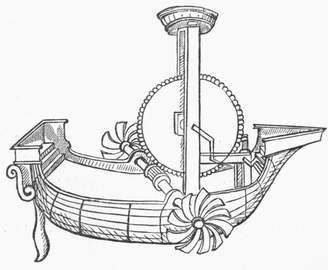
In that fine work, “Vitruvia de Architectura,” folio, Como, 1521, there is an engraving of a large vessel propelled by paddles, worked by animal power; therefore, so far as such a mode of propulsion is concerned, paddle-wheels are of very ancient origin. In 1574, Ralph Rabbards[J] presented to Queen Elizabeth, through the medium of the venerable Lord Burghley, a list of twenty-five inventions. The 24th is:—“The rarest engine that was ever invented for sea service. A vessel in manner of a galley or galliotte to pass upon the seas and rivers without oars or sail, against wind and tide, swifter than any that ever hath been seen; of wonderful effect both for intelligence, and many other admirable exploits, almost beyond the expectation of man.”
William Bourne, in his “Inventions or Devices,” published in 1578, most of which he claims to be his own projects, yet acknowledging some to have been borrowed, offers the following in the 19th Device without comment:—“And furthermore you may make a boat to go without oars or sayle, by the placing of certain wheels on the outside of the boat, in that sort, that the arms of the wheels may go into the water, and so turning the wheels by some provision, and so the wheels shall make the boat to go.”
This is followed by another application, being the 20th Device:—“And also, they make a water-mill in a boat, for when that it rideth at an anchor, the tide or stream will turn the wheels with great force, and these mills are used in France, &c.”
In 1583, proposals were made for 20 different inventions, but the author’s name does not appear. The 19th is:—“To make a boat to go fast on the water without oar or saile;” but this is all we learn of his project. See “Rara Mathematica,” edited by J. O. Halliwell, F.R.S. &c. 8vo. 1841.
In 1594, Edmund Jentill addressed to Lord Burghley two communications respecting his inventions. The last he names thus:—“A device wonderful strange is also found out, whereby a vessel of burden may easily and safely be guided both against wind and tide.” MS. Lansdown, 113, Art. 4; and “Letters on Scientific Subjects,” edited by J. O. Halliwell, F.R.S. &c. 8vo. 1841.
Cressy Dymock, in his letter published by Hartlib in the “Legacie; or an enlargement of the Discourse of Husbandry,” 4to. 1651, describing what he saw at Wicklesen, mentions—“a pretty kind of Pinnace with ordinance, somewhat like a close litter, but flat-bottomed; which rowed with wheeles instead of oares, imployed it seemes formerly with admirable successe, for the taking in of Crowland, and which gave me a proofe of what I for many years have thought possible, and of very great use and service, and still think it of unknowne value, if it were skilfully indeed framed, and applyed as it might be.” [p. 110.]
Samuel Cotton, on the 28th of January, 1619, obtained a patent for making and erecting mills upon barges or lighters in the river Thames.
David Ramsey and Thomas Wildgoose, on the 17th of January, 1618, patented, among various other inventions, one “to make boats for the carriage of burthens and passengers run upon the water as swift in calms and more safe in storms than boats full sailed in great winds.”
David Ramsey includes in his patent of 21st of January, 1630, his invention “to make boats, ships, and barges to go against the wind and tide.”