INTRODUCTION. (continued 4)
Reading edition
That the ordinary draining of land had made no material progress in the 17th century, we gather from the correspondence collected in “Samuel Hartlib his Legacie: or an enlargement of the Discourse of Husbandry,” 4to. 1651; where there is a letter written by Cressy Dymock, in which he remarks—“I went into the Isle of Ely, to see one of the Holland-mills, for dreyning; though set up there and kept by certain Frenchmen. The Invention seemed to me but mean and rude, and Mr. Wheeler’s way much more ingenious.” “I saw at Wicklesen the manner of your Holland sluices. The ruines also of a cochlea, for the emptying and dreining of water, of which Ubaldus hath writ a whole treatise.”—Pages 109, 110.
The Act of Parliament, of May, 1663, states in regard to the Marquis’s Invention, that he “hath by long and indefatigable pains and study, and with great and vast expenses, invented and found out a Secret in Nature, never heretofore discovered, being a Water-commanding engine, of greater force and advantage than hitherto hath been known; and being no pump or force now in use, nor working by any suckers, barrels, or bellows heretofore used for the raising and conveying of water; which said Engine will yield very great benefit and advantage to the Commonwealth, by draining of all sorts of Mines, Marish, Oazie, or overflown Grounds, by furnishing of Rivers and Cutts with water to make them Navigable and Portable from Town to Town; by improving of Lands wanting water; by the supplying and bringing in of water into the City of London, or into any other places; and by divers other ways and means whereby great Encouragement will be given to the People of the Nation, to undertake to work rich Mines, to drain and gain in many Marish, Oazie, and surrounded Grounds, which hitherto they have been deterred to endeavour the improvements of, by reason of the vast sums of money which must be necessarily expended by the draining and conveying away the water out of the same. * * * * * And that a Model thereof be delivered by the said Marquis, or his Assignes, to the Lord Treasurer, or Commissioner for the Treasury, for the time being, at or before the 29th of September, 1663.”—See Appendix C.
We trace the early use of steam in some of the simple apparatus of various forms, called Æolipile, to a period anterior to the Christian era. Greece and Rome, France, Holland, and Germany, have each contributed some instrument or other indicative of a knowledge of the expansive property of steam, pent up in close vessels, to give slight motions to, or force water from small delicately constructed apparatus, designed for amusement, or at most only to occasion a strong blast for blowing a fire, as figured in “Vitruvio de Architectura,” folio, 1521. Some of these early stages of progress we shall further notice here.
Besson, in his folio work on Instruments and Machines, 1578, among other contrivances shows, in plate XVIII, a cylindrical vessel, containing a coiled spring, above which is a close fitting disc, secured underneath to a cord, which, passing through the coiled spring, passes out at the bottom of the vessel, by which means it can be used to pull down the disc, so as to compress the spring, while the vessel is being filled with water, and its cover, with a jet in the centre, secured; on releasing the spring, we have here a piston acting from below upwards, to produce a fountain.
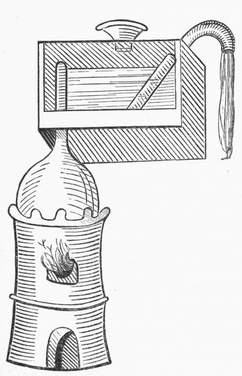
John Baptista Porta, in his “Spiritalia,” quarto, 1606, gives a rude wood engraving, as here exactly represented, a metal flask-shaped boiler, fitting the top of a small furnace, while its neck proceeds through the bottom of a cistern of water, within which there is a syphon on the right hand side, and an aperture at the top through which the cistern can be refilled. By this arrangement, the steam presses on the surface of the water, when all is closed, except the syphon, from which the water will rush with increased velocity.
In the 16th century, motive and other Æolipile were well known, and are described and illustrated by Vitruvius, Hero, and other early writers. In 1606, Porta made a slight advance, and John Rovinson, patentee of improvements in the manufacture of iron, in his “Treatise of Metallica,” 1613, among other necessary parts of his invention, describes the following:—“A new-devised vetible, round and hollow, with a long spout, to be made of some mettall or potter’s earth, wherein water being put, and the same placed on a fire, as it heateth, and the water evaporateth by the spout, it maketh a continuall blast to kindle, or increase the fire in furnaces, or fire-workes, and may be converted to many other excellent uses; and same may be made in severall peeces with the top or upper part removeable at pleasure, so as the lower part being made to stand on feet, may serrve at pleasure for a possenet, skellet or boylatory; and when the top is put on, and when fastened and luted, it may then serve for the ventible to make the blast.”
In 1615, De Caus invented, or at all events published an account of a small hot-water fountain; in 1617, Robert Fludd published his voluminous work, “Historia Macrosmi,” containing descriptive and engraved illustrations of the effects produced on water heated in close flask-shaped vessels.
In 1629, Branca suggested the rotating of a wheel, acted on by a jet of steam, as a simple kind of stamping or pounding mill. But the author, who seems to have taken a more practical and enlightened view of the subject, and to have considerably contributed to the Marquis’s enthusiasm, was John Bate, who, in 1634 and 1635, published editions of his “Mysteries of Nature and Art.” His treatise, “The first Booke of Water-workes,” contains, as stated at the commencement, “Experiments of drawing water by the crane (syphon), and by engines; of forcing water by ayre compressed, and by engines; of producing sounds by ayre and water; by evaporation of water by fire, and by engines; of motions by evaporating water, and by rarifying ayre.”
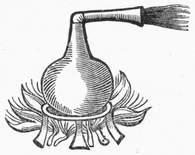
Among his “Experiments of producing sounds by evaporation of water by ayer,” the following is given:—“Prepare a round vessell of brasse, or lattin, having a crooked pipe or necke, whereunto fasten a pipe: put this vessell upon a trevet over the fire, and it will make a shrill whistling noyse.”—Page 27.
He figures a blow-pipe for glass-working, as in the annexed engraving, which he thus describes:—
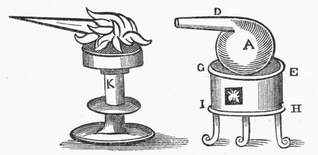
“Let there be a vessell of copper about the bignesse of a common foot-ball, as A; let it have a long pipe at the top as D, which must be made so that you may upon occasion screw on lesser, or bigger vents made for the purpose. Fill this one-third part with water, and set it over a furnace of coals, as E, G, H, I, and when the water beginneth to heat, there will come a strong breath out of the nose of the vessel, that will force the flame of a lampe placed at a convenient distance as K.”—Page 158.
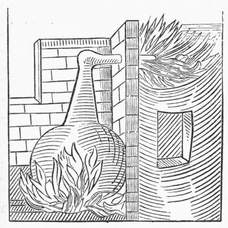
Sir Hugh Plat, in his “Jewel House of Art and Nature,” 1594, gives an account of the ordinary fire-blowing Æolipile. He says:—“A round ball of copper or lattin, that will blow the fire very strongly, only by the attenuation of water into air; which device will also serve to perfume with.—A round ball of copper or lattin, of the bigness of a small bowl—a round pipe or neck, of 3 or 4 inches in length, less than a goose quill—and an elbow of a less pipe no bigger than a straw, whose vent in the end must be no bigger than a pinhole.” “Heat the same well in the fire, and then put it into a vessel of cold water, and it will suck some of the water into it, you may heat the same so often, till by the peize (poise?) thereof you may be assured that it is more than half full. Then set this ball on a few glowing coals, and you shall find the same to give a very strong blast.... I make no question but that the same may be made so large as that they will blow one whole hour together without any intermission.”—Page 25.
In the second edition of Dr. French’s “Art of Destillation,” 1653, page 150, he describes the “Philosophicall Bellowes:” one is to blow a furnace fire; another a candle, serving as a blow-pipe; and the third for a common fire. He notes “that these kind of vessels must be made of copper, and be exceedingly well closed, that they may have no vent but at their noses.” He recommends, in preparing them for use, that “you must first heat them very hot, then put the noses thereof (which must have a very small hole in them, no bigger than a pin’s head may go in) into a vessel of cold water, and they will presently suck in the water, of which being then full turne the noses thereof towards the candle or fire which you would have blown.”
The third figure, instead of being a copper ball is formed like the human face, and is held by a long stick or handle attached to the back. It is represented and described by Schwenteri, in his “Deliciæ Physico-Mathematicæ,” 1638, along with two tubulated balls for similar use.
Such then were the suggestions the Marquis had before him to excite his experimental inquiries, independent of other sources. But whatever he may have known on the subject of these applications of steam, however much he may have experimented on them, there are two things, of which no one has yet given him the credit of possessing any knowledge whatever, the one is, condensation; the other, a piston. How the Marquis of Worcester could have been experimenting at the cost of £50,000, and upwards, at Vauxhall, and been occupied in this particular class of experiments during a large portion of thirty-eight years, in perfect ignorance that cold water will condense steam, is past all comprehension. Nay, such ignorance would be a greater matter of surprise, than the exhibition of his utmost ingenuity in the mechanical contrivances connected with his engine. Condensation was no mystery. Every work on distillation spoke on the subject, and supplied the forms of refrigeratory worms, and refrigerating heads for alembics. His very allusion to the strength of his vessels must have had reference, first to internal distension, as well as to collapse from external pressure.
John Bate, in his first book, “Of Water Works,” describes a kind of weather glass, which he calls, “the moveable perpendicular glass;” for the construction of which his directions are—“First prepare the glass A, B, fill it almost top full of water, provide also the glass K, L, having a loop at the top of it: divide it into so many equal parts as you would have degrees, and on the mouth thereof fasten a thin board, that will easily slip in and out of the bottom glass; make then a weight of lead or brass somewhat heavier than both the glass and board fastened thereunto; and then tie a little rope to the loop of the glass A, B, and the weight at the other end thereof. Rarifie the air contained in the glass L, and reverse it into the glass A, B, filled with water, and hang the plummet over two little pulleys fastened in a frame made for the purpose; and as the glass K, L, cooleth, the water will ascend the same, and so by the change of the outward both the glass and water will move accordingly.”—Pages 42–43.
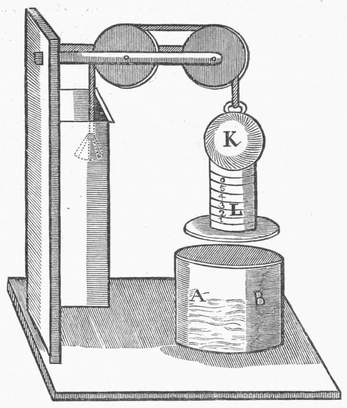
From all that has been advanced, an impartial reader must feel satisfied that there existed abundant sources of popular information, highly suggestive to such an inquisitive and inventive mind as the Marquis possessed. Van Etten mentions the filling of a cannon with water, the plugging it up, and exploding it by the action of fire applied to its trunnion. And here John Bate suggests an experimental apparatus on a small scale, which the Marquis would be almost certain to test, and in so doing to vary the construction and application. Rarefaction too is here recommended; and the effect of cooling or condensation is particularly noted, the stated result being, “the water will ascend.” We can readily imagine the Marquis varying such an experiment with infinite delight, and modifying and enlarging it to produce some practical application.
In considering these minuter points, we must never lose sight of the extraordinary perseverance shown by the Marquis throughout a long life, in conducting and varying his experimental inquiries. It was the one pursuit of a studious life-time, the heaviest source of expenditure in his private disbursements. Perhaps we should be very much under the mark in saying that he must have expended above a hundred thousand pounds in experiments alone; which would be represented by nearly ten times that amount in our day. And not only was this outlay very great, but he had for above thirty-five years kept his workman, Caspar Kaltoff, constantly engaged on his models and on practical trials of his variously constructed inventions.
The Act for his Water-commanding Engine received the Royal assent in June, 1663, and the same year he published his “Century of Inventions” (as here reprinted); a pamphlet was next issued, with no other title than the following heading at the top of the first page—“An exact and true definition of the most stupendous Water-commanding Engine, invented by the Right Honourable (and deservedly to be praised and admired) Edward Somerset, Lord Marquess of Worcester, and by his Lordship himself presented to His most Excellent Majesty, Charles the Second, our most gracious Sovereign.”—See Appendix C.
This pamphlet appears to have had some connection with means for giving publicity to the formation of a public company for carrying out the great design on a sufficiently large and remunerative scale. The author, or editor, was James Rollock, who here flourishes in a poetical vein, observing, “After the Act of Parliament, there is here set down a Latin Elogium, and an English Panegirick, both of them composed through duty and gratitude by an ancient servant of his Lordship’s.” He afterwards adds: “This ancient servant of his Lordship’s, hath for forty years been an eye witness of his great ingenuity, indefatigable pains, and vast expences in perfecting for publique service, not onely this most Stupendious Water-commanding Engine, but likewise several other rare, useful, and never formerly heard of Mathematical conclusions, of which he hath owned a Century, and thereunto I refer you: though this alone were enough to eternalize his Name to all Ages and future times.”
The “Definition” given in the pamphlet agrees with that which has already appeared in the “Life, Times, &c.,” pages 224, 225, from another source, and is here stated as follows:—
“The Engine consisteth of the following Particulars;
“1. A perfect Counterpoize for what Quantity soever of Water.
“2. A perfect Countervail for what Height soever it is to be brought unto.
“3. A Primum Mobile commanding both Height and Quantity Regulator-wise.
“4. A Vicegerent or Countervail supplying the place, and performing the full force of a Man, Wind, Beast, or Mill.
“5. A Helm or Stern, with Bitt and Reins, wherewith any Child may guide, order, and control the whole Operation.
“6. A particular Magazine for Water, according to the intended Quantity or Height of Water.
“7. An Aquaduct capable of any intended Quantity or Height of Water.
“8. A place for the Original Fountain or even river to run into, and naturally of its own accord incorporate itself with the rising Water, and at the very bottom of the same Aquaduct, though never so big or high.”
We cannot do otherwise than consider that the articles, Nos. 68, 98, and 100, refer to descriptions of the several parts of his remarkable steam engine. In No. 68, we have the two vessels, with two cocks, connected with a furnace, and so arranged that “one vessel of water being consumed, another begins to force and refil with cold water.” In No. 98, we have intimation of “the primum mobile,” forming the 3rd division of the particulars enumerated above; being some portion of the engine capable of every variety of movement. And in No. 100, we have no mechanical suggestions, but in their place a bare enumeration of results, and of advantages to be derived from the employment of such engines.
What then are we to understand by the preceding list of particulars? “1. A perfect counterpoise,” would suggest that the Marquis had contrived a complete system of pumping; “2. A perfect countervail,” appears to be only a different kind of counterpoise, as though the one were derived from weight, and the other from the action of the steam; 4. “A vicegerent,” may be the force or piston; 5. “A helm or stem, with bit and reins,” can hardly be mistaken for any other than levers, acting on valves, and in some positions connected with chains running over guide pulleys; while the parts 6, 7, and 8, refer wholly to reservoirs, cisterns, and other external arrangements. But this statement is simply made to remind the reader that the Marquis’s Engine was not so entirely simple in its construction as to consist only of a boiler and receiver, and to depend wholly on the effect of the direct action of steam on a large surface of cold water, as generally intimated. It is usual entirely to set aside this full and clear statement of details. So indefinitely has the Marquis’s claim hitherto been stated, that it is always assumed, that while using this early steam engine, he was quite unacquainted with condensation; or, at least, with any mode of employing it to produce a useful effect. On the other hand, it is not only more rational to suppose that he could not be otherwise than fully acquainted with it, but that, having ascertained its various results, he finally succeeded in employing condensation to produce a vacuum for refilling his vessels, and for giving motion to a force or piston. Indeed, we find in the foregoing statement—“6. A particular Magazine for Water, according to the intended quantity or Height of Water.” A particular Magazine, one for a special purpose, for which it was particular to have such a supply; and for size, form, and situation, it had reference “to the quantity and height of water,” for a small cistern would supply sufficient water for condensation, but a larger cistern would be required in proportion to more extended service. Then, “7. An Aqueduct,” might be the vertical main pipe; and “8. A place for the original fountain,” peculiarly arranged reservoirs, with suitable valves, floats, &c.
Uniting his several descriptions, we readily make out a construction of apparatus answering many of the conditions he has stated, as shown in the engraving[W] on the opposite page from a sectional drawing designed by the author.
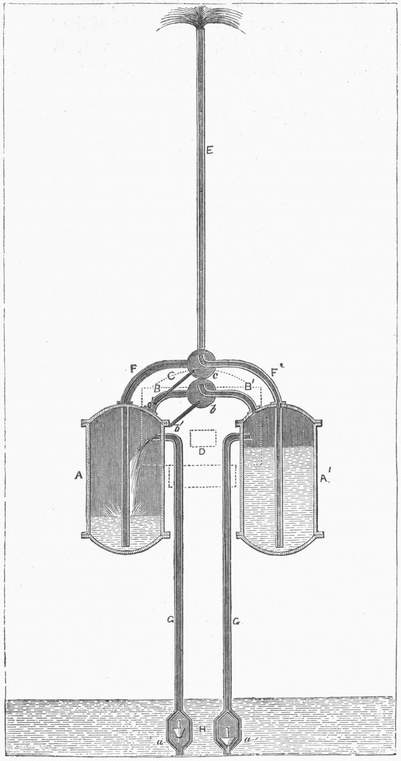
A, A' Two cold water vessels, connected by—
B, B'—the steam pipe, with—
C, the Boiler, set in—
D, the furnace. The cold water vessels A A', also are connected with—
E, the vertical water pipe by means of—
F, F', continuations of the same pipe conducted into and nearly touching the bottom of each vessel A, A'.
G, G', are two water supply pipes, with valves a, a', dipping into—
H, the well. It is obvious that by uniting these pipes, and placing the valves in the upper bend of each, it would be sufficient for a single pipe to dip into the water to be raised.
On the steam pipe B B' is—
b, a four-way steam cock, operated by—
b', its lever handle; and on the horizontal portion of the water pipe F F', is—
c, a four-way water cock, operated by—
c', its lever handle.
*** The four-way cock is figured and described as early as 1618, by Robert Fludd, in “Historia Macrosmi,” folio, page 467.
In the “Life, Times, &c.,” page 20, we have a view of the deep grooves cut in that side of the Citadel of Raglan Castle, on which the Marquis of Worcester’s Water-works were situated. The grooves would admit the insertion of pipes of about one foot external diameter, either round, or square, and they would carry water nearly twenty-five feet high. In the early use of his engine, he may have forced the water direct from the boiler, or by the using of an independent boiler, as employed by Porta, in 1606; but either way, the arrangement of his Raglan works would seem to have been that of employing a main vertical pipe for each boiler or receiver, instead of each receiver being connected with a four-way cock with one vertical pipe, or “aquaduct.”
With these observations we close our comments on the various articles of the “Century,” after having supplied a mass of most important references to contemporary and earlier scientific authors; as well as offered several entirely new solutions; and reduced the problematical character of this singularly interesting work to one only, being No. 56, which alone remains open to the charge of being a paradox.
Footnotes
“When we consider the whole of the contrivances invented by Savery, as described by himself in ‘The Miner’s Friend,’ we cannot but accord to him the praise of very great ingenuity, independent of the merit of having made the first working Steam Engine, (if he was not preceded in that by the Marquis of Worcester); but, at all events, of having been the first who introduced it into use.”
We give this passage as printed, and proceed to the next, at page 156, which is not recorded either in the Contents or Index, only distinguishing certain words:—
“We think it right to add that the language used by Savery in his ‘Miner’s Friend,’ in treating of the advantages, whether ascertained or prospective, of his invention, presents a strong contrast, in point of plainness, simplicity, and modesty, to the more high-flown phrases in which the Marquis of Worcester magnifies the performances of his ‘semi-omnipotent’ engine. Savery was evidently a practical man, possessed of great [1] common sense as well as of [2] ingenuity; and although it would probably be wrong to deny to Lord Worcester the possession of a good deal of the second of those qualities, it may well be doubted how far he is entitled to the claim of any very considerable share of the first” [common sense]!
We believe that the author of this strange composition is a Scotch Advocate of some standing; now it is far from being the character of the legal profession, as a body, to commit to paper such reckless reproach of even the dead; but assuredly it does not require the caution induced by a knowledge of common law to point out the propriety of treating with respect the memory of a man of high birth and untainted reputation, such as was the Marquis of Worcester. But this is not all, we are introduced to a “First Engine,” at the risk of a second “first,” as declared by the same pen! And without fear of contradiction we say the last should be first, and the first last in this category.
