INTRODUCTION. (continued 3)
Reading edition
De Caus’ Fountain.
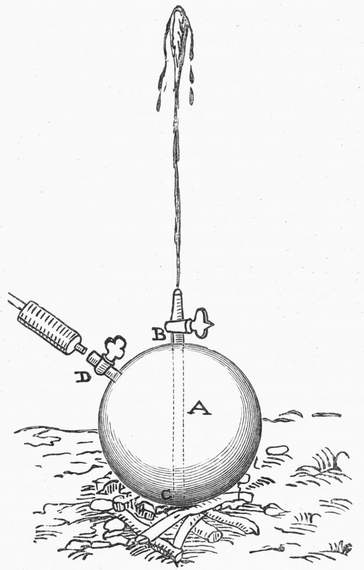
The adjoining engraving is exactly traced from the original, of which it is, in every respect, a faithful copy. It represents a globular metallic vessel A, with a jet and stop-cock at B, and another stop-cock at D, through which water can be injected by means of a syringe. The jet B, is the top end of a pipe C, which nearly touches the bottom of the inside of the hollow sphere. Supposing the globe to be half or two thirds full of water, and placed on a fire, the heat will presently raise a quantity of steam, which, as it increases in quantity, will occupy the upper empty space of the sphere, and by its pressure on the surface of the boiling water, cause the same to rise rapidly up the vertical pipe C, and produce the jet-d’eau above B, the instant the stop-cock is opened. And this operation will continue so long as any water remains for the bottom end of the pipe C, to dip into; after which it can only be renewed by refilling the vessel, and re-boiling the fresh supply of water.
De Caus, in his large folio work, in which varieties of fountains are explained by elaborate copper-plates, and minute descriptions, satisfies himself with the above brief explanation of the simple woodcut figure, which we have here reproduced; from which we infer that he laid no claim to its being his own invention, or at all events that he presented it to his readers as a gratuitous offering, for its curious and amusing results. It is not likely that the author of a considerable work, amidst recondite descriptions and sumptuous engravings of comparatively common affairs would consign his own most valuable contribution to a few lines of bare description and a coarsely engraved diagram. It is obvious, therefore, that De Caus himself, set no great store by this toy fountain; he saw no great scope in its application, and certainly never assumed it to be of greater value than as an amusing experimental fountain. To claim more for an Inventor, than an Inventor claims for himself is mere infatuation. To say that De Caus had only to add another pipe, and only to make another arrangement or two, and then this petite fontaine would somewhat resemble a steam engine, is neither sound nor admissible. An inventor must be judged by his own aim and object, and the example he offers us, without any additions or subtractions at other hands. What De Caus desribes, therefore, is not a continuous but an intermittent fountain; not self-feeding, but to be refilled by a syringe; not emitting cold, but boiling hot water; and the difficulties and delays in the use of which materially increased in proportion with its dimensions.
But there was shortly afterwards published another highly suggestive work, on a mechanical application of steam, in “Le Machine,” by Giovanni Branca, 4to. 1628; in which the 25th figure represents the operation of pounding, the pestles being acted on by pulleys and cog-wheels set in motion by a jet of steam issuing from a pipe against the vanes of a horizontal wheel. The boiler is in the fanciful form of the bust of a negro, with the steam pipe issuing from the mouth.
On the 21st of January, 1630, a patent was granted to David Ramsey, for, among other inventions, one “to raise water from low pits by fire.” But unfortunately, like all patents of that period, it is unaccompanied by any description.
John Bate, in his “Mysteries of Art and Nature,” 1635, 4to. has “a conceited lamp, for forcing water or air through the figure of a bird.” A minute description is given for constructing a small boiler in the form of a crown, surmounted by a bird, and enclosing various perforated pipes and valves, capable of being turned in various directions; the whole is set over a circular lamp, with several cotton wicks. Water being put in the boiler, Bate observes—“Then the water being by little and little converted into ayre, by the heate of the lights that are underneath, will breathe forth at the mouth of the cock;” but, on being partially turned, “then there being no vent for the ayre to breath out at, it will presse the water, and force it to ascend the pipe, and issue out where the air breathed before.” In conclusion he shrewdly remarks:—“Other devices and those more strange in their effects, may be contrived from hence.” (p. 33, 34.)
In the “Recreation Mathematique” of H. van Etten, 1629, 12mo. of which there were translations in several editions, as 1633, 1653, and others, the 67th problem is descriptive “Of the properties of Æolipiles or bowels to blow the fire.” In the course of the article on this subject it is observed: “Vitruvius, in his first book of Architecture, cap. 8, approves from these engines, that winde is no other thing than a quantity of vapours and exhalations agitated with the aire by rarefaction and condensation;” a remark curious enough, if only for the last word “condensation.” The article concludes—“Now it is cunning and subtiltie to fill one of these Æolipiles with water at so little a hole, and therefore requires the knowledge of a philosopher to finde it out; and the way is thus:—Heat the Æolipiles being empty, and the aire which is within it will become extreamely rarefied; then being thus hot throw it into water, and the aire will begin to be condensed: by which meanes it will occupie lesse roome, therefore the water will immediately enter in at the hole to avoide vacuitie: thus you have some practicall speculation upon the Æolipile.”
Here we have “condensation” a second time adverted to, while the whole experiment proves the folly of attributing to Savery a similar result as a novelty leading for the first time to a knowledge of the property of “condensation,” to the disparagement of the Marquis and his predecessors, assuming their total ignorance of what is here so clearly and graphically described.
Again, Van Etten in the fifth section of Problem LXXXV. treats—“Of a fine fountaine which spouts water very high, and with great violence by turning of a cock.” page 193. “Let there be a vessel made close in all its parts, in the middle of which let a pipe open neare the bottome; and then with a squirt squirt in the water (stopped above by the cock or faucet) with as great violence as possible you can, and turne the cock immediately. Now there being an indifferent quantity of water and aire in the vessel, the water keeps itself in the bottom, and the aire which was greatly pressed, seeks for more place, that turning the cock the water issueth forth at the pipe, and flyes very high, and that especially if the vessell be a little heated.” The concluding sentence would no doubt afford a mind like that of the Marquis of Worcester’s abundant matter for experimental trial, if ever consulted by him, either in the original, or in the translation of 1633.
The following extract from Van Etten’s 83rd Problem, “Of Cannons or great Artillery,” affords strong presumptive evidence (taken along with other extracts) of the Marquis’s acquaintance with the work. The Problem is divided into two parts, of which the first alone need be noticed, namely,—“How to charge a cannon without powder.” It is observed—“This may be done with aire and water, only having thrown cold water into the cannon, which might be squirted forceably in by the closure of the mouth of the piece, that so by this pressure the aire might more condense, then having a round piece of wood very just, and oiled well for the better to slide, and thrust the bullet when it shall be time. This piece of wood may be held fast with some pole, for feare it be not thrust out before his time: then let fire be made about the trunnion or hinder part of the piece to heat the aire and water, and then when one would shoot it let the pole be quickly loosened, for then the aire searching a greater place, and having way now offered, will thrust out the wood and the bullet very quick: the experiment which we have in long trunkes [tubes] shooting out pellats with aire only, sheweth the verity of this Probleme.” (page 173.)
The words italicised are a complete description of the Marquis’s experiment, although made with a widely different object, but both afford evidence of the force obtainable from a small quantity of heated water, the one in an imperfectly closed, the other in a well closed cannon. It is remarkable how near this experiment comes to the steam-engine cylinder, piston, and safety valve; and we can scarcely believe that such applications would escape the Marquis’s observation, when repeated and varied as was his customary course in pursuing his own inquiries.
We have thus, from 1615 to 1653, shown, what sources were open to afford suggestions to the Marquis of Worcester’s wakeful and watchful mind, alive and on the alert to seize on every hint promising some enlarged and useful application. We come next to that part of his own statement, where he says: “so that having found a way to make my vessels, so that they are strengthened by the force within them, and the one to fill after the other, &c.” “Vessels” may here apply to cisterns, receivers, boilers, &c., in short whatever appliances were used. But it is usually supposed to mean the boiler only, and hence the difficulty to understand how its safety should increase with the increased internal expansive force of the steam. But allowance must be made for the general vagueness throughout the “Century,” and we must bear in mind that its language was not arranged to inform the public in respect to construction, but, as its author explicitly states, the several inventions are “set down in such a way as may sufficiently instruct me to put any of them in practice.” Now there is good ground for believing that the Marquis had a special meaning for the word “force,” as here applied, a word then used indifferently in its ordinary and in a technical sense, in the same sentence. This is particularly worth illustrating; firstly, because it shows a probability that the Marquis had, before 1655, designed some kind of safety-valve; and secondly, to remove the common supposition of the foregoing invention being utterly paradoxical.
It has already been stated, that there is sufficient evidence to prove, that John Bate’s “Mysteries of Nature and Art,” had attracted the especial notice of the Marquis. He would be about 33 years of age on its first publication, and he wrote his Century about 20 years after its appearance, we may, therefore, readily see how likely it would be for him to adopt even its very style and language. John Bate says, at page 11:—
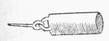
“A forcer is a plug of wood exactly turned and leathered about; the end that goeth into the barrel, is semicircularly concave; p. 57. Forces may be made to move either horizontally or perpendicularly, according unto the convenience of the work, or the invention of the artist and engineer; p. 59. (Describing ‘the water mill or engine near the north end of London Bridge.’) These two barrels must be bound fast unto two posts of the frame, with two strong iron bands, as T T; unto each of these must be fitted a force well leathered, and in the tops of the forces must be set two pieces of wood.”
Then again, at page 66:—“K K, L L, the barrels of the forces, which force the water;” p. 67. “E, a barrel of brass or wood fastened in the well, K, a force fitted into it.” Again, “the force must be very heavy;” p. 71. “B, a barrel of iron or brass, fastened in the midst of the cistern, with a force fitted unto it;” p. 72. “The force is linked, and it is noted with the letter D,” (in the engraving.) Again, “F, the barrel of the force, fastened within two or three inches of the bottom of the cistern;” p. 73, “C, a force, D, the forces barrel.” Again, “the force draweth the water out of the cistern B, into the barrel D;” p. 74, “another strong iron bar as I I, unto each end whereof must be linked a force; K K, the two barrels of the aforesaid forces.”
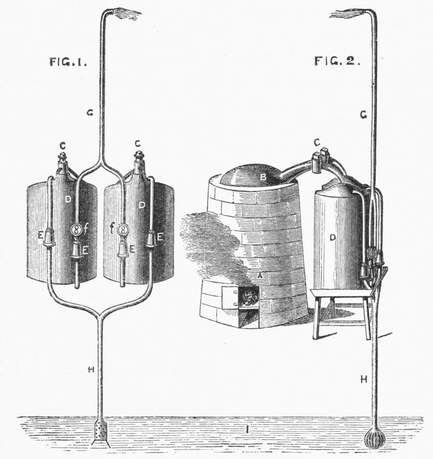
In the 21st volume of Philosophical Transactions, published in 1700, there is a description, with an engraving,[M] being, “An account of Mr. Thomas Savery’s engine for raising water by the help of fire.” It states that Mr. Savery, on the 14th of June, 1699:—“Entertained the Royal Society with shewing a model of his Engine for raising water by the help of fire, which he set to work before them; the experiment succeeded according to expectation, and to their satisfaction. The Engine may be understood by the draughts of it, where Fig. 1 is the front of the Engine for raising water by fire; and Fig. 2, the side prospect of the Engine.
“A, is the furnace; B, the boiler; C, two cocks which convey the steam from the bottom in order to discharge it again at the top; D, which convey the steam by turns, to the vessel D. the vessels which receive the water from the bottom in order to discharge it again at the top; E, valves; F, cocks which keep up the water, while the valves on occasion are cleaned; G, the force pipe; H, the sucking pipe; and I, the water.”
Neither at the time nor afterwards does the invention appear to have attracted any further notice in that quarter. The next account we have of it is afforded by “The Miners Friend, or an Engine to raise Water by Fire,” by Thomas Savery, Gent., 1702; in which the invention appears with two furnaces, instead of one, and with other details. In his description he refers to two vessels, marked P, No. 1, and P, No. 2, which correspond with the two receivers above, marked D, D.
Remarking on these, in “The Miners Friend,” Savery says:—“So that P, No. 1, is by the external pressure of the atmosphere, immediately refilled, while P, No. 2, is emptying; which being done, you push the handle of the regulator from you, and throw the force on P, No. 1, pulling the condensing pipe over P, No. 2, causing the steam in that vessel to condense, so that it fills while the other empties. The labour of turning these two parts of the engine, viz. the regulator and water-cock, and tending the fire, being no more that what a boy’s strength can perform for a day together * * * yet, after all, I would have men. * * *”
In the above 68th Article, the Marquis of Worcester says:—“A man that tends the work is but to turn two cocks, that one vessel of water being consumed, another begins to force and refil with cold water, and so successively, the fire being tended and kept constant, which the self-same person may likewise abundantly perform between the necessity of turning the said cocks.”
And in No. 100, he says, “a child’s force bringeth up an hundred feet high, an incredible quantity of water.”
We do not purpose to press any charge against Savery, but simply to relate what is on record respecting the engine he put forward; and to notice here the remarkable coincidence between his description, and that given by the Marquis 32 years before. The Marquis writes in the singular number of “the fire,” thereby indicating a single furnace; and in Savery’s first drawing we find the model represented with one furnace. Then in “The Miners Friend,” we have parts described agreeing precisely with the preceding article, No. 68. And at the particular point just quoted, we have even a closer analogy, in the use of the very same words in reference to the same parts—turning and tending. And while, in No. 100, the Marquis informs us what “a child’s force” can perform; here Savery speaks of “a boy’s strength,” which is enlarged on, however, by recommending a man’s services.
The next earliest notice we find of this engine is given by Richard Bradley, F.R.S., in his “New Improvements of Planting and Gardening,” 8vo. 1718, who, in the third part, at page 175, supplies an engraving of “the late Mr. Savory, F.R.S.,”[N] his engine, as set up by him “for that curious gentleman Mr. Balle of Cambden House.” It is represented as a spherical boiler, capable of holding forty gallons, supported on a tripod, with a fire on the ground underneath. It is connected with a bell-shaped receiver of thirteen gallons capacity, supplied below with a pipe sixteen feet long, and above with a pipe to elevate the water, forty-two feet. The steam pressure is stated to be capable of discharging fifty-two gallons per minute, the pipes being of three inches bore; and the original cost of the whole was £50.
In 1729, Stephen Switzer published his “Introduction to a general system of Hydrostaticks,” in two volumes quarto. He says:—
“Amongst the several Engines which have been contrived for the raising of water for the supply of houses and gardens, none has been more justly surprising than that of the raising of water by fire; the particular contrivance and sole invention of a gentleman, with whom I had the honour long since to be well acquainted; I mean the ingenious Captain Savery, some time since deceased, but then a most noted engineer, and one of the Commissioners of the Sick and Wounded. This gentleman’s thoughts (as appears by a preface of his to a little book, entitled, ‘The Miners’ Friend’), were always employed in Hydrostatics and Hydraulics; and the first hint from which it is said he took his engine, was from a tobacco pipe, which he immersed to wash or cool it, as is sometimes done; he discovered by the rarefaction of the air in the tube by the heat or steam of the water, and the gravitation or impulse of the exterior air, that the water was made to spring through the tube of the pipe in a wonderful surprising manner; though others say, that the learned Marquis of Worcester, in his ‘Century of Inventions,’ (which book I have not seen), see page 68, gave the first hint for this raising water by fire.”—Vol. ii. p. 325.
Thirty-four years later, Dr. J. T. Desaguliers, F.R.S., and Chaplain to His Royal Highness, Frederick, late Prince of Wales, &c., published his “Course of Experimental Philosophy,” in two volumes, quarto, 1763. His 13th section is a discourse on the “Fire-engine,” as the steam-engine was then designated. And the following lecture treats largely on the Marquis of Worcester’s present article in the “Century,” which he quotes and then observes:—
“Captain Savery, having read the Marquis of Worcester’s book, was the first who put in practice the raising Water by Fire, which he proposed for the draining of mines. His Engine is described in Harris’s Lexicon (on the word Engine), which being compared with the Marquis of Worcester’s description, will easily appear to have been taken from him; though Captain Savery denied it, and the better to conceal the matter, bought up all the Marquis of Worcester’s books that he could purchase in Pater-Noster-Row, and elsewhere, and burned them in the presence of the gentleman his friend, who told me this. He said that he found out the power of steam by chance, and invented the following story to persuade people to believe it, viz., that having drank a flask of Florence at a tavern, and thrown the empty flask upon the fire, he called for a bason of water to wash his hands, and perceiving that the little wine left in the flask had filled up the flask with steam, he took the flask by the neck, and plunged the mouth of it under the surface of the water in the bason, and the water of the bason was immediately driven up into the flask by the pressure of the air.”
Desaguliers doubts the veracity of this bottle story, and we may well agree with him, when we find that in another version the discovery is attributed to a tobacco-pipe.
He proceeds:—“Captain Savery made a great many experiments to bring this machine to perfection, and did erect several, which raised water very well for gentlemen’s seats; but could not succeed for mines, or supplying towns, where the water was to be raised very high, and in great quantities: for then the steam required being boiled up to such a strength, as to be ready to tear all the vessels to pieces. I have known Captain Savery, at York-Buildings, make steam eight or ten times stronger than common air; and then its heat was so great, that it would melt common soft solder; and its strength so great as to blow open several of the joints of his machine: so that he was forced to be at the pains and charge to have all his joints soldered with spelter or hard solder.”—Pp. 464–467.
The serious accusation made against Savery of deriving all his information from the Marquis of Worcester’s invention, and destroying all he could procure relating to the Marquis, rests solely on the authority of Desaguliers, to whom it was related by one of Savery’s friends! In 1699, the Marquis’s Act had yet 63 years unexpired, had the Duke of Beaufort felt disposed to investigate how far Savery’s engine interfered with his father’s invention; but no such interest was excited, nor had Savery at any time so much success as to induce such an inquiry. But, in 1699, the Marquis had only been dead 32 years, and we have proof that his engine was in existence in 1670, reducing the space of time to 29 years; by no means an unlikely period for Savery to find parts of the large engine, or models of a small one, or drawings, or MS. descriptions, or verbal details from eye-witnesses, from among some of the many visitants to Vauxhall, if, indeed, not directly from descendants of the “incomparable workman,” Kaltoff.
Savery’s connection with the mining interests of the country would appear to have first drawn his attention to the value of a scheme, proposing to raise vast bodies of water by the aid of a most stupendous power. He might, when a mere youth, have heard enough of the Marquis’s invention, however vaguely communicated, to excite his curiosity, and decide him on a course of action whenever an opportunity should occur.
After a lapse of more than a century and a half, Savery’s claim is not likely to be materially disturbed; but it will always be a matter of interest to observe the close similarity there is between the simple model he exhibited before the Royal Society, and the Marquis of Worcester’s brief summary of the parts and nature of his own engine. And it is not very favourable to a belief in Savery’s independence of the Marquis’s invention, that the former should be the sole inventor of a single marvellous production of ingenuity, without producing any novelty either before or afterwards, or displaying any particular inventive ability to improve on this early effort, which he left as at first produced.
“The Miners Friend” is not unlike an imitation of the “Exact and true definition of the most Stupendous Water-commanding Engine;” for example:—
The Marquis’s invention is recommended “to every individual, if he either have surrounded Marsh-ground to drain, or dry land to improve.”
Savery recommends the Engine he proposes:—
4. “As for draining fens and marshes,” &c.
“Thus whole cities may be kept clean, delightful, and wholesome.”
3. “Nothing can be more fit for serving cities and towns with water.”
“Or, if he have (I further say), Mines wherewith to enrich himself withal.”
6. “For draining of mines and coal pits, the use of the engine will sufficiently recommend itself in raising water so easy and cheap.”
“Houses to be served, or gardens to be beautified by plentiful fountains, with little charge, yet certain in ever so dry a Summer.”
2. “It may be of great use for palaces, for the nobilities, or gentlemen’s houses; for by a cistern on the top of a house * * * which water in its fall makes you what sorts of fountains you please.”
Savery says:—“And though my thoughts have been long imployed about water-works, I should never have pretended to any invention of that kind, had I not happily found out this new, but yet a much stronger and cheaper force or cause of motion than any before made use of. But finding this of rarefaction by fire, the consideration of the difficulties the miners and colliers labour under by the frequent disorders, cumbersomness, and in general of water-engines, incouraged me to invent engines to work by this new force, that tho’ I was obliged to incounter the oddest and almost insuperable difficulties, I spared neither time, pains, nor money till I had absolutely conquer’d them.”
Savery is reputed to have died in 1715, therefore he was very probably between 40 and 50 years of age in 1699; and he might have commenced his investigations into the existence of the Marquis’s inventions, models, books, papers, drawings, and traditional statements at 25 or 30 years of age, still leaving him from 15 to 20 years to complete his search for information. If he died at 60 years of age, he would be 12 years old when the Marquis died. At all events he had ample leisure, and the period was promising for such an inquiry.
In his time neither writers nor inventors were very scrupulous in their adoption of the labours of others; the wholesale literary plunder then practised by compilers, would not be permitted in modern times, nor would it be attempted by any author of moderate reputation. Invention, on the contrary, has always been a doubtful sort of preserve, the rights of which have been contested with fearless impunity by every poacher down to the present period. In the 16th and 17th centuries particularly, no rights were so ill defined as those of the inventor, even in the face of patents, and Acts of Parliament. But the rights of a deceased inventor were still less sacred in public opinion, and there never has been, at any time, an organized body interested in detecting and exposing unjust assumptions of being a true and first inventor.
Savery claimed perfect independence of the Marquis of Worcester, and promulgated a story to parallel that of the pot-lid, usually related in reference to his predecessor’s invention, while (as is pretended) he was a prisoner in the Tower. Let us now compare certain dates and circumstances to see how far they favour Dr. Desaguliers’ charge.
On the 25th of July, 1698, Thomas Savery, Gentleman, had granted to him a 14 years’ patent for “A new Invention for raising of Water and occasioning motion to all sorts of Mill Work by the impellent force of fire.”
Within six months afterwards, on the 21st of January, 1699, died the only son and heir of the Marquis of Worcester, Henry Duke of Beaufort, at 70 years of age.
Within three months after his Grace’s decease Savery had a Bill brought into the House of Lords, which, on the 6th of April, was reported to the House of Commons, and passed on the 25th of the same month. This private Act extended the patent privilege over 21 years further, making 35 years.
On the 14th of June following, it is stated in the Royal Society’s Transactions, “Mr. Savery entertained the Society with shewing the model of his engine for raising water by the help of fire.” (See page 485.)
Dr. Hook was then living, but died on the 3rd of March, 1702. Above 38 years had elapsed since his visit to Kaltoff, to see the engine at Vauxhall; and he could have spoken to the merits of Savery’s engine, as compared with what he had earlier seen, had his age and health permitted, or his inclination prompted him so to act.
On the decease of Dr. Hook, there was published “The Miners Friend,” (1702), by Thomas Savery,[O] Gentleman. He there speaks of his model shown to the Royal Society, “June the 14th, 1699,” thanking the Society for “your kindness in countenancing this invention in its first appearance in the world;” that is, within six months after the death of the Duke of Beaufort.
The Patent of 1698, like all patents of that period, contains no more account of Savery’s engine than the mere title, or designation of the nature and intention of the invention; therefore, when the Act of Parliament was applied for and obtained, there had still been no publication indicating the modus operandi. It was not until the 14th of June, 1699, that the Invention made its first appearance in the world, in the rooms of the Royal Society. And it was not until 1702, that Savery published any account of his invention, and we then expect to learn something interesting in regard to the wonderful discovery. But all he has to say on the matter is in these few lines “And though my thoughts have been long employed about water-works, I should never have pretended to any invention of that kind, had I not happily found out this new, but yet a much stronger and cheaper force or cause of motion than any before made use of. But finding this of rarefaction by fire, the consideration of the difficulties the miners and colliers labour under by the frequent disorders, cumbersomeness, and in general of water-engines, encouraged me to invent engines to work by this new force, that though I was obliged to encounter the oddest and almost insuperable difficulties, I spared neither time, pains, nor money, till I had absolutely conquered them.”
This stoicism and total absence of the least ray of mental enthusiasm are the first remarkable circumstances to strike our observation. Here, after a lapse of three years, some encouragement, and writing on the matter of a great discovery, the precious jewel is treated as if it were of the nature of the most ordinary pump. “And though my thoughts have been long employed about water-works,” yet we are to presume that he never heard of the great “Water-commanding Engine” at Vauxhall, 30 years previous. He believes in his having “found out this new, but yet a much stronger and cheaper force than any before made use of,” yet never, even remotely, declares how or in what way he came by it. “But finding this of rarefaction by fire,” as he says, we on our part naturally ask, And pray where and how did you find it? He names the considerations that “encouraged him to invent engines to work by this new force;” but from the time of producing the model of 1699 to the last improvement of 1702, there was no essential difference; the invention remained the same throughout. The only difficulties in his way were, in his own words, “the oddest and most insuperable,” but we are left to guess in what their oddness consisted.
He finally states, in his first chapter:—“I may modestly affirm that the adventurer or supervisor of the mine will be freed from that perpetual charge, expence, and trouble of repairs which all other engines ever yet employed in mines for the raising of water are continually liable unto.”
In Article No. 100, of the “Century,” however, it is shortly but expressly urged, as one important point, that the engine works, “with little charge, to drain all sorts of mines, &c.”
It appears from documents dated 1664, relating to Vauxhall, that Caspar Kaltoff is named therein as “lately deceased.”[P] So that in 1699 Thomas Savery was left in full possession of the field he had entered upon. The facts and dates now furnished, are not very favourable to the genuineness of Savery’s Invention. For it is not likely that all trace of the “Water-commanding Engine” would have been lost between 1670 and 1699, when Kaltoff’s family were still living, as also many persons who had witnessed the performance of the great engine at Vauxhall. It is true that the last we hear of it is not later than 1670, but it was then the property of the Dowager Marchioness, who died in 1681, and her Ladyship would most likely, from respect, as well as from personal interest in the matter, not permit the engine to be sold or destroyed. Then from 1681 to 1699, reduces the probability of its existence up to a period within 18 years, taking the dates to the uttermost limit, although we can easily understand that for the whole or a large portion of those 18 years Savery was in possession of all the facts he would require for coming before the public on the decease of Kaltoff, the Dowager Marchioness of Worcester, and the Duke of Beaufort; the latter being the last party interested in the invention, and likely, during his life, to frustrate such a design.
But what papers could he procure at Paternoster Row for destruction? 1. There was a pamphlet, being the Definition and Act, the latter printed in black letter. 2. There was the “Definition” itself, printed in the form of a posting bill. And, 3, there was the “Century.” All these were printed 1663 to 1664, and are editions which are now remarkably scarce. There are only about three copies of the Act, and one of the “Definition,” known to exist, while the few copies of the “Century” of 1663, are rarely indeed to be found in private collections. But, besides these, it was quite possible to procure, within 15 or 20 years after his decease, even manuscripts, drawings, and books, the property of the deceased Marquis, more or less referring to his great invention.
Even admitting that Savery was an independent inventor in 1699, notwithstanding so many conflicting circumstances pointing to a different conclusion, he could not have been working many years at York Buildings in the Strand, without hearing of the Engine at Vauxhall, invented by the proprietor of Worcester House in the Strand. This very propinquity alone was sufficient to excite in the mind of some intelligent, inquisitive, and observant visitor the fact, which so singular a coincidence would obviously suggest.
While, however, everybody else is viewing the engine of Savery’s reputed invention with astonishment, Savery himself is present to our mind only as a cold calculating man, proud, not of being a Captain over Mines, but of being designated “Gentleman;” and while thus precise to inform the world of his gentility, he leaves us in perfect ignorance of his mental acquirements, or the origin of the marvellous engine. It may appear to some, that his exhibiting of the model before the Royal Society is at once evidence of straightforwardness and uprightness of conduct. But this view is open to the objection, that he had never before shown the model, and he thanks the Royal Society for “countenancing this Invention on its first appearance in the world.” From the 25th of July 1698, to the 14th of June 1699, he had been nursing the invention in secret. What doubts could remain in his mind, when all persons likely to be most interested were no longer in existence? Men of science alone remained, who might possibly disturb his claims, and what means could be found more likely to set this doubt at rest, than a bold appeal to that learned body? And come of it what might, there would still remain to him the question of improvements; supposing the grand claim to originality to become a matter of dispute. But to Savery’s great satisfaction, if not to his greater surprise, so far from a word of dissent being raised, there was (contrary to all precedent) a certificate given in favour of the invention at Savery’s request.
Savery’s career may be taken as commencing in 1699, thirty-two years after the decease of the Marquis of Worcester, thirty-six years from the date of the “Century of Inventions,” or thirty-nine years after the establishment of the Royal Society, and yet his operations made slight impression on the public, and scarcely any on scientific society. This circumstance removes much of the surprise we might otherwise seriously entertain respecting the occasion of the Marquis of Worcester’s own publications and personal labours, during four arduous years of excessive mental and physical activity, leaving little behind to attest the extent of his operations and the precise nature of the difficulties with which he had to contend. Great strides must have been made in arts, manufactures and trade, during the intervening thirty-two years, all in favour of Savery’s progress, and yet, with the exception of Dr. Papin, scientific men were not attracted by the remarkable results which Savery prominently placed before the public; and Savery’s own exposition before the Royal Society is abridged to a single copper-plate engraving, and the shortest possible printed reference to its several details. Thus was this true mechanical prodigy of the age treated as though it were of little or no interest.
When we compare this long continued apathetic feeling, this absence of forecast to form some strikingly favourable judgment of the value of the novelty thus published, although in its earliest stage, with the superior knowledge on the subject evinced by the writings, labour, and conduct of the Marquis of Worcester, at least thirty-six years before Savery; it is then, and then only, perhaps, that we become fully alive to his almost prescient judgment, that could, as if inspired, prognosticate so truthfully as he did the future benefits of his invention to mankind.
69.
A way how a little triangle[2] scrued Key, not weighing a Shilling, shall[3] be capable and strong enough to bolt and unbolt round about a great Chest an hundred Bolts through fifty Staples, two in each, with a direct contrary motion, and as many more from both sides and ends, and at the self-same time shall fasten it to a place beyond a mans natural strength to take it away: and in one and the same turn both locketh and openeth it.
Footnotes
[A triangle Key.] This ingenious trifle may be really only one part of another instrument, just as we see in the cutting portion of a centre bit, which, if its operation were attempted to be described after the same fashion, would afford a perplexing and seemingly paradoxical statement. Yet no doubt the little triangle key was capable to the full of performing the duty here stated.
70.
A Key with a Rose-turning pipe, and two Roses pierced through endwise[4] the Bit thereof,[5] with several handsomly-contriv’d Wards, which may likewise do the same effects.[6]
Footnotes
[A Rose-Key.]
71.
A key perfectly square, with a Scrue turning within it, and more conceited then any[7] of the rest,[8] and no heavier then the triangle-scrued Key, and doth the same effects.
Footnotes
[A square Key with a turning scrue.] These two contrivances are simply variations on Article No. 69, and may depend for sufficient leverage on some source purposely kept out of view.
72.
An Escocheon[9] to be placed before any of these Locks with these properties.
1. The owner (though a woman) may with her delicate hand vary the wayes of coming to open the Lock ten millions of times, beyond the knowledge of the Smith that made it, or of me who invented it.
2. If a stranger open it, it setteth an Alarm a-going, which the stranger cannot stop from running out; and besides, though none should be within hearing, yet it catcheth his hand, as a Trap doth a Fox; and though far from maiming him, yet it leaveth such a mark behind it, as will discover him if suspected; the Escocheon[9] or[1]. Lock plainly shewing what monies[2] he hath taken out of the Box to a farthing, and how many times opened since the owner hath been in[3] it.
Footnotes
[An Escocheon for all Locks.] Stow, in his Annals of Queen Elizabeth, has particularly distinguished Mark Scaliot as a clever blacksmith; and Dr. Robert Plot, in his “Natural History of Staffordshire,” 1684, especially notices the elaborate, ingenious, and expensive locks made by several eminent Staffordshire locksmiths. He observes:—“The greatest excellency of the blacksmith’s profession, that I could hear of in this county, lies in their making locks.” He then explains at large a certain kind of locks with a master’s key, and inferior keys for the servants; and supposing any servant to trifle with such locks, the master or mistress can “certainly tell how many times that servant has been in, at any distance of time; or how many times the lock has been shot for a whole year together.” He also says: “I was told of a very fine lock made in this town (Stafford) sold for twenty pounds, that had a set of chimes in it, that would go at any hour the owner should think fit.”
73.
A transmittible Gallery over any Ditch or Breach in a Town-wall, with a Blinde and Parapit Cannon-proof.
[A transmittible Gallery.] The perusal of the elaborately illustrated works of Vegetius, Vitruvius, Fludd, and other writers of the sixteenth and seventeenth centuries, would abundantly furnish the Marquis of Worcester with hints to show what had been done in such warlike machinery, and to stimulate him to make improvements. Such an invention as the present one, with others of a like magnitude, he probably never proved practically beyond satisfying himself by means of well made models, that whatever modifications he proposed to introduce were mechanically practicable.
74.
A Door, whereof the turning of a Key, with the help and motion of the handle, makes the hinges to be of either side, and to open either inward or outward, as one is to enter or to[4] go out, or to open in half.
Footnote
[A conceited Door.] Van Etten, in his Mathematical Recreations, offers as Problem XV. “How to make a Door or Gate, which shall open on both sides.” It is represented that “All the skill and subtilty of this, rests in the artificiall disposer of four plates of iron.” The description, which is very imperfect, concludes—“the gate will open upon one side with the aforesaid plates, or hooks of iron; and by the help of the other two plates, will open upon the other side.” [Oughtred’s ed. 1653, page 30.] The Marquis may have conceived his own plan to be a most decided improvement upon this primitive design.
75.
How a Tape or Ribbon-weaver[5] may set down a whole discourse, without knowing a letter, or interweaving any thing suspicious of other secret then a new-fashioned Ribbon.[6]
Footnotes
[A Discourse woven in Tape or Ribbon.] This article should have followed article No. 43, of which it seems to be one of the “variations” therein contemplated.
76.
How to write in the dark as streight as by day or candle-light.
[To write in the dark.] This would appear only to require a box of any form, the top or lid of which being of ground glass, it could be illuminated by means of a small night-light placed below, within the box; when it would be possible to write on paper laid on the glass, in a totally dark room. Such a device might be useful to an inexpert artist for making a tracing of any drawing.
77.
How to make a man to fly; which I have tried with a little Boy of ten years old in a Barn, from one end to the other, on a Hay-mow.
[A flying man.] One feels disposed to believe, on reading this article, that the Marquis, in multiplying his experiments with fire and water, might have tried in different ways the effects of heating air, and actually gone far to anticipate Montgolfier in producing a balloon.
However, it was confidently believed in the 17th century that flying was possible, provided proper machinery could be invented. There is a curious little work on this subject, “De arte Volandi,” by Frid. Hermannus Flayder, small 12mo. 1627.
Milton, in his “History of Britain,” 1670, speaking of the prognostications of Elmer, a monk of Malmsbury, during the reign of Harold, mentions that—“He in his youth strangely aspiring, had made and fitted wings to his hands and feet; with these on the top of a tower, spread out to gather air, he flew more than a furlong; but the wind being too high, came fluttering down, to the maiming of all his limbs; yet so conceited of his art, that he attributed the cause of his fall to the want of a tail, as birds have, which he forgot to make to his hinder parts.” See also Kennet’s History of England, 1st vol. 1706, fol.
In “Friar Bacon’s discovery of the miracles of Art, Nature, &c.” published in 12mo. 1659, treating “Of admirable artificial instruments,” the following occurs among other inventions: “It is possible to make engines for flying, a man sitting in the midst whereof, by turning only about an instrument, which moves artificial wings made to beat the air, much after the fashion of a bird’s flight.” Chap. iv. page 17. He states that he has seen all his other named inventions, “excepting only that instrument of flying, which I never saw, or know any who hath seen it, though I am exceedingly acquainted with a very prudent man, who hath invented the whole artifice.”
The learned Dr. Robert Hooke, Professor of Geometry at Gresham College, in 1655, made many ineffectual trials to accomplish this object, which he communicated to the celebrated Bishop Wilkins, who considered his plans were very ingenious.
Lord Bacon was not above recommending experimental investigation of means for flying. And Bishop Wilkins suggests, that the most obvious way for effecting the desired purpose is “by wings fastened immediately to the body, this coming nearest to the imitation of nature;” and further, “this is that way which Fredericus Hermannus [Flayder], in his little discourse, De Arte volandi, doth only mention and insist upon.”
In 1679, Dr. Robert Hooke, while Secretary of the Royal Society, published “Lectiones Cutlerianæ, a collection of Lectures made before the Royal Society,” 4to. consisting of a series of pamphlets, among which, No. 1 of the “Philosophical Collections,” contains eleven articles, the fourth being, “An account of the Sieur Bernier’s way of Flying,” as follows:—
“Having lately seen an account from France of a person there, who, with some considerable success, has attempted to raise and sustain himself, and so to move and fly in the air by the help of mechanical or artificial wings, agitated only by his own strength, without the assistance of any other either animate or inanimate power; I thought it might not be unacceptable to the curious to receive some (though imperfect) account thereof.
“It is, I confess, no new design, since there has hardly been an age wherein some one or other of these Dædalian engineers have not been trying the strength of their invention about it. The story of Dædalus and Icarus might have its ground from the attempts of some persons about this matter, though poetic relations have made it seem romantic. What the performances of Simon Magus were is uncertain; they might have [been] somewhat mechanical. That attempt of one of our English kings is delivered to us for true history: whether so or no, I determine not. But without doubt, it was believed possible, and attempted also in the time of our famous Friar Roger Bacon, who lived about 500 years since. Now, though he was believed a magician or conjuror, and to have performed what was related of him by the help of diabolical magic, yet from the perusal of several of his excellent works yet extant, I esteem him no such person; but I rather find him to have been a good mathematician, a knowing mechanic, a rare chemist, and a most accomplished experimental philosopher, which was a miracle for that dark age. This man affirms the art of flying possible, and that he himself knew how to make an engine,[Q] in which a man sitting, might be able to carry himself through the air like a bird. And affirms that there was then another person who had actually tried it with good success. The stories of Architas his wooden dove, and Regiomontanus his wooden eagle, are not much doubted of. Questionless, those persons did make some kind of engines to perform what was considerable in this art of flying. Busbequius his story of the Turk at Constantinople, that attempted to fly, is not doubted. Nor are other relations of late attempts made in Germany, and elsewhere disbelieved. We have not wanted late instances, even here in England, of several ingenious men who have employed their wits and time about this design. Particularly, I have been credibly informed, that one Mr. Gascoyn did about 40 years since try it with good effect; though he since dying, the thing also died with him. And even now there are not wanting some in England who affirm themselves able to do it, and that they have proved as much by experiment.
“But of all these, we have little or no account of the ways they have taken to effect their designs, and therefore conjectures will be much at random; only we may conclude them defective in somewhat or other, since we do not find them brought into common use, which the desirableness and usefulness of any one that should succeed would certainly cause it to be. I shall desist therefore from inquiry further concerning them, and acquaint you with two ways lately published in print, and more particularly described, which pretended to some considerable performance of this kind.”
The first is inserted in the “Journal des Scavans” of the year 1678.
Then follow a letter on the subject, and an account of Lana’s flying chariot. The latter is like a boat with wheels and sails; the former was the invention of Sieur Besnier, a smith of Sable in the county of Maine. The engraving represents a nude figure with two poles held horizontally on each shoulder, about the centre, and having at each end flags or wings, in form of folio book backs, with the two back ends of the poles attached by strings to the feet; affording altogether a very feeble attempt to obtain the desired object.
The privilege of flight by any mechanical means is denied to man; his figure, weight, muscular constitution, all operate against his imitating the bird, which, admirably proportioned, light in frame, yet concentrating powerful muscular strength in its wings, well adapt it for enduring prolonged aerial flight, although the medium in which it floats is eight-hundred times lighter than water.
If flight in the air is ever to be mechanically attained, it will be by a machine, worked independently of man’s power, and which possibly will neither be so safe nor so manageable as the common balloon, with all its hazards and wayward guideless journeyings.
78.
A Watch to go constantly, and yet needs no other winding from the first setting on the Cord or Chain, unless it be broken, requiring no other care from one then to be now and then consulted with concerning the hour of the day or night; and if it be laid by a week together, it will not erre much, but the oftener looked upon, the more exact it sheweth the time of the day or night.
[A continually-going Watch.] A watch having the dial enclosed under a metal case, as in hunting watches, is no doubt to be so contrived that the opening and closing of such case, to ascertain the time, shall act more or less to wind it up. A room door has been thus made to transmit power through attached levers to keep a clock constantly wound little by little, every time on opening and closing the door.
His list of certain of his inventions gives a different reading to this article; as follows:—“I can render an ordinary watch, which, being once wound up, will go constantly during a man’s life, being used but once in 24 hours; and, though oftener looked on, it is still the same; and though not looked on for a week, still the same, if not bruised.”—See Appendix A.
And in his patent of 1660, we have again a third reading, viz:—“To make a watch or clock without string or chain, or any other kind of winding up but what of necessity must follow, if the owner or keeper of the said watch or clock will know the hour of day or night; and yet if he lay it aside several days or weeks without looking or meddling with it, it shall go very well, and as justly as most watches that ever were made.”—See Appendix B.
In “Humane Industry,” chapter I, occur the following remarks, “On Dials,” page 8:—“The wit of man hath been luxuriant and wanton in the inventions of late years; some have made watches so small and light, that ladies hang them at their ears like pendants and jewels; the smallness and variety of tools that are used about these small engines, seem to me no less admirable than the engines themselves; and there is more art and dexterity in placing so many wheels and axles in so small a compass (for some French watches do not exceed the compass of a farthing) than in making clocks and great machines.” It is also stated at page 9, that “In some towns of Germany and Italy, there are very rare and elaborate clocks to be seen in their Town Halls; wherein a man may read Astronomy, and never look up to the skies.” We are next informed: “But the exactest clocks and watches that are, are defective, and want correction; for in watches, the first half hour goes faster than the last half, and the second hour is slower than the first, and the third then the second.” Page 12.
79.
A way to lock all the Boxes of a Cabinet, (though never so many) at one time, which were by particular Keys appropriated to each Lock opened severally, and independent[7] the one of the other, as much as concerneth the opening of them, and by these[8] means cannot be left opened unawares.
Footnotes
[A total locking of Cabinet-boxes.] The fact that by this means no one of the several cabinets can “be left opened unawares,” exposes the source of security, namely something like a long key-rod to take hold of each, or a bar extending down one side to overlap, when each cabinet drawer or door is closed.
80.
How to make a Pistol Barrel no thicker then a Shilling, and yet able to endure a Musquet proof of Powder and Bullet.
[Light Pistol-barrels.] One might almost suppose the Marquis contemplated a method similar to that recently introduced by Mr. Longridge, of winding the barrel with wire.
See also article No. 44, which may, or not, refer to the same description of barrel.
81.
A Combe-conveyance carrying of[9] Letters without suspicion, the head being opened with a Needle-scrue drawing a Spring towards them[1]; the Comb being made but after an usual form carried in ones Pocket.
Footnotes
[A Comb-conveyance for Letters.] The entire ingenuity of the kind of conveyance proposed consists in the skill of the workman to provide a receptacle in so small an article, not open to suspicion when handled by a spy.
82.
A Knife, Spoon or Fork in an usual portable Case, may have the like conveyances in their handles.
[A Knife, Spoon or Fork-conveyance.] William Bourne’s 73rd Device is—“How for to convey letters secretly.” One means is to be found in a Dog’s collar. Another in a water-tight metal case, to be inserted within a bottle of wine. “Inventions or Devices,” 1578.
83.
A Rasping-mill for Harts-horn, whereby a child may do the work of half a dozen men, commonly taken up with that work.
[A Rasping-mill.] This description of mill is largely in use for rasping dye-woods, and has undergone a great variety of modifications.
84.
An Instrument whereby persons[2] ignorant in Arithmetick may perfectly observe Numerations and Substractions[3] of all Summes and Fractions.
Footnotes
[An arithmetical Instrument.] There is in the British Museum a manuscript description, with a large engraving, of the serpentine scale invented by Thomas Browne, of Fenchurch Street, London, in 1631, by means of which “instrument all kinde of questions in Arithmetike, Geometry, &c. are speedily resolved.” Brit. Mus. Birch MS. No. 4407.
Sir Samuel Morland, in 1672–3, published a small treatise, being—“The description and use of two arithmetick Instruments;” a second title mentions, “A new and most useful Instrument for Addition and Substraction of pounds, shillings, pence, and farthings,” which he “invented and presented to his most excellent Majesty, Charles II. 1666.”
85.
A little Ball made in the shape of a Plum or Pear,[4] being dexterously conveyed or forced into a bodies mouth, shall presently shoot forth such and so many Bolts of each side and at both ends, as[5] without the owners Key can neither be opened or[6] filed off, being made of tempered Steel, and as effectually locked as an Iron Chest.
Footnotes
[An untoothsome Pear.] It is difficult to understand the intended use of this proposed instrument, but it is more likely to have been suggested from a feeling of humanity than from any other motive. A desperate and ferocious enemy, thus rendered helpless before being manacled, would assuredly be less dangerous than he could otherwise be considered; and it would not, therefore, be requisite to take his life, for personal safety; once thus secured he would be likely to listen to any terms of mercy.
86.
A Chair made a-la-mode, and yet a stranger being perswaded to sit in’t, shall have immediately his armes and thighs lock’d up beyond his own power to loosen them.
[An imprisoning Chair.] In the “Memoirs, illustrative of the life and Writings of John Evelyn, F.R.S.” &c., edited by William Bray, 2 vols. 4to. 1819, occurs the Diary of his continental travels in 1644. On the 17th Nov., Evelyn being at Rome went to the “Villa Borghese, a house and ample garden on Mons Pincius.” In one of the chambers, he says, “are divers sorts of instruments of music; amongst other toys that of a satyr with so artificially expressed a human voice, with the motion of eyes and head, that it might easily affright one who was not prepared for that most extravagant sight. He showed us also a chair which catches any one who sits down in it so as not to be able to stir out, by certain springs concealed in the arms and back thereof, which at sitting down surprises a man on the sudden, locking him in by the arms and thighs, after a true treacherous Italian guise.”—Vol. i. p. 106–107.
M. de Blainville, in his travels, 1757, relates, in passing through Italy, and describing the Villa Borghese, raised under the Popedom of Paul V. uncle of Cardinal Scipio Borghese, that, “In the fourth room of the apartment, on the south side, called the room of the Three Graces, there stands a remarkable chair, said to have been formerly used to very evil purposes, by one of the Borghese family. The machine is very artfully contrived, and strangers who are not acquainted with the trick are infallibly caught, as in a trap, when they are prevailed upon to sit in this chair. By this stratagem the housekeeper gets a good many fees, which the enticed people are obliged to pay him for their deliverance out of captivity. In all appearance, these innocent deceits were the only thing intended by this piece of machinery.”—Vol. iii. page 34.
87.
A Brass Mold to cast Candles, in which a man may make 500. dozen in a day, and adde an Ingredient to the tallow which will make it cheaper, and yet so that the Candles shall look whiter and last longer.
[A Candle-mold.] This invention seems to include some recipe to whiten the tallow. When the idea of improving candle-moulds suggested itself, the Marquis had probably been over some manufactory, and on seeing the customary mode of candle-making, the present suggestion may have occurred to him. We have placed it among the few others (only nine in number), in his numerous list, as belonging to the Domestic Class, of which it is the last.
88.[R]
How to make a Brazen or Stone-head, in the midst of a great Field or Garden, so artificial and natural, that though a man speak never so softly, and even whispers into the ear thereof, it will presently open its mouth, and resolve the Question in French, Latine, Welsh, Irish or English, in good terms uttering it out of his mouth, and then shut it untill the next Question be asked.
[A Brazen head.] In a MS. list of five Inventions,
“Life, Times, &c.” page 316, the present article is briefly stated to be:—“A brass head capable to receive at the ear a whisper, and the mouth thereof to render answer in any language to the interrogator.”
In “The famous History of Frier Bacon,” [1630?] a black letter quarto of 24 leaves unpaged, the fifth article relates, “How Frier Bacon made a brazen head to speak, by the which he would have walled England about with brass.” He and Friar Bungey, it is stated, “with great study and pains so framed a head of brass, that in the inward parts thereof there was all things like as in a natural man’s head.”
The same account may be read at length in the modernised edition of “Early English Prose Romances,” edited by W. J. Thoms, F.S.A., first volume, 12mo. 1858, page 205. The unfortunate head only survived to speak thrice, and then fell to pieces!
See also “Miscellanea Antiqua Anglicana,” London, Printed for Robert Triphook, 1816, 4to. Vol. I.
In the “Inventions or Devices,” by William Bourne, 1578, “The 113th Device is, as touching the making of strange works, as the brazen head that did seem to speak, or birds of wood or metal made by art to fly, and birds made of wood or metal to sing sweetly at certain hours appointed, &c., which the common people doth marvel at.” He then proceeds to say:—
“As touching the making of any strange works that the world hath marvelled at, as the brazen head that did seem to speak: and the serpent of brass for to hiss: or a dove of wood for to fly: or an eagle made by art of wood and other metal to fly; and birds made of brass, tin, or other metal to sing sweetly, and such other like devices, some have thought that it hath been done by enchantment, which is no such thing, but that it hath been done by wheels, as you may see by clocks, that do keep time, some going with plummets, and some with springs, as those small clocks that be used in tablets to hang about men’s necks. And as the brazen head, that seemed for to speak, might be made by such wheel work, to go either by plummets or by springs, and might have time given unto it, that at so many hours’ end, then the wheels and other engines should be set to work: and the voice that they did hear may go with bellows in some trunk of brass or other metal, with stops to alter the sound, may be made to seem to speak some words, according unto the fancy of the inventor, so that the simple people will marvel at it. And for to make a bird or fowl, made of wood or metal, with other things made by art, to fly, it is to be done to go with springs, and so to beat the air with the wings, as other birds or fowls do, being of a reasonable lightness, it may fly: and also to make birds of metal to sing very sweetly, and good music, it may be done with wheels, to go at any hour or time appointed by plummets, and then to have pipes of tin or other fine metal, to go with bellows, and the pipes to have stops, and to go with a barrel, or other such like device, and may be made to play or sing what note that the inventor shall think good when he doth make it; and also there may be divers helps to make it to seem pleasant unto the ears of the hearers, by letting the sound or wind of the pipes pass through or into water, for that will make a quavering as birds do, &c. And also you may make a small puppet, either like a man or woman, to seem to go by wheels and springs, and shall turn and go circular, according unto the setting of the wheels and springs, and also the birds made to fly by art, to fly circularly, as it shall please the inventor, by the placing of the wheels and springs, and such other like inventions, which the common people would marvel at, thinking that it is done by enchantment, and yet is done by no other means but by good arts and lawful.”
Thomas Tymme, in 1612, published “A Dialogue Philosophicall,” written in the form of a Dialogue between Philadelph and Theophrast. In the third chapter, the former observes:—“I have heard and read of many strange motions artificiall, as were the inventions of Boetius, in whose commendation Cassiodorus writeth thus: you know profound things and shew mervailes, by the disposition of your Art, mettals doe lowe in sundrie formes: Diomedes picture of brasse, doth sound a trumpet loude: a brasen serpent hisseth: birds artificiall, sing sweetly. Very strange also was the moving of the Images of Mercurie: The brasen head which seemed to speake, made by Albertus Magnus: the Dove of wood, which the Mathematician Architas, did make to flie, as Agellius reporteth. Dedalus strange Images, which Plato speaketh of: Vulcans selfe-movers, whereof Homer hath written: the Iron fly, made at Noremberge, which being let out of the Artificers hand, did as it were flie about by the guests that were at the Table, and at the last, as though it were weary, returned to his masters hand againe. In which Citie also an artificiall Eagle was so ordered to flie aloft in the ayre toward the Emperour coming thither, that it did accompany him a mighty way.”—Page 63.
It is mentioned in Evelyn’s Memoirs, that when in Italy, in 1644, he visited the Villa Borghese at Rome, where he saw the figure of a satyr, that “artfully expressed a human voice.”—See Note, Article 86. And in his Diary, he records:—“13 July, 1654. We all dined at that most obliging and universally curious Dr. Wilkins’s, at Wadham College [Oxford]. He had contrived a hollow statue, which gave a voice, and uttered words by a long concealed pipe that went to its mouth, whilst one speaks through it at a good distance.” He also entertained his visitors with “many other artificial, mathematical, and magical curiosities.”
Bishop Wilkins, in his “Mathematicall Magick,” 1648, observes:—“There have been some inventions also which have been able for the utterance of articulate sounds, as the speaking of certain words. Such are some of the Egyptian idols related to be. Such was the brazen head made by Friar Bacon, and that statue, in the framing of which Albertus Magnus bestowed thirty years, broken by Aquinas, who came to see it, purposely that he might boast, how in one minute he had ruined the labour of so many years.” Proceeding further to consider such inventions, he says, “Walchius thinks it possible entirely to preserve the voice, or any words spoken, in a hollow trunk, or pipe.”—P. 176, 177.
Dr. W. Hooper, in the second volume of his “Rational Recreations,” has an article on “The Conversive Statue,” requiring the employment of two concave mirrors, a statue, and an interlocutor. In regard to this arrangement, it is remarked:—“This recreation appears to be taken from the Century of Inventions of the Marquis of Worcester; one of those men of sublime genius, who are able to perform actions infinitely superior to the capacity, or even the comprehension, of the mere scholar or man of business; and though his designs, at the time they were published, were treated with ridicule and neglect, by the great and little vulgar, who, judging by their own abilities, are ever ready to condemn what they cannot comprehend, yet they are now known to be generally, if not universally, practicable.”—Edit. 1794, pp. 220–223.
The “Athenæum” of the 6th December, 1862, announced that—“A very remarkable talking automaton is exciting the curiosity of the Parisians. It has been constructed by M. Faber, late Professor of Mathematics at a German university, and is stated by our contemporary, ‘Cosmos,’ to be by far the most successful effort that has been yet made to imitate the human voice. The figure, which is that of a woman, is exhibited on the Boulevard Magenta.”
We may here add the following comment on—
[A Stamping Engine.] “An engine, without ye least noyse, knock, or use of fyre, to coyne and stamp 100 lb. in an houre, by one man.”—See Harleian MS. No. 2428.
In “Humane Industry,” published 1661, at page 36, it is observed, that, “At the Mint of Segovia, in Spain, an engine that moves by water, distendeth an ingot of gold.”
The Coining Mill, or Press, was first introduced from France into England during Elizabeth’s reign, but was shortly after abandoned for the old hammer process of stamping with two dies. The invention of the mill is ascribed to an engraver, who used it in 1553 for coining the French king’s counters. The new process of coining was completely established in France in 1645, but not in England until 1662, the year before the “Century” was published, which sufficiently accounts for its author not printing the present article.
According to the Rev. Rogers Ruding, in his “Annals of the Coinage,” 1840, no improvement was attempted for upwards of a century, the modern coining-mill having been invented by Mr. Boulton, in 1788.
89.
White Silk knotted in the fingers[8] of a Pair of white Gloves, and so contrived without suspicion, that playing at Primero at Cards, one may without clogging his memory keep reckoning of all Sixes, Sevens and Aces which he hath discarded.[9]
Footnotes
[Primero Gloves.] Although we cannot give a clue to this contrivance for registering reckonings in card-playing, it is worth noticing the old game indicated:—
Primero, according to Dr. Johnson, is derived from the Spanish, which Minsheu, coupling with the Italian, thus explains, “primum et primum visum, that is, first, and first seen, because he that can show such an order of cards, wins the game.” He then quotes as examples:—
“I left him at primero with the Duke of Suffolk.”—Henry VIII.
“The Spaniard is generally given to gaming, and that in excess; their common game at cards is primera.”—Howell’s Letters, i. iii. 32.
“Give me your honest trick, yet, at primero, or gleek.”—Ben Jonson’s Alchemist.
Mr. S. W. Singer affords some curious information on Primero, in his excellent “Researches into the History of Cards,” quarto, 1816. It appears to be uncertain whether it is of Italian or Spanish origin. Primero, prime, and primavista, are the same game, differently designated. It was very popular in the reign of Queen Elizabeth; and, as we have seen, is mentioned by Shakespeare; indeed, it is supposed to have been one of the earliest played card games in England.
90.
A most dexterous Dicing Box, with holes transparent, after the usual fashion, with a Device so dexterous, that with a knock of it against the Table the four good Dice are fastened, and it[1] looseneth four false Dice made fit for his[2] purpose.
Footnotes
[A Dicing-box.] It would be doing deep injustice to the Marquis of Worcester, to judge him in all respects rigidly by modern fashions, customs, and habits of thought. The modern critic, in simple ignorance of the age, might exclaim with just indignation against the promulgating an invention to cheat at dice. We have many examples to prove, that the Marquis was not singular in proposing so questionable an invention, and we can only consider such schemes put forth as marvels in themselves and warnings to the unwary.
We find, as early as 1594, that Sir Hugh Plat, in his “Jewel House of Art and Nature,” describes “A perspective ring that will discover all the cards that are neere him that weareth it on his finger;” an effect produced by a hollow crystal stone or glass, with a good foil on the concave part, to act as a mirror. The apology he offers for publishing this scheme, will well apply also in the present instance; he says:—“I have discovered this secret rather to discorage yong novesses from card-play, who by one experiment may easily ghesse, how mannie sleights and cousenages, are dayly practised in our dicing and gaming houses, not doubting but that the general publication thereof will make the same so familiar with al men, as that I shall not justly be charged of anie to have taught old knaves new-schoole pointes.”
John Bate, in his “Mysteries of Nature and Art,” 1634, page 151, or the edition of 1635, page 242, gives directions, “How to make five or six dice of the ordinary bigness of dice, such as you may game withal, and such as would be taken by their looks to be ordinary dice, and yet all of them to weigh not above one grain.” To effect this:—“Take a piece of elder, and pith it, lay the pith to dry, and then make thereof with a sharp knife five or six dice, and you shall find it true that I have said.”
So far as the deceptive part goes, we have an example in reference to another game, afforded by Van Etten, in his “Mathematical Recreations,” Problem XVII. “Of a deceitfull Bowle to play withall.” The whole trick consists simply in producing an undue bias by means of a secretly inserted pellet of lead.
Walpole says of the “Century,” that—“It is a very small piece—in which he (the Marquis) affirms having, in the presence of Charles the First, performed many of the feats mentioned in the Book.” As however only two are named, No. 56 and No. 64, the foregoing mis-statement requires no stronger refutation. He proceeds:—“The work itself, which is but a table of contents; being a list of one hundred projects, most of them impossibilities, but all of which he affirms having discovered the art of performing.” Consequently, either the Marquis, or Walpole occupies a most unenviable position: for one or the other, alone speaks the truth. “Some of the easiest (he adds) seem, (among others) how to form an universal character; how to converse by jangling of bells out of tune; how to take towns, or prevent their being taken; how to write in the dark; how to cheat with dice; and in short how to fly.” He then proceeds to comment on them, observing:—“Of these wonderful inventions (but why wonderful if the easiest?), the last but one [how to cheat at dice] seems the only one of which his Lordship has left the secret; and, by two others [the universal character, and flying], it appears that the renowned Bishop Wilkins was but the Marquis’s disciple. But, perhaps, too much has been said on so fantastic a man.” It was by such unmeaning causticity that the accomplished Walpole could degrade his pen, display his own sterility in scientific acquirements, and perpetuate his incapacity to judge aright of the mathematical and mechanical acumen of the Marquis of Worcester.
91.
An artificial Horse, with Saddle and Caparizons fit for running at[3] the Ring, on which a man being mounted, with his Lance in his hand, he can at pleasure make him start, and swiftly to run his career, using the decent posture[4] with bon grace, may take the Ring as handsomly, and running as swiftly as if he rode upon a Barbe.
Footnotes
[An artificiall Ring-horse.] The nearest approach to this automaton was that of a mechanical horse, the invention of Colonel De Hamel, of the Wurtemberg Cavalry. This was, until lately, exhibited at Mason’s establishment, Piccadilly, but is now in Germany. It is made of wood, covered with a natural skin, and contains machinery which can be operated by a lever to produce any variety of action, from that of the most gentle to the fiercest of an unruly horse. But the animal possesses no locomotive power, being restrained to one spot by a strong pillar underneath, working at the centre in a cup-and-ball joint, so that it can fall sideways, backwards, or forwards, unless prevented by equestrian skill; it was, however, more than master of the greater number of many excellent horsemen who subjected themselves to its astonishing gambols.
The Marquis’s automaton was possibly intended for a kind of circus, and we may suppose that a strong post being in the centre, a long wooden bar was so placed across it as to revolve—with the horse attached to one end, and a weight or counterpoise on the other extremity, motion being given to the horse’s legs by internal machinery, and acting to propel it so long as the rider pleased, or the mechanism permitted.
92.
A scrue made like a Water-scrue, but the bottom made of Iron-plate Spade-wise, which at the side of a Boat emptieth the mud of a Pond, or raiseth Gravel.
[A Gravel Engine.] The principle of the modern dredging machine is to be seen in Besson’s “Theatrum Instrumentorum et Machinarum,” 1578, where about 25 hampers or buckets are attached to two endless chains passing over two drums, one at the bottom of two strong inclined poles, the other at the top of the same, where a workman turns it by means of an ordinary winch applied to an endless screw; while labourers below are actively filling the ascending vessels. The Marquis may have had in view to make each bucket dig up its own supply of gravel, &c. as indeed is the present practice.
This antiquated dredging machine, in some other form, had been contemplated in 1558. The Petition of George Cobham, Tomazo Chanata, and others, was presented to Queen Elizabeth, for the sole use of an engine to cleanse and carry away all shelves of sand, banks, &c. out of all rivers, creeks, and havens.—See Cal. State Papers, Dom. Series, 1547–1580. Edited by R. Lemon, F.S.A. 8vo. 1856, page 119, No. 56.
In 1583, an inventor, whose name does not appear, proposed, as one out of twenty inventions:—“An engine for cleansing or taking away of any shelves or shallow places in the river of Thames, or any such river; the same device may serve for cleansing of ditches about cities or towns, ponds, or any such like standing waters.”—Rara Mathematica, edited by J. O. Halliwell, F.R.S., &c. 8vo. 1841.
John Gilbert obtained a patent, dated 16th July, 1618, for a water plough, for the taking up of sands or banks out of the river Thames or other places. And the same John Gilbert, with James Freese, obtained a patent, dated 8th July, 1631, for engines or instruments, called water ploughs, for the taking up of sands, gravel, shelves, and banks out of the Thames and other havens. Also Symon Hill, on the 30th May, 1633, patented his invention for taking away of beds of sand and gravel from rivers.
93.
An Engine whereby one man may take out of the water a Ship of 500. Tun, so that it may be calked, trimmed and repaired without need of the usual way of stocks, and as easily let it down again.
[A Ship-raising Engine.] We find in Besson’s admirably illustrated folio work on Instruments and Machines, 1578, many means delineated for raising vessels; for taking them bodily out of the water; or, for laying them high and dry on shore for repairs, as in plates 55, 56, and 58. All such methods are naturally, however, not only very rude and imperfect, but are at best only applicable for small craft.
In 1636, Sir John Christopher Van Berg, Moravian Knight, dispossessed of all his property “by the devouring wars in Germany,” patented eleven inventions; the fifth being—“An assured way how the very greatest ship may be drawn up again, though it be sunk 80 fathoms deep.”
94.
A little Engine portable in ones Pocket, which placed to any door, without any noise, but one crack, openeth any door or gate.
[A Pocket Engine to open any door.] Doppelmayr gives an account of the screw-jack invented by Leonard Danner in 1550. It must have been well known in the following century, and we can readily understand how the principle of its action may have occurred to the Marquis for application to a pocket instrument that would exactly accord with his statement.
Bishop Wilkins, in his “Mathematical Magick,” 1648, treating on the employment of multiplied wheels, refers to Ramelli, Figure 160, observing:—“Hither also should be referred the force of racks, which serve for bending of the strongest bows, as also that little pocket engine wherewith a man may break or wrench open any door, together with divers the like instruments in common use.”—Chap. 13, pages 91, 92.
95.
A double Cross-bow, neate, handsome and strong, to shoot two Arrows, either together, or one after the other, so immediately that a Deer cannot run two steps but, if he miss[5] of one Arrow, he may be reach’d with the other, whether the Deer run forward, sideward, or start backward.
Footnote
[A double Cross-bow.] The employment of the cross-bow still lingered when this was first published in 1663. The invention is so obvious that any particular description would be superfluous, the whole effect consisting in either shooting the two arrows singly, or together.
In an article on Cross-bows, in Fosbroke’s Encyclopedia of Antiquities, 1840, it is stated that—“In a letter remissory, dated 1420, it is said, ‘lequel Haquinet a chevauchie tendu crenequins et arbalestes a croc’—that is, which Haquinet rode along with crenequins bent, and arbalestes on the hook. By the croc or crook is meant the hook, into which the trigger caught; of use both in bending the bow and shooting.”
96.
A way to make a Sea-bank so firm and Geometrically-strong, that a stream can have no power over it; excellent likewise to save the Pillar of a Bridge, being far cheaper and stronger then Stone-walls.
[A way for Sea-banks.] This article stands alone in the “Century” as an example of a singular divergence from its author’s main course of pursuits. It is more than likely that his idea in the present instance was the mere use of loose stones, laid down at such a curvature as to break rather than resist the force of heavy seas and rapid torrents, for such a plan would be decidedly “cheaper and stronger” than any masonry, especially if presenting a vertical surface to the surging sea.
97.
An Instrument whereby an ignorant person may take any thing in Perspective, as justly, and more[5] then the skilfullest[6] Painter can do by his eye.
Footnotes
[A perspective Instrument.] John Bate, in his “Mysteries of Nature and Art,” 1635, gives, at page 155, “A very easie way to describe a Towne, or Castle: being within the full sight thereof.” A vertical square frame is divided by means of a number of threads, crossing each other at equal distances. A vertical pillar opposite, has a spy-hole at the top, through which the town, or other prospect is to be viewed, and to be drawn square by square, on paper placed on the table below, until the whole is completed, as shown in a wood-engraved illustration. No doubt the Marquis had refined on this, or some like invention.
98.
An Engine so contrived, that working the Primum mobile forward or backward, upward or downward,[7] circularly or cornerwise, to and fro, streight, upright or downright, yet the pretended Operation continueth, and advanceth none of the motions above-mentioned, hindering, much less stopping the other; but unanimously, and with harmony agreeing they all augment and contribute strength unto the intended work and operation: And therefore I call this A Semi-omnipotent Engine, and do intend that a Model thereof be buried with me.
Footnote
[A Semi-omnipotent Engine.] The Marquis, previous to the publication of this article, had permitted a written notification of a few of this inventions to be circulated, which is given at length, in Appendix A. In the commencement of this MS. we recognize an earlier reading of the foregoing, as follows:—“The quintessence of motion, or a collection of all kinds of mouvements, to wit; circular, to and fro, perpendicular, upwards and downwards; side-motions, to the right and left; straight motions, forwards and backwards, with a circular vehiculum, to which any of these may be applicable, or moveable to all the points of the compass; at each of which, it will be as powerful as if it were fixed to one place or centre.
“All and every of these, by height of Art, Industry, and Experiment, working the same individual and intrinsical effect, without disturbance one to the other; and yet by these absolutely contrary motions, so performed, most strange and incredible effects may be brought to pass, to the admiration of even the greatest mathematicians.
“The knowledge of these things rendering all things as feasible to him that is master of this art, as it is to make a circle with a pair of compasses, or a straight line with a square or ruler; they being a direct abstract of arithmetic contrived by me.”
No. 98 may be read as a second notice of his steam engine; No. 68, developing the broad principle of its source of action, while the above indicates the working parts. He may allude to the facility of communicating motion to levers, forces, pistons, or plungers, in any direction, by turning on steam to variously arranged pipes, so that to his mind it appeared as though it were something of super-human origin. While the beauty, novelty, and success of his new design overawed his own mind, it was a matter of infinite surprise to him that he could not immediately impress others with a sense of the immense value and unbounded importance of an invention which superseded animal power: placing at man’s disposal a greater and more controllable mechanical agent than even the elements of nature, under the most favourable circumstances, had ever supplied.
He expressed his own solemn impression, on seeing the successful issue of this great work, when he said—“I call this a semi-omnipotent engine, and do intend that a model thereof be buried with me.”
99.
How to make one pound weight to raise an hundred as high as one pound falleth, and yet the hundred pound[8] descending doth[9] what nothing less then one hundred pound[8] can effect.
Footnotes
[A most admirable way to raise Weights.] In his MS. of a select number of his inventions, we have, in No. 6, the following earlier reading of the above:—
“By these (his quintessence of motions) I can make one pound raise an hundred, as high as the pound falls; and the one pound taken off the 112 pounds shall again descend, performing the entire effect of an hundred weight, that is, have the force which nothing less than 112 pounds can have any other way. An incredible effect till seen, but true as strange.”—See Appendix A.
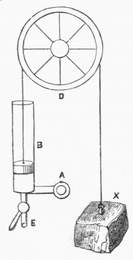
Keeping in view Nos. 25 and 27, we have here a third application of the same principle, by which it is proposed with one pound to raise a hundred “as high as one pound falleth.” In the engraved figure of this demonstrative model, one steam cylinder B, is shown, with its steam pipe and valve at A; one end of a cord is attached to the piston B, and passing over the drum wheel D, is attached to the weight X. As condensation ensues, the descent of B, will raise X; and it may be reset for another lift by drawing off the condensed water at E, and readmitting steam.
Here we are required “to make one pound weight” so that it shall be able to raise 100 times its own weight, always bearing in mind—“as high as one falleth.” This being no Archimedian experiment would be unintelligible to any man ignorant of steam, and some mode of applying its property of condensation.
James Rollock,[S] in his doggerel verses, attempts some description of this principle as applied to raising water, when he says:—
“Here little David curbs the Giant’s brood, Small drops of Rain contend with Noah’s flood; One weighs a thousand coming down apace, Weighs but himself when he hath ran his race. The Heavens admire, the Centre stands amaz’d, To see such Streams by so small Forces rais’d. Great is the Work, but greater is the Fame Of that great Peer who did invent the same.”
The plain English of Rollock’s feeble lines is, that a stream of water falling like “small drops of rain,” on the steam cylinder, caused the elevation of a hundred or more gallons, which he likens to “Noah’s flood,” in illustration of the greatness of the result; while the steam “weighs but itself,” being condensed. “Here little David,” is no more than the single attendant on the “Giant’s brood,”—the Water-commanding Engine.
The distribution of the three articles, Nos. 25, 27, and 99, is evidently adopted to conceal their connection; as we have already seen in the instance of Nos. 22, 23, and 58, which, although related to each other, are yet separated, as though they were quite independent.
100.
Upon so potent a help as these two last mentioned Inventions a Waterwork is by many years experience[1] and labour so advantageously by me[2] contrived, that a Child’s force bringeth up an hundred foot[3] high an incredible quantity of water, even two foot[3] Diameter, [4]so naturally, that the work will not be heard even into the next Room; and with so great ease and Geometrical Symmetry, that though it work day and night from one end of the year to the other, it will not require forty shillings reparation to the whole Engine, nor hinder ones day-work.[4] And I may boldly call it The most stupendious Work in the whole world: not onely with little charge to drein all sorts of Mines, and furnish Cities with water, though never so high seated, as well to keep them sweet, running through several streets, and so performing the work of Scavengers, as well as furnishing the Inhabitants with sufficient water for their private occasions; but likewise supplying Rivers[5] with sufficient to maintaine and make them portable[6] from Towne to Towne, and for the bettering of Lands all the way it runs; with many more advantageous, and yet greater effects of Profit, Admiration, and Consequence. So that deservedly I deem this Invention to crown my Labours, to reward my Expences, and make my Thoughts acquiesce in way of further Inventions: This making up the whole Century, and preventing any further trouble to the Reader for the present, meaning to leave to Posterity a Book, wherein under each of these Heads the means to put in execution and visible trial all and every of these Inventions, with the shape and form of all things belonging to them, shall be Printed by Brass-plates.[7]
In Bonum Publicum & Ad Majorem Dei Gloriam.[T]
Footnotes
[A stupendious Water-work.] The present article concludes the Marquis of Worcester’s own observations on his Water-commanding Engine. His engagements in hydraulic engineering, as we have already seen, commenced about, or before, 1628; but we have later and more satisfactory evidence of his having had the invention, which is here indicated, absolutely at work, under the management of his engineer Kaltoff, at Vauxhall. Hitherto we have confined our notice of any express date to the period of the passing of the Act in 1663, securing to him the profits in his invention for 99 years. We are, however, now prepared to show that, during the reign of Charles the First, in and before 1647, the Marquis was occupied on the mechanical arrangements of his engine, when one William Lambert, a brass-founder, was engaged under him at Vauxhall, in providing material “founded in brass,” expressly for “water-work.” This evidence, being afforded under circumstances very different from any attempt to establish the present statement, is all the more trustworthy, coming as a mere evidence of personal employment in the Marquis’s service, while soliciting from Charles the Second, after his restoration, to be reinstated at Vauxhall, in accordance with an order from the late king.
We shall now give entire the exceedingly interesting and important petition and royal order, from the original in the State Paper Office:—[U]
“To the King’s most excellent Majesty,
“The humble Petition of William Lambert.
“Humbly sheweth,
“That your Petitioner was founder to his late Majesty of blessed memory in Ffoxhall under the Marquis of Worcester, for gun and waterwork or any other thing founded in brass; and in the late unhappy war, your Petitioner was dispossessed of his employment, and left to the value of £2,000. and driven to exile by that usurpers authority.
“That your Majesty was graciously pleased at Brussels to grant your petitioner the place of founder for your Majesty’s works at Ffoxhall, upon your Majesty’s happy restoration, whereupon your Petr. depended; and deserted the King of Spain’s service; yet, nevertheless, the house was disposed to one Mr. Calthoofe, now deceased.
“Your Petitioner most humbly prayeth, That your sacred Majesty would be graciously pleased to confer upon your Petitioner some part of your Majesty’s house at Ffoxhall, to make a Founding-house for your Majesty’s use and service.
“And your Petitioner (as in duty bound) shall pray, &c.”
The following is the grant above named:—
“Charles R.
“Our pleasure is, That William Lambert, Founder for our Works at Ffoxhall, shall and may, with his family and servants, abide in and possess to our use, our house at Ffoxhall aforesaid, together with the outhousing and appurtenances of the same, and there proceed in the work as formerly he hath done, without any molestation to him or his, until further express order from us.
“Given at our Court at Oatlands, the 20th day of August, 1647.”[V]
These documents are highly interesting, as they establish, beyond a doubt, the Marquis’s early connection with gunnery and with water-work operations at Vauxhall, and account for the practical character of inventions mentioned in the “Century,” which might reasonably be thought to be beyond the scope of a private individual.
Kaltoff died in, or before, the year 1664, and it is not unlikely, therefore, that the Marquis countenanced Lambert’s present application. For more on Vauxhall and Kaltoff, see Appendix G.
The Marquis of Worcester had principally in view, in this invention, raising water for private and public purposes, and the general draining of mines or other inundated property. Its great value was evidently to supply cities and towns with water, and to drain mines of their superfluous quantity. The mineral wealth of this country was drowned treasure, until the steam engine’s powerful aid placed it within the power of man to eject the water in greater volume than it entered. Until the 17th century, this apparently obvious application of the steam engine was entirely overlooked, and had Savery done no more than impress on public notice its applicability for that invaluable purpose, he would still deserve the highest commendations of posterity. Many remarkable works were, no doubt, effected even with ordinary appliances, and men do not willingly abandon the experience of generations. We find that in the middle of the 16th century, viz.—July 2, 1565, Wm. Humfrey wrote to Sir William Cecil, concerning the working of copper mines; recommending an Almain engineer, who, he represents, can raise water one hundred fathoms high, by a newly invented engine.—Cal. State Papers, Dom. Series, 1547–1580. Edited by R. Lemon, F.S.A., 8vo. 1856, page 254. No. 73.