INTRODUCTION. (continued 2)
Reading edition
And Dr. Thomas Grent, on the 20th of July, 1632, patented a plan “for a more speedy passage of calmed ships.”
In 1640, Edward Ford, patented his invention, whereby he can make all boats, &c. “go faster against wind and tide than now they use to do, with half the men they have formerly used.”
It is stated in “Frier Bacon’s discovery of the Miracles of Art, &c.” published in 12mo. 1659, that—“It is possible to make engines to sail withal, as that either fresh or salt water vessels may be guided by the help of one man, and made sail with a greater swiftness, than others will which are full of men to help them.” Chap. iv. p. 17.
In “Humane Industry,” 1661, chap. 10, p. 154, it is noticed—“The ancients had a way to drive their ships without oar or sail, so that they could never be wind bound.” And at page 155, it is observed that—“Scaliger doth aver, that he could make a ship that could steer herself.”
Thomas Togood and James Heyes, in 1662, patented their invention for the making of ships to sail without the assistance of wind or tide.
16.
How to make a Sea-castle or Fortification Cannon-proof, and[4] capable of a thousand men, yet sailable at pleasure to defend a passage, or in an hours time to divide it self into three Ships as fit and trimm’d to sail as before: And even whilest it is a Fort or Castle they shall be unanimously steered, and effectually be driven by an indifferent strong wind.
Footnote
[A Sea-sailing Fort.] Vitruvius, Vegetius, and many ancient writers supply a variety of schemes to direct an inventor’s ingenuity. The idea of such a construction, to divide into three or more sailing vessels is likewise suggested, in many early designs, although no doubt very different in some details. But the peculiarity hitherto unnoticed, of the present invention, consists in the propelling and steering by means of an artificial current of air. It is very clear that the Marquis had discovered some pneumatic mode of propulsion. There is no inconsistency in the idea of the same means being adapted for both steering and propelling alternately. Even within the last few years extensive experiments have been made, in which air-pumps were used to compress the air beneath an inclined plane under the stern, which in flowing upwards gave motion to the vessel.
17.
How to make upon the Thames a floting Garden of pleasure, with Trees, Flowers, Banquetting-Houses, and Fountains, Stews for all kind of fishes, a reserve for Snow to keep Wine in, delicate Bathing-places, and the like; with musick made with[5] Mills: and all in the middest of the stream, where it is most rapid.
Footnote
[A pleasant floating Garden.] There appears to be little more invention here than in the contrivance of so much variety, and the selecting of “the stream where it is most rapid,” to give motion to the water-mills to work the bellows for producing the promised music; as well as to raise water high enough to obtain a pressure of it for making the snow. The whole offers one of those raree-show designs in which our great-grandfathers delighted, and the descriptions of which formed the staple of their scientific discussions in polite society.
18.
An Artificial Fountain, to be turned like an Hour-glass by a child, in the twinkling of an eye, it[6] holding great quantity[7] of water, and of force sufficient to make snow, ice and thunder, with a[8] chirping and singing of birds, and shewing of several shapes and effects usual to Fountains of pleasure.
Footnotes
[An Hour-glasse Fountain.] In a MS. among the Marquis’s papers, the foregoing appears to be the invention indicated under the title:—“Fountains of pleasure, with artificial snow or hail, or thunder, and quantity not limited.” [See p. 316.]
Kircher, Schottus, and others give descriptions, with engravings of fountains, having the external appearance of the hour-glass. The process of turning may have been facilitated by the machine resting on two central pivots. But it must have been of considerable size to produce an efficient hydraulic pressure engine to give forth snow and ice. The thunder, &c., would depend on plans well understood for producing stage effects, and their introduction here, with the music of birds, &c. [see Article 46.] is similar to other automatic arrangements which were the wonder and delight of that age, and a much later period.
In 1755, an engine of peculiar construction, to raise water from an Hungarian mine, was erected by M. Hoel, at Chemnitz, which generated intense cold as the water and air rushed out together, under great columnar pressure, causing the formation of artificial hail, projected with amazing force; the effect being very analogous to the suggestions offered by the present articles, Nos. 17 and 18.
19.
A little engine within a Coach, whereby a child may stop it, and secure all persons within it, and the Coachman himself, though the horses be never so unruly[9] in a full career; a child being sufficiently capable to loosen[1] them in what posture soever they should have put themselves, turning never so short; for a child can do it in the twinkling of an eye.
Footnotes
[A Coach-saving Engine.] We have two other readings of this article; the first is the 5th article in his list of a portion of his Inventions, (see Appendix A.) as follows:—“By this (his quintessence of motion) I can make a child, in a coach, to stop the horses (running away), and shall be able to secure himself, and those that be in the coach; having a little engine placed therein, which shall not be perceived, in what posture soever the horses draw. A child’s force shall be able to disengage them, from overturning the coach, or prejudicing anybody in it.”
The second reading is in his patent of 1661, (see Appendix B.) wherein he offers:—“To make an engine applicable to any coach, by which a child of six years old may secure from danger all in the coach, and even the coachman himself, though the horses become never so unruly, the child being able in the twinkling of an eye to loosen them from the coach, in what posture soever they draw or turn, be it ever so short, or to either hand.” By means of a T-ended lever, two or four bolts could be simultaneously drawn inwards, and the horses thereby released with the greatest possible ease and certainty.
20.
How to bring up water Balance-wise, so that as little weight or force as will turn a Balance will be onely needful, more then the weight of the water within the Buckets, which counterpoised[2] empty themselves one into the other, the uppermost yielding its water (how great a quantity soever it holds) at the self[3]- same time the lower-most taketh it in, though it be an hundred fathom high.
Footnotes
[A Balance Water-work.] It is to be regretted that we have nothing at present to aid us in offering a description at all approaching the singular construction of this hydraulic machine. There are some curious designs given in the description of M. Grollier de Servière’s cabinet, 1719, but we have never seen any plan fully realizing the effect above indicated.
21.
How to raise water constantly with two Buckets onely day and night, without any other force then its own motion, using not so much as any force, wheel, or sucker, nor more pullies then one, on which the cord or chain rolleth with a Bucket fastened at each end. This, I confess,[4] I have seen and learned[5] of the great Mathematician Claudius[6] [7] his studies at Rome, he having made a Present thereof unto a Cardinal; and I desire not to own any other mens[8] inventions, but if I set down any, to nominate likewise the inventor.
Footnotes
[A Bucket-fountain.] In the present and preceding articles the water is elevated by means of buckets, and it was only while these pages were passing through the press that the author perceived those precise marks of distinction between the two methods of employing the buckets which enables him now to offer the following explanation of each.
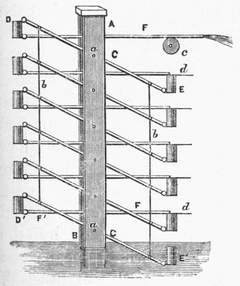
As regards No. 20, it seems, at first, absurd to expect to raise water which is to be in a balance and pass from one bucket to the other. But let us suppose an arrangement, as in the subjoined engraving, where A, B, is a strong vertical wooden frame carrying six metal or wooden pipes C, C, which can be moved simultaneously up and down on centres, a, a, being connected by the iron rods, b, b; these pipes are united with the top of six buckets at D, D', and with the bottom of six other buckets at E, E'. The buckets D, D', are also connected at the bottom with six other pipes F, F, each open at the end F, F, and so arranged that the topmost pipe passes over a pulley c, but the other five pipes with guide rods d, d, at their ends, enter the top end of the five uppermost buckets on the side E; the pipe F, passing over c, delivers the contents of bucket D, while the lower-most bucket E', is being replenished, “thus the uppermost yielding its water at the same time when the lower-most taketh it in.” In the present position of the machine the pipes C, C, are inclined, and the pipes F, F, are horizontal, but when the bucket E' is elevated, then these pipes will all reverse their positions, being connected with the buckets by means of flexible leather hose, or suitable jointed metal tubing.
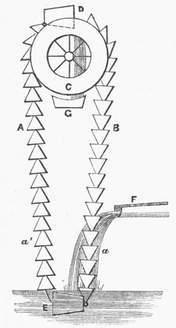
We have next to consider the present article No. 21. The conditions stated require the use of but one pulley, one cord, and two buckets, without any “force” or pump plunger, or “any wheel, or sucker.” An arrangement so simple seems only possible to be attained by some such plan as that exhibited in the illustration given below. We have here an endless chain or cord, A B, passing over the pulley C, with a bucket D, at the upper end; and another bucket E, at the lower end; the first in the act of discharging its contents into the trough G, the second re-charging with water at the level E. This endless chain is further supplied with a series of conical or other shaped buckets, a, a', set on the endless cord in a reverse direction, so as to receive water conveyed from an upper stream by the spout F, by which means the side B, of the cord will descend, and the side A, ascend, “without any other force than its own motion,” and that “with two buckets only, day and night.” On the side a', the conical buckets reverse and empty themselves, thereby lightening the ascending side A, of the endless chain or cord.
22.
To make a River in a Garden to ebbe and flow constantly, though twenty foot over, with a childs force, in some private room or place out of sight, and a competent distance from it.
[An ebbing and flowing River.] In reference to this invention Mr. Partington has quoted Peter Bogaerts’ ingenious method of a canal lock, so contrived that, in a model, a weight of seven pounds was made to raise ten hundred weight of water more than four feet in a few seconds.
But still the process of ebbing and flowing is not made out; it does appear, however, that its operation requires the constant services of a boy or other attendant, probably to keep alternately opening and closing certain sluice arrangements, placed somewhere concealed from view; the whole affording a water-work to amuse and surprise, and forming a variety on the usual strange schemes attached to grottos, caves, &c. spouting water in every variety of form.
See further the comments on article No. 57, which very probably includes the principle here employed by the Marquis.
There is no communication in this article of facts requisite to direct an engineer or inventor in the adjustment of any special kind of machinery to obtain the desired ebbing and flowing river; which is a novelty, in this respect, peculiar to the Marquis of Worcester’s ingenuity. He was evidently not copying or improving any anterior system of water-work. The next article is but an application of this new system; and it is not until he has taken us through descriptive hints of thirty-three totally different designs or devices, that in No. 57, he offers “A constant water-flowing and ebbing motion.” We think the three may be taken together, that is, No. 57, refers to the principle and mechanism, of which Nos. 22 and 23, are mere simple applications.
Thus, referring to what we have stated under No. 57, the purpose named in the present article might be attained by means of two domed or bell-shaped vessels, placed like gasometers, but otherwise immoveable, partially immersed in a pond, or other artificial piece of water; which being arranged so that, by admitting a steam pipe into each, the contained air could be driven out thereby, condensation would naturally follow, or might be accelerated; and one vessel immediately filling with water, while the other was emptying, the surface of the pond or river would be kept in a continual state of agitation, and the water might be said to “ebb and flow constantly, though 20 feet over.”
No reason is assigned for proposing this modification of water work, no advantage is pointed out, the Marquis doubtless depending on its apparent impossibility for its exciting and stimulating inquiry. He knew how the promulgation of such a wonder would have affected his own mind, and never imagined but that the public would feel equally inquisitive. His incomprehensible truths are, however, often denounced, without investigation, as though they were false.
23.
To set a Clock in[9] a Castle, the[1] water filling the Trenches about it;[2] it[3] shall shew by ebbing and flowing the Hours, Minutes and Seconds, and all the comprehensible motions of the Heavens, and Counterlibation[4] of the Earth, according to Copernicus.
Footnotes
[An ebbing and flowing Castle-clock.] John Bate, in his “Mysteries of Nature and Art,” 1635, at p. 45, describes—“A water-clock, or a glasse showing the hour of the day,” by three different arrangements.
This article is further noticed in commenting on No. 57.
24.
How to increase the strength of a Spring to such an height,[5] as to shoot Bumbasses and Bullets of an hundred pound weight a Steeple-height, and a quarter of a mile off and more, Stone-bow-wise, admirable for Fire-works and astonishing of besieged Cities, when without warning given by noise they find themselves so forcibly and dangerously surprised.
Footnote
[A Strength-increasing Spring.] The technical term Bumbasses, or probably bombasses, here used, has escaped the attention of all compilers of Archaic Dictionaries. By the context we may presume it was applied to the large stones usually fired from bombards, and differing only from bullets in these last being made of lead or iron.
Ancient cannon appear to have consisted of two kinds; a large one for discharging stones, called a Bombard, and a lesser one for darts. In 1388, a stone bullet, weighing 195 pounds, is related, according to Meyrick, to have been discharged from a Bombard, called the Trevisan. Such stone missiles may have been of the kind called by the Marquis “bumbasses,” and would be perhaps more properly named bombasses. The Stone-bow was the Prodd; probably the Slurbowe was furnished with a barrel through a slit, in which the string slided, when the trigger was pulled. Three kinds are mentioned by Du Cange. See Fosbroke’s Encyclopædia of Antiquities, 8vo. 1840.
Bishop Wilkins, treating on Catapultæ in his Mathematicall Magick, 1648, observes that their usual form was “after the manner of great bows placed on carriages, and wound up by the strength of several persons;” adding: “These were sometimes framed for the discharging of two or three arrows together.”
As the Marquis wrote the Century in 1655, only seven years after Wilkins’ publication, it is not at all unlikely that he seriously contemplated the contriving of a most useful warlike implement; and this appears the more reasonable when we find the worthy and learned prelate advancing, as it appeared to him, cogent reasons in his 19th chapter, in favour of the “Military offensive engines used amongst the ancients,” as compared to cannon; gravely summing up his observations with the remark—“that the force of these Engines does rather exceed than come short of our gun-powder inventions.” Then again on the ground of expense he shows an advantage in favour of Ballistæ and Catapultæ. Thus: “the price of these gun-powder instruments is extremely expensive.” This is proved from “a whole Cannon weighing commonly 8,000 pounds, a half Cannon 5,000, a Culverin 4,500, a Demi-culverin 3,000,” which “must needs be very costly,” amounting “to several hundred pounds,” for which sum “at least 10 of the ancient timber made engines might be purchased”!
Then their transport was a serious matter, for “a whole Cannon does require at the least 90 men, or 16 horses,” and so in proportion for others. But the timber made engines are light, and their “materials to be found everywhere.”
Then the gun-powder is costly; “a whole Cannon requiring for every charge 40 pound of powder, and a bullet of 64 pounds,” and in proportion for lesser cannon; whereas those other engines may be charged only with stones. So that only for the superior force of cannon “those ancient inventions” he conceives to be “much more commodious than these later inventions.”
Among questions propounded and agreed upon, in January, 1660, to be sent to Teneriffe by the Lord Brouncker and Mr. Boyle, the fifth was,—“Try the power of a stone bow, or other spring, both above and below (the hill), and note well the difference.”—Weld’s Hist. Royal Society, Vol. i. p. 98.
25.
How to make a Weight that cannot take up an hundred pound, and yet shall take up two hundred pound, and[6] at the self-same distance from the Centre; and so proportionally to millions of pounds.
Footnote
[A double-drawing Engine for weights.] The articles Nos. 25, 27, and 29 can only be taken as descriptive of elucidatory models, demonstrative of the applications of a certain principle, the result of condensation. For some unaccountable reason there has been a prevalent opinion that the Marquis was ignorant of condensation. If such an opinion is grounded on his not expressly alluding to it in the “Century,” then by the same rule it might be doubted whether he understood anything about steam! But as the “Century” was written to remind himself, and not to inform others of the modus operandi, it was sufficient for his purpose to particularise only the results. We can usually distinguish where he treads a beaten track, the result of reading, and where his course deviates into his “fire-water-work” experiments. The former generally has its parallel in some old author; but when the same rule is attempted to be applied to measure the others, we find we are dealing either with a new order of things, or else with sheer paradoxes of the most chimerical character. While, on the other hand, follow him in his own new track of experimental research, and we are rewarded at every step with a full and clear exposition of the wonderfully ingenious processes of inquiry by which he attained the perfection ascribed by him to his “Water-commanding Engine.”
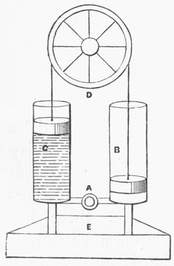
In the present article it is required that a weight shall take up double its own weight, not by the old rule of leverage, but “at the self-same distance from the centre.” In the subjoined diagram we have two cylinders C, B, connected at the lower end with a steam pipe, supplied with the steam-cock A. A cord passing over the drum wheel D, is connected at its ends with the pistons B, C; and the whole stands in a trough E. Steam having been admitted to B, and then cut off, condensation has ensued, the piston B has descended and C has been raised, and along with it a quantity of water. Here we may take the two pistons as representing “one hundred pound” each, and although they balance, yet we thus find “how to make a weight” under such circumstances, nevertheless, take up “two hundred pounds,” that is, including the water.
A very similar kind of piston to the one here shown, is suggested by Fludd, Besson, and others, to be worked by a spiral spring, which being drawn to the bottom of a cylindrical vessel, water may be poured in above it, and being then tightly covered, with a lid having either an open jet or a tap in the centre, on releasing the spiral spring, the false bottom rising, and pressing the liquid, causes it to escape in a jet d’eau, gradually diminishing as the spring relaxes. The contrivance is elaborately illustrated in the 18th folio engraving of Besson’s “Theatrum Instrumentorum et Machinarum,” 1578; the Marquis, therefore, had only to substitute steam for the spiral spring.
26.
To raise weight as[7] well and as forcibly with the drawing back of the Lever, as with the thrusting it[8] forwards; and by that means to lose no time in motion or strength. This I saw in the Arcenal at Venice.[9]
Footnotes
[A to and fro Lever.] William Bourne offers the following as his 112th Device, “touching the making of engines to thrust from or pull to you with great force or strength.” He says, “And furthermore, you may make an engine to thrust from you or to pull unto you, to lift vp or to presse downe with great force, eyther to goe with wheeles as before is declared, or else to goe with skrewes or to goe with both, as to thrust open huge and strong gates, or else you taking good hold, to pull them open vnto you wards, and will make but little noyse in the doyng thereof, but you must be sure to set the engine fast, if to thrust from, to be strongly and well backed, and to pull to them it must be strongly bolstered before, sufficient to be of force to scrue the turne.”
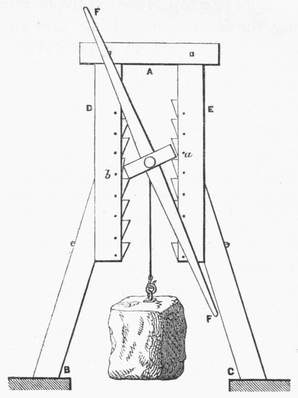
The Venetian arrangement may be described, as shown in the annexed engraving, where A, B, C, is a frame, the two upright sides of which D E, are provided with a series of clicks, appearing in the drawing like the serrated edge of a saw, and each is so placed secured by a pin on which it moves, as always to incline to fall outwards. F, F, is a long lever, having a stout short cross bar in the centre, and is represented on the point of taking up on a click at a, while it leaves one on the opposite b, such being the to and fro motion required, thereby losing “no time in motion or strength.”
27.
A way to remove to and fro huge weights with a most inconsiderable strength from place to place. For example, Ten Tunne with ten pounds, and less; the said ten pounds not to fall lower then it makes the ten Tunne to advance or retreat upon a Level.
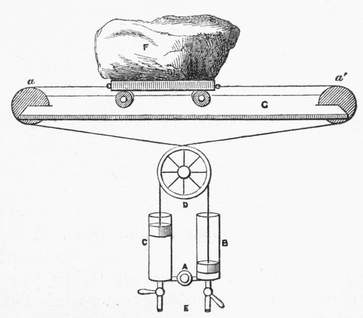
[A most easie level Draught.] The weight is in this case to be moved “with a most inconsiderable strength.” Ten pounds, or less, are to be capable of moving 22,400 pounds. And the precise conditions are—“the said ten pounds not to fall lower than it makes the ten ton to advance.” The annexed engraving shows, as in No. 25, two cylinders B, C, with their steam-pipe and valve at A, having above a platform G, on which is a loaded truck F, attached by a cord a, at one end passing over a pulley, and the drum wheel D, to the piston B; and a second cord at the other end passing over a pulley at a', attached in like manner to the other piston C. Steam having been admitted to B, on its condensation the piston descending draws along with it the weighted truck F, while the piston C, ascends, drawing in air at E.
We thus attain the strict letter of the conditions set down, the fall and the advance being equal.
28.
A Bridge portable in[1] a Cart with six horses, which in a few hours time may be placed over a River half a mile broad, whereon with much expedition may[2] be transported Horse, Foot and Cannon.
Footnotes
[A portable Bridge.] The great painter, Leonardo da Vinci, born in 1452, and who died at 67 years of age in 1520, was a man of singularly inventive talent. Among his other projects, he declares:—“I have the means of constructing light bridges, easy of carriage, and equally adapted to pursue or escape an enemy, secure from fire; and as easy to remove as to replace; and also the means of destroying those of the enemy.” See an interesting Memoir of him by J. W. Brown. 12mo. 1828.
Bourne’s 94th Device promises, “How you may make a bridge upon a sudden, that a whole army of men and their carriages may pass over any river or haven, if that it be of not too great breadth.”—See his Inventions or Devices, 1578.
Sir Hugh Plat, in his “Jewel House of Art and Nature,” 1653, shows, in article No. 22, “How to erect or build over any brook, or small river, a cheap and wooden bridge of 40 or 50 feet in length, without fastening any timber work within the water.”
29.
A portable Fortification able to contain five hundred fighting men, and yet[3] in six hours time may[4] be set up, and made Cannon-proof, upon the side of a River or Pass, with Cannon mounted upon it, and as complete as a regular Fortification, with Half-moons and Counterscarps.
Footnotes
[A moveable Fortification.] Vegetius, in “De re militari,” 1535, offers many similar schemes but less ambitious than the present one; which is, after all, little if any more than an extension and improvement on what had previously been more or less practised.
In his “Naturæ simia seu technica,” dated 1618, Robert Fludd, at page 421, gives a folio engraving of a triangular fort, with six pieces of cannon and three gunners. It appears to be on wheels, and is pushed along by a beam running on three wheels, having four horses yoked to it; literally the cart before the horse.
30.
A way in one nights time to raise a Bulwork twenty or thirty foot high, Cannon-proof, and Cannon mounted upon it, with men to overlook, command and batter a Towne; for though it contain but four Pieces, they shall be able to discharge two hundred Bullets each hour.
[A Rising Bulwork.] Grose, in his “Military Antiquities,” Vol. I. Page 355, notices a moveable tower, the use of which was revived by the Royalists in their attack on Gloucester, during the Civil War.
In 1644, Edmond Felton, gentleman, published a pamphlet entitled, “Engins invented to save blood and moneys;” the nature of which he “discovered unto the Committee for the fortifications of the City of London.” The Honourable Major General Skippon attested in respect of it, that the engine “was of three tiers of ten muskets in a tier, to shoot arrows withal.” The inventor satisfied the Committee, “how an engine will secure the foot from the horse, and the soldiers from musket shot, which engine in fair ways two men may manage at pleasure.”
He complains of a piracy of his invention, observing, “There was about twenty of the said engines made at Oxford, and from thence carried to Gloucester, to go up to the walls. And had not his Excellency the Earl of Essex so happily arrived to raise the siege as he did, it was reported by some of the army, the city was in great fear to be taken thereby; most of which said engines the besiegers burnt, because they should not be taken.”
In the second volume of “Bibliotheca Gloucestrensis: a collection of scarce and curious tracts, by John Washbourn, jun. Gloucester. 4to. 1825,” there is a reprint of “Corbet’s Historicall relation of the Military Government of Gloucester, 1645,” which contains this passage: “Wherefore besides their mine and battery, they framed great store of those unperfect and troublesome engines to assault the lower parts of the city. Those engines ran upon wheels, with planks musket-proof placed on the axle-tree, with holes for musket-shot and a bridge before it, the end whereof (the wheels falling into the ditch) was to rest upon our breast works.” Page 54.
And in the reprint of “A briefe and exact diurnall of the siege before Gloucester, by John Dorney, Esquire, 1643,” we meet with the following:—“Munday, September 4. We understood likewise that the enemy had by the direction of that Jesuitticall Doctor Chillingworth, provided great store of engines after the manner of the Romane Testudines cum Pluteis, with which they intended to have assaulted the parts of the city, between the south and west gates. These engines ran upon cart wheeles, with a blinde of plankes musquet proofe, and holes for foure musquetiers to play out of, placed upon the axeltree to defend the musquetiers and those that thrust it forward, and carrying a bridge before it; the wheeles were to fall into the ditch, and the end of the bridge to rest upon our brest-workes, so making severall compleat bridges to enter the city. After the raising of the siege, we tooke all these engines, and brought them into the towne.”—Page 225.
In the first volume of this work there is a note on the two preceding passages, in which the editor observes:—“The plan of these machines was borrowed from the ancients. Various contrivances of this kind were also employed in the middle ages, before and for a considerable time after the invention of fire-arms. Sometimes they used them for undermining the walls. At the siege of Ribadavia in Spain, during the reign of Richard II. similar moveable machines were used. See Froissart, viii. c. 26. Such an engine is also mentioned by the Marquis of Worcester in his Century of Inventions.”
31.
A way how safely and speedily to make an approach to a Castle or Town-wall, and over the very Ditch at Noon-day.
[An approaching Blinde.] Vegetius, in “De re militari,” 1535, depicts and describes several kinds of these ancient military blinds, screens, and other contrivances and machines for protecting the attacking party. At page 15 he shows a ponderous advancing screen or shield on four wheels, and at two pages further a side view of the same, covering a large body of soldiers. Some have raised, hinged platforms, to be lowered for crossing a ditch.
Grose says:—“The cattus, cat-house, gattus or cat, was a covered shed, occasionally fixed on wheels, and used for covering soldiers employed in filling up the ditch, &c.”—Military Antiquities, 4to. 1801.
32.
How to compose an universal Character methodical and easie to be written, yet intelligible in any Language; so that if an English-man write it in English, a French-man,[5] Italian, Spaniard, Irish,[6] Welsh,[7] being Scholars; yea, Grecian or Hebritian shall as perfectly understand it in their owne Tongue, as if they were perfect[8] English, distinguishing the Verbs from the Nouns, the Numbers, Tenses and Cases as properly expressed in their own Language as it was written in English.
Footnotes
[An universall Character.] In 1668, the Royal Society ordered the printing of “An Essay towards a real Character, and a philosophical language; by John Wilkins, D. D. Dean of Ripon, and F. R. S.,” folio. It is dedicated to the president, William Lord Viscount Brouncker, and consists of a treatise of 454 pages, to which is appended a dictionary of 155 pages. The very extent of such a work is almost fatal to its acceptance, and we must admit that it is questionable whether, with all its learning and ingenuity, it affords a single hint calculated to promote the intended object.
In relation to this subject, the reader, desirous of enlarged information, could not do better than consult the recently published “Lectures on the Science of Language,” by Professor Max Müller, M. A.
It would be highly interesting to possess any clue whatever to the ideas of the Marquis on this subject. He was so truthful in his statements, that he must have made a considerable advance in the discovery of means for obtaining the end proposed, although he may have over-estimated its application, according to our judgment.
Of early publications on this topic we would especially notice, “Le Caractère universel, par lequel toutes Nations peuvent comprendre les conceptions l’une de l’autre en lisant par une escriture commune, à toutes leur propre langage maternelle. Par Cave Beck. M. A.” London, 1657, 12mo. Also “Joh. J. Becheri Spirensis character, pro Notitia Linguarum Universali.” Francfort, 1661. And “Ars signorum, vulgo character universalis et lingua philosophica,” by Georgius Dalgarno: a small 12mo. volume in Latin. 1661.
A system of a universal alphabet has been recently proposed for telegraphic purposes, by means of which it is believed all the sounds of the human speech may be recorded and transmitted; mastering all the sounds which the human voice is capable of uttering in any language. The proposed scheme is even said to have been severely tested by many eminent linguists. It is to be hoped that the announced discovery will be found to realize all it promises, and remunerate the ingenious inventor.
33.
To write with a Needle and Thred, white, or any[9] colour upon white, or[1] any other[2] colour, so that one stitch shall significantly shew any letter, and as readily and[3] as easily shew the one letter as the other, and fit for any Language.
Footnotes
[A Needle-alphabet.]
34.
To write by a knotted Silk string, so that every knot shall signifie any letter with Comma, Full point, or Interrogation, and as legible as with Pen and Ink upon white Paper.
[A knotted String-alphabet.]
35.
The like, by the fringe of Gloves.
[A Fringe-alphabet.]
36.
By stringing of Bracelets.
[A Bracelet-alphabet.]
37.
By Pinck’d Gloves.
[A Pinck’d Glove-alphabet.]
38.
By holes in the bottom of a Sieve.
[A Sieve-alphabet.]
39.
Footnotes
[A Lanthorn-alphabet.]
40.
By the Smell.
41.
By the Taste.
42.
By the Touch.
By these three Senses as perfectly, distinctly and unconfusedly, yea as readily as by the sight.
[An alphabet by the—Smell; Taste; Touch.]
43.
How to vary each of these, so that ten thousand may know them, and yet[6] keep the understanding part from any but their Correspondent.
Footnote
[A variation of all and each of these.] We have here ten Alphabets, concluding with a variation on each, which, had it been given, would have at least increased the number to twenty, but that was by no means the limit. Cipher Alphabets are the least interesting portion of the “Century;” we imagine we trace in them some of the Marquis’s earliest studies, and fancy that later in life they were retained from fond recollections of the past.
These secret methods of corresponding are no longer of any service, and have no interest beyond what may attach to them in connection with the history of short-hand writing, wherein the object is rather dispatch than secrecy. Among early writers on the art of Senigraphy, and Stenography, are Bright, 1588, Bales 1590, Arnold Bostius, Trithemius 1600, Willis 1618, Dix 1633, Wilkins 1641, Cartwright 1652, Rich 1654, Falconer (“The Art of Secret Information,”) 1685, with others.
John Baptista Porta, a Neapolitan of considerable eminence, born 1445, and who died in 1515, wrote “De Occultis Literarium Notis, Libri quinque,” Argent. 1608, octavo, in which he gives no less than 180 different methods of secret writing.
The learned and ingenious Bishop Wilkins in 1641, published his “Mercury, or the Secret and Swift Messenger.”
Of line alphabets he says—“Who would mistrust any private news or treachery to lie hid in a thread, wherein there was nothing to be discerned, but sundry confused knots or other the like marks?” It is, however, easily effected by each party having like tablets marked at top with the alphabet, and having hooks down each side for the passing and holding of a thread worked backwards and forwards, in which action it is to have a knot made on it for the desired letter above; making altogether words and sentences.
Chapter 6, is on “Secret writing with the common letters, by changing of their places.”
In chapter 11, “Of writing by invented characters,” he says: “There have been some other inventions of writing by points, or lines, or figures.”
Chapter 13 is, “concerning an universal character that may be legible to all nations and languages,” concluding with observations on “The benefit and possibility of this.”
In chapter 17, we are told “of secret and swift informations by the species of sound.” Among others he names “Bells,” as a species which “may be a sufficient means, whereby to communicate the thoughts;” and in chapter 18, he treats “concerning a language that may consist only of tunes and musical notes, without any articulate sound.” And lastly, in chapter 20, we have “Of informations by significatory fires and smokes.”
Among the “variations” the sense of Seeing may be employed, as proposed by Sir Hugh Plat in his “Jewel House of Art and Nature,” 1653, in which he describes “How to speak by signs only without uttering of any word”—using the fingers and motions with them and the hands, which he calls a “conceited alphabet.”—Page 38.
Those who are curious in such matters, may see more at large in Dr. W. Hooper’s Rational Recreations, ed. 1794, 8vo. different methods of writing in cipher, commencing at p. 143, of 1st Vol.—thus:—
To communicate intelligence by a pack of piquet cards.—The musical dial.—The corresponding spaces.—The musical cipher.—Rules for deciphering.—Example of a cipher written in arbitrary characters, and the words separate from each other.—Visual correspondence; and, Correspondence by bells.
44.
To make a Key of a Chamber door, which to your sight hath its Wards and Rose-pipe but Paper-thick, and yet at pleasure in a minute of an hour shall become a perfect Pistol, capable to shoot through a Brest-plate commonly of Carabine-proof, with Prime, Powder and Firelock, undiscoverable in a strangers hand.
[A Key-Pistol.] This mere piece of ingenuity, so pleasing to certain mechanics in working out mechanical trinkets, might be effected by causing the removal of the key handle to expose a sufficiently strong pistol barrel, while the “rose pipe but paper thick” would answer to receive, and perform the office of retaining the key handle securely, by which to hold it while firing this key-pistol. The next part of the contrivance would be, to make the “wards” serve to conceal the pistol pan, cock, &c. The description is well calculated to mislead the reader, under the impression that the barrel itself is “but paper-thick.”
45.
How to light a Fire and a Candle at what hour of the night one awaketh, without rising or putting ones hand out of the bed. And the same thing[7] becomes[8] a serviceable Pistol at pleasure; yet by a stranger, not knowing the secret, seemeth but a dexterous Tinder-box.
Footnotes
[A most conceited Tinder-box.] The following note from “Humane Industry,” 1661, appears highly suggestive of such an instrument, although the Marquis’s invention is more elaborate. “Andrew Alciat the great Civilian of France, had a kind of Clock in his chamber, that should awake him at any hour of the night that he determined, and when it struck the determined hour, it struck fire likewise out of a flint, which fell among tinder, to light him a candle: it was the invention of one Caravagio of Sienna in Italy.”
46.
How to make an artificial Bird to fly which way and as long as one pleaseth, by or against the wind, sometimes chirping, other times hovering, still tending the way it is designed for.
[An artificial Bird.] The third article in his list of a portion of his inventions supplies a different reading, thus: “By this (his ‘quint-essence of motion’) I can make an artificial bird to fly which way, and as long as I please.” [Appendix A.]
The Marquis, not to be behind the curious and ingenious men of ancient times, has here and in article No. 18, emulated John Muller of Nuremberg, better known as Regiomontanus, who was born in 1436. He is celebrated for this species of rara avis; a self-moving and flying eagle, and an iron fly have afforded much matter for romantic and no doubt exaggerated accounts of their performances; the one flying a good way in the open air and returning; the other flying from the philosopher round a table and coming back to his hand. He evinced a genius of the first order as a great inventor, and also as a promoter of the advancement of science.
In Ramelli’s great work on various machines, folio, 1588, the 187th figure offers a detailed representation of a handsomely furnished apartment, in which a large carved sideboard sustains a gigantic vase containing a flowering shrub, in the branches of which six birds appear in the act of singing. The vase being a sectional drawing, various pipes can be seen, also the performer behind, who is blowing through a single pipe into the body of the vase.
But the highly popular work of Hero of Alexandria promulgated several similar schemes. He shows how to make an artificial bird sing by flowing water, or alternately sing and be silent. See Mr. Woodcroft’s handsome edition of Hero’s Pneumatics, 4to. 1851.
William Bourne, also, in his “Inventions or Devices,” 1578, treats of “birds of wood or metal made by art to fly,” and of others, “to sing sweetly at certain hours appointed.”
Bate, in his “Mysteries of Nature and Art,” 1635, treats, at page 24, “How to make that a bird sitting on a basis, shall make a noise, and drink out of a cup of water, being held to the mouth of it;” and further, “Advice whereby several voices of birds chirping may be heard.”
So again Isaac De Caus, in his “Rare Inventions of Water Works,” folio, 1659, at page 20, gives instructions—“To counterfeit the voice of small birds by means of water and air.” And in Plate XIV. “To represent divers birds which shall sing diversly when an owl turns towards them; and when the said owl turns back again they shall cease their singing.”
These later examples show that the Marquis was neither altogether original nor singular in attempting improvements in these automatic toys, which from the time of Hero of Alexandria were accounted sufficiently wonderful evidence of mechanical ingenuity to attract the serious attention of even the most talented engineers of the last century. Of such mechanical achievements of the ingenious a full account may be read in Montucla’s edition of Ozanam’s “Mathematical Recreations.”
Volant automata, as he calls them, did not escape the attentive consideration of Bishop Wilkins, and he says enough on this class of mechanical curiosities to have stimulated the mechanical ingenuity of even a less enthusiastic inventor than the Marquis of Worcester, as of the wooden dove of Archytas, and the wooden eagle and iron fly of Regiomontanus.
The Marquis, if he ever perused the little treatise just quoted, would be keenly alive to the truthfulness of the remark that—“it is none of the meanest discouragements, that any strange inventions are so generally derided by common opinion, being esteemed only as the dreams of a melancholy and distempered fancy; for that saying of Virgil,
“Demens qui nimbos et non imitabile fulmen,” &c.
“hath been an old censure applied unto such as ventured upon any strange or incredible attempt.”—See Math. Magick, 1648, p. 198.
The Rev. Dr. Powell, in the last chapter of his “Humane Industry,” 1661, treats of various minute automata as—“Certain sports and extravagancies of art,” for which he offers an ingenious apology, observing: “As nature hath her ludicra, so art hath hers too; that is, some pretty knacks that are made, not so much for use, as to show subtilty of wit, being made de Gaieté de Cœur, and for pastime as it were; yet the workmanship and elegancy of these may justly deserve admiration;” concluding—“art, as well as nature, is never more wonderful than in smaller pieces.” After describing small chains, locks, chariots, ships, clocks, and insects, he remarks:—“though these knacks are but little useful, and take up more time than needed to be lost, yet they discover a marvellous pregnancy of wit in the artificers; and may be experimenta lucifera, if not frugifera hints of greater matters.”
It will not appear strange to find the inventor of the steam engine engaged toying with an artificial bird, an imprisoning chair, a brazen head, or a riding horse, when it is remembered that for a hundred years later such automata were highly prized by the nobility and gentry, and proved extemely lucrative to the public exhibitors of such mechanical imitations of life. M. Vaucanson’s inventions were of this chararcter, attracting admiring audiences among the learned and the vulgar, on the Continent and in England. A learned society received his communication in Paris, while in London it had the unquestionable honour of being translated by Dr. Desaguliers, who says in his preface, “In giving this paper an English dress, I am still acting in my province, which has been for many years to explain the works of art, as well as the phenomena of nature;” and his translation is given under the following elaborate title:—
“An account of the mechanism of an automaton or image playing on the German Flute: as it was presented in a memoire, to the gentlemen of the Royal Academy of Sciences at Paris. By M. Vaucanson, Inventor and maker of the said machine. Together with a description of an artificial Duck, eating, drinking, macerating the food, &c. As also that of another image, no less wonderful than the first, playing on the tabor and pipe; as he has given an account of them since the memoir was written. Translated out of the French original, by J. T. Desaguliers, LL.D., F.R.S., Chaplain to his Royal Highness the Prince of Wales, 4to. 1742.” [24 pages, and an engraved frontispiece.]
47.
To make a Ball of any metal, which thrown into a Pool or Pail of water shall presently rise from the bottom, and constantly shew by the superficies of the water the hour of the day or night, never rising more out of the water then just to the minute it sheweth of each quarter of the hour; and if by force kept under water, yet the time is not lost, but recovered as soon as it is permitted to rise to the superficies[9] of the water.
Footnote
[An Hour Water-ball.] The 4th article of his selected list of his inventions supplies the following varied reading:—
“By these (his quintessence of Motion) I can make a ball of silver or gold, which thrown into a pail, or poole of water, shall arise again to the perfect hour of any day or night. The superficies of the water shall still show the hour distinctly; even the minutes, if I please.” See Appendix A.
Many curious specimens of these Horologies occur in the description of M. Grollier de Servière’s cabinet, published 1719.
48.
A scrued Ascent, instead of Stairs, with fit landing places to the best Chambers of each Story, with Back-stairs within the Noell[1] of it, convenient for Servants to pass up and down to the inward Rooms of them unseen and private.
Footnote
[A scru’d ascent of Stairs.] This title does not strictly agree with the text, for there is a material difference between “a screwed ascent, instead of stairs,” and “a screwed ascent of stairs;” the former altogether dispenses with stairs, giving the idea of an inclined ascent without steps, such as is employed in the construction of the Observatory of Copenhagen; the width being sufficient and the ascent so gradual, that a carriage and four may easily be driven up to the top circular gallery.
According to this improvement there are “back-stairs within the noell,” that is, the Noel, Nowel, Noyau, or Newell, a term applied to the centre round which the stairs of a circular staircase wind, and which may be either a solid column, or an open space. Such stairs are said to be neweled.
The great labour and expense bestowed on some kinds of staircases is well exemplified by Evelyn in his tour of France, who describes going to Blois, in 1664, and seeing there a palace built by Francis the First, the staircase of which, consisting of 274 steps, is mentioned by Palladio; he notices it as a wonderful piece of work, from its construction having occupied 1800 workmen during twelve years. “The stayre-case (he says) is devised with four entries or ascents, which cross one another, so that though four persons meet, they never come in sight, but by small loopholes, till they land.”—Memoirs of John Evelyn, 2nd edit. 4to. vol. i. page 59.
49.
A portable Engine, in way of a Tobacco-tongs, whereby a man may get over a wall, or get up again being come down, finding the coast proving[2] [3] unsecure unto him.
Footnotes
[A Tobacco-tongs Engine.] The designation here given, when published in 1663, was doubtless generally understood, but the smallness of the “engine,” its very nature, and not less, its long discontinuance of use, now renders the passage obscure. It so happens, however, that a scientific experiment, in which this humble instrument was employed by the Honourable Robert Boyle, has preserved, for our information in this matter, the true figure of the “tobacco-tongs.” In the 3rd Volume of Boyle’s Works, folio, published in 1744, is recorded his pneumatical experiments on the falling of bodies in vacuo. Treating of “New experiments physico-mechanical, touching the spring of the air,” illustrated by the well-known experiment of dropping at the same time a guinea and a feather within an exhausted glass receiver, he says: “We so fastened a small pair of tobacco-tongs to the inside of the receiver’s brass cover, that by moving a turning key, we might by a string tied to one part of them open the tongs, which else their own spring would keep shut.”
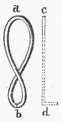
In an illustrative engraved plate, accompanying his description, the fourth figure therein is designed to show the “tobacco-tongs,” which appear in the form of a figure of 8, as in the annexed diagram, where a, is the top or hand portion, being the largest oval, while the lower oval b, is not above one third its size, at which point this steel spring instrument was cut through, to form the tong or nippers. We imagine that a side view would be like the dotted figure c, d, where d, shows how the ends of these nippers were probably elongated a little, the more readily to take up and part with the tobacco or other material. The least pressure on the outside of the large oval, will extend the nippers b, d, which again close when such pressure is removed.
But there may have been another form of such tongs, like the letter X, or two such figures combined; and by increasing the series we should produce the instrument known as the lazy-tongs, which collapse into a very small space, yet will extend to a great distance.
50.
A complete light portable Ladder, which taken out of ones Pocket, may be by himself fastened an hundred foot[4] high to get up by from the ground.
Footnote
[A Pocket-ladder.] There are many curious and ingenious designs for portable scaling ladders, offered by Vegetius in “De re militari,” 1535, but which would require to be very considerably modified to become pocketable; however, they occur in every variety at page 35, in short pieces, each with a screw at one end, and a socket at the other; at p. 59, as a neat rope ladder; at p. 113, on the principle of the lazy-tongs; and at p. 162, a method of connecting short poles is exhibited.
Robert Fludd, in the second book of his works, published in 1617 and 1618, folio, Page 384, gives a large copper-plate engraving of a very ingenious form of ladder. Each step is of wood, and the two sides of rope. The ingenuity of the invention consists in each step having a ferrule at one end, and the opposite end tapered sufficiently to fit into each ferrule of the adjoining step; by this means the whole can be put together like an ordinary fishing rod, and the top step terminating with a hook, it can easily be attached to any elevated place, and on pulling the pole, each part separates, falling at once into the form of a ladder with rope sides. Bourne’s 62nd Device, in his “Inventions, or Devices,” 1578, is—“How for to make a scaling ladder.”
Van Etten, 1653, gives for his 111th Problem, “To make a Ladder of Cords, which may be carried in ones pocket: by which one may easily mount up a wall, or tree alone.” It consists simply of two pulleys, with “a cord of an half inch thick (which may be of silk, because it is for the pocket),” having a staff at one end to sit upon. The author gravely concludes, “This secret is most excellent in warre, and for lovers, its supportablenesse avoids suspition.” See page 248.
Among Friar Bacon’s inventions, the following is recorded in the fourth chapter of his “Discovery of the Miracles of Art, Nature and Magick,” 12mo. published in 1659:—“It is possible to invent an Engine of a little bulk, yet of great efficacy, either to the depressing or elevation of the very greatest weight; which would be of much consequence in several accidents; for hereby a man may either ascend or descend any walls, delivering himself or comrades from prison; and this engine is only three fingers high and four broad.”
51.
A Rule of Gradation, which with ease and method reduceth all things to a private correspondence, most useful for secret Intelligence.
[A Rule of Gradation.] Probably some scheme which appeared to be capable of indefinite multiplication, the object of the secret correspondent always being to elude the utmost skill of an expert decipherer. Twenty-six lines of 26 letters of the alphabet each, would form a square; and supposing the letters placed in different order on each line, we might produce 26 linear alphabets, and 26 columnar alphabets; or change these by diagonal or other lines. These, and similar variations appear interminable, but it is questionable whether they would not delay rather than defy detection.
52.
How to signifie words and a perfect Discourse by[5] jangling of[6] Bells of any Parish-Church, or by any Musical Instrument within hearing, in a seeming way of tuning it; or of an unskilful beginner.
Footnotes
[A mysticall jangling of Bells.] There occurs at page 185, of Van Etten’s Math. Recreat. 1653, among the several heads of Problem 84, “Of changes in Bells.” He inquires: “Is it not an admirable thing to consider how the skill of numbers doth easily furnish us with the knowledge of mysterious hidden things?” He says: “It is often debated—what number of changes there might be made in 5, 6, 7, 8, or more bells;” observing thereon, “that a childe which can but multiply one number by another, may easily resolve it.” Not only have we here a kindred subject discussed, but also in language very analogous to that employed by the Marquis, particularly in the use of the words “mysterious,” “admirable,” and “a child;” the latter being a favourite similitude.
53.
A way how to make hollow and cover a Water-scrue as big and as long as one pleaseth in an easie and cheap way.
[An hollowing of a Water-scrue.] This was probably no more than an ingenious piece of carpentry, to obtain an object which was then most likely of considerable importance. Three of his inventions refer to the Archimedian screw, so that the Marquis seems to have given the subject more than ordinary attention.
54.
How to make a Water-scrue tite, and yet transparent, and free from breaking; but so clear, that one may palpably see the water or any heavy thing how and why it is mounted by turning.
[A transparent Water-scrue.] This invention does not appear to be offered as one of any other use than for pleasure and instruction, to “see the water or any heavy thing, how and why it mounteth by turning.” Was it not by such models that he had early informed his own mind?
If the transparent covering was not to be glass or horn, the Marquis may have used the material proposed by Sir Hugh Plat in his “Jewel House of Art and Nature,” 1653, in which is given, at page 72, a recipe: “To make parchment clear and transparent to serve for divers purposes. This I commend, (he says) before oiled paper, because it is more lasting”—when employed for windows.
55.
A double Water-scrue, the innermost to mount the water, and the outermost for it to descend more in number of threds, and consequently in quantity of water, though much shorter then the innermost scrue, by which the water ascendeth, a most extraordinary help for the turning of the scrue to make the water rise.
[A double Water-scrue.] The arrangement of this simple invention is so clearly and amply set forth, that it is a wonder it could ever have been misunderstood; yet it so baffled Mr. Partington, that he classes it among “extraordinary sleight of hand discoveries.”
M. Pattu, a French engineer, in 1815, published his account of a double water-screw of this description which he had invented, capable of being applied in three different ways, the construction, however, in all being the same. In one arrangement, the enlarged end of the screw is about one-eighth part that of the entire length of the internal or lesser screw, and it surrounds the “innermost” screw, the spirals winding in a reversed direction. The top of the shorter or “outermost” screw may be on a level with a stream of water “for it to descend” therein, to promote “the turning of the screw” (of greater length and smaller diameter) “to make the water rise,” from a lower stream.
In a second application, the long screw may be used to propel the short one, to raise water a moderate height.
Or, thirdly, the enlargement may form the upper end, and be used to propel from above, instead of from below, as at first described.
56.
To provide and make that all the Weights of the descending side of a Wheel shall be perpetually further from the Centre, then those of the mounting side, and yet equal in number and heft to[7] the one side as the other. A most incredible thing, if not seen, but tried before the late king (of[8] blessed memory) in the Tower, by my directions, two Extraordinary Embassadors accompanying His Majesty, and the Duke of Richmond and Duke[9] Hamilton, with[1] most[2] of the Court, attending Him. The Wheel was 14. Foot[3] over, and 40. Weights of 50. pounds apiece. Sir William Balfore,[4][K] then Lieutenant of the Tower,[5] can justifie[6] it, with several others. They all saw, that no sooner these great Weights passed the Diameter-line of the lower[7] side, but they hung a foot further from the Centre, nor no sooner passed the Diameter-line of the upper[8] side, but they hung a foot nearer. Be pleased to judge the consequence.
Footnotes
[An advantageous change of Centres.] This is the most minutely as well as circumstantially noted of all the Marquis’s inventions; yet we have no evidence of his ever afterwards recurring to it. The mention of Sir William Balfour makes it probable that the exhibition of this great weighted wheel took place between 1638 and 1641. [See Life, Times, &c., page 25.] Dr. John Dee, in his celebrated preface to Sir Henry Billingsley’s first English edition of Euclid, published in folio, 1570, speaks of such a machine, as not only possible, but as having been actually constructed, and “a thing most incredible if not seen;” this, compared with the language used by the Marquis, would lead to the supposition that he had not only read but copied the passage.
It is difficult to reconcile the statement he has here made, with the declaration on the title page, of his inventions having been “tried and perfected.” In this single instance, he leaves the reader to “Be pleased to judge the consequence.”
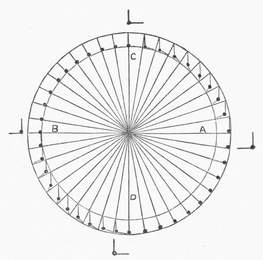
Dr. Desaguliers, in a memoir, published by the Royal Society, vol. 31, 1720–21, quoting the foregoing article, ventures the reply: “Now the consequence of this, and such like machines [assuming them to be as above described,] is nothing less than a perpetual motion.” Of course he does not admit even the possibility of such an arrangements of parts, he only allows that if that could be executed, the other would follow. But Desaguliers admitted too much, for it may easily be demonstrated that the conditions stated may be mechanically produced, without any resulting motion. Let the annexed diagram represent a wheel of 14 feet in diameter, having 40 spokes, seven feet each, and with an inner rim coinciding with the periphery, at one foot distance, all round. Next provide 40 balls or weights, hanging in the centre of cords or chains two feet long. Now fasten one end of this cord at the top of the centre spoke C, and the other end of the cord to the next right hand spoke one foot below the upper end, or on the inner ring; proceed in like manner with every other spoke in succession; and it will be found, that, at A, the cord will have the position shown outside the wheel; while at B, C, and D, it will also take the respective positions, as shown on the outside. The result in this case will be, that, all the weights on the side A, C, D, hang to the great, or outer circle, while on the side B, C, D, all the weights are suspended from the lesser or inner circle. And if we reverse the motion of the wheel, turning it from the right hand to the left hand, we shall reverse these positions also, (the lower end of the cord sliding in a groove towards a left hand spoke) but without the wheel having any tendency to move of itself.
His notice of this exhibition was not written by the Marquis until 1655, from 14 to 17 years after its occurrence, and he may have then hesitated to say that it was not a success; but he may have persuaded himself that he was at last in possession of the secret that was at first wanting. Besides, we are not to infer that the company described as being present had gone to the Tower purposely to see the Marquis’s wheel; it being far more probable that, Charles the First and the foreign ambassadors were there to view that fortress with all its treasures and curiosities.
According to the state of knowledge in 1663, the Marquis of Worcester was not singular in entertaining this subject, and all we can make of the present article is, that he has left it open to doubt whether he himself did not consider that his experiment required confirmation. “Perpetuum Mobile; or a history of the search for self-motive power,” 1862, is a work which may be taken as an elaborate note on this article, for it was the perusal of it that led the author, to commence the compilation of that work, more than thirty years ago.
Before the publication of the “Century” Samuel Hartlib had, (on the 10th of August, 1658,) written to Mr. Boyle on the subject of a perpetual motion invented by the ingenious and celebrated John Joachim Becher, an account of which was to be printed at Frankfort.—Boyle’s Works, fol. 1744, p. 280.
Charles the Second was favoured with the exhibition of another scheme of this sort, by John Evelyn, a Fellow of the Royal Society at the time, and therefore not likely to participate in any matter which the scientific world of his day repudiated. But learned men of his time rather approved of all wonder-working automata than otherwise. Evelyn says in his Diary, under the date of 14th July, 1668, that during an interview with the King:—“I showed his Majesty the perpetual motion sent to me by Dr. Stokes from Cologne.”—Vol. ii. p. 37, ed. 1859.
57.
An ebbing and flowing Water-work in two Vessels, into either of which the water standing at a level, if a Globe be cast in, instead of rising it presently ebbeth, and so remaineth untill a like Globe be cast into the other Vessel, which the water is no sooner sensible of, but[9] that[1] Vessel presently ebbeth, and the other floweth, and so continueth ebbing and flowing untill one or both of[2] the Globes be taken out, working some little effect besides its own motion, without the help of any man within sight or hearing: But if either of the Globes be taken out with ever so swift or easie a motion, at[3] the very instant the ebbing and flowing ceaseth; for if during the[4] ebbing you take out the Globe, the water of that Vessel presently returneth to flow, and never ebbeth after, until[5] the Globe be returned into it, and then the motion beginneth as before.
Footnotes
[A constant Water-flowing and ebbing motion.] We are very much mistaken if this is not the result of one of the Marquis’s early experimental model demonstrations, and a happy illustrative example for the lecture-table of raising water by the condensation of steam.
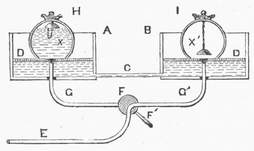
A, B, represents two water tanks or cisterns, permanently connected by the water-pipe C, and having within, D, D, two perforated shelves or false bottoms; E, is a main steam-pipe, with a four-way steam cock at F, branching into the form shown at G, G', and passing through the bottom of each tank, rises vertically to the level of the false bottoms, where each is supplied with a valve at the top end, to prevent the ingress of water. G', is shown receiving steam from E. H, I, are two hollow metal globes, surmounted with a small crown ornament to conceal a spring valve, to which a floating weight is suspended by a chain, as at X'; but floated upwards at X, where it operates to open the spring valve within the crown. In the above diagram, it is obvious that water placed in A, will flow onward to B, and stand at the same level in both cisterns. The valve in each globe requires to be so arranged, that when forced open its spring will prevent its closing until acted on by a weight, which weight must hang to the inside of the valve by means of a chain, and be able to float on the surface of the water, and it will be requisite to adjust the chain to such a length that when the water is at a certain level it shall have no influence on the float-weight of the valve, which will then close.
With this apparatus, the operator can conceal the connection between the two cisterns, and that between the bottoms to admit steam. The water is now seen at the same level in “two vessels,” and with a perforated shelf about an inch below the surface of each. We may now find, “if a globe be cast in,” the water “instead of rising, it presently ebbeth, and so remaineth,” doing nothing further “until a like globe be cast into the other vessel; which the water is no sooner sensible of, but that vessel presently ebbeth, and the other floweth.” For it must be observed, the first globe was placed in the centre, over a steam pipe, its nozzle protected with a valve, and on letting in the steam, being otherwise empty and the valve purposely opened for the escape of steam and air, but which its weight closed as soon as permitted to act, and thereon condensation followed, the water flowed into that vessel, but ebbed in the other. We then insert a second globe, in the second cistern, under like conditions; and as soon as the rising water has opened the top valve of the first globe, this second globe will repeat the operation, “and so continueth ebbing and flowing until one or both the globes be taken out.” And this ebbing and flowing, this rising, and these changing heights in the water in the two tanks or cisterns, may easily be adapted for “working some little effect besides its own motion, without the help of any man within sight or hearing,” and of course too far off to be the acting agent in such additional “working of some little effect,” some see-sawing action, to work automata or like “little effects” for the delectation of the ingenious and the delight of all the lovers of the marvellous. And note “if during the ebbing,” when that globe and that cistern is all but empty, “you take out the globe, the water of that vessel presently returneth to flow,” showing that the globe thus removed was quite empty; and therefore would be shown as part of the miracle, the same empty globe had been performing such strange motions in the water. But let “the globe be returned (empty as it was before) into it [the cistern], and then the motion beginneth as before.”
If we are correct in this conjecture, the principle involved would easily account for the inventions couched in the terms of articles No. 22, An ebbing and flowing river; and No. 23, An ebbing and flowing Castle Clock.
The present article, viewed in any other light than as illustrative of the peculiar properties of the great principle with which he was operating, and which he was incessantly investigating, and varying its applications, is altogether incomprehensible. But it was very natural for him to preserve in this simple but striking form the sure signs of greater applications. In the present example, we have no attempt, in this philosophical demonstrative model, to cater to the popular taste, although the fertile genius of the noble inventor could not permit the suggestion to escape his pen that the rise and the fall of the water might be made to operate—shall we say bellows, mills and the like, and cause birds to chirp, and fountains to play? Thus “working some little effect besides its own motion” of soberly ebbing and flowing. But this is a mere parenthetical, gratuitous offer to dash the concealed purpose, and give colour to the supposition that it had no higher design. There is generally something to serve for amusement, or to answer some practical purpose, observable in all the 100 articles, but who could assign the use of two globes, in two vessels of water, causing the same to flow and ebb? Viewed independent of the object here suggested, it bears a most purposeless character; and in no other way than as illustrative of the results of the condensation of steam, set forth in a merely experimental apparatus, can we conceive it possible of receiving either a scientific or any other reasonable explanation.
For adjusting the apparatus it would be necessary to fill the troughs or cisterns until the water was level with the perforated false bottom, and next to add as much more water as would be equal to the contents of one globe, when the water altogether would cover the false bottoms. The globes should be heavy enough not to overturn either on the admission of the steam, or the expulsion of steam and air from beneath. While steam is entering, the top spring-valve is kept closed by the float-weight, but when condensation commences, the external pressure performs the same duty; so soon, however, as the rising water has elevated the float to the underside of the spring-valve, its pressure against it and the action of the spring, cause it to open, and then the column of water will at once commence descending. As a matter of detail, the float would require a guide rod, or some similar contrivance to direct and keep its course uniformly under the valve, so as to open it.
The whole experiment is one of mere matter of fact and not of excellence. It is simply to develope a principle and not to carry out any express piece of curious workmanship; there is not, therefore, any statement of its possessing surprising qualities, the utmost proposed is “a constant water-flowing and ebbing motion,” without any condition as to degree, quantity, or extent of its effect. This and no more would the apparatus here described demonstrate on its trial.
This article of the “Century” strikingly illustrates how truly the Marquis wrote it as he says—“in a way, as may sufficiently instruct me to put any of them in practice;” or, rather to repeat the practice of them, for he has only a line or two before told us, they are such of his inventions as “I can call to mind to have tried and perfected;” and what he wrote he meant, let sceptics and superficial critics pervert his words as they may to uphold their own narrow conceits. The reader of articles, Nos. 22 and 23, is informed of effects without the least intimation of a means; he is then amused with springs, weights, levers, portable bridges, fortifications, stenography, keys, automata, stairs, ladders, cochlea, and so forth, to the number of 33 inventions, and then, after losing sight of No. 22, and No. 23, he is invited to examine the machine by which the “ebbing and flowing” effects are produced. All this is perfectly legitimate, but, nevertheless, well worthy of notice, as opening to view the peculiar tact and skill of the writer; and the extreme necessity of exercising cautious judgment in our estimate of “The treasures buried under these heads, both for war, peace, and pleasure.”
It is when we refer back to No. 22, that we become convinced, beyond what No. 57 alone might persuade us of, that by no means short of the condensation of steam could the proposed ebbing and flowing be effected on a river “twenty feet over,” and be managed by “a child’s force,” as in article No. 100.
58.
How to make a Pistol to discharge a dozen times with one loading, and without so much as once new Priming requisite, or to change it out of one hand into the other, or stop ones horse.
[An often-discharging Pistol.] About the year 1575, a description was given of the operation and advantages of a certain newly invented engine of war, whereby twenty-four bullets could be discharged from one piece at a time. And it appears that at that period there were in the Tower 200 of the engines and 3000 bullets.—Cal. State Papers, Vol. 106.
About 1580 (?) John the Almain wrote to Walsyngham, recommends one of his countrymen, who had invented an harquebuse, “that shall contain ten balls or pelletes of lead, all the which shall go off, one after another, having once given fire; so that with one harquebuse one may kill ten thieves or other enemies without recharging.”—Cal. State Papers, Vol. 146.
Porta, in his “Natural Magick,” folio, English edition, 1658, gives an account, in the 12th Book, how “A brass gun once fired, may discharge ten times.” He says, “It is a new invention, that a great brass-gun, or hand-gun, may discharge 10 or more bullets one after another without intermission. Make a dark powder, such as I used in the precedent part, and fill it thus:—First, put in a certain measure of gunpowder, that being put in, may discharge the ball, but a small one, that it may go in loosely, and that the powder put in upon it may come to touch the gunpowder: then pour in this dark powder two or three fingers deep; then put in your gunpowder and your bullet; and thus in order, one after the other, until the gun seems to be full to the very mouth. Lastly pour in some of your dark clammy powder: and when you have levelled your gun to the place appointed, put fire to the mouth of it; for it will cast out the bullets, and then fire for so long time as a man may discharge a hand-gun at divers shoots. And thus with one brass-gun you may discharge many times.”—(p. 293.)
59.
Another way as fast and[6] effectual, but more proper for Carabines.
Footnote
[An especial way for Carbines.] The Carabine or Carbine was a short gun for bullets of twenty-four to the pound.
60.
A way with a Flask appropriated unto it, which will furnish either Pistol or Carabine with a dozen Charges in three minutes time, to do the whole execution of[7] a dozen shots, as soon as one pleaseth, proportionably.
Footnote
[A Flask-charger.] His patent of 1661 gives the following altered reading to his improvements applying to guns, thus:—“To make certain guns or pistols, which in the tenth part of one minute or an hour, may, with a flask contrived to that purpose, be recharged, the fourth part of one turn of the barrel, which remains still fixed, fastening it as forcibly and effectually as a dozen threads of any screw, which in the ordinary and usual way require as many turns.”—See Appendix B.
61.
A third way, and[8] particular[9] for Musquets, without taking them from their Rests to charge or prime, to a like execution, and as fast as the Flask, the musquet containing but one Charge at a time.
Footnotes
[A way for Musquets.] The heavy firearms of the seventeenth century afforded the Marquis fine scope for the exercise of his versatile ingenuity. Muskets were originally matchlocks; long, heavy, and requiring a tall forked rest to steady them in firing. Eventually their bore was reduced for bullets of eighteen to the pound. It is curious to observe the difference between the drill practice of those times compared with the present. In “The compleat Gentleman,” by Henry Peacham, M.A., published in 1627, among his other “Military Observations,” he gives the following: “The postures of the Musquet. 1. March with your Musquet and Rest shouldred; 2. Prepare your Rest; 3. Slipp your Musket; 4. Pease your Musket; 5. Joyne your Rest and Musquet; 6. Take out your Match; 7. Blow your Match; 8. Cock your Match; 9. Try your Match; 10. Guard your Pann; 11. Blow your Match; 12. Open your Pann; 13. Present; 14. Give Fire,” &c.
Then, “25. Open your Charge; 26. Charge your Musket; 27. Draw out your Scouring Sticke; 28. Shorten your Scouring Sticke; 29. Ram your Powder; 30. Withdraw your Scouring Sticke;” &c.
Thomas Smith, in his “Additions to the Book of Gunnery, both pleasant and profitable,” published in quarto, 1643, black letter, mentions “certain short muskets of an inch, or very near an inch bore, out of which you may shoot either chained bullets, or half a score pistol bullets, or half a dozen harquebus bullets at one shot, or you may shoot out of the same fire arrows made with strong shafts, feathered with horn, or with common feathers, glued and bound on with thread. When you are to shoot a fire arrow out of any of these pieces, you must not give the piece her full loading of powder.” He further notices that “The string made fast to the end of the fire-work is to keep the arrow straight in his passage.”
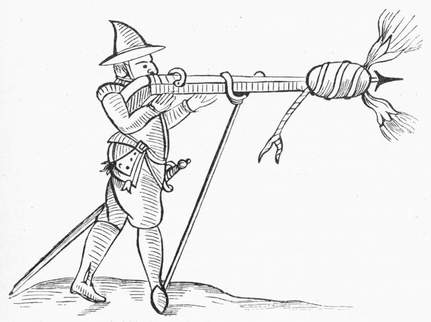
A graphical sketch of the soldier accompanies these remarks (as in the facsimile annexed), which appears almost a caricature, but it must have been seriously approved as a good illustration, by our author, the “Souldier of Berwick-upon-Tweed.”
Mr. Hewett gives the following table in his “Ancient Armour and Weapons,” page 715.
Length of Barrel. Number of Bullets to the pound. Nature of lock.
Musquet.. 4 ft. 10 Match
Harquebus . 2½ ft. 17 Wheel
Carbine .. 2½ ft. 24 Flint
62.
A way for a Harquebuss, a Crock, or Ship-musquet, six upon a Carriage, shooting with such expedition, as[1] without danger one may charge, level, and discharge[2] them sixty times in a minute of an hour, two or three together.
Footnotes
[A way for a Harquebus, a Crock.] Arquebuse, corrupted to Harquebus—a firearm requiring a forked rest placed in the ground, on which to steady the heavy barrel, which carried a ball of 2 ounces, or for fortresses 3½ ounces.
Arquebuse à croc—a small piece of ordnance placed on a stock or club, fired by a match. We find among the records of the State Paper Office the following notice in the Calendars, viz.:—John the Almain[L] writes to Walsyngham, recommending one of his countrymen, who had invented an harquebuse “that shall containe ten balls or pellets of lead, all the which shall goe off, one after another, having once given fire, so that with one harquebuse one may kill ten theeves or other enemies without recharging.”—Cal. State Papers, Dom. Series, 1547–1580. Edited by R. Lemon, F.S.A., 8vo. 1856, p. 696. No. 45.
63.
A sixth way,[3] most excellent for Sakers, differing from the other, yet as swift.
Footnote
[For Sakers and Minyons.] Sakers were cannon, 5 to 8 pounders; and Minion, long 4 pounders, or short 3 pounders.
64.
A seventh, tried and approved before the late King (of ever blessed memory) and an hundred Lords and Commons, in a Cannon of 8. inches half quarter,[4] to shoot Bullets of 64. pounds weight, and 24. pounds of pouder, twenty times in six minutes; so clear from danger, that after all were discharged, a Pound of Butter did not melt being laid upon the Cannon-britch, nor the green Oile discoloured that was first anointed[5] and used between the Barrel thereof, and the Engine, having never in it, nor within six foot, but one charge at a time.
Footnotes
[For the biggest Cannon.] This article affords a further example of the practical working out of another invention of the Marquis, and possibly at the Tower, previous to 1641.
As early as the 16th century cannon had been undergoing gradual although slight improvements. The Marquis had many opportunities for obtaining the best information, and his active mind must have long been on the alert, both at home and abroad, to ascertain all that was then known on the subject of their manufacture, with their best form and dimensions. We have very early intelligence on the subject of Engines of War among the valuable records of our State Paper Office, from which we have selected the following:—
1575? No. 74. Description of the operation and advantages of a certain newly invented engine of war, whereby twenty-four bullets can be discharged from one piece at a time.
No. 75. Notes by the inventor touching the engines of war, with the expense of making a few at a time. It would require above 100 engines to be employed at once. Desires a yearly pension in consideration of his invention.
No. 76. A note of the effects already performed by the engine of war; of which there are 200 engines and 3000 bullets already delivered into the Tower for service.—Cal. State Papers, Dom. Series, 1547–1580. Edited by R. Lemon, F.S.A., 8vo. 1856, page 513.
In the Bodleian Library there is a folio volume of the MS. papers of General Mountagu, or the Earl of Sandwich, lettered on the back “Carte Papers, 1604–1684. Letters to Earl of Sandwich, &c. 74,” in which is the following: “Invention for Cannon to doe extraordinary execution. (No. 123.) Canon that shall shute more then 400 paces, a bulett of four fadem longe to destroy the Riggings of any ship, the which bulett must necessarily goe a twart, and cannot come perpendicularly, as other chayne buletts, and other such like, who by that means may misse the intended effect and passe through the cordage or Riggings.”
Among the Sloane MSS. in the British Museum is one, No. 2497, with rude drawings of cannon, &c. viz.: a fauconet; a faucon; a minnion; a saker; a demi-culveringe; a culvering; a demi-cannon; a cannon; a cannon-peuterer; a cannon-rial; each with its proper ball, ramrods, &c.
Robert Norton, Engineer and Gunner in “The gunners dialogue with the art of great Artillery,” a black letter quarto, accompanying “The Arte of shooting in great ordnance,” by William Bourne, 1643, gives the names, &c. of ordnance, thus:—
Cannon of 8 weighing 8,000 lbs. —〃— of 7 7,000 Demi-Cannon 6,000 Culvering 4,500 Demi-Culvering 2,500 Saker 1,500 Minion 1,200
Among other inquiries in the course of the dialogue occur the following:—“If you were to make a shot in the night, at a mark showed you in the day, how would you prepare for it?” And:—“How would you make a shot at an enemies light, in a dark night, not having any candle, lanthorn, or other light by you?”
David Papillon, in his “Practical Art of Fortification,” 4to. 1645, enumerating the ordnance and ammunition of a garrison, observes:—“for a towne of two English miles circumference, of these sorts, six cannons, six demi-cannons, six long culverins [or double for a sea-port], twentie sacres [or less for a sea-port], and twelve drakes, and one hundred thousand [pounds?] weight of powder.”—P. 97.
In “Mathematical Magick,” 1648, Bishop Wilkins incidentally remarks—“the greatest cannon in use, does not carry above 64 pound weight,” page 126. And in the 19th chapter of the same work he states the charge to be 40 lbs. of powder.
John Greaves, Geometry Professor of Gresham College, who was born in 1602, and died in October, 1652, made experiments for trying the force of great guns, at Woolwich, 18th of March, 1651, which were published in the 15th volume of the Philosophical Transactions, 1685.
The following extracts are given, from their specifying the description, weight, and sometimes the size of the cannon used, with the charge of powder and weight of shot.
The great ordnance tried were:—
1. “An iron demy Canon, of 3500 lbs. weight, and having a cylinder bore, the bullet 32 lb. of iron, the powder 10 lb.
2. “An iron demy Canon, having a taper bore, and being 3600 lbs. in weight, and 4 inches longer than the former, the iron bullet 32 lb.
3. “Experiment with a whole Culverin in brass, of 5300 lbs. in weight, 11 foot one inch in length, with a taper bore, being intended for a chase piece to the frigate called the Speaker; the iron bullet was 18 lbs. in weight, the powder 10 lbs.
4. “A whole Culverin in brass, made at Amsterdam, for the French, with this mark 3580, being 10 foot long, and not very thick in the breech, 18 lb. bullet, and 9 lb. of powder.
5. “An iron Demy Culverin, 9 lbs. iron bullet, and 4 lb. of powder. This half Culverin was shot eight times.
6. “A brass Demy Culverin, the breech 13-5/8 inches, the mouth 9-5/8, 9 lb. iron bullet, 4 lb. of powder.”
65.
A way that one man in the Cabin may govern the[6] whole side of Ship-musquets, to the number (if need require) of 2. or 3000. shots.
Footnote
[For a whole side of Ship-musquets.] The list of five inventions, which appears in the “Life, Times, &c.,” page 316, refers to a similar improvement, viz.: “Oft shooting peards, controlable in one plane, either for number or time.”
The 43rd Device, given by Bourne in his “Inventions or Devices,” 1578, is entitled, “How to make any piece of Ordnance go off at any hour or time appointed, by itself, and no person there.”
Again, in the 44th Device, we have, “How to make a piece go off when you list, and no person there.”
66.
A way that against[7] several Advenues[8] to a Fort or Castle, one man may charge fifty Cannons playing, and stopping when he pleaseth, though out of sight of the Cannon.
Footnotes
[For guarding several advenues to a Town.] This would appear to be no more than an extended application of the preceding invention. We can imagine that Caspar Kaltoff executed a very beautiful model of this piece of machinery, with its 50 little brass guns, 50 ramrods, &c., all worked simultaneously by a man below, “out of sight of the cannon;” but it is very unlikely that the Marquis would have recommended its adoption; it shows, however, how he persevered in endeavours to abridge human labour.
67.
A rare way likewise for musquettoons fastened to the Pummel of the Saddle, so that a Common Trooper cannot misse to charge them, with twenty or thirty Bullets at a time, even in full career.
When first I gave my thoughts to make Guns shoot often, I thought there had been but one only exquisite way inventible, yet by several trials and much charge I have perfectly tried all these.
[For Musquettoons on horseback.] The remark which forms a postscript to this article, naturally leads to the conclusion that the improvements in guns were among the later inventions of the Marquis, perhaps about or after 1641, when his own active services promised soon to be required in the field. His improved firearms are chiefly recommended for effecting rapid firing. It may have been one of the results of his experiments, that Caspar Kaltoff became engaged at Vauxhall in such manufactures for the government.
The Marquis would obtain little assistance from Vegetius, although he would find some extraordinary applications of “Mirabilis Machina.” We see there the “Tormentum,” with its great stone ball, and fire issuing from muzzle and touch-hole, manipulated after an extraordinary fashion, bristling down the sides of an angular frame; whirled round on a circular table like a capstan; eight placed crosswise; or two placed breech to breech, one horizontal, the other vertical, to be fired from behind a goodly target. But the Marquis went far beyond these ancient military weapons, for gunpowder was then beginning to be understood and applied with a degree of effect that startled and surprised the enemy, while it only disgusted the humane portion of our forefathers of that day, who, in case of dire necessity alone, favoured the use of balista, catapulta, bows, and pikes, in the conduct of military and naval engagements.
Musketoons were the same as the blunderbuss, being of large bore to fire with a charge of twenty or more pistol bullets, of from seven to seven and a half ounces of lead, among a multitude, to disperse the crowd.
The arms offensive and defensive of the old militia, described by Grose, in his “Military Antiquities,” 1801, as applying to a trooper, with the furniture for his horse, were as follows:—“The defensive armour, a breast, back, and pot (or scull cap without vizor or bever), pistol proof; the offensive arms, a sword, and a case of pistols, the barrels not under 14 inches in length; the furniture for the horse, a great saddle, or pad, with burs and straps for affixing the holsters, a bit and bridle, with a pectoral and crupper: for the foot, a musketeer had a musket, the barrel, not under three feet in length, and the guage of the bore for 12 bullets to the pound, a collar of bandileers, with a sword.” (Vol. 1.)
Abraham Hill, a Fellow of the Royal Society, patented, 3rd of March, 1664, among other inventions, one for guns and pistols, with several devices for the speedier and more effectual discharge of them; also a new kind of powder horn.
We shall close these observations on improvements in firearms with the following miscellaneous illustrations respecting the several kinds then in use.
In “The Exercise of Armes for Calivers, Musketts, and Pikes, after the order of his excellence Maurits Prince of Orange, &c. Sett forth in the figures by Jacob de Gheyn. Printed at the Hage,” folio, 1607:—the instructions commence with an engraved illustration of the soldier, showing how he should stand and “carry his caliver, matche, and rapier;” and proceeds to observe, “he shall also hold the match burning or kindled at both the endes, betwixt the two least fingers of the same left hand.” He is thus represented, holding a piece of smouldering touch-rope of two or three feet long, lighted at both ends, and has other similar reserve cords at his belt.
In the splendid work on “Ancient Armour and Arms,” by Sir S. R. Meyrick, 2 vols. folio, 1830, numerous illustrative plates of firearms occur in the following order:—Arquebus, plate 114, figure 5.—Blunderbuss, a snaphaunce, from the Dutch donderbus, thunder-gun, p. 119, f. 10.—Carabine, a wheel-lock, p. 116, f. 1.—117, and 119, f. 9.—Carabineers, p. 43.—Cross bow, p. 94; 95; 98.—Flask for powder, p. 123; 124.—Musket, p. 117; 119.—Musketeer, p. 36.
68.
An admirable and most forcible way to drive up water by[9] fire, not by drawing or sucking it upwards, for that must be as the Philosopher calleth it, Intra[1] sphæram activitatis, which is but at such a distance. But this way hath no Bounder, if the Vessels be strong enough; for I have taken a piece of a whole Cannon, whereof the end was burst, and filled it three quarters full of water,[2] stopping and scruing up the[3] broken end; as also the Touch-hole; and making a constant fire under it, within 24. hours it burst and made a great crack: So that having a[4] way to make my Vessels, so that they are strengthened by the force within them, and the one to fill after the other.[5] I have seen the water run[6] like a constant Fountaine-stream forty foot[7] high; one Vessel of water rarified by fire driveth[8] up forty of cold water. And a man that tends the work is but to turn two Cocks, that one Vessel of water being consumed, another begins to force and[9] re-fill with cold water, and so successively, the fire being tended and kept constant, which the self-same Person may likewise abundantly perform in the interim between the necessity of[1] turning the said Cocks.
Footnotes
[A Fire Water-work.] This is that great invention which has popularized and preserved the fame of the Marquis of Worcester in the public mind. Had the whole of the Century been destroyed, with the exception of this 68th article, enough would have remained to satisfy any engineer, that the Marquis had achieved a grand discovery.
We shall proceed to notice what information books and the patent records would afford, to stimulate his inquiries into the possible practical application of the effects, resulting from the action of fire on water in close vessels.
The work which has, from being often quoted, acquired especial notice on this subject is, “Les Raisons des forces Mouvantes avec diverses Machines. Par Salomon de Caus,” folio, published at Frankfort, 1615, in which, at page 4, theorem V, under the title, “L’eau montera par aide du feu, plus haut que son niveau,” it is illustrated and described as follows:—“Le troisiesme moyen de faire monter, est par l’aide du feu, dont il se peut faire diverses machines, i’en donneray icy la demonstration d’une. Soit une balle de cuiure marquee A. bien soudee tout a lentour, à laquelle il y aura un souspiral marqué D, par ou lon mettra leau, et aussi un tuyau marqué B, C, qui sera soudé en haut de la balle, et le bout C, aprochera pres du fond, sans y toucher, apres faut emplir ladite balle d’eau par le souspiral, puis le bien reboucher et le mettre sur le feu, alors la chaleur donnant contre ladite balle, fera monter toute leau, par le tuyau B, C.” See also Figuier’s “Exposition et Histoire des principales découvertes Scientifiques Modernes.” Tome premier. Paris, 1862, p. 25.