HERE BEGINS THE SECOND BOOK OF THE LEGEND OF THE GLORIOUS JOYOUS AND HEROIC ADVENTURES OF TYL ULENSPIEGEL AND LAMME GOEDZAK IN THE LAND OF FLANDERS AND ELSEWHERE
Geoffrey Arundel Whitworth translation
I
One morning in September Ulenspiegel took his staff, three florins that had been given him by Katheline, a piece of pig’s liver and a slice of bread, and set out to go from Damme to Antwerp, seeking the Seven. Nele he left asleep.
On the way he met a dog who followed after him, smelling around because of the liver, and jumping up at his legs. Ulenspiegel would have driven off the dog, but seeing the persistence of the animal, he thus addressed him:
“My dear dog, you are certainly ill-advised to leave your home, where you would find awaiting you an excellent meal of patties and other fine remains (to say nothing of the marrow-bones), to follow, as you are now doing, a mere adventurer of the road, a vagabond that is like to lack so much as a root to give you for nourishment. Follow my advice, most imprudent little dog, and return to your innkeeper. And for the future, take good care to avoid the rain and snow, the hail, the drizzling mists, the glassy frosts and other such wretched fare as is alone reserved for the back of the poor wanderer. Keep close at home, rather, in a corner of the hearth, and warm yourself, curled up in front of the cheerful fire. But leave to me the long wandering in mud and dust, in cold and heat, to be roasted to-day, to-morrow frozen, plenished on Friday but on Sunday famished for want of food. For, trust me, little dog, the wise thing is to return at once like a sensible and experienced little dog to the place whence you came.”
But it would seem that the animal did not hear a single word of what Ulenspiegel was saying, for he continued to wag his tail and jump his highest, barking all the while, in his desire for food. Ulenspiegel imagined that all this was just a sign of friendliness, and gave no thought to the liver which he carried in his scrip.
So on and on he walked, with the dog following behind. And when they had gone in this way the better part of a league, they saw a cart on the roadside with a donkey harnessed thereto, holding his head down. On a bank, at the side of the road, between two clumps of thistles, reclined a man. He was very fat, and in one hand he held the knuckle-end of a leg of mutton, and in the other hand a bottle. He gnawed the knuckle-bone and drank from the bottle, but when he was doing neither of these things he would fall to weeping and groaning.
Ulenspiegel stopped on his way, and the dog stopped too, but quickly jumped up on to the bank, smelling doubtless a good odour of liver and mutton. There he sat on his hind legs by the fat man’s side, and began to paw at the stranger’s doublet, as much as to say, “Please give me a share of your meal!” But the man elbowed him off, and holding up the knuckle-bone in the air began to moan aloud most piteously. The dog did likewise in the eagerness of his desire, while the donkey (who was weary of being tied to the cart and thus prevented from getting at the thistles) set up, in his turn, a most piercing bray.
“What’s the matter now, Jan?” the man inquired of his donkey.
“Nothing,” said Ulenspiegel, answering for him, “except that he would fain make his breakfast off those thistles that grow there on either side of you, like the thistles that are carved on the rood-screen at Tessenderloo, below the figure of Our Lord. Nor would this dog here, I’m thinking, be any the less inclined to join his jaws together on the bone you have got there. But in the meanwhile I will give him a piece of this liver of mine.”
The man looked up at Ulenspiegel, who straightway recognized him as none other than his friend Lamme Goedzak of Damme.
“Lamme,” he cried, “you here? And what are you doing, eating and drinking and moaning? Has some soldier or other been so impertinent as to box your ears, or what’s the matter? Tell me.”
“Alas!” said Lamme, “my wife!”
And he would have emptied his bottle of wine there and then had not Ulenspiegel laid a hand on his arm and suggested that it were fairer that the drink should be given to him that had none. “Besides,” he added, “to drink thus distractedly profits naught but one’s kidneys.”
“Well said,” answered Lamme, handing his friend the bottle, “but will you drink, I wonder, to any better purpose?”
Ulenspiegel took the bottle, drank his fill, then handed it back again.
“Call me a Spaniard,” he said, “if I’ve left enough to make a minnow drunk!”
Lamme inspected the bottle. Then, without ever ceasing to groan, he rummaged in his wallet and produced another bottle, and another piece of sausage which he cut up in slices and began to munch in the most melancholy fashion.
“Do you never stop eating, Lamme?” asked Ulenspiegel.
“Often, my son,” he replied. “But now I am eating to drive away sad thoughts. Where are you, wife of mine?” And as he spoke, Lamme wiped away a tear. After which he cut himself ten slices of sausage.
“Lamme,” said Ulenspiegel, “you should not eat so quickly, taking no thought at all for the poor pilgrim.”
Lamme, who was still whimpering, gave four of the slices to Ulenspiegel, who ate them up immediately, and was much affected by their good flavour. But Lamme said, eating and crying all at the same time:
“O wife, O goodly wife of mine! How sweet she was, how beautiful she was! Light as a butterfly, nimble as the lightning, and with a voice like a skylark! For all that, she was overfond of fine clothes. Alas, but how well she looked in them! And surely, the flowers also, are they not fond of rich apparel? Oh, if you had seen her, my son—her little hands, so nimble to caress, such hands as you never could have suffered to come in contact with saucepan or frying-pan! And her complexion, which was clear as the day, would surely have been burnt by standing over the kitchen fire. And what eyes she had! Only to look at them was to be melted quite with tenderness. Alas, I have lost her! Go on eating, Tyl; it is good Ghent sausage.”
“But why has she left you?” asked Ulenspiegel.
“How should I know?” Lamme replied. “Alas! gone for ever are those days when I used to go to her home a-courting! Then, verily, she would fly away from me, half in love and half in fear! And her arms were bare, as like as not (beautiful arms they were, so round and white), but if she saw me looking at them she would cover them quickly with the sleeve of her gown.
“At other times, again, she would gladly lend herself to my caresses, and I would kiss her closed eyes, and that lovely neck of hers, so large and firm. She would shiver all over, uttering little cries of love, and then, leaning her head backwards, she would give me a playful slap upon my nose. Thereafter she would laugh and I would cry aloud, and we would wrestle together right amorously, and there was naught betwixt us but laughter and fun. But there, there. Is any wine left in the bottle, Tyl?”
Tyl gave him what remained.
“This ham does great good to my stomach,” he said.
“To mine also,” answered Lamme, “but I shall never see my dear one again. She has fled away from Damme. What say you, will you come with me in my cart to look for her?”
“That will I,” answered Ulenspiegel.
So they got up into the donkey-cart, and the donkey set up a most melancholy bray to celebrate their departure.
As for the dog, he had already made off, well filled, without a word to any one.
II
While the cart went lumbering along on the top of the dike, with the pond on one side and the canal on the other, Ulenspiegel sat brooding on the past and cherishing in his bosom the ashes of Claes. He pondered deeply upon that vision he had seen, and asked himself if indeed it were true or false, and if those spirits of Nature had been making mock of him, or if perchance they had been revealing to him under a figure those things that must be done if the land of his fathers were to be restored. In vain did he turn the matter over and over in his mind, for he could not discover what was meant by those words, the “Seven” and the “Cincture.” He called to mind the late Emperor Charles V, the present King, the Governess of the Netherlands, the Pope of Rome, the Grand Inquisitor, and last of all, the General of the Jesuits—six great persecutors of his country whom most willingly would he have burned alive had he been able. But he was forced to conclude that none of these was the personage indicated, for that they were all too obviously worthy of being burnt, and would be in another place. And he could only go on repeating to himself those words of the Lord of the Spring:
When the North
Shall kiss the West,
Then shall be the end of ruin.
Love the Seven,
And the Cincture.
“Alas!” he cried, “in death, in blood, in tears, find the Seven, burn the Seven, love the Seven! What does it all mean? My poor brain reels, for who, pray, would ever want to burn that which he loved?”
The cart by this time had progressed a good way along the road, when all at once a sound was heard of some one stepping along the sand, and of a voice singing:
Oh, have ye seen him, ye that pass,
The lover I have lost, alas!
Feckless he wandereth, knowing no tie—
Have ye seen him pass by?
As tender lamb the eagle seizeth,
So on my poor heart he feedeth.
Beardless his chin, though to manhood nigh—
Have ye seen him pass by?
If ye find him, ye may tell
Weary with following faints his Nele.
O Tyl, my beloved, hear me, I cry!
Have ye seen him pass by?
Languisheth ever the faithful dove,
Seeking, seeking her fickle love.
So, far more so, languish I—
Have ye seen him pass by?
Ulenspiegel gave Lamme a blow on his great belly, and told him to hold his breath.
“That,” said Lamme, “is a very difficult thing, I fear, for a man of my corpulence.”
But Ulenspiegel, paying no further attention to his companion, hid himself behind the canvas hood of the cart, and began to sing in the voice of a man with a bad cold that has drunk well:
In a shaky old cart with age all green,
Your feckless sweetheart I have seen;
And a glutton rides with him, like pig in sty—
I have seen him pass by.
“Tyl,” said Lamme, “you have a wry tongue in your cheek this morning!”
But Tyl put his head out of a hole in the hood:
“Nele, don’t you know me?” he said.
And Nele, for it was none other than she herself, was filled with fear, crying and laughing all at the same time, and her cheeks were wet as she answered him:
“I see you, and I know you, you wretch, you traitor!”
“Nele,” said Ulenspiegel, “if you want to give me a beating, you will find a stick in the cart here. It is heavy enough in all conscience, and knotted so that it will leave its mark right enough.”
“Tyl,” said Nele, “are you seeking the Seven?”
“Even so,” Tyl told her.
Now Nele carried with her a bag, or satchel, that was so full it seemed likely to burst. This satchel she offered to Tyl, saying:
“I thought it was unwholesome, Tyl, that a man should go on a journey without a good fat goose, and a ham, and some Ghent sausages. So take them, and when you eat of them think of me.”
While Ulenspiegel stood gazing at Nele, quite oblivious of the satchel which she was holding out to him, Lamme poked out his head from another hole in the hood, and began to address the girl in his turn.
“O girl most wise,” he said, “O girl most prudent, if he refuses such a gift it must be from pure absence of mind. But you had much better give into my own keeping that goose of yours, that ham, and those fine sausages. I will take care of them, I promise you!”
“And who,” asked Nele of her lover, “who may this red-face be?”
“A victim of the married state,” Tyl told her, “that is wasting away with sorrow, and would soon, in fact, shrink away to nothing, like an overbaked apple, were it not that he recuperated his strength from time to time and all the time by taking nourishment.”
“Alas, my son,” sighed Lamme, “what you say is only too true.”
Now it was very hot, and Nele had covered her head with her apron because of the sun. Ulenspiegel looked upon her, and conceived a sudden desire to be alone with her. He turned to Lamme, and pointed to a woman that was walking some way off in a field.
“Do you see that woman?” he said.
“I see her,” said Lamme.
“Do you recognize her?”
“Heavens!” cried Lamme, “can it be my wife? In truth she is dressed like no common country wench!”
“Can you still be doubtful, you old mole?”
“But supposing it were not her after all?” said Lamme.
“You would be none the worse off,” Ulenspiegel told him, “for over there to the left, towards the north, I know a tavern that sells most excellent bruinbier. We will join you there, and here meanwhile is some salt ham that will provide an excellent relish to your thirst.”
So Lamme got down from the cart, and made off as fast as his legs would carry him in the direction of the woman in the field.
Ulenspiegel said to Nele: “Why will you not come near me?”
Then he helped her to climb up beside him on to the cart, and made her sit close by his side. He removed her apron from her head and the cloak from her shoulders, and then when he had kissed her a hundred times at least, he asked her:
“Where were you going to, beloved?”
She answered him nothing, but seemed carried away in a sort of ecstasy. Ulenspiegel, in like rapture, said to her:
“Anyway you are here now! And truly the wild hedgerow is dun beside the sweet pink colouring of your skin, and though you are no queen, behold I will make a crown of kisses all for you! O sweet arms of my love, so tender, so rosy, and made for nothing but to hold me in their embrace! Ah, little girl, little love, how dare I touch you? These rough hands of mine, will they not tarnish the purity of your white shoulder? Yea verily, for the lightsome butterfly may flit to rest upon the crimson carnation, but I, clumsy bumpkin that I am, how can I rest myself without tarnishing the living whiteness that is you? God is in heaven, the king is on his throne, the sun rides triumphing in the sky, but am I a god, or a king, or the sun himself that I may come so close to you? O tresses softer than silk! O Nele, I fear to touch your hair, so clumsy am I, lest I tear it, lest I shred it all to pieces. But have no fear, my love. Your foot, your sweet foot! What makes it so white? Do you bathe it in milk?”
Nele would have risen from his side, but,
“What are you afraid of?” he asked her. “It is not the sun alone that shines upon us now and paints you all gold. Do not cast down your eyes, but look straight into mine, and behold the pure fire that flames there. And listen, my love, hearken to me, dearest. Now is midday, the silent hour. The labourer is at home, eating his dinner of soup. Shall we not also feed upon our love? Oh why, oh why have I not yet a thousand years wherein to tell at your knees my rosary of Indian pearls!”
“Golden Tongue!” she said.
But my Lord the Sun blazed down upon the white hood of the cart, and a lark sang high over the clover, and Nele leant her head upon the shoulder of Ulenspiegel.
III
After a while Lamme came back to the cart, great drops of sweat pouring off him, and he, puffing and blowing like a dolphin.
“Alas!” he cried, “I was born under an evil star. For no sooner had I run and caught up with this woman than I found that she was not a woman at all, but an old hag rather, as indeed I could see at once by her face—forty-five years old at the very least! And to judge by her head-gear she had never been married. For all that, she inquired of me in a harsh voice what I was doing there, carrying my great fat belly about in the clover! I told her as politely as I could that I was looking for my wife who had lately left me, and that I had run after her by mistake.
“At that the old girl told me that the only thing for me to do was to return at once whence I came, and that if my wife had left me she had indeed done well, seeing that all men are thieves and rascals, heretics, unfaithful, poisoners, and deceivers of women; and she threatened to set her dog on me if I did not make off at once. Which in truth I did incontinently, for that I perceived a great mastiff lying there growling at her feet. When, therefore, I had reached the boundary of the field, I sat me down to rest myself and to eat a bit of ham. And I was between two clover-fields. Suddenly I heard a great noise just behind me, and turning round I saw the old girl’s mastiff, no longer now in menacing mood but wagging his tail as sweetly as possible and as much as to say that he was hungry and would like a piece of my ham. I was for throwing him some small bits when all at once his mistress appeared on the scene, and shouted out fiercely:
“‘Seize the man! Seize him with your fangs, my son!’
“I started to run away, the great mastiff hanging on to me by my breeks. And now he had bitten off a piece of them, together with a gobbet of my own flesh. The pain made me angry and I turned and gave him such a smart stroke with my stick upon his front paws that I must have broken one of them at least. At that he fell down, crying out in his dog language: ‘Mercy! Mercy!’ the which I granted him. Meanwhile his mistress, finding no stones to throw at me, had begun to threaten me with pieces of earth and bits of grass. So I made good my retreat. And is it not a sorry thing, and a thing most unjust and most cruel, that because a girl has not been good-looking enough to find some one to marry her, she must needs go and take her revenge on a poor innocent like me?”
IV
Some while after these happenings, when Nele had returned to her home with Katheline, Lamme and Ulenspiegel came to Bruges. They were at the place called Minne-Water, the Lake of Love—though the learned folk would have it to be derived from Minre-Water, that is, the Water belonging to the order of monks who are called Minims. Be this as it may, here on the bank of the lake, Lamme and Ulenspiegel sat themselves down, watching those that passed in front of them under the trees. The green branches hung over the pathway like a vault of foliage, and below there sauntered both men and women, youths and maids, clasping each other’s hands, with flowers on their heads, walking so close together and gazing so tenderly into each other’s eyes that they seemed to see nothing else in all the world save themselves alone.
As he watched them, the thoughts of Ulenspiegel were far away with Nele, and his thoughts were sad thoughts. Yet his words were of another colour, bidding Lamme come off with him to the tavern for a drink. But Lamme paid no attention to what Tyl was saying, for he himself was absorbed no less by the sight of those loving pairs.
“In the old days,” he said, “we too, my wife and I, were wont to go a-courting, while others, just as we are now, would watch us, alone and companionless by the lake-side.”
“Come and have a drink!” said Ulenspiegel, “Belike we will find the Seven at the bottom of a pint of beer.”
“That’s but a drunkard’s notion,” answered Lamme, “for you know quite well that the Seven are giants, and taller than the roof of the Church of St. Sauver itself!”
The thoughts of Ulenspiegel were still with Nele, but none the less did he hope to find, perchance, good quarters in some inn, a good supper, and a comely hostess into the bargain. Again, therefore, did he urge his companion to come along with him and drink. But Lamme would not listen to him, gazing sadly at the tower of Notre Dame, and addressing himself in prayer to Our Lady somewhat in this wise:
“O Blessed Lady, patroness of all lawful unions, suffer me, I pray, to see yet once again the white neck, the soft and tender neck, of my love!”
“Come and drink!” cried Ulenspiegel. “Belike you will find her displaying these charms of hers to the drinkers in the tavern.”
“How dare you harbour such a thought!” cried Lamme.
“Come and drink!” repeated Ulenspiegel. “Your wife has turned innkeeper without a doubt.”
And thus conversing, they repaired to the Marché du Samedi, and entered into the Blauwe Lanteern—at the sign of the Blue Lantern. And there they found a right jolly-looking innkeeper.
The donkey meanwhile was unharnessed from the cart, and was put up in the stables and provided with a good feed of oats. Our travellers themselves ordered supper, and when they had eaten their fill, they went to bed and slept soundly till morning, only to wake up and eat again. And Lamme, who was wellnigh bursting with all that he had eaten, said that he could hear in his stomach a sound like the music of the spheres.
Now when the time came to pay the bill, mine host came to Lamme and told him that the total amounted to six patards.
“He has the money,” said Lamme, pointing to Ulenspiegel.
“No such thing,” said Ulenspiegel.
“What about that half-florin?” said Lamme.
“I haven’t got it,” said Ulenspiegel.
“Here’s a nice way of going on!” cried the innkeeper. “I shall strip your doublet and shirt from the two of you!”
Suddenly Lamme took courage of all he had been drinking:
“And if I choose to eat and to drink,” he cried, “yea, to eat and to drink the worth of twenty-seven florins, and more, do you think I shall not do so? Do you think that this belly of mine is not the equal of a penny? God’s life! Up to now I have fed on ortolans. But you, never have you carried anything of that sort under your belt of greasy hide. For you, you bad man, must needs carry your suet in the collar of your doublet, far otherwise than I that bear three inches at least of delicate fat on this good belly of mine.”
At this the innkeeper fell into a passion of rage, and though he was a stammerer he began to talk at a great rate, and the greater his haste the more he stammered and spluttered like a dog that has just come out of the water. Ulenspiegel began to throw pellets of bread at him, and Lamme, growing more and more excited, continued his harangue in the following strain:
“And now, what do you say? For here have I enough, and more than enough, to pay you for those three lean chickens forsooth, and those four mangy poulets, to say nothing of that big simpleton of a peacock that parades his paltry tail in the stable yard. And if your very skin was not more dry than that of an ancient cock, if your bones even now were not falling to very dust within your breast, still should I have the wherewithal to eat you up, you and your slobbering servant there—your one-eyed serving-maid and your cook, whose arms are not long enough to scratch himself though he had the itch! And do you see,” he continued, “do you see this fine bird of yours that for the sake of half a florin would have deprived us of our doublet and our shirt? Say, what is your own wardrobe worth, preposterous chatterbox that you are; and I will give you three liards in exchange for the lot!”
But the innkeeper, who by this time was beside himself with rage, stammered and spluttered more and more, while Ulenspiegel went on throwing pellets of bread in his face, till Lamme at last cried out again in a voice brave as a lion’s:
“What’s the value, think you, skinny-face, of a fine donkey with a splendid nose, long ears, large chest, and legs as strong as iron? Twenty-eight florins at the least, is it not so, most seedy of innkeepers? And how many old nails have you, pray, locked fast away in your coffer, with which to pay the price of so fine an animal?”
More than ever did the innkeeper puff and blow, yet dared not budge an inch from where he stood. And Lamme said again:
“And what is the value, think you, of a fine cart of ash-wood, finely painted in crimson, and furnished with a hood of Courtrai cloth for protection from sun and rain? Twenty-four florins at the least, is it not so? And how much is twenty-four florins added to twenty-eight florins? Answer that, you miser that cannot even count! And now, since it is market day, and since your paltry tavern happens to be full of peasants that are come to market, behold I will put up my cart to auction and my donkey too, and I will sell them here, now, and at once!”
Which, in very truth, he did. For all they that were there knew very well who Lamme was. And he actually realized from the sale of his donkey and cart as much as forty-four florins and ten patards. And he jingled the money under the innkeeper’s nose, and said to him:
“Scent you not the savour of festivities to be?”
“Yea,” answered mine host. But under his breath he swore that if ever Lamme came to him and offered to sell him his very skin, he would buy it for a liard and make of it an amulet for a charm against extravagance.
Meanwhile there was a sweet and gentle-looking young woman that stood in the yard without, and she came up oftentimes to the window and looked at Lamme, but withdrew her pretty face each time that he might have seen her. And the same evening, when Lamme was going up to bed, stumbling about on the staircase without any light (for he had been drinking not wisely), he was aware of a woman that put her arms round him, and greedily kissed his cheek and mouth and his nose even, and moistened his face with amorous tears, and then left him.
But Lamme, who was thoroughly drowsed by all that he had been drinking, lay down straightway and went to sleep; and on the morrow he departed to Ghent together with Ulenspiegel. There he went seeking his wife in all the cabarets and taverns of the town. But at nightfall he rejoined Ulenspiegel at the sign of the Singing Swan.
V
Now King Philip was obstinate as a mule, and he thought that his own will ought to dominate the entire world as if it had been the will of God himself. And his will was this: that our country, little accustomed as it was to obedience, should now curb itself under an ancient yoke without obtaining any reforms at all. And the be-all and the end-all of his desire was the aggrandizement of that Holy Mother of his, the Catholic Church, Apostolic and Roman, One, Entire, Universal, changeless and unalterable, and this was his will for no other reason at all than just the fact that it was his will. And in this he was like some woman without sense, that tosses about all night upon her bed as though it were a bed of thorns, endlessly tortured by her own imaginings.
“Yes,” he would say, “O most Holy Saint Philip, and you, O my Lord God, if only I could turn the Low Countries into a common grave, and cast therein all the inhabitants of that country, then surely they would return to Thee, my most blessed Patron, and to Thee, my Lady Virgin Mary, and to ye, my good masters, the saints and saintesses of Paradise!”
And he really tried to do as he said; so that he was more Roman than the Pope and more Catholic than the Councils!
And the people of Flanders and of the Low Countries began to grow anxious again, and to think that they could discern in the distance this crowned spider, working in the sombre house of the Escurial, reaching out his long claws with their nippers open, and spreading wide the web in which he might enwrap them all and suck them white of their blood.
Ulenspiegel, for his part, went spreading the alarm wherever he could, and stirring up the people against the ravishers of his country and the murderers of his parents.
One day, therefore, when he was in the Marché du Vendredi, near by the Dulle-Griet—the Great Canon—Ulenspiegel lay flat down on his stomach in the middle of the road. A charcoal-burner who happened to be passing came up and asked him what he was doing there.
“I am giving my nose a wetting,” Ulenspiegel told him, “so that I may discover where this great wind is coming from.”
Next a carpenter came along.
“Do you take the pavement for a mattress?” he asked.
“Before long,” said Ulenspiegel, “there are some that will be taking it for a counterpane.”
A monk came up and stopped by his side.
“What does this booby here?”
“He entreats your blessing, lying flat at your feet,” said Ulenspiegel. The monk gave his blessing and went away. But Ulenspiegel continued where he was with his head pressed to the earth, till at last a peasant came along and asked him what he was listening for. “Do you hear some noise or other?” he said.
“Yes,” replied Ulenspiegel. “I hear the wood beginning to grow, that wood whence many a faggot shall be made for the burning of poor heretics.”
“Do you hear aught else?” inquired a sergeant of the commune.
“Yes,” said Ulenspiegel, “I hear the men-at-arms that are on their way from Spain. If you have anything you wish to save, bury it now, for in a little while our cities will not be safe from thieves any more.”
“The man is mad,” said the sergeant.
And the people of the town thought so too.
VI
Now in those days, day in, day out, King Philip of Spain was used to spend his time fingering old papers and scribbling and writing on leaves of parchment. To these alone did he confide the secrets of his cruel heart, for he loved no man living, and knew that none loved him. For he desired to direct his great empire by himself alone, and like a weary Atlas he was bowed under that weight. Melancholy and phlegmatic by nature, this excess of work was consuming a body that was already none too strong. Hating as he did every happy face, he had begun to hate our land of Flanders, for its gaiety if for nothing else. And he hated our merchants just because they were wealthy and luxurious, and he hated our nobility just because they were free in speech and frank in manner, and because of the high ardour of their bravery and their jovial bearing. Neither had he forgotten the tale that was told how, as early as the year 1380, the Cardinal de Cousa had pointed out the abuses of the Church, and had preached the need of reformation, since which time the revolt against the Pope and the power of Rome had begun to be manifest in our land, and was now, under different forms and sects, rife in every head like water boiling in a kettle with the lid on.
And although, under the Emperor Charles, the Papal Inquisition had already been the death, by burning, burying alive, or hanging, of so many as a hundred thousand Christians, and although the property of these unfortunates had gone into the coffers of the Emperor and the King like rain falling into a sink, Philip decided that this was not enough, and now imposed on the country a new College of Bishops, and aspired to introduce into Flanders all the horrors of the Spanish Inquisition.
And the Town Heralds sounded their trumpets and their timbrels, and declaimed a proclamation to the effect that all heretics, whether men, women, or girls, should be done to death. Those who would recant their heresies were to be hanged, but those who were obstinate were to be burnt at the stake. The women and girls were to be buried alive, and the executioner was to dance upon their dead bodies.
And the flame of resistance began to burn and run through all the country.
VII
It was the fifth of April, just before Easter, and the Counts Louis of Nassau, de Culembourg, and de Brederode (he that was surnamed Hercule the Toper) were entering the courtyard of the palace of Brussels, together with three hundred gentlemen. They were come to seek an audience of the Governess of the Netherlands, Madame the Duchess of Parma, and were mounting the great stairway of the palace four by four.
Coming at length into the hall where my Lady was seated they presented their petition, which entreated her to use her influence with King Philip for the abolition of all those decrees which concerned religion and the introduction into Flanders of the Spanish Inquisition. This petition, which afterwards became known as “The Compromise,” also declared that in our already disaffected country such a policy as the introduction of the Inquisition could only result in troubles of all kinds, ruin to the country, and universal misery.
Berlaymont, who later on was to prove so treacherous and baneful to the land of his birth, stood close by Her Highness, and mocked at the poverty of certain of the confederate nobles who had come to visit her.
“Have no fear, my Lady,” he told her, “they are nothing but beggars!”
And by these words he implied either that the said nobles had been ruined in the service of the King, or else that they were eager to emulate the luxury of the great Lords of Spain. And thus it was that later on these same nobles endeavoured to bring ridicule upon the words of Berlaymont by saying that “they held it indeed an honour to be esteemed and spoken of as beggars—beggars for the good service of the King and the advantage of these lands.” And from that time they began to wear round their necks a golden medal carved with an effigy of the King. And on the obverse side of the medal were two hands clasped upon a beggar’s wallet, with these words writ thereunder: “To the King, faithful even unto beggary.” On their hats and bonnets they carried also little golden ornaments made in the form of beggars’ hats and platters.
And all this time Lamme went carrying his portly form about the town, seeking the wife that he never found.
VIII
One morning Ulenspiegel said to Lamme:
“Come with me. Let us go and present our compliments to a certain high noble I wot of, a most renowned and powerful personage!”
“Will he tell us where my wife is?” asked Lamme.
“Certainly,” answered Ulenspiegel, “if he knows.”
And away they went to Brederode, surnamed Hercule the Toper. And they found him in the courtyard of his house.
“What do you want with me?” he demanded of Ulenspiegel.
“To speak with you, my Lord.”
“Speak then,” said Brederode.
“You are a handsome, brave, and powerful nobleman,” said Ulenspiegel. “Time was when you were able to flatten out a Frenchman in full armour as though he were no better than a mussel in its shell. But if you are brave and powerful you are also well-informed. Can you tell us, therefore, why you wear this medal inscribed with these words: ‘To the King, faithful even unto beggary’?”
“Yes,” Lamme put in, “pray tell us why, my Lord!”
But Brederode made no answer, and only looked very hard at Ulenspiegel, who thereupon continued his discourse in this wise.
“And why, pray, do you, you other noble Lords, seek to be faithful to the King even unto beggary? Is it for the great good that he wishes you? Or for the fair friendship that he bears you? How is it that instead of being faithful to the King even unto beggary you do not so act rather that the brute himself may be despoiled of his country, and thus be made faithful for ever to beggary himself?”
And Lamme nodded his head to show his agreement with what his friend had said:
Brederode looked at Ulenspiegel with his keen glance, and smiled with pleasure at his handsome appearance.
“Either you are a spy of King Philip,” he said, “or else a good man of Flanders; and for whichever you are I will pay you your due.”
So saying he led Ulenspiegel to his pantry, and Lamme followed close behind. When they were come there, Brederode pulled Ulenspiegel’s ear till the blood flowed.
“This for the spy,” he said.
But Ulenspiegel remained quite quiet and said nothing.
Then Brederode, pointing to a pipkin of cinnamon wine, bade his butler bring it to him.
“Drink,” said Brederode, “this for the good Fleming.”
Ah!” cried Ulenspiegel, “good Fleming means sweet tongue for cinnamon! Verily the saints themselves do not know the likes of it!”
When he had drunk half the tankard he passed the remainder to Lamme.
“And who,” said Brederode, “who is this papzak, this belly-carrier that needs must be recompensed for having done nothing?”
“This,” said Ulenspiegel, “is my friend Lamme Goedzak, and whenever he drinks mulled wine he thinks that he is going to find the wife he has lost.”
“That’s so,” said Lamme, sucking up the wine from the goblet most devotedly.
“And where may you be going to now?” asked Brederode.
“In quest of the Seven,” said Ulenspiegel, “the Seven that shall save the land of Flanders.”
“And who may they be?” asked Brederode.
“When I have found them,” said Ulenspiegel, “then I will tell you.”
But Lamme, who was grown sprightly with what he had been drinking, suggested to Ulenspiegel that they should go there and then to the moon, to see if his wife perchance was there.
“All right,” said Ulenspiegel, “if you’ll provide a ladder!”
And it was May, the green month of May, and Ulenspiegel said to Lamme:
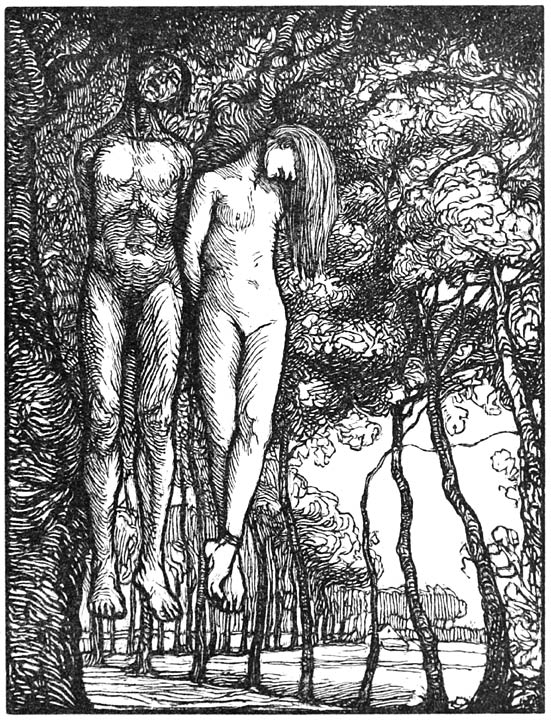
“Ah! The lovely month of May!”
“O Lamme, behold the lovely month of May! Ah, the bright blue of the sky! The joy of the swallows! And behold, the branches of the trees, how they are all red with sap, and the very earth is in love! Verily this is now the time both to hang and to burn for the Faith. For they are ready, the good little Inquisitors. Ah, what noble faces they have! And theirs is the power to correct us and to punish us and to degrade, and hand us over to the secular judges, or to imprison us—O the fine month of May!—and to take us captive, and to proceed to trial against us without serving any writ, and to burn, hang, behead us, and to dig the grave of premature death for our women and our girls. In the trees the chaffinch is singing! But upon him that is rich and wealthy the good Inquisitors have cast a favourable eye! And it is the King himself that shall enter into their inheritance. Then go, my girls, dance in the meadows to the sound of bagpipes and shawms. O the fine month of May!”
And the ashes of Claes beat upon the breast of Ulenspiegel.
“On, on!” said he to Lamme. “Happy are they that shall keep heart high and sword drawn in the dark days that are coming!”
IX
Lamme and Ulenspiegel, each mounted upon a donkey given him by Simon Simonsen, one of the followers of the Prince of Orange, went riding far and wide, warning the people concerning the bloodthirsty designs of King Philip, and always on the look-out for any news from Spain. They frequented all the markets and fairs of the countryside, selling vegetables and habited like peasants.
One day as they were returning from the market at Brussels, they passed a stone house on the Quai aux Briques, and there, in a room on the ground floor, they beheld a beautiful dame dressed all in satin. She had a high complexion, a lively look in her eyes, and her neck was most fair to behold. By her side was a young, fresh-looking cook, to whom she was addressing words like these:
“Clean me this saucepan, will you! No rusty sauce for me!”
“As for me,” cried Ulenspiegel, poking in his nose at the window, “any kind of soup is good enough! For a hungry man cannot afford to be particular.”
The lady turned towards him:
“And who,” she said, “who is this little man, I wonder, that must needs concern himself with my soup?”
“Alas, my lovely lady,” said Ulenspiegel, “if only you will consent to make soup in my company, I will teach you how to prepare a traveller’s relish of a sort that is quite unknown to lovely ladies who stay at home.”
And then, smacking his lips:
“I am hungry,” he said.
“Hungry for what?” she asked him.
“For you.”
“Sure, he’s a nice enough looking fellow,” said the cook to her mistress. “Let him come in a while and tell us his adventures.”
“But there are two of them!” said the lady.
“I’ll look after the other,” said the cook.
“Madame,” said Ulenspiegel, “it is true that there are two of us, I and my poor friend Lamme here, whose back cannot support so much as the weight of a hundred pounds, yet who carries in his stomach five hundred pounds at the least of food and drink, and that right willingly!”
“My son,” Lamme said, “do not make mock of me, unfortunate that I am, for my belly costs a deal to fill.”
“To-day, at any rate, it shall not cost you so much as a liard,” said the lady. “Come in, both of you.”
“But what about these donkeys of ours?” said Lamme.
“There is no lack of fodder,” answered the lady, “in the stable of Monsieur le Comte de Meghen!”
Thereupon the cook left her saucepan, and led Lamme and Ulenspiegel into the stable yard, they still riding on their donkeys, who now began to bray inordinately.
“Hark,” cried Ulenspiegel, “hearken to the fanfare with which they greet their coming nourishment. They are blowing their trumpets for joy, the poor beasts!”
But when they were dismounted, Ulenspiegel said to the cook:
“Come now, my dear, tell me, if you were a she-ass would you choose for your mate a donkey like me?”
“If I were a woman,” the cook replied, “I would desire a fellow that had a merry countenance.”
“What are you then,” asked Lamme, “being neither woman nor she-ass?”
“I am a maid,” quoth she, “and that is neither woman nor she-ass into the bargain. Now do you understand, fat-belly?”
Meantime the lady was inviting Ulenspiegel to drink a pint of bruinbier and to partake of some ham, a gigot, a pâté, and some salad. Ulenspiegel clapped his hands.
“Ham!” he cried, “that’s good to eat; and bruinbier is a drink divine. Gigot is food fit for the Gods! And the thought of a pâté is enough to send one’s tongue a-tremble in one’s mouth for joy! A rich salad is worthy victual for a king, forsooth. But blessed above all men shall that man be to whom it is given to dine off thy loveliness, O lady mine!”
“How the fellow does run on!” she exclaimed. And then: “Eat first, you rogue.”
“Shall we not say grace ere we consume all these dainties?” said Ulenspiegel.
“Nay,” answered the lady.
But Lamme began to make moan, complaining that he was hungry.
“Eat, then, your fill,” said the beautiful dame, “for well I see that you have no other thoughts but of meats well cooked.”
“And fresh withal,” Lamme added, “even as was my wife.”
At this the cook grew moody; nevertheless they ate and drank their fill, and that night also did the beautiful dame give his supper to Ulenspiegel, and so the next day, and the days that followed.
As for the donkeys, they were given double feeds, and for Lamme there was always a double ration. And throughout a whole week he never once went outside the kitchen, playing the wanton with many a dish of food, but never with the cook, for he was thinking of his wife all the time.
This annoyed the girl, and she went so far as to say that it was not worth while to cumber the earth if one thought of nothing but one’s belly.
But all this time Ulenspiegel and the beautiful dame were passing the time together in right friendly wise, till one day she said to him:
“Tyl, I think you have no principles at all. Who are you?”
“I am,” said he, “a son that Chance begat one day on High Adventure.”
“You are not afraid to speak well of yourself,” she told him.
“That’s for fear that others will praise me.”
“Would you go so far as to help such of your brethren who have suffered for the Faith?”
“The ashes of Claes beat upon my breast.”
“There is something splendid about you, Tyl, when you say that,” she told him, “but who is this Claes?”
“He was my father,” answered Ulenspiegel, “that was burnt alive for the Faith.”
“Verily you are not at all like my husband, the Count de Meghen,” she said, “for he, if he could, would bleed to death the country that I love. For you must know that I was born in the glorious city of Antwerp. And now I will make known to you that the Count has entered into an agreement with the Councillor of Brabant to bring into that very city of Antwerp a regiment of infantry.”
“I must inform the citizens of this,” said Ulenspiegel. “Behold, I will go there immediately, swift as a ghost.”
He departed there and then; and by the following morning the citizens of Antwerp were in arms. But Ulenspiegel and Lamme, having sent their donkeys to a farmer that was a friend of Simon Simonsen, were themselves obliged to go into hiding for fear of the Count de Meghen, who was seeking for them everywhere to have them hanged; for it had been reported to him that there were two heretics that had drunk of his wine and eaten of his meat. And he was jealous and spoke concerning this matter to his lovely dame, who ground her teeth in anger, and wept and swooned seventeen times. The cook behaved in a similar fashion, but swooned not so often, and swore by her hope of Paradise and by the eternal salvation of her soul, that neither she nor her mistress had done anything wrong unless it had been to give what was left of their dinner to a couple of poor pilgrims who, mounted on two wretched donkeys, had stopped for a moment at the kitchen window.
All that day there was a great shedding of tears, so that the floors of the house became quite damp with them. And when he saw this, Monsieur de Meghen felt reassured that he was being told the truth and nothing but the truth.
Lamme did not dare to show himself again there, for the cook always jeered at him, calling after him, “My wife!” And for this cause he was very sorry for himself, thinking of all the good food that he was missing. But Ulenspiegel continued his visits to the beautiful dame, entering the house by the rue Sainte-Catherine, and hiding himself in the storeroom. And he always took care to bring back to Lamme some dainty morsel.
Now one evening the Count de Meghen informed his lady that before morning dawned he was resolved to lead his men-at-arms into the city of Bois-le-Duc. When he had told her this he went to sleep. But the beautiful dame went straightway to the storeroom, and apprised Ulenspiegel of what had happened.
X
Ulenspiegel, in the garb of a pilgrim, and with no provision of food or money, departed incontinently for Bois-le-Duc, with the intention of warning the citizens. He reckoned to find a horse at the house of Jeroen Praet, the brother of Simon Simonsen, for whom he carried letters from the Prince. From thence he would go by side roads to Bois-le-Duc as fast as his horse would carry him.
As he was crossing the road he spied a company of soldiers coming towards him. This gave him a great fright because of the letters which he carried; but being resolved to put the best face on the misadventure, he awaited the arrival of the soldiers with all the courage at his command, standing still by the roadside telling his beads. When the soldiers came up with him he joined them, and soon discovered that they also were going to Bois-le-Duc.
At the head of the troop marched a company of Walloons led by a captain, Lamotte by name, with his bodyguard of six halberdiers. Then followed the other officers each according to rank, and with a smaller bodyguard: the provost with his halberdiers and two bailiffs, the chief watchman with the baggage-carriers, the executioner with his assistants, and a band of drums and fifes making a great row. Thereafter came a company of Flemish soldiers, two hundred strong, with their captain and his ensign-bearers. They were divided into two divisions, each of one hundred men, under the command of two sergeants, and in squads of ten under the command of corporals. The provost and his lieutenants were likewise preceded by a band of drums and fifes, beating and screaming.
Behind these, again, came two open wagons wherein rode the loving companions of the soldiers, pealing with laughter, twittering like birds, singing like nightingales, eating, drinking, dancing, standing, lying down, or sitting astride—all gay and pretty girls.
Many of them were dressed like foot-soldiers, but in fine white cloth which was cut away at the arms and legs and at the neck so as to show their sweet white flesh. And on their heads they wore bonnets of fine linen trimmed with gold and surmounted with magnificent ostrich plumes that fluttered in the wind. Their belts were of cloth of gold crimped with red satin, from which hung the scabbards of their daggers, made of cloth of gold. And their shoes, their stockings, their hose, their doublets, shoulder-knots and fitments were all of gold and white silk. Others there were, dressed also in the uniform of infantrymen but with uniforms of divers colours, blue, green, scarlet, sky-blue, and crimson, cut away and embroidered or emblazoned according to their fancy. But on the arm of each and all was to be seen the coloured band that indicated her calling.
The girls were in charge of a sergeant who did his best to keep them in order, but they made no pretence of obeying him, but bombarded him with japes and sweet grimaces so that he found it hard to keep his countenance.
Ulenspiegel meanwhile, in his dress of a pilgrim and telling his beads, went marching along by the side of the two ensign-bearers and their guard, for all the world like a little boat by the side of a big ship. Suddenly Lamotte inquired of him whither he was going.
“Sir Captain,” answered Ulenspiegel, who was growing hungry, “you must know that I am one that has committed a grievous sin, for which I have been condemned by the Chapter of Notre Dame to journey to Rome on foot and to ask pardon there from the Holy Father. This he has granted, and now I am shriven and suffered to return to my own country on the one condition that I am to preach the Holy Mysteries to whatsoever soldiers I may encounter on the way; and they for their part are enjoined to give me bread and wine in return for my preaching. And thus by my sermons do I sustain my wretched life. Would you now give me permission to fulfil my vow at the next halt?”
“I will,” said Monsieur de Lamotte.
After this, Ulenspiegel began to mingle with the Walloons and Flemings in right brotherly fashion, but all the time he kept fingering those letters which he kept concealed under his doublet. And the girls began to cry out to him:
“Come hither, handsome pilgrim, come hither and show us the strength of your pilgrim’s oyster-shells!”
And Ulenspiegel drew nigh to them with modest mien, and said:
“O my sisters in God, pray you do not make mock of the poor pilgrim that wendeth up hill and down dale preaching ever the Holy Faith to the soldiers.”
But with his eyes he feasted himself upon the sight of their sweet charms. And the wanton girls, thrusting their lively faces betwixt the canvas curtains of the wagons, cried out to him yet the more:
“Surely you are too young a man to go preaching to soldiers? Climb up into our wagon and we will teach thee more gentle subjects of conversation!”
And right willingly would Ulenspiegel have done as they bade him, but he dared not, by reason of the letters which he carried. And already two of the girls were leaning out of the wagon trying to hoist him up with their white, round arms. But the sergeant was jealous.
“Be off with you, or else I’ll off with your head!” he threatened.
So Ulenspiegel removed himself away, but not without a sly look behind him at the fresh young beauty of those joysome girls, all golden in the sun which now shone brightly.
They came at last to Berchem, where Philip de Lannoy, Lord of Beauvoir, ordered a halt. For he it was that was in command of the Flemings.
Now in that place was an oak-tree, of medium height, but despoiled of all its branches save one only, a big branch that was broken off short in the middle; for only a month before an Anabaptist had been hanged there by the neck.
Here then the soldiers came to a halt, and the keepers of the canteen came up and began to sell to them bread, wine, beer, with meats of every kind. And to the gay girls they sold all manner of sugared sweets, and castrelins, and almonds, and tartlets, the which when Ulenspiegel saw, he felt hungrier than ever.
All at once Ulenspiegel climbed up like a monkey into the tree, and seated himself astride on the big branch, seven feet above the ground at the least. And then, when he had given himself a few strokes from his pilgrim’s scourge, he began his sermon, while the soldiers and their gay girls sat round him in a circle.
“It is written,” he began, “that whosoever giveth to the poor, the same lendeth to God. Very well then, O soldiers present here to-day, and you, fair ladies, sweet comrades in love of all these valiant warriors, do you lend now to God. That is to say, give me, I beg you, some of your bread, meat, wine, beer, if you please, and eke your tartlets, and I promise you that God, who is very rich, shall give you back in exchange many pieces of ortolan, rivers of malmsey wine, mountains of sugar-candy, and great pieces of that lovely rystpap which they eat in Paradise from silver spoons.”
Then, changing to a more sorrowful tone, he continued:
“Behold now, with what cruel tortures do I strive to merit pardon for my sins! Will you do nothing to assuage the smarting pain of this scourge by which my back is lacerated till the blood flows?”
“Who is this madman?” cried the soldiers.
“My friends,” answered Ulenspiegel, “I am no madman but one that is repentant even to the point of starvation. For while my soul weeps for its sins, my stomach weeps for want of food. Good soldiers, and you, fair damosels, I see you well provided with ham and goose, with fat sausages and wine and beer and all manner of tartlets. Will you not give so much as a morsel to the wandering pilgrim?”
“Yes, yes, we will,” cried the Flemish soldiers, “for the preacher hath a merry countenance.”
And now they all began to throw him chunks of bread as though they had been balls, and Ulenspiegel did not cease from talking and from eating, astride as he was on the branch.
“Hunger,” he said, “makes a man hard of heart and little apt for prayer, yet a piece of ham removes that evil disposition in no time.”
“Look out for your head,” shouted a sergeant as he threw him a bottle half full of wine. Ulenspiegel caught the bottle in mid-air, and began to drink in little gulps, talking all the while.
“If hunger, sharp and raging, is bane to the poor body of a pilgrim, there is something else that is equally harmful to his soul; nothing less than his fear that the generosity of his soldier friends may lead him on to drunkenness. For as a general rule the pilgrim is a right sober fellow, but when, as now, one soldier gives him a slice of ham, and another a bottle of beer, he is mightily afraid lest by drinking thus upon an empty, or nearly empty, stomach he may lose his head.”
And even as he spoke, he caught hold of the leg of a goose that came whizzing to him through the air.
“This truly is a miracle,” he cried, “that one should go fishing in the air for a bird of the field! And see! Hey, presto! it has disappeared, bone and all! Verily, what is it that is greedier than dry sand? I will tell you. A barren woman and a hungry man.”
Scarcely had he spoken than he clapped his hand to his face, for two tartlets had flattened themselves, one on his eye, the other on his cheek. The gay girls who had thrown them laughed aloud, but Ulenspiegel made answer:
“Many thanks, my pretties, many thanks for thus embracing me with this jammy accolade.”
Nevertheless the tartlets had fallen to the ground.
And then suddenly the drums began to beat, the fifes screamed, and the soldiers fell in again.
Monsieur de Beauvoir ordered Ulenspiegel to come down from his tree and to march by the side of the soldiers. Ulenspiegel would willingly have been parted from them by a hundred leagues, for he had gathered from the remarks let fall by certain thin-faced foot-soldiers that he was already under suspicion, and that he ran danger of being arrested for a spy; and if this was so, he knew that they would most certainly search his pockets, and have him hanged when they found the letters which he carried. So in a little while he purposely let himself stumble into the ditch which ran by the wayside, and as he fell he cried out loudly:
“Mercy, soldiers, mercy! My leg is broken, and now I cannot walk any more. You must let me get up into the cart with the girls!”
But to this he knew that the jealous sergeant would never consent.
The girls, meanwhile, cried out from the carts:
“Come, come, jolly pilgrim, and we will succour you, and caress and make much of you, and cure you all in a day.”
“I know it,” said Ulenspiegel, “for a woman’s hand is balm celestial for all and every wound.”
But the jealous sergeant consulted with Monsieur de Lamotte, saying:
“Sir, I suspect that this pilgrim is playing some trick upon us with his tale of a broken leg. All he wants is to have the chance of getting up into the cart with the girls. Order him rather to be left behind on the road.”
“Very well,” answered Monsieur de Lamotte.
So Ulenspiegel was left where he was in the ditch.
Some soldiers, who really believed that his leg was broken, were sorry for him because of his gaiety, and they left with him a two days’ ration of food and wine. And the girls would have got down and run to his assistance, but as this was forbidden they threw him all that was left of their castrelins.
As soon as the soldiers had disappeared in the distance Ulenspiegel, still in his pilgrim’s dress, recovered his liberty, purchased a horse, and rode like the wind by roads and by-paths to Bois-le-Duc.
When he told them the news of the approach of Monsieur de Lamotte, the townspeople flew to arms to the number of eight hundred men, and they chose out their leaders, and sent off Ulenspiegel, disguised as a charcoal-burner, to Antwerp to summon help from Hercule Brederode, surnamed the Toper.
And the soldiers of de Lamotte and de Beauvoir were able to gain no entry into Bois-le-Duc, most vigilant of cities, most valiant in defence.
XI
One day Simon Simonsen said to Ulenspiegel:
“Hearken, brother mine, and tell me, are you a brave man think you?”
“Brave enough,” answered Ulenspiegel, “to whip a Spaniard to death, to kill an assassin, or to murder a murderer.”
“Do you think you could hide yourself in a chimney and wait there patiently so as to overhear what was being said in the room below?”
“God has given me strong legs,” answered Ulenspiegel, “and a supple back, and in virtue of these gifts I could stand a long time in whatever position I would, like a cat.”
“Have you patience and a good memory?” asked Simon.
“The ashes of Claes beat upon my breast,” answered Ulenspiegel.
“Very well then,” said Simon, “you will take this playing card, folded as you see it, and you will go to Dendermonde to a house, a drawing of which I will give you, and you will knock at the door twice loudly and once softly. Some one will open to you and will ask if you are the chimney-sweep; you will answer that you are he and that you have not lost the card. Then you will show the card to him who opened the door. After that, Tyl, you must do as best you can. For great are the evils that are a-planning against the land of Flanders. And you will be conducted to a chimney that has been swept and cleaned against your arrival, and in it you will find a series of strong cramp-irons made ready for you to climb by, and a little wooden shelf securely fastened to the side of the chimney for a seat; and when he that has opened the door shall direct you, you will climb up into your hiding-place, and there remain. In the chamber below, and in front of the chimney where you will be hidden, a conference is to be held between certain noble Lords: William the Silent, Prince of Orange, and the Counts d’Egmont, de Hoorn, de Hoogstraeten, and Ludwig of Nassau, the brother of William. And we Reformers desire to find out whether these noble Lords are able and willing to undertake the saving of our country.”
Well, on the first day of April, Ulenspiegel did as he had been bidden and took up his place in the chimney. Luckily for him there was no fire in the grate, and it seemed that the absence of smoke would not make it any the less easy for him to hear properly. After a little while the door of the room was opened, and Ulenspiegel was pierced through and through by a draught of cold wind blowing up the chimney. But he endured the wind with patience, telling himself that it would serve to keep him alert and attentive.
After a while he could hear my Lords of Orange, Egmont and the rest making their entrance into the room. They began by speaking of the fears they felt, of the wrath of the King and of the maladministration of the revenue and finances of the country. One of them spoke in a sharp, clear, and haughty tone of voice, which Ulenspiegel recognized as that of my Lord of Egmont; just as he recognized de Hoogstraeten by his husky tones, and de Hoorn by his loud voice, the Count Ludwig of Nassau by his firm and soldierly manner of speech, and William the Silent by that slow, deliberate way of enunciating his words as if they had all been thought out beforehand and weighed in a balance.
The Count d’Egmont asked why they had been summoned to this second conference when they had had plenty of time at Hellegat to come to a decision on what they meant to do. De Hoorn replied that the days passed quickly, that the King was growing angry, and that they must be careful to lose no time.
Then spake William the Silent.
“The country is in danger. It must be defended against the attack of a foreign army.”
At this d’Egmont grew excited, and said that he was indeed astonished to hear that the King his master had thought it necessary to send an army when all was so peaceful by reason of the watchful care of their noble Lordships, and of himself especially.
But William the Silent made answer:
“King Philip already has an army in the Low Countries consisting of not less than fourteen regiments of artillery, and they are under the control of him who commanded them at Gravelines, a general to whom all the soldiers are devoted.”
D’Egmont said that he could scarcely believe it.
“I will say no more,” said William, “but there are certain letters which shall be read to you and to the assembled Lords, and to begin with, letters from the poor prisoner, Monsieur de Montigny.”
And in these letters it was told how that the King was extremely vexed with what was happening in the Low Countries, and that when the hour was come he had determined to punish the fomenters of disturbance.
It was at this juncture that the Count d’Egmont complained of the cold, and desired to have the fire lit; the which was done while the two Lords continued their discussion of those letters. Now it was a big fire of wood, but it did not burn well on account of that big obstruction which was hidden in the chimney, and the room became quickly full of smoke.
Then the Count de Hoogstraeten began to read (for all that he was coughing continually because of the smoke) certain letters which had been intercepted on their way from Alava, the Spanish ambassador, to the Governess of the Netherlands.
“The ambassador,” he said, “writes that all the evil that has happened in the Low Countries was the work of three men: the Lords of Orange, Egmont, and Hoorn. But it were desirable, he adds, to appear well disposed to these three, and to tell them that the King recognizes that it is thanks to them that their lands have been kept loyal to him. As for the two others, Montigny and de Berghes, let them alone where they are.”
“Ah!” said Ulenspiegel, “I had rather a smoky chimney in the land of Flanders than a damp prison in the land of Spain; for garrotters grow between damp walls.”
But the Count de Hoogstraeten continued:
“The said ambassador adds that on one occasion the King, being in the city of Madrid, spoke these words: ‘By all accounts that come from the Low Countries it is evident that our royal reputation is diminished, and we are ready therefore to abandon all our other possessions rather than leave such a rebellion unpunished. We are decided to proceed to the Netherlands in person, and to claim the assistance of the Pope and of the Emperor. For beneath the present evil is concealed a future good. We shall reclaim the Low Countries to absolute obedience, and according to our own will we shall modify the constitution of that State, its religion and its government.’”
“Ah, King Philip,” said Ulenspiegel, “if only I could modify yours to mine! Verily you would suffer, under the blows of my trusty Flemish stick, a wondrous modification of your thighs and arms and legs! I would fix your head in the middle of your back with a couple of nails, and as you viewed from this position the charnel-house you have created, you should sing at your good ease a pretty song of tyrannous modification!”
Now wine was brought, and de Hoogstraeten rose upon his feet and said:
“I drink to our country!” and every one followed his example, and when he had finished the toast he threw his empty tankard down on the table, and said: “Now sounds an evil hour for the nobility of Belgium. Let us take counsel as to how we may best defend ourselves.”
He awaited some response, and looked at d’Egmont, but he uttered not a word, and it was left to William of Orange to break the silence.
“We can offer resistance,” he said, “provided that the Count d’Egmont—who at Saint-Quentin and at Gravelines has twice made France to tremble and who holds complete sway over the Flemish soldiery—provided that he, I repeat, is willing to come to our assistance in our endeavour to prevent the Spaniard from entering the fatherland.”
To this my Lord of Egmont made answer:
“I have too much respect for the King to think that it is right that we should take up arms against him like rebels. Let those who fear his wrath retire before it. I shall remain where I am, for I have no means of living if I am deprived of his help.”
“Philip knows how to avenge himself most cruelly,” said William the Silent.
“I trust him,” answered d’Egmont.
“You would trust him with your heads?” asked Ludwig of Nassau.
“Head, body, and soul,” replied d’Egmont.
“Friend, faithful and true, I will do likewise,” said de Hoorn.
But William said:
“It behoves us to be far-sighted, and not to wait for things to happen.”
And then my Lord of Egmont spoke again, very excitedly.
“I have arrested twenty-two Reformers at Grammont,” he said, “and if their preachings come to an end, and if punishment is meted out to the iconoclasts, the anger of the King will be appeased.”
But William said:
“These are mere hopes.”
“Let us arm ourselves with trust,” said d’Egmont.
“Let us arm ourselves with trust,” echoed de Hoorn.
“It is cold steel rather than trust that should be our weapons,” replied de Hoogstraeten.
Whereupon William the Silent made a sign to the effect that he wished to depart.
“Adieu, Prince without a country,” said the Count d’Egmont.
“Adieu, Prince without a head,” answered William.
“The sheep are for the butcher,” said Ludwig of Nassau, “but glory waits the soldier that saves the land of his fathers.”
“That I cannot,” said d’Egmont, “neither do I desire to.”
“May the blood of the victims fall once again upon the head of the flatterer,” said Ulenspiegel.
And then those Lords retired.
Whereupon did Ulenspiegel come down from his chimney, and go straightway to carry the news to Praet. And the latter said: “D’Egmont is nothing better than a traitor. But God is with the Prince.”
The Duke! The Duke at Brussels! Where are the safes and coffers that have wings?
XII
William the Silent went in the way by God appointed. As for the two Counts, they had already given themselves up to the Duke of Alba, who offered pardon to William as well if only he would appear before him.
At this news Ulenspiegel said to Lamme:
“My good friend, what do you think now? The Duke has sent out a summons through Dubois, the Attorney-General, by which the Prince of Orange, Ludwig his brother, de Hoogstraeten, Van den Bergh, Culembourg, de Brederode, and other friends of the Prince are cited to appear before him within forty days; and if they do this they are assured of justice and mercy. But listen, Lamme, and I will tell you a story. One day there was a Jew of Amsterdam who summoned one of his enemies to come down and join him in the street, for the Jew was standing on the pavement, but his enemy was looking out of a window just above. ‘Come down at once,’ said the Jew, ‘and I will give you such a blow on the head as will squash it down into your chest, so that your two eyes will look out from your sides like the eyes of a thief from betwixt prison-bars.’ But the other answered: ‘Even if you promised me a hundred times as much, still I would not come down.’ Even so may the Prince of Orange and his friends make reply to him that summons them!”
And so they did, refusing point-blank to appear before the Duke. But the Counts d’Egmont and de Hoorn were not of this mind. And their failure to do their duty brought them nearer to their doom.
XIII
One day in June, a fine warm day it was, a scaffold was set up in the market square at Brussels, in front of the Town Hall. The scaffold was draped in black, and close to it were two tall posts tipped with steel. On the scaffold were a couple of black cushions and a little table with a silver cross thereon.
And on this scaffold were beheaded the noble Counts d’Egmont and de Hoorn. And the King entered into their inheritance. And it was of the Count d’Egmont that the ambassador of Francis spake, saying:
“This day have I seen a man beheaded who twice made the Kingdom of France to tremble.”
And the heads of the two Counts were placed upon the posts with the iron tips. And Ulenspiegel said to Lamme:
“With a black cloth have they covered both their flesh and their blood. Verily, blessed now are they who keep heart high and sword drawn in the dark days that are coming!”
XIV
In those days William the Silent gathered together an army and invaded the country of the Netherlands from three sides.
And Ulenspiegel was at a meeting of his countrymen at Marenhout. And they were wild with anger and he addressed them in this wise:
“Know you, my friends, that King Philip has taken counsel with the Holy Inquisition, and by their advice he has declared all the inhabitants of the Netherlands to be guilty of high treason. And the charge against them is one of heresy, namely, that either they are heretics themselves, or else that they have put no obstacles in the way of the spread of heretical doctrine. And for this execrable crime the King has condemned them all, without regard to age or sex, to suffer the appropriate penalties—all except a few here and there that are exempted by name. And there is no hope of grace or pardon. And the King will enter into their inheritance. For the scythes of Death are busy through all the wide land that borders the North Sea: the Duchy of Emden, the river-land of Amise, and the countries of Westphalia and of Cleves, of Juliers and Liége, together with the Bishoprics of Cologne and Treves and the lands of France and Lorraine. The scythes of Death are busy over more than three hundred leagues of our soil, and in two hundred of our walled towns, in a hundred and fifty boroughs, in the countrysides and villages and level lands of the whole country. And the King is taking all for his own. And I tell you,” Ulenspiegel continued, “that eleven thousand executioners will not be too many for this business. But the Duke of Alba calls them soldiers. And all the land of our fathers is become a charnel-house. Fugitive are all the arts of peace, and all the crafts and industries abandon us now to enrich those foreign lands which still permit a man to worship at home the God of conscience. But here the scythes of Death are busy, and the King takes all for his own.
“Our country, as you know, had gained various privileges by gifts of money to princes when they were in need. But now these privileges have all been annulled. And as the result of many an agreement made between ourselves and our overlords we had hoped to enjoy the wealth that came to us as the fruit of our labours. Yet were we deceived. The stone-mason builded for the incendiary, the labourer laboured for the thief. And the King takes all for his own.
“Blood and tears! Everywhere naught but blood and tears! For the scythes of Death are busy—busy at the places of execution and at the trees that serve for gallows by the roadsides; and at many an open grave wherein are thrown the living bodies of our maids. And they are busy in the prison dungeons and within those circles of faggots that flame around the victims, scorching them little by little to death; or in the huts of straw where they fall suffocated in the fire and the smoke. And the King takes all for his own. And this, forsooth, by the will of the Pope of Rome. The very cities teem with spies that await their share of the plunder. The richer one is the more likely one is to be found guilty. And the King takes all for his own.
“But never shall the valiant men of Flanders suffer themselves to be butchered thus like lambs. For among those who fly away for refuge there are some who carry arms, and these are hiding in the woods....
“The monks verily have denounced them and hold themselves free to kill them and take possession of their goods. But by night and day these refugees, banded together like wild beasts, rush down upon the monasteries and seize the money that has been stolen from the poor, and take it away under the form of candlesticks and reliquaries of gold and silver, ciboria and patens, and other precious vessels of the kind.... Do I not speak truth, my friends? And they drink therefrom that wine which the monks had been keeping for themselves. And when melted down or mortgaged, these vessels will serve to provide money for the Holy War. Long live the Beggarmen!
“And even now they begin to harass the soldiers of the King, killing and plundering, then back into their lairs. And in the woods by day and night are to be seen the fires which have been lit during the hours of darkness, flaring up or dying down and ever breaking out in some fresh place. These are the fires of our banquetings. All for us the game of the woods, both furred and feathered. We are the masters here. And the peasants load us with bread and bacon whenever we are in need. Look at them Lamme; fierce and talkative, resolute and proud of bearing, they wander through the woods. And they are armed with hatchets and halberds, and with long swords and bragmarts, with arquebuses, pikes, lances, and crossbows. For any kind of weapon is good enough for such brave men, and they need no officers to lead them. Long live the Beggarmen!”
And Ulenspiegel sang this song:
Beat the drum! Beat the drum!
Drums of war!
Slit the carcass of the Duke,
Flog him on his hangman’s face!
To the death with the murderer!
Beat the drum! Beat the drum!
Drums of war!
With the victims of his wrath
Foul corruption let him share!
But long live the Beggarmen!
Christ from Heaven look Thou down,
Look upon thy soldiers true,
That risk hanging, fire, and sword
For thy Word!
And for their dear Fatherland!
Beat the drum! Beat the drum!
Drums of war!
And all drank the toast and cried aloud:
“Long live the Beggarmen!”
And Ulenspiegel drank in his turn from a golden goblet that had once belonged to some monk or other, and proudly he gazed on the wild faces of the brave Beggarmen that stood before him.
“Men,” he cried, “wild beasts rather that are my comrades, be you wolves lions, or tigers in very deed, and eat up all the cursed dogs of this King of Blood!”
“Long live the Beggarmen!” they shouted, and yet again they sang the song of
Beat the drum! Beat the drum!
Drums of war!
XV
William the Silent, with his army, was at the gates of Liége. But before crossing the Meuse he made sundry marches and counter-marches, leading the Duke astray, for all his vigilance.
Ulenspiegel applied himself most diligently to his duties as a soldier, worked his arquebus most skilfully, and kept his eyes and ears wide open.
Now at that time there arrived in the camp certain gentlemen of Flanders and Brabant, and these lived in friendly fashion with the colonels and captains of the Prince’s following.
But soon there came into being two parties in the camp, who began to dispute one with the other continually, some saying that William was a traitor, others that such accusation was a gross libel on the Prince, and that they who had made it should be forced to eat their words. Suspicion grew and grew like a spot of oil, and at length they came to blows—small companies of six, eight, or a dozen men fighting together in single combat, with all kinds of weapons and sometimes with arquebuses even.
One day the Prince, hearing the noise, came to see what was going on, and walked straight in between the combatants. It chanced that a piece of shot hit his sword and struck it from his side. He stopped the combat, and visited the whole camp, intending to put an end once for all to these combats and to these cries of “Death to William!” “Death to the war!”
Now the day after this adventure, Ulenspiegel had been to the house of a Walloon maiden to sing to her some Flemish love-songs of his. And it was near midnight, and very misty, and Ulenspiegel, being just about to leave the house, thought he heard the cawing of a crow, three times repeated. And the sound came from the door of a cottage close by. And from far off came other cawings, three times repeated, as if in answer. Presently a peasant made his appearance at the doorway of the cottage, and at the same time Ulenspiegel heard steps on the road. Two men came up to the peasant and began to talk to him in the Spanish tongue. The peasant spoke to them, also in Spanish:
“Well? And how goes it?” asked the cottager.
“Well, indeed,” the two men answered. “We have been spreading rumours on behalf of the King, and it is thanks to us that the captains and their soldiers are everywhere suspicious and talking among themselves in this wise:
“‘The Prince, so the gossip goes—is resisting the King for vile ambition and for nothing else. For by this means he thinks to make himself feared so that he may acquire cities and overlordships as the price of peace. For five hundred thousand florins he would leave in the lurch all the brave nobles who have come out to fight for their country. And it is a fact that the Duke has offered him a complete amnesty, and has promised to restore both him and his chief officers in their possessions, if only the Prince will return to the obedience of the King, and will negotiate with him alone.’
“But they that remain faithful to the Prince make answer to us in this wise:
“‘By no means will William have aught to do with the proposals of the Duke. For these are but snares and treachery. For the Prince must surely call to mind what happened to d’Egmont and de Hoorn. And it is well known that the Cardinal de Granville said at Rome, when the two Counts had been taken: “The two gudgeon, verily, have been caught, but the pike has been allowed to escape.” For nothing has been taken while William still remains at large.’”
“Is the camp divided in twain then?” asked the peasant.
“It is,” replied the two men, “and the division grows greater every day. But whom are those letters for?”
Whereupon they all entered into the cottage. A lantern was lit inside, and looking through a crack in the door Ulenspiegel could see them unsealing two letters. These they read with every appearance of enjoyment, and then they all fell to drinking honey-wine. After which the two men came out of the cottage and said to the peasant, still speaking in Spanish:
“The camp split in two, and the Prince captured—that will be worth a dozen glasses, eh?”
“Those men,” said Ulenspiegel to himself, “cannot longer be allowed to live.”
But even now they were disappearing in the thick mist, with the lantern which the peasant had brought for them. The light of the lantern shone out intermittently, as if continually intercepted by some dark body. From this Ulenspiegel concluded that the two men must be walking one behind the other.
He raised his arquebus to his shoulder and fired. Then he saw the lantern raised and lowered several times, as if the man who carried it was looking at his fallen comrade, trying to discover where he had been hit and the nature of the wound.
Yet again did Ulenspiegel raise his arquebus, and then when the lantern began to steady itself and to retreat speedily towards the camp, he fired again. Now the lantern swayed, fell to the ground and went out, leaving all in darkness.
Ulenspiegel ran on to the camp, and there he soon encountered the provost with a number of soldiers who had been awakened by the noise of the firing. Ulenspiegel accosted them, saying: “I am the huntsman. Go you now and find the game.”
“Brave Fleming,” said the provost, “methinks you are a man that knows other ways of talking besides with your tongue.”
“Words of the tongue they are but so much wind,” answered Ulenspiegel. “But words of lead—they know how to find for themselves a lasting habitation in the carcass of a traitor! Come then, follow me.”
And so saying he led them to the place where the two men had fallen. And in very deed the soldiers saw by the light of their lanterns two bodies stretched out on the ground. One was dead, and the other at the last gasp, holding his hand to his heart, and in his hand a letter all crumpled in the agony of death. The soldiers lifted the two bodies, whose clothes clearly showed them to be the bodies of gentlemen, and straightway carried them, still by the light of their lanterns, to the Prince.
Now William was about to hold a council with Frederick of Hollenhausen, the Margrave of Hesse, and other nobles. But the soldiers, who had now been joined by a company of other troopers in green and yellow jackets, stood before the tent, demanding with shouts and cries that the Prince should give them audience.
At length William of Orange came out to them, and the provost began to clear his throat and make other preliminaries for the accusation of Ulenspiegel. But the latter cut in before him, saying:
“My Lord, I had thought to kill two crows, but I have killed two traitors in their stead—two noblemen—belonging to your suite.”
Then he told the story of all that he had seen and heard and done. William did not utter a word, but the two bodies were carefully examined in the presence of Ulenspiegel himself and William the Silent, together with Frederick of Hollenhausen, the Margrave of Hesse, Dietrich of Schoonenbergh, Count Albert of Nassau, the Count de Hoogstraeten, and Antoine de Lailang, Governor of Malines. And the soldiers stood by, with Lamme Goedzak, his great belly all of a tremble. Sealed letters were found on the persons of the deceased gentlemen, which had been sent by Granvelles and Noircames, and engaged the recipients to sow division in the Prince’s entourage, and by that means to diminish his power and to compel him to yield, so that he might ultimately be delivered up to the Duke and beheaded according to his deserts. “The right procedure is,” continued the letter, “to act at first with caution and to use allusive phrases only, so that the army may be led to think that the Prince has already come to a secret understanding with the Duke, for his own advantage. This will arouse the anger of his captains and soldiers, and they will assuredly take him prisoner.” Now as a reward for this service it appeared that notes to the value of some five hundred ducats were being sent them on the Fugger Bank at Antwerp, and they were promised a thousand more as soon as the four hundred thousand ducats which were already on their way from Spain had arrived in Zeeland.
The whole plot having been now unmasked, the Prince turned in silence towards the gentlemen, Lords, and soldiers who stood round him. Many of these men he knew to be suspicious of him already, nevertheless, he pointed at the two bodies without speaking a word, intending by this gesture to reproach them for their mistrust. And at this every one present there exclaimed and shouted aloud:
“Long live the Prince of Orange! The Prince is faithful and true!” And such was their anger that they were desirous to throw the two dead bodies to the dogs; but William forbade them, saying:
“It is not these two poor corpses that deserve to be thrown to the dogs so much as that littleness of mind which must needs be suspicious of the purest intentions.”
And the Lords and soldiers cried out again:
“Long live the Prince! Long live the Prince of Orange, the friend of our country!”
And the sound of their voices was like the noise of thunder threatening injustice. And the Prince pointed to the two corpses and ordered that they should be given Christian burial.
“And I,” demanded Ulenspiegel, “what shall be done to me, faithful and true? If I have done evil let me be beaten, but if good—why then let me be suitably rewarded!”
Then the Prince addressed him, saying:
“This soldier is to receive fifty strokes from the green wood in my presence for having killed two gentlemen without orders, to the contempt of all discipline. At the same time let him receive a reward of thirty florins for having used his eyes and ears to some purpose.”
“My Lord,” answered Ulenspiegel, “give me the thirty florins first, and I shall then be able to support my beating with equanimity.”
“Yes, yes,” murmured Lamme Goedzak, “give him the thirty florins first, and then he will bear the rest with equanimity.”
“One thing more,” said Ulenspiegel, “since my soul is admittedly free from fault, is there any real reason why I must be cleansed with the wood of the oak or washed with the branch of the cherry-tree?”
“No,” murmured Lamme again, “Ulenspiegel surely has no need to be washed or cleansed. For his soul is without stain. Do not wash it, my masters, do not wash it.”
But when Ulenspiegel had received the thirty florins the provost ordered him to give himself up to the Stock-meester.
“Behold, my Lords,” said Lamme, “behold how piteous he looks. There’s no love lost between the hard wood and him—my beloved Ulenspiegel.”
But Ulenspiegel answered:
“Of a truth I love a fine ash-tree in full leaf, growing up towards the sun in all its native verdure, but I agree I loathe like poison these heavy cudgels of wood with their sap still oozing out of them, stripped of their branches and without any leaves or twigs growing thereon, for they are rough to look upon and hard to feel.”
“Are you ready?” demanded the provost.
“Ready?” Ulenspiegel repeated. “Ready for what? Ready to be flogged do you mean? No, I cannot, nor will I, be flogged by you, Mr. Stock-meester. You have a red beard certainly, and your appearance is formidable. Nevertheless, I am sure that you have a kind heart and would have no desire to thrash a poor fellow like me. And now to tell you the truth I should be loath to do such a thing myself, much less to see any one else do it. For the back of a Christian is a sacred thing, as sacred as his breast which holds the lungs, those trusty organs whereby we breathe the goodly air of God. And think how bitter would be your remorse if a too brutal blow from your cudgel should chance to break me in pieces!”
“Make haste,” said the Stock-meester.
“My Lord,” said Ulenspiegel, addressing himself to the Prince, “believe me, there is no need for all this hurry. First of all the wood of the cudgel ought to be allowed to dry. For I have heard that wood while still green is like to communicate a mortal poison to any flesh with which it comes in contact. Would your Highness desire to see me die such an ugly death? My Lord, my back I hold most pitifully at your service. Have it flogged, if you must, with rods and lashed with whips. But unless you wish to see me dead, spare me, I pray you, from the wood while it is still green.”