HERE BEGINS THE FIRST BOOK OF THE LEGEND OF THE GLORIOUS JOYOUS AND HEROIC ADVENTURES OF TYL ULENSPIEGEL AND LAMME GOEDZAK IN THE LAND OF FLANDERS AND ELSEWHERE (continued 2)
Geoffrey Arundel Whitworth translation
He accosted them, saying:
“Here are nine florins for you. Come in to dinner. Do you not smell the good smell of fricassee?”
“Ah!” they cried, “for the last half-league, and without hope!”
“Now you can eat your fill,” said Ulenspiegel, “for you have nine florins.”
But he had not really given them anything.
“The Lord bless you,” they said. For being blind, each man believed his neighbour had been given the money. And shown the way by Ulenspiegel, they all sat down at a small table while the Brethren of the Jolly Face took their seats at a long one, together with their wives and their daughters.
Then, with the complete assurance that comes from the possession of nine florins:
“Mine host,” cried the blind men insolently, “give us now to eat and to drink of your best.”
The landlord, who had heard tell of the nine florins and thought that they were safe in the blind men’s purse, asked them what they would like for their dinner.
Then they all began to talk at once at the top of their voices:
“Bacon and peas, hotchpotch of beef and veal, chicken and lamb! And where are the sausages—were they made for the dogs, pray? And who is he that has smelt out the black and white puddings in the passage without collaring them for us? I used to be able to see them, alas, in the days when my poor eyes were bright as candles! And where is the buttered koekebakken of Anderlecht? Sizzling in the frying-pan, juicy and crackling, enough to make a fish thirsty for drink! Ho there! But who will bring me eggs and ham, or ham and eggs, twin friends of my palate? And where are you, you choesels, that float in a heavenly mess of meats and kidneys, coxcombs, sweetbreads, ox-tails, lamb’s feet, with many onions, pepper, cloves, nutmegs, all in a stew, and three pints at least of best white wine for sauce? And who will bring you to me divine, chitterlings, you that are so good that one does not utter a word while you are being swallowed! And they come straight from Luyleckerland, a land bursting with fatness and filled with happy lazy folk, whose passion for good things to eat is never assuaged! And where are you, dried leaves of autumns past? Now quick there! Bring me a leg of mutton with broad beans. And for me, some pig’s ears grilled with bread-crumbs. And for me, a chaplet of ortolans. Verily the snipe shall figure the Paters, and a fat capon the Credo.”
Mine host answered quietly:
“I will bring you an omelette made with sixty eggs. And as sign-posts to guide your spoons, I will plant fifty black puddings in the midst, all smoking on a veritable mountain of good cheer; and from the top of all some dobbel peterman shall flow down like a river on every side.”
At this the mouths of the poor blind men began to water indeed, and they said:
“Then serve us, pray, and that right quickly with the mountain, the sign-posts, and the river!”
And the Brethren of the Jolly Face, who were now all seated at table with their wives, remarked to Ulenspiegel that this should be called the Day of the Invisible Feast; for that the blind men could not see what they were eating, and thus, poor things, were deprived of half their pleasure.
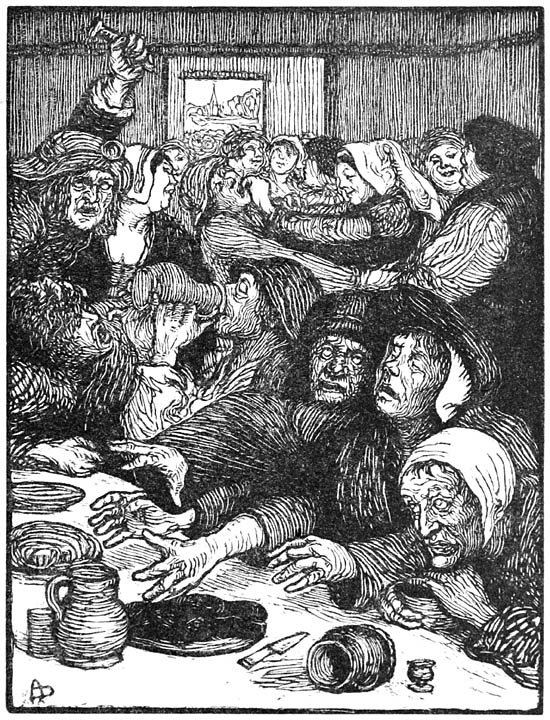
At last it came—the omelette all garnished with cress and parsley, carried by mine host himself and four of his cooks—and the blind men desired to fall to incontinently, and at once began to set their paws upon it. But mine host was determined to serve each of them fairly, and, however difficult it might be, to make sure that each trencher had its just portion.
The women archers were filled with pity to see the blind men gobbling and sighing with joy at what was set before them. For in truth they were half starved, and they swallowed down the puddings as though they had been oysters. And the dobbel peterman flowed into their stomachs as if it had been a cataract falling down from some lofty mountain.
When at length they had cleared their trenchers, they demanded yet further supplies of koekebakken, ortolans, and fricassees. Mine host, however, only provided a great platter of beef and veal and mutton bones, all swimming in a most goodly sauce. But he did not divide it properly. So that when they had well dipped their bread in the sauce, and eke their hands right up to the elbows, yet drew not out anything but bones of cutlet of veal or mutton, each man fell straightway to imagining that his neighbour had got hold of all the meat, and they began to fight among themselves, hitting out most furiously one against another with the bones.
The Brethren of the Jolly Face laughed heartily at this, but being charitably disposed, each put a portion of his own dinner into the blind men’s platter. So now if one of the blind went searching for a new bone with which to carry on the fight, he would put his hand belike upon a thrush or chicken or a lark or two; and all the time the women, holding their heads well backwards, kept pouring into the mouths of the blind long draughts of Brussels wine, and when they reached out with their hands to feel, as blind men will, whence came these rivulets of ambrosia, they would catch oftentimes at a woman’s skirt, and try to hold it fast. But quickly the skirt would make its escape.
Thus they laughed and drank, ate and sang, enjoying themselves hugely. Some of them, when they found that women were present, ran through the hall all maddened with amorous desire. But the malicious girls kept out of their way, hiding behind the Brethren of the Jolly Face. And one of them would say: “Come, kiss me!” And when the blind victim tried to do so he would find himself kissing not a girl at all but the bearded face of a man, who would reward him with a cuff on the cheek as like as not.
And the Brethren of the Jolly Face began to sing, and the blind men sang also, and the merry women smiled with fond delight to see their pleasure. But when the juicy hours were past, it was the turn of the innkeeper, who came forward, saying:
“Now you have eaten your fill, my friends, and drunk your fill. You owe me seven florins.”
The Feast of the Blind Men
But each of the blind men swore that he had no purse, and asserted that it was one of the others who carried it. Thereat arose a further dispute, and they began to hit out at one another with feet and hands and heads; but they mostly missed their mark, striking out at random, while the Brethren of the Jolly Face, entering into the fun, took care to keep them apart, so that their blows rained down upon the empty air—all save one, which happened unfortunately to strike the face of the innkeeper, who straightway fell into a rage and ransacked all their pockets. But he found there nothing but an old scapular, seven liards, three breeches-buttons, and a few rosaries.
At last he threatened to throw the whole lot of them into the pig-trough, and leave them there with nothing but bread and water to eat till they paid what they owed.
“Let me go surety for them,” said Ulenspiegel.
“Certainly,” answered the innkeeper, “if some one will also go surety for you.”
This the Brethren of the Jolly Face at once offered to do, but Ulenspiegel refused them.
“No,” he said, “the Dean of Uccle shall be my surety. I will go and find him.”
To be sure it was those Masses for the dead that he was thinking of. And when he had found the Dean he told him a story of how the innkeeper of the Trumpet Inn was possessed by the Devil, and how he could talk of nothing but “pigs” and “blind men”—something or other about pigs eating the blind, and the blind eating the pigs under various infamous forms of roast meats and fricassees. While these attacks were on, the innkeeper, so Ulenspiegel affirmed, would break up all the furniture in the inn; and he begged the Dean to come and deliver the poor man from the wicked devil that possessed him.
The Dean promised to do so, but he said he could not come at the moment (for he was busy with the accounts of the Chapter, trying to make something out of them for himself). Seeing that the Dean was growing impatient, Ulenspiegel said that he would return and bring with him the innkeeper’s wife in order that the Dean might speak to her himself.
“Very well,” said the Dean.
So Ulenspiegel came again to the innkeeper and said to him:
“I have just seen the Dean, and he is willing to go surety for the blind men. Do you keep watch over them, and let your wife come with me, and the Dean will repeat to her what I have just told you.”
“Go, wife,” said the innkeeper.
So the innkeeper’s wife went with Ulenspiegel to the Dean, who was still at his accounts and busy with the same problem. When, therefore, he saw Ulenspiegel and the woman, he made an impatient gesture that they should withdraw, saying at the same time:
“It is all right. I will come to the help of your husband in a day or two.”
And Ulenspiegel went back to the inn and said to himself:
“Seven florins shall he pay; seven florins. And that shall be the first of my Masses for the dead!”
And Ulenspiegel departed from that place, and the blind men likewise.
XXV
Now in those days Katheline had effected a cure, by means of herbs, on three sheep, an ox, and a pig, all belonging to a certain man named Speelman. She also attempted to cure a cow, the property of one Jan Beloen, but in this she was not successful. Jan Beloen promptly accused her of being a witch, asserting that she had laid a charm on the animal, inasmuch as all the time she was giving the herbs she had caressed it and talked to it, in the Devil’s own language, as was evident—for what business has an honest Christian woman to go talking with an animal...?
Jan Beloen added that he was a neighbour of Speelman’s, the man whose ox had been cured, together with three sheep and a pig as aforesaid, and if Katheline had now killed his cow, it was doubtless at the instigation of Speelman, who was jealous at seeing his, Beloen’s, land better and more profitably cultivated than his own. Pieter Meulmeester, a man of good life and reputation, and Jan Beloen himself both testified that Katheline was commonly reputed to be a witch by the people of Damme, and that she had certainly killed the cow; and on this testimony Katheline was arrested and condemned to be tortured until she had confessed her crimes and malpractices.
She was cross-examined by a certain alderman who was notorious for his ill-temper, for he was accustomed to drink brandy all the day long. And he ordered her to be placed on the seat of torture in the presence of himself and the members of the Town Council.
The torturer put her on the seat stark naked, and then shaved off her hair, looking carefully to see that no charm was concealed anywhere about her person. Finding none, he bound her with cords to the seat of torture. And she said:
“It shames me to be naked before these men. O Mother Mary, let me die!”
The torturer then wrapped some damp cloths round her breast and body and legs, and raising the bench upright he proceeded to pour great quantities of hot water down her throat so that her stomach became all swollen. Then he let the bench down again.
The alderman asked Katheline if she would now acknowledge her crime. She made a sign in the negative. And the torturer poured more hot water into her; but this Katheline brought all up again.
Then by the advice of the doctor she was released. But she did not speak a word, only beat her breast as much as to say that the hot water had burned her. When the torturer saw that she was recovered from this first ordeal, he said to her:
“Confess that you are a witch, and that you laid a charm on the cow.”
“I will confess no such thing,” replied Katheline. “I am here in your power. Nevertheless, I tell you that an animal can die of an illness, just as a man can, and in spite of all the help of surgeons and of doctors. And I swear by Our Lord Christ who was pleased to die upon the Cross for our sins, that I wished to do no harm to this cow, but simply to cure her by well-known remedies.”
Thereat the alderman was angry and cried out:
“This devil’s drab, she cannot go on lying for ever! Put her to the second torture.”
Then he drank a large glass of brandy.
The torturer meanwhile sat Katheline down on the lid of an oak coffin which was placed on trestles. Now the coffin-lid was pointed like a roof, and the edge of it was as sharp as a sword. A great fire was burning in the fireplace, for it was the month of November. Katheline, seated on the edge of the coffin-lid, had her feet shod in shoes of new leather several sizes too small for her, and then she was placed in front of the fire. When she began to feel the sharp wood of the coffin-lid cutting into her flesh, and when her shoes began to shrink under the heat of the fire, Katheline cried aloud:
“Oh, agony! Will no one give me a draught of black poison?”
“Put her nearer the fire,” said the alderman.
Then he inquired of her:
“How often, pray, have you ridden on a broom to the Witches’ Sabbath? And how many times have you caused the corn to wither in the ear, and the fruit on the tree, and the babe in the womb of its mother? And turned most loving brothers into sworn enemies, and sisters into rivals full of hatred?”
Katheline would have answered if she had been able. But she could only move her arms, as if to say “No.” But the alderman said:
“I see she will not speak till she has felt her witch’s fat all melting in the fire. Put her nearer.”
Katheline cried out. But the alderman said:
“You had better ask Satan, your friend, to refresh you.”
And now her shoes were beginning to smoke in the heat of the fire, so that she made a gesture as if to try and take them off.
“Ask Satan to help you,” said the alderman.
Ten o’clock struck. It was the madman’s dinner hour. And he retired with the torturer and the clerk of the court, leaving Katheline alone in front of the fire in the place of torture.
An hour later they returned. Katheline was still sitting there stiff and motionless. The clerk said:
“I think she is dead.”
The alderman commanded the torturer to remove Katheline from the coffin-lid, and to take off the shoes from her feet. This he could not do, so that he was forced to cut them, and Katheline’s feet were exposed to view, all red and bleeding. The alderman, whose thoughts were still with his dinner, gazed at her without a word. But after a while she came to her senses, and fell upon the ground, nor was she able to get up again in spite of many attempts. Then she said to the alderman:
“Once you desired me for your wife. But now you shall have none of me! Four times three is the sacred number, and my husband is the thirteenth.”
The alderman was going to answer her, but she forestalled him:
“Be silent. His hearing is more delicate than that of the archangel in heaven who counts the heart-beats of the just. Why are you so late? Four times three is the sacred number. He killeth those who hold me in desire.”
The alderman said:
“It seems she welcomes the devil to her bed!”
“The pains of the torture have turned her brain,” said the clerk.
So Katheline was taken back into prison. And three days later there was a meeting of the aldermen in the Council Hall; and after some deliberation Katheline was condemned to suffer the ordeal by fire.
She was taken to the grand market of Damme by the torturer and his assistants. There she was made to mount the scaffold. In the square were assembled the provost, the herald, and the judges. The herald sounded his trumpet thrice, then turned towards the crowd and made the following announcement:
“The Council of Damme,” he cried, “having taken pity upon the woman Katheline, have decreed that punishment shall not be exacted to the full extremity of the rigour of our laws. Nevertheless, in witness that she is a sorceress, her hair shall be burned, she shall pay a fine of twenty carolus d’or, and she shall be banished from the territory of Damme for the space of three years, under penalty of losing one of her limbs.”
And at this rough gentleness the people broke into applause.
Then the torturer tied Katheline to the stake, placed on her shorn scalp a wig of tow, and held it in the fire. And the tow burned for a long time, and Katheline cried aloud and wept.
Then they released her, and she was put in a cart and taken away outside the territory of Damme. She could not walk at all, because of her feet that were burned.
XXVI
Ulenspiegel, meanwhile, had arrived in his wanderings at the fish-market at Liége. There he descried a tall young fellow carrying under his arm a net filled with all sorts of poultry, and another net also which he was rapidly filling with haddock, trout, eels, and pike.
Ulenspiegel recognized him as none other than his old friend Lamme Goedzak.
“What are you doing here, Lamme?” he said.
“You must know,” Lamme answered, “that many people have lately emigrated from Flanders to this gentle land of Liége. As for me, I follow my loves. And you?”
“I am on the look-out for a master to serve for my daily bread,” said Ulenspiegel.
“Bread is a dry sort of nourishment,” said Lamme. “You would do better to try a chaplet of ortolans with a thrush for the Credo.”
“You have plenty of money?” Ulenspiegel inquired.
Lamme Goedzak made answer:
“I have lost my father and mother, and that young sister of mine that used to beat me so. I shall inherit all their property, and now I am living with a one-eyed servant who is very learned in the noble art of making fricassees.”
“Would you like me to carry your fish and your poultry for you?” suggested Ulenspiegel.
“Yes,” said Lamme.
And together they began to wander through the market. All at once Lamme said to his companion:
“You are mad. Do you know why?”
“No,” said Ulenspiegel.
“Because you go carrying fish and poultry in your hand instead of in your stomach.”
“You are right, Lamme,” said Ulenspiegel; “but since I have lacked bread, ortolans will not even look at me.”
“You shall eat your fill of them,” said Lamme, “and serve me too, if my cook takes a fancy to you.”
While they were walking along, Lamme pointed out to Ulenspiegel a beautiful young girl, who was walking through the market. She wore a silk dress and gazed at Lamme with sweet and gentle eyes. An old man, her father, walked just behind, carrying two nets, one filled with fish, the other with game.
“See that girl?” said Lamme, pointing at her. “I am going to marry her.”
“Oh!” said Ulenspiegel, “I know her. She is a Flemish maid from Zotteghem. She lives in the rue Vinave-d’Isle, and the neighbours say that she lets her mother sweep the road in front of the house in her stead, while her own father irons her underclothing.”
To this Lamme made no answer, but exclaimed delightedly:
“She looked at me just now!”
By this time they were come to Lamme’s lodging, near the Pont-des-Arches. They knocked at the door, and a one-eyed servant opened to them. Ulenspiegel saw that she was old, scraggy, lank, and fierce of aspect.
Lamme addressed her as La Sanginne, and inquired if she would take Ulenspiegel to help in the kitchen.
“I will give him a trial,” she said.
“Then take him,” said Lamme, “and let him also make trial of the delights of your kitchen.”
La Sanginne put three black puddings on the table, a pint of ale, and a large loaf of bread. Ulenspiegel set to with a will, and Lamme began to nibble at one of the puddings.
“Know you,” Lamme asked presently, “where it is that our souls abide?”
“No, Lamme,” said Ulenspiegel.
“In our stomachs,” Lamme told him, “so they can keep them excavated continually, and for ever renew in our bodies the impulse for life. And who are the best companions for a man? I’ll tell you. The best companions for a man are all good and jolly things to eat, and wine from the Meuse to crown all!”
“True,” said Ulenspiegel. “A pudding is good company to a solitary soul.”
“He’s still hungry,” said Lamme to La Sanginne. “Give him some more.” And the woman served him with a second portion of pudding—white this time.
While Ulenspiegel went on eating, Lamme grew thoughtful.
“When I die,” said he, “my stomach will die with me, and down there in purgatory they will leave me to fast, and I shall have to carry my poor belly about with me, all empty and limp.”
“I like the black ones best,” said Ulenspiegel.
“You have eaten six already,” said La Sanginne, “and you won’t have any more.”
“You may be sure,” said Lamme, “that you will be well treated here, and you will have just the same to eat as I do.”
“I shall remember this promise of yours,” said Ulenspiegel. But seeing that what his friend had told him was the truth, Ulenspiegel was well content, and the puddings that he had swallowed gave him such courage that on that very day he polished the kettles and the pots and the pans till they shone like the sun. And he lived happily in that house, frequenting willingly the kitchen and the wine-cellar, and leaving the loft to the cats.
One day La Sanginne had two poulets to roast, and she asked Ulenspiegel to turn the spit while she went to market for some herbs for a seasoning. The two poulets being well roasted, Ulenspiegel took one of them and ate it. When La Sanginne returned from the market she remarked:
“There were two poulets, but now I can only see one.”
“Just open your other eye,” answered Ulenspiegel, “and you will see the two of them all right!”
But she was angry, and went to Lamme Goedzak to tell him what had happened. Lamme came down into the kitchen and said to Ulenspiegel:
“Why do you make fun of my serving-maid? There were certainly two poulets.”
“There were,” said Ulenspiegel, “but when I came you told me that I was to eat and drink just as much as you. There were two poulets. Very well. I have eaten one, and you will eat the other. My pleasure is over. Yours is still to come. Are you not happier than I?”
“Yes,” said Lamme smiling, “but just you do what La Sanginne tells you, and you’ll find your work halved.”
“I will be careful to do as you say,” said Ulenspiegel.
So every time that La Sanginne told him to do anything he did but the half of it. If she asked him to go and draw two pails of water he would only bring back one; and if she told him to go and fill a pot of ale at the cask, he would pour the half of it down his throat on the way—and so on and so on.
At last La Sanginne grew tired of these goings on, and she told Lamme that either this good-for-nothing fellow must leave the house or she must leave herself.
Lamme descended on Ulenspiegel and told him:
“You’ll have to go, my son, notwithstanding that you have looked so much better in health since you have been here. Listen to that cock crowing. And it’s two o’clock of the afternoon! That means rain. I am sorry to have to put you out of doors in bad weather. But there, my son, you know that La Sanginne is the guardian angel of my life, with her lovely fricassees. If she were to leave me I might die a speedy death. I cannot risk it. Go then, my boy, and God be with you, and here are three florins and this string of saveloys to liven your journey.”
And Ulenspiegel departed, crestfallen and with many regrets for Lamme and his kitchen.
XXVII
There was a rumour abroad that the Emperor Charles was going to annul the right of the monks to inherit the estates of those who happened to die in their convents, a thing which was very displeasing to the Pope.
One day when Ulenspiegel was come to fish from the banks of the river Meuse, he was thinking to himself that by the above action the Emperor would stand to profit both ways, since he would inherit the said estates, while the family of the deceased would inherit nothing at all. Pondering these thoughts, he carefully baited his hook, and then sat down by the river-side. And he began to nibble at a piece of stale brown bread, regretting the while that he had no good Romagna wine wherewith to wash it down. Still, he thought, one cannot always have everything just as one would like. And all the time he kept on throwing little pieces of his bread into the water, saying to himself that no man deserves a meal who will not share it with his neighbours.
Now it was that a gudgeon came upon the scene, attracted in the first place by the odour of bread-crumbs; and he licked up the bread with his lips and opened his mouth for more, thinking no doubt in his innocence that the bread would fall into his gullet of itself. But while gazing thus in the air the gudgeon was suddenly swallowed up by a treacherous pike who had hurled himself upon him like a flash of lightning.
Now the pike played a similar trick upon a carp who was catching flies on the top of the water without any fear of danger. And after this good meal the pike stayed motionless below the surface of the water, disdainful of the smaller fry, who, indeed, were only too glad to swim away from him of their own accord and as fast as ever they could. But while the pike was taking his ease in this manner, a second pike came up; and he was a hungry pike, and his mouth was open wide, for as yet he had not breakfasted. With a bound the new arrival threw himself upon his brother, and a furious combat ensued. They lashed at one another with their fins, the water was red with their blood. The pike that had eaten defended himself but feebly against the assaults of the hungry one; nevertheless, backing a little, he took courage again and threw himself like a bullet against his adversary. The latter awaited this new attack with open jaws, which did not close until more than half of his assailant’s head had disappeared between them. Now they tried to free themselves, but could not because of the hooked teeth of the one that had become embedded in the flesh of the other. And so they battled against each other in despair. Nor did they notice, interlocked as they were, the strong fish-hook at the end of a silken cord, which rose towards them from the depths of the water. In another moment it had embedded itself in the body of the pike that had dined, and the two struggling fish found themselves drawn out of the water and laid together on the grass without the least deference.
As he killed them Ulenspiegel said:
“Ha ha, my little pikes, I will call you the Pope and the Emperor, that prey ever one upon the other; but I, forsooth, am the Common Man that shall catch you on his hook, in God’s good time, and make an end of your battles!”
XXVIII
In the meantime Nele was taking care of Katheline, who was still out of her mind and who called continually upon Hanske, her ice-cold lover. But sometimes Nele would leave her mother safely guarded in the house of some kindly neighbour, and herself would wander far and wide and all alone, even unto Antwerp, searching ever, among the ships on the river, or along the dusty roads, for Ulenspiegel.
And at home, also, in the house of Claes, it was evil days. Claes worked sadly on his land alone, for there was not enough work for two. And Soetkin stayed in the cottage by herself, cooking the beans which formed their daily fare in a hundred different ways, so that she might have something to enliven her husband’s appetite. And she sang and laughed all the time, so that he might not be grieved by seeing her unhappy.
One day a man on horseback drew up in front of the cottage. He was dressed all in black, he was very thin, and very sad of countenance.
“Is any one within?” he asked.
“God bless your sadness,” answered Soetkin, “but am I a phantom, that seeing me here you must yet inquire if there is any one within?”
“Where is your father?” asked the horseman.
“If my father’s name is Claes, he is over there,” Soetkin told him. “You will find him sowing corn.”
The horseman departed in the direction in which she had pointed, and Soetkin also went her way ruefully, for this was the sixth time that she had had to go to the baker’s to buy bread with no money to pay for it.
On returning empty-handed to the cottage, Soetkin was amazed to see Claes coming down the road triumphantly seated on the horse of the man in black. He looked very proud of himself, and the man in black walked by his side holding the horse’s bridle. Hanging at his side, Claes held a leathern bag which appeared to be full of things. Dismounting from the horse, Claes embraced his companion, gave him a playful pat upon the back, and then, shaking the bag, cried out in a loud voice:
“Long life to Josse, my brother, the good hermit of Meyborg! May God keep him in joy and fatness, in happiness and health! Our Josse, patron of plenty, and of all abundance, and rich soups!”
And so saying he took up the sack and deposited it upon the table. But Soetkin said sadly:
“My good man, we shall not eat this day. The baker has refused to give me any bread.”
“Bread?” cried Claes, opening the sack and letting a river of golden coins roll out on the table. “Bread? Here is bread and butter, meat, wine, beer! Here are hams, marrow-bones, pasties, ortolans, fatted poulets, castrelins, all just as you might find them in the houses of the rich! Bread indeed! Here are casks of beer and kegs of wine! Mad must be the baker who will refuse to give us bread. Verily we will deal at his shop no more!”
“But, my good man!” said Soetkin amazed.
“Nay, listen,” said Claes, “and make the most of your good fortune. For these are the facts. Katheline, it seems, has lately been to Meyborg in Germany, and Nele with her, on a visit to my eldest brother Josse, who dwells there as a hermit. Nele told my brother how that we were living in poverty, notwithstanding that we work so hard. And now, if we are to believe this good messenger”—and here Claes pointed to the black horseman—“Josse has left the holy Roman religion and abandoned himself to the heresy of Luther.”
The man in black made answer:
“It is they that are heretics, they who follow the cult of the Scarlet Woman. For the Pope is a cheat and a trader in holy things.”
“Oh!” cried Soetkin, “speak not so loud, sir. You will have us burned alive, all three.”
“Well,” continued Claes, “it appears that Josse has made known to this good messenger that inasmuch as he is going to fight in the army of Frederic of Saxony, and is bringing him fifty armed men fully equipped, he has no need of much money to leave it to the hands of some wretch of a landsknecht, now that he himself is going to the war. Therefore, says he, take it to my brother Claes, and render to him, with my blessing, these seven hundred florins. Tell him to live virtuously, and to ponder the salvation of his soul.”
“Yea, verily,” said the horseman, “now is the time. For God will reward every man according to his works, and every man according to his merit.”
“Good sir,” said Claes, “it is not forbidden, I trust, to rejoice in the meantime at this good news? Deign, then, to stay with us, and we will celebrate our fortune with a nice dinner of tripe, well boiled, and a knuckle of that ham which I saw just now at the pork-butcher’s. Of a truth, it looked so plump and tasty that my teeth almost shot out of my mouth to close thereon.”
“Alas!” said the stranger, “the foolish make merry while the eye of the Lord is yet upon them.”
“Come now, messenger,” said Claes, “will you eat and drink with us or will you not?”
The man answered: “It will be time enough for the faithful to think about such earthly joys when mighty Babylon has fallen.”
Seeing Claes and Soetkin cross themselves, he made as though to leave them. But Claes said to him:
“Since you persist in leaving us without accepting of our hospitality, will you at least give to my brother the kiss of peace on my behalf, and look after him well at the wars.”
“That will I,” said the man.
And he departed from them, while Soetkin went to make her preparations for celebrating their good fortune.
Now it was quickly noised abroad through the town that Claes that was once so poor had now become rich through the generosity of his brother Josse. And the Dean of Damme was heard to say that it was Katheline no doubt who had laid a charm on Josse, and he said this because Claes, although he had received a large sum of money from his brother, had given not so much as a single vestment to Notre Dame. But Claes and Soetkin were happy again, Claes working in the fields or looking after his business of charcoal-burning, while Soetkin attended to her home right valiantly. Yet still was she sorrowful at heart, scanning ever with her eyes the open road if perchance she might see her son Ulenspiegel returning back to her. And thus it was these three lived on and experienced the happiness which comes from God while waiting for that which was going to come to them from men.
XXIX
The Emperor Charles had received a letter from England, from Philip, who was now married to the Queen of that country.
“Sir and Father,” the letter ran,—“It is matter of sore displeasure to me that I should have to live in a country like this where the accursed heretics swarm like fleas and worms and locusts. Fire and sword are needed to remove them from the trunk of that tree of life which is our Holy Mother the Church. And, as if this were not trouble enough, I have also to put up with being regarded not as a King but merely as the husband of the Queen; for in very truth apart from her I am destitute of all authority. And the English make mock of me, spreading broadcast the most shameful pamphlets which assert that I am being bribed by the Pope to afflict their country with every kind of impious burning and persecution. Nor can I discover who it is that writes these pamphlets, nor yet who prints them. And when I try to raise from the people some necessary contribution (for in their malice and wickedness they often leave me without any money at all), they answer by advising me, in coarse lampoons, to ask of Satan in whose pay I am. Parliament makes excuses for fear of my sting, but I can get nothing out of them. And meanwhile the walls of London are covered with the grossest pictures representing me as a parricide who is ready to strike down your Majesty for the sake of my inheritance. But well you know, my Lord and Father, that notwithstanding all the hopes of a legitimate ambition, I most certainly desire that your Majesty may enjoy yet long and glorious years of rule. Furthermore, there are circulating through the city certain engravings on copper which show me torturing animals and laughing the while. But well you know, Sire, that if ever it has happened to me to taste this profane pleasure, I have surely never laughed thereat. But they try to make out that this innocent sport is a sort of crime, despite the fact that animals have no souls, and although it is assuredly permitted to all men, especially if they be of Royal birth, to make use of brute beasts even unto death for purposes of honest recreation. But in this land of England the people are so fond of animals that they treat their animals better than their own servants. The stables and dog-kennels are kept like palaces, and I have known great lords who pass the night on the same litter with their horse. To crown all, my noble Wife and Queen is barren, and these people have the outrageous effrontery to declare that I am to blame and not she, who is in other respects a most jealous and intractable woman, and amorous to excess. Sir and Father, I pray daily that the Lord God may have me in his grace, and I live in hopes that another throne may be given me, even though it be with the Turk, what time I still await that other glorious throne to which I shall be one day called by the honour of being the son of your very Glorious and Victorious Majesty.
(Signed) Phle.”
To this letter the Emperor made reply in the following terms:
“Sir and Son,—You have bitter enemies, I do not dispute it; but you must try to endure them without vexation in anticipation of the yet more brilliant crown that shall be yours hereafter. I have already made it widely known that I am determined to retire from my lordship over the Low Countries and other of my dominions, for I am growing old and gouty, and I know that I shall not long be able to withstand King Henry the Second of France, for Fortune ever favours the young. You should remember also that so long as you are master of England, you will be as a thorn in the side of our enemy France. Truly I suffered a nasty defeat at Metz, and lost there near forty thousand men. I was compelled to retreat before the King of Saxony. If God does not soon see fit by a stroke of His good and divine will to re-establish me in the force and vigour of my prime, I am inclined, Sir and Son, to quit my kingdoms altogether and to leave them to you.
“Have patience therefore, and do your duty meanwhile against the heretics, sparing none of them, man, woman, girl, or child, for I am credibly informed that Madame your Queen has been minded to treat them mercifully, and this is a great grief to me.
“Your affectionate father,
“(Signed) Charles.”
XXX
Ulenspiegel had been long upon the road. His feet were bleeding, but in the district of the bishopric of Mayence he met a wagon full of pilgrims who invited him to join them, and they carried him with them to Rome.
When they arrived at the city Ulenspiegel got down from the wagon, and straightway noticed a charming-looking woman standing at the door of an inn. She smiled when she saw him looking at her.
Taking this kindly humour of hers for a good omen:
“Hostess,” says he, “will you give asile, pray, to a poor pilgrim on pilgrimage who has carried his full time and is about to be delivered of his sins?”
“We give asile to all such as pay us for it,” said the woman.
I have a hundred ducats in my purse,” said Ulenspiegel (who, in fact, had no more than one), “and I would dearly like to spend the first of them in your pleasant company and over a bottle of old Roman wine.”
“Wine is not dear in these holy parts,” she answered. “Come in and drink your fill. It will only cost you a soldo.”
And they twain drank together for so long, and emptied so many bottles of wine and all to the tune of such pleasant conversation, that the hostess was constrained to order her servant to serve the customers in her place, while she and Ulenspiegel retired into a room at the back of the inn, a marble chamber, cool as a winter’s day, where, leaning her head on her new friend’s shoulder, she demanded of him who he might be.
And Ulenspiegel answered her:
“I am Lord of Geeland, Count of Gavergeëten, Baron of Tuchtendeel. I was born at Damme, in Flanders, and I hold there for my estate five and twenty acres of moonlight.”
“What land is that whence you come?” the hostess asked him, drinking from Ulenspiegel’s tankard.
“It is a misty land,” he told her, “a land of illusion, where are sown the seeds of false hopes and of castles in the air. But you, sweet hostess mine, were born in no such land of moonlight, you with your amber skin and your eyes that shine like pearls. For bright is the sunshine that has coloured that browned gold of your hair, and it is Lady Venus herself who, without a single pang of jealousy, has formed your soft shoulders, and your prancing breasts, your rounded arms, your delicate sweet hands. Say, shall we sup together this night?”
“Fine pilgrim that you are from Flanders,” says she, “say, why are you come hither?”
“To have a talk with the Pope,” said Ulenspiegel.
“Heavens!” she cried, clasping her hands together, “and that is something that even myself, a native of the country, have never been able to do!”
“Yet shall I,” said Ulenspiegel.
“But know you where the Pope lives, what he is like, what are his habits and his ways of life?”
“I heard all about him on the way,” answered Ulenspiegel. “His name is Julius III. Wanton he is, and gay and dissolute, a good talker, that never falters for a clever repartee. I have also heard that he has taken an extraordinary fancy to a little dirty beggar of a man—a dark fellow and a rude who used to wander about with a monkey asking for alms. He came to the Pope, and the Pope, it seems, has made a Cardinal of him, and now gets quite ill if a single day passes without their meeting.”
“Have some more to drink,” said the landlady, “and do not speak so loud.”
“I have also heard,” continued Ulenspiegel, “that one day he swore like a soldier, Al dispetto di Dio, potta di Dio, and all because they did not bring him the cold peacock that he had ordered to be kept for his supper. And he excused himself, saying, ‘If my Master was angered over an apple, I, who am the vicar of God, can certainly swear an oath about a pheasant!’ You see, my pet, I know the Pope very well, and understand just what sort of a man he is!”
“Oh dear,” she said, “pray be careful and do not tell this to any one else. But still, and in spite of all you tell me, I maintain that you will not get to see him.”
“I shall,” said Ulenspiegel.
“I will wager you a hundred florins.”
“They are mine!” said Ulenspiegel.
The very next day, tired as he was, he ran through all the city and found out that the Pope was to say Mass that morning at the Church of St. John Lateran. Thither Ulenspiegel repaired, and took up a position as prominently in the Pope’s view as he could. And every time that the Pope elevated chalice or Host, Ulenspiegel turned his back to the altar. Now one of the cardinals was officiating with the Pope, swarthy of countenance he was, malicious and corpulent; and on his shoulder he carried a monkey. He reported Ulenspiegel’s behaviour to the Pope, who straightway after Mass sent four terrible-looking soldiers (such as one finds in those warlike lands) to seize the pilgrim.
“What religion do you profess?” the Pope asked him.
“Most Holy Father,” answered Ulenspiegel, “my religion is the same as my landlady’s.”
The Pope had the woman fetched.
“What is your religion?” he asked her.
“The same as your Holiness’s,” she told him.
“That also is mine,” said Ulenspiegel.
The Pope asked him why he turned his back upon the Holy Sacrament.
“I felt myself unworthy to look upon it face to face,” he answered.
“You are a pilgrim?” said the Pope.
“Yes,” answered Ulenspiegel, “and I am come from Flanders to beg remission of my sins.”
The Pope absolved and blessed him, and Ulenspiegel departed in the company of his landlady, who paid over to him his hundred florins. And with this good store of money he departed from Rome and set out to return again to the land of Flanders.
But he had to pay seven ducats for the certificate of his pardon, all scribed upon parchment.
XXXI
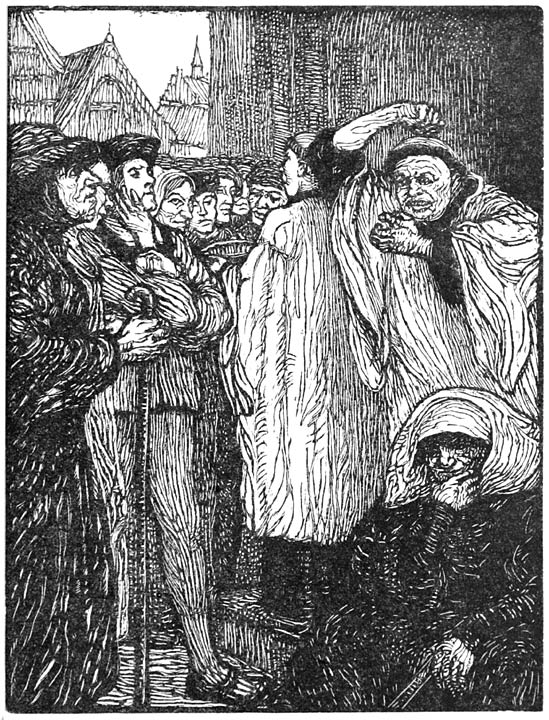
In those days there came to Damme two brothers of the Premonstratensian Order, sellers of indulgences. And over their monastic robes they wore beautiful jackets bordered with lace.
When it was fine they stood outside the porch of the church, and under the porch when it was wet, and there they stuck up their tariff; and this was the scale of charges: for six liards a hundred years’ indulgence, for one patard two hundred years, three hundred years for half a sovereign, four hundred years for seven florins, and so on according to the price—indulgences plenary or semi-plenary, and pardons for all the most terrible crimes.
And they gave to their patrons, in exchange for payment, little parchment certificates on which were written out the number of years of indulgence, and below was the following inscription:
Who wants not to be
Stewed, roasted, fricasseed,
Burning in hell for evermore,
Indulgences let him buy.
Pardon and forgiveness,
For a little money,
God will return to him.
And the eager purchasers came thronging round the monks. One of whom never left off addressing his audience. This brother had a blooming countenance, and displayed three chins at least, and a portentous belly, all without the least embarrassment.
The Monk’s Sermon
“Unhappy ones!” he cried, fixing with his eye now one, now another of the crowd. “Unhappy ones! Let me show you a picture. Behold! You are in hell! The fire burns you most cruelly. You are boiling in that cauldron full of oil wherein are prepared the olie-koekjes of Astarte. You are nothing better than a sausage on the frying-pan of Lucifer, or a leg of mutton on the spit of Guilguiroth, biggest of all the devils. And first they cut you up in little pieces. Ah, woe is me! Behold this sinner who despised indulgences! Behold this plate of daintiness! ’Tis he! ’Tis he! His wicked body thus reduced by damnation. And for sauce, brimstone and pitch and tar! Thus are those poor sinners eaten alive to be born again continually to their pain! And here in all reality is the place of tears and of grinding of teeth. Have mercy, God of mercy! For now, poor damned one, you are in hell, and you suffer unspeakable woes. And yet if any there were to subscribe a denier for you, straightway one of your hands would find relief; and let but some other give a half a denier and your two hands would be freed entirely from the pain of the fire. But as for the remainder of your body, let some one only give a florin, and there falls the dew of indulgence over all! O freshness of delight! And now for ten days, a hundred days, a thousand years maybe, according as one pays, no more roast meat, no more olie-koekjes, no more fricassees for you! And even if it is not for yourself, is there no one else, there in the secret depths of the fire, no one else for whom you would wish to gain relief—one of your parents perhaps, a dear wife, or some lovely girl with whom you have committed wilful sin?”
And as he spoke these words, the monk jogged the elbow of his brother that stood by holding in his hands a silver bowl. And that brother, lowering his eyes at this signal, shook the bowl unctuously, as if inviting contributions.
Whereat the preacher continued in this wise: “Or perhaps you have a son or a daughter, maybe, in the midst of this terrible fire, or some beloved little child? Hark, how they cry aloud, and weep, and call to you by name. Can you remain deaf to their pitiful voices? You cannot. Even a heart of ice must melt, though it cost you a carolus! And behold, at the very sound of the carolus as it strikes this vile metal” (and here his comrade shook the plate again), “a space opens out in the midst of the fire, and the tormented soul ascends to some volcano mouth where it meets the air, the fresh, free air! Where are the pains of the fire now? For the sea is close at hand, and straight into the sea the soul plunges. She swims on her back, on her stomach, floats upon the waves, dives beneath them. Oh, listen how she sings aloud in her joy! See how she rolls about in the water! The very angels gaze down upon her from heaven and are glad. Eagerly they await her coming; but not yet, not yet has she had her fill of the sea. If she might only turn into a fish! She knoweth not how there are prepared for her up aloft sweet baths, perfumed and scented, with fine bits of sugar-candy floating therein, all white and fresh like bits of ice. Now a shark appears. She fears it not at all, but clambers upon its back, and sits there all unnoticed, hoping he will take her with him down into the depths of the sea. And now she goes to greet the little water-angels that feed on waterzoey from coral cauldrons, and on freshest oysters from plates of mother-of-pearl. And she is welcomed and fêted and made much of, but still the angels in heaven beckon her on high, till at last, refreshed and happy, you may see her rise aloft, singing like a lark, up to the highest heaven where God sits in glory on his throne. There she finds again all her earthly friends and loved ones (save only those, forsooth, that in this life have spoken ill of indulgences and of our Holy Mother Church and who burn now for their sin upon the floor of hell. And so for ever and for ever and for ever to all ages, in an all-consuming eternity). But that other soul, now dear to God, refreshes herself in soft baths and crunches sugar-candy. Buy then, my brothers, buy your indulgences. We sell them for crusats, for florins, or for English sovereigns. Even copper coin is not refused. Buy then, buy! This is the Holy Mart! And we have indulgences adapted to the poor man’s purse as well as to the rich man’s. Only, I am sorry to say, my brothers, no credit is allowed. For to buy without paying cash is a crime most grievous in the eyes of Our Lord.”
Hereupon the monk who had kept silent shook his platter, and the florins, crusats, patards, sols, and deniers fell into it as thick as hail.
Claes, feeling himself rich, paid a florin for an indulgence of ten thousand years; and the monks delivered to him a piece of parchment in exchange.
At last, seeing that there was no one left in Damme but the miserly folk who would not buy indulgences at any price, the two monks left the village and proceeded on their way to Heyst.
XXXII
In those days the country round Liége was in a disturbed and dangerous state by reason of the heresy hunts, and Lamme Goedzak came again to live in Damme. He was married now, and his wife followed him willingly because the people of Liége, who had a mocking nature, used to make fun of her husband’s meekness.
Lamme often visited Claes, who, since coming into his fortune, was always to be found at the tavern of the Blauwe Torre, and had even appropriated one of the tables for himself and his boon companions. This table was next to the one where sat the Dean of the Fishmongers, Josse Grypstuiver by name, drinking sparingly from his half-pint tankard. For he was a miser, a stingy fellow who thought the world of himself, and lived for the most part on smoked herrings, and thought more of money than of the safety of his own soul. Now Claes carried in his pocket that piece of parchment whereon was inscribed the tale of his ten-thousand-year indulgence.
One evening Claes was drinking at the Blauwe Torre in the company of Lamme Goedzak, Jan van Roosebeke, and Matthys van Assche, Josse Grypstuiver also being present. Claes had been imbibing freely, and Jan Roosebeke was remonstrating with him, saying that it was sin to drink so much. But Claes replied that a pint too much meant nothing more serious than an extra half-day in purgatory.
“Besides,” said he, “I have a ten-thousand-year indulgence in my pocket! Is there any one here that would like a hundred years of them, I wonder, so that he may indulge his stomach without fear of the consequences?”
Every one shouted at once:
“How much are you selling them at?”
“For a pint of beer,” Claes answered, “I will give you one hundred days, but for a muske conyn you shall have a hundred and fifty!”
Some of the revellers gave Claes a pint of beer, others a piece of ham, and for each and all Claes cut off a little strip of his parchment. It was not Claes, forsooth, who consumed the price of his indulgences, but Lamme Goedzak; and he gorged himself so that he began to swell visibly; and all the time Claes went on distributing his merchandise up and down the tavern.
The man Grypstuiver turned a sour face towards him, and asked if he had an indulgence for ten days.
“No,” said Claes, “that’s too small a piece to cut.”
Every one laughed, and Grypstuiver ate his anger as best he could. Then Claes went home, followed by Lamme, walking as if his legs were made of wool.
XXXIII
Towards the end of the third year of her banishment, Katheline returned to her home in Damme. And continually she cried aloud in her madness: “Fire, fire! My head is on fire! My soul is knocking, make a hole, she wants to get out!” And if ever she saw an ox or a sheep she would run from it as if in terror. And she would sit on the bench at the back of her cottage, under the lime-trees, wagging her head and staring at the people of Damme as they passed by. But she did not recognize them, and they called her “The mad-woman.”
Meanwhile Ulenspiegel went wandering along the roads and pathways of the world, and one day he met a donkey on the highway, harnessed with leather and studs of brass, and its head ornamented with tassels and plumes of scarlet wool....
Some old women were standing round the donkey in a circle, all talking at once and telling each other how that no one could tame the donkey for that he was a terrible animal and had belonged to the Baron of Raix, who was a magician and had been burned alive for having sacrificed eight children to the devil. “And he ran away so fast,” said the old women, “that none could catch him. And without a doubt he is under the protection of Satan. For a while ago he seemed tired, resting by the wayside, and the village constables came to seize him. But he suddenly kicked out with his hind legs and brayed in such fearful fashion that they durst not to go near him. And that was no bray of an ass, but the bray of the devil himself. So the constables left him to browse among the thistles, and passed no sentence upon him, nor did they burn him alive for a sorcerer as they should have done. Verily these men have no courage.”
Notwithstanding this brave talk, the donkey had only to prick up his ears or flick his sides with his tail, to send the women running away from him with cries of terror. Then back they would come, chattering and jabbering, but ever ready to be off again if the donkey showed the least sign of movement. Ulenspiegel could not help laughing at the sight,
“Ah!” said he, “talk and curiosity! They flow like an everlasting river from the mouths of women—and especially old women, for with the young the flow is less continuous by reason of their amorous occupations.”
Then, considering the donkey:
“This sorcerer-beast,” said he to himself, “is a sprightly ass without a doubt, and a good goer. What if I were to take him for my own, to ride, or maybe sell him?”
Without another word Ulenspiegel went and got a feed of oats, and returning, offered them to the donkey. But while he was eating of those viands Ulenspiegel jumped nimbly upon his back, and taking the reins, turned him first to the north, then to the east, and lastly to the west. Then, when he had gone from them a little way, he raised his hand as if in blessing on those aged dames. But they, almost fainting with fear, fell upon their knees before him. And that evening when they met together again, the tale was told of how an angel with a felt hat trimmed with a pheasant’s feather had come and blessed them, and had taken off the magician’s donkey by special favour of God.
And Ulenspiegel, astride of his ass, went his way through the green fields, where the horse pranced about at liberty, where the cows and heifers grazed at their ease or lay resting in the sunshine. And he called the ass Jef.
At last Jef came to a stop, and began, as happy as could be, to make his dinner off the thistles which grew in that place in great abundance. But anon he shivered all over, and flicked his sides with his tail in the hope of ridding himself of the greedy horse-flies who, like himself, were trying to get their dinner, not off the thistles, but off his own flesh.
Ulenspiegel, who himself began to feel the pangs of hunger, grew very melancholy.
“Happy indeed would you be, friend donkey, with your good dinner of fine thistles if there was no one to disturb you in your pleasures, and to remind you that you also are mortal, born, that is to say, to the endurance of all kinds of villainies.”
Thus did Ulenspiegel address his steed, and thus continued:
“For even as you have this gadfly of yours to worry you, so also hath His Holiness the Pope a gadfly of his own, even master Martin Luther; and His Sacred Majesty the Emperor, hath he not my Lord of France for his tormentor—Francis, first of that name, the King with the very long nose and a sword that is longer still? And forsooth, donkey mine, it is certainly permitted that I also, poor little man wandering all alone, may have my gadfly too.
“Alas! Woe is me! All my pockets have holes in them, and by the said apertures do all my fine ducats and florins and daelders ramble away, flying like a crowd of mice before the mouth of the cat that would devour them. I wonder why it is that money will have nothing to do with me—me that am so fond of money? Verily Fortune is no woman, whatever they may say, for she loves none but greedy misers that shut her up in their coffers, tie her up in sacks, close her down under twenty keys and never let her show herself at the window by so much as the little tip of her gilded nose! This, then, is the gadfly that preys upon me and makes me itch, and tickles me without ever so much as raising a laugh. But there, you are not listening to me at all, friend donkey! And you think of nothing but your food. You gobbling gobbler, your long ears are deaf to the cry of an empty stomach! But you shall listen to me. I insist!”
And he belaboured the ass as hard as he could, till the brute began to bray.
“Come, come, now that you have given us a song!” cried Ulenspiegel. But the donkey would not advance by more than a single step, and seemed determined to go on eating thistles until he had consumed all that grew by the roadside. And of these there was an abundance.
When Ulenspiegel saw what was happening he dismounted and cut off a bunch of thistles; then, mounting the ass again, he placed the bunch of thistles just in front of the animal’s nose. And in this way, leading the donkey by the nose, he arrived before long in the land of the Landgrave of Hesse.
“Friend donkey,” he said as they went along, “you, verily, go running after a bunch of thistles, the meagre fare with which I have provided you; but you leave behind the lovely road that is filled with all kinds of most delicate herbs. And thus do all men, scenting out, some of them, the bouquet called Fame which Fortune puts under their nose, others the bouquet of Gain, and yet others the bouquet that is called Love. But at the end of the journey they discover, like you, that they have been pursuing things that are of little account, and that they have left behind all that is worth anything—health, and work, repose, happiness, and home.”
In such discourse with his donkey Ulenspiegel came at last to the palace of the Landgrave.
There two Captains of Artillery were playing dice upon the steps of the palace, and one of them, a red-haired man of gigantic stature, soon noticed Ulenspiegel as he approached modestly upon his ass, gazing down upon them and their game.
“What do you want,” said the Captain, “you, fellow, with your starved pilgrim’s face?”
“I am extremely hungry,” answered Ulenspiegel, “and if I am a pilgrim, it is against my will.”
“And you are hungry,” replied the Captain, “go, eat the next gallows cord you come to, for such cords are prepared for vagabonds like you.”
“Sir Captain,” answered Ulenspiegel, “only give me the fine golden cord you wear on your hat, and I will go straightway and hang myself by the teeth from that fat ham which I see hanging over there at the cook-shop.”
The Captain asked him where he came from. Ulenspiegel told him, “From Flanders.”
“What do you want?”
“To show His Highness the Landgrave one of my pictures. For I am a painter.”
“If it is a painter that you are,” said the Captain, “and from Flanders, come in, and I will lead you to my master.”
When he had been brought before the Landgrave, Ulenspiegel saluted thrice and again.
“May your Highness deign,” said he, “to excuse my presumption in daring to come and lay before these noble feet a picture I have made for your Highness, wherein I have had the honour to portray Our Lady the Virgin in her royal attire.”
And then after a moment’s pause:
“It may be that my picture may please your Highness,” he continued, “and in that case I am sufficiently presumptuous to hope that I might aspire even unto this fine chair of velvet, where sat in his lifetime the painter that is lately deceased and ever to be regretted by your Magnanimity.”
Now the picture which Ulenspiegel showed him was very beautiful, and when the Landgrave had inspected it, he told Ulenspiegel to sit down upon the chair, for that he would certainly make him his Court Painter. And the Landgrave kissed him on both cheeks, most joyously, and Ulenspiegel sat down on the chair.
“Of a truth you are a very talkative fellow,” said the Landgrave, looking him up and down.
“May it please your Lordship,” answered Ulenspiegel, “Jef—my donkey—has dined most excellently well on thistles, but as for me I have seen nothing but misery these three days past, and have had nothing to nourish me but the mists of expectation.”
“You shall soon have some better fare than that,” answered the Landgrave. “But where is this donkey of yours?”
“I left him on the Grande Place,” Ulenspiegel said, “opposite the palace; and I should be most obliged if he could be given lodging for the night—some straw and a little fodder.”
The Landgrave immediately gave instructions to one of his pages that Ulenspiegel’s donkey should be treated even as his own.
The hour for supper soon arrived, and the meal was like a wedding festival. Hot meats smoked in the dishes, wine flowed like water, while Ulenspiegel and the Landgrave grew both as red as burning coals. Ulenspiegel also became very merry, but His Highness was somewhat pensive even in his cups.
“Our painter,” said he suddenly, “will have to paint our portrait. For it is a great satisfaction to a mortal prince to bequeath to his descendants the memory of his countenance.”
“Sir Landgrave,” answered Ulenspiegel, “your will is my pleasure. Nevertheless, I cannot help feeling sorry at the thought that if your Lordship is painted by himself he will feel lonely, perhaps, all there in solitary state through the ages to come. Surely he should be accompanied by his noble wife, Madame the Landgravine, by her lords and ladies, and by his captains and most warlike officers of State. In the midst of these, my Lord and his Lady will shine like twin suns surrounded by lanterns.”
“Well, painter mine, and how much shall I have to pay you for this mighty work?”
“One hundred florins, either now or later, just as you will.”
“Here they are, in advance,” said the Landgrave.
“Most compassionate master,” said Ulenspiegel as he took the money, “you have filled my lamp with oil, and now it shall burn bright in your honour.”
On the next day Ulenspiegel asked the Landgrave to let him see those persons who were to have the honour of being painted. And first there came before him the Duke of Lüneburg, commander of the infantry of the Landgrave. He was a stout man who carried with difficulty his great paunch swollen with food. He went up to Ulenspiegel and whispered in his ear:
“When you paint my portrait see that you take off half my fat at least. Else will I order my soldiers to have you hung.”
The Duke passed on. And next there came a noble lady with a hump on her back and a bosom as flat as a sword-blade.
“Sir painter,” said she, “unless you remove the hump on my back and give me a couple of others in the place where they should be, verily I will have you drawn and quartered as if you were a prisoner.”
The lady went away, and now there appeared a young maid of honour, fair, fresh, and comely, only that she lacked three teeth under her upper lip.
“Sir painter,” said she, “if you do not paint me smiling and showing through my parted lips a perfect set of teeth, I’ll have you chopped up into small pieces at the hands of my gallant. There he is, look at him.”
And she pointed to that Captain of Artillery who a while ago had been playing dice on the palace steps. And she went her way.
The procession continued, until at last Ulenspiegel was left alone with the Landgrave.
The Landgrave said to him:
“My friend, let me warn you that if your painting has the misfortune to be inaccurate or false to all these various physiognomies by so much as a single feature, I will have your throat cut as if you were a chicken.”
“If I am to have my head cut off,” thought Ulenspiegel, “if I am to be drawn and quartered, chopped up into small pieces, and finally hung, I should do better to paint no portrait at all. I must consider what is best to be done.”
“And where is the hall,” he asked the Landgrave, “which I am to adorn with all these likenesses!”
“Follow me,” said the Landgrave. And he brought him to a large room with great bare walls.
“This is the hall,” he said.
“I should be very grateful,” said Ulenspiegel, “if some curtains could be hung right along the walls, so that my paintings may be protected from the flies and the dust.”
“Certainly,” said the Landgrave.
When the curtains had been hung as directed, Ulenspiegel asked if he might have three apprentices to help him with the mixing of his colours.
This was done, and for thirty days Ulenspiegel and the apprentices spent the whole of their time feasting and carousing together, with every extravagance of meat and drink. And the Landgrave looked on at it all. But at last on the thirty-first day he came and thrust his nose in at the door of the chamber where Ulenspiegel had begged him not to enter.
“Well, Tyl,” he said, “and where are the portraits?”
“They are not finished,” answered Ulenspiegel.
“When shall I be able to see them?”
“Not just yet,” said Ulenspiegel.
On the six-and-thirtieth day the Landgrave again thrust his nose inside the door.
“Well, Tyl,” he inquired, “how now?”
“Ah, Sir Landgrave,” said Ulenspiegel, “the portraits are getting on.”
On the sixtieth day the Landgrave grew very angry, and coming right into the room:
“Show me the pictures at once!” he cried.
“I will do so,” answered Ulenspiegel, “but pray have the kindness not to draw the curtain until you have summoned hither the lords and captains and ladies of your court.”
“Very well,” said the Landgrave, and at his command the aforesaid notabilities appeared. Ulenspiegel took up his stand in front of the curtain, which was still carefully drawn.
“My Lord Landgrave,” he said, “and you, Madame the Landgravine, and you my Lord of Lüneburg, and you others, fine ladies and valiant captains, know that behind this curtain have I portrayed to the best of my abilities your faces, every one warlike or gentle as the case may be. It will be quite easy for each one of you to recognize himself. And that you are anxious to see yourselves is only natural. But I pray you have patience and suffer me to speak a word or two before the curtain is drawn. Know this, fair ladies and valiant captains; all you that are of noble blood shall behold my paintings and rejoice. But if there be among you any that is of low or humble birth, such an one will see nothing but a blank wall. So there! And now, have the goodness to open wide your noble eyes.”
And so saying, Ulenspiegel drew the curtain.
“Remember,” said he again, “only they of noble birth can see my pictures, whether they be lords or ladies.” And again, presently: “He of low birth is blind to my pictures But he who clearly sees, that man is a nobleman without a doubt.”
At that every one present opened wide his eyes, pretending—you may be sure—to see, and feigning to recognize the various faces and pointing themselves out to one another, though in reality they beheld nothing at all but a bare wall. And for this they were each and all secretly ashamed.
Suddenly the court jester, who was standing by, jumped three feet in the air and jaggled his bells.
“Take me for a villain,” he cried, “a most villainous villain, but I verily will affirm and assert and say with trumpets and fanfares that there I see a wall, a blank, white wall, and nothing but a wall, so help me God and his saints!”
Ulenspiegel said:
“When fools ’gin talking, time for wise men to be walking.”
And he was about to leave the palace when the Landgrave stopped him.
“Fool in your folly,” said he, “you make boast that you go through the world praising what is good and fair and making mock of foolery, and you have dared to make open game of so many and so high-born ladies, and of their yet more noble lords, bringing ridicule on the pride of their nobility! Of a truth I tell you that the day will come when you will hang for your free speech.”
“If the cord is of gold,” said Ulenspiegel, “it will break with dread at my approach.”
“Stay,” said the Landgrave. “Here is the first bit of your rope,” and he gave him fifteen florins.
“All thanks to you,” said Ulenspiegel, “and I promise you that every tavern on the road shall have a thread of it, a thread of that gold which makes Crœsuses of all those rascally tavern-keepers.”
And off he went on his donkey, holding his head up high in air, with the plume in his cap wagging joyously in the breeze.
XXXIV
Now was the season of yellowing leaves, and the winds of autumn were beginning to blow. Sometimes for an hour or two it seemed that Katheline was come into her right mind again, and at such times Claes would say that the merciful spirit of God had come to visit her. Then it was that she had power to throw a charm upon Nele, by signs and incantations, so that the girl was able to see whatever was happening all over the world, in the public squares of the cities, or on the highways, or in the houses themselves.
To-day Katheline was in one of these moods of right-mindedness, and she was eating olie-koekje with Claes, Soetkin, and Nele. Claes said:
“This is the day of His Majesty the Emperor’s abdication. Nele, my dear, do you think you could see as far as Brussels in Brabant?”
“If Katheline wishes me to,” said Nele.
Thereupon Katheline caused her to sit down on a bench, and making sundry passes with her hands, she muttered her incantations, which soon sent the girl off into a trance.
Then Katheline said to her:
“Make your way into the little house which is called the Park House, and is the favourite residence of the Emperor Charles the Fifth.”
Whereupon Nele began to speak, in a low voice, as though she were half suffocated.
“I am standing in a small room painted green. There is a man in the room. He is about fifty-four years of age, and he has a bald head and a protruding chin with a white beard growing upon it. His grey eyes have a wicked, crafty look, filled with cruelty and false kindness. And this is the man they call ‘His Most Sacred Majesty.’ He suffers from a catarrh and always keeps coughing. Beside him is another, a young man with an ugly face like that of a hydrocephalous monkey. I saw him once at Antwerp. He is King Philip. At the present moment he is being rebuked by His Sacred Majesty for having slept out last night away from home. Doubtless, says His Majesty, he was at some brothel in company of a trollop of the town. His hair, it seems, smells of the tavern, no place, that, for a King to seek his pleasures in, he who may have his choice of all the sweetest bodies in the world, of skin like satin fresh from perfumed baths, and of hands of high-born ladies, very amorous. Such as these, says His Majesty, are more fit for him, surely, than some half-mad wench that is come, scarcely washed, from the arms of a drunken soldier. For there is not one among all the ladies, the most noble, the most beautiful, whether virgin, wife, or widow, that would resist King Philip! And they would be proud to give him of their love—not by a greasy glimmer of stinking tallow, but by the light of scented tapers made of finest wax.
“The King replies that he will obey His Sacred Majesty in all things. Whereupon His Sacred Majesty has a fit of coughing and drinks some draughts of hippocras. After which he addresses his son, sorrowfully, in these words:
“‘You must know, my son, that very soon I am to give to the world the mighty spectacle of the abdication of my throne in the favour of you, my son. And I shall speak before a great crowd of people, coughing and hiccuping as I am—for all my life I have eaten too heartily. And very hard-hearted must you be if you shed no tears when you hear what I shall have to say.
“‘I shall shed many tears,’ answers King Philip.
“And now His Sacred Majesty is speaking to his valet, a man named Dubois.
“‘Bring me some sugar dipped in Madeira,’ he cries. ‘I have the hiccups. Pray heaven they do not attack me when I am making my speech before all those people. Oh, that goose I had last night for dinner! Will it never pass? I think I had better take a glass of Orleans wine? No, it is too harsh. Or perhaps if I ate some anchovies? No, they are oily. Dubois, there, give me some Roman wine!’
“Dubois does as he is told, then dresses his master in a robe of crimson velvet, wraps a golden cloak about him, girds on his sword, places the globe and sceptre in his hands, and on his head the crown. Thus arrayed, His Sacred Majesty goes forth from the Park House, riding on a little mule and followed by King Philip and many notables. Presently they arrive at a large building called the Palace, and they come to a room wherein is a tall thin man, most richly dressed. He is the Prince of Orange, William, surnamed the Silent.
“‘Do I look well, Cousin William?’ His Sacred Majesty inquires.
“But the man makes no answer, till at length His Sacred Majesty speaks again, half mused, half angry.
“‘Still silent, cousin? Still without a word?—even when you have the chance of telling the truth to a grey-beard! Come now, shall I abdicate or stay upon my throne, O silent one?’
“‘Most Sacred Majesty,’ replies the thin man, ‘at the approach of winter even the strongest oaks let fall their leaves.’
“Three o’clock strikes.
“‘Lend me your shoulder, silent one, that I may lean upon it.’
“And, so saying, His Most Sacred Majesty leads the way into a great room wherein is a canopy, and under the canopy a dais covered with a carpet of crimson silk. On the dais are three chairs. His Sacred Majesty seats himself on the mid-most one, which is more ornamented than the others and surmounted by the imperial crown. King Philip takes the second chair, and the third is occupied by a woman, who is no doubt the Queen. On either side are long benches covered with tapestry, and sitting upon them are men dressed in red robes and wearing round their necks the image of a golden sheep. Behind stand various personages who would seem to be princes and lords. Opposite these, and at the bottom of the dais, there is a row of bare benches which are occupied by men dressed in plain cloth. I hear it said that these men are clothed and seated so modestly because it is themselves that have to pay all the costs. At the entrance of His Sacred Majesty these people all stand up, but when he has sat down he makes a sign and they sit also.
“Now a very aged man is talking of his gout interminably. After which the woman, who seems to be a Queen, presents a roll of parchment to His Majesty. His Sacred Majesty reads what is written thereon in a low voice, coughing all the time, and then he begins to speak for himself.
“‘Many and long are the journeys that I have made through Spain and Italy and the Netherlands, through England and through Africa, all for God’s glory, for the renown of my arms, and the good of my peoples.’
“And so on, and so on, till at last he comes to tell of his growing weakness and fatigue, and of his determination to relinquish the crown of Spain, together with the counties, duchies, and marquisates of all those countries, and of his desire to hand them over to his son. Thereafter he begins to weep, and every one weeps with him, and King Philip gets up from his chair and falls upon his knees before his father.
“‘Most Sacred Majesty,’ he cries, ‘am I indeed to receive this crown from your hands while yet you are so strong to wear it?’
“Then His Majesty whispers into his son’s ear that he should speak some kindly words to those men who are seated upon the tapestried chairs. Whereupon King Philip turns towards them, and without rising addresses them in a sharp tone of voice.
“‘I understand French fairly well,’ he says, ‘but not well enough to be able to talk to any one in that language. But the Bishop of Arras, Monsieur Grandvelle, he will say something to you on my behalf.’
“‘That is not the way to speak to them, my son,’ says His Sacred Majesty.
“And in truth the whole assembly begins to murmur, seeing the young King so proud and unbending. The woman, she who is the Queen, then makes an oration, and is followed by an aged professor, who, on sitting down, receives a wave of the hand from His Sacred Majesty by way of thanks. These ceremonies and harangues being finished, His Sacred Majesty makes a declaration to the effect that his subjects are released from their oath of fidelity, signs the deeds drawn up to ratify his abdication, and then, rising from his throne, places his son upon it in his stead. Every one in the hall weeps. Then they return again to the Park House.
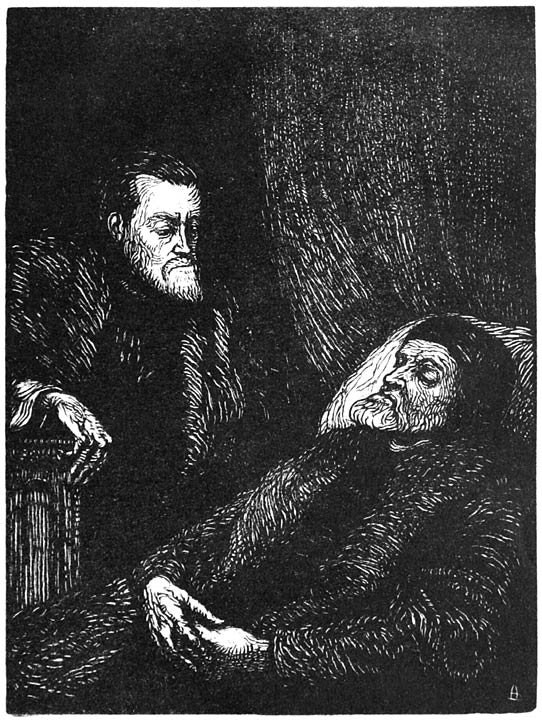
“Once more His Sacred Majesty and his son Philip are alone together in the green chamber. As soon as the doors are shut His Sacred Majesty goes off into a peal of laughter, and begins talking to King Philip, who keeps quite solemn all the time.
Father and Son
“‘Did you notice,’ says the Emperor, laughing and hiccuping at the same time, ‘how little was needed to move these good people to tears? Heavens, how they wept! You would have thought it was the deluge! That fat Maes who made the long speech, why, he cried like a calf! Even you appeared to be affected—but not quite sufficiently, perhaps. Really there is no doubt that these are the best of all the entertainments which one can provide for the populace. For just as we nobles are wont to cherish most those mistresses who cost us most, so also it is with the people. The more we make them pay the more they love us. That is why I have tolerated the reformed religion in Germany while punishing it severely in the Low Countries. If, however, the German princes had been Catholics I would have made myself a Lutheran so that I might confiscate their property. Verily they all believe in the integrity of my zeal for the Roman faith, and when I leave them they are full of regrets. Yet for heresy there have perished at my hands fifty thousand of their bravest men and of their tenderest maidens, in the Netherlands alone. But still they grieve at my departure. And without making any count of what has been got from confiscations, I have raised in taxes more than the wealth of all the Indies or Peru; yet they are sorry to lose me. And I have torn up the Peace of Cadzant, brought the city of Ghent under subjection, suppressed every one who might be dangerous to me, put down all liberties, freedoms, and privileges, and placed them under the authority of the royal officers; but yet do these good people think they are still free inasmuch as I allow them to shoot with the crossbow, and to carry in procession the banners of their guilds. Willingly do they submit themselves to the hand of their master, finding happiness in a cage, and singing his praises while he is with them, and weeping when he departs. My son, be you to them even as I have been, kindly in words but harsh in deed. Lick that which you have no need to bite, and never leave off swearing to maintain liberties, freedoms, and privileges, however little you may scruple to destroy those liberties if they show signs of becoming dangerous. For such things as these are like iron if handled timidly, but brittle as glass if grappled with a strong hand. Therefore you should root out all heresy, not because it differs from the Roman religion, but because, if allowed to flourish, it would mean the end of our rule in all the Netherlands. For they that attack the Pope with his three crowns would finish by denying the authority of the temporal princes who wear but one. So, then, you should follow my example, and regard all claims to freedom of conscience as crimes of high treason to be punished by immediate confiscation. Hereby you will inherit great riches, as I also have done all my life long; and when you come to die or to abdicate, everybody will say, ‘Ah me, the good and noble prince!’ and many are the tears that will be shed!’
“And now I hear no more,” said Nele, “for His Sacred Majesty has laid him down to sleep. And King Philip, that proud and haughty prince, stands gazing at him with loveless eyes.”
And when she had thus spoken, Nele was awakened from her trance by Katheline. And Claes gazed thoughtfully into the fire as it flamed and lit up all the chimney.
XXXV
It was the month of April. The weather had been mild, but now there was come a sharp frost and a sky grey and overcast as it were the sky of All Souls’ Day. The third year of Ulenspiegel’s banishment had long since passed, and Nele was waiting day after day for the return of her lover.
“Alas!” she cried, “there will be snow on the pear-trees, and snow upon the flowering jasmines, and on all the poor plants that have bloomed in confidence of the mildness and the warmth of an early spring. Already from the sky little snowflakes are falling on the roads. And on my poor heart as well the snow is falling.
“Where, oh where are the bright rays of sunshine that should be playing now on our happy spring-time faces—and upon red roofs that were used to grow the redder for that warmth, and on window-panes that flashed as they caught that sunny brightness? Where indeed are those flaming beams that kindled earth to life again, and the sky, and the birds, and the insects? Alas! For day and night am I chilled by sorrow and long waiting. Oh where, where are you, my lover Ulenspiegel?”
XXXVI
That Sunday there was held at Bruges the Procession of the Holy Blood. Claes told his wife that she and Nele ought to go and see the procession, and that if they did so, it was not impossible they might find Ulenspiegel in the city. As for himself, he would stay behind and look after the cottage and be ready to welcome their pilgrim if he should return.
So the two women went off together. Claes remained at home and sat himself down on the doorstep and gazed into the deserted village street. All was quiet as the grave, except now and again for the crystal sound of the bell of some village church, or, rising and falling with every little gust of wind from Bruges, the far-off music of the carillon and the sound of the guns and fireworks that were being let off in honour of the Holy Blood. But in spite of all these sounds of joy, Claes was filled with sadness, scanning the grey mist that hung over the fields for a sight of his son, and trying to hear his footfall in the jolly rustling of leaves and gay concert of birds as they sang among the trees. Suddenly he noticed a man coming down towards him on the road from Maldeghem. It was a man tall of stature, but it was not Ulenspiegel. And presently Claes saw him come to a stand beside a field of carrots, and bend down to eat of the vegetables as if he were starving for food.
“There’s a hungry man sure,” said Claes to himself.
But after a while the man continued his walk, and passed out of view; to reappear a little later at the corner of the rue Héron. Claes recognized him at once as the messenger who had brought the seven hundred ducats from his brother Josse. He went to meet him, and asked him in.
“Blessed are they that are kind to the wandering traveller,” said the man, and readily accepted the proffered invitation.
Now on the window-ledge of the cottage window lay some bread-crumbs which Soetkin kept ready for the birds of the neighbourhood, who had learnt to come there during the winter for their food. The man took these crumbs and ate them.
“You must be hungry and thirsty,” said Claes.
“Eight days ago was I robbed by thieves,” the man replied, “and since then I have had nothing to eat but the carrots I have found in the fields and roots in the forest.”
“Well then,” said Claes, “I am thinking it is time you had a good round meal.” And so saying he opened the bread-pan. “Look,” he continued, “here is a dishful of peas, and here are eggs, puddings, hams, sausages from Ghent, waterzoey, a hotchpotch of fish. And down below in the cellar there slumbers our good wine from Louvain, made after the manner of Burgundy wine, all clear and red as rubies. Only the glasses are wanting now to rouse it from its sleep. And to crown all, let us put a faggot to the fire. Already I can hear the pudding singing in the grill! And that’s a song of right good cheer, my friend!”
Claes kept turning the puddings, and as he did so he inquired of the stranger whether he had seen his son, Ulenspiegel.
“No,” was the answer.
“Then perhaps you bring me news of my brother?” Claes said, as he placed the puddings, now well grilled, upon the table, together with a ham omelette, some cheese, and two big tankards of gleaming Louvain wine, both red and white.
The man said:
“Your brother Josse has been done to death upon the rack at Sippenaken near to Aix. And all because he was a heretic, and bore arms against the Emperor.”
Claes was like one mad, and he shook all over, for his wrath was great.
“Wicked brutes!” he cried. “O Josse! My poor Josse!”
Then the stranger spoke again, but in a voice that held no sweetness.
“Not in this world, my friend, is to be found just cause either for joy or for sorrow.” And he fell to his food. But after a while he spoke again.
“You must know that I was able to be of some assistance to your brother while he was in prison, by pretending that I was one of his relatives, a peasant from Nieswieler. I am now come hither in obedience to his command that if I was not killed for the Faith like him, I should go to you, and charge you in his name to live in the faith and peace of our Saviour, practising all works of mercy, and educating your son in secret in the law of Christ. ‘That money,’ he said, ‘which I gave to my brother was money taken from the poor and ignorant. Let Claes make use of it in rearing Tyl in the knowledge of God and of His word.’”
And when he had thus spoken, the messenger gave Claes the kiss of peace. And Claes made moan and lamentation, saying:
“Dead upon the rack! Alas! My poor Josse!” And his grief was so great that he could not put it from him. Nevertheless, when he saw that the messenger was consumed with thirst and held out his glass for more wine, Claes poured out again. But he himself ate and drank without pleasure.
Now Soetkin and Nele remained away for seven days; and all this time the messenger stayed beneath the roof of Claes, and every night they heard Katheline howling in her cottage over the way:
“Fire! Fire! Make a hole! My soul wants to get out!”
And Claes went to her, comforting her with gentle words, and afterwards returned to his own house.
At the end of the seven days the messenger departed. Claes offered him money, but he would only accept two caroluses with which to feed himself and find lodging on his way back home.