HERE BEGINS THE SECOND BOOK OF THE LEGEND OF THE GLORIOUS JOYOUS AND HEROIC ADVENTURES OF TYL ULENSPIEGEL AND LAMME GOEDZAK IN THE LAND OF FLANDERS AND ELSEWHERE (continued 2)
Geoffrey Arundel Whitworth translation
“Have mercy on him, Prince,” cried my Lords of Hoogstraeten and of Schoonenbergh both together; while the others all began to smile compassionately. Lamme also put in a word of his own, “Have mercy, my Lord. Green wood is poison, neither more nor less than rank poison!”
The Prince said:
“Very well.”
Thereupon Ulenspiegel leapt in the air again and again, and smote Lamme on his belly and compelled him to dance too, saying: “Join me now in praising the good Duke who has delivered me from the green wood.”
And Lamme did his best to dance, but could not very well because of his belly. And Ulenspiegel gave him to eat and to drink as much as he was able.
XVI
It was now at the end of October. The Prince was in want of money, and his army of food. The soldiers too began to murmur, and he marched them towards the French frontier to offer battle to the Duke. But the Duke would not fight.
Leaving Quesnoy-le-Comte to go to Cambrésis, the Prince’s army fell in with ten companies of Germans and eight Spanish ensigns and three cohorts of cavalry. They at once joined battle, and in the midst of the mêlée was Ruffele Henricis, the Duke’s son, crying out at the top of his voice:
“No quarter! No quarter! Long live the Pope!”
Now Don Henricis found himself opposite to a company of arquebusiers which was led by Ulenspiegel, and he threw himself upon them with all his men. Ulenspiegel said to his sergeant:
“I will cut out this murderer’s tongue for him!”
“Very good,” said the sergeant.
And Ulenspiegel took careful aim, and his bullet shattered the tongue and the entire jaw-bone of Don Ruffele Henricis, son of the Duke. At the same time Ulenspiegel brought down the son of the Marquess Delmares, and in a little while more the eight ensigns and the three cohorts of cavalry were thoroughly worsted.
After this victory Ulenspiegel went seeking for Lamme everywhere through the camp, but he could not find him.
“Alas,” he said, “he is gone! Lamme is gone; my friend, my great fat friend! In his warlike ardour he must have forgotten how heavy his belly was, and tried to follow the Spaniards in their flight. Out of breath he must have fallen like a sack on the wayside. And then the enemy will have picked him up for ransom—a ransom of good Christian fat! O Lamme, my friend, where are you? Where are you, my great fat friend?”
Ulenspiegel sought him everywhere but found him not and had to nurse his grief in silence.
And now November was come, the month of snow-storms, and Ulenspiegel, having been ordered to report himself before William, found the Prince brooding in silence, and biting the lacings of his coat of mail.
“Listen to me,” the Prince said presently, “and give me your whole attention.”
Ulenspiegel answered: “My ears are like the gates of a prison. One enters easily but to get out again is a different matter.”
“Very good,” said William, “but now I would have you go for me to Namur, and to Flanders, Hainaut, Sud-Brabant, Antwerp, Nord-Brabant, and to Gueldre, Overyssel, and the North of Holland, telling the people everywhere that, although it seems that the fates on land are hostile to our most Holy and Christian Cause, we will yet continue the struggle by sea, no matter what the evil powers that are arrayed against us. For God holds the issue in His own good providence, whether in success or failure. And when you are come to Amsterdam you will render an account of all that you have done to Paul Bruys who is my trusty vassal. Here are three passports, signed by the Duke of Alba himself, which were found on certain bodies of the dead at Quesnoy-le-Comte. My secretary has filled them in afresh. And it may be that on your journey you will meet some good companion in whom you can trust. Let him go with you. And those are to be accounted trustworthy who know how to answer the song of the lark with a warlike cockcrow. Here are fifty florins. Be valiant and faithful.”
“The ashes of Claes beat upon my heart,” answered Ulenspiegel.
And he went his way.
XVII
Now the passports were countersigned both by the King and the Duke, and they authorized the bearer to carry any kind of arms at his convenience. So Ulenspiegel took with him his trusty arquebus as well as a good supply of cartridges and dry gunpowder. He dressed himself in a short cloak and a shabby doublet and hose made after the Spanish fashion, and thus accoutred, with a plumed cap on his head and a sword at his side, he made his departure from the Prince’s army where it lay at the French frontier, and set out for Maestricht.
The roitelets, those heralds of bad weather, were flying around the houses seeking asile from the storm, and on the third day snow fell. Many times during the journey did Ulenspiegel have to show his safe-conduct. But they always let him pass, and so he came at length to the confines of Liége. He was plodding along over a level heath, and a fierce wind was driving the swirling snowflakes against his face, and in front and on every side the heath stretched out all white under the snow that fell in eddies, which themselves were whirled about hither and thither in the squalls of wind. And there were three wolves that began to follow him. But one of them he killed with a shot from his arquebus, and the other two flung themselves upon their wounded comrade, and then made off into the woods, each carrying a piece of the corpse.
Delivered from this peril, Ulenspiegel peered about him, fearing lest there might be other bands of wolves in that country, but he saw nothing except, in the far distance, certain objects that looked like grey statues moving slowly along in the falling snow. Behind these again, Ulenspiegel could descry the dark figures of a couple of soldiers on horseback. To see the better what all this might portend, Ulenspiegel climbed up into a tree, and there the wind brought to him a far-off sound of lamentation. “It may be,” Ulenspiegel said to himself, “these people are pilgrims, clad in white habits; for I can scarcely distinguish their figures against the snow.” But after a little while he saw that they were men running, quite naked, and that behind them were two German troopers in black uniforms riding on horses. And they were driving the poor wretches in front of them with whips. Ulenspiegel took aim with his arquebus. Now he could distinguish the individual figures of that mournful company—old men and young men naked, shivering, and quaking with cold, hardly able to stand some of them, but running all, for fear of the cruel whips of the two soldiers who, themselves being warmly clad and red with brandy and good food, took pleasure in lashing the bodies of naked men to make them run the faster.
Ulenspiegel said: “You shall be avenged, ashes of Claes!” And he killed one of the soldiers outright with a bullet from his arquebus. The soldier fell from his horse, and his companion took fright, not knowing whence the shot had come. But concluding that his assailant must be hiding somewhere in the wood, he decided to make good his escape, together with the horse of his dead companion. The man contrived to get hold of the horse’s bridle, but while he himself was dismounting to plunder the body of the dead, he was hit by a bullet in the neck and fell to the ground.
As for the naked prisoners, they imagined that some angel from heaven, who was also forsooth a fine marksman, had descended from the sky to aid them, and they all fell down upon their knees in the snow. At this Ulenspiegel descended from his tree, and was at once recognized by the company who had previously served with him as soldiers in the armies of the Prince. They said to him:
“O Ulenspiegel, we are come from France, and we were being driven in this piteous plight to Maestricht, where the Duke is, to be treated there as rebel prisoners because we cannot pay our ransom, and are therefore condemned in advance to be tortured, cut into pieces, or sent to row like caitiffs and criminals in the galleys of the King.”
Ulenspiegel gave his opperst-kleed to the oldest of the soldiers, saying:
“Come with me, my friends. I will accompany you as far as Mézières; but first of all let us strip these two dead soldiers and take possession of their horses.” Thereupon the doublets, hose, boots, head-gear, and body-armour of the soldiers were divided up among the sick and feeble, and Ulenspiegel said:
“We shall soon be entering the wood, where the air is thicker and more gentle. You had better run, my brothers.”
Suddenly one of the men fell down on the ground, crying: “I am hungry and cold, and I am going to God to bear witness that the Pope is Antichrist on earth.” And he died, and the others agreed to carry the body with them that it might be given Christian burial.
While thus proceeding along the road, they met a peasant driving a cart with a canvas hood. Seeing the men all naked, the peasant had compassion on them and invited them to ride in his cart. There they found some hay to lie on, and some empty sacks to cover them withal. And they were warmed and gave thanks to God. Ulenspiegel rode beside the cart on one of the two horses that had belonged to the German troopers, leading the other by the bridle.
At Mézières they all alighted. Good hot soup and beer and bread and cheese were handed round, with some meat for the older men and women. And they were nobly entertained; and they were clothed and armed again, all at the expense of the commune. And every one joined in giving thanks and praise to Ulenspiegel, who received it gladly. Ulenspiegel also sold the horses of the German troopers for eight-and-forty florins, out of which he distributed thirty florins among the Frenchmen.
Thereafter he took the road again, and as he walked solitarily along he said to himself:
“Verily now do I wander through a land of ruin, blood, and tears. Nevertheless, I find nothing. Those spirits lied to me without a doubt. For where is Lamme? Where is Nele! Where are the Seven?”
And he heard a voice speaking to him as though in a whisper:
“In death, in ruin, and in tears, seek!”
And he went his way.
XVIII
It was the month of March when Ulenspiegel came to Namur. There he found Lamme, who, having conceived a violent passion for the fish of the Meuse, and for the trout especially, had hired a boat and spent all day fishing in the river by permission of the commune. But for this privilege he had been obliged to pay the sum of fifty florins to the Guild of the Fishmongers.
Some of his fish he sold. But the rest he ate himself, and by this means he gained a finer belly than ever, and a small sack of money. When he saw his friend and comrade walking along the banks of the Meuse and about to enter the town, Lamme was mightily rejoiced and pushed his boat to the shore, and there springing on to the bank rushed up to Ulenspiegel, blowing and puffing and stammering for joy.
“Here you are,” he cried, “here you are at last, my son. And where are you off to? What are you after? You are not dead, then? And have you seen my wife? You’ll feed off the fish of the Meuse, which are the best to be found anywhere on this base earth! And let me tell you something. The people here make such sauces as will tempt you to dip your fingers into the dish right up to your shoulder! Ah, but how proud and splendid you look! On your cheeks is the very bloom of battle. And here you are! It’s you, it’s really you, my son! My Ulenspiegel! You jolly vagabond!” Then in a lower tone of voice he added:
“And how many Spaniards have you killed? You have not seen my wife by any chance, in the carts with those other hussies? Ah, but the wine of the Meuse! You must taste it. And have you been wounded, my son? You must rest here a while, so fresh and cheery as you are, and vigilant as a young eagle. But our eels! You must taste our eels. No muddy taste about them! Come, kiss me, my second self! Praise be to God! How glad I am!”
And Lamme danced and leapt in the air, puffing and blowing and compelling Ulenspiegel to dance too.
Thereafter they walked towards Namur. At the gate of the city Ulenspiegel showed his passport signed by the Duke. And Lamme conducted him to his house. While their repast was being prepared he made Ulenspiegel tell him all his adventures and then recounted his own, telling how he had left the army to follow a girl whom he thought was his wife. It was in pursuit of her, it seemed, that he had come at last to Namur. And he kept on asking Ulenspiegel:
“Are you sure you have not seen her anywhere?”
“I have seen many other beautiful women,” answered Ulenspiegel, “and in this town especially, where it seems they are all most amorous....”
“It is so,” said Lamme, “nevertheless I have remained faithful. For my sad heart is heavy with but a single recollection.”
“Even as your belly is heavy with countless platter-fuls!” said Ulenspiegel.
“When I am unhappy I have to eat,” Lamme replied.
“Your unhappiness knows no end?” demanded Ulenspiegel.
“Alas, no!” said Lamme.
And helping himself to another trout:
“Look,” he cried, “look how lovely and firm he is. This flesh is as pink as the flesh of my wife. But to-morrow we will leave Namur. I have a purseful of florins, and we will buy a donkey for each of us, and so we will go riding away to the land of Flanders!”
“You will be giving up a great deal,” said Ulenspiegel.
“Never mind,” said Lamme. “My heart draws me back to Damme. For it was there that my love loved me well. And it may be that she also has returned thither.”
“We will set out to-morrow,” said Ulenspiegel, “since such is your desire.”
And in fact they set forth as Lamme had said, each on a donkey; and so they rode along side by side.
XIX
Nele all this time was living at Damme, sorrowful and alone, with Katheline, who still continued to call amorously for her cold devil who never came.
“Ah!” she would say, “you are rich, Hanske my pet; and you could easily give me back those seven hundred caroluses. Then Soetkin would live again and come to earth once more, and Claes in heaven would laugh for joy. Easily could you do this, and you would! Put out the fire! My soul wants to get out!”
And with her finger she would point without ceasing to the place on her head where the flaming tow had burned her.
Katheline was very impoverished, but the neighbours helped her by sending in beans and bread and meat, according as they were able. The commune also gave her a certain amount of money, and Nele did sewing for the wealthy bourgeois, and went to their houses to mend their linen, earning in this way a florin or two every week. But Katheline kept on with her eternal “Make a hole! Let out my soul! She is knocking to be let out! And he will give me back the seven hundred caroluses!”
And Nele wept to hear her.
XX
In the meantime Ulenspiegel and Lamme continued their wanderings. Under the protection of their passports, they entered one day into a little tavern built against the rocks of the Sambre, the which rocks are covered with trees here and there, and on the sign of the tavern was written mine host’s name—MARLAIRE. When they had drunk many a flask of wine—wine of the Meuse, rather like Burgundy—and when they had eaten a large plate of fish, they fell talking to the innkeeper, who was a keen Papist but as talkative as he was pious because of the wine he had been drinking. And he kept on winking his eye maliciously. Ulenspiegel had a suspicion that all this winking portended something mysterious, and he made the fellow drink yet more, with the result that he fell to dancing and shouting with laughter, till at last he sat himself down at the table again, and, “Good Catholics,” says he, “I drink to you.”
“And to you we drink also,” answered Lamme and Ulenspiegel.
“And I drink to the extinction of all heresy and rebellion.”
“We will join you in that toast,” answered Lamme and Ulenspiegel, who kept on filling up the goblets which mine host could never suffer to remain full.
“You are good fellows,” said the innkeeper. “Let me drink to the health of your noble Generosities. For you must know that I derive some profit from all the wine that is drunk here. But where are your passports?”
“Here they are,” replied Ulenspiegel.
“With the Duke’s signature and all,” said the innkeeper. “Here’s a health to the Duke.”
“To the Duke,” echoed Lamme and Ulenspiegel. And mine host went on talking:
“Answer me now, do you know what it is that they catch rats and mice in? Why in rat-traps to be sure, and mouse-traps. Who is the mouse then? The great heretic of Orange—and orange he is in very truth, like the flames of hell! But God is on our side. They will come. Ho ho! A toast! Pour out the wine; I bake and burn with thirst. Come, drink, my masters. Fine little Protestant evangelists.... I said little. Fine valiant little fellows they are, and brave soldiers, sturdy as oaks.... I drink to them! Are you not going with them to the camp of the great heretic? I have certain passports signed by him.... You will see.”
“We are going to the camp,” answered Ulenspiegel.
“Yes, they will do their work well. And one fine night, if the opportunity presents itself”—and here the innkeeper whistled, and made a gesture as of one man cutting another’s throat—“cold steel, I tell you. It’s that that shall prevent the black bird of Nassau from singing any more. Come, drink again.”
“You’re a gay fellow,” said Ulenspiegel, “in spite of being married.”
The innkeeper said:
“I am neither married nor have I ever been. The secrets of Princes are safe with me. Drink! But if I had a wife she would steal my secrets from under my pillow to get me hanged and herself made widow before the time. Long live God! They will come.... But where are the new passports? On my heart of a Christian. Drink! They are there, there I tell you. One hundred paces along the road near by Marche-les-Dames. Do you see them? Drink again!”
“Drink?” said Ulenspiegel. “Yes, I drink and drink and drink. To the King, to the Duke, to the Protestant preachers, and to Vent d’acier—Wind of Lead. And I drink to thee and to me, to the wine and the bottle that holds it. But why? It is you that have stopped drinking!”
And at each new toast Ulenspiegel filled up the glass of the innkeeper, who emptied it straightway.
Ulenspiegel looked at him for some time, then rose and said to Lamme: “Come, Lamme, it is time for us to be off. He is asleep.” But when they were outside, “He has no wife,” Ulenspiegel continued. “We are safe. The night is at hand. Did you hear what the rascal said? And do you rightly understand who these three preachers are? Do you realize that they are to come along the bank of the Meuse from Marche-les-Dames, and that it will be our part to await them on the road? And then for Vent d’acier—Wind of Lead—to start his whistling?”
“Yes,” said Lamme.
“It is for us to save the Prince’s life,” said Ulenspiegel.
“Yes,” said Lamme.
“Wait,” said Ulenspiegel. “You take my arquebus, and go and hide in the undergrowth among the rocks. Load it with two shots, and shoot when you hear me caw and crow.”
“I will,” said Lamme.
And so saying he disappeared into the undergrowth. And Ulenspiegel could hear quite clearly the click of the gun as Lamme loaded it.
“Do you see them coming?” he asked presently.
“I see them,” answered Lamme. “There are three of them, marching together like soldiers, and one of them is much taller than the others.”
Ulenspiegel sat himself down by the side of the road, with his legs stretched out in front of him, muttering his prayers on a rosary, just like beggars do. And he held his hat between his knees. And when the three evangelists passed in front of him, he held out his hat as though asking for alms; but they gave him nothing. Then Ulenspiegel got up and addressed them most piteously:
“Kind sirs,” he said, “do not refuse a patard to a poor quarryman who has recently had an accident and broken his back by falling down a mine. The people in this part of the world are hard of heart, and they have not been willing to give me anything to relieve my distress. Alas! Give me but a patard, and I will say many prayers for you. And God will keep you happy, all your lives long, kind friends!”
“My son,” said one of the evangelists, “there can be no happiness for us in this world so long as the Pope and the Inquisition remain in power.”
Ulenspiegel heaved another sigh:
“Alas! What are you saying, my lords? Do not speak so loud, if it please you. But give me a patard.”
“My son,” replied one of the evangelists, he that was the smallest of the three, and of a very warlike countenance, “we poor martyrs carry no patards save only just enough to keep us going on our journey.”
At this Ulenspiegel threw himself on to his knees in front of them.
“Give me your blessing then,” he said.
The three evangelists laid their hands upon the head of Ulenspiegel, albeit with little signs of devotion.
Now Ulenspiegel noticed that although they were lean of figure, these men all had very fat stomachs, so he rose from his knees, and then pretended to stumble, knocking against the body of the tall evangelist as he did so. At that a merry tinkle of coin was distinctly audible. Thereupon Ulenspiegel raised himself to his full height and drew his dagger.
“My good man,” he said, “it is cold and I am but poorly clad; but methinks you have too much about you. Give me some of your wool, that I may get a cloak made for me. I am a Beggarman. Long live the Beggarmen!” The tall evangelist made answer:
“You cock of a Beggarman, you carry your crest proudly forsooth, and we are going to cut it off for you!”
“Cut it off then,” cried Ulenspiegel, giving ground, “but let me warn you that trusty Wind of Lead is going to sing for you or ever he sings for the Prince my master! Beggar I am! Long live the Beggarmen!”
The three evangelists were astounded and cried out to each other: “How does he know? We are betrayed! Kill him! Long live the Mass!” And each man drew forth from beneath his hose a sharp dagger. But Ulenspiegel, without waiting for them to attack him, gave ground towards the bushes where Lamme was hidden, and when he judged that the three evangelists were within range of the arquebus, he cried out: “Crows, black crows, the Wind of Lead is going to whistle. I sing your bitter end!”
Then he cawed like a crow. And a shot rang out from the bushes, and the tall evangelist fell prone on the earth. The next moment followed a second shot, which accounted in the same way for the second.
And from among the bushes Ulenspiegel saw the jolly face of Lamme, and his arm raised as he hastily reloaded his arquebus. And from the midst of the dark shrubbery a puff of blue smoke mounted into the air.
There now remained but one evangelist, and he was in a furious rage, and tried to cut at Ulenspiegel with all his might. But Ulenspiegel cried:
“Wind of Steel or Wind of Lead, which matters it? Either way you shall quit this world for another, you shameless murderer!”
And he attacked the foe and defended himself most bravely. So they stood on the roadway, inflexible, face to face, giving and parrying blows. Now Ulenspiegel was covered with blood, for his opponent was an experienced fencer, and had wounded him on the hands and on the legs. But Ulenspiegel attacked and defended himself like a lion. Still the blood which began to flow from his head blinded him, and he retreated continually, trying to wipe away the blood with his left hand but every moment feeling weaker. And he would most certainly have been killed had not Lamme brought down the third evangelist with another shot from his arquebus.
And Ulenspiegel saw him fall, and heard him vomit forth blasphemies and blood, and the white froth of death. And once again the blue smoke drifted up above the dark shrubbery, in the midst of which Lamme displayed yet again his jolly face.
“Have you finished him off?” he asked.
“Yes, my son,” replied Ulenspiegel, “but come....”
Lamme, then, coming out of his hiding-place, saw Ulenspiegel all covered with blood. He ran like a stag, in spite of his fat belly, and came to Ulenspiegel where he sat by the three dead men.
“He is wounded!” Lamme cried. “My gentle friend is wounded by the rascally murderer.” And then, with a vicious kick at the jaw of the evangelist who lay nearest to him: “You cannot answer me, Ulenspiegel? Are you going to die, my son? Where is the ointment! Ha! I remember now. It is at the bottom of his satchel under the sausages. Can’t you hear me speak, Ulenspiegel? Alas! there is no warm water here to wash your wound, and no way of getting any. The water of the Sambre will have to do instead. But speak to me, my friend. You are not so badly hurt after all, surely. A little water—there, it’s cold, isn’t it? But he is waking up. It’s I, your friend; and your enemies are all dead! Oh, where is some linen? Some linen to bind up his wounds. There isn’t any. What am I to do? Ah! my shirt, that must serve.”
Presently Ulenspiegel opened his eyes and raised himself from the ground with his teeth all chattering because of the cold.
“And here you are standing up already!” Lamme exclaimed.
“It is a balm of much virtue,” said Ulenspiegel.
“Balm of valiance,” answered Lamme.
And then, taking the bodies of the evangelists one by one, he cast them into a hole in the rocks, leaving their weapons and their clothes upon them. But he took their cloaks.
And all around in the sky the crows were beginning to caw to each other, in anticipation of the feast. And the Sambre flowed by like a river of steel under the grey sky.
And the snow fell, washing the blood away.
Yet they felt ill at ease, and Lamme said:
“I had rather kill a chicken than a man.”
And they mounted again upon their donkeys. And when they arrived at the gates of Huy, the blood was still trickling from the head of Ulenspiegel, so they dismounted and pretended to have a quarrel, and to use their daggers on one another, with the utmost ferocity as it seemed. But when they had finished their duel, they remounted their donkeys and came into the town, showing their passports at the city gates.
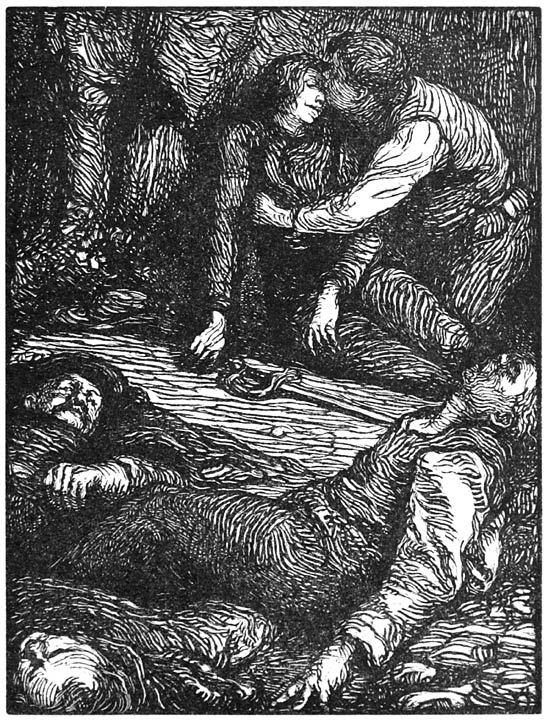
Lamme succours Ulenspiegel
The women, seeing Ulenspiegel wounded and bleeding while Lamme rode his donkey as though he had been the victor, threw many a glance of tender commiseration upon Ulenspiegel, and pointed their fingers at Lamme, saying: “That is the rascal who wounded his friend.”
Lamme all this time was anxiously scrutinizing the crowd, hoping to discover his wife among them; but all was in vain, and he was sad at heart.
XXI
“Where are you going now?” said Lamme.
“To Maestricht,” answered Ulenspiegel.
“But stay, my son. I have heard that the army of the Duke is camped all round the city and that he himself is within. Our passports will be of no use to us there. Even if they satisfy the Spanish soldiers, we shall still be arrested in the city and put through an examination. And in the meantime they will become aware of the death of the evangelists and our days on this earth will be numbered.”
To this Ulenspiegel made answer:
“The crows and the owls and the vultures will make short work of their repast. Already no doubt the dead bodies have become unrecognizable. As for our passports, there is no reason why they should not remain effective. But if the murder of the evangelists becomes known we should be arrested as you say. Nevertheless, whatever happens we shall have to go to Maestricht and pass through Landen on the way.”
“We shall be captured,” said Lamme.
“We shall get through,” answered Ulenspiegel.
Conversing in this wise they came to the inn of La Pie, where they found a good supper awaiting them, and good quarters for the night, both for themselves and for the donkeys; and on the morrow they took the road again for Landen.
Not far from that town they came to a large farm. There Ulenspiegel whistled like a lark, and from the interior came the sound of a warlike cockcrow in answer. After that a jolly-looking farmer appeared at the door of the farmhouse, and greeted them as friends and good Beggarmen, and bade them welcome.
“Who is this man?” Lamme inquired.
“His name is Thomas Utenhove,” said Ulenspiegel, “and he is a valiant Protestant. The man-servants and maid-servants that work on the farm are fellows with him in the cause of freedom of conscience.”
Then Utenhove said:
“You are the envoys of the Prince? Come in then, eat and drink with me.”
And the ham was crackling in the frying-pan, the sausages likewise, and the wine flowed and the glasses were filled again. And Lamme drank like dry sand, and ate his fill. And the boys and girls of the farm came one after another and thrust their noses into the half-open door to gaze on him as he worked away so hard. But the men were jealous, saying that they also would be able to eat and drink as bravely if they had the chance.
When all was finished, Thomas Utenhove said:
“One hundred of our peasants will be leaving us this week under pretext of going to work on the dikes at Bruges and thereabouts. They will be setting out in small bands of five or six at a time, and all by different routes. At Bruges they will find certain barges waiting for them to take them by sea to Emden.”
“Will these men be provided with arms and with money?” inquired Ulenspiegel.
“Each man will carry ten florins and a heavy cutlass.”
“God and the Prince will reward you,” said Ulenspiegel.
“But tell me,” said the farmer, “is Edzard, Count of Frise, still friendly to the Prince?”
“He feigns not to be,” answered Ulenspiegel. “Nevertheless, he is giving harbourage all the time to the Prince’s ships at Emden.” And then he added: “We are on the way to Maestricht.”
“You cannot go there,” said the farmer. “The Duke’s army is camped in front of the town and all round it.”
With that he conducted his visitors up into the loft, whence they could see the standards of enemy cavalry and infantry moving about in the distance over the plain.
Ulenspiegel said:
“I have a plan to get through, if only they who have authority in this place would give me leave to get married. But for wife I should need a sweet and a gentle and comely lass who would be willing to marry me—if not for always, then for a week at least.”
Lamme gasped with astonishment.
“Don’t do it, my son,” he cried. “She will only leave you, and then, all alone, you will burn with the fire of love; and the bed where now you sleep so sweetly will seem to you nothing better than a bed of prickly holly leaves, and gentle sleep will shun you for evermore.”
“Still I must marry,” replied Ulenspiegel. And then to Thomas Utenhove: “Come now, find me a wife; rich or poor, I don’t care which! And I will take her to church, and our marriage shall be blessed by the priest. And he shall give us our marriage lines. Though, to be sure, we shall not hold them valid as being given by the hand of a Papist and an Inquisitor. Nevertheless they will be good enough for our purpose, and we will prepare ourselves, as is the custom, for our wedding trip.”
“But what about the wife?”
“That’s your look-out,” answered Ulenspiegel. “But when you have found her I shall take two wagons and decorate them with wreaths of fir branches and holly and paper flowers, and in the wagons themselves I shall dispose the men whom you wish to be conveyed to the Prince of Orange.”
“But your wife?” persisted Thomas Utenhove. “Where will you find her?”
“Here, I doubt not,” answered Ulenspiegel. “And then I shall harness two of your own horses to one of the wagons, and our two donkeys to the other. In the first wagon will ride my wife and myself, together with my friend Lamme here, and the witnesses of our nuptials. In the second wagon will follow the musicians, the players upon the drum, the fife, and the shawm. And then, with all our joyous wedding-flags a-flying, and with music playing, and we ourselves singing and drinking each other’s healths, we shall ride along at the trot by the high road that leads to the Galgen-veld—the Field of the Gallows—which for us indeed will be the Field of Liberty.”
“I will do all in my power to help you,” said Thomas Utenhove, “but the women and girls will want to follow their men-folk.”
“We will go where God wills,” said a pretty-looking girl who had thrust in her head at the half-opened door.
“You can have four wagons if need be,” said Thomas Utenhove, “and by that means we should be able to convey as many as five-and-twenty men.”
“The Duke will be nicely fooled,” said Ulenspiegel.
“And the Prince’s fleet will gain the service of some fine soldiers,” added Thomas Utenhove.
Then he caused a bell to be rung to summon his footman and his servants, and when they were all assembled he said to them:
“All you that are from the land of Zeeland, women as well as men, listen now to me. Ulenspiegel, who is hither come from Flanders, has a plan to convey you through the enemy’s lines, disguised as the followers in a wedding procession.”
And thereat the men and women of Zeeland cried out with one accord:
“We are ready, even unto the death!”
And the men said one to another:
“What joy it will be to exchange this land of slavery for the freedom of the sea!”
And the women and girls said likewise:
“Let us follow our husbands and our lovers; we belong to Zeeland and there we shall find asile!”
Now Ulenspiegel had noticed a young and pretty maid, and he addressed her jokingly:
“I would you were my wife!”
But she blushed and answered him:
“I would have thee for my husband—but at the church only, remember!”
The women laughed and said among themselves:
“She is in love with Hans Utenhove, the master’s son. He will go along with her, doubtless.”
“You say truly,” Hans replied.
And his father said:
“You have my permission.”
Then all the men put on their best clothes, their doublets and hose of velvet, and the great opperst-kleed over all. As for the women, they wore black petticoats and pleated shoes. Round their necks they wore a white ruff, their bodices were embroidered in gold, scarlet, and blue; their skirts were of black wool with broad stripes of black velvet thereon, and their stockings were of black wool, and their shoes of velvet with silver buckles.
Thereupon Thomas Utenhove went to the church and put into the hands of the priest a couple of rycksdaelders, asking him at the same time to join in marriage Thylbert the son of Claes (that is Ulenspiegel) and Tannekin Pieters. And this the curé consented to do.
Ulenspiegel then went to church, followed by the wedding procession. And there, in the presence of the priest, Tannekin was made his wife.
And she looked so pretty and so sweet, so complaisant and so tender, that right willingly would he have eaten her up as she had been a ripe apple of love. And he told her so, not daring to do more for the respect he felt for her gentle loveliness. But she pouted her lips, and bade him leave her alone, for that Hans was watching him and would kill him without a doubt.
And a certain damsel was jealous, and said to Ulenspiegel:
“Seek elsewhere for a lover. Do you not see that she is afraid of her own man?”
Lamme clapped his hands together and cried:
“You cannot have them all, you rascal!”
So Ulenspiegel, making the best of his misfortune, returned to the farm with the wedding guests. And there he drank and sang and made merry, clinking many a glass with the damsel that was jealous. And at this Hans was glad, but not so Tannekin, nor yet the youth that was betrothed to the damsel.
At noon, while the sun shone down from a clear sky and a fresh breeze was blowing, the wedding carriages started off. They were decorated with flowers and every kind of greenery, with flags flying, and drums and fifes, bagpipes and shawms playing most joyfully.
Now it happened that in the camp of the Duke of Alba there was another fête in progress; and the sentries of the guard, having sounded the alarm, ran to the Duke, crying:
“The enemy is at hand. We have heard the noise of drums and fifes, and we have seen their banners in the distance. There is a strong force of cavalry that is hoping to draw you into some ambush. The main body, doubtless, is not far off.”
The Duke at once sent to warn the colonels and captains, and himself ordered the army to be massed in battle array, and dispatched certain scouting parties on reconnaissance.
Then it was that there came on the scene the four carriages, making straight for the Duke’s gunners. And in the chariots were none but men and women dancing and drinking and playing most joyously on fifes and drums and bagpipes and shawms. And wondrous was the din that came from all those instruments.
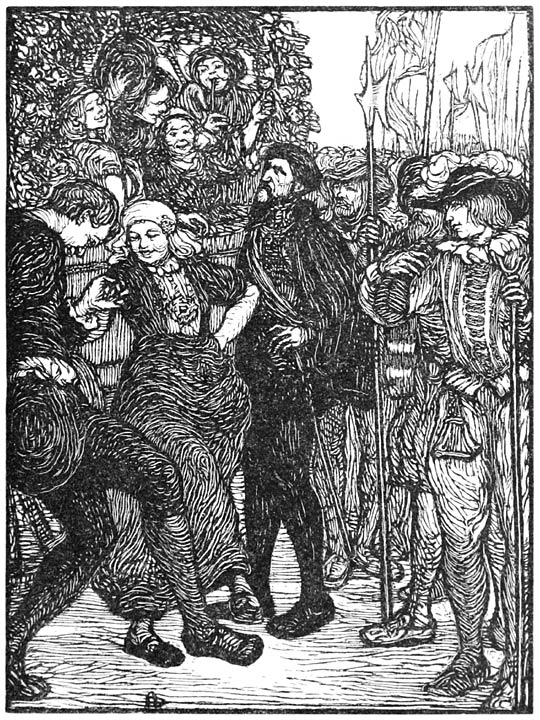
The Mock Marriage
When the procession had been brought to a halt, the Duke himself came up, attracted by the noise, and he saw the newly married bride where she stood in one of the four chariots; and beside her was Ulenspiegel, the bridegroom, covered with flowers; and all the other peasants, both men and women, who had by now got down from the chariots and were dancing all round them and offering drink to the soldiers.
The Duke and his friends were much astonished at the simplicity of these peasants who sang and made merry when all around them was an army ready to do battle.
And now they that remained in the chariots were giving all the wine to the soldiers, and they in their turn were fêted by them and made much of; till at last, when the wine began to run out, the peasants continued on their way again. The drums and fifes and bagpipes struck up once more and the cavalcade moved off without any let or hindrance. And the soldiers, in high good humour, let off a volley from their guns in honour of the festal occasion.
And thus they came to Maestricht, where Ulenspiegel took counsel with the agents of the Reformers as to the best way of sending ships loaded with arms and munitions to the assistance of the Prince’s fleet.
And from there they went to Landen and to other places, disguised as working men.
The Duke was not long in learning the trick that had been played on him, and there came into his hands a lampoon which was in circulation at the time, with this refrain:
Bloody Duke,
Silly Duke,
Hast thou seen the Bride?
And every time that the Duke made a mistake in his general-ship the soldiers would sing:
The Duke he can’t see clearly;
He has seen the Bride!
XXII
Now in those days the Duke divided his army into two parts, one of which he ordered to march towards the Duchy of Luxemburg and the other to the Marquisate of Namur.
“These tactics of the military are all one to me,” said Ulenspiegel to Lamme, “let us go on our way with confidence.”
They were walking along the banks of the Meuse, near the town of Maestricht, and Lamme saw that Ulenspiegel gazed attentively at all the boats that were sailing on the river. Suddenly he came to a stand before one of these boats upon whose prow was carved the figure of a mermaid. And the mermaid carried a shield and on it in gold upon a black ground were blazoned the letters J.H.S., being the monogram of Our Lord and Saviour Jesus Christ. Ulenspiegel signed to Lamme that he should stand still, and then he began to sing like a lark most joyously.
A man appeared on the boat and began to crow like a cock. At this Ulenspiegel set up a noise like a donkey’s bray, which the man immediately echoed with interest. And the two donkeys of Lamme and Ulenspiegel lay back their ears and joined in the chorus with their own natural voices. Sundry women and men were passing along that way, the latter riding on the backs of the horses which were tugging the barges along the tow-path. And Ulenspiegel said to Lamme:
“This boatman is making mock of us and our good steeds. What do you say to going and attacking him on his boat?”
“Let us rather entice him over to the bank,” replied Lamme.
But a woman who happened to be passing at the moment said:
“If you don’t want to come back with your arms cut off, your backs broken, and your noses in pieces, let me advise you to let this Stercke Pier bray at his ease.”
“Ee—aw! Ee—aw! Ee—aw!” went the boatman.
“Let him sing,” continued the woman. “Only the other day he showed us how he could lift on his shoulders a truck of heavy barrels of beer, and hold back yet another truck that was being dragged forwards by a strong horse. And at the inn there”—and as she spoke she pointed to the tavern of the Blauwe Torre—“it was there one day that he threw his knife at a plank of oak-wood twelve inches thick and pierced it at a distance of twenty paces!”
“Ee—aw! Ee—aw! Ee—aw!” went the boatman, and now he was joined by a youngster of twelve or so, who climbed on to the bridge of the boat, and began to bray in like manner.
But Ulenspiegel answered the woman:
“He’s nothing to us, your Peter the Strong! For however strong he is, we are stronger! See my friend Lamme here. He could eat up two men like that without so much as a hiccup!”
“What’s this you’re saying, my son?” demanded Lamme.
“The truth,” answered Ulenspiegel. “And do not let your modesty contradict me. For of a truth, good people, women and working men of Maestricht, I tell you that before long you shall see my friend here belabouring and beating to nothing this famous Stercke Pier of yours!”
“Be quiet,” said Lamme.
“Your strength is famous far and wide,” answered Ulenspiegel. “You cannot conceal it.”
“Ee—aw!” went the boatman. “Ee—aw!” went the boy.
Suddenly Ulenspiegel began again to sing like a lark very melodiously, and the men and women and workmen standing by were enchanted, and began to ask him where he had learnt the art of whistling so divinely.
“In Paradise,” answered Ulenspiegel, “whence I come.” Then he addressed himself to the boatman, who was still continuing his braying and mocking:
“Why do you stay there on your boat, you good-for-nothing? Haven’t you the courage to come and jeer at us and our steeds from the dry land?”
“Haven’t you the courage for that?” said Lamme.
“Ee—aw! Ee—aw!” went the boatman. “Come, my good bray-masters, come up rather into my boat.”
Then Ulenspiegel whispered to Lamme to do exactly as he did. But to the boatman he said aloud:
“If you are Stercke Pier, I am Tyl Ulenspiegel. And these two here are our donkeys, Jef and Jan, and they know how to bray better than you do, for that is their natural way of talking. As for coming on to your leaky decks, it is the last thing we wish to do. Your boat is like a tub, and each time that a wave comes along it shivers, and it knows no other way of walking save sideways-on like a crab.”
“Yes, like a crab!” said Lamme.
To which the boatman made answer:
“What are you croaking there between your teeth, great block of fat?
At this Lamme fell into a rage, crying:
“You are no Christian to make mock of my infirmity. My fat is my own, let me tell you, and is the result of the good food I eat, whereas you, old bag of bones that you are, you have never lived upon aught better than smoked herrings and old candle-wicks if one may judge anything from the lean flesh that shows through the tears in your measly hose.”
“Ee—aw! Ee—aw!” cried the boatman, and Lamme would have got down from his donkey to collect stones to throw at him had not Ulenspiegel said him nay.
The boatman now began to whisper something into the ear of the lad who was still “ee—awing” at his side, and a moment later the lad unfastened a little boat which lay by the side of the big one, and with the end of the boat-hook shoved himself cleverly off towards the river-bank. When the boy was quite close to the bank he drew himself up proudly and threw down this challenge:
“My master wants to know if you will have the courage to come on to his boat and join with him in a battle of fist and feet. And these good men and women shall be the arbiters.”
“Certainly,” said Ulenspiegel in a dignified tone of voice.
“We accept the challenge,” said Lamme haughtily.
It was midday. The workmen who laboured on the dike and the road-menders and the builders of ships were about to take their repast of beans and boiled beef which had been brought them by their women-folk or their children. All these, then, who stood around began to laugh and to clap their hands at the prospect of a fight, looking forward with joy to the chance of seeing the head of one of the combatants broken, or his body thrown in pieces into the river.
“My son,” said Lamme under his breath, “the boatman will assuredly throw us into the water.”
“Let him throw you in if he wants to,” said Ulenspiegel.
“The big one is afraid,” said the crowd of workmen.
Lamme, who was still sitting his donkey, turned round and gave them a look of anger, but they jeered at him the more.
“Come on,” said Lamme. “Let us to the boat, and then they shall see if I am afraid.”
At these words the jeers broke out again, and Ulenspiegel said:
“Come, let us to the boat!”
When, therefore, they had dismounted from their donkeys they threw the bridles to the boatman’s lad, who caressed the animals in friendly wise and led them to a place where he saw some thistles growing. At the same time Ulenspiegel seized hold of the boat-hook, made Lamme get into the skiff, and then steered straight for the big boat. There he mounted on to the deck by the help of a rope, and Lamme climbed up in front of him, puffing and blowing.
Arrived on the bridge of the boat, Ulenspiegel leant down as if to lace up his boots, and at the same time he spoke a word into the boatman’s ear, who straightway laughed and gave Lamme a curious look. Then he began to roar out at him every kind of insult, calling him worthless rogue, a man bloated with vicious fat, prison-bred, pap-eter, and at the same time inquiring of him how many tons of oil they gave him when he was bled.
All of a sudden, without waiting to reply, Lamme threw himself like a mad bull upon the boatman, knocked him down, and began to beat him with all his might. The boatman, however, did not receive much injury, forasmuch as Lamme’s arms were but weak on account of their fatness. And the boatman suffered himself to be thus dealt with despite the fact that he was making a great pretence at resistance all the time. And the men and women who were watching the battle from the bank were astonished, and exclaimed to each other: “Who would have thought that this fat man could be so fiery!”
And they clapped their hands while Lamme continued to belabour the boatman most unmercifully. But the latter took care only to protect his face. Suddenly Lamme was seen to be kneeling upon the breast of Stercke Pier, with one hand on his adversary’s throat, and the other raised to strike.
“Cry for mercy,” he said furiously, “or else I shall make you pass through the planks of your tub.”
At this the boatman began to cough, thereby signifying that he could not speak, and demanded mercy with a sign of his hand.
Then Lamme was seen to pick up his adversary in a most generous manner, who thereupon, standing upright and turning his back towards the onlookers, put out his tongue at Ulenspiegel. Now the latter was rocking with laughter to see Lamme shaking the feather on his cap so proudly and walking about in triumph upon the deck of the boat.
And the men and women, boys and girls, who were watching from the bank applauded their loudest and cried out: “Long live the conqueror of Stercke Pier! He is a man of iron! Did you see how he cuffed him with his fist, and how he threw him down on his back with a blow of his hand? But see, they are now about to drink together to make the peace! Stercke Pier is coming up from the hold with wine and sausages!” And in very truth, Stercke Pier might now have been seen coming on deck with two tankards and a quart of white Meuse wine. And Lamme and the boatman made their peace. After which Lamme asked his new friend what sort of fricassees they were that were being cooked in the hold of the ship; for at one end of the deck was a chimney whence rose a column of thick black smoke. And the boatman made answer:
“Since you are men of valiant heart, knowing well the song of the lark, the bird of freedom, and the warlike clarion of the cock, and the bray of the ass withal, come you with me and I will show you my kitchen.”
And so saying he led the way into the hold, where, removing certain planks from the floor, he disclosed some mighty piles of gun-barrels, together with a quantity of iron lances, halberds, sword-blades, and a great heap of powder and shot.
“Where shall I take them?” he asked.
“To Emden, through the North Sea,” said Ulenspiegel, “good Beggarman that you are!”
“The sea is big,” said the boatman.
“Big for battle,” said Ulenspiegel.
“God is with us,” said the boatman.
“Who then can be against us?” cried Ulenspiegel.
And when they had thus spoken, the boatman conducted Lamme and Ulenspiegel on deck, with many words of cheer and good counsel. Then they rowed to the bank, where they mounted again upon their donkeys and set off towards Liége.
“My son,” said Lamme whilst they were ambling gently along, “pray tell me why did that man, strong as he was, allow himself to be beaten by me so cruelly?”
“To the end,” answered Ulenspiegel, “that wherever we go, the fear of your prowess may go before us. That indeed will prove a more powerful escort than twenty landsknechts. For who would dare to measure his strength with Lamme the mighty, Lamme the conqueror? Lamme the matchless bull among men, that overcame in the sight of all beholders the famous Stercke Pier—Peter the Strong—and threw him to the ground like a feather?”
“You say well, my son,” said Lamme, drawing himself up in the saddle.
“And I say what is true,” answered Ulenspiegel, “for did you not notice the faces that looked out so curiously from the houses on the outskirts of this village? They were pointing at the terrible figure of Lamme the Conqueror! And do you see these men who are gazing on you even now with such envy, and these sorry cowards who uncover as you pass? Answer to their salute, O Lamme, my sweet one, nor be disdainful of the populace. Behold, the very children know your name and whisper it with terror.”
And Lamme passed along proudly, saluting right and left like a king. And the fame of his valour followed him from village to village and from town to town, as far as Liége, Chocquier, La Neuville, Vesin, and Namur, to which place, however, our travellers gave a wide berth because of the three evangelists. And so they wended along by the banks of river and canal, and everywhere the song of the lark answered the song of the cock. And wherever they went they found that in the sacred cause of Liberty weapons were being forged and armour furbished for the ships that stood by along the coast to carry away.
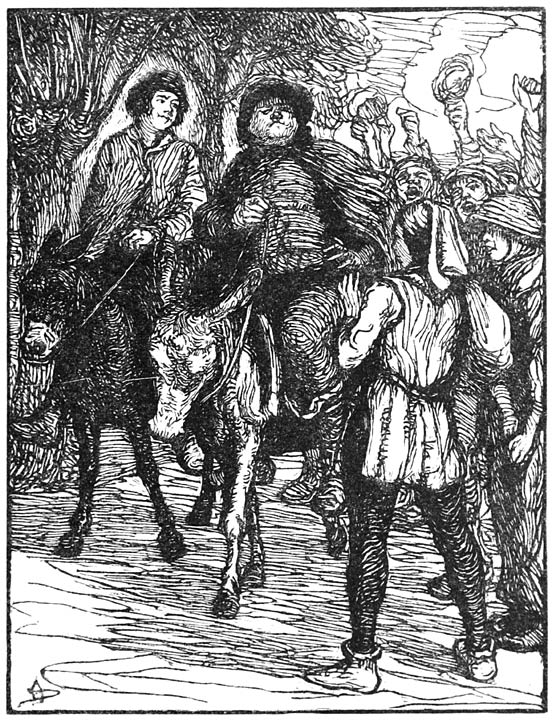
Lamme the Victor
And Lamme, preceded everywhere by his glorious reputation, began himself to believe in his own prowess, and growing proud and warlike he let his beard grow too. And Ulenspiegel called him Lamme the Lion. But Lamme did not continue in this purpose longer than the fourth day, because the hairs of his beard began to tickle him. And he passed a razor over the surface of his victorious countenance, so that it appeared thereafter like his own face once more, round and full as the sun, ablaze with the flame of good nourishment. And thus they came at length to Harlebeke.
XXIII
At Harlebeke Lamme renewed his provision of oliekoekjes, eating seven-and-twenty of them on the spot and putting thirty away into his basket. The same evening they came to Courtrai and dismounted from their donkeys at the tavern of the Bee that was kept by one Gilis Van den Ende, who himself came to the inn door as soon as he heard the singing of the lark.
At once the new arrivals found that everything was made like sugar and honey for them; for mine host, as soon as he had seen the letter from the Prince, presented Ulenspiegel with fifty caroluses on the Prince’s behalf, nor would he accept any payment at all for the turkey which he served for their dinner, nor yet for the dobbel clauwaert which he gave them to drink. He warned them also that there were many spies in Courtrai, and that it behoved both Ulenspiegel and his companion to keep a close watch on what they said during their stay in the city.
“We shall be careful,” said Ulenspiegel and Lamme. And so saying they came out of the tavern.
The gables of the houses were all gilded in the rays of the setting sun. The birds sang in the lime-trees, and Lamme and Ulenspiegel wandered at their ease along the streets of the town. All at once Lamme said:
“I asked Martin Van den Ende if by chance he had seen any one at all resembling my wife in Courtrai, and he told me that there were a number of women that were accustomed to meet together of an evening at the sign of the Rainbow, a house that is kept by a woman called La Stevenyne, just outside the town on the road to Bruges. I shall go there.”
“I will meet you anon,” said Ulenspiegel. “But now I would see the sights of the town. If I meet your wife I will send her on to you. Meanwhile remember what the innkeeper said, and keep your own counsel if you value your own skin.”
“I will be careful,” said Lamme.
Ulenspiegel walked about by himself till the sun set and night began to come on quickly. He had come to the Pierpot-Straetje—the Alley of the Pot of Stone—and there he heard the sound of a viola being played most melodiously, and presently he noticed a white figure that beckoned to him from a distance, then retreated, playing the viola all the time. It was a woman, and she sang like a seraphim, a sweet, slow song, stopping now and then to look behind her with a beckoning gesture, then retreating again. But Ulenspiegel ran quickly and overtook her, and was about to speak to her when she sealed his lips with a hand all scented with benjamin.
“Are you a working man or a nobleman?” she asked.
“I am Ulenspiegel.”
“Are you rich?”
“Rich enough for you.”
“But you have not seen me!” And she opened the lantern she carried so as to let the light shine straight upon her face.
“You are beautiful,” said Ulenspiegel.
“Then come with me,” she said.
And she brought him to the house of La Stevenyne, on the road to Bruges, at the sign of the Rainbow.
They entered a large room where a great number of girls were assembled, who all looked up jealously at Ulenspiegel’s companion as she came in. And suddenly Ulenspiegel saw Lamme, sitting there in a corner by a little table whereon was a candle, a ham, and a pot of beer. By his side were a couple of girls, who were endeavouring to get a share in the ham and the beer; but Lamme was trying to prevent them. As soon as he noticed Ulenspiegel he jumped up, crying:
“Blessed be God who has given back to me my friend! Bring more drink, baesine!”
At this Ulenspiegel drew out his purse, saying:
“Yes, bring us to drink to the value of what is in here!” and he jingled the money that was in the purse.
“No, by heaven!” cried Lamme, seizing the purse. “It’s I that shall pay, not you.”
Ulenspiegel would have recovered the purse by force, but Lamme kept tight hold. As they were struggling together, the one to keep the purse, the other to get it back again, Lamme whispered by fits and starts into Ulenspiegel’s ear:
“Listen. Constables. Here ... four of them ... in the little room with three girls. Two outside waiting for you and for me.... I tried to go out ... prevented.... The girl over there in the brocaded gown is a spy ... Stevenyne a spy!”
And all the time they were fighting Ulenspiegel listened attentively, though he kept on crying aloud:
“Give me back my purse, you rascal!”
And they seized each other by the neck and by the shoulders, and rolled together on the floor, while Lamme went on with his tidings to Ulenspiegel. Suddenly there appeared on the scene mine host of the tavern of the Bee; and he was followed by seven other men, with whom, however, he apparently had no connexion. As he came in he crowed like a cock and Ulenspiegel whistled like a lark. Then, seeing Ulenspiegel and Lamme still struggling on the floor, he inquired of La Stevenyne who they might be. “Two rascals,” she told him, “who ought to be parted from each other instead of being allowed to make all this disturbance ere they are brought to the gallows.”
“If any one tries to separate us,” said Ulenspiegel, “we will make him eat of these paving-stones.”
“Yes,” said Lamme, “we will make him eat these paving-stones!”
Then Ulenspiegel whispered something in Lamme’s ear. “The innkeeper is come to rescue us.” And presently the innkeeper, who must have divined some mystery was afoot, joined the mêlée on the floor with his head down, and Lamme attacked him in the ear with these words:
“You have come to rescue us? How will you do it?”
The innkeeper made pretence of pulling Ulenspiegel by the ears, but managed to say to him the while, under his breath:
“These seven men are on your side ... they are strong men ... butchers.... I must be off ... too well known in the town ... but when I have gone.... ’T is van te beven de klinkaert.... Break up everything....”
“I understand,” said Ulenspiegel, rising at the same time from the floor and kicking out at the innkeeper. The latter struck Ulenspiegel in his turn and Ulenspiegel said:
“You hit hard, my hearty!”
“As hard as a hail-storm,” said the innkeeper. And quickly seizing the purse from Lamme he handed it back to Ulenspiegel.
“You may stand me a drink, you rogue, now you are come into your right mind again.”
“I’ll stand you one, you scandalous scamp,” replied Ulenspiegel.
“See how insolent he is,” said La Stevenyne.
“As insolent as you are beautiful,” answered Ulenspiegel.
Now La Stevenyne was sixty years old at least, and her face was like the fruit of the medlar, but all yellow with bile, and she had a large port-wine stain on her left cheek.
When the innkeeper had had his drink, he paid the bill and departed. The seven butchers meanwhile made sundry knowing grimaces at the constables and La Stevenyne. One of them indicated by a gesture that he held Ulenspiegel for a simpleton, and that he would be able to do for him very easily. But all the time that he was putting out his tongue in mockery to La Stevenyne, who herself was grinning and laughing, he whispered in Ulenspiegel’s ear:
“’T is van te beven de klinkaert—it is time to rattle the glasses.” Then, in his ordinary tone of voice, and pointing at the constables:
“Gentle Reformer,” he said, “we are all on your side. Stand us some food and drink, won’t you?”
And La Stevenyne laughed with pleasure, and put out her tongue at Ulenspiegel when his back was turned. And La Gilline, she of the brocaded gown, she also put out her tongue at Ulenspiegel, and the girls all began to whisper one to another: “Behold the spy that by her beauty draweth men to the torture and bringeth them at last to a death more cruel even than torture. Above seven-and-twenty Protestants hath she betrayed already. Gilline is her name, and now she is in a rapture of joy as she thinks of the reward she will get for her information—the first hundred caroluses, to wit, from the estate of each of her victims. But she will not laugh when she bethinketh her that she must share one-half of the spoil with La Stevenyne!”
And every one there present—the constables, the butchers, and the girls themselves—put out their tongues in mockery of Ulenspiegel. And Lamme sweated great drops of sweat, and became red with anger like the crest of a cock. But he would not let himself say a word.
“Come, stand us food and drink,” said the butchers and the constables.
“Very well,” said Ulenspiegel, jingling yet again the money in his purse. “Bring us meat and drink, my sweet Stevenyne; bring us drink in glasses that can sing!”
At this the girls began to laugh anew; but La Stevenyne went down to the cellar and brought back with her ham, sausages, black-pudding omelettes, and some of those singing glasses, that are so called because they are mounted on tall stems and can be made to resound like a bell when some one strikes them. Then Ulenspiegel said:
“Let him who is hungry eat, and he who is thirsty let him drink!” And the constables, the girls, the butchers, Gilline, and La Stevenyne applauded these words of Ulenspiegel, clapping their hands and stamping their feet; and then they all sat down to the feast. Ulenspiegel, Lamme, and the seven butchers sat at the big table of honour, the constables and the girls at two smaller tables; and they ate and drank right heartily. And the constables invited their two comrades, who had been waiting outside the house, to come in and join them.
La Stevenyne said with a snigger:
“Remember, no one can leave till he has paid me.”
And she went and locked all the doors, and put the keys in her pocket.
At this La Gilline raised her glass.
“The bird is in its cage,” she cried. “Let us drink.”
But two of the girls, whose names were Gena and Margot, said to her:
“Is this yet another man that you are going to lure to his death, you wicked one?”
“I know not,” said Gilline; “let us drink.”
But the girls would not drink with her.
And Gilline took her viola and sang in French this song:
Au son de la viole,
Je chante nuit et jour;
Je suis la fille-folle,
La vendeuse d’amour.
Astarté de mes hanches
Fit les lignes de feu;
J’ai les épaules blanches,
Et mon beau corps est Dieu.
Je suis froide ou brûlante,
Tendre au doux nonchaloir:
Tiède, éperdue, ardente,
Mon homme, à ton vouloir.
Vois, je vends tout: mes charmes,
Mon âme et mes yeux bleus;
Bonheur, rires et larmes,
Et la Mort si tu veux.
Au son de la viole,
Je chante nuit et jour;
Je suis la fille-folle,
La vendeuse d’amour.
As she sang this song La Gilline looked so beautiful, so soft and fragrant, that all the men, the constables and the butchers, Lamme and Ulenspiegel himself, sat smiling there, quite melted and overcome by her charm.
All at once La Gilline gave a loud laugh and fixed her gaze on Ulenspiegel:
“And it’s thus that the birds are caged,” she said. And the spell of her charm was broken.
Ulenspiegel, Lamme, and the butchers looked at one another.
“Well now,” said La Stevenyne, “are you going to pay the bill, my Lord Ulenspiegel?”
“We shall pay nothing in advance,” said he.
“Then I shall pay myself later on—out of your inheritance,” said La Stevenyne. After that:
“Let us drink!” she cried.
“Let us drink!” cried the constables.
“Let us drink!” cried La Stevenyne. “The doors are shut; the windows are strongly barred; the birds are in their cage. Let us drink!”
“Let us drink then,” said Ulenspiegel. “And bring us wine of the best to crown the banquet.”
La Stevenyne brought in more wine. And now they were all seated, drinking and eating, the constables and the girls together. But the seven butchers were at the same table with Ulenspiegel and Lamme, and they kept on throwing pieces of ham, and sausages, omelettes, and bottles of wine to the table of the girls, who themselves caught the food in mid-flight as carp catch the flies that buzz on the surface of a fishpond. And La Stevenyne laughed and grinned, and pointed to the packets of candles which hung over the counter. And these were the candles that the gay girls were used to purchase, five to the pound. Then La Stevenyne said to Ulenspiegel:
“On his way to the stake it is the custom for the condemned man to carry a wax candle. Shall I make you a present of one?”
“Let us drink!” said Ulenspiegel.
But La Gilline said: “Look at Ulenspiegel’s eyes. They are shining like the eyes of a swan that is about to die.”
“Wouldn’t you like to eat one of the candles?” said La Stevenyne. “They would serve you in hell to lighten your eternal damnation.”
“I see clearly enough to admire your ugly mug,” said Ulenspiegel.
Suddenly he struck the stem of his wine-glass and clapped his hands together with a rhythm like that an upholsterer uses when he beats the wool of a mattress with his stick.
“’T is van te beven de klinkaert,” he said; “it is time to make the glasses shiver—the glasses which resound....”
And this, in Flanders, is the signal that the drinkers make when they are angry, and when they are like to ransack and despoil in their wrath the houses of ill fame. So even now did Ulenspiegel raise his glass and drink, and then did he made it vibrate upon the table, crying yet again:
“’T is van te beven de klinkaert.”
And the seven butchers did likewise.
Then a great stillness fell upon the company. La Gilline grew pale; La Stevenyne looked astonished. The constables said:
“Are the seven with them too?” But the butchers winked their eyes and reassured them; yet all the time they continued without ceasing, and louder and louder as Ulenspiegel led them:
“’T is van te beven de klinkaert. ’T is van te beven de klinkaert.”
La Stevenyne took another draught of wine to give herself courage.
Then Ulenspiegel struck his fist on the table in that regular rhythm which the upholsterers use as they beat their mattresses; and the seven did likewise; and the glasses, jugs, trenchers, flagons, and goblets began to dance upon the table, slowly at first, but beginning soon to knock against each other, and to break and to heel over on one side as they fell. And all the time echoed and re-echoed, more sternly menacing, with every monotonous repetition:
“’T is van te beven de klinkaert.”
“Alas!” said La Stevenyne, “they will break everything.” And her teeth seemed to show farther out from her lips than ever. And the hot blood of their fury and of their anger began to flame in the souls of the seven butchers, and in the souls of Lamme and Ulenspiegel. Till at last, without ceasing once their melancholy and monotonous chant, all they that were sitting at Ulenspiegel’s table took their glasses, and brake them upon the table, and at the same moment they drew their cutlasses and leapt upon the chairs. And they made such a din with their song that all the windows in the house shook. Then like a band of infuriated devils they went round the room, visiting each table in turn, crying without ceasing:
“’T is van te beven de klinkaert.”
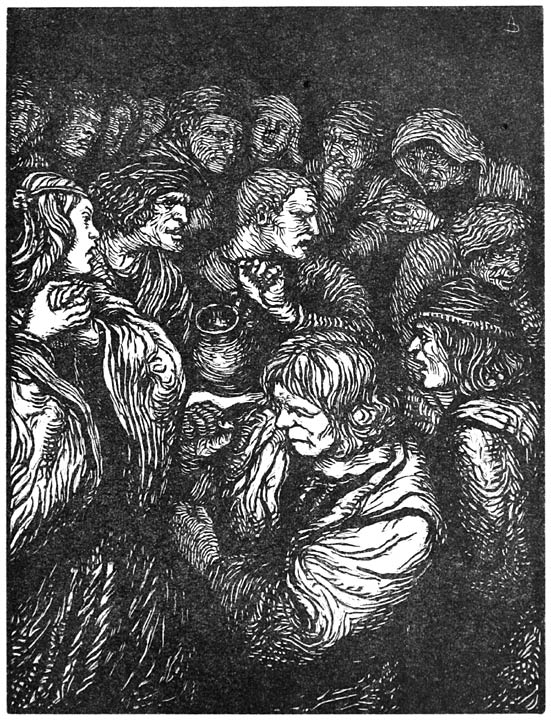
“’Tis van te beven de klinkaert”
And the constables rose up trembling with terror and seized their ropes and chains. But the butchers, together with Lamme and Ulenspiegel, thrust their knives quickly back into their cases, and sprang up to run nimbly through the chamber, hitting out right and left with their chairs as though they had been cudgels. And they spared nothing there except the girls, for everything else they brake in pieces—furniture, windows, chests, plates, pots, trenchers, glasses, and flagons, hitting out at the constables without mercy, and crying out all the time in the rhythm of the mattress-beaters: “’T is van te beven de klinkaert. ’T is van te beven de klinkaert.” And Ulenspiegel, who had given La Stevenyne a blow on the nose with his fist, and had taken all her keys and put them into his satchel, was now amusing himself by forcing her to eat those candles of hers. And the girls laughed at the sight of her as she sneezed with anger and tried to spit out the candles—but in vain, for her mouth was too full. And all the time Ulenspiegel and the seven butchers did not cease the rhythm of their dire refrain: “’T is van te beven de klinkaert.” But at last Ulenspiegel made a sign, and when silence had at last been restored he spake, saying:
“You are here, my friends, in our power. It is a dark night and the River Lys is close at hand, where a man drowns easily if he is once pushed in. And the gates of Courtrai are shut.” Then turning to the seven butchers:
“You are bound for Peteghen, to join the Beggarmen?”
“We were ready to go there when the news came to us that you were here.”
“And from Peteghen you were going to the sea?”
“Yes,” they said.
“Do you think there are one or two among these constables whom it would be safe to release for our service?”
“There are two,” they said, “Niklaes and Joos by name, who have never as yet been guilty of persecuting the poor Reformers.”
“You can trust us!” said Niklaes and Joos.
“Very well then,” said Ulenspiegel. “Here are twenty caroluses for you, twice as much, that is, as you would have got for an act of shameful betrayal.” And at that the other five constables cried out as one man:
“Twenty florins! We will serve the Prince for twenty florins. The King’s pay is bad. Only give us half as much and we will tell the judge any tale you please.” But Lamme and the butchers kept muttering under their breath:
“’T is van te beven de klinkaert. ’T is van te beven de klinkaert.”
“In order that you may be kept from too much talking,” Ulenspiegel continued, “the seven will lead you in handcuffs to Peteghen, and there you will be given over into the hands of the Beggarmen. The florins will be handed to you at sea, and if you prove brave in battle you will have your share of the spoil. If you attempt to desert you will be hanged.”
“We will serve him who pays us,” they said.
“’T is van te beven de klinkaert! ’T is van te beven de klinkaert,” murmured the seven.
“You will also take with you,” said Ulenspiegel, “La Gilline, La Stevenyne and the girls. If any one of them tries to escape you will sew her in a sack and throw her into the river.”
“He has not killed me yet!” cried La Gilline, jumping up from her corner and brandishing her viola in the air. And she began to sing:
Sanglant était mon rêve.
Le rêve de mon cœur.
Je suis la fille d’Eve
Et de Satan vainqueur.
But La Stevenyne and the others seemed as if they were going to cry.
“Do not be afraid, my sweets,” said Ulenspiegel. “You are so pretty and so tender that all men will love to caress you wherever you go, and after every victory you will have your share in the spoils.” But the three girls turned upon La Gilline:
“You that were her daughter, her breadwinner, sharing with La Stevenyne the shameful rewards of her espionage, do you still dare to flaunt yourself before us and to insult us with your dress of brocade? Verily it is the blood of the victims and nothing else that has clothed you so richly. But now let us take her dress from her, so she may be like to us.”
“That shall not be,” said Ulenspiegel.
And the girls looked jealously at Ulenspiegel, saying:
“He is mad about her, like all the rest.”
And La Gilline played upon her viola and sang, and the seven butchers departed for Peteghen, taking with them the constables and the girls. And they passed along by the River Lys. And as they went they kept muttering:
“’T is van te beven de klinkaert! ’T is van te beven de klinkaert!” And at break of day they came to the camp, and sang out like the lark and were answered straightway by a cockcrow. The girls and the constables were put under a strong guard, but in spite of these precautions La Gilline was found dead at noon on the third day, her heart pierced by a long needle. The three girls accused La Stevenyne of having done this deed, and she was brought before the captain. There she confessed that she had committed the crime out of jealousy and anger at the way the girl had treated her. And La Stevenyne was hanged and buried in the wood.
La Gilline also was buried, and prayers were said over her sweet body.
XXIV
Warm was the air, and not a breath of wind was wafted from the calm sea. The trees on the Damme canal were motionless, and the grasshoppers were busy in the meadows, while from many a church and abbey the men came into the fields to fetch that “thirteenth part of the harvest” which was claimed by the curés and the abbés who lived round about. From the depths of a blue and blazing sky the sun poured down his heat, and Nature slept beneath that radiance like some beautiful girl that has swooned away beneath the caresses of her lover.
From far off, Lamme and Ulenspiegel descried the high, square, massive tower of Notre Dame, and Lamme said:
“There, my son, is the home both of your loves and of your sorrows.” But Ulenspiegel made no answer.
“In a little while,” continued Lamme, “I shall be seeing my old home, and perhaps my wife!” But Ulenspiegel did not answer.
“You man of wood,” said Lamme, “you heart of stone, will nothing move you—neither the near approach to the place where you passed your childhood, nor yet the dear memory of poor Claes and Soetkin, the two martyrs? What! You are not sad, neither are you merry; who can it be that has thus hardened your heart? Look at me, how anxious and uneasy I am, and how my belly heaves with nervousness; look at me I say!”
But Lamme looked at Ulenspiegel and saw that his face was drawn and pale, and his lips were trembling with tears, and he said not a word. And now Lamme also held his peace.
They walked along in this way without speaking till they came to Damme, which they entered by the rue Héron; and they saw no one about because of the heat. Only the dogs lay on their sides on the doorsteps of many a house, gasping, with their tongues out, while Lamme and Ulenspiegel passed right in front of the Town Hall where Claes had been burnt to death; and here the lips of Ulenspiegel trembled the more, and his tears dried up. And at last they were come to the house of Claes himself, which was now occupied by a master charcoal-burner. Ulenspiegel entered in and said:
“Do you recognize me? I would wish to rest here a while.”
The master charcoal-burner answered:
“I recognize you. You are the son of the victim. You are free in this house to go wheresoever you will.”
Ulenspiegel went into the kitchen, and then upstairs into the room of Claes and Soetkin, and there he shed many tears.
When he had come down again, the master charcoal-burner said to him: “Here is bread, cheese, and beer. If you are hungry, eat. If you are thirsty, drink.”
But Ulenspiegel made a gesture to the effect that he was neither hungry nor thirsty, and he left the house and came with Lamme to Katheline’s cottage, and there they tethered their donkeys and straightway entered in. It was the hour of the midday meal. On the table was a dish of broad beans in their pods together with some white beans. Katheline was busy eating, while Nele was standing by her ready to pour into Katheline’s plate some vinegar sauce which she had just taken off the fire. When Ulenspiegel came into the room Nele was so startled that she put the sauce, and the pot and all, into Katheline’s platter. And Katheline kept on wagging her head, and picking out the broad beans with her spoon from the trencher, striking her forehead the while and crying ever like one mad:
“Put out the fire! My head is burning!”
And the smell of the vinegar made Lamme feel hungry. But Ulenspiegel stood still where he was, gazing at Nele and smiling for love of her despite his great sorrow.
And Nele, without a word of greeting, flung her arms round his neck. And she also seemed like one bereft of sense. For she cried and laughed, and blushing as she was with her great and sweet happiness, she could only say: “Tyl! Tyl!”
Ulenspiegel, happy now in his turn, gazed into her eyes. Then she let go of him and stepped back a pace or two, gazed at him joyfully in her turn, and then threw herself on him again, clasping her arms round his neck, and so many times and again. And he suffered her gladly, powerless to tear himself away from her, till at last she fell into a chair, tired out and like one bereft of her senses, and she said without shame:
“Tyl! Tyl, my beloved! Here you are come back to me again!”
Lamme meanwhile was standing at the door; but when Nele had recovered herself a little, she pointed to him, saying:
“Where have I seen this fat man?”
“He is my friend,” Ulenspiegel told her. “He goes seeking his wife in my company.”
“I know you,” said Nele to Lamme. “You used to live in the rue Héron. You are seeking for your wife? Well, I have seen her. She is living at Bruges in all piety and devotion, and when I asked her why she had left her husband so unkindly, she answered that it was by the Holy Will of God and at the command of Holy Penance, and that she could never live with her husband again.”
At these words Lamme was sad, but his eyes wandered to the beans and vinegar. And outside the larks sang as they flew upwards into the sky, and all Nature swooned away under the caress of her Lord the Sun. And Katheline kept stirring with her spoon that pot of beans and sauce.
XXV
Now, in those days a damsel some fifteen years of age was going from Heyst to Knokke, alone in the middle of the day, by the sand-dunes. No one had any fear for her for they knew that the wolves and wicked spirits of the damned go biting their victims only in the night. The damsel carried a satchel wherein were forty-eight gold coins of the value of four florins carolus, being the sum owed by the girl’s mother, Toria Pieterson, who lived at Heyst, to her uncle, Jan Rapen of Knokke, on account of a sale. The girl’s name was Betkin, and she was wearing her best clothes, and she went on her way most happily.
The same evening, seeing that she did not return, her mother became anxious, but reassured herself with the thought that the girl must have stayed the night with her uncle.
On the morrow, certain fishermen on their way back from the sea with a boat-load of fish, drew their boat on to the beach and unloaded their catch, which they would sell at auction by the cart-load at the Minque of Heyst. They went up the road along the dunes, all strewn with shells, and presently came upon a young girl, stripped naked even to her chemise, with traces of blood all about her. Coming nearer they found upon her neck the horrid marks of long sharp teeth. She was lying on her back with her eyes wide open gazing up into the sky, and her mouth was open also as if with the cry of death itself!
Covering the girl’s body with an opperst-kleed they brought it to Heyst, to the Town Hall, and there quickly assembled the aldermen and the leech, who declared that the long teeth that had made those marks were no teeth of a wolf as known in nature, but rather of some wicked and devilish werwolf, and that it behoved them now to pray God one and all that he would deliver the land of Flanders.
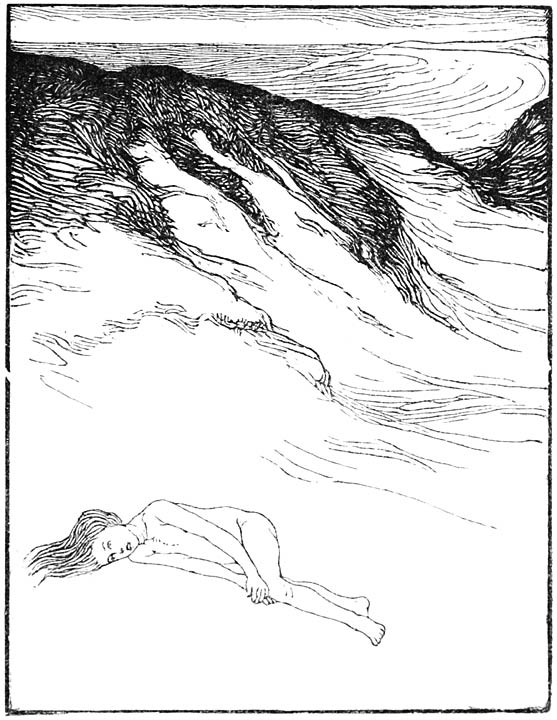
The Death of Betkin
And in all that country, and notably at Damme, at Heyst, and at Knokke, prayers and orisons were ordered to be made.
But Ulenspiegel went to the town bailiff and said to him: “I will go and kill the werwolf.”
“What gives you this confidence?” asked the bailiff.
“The ashes beat upon my heart,” Ulenspiegel replied. “Only give me leave to labour a while at the forge of the commune.”
“Very well,” said the bailiff.
Ulenspiegel, without telling a word concerning his project to any man or woman in Damme, betook him to the forge, and there, in secret, he fashioned a fine and a strong trap such as those traps which are made to catch wild beasts.
On the following day, which was a Saturday, day beloved of werwolves, Ulenspiegel armed himself with a letter from the bailiff to the curé of Heyst, together with the trap which he carried under his cloak, as well as a good crossbow and a well-sharpened cutlass. Thus provided, he departed on his way, saying to those in Damme:
“I am going out to hunt the seagulls, and of their down will I make a soft pillow for madame the wife of the bailiff.”
Now before he reached Heyst, he came out on to the seashore. The sea was rough and boisterous, and he heard the great waves growling like thunder, and the wind that blew from England whistling in the rigging of the boats that were stranded on the beach. A fisherman said to him:
“This bad wind will be our ruin. Last night the sea was calm, but at sunrise she suddenly swelled with anger. And to-day we shall not be able to go out fishing.” Ulenspiegel was pleased at this, for he knew that now he would be sure of some assistance if need arose. At Heyst he went straight to the curé and presented the letter that the bailiff had given him. The curé said:
“You are a brave man, but let me tell you that no one goes along the dunes on Saturday nights without being bitten by the werwolf and left dead on the sands. Even the men who are at work on the dikes never go there except in a party. The evening is coming on. Do you not hear the werwolf howling in his valley? Perchance he will come again into the cemetery, even as he came last night, howling most horribly through all the hours of darkness! God be with you, my son. But go not there.” And the curé crossed himself.
“The ashes beat upon my heart,” answered Ulenspiegel.
The curé said:
“Because you have so brave a spirit I will help you.”
“Monsieur le Curé,” said Ulenspiegel, “you will be doing a great kindness, as well to me as to this poor desolated land of ours, if you will go to Toria, the dead girl’s mother, and to her two brothers also, and tell them that the wolf is near at hand, and that I am going out to wait for it and kill it.”
The curé said:
“If you want to know where you should lie in wait, let me advise you to keep along by the path which leads to the cemetery. It runs between two hedges of broom. It is so narrow two men could scarcely walk abreast.”
“I understand,” said Ulenspiegel. “And you, brave curé, will you tell the girl’s mother and her husband and her brothers to come themselves and wait together in the church about the hour of the curfew. There, if they hear a cry like the cry of a seagull, it will mean that I have seen the werwolf. Then they must sound the wacharm on the bell, and come fast to my assistance. And if there are any other brave men....”
“There are none, my son,” replied the curé. “The fishermen are less afraid of the plague and of death itself than of the werwolf. Do not go, I beseech you.”
Ulenspiegel answered:
“The ashes beat upon my heart.”
And the curé said to him:
“I will do as you bid. God bless you. Are you hungry or thirsty?”
“Both,” answered Ulenspiegel.
The curé gave him some beer, some bread, and some cheese, and Ulenspiegel when he had eaten and drunk went his way.
And as he walked along he raised his eyes and beheld Claes, his father, seated in glory at the side of God in heaven where the moon shone so brightly. And thereafter he gazed upon the sea and upon the clouds, and he heard the wind that came blowing stormily from England.
“Alas!” he cried, “O Dusky Clouds that pass along so rapidly yonder in the sky, be you now for a vengeance on the murderer. And you, O Wind that whistles so sadly in the gorse along the dunes and in the rigging of the ships, be you now the voice of the victims that cry to God that he should help me on in this enterprise.”
And so saying he came down into the valley, stumbling as if he had been a drunken man; and he began to sing, hiccuping all the time, staggering from side to side, yawning, spitting, and then standing still and pretending to be sick. But all the time he was keeping his eyes wide open, and peering this way and that, for he had heard the sharp sound as of a wolf howling. Then, as he stood there vomiting like a dog, he descried the long outline of a wolf moving towards the cemetery in the bright light of the moon.
At that he lurched on again, and came into the path between the hedges of broom. There he pretended to fall down, and as he did so, he placed his trap upon the side from which the wolf was coming. Then he loaded his crossbow, and went forward about ten paces, standing up again in a drunken posture. He still went on staggering to right and to left, nor did he cease to retch and to hiccup, but all the time his mind was taut as a bowstring, and he was all eyes and ears for what might be going to happen. Yet he saw nothing save the dark clouds racing in the sky, and again that large and heavy form of blackness coming down the path towards him. Neither did he hear aught but the dismal wailing of the wind, and the angry thunder of the sea, and the sound that the shells on the path gave forth beneath a heavy step that tapped upon them. Feigning to be about to sit down, Ulenspiegel fell forwards on to the path, very heavily like a drunken man. After that he heard as it were a piece of iron clinking close to his ear, and then the sound of the trap shutting, and a human voice that cried out in the darkness.
“The werwolf,” said Ulenspiegel to himself. “He’s got his front paws caught in the trap. Now he is howling and trying to run away, dragging the trap with him. But he shall not escape.” And he drew his crossbow and shot an arrow at the legs of the werwolf.
“He’s wounded now,” said Ulenspiegel, “and he has fallen down.”
Thereupon he whistled like a seagull, and straightway the church bell clanged out from the village and a boy’s shrill voice was heard crying from afar off:
“Awake! Awake, you sleepers! The werwolf is caught.”
“Praise be to God,” said Ulenspiegel.
Now the first to arrive on the scene of the capture were Toria the mother of Betkin, and Lansaen her husband, and her two brothers Josse and Michael. And they brought lanterns with them.
“You have caught him?” they asked.
“Look on the path,” answered Ulenspiegel.
“Praise be to God,” they exclaimed, crossing themselves.
“Who is it that is calling out the news in the village?” asked Ulenspiegel.
“It is my eldest boy,” Lansaen answered. “The youngster is running through the village knocking on all the doors and crying out that the wolf is caught. Praise be to thee!”
“The ashes beat upon my heart,” answered Ulenspiegel.
Suddenly the werwolf began to speak:
“Have mercy on me! Have mercy, Ulenspiegel!”
“This wolf can talk!” they exclaimed, crossing themselves again. “He is a devil in very truth, and knows Ulenspiegel’s name already!”
“Have mercy! Have mercy!” the voice cried again. “I am no wolf. Order the bell to stop ringing. For thus it is that it tolls for the dead. And my wrists are torn by the trap. I am old and I am bleeding. Have mercy! And what is this—this shrill voice of a child awakening all the village? Oh pray, have mercy!”
“I have heard your voice before,” said Ulenspiegel passionately. “You are the fishmonger. The murderer of Claes, the vampire that preys upon poor maids! Have no fear, good mother and father. This is none other than the Dean of the Fishmongers on whose account poor Soetkin died of grief.” And with one hand he held the man fast by the neck, and with the other he drew out his cutlass.
But Toria the mother of Betkin prevented him.
“Take him alive,” cried she. “Take him alive. Let him pay!”
Meanwhile there were many fisherfolk, men and women of Heyst, who were come out at the news that the werwolf was taken and that he was no devil but a man. Some of these carried lanterns and flaming torches, and all of them cried aloud when they saw him:
“Thief! Murderer! Where hide you the gold that you have stolen from your poor victims?”
“He shall repay it all,” said Toria. And she would have beaten him in her rage had she not fallen down there and then upon the sand in a mad fury like unto one dead. And they left her there until she came to herself.
And Ulenspiegel, sad at heart, beheld the clouds racing like mad things in the sky, and out at sea the white crests of the waves, and on the ground at his feet the white face of the fishmonger that looked up at him in the light of the lantern with cruel eyes. And the ashes beat upon his heart.