HERE BEGINS THE FIRST BOOK OF THE LEGEND OF THE GLORIOUS JOYOUS AND HEROIC ADVENTURES OF TYL ULENSPIEGEL AND LAMME GOEDZAK IN THE LAND OF FLANDERS AND ELSEWHERE (continued 3)
Geoffrey Arundel Whitworth translation
XXXVII
When Nele and Soetkin returned from Bruges, they found Claes in the kitchen, sitting on the floor like a tailor, sewing buttons on an old pair of breeches. Titus Bibulus Schnouffius barked his welcome; Claes smiled, and Nele smiled in answer. But Soetkin did not take her eyes from the road, gazing continually in hopes to see her beloved Ulenspiegel.
All of a sudden she broke silence. “Look,” she cried, “here is the Provost-Marshal. He is coming along the road with four sergeants of the peace. They cannot be wanting any one from here, surely! And yet there are two of them turning off by the cottage!”
Claes looked up from his work.
“And the other two have stopped at the front,” Soetkin said.
Then Claes got up.
“Who can they want to arrest in this road?” his wife continued, and then: “O Christ! They are coming in here.”
“Look to the money!” cried Claes. “The caroluses are hidden away behind the fireplace.” And with these words he ran out of the kitchen into the garden. Nele understood what he meant, and saw that he was going to try and make his escape over the hedge. But the sergeants seized him by the collar, and now he was hitting out at them in a hopeless endeavour to break free.
“He is innocent!” Nele cried aloud amid her tears. “He is innocent! Do not hurt him. It is Claes, my father! O Ulenspiegel, where are you? Where are you? If you were only here you would kill them both!”
And she threw herself on one of the sergeants and tore at his face with her nails. Then she cried out again: “They will kill him!” and fell down upon the grass in the garden, and rolled there in her despair.
Katheline, hearing the noise, had come out from her cottage, and stood up straight and immovable, gazing at the piteous scene. Then she spoke, wagging her head:
“Fire! Fire! Make a hole! My soul wants to get out!”
Soetkin meanwhile, who had seen nothing of all this, was talking to the sergeants who had entered the cottage.
“Kind sirs,” she began, “what is it that you are looking for in our poor dwelling? If it is my son you want, he is far away. Do you feel equal to a long journey?”
And she felt quite pleased at the way she was handling the matter. But it was at this very moment that Nele began to cry aloud for help, and when Soetkin had made her way into the garden, it was to see her husband seized by the collar and fighting on the pathway near the hedge.
“Hit hard and kill them!” she cried, and then: “O Ulenspiegel, where are you?”
And she was about to go to the assistance of her man when one of the sergeants caught hold of her, not indeed without some danger to himself. And Claes was fighting and hitting out so forcibly that he would certainly have escaped had not the two sergeants with whom Soetkin had been talking come out to aid their fellows in the nick of time. So at last they were able to tie the hands of Claes together, and to carry him back to the kitchen, whither Nele and Soetkin had already come, crying and sobbing.
“Sir Provost,” Soetkin said, “what crime has he committed that you are binding my poor husband thus with cords?”
“He is a heretic,” said one of the sergeants.
“Heretic!” cried Soetkin, looking towards her husband. “You a heretic! These devils are lying!”
Claes answered:
“I resign myself into God’s keeping.”
And they took him away. Nele and Soetkin followed behind, in tears, believing that they also would be summoned before the judge. They were joined by many of their friends and neighbours, but when these heard that it was on a charge of heresy that Claes was walking thus in chains, fear came upon them and they returned incontinently to their houses, closing their doors behind them. Only a few young girls had the courage to approach Claes and say to him:
“Whither are you going to, Charcoal-burner, in these bonds!”
“I go unto the grace of God, my girls,” he answered them.
So they took him away to the town gaol, and Nele and Soetkin sat themselves down upon the threshold. And towards evening Soetkin besought Nele to leave her and to go and see if Ulenspiegel had perchance returned.
XXXVIII
The news spread quickly through the neighbourhood that a man had been taken prisoner on a charge of heresy, and that the inquisitor Titelman, Dean of Renaix, surnamed the Inquisitor without Pity, had been appointed judge. Now at this time Ulenspiegel was living at Koolkerke, in the intimate favour of a farmer’s widow, a sweet and gentle person who refused him nothing of what was hers to give. He was very happy there, petted and made much of, until one day a treacherous rival, an alderman of the village, lay in wait for him early in the morning when he was coming out of the tavern, and would have beaten him with a wooden club. But Ulenspiegel, thinking to cool his rival’s anger, threw him into a duck-pond that was full of water, and the alderman scrambled out as best he could, green as a toad and dripping like a sponge.
As a result of this mighty deed Ulenspiegel found it convenient to depart from Koolkerke, and off he went to Damme as fast as his legs would carry him, fearing the vengeance of the alderman.
The night fell cold, and Ulenspiegel ran quickly. For he was longing to be home again, and already he saw in imagination Nele sewing by the fire, Soetkin getting ready the supper, Claes binding up his sticks, and Schnouffius gnawing at a bone.
A tramping pedlar met him on the road and asked him whither he was off to so fast and at that time of night.
“To my home in Damme,” Ulenspiegel told him.
The tramp said:
“That town is no longer safe. They are arresting the Reformers there.” And he passed on.
Presently Ulenspiegel arrived at the inn of the Roode Schildt and went in for a glass of dobbel kuyt. The innkeeper said to him:
“Are you not the son of Claes?”
“I am,” said Ulenspiegel.
“Make haste then,” said the innkeeper, “for the hour of evil fortune has sounded for your father.”
Ulenspiegel asked him what he meant by these words, and the innkeeper told him that he would know soon enough. So Ulenspiegel left the inn and continued on his way, running apace.
When he arrived at the outskirts of Damme, the dogs that stood by the doorways came running round his legs, jumping up at him, yelping and barking. Hearing this noise, the women also came out of their houses, and when they saw who it was they all began talking at once.
“Whence come you?” they cried. “And have you any news of your father? And do you know where your mother is? Is she in prison too? Alas! Heaven send they do not bring him to the stake!”
Ulenspiegel ran on faster than ever. He met Nele.
“Tyl,” she said, “you must not go home. They have set guards in our house in the name of His Majesty.”
Ulenspiegel stopped running.
“Nele,” he said, “is it true that Claes, my father, is in prison?”
“It is true,” Nele said, “and Soetkin sits weeping at the gaol door.”
Then the heart of the prodigal son swelled with grief, and he said: “I must go to them.”
“No,” said Nele. “First you must do what Claes told me, just before he was taken away. ‘Look to the money,’ he said, ‘it is hidden at the back of the grate. You must make sure of that first of everything, for it is the inheritance of poor Soetkin.’”
But Ulenspiegel would not hear aught and ran on quickly to the gaol. There he found Soetkin sitting at the gate. She embraced him with many tears, and they cried on one another’s neck.
Knowing that they were there, the populace began to crowd in front of the prison. Then the sergeants arrived and told Soetkin and Ulenspiegel that they were to go away at once. So mother and son returned to Nele’s cottage, which was next door to their own, and was being guarded by one of the foot-soldiers who had been sent for from Bruges in case there might be trouble during the trial and execution of Claes. For it was well known that the people of Damme loved him exceedingly.
The soldier was sitting on the pavement in front of the door, draining the last drops of brandy from a flask. Finding it was all gone he threw the flask away and was amusing himself by dislodging the stones on the path with the point of his dagger.
Soetkin went in to Katheline, crying most bitterly.
But Katheline said: “Fire! Fire! Make a hole! My soul wants to get out!” And she kept wagging her head.
XXXIX
Borgstorm, the great bell of Damme, had summoned the judges to judgment. It was four o’clock, and now they were collected together at the Vierschare, around the Tree of Justice.
Claes was brought before them. Seated upon the dais was the high bailiff of Damme, and by his side, opposite Claes, the mayor, the alderman, and the clerk of the court.
The populace ran together at the sound of the bell. A great crowd they were, and many of them were saying that the judges were there to do—not justice—but merely the will of His Imperial Majesty....
After certain preliminaries, the high bailiff began to make proclamation of the acts and deeds for which Claes had been summoned before that tribunal.
“The informer,” he said, “had been staying by chance at Damme, not wishing to spend all his money at Bruges in feasting and festivity as is too often the case during these sacred occasions. On a time, then, when he was taking the air soberly on his own doorstep, he saw a man walking towards him along the rue Héron. This man Claes also saw, and went up to him and greeted him. The stranger, who was dressed all in black, entered the house of Claes, leaving the door into the street half open. Curious to find out who the man was, the informer went into the vestibule, and heard Claes talking to the stranger in the kitchen. The talk was all about a certain Josse, the brother of Claes, who it seems had been made prisoner among the army of the Reformers, and had suffered the punishment of being broken alive on the wheel of torture, not far from Aix. The stranger said that he had brought Claes a sum of money which his brother had desired to leave him, which money having been gained from the ignorant and poverty-stricken, it behoved Claes to spend it in bringing up his own son in the Reformed Faith. He also urged Claes to quit the bosom of our Holy Mother Church, and spake also many other impious words to which the only reply vouchsafed by Claes was this: ‘The cruel brutes! Alas, my poor Josse!’ So did the prisoner blaspheme against our Holy Father the Pope and against His Royal Majesty, accusing them of cruelty in that they rightly had punished heresy as a crime of treason against God and man. When the stranger had finished the meal that Claes put before him, our agent heard Claes cry out again: ‘Alas, poor Josse! May God keep thee in his glory! How cruel they were to thee!’ And thus did he accuse God himself of impiety by this suggestion that He could receive a heretic into His heaven. Nor did Claes ever cease to cry aloud: ‘Alas! Alas! My poor Josse!’ The stranger then, launching out into a frenzy, like a preacher beginning his sermon, fell to revile most shamefully our Holy Mother the Church. ‘She will fall,’ he shouted, ‘she will fall, the mighty Babylon, the whore of Rome, and she will become the abode of demons, and the haunt of every bird accursed.’ And Claes meanwhile continued the same old cry: ‘Cruel brutes! Alas, poor Josse!’ And the stranger went on in the same way as he had begun, saying: ‘Verily an angel shall appear that shall take a stone that is great as a millstone, and shall cast it into the sea, crying: “Thus shall it be done to Babylon the mighty, and she shall be no more seen.”’ Whereupon, ‘Sir,’ says Claes, ‘your mouth is full of bitterness; but tell me, when cometh that kingdom in which they that are gentle of heart shall be able to dwell in peace upon the earth?’ ‘Never,’ answered the stranger, ‘while yet my Lord Antichrist rules, that is the Pope, who is to-day the enemy to all truth.’ ‘Ah,’ said Claes, ‘you speak with little respect of the Holy Father. But he, surely, is ignorant of the cruel punishments which are meted out to poor Reformers.’ ‘Not at all,’ answered the stranger, ‘and far from it, for it is he who initiates the decrees and causes them to be put into force by the Emperor, now by the King. The latter enjoys all the benefits of confiscation, inherits the property of the dead, and finds it easy to bring charges of heresy against those who have any wealth.’ Claes said: ‘Indeed I know that such things are freely spoken of in the land of Flanders, and one may well believe them, for the flesh of man is weak, even though the flesh be royal flesh. O my poor Josse!’ And by this did Claes give to understand that heretics are punished because of a vile desire on the part of His Majesty for filthy lucre. The stranger wished to argue the matter further, but Claes said: ‘Please, sir, do not let us continue this conversation, for if it were overheard I might easily find myself involved in some awkward inquiry.’ Then Claes got up to go to the cellar, whence he presently returned with a pot of beer. ‘I am going to shut the door,’ said he, and after that the informer heard nothing more, for he had to make his way out of the house as quickly as he could. Not till it was night was the door again opened, and then the stranger came forth. But he soon returned, knocking at the door and calling to Claes: ‘It is very cold, and I know not where I am to lodge this night. Give me shelter, pray. No one has seen me. The town is deserted.’ Claes welcomed him in, lit a lantern, and last of all he was seen to be leading the heretic up the staircase into a little attic room with a window that looked out on to the country.”
At this Claes cried out: “And who could have reported all this but you, you wicked fishmonger! I saw you on Sunday, standing at your door, as straight as a post, gazing up, like the hypocrite you are, at the swallows in their flight!”
And as he spoke, he pointed with his finger at Josse Grypstuiver, the Dean of the Fishmongers, who showed his ugly phiz in the crowd of people. And the fishmonger gave an evil smile when he saw Claes betraying himself in this way. And the people in the crowd, men, women, and maids, looked one at the other and said: “Poor good man, his words will be the death of him without a doubt.”
But the clerk continued his depositions.
“Claes and the heretic stayed talking together for a long time that night, and so for six other nights, during which time the stranger was seen to make many gestures of menace or of benediction, and to lift up his hands to heaven as do his fellow-heretics. And Claes appeared to approve of what he said. And there is no doubt that throughout these days and nights they were speaking together opprobriously of the Mass, of the confessional, of indulgences, and of the Royal Majesty....”
“No one heard it,” said Claes, “and I cannot be accused in this way without any evidence.”
The clerk answered:
“There is something else that was overheard. The evening that the stranger left your roof, seven days after he had first come to you, you went with him as far as the end of Katheline’s field. There he asked you what you had done with the wicked idols”—here the bailiff crossed himself—“of Madame the Virgin, and of St. Nicholas and St. Martin. You replied that you had broken them all up and thrown them into the well. They were, in fact, found in the well last night, and the pieces are now in the torture-chamber.”
At these words Claes appeared to be quite overcome. The bailiff asked if he had nothing to answer. Claes made a sign with his head in the negative.
The bailiff asked him if he would not recant the accursed thoughts which had led him to break the images, and the impious delusion whereby he had spoken such evil words against Pope and Emperor, who were both divine personages.
Claes replied that his body was the Emperor’s, but that his soul was Christ’s, whose law he desired to obey. The bailiff asked him if this law were the same as that of Holy Mother Church. Claes answered:
“The law of Christ is written in the Holy Gospel.”
When ordered to answer the question as to whether the Pope is the representative of God on earth, he answered, “No.”
When asked if he believed that it was forbidden to adore images of Our Lady and of the saints, he replied that such was idolatry. Questioned as to whether the practice of auricular confession was a good and salutary thing, he answered: “Christ said, confess your sins one to another.”
He spoke out bravely, though at the same time it was evident that he was ill at ease and in his heart afraid.
At length, eight o’clock having sounded and evening coming on, the members of the tribunal retired, deferring their judgment until the morrow.
XL
The next day the great bell, Borgstorm, clanged out its summons to the judges of the tribunal. When they were all assembled at the Vierschare, seated upon the four benches that were set around the lime-tree, Claes was cross-examined afresh, and asked if he was willing to recant his errors.
But Claes lifted his hand towards heaven:
“The Lord Christ beholdeth me from on high,” he said, “and when my son Ulenspiegel was born I also gazed upon His Sun. Where is Ulenspiegel now? Where is he now, the vagabond? O Soetkin, sweet wife, will you be brave in the day of trouble?”
Then looking at the lime-tree he cursed it, saying: “South wind and drouth, I adjure you to make the trees of our fathers perish one and all where they stand, rather than that beneath their shade freedom of conscience shall be judged to death! O Ulenspiegel, my son, where are you? Harsh was I unto you in days gone by. But now, good sirs, take pity on me, and be merciful to me in your judgment, even as Our Lord would be merciful.”
And all that heard him wept, save only the judges.
Then Claes asked them a second time if they would not pardon him, saying:
“Truly I was always a hard-working man, and one that gained little for all his toil. I was good to the poor and kind to every one. And if I have left the Roman Church it is only in obedience to the spirit of God that spake to me. I ask for no grace except that the pain of fire may be commuted to a sentence of perpetual banishment from the land of Flanders. Banishment for life! A sufficient punishment that, surely!”
And all they that were present cried aloud:
“Have pity upon him! Have mercy!”
But Josse Grypstuiver held his peace.
Now the bailiff made a sign to the company that they should keep silence, adding that the placards contained a clause which expressly forbade the petitioning of mercy for heretics. But he said that if Claes would abjure his heresy he should be executed by hanging instead of by burning. And the people murmured:
“What matters burning or hanging, they both mean death!”
And the women wept and the men murmured under their breath.
Claes said:
“I will abjure nothing. Do to my body whatsoever is pleasing to your mercy.”
Then spoke the Dean of Renaix, Titelman by name:
“It is intolerable that these vermin of heretics should raise up their heads in this way before their judges. After all, the burning of the body is but a passing pain, and torture is necessary for the saving of souls, and for the recantation of error, lest the people be given the dangerous spectacle of heretics dying in a state of final impenitence.”
At these words the women wept still more, and the men said: “In those cases where the crime is confessed punishment may be rightly inflicted, but torture is illegal!”
The tribunal decided that since indeed it was a fact that the ordinances did not order torture to be applied in such cases, there was no occasion to insist that Claes should suffer it. He was asked once more if he would not recant.
“I cannot,” he answered.
Then, in accordance with the ordinances, sentence was passed upon him. He was declared guilty of simony in that he had taken part in the sale of indulgences, and he was also declared to be a heretic and a harbourer of heretics, and as such he was condemned to be burned alive before the hoardings of the Town Hall. His body was to be left hanging on the stake for the space of two days as a warning to others, and afterwards it was to be interred in the place set apart for the bodies of executed criminals. To the informer, Josse Grypstuiver (whose name had never been mentioned throughout the whole trial), the tribunal ordered to be paid the sum of fifty florins calculated on the first hundred florins of the inheritance of the deceased, and a tenth part of the remainder.
When he heard the sentence that had been passed upon him, Claes turned to the Dean of the Fishmongers.
“You will come to a bad end,” he said, “you wicked man that for a paltry sum of money have turned a happy wife into a widow, and a joyous son into a grieving orphan.”
The judges suffered Claes to speak in this way for they also, all except Titelman, could not help despising from the bottom of their hearts the Dean of the Fishmongers for the information he had given. Grypstuiver himself went pale with shame and anger.
And Claes was led back to his prison.
XLI
On the morrow (which was the day before the execution of Claes) the decision of the court was made known to Nele, to Ulenspiegel, and Soetkin. They asked the judges for leave to visit Claes in prison, which permission was granted in the case of the wife and the son only.
On entering the prison cell they found Claes tied to the wall by a long chain. A small fire was burning in the grate because of the damp. For it is custom and law in Flanders that they who are condemned to death shall be gently treated and be given bread and meat to eat, or cheese and wine. Still gaolers are a greedy race, and oftentimes the law is broken, there being many prison guards who themselves eat up the greater part of the nourishment provided for the poor prisoners, or keep the best morsels for themselves.
Claes embraced Ulenspiegel and Soetkin, crying the while. But he was the first to dry his eyes, for he put control upon himself, being a man and the head of the family. Soetkin, however, went on crying, and Ulenspiegel kept muttering under his breath:
“I must break these wicked chains!”
And Soetkin said through her tears:
“I shall go to King Philip. He surely will have mercy!”
But Claes answered that this would be no use since the King was wont to possess himself of the property of those who died as martyrs.... He said also:
“My wife and child, my best beloved, it is with sadness and sorrow that I am about to leave this world. If I have some natural apprehension for my own bodily sufferings, I am no less concerned when I think of you and of how poor and wretched you will be when I am gone, for the King will certainly seize for himself all your goods.”
Ulenspiegel made answer, speaking in a low voice for fear of being overheard:
“Yesterday Nele and I hid all the money.”
“I am glad,” Claes answered; “the informer will not laugh when he comes to count his plunder.”
“I had rather he died than had a penny of it,” said Soetkin with a look of hate in her eyes now dry of tears. But Claes, who was still thinking about the caroluses, said to Ulenspiegel:
“That was clever of you, Tyl, my lad; now Soetkin need not be afraid of going hungry in the old age of her widowhood.”
And Claes embraced her, pressing her close to his breast, and she wept all the more bitterly as she thought how soon she was to lose his tender protection.
Claes looked at Ulenspiegel and said:
“My son, it was wrong of you to go running off along the high roads of the world like any ruffian. You must not do that any more, my boy. You must not leave her alone at home, my widow in her sorrow. For now it is your duty to protect her and take care of her—you, a man.”
“I will, father,” said Ulenspiegel.
“O my poor husband!” cried Soetkin embracing him again. “What crime can we have committed? Nay, we lived our life peaceably together, lowly and humbly, loving each other well—how well Thou, Lord, knowest! Early in the morning we rose for work, and at eventide, rendering our thanks to Thee, we ate our daily bread. Oh, would that I could come at this King, and tear him with my nails! For in nothing, O Lord God, have we offended!”
But here the gaoler entered and said that it was time for them to depart.
Soetkin begged to be allowed to stay, and Claes felt her poor face burning hot as it touched his, and her tears falling in floods and wetting all his cheek, and her poor body shaking and trembling in his arms. He, too, entreated the gaoler that she might be suffered to remain with him. But the gaoler was obdurate, and removed Soetkin by force from the arms of Claes.
“Take care of her,” Claes said to Ulenspiegel.
He promised, and son and mother left the room together, she supported in his arms.
XLII
The next day, which was the day of the execution, the neighbours, out of pity for their suffering, came and shut up Soetkin and Nele and Ulenspiegel in Katheline’s cottage. For they could not bear that they should see the terrible sight of the burning. Yet it had been forgotten that the far-off cries of the tormented one would reach the cottage, and that those within would be able to see through the windows the flames of the fire.
Katheline, meanwhile, went wandering through the town, wagging her head and crying out continually:
“Make a hole! Make a hole! My soul wants to get out!”
At nine of the clock Claes was led out of his prison. He was dressed in a shirt only, and his hands were tied behind his back. In accordance with the sentence that had been passed upon him, the pile was set up in the rue Notre Dame, with a stake in the midst, just in front of the hoarding of the Town Hall. When they arrived there the executioner and his assistants had not yet completed the work of stacking the wood. Claes stood patiently in the midst of his tormentors watching while the work was finished, and all the time the provost on his horse, with the officers of the tribunal and the nine foot-soldiers that had been summoned from Bruges, had the greatest difficulty in keeping order among the people. For they murmured one to another, saying that it was cruelty thus to do to death unjustly a man like Claes, a poor man and already old in years, and one that was so gentle, so forgiving, and such a good and steady workman.
Suddenly they all fell upon their knees and began to pray, for the bells of Notre Dame were heard tolling for the dead.
Katheline also was among the crowd, right in the front, mad as she was. Fixing her eye on Claes and the pile of wood, she wagged her head and cried continually:
“Fire! Fire! Dig a hole! My soul wants to get out!”
When Nele and Soetkin heard the sound of the tolling they crossed themselves. But Ulenspiegel did not cross himself, saying that he would never pray to God after the same fashion as those hangmen. But he ran about the cottage, trying to force open the doors or jump from the windows. But they were shut and fastened well.
Suddenly Soetkin hid her face in her apron.
“The smoke!” she cried.
And in very fact, the three mourners could see, mounting high to heaven, a great eddy of smoke; all black it was, the smoke of the funeral pile whereon was Claes, tied to a stake, the smoke of that fire which the executioner had just set burning in the name of the Father and of the Son and of the Holy Ghost.
Claes looked around for Soetkin or Ulenspiegel. But not seeing them anywhere in the crowd he felt happier and more at ease, thinking that they would not know how he suffered. And all the time there was a silence like death, except for the sound of Claes’ voice praying, and the crackling of the wood, the murmuring of men, the weeping of the women, the voice of Katheline as she cried: “Put out the fire! Make a hole! My soul wants to get out!” and over all, the bells of Notre Dame tolling for the dead.
Suddenly Soetkin’s face went as white as snow, and her body trembled all over. She did not utter a sound, but pointed to the sky with her finger. For there a long, straight flame of fire had risen above the pyre, and now was leaping high above the roofs of the lower houses. It was a flame of pain and cruelty to Claes, for following the caprice of the breeze, it preyed upon his legs, or touched his head so that it smoked, licking and singeing his hair.
Ulenspiegel took Soetkin in his arms and tried to tear her away from the window. Then they heard a sharp cry, the cry which came from Claes when one side of his body was burnt by the dancing flames. But then he was silent again, weeping to himself. And his breast was all wet with his tears.
Thereafter Soetkin and Ulenspiegel heard a great noise as of many voices. This was the townsfolk, their wives and their children, who now began to cry and shout out all together:
“He was not sentenced to be burnt by a slow fire, but by a quick fire! Executioner, stir up the faggots!”
The executioner did so. But the fire did not flame up quick enough to please the mob.
“Kill him!” they shouted. “Put him out of his misery!” And they began to throw missiles at the provost.
Soetkin cried aloud: “The flame! The great flame!”
And in very truth they saw now a great red flame, mounting heavenwards, in the midst of the smoke.
“He is about to die,” said the widow. “O Lord, of your mercy receive the soul of this innocent. Where is the King, that I may go and tear out his heart with my nails?”
And all the while the bells of Notre Dame kept tolling for the dead. Yet again did Soetkin hear a great cry from her husband; but mercifully she was spared the sight of his body writhing in the agony of the fire, and his twisted face, and his head that he turned from side to side and beat upon the wood of the stake. Meanwhile the crowd continued to shout and to hiss, and the boys threw stones, until all of a sudden the whole pile of wood caught alight, and the voice of Claes was heard crying out from the midst of the flame and smoke:
“Soetkin! Tyl!”
And then his head fell down upon his breast as though it were made of lead.
And there came a cry, most piteous and piercing, from the cottage of Katheline; and after that there was silence, except for the poor mad woman wagging her head and saying:
“My soul wants to get out!”
Claes was dead. The fire burned itself away, smouldering at the foot of the stake whereon the poor body still hung by its neck.
And the bells of Notre Dame tolled for the dead.
XLIII
In Katheline’s cottage Soetkin stood leaning against the wall, with her head hanging down and her hands clasped together. She held Ulenspiegel in her arms, speechless and without a tear. Neither did Ulenspiegel say anything. It made him afraid to feel the burning fever that raged in the body of his mother.
The neighbours, returning from the place of execution, came to the cottage and told how Claes had made an end of his sufferings.
“He is in glory,” said the widow.
“Pray for him,” said Nele, putting her rosary into the hands of Ulenspiegel. But he would make no use of it, giving as his reason that the beads had been blessed by the Pope.
At last night came, and Ulenspiegel urged his mother to go to bed, telling her that he himself would sit up and keep watch in the room. But Soetkin said that there was no need for him to do that. Let him sleep also, for the young have need of a good night’s rest. So Nele prepared two beds for them in the kitchen, and after that she left them.
Mother and son stayed up together while what remained of the wood fire burned itself out in the grate. Then Soetkin retired to her bed, and Ulenspiegel did likewise, listening to his mother sobbing to herself under the bedclothes.
Outside in the silence of the night the wind made a murmuring sound in the trees by the canal. It was like the far-off sound of waves, and it meant that autumn was coming soon. Also, there were great eddies of dust that beat against the cottage windows.
Now it seemed to Ulenspiegel that he saw the figure of a man going to and fro in the room, and he thought he heard the sound of footsteps coming and going in the kitchen. But when he looked he no longer saw the man, and listening he no longer heard those footsteps, but only the sound of the wind as it whistled in the chimney and Soetkin crying under the bedclothes.
Then once again he heard those footsteps, and just behind him, near his head, a soft sigh.
“Who is it?” he said.
No one answered, but quite distinctly came the sound of three taps on the table. Ulenspiegel was afraid, and began to tremble. “Who is it?” he said again. No one answered, but once more there came the three taps upon the table, and after that he felt two arms hugging him round, and over him there leant a man’s body with skin all wrinkled and a great hole in its breast that gave forth a smell of burning.
“Father,” said Ulenspiegel, “is it you, and is this your poor body that weighs thus upon me?”
He received no answer to his question, and although the shadow seemed still quite close, it was from outside the cottage that he heard a voice crying out to him by name, “Tyl! Tyl!”
Suddenly Soetkin got out of bed and came over to where Ulenspiegel was lying.
“Do you hear something?” she said.
“Yes,” he answered, “it is father calling to me.”
“I too,” said Soetkin, “I have felt a cold body beside me in my bed, and the mattress has moved, and the curtains. And I heard a voice that spoke my name: ‘Soetkin!’ it said, a voice soft as a whisper. And I heard a step near by, light as the sound of a gnat’s wings.” Then she addressed herself to the spirit of Claes: “If there is aught that you desire in that heaven where God guards you in his glory, you must tell me, my man, that we may know what you would have us do.”
All of a sudden a mighty gust of wind came blowing upon the door, and it burst wide open and straightway the room was filled with dust; and from afar, Soetkin and Ulenspiegel could hear the sound of the cawing of many ravens.
They went out of the cottage, and came together to the place of torture....
It was a black night, save where the clouds—coursing in the sky like stags before the keen north wind—were parted here and there so as to disclose the glittering face of some star.
By the remnants of the pile strode a sergeant of the commune, up and down, keeping guard. Soetkin and Ulenspiegel heard his steps as they resounded on the hardened ground, and together with that sound there came the cry of a raven, calling his fellows, doubtless; for from far away there came the sound of other caws in answer.
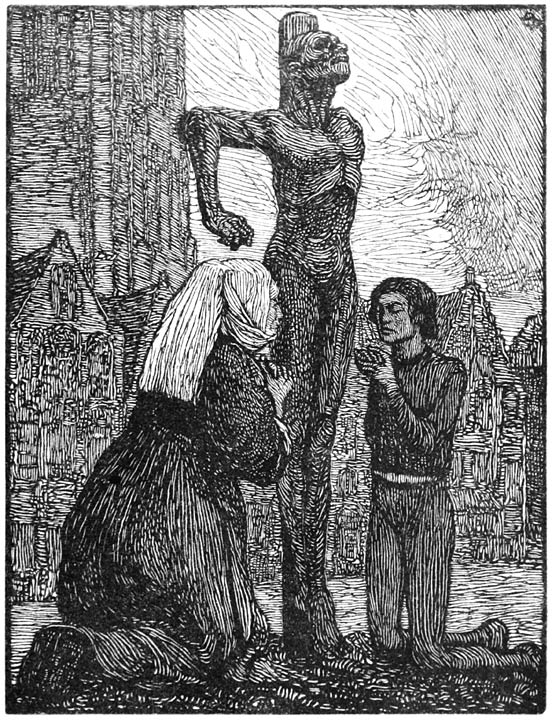
Ulenspiegel and Soetkin by the Dead Body of Claes
As Soetkin and Ulenspiegel approached the pile the raven swooped down upon the shoulder of Claes, and they could hear its beak pecking upon the body. And soon the other ravens followed. Ulenspiegel would have thrown himself upon the pile and beaten them off had not the sergeant come up and prevented him.
“Are you a sorcerer,” cried the man, “that comes hither for the hands of the dead as a talisman, and yet do you not know that the hands of a man that has been burnt to death possess no power of invisibility, but only hands of one who has been hanged—such as you yourself will be one of these days?”
“Sir,” Ulenspiegel replied, “I am no sorcerer, but the orphaned son of the man tied to this stake here. And this woman is the dead man’s widow. We only wish to kiss him once again, and to take away a few of his ashes in his memory. Give us leave, sir, pray, for you are certainly no foreign soldier, but a son of this land.”
“Very well,” said the sergeant.
So the orphan and the widow made their way over the charred wood and approached the body. Weeping, they both kissed the face of Claes.
Then Ulenspiegel found the place where the heart had been, a great hole hollowed out by the flames, and therefrom he took a few ashes. Then Soetkin and he knelt down and said a prayer, and when the sky began to turn pale in the dawn they were still kneeling there together. But the sergeant drove them off, for he was afraid that he would be punished for his kindness.
When they were home again Soetkin took a piece of red silk, and a piece of black silk, and she made a little bag to contain the ashes. And on the little bag she sewed two ribbons so that Ulenspiegel could always carry it suspended round his neck. And she gave it to him with these words:
“These ashes are the heart of my husband. This red ribbon is his blood. This black one is our sorrow. Always upon your breast let them lie, and call down thereby the fire of vengeance upon his torturers.”
“Amen,” said Ulenspiegel.
And the widow embraced her orphan, and the sun rose.
XLIV
In that year, being the fifty-eighth year of the century, Katheline came into Soetkin’s house and spake as follows:
“Last night, being anointed with balm, I was transported to the tower of Notre Dame, and I beheld the elemental spirits that carry the prayers of men to the angels, and they in their turn, flying up towards the highest heaven, bring them to the Throne of God. And everywhere the sky was strewn with glittering stars. Suddenly I saw the figure of a man that seemed all blackened and charred, rising from a funeral pile. Mounting up towards me, this figure took its place beside me on the tower. I saw that it was Claes, just as he was in life, dressed in his charcoal-burner’s clothes. He asked me what I was doing there on the tower of Notre Dame. ‘And you,’ I asked in my turn, ‘whither are you off to, flying in the air like a bird?’ ‘I am going,’ he answered, ‘to judgment. Hear you not the angel’s trump that summons me?’ I was quite close to him, and could feel the very substance of his spiritual body—not hard and resisting to the touch like the bodies of those that are alive, but so rarefied that to come up against it was like advancing into a kind of warm mist. And at my feet stretched out on every side the land of Flanders, with a few lights shining here and there, and I said to myself: ‘They that rise early and work late, surely they are the blessed of God!’ And all the time I could hear the angel’s trumpet calling through the night. And presently I saw another shade mounting up towards me from the land of Spain. This was an old man and decrepit, with a protruding chin, and quince jam all oozing from the corners of his lips.
“On its back it wore a cloak of crimson velvet lined with ermine, and on its head an imperial crown, and it kept nibbling a piece of anchovy which it carried in one hand, while in the other hand it clutched a tankard of beer. I could see that this spirit was tired out and had come to the tower of Notre Dame to rest itself. Kneeling down, I addressed it in these words: ‘Most Imperial Majesty, of a truth I revere you, yet I know not who you are. Whence come you? And what was your position in the world?’ ‘I come,’ answered the shade, ‘from Saint Juste in the country of Estramadoure. I was the Emperor Charles the Fifth.’ ‘But,’ said I, ‘whither, pray, are you going on such a cold night as this, and over these clouds that are all heavy and charged with hail?’ ‘I go,’ answered the shade, ‘to judgment.’
“Just as the Emperor was about to finish his anchovy and drink up his tankard of beer, the angel’s trumpet sounded, and straightway he had to betake himself to the air again, grumbling at this sudden interruption of his repast. High aloft he mounted through space, I following close behind; and as he went he hiccuped with fatigue, and coughed asthmatically, even vomited now and again; for death had come upon him at a time when he was suffering from a fit of indigestion. Thus ceaselessly we soared aloft like arrows shot from a bow of cornel-wood. The stars glimmered all around us, and time and again we saw them detach themselves and fall headlong, tracing long strokes of fire upon the sky. Once more the angel’s trump resounded, very shrill and powerful. Each fanfare seemed to cleave for itself a pathway through the cloudy air, scattering the mists asunder like a hurricane that has begun to blow from near at hand. And by this means our track was marked out clearly for us, till at length, when we had been carried up and up a thousand leagues and more, we beheld Christ Himself in His glory, seated upon a throne of stars. And at His right hand was the angel who records the deeds of men upon a register of brass, and at His left hand stood Mary His Mother, she that for ever implores mercy for poor sinners.
“Claes and the Emperor knelt down together before the throne. And the angel took off the crown from the head of the Emperor, and cast it away.
“‘There is only one Emperor here,’ he said. It is ‘Christ!’
“His Sacred Majesty could not conceal his annoyance; yet managed to assume a humble tone of voice as he begged to be allowed to keep his anchovy and his tankard of beer, for that he had come a long way and was very hungry.
“‘Hungry you have been all your life,’ said the angel, ‘nevertheless, you may go on with your eating and drinking if you want to.’
“The Emperor emptied the tankard of beer and took a nibble at the anchovy. Then Christ addressed him with these words:
“‘Do you present yourself to judgment with a clean soul?’
“‘I trust so, dear Lord,’ answered Charles the Emperor, ‘for I have confessed my sins and am well shriven.’
“‘And you, Claes? You do not seem to be trembling like the Emperor.’
“‘My Lord Jesus,’ answered Claes, ‘there is no soul that is clean, and how should I be afraid of you, you that are sovereign good and sovereign justice. Nevertheless, I am afraid of my sins, for they are many.’
“‘Speak, carrion!’ said the angel, addressing himself to the Emperor.
“‘I, Lord,’ said Charles, in an embarrassed tone of voice, ‘I am he that was anointed with oil by your priests, and crowned King of Castile, Emperor of Germany, and King of the Romans. It has ever been my first care to maintain that power which was given me by you, and to that end I have done my best by hanging and by sword, by burning and by burying alive, by pit and by fire to keep down all Reformers and Protestants.’
“But the angel said:
“‘O you false and dyspeptic man, you are trying to deceive us. In Germany, forsooth, you were tolerant enough of the Protestants, seeing that there you had good cause to be afraid of them. But in the Netherlands you beheaded, burned, hanged, and buried them alive, for there your only fear was lest you might fail to inherit sufficient of their property—so rich and plenteous, like the honey made by busy bees. And there perished at your hands one hundred thousand souls, not at all because you loved the Lord Christ, but because you were a despot, a tyrant, a waster of your country, and one that loved himself first of all, and after that, nothing but meat, fish, wine, and beer, for you were always as greedy as a dog and as thirsty as a sponge.’
“When the angel had made an end, Christ commanded that Claes should speak, but now the angel rose from his place, saying: ‘This man has nothing to answer. He was a good, hard-working man, as are all the poor people of Flanders, willing either for work or play; one that kept faith with his masters and trusted his masters to keep faith with him. But he possessed a certain amount of money, and it was for this reason that an accusation was brought against him, and inasmuch as he had harboured in his house a heretic, he was condemned to be burnt alive.’
“‘Alas!’ cried Mary, ‘the poor martyr! But here in heaven there are springs of fresh water, fountains of milk, and exquisite wine which will refresh you, and I myself will lead you there, good charcoal-burner!’
“And now the angel’s trumpet sounded yet again, and I saw a man, naked and very beautiful, rising from the abyss. On his head was an iron crown, and on the rim of the crown these words inscribed: ‘Sorrowful till the day of judgment.’
“He approached the throne and said to Christ:
“‘Thy slave I am until that day when I shall be Thy master!’
“‘O Satan,’ said Mary, ‘the day will come when there shall be neither slave nor master any more, and when Christ who is Love, and Satan who is Pride, shall stand forth together as the One Lord both of Power and of Knowledge.’
“‘Woman,’ said Satan, ‘thou art all goodness and all beauty.’
“Then addressing himself to Christ, and pointing at the same time towards the Emperor, Satan demanded what was to be done with him. Christ answered:
“‘Take this crowned wormling and put him in a room wherein you have collected together all instruments of torture which were in use under his rule. And each time that some innocent wretch is made to suffer the torture of water, whereby the bodies of men swell up like bladders; or the torture of the candles, whereby the soles of their feet or their armpits are burned and scorched; or the torture of the strappado, whereby their limbs are broken; or the torture of the four wagons that drags them asunder—and every time that a free soul breathes out its last upon the funeral pile let this man also endure in his turn these same deaths and tortures, to the end that he may learn in his own person what evil may be wrought in the world by an unjust man who has power over his fellows. Let him languish in prison, let him meet death upon the scaffold, let him mourn in exile, far from his native land, let him be scorned, abused, and flogged with many whips. Let him know what it is to be rich and see all his property eaten up by the tax-gatherer, let him be accused by informers and ruined by confiscations. Turn him into an ass that he may know what it is to be gentle by nature and at the same time ill-treated and badly fed; let him be a poor man that asks for alms and is answered only with abuse; let him be a workman that labours too long and eats too little; and then, when he has thus well suffered both in his body and his soul, turn him into a dog that he may be beaten, an Indian slave that he may be sold to the highest bidder, a soldier that he may fight for another and be killed without knowing why. And then, at the end of three hundred years, when he has exhausted all sufferings and all miseries, make a free man of him, and if in that state of life he is good like Claes here, you may lay at last his body to rest in some quiet corner of earth that is shady in the noonday heat and open to the morning sun, and there beneath a beautiful tree and covered with fresh sward, he shall find eternal repose. And his friends shall come to his grave to moisten it with their tears, and to sow violets there, which are called the flowers of remembrance.’
“But Mary said: ‘Have mercy upon him, O my Son; he knew not what he did, and we know how power hardens the heart.’
“‘There is no mercy for him,’ said Christ.
“‘Alas!’ cried His Sacred Majesty, ‘woe is me! Would that I had but a single glass of Andalusian wine!’
“‘Come,’ said Satan, ‘it is past the time for wine or meat or poultry!’
“And away he carried off the soul of the poor Emperor, down to the nethermost hell, still nibbling as he went his piece of anchovy. For this Satan suffered him to do out of pity.
“Thereafter I saw that Our Lady conducted Claes away and up into the highest heaven, where is nothing but stars hanging from the roof like clusters of grapes. And there the angels washed him clean, and he became all beautiful and young, and they gave him rystpap to drink in silver ladles. And then the heavens closed.”
“Claes is in glory,” said the widow.
“His ashes beat against my heart,” said Ulenspiegel.
XLV
During all the three and twenty days that followed, Katheline grew paler and paler, and thin and all dried up as though devoured not only by the madness that consumed her but by some interior fire that was even deadlier still. No more did she cry out as of old: “Fire! Fire! Dig a hole! My soul wants to get out!” But she was continually transported into a kind of ecstasy, in which she spake to Nele many strange words.
“A wife I am,” she said, “and a wife you also ought to be. My husband is a handsome man. A hairy man is he, hot with love. But his knees and his arms, they are cold!” And Soetkin looked at her sadly, wondering what new kind of madness this might be. But Katheline continued:
“Three times three are nine, the sacred number. He whose eyes glitter in the night like the eyes of a cat—he only it is that sees the mystery.”
One evening when Katheline was talking in this way, Soetkin made a gesture of misgiving. But Katheline said:
“Under Saturn, four and three mean misfortune. But under Venus, it is the marriage number. Cold arms! Cold knees! Heart of fire!”
Soetkin answered:
“It is wrong to talk in this way of these wicked pagan idols.”
But Katheline only crossed herself and said:
“Blessed be the grey horseman. Nele must have a husband—a handsome husband that carries a sword, a dusky husband with a shining face!”
“Yes,” cried Ulenspiegel, “a very fricassee of a husband, for whom I will make a sauce with my knife!”
Nele looked at her lover with eyes that were moist with pleasure to see him so jealous.
“None of your husbands for me!” she said.
But Katheline made answer:
“When cometh he? He that is clad in grey, and booted and spurred?”
Soetkin bade them say a prayer to God for the poor afflicted one, whereupon Katheline in her madness ordered Ulenspiegel go and fetch four quarts of dobbel kuyt what time she made ready some heete-koeken, as pancakes are called in Flanders.
Soetkin asked her why she wished to make festival on a Saturday like the Jews.
“Because the butter is ready,” said Katheline.
So Ulenspiegel stood up and took in his hand the big pot of English pewter that held just four quarts.
“Mother,” he asked, “what shall I do?”
“Go,” said Katheline.
Soetkin did not like to say anything more, for she was not mistress of the house. So she told her son to go and do as Katheline had bidden him. Ulenspiegel ran to the tavern and brought back with him the four quarts of dobbel kuyt. And soon the kitchen reeked with the good smell of pancakes, and every one felt hungry, even the poor afflicted Katheline.
Ulenspiegel ate heartily, and drank heartily also, for Katheline had given him a full tankard, saying, with a malicious look, that it behoved him to drink more than the others seeing that he was the only male and the head of the house. Afterwards she asked him to give them a song.
But Ulenspiegel did not sing, and Nele was all tearful, seeing Soetkin so pale, and as it were all sunken into herself. Katheline alone of them all appeared to be happy.
When the meal was over Soetkin and Ulenspiegel went up into the loft to bed. Katheline and Nele stayed behind, for they slept together in the kitchen.
All was quiet until the second hour after midnight. Ulenspiegel had already been asleep for a long time because of all the beer he had been drinking. But Soetkin, as her custom was, lay on with eyes wide open, praying Our Lady to send her sleep, but with no avail.
All of a sudden she heard the cry of a sea-eagle, and from the kitchen came a like cry, in answer. Then, from far off in the country somewhere, other cries resounded, always as it seemed in answer to that cry in the kitchen just below.
Soetkin tried to think it was only the night-birds calling to one another, and endeavoured to distract her attention from those sounds. But presently she heard a neighing of horses and a noise as of iron sabots beating along the high road. Then it was that she opened the window of the loft and saw that in very fact there were a couple of horses saddled just outside the cottage, pawing the ground and nibbling the grass that grew by the side of the road. Thereafter she heard the voice of a woman crying out in fear, and a man’s voice threatening, followed by the sound of blows, more cries, a door shutting with a bang, and then steps running up the ladder in mortal fear:
All this time Ulenspiegel was snoring away in his bed, hearing nothing, till the door of the loft opened and Nele came in, out of breath, sobbing, and with scarcely anything on. As hastily as she could the girl dragged against the door a table, some chairs, an old heating stove, any bit of furniture that was to hand. With these she made a rough-and-ready barricade. Meanwhile, outside, the last stars were paling in the heavens and the cocks beginning to crow.
Ulenspiegel had turned over in his bed at the noise Nele was making, but now he had gone to sleep again. Nele, meanwhile, had thrown herself on to Soetkin’s neck.
“Soetkin,” she said, “I am afraid. Light the candle, do!”
Soetkin did so, and all the time Nele never left off moaning. By the light of the candle Soetkin looked the girl up and down. Her shift was torn at the shoulder and in front, and there were traces of blood upon her neck and cheek, such as might be left by the scratch of a finger-nail.
“Whence have you come? And what are these wounds?” Soetkin asked her.
Trembling and groaning all the time, the girl made answer:
“For mercy’s sake, Soetkin, do not bring us to the stake!”
Ulenspiegel meanwhile had awakened from his sleep, and was blinking his eyes in the sudden light of the candle. Soetkin said:
“Who is it down there?”
“Not so loud!” Nele whispered. “It is the husband Katheline desired for me.”
All at once Soetkin and Nele heard Katheline cry out in a loud voice, and their legs gave way beneath them in their terror.
“He is beating her,” said Nele, “he is beating her because of me!”
“Who is it in the house?” cried Ulenspiegel, jumping out of bed. And then, rubbing his eyes, he went stalking up and down the room till at last he found a heavy poker that stood in the corner. He took hold of it, but Nele tried to dissuade him, telling him that there was no one there. But he paid no attention, running to the door and throwing to one side the chairs and tables and the stove that Nele had piled up in front of it. All this time Katheline was crying out from the kitchen, and Nele and Soetkin held Ulenspiegel—the one by the waist, the other by the legs—and tried to prevent him from descending the stairs. “Don’t go down,” they told him. “Don’t go down, Ulenspiegel. There are devils down there.”
“Forsooth,” says he, “Nele’s devil-husband! Him verily will I join in marriage to this long poker of mine! A marriage of iron and flesh! Let me go!”
But they did not loose their hold, hanging on as they were to the landing rail.
And all the time Ulenspiegel was trying to drag them down the staircase, and they the more frightened as they came nearer to the devils below. And they could avail naught against him, so that at last, descending now by leaps and bounds like a snowball that falls from the top of a mountain, he came into the kitchen. And there was Katheline, all exhausted and pale in the light of dawn.
“Hanske,” she was saying, “O Hanske, why must you leave me? Is it my fault if Nele is naughty?”
Ulenspiegel did not take any notice of her, but straightway opened the door of the shed, and finding no one there, rushed out into the yard, and thence into the high road. Far away he descried two horses galloping off and disappearing in the mist. He ran after them hoping to overtake them, but he could not, for they went like a south wind that scours the dry autumn leaves.
Ulenspiegel was angry with disappointment, and he came back into the cottage grieving sore in his heart and muttering between his teeth:
“They have done their worst on her! They have done their worst!...”
And he looked on Nele with eyes that burned with an evil flame. But Nele, all trembling, stood up before Katheline and the widow.
“No!” she cried. “No, Tyl, my lover! No!”
And as she spoke she looked him straight in the face, so sadly and so frankly that Ulenspiegel saw clearly that what she said was true. Then he spake again, and questioned her:
“But whence came those cries, and whither went those men? Why is your shift all torn on the shoulder and the back? And why do you bear on forehead and cheek these marks of a man’s nails?”
“I will tell you,” she said, “but be careful that you do not have us burned at the stake for what I shall tell you. You must know that Katheline—whom God save from Hell—hath had these three-and-twenty days a devil for her lover. He is dressed all in black, he is booted and spurred. His face gleams with a flame of fire like what one sees in summer-time when it is hot, on the waves of the sea.”
And Katheline whimpered: “Why, oh why, have you left me, Hanske, my pet? Nele is naughty!”
But Nele went on with her story:
“The devil announces his approach in a voice that is like the crying of a sea-eagle. Every Saturday my mother receives him in the kitchen. And she says that his kisses are cold and that his body is like snow. One time he brought her some florins, but he took from her all the other money that she had.”
All this time Soetkin kept on praying for Katheline, with clasped hands. But Katheline spake joyfully:
“My body is mine no more. My mind is mine no more. O Hanske, my pet, take me with you yet once again, I beg you, to the Witches’ Sabbath. Only Nele will never come. Nele is naughty, I tell you.”
But Nele went on with her story:
“At dawn,” she said, “the devil would go away, and the next day my mother would relate to me a hundred strange things. But, Tyl dear, you must not look at me with those cruel eyes.... Yesterday, for instance, she told me that a splendid prince, clad in grey, Hilbert by name, was anxious to take me in marriage, and that he was coming here himself that I might see him. I told her that I wanted no husband, handsome or plain. Nevertheless, by weight of her maternal authority she persuaded me to stay up for him, for she certainly keeps all her wits about her in whatever pertains to her amours. Well, we were half undressed, ready to go to bed; and I had gone off to sleep sitting on that chair. It seems that I did not wake up when they came in, and the first thing I knew was that some one was embracing me and kissing me on the neck. And then, by the bright light of the moon, I beheld a face that shone like the crests of the waves of a July sea when there is thunder in the air, and I heard a low voice speaking to me and saying: ‘I am your husband, Hilbert. Be mine! I will make thee rich.’ And from the face of him that spake these words there came an odour like the odour of fish. Quickly I pushed that face away from me, but the man tried to take me by force, and although I had the strength of ten against him, he managed to tear my shift and scratch my face, crying out the while that if only I would give myself to him he would make me rich. ‘Yes,’ I answered, ‘as rich as my mother, whom you have deprived of her last liard!’ At that he redoubled his violence, but he could not do anything against me. And at last, since he was more disgusting than a corpse, I scratched him in the eye with my nails so sharply that he cried out with pain, and I was able to make my escape and run up here to Soetkin.”
And all this while Katheline kept on with her “Nele is naughty. And why did you go away so soon, O Hanske, my pet?”
But Soetkin asked her where she had been while wicked men were attempting the honour of her child.
“It is Nele that is naughty,” Katheline replied. “As for me, I was in company of my black master, when the devil in grey comes to us, with his face all bloody. ‘Come away,’ he cries, ‘come away, my boy, this is an evil house; for the men, it seems, are of a mind to fight with one to the death, and the women carry knives at the tips of their fingers.’ And there and then they ran off to their horses, and disappeared in the mist. Ah, Nele, Nele! She is a naughty lass, I tell you!”
XLVI
On the following day, while they were making a meal of hot milk, Soetkin said to Katheline:
“You see how misfortune is already driving me from this world; and yet you, it seems, would like to drive me away all the faster by your accursed sorceries!”
But Katheline only went on repeating:
“Nele is naughty. Come back, Hanske, my pet!”
It was the following Wednesday when the two devils came again. Ever since the preceding Saturday Nele had slept out at the house of a widow woman named Van den Houte, saying, by way of excusing herself, that she could not stay with Katheline because of that young rogue Ulenspiegel.
Now Katheline welcomed her black master and her master’s friend out in the keet, which is to say the laundry or bakehouse adjoining the cottage. And there did they feast and regale themselves with old wine and with smoked ox tongue, which viands were always prepared and ready in that place for them. And the black devil said to Katheline:
“You must know, Katheline, that we are engaged in a mighty work, and to accomplish it we have need of a large sum of money. Give us, I pray you, what you can.”
When she only offered them a florin they threatened to kill her. But when she had raised the amount to a couple of golden caroluses and seven deniers they let her off.
“Come not again on Saturdays,” she told them, “for Ulenspiegel has discovered that your custom it is to come on that day, and he will certainly be waiting for you and will beat you to death, and that would be the death of me as well.”
“We will come next Tuesday,” they told her.
Now on that day Nele and Ulenspiegel went to sleep without any anxiety, thinking that the devils only came to the cottage on Saturdays. But Katheline got out of bed secretly and went into the yard to see if her friends had arrived. She was very impatient, for since seeing Hanske again her madness had abated, for hers was a lover’s madness, as they say.
But to-night she could nowhere see her friends, and she was greatly distressed, so that when, presently, she heard the cry of the sea-eagle coming as it seemed from the open country in the direction of Sluys, she went out towards that cry, making her way across the field by the side of a tall dike that was constructed of sticks and grass. She had not gone far when she heard the two devils conversing together at the other side of the dike. And one of them said:
“Half shall be mine.”
And the other answered:
“No. Nothing of the kind. What is Katheline’s belongs to me. All of it.”
Then they blasphemed together most terribly, disputing as to which of the two should be possessed of the property and the love of Katheline and of Nele into the bargain. Paralysed with fear, daring neither to speak nor to move, Katheline presently heard them fall to fighting with one another. And then one of the devils cried aloud:
“Ah! The cold steel!”
And after that there came the sound of a death-rattle, and of a body falling heavily.
Terrified as she was, Katheline returned to the cottage.
At two of the morning she heard once more the cry of the sea-eagle, but this time close at hand in the yard. She went to the door and opened it, and saw her devil lover standing there all alone.
She asked him what he had done with his friend.
“He will not come again,” he told her.
Then he kissed her and caressed her, and his kisses seemed colder than ever before. When the time came for him to depart, he asked her to give him twenty florins. This was all that she had, but she gave him seventeen.
The next day she could not control her curiosity, and walked out along by the dike. But she found nothing, except at one place a mark on the grass about the size of a man’s coffin; and the grass was wet underfoot and red with blood. But that evening rain fell, washing the blood away.
On the following Wednesday Katheline heard yet again the cry of the sea-eagle in the yard.
XLVII
Now whenever any money was needed to pay for the expenses of Katheline’s household, Ulenspiegel was accustomed to go by night to the hole by the well wherein had been hidden the money left by Claes. He would lift up the stone that covered the top of the well and would take out a carolus.
One evening the two women were busy with their spinning, while Ulenspiegel sat carving a chest which had been commissioned from him by the town bailiff. And upon the side of the chest he was carving a hunting scene. Very beautiful it was and cleverly carved, with a pack of hounds running in pairs closely following one another, chasing their quarry.
Katheline was there, and Nele asked Soetkin absent-mindedly if she had found a safe hiding-place for her treasure. Thinking no harm, the widow answered that it would be hard to find a safer place than the side of the well wall.
Near midnight of the following Thursday Soetkin was awakened by Bibulus Schnouffius, who was barking fiercely. But soon he was quiet again, and Soetkin, thinking that it was a false alarm, turned over and went to sleep.
The next day when Nele and Ulenspiegel rose at dawn they were surprised to find no Katheline in the kitchen, neither was the fire lit, nor was there any milk boiling on the fire as usual. They were surprised at this and went out to see if perchance she was in the yard. And there they found her, all dishevelled in her linen shift, notwithstanding that it was drizzling with rain, and she was all damp and shivering, and stood there, not daring to come in.
Ulenspiegel went up to her and asked her what she was doing half naked there in the rain?
“Ah!” she said. “Yes, yes. Strange things have happened! Strange, wonderful things!”
And as she spoke she pointed to the ground, and they saw the dog lying there with its throat cut, all dead and stiff.
Ulenspiegel’s thoughts ran at once to the treasure. He hastened to the hole by the well, and found as he had feared that it was empty, and all around the earth scattered about far and wide.
He ran back to Katheline and struck her with his hand.
“Where are the caroluses?” he cried.
“Yes! Yes! Strange things have been happening!” she answered.
At this Nele tried to protect her mother from the wrath of Ulenspiegel.
“Have mercy, have pity,” she cried. “O Ulenspiegel!”
Then he stopped beating the wretched woman, and at the same moment Soetkin appeared on the scene and wanted to know what was the matter.
Ulenspiegel showed her the dog with its throat cut and the empty hole. Soetkin turned pale, and cried out most sorrowfully:
“O God, thou hast brought me low indeed!”
And Nele, seeing how gentle Soetkin was, wept also and was very sorrowful. But Katheline, flourishing a piece of parchment that she held in her hand, began to speak in this wise:
“Yes, yes. Strange things and wonderful have come to pass this night! For he came to me, my good one, my beautiful. And no longer did his face display that ghastly glitter which makes me so afraid. And it was with a great tenderness in his voice that he addressed me. Yes, I was overcome with love for him, and my heart was melted within me. ‘I am a rich man.’ he told me, ‘and soon I will bring thee a thousand florins in gold.’ ‘So be it,’ I answered him. ‘I rejoice for your sake rather than for mine, Hanske, my pet.’ ‘But is there no one else in your cottage,’ he asked, ‘that you love, perhaps, and would rejoice to see enriched by me also?’ ‘No,’ I replied. ‘They that live here have no need of any help of thine.’ ‘You are proud, it seems,’ he answered. ‘Soetkin and Ulenspiegel, are they then so rich as to need nothing?’ ‘They live without the help of any,’ I told him. ‘In spite of the confiscations?’ he asked. But then I laughed aloud, and said that he knew that they would not be such simpletons as to hide their treasure in the house where it could be easily found. ‘Nor yet in the cellar?’ he persisted. ‘Of course not,’ I told him. ‘Nor yet in the yard?’ To that I answered not a word. ‘Ah,’ he said, ‘that would indeed be a piece of imprudence.’ ‘Not so imprudent as all that,’ I answered, ‘for neither walls nor water have tongues.’ And at that he began laughing to himself. Presently he went away, earlier it was than usual. But first he gave me a powder, telling me that if I took it I should be spirited away to the finest of all the Sabbaths. I accompanied him a little way just as I was, as far as the door of the yard, and I seemed half asleep, and soon I found myself, even as he had told me, at the Witches’ Sabbath, and I did not return from thence until the morning. Then it was that I found myself here as you see me, and discovered the dog with his throat cut, and the empty hole. And this is a heavy blow to me, to me that loved him so tenderly, and had given to him my very soul. But whatsoever I have shall be yours, and I will labour with my hands and my feet to keep you alive, never fear.”
But Soetkin said:
“I am become even as the corn beneath the grindstone. God and this devil robber are heavy upon me both at once.”
“Robber do you call him?” cried Katheline. “Speak not so. He is a devil, a devil I say! And for proof I will show to you this parchment which he left behind him in the yard, and on it is written, ‘Forget not to serve me, and behold, in three times two weeks and five days I will render thee back again twice as much again as the treasure I have now taken from thee. Doubt not, or else thou wilt surely die.’ And oh,” cried Katheline, “of a surety he will keep his word!”
“Poor mad thing,” said Soetkin.
And this was the only word of reproach that she uttered.
XLVIII
Six months passed, and the devil lover came no more. Nevertheless Katheline did not live without hope of seeing her Hanske again.
Soetkin meanwhile had given up her work altogether, and was always to be found sitting huddled up in front of the fire; and her cough never left her. Nele provided the choicest and most sweetly smelling herbs, but no remedy had any power over her. As for Ulenspiegel, he never left the cottage for fear that his mother might die while he was out.
At last there came a time when the widow could neither eat nor drink without being sick. The surgeon (who also carried on the trade of a barber) came to bleed her, and when the blood had been taken away she was so enfeebled that she could not leave her chair. And at last the evening came when she cried out, all wasted with pain:
“Claes! Husband! And Tyl, my son! Thanks be to God for He taketh me!”
And with a sigh she died.
Katheline did not dare to watch by that bed of death, so Nele and Ulenspiegel kept watch together, and all night long they prayed for her that was gone.
As the dawn broke a swallow came flying in by the open window.
Nele said: “The bird of souls! It is a good omen. Soetkin is in heaven!”
The swallow flew three times round the room, and departed with a cry. Then there came a second swallow, larger it was and darker than the first. It fluttered around Ulenspiegel, and he said:
“Father and mother, the ashes beat upon my breast. Whatsoever you command me, that will I do.”
And the second swallow went off with a cry, just as the first had done. And Ulenspiegel saw thousands of swallows skimming over the fields. And the sun rose.
And Soetkin was buried in the cemetery of the poor.
XLIX
After the death of Soetkin Ulenspiegel grew dreamy, sorrowful, and angry, and he would wander about the fields, hearing nothing, taking what food or drink was put before him, and never choosing for himself. And oftentimes he rose from his bed in the middle of the night and went out into the country alone.
In vain did the gentle voice of Nele urge him not to despair, in vain did Katheline assure him that Soetkin was now in Paradise with Claes. To both alike Tyl answered:
“The ashes beat upon my breast.”
And he was as one mad, and Nele was sorrowful because of him.
Meanwhile, Grypstuiver the fishmonger dwelt alone in his house, like a parricide, daring only to come out in the evening. For if any man or woman passed him on the road they would shout after him and call him “murderer.” And the little children ran away when they saw him, for they had been told that he was a hangman. So he wandered about by himself, not venturing to enter any of the taverns that are in Damme, for the finger of scorn was pointed at him, and if ever he stood in the bar for a minute, they that were drinking there left the tavern.
The result was that no innkeeper desired him as a customer any more, and whenever he presented himself at their houses they would shut the door on him. The fishmonger would make a humble remonstrance, but they answered that they had a licence to sell wine certainly, but that they were not obliged to sell it against their will.
The fishmonger grew impatient at this, and in future when he wanted a drink he would go to the In ’t Roode Valck—at the sign of the Red Falcon—a little cabaret outside the town on the banks of the Sluys canal. There they served him, for they were hard up at that inn, and glad to get anything from any one. But even so, the innkeeper never entered into conversation with him, nor did his wife either. Now in that house there were also two children and a dog; but when the fishmonger made as though he would kiss the children they ran away, and the dog, when he called him, tried to bite him.
One evening Ulenspiegel was standing on his doorstep in a dream, and Mathyssen, the cooper, happening to pass by, saw him standing there, and said to him:
“If you worked with your hands belike you would forget this grievous blow.”
But Ulenspiegel answered: “The ashes of Claes beat upon my breast.”
“Ah!” said Mathyssen, “there lives a man who is sadder even than you are—Grypstuiver the fishmonger. None speaks to him, and all avoid him, so much so that when he wants his pint of bruinbier he is forced to go out all alone to the poor folk of the Roode Valck. Verily he is well punished.”
“The ashes beat....” Ulenspiegel answered him again.
And the same evening, when the bells of Notre Dame were sounding the ninth hour, Ulenspiegel sallied forth towards the Roode Valck, but failing to find the fishmonger there as he had expected, he went wandering along under the trees that grow by the canal-side. It was a bright moonlight night.
Presently he saw the figure of the murderer coming towards him. He passed close in front of Ulenspiegel, who could hear what he was saying, for the fishmonger was talking to himself, as is the custom of they who live much alone.
“Where have they hidden it?” he muttered. “Where have they hidden the money?” But Ulenspiegel answered the question for him by giving him a great blow in the face.
“Alas!” cried the fishmonger as he felt the hand of Ulenspiegel upon him. “Alas, I know you! You are his son! But have pity on me. Have pity! For I am weak and aged, and what I did to your father was not done out of malice, but in the service of His Majesty. Only deign to forgive me, and I will give you back again all the goods that I have bought, and you shall not pay me a penny. You shall have everything, and half a florin over and above, for I am not a rich man. No, you must not think that I am rich!”
And he was about to kneel down in front of Ulenspiegel. But seeing him so ugly, so craven, and so base, Ulenspiegel took hold of him and threw him into the canal.
And he went away.
L
And from many a funeral pyre there ascended to heaven the smoke from the flesh of the victims, and Ulenspiegel, thinking ever upon Claes and Soetkin, wept in his loneliness.
At last, one evening, he went to find Katheline, thinking to inquire of her some way of remedy or revenge.
She was alone with Nele, sewing by the light of the lamp. At the sound which Ulenspiegel made as he came in, Katheline raised her head slowly like one that is awakened from a heavy sleep.
He said: “The ashes of Claes beat upon my breast, and I am fain to do somewhat to save this land of Flanders. But what can I do? I have entreated the great God of earth and heaven, but he has answered me nothing.”
Katheline said: “The great God cannot hear you. First of all you should have recourse to the spirits of the elemental world, for they, uniting in themselves two natures, both celestial and terrestrial, are enabled to receive the plaints of men and hand them on unto the angels, who themselves in their turn carry them up thereafter to the Throne.”
“Help me,” he said, “only help me now, and I will repay you with my blood if need be.”
“I can help you,” said Katheline, “on one condition only: that a girl who loves you is willing to take you with her to the Sabbath of the Spirits of Spring, which is the Easter of Fruitfulness.”
“I will take him,” said Nele.
Whereupon Katheline took a crystal goblet and poured into it a certain mixture of a greyish colour, and she gave it to them both to drink, and rubbed their temples with this mixture, and their nostrils likewise, and the palms of their hands, and their wrists, and she also caused them to eat a pinch of white powder, and then she told them to gaze the one at the other in such manner that their two souls might become one.
Ulenspiegel looked at Nele, and straightway the sweet eyes of the girl illumined in him a mighty flame, and because of the mixture he had taken he felt as it were a thousand crabs nipping his skin all over him.
After that Nele and Ulenspiegel undressed, and very beautiful they looked in the lamplight, he in the pride of his manly strength, and she in all her youthful grace and sweetness. But they were not able to see one another, for already it was as though they were asleep. Then Katheline rested the neck of Nele upon the arm of Ulenspiegel, and taking his hand she placed it upon the young girl’s heart. And there they stayed, all naked, lying side by side. And to both of them it seemed that their bodies, where they touched, were made of tender fire, like the sun itself in the month of roses.
Then, as they afterwards related, they climbed together on to the window-sill, whence they threw themselves out into space, and felt the air all round them, buoying them up as the waters buoy up the ships at sea.
Thereafter they lost all consciousness, seeing naught of earth where slept poor mortals, nor yet of heaven whose clouds were rolling now beneath their feet; for now they had set their feet upon Sirius, the frozen star, and from thence again they were flung upon the Pole.
There it was that a fearful sight awaited them, a giant all naked, the Giant Winter. His hair was wild and tawny, and he was seated on an ice-floe, with his back resting against a wall of ice. Near by in the pools of water there disported a host of bears and seals, bellowing all round him. In a hoarse voice the giant summoned to his presence the hail-storms and the snow-storms and the icy showers; also there came at his behest the grey clouds and brown odorous mists, and the winds among whom is the sharp north wind, he that blows the strongest of all. Such were the terrors that raged together in that place of bane.
But smiling in the midst, the giant reclined on a bed of flowers that had been withered by his own hand, and of leaves dried by his very breath. Then, leaning down and scratching the ground with his finger-nails, and biting it with his teeth, the giant began to burrow a great pit. For he wanted to discover the heart of the earth to devour it, and to put the blackened coal where once there had been shady forests, and chaff where once had been corn, and barren sand in place of fruitful soil. But old earth’s heart was made of fire, so that he dared not touch it but recoiled therefrom in dread.
There he sat like a king upon his throne, draining his horn of oil. All round him were his bears and seals, and the skeletons of those whom he had killed on the high seas or on the dry land or in the cottages of the poor. He listened joyfully to the roaring of the bears, to the braying of the seals, and to the sound made by the skeletons of men and animals as the bones clicked together beneath the claws of the crows and vultures that came for the last remaining piece of flesh that might still adhere to them. And sweet also to his ears was the noise the ice-floes made as they were driven one against another by the waves of that dreary sea.
And when he spoke, the voice of the giant was even as the roaring of a hurricane or as the noise of winter storms, or as the wind howling in the chimneys.
“I am cold and afraid,” said Ulenspiegel.
“He is powerless against immortal souls,” said Nele.
Even as she spoke a great commotion arose among the seals, who began to rush back into the sea with all haste. And it was apparent that the bears also were afraid for they lay back their ears and began to bellow most piteously. As for the crows and ravens, they cawed as though they were in terror of their lives, and started off to hide themselves among the clouds.
And now it was that Nele and Ulenspiegel first began to hear a sound as of a mighty battering-ram beating upon the farther side of that glassy wall against which Giant Winter had been reclining. And the wall cracked visibly and shook to its foundations. But of all this Giant Winter heard nothing at all, for he went on baying and bellowing most joyfully, filling and emptying again and again his bowl of oil, and continuing his search for the heart of the earth, that he might freeze it to nothing, although, forsooth, whenever he found that fiery centre he always lacked the courage so much as to take it in his hand!
Meanwhile the blows of the battering-ram resounded heavier and louder, and the crack in the wall of ice grew broader every second, and all around the giant, the rain of icicles ceased not to fall in myriad fragments. And the bears roared ceaselessly and piteously, and the seals sent up their plaintive cries from the dreary waste of water.
Suddenly the wall gave way, and from the bright sky beyond it a man descended. Naked he was, most beautiful of aspect, holding in one of his hands a hatchet of pure gold. This was Lucifer, the light-bringer, Lord of the Spring.
When Giant Winter saw him he immediately cast away his bowl of oil and entreated the new-comer to spare at least his life. But at the first warm breath of Spring, Giant Winter lost all his strength, and Lucifer was able to bind him with a chain of diamonds, and tie him securely to the Pole.
Then, standing still, the Lord of the Spring most tenderly and amorously cried aloud, and from the heavens there descended a woman, naked also, and most fair, most beautiful. She stood beside her lord, and spake to him:
“You are my conqueror, strong man.”
And thus he answered her:
“If you are hungry, eat; if you are thirsty, drink; if you are afraid, come near to me. I am your mate.”
“I have no hunger, no thirst, but for thee alone,” she said.
Then the Lord of the Spring called out yet seven times and again. Most tremendous was his voice, and there was a mighty din of thunder and lightning, and behind him there came into being a kind of dais all made of suns and stars. And the lord and his lady sat them down on two thrones.
Then these twain, their countenances remaining still and motionless, and without the least tremor to spoil the calmness of their majesty and their power, both together cried aloud. And at that sound there was a movement in the earth like that of a countless multitude of worms, and not in the earth only but in the hard stone and in the ice-floes also. And Nele and Ulenspiegel heard a sound like that which might be made by gigantic birds trying to crack with their beaks the great imprisoning egg-shells wherein they were concealed. And amid this great commotion of the earth, heaving and subsiding like the waves of the sea, there appeared forms like those of eggs.
And suddenly, on all sides, trees emerged, their bare branches all entangled together, and their stems shaking and tottering together like drunken men, which began to separate themselves the one from the other, leaving empty spaces of earth between. And now from the ever restless soil there emerged the Spirits of Earth, and from the depths of the forest the Spirits of the Woods, and from the neighbouring sea, now cleared of ice, the Spirits of the Water.
And Nele and Ulenspiegel could discern the guardian spirits of all these wonders. Dwarfs there were, men of the woods that lived like trees and carried, instead of mouths and stomachs, little clusters of roots sprouting from below the face to the end that they might suck their nourishment from the bosom of mother earth. Lords of the mines there were as well, they that know no speech, and are destitute of heart or entrails, and move about like glittering automatons. There came also the dwarfs of flesh and bone, little fellows with lizards’ tails and the heads of toads, and a lantern on their head for head-gear. These are they that leap by night upon the shoulder of the drunken wayfarer or the tired traveller, and then jump down again, waving their lanterns the while so as to lead into marsh or ditch that hapless wight who thinks the light he sees is a candle set to beacon his way home.
There came too the Girl-Flower spirits, blossoms they of womanly health and strength. Naked they were and unashamed, glorying in their beauty, and having nothing to cover them but their hair. The eyes of these maids shone liquid like mother-of-pearl seen through water; the flesh of their bodies was firm, white, and glittering in the sunshine; and from half-opened ruby lips their breath wafted down more balmy than jasmine.
These are the maids that wander at eventide in the parks or gardens of the world, or belike in the shady paths of some woodland glade. Amorous they are, searching ever for some soul of man to possess it for themselves. And whenever some mortal lad and lass come walking their way, they try to kill the girl, but failing in this they breathe a breath of love upon the doubting damsel, so that she fears no longer to abandon herself to the delights of love, but gives herself to her lover. For then the Girl-Flower is permitted to take her share of the kisses.
Besides all this, Nele and Ulenspiegel could see descending now far from heaven the Guardian Spirits of the Stars, the Spirits of the Winds, of the Breezes, and of the Rain: young, winged men that fertilize the earth. And there appeared from every point in the heavens the soul-birds, the dear swallows. At their coming the light itself seemed to grow brighter, and the girl-flowers, the lords of the rocks, the princes of the mines, the men of the woods, the spirits of water, fire, and earth, all cried out with one voice, “O Light, O sap of Spring, Glory to the Spirit of Spring!” And though the sound of all this shouting was more powerful than the noise of a raging sea, or of a thunder-storm, or of a hurricane let loose, yet it seemed most solemn music to the ears of Nele and Ulenspiegel, who stood, motionless and dumb, curled up behind the gnarled and wrinkled stem of a mighty oak.