Chapter II · LEARNED LADIES IN ENGLAND FROM 1650 TO 1760 (continued 3)
Reading edition
Anne Killigrew (1660-1685)
Anne Killigrew came of a family prominent in the court of Charles II. Her uncle Thomas, the "court wit," was given a patent for the Theater Royal; her uncle Henry was admiral under James, Duke of York; her father was chaplain to James and Master of the Savoy; and Anne was maid of honor to Mary of Modena. She was born in St. Martin's Lane and died at her father's lodgings within the Cloisters of Westminster. London and the court were her habitat. Ballard says she had "a polite education," but no details are given. She apparently was taught the accomplishments counted necessary for a girl in her social position. That she went beyond mediocrity in painting we have already seen.[200] In poetry, also, according to Dryden, she excelled. The thin volume of her published verse (1686) scarcely justifies his eulogy, but Wood, in Athenæ Oxoniensis, says that Dryden in no way exceeds the truth. Her poems sent anonymously from hand to hand received high praise and were even at first attributed to the best poets of the age. They gradually came to be known as hers, but she gives no evidence of having suffered any contumely as a poetess. She has nowhere any complaint of undue or irritating feminine limitations. She is pessimistic, scornful, rather hard and drastic, in her judgments, but it is greed for gold, ambition for place or power, unbridled love, atheism, war, that are the subjects of her invective. There is not a light or playful, or even a happy, touch in her poems. They have a crude virility, what Dryden calls a "noble vigour," and a contemptuous outlook on "the truly wretched Human Race."
Personally Miss Killigrew must have been attractive. Her epitaph eulogizes her as a daughter and a sister:
In a numerous race And vertuous, the highest place None envy'd her: sisters, brothers, Her admirers were and lovers: She was to all s' obliging sweet, All in one love to her did meet.
And she was an acknowledged favorite at court, especially with her royal master and mistress. Dryden emphasizes her beauty and charm. The portrait she painted of herself shows her in no sense averse to pomps and vanities of attire.[201] In actual life she must have moved along in fairly smooth accord with the life about her, but there could have been few ladies within the circle of the court more alien to it in spirit than Anne Killigrew. It is difficult to place her mentally amid the gayeties of London life. She presents an anomaly. To be young, beautiful, gifted, high in social opportunities, praised and loved, and yet to look out upon life with bitterness and distaste, to be conscious at twenty-five that all this world has to offer will turn to dust and ashes in the mouth—such is the curious combination we find in her. While the few accessible details concerning her indicate a considerable degree of lovableness, her poems are those of an implacable moral censor.
Anne Killigrew was but four when Mrs. Philips died, but the spell of the "Matchless Orinda" descended early upon her, and she gives one of the earliest of the many eulogies written by women concerning their distinguished ancestor among British Muses.
Orinda (Albion, and her sex's grace) Ow'd not her glory to a beauteous face: It was her radiant soul that shone within, Which struck a lustre thro' her outward skin; That did her lips and cheeks with roses dye, Advanc'd her height, and sparkled in her eye. Nor did her sex at all obstruct her fame. But high'r 'mongst the stars it fixt her name; What she did write, not only all allow'd, But ev'ry laurel, to her laurel bow'd!
Mrs. Evelyn (1635-1709) and Mary Evelyn (1665-85)
John Evelyn's flattering letter to the Duchess of Newcastle, already quoted, with its list of learned women, his suggestion to Lord Cornbury that he add two ladies to his gallery of notables, the trouble he took to conduct a party of ladies to see the girls' "colleges" at Hackney, and various references in Numismata (1697) indicate a genuine interest in the intellectual achievements of women. Mrs. Evelyn seems at first to have been of a different temper. She wrote as follows to her son's tutor, Mr. Bohun, in 1672:
Women were not borne to reade authors, and censure the learned, to compare lives and judge of virtues, to give rules of morality, and sacrifice to the Muses. We are willing to acknowledge all time borrowed from family duties misspent; the care of children's education, observing a husband's commands, assisting the sick, relieving the poore, and being serviceable to our friends, are of sufficient weight to employ the most improved capacities amongst us. If sometimes it happens by accident that one of a thousand aspires a little higher, her fate commonly exposes her to wonder, but adds little to esteeme. The distaffe will defend our quarrels as well as the sword, and the needle is as instructive as the penne. A heroine is a kind of prodigy: the influence of a blazing starre is not more dangerous, or more avoyded. Though I have lived under the roofe of the learned, and in the neighborhood of science, it has had no other effect on a temper like mine, but that of admiration.
But these very letters, in which Mrs. Evelyn disclaims learning, would be a capital point in refutation of Macaulay's charge of general feminine illiteracy. In subject-matter, in style, and in the mechanics of writing they show a development not unworthy of that "roofe of the learned" under which she dwelt. At the time Mrs. Evelyn wrote the letter just quoted her daughter Mary was but six years old, but her literary and artistic tastes must have soon become manifest, for when she died of small-pox at nineteen she was an accomplished young woman, on the road, apparently, to be the dangerous "blazing starre" her mother decried, and her training must have been going on for ten or twelve years in the home with the active connivance of her parents. Her father was exceedingly proud, not only of her excellence in dancing and music, but especially, it would seem, of her passion for books. She had, he said, "read abundance of history, and all the best poets, even Terence, Plautus, Homer, Virgil, Horace, Ovid; all the best romances and modern poems." After her death they found among her papers a commonplace book in which she had entered "an incredible number of selections from historians, poets, travellers." Her piety and her impulse towards expression were both shown in the many "resolutions, contemplations, prayers and devotions" she left in written form. Of the extent to which both Mrs. Evelyn and her daughter carried their work in painting and enamel I have already spoken.[202]
The Evelyn household may stand doubtless as one of many where, without any tinge of pedantry or any especial outward manifestations of learning, there was yet a natural interest in arts and letters, an interest shared, in quite a simple, normal way by all the members of the family.
The Honorable Miss Dudleya North (1675-1712)
The Honorable Miss Dudleya North was a niece of the Honorable Roger North, and it is through the memorable Lives of the Norths that we come upon an account of her life. Dudleya and her two younger brothers were brought up together. She learned the same lessons and read the same books as her brothers, and joined in their amusements. When they went to the University, she carried on her studies at home and she became one of the most highly cultured and learned women of her time. After she had conquered Greek and Latin she advanced to Hebrew, and finally, "by a long and severe course of study," she gained "a competent knowledge in the whole circle of Oriental learning." Her uncle Roger laconically described her life as follows: "The eldest sister, Catharine, died ... and the youngest, named Dudleya, having emaciated herself with study whereby she had made familiar to her, not only Greek and Latin, but the Oriental languages, under the infliction of a sedentery distemper, died also."
The fine collection of Oriental books left by Miss North was given by her brother, Lord North and Grey, to the parochial library at Rougham in Norfolk. Her uncle wrote: "I have had a design to build a parochial library at Rougham, and now shall finish it this summer, and placing my niece's books there, entitle the Catalogue Ex dono, etc., e libris eruditissimæ virginis, etc., which will be a monument more lasting than marble."[203]
Anne Lee, Lady Wharton (1632?-1685)
Anne Lee, the daughter and co-heiress of Sir Henry Lee, married in 1673 Thomas Wharton, whose chief interest in her was based on the large dowry she brought him. The unhappiness of her married life received some alleviation from the wise and steadfast friendship of Dr. Gilbert Burnet. In 1680-81, she was in France for her health and during this time she corresponded regularly with Dr. Burnet. He addressed to her various poems with titles such as The Secrets of Friendship, Friendship's Mysteries, Pure Love, and Love's Magnetism. She wrote a tragedy in blank verse on the love of Ovid for Julia, a number of Scripture paraphrases, and some occasional poems.[204] Some of these poems drew approving verses from Dryden in his Eleonora, a panegyrical poem on the death of Mrs. Wharton's elder sister, Lady Abingdon, in 1691, and from Waller, who, in his old age, was still equal to flattering a new "Chloris," under which name he celebrated her learning and her poetry.
Ann Baynard (1672-1697)
Ann Baynard had a natural propensity to learning and her father Dr. Edward Baynard, Fellow of the College of Physicians, London, gave her a very liberal education. Dr. Prude[205] says of her:
As for learning, whether it be to know and understand natural causes and events, to know the courses of the sun, moon, and stars; the qualities of herbs and plants; to be acquainted with the demonstrable verities of the mathematicks; the study of philosophy; the writings of the antients; and that in their own proper language, without the help of an interpreter: These and the like are the most noble accomplishments of the human mind, and accordingly do bring great delight and satisfaction along with them, these things she was not only conversant in, but mistress of, and that to such a degree, that very few of her sex did ever arrive at. She had from her infancy been trained up in the knowledge of these things, and had made a great progress therein; and even in her green years, at the age of 23, was arrived to the knowledge of a bearded philosopher.[206]
She was a "nervous and subtle disputant" in the "hard and knotty arguments of metaphysical learning." She was always coveting more knowledge, saying that it was a sin to be contented with but a little. She was exceedingly religious and learning was to her but a handmaid of piety. Her last words were a recommendation to women to study philosophy and the great book of nature which would give them a sound basis for wisdom in practical life. Women, she said, are capable of such study, and could accomplish much if they would "spend of that time in study and thinking, which they do in visits, vanity and folly." Mr. Collier, in the Great Historical Dictionary, says of her that it is doubtful whether the first Ralph Baynard, who for his conduct at the battle of Hastings was rewarded with eighty-five lordships, did more honor to the name of Baynard or the last Anne.
Mrs. Alicia D'Anvers (fl. 1691)
Academia: or the Humours of the University of Oxford in burlesque verse is a thin quarto by Mrs. Alicia D'Anvers. It was printed in May, 1691, and again with a fuller descriptive title in June of the same year. The poem is an account given to his fellow-servants by John who has recently visited Oxford. Mrs. D'Anvers puts herself in John's place. She uses his crude and even rough language, she gives his point of view, and relishes the misconceptions due to his ignorance. Heavy and clumsy as the poem is there is something refreshing and original in its tone. As an attempted realistic portrayal of a servant's experiences it stands quite by itself, except in comedies, in the decades before the novel widened human interests. Mrs. D'Anvers is neither patronizing nor didactic. She simply finds genuine humor and entertainment in the comic juxtaposition of John's mind and the ancient customs and glories of Oxford.
Lady Chudleigh (1656-1710)
Lady Chudleigh[207] was a lady of much repute in the eighteenth century for her writings in both prose and verse. Her Poems were published in 1703 and her Essays in 1710, but her chief literary activities belong in the late seventeenth century. Her Essays are disquisitions on Pride, Humility, Self-love, Friendship, Death, Anger, Avarice, Solitude, and kindred themes. Mr. Ballard says of them: "They appear to be, not the excursions of a lively imagination ... so much as the deliberate results of a long exercise in the world, improv'd with reading, regulated with judgment; softened by good breeding, and heightened with sprightly thoughts and elevated piety." Her prose style is fluent, energetic, and, for the most part, correct. In her Preface to her Song of Three Children Paraphrased she makes several points that indicate mental independence. In the height of the dominance of the heroic couplet she chooses Pindaric verse because she does not wish to be tied up to the rules of the couplet, and because she desires to give her fancy greater scope. She begs pardon for introducing into her poem ideas "not generally received," such as Dr. Burnet's conception of the "Ante-diluvian Earth as Smooth, regular, and uniform; without Mountains or Hills." Concerning her poetic use of the doctrine of preëxistence she says, "To me 't is indifferent which is true, as long as I know I am by the Laws of Poetry allow'd the Liberty of chusing that which will sound most gracefully in Verse." In regard to the stars she adopts "the Cartesian Hypothesis" because it makes the universe "appear infinitely larger, fuller, more magnificent." Her imagination is as genuinely excited as was Tennyson's by her conception of the "boundless Spaces" of the heavens and the splendor of the "huge Globes which roll over our Heads." She believes also in a millennial existence on "a new habitable earth." The poem itself is an unbroken ecstasy ninety long stanzas in duration, and becomes undeniably wearisome. But the woman who could spend months in a lonely country place absorbed in such religious and scientific reflections, who could maintain for so long a time so rapt and energetic a mental attitude towards abstract subjects, was far enough removed from the traditional hausfrau.
Though Lady Chudleigh rejoices in these learned topics she modestly disclaims any accurate knowledge. "But 't is not reasonable to expect that a Woman should be nicely skill'd in Physics: We are kept Strangers to all ingenious and useful Studies, and can have but a slight and superficial Knowledge of things." Two poems, Resolution and To Mr. Dryden on his excellent Translation of Virgil, give evidence of Lady Chudleigh's wide reading in poetry, history, drama, and divinity. Her literary dicta are of little value, for they do hardly more than echo the judgments of the day. According to her it was the poet Waller who, coming after the "transient Glimm'rings of Chaucer" and the "Lunar Beams of Spenser," announced the dawn of a new Morn, and with Dryden came "The Triumphs of refulgent Day." Taken as a whole the poems bitterly inveigh against life with its blighting sorrows, its fleeting, unreal joys, its injustice, its black despairs. The only break in the gloom comes in short periods of absorption in books, or in occasional religious ecstasies.
The first poem by which Lady Chudleigh became known is The Ladies' Defence: a sudden, angry outburst caused by a sermon on Conjugal Duty by a Mr. Sprint, a nonconformist in Sherbourn, Dorsetshire.[208] The personal animus in a little poem To the Ladies warning them against marriage, apparently grew out of her own matrimonial infelicities. And The Ladies' Defence has the same ring of indignant sincerity. The poem is in the form of a conversation between the parson who preached the sermon; Sir William Loveall, who, out of the ignorance of his unmarried state, endeavors to reconcile the warring parties; Marissa, Lady Chudleigh herself; and Sir John Brute, who thanks the parson for preaching against "those Terrors of our Lives, those worst of Plagues, those Furies call'd our Wives." The parson replies:
Not led by Passion, but by Zeal inspir'd, I've told the Women what's of them requir'd: Taught them their Husbands to Obey and Please, And to their Humours sacrifice their Ease: Give up their Reason, and their Wills resign, And ev'ry look, and ev'ry thought confine. Sure, this Detraction you can't justly call? 'T is kindly meant, and 't is address'd to All. If you wou'd live as it becomes a Wife, And raise the Honour of a marry'd Life, You must the useful Art of wheedling try, And with his various Humours still comply; Whate'er he is, you still must think him best, And boast to all that you are truly blest; Also, to him you inward Reverence owe; If he's a Fool, you must not think him so; Nor yet indulge one mean contemptuous Thought, Or fancy he can e'er commit a Fault. Nor must your Deference be alone confin'd Unto the hid Recesses of your Mind, But must in all your Actions be display'd, And visible to each Spectator made.[209]
After this sarcastic summary of Mr. Sprint's irritating sermon Lady Chudleigh in the person of Marissa, depicts the general condition of women and her own loftier ambitions:
'T is hard we should be by the Men despis'd Yet kept from knowing what would make us priz'd. Debarr'd from Knowledge, banish'd from the Schools, And with the utmost Industry bred Fools. Laugh'd out of Reason, jested out of Sense, And nothing left but Native Innocence: Or that my Sex would all such Toys despise; And only study to be Good, and Wise: Instead of Novels, Histories peruse, And for their Guides the wise Ancients chuse, Thro' all the Labyrinths of Learning go, And grow more humble as they more do know. Beauty's a Trifle merits not my Care. I'd rather Æsop's ugly Visage wear, Joyn'd with his Mind, than be a Fool, and Fair. But spite of you, we'll to ourselves be kind: Your censures slight, your little Tricks despise, And make it our whole business to be wise. The mean low trivial Cares of Life disdain, And read and Think, and Think and read again, And on our Minds bestow the utmost Pain.
Anne Kingsmill, Lady Winchilsea (1661-1720)
One of the important women of letters in the late seventeenth century was Anne Kingsmill.[210] Of her early life we have no definite details. That it was a gay and happy life may be inferred from one of her retrospective poems in which she says that in her youth "Pleasure's tempting Air" blew soft about her, and that she dedicated her "Prime" to "vain Amusements." Later she coveted a place at court which to her ambitious eye seemed "Paradice below." At what time this desire was realized we have no record, but in 1683 we find her listed as one of the maids of honor to Mary of Modena. Miss Strickland says that Anne Killigrew and Anne Kingsmill were "ladies of irreproachable virtue, members of the Church of England, and alike distinguished for moral worth and literary achievements," and she adds that Anne Kingsmill was "well-known as the beautiful and witty maid of honour." In 1684 Anne married Mr. Finch, gentleman of the bedchamber to the Duke of York. At the coming of William and Mary, Mr. and Mrs. Finch went to the family place at Eastwell Park where they spent the rest of their uneventful lives in a retirement, embittered at first, doubtless, by their grief over Stuart disasters, but, as the years passed, rendered more and more delightful by the joys of country life, of books, and of friends. Mrs. Finch's best poems are those inspired by Eastwell and its associations. The Elizabethan house at Eastwell was set in a park of old yew trees and majestic beeches, forming "the very ideal of an ancestral park of the ancient noblesse," and it was by the extraordinary dignity and beauty of this park that Mrs. Finch's most imaginative work was inspired. Within doors the gathering of antiquities, the illuminating of books, the formation of a great library, and free literary productivity were the family interests. There were also many and close ties of friendship founded on natural causes of union such as loyalty to the Stuarts, devotion to the Church of England, high and even austere ideals of life. And family ties and ties of friendship received ardent acknowledgment. No woman of this period was more happily circumstanced in her home for the unhampered pursuit of literary tastes than was Lady Winchilsea. She began to write when she was a maid of honor, but it was with a nervous sense of the ridicule that would probably follow any disclosure of that fact. But at Eastwell the case was different. There are charming pictures of evening sessions when the authoress presented her work to an enthusiastic circle. A scribe entered her writings in a fair and clerkly hand in a majestic folio. With such encouragement the lady kept sedulously and joyfully to her task. And when her husband's accession to the title gave her a new position of dignity and authority she even ventured, in 1713,[211] to publish a selection from her verse, first under the pseudonym "Ardelia," and then, in a later impression, with her full name and title.
Lady Winchilsea's poems were composed between 1683 and 1720, and during this period she tried nearly all poetic forms. Songs, satires, fables, tragedies, translations, are fully represented. She was the most voluminous of the minor poets of her time, and in vigor and scope she outranks most of them. But her literary importance to-day rests not so much on the amount or variety of her work, as on the fact that in an age of didacticism and satire she delicately foreshadowed tastes that ruled in the romanticism of a century later. It was her Nocturnal Reverie, with its minute accuracy of observation, its sense of the mystery of nature and of the mystic union between man and nature, that secured Wordsworth's praise, gave her an honorable place in Ward's English Poets, and finally established her in the heaven of literary fame as, in Mr. Gosse's phrase, "a minor excelsitude."
In the present study quite other points are to be made concerning Lady Winchilsea. She is particularly interesting when considered as a heretic against certain prevailing social and educational ideals. In the gay dissipations of court life under Charles II she maintained a conception of life serious and even austere. In close association with Mary of Modena and James II she yet maintained her devotion to the Church of England. With the world of fashion flocking to the comedies of the Restoration dramatists she yet condemned the immoralities of the stage with the bitterness of a Jeremy Collier. There was, then, in Lady Winchilsea an independence of judgment, a stoutness of fiber in forming and defending her own views, which would lead one to expect some trenchant remarks on the contemporary attitude towards women. It is much to be regretted that the letters of Lady Winchilsea, if any are extant, have never been published. Her interests were so varied, her friendships so ardent, her hours of country leisure so numerous, her pen so facile, that she must have found, in what Anne Seward called "epistolary solicitudes," one of the most convenient outlets for a spirit often kicking against the pricks of social conventions, and her keenness of insight, her caustic phrasing, would make her letters worth many pages of pindarics. But in default of such letters we turn to the one prose essay and to the poems. From scattered passages we can build up the elements of her heresies. Though she loved her home and was the most devoted of wives, she utterly rejected the hausfrau theory of life. She declared that she, at least, was never meant for "the dull manage of a servile house." She asked little of her table except that it should be "set without her care." Rich food and elaborate service could be dispensed with, but leisure and a free mind she must have. The frivolous occupations of the town lady, the endless discussions of laces and brocades, the rivalries as to dishes and screens from China, the gossip and ill-natured jests at fashionable tea-tables, she found unendurable. Feminine accomplishments, such as embroidery, amateurish drawing and painting, awakened her active hostility.
This definite rejection of all that ordinarily filled the feminine mind, and a rejection, moreover, in the interests of books and writing, of course made Ardelia the unhappy victim of many a sneer. The attack on her by Pope and Gay, in Three Hours after Marriage, in 1717, may be taken as an extreme example of the indignities to which "a petticoat author" might be subjected, but there must have been many lesser evidences of social disapproval or the irritating theme would not so often recur in her poems. In "The Introduction" she says:
Alas! a woman that attempts the pen, Such an intruder on the rights of men, Such a presumptuous Creature, is esteem'd, The fault, can by no vertue be redeem'd. They tell us, we mistake our sex and way; Good breeding, fassion, dancing, dressing, play Are the accomplishments we should desire; To write, or read, or think, or to enquire Would cloud our beauty, and exhaust our time, And interrupt the Conquests of our prime.
She congratulates herself that she had at least had the good sense to keep her rhymes a secret while at court, where a "Versifying Maid of Honour" would have been looked upon "with prejudice, if not with contempt." During a visit to London she heard the young gossip Almeria describe a certain lady as "A Poetess! a woman who writes! A common jest!" Conscious of her growing folio at Eastwell, Ardelia resented the implied censure. What law, she asks, forbids women to think? Women, she protests, are "Education's and not Nature's fools." Ardelia had high praise from noted contemporaries and cordial appreciation at home. But these did not avail to conquer her morbid sensitiveness to criticism. She seemed to embody in herself two warring tendencies, a demand for complete intellectual freedom and the author's inevitable desire to spread his wares abroad, with the shrinking modesty of the lady to whom any sort of publicity was hateful.
The "Matchless Orinda," Lady Winchilsea tells us, was the model on whom, from her early girlhood she formed herself. The first verses she wrote were in honor of Orinda. By Orinda's example she justified the efforts and aims of her own muse, but she is in no sense a copyist. It was Orinda's fame as a noted and virtuous woman poet that inspired her rather than any close study of Orinda's work. Lady Winchilsea, in that small portion of her work on which her fame rests, is very delicately and truly original. Her spirit reacted against court life as definitely as did Anne Killigrew's, but she found no satisfaction in satiric comment. She shrank from any sort of contest. She argued and protested only when pushed to the wall. She was shy and easily intimidated, and her best work does not come from the heat of conflict or from bitterness of spirit. She is essentially contemplative. The poems on which her fame rests blossomed out quietly, exquisitely, under the gentle stimulus of a happy home life in the midst of lovely natural surroundings. She is typically a lady of letters because, without the spur of necessity, urged on by no popular applause, she yet, for more than thirty years, made the reading of books and the writing of books the central occupation of her life.
The Honorable Mrs. Monck (d. 1715)
The honorable Mrs. Monck[212] was the daughter of Lord Molesworth, a nobleman of Ireland. Mr. Ballard says of her learning: "She, purely by force of her own natural genius, acquired a perfect knowledge of the Latin, Italian and Spanish tongues: and by a constant reading of the finest authors in those languages, became so great a mistress of the art of poetry, that she wrote many poems for her own diversion." In 1716, after her death, Lord Molesworth published her poems under the title Marinda. Poems and Translations on Several Occasions. In his dedication to Caroline, the Princess of Wales, he says that the book represents the works of the leisure hours of a young gentlewoman in a remote country solitude, with no assistance but that of a good library, and with the daily care of a large family on her hands. In commending her character he says, "I loved her more because she deserved it, than because she was mine." Various slight poems show Marinda's knowledge of Italian and Spanish. Better than all these are two cleverly turned epigrams on "a lady of pleasure," and some affecting farewell lines written in her last sickness to her husband. Mrs. Monck's repute for learning comes largely by hearsay, her printed memorials are slight and unimportant, but she nevertheless gives an impression, elusive but real, of a most interesting personality.
Martha, Lady Giffard (1639-1722)
Lady Giffard was Sir William Temple's sister. She was twelve years younger than Dorothy. After her marriage and almost immediate widowhood, in 1661, she made her home with the Temples. Her Life and Correspondence has been published by Mrs. Longe as a sequel to the Letters of Dorothy Osborne. The volume contains letters from Lady Chesterfield, from Lady Sunderland ("Saccharissa"), and others, to Lady Giffard. The letters by Lady Giffard are few in number and are all written to her niece Lady Berkeley, later Lady Portland, and belong in the years 1697-1722. These letters have none of the sparkle and humor and literary charm of Dorothy's. But we get indications that Lady Giffard was a woman of intellectual interests. We find her reading Turkish history daytimes with recourse to Virgil, "as less exacting," for evenings. She knew Spanish and French, and one of the specific items in her will is a bequest of the books she had collected in these two languages.
Sarah Byng, Mrs. Osborne (1693-1775)
A third series of letters, published under the title Political and Social Letters of a Lady of the Eighteenth Century, though belonging later in the century, may be brought in here because they carry on the series of Osborne letters. Sarah Byng, the daughter of Admiral Byng, Viscount Torrington, married, in 1710, John Osborne of Chicksands Priory, the old home of Dorothy and the place from which she wrote most of her letters. Mr. John Osborne was Dorothy's grand-nephew. He died in 1719 and his father in 1720, leaving to Sarah Osborne an infant son, Danvers, the heir to the title and a heavily burdened estate. Her letters fall in several series, the first set from 1721 to 1739 being to her brother George on business matters concerning the property. Most interesting are the letters to Danvers from 1733 to 1751. When he came of age in 1736 she was able to turn over to him an unincumbered estate, and on his marriage in 1740 she superintended the establishment of the new household at Chicksands. A third set of letters has to do with the sentence and execution of her brother Admiral Byng, in 1757. Through the death of the wife of Danvers in 1743 and the death of Danvers in 1750 Mrs. Osborne was left with two grandsons to bring up, and her last letters are to John, one of these grandsons, who was traveling in Holland.
Through two generations Mrs. Osborne bore heavy administrative and financial burdens. She was both father and mother to her son, and then to her grandsons. And she was left single-handed to conduct the defense of her brother Admiral Byng. It is not strange that the letters are frequently hurried and harassed in tone. She is constantly vexed and baffled because, as a woman, she cannot conduct affairs directly. Some man must be her intermediary. She lays plans, foresees difficulties, writes explicit directions, and then she must urge and cajole her representative to due interest and prompt action. The especial interest in her letters is their abundant and exact account of social life and especially of domestic economy. Energetic, courageous, resourceful, keenly observant, and with a clear head for business, Mrs. Osborne shows herself to be. Perhaps if we had her letters before the burdens of life fell so heavily upon her we might find some hint of the charm in Dorothy's letters, for even Dorothy's letters after marriage became "tame and flat to what was before." As it is, Mrs. Osborne's letters are valuable for scattered social detail, not for any permanent charm of expression.
Elizabeth Singer, Mrs. Rowe (1674-1737)
Mr. Walter Singer, a dissenting minister of Frome, was early left a widower with three daughters. Two of these daughters showed while still young exceptionally good minds and a natural interest in study. One daughter, who died at nineteen, was devoted to medicine and collected books on that subject. Elizabeth preferred drawing and poetry. She began drawing when her fingers could hardly hold the pencil, and she squeezed out the juices of plants to make colors. Her father furnished her an excellent master, and she attained sufficient skill so that throughout her life her work was highly prized by her friends. She also loved music "to excess." But poetry was her chief delight. She began writing at twelve, and by the time she was twenty-two she had on hand a store of verse so pleasing to her friends that they insisted on its publication, and there accordingly appeared a thin little volume in 1696 under the title Poems on Several Occasions. Written by Philomela. The "Preface to the Reader," by one Elizabeth Johnson, is another of many contemporary indications of feminine irritation at the limitations imposed upon them. Miss Johnson allows "Mankind the Brutal Advantages of Strength," but when they "wou'd Monopolize Sence too, when neither that, nor Learning, nor so much as Wit" is granted the women, they are forced to protest against such "notorious Violations on the Liberties of Free-born English Women." "This makes the Meekest Worm amongst us all, ready to turn agen when we are thus trampled on; But alas! What can we do to Right our selves? stingless and harmless as we are, we can only Kiss the Foot that hurts us." But it sometimes pleases Heaven to succor a distressed people by sending them some bright genius, "an Epaminondas, a Timoleon, a Nassaw." "Nor is our Defenceless Sex forgotten—we have not only Banduca's and Zenobia's, but Sappho's, and Behn's, and Schurman's, and Orinda's, who have humbled the most haughty of our Antagonists, and made 'em do Homage to our Wit, as well as our Beauty." Miss Singer's consent to the publication of this volume was gained only by a promise of strict anonymity, and the "Philomela," then chosen as a pen-name through a naïve adaptation of "Singer," became her permanent appellation.
One interesting fact with regard to these early poems is the indication we have of a kind of poetical commerce maintained among the members of a group of persons similarly inclined to verse. Philomela writes a Pindarick Poem on Habbakuk which she sends to "The Athenians" and they respond with a poem beginning,
We yield! we yield! the Palm, bright Maid! be thine!
She sends a Poetical Question to the Athenians and gets a long answer. The Vanity of the World and The Wish are likewise addressed to the Athenians and have similar responses. In a Pindarick to the Athenian Society she brings as "Zealous Tribute," "The early products of a Female muse," praising especially their piety and heroic sentiments and the courage with which they have lashed the darling vices of the times.
A friendship so exalted and immense, A female breast did ne'er before commence.
A little poem in humorous vein, To one that persuades me to leave the Muses, gives some account of her school-days. "I fairly bid the Boarding Schools farewell," "Old Governess farewell with all my heart," are lines indicative of her attitude.
Spite of her heart, Old Puss shall damn no more Great Sedley's Plays, and never look 'em o're; Affront my Novels, no, nor in a Rage, Force Dryden's lofty Products from the Stage, Whilst all the rest of the melodious crew, With the whole System of Athenians too, For Study's sake out of the Window flew. But I, to Church, shall fill her Train no more, And walk as if I sojurn'd by the hour.
In like vein she bids adieu to "dancing days," singing lessons, Japan work, and even her "esteemed Pencil," and vows to give herself to poetry. And true it is that the rest of her life is mainly of literary and pious significance. When young her beauty and charm had resulted in "a train of lovers," but no one of them, not even Mr. Prior, the poet, could lure her from her serene solitude—possibly because she was "destined by heaven for the possession of another gentleman." At any rate, she went smoothly on with her chosen literary life till she was thirty-six, when she married Mr. Thomas Rowe, thirteen years younger than herself, but of like tastes and himself an author. Their extraordinarily happy life together was brought to a close by his death in 1715, and, after this five years of happiness, she spent the twenty-seven years of her widowhood in a stricter solitude, a more absorbed religious communion, a completer devotion to literary pursuits, than before her marriage. Her essays, her poems, her letters, were the events of her life. She had early come to know the family of Lord Weymouth at Longleate. Mr. Thynne had taught her French and Italian; various members of the family and various family events were celebrated in her verse. She was on most intimate terms with the Countess of Hertford and corresponded with her for many years. Over a hundred of her letters to the Countess were published in The Works of Mrs. Elizabeth Rowe and Mr. Thomas Rowe, and though they make dull and monotonous reading now were highly esteemed at the time. In fact, the modest and anonymous Philomela had great eighteenth-century vogue. She had the friendship of many in the great world, she was abundantly praised by poets and divines, and her works went through numerous editions. Her husband said that she combined the fire and passion of Aphra Behn with the chaste purity of Mrs. Katherine Philips. But Astræa's passion underwent some strange alchemy when it was transmuted into Philomela's religious ecstasy. Orinda's purity was fatal to the combination. Yet Mrs. Rowe's "divine transports" have—Mr. Watts admits it—sometimes a soft and passionate sound, even an amorous note, capable of misinterpretation, but evidently reminiscent of the Songs of Solomon, beloved of her youth. It was not an age for enthusiasms and ecstasies. That her "flights" were so popular may possibly be explained by the fact that through them all she was curiously prosaic and intellectually commonplace.
Mrs. Bland (1660?-1765?)
Mr. Ballard speaks of "Mrs. Bland,[213] a Yorkshire gentlewoman so well skilled in Hebrew that she taught it to her son and daughter." Mrs. Bland was born about 1660 and married Mr. Nathaniel Bland in 1681. Her instructor in Hebrew was Lord Van Helmont from whom she learned to write the language with great exactness. At the request of Mr. Thoresby she wrote a Phylactery in Hebrew and presented it to the Royal Society, where it was preserved among their curiosities. Mr. Bland became Lord of the Manor at Beeston and Mr. Thoresby visited him there. To the astonishment of the guest Martha Bland, the young daughter of the house, was translating Hebrew into English, having been taught by "that ingenious gentlewoman," her mother. Four years later Mr. Thoresby took his son Ralph to see "Mrs. Bland, the Hebrician." She had also studied Anglo-Saxon, for she borrowed Elizabeth Elstob's book from Mr. Thoresby and kept it long enough to copy out the grammar part.
Miss Jane Barker (fl. 1688-1723)
Miss Jane Barker is a literary lady whose productions belong in two epochs. Her collected poems appeared in 1688 under the title Poetical Recreations: Consisting of Original Poems, Songs, Odes, etc. With Several New Translations. In Two Parts, Part I. Occasionally Written by Mrs. Jane Barker. Part II. By Several Gentlemen of the Universities, and Others. Twenty-seven years after the publication of this verse Miss Barker again came before the public, this time as a writer of romances which proved very popular. They were collected under the title The Entertaining Novels of Mrs. Jane Barker, and a second edition had appeared by 1719. In 1723 she brought out A Patch-Work Screen for the Ladies; or Love and Virtue Recommended: In a Collection of Instructive Novels. Related after a Manner intirely New, and interspersed with Rural Poems, describing the Innocence of a Country Life. By Mrs. Jane Barker, of Wilsthorp, near Stamford, in Lincolnshire.[214]
The long silence between the verse of 1688 and the romances of 1715-26 is unbroken by any explanatory hint or reference. Yet Miss Barker had but one story to tell and that was told in her youth. In her novels she uses the characters, events, and emotions recorded in her early verse. Under the form of a sustained narration, with the addition of much in the way of romantic adventure, they make more entertaining reading, but offer no essentially new elements. The fifth novel, Clodius and Scipiana, is perhaps but an enlargement of a romance entitled Scipina, which had been published and concerning which she had received several congratulatory poems, before 1688.[215]
One persistent element in Miss Barker's verse and prose is autobiographic reference. Especially is this true of the poems, The Amours of Bosvil and Galesia and A Patch-Work Screen. From these sources various facts emerge concerning Miss Barker's life and personality.
She says that she was sent at first to the "Putney School," but that she was taken home at about ten by her mother who had come to consider such schools as "Academies of Vanity and Expense, no Way instructive in the Rudiments of a Country Gentlewoman's Life." At fifteen she was sent to London under the care of an aunt to learn "Town Politeness."[216] Her father lived near Cambridge,[217] and through her brother, a Cambridge man, she was well known in the younger literary set at the University. The praise accorded her verse was excessive. "Philaster" of St. John's hails her as the true heiress of the great Orinda. To "C. G." she is the Elijah for whose mantle meaner poets wait. "Exilius," also of St. John's, celebrates the miracles of her Almighty Pen. "S. C." wonders to see men "tug at Classic Oars" and "sweat over Horace" when along comes a lady who without effort utters "well-shapt Fancy and true Digested Thought." "Fidelius" rejoices to see "Physick and Anatomie done into purest Verse." And "J. N.," Fellow of St. John's, praises her Scipina as writ in lines,
More than Astrea's soft, more than Orinda's Chaste.
Another gentleman from St. John's said that she surpassed "the Scaroons and Scudderies of France" and showed that England could originate as well as translate.[218] Miss Barker was evidently in the stimulating and unusual position of being the temporary literary idol of an academic coterie.
There was a false lover in Miss Barker's early life who, as "Strephon" in verse[219] and as "Bosvil" in prose,[220] is copiously written up along with her own emotional experiences as "Galesia." The most interesting portion of the affair has to do with Galesia's original ways of reëstablishing her happiness. She found comfort in contemplating the wonderful works of Creation.[221] She wandered along shady paths, by little streams, and through the meadows. She loved the early morning, the evening dews, the starry night sky. There is no felicitous phrasing in the references to nature, but the fact remains that Galesia found in nature a satisfaction and sometimes an exaltation quite foreign to the heroines of her time.
Galesia's second resource is study. She says of this new occupation:
Finding myself abandon'd by Bosvil and thinking it impossible ever to love any Mortal more, resolv'd to espouse a Book, and spend my Days in Study ... I imagin'd my self the Orinda or Sapho of my Time. In order to this, I got my brother, who was not yet return'd to Oxford,[222] to set me in the way to learn my Grammar, which he really did, thinking it ... a Freak without Foundation to be overthrown by the first Difficulty I shou'd meet with in the Syntax, knowing it to be less easy to make Substantive and Adjective agree, than to place a Patch or Curl.[223]
Her indulgent brother, when he came back from his studies abroad, also taught her medicine. With him she went on long "simpling" excursions to gather flowers for the "large natural Herbal" they were making. With him she read "Bartholine, Walæus, Harvey, his Circulatio Sanguinis, and Lower's Motion of the Heart."[224] She learned to write prescriptions, or "bills" as she called them, in Latin, with the same "Cyphers and Directions as Doctors do," so that even the apothecaries were misled and filled her "bills" with those of the regular physicians.[225] She also ventured on something in the way of practice and gained some repute for curing cases of gout given up by the doctors.[226] She began to abandon the Muses for Paracelsus. Or if she wrote poems the processes of digestion and the circulation of the blood were her themes.[227] If the shackles of rhyme hindered scientific accuracy of statement, she squared herself with facts by abundant footnotes in which the proper Latin terminology was given full scope. Her interest in medicine was a vital one. She even thanks Strephon, through whose falsity she had been driven to study, and had so gained a joy beyond "the sottish ease" that waits on love. In her new love of learning she even took a vow of virginity:
In this happy life let me remain, Fearless of twenty-five and all its train Of slights or scorns, or being call'd Old Maid, Those Goblings which so many have betray'd.[228]
Somewhat later Galesia gained a complete victory over her lovelorn self by a most original and sensible method. She took entire charge of her father's farm. She planned the work, hired the laborers, superintended in person the occupations of each day, paid the wages, and kept the accounts. The wholesome interests of each day and equally wholesome fatigue at night left no intervals in which to regret her lost lover.[229]
Galesia's recourse to hard study and responsible farm management as a cure for a wounded heart sets her as a heroine in a class by herself. She is so sensible and reasonable as to seem out of place in a romance. It is therefore something of a surprise to find her out-distancing the most sentimental in sighs and sobs and tears. Her utterance in recounting the baseness of Bosvil, "It is fitting that I should weep on all occasions," might serve as her permanent order of business. "My sighs alternately blew up my Tears and my Tears allay'd my Sighs" till "fresh Reflections rais'd new Gusts of Sorrow," describes her stormy woes. Sometimes she is able to restrain "the briny Ebullition," but usually "a new Flux of Tears" breaks down all barriers.
With the death of her brother the joy of Galesia's life went out. Books and medicine lost their charm. Without his inspiring presence all her occupations became insipid. Her view of learned women also changed. She says a learned woman is as ridiculous as a spinning Hercules; that books are as unfit for women as paint, washes, and patches are for a man; that a studious woman and an effeminate man may be classed together as out of their sphere. A learned woman is "like a Forc'd Plant that never has its due or proper Relish but is wither'd by the first Blast," or "like the Toad in the Fable, that affected to swell itself as big as the Ox," and burst in the enterprise.[230] This bitter view of learning comes only in the novels, and probably indicates some unhappy experiences on Miss Barker's part since the days when her muse was honored by the University wits.
Celia Fiennes (fl. 1691-1703)
Celia Fiennes was the daughter of Colonel Nathaniel Fiennes and the sister of the third Viscount Saye and Sele. The one book by which she is known is Through England on a Side Saddle in the Time of William and Mary, Being the Diary of Celia Fiennes, first published in 1888 by the Honorable Mrs. Griffith, to whom the original manuscript was given by her father, the thirteenth Baron Saye and Sele. In her interesting "To the Reader" Miss Fiennes explains that these journeys were undertaken that she might regain her health by "variety and change of aire and exercise"; that she picked up such information as came in her way because her mind could not remain totally unoccupied; and that she wrote down her observations merely for the pleasure of her near relations, the manuscript not being designed for more public use. She then proceeds to justify her travels:
Now thus much without vanity may be asserted of the subject, that if all persons, both Ladies, much more Gentlemen, would spend some of their tyme in Journeys to visit their native Land, and be curious to Inform themselves and make observations of the pleasant prospects, good buildings, different produces and manufactures of each place, with the variety of sports and recreations they are adapt to, would be a souveraign remedy to cure or preserve ffrom these Epidemick diseases of vapours, should I add Laziness?—it would also fform such an Idea of England, add much to its Glory and Esteem in our minds and cure the evil Itch of over-valueing fforeign parts; at least ffurnish them with an Equivalent to entertain strangers when amongst us, Or jnform them when abroad of their native Country, which has been often a Reproach to the English, ignorance and being strangers to themselves. Nay the Ladies might have matter not unworthy their observation, soe subject for conversation, within their own compass in each country to which they relate, and thence studdy now to be serviceable to their neighbours especially the poor among whome they dwell, which would spare them the uneasye thoughts how to pass away tedious dayes, and tyme would not be a burden when not at a card or dice table, and the ffashions and manners of fforeign parts less minded and desired.... But now I may be justly blamed to pretend to give acc: of our Constitution, Customs, Laws, Lect, matters farre above my Reach or capacity, but herein I have described what have come within my knowledge either by view and reading, or relation from others which according to my conception have faithfully Rehearsed, but where I have mistaken in any form or subject matter I easily submitt to a correction and will enter such Erratas in a supplement annext to ye Book of some particulars since remark'd; and shall conclude with a hearty wish and recommendation to all, but Especially my own Sex, the studdy of those things which tends to Improve the mind and makes our Lives pleasant and comfortable as well as proffitable in all the Stages and Stations of our Lives, and render suffering and age supportable and Death less fformidable and a future State more happy.[231]
Miss Fiennes's separate journeys are not dated, but we know that they began before 1691 because the earlier trips from her home at Newtontony in Wiltshire to Bath, to Oxfordshire, to "Salsebury," were taken with her mother, and her mother died in 1691. The description of the coronation of Queen Anne would indicate that the travels extended beyond 1703. "My Northern Journey in May 1697" was one of the most important of her travels. She thus records its close: "Thence to Highgate 6 miles, thence to London 4 miles where I returned and all our Company Blessed be God very well wthout any disaster or trouble in 7 weeks tyme about 635 miles that we went together."[232] Cambridge, Ely, Peterborough, Nottingham, Lincoln, Hull, and Scarborough, indicate their general route north. Encouraged by the success of this difficult trip, Miss Fiennes determined upon a still more hazardous enterprise. "My great Journey to Newcastle and to Cornwall"[233] records a remarkable achievement. She went north to Peterborough; then west to Chester; then north by way of Liverpool, Preston, Lancaster, Kendall, Lake Windermere, Ambleside, Ulswater, Penrith, Carlisle, and so over into the edge of Scotland; then east to Newcastle; then southwest by Durham, Manchester, Worcester, Exeter, Plymouth, Land's End; and finally home to Newtontony.
Arthur Young is famous for his English tours, but his travels are nearly three quarters of a century later than those of Miss Fiennes.[234] Gray's notable visit to the Lakes was in 1769. In 1756-1766 Amory, in his Life of John Buncle, described the Lake Region, and as early as 1760 Dr. Brown wrote a letter praising the Lakes. But Celia Fiennes's visit and description belong at the very beginning of the century and confer upon her the honors belonging to the pioneer. Her book has also a distinctive interest of its own. I cannot forbear to quote her account of her journey through the Westmoreland Hills:
Thence I Rode almost all the waye in sight of this great water [Windermere], some tymes I lost it by reason of ye great hills interposeing and so a Continu'd up hill and down hill and that pretty steep, even when I was in that they Called bottoms wch are very rich good ground, and so I gained by degrees from Lower to higher hills wch I alwayes went up and down before I came to another hill. At last I attained to the side of one of these hills or ffells of Rocks, wch I passed on the side much about the Middle, for Looking down to the bottom it was at Least a Mile all full of those Lesser hills and jnclosures, so Looking upward I was as farre from the Top which was all Rocks, and something more barren tho there was some trees and wood growing in ye Rocks and hanging over all down ye Brow of some of the hills. From these great ffells there are severall springs out of ye Rock that trickle down their sides, and as they meete with stones and Rocks in the way, when something obstructs their passage and so they Come with more violence, that gives a pleaseing sound and murmuring noise.... As I walked down at this place I was walled on both sides by those inaccessible high rocky barren hills wch hangs over ones head in some places and appears very terrible, and from them springs many Little Currents of water from the sides and Clefts, wch trickle down to some Lower part where it runs swiftly over the stones and shelves in the way, wch makes a pleasant Rush and murmuring noise.[235]
Wordsworth's "And all the air is filled with pleasant noise of waters," has here an interesting early statement. Of Ulswater, she says:
I rode the whole Length of this water by its side, sometyme a Little higher upon the side of the hill and sometyme just by the shore.... I observed the boundaries of all these great waters (which are a sort of deep Lakes or kind of standing waters) are these sort of Barren Rocky hill wch are so vastly high. I Call this a standing water because its not like other great Rivers as ye Trent, Severne, Hull or Thames, etc. to appear to Run wth a streame or Current but only as it Rowles from side to side Like waves as the wind moves it.[236]
As a rule scenery is but slightly touched upon. Miss Fiennes's interest was in roads, bridges, markets, dwellings and grounds, churches; in the quality and price of food, in dress, in pictures and furniture, in manners and customs; in pageantry, processions, and ceremonials. Her description of the customs at Bath, of the funeral of Queen Mary, of the Lord Mayor's Day in London, may be taken as illustrative of her method of writing. Her manuscript was printed verbatim, and that was, indeed, the only course to pursue. Any attempt to correct or methodize, or modernize it, would result almost in rewriting it. Lady Mary Wortley Montagu, a generation later, was a keen observer of affairs in Turkey, but Miss Fiennes surpasses her in fullness of detail. Nothing escapes her quick, accurate eye, her sharply retentive memory, and her unwearied pen. The facts crowd in upon each other with breathless haste. There is no such thing as grace or melody or beauty of style. There is hardly anything so tranquilizing as order and clearness. There is no time for any personal reactions on the things seen. There is only here and there a reflection, there are only the scantiest notes on people. But there is an astounding assemblage of external facts, undiscriminating, uninterpreted, unenlivened by a spark of emotion or imagination, but, in their total effect, genuinely impressive. What energy, what courage, what endurance, it required for a woman to make these unusual and very difficult journeys! And yet at first reading the dry, rapid, confused narrative is as uninspiring as a guidebook. It is only gradually that we become conscious of the burning enthusiasm that kept Miss Fiennes at her self-imposed task. She had the zeal of a devotee with the intellectual method of a chronicler or maker of inventories. But whatever may be the counts against her style, there can be no deductions from the high estimate of her book as a contribution to social history. And still more must it stand to her credit that not only no other woman, but no man of her day knew so much about England as did this earliest of the women travelers.
Elizabeth Elstob (1683-1756)
A lady who can in the strictest interpretation of the word be called learned is Elizabeth Elstob. For this reason and because she is very little known, I shall give as full an account as I have been able to obtain. In Ballard's Collection of Original Letters, in the Bodleian Library are several to him from Miss Elstob, and among them is the following brief memoir of her life, in her own handwriting, enclosed in a letter dated November 23, 1738:
Elizabeth Elstob, Daughter of Ralph and Jane Elstob,[237] was born in the Parish of St. Nicholas, in New Castle upon Tyne, September the twenty ninth, sixteen hundred and eighty-three. From her childhood she was a great lover of books, which being observed by her mother, who was also a great admirer of learning, especially in her own sex, there was nothing wanting for her improvement, so long as her mother lived. But being so unfortunate as to lose her when she was about eight years old, and when she had but just gone thro' her accidence and grammar, there was a stop put to her progress in learning for some years. For her brother being under age when her mother died, she was under the guardianship of a relation, who was no friend to women's learning, so that she was not suffered to proceed, notwithstanding her repeated requests that she might, being always put off with that common and vulgar saying that one tongue is enough for a woman. However, this discouragement did not prevent her earnest endeavours to improve her mind, in the best manner she was able, not only because she had a natural inclination to books herself, but in obedience to her excellent mother's desire. She therefore employed most of her time in reading such English and French books (which last language she with much difficulty obtained leave to learn) as she could meet with till she went to live with her brother, who very joyfully and readily assisted and encouraged her, in her studies, with whom she laboured very hard as long as she lived. In that time she translated and published an Essay on Glory, written in French by the celebrated Mademoiselle de Scudery, and published an English-Saxon Homily on the Birthday of St. Gregory, with an English translation and Notes, etc. Also the Rudiments of Grammar for the English-Saxon Tongue. She designed, if ill fortune had not prevented her, to have published all Ælfrick's Homilies, of which she made an entire transcript, with the various readings from other manuscripts, and had translated several of them into English. She likewise took an exact copy of the Textus Roffensis upon vellum, now in the library of that great and generous encourager of learning, the Right Honourable the Earl of Oxford. And transcribed all the Hymns, from an ancient Manuscript belonging to the Church of Sarum. She had several other designs, but was unhappily hindered, by a necessity of getting her bread, which with much difficulty, labour, and ill health, she has endeavoured to do for many years, with very indifferent success. If it had not been that Almighty God was graciously pleased to raise her up lately some generous and good friends, she could not have subsisted, to whom she always was, and will, by the grace of God, be most faithful.[238]
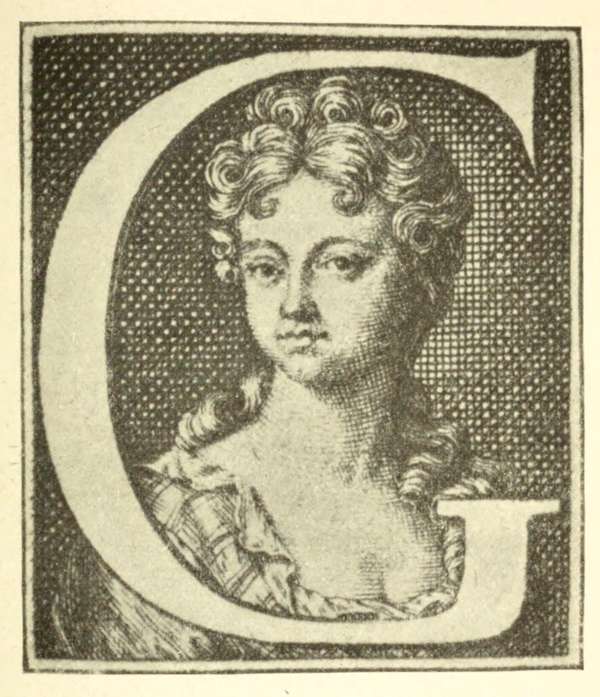
ELIZABETH ELSTOB From a drawing by herself engraved in an initial for her translation of The Pastoral of St. Gregory, 1709, and used also in her Grammar in 1713
The brother of whom Miss Elstob speaks was William Elstob, who was ten years older than she. At eleven he was sent to Eton. At sixteen he went to Cambridge, and later to Oxford, where he was finally, in 1696, elected fellow of University College. In 1702 he became rector of the united parishes of St. Swithin and St. Mary Bothaw, in London, where he died in 1715 at the age of forty-two. He was a highly trained linguist, a great lover of antiquities, and one of the most promising Anglo-Saxon scholars of his time. He apparently had liberal sentiments concerning the education of women, so that as soon as his sister came under his care all her desires for study were gratified. Just when she went to Oxford is not certain, but it was probably about the time he took his fellowship, when she was thirteen. She gives the date of her entrance upon her Anglo-Saxon studies as 1698, when she was fifteen. In that year her brother had made a transcript of King Alfred's version of the Latin historian Orosius which he designed to publish. She wished to understand it and says, "Having gained the Alphabet, I found it so easy, and in it so much the grounds of our present Language, and of a more particular Agreement with some Words which I had heard when very young in the North, as drew me to be more inquisitive after Books written in that Language." Her brother was well pleased and recommended the Saxon Heptatuch. From this she went on to other treatises, and finally began to divert herself with taking transcripts of such ancient manuscripts as she could find.[239] She proved to be particularly facile with her pen. The copies she made of the old manuscripts were said to be marvels in the way of beauty and accuracy of lettering. Her copy of the Textus Roffensis is described by Nichols as "one of the most lovely specimens of modern Saxon writing that can be imagined." She was well received in the University, for Mr. Rowe Mores speaks of her as "the indefessa comes of her brother's studies, a female student in the University and a favourite of Dr. Hudson and the Oxonians."[240] In 1702 she went with her brother to London and they kept on in their work together with great eagerness and satisfaction. There gradually grew up in Miss Elstob's mind a desire to translate and publish some Anglo-Saxon manuscript. She was encouraged in this not only by her brother, but by Dr. Hickes, "the great patron of the Septentrional Studies," who said that by publishing somewhat in Saxon she might invite "the ladies to be acquainted with the Language of their Predecessors, and the Original of their Mother Tongue." The text finally determined upon was the Homily on the Birthday of St. Gregory. Dr. Hudson, "a man of so generous a mind as not to discourage learning, even in the female sex," gave her access to the ancient parchment Book of Homilies in the Bodleian. The book on St. Gregory appeared in 1709 under the title, An English-Saxon Homily on the Birth-Day of St. Gregory: Anciently used in the English-Saxon Church. Giving an Account of the Conversion of the English from Paganism to Christianity. Translated into Modern English, with Notes. It was a stately and dignified volume with a full-page engraving by Gribelin, and many engraved letters and head and tail pieces. In the capital "G" of Gregory was a portrait of Miss Elstob done by herself.[241] The Dedication to Queen Anne apologizes for using a language so "out-dated and antiquated," a language which "few Men and none of the other Sex have ventured to converse with" since the time when it was the current speech. But she adroitly pays the necessary compliment and at the same time recommends her theme, by pointing out that Anglo-Saxon was the language in which the Pious Progenitors of Queen Anne had received the Orthodox Faith of which the Queen was the undoubted Defender. The Preface, sixty pages long, is a learned account of the introduction of Christianity into England. In the text the Saxon and English are in parallel columns, and there is a brave apparatus of notes and comments. Following the English-Saxon Homily is a Latin version by William Elstob which he presents to his sister with the following Latin letter:
Gulielmus Elistobius ELIZABETHÆ Sorori suæ carissimæ S. D.
Dum tu, soror mea dilectissima, Homiliæ Saxonicæ, de gentis nostræ Conversione paras versionem Anglicam fæminis liberalibus: nonnulli forte ex amicis nostris, tum Academicis tum aliis, Latinam postulant hominibus eruditis. Id te velle accomodare venis ad me dicens, bene autem posse negâsti. Verecundius sane id quam verius. Sed favendum omnino verecundiæ, præsertim muliebri: maximè autem tuæ, cum in te virtus illa sit notissima. Quare, quod poscis, dulcis & indefessa studiorum meorum comes, do tibi Latinè. Non Ciceronianè, ut tu velis, id est ornatè, at non ineptè tamen: iisdem ferè verbis repositis quæ in Saxonica olim tansfusa, vel ex Turonensi Gregorio, vel tuo, vel ex Beda nostrate, vel utroque Diacono, & Johanne & Paulo. Eadem plane ratione, qua jam pridem Orosium à nobis elucubratum scis, & qua Gregorii tui Curam Pastoralem, Deo favente, & adjutrice te, Eruditis perlibenter darem. Vale.
Kal. Jun. MDCCIX.
The book was published by subscription and the list of subscribers is an interesting one. We, of course, find the Anglo-Saxon scholars, such as Mr. Thwaites[242] and Dr. Hickes, various Oxonians, the Elstobs of Canterbury and Durham, and others who were in the same religious or learned circles. Various letters to Ralph Thoresby[243] show his interest. In March, 1708-09, she sent him the frontispiece to the Homily saying there would be other ornaments in the way of borders and letters "which will make the book somewhat dear, but I would willingly have it as beautiful as possible." In May, 1709, she thanks him for procuring "so noble a number of encouragers" to her work. Nearly half of the two hundred and sixty subscribers are women. Lady Elizabeth Hastings and Lady Catharine Jones, Mary Astell's friends, are there; and Lady Winchilsea's friends, the Thynnes, the Worseleys, and the Thanets, but not Mary Astell or Lady Winchilsea. The literary set—Pope, Swift, Gay, Addison, Steele—is not represented. Women of title, clergymen, and scholars make up the list.[244]
The Preface is of personal as well as learned interest. Miss Elstob did not enter upon the career of authorship without an uneasy recognition of the opprobrium she might bring upon herself by aspirations so unfeminine. She was, in her own mind, fortified by the elegant Latin treatise in which "Mrs. Anna Maria à Schurman, that Glory of her Sex," had answered, with due scholastic form and dignity, the usual objections made by Gentlemen to Women's Learning, but in deference to the readers of her Homily she felt the necessity of a few words of self justification:
For first, I know it will be said, What has a Woman to do with Learning? This I have known urged by some Men, with an Envy unbecoming that greatness of Soul, which is said to dignify their Sex.... Where is the Fault in Womens seeking after Learning? why are they not to be valu'd for acquiring to themselves the noblest Ornaments? what hurt can this be to themselves? what Disadvantage to others? But there are two things usually opposed against Womens Learning. That it makes them impertinent, and neglect their household Affairs. Where this happens it is a Fault. But it is not the Fault of Learning, which rather polishes and refines our Nature, and teaches us that Method and Regularity, which disposes us to greater Readiness and Dexterity in all kinds of Business. I do not observe it so frequently objected against Womens Diversions, that They take them off from Household Affairs. Why therefore should those few among us, who are Lovers of Learning, altho' no better account cou'd be given of it than its being a Diversion, be deny'd the Benefit and Pleasure of it, which is both so innocent and improving.... I shall not enter into any more of the Reasons why some Gentlemen are so eager to deny us this privilege: I am more surprised, and even ashamed, to find any of the Ladies were more violent than they, in carrying on the same charge. Who despairing to arrive at any eminent or laudable degree of knowledge, seem totally to abandon themselves to Ignorance, contenting themselves to sit down in Darkness, as if they either had not Reason, or it were not capable by being rightly cultivated, of bringing them into the Light.... Admit a Woman may have Learning, is there no other kind of Learning to employ her time? What is this Saxon? What has she to do with this barbarous antiquated Stuff? so useless, so altogether out of the way?... I fear, if things were rightly consider'd, that the charge of Barbarity would rather fall upon those who, while they fancy themselves adorn'd with the Embellishments of foreign Learning, are ignorant, even to barbarity, of the Faith, Religion, the Laws and Customs, and Language of their Ancestors.[245]
It was inevitable that the learning in Miss Elstob's work should be thought of by many as in reality the work of her brother. On this point, towards the close of the Preface, she comments rather ambiguously as follows:
I have been askt the Question, more than once, whether this Performance was all my own? How properly such a Question may be ask'd by those who know with whom I live, I shall not dispute: But since some there are who may have a Curiosity to know the same thing, who yet suspect the Decency of such a Question: that they may be under no Uneasiness on this account, they may be pleas'd to understand that I have a kind Brother, who is always ready to assist and encourage me in my Studies. I might say much of my Obligations on this account: wou'd he permit me to express my self at large on that Subject. But as I think it no shame to me to take any Advice where it may be so easily obtain'd: so I should think it unpardonable to be guilty of such a Silence, as might make me seem averse to all Acknowledgement.
After the publication of the Homily on the Birthday of St. Gregory Miss Elstob made a visit to Canterbury where her uncle was prebendary. The number of Canterbury names in her list of subscribers shows that her fame for learning had preceded her. She was very favorably received, especially by some ladies of rank, one of whom expressed a desire to study Anglo-Saxon under her direction. In pursuance of this project Miss Elstob began at once on the preparation of an Anglo-Saxon Grammar.[246] In 1715, when the Grammar finally appeared, Miss Elstob wrote thus in a Preface addressed to Dr. Hickes:
I was more particularly gratified with the new Friendship and Conversation, of a young Lady, whose Ingenuity and Love of Learning is well known and esteem'd, not only in that Place, but by yourself: and which so far indear'd itself to me, by her promise that she wou'd learn the Saxon Tongue, and do me the Honour to be my Scholar, as to make me think of composing an English Grammar of that Language for her use. That Ladies Fortune hath so disposed of her since that time, and hath placed her at so great distance, as that we have had no Opportunity, of treating farther on this Matter, either by Discourse or Correspondence. However, though a Work of a larger Extent, and which hath amply experienced your Encouragement, did for some time make me lay aside this Design, yet I did not wholly reject it.... But considering the Pleasure I my self had reaped from the Knowledge I have gained from this Original of our Mother Tongue, and that others of my own Sex might be capable of the same Satisfaction: I resolv'd to give them the Rudiments of that Language in an English Dress.
The long Preface to the Grammar is chiefly taken up with an attack on John Brightland, author of the Whole System of English Education, and other wise grammarians who had spoken lightly of Anglo-Saxon and especially of the Thesaurus of Dr. Hickes. One of the aspersions cast by the gentlemen on their mother tongue was that the Northern Languages "consist of nothing but Monosyllables," and Miss Elstob plunges into a lengthy defense of monosyllables with so many quotations from English verse as to show that being "mistress of eight foreign languages" did not prevent her from being exceedingly well read in the poetical literature of her own tongue. This portion of the Preface is followed by a diatribe against those who consider the study of antiquities and of the Saxon tongue as belonging to a lower order of mind, and not contributing to a "just stile" as do the classics.[247] This topic, also, is illustrated by literary characterizations so numerous and apt as to show wide and discriminating reading in English prose.[248]
Miss Elstob was a redoubtable champion in the cause of Anglo-Saxon learning. At the beginning of her career, in 1709, just as her Homily on the Birthday of St. Gregory was coming from the press, Swift had spoken of her as one of the Professors in the College of Madonella, ascribing to her the publication of "two of the choicest Saxon novels, which are said to have been in as much repute at Queen Emma's Court, as the 'Memoires from the New Atalantis' are with those of ours."[249] This disparaging allusion may have predisposed Miss Elstob to answer Swift with exceptional energy when he ranged himself with the scorners of Anglo-Saxon learning. In 1737 Mr. Ballard, in expressing surprise at the appearance of some new opponent of Saxon, wrote: "Indeed I thought that the bad success Dean Swift had met with in this affair from the incomparably learned and ingenious Mrs. Elstob, would have deterred all others from once opening their mouths on this head."[250]
The Homily and the Grammar gave Miss Elstob, at thirty-two, a distinguished place in the world of scholarship. She had also shown unusual skill with her pencil. Not only were her transcripts of manuscripts noted for their beauty, but she also drew admirable portraits. In 1737 Mr. Ballard wrote Mr. Joseph Ames:
I design, if possible, to make a tour to London this Winter, just to peep upon a few choice friends, and will bring Miss Elstob's Life of her Brother along with me, to pleasure you with. But you must be silent in the affair, for some particular reasons not proper here to be mentioned. Besides the above mentioned Life, I have a dozen pieces of this fine accomplished gentlewoman's drawings, amongst which are pictures of herself, Dr. Hickes, Mr. Dryden, and Johannes Ogilvius, etc. very masterly done, and, as I am told, very extraordinary true likenesses.[251]
We get no further completed work from Miss Elstob after the Grammar of 1715, but the six years between the Homily and the Grammar were rich in study and plans. In February, 1708-09, Mr. Thoresby wrote to Dr. Richardson:
Amongst the Authors, I might have mentioned some of the female sex; as the Bishop of Sarum's lady, and Miss Elstob; the former has writ a Method of Devotion, the latter translated a piece of Mons. Scudery from the French, and added some of her own: and is for giving us a more correct Edition of Sir John Spelman's Saxon Psalms, in which tongue she is a great proficient, and has writ that in my Album, etc.[252]
The "work of larger extent" for which Miss Elstob temporarily set aside her Grammar was the proposed publication of a Saxon Homilarium with English translations and notes. That this Homilarium, which was to have been her great work, was well under way by 1712 is indicated by the following letter, December 23, 1712, from Dr. Hickes to Dr. Charlett:
I suppose you may have seen Miss Elstob, sister to Mr. Elstob, formerly fellow of your Coll. and the MSS. she hath brought to be printed at your press. The University hath acquired much reputation and honour at home and abroad, by the Saxon books printed there, as well as by those printed in Latin and Greek, and the publication of the MSS. she hath brought (the most correct I ever saw or read) will be of great advantage to the Church of England against the Papists; for the honour of our Predecessors the English Saxon Clergy, especially of the Episcopal Order, and the credit of our country to which Miss Elstob will be counted abroad as great an ornament in her way, as Madam Dacier is to France. I do not desire you to give her all encouragement, because I believe you will do it of your own accord from your natural temper to promote good and great works. But I desire you to recommend her, and her great undertaking to others, for she and it are both very worthy to be encouraged, and were I at Oxford, I should be a great solicitor for her. And had I acquaintance enough with Mr. Vice-Chancellor I had troubled him with a letter in her behalf. I will add no more but to tell you that the news of Miss Elstob's encouragement at the University will be very acceptable to me, because it will give her work credit here, where it shall be promoted to the utmost power by your Philo-Sax. and Philo-Goth. and most faithful, humble Servt.[253]
In February, 1713, Bedford wrote to Mr. Hearne: "I am to desire yo from him to give all ye assistance & encouragement yo can to Mrs. Elstob's work, who is now going down to ye University again abt it."[254] Mr. Hearne responded in March: "I wish Mrs. Elstob good success. Tho' if she meet with no better Encouragement here than I have done as yet 't will not be great."[255]
In the same year Mr. Bowyer printed "Some Testimonies of Learned Men in favour of the intended edition of the Saxon Homilies, concerning the learning of the author of those Homilies, and the advantages to be hoped from an edition of them."[256] And three letters from Miss Elstob to the Lord Treasurer show that he solicited and obtained the Queen's Bounty towards printing the Homilies.[257]
In spite of all this encouragement the publication of the Homilies hung fire for many months. It is possible that the death of Mr. Elstob and of Dr. Hickes in 1715 delayed matters by depriving Miss Elstob of able advocates and counselors. In July, 1716, Sir P. Sydenham indicates his concern that the book had not yet appeared.[258] In November of that year Mr. T. Baker writes apologetically to Mr. Hearne that he is "deep in Mrs. Elstob and Mr. Strype," and that the work does not admit of haste.[259] Later in the same month Mr. Hearne gives the cheering news that "Mrs. Elstob's book is going on at last."[260] But only five of the Homilies were actually printed off at Oxford.[261] The great scheme failed for want of money. Miss Elstob's own fortune was apparently involved, for in 1718 Mr. T. Baker wrote to Hearne that Miss Elstob was "lately gone off for debt."[262]
Except these few facts concerning the Homilies very few details are known concerning Miss Elstob's life after 1715. Bishop Smalridge[263] aided her for a time, but she could not endure the thought of being a burden on her friends, and she finally went to Evesham, Worcestershire, where she started a little school. Mr. Tindale, in his History of Evesham, says that he was credibly informed that her weekly stipend in this school was at first but a groat a week. She was in this very contracted and difficult way of life for nearly twenty years. When relief came it was as the result of the efforts of an obscure young Anglo-Saxon scholar, Mr. George Ballard, a lady's-stay-maker, who became acquainted with Miss Elstob and described her situation so effectively to one of his customers, a Mrs. Chapone, that this lady wrote a circular letter representing Miss Elstob's extensive learning, her service to literature, her multiplied distresses, her meekness and patience, and sent it to the neighboring gentry. An annuity of twenty guineas was raised, and Miss Elstob was enabled to keep an assistant so that she could again "taste of that food of the mind from which she had been so long oblig'd to fast."
Another result of Mrs. Chapone's letter was a possible appointment for Miss Elstob as mistress of a charity school kept up by Lady Elizabeth Hastings. With regard to this plan Miss Elstob wrote the following very interesting letter to Mr. George Ballard:
Since you desire to know if I have accepted Mrs. Capon's proposal, I do, though I am very sensible it is not commendable to expose a private correspondence, venture to communicate to so good a friend, a copy of the worthy gentleman's letter, sent her in answer to her vastly kind recommendation of me, and the charming letter she sent to me. In answer to hers, after I had received your answer, I assured her of my readiness to serve that excellent lady, as far as lyes in my power. But there are some things to be taught in such a school, which I cannot pretend to: I mean, the two accomplishments of a good housewife, spinning and knitting. Not that I would be thought to be above doing any commendable work proper for my sex; for I have continually in my thoughts the glorious character of a virtuous woman, Proverbs XXXI, 13; "She seeketh wool and flax, and worketh willingly with her hands." And as an instance of the truth of this, the gown I had on when you gave me the favour of a visit was part of it my own spinning, and I wear no other stockings but what I knit myself: yet I do not think myself proficient enough in these arts to become a teacher of them. As to your objection on the meanness of the scholars, I assure you, Sir, I should think it as glorious an employment to instruct those poor children, as to teach the children of the greatest. But I must tell you that mine may be termed a life of disappointments from my cradle till now, nor do I expect any other while I live. This, and hearing no more of that affair, makes me think her ladyship is provided with a mistress before now, there being many more deserving than myself, that are in want of such an employment. Nor do I repine; for I am so inured to disappointments, that I expect nothing else, and I receive them with as much easiness as others do their greatest prosperity.... I often compare myself to poor John Tucker, whose Life I read when a girl in Winstanley's Lives of the Poets, which affected me so much that I cannot forget it yet. He is there described to have been an honest, industrious, poor man, but, notwithstanding his indefatigable industry, as the author writes, "no butter would stick on his bread."[264]
The Mrs. Chapone who wrote the circular letter concerning Miss Elstob was Sarah Kirkham, an intimate girlhood friend of Mary Granville, afterward Mrs. Pendarves, but better known as Mrs. Delany. Sally Kirkham is described by Mrs. Delany as a girl of "extraordinary understanding, lively imagination, and humane disposition," of "uncommon genius and intrepid spirit." In 1725, at the age of twenty-four she married the Reverend John Chapone, and they went to live in Stanton, Gloucestershire, and little more is heard of her until the writing of this letter before 1734. Mrs. Chapone meant the letter for the neighboring gentry, but it finally reached a more distinguished audience. Mrs. Pendarves writes:
I told you in my last I had left Sally's letter with Mrs. Pointz. She gave it to her husband, who desired the Duke to read it to the Queen. The Queen was so touched with the letter that she immediately sent for Mrs. Pointz, to inquire into some more particulars about the person mentioned in it, and the person who wrote it. Mrs. Pointz said she knew no more than what the letter told, but that Mrs. Chapone was a friend of ours. The Queen said she never in her life read a better letter, that it had touched her heart, and ordered immediately an hundred pounds for Mrs. Elstob, and said she "need never fear a necessitous old age whilst she lived, and that when she wanted more to ask for it, and she should have it." I think this was acting like a queen, and ought to be known.... I hope this may be the means of serving our friend Sally, the letter was the whole discourse of the drawing-room. The Queen asked the Duke "When he should be able to write such a letter." He answered, honestly, "Never." Mrs. Pointz has asked many particulars about Mr. Chapone, and I did him justice.[265]
Queen Caroline's interest was so genuinely aroused that she not only ordered the £100 to be at once sent to Miss Elstob, but promised to repeat the same every five years. This was evidently with the idea that she should be taken from the little school at Evesham and put into her proper station as "mistress of a boarding-school for young ladies of a higher rank." Such might have been the outcome had not the money lapsed with the death of the Queen in 1737.
All plans for Miss Elstob seemed to end in failure till "Sally's historical epistle," as Mrs. Pendarves called it, was sent to the Duchess of Portland at Bulstrode.[266] The result in this case was of permanent value, for Miss Elstob was invited by the Duchess to make her home at Bulstrode as instructor of the children. Of this appointment Mrs. Pendarves wrote, December 12, 1738, to her mother:
The Duchess has now a thousand fears, lest my Lord and Lady Oxford should have any objections against taking her, but I hope they will all prove false.... Mrs. Elstob seems, out of modesty and diffidence of herself, to decline coming, but it would be most imprudent of her to decline such an offer, when no fatigue will be imposed upon her, but all imaginable care will be taken of her. I own I long to have you see her, that I may really know what sort of woman she is. My Lord Oxford objects to her not speaking French, but the Duchess answers she shall have a master for that, or a maid to talk, and all she requires and hopes of Mrs. Elstob is to instruct her children in the principles of religion and virtue, to teach them to speak, read, and understand English well, to cultivate their minds as far as their capacity will allow, and to keep them company in the house and when her health and strength will permit to take the air with them. All this she is surely well qualified to do, and it would be a sincere joy to me to have our worthy Duchess possest of so valuable a person.[267]
Ten days later Mrs. Pendarves wrote again from Bulstrode:
The Elstobian matter is quite fixed, and she expressed the utmost satisfaction at having secured such a worthy woman to educate her children; I wrote last post to Mrs. Elstob to tell her that the Duchess looked on her as engaged to her, and that her salary should begin on Xmas Day next, though she could not conveniently take her into her family till Midsummer. I hope she will write to the Duchess, and suppose she will of course; I gave her a little hint but would not have it mentioned that I did.... I think your advice to Mrs. Elstob quite right about paying debts; a person of such principles as hers cannot enjoy any advantages without doing that justice when it is in her power to do it.[268]
In August, 1739, Miss Elstob was in Evesham and several times met her benefactor, Mrs. Chapone, of whom she gives a lively picture showing that letter-writing was not Mrs. Chapone's only title to fame. Miss Elstob writes:
The last time she was here, I had an exceeding pleasure, though not without some concern, at hearing a long and warm dispute between that charming woman, and Mr. Ben Seward, on some methodistical notions, in which it was by better judges than myself agreed that the female antagonist had much the advantage over him.[269]
Miss Elstob spent the remaining seventeen years of her life with the Duchess of Portland. They were comfortable, leisurely, studious years, a delightful haven after her twenty years of hardship, penury, and intellectual starvation. But she was fifty-six when she went to Bulstrode, and the ease and security of her life there came too late to rouse into life the mental activity so long dormant. Miss Elstob's real life was the twenty years with her brother, years of plain living and high aspirations while they worked together in the realms of pure scholarship. It would be difficult to find a more satisfying example of literary comradeship than that offered by the learned young curate and the learned young sister, the "dulcis & indefessa comes" of his studies.[270]
Elizabeth Blackwell (fl. 1739)
In 1739 Mrs. Elizabeth Blackwell published in two folio volumes A Curious Herbal, containing Five Hundred Cuts, of the most useful Plants, which are now used in the Practice of Physick, engraved on folio Copper Plates, after Drawings taken from the Life, by Elizabeth Blackwell. To which is added, a short Description of the Plants and their common Uses in Physick. Printed for John Nourse at the Lamb without Temple Bar. The first of these magnificent volumes is dedicated to the famous Dr. Richard Mead, "Physician to Kings," as the one who first advised the publication of the work. The dedication of the second volume is to Isaac Rand, an apothecary and Fellow of the Royal Society, and Curator of the Botanical Garden at Chelsea, as the one to whom she went for assistance in all difficult botanical questions. The short descriptions of the plants were taken mainly from Mr. Joseph Miller's Botanicum Officinale with his consent. She lived near the Botanical Garden and made all her drawings from life. She also etched them on copper, and colored them herself. The book received high recognition. Much of the work must have been done by 1735, for on October 1 of that year the following testimonial, now one of the title-pages, was written:
We whose names are underwritten, having seen a considerable Number of the Drawings from which the Plates are to be engraved, and likewise some of the Coloured Plants, think it a Justice done the Publick to declare our Satisfaction with them, and our good Opinion of the Capacity of the Undertaker.
R. Mead, M.D. G. L. Tessier, M.D. Alexander Stuart, M.D.
Ia. Douglas, M.D. James Sherard, M.D. W. Cheseldon
Joseph Miller Isaac Rand Rob. Nicholls
This statement was repeated in French and the names again signed.
A further endorsement on the completion of the book was dated July 1, 1737. It is as follows:
Imagines hasce Plantarum Officinalium per Dominam Elizabetham Blackwell delineatas ceri incisas & depictas, iis qui Medicinæ Operam dant, perutiles fore judicamus.
Thomas Pellet, Præs.
Henricus Plumptre}Censores.
Richardus Tyson}
Peircuis Dod}
Gulienius Wasey}
In 1757-73 there was a fine republication of the work in Nuremberg with an addition of a hundred plants, and a highly laudatory Preface. The work was recognized at once as of great practical value because of the accuracy of the drawings and the large number of plants represented. The charm of the plates is beyond question so far as delicacy of outline and beauty of coloring are concerned. They are superior to the plates in Darwin's Botanic Garden, nearly half a century later. The Blackwellia race of plants was named after Mrs. Blackwell in recognition of her admirable work.[271]
Mrs. Blackwell is herself an enigma. She emerges into public notice for three years, but her life before and after sinks into obscurity. She was said to be "a virtuous gentlewoman, daughter of a worthy merchant," who gave her a handsome portion. Her husband was Alexander Blackwell, a printer. He was a well-educated and able man, but generally counted an adventurer. He at one time entered upon a project of conducting a printing establishment of his own. His failure in this landed him in a debtor's prison where he was confined several years. Mrs. Blackwell's Herbal was made by her for the purpose of securing his release. He is said to have aided her in the foreign terminology and in the abridgments from Miller. When he was free her object was accomplished and we hear of no further work. It would be interesting to know how she came to have so much skill. It would be more interesting to know the psychology of her prompt abandonment of work by which she won both fame and money, and in which she took such evident delight.[272]
Mrs. Elizabeth Cooper (fl. 1735-40)
It is to be regretted that so few facts are accessible concerning Mrs. Elizabeth Cooper. Her works seem to offer interesting points of departure for investigation into her life and education, but we know little about her except that her literary ventures belong between 1735 and 1740. She was the wife of Thomas Cooper,[273] who was either an auctioneer or a book-seller, or possibly both, and she was married before 1735. Beyond these meager facts our knowledge of her must be gleaned from her books. Apparently her first literary venture was a comedy. It was entitled The Rival Widows; or, the Fair Libertine, and was brought out at the Covent Garden Theater in 1735. It had a successful run of nine nights. Baker says that "allowing for the too common freedom of female dramatists, this is far from a bad comedy."[274] Genest, after briefly outlining the play and commenting on various passages that seem to him borrowed from preceding dramatists, says: "It is on the whole a tolerable play, but it wants incident sadly." But he does not agree with Baker as to the moral tone of the play, for he says of Lady Bellair, the heroine, "Lady Bellair is gay and extravagant, but of good principles at bottom ... it is with much impropriety that she is called a Fair Libertine—she is only above vulgar prejudices."[275] In her preface to the play Mrs. Cooper says that it was designed "an Offering to the Sex" in that the chief character is a woman "capable of thinking for herself, and acting on the principles of Nature and Truth." Some indications of the characteristics of Lady Bellair may be found in the fact that Mrs. Horton was chosen to create the part. Millamant in Congreve's Way of the World, Lady Dainty in Burnaby's The Reform'd Wife, Lady Betty Modish in Cibber's Careless Husband, and Lady Townly in his Provoked Husband, were the parts in which Mrs. Horton's beauty and her elegance of dress and manner found their fitting opportunity. Lady Bellair belongs evidently to this class of fine lady coquettes, and a further point of interest concerning Mrs. Cooper is that on her benefit night she herself played the part of Lady Bellair. Either Mrs. Cooper had already shown enough ability as an amateur actress to warrant her appearance on the stage of one of the leading theaters, or she was well enough known as a writer or as a personality to make her presence in the cast a drawing card. That she could venture on the inevitable comparison with Mrs. Horton may indicate some possibilities in the way of her own attractive qualities. And it is to be further noted that she "unexpectedly and surprizingly" eclipsed Mrs. Horton. The Prompter endeavors to explain Mrs. Cooper's success by saying that she "looked" the character and represented with great "naturalnes," the somewhat bold and libertine heroine.[276]