Chapter II · LEARNED LADIES IN ENGLAND FROM 1650 TO 1760 (continued 5)
Reading edition
And as the faults of this work want very little excuse, so its beauties want as little recommendation; though I will not say but they may sometimes stand in need of being pointed out to the generality of readers. For as the merit of this work consists in a vast penetration into human nature, a deep and profound discernment of all the mazes, windings, and labyrinths, which perplex the heart of man to such a degree that he is himself often incapable of seeing through them; and as this is the greatest, noblest, and rarest of all the talents which constitute a genius; so a much larger share of this talent is necessary even to recognize these discoveries when they are laid before us than fall to the share of a common reader....
As to the characters here described, I shall repeat the saying of one of the greatest men in this age,—"That they were as wonderfully drawn by the writer as they were by Nature herself." There are many strokes in Orguiel, Spatter, Varnish, Levif, the Balancer, and some others which would have shined in the pages of Theophrastus, Horace, or La Bruyère. Nay, there are some touches which I will venture to say might have done honour to the pencil of the immortal Shakespeare himself.[352]
For a continuation of David Simple in 1747,[353] Fielding wrote a dedication and five letters. In this Preface he gave his opinion on learning for women:
The objection to the sex of the author hardly requires an answer; it will be chiefly advanced by those who derive their opinion of women, very unfairly, from the fine ladies of the age; whereas, if the behavior of their counterparts, the beaux, was to denote the understanding of men, I apprehend the conclusion would be in favour of the women, without making a compliment to that sex. I can, of my own knowledge and from my own acquaintance, bear testimony to the possibility of those examples which history gives of women eminent for the highest endowments and faculties of mind. I shall only add an answer to the same objection, relating to David Simple, given by a lady of very high rank, whose quality, is however, less an honour to her than her understanding. "So far," said she, "from doubting David Simple to be the performance of a woman, I am well convinced it could not have been written by a man."[354]
Miss Fielding's own views on the woman question are slightly indicated in this story. In the course of his peregrinations David Simple meets the charming Miss Cynthia, who tells him the story of her life and leads him to reflect upon the irritation and unhappiness which result from the undue restrictions imposed upon women. Miss Cynthia had always been subject to repression. Whenever she asked questions she was told, such things were not proper for girls of her age to know. She was not allowed to read, for Miss Cynthia must not inquire too far into things lest it should turn her brain. She was to mind her needlework and such things as are useful to women. Reading and poring over books would never get her a husband. Cynthia's restlessness doubtless well represents the state of mind of many a contemporary girl eager for learning, but not able to escape from the feminine conventions.
In 1749 Miss Fielding published a work quite new in form and intention. It was entitled The Governess; Or, The Little Female Academy. Calculated for the Entertainment and Instruction of Young Ladies in their Education. It was so popular that a seventh edition appeared in 1760. This little book represents the happenings of nine days in the school of Mrs. Teachum, a gentlewoman who taught young ladies "in Reading, Writing, Working, and in all proper Forms of Behavior." The oldest of her nine young ladies was fourteen, the youngest was six, and the others between six and twelve. The book was professedly written, not for the Mrs. Teachums of the age, but for little girls under twelve. And the instruction embodied was thrown into story form to make it more acceptable to young readers. I know of no earlier similar attempt. Such books as had been written for children were serious and religious in tone. But Miss Fielding's book was lively and entertaining. Each little girl told the history of her life and analyzed her adventures and emotions, particularly her faults and their outcome, in true romance style. But all is kept pretty near to a child's understanding. And there are some occurrences—as a fracas in which the genteel young ladies "fought and scratched and tore like young cats," for the possession of an apple redder and bigger than its companions in the basket, a collation at a dairy farm, sewing-parties in an arbor with Miss Jenny Peace, the fourteen-year old girl, as story-teller and as umpire in all disputes, that must have had extraordinary charm for young misses who had never before seen even a semblance of their own lives in print.
Miss Fielding's other works are of less significance except for her translation of Xenophon's Memoirs of Socrates; with the Defence of Socrates before his Judges (1762), which indicates a knowledge of Greek more exact than was common in her day.
The most interesting fact in Miss Fielding's life is her close friendship with Richardson. She was one of the most ardent admirers of his work. She says of Clarissa: "When I read of her I am all sensation; my heart glows; I am overwhelmed; my only vent is tears.... Often have I reflected on my own vanity in daring but to touch the hem of her garment." In 1756 Richardson wrote to her:
Why did you not tell Lady Bradshaigh ... that you were my much-esteemed Sally Fielding, the author of David Simple? She knows my opinion of you, and of your writing powers.... I have just gone through your two vols. of Letters. Have re-perused them with great pleasure, and found many new beauties in them. What a knowledge of the human heart! Well might a critical judge of writing say, as he did to me, that your late brother's knowledge of it was not (fine writer as he was) comparable to yours. His was but as the knowledge of the outside of a clock-work machine, while your's was that of all the finer springs and movements of the inside.[355]
The most popular work by Miss Fielding was The Little Female Academy. David Simple, to be sure, went through two editions in 1744. But the indications of contemporary recognition are not at all commensurate with the praise from her brother and Richardson and other high authorities. Of foreign appreciation of her work there are more proofs. David Simple was translated into German[356] in 1746 and into French in 1755,[357] and The Countess of Gräfin was translated into German in 1761.[358] The French translator of David Simple commented on the approbation générale which this romance had found.[359]
Charlotte Lennox (1720-1804)
Charlotte Rumsey was the daughter of Colonel James Rumsey, Lieutenant-Governor of New York. At fifteen she was sent to England as the protégé and probable heiress of an aunt. But the aunt became insane, and the girl was left penniless. The only facts that emerge concerning the difficult years before her marriage to Mr. Lennox in about 1748 have to do with her very mediocre career as an actress.
Except for a volume of poems in 1747, it was not till after her marriage that Mrs. Lennox came forward prominently as an author. Her two-volume novel, The Life of Harriet Stuart, Written by Herself, appeared in 1751. But in literary circles she was evidently well known before this, for Johnson was her especial friend. When her manuscript was ready for publication, he arranged a celebration at his Club. The festivities were to last all night. Mrs. Lennox was ceremoniously crowned with laurel, and there was a magnificent hot apple-pie stuck with bay leaves.[360] This first novel is probably in part autobiographical inasmuch as the heroine, Harriet Stuart, is the daughter of a man of high official rank in America, and goes to England at fifteen to live with an aunt who becomes insane and leaves her penniless. But this is merely a slight framework for a series of love adventures. Miss Stuart's wit and beauty gather about her lovers of all varieties, army officers, sea-captains, pirates, merchants; and the alarming crises of her fate put her into close competition with Clarissa Harlowe herself. America, France, and England are the far-separated scenes of Miss Stuart's trials and victories, the emphasis being on her life in America. There would be a chance for some interesting local color in this representation of mid-eighteenth-century life in New York if the young lady could have spared a moment from her adventures to observe her surroundings. An Indian encampment, a visit to a fort, an escapade to a "farm," a midnight row on the Hudson, are mentioned, but with no comment. Towns and houses, roads, rivers, and seas, are but localities for love scenes, means of transit from one episode to another. The story is told with a deft manipulation of details and an easy fluency that would seem to indicate something of a previous literary apprenticeship. At any rate, in this novel she had found her medium, and she was soon ready with a tale that gave her genuine distinction. The Female Quixote appeared in 1752 with a Dedication written by Johnson, and it was reviewed by him in The Gentleman's Magazine for March. He said of it: "Mr. Fielding, however emulous of Cervantes, and jealous of a rival, acknowledges in his paper of the 24th, that in many instances, this copy excels the original, and though he has no connection with the author, he concludes his encomium on the work, by earnestly recommending it as a most extraordinary, and most excellent performance. 'It is,' says he, 'a work of true humour, and cannot fail of giving a rational, as well as a very pleasing amusement, to a sensible reader, who will at once be instructed, and highly diverted.'"[361] Johnson's name is still more intimately connected with the book, for he wrote the chapter which has the heading, "Being in the author's opinion, the best chapter in this history."[362] Harriet Stuart reads like an echo of Richardson, but in The Female Quixote Mrs. Lennox strikes an original note. Comedy had already, a generation earlier, in Biddy Tipkin, made sport of the romance-reading girls of the day. But the satire was new in fiction. And it was carried out with a fullness and accuracy of details possible only to one who had herself been a traveler in enchanted realms. Mrs. Lennox must at some time have been as devoted to French fiction as even Dorothy Osborne and Mrs. Pepys in the preceding century. Her story is long-drawn-out and improbable, but the cleverness with which Arabella and Lucy parody Don Quixote and Sancho Panza gives the book a notable place among the English followers of Cervantes. The Spiritual Quixote (1773), a satire on the Methodists, and The Benevolent Quixote (1791), a satire on mawkish ideas of charity, are inferior in vivacity and interest to Mrs. Lennox's work.
In 1753-54 Mrs. Lennox brought out Shakespeare Illustrated; or, Novels and Histories on which the Plays are ... founded, collected and translated, an uncritical piece of work according to present standards, but historically significant as one of the earliest attempts to present Shakespeare's sources.[363] A two-volume novel, Henrietta, in 1758, was dramatized as a didactic comedy under the title The Sister,[364] and brought out at Covent Garden in 1769. Though Miss Mattocks played the chief part, and the Prologue and Epilogue were respectively by Colman and Goldsmith, the play met with but moderate success. In 1760-61 Mrs. Lennox edited The Ladies Museum, in which were illustrated articles on natural history written especially for ladies, philosophical discussions simplified for ladies, and continued stories of the love-adventure type evidently calculated for the same tastes. The most interesting character drawing is that of an incipient Mrs. Malaprop in the person of a Mrs. Gibbons.
If any annals were extant of Mrs. Lennox's life we should doubtless find records of continuous study. At least we constantly get new proofs of her learning. The Memoirs of M. de Bethune, Duke of Sully, in three volumes in 1756,[365] The Memoirs of the Countess Berci, in two volumes in the same year, and Memoirs for the History of Madame de Maintenon, in 1757, show not only her mastery of French, but very steady application to intellectual tasks. In 1759 she had what might be considered her crowning honor as a learned lady. She was chosen to edit a translation of Brumoy's Greek Theatre. In collaboration with her were Dr. Johnson, Dr. Gregory Sharpe, Dr. Grainger, and John Bourrya, men of recognized standing as scholars.[366]
Mrs. Lennox lived forty-four years after the close of the period under discussion. But she belongs properly in the first half of the century because all her important work comes between 1750 and 1760. After a decade of exceptional literary activity she sinks into obscurity. In 1775 Dr. Johnson assisted in preparing proposals for the publication of her collected works, in three quarto volumes, by subscription. Had this plan been carried out there would doubtless have been preserved much interesting information concerning the social and literary life of an eminently successful mid-eighteenth-century bas bleu. From the facts at hand it is easy to see that she was countenanced by some of the best minds of her time. Her portrait was painted by Reynolds and engraved by Bartolozzi.
Miss Catharine Talbot (1721-1770)
In 1770 Miss Elizabeth Carter gathered together and published the Works of her friend Miss Catharine Talbot. There had been considerable urgency on the part of Miss Talbot's friends to secure such a publication during her lifetime, but she was too timid, and, though The Green Book in which she kept sketches and fragments, and "the considering drawer," constantly received accessions, her modest opinion of her own worth and an exaggerated dread of general criticism held her back from the ordeal of the printed page. But when the Works finally appeared they achieved immediate popularity. The Reflections on the Seven Days of the Week went through three editions the first year and there was a tenth edition in 1784. Of the Works the eighth edition appeared within forty years. The extravagant contemporary estimate of Miss Talbot as a moral and religious writer, as a supporter of Christian ethics, can awake only surprise in the modern reader. Even a reader whose mind has been subdued to second-class eighteenth-century didacticism finds Miss Talbot's moralizings pale and anæmic. But when we read her letters we come upon a much more attractive and vital personality. A letter descriptive of Mr. Browne Willis and his four daughters shows a gay spirit and a talent for minute observation and social satire of the Jane Austen type.[367]
From the age of five Miss Talbot lived in the family of Mr. Seeker, Bishop of Oxford and later Archbishop of Canterbury. Her spiritual and mental training were constantly under the supervision of the Archbishop, who loved her devotedly. And her education is particularly interesting as an illustration of the desultory and fragmentary character of the intellectual discipline provided for a girl of active mind, even in one of the best families. One advantage was hers from early life, and that was her association with the learned guests at the deanery where there was always an atmosphere of scholarly and serious discussion. And her position as a member of the Archbishop's family not only gave her entrance into the best social circles, but made it incumbent on her, as hostess or guest, to cultivate the amenities of life. But she did comparatively little in the way of exact studies. She was proficient in French and Italian, but she knew no Hebrew or Greek and but little Latin. She had tutors in geography and astronomy and found satisfaction in the conceptions opened up to her by these subjects. Of her drawing and painting for which she had considerable repute she wrote in 1745:
I learn of a good master but am much too impatient and too volatile to give half the time and application that are necessary to make anything tolerable, yet I undertake large pictures, like an inconsiderate goose as I am, and then have the mortification to leave them unfinished. This is actually the case with a fine holy family of Carlo Maratti's, which I began last winter (and two or three other pictures at the same time) in crayons, and which must now want the perfecting touches till February or March. At the same time I had undertaken to learn perspective of Mr. Wright. I hope from all these things I shall in time learn discretion at least, and not to be thus perpetually aiming de prendre la lune avec les dents.[368]
This letter was written when she was twenty-five. A Dialogue written at eighteen gives an earlier glimpse of her chaotic student life. This Dialogue is entitled "Enquiry how far Practice has kept pace with Intention."
What have you done, this Summer?
Rode, and laughed, and fretted.
What did you intend to do?
To learn geography, mathematics; decimal fractions and good humour: to work a screen, draw copies of two or three fine prints, and read abundance of history: to improve my memory and restrain my fancy: to lay out my time to the best advantage: to be happy myself, and make everybody else so. To read Voltaire's Newton, Whiston's Euclid, and Tillotson's Sermons.
Have you read nothing?
Yes: some of the Sermons; Mrs. Rowe's Works; The Tale of a Tub; a book of Dr. Watt's; L'Histoire du Ciel; Milton, and abundance of plays and idle books.
Archbishop Secker's household presents an agreeable picture of lettered leisure. During the evenings there are long sessions known as "the family readings." In 1751 they are reading Pope's Works, evidently in the recent nine-volume edition by Warburton. They are filled with mingled pride and shame as they reflect on his genius and his failings. They have read Mrs. Cockburn's defense of him and they love her for her zealous championship. But Pope is not their idol. All their hero worship, at least all of Miss Talbot's hero worship, goes to Richardson. She cannot subscribe to any criticism of him. In a discussion of one of his essays in The Rambler, Miss Carter's strictures bring a spirited protest from Miss Talbot:
He does not pretend to give a scheme (not an entire scheme) of female education, only to say how when well educated they should behave, in opposition to the racketing life of the Ranelagh-education misses of these our days. Do read it over again a little candidly. How can you ever imagine that the author of Clarissa has not an idea of what women may be, and ought to be.
Richardson and Miss Talbot were personal friends and he thought so highly of her judgment that when he contemplated creating the character of a perfect gentleman as the hero of Sir Charles Grandison, he consulted her concerning the traits of this superman. She in turn consulted Miss Carter, and when the book appeared she wrote to Miss Carter in great glee:
Oh! Miss Carter, did you ever call Pigmalion a fool, for making an image and falling in love with it ... and do you know that you and I are two Pigmalionesses? Did not Mr. Richardson ask us for some traits of his good man's character? And did we not give him some? And has not he gone and put these and his own charming ideas into a book and formed a Sir Charles Grandison?
Beside the evening readings there were leisurely literary picnics, where by some riverside they drank tea and read Madame de Sévigné's Letters and Miss Fielding. They read Mrs. Cockburn and Mrs. Jones, and Mrs. Lennox, even the Memoirs of Mrs. Constantia Phillips, and the early verse of Miss Mulso. There is time for slow and meditative reading, and for interested comment and question, back and forth, by letter. It was a normal, unpretentious, and stimulating way to gain an acquaintance with contemporary literature. And the great classics were read, in translations, in the same manner. To read with a learned man like Archbishop Secker was in itself an education.
It is thus that Miss Talbot had all the environment of education with none of its disciplinary work. By twenty she was known as "the celebrated Miss Talbot" without any basis of actual achievement. She seems to have embodied an eighteenth-century ideal. Her religious beliefs were beyond cavil, her conduct irreproachable. She had an alert mind, wide interests, and considerable information on varied topics. She had a high social rank, and she recognized social obligations. She was affable, approachable, attentive. She had enough learning to give her distinction, but not enough even to threaten pedantry. And she exerted all her talents in home and church circles. She was not a Lætitia Pilkington writing scandal for daily bread, nor a Mary Astell protesting against the tyranny of man, nor an Elizabeth Elstob delving in unfashionable research. She awakened no antagonisms. She had the success and happiness that come from being entirely in accord with one's environment.[369]
Mary Leapor (1722-1746)
A few mediocre poetesses at the end of the period may be cursorily noticed because in their own day they attracted some attention. In Poems by Eminent Ladies Mary Leapor (1722-1746)[370] is given more space than any other author. And in these decorous pages she stands out as a distinct individuality. She is the daughter of a gardener, but no such elegant creature as Tennyson's Rose. She has work to do indoors and out, and her life is eminently prosaic. She has a plain face, an awkward figure, and non-descript clothes. But she has no quarrel with fate or her mirror. She seems to have been a shrewd, sensible young woman, vivacious, quick-witted, with no illusions, no sentimentality, no dreams. In her minor fashion she was a satirist of the Pope school. Of the seventeen books in the little library she had painfully gathered, the ones she valued most were by Pope and Dryden. She manages the heroic couplet with considerable correctness and ease and she follows Pope's method of illustrating a topic with verse portraits. Her closely studied country scenes suggest that Gay's Shepherd's Week must have been among her books. Considering her youth and contracted way of life, she had a remarkable insight into social foibles, but she had none of Swift's scorn of the human race nor of Pope's personal virulence. Her outlook on life was detached, tolerant, and amused.
Miss Mary Jones (fl. 1755)
In 1755, when Miss Mary Jones was included in Eminent Ladies, she was still living, and therefore the date of her birth was not given. But the editorial comment says that Oxford was her home, and "hence deservedly called the Seat of the Muses." Miss Jones corresponded with a maid of honor, had many intimacies among the nobility, and rejoiced in the friendship of Her Royal Highness, the Princess of Orange. Her poems had, therefore, especial opportunities to make their way. But the modest author long resisted the suggested publication of her works. She felt that these "accidental ramblings of her thoughts into rhyme" were of too slight value to be preserved in print. But she finally, in 1752, came forward with a volume which was greeted with high praise. The Monthly Review for 1752 began an Appreciation of her in the following flattering fashion: "To the applauded names of the ingenious Molly Leapor, and the truly admirable Mrs. Cockburn (see Review, the preceding volumes) we have now the pleasure to add that of Mrs. Jones; whose name will not be less an honour to her country, and to the republic of letters, than her amiable life and manner are to her own sex: to that sex whose natural charms alone are found sufficient to attract our tenderest regards; but which, when joined to those uncommon accomplishments and virtues this lady is mistress of, so justly command our highest admiration, and most ardent esteem." The Review considers her compositions in verse as "superior to those of any other of our female writers since Catherine Phillips" and her prose as "superior to any pieces of the kind that our own country has produced, from the pen of a woman." She was of a gay and vivacious temperament, and social by nature. Her interest in her friends' affairs brought forth many occasional poems. A spider frightens Charlot, Mrs. East's canary bird dies, a hare is sent to Mrs. Clayton, Lady Beauclerk desires an elegy in memory of her husband,—each incident receives poetical commemoration. Epistles on Patience, Desire, and Hope are addressed to her friends among the nobility.
Like Miss Leapor she is a satellite of Pope. She has studied him to such effect that phrases and whole lines from his poems occur in her verse, and to the best of her ability she copies his style. Her Epistle to Lady Bowyer is throughout curiously reminiscent of his Epistle to Dr. Arbuthnot. Her verse essays are loosely constructed amplifications of Pope's aphorism which she transforms into "Whatever is, is Best."
Mrs. Madan (fl. 1755)
Mrs. Madan ("formerly Miss Cowper") was living in 1755. She was reputed to have fine talents for poetry, an "extraordinary genius," in fact, but she could never be brought to publish any of her poems. She is therefore known now only by her translation of Abelard's Letter to Eloisa, a kind of companion piece to Pope's Eloisa to Abelard. It is smooth, well-expressed, and shows some sympathetic understanding of Abelard's emotions.
Miss Mary Masters (fl. 1755)
Miss Mary Masters, a native of Ottley near Leeds in Yorkshire, had an early taste for poetry, but she was "always brow-beat and discountenanced by her parents."[371] The chief poems by her in Eminent Ladies are trite paraphrases of the Psalms and need not detain us.
In 1755 she brought out by subscription Familiar Letters and Poems on Several Occasions. The letters between her as Maria and various friends in 1755 are of considerable interest. The young ladies discuss, in the main, questions of love and marriage, but some letters at the end of the book concern themselves with the relative powers of men and women. "Miss ——" sustains the conventional view that they differ fundamentally, men having more strength of judgment, and women quicker apprehension. She says that no woman has been great as an orator, that the best women poets are inferior to Milton, and that men have always managed the government. Maria maintains that the difference is not in the faculties themselves, but in the training of the faculties and in opportunities for their use. She cites a young lady of twenty-two in France who had been admitted to the Academy of Science. And one entire letter is a eulogy of Italian learned ladies. She gives the name of Clelia Borromeo of Milan, counted by the Italians "the greatest mathematician their country has produced, except Galileo and Manfredi"; Gabriella Agnesi, also of Milan, skilled in algebraic computations; Countess Tullia Francesca Bizetti Imbonati, a "Lyrick Poetess," another Milanese lady; Laura Catterina Bassi, Professor of Experimental Philosophy in the University of Bologna, and many others. Maria is the earliest apologist for the advancement of women to make such definite and intelligent use of the learned Italian ladies as corroborative illustrations.[372]
Miss Mary Chandler (1687-1745)
Miss Mary Chandler (1687-1745), the daughter of a minister, was a popular poetess of Bath, where she had at eighteen set up a little shop. She was literary in her tastes and in spite of constant ill-health and the hard work entailed by her shop she found time for wide reading in poetry. She also wrote rhyming riddles and poems to her friends. She became a favorite among the gentry and the literary ladies in and about Bath, Lady Russell, the Duchess of Somerset, Mrs. Barber, and Elizabeth Rowe being among her friends. She often visited at great houses and her poems were handed about with much praise. She was finally advised to make a collection of these occasional verses and publish them. They appeared under the title A Description of Bath, and the book was so favorably received that it went through six editions by 1744, and a seventh and an eighth edition in 1755 and 1767. Our knowledge of Miss Chandler comes mainly from Cibber's Lives of the Poets. The account published by Cibber was written by Miss Chandler's brother Samuel.[373]
Mary Granville (Mrs. Delany) (1700-1788)
Mary Granville was sent at six to the private school of Mdlle. Puelle. From eight to seventeen she was educated at home according to the established programme for girls destined for marriage and social position. "Music, reading, writing, French, work, and whist" are the occupations she enumerates. At seventeen she was married to Alexander Pendarves, a match counted advantageous though the bridegroom was sixty and detested by the bride. After the wedding—"conducted with much pomp and misery"—there came seven years on an isolated estate where all the skill and patience of the young wife were called into action by the jealous fancies and the hypochondriac whims of her invalid husband. At twenty-four, a beautiful widow, she entered upon a gay period of London life. Socially a success she had many offers of marriage, but her affections were entirely centered upon Lord Baltimore. His impassioned love was not, however, equal to the strain put upon it by her small dowry, and he suddenly married a rich wife. After the long illness that followed this destruction of her hopes Mrs. Pendarves went to Ireland to recuperate. There she met Patrick Delany whom, years later, when she was forty-three, she married. The most satisfying years of her life came after this marriage. Dr. Delany belonged to the best literary set of Dublin, and he was in full accord with his wife's literary and artistic interests. For a quarter of a century her life was one of leisure, stimulating companionship, much reading and discussion, much social variety, and long hours of entertaining hand-work. After Dr. Delany's death in 1768 Mrs. Delany lived in an honored, dignified, but not inactive retirement. She was loved and visited by the King and Queen and by many devoted friends. There had gathered about her name a tradition of love and admiration. A sketch of her entitled "Maria," by Dr. Delany, does not exceed the general impression we get of her charm. He wrote:
Maria was early initiated into every art, with elegance and condition, that could form her into a fine lady, a good woman, and a good Christian. She read and wrote two languages correctly and judiciously. She soon became a mistress of her pen in every art to which a pen could be applied. She wrote a fine hand in the most masterly manner, she drew, and she designed with amazing correctness and skill....
With a person finely proportioned, she had a lovely face of great sweetness set off with a head of fair hair, shining and naturally curled, with a complexion which nothing could equal, in which the lilies and the roses contended for the mastery. Her eyes were bright ... indeed, I could never tell the colour they were of, but to the best of my belief they were what Solomon calls "Dove's eyes," and she is almost the only woman I ever saw whose lips were scarlet and her bloom beyond comparison.
Mr. Ballard dedicated the second part of the Memoirs of Learned Ladies to her as "the truest judge, and the brightest pattern of all the accomplishments which adorn her sex." Burke called her "the highest bred woman of the world and the woman of fashion of all ages."
These citations but faintly indicate the impression made by Mrs. Delany on her contemporaries. It is not, however, an impression sustained by any existing work of hers. The seventy-two pictures she painted were copies of old masters with occasional portraits of relatives and friends, and they were highly prized at the time, but no one of them was of sufficient excellence to secure permanent recognition. Her wide and diversified reading is evidenced by her letters which are full of references to the histories, novels, plays, criticism, and devotional works occupying her eager attention. She carried books on every journey. She read or was read to every spare moment. But none of this miscellaneous devotion to books resulted in anything like learning or even in a critically discriminating taste.
Her two real achievements were letter-writing and hand-work. Over a thousand of her letters have been published. They are lively and entertaining and are valuable for the study of mid-eighteenth-century social life. Especially vivid are her accounts of festivities. The rooms and their furnishings, the gowns and jewels of the ladies, the refreshments served, the guests and their idiosyncrasies, are effectively sketched in. There is humorous appreciation, but no touch of malice, and almost no gossip. The refinement and sweetness of tone in the letters never becomes vapid or mawkish. There is always a counter-balancing gayety and buoyancy of mood. Mrs. Delany must have made letter-writing nearly as much a matter of business as did Miss Seward, but the heavy "epistolary solicitudes" of the Swan of Lichfield are at the other end of the scale from Mrs. Delany's bright naturalness. Mrs. Delany's letters are but a clear medium revealing "the fine lady, the good woman, and the good Christian" of Dr. Delany's picture of "Maria."
The most surprising element of Mrs. Delany's life is her hand-work. In October, 1750, she wrote: "I am going to make a very comfortable closet, to have a dresser, and all manner of working tools, to keep all my stores for painting, carving, and gilding, etc., for my own room is now so clean and pretty that I cannot suffer it to be strewed with litter, only books and work, and the closet belonging to it to be given up to prints, drawings, and my collections of fossils and minerals."
With almost any tool she had instinctive dexterity, and she had taste and originality. She apparently enjoyed every kind of hand-work that came to her notice. She never wasted a minute. The knotting-shuttle and the embroidery needle were constant attendants on her tea-table hours, and she accomplished almost unbelievable amounts in designing and working fancy gowns, coverings for chairs and sofas, bed-curtains, etc. She made a carpet and other elaborate pieces in double cross-stitch; she did "shell lustres" and chenille work; she designed and executed a chapel ceiling in cards and shells. Most remarkable of all is her herbal begun when she was seventy-two and completed when she was eighty-five. The flowers were made of colored papers and were so accurate as hardly to be distinguished from the flowers themselves. This paper mosaic was left to the Duchess of Portland with a selection of twenty of the flowers to Queen Charlotte. The herbal is now in the British Museum.
A review of the achievements of Mrs. Delany—her painting, her hand-work, her letter-writing, her multifarious reading—shows that these are but incidental to her personal charm. Her beauty, and the loveliness of her nature, made a fine commendatory background for whatever she did. A friend's portrait, a design for a gown, a bit of turning in ivory, a letter—every trifle gained in value when illumined by the "dove's eyes" of so high-bred and elegant a lady. Her character was marked by uprightness, dignity, and good judgment. She was delicate in her feelings, gentle, courteous, and most sincerely kind. All of her qualities made her a desirable member of any family or social group. It is as a fine lady of the best type that she is remembered, not as a learned woman.
Elizabeth Carter (1717-1806)
Elizabeth Carter lived nearly half a century after the close of the period now under consideration, and her fame as a learned lady belongs chiefly in the second half of the century, but the work on which that fame was based belongs before 1760. Our knowledge of her life comes mainly from two sources, her Memoirs published in 1807 by her nephew and executor, Montagu Pennington, and a series of letters between Miss Carter and Miss Talbot written in the years 1741-1770 and published in 1809. There are also many allusions to Miss Carter in contemporary writings.[374]
Miss Carter's linguistic tastes were early in evidence, but she was discouragingly slow and dull in mastering language details. It was by sheer force of industry that she developed her remarkable aptitude for foreign tongues. Latin, Greek, and Hebrew she learned from her father. Italian, Spanish, and German she taught herself. French she had learned as a child from a Huguenot refugee minister in Canterbury. She also gained some knowledge of Portuguese, and she finally studied Arabic. She began her career as an author at seventeen with verses signed "Eliza" in The Gentleman's Magazine. At twenty-one her slender little volume of poems appeared. It is all occasional verse and nowhere rises to any particular excellence. But its moralizing and reflective tone proved acceptable to many readers and there were new editions in 1762, 1766, 1776, 1777, with a translation into French in 1706.
In 1739 Miss Carter's knowledge of French and Italian, her wide reading, and her interest in philosophical questions were shown by her translation from the French of an attack on Pope's Essay on Man, by M. Crousaz,[375] and a translation from the Italian of Algarotti's Newtonianismo per le dame.[376] At thirty-two she began her translation of Epictetus at the request of Miss Talbot and Archbishop Secker. She kept rather fitfully at this task for three years, from time to time forwarding completed sheets to the deanery. She had not made the translation with any thought of publication and it was with much difficulty that she could be brought to consider the thought of presenting her work to a general public. But consensus of authoritative opinion as to the ethical value of the original and the excellence of the translation led her finally to consent to a subscription publication at a guinea a volume in 1758. The success was unprecedented. Her share of the profits was one thousand guineas and her fame was established beyond cavil.
After Epictetus we hear of no more work by Miss Carter. Her intellectual life was not, however, at a standstill. She kept up her languages by daily assigned readings, she read much in ancient and modern history, she shows thorough familiarity with new books of science, poetry, and letters. She practiced on the spinet and German flute. She was an admirable housekeeper, being in especial repute for puddings, cakes, and pastries. All odd minutes were given to work with the needle and the shuttle. And she was guide and teacher to her young half-brothers and sisters. But we get no more poems, no more learned translations.
Her growing reputation as the most distinguished bas bleu in England, her social success during London winters, the awe with which her country neighbors regarded her as "the greatest schollard in the world," her travels in England and on the Continent, her literary and artistic friendships—all these given in vivid detail in her letters—belong in the picture of the brilliant life after the mid-century mark.
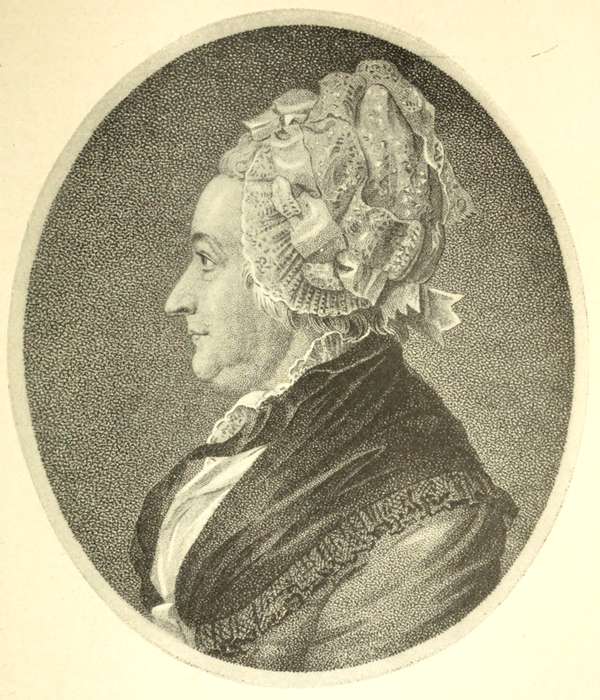
MISS ELIZABETH CARTER From an engraving in The Works of Elizabeth Carter, 1806
But in whatever period, from whatever point of view, Miss Carter presents us with a career almost unexampled in the annals of learned ladies. She chose learning young and pursued it undeviatingly, with no hesitancies and no retrospective regrets. There were no disapproving friends or relatives to interpose obstacles in her path. Few girls, even to-day, could have greater freedom in the determination of their own hours, occupations, and pleasures. Her father, though disheartened by her slow progress, was her faithful teacher. Even her stepmother aided and abetted her extravagant devotion to study. She was allowed to determine the momentous question of marriage entirely according to her own inclinations. Her published work met with immediate praise. She was but twenty-two when Johnson published epigrams in Greek and Latin in her honor, and said she should be praised in as many languages as Lewis the Grand. And by middle life she had achieved independence, money, and fame.
Nor was her career merely an external success brilliantly masking unsatisfied inner desires. On the contrary, to the end her eighty-nine years seemed rich and gracious to her. She did not covet other women's lovers or husbands or children or homes. She set possible honors lightly aside. When her friends were urging upon her a place at court, she dreamed that she had cut off her head for the greater convenience of curling her hair, and she declared this dream symbolic of the fatal cost at which honors were often bought. Her joys were of an unambitious, quiet, perennial sort. She loved nature in all its moods of storm and shine. Her genius for friendship nearly equaled the "Matchless Orinda's." She loved reading and had many books. She enjoyed reflection and had many hours of happy solitude. She was domestic in her tastes and found herself loved and needed in her father's home. She had a sound, sweet, sensible, modest nature that not only disarmed criticism, but preserved her from any undue or arrogant emphasis on her position as the most distinguished literary woman of her time. And she had an unfailing sense of humor that sent an undercurrent of enjoyment through even the prosaic and dreary parts of life.