Chapter II · LEARNED LADIES IN ENGLAND FROM 1650 TO 1760 (continued 2)
Reading edition
WRITERS ON RELIGION AND THEOLOGY
The Term Catalogues for 1670-1713 show how great was the preponderance during those years of books on "Divinity." That women should share in this prevailing interest is but natural, for religion came within the accepted canon of the truly feminine. And there are evidences of an even greater amount of devotional writing by women than might be expected. The period 1650 to 1750, and especially the first half of that period, could show a long list of women noted for lives of piety and good works.[150] The loose living characteristic of the court apparently had its reaction towards exceptional spiritual rigor on the part of many ladies of rank. And of these devout ladies no small number found in the composition of religious verse or prose the intellectual and emotional outlet denied them in other ways. Almost none of this writing was meant for a public. The reams of meditations, prayers, and reflections left in manuscript were merely a private resource, and often kept secret even from the author's family. Such writings were in their nature fugitive, and it would only now and then happen that some relative or friend would collect and order the papers and see them through the press. We accordingly get scattered hints through funeral sermons and casual notices of an amount of devotional writing greatly in excess of that published. But to tabulate even all the published material would be wearisome and to no good end. A few illustrative examples showing the chief characteristics may suffice.
Lady Elizabeth Brooke (1601-1683)
One of the best examples of the persistent and prodigious industry shown by some of these ladies is the work of Lady Elizabeth Brooke. She began at thirty to make notes on sermons, to copy extracts from commentaries, and occasionally to write out some personal opinions, and she kept at this sedative occupation till her death fifty-two years later. It is painful to reflect on such a mass of undigested material, but the significant fact remains that she preferred such reading and writing to the ordinary interests of her sex. Some of her "Observations and Rules for Practice" were published as an appendix to the sermon preached at her funeral. Selections from her writings were published as late as 1828 in The Lady's Monitor.
Anne Murray, Lady Halkett (1622-1699)
Anne Murray, Lady Halkett, was even more industrious. Her father, who was tutor of Charles I and Provost of Eton, died when she was a child, but her mother, who was governess to the Princess Elizabeth, gave her "a complete education." Of her early life she says: "My mother spared no expense in educating all her children in the most suitable way to improve them ... and paid masters for teaching my sister and mee to write, speak French, play on the lute and virginalls, and dance, and kept a gentlewoman to teach us all kinds of needlework, which shows I was not brought up in an idle life." After several complicated and long drawn-out love affairs—fully described in her Autobiography—Anne married Sir James Halkett in 1656. As the years passed her interests finally centered on two subjects, divinity and medicine. In "physick and surgery" she gained great repute. She was consulted in difficult cases from the remotest parts of the kingdom and her fame spread even to Holland. It was quaintly said of her: "She was ever employed either in doing or reaping good: in the summer season she vyed with the bee or ant, in gathering herbs, flowers, worms, snails, etc., for the still or limbeck, for the mortar or boyling pan, etc., and was ordinarily then in a dress fitted for her still-house; making preparations of extracted waters, spirits, ointments, conserves, salves, powders, etc., which she ministered every Wednesday to a multitude of poor infirm persons, besides what she dayly sent abroad to persons of all ranks who consulted her in their maladies."[151] But it was religious themes only that employed her pen. The catalogue of her writings includes twenty-one volumes, or a total of about eight thousand pages of manuscript, some in quarto, some in folio size, and all bound. Some of these books were printed at Edinburgh in 1701. The title of one book of three hundred and fifteen pages will indicate the general character of her writing: Select Meditations and Prayers upon the First Week, with Observations on each Days Creation, and Considerations on the Seven Capital Vices to be opposed, and their opposite Virtues to be studied and practised.
Vices to be subduedVirtues to be learned
PrideSundayHumility
CovetousnessMondayContentation
LustTuesdayChastity
EnvyWednesdayCharity
GluttonyThursdayTemperance
AngerFridayPatience
SlothSaturdayDiligence
All but nine of these books were written during Lady Halkett's twenty-eight years of widowhood when she had much leisure, but under any circumstances the task was a great one, and becomes the more amazing when we reflect upon it as really only a private recreation. To write so much with no urgency of fame or money shows some very strong inner demand for expression and a very facile pen.
"Legacies"
Another type of religious book goes back for its inspiration to Elizabeth Jocelyn's famous Legacie. One of Lady Halkett's books was The Mother's Will to an Unborn Child, written in 1656 before the birth of her daughter Elizabeth. Books of advice from parents to children to be read after the death of the parents were not uncommon. Elizabeth Sadler (1623-1690), the wife of the Reverend Anthony Walker, was an exceedingly devout woman whose literary instinct and a prevision of death led her to write a large book in octavo for the instruction of her two daughters. Two other books will sufficiently illustrate the type: The Experiences of God's gracious dealing with Mrs. Elizabeth White, late wife of Mr. Tho. White of Caldecot in the County of Bucks; as they were written under her own hand, and found in her Closet after her decease: she dying in child-bed, December 5th, 1669;[152] The Legacie of a Dying Mother to her mourning children; being the Experiences of Mistress Susanna Bell, who died March 13, 1672. With an Epistle Dedicatory by Thomas Brookes, Minister of the Gospel.
Rachel Wriothesley, Lady Russell (1636-1723)
Lady Russell is an example of a woman who definitely set out to be religious, and whose writings contain an analysis of her methods. The circumstances of her life give everything pertaining to her a particular interest. The execution of Lord Russell for treason in 1683 left her broken by the shock. She had, though without avail, set in motion every possible agency to avert his fate, and she had devoted herself absolutely to him till his tragic death. Then, after a period of the deepest despondency, she entered again upon the duties that lay before her. She conducted the education and arranged the marriages of her three children. She showed herself an excellent business woman in the management of her estate. And she steadily interested herself in securing benefices and other offices for persons of whom her husband would have approved. Her Letters as published contain a few during the first years of her happy married life; many written concerning the "judicial murder" of Lord Russell; and very many concerning family affairs and the candidates for whom she was seeking favor. As letters they are uninteresting. The subject-matter is generally too local and temporary to hold the attention of the modern reader, and the style is dry and hard. Even the records of her bitter grief and of her struggle to attain a mood of Christian resignation are less affecting than might be expected. A kind of apathy seemed to settle down over her spirit. She was too deeply hurt to find in words any balm for her sorrows. She answered condolences when she must, but briefly, and with no lightening of the gloom that encompassed her. Of all her letters the longest and most valuable as a personal revelation is one written to her children July 21, 1691, "a day of sad remembrances," for it was the anniversary of her husband's execution eight years before. In 1691, Rachel, the oldest child, was twenty years old, and Wriothesley, the youngest, was eleven. The five or six pages in which Lady Russell recounts, probably especially for the benefit of Rachel, her method of personal spiritual watch-care, has great value as a religious document, for she was not alone in her way of seeking salvation, in her heart-searchings, in her dependence on the external means of grace, in her sedulous striving after perfection. It was the devout habit of devout people of the time, but perhaps carried to a meticulous excess by Lady Russell. She says that she was always provided with a little piece of paper on which she wrote her faults and temptations as they occurred during the day. At night a careful review of this record contributed to a better watch and ward.
And then [she continued], upon Friday morning when I have prayed my usual daily prayers (which have bin most constantly for many years those in taler's holy living) before I pray that of intercession pa: 35. I stop ... and look upon my dayly notes for that weeke, I recollect my fautes; consider what care I have taken to correct or forsake them—but alas when we do best we shall find enof to be humbled for—therefore I chuse some prayer of confesion most times that in taler's holy living page 302. When I have done it, I make my resolutions to do better for ye time to come, and especialy to watch myselfe where i ame most apt to fal, naming in what I ame so—then I pray some prayer for grace to keep these promises of better obedience—as in pa: 31—for grace to spend our time wel, on page 271, for the grace of faith, hope & charity. Then I pray the dayly prayer of intercession that I left of at in pa:35—after this I praise God ... for all the blessings vouchsafed to me both spiritual & temporal—as that I was born of Christian parents, not suffered to be strangled in the womb, that I was baptized, and sence, educated in Christian Religion. I blesse thee for al checks of Conscience I have had especially those I have profited by.... And then I goe on, I bless thee for our creation, preservation &c.—close with ye lords prayer.
After this service she went over her faults of the week, making a summary of them. A similar abridgment for the month was entered in a book kept for that purpose, the incriminating little pieces of paper were torn up, and a new record entered upon. She found that a frequent re-reading of the book "saved much time in looking back" and contributed to humility. Evidently Lady Russell was as orderly in religion as she was in her business affairs. She finds her definite tabulations "hugely more satisfying to her mind, than a more carelesse loose way of living is, and no settled method." The letter closes with the admonition, "Be devout & reguler in your dutys to God—heaven wil be secure, and pleasures innocent."[153] Lady Russell's letters reveal a devout, difficult, over-burdened life, so much concerned with the means of grace as never to have any happy consciousness of grace itself.
Elizabeth Blake, Mrs. Burnet (1661-1712)
Elizabeth Burnet (1661-1712), daughter of Sir Richard Blake, married at seventeen into a Catholic family. Her husband, Robert Berkeley, was a ward of Bishop Fell, through whom the marriage was brought about. The firmness and tact necessary to maintain her own views as a Protestant and hold her husband to that faith, and yet not antagonize the family, could hardly be expected of so young a girl. But Bishop Fell had judged her character well and she met all the demands of so delicate a situation. She took advantage of many leisure hours in the country to investigate fully the questions at issue between the Catholics and the Protestants. She did not know the learned tongues, but she studied the Scriptures, read commentaries, and conversed with clergymen. When she became a widow in 1693, at thirty-two, she employed her time in two characteristic ways. In the administration of her husband's charitable schemes she found congenial activity. And she gave way to her natural instinct for writing. In 1700 she became the wife of Bishop Burnet. His approval of her literary work and his request that it be published led to the production of her Method of Devotion. It was so popular that she revised and enlarged it and brought out a second edition. And it was republished in 1713 after her death. The book contained "Rules for holy and devout Living," "Prayers on Several Occasions," "Advices and Devotions on the Holy Sacrament." Mrs. Trotter said of her in 1701, "She has an extraordinary clear and solid judgment, the truest goodness and prudence, and the most charming affability in her behaviour; in short, I have met with no such perfection in any of my sex."
Elizabeth Bury (1644-1720)
Elizabeth Bury was another young woman whose bright, acquisitive mind resented conventional inactivity and put out tentacles in all directions for knowledge. Philology, philosophy, history, heraldry, geography, mathematics, were among her interests. She contended that souls were of no sex and that women were often "disposed to an accurate search into things curious and profitable, as well as others." She studied anatomy and medicine until she had gained "a surprizing knowledge of the human body, and of the Materia Medica," so that she could state the symptoms of the most difficult and intricate cases in the physician's own terms. She learned French that she might talk with French refugees to whom she was a benefactress. Her correspondence and conversation were both highly prized. But all these interests must be counted merely as diversions. "Her constant favourite and darling study was divinity." The Bible, Mr. Henry's Annotations, a few works on practical divinity, and a competent number of Hebrew books made up her working library. Hebrew because of its scriptural importance was the subject on which she concentrated her attention and she was reputed to have a critical knowledge of its idioms and peculiarities. It was said that she could even quote the original in common conversation if the elucidation of some text were in question. As the years passed, books and writing, "morning hours with God," and many arduous charitable duties so fully occupied her that she found mere social life an unrewarded tax. Of ordinary conversation she said that though one might strike fire "it always fell on wet tinder." The mass of manuscripts found after her death reflected the variety of her interests, but the majority were on topics such as Meditations on the Divinity of the Holy Scriptures, The unreasonableness of Fretting against God, and similar subjects. She kept also a voluminous Diary, an abridgment of which was published by her husband in Bristol in 1721. Mr. Watts's Elegy indicates something of the reverence with which Mrs. Bury was regarded by her contemporaries; and a woman of her personal charm, executive ability, alert responsiveness to the calls of charity, along with her quick mind, and multifarious, if not always profound, learning would take an even higher place in any organized community to-day.
Susanna Hopton (1627-1709)
Women also entered the less feminine fields of controversy. Susanna Hopton is an interesting example. In her youth she had become a Catholic, but under the influence of her husband she entered upon a thorough study of the points at issue between the Catholics and the Protestants. Dr. Hickes says of her: "She made herself as perfect in the controversie, as English writers could make her, who managed the controversie on both sides. I have (says he) above twenty popish authors, which she left me, and some of them with marginal notes in her own hand. She was well versed in Bishop Moreton's, Archbishop Laud's and Mr. Chillingworth's works, and Ranchin's Review of the Council of Trent, etc."[154] As a result of this reading she drew up a long and learned letter to Father Tuberville, showing him why she had renounced the Church of Rome. This letter was published by Dr. Hickes immediately after her death in his volume of Controversial Letters in 1710. Mr. William said that she was an excellent casuist and divine, and could encounter and confute all enemies of the church. "Her discourse and stile upon serious matters was strong, eloquent and nervous; upon pleasant subjects, witty and facetious: and when it required an edge was sharp as a razor." Daily Devotions, Meditations on the Six Days Of Creation, and Meditations on the Life of Christ were her other works. As a wife, a neighbor, and a friend she seems to have been in high esteem, but her life had the church as its center.
Damaris Cudworth, Lady Masham (1658-1708)
Damaris Cudworth and Mary Astell, two of the most gifted women of the period, became involved in the theological discussion between John Norris and John Locke. Miss Cudworth knew both disputants well. As a young woman she had corresponded with Norris on the subject of "Platonic Love," and in 1689 he had dedicated to her his Reflections upon the Conduct of Human Life, with reference to the study of learning and knowledge. But it was Locke who had a permanent influence on her opinions. While she was still in Cambridge with her father, Ralph Cudworth, Locke taught her divinity and philosophy. After her marriage to Sir Francis Masham in 1685, Locke was a frequent visitor at their home, and from 1691 till his death in 1704 he lived permanently with them. Her polemical articles were doubtless written under his inspiration. In 1694 the correspondence between Mary Astell and John Norris was published, under the title, Letters concerning the Love of God. Two years later Lady Masham answered their arguments in her Discourse concerning the Love of God,[155] which was attributed to Locke and answered by Norris. In 1700 Lady Masham published Occasional Thoughts in reference to a virtuous Christian Life, which is her closing word in the controversy.
Damaris Cudworth was a woman of remarkable intellect. Her father was delighted with the early manifestations of her power and he took pride in securing for her the best possible education. The curious epitaph on her tomb praises her learning, judgment, candor, penetration, and love of truth, and credits her with being a devoted and intelligent mother. It sums up her character in the statement, that "to the Softness and Elegancy of her own Sex" she added "several of the noblest Accomplishments and Qualities of the other," and that "she possessed these advantages in a degree unusual to either." The conventional eulogy on a tomb is always open to suspicion, but in this case the vague generalities of the epitaph fall below the truth. Locke, in a letter to Phillipp van Limborch, said of her: "The Lady herself is so well versed in theological and philosophical studies and of such an original mind that you will not find many men to whom she is not superior in wealth of knowledge and ability to profit by it. Her judgment is excellent, and I know few who can bring such clearness of thought to bear upon the most abstruse subjects, or such capacity for searching through and solving the difficulties. I do not say of most women, but even of most learned men."[156]
Lady Masham was also recognized as one of the early champions for woman's education, for when Mary Astell's Serious Proposal appeared anonymously in 1694 it was by some attributed to Lady Masham. She took the subject up definitely in her Occasional Thoughts. After commenting on the lack of knowledge of science, law, history, politics, morals, and religion, of most English gentlemen, Lady Masham continued:
Thus wretchedly destitute of all that Knowledge which they ought to have, are, generally speaking, our English gentlemen, and being so, what wonder can it be, if they like not that women should have knowledge; for this is a quality that will give some sort of superiority even to those who care not to have it?... But such men as these would assuredly find their account much better therein, if tenderness of that prerogative would teach them a more legitimate way of maintaining it, than such a one as is a very great impediment or discouragement at the least, to others in the doing what God requires of them. For it is an undesirable truth that a lady who is able to give an account of her faith, and to defend her religion against the attacks of the cavilling wits of the age, or the abuses of the obtruders of vain opinions: that is capable of instructing her children in the reasonableness of the christian religion, and of laying in them the foundations of a solid virtue: that a lady, I say, no more knowing than this does demand, can hardly escape being called learned by the men of our days, and in consequence thereof, becoming a subject of ridicule to one part of them, and of aversion to the other; with but a few exceptions of some virtuous and rational persons. And is not the incurring of general dislike one of the strongest discouragements we can have to any thing?[157]
Grace Norton, Lady Gethin (1676-1696)
There was published soon after Lady Gethin's death, from loose papers left by her, a work entitled Reliquiæ Gethinianæ. Congreve's poem, entitled Verses to the Memory of Lady Grace Gethin, occasioned by reading her Book, speaks in high praise of her. He says the book shows all that study or time could teach.
But to what height must his amazement rise, When, having read the work, he turns his eyes Again to view the foremost opening page, And there the beauty, sex, and tender age, Of her beholds, in whose pure mind arose Th' ethereal source, from whence the current flows.
Lady Gethin was counted a marvel of wisdom, but when we read her Apothegms and Essays and Witty Sayings we are more impressed by her accurate memory of Bacon and other earlier essayists than by any profound knowledge of life on her own part.
Mrs. Eleanor James (fl. 1685-1715)
Mrs. Eleanor James[158] was a writer on religious and political topics. No complete list of her works has ever been compiled. She gained publicity for her religious views by numerous single printed sheets between 1685 and 1715. John Dunton described her husband as being well known because he was an excellent printer, and "something the better known for being the husband of that she-state-politician, Mrs. Eleanor James." She is said to have constituted herself a sort of "adviser to reigning sovereigns" from Charles II to George I, whom she visited in turn for counsel and admonition. Her chief published works are on religious controversy. Her Vindication of the Church of England (1687) created considerable antagonism. In answer to a satirical Address of thanks to Mrs. James on behalf of the Church of England she wrote Mrs. James's Defence. A lady also appeared in the lists against her in a book entitled Elizabeth Rowe's Short Answer to Eleanor James's Long Preamble or Vindication of the new Test. Mrs. James's Apology (1694) and her Reasons humbly presented to the Lords Spiritual and Temporal (1715) complete the list of her more important publications.
Mrs. Newcome (fl. 1728)
Mrs. Newcome's Enquiry into the Evidences of the Christian Religion was published in 1728. Mr. Bowyer says that she was by every one accounted a most excellent and worthy woman, and that her learning was attested by more than one volume. Mr. Grey mentioned her in his Hudibras as "the very learned lady" who gave him the note about Penguins in Book I. Nichols quotes a Mr. "T. F." who says that she had great fame for learning, but adds cautiously: "All that I know of that matter is, that as often as I have been in company with her, and when things were thrown out designedly to tempt her to speak, and discover herself, as the armour produced to Achilles, it never took effect. So that I can not speak of her learning from my own knowledge; but if she was not that, she was something better, a very good woman."[159]
Catherine Trotter, Mrs. Cockburn (1679-1749)
The most distinguished woman in the field of polemics in the first half of the eighteenth century was Catherine Trotter, better known as Mrs. Cockburn. The contemporary recognition accorded Mrs. Cockburn is to-day the most surprising fact about her. Her father was a Scotchman, a commander in the royal navy, and highly thought of by Charles II, but his death at sea in 1683, and many ensuing disastrous business complications, left the family in serious financial difficulties. Mrs. Trotter was, however, nearly related to the Duke of Lauderdale and the Earl of Perth, a fact which secured her social recognition no matter how narrow her circumstances. Catherine, her youngest child, began writing poetry at a very early age. She also early showed unusual mental alertness, for "she both learned to write and made herself mistress of the French language, by her own application and diligence, without any instructor." In Latin and Logic she had some guidance. Logic was so interesting to her that while still young she drew up an abstract of its principles, for her own use.
Catherine's first extant poem was a thanksgiving in heroic verse for the recovery of Mr. Bevil Higgons from small-pox. She was then fourteen, but the labored lines have a kind of heavy maturity prophetic of her later verse. In her seventeenth year she entered fully upon her literary career. For thirteen years she devoted herself to study and writing, and if applause from high authorities could justify her serious preoccupation with things of the mind, such justification was hers in full measure. Before she was seventeen her tragedy, Agnes de Castro, was acted at Drury Lane. It was by the advice of the Earl of Dorset and Middlesex that she had allowed "this little off-spring of her early muse"[160] to try its fortune in the world, and such success as it had must be attributed largely to the protection of influential patrons. But with or without patrons, whatever Miss Trotter did was sure to win praise. When she wrote a eulogistic poem to Congreve on his Mourning Bride, in 1697, he expressed himself as heartily vexed that her lines came too late for publication with his play, and said of her poetical commendation, "It is the first thing, that ever happened to me, upon which I should make it my choice to be vain."
In 1698 there appeared, at the new theater in Lincoln's Inn Fields, Miss Trotter's second tragedy entitled The Fatal Friendship. Mr. Betterton, Mr. Verbruggen, Mr. Thurmond, Mrs. Barry, and Mrs. Bracegirdle, took the chief parts. The play ran several nights and was seen occasionally on the stage until far down in the eighteenth century. Its immediate success was great and the praise that poured in upon the nineteen-year-old author must have been bewilderingly sweet. Mr. Higgons evened up the score for the small-pox poem by some verses which declared her direct descent from Sappho. Mr. Harman said that she maintained the true empire of the stage along with Congreve, Granville, and a few others "well read in honour's school." From "an unknown hand" came a poem addressed to "my much esteemed Friend." This author writes of his consuming anxiety at the beginning of the play, and of the joy that gushed forth as he observed its success. The impression from his poem is that he had known the play intimately before its appearance. According to "the elegant pen of Mr. John Hughes" Miss Trotter's "virgin voice offends no virgin ear," her chaste thoughts and clean expressions set her nobly apart as a reformer of the stage, and she is a successful champion of her sex, since her genius has destroyed the "Salique law of wit" established by men. So pleased was Mr. Farquhar with The Fatal Friendship that he sent his first comedy Love and a Bottle, which had "been scandalously aspersed for affronting the ladies," "to stand its tryal before one of the fairest of the sex, and the best judge." And he adds his thanks for the "favour and honour" she showed him by appearing on his third night. He concludes his letter with a double compliment: "But humbly to confess the greatest motive, my passions were wrought so high by representation of Fatal Friendship, and since raised so high by a sight of the beautiful author, that I gladly catched this opportunity of owning myself your most faithful and humble servant." Mrs. Manly also gave a generous tribute to her young fellow-aspirant for stage honors:
Orinda and the Fair Astrea gone Not one was found to fill the Vacant Throne; Aspiring Man had quite regain'd the Sway, Again had Taught us humbly to Obey; Till you (Nature's third start, in favour of our Kind) With stronger Arms, their Empire have disjoyn'd, etc.
Dela Manley
After The Fatal Friendship Miss Trotter's work for the stage need not be particularly dwelt upon. She had a comedy brought out at Drury Lane in 1701. A new tragedy in the same year at Drury Lane, and a tragedy at the Haymarket in 1706, complete the list. Some occasional poems appeared during this period. In 1700 she was one of the nine ladies who wrote on the death of Dryden, under the title The Nine Muses; or Poems written by as many ladies on the death of the late famous John Dryden, Esq. In 1704 she entered the lists with Mr. Addison and Mr. John Philips in celebrating the victory of Blenheim, but she did not venture to publish her poem till the manuscript had been submitted to the Duke of Marlborough. When the duke and the duchess and the lord treasurer Godolphin declared themselves "greatly pleased" she sent her lines to the press.
Besides her dramatic and poetical work Miss Trotter wrote in prose on critical and theological subjects. An interesting disquisition on "the poets of the last age" appeared in the dedication of her The Unhappy Penitent in 1701. Of Shakespeare, Dryden, Lee, and Otway she speaks with independent judgment and considerable discrimination. But none of the works so far listed are those on which her fame rested. It was not in poetry, drama, or literary criticism that she found satisfaction. Religion and philosophy were her true field. Locke's Essay concerning Human Understanding was published in 1690, and among the antagonistic criticisms it called forth were three series of Remarks published anonymously in 1697 and 1699. Young as she was Miss Trotter pursued the controversy with the keenest interest and in 1701 she drew up a Defence of The Essay of Human Understanding. Mr. George Burnet of Kemney, then in Holland, and Mrs. Burnet, the wife of Bishop Burnet, were entrusted with the secret of her Defence, and both advised anonymous publication, agreeing with her that her youth and sex would, if known, count against a work of that nature. Her Defence appeared in print in 1702. Mrs. Burnet on finding that the Bishop, Mr. John Norris, and Mr. Locke himself, were highly pleased with it, could keep the secret no longer.[161] Mr. Locke sent Miss Trotter a present of books and a letter in which he expressed his gratitude for "an opportunity to own you for my protectress, which is the greatest honour my Essay could have procured me. Give me leave therefore to assure you, that as the rest of the world take notice of the strength and clearness of your reasoning, so I can not but be extremely sensible, that it was employed in my behalf."[162]
A second pamphlet was entitled A discourse concerning a guide in Controversies and grew out of her own spiritual conflicts. Although of a Protestant family she had become a Catholic early in life, but had gradually found herself less and less in harmony with that church till 1707 when, in this Discourse, she announced her return to the Church of England.
The polemical years between 1701 and 1707 had been diversified by several love affairs. Mr. George Burnet of Kemney, Mr. Fenn who was an eloquent young clergyman,[163] Mr. Cockburn, "and some others," are indicated in her letters. Miss Trotter's letters to two of these lovers, Mr. Fenn and Mr. Burnet, are nearly as polemical as her Defence and Discourse. She uses all her old Art of Logic to reason her lovers into friends. She had, in fact, no particular respect for the passion of love as a factor in human life. She apologized for having given it so important a place in her plays, for it was "not noble enough to fill a whole tragedy."[164] When Mr. Burnet professed "the most passionate ardour of mind and soul" for her,[165] she responded with a eulogy of "just and beneficent friendship." "It is only that niggard passion, which is distinguish'd by the name of love, that excludes all but one object from having a part in it, and is not satisfied without monopolizing the affections of the heart."[166] She offered Mr. Burnet "due gratitude" and she surely owed him some return for the pains he took to spread the fame of her works. He wrote so highly of her to the Princess Sophia that the royal lady wrote in answer: "Je suis charmée du portrait avantageux, que vous me faites de la nouvelle Sappho Ecossoise, qui semble meriter les eloges, que vous luy donnez."[167]
Miss Trotter's letters to Mr. Cockburn, whom she married in 1708, are also full of argument and business. If she had a deep affection for him she certainly never allowed herself to speak out. She says that their chief aim in marriage was to assist each other in performing those duties that flow from the love of God.[168] Of the ensuing twenty years she wrote in 1738 as follows: "Being married in 1708, I bid adieu to the muses, and so wholly gave myself up to the cares of a family, and the education of my children, that I scarce knew there was any such thing as books, plays, or poems stirring in Great Britain."[169] It was an attack on Mr. Locke that again drew her into public controversy. Dr. Winch Holdsworth published in 1720 a sermon on Mr. Locke's "false reasonings" against the resurrection of the same body. The sermon came to her hands some years later and she published in 1726-27 A Letter to Dr. Holdsworth. In 1727 he published A Defence of the Doctrine of the Resurrection of the same Body. Her answer, A Vindication of Mr. Locke's Christian Principles, remained in manuscript till the publication of her works in 1751. She also wrote in 1739 Remarks upon some Writers in the Controversy concerning the Foundation of Moral Duty and Moral Obligation which was published in 1743 in The History of the Works of the Learned. In 1747 she entered upon a confutation of Dr. Rutherforth's Essay on the Nature and Obligations of Virtue. Her Remarks on this Essay was published by Mr. Warburton with a laudatory Preface in which he spoke of her "fine genius," "clearness of expression, strength of reason, precision of logic, and attachment to truth."
From 1731 to 1748 there is a series of letters between Mrs. Cockburn and Anne Hepburn (afterwards Mrs. Arbuthnot), her niece. It is almost entirely a literary and religious correspondence and shows that Miss Hepburn's interests were on almost as high a plane as her aunt's. A list of the books they exchanged and commented on would include most of the important new works in England during the first half of the century. The most interesting literary taste revealed is Mrs. Cockburn's partiality for Pope. In 1738 she wrote him a long letter in which she said, "Your Epistle to Dr. Arbuthnot, and Essay on Man, gave me some idea of your morals. But when I read your private letters, where, as you express it, you throw yourself out upon paper, I thought I saw your heart open and undisguised. I was charmed with the sincere, ingenuous, unsuspecting friend, the unwilling enemy, the benevolent mind, extending to all parties, all religions, all mankind; the filial piety, the tender concern for a mother's approaching death, at an age, when most men would have considered theirs only as a useless burden. In short, I saw so many amiable qualities opening on every different occasion, that I began as much to admire the valuable man as the great genius." She chides him gently for thinking too lightly of his genius, for while he is measuring syllables and coupling rhymes to such excellent moral ends, she is ready to assure him of a final "Well done, thou good and faithful servant." It is a pity this epistle was never sent. It would doubtless have been almost as surprising to the wicked wasp of Twickenham as to the crowd of enemies for whose benefit he was preparing the New Dunciad.
Mr. Birch, who edited Mrs. Cockburn's Works in 1751, said of her:
Posterity at least will be solicitious to know, to whom they will owe the most demonstrative and perspicuous reasonings, upon subjects of eternal importance; and her own sex is entitled to the fullest information about one, who has done such honour to them, and raised our ideas of their intellectual power, by an example of the greatest extent of understanding and correctness of judgment. Antiquity, indeed, boasted of its female philosophers, whose merits have been drawn forth in an elaborate treatise of Menage. [Historia Mulierum Philosophorum, 8vo. Lyons, 1690.] But our own age and country may without injustice or vanity oppose to those illustrious ladies the defender of Locke and Clarke; who, with a genius equal to the most eminent of them, had the superior advantage of cultivating it in the only effectual method of improvement, the study of a real philosophy, and a theology worthy human nature, and its all perfect author.
Mrs. Cockburn had a strong, clear, acute mind. The impression she made on the best thinkers in her generation is due to this fact, and, further, to the fact that she used her mentality on topics then counted vital. She was didactic, she was morally irreproachable, she was unassuming. That her editor's confident prediction of her fame has been discredited by time, that she is in reality hardly so much as a name to-day, is due partly to the oblivion that has overtaken her subjects, but also, and even more justly, to the dead level of her excellence. She has no wit, no fancy, no imagination, no sprightliness of thought, no humor. Mary Astell and "Sophia" were occasionally roused to picturesque indignation. But not so with Mrs. Cockburn. She is as cold, as orderly, as unstimulating as a formula.
Mrs. Margaret Fell (1614-1702)
Among dissenters there is less literary record. We find more among the Quakers than elsewhere, yet even there not so much as might be expected from the fact of their recognition of the equality of the sexes. It was stated in their creed: "As we dare not encourage any ministry but that which we believe to spring from the influence of the Holy Spirit, so neither dare we attempt to restrain this ministry to persons of any condition in life, or to the male sex alone; but as male and female are one in Christ, we hold it proper that such of the female sex as we believe to be endued with a right qualification for the ministry should exercise their gifts for the general edification of the Church."[170] As a rule, however, the Quaker women were too busy on their preaching tours to have much time for authorship. Margaret Fell is their chief representative writer.[171] Her activities began before the Restoration. As the wife of Judge Fell of Swarthmore Hall she was of distinct social importance, and she showed unusual ability in the conduct of the household affairs incident on her husband's wealth and large landed properties. She was always exceedingly devout and Swarthmore Hall was traditionally recognized as the home of "lecturing ministers." Among these itinerant speakers, in 1652, was George Fox. His brief sojourn at Swarthmore was epoch-making, for when Judge Fell returned from a distant visit he was met as he crossed Ulverston Sands by a solemn conclave of gentlemen on horseback whose purpose it was to announce that his wife and most of his household had become Quakers. On investigation he became himself at least sufficiently sympathetic with the new views not to interfere with his wife's convictions. For half a century she was identified with Quaker interests. The great dining-room at Swarthmore was for many years the regular meeting-place of the Friends. In 1669, eleven years after the death of Judge Fell, Margaret married George Fox, and till his death in 1691 she gave her time, her thought, her money, to a defense of persecuted Quakers. Three of her daughters became preachers. She traveled from jail to jail, from house to house, to comfort the imprisoned and their families, and from meeting to meeting to preach the word. As the "nursing mother" of the church she had an immense correspondence. The petitions to the king and to powerful noblemen were often composed and personally presented by her. The importance attached to her advice and opinions is indicated by the hundreds of letters still extant addressed to her by the preachers who gathered about George Fox. During her most active years the practical conduct of church affairs occupied her to the exclusion of other work. But earlier, especially during 1665-1668, she made use of the enforced leisure consequent on various imprisonments to write in defense of Quaker principles. Of the ten tracts thus produced one of the most interesting was on the vexed question of the right of women to preach and was entitled Women's Speaking Justified, Proved and Allowed of by the Scriptures.
Anne Finch, Lady Conway (d. 1679)
Another important lady who, after long study in other religions came finally into the Quaker faith, was Anne Finch, a daughter of Sir Henry Finch. In 1651 she married Lord Conway and was established as mistress of Ragley Castle in Warwickshire. As a young woman she had been attracted by the teachings of Henry More, the Cambridge Platonist. After she became Lady Conway he spent much time at Ragley where he wrote several of his books. During his various absences Mr. More and Lady Conway corresponded regularly on theological subjects. The questions in her letters sufficiently indicate the metaphysical perplexities that absorbed her thoughts. She knew the learned tongues and read eagerly the works of "Plato, Plotinus, Philo Judæus, and the Kabbala Denudata." She was a theosophist and a mystic. The esoteric, the mysterious, the miraculous, captured her imagination. "Under her inspiration Ragley became the home of religious marvels." One chapter of John Inglesant, the novel in which Mr. Shorthouse so sympathetically described Little Gidding, is said to be based on the life at Ragley. Lady Conway suffered from headaches so severe and persistent as to defy the best skill of London and Paris. Under the influence of Mr. More, who said there might be "a sanative and healing contagion as well as a morbid and venemous," she summoned to Ragley the famous Valentine Greatrakes, "the Stroker," but the magic of his hands failed in her case. Her headaches made of her life one long disease, but never conquered her intellectual eagerness and hardly abated her learned pursuits.
When she finally joined the Quakers it was against the advice of Mr. More, but she was one, he said, "who never submitted all her judgment to any one." Her friendship with Robert Barclay and William Penn followed her acceptance of the new doctrines. While Lady Conway was undoubtedly one of the most distinguished converts to the Quaker faith, her invalidism and then her death in 1679 interfered with any such active service as that of Margaret Fell. The two women were, moreover, temperamentally unlike. Margaret Fell, a descendant of Anne Askew, had the blood of the martyrs in her veins. A "cause" could capture her mind and heart. She was energetic, an organizer and administrator. Lady Conway, on the other hand, beyond almost any woman of her time, lived in things of the mind.
Of Lady Conway's numerous works only one has been printed. In 1690 there appeared at Amsterdam a collection of philosophical treatises written in Latin. The first one of the series was a translation of "a work by a certain English countess, learned beyond her sex." Leibnitz, on the authority of Van Helmont, attributed this to Lady Conway. This treatise was re-translated into English in 1692.[172]
Jane Ward, Mrs. Lead (1623-1704)
Mrs. Jane Lead[173] was a mystic and the founder of a sect. She was the daughter of Schildknap Ward, of a good Norfolk family, and it is said that there were no external influences to account for her unusual experiences. As a child in the midst of the Christmas gayeties at her father's house, she heard a miraculous voice that summoned her to a religious life. She became a widow while still young and thereafter followed without hindrance, in the completest seclusion, in London, her recognized vocation. She studied mystical works and had nightly prophetic visions which she recorded in her spiritual diary. Between 1681 and 1702 she published fifteen volumes and another one appeared immediately after her death. In 1693 Mr. Francis Lee, a young Oxford man and a medical student at Leyden, visited her, gave allegiance to her doctrines, and devoted himself to her service. Mr. Lee and Mrs. Lead became the center of an important theosophical organization called The Philadelphian Society, which existed till 1702. Mrs. Lead died in 1704 "in the 81st year of her age and the 65th of her vocation to the inward life." Mr. Lee wrote to the Countess Kniphausen and others in France and Germany a letter entitled The Last Hours of Jane Lead by an Eye and Ear Witness. Five years before her death Mrs. Lead's spiritual diary was published under the title, A Fountain of Gardens, watered by the Rivers of Divine pleasure, and springing up in all the variety of spiritual plants, blown up by the pure Breath into Paradise. To which is prefixed, A Poem, introductory to the Philadelphia Age, called Solomon's Porch, or The Beautiful gate to Wisdom's Temple.
Susannah Annesley, Mrs. Wesley (1670-1742)
One of the most notable women of the early eighteenth century was Susannah Wesley, the mother of John and Charles Wesley. She came of a fine old Nottinghamshire family, and her father, Dr. Annesley, a man of power and influence, "the St. Paul of the Nonconformists," secured for his children an education suitable to their birth. At twenty-one Susannah, a beautiful and gifted young woman, married Samuel Wesley and entered upon her career as wife of a rector of humble position and small means.
It is said that large families either submerge the individual, or result in characters of exceptionally fine discipline. From this test Susannah emerged triumphant. She was the twenty-fifth child of her father, and in the first twenty-one years of her married life she had nineteen children. So, as child and parent, she was always in close touch with many varied personalities, an experience the conditions of which demanded both firmness and flexibility.
Her married life seemed made up of difficulties. Most of it was passed in a remote rectory, at Epworth, in the Lincolnshire fens, among the crudest and most boorish people.[174] Not even the strictest economy could hold the outgo within the meager limits of the rector's stipend. There were fevers, small-pox, and other diseases to combat, and five of the children died young. There were also disasters through fire and flood and through the hostility of malicious parishioners, but Mrs. Wesley held herself steadfast to her ideals. Her spirit was never daunted. In the most unpromising environment, under the most adverse conditions, she created a family life remarkable for its order, serenity, good breeding, and aspiration. Even as a child the quality of her mind and character had been apparent. It is reported that at thirteen, having heard at home much discussion of the points at issue between the Nonconformists and the Church of England, she had reviewed the questions for herself and had decided in favor of the Church. Throughout her married life she showed the same independence and self-reliance. Mr. and Mrs. Wesley were always very happy together, but she was in no sense the ideal submissive wife of the eighteenth century. She wrote to her son John when he was in Oxford, "'T is a misfortune almost peculiar to our family that your father and I seldom think alike."[175] She considered King William a usurper and consistently refused to say Amen to the rector's prayers for the new monarch. Mr. Wesley celebrated the victory of Blenheim in a poem, but Mrs. Wesley disapproved of the war and she wrote: "Since I am not satisfied of the lawfulness of the war, I cannot beg a blessing on our arms till I can have the opinion of one wiser and a more competent judge than myself in this point; namely, whether a private person that had no hand in the beginning of the war but did always disapprove of it may, notwithstanding, implore God's blessing on it, and pray for the good success of those arms which were taken up, I think unlawfully." And she declined to join in the worship on the day appointed for prayers for the success of English troops.[176]
Mrs. Wesley had a natural genius for teaching and she became the school-mistress of her family. Her methods were uniform and rigorous. At five each child was given in one day, during two sessions of three hours each, such effective tutoring in the alphabet that by night he knew it and could begin reading the Book of Genesis the next day. The various studies counted necessary followed in due order. Each child was kept closely to the task in hand and the progress made was surprising. Mrs. Wesley said, "It is almost incredible what a child may be taught in a quarter of a year by a vigorous application if it have but tolerable capacity and good health." The virtues inculcated were prompt obedience, quiet manners, correct speech, and courtesy. The religious training of the children received especial emphasis. Mrs. Wesley wrote out for them a clear series of explanatory comments on the Catechism and the Creed, she trained them to take part in family devotions, and once a week she met each child for an hour of private religious conversation and instruction. So precious were these hours to the children that when John was a Fellow in Oxford, he wrote urging his mother to devote her thought and prayer to him during the Thursday evening hour that had been his.
Mrs. Wesley's devout ministrations to her own family, during her husband's absence, became known to some of the neighbors who desired to join her circle. The numbers increased so rapidly that on the first Sunday of February, 1712, more than two hundred were present and many went away for want of room. The curate objected to these meetings and Mr. Wesley wrote in deprecation of them. Mrs. Wesley, too, was seriously in doubt whether one of her sex could find Scripture authority for thus breaking the bread of life to the people. But the manifest needs of the poor parishioners and their eagerness for the gospel prevailed over all doubts and the meetings continued.
The power of Mrs. Wesley in her own home and immediate neighborhood was, through her son John, felt throughout England. Mr. Winchester says truly:
John Wesley was the son of his mother. From her he inherited his logical cast of mind, his executive capacity, his inflexibility of will, his union of independence of judgment with respect for authority, his deep religious temper. And all the characteristics were developed and fixed by his early training. His precision and order, his gift of organization and mastery of details, his notions of education, even some specific rules and customs of his religious societies, can be traced to his mother's discipline. It is often said that Methodism began in the University of Oxford: with more truth it might be said that it began in Susannah Wesley's nursery.[177]
The religious writers so far mentioned only partially represent the great amount of similar literary activity. In many homes where rank or wealth made social diversions an alluring possibility there was carried on by wives and daughters not only a life of austere piety and great practical benevolence, but a life also of intellectual ambitions and instincts. The fact that many of the questions which these ladies discussed are now dead issues cannot obscure the more significant fact that on questions then counted vital they wrote always with energy, often with logical acumen, and sometimes with effectiveness. The home and social life that emerges from scattered hints and records in these religious writings is as remote from that portrayed in contemporary court memoirs or diaries as is the general tone of Paradise Lost or Pilgrim's Progress, and is worth dwelling upon as illustrative of that body of almost unrecognized solid morality that gave to Jeremy Collier a background of public approval when he attacked the immorality of the stage, and through the stage, the immorality of the stage-going people.
WRITERS ON PRACTICAL BENEFICENCE
The piety that finds genuine expression in the writings of the seventeenth and eighteenth centuries had almost as frequent expression in the practical necessities of daily life. On the great ladies of the land was laid the responsibility for the physical well-being, the education, and the happiness of those beneath them in birth and wealth. Responsibilities now provided for by multifarious overworked organizations then devolved upon individuals. And many women in the distribution of their money and leisure showed so much insight and practical ability as to become ruling influences in their communities. The fame of some of these women spread through the nation. The combination which they showed of munificent giving, on the one hand, and of rigid self-discipline, on the other, exalted them almost into saints. The two ladies who most fully illustrate the type are Mrs. Bovey and Lady Elizabeth Hastings. Their learning was chiefly in the realm of theology.
Catherine Riches, Mrs. Bovey (1670-1726)
Mrs. Bovey,[178] the daughter of a London merchant, was a great heiress and a great beauty and was consequently much sought after. At fifteen she married William Bovey, Esq., Lord of the Manor of Flaxley, Gloucestershire. After seven years of unhappiness she was left a childless widow with a large fortune at her command. She refused to marry again, but entered into a close friendship with Mrs. Mary Pope. The two ladies lived together in retirement for thirty-two years, making it the purpose of their lives to manage Mrs. Bovey's fortune and estate and to dispose of most of the income in wisely regulated charities. Mrs. Bovey was the subject of much praise from all kinds of people. Mrs. Manley gives the following vivid picture of her:
She is one of those lofty, black and lasting beauties that strike with Reverence, and yet Delight; there is no Feature in her Face, nor any thing in her Person, her Air and Manner, that could be exchanged for any others, and she not prove a Loser: Then as to her Mind and Conduct, her Judgment, her Sense, her Stedfastness, her Reading, her Wit and Conversation, they are admirable; so much above what is most lovely in the sex, shut but your Eyes, (and allow for the Musick of her Voice) your Mind would be charmed, as thinking yourself conversing with the most knowing, most refined of ours; free from all Levity and Superficialness, her Sense is sold [solid?] and perspicuous. Lovely Porcia is so polite, so neat, so perfect an economist, that in taking in all the greater Beauties of Life, she does not disdain to stoop to the most inferiour; in short, she knows all that a Man can know, without despising what, as a woman, she should not be ignorant of.
In 1714 Steele dedicated the second volume of his Ladies' Library to her. With his genius for giving delightful compliments, he says: "Thus with the charms of your own sex, and knowledge not inferior to the more learned of ours, a closet, a bower, or some scene of rural nature, has constantly robbed the world of a ladies appearance, who never was beheld but with gladness to her visitants, nor ever admired but with pain to herself."
Dr. Hickes, in the Preface to his Linguarum Septentrionalium Thesaurus (1702), eulogized this præstantissima & honestissima matrona as the Angliæ nostræ Hypatia Christiana. She had received no formal education, yet by frequent converse with some of the most learned men of the day and by intense application to study she gained a great share of knowledge. She was interested in educational matters, and she gave with particular pleasure to organizations for the training of poor children. At her death Mrs. Pope, her executor, was instructed to pay large sums to such charitable schemes as the gray-coat school, the blue-coat school, the charity school of Christ's Church Parish in Southwark, and a college to be founded in the Island of Bermuda.
Mrs. Bovey's attractive personality may be further emphasized by the persistence of the rumor identifying her with "the perverse widow" whose charms and whose coldness destroyed the peace of Sir Roger de Coverley's heart. Her beauty, her wealth, her learning, her kindness of heart, her general beneficence, and, finally, her inaccessibility, made her admired, loved, and longed for, till she was idealized into something quite above human nature's daily food.
Catherine Riches's father belonged to the wealthy merchant class of London. It would be interesting if we could know the kind of home life and training given to this young city heiress. Was it the unhappy disciplinary years of her married life that turned her so decisively from the pomps and pleasures apparently awaiting one so young and beautiful and rich?
Lady Elizabeth Hastings (1688-1739)
Lady Elizabeth Hastings was the daughter of Theophilus, seventh earl of Huntingdon, by his first wife, through whom, in 1704, she came into a fortune and the possession of Ledstone Park, an estate near Pontefract, Yorkshire. From twenty-two to her death at fifty-seven Lady Elizabeth lived almost continuously at Ledstone. Of these thirty-five years not a striking event is recorded. Her days were "bound each to each by natural piety" and her tranquil life developed along an uninterrupted course of charity and devotion.
To live in Yorkshire, in the eighteenth century, was to be buried. Social and intellectual life were alike without sustenance. Yet from this remote home Lady Elizabeth's fame traveled to London and she became the subject of remarkable eulogies. Number 42 of The Tatler, written possibly by Congreve, appeared in 1709 when the "divine Aspasia" had been but five years at Ledstone. She must have gone there with well-formed ideas of life, for with no vacillations, no period of experimentation, she seems to have entered immediately on that career of religious contemplation and good works which had, in five years, given her the reputation of being a "female philosopher" of the most exalted type. The Tatler paper says that she put into practice the schemes and plans the ancient sages had thought beautiful but inimitable. Steele, in The Tatler, number 49, gave perfect expression to the reverent admiration with which Lady Elizabeth had come to be regarded:
Aspasia must therefore be allowed to be the first of the beauteous Order of Love, whose unaffected freedom, and conscious innocence, give her the attendance of the graces in all her actions. The awful distance which we bear towards her in all our thoughts of her, are certain instances of her being the truest object of love of any of her sex. In this accomplished lady, love is the constant effect, because it is never the design. Yet, though her mien carries much more invitation than command, to behold her is an immediate check to loose behaviour; and to love her is a liberal education.
A somewhat closer view of the life of the Lady Elizabeth comes from casual notes by Thoresby who, in his travels about the northern counties between 1711 and 1724, frequently spent a few days at Ledstone. From the unconnected details scattered through his letters and diaries there emerges a fairly clear picture of a great house exactly ordered on the basis of the religious life. Private prayers, family devotions in which all the servants were included, at several stated hours each day, preparation for church festivals, frequent assemblages for the reading of sermons and holy books, refreshing conferences on mooted points of doctrine, friendly communion on the present and future joys of the Christian, filled the days to the exclusion of worldly interests. No mother superior could have felt a responsibility more definite or have exerted a power more minutely organized for the promotion of the spiritual welfare of those under her charge.
Lady Hastings was also engaged in schemes of wider application. She became as noted for her benefactions as for the saintliness of her recluse life. "Human learning as the handmaid of religion" was the basis on which her gifts were made. She therefore became definitely associated with the new schemes springing up in England for the education of poor boys and girls. In one of Thoresby's visits they walked across the fields to see the new school she was building and endowing for the absolute maintenance and education of fourteen poor girls. The Victoria History of the County of Yorkshire records "Lady Hastings's Schools" at Thorp Arch, Ledsham, Collingham, and Wick. The formal deeds conveying these schools to trustees are dated in 1738, probably because at that time she knew she could not recover from the cancerous affection of which she died the following year. But some of these schools had been established and supported by her much earlier. The account given of the Ledsham school is typical of the others: "These schools are part of the general charity founded by Lady Elizabeth Hastings by deed 14 December, 1738. In a charity school for boys 20 scholars were to be taught and one youth between the ages of 17 and 23 as a charity school-master. The girls' school was for 20 scholars, who were to be clothed partly out of the proceeds of their spinning. The boys' school is now public and elementary, while the girls' school gives a free education in elementary subjects and household duties. The expenses of this school amount to about £400 a year, and this is wholly derived from the endowment." Lady Elizabeth also left a large bequest to Queen's College, Oxford, for poor scholars from schools in Yorkshire, Westmoreland, and Cumberland.[179] Berkeley's missionary project found in her one of its most generous supporters, and her name headed many a list of charities for educational and religious purposes.
So well known did she become that in 1735 a remarkable tribute to her was planned and partly executed. An anonymous donor offered to The Gentleman's Magazine a series of prizes for the four best poems entitled The Christian Hero. The chief prize was to be a "Gold Medal (intrinsic value about Ten Pounds) which shall have the Head of the Rt. Hon. the Lady Elizabeth Hastings on one Side, and that of James Oglethorpe Esq. on the other, with this Motto, England may Challenge the World, 1736."[180] This announcement was in December, 1735. In the January number for 1736 the editor expressed his great concern at having given offense to a Lady, whose name even they did not venture to mention again, by the publication of the proposed Gold Medal prize without her consent.[181] In February the donor humbly asked her Ladyship's pardon for the uneasiness he had so undesignedly caused her, saying that he had not the honor to know her personally, but had been animated solely by the feeling of respect and deference due to the eminence of her character.[182]
When Lady Hastings died, in 1739, The Gentleman's Magazine published a memorial notice said to be by Dr. Johnson. In heavy, analytic fashion it sums up her reputation for sanctity and benevolence, and closes with the statement that "scarce any age has afforded a greater Blessing to many, or a brighter Pattern to all."[183] The year after her death, Law, the noted author of The Serious Call, cited Lady Hastings as a sufficient refutation of the charge that saintliness was not a natural product of the English Church. In 1741 Wilford's stately folio contained a laudatory account of Lady Hastings, and in 1742 Mr. Barnard published An Historical Character, relating to the holy and exemplary Life of the Right Honourable Lady Elizabeth Hastings. To which are added, 1. One of the Codicils of her last Will, setting forth her Devise of Lands to the Provost and Scholars of Queen's College in Oxford, for the interest of 18 Northern Schools. 2. Some Observations therefrom. 3. A Schedule of her other perpetual Charities, with the Principal Rules for their Administration.
Few of the people who praised Lady Hastings knew her personally. Even more strongly than in the case of Mrs. Bovey there seems to have grown up in the public mind a kind of idealized picture of her. She was a saint set apart from the world, not only by a voluntary isolation, but by virtue of her beauty, beneficence, and nobility. She was enshrined. The reverence, affection, and praise accorded her have a definite note of Platonism. She becomes an embodiment of the highest charm and excellence, and the actual "Lady Betty" seems lost in the process.
What were the diversions at Ledstone? Lady Elizabeth's four younger half-sisters, Anne, Frances, Catherine, and Margaret, usually lived with her. After the death of Lady Elizabeth, Margaret, who had become a convert to Methodism, married one of the leaders in that new communion and it was through her influence that Selina, the wife of Theophilus, the brother of these young ladies, was likewise converted to Methodism. The five sisters were apparently a unit in their predisposition to a religious life. But they were too young and too free not to have had some other elements in their life. Had they any such relief as the book-binding at Little Gidding? Our knowledge of the life at Ledstone is tantalizingly incomplete because every one who wrote about Lady Elizabeth took at once an exalted tone, and generalized his picture into abstractions.
Lady Huntingdon (1707-91)
Closely connected with Lady Hastings and the life at Ledstone is another leader in the religious world, the famous Lady Huntingdon, the wife of Lady Hastings's brother Theophilus. Margaret Hastings had accepted the doctrines of the Methodists and through her influence Lady Huntingdon allied herself with the same obscure body. Lady Huntingdon was from childhood introspective and religious. As the daughter of Earl Ferrars and the wife of the Earl of Huntingdon, a brilliant social career was almost inevitable. But in the midst of the splendid scenes in which she took a vivacious and apparently happy part she was spiritually aloof. She was always resisting the encroachments of the world, and striving by self-denial, a rigid course of devotional exercises, and systematic beneficences, to secure inward peace. But she never came into a free and joyous religious consciousness till she accepted the new doctrines taught by the group of Oxford men known as Methodists.[184] In 1739 she sent for John and Charles Wesley to visit her and she became a fearless advocate of their views. After her husband's death in 1746 she devoted her time, her great wealth, and her influence to the cause of Methodism. With several clergymen, her two daughters, her sisters, Anne and Frances, and a few friends, she made a sort of home missionary tour from Bath through Wales for the purpose of studying the needs of the poor in the matter of religious education. In 1748-49 she opened her fine mansion in Park Street, London, for Methodist preaching services. The most distinguished men and women of the time attended these services, but not always as reverent listeners. The whole scheme was met with varying degrees of ridicule. Coventry wrote a description of the meetings at Park Lane, it is supposed, in his account of "Lady Harridan" and her assembly:
It was a sisterhood of the godly, met together to bewail the vanities of human life, and congratulate one another on their breaking from the enchantments of a sinful world.
The causes which had converted them to Methodism, were as various as the characters of the converts. Some, the ill success of their charms had driven to despair; others, a consciousness of too great success had touched with repentance.... But the greater part, like the noble president, were women fatigued and worn out in the vanities of life, the superannuated jades of pleasure, who, being grown sick of themselves, and weary of the world, were now fled to Methodism, as the newest sort of folly that had lately been invented.[185]
One particularly offensive element in Methodism to people who set store by birth and breeding was its leveling effect. Social position counted for little in the face of the all-important classification into saints and sinners. The Duchess of Buckingham wrote in violent protest: "The doctrines of these preachers are most repulsive, and strongly tinctured with impertinence and disrespect towards their superiors, in perpetually endeavoring to level all ranks and do away with all distinctions. It is monstrous to be told that you have a heart as sinful as the common wretches that crawl upon the earth. This is highly offensive and insulting, and I cannot but wonder that your ladyship should relish any sentiments so much at variance with high rank and good breeding."[186]
The fruition of Lady Huntingdon's remarkable work belongs later in the century, but its inception is between 1739 and 1760 and is of great importance.
DRAMATIC WRITERS
In July, 1867, there was dispersed at Sotheby's rooms the library of the Reverend A. J. Stainforth. "The collection was formed entirely of works of British and American poetesses and female dramatic writers. The books were arranged in over three thousand lots, and the catalogue extends to 166 pages." That Mr. Stainforth spared neither money nor diligence in securing the books for this collection is evident from a single illustration, namely, his search for so obscure a book as Eliza's Babes. "When Mr. Stainforth was forming his collection of Female Poets without regard to cost, he failed to procure a copy of Eliza's Babes, although the hue and cry was circulated far and near."[187] I have not had access to this catalogue and I do not know how many items the "three thousand lots" contain, nor how many individual names are catalogued. If the arrangement is chronological it would doubtless serve to indicate the very rapid spread of female authors after about 1750. Yet even the century from 1650 to 1750 is not without its large contribution. In the preceding sections of this study there has been some indication of the mass of devotional and polemical writing by women. Among poets, playwrights, essayists, novelists, and letter-writers we shall find not only an even greater volume of production, but work of higher intrinsic value.
The Duchess of Newcastle (cir. 1625-1673)
The Duchess of Newcastle wrote numerous plays. Twenty-one were published in 1662, and in 1668 five more appeared. They are described as hardly more than allegorical dialogues arranged in successive scenes, but without plot, and showing no power of dramatic portrayal. The Duchess herself is evidently the original of several of the characters. In her plays as in her scientific studies the particular boast of the Duchess is that whatever she writes is spun out of her own fancy:
But noble readers, do not think my plays Are such as have been writ in former days; As Johnson, Shakespear, Beaumont, Fletcher writ, Mine want their learning, reading, language, wit. The Latin phrases, I could never tell, But Johnson could, which made him write so well. Greek, Latin poets I could never read, Not their historians, but our English Speed: I could not steal their wit, nor plots out-take; All my plays plots, my own poor brain did make. From Plutarch's story, I ne'er took a plot, Nor from romances, nor from Don Quixote.[188]
It goes without saying that these plays were not suited for stage presentation, and, in point of fact, very few of them were ever put into rehearsal. One of the plays that did appear drew a great crowd, but the motive was curiosity to see the Duchess rather than any interest in the play. Pepys, who went to hear this play March 30, 1667, wrote concerning it, and its author:
The whole story of this lady is a romance and all she does is romantic. Her footmen in velvet coats, and herself in antique dress, as they say; and was the other day at her own play, "The Humorous Lovers"; the most ridiculous thing that ever was wrote, but she and her Lord mightily pleased with it: and she at the end, made her respects to the players, and did give them thanks. There is as much expectation of her coming to Court, that so people may come to see her, as if it were the Queen of Sheba.
Aphra Amis, Mrs. Behn (1640-1689)
The only important dramatic work by a woman during the second half of the seventeenth century was by Mrs. Behn. She was born at Wye, in Kent.[189] While she was still very young the Amis family went to Surinam, West Indies, where Aphra's girlhood was spent. At about twenty-three[190] she returned to England and soon thereafter married Mr. Behn, a London merchant of Dutch parentage. At his death, before 1666, she was left nearly penniless. For a short time she was in Holland as a secret political agent for the English court. But her services received scant official recognition and the pay was so meager and uncertain that she returned to England and began to look about for other means of support. The new passion for the theater was not yet exhausted and she turned instinctively to play-writing as her most hopeful resource. During the years 1670-1689 her literary output extended into many other fields and shows continuous work at high pressure. Not only was she one of the chief assets of the Duke's Theater as a playwright, but she also translated French verse and prose; she wrote numerous occasional poems; she edited miscellanies; and she wrote novels. Her comedies had a most flattering contemporary vogue and some of them maintained their popularity well into the next century. She satisfied the taste of the day for rapid, bustling plots, with many and varied characters, and her intrigues were cleverly manipulated, while she surpassed most of her contemporaries in vivacious, easy, rapid dialogue. She is never dull or insipid. Her plays show that she had a vigorous mind, an overflow of spirits, a reckless mental energy. There is apparent a sense of power conscious of itself and careless of precedents or restrictions. In defiance of Ben Jonson, Dryden, and Shadwell she spoke contemptuously of "the musty unities." The material for her plays she took wherever she found it, from preceding plays, from romances, from real life, used it, made it over, and often so improved it that she could justifiably laugh at charges of plagiarism. One charge she could not evade and that had to do with the immorality of her writings. Dryden, Shadwell, Wycherley, and Etherege, and the audiences who applauded their plays, seemed to find the vis comica in an open indecency of character, situation, and conversation that is to-day almost unbelievable. And of Mrs. Behn it must be admitted that she vied with the most corrupt. She said, in extenuation, as Dryden also said in answer to Jeremy Collier's strictures, that she wrote to please. She did not consider comedy "a reforming or converting agent," it was meant to be "an entertainment." Her emphasis on the vicious elements of the life about her was a clear case of supply and demand, but it had an unhappy personal result. There early gathered about her name a hostile tradition based on the fact that she was not only a woman writer, but an eminently successful woman writer, and on the further fact that, being a woman, she had not the modest reserve for which the chaste Orinda was idolized, but presented debaucheries in the bold and open manner characteristic of contemporary male playwrights. This hostile tradition, crystallized by Pope in a witty couplet,[191] became a commonplace of adverse criticism, and Astræa's undeniable talents have sunk into oblivion. A general revival of Mrs. Behn's comedies would be impossible, undesirable, but by the student of social and political history in the Restoration period they cannot be ignored.
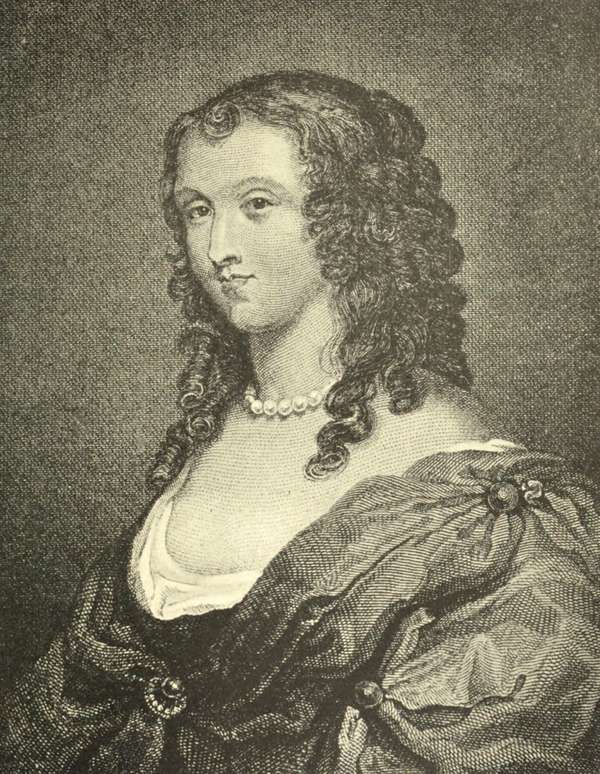
MRS. APHRA BEHN From a picture by Mary Beale in the collection of his Grace the Duke of Buckingham. Drawn by T. Uwins. Engraved by J. Fittler, A.R.A. From an engraving in Effigies Poeticae, London, 1824, Vol. II
Mrs. Behn's novels are now as little known as her plays, but in her own day were very popular. Oroonoko, the first and by far the best, was based on her life in Surinam. At a time when French heroic romances, with their high-flown adventures, unreal characters, and stilted dialogue, were the only works of fiction, Mrs. Behn's short, simple, vigorous, and affecting story of real life comes with a startling sense of novelty.[192] The vivid portrayal of the cruelties incident to the slave trade, though probably written without didactic intent, gives the story a modern humanitarian note not unprophetic of Uncle Tom's Cabin. And the description of the Indian Prince as the ideal natural man, his innate virtues in their pristine purity unvitiated by civilization, foreshadows the theories of Rousseau. The descriptions of nature, however exaggerated, are vivid and attractive, and show a delight in scenic detail not found again in fiction before Mrs. Collyer in 1730. Thus in four ways, choice of real life as a theme, interest in scenery, emphasis on the natural man, and on humanitarianism, Mrs. Behn's little story links itself with the novel of the future rather than with the romances of the past. In the plays Mrs. Behn showed exceptional ability in a realm in which women have seldom excelled. In her novels she marked out a path where women have gained marked literary success.
In one other way she is an important, outstanding figure. She was the first woman in England who made authorship a profession, the first one who definitely set out to earn her living by her pen. It is unfortunate that the first literary lady to achieve "economic independence" should likewise be the first whose writings were notably immoral. But it is a law of human nature that an unaccustomed freedom seldom contents itself in its early exercise of power with destroying merely the unjust bonds by which it has been confined. Freedom is likely to begin by being license. And when Aphra Behn so far defied convention as to compete with men as a playwright on the public stage, when she openly criticized her contemporaries and boasted that her comedies did not fall below most that she read, she had so set herself apart in an unfeminine realm that prudishness and decency fell together. Psychologically the actress and the writer of comedies seem to have gone through similar experiences.
Plays between 1696 and 1706
Mrs. Behn had no feminine contemporary rivals, but later in the century a number of women attempted to write for the stage. In Genest's record for Drury Lane and Lincoln's Inn Fields seven plays by six women are listed in 1696. In the ensuing ten years at least eighteen more plays by women appeared. This exceptional activity did not pass without satiric comment. In 1697 "W. M.'s" Female Wits,[193] with its attack on Miss Trotter, Mrs. Manley, and Mrs. Pix, was acted six times without intermission, a run showing exceptional popularity. In 1702 the hostility of the wits towards women playwrights was again voiced in Gildon's The Two Stages.[194] Genest says that about this time "prejudice against females rose so high that Mrs. Centlivre in Stolen Heiress and Mrs. Pix in Conquest of Spain spoke of their plays as if by men."[195] The authors of these twenty-five plays were Miss Trotter, Mrs. Pix, Mrs. Manley, Mrs. Centlivre, Mrs. Wiseman, "A Lady," "A Young Lady," "A Lady of Quality," and "A Club of Ladies." Fourteen of the plays were tragedies, the best one being, probably, Miss Trotter's Fatal Friendship, almost the only one of the fourteen that survived on the stage after its initial season. The writers of comedy were more successful.
Few of these authors need particular notice. Miss Trotter's work has already been discussed.[196] Mrs. Manley's three plays appeared at ten-year intervals, 1696, 1706, 1717. They were unsuccessful on the stage and they have no qualities that would claim the reader's attention. It is in fiction, not in drama, that Mrs. Manley gained her reputation.
Mrs. Pix (1666-1720?)
Mrs. Pix, daughter of the Reverend Roger Griffith, Vicar of Nettlested in Oxfordshire, and wife of George Pix, a merchant tailor of London, was thirty when she brought out her first play. During the ensuing ten years she put on the stage five tragedies, one comedy, and possibly other plays not under her name. Her tragedies, though written in blank verse, yet belong to the heroic genre, and their chief interest lies in the fact that they represent that genre in its dying throes. In Mrs. Pix's tragedies the heroic play of Dryden's day could look upon its enfeebled and distorted image. We have the war background, the remoteness of time and place, the historical source with free alterations of persons and events, that mark the heroic drama. The type characters are the same. The heroine is unapproachable in beauty, unassailable in virtue. The hero, godlike in personal prowess, the idol of the army, framed by nature to be the darling joy of womankind, cares for glory only that he may lay it at the feet of his beloved. Blest by her he will leave unenvied monarchs to "fight for this Dunghil Earth." This noble pair, joined by indissoluble vows or by a secret marriage, are subjected by the plot to the machinations of the beautiful wicked woman in whose heart has sprung into being a passion for the hero, and to the arrogant demands of the tyrant who claims the heroine as his prey. The result is disaster and the last act is a holocaust. Fights, murders, and suicides carry off all the important dramatis personæ. Disguises, mistaken identity, the ravings of sudden madness, ghosts, and secret documents, determine the events of the play. Passion is torn into exclamatory tatters from the first scene to the last. We have rant and bluster and tortured similes, until taste, good sense, and correct English suffer the same fate as the chief characters. The description of Mrs. Pix as "a fat female author," appropriately called "Mrs. Wellfed," would prepare us for something more placid than the chaos into which she leads us.
The one possible explanation of Mrs. Pix's acceptance year after year by the audiences of Drury Lane and Lincoln's Inn Fields is that the business of her plays never lags. They are short, full of action and surprising turns. An event is never delayed by a disquisition. They also gave excellent opportunity for scenic effects of palaces, prisons, and camps.
Susanna Freeman, Mrs. Centlivre (1680?-1723)
The only woman writer of plays of real importance in this period is Susanna Centlivre.[197] She was the daughter of a Mr. Freeman of Holbeach, Lincolnshire. He is said to have had a considerable estate at the time of the Restoration, but being a zealous dissenter, he was persecuted, his estates were confiscated, and he was obliged to seek refuge in Ireland, where Susanna was born. Her early life is involved in obscurity, but there cling to her name biographical details of a picturesque and romantic sort, though of rather questionable authenticity. Left an orphan at nine and subjected to the ill-usage of a stepmother, the child, at twelve, finally escapes and makes her way to London which she enters penniless, innocent, beautiful. She is rescued by a Cambridge student, a Mr. Hammond, and disguised as a boy she accompanies him to the University. Later she marries the nephew of Stephen Fox, but is left a widow before she is sixteen. A second marriage to a Mr. Carroll results in a second widowhood before she is eighteen. At twenty her first tragedy is played at Drury Lane. She appears soon after this as an actress in country theaters. Mrs. Behn and Mrs. Haywood could ask no richer material for an adventure novel. Then suddenly the scene changes. The buffeted Susanna marries Mr. Centlivre, Queen Anne's chief pastry-cook, and settles down into a comfortable, orderly, and apparently happy domestic life, of which, however, we know in reality even less than of her early kaleidoscopic career.[198] The events of her life are the presentation and publication of her plays.
Before her marriage in 1706 she had begun the series of comedies of which, between 1703 and 1722, she wrote seventeen. They were all successful, and four of them, The Gamester (1705), The Busy Body (1709), The Wonder: A Woman Keeps a Secret (1714), and A Bold Stroke for a Wife (1718), held a fairly prominent place on the stage through the century.
In 1761 there was published a fine edition of her works in three volumes. There is a preliminary address "To the World" in which an anonymous woman endeavors to do justice to "The Manes of the never to be forgotten Mrs. Centlivre." She thus recounts the difficulties Mrs. Centlivre encountered as a female author:
She was even ashamed to proclaim her own great Genius, probably because the Custom of the Times discountenanced poetical Excellence in a Female. The Gentlemen of the Quill published it not, perhaps envying her superior Talents; and her Bookseller, complying with national Prejudices, put a fictitious Name to her Love's Contrivance, thro' Fear that the Work shou'd be condemned if known to be Feminine. With modest Diffidence she sent her Performances, like Orphans, into the World, without so much as a Nobleman to protect them; but they did not need to be supported by Interest, they were admired as soon as known, their real Standard, Merit, brought crowding Spectators to the playhouses, and the female Author, tho' unknown, heard Applauses, such as have since been heaped on that great Author and Actor Colley Cibber.
Her play of the Busy Body, when known to be the Work of a Woman scarce defray'd the Expences of the First Night. The thin audience were pleased, and caused a full House the Second; the Third was crowded, and so on to the Thirteenth, when it was stopt, on account of the advanced Season; but the following Winter it appear'd again with Applause, and for Six Nights successively, was acted by rival Players, both at Drury Lane and at the Hay-Market Houses. See here the Effects of Prejudice, a Woman who did Honour to the Nation, suffer'd because she was a Woman. Are these things fit and becoming a free-born People, who call themselves polite and civilized! Hold! let my Pen stop, and not reproach the present Age for the Sins of their Fathers....
A Poet is born so, not made by Rules; and is there not an equal Chance that the Poetical Birth should be female as well as male?... I could wish that some young Ladies of my Acquaintance, now in Boarding Schools, had classical Education, which would improve their Minds, furnish them with a more general Knowledge, and of course better fit them for Conversation, and the Management of Business.
The author of "To the World" finds great satisfaction in the union of Mrs. Lennox with "Lord Corke and Mr. Samuel Johnson" in the translation of Brumoy's Greek Theatre.
This convinces me [she says] that not only that barbarous Custom of denying Women to have Souls, begins to be rejected as foolish and absurd, but also that foolish Assertion, that Female Minds are not capable of producing literary Works, equal even to those of Pope, now loses Ground, and probably the next Age may be taught by our pens that our Geniuses have been hitherto cramped and smothered, but not extinguished, and that the Sovereignty which the male Part of the Creation have, until now usurped over us, is unreasonably arbitrary: And, further, that our natural Abilities entitle us to a larger Share, not only in Literary Decisions, but that, with the present Directors, we are equally entitled to Power both in Church and State....
In 1764 Baker, in Biographia Dramatica, gave an account of Mrs. Centlivre's work, and most eighteenth-century dramatic collections included plays by her. In 1776 The New English Theatre, which professed to assemble "the most Valuable Plays which have been Acted on the London Stage," published The Busy Body, A Bold Stroke for a Wife, and The Wonder. Her plays were included by John Bell in various collections from 1776 to 1792. Mrs. Inchbald, in her British Theatre (1808), and Oxberry, in The New English Drama, 1818-1824, carried the publication of her plays into the nineteenth century. Such brief notices as occur are highly laudatory. Mr. Baker says: "In a word we cannot help giving it as our opinion, that if we do not allow her to be the very first of our female writers for the stage, she has but one above her, and may justly be placed next to her predecessor in dramatic glory, the great Mrs. Behn." Nearly half a century later Mrs. Inchbald gave even stronger praise when she said that Mrs. Centlivre "ranks in the first class of our comic dramatists." Of the Busy Body Mrs. Inchbald said: "This comedy is by far her best work. In excellence of fable, strength of character, and intricacy of occurrences, it forms one of the most entertaining exhibitions the theatre can boast." Of The Wonder she wrote: "Garrick thought Don Felix worthy his most powerful exertions, in describing the passion of jealousy; and his character was upon the lists with the favorite parts he performed.... Mrs. Centlivre has somewhere said 'the Muses, like most females, are least liberal to their own sex.' She was ungrateful if she did not acknowledge her obligation to them in the composition of this work; for they presided with no niggardly influence over the whole production."
Modern study of Mrs. Centlivre's work has taken a surprising turn. It has to do entirely with Quellen and Verhältnisse. In 1900-1905 there were seven German dissertations dealing with the sources of her plays.[199]
The impulse to play-writing seems to have expended itself with Mrs. Centlivre. Hannah Cowley's popular Belle's Stratagem (1782) is the only other play of even moderate importance through the rest of the century. The situation with regard to play-writing is rather curious. Virtuous ladies were at liberty to write tragedies because tragedies were supposed to be moral and elevating. But unfortunately none of these ladies succeeded in tragedy. On the other hand, ladies who were not virtuous wrote comedies and were eminently successful. The realm between tragedy and comedy, the sentimental comedy, in its combination of didacticism and morality with social studies from middle-class life and the opportunity for rapid intrigue, might have seemed the very medium in which women could most advantageously work. But the successful sentimental comedies from The Conscious Lovers to False Delicacy were written by men playwrights.
General Learning and Literary Work
Besides the women whose work was sufficiently specialized to be grouped under particular subjects or species there were many women to whom learning was itself an avocation with no thought of any literary outcome, and there were many more whose interests were in the general field of belles-lettres and who wrote either in verse or in prose, and on such varied themes as the occasion might suggest. Since no effective principle of classification suggests itself in connection with these writers, it will probably be in the interests of clearness to discuss them in an order as nearly chronological as may be.
Joan Philips (fl. 1679)
An early, almost unknown, little volume of poems, published in 1679 under the title, Female Poems on Several Occasions. Written by Ephelia, is the work of Joan Philips whose portrait accompanies the poems. Such of Miss Philips's poems as can be dated belong but a year or two before the publication of the book. She apparently had some rather close connection with court circles. Her little volume is dedicated to the "Most Excellent Princess Mary, Dutchess of Richmond and Lennox"; she sends a congratulatory poem to Charles II on the discovery of the Popish Plot; and she writes an elegy on Archbishop Sheldon.
Her poems are not, however, usually concerned with court and state. The "Several Occasions" calling forth her verse are chiefly amatory or friendly. Her love-poems are highly personal. From poem to poem the lady pursues the uneven and finally disastrous course of her love for "Strephon," sometimes less poetically addressed as "F. G." From "Love's First Approach" to Strephon's final decisive nuptials with a wealthier Fair One the hopes and despairs of Ephelia are spread before us. She can find no surcease from sorrow. Books fail her as a resource, and her pen proves as recalcitrant as that of the White King in Looking Glass Land.
Sometimes with Books I would divert my mind, But nothing there but F's and G's I find. Sometimes to ease my Grief, my Pen I take But it no letters but F. G. will make.
Miss Philips's friendship poems, in their addresses to "the honoured Eugenia," "the beauteous Marinda," to "Damon," and to "Phylocles inviting him to friendship" show how definitely Ephelia formed herself on the model of the great Orinda whom she praises as having reached the summit of excellence.
Miss Philips also wrote in awe-struck admiration of "Madam Behn" whose "strenuous polite lines" seemed to her a union of "Strong and Sweet" such as might be envied by the wittiest men. And she followed in the footsteps of Mrs. Behn to the extent of writing one comedy, The Pair-Royal of Coxcombs which had the humble success of being acted at a dancing-school. The deprecatory Prologue and Epilogue were included in her poems together with some of the love-songs in the play.
Ephelia seems to spread her life before us, but as a personage in the real world she escapes us. She and Strephon have faded into obscurity. She is contemporary in comedy with Mrs. Behn. Had they some literary comradeship? But twelve years separate the published work of Joan Philips from that of Mrs. Katherine Philips. Were the two poetesses perhaps related? Lady Winchilsea was eighteen when the volume by Ephelia appeared. About fifteen years later we find Lady Winchilsea as "Ardealia" writing on Friendship to one "Ephelia." Could it possibly be this Ephelia? Did Ephelia publish the poems herself with her own portrait as frontispiece? If so she was strangely lacking in the reserve characteristic of Orinda and Ardelia. But even with no biographical data whereby to substantiate or correct the poems, the thin little volume holds its place of interest because of its early date and because of the literary ambitions it indicates.