Chapter II · LEARNED LADIES IN ENGLAND FROM 1650 TO 1760 (continued 4)
Reading edition
Mrs. Cooper's second dramatic attempt was a tragedy which was not successful. It was acted but one night and was never printed.
This theatrical work was, however, only on the fringe of Mrs. Cooper's real interest. In 1737 she published a book entitled The Muses Library; Or, a Series of English Poetry, from the Saxons, to the Reign of King Charles II containing, The Lives and Characters of all the known Writers in that Interval, the names of their Patrons; Complete Episodes, by way of Specimen of the larger Pieces, very near the intire works of some, and large Quotations from others. Being a General Collection of almost all the old valuable Poetry extant, now so industriously enquir'd after, tho' rarely to be found, but in the Studies of the Curious, and affording Entertainment on all Subjects, Philosophical, Historical, Moral, Satyrical, Allegorical, Critical, Heroick, Pastoral, Gallant, Amorous, Courtly and Sublime. But one volume of this projected work was published. The early Georgian public was not trained to an interest in the past. Mrs. Cooper suffered the not infrequent fate of pioneers. There was even difficulty in working off one edition of the first volume, as is evident from its appearance in 1738 and 1741 with changed title-pages.[277] That Mrs. Cooper expected to publish the second volume, including the poets from Samuel Daniel to the time of Charles II, is shown not only by the statement in her Preface, but by interesting notes in the Diary of William Oldys (1696-1761), the famous antiquary. In 1736 he was in London employed in seeing through the press a new edition of Raleigh's History of the World. His Chambers were in Gray's Inn and he was frequently consulted there "on obscure and obsolete writers by eminent men of letters." Two of the people in whom he was particularly interested were Thomas Hayward, who was compiling his British Muse, and Mrs. Cooper. In his Diary are the following records:
1737, June 22. Mrs. Cooper came to my chambers: said she would return Puttenham's Art of Poesy, Browne's Pastorals, and Sir Henry Wotton, when she had finished her extracts for the second volume of her Muses' Library to be published by Christmas.
July 4, Monday. Returned Sir T. More's works: some of his English poetry therein might be for Mrs. Cooper's work, or Mr. Haywards, on Fortune, etc.
Aug. 13. Rec'd letter from Mrs. Cooper to borrow old Marlowe's poem of Hero and Leander for the continuation of her Muses' Library; sent by the servant a very scarce collection of old poetry, called The Paradise of Dainty Devices, in which are several pieces by the old Lord Vaux in King Henry the Eighth's time, the Earl of Oxford, Sir W. Raleigh, Mr. Edwards, Jasper Haywood, Hunis, Churchyard, Kinwelmarsh, Lloyd, Whetstone, etc., printed 4o. 1578. To borrow one of Caxton's books of Sir Hans Sloane and remember to apply the story of Absyrtus in the preface for Mr. Hayward's Collection of select thoughts from our old poets.[278]
Mrs. Cooper frequently comments on the difficulty and expense of gathering material for her enterprise and gratefully acknowledges "the generous Assistance of the Candid Mr. Oldys." Biographical data were also obtained only through most patient effort. The only Lives of the Poets to which she could have access were Wood's Athenæ Oxoniensis and the works of Phillips, Winstanley, and Jacob. Edward Phillips's Theatrum Poetarum appeared in 1675. Its first volume gave brief biographical and critical notes on sixty-four authors from Robert of Gloucester to George Chapman, thus covering about the same ground as Mrs. Cooper's first volume which closes with Samuel Daniel. William Winstanley's Lives of the English Poets was published in 1687. It includes notes on poets from William the Conqueror to James II with occasional brief illustrative extracts. The Poetical Register of Giles Jacob (1724) is, in the first volume, confined to dramatists and is based on Langbain. The second volume, The Lives and Characters of the English Poets, extends about a century and a quarter later than Mrs. Cooper's volume. In the period before 1600 about half the names in her volume are included and briefly commented on. Jacob also gives an occasional extract.
Mrs. Cooper was not, then, without predecessors in her undertaking. The novelty in her book was her assumption that people would not only like to know about the old poets, but that there would be many lovers of literature who would rejoice in reading the old poems, and very nearly in their original antiquated form. She gives ten pages from Langland, eleven from Barclay, twenty-eight from Sackville, twenty-four from Churchyard, thirty-five from Fulke Greville, thirty-one from Fairfax, and so on. Chaucer, Spenser, and Shakespeare are less fully represented, as being already well known. The selections are the result of wide reading and are made because they pleased Mrs. Cooper's own taste. "What has given me Pleasure in my Closet," she says, "I have undertaken to recommend to the Publick; not presuming to inform the Judgment, but only awaken the Attention." That she failed to "awaken Attention" was the fault of the age. Her selections were representative and interesting.
Mrs. Cooper's book shows not only wide research and a full knowledge of extant criticism, but it also manifests a personal zest in reading and an unusual independence of literary judgment. This independence is shown in her choice of authors. Phillips, Winstanley, and Jacob had omitted Langland, but she says, "In my Judgment, no Writer, except Chaucer, and Spenser, for many Ages, had more of real Inspiration." Or take the case of Lydgate. Phillips mentions him, but not, apparently, from any personal knowledge of his work. Winstanley and Jacob praise him highly. Mrs. Cooper says of him: "Many Authors are so profuse in his Praise as to rank him very little below his Master, and, often, quote them together; which rais'd my Curiosity so high, that I gave a considerable Price for his Works, and waded thro' a large Folio, hoping still to have my Expectation gratified.... But I must, either confess my own want of Penetration, or beg leave to dissent from his Admirers." She gives a long quotation from Lord Brook's A Treatise of Humane Learning, because his name has "never yet received the Honours it deserved." She is indignant at the general indifference to the work and fame of Edward Fairfax and writes a eulogy of several pages. Her comments on Chaucer, Spenser, and Shakespeare are brief, since all agree on their preëminence. Mr. Lounsbury, after noting one or two errors in the book, says of it: "I know of no similar work produced at that period in which the knowledge displayed is so accurate and comprehensive, or the critical estimates so uniformly good and just. There was exhibited in it not merely freshness of judgment but the independence that springs from the study of writers at first hand."[279] Mrs. Cooper had in her the making of a scholar. She allowed herself no generalities. Whatever she said was based on a thorough study of the material under discussion. Furthermore, she acquainted herself with all extant critical opinion without thereby losing the power to form an opinion of her own.
Mrs. Cooper's Preface is an excellent, even an eloquent, piece of writing, in justification of poets as a nation's glory. She recognizes that "Merit is not its own Preservative" and wishes in her book to set up if possible "a Bulwark which shall preserve Merit from the attacks of Time." She considers her "Series of Poetry (which has never been aim'd at anywhere else) ... one of the most valuable collections that ever was made publick." She has no apologies to make. In introducing to the moderns this august company of ancient poets she is saved from any possible self-consciousness by the dignity of her enterprise. The same tone pervades her Dedication. No single name is glorious enough to appear at the head of her list. She chooses rather a dedication to "the truly Honourable Society for the Encouragement of Learning."[280] That Society was then in the hey-day of its brief glory. Mrs. Cooper had, apparently, no thought of personally benefiting by her Dedications. On the contrary she counted this an opportunity to express what all authors and lovers of literature must feel towards a design "so great, seasonable, and humane" as that of this new organization, a design applauded by "all who have Generosity, Benevolence or Politeness."
As dramatist and actress Mrs. Cooper would deserve at least passing mention, but as a scholar, as an ardent advocate of early English poetry, she must take high rank, not only among the learned women, but also among the learned men of her day.
Lady Mary Wortley Montagu (1689-1762)
No woman of the first half of the eighteenth century had a more active mind or facile pen than Lady Mary Wortley Montagu. Although almost none of her work appeared in print in her lifetime, her personality made its own way, and she was early recognized as of note for genius and learned acquirements. It is, therefore, of especial interest to inquire into the particulars of her education, and to find out her status as a woman of letters.
The materials for such an inquiry are fairly abundant, and are mainly: her miscellaneous letters, first published in 1803; a fragmentary autobiographical romance, of which she says "not a sillable" except the names is feigned; and the Introductory Anecdotes by her granddaughter, Lady Louisa Stuart,[281] included in Lady Mary's Letters and Works brought out by Lord Wharncliffe, her great-grandson, in 1887. The important groups of letters containing personal details are those written to Mr. Montagu from about 1709 till their marriage in 1712, and the very large group to her family and friends, chiefly to Lady Bute, her daughter, during Lady Mary's stay in Italy from 1739 to 1761.
Lady Mary's mother died when she was eight, and her father, too much a man of pleasure to trouble himself with the education of girls, gave his three young daughters into the care of "an old governess, who, though perfectly good and pious, wanted a capacity for so great a trust."[282] In commenting on the evil effects of an ignorant education, Lady Mary said: "My own was the worst in the world, being exactly the same as Clarissa Harlowe's; her pious Mrs. Norton so perfectly resembling my governess, who had been nurse to my mother. I could almost fancy the author was acquainted with her. She took so much pains from my infancy, to fill my head with superstitious tales and false notions, it was none of her fault I am not at this day afraid of witches and hobgoblins, or turned methodist."[283] But at least there were no hindering home influences, and Lady Mary had what Charles Lamb would call the luck to be "tumbled early into a closet of good old English books." Forsaking the dolls of her sisters she took refuge in her father's fine library and there she read with the absorption of a youthful Coleridge. She "got by heart all the poetry that came in her way," and she "read every romance as yet invented." Lady Louisa says she "possessed and left after her, the whole library of Mrs. Lenox's Female Quixote—Cleopatra, Cassandra, Clelia, Cyrus, Pharamond, Ibrahim, etc., etc.—all, like the lady Arabella's collection, 'Englished,' mostly, 'by persons of honour.' The chief favourite appeared to have been a translation of Monsieur Honoré d'Urfé's Astrea, once the delight of Henri Quatre and his court, and still admired and quoted by the savans who flourished under Louis XIV. In a blank page of this massive volume (which might have counterbalanced a pig of lead of the same size) Lady Mary had written in her fairest youthful hand the names and characteristic qualities of the chief personages thus:—the beautiful Diana, the volatile Climene, the melancholy Doris, Celedon the faithful, Adamas the wise, and so on; forming two long columns."[284] Among Lady Mary's earliest attempts at authorship were romantic stories in imitation of these her favorite authors.
But along with her romances, and soon superseding them, were sterner studies. She early began to teach herself Latin. In her account of herself under the name Lætitia, she said:
Her appetite for knowledge increasing with her years, without considering the toilsome task she undertook, she began to learn herself the Latin grammar, and with the help of an uncommon memory and indefatigable labour, made herself so far mistress of that language as to be able to understand almost any author. This extraordinary attachment to study became the theme of public discourse. Her Father, though no scholar himself, was flattered with a pleasure in the progress she made, and this reputation which she did not seek (having no end in view but her own amusement) gave her enviers and consequently enemies among the girls of her own age.
Lady Mary was but fourteen when her "just and knowing" criticism of a play, her knowledge of Latin, and her relish for the classics, excited the wonder and admiration of Mr. Wortley Montagu. He was as amazed "as if he had heard a piece of wax work talk."[285] But the envy of her girl companions and the liberal praise of Mr. Wortley are not the only proofs that Lady Mary's shining talents and learned tastes met early recognition. Her uncle, Mr. William Fielding, "perceived her capacity, corresponded with her, and encouraged her pursuit of information." Bishop Burnet showed himself most friendly, and condescended to direct her studies. Mr. Wortley also kept up a kind of scholarly guidance. Lady Mary said to Spence in Rome in 1741: "When I was young I was a great admirer of Ovid's Metamorphoses, and that was one of the chief reasons that set me upon the thoughts of stealing the Latin language. Mr. Wortley was the only person to whom I communicated my design, and he encouraged me in it. I used to study five or six hours a day for two years in my father's library; and so got that language, whilst everybody else thought I was reading nothing but novels and romances."[286] By the time she was twenty Italian had been added to her accomplishments. In an early undated letter to Mrs. Hewet she wrote: "I have begun to learn Italian, and am much mortified I cannot do it of a signor of Monsieur Resingade's recommendation; but 'tis always the fate of women to obey, and my papa has promised me to a Mr. Cassotti. I am afraid I shall never understand it as well as you do." By 1710 she was quoting Italian verse, and in the following year she corresponded with Mr. Resingade in Italian. That she was still working under Mr. Cassotti in 1712 is apparent from her request that Mr. Wortley should send one of his letters to her under the care of Mr. Cassotti, her "Italian master." At this period, or a little later, she also learned French, so that she wrote letters and essays in that language. Her continued devotion to study is shown by a letter from Thoresby to Anne Wortley in 1709: "I am now so much alone, I have leisure to pass whole days in reading.... My study is nothing but dictionaries and grammars. I am trying whether it be possible to learn without a master; I am not certain (and dare hardly hope) I shall make any great progress; but I find the study so diverting. I am not only easy, but pleased with the solitude that indulges it."[287]
Lady Mary's diligence resulted in 1710 in a translation of the Latin version of the Enchiridion of Epictetus which she sent to Bishop Burnet with a notable letter. Of the translation she says: "Here is the work of one week of my solitude—by the many faults in it your lordship will easily believe I spent no more time upon it; it was hardly finished when I was obliged to begin my journey, and I had not leisure to write it over again. You have it here without any corrections with all its blots and errors." Bishop Burnet returned the document with emendations which in the present printed form are given in italics.[288] In spite of the numerous changes suggested as closer to the original, the translation remains as a remarkable production for a self-educated girl of twenty. Even more remarkable as evidencing maturity of thought and command of an admirable English style is the letter, which is of particular significance in connection with the contemporary attitude towards the learned woman:
My sex is usually forbid studies of this nature, and folly reckoned so much our proper sphere, we are sooner pardoned any excesses of that, than the least pretensions to reading or good sense. We are permitted no books but such as tend to the weakening and effeminating of the mind. Our natural defects are every way indulged, and it is looked upon as in a degree criminal to improve our reason, or fancy we have any. We are taught to place all our art in adorning our outward forms, and permitted, without reproach, to carry that custom even to extravagancy, while our minds are entirely neglected, and, by disuse of reflections, filled with nothing but the trifling objects our eyes are daily entertained with. This custom, so long established and industriously upheld, makes it even ridiculous to go out of the common road, and forces one to find as many excuses as if it was a thing altogether criminal not to play the fool in concert with other women of quality, whose birth and leisure only serve to render them the most useless and most worthless part of the creation. There is hardly a character in the world more despicable, or more liable to universal ridicule, than that of a learned woman: those words imply, according to the received sense, a tattling, impertinent, vain, and conceited creature. I believe nobody will deny that learning may have this effect, but it must be a very superficial degree of it. Erasmus was certainly a man of great learning and good sense, and he seems to have my opinion of it when he says, Fæmina qui (sic) vere sapit, non videtur sibi sapere; contra, quæ cum nihil sapiat sibi videtur sapere ea demum bis stulta est. The Abbé Bellegarde gives a right reason for women's talking overmuch: they know nothing, and every outward object strikes their imagination, and produces a multitude of thoughts, which, if they knew more, they would know not worth their thinking of. I am not now arguing for an equality of the two sexes. I do not doubt God and nature have thrown us into an inferior rank; we are a lower part of the creation, we owe obedience and submission to the superior sex, and any woman who suffers her vanity and folly to deny this, rebels against the law of the Creator, and indisputable order of nature: but there is a worse effect than this, which follows the careless education given to women of quality, its being so easy for any man of sense, that finds it either his interest or his pleasure, to corrupt them.[289]
In 1712 Lady Mary married Mr. Wortley Montagu, in 1713 her son was born, and in 1715 she started with her husband on their journey to Turkey. The six years between the Enchiridion and the Embassy present Lady Mary to us in an enviable position. The reputation of her youth was augmented. "The wittiest as well as one of the most beautiful women of her day, she numbered among her admirers the most powerful of the statesmen, and the most brilliant of the littérateurs; while, for a time at least she was a favourite at the rival Courts of the King and the Prince of Wales."[290] The only literary output of this period is a long, rather stilted and perfunctory criticism of Addison's Cato which she undertook at her husband's request,[291] and some Court Poems which she wrote with great zest, in conjunction with Pope and Gay, in pursuance of Gay's plan to ridicule the pastoral by keeping the form, but making it the vehicle of corrupt court and town life. Of the seven poems so written four were by Lady Mary. In them we come for the first time on her power of combining picturesque detail and caustic comment. Not Gay himself was richer in local color; and Pope and Swift were almost equaled in contemptuous social portraiture.
During the six years before the Embassy Lady Mary's activities were essentially those of a social leader and the mistress of a household. But all her interests were focused to one point when she found that she could go to Turkey with Mr. Montagu. Travel "is the thing on earth I most wish," she had written in 1710, and now that her husband was sent as Ambassador to the Porte, her dreams could be realized. She must have been a perfect traveling companion. She had great courage, great endurance; no hardships or dangers daunted her. During the fifteen months of their absence she had her three-year-old son to care for, and her daughter was born while they were in Constantinople, but nothing interfered with her zest for experiences. Each day was a new adventure. Each day her insatiable desire to learn and to know some new thing received some new satisfaction. During the journey she kept a full diary which, though not published till after her death, became known in manuscript soon after her return. Certainly by 1725 she had prepared a copy with an eye to publication. To this manuscript Mary Astell wrote a Preface, signed "M. A.," and dated 1725. Mary Astell was twenty-two years older than Lady Mary for whom she had a strong personal affection, as well as a very sincere pride in her reputation as a learned woman. The Preface would seem to indicate that Lady Mary's "enviers" and "enemies" had not decreased since her girlhood days:
In short [says Mary Astell] let her own sex, at least, do her justice; lay aside diabolical Envy, and its brother Malice, with all their accursed company, sly whispering, cruel backbiting, spiteful detraction, and the rest of that hideous crew, which, I hope, are very falsely said to attend the Tea-Table, being more apt to think they attend those public places where virtuous women never come. Let the men malign one another, if they think fit, and strive to pull down merit, when they cannot equal it. Let us be better-natured, than to give way to any unkind or disrespectful thought of so bright an ornament of our sex merely because she has better sense; for I doubt not but our hearts will tell us, that this is the real and unpardonable offense, whatever may be pretended. Let us be better Christians, than to look upon her with an evil eye, only because the Giver of all good gifts has entrusted and adorned her with the most excellent talents. Rather let us freely own the superiority of this sublime genius, as I do in the sincerity of my soul, pleased that a woman triumphs, and proud to follow in her train. Let us offer her the palm which is so justly her due; and if we pretend to any laurels, lay them willingly at her feet.
After Lady Mary's return to England in 1718 we come upon a long period of quiescence. Domestic affairs, events of social and political life, her friendships and hatreds, her economies and stock speculations, completely occupied her. During the first part of this period she was extravagantly praised. Steele said of her in his essay on Inoculation:
This ornament of her Sex and Country, who ennobles her own Nobility by her Learning, Wit and Virtues, accompanying her consort into Turkey, observed the Benefit of this Practice, with its frequency, even among these obstinate Predestinarians, and brought it over for the service and safety of her native England, where she consecrated its first effects on the persons of her own fine children.
In 1720 Pope wrote
In beauty and wit No Mortal as yet To question your empire has dared: But men of discerning Have thought that in learning To yield to a lady was hard. Impertinent schools, With musty dull rules, Have reading to females denied; So Papists refuse The Bible to use, Lest flocks should be wise as their guide. But if the first Eve Hard doom did receive When only one apple had she, What a punishment new Shall be found out for you, Who, tasting, have robbed the whole tree.
And in 1727 he wrote in Sandys' Ghost:
Ye ladies, too, draw forth your pen, I pray where can the hurt lie? Since you have brains as well as men, As witness Lady Wortley.
Before 1724 Dr. Young had sent her his tragedy The Brothers, requesting her criticism. In 1725 Richard Savage dedicated his Miscellanies to her as one through whose elevated and immortal wit England had been honored, and who had firmly established the fact that women have "strength of mind in proportion to their sweetness." And Henry Fielding, her second cousin, sent her his comedies, "exceedingly anxious" for her opinion of them.
But after 1724 or 1725 the years seem to slip on in an aimless fashion, the only breaks in the monotony coming from the intermittently virulent quarrels with Pope, the religious and medical animosities roused by the inoculation process, family sorrows and family discords, with no literary output to mark any personal achievements. From thirty to fifty should have been harvest years after so brilliant a beginning. But the early promise faded into a middle age disillusioned, unambitious, and rather commonplace. The only writing of any importance was in the correspondence kept up in a desultory fashion with various friends. Such of the letters of this period as have been preserved are so vivid and picturesque, so witty, and so pleasantly caustic in their comment, that we can only regret their small number. Take for instance the following description of a feminine riot in the House of Commons:
At the last warm debate in the House of Lords, it was unanimously resolved there should be no crowd of unnecessary auditors; consequently the fair sex were excluded, and the gallery destined to the sole use of the House of Commons. Notwithstanding which determination, a tribe of dames resolved to show on this occasion that neither men nor laws could resist them. These heroines were Lady Huntington, the Duchess of Queensberry, the Duchess of Ancaster, Lady Westmoreland, Lady Cobham, Lady Charlotte Edwin, Lady Archibald Hamilton, and her daughter, Mrs. Scott, and Mrs. Pendarves, and Lady Frances Saunderson. I am thus particular in their names, since I look upon them to be the boldest asserters, and most resigned sufferers for liberty, I ever read of. They presented themselves at the door at nine o'clock in the morning, where Sir William Saunderson respectfully informed them the Chancellor had made an order against their admittance. The Duchess of Queensberry, as head of the squadron, pished at the ill-breeding of a mere lawyer, and desired him to let them upstairs privately. After some modest refusals, he swore by G—— he would not let them in. Her grace, with a noble warmth, answered, by G—— they would come in in spite of the Chancellor and the whole House. This being reported, the Peers resolved to starve them out; an order was made that the doors should not be opened till they had raised their siege. These Amazons now showed themselves qualified for the duty even of foot soldiers; they stood there till five in the afternoon, without either sustenance or evacuation, every now and then playing volleys of thumps, kicks, and raps against the door, with so much violence that the speakers in the House were scarce heard. When the Lords were not to be conquered by this, the two duchesses (very well apprised of the use of stratagems in war) commanded a dead silence of half an hour; and the Chancellor, who thought this a certain proof of their absence (the Commons also being very impatient to enter), gave order for the opening of the door; upon which they all rushed in, pushed aside their competitors, and placed themselves in the front rows of the gallery. They stayed there till after eleven, when the House rose; and during the debate gave applause and showed marks of dislike, not only by smiles and winks (which have always been allowed in these cases), but by noisy laughs and apparent contempts; which is supposed the true reason why poor Lord Hervey spoke miserably.[292]
In 1739 Lady Mary drifted, without settled plan, to Italy, and there her self-elected exile lengthened itself insensibly into a habit of absence, so that she did not return to England till 1761, the year before her death. During this period she kept a full journal, and projected other work, but brought nothing to fruition.[293] Her chief occupation was reading. Her voracious appetite for fiction passed over from her girlhood absorption in French romances to the novels crowding the presses of the mid-eighteenth century. The events of her placid life were boxes of books from England, and the novels she read would make an adequate list even for Polly Honeycomb. Lady Orford said she wondered how any one could find pleasure in the books Lady Mary chose. But Lady Mary confessed herself "a rake in reading," and said, in 1750: "I thank God my taste still continues for the gay part of reading. Wiser people may think it trifling but it serves to sweeten life to me."[294] In 1752 her daughter sent her Peregrine Pickle (1751), Lady Vane's Memoirs (1750), The Fortunate Parish Girl (1750), Pompey the Little (1751), Eleanora's Adventures (1751) and the Life of Mrs. Constantia Philips, as among the interesting new books. In a letter to Lady Bute Lady Mary wrote:
I see in the newspapers the names of the following books: Fortunate Mistress, Accomplished Rake, Mrs. Charke's Memoirs, Modern Lovers, History of Two Orphans, Memoirs of David Ranger, Miss [Mos]tyn, Dick Hazard, History of a Lady Platonist, Sophia Shakespear, Jasper Banks, Frank Hammond, Sir Andrew Thompson, Van a Clergyman's Son, Cleanthes and Celimena. I do not doubt at least the greatest part of these are trash, lumber, etc.; however, they will serve to pass away the idle time, if you will be so kind to send them to your most affectionate mother.[295]
And she read English drama from Gammer Gurton's Needle to Lillo's George Barnwell, her prime favorite.[296]
During the twenty-two years in Italy Lady Mary was practically alone, but she says time never hung heavy on her hands. She wrote letters constantly, and her interest never flagged in the affairs of England in general and of Lady Bute's family in particular. As the daughters grew up, Lady Mary wrote often about their education, and we see that the ideas of the letter to Bishop Burnet persist. In 1753 she wrote concerning Lady Mary, the eldest granddaughter, who had shown herself excellent in arithmetic:
Learning, if she has a real taste for it, will not only make her contented, but happy in it. No entertainment is so cheap as reading, nor any pleasure so lasting. She will not want new fashions, nor regret the loss of expensive diversions, or variety of company, if she can be amused with an author in her closet. To render this amusement extensive, she should be permitted to learn the languages. I have heard it lamented that boys lose so many years in mere learning of words: this is no objection to a girl, whose time is not so precious: she cannot advance herself in any profession, and has therefore more hours to spare; and as you say her memory is good, she will be very agreeably employed in this way. There are two cautions to be given on this subject: first, not to think herself learned when she can read Latin, or even Greek. Languages are more properly to be called vehicles of learning than learning itself, as may be observed in many schoolmasters, who, though perhaps critics in grammar, are the most ignorant fellows on earth. True knowledge consists in knowing things, not words. I would wish her no further a linguist than to enable her to read books in their originals, that are often corrupted, and always injured by translations. Two hours application every morning will bring this about much sooner than you can imagine, and she will have leisure enough besides to run over the English poetry, which is a more important part of a woman's education than it is generally supposed.... If she has the same inclination (I should say passion) for learning that I was born with, history, geography, and philosophy will furnish her with materials to pass away cheerfully a longer life than is allotted to mortals. I believe there are few heads capable of making Sir I. Newton's calculations, but the result of them is not difficult to be understood by a moderate capacity. Do not fear this should make her affect the character of Lady ——, of Lady ——, or Mrs. ——: These women are ridiculous, not because they have learning, but because they have it not. One thinks herself a complete historian, after reading Echard's Roman History; another a profound philosopher, having got by heart some of Pope's unintelligible essays; and a third an able divine, on the strength of Whitfield's sermons: thus you hear them screaming politics and controversy.[297]
In the next letter Lady Mary shows some doubt as to the wisdom of giving advice so outspoken on the subject of learning. She says:
I cannot help writing a sort of apology for my last letter, foreseeing that you will think it wrong, or at least Lord Bute will be extremely shocked at the proposal of a learned education for daughters, which the generality of men believe as great a profanation as the clergy would do if the laity should presume to exercise the functions of the priesthood. I desire you would take notice, I would not have learning enjoined them as a task, but permitted as a pleasure, if their genius leads them naturally to it.[298]
Later in the same letter she says:
There is nothing so like the education of a woman of quality as that of a prince: they are taught to dance, and the exterior part of what is called good breeding, which, if they attain, they are extraordinary creatures in their kind, and have all the accomplishments required by their directors. The same characters are formed by the same lessons, which inclines me to think (if I dare say it) that nature has not placed us in an inferior rank to men, no more than the females of other animals, where we see no distinction of capacity; though, I am persuaded, if there was a commonwealth of rational horses (as Doctor Swift has supposed), it would be an established maxim among them, that a mare could not be taught to pace.
In October of the same year she wrote further on the subject of the learned woman:
I confess I have often been complimented, since I have been in Italy, on the books I have given the public. I used at first to deny it with some warmth; but, finding I persuaded nobody, I have of late contented myself with laughing whenever I heard it mentioned, knowing the character of a learned woman is far from being ridiculous in this country, the greatest families being proud of having produced female writers; and a Milanese lady being now professor of mathematics in the University of Bologna, invited thither by a most obliging letter, wrote by the present Pope, who desired her to accept of the chair, not as a recompense for her merit, but to do honor to a town which is under his protection. To say truth, there is no part of the world where our sex is treated with so much contempt as in England. I do not complain of men for having engrossed the government: in excluding us from all degrees of power, they preserve us from many fatigues, many dangers, and perhaps many crimes. The small proportion of authority that has fallen to my share (only over a few children and servants) always has been a burden and never a pleasure, and I believe every one finds it so who acts from a maxim (I think an indispensable duty), that whoever is under my power is under my protection. Those who find a joy in inflicting hardships and seeing objects of misery, may have other sensations; but I have always thought corrections, even when necessary, as painful to the giver as to the sufferer, and am therefore very well satisfied with the state of subjection we are placed in: but I think it the highest injustice to be debarred the entertainment of my closet, and that the same studies which raise the character of a man should hurt that of a woman. We are educated in the grossest ignorance, and no art omitted to stifle our natural reason; if some few get above their nurse's instructions, our knowledge must rest concealed, and be as useless to the world as gold in a mine. I am speaking now according to our English notions, which may wear out, some ages hence, along with others equally absurd.[299]
Lady Montagu died in London in 1762. Her Turkish Letters were published the next year. Her miscellaneous correspondence came out in 1807. Nor was her real significance apparent until both publications were accessible. It was then at once recognized that no English letter-writer had surpassed Lady Mary in brilliancy and wit. Her eye was so quick and accurate that no interesting details of dress or manner escaped her. As a chronicler and critic of social faults and foibles she was cool, keen, merciless. She was graphic in phrase, homely and direct in figures of speech, racy and idiomatic. The whole tone of her writing was free, lively, energetic, and she could make any topic entertaining. As a person there seems to be ground for two opposite opinions concerning Lady Mary. People admired her and praised her, or they hated her and told scandalous stories about her. But as a writer there could be but one opinion. She was not the first woman of letters to be eulogized, but she was the first woman, not in fiction or drama, whose writings every one wished to read.
Mrs. De la Rivière Manley (1672-1724)
Mrs. Manley,[300] a gentlewoman of good family, the daughter of Sir Roger Manley, was left an orphan while still young. Her guardian, a cousin twenty years older than herself, tricked her into a false marriage, and then, on the birth of a child, announced the cheat and disappeared. Most of the fortune left by her father had also vanished. The details of her life after this until she began her career of authorship are but vaguely known. In 1696 she made a threefold appeal to the public in Letters written by Mrs. Manley;[301] The Lost Lover, a comedy written in seven days, produced at Drury Lane, and not successful; and The Royal Mischief, successfully brought out at Lincoln's Inn Fields. In the Preface to her Letters (1696) Mrs. Manley spoke of the eager contention between the theaters as to which should bring her on the stage, but drama was not her natural medium. When, after a silence of nine years, she again appeared as an author, it was with The Secret History of Queen Zarah (1705), a precursor of the scandalous personal and political memories for which she became known. In 1709 she published Secret Memoirs and Manners of several Persons of Quality of Both Sexes. From the New Atalantis, an Island in the Mediterranean. The popularity of this book brought a second volume the same year. In 1710 appeared Memoirs of Europe towards the Close of the Eighth Century. This and a second volume were afterwards reprinted as the third and fourth volumes of The New Atalantis. The sixth edition of The New Atalantis had a Key at the end of the fourth volume.
This book purported to be by an Italian and put into English by an anonymous translator. The plan of the romance is that of a journey where Astræa (Mrs. Behn revisiting the earth), Fame, and Virtue are conducted invisibly about while their guide, "Intelligence," tells them the secret histories of the persons they meet. Under this thin disguise the statesmen, wits, and beauties of the reign of William and Mary and Queen Anne were at once recognized. Mrs. Manley, the publisher, and the printer, were arrested. On her own testimony, however, the blame was counted hers and she was examined before the court, but after about three months she was discharged. And the later volumes followed with no public expression of disapproval.
In 1711 Mrs. Manley succeeded Swift as editor of The Examiner. In 1714 appeared The Adventures of Rivella, or, the History of the Author of Atalantis, by Sir Charles Lovemore. In 1724 Curll brought this out as Mrs. Manley's History of Her own Life and Times, and it was probably written by her. In 1720 The Power of Love in Seven Volumes, and Verses, in Anthony Hammond's New Miscellany, close her contributions to literature. She died at the house of Alderman Barker whose mistress she had been for several years.
A fact of central interest about Mrs. Manley's personal and literary career is her quarrel with Steele which kept up with long lulls and acrimonious crises from before 1709 to 1717. In the first volume of The New Atalantis[302] she gave an account of Steele as "Monsieur le Ingrate," narrating in detail her aid in rescuing him from the impostors who were leading him into ruinous expenses in search of the philosopher's stone, and bitterly assailing him for his later ingratitude in the time of her own distresses. In the same year The Tatler, No. 35, possibly referred to Mrs. Manley under the description of the snuff-eating lady. Certainly in September Swift represented her, under the name of "Epicene," as one of the professors in Madonella's college. Mrs. Manley, assuming that the paper was by Steele, wrote a denunciatory letter, which he answered in mild fashion, owning his former indebtedness to her and explaining his inability to aid her when she appealed to him. In the third and fourth volumes of The New Atalantis (1710) were further attacks on Steele.[303] This third volume was dedicated to him as "Isaac Bickerstaffe." She quoted his letter, but omitted some of the mitigating sentences. Of the "mighty Tatlers" leveled at her she says: "A weak, unlearn'd Woman's Writings, to employ so great a Pen! Heavens? how valuable am I? How fond of that Immortality, even of Infamy, that you have promised! I am ravished at the Thoughts of living a Thousand Years hence in your indelible lines, tho' to give Offence.... I shall be proud of furnishing Matter towards your inexhaustible Tatler, and of being a perpetual Monument of Mr. Bickerstaffe's Gallantry and Morality."
In August, 1713, (The Guardian, No. 128), Steele entered the controversy concerning the demolition of Dunkirk. Mrs. Manley answered with a pamphlet in which the "honour and Prerogative of the Queen's Majesty" were defended "against the unexampled Insolence of the Author of the Guardian." This closed the open hostilities, and by 1717 there were handsome apologies and frank admissions of error on both sides, and the reconciliation seems to have been complete. The chief interest we find in Mrs. Manley's play is the fact that Steele wrote the Prologue and that the play was dedicated to him. In this Dedication she said, "I have not known a greater mortification than when I have reflected upon the severities which have flowed from a pen which is now, you see, disposed to celebrate and commend you."[304]
Mrs. Elizabeth Thomas (1677-1731)
Dryden conferred upon Mrs. Thomas the title of "Corinna" and says, "I would have called you Sapho, but that I hear you are handsomer." The young poetess had received no regular education, but she improved her mind by reading the politest authors, and finally, at twenty-two, she ventured forth as a poet herself. She sent two poems to Mr. Dryden asking his critical judgment of them. He responded with the following letter:
Fair Corinna,
I have sent your two poems back again, after having kept them so long from you: They were I thought too good to be a woman's; some of my friends to whom I read them, were of the same opinion. It is not very gallant I must confess to say this of the fair sex; but, most certain it is, they generally write with more softness than strength. On the contrary, you want neither vigour in your thoughts, nor force in your expression, nor harmony in your numbers; and methinks, I find much of Orinda in your manner, (to whom I had the honour to be related, and also to be known) but I am so taken up with my own studies, that I have not leisure to descend to particulars, being in the meantime, the fair Corinna's
Most humble, and Most faithful servant John Dryden.
Nov. 12, 1699.
The poetical career thus auspiciously begun with the praise of the great poet ended in disaster. After the death of Mr. Gwinnet, who had courted her for sixteen years, in 1717, and of her mother in 1719, she was always in financial straits and used almost any means to avoid her creditors. During the time when she was living under the protection of Mr. Henry Cromwell, she gained possession of twenty-five letters written to him by Mr. Pope. These she sold to Curll, who published them in 1726, and she thus gained a disgraceful place in The Dunciad. Her Poems were published in 1722, 1726, 1727, but she does not seem to have been rewarded with either fame or money. Besides other unimportant literary work she wrote an autobiography entitled Pylades and Corinna; or, Memoirs of the Lives, Amours, and Writings of Richard Gwinnet, Esquire, and Mrs. Elizabeth Thomas, junior.... To which is prefixed the Life of Corinna, written by herself. This was published in 1731 in two volumes. The autobiography in an abridged form appears in Cibber's Lives of the Poets.[305]
Mrs. Eliza Haywood (1693-1756)
Miss Eliza Fowler, the daughter of a small shopkeeper in London, was married before she was twenty to the Reverend Valentine Haywood.[306] In 1721 she left her husband[307] and thereafter she had her own way to make. A few unimportant attempts as an actress[308] and some occasional unsuccessful attempts as a playwright may be set aside as not belonging to her real career. It was as a writer of romantic tales and novels that she achieved success. This vein once tapped, the ore, such as it was, seemed inexhaustible. From 1719 to 1756 Mrs. Haywood published about seventy single works, nearly all of them "fictitious tales."[309] If we should count various editions, the numbers of times she was privileged to see some work by her issue from the press during her thirty-seven years of authorship would exceed one hundred and fifty. Her most prolific years were 1724 to 1728, thirty-three new books appearing during this short time.
This crowding of book after book through the press, the numerous editions of the more popular novels, and the fact that four "Collections" of her works had appeared by 1729, sufficiently attest her extraordinary contemporary popularity. Mrs. Haywood's fecundity is not a matter for great surprise. It is easy to understand that if she could write one novel like Love in Excess, she could write half a hundred more without seriously taxing her creative spirit. But to the present-day reader her popularity seems incredible. Of what sort was the reading public that stimulated her and her publishers to such activity? According to Mr. Gosse's conjecture in "What Ann Lang Read," "Eliza was read by servants in the kitchen, by seamstresses, by basket-women, by prentices of all sorts, male and female, but chiefly the latter."[310] But Mr. Whicher points out that Mrs. Haywood's novels were never issued in cheap form, and that one to three shillings for a slender octavo would put the books beyond the purses of the servant class.[311] In all probability Ann Lang, the milliner's apprentice, is less truly representative of Mrs. Haywood's readers than is Polly in Colman's Polly Honeycomb (1760). Polly did not begin her career as a novel-reader till more than a decade after the appearance of Pamela, so that a fairly wide range of fiction was open to her, and Mrs. Haywood could be but one element of her possible literary joys. But we know that The History of Miss Betsy Thoughtless was one of her favorites, and the extracts she gives from Mrs. Haywood's previous novels and the names she cherishes, read like satires on that lady's heroics. If Polly may be counted as typical of Mrs. Haywood's public, we have readers distinctly above the servant class. Mr. Honeycomb was a well-to-do tradesman with clerks in the office and a fairly elaborate domestic establishment. Polly may even have been to a finishing school. There are also indications of a class of readers higher still. The ladies of fashion who so attentively pursued Mrs. Manley's New Atalantis could hardly be supposed indifferent to the social scandal in Mrs. Haywood's Memoirs of a Certain Island and The Court of Carimania. In Leonora's library there was a Book of Novels which would doubtless appeal to the same taste as Mrs. Haywood's tales. Furthermore, the impassioned protests against novel-reading in all didactic addresses to young ladies would indicate a widespread devotion to fiction in the higher social ranks.
Mrs. Haywood's popularity was certainly contributed to by a lack of important competitors. Before the advent of Pamela the young girl eager for stories must read French romances, Defoe's novels, or Mrs. Haywood's novels. Defoe was not particularly attractive to the Pollys of the age, and the taste for the many-volumed romances, beloved of ladies from Dorothy Osborne and Mrs. Pepys to Biddy Tipkin and Arabella,[312] was gradually dying out. So Mrs. Haywood had her chance. Her "little Performances," as she called them, offered in brief compass the love and adventure of the long romance without its tax on the reader's patience.
Mrs. Haywood's short romances have but one theme. "Eliza writes, but Love alone inspires," is a correct analysis by one of her admirers. She is the self-appointed chronicler of Love and all its attendant passions. She sets herself to trace "The Wild Career of untamed Love in the proud Heart of Arbitrary Man"; to note the thrilling ardors, the languishments, the ecstasies and violent agitations on the part of the adored one; to depict with extravagant emphasis the jealousy, rage, despair, of disappointed affections. These experiences of the heart take place in the midst of adventures of the most melodramatic sort. Flights over land and sea are complicated by storms and shipwreck, by bandits and pirates. The heroic play itself is less prolific in elopements, seductions, duels, murders, and suicides. The sword, the dagger, and the poison cup play an active part in cutting Gordian knots too intricately tied. There is small effort to make the story probable. The whole effort is to make it exciting. The reader is plunged from adventure to adventure with no breathing place in which to be critical, and it is by this headlong speed that the attention is held. But after reading several of the tales it becomes apparent that to know one is to know all. The passions, the situations, the obstacles, the dénouements recur. Nor are the people differentiated. The ardent lovers, their yielding or temporarily obdurate fair ones, the jealous lovers and mistresses, hard-hearted fathers, faithless friends, and mercenary confidants, make up the personnel of each story. Among the hundreds of characters there is not one that remains in the memory as a real person. They are but puppets through whose convulsive starts and unnatural tones Mrs. Haywood vainly endeavors to make genuine passion speak.
Nor have these novels any additional points of interest such as might come from witty dialogue, pungent comment, or beautiful description. Mrs. Haywood's English is fluent, intelligible, and fairly correct, but it never attains distinction. The total effect of these tales of passion is one of almost stupefying dullness and monotony. It is painful to reflect on the blunted moral, emotional, and æsthetic sensibilities of a generation of readers who found their solace in The Excess of Love and its congeners.
Mrs. Haywood's activities suffered something of a check after 1729, possibly owing to the savage attacks on her by Pope in The Dunciad (1728).[313] At any rate, for some reason or combination of reasons, no new original works of any importance by her appeared between 1729 and 1751. Among various expedients to earn a livelihood during this period the most notable is her attempt to establish herself as a publisher in 1742, but since only two books are recorded as published by her she probably quickly found herself without the business training for such an enterprise.[314] A more notable undertaking is The Female Spectator edited and at least partly written by Mrs. Haywood in April, 1744—May, 1746.
She entered again the field of authorship with her best novels, The History of Miss Betsy Thoughtless, in four volumes (1751), and The History of Jemmy and Jenny Jessamy, three volumes (1752), which have the merit of faintly foreshadowing the domestic novel of a later day.[315]
The paper is professedly modeled on the work of Addison and Steele. The writing purports to be by an editorial group of four ladies with Mrs. Haywood as editor-in-chief. A vivacious widow in whom lovers confide; Euphrosine, so called because of her brightness and charm; and Mira, a lady of hereditary wit, complete the quadrumvirate. Their avowed purpose is to give entertaining items of news, discuss dress, decorum, and social foibles in friendly admonition, and analyze the human heart. But there is no real emphasis except on the last of these topics. The Tenderillas, Claribellas, Elismondas, Dorindas, and the rest, pursue their amorous way from volume to volume, unconscious that the world holds any interest but love, that "noblest, softest, and the best" of all the passions.
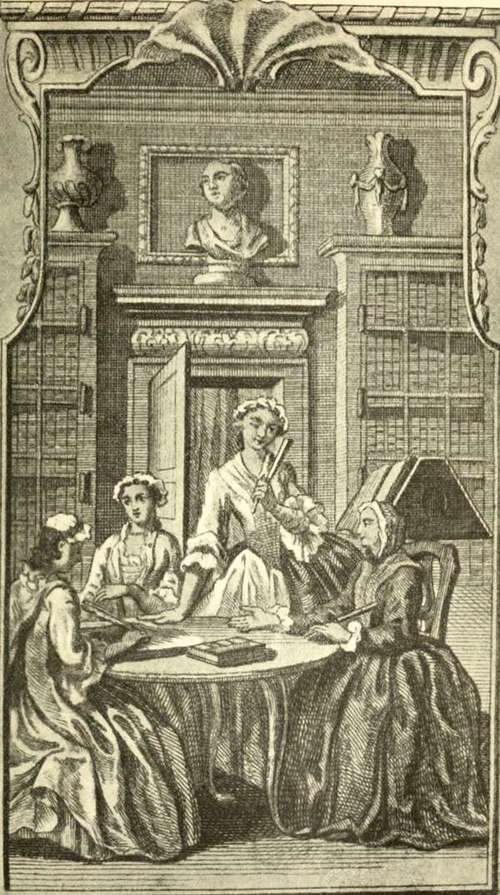
THE SUPPOSED EDITORS OF THE FEMALE SPECTATOR BY MRS. ELIZA HAYWOOD From Vol. I of the seventh edition, 1771 Mrs. Haywood is the scribe; the lady in black is the vivacious widow of quality; the lady standing is "Euphrosine"; the other lady is "Mira"
But now and then the editors or some contributor break out of the charmed circle, and we get a glimpse of women who, along with their overworked hearts, have at least rudimentary minds. A certain "Cleora" urges that women's best qualities are often stifled by a wrong education, and that "the world would infallibly be happier than it is if women were more knowing than they generally are." The studies suggested are history, geography, some of the more agreeable parts of mathematics, and "Enchanting Philosophy, its path strewd with Roses." Music, poetry, dancing, and novels are suggested by way of relaxation. For solid reading the recommendation includes translations of Latin historians and French books of travel, and closes with Bailey's Dictionary, "a library of itself since there was never person, place or action of any note, from the creation down to the time of its being published, but what it gives a general account of." In another essay "Philo-Naturæ" spends impassioned pages urging ladies to study natural history, but nullifies her eloquence by the narrow limit she assigns to their work. "It is easy to see, that it is not my ambition to render my sex what is called deeply-learned." Women need only "a kind of general understanding" of science, such as will enable them to take an agreeable part in conversation. They are not called to abstruse and difficult researches, but merely to those light and charming observations that catch the watchful eye on little excursions such as ladies make in fields, meadows, and gardens.
In The Wife (1755) Mrs. Haywood is less liberal than in The Spectator. The married lady is particularly warned against the dangers of an active mind or speculative disposition. She may be so misguided as to "attempt to investigate those things that Heaven has hidden from human understanding," in which case her brain will be distracted by books of controversy. Or she may strangely busy her mind about the planets, wondering whether those vast and luminous orbs are habitable, and if so, whether possessed by men or angels or the ghosts of the departed. A lady so fantastically engaged is likely to waste her time over such books as Fontanelle's Plurality of Worlds.
A woman who once gets either of these fancies into her head, is lost to everything besides; her husband, children, family, friends, acquaintances, with all the necessary avocations and duties of her station, seem altogether unworthy her regard; she lives in the clouds, and it is with difficulty she is dragg'd down to the performance of anything requir'd of her below.
Methinks it is down-right madness to waste any part of time in seeking after things impossible to be attain'd; or if attain'd could be of no real service:—a married woman, above all others, should avoid this error:—it best becomes her to center her whole studies within the compass of her own walls,—to enquire no farther than into the humours and inclinations of her husband and children, to the end she may know how to oblige those she finds in him, and rectify whatever is amiss in them, and not attempt to extend her speculations beyond her family, and those things which are entrusted to her management.
Mrs. Haywood's programme reads like a combination from Molière's Chrysal and Mrs. Barbauld.
In 1729 Swift wrote from Dublin to Pope:
Mrs. Mary Barber (1690?-1757)
There are three citizens' wives in this town; one of them whose name is Grierson, a Scotch book-seller's wife. She is a very good Latin and Greek scholar, and has lately published a fine edition of Tacitus, with a Latin dedication to the Lord Lieutenant; and she writes Carmina Anglicana non Contemnenda. The second is one Mrs. Barber, wife to a woolen draper, who is our chief poetess, and, upon the whole, has no ill genius. I fancy I have mentioned her to you formerly. The last is the bearer hereof, and the wife of a surly rich husband, who checks her vein; whereas Mrs. Grierson is only well to pass, and Mrs. Barber, as it becomes the chief poetess, is but poor. The bearer's name is Sykins. She has a very good taste of poetry, has read much, and, as I hear, has writ one or two things with applause, which I never saw, except about six lines she sent me unknown, with a piece of sturgeon, some years ago, on my birthday. Can you show such a triumfeminate in London?[316]
Soon after Swift added Mrs. Pilkington to his list of Dublin writers, but it still remains a triumfeminate, because we hear no more of Mrs. Sykins, the surly rich husband having apparently been successful in checking her vein. Her proposed visit to Pope was also a failure. She went to Twickenham and delivered Swift's letter, but, for some unknown reason, returned to London two hours before the time Pope had appointed to receive her. His irritation found expression in the reference to "an Irish poetess" as among his troublesome visitors in one version of The Epistle to Dr. Arbuthnot.[317]
Mrs. Mary Barber would hardly be so much as a name to-day were it not for Swift. He first met her in about the year 1729, and from that time to 1736 letters to and from him have much to say concerning her career. She was then nearly forty, most of her poems existed in manuscript, she was already something of a celebrity in Dublin, and her one desire was a subscription publication of her work. In pursuance of this wish she went to London late in 1730 and Swift sent kindly letters in her behalf to several of his London friends. In the summer of 1731 a mysterious letter to the Queen, purporting to be from Swift, contained this passage: "Mrs. Barber, the best female poet of this or perhaps any age, is now in your majesty's capital; known to Lady Hertford, Lady Torrington, Lady Walpole, etc.; a woman whose genius is honoured by every man of genius in this kingdom, and either honoured or envied by every man of genius in England."[318] Pope sent a copy of this letter to Swift, who immediately and indignantly, in letters to Pope and the Countess of Suffolk, disavowed it. Such a letter, he said, would be "a folly so transcendent, that no man could be guilty of, who was not fit for Bedlam." In his letter to Pope Swift said of Mrs. Barber:
Dr. Delany has been long her protector; and he, being many years my acquaintance, desired my good office for her, and brought her several times to the deanery. I knew she was poetically given, and, for a woman, had a sort of genius that way. She appeared very modest and pious, and I believe was sincere; and wholy turned to poetry. I did conceive her journey to England was on the score of her trade, being a woollen-draper, until Dr. Delany said, she had a design of printing her poems by subscription, and desired I would befriend her: which I did, chiefly by your means, the doctor still urging me on: upon whose request I writ to her two or three times, because she thought my countenancing her might be of use. Lord Carteret very much befriended her, and she seems to have made her way not ill.[319]
The perpetrator of the forged letter and the purpose in sending it to the Queen have never been discovered, but the irritation arising from it might well have destroyed Swift's interest in Mrs. Barber's subscription list. He apparently recognized, however, that she was innocent of offense and continued his efforts in her behalf. Dr. Arbuthnot writes that he has shown "as much civility as he could" to Mrs. Barber.[320] Gay has "made a visit to Mrs. Barber."[321] Lady Betty Germain says Mrs. Barber "goes on in her subscription very well."[322] But the list was incomplete by the summer of 1732 and dragged slowly on till 1734 in spite of the aid of Mr. Barber, Lord Mayor of London, Mrs. Worsley, Mrs. Cæsar, Mrs. Conduitt, Miss Kelly, Lord Carteret, Lord Orrery, and the Duchess of Queensberry, all of whom in response to applications from Swift wrote to him concerning the progress of Mrs. Barber's affairs. In 1733 Mrs. Conduitt wrote that "the town had already been so long invited into the subscription that most people had already refused or accepted."[323] It was not till 1734 that the list was considered long enough to make publication safe.
Swift crowned his service by writing a dedicatory letter to Lord Orrery. In this letter he spoke of Mrs. Barber as follows:
She desireth your protection on account of her wit and good sense, as well as of her humility, her gratitude, and many other virtues. I have read most of her poems; and believe your Lordship will observe, that they generally contain something new and useful, tending to the reproof of some vice or folly, or recommending some virtue. She never writes on a subject with general unconnected topics, but always with a scheme and method driving to some particular end: wherein many writers in verse, and of some distinction, are so often known to fail. In short, she seemeth to have a true poetical genius, better cultivated than could be expected, either from her sex, or the scene she hath acted in, as the wife of a citizen. Yet I am assured, that no woman was ever more useful to her husband in the way of his business. Poetry hath only been her favorite amusement; for which she hath one qualification that I wish all good poets possess'd a share of; I mean, that she is ready to take advice, and submit to have her verse corrected, by those who are generally allow'd to be the best judges.[324]
But for the persistent efforts of Swift the subscription would never have been completed. Yet Mrs. Barber had gained incidentally such a retinue of supporting friends that her poems were republished in 1735 and 1736. There was apparently a touch of personal venom in the passage where Mrs. Pilkington chronicles the generous aid given Mrs. Barber and emphasizes the final small success of the poems:
Mrs. Barber ... was at this time writing a volume of Poems, some of which I fancy might, at this Day, be seen in the Cheesemungers, Chandlers, Pastry-cooks, and Second-hand Book-sellers' Shops: However, dull as they were, they certainly would have been much worse, but that Dr. Delany frequently held what he called a Senatus Consultum, to correct these undigested materials; at which were present sometimes the Dean, (in the Chair) but always Mrs. Grierson, Mr. Pilkington, the Doctor, and myself.[325]
A poem in which they were summoned to one of these meetings began:
Mighty Thomas a solemn Senatus I call, To consult for Saphira, so come one and all.
In 1736 Mrs. Barber was again in financial straits. A scheme for letting lodgings, and another scheme for selling Irish linens at Bath having proved impracticable, she made a final appeal to Swift. Dr. King of Oxford and Mrs. Cleland had spoken so warmly of Swift's Treatise on Polite Conversation that many people wished to see it, and Lady Worsley with many other of Mrs. Barber's patronesses urged her to ask Swift to let her publish it for her own benefit. After apologies for asking such a favor she says:
I humbly beseech you, sir, if you do not think it proper not to be offended with me for asking it; for it was others, that out of kindness to me, put me upon it. They said you made no advantage for yourself, by your writings; and that, since you honoured me with your protection, I had all the reason in the world to think it would be a pleasure to you, to see me in easy circumstances; that everybody would gladly subscribe for anything Dr. Swift wrote; and indeed, I believe in my conscience, it would be the making of me.[326]
Dean Swift presented her with the copy and the sale proved advantageous.
The career of a mediocre writer like Mrs. Barber would hardly justify chronicling were it not for the interesting exemplification it offers of the system of patronage. Swift and his influential friends manifest no particular interest in Mrs. Barber's "moral and not inelegant verse," but responsibility for her welfare seems to have been accepted by them without demur, nor does she seem to have felt any hesitancy about accepting any aid that might be forthcoming.
The most vivid introduction to Mrs. Grierson comes from the pen of her early friend Mrs. Pilkington:
Mrs. Constantia Grierson (1706?-33)
About two years before this a young Woman of about eighteen years of age, was brought to my Father, by a Stationer to be by him instructed in Midwifery.[327] She was Mistress of Hebrew, Greek, Latin, and French, understood the mathematicks, as well as most men. And what made these extraordinary Talents yet more surprizing was, that her Parents were poor illiterate Country People; so that her learning appeared like the Gift poured out on the Apostles, of speaking all languages, without the Pains of Study; or, like the intuitive Knowledge of Angels: Yet in as much as the Power of Miracles is ceased; we must allow she used human Means for such great and excellent Acquirements: And yet in a long Friendship and Familiarity with her, I could never obtain a satisfactory Account from her on this Head; only she said, "she had received some little Instruction from the Minister of the Parish, when she could spare time from her Needlework, to which she was closely kept by her Mother." She wrote elegantly both in Verse and Prose; and some of the most delightful Hours I ever past, were in the Conversation of this female Philosopher.
My Father readily consented to accept her as a Pupil; and gave her a general Invitation to his Table, so that she and I were seldom asunder. My Parents were well pleased with our Intimacy, as her Piety was not inferior to her Learning. Whether it was owing to her own Desire, or the Envy of those who survived her, I know not; but of her various and beautiful Writings except one Poem of her's in Mrs. Barber's Works, I have never seen any published; 't is true, as her turn was chiefly to philosophical or divine Subjects, they might not be agreeable to the present Taste.[328]
A eulogy of Mrs. Grierson was written by Henry Brooke (1703?-1783) the author of a tragedy, Gustavus Vasa, and various popular novels, in a poem on "The Art of Printing," and an account of her, derived from his notes, was published in Brookiana in 1804.
Mr. Brooke has celebrated the learning, piety, and virtue, of Mrs. Grierson, in a poem which he wrote on the Art of Printing. This lady was born in the city of Kilkenny. Such is the vanity of man, that he thinks he pays a sufficient compliment to woman, when he says, she has a masculine mind, when, in truth, it is known that there are many females on record, who have rivalled the lords of the creation in every branch of science, and department of learning. In this constellation the name of Mrs. Grierson will shine with increasing luster. Her father observed, that his daughter, while yet a child, was very fond of books, and not-withstanding his circumstances were narrow, he was determined to furnish her with all those that he thought were suited to her years; but he soon found, to his great joy, that her capacity was not to be measured by her years, it flew before them; and that her genius and inclination would triumph over every difficulty, even without the aid of a master. In a time that is almost too short to be mentioned, she was allowed by competent judges, to be a perfect mistress of the Greek and Roman tongues; and whilst other young women were proud of carrying the keys of closets, etc., she carried the keys of science, which she unlocked and surveyed, not with a transient eye, but with the warmth and constancy of one that fell in love with their beauties, and could duly appreciate their charms, so that all her attainments may be said to have been dictated by nature, aided by laudable curiosity and industry. She was early married to George Grierson, Esq., the king's printer. As he had a good library, she had an opportunity of indulging her literary pursuits.[329]
After her marriage Mrs. Grierson carried on her studies with such ardor that at twenty-one she brought out an edition of Terence and at twenty-three an edition of Tacitus. When she died at twenty-seven, she left a partially completed edition of Sallust. Mrs. Barber says that she also wrote an unpublished Abridgment of the History of England. Her Tacitus has received high praise. Dr. Harwood, a learned bibliographer, commented on it in the following terms:
This is one of the best edited books ever delivered to the world. Mrs. Grierson was a lady possessed of singular erudition, and had an elegance of taste and solidity of judgment, which justly rendered her one of the most wonderful as well as amiable of her sex. Prefixed to this edition of Tacitus, is a dedication to Lord Carteret, in most elegant Latinity.[330]
Mrs. Grierson also wrote occasional verse a few specimens of which appear in Mrs. Pilkington's Memoirs, in Poems by Eminent Ladies, and in Mrs. Barber's edition of her own poems. Mrs. Barber in her Preface praised Mrs. Grierson and gave many of the facts used by later writers. Mr. Ballard was anxious to give a full account of Mrs. Grierson, and he wrote in 1747 to Mrs. Barber for further information. "I likewise," says Mr. Ballard, "got the same friend to apply to a learned and eminent dignitary in the church in Ireland; one who is thoroughly acquainted with all the various circumstances of her life and is every way qualified for the performance." The eminent churchman promised an account of her life, but it never came to hand, so Mr. Ballard was obliged to content himself with a general eulogy. He says, "If Heaven had spared her life, and blessed her with health, which she wanted for some years before her death, there is good reason to think she would have made as great a figure in the learned world, as any of her sex are recorded to have done." Mrs. Grierson, "the learned Nymph Whom Curiosity engaged every Person to see,"[331] was on intimate terms with Swift, Thomas Sheridan, and Dr. Delany, and it is singular that a more exact account of her life should not have been preserved.
Lætitia van Lewen Pilkington (1712-50)
Lætitia Pilkington, the daughter of Dr. Van Lewen, a physician of Dublin, was about twenty-two years younger than Mrs. Barber, but Mrs. Barber's work came so late in her life and Mrs. Pilkington was so precocious that they were in effect poetical contemporaries. Lætitia's love for literature and her lively mind were in evidence before she was five. She thus describes the beginning of her education:
My mother strictly followed Solomon's Advice, in never sparing the Rod; insomuch that I have frequently been whipt for looking blue of a frosty Morning; and whether I deserved it or not, I was sure of Correction every Day of my life.
From my earliest Infancy I had a Disposition to Letters; but my Eyes being weak after the Small-pox, I was not permitted to look at a Book; my Mother regarding more the Beauty of my Face, than the Improvement of my Mind; neither was I allowed to learn to read: This Restraint, as it generally happens, made me but more earnest in the Pursuit of what I imagined must be so delightful. Twenty times a Day have I been corrected, for asking what such and such Letters spelt; my Mother used to tell me the Word, accompanying it with a good Box on the Ear, which, I suppose, imprinted it on my Mind.... I do assure you, it had this Effect on me, that I never forgot what was once told me; and quickly arrived at my desired Happiness, being able to read before she thought I knew all my Letters; but this Pleasure I was obliged to enjoy by Stealth with Fear and Trembling.
I was at this Time about five Years of Age; and my Mother being one Day abroad, I had happily laid hold on Alexander's Feast and found something in it so charming, that I read it aloud; but how like a condemned Criminal did I look, when my Father, softly opening his Study-door, took me in the very Fact; I dropt my Book and burst into Tears, begging Pardon and promising never to do so again: But my Sorrow was soon dispelled, when he bade me not to be frightened, but read to him, which to his great Surprize, I did very distinctly, and without hurting the Beauty of the Numbers. Instead of the whipping, of which I stood in dread, he took me up in his Arms, and kissed me, giving me a whole Shilling, as a Reward, and told me, "He would give me another as soon as I got a Poem by Heart," which he put into my Hand, and proved to be Mr. Pope's sacred Eclogue; which Task I performed before my Mother returned Home. They were both astonished at my Memory, and from that Day forward, I was permitted to read as much as I pleased; only my Father took care to furnish me with the best, and politest Authors; and took Delight in explaining to me, whatever, by Reason of my tender Years, was above my Capacity of Understanding.
But chiefly was I charmed and ravished with the Sweets of Poetry; all my Hours were dedicated to the Muses; and, from a Reader, I quickly became a Writer; I may truly say with Mr. Pope,
I lisp'd in Numbers, for the Numbers came.
My Performances had the good Fortune to be looked on as extraordinary for my Years; and the greatest and wisest Men in the Kingdom did not disdain to hear the Prattle of the little Muse, as they called me, even in my Childish Days. But as I approached towards Womanhood a new Scene opened to me; and by the Time I had looked on thirteen Years, I had almost as many Lovers.
At seventeen Lætitia married a penniless Irish parson, Mr. Matthew Pilkington. Soon after their marriage they became well known in the Dublin literary set. Constantia Grierson who was the first to congratulate Lætitia on her marriage, and who witnessed the cruel treatment the couple received from Mrs. Van Lewen, introduced them to Dr. Delany who befriended them. Through Dr. Delany they met Swift, who was much taken by the "little poetical parson and his littler poetical wife." He called them "The Mighty Thomas Thumb and her Serene Highness of Lilliput,"[332] and for a short time they were evidently much at the deanery. The most famous portions of her Memoirs have to do with Swift. His early biographers were apparently unwilling to own how much of their vivid, picturesque material came from a source so little esteemed, but Mr. Craik credits Mrs. Pilkington with "a picture of the Dean which is probably more true to the life than many that are more pretentious."[333] The young lady's wit, vivacity, courage, and independent mind brought a new and piquant element into Swift's life. He scolded her till she fled in tears, but at his imperious summons she always came back in new, adoring subjection. On one occasion, after an exceptionally severe castigation, he wrote sharply but with an underlying compliment: "You must shake off the Leavings of your Sex. If you cannot keep a Secret, and take a Chiding, you will quickly be out of my Sphere. Corrigible People are to be chid; those who are otherwise, may be very safe from any Lectures of mine: I should rather choose to indulge them in their Follies, than attempt to set them right."[334] Usually her wit could turn an impending quarrel into some sort of gay banter. On one occasion Swift began to reprimand her for having copied out one of his manuscript poems. But she interrupted, saying she did not copy it, but knew it by heart from one reading. Whereupon there ensued a memory contest. The test given her was from Shakespeare, all of whose works she said she could repeat. "The Line he first gave me, he had purposely picked out for its Singular Oddness: But [sic] rancours in the Vessel of my Peace. Macbeth. I readily went on with the whole Speech, and did so several times, that he tried me with the different Plays. The Dean then took down Hudibras, and ordered me to examine him in it, as he had done me in Shakespeare; and, to my great surprize, I found he remembered every Line from Beginning to End of it."[335]
When Swift first saw little Mrs. Pilkington as a bride he exclaimed, "What, this poor little Child married! God help her, she is early in Trouble."[336] The words were prophetic, for the troubles began very soon. They were engendered by literary jealousy, for Mr. Pilkington was a poet on his own account. Compliments to the wife became as wormwood to the husband, especially when such compliments were accompanied by frank depreciation of his own talents. Swift once put a question to Mrs. Pilkington and received her answer. Mr. Pilkington then entered the room and was asked the same question and gave an unsatisfactory answer. "P-x on you for a Dunce," said the Dean. "Were your Wife and you to sit for a Fellowship, I would give her one, sooner than admit you a Sizar." From that time on Mr. Pilkington viewed his wife "with scornful yet with jealous eyes."[337]
On another occasion the two wrote odes in imitation of Horace. Angered at her success Mr. Pilkington told her that a Needle was more becoming to a Woman's Hand than a Pen, and was placated only when the lady consigned her own ode to the flames and highly praised his. Her comment is: "And here let me seriously advise every Lady, who has the Misfortune to be poetically turned, never to marry a Poet.... If a Man cannot bear his Friend should write, much less can he endure it in his Wife; it seems to set them too much on a Level with their Lords and Masters; and this I take to be the true Reason why even Men of Sense discountenance Learning in Women, and commonly choose for Mates the most illiterate and stupid of the Sex; and bless their Stars their Wife is not a Wit."[338] Jealousy was, however, the least of Mr. Pilkington's faults. He soon proved himself "the arrantest rogue in England." The action he brought against his wife for divorce was not sustained by the courts, but the outcome of it was that he abandoned her and her two children, and she was left penniless. She went to London where she lived a life compounded of misfortunes and misdemeanors.
In the Memoirs she gives in extenso the various expedients whereby she tried to get a living. One of the most successful was as a public letter-writer for which she issued the following card:
Letters written here on any Subject, except on the Law, Price Twelvepence; Petitions also Drawn at the same Rate. Mem. Ready Money, no Trust.[339]
Under cover of getting subscriptions for the Memoirs, she really lived on the charities of the charitable and what she euphemistically termed "contributions from the great." Colley Cibber[340] especially befriended her and urged her to push forward the Memoirs. But spite of all aid her course was downward. At one time she was even imprisoned for debt.[341] On her release she tried to keep a print and pamphlet shop,[342] but failed. And finally she wandered back to Dublin where she died at thirty-eight.
The one book by which Mrs. Pilkington is known is her Memoirs, the three volumes of which appeared in 1748. In 1754 a third edition appeared with an additional volume by her son. Shortly after her death there appeared a compilation entitled The Celebrated Mrs. Pilkington's Jests; or, The Cabinet of Wit and Humour. In the Memoirs the early happy life in Dublin and the later tricks and shifts and intrigues of the London life are described with equal frankness. The result was a tarnished fame as a woman, but an undisputed reputation as a clever writer. When the Earl of Chesterfield wondered that she could write English so well, she sent word to his lordship that Dr. Swift had been her tutor.
As a literary critic Mrs. Pilkington is especially severe on the immorality of some contemporary women writers. Speaking of a lady who had refused to subscribe to her book she said:
She would have purchased my Book sooner than the Bible, to indulge her private Meditations, Especially if I had the wicked Art of painting up Vice in attractive Colours, as too many of our Female Writers have done, to the Destruction of Thousands, amongst whom Mrs. Manly and Mrs. Haywood deserve the foremost Rank.
But what extraordinary Passions these Ladies may have experienced, I know not; far be such Knowledge from a Modest Woman: Indeed Mrs. Haywood seems to have dropped her former luscious Stile, and, for Variety presents us with the insipid: Her Female Spectators are a Collection of trite Stories, delivered to us in stale and worn-out Phrases: Bless'd Revolution!
Yet of the two, less dang'rous is th' Offence To tire the Patience, than mislead the Sense.
And here give me leave to observe, that amongst the Ladies that have taken up the Pen, I never met with but two who deserved the Name of a Writer; the first is Madam Dacier, whose Learning Mr. Pope, while he is indebted to her for all the notes on Homer, endeavoured to depreciate; the second is Mrs. Catherine Philips, the matchless Orinda, celebrated by Mr. Cowley, Lord Orrery, and all the Men of Genius who lived in her Time.
I think this incomparable Lady was one of the first Refiners of the English Numbers. I cannot, except my own Country-woman Mrs. Grierson, find out another female Writer, whose Works are worth reading; she indeed had a happy and well-improved Genius!
The last glimpse we have of Mrs. Pilkington is most effective in the dramatic contrast it presents. On Thursday, April 12, 1750, John Wesley wrote in his Dublin Diary: "I breakfasted with one of the Society, and found she had a lodger I little thought of. It was the famous Mrs. Pilkington, who soon made an excuse for following me up stairs. I talked with her seriously about an hour: we then sung, 'Happy Magdalene.' She appeared to be exceedingly struck: how long the impression may last, God knows."[343]
Mrs. Mary Davys (fl. 1725)
Mrs. Mary Davys wrote a comedy produced at Lincoln's Inn Fields in 1716, and a didactic novel, The Reform'd Coquet, which appeared in 1724. Her Works, in two volumes, appeared in 1725. Miss Morgan says that the young lord who is the hero of The Reform'd Coquet, is one of the earliest examples in fiction of "the perfect prig of which Sir Charles Grandison is the consummate example."[344] She was the wife of the Reverend Peter Davys, master of the free school of St. Patrick's, Dublin, so she came into the circle of Swift. Dr. Ewen of Cambridge formerly had thirty-six letters from Swift to Mr. and Mrs. Davys. Mr. Davys died in 1698 and Mrs. Davys was "left to her own endeavours." In 1713 she wrote to Swift complaining that he had not written to her for four years. "I have honestly told her," he said, "it was my way never to write to those whom I am never likely to see, unless I can serve them, which I cannot her, etc. Davis the schoolmaster's widow."[345] She was not so fortunate as Mrs. Grierson and Mrs. Pilkington.
Mrs. Mary Mitchell Collyer (1716?-1762?)
Mrs. Collyer's publications were anonymous and she has been hardly more than a name in literary history. Recent investigations have, however, shown her to be of genuine importance, not merely as a writer of considerable ability, but especially as an author in whom romantic tendencies found early and well-defined statement.[346] Mrs. Collyer was the wife of Joseph Collyer, a compiler, translator, and publisher to whom her books have sometimes been attributed. Her son was Joseph Collyer, an engraver of merit. Mr. Collyer's income was apparently small, for Mrs. Collyer wrote for the support of her family. In the Dedication to her Death of Abel she said: "Placed by the hand of Providence at an humble distance from the Great, my cares and pleasures are concentrated within the narrow limits of my little family, and it is in order to contribute to the support and education of my children, I have taken up my pen."
The seven works attributed to Mrs. Collyer fall between 1743 and 1763. It is unnecessary to consider these works here in detail except so far as may serve to indicate their historical significance. For this purpose we may take up first the last of her books, the translations from the German, for it is on these that her modicum of fame has rested. When Mrs. Collyer translated Gesner's Der Tod Abels in 1761 and began Klopstock's Messiah the year after, she was a pioneer in a new kind of learning. The professed linguists seldom included German in their list, and German literature was practically unknown.[347] Mr. Haney, in his study of "German Literature in England before 1790," gives William Taylor of Norwich as "the first literary critic to attempt a systematic introduction of German literature into England," and Mr. Taylor's period of literary activity did not begin until 1790. Of the sporadic translations before that period, aside from scientific and theological works and a few hymns, Mr. Haney cites but two anterior to Mrs. Collyer's Death of Abel. There were few more popular works in the eighteenth century than this translation. There were eighteen editions in twenty-one years, and many later editions. It satisfied alike the pious reader and the lover of fiction. The Quarterly Review for 1814[348] says: "No book of foreign growth has ever become so popular in England as the Death of Abel. Those publishers whose market lies among that portion of the people who are below what is called the public, but form a far more numerous class, include it regularly among their 'sacred classics': it has been repeatedly printed at country presses with worn types and on coarse paper; and it is found at country fairs, and in the little shops of remote towns almost as certainly as the Pilgrim's Progress and Robinson Crusoe." Miss Hughes quotes numerous other testimonies to the same effect.
This remarkable popularity was due, of course, to the original author rather than to the translator. Mrs. Collyer's version received high contemporary praise, but according to modern ideas it would be counted loose and inaccurate. Miss Reed characterizes the style as unnatural and affected, and she thinks that while the translation made Gesner widely known, it in reality injured his fame. But the excellence of the work, or its defects, are not so significant in a study of Mrs. Collyer as are the facts that she was sufficiently well trained in German to give even a fairly adequate version, and that she should be the first to present a German poet of the new school to an English public.
Mrs. Collyer died before completing her translation of Klopstock and her husband carried it to a conclusion. He said in his Preface that his wife's fatal illness was brought on by her agitation of mind in connection with her work on the Death of Abel.
Mrs. Collyer's Christmas Box is another instance of pioneer work. Its full descriptive title is A Christmas Box, Consisting of Moral Stories, adapted to the Capacities of Little Children and calculated to give them early impressions of Piety and Virtue. Two volumes. Adorned with cuts. The Christmas Box and Miss Fielding's Little Female Academy appeared in 1749, five years after Newbery's first child's book, The Little Pretty Pocket Book, of 1744. In 1745 he brought out three volumes of The Circles of the Sciences, and in 1751-52 The Lilliputian Magazine. Thus a new class of literature was definitely started, with Mrs. Collyer and Miss Fielding as important contributors to the spread of the idea at its inception.[349]
Two of Mrs. Collyer's novels are translations from the French, and are of slight importance in comparison with her one original novel the full title of which is Felicia to Charlotte: Being Letters from a Young Lady in the Country, to her Friend in Town. Containing A Series of the most interesting Events, interspersed with Moral Reflections; chiefly tending to prove that the Seeds of Virtue are implanted in the Mind of Every Reasonable Being. Volume one appeared in 1744 and a second volume in 1749. Miss Hughes in her analysis of this novel[350] points out various elements that forecast ideas not dominant till some decades later. It was a novel of purpose, written for ethical and religious ends, and as such antedates John Buncle by twelve years. It is also a novel of feeling. Its hero, Lucius, must wait for Sterne before he can find his true kin. The courtship of Lucius is punctuated with sighs and tears, with the overwrought emotions of a sensitive heart. Steele's Conscious Lovers offers an early sentimental parallel, but the type was not fully developed till in the seventies. The first volume ends with the marriage of Felicia and Lucius. In the second volume the happy pair, now quite sane and sensible, are able to discuss with fluency and precision their ideas on the nurture and education of children. This volume was thus a pedagogic romance of the sort that became popular after Rousseau.
The most interesting of all the new ideas brought forward by Felicia and Lucius is their love of nature and of country life. They choose the country as a place of residence and justify their choice on rational grounds. And Mrs. Collyer has a surprising fullness and ardor of description, and a sincere joy in nature not equaled in fiction before John Buncle (1756-66), and she is a decade earlier.[351] It was only in poetry or in philosophical theory that Mrs. Collyer could have found sources for her literary use of nature. Spenser, Milton, and Thomson were well known to her and they doubtless influenced her.
Connected with this love of nature are Mrs. Collyer's ideas on gardening. When she and Lucius bought their estate it was in the formal style, but they at once changed it to make it appear as much like nature as possible. In this Mrs. Collyer was not entirely original, for the Spectator and the Guardian, Pope, Switzer, and Batty Langley had decried the stiff regularity of the formal garden, and Kent's great gardens came between 1730 and 1748. But Mrs. Collyer promptly took up the new ideas and she ranks among their early defenders.
Mrs. Collyer is very interesting because she showed herself in these various ways so sensitive to new ideas. She seemed to know what was in the air even before it had had any but the most casual expression. She sat down very modestly and with much trepidation to write anonymous translations and novels for the support of her family, but she was, quite unconsciously it may be, treading the path of the pioneer.
Sarah Fielding (1710-1768)
Sarah Fielding's first and most important novel, The Adventures of David Simple in search of a Faithful Friend (1744), received extraordinary commendation from the two contemporary authors whose judgments might be counted authoritative, Henry Fielding and Samuel Richardson. Fielding's satiric picture of Mrs. Western in Tom Jones is more than offset by his utterances in connection with his sister Sarah's books. When David Simple appeared, Joseph Andrews had been two years before the public, and it was natural that her popular little book should be attributed to Fielding. But when the second edition came out (also 1744) he took occasion to disavow his supposed authorship, and likewise to commend the book.
A third, and indeed the strongest, reason which hath drawn me into print, is to do justice to the real and sole author of this little book; who, notwithstanding the many excellent observations dispersed through it, and the deep knowledge of human nature it discovers, is a young woman; one so nearly and dearly allied to me, in the highest friendship as well as relation, that if she had wanted any assistance of mine I would have been as ready to have given it to her as I would have been just to my word in owning it; but, in reality, two or three hints which arose on the reading it, and some little direction as to the conduct of the second volume, much the greater part of which I never saw till in print, were all the aid she received from me. Indeed, I believe there are few books in the world so absolutely the author's own as this....