III MONUMENTS OF THE HITTITES
Reading edition
Preliminary: Chronology—Classification—Disposition
With this outline of the chief historical phases of Asia Minor before us, we pass from the remains of mediæval and classical antiquity to a consideration of those more ancient monuments which bear witness to Hittite handiwork. Notwithstanding the progress of historical research, these remain the surest basis for the study of our subject, giving us an insight into the Hittite civilisation, which is rendered more valuable and more intelligible by the light thrown upon Hittite chronology by recent excavation. Their nature and intrinsic details are material evidence of Hittite arts, which, in the lack of internal literary documents, no other sources can satisfactorily supply; while their disposition defines for us the Hittite lands in a manner more reliable and more substantial than theories based on vague and difficult references in oriental history. A reasonable consideration of the environment of these monuments, also, may help us to appreciate something of that which is most difficult to realise but all-important, namely the circumstances of the life of those whose hands produced them.[126]
PLATE XXX
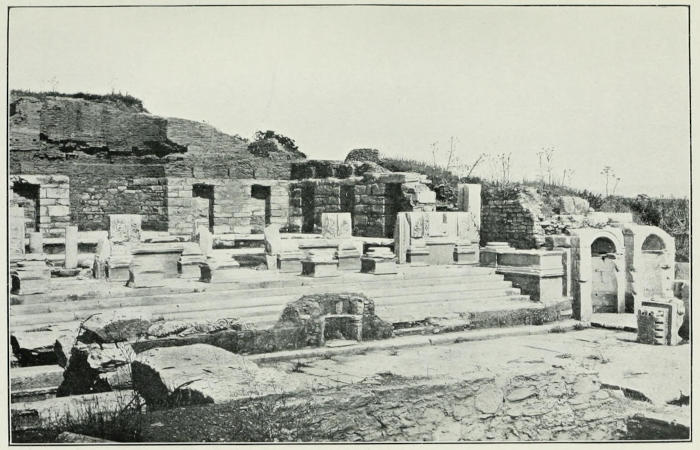
EPHESUS: REMAINS OF THE ‘LIBRARY OF CELSUS,’ RECENTLY UNCOVERED (See p. 71.)
Obedient to a now accepted principle of psychology, we follow in the development of our inquiry the sequence of evidences by which this subject has been established during the past generation. Postponing for the present any detailed account of the walled towns and groups of sculptures which have been the scene of recent investigation, we shall consider firstly those monuments which are found isolated and scattered throughout the regions indicated in the opening chapter. If, in so doing, we can yet be guided by the light of modern discoveries, we may hope to avoid some of the difficulties which beset the path of these pioneers whose work introduced to us this new material. Our method of study, like theirs, must be comparative; but we shall be content to confine ourselves almost entirely to the monuments identified as Hittite by the presence of the peculiar hieroglyphic signs or inscriptions carved upon them. It was indeed upon this line of evidence that Professor A. H. Sayce was enabled, thirty years ago, to establish the relationship of the unexplained inscriptions of Hamath with the sculptures of Kara-Bel in the far west of Asia Minor, and thence to make his brilliant inference of a forgotten empire.[127]
We use the test of Hittite hieroglyphs, not only because it has become in this way fundamental to our subject, but because it is no longer open to doubt whether these peculiar signs are of Hittite origin or not. Formerly there may have been room for reasonable criticism so long as this conclusion was based only on the fact that these symbols were found chiefly on unexplained monuments from Hamath and neighbouring places in Northern Syria associated in history with the Hittites. But now the increasing accumulation of this kind of circumstantial evidence has been crowned by the discovery that the chief site of such monuments in Asia Minor, namely Boghaz-Keui, was for two centuries the capital of the Hittites, whose name (Hatti) appears freely on the literary documents that have been unearthed[128] there in recent excavations. Being secured then against fundamental error, a comparison of the Hittite monuments identified on this basis readily reveals peculiarities of art which may be regarded as typical, so that we might reasonably include in our category other monuments of like kind which lack only the ultimate criterion which we have set before us. We do not wish, however, nor do we need, in the scope of this volume, to press the argument by analogy, being warned against the pitfalls of such a method by several general considerations, and especially by the noticeable survival of Hittite influence in the local sculptures, like those of Phrygia[129] and western Lycaonia.[130]
Though we continue to employ the old materials, however, we see them now in a clearer light. Just as the time has passed by when the word ‘Hittite’ must be written in inverted commas, or qualified with the adjective ‘so-called,’ so now we are not content any longer to regard the older monuments of the interior together in general as pre-Hellenic, much less pre-historic, without distinction as to period or locality. The references to the Hittites in Babylonian, Egyptian, and Assyrian history alone, it is true, would not be sufficient to establish an historical basis for this phase of our inquiry, though giving us a range of dates that covers broadly the whole of the second millennium down to the eighth century B.C.,[131] but these allusions are now supplemented, and in great measure made intelligible, by the evidence of the Hittite archives recently discovered at Boghaz-Keui, which establish chronological relationships of the thirteenth and fourteenth centuries B.C.,[132] together with a series of contemporary Hittite works. This date now becomes the basis for all inquiry, bringing into line several points previously problematical and much disputed, just as the intrinsic evidence of these archives throws a new flood of light over the disposition and constitution of the Hittites at the very period when they figure most prominently in the pages of Egyptian history.
PLATE XXXI
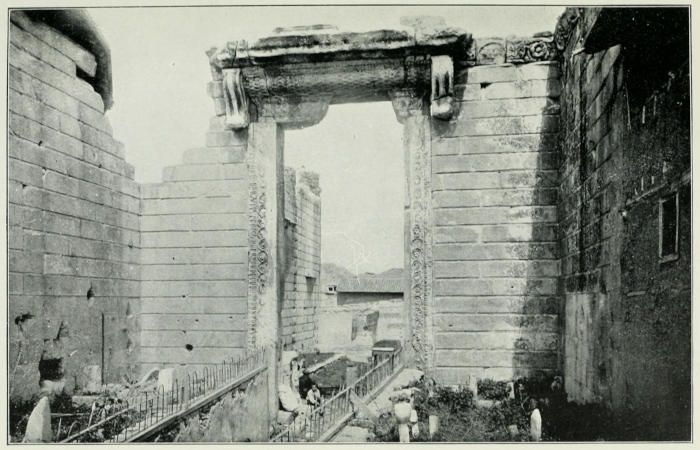
ANGORA: REMAINS OF THE TEMPLE OF ROME AND AUGUSTUS
Other researches have contributed towards broadening this basis of investigation. At Sakje-Geuzi recent excavations[133] have established the fact previously in doubt, that the settlements of Hittite peoples had begun there at any rate many centuries, possibly several thousand years, previous to the age marked by the oncoming and ultimately overwhelming tide of Assyrian influence early in the first millennium B.C. The relation of the later phase of local arts to Assyrian chronology is given by the results of excavations made on the great mound at Sinjerli, distant about a day’s journey in the same valley towards the south.[134] Here certain palace buildings and sculptures, some of which betray Assyrian feeling, may be dated, by help of inscribed monuments that were unearthed, to the eighth century B.C., when this principality became tributary to Tiglath Pileser III. The reign of Esarhaddon, the conqueror of Egypt, brought even this nominal independence to an end about 680 B.C.
PLATE XXXII
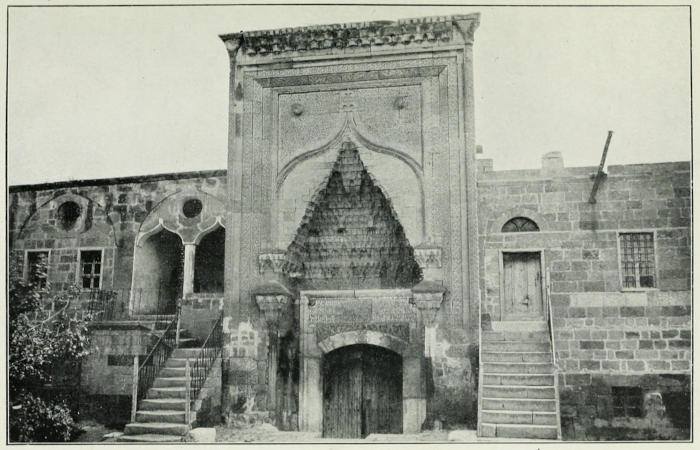
NIGDEH: PORTAL OR THE ‘WHITE MIDRESSEH’
Built by Ala-ed-din the Great, circa 1223 A.D. An early example of Seljûk art. (See p. 73.)
To these revelations by the spade there should be added various contributions of the pen, which, together with the old materials, make possible the study of Hittite remains upon an historical rather than a purely archæological basis. We might indeed make some general inferences from the results of these researches, but it will be wise to keep ever in view the geographical conditions, and never to assume collateral development among the various branches of the Hittite peoples whose lands were physically so disunited. Evidence affecting one state in the north of Syria may be applied with some surety to its neighbours; but it may not be applicable beyond the Taurus. No published accounts enable us to test the antiquity of Hittite settlements upon the tableland of Asia Minor, and it is doubtful if even the necessary soundings have been made. For the middle period, however, the difficulty is less, where history shows that the influence of the Hatti administered from Boghaz-Keui must have predominated in the north of Syria, and contemporaneity of development may therefore be inferred. But when we come to the inferior limit of date the same difficulty (the possibility of independent development) is reopened, for, in the absence of positive material evidence to the contrary, the Assyrian arms seem never to have passed the Halys even while Assyrian influences were dominant in Syria. On the other hand, as we have seen in the previous chapters, we have to take into account the possible influence of the new civilisations, like that of the Phrygians, which had meanwhile been developing upon the tableland. One thing at any rate seems clear, that no Hittite monuments of Asia Minor can well be later than the period of Phrygian domination in the eighth century B.C.,[135] so that in the end a general parallel is suggested with the closing dates afforded from Assyrian history.
Having now considered in general terms the method and the new chronological basis of our inquiry, we come first to an account of those isolated monuments which illustrate to us the diversity of Hittite art and the wide range of its influence. The most striking of these are perhaps those carved on the living rock, which may take the form of single figures, some gigantic, others less than life-size, or groups representing deities and their ministers, accompanied in each case by Hittite hieroglyphs, or long inscriptions without any sculptures to give a suggestion of their meaning.[136] Of the moveable monuments only one is found clearly in situ,[137] and this from its position and nature may be thought, like some of the rock-inscriptions, to have been a boundary stone. There are others, however, of such weight[138] or peculiar character[139] that they may be judged to have been set up not far from the sites where they have been found. The provenance of monuments found on or in the vicinity of ancient sites is also reliable as evidence.[140] Sculptures are rarely executed in the round, except for architectural purposes,[141] though in one or two instances there have been found fragments of statues.[142] Reliefs however, are plentiful, mostly representing mythological creatures or persons; while a distinct class, which represents a ceremonial feast or communion, seems to include some specimens of funerary character.[143] Among inscribed monuments the most interesting are those stelæ which show a human figure, accompanied, it would seem, by a formal biography of good works.[144]
PLATE XXXIII
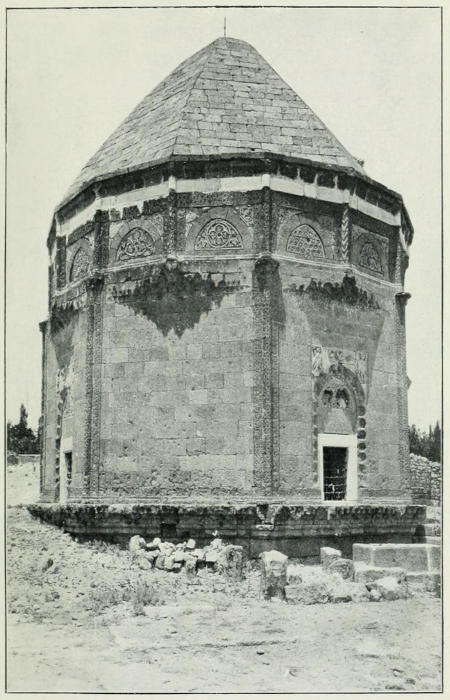
NIGDEH: TOMB OF SELJÛK PERIOD
Traditionally the tomb of Havanda, wife of Ala-ed-din, but dated 1344 A.D. Note the design, tracery, and stalactite ornamentation. (See p. 73.)
Unfortunately a considerable proportion of the inscribed blocks of stone that have been found are imperfect, so that little can be hoped from the inscriptions themselves. There are also a few small objects so portable, and reported from regions so exceptional, that they cannot be used as topographical evidence. Lastly, there are naturally a number of monuments simulating Hittite work which we hesitate to include without further evidence. It will be useful at this stage to give a classified list of the places where the chief Hittite monuments have been found.[145] Towns and palaces are included though not discussed in this chapter; further, classifications which are based on inference, or doubtful in any way, are denoted by square brackets, while an asterisk signifies that the Hittite origin of the monument to which it refers is problematical and unconfirmed. Other special features are pointed out in the footnotes.
Walled Towns.—Boghaz-Keui, Eyuk, Sakje-Geuzi, Sinjerli. [Ilgîn (Kolitoghlu Yaila), Jerablus (Carchemish), Marash.]
Fortresses.—Boghaz-Keui (Sary Kaleh, Yenije Kaleh), Giaour Kalesi, Karaburna, Kizil Dagh.
Rock Carvings.—Sculptures with Inscriptions—Boghaz-Keui (Iasily Kaya), Fraktin, Ivrîz, Kara-Bel (Mount Tmolus), Kizil Dagh, Mount Sipylus, Tashji. Sculpture only—Giaour-Kalesi.[148] Inscriptions only—Asarjik, Boghaz-Keui (Nishan Tash), Bulghar-Madên, Gurun, Kara Dagh (Mahalich).
Stones in situ.—Inscribed Sculpture—Kuru-Bel. Inscription only—Bogche.
Moveable Stones.—Sculptures in the round—Boghaz-Keui,[149] Derendeh[150] (and at Arslan Tash),[150] Eyuk,[150] Eski-Yapân,[150] Kurts-oghlu,[151] Kuru-Bel,[152] Marash,[151] Yamoola.[149] Reliefs; mural—Aintab, Boghaz-Keui, Doghanlu, Malatia, Marash. [Angora (Kalaba, Yalanjak, Amaksiz Keui).] Reliefs representing a Ceremonial Feast—Kara-burshlu, Malatia, Marash, Sakje-Geuzi, Sinjerli,[153] Yarre. Inscriptions accompanying human figure—Andaval, Bor, Jerablus[154] (Carchemish), Kellekli, Marash,[153] Samsat, Tell-Ahmar. Inscriptions only—Aleppo, Alexandretta,[155] Albistan (Kirchuk Yapalak), Bey-Keui, Ekrek,[154] Emir-Ghazi,[151] Hamath, Ilgîn (Kolitoghlu Yaila), Izgîn,[156] Jerablus, Karaburna, Nigdeh,[151] Restan, Suasa.
Problematical Monuments.—Eflatoun-Bunar, Fassiler, Gerger.
The first thing that strikes us in considering this list is that these monuments are all of stone. We might possibly be able to include, with suitable caution, some number of small objects of bronze or pottery, mostly in animal form, and also a number of peculiar ceramic types, including painted vases and neolithic pottery decorated in a primitive manner by incisions. But, except in the latter instances,[158] these do not advance the main subject of our inquiry; for while their identification with the Hittites is chiefly a matter of general inference, their provenance is nearly always doubtful. The same thing might be said unhappily of the definitely Hittite seals and kindred objects, of which several excellent specimens are on record,[159] whether made of silver,[160] stone,[161] or ivory.[162] While all of these are worthy of closest study from the point of view of Hittite art and motif, yet nearly all have been found in the hands of peasants who were loath to tell the exact site of their discovery, or of town-dealers who did not know.
PLATE XXXIV
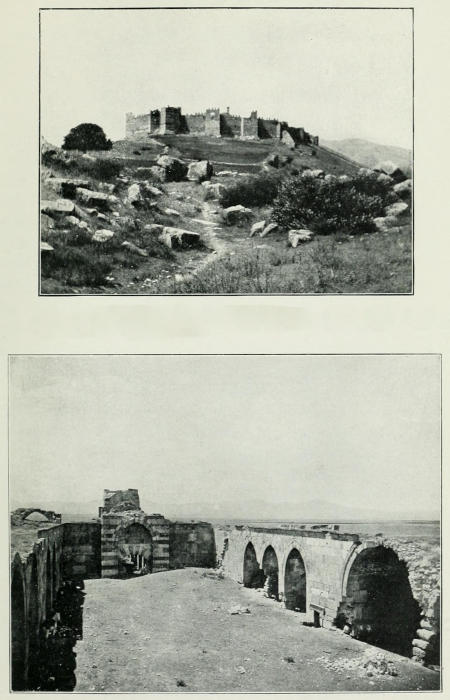
EPHESUS: MEDIEVAL FORTRESS WITH SELJÛK REMAINS AT AYASOLÛK
KONIA: ZAZADÎN HAN, OF SELJÛK WORK AND STYLE (See p. 73.)
Hence to define our Hittite land by the disposition of the monuments, we fall back largely on the works in stone, the original position of which is known or can be inferred. Doubtless at one time the surface of the ground was covered with other indications, with ruins of villages and houses where now the grass grows over indistinguishable mounds; and doubtless also many exposed monuments must hitherto have escaped scientific record. Hence our argument from the disposition of the monuments should be guarded; it is positive, indeed, so far as we have evidence, but the negative case should not be urged. The durability of stone has perpetuated these monuments to us, but it is not thereby demonstrated that the Hittites had any exclusive preference for this material. And being of stone, they are most plentiful in stony regions, and rarely found upon grassy plains. We cannot expect, for instance, upon the broad pastures of Iconium anything analogous to the sculptures which are found in rocky Taurus, where the opportunity was all-tempting which in the former case was lacking. It has been well said that ‘if the plateau presented throughout the same character, there would be no need to seek on its surface monuments of the past. Hunters and woodmen build no cities, and arts are unknown to them.’[163] Consequently, in finding a concentration of Hittite sites upon the hilly regions of the map, this fact should not be allowed to weigh disproportionately, although there is independent evidence tending to the conclusion that several branches of the Hittite peoples, particularly those of Asia Minor, were of mountain origin.[164]
With these considerations in mind, a study of the disposition of these Hittite sites upon the map[165] can teach us much, notwithstanding our self-imposed restrictions. Our southerly frontier reaches to Hamath on the Orontes. Eastward our boundary is the Euphrates, flowing past Malatia, Samsat, and Jerablus. Westward the monuments follow the inner edge of Taurus as far as the Kara Dagh, with not a single site under the southern slope of these mountains. In the north we have no clear boundary. Eyuk and Boghaz-Keui are found in the middle of the circuit of the Halys, with no places nearer than those which lie in the valley of that river. Across the river a single line of monuments, including Giaour-Kalesi, Yarre, Doghanlu, and Bey-Keui, seems to lead on towards the Lydian coast, to where Sipylus and Kara-Bel are found between Sardis and Smyrna.
PLATE XXXV
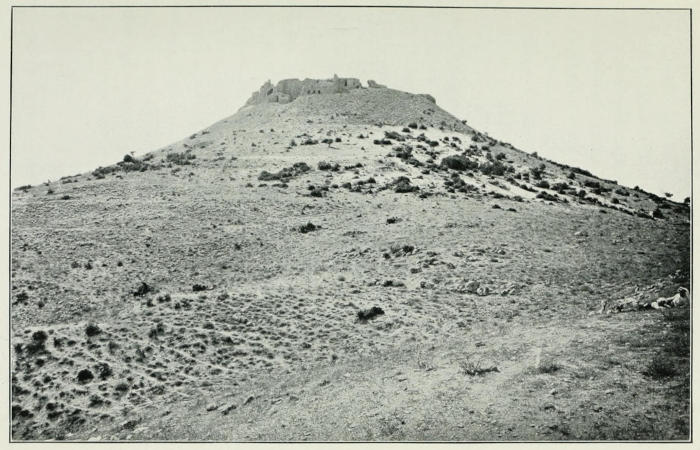
ROWANDUZ KALEH: MEDIEVAL FORTRESS ON A STEEP CONICAL HILL OVERLOOKING THE AFRÎN
Supposed to have been built under Genoese architects during the 14th century A.D. (See p. 9.)
A brief consideration of the classified list of monuments above will reveal the fact that for description no grouping of these places is so convenient as that formed naturally by geographical divisions. The first main group (A) will include all the monuments of the north of Syria, in which we may recognise three separate districts. The most southerly is the Orontes valley, with which we can include Aleppo, though the latter historically would seem to have been the centre of an independent state.[166] The monuments from Hamath consist of a series of stones inscribed in relief, partly belonging to the same inscription; while at Aleppo there is one small stone of similar character. The places Restan and Homs indicated upon the map are positions of importance further up the Orontes, though unidentified by local remains.[167] The site of Kadesh, the historical frontier fortress of the Hittites in their warfare with Egypt, is similarly now unrecognisable, but a consensus of opinion among students of the Egyptian records places it not far southward of the present lake of Homs.[168]
Eastward we have the monuments on the Euphrates, including numerous inscriptions, a stela, and fragments of sculpture, from the irregular mounds which mark the site of ancient Carchemish at Jerablus. Several carved and inscribed monuments are recently reported from Kellekli and Tell-Ahmar,[169] which are in the same vicinity, while further up the river there are found an inscribed and sculptured block from Samsat, and a doubtful carving on the rocks near Gerger Kalesi. The remaining monuments of the north of Syria lie towards the west, mostly in the valley of the Kara Su. The mounds of Sinjerli and Sakje-Geuzi are included, wherein excavations have disclosed the ruins of sculptured palaces and other monuments that will be described with more detail in a later chapter. A relief with inscription comes from Kara-burshlu in the same vicinity; while a sculptured and inscribed corner-stone of peculiar character has been found at Aintab, a little to the east. To the south of this town is Killiz, a place not marked by any peculiar remains, but the centre where numbers of bronze figures,[170] seals, and other small objects of Hittite character, are commonly found in the bazaars. Lower down on the Afrîn, and hence geographically contiguous, is Kurts-oghlu, whence comes a portion of a small statue carved in the round, upon which still remain two lines of incised inscription. We include Marash also in this group, though it is on higher ground at the ascent of the Taurus mountains. Here there must have been a city of importance, suggested alike in the strategic position and in the number and character of the monuments found upon the site. Among these are two sculptured lions (one inscribed with hieroglyphs in relief), slabs carved with reliefs depicting interesting scenes, and the lower part of an inscribed statue, as well as several blocks and fragments also inscribed.
Passing northwards the monuments found in the mountain regions of Taurus and Anti-Taurus constitute our second main group (B). This embraces the district marked by the four sites in the valley of the Tochma Su, with which there may be included two others in the head-waters of the Pyramus. At Malatia there have been found several architectural blocks sculptured in relief with religious representations and hunting scenes, most of them bearing also groups of Hittite hieroglyphs upon them. There can be no doubt that, situated like Marash in a position of great strategic importance,[171] at one time on the Mitannian and later on the Assyrian frontier, this place is equally one of the more noteworthy Hittite sites. From Derendeh come an inscribed fragment of a statue and a small basaltic lion; and from a spot called appropriately Arslan Tash, one hour distant to the south, two other lions, which are presumably architectural. At Palanga an inscribed cylindrical columnar figure has been found; while Gurun, further up the valley, is the site of two inscriptions, one on the living rock and the other on an isolated block. On the southern side of the watershed an inscribed stone has been found in a cemetery at Kirchuk Yapalak, two hours distant from Albistan; while the column or obelisk from Izgîn, inscribed on four sides with hieroglyphs in relief, is an object almost as remarkable as the round column from Palanga.
This group includes, as a second district, five sites in the Anti-Taurus. The most easterly is Kuru-Bel, a pass near old-time Comana: here is one of the most striking Hittite works, resembling a great altar with lions crouching upon the top on either hand. Three places are on the main stream of the Zamanti Su: from an Armenian cemetery at Ekrek there has come a stone inscribed in incised hieroglyphs, which has been re-dressed with Christian emblems; at Tashji are two figures and an inscription incised upon the rock; while Fraktin is famous as the site of rock-sculptures that make important additions to Hittite religious symbolism. Lastly, at Asarjik, on the northern slope of Mount Argæus, overlooking Cæsarea, an inscription is incised upon a broken rock, accompanied by interesting markings like graffiti.
In our third main group (C) we include those few monuments found in or near the valley of the Halys, north-westward of Cæsarea. These are a great sculptured eagle on a lion-base, an object not demonstrably of Hittite workmanship, on the river-bank near Yamoola; a perfect inscription covering four sides of a round-topped stone, standing on a pedestal, overlooking the river valley on the south bank near Bogche; thirdly, an inscription in three lines on a stone found at Karaburna, which is on the opposite bank considerably lower down; and lastly, two incised inscriptions found recently at Suasa, which lies back considerably from the river, almost opposite the place last named.
With the same group we class the district inside the circuit of the Halys, the monuments of which are almost confined to the famous ruins of Boghaz-Keui, with the neighbouring sculptured sanctuary of Iasily Kaya, and the walled mound and palace of Eyuk, both of which are described in later chapters. There are, however, one or two features which may be appropriately singled out for comparison in this chapter, notably the inscription in relief on the rock called Nishan Tash, on the high ground of the citadel at Boghaz-Keui, and a couple of building blocks sculptured like those of Sinjerli, Malatia, and Eyuk, recently found at the foot of the acropolis. If we may mention also two objects of doubtful provenance, these introduce a place called Eski-Yapân, on the road from Sungurlu to Chorum, where an architectural lion is built into a modern wall,[172] and Denek-Madên, near to Cheshme-Keupru, where an interesting round ivory object engraved with Hittite characters and signs has been rescued.[173]
PLATE XXXVI
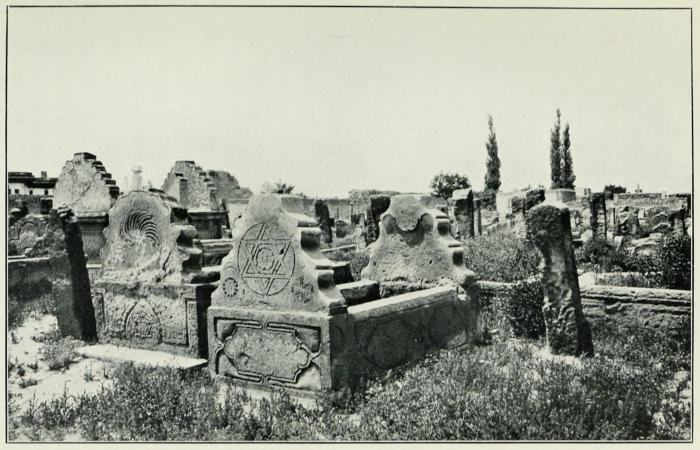
CÆSAREA: TURKISH CEMETERY, NOW DISUSED (See p. 23.)
We are inclined to group together all the monuments westward of the Halys (D), including with them the two famous sculptures near the Lydian coast. We thus bring together for comparison the rock carvings of Giaour-Kalesi and of Kara-Bel, which are analogous, and the dethroned Niobe seated on Mount Sipylus. In the Phrygian country there are on record an inscribed stone at Bey-Keui, and a sculpture with uncertain hieroglyphs at Doghanlu Daresi. A relief found at Yarre, representing a ceremonial feast, conforms with a definite class of Hittite sculptures found elsewhere on the several sites mentioned in the list above. The same may be said, though with less confidence, of carved slabs found in the vicinity of Angora, representing lions, but we exclude the sculptured lion to be seen near the bridge at Cheshme Keupru. The remarkable thing about the disposition of these monuments, excluding the reliefs at Angora, is that they seem to mark out the line of a single road, namely the Royal Road from Boghaz-Keui to Sardis and the west.[174] The only reasonable doubt seems to be as to the route from Giaour-Kalesi to Boghaz-Keui, about which there is no evidence. Some students of the local topography think it must have gone by way of Angora, in spite of the tradition (which in the absence of evidence becomes of interest) that Angora was a comparatively late Phrygian foundation.[175] Others urge[176] that it was improbable that the road ‘swerved southwards to Giaour-Kalesi,’ an opinion seemingly forgetful of the road’s objective.[177]
The district westward of Iconium, in which are found the Lycaonian-Hittite monuments of Eflatoun-Bunar and Fassiler, stands by itself. But as there is only one clearly Hittite object from this region, namely a stone inscribed with hieroglyphs in relief, from near Kolitoghlu Yaila, near Ilgîn, we include this with the main western group.
We now come to the fifth and last group (E) of these arbitrary divisions, which includes nine sites and several of the most important monuments.[178] It embraces the whole of the south-western range of Taurus from the Kara Dagh to Bulghar Dagh, as well as the districts at its foot, of which in classical times Eregli (Cybistra) Arissama (Ardistama) and Kilisse Hissar (Tyana) were the more important centres. The monuments recently discovered on the Kara Dagh might indeed have been regarded as a group apart; but as this district shares in the geographical economy of the others, and is a spur of the main Taurus range, we prefer to class them with the rest. They are found in two places, firstly, near Mahalich, on the summit of the Kara Dagh, where there are two inscriptions in relief and a passage in the rock; and secondly, on the outlying knoll called Kizil Dagh, on which are the remains of a ‘high place,’ including a rock-throne and an incised seated figure with three inscriptions; while on the very summit there are the ruins of a fortress, and an inscription in relief upon the rock. The monument of Ivrîz, above Eregli, is well known; it is a gigantic and imposing sculpture of the god of fertility (by whatever name he may be known) with the local priest-king in adoration; three short inscriptions accompany the scene. The traces of a second sculpture of similar character are to be found not far above.[179] At Bulghar-Madên, on the other side of a lofty ridge, an incised inscription of five lines is graved upon the living rock. These two monuments seem to have been connected in some way with Tyana, in the vicinity of which several inscribed stelæ and sculptures have been found. That from Bor, discovered in two portions which were rescued at different times, is the best of these; and an interesting fragment remains at Eski Andaval, where jealousies and suspicions prevent it from being seen. Nigdeh contributes an incised altar of round shape. From Tyana itself nothing is reported, but the antiquity of the site is unquestioned, and its known monuments reach back to the time of a Phrygian Midas.[180] In this district, particularly at Bor, numerous small objects of great interest have been secured, and there is little reason to doubt but that they were found originally not far away.[181] Further west, in the desert tract of the eastern extremity of the great salt plains, there are the ruins of Ardistama; and in the vicinity, near Emir Ghazi, there have been found in late years an inscription in relief, and three others on round altars. These are included in the same group on account of their geographical proximity.
Now that we have completed this preliminary survey of the disposition of such Hittite monuments as by their character or the circumstances of their discovery may be accepted by us as evidence in our inquiry, we realise more clearly the reason for the distinction we made in an earlier chapter between the eastern and western portions of Asia Minor. In the West we can speak of only nine monuments, of which four are not of Hittite origin. Six of these seem to lie along the line of a single road; and of the others, only one is inscribed with Hittite characters, and even that is moveable and not found in its original position. If only by contrast with this paucity, the comparative frequency of monuments towards the East, and their definite character, naturally inclines us to assign some tentative boundaries to the Hittite country. In the North this is not difficult; the Halys River remained in the time of Crœsus a division between peoples of different race,[182] and Sir William Ramsay has pointed out[183] differences in important racial customs between the peoples of the two banks in ancient times.
But to the south there is no such boundary; even the great plains, which form so prominent a landmark in the map, seem to be more barren now than in the days when Ardistama flourished.[184] This change is illustrated by the western extension of the monuments along the foot of the Taurus and in the desert. We must not forget, also, that whole tracts are eliminated from our purview from absence of stone; nor should we allow ourselves to be prepossessed with the idea of divisions on the tableland, which is, after all, continuous and coterminous. If it is true that nearly all the evidences of Hittite occupation in the west resolve themselves into monuments erected along a single road, it is also true that if we exclude from our view the group of remarkable monuments at Boghaz-Keui and Eyuk, there remains little sign that the country within the circuit of the Halys was indeed at any time Hittite territory, much less that it enclosed their northern capital. In face of such considerations the great sculptures and fortress of Giaour-Kalesi, the carvings of Doghanlu, the inscription and tumulus of Bey-Keui, and most striking of all, the sculptures of the west on Mount Sipylus and in the pass of Kara-Bel, as well as those monuments in Phrygia and Western Lycaonia which at least reflect the influence of Hittite art, become imbued with a relative importance not to be overlooked in our inquiry. The land of the Hittites is for us as broad as the extent of their works: it is for another phase of our subject to inquire whether there is evidence to tell us how and when their territory was acquired, and for how long it remained in their power.
Section A.—Monuments of the North of Syria.
HAMATH, RESTAN, ALEPPO; KURTS-OGHLU (ALEXANDRETTA), SINJERLI, KARA-BURSHLU, SAKJE-GEUZI; AINTAB (KILLIZ), MARASH; JERABLUS, KELLEKLI, TELL-AHMAR, SAMSAT, RUM KALI (GERGER).
The town of Hamath has grown up where the main road from the north enters the Orontes valley. This river, in characteristic fashion, flows for the most part deep below the level of the surrounding plains; and Hamath is found at a spot where the banks widen out, so that the town is in a hollow, almost surrounded by escarpments formed of the steep banks and the broken edges of the plain. Though picturesque, the position in general can have had little strategic importance, even in antiquity, being overlooked and exposed. Hence it probably came into being in Hittite times as an important halting-place upon the main road through Syria, and as a natural centre for the surrounding agricultural districts. The original Hittite stronghold would seem to have been more strongly placed; this probably covered the broad-topped mound[185] which marks, in the manner so familiar in old Syrian towns, the beginnings of the site. Doubtless this would be surrounded at a certain stage with a wall, as was the fashion of those days; and later, on the analogy of Sinjerli, the population overspread the limits of the enclosure, and so settled in times of quiet on the tempting ground at the foot of the acropolis. In this development, and in the nature of its situation, Hamath shares largely the general features of many Syrian sites. Being (even now) somewhat out of the way of European travellers, it is curious that numerous inscriptions should have been noticed here, while a famous historical site like Kadesh remains unidentified, and a strong natural position like Restan was until recently without record of Hittite occupation.[186]
PLATE XXXVII
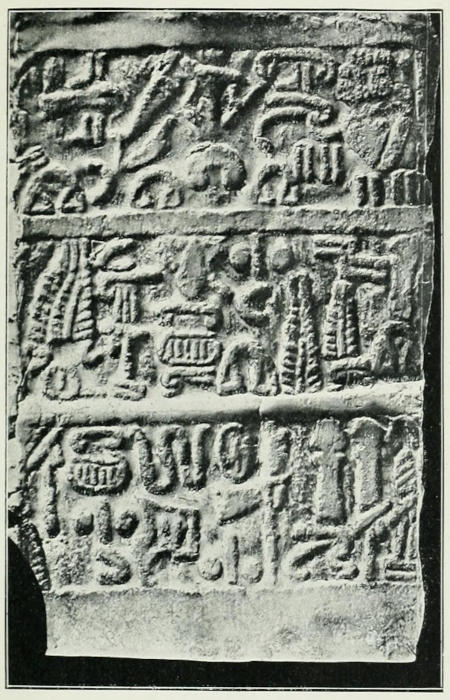
HAMATH: INSCRIPTION IN THREE LINES OF HITTITE HIEROGLYPHS CARVED IN RELIEF, ONE OF THE SO-CALLED ‘HAMATHIC’ INSCRIPTIONS (See p. 95.)
The photograph is taken from a paper impression.
Whatever may be the explanation, as early as 1812 a black basaltic block built into the corner of one of the houses in a bazaar attracted the eye of a famous traveller[187] by reason of the strange-looking hieroglyphic signs upon it. Sixty years later other stones came to light;[188] some were built into the modern walls, others lay loose. All were regarded with veneration by the inhabitants,[189] and it was with great difficulty that they were removed, in 1872, to a place of safety by the Turkish Governor through the energetic initiation of Dr. Wright, supported by the British Consul.
The inscriptions are five in number,[190] whereof two are on adjacent sides of the same block of stone. The first was found in the wall of a house; it measures nearly 15 inches in height and 13 inches in length.[191] The inscription is in three lines; and it begins at the top right-hand side, with the symbol of the human arm and head, with finger touching the lips, a sign which indicates the beginning of a first personal declaration. Other hieroglyphics may be readily recognised in the photograph. The yoke which has the phonetic value of our letter S is thrice repeated in the lower part of the line; while towards the end there is seen the hand and forearm, marked off by the smaller word-dividing signs above and below, which in this grouping seems to express some attribute of lordship,[192] as ‘mighty’ or ‘powerful.’ On the analogy of other hieroglyphic systems, the signs face always towards the commencement of the inscription. In this way the character of Hittite inscriptions may be recognised as boustrophedon, turning alternately in direction with the successive rows, like oxen ploughing in a field. The second row in this case must be read then towards the right. The most noticeable sign is the royal head-dress, which is conical and drawn always with a midrib.[193] This symbol is an ideograph meaning king. Below the first example of this sign there occurs the freely used determinative of a locality; it is oval in shape, and is to be distinguished by details from a similar symbol indicating sanctity or divinity, which is seen commonly at the top of the groups of signs which seem to name individuals in the sculptures.[194]
There seems to be little variation between the texts of this inscription and two others from the same place.[195] Of these, No. 2 is an inscription likewise in three lines, lacking only a few signs at the end. The stone measures nearly 20 inches in length by 15 inches in height; it was found built into the wall of a garden. The inscribed end of the third stone (that which was looked on as possessed with virtue for the rheumatic), is only just 11 inches in height, with a width the same as in the former instance. There are two lines of inscription preserved. The largest stone of all was found built into the corner of a small shop; its height is just over 2 feet, and its length 3 feet in front. It is cubical, with a thickness or depth of at least 15 inches. It was probably a corner-stone in antiquity also, for it is inscribed on the front and on the left-hand side.[196] The signs, as in the other cases, are in relief. The inscription is not continuous around the corner, for in front are five rows, which begin to read from the right, while by the side are four rows only, beginning from the left. The depth of the rows is the same in each case. The face inscription is considerably rubbed and damaged, and a portion of the last line missing; while the edges of the side-inscription are also rubbed away.[197]
The one monument of Aleppo[198] is a single panel of inscription carved in relief upon a block of basalt, nearly 2 feet 6 inches long, and 1 foot 6 inches high. When seen originally it was built into the south wall of an old mosque, and was regarded with special superstition by the native people, who ascribed to it powers of curing ophthalmia. The smooth-rubbed nature of the surface of the stone may be partly ascribed to the devotions of the afflicted, who were wont to rub their affected eyes upon it. When attention was drawn to the character and archæological importance of this monument, it was hastily removed, and reported as broken. Rather more than twenty years later, however, it was refound,[199] built again into the wall of a mosque, and a new photograph was obtained. The signs are too worn to transcribe with certainty, and the inscription is too incomplete to be of much present use for comparative study. It is remarkable that no other Hittite monuments from Aleppo have been recorded. Possibly the reason is that the fine mediæval Turkish castle now completely covers the bold acropolis which was probably the position of the stronghold in Hittite times.[200] There is rumour of other inscriptions in the masonry of the keep, and in the town, but nothing has yet come to light.
We pass now westward towards the ancient lands of Wan. From here only one monument is recorded,[201] but that is of peculiar interest, being part of a sculpture in the round. This was found in a large rubbish-mound at Amk near Kurts-oghlu, a village not far from the Gindarus of Roman times upon the Afrîn. It is now in the Berlin Museum.[202] It consists of the lower part of a statue, which must have represented a somewhat stolid person standing, clad in long skirt, below which the toes protrude. The inscription is incised in two rows around the front and sides of the skirt at the bottom, beginning from behind the right-hand side. The space not inscribed behind is filled with four vertical folds, descending from the waist, which seems to be encircled with a belt. The upper part of the body is broken away, but it seems to have been clad in a garment which reached down, in front and behind, to the waist and descended lower over the thighs; but the upper part is all broken away, leaving only the position of one elbow, which was bent. The height of the preserved portion of the statue is 16 inches, and width at the bottom 10½ inches. Dr. Messerschmidt notes with regard to the inscription that an attempt seems to have been made to add a third line, which was abandoned possibly owing to lack of room, and the signs added were then effaced with cross-lines. It remains probable, none the less, that these extra words were essential to complete the sense of the inscription.[203]
PLATE XXXVIII
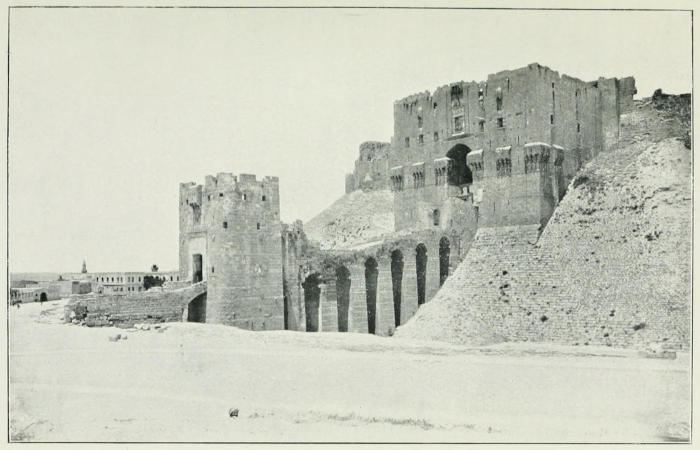
ALEPPO: ENTRANCE TO THE MEDIEVAL FORTRESS UPON THE ACROPOLIS
Northward lies Sinjerli, the centre of old-time Shamal, in the valley of the Kara Su, under the eastern slopes of Mount Amanus. Here one of the numerous mounds in this locality has been excavated, and disclosed the site of a walled town surrounding an acropolis which was separately enclosed. Within were palaces, or Hilâni, of different building periods, and decorated like the gates of the citadel and town with sculptures of varying character. Several inscriptions, from the dated evidence upon them and their relative positions, added to the archæological value of these discoveries, which will be found described in greater detail in Chapter v.
An hour northward from Sinjerli is the village of Kara-burshlu, at the foot of Mount Amanus, and on the way from one of the chief local descents from the mountains called significantly Arslan Boghaz (Lion Gorge). Above this village there towers a steep knoll, on the summit of which an interesting carved monument was found by members of the first Berlin expedition to Sinjerli.[204] The subject of the relief is a Ceremonial Feast, similar in its general features to others observed in the locality at Sinjerli,[205] Sakje-Geuzi, Marash, and Malatia, and in Asia Minor at Boghaz-Keui (Iasily Kaya) and at Yarre, but rendered important through certain variations. For it seems to have been inscribed on both sides and on the top; while, below, part of a pedestal remains, on which it must have been designed to stand.[206] Thus it could not have been intended for a building stone, nor is there any suggestion that it was an old stone re-used. Its height is 3 feet 7 inches, its width 3 feet; and the pedestal is preserved to a length of about 5 inches with a width of 18 inches. Unfortunately the stone was found in a poor state of preservation, and could not be moved, so that we have to rely chiefly on sketches and impressions taken on the spot by the discoverers. These, however, were executed with great skill, and it is the fault rather of the condition of the monument, and of our unfamiliarity with the writing, that more of the inscription cannot be made out. As it is, only part of four rows from the right-hand side have been published; but there seem to have been originally six rows on each side and at least one row on the top. The letters are all incised. The sculpture is in relief, and represents two figures seated on either side of a low table, similar to one another and vis-à-vis. The hair of the one seems to be short, and of the other curled. Their shoes turn upwards at the toe. Their robes are long and fringed, reaching to the ankles, and there is a belt (partly at least) around the waist. Each raises the further hand with something in it to the level of the mouth. The nearer elbow is drawn back in a natural position, and a staff is suggested in the hand. The chairs are square cornered and straight legged, twice as high as broad, with spindles to match, and low backs, the upper bars of which are thicker and rounded behind. The table is of familiar shape, rather squeezed in the drawing. The top seems to be round, and the curved legs (which are probably three in number) cross about two-thirds of their height, forming a tripod. The feet of the legs are ornamented, probably but not clearly, as animals’ feet. Upon the table are five flat circular objects (if we interpret the perspective of the drawing rightly) like native loaves of bread, and upon them are two small pear-shaped objects more difficult to define.
The class of sculpture to which this monument belongs is to be distinguished in our opinion from that in which one of the personages represented is clearly more exalted than the other,[207] hence presumably the lord or master to whom a servant ministers; whereas in these, the persons seem to be on an equality, and both share in the feast. The suggestion of a ‘funerary feast’[208] as an explanation of these sculptures seems most natural, but the difficulty in accepting this arises from the fact that at Sinjerli the stone in question forms part of a mural decoration, and others of those mentioned seem to be clearly architectural blocks. This difficulty might be explained away by the compromise that the scenes were originally commemorative of some religious institution of a funerary character, though not actually tombstones.[209]
One of the most interesting monuments of this kind is found at Sakje-Geuzi, which lies in the same valley as Sinjerli, about a day’s journey to the north-east. The route passes through a gap in a low ridge which divides the valley transversely and forms a natural boundary between the two districts. Recent excavations[210] have unearthed in one of the mounds at Sakje-Geuzi the outline of a walled citadel and the foundations of a palace with portico sculptured in characteristic fashion. These buildings we describe with those of Sinjerli and Eyuk in a later chapter; but there are one or two surface monuments of this site that may appropriately be mentioned now. One of these is the relief in question.[211] The stone was found in the marshy ground at the foot of the mound called Jobba Eyuk. The stone is preserved to a height of 27 inches, and is probably a decorative building slab, brought down in modern times from the mound. The carving is very weathered, but its main features may be readily made out. The figure on the left is seated, with hands stretched out towards the table; while that on the opposite side stands facing the other, with hands forward as though in the act of serving.[212] The dresses seem to be long robes; that of the standing figure may be bordered or fringed. The hair of the seated figure ends in a bunched curl.[213] The chair is straight-legged as before, only the back is higher, and while curving very slightly backwards does not thicken but rather tends to taper. The table is better drawn than in the last instance; the curve and crossing of the legs is more clear; but the third leg is shown in each case stopping short at the junction, possibly because the artist thought the curve took it out of the plane of the sculptures. The objects upon the table cannot be identified: the one which seems to be proffered by the left hand of the standing figure is round and set upright; the other is small and T-shaped.
Another monument not found in situ, and no longer at Sakje-Geuzi, was removed to Berlin[214] some years ago from the walls of the Konak, or chiefs house, in the village. It consists of three sculptured stones, obviously part of a mural decoration, but forming in themselves a complete group. The subject depicted is a royal lion hunt.[215] The king or priest dynast is marked out by a winged disk near to his head; he rides in a two-horsed chariot, which is driven by a companion. The horses, like the men, are clad in mail; jaunty tassels hang from their sides and shoulders. The car is small and seemingly open at the back; a quiver for arrows is hung up on each side, as well as an implement which seems like a javelin. The tires of the wheels are thick, and there are eight spokes. The two figures standing within the chariot are clad exactly alike, in long mail robes with short sleeves that do not reach the elbow. Both are without other headgear than their copious hair or wig, which is arranged in long parallel curls over the head; their beards also are dressed in pendent curls in the Assyrian style. The face of the warrior is partly hidden by that of him who drives, but the visible characteristics are the same. The eye is rendered in full, while the somewhat aquiline nose and prominent lips are in profile. The similarity of these two figures is somewhat striking; possibly, on the Egyptian analogy, it is the king’s son who drives. He holds the reins in his two hands, a pair in each, while in his right he seems to grasp also a short-stocked whip. The figure seen partly behind, which we take for the monarch, is portrayed in the act of shooting. The short bow is drawn to the back of the neck, and the middle part of the weapon, held by the outstretched left hand, together with the long point of the arrow, is seen protruding from before the face of the nearer figure. His quarry is a noble lion which is seen immediately in front of the chariot horses. A third figure in the background here intervenes, being partly hidden by the forelegs of the horses and the hind parts of the lion. He is clad only in a short tunic from the waist; the garment has apparently a seam vertically down the front, and the fold, which is fringed or bordered, falls transversely over the right thigh. His feet are shod in sandals.[216] The face of this person is not well preserved, but his hair is short and very curly. In his right hand an implement resembling a double axe is poised aloft, while with his left he still grasps a spear, the point of which protrudes from the near flank of the lion. The beast itself is shown also in profile; the tail with bushy tip is down; the mane and ruffle are depicted, and the hair is shown full behind the shoulder and under the belly.[217] The mouth is open, with the teeth all bared, and the left paw is upraised with the claws turned outwards, both actions threatening a fourth person who with face turned towards the group completes the scene. With both hands this man drives home a spear into the skull or left shoulder of the animal. He is clad like the riders in the chariot in a long suit of mail, with short sleeves. In this case the lower part of the garment may be seen, which in the others is hidden by the side of the chariot: it is cut away from above the knees, though falling behind nearly to the ankles. There is a belt around the waist as before; the sandals have flat soles, while toe-piece and ankle-strap are clearly delineated. The head-dress of this person is peculiarly interesting. While perpetuating the form of the conical hat it seems to look more clearly like a helmet. This may, however, be an illusion, as there is a border around the brow, and the appearance of a turnover fold which reaches down the side from the peak. Over the back of the animal, between the spears of the two standing figures, there appear four rosettes of twelve petals each; while the upper and lower borders of the stones are decorated also with a pattern composed of contiguous concentric circles. The height of these slabs is nearly four feet, which accords with the measure of other stones of similar character and decoration found upon one of the mounds of this site.[218] Together these form a series of pronounced Assyrian feeling, and obviously of later date[219] than the palace-portico recently unearthed.
PLATE XXXIX
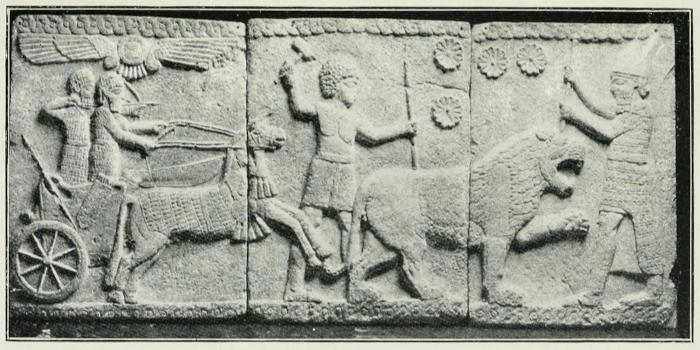
SAKJE-GEUZI: ROYAL HUNTING SCENE
Date probably 8th century B.C.
From Sakje-Geuzi a difficult mountain track leads over the Qurt Dagh to Kartal, crossing the head-waters of the Afrîn, and, following the wild upper valley of that river to Karadinek, passes thence under the curve of the basalt plateau to Killiz. The distance in time is much the same as the better road by way of Aintab, being two days’ journey in either case, but the scenery and interests of the former route are unparalleled in Northern Syria. At Killiz various small objects have been from time to time bought in the bazaars, such as stone seals and small bronze figures. Two of the latter we illustrate here,[220] but it is not certain that they are of Hittite origin. Their archaic appearance, however, the range of country and localities in which this class of objects are found, and several other considerations, render the suspicion a probability.[221]
Aintab, one day’s march eastward from Sakje-Geuzi, lies at the juncture of two main routes, the one from Cilicia eastward across the Euphrates, the other from Marash southward by Killiz to Aleppo. It is somewhat surprising therefore that there is no further evidence of Hittite handiwork forthcoming than a single granite corner-stone. This is a cubical block,[222] about twenty inches in height, inscribed on the one face and sculptured on the adjoining side to the right. It is clearly an architectural piece, for neither sculpture nor inscription is completed on the single stone; yet it should be mentioned that in the palace buildings of Sakje-Geuzi, Sinjerli, and Eyuk in no case has an inscription been found built into the walls which are decorated with sculptures. Recently at Malatia, and at Boghaz-Keui, sculptured blocks have been found on the face of which are hieroglyphic signs, as may be seen in situ at Eyuk; but in no case is an inscription found built into a wall. We feel inclined to regard this stone therefore as part of another class of structure, like a built-up hero-monument or shrine.[223] The inscription is in three panels, of which the middle one is complete and enclosed by a border; the lowest is lacking only in the left-hand corner at the bottom, while the uppermost is suggested only by traces of the lowest signs within it. A religious character is suggested in the reading of the middle panel tentatively offered by Professor Sayce: ‘This (monument) erecting to the god of my country.’ The sculptured side is equally problematical. That which remains shows the right leg of a man from thigh to knee. The dress seems to be a short tunic, the lowest edge of which seems to be curled up behind. The position of the leg and dress suggest several points of interest in attempting a restoration of the attitude. The figure must have been about life-size, and posed for action with left leg forward; not running but rather walking quickly, or possibly hurling a spear, with the muscles of the leg strung up to give the final impetus to the throw.
PLATE XL
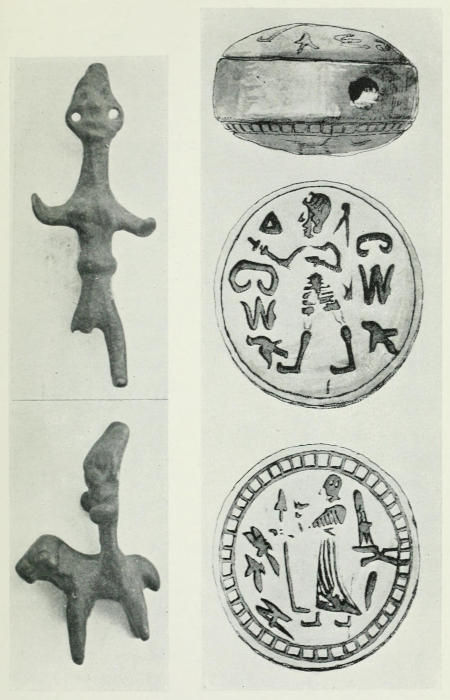
KILLIZ: BRONZE FIGURES. (See p. 106.) DENEK MADÊN: IVORY SEAL. (See p. 160.)
Marash lies one day’s journey northwards of Aintab: it is a considerable town placed at the descent from the Taurus on sloping ground well above the plain and 2500 feet above the sea. We have seen that it has played a considerable part in local history, as follows from its important position at the junction of several main routes; and to judge from the remains that have been found there, it must have been in earlier times one of the more important centres of the Hittites. As in the parallel cases of Aleppo and Hamath, probably the conical knoll to the west of the town, crowned by the remains of the mediæval and earlier fortifications, marks the original village ‘tell,’ which, like the mounds of Sakje-Geuzi, began to grow with the first settlements of Hittites upon the spot. Into an arched stone gateway on this acropolis there had been built two sculptured lions of Hittite workmanship, one of them, indeed, freely inscribed with Hittite characters. Originally the two lions had unquestionably guarded the entrance to a palatial building, forming the corner-pieces of the lowest course;[224] but in later times they had been poised aloft in the masonry as mere ornaments.[225] Though these are perhaps the most striking objects from this place, several other monuments are on record, the interest of which is enhanced by their variety of character and detail.[226] These include a slab sculptured with the representation of a Ceremonial Feast, similar to those of Kara-burshlu and Sinjerli, but with the addition of Hittite hieroglyphs upon the sculptured face. There is also the body of a small statue with a considerable part of the sculpture preserved, and a stela with carved figure and long incised inscription. Several other sculptures may be unhesitatingly included in the list, though without Hittite hieroglyphs upon them. One of these is a fragment showing a woman seated with a child on her knee, holding in her left hand a lyre upon which is perched a bird. Another is also broken, but the figure of a man serving at a table is preserved, and there is clear suggestion of a greater figure on the opposite side. Below, in an ill-drawn scene, a man holding a spear is represented leading a horse.[227] Recently a fine monumental piece has been added to the list, consisting of a cubical block of stone carved on the four sides, with inscription in this case as well as a human figure in relief. There are also various fragmentary inscriptions which have been longer known. There can be no doubt but that Marash was a royal seat of even greater importance than those at Sinjerli and Sakje-Geuzi.
PLATE XLI
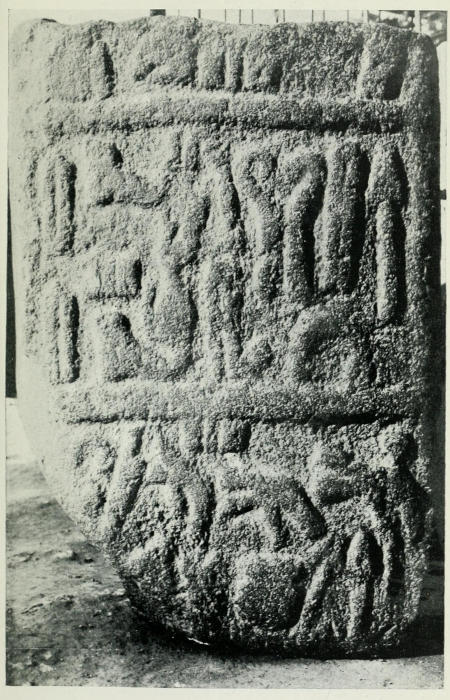
AINTAB: INSCRIPTION UPON SCULPTURED GRANITE CORNER-STONE (See p. 107.)
The first object of this list, the inscribed lion, is well known, and has several times been published in illustration. We reproduce a photograph of its profile,[228] which is the most typical and interesting point of view. Its architectural nature is evident, and is entirely accordant with that of the lions found in situ at Sakje-Geuzi.[229] It must have stood at the left hand as the decorative corner-stone of a palatial portico, with its fellow lion in the corner opposite. The place on the back prepared for the reception of an upper course of masonry may be seen, and the relative alignment of both walls may be inferred. The forequarters and head of the lion stood out from the wall, and these are sculptured in the round; the rest of the body is in relief. The treatment obeys the now familiar canon, though not carried out in detail: the ruffle of the neck and hairy belly are suggested; the tail curls under, and is seen between the two hindlegs. Only one foreleg is seen in profile, in contradistinction to the familiar Assyrian representations. In this case, however, detail of execution is sacrificed to the long inscription, which uniquely covers the body and even the legs of the animal as well as the spaces between them. The hieroglyphs are deliberate and well cut; the basaltic nature of the rock probably accounts for their superficial roughness, especially in view of the great number of signs carved on a really small surface; for the object is much less than life-size, being only 17 inches high, 35 inches long, and just over 10 inches thick.[230] From the rendering of the inscription by Professor Sayce,[231] it would appear to have been carved by the Hittite king of the district, who united the priestly dignities with his office, as we should expect from the accounts of Strabo in parallel cases.[232] There are several striking points developed by this translation, which though unconfirmed commands our interest and respect. The king claims for himself amongst other attributes to be ‘the dirk-bearer[233] powerful,’ ‘citizen of Merash,’ ‘priest of Merash,’ ‘royal lord of these lands, king of the lands of the god,’ ‘who provides food for the sanctuary,’ ‘of the men of the corn land the chief,’ ‘seated on the throne of Kas.’ He also claims to ‘have nourished the sanctuary of the Hittite ... the god’s high place,’ and to ‘have made a high place for the dancers’ for the celebration of religious rites. The Assyrian name of Marash was Markhasi, which seems to take the form Ma(a)rghasi in the Hittite. There is a clear suggestion of a theocratic ideal in state affairs, beginning with the high priesthood of the sovereign, and borne further by naming the subjects of the Marash king ‘children of the gods,’ for which there is analogy in the Vannic inscriptions. Sandes seems to be chief god.
PLATE XLII
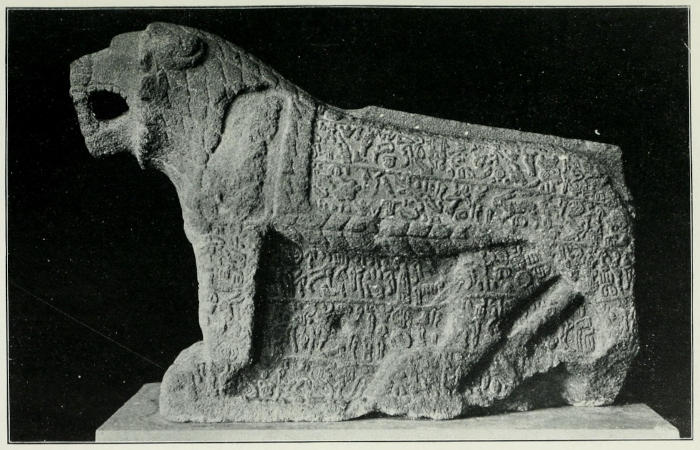
MARASH: ARCHITECTURAL LION CORNER-STONE INSCRIBED WITH HITTITE HIEROGLYPHS IN RELIEF
The stone sculptured with the representation of a Ceremonial Feast is reported to have been found, together with ‘lance heads and potsherds,’ in a vineyard of Marash.[234] This is another of that class of monument of which we noted the wide distribution and varying features in connection with that found at Kara-burshlu. In this case both figures are seated. They are presumably but not necessarily female. They are clad in long robes; details of the bust are not visible, and it is only the relative smallness of the feet and hands, and certain fulness in the treatment of the bodies, that offer a suggestion of their sex. They are seated on high square chairs with backs that curl away at the top, and their feet rest upon low square footstools. A table between them has straight legs, of which only two are shown, ornamented in some way at the feet. On the table are three round bread-cakes and a cup. The figures are vis-à-vis: each one stretches out the further hand, the left one holding a cup, the other a round mirror of familiar Egyptian shape. Their other hands are drawn back and only just protrude from their cloaks; each seems to hold the same sort of object, ‘perhaps a vase or pomegranate.’[235] The garment is curious, being continuous over the head-dress, and descending to the ankles, with a fringe or border all along the edge and round the bottom. There is a waistband to each figure, which is seemingly composed of separate strands, but it is difficult to understand its attachment.[236] The head-dress is singular, being cylindrical in shape, recalling most nearly that of the Turkoman women.[237] The faces of the persons are ill-drawn and unnatural, but prominence is given to the straightness of nose in line with the receding forehead[238] and to the fulness of the lips. Above and between the heads there are traces of a considerable inscription in relief, of which the signs towards the sides can be made out with some certainty; but the middle portion is too worn to enable one to study the sequence of the characters, or even to decide whether they form two groups, one referring to each person. The whereabouts of this stone is uncertain, but casts are in the Berlin Museum. Its height is 49 inches and width 35 inches; it is just over 15 inches thick. The material is basaltic stone or dolerite.
The portion of a statue from Marash[239] is of importance as numbering, together with a large hand from the same place and the broken figure from Kurts-oghlu, among the very few recorded Hittite sculptures in the round. Unfortunately this one is too broken and too small to tell us much in detail of this feature of Hittite art. With the exception of the right shoulder, however, the whole body is preserved, and only the head and feet are lacking; but the style of the object is formal, and in place of artistic detail there are merely four or five irregular bands of inscription in relief, with other signs upon the preserved shoulder. The right hand remains, but it is worn and lacks detail; in the left there seems to be held a sort of loop with pendent tassel. The material of the statuette is basalt. The height preserved is under 9 inches, its width 6 inches. This torso seems to have belonged to a figure quite distinct from another of similar material which seems to have come from the same vicinity.[240] Of this only two broad bands of the inscription remain, but they seem to mark the beginning of a long inscription; the symbols are boldly cut in relief, and are similar in every way to those of Jerabis. The fragment is rounded and apparently formed part of a hollow figure: it was copied by the discoverers amid much difficulty and subsequently disappeared. The existence of a third statue at Marash, but in this case of gigantic size, is indicated by a large hand, fully twice life-size, and carved in the round.[241] It is, of course, impossible to say from this fragment whether it is really of Hittite origin.
Another important monument of Marash has the appearance of a royal stela with a long inscription accompanied by an image of the king. This belongs to a class of monument of which we shall find further examples at Carchemish and in the neighbourhood of Tyana. In this case the figure occupies the central part of the stone, reaching almost to its full length; and the inscription is incised in six rows across the whole, the face and feet and forearms of the man alone excepted. The face of the kingly personage is turned to his right, and the whole figure is in profile with the exception of the shoulders, which are square to the observer—in conformity with the common Oriental principles of drawing. The right hand holds a staff which touches the ground in front of the right foot, and rises vertically as high as the shoulders; both elbows are bent at right angles, the left fist being closed and shown about the middle of the body. The robe is a single garment reaching to the ankles, the bottom being fringed or bordered. The toes of the boots are upturned, and, being represented clumsily, look like sabots. The face of the man is too worn to show much character; there is a long curled beard, a band around the forehead, and the hair or wig ends in a prominent curled bunch behind the neck. This stone seems to have been found outside Marash in a burying-place on the road to Adana.[242] Its height is nearly 3 feet 8 inches, and its breadth just over 1 foot 10 inches.[243]
This monument must yield place to another, which is of unique character and interest, more recently discovered[244] on the citadel. This is a block of granite more nearly cubical in shape, but with the top and bottom broken away, so that its original height remains problematical. The preserved portion measures about 2 feet 3 inches in height, and the combined length of three sides, which are approximately equal, is about 5 feet 2 inches. On three sides the inscription is continuous; the hieroglyphs are in relief and are arranged in five bands, of which four are seemingly complete. A sixth band at the bottom is partly traceable, and there may have been others below; at the top, however, the limit is clearly marked, so that the beginning of the inscription is preserved. The opening groups of signs resemble closely those on the lion previously described, though variations of single signs are noticeable, and may possibly supply philologists with alternative readings. It is not, however, the inscription, though unusually legible and complete, that attracts our interest, so much as the sculptures and composition of the whole. The inscription is preceded by a king-like figure in relief, who occupies the right-hand portion of the side on which he is carved and faces away from the inscription, to the right, looking that is to the corner. The inscription follows: the height of the figure is equal to four bands of the hieroglyphs, and the lower bands project under his feet. The second side is entirely filled with the continuation of the inscription, which comes to an end at the left hand of the third side (which is opposite the figure) with the upper part of the picture of a dagger and part of an attachment for it. On the fourth side there is no inscription; the corners are cut away, but there is seen in the middle a sort of tassel, on a large scale accordant with that of the dagger-hilt. It must be noted that the king is turned towards this object in the extended drawing: he is portrayed much as on the stela described above, but the drawing is not good or well preserved. He wears a long robe bound around the waist; the short sleeves are ornamented at the ends, whether with a plain band or otherwise; and the bottom of the plain skirt, which reaches to the ankles, is also fringed or bordered in some way. The toes are shown upturned. The head-dress seems to be a close-fitting skull-cap, behind which the hair descends in the familiar bunching curl. The beard hangs in curls. The face is crudely represented, the mouth being no longer distinguishable. The left hand, which is very disproportioned, is held up before the face with fingers towards the mouth, in the position which in the hieroglyphs is read to indicate the beginning of a personal declaration. The right hand is drawn up breast high, but no staff is shown, possibly because it would have traversed the body.
This stone is thought by Dr. Messerschmidt, who has studied it closely,[245] to have been re-dressed and re-used in Hittite times; he thinks that a large god-figure, wearing a dagger suspended from the shoulder, must have been originally the chief subject of the sculpture; and that this was partly effaced in Hittite times by the king, who had the stone re-dressed and his own figure carved thereon. The inscription he regards as pertaining to the larger figure; and he looks upon the mutilation of the figure of a god as the sign of a period of decline and degradation.
This monument is unique in character, and every respect must be paid to the conclusions of one who, being familiar with Hittite works, has studied this one carefully. Having only the photograph and drawings which he published as guide, we naturally hesitate to put forward any alternative view; yet it must be said that there are several fundamental objections to the explanation which has been offered. The most obvious and irremovable is that there is direct evidence on the face of the stone that the carving is all contemporary; for it is all in relief, and in accordance with precedent the background not sculptured must have been cut away, so that it would have been impossible subsequently to carve thereon a figure with the same relief as the rest. Added to this, it is clear that the inscription is arranged with due regard to the small figure, not the reverse. Also the ends of the inscribed bands are coterminous with the dagger, stamping the whole composition as contemporary. It must next be noted that no trace of a great figure is to be seen, nor can its form be conjectured, seeing that the dagger hangs on one side and the tassel on the next, unless indeed the stone formed the lower portion of a somewhat angular statue,[246] about four times its present height. A figure in relief would have occupied part of two sides of the stone including the corner—an unprecedented complication in Hittite sculpture. The analogy quoted by Dr. Messerschmidt of the god-figure discovered in the last excavations at Sinjerli breaks down at this point. That object was carved in the round, representing a deity standing in Hittite fashion upon a base composed of two standing lions, as on the monuments of Carchemish and Boghaz-Keui. He wears a dagger stuck into a belt, and with the trappings there is a large tassel of the kind seen on the fourth side in this instance. From these details Dr. Messerschmidt thinks that the Marash monument only differed in that the dagger must have been worn suspended from the shoulder, on account of the pendent position of the belt. On all analogy, however, the priest-king in this case must be facing the deity he is worshipping. If then no other form of deity can be suggested, we must take the only evidence before us as to its nature, which would lead us to infer that it is here represented by the dagger and tassel. We venture no hypothesis in explanation; the Sacred Dirk[247] as a cult object is known in Hittite symbolism and familiar in the hieroglyphs; and it would be equally accordant with precedent to imagine that the dirk was really emblematic of the deity with whom it was usually associated. Alternatively the object of worship may have been a great divine statue upon the skirt of which these representations were carved.
Among the minor inscribed objects from Marash there should be mentioned one, which is a fragment of basalt 10½ inches high and 8 inches wide, inscribed with characters in high relief on two adjacent sides.[248] There are also several uninscribed sculptures from Marash of peculiar interest. The first is a slab of basalt 21 inches high, carved in relief.[249] The subject is that of a female seated at a table facing to the left; on her left knee[250] is a child, whose face is towards the mother. In the right hand of the woman is a decorated mirror, or something of that form; and in her left, which is extended over the table, she holds a primitive five-stringed lyre, square in shape.[251] Over the lyre is a bird often taken for a dove, but more nearly resembling a vulture.[252] The counterpart to the figure, if such existed, is broken away; the carving is crude and the surface worn. Such details as are distinguishable, the robe, the hat, the chair and table, seem to be similar respectively to those upon the sculpture of the Ceremonial Feast from this place previously described. There is a second uninscribed stone on which appears the emblem of a bird similar to the other in outline and appearance.[253] In this case the subject shows two figures, one on either side of a small two-legged table. That on the right, which is seated, wears the same cylindrical hat as in the cases just described. That on the left, which is standing, is clad in a long robe, which, from such details as are visible, suggests the toga-like garment which distinguishes the priestly class on certain monuments of Asia Minor. The further hand of each is outstretched as usual, the one holding a mirror and the other the bird; the latter feature, however, is not carved with the same detail as in the case just quoted. Over the right shoulder of the standing figure there seems to hang a bow of the peculiar triangular form often depicted in ancient drawing.[254] The cord, however, is not seen; and the stone is in general worn so smooth that little detail can be discerned. The bow reappears on a third uninscribed fragment, which probably resembled the former in subject somewhat closely. On this a figure is shown standing before a two-legged table, over which he holds aloft a curving bow with his extended left hand. In his right hand, which is kept low, there may be seen two arrows, while a quiver hangs at his waist. This stone is also very smooth-worn, but some details of dress may still be recognised, notably the skull-cap long robe with fringe, and turned-up shoes. The Hittite character of the theme is sustained by the arrangement of the hair, which falls away in a single thick cluster or curl behind the neck. A tassel is attached to the waistbelt.[255]
A fourth stone of somewhat larger size, being 35 inches high, is decorated with a subject of unusual character, but unfortunately the most important figure of the scene is largely broken away.[256] This must have been a picture of a god, represented in long fringed robe, and sandals with upturned toes. Poised aloft in front of him, but how supported is not seen, there is the end of an implement or weapon, the attachment to which forms a loop, and then hangs down. A low table, with two curving legs, is placed opposite the middle height of this figure; upon it is a bird, seemingly a goose, with bread-cakes and other eatables. On the opposite side, and facing the major being, a small male figure stands at the same level as the table. He is clad in a short fringed tunic, with oblique fold, and a vest with short sleeves. On his feet are sandals, with the points very prominently returned, and above these are anklets, unless these be long laces wrapped around the ankles to bind the sandals. His hair is curly on the head and bound by a fillet, while lower down it hangs more straightly as far as the shoulders. An earring is suggested, and thick bracelets are clearly shown. He holds an object in his left hand which may be taken for a palm leaf, while with the right he partly proffers towards the greater person a small cup which seems to be bound around with two small bands, as though made of wood. Below, in such space as remains available, the sculptor has added a horse led by a man. Both are on a small scale, but disproportionate, as the man stands higher than the horse’s head; this arises from the fact that a greater height is available under the feet of the small figure than under the greater one, where the horse’s body is seen. The animal is a stallion, represented with a vague suggestion of spirited movement in the forelegs; and his shoulder-muscles are shown in the same conventional outline as is seen sometimes on the representations of lions in this style of art.[257] The man holds the bridle with his right hand; and, with his back to the horse, and indeed to the greater figure, he holds a spear upright with his left hand, the end of the shaft resting on the ground. He seems to wear a skull-cap, and his hair falls behind in the characteristic bunch or knot. In this case, as in nearly all the figures considered, the outline of the face shows the nose and forehead as practically continuous.
There are two further sculptured fragments of stones from Marash worthy also of special mention. On the one there is preserved the front part of a chariot and the hind part of a horse;[258] the carving is rough, and the drawing neither clear nor good. A small animal under the horse may be a dog. The wheel of the chariot seems to have had eight spokes. The driver is hardly seen, except for the forearm and the hand that grasps the reins. We may conclude none the less that the fragment formed part of a scene of the royal hunt.[259]
The other fragment is better known, showing the head of a musician playing the double pipes.[260] From the treatment of the hair and general character of the carving of this piece we suspect that it is of post-Hittite art, corresponding to the Aramaic period at Sinjerli. There is also in the Berlin Museum a new piece in Hittite style which may very well come from the same place. It is about two feet high, and rather wider. The sculpture is fragmentary, but of striking interest, for the central figure, a man, seems to be riding on horseback. He grasps the bridle with his left hand, and holds a curving nameless object in the right. His legs and the body of the horse are not visible. In the background to the left there is the smaller figure of a female seated on a chair. She holds a pomegranate in her right hand, and raises a drinking-cup with the left. To the right of the man’s head a tiny figure seems to represent the whisk-bearer, turning towards his lord, and waving a palm leaf.
This brings to an end the list of major monuments from Marash. When it is considered that the site has never been excavated for its antiquities, and that these discoveries are mostly accidental, it must be admitted that there is evidence here of a Hittite city of exceptional importance. The date to which it can be assigned as a seat of power will be considered when all the data for comparison are before us.[261]
PLATE XLIII
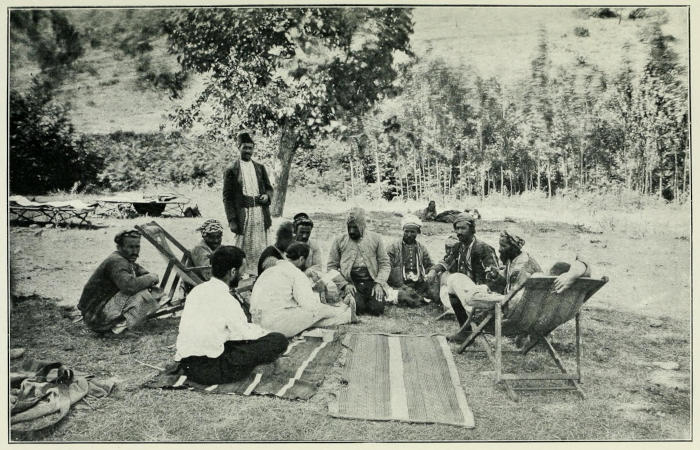
ROWANDUZ, ON THE AFRÎN: DISCUSSION OF ROUTES, AN INCIDENT OF TRAVEL IN THE QURT DAGH MOUNTAINS
Note the varied facial types of the natives. (See pp. 9, 33, 106.)
We now pass to a third group of Syrian monuments: those which are found at places on the Euphrates, which we accept as the eastern frontier. We begin naturally with Jerablus, the site of Carchemish, as being the nearest, the furthest south and the most famous. Here was the strategic frontier in the struggle of the oriental nations, and here a Hittite fortress was so strongly placed that it defied the assaults of the Pharaohs, and resisted with a great measure of success the efforts of the Assyrians to reduce it several centuries after the Hittite power had passed its zenith.[262] Some amount of excavation has been made upon the site, and though not thorough and inadequately reported, we gain thereby an indication of a walled city upon the river’s brink, protected on the land side by ditches in addition to the ramparts,[263] and enclosing as usual a high knoll which marks at once the acropolis and the site of the original settlement in a remoter age. Here there have been found several lengthy inscriptions in Hittite characters, numerous fragments of the same kind, two stelæ and the upper portion of a third, as well as a stone sculptured upon its flat side with the full-face portrait of an exalted being. In some of the sculptures the motive, and in others the details, of treatment tell of the proximity to a dominant extraneous artistic influence. This is particularly to be noticed in the emblems of winged deities, and in some of the monuments on which no Hittite hieroglyphs are found. One of the latter category is a striking monument representing two figures standing upon the back of a crouching lion. The mane of the lion is represented, but no hair is shown underneath the belly. The attitude of the beast is uncommon in Hittite art, as may be seen by comparing the lions of Sinjerli, Sakje-Geuzi, Marash, Derendeh, and elsewhere. The animals carved on the rock walls of the sanctuary of Iasily Kaya, which also support exalted persons, are represented as standing; whereas in this case the chin, belly, and tail of the animal almost touch the ground. The nearest analogy is perhaps one of the less known sculptures of Eyuk,[264] but there is no real parallel for this treatment of the subject. Of the personages, one is winged and clearly divine, while the other, though dressed in the same way, stands behind over the quarters of the animal, with one hand raised in an attitude of reverence or supplication. Otherwise the figures are of equal height, and their costumes also are alike. The head-dress[265] is a conical hat with prominent upturning brim; the toes of the shoes are likewise turned up in an exaggerated manner. The robe in each case is long, with a broad fringe around the bottom; around the waist there is a belt or girdle, and a fold of the skirt falls sideways from the middle towards the right. The wings of the leading figure rise sharply upwards from behind the shoulders, as on one of the deities of Iasily Kaya. He stands upon the shoulders of the beast, whose head cowers in abjection. In the photograph before us there is a suggestion of hieroglyphs upon the face of the stone, a feature which is not, however, confirmed by the observations of others. We thus have in this sculpture a recognisable mingling of the Hittite and Assyrian motives; and the sculptor’s art, at any rate, has not suffered in the combination. Both in treatment and in drawing this monument, though weathered and exposed, reveals an evidence of artistic skill which in some of the purely Hittite monuments elsewhere is not even suggested.
Turning now to the monuments of Jerablus that bear Hittite inscriptions upon them, another deity is found on a fragment of basalt, 31 inches high, upon which the lower part of the body and the ends of four bands of hieroglyphs are preserved.[266] In this case the wings are depressed, folding by the sides, and reaching to the knees, otherwise they would hardly be visible on the broken stone. The feet of the figure and the left hand are missing; in the right hand, which is in front of the body, is a small seed-basket—a symbolism derived from the other side of the Euphrates.[267] The long robe of this deity is similarly strange to early Hittite art, being bordered with a long fringe, and divided by several parallel bands of embroidery.[268] This seems to be an outer cloak, for one may see on the original traces of the familiar short tunic. The carving of this monument is unsurpassed on any inscribed Hittite relief. The delicate indications of the knee muscles may be noted as an illustration, especially when the gritty nature of the stone is taken into consideration. In making this comparison it should be borne in mind that most of the known Hittite reliefs are worn through exposure to the weather; and that objects unearthed for the first time, as at Sakje-Geuzi, give a different impression as regards the sculptor’s craft. Another noteworthy instance is at Iasily Kaya, where a row of figures which had been partly covered, at least for long centuries, has been cleared during the last few decades, giving evidence of a detailed treatment of the whole series which would not have otherwise been suggested.
Another sculptured object belongs to the category of stelæ, resembling in general that of Marash. It is partly chipped away, but sufficient remains for us to make out its original character and dimensions.[269] It is 47 inches high and 26 inches wide. It is crossed horizontally with eight bands of hieroglyphic inscriptions in relief, with raised lines between them, except where the outline of the central figure intervenes. This represents a man, in higher relief than the rest of the carving,[270] who stands in the middle portion of the stone, his feet descending below the inscription, and his head just entering the topmost band. The figure is nearly all chipped away, but the outline remains by that very process well defined. The person, undoubtedly a king, faces to his left, and in his extended left arm he holds aloft a short staff or rod which is marked as though divided down the middle. His right arm is not seen. His robe was crossed obliquely by folds, and it descended to the ankles. His feet were shod, and the toes of the shoes turned sharply upwards. His hair seems to have been dressed[271] in a single bunched curl behind the neck, but the point is obscure. The upper portion of a second similar monument is on record,[272] but the object is destroyed. It shows a central figure turned likewise to the left; with the left hand up, and forward, and the right hand before the chest. The head-dress seems to be a skull-cap, with band across the forehead. The sleeves of the dress are short; and around the waist there is another instance of the broad girdle of cords, ending, it would seem, in a curling knot or loop.[273] There are four rows of hieroglyphs, of which we have only an imperfect copy. A fragment of a third monument of like kind is preserved,[274] but it is uninstructive.
There are two notable inscriptions from Jerablus among many which are fragmentary. The one is a corner-stone of special shape,[275] being recessed in the very angle for eight inches on each side. The raised inscription upon it, however, seems to be continuous even through the recessed angle to the broken end of the block. The stone is basalt, and the whole measures 39½ inches in height. The widths of the various stages, beginning from the right side, which is unbroken, are 7 inches, 8½ inches, 8¾ inches, and 22 inches to the fractured edge. In further explanation of the form of the stone, it may be said that the first and third of these measures are in the same parallel direction, and combine to give that side of the whole stone a width of 15¾ inches. Similarly the next side was at least 30½ inches wide. The inscription is in relief, and is arranged in five bands, divided by lines of equal projection. The signs are clear, and the tenor of the inscription, according to Professor Sayce’s reading, is religious and monumental, giving the king-priest’s account of his setting up a bull shrine on a high place at Carchemish. Another considerable inscription is found on a portion of a round column, 5 feet 6 inches high.[276] Four bands of the inscription are perfect so far as they continue, namely, for 41 inches, but the beginning and ending of the lines are not preserved. There is another band partly visible above. The back of this object has been dressed, subsequently to the breaking of the stone, for the purpose of carving thereon a figure seemingly divine and in full face. It is not in Hittite style, but Hittite influence may be found surviving in certain features.
We cannot dwell longer with profit upon the details of these broken remains, nor of the numerous inscribed fragments, of which copies of nearly twenty are before us. But if we may cull from a somewhat unusual source, namely the columns of a daily newspaper, an account of excavations made for the British Museum on the site, it would seem that the foundations of at least one palatial building were come upon. ‘Facing the entrance,’ we are told, ‘there were found two imperfect tablets, which formed part of an adoration scene. On the one was the image of a goddess, the Hittite Kybele, naked, winged, and with hands offering her breasts.’ Her hair descends in a double plait on each side, curling away at the bottom around the shoulders.[277] The hat is of conical shape, the brim upturned, and bulging at the top. The priestess represented on the adjoining slab was thought by those who saw the sculptures to have been clad in a cloak, but the stone was broken away above the knees of the figure. A little further along were three figures in procession. This stone was likewise broken about the middle of the figures;[278] but the central figure may be seen to have been clad in a long fringed cloak, with a long under garment which is belted, while the outer figures have only the short tunic familiar in Hittite sculptures. Only the outer figures wear the turned-up shoe, an interesting distinction if correctly represented. M. Perrot sees in the sculptures a priest between two warriors. The border to the stone is the pattern of continuous concentric circles such as we have seen at Sakje-Geuzi on sculptures of late Hittite art.
A short distance up the Euphrates from Jerablus is Birejik, which has now supplanted the former as the place for the passage of the river. From here there comes a curious monument of indefinite origin, now in the British Museum under the title ‘Monolith of a King.’ As there is no clear evidence upon it or in the circumstances of its discovery that it is of Hittite handiwork, we do not dwell upon it. It has, however, several suggestive features, not the least interesting of which is the winged disk with horse-shoe ornament above the figure, as in the emblems which designate the priest-king at Boghaz-Keui.[279] At Tell-Ahmar, where there is another crossing of the Euphrates about the same distance southward from Jerablus, Mr. Hogarth has recently made discoveries which contribute important evidences to our subject. Awaiting a full description of these newly-found monuments,[280] we may take note that the site of the finds was on the eastern bank of the river, revealing the Hittites of that day as masters of this crossing; and that among the objects discovered, here or in the neighbourhood, are a lion of somewhat Hittite character, inscribed in cuneiform but not in hieroglyphs, and a stela or sculptured monument of sorts, with eight lines of inscription in relief around three sides, and on the fourth side the lower part of a male figure standing upon a bull. Further up the river, above Birejik, is Rum-Kale, whence comes another fragment equally doubtful and even more curious. It is certainly one of the worst serious efforts to draw a human figure that sculptor or mason ever worked upon. M. Perrot[281] apparently includes this in his list of Hittite works, though he describes it as ‘uncouth.’ There is in this case no indication of Hittite or of any other style, so that nothing can be gained by considering it further.
When we reach Samsat, however, a definitely Hittite monument presents itself.[282] This is an object which in form recalls the funerary stela of Kara-burshlu; but as in this case a pedestal of diminishing thickness is preserved, and the inscription is likewise found upon the two sides of the stone, there is further evidence in favour of its having stood alone. The subject of the sculpture carved upon the face is quite different, however, being only a single figure. So far as this can be seen (for a deep groove has been cut at some time down the length of the stone through the middle of the body), it seems to be that of a man turned to his right. He is clad in a long robe fringed at the bottom, and wearing shoes with the toes turned extravagantly upwards. He seems to be holding (with the right hand possibly) a staff, and more doubtfully a reversed lituus with the left, after the manner of the priests of Boghaz-Keui and Eyuk. The inscription is incised, but it is hardly sufficiently well preserved to be copied with any certitude. Nine rows of hieroglyphs are traceable at the one side and six upon the other, but nearly half of the stone is missing. It was found in the open, partly buried, between the town and the hill of the acropolis. Its height is just over five feet, without including the pedestal, so that the figure which stands clear of the bottom was about life size. The face of the stone is 25 inches wide, and the depth of the inscribed sides seventeen inches.
At Gerger Kalesi, almost at the main turn of the river, there is a monument on the rocks, about which further details would be full of interest. From the published drawings[283] it resembles the Hittite reliefs of Giaour-Kalesi and Kara-Bel in the west of the Hittite lands; and we await some further careful examination with expectation of finding Hittite hieroglyphs upon it. The figure is apparently gigantic, of three times human height. It is that of a warrior clad in short tunic (the details of which are doubtful). He wears a collar of some kind and a conical hat. There is a bow over the left shoulder; the right hand is down and forward. It simulates a Hittite monument very closely, and its presence on the brink of the Eastern frontier of that people is the more full of interest.
Section B.—Monuments in the Taurus and Anti-Taurus.
MALATIA, DERENDEH, PALANGA, GURUN; ARSLAN TASH, ALBISTAN; KURU-BEL; EKREK, TASHJI, FRAKTIN.
From the north of Syria we pass to the mountainous region of the Taurus and Anti-Taurus. Here is the centre, if not the focus, of the Hittite lands, and isolated monuments are found in considerable numbers and variety. When one takes into account the difficulty of exploration, it must be conceded to be a remarkable and suggestive fact that no fewer than eleven Hittite sites in the Taurus country are clearly indicated, as compared with the same number in the north of Syria, and about twenty scattered throughout the whole tableland and west of Asia Minor.
One of the most important of these sites is located at Old Malatia, which lies near the confluence of the Tochma Su with the Euphrates. Here there must have been a fortified city, comparable to Marash, for the defence of the frontier. Though no systematic excavation of the site has yet been made, yet the nature of the several sculptures found there speaks for itself. The mound which marks the old-time acropolis is probably that now called Arslan Tepe, near the village of Ordasu, about two or three miles north-eastward from the modern town: the attention of scholars was called to this spot by the visit of Mr. Hogarth’s expedition in 1894. The explorer describes the mound[284] as about fifty feet in height, of irregular shape, longest from north to south, like the accumulation above a building, but without any visible masonry upon it. West of it rise two smaller mounds, and to the south one. The Euphrates is about two hours distant. The sculptured stones are seven in number, and they seem to form part of a series decorating a façade. Three of these are facing-slabs merely, while four others (found independently) are more solid, and may have been building-blocks. The most perfect slab[285] is just under four feet in length, with a height of two feet, and thickness one foot. Along the top is an incomplete row of hieroglyphs in relief,[286] reading from the left. Below is the main theme of decoration, representing a lion hunt, carved in strong relief. The picture is composed of a horse chariot with two riders, a dog below the horse, and a wounded lion in front. Several hieroglyphic signs are found above the horse’s back, and also between his head and that of the lion; but as these signs read now from right to left, it may be concluded that they continue the inscription above. The sculpture is formal and lacking in vitality, but several details may be noticed. The chariot is small. The charioteer and the warrior stand within, side by side; the latter occupies a front place in the picture, which is drawn in profile with the usual conventions. Both men are clad in short tunics with waist-belts, and both wear close-fitting skull-caps, and the hair of the warrior curls in characteristic fashion behind the neck. His weapons are the bow and the spear. The bow is short and curved, and the arrow is strongly barbed; two quivers are depicted cross-ways upon the side panel of the chariot. The spear is shown point upward, ready at hand in the back of the chariot. The driver holds two pairs of reins, from which it may be inferred that two horses are being driven, though being side by side the outline of only one is visible. The shoulder muscles of the horse are outlined conventionally, and it is noticeable that his mane is tightly bound and ends in a curl. The trappings are not distinguishable. The figure of the dog is seen between the horse’s front and back legs; it is crude and uninteresting. The pose of the lion is unconventional. He is represented as half rampant, turning round his head with open mouth towards his tormentors, and clawing the air with the pain of his wound. The shaft of an arrow is seen below the shoulder. The tail is short and thin, and curls upwards; that of the horse is long, and falls so as almost to touch the ground. The mane of the lion is represented fully by short curls; but the belly and shoulders are hairless.[287] The claws are exaggerated; the nose is out of drawing, and the execution of the sculpture in general is poor.