Part 3 — VI THE STORY OF THE HITTITES
Reading edition
In this concluding chapter we shall endeavour to relate the material evidences of Hittite handiwork to the story of their doings. The monuments have been described, their disposition noted, and in some cases the materials for dating them have been defined; but the outline of Hittite history as sketched in the second chapter remains to be filled in with such details as can be gleaned from the literary sources both old and new. The old sources are well known. They include the letters found at Tell el Amarna,[709] the decorative scenes and inscriptions on the walls of Egyptian temples,[710] and the archives of the Babylonian and Assyrian kings. In our use of these we must rely on the published translations and critical discussions of philologists,[711] which we can do with more reliance in that this branch of investigation is associated with such names as Maspero, Meyer, Müller, Sayce, Winckler, Hommel, Knudtzon, Reinach. The new sources are the archives of the Hatti kings, the first dynasty of the Hittites yet visible to history, discovered recently amid the ruins of their capital at Boghaz-Keui.[712] These documents are at the beginning contemporary with the Tell el Amarna letters, which they supplement and substantiate, and they range in date practically as far as the Egyptian references, by the side of which they provide a series of important synchronisms. These new archives have not yet been published in full, so that we do not reap the advantage of others’ criticisms in this case. But Dr. Winckler has given the world the first fruits of his labours,[713] which embody the materials for many long-lost pages of oriental history. These we have endeavoured to analyse, for they are difficult and obscurely put forward, and we shall express them in what appears to us to be their historical sequence and relationship.
As usual, however, in these investigations, the purely archæological evidences throw light on the settlement of the Hittites long before the earliest literary allusions. The mound of Sakje-Geuzi,[714] at the southern foot of Taurus, illustrates the development of local culture during a continuous occupation of the site throughout a period which is not overestimated as beginning before 3000 B.C. and lasting down to the time of Assyrian domination. We have already seen that the earliest settlers shared some features of their neolithic culture in common with Susa on the one hand and the Troad and even Crete on the other.[715] Was all western Asia and the Ægean infused with a common germ of civilisation in those days, or was this settlement in remote antiquity an incident in a migration from one point to the other? Unfortunately we have no collateral evidence as to the plateau of Asia Minor to help in answering these questions; yet if the Hittite culture had taken root in the north of Syria before the second millennium B.C., it may readily be believed that it had been planted equally long upon the tableland, where in historic times its chief power is found. The high standard of Hittite culture, as revealed by their own archives and monuments at the dawn of their history in the fourteenth century B.C., argues in itself a long period of settlement and development under civilised conditions; while a long contact with the culture of the Euphrates valley is indicated also by the fact that their earliest international correspondence was conducted in the Assyro-Babylonian language, while their scribes had sufficient intimacy with the cuneiform system of writing to be able to apply it to their own language, which was radically different. The great deities of the Hittite pantheon also have their prototypes in Babylonia.
Of what stock, then, were these early settlers, and whence did they come? Did they form part of a great migration from the East, like the Turks in modern history, according to an old school of thought? were they Semitic? or did they pass like the Phrygian conquerors, from Europe into Asia, absorbing and adopting Eastern thought and habits, a veritable mirage orientale? That the Hittites were not autochthonous, if such a term has any meaning, is apparent already, and will become more clear as we proceed, from the complexity of their pantheon and the mingled elements of their peoples. We must from the outset beware also of the pitfall of inconsistent terminology. The name Hittite is commonly employed in three senses which we must distinguish: it may be used in reference to the whole confederacy of peoples as depicted in the Egyptian scenes, or to the smaller and more homogeneous band of Hittite tribes, or to the dominant tribe of Hatti within the Halys, which seems to have given its name in antiquity to the whole. The Egyptian artists indeed recognised the mixed character of the confederates in their day, and noted some of their peculiarities, but did not distinguish between them with sufficient clearness or consistency for our purpose. Two types which we reproduce[716] will serve to illustrate the wide difference of racial character among the Hittite allies obvious to the Egyptians in the time of Rameses the Great. The one is Mongoloid, characterised by a definite pigtail,[717] oblique eyes, high cheek-bones; in short, a recognisable Tartar type. We are inclined to place it in the vicinity of Carchemish, if not beyond the Euphrates, upon the main trade route with the East. The other is a clean-cut proto-Greek type, with a special form of shield, which we are tempted to assign to Lydia or some part of western Asia Minor. The Amorites, an Aramæan (Semitic) people, are also conspicuous among the allies of these times, being distinguished by a projecting beard, receding forehead, and other features.[718] These vast differences among the peoples united under the Hatti leadership in the thirteenth century B.C. are now explained historically, as will become evident later in this chapter. They reveal to us a population of the Hittite lands no less mixed than that of Turkey in Asia to-day. They do not, however, throw any light upon the question of the original race of the Hittite tribes. These are commonly identified with another type with a long head, long nose, and receding forehead, deep-set eyes somewhat obliquely placed, and yellow, wrinkled skin. A sharp, firm line runs down from beside the nostril on either side of the lips.[719] On the walls of the Ramesseum, where it is best seen, this type is associated with Aleppo, and we must recognise in it an element of the Hittite peoples; but on comparing it with the Hittite sculptures of Sinjerli, Boghaz-Keui, and elsewhere, we must regard it as still hypothetical whether even the central Hittite states were strictly homogeneous in race. The Hatti themselves, indeed, we look on as a dominant conquering element, differing again, maybe, considerably from other Hittite peoples[720] in a manner best explained by considering the dominance of the Seljûks or the Osmanlis in later times, or most analogous perhaps to the position of the Phrygian rulers in antiquity amongst other peoples of kindred race who had preceded them.
PLATE LXXXIII
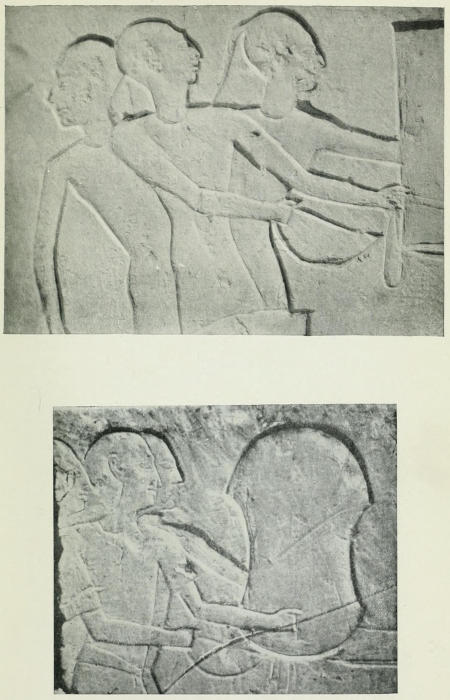
TYPES OF HITTITE ALLIES.
i. Mongoloid.
ii. Proto-Greek.
Temple of Rameses II. at Abydos.
Though we fail to identify the Hittite race,[721] there is some general indication of the direction whence they came. We have dismissed the direct evidence of the pigtailed element amongst the Hittite peoples, in spite of the temptation of the pigtails on the sculptures of Boghaz-Keui,[722] and the description of a pigtailed leader as a royal Hittite, lest we should push the argument there—from further than might be warranted. We may regard these facts, however, as a general indication of relationship with the East. The contact with Babylonia has been already argued, and we must recall the singular relations between the painted pottery of Sakje-Geuzi with that of Turkestan, extending over a long range of post-neolithic culture.[723] Another link, not previously mentioned, is the early employment by the Hittites of the horse, dating from at least the beginning of the second millennium B.C.,[724] and the antiquity of the remains of horses found equally in the mounds of Turkestan.[725] Another item of evidence on this question may be found in the footgear of the Hittites, which, except in the later sculptures of North Syria, is always represented, as we have seen, as a shoe or boot with upturned toe.[726] This feature is now specially characteristic of the Tartar peoples, and hence another eastward connection is suggested. But it is not so exclusively; the Arabs (who borrowed it in the Middle Ages from the Turks) employ it in the desert sands, and in the more special form in question it may be found in many mountain countries, for example Greece, and it has long been used in Crete. It is commonly supposed to be the natural form of snow-shoe for highland regions, though the shepherds of the Pyrenees, who also use it, believe it to be specially adapted to walking upon broken and stony ground. However that may be, most scholars are agreed that it argues a mountain origin for its Hittite wearers,[727] and this suggestion is borne out by the mountain cults found in the Hittite pantheon.[728] The mountains by which the Hittites reached the plateau of Asia Minor are not far to seek; they lie eastward, in Armenia, the Caucasus, and the Taurus.
PLATE LXXXIV
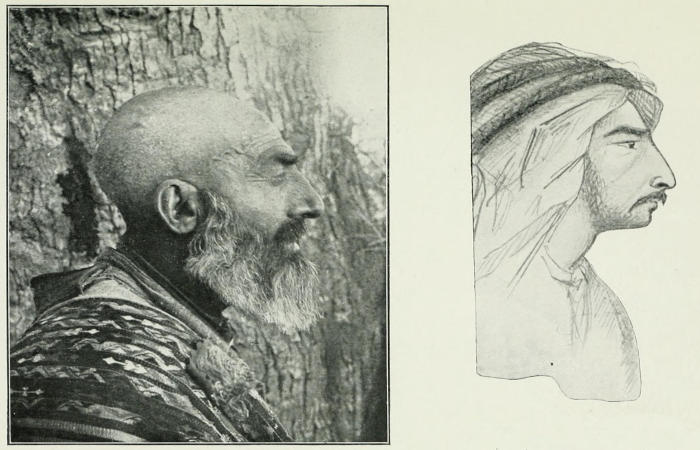
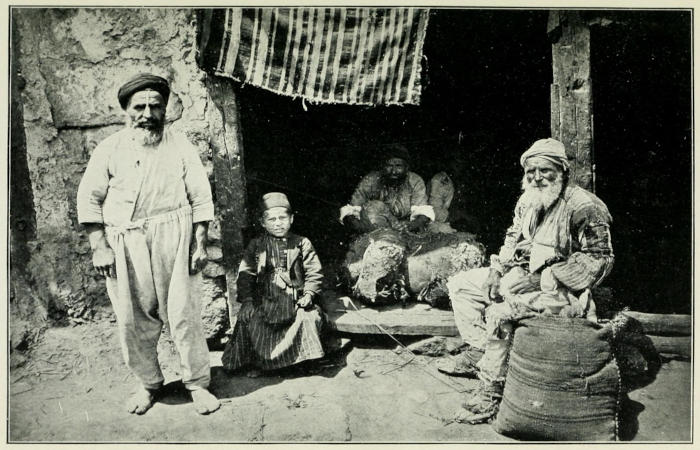
1. A LIVING AMORITE. (See pp. 12, 318.) 2. SURVIVING HITTITE TYPE.
From a sketch by Mr. Horst Schliephack. (See p. 16, note 2, and cf. p. 48.)
We do not press the argument of these suggestions, but only regret the paucity of evidence available. For the present we must be content that we have been able to find some evidence as to the antiquity of the Hittite settlement. We cannot suppose that the mounds of Sakje-Geuzi stand alone: indeed a myriad others, that remain unexamined,[729] are evidence to the contrary, and considerable inference may be made with these as basis from the disposition of the Hittite tribes as revealed by the first light of history. One powerful branch must have early seized the position of Carchemish, while others settled in the plains that lie westward of the Euphrates. Others again found their homes in the valleys of the Kara Su and the Orontes, while some branches passed the Lebanon and mingled with the aboriginal people of southern Syria, where they were gradually submerged. If we are right in our argument, the habitable valleys of the Taurus and anti-Taurus regions must have been earlier peopled; and to judge from the relationship we have indicated, the western extension of these tribes in Asia Minor must have been considerable even as early as neolithic times. Whether the Hatti rulers themselves were part of a later immigration is still open to consideration; upon that point we await further evidence. The Hittites would seem to have brought with them (sooner or later) a new cycle of deities, with Babylonian prototypes, including their national Sandes or Sandan, lord of heaven, a god of the skies with lightning in his hand, in one of his various forms; and they seem to have absorbed into their pantheon a number of acceptable nature-cults, like the worship of mountains and streams and of the mother-goddess of earth, already practised by an earlier population whom they overlaid. The sun-god they seem to have received from contact with the Semite, and to have identified him with their own chief god. With regard to other aspects of their primitive culture, we can argue from the one site of Sakje-Geuzi alone, and from the reflected witness of later times. There is only one general assumption, therefore, that we make, that once settled in a metal-producing country, in contact with the rich mines of the Caucasus,[730] and the copper sources in Cyprus and the Taurus, their civilisation would share to the full in the stimulus of the copper and bronze ages as these arose. It is at the latter stage that they emerge into the full light of history[731] in the fourteenth century B.C.
PLATE LXXXV
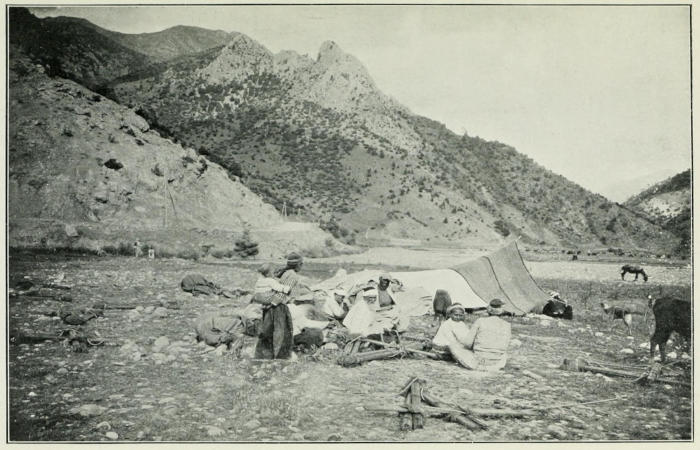
THE WESTWARD DRIFT: NOMADS PASSING INTO ASIA MINOR THROUGH THE CILICIAN GATES.
The earliest allusions to the Hittites, however, in oriental records take us back to the period of the great movements in western Asia some five or six centuries before. These references are naturally scanty, but they occur in the records of three different peoples, and are in a sense parallel to one another, so that the main facts bear the stamp of historical accuracy. From the Babylonian archives it appears that about 1800 B.C., or before, the Hittites were chiefly responsible for the overthrow of the first dynasty that ruled at Babylon;[732] while of even earlier date in the same dynasty are references to the king of the Hittites and his doings, contained in the great Babylonian work on astrology,[733] and there is an allusion of possibly much older date.[734] The mention of the Hittites at the beginning of the second millennium is almost synchronous with the earliest dated reference from Egyptian sources, in an inscription of the twelfth dynasty,[735] from which it would appear that settlements of the Hittites had been established in southern Syria, and that these were among the objectives of a military expedition. The historical setting of this record is apparent, and it is confirmed and amplified by the references in Hebrew history, which claim our consideration no less than the inscriptions carved by loyal subjects of the Pharaoh. These passages show us that in local tradition of the time of the Patriarchs the Hittite settlements were no matter for special comment.[736] On the other hand, their name was practically synonymous with that of Canaanites,[737] and, like the Amorites, they were long looked upon as one of the settled peoples of the land.[738] For some centuries, however, we are without dated records, nor is there any direct evidence as to the history and doings of the Hittites until the eighteenth Egyptian dynasty. One thing, however, is clear, that the ‘Hyksos’ peoples who overran Egypt in the meanwhile were deeply imbued with the elements of a culture which, if not purely Hittite nor directly traceable to them at this date, was still largely shared by the Hittites in historic times.[739] The people that had overthrown the dynasty of Babylon was clearly an established power already organised.
Though the earliest kings[740] and dynasties of the Hittites remain unknown, the nature of the Hittite organisation in the thirteenth and fourteenth centuries B.C. is now made clear by the archives recently discovered at Boghaz-Keui. These cover the reigns of six generations of the Hatti dynasty of kings, making allusion in all to eight of their sovereigns. They include treaties with internal states in Syria and elsewhere, with Mitanni, with the Amorites, and with Egypt, most of them prefaced by historical notes of events leading up to the conclusion of the treaty in question. There is also correspondence of a diplomatic character with the courts of Thebes, of Babylonia and of Mitanni, and other documents of varied sorts. These are written in cuneiform, and the language employed in foreign affairs is the Assyro-Babylonian: only in some internal matters the Hittite language is used. Though the documents have not yet disclosed the full nature of their contents, the archives as a whole[741] have already thrown as much light upon the history of the Hittites at this period as did the Tell el Amarna tablets, with which they are in part contemporary, on the foreign affairs of Egypt during the eighteenth dynasty.
The story opens with a bid for empire under the Hatti leadership in the person of Subbi-luliuma.[742] This ruler (known in Egyptian records as Sapalulu) had inherited only the kingship of his city-state of Kû-sar [or Sû-sar], which was possibly at Boghaz-Keui itself, from his father, Hattusil I.; but so well were his plans laid, and so accomplished his military leadership, that before his death he had won for himself the title of Great King.[743] We cannot follow the story of his doings in Asia Minor, for unfortunately the names of the places mentioned in Hittite in this and the succeeding reign cannot yet be identified; but it will be clear from what follows that his western frontiers, if not already peopled by Hittite tribes and subject to his authority, must have claimed his first attention. In other directions his policy and movements are revealed more clearly. Among his own peoples he seems to have arranged a series of alliances; other lands which he overran he parcelled out among his followers, while to some non-Hittite tribes he granted terms of vassalage.
Though we have no clear allusion to the kingdoms in the Taurus regions at this time, we may infer that the two great Hittite states of Arzawa[744] and Khali-rabbat,[745] which lay on either side of his pathway, were already allied with him in one or other of these ways, before he descended to the north of Syria, and ventured to enter the political arena of western Asia, where the older powers were stationed to resist his oncoming. The whole of Syria as far northward as Aleppo had indeed for something like a century been within the sphere of influence of the Pharaohs. It is claimed for the Egyptian monarch Thothmes I. that before the close of the sixteenth century B.C. he had set up the boundary of his empire somewhere near Carchemish on the Euphrates, in the ‘land of Naharain.’ Three of his successors by occasional expeditions, beginning with that of Thothmes III. about 1469 B.C.,[746] had sought to retain this boundary, and had come into conflict with the Hittite tribes already settled in these regions. These seem to have submitted like other northern states, nominally at any rate, to the Egyptian supremacy, and to have regularly sent their tribute to the Pharaoh. But though Amenhetep III. inherited the full power and dominion of his predecessors, he seems to have found it necessary to send an expedition at the beginning of his reign to maintain his suzerainty.
These frontier states indeed occupied at this time a position of considerable difficulty, where all the diplomacy of their chieftains was required to maintain the security of their inheritance. The reins held by the Pharaoh on his distant throne at Thebes may, it is true, have been only lightly felt: an occasional present or diplomatic letter to the court would generally secure respite from that direction; but their anxieties were not thereby ended, for in the East a nearer power claimed their allegiance also, before the arrival of the Hatti leader added to their perplexities. This power was the kingdom of Mitanni, which was firmly established in northern Mesopotamia, from the Euphrates to the Tigris. Tushratta, who now occupied the throne, represented the fourth generation of his illustrious house,[747] the authority of which had been strengthened through the foresight of his predecessors by intermarriage with the royal family of Thebes. His father’s sister had been wife of Thothmes IV., and his own sister was married to the ruling Pharaoh. He clearly realised that the continued support of Egypt would be necessary to him if he was to save his kingdom from being crushed by the increasing pressure of Assyria on the one hand and of the Hittite on the other; so that with some alacrity on his part[748] his daughter was sent to Egypt to become the wife of the heir-apparent. Propped up in this manner, the Mitannians had not only established a formidable barrier at the Euphrates against Hittite expansion eastward, but had even extended their own influence westward of that landmark, so much so that some of the princes of northern Syria first encountered by the Hittites hardly knew to whom they owed their allegiance, and were conquered as vassals of Mitanni while professing in their letters to be loyal subjects of the Pharaoh.[749]
TABLE SHOWING CONTEMPORARY RULERS AND ROYAL ALLIANCES
Compiled from the Hittite Archives and the Tell el-Amarna Letters.
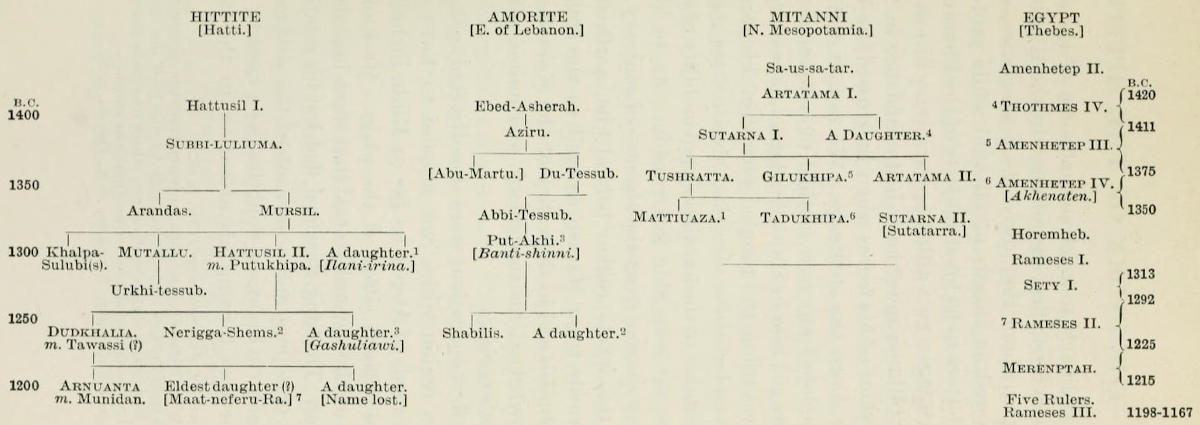
With these two allied powers arrayed against him, Subbi-luliuma must have had confidence in the unity and valour of his forces when he crossed the Taurus to throw down the challenge. We cannot tell whether he employed any new method or weapon of war that encouraged him in his aspirations. As seen by us now, in unravelling the tangled record of his rapid movements and effective victories,[750] his successes appear to be attributable to the hardihood and mobility of his troops and to his own able generalship. As to his forces, we may assume from the absence of contrary evidence, that the whole region behind him, northwards and westwards from Marash, as well as the states round Carchemish and in the valley of the Kara Su, already acknowledged his supremacy, and united with him in this enterprise.
His first operations were thus directed against Nukhasse, a region which we suppose to have extended northwards of Aleppo as far as Killiz, including some of the ancient cities of the plain. He took all the lands of the several states[751] that were included in this district. The king, Sarrupsi, fled, but his relatives were made prisoners, and a servant of the dethroned king was set up in his stead, doubtless as a vassal. The conqueror was turning his attention to the district of Abîna, being disposed to leave Kinza unmolested, when the king of the latter district, Sutatarra, and his son Aitakama, with their war chariots, bore down upon him and gave battle. Though he had been prepared to respect these adversaries, Subbi-luliuma was not slow to respond to and punish this provocation: the king and his son, together with many of the chiefs, were taken prisoners and sent in triumph to the capital. The fate of Sutatarra is unknown, but Aitakama reappeared later, reinstated in his kingdom, and a faithful ally of the Hittite, who entrusted him with the command of the Syrian armies.[752] The land of Kinza is unplaced, but it seems to have lain westward, possibly on the lower Orontes, corresponding with the district of Hamath or the kingdom of the Hattina in later times. It was probably peopled with a Hittite tribe, to judge from the nature of these chieftains’ names and the position subsequently accorded to Aitakama. Realising in these incidents the constant influence of Mitanni, and attributing them to the hostile attitude of Tushratta, Subbi-luliuma now deemed it desirable to establish his prestige, and so turned eastward, ready, if necessary, to join issue with Tushratta. In a single year he added to his territory the whole region of the plains lying between the mountains and the Euphrates.[753] In this campaign he seems to have overrun the Aramæan district of Am (or Amma), and with the aid of his allies to have captured several cities.[754] But the real objective of the Hittite leader was the destruction of the Mitannian supremacy and power. Therefore crossing the Euphrates[755] he ‘went forth against the might of the king Tushratta,’ and marched against the lands of Isuwa, which are supposed to have bordered on the Tigris, bringing its people into subjection, as it would appear his father had done in some previous campaign hitherto unrecorded.[756] This record is difficult to understand, but we are led to infer that Tushratta did not actually give battle to him on this expedition, and even when the conqueror made his way northwards into the mountainous region of Alshe, the Mitannian king still hesitated to join issue with him.[757] The newly acquired territory was handed over to a confederate, Antaraki, ‘as a present.’
The power of Tushratta would seem, indeed, to have been crushed by these irresistible exploits;[758] the kingdom fell into anarchy, and the king himself was shortly afterwards murdered, giving the Hittite a further occasion for interference in its affairs, an opportunity which we shall find he was not slow to seize. Meanwhile, however, disaffection had shown itself in the North of Syria, seemingly as a result of the overtures of Pharaoh’s emissaries.[759] ‘Wheeling about,’ the record says,[760] Subbi-luliuma recrossed the Euphrates and descended on Aleppo. His route lay probably from Malatia by way of Samsat or Marash, and the absence of comment at this stage confirms our impression that this region was already subject to him, though there is a suggestion that a generation previously it had been for a time in the hands of the Mitannians.[761] The subjection of Aleppo[762] and the neighbouring lands and cities of Nî and Katna[763] was swiftly effected, and at first these districts were placed under the rule of one Akia, king of Arakhti; but on the disaffection of this chief they were reduced to direct government by Hittite officials and became a province of the kingdom. A chieftain who remained loyal to Egypt made an effort about this time to recover the land of Am for the Pharaoh, but he was repulsed by Aitakama with the Hatti.[764] Aitakama thus reappears on the scene, and from the same record it is clear that he had been reinstated in his father’s kingdom. He now appears as the most influential agent of the Hittite king in the north of Syria, entrusted with the conduct of missions and command of troops, even while protesting to the Pharaoh[765] that he was maligned by those who accused him of infidelity. His attempts to seduce the frontier states from their old allegiance had been reported to the Pharaoh by Akizzi,[766] who wrote from Katna, apparently on the eve of the events we have just recorded, appealing at the same time in despair for help against the catastrophe that threatened. To Aitakama’s proposals Akizzi replied that though he should die he would not go over to the king of the Hatti. With him there remained faithful the kings of Nukhasse, of Nî, of Zinzar, and of Tunanat, all city-states near Aleppo, while with the Hittite there were leagued the kings of Rukhizi and Lapana, whose names were Arzawia and Teuwatti. We have seen that Akizzi’s appeal and his fidelity were alike in vain. The Pharaoh was powerless or unwilling to interpose; resistance unsupported was impossible; and Subbi-luliuma with his generals easily made good his victories. Akizzi himself seems to have escaped from Katna before that city fell,[767] but the king of Nî, by name Takua,[768] and his brother Aki-tessub were among the prisoners.
PLATE LXXXVI
CÆSAREA: TYPES OF SEMITIC SETTLERS. (See pp. 12, 23, 33.)
The triumph of the Hittite arms in these, and doubtless other minor expeditions, had now established the authority of the Hittite king throughout the region of northern Syria, and had extended his frontier until it bordered on that of the Amorites, hitherto professed allies of the Pharaoh. These early settlers have recently been recognised as of Aramaic (Semitic) stock; in records of Babylonia as old as the time of Hammurabi, from which this inference is made, they are described as living in the western deserts, and now appear to have pushed gradually northward, until they had occupied, like Bedouin, all the habitable fringe of the tongue of desert lying between Mesopotamia and the Lebanon. Their patriarch, Ebed-Asherah, now found himself in the same dilemma as Aitakama and other northern chieftains had before him, but the rapid advance of the Hittite power left him little time for hesitation.[769] He and his sons were the recognised leaders of the Amorite tribes in peace and policy and war. They had watched with anxiety the approach of the Hittite leader on Tunip from Nukhasse,[770] and the failure of the Pharaoh to send them support could not but have added to their concern. Quick by instinct to read the signs of the times, they covertly came to an understanding with the chief of Kadesh, a city already under the Hittite suzerainty, if not actually within the domain of Aitakama. At the same time Aziru, the most active of the sons of Ebed-Asherah, making pretence of still serving his old master, cast his eye upon the city of Sumur as his nearest prize. The change of attitude and subtle dealings of the Amorites did not escape the notice of the Pharaoh’s emissary, who reported Sumur to be in great danger though not yet fallen, and Ebed-Asherah’s sons as minions of the new northern power.[771] The Egyptian sovereign was grieved but inactive. In a letter addressed to the Amorite chief[772] he charged them with their duplicity, and ordered the appearance of Aziru as a hostage at his court. The latter, however, evaded the command. He would seem to have already brought about the downfall of Sumur and other cities, and felt some natural hesitation in accepting his sovereign’s invitation. He found also a pretext for postponing the rebuilding of Sumur as commanded,[773] and still protested his fidelity. In response, however, to a more peremptory summons, in spite of shifts and subterfuges, Aziru appeared ultimately at Thebes[774] for the judgment of his case. But the Amorites had influence at court, as appears from a letter of their patriarch to one of the officials asking for his son’s release.[775] Amon ‘passed sentence’ on Aziru and ‘granted him his life.’[776] The mercy extended to Aziru, however, was unavailing; and further allegiance to the Pharaoh could only have proved fatal to the best interests of his people. The Hittite cause was clearly triumphing, indeed the Egyptian made no apparent effort to resist his oncoming; in any case the Amorite hastened to take the winning side. Betaking himself to the Hittite, Aziru ‘cast himself under the feet of Subbi-luliuma,’ who ‘granted him grace.’[777] The price of the Amorite vassalage appears in another record as three hundred shekels of gold paid yearly.[778]
With the Amorites on his side it would appear that the Hittite leader might now have swept onwards to the frontiers of Egypt, but at this stage the southerly progress of the Hittite arms seems to have been stayed. Occupied probably with other campaigns of similar character for the expansion of his power in Asia Minor, Subbi-luliuma had been obliged to entrust the conduct of much of his Syrian wars to Aitagama, and possibly he found that the region of the Lebanon was a frontier already distant enough for effective control. However that may be, he found it desirable to come to terms with the Pharaoh, and concluded with him an alliance,[779] which brought their struggle for some time to an end.
Some of the events which we have described seem to have happened with a swiftness surprising even in oriental history, but the Great King probably foresaw that a sterner task lay before him in the consolidation of his empire. Here again fortune proved to be on his side, by removing the two chief sources of inquietude on his Asiatic frontiers. In Egypt, Amenhetep IV., who had succeeded to the throne about 1375 B.C., was too young or too busily occupied with home affairs to take any active interest in the possession of Syria, and was only too glad to renew the Hittite treaty in due course.[780] Babylonia, where the kings of Karduniash sat upon the throne, was too distant to give occasion for anxiety, and in addition the broad tract subject to the Amorite régime was wedged between their respective spheres of influence. In the East the tragic development of affairs among the Mitannians,[781] the murder of Tushratta, the flight of the heir-apparent from the usurper and patricide, Sutatarra, and the invasion of the land by the Assyrians and by the mountaineers of Alshe, were a series of events all favourable to the Hittite cause. The armies of Subbi-luliuma crossed the Euphrates to make good his claim to a portion of the disintegrated kingdom, and when he realised the distressful condition which the anarchy of these times had brought about, he even sent his administrators with cattle, sheep, and horses to re-establish the population.[782] Finally, when the fugitive Mattiuaza, after a vain appeal to the court of Babylon,[783] turned to him for protection, he saw and grasped his opportunity. The oracle was consulted, and ‘the Hittite god gave judgment in favour of Mattiuaza, Tushratta’s son’ (as against Sutatarra, whom he had previously supported). Taking, therefore, the unhappy prince by the hand, Subbi-luliuma gave him one of his daughters to wife, and set him upon the remnants of his father’s throne. Terms of allegiance were defined, and the new but reduced kingdom of Mitanni was created a special Protectorate.[784] The gods of both peoples were invoked as guardians of the treaty. The frontier of Subbi-luliuma on the Euphrates was amply secured by the gratitude of the re-established king.
The empire of the Hittites beyond Taurus had now reached, under Subbi-luliuma, its furthest historical extent; and in Asia Minor, though direct evidence is not yet available, we may infer that his sway had been extended westward far beyond the confines of the Halys, even if his arms had not already penetrated to the Lydian coast.[785] We thus see in Subbi-luliuma the founder of the Hittite empire under the dynasty of the Hatti, which for nearly two hundred years continued to hold its own amid the constant tremblings of the balance of oriental power throughout this time. Relieved for the present from their frontier campaigns, the Great King and his allies seem to have reaped the reward of their good fortune and prosperity. In the capital at Boghaz-Keui, ‘the city of the Hatti,’ the royal palace seems to have stood on the northern crest of Beuyuk Kaleh.[786] At Malatia, the palace of his vassal or ally, the king of Khali-rabbat (the Milid of later Assyrian records), was decorated with sculptured blocks showing the ruler and his consort as high priest and high priestess, making oblations before Sandes (the Hittite national deity), and to the winged deity who seems to have been the guardian of the tribe.[787] To the same phase of art, though not necessarily the work of this generation, we must assign the similar oblation scenes of Eyuk[788] and Fraktin[789]; in the former case, moreover, the forms of the sacred vessels are the same as those seen at Malatia. It is true that such vases may have continued in use for ceremonial purposes after their common vogue had passed; but in any case the lower buildings at Eyuk, the existence of which we have pointed out,[790] must be as old as these times; while in the rock-sculptures of Fraktin we recognise a phase of art and motive as early as that of any recorded Hittite works.
It is a singular fact that notwithstanding the great deeds of Subbi-luliuma and his successors, no sculpture of any kind has come down to perpetuate the Hittite triumphs. The Hittite monuments of Asia Minor are all of primarily religious signification. The royal palaces were decorated with religious scenes, while even the warrior deities of Giaour-Kalesi and Kara-Bel are identified with forms of the national god Sandes. The king is always spoken of as The Sun, and this fact may be reflected in the terms of address to the Pharaoh by his Syrian subjects at this time,[791] who otherwise is invariably styled the Horus. At Malatia the local king and queen are already seen as high priest and high priestess of the gods.[792] In these early suggestions we see the first traces of ideals so clear in later history, namely, priest-kingship and the high status of the woman,[793] with all the ramifications which the maintenance of these principles involved.
The nature of the Hittite constitution as a whole becomes more clear in later reigns, but we have already seen something of the nature of the kingdom and confederacy in watching the tying of its bonds. Three distinct grades of allegiance can be recognised already:[794] the allies, the vassals under tribute, and the conquered states administered by the crown. The special protectorate of Mitanni may be classed with the first of these. Each subject state would seem to have been bound to the Great King by special treaty: that with the Amorites has been already mentioned, while even the petty kingdom of Nukhasse seems to have its special firman granted when first conquered, previous to the disaffection of its chief.[795]
PLATE LXXXVII
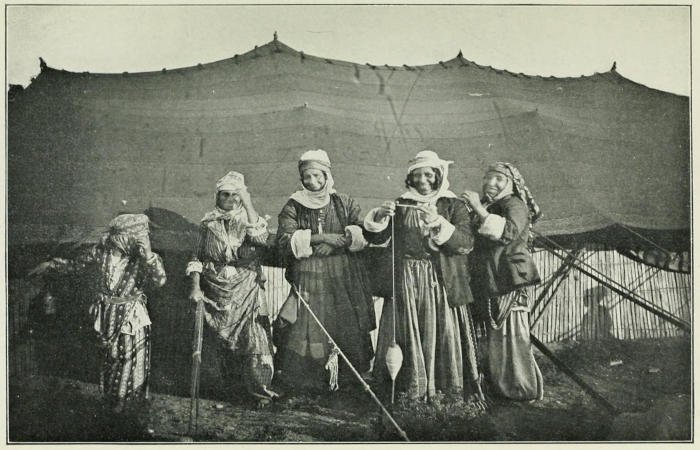
YENI HAN, NEAR SEKKELI: GROUP OF NOMAD WOMEN. (See p. 29.)
Subbi-luliuma died,[796] and ‘mounted the hill,’[797] where on the sacred high place he was gathered to his god. Thereafter for over a century and a half, notwithstanding the constant development of new historical situations, the dynasty of the Hatti sat firmly on the throne, throughout the greatest visible period of Hittite power. His son Arandas, who nominally succeeded after a short interregnum, seems to have been without effective power, and was shortly replaced by his brother Mursil, the Maurasar of the Egyptian texts. During the earlier part of an apparently long reign, this monarch seems to have had leisure and tranquillity to enjoy the empire which he had inherited from his father. During the first ten years at any rate, the annals of which are preserved, there seems to have been no incident of foreign affairs more noteworthy than a series of minor troubles on the frontiers. His relations with a number of states are mentioned, but the Hittite names of these are not yet recognisable.[798] The governorship of various frontier lands was apportioned, or possibly these were now for the first time brought under Hittite rule. One Barkhu-izuwa was appointed to the land of Mira, Manapa-Tessub[799] to Amaskhe-haku, and Targâs-nâli to Happalama. The terms of the Amorite vassalage were renewed in a special treaty with Abbi-Tessub, who now appears as chieftain of that people.[800] In the period of apparent calm in the early part of this reign, we may see historically the opportunity when in the security of his kingdom the monarch built a new royal palace at Boghaz-Keui on the lower ground to the north of the acropolis, outside the main line of the defences.[801]
But inactivity in these empires of the sword was always fraught with danger. Towards the close of his reign, if we read the somewhat obscure chronology of this period rightly, the eastern frontiers of his empire suffered several shocks. The Assyrian kingdom had been steadily gathering strength, and soon after 1320 B.C. Shalmaneser I. seems to have dispossessed the Hittite entirely of his suzerainty eastward of the Euphrates, ravaging all the kingless country of Mitanni as far as Carchemish.[802] Further north he even crossed the Euphrates and entered Khali-rabbat, capturing Malatia, just as a previous Assyrian monarch had done a hundred years before. In this campaign the Hittite forces sent against him seem to have been definitely defeated, and Shalmaneser penetrated as far as Muzri,[803] while his successor also invaded the district of Kummukh, which lay on the Hittite side of the Euphrates around Samsat. Egypt also, rejoicing in the re-establishment of a strong line of kings, was not long in taking advantage of this temporary weakening. Sety I. had hardly ascended the throne of the Pharaohs when he initiated a series of campaigns in the south of Syria, and erelong found himself able to beat back the Hittite forces, and to penetrate northwards as far as Tunip and the land of Naharain,[804] reaching possibly to the Euphrates. The early operations of his successor, Rameses II., however, seem to have extended only as far as the Lebanon,[805] where the Hittites were encountered; hence we may conclude that the latter had been able to regain their ascendency in northern Syria. In these critical times, with a great struggle inevitable and even imminent, Mursil died, and his son Mutallu succeeded to the Hittite throne.[806]
The new monarch was not slow to realise the critical state of affairs that had arisen on his eastern frontiers. Assyria, indeed, seems to have withdrawn temporarily, through internal reasons, from her efforts to obtain a footing in the Hittite lands, but the repeated incursions of the Egyptian armies, and the evident intention of the Pharaoh to regain his dominion over Syria, called forth a mighty effort on the part of Mutallu to retain the empire which his great ancestor, Subbi-luliuma, had established, if not even to extend its boundaries. The call to arms was sounded through the Hittite lands, and the response from every side showed how deeply and widely the power of the Great King had been established. Practically all parts of Asia Minor are represented in this splendid rally round the Hittite leader. United in this common enterprise, the states of the centre, like the Hatti (Kheta), Arinna, Pisidia, were joined by Dardanians and Mysians from the furthest portions of the peninsula, as well as by Lycians of the southern coast, and Kataonians from the anti-Taurus.[807] Northern Syria, from Carchemish to Kadesh, sent also its contingents, for the Hittite leader ‘left no people on his road. Their number was endless, nothing like it had ever been seen before. They covered the mountains and hills like grasshoppers for their number.’ The Pharaoh valiantly went out to meet this formidable enemy before it entered his own dominions, and the fateful battle was joined not far from Kadesh. The opening stages were favourable to the Hittite, who made a strategic and unforeseen onslaught on the enemy’s flank, and for a time disorganised the Egyptian forces. The Pharaoh’s position, indeed, at one moment seems to have been almost desperate, but in the issue he managed to recover his formation and claims to have pursued the Hittites from the field.[808] The Egyptian losses were so great that they were unable to follow up their advantage: even Kadesh remained unassailed, though the Hittite king had taken refuge within its walls; so that the battle must be regarded as indecisive. The moral effect, however, on both sides was sufficient. Mutallu made overtures for a truce, which the Pharaoh readily accepted,[809] and the Egyptian forces were withdrawn.
PLATE LXXXVIII
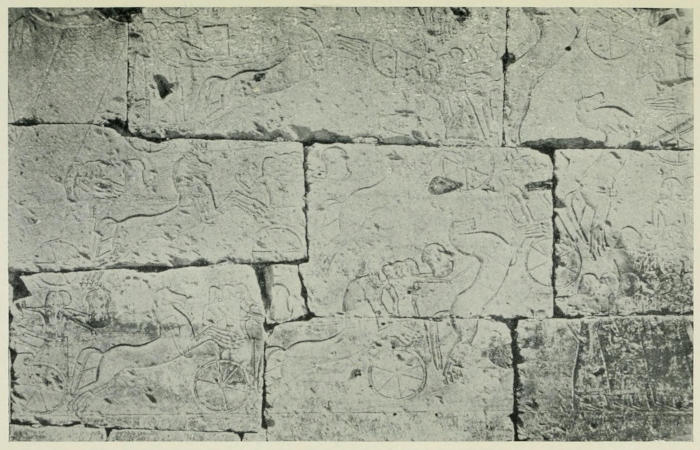
BATTLE OF KADESH: HITTITE CHARIOTRY CHARGING A HILL.
Temple of Rameses II. at Abydos.
The result of this battle proved indeed an effective rebuke to the ambitions of the leaders on both sides. Thereafter Rameses confined his military operations to southern Syria. With the Hittites the issue was more serious, and the consequences more immediate. Two princes of the royal blood, Sipa-zar (? Subbi-sil) and Mazarima, several chiefs, soldiers, and charioteers had been counted among the slain. The Kataonian chief also perished in the battle, and the king of Aleppo was drowned while attempting to cross the moat and marshes that protected Kadesh. The great army had to be disbanded, dismayed and disappointed, when victory had been so nearly within their grasp. The Amorites, whose home lands had suffered perhaps most of all in this warfare, and who were at all times watchful of the balance, threw off their allegiance.[810] Their chief, Put-akhi,[811] was deposed, but escaped the punishment of his offence. The disaffection spread among the troops: a mutiny took place, in which the chief general figures conspicuously, and Mutallu was assassinated.[812] The zenith of Hittite power was passed; the Hittite Sun had reached its highest point, and the shadows at that same moment began to lengthen. Never again, it would seem, could the Hittite leaders call up in their special enterprise so many allies drawn from such varied peoples.
The dynasty of the Hatti none the less retained the throne; Hattusil, brother of the ill-starred leader, whose end we have described, now became Great King, and Putukhipa, Princess of Qizwadna, was his queen. As daughter of the city of Arinna, the home of the sun-god, this lady was probably the foremost of the land, and her union with the Prince of the Hatti was one of the events that contributed to restore the prestige of his house. As Khetasar this monarch looms big in the pages of Egyptian history, and indeed his reign was one of considerable importance and duration. But, as with his compeer upon the throne of Egypt, the actual tendency of events throughout this reign shows signs of weakening in the Hittite power and the gradual dismemberment of their empire.[813] As with Egypt also from this date, this reign was free from serious conflict or disturbance in Syria. Assyria had fallen temporarily behind in the bid for empire, the Mitannians were utterly submerged, and neither of the other two powers was yet disposed to resume hostilities. One of Hattusil’s first acts contributed indeed to secure the tranquillity of his frontier in this direction, by the reinstatement of Put-akhi as Chief of the Amorites, under the same terms of vassalage as of old.[814] It was indeed to Hattusil’s intervention that the Amorite prince owed his life at the time of his disaffection; and now, with a Hittite princess (Gashuliawi) for wife, Put-akhi was united in his allegiance by a double bond.
Later in his reign, about 1271 B.C., Hattusil succeeded in bringing about a definite offensive and defensive alliance, and treaty of extradition, ‘a good treaty for friendship and concord, which was to assure peace, for a longer period than beforetime’ with the Pharaoh. The preliminary negotiations occupied many months, and were carried out with a full measure of oriental dignity. The queens on either side took part in the negotiations, and the chief wife of Rameses wrote to Putukhipa specially expressing her satisfaction when the affair was concluded. The first draft of the treaty was clearly prepared by the Hittite diplomatists; not only does the name of the Hittite king come first in all cases where both names occur, but a summary has been found among their archives which does not contain all the clauses finally incorporated.[815] It is prefaced with an historical preamble, after the well-established precedent found in the Hittite treaties with the Amorites and the Mitannians, as well as with minor vassal states. Only in this case, the treaty being one of equity, no pointed allusion was made to the first conquest of Subbi-luliuma on the one side, or to the exploits of Sety on the other: the fact of past wars and of the previous interim treaties was mentioned, but now the two kings were to be as allies, friends, and brothers, with a good understanding between them for evermore. Neither should henceforth invade the other’s lands, the boundary between them being the northern Lebanon; on the other hand, if either was in distress of war, and appealed to the other for assistance, then troops should be sent accordingly; their warfare should be in common.[816] Minor matters, such as the question of fugitive servants and refugees, were also arranged.
We do not know whether duplicate copies of this treaty were actually exchanged, but this may be inferred from the fact that an Egyptian embassy was received in the Hittite capital.[817] The Egyptian record of this affair, inscribed on the walls of the temple of Karnak, only makes it known that two Hittite ambassadors, by name ‘Tal-tisebu’ and ‘Rameses,’ accompanied by a goodly retinue, presented the Hittite copy engraved on a silver tablet to the Pharaoh.
The gods of all the Hittites were separately invoked, after their time-honoured custom, as guardians to the inviolability of this treaty. The sun-god, lord of heaven, takes first place, followed by the sun-god of Arinna. Then come the various localised forms of Sandes,[818] called Sutekh by the Egyptians, and associated here with nine chief states, in which we seem to recognise three,[819] Arinna, Aleppo (Khilpa), and Sarisu, possibly the classical Sareisa. A list of the tutelary deities follows, including seven gods and three goddesses,[820] but possibly the gaps in the text betoken others. Finally, the god of the land, the queen of heaven, the goddess of the soil, the mistress of the oath, the goddess (Askhir) of the mountains, and the rivers of the Hittite lands, are appealed to; with a last reference to the gods of Qizwadna, the home of the Hittite queen, and to those of Egypt, who are all covered by one clause. The designs and inscriptions of the seals are of special interest: upon the tablet itself these were naturally engraved. On the obverse, we are told, there was the image of the Hittite national god embracing the Great King,[821] surrounded by an inscription rendered, through the medium of the Egyptian text, ‘The Seal of Sutekh, Prince of Heaven,’ and ‘the seal of the treaty made by Khetasar (Hattusil) son of Maursar (Mursil), the great and powerful king of the Hittites.’ This was the seal of the Hittite god of the skies. The reverse was parallel, only in place of the figure of Sandes was that of the sun-god of Arinna, lord of the whole earth, and the Great Queen was shown in the deity’s embrace. Around was an inscription, ‘The seal of the sun-god of the city of Arinna, lord of the earth,’ and ‘The seal of Putukhipa, Great Queen of the Hittites, daughter of the land of Qizwadna ... of the land of Arinna, the mistress of its territory, the priestess of its goddess.’
The fame of this treaty was noised abroad, and an inquiry was received from the king of Babylonia as to its purport. The Hittite king replied[822] with firmness and obvious exultation: ‘I will inform my brother: the king of Egypt and I have made an alliance, and made ourselves brothers. Brothers we are and will [unite against] a common foe, and with friends in common.’ The letter continues with an explanation of the previous warfare between the nations that had rendered this compact desirable, and allusion is made to the inroads of the Pharaoh on the Hittite lands.
Though relations between Egypt and Babylonia at this time were well established, it might have been thought that Babylon was too distant to have been much concerned with the Hittite seated in the north of Asia Minor. Yet in fact at this time only the eastward extension of the Amorite realm divided the two powers, just as the same people formed the frontier with Egypt further west. Diplomatic relations had indeed been opened between them for fully a generation, and several long letters have been recovered. They refer chiefly to the brigandage of the Amorites, whom the Hittite king is asked to keep in order, and punish as being his vassals. It is interesting to notice also the influence which Hattusil exerted, through the forceful language of his ambassador at the Babylonian court, and his own almost threatening diplomatic letters, interfering even in the settlement of the succession to the Babylonian throne. This subject might well be regarded as outside the sphere of international politics, and the Babylonian king found reason to object also to the terms of the communication on this matter, which would have been addressed more fittingly to a vassal rather than a compeer. But Hattusil’s reply is worthy of record: ‘I only wrote this, “If you do not acknowledge the son of your lord, will it not happen that if an enemy attack you, I will not come to your aid?” for my brother was then a child, and he is an evil man who deals according to evil thoughts.’
Questions of foreign policy also were discussed by these two powers in several letters. One fragment from Babylon shows that the increasing power of Assyria[823] was the problem of the moment, and a reply of Hattusil[824] shows that they were being drawn together on this matter, which was of grave concern to them both. His advice to the younger king, expressed in flattering terms, to ‘go and plunder the land of the foe,’ indicates the astute politician’s anxiety to get the sword that hung menacing over his own head removed. The situation that now developed is one of considerable historical interest. Like Tushratta of Mitanni on the approach of the Hatti, so now the Hittite king at this crisis took special means to ensure the support of Egypt, where Rameses the Great still sat upon the throne of Thebes beside the tranquil Nile. Formerly Tushratta had granted a daughter in marriage at the first time of asking, contrary to precedent; but now not only was the first Hittite princess seemingly offered to Rameses, to take a place among the other royal wives, but the Hittite king himself with great state accompanied her to Egypt, and, escorted up the Nile, visited the Egyptian monarch in his capital, an event without parallel in oriental history. Naturally Rameses made adequate record of this incident,[825] and the beauties of his new bride received the praises of his courtiers.
Little is known of the two successors of Hattusil, Dudkhalia, and his son Arnuanta, under whom the dynasty of the Hatti kings was prolonged into the twelfth century, B.C. An edict issued by the former concerns the organisation of the empire and the position of the greater vassals.[826] The names of some of the chieftains transpire among the witnesses to the document: Eni-Tessub[827] appears at this time as king of Carchemish, which was probably the second state of the empire. Another event in the reign of Dudkhalia is a ‘treaty’ with the king of Aleppo, doubtless a ratification of the terms of vassalage, but the name of that chieftain is not revealed.
The name of Arnuanta, his son, who in turn became Great King, is the last of the dynasty that has come to light, and circumstances tend to show that the day of Hatti dominion was really over. He is known only from two fragments of royal edicts, and a more complete document (found in the débris of a gateway), seemingly an elaborate land register or cadastral survey.[828] This is rendered of special interest by the seals, which, like the famous boss of Tarkudimme, were inscribed in Hittite hieroglyphs and in cuneiform. The Hittite inscription on one seal is defaced, but the cuneiform can be read in both cases. The first seal is that of Arnuanta himself, the Great King, son of Dudkhalia. The second gives the names of the royal ladies, namely, the Queen-Mother Tawâssi,[829] and his wife, the Great Queen, Munidan; while a daughter of Dudkhalia is mentioned, though her name is lost.
The appearance of these royal women side by side with the monarch in the transaction of state affairs reawakens a whole series of interesting allusions which transpire in the earlier archives of this dynasty, indicating a clear position of authority held by the female side, and even suggesting a matriarchal system of succession to the throne. In the edict of Dudkhalia the Queen-Mother, Putu-khipa, is mentioned as co-ruler; and we have seen above that she separately placed her seal upon the treaty with Egypt, wherein she is described as Great Queen of the land of the Hittites, ... of the land of Arinna, the mistress of its territory.’ Further, the son of this powerful lady succeeded to the throne upon the death of Mutallu, even though the latter’s son was still alive (being mentioned in documents of Hattusil). During the interregnum[830] she maintained the continuity of the government, with sole powers in her hands, as appears from her correspondence at this time with Rameses. The title of Hattusil himself to the throne can best be explained in view of these facts, by his marriage with this lady, a first princess of the land;[831] and that her son would succeed seems to have been foreseen by Rameses II. when he wrote to her diplomatically, wishing him ‘good health.’ The part taken by royal women in state affairs in the East can be illustrated from modern events in China, which under its Mongol rulers presents us with so much interesting comparison, no less than from the records of the correspondence between Egypt and Mitanni in the age with which we deal.
This respect of the worshippers of the Mother-Goddess for the female was inculcated by them among various branches of their peoples. It will not be forgotten that the founder of the Hatti dynasty, when he admitted the fugitive Mitannian prince to his family and extended to him his protection, laid down the condition of a monogamous marriage. So, too, Hattusil, in granting his daughter to the Amorite chieftain, Put-akhi, whom in like manner he re-established in his authority, inserted in the document recording the alliance a clause to the effect that the sovereignty over the Amorite should belong to the son and descendants of his daughter for evermore.
These indications all agree with the impression that Greek tradition and the Hittite monuments have already left upon our minds. The worship of the Mother-Goddess, to which we have alluded, would seem, indeed, to have been paramount throughout the Hittite lands, from Carchemish to Ephesus, from Kadesh to the coast of the Black Sea. Originally a nature cult, derivable from the productivity of the earth, this had now taken divine form with the quality of self-reproduction, to develop later into the conception of a universal mother. Though this worship was general throughout western Asia, its introduction into Asia Minor is traceable to the Hittites, upon whose monuments its symbolism appears earlier than it is known elsewhere, notably at Boghaz-Keui,[832] Eyuk,[833] Fraktin,[834] and on Sipylus.[835] We do not wish to imply a local development of the cult, though that may be admitted as a possibility when we consider the simple and general nature of its origins, and the power of the human mind then as now to attain in a few years the standpoint reached only by generations of ancestral experiences, and thereon to build up new conceptions, to be transmitted in like manner together with those inherited. Yet on the fertile plains of Babylonia the seasonal productivity of nature was more conspicuous and almost spontaneous; there indeed, as it seems, man was earlier able to give up his wandering life and settle, noting with satisfaction and gratitude that earth and sunshine with other elemental forces provided him with the means of living. Taking also the evidence as it stands, it would seem that the embodiment of these conceptions in divine form (under the name Istar) is earliest attributable to Babylonia; and from there consequently we are disposed to derive her when found in Asia Minor, whether by general contact, as is historically admissible, or introduced, as seems more probable, by some early migration of Hittite peoples that had already assimilated her to themselves.
The worship of a goddess with virtues so natural and with powers that it was so desirable to propitiate would, in any case, it may be thought, be readily acceptable to a peasant people. It became deeply rooted, and in certain localities took special forms, reflected many centuries later in rites like those of Ma at Comana, Kybele in Phrygia, Artemis at Ephesus, and, latest of all, Semiramis at the post-Hittite city at Carchemish. From the sculptures of Boghaz-Keui[836] it may be seen that, as in Babylonia, there was already associated with her a youth, whose male powers were necessary to complete her own. With her also there appears a lioness or panther whose force and character seemed to be emblematic of hers. Though clearly attributable to an earlier phase of thought, this association may have been made before the cult was localised. There are, however, traces in these sculptures of more primitive conceptions, attributable to older strains of population. From the evidence in general, four or five strata, indeed, may be discerned in the Hittite pantheon. In the lowest of these there appear the purely elemental forms, mountains and streams,[837] earth,[838] sun,[839] moon[840] and star.[841] Passing from the inanimate to the animate, we find the lion,[842] the bull,[843] the eagle,[844] the falcon or dove,[845] the goat,[846] the stag, the serpent[847] and other living creatures, some of them possibly adopted as tribal totems, and all no doubt representing some special virtue or power that later became embodied in the deities associated with them. Upon these substrata the gods of human form appear to be imposed, and first among these the Mother-goddess. Already, as we have noticed in these sculptures,[848] her supreme powers in life and her unfathomable actions had found expression in the semblance of a lion, before she was adopted by the mountain-worshippers; and another class of monument, possibly of later evolution, seems to reveal her in another aspect, as a goddess to be propitiated at death. The two ideas in her case are not far separated; for just as in the simplest conception of her powers through her the dead earth revived, while in her developed cult, her dead son yet lived in her offspring (through her unnatural union with him), so the instinctive belief of humanity in the incompleteness of death found expression in offerings to her for the dead,[849] and in communion of the dead at her table.[850] The idea of a future life after death was inseparable from her worship.
In the sculptures[851] of these times there are associated with the goddess a number of divine attendants and priestesses, each holding as it seems a bent staff upon which she leans. These are not armed, but in them we may see the prototypes of a class of women devoted to the goddess, who in later centuries, on the decline of the Hittite power, at the coming maybe of the Phrygians, at first for the defence of their religion, and later separating in independent action, developed into armed priestesses, and possibly the Amazons of tradition.[852] But that was not yet; nor do we see in any of the shrines of the goddess of this age any sign or suggestion of the orgies and carnal festivals that a thousand years later were celebrated in her name. On the other hand, we see the cult at this age in its simplicity; in some cases the goddess worshipped alone, in others accompanied by the son-consort, whose position in legend and at Boghaz-Keui is secondary to her own. In the latter case, however, she is face to face with another god who is her equal. We have been able to trace in these sculptures to some extent the merging of this religion with the old conceptions, and now we pass to consider its union with the new.
In this fourth phase the male predominates. The new divinity was a god omnipotent, with lightning in his hand. We call him Sandes, from a name surviving in Greek tradition in Cilicia and Lydia; but his real name is unknown. Possibly Tarku was one Hittite form of it; but at this period of his conspicuous individuality Baal or Zeus would suit him better. Like the goddess, he was well known in western Asia under various guises, the Tessub of Mitanni, the Hadad of Syria, the Rimmon of Babylonia. He came into Asia Minor, it seems to us, as guardian deity of the conquering Hatti, clad like their warriors; and in their wake came a limited number of kindred tribes, among whom also he was worshipped under various forms,[853] notably as a God of War with sword in hand.[854] By them he was transmitted as the national god to the other Hittite peoples, whose tutelary deities, however, seem to have been various.[855] In him, the embodiment of manly strength, the nature worshippers saw the sun, ruling in the skies,[856] supreme, a fitting husband for their Mother Earth. It was not hard to reconcile the cults. Just as the sun’s return in spring-time to shine upon the earth was necessary to revivify the dead year; so was the periodic union of the god with the goddess natural and appropriate, that the earth might bring forth her fruits in due season. The sculptures[857] illustrate the rite that arose upon this new ideal, where we see the statue of the god borne upon the shoulders of his priests to the open-air sanctuary of the goddess, and the divine nuptials celebrated with the dancing and revelry that have accompanied marriage festivals through all time.
The conception of Fatherhood, hitherto submerged, now found expression in independent form, wherein the new god was identified with the Bull, the emblem of virility. At Malatia[858] the god rides upon the animal’s back; at Eyuk[859] the animal alone is found, in a scene where his ministers are the royal high priest and priestess, the counterpart to the worship of the goddess herself on the other side of the gateway. In this character food and music and revelry were his delight. There were present all the elements which under other conditions might have led to the development of a special and exaggerated worship of masculine powers. But here the circumstances were unfavourable. So long, indeed, as the warrior kings maintained the throne, their god also retained his individuality,[860] amid an environment, however, too deeply imbued with the older ideals to maintain his separate worship after their downfall. Already we see one way in which his cult was liable to be submerged; for the part he now claimed, as it were, by force, had been hitherto played in esoteric fashion by the son. Hence a new identity arose, in which the attributes of the father-god and the son-god became confused and merged in one.[861] This fact seems to be reflected even in the sculptures of Boghaz-Keui, where the cult of a dirk, which each important male figure wears, becomes endowed with a separate ritual.[862] Possibly, however, this may be more particularly an aspect of the son-god, and associated with the ritual of the Mother-goddess. It was, moreover, a national cult, widespread, and revered.[863] In any case the association of the Father-god with the Son-god in the cult of the Mother-goddess, nature’s divine triad, seems to us an essential feature of the religion of these times.
The part played by the king and his queen in this worship is clear in the sculptures of Eyuk[864] and Malatia,[865] and their position as high priest and priestess of the god is defined in the text of the Egyptian treaty.[866] Whether the king himself took an official position in the worship of the goddess is still open to conjecture; for the pictures of the high priest at Boghaz-Keui,[867] though accompanied by the royal insignia, are open to another interpretation,[868] and possibly in her festivals the king’s place was taken by a eunuch-priest of considerable authority, in accordance with a ritual long established and surviving in later times. At Sinjerli there is an interesting suggestion in a certain series of sculptures[869] belonging possibly to this era. In comparing these it seems to us that the king himself is shown impersonating his gods or god in various characters; in one he is the warrior with shield and spear, in another he holds aloft the lightning trident, and in a third we see him like Thor with a magic hammer. In the rites of the various deities the king may possibly have carried these sacred emblems ceremonially.
The position of the Hatti kings in state affairs, the nature of their kingdom and their empire, has been already disclosed in watching how their power was won.[870] The army was the mainstay of their empire, yet no martial scenes decorate the walls of the palaces and temples that have been hitherto unearthed. This may be accounted for by the essentially feudal nature of the constitution, whereby the bulk of the forces would be composed of troops under the more direct command of the vassal kings and chieftains. Within the domain of his own tribe or tribes, though doubtless a royal bodyguard was maintained, it would almost seem that the power of the Hittite king was sustained rather by constitutional rights such as have been indicated. Some of the religious sculptures, however, give an indication, though in somewhat conventional and maybe antiquated form, of the dress and armour of the Hittite infantry; while the general character of their chariots and arms may be gathered from the hunting scenes of later date in Syrian towns. Where the home sources fail, the Egyptian carvings supply a wealth of detail illustrating all branches of the Hittite forces;[871] and these, though drawn as it were from afar, have none the less the advantage of being contemporary evidence, recorded, too, by past-masters in this branch of archivism, who allowed no characteristic detail to escape them.
The freest drawing of a foot-soldier is that from Sinjerli,[872] wherein a warrior is seen armed with a spear and shield; the head of the spear is narrow and ribbed down the middle, and the shaft is about the length of the man; the defensive weapon is of the figure-of-eight shape traditional in Asia Minor, and associated with some branches of the Hittites in Egyptian sculptures.[873] The dirk which is worn, an invariable side-arm of the Hittites, is here shown so long that it looks almost like a two-edged sword; from other sculptures, however, like those of Giaour-Kalesi[874] and Boghaz-Keui,[875] we may be sure that a dirk or dagger is indicated. The crescental hilt and the midrib are noticeable features. That the sword was used, however, may be gathered from other scenes.[876] The dress of the Hittite warrior, like that of his gods, was uniformly the short tunic, short-sleeved vest, shoes with turned-up points, and tall conical hat; the last named is seemingly padded in this instance at the top. Equestrians and charioteers seem to have modified or discarded this head-dress[877] as being unsuitable for rapid motion. In addition to the spear, the bow was doubtless used by both infantry[878] and chariotry;[879] but other implements, originally of an offensive character, like the club, double-axe,[880] mace, and curved dagger,[881] are found only in religious symbolism in such connection that it must be considered doubtful whether they continued to be used in war. The throw-stick is, however, admissible, though found only in sporting scenes.[882] As to the Hittite cavalry the local sources almost fail us. Two stones from Sinjerli show a rider armed with bow and dagger, and possibly a shield decorated with a human face;[883] and a third sculpture from the same site introduces a large round shield and possibly a quiver.[884] There is also a fragment, possibly from Marash, showing a horse rider,[885] though apparently not in that instance a fighting man. In another case a led horse is shown, with attendant groom, as though awaiting his royal master’s pleasure.[886] In Egyptian scenes,[887] however, the Hittite horse-rider is conspicuous, fleeing before the Pharaoh’s arrows, himself armed with a lance; and in two literary passages at least, clear reference is made to the Hittite cavalry.[888]
The chariotry of the Hittites was, however, their chief arm of offence. Unfortunately only one war-chariot is shown in their own sculptures,[889] and this is apparently of later date and employed in an inter-tribal struggle. In this case two persons are shown in the car, the warrior and his driver. The wheel has six spokes, the car is lightly built, and a pair of horses are harnessed to it.[890] The warrior’s arms are the bow and spear. Other chariots appear in hunting scenes, showing little variation except the eight-spoked wheels; but it may be thought from the Egyptian representations that a somewhat heavier car with panelled sides was employed for war. The magnificent appearance of the massed Hittite chariots in attack excited the admiration of their enemies, the Egyptians, who have handed down vivid pictures of them taken from their wars: the assault on a hill,[891] an incident in the battle of Kadesh, shows excellent formation in close order while advancing at a gallop. The Egyptians were unanimous in representing three Hittites in each car, a practice which differed from their own, and so attracted their attention. The third man was a shield-bearer, whose absence from the hunting scenes of the Hittite sculptures is self-explanatory. A square shield, mostly associated with the Syrian allies, makes its appearance in the scene before us; but the Egyptian artists were so much perplexed by the necessity of crowding and showing three men within the tiny car, that they forgot or found no room for the offensive arms of their redoubtable enemy.
For transport in war the Hittites seem to have employed freely a covered wagon on four wheels, a characteristic vehicle throughout western Asia to-day, and drawn then as now either by bullocks or a pair of horses. In addition, the hardy ass was also requisitioned, represented as struggling with the weight of his panniers.[892] Though for the frontier wars with Egypt, fought out mostly near the Lebanon, the Hittite doubtless employed a strategic base in northern Syria, such as Carchemish, yet for his Syrian campaigns, and for the general control of his Syrian dependencies, it becomes almost self-evident that there must have been one route at least available for wheeled traffic connecting with the interior and the capital. But it is by no means easy to determine which of the several passes may have been used for this purpose.[893] The history of these times leads us to infer a system of communication throughout the empire, with Boghaz-Keui as its focus. From this centre, to judge by the disposition of the earlier monuments and other evidence, roads already radiated in several directions. To the north was Sinope,[894] which seems at one time to have been the first port of the country, but to have fallen into decline with Boghaz-Keui itself. To the east we must infer a road connecting the valley of the Halys, whether by way of Sivas or otherwise, with that of the Tochma Su,[895] and so leading down to the frontier at Malatia. A southerly bifurcation of this route led by Albistan down the passes of the Pyramus to Marash,[896] communicating thence severally with Carchemish, Aleppo, and the valley of the Kara Su, wherein lay the cities of Sakje-Geuzi and Sinjerli. A more direct track over the mountains from Mazaca (Cæsarea) to Marash passed by Kuru-Bel near old-time Comana,[897] whence also Dastarkon (near Ferakdin) might be approached. The line of communication from Boghaz-Keui to Mazaca is not known, but a direct road from the former towards Tyana is traceable, and possibly it sent off a branch corresponding with the modern route from Injessu to Cæsarea. Whether in its direct southerly line it continued as a wheel track thus early through the Cilician gates to Tarsus is open to question, though it was clearly open some three centuries later.[898] Westward also there must have been established now or shortly afterwards an embranchment connecting Tyana by way of Ardistama with Iconium; while, as we have already noted,[899] the existence of a main westerly route from Boghaz-Keui to the Lydian coast is testified by the contemporary sculptures of Giaour-Kalesi and Kara-Bel.
Of the cities which these roads connected there remains little trace. At Boghaz-Keui only the buried remains of the palace built by Mursil[900] and the sculptured sanctuary which we have dated to the age of Hattusil[901] can be assigned with any security to the two centuries that we have been considering. At Eyuk and Malatia the cubical building blocks decorated with sculptures seem to indicate the existence of palaces as early as the reign of Subbi-luliuma.[902] The site of Sakje-Geuzi was already occupied by Hittite people, and probably counted six walled townships and citadels within its neighbourhood;[903] we suspect it to be the centre of the state that later becomes known in the Assyrian records by the name of Iaudi. Sinjerli was also a large and flourishing city,[904] the capital of the kingdom later called by the Assyrians Samalla. Carchemish,[905] Aleppo,[906] and Hamath[907] are also known as Hittite cities from the history of these times, but no remains of buildings have been found within their areas that can be assigned to this period.[908] We may infer, however, from the evidence of the excavations at Sinjerli, and from contemporary Egyptian sculptures, as well as from the designs of late fortifications, that the cities of this age were already surrounded by masoned walls, supported by numerous external towers, and entered through gateways barred by a pair of double doors and guarded by wing towers on either hand. But most of the visible architectural remains of Boghaz-Keui, and nearly all those that have come to light in Syria, including those of Marash, belong upon our evidence to a later period after the disintegration of the empire, when for a while in the development of history the opportunity occurred for a revival of local arts upon the old models among the small kingdoms that survived.
The disintegration of the Hittite empire introduces a new phase of their history. With it was involved the downfall of the Hatti rulers, indicated by the failure of the archives of Boghaz-Keui after the reign of Arnuandas, two generations after the time of Hattusil, and hence probably about 1200 B.C. In the great combine of land and sea powers against Egypt, which Rameses III. resisted and dispersed,[909] the Hittites again figure among the confederates, but this time no longer as leaders; and subsequently they appear no more in Egyptian history. They had held sway over Asia Minor for about two centuries, a lengthy period for an oriental dynasty, and now they were submerged by historical movements, of which the details are wanting so far as it affected them, though the development of events may be traced in outline. As often in the history of Asia Minor, the tide of immigration that had formerly set westward had now turned, and, sweeping irresistibly from Europe southward and eastward over the Greek world and the Ægean Islands, traversed also the peninsula.[910] The wave which Rameses III. turned away from the Egyptian frontier had swept away the Hatti power, and it may be thought that their part in the movement, like that of others, was migratory rather than warlike, pressed onwards by newcomers from beyond.
In the redistribution of power that followed the dispersal of these peoples, the dominant position in Asia Minor seems to have been held by the Muski,[911] whom we presume to be a European people, akin to the Phrygian conquerors of later times.[912] With these newcomers at any rate the Assyrian kings were occupied for half a century. By 1170 B.C., it would appear, they had traversed Asia Minor and descended upon Kummukh, the Hittite state lying around Samsat, between Carchemish and Malatia, upon the Assyrian frontier; and it was not until 1120 that they were driven back by the valorous expeditions of Tiglath-Pileser I. It is possible that the Assyrian king followed up his victories as far as the Black Sea;[913] but in any case the power of the Muski would seem to have been broken and to have gradually declined until reinforced by the Thracian immigrants of the ninth and eighth centuries B.C.[914] In the meanwhile the Hittite states found the opportunity for a remarkable revival. The readiness of these peoples, though no longer politically united, to combine against a common enemy is well shown by the experiences of the Assyrian king, who had no sooner crossed the frontier at Malatia, than he was assailed on his right flank by twenty-three chieftains,[915] while in front lay sixty others whose domains extended to the Upper Sea. Though possibly this expedition lay eastward of the boundary of the Hittite lands, the central Hittite states did not escape from the ambitious raids of the Assyrian king, who crossing the Euphrates on rafts of skin, this time nearer to Carchemish, put Mount Bishri[916] to the sword, and advancing northwards, devastated the frontier lands (Muzri), which lay now, as we have seen, beyond Kummukh, nearer to the kingdom of Malatia. The Kumani, dwelling probably in the mountainous region round Comana (Shahr), seem to have gone out to the assistance of their kinsfolk, harassing the Assyrian probably on his left flank. But their native fastnesses and walled cities did not protect them from the vengeance of the Assyrian. Their advanced troops were overcome and imprisoned in the fortress of Arinni; while the remainder of their fighting men, some 20,000 strong, who lay entrenched on Mount Tala, were driven out and pursued as far as the range of Kharusa, on the frontiers.[917] Kibshuna, the capital of the Kumani, surrendered. The states of Syria were the next to fall to the Assyrian conqueror, for a fresh expedition passing up the Orontes seems to have crossed the Lebanon and reached the Mediterranean coast northward from Beyrout.[918]
Though the expeditions of Tiglath-Pileser I. were far-reaching, they do not seem to have established anything like a permanent hold over the Hittite states of Syria. Carchemish, upon the frontier, does not seem to have lost any of its independence, and it may be suspected that after the decline of the Hatti, this state remained the chief centre of the Hittite power.[919] There is indeed a suggestion that its kings were descended from, or early related to, the Hatti rulers,[920] and that at one time, perhaps in the eleventh century, they held sway as far as Gurun,[921] in the valley of the Tochma Su, indicating a kingdom which embraced all the central Hittite states. However that may be, some names of the early kings of Carchemish have been handed down among the archives of the Hatti,[922] under whom it seems clearly to have been already a state of major importance; and its independence was maintained, in name at least, as late as any of which the history is known.
The apparent independence of Carchemish throughout the reign of Tiglath-Pileser is not only a testimony to its own military resources, but an indication that the Assyrian conquests were not secured. The time of the great Assyrian empire was not yet, and as the Assyrian power gradually weakened for a while, so did that of the Hittite states revive. For something like a century and a half, until about 950 B.C., some semblance of Assyrian authority may still be traced on the near side of the Euphrates,[923] but in view of the history of these times it may be said that during the tenth century B.C., until the renewal of Assyrian invasions (about 850 B.C.), the Hittite states of Syria were free, and their works illustrate to us their latent vitality and the revival of their traditions.
It was not only in Syria that this opportunity was afforded, for a parallel development of circumstances upon the plateau of Asia Minor seems to have encouraged the revival of the chief states also by the removal of their embarrassments. The Assyrian invasions had broken the strength of the Muski, who had for some time threatened to overwhelm and submerge the Hittite peoples; and now the gradual withdrawal of both enemies was marked by a cycle of Hittite works which proved how deep-rooted was their civilisation, and later history shows how radical must be the changes that would supplant it in their mountain homes. At Boghaz-Keui a new palace, unadorned, however, with sculptures, sprang up on the site of that of the Great Kings, which was now completely ruined. It is possible that the great walls of the citadel as they are now seen were the product also of this age.[924] They would seem to have been furnished, now or within a few generations, with the great arched gateways decorated with sculptures[925] which are one of their most striking features. Incidentally there is disclosed in the representation of a female warrior upon one of the great jambs[926] the development of, or union with, the Amazons,[927] whose fame lived in Greek history and tradition while the deeds of the old Hatti kings were already buried in oblivion. At Eyuk we have seen there is indication of a corresponding phase of local buildings, involving details of architecture and sculpture peculiarly Hittite.
It would seem, however, that it was not in the old centre of administration that the dominant Hittite spirit most revealed itself. The sculptures of Bor[928] and Ivrîz,[929] and the related inscriptions of Bulghar-Madên[930] and Karaburna,[931] with others on the Kara Dagh and at Bogche, as well as numerous minor works, are all indications of a considerable area united as a single kingdom, the centre of which was Tyana. The Assyrian records of later times tell indeed of a powerful tribe or people named by them the Khilakku, whose geographical disposition seems to correspond with this area. These two facts in association recall the tradition of a great ‘Cilician’ empire, mentioned by Solinus,[932] which was said to have embraced within its sway most of the great states of Asia Minor and of Syria that had formerly acknowledged the rule or suzerainty of the Hatti kings.[933]
Though this renaissance of the Hittite kingdoms may have been short-lived,[934] it was none the less real and general, as the peculiar features and relationship of the monuments of this age testify. Practically nothing is known, however, of the history of this period: their own inscriptions seem to be mostly theocratic or religious, while Egypt and Assyria were too much engaged with home affairs to send expeditions into Hittite-Syria, the records of whose adventures might otherwise have enabled us to penetrate into the obscurity which hides this brilliant epoch from our view. The period falls, however, within the first pale glimmer of Greek tradition, which enables us at any rate to interpret more clearly some aspects of the local monuments of these times. The map of the Hittite world[935] in the tenth century B.C., deduced from the disposition of their monuments, and from the records of the Assyrians when they came again into contact, is also instructive, and seems to us to indicate the home-lands or settling-places of the real Hittite peoples more clearly even than a map of the Hittite empire, based as that would necessarily be on the whole range of Hittite works[936] and the uncertain identification of Egyptian names. Eastward of the Khilakku,[937] the kingdom known by the Assyrians as Tabal seems for part of the time to have embraced most of the cities of the Anti-Taurus from Fraktin to Comana, extending northwards possibly as far as Ekrek and Mazaca (Cæsarea). It included numerous small states,[938] some of which at various times became separately prominent, among which Kammanu seems to be recognisable in Komana (identified with the modern Shahr), while the principality of Shinukhta and the city of Tynne[939] lay nearer to Tyana. On the Tochma Su, Guriania was the name of a minor kingdom seated at Gurun, while lower down old Malatia was the chief town of the kingdom of Milid (Miliddu), which still retained its great importance.[940] Gurgum lay seemingly around Marash, then known as Marghasi, to which we refer below, while Kummukh[941] extended, as we have seen, north-eastward up the near bank of the Euphrates. Several states lay in the valley between the Kurt Dagh and the Giaour Dagh,[942] like Mikhri, bordering on the Pyramus; Iaudi, with its centre (Kullani) possibly at Sakje-Geuzi or at Killiz; and Samalla, farther south, with its capital at Sinjerli; while lower down on the Kara Su was Unki,[943] which probably included Kurts-oghlu and the site of the classical Gindarus. The boundaries of the small states and larger kingdoms alike cannot be fixed, and probably varied continually with the ascendency of this chief or the other. The region last mentioned, for example, seems at one time to have been mostly subject to Samalla,[944] while at other times it was divided between Gurgum and the Hattina, or subject to one or other of these powers. The latter, as their name implies, were a Hittite folk, whose numerous principalities[945] lay in the valley of the Orontes,[946] with Hamath doubtless as their capital. Lastly, the Hatti themselves seem to be represented by the powerful kingdom of Carchemish on the Euphrates,[947] the boundaries of which were indefinite, but reached at any rate to the Khabour River on the south.
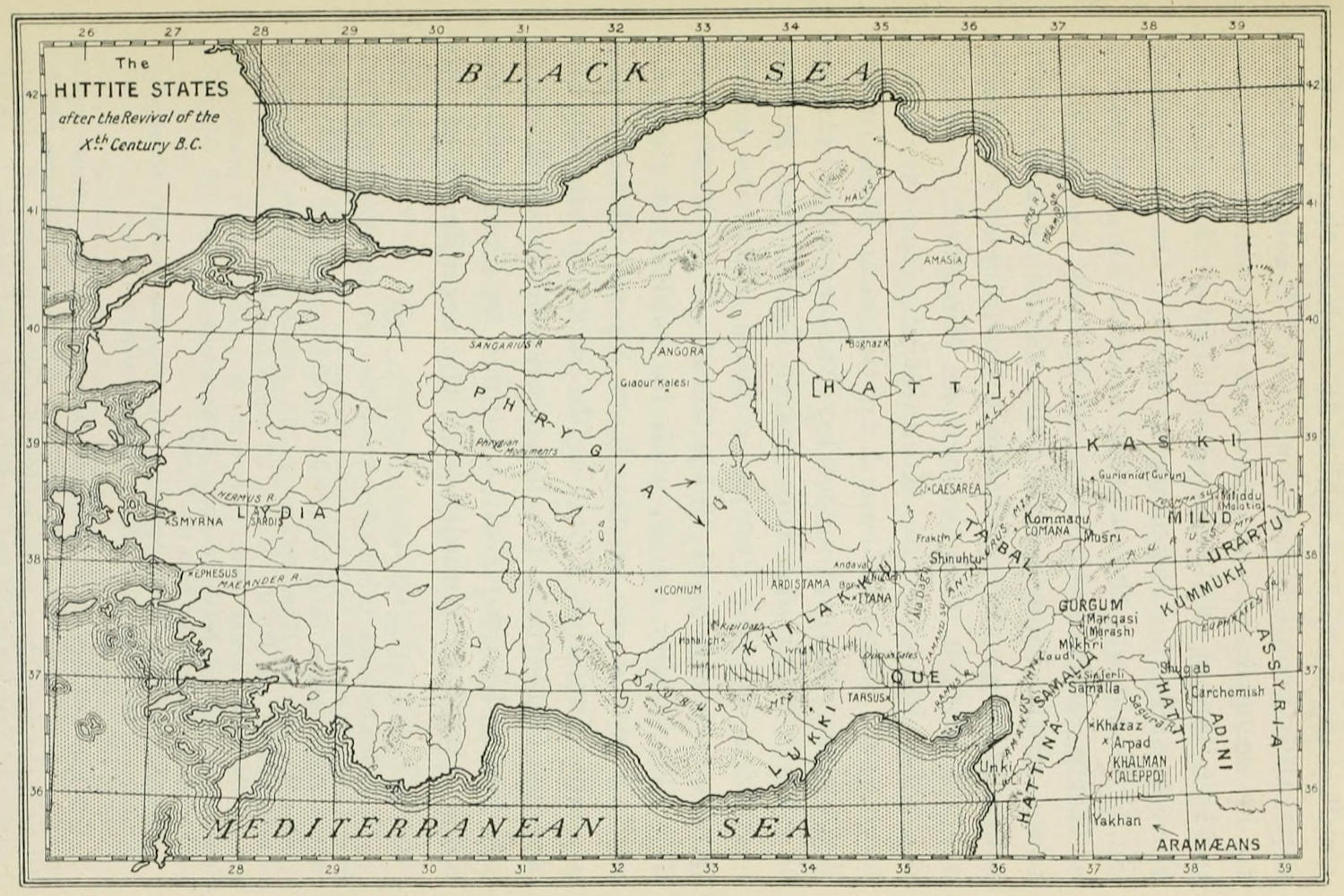
THE HITTITE STATES after the Revival of the Xth Century B.C.
On the outskirts of the Hittite kingdoms there were already present most of the elements of the powers that later were to submerge them. In the immediate West we place the Muski-Phrygians, but the mutual boundary is indefinable and probably varied constantly.[948] East of the Euphrates, Mitanni was no more, and Assyria was recruiting; while from the south and south-east there had already begun the steady infiltration of Aramæan peoples, who now occupied most of the tongue of land between the Orontes and the Euphrates.[949] Damascus was their centre, and within the Hittite-Assyrian sphere they had already planted strong settlements in the plains westward of the Euphrates. Even the kings of Samalla are early found with Semitic names,[950] a fact which corresponds with the character of a whole series of its monuments.[951] We may suspect from the name in like manner the Aramæan extraction of the dynasty of Bit Adini, which ruled over a broad and numerously peopled Hittite tract extending from south of Carchemish even across the Euphrates, including probably the site of Tell-Ahmar. Shugab lay also on both banks of the river, somewhat further north. In the north-east a new and formidable power akin to the earlier Hittites was gathering strength in the vicinity of Lake Van, by name Urartu; but the Cimmerian hordes had not as yet appeared in the north.
Many of the surface monuments of the Hittites seem to belong to this period of revival: they are linked by various common features in detail, and illustrate at the same time the development of new motives in art. The increasing power of the priest-king is reflected in the prominence now given to his portrait as a chief subject for the sculptures.[952] His dress has now assumed a magnificence of embroidery and tapestry unknown in earlier times, though clearly derived, as regards the close cap, long robe, mantle, and shoes, from the priestly dress of the bygone age. On the rock carving of Ivrîz he pays his devotions to a god of agriculture, who presents so many new features that he might at first sight be taken for an entirely new conception, notwithstanding that his dress is obviously a direct modification only of the time-honoured and sacred costume of the Hatti gods. Yet he is a descendant of the Son-god of Boghaz-Keui,[953] and his new virtues are a product of the Hittite lands. Now he has become the peasant’s god, the patron of agriculture, himself rewarding toil with fruit and corn. In Babylonia, where the grain grew wild, and the harvest was a gift of nature varying only in degree, the function of the consort to the earth-goddess, as the fertiliser, had been a secondary consideration. In the prominence of manhood under the Hatti kings, the god had received his separate local attributes and sanctuary. Now he appears, alone, in a third phase clearly developed upon a soil where the goddess was benign only to those who toiled. Here the clearing of the ground, irrigation, ploughing, sowing, and constant tending were necessary before the harvest could be won; and in this attribution the god is worshipped. The Greeks, when they arrived upon the scene, saw in him their own Hercules as the god of toil. His dress, however, as we have mentioned, betokens his Hittite origin. The tunic and turned-up shoes, though more elaborate, remain essentially the same as of old. The national hat, however, has lost its height, and is also broader; and the same difference may be noted in the newly found Amazon figure at Boghaz-Keui. This change, indeed, may be traced back to the later years of the Hatti period, if reliance may be placed on the Egyptian representation[954] of the Hittite monarch who visited Rameses II. The pigtail, moreover, has disappeared, and from the source last quoted and other considerations we are inclined to believe that even in the Hatti period it was already antiquated, surviving only in religious representations as sanctified by time. For civil purposes it may even then have been replaced by the new style, which at any rate is characteristic of the monuments of the age we are considering, in which the hair is gathered in a thick bunch curling backward behind the neck.[955]
The range of these changes in detail on both sides of the Taurus is another indication of close bonds between the various branches of the Hittite peoples. In the architecture of these times there appears a new and striking motive, equally wide in its distribution, in the lion corner-stone.[956] The lion itself we have seen to have been early introduced into Hittite symbolism, but the earliest examples in the round seem to be the product of this age. The carvings of Sakje-Geuzi, which show the Hittite style just tinged with Assyrian or Aramaic (Semitic) influence, can be assigned with some certainty to the period 900-850 B.C. At Sinjerli the great lions seem to be of earlier date,[957] but in any case there is a remarkable coherence in design and method of employment between all the recorded specimens; as well as a correspondence in treatment of detail with the lions which decorate the chief gateway and the tank at Boghaz-Keui.[958]
One of the lions of Marash is covered with an inscription, the nature of which seems to conform entirely with the dominant theocratic ideals of the age.[959] The monuments and ruins of this place are in themselves evidence of a city of remarkable strength and of conspicuous importance in the Hittite world,[960] of which it was one of the last surviving members. Unhappily for history we must still wait here as elsewhere for the evidences which the excavator’s spade alone can satisfactorily bring to light. The bare references in the Assyrian annals to the capture of this or that city, or to the various desperate coalitions of the Hittite states against the power that threatened their independence, if not their existence, tell us little but the date and manner of their downfall. If one could but penetrate the gloom that enshrouds the story of the Hittites in these stirring times, how many Iliads could be written to delight their readers!
We pass then to the last phase, which covers the period 850-700 B.C., during which the Hittite states were one by one submerged by the various powers that encircled them, and finally the Cimmerians blotted out from Asia Minor the memory of the past. The story is soon told; for we have only the record of the Assyrian[961] and Vannic[962] inscriptions to help in filling the outline of the Hittite story of these last centuries which was sketched in an earlier chapter. These records also are usually either brief and formal, or expressed in terms obviously exaggerated and partial; and the operations of which they tell were for the most part confined to the eastern Hittite states. Such as they are, however, they are welcome.
The story opens about 884 or 885 B.C., with the loss of Tul Barsip, a chief stronghold of the Bit Adini. This was, as it were, the warning of a long series of incursions by the Assyrian forces under Assur-nazir-pal and his successor, Shalmaneser II. The Euphrates was crossed by them on rafts of skin as aforetime. Shangara, King of Carchemish, was awed into sending a handsome tribute to secure the safety of his crown and life. Among his gifts were a royal chariot, objects of gold, silver, copper and iron, bulls of bronze, decorated cups and carvings in ivory. The route of the Assyrian leader lay by way of the Orontes valley, and for a brief moment, Lubarna, who at that time was head of the principalities of the Hattina, seems to have contemplated resistance. Realising, however, the inutility of such a course, he followed the example of Shangara, and paved with presents the way of the Assyrian king, who, with the route now open, passed onwards beyond the Lebanon. But the Hittite leaders were not yet conquered. Somewhere about 860 B.C. nearly all the Hittite states of Syria, including Carchemish, Bit Adini, Gurgum, Samalla, Quë, and the Hattina, leagued themselves in a determined effort to resist, if not to rid themselves of, the Assyrian menace. Taking advantage of the absence of Shalmaneser’s army in the north, where he was assailing the fastnesses of the Urartu, they even crossed the frontier and made considerable inroads upon the Assyrian lands. The vengeance of the Assyrian was swift. The towns of Bit Adini were taken by storm, and the Euphrates was crossed. Gurgum, one of the states first open to attack, seceded from the confederates and submitted. The combined army of Adini, Samalla, and the Hattina was next defeated, and the Assyrian forces pressed once more up the valley of the Orontes, this time in pursuit of the King of the Hattina, Shapalulme, who had escaped. Seizing the opportunity, the King of Samalla collected his troops, and being joined by the King of Carchemish, with reinforcements also from Quë and further west, he prepared to defend his country against the invader. The effort, however, was vain. The fortress of Shapalulme was burnt. It is even possible that the Assyrian passed over the Amanus into Cilicia,[963] being only stopped on the frontiers of the chief Hittite state by ambassadors and presents.[964] Hittite prisoners graced this triumph of the Assyrian conqueror, in his capital, being distinguished by their long robes and cumbrous hats.[965]