III MONUMENTS OF THE HITTITES (continued 2)
Reading edition
The second block[288] is smaller, but broken in two pieces; it seems to lack also the upper band of inscription. On the right hand it is clearly defective, showing towards that side the back part of a chariot, with six-spoked wheels, quivers, spear, and bowman, exactly as in the previous instance. The more perfect scene, though broken through the middle, shows two figures seated at a ceremonial feast of the kind previously described.[289] Though both persons are seated, they are not represented exactly alike. That on the left seems to be a male; he is distinguished by a close round skull-cap with upturned peak or ornament upon the brow. His long, straight nose is very prominent. His hair turns backward in a single full curl behind the neck. His robe is long, and fringed around the bottom. The toes of his shoes are prominently upturned, and his feet rest on a square-framed stool. The chair on which he sits has curving legs, forming a figure-of-eight cross, and ending in a small outward curve, similar to those supporting the table in other sculptures. The back of the chair is high and turns outward. In his right hand the man holds a crooked staff reversed, and in his left he holds up a small cup. The objects on the table cannot well be identified, as the stone thereabouts is rubbed smooth; but the table may be seen to be supported by two straight legs which cross. The figure on the right of the table, which faces towards the other, is less clearly seen upon the stone, but sufficient may be made out to show that it differs considerably in some details. The head-dress is a hat which is not close-fitting, but rises squarely in front. From behind, a long veil or shawl seems to descend to the waist, where it can no longer be traced owing to the weathering of the stone. The suggestion of the face and clothing is that the figure represents a woman. She is seated, as in the other cases of women,[290] on a square-framed seat with spindle, the back of which must have been low. It is suggested, but not certain, that her feet rest on a footstool. A few hieroglyphic signs between the heads of the figures, and a longer row over all, complete the whole. Though poorly preserved and poorly carved, the general theme of these sculptures is not without special interest. The right-hand portion with the chariot and archer is of the same nature as the lion-hunt seen on the stone previously described, and possibly formed part of the same scheme. The left side, with its two seated figures, belongs to the class of ceremonial feast, of which we have already described various examples. The association of this subject with others of entirely different import has a parallel in the wall sculptures of Sinjerli, where, however, the different subjects are not found on the same stone as in this instance. Here also the persons represented seem to be man and woman. Neither serves the other; both seem to share equally in the rite. In them we are inclined to see the local king and queen, inasmuch as they are personages of sufficient importance to be represented, even though no special attributes of rank denote them. The chieftain and his consort feasting would constitute a theme readily comprehensible in oriental art; but if the subject have really a religious significance, which is more probable, we see them in their capacity of chief priest and priestess,[291] an association for which the sculptures of Eyuk provide us with sufficient analogy.[292] This alternative we regard as the real explanation in this instance.
A third sculpture from Malatia[293] is of smaller size, measuring only thirty-two inches in length and eighteen in height. It is, however, in beautiful condition, and though the edges are broken, the scene depicted upon it is complete in itself. The carving is in relief. As in previous cases a line of inscription[294] runs along the top from left to right. The subject reproduces a striking resemblance to most of the features on the stone first described, except that a fleeing stag takes the place of the wounded lion. Otherwise the horse, chariot, bowman and driver, even the dog below the horse’s feet, are reproduced almost in exact facsimile. Only in this case the better preservation of the stone enables us to trace some details more clearly, while the drawing and carving are executed with greater skill and care. The short sleeves of the men’s dress are distinguishable; the ‘two quivers’ suspended crosswise on the side panel of the chariot seem almost like stout diagonal supports to an open framework. As in the former case only one horse is represented, but the trappings are clearly designed for two, and there is a raised band above his back which may be taken for the back of the further horse, or possibly the pole of the chariot. The horse is entire. The muscles of the shoulder and thigh on all the animals are outlined with deliberation, and behind the horse’s shoulder are certain further markings, intended probably to represent the ribs or muscles more fully, recalling the similar convention seen on certain sculptures of Eyuk[295] and of Sakje-Geuzi.[296] The stag is represented with branching horns; and his head is well drawn. He is in full flight before his pursuers, his hind legs being shown in the picture as overlapping the forelegs of the horse.
PLATE XLIV
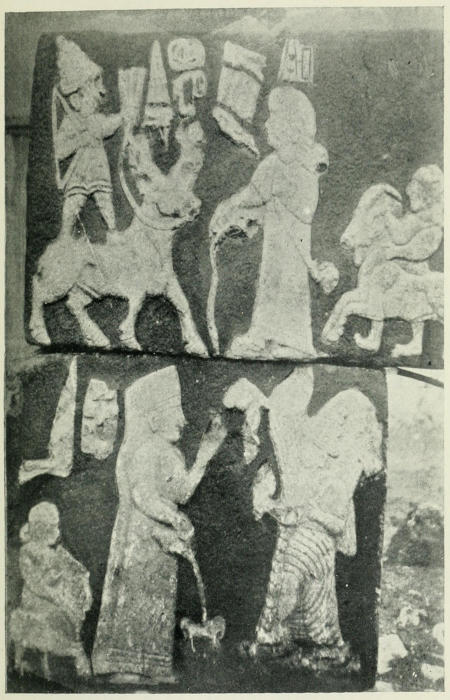
MALATIA.
i. King-priest making oblations at the shrine of the God of the skies, who stands on a bull with lightning in his hand. (See pp. 138, 359.)
ii. Queen-priestess making oblations to a tutelary winged deity. (See p. 139.)
The other stones from Malatia[297] are four in number, each decorated on one face. Unfortunately no information is forthcoming in regard to them except the published photographs, which again are not satisfactory. The subjects carved upon the stones are of striking interest. In the first of the series a deity, wearing a conical head-dress decorated with rings,[298] stands upon the back of a horned bull.[299] His left leg is forward (as he faces to the right), and on his feet are tip-tilted shoes. In his right hand, which is drawn back, there is a triangular bow,[300] and in his outstretched left hand he seems to hold up a forked emblem, like the lightning trident,[301] and to grasp at the same time a cord which is attached to the nose of the bull. His dress is a short bordered tunic. Facing him is a long-robed personage, in whom we recognise the king-priest, distinguished by his close-fitting cap and the characteristic large curl of hair behind the neck. In his left hand he holds a reversed lituus; his right is partly extended and seems to be pouring out some fluid which falls in a wavy stream. He is followed by a small person who leads up (with some difficulty it would seem) a goat clearly intended for an offering. Some hieroglyphs complete the picture. It is instructive to compare the whole theme with that which decorated the left hand of the façade to the palace at Eyuk,[302] especially as the blocks of stone seem to be in this instance also cubical building stones. The second sculpture of this series shows a different deity, who is winged,[303] though wearing the same conical hat with rings and upturning peak. His dress is curious; the lower part seems like a many-pleated continuous flowing garment which winds around his body and one leg, and passes behind the other leg. His two hands are held near his body, and in the left he grasps some object which is obscured, but may be seen to have reached to the left shoulder. He is approached by the queen-priestess, who is recognised (as in former cases) by the low cylindrical hat and the long cloak or veil descending therefrom behind the shoulders to the ground. Her left hand is raised as in reverence, and her right one, extended but low, seems to hold a narrow jug, with side handle and long neck, from which she is clearly pouring an oblation into a two-handled vase which seems to rest on the ground before the feet of the god.[304] Behind her there follows a small attendant leading an animal which may be presumed to be a goat as in the previous case. The few hieroglyphs accompanying these figures are illegible. The third block of the series seems to have been decorated with a row of male figures, unaccompanied by any hieroglyphs. Two of these remain. Each is clad in a short bordered tunic reaching to the knees, a conical helmet with rings between the ribs, and shoes with turned-up toes. The second man, who brings the series to an end, is bearded; his nose is mongoloid rather than aquiline or semitic, and he wears a conspicuous curling pigtail. In his advanced left hand he holds in a vertical position a long spear (or similar object), the shaft of which rests on the ground. In his right hand, which is held to his side, he clasps the handle of a mace, the head of which is made up of a ring-like device similar to that seen in the helmets. At his waistbelt there hangs a dagger with curling blade and crescental handle. The man whom he follows seems to be beardless, and he wears a short mantle, one end of which is thrown loosely over the right shoulder. His knife is like his neighbour’s; but an object with long shaft that he carried obliquely, grasped in both hands, is difficult to recognise; from the upper end there seems to hang a short tassel or object attached by a cord. Both figures face to the right, and in obedience to convention, their faces and bodies are in profile, the shoulders in full view, while the left foot and left arm are advanced. The last of this series is fragmentary, and seems to be the decorated upper border of a larger subject. In what remains it is possible to see hypothetically a pair of hands held aloft amid flames. Over all is the pattern of a twisted coil of rope.
Looking back for a moment at the nature of these sculptured monuments, we may with some certainty attribute them to two different building periods. The earliest are those four just described, which, from the point of view of construction and of symbolism, resemble, as we have seen, the palace works and sculptures of Eyuk.[305] The other sculptured slabs, which we described first, correspond more nearly from both points of view with the remains of Sinjerli and Sakje-Geuzi,[306] which we shall find reason to believe in later chapters belong probably to a later phase than the foregoing. The one group may be dated in general terms to the later half of the second millennium B.C., and the other to the early centuries of the first.
Passing up the valley of the Tochma Su, a small group of monuments is met with just after passing Derendeh. There was a rumour, when the English explorers, Hogarth and Munro, passed that way in 1891,[307] of a sculptured lion at a place called Haüz, not far from Derendeh towards the north. But the monuments on record were found in the neighbourhood of Palanga (Chiftlik), which lies on the higher ground after leaving the gorge of the river, some three hours’ journey westward from Derendeh. Here a small lion carved in basaltic stone was seen built into the main gateway; while lying in a puddle near a well hard by, and used as a stepping-stone, was a fragment of a unique columnar figure made also of basalt. The lion was similar to those found in the neighbouring wayside cemetery, hence called Arslan Tash, which we shall presently describe; the columnar figure,[308] however, is unique and instructive. The fragment preserved is fifty-two inches high and about fifty-five inches in circumference towards the top: it swells a little lower down. It ‘represents the lower portion of a draped figure; it is a mere shapeless column without feet, but a double protuberance of the stone at the end of the first line of the inscription is evidently intended to represent the buttocks. The drapery consists of an underskirt, plain except for a short series of perpendicular pleats down the middle of the back, and an upper garment thrown round the left side, the folded edges almost meeting under the right arm.[309] This mantle or cloak reaches down below the level of the knees; its vertical edges are fringed with a border of narrow lappets or tags very similar to those represented on a terra-cotta statuette from Cyprus.’[310] The inscription on this monument extends from the front of the figure around the left side to the back, covering two-thirds of the circumference. The signs are incised, and arranged in four bands, whereof the lowest is broader but less carefully cut than the others. Mr. Hogarth, in his description, points out other interesting analogies. The columnar form, the flat treatment of the drapery, and the ribbed pleats of the underskirt, recall to him the Hera of Samos in the Louvre; while for the rendering of the zigzag folds at the edges of the cloak and the buttocks, a parallel might readily be found in early Greek art, as, for example, among the archaic statues in the Acropolis Museum at Athens. In particular, the large terra-cotta figures from Salamis present an interesting comparison as regards both form and the general disposition of the draperies.
It is difficult to point to any nearer analogies than those which Mr. Hogarth indicated at the time of his discovery. Though belonging to a different place and later period, the statue of Hadad, found near Sinjerli, seems to us to be a product of the same tradition in art.[311] There is another statue of later date from the latter place, the discovery of which was recently announced.[312] This is also of columnar form, though the bottom of the skirt and feet are shown. The arms also are in relief, while the head and face, the latter wofully ill-drawn, are in the round. It is a survival and development from the older motive.
PLATE XLV
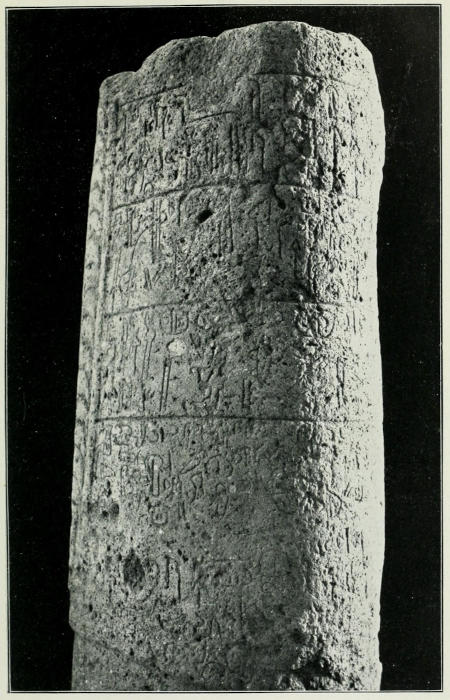
PALANGA: INSCRIBED COLUMNAR STATUE
The string of monuments from Palanga to Albistan indicates a southern bifurcation of the route, linking in Hittite times with the valley of the Pyramus. The suggestion of an important Hittite road leading continuously up the valley of the Tochma Su, and so over the watershed to the Halys and possibly towards Pteria, seems to be substantiated by two further inscriptions found on the rocks at Gurun, which is some way further up the river on the edge of the divide. This place (the Gauraina of Ptolemy and Guriania of the Assyrian texts) lies in a defile on both banks of the river. Just above the village the waters race through a narrow rocky gorge, at the foot of which the two inscriptions were found.[313] The one is incised on the face of an overhanging crag, near a small spring. It fills a space about four feet wide and three feet high, and is placed about twelve feet or more above the ground. The other is somewhat higher on the declivity, and further from the stream: the hieroglyphs are larger than in the former case, and less carefully incised. The inscriptions are very weathered, so that it is hardly possible to make much of them, but they seem to be partly in duplicate. The emblems which distinguish the two chief male deities in the divine triad at Boghaz-Keui[314] may be recognised; and Professor Sayce has also detected a variant of the place-name frequently recurring on the inscriptions of Carchemish (Gar-ga-me-i-si-ya), which makes it appear that there was some political relation between the two places.
Turning from Derendeh southward up towards the divide, ‘Arslan Tash’ is reached, about three miles after passing Palanga. The place lies about one mile east of the Kurdish village of Yeni Keui. The spot is marked by a series of hummocks near a small wayside graveyard, and receives its name[315] from two great monumental lions of hard limestone,[316] one erect, and the other fallen on its left side. They form a pair each about eight feet in length, and nearly six feet in height. These monuments, though large and impressive, are of crude appearance. They recall most nearly two massive early lions found at Sinjerli,[317] but though obeying certain early canons they are less thoroughly worked, as well as more roughly drawn. Their mouths are open, but exaggerated in size. The rough of the mane is strongly but not finely marked; the legs are not at all disengaged from the stone; the forepaws are almost shapeless, but the hind ones are fully outlined, with the muscle of the thigh suggested. Only one forepaw and one hindpaw appear in the profile view (a purely Hittite convention) while the tail comes down between the legs forward, ending in a curl.[318] Mr. Hogarth thinks that as they lay when found these lions may have marked the position of the entrance to a building.
Just over the watershed, at a place called (Ashagha) Yapalak, a badly defaced Hittite inscription has been seen,[319] but not published, and it seems to have been removed. The record, however, marks the continuity of the track, and the next discovery brings us well into the valley of the Pyramus at Izgîn. The monument itself was seen and photographed amid considerable excitement at Albistan,[320] whither it had been transported, and it is now in safe keeping in the museum at Constantinople.
The object is an obelisk, a unique example among Hittite works. Its Hittite origin is attested by the inscription which covers its four sides. Its material is coarse limestone; in height it measures eight feet two inches; in form it narrows slightly towards the top from one point of view, maintaining its width (twenty-one inches) in the other. The tapering faces are narrower at the bottom than the others, being only ten inches wide. The apex is slightly rounded. The hieroglyphs are in strong relief, arranged in rows. There are about nineteen of these rows on the broad faces, and sixteen only on the narrow ones, so that the signs are less crowded on these sides. Unfortunately the monument is very worn around the middle, and a considerable portion of the inscription cannot be recovered. It was originally seen standing as a headstone in a graveyard at Izgîn, which is a Turkoman village, some six miles north-east from Albistan, near the confluence of the Kurman Su with the Pyramus.
We have seen that the monuments which we have examined thus far in the Taurus region mark out the track of two main highways, the one following the valley of the Tochma Su, the other branching from that route southward to gain the valley of the Pyramus. A monument recently discovered now suggests one way at least by which in ancient times the Anti-Taurus might be traversed. This is found in the high pass of Kuru-Bel, a route which has now fallen considerably into disfavour, though not without its advantages. The distance is not more than ten miles to Comana (identified with the modern village of Shahr), which lies to the south-east. By this route, the tracks from the east, whether by way of Marash or by Albistan, converging on Comana, might lead down directly to Cæsarea and the interior; or they might, without serious difficulty, connect with Ekrek farther to the north, or Tashji and Fraktin farther south, all of them sites of Hittite works. In this case the monument seems like a great altar of stone, square cut, with a lion crouching on the top on either hand. The material is grey trachyte, which is only found fifteen or twenty miles nearer to Mount Argæus;[321] and as the object weighs just over a ton, it is a matter of considerable perplexity how it was transported in ancient times over the rugged path to the spot where it now lies. There is little doubt but that it remains in its ancient position. It is found on a limestone rock which rises from a small grassy plateau overshadowed by the lofty peaks of the Soghan Dagh, being itself about 7500 feet above the sea. The base of the object is solid and rectangular in form, with a length of four feet; its width is just under three feet, and its height seventeen inches. The two crouching lions are carved in the same piece of stone, one on either side, like the decorative arms to a throne. The stone is considerably weathered, so that it is not possible to recover much impression of the original finish or detail of the work. The limbs of the animals are outlined, and shown in full relief; the carving is all in the round. The lions are nearly as long as the stone is broad, while they are ten inches high and about eleven inches broad. The clear space between them on the top of the altar is about two feet. In front there may be made out several incised Hittite hieroglyphs, which seem to have formed part of a considerable inscription in three lines. We accept the term altar as an explanation of this monument on the mere general suggestion of its shape; it is, however, unique, and there is no material for forming a definite opinion. The modern shepherds of the vicinity make use of it for pounding up the roots from which they extract a dye for marking their sheep. This usage has considerably damaged the lions, and affords us no clue as to the original purpose of the monument. It may, however, have very well been an altar to the God of the Mountain or of the Pass. The sculptures of the Kara Dagh,[322] and even those of Boghaz-Keui,[323] prepare us for local cults of this character.
From Kuru-Bel, as we have mentioned, several different routes lead on to the plateau of the interior. One of these (but not the easiest or most direct) follows the stream called Kuru Chai down till it joins the Zamanti Su. A little way above the junction on the opposite side there flows in another stream which comes past Ekrek. This is a small Armenian village, eight hours’ easy journey eastward from Cæsarea. It boasts three Christian churches, and from one of the graveyards there has come to light a stone[324] of special interest. This was originally a Hittite monument with a panel of hieroglyphs incised along the bottom, bordered by a double line. A few signs appear below, but they are not continued. The stone has been re-dressed, it would appear, in Christian times, and five crosses have been carved upon it, being left in false-relief by cutting away the surface of the stone. There is a feather and zigzag border around the edge, which may possibly be original. The two rosettes might equally well be a Hittite device, but their relief corresponds with that of the crosses. The latter are symmetrically arranged, two small ones on each side under the arms of the larger central cross, which stands on a bar upon a roughly incised ‘calvary.’
PLATE XLVI
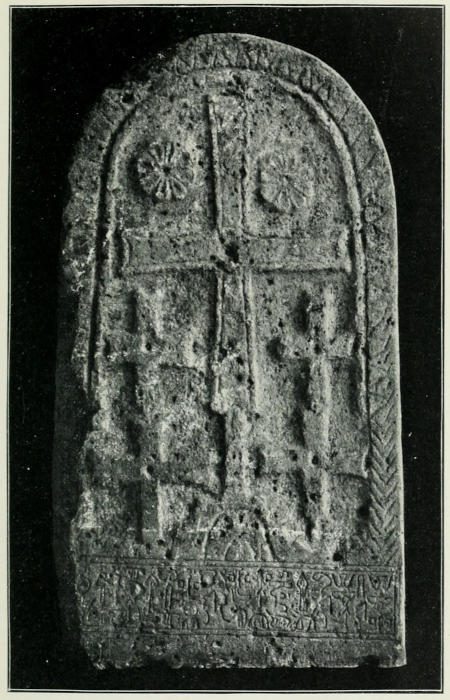
EKREK: HITTITE INSCRIPTION REDRESSED WITH CHRISTIAN EMBLEMS
Farther down the Zamanti Su we come to the village of Tashji, placed in a narrow glen on the bank of a small tributary. Here, upon a rock, there are visible the incised outlines of two figures and a considerable number of hieroglyphs.[325] The carvings are so weathered, and the record of them so insufficient, that little can be made out of the inscription. The two figures, however, may be judged to have been clad in priestly dress, with close-fitting skull-cap. The sharply-cut features of one of them remain conspicuous. They are to the right hand of the scene as published, and facing to the observer’s right; hence it is probable that they are facing some deity or deified object which has escaped observation. The position of this monument is of special interest, as it is only eight miles eastward from Fraktin, which is found on the next main bend of the river.
Here, at Fraktin (otherwise Ferak-Din),[326] is one of the most famous of Hittite sculptures, which makes most important contributions to Hittite religious symbolism.[327] From its position on the river, Professor Ramsay has, with reason, identified this place with the Dastarkon on the river Karmalas mentioned by Strabo,[328] and has shown how the omission of the name of the place from the list of Hiera, though at one time the most important, and the head over all others in Cappadocia, argues for its extreme antiquity as a religious centre, the importance of which was already passing when the list was made. Its sanctity was preserved, however, even in Christian times, by the Bishopric of Kiskissos, situated at Kiskeui, the nearest village to the site.
The sculptures[329] of Fraktin are found about half a mile north-north-east of the village, carved upon a convex rock facing to the west, where a cliff about fifteen or twenty feet high rises above a sluggish stream, the Kara Su, which flows past at the foot. They are about four feet from the ground, and the figures are from three feet to three feet four inches in height. The group fills a space nine feet eight inches wide, or, including an outer group of hieroglyphs, thirteen feet ten inches over all. The carving is executed in relief about two inches high. There are two scenes, in each of them two personages. The group on the left consists of two male figures, facing one another, and separated by an altar. They are both clad in Hittite fashion, with short tunic, conical hat, and shoes with upturned toes,[330] while each has seemingly a dagger at the waist. The figure to the left holds out some object in his extended left hand above the altar. In his right hand there is grasped a curving staff, which rests upon the shoulder.[331] With this figure there is associated the divided oval, the emblem of sanctity; so that we cannot doubt that if either of these two is a divine figure to whom the other is ministering, then it is the one in question. The figure upon the other side of the altar is more defaced; he seems to hold under the left arm a triangular bow,[332] while with his right hand he grasps an object which is continued by a wavy outline to the ground before his feet.[333] The altar between the two is very curious, and the object upon it unintelligible. The pedestal seems to be draped almost like a human figure with a narrow folded garment ending in a fringe. The narrowing at the top, representing the waist, and the horizontal belt around it, are evident.
PLATE XLVII
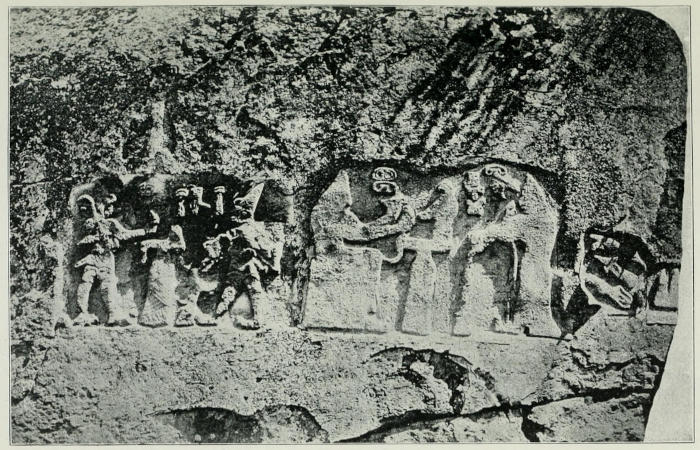
FRAKTIN: THE ROCK-SCULPTURES
Oblation scenes to the Mother-Goddess (right) and to the Son-consort (left).
The group to the right is not completely carved, the outlines only being shown, though the background is cut away. On the left of the altar in this case, the figure is seated on a square-shaped stool, and notwithstanding the conical hat (generally a part of the male attire), the only parallel cases of a seated deity suggest the figure of Ma, the Mother-goddess.[334] Whoever or whatever it may be, the hands are held out towards the altar. On the opposite side there is a similar long-robed figure standing, and the garment in this case shows a considerable train behind, while in front the turned-up toe of one foot protrudes. The right hand seems to lean on a long staff,[335] while the left, contrary to the usual convention, is extended, and grasps a long pendent object which reaches the floor,[336] as in the counterpart. The object perched upon the altar is unexplained, but most resembles the crudely drawn outline of a falcon or other large bird[337] facing the goddess.
Much has been written, and much might still be argued, as to the meaning of these sculptures. All that is certain is the insufficiency of evidence by which to identify them. We seem to have, however, two acts of worship, probably oblation scenes, represented; and on the analogy of the sculptures of Boghaz-Keui,[338] we may feel drawn to see in these sculptures two shrines, the one of the Mother-goddess, later known as Cybele, the other of her companion, likewise familiar in later times as Attis. At Boghaz-Keui the same divine pair appear in other guise. But being ignorant of the local religion, we learn little or nothing from these identifications. It is however of interest to notice how deeply permeated and how widely spread throughout the Hittite lands was the cult of the Nature-goddess in early times.
Section C.—Monuments of the Halys Basin.
ASARJIK, SUASA; YAMOOLA, BOGCHE, KARABURNA; BOGHAZ-KEUI (DENEK MADÊN).
With this group of monuments there are two or three outside the convex curve of the Halys, though none the less in the basin which that river drains. The first of these, on the slopes of Mount Argæus, might perhaps more appropriately have been classed with the monuments of Anti-Taurus, of which system Argæus is really the most advanced and most prominent peak. We have no doubt that near the summit of this magnificent slumbering volcanic cone there might be found traces of Hittite high-places, but for the present our only evidence of Hittite presence in this locality is to be found a comparatively short way up the ascent, at a place called Tope Nefezi, near to Asarjik.[339] Here, among a number of small rocks, there is found one, enclosed with a growth of low scrub, upon the southern face of which a Hittite inscription is incised. The spot is near one of the main ascents of the cone, commanding a view of the plain below, while in front the snowy peak emerges in vivid, gleaming contrast out of the dense growth of pine and fir trees that clothe the middle heights of the mountain. A stream coming from high up the mountain passes near the spot, and descends just eastward of Cæsarea to join the Deli Su. This river, flowing west through the marshes, shortly afterwards enters the Kara Su, which empties into the Halys just above Bir Geuz bridge.[340]
The rock itself is cracked vertically and weathered at the edges, so that some of the inscription on the left hand is missing, and some of it is illegible. It covers a space nearly four feet wide and nearly two feet high. It consists of two bands, of which the lower one, about eight inches in height, is marked only faintly with half-obliterated signs which suggest graffiti. The upper band is covered with incised hieroglyphs and a group of short upright strokes probably representing numerals. In the left part of the inscription, three or more signs are superposed in each column, while the whole is to be read clearly from right to left. For the moment the presence and position of this monument are its chief features of importance.
The other site, about equally distant from the Halys, but considerably to the west, is Suasa, on the head-waters of the stream which enters the Halys just above Karaburna. Here, on a cubical block of stone, similar to many hundreds fallen from the cliff, there has been found[341] an inscription, incised on the front and back. The exposed part of the stone is rather more than three feet wide. The record of the monument is insufficient to let us assign much importance to its apparent intrinsic details, such as the possible appearance of a winged animal and a fish among the hieroglyphs. That which concerns us most, as in the former case, is the unquestionably Hittite nature of the monument, and the place where it is found. If we are to regard these isolated monuments as general evidence of Hittite routes, we may see in this one the suggestion of a road from Akserai (Archelais) direct to Karaburna, connecting on the one hand with Ardistama or with Konia, and on the other with Boghaz-Keui by a southern branch of the royal road.[342]
Karaburna lies on the north bank of the Halys river.[343] Just behind the village a steep hill rises about four hundred feet, and is crowned with an ancient fortress. On two sides the wall of rock forms a sufficient defence, but on the west, and particularly on the north, this is more broken, and is supplemented by an artificial wall of rough stone work.[344] In the east side there is a sort of gateway, and below there is an underground passage leading probably to a well.[345] On a shelf of rock to the left of this entrance there is a lengthy Hittite inscription.[346] The surface of the rock is not very smooth, and it was found both worn and covered with lichen. None the less the discoverer brought back good copies of the inscription, which is important both intrinsically and topographically. The hieroglyphs are incised, and are arranged in three rows with border and dividing lines. They seem to have filled a space rather more than five feet long and just less than two feet wide. The inscription, as translated by Professor Sayce, refers chiefly to the building of the fortification and the towers thereof; there is also a remarkable suggestion that the district was subject to or part of Tyana. If we may make an inference therefrom, it is that the inscription belongs to a time when Tyana had superseded Pteria as the Hittite capital, and when Greater Cilicia had taken the place of northern Cappadocia as the most important Hittite state.
PLATE XLVIII
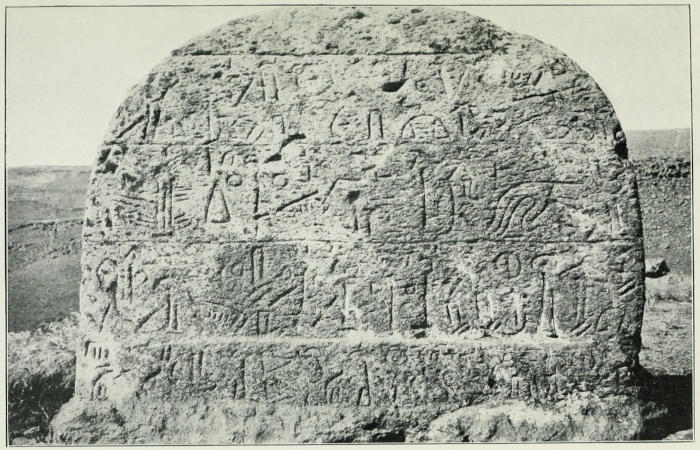
BOGCHE: HITTITE INSCRIPTION INCISED ON FOUR SIDES OF A ROUND-TOPPED STONE (See p. 155.)
At Bogche, higher up the river, and on the opposite bank, there is a unique Hittite monument, which, so far as can be judged, stands now precisely where it did in antiquity. It is a flat round-topped granitic stone, inscribed on both sides and ends, and standing upon a suitable plinth or pedestal. The width of the stone is almost exactly four feet, and its height three feet. At the side it is twenty-one inches wide at the bottom, narrowing to eleven and a half inches at the top.[347] The position of the monument is a slope of high ground overlooking the valley of the river, and isolated amid pastures to the west of the village. Its nature and situation alike suggest a tribal or village boundary stone, such as we suspect at Gurun and Bulghar-Madên. The inscription is arranged in four lines, and seems to commence at the top right hand of the northern face (which is towards the river). The hieroglyphs are incised, and include several new and uncommon signs. Though difficult the inscription is one of the most perfect pieces available for the decipherer or philologist.
Passing the Bir Geuz bridge, Yamoola is found some little way farther up the river, upon the northern bank. The village is in open ground, but just above the valley narrows to a gorge, which is practically continuous as far as Chok Geuz Keupru.[348] A pathway follows the river-side for the most part, winding along the narrow strip of soil between the water and the heights which overlook it. Other tracks take the higher ground, but they are rendered difficult by the loose stones that thickly cover the surface, imparting a desolate and wild character to the region. About forty minutes’ journey above Yamoola, or two and a half hours below Chok Geuz Keupru, the monument is found upon gently-sloping ground near the brink of a steep knoll about five hundred feet in height. The spot does not command an extensive view of the river, though only a hundred yards away, because the ground rises slightly in between; but a little way up stream the banks are more gentle, and the water comes into view at a bend.
The monument is a gigantic eagle of stone,[349] sculptured in the round, standing upon a solid base carved in bold relief with the design of a seated lion within each of three panels at the front and sides. The height over all is seven feet. It now lies upon one side, but it would appear that it was originally set up some four or five yards distant on a platform of stones, the front edge of which is slightly raised like a ridge to prevent slipping.[350]
The head of this great eagle is unfortunately broken away, and has not been found. Around the neck the feather pattern which covers the body gives way to a hair-like representation, seen as two clusters of hair curling finally towards one another. This may, indeed, be only a method of reproducing the down upon the neck, parallel with the treatment of the legs; on the other hand, hair may be intended, and it is thus possible that the bird was human-headed. After due consideration of the details and probabilities, however, we are disposed to accept the simpler solution: that the emblem was a simple though gigantic eagle, set upon a lion-base. Upon the breast of the bird, the plumage is represented by a leaf-like pattern with a boldness accordant with the great size of the subject. Upon the back this detail is repeated to some extent, but for the most part the work is more conventional, consisting of bands of herring-bone pattern running down the full length of the body, diverging upon the shoulders, and then converging gradually so as to cross towards the tail. The legs are shown covered with down, and the talons are forcefully executed.
PLATE XLIX
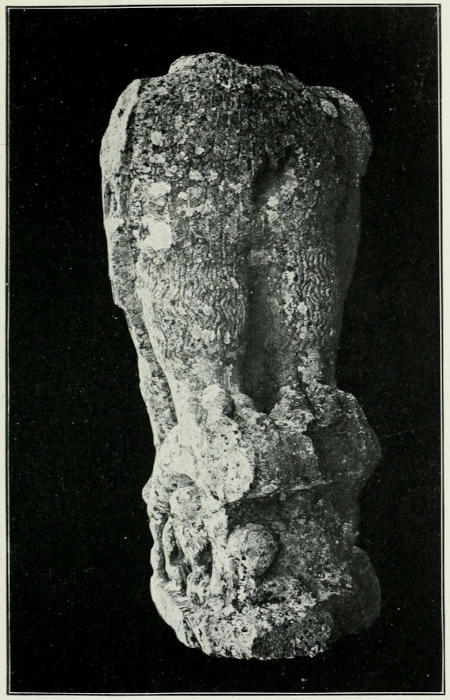
YAMOOLA: GIANT HEADLESS EAGLE STANDING ON A SOLID PEDESTAL SUPPORTED BY LIONS
The background has been removed.
The base of this monument is also of special interest. In each of the two visible panels (hence presumably upon the third) a lion is shown in an attitude not exactly crouching, but as though supporting the weight upon his shoulders and back. His forequarters are too much raised for an ordinary recumbent position, though otherwise the attitude of these animals is reposeful. The left leg in each case crosses over the right, and the tail curls up from between the legs backward over the thigh. The right side is presented in each case, and the face looks outwards. The width of the base, excluding the tail, which projects about five inches, is three feet nine inches. Framing the panels in which the lions are shown, and separating the pedestal from the rest of the monument, there is a curious wavy ridge of stone upon which the eagle is perched. It may possibly be intended as a branch of a tree, but it is made almost to resemble a writhing serpent, with its alternate narrowing and widening.
We have departed from the strict lines laid down at the outset of our inquiry in including this object, which is uninscribed, and bears no direct evidence of date upon it. We do so because we claim it with some confidence as Hittite work. Eagles, in relief and in the round, and lions, are familiar emblems in Hittite religious art, and they are found in association at Boghaz-Keui;[351] indeed, at this place, which we may believe to have been the religious centre for the whole Halys basin, a cult of the eagle seems to have been perpetuated in Hittite times.[352] Hence, though the character and composition of the monument are unique, the emblems which it comprises are familiar subjects in Hittite art, and appropriate to the locality. As to its meaning, however, we can hazard no opinion; its position near the valley of the river suggests a possible relationship, and we know[353] that rivers were sacred to some Hittite tribes.
Leaving now the valley of the Halys, it is a singular fact that there is no permanent trace of Hittite presence on record within the broad circuit which that river encloses, except the ruins of the capital at Boghaz-Keui and of the neighbouring palace at Eyuk. At the former place there is one monument called Nishan Tash, which claims mention independently of the buildings and sculptures to which we devote a special chapter, inasmuch as it is a rock-carving unlike anything else on the acropolis where it is found. It lies between the two fortresses of Beuyuk and Yenije Kaleh, where the surface of a rock facing to the south has been smoothed for a space about twenty feet by ten, and carved with a design or inscription arranged in ten separate lines. It is generally thought that this is an inscription in Hittite hieroglyphs, and probably that is correct; but owing to its extremely weathered state, we do not believe it possible now to recognise the signs with any certainty, though one traveller claims to have deciphered four lines in comparatively recent years. The rock lies back at a considerable angle, and is thus entirely exposed to rain and frost. At the present time the carving simulates a series of animal forms, arranged in pairs facing one another, and (in the second row) of winged creatures placed singly and separated by dividing lines from one another. In the ninth row there is a suggestion of bulls facing one another in pairs, with lowered heads. Doubtless this is illusion,[354] but it shows the unfortunate impossibility of recovering the original inscription with any reliability.
Two further monuments, recently discovered,[355] may be appropriately mentioned, inasmuch as they have no clear relation to any other buildings of the site. They are cubical building blocks of granite (similar to those from Malatia and elsewhere), and the face of each is decorated with a relief. In the upper part of the stone there is a socket-hole, from which fact the discoverers argue that they were the bases for statues, though from the analogy which their other discoveries afford, it would appear more probable that they supported a building carried up in timber. The subject of the relief is clearly religious, and it includes some striking and important features, which appear on each stone. Indeed, the only difference between the two is found in three out of five hieroglyphic signs that occur in each case. Otherwise the subject represented is the same. This shows a priest, clad in toga-like robe standing in an attitude of prayer before an altar. He wears a skull-cap, shoes with turned-up toes, and earring. The toga is worn (in one case plainly) over a short tunic and vest. His left hand is raised towards the altar, and his left foot is advanced. The altar is of square shape, and without parallel in Hittite representations.[356] It is decorated with squares divided by diagonal lines and crosses. There is a little difference discernible in the arrangement of these decorative details, the chief point being that on the one they are arrayed in rows (in which case there are no crosses) and in the other in columns (in which case the crosses form a partial middle column between two of diagonals). Most curious of all, upon the altar, seemingly one on the right hand and one on the left, are two tall loop-like or round-topped objects standing vertically. Behind the altar there seems to be the cult object, which at first glance looks very like a harpoon, though the head is bent somewhat backward. It may, however, be thought to represent some pointed object (like the Hittite hat) on a pole.
(There is a small ivory object recently obtained at Denek Maden, near Chesme Keupru, which we may appropriately mention here,[357] as it is characteristic of a certain class of Hittite objects, though not of direct use to our present subject. Its form makes it improbable that it was a seal in the ordinary sense. On the obverse there is the figure of a god clad in a short tunic; from the hieroglyphs alongside he is to be recognised perhaps as Sandan, or Sandes. On the reverse there is the robed figure of a priest holding apparently a long staff in his hand, and wearing a skull-cap. Certain hieroglyphs accompany this figure also. The character of the object and treatment of detail have several features of special interest.)
Section D.—Monuments of the West.
ANGORA, GIAOUR-KALESI, YARRE (CHESME KEUPRU); DOGHANLU, BEY-KEUI; SIPYLUS, KARA-BEL; ILGÎN (KÖLIT-OGHLU YAILA), (EFLATOUN-BUNAR, FASSILER).
It has already been indicated that the Hittite works in the west are few in number and of somewhat special character, and that they are disposed for the most part seemingly along a single line of road.[358] They betoken a line of conquest rather than a period of settlement. Nevertheless, if we may permit ourselves to take into consideration certain sculptures which, though uninscribed, are of strongly Hittite character, we shall find reason to feel the presence of Hittite influence, or close contact with Hittite artistic feeling, in Galatia north-east from Phrygia. In view of the fact which has been established[359] that the Halys River formed a boundary between peoples of different racial customs, this evidence, if it may be accepted, assumes definite importance, inasmuch as such influence was less likely, under the circumstances, to be the result of neighbourly assimilation. It would argue, in short, for a definite occupation or suzerainty.
Of such uninscribed works we may single out three in the immediate vicinity of Angora, the one at Kalaba,[360] which is just eastward of the town, the others at Amaksiz and Yalanjak,[361] which lie to the west and south-west respectively. These are uniform slabs of stone, suitable for the façade of a building, decorated with reliefs of lions.[362] It is not merely the analogy of motive and of subject, but certain details of treatment, which give them a Hittite character. The beasts are in each case represented as advancing, with wide open mouths. The farther legs are advanced and the tail curls over the back. On the lion from Kalaba the body is seemingly hairy below the belly and the collar is suggested. Most characteristic of all is the treatment of the shoulder muscles, which are drawn in conventional outline, as at Eyuk, Sinjerli, and elsewhere. (At Chesme Keupru, also, exposed to the weather on the western side of the bridge, there is a lion sculptured completely in the round. This is in itself a fashion unknown to Hittite art, and added to that there must be noticed the seated posture of the animal and uncouth treatment of the subject. We cannot see in this any semblance of Hittite influence.)
The sculptures of Giaour-Kalesi, however, are of unmistakably Hittite origin, even though no inscription seems to have been noticed with them. Here the subjects are godlike figures, in familiar Hittite guise.[363] They are carved in relief upon the living rock, and their situation is particularly noteworthy. A rocky knoll overlooks, indeed partly overhangs, a narrow pass: upon the summit is a fortress, rectangular in shape, about eighteen yards by thirty-seven, and supported by an outer and lower wall at a distance of twelve to thirty yards. The masonry of the inner wall is rough dry-walling, while the outer is built in the style of the fortress on Beuyuk Kaleh at Boghaz-Keui,[364] of stones roughly pentagonal in shape, irregular in size, fitted to one another, and laid without mortar. In its shape this fortress corresponds to that of Yenije Kaleh at Boghaz-Keui;[365] in its double wall and rough inner masonry to that on Kizil Dagh;[366] and in the position of the monuments near its entrance to that on Kizil Dagh just mentioned, and to another at Karaburna.[367]
PLATE L
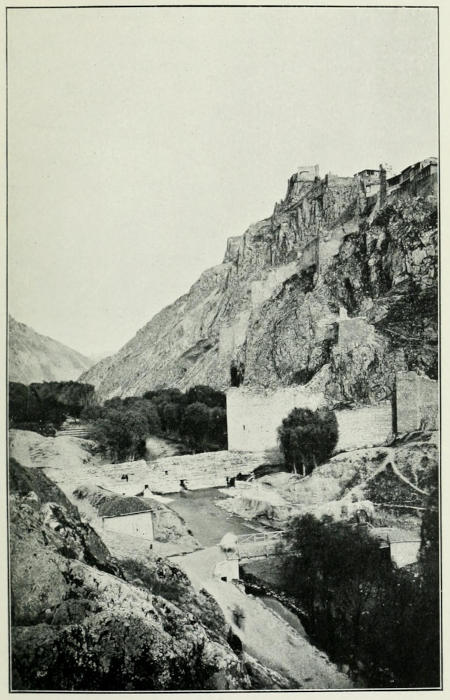
ANGORA: THE ACROPOLIS (See also p. 36.)
The sculptures represent two male figures: the one bearded, the other beardless. Both are clad in the short tunic, tip-tilted shoes, and conical hat familiar in the god-figures at Boghaz-Keui.[368] A dagger with crescental hilt is stuck into the belt of each. They are of gigantic size, seemingly about ten or twelve feet high, and both are posed in the same way facing in the same direction. They turn to the observer’s left; their right hands are advanced, as though pointing down the pass, while their left arms are drawn back. Obedient to convention, the right legs are advanced, and the shoulders are seen almost in full view. Something hangs down from the hat of each, falling behind the neck;[369] and upon the front of the hat worn by the bearded figure there may be traced a curving object, but whether the upturned brim familiar on the sculptures at Sinjerli and Boghaz-Keui,[370] or some other emblem, is not determinable.
There can be little doubt as to the identification of these two figures, as they are portrayed, with the father-god and the son-god (the two forms of Attis of later times), seen in exact correspondence on the sculptured walls of the sanctuary at Boghaz-Keui.[371] Is it merely a coincidence that, while being a link in the great westerly route from Boghaz-Keui towards Kara-Bel and Sipylus, they are pointing down the pass which is thought by many to have led also directly to Pessinus or Pessinous, the chief sanctuary of the Mother-goddess[372] in this part of Asia Minor?
Whatever may have been the direction of the Royal Road eastward of Giaour-Kalesi, it would seem to have passed west by way of Yarre, which is found near a bridge over the Sangarius called Karanji Keupru. Here a sculptured slab has been found[373] decorated with a relief representing a ceremonial feast. This is an important link, for this class of subject has a wide distribution, as we have seen,[374] throughout Hittite lands on both sides of the Taurus. Its appearance west of the Halys betrays the influence not only of Hittite art but of a common religious institution.
PLATE LI
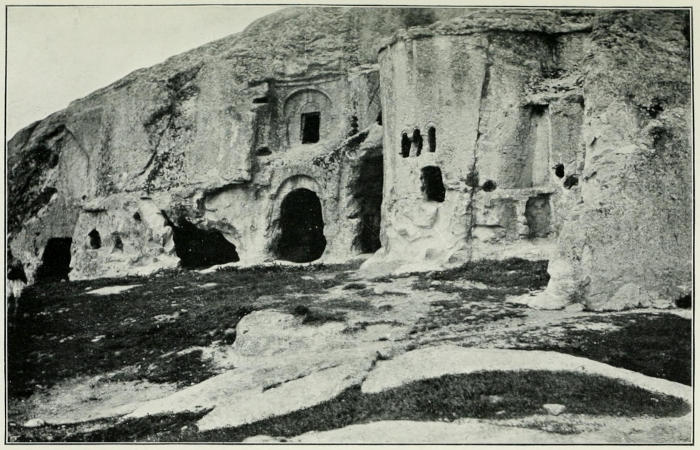
AYAZÎN: ROCK-HEWN TOMBS AND EARLY CHRISTIAN CHURCH. Cf. p. 60.
The church may be recognised on the right by its rounded exterior, corresponding to the apse.
The slab is almost exactly thirty inches square and twelve inches thick. The back is rough, and on the upper side is carved a tongue or ‘joggle,’ for attaching another slab: clearly it formed part of the façade of a building like the slabs of Angora, Sinjerli, and Sakje-Geuzi. The drawing of the scene is more angular and less free than is seen on most Hittite works, but there are several intrinsic Hittite peculiarities. Two figures are seated, their feet on footstools, at opposite sides of a narrow table or altar. The head and back of the left-hand figure are missing. The shoes of both turn upwards at the toes, and their garments seem to be long, reaching to their ankles. The end of a toga-like garment is conspicuous on the right-hand figure, falling over the right shoulder and reaching almost to the seat. The head-dress of this figure resembles a skull-cap with expanding front, and a short hood or veil falls behind the neck. The features are sharp, the nose and chin being particularly prominent. The figure is seated on a stool with two straight legs which cross. In the left hand (which, as at Sinjerli and elsewhere, is inaccurately represented with the palm instead of the knuckles towards the observer) there is grasped a small round-topped object; and in the right hand, which is partly raised, there seems to be a cup. The opposite figure is clad alike, so far as it can be seen, and similarly raises a cup towards the lips. The object between them resembles in form the narrow tapering altars seen on the sculptures of Fraktin. Upon it there seem to be a bird, and possibly some other offerings not clearly defined. In the background between the two heads, and above the ‘altar,’ there appear certain marks, in relief, which may be the remains of hieroglyphic signs. It is unfortunate that the whole of this sculpture is not preserved, a circumstance which makes us hesitate to attempt to explain its meaning. It is probable, however, that the persons, being both seated, are in this case on an equality, and both share in the feast, as at Marash,[375] Boghaz-Keui,[376] and Sinjerli.[377] We infer that they are man and woman, but that is not clear. The figure on the right, clad in the toga and long robe, wears also an earring. The seat on the left is not a stool of the same kind as that on the right, but rather a square-shaped chair, though, being broken in two, we have only a portion remaining from which to judge.
In the Phrygian country the rock sculptures of non-Phrygian character near the Midas-tomb at Doghanlu[378] may be thought to carry on the line of Hittite highway to the west. These are found on a plateau above the valley in which are the Phrygian monuments, and they seem to have been anciently reached by means of a road ascending in a gentle curve, now partly hidden at the bottom by accumulated earth. There are several figures of gigantic size carved in relief upon the rocks, but that which has attracted most attention is a small one in the series, two feet four inches high, described by the discoverer as a figure of ‘Hermes.’ The person stands, facing left, his left foot and arm advanced. His hair is dressed close, or it may be covered by a skull-cap, and a curl is visible behind the neck. In the left hand a caduceus is held upright, the head of which is seen like a small disk with horn-like objects projecting from the top and turned towards one another. Beyond the staff are certain picture-signs, amidst which a bird[379] may be recognised, with a small triangular sign below. These signs, in the opinion of the discoverer, are not the same as the Hittite hieroglyphs. None the less, the monument is accepted as Hittite by Dr. Messerschmidt[380] and M. Perrot.[381] We consider their interpretation of the origin of the sculpture to be extremely doubtful. We do not feel so strongly as Professor Ramsay that the Phrygians obviously learned this type from the Hittites of Pteria, as may be seen from a comparison with the youthful god in the sanctuary of that place. On the other hand, the caduceus, the picture-signs, and the short robe of the figure, are not really those familiar in Hittite art. We are told, however, that other sculptures of the series with which the ‘Hermes’ is associated have more in common. The theory of Hittite influence, though not of Hittite origin, is perhaps easiest reconciled with history, and we may accept it tentatively as a working hypothesis explaining their presence, but not as independent evidence.
PLATE LII
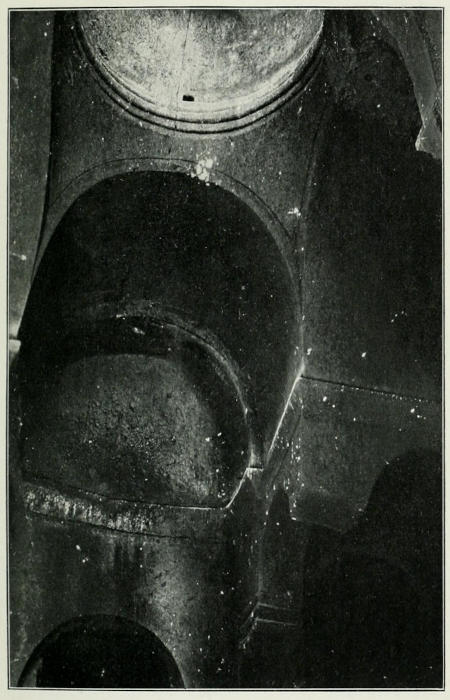
AYAZÎN: ROCK-HEWN ROOF OF THE CHRISTIAN CHURCH
Notice the dome and capitals. (See Pl. LI. and p. 60.)
The same doubt does not exist, however, in regard to an inscription from Bey-Keui, which is a definite trace of the Hittites in the west. The monument is a dressed block of limestone, dug by Professor Ramsay[382] out of a mound at the entrance to a glen. The hieroglyphs are in relief, and on the portion of the stone preserved were arranged in rows, of which two partly remain. The whole was surrounded by a plain border.[383] From the published copy two or three of the signs may be readily recognised as distinctively Hittite. The position of the monument has thus a great interest amid the paucity of evidence in the west.
Those monuments which tell of the Hittite influence in the extreme west are found on the mountains of Sipylus and Tmolus, not far in either case from Smyrna. The river Hermus before entering the sea flows about a mile distant on the northern side of Mount Sipylus. On the other bank there stretches out a considerable expanse of highly fertile plain. The road and railway pass between the river and the mountain, and from them the famous sculpture may be plainly seen. It is several hundred feet up the slope, involving a sharp climb up the accumulated débris and soil at the foot of the cliff. Above, the cliffs rise sheer and almost precipitous.[384]
The monument occupies a recess specially prepared, about forty feet in height, while the figure itself is over thirty feet high. This gigantic sculpture, perhaps on account of its accessibility, has been more noticed in writings, ancient and modern, than any other. Its present condition,[385] however, leaves us no chance of forming any new opinion as to its original meaning and character. Fortunately on both points there remains little doubt, in spite of a considerable controversy, which is, however, now no longer of interest. As to its meaning, we are guided by the studied words of Pausanias,[386] read in the light of modern information, to believe that it was a rock image of the Mother-goddess; and as to its character, we may see in its present weathered state the indications of a sculpture in very high relief, almost indeed in the round, though not disengaged from the rock, which once represented a female seated, with her feet presumably upon a stool. The head of the figure is seemingly inclined forward, and the form of the female bust may still be recognised. Those who previously may have thought the carving to represent a bust upon a pedestal were deceived by its present appearance, for certain hieroglyphs[387] in the recess near the head attest its Hittite origin: the motive of bust and pedestal finds no place in the category of Hittite art, while the seated figure of the Mother-goddess has its counterpart in the Hittite sculptures at Eyuk[388] and Fraktin.[389] The inscription in question is very fragmentary, though certain characteristic symbols can be recognised, notably the tip-tilted shoe and the horned (ram’s) head. ‘It contains,’ writes Professor Sayce, ‘the name of the Mother-goddess, with her title “Queen of the Rock,” all of which signs recur in an inscription from Emir-Ghazi.’[390]
PLATE LIII
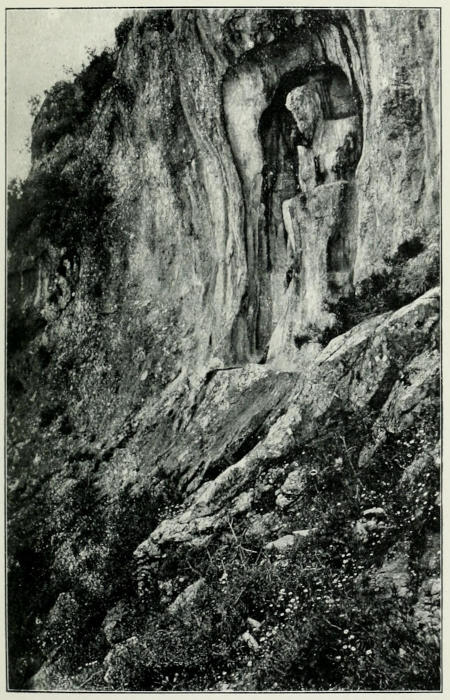
MT. SIPYLUS: GIANT IMAGE OF THE MOTHER-GODDESS
It would seem that classical writers, following generally in the footsteps of Homer, confounded this image with another object, a natural rock on the same mountain, which tradition associated with Niobe, and would seem indeed to have conveyed a suggestion of her weeping form. Thus Homer[391] sings that ‘Niobe, turned to stone, upon arid Sipylus broods o’er her sorrows’; and so again Ovid:[392] ‘Fastened to the rock she weeps, and the marble sheds tears.’ Fortunately Pausanias, himself probably a native of this country, ascertained the facts and showed how the confusion had arisen. ‘This Niobe,’ he says,[393] ‘I myself saw when I ascended Mount Sipylus; close at hand it is merely a rock and a cliff, with no resemblance to a woman, mourning or otherwise; but if you stand farther off, you will think you see a weeping woman bowed with grief.’ This is clearly the Niobe of Homer, Ovid, and Sophocles, and clearly also the smoothed appearance of the rock above the image of the Mother-goddess (which is not, it seems, due at all to the action of the water), was one of the reasons accounting for the confusion. As to the identity of the image, Pausanias leaves us in no doubt where he says,[394] ‘Here (at Aeriae) there is a temple of the Mother of the Gods, with a stone image of her: both are worth seeing. The people of Aeriae say that it is the most ancient sanctuary of this goddess in the Peloponnese. The oldest of all her images,[395] however, is on the rock of Coddinus at Magnesia, to the north of Sipylus: the Magnesians say it was made by Broteas, son of Tantalus.’ Finally the same writer makes his distinction apparent by showing that he was aware of the passage in Homer referring to the story of Niobe.[396]
As in other cases, we do not dwell upon the religious symbolism of the monument. That the Mother-goddess (Ma) was the prototype of Kybele remains undisputed, and all that is of interest in the cult of the great Phrygian goddess has been pointed out by Sir William Ramsay[397] and others. But the attributes of the goddess in the minds of the Hittites remain indefinite, and are to be inferred from the rites represented with her at Boghaz-Keui, Eyuk, and Fraktin, from the ritual described by Strabo and Herodotus, as surviving at Comana, Tyana, Pessinus, and elsewhere, and from the inherited attributes of Kybele herself.[398]
The other Hittite monuments of the west on the pass of Kara-Bel are comparatively near at hand. A stream which feeds the Hermus, flowing around the foot of Mount Sipylus on the east, comes down from the valley which separates that mountain on the south from the opposite slopes of Olympus. The bed of another small tributary leads up these southern slopes to a narrow wooded glen upon the ridge, in which are the sources of the Kara Su. Through this glen there passes a track, now not much used, connecting Ephesus to the south with Sardis or Smyrna by the northern valley. About seventy feet above this track, in the perpendicular face of the cliff, a niche of rock encloses a sculpture in relief. The niche is about six feet wide at the base and nine feet high, being considerably narrower at the top.[399] The figure within is that of a warrior, similar to those of Giaour-Kalesi, and resembling the god-figures at Boghaz-Keui. He stands facing to his left, his left leg and arm advanced, and his shoulders squared to the observer. He wears a short tunic and short-sleeved vest and high boots, which in some early drawings are shown as turning up at the toes.[400] The conical Hittite hat completes his costume. A triangular-shaped bow is carried over his right shoulder, and his extended left hand seems to grasp a long staff or spear.[401] The sculpture, being on the east side of the ravine, is turned towards Ephesus. There is another similar sculpture on a detached block of stone some two hundred and fifty yards farther up the pass. This stone seems to have fallen from the rocks above, and it now lies on the west side near the stream, about twelve yards below the level of the path. As it lies the sculptured face is towards the east, and the figure being turned as in the former case, towards the left, looks to the north. It is probable, however, from the similarity of the two subjects, that they originally looked in the same direction.
It is curious that there is no mention of these sculptures by Pausanias. Herodotus, however, describes them as images of Sesostris,[402] ‘the one on the way from Ephesus to Phocaea, the other from Sardis to Smyrna. In both places a man is carved, four and a half cubits high, bearing a spear in his right hand, and in his left a bow; and the rest of his equipment is in unison, for it is partly Egyptian and partly Ethiopian. From one shoulder to the other there extend across the breast sacred Egyptian characters, incised, which read as follows: “I acquired this region by my own shoulders.” Who or whence he is he does not here show.’ It is clear that Herodotus was writing from hearsay: there is just enough general accuracy in his account to identify the monuments, and enough discrepancy to make it apparent that he had not visited them himself. The details as to position we have already noticed; and Professor Sayce has shown[403] that the inscription, so far from being across the breast of the figure and in Egyptian characters, is found in the characteristic place, between the spear and the head of the figure, and consists of a group of Hittite hieroglyphs, in which certain symbols can be recognised. On the fallen block no trace of inscription remains, as the sculpture has suffered mutilation; in fact, a Yuruk’s tent was at one time pitched against it, and the niche used as a fireplace. But sufficient remains to make it demonstrable that no Egyptian inscription ran across the breast. We can hardly hesitate to identify this figure with one of the two forms of the Hittite national deity, and if the suggested absence of beard be a guide, he will be in this case the son-god of Boghaz-Keui, the Sandon of Tarsus, the prototype of Attis the consort of Kybele. We are inclined to see him here, as at Giaour-Kalesi, in the aspect of a God of Arms. We may notice once more, and ask, as in a previous case, whether it can be mere coincidence that the only Hittite monuments surviving in the extreme west are representations of the Mother-goddess and of the chief male deity of the Hittite peoples.
PLATE LIV
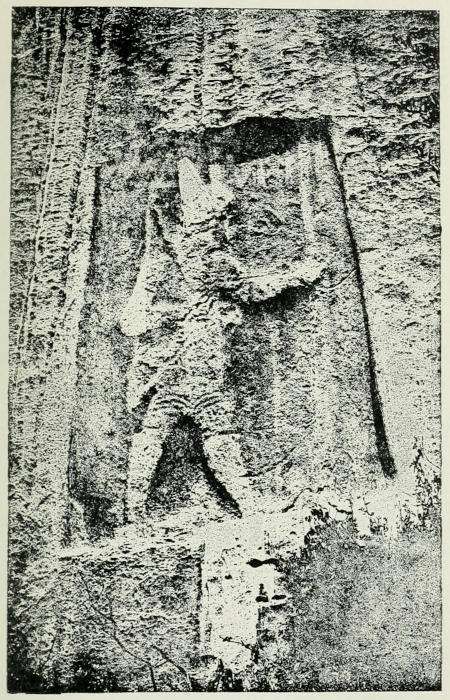
KARA-BEL: THE HITTITE GOD OF ARMS
With these monuments of the west we classify also one definitely Hittite inscription from near Iconium, and two instructive monuments reflecting Hittite influence, found near the Lake Beyshehr. The inscription was found near Ilgîn, at a place called Kölit-oghlu Yaila,[404] about three miles from the latter and eight miles eastward from the former, and about three hundred yards off the road from Ilgîn to Kadyn Khan. Actually the spot is about fifty miles north-westward from Iconium. Here there are traces of an ancient site in a slight eminence upon the plain, and the ruins of a wall running in a curve for a long distance. It is possible, Professor Ramsay thinks, that these indications may mark the site of pre-Hellenic Tyriaion,[405] which was one of the three chief cities of the Phrygio-Lycaonian frontier lands. In Roman times, however, Tyriaion was placed without doubt at Ilgîn. It is more probable that the mound indicates a site of antiquity that fell for some reason into neglect as Tyriaion came into prominence. Out of the top of this there was dug up a block of limestone, about two feet eight inches high and six feet long. It is not quite complete; but upon it there may be made out with some certainty three rows of Hittite hieroglyphs in relief, the inscription commencing with the right-hand side at the top. The position of the monument is of special importance, for it seems clearly to have been found near to its original position, and is the sole witness of Hittite handiwork in this part of the tableland. And though it stands alone, it does not seem to be of that class, the isolation of which may be accounted for and is in itself instructive, like the sculptures of Sipylus and Kara-Bel. It seems, on the other hand, to be the product of settled conditions, and its presence implies a whole field and period of Hittite influence which would otherwise have remained in obscurity.
There are two monuments south-west of Konia which, though not inscribed nor demonstrably of Hittite handiwork, reflect clearly Hittite influence and feeling in art. One of them is ‘Plato’s Spring’ at Eflatoun-Bunar,[406] nine miles northwards from Beyshehr. This consists of two walls of an unexplained structure, of which about two-thirds has been destroyed. The façade, which is decorated with sculptures, is about twelve feet in height and twenty feet in length. It is washed by a stream which has been partly dammed by stones taken from the building. The stones are large, almost gigantic, and dressed with care: they are decorated with human figures in relief, which vary in size with the stones, though forming a symmetrical group, and each posed with hands raised, in full view; several of them wear the conical Hittite hat. Two pairs of wings, enclosing disks, are carved upon a single stone which spans all but the corner-stones, while a great slab which covers the whole retains the decoration of a single pair of wings and part of a central disc. In the side view some of the stones are dressed with a panel; other stones are lying about, and Professor Ramsay has detected one on which a lion seemed to have been carved.
There is another remarkable but equally problematical monument at Fassiler,[407] near the route from Beyshehr to Iconium. It is a gigantic stela, about eight yards in height, and nearly a yard thick. At the bottom its width is nearly three yards, narrowing at the top to nearly two yards. The subject represented upon it is carved in very high relief. It shows two lions side by side separated only by a figure, clad in a long robe, with hands folded before the breast. Upon the shoulders[408] there is posed a greater figure, wearing the short tunic and conical hat of peculiar form. The right hand is raised, while the left arm is bent, and some indistinct object is grasped by the hand. Meagre as is our information about this monument, we do not hesitate to see in it a reflection of an idea which we see carried out in the Hittite sanctuary of Boghaz-Keui. The theme seems to us to represent the statue of the god borne upon the shoulders of his priest; and the lions, as emblems or guardians of the god, suggest a derived form of the son-god or Attis, which we discuss in a later chapter.[409] The character of the lions flanking the monument, with their heads projecting boldly in front, is also in keeping with Hittite tradition;[410] and the position of the sculpture between the lions has its counterpart in a monument, equally of post-Hittite times, which has been brought to light at Sinjerli.[411] Finally the whole appearance of the monument suggests a columnar figure upon a lion-base,[412] of which this is a clumsy and ill-carved substitute. A wonderful gulf separates the drawing and execution of this monument from the sculptures of Boghaz-Keui.
Section E.—Monuments in the South-East of the Tableland.
KARA DAGH, EMIR-GHAZI, TYANA (BOR, NIGDEH, ANDAVAL), BULGHAR-MADÊN, IVRÎZ.
We turn in fine to the south-eastern corner of the tableland, now a desert tract fringed by the northern slopes and outlying ridges of the Taurus mountains. Our comparatively intimate knowledge of the monuments and historical geography of this region is due almost entirely to the consistent researches of Professor Sir Wm. Ramsay and his school.
We come firstly to the Kara Dagh (Black Mountain), an outlying ridge of Taurus,[413] which rises three or four thousand feet above the plain, to a height of seven thousand feet above the sea. At the foot of the mountain, on the north, the little village of Maden-Shehr marks the classical site of Barata, better known, perhaps, as Bin Bir Kilisse, ‘the thousand and one churches.’ Professor Ramsay tells[414] of the great changes that time has wrought in this locality. Here there ‘must have been in ancient time the summer sanatorium of the Lycaonian plain. The soil is very fertile, and being volcanic, is specially suitable for vines. Many kinds of fruit trees also were cultivated. Water is not plentiful, but there are several springs of remarkably good water. The needs of agriculture and viticulture were met by a wonderfully elaborate system of storing the rain and the melted snows of winter.’ But now ‘the site of this ancient city is the most inhospitable in the whole of Lycaonia. There is no water except filthy half-poisonous puddles stored in the ancient cisterns. The vines have almost entirely disappeared, the orchards remain only in a few trees run wild. There is hardly any cultivation. The water runs rapidly off the steep slopes of the mountain, and is of no benefit to agriculture except in the lowest parts of the little sheltered valley where the city was built.’
That the life, and possibly the sanctity, of the place dates back to remote antiquity is shown by the discovery[415] of two Hittite inscriptions on the summit of the mountain. The spot called Mahalich is marked by a Byzantine Church, which seems to preserve the ancient sanctity of a high place of older times.[416] The church is supported on the north side by rocks in which a passage can now be traced, though it would seem to have been partly hidden at least by the Byzantine walls. This passage was to some extent artificial, and on its rock-walls are two inscriptions, a short one in relief upon the north, and a longer one incised on the south. The shorter inscription consists of four groups of signs only, translated by Professor Sayce[417] to mean ‘Tarkyanas, the supreme king.’ The other inscription is longer, comprising twelve groups of signs in a row, in addition to the same royal name, which in the middle recurs with little variation in its hieroglyphic form, though surmounted in this case by a winged emblem. There appears in this inscription[418] a hieroglyphic sign otherwise unknown, resembling a horned altar.
In the same neighbourhood, about eight miles to the north-west, there is an outlying rocky hill called Kizil Dagh, which rises sharply from the plain to a height of nearly four hundred feet. The summit of this knoll is crowned with a fortress, the early character of which is betokened, says the discoverer,[419] by its style and by three hieroglyphic inscriptions found near by. We are not yet told the precise nature of the ramparts, but the position of the fortress recalls those of Giaour-Kalesi, Boghaz-Keui, and Karaburna. Near a gate in the western wall, on the right-hand side, the longest inscription of the series is to be seen upon a sort of rock altar. The hieroglyphs are carved in relief, and arranged in two rows. As with the inscription on the Kizil-Dagh, the same royal name appears in the middle of the group of signs, surmounted, it would seem, by a winged disk. Lower down on the hill, but still upon the shoulder, there rises a sharp rock, roughly hewn into the form of a high-backed seat or throne, and on the back of this a bearded figure has been engraved. The personage is represented as seated on a square-shaped throne, his feet upon a stool; but the details of the design are unlike anything else that has been recorded.[420] Much of its peculiarity may be attributed to the unskilled hand that carved it, but there are certain features rendered with deliberation that are worthy of note. The left arm is outstretched, and the hand grasps towards the top a staff with crescental knob, which is held vertically. The lower end of the staff stops short above the stool, possibly in obedience to the general convention of perspective in Hittite art. Were the drawing completed, indeed, in our own convention, with the vanishing point suitably chosen, it would be found that the staff seemed to rest upon the stool. In the right hand, which is just in front of the body, there seems to be a cup of some kind.[421] The dress is not clearly drawn, but there is the suggestion, by a simple oblique line, of a loose fold or possibly the loose end of a toga across the body. The hem of the skirt is fringed. No footgear is apparent, and the head-dress is apparently a degradation of the familiar conical hat, reduced in this case to an inverted V-shape by unskilled drawing. The hair falls straight and backwards upon the shoulders. The seat is curious, and plainly simulates a substantial chair of wood. The back is a solid upright piece, square cut, and the side-pieces which form the arms are lateral strips, connecting the front legs with the back. The footstool is similar in style. Without other evidence it would have been difficult to support an argument of Hittite origins for this carving; but that question does not arise, owing to the presence of a group of hieroglyphs appearing characteristically between the top of the staff and the face, and these signs are at once recognisable as forming the same group which we have met with three times previously in the same vicinity, namely, the royal name read by Professor Sayce Tarkyanas.[422] The same name appears in two other places on the same rock. In the one case it is followed by two short lines of inscription, incised like the rest, and the spelling of the name seems to illustrate an interchangeability of two hieroglyphic signs. Surmounting the whole there is a winged emblem, in which the central portion seems to be composed of two crescents underneath a disk (which is also divided like a crescent). Above the emblem there appear the symbol of sanctity (the divided oval) and the hieroglyph which Professor Sayce interprets as the name of the god Sandes.[423] The same arrangement, with slight variations, is repeated with the other occurrence of the name, which in this case, however, is spelt as in the earlier instances. The centre of the winged emblem may be seen to be a rosette, with a curious spreading object below. Above, two dots follow the name of Sandes, and the picture-sign of a human arm bent ‘in adoration’ is by the side.
These two groups of inscriptions, and the carving which accompanies them, awaken several interesting thoughts. The most important point is one which might be easiest lost sight of, namely, that these sacred places are sought on rocky points or hilltops, bearing out the suggestion of the sculptures near Boghaz-Keui,[424] in which there may be reasonably suspected the surviving traces of mountain-cults, or cults of mountain deities, underlying the newer religious symbolism. There the idea is conveyed in the drawings, here in fact. Who this deity was, in his local guise at any rate, we do not learn. It would seem, however, that he was identified at some time or other with Sandes, just as at Boghaz-Keui most of the various local deities seem to be identified with the chief national god of the age. The monuments before us, then, probably belong to the time when the cult of this god was dominant, as under the Hatti rulers, or during the ascendency of Greater Cilicia (possibly Kas in the inscriptions) as head-state of the Hittite confederacy. As for the name repeated in each inscription, the fact that the winged rosette, or winged emblem of sorts, overspreads it in four instances, leads us to infer from the analogy of similar Hittite monuments,[425] that the name is that of the king-priest of the locality. We recognise then in our Tarkyanas (by whatever name he may have been called) the local dynast of the period of the sculptures, who was the chief minister and representative of the local god.
Who, then, is the seated figure? It may be naturally thought that the group of hieroglyphs repeating the same name decide that fact, but we are led on further consideration to incline to another conclusion. For there is no single example in Hittite art where the king is represented seated or enthroned. On the other hand, it is the god who is found to be enthroned, and the king appears in such scenes by virtue of his priestly office. In this case the winged emblem does not accompany the writing of the name between the figure and his staff; hence it is conceivable that we have here a representation of the deity called by a name which was that used also by the priest; if this be so, then it may be assumed that the priest has really adopted to himself a name similar to, or compounded of, that by which the god was known in the locality.[426]
There is one further point of importance which these inscriptions illuminate. It is hardly to be doubted but that they are all contemporary, especially as we have reason to believe that they each contain the name of the same living person. Yet the different styles in which they are carved—some in relief, others incised, some badly drawn, others outlined with more care—would have otherwise given scope for argument as to different periods of origin. We may dismiss, at any rate for the future, the arguments as to period based merely upon the difference between relief-work and incision, irrespective of style and details.[427]
The plain is broken between Iconium and Tyana by a low ridge called the Karaja Dagh. On the northern side of this, an isolated mass of rocks rises from the plain, and is known as the Arissama Dagh. On one of its highest peaks an ancient fortress, called naturally Arissama Kaleh, commands a track which skirts the northern shoulder of the ridge and looks down on the remains of a village called Eski Kishla (Old Winter Quarters), about four miles distant to the west. The place is now hardly inhabited, save for a few half-starving nomads; but there are considerable traces of an ancient site in the squared stones to be found among the débris. Here there has been found[428] a remarkable stone altar of mushroom shape, and inscribed in the Hittite hieroglyphs. Some three miles south-east is the village of Emir-Ghazi, placed upon the slope of a considerable mound, where also old worked stones are excavated in quantity. Here Professor and Lady Ramsay discovered two further monuments, also inscribed; the one was a fragment of a second altar of the same form, but the original character of the other object remains uncertain, as it had been converted into a water-trough and so considerably damaged.
These three monuments[429] are an important contribution to Hittite archæology, and their position throws considerable light upon the changed conditions and economy of the past. The altar is unique and perfect. It is forty-two inches high, cylindrical in shape, with an expanding top, the diameter of which is twenty-four and a half inches. The material is black basalt. The pedestal tapers somewhat from the base upwards, and the top spreads out sharply like a table. The Hittite hieroglyphs upon it are in relief, and form a seemingly continuous inscription, arranged around the top edge and around the shaft in six parallel rows. A conspicuous feature of the inscription[430] is the Ædicula (so called), being the grouping of the royal or priestly emblems in the form of a shrine (or naiskos) under the outspread wings attached to a rosette, and recalling closely the emblems of the priest-king at Boghaz-Keui.[431] From the second altar, the tray and bottom of which are broken away, one line of inscription is entirely missing, while the ends of the other lines (of which there were five originally) are also wanting. As in the former case the hieroglyphs are carved in relief. This form of altar, though not found elsewhere in the round, is suggested by the rock carving of Fraktin,[432] and is clearly and elaborately represented on the dromos-decorations at Eyuk.[433] In the latter case the altar is placed before the enthroned bull, and towards it the priests and priestess lead up rams to the sacrifice.
The remaining monument is so imperfect that but little can be made out as to its original nature. That it was a corner-stone is certain from the arrangement of the inscription, and we may compare it with the monuments from Aintab[434] and from Marash.[435] Dr. Messerschmidt is inclined to give it the same form as a corner-stone with recessed angle from Carchemish.[436] However that may be, five lines of hieroglyphs in relief are partly preserved upon the two inscribed faces, the rest being cut or broken away; the height is about twenty-five inches, and the width of the sides seventeen and fifteen inches respectively.
PLATE LV
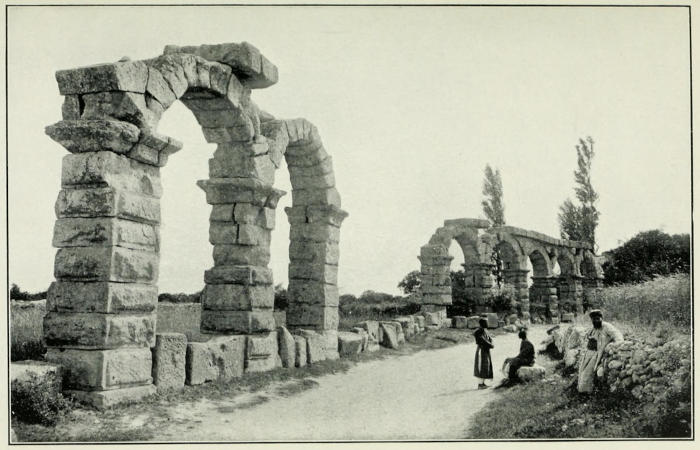
TYANA: THE RUINED AQUEDUCTS OF ROMAN PERIOD (See pp. 42, 70.)
At the eastern limits of the great plains we reach Kilisse Hissar, the site of the old-time Tyana.[437] It is shut in on three sides by ridges and low outlying hills, but is open to the plain, and accessible from Eregli and from Bulghar-Madên. It can hardly be doubted that this was the chief city for the region we are considering, even in Hittite times, to judge from its importance in the minds of classical writers and from the extensive nature of its mounds and ruins. Strabo[438] describes it as ‘built upon the mound of Semiramis’ which was ‘fortified with good walls.’ Here, curiously enough, no Hittite monument has been brought to light, probably because haphazard excavation in the mound is hardly possible, owing to the fact that it is almost covered by the modern houses. None the less, a Phrygian inscription of Midas[439] attests the antiquity of the site; and three separate Hittite inscriptions seen in the neighbouring places of Bor, Nigdeh, and Andaval may be reasonably believed, as is supposed, to have come from the same source.
The most instructive and interesting of these monuments is that from Bor, which is a monumental stela, recovered in two main portions at different times at an interval of twelve years or more.[440] Even now the stone is not complete; as may be seen from our illustration the fitted edges do not quite correspond, so that a small portion is missing from the height, while the left-hand edge is entirely broken away. The upper part measures thirty inches by sixteen, with a thickness of eight inches. The lower part is five inches taller, so that the whole must have been six feet or more in height. Fortunately, on the fragments that have survived, there is to be seen nearly the whole figure and face of a man, clearly the priest-king, as well as an indication of the nature and arrangement of the inscription. The figure is carved in high relief, with a projection amounting in places to three inches, while the hieroglyphs are incised upon the background. The figure occupied a height equivalent to eleven bands of the hieroglyphs, of which fourteen are indicated. We have no means of judging how wide the stone was originally, as the bottom is fractured and the top has plainly been re-dressed since it was broken, to correspond with the narrower width. We are inclined to think that the larger and more important portion of the stone is still lacking. For the attitude of the figure is that of adoration or of a suppliant. The man is depicted with his back near the edge of the stone, and his hands raised before his chin, exactly as on the rock monument of Ivrîz.[441] Now on the stelæ in which one figure alone appears, like those of Carchemish and Marash,[442] the personage, be he priest or king, occupies the central position on the stone, and almost its whole height. He stands in those cases with one arm outstretched grasping his staff, while the other arm is close to his side; on the one he faces to the left, on the other to the right, but the pose is the same. In this case the details are all changed. To judge by certain faint indications on the stone, and by comparison with the monument of Ivrîz described below, it may be inferred that the hands are clasped in front of the face; it is at any rate clear in the photograph that one hand at least is raised before the mouth. He does not occupy the centre of the stone but the side of it, as may be judged from the short lines of inscription beginning just opposite the face. He does not fill the whole monument in accordance with the idea of ‘exclusive majesty’ so common and so dominant in Oriental art; on the other hand there are three lines of inscription above his head, and at least one below. We are inclined from these considerations to regard these fragments as forming part of a much larger whole, on which the theme was one of adoration, not much unlike that carved on the rocks at Ivrîz.[443] The resemblance may well be extended, for on comparing the two priestly or kingly figures many striking features will be found in common. The most apparent difference is the arrangement of the cloak, which on the Bor stone is fastened below the throat, while on the Ivrîz sculpture it is shown to hang more loosely, so that the front edge of the fringed border trails on the ground. Otherwise the details correspond closely; in each case the cloak is embroidered in three bands, and bordered with a fringe. Even the patterns are similar, the svastika appearing on the stone before us in the middle band between two bands decorated with diamond pattern (or ‘continuous squares’). The skirt below is even more sumptuously embroidered; in each case the svastika fills the lowest band, and from this hangs a fringe. On the Bor fragment other elaborate devices are introduced, including the double or quadruple Ionic curve, and the rosette; an embroidered waistbelt, collar, and shoes complete the treatment. Other features, less exceptional, conform to the old conventions: the turning-up points to the shoes, the bunched curl of hair behind the neck, the skull-cap, and the straightness of the nose. The beard is full and curly.
PLATE LVI
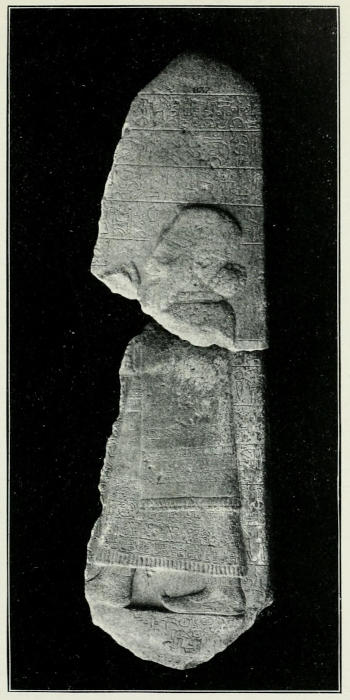
BOR: HITTITE INSCRIPTION AND RELIEF
The subject is the King-Priest in adoration of a deity whose figure is missing. Cf. Pl. LVII.
The inscription commences with two groups of hieroglyphs which may be read Ay-mi-ny-a-s of the land of Tyana.[444] An earlier reading[445] by the same decipherer suggested Ai-m-gal-a-s, corresponding to the royal name Αινγαλος occurring in Greek inscriptions of Cilicia. However that may be, and whatever may be the precise values to be assigned to these hieroglyphs, the initial group which contains the royal name[446] will be found to recur on the two famous monuments of Bulghar-Madên and Ivrîz. On the latter, the name appears in one place written exactly in this instance, and in another place, as at Bulghar-Madên, with a slight and evidently grammatical variation. This fact throws a welcome light upon the local history of the period.
Of the other monuments of the locality, the fragment from Andaval—now hidden in the Greek church of that place—seems from the description given of it to have been part of a similar monument, or at any rate of a stone decorated with human figure and inscription.[447] The stone is broken and rounded, measuring about thirteen inches across. It shows only the top and back of the head of the figure, with two lines of incised hieroglyphs above and the beginnings of two lines behind. The hair on the head is shown by small curls, while behind the neck it falls in the characteristic bunch. The eye is seen as usual in full upon the profile of the figure, which is turned to the observer’s right.
The third monument has been found[448] in late years at Nigdeh, where it was dug out of the foundations of a house. It is round and moulded, and in all probability formed part of the base of a column or of a built-up pedestal of some kind. At the bottom there is a protrusion of stone for attachment, and in the top there is a square-cut socket hole, of a width equal to about a third of the whole diameter. The mouldings, which run around the upper edge only, look almost Roman in style. The inscription[449] upon it is short, occupying a space only twelve inches by four, and the letters are incised.
The monument of Bulghar-Madên is an inscription in five lines of incised hieroglyphs.[450] It may be reached by crossing the outlying ridges of Taurus between Tyana and Bulghar-Madên (a distance of thirty miles), or by turning from the main road up the valley of the stream which flows at the foot of the Bulghar Dagh.[451] In either case the monument is found near the small village of Ali Hodje, two miles below Bulghar-Madên, on the left (or north) bank of the stream; and it is to be reached only by a sharp climb up the steep side of the valley, a little way above the village. A guide is necessary, for the inscription is inconspicuous, and it is carved on an outcrop of brown rock similar to many others in the locality. The rock overhangs slightly, and is fairly smooth, though its rough granitic nature renders it difficult to work with ease. The inscription is in fair preservation, but it has probably never been deeply or clearly incised. It occupies a space about four feet high and rather more than six feet wide, and it is divided off from the rock around by a border-line incised to about the same depth as those which separate the rows of hieroglyphs. These rows are not all of the same length, for the two uppermost are shorter on the left hand than the others, probably on account of a considerable flaw in the stone which they thus avoid. The top of the inscription is about ten feet from the ground, so a ladder is desirable in order to study it closely.
It is generally thought that the vicinity of the silver-mines explains the presence of this inscription. Yet the mines are some four miles distant, and a more appropriate spot near the entrance to them could have been readily found. It seems much more probable that this monument, like the stone upon a pedestal near to Bogche, marks the boundary to a territory or state, which in this case, for the reason we have indicated, would be that ruled from Tyana. The general tendency of the reading given by Professor Sayce,[452] which is remarkably instructive, seems to confirm this opinion. Thus ‘A prince am I who has fixed the boundaries,’ and again, ‘This is the prince-god’s sacred stone for the land, set up here, belonging to the boundary.’ It is only fair to say that Professor Sayce regards his reading in this case as tentative; he also reads the name of the prince in this case as a ‘son of Ayminyas’ of Tyana; and there is another compound form of the word which may be taken for ‘the land of Ayminyas.’
We come, in conclusion, to the monument of Ivrîz,[453] which is best approached from Tyana or Iconium by way of Eregli,[454] but is also accessible to the adventurous traveller from Bulghar-Madên by traversing the rocky snow-flecked ridge that lies between. From Eregli following up the bed of the Kodja Su the dreary barren plains are left behind, and a verdant though neglected valley is unfolded. The pathway lies through old gardens and vineyards and reaches of corn-land; willows line the waterside, and the country is cheered by a profusion of trees in which the hazel and chestnut abound, with here and there a great walnut or a row of poplars. The valley with its singular fertility and beauty is in marked contrast to the arid tracts beyond, and the change is only intensified where, leaving the main stream, the pathway follows up, on the left bank, a richly wooded vale that trends towards the south. This new valley leads into the mountain, and after a distance of nearly three miles it comes to an abrupt end where the wall of Taurus is met, rising almost precipitously, and encircling the head of the glen where the hamlet of Ivrîz is found. At the foot of the rock a stream of water, clear and cool, bursts out in tremendous volume, and, supplemented by other similar sources, becomes in a hundred yards a raging and impassable torrent, roaring with a wonderful noise as it foams and leaps over the rocks in its course. Before joining the main stream of the valley it washes at a bend the foot of a bare rock, upon which from the opposite side there may be seen the famous sculptures,[455] the most striking of all known Hittite works, and one of the most imposing monuments of the ancient East.
The treatment of these sculptures is all in relief. In composition there are two persons represented: the Peasant-god, a gigantic figure fourteen feet in height, distinguished by the bunches of grapes and bearded wheat which he holds, and the King-priest, an heroic figure eight feet in height, facing towards the god, with clasped hands raised in adoration or thanksgiving for his bounty.