III MONUMENTS OF THE HITTITES (continued 3)
Reading edition
The god is clad in the short tunic, short-sleeved vest, pointed cap, and shoes with turned-up toes, characteristic of the godlike figures on all Hittite sculptures. But here the sculptor has elaborated his theme, and has worked into it ideas or conceptions which we may reasonably suspect were derived ultimately from the East through the intermediary of Cilicia.[456] The figure is squat and stolid, and the face almost Semitic. The nose, while straight and prominent, is treated with unusual fulness. The hair is arranged in ringlets, so too the beard, except upon the face where it is represented by curls.[457] The left hand is advanced, holding up the ears of corn; while the right one is by the body, grasping the vine-branch with pendent clusters. The drawing of the body obeys the ordinary convention; the left leg is advanced, the head is seen in profile to the left, while the shoulders are squared to the observer. There are bracelets on the wrists, and the suggestion of something undetermined upon the right forearm. The belt is decorated as if of worked leather, and ends in a curl before the body, possibly suggesting an attachment on the further side. The boots are high, with a front flap bound to the ankle by a lace wrapped around, like the boots of the peasantry of the district and of Cilicia in modern times. Perhaps the most peculiar and Oriental detail is to be found in the horns which decorate the helmet, of which four pairs are visible. In front of the right foot is the suggestion of a bolted implement, possibly a plough.
PLATE LVII
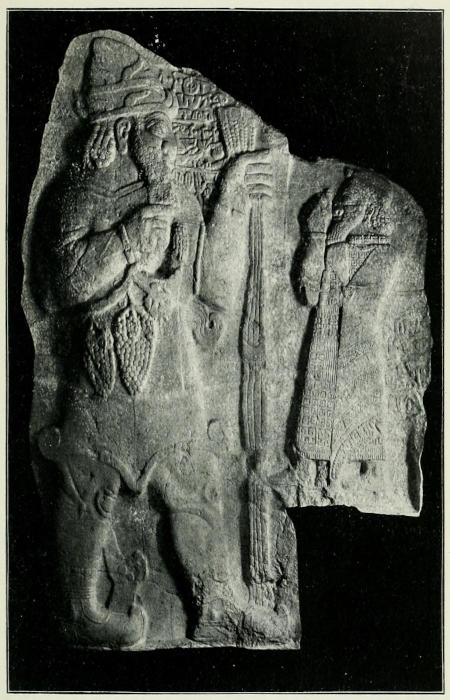
IVRÎZ: GIANT SCULPTURES ON THE ROCK
The subject is the King-Priest in adoration of the Hittite god of cultivation.
From a plaster cast in the Berlin Museum.
Facing the god, and posed at a higher level (possibly, as in other examples of eastern art, so that the relative smallness of the figure would be less apparent), is the figure of the priest-king, who, if we mistake not the group of hieroglyphs that denote him, is the same that we have previously met with near Tyana.[458] In general style and in some details, the treatment of this figure is similar; but the dress differs in several ways. The priestly skull-cap is surrounded by three decorated fillets with a knotted ornament of jewels upon the brow. The long skirt is a richly woven garment, on which the pattern is chiefly a series of punctuated squares in parallel rows, with a svastika border edged with a fringe. Over the shoulders there is thrown an embroidered mantle, with ample collar, attached in front with a jewelled clasp or brooch. It falls behind to below the knees, while in front the tasselled or fringed ends trail on the ground. The pattern is arranged in three bands of continuous squares or double zigzags. There is a substantial necklace and bracelet. The boots and features and hair are treated as in the god-figure opposite; perhaps the hair is bunched in this case a little more thickly behind the neck. The right leg is advanced, and the two raised hands are clearly clasped before the face, the fingers and nails of the further hand being carefully represented.
There are three short inscriptions accompanying these figures. In that which is carved before the face of the god, Professors Sayce[459] and Jensen both find the name of Sandes in the first line (the W-like sign below the divided oval that signifies divinity). In the next line, as in the overlap of the first and second lines of inscription behind the king, we find the same name (read Ayminyas)[460] as we have previously seen in the inscriptions of Bor and of Bulghar-Madên. This point is of importance in considering the history of the Hittite peoples when, as it seems, the central authority was no longer at Boghaz-Keui. For the date of these sculptures, if only from their close analogy in treatment to those of Sakje-Geuzi, may be put down to the tenth or ninth century B.C. It would seem indeed that we are here drawn into relation with the kingdom of (Greater) Cilicia, which, with Tyana probably as capital, took the place of the Hatti-state within the Halys, as the dominant Hittite state at the beginning of the first millennium B.C.[461]
This point becomes more probable as we dwell upon the religious symbolism of the monument. As Professor Ramsay has shown, in the muscular toiling peasant-god who by his hoe and plough reclaims an arid waste and makes it bounteous, we have a conception of Hercules, and that he was the recognised chief deity of the district is evident from the name Herakleia given by the Greeks to Eregli. Professor Frazer also has put it beyond doubt that the attributes of this Hercules are to be found in Sandon of Tarsus. Now the prototype of Sandon we shall find in the national Son-god (later Attis) portrayed in the sculpture gallery of Boghaz-Keui,[462] and in this way we are linked at once with the older Hittite mythology through the intermediary of the Cilician.