Third Lecture. LAKE-DWELLINGS AND PILE-STRUCTURES IN ITALY.
Reading edition
On the 20th of July, 1860, M. G. de Mortillet wrote a letter to Sig. Cornalia, president of the Italian Society of the Natural Sciences, at Milan,[37] in which, while mentioning the discoveries made in Switzerland, he suggested that similar antiquities might be found in the lakes of Lombardy. The reading of this letter led to a discussion which at once elicited one or two statements of archæological importance. The vice-president, Sig. Antonio Villa, recalled the fact that a bronze axe-head and some flint arrow-heads were found in the turf-bog of Bosisio, at a depth of 10 feet, which were described and figured in a Milan journal, Il Fotografo, 2nd August, 1856. The president also mentioned that he possessed weapons of a similar character, which were found, along with some human bones, in the peat-beds of Brenna. Shortly afterwards the celebrated naturalist Gastaldi, in an article in Il Nuovo Cimento, directed attention to certain antiquities which the turf-cutters were in the habit of finding in the "torbiera di Mercurago." (B. 37.) Subsequently Gastaldi visited this locality, and along with Professor Moro, of Arona (who first recognised the importance of the objects in question), made further researches in the peat at Mercurago, the result of which was to leave no doubt that they had here to deal with the remains of a true palafitte analogous to the pile-dwellings in the Swiss lakes. During the next two years Gastaldi's report was considerably enlarged by further finds at Mercurago. (B. 43 and 52.)
About the same time that these discoveries at Mercurago were being made the existence of a palafitte in Lake Garda was surmised from the finding, at various times, of bronze implements and weapons in the harbour at Peschiera; but nothing further of a very definite character occurred till the summer of 1863, when Professors Desor and De Mortillet visited Lombardy in search of lake-dwellings. These eminent archæologists were joined by Professor Stoppani, and the immediate result of their investigations was the discovery of several settlements in the Lake of Varese and elsewhere. (B. 67.) Since then the lacustrine stations south of the Alps have greatly increased in number, there being now scarcely any of the smaller lakes and turbaries of North Italy that have not yielded more or fewer remains of this character.
In addition to these ordinary lake-dwellings, whether in water or in peat, there are, in the valley of the Po, other ancient remains known as "Terremare," which are now shown to be so closely analogous to the former that they fall to be described as land palafittes. They are found only in the eastern part of the valley, and as some of their relics, in common with those of the adjacent palafittes, present some characteristics which are not found in western Lombardy, I fasten on this distinction as a convenient principle of classifying the lake and peat dwellings into a western and an eastern group, reserving the "terremare" for separate treatment. Accordingly we begin with Lake Varese, whose settlements appear to have been the most important and the most central in the western group.
LAKE OF VARESE.
Lake Varese is irregularly shaped, about 5½ miles in length, and less than half that in breadth. It occupies a somewhat shallow basin, its greatest depth being 85 feet, and, although bounded on the north by high hills, its banks are generally flat or shelving. Its surface is 770 feet above sea-level, and 134 feet above that of Lake Maggiore, to which its surplus water is carried by the Bardello, a stream which has its outlet at the north end of the lake. The district around is rich and well cultivated, except on the south side, where the lake becomes contiguous with an extensive peat-bog called "torbiera della Brabbia." When Stoppani and his illustrious friends, along with Desor's experienced fisher, Benz, commenced their lacustrine explorations in Lombardy, they selected Lake Varese to start with, on account of the suitability of its shores for such structures. On the very first day (21st April, 1863) their labours were rewarded by the discovery of the sites of two settlements—one at the south-east side of the little island then called Isolino, or Isola Camilla, but now I. Virginia,[38] and the other opposite the village of Bodio.
Professor Stoppani continued his researches after the departure of his friends, and made further discoveries, not only in Lake Varese, but in some of the other lakes of Lombardy. In November of the same year Captain Angelo Angelucci, of Turin, was attracted to the scene of these discoveries in Lake Varese, and henceforth took an active part in the investigation of its palafittes. (B. 63.) Nor must I omit to mention the Abate Ranchet among the list of the early explorers. He discovered in the same year not only a new station on the south side of the outlet, but also, in the following year, two others in the adjoining lake of Monate. (B. 85.) At the end of the first year's explorations we find, from the reports of Stoppani and Angelucci, that no less than six stations were determined in Lake Varese, all situated on its south-western shore. In 1868, when Dr. Camillo Marinoni published a report on "Le abitazioni lacustri e gli avanzi di umana industria in Lombardia" (B. 159), the number had increased to seven. Although no addition has since been made to their number, much attention has been given, especially in these later years, to their investigation. The Sketch Map of Lake Varese (page 189) shows the names and the respective positions of these settlements, which I shall now shortly describe.
Isola Virginia.—This is a small egg-shaped island lying along the west shore, from which it is distant about 80 yards. It is 240 yards long, with a maximum breadth of 100 yards, and contains besides some fine trees, a house with two storeys, the upper of which is converted into an archæological museum, and at a little distance there is a café for the convenience of the numerous visitors that frequent the locality. Its area is nearly 3 acres, and its highest point is barely 8 feet above the average level of the lake.
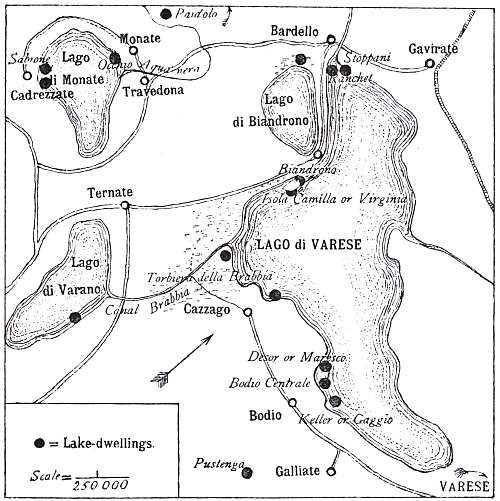
Piles were discovered in the lake at the south-east side of the island, in a space extending along its margin for about 100 yards, and about half that distance in breadth. Two years ago, when I visited the locality, the heads of piles were readily seen through the water, just cropping above the sandy bottom. In some cases it was difficult to distinguish them from stones; but a poke with the oar or a long stick at once determined which they were. Professor Stoppani, in his first report (B. 67), describes this as a steinberg, but the idea of the whole island being artificial—an idea first suggested by Desor, who found analogous instances in the Rosen Insel, Lake Starnberg, in the little island at Inkwyl, and in the Irish Crannogs—gained strength by the discovery of similar stumps of piles on its north-west side. Although the local antiquaries—Ranchet, Regazzoni, Quaglia, Castelfranco, and others—occasionally visited these lacustrine stations and made considerable investigations, with the result of adding to their private collections, it was not till 1878 that any systematic researches were made with the view of testing Desor's suggestion that the island was a gigantic crannog. This was first attempted by an Englishman, Mr. W. K. Foster, of London, who happened to be residing in the neighbourhood. In carrying out the necessary excavations he had the assistance of Ranchet and Regazzoni, both experienced investigators of lacustrine antiquities. Five trenches, covering on the aggregate about 80 square yards, were dug in different parts of the island, and in all these, piles, fragments of pottery (one of which had the impression of plaited reed-work), and various other relics of human industry, were encountered. In the sections presented by these trenches the following strata were successively passed through:—
1. Surface Soil for about 14 inches.
2. Vegetable Mould, of a dark colour 10 "
3. Sand and Gravel 21 "
4. Sand and Earth, with much organic débris 16 "
5. Sand and Mud (the original lake-sediment).
The most noteworthy objects collected in these operations were as follows:—In the first layer a Roman coin of Marcus Aurelius, and a portion of a mould for a socketed lance-head (Fig. 48, No. 19). In the second, two fragments of bronze. In the third, two polished stone celts, with a portion of a third, and two clay weights. In the fourth, a flint saw with a wooden handle, two bone pins, and some sharpening-stones.
The piles were evidently in their natural position, and the conclusion that the entire island had been a pile-dwelling was irresistible; but the questions when and by what means was the transformation accomplished, were as obscure as before. Mainly for the purpose of clearing this matter, Sig. Ettore Ponti, in September of the following year, gave instructions to have further excavations made in different parts of the island. On this occasion 12 trenches were dug, covering an area of about 230 square yards with an average depth of 3 to 4 feet.
The stratification and composition of the stuff were very similar to those experienced in the former excavations. In this space 440 piles were counted, and Regazzoni calculates that at this rate the original number of piles requisite for the construction of the entire lake-village would be from 35,000 to 40,000. Some horizontal beams were also found among the débris. Among the relics the following are noteworthy:—A tyne of deer's horn, with a flint implement inserted into the end of it (No. 3); a small clay weight shaped like a pear; several objects of worked bone, as needles (Nos. 7 to 9), pointers, chisels (No. 25), handles, etc. A knife (No. 5) and a dagger of bronze (No. 6), and two oblong beads of coloured glass with transverse grooves, were found in the stratum immediately below the surface soil.
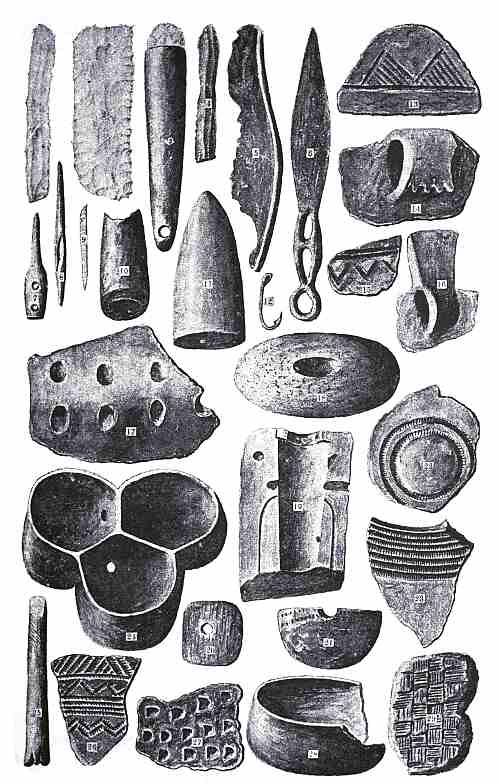
Fig. 48—Isola Virginia. No. 25 = 1⁄4, and the rest = 1⁄2 real size.
As a rule, the tops of the piles in these trenches were on a level with the surface of the water, while those in the lake were several feet lower—more or less, according to the depth of water. The cause of this was no doubt the protection given to the former by the accumulation of débris around them. It was observed that the uppermost layer alone had yielded Roman coins, but along with them were objects of both the Stone and Bronze Ages—a juxtaposition which might be accounted for by agricultural and other operations to which the island has been subjected in historical times. The fourth, or that which lay immediately over the ancient lake-sediment, was alone exclusively deposited under water, as it contained some entire dishes, and the associated débris were just the usual contents of lake-dwelling relic-beds, viz. the shells of hazel-nuts, acorns, charred bits of wood, bones of various animals (among others the skull of an enormous wild boar), as well as implements of bone, horn, and flint, pottery, etc. The second and third layers were composed of much the same materials as the fourth, but they appeared to have been the contents of a previously-deposited relic-bed artificially heaped up, as they contained portions of wooden beams which had no definite purpose, but lay in the soil in all directions.
The relics of humanity collected on the Isola Virginia in the course of these various excavations are so numerous that one of the two rooms set apart by Sig. Ponti as an archæological museum for the lacustrine remains of Lake Varese is entirely devoted to their exhibition and preservation, where they have been carefully and neatly arranged under the skilful care of Professor Regazzoni.
Pottery.—As in the other lacustrine stations in this lake, there are two kinds of pottery—one black, and made of fine paste, of which most of the smaller vessels were made; the other is of a greyish colour, but sometimes it has a reddish tinge, and contains a mixture of fine gravel or coarse sand, which gives it a rough appearance. The fragments and entire dishes in the Ponti Museum decidedly testify to considerable skill in the ceramic art. Besides perforated knobs and tubular borings for the insertion of cords (No. 17), there are various forms of handles, as in Nos. 14 and 16, the latter of which is interesting, as it suggests the primary stage of the ansa lunata which is such a prominent characteristic of the pottery in the eastern portion of the Po valley.
The diversity of ornamentation is also worthy of notice—raised dots, nail-marks, perforated rims, lines, corrugated grooves, and cord-markings, forming a variety of combinations (Nos. 13, 15, 22, 23, 26, and 27). One bit shows the impression of plaited reed-work (No. 29). Another, an entire dish made of fine black paste, is a curiosity in its way; it consists of three cups united, and having a communication with each other by a small hole in the dividing septa (No. 24). The coarse pottery indicates vessels of large dimensions. There are also loom-weights, spindle-whorls (No. 21), some conical objects pierced vertically (No. 10), and casts of wicker-work, supposed to be the remains of the cottage walls.
Bone and Horn.—Objects of this class are numerous, as polished daggers, pointers, chisels (No. 25), needles (Nos. 7 to 9); also a few perforated teeth.
Stone.—Celts and chisels are fairly abundant, and among them are one or two of jade. Though I noted only one fragment of a perforated axe-head, the art of boring stone was known and skilfully practised, as there are several spindle-whorls and other implements with neat perforations (No. 18). There are also hammer-stones (some with finger-marks), corn-grinders, and polishers. Among the latter are large flat polishing slabs, and a few hand-polishers made like a stone celt (No. 11), which are peculiar to North Italy, if not, indeed, to the Varese lake-dwellers, as I have seen only one other out of the district, viz. at Viadana.
Among the flint objects are knives, scrapers, saws, arrow-points, chisels (like those in Fig. 68, Nos. 8, 14, and 15), cores, and a large quantity of flakes (Nos. 1 to 3). For small cutting implements flint was not the only substance used by these lake-dwellers, as there are 36 fine flakes of obsidian (No. 4), and some arrow-heads of rock crystal.
Bronze.—The bronze objects in the museum, including fragments, amount only to 15, and represent knives, fish-hooks, etc. (Nos. 5, 6, and 12).
Amber.—There is also a bit of amber which appears to have been an ornament.
Small square or oblong pieces of wood perforated (No. 20) are supposed to have been floats for nets.
The organic remains collected in the fourth stratum, which was considered to be the true relic-bed of the palafitte, were submitted to Professor Sordelli, who recognised, among other seeds and fruits, the following:—Millet (Panicum miliaceum), wheat (Trit. vulgare), bramble (R. fruticosus), and the vine (Vitis vinifera).
Among the bones of animals identified were those of the bear, wolf, badger, beaver, wild boar, stag, roe, etc. The ordinary domestic animals were also represented, and in addition to them I have to mention portions of two human jaws which were found a few inches below the tops of the piles. (B. 324, 326, 341, 343a, 359, and 437.)
Professor Castelfranco (B. 456), who has carefully studied the phenomena presented by these repeated excavations, formulates the following theory as to the succession of events which have brought about the evolution, so to speak, of the Isola Virginia:—
(1) The original palafitte had been destroyed by a conflagration towards the close of the Bronze Age or the beginning of the Iron Age.
(2) Its inhabitants were hunters, fishers, rearers of domestic animals, and agriculturists.
(3) Shortly after the destruction of the pile-village, its subsequent occupiers converted the larger portion of its site—which had already, in parts at least, reached the surface by the gradual accumulation of débris—into a veritable island, by heaping over it stuff dug from the margin and especially from the landward side, where there is now a channel separating the island from the mainland. Thus the upper layers contain the débris of the earlier people, mixed with sand, gravel, and mud. This view is rendered probable by the fact that in one place, towards the north of the island, the second layer was displaced by an artificially constructed bed of large pebbles.
(4) The newcomers, to whom Castelfranco assigns the transformation of the palafitte into an island, were the Ligurians, whose "sépultures à cineration" are so numerously found in the neighbourhood.
Bodio.—The bay opposite this village contains the remains of three stations, the most southerly of which is known as "Keller" or "Del Gaggio," the next as "Bodio Centrale" or "Delle Monete," and the third as "Desor" or "Del Moresco." All these are comparatively near the shore, being only about 30 yards distant, and the central one is about equidistant—some 800 yards—from the other two. (B. 327, p. 47.) The central station appears to have been a true steinberg, as its area was covered with stones; regarding which Stoppani remarks that formerly they were more numerous, because within recent times some were known to have been removed for building purposes. At first more bronze objects were found on Keller, and more pottery on Desor, while the Centrale was characterised by the discovery on it of a hoard of Roman coins. Subsequent investigations have not borne out these early distinctions based on the character of their relics, and they are now generally acknowledged to belong to the same age.
The coins found on the Centrale were mostly small silver pieces, much decomposed, belonging to the last half-century of the Republic. Stoppani collected about 70, and Angelucci, who explored shortly after him, no less than 128. One found by Regazzoni in 1876 (B. 327, p. 52) has on it, along with the head of Mark Antony, the following legend:—M. ANT. IMP. AUG. III. VIR. R.P.C. M. BARBAT. Q.P., etc., which would make the date about 40 B.C. The hoard is supposed to have been lost or deposited here long after the lake-dwelling ceased to be inhabited—a supposition that is borne out by the fact that the coins were confined to one limited spot, only a couple of yards square. In 1876-7 Sig. Ponti made researches on Desor which greatly enriched his museum both in stone and bronze objects. (B. 327.) A selection of objects from these stations is given on Fig. 49.
Cazzago-Brabbia.—This station is situated opposite the village of the same name, and at first it gave such poor results that Stoppani called it a trial station, or an attempt to found a settlement. From the researches made in 1877 it was found to be rich in remains, and exactly similar to those at Bodio. It was, however, farther from the shore, and extended parallel to it for about 150 yards. Its breadth was somewhat irregular, and, judging from the disposition of its piles, it would appear to have been two quadrangularly-shaped stations nearly in contact with each other. Among the bronze objects collected on this station are four lance-heads, a chisel, an awl, 10 fish-hooks, four hair-pins, a fibula, etc. (B. 456.) There are also some fine arrow-points of flint.
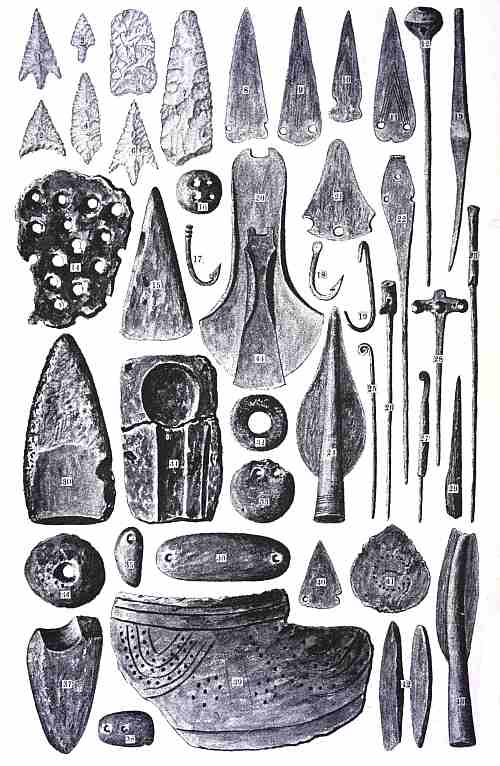
Fig. 49.—Bodio, Cazzago, and Bardello. Nos. 24, 31, 39, 43, and 44 = 1⁄4, and the rest = 1⁄2 real size.
Bardello.—Near the mouth of the river are two stations, one on the left and the other on the right shore. The former, called Ranchet, after its discoverer, is a small settlement some 200 yards from the mouth of the river, and 6 or 7 from the shore. It measures about 60 yards long and 50 broad. A large quantity of the bones of domestic animals was found here, as well as some flint and bone arrow-points, spindle-whorls, and various fragments of pottery. Ranchet records also a small lance-head of bronze, a portion of a vase containing some black stuff adhering to it (supposed to be remains of food), and portions of another of fine black paste. The station on the north shore, called after Professor Stoppani, by Regazzoni, is about 100 yards from the mouth of the Bardello, in the direction of Gavirate. It is in the form of a parallelogram, 65 by 45 yards, and, like the previous station, has the piles arranged in parallel rows. Among its relics are:—Bones of the ox, goat, stag, and pig; flint arrow-heads, scrapers, etc., of the usual kind; some bone implements. Two bronze pins and a winged celt are sufficient to show that the station was similar to the others in Lake Varese (Nos. 23 and 44).
Marinoni (B. 159) mentions another station opposite Gavirate, but neither Regazzoni nor Ranchet could find any traces of it. (B. 327, p. 66.)
Torbiera di Biandrono.—Lake Biandrono, which formerly occupied a larger area than at present, has on its north-west side an extensive peat-bog, in which Dr. B. Quaglia has discovered the remains of a true palafitte lying under a deposit of about 6 feet of moss. The station is some 200 yards distant from the lake, and of a quadrangular shape, with massive piles scattered over its area. It is remarkable as having supplied objects which might be considered characteristic of all periods—from the earliest polished Stone Age down to that in which knives, spears, hooks, and spurs of iron were manufactured. (B. 327, p. 89.) Other objects recorded from this station are polished stone hatchets; arrow and lance-heads of yellow and dark flint; fragments of pottery, some of which were made of fine paste by the aid of the potter's wheel, and had extremely elegant forms (B. 423, p. 86); two fish-hooks of bone and two oars now in the Museum at Varese. Four curious objects similar to one from Torbiera di Cazzago-Brabbia (Fig. 50, No. 18) were found here. (B. 327, p. 87.) These relics have been widely dispersed, some having gone to the Museums of Pavia, Milan, Varese, and Como. An iron spur figured by Regazzoni is in the Como Museum.
Torbiera della Brabbia.—Some forty years ago the peasants commenced to cut peats in the extensive turbary which lies on both sides of the canal Brabbia, and it is recorded that objects of antiquity were from time to time found, to which, however, little attention was paid. As early as 1856, Angelo Quaglia directed attention to worked beams in the peat, and since 1863, when such objects began to be more inquired after, other piles were detected in one or two places. The most important of these stations is near the mouth of the Brabbia, on its east bank. Here, during the last few years, many interesting relics have been found. While the usual flint and stone objects (Nos. 2 to 8) are abundant, several others of a more novel character have to be added to the list. Especially noteworthy are some peculiarly-shaped fibulæ (Nos. 9 to 15), one being of iron (No. 12); and a curious object made of bronze rings (No. 18), supposed to be an epaulette, is also from this station. Other objects of bronze are some hair-pins (Nos. 22 to 28), an ornamental pendant (No. 17), a winged celt (No. 21), and a ring (No. 19). There is also one flat celt of copper (No. 20). Among the stone celts and chisels some are now recognised to be of jade. (B. 423, p. 80.) No. 33 represents a hatchet of chloromelanite. Quaglia figures a curious flat stone like a wheel, with a wide circular perforation, and brought to a sharp edge along its outer margin. There were also spindle-whorls of terra-cotta (No. 29) and a quantity of pottery (Nos. 34 and 35); also two small pendants of amber. Of staghorn there are two magnificent harpoons, one of which is here figured (No. 32). Square bits of wood with central perforations (No. 36) are supposed to have been used as floats for fishing-nets. Among the osseous remains is the skull of a deer with part of the horns attached.
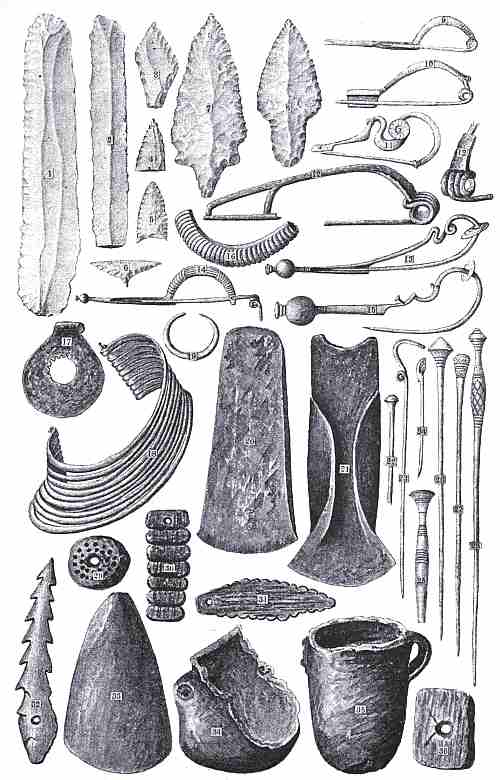
Fig. 50.—Torbiera di Cazzago-Brabbia (except No. 1). Nos. 18 and 35 = 1⁄3, 32 = 1⁄4, and all the rest = 1⁄2 real size.
Pustenga.—Between Galliate and Doverio, and not very far from the south shore of Lake Varese, there exists in the plain called "Pustenga" a turbary of some 17 acres in extent, which was formerly a small lake, and in which G. Quaglia (B. 423, p. 90) has detected the remains of a palafitte. Among the objects recorded from this station are two arrow-points, a knife and a saw of flint, six stone celts, and a large jaw of an ox. Of the stone hatchets four are of serpentine, one of jadeite (?), and one of chloromelanite. The latter is figured by Quaglia. (B. 423, Pl. iv. 45.)
LAKE MONATE.
In the month of April, 1863, Stoppani, Desor, and De Mortillet searched this lake unsuccessfully, and consequently came to the conclusion that it was unsuitable for lake-dwellings ("non potesse offrire piaggia opportuna per le palafitte"). Notwithstanding this opinion, the Abate Ranchet, with the assistance of two local fishermen, succeeded shortly afterwards in discovering the sites of two settlements on the east shore of the lake, near the village of Cadrezzate. (B. 159.) The stations were in water from 6 to 9 feet deep, and about 200 yards apart, and their sites were marked by large mounds of stones ("enormi cumuli di grossi ciottoli"). Fragments of pottery were found in abundance, which in quality of paste and form corresponded with those of the palafittes in Lake Varese. One dish had also a quantity of black stuff, which was supposed to have been the remains of some kind of porridge. A saw, two arrow-points, and a few chips, of flint, and bits of charcoal, were the only objects, in addition to the pottery, collected.
Little was done by way of exploring these stations till the year 1875, when the brothers Borghi, the proprietors of the lake, became interested in its submerged antiquities, and proposed to make further researches. To the experienced archæologist Castelfranco they entrusted the conduct of these researches, and it is to his report I am indebted for the following facts. (B. 321.)
Sabione.—The most northerly and largest of the two stations at Cadrezzate is about 60 yards from the shore, and occupies a quadrangular space of about 100 yards in length, and rather more than the half of this in breadth. This area was overspread with stony mounds having intervals of from two to four yards between, and for this reason it was difficult to operate with the drag. Piles were found in the intervals between, as well as on, these steinbergs; but Castelfranco thinks the former were the roadways between the huts, which were built on the piles supported by the stones.
The relics collected were similar to those from Varese, of which the following are the principal objects:—
A bronze hatchet (coltello-ascia) 5 inches long, and 1 to 2¼ inches broad.
Pottery, including fragments with handles of various forms.
Dishes containing a black crust ("simile al residuo che la polenta lascia in fondo al painolo dopo la cottura") were frequent. Some of this stuff was submitted to Professor Sordelli for analysis, and he thinks, from detecting in it the halves of acorns, that it was a kind of porridge made from this fruit. One thin spindle-whorl 2 inches in diameter had a few punctured dots on its surface, intended as an ornamentation. One flint arrow-point, and a stone hatchet converted into a polisher, like those already described from Varese. There were also shells of hazel-nuts, and the kernels of the cornel cherry.
Pozzolo.—This station was similar to the former as regards the stony mounds, but only about half its size. The principal relics from it were:—
Bronze.—A triangularly-shaped spear-head or dagger 3¼ inches long and an inch broad at its base, where there were two rivet-holes; a hair-pin 3½ inches long, with a ring head; also a fish-hook.
Stone.—A few chips, arrow-points, and a chisel of dark flint; a hammer and polisher of the hatchet-shaped kind.
Pottery.—Fragments of a coarse and fine kind. Vases containing the "sostanza terrosa" already noticed. One bone was found, and in one spot there was a large quantity of cherry-stones.
Occhio.—The "Stazione dell' Occhio" is near Monate, and consists of a mass of stones in water from 10 to 14 feet deep; but, notwithstanding the difficulty of searching in such a depth, the following industrial remains were collected:—Chips of flint, charcoal, fragments of pottery, shells of hazel-nuts, and a bronze hook—sufficient to show that it belonged to the same period as the others.
LAKE VARANO, TERNATE, OR COMABBIO.
The previous failure of the early explorers and subsequently of the experienced fisherman known as "Lo Spariss" in their search for palafittes in Lake Varano did not prevent Castelfranco from trying his luck in this lake also. In July, 1878, with the assistance of two fishermen experienced in lake-dwelling researches, he made a tour of the lake (some 5 miles in circumference), and discovered traces of no less than eight stations in different localities, chiefly on the east shore. But the objects, though sufficiently distinctive to show their origin, are too few and unimportant to require any detailed notice.
Professor Castelfranco comes to the conclusion that in both the lakes of Monate and Varano the palafittes are coeval with those in Lake Varese. He is, however, struck with the entire absence of bones from both of them—a fact which appears to him unaccountable. (B. 321.)
TORBIERA DI MOMBELLO
Between the villages of Mombello and Cerro, on the east shore of Lake Maggiore, and a few miles south of Laveno, there was a small turbary in which Dr. Carlo Tinelli discovered the remains of a palafitte. The peat was being excavated from 1844, but it was 20 years later before the remains of the palafitte were detected. The further progress of the peat-cutting was carefully watched by Tinelli and a priest, Guiseppe Della Chiesa, in the interests of archæology. Some of the piles were extracted, and were said to show marks of having been fashioned by stone implements.
The relics collected here are:—Flint objects in considerable abundance, among which were two saws, a lance-head, and a beautiful knife-flake (Fig. 50, No. 1), now in the Museum at Varese; fragments of coarsely-made dishes without handles or ornamentation. Three canoes, roughly made and similar to those from Mercurago, were found at a depth of 8 feet. One of the canoes, 7 feet long, was presented to the Museum at Varese. Along with these objects were bones of the stag, goat, and roe. (B. 171.)
TORBIERA DI VALCUVIA.
In 1870 Professor Leopoldi Maggi described the remains of a palafitte found in "un bacino torboso" between Santa Maria di Cuveglio and Cavona. (B. 187.) This basin lies among glacial débris, and was formerly a small lake, but in modern times it became entirely filled up with peat. On the surface there was a layer of vegetable soil 10 inches thick, then spongy peat to the depth of 3 feet, and then a layer of more solid peat about 1 foot 8 inches thick. Underneath these layers was a blackish muddy deposit, extending to an unknown depth, into which the piles were inserted. These piles were from 5 to 10 feet long, and 8 to 10 inches in diameter. They were closely set, and along with them were several beams lying horizontally. The relics consisted of pottery, knives of bronze and iron, charcoal, etc., all of which were dispersed.
TORBIERA DI BRENNO.
Another locality that has yielded interesting remains, of "stazioni palustri," is the "torbiera di Brenno-Useria," situated along the road from Varese to Porto Ceresio, on Lake Lugano. Here, some years ago, a canoe was dug out by the peat-cutters, and associated with it were a large number of weapons of bronze and iron, bracelets, fibulæ (Fig. 51, No. 14), bones of domestic animals and of man, but no objects of flint. (B. 327, p. 92.)
LAKE OF LECCO.
As early as 1860 Desor thought he had discovered indications of a palafitte in Lake Maggiore,[39] but this was subsequently disproved, and up to the present time no remains of these ancient dwellings have been found in this lake. The explanation of their absence in the larger lakes of Italy is to be found in the physical conditions of these glacial and rock-cut basins, which, owing to the depth of water and their rapidly-shelving shores, afford no holding for piles.
Stoppani, in his first exploratory tour, turned his attention to Lago di Lecco as, in his opinion, a suitable locality, and having found a group of piles half-way between the Bridge of Lecco and Malgrate stretching towards the western shore, he concluded this was "una bella palafitta a cui nulla mancherebbe per ritrarre perfettamente quelle della età del bronzo." The only resemblance of this supposed palafitte to those of the Bronze Age was the fact that the tops of the piles projected 1 or 2 feet above the lake mud, as no relics of any kind were found. Further researches have not confirmed the genuineness of this palafitte, and Regazzoni throws out the hint that the piles observed by Stoppani might be the work of modern fishermen, who are in the habit of inserting stakes for fixing their nets and which, among themselves, go under the name of serrade or gueglie. (B. 67 and 327, p. 70.)
LAKE OF ANNONE.
In the narrow strait which connects the small lake-basins of Sale and Annone, Stoppani found some piles projecting from a heap of stones in a depth of 6 or 7 feet of water, which he took to be indications of a palafitte. In 1877 Castelfranco (B. 307) re-examined the locality, and came to the conclusion that the submerged piles and stones observed by Stoppani were merely the remains of a bridge which, at some former period, connected the peninsula Isella with the southern shore; and so the matter still rests.
LAKE OF PUSIANO.
More satisfactory discoveries were, however, made by Stoppani in his preliminary tour in the Lake Pusiano, where, at the north end of the Isola dei Cipressi, he recognised the existence of a pile-dwelling. The genuineness of this station has been confirmed both by Castelfranco and Regazzoni, who had subsequently made some investigations in the locality. The industrial remains were confined to a few objects of flint-saws, scrapers, flakes, and arrow-points, a portion of a terra-cotta whorl, and some bones and teeth of animals. In 1877 Regazzoni found piles at the other end of the Isola dei Cipressi buried in a heap of stones. (B. 327, p. 72.)
TORBIERA DI BOSISIO.
To the east of Lake Pusiano lies the torbiera di Bosisio, which came early under the notice of archæologists by the discovery in it, at a depth of 10 feet, of a beautiful bronze axe-head (Fig. 51, No. 10). Since then a great many relics have been from time to time found in this peat, but they have been widely dispersed, and as the deposit is now nearly exhausted no more finds can be looked for. Sig. G. B. Villa,[40] in his descriptive notices of this peat moor, speaks of arrow-points, burnt wood, bits of straw, trunks of trees, etc. Among other things which have been sent to different museums are a bronze spoon (No. 11), (probably of much later date than the other objects), some beautiful arrow-points (Nos. 1 to 7), and a lance-head of flint. An iron hook of modern shape was found at a depth of 3 feet. (B. 327, p. 97.)
TORBIERA DI CAPRIANO.
In 1869 Dr. Marinoni described a turbary at Capriano, near Renate (B. 169), in which some remarkable objects of bronze were found at a depth of about 7 feet. Similar objects are prevalent among the relics from the Swiss lake-dwellings, and, judging from what we know of the early Iron Age in Italy, they appear to belong to this period. The find comprised a hair-pin (Fig. 51, No. 13), a fibula (No. 18), three bracelets (Nos. 15 and 16), a pendant (No. 17), and a spiral ring (No. 19), all of which are here reproduced from Marinoni's work. (Ibid., Mem., vol. vi. Pl. 1.)
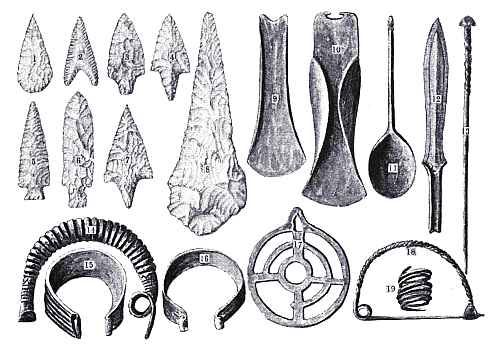
Fig. 51.—Bosisio (1 to 7, 10 and 11), Capriano (13, and 15 to 19), Brenno (14), and Cascina (9 and 12). Nos. 9 to 12 = 1⁄4, and the rest = 1⁄2 real size.
TORBIERA DI MAGGIOLINO.
Sig. G. B. Villa, in his "Notizie sulle Torbe della Brianza" (B. 90), describes another locality not far from Bosisio, in the territory of Rogeno, called Maggiolino, in which piles, bones, fragments of pottery, flint knives, and arrow-points, etc., were found—evidently the usual débris of a palafitte. (See also B. 327, p. 97.)
TORBIERA DI MERCURAGO.
Since Gastaldi published his first report on the discovery of palafittes in the bog of Mercurago by Professor Moro, many additional objects from this locality have come to light, some of which have been noticed and figured by Gastaldi in his numerous articles on the antiquities of Lombardy. The peat is now exhausted, but from these notices, together with an inspection of the relics still preserved in the Turin Museum, we can have a tolerably correct notion of this the first discovered lake-dwelling in Italy. (B. 43, 52, 91, 168, and 294.)
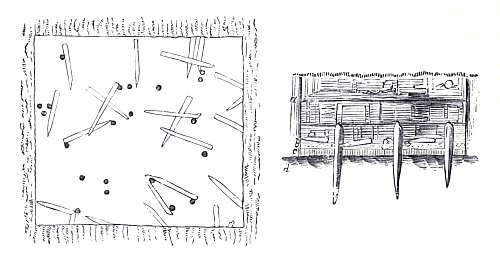
Fig. 52.—Plan and Section of portion of Torbiera di Mercurago, showing distribution of piles.
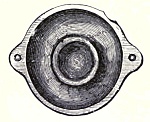
Fig. 53.—Cover of Earthenware Vessel (1⁄3).
The peat basin of Mercurago is of an oblong shape, and the antiquities and piles were in a circumscribed place at its northern end, about 130 feet from the bank. Here in a space of 30 feet square, cleared for antiquarian purposes, were counted 22 piles bound together with cross timbers (Fig. 52). The superficial deposit of peat was about 6 feet in thickness, and the tops of the piles reached half-way upwards, while their lower ends penetrated from 3 to 4 feet into the lake mud below. Between this mud and the superincumbent peat there was a bed of fern, and lying immediately over it were three earthen dishes in good preservation, one of which appears to be a lid or cover for another dish (Fig. 53), together with a large quantity of the broken fragments of others, a bronze pin (Fig. 60, No. 6), a scraper 4¾ inches long (No. 7), several arrow-heads (Fig. 54), and quite a litter of flint flakes, some shells of hazel-nuts, and stones of the cornel cherry, etc.
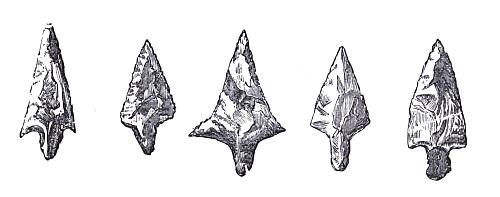
Fig. 54.—Flint Arrow-heads (2⁄3).
The pottery was made of a blackish paste mixed with coarse grains of sand or quartz, and a few dishes were ornamented with patterns of zig-zag scratches separated by parallel lines (Fig. 60, No. 13). Some had handles, and others small ears or perforated knobs, two of which had portions of string still attached to them (Figs. 55 and 56).
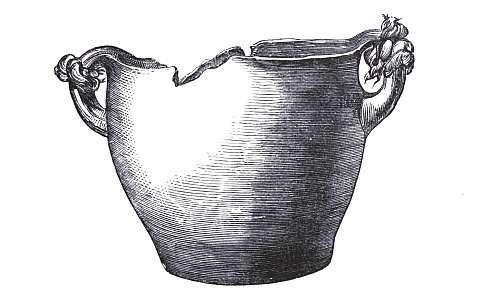
Fig. 55.—An Earthenware Vessel, with portions of string attached to handles (1⁄2).
Among other relics from this station were:—Two daggers of bronze, one still retaining a couple of rivets for fixing the handle (Fig. 60, No. 1); two bronze pins (Nos. 2 and 4); a wooden anchor 3¼ feet long, terminating at one end with two hooks and at the other with a hole as if for attaching a rope; a canoe 6 feet long, 3¼ feet wide, and about a foot in depth (Fig. 57); near the canoe lay a bronze drill (Fig. 60, No. 5); and a neat spindle-whorl of baked clay 1½ inch in diameter (No. 22). Among the more recent finds are numerous flint arrow-heads and scrapers (No. 8); a spindle-whorl of soapstone, pietra ollare (No. 16); a wooden dish and perforated floats for nets; earthenware dishes of great variety (No. 12); and 16 conical beads of vitreous paste, which, when strung together, formed a handsome necklace (No. 9); and a large cake of burnt clay perforated in the middle (No. 18).
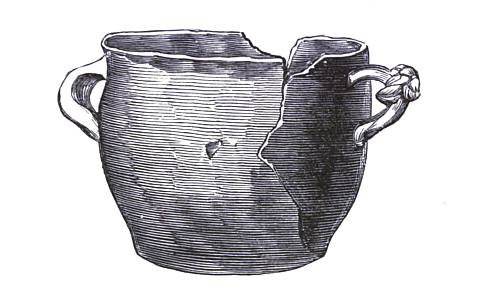
Fig. 56.—Earthenware Vessel (1⁄2).
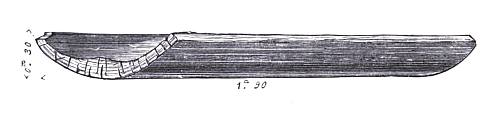
Fig. 57.—Portion of Canoe.
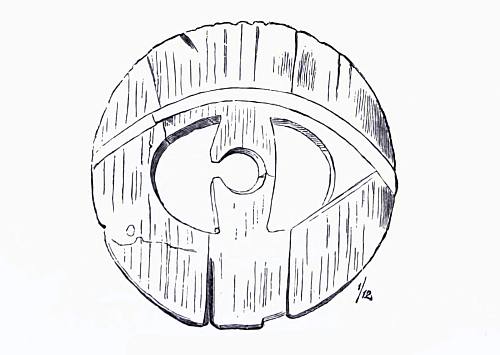
Fig. 58.—Wooden Wheel.
But the most remarkable objects were two wooden wheels. One (Fig. 58) was made of three boards kept together with two crossbars dovetailed into the boards, and in the centre was a round hole having on each side of it a semilunar space. This wheel, which was not quite circular, had an average diameter of 2 feet. The other wheel (Fig. 59) was differently constructed. It had six spokes: two of them were made of the same piece of wood as the nave, and their extremities formed part of the rim; the other four, two on each side, connected the fellies with the central piece. The fellies were neatly mortised together and the workmanship was very good. These wheels were so far decayed that they could not be preserved, but casts of them were taken, which may now be seen in the Museum at Turin.
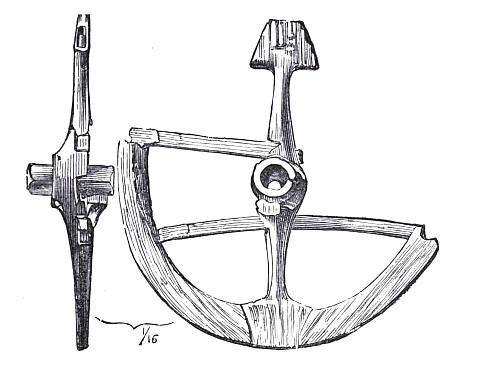
Fig. 59.—Wooden Wheel.
TORBIERA DI BORGO-TICINO, ETC.
Analogous remains to those in Mercurago have been found in several other localities, especially in the districts called Pennino near Borgo-Ticino, and the moor of Gagnano; but the objects were dispersed or thrown away. A stone celt from this place is figured by Gastaldi (Fig. 60, No. 19).
In the neighbouring moor of Conturabia a group of piles was observed in the centre of the bog which appears to have belonged to a palafitte of a later date, as some of the piles were said to have been tipped with iron. Gastaldi procured one of these piles, and although this particular one had no iron on it he was convinced that it had been sharpened by instruments similar to those in use at the present day. (B. 52.)
TORBIERA DI SAN MARTINO (SAN GIOVANNI DEL BOSCO).
This morainic basin is situated in the vicinity of Ivrea, immediately to the south of the village of Giovanni, and it also has yielded, from time to time, antiquities which leave no doubt that it was a home of the lake-dwellers. The bog is of an oval shape, about 1¼ mile in length, and half this in breadth, and is beautifully situated amidst groves of chestnut and walnut trees interspersed through rich meadows and fields. On its margin are found the trunks of trees, from 1 to 2 feet in diameter, still attached to their roots and lying just as they had fallen with their points directed to the centre of the bog. These trees are generally pine, oak, hazel, alder, etc.
Below the ordinary peat there is a layer of blackish mud which, on being dried, is combustible, and underneath it lie the stratified layers of ancient lake silt, consisting of a whitish clayey substance. In the blackish intermediate layer there was found, in September, 1864, a canoe 8 feet 4 inches long, 1 foot 9½ inches broad, and 8 inches deep. (A model of this canoe is now in the Museum at Turin.) A few years later (1868) another canoe was found in this turbary, of slightly larger dimensions, having two paddles in it (Fig. 60, No. 17). The following objects are, among others, described and figured by Gastaldi as coming from the same place, viz.:—Specimens of pottery (Nos. 14 and 23), one of which (No. 23) is a lid of a vessel precisely similar to the one from Mercurago (Fig. 53); flint and stone implements (Fig. 60, No. 20); wooden net-floats (No. 21); two bronze pins (Nos. 10 and 11); and a remarkable bronze pendant (No. 15), supposed, however, to be of Etruscan or Roman origin, and of later date than the other remains. (B. 168 and 294.)
Other turbaries in the western districts of the Po that have yielded prehistoric remains, but with which there were no piles or other indications of lake-dwellings, are:—
Torb. di Torre Bairo.—Fragments of vessels made on the wheel. In another small bog a quern-stone was found which is supposed to be of Roman times.
Torb. di Mongenet.—A bronze paalstab. (B. 294, tav. xiii. 4.)
Torb. di Bolengo.—A bronze arrow-point. (Ibid., tav. xiii. 9.)
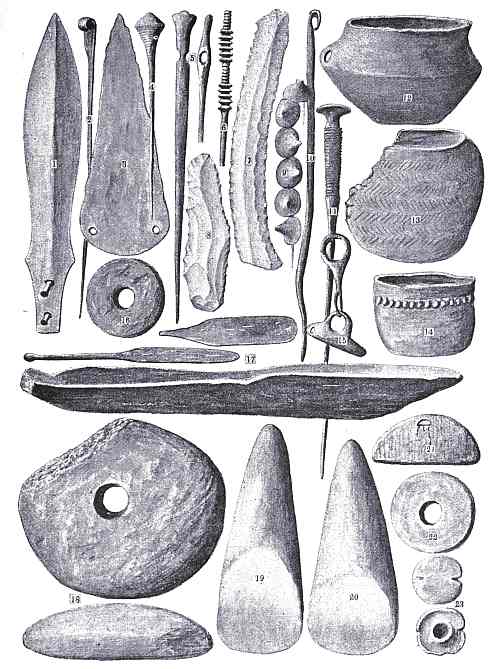
Fig. 60.—Mercurago (1 to 9, 12, 13, 18, and 22), Borgo-Ticino (19), and San Martino. Nos. 12, 14, 18, 21, and 23 = 1⁄4, 13 = 1⁄6, 17 = 1⁄24 (the paddles 1⁄20), and the rest = 1⁄2 real size.
Torb. di Trana.—A sword of bronze 27 inches long (B. 294, Pl. xi.), and a celt of the flat type, (B. 168, Pl. viii.)
Lago di Piverone.—A bronze sword. (B. 168, Pl. viii.)
Torb. di Oleggio-Castello.—A bronze sword and a socketed spear-head. (Ibid.)
LAGOZZA.
Lagozza is the name given to a small natural "bacino torbosa" situated in an undulating plateau of morainic débris, about 4 miles from Gallarate in the province of Milan. It is roughly oval in shape and covers a superficial area of 10 or 12 acres. Till recently this basin was a peaty bog, passable in summer, with certain precautions, to "Cacciatori;" but in former times, as its name implies, it was a stagnant lake. In 1875 the proprietor, Count Cornaggio, an ardent and skilful agriculturist, determined to remove the peat altogether, and, for this purpose, commenced operations by cutting a central canal to carry off the water. While the workmen were thus engaged they began to find near the middle of the bog bits of pottery, charcoal, and rotten piles, which, on skilled attention being directed to them, turned out to be undoubted indications of a prehistoric lake-dwelling. The process of clearing out the peat was therefore watched with great interest by local antiquaries, as the operation would involve a more thorough investigation of the antiquities imbedded in the peat than any researches that were likely to be undertaken solely from the scientific point of view. It was not till the spring of 1880 that the main portion of the palafitte was reached by the peat-cutters, and then various antiquarian objects were met with. The turf is now entirely removed, and the relics collected are deposited partly in the Museo Civico in Milan, and partly in the Museo Archeologico at Como.
The pile-dwelling occupied a rectangular space, near the centre of the bacino, about 80 yards long from north to south and 30 to 40 yards broad. The turf here varied in thickness from 1 to 2 yards, according to the state of moisture; below which there was a muddy stratum containing the roots of water plants (fango con radice), among which the tops of the piles appeared. This layer was 16 inches thick, and immediately below it was the strato archeologico, which varied in thickness from 2 to 8 inches, and contained the usual débris of human occupancy embedded in a matrix of black peat mud and earth. Below this again was a stratum of black earth, mixed with the whitish clay or marl of the ancient lake bottom, in which the points of the piles were firmly fixed. The piles were pointed at the base and irregularly fixed, 4 or 5 to the square yard, and varied in length from 3½ to 5 feet, with a diameter of 4 to 8 inches. Many prepared beams either of round or split stems, some over 20 feet in length, lay buried in the peat, as if they had fallen from a platform. Regazzoni draws attention to some short beams having a square-cut hole at each end. One of these beams measured 24½ inches long, 4¾ broad, and 3½ thick, and the holes were 2¾ by 1½ inches. The top of a tree whose branches were neatly chopped off at the distance of 6 or 7 inches from the stem was supposed to have been used as a ladder.
Castelfranco thinks the points of the piles were fashioned by some sharp-cutting instrument of metal, as some of the cuts were 11 inches long, and such as no stone weapon could have produced ("non credo che una scure di pietra sia mai stata capace di tanto"). This observation is very significant in face of the fact that there is no object of metal among the relics from Lagozza, with the exception of a fibula (Fig. 61, No. 18), found in the lower part of the turf and, therefore, outside the well-defined relic-bed. This fibula belongs to the early Iron Age, and it is doubtful whether it belonged to the inhabitants of the palafitte. The same author also states that where charcoal and partially burnt wood were in greater abundance there also the relics were more numerous, and hence he concludes that the settlement came to an end by a conflagration ("il risultato di un incendio generale o di parecchi parziali").
Among the industrial remains collected from Lagozza pottery takes the chief place. The quality is of two kinds, coarse and fine, the latter having a smooth black appearance and without any admixture of coarse sand. The vessels, of which a considerable number are whole or nearly so, consist of cups, bowls, plates, vases, spoons, etc. They are generally without handles, having, instead, perforated knobs, as may be seen from the accompanying illustrations (Fig. 62, Nos. 2, 6, 7, 9, and 15). The plates are sometimes ornamented with panels containing impressions of circles, dots, and lines (Nos. 3, 10, and 13). Some of the larger dishes have conical protuberances or finger-marks round the margin (Nos. 1 and 4).
The spindle-whorls, about 40 of which are in the Museum at Como, are somewhat peculiar, being flat circular cakes of burnt clay with a hole in the centre, and often ornamented with lines or rows of elliptical impressions (Fig. 61, Nos. 12 to 17).
There are some clay weights of the usual conical shape, and others kidney-shaped with a perforation at each end (Fig. 62, No. 14). In some of these weights bits of straw and grains of barley and wheat have been detected.
There is not a single article made of bone or horn, nor any trace of fishing or hunting gear, with the exception of one or two arrow-heads (Fig. 61, Nos. 5 and 6).
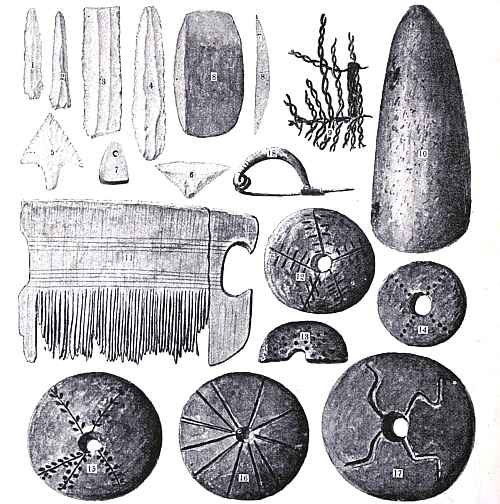
Fig. 61.—Lagozza. All 1⁄2 real size.
Stone celts are scarce, only about 30 in all, and none perforated (No. 10). One small implement is in the form of a double-edged axe, and adapted for cutting at both ends (No. 8).
Flint flakes or knives (Nos. 1 to 4) are numerous, but cores and chips are less frequent. Arrow-points are extremely few—only three have I seen in the Museum at Como, but their authenticity seems to be questioned by Castelfranco, who thinks they were not actually from the relic-bed in the palafitte. Among the usual stone objects, such as hammers, rubbers, etc., are to be noticed a number of white quartz pebbles and eight or nine small polished stones with scratched markings on them (Fig. 62, Nos. 11 and 12).
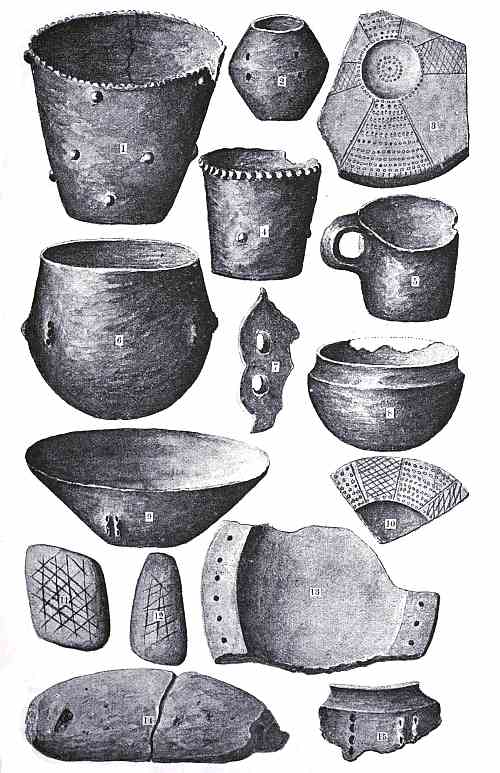
Fig. 62.—Lagozza. All 1⁄3 real size.
A wooden comb (Fig. 61, No. 11), with teeth at one side, is, I believe, the only specimen from any of the lake-dwellings in Italy.
Ornaments or charms are represented by one small pendant of green steatite perforated for suspension (No. 7).
As evidence that the inhabitants were in the habit of spinning and weaving, there are, besides the spindle-whorls and clay weights, bits of thread and cord, and one small fragment of coarsely-made linen tissue (No. 9). According to Professor Sordelli, this was made from wild flax (Linum angustifolium), of which he found the seeds and fibres in abundance, but no trace of the cultivated species. On the other hand, there were two kinds of wheat and the six-eared barley. Among the food-remains were the wild apple, acorns, hazel-nuts, stones of the cornel cherry, poppy-seeds, etc.
But the most remarkable feature of Lagozza is, that no animal bones of any description were found—not a tooth, or horn, or bone of any kind. Neither were there any warlike weapons, with the exception of the few questionable arrow-points. Castelfranco therefore suggests that the inhabitants of Lagozza might have been vegetarians. (B. 354, 359b, 372d´, 387, 409, 452, 456, and 459c.)
LAKE GARDA.
In 1851, while the harbour of Peschiera was being deepened, numerous bronze implements, associated with piles deeply buried in the bed of the lake, were found at a particular spot near the north mole of the fortress; but no special attention was paid to them. The bronze objects were laid aside by the workmen, and it is said that a quantity of them, weighing some 15 or 20 pounds, was sold as old metal. Of this find a very few were sent to the K. K. Antiken Cabinet in Vienna. In 1860 further deepening of the harbour became necessary, and again similar objects were found in the dredged-up stuff. These operations were conducted under the supervision of M. Lorenz and Col. von Silber, who, in the interests of archæology, collected and preserved the bronze objects. Subsequently, on its being suggested that this was a palafitte like those recently discovered in the Swiss lakes, Col. von Silber forwarded an assortment of the relics to Dr. Keller at Zürich, with the following explanatory notice of the circumstances in which they were found:—
"In deepening the entrance of the harbour at Peschiera for the newly-built gunboat, which was done by means of a mud-machine (called a 'paternoster') to a depth of 7 or 8 feet below the usual level of the water, the workmen found amongst the mud and sand brought up by the machine a great number of bronze implements. These were carefully preserved, for the sake of archæology, by Mr. Lorenz, the marine engineer, now residing at Pola, and myself. I was so uninitiated in this science, that when I found that the greater part of the objects had been taken up from a space of a very few square fathoms, I had the notion that a ship, laden with bronze, had been wrecked here, and it was not till a conversation which I had with Dr. Freudenberg, of Bonn, that I was led to believe that a lake-dwelling probably existed on this spot. This idea was corroborated by the fact that just in this place the working of the mud-machine was very much impeded by a number of burnt piles which were quite covered with the mud. Unfortunately, I fancied at first that these piles came from the fishermen's huts, which abound in this neighbourhood at the present day, so that I paid no attention to their position or arrangement. The piles which were drawn up were, on an average, 4 or 5 feet long, quite hidden under the sand, and burnt to such a degree that it is quite impossible for me to say with certainty what kinds of wood they were made of. I imagine, however, that the wood was chiefly that of the stone oak (Quercus ilex). The piles were 4 or 5 inches in diameter.
"Besides the bronze implements one of stone was found, which I believe to be a sling-stone. Lately, when reading the reports of the Swiss lake-dwellings, I remember the occurrence of a great number of pieces of burnt clay found in the mud. These pieces were of a blackish colour, remarkably thick, and without any definite form. I do not doubt that they have been fragments of the clay covering the huts of the lake-dwellings." (B. 119, 2nd ed., p. 364.)
These discoveries induced the eminent archæologist, Dr. E. Freiherr von Sacken, to visit Peschiera for the purpose of investigating into the reported Pfahlbau. In addition to his own special researches he had correct details of the results already obtained from Captain von Kostersitz, who was present, and carefully watched the excavations during the years 1860-1-2, and from these he drew up an admirable report, published in 1864 (B. 75), which clearly proved that there was here a true pile-dwelling of the Bronze Age.
In this report the following sectional description of the sedimentary strata is given:—
(1) In a depth of about 5 feet of water there was first a sandy layer from 2½ to 3 feet thick in which no relics were found.
(2) Beneath this layer of sand was the relic-bed, from 2 to 3½ feet thick, composed of a mossy deposit containing the remains of plants, organic débris, the industrial objects already referred to, and the tops of numerous piles.
(3) Underlying the relic-bed was a thick bed of stiff loam and sand, into which the piles deeply penetrated. These piles were generally of pine and oak, the former predominating in the proportion of two to one.
The dimensions of the lake-dwelling were not accurately ascertained, but the area covered by the dredging operations exceeded 10,000 square yards, and in most of this space piles were found. No stone implements were found, with the exception of the polished discoidal stone sent to Dr. Keller; but the number of bronze objects amounted to 250, most of which were sent to Vienna.
Professor Franz Unger made a careful study of the organic remains, and amongst the various fruits, plants, and wood identified by him the most interesting are rye (Secale cereale) and the vine (Vitis vinifera). The former has not yet been found in any of the terremare or lake-dwellings of North Italy.
The osseous remains represented the ordinary domestic animals—dog, sheep, goat, ox, horse, and pig—as well as the stag, roe, wild boar, etc.
Besides the bronze objects there were fragments of pottery and one or two Roman coins—one of Trajan and one of Domitian.
Meantime archæologists were on the look out for palafittes in other parts of the lake. It appears that as early as 1861 Cav. Martinati detected piles at a place called Rocca di Garda, near Bardolino, on the eastern shore of the lake, which he considered to be the remains of a pile-dwelling. Dr. Alberti also discovered similar evidence in two localities farther south, Il Bor and Porto di Pacengo, which he described in a letter to Martinati in 1864. (B. 77 and 355.) This stimulated the Accad. d'Agricoltura, Arti, e Commercio di Verona to appoint a Commission to investigate the matter; but their labours were soon afterwards discontinued owing to the political disturbances of 1866, and it was not till ten years later that these proposed archæological researches were resumed and the Commission re-constituted. Although on this occasion no bronze objects were found, it cannot be said that the explorations were altogether devoid of interest, as the existence of the reported palafittes was not only confirmed, but a considerable quantity of the osseous remains of the ordinary domestic animals, fragments of pottery (including handles known as anse lunate), and a wooden spoon were collected. But the Commission soon abandoned the work as profitless. Then it was that Mr. Alberto Cavazzocca, of Verona, commenced to search Il Bor on his own account, and succeeded in a couple of seasons in securing from it a small collection of antiquities, including objects of stone and bronze.
On the western and more sheltered shores of Lake Garda Professor Stoppani, of Milan, found traces of several stations, particularly in the Gulf San Felice di Scovolo, three of which were situated close to its northern shore, and two close to the Isola Lecchi on the landward side of the island. As few relics were found—only a few flint objects—and as the piles in all these stations were near the shore and in comparatively shallow water, Stoppani concluded they belonged to the Stone Age. These explorations were a sequence to the first researches in Lake Varese, so auspiciously initiated by Desor and Mortillet, and which Stoppani followed up by making an exploratory tour of the lakes of North Italy. The observations of Stoppani, however, have not been confirmed by any subsequent researches, though this particular locality is pre-eminently the most fitted for lake-dwellings in the whole of this extensive sheet of water. (B. 87.)
In 1879, under the skilful management of Cav. Stefano de Stefani (R. Ispettore degli Scavi, Verona), dredging operations were resumed at the old place in the harbour of Peschiera, which considerably added to the number of relics from this station.
In the spring of the following year De Stefani transferred his operations to an entirely new locality in the river Mincio, below the railway bridge, where the stream divides into a number of separate channels. Among the islands thus formed he had reason to suspect the existence of pile-dwellings, and in this expectation he was not disappointed, as he succeeded in finding not only the submerged piles and transverse beams, but also a large number of flint, and some bronze objects, and even a few Roman remains.
As both these investigations were undertaken by orders from the Minister of Public Instruction and at the expense of Government the relics were sent to enrich the prehistoric department of the Kircherian Museum at Rome.
The people of Verona were greatly chagrined to find that these successive discoveries, which had now attained much celebrity in archæological circles, were constantly slipping out of their hands, and that in their own local museum there was scarcely a single article illustrative of the culture and social condition of these early lake-dwellers. To rectify this state of matters and make some amends for their past neglect the Academical Commission was induced to order a fresh investigation under De Stefani, whose recent success was characterised as "risultati splendidissimi." Again the excavations of De Stefani were crowned with great success. In 1881 his attentions were directed to Peschiera, which yielded him a considerable number of articles, being the fourth important supply since its discovery in 1851. In 1883 the station in the Mincio was subjected to further explorations, and De Stefani's labours were rewarded by a rich harvest of relics, mostly of the Stone Age, which included many flint implements, as knives, hatchets, saws, arrow-points, etc.
The relics collected on both these occasions are now deposited in the Museo Civico at Verona, and at last this town shares with Rome, Vienna, and Zürich, the honour of possessing a collection of these remarkable remains. (B. 342, 358, 370, 424, and "Notizie degli Scavi, 1880 and 1884.")
From these general remarks it will be seen that there are only three lake-dwellings in Lake Garda that have yielded remains sufficiently comprehensive in quantity and variety to enable us to form some idea of the period to which they belonged, viz. the station close to the fortress of Peschiera, that in the Mincio, and that known as Il Bor on the south-east shore of the lake.
Peschiera.—Since the report of Baron v. Sacken the various researches conducted here have not thrown additional light on the general condition and distribution of the piles. De Stefani bears testimony to the accuracy of the facts as to the archæological stratum in which the relics were found, and observes that the overlying bed of sand and gravel sometimes attained a depth of over 4 feet. (B. 424, p. 9.) In it were found decomposed organic matter, bits of charcoal, fragments of pottery, and bronze objects. In the previous discoveries only one stone implement was recorded, so that the station was considered to be exclusively of the Bronze Age. Nor was its character in this respect much altered by the recent researches, as only a few implements of stone were found, viz. two knives or scrapers, one arrow-point and a few chips of flint, a round sling-stone of granite, and another of an oval form with marks of having been used. Nothing of importance was added as regards its flora and fauna. De Stefani describes a curious object like a biscuit, picked out of the dredged stuff, which he considered might have been a cake of bread. It was made of viscous matter and measured 4 inches in diameter and ¾ of an inch thick, and contained bruised cereals; but, as he was examining it, it slipped through his fingers and again fell into the water. (B. 424, p. 10.)
This settlement appears to have flourished exclusively in the Bronze Age, as may be seen from a glance at the accompanying illustrations (Figs. 63, 64, and 65).
Pottery.—The fragments of earthenware indicate a great variety of vessels made of two kinds of paste—a coarse and a fine quality. Of the latter, Nos. 26 to 30, Fig. 65, are sufficient to show that the ceramic art of the lake-dwellers was identical at one period of their existence with that of the terramaricoli in which the anse lunate (No. 26) are so characteristic.
Bronze.—Weapons, implements, and ornaments of this material are extremely numerous, numbering upwards of 300 objects. Among the weapons we find socketed lance-heads (Fig. 64, No. 10), daggers (No. 1 to 7), single-edged knives (No. 11), and a remarkable series of double-edged dagger-knives with riveted tangs or sword-like handles (Fig. 65, Nos. 10, and 12 to 14).
The implements include three kinds of hatchets (Fig. 63, No. 30; Fig. 64, No. 32, and Fig. 65, No. 11), chisels and gouges (Fig. 63, No. 36), sickles (No. 33), various forms of razors with handle and double cutting edges (Nos. 1 to 5), needles (No. 7), and fish-prongs and hooks (Fig. 64, Nos. 18 to 21, 30 and 31).
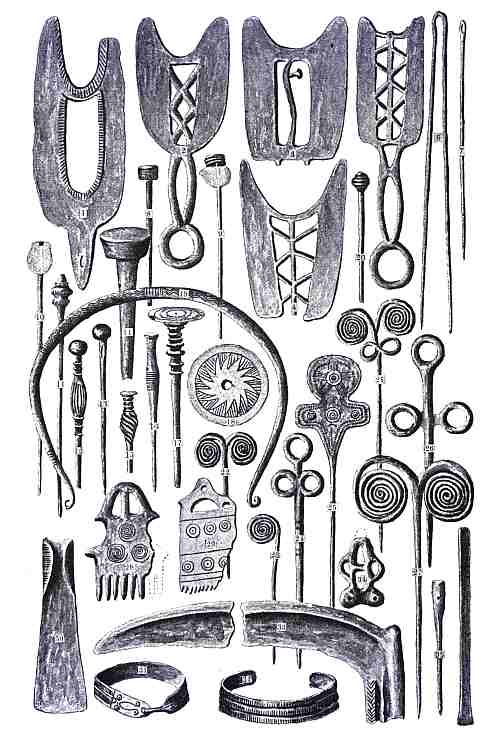
Fig. 63.—Peschiera. All 1⁄2 real size.
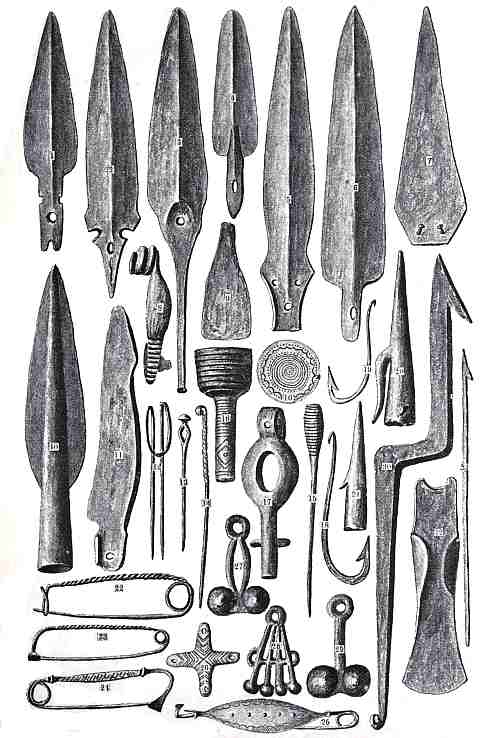
Fig. 64.—Peschiera. No. 32 = 1⁄4, and all the rest = 1⁄2 real size.
The ornamental objects are hair-pins, combs, pendants, bracelets, fibulæ, and a torque. Hair-pins are in great numbers and of extreme elegance both in form and ornamentation (profusely illustrated in Figs. 63, 64, and 65); among them are some with amber heads (Fig. 63, Nos. 9 and 10); some have flat, others disc-shaped, heads (Nos. 17, 18, and 25); especially interesting are those with heads made of various combinations of spirals (Nos. 21 to 27), as being identical with the hair-pins of the terremare. Combs are of bone (No. 29) as well as of bronze (No. 28). Pendants of curious and varied forms are also abundant (Fig. 64, Nos. 27 to 29), among which one (Fig. 63, No. 34) is of lead. The small ornamental cross represented by No. 26, Fig. 64, is of tin. The fibulæ are also of diversified forms, as may be seen from the illustrations (Fig. 64, Nos. 8, and 22 to 25). The bracelets are of two kinds, made of thin bands (Fig. 63, Nos. 31 and 32), one closed with a hook and the other open. Only one torque (No. 19) has been found at Peschiera, and in form it is similar to the few recorded from the Swiss lake-dwellings (Fig. 10, No. 3).
Finally there are a few spirals, bits of wire, and one special object of unknown use (Fig. 64, No. 17).
The relationship which these objects have to analogous remains in foreign countries is most exhaustively and ably dealt with by Professor Pigorini. (B. 310.)
Mincio.—As the surplus water of Lake Garda, under the name Mincio, passes beyond the railway-bridge, it divides into two larger channels and some smaller ones, forming a series of acutely-pointed islands. The bed is here irregular, and at various points the tops of piles were seen in groups projecting from the bed of the river. The first explorations were in the larger channel to the left. Here De Stefani found several objects of antiquity, among which the following are the principal (B. 358):—
Bronze.—The corroded blade of a knife-dagger (double-edged), portion of a dagger-blade with a mid-rib, portion of another with deep longitudinal grooves, portion of a small disc and portion of a spiral.
Flint.—Two rectangularly-shaped hatchets, a saw (curved), a javelin, an arrow-point, a lance-head, small knives, and a large quantity of chips, cores, and crude flints.
Pottery.—Two spindle-whorls, a quantity of handles and fragments of dishes.
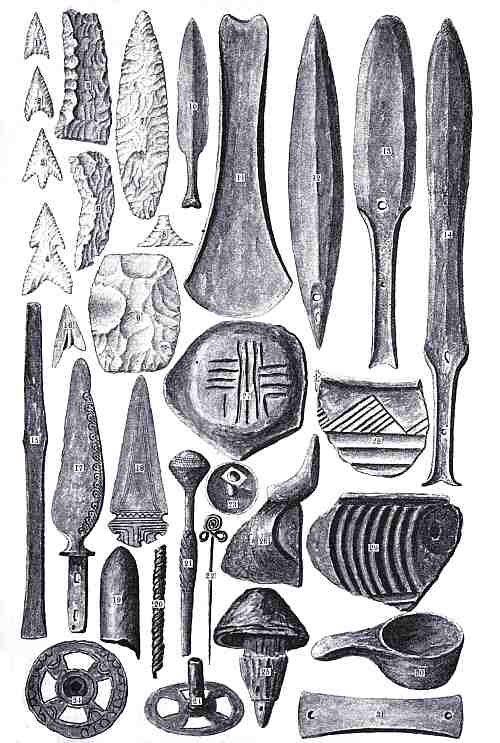
Fig. 65.—Peschiera. (10 to 14, 21, 26 to 29, and 31.), Il Mincio (1 to 9, 17 to 19, 22, 23, 25, and 30), and Il Bor (15, 16, 20, and 24). All 1⁄2 real size.
Staghorn.—A portion converted into the form of a hatchet, a hair-pin, and several other worked bits.
Bones, etc.—A large quantity of teeth and bones of the ordinary domestic animals.
At another spot, 200 yards lower down in the central canal, amidst a group of piles he collected:—
Bronze.—A knife (Fig. 65, No. 17), two small dagger-blades with rivet-holes, the point of a sickle, two bits of the cutting-ends of axes (paalstabs), two hair-pins 10 inches long and three smaller ones, a disc-shaped head of a pin, portions of a fibula, together with fragments of various other undetermined objects. One interesting relic is supposed to be the knob of a handle (No. 25).
Stone.—One portion of a polished stone of basalt (No. 19).
Flint.—The implements of this material were here in great abundance (Nos. 1 to 9). Eighteen hatchets, mostly of a rectangular form (No. 9); 60 saws (Nos. 5 and 6); 49 arrow-points (Nos. 1 to 4), of which one (No. 4) has four barbs and another is chisel-shaped (No. 8); 13 lance-heads (No. 7), etc.
Amber.—Two beads, one reddish and the other yellow.
Pottery.—Various fragments, especially handles of vessels of different forms—cornuta, lunata, lagotis, bitubercolata, etc. Some of the dishes were of fine black ware, among which I may note a spoon (No. 30), but generally the coarser kinds predominated. Spindle-whorls were also numerous and varied in form, not less than 31 being collected. There were also two large net weights, one round and the other ring-shaped.
Staghorn.—Several worked bits: one was a portion of an ornamented comb and another part of a handle of some sort.
Money.—Four coins, much corroded, supposed by De Stefani to be of the second half of the third century.
In 1883 De Stefani resumed his researches in the same place. (B. 424.) On this occasion the bronze objects were limited to one or two insignificant fragments; but, on the other hand, the flint implements increased—knives, saws, javelins, lance-heads and arrow-heads being in abundance. Among the other things I may mention two small stone discs perforated, probably used as spindle-whorls; a small bit of green glass, together with portions of worked and unworked horn, bone, etc.
The ornamental blade (Fig. 65, No. 18), a neat spiral-headed pin (No. 22), and a stud (No. 23), all of bronze, are in the collection of Dr. Rambotti, and said to be from the station in the Mincio.
Il Bor.—Previous to the investigations of Il Bor by Cavazzocca (B. 355), Dr. Alberti had estimated the number of heads of piles visible on this station at 500, but this number the former considers rather high. The station stretched parallel to the shore, from which its site is now distant about a hundred yards; but it is supposed that the present level of the water stands higher than it was in the days of the lake-dwellers. One reason for this opinion is that a triple row of piles which runs shorewards, and is considered to be the remains of a gangway, was found to terminate suddenly about half-way. The strato archeologico lies under a thin covering of sand and gravel, which Cavazzocca explains to be the débris of the disintegrated morainic coast carried outwards by the boisterous action of the waves.
The principal relics collected by Cavazzocca are as follows, most of which are illustrated in his monograph:—
Bronze.—Four knife daggers similar to those from Peschiera; three pin-heads, "capocchie di aghi crinali" (Fig. 65, No. 24), like those from the terremare; one axe-head with wings, like No. 30, Fig. 63; one conical button; two chisels (Fig. 65, No. 15); four hair-pins; two fragments of spiral tubes (No. 20), and six undetermined objects.
Pottery showed diverse forms, including anse lunate, and fragments of vessels, spindle-whorls, etc.
Stone.—Three fragments of stone moulds, several whetstones, and an arrow, knife, and several chips of flint.
An arrow-point of bronze (No. 16) and a couple of small daggers from Il Bor are in the Museum of Rome.
LAKE FIMON. (B. 83, 110, 132, and 295.)
About four miles to the south of Vicenza, at the southernmost point of an irregularly-shaped valley of rich meadow-land, lies the small lake of Fimon. At the present time it is hardly a couple of miles in circumference, but before the Debba Canal, which carries its surplus water to the river Bacchiglione, was cut, it is known to have been considerably larger, and in prehistoric times it is supposed to have covered the larger part of the valley. In a meadow called Pascalone, near its north end, and close to where the Debba Canal begins, Mr. Lioy detected the tops of piles jutting out of the grass, which he at once concluded to be the remains of a lake-dwelling—a supposition which was completely verified by extensive excavations. The surface of the meadow where these piles were visible was less than 2 feet above the level of the lake, and on making excavations over a selected portion the following facts were ascertained:—
Piles.—The piles were from 8 to 12 inches in diameter, singly and irregularly placed, but sometimes in groups; some were hard and black (oak), and others soft, but they bore no traces of any cutting implements. In some instances they were surrounded with heaps of stones. They penetrated deeply, and one which was pulled up measured 18 feet in length. No traces of a gangway stretching to the shore could be discovered.
Relic-bed.—Below a thin covering of vegetable-mould there was a peaty bed about 16 inches thick, and underneath this, lake-marl containing various kinds of fresh-water shells to the extent of 3 feet 4 inches. To this succeeded the strato archeologico with its various contents—decomposed organic matter, broken bones, fragments of pottery, flint implements and other worked stones, bits of straw, reeds, charcoal, clay plaster, burnt faggots, etc. This bed was about 12 inches thick, and its matrix was of a yellowish-black colour, which, when cut into, had a doughy consistency and emitted a strong sulphurous smell.
Relics.—The rough stone implements were made out of the limestone of the neighbouring hills, very seldom of sandstone, but more frequently of flint from the spurs of the Alps. These flints were in considerable numbers in the form of chips, nuclei, and unfinished implements, very few of which were well formed; a few rudely-formed arrow-points, lance-heads, knives, and saws or scrapers; pebbles of limestone, probably hammer-stones; stone discs, 2 to 4 inches in diameter (only one was perforated); also numerous sling-stones made of sandstone, basalt, and serpentine; one fragment of granite, flattened and polished on all the four sides, but only one small polished stone celt. Many of the bones were worked, and there were tynes of staghorn, sharpened at the top and perforated at the base; also pointers, spear-heads, spatulæ, and splinters of all kinds.
The fragments of pottery were so plentiful that a handful of mud could not be taken up without finding some pieces in it. Amongst some thousands of fragments about 50 vessels in a more or less perfect condition were picked out. They are all of a dark colour, with handles attached, generally below the rim, and flat bases. Some of them have everted lips, and many are ornamented with knobs, depressions, or raised ridges (circular, wavy, or confluent). Some of the handles approach the form known as anse lunate, others terminate in a round button (ansa mono-appendiculata). One small bowl had two handles. The paste was of two qualities: one fine, and the other mixed with coarse bits of gravel, quartz, and carbonate of lime.
Numerous specimens of spindle-whorls. They are flat circular cakes of clay, like small wheels, perforated and unornamented.
Organic Remains.—Fruit of the water-chestnut (Trapa natans), kernels of cherries, hazel-nuts, acorns, bramble seeds, etc.
The bones of the stag and wild boar seem to predominate among those of the sheep, ox, roe, badger, etc.; also a large quantity of the broken carapaces of a small fresh-water turtle (Emys lutaria).
Some five or six years later (1871) Mr. Lioy made further excavations near the same place, and came upon a relic-bed 8 inches in thickness and only 16 inches below the surface, which he considered to be the remains of a pile-dwelling of a later age. In this relic-bed he found a bronze celt (Fig. 66, No. 1) and some flints of a grey-reddish or yellowish colour (different from the blue variety in the earlier dwelling), but no stone implements and no arrow-points. Pottery was not abundant, but it was made of a finer quality and the ornamentation shows a higher style of art. Mr. Lioy also observes that the bones of the domestic animals, such as sheep and oxen, are now in excess of those of wild animals.
As a final report of the abitazioni lacustri of Lake Fimon (B. 295) Mr. Lioy has published a lengthy monograph with numerous plates of illustrations. The work, however, deals more with extraneous and general considerations than specific facts or details bearing on the remains of the palafittes in this lake. I consider the station at Polada, with its remarkable relics, far more typical of the Stone Age lake-dwellings, and I have accordingly selected it as a standard for such remains in the eastern valley of the Po. Moreover, Mr. Lee (B. 119, 2nd ed.) has already presented to English readers an abridgement of Mr. Lioy's work, with no less than nine plates of illustrations; whereas a report of the discoveries at Polada has not yet been published at all. I have, therefore, restricted my illustrations from Lake Fimon to the few objects on Fig. 66, which include a bronze flat celt, a large clay ring, and a few specimens of pottery.
ARQUÀ-PETRARCA.
In the neighbourhood of Padua remains of lake-dwellings presenting in many respects similar characteristics to those in Lake Fimon, have recently been discovered in the small lake of Arquà-Petrarca situated in the Euganean hills. It was discovered in the autumn of 1885 by Professor Frederico Cordenons, who, with the aid of funds from the Museums of Padua and Este, made excavations during this and the following summer, the result of which he has just published. (B. 464.) It appears that the lake, though now only covering some dozen acres, was formerly of much greater extent and occupied the whole of the present valley. In the slime of this ancient lake-basin, which is now overlaid with a deposit of peat over 3 feet in thickness, the remains of two stations were found, one on the eastern and the other on the western margin of the present lake. These remains, which consist of piles, portions of transverse beams, and a large assortment of the industrial débris of the inhabitants, are entirely confined to the ancient mud deposit, nothing being found in the peat above it. Mr. Cordenons does not give as minute a description of the relic-bed and its surroundings as could be desired; but as only a fourth of the area occupied by the piles has been excavated (1,000 square yards), the present report may be only a first instalment of the researches.
Among the objects collected, the following will give a general idea of its chronological position with respect to analogous remains in the Po valley:—Several perforated stone axes, half of a perforated hammer-axe of green serpentine beautifully polished, a large hammer-stone, a beautiful flint saw four inches long ("un bellissimo coltello-sega"), portion of a finely-worked laurel-leaf-shaped lance-head of flint, a number of arrow-heads, lance-heads, saws, knives, etc., of flint.
Objects of staghorn were not numerous, and only some perforated rings of this material are recorded.
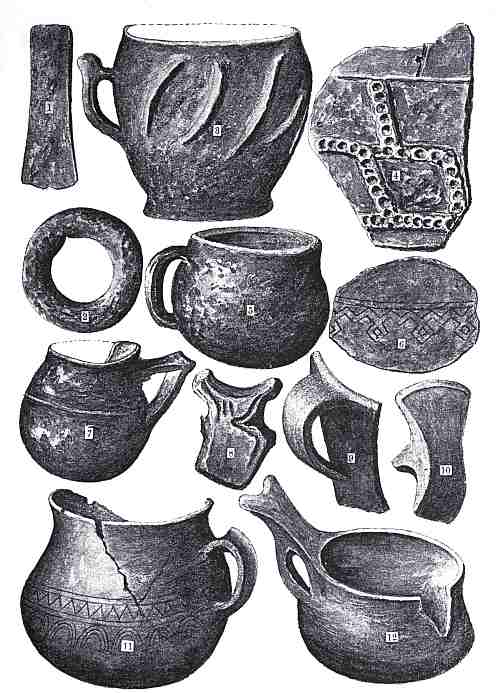
Fig. 66.—Fimon (1 to 8), and Arquà-Petrarca (9 to 12). All 1⁄3 real size except No. 2 = 1⁄6.
The pottery is abundant, and with the description of it much of Cordenons's monograph is taken up. The paste in the generality of the vessels is mixed with sand and bits of mica, recognised to be the débris of the surrounding hills. Only one dish (Fig. 66, No. 11) showed ornamentation of incised lines, but, on the other hand, raised lines meeting in points, forming triangles, etc., were most common. The handles were of various shapes and showed a complete series of the progressive stages, from the single button-shaped top to the almost perfect ansa cornuta.
No metal objects were found, and consequently Mr. Cordenons concludes that the station belonged to the pure Stone Age, a conclusion which, however, Pigorini disputes. (B. 466b.)
The pottery is very similar to that from the adjacent lake-dwellings at Fimon, and by no means dissimilar to that from Polada.
POLADA.
About half-way between Desenzano sul Lago and the village of Lonato, and a little to the south of the direct railway between Milan and Venice, there is, in the midst of a series of morainic hillocks, a small bowl-shaped hollow, scarcely 300 yards in diameter, which at one time formed a stagnant lake called Polada. It appears that at some former period, of which there is now no record, this pool had been partially drained by means of a small tunnel which was pierced through the morainic lip on its north side, and so carried off the water to a lower valley. The result of this was to expose a considerable portion of the lake-bottom, one part of which formed a tongue-like projection or promontory attached to its eastern margin. This continued to be the condition of Polada for many ages, and in course of time the remaining portion of the lake became completely filled up with peat. Some years ago the proprietors of this bog commenced to utilise its contents as fuel, and, to facilitate this operation, the margin of the crater-like cavity was pierced by a second tunnel at a lower level than the former, so as to get rid of the water. It was then found that the promontory of land, which since its original exposure had been cultivated, had been only partially bared by the first drainage, as on its inner side there was a thin covering of peat, which a little farther on suddenly sank to a great depth. In the course of removing this covering of peat from the tip of the promontory, and just on the margin of the cultivated land, some rotten piles and other indications of a prehistoric dwelling were discovered. Dr. Giovanni Rambotti, President of the Liceo Ginnasio at Desenzano, recognised this to be the remains of a lake-dwelling erected on piles, and so greatly did he interest himself in the objects recovered and daily turning up that he arranged with the workmen to preserve all the relics for him. This discovery was made in 1872, and, as the operation of clearing out the peat progressed during the following two or three years, the settlement turned out to be very rich in industrial remains. Now that the turf is entirely removed and all the relics kept together Dr. Rambotti finds himself the possessor of one of the most valuable and instructive collections of lake-dwelling remains in Italy.
From an inspection of the original outlet Dr. Rambotti calculates that before the first tunnel was executed this tongue of land would be covered by eight to ten feet of water, and he thinks that in this depth of water the lake-dwellers must have erected their piles and platform. That portion of the site might have been exposed and destroyed when the first drainage was made, is probable; but at any rate sufficient remained to be able to form some opinion as to its size. When I visited the locality with Dr. Rambotti he gave me the following dimensions, which he derived from a careful study of the locality and disposition of the piles. Its form was that of an oblong parallelogram, 65 yards long and about one-third of this distance in breadth. Its longest diameter ran nearly east and west, and the dwelling thus presented its short side to the nearest shore. Two rows of piles, about two feet apart, stretched to the shore, a distance of about 100 yards, and Dr. Rambotti justly concluded this to be the remains of a gangway. A shallow canoe, 25 feet long and 30 inches wide, having traces of fixtures for oars at three equidistant spots on each side, was found near the site of the lake-dwelling. Portions of a second canoe, apparently of smaller dimensions, were disinterred at the land end of the gangway.
But the valuable feature of this lake-dwelling is the large and unique assortment of industrial remains which it has furnished, all of which are kept together at the private residence of Dr. Rambotti, where they constitute a respectable museum.
Pottery.—The larger vessels were made of coarse greyish clay, mixed with rough sand or pebbles; but the smaller and more ornamental were composed of a fine black homogeneous paste. Besides a large quantity of fragments, there are in Rambotti's collection about 150 vessels, more or less entire, showing a considerable variety of size and form, according to the uses for which the vessels were intended. Some were large wide-mouthed jars, with two, or sometimes four, handles. The largest of this class measured 15 inches across the mouth and 9 inches in depth. One flat dish was 12 inches in diameter and only 4 deep, while another was flower-pot-shaped and measured 10 inches across at the top, 5 ½ at the base, and 12 in depth. Another dish (Fig. 68, No. 37) was perforated all over with small round holes, arranged in upright and equidistant rows, of which there were in all thirty, each row having eight holes. The measurements of this curious percolator are 10½ inches across the mouth, 8 at the base, and 4½ in depth. Some vessels, especially the larger vases, were ornamented with a line of perforations or projecting knobs round the rim; others again had a ridge marked here and there with a knob round its bulging part (Fig. 67, No. 6). Few were without handles. In one or two instances there was a hollow protuberance, instead of a handle, sufficiently prominent to be grasped, and the hollow part communicated with the interior of the vessel. The handles were attached generally at the rim, but often below it, and sometimes half-way down the side of the vessel. The largest handle I noticed measured 6 inches from its two points of attachment. Some of the handles were surmounted by a button-shaped prominence (No. 10); others terminated in a bifurcation like a couple of horns, which strongly suggests a rudimentary form of the ansa lunata, so characteristic of the terremare (Nos. 13 and 14). Of the finer kind of pottery there are a great variety of dishes, which may be classed as cups, bowls, plates, jugs, etc., some of which were ornamented with simple designs made with dots and lines (Nos. 9, 10, and 11). One handle had the form of a cross punctured on it, having one arm prolonged into a long stem running downwards, just like a modern Christian cross.
About 140 spindle-whorls of terra-cotta, some of which are variously ornamented (Fig. 68, Nos. 28, 29, and 36). A considerable number of perforated clay weights, of which five are flat, with the hole in the centre (Fig. 67, Nos. 19 and 20). The most novel objects were a few oblong cakes of terra-cotta ornamented with repeating lines of small circular depressions (Fig. 68, Nos. 22 to 24).
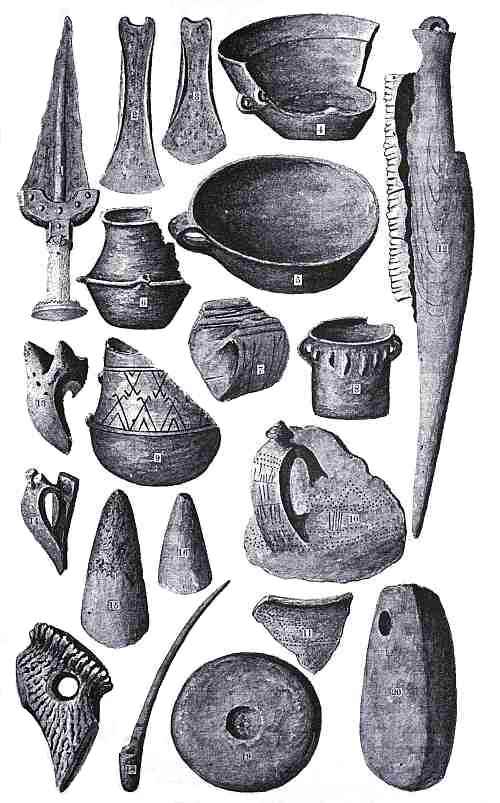
Fig. 67.—Polada. All 1⁄3 real size.
Stone Objects.-A large sandstone polisher, together with a number of smaller ones. About 40 hammer-stones of quartz, serpentine, etc., some having finger-depressions. A few perforated stones, used as sinkers or hammers. Six round stones about the size of an egg, found in the canoe. Of polished celts there were only six of the usual type (Fig. 67, Nos. 15 and 16). One of the most remarkable features of the collection is the number of arrow-points, which exceed 300, presenting in this respect a remarkable contrast to Lagozza. As will be seen from the illustrations (Fig. 68, Nos. 1 to 19) these arrow and lance-heads are varied in form and exceedingly well made. Eight are of a rhomboidal shape, and a similar number have only one barb (No. 7). Three rectangular plates of polished stone, perforated at the corners, were probably used to protect the wrist of the archer (Nos. 34 and 35). Flint saws to the extent of nearly 100, of which a few are unique. One has slanting teeth as shown in No. 20, which represents both sides of the flint. A few were still in their handles when found. One is very remarkable (Fig. 67, No. 12) as being formed of four separate flints fixed in a wooden casing by means of a groove and asphalt. This casing or handle has a grasping portion at each end—in short, it is a double-handed saw. The illustration represents this implement lying flat, and the horn-like ending projects upwards at an angle of about 40°, so that when placed in working position with the flints downwards, the horn-like projection would be directed to the left. Hence Dr. Rambotti thought the lake-dwellers were left-handed men. There were two other wooden casings, precisely similar, but minus the flints.
Horn und Bone.—About 40 daggers and pointers of bone, of which 12 are made from split leg-bones and beautifully polished like those from Laibach and other places. A number of small pointed objects of bone, chisels, pins, etc. (Fig. 68, Nos. 25 to 27). Seven perforated axe hammer-heads of staghorn (Fig. 67, No. 17), also similar to those from Laibach.
Bronze.—A bronze dagger (No. 1) with a neatly-worked bone handle terminating in a button-shaped capsule. The blade was attached to a semilunar capsule of thin bronze by rivets. Portions of worked bone similar to the handle of this weapon were supposed to belong to other analogous weapons. Three flat celts of the terramara type (Nos. 2 and 3).
Ornaments.—Eight bone rings, one of which is ornamented with small circles (Fig. 68, No. 33). Three perforated buttons or spindle-whorls of marble (No. 30). Several other forms of buttons in stone or marble (Nos. 21 and 32). Several perforated teeth of dog, wolf, bear (No. 31), and wild boar; also one perforated shell.
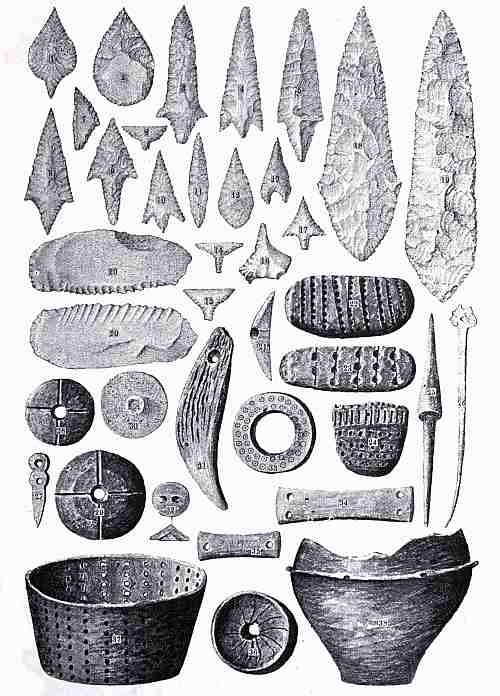
Fig. 68.—Polada. Nos. 37 and 38 = 1⁄6 and all the rest = 1⁄2 real size.
Wood.—Several articles of wood are preserved, as handles of implements, a portion of an oar, fragments of the casings for flint saws. A stool with six legs cut out of the solid. These are now mostly shrivelled up and scarcely recognisable.
Osseous Remains.—Upper part of a human skull. Also numerous bones of the following animals:—the urus and some other breeds of cattle, horse, sheep, goat, dog, cat (one skull), wild boar, pig, stag, and roe.
Dr. Rambotti thinks that there was satisfactory evidence to conclude that the settlement had been destroyed by fire.
No report of this remarkable lake-dwelling has yet been published in Italy, but the principal objects were exhibited at a Congress of Art and Archæology held at Brescia in the autumn of 1875. On this occasion no less than fourteen pages of the published catalogue of the exhibition are devoted to the enumeration of Dr. Rambotti's collection from Polada.
CASCINA, Etc.
The Torbiera di Cascina, situated between Castelnuovo and San Georgio, in Salice, has from time to time yielded objects which, there can be no doubt, belonged to ancient pile-dwellers. The station was first recognised by Martinati (Adige, 1874, No. 23), who found flint arrow-points, a laurel-leaf-shaped lance-head, some stone implements, bits of staghorn, etc. In 1878 Pigorini gives a further account (B. 328d') of some of the objects since discovered, including 18 flint pieces—arrow-points of various forms, including one of the so-called rhomboidal type (selce romboidale), a magnificent lance-head, a fine saw, and one small triangular chisel. In the Museo Kircheriano at Rome there are also preserved a bronze axe of the flat type (Fig. 51, No. 9) and a curious knife of bronze (No. 12), similar to those from the lake-dwelling at Peschiera, which were found in this place.
Martinati (B. 279, p. 179) also describes another small torbiera in the vicinity of Lazise, in which three rows of piles were encountered, and associated with them were fragments of black pottery. It was also reported that in past years entire vessels of the same kind were found in the locality.
TERREMARE.
Shortly after the middle of last century certain artificial deposits of an earthy substance found scattered in the shape of large, flattish mounds, over the provinces of Parma, Reggio, and Modena, became known to agriculturists as possessing great fertilising power—a property which they henceforth turned to advantage by using their contents as manure. To such an extent has this practice been carried that many of these deposits, notwithstanding their great extent, covering, in most instances, many acres, have now entirely disappeared. This substance looks like a mixture of clay, sand, ashes, etc., arranged in differently-coloured strata—yellowish-brown, green or black—and goes among the peasants under the name of marna or mèrne; but in scientific circles it is generally called terramara, more especially since the meeting of the International Congress at Bologna. In the course of these annual excavations various objects of antiquity were noticed by the workmen, such as Roman coins and tiles; implements of bone, horn, bronze, etc.; the bones of domestic and wild animals; and even human bones, were occasionally turned up. But these popular observations failed to lead to any scientific investigation, and when these mysterious mounds happened to be noticed by the early writers of this century each had a theory of his own to account for them. Thus the celebrated naturalist Venturi, in his "Storia di Scandiano," published in 1822, assigns them partly to the Boii, a Celtic race who here, according to him, cremated their dead warriors and ceremoniously threw their weapons and animals taken in war into the burning pile; and partly to the Romans, who subsequently inhabited the country, and selected these heaps for their dwellings and burial-places. Others supposed them to be the sacred or traditional cemeteries of successive races, and hence their contents are called "terrecime-teriale"; and it is a curious fact that many of these truncated mounds are to this day crowned by a modern church or convent, around which the Christians have been in the habit of burying their dead. Nor did the opinion of Gastaldi, published in 1861 (B. 43), throw much light on the matter. Seeing that the terremare were invariably situated near running streams, he considered them heaps of the remains of different, ages—Roman graves, cremations, and funeral feasts, which had been washed down and re-arranged by floods. But these and similar theories, based on the supposition that they were the abodes of the dead, were not in harmony with the domestic character of the pottery and implements turned up. The starting-point of a long series of researches which have now cleared up the problem was the announcement by Professor Strobel of Parma, in 1861 (B. 44), that the remains of a palafitte, analogous to those found in lakes and marshes, were to be seen below the true terramara deposits at Castione dei Marchesi.
This celebrated and best known of all these settlements is situated about four miles north-west of Borgo San Donino, in the province of Parma. It was discovered about seventy years ago, and continued to be excavated solely for agricultural purposes till 1861, when Gastaldi's publications directed attention to the prehistoric remains of North Italy. Till then the numerous objects of human industry disinterred by the workmen excited little or no curiosity. Things, however, were very different after the northern wave of archæological inquiry, now greatly quickened by the discovery of the Swiss lake-dwellings, had reached the Parmensian antiquaries. Henceforth instructions went forth from the proprietor, Sig. Ugolotti, that these objects were to be carefully preserved, and now they constitute a special and most interesting collection in the Archæological Museum at Parma. On visiting Castione one sees a slight elevation rising about 10 feet above the plain and surmounted by a church and convent. These buildings, which are both lofty and extensive, are approached on the west side by a stone bridge, spanning a canal-like pool of stagnant water, which lies along the margin of the mound and partly surrounds it. Elsewhere the slope from this plateau to the level plain is gradual, except where the more recent excavations have been made, which present much the same appearance as a roadside sand-pit. Of the original size and form of the mound it is now difficult to form a correct estimate, owing to the amount of stuff yearly carted away, but the portion still undisturbed or covered by buildings may be estimated at two acres.