Sixth Lecture. THE LAKE-DWELLERS OF EUROPE— THEIR CULTURE AND CIVILISATION.
Reading edition
I.—STONE AGE.
In the summary of the remains of lake-dwellings which I have brought under your notice in the previous lectures, you will have observed that there was often a great diversity in the character of the relics even in stations that were lying close to each other. From the study of this feature alone we must conclude that some flourished at a time when the use of metals was entirely unknown to their inhabitants, as all tools and weapons recovered from the débris were made of such materials as stone, bone, horn, etc. The substitution of bronze for these materials marks a decided change in the culture and civilisation of the lake-dwellers—a change which becomes further modified by the introduction of iron. We have thus a great variety of lake-dwellings, distinguishable from each other generally by the character of their industrial remains, according to the particular civilisation which prevailed at the period of their habitation, some dating from the pure Stone Age, others from the Bronze Age, while others again bear the imprint of various later civilisations, as Roman, Celtic, Carlovingian, Slavish, etc. In dealing, therefore, with lacustrine remains as a whole, we have to take into account not only their distribution over a wide geographical area, but also their continuance in various parts of Europe for a long period extending from the Neolithic Age to the dawn of written history.
The outlying parts of this wide field, comprising more particularly the lake-dwelling remains in North Germany and in Great Britain and Ireland, I have already sufficiently dealt with when treating of their archæological details, so that it is unnecessary to bring them again prominently forward. There remains, therefore, only the central area of Europe, where they originally developed and so extensively flourished during the Stone and Bronze Ages. To draw, from a general criticism of the mass of recovered materials which I brought before you in the first three lectures, some general notion of the culture and civilisation which characterised their occupiers is therefore the first and primary object of this lecture.
Though the famous three ages of Stone, Bronze, and Iron had been established as a method of classification before lacustrine treasures became known, I question if there is in the whole range of prehistoric archæology any class of antiquities that gives greater support to this remarkable chronological sequence, or throws more light on the introduction of metals into Europe than those collected from the lake-dwellings. The period of duration of the early pile-dwellings in Central Europe entirely covers and overlaps that which witnessed the introduction of the great art of metallurgy in Europe. While the contents of graves and ceremonial burials are important in preserving special products of the technical skill of a people, we have from some of these lacustrine dwellings materials for reconstructing the entire life history of their inhabitants, giving, as it were, a complete picture of their arts, industries, luxuries, and amusements.
That many of these lake-villages, built as they were on wooden platforms and constructed of combustible materials, were liable to conflagrations, we can readily believe, and we have had conclusive evidence that many of them came to an untimely end in this manner. It is, indeed, to such catastrophes that we owe much of our information, as the sudden interruption of busy life-scenes in such a manner and especially when accompanied by circumstances that tended to preserve the ruins from decay, has been the means of supplying us, as it were, with a photographic picture of the habits, customs, and industries of the people; and it requires only a sufficient number of such instances to be able, from a comparative examination of the recovered relics, to construct a fair scale of the progressive civilisation and culture of the lake-dwellers. On the other hand, there are lacustrine villages which have existed, through various ages, such as Nidau, but the association of objects so widely separated in point of time in one place becomes misleading, especially if their relative ages cannot be tested by superposition in the relic-bed—which can rarely be the case in lacustrine investigations, as in the act of dredging the relics are all jumbled together.
Professor Desor, observing that large quantities of pottery of every description were found in certain localities, which could not belong to one family, and that many of the bronze weapons and implements were new and unused, suggested that the palafittes in Lake Neuchâtel were merely magazines or shops, and not the ordinary residences of the people. (B. 252, p. 3.) But this opinion has not been adopted by Swiss archæologists; nor indeed is it at all justified from a study of the character of the multifarious objects discovered among their débris, which undoubtedly point to village life and the exercise of social and domestic avocations on the spot. Dr. Gross, in combating Desor's opinion, so far as founded on the unused condition of many of the relics, remarks:—"Je possède dans ma seule collection les tronçons de plus de dix épées réduites à l'état fragmentaire par un long usage. Un grand nombre d'outils s'y montrent altérés et modifiés par la même cause." (B. 392, p. xii.)
The settlements of the pure Stone Age are found only in a limited area in Central Europe. Their greatest development has been in the lakes bordering on both sides of the Alps, and it is especially from the data there supplied that we become acquainted with their characteristic features. This area may be more specifically defined as including the lakes of Lombardy, Laibach, Bavaria, Switzerland, and Savoy, with the exception perhaps of Lake Bourget—whose palafittes appear to have been constructed exclusively in the Bronze Age.
One of the most striking facts, and one to which I invite special attention, is the advanced state of the culture and social organisations which prevailed amongst the earliest constructors of these singular abodes. It is beyond doubt that, from the very start, their inhabitants were acquainted with various industries, especially weaving, which they sedulously practised; that they reared the ordinary domesticated animals; and that they cultivated flax, fruits, and various kinds of grain. For example, at Wangen two varieties of wheat and the two-rowed barley were distinctly recognised both in whole ears and in the separate grain, the latter in quantities that could be measured in bushels. The stones of the grape, which Professor Heer (B. 123) somewhat hesitatingly announced among the fruits from this station, may now be accepted as genuine, as the grape (Vitis vinifera) has recently been found at Steckborn, another station of the pure Stone Age,[124] and at Haltnau. (B. 462, p. 58.) Several varieties of well-made cloth of flax, and mats of bast, were also found at Wangen. There is preserved in the Museum of Fribourg a carbonised spindle from Lake Morat, which shows fine threads still coiled round it, and Dr. Gross figures a similar object from Locras. (B. 392.) Most antiquaries are acquainted with the remarkable varieties of cloth, fringes, nets, cords, and ropes brought to light by Messikommer from the very lowest relic-bed at Robenhausen (Fig. 25). Even specimens of embroidery were found at the adjoining station of Irgenhausen. (B. 126, Pl. xvi.) Remains of linen cloth, thread, nets, basket-work, etc., have also been found in a great many other stations, as Vinelz, Locras, Schaffis, Lagozza, Laibach, etc. But the absence of such fragile and perishable relics from many other stations is not to be taken as evidence that their inhabitants were unacquainted with such industries; for it must be remembered that it is only when fabrics are carbonised, or deposited in circumstances exceptionally favourable to their preservation, that they are prevented from undergoing the natural process of decay. Thus, at Schussenried, though there was no actual cloth found, the impression of a well-woven fabric is clearly seen on a consolidated mass of wheat—probably that of the sack in which the grain had been stored—and at Laibach a similar impression was observed on a fragment of pottery.
One of the stations in Moosseedorfsee which became completely exposed in consequence of drainage operations, and was carefully examined by the experienced archæologists Messrs. Jahn, Morlot, and Uhlmann, yielded a large assortment of the osseous remains of animals, amongst which the following were supposed to have been in a state of domestication, viz.:—dog, sheep, goat, pig, and various kinds of oxen. A few bones and teeth of the horse were also found, but these might have belonged to the wild species, as it is not agreed, nor is there any evidence, that this animal was domesticated till the Bronze Age. The cultivated plants from this station were barley, two kinds of wheat, pea, poppy, and flax. Among an assortment of its industrial remains, now in the Bern Museum, are about a dozen celts of nephrite (one of jadeite), bits of cord, a wooden comb, a fish-hook made of a boar's tusk, flint saws in their wooden handles, and fragments of pottery, some of which are ornamented with nail-marks or perforations round the rim. One piece of dark pottery (Fig. 184, No. 5) has a series of triangular bits of birch bark stuck on its surface by means of asphalt. (B. 336, p. 37.) If any further evidence were required to show the skill of the early lake-dwellers in the arts of spinning and weaving, and the extent to which they followed agricultural pursuits and the rearing of domestic animals, I have only to call attention to the vast number of spindle-whorls, loom-weights, etc., which are everywhere to be met with; the corn-crushers, yokes for cattle (Fig. 184, No. 1), field hoes, picks, and other agricultural implements found on the sites of the earliest settlements, as Robenhausen, Schaffis, Schussenried, etc.
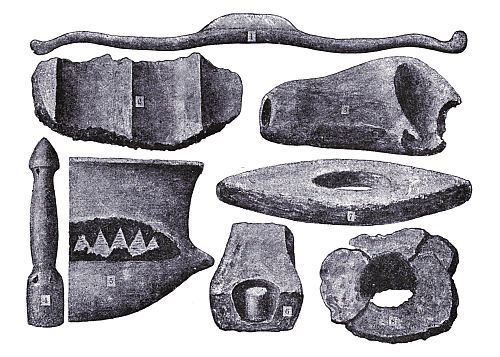
Fig. 184.—Miscellaneous Objects. No. 1 = about 1⁄14, 4 = 4⅓ feet long, 3 and 8 = 1⁄4, and the rest = 1⁄2 real size.
That the potter's art was well known to, and practised by, the early lake-dwellers hardly needs any demonstration when we look at the mass of fragments, and even whole dishes, consisting of bowls, plates, cups, jugs, spoons, and large vases, now tabulated and stored in the various museums of lacustrine objects. These dishes were made without a knowledge of the potter's wheel, and the paste generally contained coarse sand or small pebbles; but a finer kind was also used for the smaller vessels. Generally speaking they are coarsely made in the earlier stations, having perforated knobs instead of handles, yet occasional examples turn up which show that handles were not unknown. The ornamentation consists of finger and string marks, irregular scratchings with a pointed tool, raised knobs, perforations round the rim, together with dots and lines in various fantastic combinations. No two vessels exactly alike in style and ornamentation have ever been found. The only approach that I have seen is in the case of two vases, one from Bodmann (Fig. 30, No. 20), and the other from Schussenried (Fig. 35, No. 4), which certainly suggest that the vessels were made under the influence of the same artist. In Lagozza and Polada artistic patterns were made from the impressions of a small tube, probably a stiff straw or a bone instrument, alternating with panels of crossed lines. In Laibach great skill is exhibited, not only in the variety and elegance of the vessels, but also in their ornamentation, which consists of various figures, rectangles, crosses, rhombs, triangles, etc., the lines of which are flanked with small pointed impressions. In the Mondsee a similar taste for geometrical figures is displayed, and here the lines are large and deeply cut so as to admit of the insertion into them of a white substance which, on the originally black pottery, must have had a striking effect. Associated, however, with these fantastically ornamented dishes, both in Laibach and the Mondsee, are others of a much inferior type.
To the food supply derived from agriculture, the rearing of domestic animals, and the seeds and fruits of wild plants, they added the produce of hunting and fishing; and the remains of the weapons used in these pursuits are numerous. Arrow-points of flint and sometimes of other minerals, as rock crystal and jade, and of bone, are amongst the most common relics; and even a few of the bows made of yew wood, notwithstanding their liability to decay, have come to light, two from Robenhausen, and one from each of the stations of Vinelz, Sutz, and Clairvaux.
It appears that the earlier arrow-points were of the triangular type, with or without stems, and it is supposed that the addition of barbs was an evolutionary process of improvement, and of course of later date. Thus none of the arrows from Schaffis have barbs, but on the other hand Vinelz has supplied some beautiful examples (Fig. 7). The barbed forms are also prevalent on the palafittes of Lake Varese and Polada, but they are entirely absent from the stations in the Mondsee, Attersee, and Laibach Moor.
The discovery of some arrow-points with a portion of the wooden shaft still attached has disclosed the fact that this union was accomplished, at least in some instances, by means of an adhesive material like asphalt. In the Neuchâtel district this material might, indeed, be the natural product of this name, as it is so readily found in the neighbouring Val de Travers. It is more probable, however, that, as suggested by Dr. Dom, of Tübingen, it was the manufactured product of birch-bark—a suggestion which explains the frequency with which rolls of this material were found among the débris of so many lake-dwellings. This adhesive material was used, not only for fixing arrow-points and other implements in their handles, but also, when mixed with charcoal, to give a black gloss or varnish to pottery. Its discovery and application for such purposes in Polada, Mondsee, Schussenried, and many of the Swiss stations of the Stone Age, as St. Aubin, Locras, Moosseedorf, etc., proves that its use was prevalent over the whole lake-dwelling area of the Stone Age.
Spear-heads and daggers were manufactured from flint, and specimens of the latter have been found inserted into a wooden handle or surrounded by a withe so as to give a better grip to the weapon. There were also very effective weapons of this class made from the leg-bones of deer and other animals, as well as from the tines of staghorns, etc.
For the purpose of carrying on the ordinary avocations of domestic and social life the lake-dwellers were in possession of a varied assortment of tools and implements, the precise function of some of them, however, being difficult to determine. They had hatchets, knives, saws, scrapers, borers, etc., of flint and other hard stones. Cutting instruments were also made of horn, bone, and the tusks of the wild boar, as well as an endless variety of pointers, chisels, etc. With such tools they constructed wooden houses, scooped out canoes, and shaped wood into various kinds of dishes, clubs, and handles. The stone celt or axe-head, the most indispensable of all implements to the Stone Age people, was mounted in a variety of ways. Most frequently there was a casing of horn into which the axe was fixed, and this casing was then fitted into a wooden handle (Fig. 185, Nos. 8 and 10). Sometimes the horn fixing had a V-shaped slit in the opposite end from the hatchet (Fig. 7, No. 13), which fitted into a corresponding slit in a crooked handle (Fig. 185, Nos. 1, 13, and 14). When locked the instrument became a kind of adze, the cutting edge transverse to the axis of the handle. This method Dr. Gross thinks was more especially used in the Copper Age. At Wangen horn fixings were rarely used, the hatchet being inserted into a split cleft in a crooked branch. It is interesting to note that this method was in use among the prehistoric salt-miners at Hallein, near Salzburg,[125] and at Castione in Italy (Fig. 185, No. 13).[126] The smaller axes and chisels, as well as a variety of flint implements, were not infrequently inserted directly into suitable portions of deer-horn, as shown in many of the accompanying illustrations.
The perforated axe of stone or horn had simply a wooden handle firmly fixed by a wedge inserted into a split at its end in the perforation, an example of which, found at Schussenried, Mr. Frank carefully preserves. Besides these there is a variety of objects of horn and bone which might have been used as implements or weapons, but mostly, I should say, for agricultural purposes, such as picks (Fig. 185, Nos. 4 and 7), hammers, clubs, etc. Some of the smaller bone implements were also inserted into handles, specimens of which were particularly numerous at St. Aubin.
Flint saws were extremely abundant, and are to be found among the remains of almost all the earlier stations, many of which still retain their wooden or horn handles. Only in Polada has the compound and double-handed saw been found (Fig. 67, No. 12). It consists of a casing of wood with four flints cemented into a groove along one of the edges.[127]
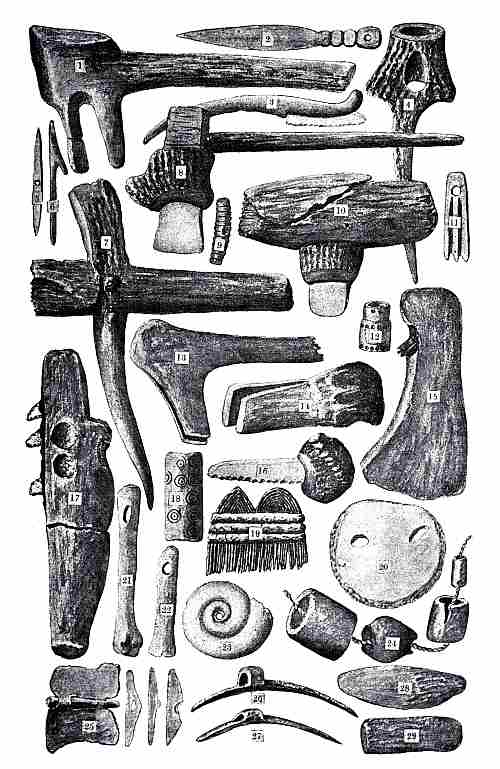
Fig. 185.—Miscellaneous Objects. Nos. 20 to 24 = 2⁄3, and the rest, except No. 25 = 1⁄3 real size.
Another curious implement supposed to be a saw was found at Vinelz, and is now in the Cantonal Museum at Berne (Fig. 185, No. 17). It consists of a massive handle of wood, evidently fashioned for the hand, with three worked flints stuck in a row and kept in their place by asphalt.
Among domestic utensils, in addition to pottery, are small cups and boxes made of horn (Nos. 12 and 18). There are also spoons, pins, needles, buttons, awls, knives, flax-combs, etc., of bone. Combs for the hair were generally made of wood in the usual form (Fig. 11, No. 7). Another most ingenious method was by binding together a series of prepared twigs with their ends folded one way, as seen in Fig. 185, No. 19.
Wooden dishes cut out of the solid, such as ladles, bowls, tubs, etc., have been found in many stations, but especially at Robenhausen; and there can be no doubt that similar vessels were in general use among the early lake-dwellers.
I have already noticed the finding of fishing-nets at Robenhausen and Vinelz, and a fish-hook ingeniously made from a boar's tusk. Other fish-hooks were made of bone, as seen in the illustrations from Bodmann, Wangen, and Bauschanze.
Nor were these early settlers insensible to the charms of personal ornament. Shells (both recent and fossilised), coloured pebbles, the teeth of carnivorous animals, ornamented pieces of bone and horn, stone and clay beads, and even roundlets of the human skull, were pierced for suspension, and worn either as pendants or necklaces (Nos. 9, 11, and 20 to 24).
The skill displayed in the manufacture of the perforated stone axes and hammers has often excited the astonishment of antiquaries; and many of them thought that it was hardly possible to bore perfectly round or oval holes through such hard materials without the use of metal tools. Yet this was undoubtedly done, as we find not only bored implements, but smoothly sawn portions, in the very earliest stations, as, for example, Schaffis, Moosseedorf, Wangen, Robenhausen, etc. From the former there are in the Berne Museum stone celts with a round hole and one with an oval-shaped perforation. Quite as inexplicable are the numerous fragments of stone, clearly indicating, from the parallel grooving, that they were sawn off. Some of these pieces are by no means small, and such as could be readily accounted for by the use of flint saws. In the Museum of Zürich there is a large water-rolled stone of serpentine, measuring 14 by 9 by 8 inches, which was dredged up at Wollishofen, showing a cut 11 inches long and ⅝ inch deep. One side of the cut was broken off, but the fragment was fortunately also recovered and when made to fit in its place, which it does to a nicety, the maximum breadth of the cut can be readily ascertained to be ⅜ of an inch. The sides of this cut are finely striated with parallel grooves, which are not exactly straight, but bent slightly downwards in the middle. Before the sawing was begun there are clear indications of a superficial groove having been made by chipping, evidently with the intention of guiding the saw in the initiatory stages of the process. What could this saw have been made of? I do not think that with a flint implement this cut could have been made. It is as regular as that from a modern steel instrument. It is now supposed that the sawing of stones was performed with a thin wooden board and some dry sand. The late Dr. Keller experimented with these simple means, and found that they were quite sufficient for the purpose. He also practically proved that in the same way, with a wooden tube set in rapid motion round its axis, he could easily bore a hole in the hardest stone. (B. 336, p. 49.) Anyone visiting the Museum in Zürich may practically test the efficacy of these processes for himself, and the obliging custodian delights in showing the method of working. Soft wood is found to be better than hard, as the former takes up more of the particles of the sand, which act like fine teeth in grinding the stone. That tubes of some kind were used for boring stones by the lake-dwellers is demonstrated by the finding of hundreds of round cores, the result of boring on this principle, as well as, sometimes, implements with the boring begun but incompleted, showing the round core still in the hole as shown in Fig. 184, No. 6. In the Zürich Museum there is also a staghorn hammer from Robenhausen with a partially bored hole having a core in its centre, thus proving that horns were also manipulated in the same way (Fig. 24, No. 12).
No problem has for many years puzzled archæologists more than the effort to account for the finding, from time to time in various parts of Europe, of those remarkably elegant implements made from the mineral substance commonly known as jade. Hitherto they have been generally found isolated in the soil or in graves of the Stone Age, such as the dolmens of Brittany. The favourite theory, seeing that no local habitat could be assigned to this mineral, was that these implements were imported by the original neolithic people, who were supposed to have migrated westwards from the plains of Northern India. The discovery of a large number of celts and small chisels in the lake-dwellings, together with a few other objects made of nephrite, jadeite, and chloromelanite, has reopened the problem as to their origin, with the result, however, of making the controversial flame burn brisker than ever. Independent of the lake-dwelling finds, the number of jade objects now known in Europe may be roughly stated at 200, about the half of which come from some 44 departments of France. Of the remaining 100 about 80 are from Western Germany, the rest being assigned to various localities in Italy,[128] Austria, and Greece. According to the opinions of competent mineralogists the vast majority of those from Western Europe are made of jadeite and chloromelanite, the number made of the former being slightly in excess of the latter. In the French group there is only one of nephrite, from the vicinity of Rheims, and in the German group three or four, found in Baden and Bavaria. Mr. A. B. Meyer states that, with the exception of one from Posen, all the German examples were found to the west of the Elbe.
In appearance, nephrite, jadeite, and chloromelanite closely resemble each other, and, owing to considerable variations in the colour to which they are all more or less liable, it is difficult to distinguish them by the unaided eye. Generally speaking nephrite has a somewhat soapy feel, with a lighter and more transparent tint of green than jadeite, while chloromelanite is darker and less transparent than either. According to Meyer their specific gravity is:—nephrite 2·9 to 3·2, jadeite 3·3, and chloromelanite 3·4 to 3·6. From the large number of implements, especially hatchets, small chisels, and sometimes knives (Fig. 185, No. 28)—rarely arrow-points and ornaments—found in almost all the lake-dwelling stations of the Stone Age, it would appear that they were greatly admired and much sought after by the inhabitants of these settlements. Dr. Gross thinks they were in greatest abundance in those stations which flourished in the period immediately preceding that of the introduction of metals, and that after this event they disappear altogether. (B. 392, p. 10.)
From Lake Constance the number of jade implements now considerably exceeds 1,000, as may be verified by an inspection of the museums in the neighbourhood. One station alone, Maurach, has supplied 349 tolerably well, and 141 badly, made implements, and no less than 154 chips and sawn portions varying from the size of a finger-nail to a few inches. (B. 378, p. 78.) Similar chips have also been occasionally met with in other stations. This at once settles one important point, viz. that the lake-dwellers were in actual possession of the raw material, which they worked on the spot. Although most of the settlements in Lake Constance have yielded more or less specimens, there is none that even approaches Maurach in point of numbers, the next highest being Unter-Uhldingen, Immenstadt, and Sipplingen, from each of which two or three score have been collected. In moving eastwards towards the Danubian valley they become much rarer. Thus Schussenried has yielded only one (jadeite), Olzenreuthe seven (all nephrite), Starnbergersee two (nephrite), Laibach one (nephrite). Only one (jadeite) is recorded from the Mondsee, and none from the Attersee. According to Fischer[129] 97 per cent. of the implements from Lake Constance are of nephrite, while the other three per cent. are nearly equally divided between jadeite and chloromelanite. In the Zürich Museum he found 28 implements of nephrite, one of jadeite, and six of chloromelanite. Of the former, 22 are from Meilen and four from Robenhausen. Out of 295 in the museums of Berne (which came from the lakes of Neuchâtel, Bienne, Morat, Inkwyl, and Moosseedorfsee), 118 are of nephrite, 124 of jadeite, and 53 of chloromelanite. From these approximate calculations we see that while nephrite was greatly in excess of jadeite in the settlements of Lake Constance and its neighbourhood, this inequality becomes gradually removed as we move westwards, till we come to France, where their relative frequency becomes actually reversed. Chloromelanite, on the other hand, though as a whole much rarer than either nephrite or jadeite, seems to have been more evenly distributed. Roundly speaking, we have in all Europe between 300 and 400 worked objects of jadeite, and about 200 of chloromelanite, while those of nephrite amount to twice these numbers combined.
These facts are very suggestive, and undoubtedly give some support to the theory that these minerals were found by the lake-dwellers somewhere in their own neighbourhood. But notwithstanding the most careful searching on the part of geologists and mineralogists not a particle of any of them has yet been found in situ in any part of Switzerland. As an inducement to country people to be on the look-out a reward of 200 francs was offered a few years ago[130] to anyone who could produce a bit of nephrite, found in situ, of the size of a man's fist, but as far as I know, the reward still lies unclaimed.
Three isolated portions have been found in Germany, one in the alluvial sands of Potsdam, another in the vicinity of Meersburg, and a third in the vicinity of Leipzig.[131] Also in somewhat similar circumstances two portions have been recorded from Styria.[132] It is said to have been found in situ in small quantities in the rocks of Silesia, as recorded by H. Traube, of Breslau, in an article entitled "Über den Nephrit von Jordansmühl in Schlesien."[133] Mr. Roediger directs attention (by a note in Antiqua, 1884, p. 150) to the fact that it was stated to have been found in the Canton Freiburg, in a work published in 1834. A few chips were found in the prehistoric caves at Mentone associated with worked flints.[134]
To these remarks on the jade question I have only to add that Dr. Arzruni[135] maintains that the nephrite and jadeite of the lake-dwellings can be microscopically shown to differ from the Asiatic mineral. It may also be interesting to note that 13 small axes or chisels of jade were found by Schliemann in the prehistoric cities of Troy (Ilios, p. 240).
As to the huts or cottages in which the lake-dwellers lived the evidence is still somewhat scanty. For a long time the only indications that huts were erected over the platforms consisted of portions of clay having the impressions of round timber (Fig. 184, No. 2), hearth-stones, and some stray beams and bits of thatching. Recently, however, more definite information has been brought forward by Mr. Frank, the investigator of the lake-dwelling at Schussenried. This settlement had none of the signs of having been destroyed by fire, and it is supposed that its inhabitants voluntarily abandoned it on account of the growth of the surrounding peat. In this case it is probable that the huts would be allowed to fall into natural decay, but before this happened there was a chance that some part of the buildings would become overtaken by the moss, and so become, as it were, hermetically sealed up. That something like this actually occurred is now proved by the discovery at this station of the foundations and portions of the walls of a cottage deeply buried in the moss. Upon the discovery being known Mr. Frank had the ruins at once uncovered, and before the crumbling materials disappeared there was a plan of the building taken, which by the courtesy of the investigator I had an opportunity of inspecting. The structure was of an oblong rectangular form, about 33 feet long and 23 feet wide, and was divided by a partition into two chambers. On the south side there was a door, a little over 3 feet wide, which opened into one of the chambers. The other, or inner chamber, was somewhat larger, and had no communication with the outside, except through the former by means of a door in the partition. There were no relics found in these chambers, but in the outer there was a mass of stones which showed signs of having been a fire-place. The walls were constructed of split stems set upright and their crevices plastered over with clay. The flooring in both chambers was composed of four layers of closely laid timbers separated by as many layers of clay. These repeated floorings may have been necessitated by the gradual rise of the surrounding peat which ultimately drove the inhabitants away.
Mr. Messikommer (B. 406c) in the course of his investigations at Robenhausen found, over an area of 33 yards long and 10 broad, indications of what he considered to be four separate dwellings. From a study of the peculiar grouping and distribution of the industrial remains over this area he came to the conclusion that each cottage had its own special furniture, a hearth, weaving appliances, a millstone, sharpening-stones, etc., and on this principle he determines the size of the huts. From these calculations the size of the Robenhausen cottages would be almost identical with that at Schussenried, each having an area of about 750 square feet. From observations made at Irgenhausen similar results were obtained. At Niederweil, where the limits of contiguous dwellings were clearly definable, the area assigned to each was found to be somewhat less.
Swiss archæologists pretend to see, in the remains of their lacustrine villages of the Stone Age, evidence of three distinct periods, which are thus formulated by Dr. Gross:—
"Les fouilles que j'ai faites, depuis une dizaine d'années, dans les villages lacustres de l'âge de la pierre, m'ont prouvé qu'ils n'ont pas tous été habités à la même époque, mais qu'ils remontent à trois périodes différentes bien caractérisées.
"Dans la première période, je range les stations les plus anciennes, représentées, dans le lac de Bienne, par la palafitte de Chavannes (Tschaffis), près de Neuveville. Les produits de l'industrie humaine trouvés sur ces emplacements, dénotent un art tout-à-fait primitif; les haches de pierre sont petites, à peine polies et presques toutes en minéral indigène; les haches-marteaux n'apparaissent que sous forme de grossières ébauches, et les outils en corne et en os sont mal travaillés. On ne remarque aucune trace d'ornementation, ni sur les armes et les instruments, ni sur les produits de la céramique. La poterie, du reste, est façonnée d'une argile grossière, sans l'aide du tour naturellemente, et revêt des formes qui trahissent l'enfance de l'art du potier.
"La seconde période, à la quelle appartient l'ancienne station de Locras, celle de Latrigen et en général la plus grande partie de nos établissements de l'âge de la pierre, présente déjà un notable progrès sur la précédente, en ce que les armes et les outils sont perfectionnés, les haches en pierre, quelquefois perforées pour recevoir le manche, sont fort bien travaillées, polies avec soin et revêtent parfois des dimensions colossales. On constate aussi dans ces stations une abondance relative de hachettes en néphrite, jadéïte et chloromélanite. En effet, tandis que ces objets en minéral étranger font presque entièrement défaut pendant la première et la troisième période, on les rencontré dans les stations qui nous occupent dans une proportion qui peut varier du 5 au 8% des haches en minéral indigène.
"Le métal n'apparaît pas encore dans cette période, ou du moins pas dans la couche archéologique; exceptionnellement, on trouve, ici et là, entre les pilotis, quelques lamelles de cuivre, et plus rarement de bronze.
"La poterie, faite d'une pâte plus fine et mieux façonnée, présente quelques traces d'ornementation sous forme d'éminences percées et de dents de loup.
"Enfin la troisième période comprend les stations de l'époque de transition de la pierre au bronze. C'est l'époque du cuivre, si je puis l'appeler ainsi, caractérisée par la présence dans la couche archéologique même, d'armes et d'instruments de cuivre pur (très-rarement de bronze), de haches-marteaux habilement perforées, d'outils de bois et de corne très bien façonnés, et surtout de vases de formes variées, quelques-uns munis d'anses et la plupart ornés de dessins faits avec les doigts ou au moyen de ficelle imprimée dans l'argile encore molle. Comme je l'ai déjà fait remarquer plus haut, les haches en néphrite et jadéïte sont devenues plus rares et font même presque entièrement défaut." (B. 392, p. 2.)
It will be remembered that a similar subdivision of the Stone Age was adopted by M. Borel in his essay on the lacustrine stations along the Bevaix shore. (See page 49.) In my opinion there are no archæological grounds for such a classification; but I retain its nomenclature as a matter of convenience, especially the term "Transition" period. The inhabitants of Schaffis (referred to by Dr. Gross, and acknowledged to be one of the oldest stations in Switzerland), knew and practised the art of boring and sawing stones; they possessed implements of nephrite and jadeite (Fig. 185, No. 29), and in the manufacture of the usual flint implements they were, according to Dr. v. Fellenberg, pre-eminent. In the assortment of objects from this station in the Cantonal Museum at Berne are to be seen some fantastically-shaped and perforated clubs of horn and bone, a large needle, and five peculiar objects of horn, similar to those found on so many of the stations of the period of transition as Sutz, Gerlafingen, etc. (Nos. 26 and 27), pieces of cloth, flax combs, a variety of clay weights, stone axe-hammers in all stages of manufacture, well-shaped daggers of flint and bone, flint saws in their wooden handles. On this station Dr. Gross also describes the finding of portions of a ladder; and Dr. Keller (B. 336, p. 48) part of a door or window containing a long bolt (No. 25). It is true that the specimens of pottery are coarse and devoid of ornamentation; but this might have been due to social causes rather than a deficiency of knowledge, as we find that in some of the other early stations, as for example Schussenried, the pottery is highly ornamented. In the struggle for existence the original founders of the lake-dwellings, surrounded by fierce aborigines and wild animals, had to pay more attention to the mere necessaries of life than to art. With the progress of time there are indications of considerable prosperity and a corresponding advancement in culture, but nothing worthy of being characterised as a separate period till the introduction of bronze, which, by facilitating all mechanical and industrial operations, produced a social revolution. But this change was only by degrees, and the overlap of the Stone and Bronze Ages is appropriately designated the period of transition. However long or short the lake-dwellers existed in the pure Stone Age (in regard to which there is not much evidence), one thing is clear, that during all that time the essential elements of their culture and civilisation underwent little or no change.
II.—TRANSITION PERIOD.
Before proceeding to describe the changes brought about in the social economy of the lake-dwellers by the introduction of the metals, there is an important problem that demands a few passing remarks, viz. the evidence as to the existence of a Copper Age in Europe. The theory of those who advocate the affirmative of this problem, among whom are notably Professor v. Pulszky, of Buda-Pesth, and Dr. Much, of Vienna, is that the prehistoric people of Europe became first acquainted with the art of extracting copper from its ore, which they fashioned both by smelting and hammering into various kinds of weapons, implements, and ornaments. In the first instance these were mere imitations of objects previously in use. Thus the flat axe or celt, almost the only form ever found in copper in Europe (except Hungary), was clearly formed on the model of the stone implements previously in use. Daggers and spear-heads are also imitations of their flint prototypes, as may be strikingly seen by a comparison of Fig. 7, No. 11, with Fig. 8, No. 2, the former being flint, and the latter copper.
As the very strongest arguments in support of a Copper Age are derived from the number and variety of objects of pure copper that have come to light through lake-dwelling researches, I will endeavour, as briefly as possible, to point out their general bearing on this problem. We have already seen that in many instances celts, daggers, beads, and other objects of copper were found on various stations, but almost invariably associated with bronze objects, as was the case, for example, at Wollishofen. There can hardly be any doubt that the transition from Stone to the most flourishing period of the Bronze Age took place during the occupation of this lacustrine settlement, but to infer that its copper objects were the products of a Copper Age would manifestly be overstepping the limits of a legitimate conclusion. From these long-lived settlements, with their promiscuous contents, we must turn to those which have come, as it were, to a premature end, just shortly after the first metal objects began to be used, but before the full development of the Bronze Age. From such stations in the lake-dwelling area I select the following seven as the most interesting, viz.:—Polada, Laibach, Mondsee, Robenhausen, Locras, Vinelz, and St. Blaise. In the following table I have tabulated all the metal objects that I can find on record, or deposited in local collections, as coming from these stations.
Name of Station. Copper. Bronze. References.
Polada —— 1 dagger, 3 flat celts. Dr. Rambotti's Collection, Desenzano, Fig. 67.
Laibach (crucibles) 1 flat celt, 6 daggers and cutting blades, 5 awls, 1 fragment. 1 winged celt, 3 pins, 2 swords, 1 ornamented dagger, 2 plain do., 2 bracelets. Fig. 45; B. 302 and 317.
Mondsee (crucibles, Fig. 184, No. 3) 14 flat celts, 6 daggers, 3 spirals, 3 awls, 1 fish-hook, 2 fragments 1 portion of dagger, 1 hair-pin Fig. 39; Much: Kupferzeit in Europa
Robenhausen (crucibles) 1 flat celt 1 flat celt Fig. 24
Locras 4 daggers, 2 awls, 1 double celt (No. 10, Fig. 186), 1 bead 1 flat-handed sword, 1 dagger, 2 hair-pins Fig. 186, No. 1; B. 336, p. 33; Matériaux vols. xiv. and xv.; Antiqua, 1885, p. 106
Vinelz 49 beads (45 of which are in Bern and 4 in Gross Coll.), 9 daggers, 6 awls, 1 flat celt, 8 pendants, 1 spiral, 1 tube, 3 punches, 1 hair-pin, 1 chisel —— Fig. 7 Antiqua, 1885, p. 107; B. 462, Pl. xv. and xvi.
St. Blaise (crucibles) 5 daggers, 2 portions of flat celts, 3 knives, 3 beads, 4 arrow-points, 2 earrings, 1 spiral 1 dagger with mid-rib. Anzeiger, 1882, Pl. xix. 3 Fig. 8; Antiqua, 1883, p. 61; Ibid., 1884, pp. 59 and 60; Ibid., 1885, pp. 10, 108; and Ibid., 1886, p. 13
The total number of copper objects tabulated by Mr. Forrer, in his carefully prepared "Statistick der in der Schweiz gefundenen Kupfergeräthe,"[136] amounts to 250. Of these, 107 are beads or ornaments, and of the remaining number, 37 are flat celts—the rest being chisels, knives, daggers, hammers, etc. The copper finds on the other stations, except the seven here mentioned, may be dispensed with as weakening rather than strengthening the evidence for a separate Copper Age, because there was a preponderance of bronze objects associated with them, as was the case, for example, at Lattringen and Gerlafingen.
Looking now at our seven selected stations we see, from the general character of the relics with which the metal objects were associated, that they belonged essentially to the Stone Age; and it would appear as if the use of the metals had not been sufficiently long known to alter their prevailing character. Now it will be observed that in all these seven stations, except one, viz. Vinelz, objects of bronze were also found associated with those of copper. On the other hand, Polada has yielded only a few bronze weapons, and yet there can be no doubt that this station existed during the earliest Transition period. Nor is it in this respect singular, as at Ober-Meilen there were two objects of bronze, viz. a flat celt and a bracelet, associated with relics of the Stone Age, but none of copper. Also in the transition station at Morges (Roseaux) there were no less than 18 bronze celts of the same type, together with a few other objects of this material, but none of copper. On the supposition that a Copper Age prevailed for any length of time as a preliminary to that of Bronze, it would follow that the station at Vinelz was earlier than the others. The character of its relics does not, however, bear this interpretation, as the perforated hatchets and other relics are more numerous and more elegant than anywhere else, and some of its pottery is highly ornamented and in some respects resembles that of the Bronze Age. The arrow-points and daggers of flint are exceedingly well formed, and among a variety of types of the former there are some with recurved barbs. Also this station is rich in cloth, nets, thread, bone buttons, etc., and corresponds in every respect with that of Locras, on which a sword and a dagger of bronze were found along with a few copper implements. The mere absence of bronze in Vinelz is not a sufficient reason, per se, to suppose that it existed in a pure Copper Age without a knowledge of bronze. All the copper objects from the other stations bear the same evidence of primitive workmanship as those from it.
On the other hand, the earliest bronze objects, wherever found, such as the swords and daggers, etc., from Locras, Polada, and Laibach, show a totally different and a much higher style of manufacture; but yet there is not even presumptive evidence in favour of the idea that they represent a later date than the crude copper tools and weapons of Vinelz. The contemporaneity of more or fewer bronze objects in the six other stations of the Transition period above named entirely outweighs the exceptional evidence of this one. Admitting that these copper objects were fabricated by the lake-dwellers, a supposition which is rendered highly probable by the finding of so many crucibles at Robenhausen, Mondsee, Laibach, and other places, we must also admit that their fabricators were somehow acquainted with the superior qualities of bronze implements. Consequently the manufacture of these inferior articles must be explained on some other grounds than the supposition of a Copper Age, in the sense that it preceded and gradually developed into that of Bronze. I fancy the true explanation is that the lake-dwellers became first acquainted with metal instruments in the form of imported bronze objects, especially swords and daggers, and that this suggested to them, and directly led to, the discovery of the art of reducing the pure metal from the copper ore. Local or peripatetic coppersmiths, in trying to imitate these imported implements, went on manufacturing copper objects until they learned the art of hardening it by the proper admixture of tin. This knowledge might have been originally kept a great secret. But, however this may be, it is certain that the secret was not long kept, as we soon find the lake-dwellers in full possession of the art of manufacturing all manner of bronze objects. Ignorance of the nature of the alloy or perhaps the scarcity or dearness of tin, leading to wilful deception on the part of the fabricators, may partly account for the production of some of these copper implements. It has also been suggested that the repeated melting of bronze causes the tin to disappear, and that in this way copper objects may have come about. But this explanation is inapplicable to those from the lake-dwellings, as they are all of the most primitive type, and were undoubtedly manufactured during the initiatory stages of the metallurgic art.
III.—BRONZE AGE.
The art of manufacturing cutting implements of bronze, when once known, must have come quickly into general use, owing to their vast superiority over those in previous use, whether of stone or copper. Not only was there a great impulse given to the ordinary affairs of life, but actually new industries must have been developed. In lieu of the primitive weapons and tools previously in use, we have now a splendid array of swords, daggers, lances, axes, knives, rasors, chisels, gouges, sickles, etc. The simple dagger of bone or flint, which could only be used by a thrusting blow, became not only more specialised and a more powerful weapon, but developed into a new weapon—the double-edged sword. The first form of this weapon which found its way to the lake-dwellers appears to have been that with a flat handle (Fig. 186, Nos. 1, 7, and 9), with a series of rivet holes for attaching plates of bone or wood, so as to give a better grip to the wielder. Subsequently the handle was cast separately of solid bronze, and the blade was then attached to it by means of rivets. One of the most elegant of these forms was that terminating at the hilt in a couple of spirals, several examples of which are illustrated on Figs. 11, 19, and 186. From Moeringen there is a very rare sword of this type, but portion of the handle is broken off. The blade is of iron and the handle of bronze ornamented with encrusted bands of iron (Fig. 186, No. 6).
Such sharp-edged weapons entailed the necessity of caution when carried about the person, and accordingly sheaths were used, probably in the first place made of wood and tipped with bronze. Objects supposed to be these tips have been found at various places, as Moeringen, Auvernier, Champreveyères, Luissel (Fig. 19, No. 4), Bourget, etc. (Fig. 21, No. 20).
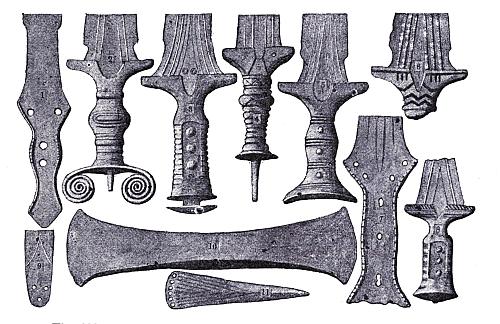
Fig. 186.—Bronze Weapons and Copper Celt. Nos. 10 and 11 = 1⁄6, and all the rest = 1⁄3 real size.
While daggers were riveted to handles of solid bronze, horn, or other materials (Fig. 186, No. 8), a form which they retained during the whole Bronze Age, lance-heads were from the earliest times made with sockets. Arrow-points were subject to greater variations, as we find them tanged, socketed, or merely triangularly-shaped flat pieces. The latter had generally two or four small holes by means of which they were fastened to the stem by a wire or thread (Fig. 21, Nos. 22 to 26). Hatchets display a series of evolutionary improvements, the various stages of which can be readily traced. Thus the primitive stone form, which was alone adhered to in the few copper examples hitherto found, was also continued in bronze, and in this form the bronze axe spread largely over Europe. But it gradually gave way to that with flaps, or wings, with or without loops for fixing the instrument more firmly to its handle. Finally we have the socketed hatchet, which appears to have been considered the best form in use during the Bronze Age. It was only when iron superseded bronze in the use of cutting implements that the modern type, i.e. with a transverse hole for the handle, came into general use, although the principle was well known in previous ages, and, indeed, acted upon, as in the perforated stone hammers and axes. Bronze saws (Fig. 6, No. 7) appear to have been used to an extremely limited extent, as only some half-a-dozen examples have been found on the whole lake-dwelling area of Central Europe. Their rarity in comparison with the superabundance of flint saws in the Stone Age may be accounted for by the large number of sharp cutting instruments that were now prevalent, and which were better adapted for many of the purposes to which the saws were formerly put, such as the making of arrow-stems, wooden handles, etc. The ordinary knives of the palafittes are extremely elegant in form, the blade being always more or less curved, and frequently ornamented with parallel or wavy lines and running patterns of concentric circles and dots. They were generally hafted by means of a tang or socket, but sometimes the blade and handle were made in one solid casting. Numerous examples of all these different forms are given in our illustrations.
It is interesting to note that the socketed knives are very rare in Eastern Switzerland, not a single example being recorded from the great find at Wollishofen, while, as we move westward, they increase relatively, till in Lake Bourget they become the rule and not the exception.
The blades which go under the name of razors, though of diversified forms, may be divided into two kinds, according as they are single-or double-bladed. The former have a ridged back, which generally projects at one end, so as to become a short handle, often assuming the form of a terminal ring, as shown in Fig. 20, Nos. 22 and 23. One in the Gross collection has a handle of staghorn. The latter, or double-bladed, have the handle placed intermediately between the blades, and are common in the terremare and the palatfitte of Peschiera (Fig. 63), but they do not occur in Lake Bourget. The small pincers supposed to be for epilation, so common in La Tène and in Gallo-Roman times, appear to have come into use towards the close of the Bronze Age, as they are extremely rare in the palafittes of Central Switzerland, but more common in those of Lake Bourget. One is figured by Dr. Gross, from Moeringen, similar to the one here represented from Lake Bourget (Fig. 20, No. 24).
Sickles were also widely distributed over the lake-dwelling area of the Bronze Age, including the terremare. They are flat on the under side, but on the upper side they have two or more ridges running lengthways, the object of which was to strengthen the implement. By means of a raised knob, or rivet-hole, and sometimes a projecting spur, it was firmly fixed into a wooden handle, as seen in Fig. 187. That represented here was found at Moeringen, and is adroitly fashioned by hollows and rounding ridges, adapted for the right hand. That this was the normal condition of these handles is probable from the fact that other two similar objects were found at Corcelettes, which are now preserved in the Museum at Lausanne.
As regards hammers, chisels, gouges, punches, awls, needles, hooks, and spears for fishing, etc., it is unnecessary to add to the descriptive details already given, and their general characters are sufficiently patent from the illustrations.
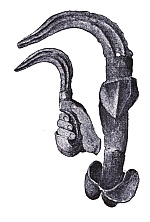
Fig. 187.—Wooden Handle with Bronze Sickle (1⁄3). The smaller figure shows the manner of using this implement.
In the category of objects used for the toilet and personal ornament we have a large assortment of new and fanciful forms, such as bracelets, pendants, necklaces, fibulæ, pins, combs, belt-clasps, finger-rings, buttons, studs, earrings, chains, as well as a few ornaments of gold, amber, and glass.
First in importance are the armlets or anklets, which greatly differ as regards size, form, and ornamentation (Fig. 188, etc.). They are closed or open. The former are solid or hollow rings, and either plain or ornamented with the usual geometrical figures of incised lines, circles, and dots variously combined. The open bracelets are more numerous, and have a wider range of style and pattern. Some consist of a stout wire, spirally grooved, in single or double ply (Fig. 3, No. 15), or a flat band with a terminal hook and eye for fastening when worn over the arm. Others are penannular, with flat expansions at each end, and the more massive are hollowed in the centre so as to reduce their weight. These latter are peculiar to the palafittes of Western Switzerland, having their greatest development in the lakes of Neuchâtel, Bienne, and Morat. They occur in Lake Bourget, but not to the same extent as the solid forms. Jet bracelets are rare, only one or two being recorded from the Swiss palafittes (Fig. 11, No. 14); but they are more numerous in Lake Bourget. One is of tin (Fig. 188, No. 3).
Pendants and such like ornaments affect so many different forms that it would be idle here to attempt to classify them. They have all one common element, viz. a perforation or ring at the top for suspension, and it is probable that many of them are merely individual parts of a compound ornament, like that found at Auvernier, and figured by Dr. Gross (B. 392, Pl. xxiii. 33), in which there are no less than fourteen different pendants hanging from a central wheel. But no doubt many of them, especially the larger forms, such as those found on the palafitte at Onens (Fig. 189, Nos. 1 to 3), must have been used as single decorations.
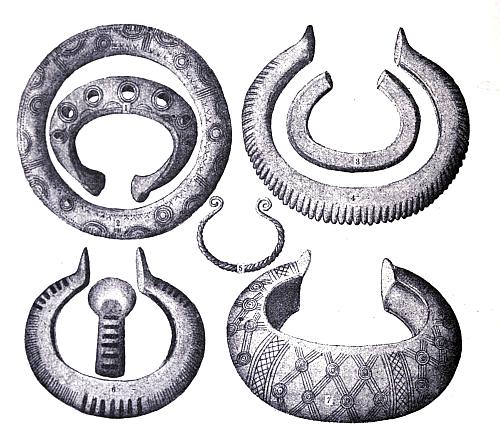
Fig. 188.—Bronze and Tin Bracelets. All 1⁄2 real size.
Necklaces formed by stringing together beads of various materials, such as that represented on Fig. 11, No. 1, were probably a common method of personal adornment; but of course they are seldom met with except as individual beads. Solid rings for the neck, or torques, are extremely rare, their entire number recorded from the lake-dwellings of the Bronze Age being less than half-a-dozen. They are all of one type, and similar to the two illustrations given in Fig. 10, No. 3, from Cortaillod, and Fig. 63, No. 19, from Peschiera.
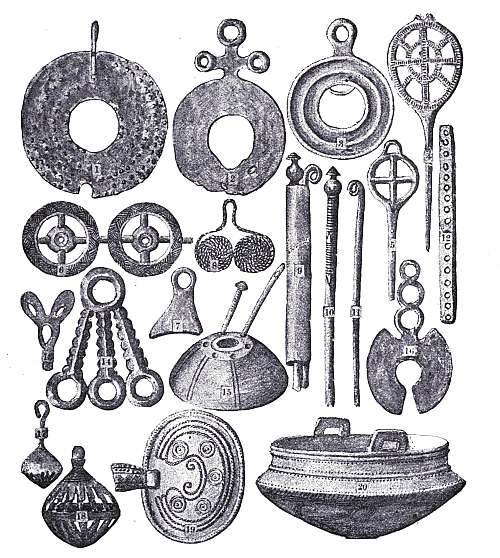
Fig. 189.—Pendants, Ornaments, etc., of Bronze and Tin. Nos. 1 to 3, and 17 to 20 = 1⁄3, and the rest = 2⁄3 real size.
Fibulæ were not quite so rare as the torques, and they appear to have been pretty equally distributed over the lake-dwelling area, both north and south of the Alps. Though well represented at Peschiera, their existence in the true terramara deposits is still a matter of contention among archæologists. From a glance at the various examples given in our illustrations (Fig. 3, No. 20; Fig. 6, Nos. 4, 9, and 10; Fig. 12, Nos. 4, 12, 14, and 26), etc., it will be seen that they occupy an intermediate place between the straight pin and the more highly developed and elaborate forms found among relics of later ages.
Pins are the most common objects among the industrial remains of the lake-dwellings, the total number found in the Swiss stations alone being approximately over 10,000. Their principal function was to adorn the hair, but no doubt some were used for other purposes, such as the fastening of garments, and so they took the place of the fibulæ. They are extremely varied in size and style of manufacture, being of all grades from an inch up to 30 inches in length, and from the simple unadorned stem with a mere knob for a head up to the highly decorated examples so numerously represented in our illustrations, such for example as those with massive heads in the form of a hollow globe (Fig. 13, No. 12), or cup (Fig. 3, No. 9), or expanded disc (Fig. 10, No. 24). Some had a loose ring for a head, to which in some instances bits of chains were attached (Fig. 3, No. 6). In Lake Bourget a few were found with flat wheel-shaped heads (Fig. 189, Nos. 4 and 5).
Bronze combs are fairly well represented both in the terremare and the lacustrine dwellings. They are almost invariably small, with a single or double row of teeth. Clasps for girdles like the one figured from Bourget (Fig. 20, No. 25) are in the Gross collection, as well as a few others of a slightly different form. Buttons, studs, chains, finger-rings of single or more coils, earrings, glass and amber beads are also so numerous and widely spread as to show that they were not merely exceptional objects among the lake-dwellers.
Several bronze dishes, not exceeding a dozen in all, have been found on several of the Swiss stations. They are in the form of small wide-mouthed cups of beaten bronze, with or without handles, and often ornamented with slightly raised knobs of repoussé work (Fig. 10, No. 20), or like small jars of cast bronze (Fig. 3, No. 22, and Fig. 6, No. 2). Fragments of larger dishes, like the Etruscan situlæ made of thin sheets riveted together, with massive handles also attached by rivets, have been found at Wollishofen (Fig. 4, Nos. 17 and 22).
Gold is only sparingly met with, and the objects are generally small or fragmentary. In this condition specimens of the precious metal are among the relics from Nidau, Moeringen (Fig. 189, No. 8), Auvernier, Concise, Cortaillod, Montilier, Wollishofen, and Lake Bourget, etc. A few objects are of tin, the most frequently met with being small wheels with four, five, or eight spokes, which are recorded from several stations, portion of a ring and a bracelet from Montilier (Fig. 188, No. 3), a small bar pierced with 16 holes from Corcelettes (Fig. 189, No. 12), and a pendant from Auvernier (No. 7), a small cross from Lake Garda (Fig. 64, No. 26), etc. Tin is also represented in small ingots and, as we shall afterwards more particularly notice, it was used to decorate the inside of various dishes of earthenware.
To these industrial objects, many of which had their prototypes in the Stone Age, we have to add a variety of appliances for carrying on the metallurgical art. Stone anvils gave place to bronze ones, and of these the most remarkable is that from Wollishofen (Fig. 4, No. 21). Moulds were generally made of sandstone or hardened clay, the former being the most numerous, and specimens may be seen in all the collections from the stations both north and south of the Alps. It will be recollected that the two valves of a mould for a winged celt made of bronze were found at Morges at a very early stage in lacustrine investigations (Fig. 17, No. 8). For many years this apparatus remained as a solitary and unique example of this kind of mould, but now three other valves, similar to those from Morges, have been found, one on each of the stations of Auvernier, Corcelettes, and Estavayer (Fig. 9, No. 22). Crucibles are abundantly represented. They are of various shapes and sizes, sometimes with a solid handle, as those from Rohenhausen and St. Blaise, and at other times with a short projection having a perforation through which a wooden stick could be inserted as a handle (Fig. 184, No. 3, and Fig. 45, No. 14). As further evidence that the founder practised his art in situ we have various records of the finding of ingots of copper, tin, and lead; also slag, defective castings, scoriæ and refuse of smelting furnaces. In the Gross collection there is a circular cake of tin with a small ring for suspension similar to a leaden cake figured from Wollishofen (Fig. 4, No. 23). The huge mass of copper in the form of a double celt (Fig. 186, No. 10) was probably for the same end, and not intended as an implement at all.
In Dr. Evan's collection there is a remarkable bronze knife (Fig. 190) from Bourget, having the handle and blade made of one solid casting, which appears as if it had just been freshly extracted from the mould. It has evidently undergone no subsequent polish, and still retains a thin irregular rim all round, corresponding with the junction of the two halves of the stone mould.
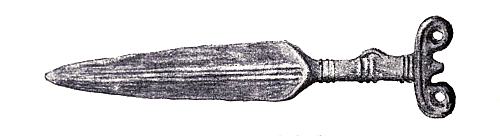
Fig. 190.—Bronze Knife (1⁄3).
It is not, however, to be supposed that I claim all the multifarious objects found in the débris of the lake-dwellings as products of native art; on the contrary, I believe there are many objects, especially the more complicated and ornamental, which can be traced to foreign sources. But on the other hand the mere inspection of the extensive assortment of foundry materials, especially the variety of moulds which include swords (B. 282, Pl. liv. Fig 2, and B. 392, Pl. xxix. Fig. 11), daggers, spears, knives, sickles, all kinds of celts and chisels, bracelets, buckles, pins, rings, wheels, etc., leaves no doubt that the home industry in the manufacture of bronze was extensive and skilfully conducted. Indeed, the skill and ingenuity displayed in casting such a variety of objects can only excite our astonishment. How the series of involved and massive rings of cast bronze represented on Fig. 10, No. 1, was produced, is really a mystery. A model of such an object made of wax if embedded in soft clay, and subsequently hardened by exposure to heat so as to melt the wax and thus allow it to escape, might supply the founder with the requisite mould. But that this was the method adopted by the lacustrian founder is, of course, a mere conjecture.
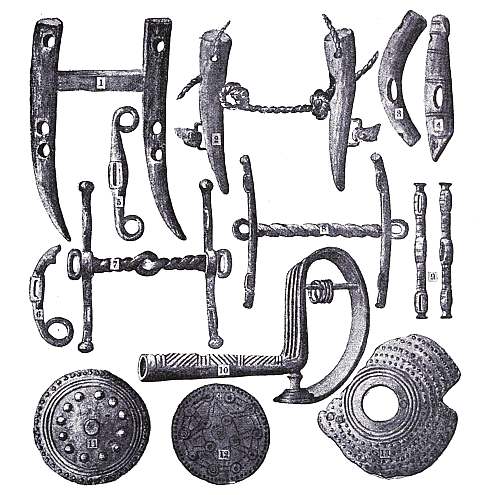
Fig. 191.—Bridle-Bits, Horse Trappings, etc. All 1⁄3 real size.
That the horse was now domesticated and under the control of the lake-dwellers we have very circumstantial evidence in the discovery of bridle-bits, various ornaments for harness, and even a wheel and other mountings of a chariot or biga. For many years some curious and highly polished portions of horn from 4 to 7 inches in length, and perforated with three or more holes, one in the centre and the other at the extremities, were among the unexplained relics of the Bronze Age stations (Fig. 191, Nos. 3 and 4). The holes in these objects had a worn appearance, and it was noticed that the direction of the central aperture was always at right angles to those at the extremities. Their use however, remained a complete puzzle till the year 1872, when a remarkably fine and well preserved horse-bit of bronze was discovered at Moeringen (No. 7). The similarity of these horn objects to the side pieces of the bronze bit led to the conjecture that they were the analogous parts of horse-bits made of horn. The subsequent discovery of several other bronze bits, all of the same type, gradually strengthened this opinion; but whatever doubt might remain as to their function is now dispelled by the discovery at Corcelettes, in 1888, of a complete specimen made of two tines of staghorn with a transverse mouthpiece of bone (No. 1). Of the bronze bridle-bits found up to this time only three are entire, but there are several isolated side and centre pieces from the stations of Nidau, Moeringen, Auvernier, Corcelettes, and Estavayer (Nos. 5, 6, and 9). It will be observed that all the examples here figured (which include the most diverse forms), though differing in some details, are of the same type. The only marked difference in the two entire specimens is that one (No. 7) has the mouthpiece divided in the middle, whereas the other (No. 8) is one solid piece. This latter was found at Corcelettes and is now in the Lausanne Museum. The third entire specimen, which was also found at Corcelettes, appears from its illustration (B. 462) to be identical with No. 8.
According to Dr. Gross, No. 7 was made in one casting, thus proving the perfection to which bronze working was carried. All these specimens of horse-bits, so far as can be judged from the breadth of the mouthpiece, indicate very small horses, No. 7 being 3½ inches between the side pieces, and No. 8 rather less than 4 inches.
The entire bridle-bit of horn is even still smaller, being only 2¾ inches wide. It is thus described by Dr. Brière (B. 461):—
"Cette intéressante pièce, en parfait état de conservation, se compose de 2 branches en bois de cerf, percées chacune de 3 trous evidées à la partie supérieure sur un profondeur de 3 centimètres et mesurant 18 centimètres de longeur, reliées entre' elles par la barre du mors qui est en os et mesure exactement 7 centimètres entre les 2 branches. Cette barre en os est creuse et pour assujettir la pièce aux branches, on a enfoncé de petits coins en corne de cerf pour combler le vide et pour la rendre solide."—Antiqua, 1888, p. 37.
Judging from the frequency with which the isolated side-pieces of bridle-bits made of horn have been found on almost all the bronze stations, no less than 12 being now preserved in the Munich Museum from Starnberg, and 14 in the Lausanne Museum from Corcelettes, the horse must have been common among the lake-dwellers. It will also be remembered that similar objects have been found in the terremare, and Dr. Carlo Boni thinks that a piece of rope was used instead of the stiff mouthpiece in the manner shown in No. 2.
There are various other objects which are supposed to have been used as ornaments for horse harness, such as the phaleræ or bronze discs, rings, knobs, etc. The former (Nos. 11 to 13) are often slightly convex on one side and decorated with circles or small knobs formed in repoussé work, and on the other side there is a small loop for fastening it. Several horn and bone discs, especially those from Starnberg (Fig. 36, Nos. 24 and 30) suggest a similar usage.
Two curious bronze objects (Fig. 191, No. 10) found on the eastern shore of Lake Neuchâtel, one at Chevroux and the other at Estavayer, together with portion of a hollow tube of a similar style of ornamentation, remained for a long time unexplained. However, coupled with the bronze wheel found at Cortaillod (Fig. 10, No. 17) Dr. Keller showed that they were the handles and part of the top railing of an Etruscan biga or war chariot. (B. 336.)
The use of the long pins of brass with sword-like handles (Säbelnadeln) found on the stations of Wollishofen (Fig. 4, Nos. 9 and 10), Grosser Hafner (Fig. 2, No. 32), and the Grand City of Morges, is not yet sufficiently understood. In 1886 Major v. Tröltsch,[137] in a note to the Society of Anthropology in Berlin, directed attention to the fact that an object of the same kind was preserved in the Museum at Donaueschingen, which had been found in a Burgwall (Lagerplatz) on the Hohenhöwen, "einem der vulkanischen Bergkegel des Hegau's bei Singen." The object thus described by Major v. Tröltsch is precisely similar to that here figured from the Grosser Hafner (Fig. 2, No. 32). Its total length is 16½ inches, of which the pin takes up 13 inches and the terminal ring 1⅜ inch. The stem presents a square section, and in this respect it agrees with the examples found at Zürich and Morges. Subsequently Dr. L. v. Rau,[138] Mr. R Forrer,[139] and Mr. Heierli[140] contributed to the Society some further notes on these singular implements, but without coming to any agreement as to their function.
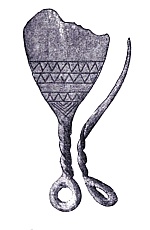
Fig. 192.—Bronze Mirror from Port Alban (1⁄3).
In addition to these bronze relics so numerously described and illustrated in the previous pages, there are many objects which cannot be classified under any of the previous headings, as their use is unknown. Fragments of small hollow globes are supposed to have been used as children's rattles. Examples of these have been found at Moeringen made of pottery, two of which, now in the Museum at Berne, are still perfect (Fig. 193, No. 9). Both objects are ornamented, and contain inside a piece of hardened clay which, when shaken, makes a jingling noise. In the Museum at Zürich there is, also from Moeringen, a small pendant like a bell now used on horse harness (Fig. 189, No. 17). Dr. Gross (B. 392, p. 75) describes a similar object found at Auvernier (Fig. 189, No. 18) as a perfume-box (cassolette). Among the more recent finds is the object represented on Fig. 192, which is supposed to be part of a mirror similar to those so frequently met with among Etruscan and Roman remains. (B. 420, p. 167.) We have already observed that on several of the Scottish crannogs there were found some thin stones, highly polished and circular or square, which are supposed to have been used for the same purpose. These stones, when moistened with water and looked at in certain conditions as regards light, are by no means a bad substitute for the more perfect reflecting mirrors of the present day.
These great innovations following in the wake of the metals could hardly fail to influence such a plastic art as that of the potter. Accordingly we find a better quality of paste, greater variety and elegance of form, and some approach to systematic decoration. There is one new form quite characteristic of this age which, were it not for the extreme elegance and harmony of all its parts, one would suppose indicated a retrograde movement. This was a small water-bottle-shaped vase, which, having a conical base, could not be made to sit upright upon a flat surface without some kind of support. This support is supposed to be a clay ring (Fig. 2, Nos. 2, 5, and 31), great numbers of which have been found in the Bronze Age stations. Ultimately colouring materials were introduced which considerably enhanced the effect of ornamentation on the dishes. Besides systematic patterns of recurring geometrical figures formed by lines in the soft clay, we sometimes find similar patterns traced on the surface of the vessels by means of thin strips of tin-foil made to adhere by means of a kind of gum or asphalt. The vessels thus manipulated were of extremely elegant forms, and made of a fine paste with a smooth black surface. This custom was particularly prevalent in Lake Bourget, but specimens have been found in some of the other lakes, as at Nidau, Hauterive, Cortaillod, Montilier, Estavayer, etc., but it is extremely rare in Eastern Switzerland. On Fig. 193 I have shown a few additional specimens of pottery. No. 1 is the quarter of a dish shaped like a milk plate having a small flat base. It is perforated with groups of holes arranged systematically as shown in the illustration, and the inside is ornamented with a few incised circles. This dish, or rather percolator, was found in Lake Bourget, and formed part of Mr. Rabut's collection now in the British Museum. Another percolator, of similar shape and size, differently ornamented, and having a slight variation in the disposition of the grouped perforations, was found at Montilier, and is figured by Keller. (B. 126, Pl. v. 26.) No. 2 represents the quarter of a dish of the same form as the above, but without perforations. Its interior is adorned with strips of tin-foil (here represented in white) producing a wonderfully complicated design. This dish was found at Cortaillod, and is now in the Schwab Museum, along with an extremely handsome wide-mouthed vase, also from Cortaillod, the outside of which is similarly ornamented. In the latter case the upper part of the vessel is surrounded by small panels all having different designs made of circles, lines, and crosses. (See B. 126, Pl. xvi. 1.) No. 6 is a vase with conical base, from Hauterive, also adorned in the same fashion. In looking at these vessels ornamented with tin it is difficult to make out the designs, as the tin is now even blacker than the pottery. Hence, in Nos. 4 and 5, both of which are from Lake Bourget, the tin is represented by the dark lines. No. 3 represents a fragment of pottery, now preserved in the Museum at Aix-les-Bains, which shows how a broken dish had been mended by passing two or three plies of a tough grass or rush through a perforation on each side of the crack. After the fragments were thus brought together one of the rushes was twisted in a spiral manner round the others, evidently for protecting them from wear and tear. The remaining Nos. (7 to 10) illustrate some toy dishes and children's playthings from Moeringen and Auvernier.
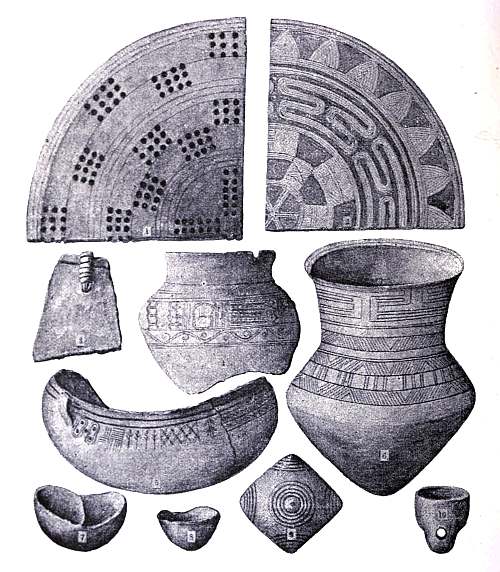
Fig. 193.—Specimens of Pottery of the Bronze Age. Nos. 1 and 2 = 1⁄4, and the rest = 1⁄2 real size.
The spindle-whorls of the Bronze Age are generally made of earthenware, and often highly ornamented, thus showing the improved taste of the people.
Among the more notable objects peculiar to the Bronze Age are certain polished stones, in the form of circular or oval discs with a marginal groove (Fig. 194). These stones were formerly reckoned to be sling-stones, but now they are generally recognised as potters' implements, used probably for fashioning the bases of the dishes.
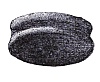
Fig. 194.— Discoidal Stone (1⁄3).
There are many problems worthy of careful consideration suggested by the facts disclosed in these pages, but in this rapid sketch I can only refer to one or two in a cursory manner. First of all we have to inquire if the lake-dwellers practised religious rites. In support of the affirmative to this inquiry there are some indications, and the few objects capable of such an interpretation are illustrated on Fig. 195. In this category I include the following:—
(1) The highly ornamented wooden sticks or bâtons de commandement, from Castione (Nos. 1 and 2), and from Moeringen (No. 3). The only perfect example (No. 1) is rather less than sixteen inches in length, and the others do not appear to have been larger.
(2) The four remarkable bronze tubes with ring appendages from Lake Bourget (Gresine). These, though differing in size and some other respects, are all of one type, and were clearly conceived and wrought out on a uniform plan, and for some specific purpose. The most perfect of these objects (see page 102) appears to be complete, and consists of an ornamental tube, surrounded by three rows of fixed loops, three in each row, placed at regular distances, and to each loop there are three loose rings appended, as shown in the illustration (No. 4). The two previously illustrated (Fig. 21, Nos. 1 and 2) have only one ring in each of the nine loops, and it does not appear that there had been any more. The fourth, now preserved in the Museum at Chambery, is nearly as large as the perfect one; but it is greatly worn, and retains now only a few rings, some of the loops being broken or worn through. It is illustrated by Perrin. (B. 282, Pl. lxiv. 1.)
(3) The ornamental reniform rings (Schwurring) from Morges and Thonon (Fig. 17, Nos. 2 and 3), could not have been used as bracelets, and Dr. Forel suggests that they are analogous to the armilla sacra on which the ancient Germans were wont to place their hands when about to swear a solemn oath. (B. 286, p. 46.)
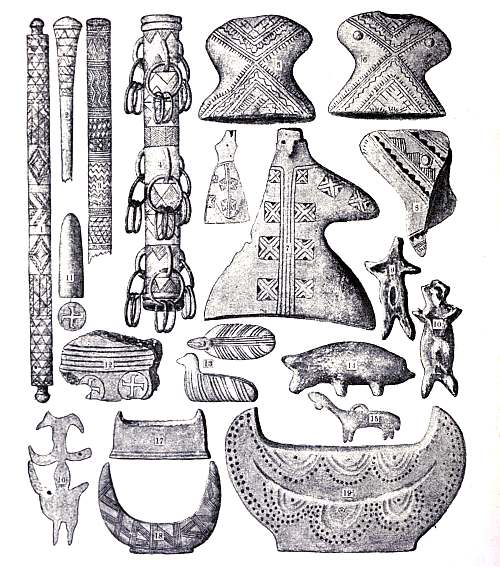
Fig. 195.—Objects suggestive of Religious Ideas. Nos. 4, 9 to 13, 15 and 16 = 1⁄2; 1 to 3, 5 to 8, 14 and 19 = 1⁄4; and 17 and 18 = 1⁄8 real size.
In the Museum at Brunswick, in Germany, I noticed three of these rings, one of which is almost identical with the one from Morges, differing from it only in the details of the ornamentation; but of their history and origin nothing seems to have been known. Another is in the Museo Civico, at Turin, as well as a large circular ring like that from the lacustrine station at Wollishofen (Fig. 188, No. 2), both of which have been figured by Gastaldi. (B. 294, Pl. xii.) I believe it more probable that these large circular rings, though generally considered to be bracelets, were used for the same purpose as the reniform rings. Among the objects in the prehistoric and Roman collection of antiquities in St. Ulric, at Regensberg (Ratisbon), there is a large hollow ring of bronze, ornamented with three lines of concentric circles, which measures six inches in external and three inches in internal diameter, thus leaving one and a half inch for the thickness of the ring. It was found, along with several other things, in a pre-Roman grave (Hügel-grab) near Velburg.
(4) The clay images of animals found on several stations in different parts of the lake-dwelling area, as well as those of the terremare (Fig. 84, Nos. 23 and 24), and more especially the human images from Laibach, are probably idols. On Fig. 195, along with four clay figures from the lakes of Neuchâtel and Bourget (Nos. 9, 10, 13, and 14), I represent two of bronze (Nos. 15 and 16), which I noticed in a collection from Bodmann, in the Steinhaus Museum, at Überlingen. One of these was evidently used as a pendant, and the other appears to have been intended for a human being. The clay figures from Laibach (Nos. 5 to 8), though fragmentary, are undoubtedly representations of the human body. Nos. 5 and 6 represent the back and front view of the trunk of a female, while No. 7 shows a human body with a prominent nose. These two figures are hollow in the interior, and richly ornamented exteriorly with designs which are supposed to be imitations of embroidered garments. Another of these human figures from Laibach, as well as the image of a small animal, is represented on Fig. 42, Nos. 11, 23 and 24.
The extraordinary number of implements and chips of nephrite found at Maurach, and the equal predominance of flint refuse and implements in all stages of manufacture at some of the other stations, as Wallhausen, Nussdorf, etc., suggest the idea that the various industries prosecuted by the inhabitants of the lake-villages had already developed to such an extent as to become localised in certain centres. Again, the localisation of certain industries, as comestibles in one place, flax in its various preparatory stages in another, the complete kit of foundry tools in a third, etc., all point to the knowledge and practice of the principles of the division of labour.
That the lake-dwellers kept up commercial relations with foreign countries is proved by their possessing materials, not only peculiar to distant or limited areas, such as amber, jade, flint, etc., but also certain objects having such peculiarities in form or style of ornamentation as have enabled experienced archæologists to trace them to their original areas of evolution. Thus at Corcelettes were found an ornamental bronze dish, and portion of a fibula (Fig. 189, Nos. 19 and 20), which, when seen by Montelius in the Museum at Lausanne, were at once recognised by him as of northern origin. (B. 348.) Dr. Keller has also shown, as already stated, that certain bronze objects found in the Lake of Neuchâtel, which for a long time remained a puzzle to archæologists, belonged to an Etruscan carriage or biga. The few fibulæ found in the Swiss lake-dwellings have also been traced to their native habitats in Northern Italy.[141] The half-moon-shaped flint knives, so characteristic of Scandinavia and Northern Germany, have been found as far south as the Mondsee, and one solitary representative (Fig. 34, No. 20), now in the Museum of Natural History at Stuttgart, is said to have come from Schussenried station.
One notable fact about the distribution of lake-dwellings is that their relics conform in style, ornamentation, and general characteristics, to contemporary antiquities in the surrounding districts; and I find no special characters in their industrial remains that bind the lake-dwellers together as one clannish people. The relics from the lake-dwellings of the Stone Age in Northern Germany are readily seen to be closely related with those of the Scandinavian archæological area. Whatever the original resemblances and points of agreement of the founders may have been, they were soon modified and adapted to the physical conditions and requirements of their environments.
That continued attention was paid to the rearing and breeding of domesticated animals during the Bronze Age is attested by their osseous remains, which have been critically examined by such competent authorities as Rütimeyer (B. 42), Studer (B. 404), Uhlmann (B. 336), and others. While the lake-dwellers of the earlier Stone Age had only as domestic animals one small species of dog, a small ox, a horned sheep, and the goat, we find that towards the end of this period and during the succeeding Bronze Age not only new and large breeds were developed, but another was added to the list, viz. the horse. From the remains of the domestic horse found at Moeringen and elsewhere it appears to have been a small and slender-limbed animal with small hoofs, and altogether much inferior to the wild horse as hunted and eaten by the cave men of palæolithic times, from which it is supposed to have been a direct descendant. When the Aar canal was being excavated the bones of the smaller or domestic horse were found associated with bronze objects in no less than nine different localities, all of which agree with the above characteristics. (B. 404.) The horse of the terremare, according to Professor Strobel, presents the same characters as that of the Swiss lake-dwellings, and as we have already seen from the bridle-bits and other horse trappings, there can be no doubt it was also in a state of domestication. I may also mention that a skull found at Auvernier was believed by Rütimeyer, after most careful deliberation, to be that of the ass. Professor Strobel has also recognised the osseous remains of the ass in the terremare. (B. 389b.) The sheep diverged considerably from its earlier form, and lost much of its goat-like appearance, being now larger, and developed into various breeds. Still more varied were the breeds of cattle, especially in the vicinity of the lakes of Bienne and Neuchâtel. The Bos primigenius appears to have been tamed and crossed with the earlier type, giving rise to a variety of breeds, such as trococeros and frontosus, one of which had wide branching horns, as is proved from its remains found at Concise, Chevroux, Locras, etc. The small dog of the Stone Age (Canis domesticus palustris, Rüt.) gave place to a much larger kind, somewhat resembling our modern greyhound. The domestic pig also appears to have passed through various evolutionary phases; but the wild boar still retained its individuality intact. Dr. Uhlmann in his report on the osseous remains from the Grosser Hafner, at Zürich (B. 336), describes three varieties of the pig, as well as three of cattle.
With the exception of the domestic fowl and the tame cat, the domestic animals reared by the lake-dwellers were similar to those now extant. Nor is there much change as regards the wild animals and birds then prevalent. The animals that now frequent the higher Alps, such as the marmot, chamois, and wild goat, are very scarce in the lake-dwellings, showing that already nature had consigned them to the zone of their present habitation. Altogether, with the more improved weapons of the Bronze Age, there ensued, according to Rütimeyer, a marked diminution in the relative proportion of the ordinary wild animals of the chase, and a corresponding increase in those of the domestic breeds. The great wild oxen, the urus and bison, disappeared from the neighbourhood altogether.
Such progressive strides in agricultural pursuits are, however, not discernible in the vegetable remains, notwithstanding the minute investigations of Professor Heer. (B. 123.) From the very commencement the lake-dwelling colonists cultivated flax, two or three varieties of barley and wheat, millet and peas. The only addition that appears to have been made in the Bronze Age were the oat (Avena sativa), and the dwarf field bean (Faba vulgaris) of a strikingly small size. On the other hand we have to note the absence of winter wheat, rye, hemp, and most of the culinary and garden vegetables. Fruits and berries were largely used as food, but there is no evidence to show that they were cultivated. Among these the following have been identified:—apples, pears, plums, sloes, one or two species of cherry, raspberries, blackberries, and strawberries, hazel and beech nuts, water-chestnuts, poppies, etc. Grape-stones from Wangen were hesitatingly included in Professor Heer's list of fruits from the lake-dwellings; but, as already mentioned, this doubt is now diminished by the finding of grape-stones at Steckborn, another station of the Stone Age. Stones of the grape were early recognised among the débris of the palafittes of Lake Garda, and quite recently Mr. A. Goiran has identified those of the olive (Oleo europæa) and peach.[142]
Bread was made only of wheat and millet, that of the latter generally containing some grains of wheat and linseed. Cakes made of the seeds of the poppy were also found at Robenhausen.
Various portions of the osseous remains of man, comprising the skull and other portions of the skeleton, have been found in several stations, as Meilen, Wollishofen, Grosser Hafner, Schaffis, Sutz, Locras, Vinelz, Nidau, Wauwyl, Bevaix, Insel Weerd, etc. All these remains have been more or less critically examined and reported on by Virchow (B. 305 and 433), Studer (B. 419 and 432), and Kollmann (B. 420), but notwithstanding a number of minute measurements and learned disquisitions, contradictory opinions are held by these scientists as to the race or races of men that inhabited the lake-dwellings. Dr. Studer advocates the theory of Troyon, that with the introduction of bronze there was also a new race of people, and this opinion he bases on the fact that at Sutz and Vinelz two kinds of human skulls were found, viz. brachycephalic and dolichocephalic, whereas in the pure Stone Age stations only brachycephalic skulls were met with. Segments of the upper parts of human skulls supposed to have been used as drinking cups were found at Gerlafingen (B. 392, p. 107), Sutz, Schaffis, and Locras, and from the latter there was also a skull having a circular portion of it cut out, as if trepanning had been performed. (B. 336, p. 31.)
Although it is now pretty well established that in these prehistoric times trepanning was practised as far back as the Stone Age,[143] it does not appear that this skull from Locras (B. 336, Pl. v. 28) had been operated on during the lifetime of the individual. Roundlets, cut out of skulls, are supposed to have been used as charms, and they are frequently met with in the graves of the period. From the lake-dwellings two of these objects have been recorded; one from Concise (Fig. 185, No. 20)[144] has two small perforations for suspension, and another, with one hole, is figured by Dr. Gross. (B. 392, Pl. xxiii. 65.) On the Trajan column a Dacian village is represented having human skulls set on poles before the walls. (B. 164.) The finding of skulls of a different race in the lake-dwellings might therefore be accounted for on the supposition that they were trophies of their enemies and not those of the occupiers of the lake-dwellings. Anatomical deductions from the few long bones of skeletons that have come to light indicate, so far as the evidence goes, that the Bronze Age men were of small stature—a conclusion which is also supported by the small size of the handles of the swords and other weapons of the period.
Professor Virchow in a long review of the craniology of the Swiss lake-dwellers comes to the following conclusions (B. 433, p. 300):—
(1) In the stations of the pure Stone Age, brachycephalic skulls only are known to a certainty to have existed.
(2) In the Transition period, both brachycephalic and dolichocephalic are known.
(3) In the full Bronze period the skulls are more inclined to the dolichocephalic type.
(4) The people of La Tène were of a highly mixed character, among whom, however, brachycephalic types predominated.
The eminent Berlin anthropologist thinks that during the Bronze Age a new people joined the original lake-dwellers by degrees, but not as one great immigration subverting the previous order of things. This opinion seems to be greatly strengthened by collateral circumstances. We have already seen how gradually bronze was introduced among the lake-dwellers. No violent disturbance of the previous conditions of life is anywhere to be detected. The original system of constructing lake-villages is continued exactly the same, and the only changes are such as can be accounted for by the use of better implements. The lake-dwellings of the Bronze Age are built in deeper water, and consequently farther from the shore than those of the Stone Age, and the piles are more slender, often stems split into two or four. The steinbergs appear to have been discontinued, or were only used over a hard and stony shore into which piles could not be easily driven. The sites of the latest villages are on the same ground as, or in close proximity to, those of the earliest ones. Remains of cottages are still the same, viz. bits of plaster, with marks of round timbers, and some hearth-stones. From Lake Bourget there are portions of clay plaster of this character, ornamented with incised lines and the impressions of groups of concentric circles (Fig. 21, No. 15) or the swastika (Fig. 195, No. 12). Also from the same place there are bits of clay tubes, the interiors of which are blackened with soot, supposed to have been small chimneys (Fig. 184, No. 8).
In Eastern Switzerland and the Danubian valley the number of stations greatly decreased during the Bronze Age, while in the Lake of Geneva they rather increased, and in Lake Bourget its eight stations belonged almost exclusively to this period.
The stations at Laibach, the Mondsee, Attersee, and Schussenried came to an end in the Transition period, and to the east of Lake Constance only one, viz. that in the Starnbergersee, continued during the Bronze Age. In the lakes of Constance, Zürich, Neuchâtel, Morat, and Bienne, they were also greatly reduced in numbers; but, on the other hand, they occupied larger areas, and show a greater concentration to selected localities, often the outlets of the lakes.
It was not till 1876 that any sepulchral remains bearing on the question—how the lake-dwellers disposed of their dead—came to light. In this year some workmen engaged in digging the foundation for a house in the vicinity of the site of the lake-dwelling at Auvernier, and some 50 yards from the shore, came upon a large flagstone measuring 5¼ by 4¼ feet, which turned out to be the covering of a stone coffin containing the remains of 15 or 20 skeletons. The grave was constructed in the usual way by setting four large flags on edge, which formed its sides, and over them a fifth was laid as a covering. These upright flags were of granite and gneiss, and the largest measured 6¼ feet long, 6 feet wide, and 11 inches thick. The rectangular space thus enclosed measured 5 feet 3 inches long, 3 feet 8 inches wide, and 5 feet 10 inches deep. Dr. Gross, who superintended the clearing out of its contents, states that the bodies had been placed in a sitting posture round the grave, with the heads to the walls and the feet directed towards the centre. External to this cist, on two of its sides, there was another series of upright flags, which formed two smaller chambers, and in one of them there were also human bones.
The relics associated with this burial consisted of some perforated teeth (boar, bear, and wolf); a small polished bone disc, perforated (Fig. 196, No. 3); two small stone celts—one with a perforation for suspension in the end opposite the cutting edge. Of bronze objects, found actually in the grave, there were only three, viz. a plain pin 6¼ inches long (No. 1), a small ring (No. 6), and a bead which looked like copper (No. 2).
Six feet to the east of this tomb, and about the same depth, the workmen subsequently came upon the skeleton of a child buried simply in the earth without any stone coffin, and near it were found the following objects:—Two pairs of small oval bracelets (Nos. 4 and 5), a curious pendant like a stud (No. 7), and an amber bead.
Two of the human skulls were sent to Rütimeyer, who pronounced them to be of the Type de Sion, and identical with those he had already examined from several lake-dwellings at Nidau, Meilen, Robenhausen, and Wauwyl.
From these data it would appear that the tomb of Auvernier belonged to the Transition period. (B. 286.)
In 1876 and 1877 several interments were found near the quay at Montreux, some with, and some without, stone cists, and along with them were associated various relics, as bracelets (Nos. 10 and 11), hair-pins (Nos. 12 and 13), some pottery ornamented with geometrical figures (No. 14), flint knives, a small stone crescent, and a horse's tooth much smaller than those of our modern horse. (B. 336.) Again, in 1884, some more tombs were discovered near the same place which yielded objects of the Bronze Age, viz. a bronze pin, six bronze bracelets (Nos. 8 and 9), and two or three urns (Antiqua, 1884, p. 101).
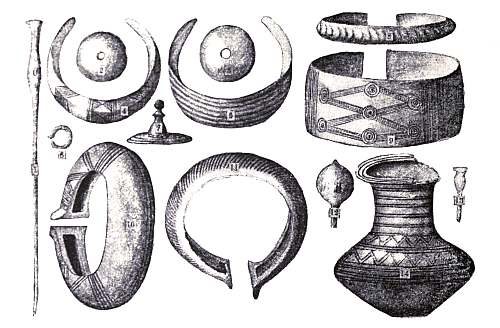
Fig. 196.—Objects from Tombs of the Lake-Dwellers of the Bronze Age. No. 14 = 1⁄5, and the rest = 1⁄2 real size.
Dr. F. A. Forel (B. 286, p. 48) describes "cimetières de l'époque lacustre" in the vicinity of Morges and St. Prex. In the former group some skeletons were found in stone cists, one of which had two bracelets still adhering to the bones. "Ces bracelets," says Dr. Forel, "qui sont actuellement au musée cantonal de Lausanne, et à la bibliothèque de Morges, appartiennent incontestablement par leur beau travail et leur ornamentation riche et très-caractéristique à la belle époque du Bronze, à l'époque de la grande cité de Morges." In the cemetery near St. Prex were found some thirty skeletons deposited in free earth, and associated with them were some bronze ornaments (une vingtaine de bracelets, épingles à cheveux, anneaux, etc.), which, according to Dr. Forel, incontestably belonged to the bel Age du Bronze. Moreover, in the very same place, and almost alternating regularly with the free burials, there were urns containing ashes and charcoal. One of these urns (still preserved at the date of Dr. Forel's description, 1876), which measured 6¼ inches in diameter and 5 inches in height, presented all the characters of the pottery of the lake-dwellings of the Bronze Age.