Fourth Lecture. SPECIAL CHARACTER OF THE REMAINS FOUND AT LA TÈNE AND IN LAKE PALADRU: LACUSTRINE AND MARINE DWELLINGS IN THE LOWER RHINE DISTRICT AND NORTH GERMANY.
Reading edition
LA TÈNE.
The celebrated lacustrine station, La Tène, is situated at the north end of Lake Neuchâtel, just close to the present artificially formed outlet where the land end of its mole or dyke begins. Stretching from this point eastwards there is a gravelly elevation, some 200 yards long by 50 wide, which, before the "Correction des Eaux du Jura," formed a shallow part of the lake, and for this reason it was called among the fishermen La Tène (the shallows). As early as 1858, Col. Schwab discovered this to be the site of a rich repository of antiquities of a totally different character from those found in any of the hitherto explored Pfahlbauten. Subsequently Professor Desor directed his attention to the locality and made a collection of its antiquities, among which he announced some Gallic coins (Fig. 92, No. 8) and a sword-sheath ornamented with the forms of three fantastic animals (Fig. 87, No. 9). Further discoveries of its remarkable antiquities were made by M. Dardel-Thorens, who for many years, while resident superintendent of the Lunatic Asylum of Préfargier, situated close by, devoted his spare time to the investigation of La Tène. As the relics were associated with numerous piles there appeared to be no doubt among these antiquaries that the station was quite analogous to the ordinary pile-dwellings of the Stone and Bronze Ages, the only difference being that it represented a later age.
Notwithstanding the facilities for investigation afforded by the lowering of the waters of the lake in 1876, which had the effect of making La Tène dry land, nothing further was done till 1880, when M. E. Vouga, schoolmaster at Marin, interested himself in the matter. One reason for this neglect was the opinion that the whole area had been already so thoroughly examined by previous explorers, that nothing remained to be done. Before, however, describing the discoveries of M. Vouga, it will be necessary to look more minutely at the situation of La Tène and the nature of the substratum in which its antiquities were found.
In making a section through the La Tène elevation there is first encountered a bed of water-worn gravel and sand, varying in thickness from three or four feet to as many yards. This gravel had evidently been thrown up by the action of the waves, and in it there are no antiquities found, with the exception of occasional fragments of Roman pottery and tiles. Beneath this superficial gravel there lies a blackish bed of peat of considerable thickness, below which is the ancient lake sediment. It is on the surface of this intermediate mossy bed, and sometimes buried in it, that the objects characteristic of La Tène are found. From these stratigraphical glimpses of Natures workings it would appear that during prehistoric times the whole low-lying district from Préfargier to the lake of Bienne was a shallow bay, which became ultimately overgrown with marsh plants and peat to the extent of forming the "Gross Moos." Scattered throughout the deposits of this quiet bay, and especially along the waterway to Bienne, are frequently found antiquities belonging to all the three ages of prehistoric times previous to the occupation of the locality by the Romans, remains of whom are, of course, also met with. Professor Desor, and others who have carefully examined the locality from a geological point of view, account for the subsequent overspreading of La Tène as the combined result of two natural causes, viz. first, the elevation of the level of the lake owing to sedimentary deposits or accidental obstruction in the channels through which the surplus water found its escape; and, second, the gradual removal, by the action of the waves, of a protective barrier in the shape of a projecting moraine of sand and gravel, which stretched outwards from Préfargier in the direction of La Sauge, and sheltered La Tène for many ages from the action of the open lake. But whatever the explanation may be, it is certain that a considerable change has taken place since these sedimentary deposits of fine silt were formed, as at the present time the amount of gravel thrown up on the shore of La Tène is so great as to advance the beach at the annual rate of two or three yards; and this occurs notwithstanding that the level of the water, owing to the operations necessitated by the "Correction des Eaux du Jura," is even lower than it was when the neighbouring lake-dwellings of the Stone and Bronze Ages flourished.
Recent Explorations.—While M. Vouga was one day making excavations near a group of piles, which he considered to have been supports for a bridge, he came upon the foundations of a wooden house, and in the course of clearing it out he made the important discovery that it had been situated on the brink of a deep channel, which had subsequently become filled up with sand and gravel. The most natural explanation was that this channel was an ancient river-bed which, when the house was constructed, formed the outlet of the lake. With this idea paramount in his mind, Vouga determined to trace out its direction and bearings. About 20 yards farther up—i.e. in the direction of the lake—he came upon the remains of a second wooden house, with its foundation beams still in situ, and two of its containing walls (which had evidently fallen over) lying one over the other. Here the bank of the channel formed a steep descent of 10 feet deep. The floor of this structure was formed of two square-cut beams, each over 16 feet in length and 8 inches in thickness, having a series of closely-set mortised holes for transverse beams. Its breadth was 9 feet 2 inches, and it lay 2½ feet below the surface, and about 7 feet higher than the bottom of the river. The two sides of the building were formed of three beams corresponding in length with that of the flooring, and about 2½ feet apart, and having transverse mountings and a trellis-work of branches. One of these had apparently fallen into the river, as its end reached nearly to the bottom of the channel. Pursuing his investigations still in the direction of the lake, he came upon the remains of a third building, near which were the piles of a second bridge. The space between the two bridges was about 100 yards, and, judging from the position of the piles, this bridge was directed to the same point as the former—probably La Sauge, at the opposite corner of the lake. These bridges were supported on a succession of parallel rows of oak piles 4 to 6 inches in diameter, and placed at intervals of 3 to 20 yards; and each row contained five or six piles, from half a foot to 3 feet apart. About 50 yards above the second bridge a fourth dwelling was encountered, but it appeared to have been already pillaged of its contents. Near this our explorer proceeded to clear a portion of the bed of the river, and lying in the mud and gravel at a depth of 10 feet from the original surface he found a large quantity of antiquities—swords, lances, axes, chains, razors, various wooden implements, fragments of a large vase, the entire wheel and other parts of a chariot, together with the bones of men, horses, and oxen. A fifth building was subsequently discovered between the third and fourth, so that we have here the evidence of a row of five houses situated along the right bank of the ancient river, and all within a distance of 200 yards.
On the left bank of this supposed river only one habitation, opposite No. 1, was discovered, which M. Vouga thought had already been pillaged. It was reported that near this spot several human skeletons had been discovered, one of which had a rope round the neck! Below this the channel becomes deeply buried, and the superficial gravel attains the depth of some ten feet; but, nevertheless, Vouga succeeded in making excavations which decided the chronological sequence of the Roman and Gallic remains. "It was," says he, "in the midst of these gravels that I found the layer containing Roman remains—tiles and fragments of pottery, nails, etc.—at a height of two and a half to three feet above the Gallic objects." (B. 428, p. 13.) These Gallic objects consisted of the well-known fibulæ and other articles characteristic of La Tène, so that superposition clearly indicates the Roman occupation to be posterior to that of its original constructors.
M. Vouga believes that the channel, along the banks of which he found the remains of so many houses, was the right branch of two outlets which at that time existed, and which united lower down to form the Thielle. The left branch was nearer the rising ground towards Epagnier, but it is now covered over with gravel, and has never yet been examined. Some 300 or 400 yards lower down there are some gravel pits, which are occasionally worked for road metal, in which I saw in the summer of 1886 a great many piles, singly and in groups, cropping up through a black peaty deposit underneath the gravel. I mentioned the matter to M. Vouga, and he informed me that the few things found there indicate a Gallo-Roman period.
According to M. Vouga, the site of La Tène station extended from the south bank of the outlet to the small island formed by its two branches before they became united. The upper part of this island, now denuded of its peaty deposits by the action of the waves, forms part of the lake. This denuding process is still going on at the margin of the lake all the way from La Tène to Préfargier. Large masses of the ancient sedimentary deposits, containing piles and relics of the lake-dwellers, become undermined and broken up by the waves, leaving their more solid relics, such as stone hatchets, mixed with the gravel. These are often thrown up on the beach, and in this way many beautiful jade hatchets have been picked up from the sites of the four lake-dwellings now almost entirely disintegrated, which existed along the north shore from La Tène to Préfargier. It is in the gravel at the upper end of La Tène that most of the coins have been collected.
The success attending Vouga's excavations induced M. Borel, on behalf of the Museum of Neuchâtel, to make further excavations along the banks and bed of the ancient river discovered by the former, but without much success. Finally, in 1884, the Cantonal Government having granted to the Historical Society the exclusive right of conducting explorations at La Tène, this society undertook fresh excavations under the management of Messrs. Vouga and W. Wavre. During these researches portions of a gold torque and some gold coins were the principal finds. These coins are valuable inasmuch as they were found in situ, and not, as most of the others, among the shifting gravel.
From Keller's description (B. 126) of the earlier discoveries on La Tène it appears that Col. Schwab, on removing some large mortised beams, found many weapons and other antiquities all huddled together. In the light of Vouga's researches it is probable that this spot was a dwelling similar to those I have already described, as we are told that there were three beams of fir wood, from 15 to 20 feet long, lying parallel to each other and a few feet apart. These beams rested on upright piles, and contained a series of triangular holes as if for the tenons of wooden superstructures.
Relics.—Like the fate of most lacustrine remains, those from La Tène have been widely scattered. Many are deposited in the Cantonal Museums of Bienne, Neuchâtel, and Berne. The Gross collection, being now public property, finds also a temporary lodgment in a room in the Federal Hall in the latter town. A few, including some of the most interesting relics, have been secured for the Museum of Geneva. The largest of the private collections are those of Messrs. Vouga, of Marin, and Dardel-Thorens, of St. Blaise. With the exception of the articles in the possession of the latter gentleman (which are, however, copiously illustrated in Antiqua and the works of Vouga and Gross), I have studied more than once all these collections. As the principal objects have already been more or less described and illustrated in the excellent works of Keller, Desor, Gross, and Vouga, I wish here to acknowledge that in the production of the accompanying illustrations I have made free use of all these publications, either to rectify my own sketches, or (and this more especially) to give me the correct size of the objects—a point which is rather troublesome to attain through a glass case when, as it often happens as regards the smaller museums, authoritative officials may not be at hand to give access to the cases.
Owing to the peaty nature of the matrix in which the relics from La Tène were embedded they are in a remarkably good state of preservation. They consist chiefly of iron implements and weapons, presenting a striking difference not only in material but also in form and style of manufacture from any found in the ordinary lake-dwellings. Articles of bronze are sparingly met with, and they are, with one or two exceptions, very dissimilar to those from the true palafittes of the Bronze Age. In giving a short description of these relics it will be convenient to group them under the following heads:—(1) Arms; (2) Implements and Utensils; (3) Articles of Ornament and Dress; (4) Horse-Trappings and Waggons; (5) Money, and Objects of Amusement, etc.; (6) Osseous Remains.
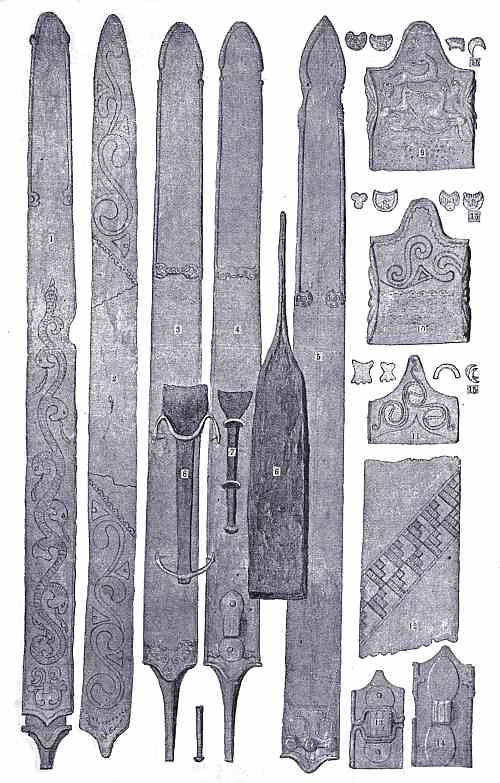
Fig. 87.—La Tène. Nos. 9 to 12, and 15 = 1⁄2;, and the rest = 1⁄4; real size.
1. Arms.—Swords (Fig. 87).—The swords from La Tène, which now number considerably over 100, are all made after one characteristic type. They vary in total length from 30 to 38 inches (or even more), of which the handles occupy 4 to 6½ inches. The blade is always double-edged, generally without a defined median ridge, and scarcely tapers in its whole length till within a few inches of the extremity, when it gradually forms a round blunt tip. It is devoid of ornamentation, except in one or two instances where parallel grooves run along the median line, or the surface becomes thickly dotted with small impressions. Others again have small incised figures upon them (No. 15), but these are supposed to be makers' marks—an interpretation which seems to be corroborated from the fact that those bearing such marks are of a superior quality. The handle is separated from the blade by a prominent curved ridge attached to the hilt of the blade, into the concave side of which the end of the scabbard neatly fits. Although all the swords hitherto found at La Tène have this dividing ridge in the form of a graceful curve such as is represented in the illustrations, I may remark that some of the same type from other stations are straight. What now remains of the handle is merely the central tang, over which there was a grip of horn or wood. On this tang were sometimes small transverse plaques for fastening the handle (No. 8); and Vouga figures one with two small circles from a grave of the Iron Age at Bevaix, which I here reproduce (No. 7) on account of its striking similarity to the sword-handles from Lisnacroghera. (See Fig. 124, Nos. 1 and 2.)
The sheaths are formed of two plates of iron (rarely bronze), one of which overlaps the other at the margins, where they are riveted together. Sometimes these plates are strengthened by one or more cross ridges, and about the lower third a raised bead begins which runs round the tip. These attachments often assume an ornamental character (Nos. 3, 4, and 5). The upper surface of the sheath is also generally ornamented with a variety of curious designs, in which spiral and recurring scroll patterns play a conspicuous part (Nos. 3, 10, and 11). But perhaps the most remarkable design is that of three fantastic animals (No. 9), which, from their resemblance to the figures on Gallic coins, first led Desor to the conclusion that the weapons had a similar origin. Only three sheaths are known to have been ornamented along their entire length—viz. Nos. 1, 2, and 12. That on No. 12 was repeated three times at regular intervals. The underside of the sheath has always a suspension clasp, which assumes various elegant shapes (Nos. 4, 13, and 14). In one instance the upper sheath-plate was of bronze, and another had both plates of iron, but the surrounding bead was of bronze. No. 6 represents a piece of iron (being one of about a dozen similar pieces found at La Tène), which is supposed to be the rudimentary stage of the sword-blade.
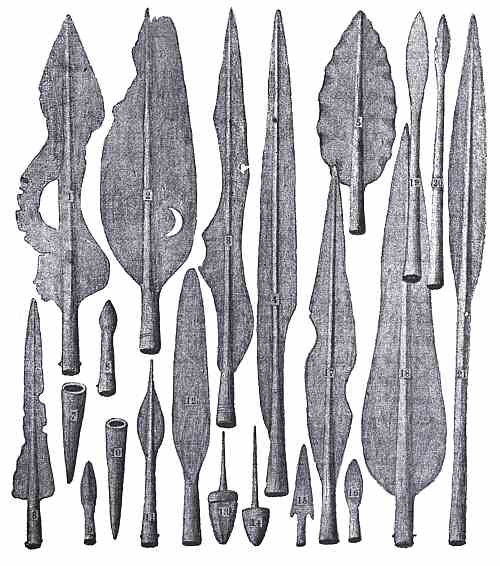
Fig. 88.—La Tène. Nos. 7, 10, 13, and 14 = 1⁄3, and the rest = 1⁄4 real size.
Lance and Javelin Heads (Fig. 88).—These weapons are extremely varied in shape and size, as may be seen from a glance at the illustrations. They all have sockets, and the smallness of the bore at once distinguishes them from Roman weapons of the same class. Sometimes the socket is short, while the blade is large and leaf-shaped, and at other times it runs nearly the whole length of the latter. Two nail holes, and sometimes small prominences, are seen at the lower end of the socket, by which the wooden handle was more firmly fastened. In a few instances (No. 12) there is no median ridge, but generally this is a prominent feature extending the whole length of the blade, and sometimes it assumes a triangular form, like that in our modern bayonet (Nos. 3, 4, etc.). Another peculiarity of some of these weapons is the cutting away of segments and semilunar portions, either at the edges (Nos. 1, 3, and 17) or in the body of the blade (Nos. 1 and 2). One fine weapon has an oval blade with a crenated or wavy edge (No. 5).
The butt end of the wooden handle was protected by an iron knob (Nos. 7, 10, 13, and 14), either simply conical or multilateral, above which there was a neat ferule (No. 13).
Arrow-heads.—It is only in the later excavations that a few arrow-points have come to light. Like the spear-heads, they are all socketed (Nos. 15 and 16).
Shields, etc. (Fig. 89).—Several objects have been found at La Tène which must be considered as shield-mountings. The umbo was of thin iron, arched in the centre, and attached to the shield by large studs or sometimes small nails (No. 1). The handle was made of a curved iron rod riveted to two rectangular plates of iron attached to the shield (No. 2). Some large handsome plaques of bronze, of a flamboyant character, are supposed to have been ornaments on the face of the shield (Nos. 3 and 4), of which about half a dozen altogether have been found. Besides these there are several discs and other objects of bronze (Nos. 5, 8, 9 to 11, and 21), many of which were probably ornaments for horse-harness, and there are some which Dr. Gross conjectures to have been ornaments for helmets. (B. 446, p. 28.) The curious object of thin bronze represented by No. 20 is also supposed to be an ornament for a helmet.
2. Implements and Utensils.—Hatchets (Fig. 90).—Though comparatively rare, the hatchets are of various kinds (only about twenty have been hitherto found). One form (Nos. 1, 2, and 7) reminds one of the winged celt of the Bronze Age. The former, however, has only two wings, instead of four as in the latter, and its cutting edge is more expanded. Others are like our modern axes and adzes (Nos. 4, 5, and 6). One of this type is made of bronze, but of so diminutive a size as to give rise to the idea that it was a toy (Fig. 91, No. 31).
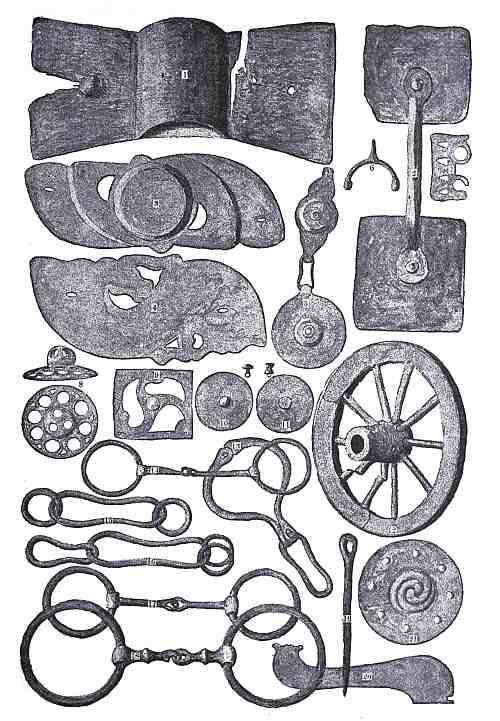
Fig. 89.—La Tène. Nos. 8 = 1⁄2, 20 = 1⁄8, 12 = about 1⁄20, and the rest = 1⁄4 real size.
Chisels and Gouges.—These tools differ only from those of the Bronze Age in being made of iron. They are in considerable numbers (Fig. 90, Nos. 33 and 34).
Hammers.—Only a very few hammers are recorded; they are small, and generally hafted by means of a central hole (No. 22). The almost entire absence of implements from La Tène, required in the forging of iron, is somewhat remarkable, and in striking contrast with the number of foundry materials collected from the palafittes of "le bel âge du bronze."
Saws.—Also sparingly represented. Two found by Vouga had handles, one of horn (No. 25) and the other of wood (No. 24). Another has a solid handle of iron, and terminates at the other end in a curious raised hook (No. 29).
File.—Only one object of this class (No. 37) is recorded.
Shears.—Three of these implements are here illustrated (Nos. 15, 16, and 17), from which it will be seen that they are precisely similar to those still used for sheep-shearing. They are elegant in shape, and some even still retain their elasticity. The number collected from La Tène is over a dozen.
Sickles and Scythes.—The few sickles recorded resemble those of modern times, and some of them had teeth. Scythes, more numerous than the sickles, vary in size from 14 to 20 inches in length, and 1½ to 3 inches in breadth. They were hafted by a crooked tang and a ring, precisely like those still in use (Nos. 30 and 32).
Knives.—As regards style and ornamentation, the knives of the Iron Age are greatly inferior to those of the preceding age. Their size and special characters are sufficiently shown in the illustrations (Nos. 8 to 12). One, like the saw already noticed, has a peculiar hook at the point (No. 23).
Razors.—The so-called razors are short, thick, and heavy blades with a rounded cutting edge, and a small prolongation as a handle (Nos. 18, 27, and 28). One of these implements was found adhering by its rust to a pair of shears (Nos. 17 and 18).
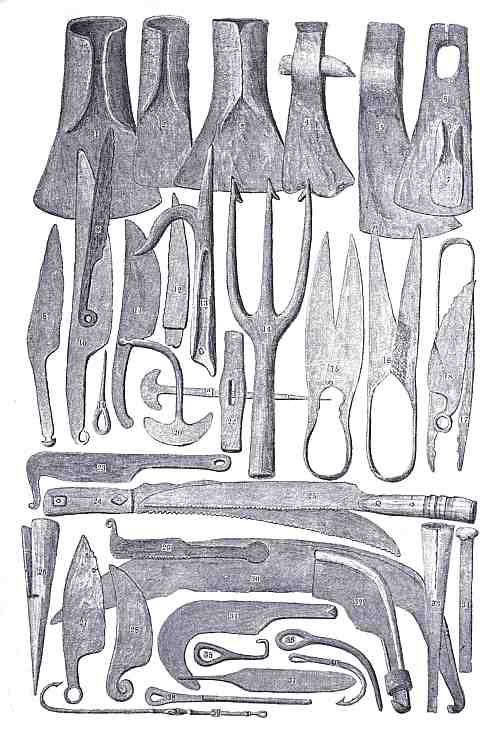
Fig. 90.—La Tène. All 1⁄4 real size.
Pruning Hooks.—Under this category I reckon some large cutting implements in the form of a bent knife, similar to that in present use for cutting hedges. The one here figured from La Tène (No. 31) is very similar to those found on some of the palafittes in Lake Constance. (See Fig. 32, No. 11.)
Pincers.—Pincers are of bronze and iron, and vary considerably both in size and form, as may be seen from the illustrations (Fig. 91, No. 11 to 14).
Pots and Dishes.—Of earthenware only a few fragments have come to light, and it is said to be of a totally different kind from that of the true palafittes. It is black and coarse, and shows no evidence of having been made on the wheel; but as to this there appears to be difference of opinion. (B. 428, p. 27, and 446, p. 48.) In addition to this kind, however, there are usually found on the surface of the peaty bed and in the superimposed gravel beds fragments of tiles, pottery, etc., the Roman origin of which cannot be mistaken; but such industrial remains, according to the explorers, are more superficial, and, consequently, posterior to the Gallic remains. (B. 428, p. 27.)
On the other hand, La Tène has furnished several large pots of beaten bronze, with rims and ring-handles of iron (Fig. 92, No. 19), some bronze cups (No. 18), a large iron ladle (No. 20), and one or two chains with large hooks, probably pot-hangers (No. 1). The cup here represented was found on the shore in the vicinity of La Tène, but it is supposed to have come from this station.[45]
Fishing Materials (Fig. 90).—Among this class of objects are some large spears with two or three prongs (No. 14), fishing-hooks of bronze and iron (Nos. 39 and 40), and some implements like the iron tips of boating gaffs (Nos. 13 and 26).
Diverse.—Hammer-stones, polishers, and corn-grinders are like those used in the preceding ages.
3. Objects of Ornament and Dress.—As regards the objects coming under this category, if we exclude the fibulæ and torques, which we now know to have been worn by men as well as women, it is noteworthy that those peculiar to female adornment are extremely rare, if not entirely awanting—a fact which strongly supports the theory that this station was a military fort.
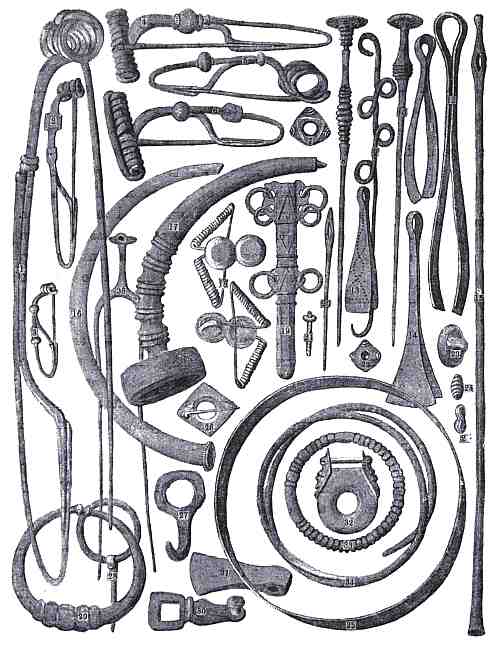
Fig. 91.—La Tène. No. 32 = 1⁄3, and the rest = 1⁄2 real size.
Fibulæ (Fig. 91).—The number of fibulæ from La Tène now amounts to several hundreds. They are all made on one principle, viz. that of our modern safety-pins. This principle is simply an evolutionary stage of the function of the straight pin, by which the point is bent round so as to meet the top after having subjected the stem to several twists so as to give it elasticity. In the part corresponding to the top of the pin there is a catch for the point when fastened. The ornamentation on the upper part and the number of spiral twists on the stem are so varied that each fibula has a distinct individuality of its own, and no two specimens exactly alike have ever yet been found. Their average size is from two to six inches in length, but sometimes they exceed this, as in one here figured (No. 1), which is 10½ inches in length. They are almost exclusively made of iron (Nos. 1 to 6), the exceptions being one or two of bronze (Nos. 18 and 26), and a small circular-shaped brooch of gold (B. 428, p. 28), which are somewhat analogous to those of the Hallstadt period.
Pins, Needles, etc.—The ornamental pins are few in number, and generally made of bronze. Of four here figured (Nos. 8, 9, 10, and 36) one has a double stem, and is so similar to some half-dozen found in the Pfahlbauten of the Bronze Age that it is more likely to be a stray object from the latter than a relic of La Tène. Nor is this at all improbable, as we have already seen that there were several of these stations quite in the vicinity of La Tène, the relic-beds of which have become almost entirely disintegrated by the waves.
A remarkable object, found by Vouga, consists of an ornamental bronze tube, closed at one end, and having six movable rings symmetrically arranged (No. 19). There can be no doubt this was a needle-holder, as it contained a well-formed needle of iron (No. 20). Another curious object, having an eye like that of a needle, terminating in an elongated bulb instead of a sharp point, is represented by No. 15.
Buckles, Rings, etc.—A large assortment of iron clasps (Nos. 27 and 30), buckles (Nos. 28 and 32), rings (No. 33), etc., is to be found in all the collections from La Tène. There are also to be met with a few beads and buttons of bronze (No. 23), and some glass beads of a pretty blue colour, or variegated with blue, yellow, and white (Nos. 22, 24, and 25). One has part of a bronze twisted wire passing through it (No. 21).
Bracelets.—In striking contrast to the fibulæ, bracelets are very rare. Dr. Gross figures one of bronze wire; another of an iron rod, with the inside flattened; and a third of iron plate, riveted, forming a hollow tube, reminding one of the ornamental hollow rings of the Bronze Age. (B. 446, Pl x. 17, 18, and 27.) Of the two here figured (Nos. 34 and 35), one is a spiral rod, and the other a flat band, both of iron. Fragments of glass bracelets, in the form of a flat band, having the outside ornamented with wavy corrugations, have also been found. (B. 126, p. 294.)
Neck-Rings.—Several portions of massive neck rings, precisely similar to those represented on ancient statuary as peculiar to distinguished Gallic warriors, as, for example, that on the neck of the "Dying Gladiator" in Rome, have been found at La Tène. They appear to have been made of two symmetrical portions, which, when worn, were united at the back of the neck, and then formed a large penannular ring, with an expanded bulb at each end (Nos. 16 and 17). They were sometimes plain rings, but generally they were more or less worked into some artistic pattern. That represented on the dying gladiator is distinctly seen to be twisted spirally immediately above the terminal bulbs. Of the two here represented, one (No. 16) is of gold, and weighs 72·90 grammes, and the other of bronze (No. 17).
4. Horse-Trappings, Waggons, etc.—Among the objects under this class we have not only bridle-bits (Fig. 89, Nos. 14 to 18), spurs (No. 6), various discs and other objects of bronze, supposed to have been ornaments on horse-harness (Nos. 5, 7, 8, 10, 11, and 21), but the actual remains of waggons, as wheels (No. 12), part of the wooden pole, linch-pins (No. 19), and other attachments. The wheel here figured shows a nave with 10 spokes and fellies, which are bound together by an iron hoop, precisely similar to the wheels now in use. "La roue entière," writes its discoverer, "a un mètre de diamètre; trouvée en compagnie d'épées gauloises, elle avait sur le moyeu un umbo de bouclier. Le cercle de fer qui l'entoure, d'environ un centimètre d'épaisseur, a 5 centimètres de largeur, le moyeu a 60 centimètres de longueur, il est formé de deux pièces, reliées de chaque côté par un ou deux petits cercles. Les rais sont en chêne au nombre de dix et la jante est, ou plutôt était, d'une seule pièce courbée et paraît de frêne; elle avait été raccommodée et la pièce est assujettie au moyen d'un clou et d'une embrasse de fer.
"Elle était encore entière, mais, en la transportant, quelques rais tombèrent et comme je ne pus pas la mettre immédiatement et entièrement dans l'eau, la jante se retira en peu de jours, laissant un espace entre le bois et le fer, de sorte que, quand je voulus mettre la roue entière dans son bassin de zinc, elle se sépara en plusieurs morceaux.
"Dans la même couche, mais dans la partie inférieure, puisqu'elle allait en pente, on trouvait des parties d'autres roues, des rais, moyeux calcinés, des manches de haches droits ou coudés pour celts, des parties de bois de lances, des poches en bois avec manches des fragments de grandes écuelles en bois, etc., de grandes et fortes poutres avec mortaises." (B. 428, p. 22.)
The fragments of this interesting relic are now carefully preserved in liquid in a large trough in the Museum at Neuchâtel.
The number of bridle-bits (excluding objects represented by Nos. 15 and 16, which are also supposed to have been used for this purpose) amounts to about a dozen. They are all made of well-beaten iron, with the exception of one (No. 17) which has a superficial layer of bronze over the iron, and have large side-rings, and a central mouthpiece divided into two symmetrical halves.
5. Money, Objects of Amusement, etc.—Coins.—But perhaps the most interesting feature of La Tène is the discovery of coins among its strange assortment of relics. Some of these are Roman, but others are undoubtedly of Gallic origin, being identical with those otherwise known to have been current among the various tribes in Gaul, prior to any intervention in their affairs by the Romans. In most cases they were picked up on the surface or amongst constantly shifting gravel, and of course no conclusive inferences could be drawn from them. This uncertainty is now, however, removed by the discovery of two gold pieces at a depth of 10 feet below the present surface, and associated with the usual characteristic objects of La Tène. "En creusant à la drague," says Vouga, "les pêcheurs de M. Schwab ont découvert une monnaie d'or et plusieurs monnaies d'argent et de potin ou de bronze. Plus tard, M. Alexis Dardel et d'autres personnes en ont aussi trouvé en assez grand nombre, surtout sur la tourbe et sur les bords du lac où les vagues les entraînaient, et une quantité de monnaies romaines avec des monnaies de Marseille, de Nîmes, de Lyon, de Vienne. Le plus grand nombre a dû se trouver sur l'île, entre les deux bras de la Thielle; mais de là, à mesure que le terrain était enlevé, ces monnaies étaient balayées et entraînées au bord avec les graviers.
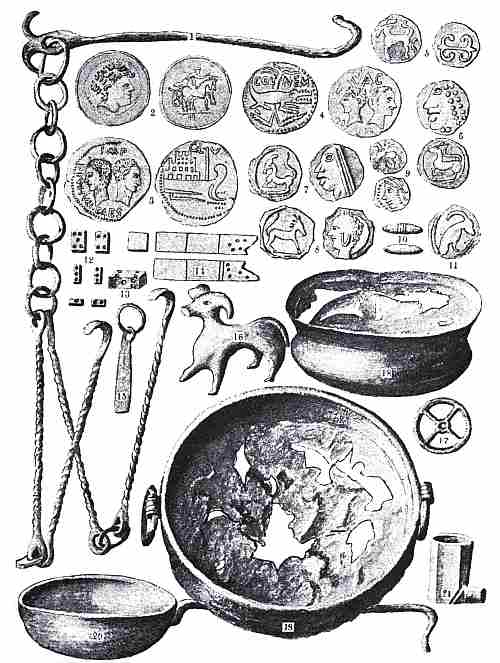
Fig. 92.—La Tène. Nos. 1, 15, 19 and 20 = about 1⁄6, 18 = 1⁄3 and the rest = 2⁄3 real size.
"Comme elles se trouvent toutes pêle-mêle, on ne peut en tirer des conclusions bien sûres. Il n'en est pas de même de deux monnaies en or trouvées à trois mètres de profondeur avec les objets mêmes de la Tène, en février, 1884; ce sont, d'après les descriptions qu'en a faites M. le Dr. Trachsel, de Lausanne, qui les croit Carnutes, du pays Chartrain. Une monnaie gauloise, en or pâle, concave, du poids de 7.783 grammes (Fig. 92, No. 2): A. Tête à bandeau royal; R. Aurige conduisant un char attelé de deux chevaux; à l'exergue, inscription étrusque ou grecque, indistincte." (B. 428, p. 29.) The other coin is very like the above in every respect, except that it is smaller, being only about one quarter of its weight.
The gold coins are rare, only seven in all, according to Vouga, being recorded. One, in the Museum of Bienne, is described by Keller (B. 126, p. 302, and Pl. xv. 34) as a bad imitation of the Macedonian coins of Philip. Another (described in the Anzeiger for 1883, p. 401) is similar to Fig. 92, No. 2. A fifth is a fragment, and the remaining two consist of small elongated rolls of gold (No. 10).[46]
Besides the gold coins from La Tène, there are about 100 of silver, and about the same number of bronze or potin (a mixture of copper, tin, and lead), representing a great variety of coinages, both native and foreign (Nos. 3 to 9, and 11).
Dr. Gross, having submitted some specimens of these coins, intended as illustrations for his work on La Tène, to M. A. de Barthelémy, publishes the following as the opinion of this eminent numismatist as to their date:—
"En résumé les monnaies dessinées sur la planche XI, à l'exception des Nos. 23 et 24 [gold coins] qui, à cause de leur métal, ont en un cours prolongé, sont de la seconde moitié du premier siècle avant l'ère chrétienne, principalement de la fin." (B. 446, p. 47.)
Amusements.—Among objects of this nature are several dice, some of bronze and others of bone (Nos. 12 to 14). Also, about a dozen small stones of the size of ordinary marbles, and perfectly round, except on one side, where there is a segment, as it were, cut off, are supposed to have been used for some kind of game.
Diverse.—In concluding this summary of the relics from La Tène, I have merely to mention as unclassified objects a four-footed figurine and a small wheel, both of bronze, and in the collection of Mr. Dardel (Nos. 16 and 17). Dr. Gross describes a bronze object resembling a tobacco-pipe (No. 21) which, he believes, was found on this station.
6. Osseous Remains.—To these relics is further to be added a large quantity of the osseous remains of men and domestic animals. Of the circumstances in which the earlier finds of this description were made we have not very definite information. Keller, writing in 1866 (B. 126, p. 295), speaks of a basketful of human bones representing some eight individuals; and Desor about the same time found a human skull, which he figures in his work on the palafittes. (B. 95.) M. Vouga, however, gives precise and most interesting information regarding the conditions in which he encountered the osseous remains of human beings, as well as those of the horse, ox, pig, and dog.
We have already seen how M. Vouga came upon the débris of a series of wooden houses constructed on the banks of an ancient river. Referring to these establishments he thus writes:—
"Devant le premier établissement je trouvai un crâne entier de femme. Devant le second, je trouvai pareillement les ossements de trois ou quatre personnes et trois crânes, dont un portait les traces de coups d'épée sur le sommet; un second était remarquable par sa déformité et l'extension de la partie postérieure. Devant le quatrième, deux mâchoires inférieures et les ossements dune trentaine de personnes, avec un très grand nombre d'os de chevaux, de bœufs, et de porcs. Devant le troisième, un crâne de chien grand et entier. Devant le cinquième, trois squelettes entiers dont un portait une corde au cou(?).
"Outres ces crânes et ces ossements dont je puis indiquer la provenance, il a été trouvé un grand nombre d'autres squelettes, d'ossements divers, de crânes de chevaux appartenant à une petite race.
"Je ne pourrais pas garantir l'âge de tous les squelettes, puisque, comme je l'ai dit en commençant, deux doivent être bourguignons, ayant retrouvé l'emplacement de la tombe avec un poignard de cette époque, et que six autres se sont trouvés à mi-hauteur, non loin d'un chénau en bois, et que la couche romaine paraissait s'incliner vers ce côté-là," (B. 428, p. 31.)
Concluding Remarks on La Tène.—In face of the above facts, the opinion of the earlier investigators that La Tène was an ordinary palafitte of the Iron Age, analogous to the lake-villages of the preceding ages, can no longer be entertained. Its geographical position, commanding the great highway between Constance and Geneva, and the vast preponderance of warlike weapons among its relics, clearly point to its having been a military station or outlook. Nor does it require much penetration to learn from its present ruins something of its final fate. The quantity of human bones representing some 30 or 40 individuals, some with gashes on the tops of their skulls; the number of abandoned swords, still in their scabbards; the incongruous medley of relics found by Vouga at the bottom of the ancient river-bed—all indicate that its capture by an enemy was sudden and the struggle fierce. The discovery of Roman remains, such as coins, tiles, pottery, bricks (one with the mark of the 21st legion, "Rapax"),[47] on and around La Tène, leave little doubt that its conquerors were the Romans.
Literature.—B. 22, 31, 72, 95, 119, 126, 419, 420a', 420b', 420c, 428, 434a, 446, 449a", and 463c. Also Virchow on the human remains in vols. xv. and xvi., Zeit. für Ethn. Verhand.
LAKE PALADRU.
From time immemorial a legend prevailed among the inhabitants around Lake Paladru that a city had been buried in its waters—a catastrophe brought about by the maledictions of the monks of the neighbouring Carthusian establishment of Sylve Bénite. On the 24th September, 1864, M. Vallier, of Grenoble, and some friends arranged a boating excursion for the purpose of examining the lake as to the reported existence of piles in it, with the view of accounting for the currency of the above legend, and found no less than six different sites where piles were to be seen projecting more or less from the mud. These were supposed to be the remains of lacustrine villages of which the following particulars were ascertained:—
1. Station des Grands Roseaux.—This station was situated near the head of the lake, and about two hundred yards from shore; depth of water from one to two feet; piles sometimes three feet apart, and sometimes much less; over 150 were counted.
2. Stat. de l'Ile de Loyasse.—Two hundred and fifty yards from the former, and about 100 yards from shore. Only about twenty piles were counted.
3. Stat. de la Genevrière.—About 600 yards farther on and 70 yards from shore. About twenty piles counted.
4. Stat. de la Neyre.—About 200 yards from the preceding, and close to the shore.
5. Stat. du Plâtre.—About thirty piles counted in water from 10 to 13 feet deep.
6. Stat. du Puits des Carpes.—Fifty or sixty piles observed close to each other and about 20 yards from the shore.
These indications of pile-dwellings, though strengthened by further observations by M. Vallier in the following year, really contributed little to the elucidation of the problem as to the period to which they belonged; so that the work of M. Vallier, "La Légende de la Ville d'Ars sur les Bords du Lac de Paladru," leaves the question much in the same position as it was left by Professor Fournet, who had already suggested, in 1860,[48] that the legend of the buried city had its origin in the former existence of lake-dwellings. It remained to M. Ernest Chantre, of Lyons, to make the first practical investigations to clear up the mystery. To this line of research he was led by the encouragement and knowledge he had received at the first meeting of the International Congress of Prehistoric Archæology, held at Neuchâtel, in 1866, when he had an opportunity of being initiated by Professor Desor and others in lacustrine research. His first efforts, an account of which was published in the Matériaux for 1867, showed that two of the stations mentioned by M. Vallier belonged to the Iron Age. Learning then that engineering works were in progress for regulating the outflow of the waters of this lake, which would have the effect of lowering its level, M. Chantre deferred his proposed excavations till these more favourable conditions should be accomplished. His subsequent investigations, conducted in the autumn of 1870, were confined to the first-named station (Grands Roseaux), which, from his former experience, gave greater promise of archæological results. From it he had already picked up some bones of the ox, pig, stag, etc., the kernels of a species of small cherry and of two kinds of plums, fragments of pottery of a different kind from any found in the Swiss lake-dwellings, an iron knife, and a wooden comb. Owing to the lowering of the lake the station was now (1870) a foot above water, and it could be easily examined by the spade on terra firma. In the excavations which ensued the following strata were met with:—(1) Eight inches of peaty mud and roots of water plants; (2) About eighteen inches of peat containing bits of worked wood and bones; (3) Ten inches of peat containing bones, fragments of pottery, and a great variety of antiquities; (4) Underneath this peat was the whitish lake sediment known as shell-marl.
The area occupied by the piles and wooden beams was about 1,600 square yards in extent, and of a somewhat circular shape. The tops of the piles were water-worn, and projected above the mud from one foot to one foot and a half. They were made of the stems of trees from 10 to 16 feet long, and 7½ to 15 inches in diameter, some being squared and pointed with the hatchet, and most of them penetrated to the shell-marl. Their distance from each other varied very much. Many were observed to be in groups of four, rectangularly placed, with cross timbers stretching between them, thus forming a series of square or rectangular chambers. The cross-beams overlapped each other, and each had a cutaway cavity at the point of crossing, which kept it in position, precisely on the principle on which the Swiss chalets are constructed at the present day. The walls of the submerged compartments contained some four or five of these transverses, and the space enclosed varied from 7 to 30 feet long. In the larger spaces the uprights were not restricted to the corners, but occupied intermediate positions inside the enclosed area. Numerous tenons, mortises, pegs, and other portions of worked timbers, proved that these structures were erected by the hatchet and chisel alone, as none showed any evidence of the use of the saw; nor were there any iron nails found.
The woodwork was so abundant, that the removal of it became a regular employment; and for its discovery the mud was probed with iron rods.
In two places a double row of piles stretched to the shore, one 230 feet and the other 130 feet long, which, there can be little doubt, were the remains of gangways.
The industrial relics (Fig. 93) consisted largely of iron objects, among which were several knives (No. 3), an axe (No. 11), an · awl, a gimlet, part of a pair of shears (No. 2), a chisel, part of a lock (No. 8), chains (No. 7), several keys (No. 9), horseshoes (Nos. 5 and 6), a curry-comb (No. 10), a spur (No. 12), a lance (No. 4), and portions of a javelin.
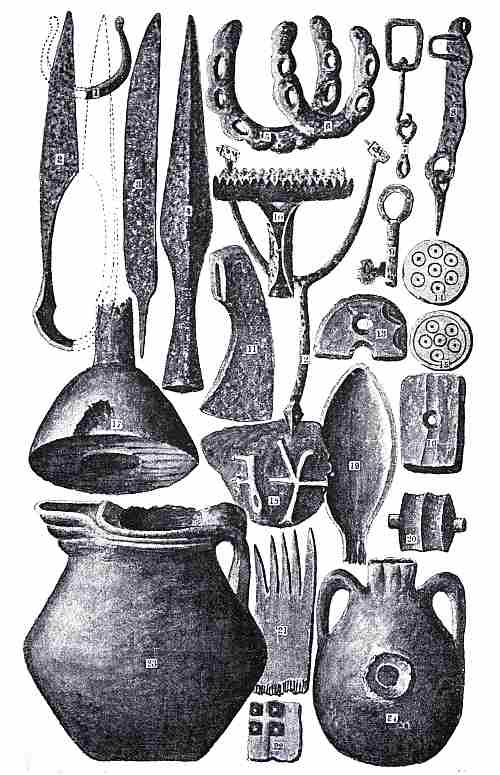
Fig. 93.—Paladru. All 1⁄3 real size.
Of other materials there were two bone-counters (Nos. 14 and 15), a sharpening stone, the half of a leaden bracelet (No. 1), and a number of wooden objects, viz. two combs (No. 21), spoons (No. 19), pestles (No. 17), a bobbin (No. 20), and some perforated bits, like floats for nets (Nos. 13 and 16).
Pottery is of a greyish-black colour, well baked, and fashioned on the wheel, with an ornamentation of a very unusual character (Nos. 18, 22, 23, and 24). The only entire vessel was flask-shaped, having a hole in the middle of one of its sides (No. 24). Some pieces of cloth like Roman tissues, and a portion of a Roman vase, were also found.
The animals identified from the bones were the ox, sheep, goat, horse (a small race), pig, dog, and a large-sized otter. Among the remains of fruits were two species of cherry, two species of plums, peaches, walnuts, hazel-nuts, acorns, etc.
Oak was the only wood used in the construction of the submerged foundations, with the exception of one trunk of a chestnut tree; but ash, cornel-cherry, and box had been used for making utensils. (B. 193.)
In 1885, owing to the lowness of the water in the lake, further discoveries were made on this station (Grands Roseaux). Immediately in front of the lacustrine village, on its lake side, a triple row of piles was detected, which appeared to have acted as a breakwater; and on its site, along with some great oak-beams, were found various relics of a similar character to those already described. Among these were the following iron objects of the Carlovingian period—viz. 17 knives, 2 keys, a hook, a pair of shears, a stirrup, 2 spurs, a portion of the umbo of a shield, and some horseshoes of a small size. The other objects recorded were two portions of wooden spoons, fragments of a comb made of yew, and a piece of goatskin.[49]
RHINE DISTRICT.
In the two lacustrine stations just described we had to deal with remains essentially different from any that have hitherto come under our notice. In La Tène both stone and bronze objects are quite the exception, while those of iron are not only in great abundance, but, from their variety and style of art, clearly show that the working and forging of this metal had reached a great state of perfection. In short, we have inherent evidence that the civilisation of the Bronze Age was now superseded by one of a totally different character, and yet it would seem that this complete change had been accomplished independent of, and prior to, the advent of the Romans. On the other hand, the class of antiquities found in Lake Paladru brings us down to Carlovingian times, probably as late as the ninth or tenth century. In pursuing our investigations northwards we find records of many lake-dwellings which, like these, are the products of later ages than those in which the Swiss Pfahlbauten flourished. But, at the same time, there is satisfactory evidence as regards others in the same localities that they belonged to the Prehistoric Ages. Professor Virchow (B. 165) considers that, with one or two exceptions, all the lake-dwellings of North Germany were founded during the Iron Age, and, like our Scottish and Irish crannogs, continued down to the Middle Ages. As regards many, however, no conclusive inferences can be drawn, as they are imperfectly or entirely unexplored.
THE PALATINATE.
Mr. C. Mehlis (B. 400) states that in the low-lying land near Billigheim, on the left bank of the Rhine, evidences of a pile-dwelling have for many years been observed. In one place piles were found in their original position. They consisted of square-cut oak beams, about six feet long, and placed in the form of a rectangle. Near them were collected in great numbers tiles of a dark-red colour, fragments of pottery peculiar to the period from the tenth to the thirteenth century, and bones of the deer. In addition to these relics, which point to the early Middle Ages, there were others at a greater depth which no less conclusively point to a much earlier period. These are described as implements of stone and flint, such as knives, axes, spear-heads, etc.
Other indications were noticed in the turf-beds at Landstuhl and Durkheim; and below Mayence, Lindenschmit has shown that a pile-dwelling existed in Roman times. Other stations are said to be at Würzburg, Wiesentheid, and Niedissigheim, in which the bones of various oxen and pigs were found associated with piles. (400a, p. 254.)
DEÛLE-À-HOUPLIN.
In 1876 M. Rigaux announced the existence of a pile-dwelling in the marsh of Deûle-à-Houplin, in the Département du Nord, in which were found not only broken bones, flint objects chipped and polished, and pottery, but also some metal objects.[50]
MAESTRICHT (HOLLAND).
In the valley of the Meuse, near Maestricht, Mr. Ubaghs (B. 413) describes a sort of artificial island composed of trunks of trees brushwood, leaves, etc., which came to light in 1883 in the course of railway excavations. This curious structure lies close to the canal from Maestricht to Bois-le-Duc; and it appears that when this canal, many years ago, was being constructed, it is recorded that the workmen had come upon much wood and bones, which were thrown away as of no importance. The portion now exposed by the railway excavations was about 16 feet below the surface and extended parallel to the canal for about 50 yards, with a breadth of 11 yards, and Mr. Ubaghs estimates that 4 or 5 yards more were destroyed by the canal operations. The trunks were from 6 to 13 feet long and, in some instances, 1 foot in diameter. The larger ones were underneath and reposed on a bed of gravel, in which they were partially embedded. Above the beams were decayed branches and leaves, forming a bed of vegetable débris some eight or nine inches in thickness, but no upright piles were anywhere observed. Mr. Ubaghs considers this was in former times an island constructed partly, at least, artificially, like the Irish crannogs or the Pfahlbauten at Schussenried, and that it served as a dwelling-place for hunters, who left the remains of feasts and broken weapons behind them.
Among the objects of archæological value collected were the following:—Portion of a human skull, and various bones of the horse, urus, ox, stag, goat, dog, pig, beaver, and the humerus of a bird. The industrial relics consisted of various kinds of implements and weapons of bone and staghorn, as harpoons, perforated clubs, daggers, etc., of which a few are here represented (Fig. 94). As these illustrations are merely copied from Ubaghs' work, and are not drawn to scale, I give the respective lengths of the objects, viz. (1) 15½, (2) 10, (3) 6½, (4) 13½, (5) 4¾, (6) 3, and (7) 3½ inches.
No complete skeleton of any animal was found, because, as Mr. Ubaghs remarks, these hunters only carried certain portions of the dead animals to their abodes. It was also observed that the spongy portions of the bones had been gnawed away, probably by dogs.
To the portion of the human skull (dolichocephalic) there is now more than ordinary interest attached, as it was near the same spot that Professor Crahay discovered the celebrated human jaw known as the "Smeermaas mâchoire," and subsequently described by Sir Charles Lyell in his "Antiquity of Man" as coeval with a mammoth tusk found in the vicinity. The present skull was found 11 to 13 feet below the surface, lying upon the gravel bed on which the wooden structures reposed. From a careful comparison of it with the "Crahay jaw," now in the cabinet of anatomy in the University of Leyden, Mr. Ubaghs found that the two relics were identical as to patina, consistency of bone, and the composition of the material in which they were embedded (traces of which still adhered to them), and he comes to the prosaic conclusion that the two belonged to the Maestricht crannog: "Cette mâchoire, ainsi que les autres ossements de la même provenance, ont appartenu à notre station lacustre près de Maestricht."
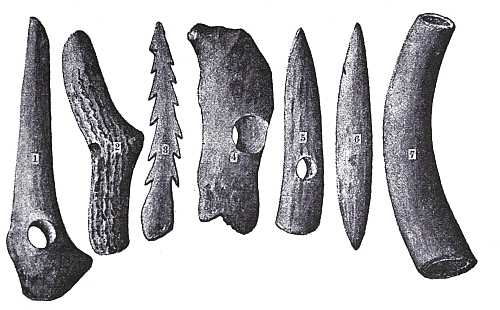
Fig. 94.—Maestricht.
M. Kerkhoffs[51] attacks Sir Charles Lyell for some palpable mistakes he has made regarding the relative positions of the Crahay jaw and the mammoth tusk. According to Sir Charles, the tusk was found "six yards removed from the human jaw, in horizontal distance."[52] M. Kerkhoffs gives the following quotation from Crahay's original notice of the discovery:—"Dans une pointe que forme le plateau de Kaberg, en s'avançant dans la plaine, près de Smeermaas, on a rencontré dans la terre argileuse à 6m50 au-dessous du sol, la mâchoire inférieure d'un homme garnie de ses dents, sans être accompagnée d'aucun autre reste; elle ne semblait pas avoir roulé; les ouvriers assurent que la terre n'y avait pas été remuée. L'os est très fragile, mais n'a pas été dans cet état de mollesse des ossements d'éléphants; aussi n'est-ce pas la même couche de terre; car au-dessous de cette mâchoire s'étendait une couche irregulière de gravier et de cailloux de 2 à 3 mètres d'épaisseur, au-dessous de laquelle était placée une nouvelle couche argileuse dans laquelle on a trouvé des restes d'éléphants à 14 mètres au-dessous du sol."
From these remarks it would appear that Sir Charles Lyell's account of the position of the mâchoire is neither a fact nor in accordance with Professor Crahay's description of the conditions in which it was found, as the tusk is here described as having been over 24 feet deeper.[53]
NORTH GERMANY.—(a) MECKLENBURG.
Lattmoor.—The discovery of lake-dwellings in North Germany dates back to the summer of 1863, when Dr. Lisch, Curator of the Antiquarian Museum at Schwerin, accompanied one Sergeant Büsch to inspect a peat bog at a place called Gägelow, in the vicinity of Wismar, where the latter reported that some stone implements had been found. Dr. Lisch recognised in this place the site of a lake-dwelling and looked upon the discovery as one of great importance. Soon afterwards Büsch, who was a member of the Antiquarian Society of Schwerin, and took an active part in collecting objects for the museum, ascertained that similar remains were often met with in the peat bog known as the Lattmoor, situated about a mile to the north of the town of Wismar. On the 4th July, 1864, Büsch so greatly astonished the members of the society with the number and variety of objects he placed before them that Dr. Lisch again accompanied him to this new field of discovery, and again came to the conclusion that it was the site of a true Pfahlbau. Sergeant Büsch, to whom the credit of these discoveries was undoubtedly due, became greatly elated over his successes, and continued to supply Dr. Lisch with the most extraordinary objects from this lake-dwelling, all of which were accepted without exciting the slightest suspicion that any of them had been falsified. In 1865 Dr. Lisch published an illustrated report of the Wismar lake-dwellings (B. 100), and the subject attracted much attention in archæological circles on account of their analogy to those in Switzerland. Shortly after the appearance of Lisch's work Dr. Lindenschmit, of Mayence, announced that certain objects included in a small collection which Büsch had sent to him were falsifications, and especially pointed out a bone comb and some other bone objects which undoubtedly came under this category. The doubts thus cast on the relics from the Wismar lake-dwelling became intensified when soon afterwards Büsch got into trouble in regard to some money matters, which ended in his being convicted and punished for forgery. Not only was there now doubt cast upon the genuineness of the entire relics, so much prized at the Schwerin Museum, but the very existence of the lake-dwelling was called in question. After this untoward event Dr. Lisch became more cautious and carefully inspected all the relics that had already come to the museum, the result of which was that Büsch had not only fabricated a considerable number, but also included real objects of antiquity found elsewhere as coming from the lake-dwelling. All the doubtful specimens were then carefully eliminated from the collection, and further investigations were undertaken by competent and trustworthy men, notably Messrs. Fromm and Mann of Wismar. The result of this inquiry was such as to leave no doubt whatever as to the genuineness of the Wismar lake-dwelling, as the same class of objects continued to be found after the disappearance of the unfortunate Büsch altogether from the scene. A couple of years later Dr. Lisch published a second report of the Wismar Pfahlbauten (B. 142), in which he notes those articles he considered to have been forgeries, chiefly objects of bone and horn, in his previous report, and incorporates the further discoveries. Since 1867 little peat-cutting has been carried on in this part of the moor, and the antiquities have correspondingly decreased. A final report of this lake-dwelling was, however, given in 1873, by Dr. Lisch, which in every respect confirms its previous character. (B. 242.) Professor Virchow, who also visited the locality and, with his usual critical acumen, investigated the whole matter, came to the conclusion that, notwithstanding Büsch's incomprehensible mystifications, the lake-dwelling at Wismar was undoubtedly trustworthy. (B. 165.)
I visited the Museum of Schwerin during the summer of 1888 for the express purpose of seeing these remains, and after a careful inspection of them I could not differ from the conclusions arrived at by Lisch and Virchow. Moreover, I had the assurance of Miss Buchheim, custodian of the antiquarian department, that there could be no doubt at all that the entire collection from Wismar now in the museum was as genuine as anything of the kind in Europe.
The lake-dwelling remains occupy a separate compartment in one of the wall-cases. Among those from Wismar are 32 flint hatchets and chisels more or less perfect (Fig. 95, No. 6), three perforated stone axe-heads (Nos. 16 and 17), eight semilunar flint saws (Nos. 11 and 12), one or two arrow-points (No. 20), a flint dagger with handle (No. 10), some flint flakes and a number of polishers (No. 18). Of horn and bone there are many worked portions, among which are three perforated implements (No. 14), one perforated bead of amber, portions of piles and worked wood, and a large heap of bones. But, of course, all the objects have not come to this museum, as there are some described in Dr. Lisch's reports which have evidently found a resting-place in some other collections. Among the relics are not only large hollow polishing-stones and round rubbers, but also fragments of true querns or handmills, the presence of which appeared to have astonished Dr. Lisch, as he considered the latter to be of much later date than any of the other associated objects.
Of bronze only one socketed celt with side loop and portion of an arm band are mentioned.
The pottery was of a peculiar character, much broken and difficult to make out. One portion, which is here represented (No. 9), shows groups of lines running up and down the bulge of the vessel. A few clay spindle-whorls were also found.
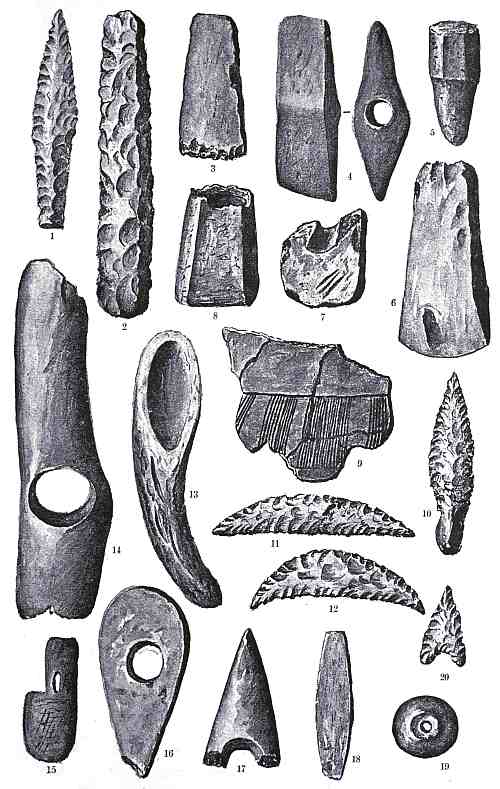
Fig. 95.—Wismar and Gägelow (1 to 5, 7, 8, and 19).All 1⁄3 real size.
Among the osseous remains Professor Rütimeyer identified the following animals:—ox (Bos taurus and primigenius), sheep, goat, pig (Sus scrofa ferus and domesticus), stag, roe, horse, dog, beaver, rat, wild duck, seal, tortoise, and pike. A few human bones were also collected.
The site of this lake-dwelling is in the low ground known as the Lattmoor, a short distance to the north of the town of Wismar. Judging from the nature of the locality and its surroundings, all authorities are agreed that in prehistoric times it was the bed of an irregularly shaped lake, but of no great depth. The piles were found by the peat-cutters in a somewhat contracted portion some 260 yards to the south of the Muggenburg tile works. On excavating into the accumulated deposits of this basin the following layers were encountered:—(1) ordinary turf, about 5 feet; (2) a layer of alluvial mould, about 1 foot thick; (3) black muddy stuff, containing the remains of water plants for a depth of 10 feet. It was in the latter that rotten piles were detected, which penetrated its whole depth to the underlying glacial clay. These piles were about 10 feet long and 6 or 7 inches thick; and they were placed about 2 feet apart, with their present tops at least 6 feet below the surface of the bog. From the arrangement of the woodwork Dr. Lisch formed the opinion that the huts erected over them were both round and square, and he thought he recognised three of the former and two of the latter. The round huts had a diameter of 14 to 18 feet, and were placed at intervals of 6 to 8 feet. Horizontal beams were found both on the supposed sites of these huts and in the intervals. Leading from one of the huts to the shore there was a line of seven or eight large granite stones.
Gägelow.—The site of the Gägelow lake-dwelling, the first discovered in North Germany, is a small hollow near the seashore a few miles to the west of Wismar. This hollow contained a rich deposit of mould, which Herr Seidenschnur, the proprietor, was in the habit of utilising as manure for his fields. It appears that as early as 1861 some horn objects were found in the stuff taken out of this place, which, on being presented to the Museum at Schwerin, then led Dr. Lisch to make the suggestion of a lake-dwelling—a suggestion which was afterwards confirmed by his visit to the place in May, 1863.
By the removal of the mould from year to year, this hollow had been partially converted into its pristine aqueous condition, which, however, could hardly be dignified by the name of a lake, being nothing more than a pond, some 40 yards long by 30 broad. Here a semicircular area containing oak piles was detected, which measured about 22 feet in diameter. The piles were 7 to 10 feet long, and 7 to 8 inches thick, and interspersed among them were some horizontal beams. Associated with this wooden structure were found various kinds of antiquities—viz. four polished or chipped axes of flint (Fig. 95, Nos. 2 and 3), two perforated axe-hammer heads of diorite (No. 4), a portion of a third (No. 7), and some flint daggers (No. 1) and flakes. A four-cornered mortar of grey basalt, 3½ inches high by 2½ broad (No. 8); the corners of this vessel are rounded, and its surface neatly polished. A hand-millstone or quern, 1 foot in diameter and 2½ inches thick, made of porous basalt: this quern had a hole in the centre, with two swallow-tail notches on each side for fixing the handle, and its under surface was worked into a series of narrow grooves, precisely similar to those of Roman and post-Roman times. There were also some spindle-whorls (No. 19), a portion of a clay weight, and fragments of dishes of black and red pottery, some of which had handles. The bones were all of the ordinary domestic animals.
Marine Pile-dwellings.—The spirit of antiquarian research aroused in the neighbourhood by these discoveries, led to the recognition of the remains of marine pile-dwellings (Meerpfahlbauten) in the bay of Wismar. Attention was first directed to this subject by Mr. Mann, who pointed out that for several years past flint hatchets, daggers, and knives, as well as various objects of horn and bone, and even bronze implements, were frequently turned up by the dredging machines used in the harbour. The matter, however, excited no interest among the workmen, and thus many valuable objects were re-deposited in deep water along with the dredged mud. It was reported that some bronze objects had been sold to the smith, Vossech, and melted; while others of stone and horn had been dispersed. It appears also that at a particular place called the Baumhaus piles of oak had been observed. In 1864 the workmen engaged at the dredging machines, having their attention called to the matter, reported the existence of piles at various places in the bay, one of which was between the shore and the little island Wallfisch, and the other close to the island Poel. One peculiar horn object which had been sent to the museum was supposed to have been a Taschenbügel or rim for a pouch. (B. 100, p. 101, and vol. xxix. p. 132.)
Bützow.—There was also, according to Dr. Lisch, a lake-dwelling in a turf moor called the "Sühring," near the town of Bützow. Here at a given place near the margin of the moor the peat-cutters were occasionally finding antiquities associated with piles, which, on being sent to the Schwerin Museum, led to the recognition of the true character of the find. Over 60 objects were collected, among which Dr. Lisch enumerates the following:—two round stone rubbers, three semilunar flint saws, a flint celt, a perforated axe-head, a bronze pin three and a half inches long, several objects of horn and bone, a piece of reindeer horn, and shells of hazel-nuts. (B. 142.)
Vimfou.—Dr. Weichmann-Kadow (B. 142) describes a lacustrine dwelling found in a small lake at Vimfou, near Goldberg. The lake was drained and converted into meadow land in 1865, and in its former bed three localities containing piles had been observed, only one of which, however, was subjected to any examination. This was near the middle of the lake, and the piles, which appeared to have been the foundations of a burnt-down hut, occupied a circular area about 12 feet in diameter. Inside the piled area were bits of burnt wood, charcoal, and some broken pottery and three whole vessels. Some of these vessels were well made and had handles and a style of ornamentation which corresponded with the early Iron Age. The only other remains were a few grinding stones (Quetschmühle), some small round pebbles supposed to have been used as draughtsmen, bits of bone, and the shells of hazel-nuts.
(b) POMERANIA AND CENTRAL PRUSSIA.
Ryck.—Almost contemporary with Lisch's discoveries in the vicinity of Wismar were those by Von Hagenow at the mouth of the river Wiek. (B. 97.) Rumours of the discovery of various ancient objects of flint, bronze, and iron, while the bed of the river was being deepened, induced Mr. von Hagenow to investigate the matter. These reported discoveries extended backwards for upwards of twenty years, embracing the years 1839-47-59-62 and '64. It was only in the latter year that it became surmised that the antiquities indicated a lake-dwelling. There was no doubt of the existence of piles, which Von Hagenow unhesitatingly concluded had been used for this purpose; but others thought they were the remains of a bridge. Prof. Virchow, writing in 1869 (B. 165), after examining into all the circumstances, was unable to form an opinion or to decide whether these remains pointed to a bridge or to a lake-dwelling.
Hegar Lake.—This lake is situated in the district of Dramburg, near Sabin, and in it were found many iron objects, upwards of 100 arrow and lance-heads, spurs and horse-bits, associated with the remains of a small wooden house. No objects characteristic of the Stone or Bronze Ages were found, so that there can be no doubt that this station was of a comparatively late age. (B. 119, 2nd ed., p. 629.)
Werbelinsee.—According to Professor Virchow, this lake contains the remains of a most interesting pile-dwelling. (B. 165.) The lake is situated not far from Joachimsthal and Angermünde, and on its south side, near the village of Altenhof, piles were detected which, by a vague tradition, were supposed to mark the site of a bridge. Professor Virchow, however, by placing long wooden poles in the water where the submerged ancient piles were observed, demonstrated the existence of a vast area which even the sceptical boatmen admitted could only have been intended for the foundations of a village.
Persanzigersee.—This lake, according to Kasiski (B. 125 and 362), is situated four and a half miles to the west of Neustettin, and formerly covered about 186 acres; but in 1863 it was lowered some 10 feet by the construction of a drainage canal, thereby reducing its area to less than as many roods. At the north end of the lake, and 170 yards from the shore, there appeared a small island, which was found to have been surrounded by a remarkable structure of piles and cross-beams. Sixty yards to the north of this island there was a flat prominence, called the "Werder," which was completely cut off from the mainland, partly by bogs and partly by an arm of the lake 55 yards wide. (See accompanying Sketch Map.)
Stretching between the island and the point of the Werder the stumps of a double row of piles, doubtless the remains of a bridge, were detected. A similar bridge also extended from the Werder to the shore; and to the south of this were the remains of a third bridge, which appears to have never been finished, as it stopped suddenly short after reaching some 40 yards into the lake in the direction of the island. Another row of piles, commencing at the outer end of the bridge which connected the island with the Werder, extended circularly for a considerable distance in the bed of the lake, as if intended to protect the island.
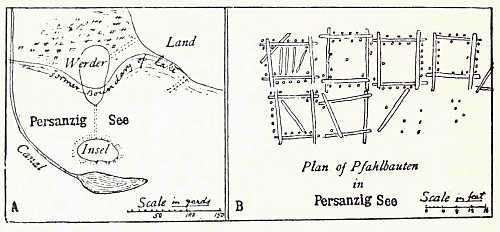
The chief point of interest, however, lay in the peculiar structures which surrounded the island. These consisted of a series of rectangles, some 60 in number, formed of horizontal beams 16 feet long and 8 to 12 inches in diameter; they overlapped each other near their extremities, leaving about 18 inches free, and each beam had deep cuts by which it was kept in position, exactly similar to the plan used in the construction of a log house. The rectangular spaces measured four or five square yards, and had 30 or 40 piles placed on both sides of the chamber-walls, apparently for the purpose of strengthening the horizontal beams, as shown in the plan. These chambers appear to have formed a complete girdle to the island, but they were partly destroyed on the south side. The quantity of wood used was enormous, as the piles alone numbered about 1800. On the north side the structures were remarkably well preserved, being protected by a covering of slime and rushes eight to twelve inches thick. At first Major Kasiski believed that the rectangles were cottages, but subsequently, after comparison with similar structures in other lakes in North Germany, he came to the conclusion that they formed merely the submerged foundations over which the cottages had been built.
The bridges from the Insel to the Werder, and from the Werder to the shore, were built on two rows of piles, 8 feet apart, and the piles in each row were about 7 feet apart. Major Kasiski inferred from the remains of the unfinished bridge, which showed the use of tenons and mortises, that it was of later date than the others.
Among the relics collected on the island or amidst its surrounding structures are two halves of an upper quern, 14½ inches in diameter and 5 inches thick. The under side is concave, and the centre hole, which has a diameter of 1¼ inches, widens upwards like a funnel. Querns have been found in several lake-dwellings in North Germany, as Gägelow, Wismar, and Cottbus, in Neumark.[54] Other relics consist of wooden clubs, two portions of leather, a skate made of the leg-bone of a horse, staghorn hammers, five sharpening-stones, a few spindle-whorls of stone and clay, a bit of coral, seven portions of worked wood—a shovel, rudder, etc. Of metal there are a fragment of bronze and an iron hatchet. The latter implement is small, measuring only 3½ inches long, and 2½ inches wide at its cutting-edge, and has a round hole for the handle.
The pottery, of which 45 fragments were collected, was made of fine clay, by means of the potter's-wheel, and from the variety of its ornamentation and characteristic wavy lines, there can be no doubt that it belonged to the type of the Burgwälle—an inference which is greatly strengthened by its resemblance to that found in the Wallberg in the Raddatzsee, a noted Burgwall situated in the close vicinity. Illustrations of a few specimens of this pottery are given on Fig. 96, Nos. 6 to 9.
From an examination of the bones collected the following animals were identified, viz.:—horse, ox, goat, sheep, pig, dog, fox, deer, and roe.
In the Virchowsee a little to the north of Persanzig there is a huge Burgwall surrounded by water, in which the remains of piles have been found. (B. 165.)
Streitzigsee.—On the lowering of this lake a very large assortment of piles became exposed, but although several excavations were made, both by Professor Virchow and others, no decided results were obtained bearing on their character and scope. (B. 165.)
Lübtowsee.—Another locality which has furnished remains of pile-dwellings lies to the right of the Oder, in the vicinity of Lübtow. (B. 165.) Here the river Plöne traverses a long lake, and on its being lowered in 1859, an extensive area covered with piles became visible towards its northern end. It is said that many relics were found among these piles, some of which were collected by the proprietor; but the idea of their belonging to lake-dwellings was not mooted till several years afterwards. Professor Virchow visited the locality in 1865, and again in 1869, and on the latter occasion he made extensive excavations, which convinced him that this was a regular lake-settlement. Later on the foundations of a quadrangular wooden building came to light, from which, owing to its being 3 feet under the late lake level, Mr. Kühne inferred that the lake must have formerly stood at a lower level. That this structure, however, as well as the piles, belonged to the Iron Age, he says there can be no doubt whatever, as the antiquities collected in both were precisely similar, being generally iron objects, such as swords, lance and arrow-heads, stirrups, spurs, knives, and bricks of the thirteenth or fourteenth century. In the rectangular building, in addition to such objects, were found a helmet and greaves. But what was considered still more singular, there was found among the piles a number of stone chisels and hammers, together with one bronze celt. (B. 119, 2o ed., p. 629.)
Adjacent to this lake at Bonin, and deeply buried in the turf, indications of wooden structures came to light which, in 1872, attracted the attention of Professor Virchow, who, in company with the local antiquaries, made excavations which revealed structures analogous to those in the Persanzigersee. (B. 227.) In excavating they passed through the following distinct layers:—First, 5 to 8 feet of peat; second, some thin layers of marl, sand, and mud; and third, a relic-bed, 2 to 4 feet in thickness. The woodwork appeared to the investigators to have been cut by sharp metal tools. Among the relics collected were four sharpening-stones, a few perforated staghorn hammers, a bone chisel 6½ inches long, some large horn handles, a small iron knife, bits of leather, fragments of wooden dishes, and part of a boat. Pottery was also found which belonged to the Burgwälle type.
Soldinersee.—In 1857 this lake was lowered 7 to 8 feet, when two islands became visible, one of which turned out to be the site of a lake-dwelling, and yielded a considerable number of antiquities, among which was portion of a reindeer horn. (B. 165, p. 407.)
In 1873 Major Kamienski examined it with greater care, and published a short notice of the results. (B. 241.) The island was 150 yards from the shore, and measured 85 by 30 yards. It contained many piles, and showed no evidence of having been destroyed by fire. The relics were of a mixed character. With flint flakes and broken stone-axes were various iron objects, as a hook, a spear-head, three knife-blades, and three halves of horseshoes. There were also arrow-points of bone, two portions of bows, a clay spindle-whorl, a bone shuttle, beautifully worked, and a piece of horn with a kind of ornamentation cut on it. The fragments of pottery also indicated different kinds. Stones, which looked as if they had been exposed to fire, were supposed to have been used as hearths. Among the osseous remains were those of the ox, pig, stag, roe, fox, bear, beaver, wild boar, and a single vertebra of a fish.
A Burgwall was on the land near the lake-dwelling—a fact which is somewhat significant, as, according to Virchow, there was often a close connection between these two classes of remains.
Dabersee (Hinter Pommern).—The Pfahlbauten in this lake were shown by Professor Virchow to be connected with an adjacent Burgwall by a wooden bridge. (B. 165.) He also found that the piles were associated with submerged wooden rectangles similar to those already described in the Persanzigersee. Together with pottery of the Burgwälle type, he found bone skates, an iron hatchet, and an ornamented comb, constructed of several pieces of bone banded together with iron rivets. About this comb he remarks that the teeth were sawn after the pieces were put together—a peculiarity which I have noted of the bone combs found on the Ayrshire crannogs.[55]
Lübbinchenersee (Kr. Guben).—In 1877 a lake-dwelling of the Slavish period (Spätwendischer und darüber Mittelalterlicher Pfahlbau) was examined by members of the Märkisches Museum, in Berlin, from which they collected a large quantity of iron objects, pottery, bones, etc., which may now be seen in this museum. The base of this lacustrine dwelling was constructed precisely similar to that at Persanzig, and the beams had similar cuts near their extremities, where they overlapped each other.
Alt Friesack (Kr. Ruppin).—A similar Slavish Pfahlbau was found at Alt Friesack, from which there is now in the Märkisches Museum a large quantity of débris—wooden beams, quern-stones, some perforated clay sinkers (Fig. 96, No. 5), an iron hatchet (No. 2) with traces of ornamentation on it, an iron oblong ring (No. 1), and pottery with the characteristic wavy lines (Nos. 3 and 4).
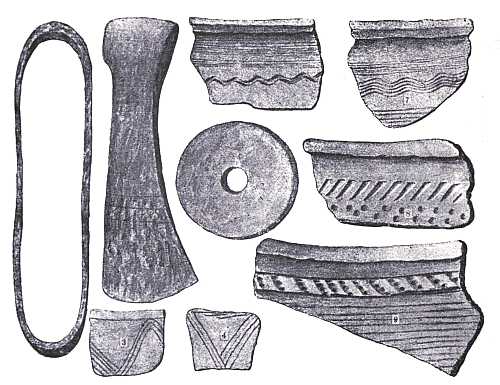
Fig. 96.—Friesack (1 to 5) and Persanzig. No. 5 = 1⁄4, the rest 1⁄2 real size.
Kloppsee (Neumark).—A lake-dwelling in the Kloppsee, near Woldenburg, has yielded a fine black pottery, so well burnt that it gives a metallic ring when struck. The vessels found here are well shaped, and the fragments show handles, feet, and well-formed recurved rims. (B. 165.)
Spandau.—One of the most remarkable lacustrine discoveries in North Germany was made a few years ago (1881) at the town of Spandau, near Berlin. Here, in a flat space called Stresow, close to the river Havel, in which workmen were excavating the foundations of a military powder-house, oak piles and bronze weapons were turned up from considerable depths.
The locality was almost surrounded by the adjacent sluggish waters, and so wet that two pumps had to be kept going before the men could carry out the necessary excavations. From the sedimentary character of the deposit, as well as the abundance of fresh-water shells, there could be no doubt that formerly the place had been occupied by a lake. There was, first of all, a bed of peat about five feet thick, and under this came a deposit of mud and sand. On the south side of the space being excavated there was observed at a depth of nearly 12 feet a layer of greenish stuff, mixed with bones, impregnated with vivianite, and through this layer the piles were found to have penetrated to the sand underneath. It was in the muddy deposit immediately beneath the peat that the tops of the piles appeared, and they were arranged sometimes in parallel rows, and sometimes without any apparent regularity. Some were of oak, and others of soft wood. There was also much timber lying transversely, and many of the beams showed signs of charring.
The relics were collected between and around these piles, and uniformly all over the area. They consisted of a remarkable series of bronze implements and weapons, together with a few of stone and horn. There were also found the bones of tame and wild animals, a human brachycephalic skull and some other human bones, a portion of a canoe, and a very small quantity of pottery of an indeterminate character. The bones were very much broken, but, notwithstanding, they were identified as belonging to the following animals, viz.:—stag, roe, hare, bear, ox, horse, pig, and dog. It is noteworthy that the reindeer and elk were both unrepresented.
Relics.—It is, however, the relics that distinguish this lacustrine find from others in North Germany, and these I shall now describe shortly:—three swords with handles (Fig. 97, Nos. 8, 9, and 10), one sword-blade attached by rivets (No. 11); an ornamented commandostab (No. 18), and a small button-like object, ornamented with a running scroll of double spiral; three daggers have rivet-marks and one has a tang (Nos. 5, 6, 7, and 12); one dagger, still in its bronze handle (No. 13), has its butt end ornamented with concentric circles and spirals characteristic of the Scandinavian archæological area; two lance-heads with sockets (Nos. 4 and 17), one of which is ornamented with lines and crossbars (No. 17); one socketed celt (No. 3); five paalstabs (Nos. 1 and 2); and a piece of bronze wire.
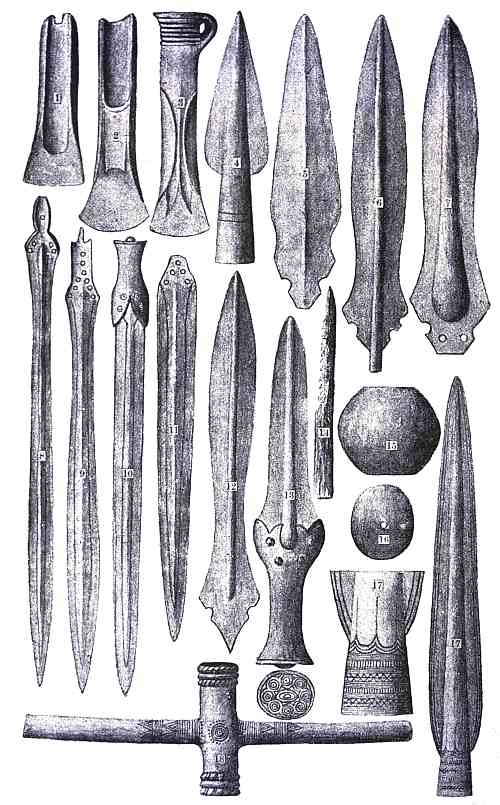
Fig. 97.—Spandau. Nos. 8 to 11 = 1⁄6, and the rest 1⁄3 real size (socket of No. 17 = 2⁄3).
Of stone objects there were two round grindstones or polishers (No. 15) and some sharpening stones, a polished perforated stone (No. 16), a portion of a hammer of greenstone, and a round stone ball 4 inches in diameter, like a cannon-ball.
Five staghorn axe-heads, a disc of horn perforated, a portion of a horn spear, five bits of rough unornamented pottery, and a large perforated ball of clay. Fragments of a canoe showing a length of 10 feet. Report goes that an iron implement, and a portion of a dish like earthenware of the twelfth century, were found; but probably they had no connection with the bronze objects above described. It is noteworthy that all the relics are of a military character, there being among them no spindle-whorls, combs, hair-pins, fibulæ, bracelets, or any other objects that can be said to belong to domestic life. For this reason this lacustrine abode is generally supposed to have been a military fort like La Tène. (B. 384 and 396.)
(c) POSEN AND POLAND.
Objezierze.—In the province of Posen there are several localities to be recorded which have yielded unequivocal indications of lake-dwellings, two of which, viz. Objezierze and Czeszewo, are supposed by local archæologists to date as far back as the Stone Age. The former existed in a swamp now filled up with peat, which has thus preserved and concealed piles and other remains recently brought to light by peat-cutters. The relics collected from this place are now deposited in the Posen Archæological Museum, and among them I have noted the following:—A few remarkably fine knife-flakes of flint, one of which is 7½ inches long, a perforated bead, four large clay rings (Fig. 98, No. 8), and three flint celts of the Scandinavian type (No. 7). In the same turf moor and in the vicinity of the lake-dwelling was found a large bronze torque ornamented as shown in No. 9.[56]
Czeszewo (Kr. Wagrowice).—Although for many years the existence of piles in a particular spot in this lake was known to fishermen, it was not till 1871 that their true nature was recognised by Professor Lepkowsky of Krakow. The lake was surrounded by marshy borders and peat bogs, and at various times its level was lowered, which thus considerably reduced its area. Firewood being scarce in the district, the fishermen were in the habit of pulling out the piles, and in this way the structures were greatly damaged before a competent archæologist saw them. The site of the Pfahlbau was near a large tumulus constructed close to the original lake margin. The area occupied by the piles was in the form of a segment of a circle, the base of which was 250 paces long and its greatest breadth 75. Transverse beams from 10 to 12 feet long were found interspersed among the uprights, which were supposed to have bound the latter together, though neither wedges nails, nor mortises were detected. It was observed that the uprights had their tops charred and that the portions remaining were longer the farther they were placed from the shore, and hence it was supposed that the dwelling had been destroyed by a conflagration.
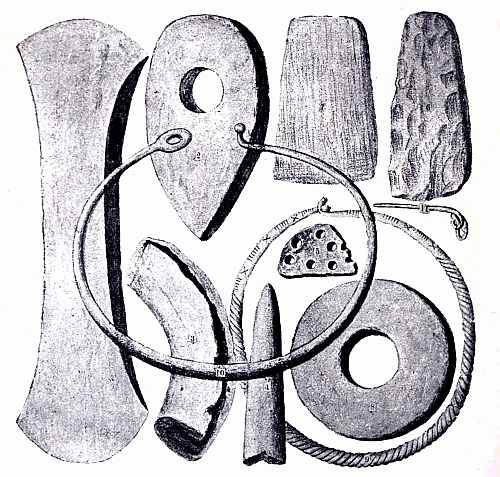
Fig. 98.—Czeszewo (1 to 6), Objezierze (7 to 9), and Lagiewnicki. All 1⁄2 real size.
The remains of human industry collected from this station are now deposited partly in the Jagellon Museum at Krakow, and partly in the Archæological Museum at Posen. Among them are fragments of pottery, one being part of a dish perforated with small holes (Fig. 98, No. 5), perforated stone and horn hammers and axes (Nos. 1 and 2), one or two plain celts (No. 6), some fragments of clay rings (No. 3), two fragments of human skulls, and a large quantity of the osseous remains of different animals. One object of bronze is said to have been found on this station, and one of the stone implements is only partially perforated, the operation having been unfinished. The stone objects are made of dark granite.
Messrs. Kohn and Mehlis have published a small photographic view of the objects in the Krakow Museum, but the more interesting ones, though fewer in number, are at Posen, from which the illustrations here shown are taken. Notices of this lake-dwelling have been published by Count Przezdiecki (B. 156 and 195), by Kohn and Mehlis (B. 338), and by Ossowski of Krakow (B. 361)—the last being in Polish and French.
Grossesee.—At Alt-Gortzig, in the Grossesee, there was a small island which became visible on the lowering of the lake some 10 feet, around which were found piles and the usual débris of a lacustrine dwelling, among which were pottery with parallel and wavy lines, charcoal, and an iron axe-head, together with numerous osseous remains. (B. 228 and 352.)
Pawlowice.—Mr. Schwartz, of Posen, describes what he considers to have been a lake-dwelling near Pawlowice. Here, in a turf-moor which had formerly been a lake, he found, at a depth of five feet, bits of clay plaster, hearth-stones, fragments of cooking vessels, etc.[57] Also at Komorowo, in the Bythinersee, indications of lake-dwellings have been found.[58]
Lagiewnicki.—Another interesting locality, discovered a few years ago, is at Lagiewnicki (Posen). Here the tops of oak piles were found at a depth of five feet in the peat, and associated with them were fragments of two kinds of pottery—one rough, like that used in the manufacture of urns, and the other of the Burgwälle type. Among the relics were a wooden mallet, a perforated bone implement, some flint flakes, the pin of a bronze fibula of La Tène type (Fig. 98, No. 11), and a silver necklace (No. 10), terminating at one end in a raised button which clasped with an eye at the other when fastened. (B. 430.)
Kwaczala.—At the request of the Academy of Sciences of Krakow, Mr. Adam Kirkor, curator of the Archæological Museum at Wilna, investigated, in the summer of 1873, a peat-moor near the village of Kwaczala, said to contain pile-dwellings. Mr. Kirkor found beams and piles in several spots pointed out by the proprietor, where the peat-cutters were said to have formerly encountered woodwork. Water came upon his trenches at a depth of three feet. Both upright and transverse beams of oak were found, some being over a yard in circumference and 8½ yards long. The area containing structural remains of woodwork was 70 yards long by 40 broad. The foundation was of horizontal beams, spread out in all directions, which he concluded to have been arranged after some kind of architectural principle. There was a large quantity of rude pottery, some showing linear or punctured ornamentation. Two perforated axe-hammer heads of stone, and about 300 bits of worked flint were collected among the débris, as well as some bones of the horse. Altogether, this primitive habitation appears to have been of a peculiar kind. (B. 338.)
Bialka (Lubliner Kr.).—In the moor of Bialka, formerly covered with water, there is a small island about 100 paces in diameter, on which tradition says there was once an enchanted castle. Professor Joseph Przyborowski, of Warsaw, made some excavations on the island, and found on the surface some tiles and modern implements, which so far confirmed the tradition of the ancient castle; but upon digging he came upon wooden piles at a depth of four feet. His excavations extended some twenty feet long and nine feet wide, and in the whole of this area he found numbers of piles, as well as cross-beams. Associated with these wooden structures there was also a relic-bed, entirely distinct from the superficial layer, on which he found two well-formed flint arrow-heads, a portion of a perforated axe of serpentine, some flint implements, and broken bones of edible animals. If this site were properly investigated the author prognosticated results of considerable scientific value. (B. 338.)
Professor Ossowski, in his "Carte Archéologique" (B. 361), gives the following sites of lake-dwellings, none of which, however, have been carefully investigated:—(1) Warlubie (Kr. Swieć). This is a vast peat deposit from which neolithic implements and staghorn hammers have been extracted from time to time. It was visited by Ossowski in the year 1878, who found some fragments of pottery and charcoal. But these merely strengthened the suspicion that the antiquities were due to Pfahlbauten. (2) Similar indications were found at Kowalewo, in the district of Tornú. (3) At Wabrzeźno, in the district of Chelmno, there is a small lake, in which were found a primitive vase, a bronze fish-hook, a stone hammer, and an implement of staghorn. (4) Lankorsz, district of Lubawa.
(d) EAST PRUSSIA AND LIVLAND.
In the eastern districts of Prussia lake-dwelling remains have been discovered in the following places, which have been more or less investigated and described in various archæological publications, especially in the Altpreussiche Monatsschrift:—
Aryssee (Kr. Lötzen).—A. M., vol. iv. p. 667; xii. p. 89; xiv. p. 181. Zeit. für Ethn., vol. xix., Verhand., p. 491.
Czarnisee (Kr. Lötzen).— A. M., vol. xiv. p. 181; vol. xv. p. 481.
Kocksee (Kr. Rössel).—A. M., vol. xxii. p. 169; Zeit. für Ethn., vol. xvi., Verhand., p. 560.
Probchensee (Kr. Rössel).—A. M., vol. xxii. p. 169
Quertz (Kr. Heilsberg).—A. M., vol. xxii. p. 169.
Bonslack (Kr. Wehlau).—A. M., vol. xxii. p. 485.
Tulewosee (Kr. Lyck).—A. M., vol. v. p. 750.
Szontagsee (Kr. Lyck).—A. M., vol. xxiv. p. 488.
Kownatkensee (Kr. Niedenburg).—A. M., vol. xxiv. pp. 168 and 496.
Lonkorreckersee (Culmerlande).—A. M., vol. x. p. 579.
Geserichsee—Phy. Ok. Gesel., 1874, Verhand., p. 14.
Aryssee.—The existence of the débris of a remarkable lake-dwelling in the Aryssee became known in 1863, in consequence of the discontinuance of a mill which had its motive power supplied by the surplus water from this lake, and the subsequent deepening of its outlet, which had the effect of lowering its level about seven feet. Its remains have been investigated and described by various persons, notably Professor Heydeck, of Königsberg, who has made plans and models of its peculiar structure. These, as well as a large collection of relics, are now deposited in the Prussia Museum at Königsberg. It appears to have been a kind of Packwerk. There were, first of all, two or three layers of round timbers lying transversely to each other on the bottom of the lake in the form of rectangles, after which their sides only were continued upwards by single beams, laid successively on each side, thus leaving empty spaces above. These horizontal beams were kept in position by numerous uprights, which here and there flanked them on both sides, as well as by deep cuts towards their extremities where they overlapped each other, precisely similar to the plan adopted at Persanzig and elsewhere. This understructure had a thickness of three to four feet, and over it was laid a wooden platform, above which the huts of its inhabitants were constructed. Clay floorings were found over these platforms, with evidences here and there of fire-places. The relics were found both on the platform and in the originally empty spaces, which, of course, were now filled up with débris. Upon its first appearance there was a layer of from 1½ to 2 feet of mud over the woodwork, but after its exposure for some time the mud dried and became greatly contracted. The central area of this structure measured 72 by 36 feet, and was surrounded by three rows of piles. A bridge or gangway, also constructed on a triple row of piles, extended to the shore, a distance of about fifty yards.
At first, and for several years after its discovery, no metal objects were found, and hence it was supposed to belong exclusively to the Stone Age; but this is no longer the case, as latterly it has furnished both iron and bronze objects.
Among the relics are the following:—fragments of an iron socketed lance-head 4 inches long, a large bronze button 1¾ inch in diameter, and a portion of cast bronze. Wooden hooks, like those from Robenhausen, and perforated square bits, supposed to have been floats for nets. Fragments of pottery and some whole dishes, the largest being 18 inches high, showing nail and finger marks (Fig. 99, No. 11), perforated rims (No. 10), and sometimes handles. A few flakes, arrow-points, and scrapers of flint (Nos. 8 and 9). Fragment of a perforated axe-hammer of diorite and some mealing stones. Six perforated horn axes, the largest 6½ inches long; pointers, pins, two needles, and various other objects of bone (Nos. 1 to 7). Arrow-points of bone are 3 to 4 inches long, and scrapers 1½ to 3½ inches. Portions of roofing thatch of rushes, clay flooring, etc.
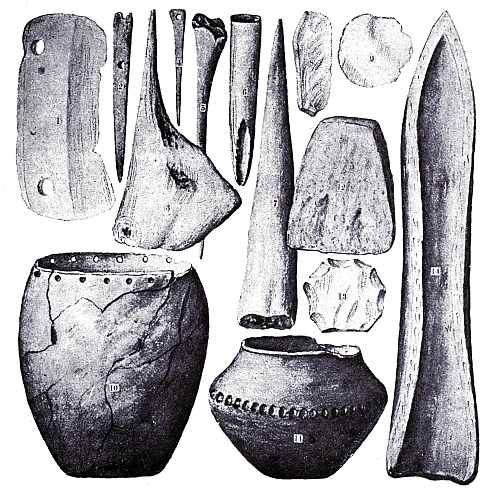
Fig. 99.—Arys and Kownatken (12 to 14). No. 10 = 1⁄8, 11 = 1⁄4, and the rest = 1⁄2 real size.
Czarnisee and Tulewosee.—These two lakes are in the vicinity of the Aryssee, and each contained a lake-dwelling similar to that in the latter, both in structure and in the character of its relics. On the station in the Czarnisee were found a blue glass bead; a partially perforated stone axe, 3⅛ inches long, with the core still remaining; and two socketed iron lance-heads.